My protest sign focuses on human rights while another sign I created calls for ICE to get out of Rice County and Minnesota. (Minnesota Prairie Roots copyrighted photo February 2026)
I PULLED OUT my long johns, wool socks, stocking cap, mittens, hand warmers, winter boots and scarf. Then I pulled out my parka and my protest sign: STAND UP FOR HUMAN RIGHTS.
This photo shows just a section of the protesters lining Minnesota State Highway 60 on Saturday. Protesters meet here weekly at 11 a.m. for an hour of peaceful protest. (Minnesota Prairie Roots copyrighted photo February 2026)
Just before 11 a.m. Saturday, Randy and I joined others outside the Rice County government services building along Minnesota State Highway 60 for our fourth protest there and the fifth in Faribault. Each week numbers grow, this time reaching some 80 of us stretched along the sidewalk with our signs.
Bundled up in 25-degree temps, a protester displays a sign against ICE. (Minnesota Prairie Roots copyrighted photo February 2026)
We are not agitators or paid protesters as some claim, but rather ordinary Minnesotans united, called by our morals, our compassion, our concerns, to publicly say we are not OK with what is happening in this country. We are Minnesotans who care about immigrants and refugees, about freedom, about the Constitution, about due process and much more. We are concerned about the presence of ICE agents, whom we want out of our community, out of our state, after two-plus months of occupation.
If you look closely at the banner on the lamp post, you will see a photo of a local veteran. Many veterans have joined the Saturday protests, recognizing the importance of standing up for freedom and Constitutional rights. (Minnesota Prairie Roots copyrighted photo February 2026)
And so we protest, week after week in our community an hour south of Minneapolis, because our city, too, has been impacted by ICE. People have been taken by federal agents from an apartment complex near the public library, by the railroad tracks near the turkey processing plant, from the trailer parks… It’s documented in videos. Warning horns blare, whistles sound, bystanders yell, sometimes. ICE has parked for hours in a neighborhood with Hispanic families. Watching, intimidating, silently threatening. Agents have photographed license plates at a gas station. This is reality in my city of 25,000.
School attendance has dropped. People are afraid to go to work, afraid to go grocery shopping and/or to food shelves (because ICE is watching), afraid to go to the doctor, afraid to leave their homes for fear of being taken by ICE. Legal status doesn’t seem to matter, only skin color, although even white people have been detained (with two killed) in Minnesota. Neighbors, churches and more have rallied to help with grocery shopping and delivery, walking kids to bus stops, giving co-workers rides. That support matters as does participating in protests. I’ve personally been thanked by Latinos and a Somali man for protesting.
This is why I’ve become an activist. This is why I use my voice as a writer and photographer. That is why I’ve started volunteering at a local food shelf. No one should live in fear of simply going about their daily lives. I am also doing this for my young grandchildren. I want them to understand the importance of speaking up for others. I want them to realize, when they are old enough, that their grandma did not remain silent in the face of atrocities inflicted by the federal government upon its people.
One protester drew on history to create his protest sign. (Minnesota Prairie Roots copyrighted photo February 2026)
There is value in publicly taking a stand, especially in a city like mine which votes red. (Well, certainly not all of us.) Every protest brings out some who object to our activism as they drive by. That is their Constitutional right. They flash middle fingers, shout profanities, sometimes drive aggressively close, raging mad. That is not OK, potentially endangering people protesting in a public space. But we remain undeterred in raising our voices.
Cold winter weather has not stopped Minnesotans from bundling up to speak up. (Minnesota Prairie Roots copyrighted photo February 2026)
ON TUESDAY, FEBRUARY 10, a group of county residents are going to the Rice County Board of Commissioners meeting to speak about the impact of ICE on the community. That will happen during the open comments portion of the meeting at 8 a.m. I’m not part of that group, but was made aware of it. I’ve felt for a while that our local city and county government officials need to address this topic. ICE is certainly having a negative impact on the health, safety and well-being of county residents both directly and indirectly. That should not, and cannot, be ignored.
We must all do whatever we can, whenever we can, however we can to speak up, help and love our neighbors, and stand strong in the face of tyranny and injustice.
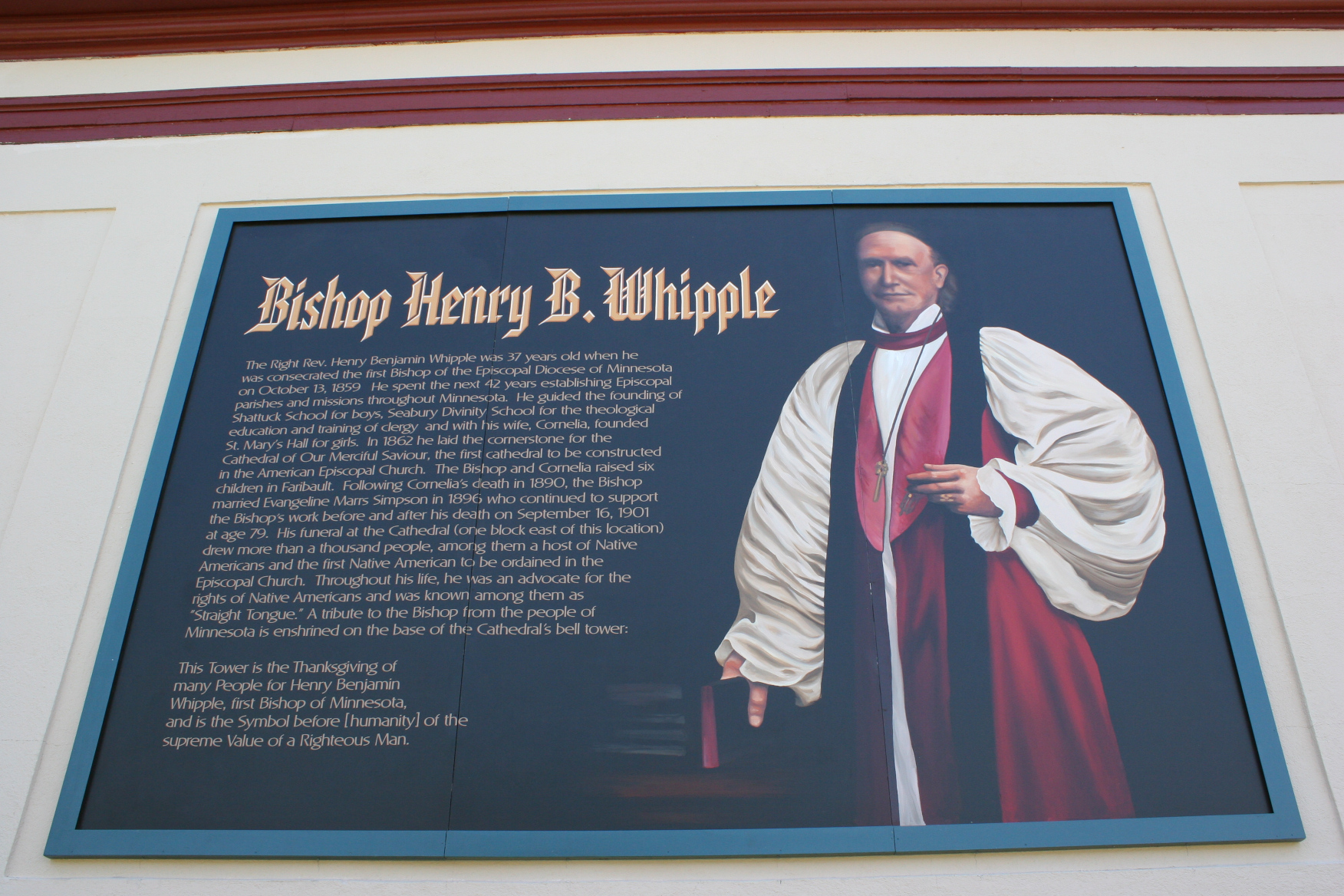
A mural on the bandshell at Faribault’s Central Park honors Bishop Henry Whipple. (Minnesota Prairie Roots copyrighted file photo)
I EXPECT BISHOP HENRY WHIPPLE may be turning over in his grave under the altar inside the Cathedral of Our Merciful Saviour in Faribault. He would be appalled by what’s happening in this community with ICE enforcement. And he would also likely be standing side-by-side with protesters outside the Bishop Henry Whipple Federal Building at Fort Snelling protesting ICE’s presence in Minnesota. The federal agents are based inside the building named after him.
Whipple was all about compassion and embracing others, especially as a friend to the Dakota in Minnesota following his arrival here in 1860 and throughout his ministry. He would not be fine with ICE violently, or non-violently, taking people from their vehicles, their homes, clinics, outside schools and churches, inside businesses…and illegally detaining them without due process. That includes those here legally and American citizens imprisoned inside the building bearing Whipple’s honorable name.
I am not OK with this. None of us should be.
HOW BISHOP WHIPPLE MIGHT REACT
As Minnesota continues to deal with the presence of 3,000 ICE agents in our state, I think of the Episcopalian bishop, known as “Straight Tongue” for his honesty, and how he would react. He would assuredly be on the streets advocating for human rights. He would be talking with the current president, just like he did in 1862 with President Abraham Lincoln. Whipple traveled to DC then to personally plead for the lives of 303 Dakota sentenced to death by hanging.
Whipple would probably also be out buying groceries for Faribault residents afraid to leave their homes. He would be walking kids to their bus stops in trailer parks. He would be preaching peace, love and compassion.
HONORING WHIPPLE’S LEGACY
Those who disliked Whipple, and the Dakota, disparagingly tagged the clergyman as “The Sympathizer.” Little has changed. There are far too many in my community who hate, and, yes, that’s a strong word, anyone whose skin color is other than white. I don’t understand. They all, unless they are Native American, can trace their presence in America back to immigrants.
If only Bishop Henry Whipple was still alive to spread love in Faribault and beyond. It’s up to us to honor his legacy by loving and helping our neighbors during these especially dark days of injustice and oppression.
#
FYI: To learn more about the bishop, I direct you (click here) to a previous blog post I wrote about him and his role in Minnesota history following a 2023 presentation at the Rice County Historical Society.
Photographed many years ago in downtown Faribault.(Minnesota Prairie Roots copyrighted file photo used here for illustration only)
MY SUNDAY BEGAN as most Sundays do with morning worship at my church. The sermon highlighted sections of Mark 12, which includes this verse: Love your neighbor as yourself. That would theme the rest of my day.
Hours later I found myself gathered with others for the annual Rice County Salvation Army Red Kettle Campaign Kickoff. Again, the focus was on neighbors, specifically helping our neighbors in need.
Shortly after that event, Randy and I were on the road to neighboring Northfield for a 5 pm candlelight prayer vigil at Bridge Square. That, too, was about loving our neighbors. This time the gathering focused on supporting the family of Adan Nunez Gonzalez, a 41-year-old father of four snatched by masked Immigration and Customs Enforcement agents at gunpoint on November 11 in a residential neighborhood of Northfield. That incident has sparked outrage in this southern Minnesota college town and beyond.
Several family members and others witnessed Nunez Gonzalez being pulled from the passenger side of a vehicle while he was arriving at a job site along Washington Street. He’s a painter, originally from Mexico, with reportedly no criminal record who has been living in the US for 11 years. The entire incident was captured on video by his teenage son, called to the scene, and has been widely-circulated on social media. Nunez Gonzalez is now being held in the Kandiyohi County Jail. That county is among eight in Minnesota assisting with various aspects of ICE enforcement efforts. My county of Rice is not among them.
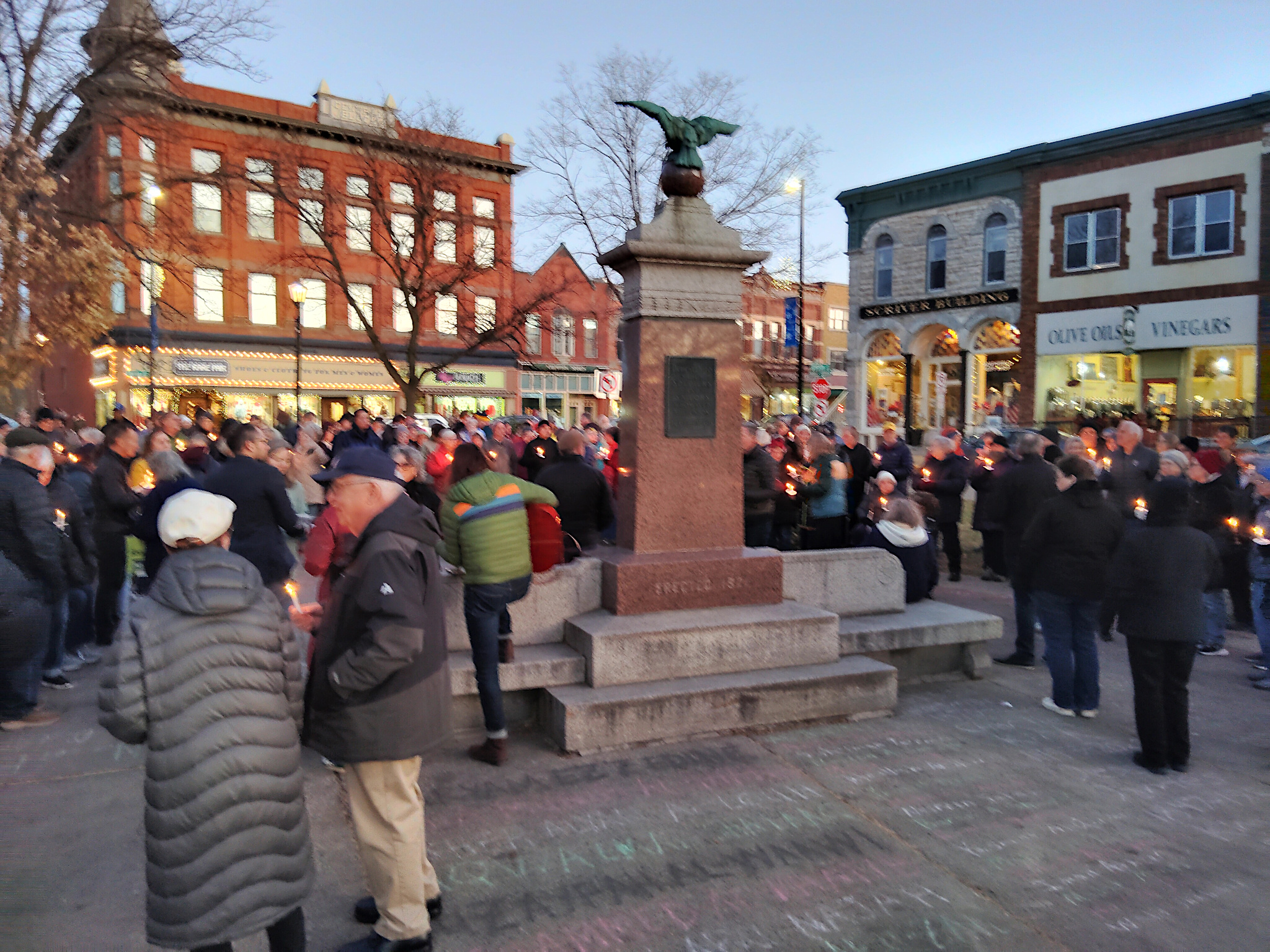
Attendees gather at Bridge Square as the candlelight prayer vigil is about to begin. (Minnesota Prairie Roots copyrighted photo November 2025)
HEAVY, YET HOPEFUL, HEARTS
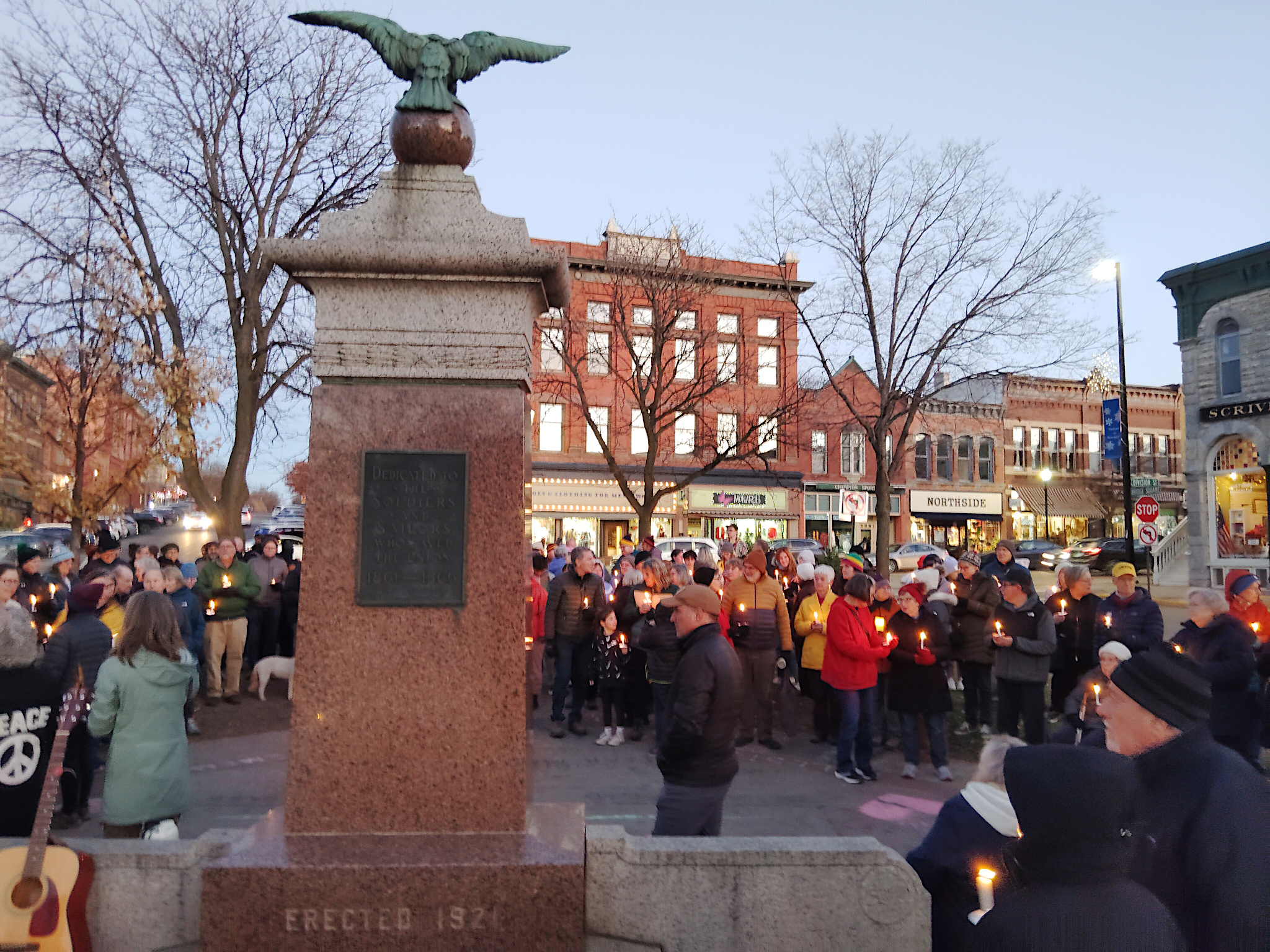
The mood at Sunday’s prayer vigil felt heavy, yet hopeful, as some 200 of us gathered in the town square for this event organized by the Northfield faith community. As the sun set, as the nearby Cannon River roared over the dam, candles were distributed, lit and the crowd pressed together around a monument honoring Civil War soldiers. In late September, football players from Carleton College, blocks away, met here to turn the eagle atop the monument toward their college after defeating across-town rival St. Olaf College. It’s an annual celebratory tradition for the winning team.
Bridge Square has long been a community gathering spot, a place to celebrate, to peacefully protest, to meet one another for local events.
On this mid-November evening, it felt right and necessary to be here. To pray. To sing. To hear scripture quoted. To contemplate the gravity of ICE actions that have traumatized, torn families apart, instilled fear in communities across the country, raised the ire and concerns of many Americans like me who care about our neighbors and how they are being unjustly treated. Taken by armed, masked ICE agents and Border Patrol. Confined. Deported. Without due process of law.
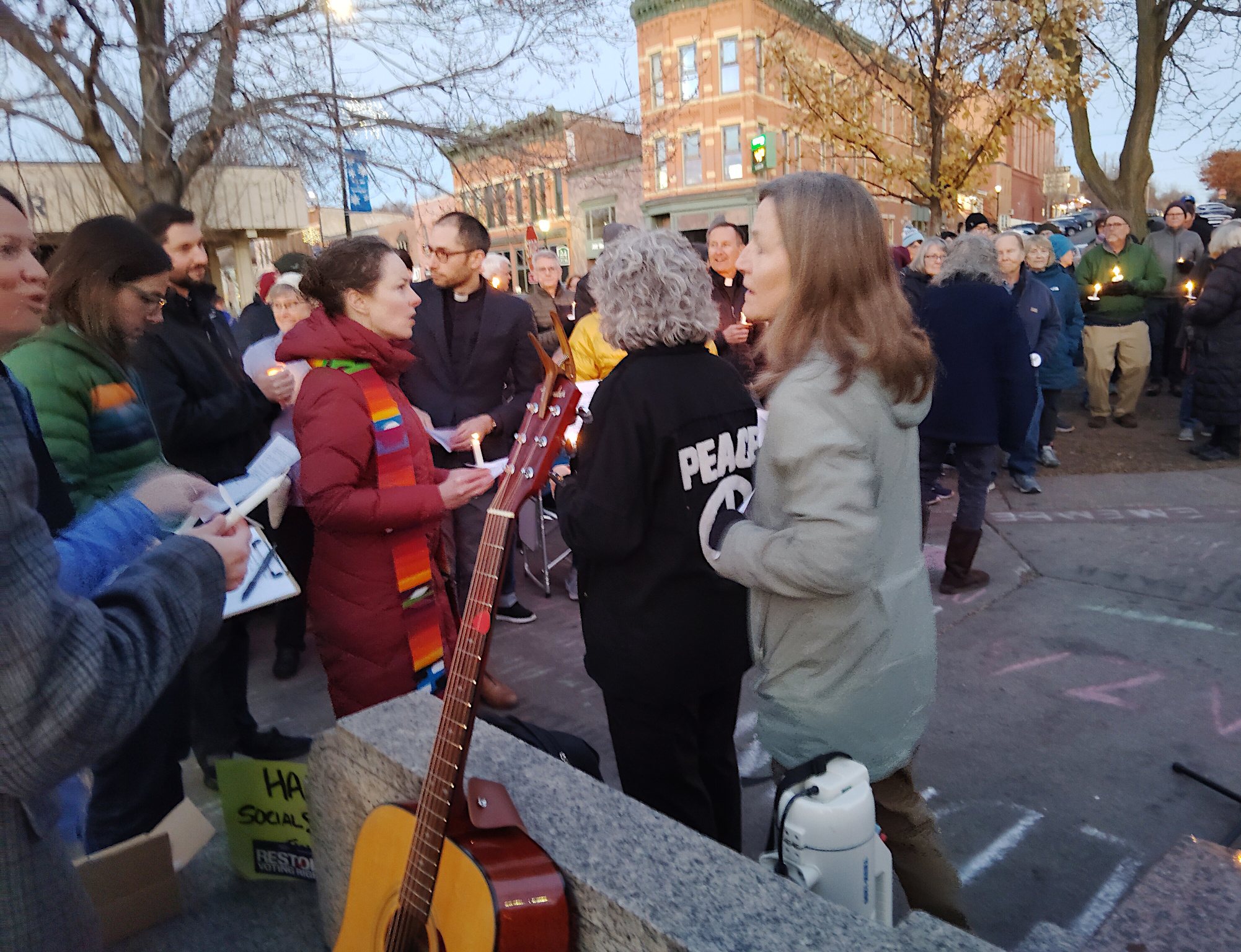
Clergy gather before the start of the prayer vigil. (Minnesota Prairie Roots copyrighted photo November 2025)
A COMMUNITY RESPONDS
I felt the unity of a community determined to raise their voices and to take action. Northfielders have fed the family of their detained neighbor, organized activities for his children, started a GoFundMe to cover legal and other expenses, emailed support, expressed outrage and much more.
Love your neighbor as yourself was emphasized by clergy leading the vigil. One after another they stepped up to the mic, the first pastor leading us in The Lord’s Prayer. One referenced the biblical parable of the mustard seed and how we are to plant seeds of hope, faith, advocacy that will grow sturdy and strong among us. Another spoke of Jesus and his family fleeing to Egypt after his birth following threats from King Herod to find and kill all first-born males. It was fitting.
Another view of the crowd, not all of it, but a section of the attendees. (Minnesota Prairie Roots copyrighted photo November 2025)
A BIBLICAL DIRECTIVE
And then there was the well-known scripture from Matthew 25 in which Jesus asks us to care for one another—when hungry or thirsty, in need of clothing, when sick and in prison. It is as strong a directive as any in the bible to love our neighbors and to show that love in kind, caring and compassionate action.
The 25-minute Sunday evening prayer vigil closed with singing of “This Little Light of Mine.” Voices rose clear and strong in the darkness, arms stretched high, each hand grasping a single candle. A light. Many candles shining lights of support, hope, protest, resistance, outrage and more in a community that cares deeply about its neighbors.
#
NOTE: Please check back for a second “Love your neighbor” post, this one on the Salvation Army Red Kettle Campaign Kickoff.Also, note that the vigil images in this post were taken with my smartphone, thus the quality is not great compared with pix I would have taken with my 35 mm Canon. I left that at home, opting to be in the moment.
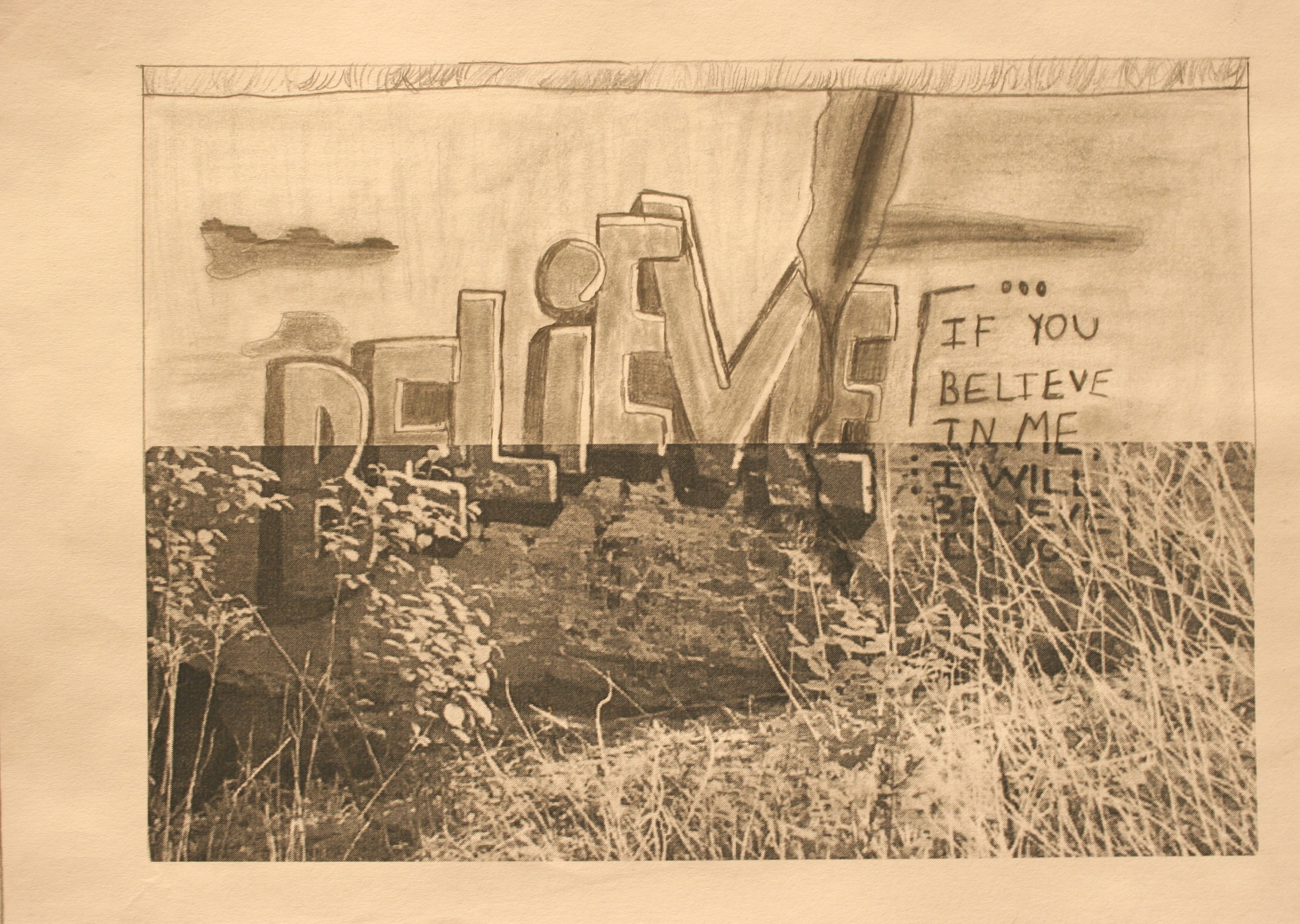
“Believe” by Mackenzie Miner, a then eighth grader at Faribault Middle School, was exhibited at a past student art show at the Paradise Center for the Arts. (Minnesota Prairie Roots copyrighted file photo)
DURING THE PAST SEVERAL DAYS, I’ve thought a lot about how to craft an Easter message about living my Christian faith against the backdrop of what’s happening in our country today. It’s tough, really tough, to feel positive and joyful. But I must believe that things will get better. Eventually.
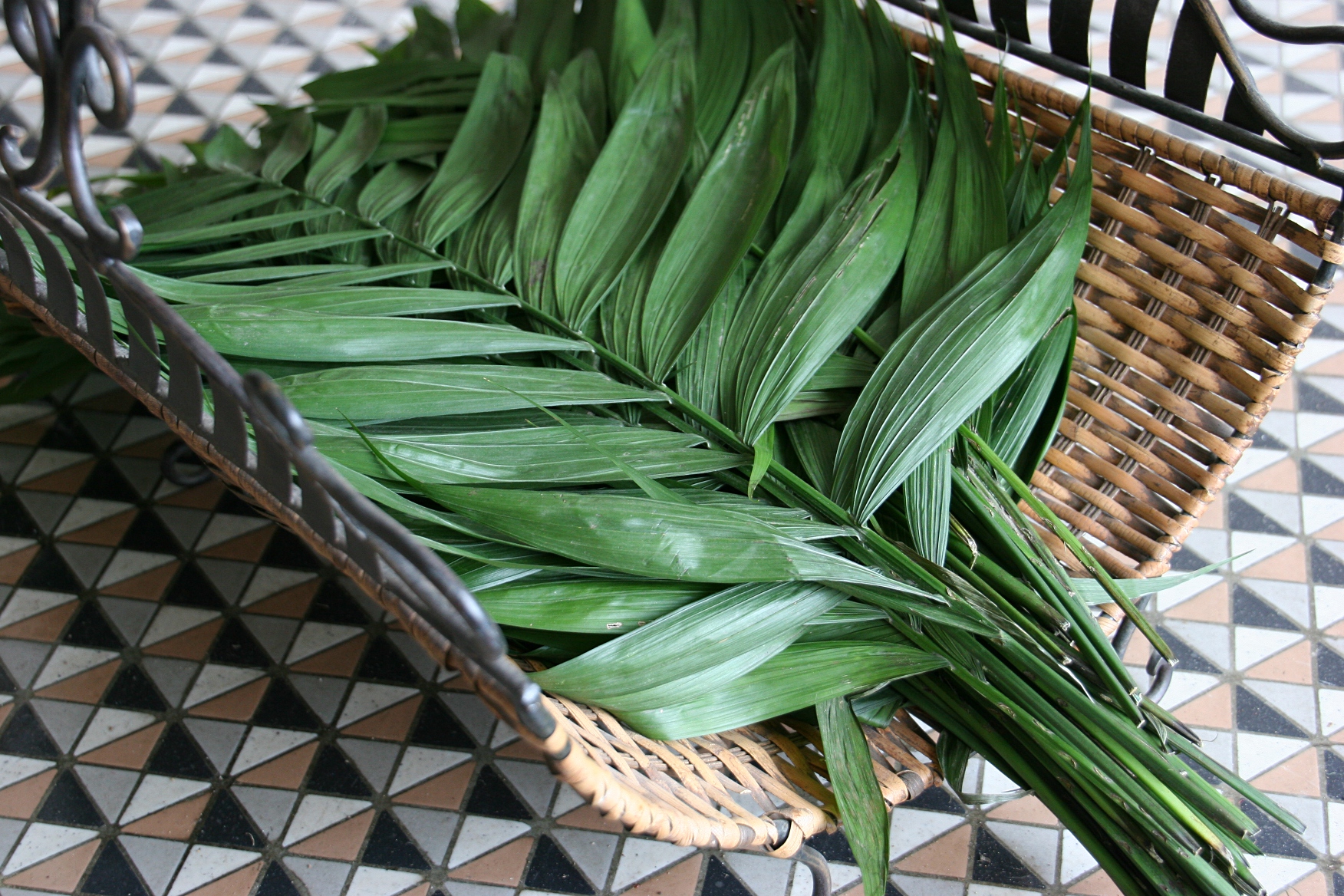
Rather than dwell on the totality of everything negative, I decided to focus on messages I heard during a Palm Sunday worship service at my eldest daughter’s Lakeville church. Randy and I were there for a pancake breakfast fundraiser and then to listen to our grandchildren sing. We—kids and adults alike—sang the traditional processional hymn, “All Glory, Laud and Honor,” as we waved palm branches. It was an uplifting, praise-filled, reverent experience, reminding me of Jesus’ triumphant entry into Jerusalem among a joyful crowd waving palm branches and shouting, “Hosanna!” Jesus rode in on a donkey, symbolic of his humility and humanity. Days later, the people would turn on Jesus and he would die an agonizing death upon a cross.
That journey to the cross, followed by the resurrection of Jesus on Easter morning, started on Palm Sunday, the beginning of Holy Week and a time of reflection. The service at St. John’s started with a blessing of the palms. That blessing set the tone for worship, at least for me. The palm branches we held represented celebration, justice and comfort. These are the words that most resonated with me:Bless these protest palms, O God of Justice…may they make us bold and brave to stand up against injustice.
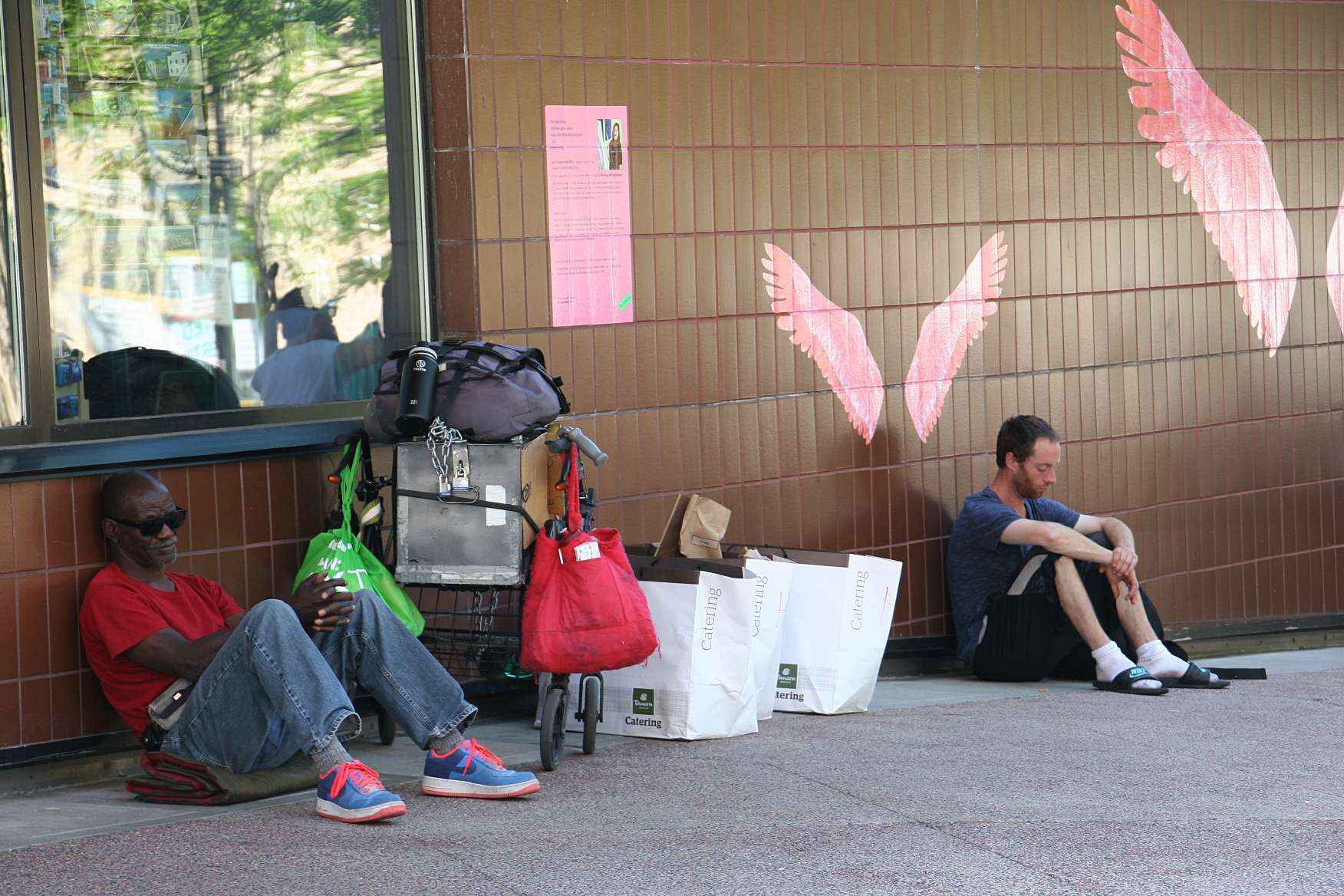
The unsheltered, photographed in downtown Madison, Wisconsin, in June 2018 near the state capitol. (Minnesota Prairie Roots copyrighted file photo)
So, as I stood at the back of the church, I waved my palm frond high like a protest sign, thoughts of injustices racing through my mind. I’ve done some protesting lately with my words. I felt encouraged and empowered to stand bold and brave against injustices. Jesus did. He called people out. He got mad. He chastised. He advocated for and helped those who suffered the most. The outcasts. The lonely. The poor and hungry. He showed compassion and love. He provided. He forgave.
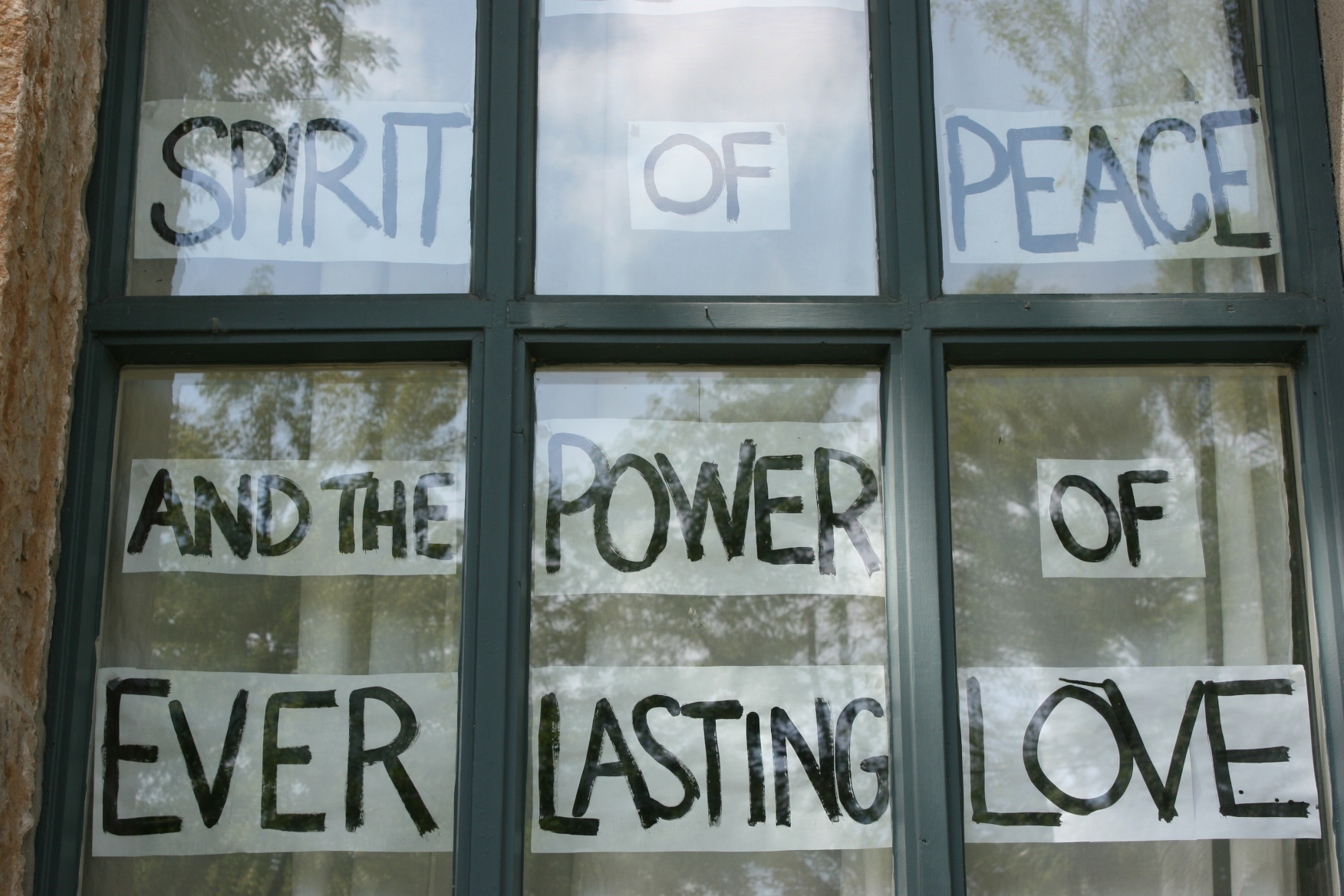
A portion of a quote by John Lewis posted in the window of a Dundas, MN., home. (Minnesota Prairie Roots copyrighted file photo)
Remember the once popular WWJD/What Would Jesus Do slogan? I think Jesus would be more than a little ticked off about the injustices today, how people are treating one another, how those in positions of leadership are abusing their power. Jesus did, after all, overturn the tables in the temple when it became a noisy marketplace for greedy vendors focused on making money rather than allowing people easy access inside for spiritual reasons.
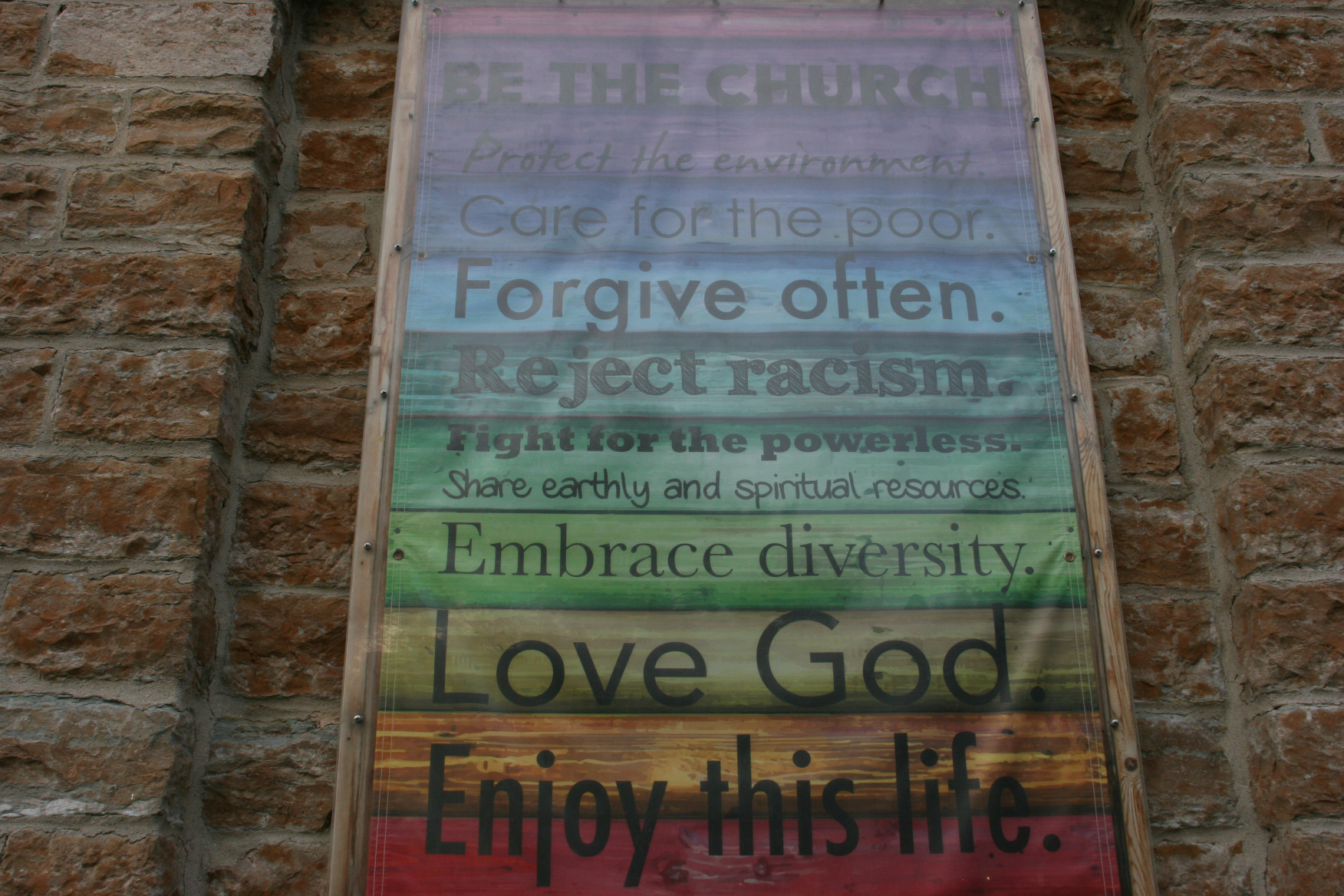
Posted on the exterior of the Congregational Church of Faribault United Church of Christ. (Minnesota Prairie Roots copyrighted file photo)
I’d like to think that Jesus wants every single one of us tobe bold and brave in our words and actions. It’s easy enough to sit quietly and do nothing. Just pretend all is well with everyone when, in reality, it’s not. People are struggling. In relationships. With unexpected and unnecessary job loss. Financially. Mentally. In ways I would never have thought possible in this country—suppression, oppression, ongoing discrimination, intimidation, imprisonment… Injustices run rampant.
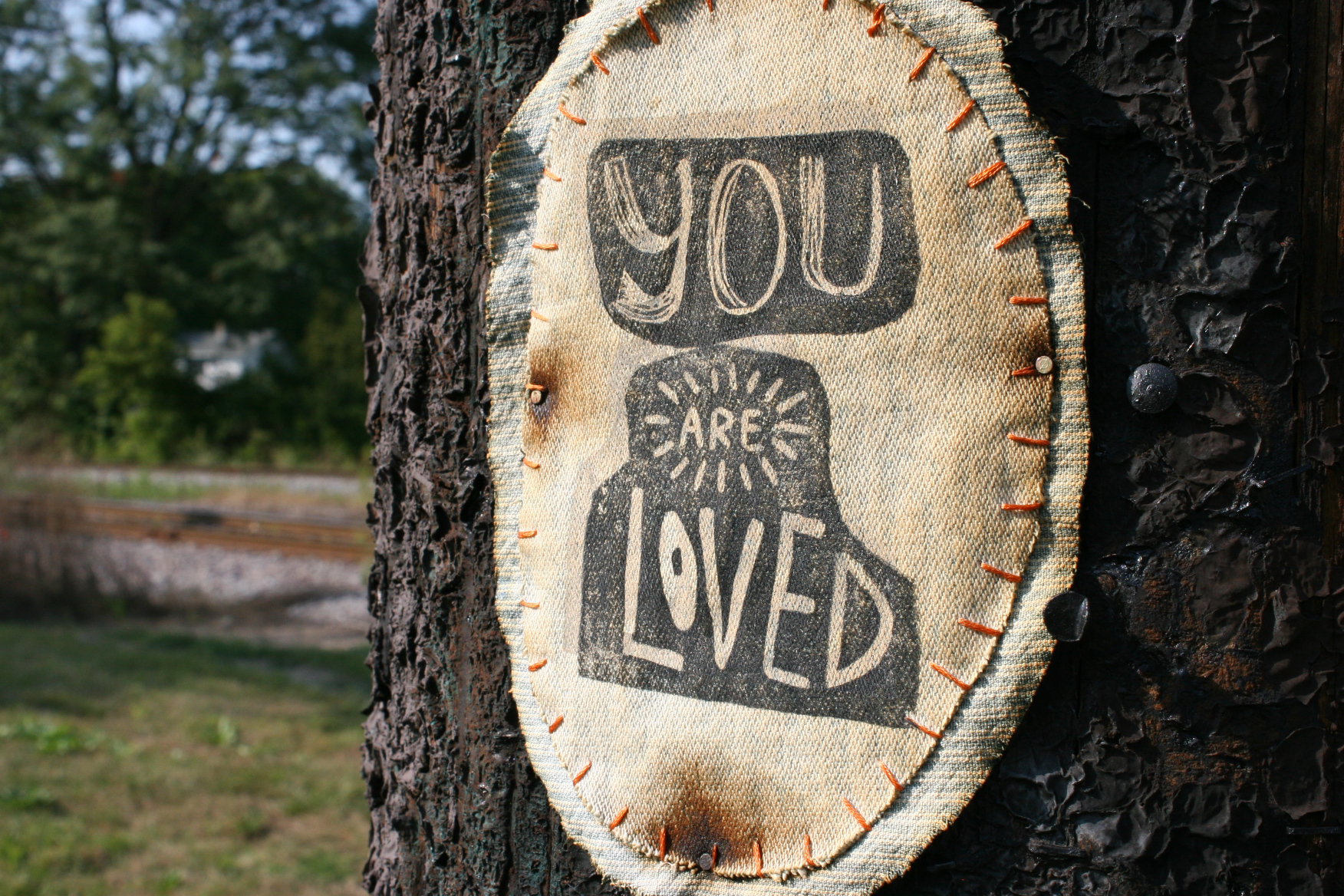
A loving message posted along a bike trail in Madison, WI. (Minnesota Prairie Roots copyrighted file photo)
We each have the power to do something about those injustices. Volunteer. Encourage. Donate money to charitable organizations or to individuals in and outside your circle who may need a little extra help right now. Smile. Be respectful. Extend small acts of kindness. Simply be a kind, decent, compassionate and loving person.
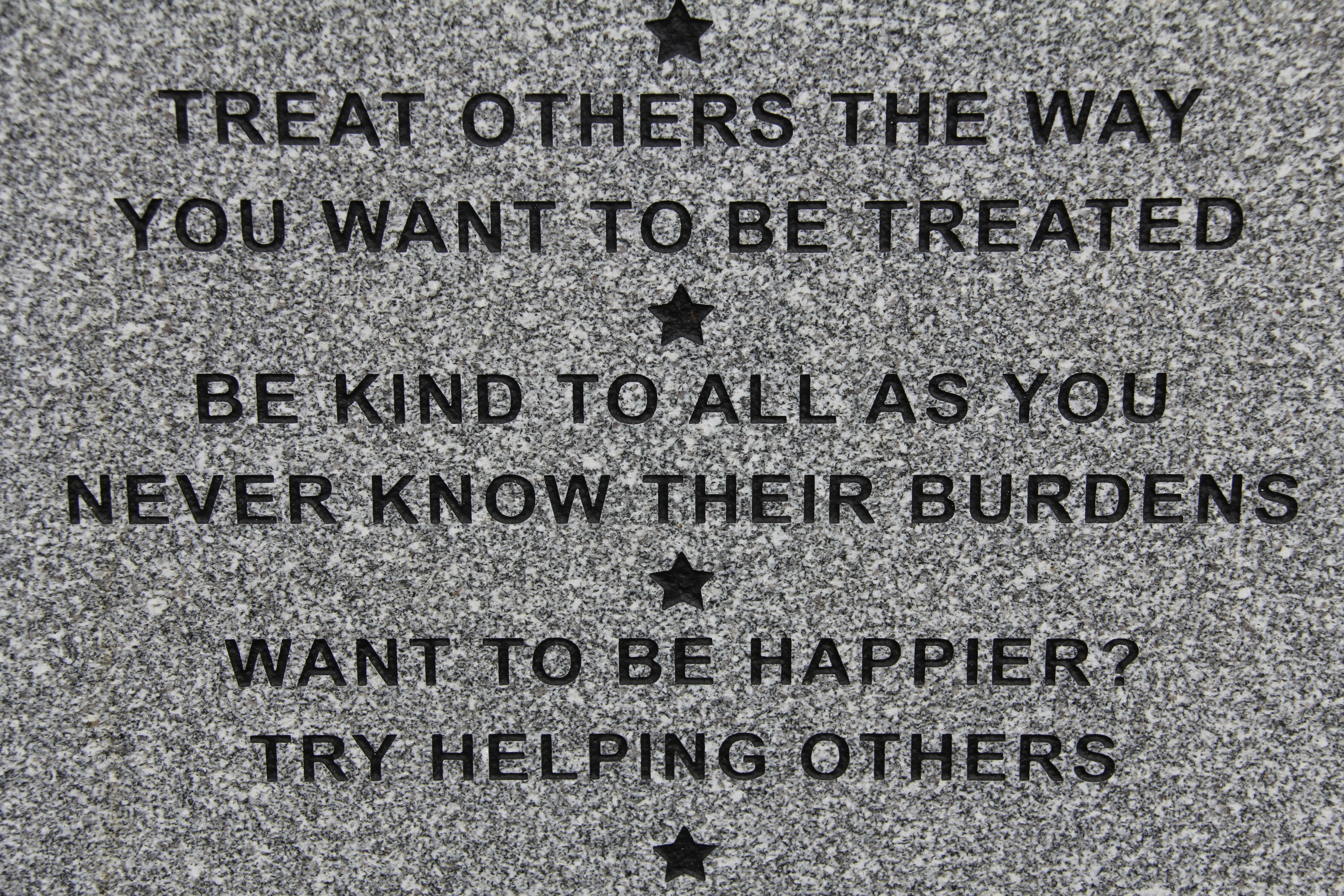
A message on a tombstone at Valley Grove Cemetery, rural Nerstrand. (Minnesota Prairie Roots copyrighted file photo)
But also don’t hesitate to bebold and brave to stand up against injustice, to wave your protest palm branch high, then higher still.
I happened upon this book while searching for recently-published astronaut and geography books for my 4-year-old grandson. I never did find those sought-after titles. Not that it mattered. What I discovered instead were three must-read books: My Powerful Hair, Boycott Blues—How Rosa Parks Inspired a NationandWe Are Better Together.
Parks is certainly familiar to me as the Black seamstress who in 1955 refused to give up her seat to a white man on a city bus in Montgomery, Alabama. That sparked a bus boycott and the Civil Rights Movement. Likewise, working together to effect change, to improve our world, to help one another is a familiar theme.
“The Native Man, His Eagle & His Chanupa,” an oil painting by Dana Hanson and part of her 2018 “Healing the Land” exhibit at the Owatonna Arts Center. (Minnesota Prairie Roots copyrighted file photo 2018, used for illustration only. Art copyrighted by Dana Hanson.)
THE IMPORTANCE OF HAIRREVEALED
It is the story on hair, though, which proved a particularly teachable read. My Powerful Hair focuses on Native Peoples’ hair and its importance in their culture, their history, their lives. Through the writing of New York Times bestselling and award-winning author Lindstrom, who is Anishinaabe/Metis (and an enrolled citizen of the Turtle Mountain Band of Ojibwe), and Indigenous artist Littlebird of Oregon’s Confederated Tribes of Grand Ronde, I learned the symbolism and power of hair in Native American culture. Admittedly, this is something I should have known, having grown up on the southwestern Minnesota prairie between the Upper Sioux and Lower Sioux Indian Reservations (today termed “communities”). I thought I was informed. But I wasn’t, not about hair.
Told from the perspective of a young Native girl, My Powerful Hair explains the reasons Native Peoples grow their hair long. And keep it long. Hair holds stories, memories, strength, sorrow, connections to each other and to Mother Earth. And more. Page after page, the narrator shares events in her life that weave into her hair. When Nimishoomis (her grandfather) taught her to fish, her hair reached her ears. When her cousins taught her to make moccasins, her hair flowed past her shoulders. In the sharing of these moments, I began to understand the power of hair in Native American culture.
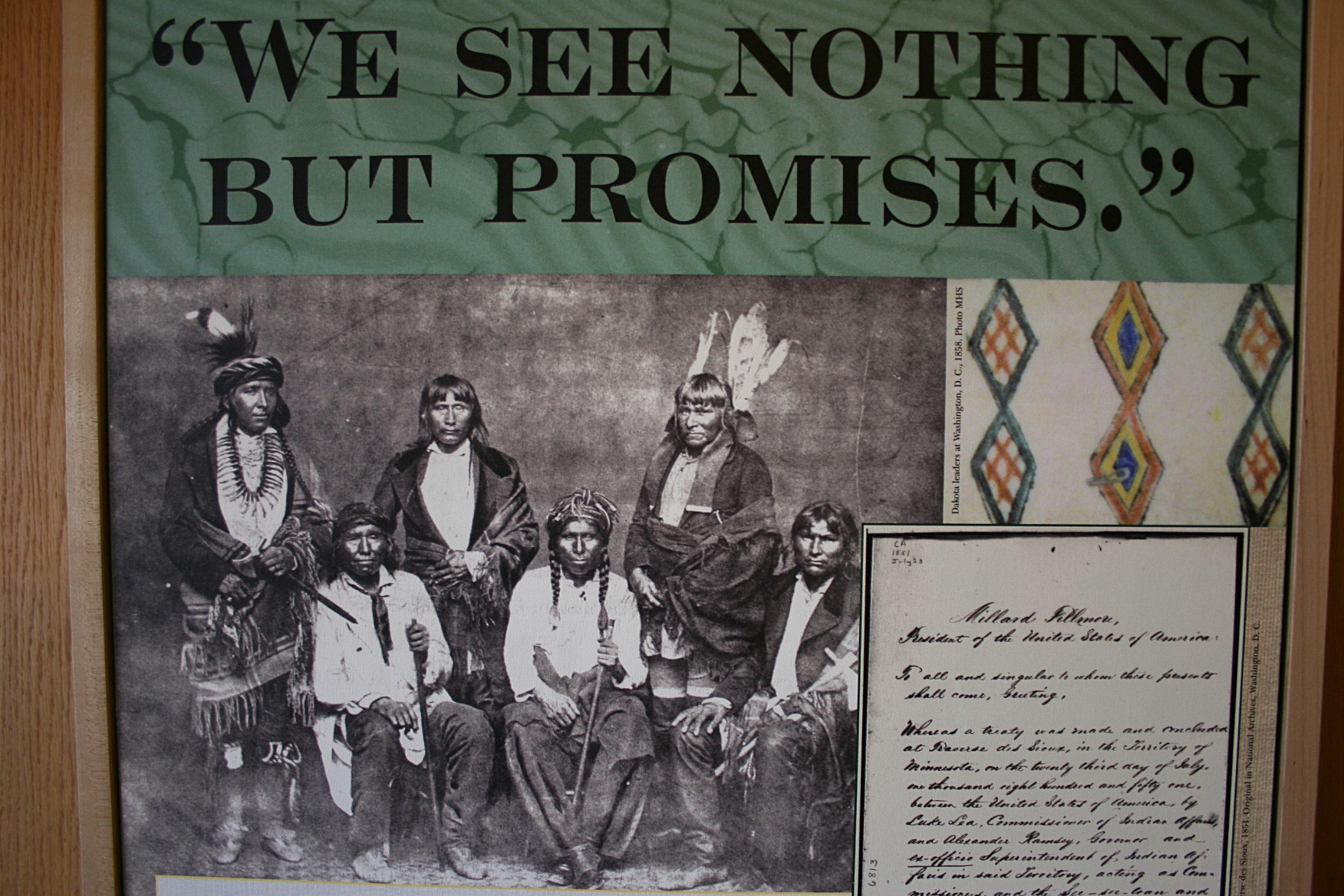
A photo panel at the Traverse des Sioux Treaty Center in St. Peter shows Dakota leaders photographed in Washington D.C. in 1858. The photo is from the Minnesota Historical Society and is used here for illustration only.
FORCED HAIRCUTS
I also understood fully, for the first time, the trauma inflicted upon Indigenous individuals forced long ago by white people to cut their hair. The writer and illustrator don’t hold back. In the first few pages, a young Nokomis (grandmother) is in tears as the hands of a Catholic nun grasp, then cut, her braids. It’s an emotionally impactful visual.
But this was reality at Indian boarding schools, within faith communities and elsewhere back in the day, in a time period when efforts focused on erasing Indigenous culture, on conforming Native Peoples to European ways. It was wrong.
Displayed at Bridge Square during Northfield’s Earth Day celebration in 2022. (Minnesota Prairie Roots copyrighted file photo April 2022, used for illustration only)
“A TERRIBLE INJUSTICE”
A blogger friend from the central Minnesota lakes region recently shared a bit of her family’s experience per my request. Of unverified (records were often destroyed) Cherokee ancestry, Rose speaks of her mother’s trauma after being sent to a Catholic girls’ school in Crookston. “Mom didn’t tell us much about her experience there,” Rose says, “only that they made her cut her long black hair. My mom never cut her hair again for the rest of her life. She saw the forced haircut as a terrible injustice.” Injustice seems a fitting word.
In an author’s note, Carole Lindstrom shares the same trauma, documented, she writes, in a photo of her grandmother and two great aunts with their black hair shorn above their ears. They were forced into an Indian boarding school in the early 1900s.
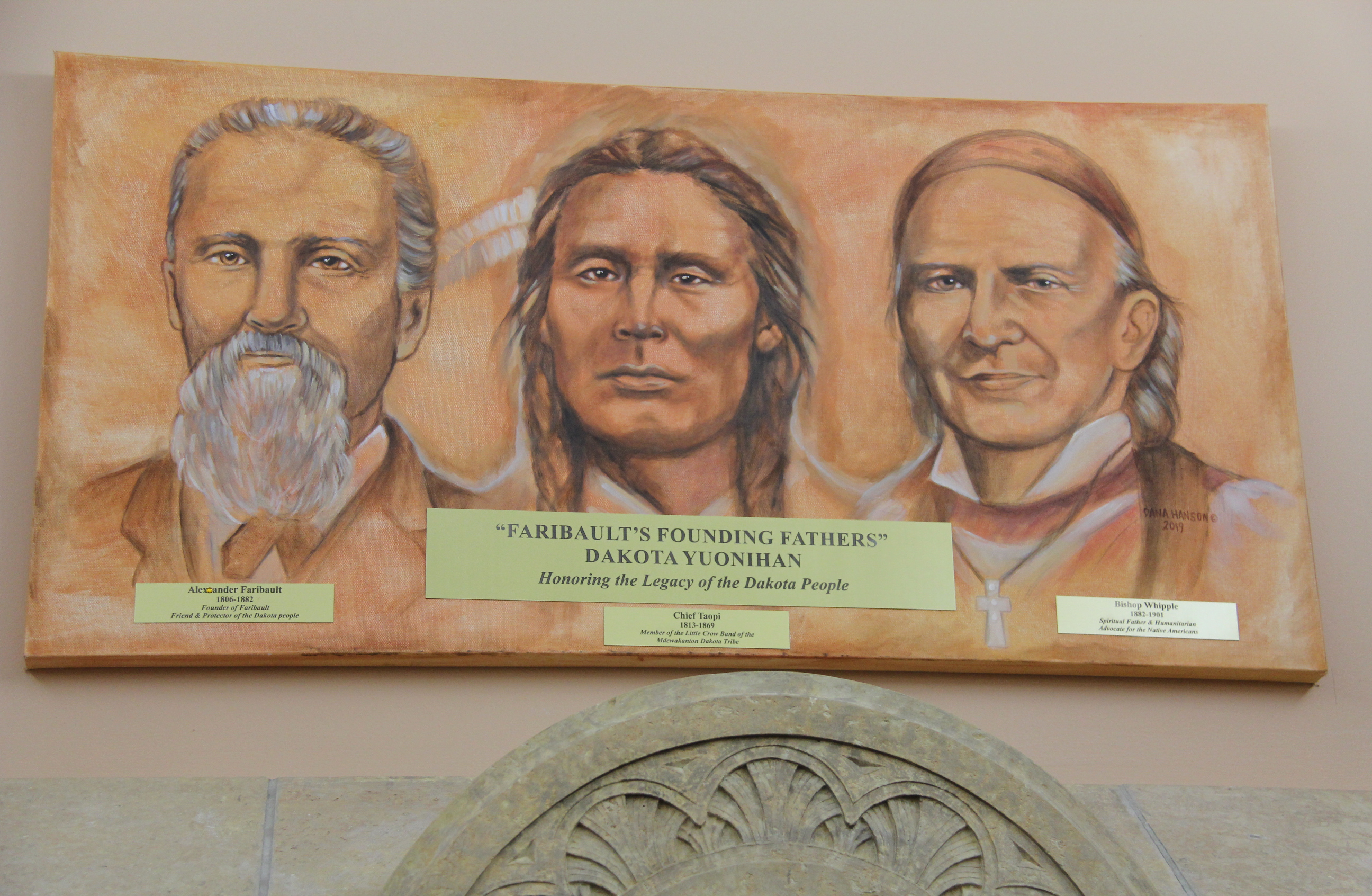
“Honoring the Legacy of the Dakota People” focuses this artwork by Dana Hanson. Chief Taopi centers the painting with Alexander Faribault to the left and Bishop Henry Whipple on the right. The word “Yuonihan” means honor or respect. This art hangs inside Buckham Memorial Library. (Minnesota Prairie Roots copyrighted file photo November 2022. Art copyrighted by Dana Hanson.)
POWER IN STORIES, IN HERITAGE, IN RESPECT
Rose is thankful for books like My Powerful Hair. “I am glad that stories like this are being told,” she says. “Much First Nations history nearly disappeared. And many First Nations keep their ceremonies and other information ‘secret’ so it won’t be distorted or misused by people who don’t understand, or who seek to harm them.” Based on history, that seems warranted.
This Minnesota woman has one more reason to feel grateful for children’s picture books by Indigenous Peoples. Her grandchildren are of Ojibwe heritage; their other grandmother lives on the White Earth Nation in northwestern Minnesota. “My hopes for my grandchildren are that they learn all they can about their Ojibwe ancestors and customs and values,” Rose says. “I hope they can choose what lessons they want to carry forward in their own life. I hope they are fantastic examples of how people from different backgrounds can get along and respect and love one another.”
And so I learned, not only from Rose, but from reading My Powerful Hair. Stories woven into our hair matter. For they are powerful.









 Minnesota Prairie Roots
Continuing to raise our Minnesota Strong voices in Faribault February 9, 2026
Tags: activism, commentary, Constitutional rights, Faribault, free speech, freedom, Immigration and Customs Enforcement, injustice, Minnesota, Minnesota Strong, news, protests, Rice County
I PULLED OUT my long johns, wool socks, stocking cap, mittens, hand warmers, winter boots and scarf. Then I pulled out my parka and my protest sign: STAND UP FOR HUMAN RIGHTS.
Just before 11 a.m. Saturday, Randy and I joined others outside the Rice County government services building along Minnesota State Highway 60 for our fourth protest there and the fifth in Faribault. Each week numbers grow, this time reaching some 80 of us stretched along the sidewalk with our signs.
We are not agitators or paid protesters as some claim, but rather ordinary Minnesotans united, called by our morals, our compassion, our concerns, to publicly say we are not OK with what is happening in this country. We are Minnesotans who care about immigrants and refugees, about freedom, about the Constitution, about due process and much more. We are concerned about the presence of ICE agents, whom we want out of our community, out of our state, after two-plus months of occupation.
And so we protest, week after week in our community an hour south of Minneapolis, because our city, too, has been impacted by ICE. People have been taken by federal agents from an apartment complex near the public library, by the railroad tracks near the turkey processing plant, from the trailer parks… It’s documented in videos. Warning horns blare, whistles sound, bystanders yell, sometimes. ICE has parked for hours in a neighborhood with Hispanic families. Watching, intimidating, silently threatening. Agents have photographed license plates at a gas station. This is reality in my city of 25,000.
School attendance has dropped. People are afraid to go to work, afraid to go grocery shopping and/or to food shelves (because ICE is watching), afraid to go to the doctor, afraid to leave their homes for fear of being taken by ICE. Legal status doesn’t seem to matter, only skin color, although even white people have been detained (with two killed) in Minnesota. Neighbors, churches and more have rallied to help with grocery shopping and delivery, walking kids to bus stops, giving co-workers rides. That support matters as does participating in protests. I’ve personally been thanked by Latinos and a Somali man for protesting.
This is why I’ve become an activist. This is why I use my voice as a writer and photographer. That is why I’ve started volunteering at a local food shelf. No one should live in fear of simply going about their daily lives. I am also doing this for my young grandchildren. I want them to understand the importance of speaking up for others. I want them to realize, when they are old enough, that their grandma did not remain silent in the face of atrocities inflicted by the federal government upon its people.
There is value in publicly taking a stand, especially in a city like mine which votes red. (Well, certainly not all of us.) Every protest brings out some who object to our activism as they drive by. That is their Constitutional right. They flash middle fingers, shout profanities, sometimes drive aggressively close, raging mad. That is not OK, potentially endangering people protesting in a public space. But we remain undeterred in raising our voices.
ON TUESDAY, FEBRUARY 10, a group of county residents are going to the Rice County Board of Commissioners meeting to speak about the impact of ICE on the community. That will happen during the open comments portion of the meeting at 8 a.m. I’m not part of that group, but was made aware of it. I’ve felt for a while that our local city and county government officials need to address this topic. ICE is certainly having a negative impact on the health, safety and well-being of county residents both directly and indirectly. That should not, and cannot, be ignored.
We must all do whatever we can, whenever we can, however we can to speak up, help and love our neighbors, and stand strong in the face of tyranny and injustice.
© Copyright 2026 Audrey Kletscher Helbling