
I AM NO FASHIONISTA or anything closely resembling a woman who knows, or really cares, about fashion.
So when I stopped at the Mantorville Art Guild last week while visiting this historic southeastern Minnesota river town, I had no idea I had just stepped into the world of fashion.

When you enter the Mantorville Art Guild, turn and pull hard on the door knob. And if a strong wind is blowing, hang onto the screen door.
But I should have figured it out given the fashionably-dressed women consulting with artist Max Lohrbach. They weren’t, like me, dressed in plain denim shorts, a scoop-necked cotton shirt and $3 flip flops from Walmart. Rather, one wore an ankle-length shoulderless dress with a swatch of fabric crossing her back and a band tied at her neck. A big bag was fashionably slung over her shoulder. I can’t recall the other woman’s attire, but neither toted a bulky brown camera bag like me.
I felt a bit under-dressed for the occasion. How was I to know, though, that one of Minnesota’s premier fashion designers would be there? That would be Lohrbach. Not until I returned home did I realize his importance.
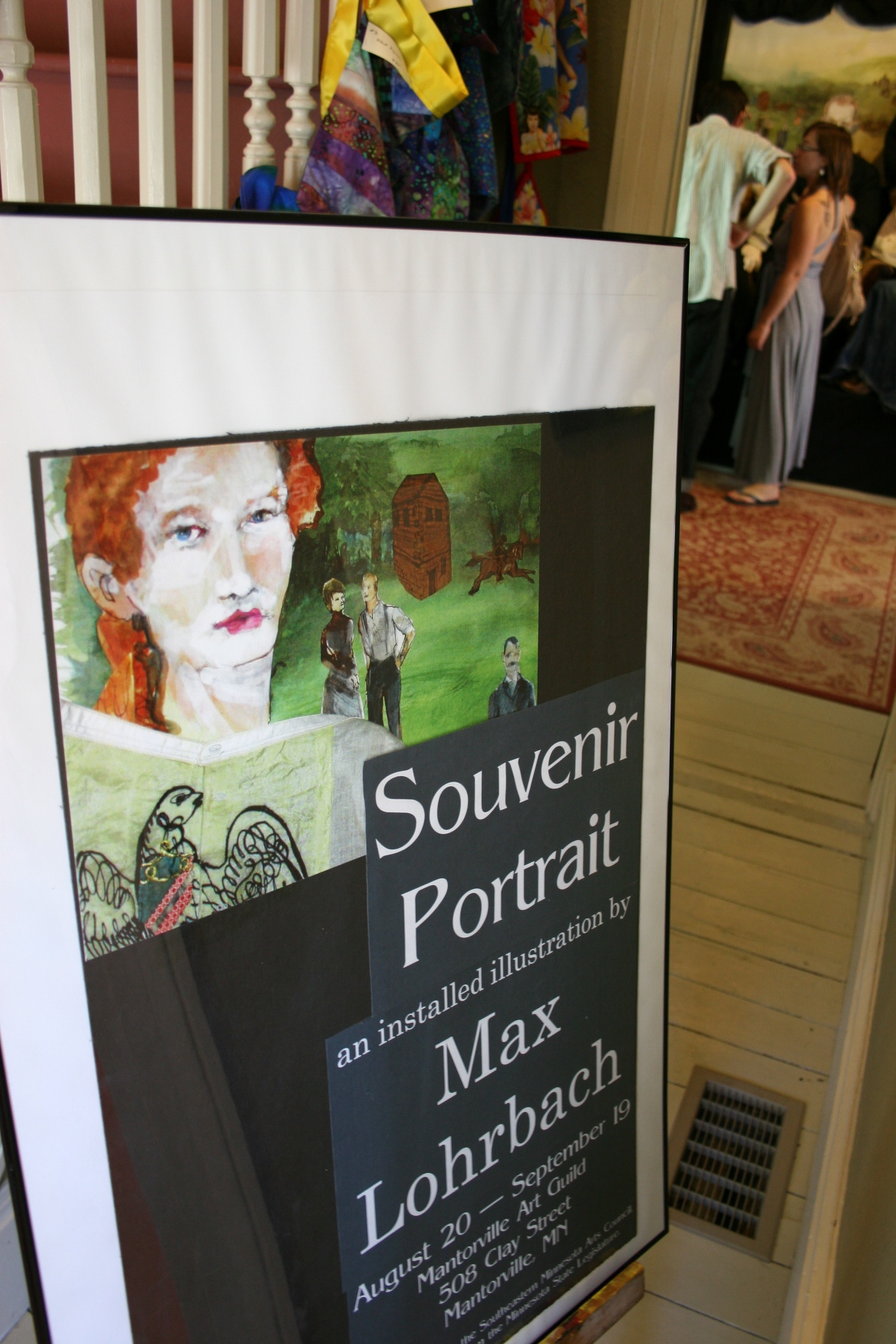
In the background, Max Lohrbach visits with guests at his "Souvenir Portrait" exhibit, which opened August 21 in Mantorville.
My blissful ignorance allowed me to enjoy Lohrbach’s “Souvenir Portrait” without star-struck pretenses. I was simply viewing an artistic piece that, to me, seems a perfect fit for the artist’s hometown of Mantorville, a community with a 12-block downtown on the National Historic Registry.
Lohrbach’s 2-3 dimensional “installed illustration” showcases his original garments influenced by, and depicting, the 1876 era, the time of our nation’s Centennial.
If his exhibit had been a photograph, I would have been looking at a family portrait. Promotional information for Lohrbach’s show says, “The somewhat dark scene may serve not only as a fashion installation, but also as a common ancestral portrait.”
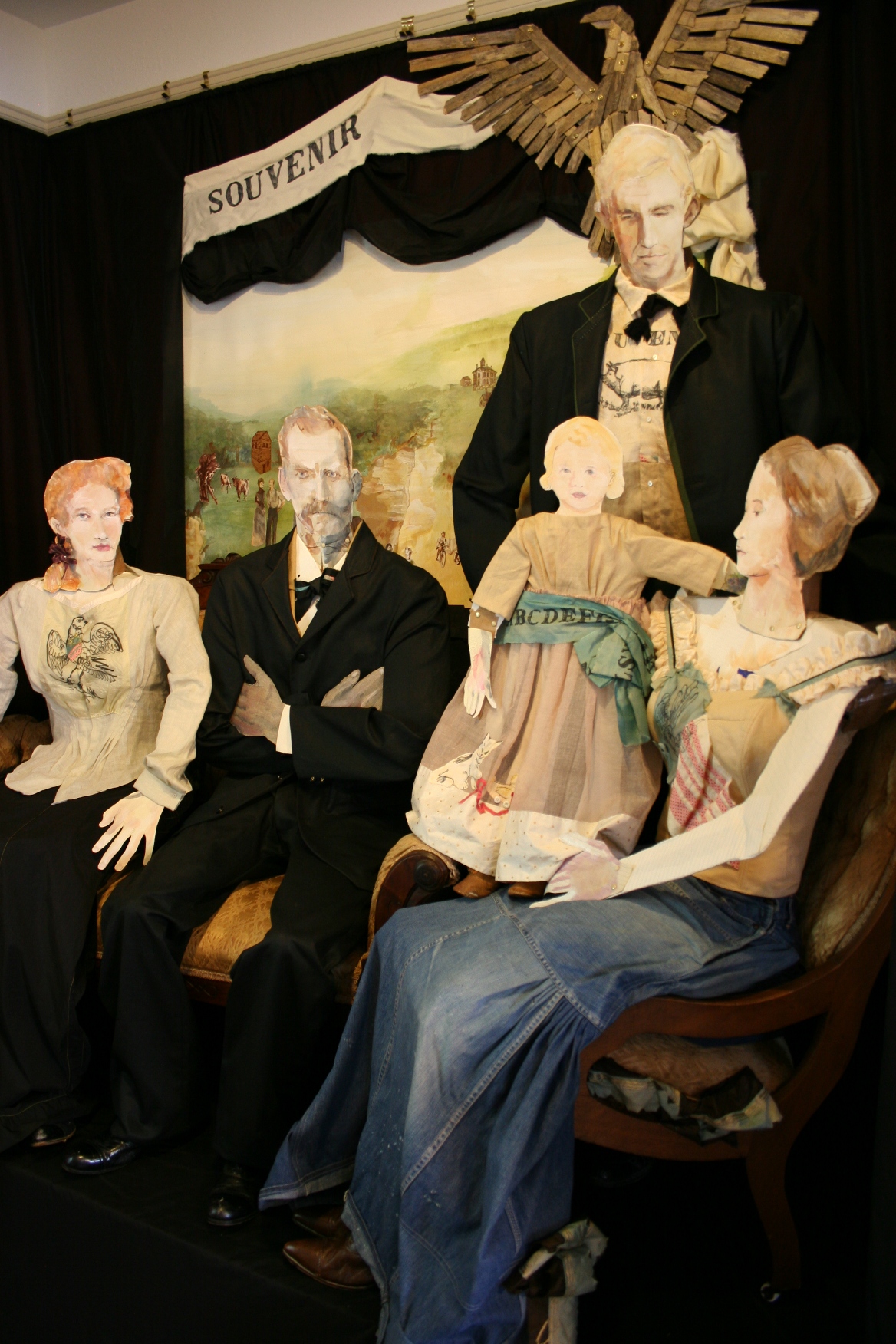
Max Lohrbach's "Souvenir Portrait" at the Mantorville Art Guild.
“Souvenir Portrait” calls for a closer look at the details this Minnesota designer has incorporated into his scene—the red, white and blue in the clothing; the alphabet sash upon the child’s skirt; the pig drawing on the father’s shirt; the crossed arms; the hand angled in the pocket; the mother turned protectively toward her child; the rustic eagle fashioned from weathered wood…
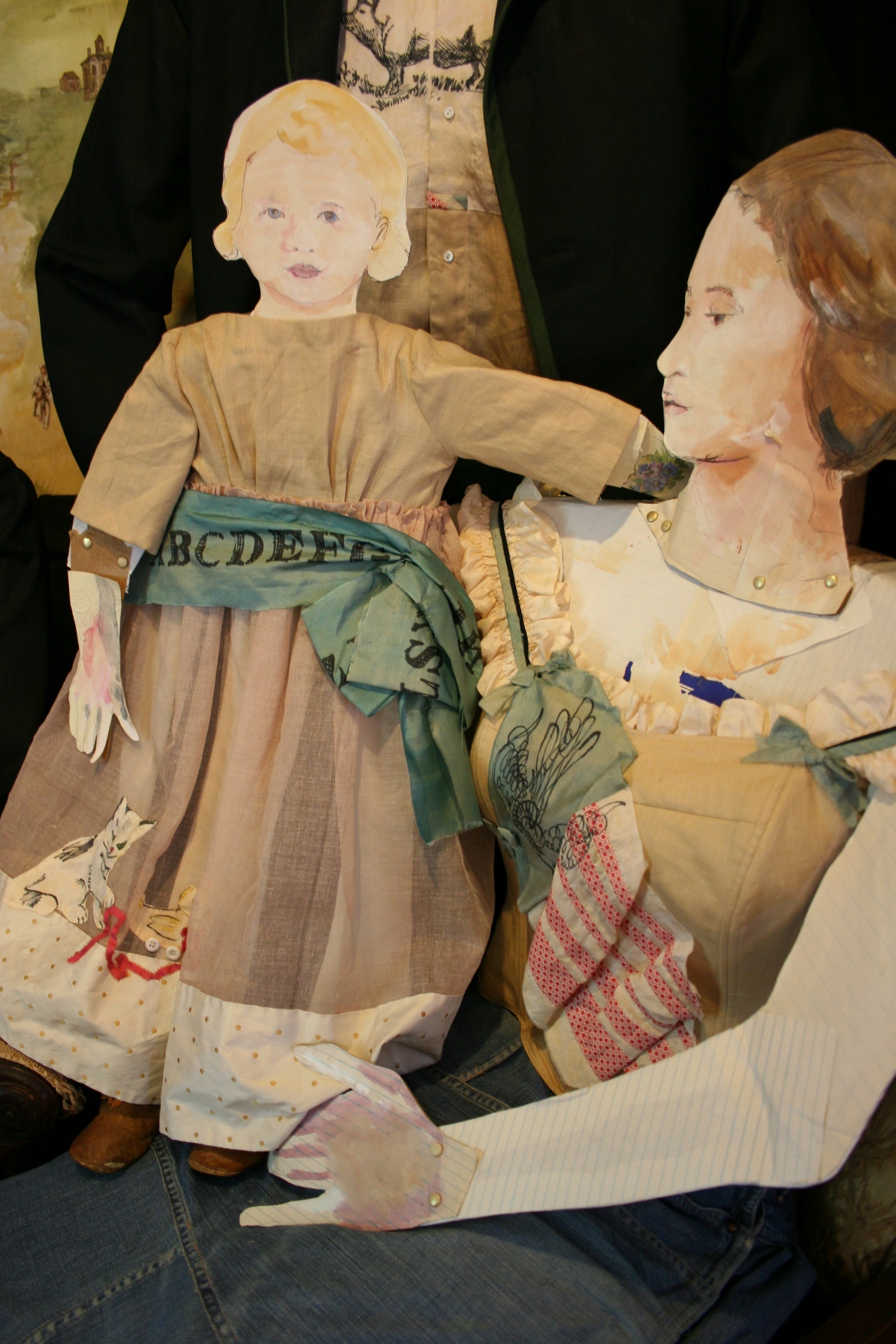
Lohrbach's work depicts the love between mother and child.

Playful vintage details incorporated into the child's dress.

There's something almost sad, or perhaps contemplative, in the face of this woman painted by Lohrbach and wearing his original design.
Lohrbach has created a piece worthy of study as much for the personal sense of history he conveys as for the detailed vintage-style garments he’s designed.
“SOUVENIR PORTRAIT” will be on display at the Mantorville Art Guild, 508 Clay Street, until September 19. Gallery hours are from 11 a.m. – 4 p.m. Friday and Saturday and from noon until 4 p.m. on Sunday. Arrangements can be made for special tours. Fashionable attire is optional.
© Copyright 2010 Audrey Kletscher Helbling


Barns, an enduring symbol of farming June 25, 2026
Tags: agricultural symbol, agriculture, barns, childhood memories, commentary, cosmos, farm sites, farming, Hutchinson, Mantorville, Minnesota, photography, road trip, rural life, rural Minnesota, southern Minnesota, travel
IF A SINGLE BUILDING symbolizes agriculture in Minnesota, it is a barn.
Barns hold the history of farming within their walls. They hold the stories of farm families who labored therein. They hold memories—the heat of cattle, the lingering scent of manure, the pulse of milking machines, the scurrying of barn cats and much more.
Barns also hold heartaches and challenges and the satisfaction and rewards that come with farming.
To step inside a barn, or even to observe one from a distance as I did on recent trips out and about in rural Minnesota, is to understand the importance agriculture plays in this state.
Sure, farming has changed. Many barns no longer house animals, once a farm staple, as ag has shifted to crop farming. But at its core, this profession, this way of life, still centers rural parts of Minnesota, keeps small towns going. I saw that, from Mantorville to Faribault and from Faribault to Morris and back home.
Barns dominate farm sites just like grain elevators landmark many small rural communities.
While I see too many dilapidated barns fallen into heaps of rotting wood, I also see those that are well-cared for, still standing strong against the ravages of time and weather. I know that comes at a cost to the landowner. Keeping a barn properly roofed and painted is a major expense. I appreciate efforts to preserve barns built by generations past.
My ancestry traces to farming, to German immigrants who arrived in America, eventually making their way to southwestern Minnesota. There they found rich dark soil in which to plant seeds. Land upon which to build farmhouses, barns and other buildings necessary to the operation of a farm.
I am rooted in farming. I worked inside the barn my father built. I shoveled manure, scooped silage, pushed a wheelbarrow heaping with ground feed, carried pails brimming with milk, bedded straw, tossed hay bales from the hayloft, fed calves… I worked the land, too, picking rock and pulling cockleburrs. I carried lunch to my dad and uncles on hot summer days of baling hay.
There is nothing romantic about farming. It is hard work. It is a risky business affected by weather, markets, prices, too many factors out of a farmer’s control.
Yet, I will unequivocally state that I am incredibly thankful I grew up on a working farm. The lessons learned there about working together, about forging forward despite setbacks, about standing independent and strong are ingrained in me.
My dad laughed when I told him I wanted to be a farmer when I grew up. He knew better. There was nothing to keep me on the farm. And so I left, went to college, became a journalist. But even though physically-removed from the farm, I’ve always carried my ruralness within me, reflected in my writing and photography.
I find myself still drawn to rural scenes. A farm site. A grain elevator. A gravel road. Cattle grazing. Farm machinery, especially tractors, traversing fields. These all define agriculture. But it is the barn which symbolizes farming and the enduring strength and hope of a farmer.
#
NOTE: I took these photos from the front passenger seat, either through the windshield or side window while traveling at highway speeds. Locations of several photos are not noted as I don’t recall the exact locations.
© Copyright 2026 Audrey Kletscher Helbling