Minnesota Prairie Roots

Writing and photography by Audrey Kletscher Helbling

A look at Bishop Henry Whipple’s role in Minnesota history February 17, 2023

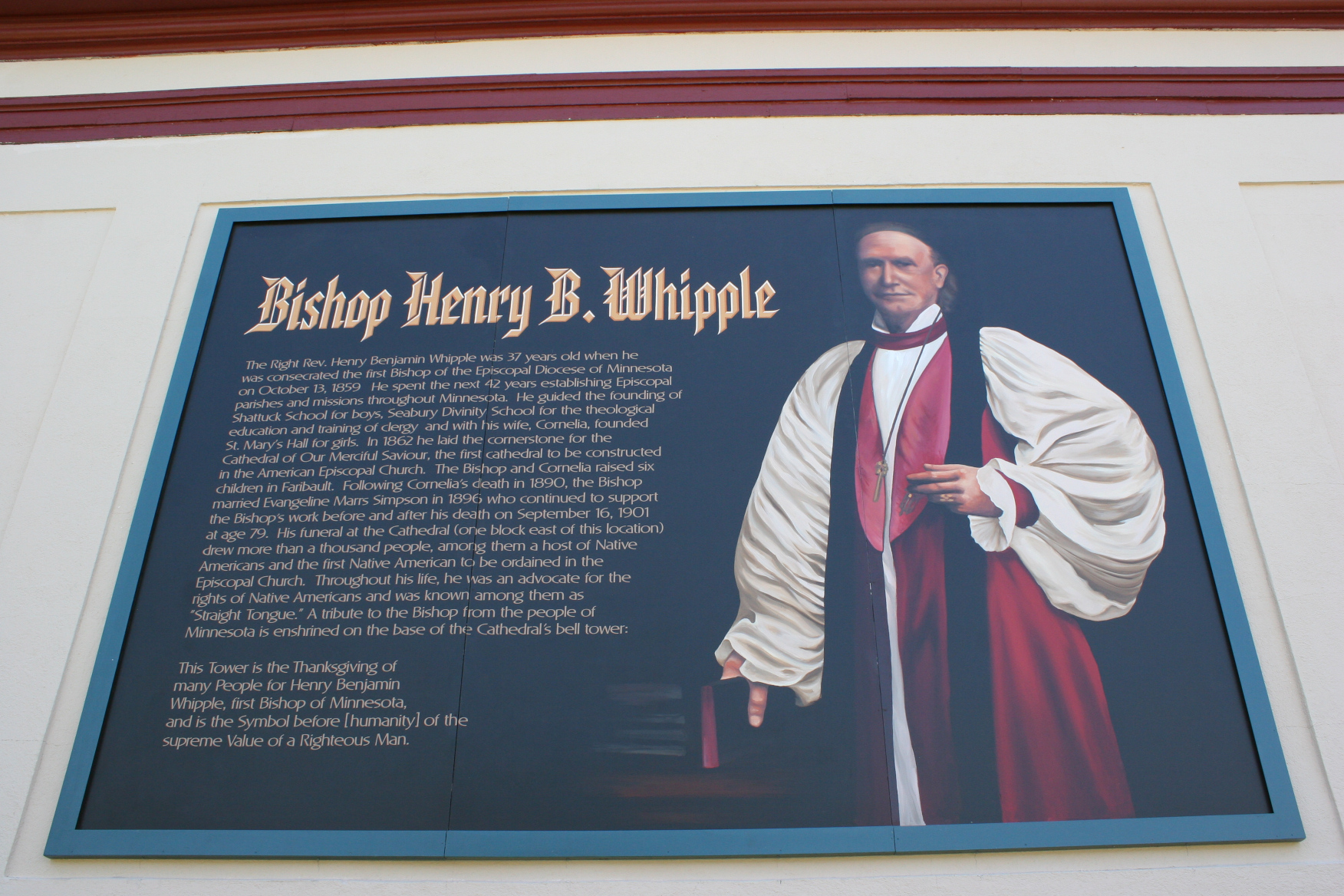
A painting of Bishop Henry Whipple and information about him grace a mural on Faribaults’ Central Park Bandshell. (Minnesota Prairie Roots copyrighted file photo June 2020)

He was known as “Straight Tongue” for his honesty. He was disparagingly called “The Sympathizer” by others for the compassion and care he held for the Dakota. He was Bishop Henry Whipple.

Thursday evening, Rice County Historical Society Executive Director David Nichols spoke to a packed room about this Episcopal priest who played such a pivotal role in Minnesota history, specifically during the time shortly before, and then after, The U.S.-Dakota War of 1862. For me, personally, Nichols’ focused talk connected my home region of Redwood County, the area in which the war centered, to my home of 40 years, Rice County.

I grew up with a limited (white) perspective of the war with no knowledge of Whipple. I only learned of this New York born clergyman upon my move to Faribault in 1982. Nichols broadened my understanding during his presentation and during a question and answer session that followed.
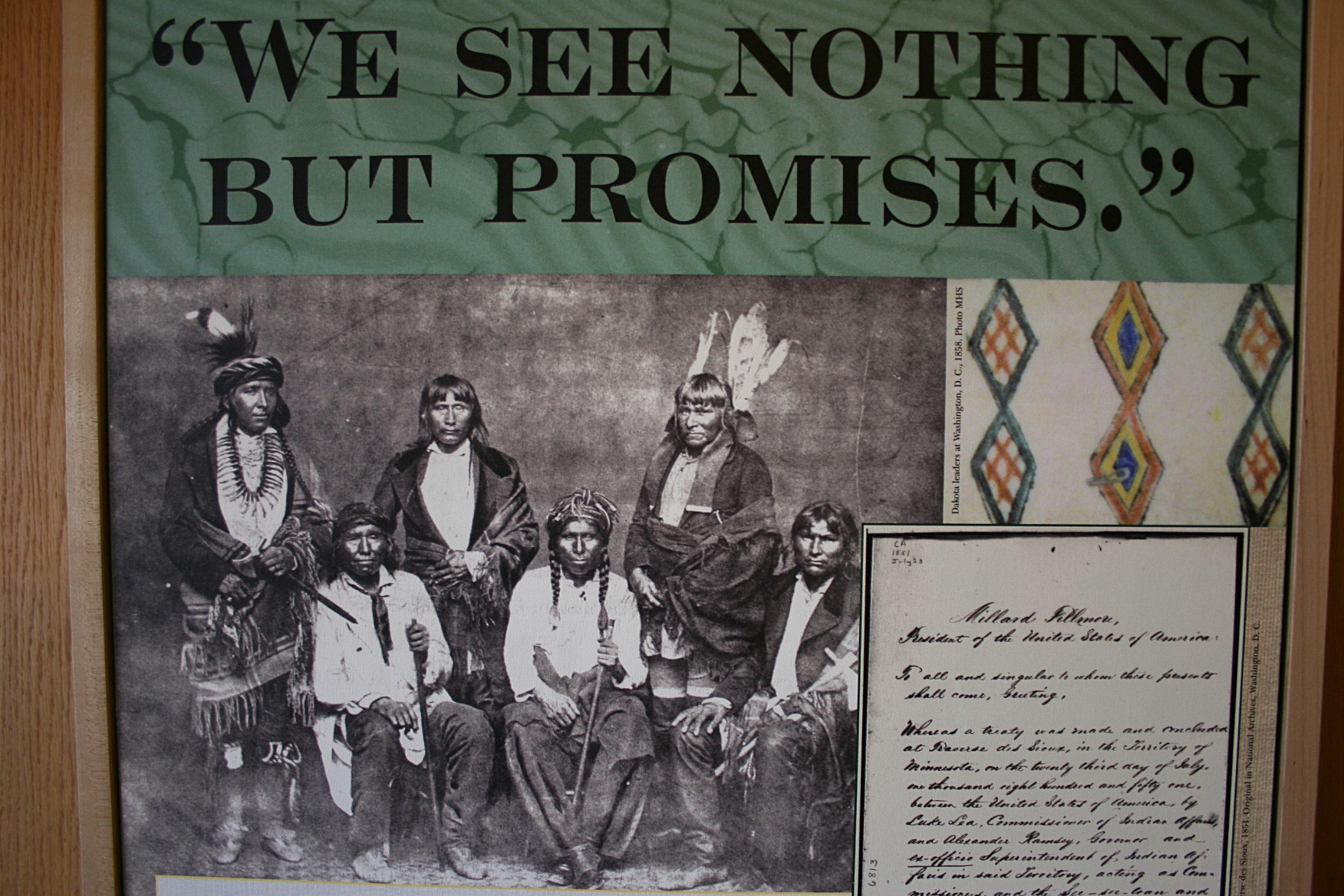
A panel at the Traverse des Sioux Treaty Center in St. Peter shows Dakota leaders photographed in Washington D.C. in 1858. The photo is from the Minnesota Historical Society. It references broken treaty promises and rising tension. (Minnesota Prairie Roots copyrighted file photo)

HIGH TENSIONS

Whipple arrived here in 1860 as the newly-elected Bishop of Minnesota, settling in Faribault. Already at that time, tensions were mounting among settlers and the first peoples of Minnesota, Nichols said. Tensions also existed between the “Farmer Indians” (those who adapted to Euro culture) and “Blanket Indians” (who maintained their Native culture, traditions and lifestyle). Conditions on reservations were terrible with disease, starvation, and dishonest agents failing to provide promised government annuities.

That is the situation Whipple found when he landed in Minnesota. It was a time, noted Nichols, of “tensions about to boil over.” And eventually they did with the outbreak of war in August 1862. It was a decidedly bloody and awful war, as all wars are. Some 600-800 died and the Dakota were eventually displaced from their land.
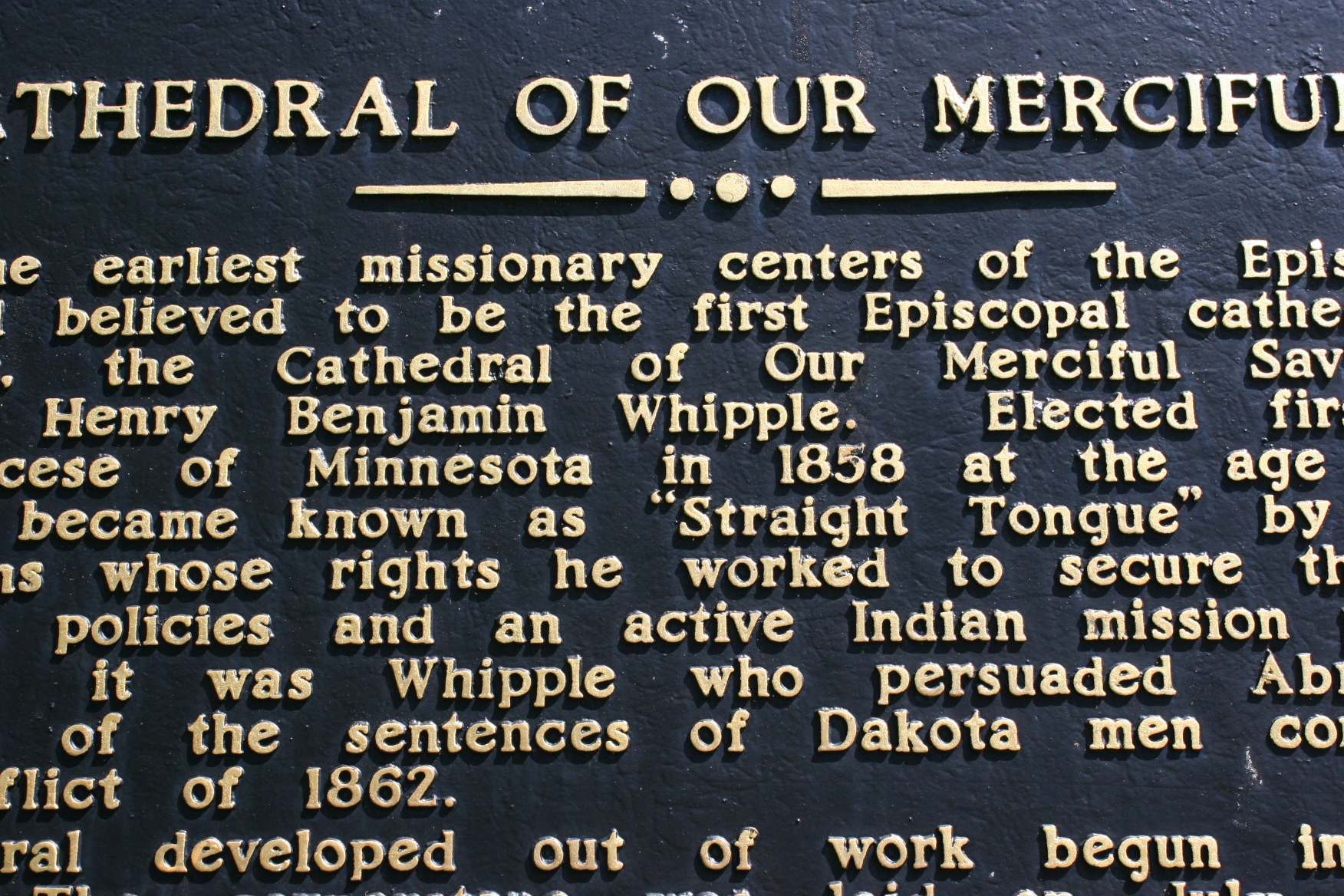
Details on a sign outside The Cathedral of Our Merciful Saviour, Whipple’s church in Faribault. (Minnesota Prairie Roots copyrighted file photo 2020)

THE SHAPING OF A HUMANITARIAN

To understand Whipple’s position and part in this, Nichols provided background. Whipple was involved in New York politics as a “conservative Democrat,” a term which drew laughter from the crowd at Thursday’s presentation. He briefly attended Oberlin College, notable because the college was among the earliest to admit women and African Americans. And Whipple was ordained in 1849, during the so-called “Second Great Awakening” with a focus on civil rights.

Learning this helped me better understand the bishop. All of these experiences shaped a man who spoke with honesty and compassion, advocated for Minnesota’s Indigenous Peoples (both the Dakota and the Ojibwe, natural enemies), called for reform and peace and understanding. Whipple was, said Nichols, a voice for calm, calling for justice, not vengeance, when the short-lived U.S.-Dakota War ended.
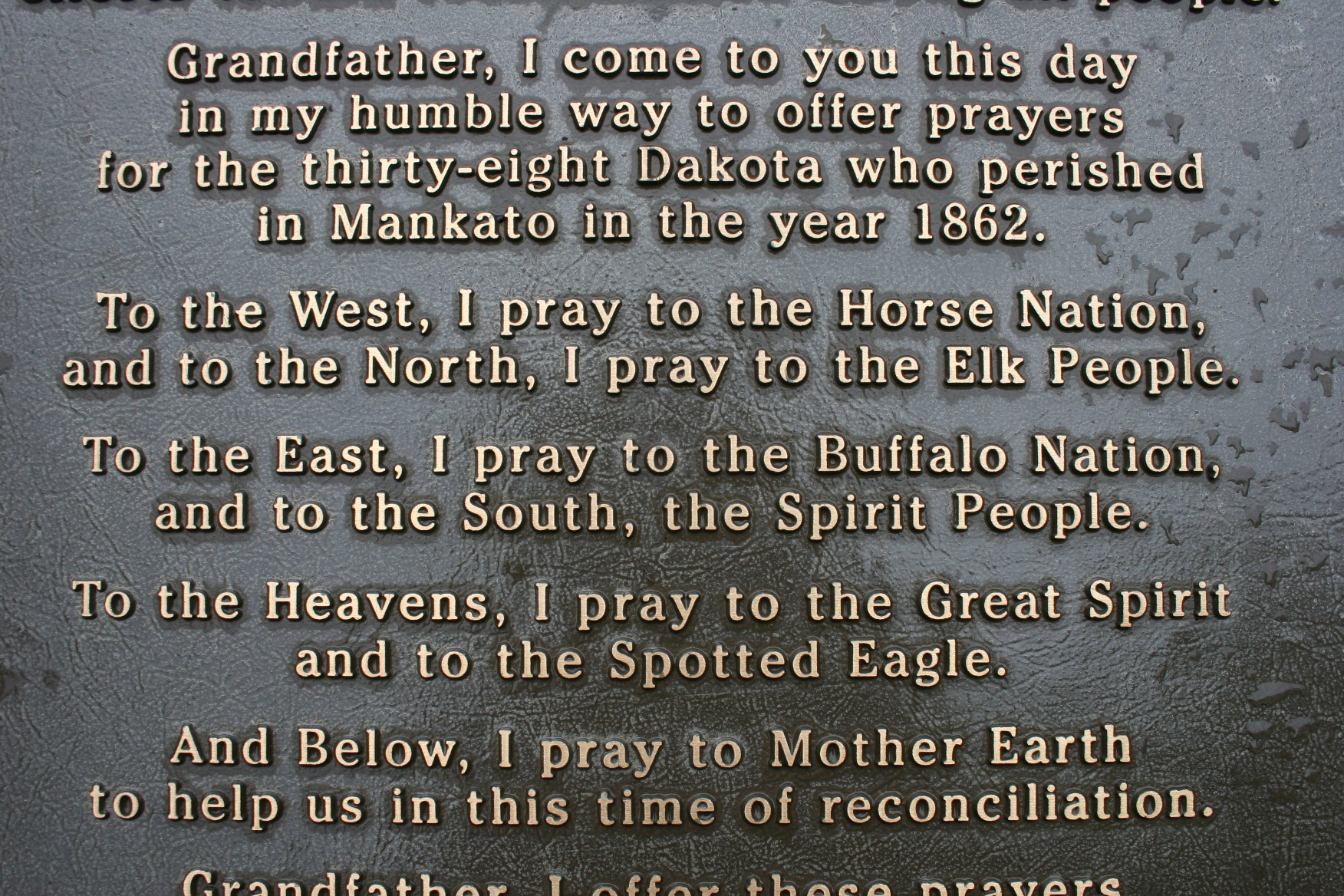
Words on a marker in Reconciliation Park in Mankato where 38 Dakota + 2 were hung on Dec. 26, 1862. (Minnesota Prairie Roots copyrighted file photo May 2012)

ADVOCATING FOR PARDONS

In his many years of missionary work and advocacy, even when his life was threatened by those who viewed him as an “Indian sympathizer,” one singular moment stands out to me. And that is Whipple’s efforts to save the lives of 303 Dakota men sentenced to death after the war. He met with President Abraham Lincoln and was “partly responsible,” Nichols said, for Lincoln’s eventual pardon of all but 38 Dakota. The 38, plus two others, were hung in a public mass execution in Mankato on December 26, 1862. It is a terrible and profoundly awful moment in Minnesota history, especially the history of the Dakota.
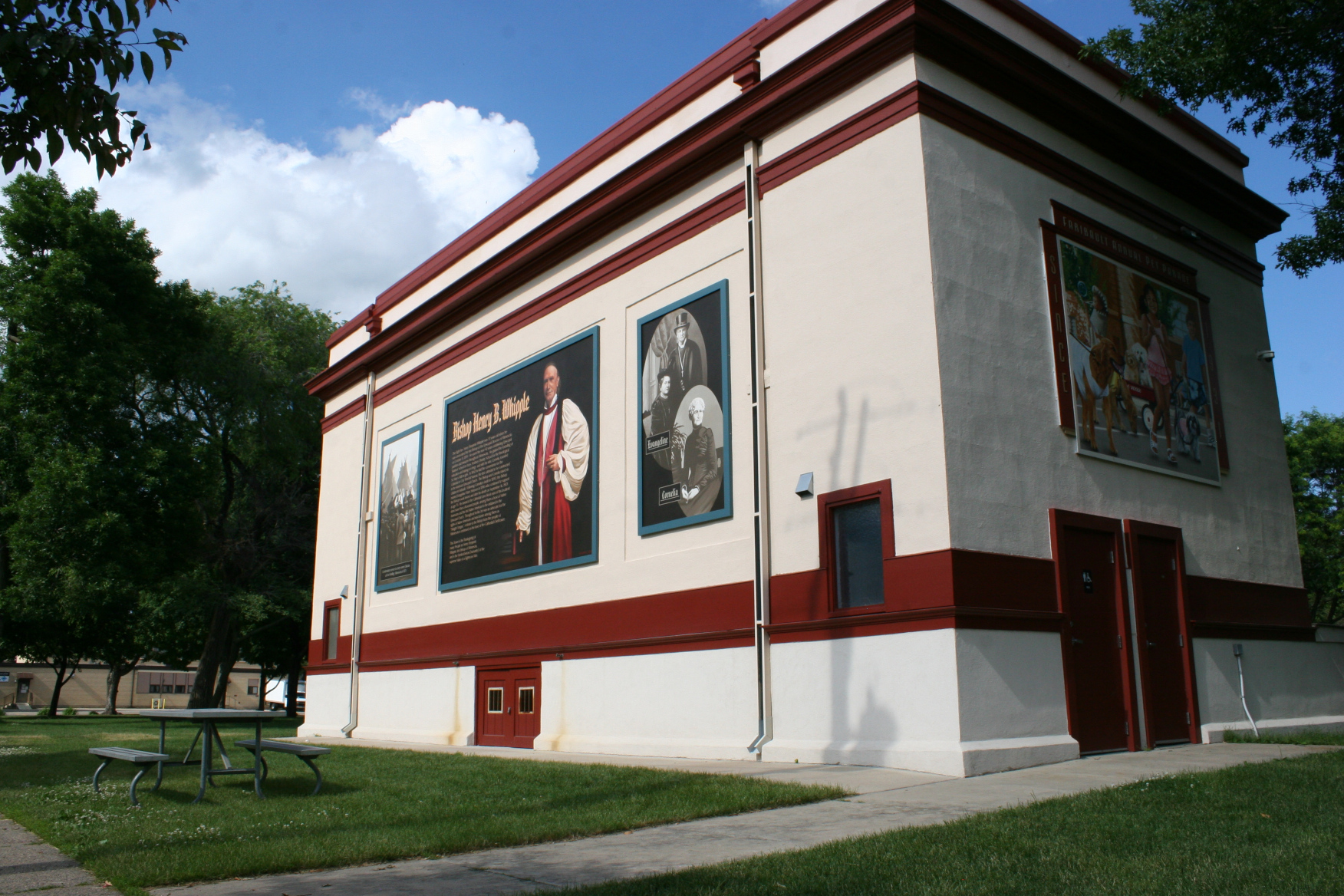
A full view of the bandshell mural featuring Bishop Whipple and his first wife, Cornelia, and his second wife, Evangeline. (Minnesota Prairie Roots copyrighted file photo)

ASSIMILATION

While listening to Nichols’ presentation on Whipple, I felt conflicted. Conflicted because the bishop was, he said, “a strong assimilationist.” That label bothered me until I talked further with Nichols. He explained that Whipple did not view himself and Europeans as superior to Native Peoples, but rather observed, in the context of place and time and thinking, the need to adapt versus being driven out. That helped me better understand Whipple’s approach. I recognize, though, and acknowledge the current-day struggles with assimilation, especially as it relates to Indian boarding schools. I appreciate the recognition of, and return to, culture, tradition and heritage today.
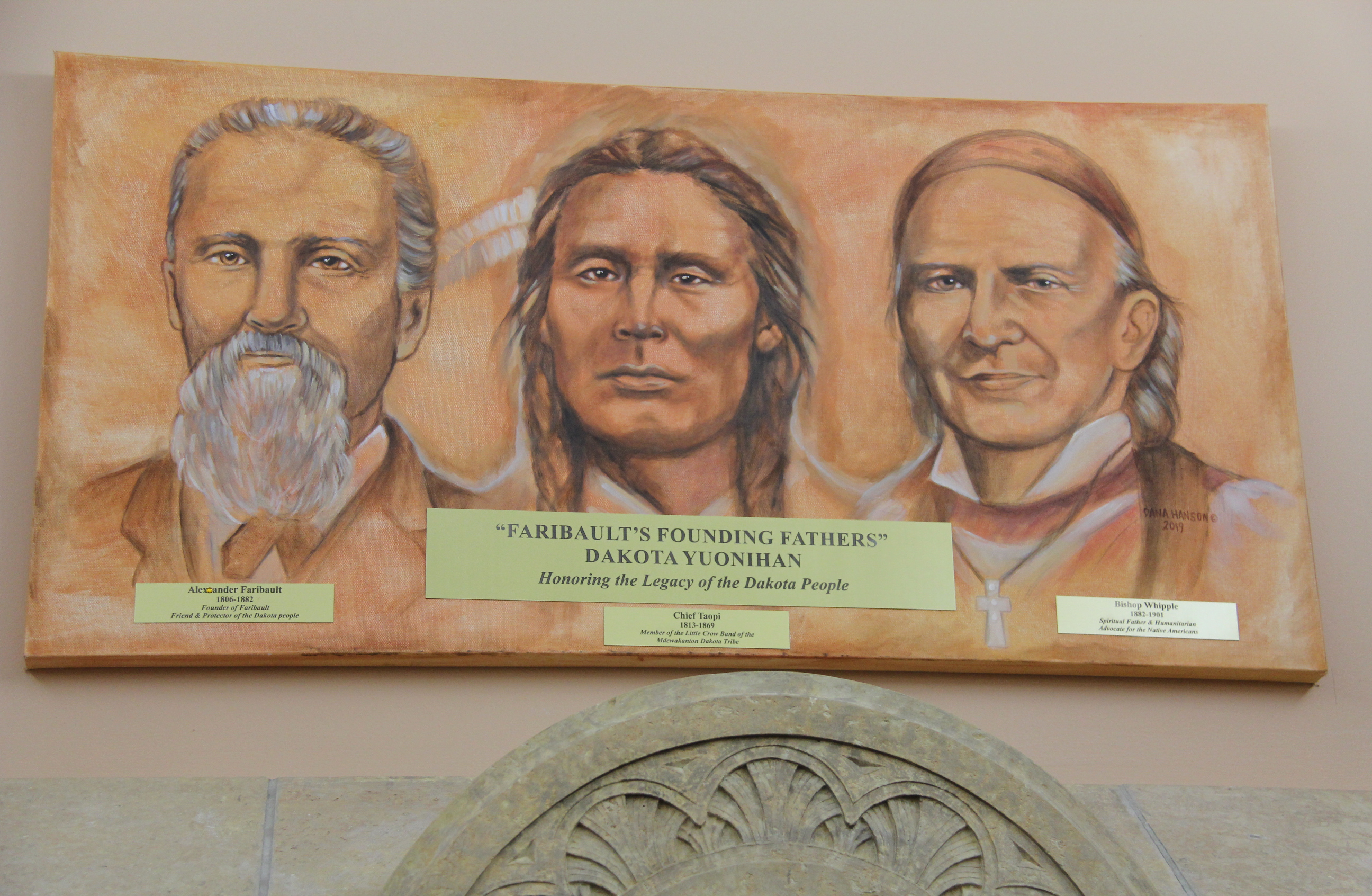
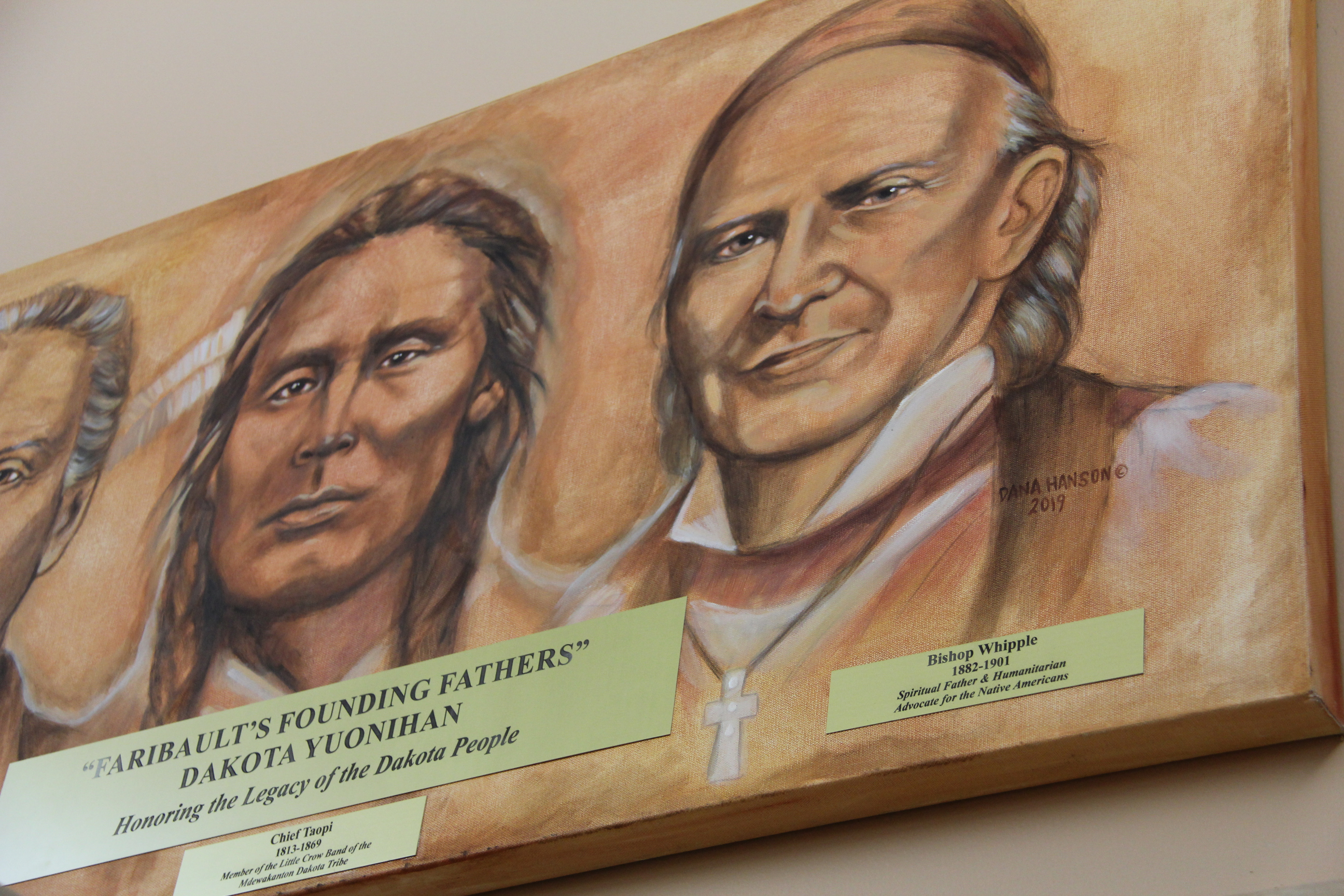
“Faribault’s Founding Fathers,” portraits of Alexander Faribault, left to right, Chief Taopi and Bishop Henry Whipple, by Dana Hanson hangs in Faribault’s Buckham Memorial Library. (Minnesota Prairie Roots copyrighted file photo November 2022)

WELCOMING THE DAKOTA TO FARIBAULT, OR NOT

Whipple, by his words and actions, embraced the Dakota and Ojibwe who called Minnesota home long before white settlers arrived, long before he moved to Faribault. My community, founded by fur trader Alexander Faribault, himself half Dakota, was a safe haven for the Dakota (“you don’t attack family”) during the 1862 war and thereafter, Nichols said. Faribault and Whipple worked together to move 180 Dakota from St. Paul’s Fort Snelling, where they were held following the war, to live on land Alexander owned along the Straight River in Faribault.

I wondered, “Were they welcomed here?” The answer, given by former RCHS Executive Director Susan Garwood, was as I expected. Mixed. While some supported the Dakota’s presence in Faribault, others were vocal in their opposition. In that moment, I thought of our ever-growing immigrant population in my community. Many welcome our newest neighbors and, like Alexander Faribault and Bishop Henry Whipple, support and encourage them. But many also want them gone. History repeats.
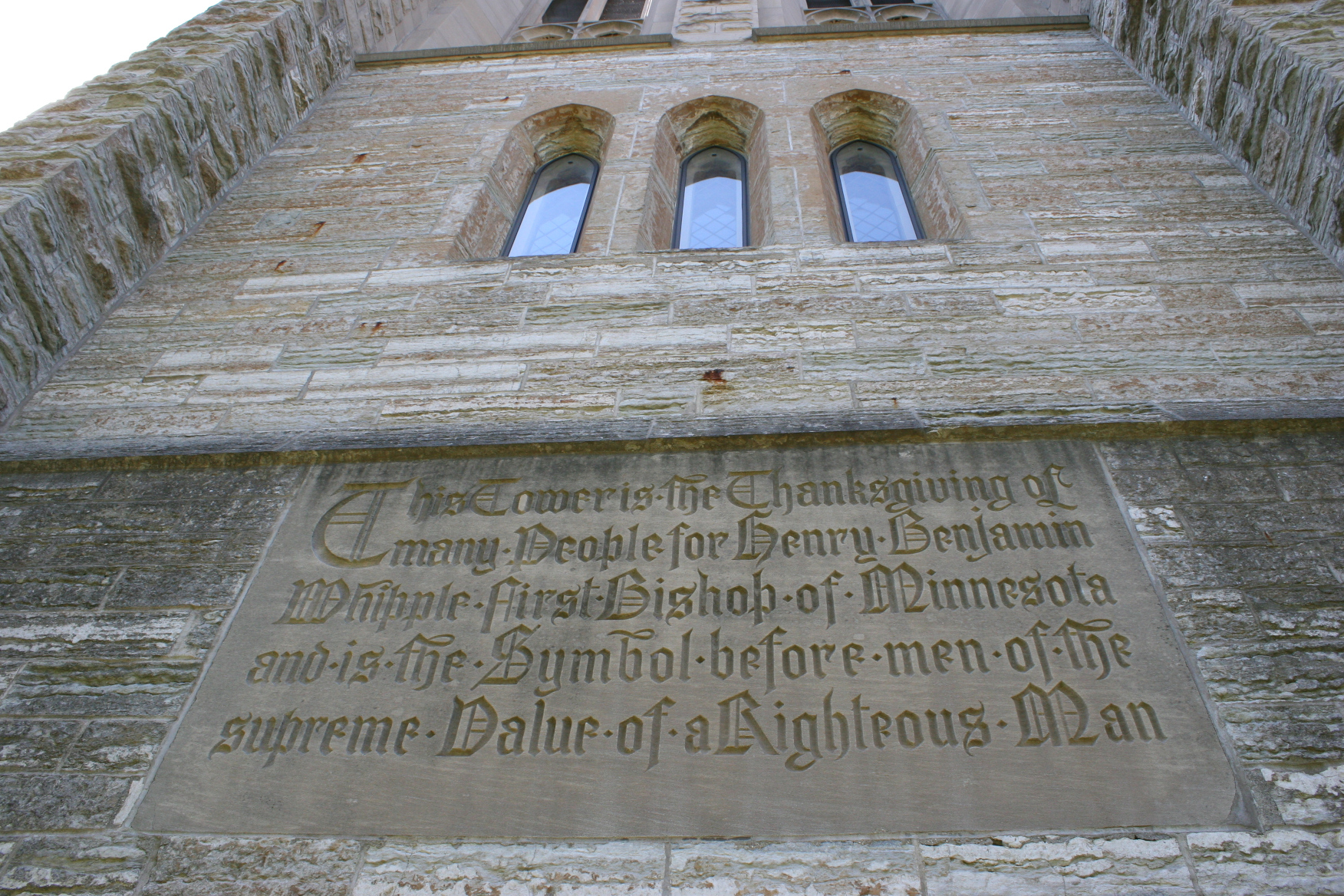
An inscription honors Whipple on the Cathedral bell tower. (Minnesota Prairie Roots copyrighted file photo June 2020)

MARKING HISTORY

Walk around Faribault today and you will see many reminders of the work Whipple did not only locally, but across Minnesota. Historical markers and inscriptions about the bishop grace The Cathedral of Our Merciful Saviour, his faith base. He’s buried under the altar there. Across the street at Central Park, Whipple-themed murals cover the west side of the historic bandshell. Downtown, one of many history-focused benches honors Whipple. And across town, at the Chapel of the Good Shepherd on the campus of Shattuck-St. Mary’s School, a marker notes his role in founding Shattuck and other schools in Faribault.

Efforts are underway now locally to recognize the Dakota as well, to publicly mark their place in the history of Faribault. I’d like to think Bishop Henry Whipple, also known as “Straight Tongue” and “The Sympathizer,” would welcome the idea, would even step up to fund raise, just as he did some 160 years ago to support the relocation of 180 Dakota from Fort Snelling to Faribault.

© Copyright 2023 Audrey Kletscher Helbling


At Buckham Library: Portraits honor Faribault’s founding fathers November 21, 2022

“Faribault’s Founding Fathers,” Alexander Faribault (left to right), Chief Taopi and Bishop Henry Whipple, painted by Dana Hanson. “Yuonihan” means honor or respect. (Minnesota Prairie Roots copyrighted photo November 2022. Art copyrighted by Dana Hanson.)

MY LIBRARY, BUCKHAM MEMORIAL in Faribault, features dozens of art pieces by local artists scattered throughout the building. I’ll admit that I really don’t even notice the art any more in my frequent visits to the library. Like anything, after time, familiarity begets overlooking.

But that all changed recently when I looked across the library to the west by the adult fiction and saw a work of art I hadn’t previously noticed. It’s been there for about a year. Yet, just now, I happened to see Dana Hanson’s original art piece, “Faribault’s Founding Fathers.” I strode across the library toward the high-hanging portrait piece and took pause.

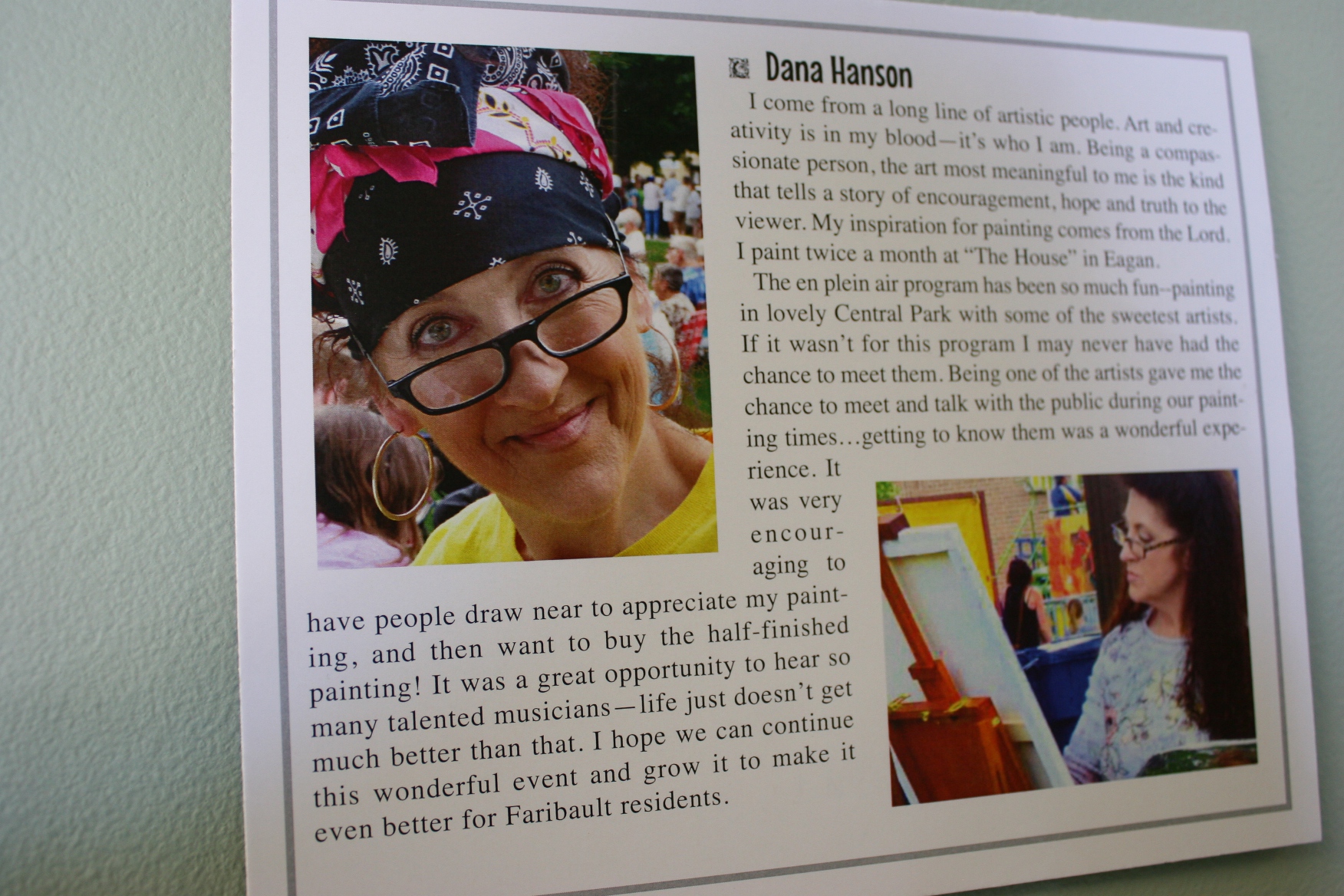
Dana Hanson’s artist statement posted at the 2016 Artgo! art show at Buckham Center. (Minnesota Prairie Roots copyrighted file photo October 2016)

I first met Dana, who specializes in portraits, in 2015 during Faribault’s summer Concerts in the Park weekly outdoor music series at Central Park. Local artists were invited to paint on-site and Dana was among them. She has since moved away from Faribault.

A close-up of Dana’s “The Native Man, His Eagle & His Chanupa,” an oil painting exhibited in Owatonna in 2018. (Minnesota Prairie Roots copyrighted file photo April 2018)

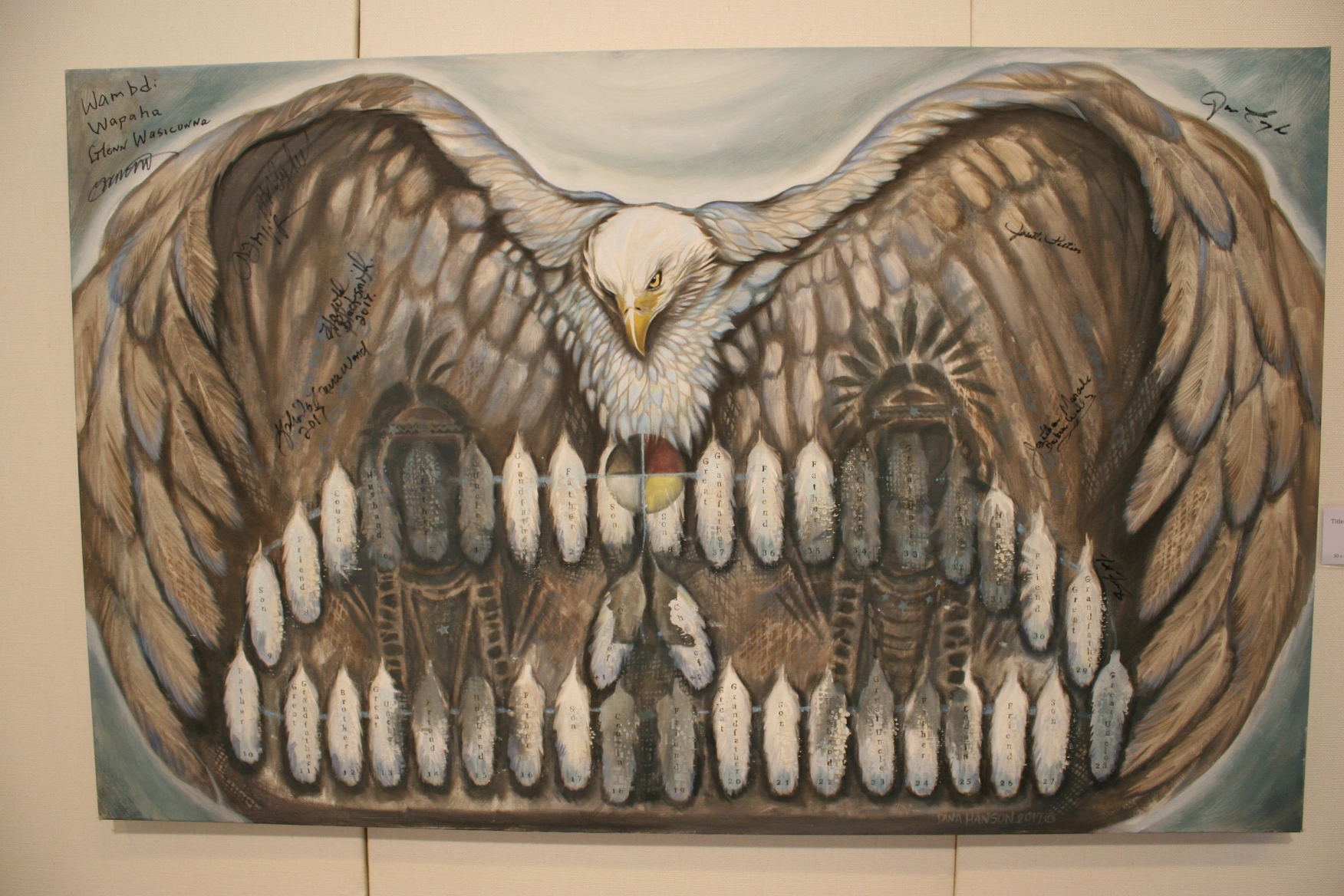
Eventually, her art started showing up in exhibits—at Buckham Center, at the Paradise Center for the Arts and at the Owatonna Arts Center. Her work ranged from faith-inspired to celebrity (like Bob Dylan, Prince and Judy Garland) and Native American portraits and more. In Owatonna, her “Healing the Land” exhibit several years ago focused on the Dakota people.

Up close with Chief Taopi, center, and Bishop Henry Whipple, right. (Minnesota Prairie Roots copyrighted photo November 2022)

So when I saw the recently-donated 2019 painting of Faribault’s founding fathers, I was not at all surprised. Dana holds a heart full of gratitude, love and compassion for Indigenous peoples. That shows in her art, including in these portraits of Chief Taopi, a member of the Little Crow Band of the Mdewakanton Dakota Tribe; town founder Alexander Faribault, “friend and protector” of the Dakota; and Bishop Henry Whipple, “Spiritual Father and Humanitarian” and “Advocate for the Native Americans.”

Another example of Dana’s art, MESSENGERS OF HOPE with the horses subtitled, from left to right, “Light,” “Passion Fire” and “Grace.” These were exhibited at the Paradise Center for the Arts in 2017. (Minnesota Prairie Roots copyrighted file photo March 2017.

Indigenous peoples were the original inhabitants of Faribault, of Rice County, a fact now only beginning to be widely-acknowledged and honored. The Wakpekute, part of the Dakota Nation, placed their dead on scaffolding on the hill just up from my house in today’s current-day Wapacuta (sic) Park, a fact I only learned this fall at an historical presentation. Eventually, they were buried in Peace Park, a triangle of land near the library. There’s so much rich local history I am beginning to learn.

“Protector of the 38 + 2,” an oil on canvas by Dana Hanson and previously displayed in Owatonna. Her art honors the 38 Dakota men who were hung in Mankato following the US-Dakota War of 1862. (Minnesota Prairie Roots copyrighted file photo April 2018)

Chief Taopi, who centers Dana’s portrait trio, was a leader among his people and a member of a Peace Party during the US-Dakota War of 1862. Eventually he landed in Faribault, living on land owned by founder and fur trader Alexander Faribault. Taopi and the Bishop forged a strong friendship also. The Dakota chief died in 1869 and is buried at Maple Lawn Cemetery in Faribault.

Now, to see these three men honored via a painting in a place of learning, a place of connection, a place where history writes onto pages, reminds me of their importance in my community. In the familiarity of the library and during this, Native American Heritage Month, I need to pause, appreciate and respect those who shaped this place I’ve called home for 40 years.

© Copyright 2022 Audrey Kletscher Helbling
 

What I’m drawn to photograph in rural Minnesota January 7, 2020

Filed under: Uncategorized — Audrey Kletscher Helbling @ 5:00 AM
Tags: , , , , , , , , ,

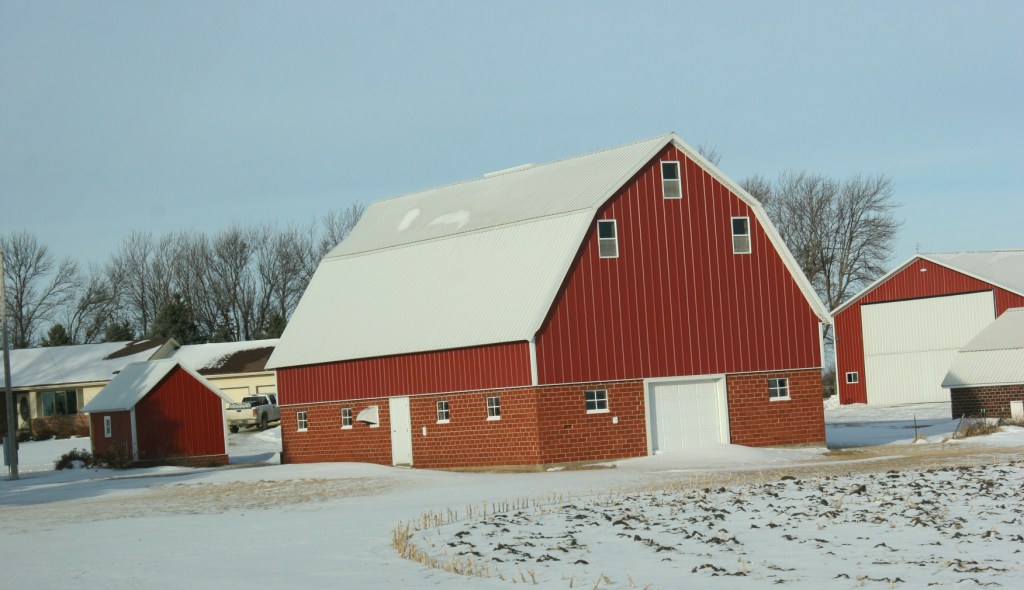
One of my favorite Minnesota barns is this especially well-maintained one along a back county road west of New Ulm.


I FIND MYSELF, all too often in my on-the-road rural photography, focusing primarily on barns. My eyes gravitate toward these agricultural icons that I fear will vanish within the next 50 years, fallen to abandonment and/or replaced by nondescript cookie cutter metal polesheds. That saddens me. But it is the reality of the times, of the decline of the family farm.


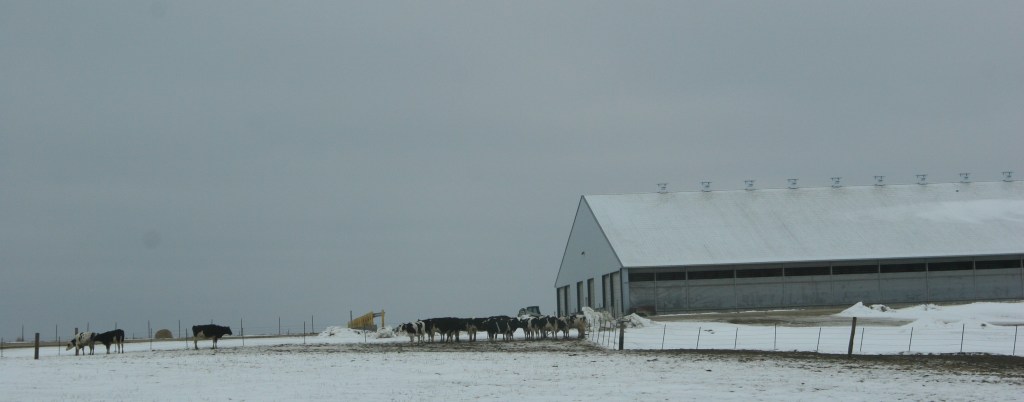
Massive polesheds have replaced traditional barns on some farms, including this one along Interstate 90 in southeastern Minnesota.


I will continue to photograph these beloved landmarks, symbols of a bygone era of farming. Barns hold personal value to me as a farmer’s daughter. I grew up working in the barn—feeding cows, bedding straw, shoveling manure, lugging pails of still warm milk from cow to bulk tank and much more.


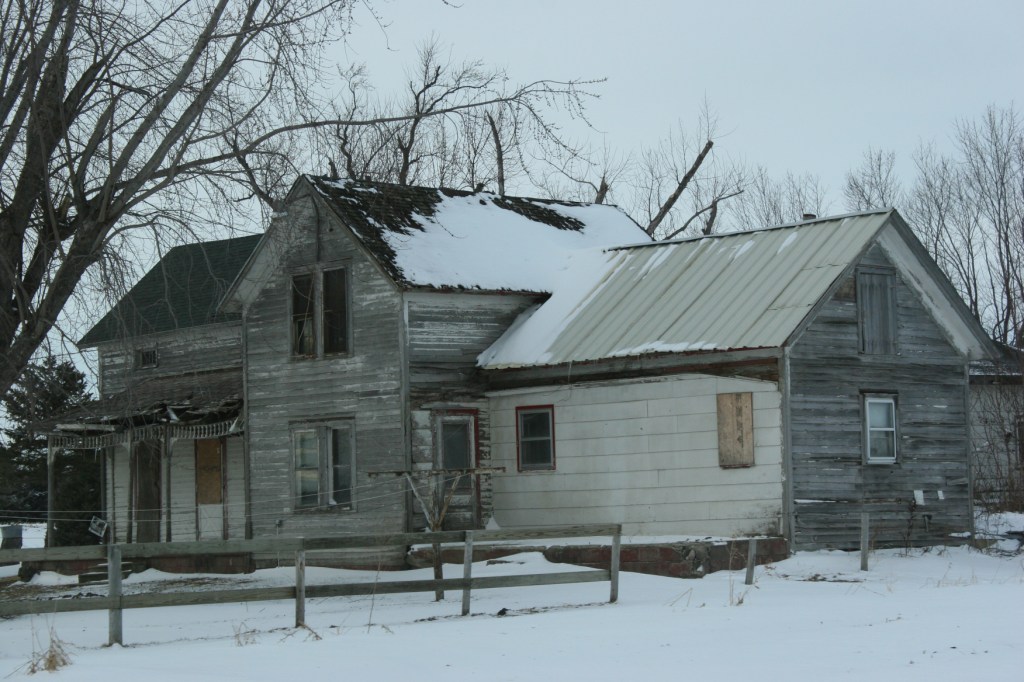
An abandoned farmhouse near Morristown, Minnesota.


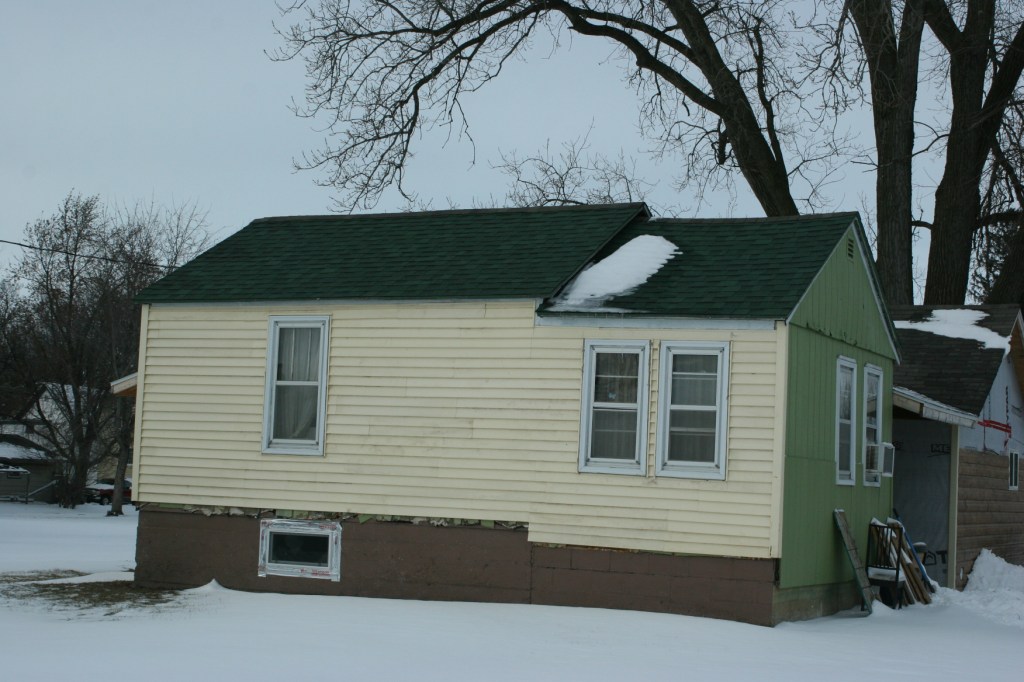
A tiny, colorful house in Morristown, Minnesota.


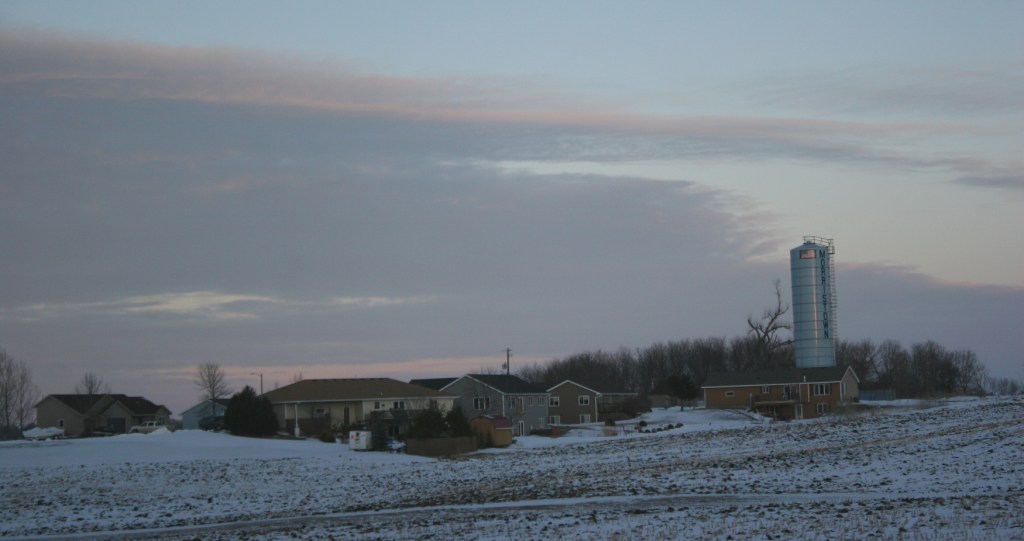
Just blocks away in Morristown, newer homes cluster in a housing development. A tornado hit this area in 2018, destroying and heavily damaging houses.


While documenting these centers of farm life, I’ve mostly neglected to photograph the homes of rural Minnesota. They vary from abandoned houses with broken windows to modern-day structures.


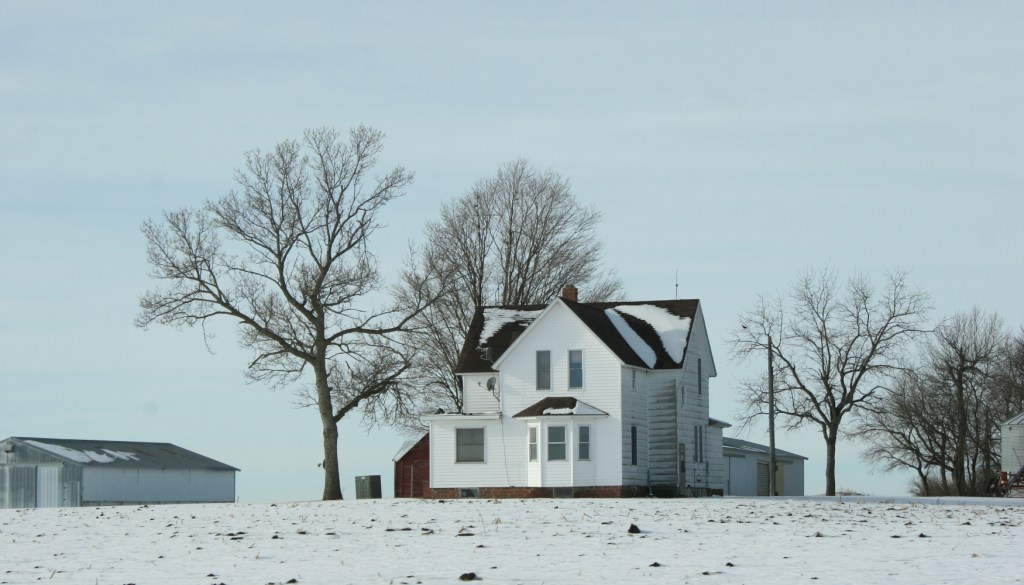
In southwestern Minnesota, an aged farmhouse so familiar to me.


It is the decades-old farmhouses that appeal to me most, no matter their conditions. My childhood home until my early teens was a cramped three-bedroom 1 ½-story house without a bathroom. A hulking oil burning stove in the living room heated the structure. A trap door in the kitchen opened to stairs leading to a dark dirt-floored cellar where salamanders lurked. Mom stashed the bounty of her garden in fruit jars lining plank shelves.


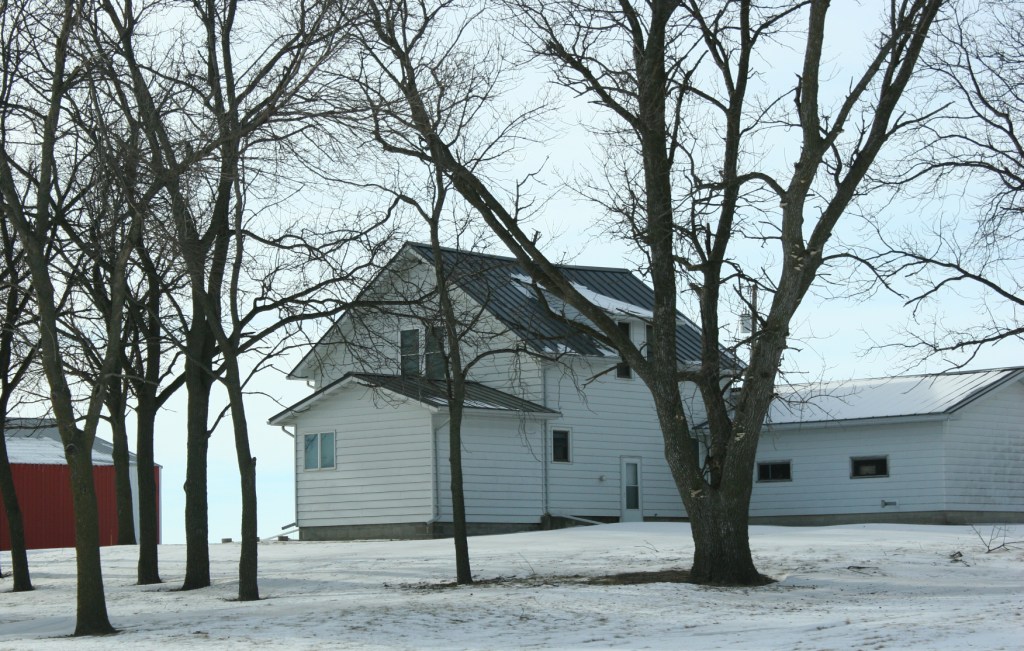
A southwestern Minnesota farmhouse.


I am thankful to have grown up in a minimalist house, in a poor farm family. We may have been poor materialistically. But our family was rich in love. I never realized until I became an adult that I was raised in near poverty. Because of that background, I’ve never needed the most, the best, the newest.


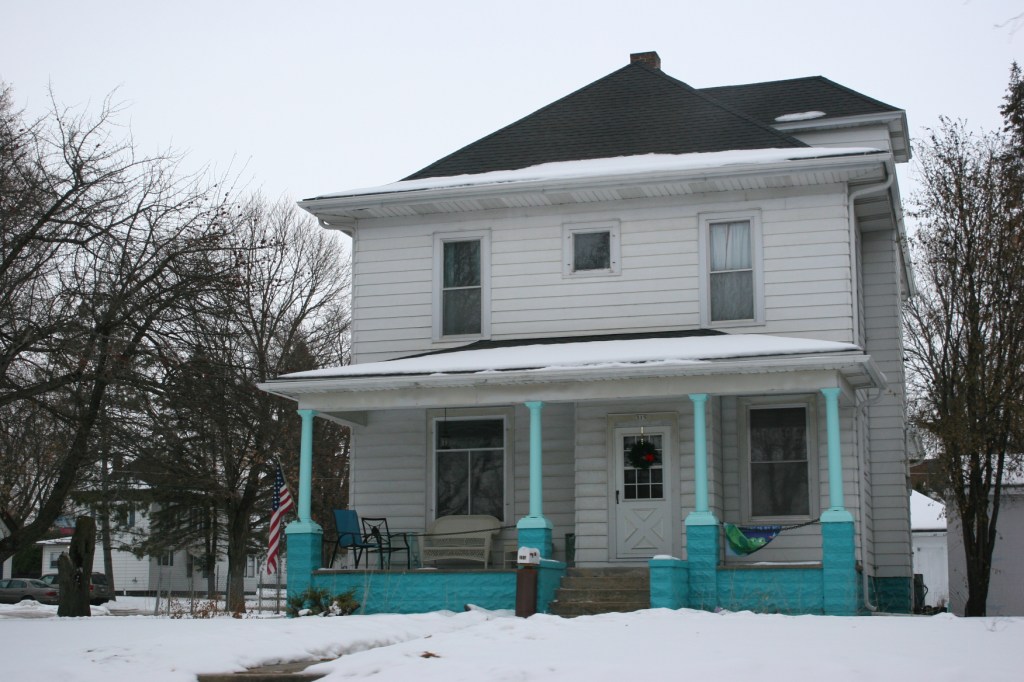
In Kenyon, Minnesota, a brilliant turquoise makes this house stand out.


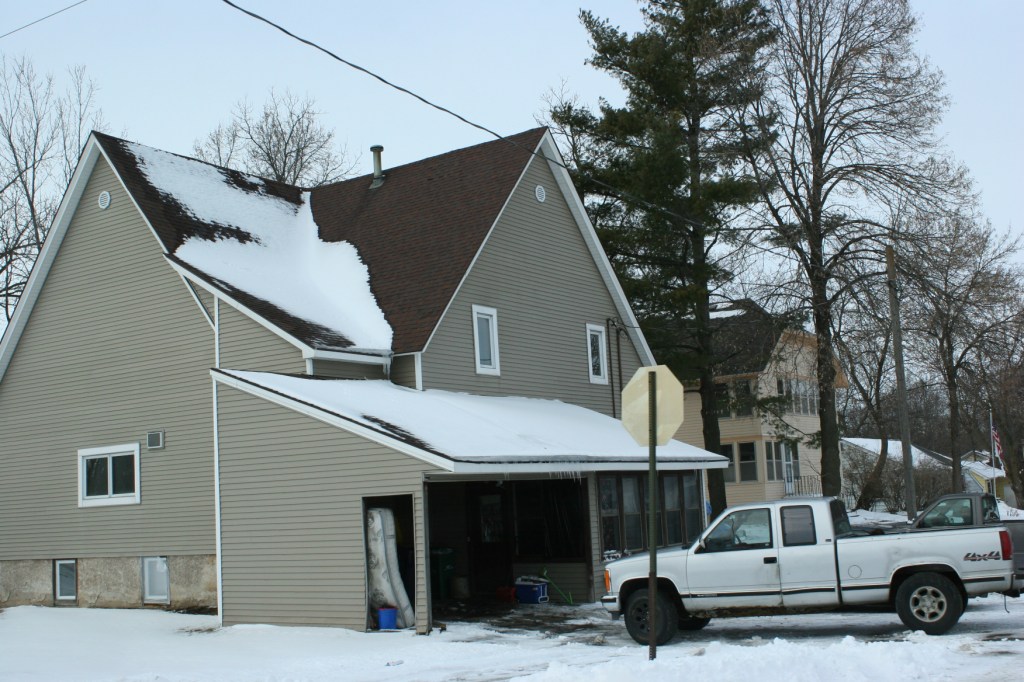
On recent road trips, I intentionally aimed my camera lens at houses. Both in small towns and in the countryside. These are not just houses. They are homes. Or memories of homes. Worthy of preserving with my camera as part of rural Minnesota history.


A home in the small town of Morristown, Minnesota.


THOUGHTS?

© Copyright 2020 Audrey Kletscher Helbling
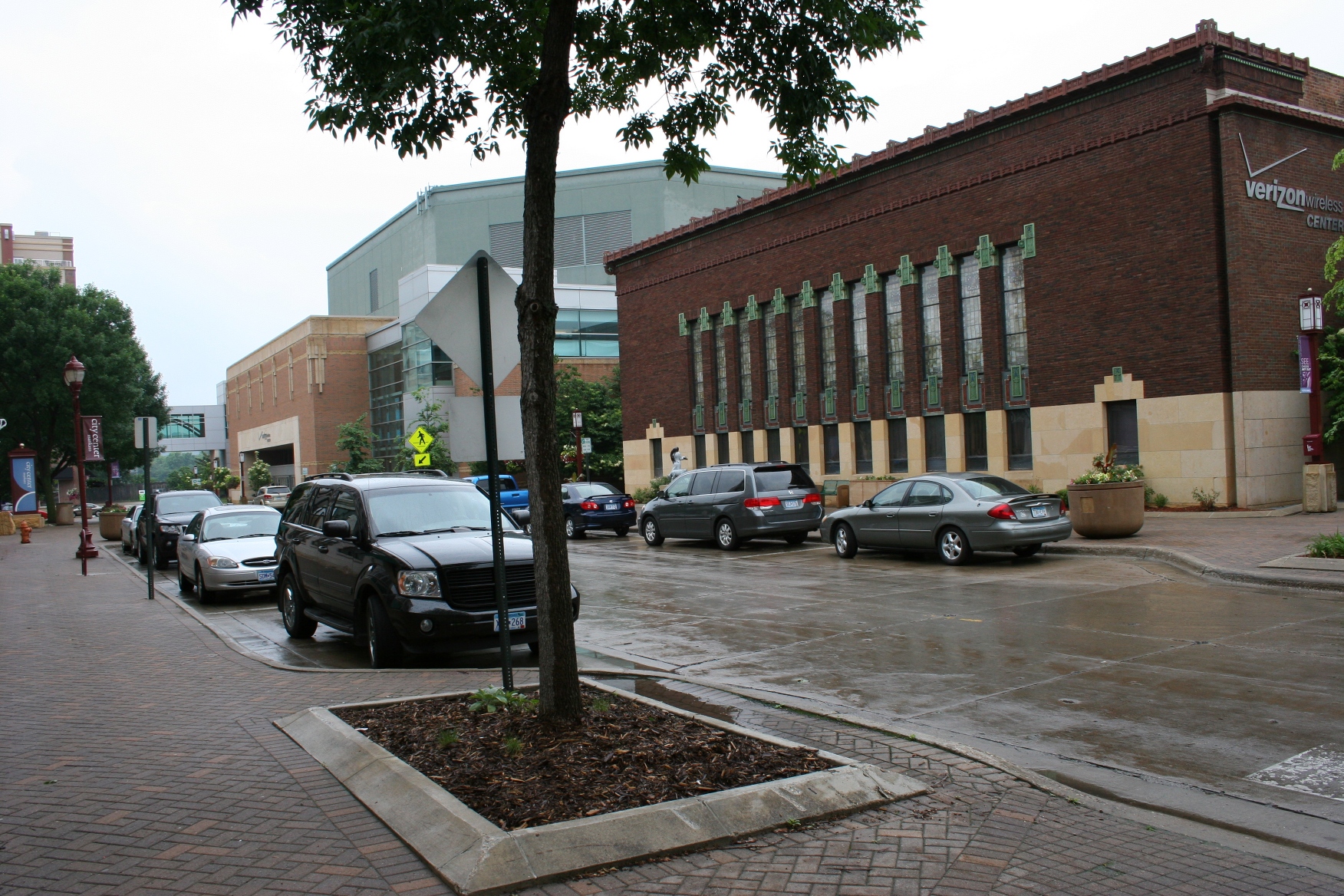
 

A historic bank and White Buffalo Calf Woman June 23, 2011

SET ME IN FRONT of an architecturally-stunning historic building and I’m in history heaven.

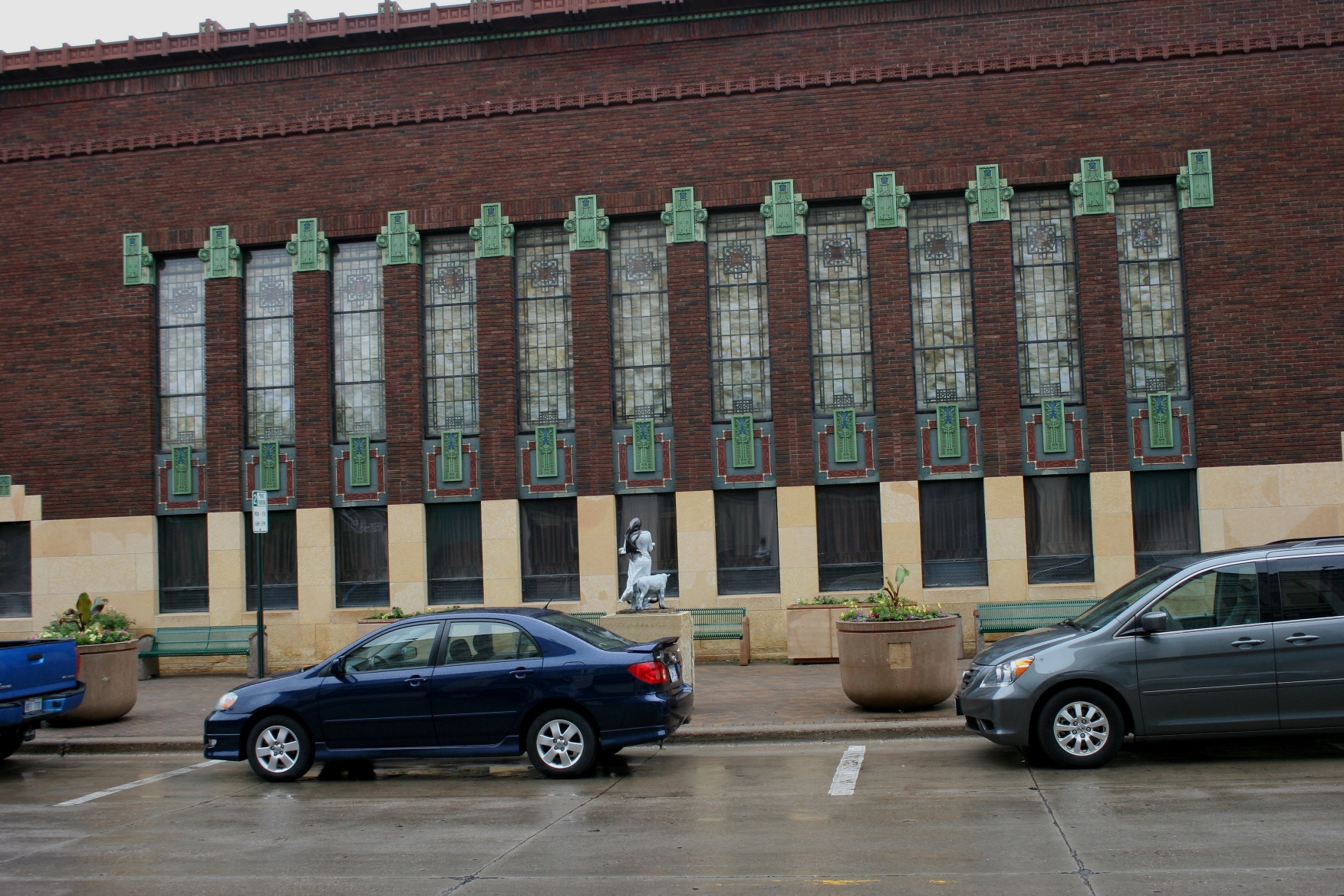
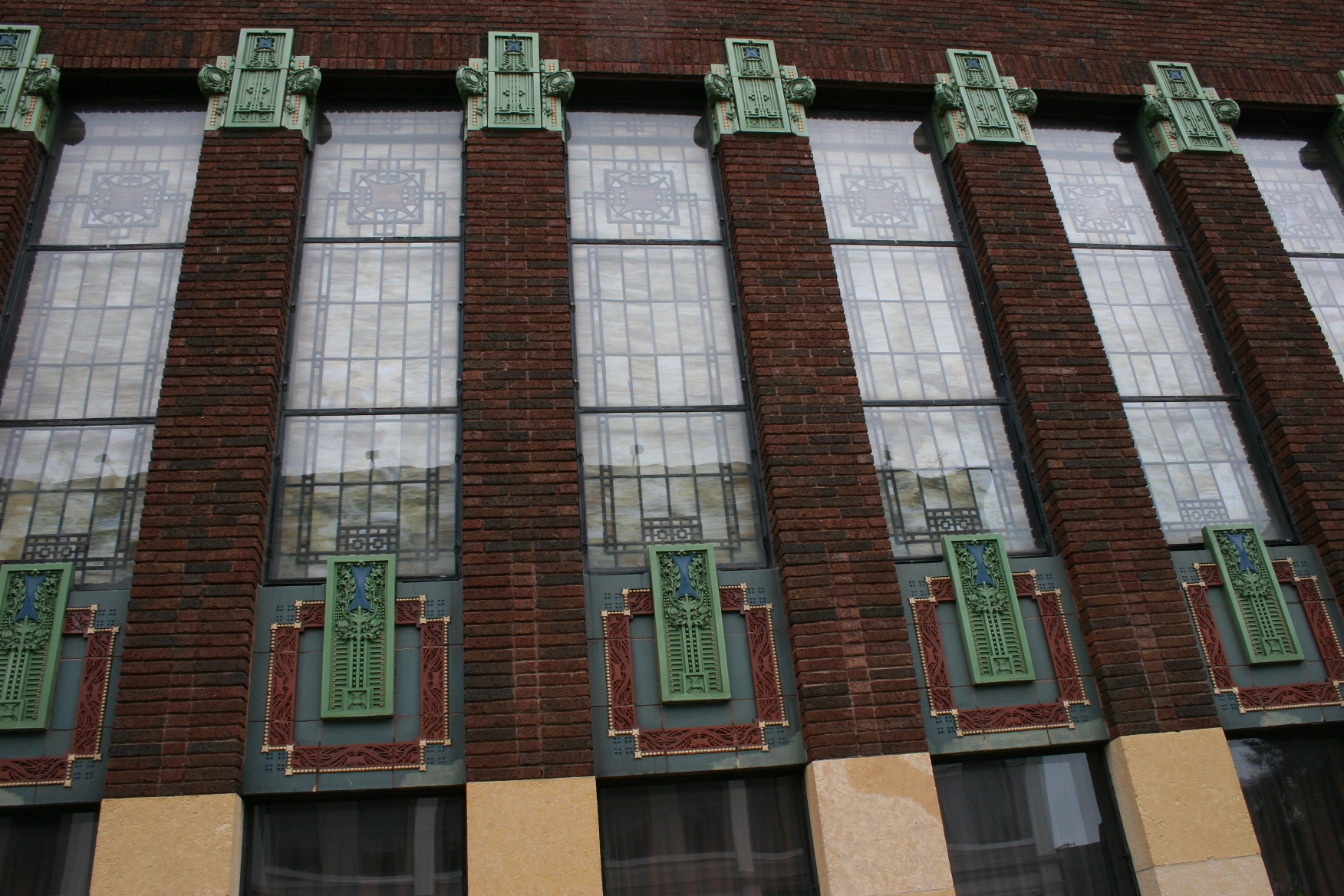
Just look at the lines, the colors, the window leading, the carvings…of the Old First National Bank of Mankato building, now a Verizon Wireless Center reception hall.

I didn’t step inside the former bank, didn’t even try a door. I was content last Saturday afternoon to view the exterior with its Prairie School style architecture.

“It’s like that bank in Owatonna,” my husband said as we gawked at the building built of brick, Mankato limestone and terra cotta along Civic Center Plaza in downtown Mankato.

He was, of course, referring to Chicago architect Louis Sullivan’s “jewel box,” National Farmer’s Bank in Owatonna, a brick building with terra cotta accents, splendid for its stained glass windows, arches and other architectural details.

The Mankato building features Frank Lloyd Wright-inspired stained glass and detailed ornamentation along the roof line.

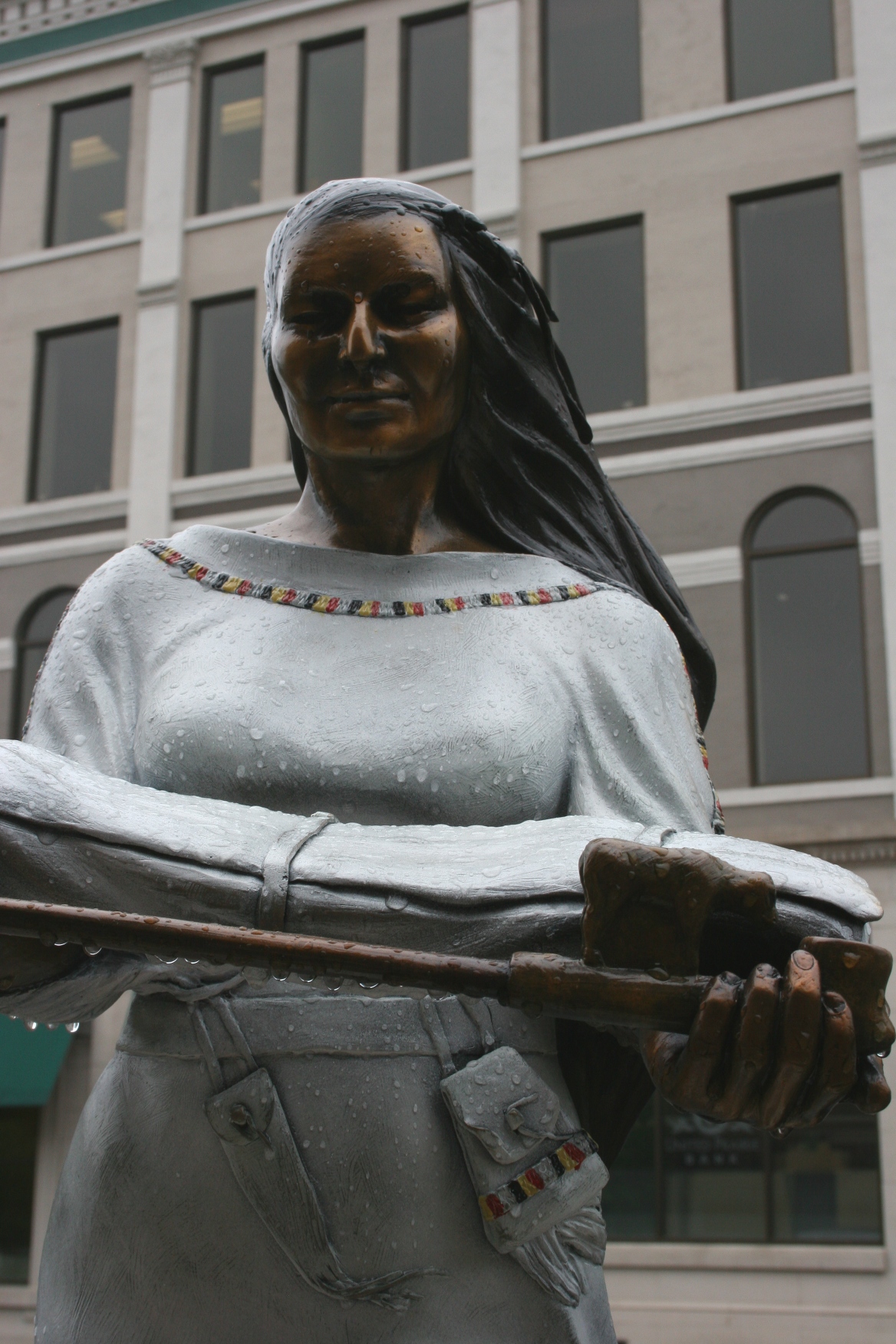
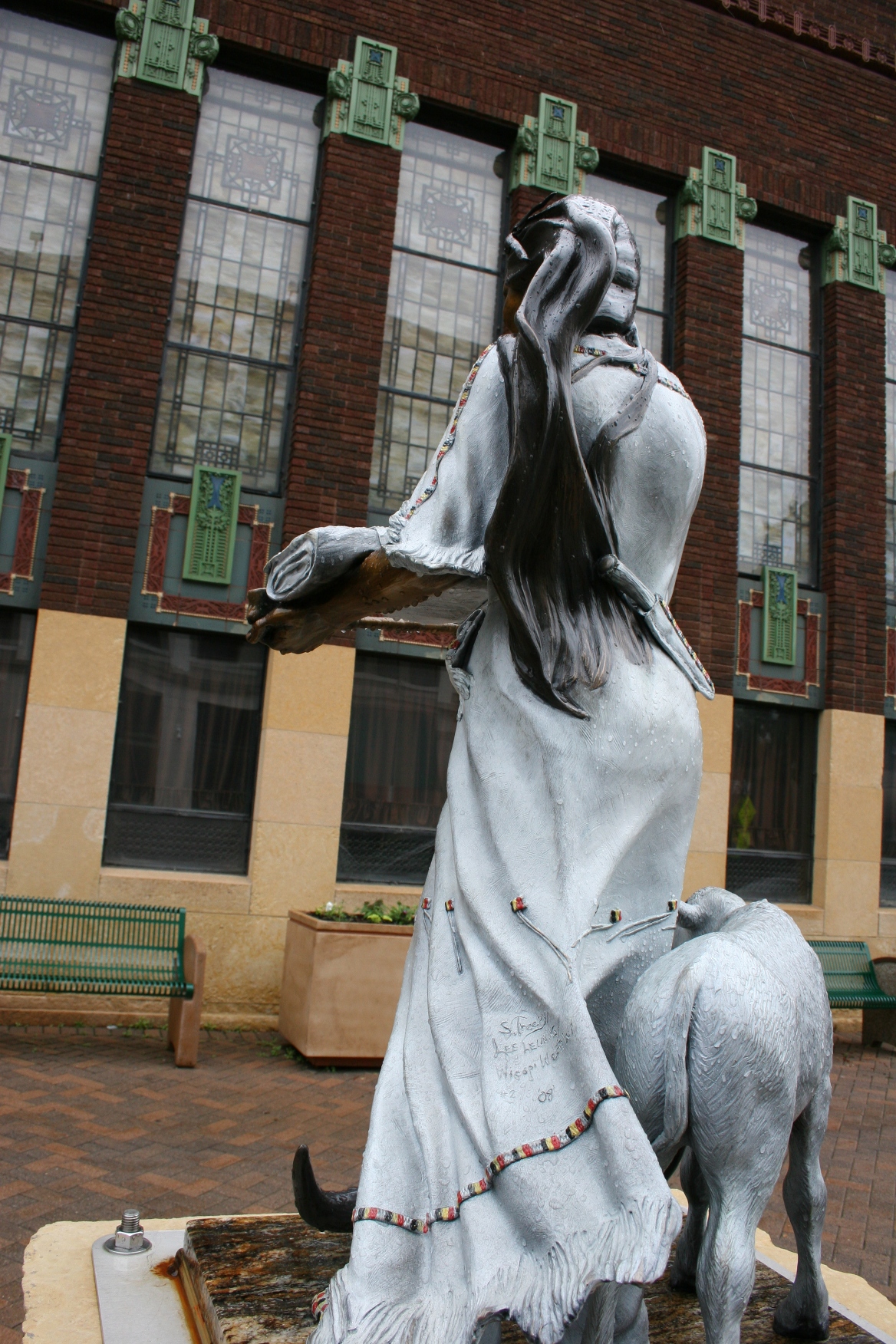
And now it also showcases a bronze sculpture of White Buffalo Calf Woman by South Dakota artists Lee Leuning and Sherri Treeby as part of Mankato’s City Art Walking Sculpture Tour.


If you peer at the woman’s face, examine her beaded moccasins and the trim on her buckskin dress and pouch, you’ll notice how the colors mimic those of the historic bank building. Whether this Native American sculpture’s placement was planned or accidental, I don’t know, but it fits seamlessly with the historical vibe of the locale, enhancing the whole art viewing experience.

The city of Mankato, apparently named after a varied translation of the Dakota word Mahkato, meaning “blue earth,” owns a place in Minnesota and national history for the mass hanging of 38 Dakota here on December 26, 1862. Three hundred warriors were accused of killing civilians and soldiers and of other crimes during the U.S.-Dakota Conflict. After a public outcry, President Abraham Lincoln commuted the sentences of all but 38. Certainly, Mankato is not proud of this moment in history. But efforts have been made to honor the Dakota at monuments in the city.

And now sculptures like White Buffalo Calf Woman also help heal and educate the public about the Native American culture. According to information on the sculpture placard, this prophetess is the only religious icon accepted by all Native American tribes. She “brings a message of healing, hope and peace among the races to all the people.”

More than just art, I also got a history lesson along a Mankato city street on a Saturday afternoon in June.

PLEASE VIEW MY JUNE 20 post for more photos and information about the Walking Sculpture Tour. Additional images will be forthcoming.

© Copyright 2011 Audrey Kletscher Helbling
 

Can reconciliation ever exist over the U.S.-Dakota Conflict of 1862? July 15, 2010

Filed under: Uncategorized — Audrey Kletscher Helbling @ 6:58 AM
Tags: , , ,

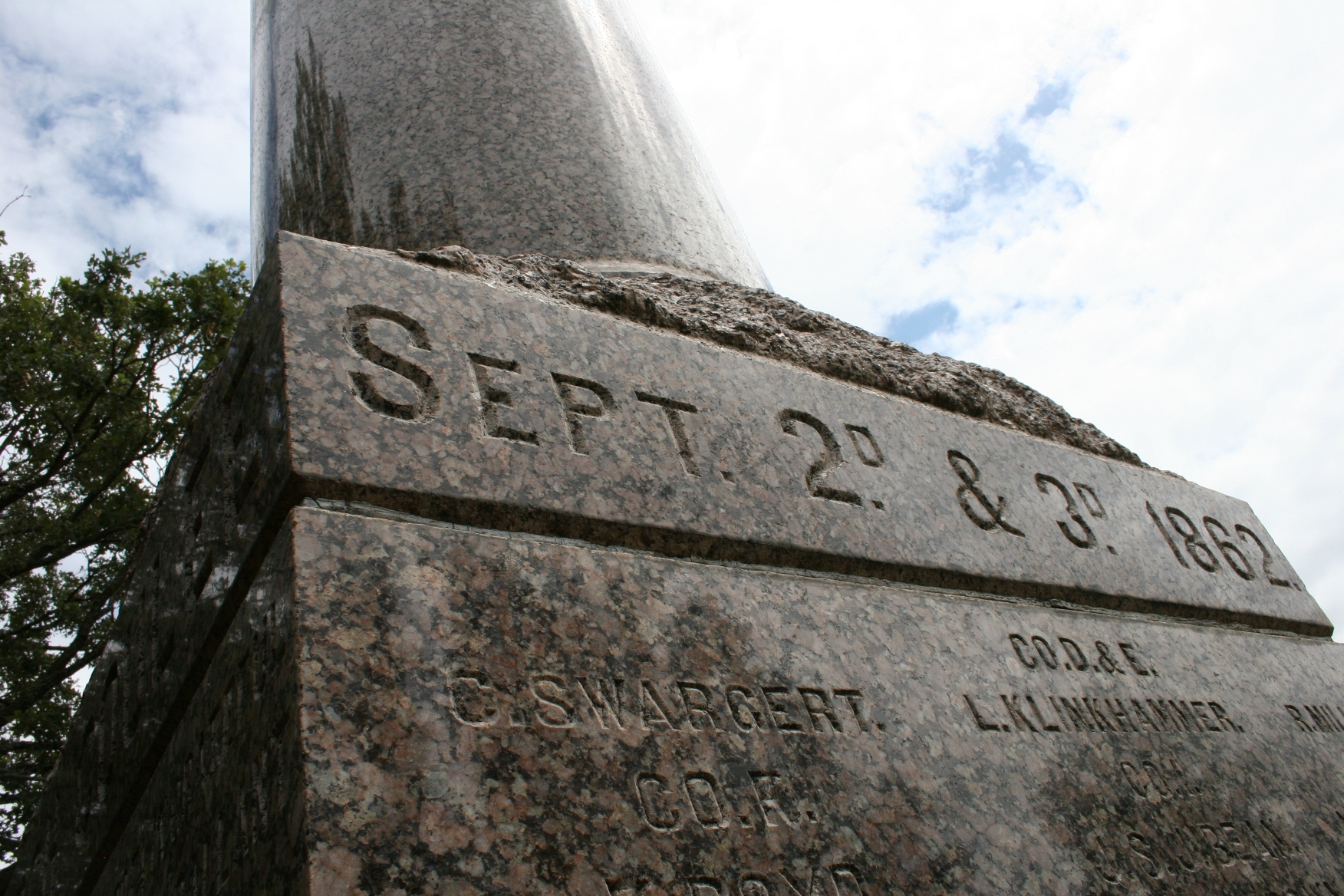
A marker honors soldiers and citizens at the Birch Coulee Monument near Morton. White men and Native Americans fought in the battle at Birch Coulee on September 2 and 3 during the U.S.-Dakota Conflict of 1862.

IF EVER A WAR suffered an identity crisis, it would be the U.S.-Dakota Conflict of 1862. I’m not stating that lightly or in any manner that would indicate disrespect to anyone.

But, in all honesty, I sometimes don’t know how to label the battle between the Dakota people and the white people. I’ve struggled for years with that issue, most recently while writing an essay “Strong Words on Strong Stone at Birch Coulee,” published in Hidden History of the Minnesota River Valley by Elizabeth Johanneck.

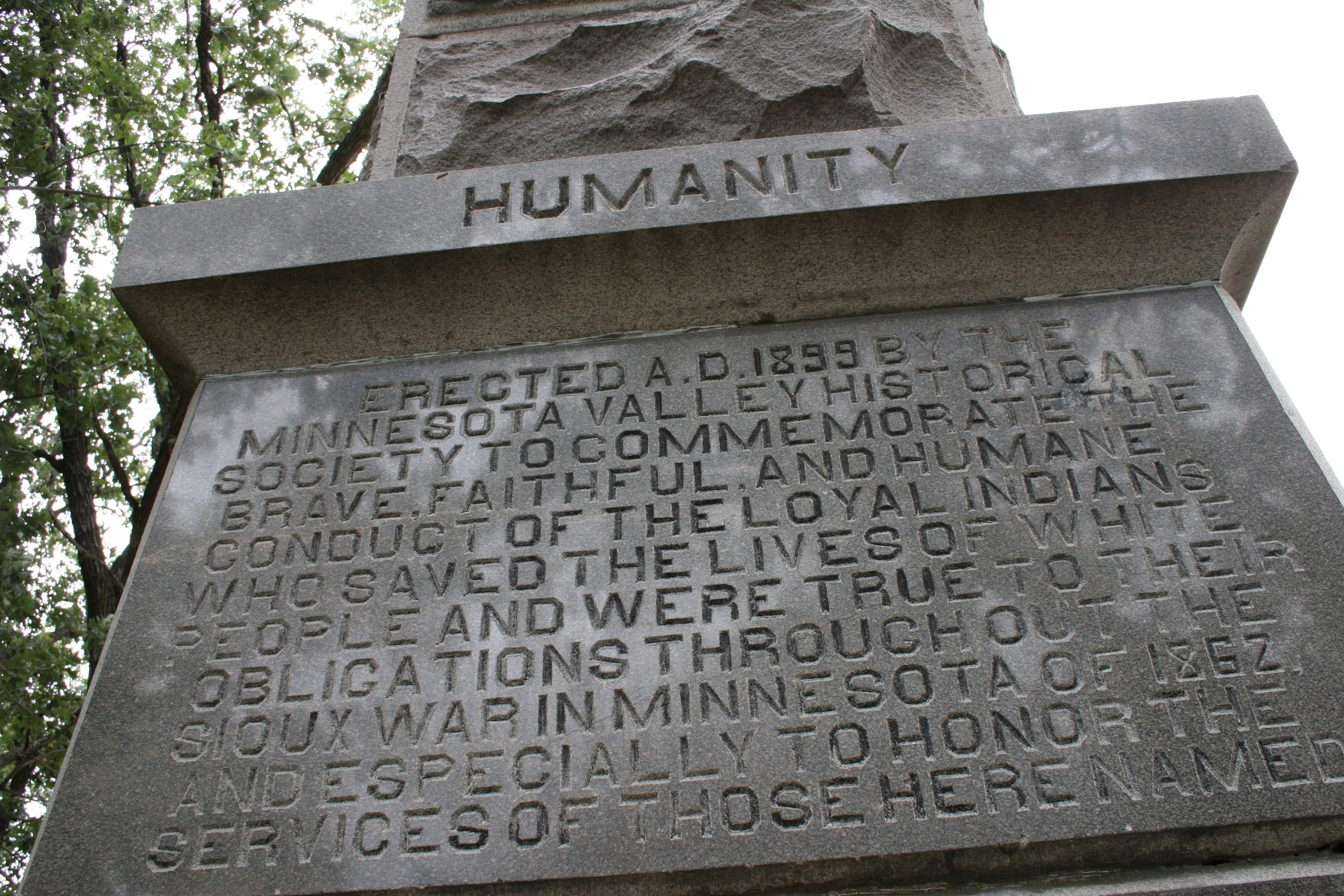
The Loyal Indian Monument at Birch Coulee Monument honors Native Americans and features strong, uppercased words like HUMANITY, PATRIOTISM, FIDELITY and COURAGE.

Back in the 1970s, when I wrote a high school term paper on this conflict, I tagged my research as “The Sioux Uprising of 1862,” the accepted designation then. Prior to that, the word “massacre,” which seems entirely too biased and accusatory, denoted this event in Minnesota history. The conflict has also been termed as an “outbreak,” to me a tag more fitting of a disease.

The name evolved next to “The Dakota War of 1862” (still used by many) and then to the prevailing current-day usage, “U.S.-Dakota Conflict of 1862.”

Apparently, though, that label isn’t set in stone. Recently, while touring the Rice County Historical Society Museum in Faribault, Director Susan Garwood and I discussed the title while standing next to a recently-restored Civil War battle flag carried by Co. C Sixth Minnesota Volunteer Infantry.

Today the word “rebellion” has even been tossed about in defining the conflict, Garwood says.

Right or wrong, I find it interesting that, 148 years after this “war” or “conflict” (or whatever word you choose to define it), the discussion continues. To me, the identity seems to switch with new insights, changing attitudes and/or political correctness.

Garwood also shared that more and more, historians are leaning toward viewing this conflict between the Dakota and the white people as part of the Civil War. After all, Minnesota soldiers, like the Sixth Regiment, fought against the Confederacy and defended the settlers against the Dakota. I suppose in many ways this makes sense since the wars between the North and the South and between the Dakota and the white men occurred simultaneously and were intertwined in defining the history of Minnesota and of this country.

Two Minnesota sites, Fort Ridgely and the location of the Battle of Wood Lake, are among nationally-designated Civil War battlefields. Both have been ranked by the Civil War Sites Advisory Commission of the National Park Service as “needing additional protection.” A Wood Lake Battlefield Preservation Association is working to preserve the battleground that marked the end of the U.S.-Dakota Conflict.

Dakota beadwork displayed at the Rice County Historical Society Museum in Faribault.

I expect that differences in opinion will always exist regarding the “correct” terminology and historical connections for the U.S.-Dakota Conflict of 1862 just as differences exist among people.

I grew up within 15 miles of the Battle of Wood Lake on land that lies between the Upper Sioux Community and the Lower Sioux Indian Community, so I am well aware of the differing perspectives and, yes, even prejudices and discontentment, that lingered when I left the area 36 years ago and which continue today.

Now as the 150th anniversary of the 1862 U.S.-Dakota Conflict approaches in 2012, I wonder, even worry, that deeply-rooted bad feelings, misunderstandings, bitterness and misconceptions will roil to the surface.

I hope that respect, rather than disrespect, define this remembrance.

Already, some efforts are underway to assure that the 150th commemoration includes reconciliation. According to an article in the New Ulm Journal, German polka dancers and Lower Sioux Community chanters, drummers and dancers performed earlier this week at a joint concert in New Ulm, site of several major clashes during the U.S.-Dakota Conflict.

A 150th Anniversary Steering Committee of the U.S.-Dakota War of 1862 has formed and launched a Web site, http://BrownCountyDakotaWarCommemoration.com. Currently, a contest is underway for a logo that represents the U.S.-Dakota War of 1862. The winning design will be used to promote commemorative activities planned for August 2012.

Although nothing has been finalized, committee member Kim Janke tells me her group is planning battle site tours; marker dedications; symposiums; a banquet; dedication of a Brown County Museum exhibit on the War of 1862, “representing the pioneers, Native Americans and what happened during the war;” and more.

All of this gives me hope that someday, perhaps soon, all of us, no matter our differences regarding the U.S.-Dakota Conflict of 1862, can stand together, reconciled, in an unbroken circle of peace.

Dakota beaded moccasins exhibited at the Rice County Historical Society Museum.

© Copyright 2010 Audrey Kletscher Helbling