Minnesota Prairie Roots

Writing and photography by Audrey Kletscher Helbling
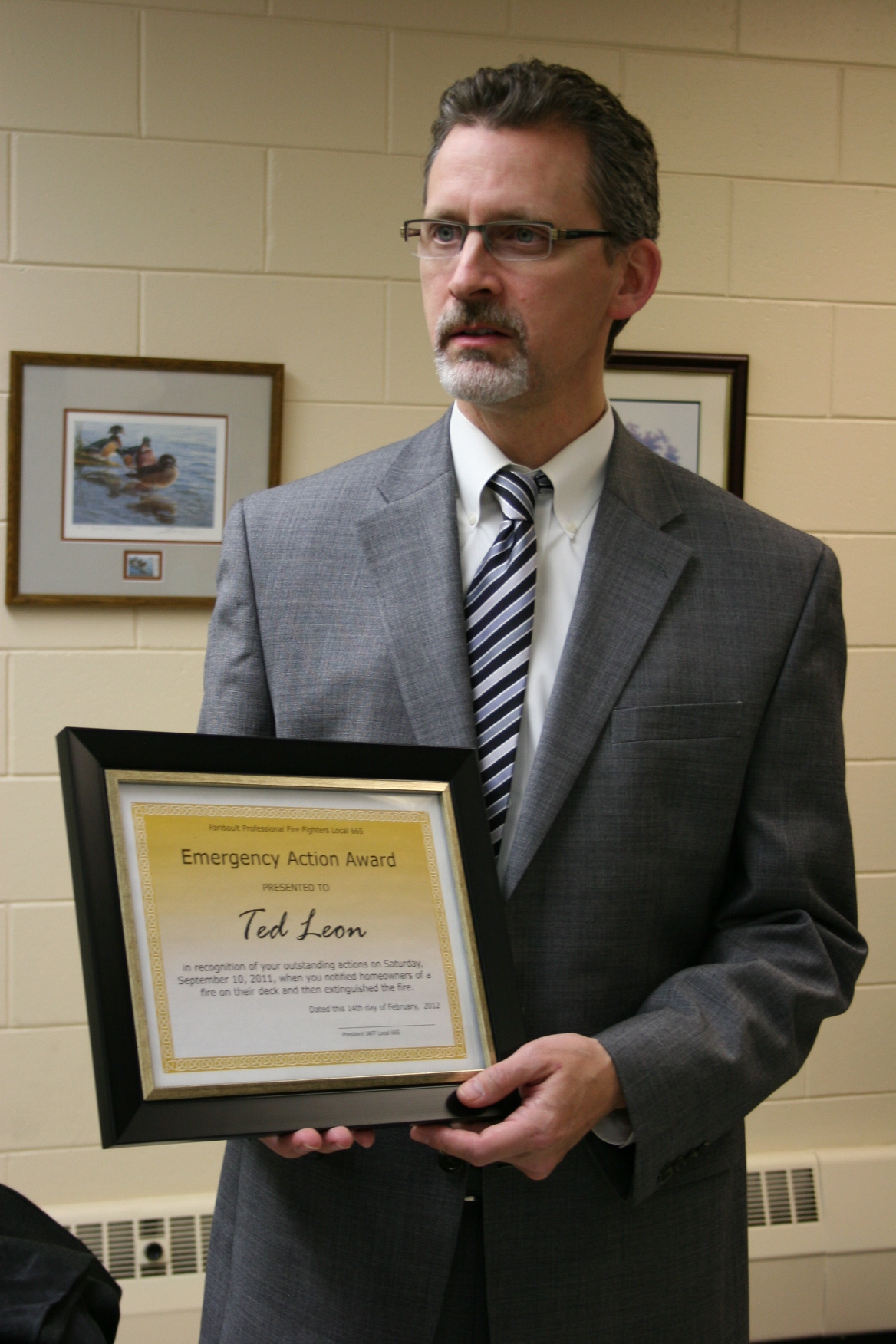
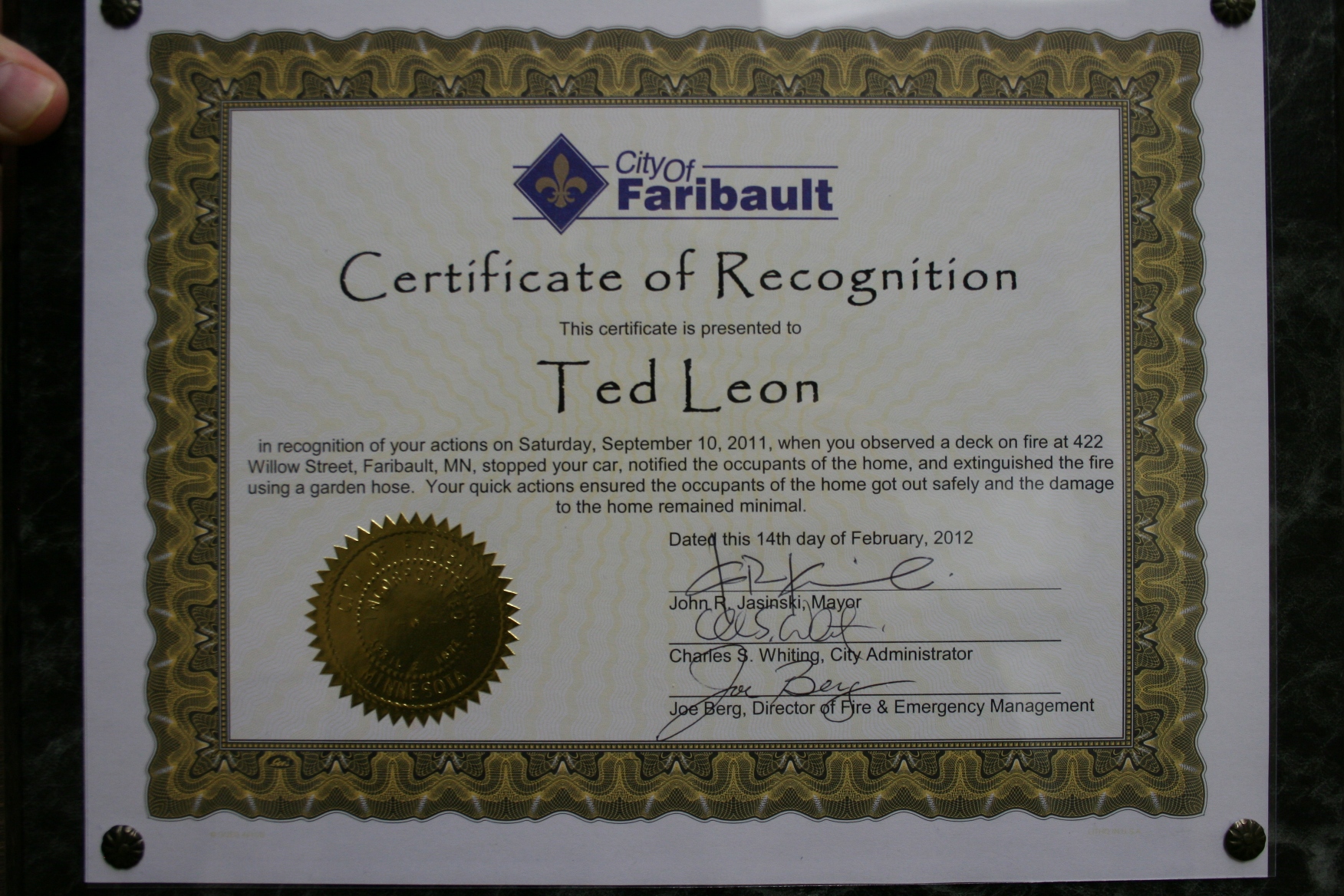
Found: Citizen firefighter Ted Leon from Owatonna September 13, 2011

Filed under: Uncategorized — Audrey Kletscher Helbling @ 4:07 AM
Tags: , , , , , , , , , ,

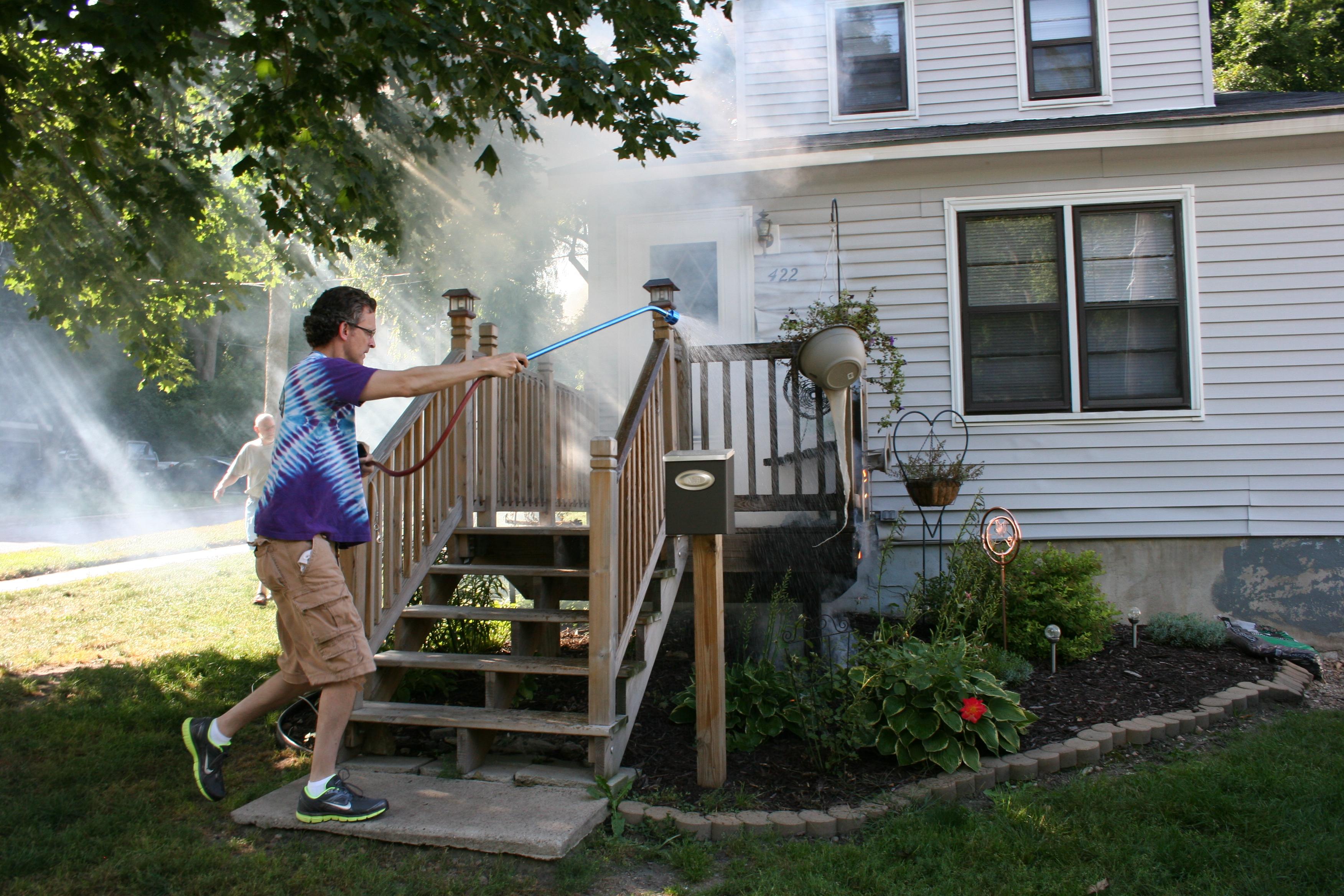
READERS, WE’VE FOUND “Ted from Owatonna,” the passerby who Saturday afternoon stopped to extinguish a quickly-spreading fire on my neighbor’s deck.

Thanks to the quick action of Ted Leon, 47, an attorney at Federated Insurance in Owatonna, Kristin and Kevin Klocek’s Faribault house was saved from what both Ted and I believe could have been a devastating fire. (Click here to read my first blog post about the fire.)

Up until late Monday afternoon, I did not know Ted’s last name because he identified himself only as “Ted from Owatonna” when he left the scene, telling me he had to get going. He told me that much only because I asked. He was the first to arrive at the fire, to grab a garden hose.

But before I get into details about Ted’s firefighting, let me first tell you how we found Ted. And I say “we” because this was a joint effort that initially involved my blogging about the fire, followed up by Minnesota Public Radio’s Bob Collins linking to my story in his News Cut column, Faribault Daily News Managing Editor Jaci Smith learning of my post via Collins’ post and then the Faribault newspaper and its sister paper, The Owatonna People’s Press, publishing a “Do you know this man?” community alert on their websites that included a photo I shot once the fire was under control.

This photo was posted on the newspaper websites in an effort to locate "Ted from Owatonna."

A friend of Ted’s saw the online photo and contacted the Owatonna paper with Ted’s name and number. This I learned from Jaci Smith, who had called me earlier Monday for permission to use my photos and to ask me about the whole event.

Early Monday evening Ted called me, before I had an opportunity to phone him.

So, how then did Ted end up on Willow Street in Faribault at the precise moment the smoldering fire flared up on Kevin and Kristin’s deck?

He, his wife Kathe and their three youngest sons were on their way from The Defeat of Jesse James Days re-enactment in Northfield to 4 p.m. Mass at Divine Mercy Catholic Church. They are not members of the Faribault parish—they attend Sacred Heart in Owatonna—but because Kathe was participating in a St. Paul bike ride Sunday morning, they opted to attend the Saturday afternoon service in Faribault en route home. Their Owatonna church does not have a Saturday Mass.

Kathe told her husband she knew how to get to Divine Mercy and, says Ted, “That put us right in the path of the fire.”

It was nearing 4 p.m. when the Leons were driving in the 400 block of Willow Street. “I looked to the right and saw the fire pretty much engulfing the front deck,” Ted recalls.

As his mind computed the situation, he didn’t quite believe what he was seeing until he realized, “Oh, my goodness, that thing is on fire.” He pulled over, asked Kathe to call 911. Concerned that a grill and propane tank might be involved (they weren’t), Ted told his family to remain inside their van while he raced toward the fire.

He remembers only, in those initial moments, being “really focused in” on the fire and worried that people were inside the house. Ted had reason for concern. Kristin and her daughter Kaylee were inside, unaware of the blaze. As Ted ran up the steps and onto the deck toward the front door, he felt the intense heat of the actively-spreading fire.

He pounded on the screen door, peered through the screen and saw a little girl with her back to him. He ripped the screen and pounded again on the interior door and hollered “Fire, get out!” (or something like that; he doesn’t recall his exact words) until she noticed him.

In this photo you can see how the heat of the fire melted the vinyl siding.

“Once I knew they were aware of the fire, I ran around the house looking for a hose,” Ted continues.

He found two hoses connected to a single water spigot and grabbed one. As he pulled the hose toward the burning deck and the burning wood chips below the deck, the hose jerked from his hand. It was too short. He ran back to the spigot, flipped a lever that sent water to the second hose and “said a prayer it would be long enough.”

It was. The fire responded quickly to the water.

Days after the fire, Ted seems humbly surprised at the media attention. “I didn’t feel like it was a big deal,” he says of his actions.

Anyone would have done what he did, Ted claims. “It was my turn (to help someone).”

I agree with Ted, to a point. I’m not sure I could have gone onto that deck with the actively spreading fire. I saw those intense flames when I arrived just as Ted was grabbing that second hose.

“It’s nice to be able to put your faith into practice and help someone,” this Good Samaritan says.

Later, while worshipping at Divine Mercy, he offered prayers of thanksgiving. His clothes reeked of smoke, he says, and his legs felt sunburned from the intense heat of the fire.

Ted doesn’t remember me several times screaming, “Kristin and Kevin, get out!” He was, as he says, totally focused on extinguishing the fire and making sure everyone was out of the house.

I remain convinced, and so does Ted, that the entire house soon would have been engulfed in flames had he not spotted the deck fire and taken immediate action.

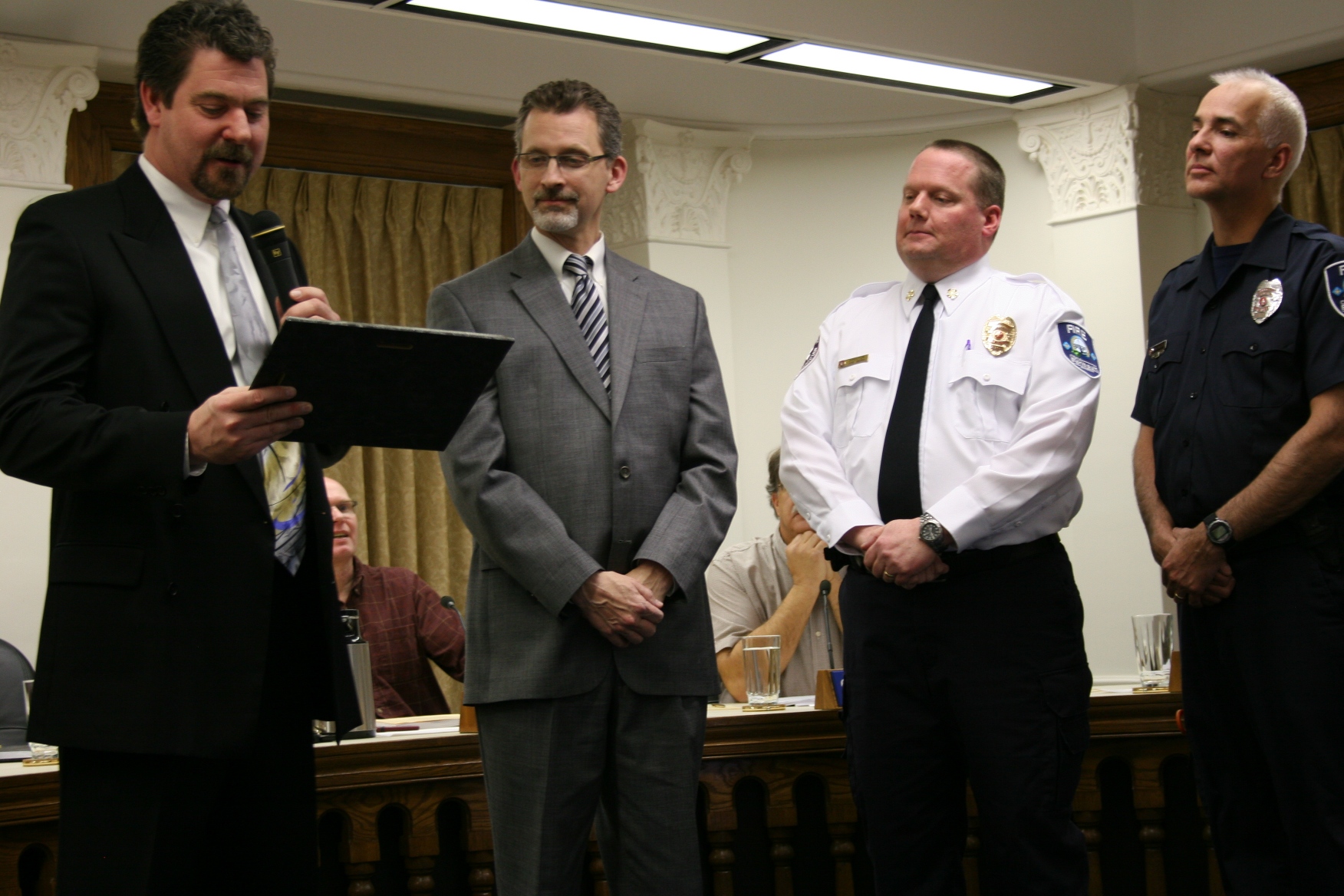
While on the scene of the fire, I spoke with Faribault firefighter Joel Hansen, who was very much interested in finding “Ted from Owatonna” and possibly presenting him with an award for his actions.

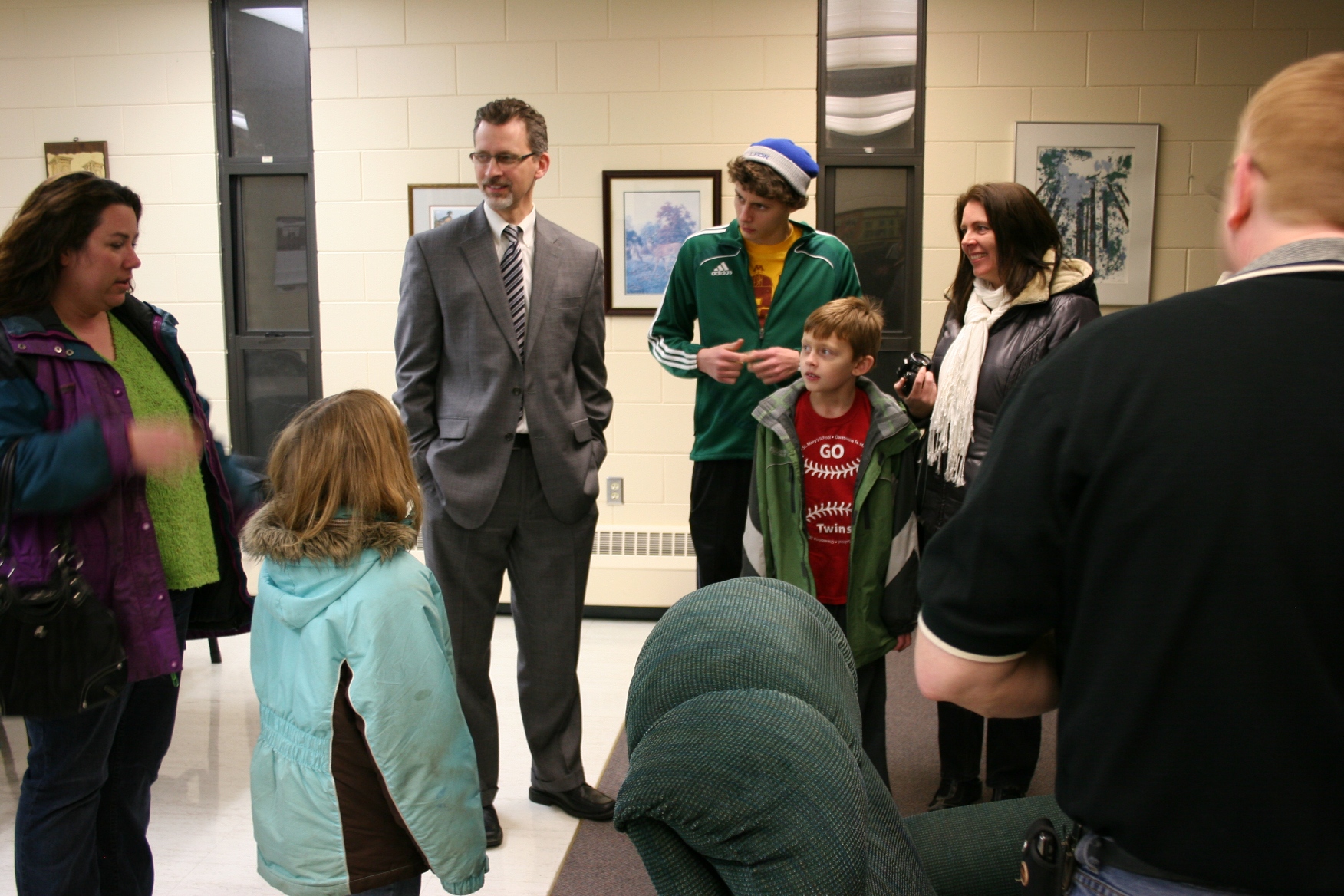
I told Ted Monday evening that I would see him at the awards ceremony.

FYI, A LITTLE BACKGROUND if you have not yet read my first post: I was working in my home office Saturday afternoon when my 17-year-old son, who was sitting on the couch working on his laptop, heard a car horn, looked up and saw the fire directly across the street. “The neighbor’s house is on fire!” he shouted.

I grabbed my camera, which was right next to my desk and raced out the front door, not even stopping to slip on shoes. Because of my background as a former newspaper reporter and now a current freelance writer, it was simply a natural instinct for me to grab my camera.

My first concern was for the safety of my neighbors, not photographing the fire. By the time I got to the front yard, Ted was pulling the second hose toward the fire. At that point flames were shooting up from the wood chips and from the deck.

Because there was nothing I could do at this point to help Ted fight the fire, I remained focused on my neighbors getting out. I was unaware that Ted had already pounded on the door and that the family knew about the fire.

When Kristin and Kaylee rounded the corner of the house after exiting via a door into the garage, I comforted them and made sure they were OK. By then the fire was under control and nearly out. Only then did I begin photographing the scene. At one point I also spoke on the phone with Kristin’s husband. She had called him earlier, but I wanted to assure him that his family was alright and update him on the situation.

A smoldering cigarette butt under the deck has been indicated by fire officials as the likely, as-yet unofficial, cause of the fire.

FOR THE LOCAL news story by Jaci Smith, click here to an article in The Faribault Daily News.


TO READ BOB COLLINS News Cut column, click here and check his Monday morning 5×8 entry.

© Copyright 2011 Audrey Kletscher Helbling

 

We’re not hyphenated Americans… September 12, 2011

Xafsa, age 5

THEY ARE THE FACES, the hands, the feet, the voices of a new Faribault. Not the community of only French or Germans, Scandinavians or whatever ethnic groups shaped and defined this southeastern Minnesota city for so many years.

Today the face of Faribault is changing with one-fifth of the population identifying itself as non-white in the 2010 U.S. Census. Most of those minorities are Latinos and Somalis, “drawn by the opportunity to live in a small town and work in food processing plants, especially meat-packing plants,” according to a recent research report, “After the Welcome Center: Renewing Conversations about Immigration and Diversity in Faribault,” conducted by students and staff with the St. Olaf College Political Science Department. To read that report, follow this link:

http://www.stolaf.edu/services/cel/students/CURI_Immigration.html

I can’t possibly attempt to summarize the contents of that report here. But it is packed with information that should be a must-read for every member of my community. We can all learn a thing or two or ten or 20 from this research project.

But mostly we can learn from meeting our neighbors at events like the International Festival held Saturday in Faribault’s Central Park. I’ve attended this meld of ethnic cultures several times already and each time enjoyed interacting with my neighbors whose skin color differs from my own.

That all sounds nice, politically-correct, and exactly what you’d expect me to write in a public venue like this blog. But I am sincere in my appreciation to the volunteer organizers of the International Festival and to those who participate. We just need more Caucasians to attend.

Several Latinos lead in singing of Mexico's national anthem on the band shell stage.

From the food and merchandise vendors to the musicians and everyone in between, I had ample opportunity to educate myself about Mexico, El Salvador, Guatemala, Honduras, Somalia, Holland and Norway. My husband and I sampled ethnic foods from five vendors.

We sampled pupusas right off the griddle.

My husband and I tried Guatemalan chuchitos-- chicken, corn and salsa wrapped in a corn husk.

Faribault resident and one of the organizers, Peter van Sluis a Dutch citizen who has lived in the U.S. for 25 years, says the festival offers “a chance to mingle with different cultures.”

For me that mingling was most evident when children gathered under shade trees just south of the Central Park band shell to break piñatas. It didn’t matter if their skin was the beautiful color of sun-baked clay, or a nearly-black deep brown, or pale white. They were all kids, just kids, waiting to whack that swaying treasure-trove apart and then scramble for candy.

After the pinata was broken, the kids shared the candy.

While waiting for the piñata busting, I made a point of scanning the adult faces. I saw smiles—smiles nearly as wide as the brimmed hat worn by the man donning an El Salvador T-shirt. That’s an exaggeration, but you get my point. Viewing kids having fun has no color barriers.

Riyaam, 16

I would be remiss, however, if I didn’t mention my chat with Owatonna High School student Riyaam, a stunning Somali teen who was peddling shoes, skirts and other merchandise at a table. Well-spoken and seemingly mature beyond her 16 years, Riyaam and I talked about clashes between whites and Somalis at OHS which she says has led to a new policy of basically, “you fight, you’re out.”

She told me how the angry voice of a single white student, who declared, “Somalis don’t belong here,” triggered those racial tensions.

As she spoke, her voice became more agitated, edged with emotion. I wanted to reach across the table and hug her and I wish now that I had.

But I didn’t and it is too late for that now, but not too late to encourage Faribault residents to make the effort to meet the Somalis, the Sudanese, the Latinos and other immigrants who now live among us. It is easy to dismiss and stereotype an ethnic group if you’ve never made the effort to personally meet them individually.

A member of the Faribault-based band Circles and Squares, of which two members performed at Saturday’s International Festival, nicely summarized, I thought, the goal of the gathering: “Remember, we’re not hyphenated Americans. We’re friends.”

Well, said.

National flag ribbons were tied to trees in Central Park during the celebration.

Vendors peddled their wares at the festival.

Shoes from Somalia on display at Riyaam's table.

A woman from El Salvador cooked at her food both.

Sanji, 18 months, plays with toys in the kids' activity area of the fest.

Hoop maker, performer and teacher Adrienne Lee teaches a Girl Scout the art of hoop dancing. The Girl Scouts were among the non-profit groups with booths at the festival.

A young girl's henna stained foot.

Colorful skirts for sale at Riyaam's booth.

THE ST. OLAF RESEARCH, which included interviews with 39 Faribault community members, states: “Most interviewees agree that Faribault’s immigrant and native-born communities operate alongside each other; coexisting peacefully, but not acting as a single integrated community.”

Exactly.

The report continues: “They do not agree about what should be done to unite these groups.

“We found Faribault leaders thus enmeshed in the long-standing American debate about which people ought to change and how much.”

A colorful, detailed wall hanging/blanket represented El Salvador at one booth.

FYI: International Festival, Faribault, a recently-formed non-profit, has set its number one goal “to promote understanding of different cultures by organizing an annual event,” says Peter van Sluis. Secondly, the group wants to raise money and assist other non-profits.

© Copyright 2011 Audrey Kletscher Helbling
 

Remembering 9/11 in Faribault, Minnesota September 11, 2011

WE CAME. We listened. We prayed. We remembered.

This afternoon my husband and I were among perhaps 100 individuals who gathered outside the county courthouse at the Rice County Veterans Memorial in Faribault to remember September 11, 2001.

A view of the crowd in front of the Rice County Courthouse and veterans memorial.

WW II veteran George DeLay, among those in attendance, waits on the courthouse steps for the program to begin.

As traffic whizzed by on busy Fourth Street, aging veterans stood or sat, their heads bowed in quiet contemplation.

Representatives of local law enforcement and emergency personnel stood attentively.

Six-year-old Dakota, son of Faribault American Legion Post 43 Commander and Desert Storm veteran Kirk Mansfield, perched on his mother Paula’s lap on the courthouse steps clutching an American flag. Too young to have lived through this day, he is learning about 9/11 from his parents, from ceremonies like those held today.

We are all still learning, experiencing and understanding how that attack on our nation 10 years ago has affected us, changed our thinking, our perspectives on life.

“Freedom is our greatest asset and our greatest export,” former Sheriff Richard Cook, who has been active in expanding the veterans’ memorial, said. “Freedom will live and flourish.”

Veteran and chaplain Roger Schuenke led the crowd in prayer: “May the faith of our fathers guide, protect and sustain our people.”

But it was the names read by Kirk Mansfield and American Legion Auxiliary representative Louise Flom that most impacted me, that caused me to pause, to settle onto the lawn of the courthouse with my camera in my lap and to listen, just listen, instead of photographing the scene.

For nearly 10 minutes the pair read the names of 94 Minnesotans who have been killed in action since 9/11:

Chester W. Hosford of Hastings, Corey J. Goodnature of Clarks Grove, Brent W. Koch of Morton, Randy W. Pickering of Bovey, Edward J. Herrgott of Shakopee, Andrew J. Kemple of Cambridge…

Familiar names, like Jesse M. Lhotka of Alexandria (originally from Appleton), David F. Day of  Saint Louis Park (originally from Morris) and Jason G. Timmerman of Cottonwood/Tracy—all National Guard members killed on February 21, 2005, in Iraq, and whose families I interviewed several years ago for a feature published in Minnesota Moments magazine.

I remembered how speaking with Lhotka’s widow had been one of the most emotionally-challenging interviews I’d ever done in my journalism career.

This I thought as Commander Mansfield and Flom read for nearly 10 minutes. Ninety-four men whose families grieve.

This is how I remembered 9/11 today, by honoring those who have given their lives for freedom.

Veterans' names are engraved in pavers edging the Rice County Veterans Memorial, the site of today's ceremony.

Some of the 20-plus veterans who stood in a line flanking the memorial.

Jim Kiekeknapp, who served in Vietnam, played taps.

Dakota with him mom, Paula, watched from the courthouse steps.

WW II veterans Bill Korff and past commander of the local Legion came in his wheelchair.

A veteran's salute.

AND THEN ON THE WAY HOME from the courthouse, I stopped at the Faribault Fire Department to photograph the memorial there honoring the New York City firefighters who died in the Twin towers.

A memorial at the Faribault Fire Department, where a short service was also held this morning.

The Faribault firefighters pay special tribute to the fallen New York firefighters on their memorial sign.

TO BACKTRACK EVEN FURTHER in my day, when my husband and I were at a local nursing home leading a morning church service, I insisted that the eight of us gathered there sing “America, the Beautiful.”

I found verse 3 especially fitting for this day when we as Americans pause in our lives to remember September 11, 2001:

“O beautiful for heroes proved

In liberating strife,

Who more than self their country loved,

And mercy more than life!

America! America! May God thy gold refine

Till all success be nobleness

And every gain divine!”

Six-year-old Dakota and others in attendance perused the veterans' pavers after the ceremony.

© Copyright 2011 Audrey Kletscher Helbling
 

“The neighbor’s house is on fire!” September 10, 2011

Filed under: Uncategorized — Audrey Kletscher Helbling @ 5:55 PM

Tags: , , , , , , , ,

TED FROM OWATONNA, you are our Willow Street neighborhood hero. This afternoon you saved my neighbor’s house from what could have been a devastating fire. Thank you. Thank you. Thank you.

You were in a hurry to leave after you put out the fire on Kristin and Kevin’s deck with a garden hose around 4 p.m. today. You didn’t give me your last name—I was the one with the camera, the across-the-street-neighbor.

I am forever grateful to you for noticing the flames (as you drove by with your family), stopping, grabbing a garden hose, banging on the house and yelling for my neighbors to “Get out!”

This is a view from my yard looking directly across the street at Kevin and Kristin's house on the corner of Tower Place and Willow Street. The fire was extinguished before firefighters arrived.

I did not get many actual fire photos as I was more focused on making sure my neighbors were out of the house than in photographing the scene. But here you see wood chips burning under the deck.

Ted from Owatonna uses water from a garden hose to put out the deck fire.

That's my neighbor Kristin on the right, with Ted still working to assure the fire is out.

You deserve an award, Ted. Faribault firefighter Joel Hansen says the fire department gives awards for efforts like yours. I expect you wouldn’t want one. But you need to be recognized and publicly thanked.

If not for your quick action, I am convinced the fire would have caused severe damage to Kristin and Kevin’s home.

By the time my 17-year-old son noticed the flames (which was almost immediately) and hollered, “The neighbor’s house is on fire!” you were already there grabbing the hose.

Flames were shooting from under and around the deck in the mere seconds it took for my husband and me to race across Tower Place. I didn’t even slip on shoes, just grabbed my camera and ran.

All I could think of was that my neighbors were in their house; their car was in the driveway. I screamed, “Kevin, Kristin, get out of the house!” Several times.

My eyes focused on those flames blocking the front door. The flames that kept shooting up until Ted extinguished them with water from that garden hose.

Then Kristin and her daughter, Kaylee, rounded the corner from the garage, having safely exited through a back door.

Kristin told me she heard the banging, but, because some neighborhood kids have been banging on her house recently, didn’t think much of it. But then she got up to check, saw the fire and got out. Her husband and son were not home.

I am relieved, thankful, grateful that the fire was contained to the deck area, that it did not happen at night, that my neighbors got safely out. The deck and siding are damaged. That is minor compared to what could have been.

The fire damaged the deck and siding.

Faribault firefighter Joel Hansen continued spraying down the area after Ted left.

It could have been worse, much worse, if not for the quick actions of Ted from Owatonna.

If anyone knows the identity of Ted, please submit a comment and I will pass this information along to the Faribault Fire Department. My husband also got Ted’s license plate number, so we are confident that officials can track him down that way. We want Ted to get the public recognition he deserves.

Today, Ted, let me give you your first public, “Thank you!”

Readers, if you would also like to comment on Ted’s actions, I welcome you to do so.

© Copyright 2011 Audrey Kletscher Helbling
 

If only Jesse James had been a beer farmer September 8, 2011

Another craft beer, James-Younger 1876 Rye Ale, made right here in Minnesota honors the defeat of the James-Younger Gang during an 1876 bank robbery in Northfield.

CRAFT BEER LOVERS, here’s a new beer for you, James-Younger 1876 Rye Ale, a limited-edition beer selling this week during Northfield’s annual Defeat of Jesse James Days. Proceeds from beer sales will benefit the Northfield Historical Society.

Now I’m no beer connoisseur, but my husband and I like to try specialty beers such as James-Younger. He bought a six-pack a few weeks ago at Firehouse Liquor in Dundas. While this rye ale doesn’t suit our homogenized taste buds, I’m certain it will appeal to plenty of other folks.

That all said, if you pick up some James-Younger ale, I want you to turn the bottle on its side and read the small print: “Brewed and bottled for Bank Beer Co. by Brau Brothers Brewing Co. LLC. Lucan, MN

OK, then, about Lucan—it’s a town of 220 residents in Redwood County in southwestern Minnesota and about five miles from the farm where I grew up. I think it would be accurate to say that Brau Brothers Brewing has put Lucan on the map with its award-winning beers.

As for the Braus, they are three brothers and a Dad who produce craft beers like Ring Neck Braun Ale, Moo Joos, Hundred Yard Dash and my personal favorite, Strawberry Wheat.

Since I’m not too knowledgeable about beer stuff, I emailed Brau Brothers CEO and brewer Dustin Brau to inquire about the James-Younger ale. His family-owned business brewed the beer and co-packaged it for Bank Beer Company, a contract brewery based in Hendricks. That town of 725 lies even further west, in Lincoln County only miles from the South Dakota border.

Anyway, Dustin credits Jason Markkula at Bank Beer for the idea, recipe, marketing and distribution of the James-Younger ale. Brau Brothers brewed and bottled the beer.

And because Dustin clearly knows beer, I asked him to describe James-Younger 1876 Rye Ale: “Basically, a rye pale ale. Not crazy hoppy, but just enough. The spice from the rye comes through a bit, reminiscent of pepper.”

As for the rye, well, it comes right from the Brau Brothers’ fields. And, if you check the company’s Facebook page, you’ll read that the Braus tag this growing and harvesting of rye as “beer farming.” You just have to appreciate brewers who think that way.

Cheers!

FYI: You won’t find James-Younger 1876 Rye Ale just anywhere. Look for it in limited supplies in the Northfield area during the Defeat of Jesse James Days, which continues through Sunday.


No first day of school tears here September 6, 2011

Filed under: Uncategorized — Audrey Kletscher Helbling @ 8:35 AM
Tags: , , , , , , , , ,

My oldest daughter and my son in a photo taken in May.

MY YOUNGEST STARTED his first day of his final year of high school this morning.

I feel as if I should be crying or something. But I’m not.

By now, by the third child, after 20 years of first days of school, it’s not such a big deal any more. The excitement and the anticipation just aren’t there.

It’s not that I’m a negligent mom who doesn’t care about her child or her child’s education. Rather, the first day of school novelty wore off long ago.

Last night in our house, there was no last-minute packing of the backpack, no pre-school-day jitters. Rather my concern leaned more toward making sure the 17-year-old got to sleep at a reasonable hour.

He is a night owl. If my teen had his way, classes would start around 11 a.m. So today, really, begins the battle of trying to get him to get enough sleep. This issue causes much strife in our household. Next year, at college, he’s on his own.

My focus right now is directed in guiding my son toward selecting a college. He has the smarts—an ACT test score of 32 and nearly a 4.0 GPA—to get in anywhere. But he certainly doesn’t have the money. However, I’ve encouraged him to apply wherever he wishes because maybe, just maybe, he’ll get a financial aid package that will allow him to afford a school he couldn’t otherwise afford.

I’ve suggested he make two college lists: a dream list and a realistic list.

In the meantime, during the first semester of his senior year of high school, my boy is enrolled in a rigorous course of study: Introduction to Economics, Advanced Placement Calculus, Advanced Chemistry and CIS Anatomy/Physiology. He’s also taking speech and logic at the local community technical college. By graduation in June, my son should have more than a semester of college credits earned.

I’ve encouraged him to pursue these college credits. They’re free, I keep telling him. Why wouldn’t you? He understands.

And so these are my thoughts this morning as my last child, who is eight years younger than his oldest sister and six years younger than his other sister, begins his senior year of high school.

No tears shed in this household. But next year at this time, when my husband and I are dropping our youngest off at his dorm, or seeing him off at the airport—if he manages to get into a college on his dream list—I expect the tears will fall fast and steady.

IF YOU’RE A PARENT with school-age children, how did the first day of school go for you? Share your thoughts and/or experiences in a comment.

© Copyright 2011 Audrey Kletscher Helbling

 

A tale of two girls and a goat-napping August 30, 2011

Filed under: Uncategorized — Audrey Kletscher Helbling @ 3:03 PM

Tags: , , , , , , , , ,

This goat is not to be confused with the heisted goat. Rather this goat was photographed at the Kasota Zoo and is used for illustration purposes only with this blog post.

IF YOU HAVE NOT yet heard the tale out of Mankato about the young stepsisters—we’re talking under age 10—who stole a goat from a zoo in the middle of the night and were caught walking down a street in their pajamas with the goat, then click here.

While this story could have ended not-so-happily, it did. The girls and the goat are fine, although the stepsisters could be in trouble with their parents, or the law.

After lying to the police about how they got the goat, the 6 and 7-year-olds eventually fessed-up and the truth was uncovered. They’d been to a birthday party at Sibley Park Zoo earlier in the day and apparently decided they just had to have a goat.

I heard this story on the 10 p.m. news Monday and laughed and laughed and then laughed some more.

I know, maybe I shouldn’t be laughing. Stealing is wrong. Lying is wrong. But in these days of news stories about natural disasters, war, murders, unemployment, a depressed economy, scandalous politics and more, you have to appreciate an imaginative caper like two kids stealing a goat from a zoo, in their p.j.s, in the middle of the night.

And sometimes you just have to view life with a Betsy-Tacy-Tib perspective.

Betsy, Tacy and Tib, for those of you unfamiliar with that trio, are characters in a series of children’s books written by Mankato author Maud Hart Lovelace and published between 1940–1955. The three, based on real-life friends growing up in Mankato (Deep Valley in the books), get into all sorts of mischief.

The fictional trio made quite a mess in the kitchen when they mixed up “Everything Pudding” combining ingredients like bacon grease, vinegar, onions, sugar, red pepper and more.

Another time they cut each other’s hair.

Betsy cuts Tacy's hair in this snippet from a mural by artist Marian Anderson in the Maud Hart Lovelace Children's Wing at the Blue Earth County Library in Mankato.

And once the three ventured into Little Syria for a picnic lunch. There they encountered a goat. They didn’t steal the goat. He stole from them, grabbing their picnic basket and scattering sandwiches, cookies and hard-boiled eggs in all directions.

Yup, sometimes you have to laugh, whether it’s at the antics of a goat in a book of fiction or the antics of real-life goat thieves who seem like they could have stepped right off the pages of a Betsy-Tacy book.

FYI: The girls with the Betsy-Tacy-Tib mischievous streak and the goat were apprehended along Carney Avenue. Coincidence or not, one of the books in Lovelace’s series is titled Carney’s House Party. And Carney’s surname is Sibley.

WHAT’S YOUR TAKE on this story about the stepsisters who stole the goat from Sibley Park Zoo in Mankato? Share your thoughts by submitting a comment.

© Copyright 2011 Audrey Kletscher Helbling

 

Connecting to God at country churches August 28, 2011

Vista Evangelical Lutheran Church, located at the intersection of Waseca County Roads 20 and 56 northeast of New Richland was built in 1908 and is on the National Register of Historic Places.

DURING THE PAST FEW YEARS, whenever I spot an old country church and have the time to stop and photograph it, I do.

I possess a sincere appreciation for the history, architecture, beauty and art found in these rural houses of worship.

There’s also something about a church in the country that exudes a deep sense of peace not found in a church built in a town and surrounded by homes or businesses, confined by concrete or pavement.

In the country, a church feels more closely connected to God by the sky, the land, the stirring of the wind through the trees, the background buzz of bugs on an end-of-summer day.

Serene. Peaceful. Calm. A certain sense of comfort comes from walking through a country churchyard, through the adjoining cemetery that links to farm fields where congregational forefathers worked the land and, on Sunday mornings, paused to thank God for the blessings bestowed upon them.

A plaque at Vista details the congregation's Swedish roots and history. Early settlers met on a hill north of the current church on August 8, 1858, and signed a constitution.

Most times on these brief visits to country churches, I find the doors locked. It wasn’t always this way. Perhaps even a decade ago, I could have walked inside. But times are different. Worry about theft requires locked doors.

So I can only imagine the sun streaming through stained glass windows, the worn pews, the ornate altar, the frayed rope of the bell pull.

Nearly every old country church features irreplaceable stained glass windows.

As I circle the church exterior, I consider the families that have come together here to celebrate baptisms and marriages and to mourn the loss of loved ones. Ashes to ashes, dust to dust.

Cornfields snuggle up to Vista's church yard. It's the most beautiful of settings.

Here, standing with my feet planted next to the church next to a corn or soybean field overlooking the picturesque countryside, I can feel the almighty presence of God the Creator as I contemplate words from “Beautiful Savior,” my favorite hymn:

Beautiful Savior, King of creation, Son of God and Son of Man!

Truly I’d love thee, Truly I’d serve thee,

Light of my soul, my joy, my crown.

#

Fair are the meadows, Fair are the woodlands, Robed in flow’rs of blooming spring;

Jesus is fairer, Jesus is purer,

He makes our sorr’wing spirit sing.

Vista's steeple rises above the countryside as a local landmark.

A lovely grassy area of shade trees lies to the north and west of the Vista church.

© Copyright 2011 Audrey Kletscher Helbling
Verses one and two of “Beautiful Savior” are from The Lutheran Worship hymnal.


A close-up look at the Veseli Ho-Down August 24, 2011

A banner below the hill by Most Holy Trinity Church and school welcomed attendees.

WHENEVER I ATTEND an event like the Veseli Ho-Down, or go anywhere, I notice the details.

That skill has evolved from my years as a writer, fine-tuned also by my work as a photographer. Photography encourages me to seek the faces, even the hands and feet, of individuals in a crowd to tell a story in an unexpected way.

I apply that same method to photographing buildings and activities, anything really. Give an overall picture, but then move in to showcase the often overlooked details.

That said, as promised in a previous post, below are more photos from the festival my husband and I attended on Sunday at Most Holy Trinity Catholic Church in Veseli, near Lonsdale in northwestern Rice County. Enjoy the details, from my perspective, of the Veseli Ho-Down.

First...the crowd...and then a closer look at individuals, and more, at the festival...

An employee from a Bloomington group home brought residents and their therapy bird, Buddy, to her hometown for the Ho-Down. The parakeet (is that correct?) quickly attracted the attention of fest-goers like this girl.

An 11 a.m. polka mass started the day's activities. I took this snippet image of worshipers from the balcony of Most Holy Trinity. I'll feature detailed photos of the church in another post, so check back.

While technically not the best photo, I still like this image for the story it tells of women taking a break from their work in the church basement. When I noticed the rosaries and cross above the kitchen window opening, I knew I had to photograph this scene. The volunteers were selling baked goods.

Kolacky, a Czech pastry, were among the many ethnic baked goods sold at the festival.

The New Prague Czech Singers performed in their mother tongue under a tent in mid-afternoon.

I upped the contrast on this image to make the colors pop on this costume worn by a Czech singer.

The hands of the bingo number caller, or whatever you call a person who calls bingo numbers.

A sign on a propped-open-with-a-rock church basement door directs fest-goers to the bake sale. To the left in the photo is the station for the hog raffle.

I met 94-year-old (almost 95) Celia enjoying a burger in the company of her great niece, Brenda. I was charmed by her beautiful face and quiet elegance. Ceila grew up near Webster and today lives on a farm with her bachelor son near Lonsdale. Celia typically attends about a half-dozen area church festivals each summer. Her great aunt likes visiting with people and enjoys the Czech music, Brenda says. A few weeks ago Celia won $100, half a hog and $10 playing bingo at the Immaculate Conception Church festival in Lonsdale. She's one lucky lady.

The kids, as kids will, chased each other up and down the handicapped entrance to the church.

Waiting for customers at the duck pond in the kids' games tent.

I laughed when I saw this sign on yellow beans for sale. That's an interesting way to sell produce.

I am Lutheran. We do not do raffles. But everywhere I turned at the Ho-Down, someone was pedaling raffle tickets. As I waited in line for the chicken dinner, two men pushed Split the Pot raffle tickets. For $1, you buy a ticket. Every hour a winner is selected and gets half the money. The rest goes to the church. No, we did not win, but we contributed to Most Holy Trinity. These guys hustled the grounds all afternoon.

And where did all that raffle and other money go? Right through the cashier's window in the former Catholic school. I walked by this building numerous times before I noticed the sign, the open window and the well-worn step-up step. It's details like this that tell the complete story of small-town events like the Veseli Ho-Down.

© Copyright 2011 Audrey Kletscher Helbling

 

Celebrating the Czech heritage at Veseli Ho-Down August 23, 2011

AROUND 10:15 a.m. we pull into Veseli, population 200, in northwestern Rice County and are directed to a parking spot on a ball field just below Most Holy Trinity Catholic Church. My husband Randy and I have barely exited our car when Fritz and young Joe arrive in their golf cart, offering us a ride around the block so we don’t have to climb the steep hill to the church.

We learn on the short jaunt that this marks the 44th annual Holy Trinity celebration, which began as a typical church festival but today has evolved into the Veseli Ho-Down.

A sign several miles from Veseli directs motorists to the Ho-Down.

A fest-goer sports a Veseli Ho-Down t-shirt.

It is an event complete with a polka mass, raffles galore, a chicken dinner, kids’ games, home-baked Czech goodies, bingo, entertainment by 11 musical groups and beer, lots of beer.

In between all the activity, you’ll catch snippets of the Czech mother tongue, spoken by the old-timers from Veseli, Lonsdale, Montgomery, New Prague and Webster.

But you needn’t be Czech, or even Catholic, to enjoy this event that swells Veseli’s population on this Sunday in August. I’m Lutheran and I’m German. Chat it up with those attending, and you’ll discover that many grew up in Veseli, or the area, and are back for the day to celebrate, support the church and mingle with family and friends.

John Hertaus Jr. and his wife, Joseth (she’s part French and has a name of French origin), coordinate the chicken dinner served from a tent to around 1,000 diners. Down the hill and around the corner by Novak’s Garage, volunteers grill the 514 chickens, which are then placed in surplus military issue containers and hauled on a wagon to the church grounds.

The Hertauses keep a watchful eye on the entire chicken dinner, which was added to the festival, along with the polka mass, about 20 years ago upon the suggestion of John Jr.’s parents, John Sr. and Rita.

Well before 11 a.m., attendees are already buying $10 tickets for the chicken dinner and filing into the sanctuary. By mass time, worshippers pack the pews, fill folding chairs along the side aisles and overflow into the church entry. Without a program—they ran out—I can’t follow the worship service, so I just sit and stand and fold my hands and bow my head when I am supposed to do so.
The polka mass begins.

A view from the balcony of Most Holy Trinity Catholic Church.

Soaring pillars, stenciling and stained glass windows define the sides of the church.

In this image, notice the details: the hats attached to clips on the back of the pew and the name tags, with parishioners' names, tagging the pew ends. I asked my husband, a former Catholic, about the name tags. He said that in some churches families rented pews. I don't know whether that is still practiced at Holy Trinity.

In between, I take photos, plastering myself against the thick support pillars that block my view of the altar area. I slip upstairs for awhile to get a bird’s eye view of the crowd. Back in my wall-hugging folding chair, I notice the details—the name tags attached to pew ends, the pew back clips for hats, the stenciled walls and ceiling, the stained glass windows, the time-worn wood, the cracked plaster walls, the ornate altar, the sway of hands and feet and bodies to music that seems more suited for an old-time dance than a church service.

Yet, even though I can’t understand any of the words sung with the concertina, trumpet, drums, keyboard and bass guitar due to acoustics and my hearing loss, I still feel spiritually uplifted by music that shouts praise instead of party.

Muzikante, pojd’te hart, tu pisnicku, co mam rad,

Dneska budem ja a moje pany, Panu Bohu dekovat.

Ted and Dorothy Winczewski drove two hours from Coon Rapids to celebrate their 57th wedding anniversary after reading about the polka mass in The Catholic Spirit. “It was just something to do, something spiritual,” Dorothy says. The polka music reminds her of the wedding dances she attended in New Prague while growing up in nearby Shakopee. “I loved it.”

Shoppers look over the mostly Czech baked goods filling tables in the church basement.

The mocha cakes we bought.

In the church basement, while perusing the tables covered with Czech and other treats like kolacky, buchta, koblihy and mocha cakes, I meet a native of nearby Montgomery now living in Bloomington who has orders from his coffee group to pick up poppyseed kolacky. He does.

Most of the goods are baked on-site. And, yes, my husband and I leave with koblihy (like raised doughnuts) and mocha cakes (absolutely divine yellow mini-cakes frosted on all sides and rolled in nuts).

As we wander the church grounds, I am struck by the universal age appeal of this festival. From weeks-old babes to those in their 90s, the Ho-Down draws everyone. And they are friendly lot.

Clarence Smisek

When I approach 88-year-old Clarence Smisek of New Prague, dressed in an ethnic costume as a long-time member of the New Prague Czech Singers, he flashes a broad smile and informs me that Veseli means “to be happy.” He’s right. I later check Google translate. This Czech, who grew up a mile south of Veseli, was baptized at Holy Trinity and up until recently gave tours of the church, seemed a happy fellow.

He also tells me that Smisek means “to smile,” although I can’t verify that.

Ask Clarence to define the Czech people, and he’ll tell you this: “They are hard-working people and they are generous.”

I agree, based on the hard work, time and energy that I know goes into planning and carrying out a successful festival like the Veseli Ho-Down.

But I’d add two more adjectives to Clarence’s description of the Czech. That would be fun-loving and friendly.

CONTINUE SCROLLING BELOW for more Ho-Down images and then check back for additional posts featuring festival photos. Also scan The Catholic Spirit, your local newspaper or elsewhere, and plan to attend a Minnesota church festival this fall.

The front of the historic 1905 Most Holy Trinity Catholic Church, Veseli.

I found cousins Kayla, right, and Brianna sitting on the bank of steep steps leading to the church entry. Kayla, who attends Holy Trinity, won a cake in the cake walk and later would help with clean-up at the tattoo station. Brianna was visiting from Zumbrota.

I waited in line for my chicken dinner next to Bradley, 15, of New Prague and his grandma, Janet, from Veseli. They picked up 11 dinners. Bradley didn't wear the hat just for the Ho-Down. He wears it every day.

My husband and I split a single chicken dinner (half a chicken.)

A volunteer staffs a Spin-the-Wheel prize booth that proved popular with kids. A blue tarp providing shade over the game area lends a bluish tint to this photograph.

A partial view of the festivities from the back side of the church.

The New Prague Czech Singers sing during the mid-afternoon, one of 11 musical groups who donated their time and talents. The youngest member of the group is her 50s and learned Czech from her grandmother.

© Copyright 2011 Audrey Kletscher Helbling