Minnesota Prairie Roots

Writing and photography by Audrey Kletscher Helbling

What is this world coming to? July 20, 2012

Filed under: Uncategorized — Audrey Kletscher Helbling @ 9:17 PM
Tags: , , , , , , , ,

THE QUESTION LINGERS on the edge of my brain, nearly tumbling in words onto my tongue, over my lips and out my mouth.

What is this world coming to?

Do you ever ponder that very same question, asking today why a 24-year-old would open fire in a Colorado movie theater killing a dozen and injuring some 60 more? Why? What drives a person to such violence, to take the lives of other human beings who are simply out for an evening of entertainment?

Why, on July 10, did a father in River Falls, Wisconsin, kill his three young daughters? To get back at/punish/hurt his ex-wife?

Why do two young girls vanish, poof, just like that, while riding their bikes in a small Iowa town?

What is this world coming to?

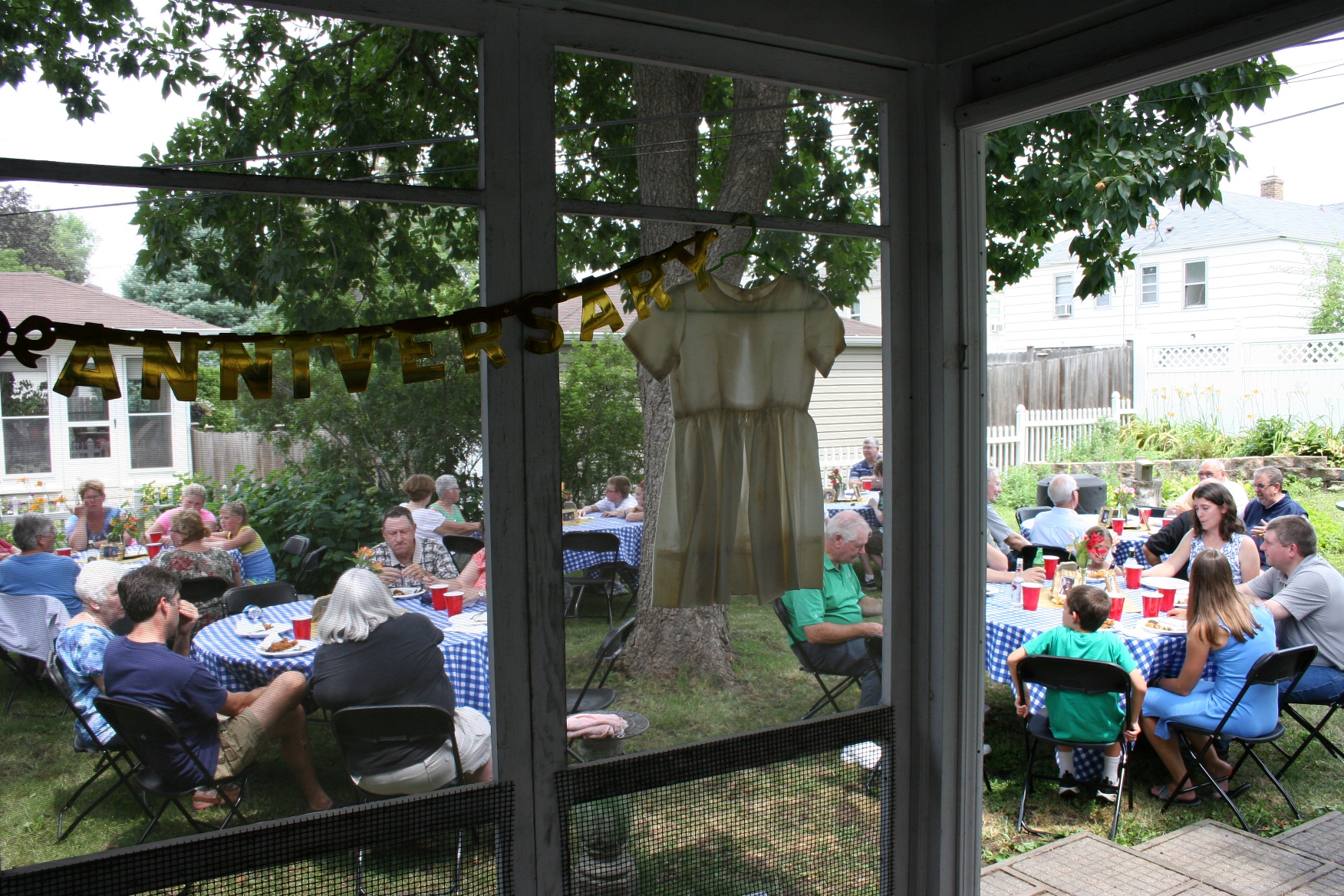
About two blocks away from this anniversary party in south Minneapolis, a crime scene was unfolding late last Sunday morning.

Why, last Sunday, when my family drove to south Minneapolis for a 50th wedding anniversary party, did we turn off Lyndale Avenue and a block away encounter a multitude of police cars and yellow crime scene tape and a TV news crew arriving? We continued on our way wondering what was unfolding as we greeted family, sipped lemonade and slipped into folding chairs in the festive, fenced in backyard just down the street and around the corner.

When my middle brother arrived a bit later, he noted that officers were posed with weapons drawn. Were any of us in danger as we drove past the scene?

What is this world coming to?

Why are children, the most innocent of victims, being shot and killed in Minneapolis on such a regular basis that this horrible crime no longer surprises us?

Have we become immune to violence and the essence of evil which drives it?

What is this world coming to?

When will the killing stop?

© Copyright 2012 Audrey Kletscher Helbling

 

Vesta & Belview celebrating one year after storms June 29, 2012

TWO REDWOOD COUNTY COMMUNITIES will come together to celebrate this Sunday, one year to the date after severe storms ripped through this region of southwestern Minnesota.

St. John’s Lutheran Church in Vesta, hours after a July 1, 2011, storm ripped half the roof from the sanctuary. Photo courtesy of Brian Kletscher.

In my hometown of Vesta, area residents will remember the storm anniversary and rededicate St. John’s Evangelical Lutheran Church at a 10:30 a.m. worship service followed by a catered chicken dinner.

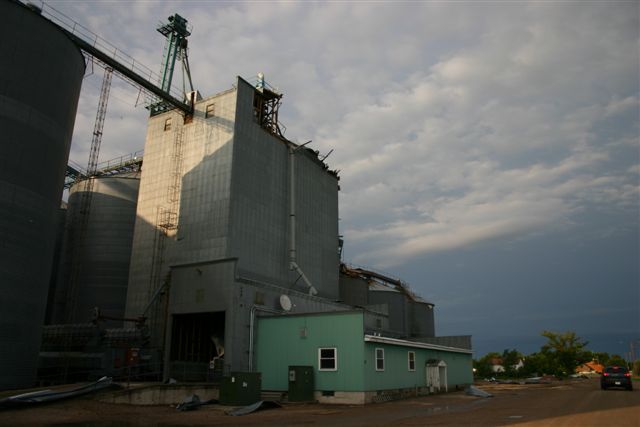
Damage to one of the grain bins at the local elevator. Photo by Brian Kletscher.

The grain elevator complex, the visual defining landmark in the farming community of Vesta, was ravaged by winds. You’ll see the damage near the top of the old grain elevator. Photo by Brian Kletscher

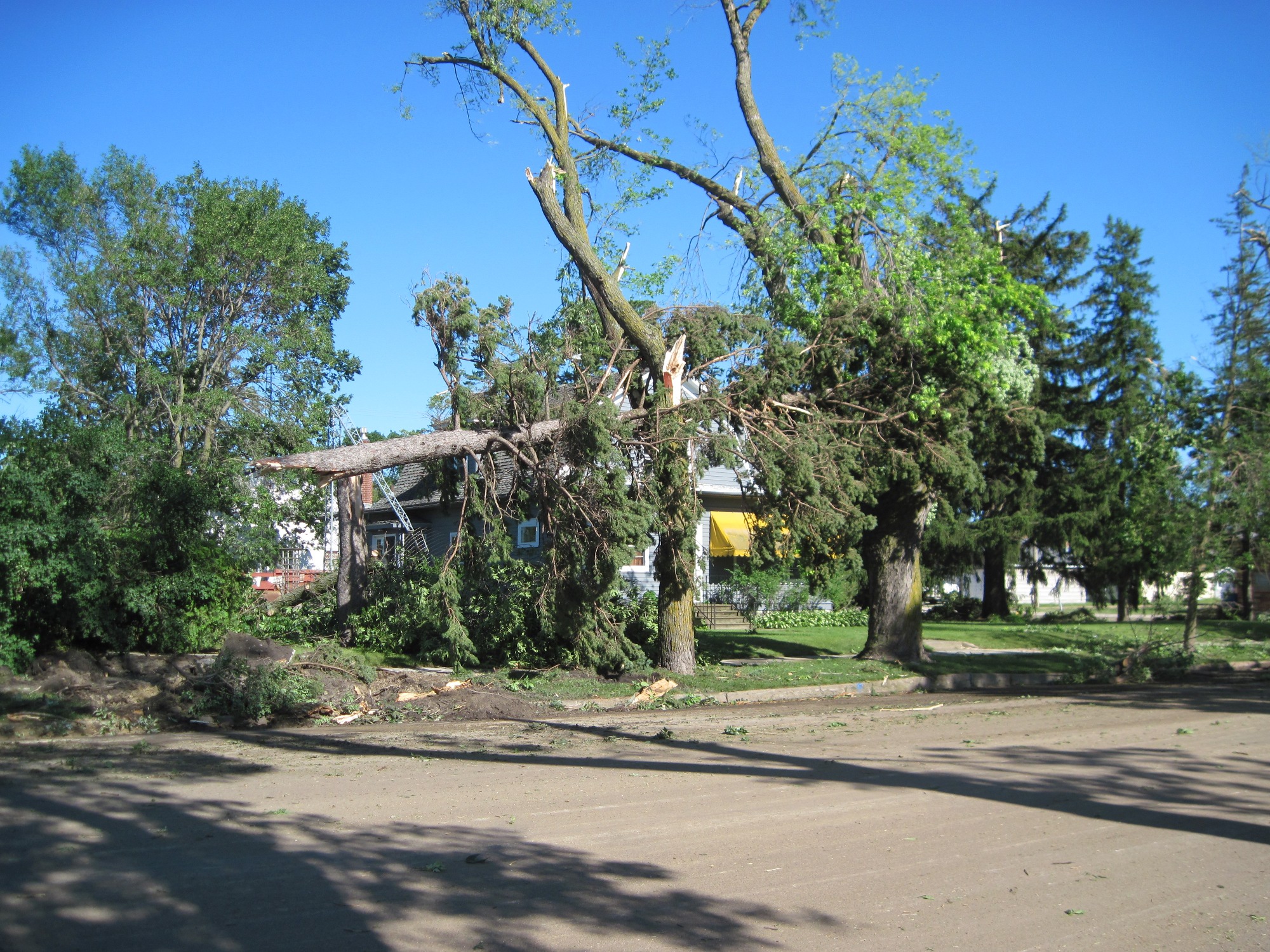
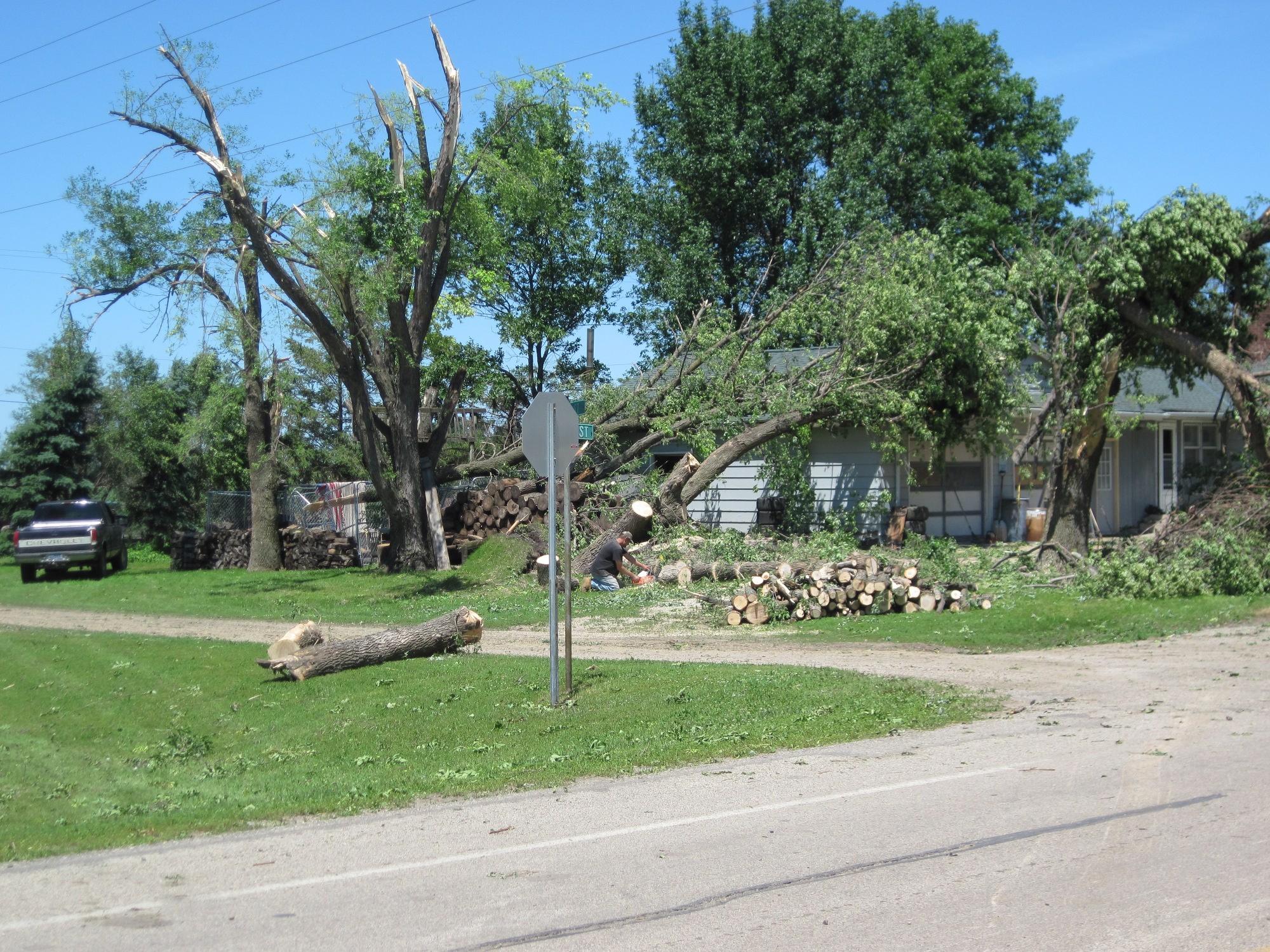
During the late afternoon of July 1, 2011, a series of downbursts with wind speeds of 90 – 100 mph swept through Vesta, ripping half the roof from St. John’s sanctuary, felling trees, denting grain bins, damaging the landmark grain elevator and more.

Under construction in March, a pastor’s office, bathroom and storage room were added to the south side of the early 1970s era church. Photo by Audrey Kletscher Helbling.

It took nearly a year for St. John’s to reopen after the congregation decided to expand the church as part of the roof reconstruction process.

Entering Belview from Sacred Heart at 9 a.m. on July 2, the morning after the tornado. Photo courtesy of Merlin and Iylene Kletscher, who were not yet living in Belview when the storm hit.

In Belview, about 10 miles to the north and east, residents will also mark the one-year anniversary of an EF-1 tornado which rode in on the same storm system. The tornado, with winds of 95 – 105 mph, wiped out many of this prairie town’s trees (which fell onto buildings and vehicles), damaged the nursing home to the point that it closed for awhile, wrecked roofs and more.

A month after the tornado, Belview’s Parkview Home (nursing home) remained closed as repairs were needed to the damaged roof, covered here with blue tarps. Photo by Audrey Kletscher Helbling.

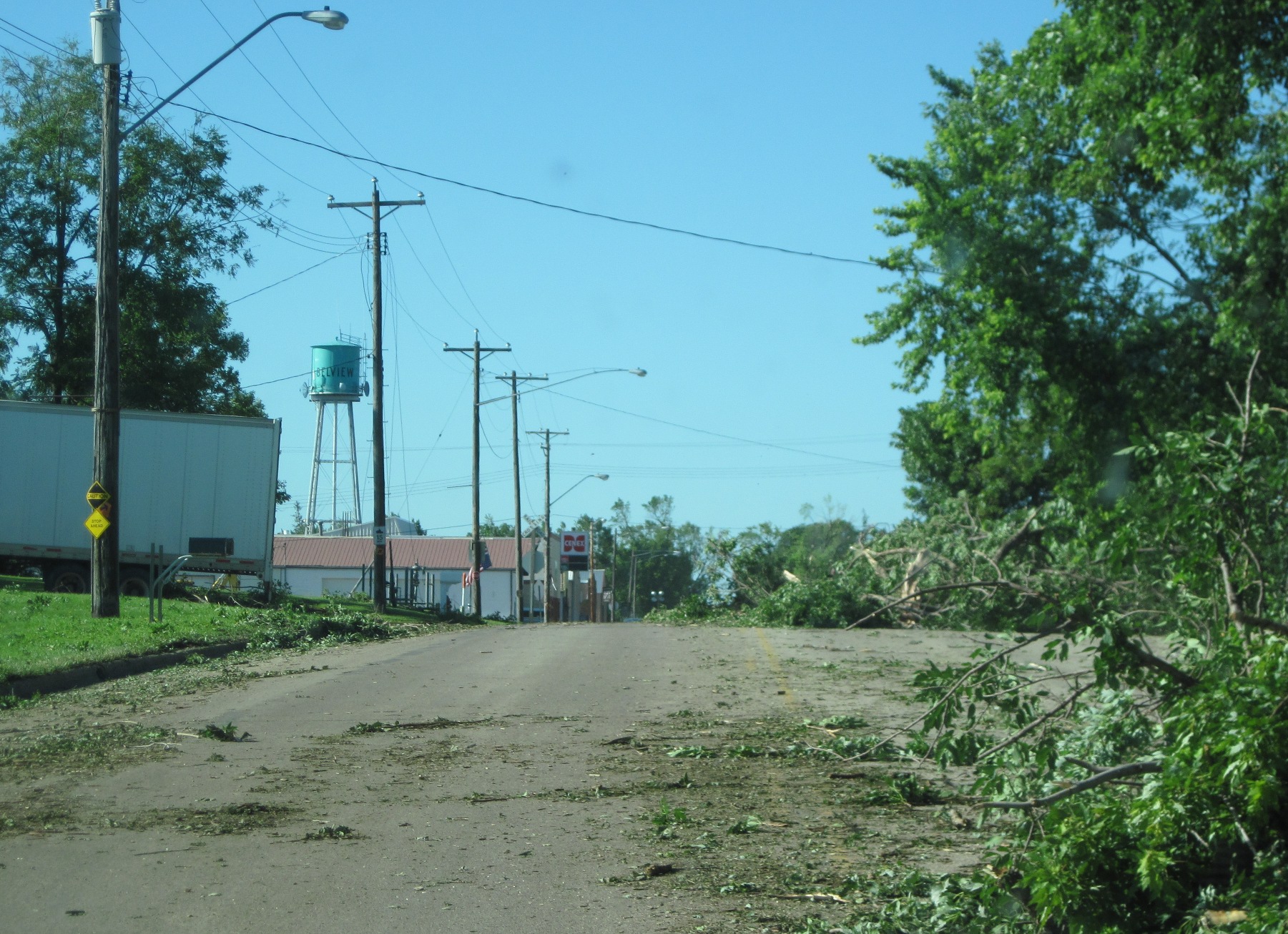
The communities of Belview and Vesta lost many trees in the July 1 storms. This photo is along a Belview street north of the park. Photo courtesy of Merlin and Iylene Kletscher.

Jerry Hagen’s house, across the street from Merlin and Iylene’s home in a July 2 photo. Photo courtesy of Merlin & Iylene Kletscher.

Damage along South Main Street in Belview. Photo courtesy of Merlin and Iylene Kletscher.

A year later, Belview residents are celebrating with a catered community picnic supper and entertainment at the local park (or in the air conditioned historic Odeon Hall if the weather is too hot) from 4 p.m. – 6 p.m. Sunday.

“We know we can pull together when the going gets tough as was proven after the storm,” says City Clerk Lori Ryer. “Now we would like to pull together in a spirit of community and fellowship and say thank you to everyone in town and to those that helped.”

My Uncle Merlin and Aunt Iylene Kletscher will be among Belview residents attending that picnic, celebrating and listening to the music of Ron and Kathy and Friends. The Kletschers had just closed on the purchase of a foreclosed fixer-upper home along Belview’s Main Street when the tornado ravaged Iylene’s hometown. They lost most of their trees—one of the reasons the couple bought the property—and sustained damage to their house, which they had just begun renovating.

Says Merlin:

So far we have planted four flowering crabs, a new disease resistant elm tree, 13 lilac bushes and the city has the Main Street boulevard planted with really nice-sized maples. We have two churches with new roofs, the bank is putting a new roof on right now and there are also more homes in the process of new shingles, etc., now.

One year later, Belview is looking pretty darn good!

A portion of Main Street in Belview a month after the tornado. Photo by Audrey Kletscher Helbling
FYI: To read more about the July 1, 2011, storms and to view more storm damage photos, check the Minnesota Prairie Roots archives from July 2011. In addition to the damage in Vesta and Belview, many rural residences also were hit. The farm of my cousins, Danny and Marilyn Schmidt, was struck by a second EF-1 tornado which nipped the northwestern corner of Redwood County. Near the South Dakota/Minnesota border, the community of Tyler experienced an EF-2 tornado which followed a 3-mile path through Lincoln County. The tornadoes and wind storms were part of a massive storm system  on July 1, 2011, which began along the western edge of Minnesota and extended as far east as northwestern Wisconsin.

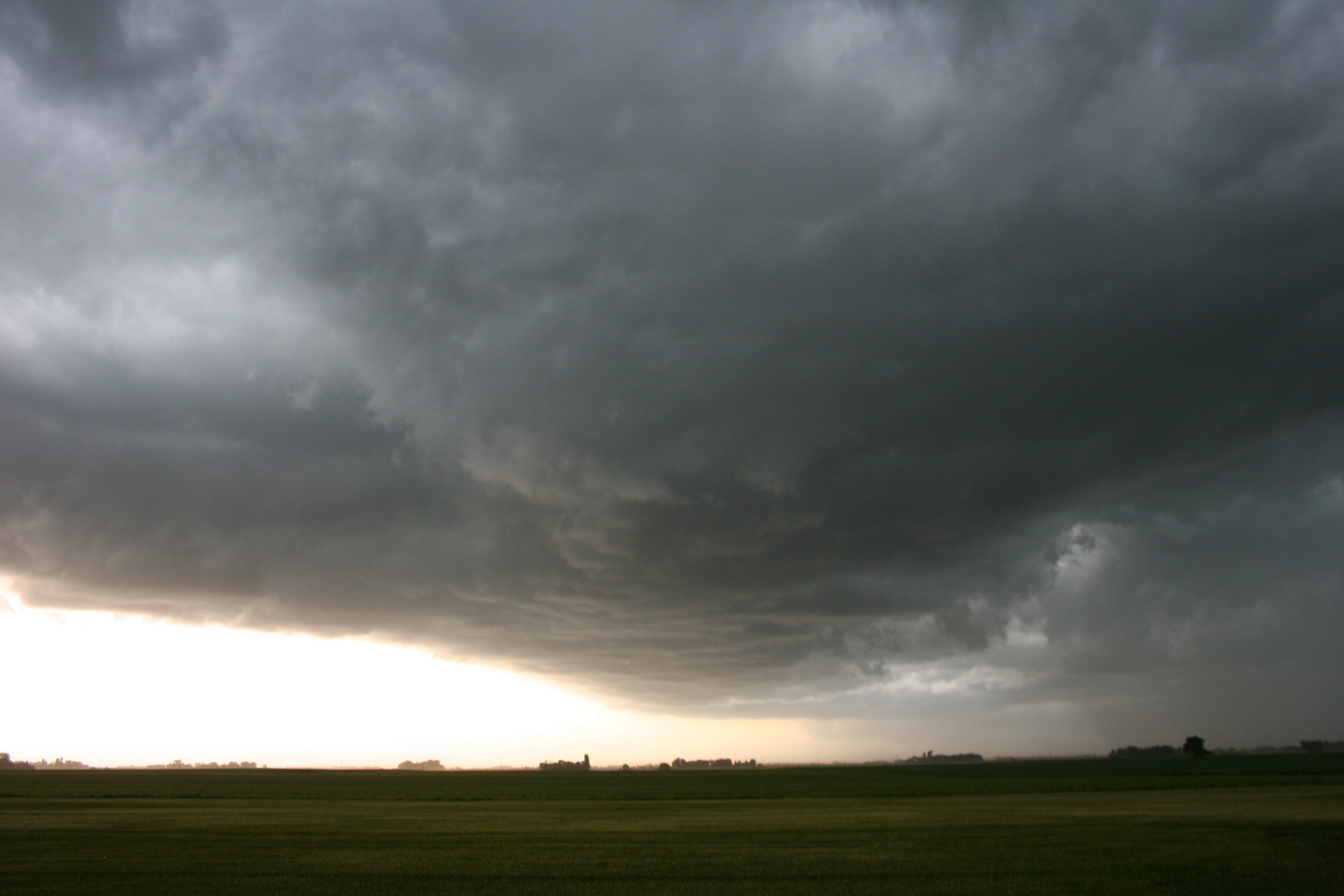
I was on my way with my husband to a party near Nerstrand not far from our Faribault home in southeastern Minnesota when these threatening clouds moved in during the early evening hours of July 1, 2011. It was while driving to our friends’ rural home that my sister Lanae phoned to tell me about the storm in our hometown and to warn me of the approaching bad weather. Fortunately the ominous clouds delivered only rain and nothing severe. But I was worried, very worried.

Copyright 2012 Audrey Kletscher Helbling


Accident reports from the interstate June 16, 2012

WHEN WE HEADED out for Fargo late Thursday morning northbound on Interstate 35, I never expected this to be anything but a long, five-hour road trip.

But we were only a half hour into our drive when we ran into rain and this scene along Interstate 35W near County Road 42 in Burnsville.

This bus ran off Interstate 35W in Burnsville Thursday morning.

Little did my husband, son and I know this bus crash would be just the first of three notable accidents that would occur along our route.

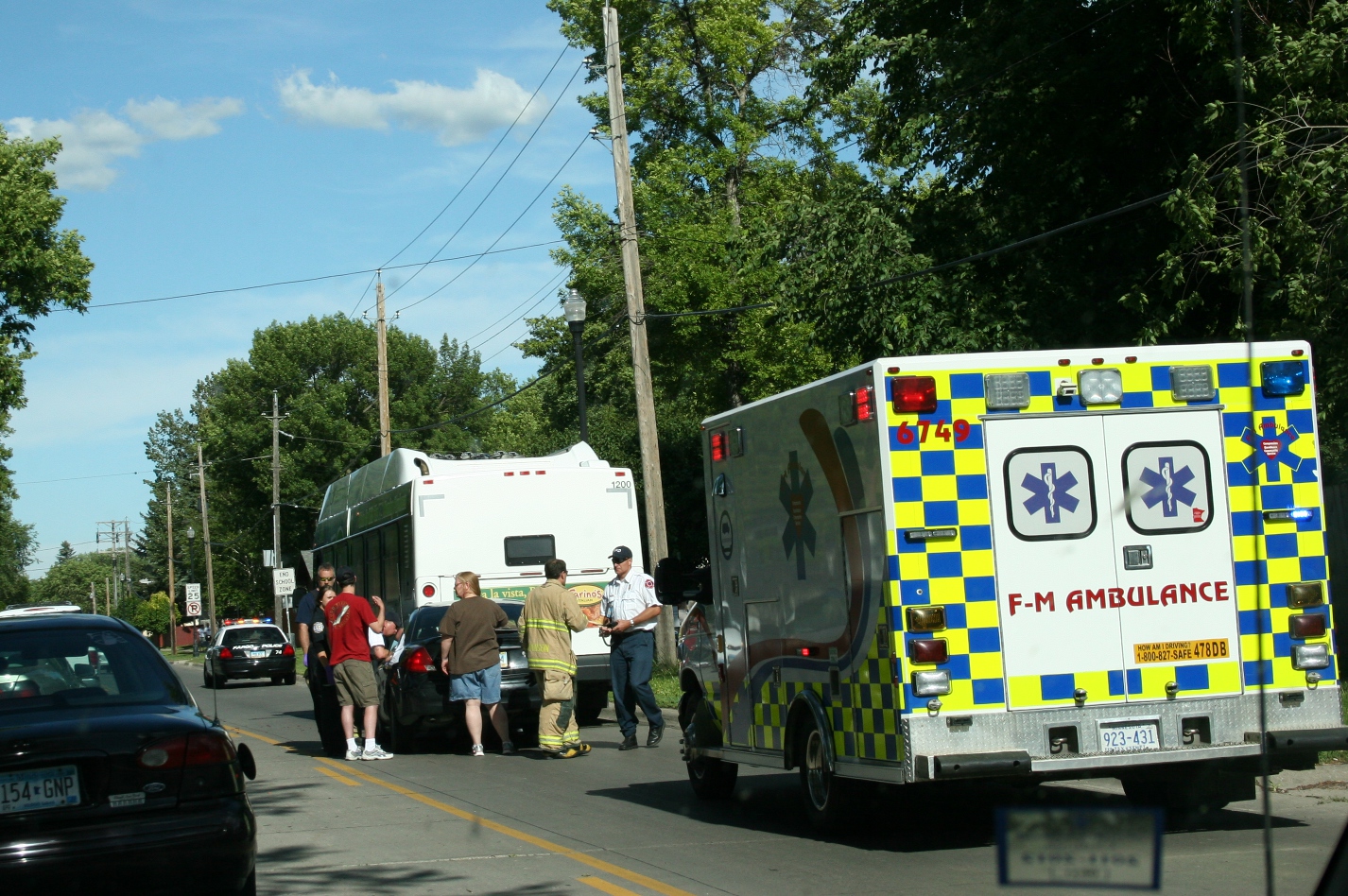
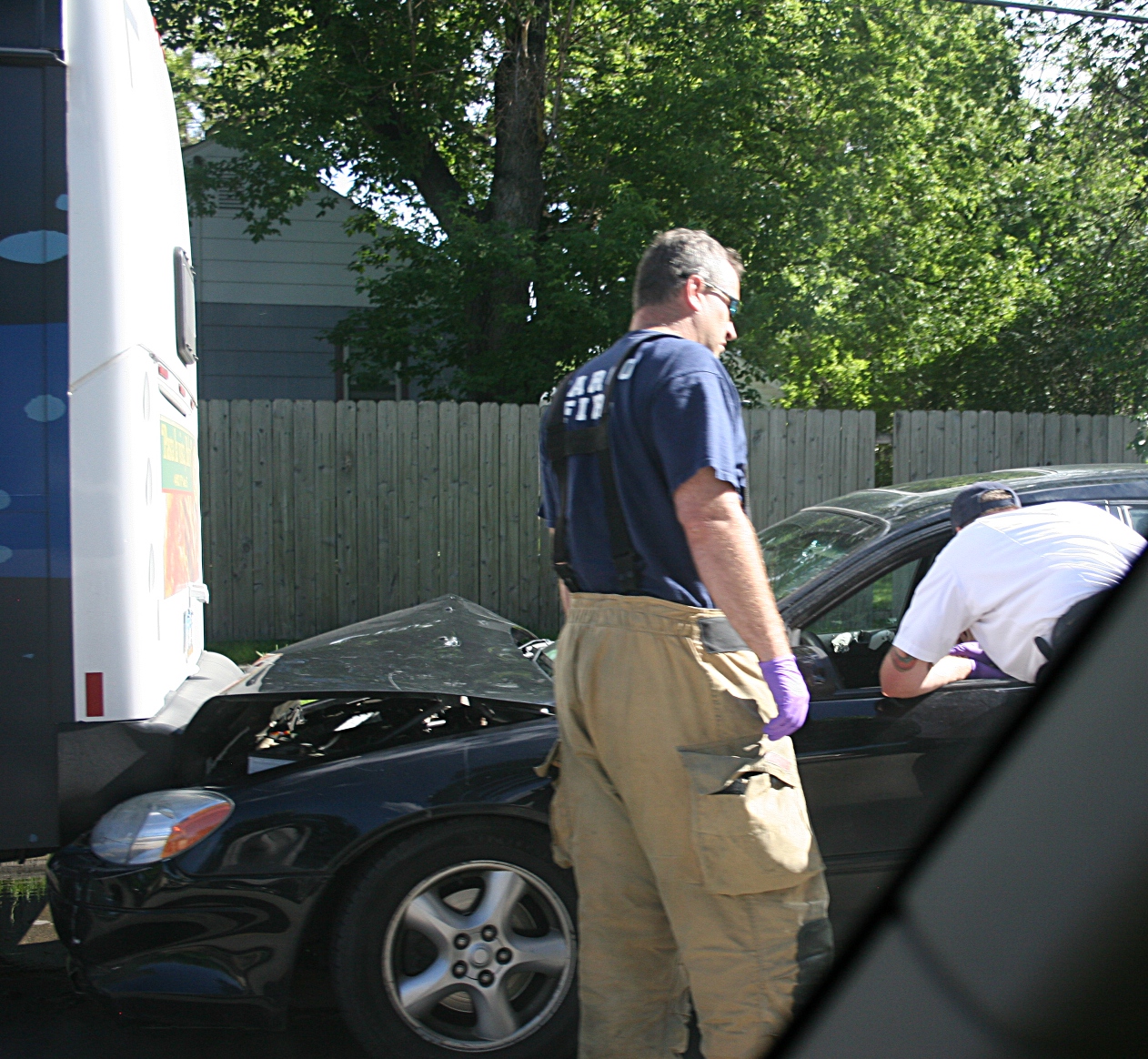
Thursday evening while traveling on a Fargo city street, we were caught in the middle of this scene in which a car rear-ended a bus.

And then the second accident involving a bus, on a Fargo city street.

Emergency personnel speak to the driver of the car, still inside the car, which rear-ended the bus.

But it got worse, way worse.

Friday afternoon, driving on Interstate 94 east of Moorhead around 4:30 p.m. we spotted dense black smoke in the distance.

“Looks like someone burning tires,” my husband said and we thought nothing more of it.

That is until traffic began to merge from the left lane into the right as the four-lane narrowed to two lanes in a bridge construction zone about one mile ahead. Traffic ground to a near-halt.

And then we realized, when the vehicles in the left lane began turning off the eastbound lanes onto a maintenance turn-around and driving back west that the smoke was the result of an accident on the interstate.

We followed the leader back west (westbound traffic was not leaving the accident site) and exited the interstate at the Sabin exit, pulling off a county road to figure out an alternative route.

It was then, while my husband and son were consulting maps, that I stepped from the van and shot this distant scene of smoke from a fiery head-on crash.

We pulled off Clay County Road 79, which runs along Interstate 94, to plot an alternative route. This was the scene unfolding before us as a result of the fiery head-on crash.

According to The Forum of Fargo-Moorhead, an eastbound car driven by Roberta Haspel, 58, of Barnesville crossed into the westbound lane in a construction zone and collided head-on with a semi driven by Gary Sather, 65, of Bismarck. The semi went into the median and caught fire.

Haspel reportedly was airlifted from the scene and hospitalized in critical condition. The truck driver was treated for non-life-threatening injuries.

It was an absolute relief to hear that no one was killed in this fiery crash.

I mean if you had seen the smoke…

As we drove on the Clay County Road 11 overpass over Interstate 94, I shot this photo. The interstate curves to the south.

Another shot from the Clay County Road 11 overpass as we followed an alternative route to Sabin. The westbound lanes of I-94 were also shut down and traffic rerouted off the interstate. Here you see eastbound traffic, which was reportedly backed up for seven miles all the way to Moorhead.

© Copyright 2012 Audrey Kletscher Helbling


In Faribault, bikers and vets honor our Armed Forces May 20, 2012

Filed under: Uncategorized — Audrey Kletscher Helbling @ 12:27 PM
Tags: , , , , , , ,

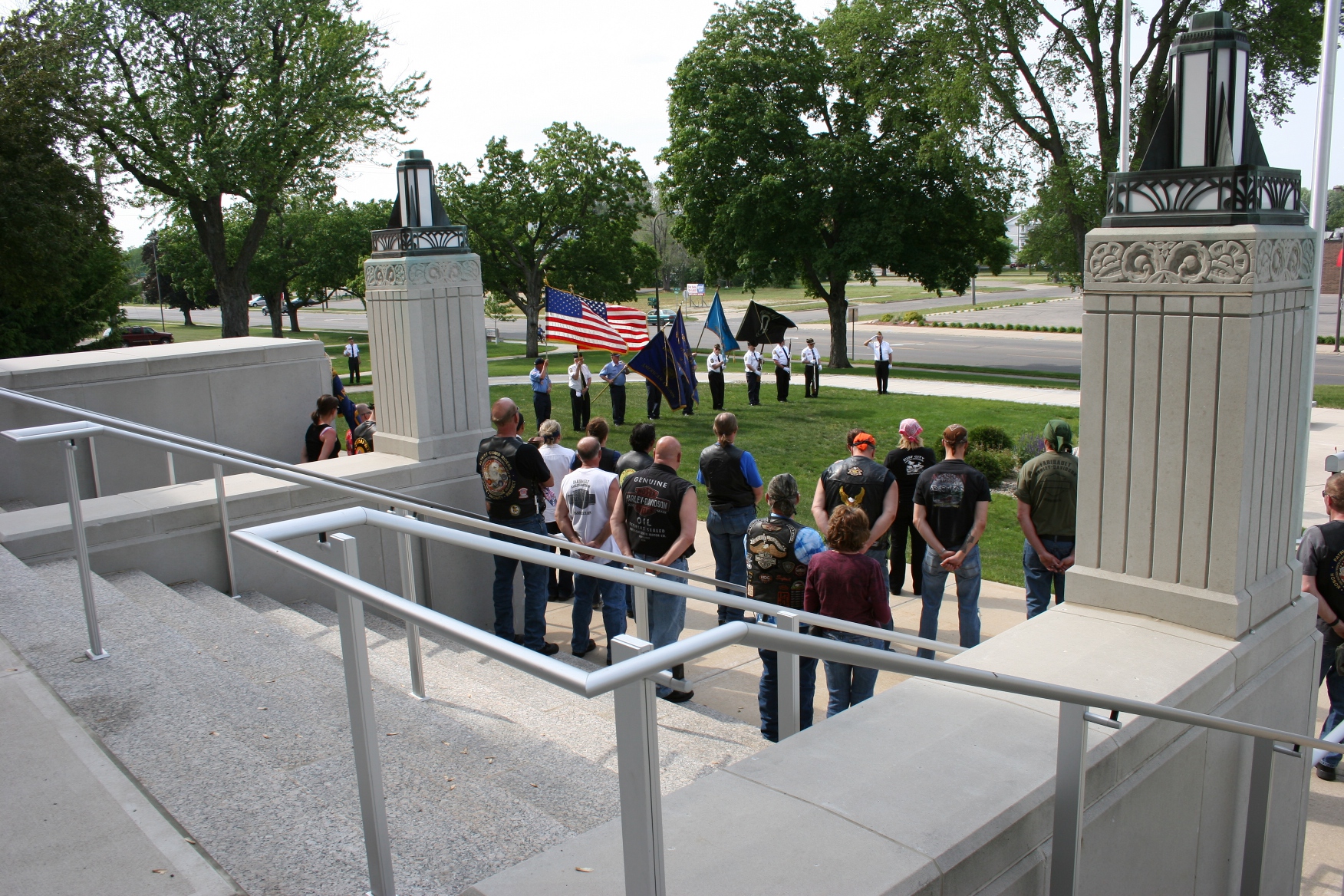
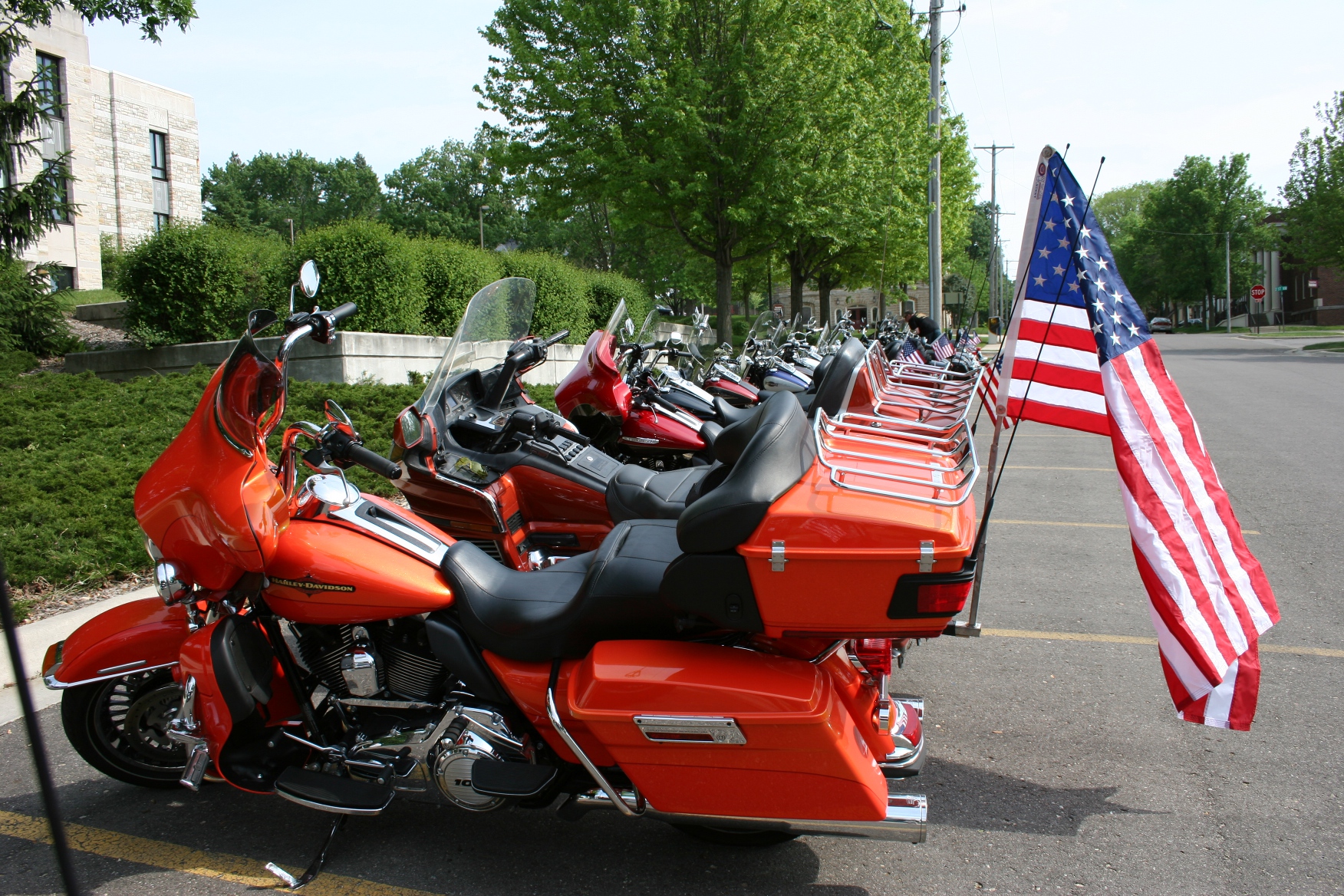
Veterans and bikers commemorate Armed Forces Day at the Rice County Veterans Memorial in Faribault.

ON MAY 20, 1950, our country celebrated the first Armed Forces Day in a big way with parades in Washington, D.C., New York and Berlin and with air shows, open houses and receptions.

Sixty-two years later, in my community of Faribault, veterans and a group of Harley-Davidson motorcycle riders gathered Saturday, on Armed Forces Day, to honor those who have served or are serving in the military.

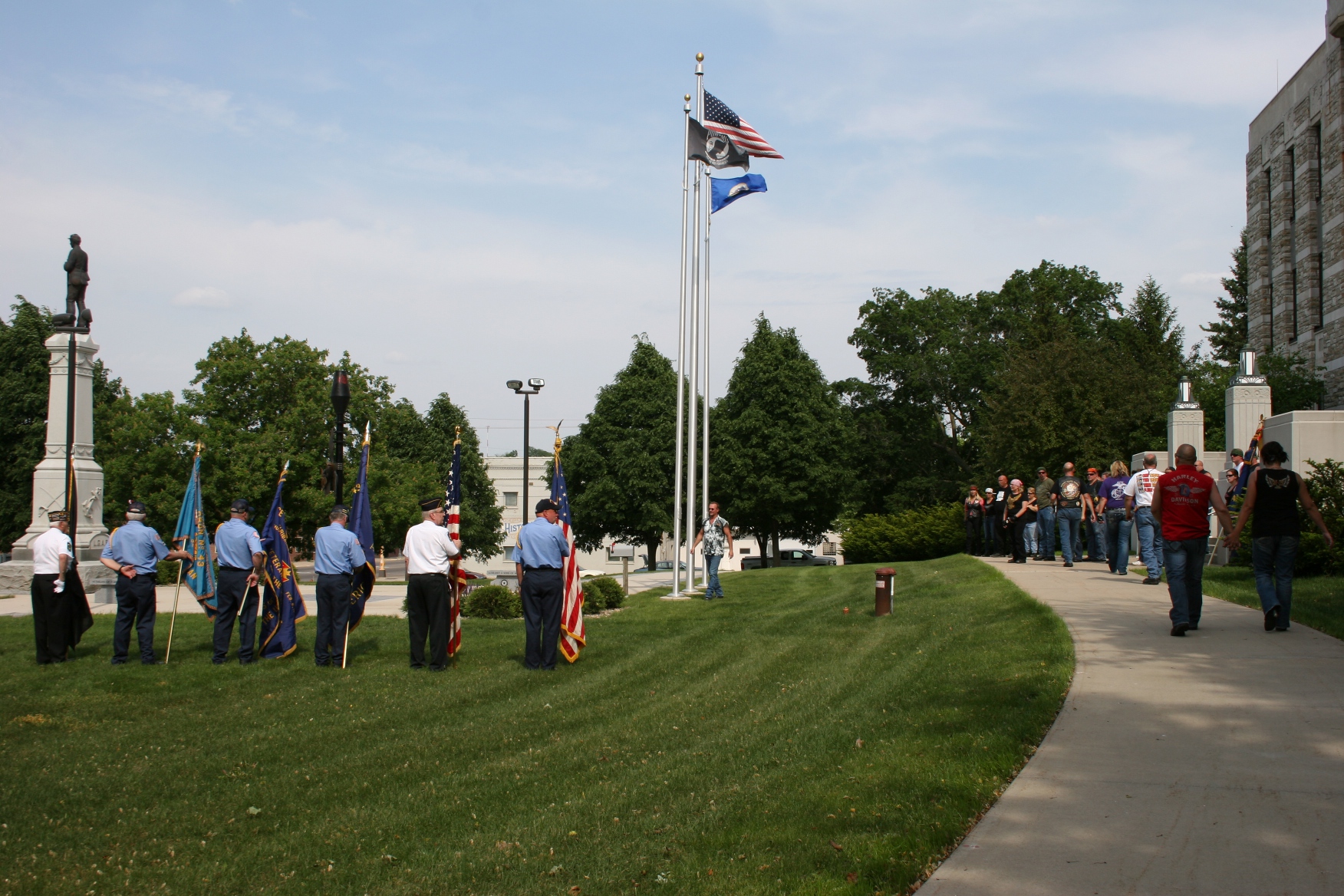
The Color Guard stands ready as the bikers arrive.

I am almost ashamed to admit this—especially as the daughter of a Korean War veteran—but I was unaware of an annual Armed Forces Day on the third Saturday in May or of Armed Forces Week, which ends today.

That was until yesterday, when I spoke with several veterans as we waited for the bikers to arrive at the Rice County Veterans Memorial at the county courthouse.

Bikers participating in the Faribault Harley-Davidson Harley’s Heroes raised $2,800 on Saturday for the Disabled American Veterans. In 2011, the Faribault dealership raised about $2,200 and earned status on the Harley’s Heroes Honor Roll as one of the top six fundraising dealers in the country. Thirty percent of Harley customers are active or retired military vets, according to the H-D website.

Around 4 p.m. the bikers, who were participating in the annual Harley’s Heroes nation-wide event to raise monies for the non-profit Disabled American Veterans, rumbled across Fourth Street, circled the courthouse and pulled into the west parking lot, American flags waving from the backs of their Harleys.

The bikers and the vets, my husband and I, and a photographer paid our respects in a short ceremony that included a gun salute, playing of the taps and a brief explanation of the vets memorial.

I am almost ashamed to tell you this, but no one else in my community paused or pulled off the street or took a break from their work or activities or fun to commemorate Armed Forces Day by attending this short ceremony.

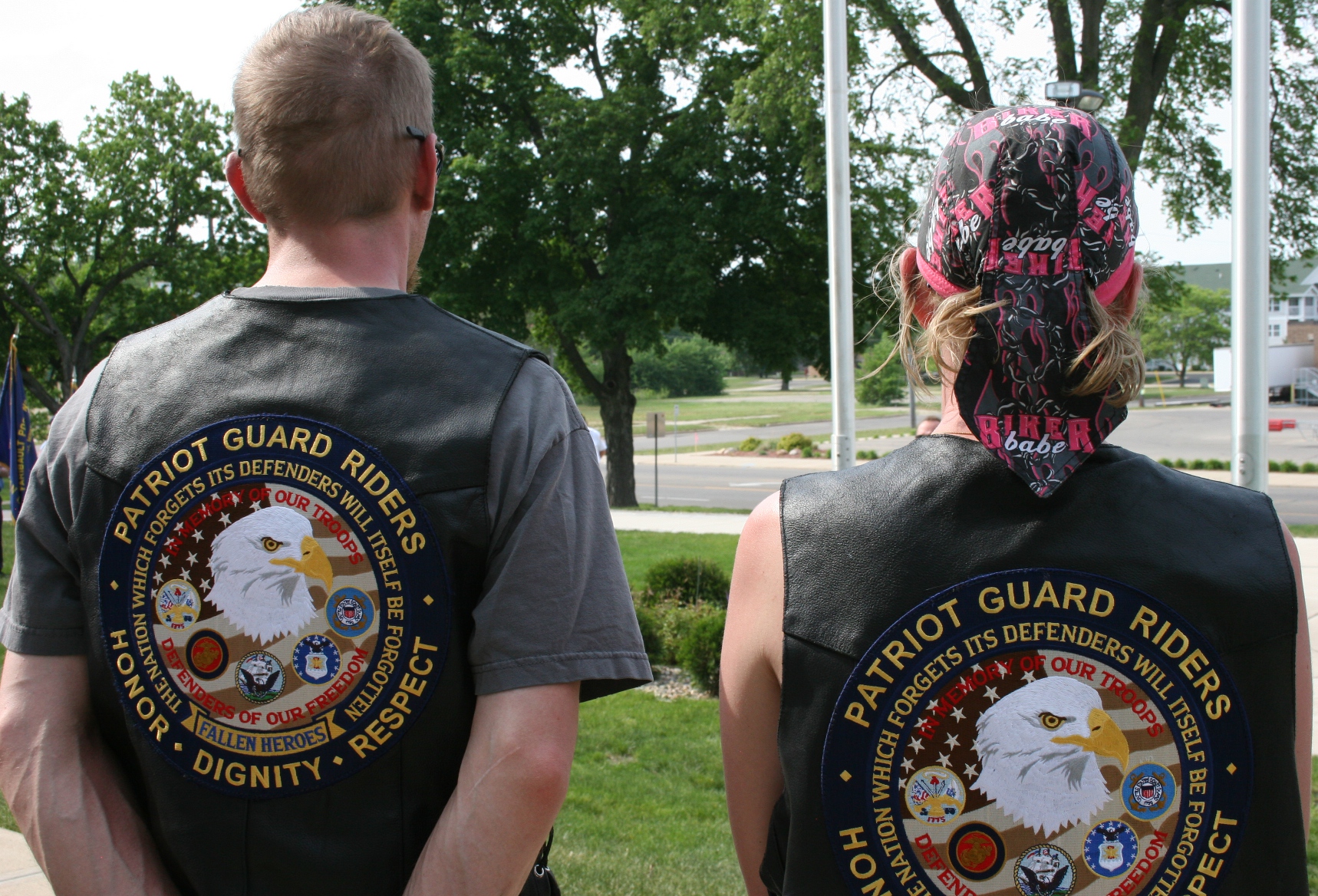
Members of the Patriot Guard Riders were among those in attendance.

Said General Omar N. Bradley, former chairman of the Joint Chiefs of Staff, on that first Armed Forces Day celebration in 1950:

The heritage of freedom must be guarded as carefully in peace as it was in war.

We would all do well to remember that, especially each year on the third Saturday of May.

I spotted this bumper sticker on the vehicle of a Vietnam veteran who had come to the ceremony.

© Copyright 2012 Audrey Kletscher Helbling
 

Thank you, Mr. Postmaster, for finally hearing the voice of rural America May 14, 2012

Filed under: Uncategorized — Audrey Kletscher Helbling @ 10:33 PM
Tags: , , , , , ,

FINALLY, AN IDEA that makes sense for continuing postal service in parts of rural America.

The United States Postal Service revealed a plan last week that could keep thousands of small-town post offices open by reducing hours. That’s certainly better than the alternative for places like Hope, Minnesota, an unincorporated community just off Interstate 35 south of Owatonna in Steele County. Last summer Hope’s 120 residents learned that their post office, like thousands of others across the country, likely would close in a cost-cutting measure.

Under a proposal, the Hope Post Office will remain open with daily window hours cut from eight to two.

Residents of Hope didn’t simply give up and accept their fate.  Instead, they circulated petitions and attended meetings and voiced their opinions and filed an appeal. To no avail. The postal service announced in April that the Hope Post Office would close. But now it appears the Postal Service has had a change of heart about closing thousands of small-town post offices nation-wide.

Postmaster General and CEO Patrick R. Donahoe said in part last week: “…we’ve listened to our customers in rural America and we’ve heard them loud and clear—they want to keep their post office open. We believe today’s announcement will serve our customers’ needs and allow us to achieve real savings to help the Postal Service return to long-term financial stability.”

So what does all that official talk mean? Some 13,000 post offices are now on “a preliminary list (for modified hours) that requires additional review, analysis, and verification and is subject to change.” Of those, 407 are located in Minnesota.

Well, the Postal Service is certainly covering all of its bases with that language, leaving room to tweak proposals and change plans/minds. I suppose one can never be too careful and cautious when one is a government entity. Meetings will be held in the affected communities to review options, which could take more than two years to implement.

Additional alternatives, according to the Postal Service, include mail delivery to affected customers via rural carrier or highway contract route; contracting with a local business for a village post office; and offering service from a nearby post office.

In a news release issued May 9, Postal Service Chief Operating Officer Megan Brennan says: “The post offices in rural America will remain open unless a community has a strong preference for one of the other options. We will not close any of these rural post offices without having provided a viable solution.”

Good.

The post office in Randolph is facing reduced hours, dropping from eight daily to four.

This certainly comes as welcome news to the folks in Hope and in many other Minnesota communities. In my region, post offices in Morristown, Warsaw, Kilkenny, Webster, Nerstrand, Dennison, Hampton, Castle Rock and Randolph are facing possible reduced hours.

My hometown of Vesta 120 miles to the west, along with nearby Wabasso, Wanda and Wood Lake, also made the modified hours list.

In every corner of Minnesota and hundreds of places in between, you’ll find those 407 small-town post offices where window service is likely to be trimmed. The Minnesota list fills slightly more than eight pages on a 260-page document that includes some 13,000 post offices across the U.S. To read that list, click here.

The Mantorville post office, where this photo was taken, is on the preliminary list of southeastern Minnesota post offices slated to have daily hours cut from eight to six.

It’s never a good thing, to reduce service in a small town. But closing the post offices would be worse.

I sometimes wonder if the decision-makers have ever set foot in these small towns, if they grasp the importance of a post office as an integral fiber in the fabric of community. Post offices are more than a place to pick up mail, to purchase stamps, to send a package. In these small towns, they are also community gathering places, a locale to exchange news, a spot to reach out to neighbors and a symbol of community identity.

I’ve witnessed, first-hand, how losing a school, a church, a business, can impact a rural community. In Vesta, for example, the town’s 330 residents can’t even buy a loaf of bread or a gallon of milk; they must travel some 20 miles for those staples. I remember when my hometown’s Main Street was lined with businesses, including a grocery store, two hardware stores and more.

Yes, times have changed. We are a more mobile society. We communicate via cell phones and e-mail and Facebook and other social media. But not everyone. In these small towns—the ones where the Postal Service initially considered shuttering post offices—many elderly residents don’t own computers, relying instead on old-fashioned mail delivery to pay bills and send letters and hear from loved ones. The post office is vital to their system of communication.

That the U.S. Postal Service finally heard the loud and clear voice of rural America, and perhaps understood that voice, pleases me as it should thousands of other Americans.

© Copyright 2012 Audrey Kletscher Helbling
 

Second Faribault jeweler hit in apparent state-wide crime wave April 25, 2012

Filed under: Uncategorized — Audrey Kletscher Helbling @ 2:50 PM
Tags: , , , ,

Chappius Jewelers, photographed several years ago, and the latest target of thieves.

YOU HAVE TO HAND IT to the owners of Douglas Diamonds & Fine Jewelry. They possess a sense of humor.

Less than two weeks after a Saturday morning break-in netted smash-and-grab thieves $10,000 in merchandise, the Faribault jeweler is running an ad in the Faribault Daily News with this tag:

Even thieves know great jewelry when they see it.

Examined alone, this ad would, indeed, strike you as funny, and creative. The catchy phrase grabs the reader’s attention.

But a few pages back in the same issue (today’s), this headline also draws attention:

Break-in at Chappuis Jewelry

The Faribault newspaper is reporting that a second jewelry store was targeted around 9:45 p.m. Tuesday by smash-and-grab thieves. You can read the complete story about the theft at Chappuis Jewelry, right around the block from the police station in the heart of historic downtown Faribault, by clicking here.

When you read that story, you won’t laugh. Not at all. The newspaper reports a string of jewelry store break-ins state-wide and a growing concern among law enforcement about the brashness of the criminals and the safety of their own, business owners and the public.

After leaving Faribault last night, the same group reportedly continued on to Hastings and hit a jewelry store there around 11 p.m.

The jewelry store crime wave apparently began on April 7 with a theft at Chilson Jewelers in Cambridge. Since then, jewelers in Apple Valley, Farmington and Buffalo have also been hit and investigators are looking into a connection with similar cases in Wayzata and Alexandria.

Let’s hope investigators get a break in these cases soon, before a break-in (and I expect there will be more) escalates into a violent confrontation.


In Clintonville: I survived the 1.5 March 28, 2012

Filed under: Uncategorized — Audrey Kletscher Helbling @ 11:52 AM
Tags: , , , , ,

The Booms Are Back! Residents of Clintonville Are Reporting Very Loud Noises on Tuesday Night!

So screams the headline scrolling across the Clintonville Chronicle website today as this Wisconsin community northwest of Green Bay experiences yet more unsettling booms following a recent 1.5 magnitude earthquake that rattled residents.

Since my second daughter lives in Appleton about 40 miles to the south, I’ve taken a special interest in Clintonville. Geologists determined that a “swarm” of earthquakes, amplified by Wisconsin’s unique bedrock, caused the shaking and sonic type booms that have awakened and frightened residents in this town of 4,736.

Yes, I would be scared, too, if the earth started rattling and rumbling.

And, just for the record, my daughter has been to the small medical clinic in Clintonville for her job as a Spanish medical interpreter, although not recently.

In perusing the newspaper website, I am happy to see that Clintonville is already embracing the economic opportunities that come with being thrust into the national spotlight. T-shirts emblazoned with “I Survived the 1.5” can be purchased in Clintonville or ordered online. Click here for more information about those shirts.

T-shirt sale profits “will be used to beautify or enhance something in our City as determined by the Mayor at a later date,” promo info reads. “This is not meant to make light of a serious situation but to show that we, as a community, came together to get through the events of this week.”

Let me interject here to applaud the folks of Clintonville. This is one of the attributes I admire in small towns. Togetherness.

I expect that the earthquake marks the biggest news event ever in Clintonville. In a typical week, you’re more likely to read top stories like these from the March 20 Chronicle: “Clintonville Sheep Now Famous,” “Christus to Host Spring Luncheon” and “Sheriffs Seek Evidence of Burglary” rather than “City of Clintonville is Booming.” Click here to access the award-winning Chronicle home page.

All of that booming has also prompted some Clintonville residents to purchase earthquake insurance. (Click here to see a map of  March 19 – 21 quake-related reports from Clintonville.) My daughter mentioned the insurance sales to me yesterday during a noon-time phone conversation, just before she headed out the door to a clinic in New London, some 15 miles south of Clintonville.

WHAT ARE YOUR thoughts on an earthquake in Wisconsin, of all places?

© Copyright 2012 Audrey Kletscher Helbling
 

Same day, same highway 50 miles apart: Plane lands, cattle truck crashes January 7, 2012

KNOWN AS A NOTORIOUSLY DANGEROUS roadway along some stretches, U.S. Highway 14 in southern Minnesota Thursday grabbed headlines again with two separate crashes about 50 miles and 12 hours apart. One involved a cattle truck, the other a small plane.

This time though, only cattle, not people, died.

I know this road, The Laura Ingalls Wilder Historic Highway, well as it’s the route my family travels back to my native southwestern Minnesota.

I shot this image along U.S. Highway 14 east of Lamberton several weeks ago.

Around midnight Thursday, January 5, a semi truck pulling a cattle trailer left Highway 14 just east of the Nicollet County Road 37 intersection near New Ulm and rolled onto its side in the ditch, according to news reports. The driver suffered only minor injuries, but some of the 35 cattle were killed in the crash or had to be euthanized.

About 50 miles west and some 12 hours earlier, Highway 14 east of Revere in Redwood County became a runway for a Lakeville pilot who was forced to make an emergency landing, according to news sources. He managed to land his plane on the road before it went into a ditch and flipped.

As in the cattle truck accident, the pilot escaped with only minor injuries.

When I first heard and read about these accidents, I was simply thankful that the truck driver and pilot survived. I was thankful, too, that others traveling along Highway 14 were not involved.

Then I started wondering exactly how many vehicles travel along these sections of Highway 14 each day and how those counts and the timing and locations of the incidents affected the outcomes.

According to the most recent statistics I could find from the Minnesota Department of Transportation’s Office of Transportation Data and Analysis, the 2009 annual average daily traffic count was 8,000 for the Highway 14 area where the cattle truck crashed.

See how the outcome could have been so much different had this occurred during peak daylight travel hours? Anyone who’s driven Highway 14 between New Ulm and Mankato realizes just how unsafe this narrow, arterial road is with its heavy traffic, county and other roads intersecting the highway and few opportunities to safely pass.

Fortunately, 50 miles west, the traffic count drops considerably as the population decreases and the land stretches flat and wide into acres of fields punctuated by farm sites and small towns.

Near Revere, where the pilot landed his plane on Highway 14 before noon on Thursday, MnDOT lists the 2007 annual average daily traffic count as 1,550. Odds of putting a plane down without hitting a vehicle were definitely in the pilot’s favor.

And given trees are sparse on the prairie, luck was in the aviator’s favor there, too.

Fortunately, the emergency landing also occurred outside of Revere, in the 3.5 miles between the town of 100 residents and Highwater Ethanol and not too dangerously close to either. The ethanol plant, of which my middle brother is the CEO/GM, is situated along Highway 14 between the crash site and Lamberton.

Viewing a 1994 plat of the area, I spotted a landing strip just to the north and east of Revere. I could not verify whether that still exists and it really doesn’t matter given the pilot claims he had to make a snap decision to put his failing aircraft down Thursday on Highway 14 at a speed of 90 mph.

I’m thankful that on January 5, 2012, U.S. Highway 14 in southern Minnesota didn’t rack up more fatal statistics. It’s already had too many.

© Copyright 2012 Audrey Kletscher Helbling


The generous gift of a St. Paul woman to a rural Minnesota food shelf January 6, 2012

TODAY I’M TREATING YOU to a gem of a story published yesterday in a weekly community newspaper, The Gaylord Hub.

It’s an inspiring and uplifting story of a St. Paul woman who purposely sought out a rural food shelf as the recipient of a Christmas gift. And a mighty generous one from someone with apparently no connection to Gaylord, a southern Minnesota Sibley County seat town of around 2,300.

Hub officer manager and bookkeeper Elizabeth Reishus shares the tale of generosity in her January 5 “The Word From High Avenue” column as shared with her by Yvonne O’Brien of Sibley County Food Share, Inc.

Writes Reishus:

A woman from St. Paul had called Second Harvest food bank to ask for a list of rural food shelves. Second Harvest was not able to give her that information, but did give her O’Brien’s phone number.

The woman then called O’Brien and asked questions about the food shelf. What percent of families served were minorities? Is the need higher in the summer? What kinds of resources does your food shelf have to rely on for donations?

O’Brien explained that about 40 percent of clients at the food shelf are people of a minority. The need for help increases in the summer when seasonal workers arrive to work at area farms and other agriculture-related jobs. She also explained that unlike bigger towns and cities, we do not have the big chain stores such as Wal-Mart, Target, Cub or Cash Wise that donate food. The Sibley County Food Shelf is maintained through the generosity of area people and some grant money, O’Brien explained.

The St. Paul woman said she would like to send a donation to the food shelf. O’Brien gave the woman the mailing address for donations and expected to receive a check for about $50. She was pleasantly surprised to find that the donation check was for 10 times that amount. The generous mystery woman gave $500 to the Sibley County Food Shelf.

How’s that for Minnesota Nice and for thinking beyond the metro?

Consider the effort this mystery woman took to find just the right place for her $500 donation. What motivated her to seek out a rural food shelf, to ask those specific questions about minorities, to give that much money to a single food shelf?

I’d never really thought, prior to reading Reishus’ column, how small-town food banks typically don’t receive food donations from chain stores, relying instead primarily on the generosity of locals.

So thank you to that woman from St. Paul for thinking beyond the metro area of the need in rural Minnesota and for blessing Sibley County Food Share with $500.

She offers us much food for thought.

FOR MORE INFORMATION about Sibley County Food Share, click here.


Farewell to the Swany White Flour Mill of Freeport December 28, 2011

Freeport promotes itself as "The city with a smile!" That's the smiling water tower to the right and the Swany White Flour Mill to the left in front of the church steeple in this June 2011 image. Freeport is among the communities after which Garrison Keillor's fictional Lake Wobegon is fashioned.

CROSSING THE OVERPASS into Freeport last June, I snapped a quick landscape photo with the town’s charming water tower smiling at travelers along Interstate 94 in central Minnesota.

I should have focused, though, on the old-fashioned grain elevator-style flour mill to the left in my framed image.

Late Tuesday afternoon this historic icon, the Swany White Four Mill, built in 1897 and owned by the Thelen family since 1903, burned. Minnesota has lost an important part of her history, a still-functioning mill of yesteryear that specialized in producing commercial grade and organic flour and was known for its famous Swany White Buttercake Pancake and Waffle Mix.

That I never realized the importance of this towering, aged building on that June afternoon saddens me for I am typically drawn to small-town elevators. But when my husband and I swung into Freeport late on that Saturday afternoon 6 ½ months ago, we were more interested in finding Charlie’s Café, a popular dining spot in this town of 450. We were hungry. Charlie’s was packed, so we left town without eating there, but not until I snapped photos of the café and Sacred Heart Church and School.

Popular Charlie's Cafe is noted for its tasty homemade food including caramel rolls, meringue pies and hot beef commercials. To the right is the Pioneer Inn, after which Garrison Keillor modeled The Sidetrack Tap in his fictional Lake Wobegon. Keillor and his family lived near Freeport in the early 1970s.

Sacred Heart Church, Freeport, described by Garrison Keillor as "a fine tall yellow-brick edifice with a high steep roof."

Sacred Heart School in Freeport, a lovely old building that caught my eye.

I totally missed out on the Swany White Flour Mill, simply because I was unaware of its important existence.

Eleven years ago, though, the historic mill, Charlie’s and other central Minnesota scenes were photographed by National Geographic photographer Richard Olsenius, illustrating a story, “In Search of Lake Wobegon,” by Garrison Keillor, expanded in 2001 as a book. A sister-in-law gave me her copy of the December 2000 National Geographic recently, knowing how much I would appreciate Keillor’s writing and the black-and-white images by Olsenius. I do.

Keillor rented a farmhouse south of Freeport some 40 years ago. He and his family weren’t exactly embraced by the community during the three years they lived there. Keillor writes about his experiences in the magazine piece, where he reveals that his fictional Lake Wobegon is based on life in central Minnesota, including Freeport.

I wonder if Keillor is reflecting on those years in Freeport as news of the Swany White Flour Mill’s demise reaches him. A eulogy or a tribute to this historic mill would seem fitting for Keillor’s radio show, “A Prairie Home Companion,” broadcasting from Honolulu, Hawaii, on New Year’s Eve, far from Lake Wobegon “where all the women are strong, all the men are good-looking, and all the children are above average.”

It hasn’t exactly been a quiet week in Lake Wobegon.