Minnesota Prairie Roots

Writing and photography by Audrey Kletscher Helbling

Owatonna author Chris Norbury featured at Books on Central literary event October 20, 2025

(Credit: Books on Central Facebook page)

THIS WEEK ONE OF MY FAVORITE area writers comes to downtown Faribault. He’s Owatonnan Chris Norbury, award-winning author of three books in the Matt Lanier mystery-thriller series and a stand alone middle school novel, Little Mountain, Big Trouble.

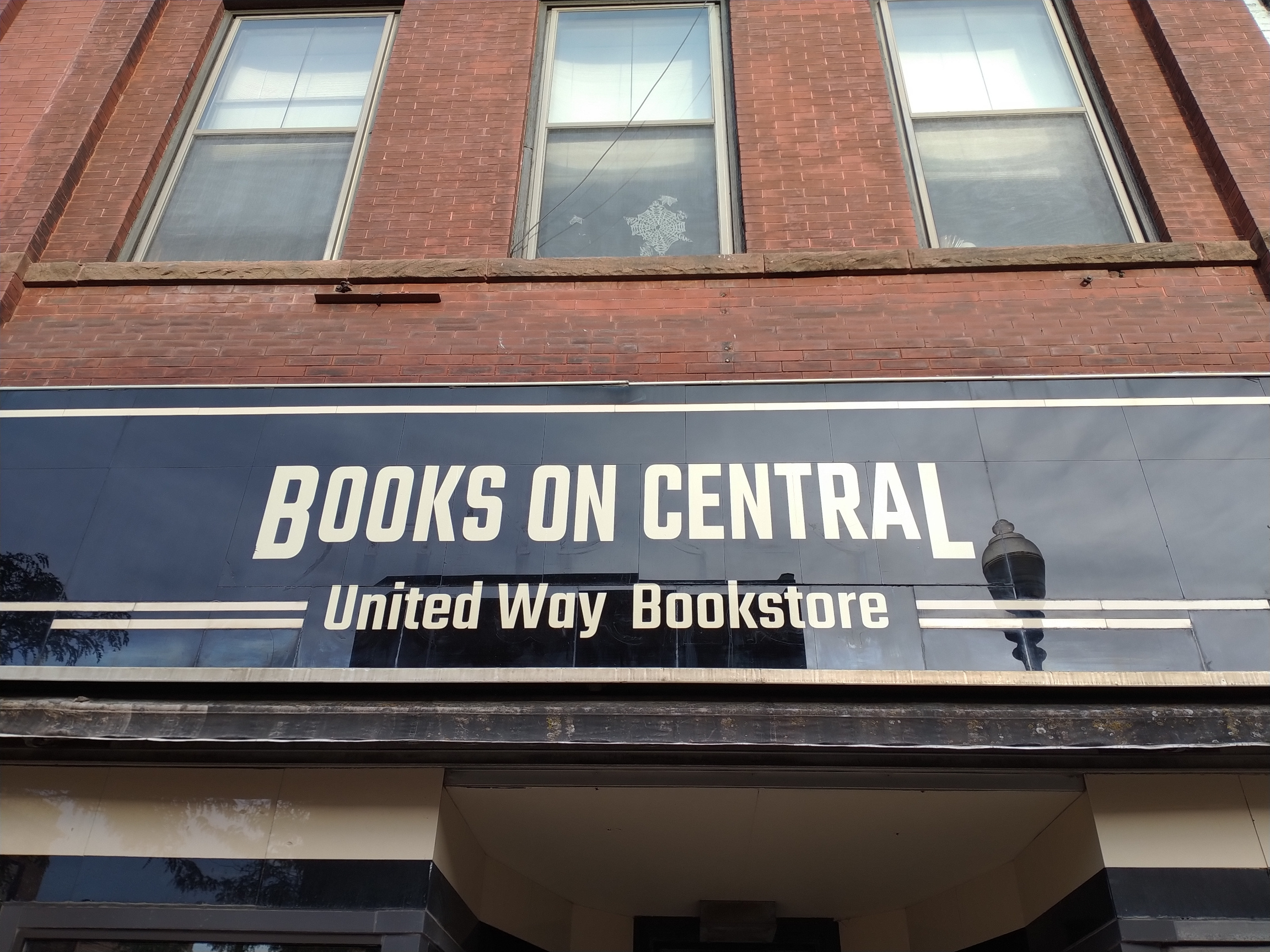
Books on Central, a used bookshop of the Rice County Area United Way, is hosting Norbury beginning at 6 p.m. Thursday, October 23, as part of its author series. Norbury will read and talk about his books and the craft of writing.

I’m excited to see Norbury again. We’ve chatted briefly several times when he was selling his books at events in Faribault. He is a genuinely nice guy whose writing I happen to love. As a writer, I recognize Norbury’s devotion to craft—the time, energy, inspiration and hard work it takes to write a book. I expect to learn more during his upcoming talk and the Q & A that follows.

My first introduction to Norbury came via his mysteries, all set in Minnesota with recognizable place titles like Castle Danger, Straight River and Dangerous Straits. Main character Matt Lanier is a southern Minnesota farm kid turned professional musician. I’m especially drawn to books set in Minnesota and with strong home-grown characters like Lanier.
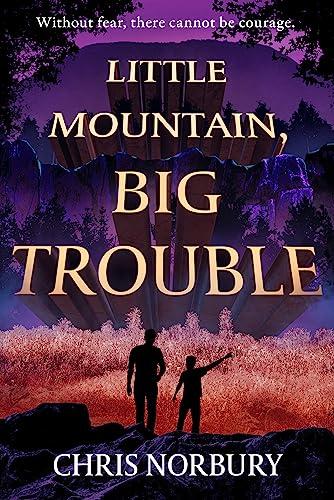
(Book cover sourced online)

But it is Norbury’s novel for middle schoolers (and older, including adults), Little Mountain, Big Trouble, which really resonates with me. I encourage you to read my review of this book (click here) about 12-year-old Eduardo, who is bullied and eventually paired with a Big Brother, Russ. Like Russ, Norbury was a Big Brother for 20 years and today donates a portion of his book sales to Big Brothers Big Sisters of Southern Minnesota. I appreciate Norbury’s generous ongoing support of an organization which helps young people.
(Minnesota Prairie Roots copyrighted file photo)

Books on Central also gives back to community through its umbrella organization Rice County Area United Way. Book sale proceeds go to the United Way which in turn provides financial support to select nonprofits in the county. All book inventory is donated by community members and all staff at the used bookshop are volunteers. There’s so much to love about this Minnesota bookstore and Minnesota writers like Chris Norbury. Kindness, compassion and community center both as they embrace books and the craft of writing.

FYI: Books on Central, 227 Central Avenue North, Faribault, is open from 11 a.m.-5 p.m. Wednesday-Friday and from 10 a.m.-4 p.m. Saturdays and other times for special literary and other events.

© Copyright 2025 Audrey Kletscher Helbling


Marcie Rendon, an authentic Native American voice in riveting mystery November 13, 2024

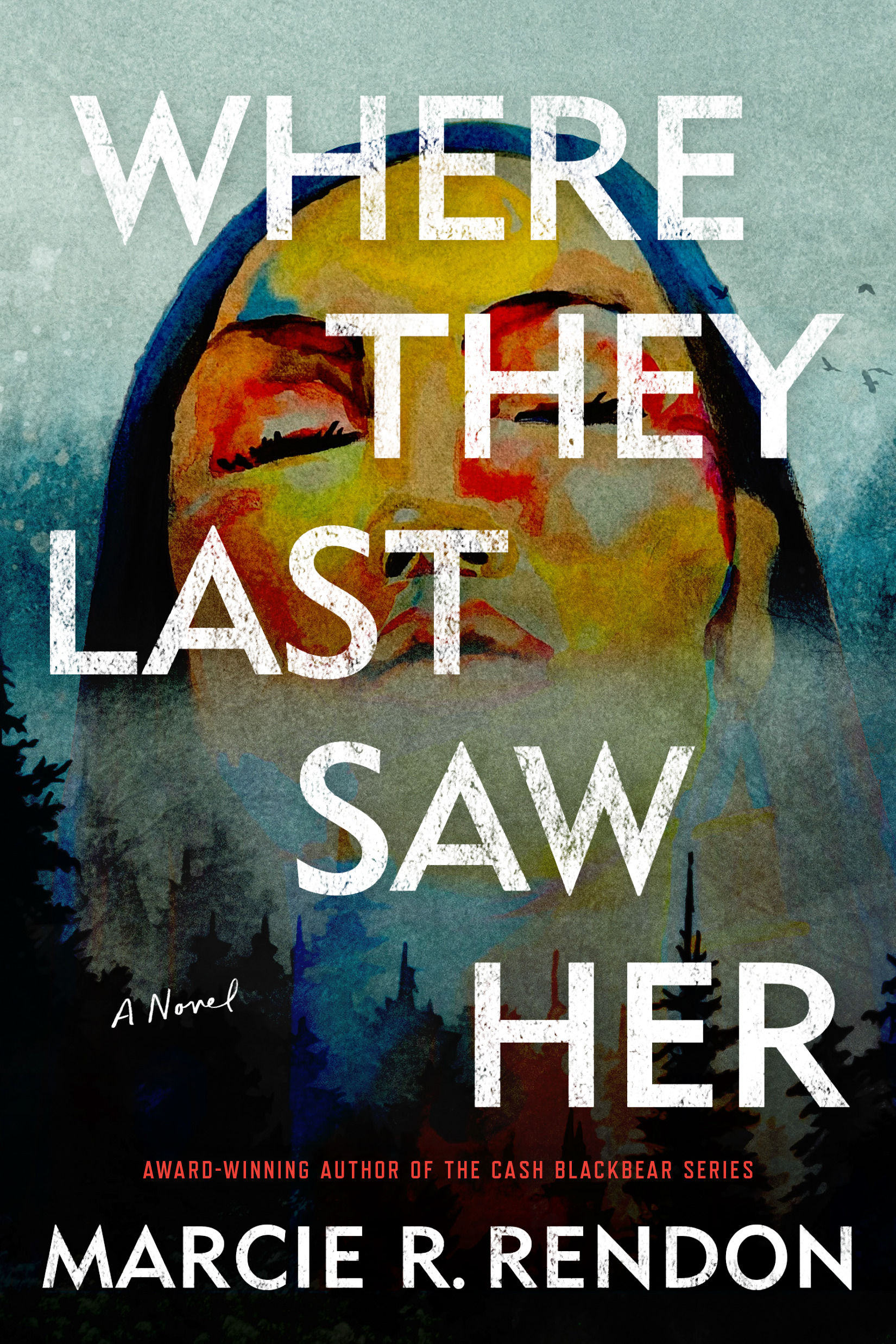
(Book cover sourced online)

AS A WRITER, I bring my voice into my writing. My work is distinctively, authentically mine. Just as it is for most writers.

Recently I finished reading a novel, Where They Last Saw Her, by a Minnesota writer with an authentically strong Native American voice. It’s a voice we don’t often hear, which is perhaps why I find the writing of Marcie R. Rendon so compelling. She is a citizen of the White Earth Nation in north-central Minnesota.

I’ve read the first three books in her Cash Blackbear mystery series and am eagerly awaiting the release of her fourth in 2025. In the meantime, I found this stand-alone mystery set on the fictional Red Pine Reservation in northern Minnesota. As in her Cash series, the main character in Where They Last Saw Her, Quill, is a strong Native woman. Quill is the mother of two, a runner, and loyal friend to Punk and Gaylyn. And she is a woman who takes matters into her own hands when Indigenous women and children go missing.

The logo of the Minnesota Missing and Murdered Indigenous Relatives Office. (Image sourced online)

I wish that part—the missing women and children—was fictional. But it’s not. Rendon assures the reader understands that. The missing focus her book. In real life, between 27 and 54 American Indian women and girls in Minnesota were missing in any given month from 2012 to 2020. That’s according to the Minnesota Missing and Murdered Indigenous Relatives Office, an agency established in 2021 to provide support and resources to families and communities affected by such violence.

Rendon weaves a story that, if not for the disclaimer of “any resemblance to actual events, locales, or persons, living or dead, is entirely coincidental,” could pass for the truth. As a writer, I understand that in every bit of fiction lies some truth. And this book seems to hold a lot of underlying truth in events, trauma, violence and much more.

I felt compelled to visit the Minnesota Bureau of Criminal Apprehension’s missing person’s website, where I scrolled through a lengthy list of missing persons. There I found the names of three Native American women: Nevaeh Kingbird, last seen in Bemidji in October 2021. Sheila St. Clair, last seen in Duluth in August 2015. And then American Indian JoJo Boswell, gone missing in Owatonna in July 2005. I expected to find more based on the MMIR summary information. Perhaps I missed something in my surface search.

That brings me back to Rendon’s fictional story. In addition to providing me with a much deeper understanding of missing (including trafficked) Indigenous women and girls in a book that I didn’t want to put down, I learned more about the culture and language of First Nations peoples. Ojibwe words are scattered throughout the story. A glossary would be helpful. Customs, traditions and spiritual beliefs are also part of Rendon’s writing. All of that lends the authenticity I noted earlier. Only someone intimately familiar with Indigenous Peoples could write with such an authentic Native American voice.

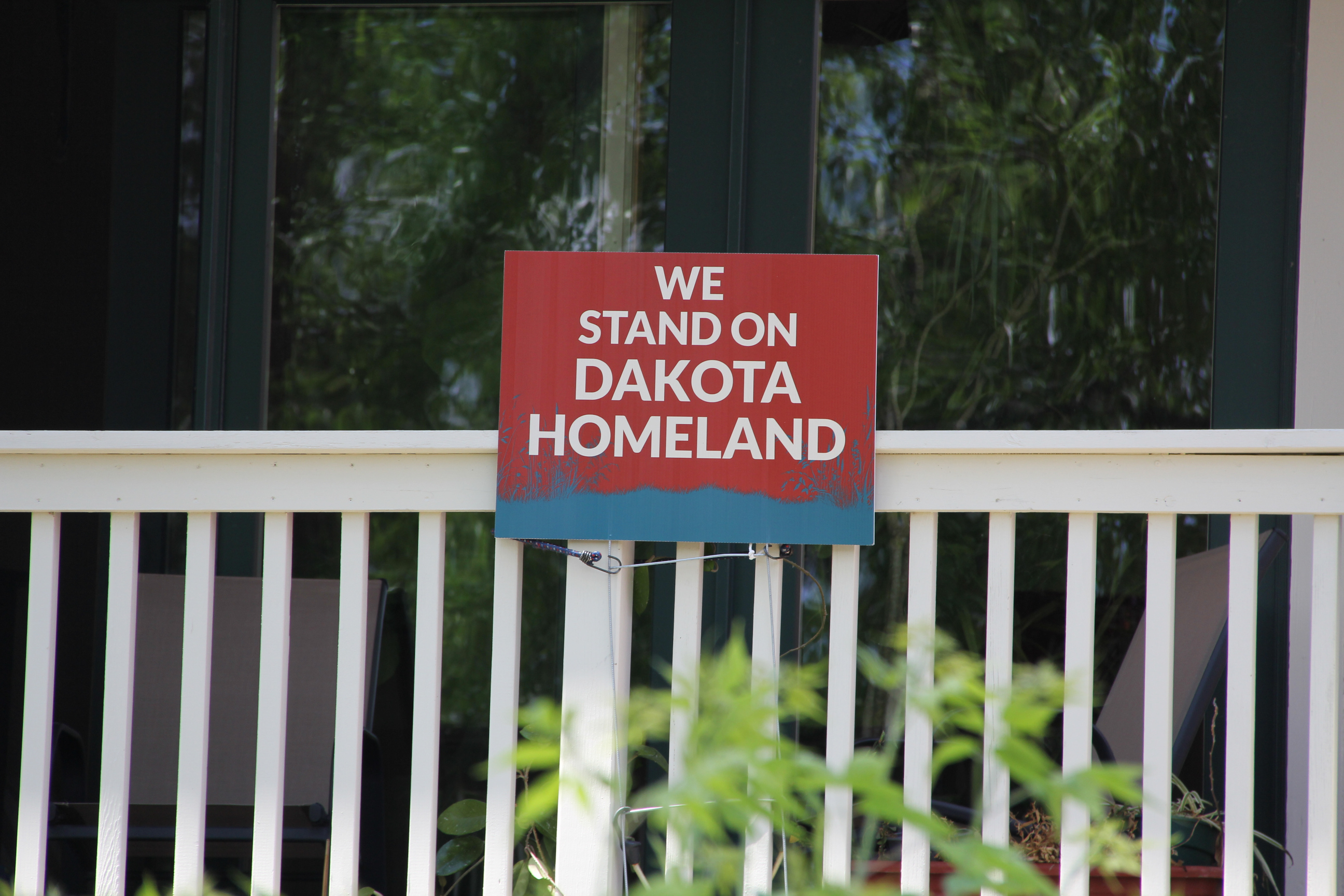
I photographed this sign along the Cannon River in Northfield. St. Olaf College in Northfield is hosting several events during Native American Heritage Month. Click here. (Minnesota Prairie Roots copyrighted file photo May 2024)

Environmental topics and pipeline construction (an actual controversial issue in Minnesota and North Dakota) also play into the plot of Where They Last Saw Her.

I’d encourage anyone who enjoys a good mystery, and who wants to become more informed, to read Where They Last Saw Her. This is a riveting read that rates as simultaneously heartrending.

#

(Image source: The U.S. Department of the Interior Indian Affairs)

NOTE: November marks National Native American Heritage Month with a 2024 theme of “Weaving together our past, present and future.” Events are planned throughout the US, including right here in Minnesota (click here). Tuesday, November 19, is set aside as Red Shawl Day, a day to remember missing and murdered Indigenous people and to honor their families. Writer Marcie Rendon includes this wearing of red in her book, Where They Last Saw Her. Please take time this month to honor Indigenous people by learning, celebrating, respecting, remembering.

© Copyright 2024 Audrey Kletscher Helbling
 

About that man named Ove March 10, 2023

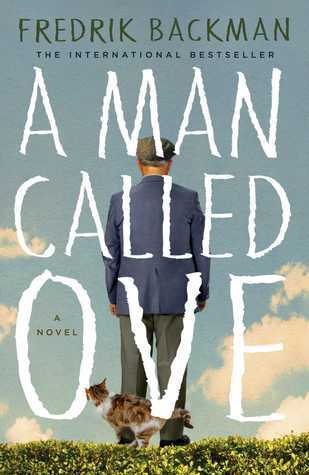
Book cover source: Goodreads

I NEARLY STOPPED READING the book several chapters in. The content weighed on me, so emotionally heavy that I wondered if I could continue. But then the story line began to unfold in a more hopeful way. And I read on.

By the time I reached the final chapter of A Man Called Ove, I was so invested in this book, the characters and relationships that formed, the way lives intertwined to save a life, that I wondered why I ever considered not finishing.

This 2014 international bestselling novel by Swedish blogger and columnist Fredrik Backman now ranks as a favorite book of mine. It made me cry. Correction. Sob. I struggled to read the final pages as tears blurred my vision. It’s been awhile since a work of fiction has spawned such a heart-wrenching emotional reaction.

I challenge you to pick up this book and read about aging Ove and his grief and grumpiness and outspokenness and how the edges of his hardness begin to soften. I laughed. I cried. I worried. I felt hopeful. I cheered. I wanted to give Ove a kick in the pants. I pondered. I related.

The mix of emotions elicited by A Man Called Ove tells me one thing. This is a remarkable book. The writing. The way mental health weaves into the story. There’s no avoidance of hard topics—of bullying and trauma and loss and grief and obsessive compulsive behavior and suicide and the way the mind wraps and detours and struggles and copes.

Into all of this, the author brings hope. In new neighbors. In a mangy cat. In a teen with sooty eyes and a determined journalist and a friend with dementia. I appreciate how, in the end, differences matter not. It’s that kind of book. Real. Honest. Heart-breaking.

I did not see the American movie, “A Man Called Otto,” based on the book. I’ve been told it’s good by some, advised by others to watch the Swedish version instead. Usually I’m disappointed in film adaptations. I haven’t seen a movie on the big screen in many years.

This Sunday evening, movies will be front and center in Los Angeles as “best of” awards are presented at The Oscars. I didn’t find “A Man Called Otto” (or any of the actors/actresses) on a quick scroll through The Academy Awards nominees list. Tom Hanks stars as Otto. I’m not into Hollywood events like this, although certainly they are important to honor those who do outstanding work in their craft. Rather, I prefer books, where I can read and then visualize people, scenes, interactions. My imagination unleashes, prompted by the writing of creatives passionate about the written word.

TELL ME: Have you read A Man Called Ove and/or seen the Swedish or American film based on the novel? I’d like to hear your reactions to either or both.

Thank you to readers Ken and Colleen who suggested I read this book.

© Copyright 2023 Audrey Kletscher Helbling


“The Seed Keeper,” an award-winning book every Minnesotan should read June 21, 2022

Cover design by Mary Austin Speaker. Cover beadwork art by Holly Young. (Credit: Publisher, Milkweed Editions)

VISUALIZE A PACKET OF SEEDS. Then open the envelope and spill a handful of seeds onto your open palm. What do you see? You likely envision seeds planted in rich black soil, covered, watered, sprouting, growing, yielding and, then, harvested. And while that visual is accurate, seeds hold more. Much more.

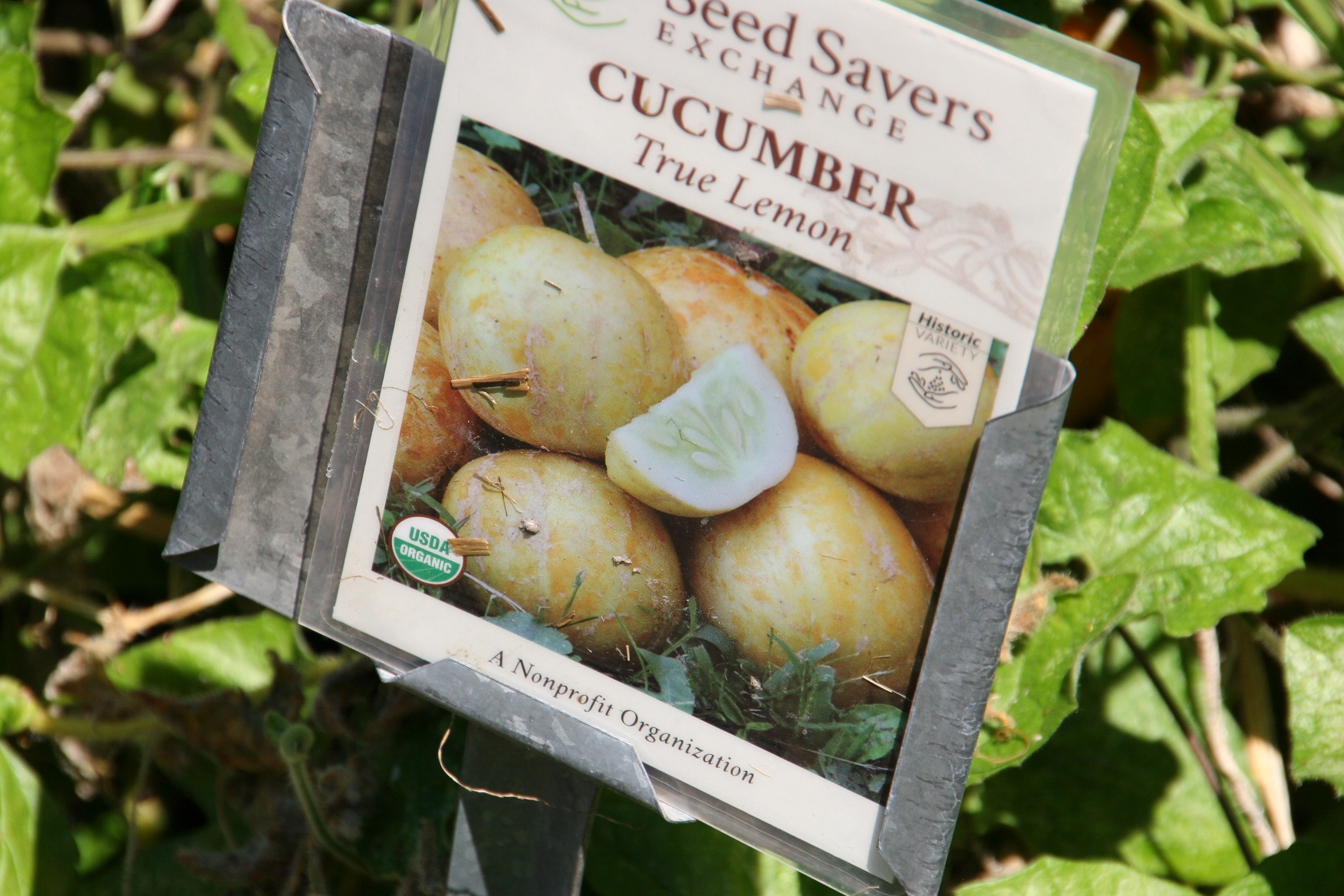
Photographed at Seed Savers Exchange near Decorah, Iowa. The farm specializes in saving heirloom/heritage seeds. (Minnesota Prairie Roots copyrighted file photo October 2018, used here for illustration only)

I just finished reading The Seed Keeper, Diane Wilson’s debut novel and winner of the 2022 Minnesota Book Award in the Novel & Short Story category. I’ve never felt so profoundly and deeply moved by a book rooted in history. Wilson’s writing is like a seed planted, nurtured, then yielding a harvest of insight and understanding.

Part of a public art installation at the Northfield Earth Day Celebration in April. (Minnesota Prairie Roots copyrighted file photo April 2022)

Hers is the story of the Dakota people, specifically of several generations of women, The Seed Keepers. Hers is the story of a connection to the land, sky, water, seeds and of reclaiming that relationship. Hers is a story of wrongs done to indigenous people in Minnesota, of atrocities and challenges and struggles. Past and present. Hers is a story of wrongful family separation and of reuniting with family and community.

A full view of the art planted in Northfield for Earth Day. (Minnesota Prairie Roots copyrighted file photo April 2022)

At the core of Wilson’s novel are the seeds. The seeds, stored in a willow basket, and eventually passed through the generations. The seeds that not only provided food for their families’ survival, but held the stories of Dakota ancestors and a way of life.

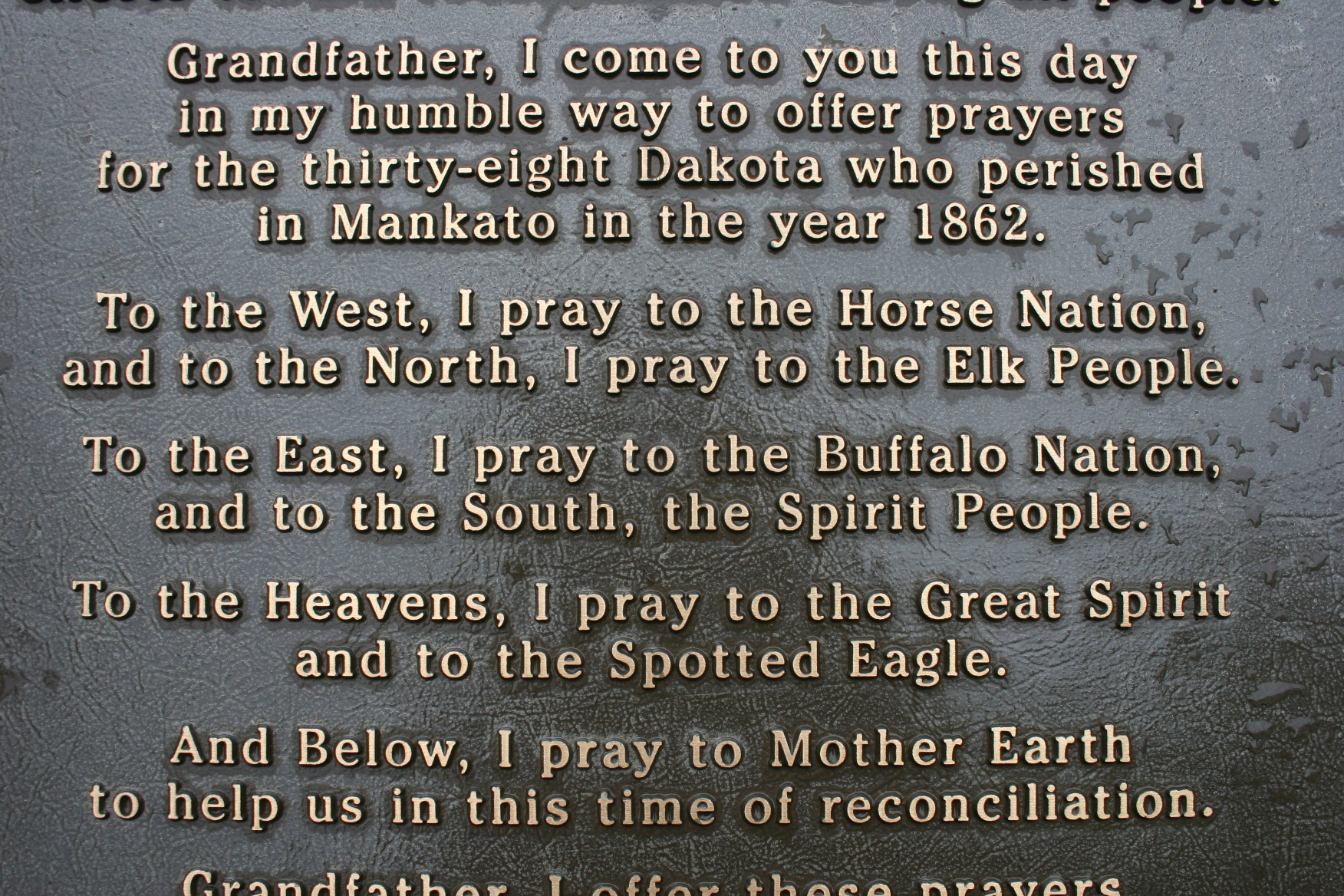
Words on a marker in Reconciliation Park in Mankato where 38 Dakota were hung on December 26, 1862. Wilson references the park, and the theme of forgiveness, in her novel. (Minnesota Prairie Roots copyrighted file photo May 2012)

The subject of this book holds personal interest to me because of its setting in southwestern Minnesota, site of The US-Dakota War of 1862. Wilson covers that war, including the hanging of 38 Dakota warriors in Mankato. As a native of Redwood County, I studied that war, even researched and wrote a term paper on the topic some 50 years ago. But I expect if I read that paper now, I would find many inaccuracies. My writing was shaped by the White (settlers’) narrative without consideration of the Dakota. I long ago realized the failings of that narrow-minded, biased perspective.

Even though I wasn’t taught the whole story, at least I was aware of The U.S.-Dakota War of 1862. It was centered in my home region and in neighboring Brown County, where my maternal ancestors fled their rural New Ulm farm for safety in St. Peter. Many Minnesotans, I’ve discovered, are unaware of this important part of our state’s history.

The Seed Keeper, though fictional, reveals just how devastating this war was to the Dakota people in removal from their native land, in their imprisonment and in efforts by Whites to control and shape them. I found this sentence penned by the author to be particularly powerful: What the white settlers called progress was a storm of fury thundering its way across the land, and none of us were strong enough to withstand it.

This 67-ton Kasota stone sculpture stands in Reconciliation Park in Mankato. It symbolizes the spiritual survival of the Dakota People and honors the area’s Dakota heritage. The park is the site of the largest mass execution in U.S. history. (Minnesota Prairie Roots copyrighted file photo November 2019)

Still, strength sprouts and grows in The Seed Keeper through a riveting storyline that stretches back to Marie Blackbird in 1862 and then follows main character Rosalie Iron Wing through the decades to 2002. Even her name, Iron Wing, evokes strength and freedom. Rosalie marries a White farmer, births a son and her two worlds collide.

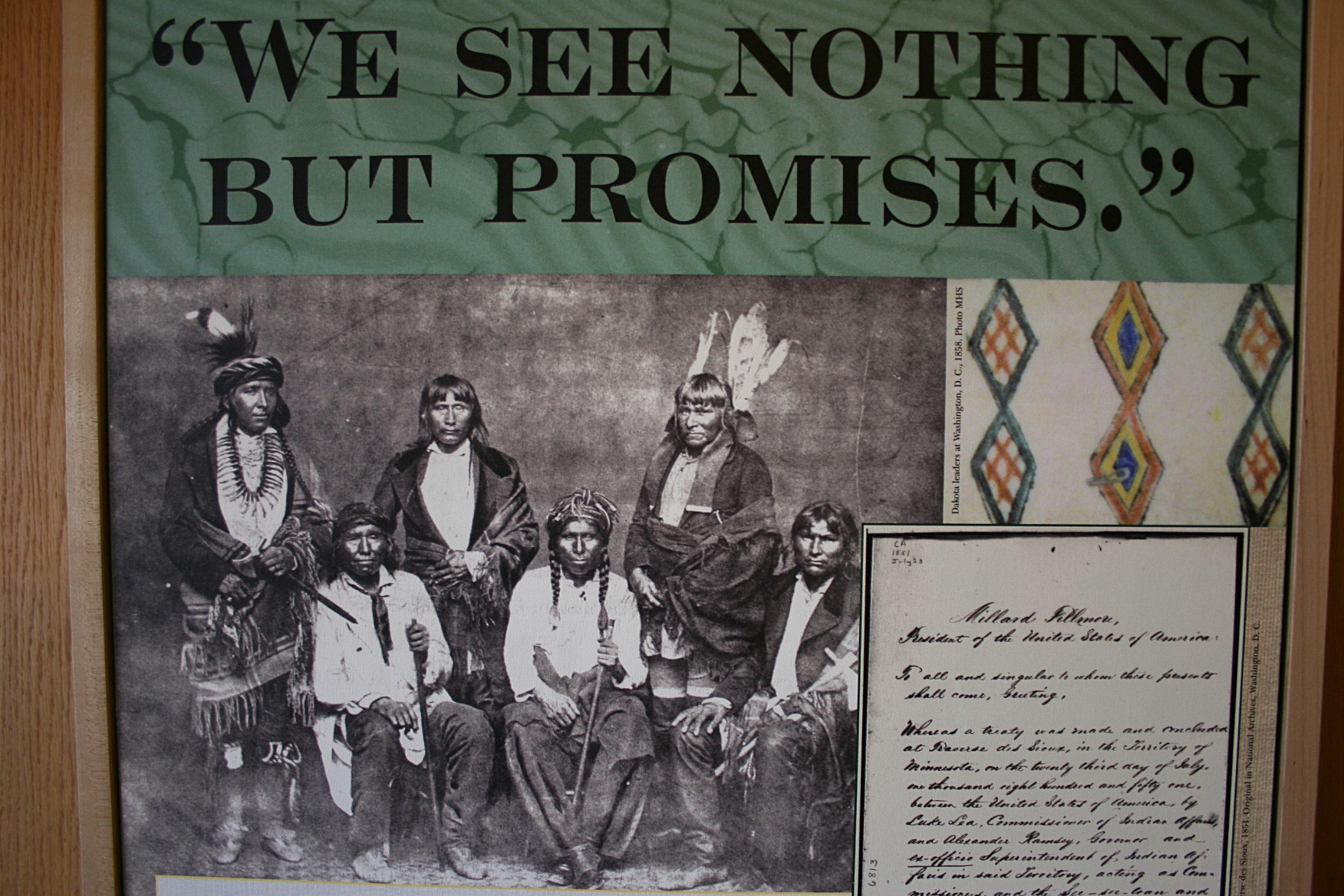
A photo panel at the Traverse des Sioux Treaty Center in St. Peter shows Dakota leaders photographed in Washington D.C. in 1858. The photo is from the Minnesota Historical Society. The quote represents the many broken treaties between the Dakota and the U.S. government. (Minnesota Prairie Roots file photo 2013)

I was especially drawn to this statement by a Dakota elder in Wilson’s book: People don’t understand how hard it is to be Indian. I’m not talking about all the sad history. I’m talking about a way of life that demands your best every single day. Being Dakhóta means every step you take is a prayer.

Wilson writes with authenticity as a Mdewakanton descendant, enrolled on the Rosebud Reservation. She’s walked the steps of the Dakhóta.

#

TELL ME: Have you read The Seed Keeper and, if so, what are your thoughts? I’d encourage everyone, Minnesotan or not, to read this award-winning novel.

© Copyright 2022 Audrey Kletscher Helbling


The truths in “The Help” December 1, 2011

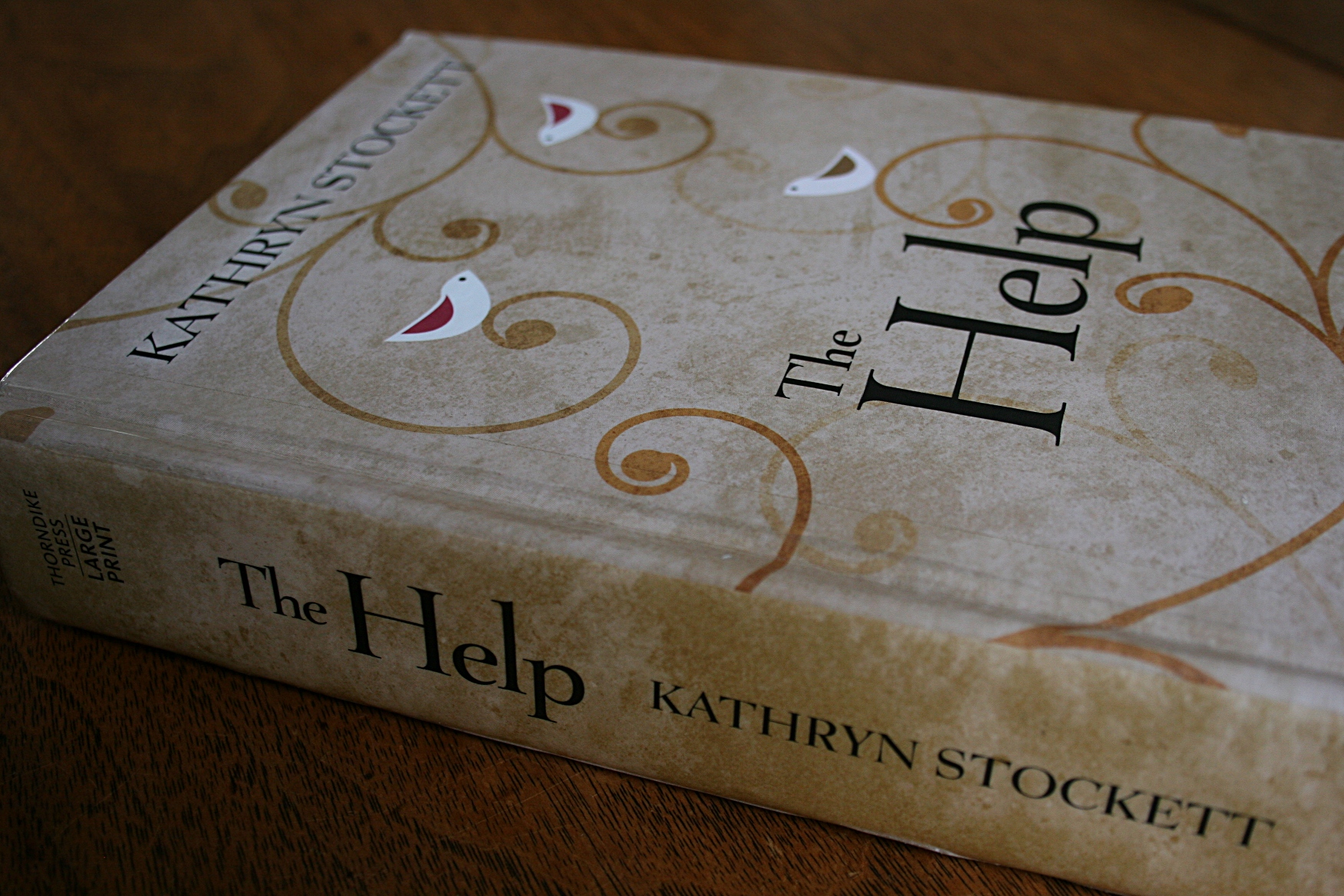
The large print version of The Help.

THREE MONTHS AGO I reviewed “The Help,” a movie based on the New York Times bestseller by Kathryn Stockett. (Read that review by clicking here.)

I wrote then:

In a nutshell, “The Help” tells the story of black women working as maids in upper class Southern white households during the 1960s.

It is that and more. So much more.

Yesterday I stole away 10 minutes to finish the final chapter of The Help. My opinion of the book rates as high as my opinion of the movie. Everyone ought to read this novel and see this movie.

Why?

Although a work of fiction, this book speaks the truth.

Let me show you. While reading The Help, I jotted three page numbers onto a scrap of paper, noting passages that especially struck me.

In chapter 17, from the perspective of Minny, a “colored” maid, are these thoughts:

But truth is, I don’t’ care that much about voting. I don’t care about eating at a counter with white people. What I care about is, if in ten years, a white lady will call my girls dirty and accuse them of stealing the silver.

Consider those words. Do attitudes of “stealing the silver” still linger today?

Near the end of the book, in chapter 34, I came across this line:

Please, Minny, I think. Please, take this chance to get out.

Aibileen wishes this as she speaks on the phone with her friend Minny, who has hunkered down in a gas station after fleeing her abusive husband. Minny finally finds the courage to leave Leroy.

Personal courage, in my summation, is a reoccurring theme in The Help—courage to speak up, courage to be true to yourself, courage to escape abuse.

I would like to see copies of The Help placed in every women’s shelter, given to every victim of domestic abuse, handed to every woman trying to muster the courage to flee an abusive relationship. Stockett’s writing on the topic is that powerful, that motivating, that moving.

Profound, strong words of encouragement for anyone who's been abused, known someone who's been or is being abused, or is currently in an abusive relationship.

Finally, a few pages later I found this passage, a favorite line from the movie and repeated in the book by Mae Mobley, the little girl in maid Aibileen’s care:

“You is kind,” she say, “you is smart. You is important.”

Aibileen ingrained that phrase in Mae Mobley, a child mostly ignored by her mother.

How often do we tell our children, “You is kind. You is smart. You is important” and really, truly, mean it?

IF YOU’VE READ The Help, what nuggets did you glean from this book? What themes or passages made a lasting impression on you?

© Copyright 2011 Audrey Kletscher Helbling