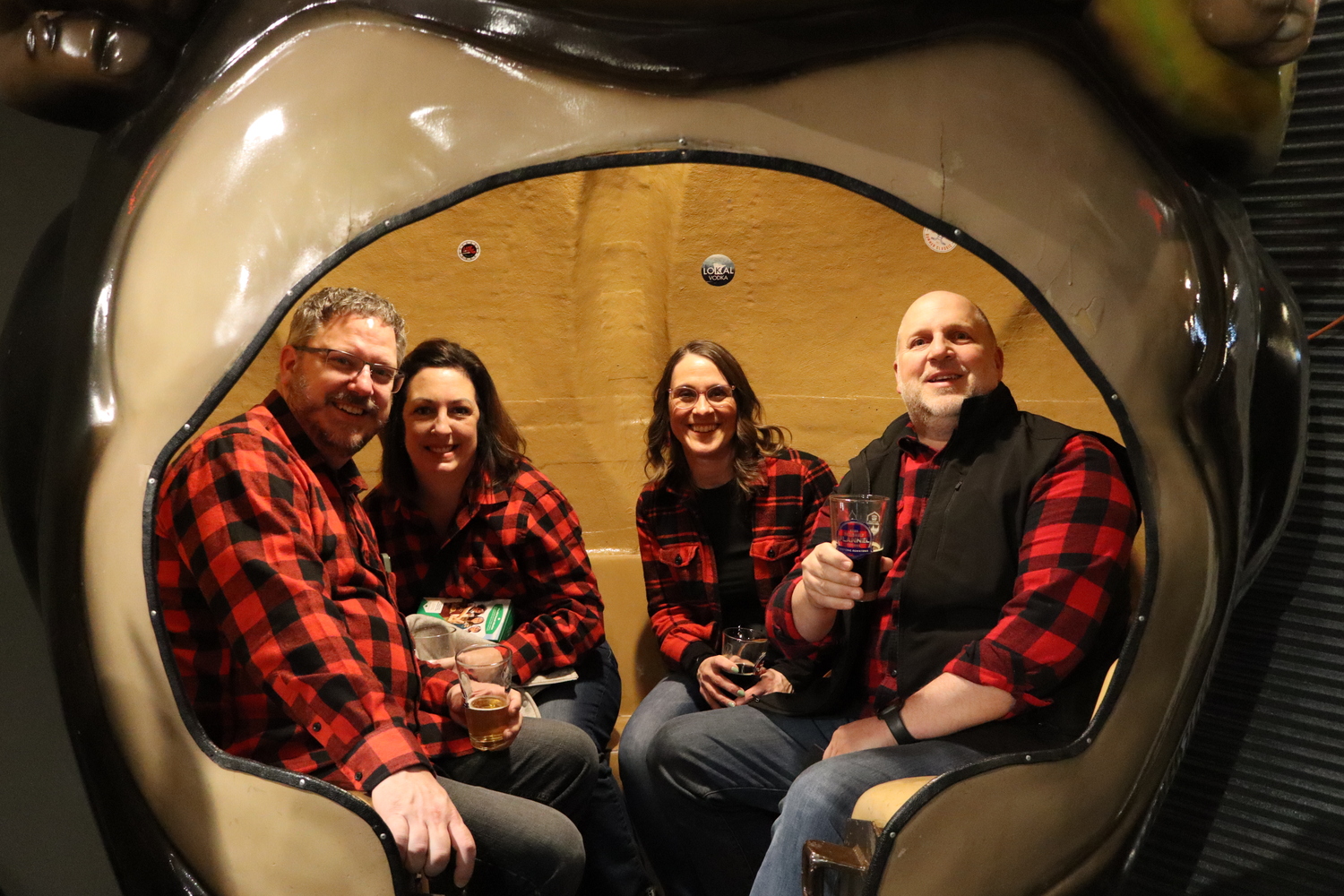
Attendees at a past Faribault Flannel Formal cozy inside a non-working amusement ride inside Corks & Pints. (Photo credit: Faribault Area Chamber of Commerce & Tourism)
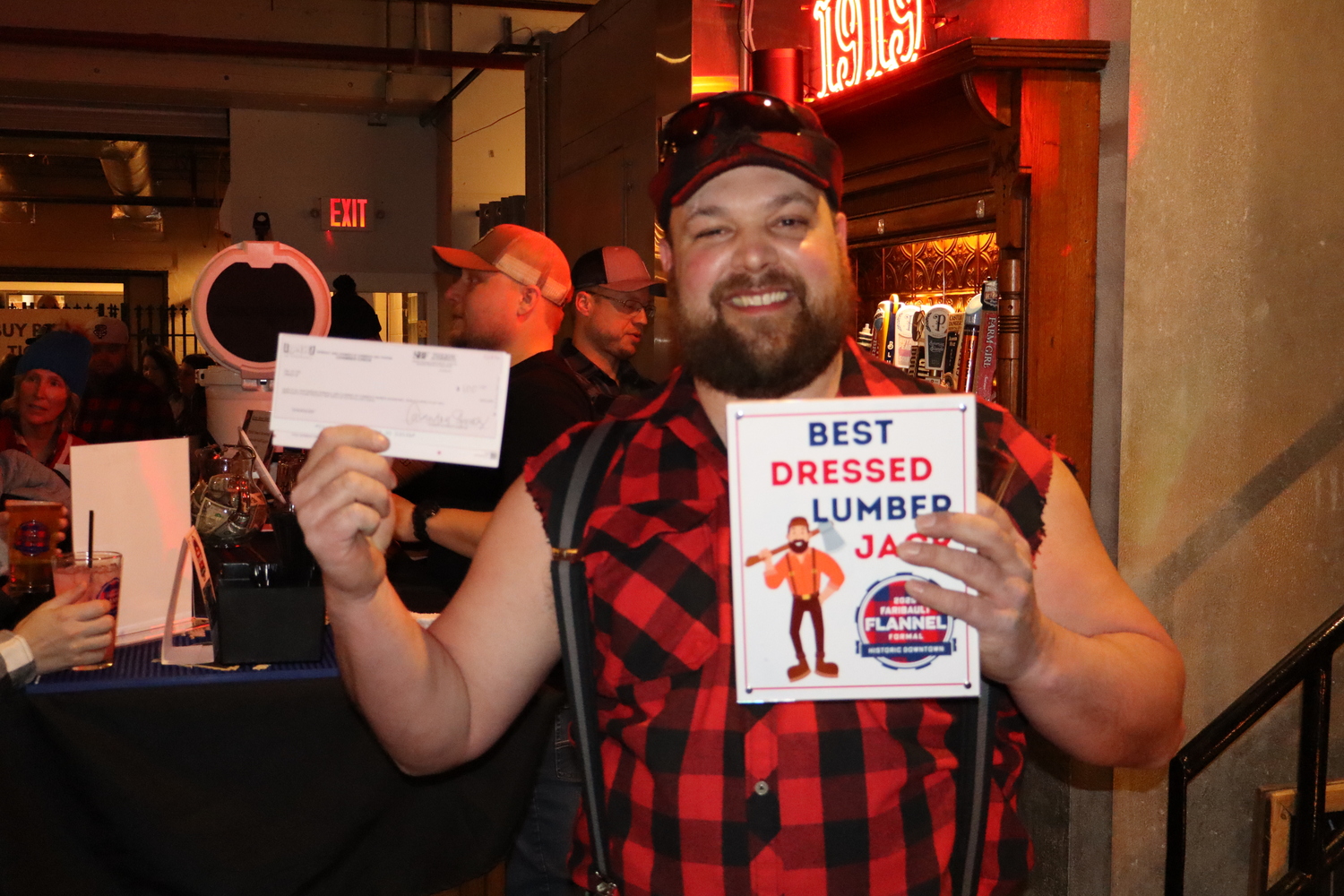
Voted as the Best Dressed Lumber Jack in 2025. (Photo credit: Faribault Area Chamber of Commerce & Tourism)
The dress code calls not for formal wear, but rather for flannel, preferably buffalo plaid red and black. That’s my kind of winter attire. Attendees can even participate in Lumber Jack and Jane costume contests, which call for creativity in flannel wear. Beards will also be judged to find “the best,” whatever fits that definition.
Chicken Wild Rice Hotdish, an example of the hotdish you may find at the Faribault Flannel Formal. (Minnesota Prairie Roots copyrighted file photo)
This promises to be a Minnesotan event through and through with activities like a Hotdish Showdown. Note, I wrote hotdish, which is the Minnesota word for casserole. Locals will cook up their favorite hotdishes to be judged and sampled.
The influence of legendary lumberjack Paul Bunyan—who may or may not have eaten hotdish, but who certainly wore buffalo plaid flannel—will be noticeable. There will be axe throwing in a special trailer, a Beaver Toss (that would be stuffed beavers), bag toss and hammerschlagen (driving nails into a stump). Fun stuff to show off precision skills and perhaps a bit of brawn.
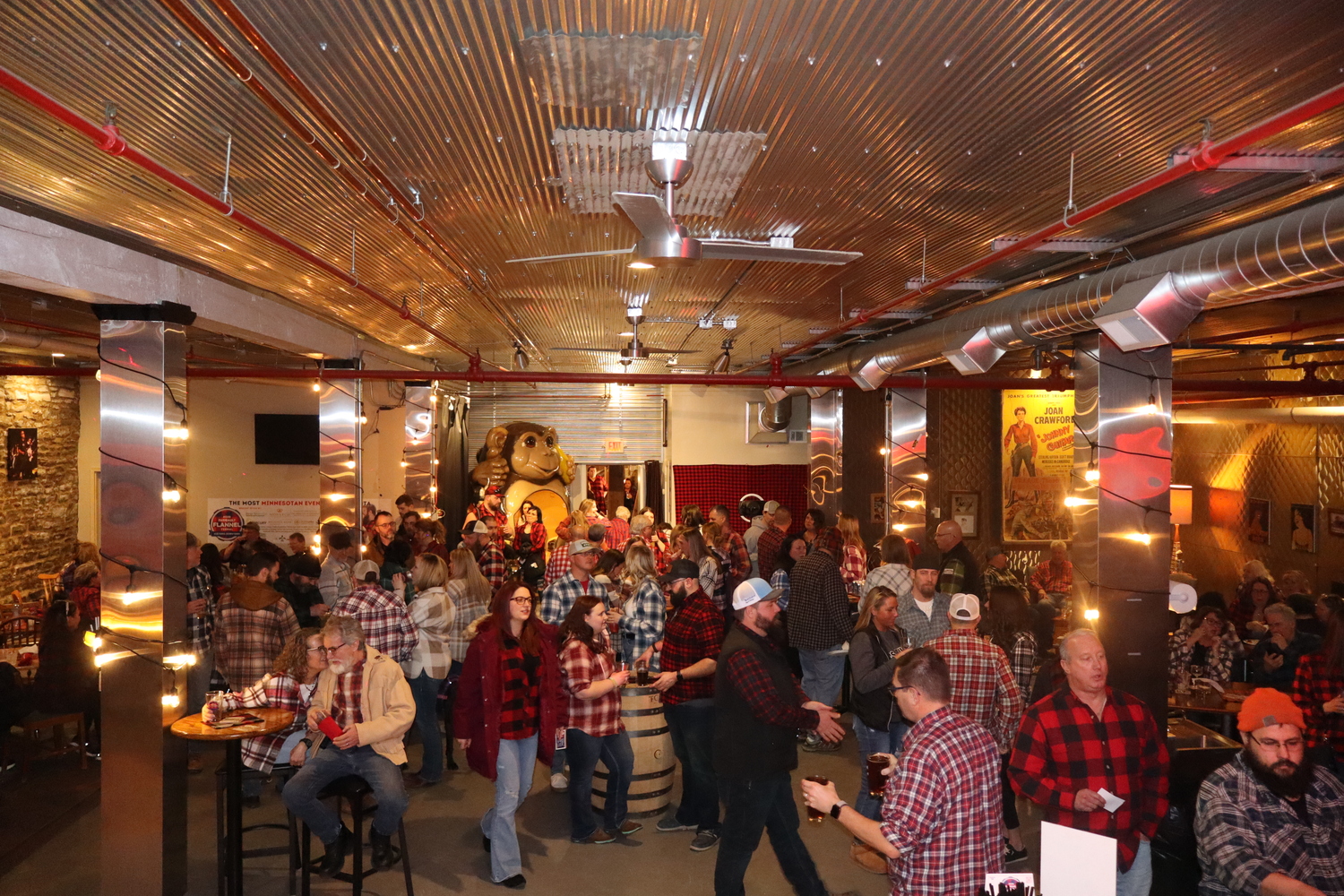
Inside the lower level of Corks & Pints, which connects to the distillery. (Photo credit: Faribault Area Chamber of Commerce & Tourism)
No event is complete without music. Minneapolis rock cover band Robos headlines the stage. Those who purchase $75 VIP experience tickets for early admittance at 3 p.m. can also exclusively enjoy the music of Wayne & the Boys, a one-man band performing the music of Wayne Wagner, inducted into the Legends of South Dakota Country Music Hall of Fame. VIP perks also include a swag bag, two complimentary drink tickets, voting power and access to exclusive hideouts.
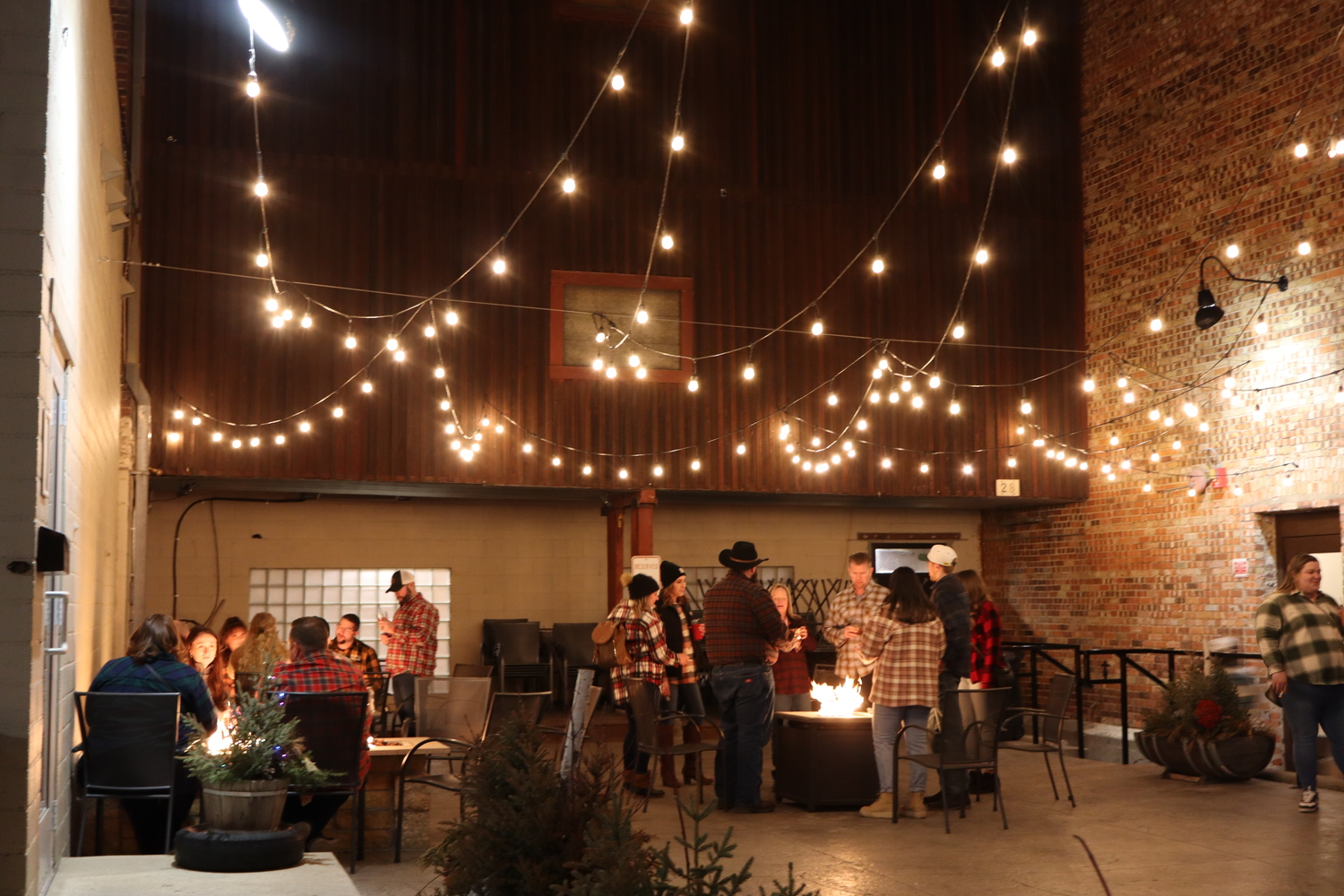
Flannel attendees gather on the patio between the distillery and Corks & Pints. (Photo credit: Faribault Area Chamber of Commerce & Tourism)
Whether you go VIP or opt for a $25 general admission experience, the Faribault Flannel Formal is sure to be a true Minnesotan experience, especially with all that plaid flannel. You can even experience Minnesota winter by stepping outside to order a drink at the Sleigh Bar (new this year) and then warm up in a heated tent, followed perhaps by a conversation about the weather. We like to talk weather here in Minnesota.
You may even overhear phrases like “You betcha.” Or “That’s different.” Or “It could be worse.”
But mostly, I expect you will hear friendly conversations, lots of laughter, maybe an ice fishing tale or three, and praise for Minnesota, this place we love. Even in the deep of winter. (Mostly.)
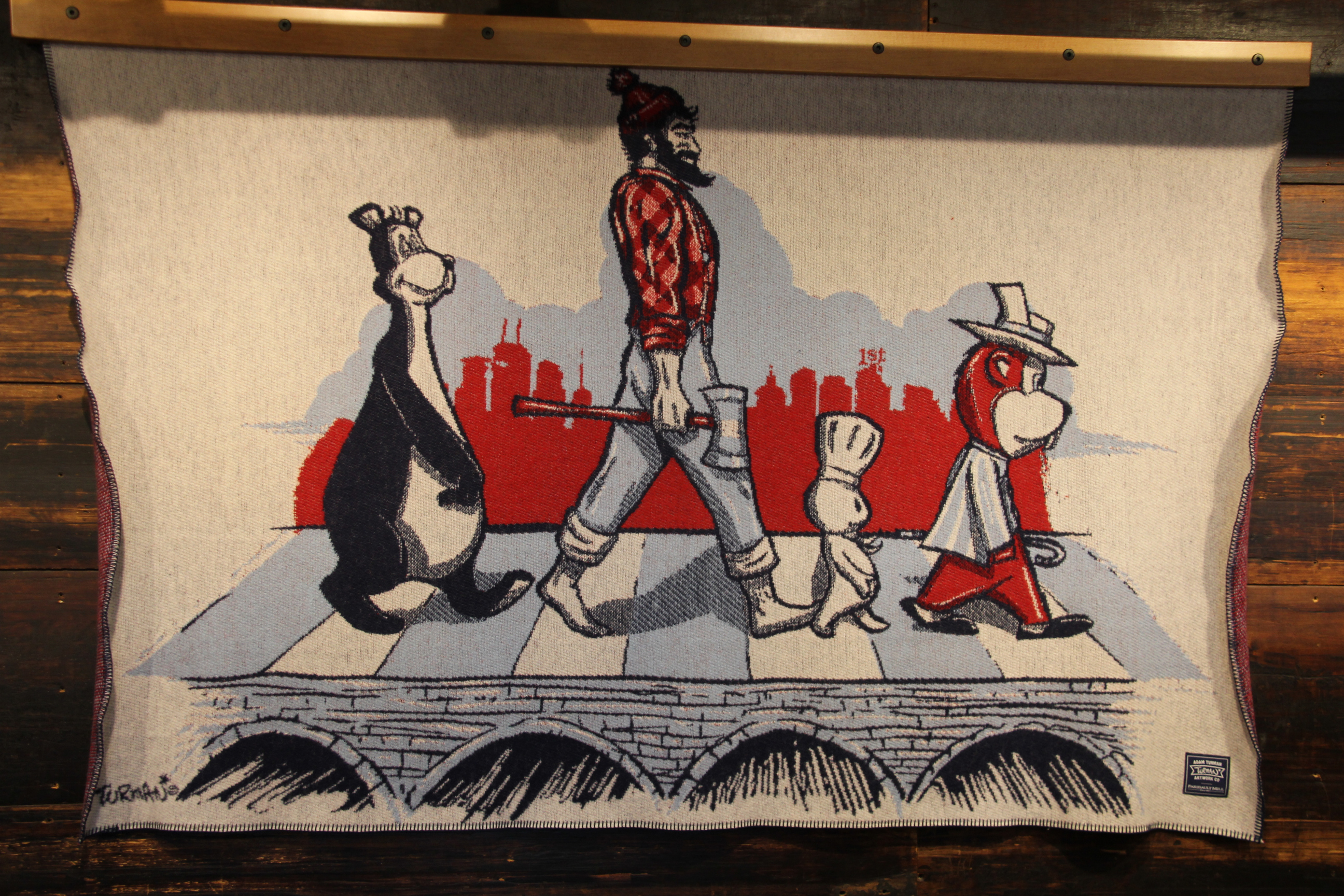
Minnesota artist Adam Turman designed this Abbey Road throw (inspired by the Beatles “Abbey Road” visual) for the Faribault Mill. It features the Hamm’s beer bear, Paul Bunyan, the Pillsbury Dough Boy and State Fairchild, all legendary Minnesota icons, against a metro skyline backdrop.(Minnesota Prairie Roots copyrighted photo October 2024)
AS A LIFE-LONG MINNESOTAN, certain things pop out at me as iconic Minnesota. Topping that list—Paul Bunyan and Babe the Blue Ox. I realize we’re not the only place claiming this over-sized legendary lumberjack and his ox as ours. But both are assuredly important in state lore, tourism and business identity, mostly in central and northern Minnesota where our lumber industry is rooted.
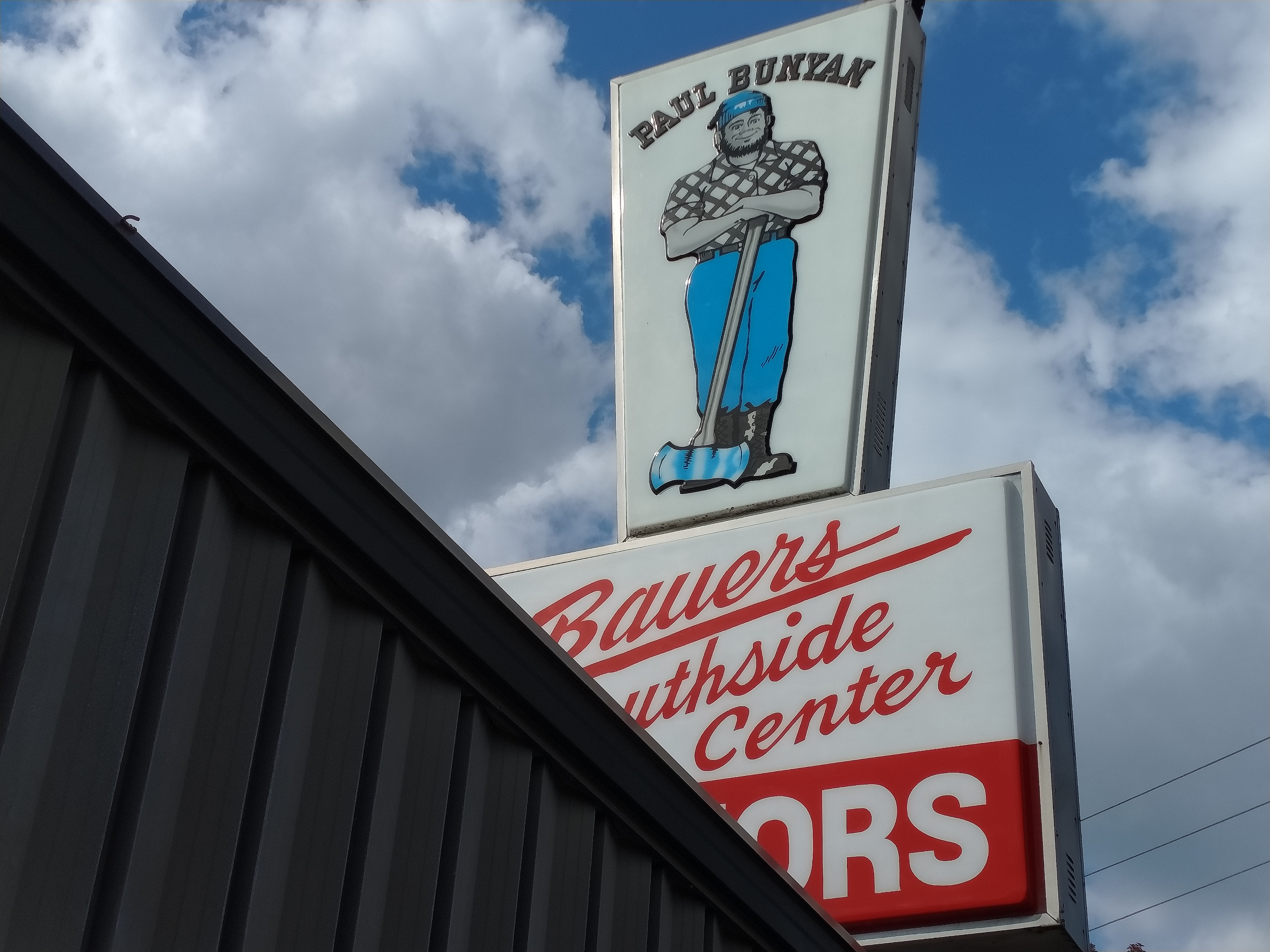
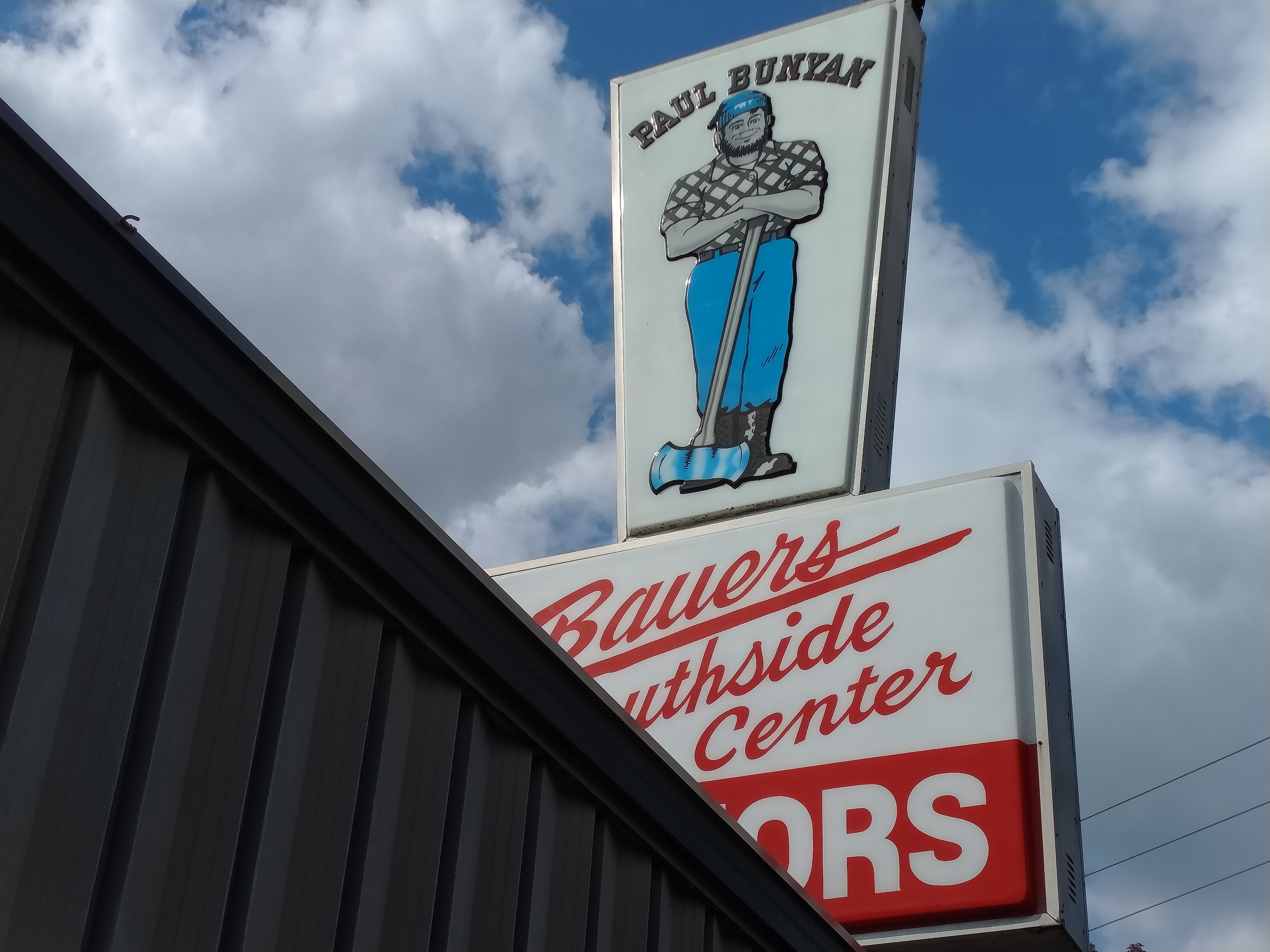
This Paul Bunyan sign is just blocks from my home. Granted, Paul is not wearing his usual buffalo plaid flannel shirt. (Minnesota Prairie Roots copyrighted photo September 2023)
Yet, I only need head south a few blocks from my house to see Paul marking Bauers Southside Liquor, once also home to the adjoining Paul Bunyan South gas station and convenience store. It closed years ago as did all the other Paul Bunyan stores in Faribault.
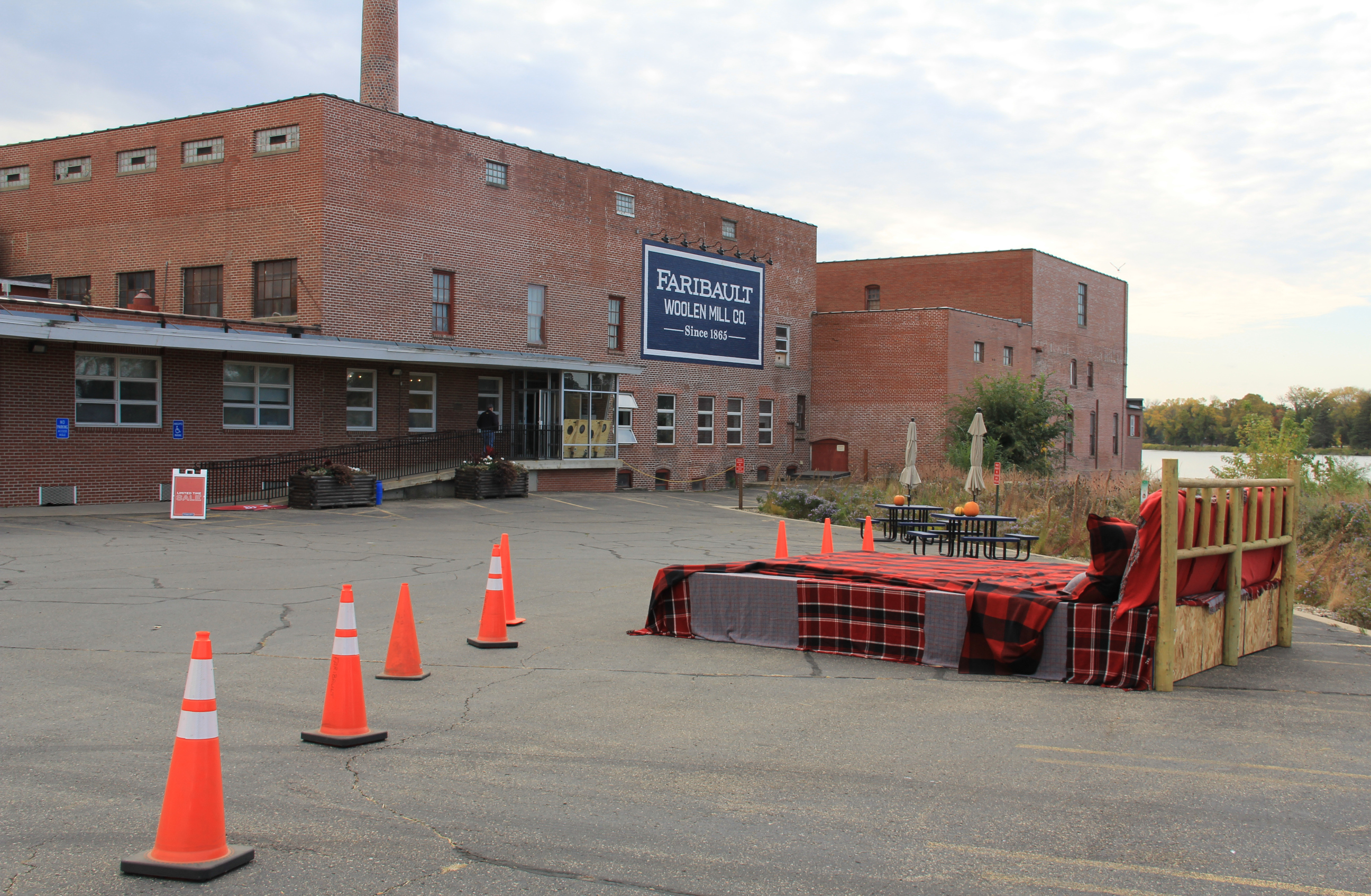
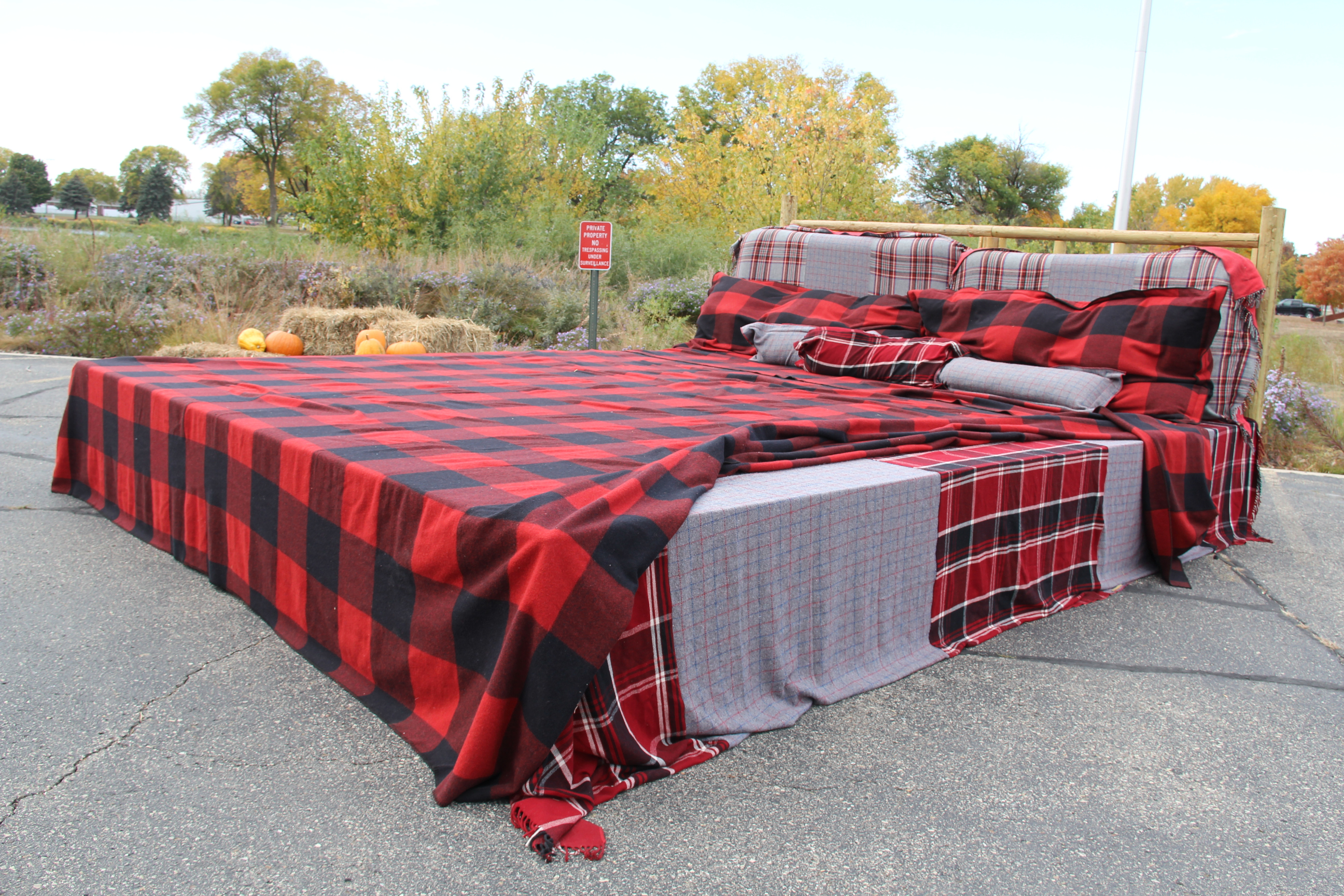
Paul Bunyan’s bed sits by the Faribault Mill along the Cannon River on Faribault’s northside. (Minnesota Prairie Roots copyrighted photo October 2024)
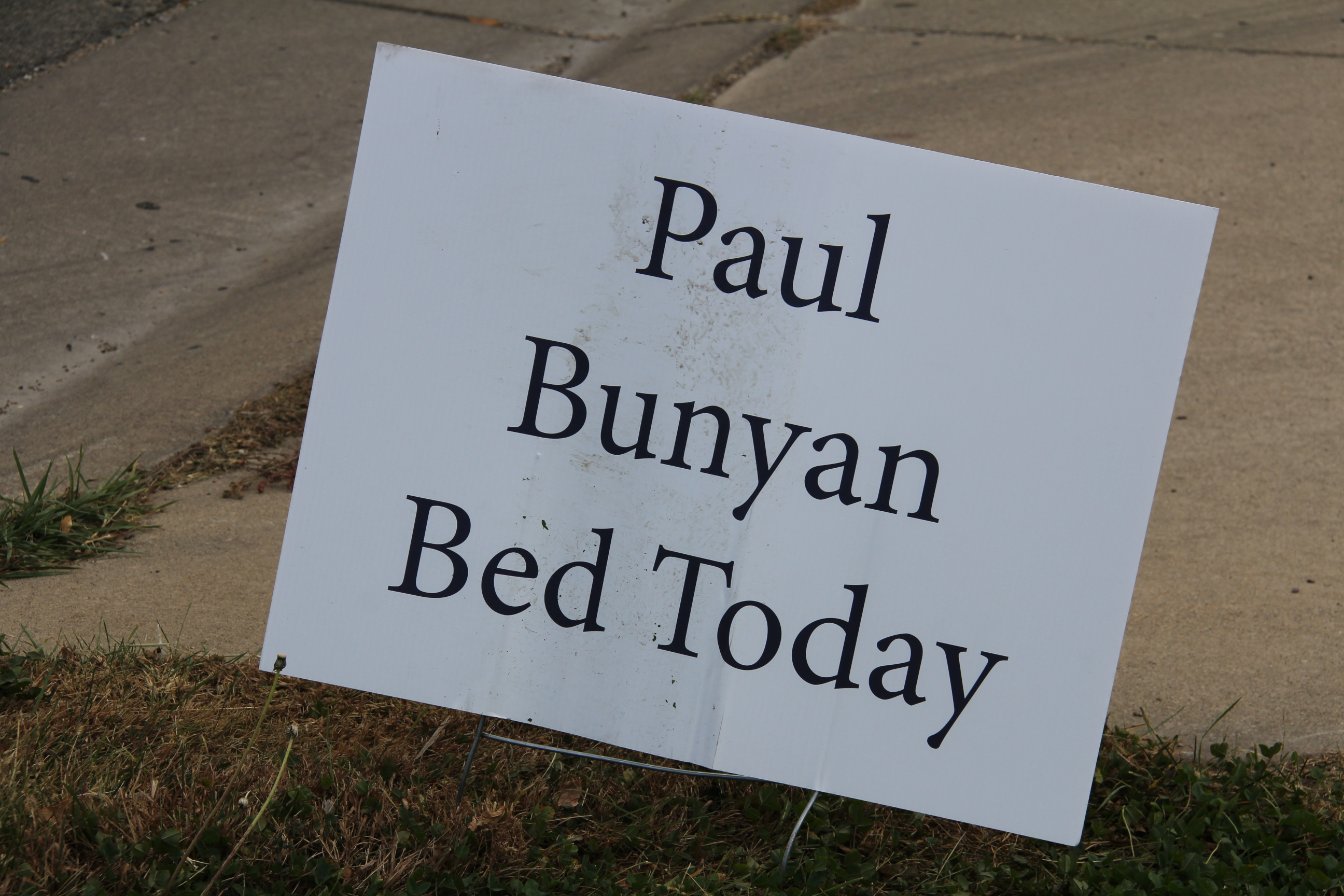
A roadside sign welcomes visitors to hop into Paul Bunyan’s bed. (Minnesota Prairie Roots copyrighted photo October 2024)
The bed showcases several of the Mill blanket patterns. (Minnesota Prairie Roots copyrighted photo October 2024)
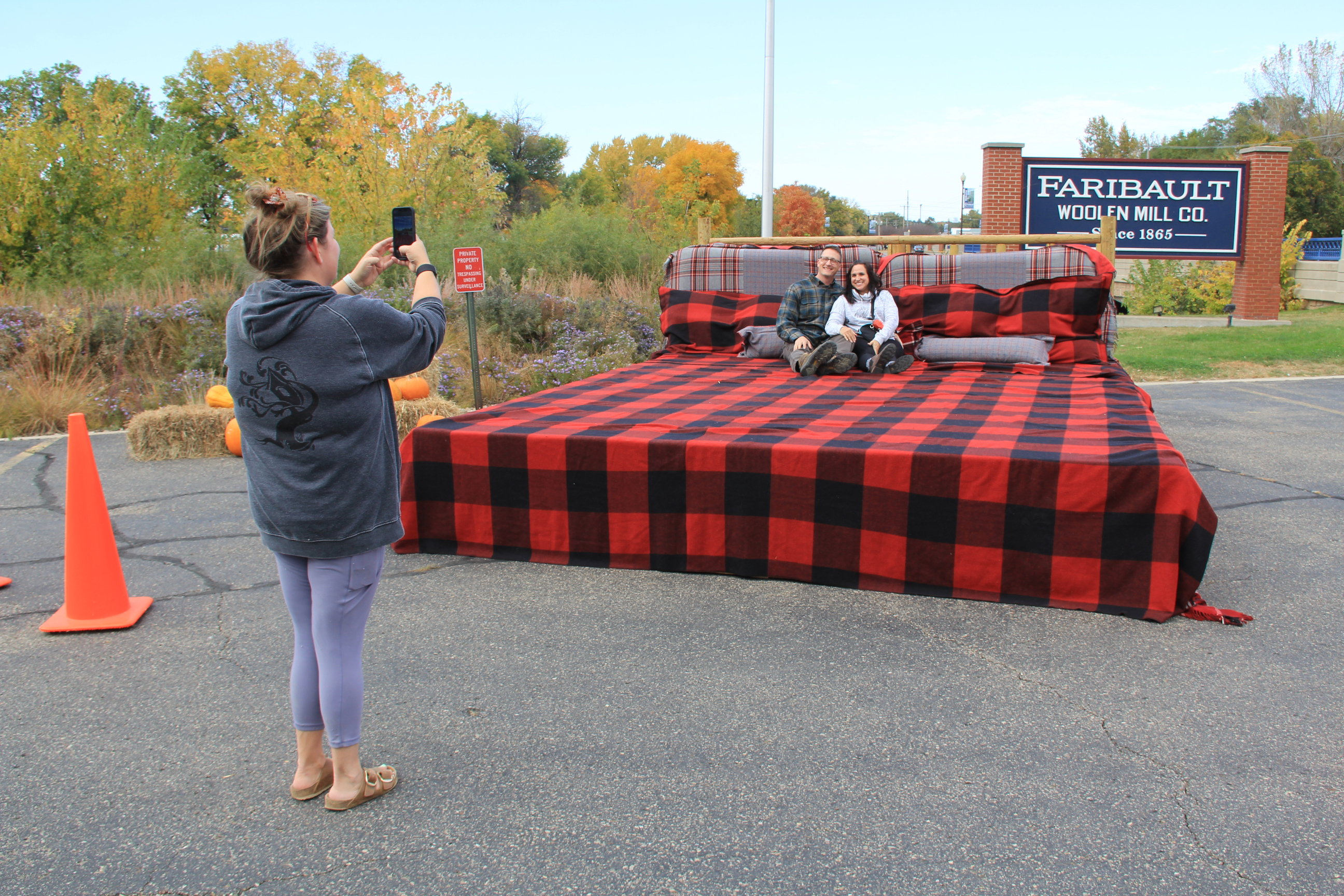
Yet, the legendary lumberjack maintains his influence locally. Recently, I spotted an enormous buffalo plaid blanketed “bed” in the parking lot of Faribault Mill, an iconic business since 1865 known for its wool blankets. Signs invited folks to stop, climb onto the Paul Bunyan bed and take photos.
A friend photographs friends who climbed into Paul Bunyan’s bed. (Minnesota Prairie Roots copyrighted photo October 2024)
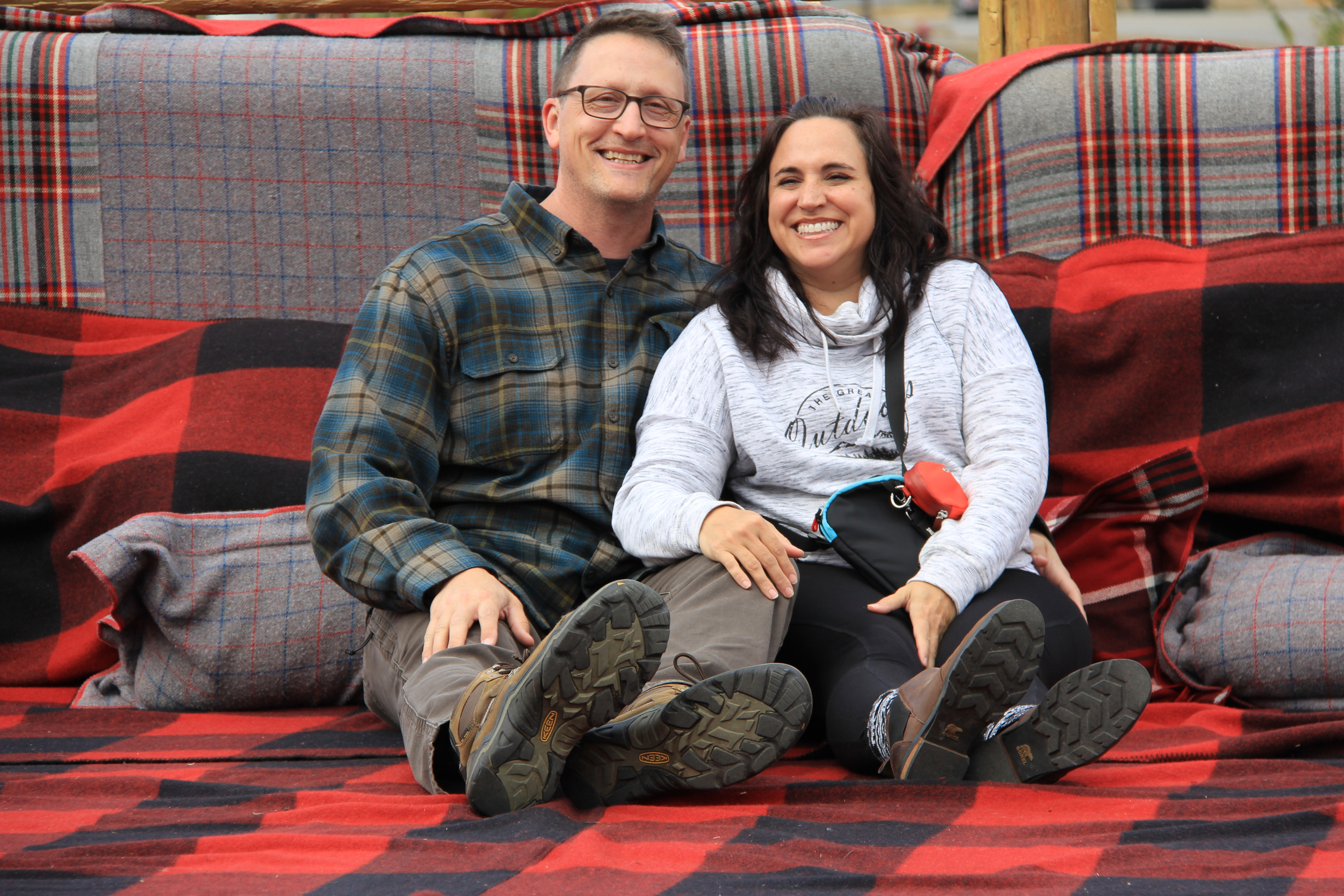
While I was there, one couple did just that. They were camping in nearby Nerstrand Big Woods State Park with others and headed into Faribault for stops at a local apple orchard and also at the Mill. I tipped them off to other places to visit, especially our historic downtown. I never pass on an opportunity to tell visitors about my community.
A comfy photo op in Paul Bunyan’s bed. (Minnesota Prairie Roots copyrighted photo October 2024)
On this Saturday, after photographing that creative marketing bed, I followed the two couples from Minneapolis into the Mill retail store. I haven’t been inside in a while. To my delight, I found more Minnesota icons on Mill products. I should note here that the Mill has a second mill (acquired in 2022) in Monmouth, Maine (Brahms Mount) which specializes in cotton textiles. Paul Bunyan is also big in Maine folklore.
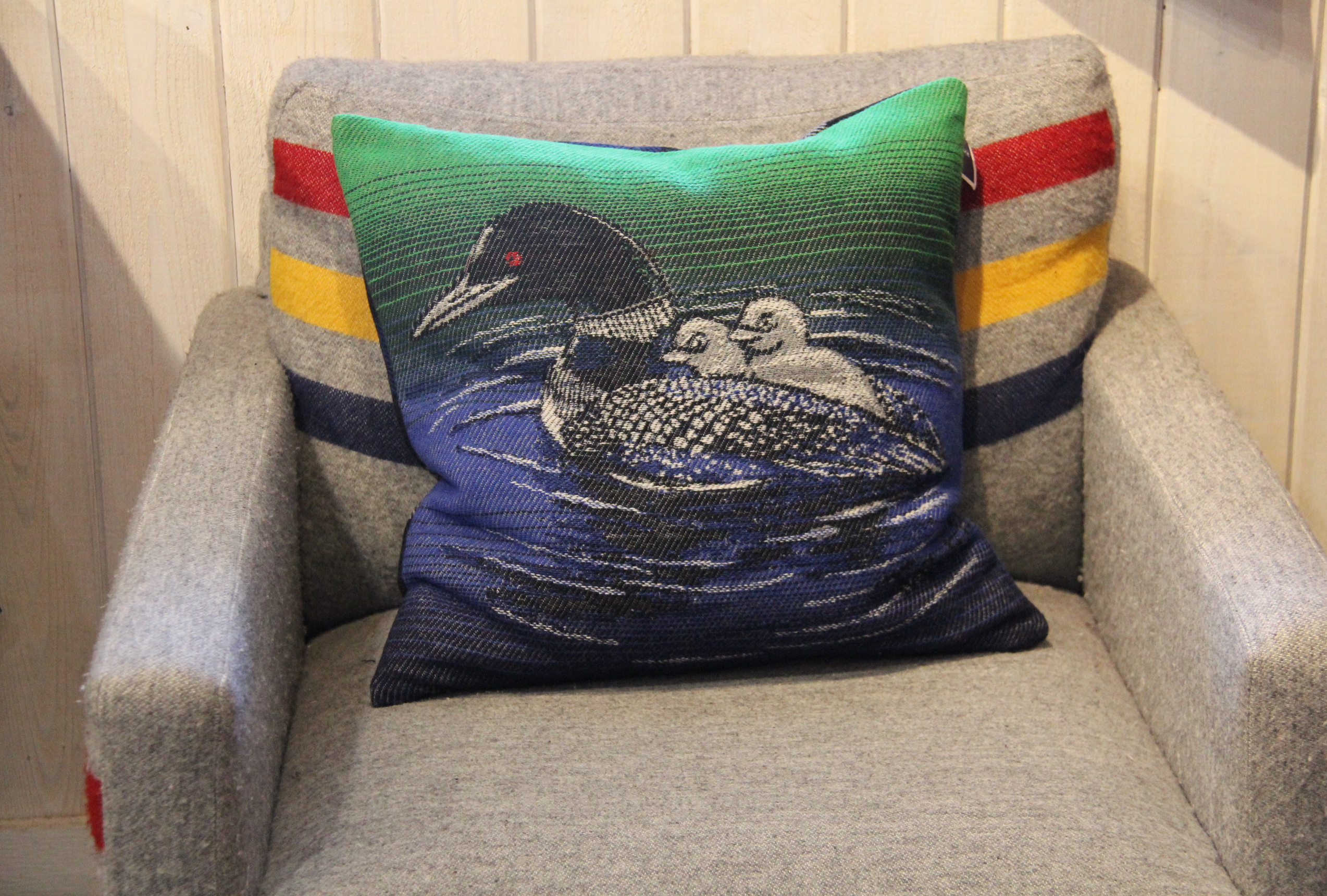
Adam Turman designed this loon throw pillow displayed on an easy chair upholstered with Faribault Mill blankets. (Minnesota Prairie Roots copyrighted photo October 2024)
I love how Faribault Mill tapped into Minnesota talent. Artist Adam Turmancreated art for throws and pillows that is distinctly part of Minnesota culture and life. I’ve been a fan of Turman since viewing his art on seasonal-themed murals in neighboring Northfield. His work for Faribault Mill features Paul Bunyan and Babe, the Hamm’s beer bear, the Pillsbury Dough Boy, State Fairchild, loons, a snowy owl, cardinal, Split Rock lighthouse and the Boundary Waters Canoe Area Wilderness.
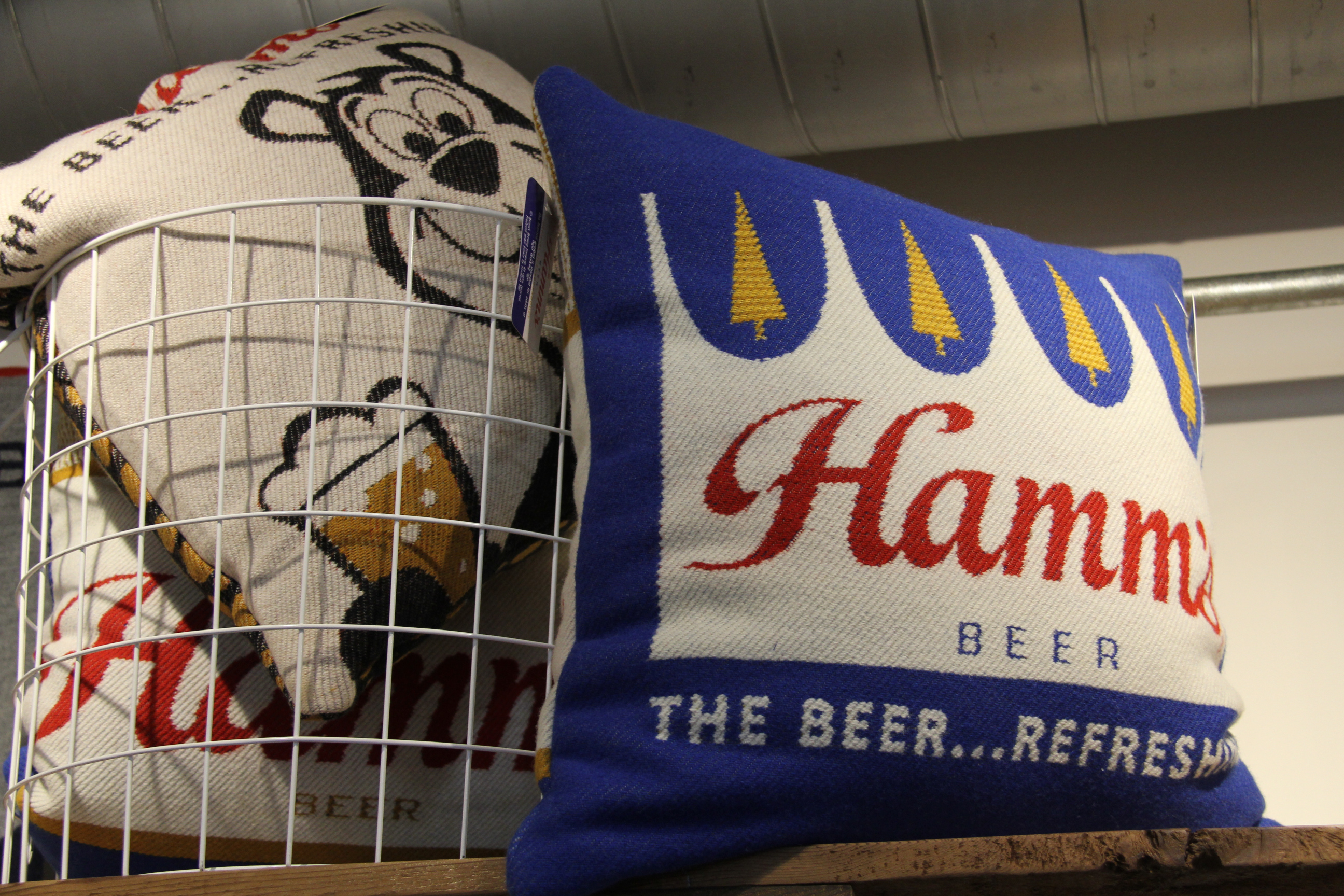
The Faribault Mill partnered with Hamm’s Beer on these pillows. Hamm’s was first brewed in Minnesota, “the land of sky blue waters,” in 1865. It is no longer made in Minnesota. (Minnesota Prairie Roots copyrighted photo October 2024)
While strolling through the Mill store, I focused on the art-themed merchandise among all the traditional primarily plaid and solid-hued woolen blankets people have come to associate with Faribault’s mill.
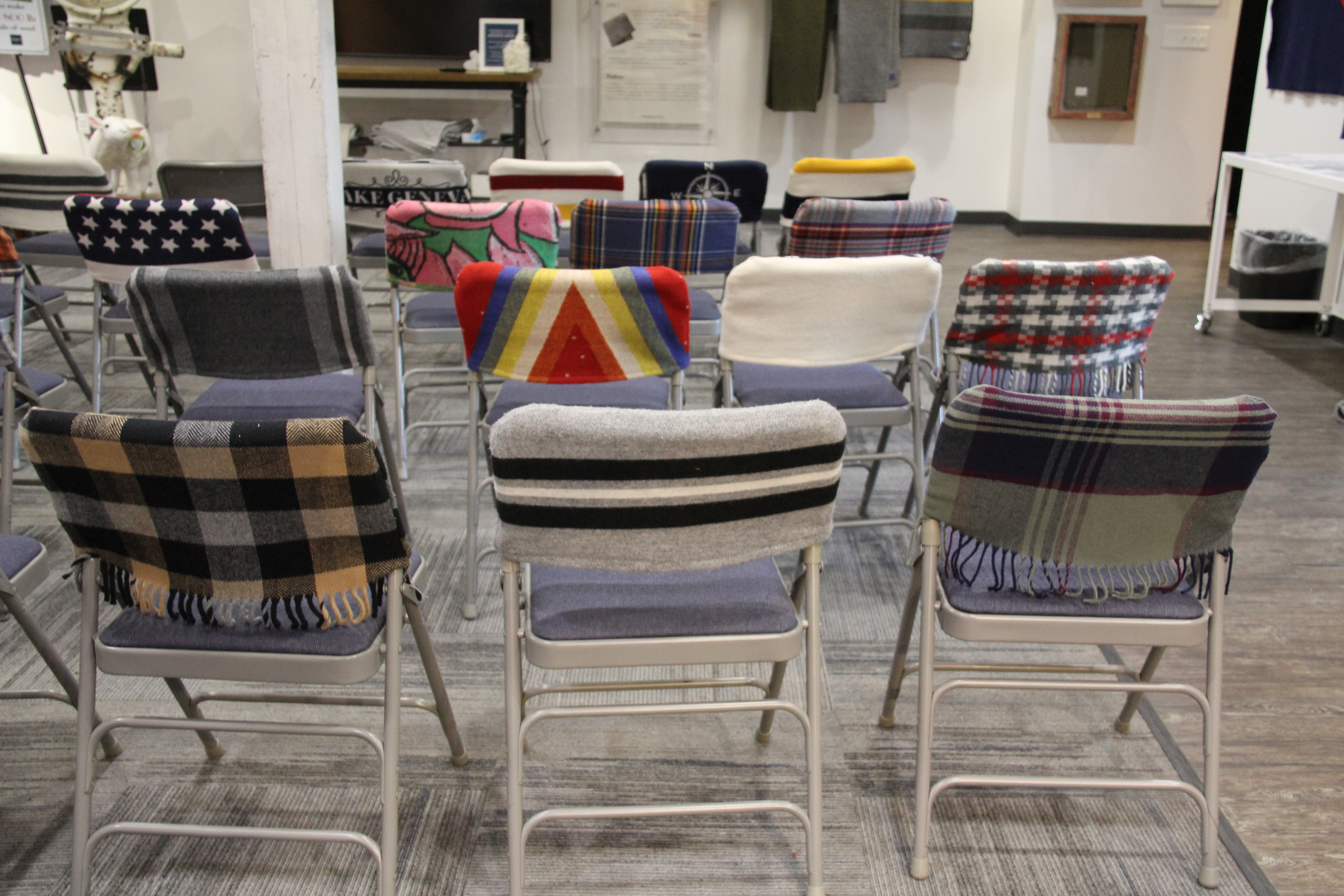
Visitors touring the Mill settle on these blanket remnant draped chairs to learn more about the Mill. (Minnesota Prairie Roots copyrighted photo October 2024)
In a room just off the main shop, I spotted folding chairs set up for folks who tour the mill. Tours are available at 11 am and 1 pm Fridays and Saturdays for a fee. Wool blanket remnants drape the chair backs, creating a memorable and colorful scene.
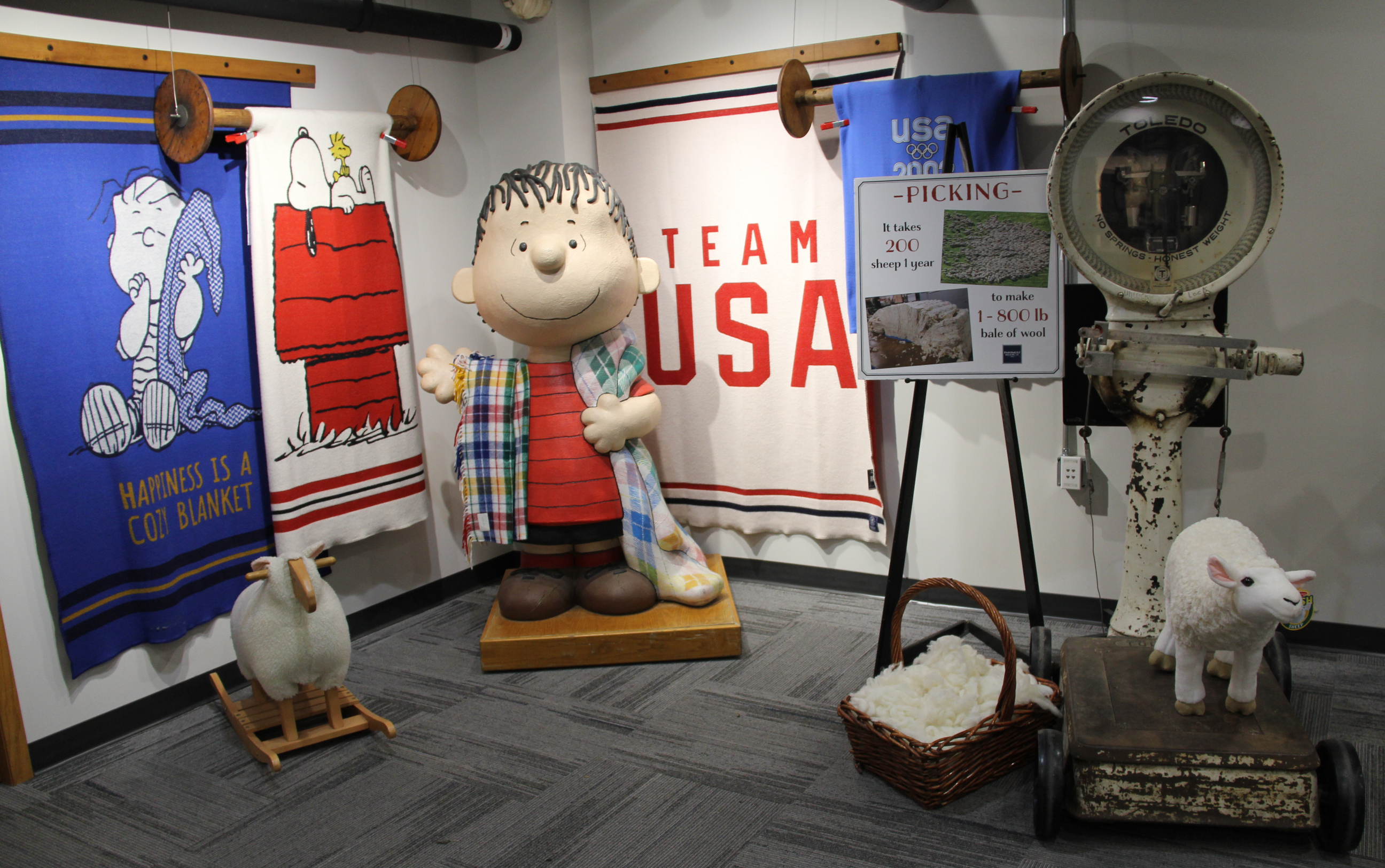
Peanuts themed throws are among Mill merch, shown here in the gathering space for those touring the factory. (Minnesota Prairie Roots copyrighted photo October 2024)
Also memorable are the Linus statue and the Peanuts-themed throws. We Minnesotans are proud of the Peanuts crew created by Charles Schulz, born in Minneapolis and raised in St. Paul. And I am proud of the Faribault Mill, a long-standing business in my community known for its quality made-in-America products. During the two World Wars, the then Faribault Woolen Mill made wool blankets for Army soldiers.
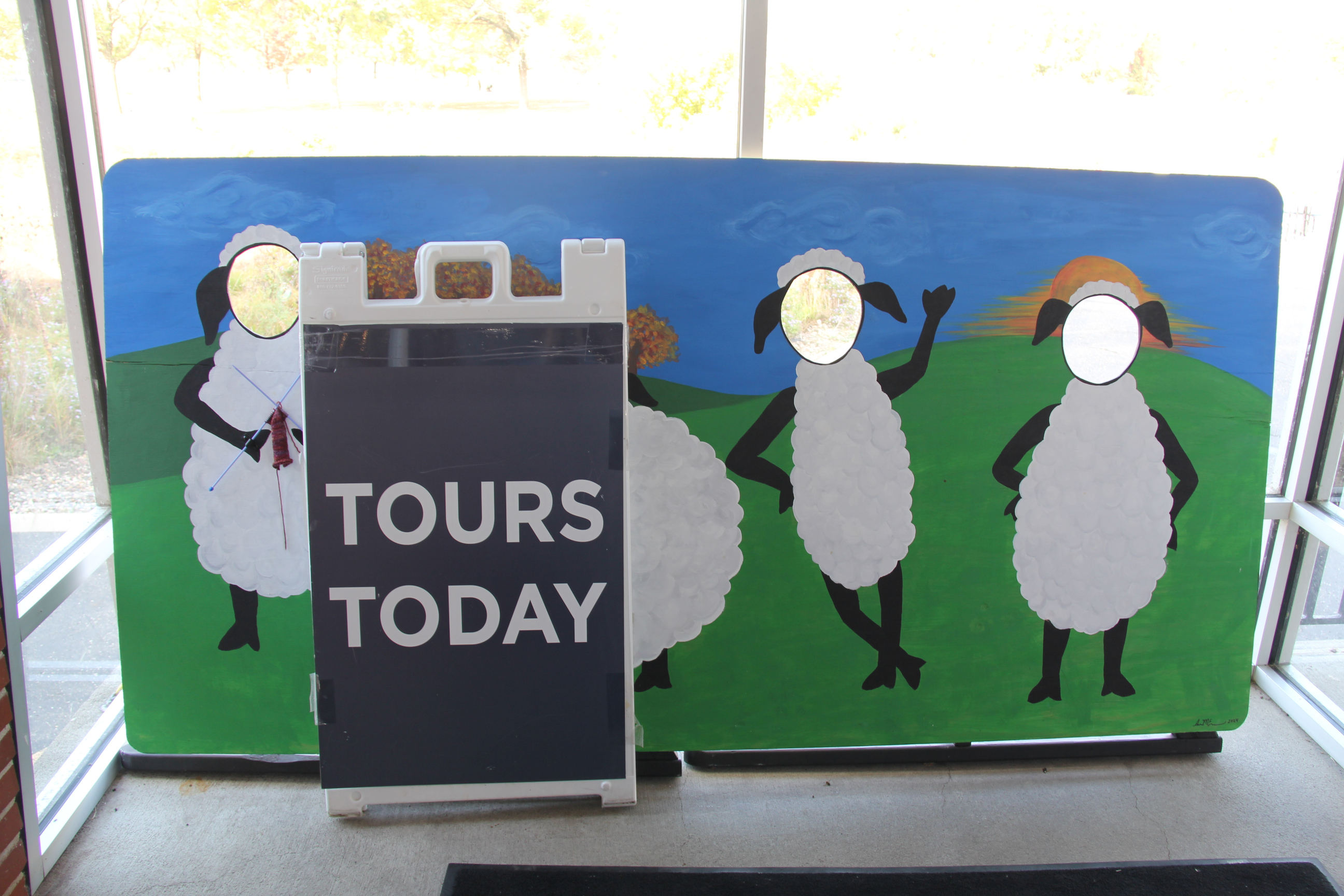
Another photo op, sheep cut-outs photographed inside the entrance to the retail store. (Minnesota Prairie Roots copyrighted photo October 2024)
Today Mill employees continue to create quality products, and not just blankets, at its two plants. The Mill also weaves into the fabric of America via a Paul Bunyan-sized spirit of generosity. For every bed blanket sold, the company donates a blanket to nonprofits serving youth experiencing homelessness in major cities across the U.S. That’s through its Spread the Warmth program. The Mill has also donated blankets to local youth.
The marketing and business teams at Faribault Mill clearly understand the value of connecting with community, of giving back and of drawing customers via creativity. The Paul Bunyan-sized buffalo plaid blanketed bed and the Minnesota art by Adam Turman both grabbed my attention. While the bed has been put to bed for the season—maybe because Paul Bunyan needs his wool blankets back for the forthcoming winter—you can still step inside the retail store and wrap yourself in the warmth of Minnesota from blankets to legendary icons.
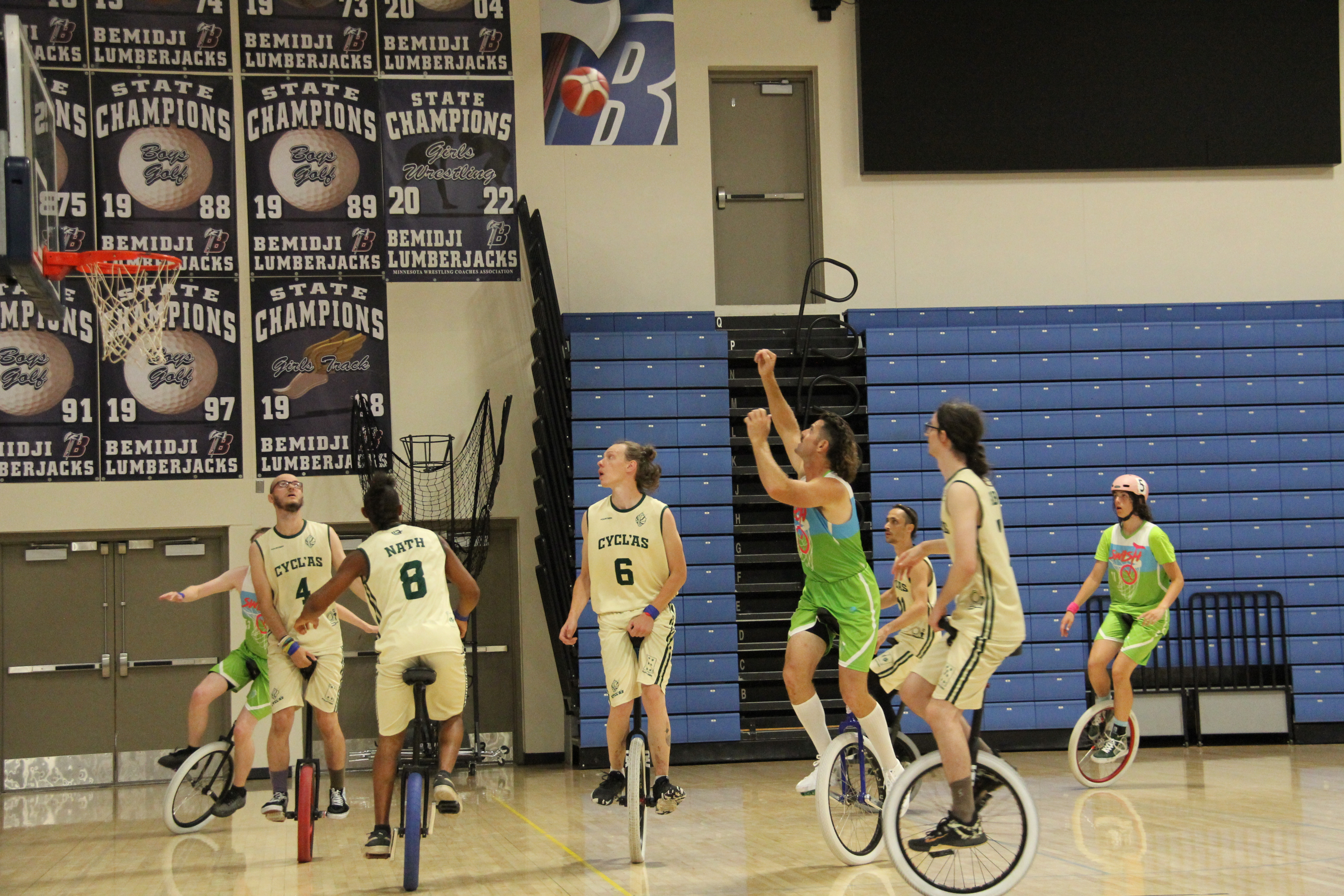
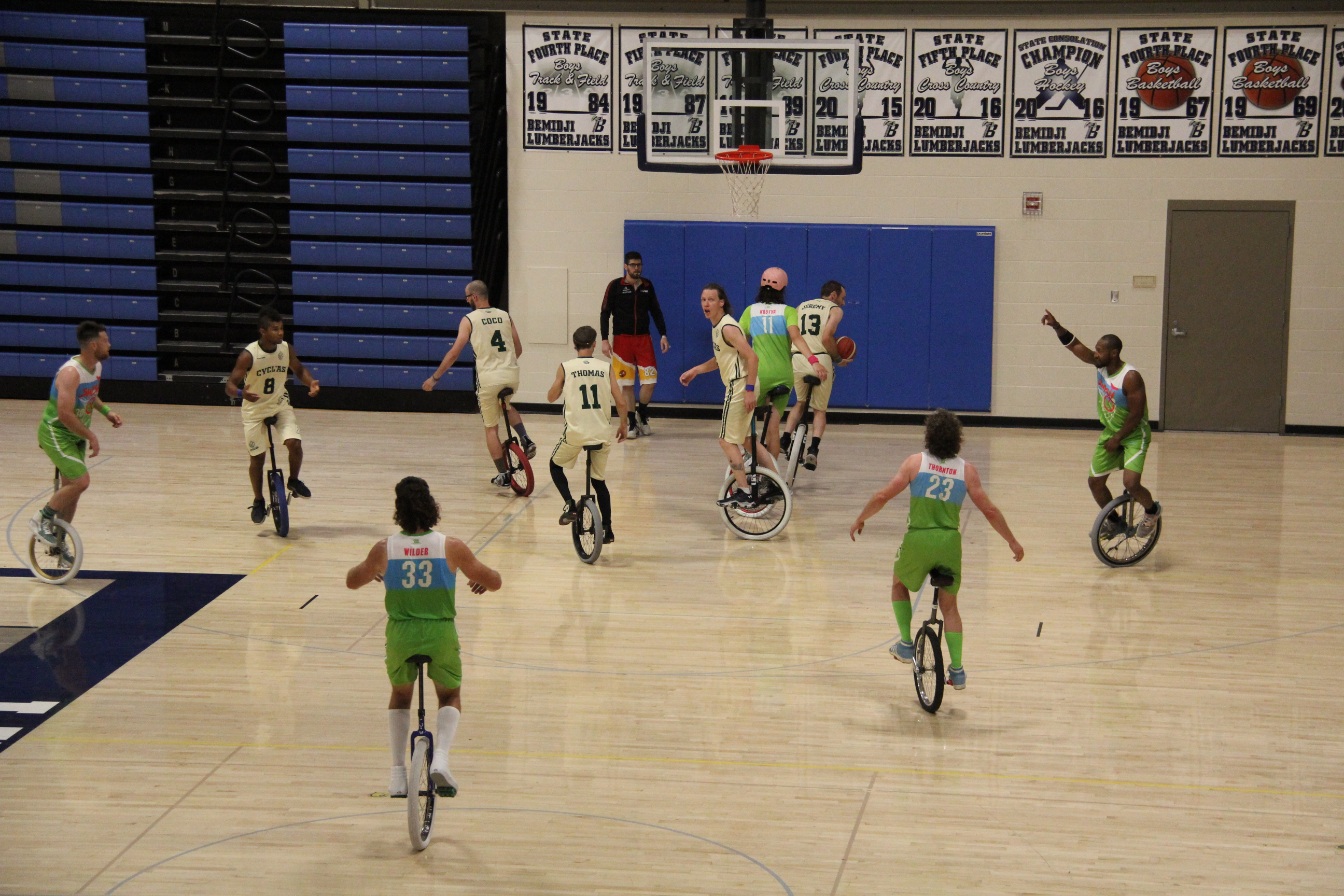
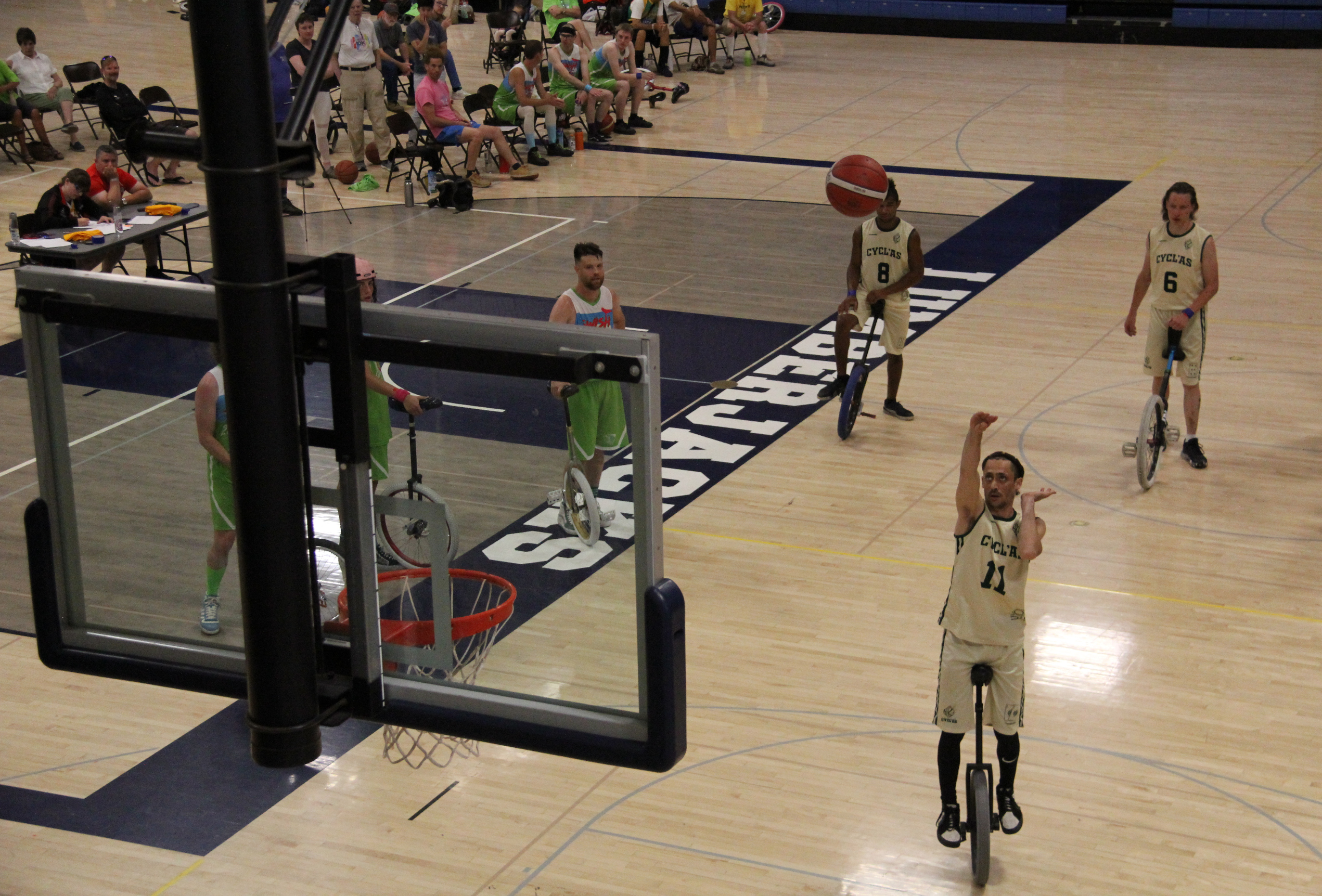
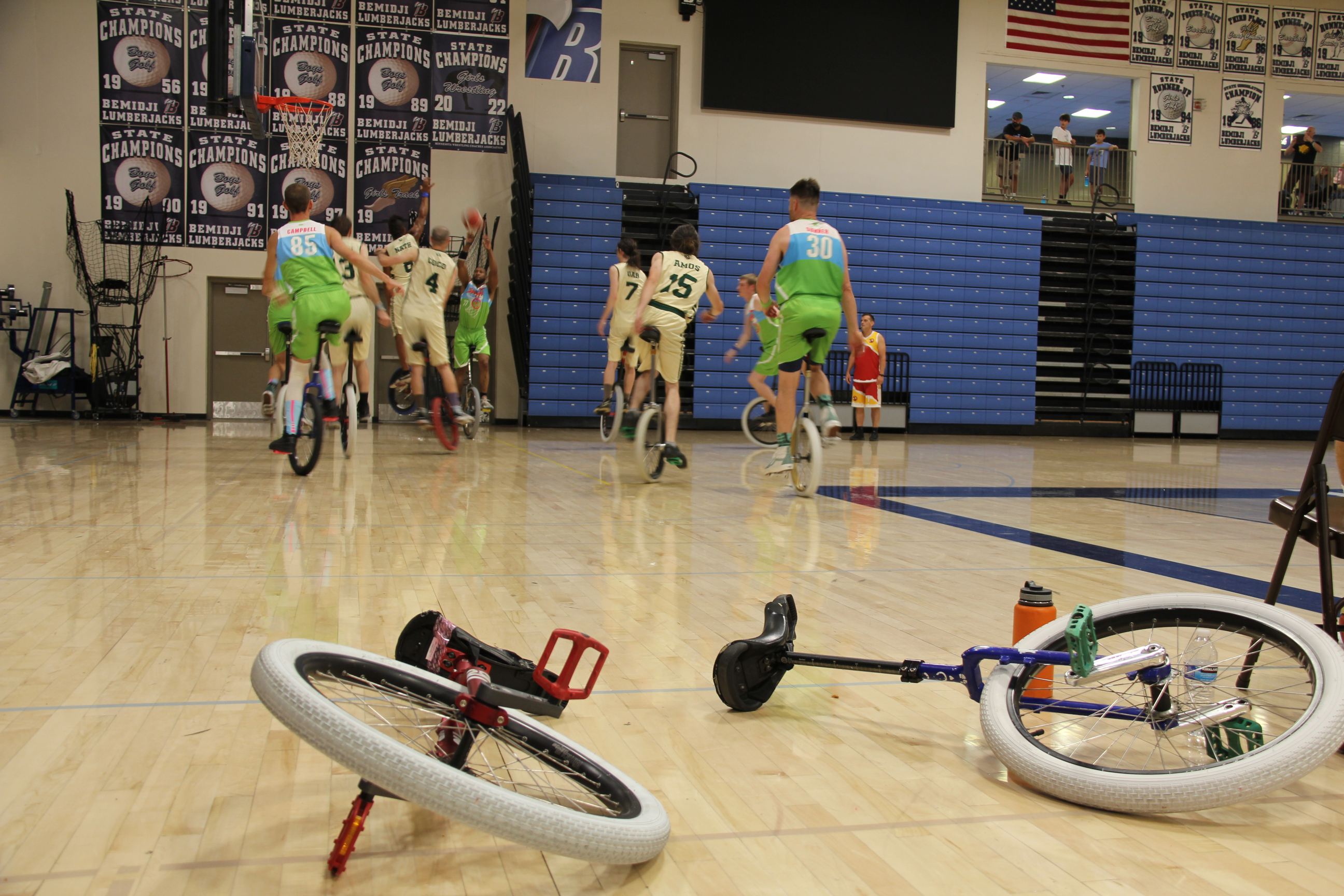
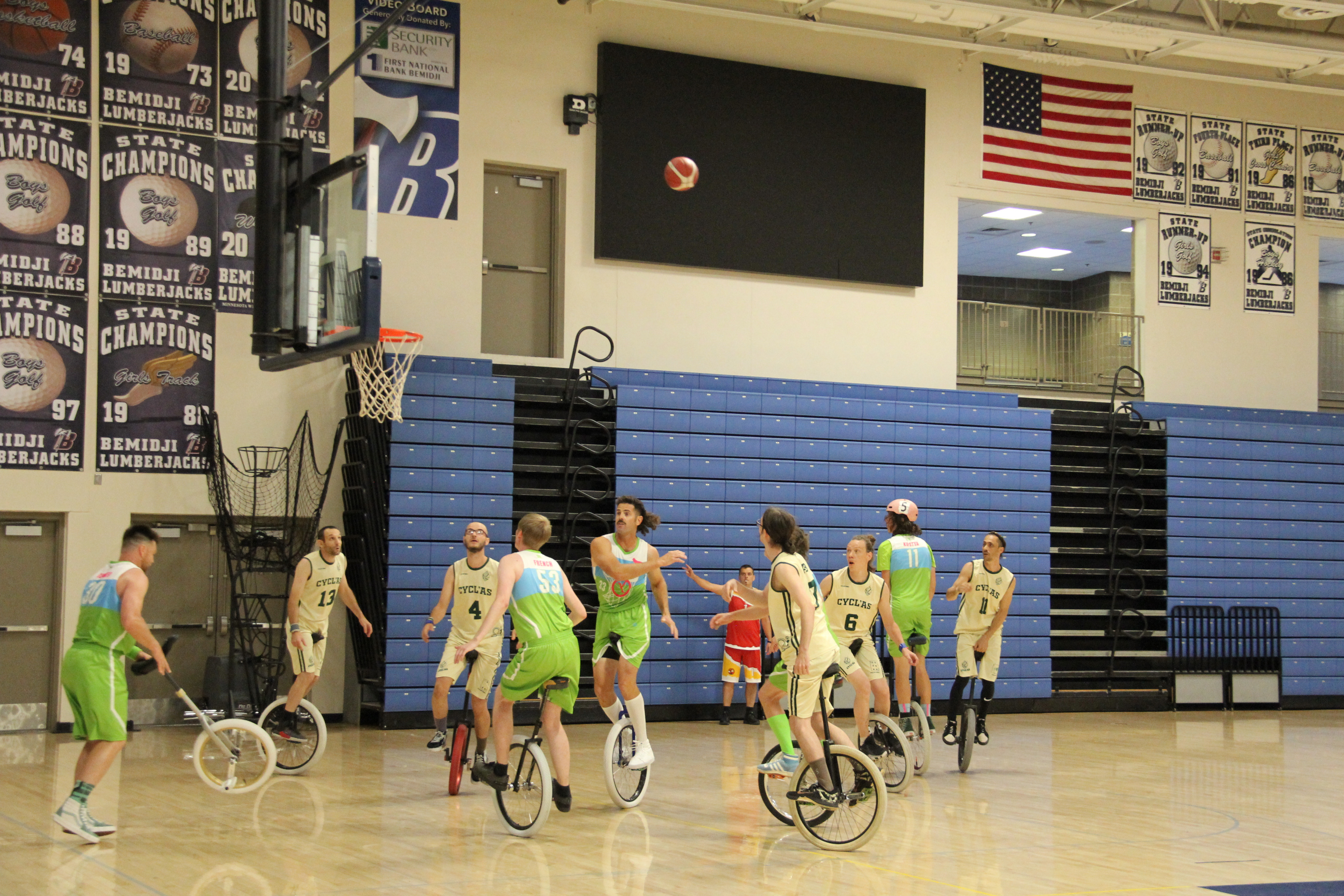
A Swish player shoots a basket in a July 18 game against a French team. (Minnesota Prairie Roots copyrighted photo July 2024)
SWISH, AND HE SCORES. Or Swish, they score.
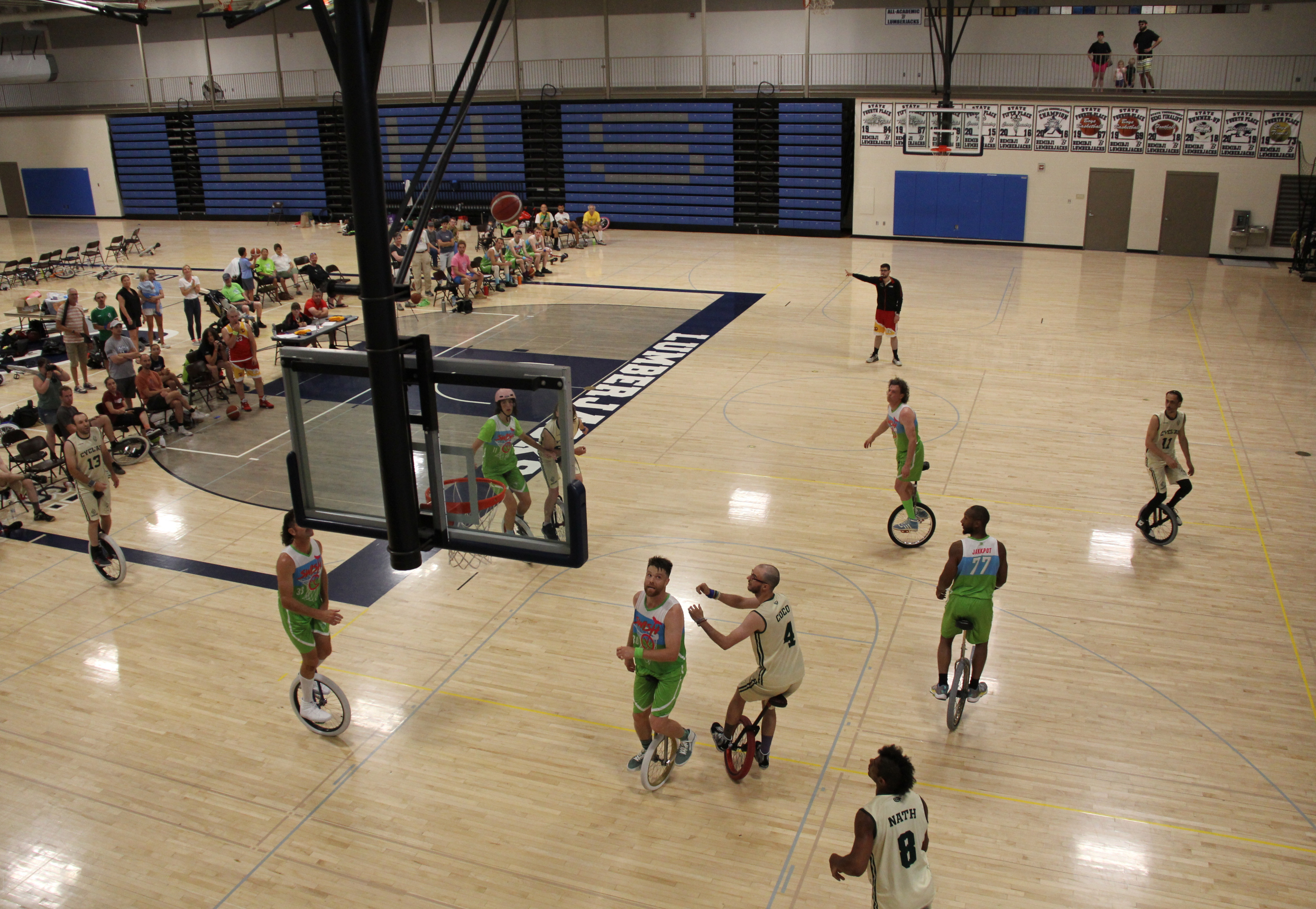
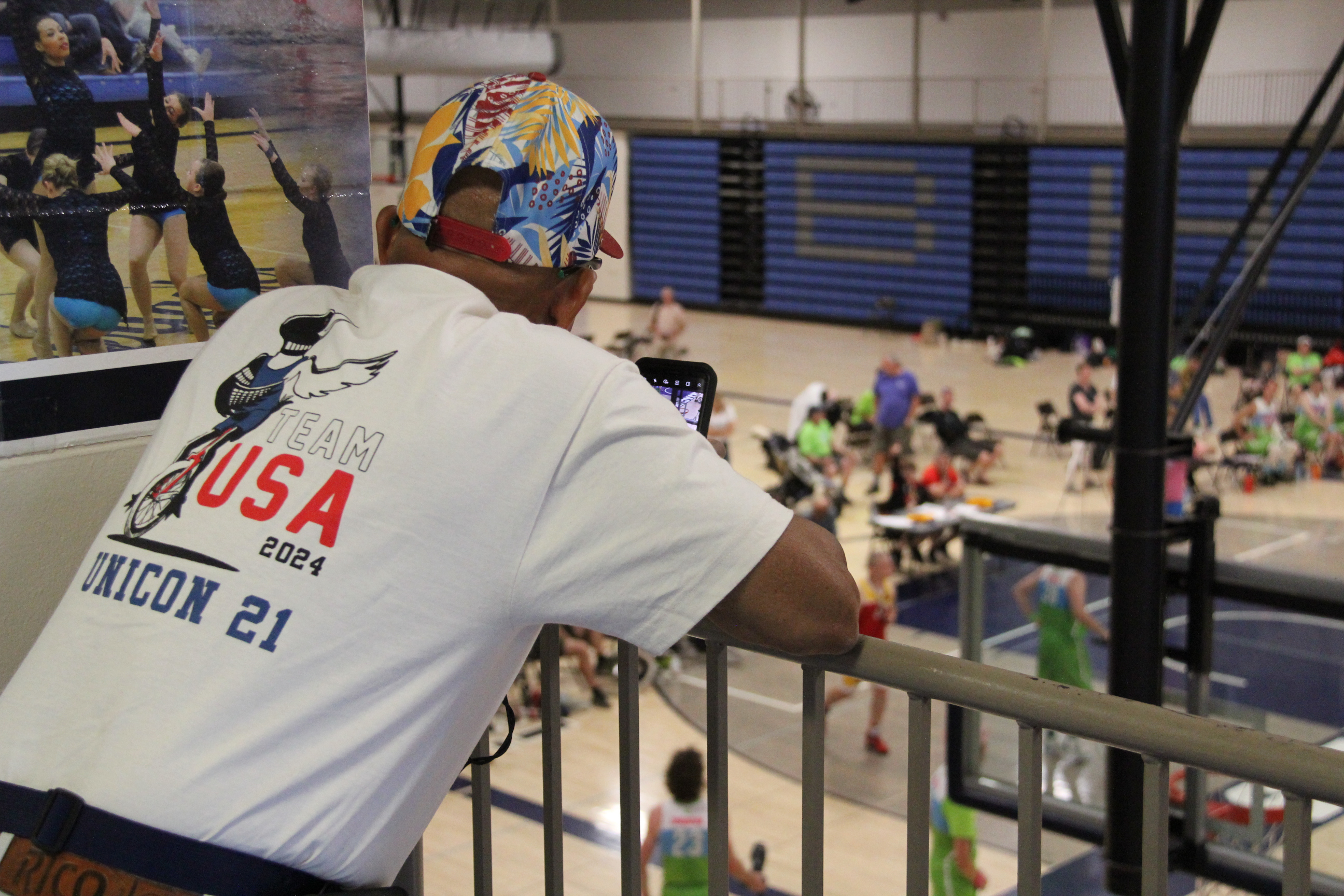
The scene from the balcony. (Minnesota Prairie Roots copyrighted photo July 2024)
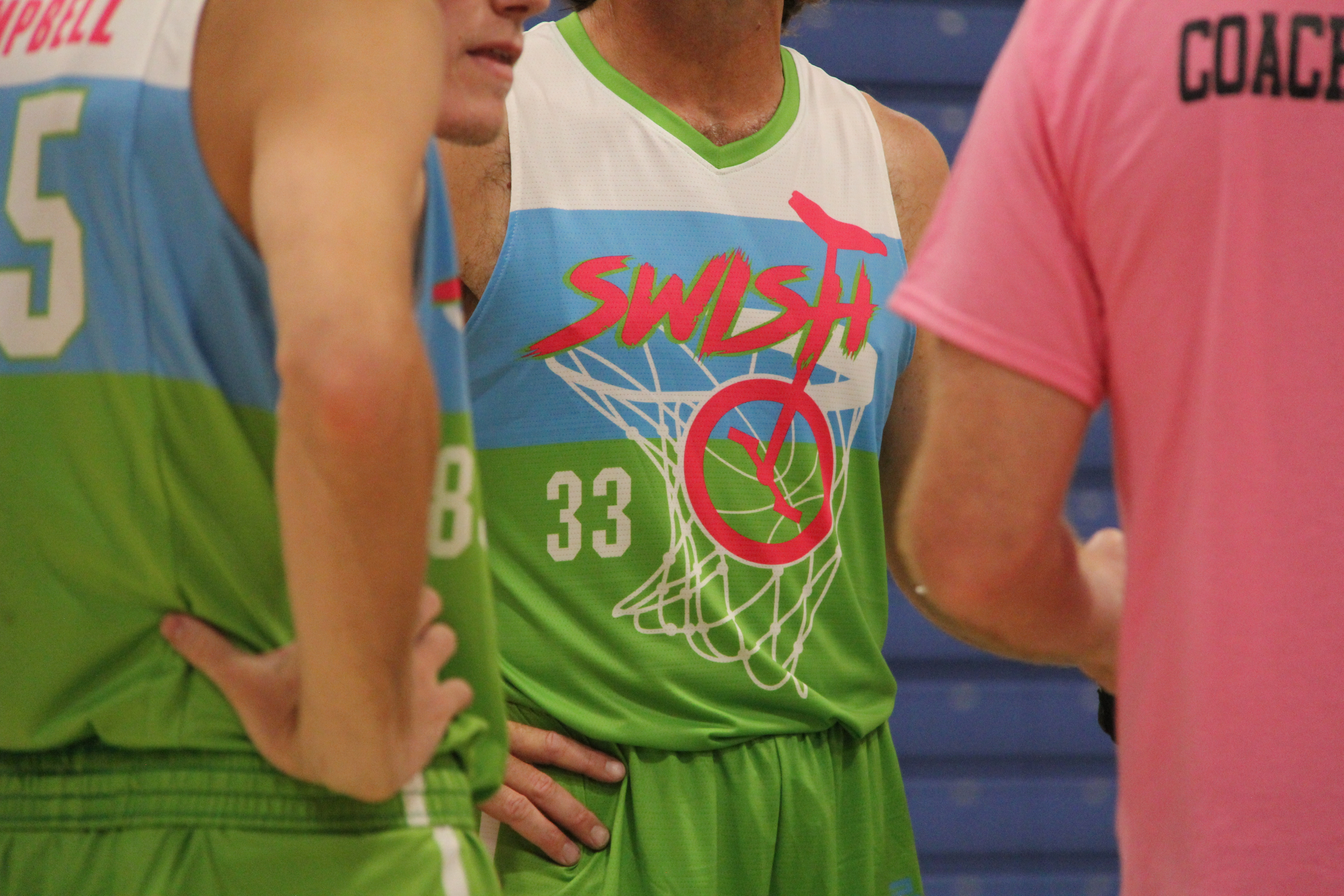
I love the Swish uniform graphic with a basketball and unicycle overlapping. (Minnesota Prairie Roots copyrighted photo July 2024)
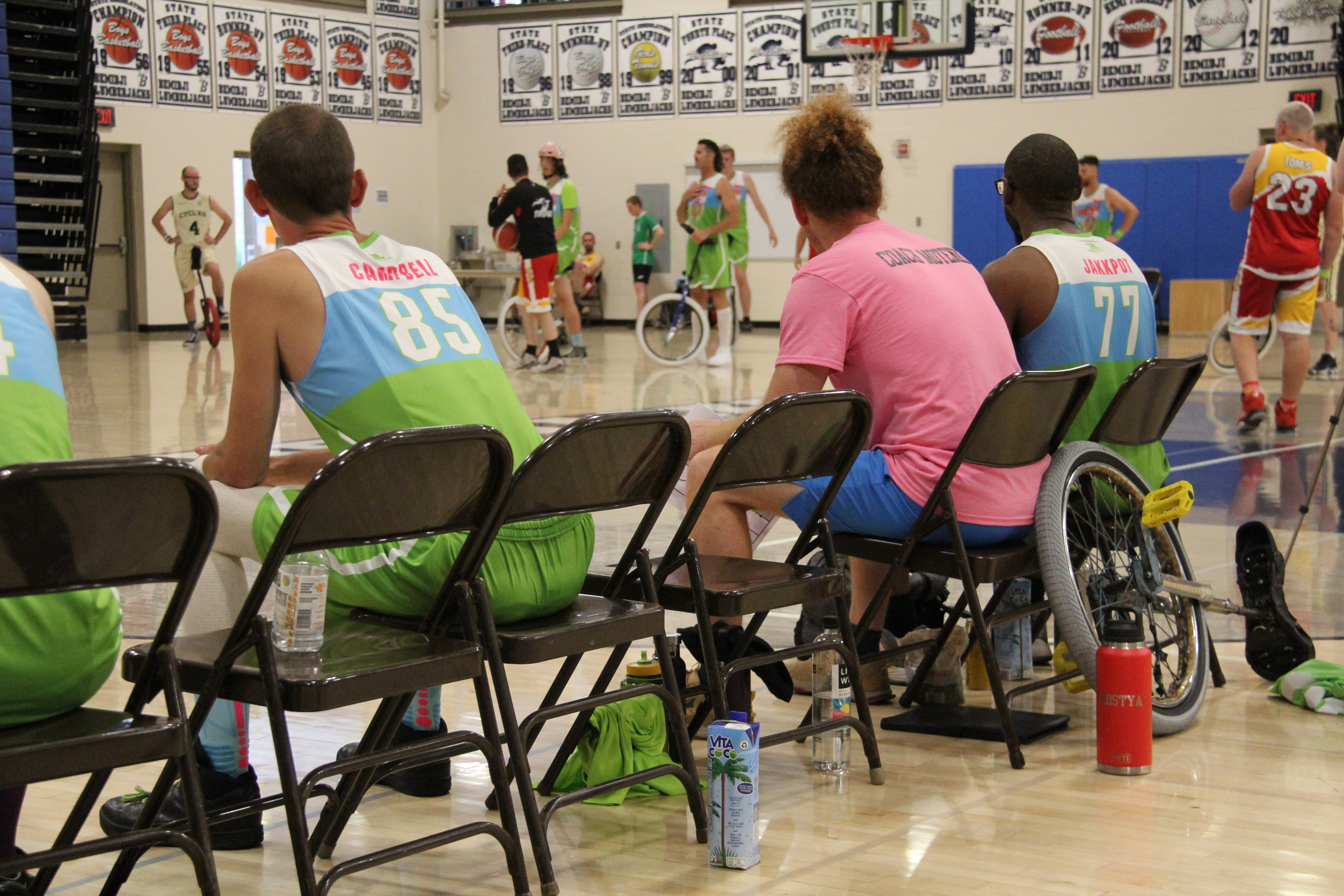
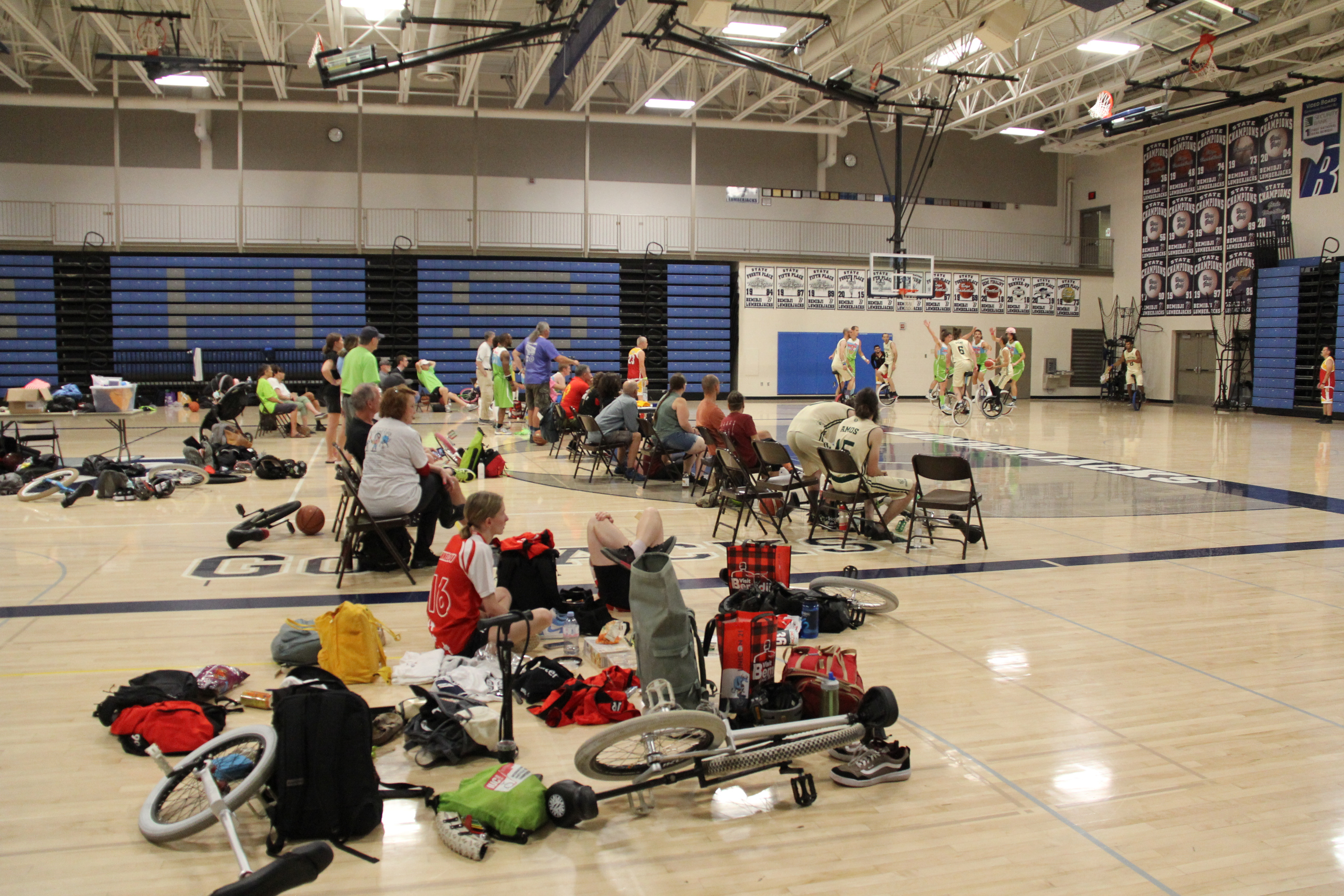
Things were pretty informal with folding chairs serving as team benches. (Minnesota Prairie Roots copyrighted photo July 2024)
Swish, a team from California, earned the bronze medal in unicycling basketball competition this week at Unicon 21, the international unicycling convention held in Bemidji July 14-26. I saw them play early on against a French team in the high school gym. They lost that match in a close game.
More basketball action… (Minnesota Prairie Roots copyrighted photo July 2024)
Watching from above. (Minnesota Prairie Roots copyrighted photo July 2024)
Aiming for the basket for the French team after being fouled. (Minnesota Prairie Roots copyrighted photo July 2024)
Although winning was the goal, it’s clear these basketball players are dedicated to a sport they love playing. I can’t imagine that hopping onto a unicycle, then dribbling and passing a ball, guarding and shooting baskets is easy. You gotta love the challenge this version of basketball presents.
Fans sat on folding chairs or on the gym floor, up close to the game. (Minnesota Prairie Roots copyrighted photo July 2024)
As the toddler daughter of one Swish player napped in her stroller, the game progressed. Nothing awakened Rosie, not even errant basketballs bouncing toward her and deflected by Grandpa, in Minnesota from Mississippi for the competition.
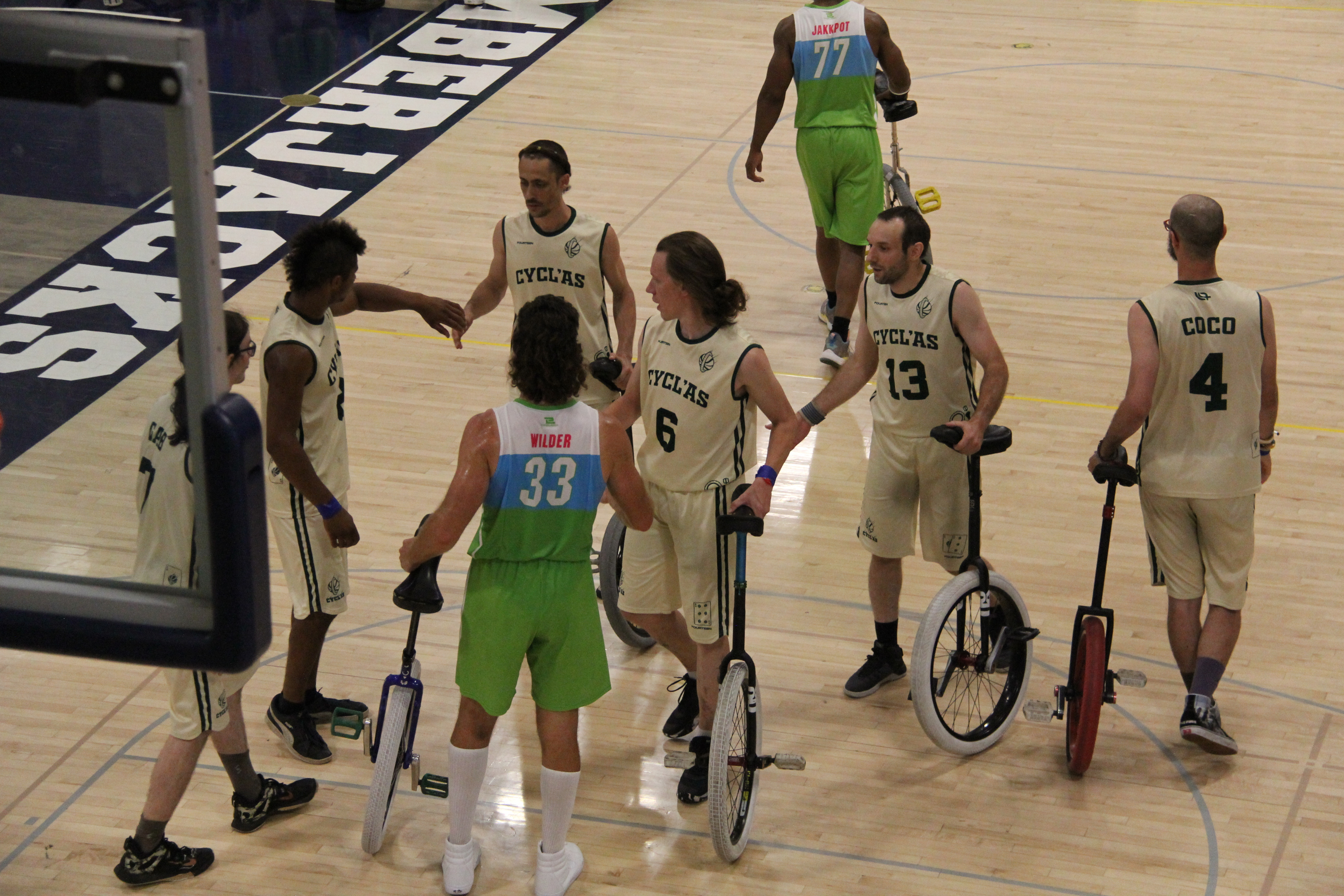
Most players simply threw their unicycles down when not riding them. (Minnesota Prairie Roots copyrighted photo July 2024)
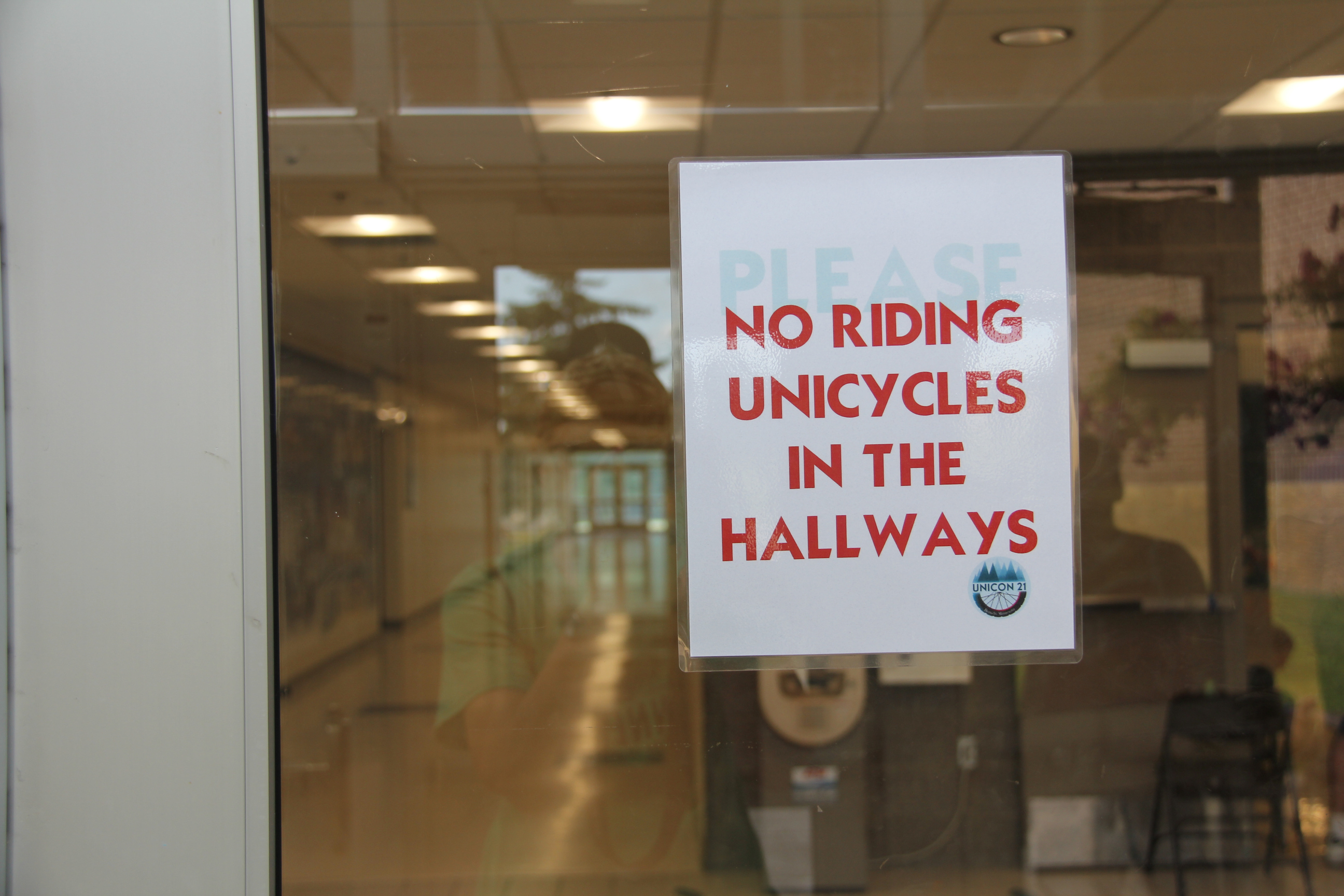
Posted on the entry door to the school. (Minnesota Prairie Roots copyrighted photo July 2024)
Playing hard, the California team vs the French. (Minnesota Prairie Roots copyrighted photo July 2024)
I watched the game, watched Rosie, got up and walked around looking for photo ops. Basketball, actually sports in general, don’t hold my interest for long, even an international competition. Plus, and I hesitate to write this, but the gym smelled of sweaty locker room. I stepped out occasionally simply to breathe fresher air in the air conditioned hallways.
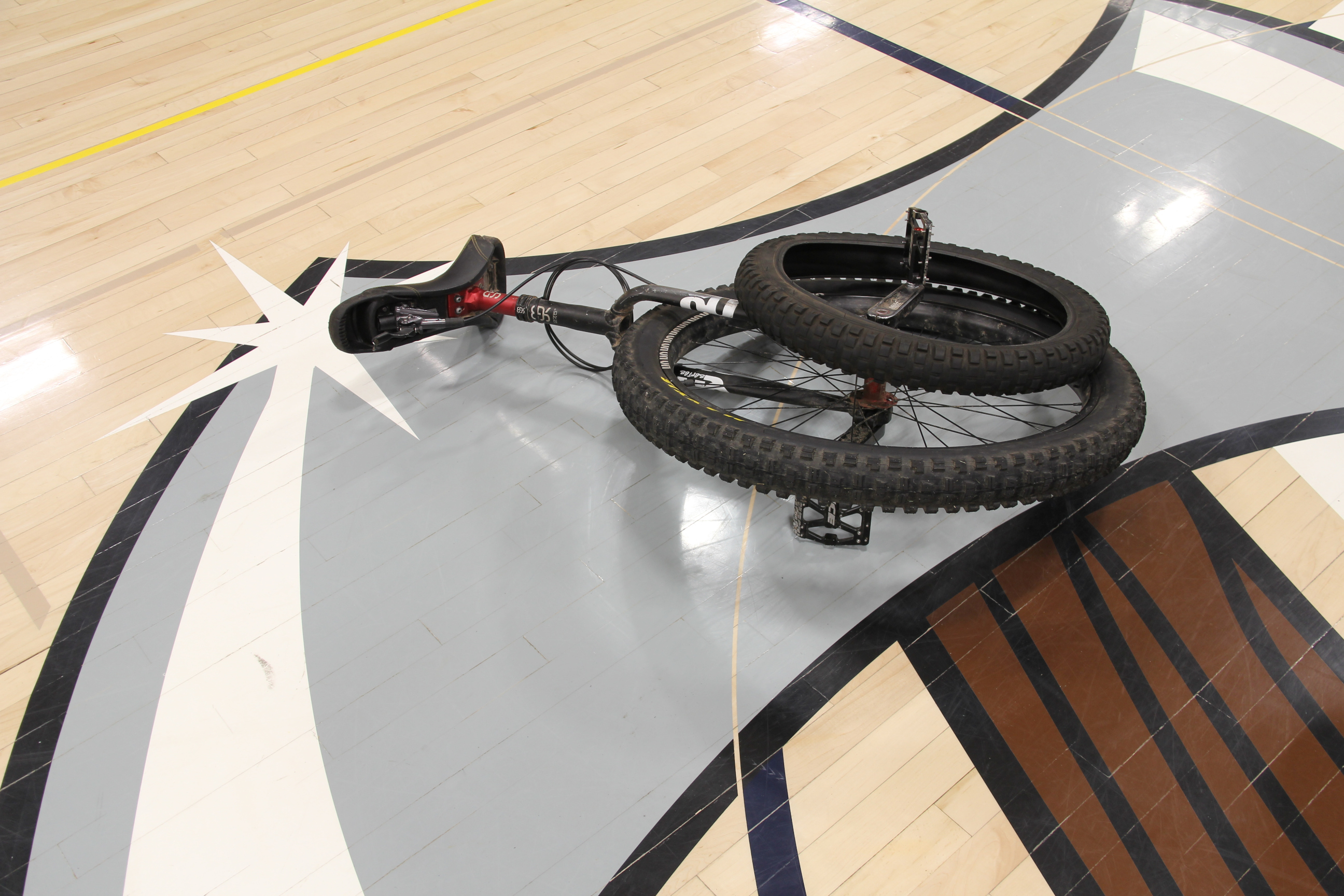
A unicycle lies atop Paul Bunyan’s axe blade on the gym floor. (Minnesota Prairie Roots copyrighted photo July 2024)
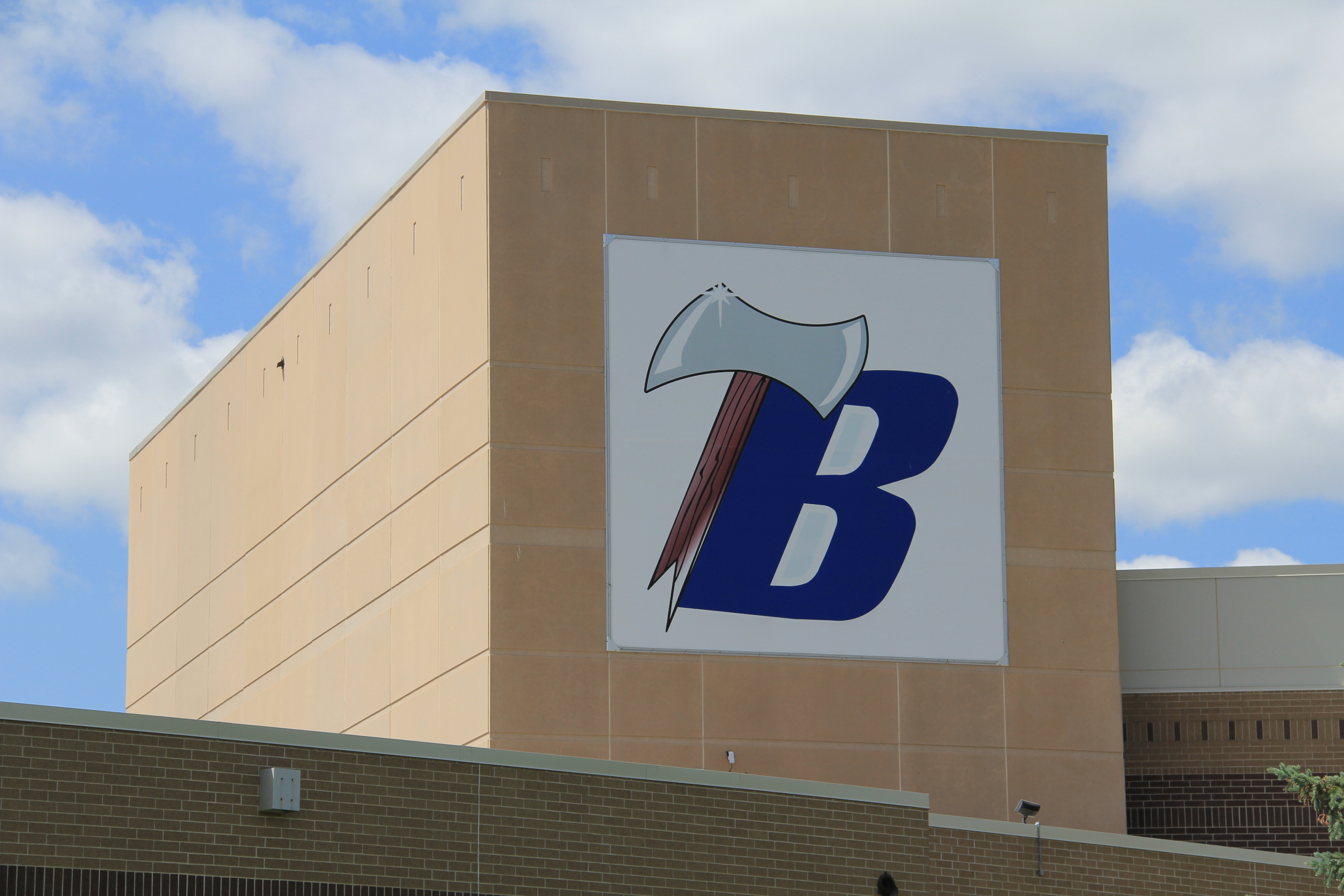
On the exterior of Bemidji High School, Paul Bunyan’s axe. (Minnesota Prairie Roots copyrighted photo July 2024)
While wandering, I noted the Paul Bunyan legendary influence. On the gym floor, a unicycle lay on the blade of Paul’s over-sized axe. It’s only fitting that the school mascot is the Lumberjacks given Paul is a lumberjack.
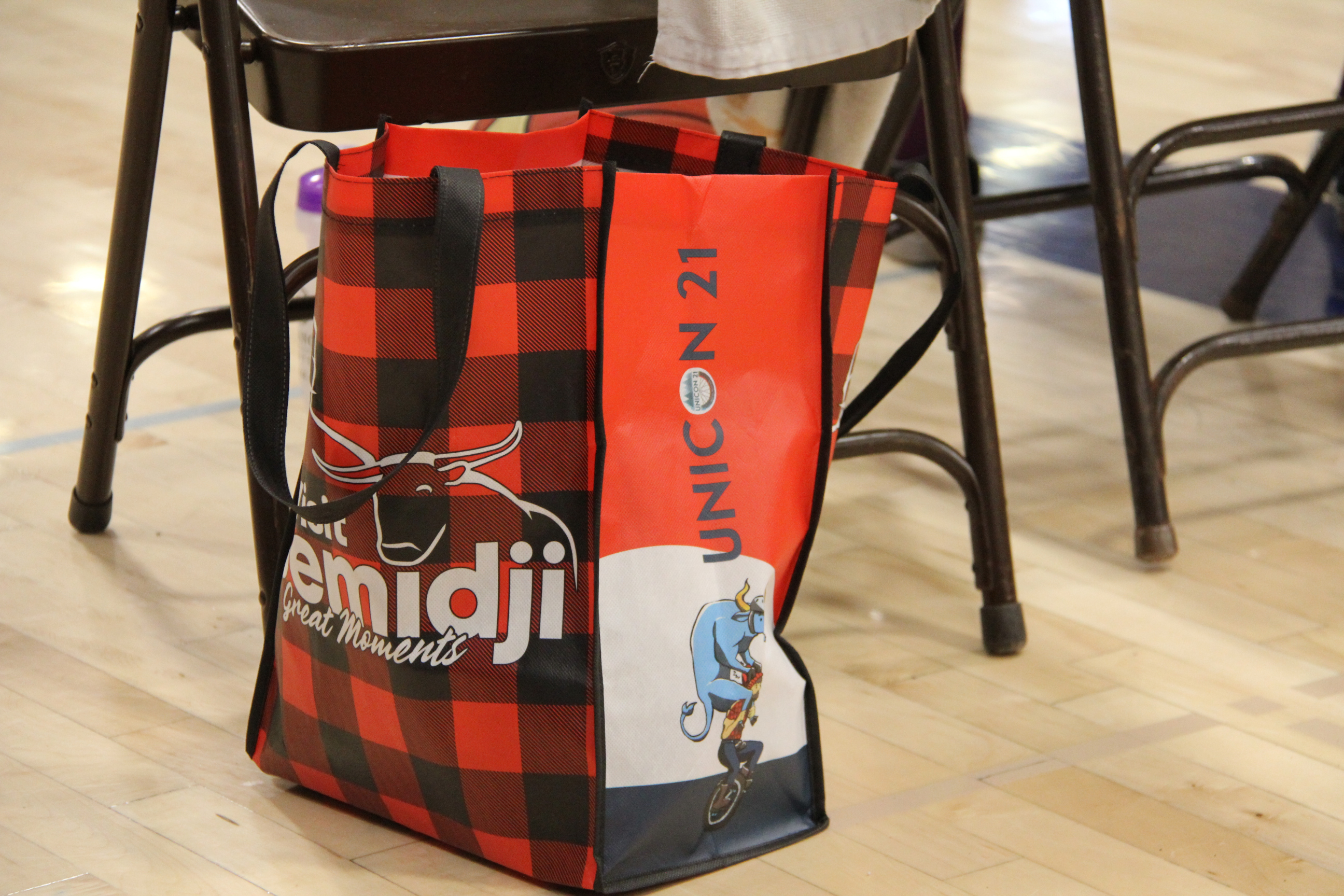
Unicon 21 attendees got Paul Bunyan-themed tote bags. (Minnesota Prairie Roots copyrighted photo July 2024)
His likeness, and that of his sweetheart, Lucette, and Babe the Blue Ox, adorned red buffalo plaid Unicon 21 swag bags scattered across the gym floor. The stuff of folklore, Paul and Babe are a major marketing brand in northern Minnesota. Statues of the pair stand along Lake Bemidji, for example, and are widely used in branding throughout the region from Brainerd northward.
The game ends. (Minnesota Prairie Roots copyrighted photo July 2024)
I wonder what the Californians thought of the whole Paul Bunyan lore, or if they even noticed. Swish was in Minnesota, after all, to play basketball. While Rosie napped and I wandered in and out of the gym, they wheeled across the gym floor, focused on scoring, on winning the game.
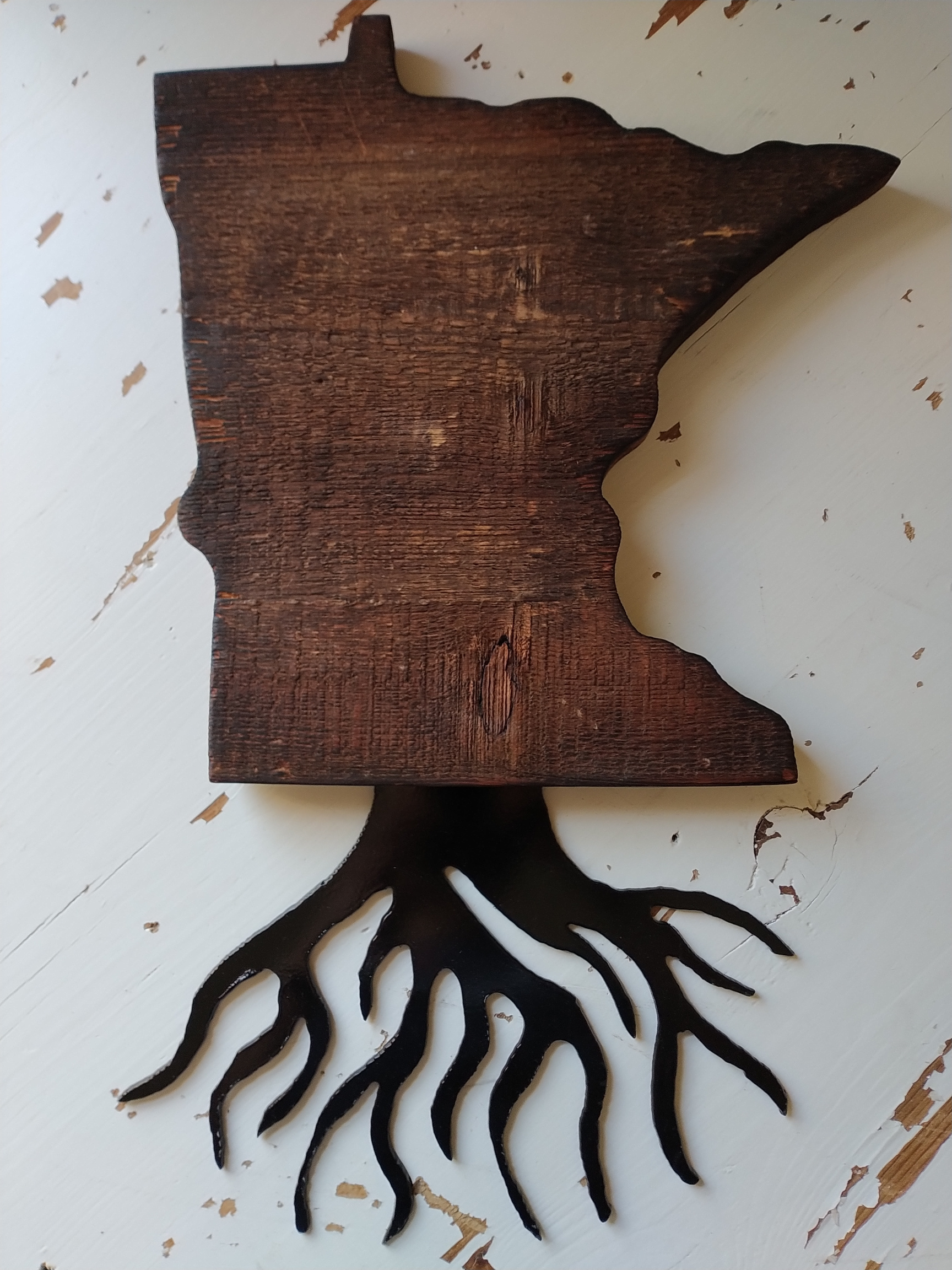
Minnesota wood art with Minnesota shape by Spanky’s Woodshed of Faribault, metal roots by my friend Steve and assembled by my husband, Randy. (Minnesota Prairie Roots copyrighted photo 2024)
AS A LIFE-LONG MINNESOTAN, I speak Minnesotan. It’s hotdish, not casserole. Pop, not soda. Bars may be a sweet treat baked in a cake pan and cut into squares or a place to imbibe. And when someone is going Up North, it’s not to Canada, but typically to the cabin in the Brainerd lakes area or thereabouts.
A serene country scene just north of Lamberton in southern Redwood County, my home county. (Minnesota Prairie Roots copyrighted file photo)
I’m proud to be rooted in this state many consider fly-over land. On a road trip to the East Coast a few years back, folks, upon learning I was from Minnesota, reacted, “Oh, it’s cold and snowy there.” I’m just fine with non-residents thinking that. It is cold for much of the year. And it is snowy, too, most winters. But we have four distinct seasons to be appreciated in a state that is geographically diverse. Prairie. Woods. Bluffs. Rolling land. Farm fields. Cliffs that rise above the Mississippi River and Lake Superior. Wilderness. Lakes numbering 10,000-plus. All inside our spacious borders.
And outside “The Cities,” as we term the twin cities of Minneapolis and St. Paul, away from metro lights, the night sky is dark, expansive and filled with more stars than you can imagine. Sky and land defined my childhood home on the vast prairie of southwestern Minnesota. But even here in southeastern Minnesota, the sky is big as noted by a Boston visitor. She saw the Minnesota night sky for the first time as we drove her to Faribault from the Minneapolis-St. Paul International Airport. The infinite number of stars impressed her. Northern lights (the aurora borealis), which I have yet to see, are also an attraction.
Paul Bunyan is primarily a central and northern Minnesota legend. But he can also be found in southern Minnesota, like on this sign in Faribault.(Minnesota Prairie Roots copyrighted photo 2023)
If I sound like I work for the Minnesota Department of Tourism, I don’t. That job falls to legendary lumberjack Paul Bunyan, unofficial tourism CEO. Clad in his signature buffalo plaid flannel, he is easily recognizable, much-loved and a trendsetter in fashion in the North Star State. I would venture to guess that nearly every Minnesotan owns a collection of flannel shirts. They are my go-to winter attire.
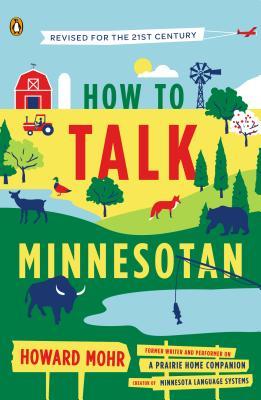
An updated version of “How to Talk Minnesota” is a good guidebook to Minnesota speak.
Did I mention that we don’t speak Fargo, even if that North Dakota city sits across the Red River from Moorhead, Minnesota? I’ve been told we drag out the “o” sound in a distinctly Minnesoooootan sound. Could be. I don’t necessarily hear it. I don’t deny, though, that we are obsessed about the weather. Conversations within our borders usually include one weather reference whether it be wind chill or humidity or “hot enough for you?”.
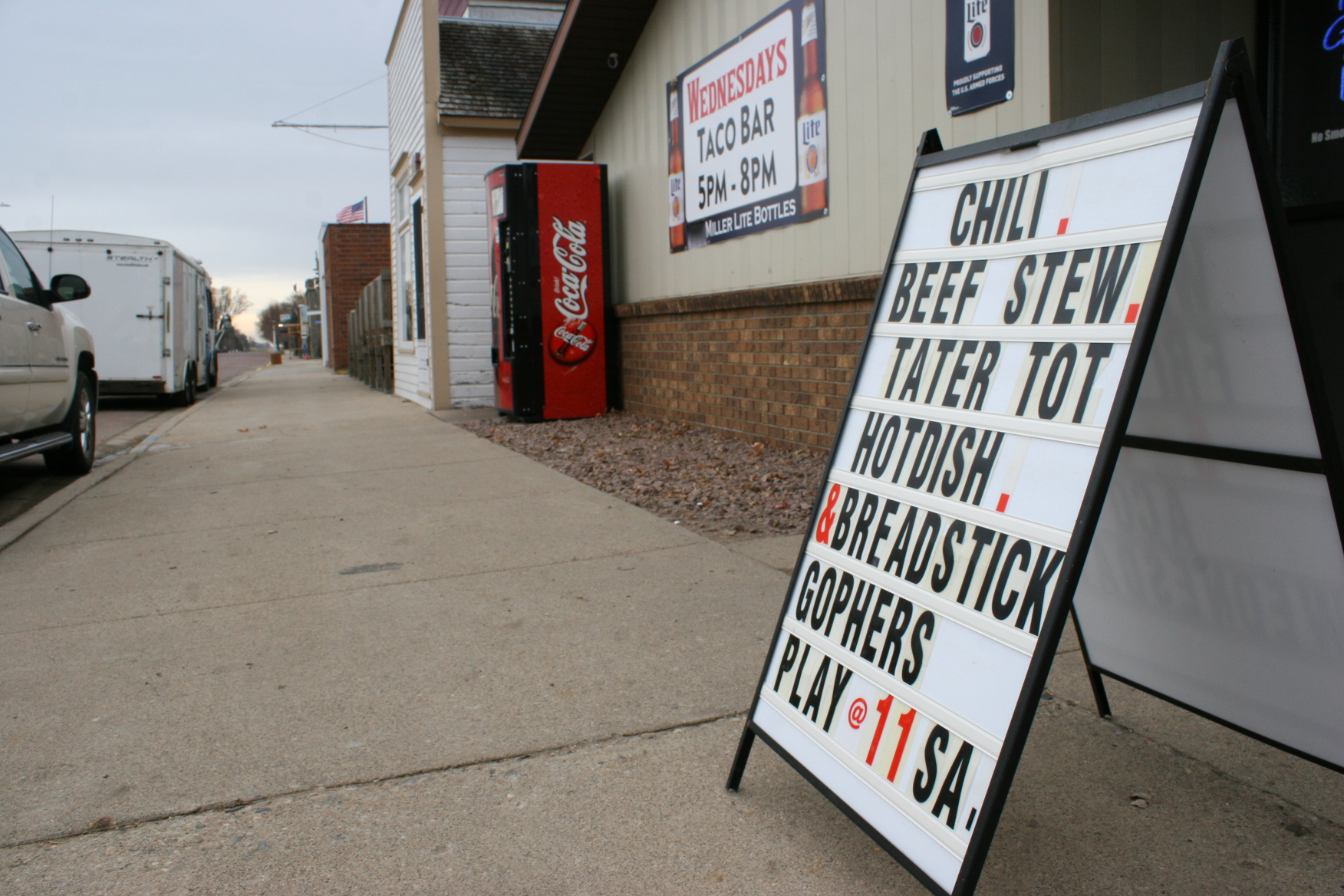
This sandwich board in small town Belview promotes one of Minnesota’s signature dishes, Tater Tot Hotdish, as a noon special. (Minnesota Prairie Roots copyrighted photo 2019)
Minnesotans are known for a thing called “Minnesota Nice,” which I like to believe is true most of the time. We are a bit reserved, use phrases like “that’s different” or “that’s interesting” when we really don’t like something or disagree, but want to be nice by holding back our honest thoughts.
The Minnesota sweet treat known as bars, often served with “a little lunch.” (Minnesota Prairie Roots copyrighted file photo)
Our goodbyes are prolonged. Often, as visiting family is leaving my home, I find myself either standing in the driveway or window waving, waving, waving. That follows the hugs I’ve given only minutes earlier. You can’t get in too many goodbye waves.
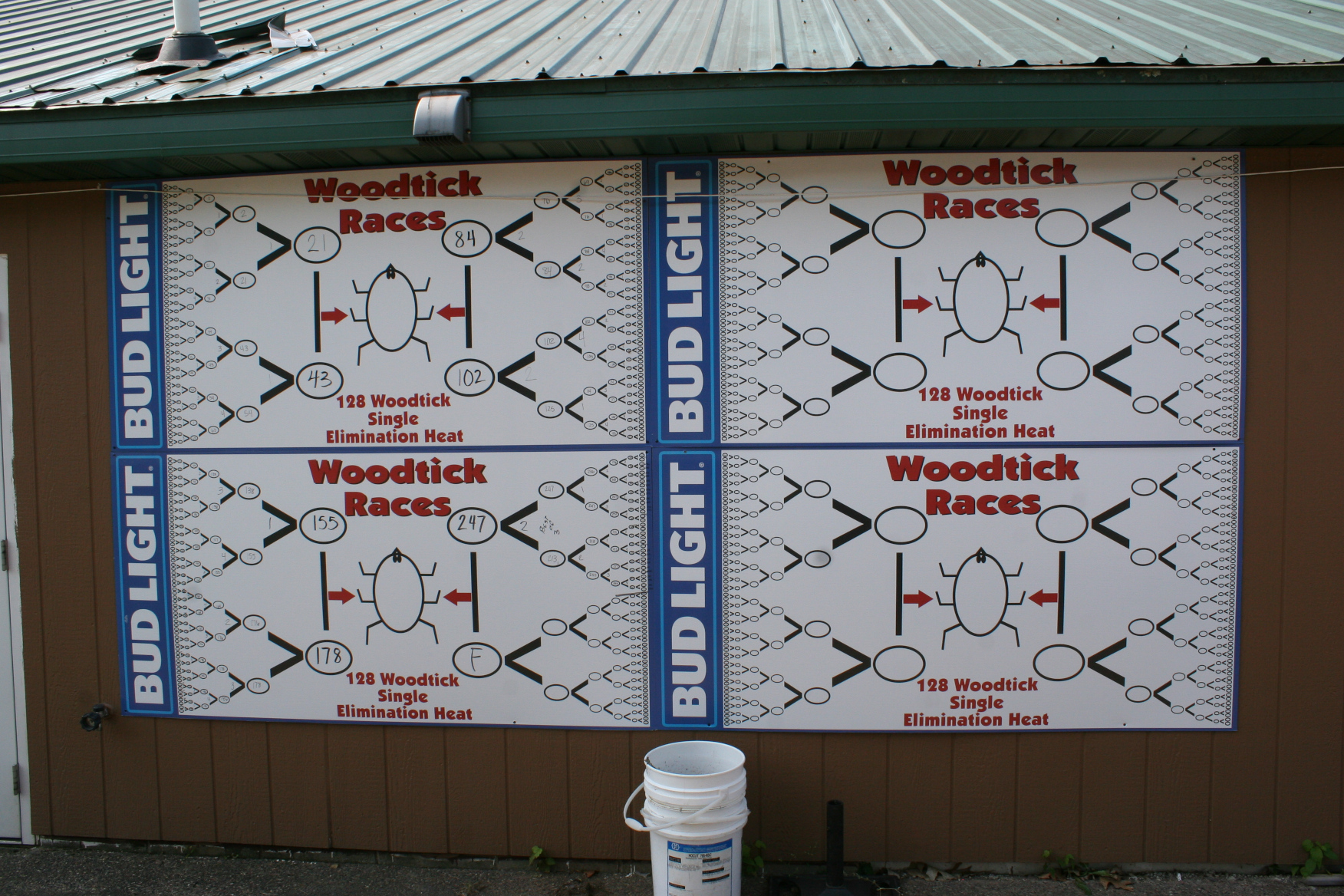
The Woodtick Inn in Cuyuna hosts Woodtick Races each summer. (Minnesota Prairie Roots copyrighted file photo August 2021)
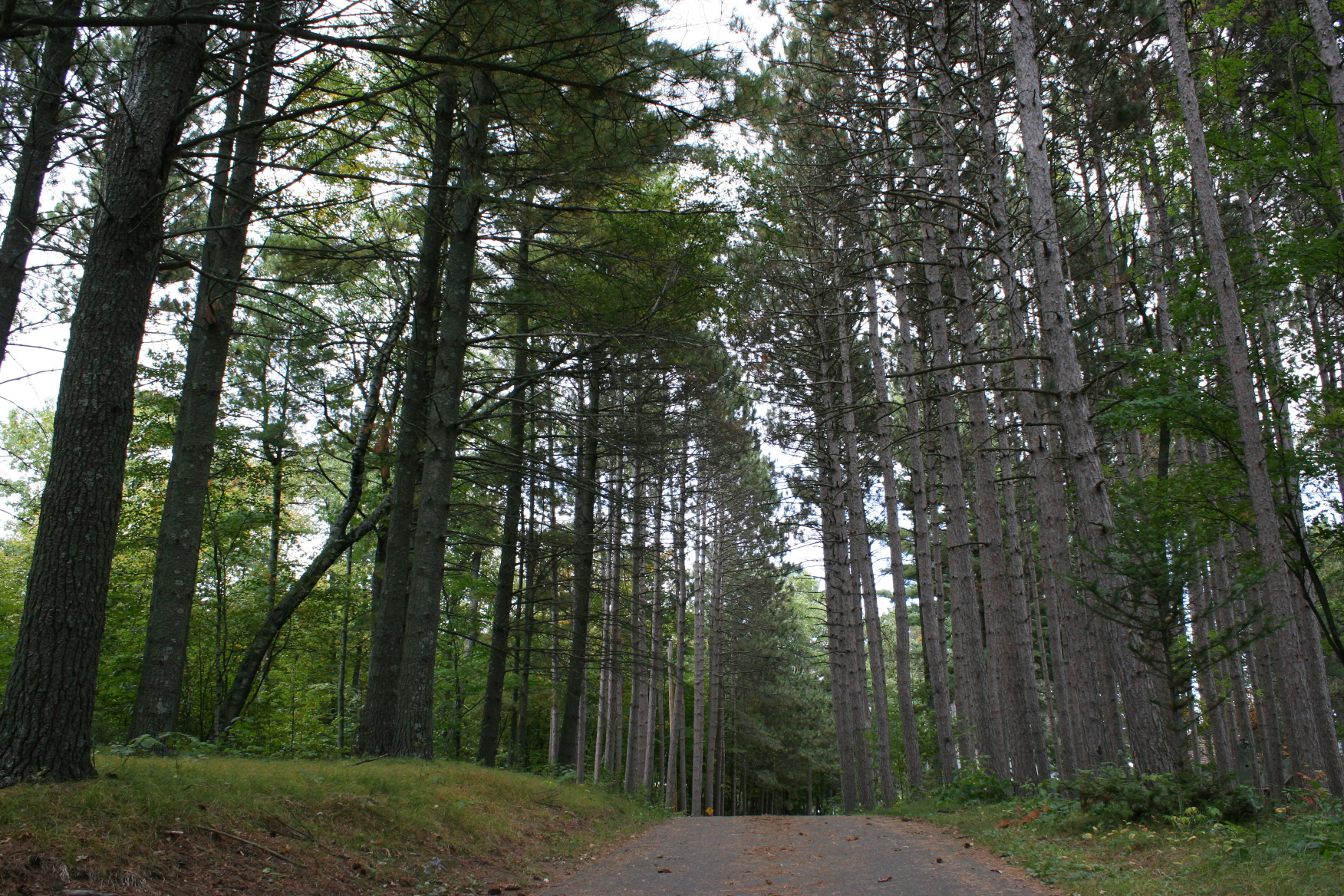
Pines border the driveway leading to a central Minnesota lake cabin. (Minnesota Prairie Roots copyrighted file photo)
I love this state where I’ve lived my entire life, even when I complain about the long winters and abundance of mosquitoes. This is home. Always has been. Always will be.
#
IF YOU HAVE any questions about Minnesota, any observations, anything you want to share, please do. Just follow the rules of “Minnesota Nice.”
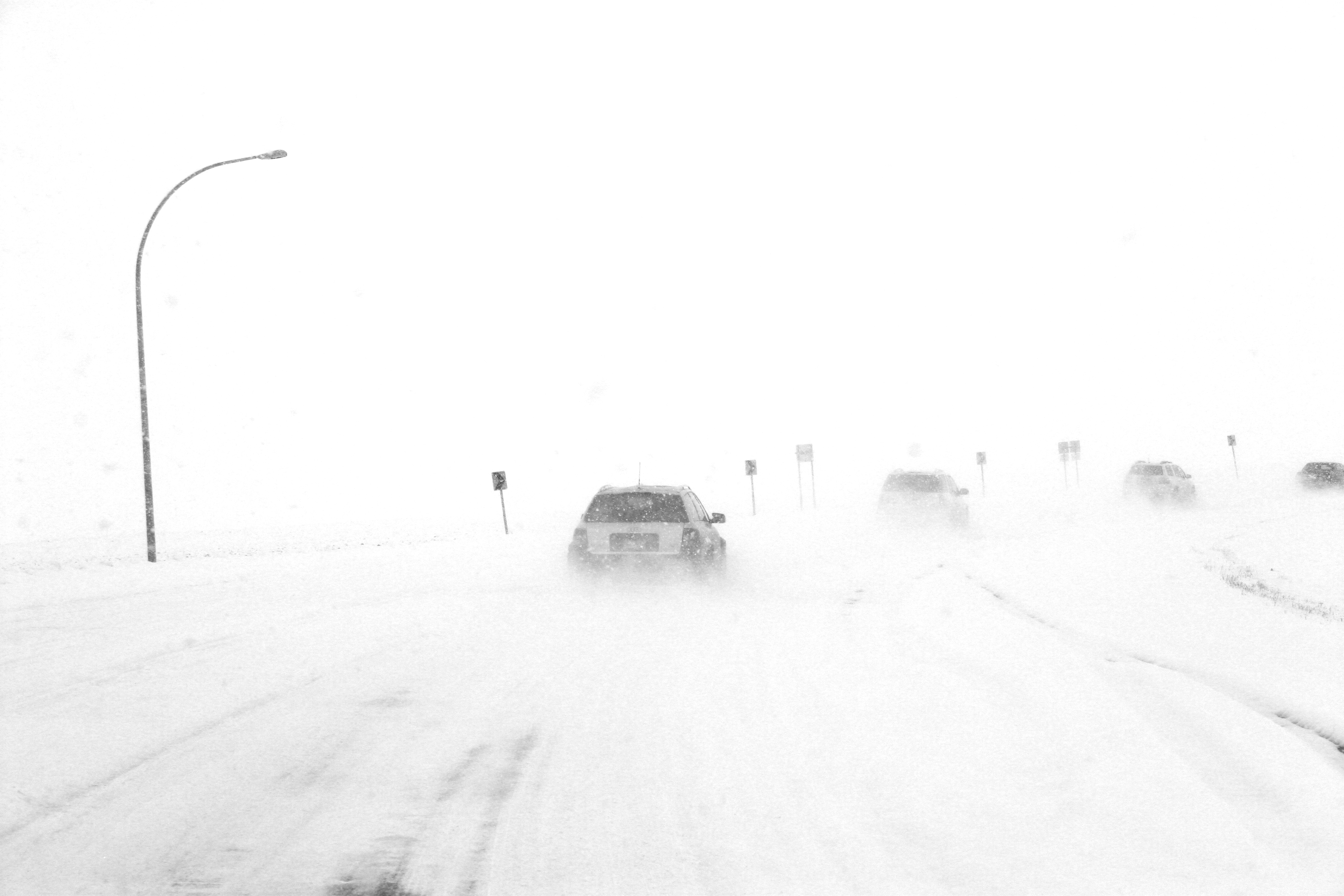
Treacherous winter driving conditions along Minnesota State Highway 19 just north of Vesta in southwestern Minnesota in January 2013. These weather conditions are not uncommon on the prairie. (Minnesota Prairie Roots copyrighted and edited file photo 2013)
WINTER IN MINNESOTA can be decidedly difficult in the sort of way that challenges us to either adjust, adapt or embrace, or flee to Arizona, Texas or Florida.
That got me thinking. If you’re not from the Bold (Cold) North, you may be unfamiliar with our winter weather obsession and terminology. Wind chill is an oft-referenced word in Minnesota winter weather forecasts. Defined, that’s the feels like temp on skin when wind meets air temperature. The result is not pleasant with repeated warnings of exposed flesh can freeze in just minutes. That’s the time to layer up, don long johns, pull out the heavy parka or down coat, shove hands into mittens (not gloves), wrap your face and neck in a scarf, clamp on a warm hat and lace lined boots over thick wool socks. Or stay indoors. Just for the record, recent Minnesota wind chills have been between 20-35 degrees below zero.
Experts, like the Minnesota Department of Public Safety, advise us to carry winter survival kits in our vehicles and to stay inside should we become stranded or go off the road. Call for help and wait. Exiting your vehicle is risky as in risk becoming disoriented and lost in a snowstorm if in a rural area or risk being hit by a vehicle if your vehicle slides into the ditch along a busy interstate. Just recently a driver was struck while doing exactly that; he’ll be OK.
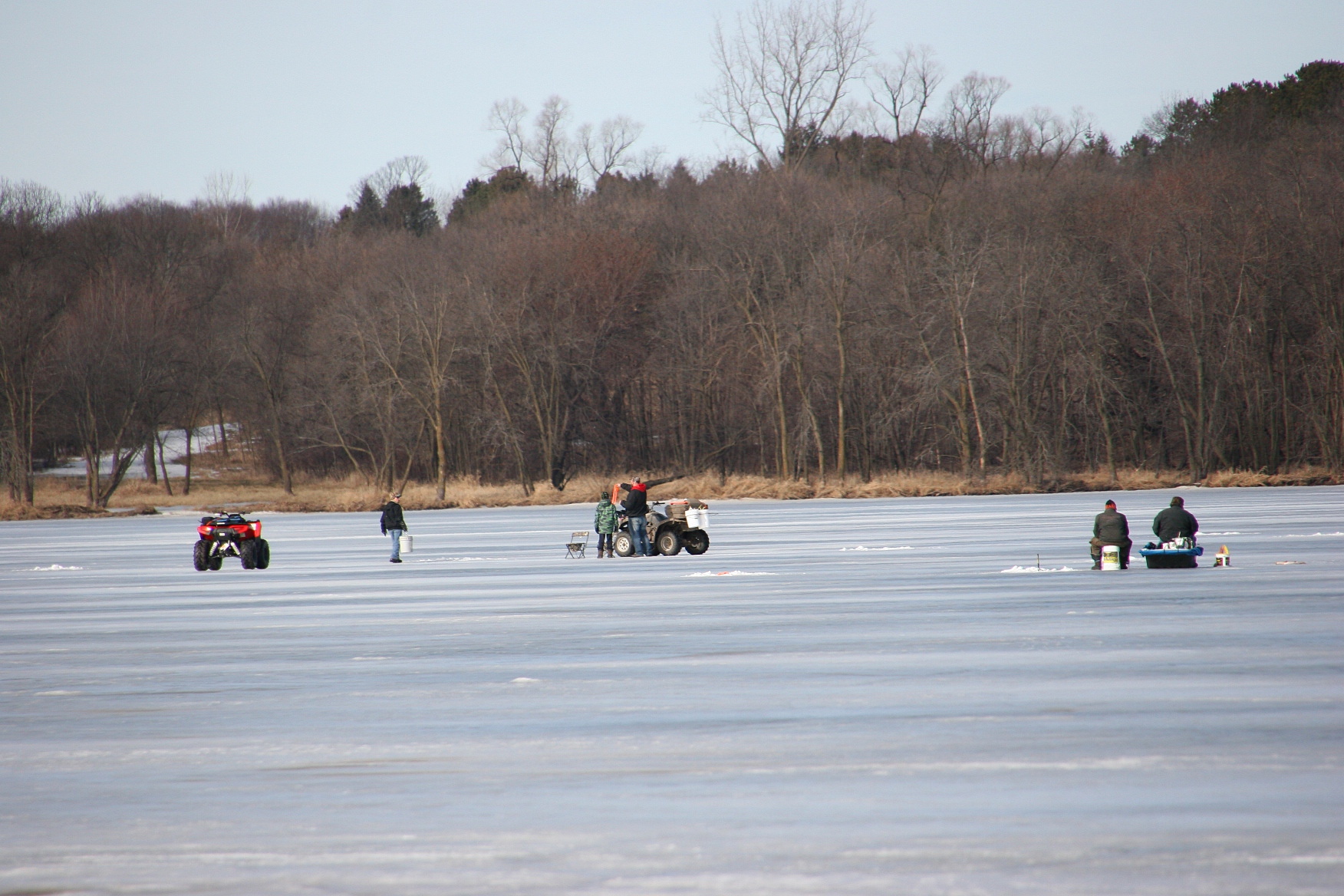
Ice fishing on Union Lake in Rice County. Some anglers don’t fish in houses, but rather in the open air, sitting on overturned 5-gallon buckets. (Minnesota Prairie Roots copyrighted file photo)
YES, MINNESOTANS REALLY DO DRIVE ONTO FROZEN LAKES
Regarding risk, Minnesotans continue to participate in a sem- risky winter sport. Ice fishing. As absurd as this sounds to those who have never lived in a cold weather state, this is the sport of angling for fish on a frozen lake. It can be (mostly) safe if anglers follow basic rules for ice safety, the first being that no ice is ever 100 percent safe and know your lake. The Minnesota Department of Natural Resources offers basic ice thickness guidelines such as stay off ice less than four inches thick. If it’s four inches thick, you can walk on lake ice. Nine to 10 inches of ice will support a small car or SUV. You’ll need 16-17 inches to drive a heavy truck onto a frozen lake and so on. Every winter vehicles plunge through the ice and people lose their lives on Minnesota lakes.
Yet, we Minnesotans continue to embrace the sport, exercising caution. Clusters of simple pop-up temporary day houses to homemade wooden shacks to fancy sleep-overnight factory models create mini villages on our frozen lakes. Anglers hang out therein, drilling holes in the ice, drinking beer, playing cards and doing whatever while waiting for the fish to bite. Decades have passed since I participated in this winter sport. But I did. It was the cracking noise of the ice that got to me.
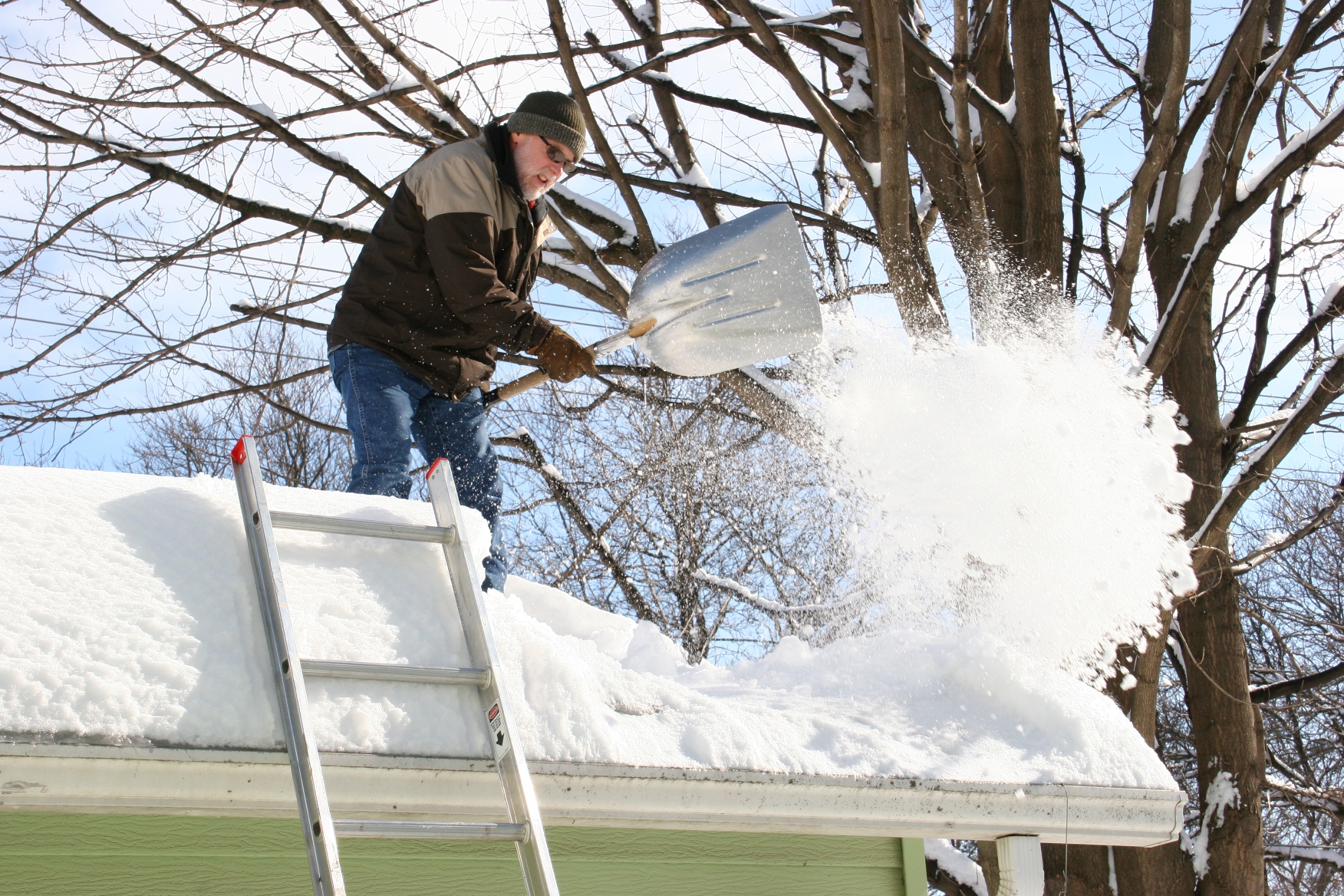
Randy shovels snow from our house rooftop during a previous winter. (Minnesota Prairie Roots copyrighted file photo)
PENGUINS, FIRE & UP ON THE ROOFTOP
Ice. I quite dislike that aspect of winter. And we’ve had a lot of ice this winter on roads, sidewalks, parking lots, every hard surface. As I age, my fear of falling and breaking a bone is real. I deal with ice by either staying off it or walking like a penguin.
Recently I observed my neighbor trying to remove ice from his driveway with fire fueled by a small portable propane tank. It was the weirdest thing—to see this flame in the black of evening aimed downward onto his cement driveway. It didn’t work well. The next evening, two of them were out chipping at ice the old-fashioned way with a long-handled bladed tool designed for that purpose.
Yes, we chip ice from our sidewalks and driveways. We shovel snow from our roofs in an effort to prevent ice dams (of which there are many this winter). Getting through a Minnesota winter, especially one as snowy as this season, requires fortitude and effort.
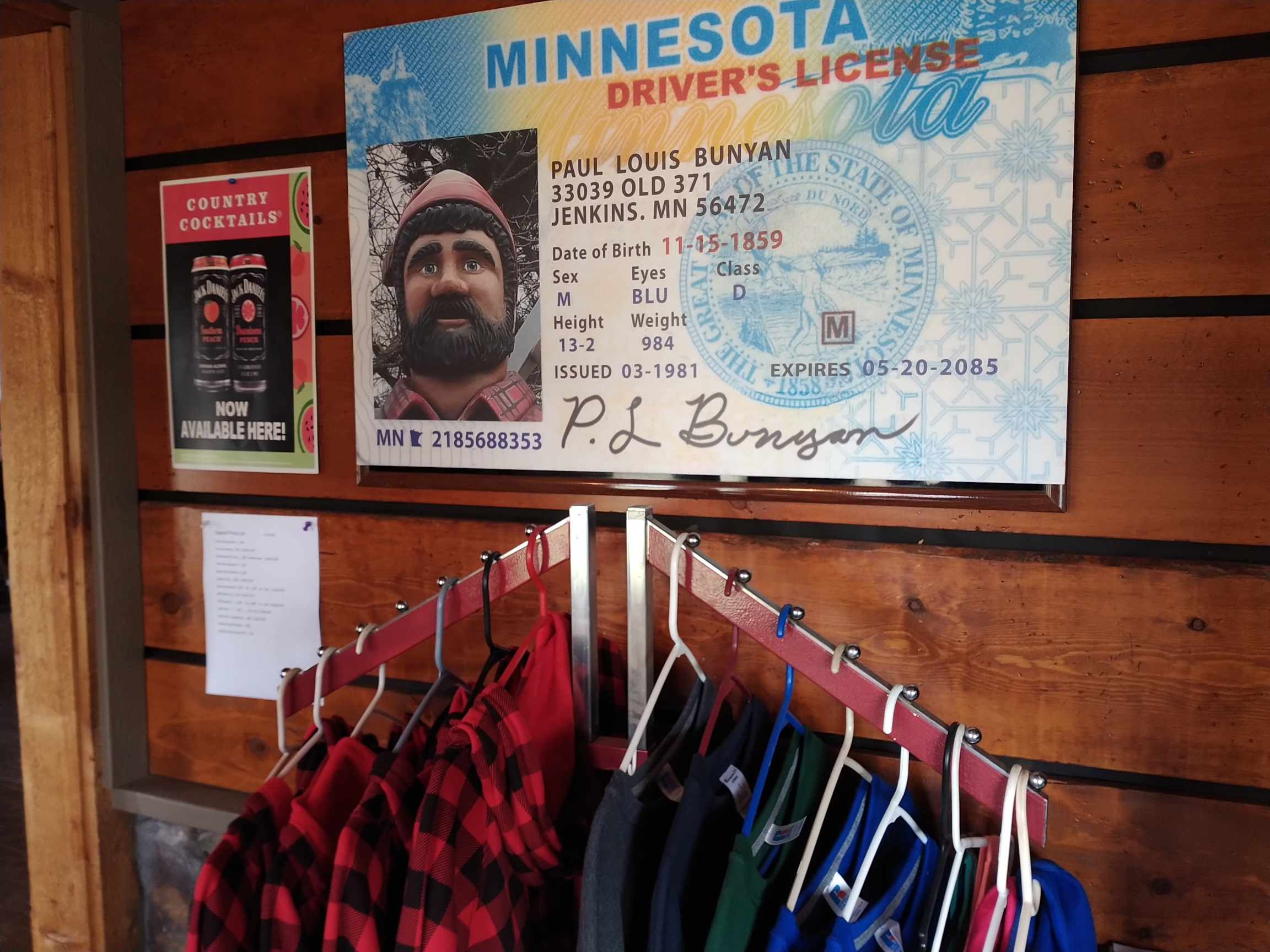
This oversized Minnesota driver’s license hangs above a rack of buffalo plaid flannel and other shirts at the A-Pine Restaurant near Pequot Lakes in the central Minnesota lakes region, aka Paul Bunyan land. (Minnesota Prairie Roots copyrighted photo September 2022)
CELEBRATING PAUL BUNYAN STYLE
Winter here also requires plenty of flannel, our unofficial winter attire. I recently purchased two flannel shirts to replace two that I’d worn thread-bare. I love my flannel. It’s comfy and cozy and warm and makes me feel Paul Bunyan authentic. If you’re unfamiliar with Paul, let me explain. He’s a legendary lumberjack, a symbol of strength and endurance. And he wears red buffalo plaid flannel. My community even celebrates flannel with the Faribault Flannel Formal, set for 5:30-9 pm Saturday, March 11, at Craft Beverage Curve (10,000 Drops Craft Distillers and Corks & Pints)). And, yes, that means attendees wear flannel, sample hotdishes (the Minnesota term for casseroles) and participate in lumberjack games. Yeah, sure, ya betcha. This is how we survive winter in the Bold (Cold) North.
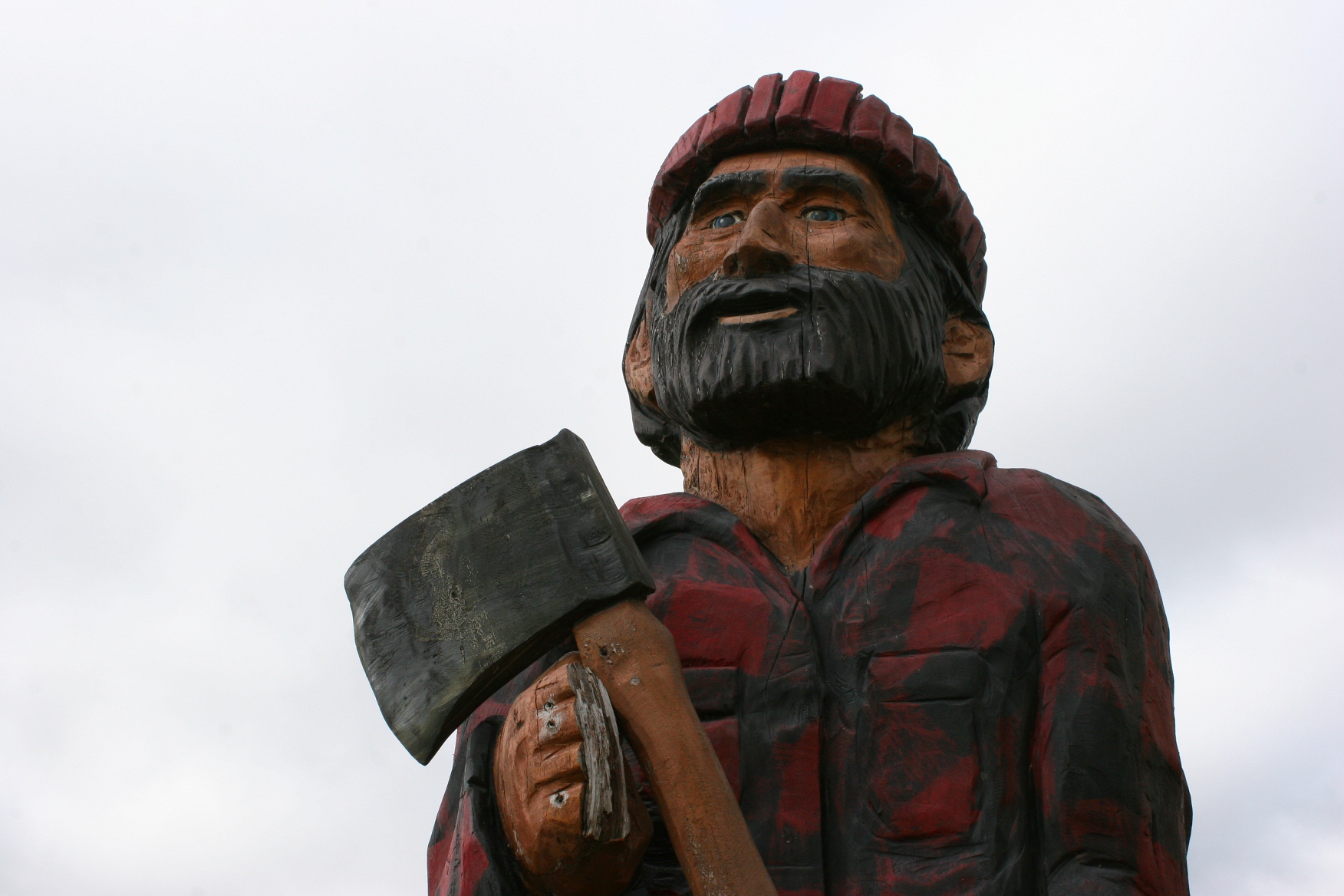
Paul Bunyan chainsaw art in Hackensack, MN. (Minnesota Prairie Roots copyrighted file photo September 2017)
WHEN WINTER WALLOPS MINNESOTA, Minnesotans get resourceful. Or at least that proved true for Randy on Saturday morning when he suited up in his Dickies coveralls and assorted winter gear to remove snow from the end of the sidewalk.
Before he exited the house, I advised him to pace himself given his age and the knowledge that the snow deposited by the city plow would be heavy. We had no idea.
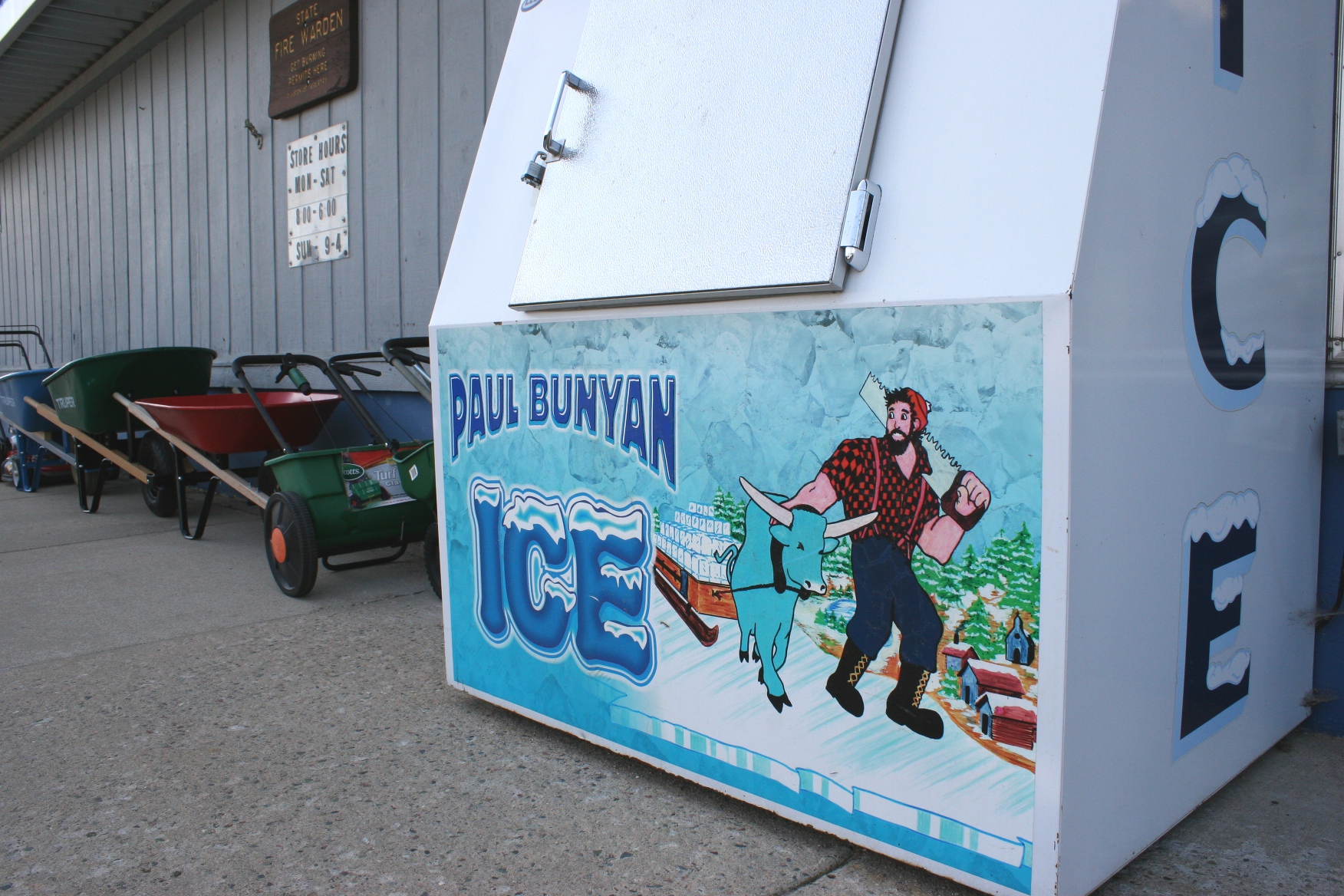
Legendary Paul Bunyan is seen often in central and northern Minnesota, here on an ice machine outside Thurlow Hardware and Rental in Pequot Lakes. (Minnesota Prairie Roots copyrighted file photo August 2018)
I watched from the window while Randy tossed scoopfuls of rock hard snow onto ever-growing mounds banking the sidewalk. He seemed to be following my take-it-easy advice by occasionally pausing to rest. But then he stopped, headed up the street toward the driveway, then the garage. I figured he was coming inside to warm up.
Not so. Rather he walked out of the garage with an ax. Yes, the tool used to fell trees, split wood or in the recreational competition of ax throwing.
It didn’t take long to see what Randy had in mind. Soon he was swinging the ax into the snow wall lodged at sidewalk’s end. The moisture-heavy snow bladed there by the city plow froze overnight, making it impossible to shovel without first splitting the solid chunks. Unbelievable.
Randy worked tirelessly swinging the ax blade into the rock pack. Swing. Swing. Swing. Then he set the ax aside, grabbed the scoop shovel and flung the snow rocks aside. He repeated the process until the sidewalk end was cleared.
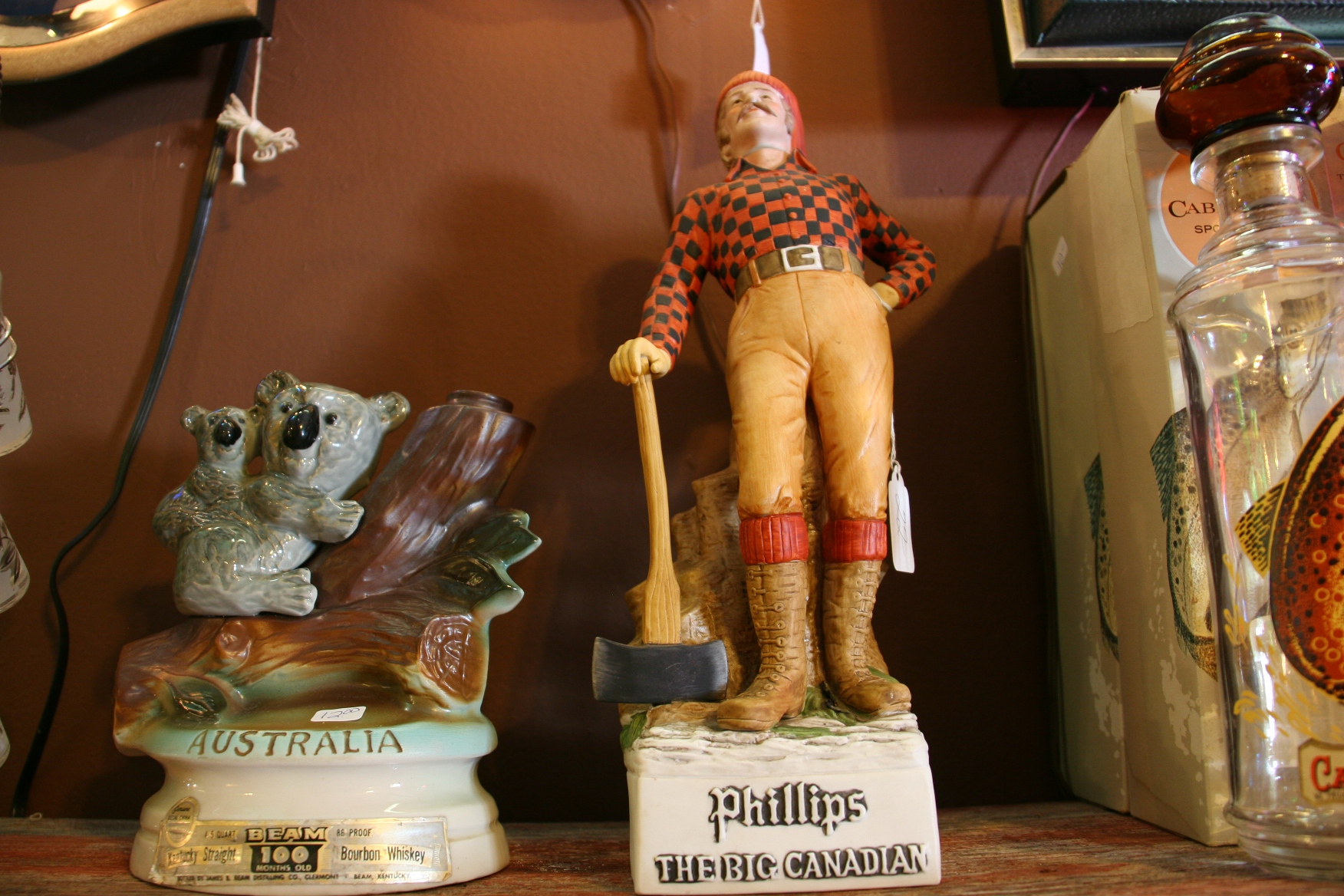
A Paul Bunyan liquor bottle photographed in 2018 at Sarah’s Uniques & Jim Mantiques in St. Charles. (Minnesota Prairie Roots copyrighted file photo August 2018)
In all the decades of removing snow, and I’ve done plenty of snow-clearing, too (including sidewalk and driveway ends), we’ve never resorted to using an ax. But Paul Bunyan would have been proud of Randy’s resourcefulness. To survive in Minnesota, you sometimes need to think like a legendary lumberjack.
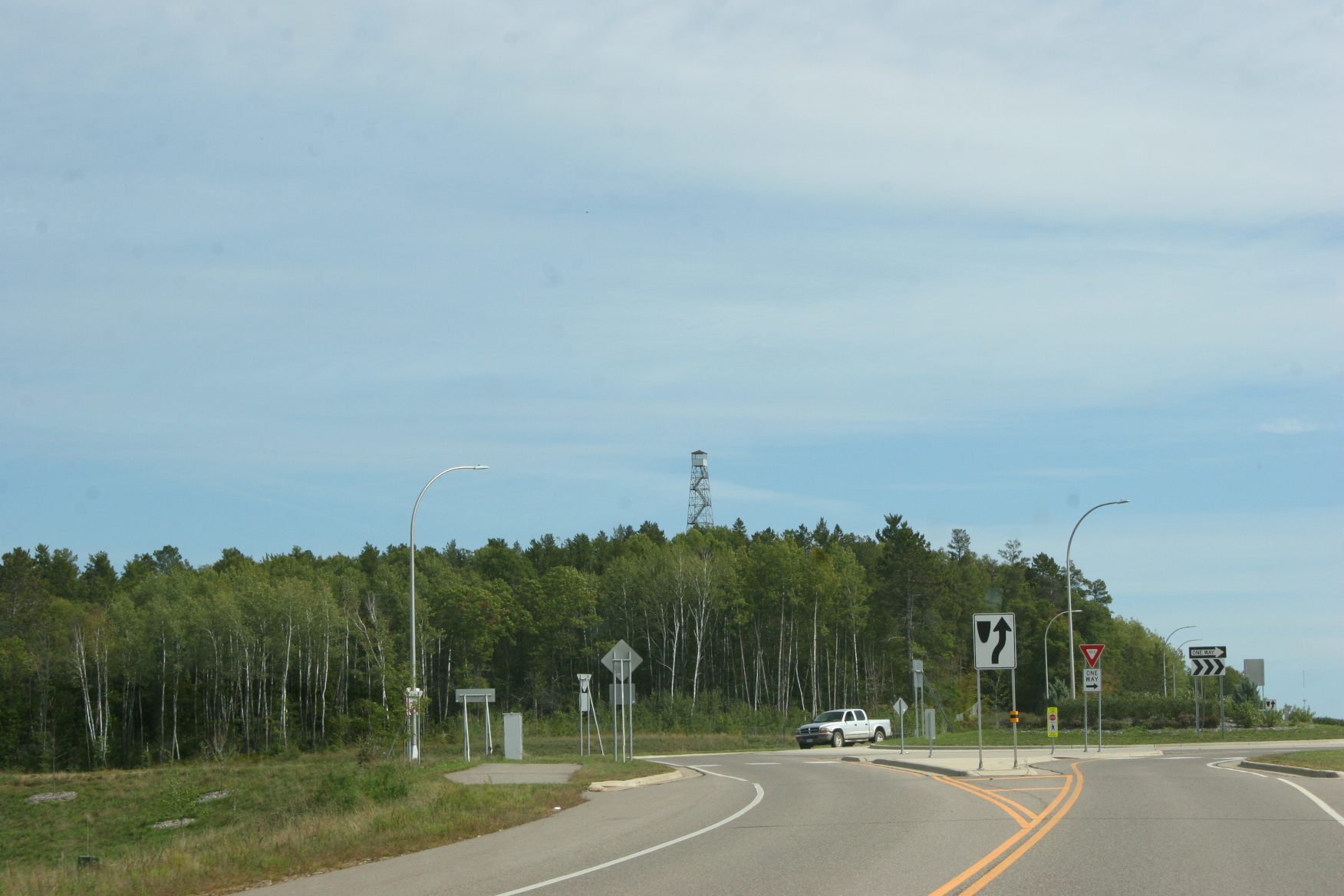
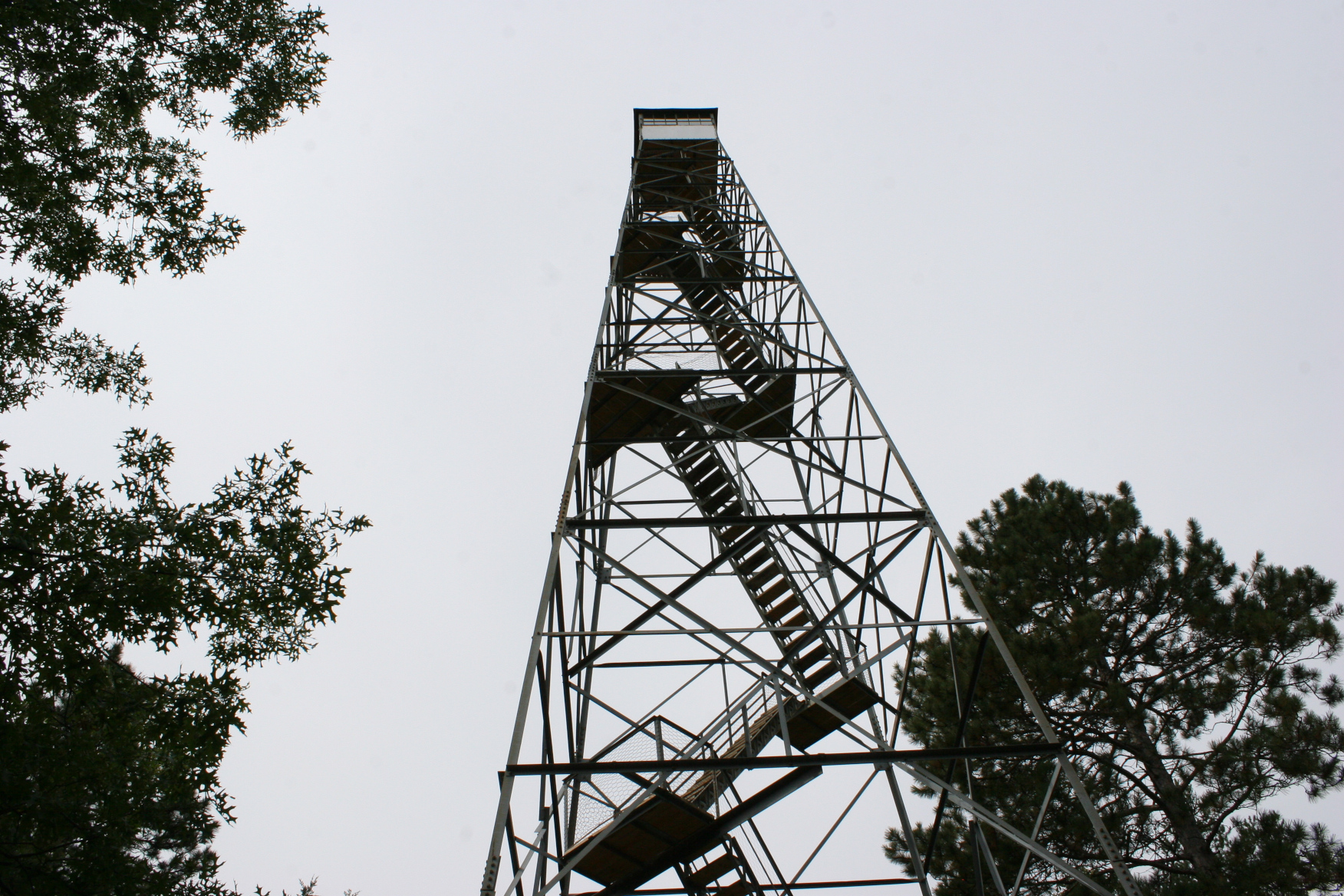
Just a short distance from this roundabout by Pequot Lakes, you can see the Paul M. Thiede Fire Tower peeking through the treetops. Minnesota Prairie Roots copyrighted photo September 2021.
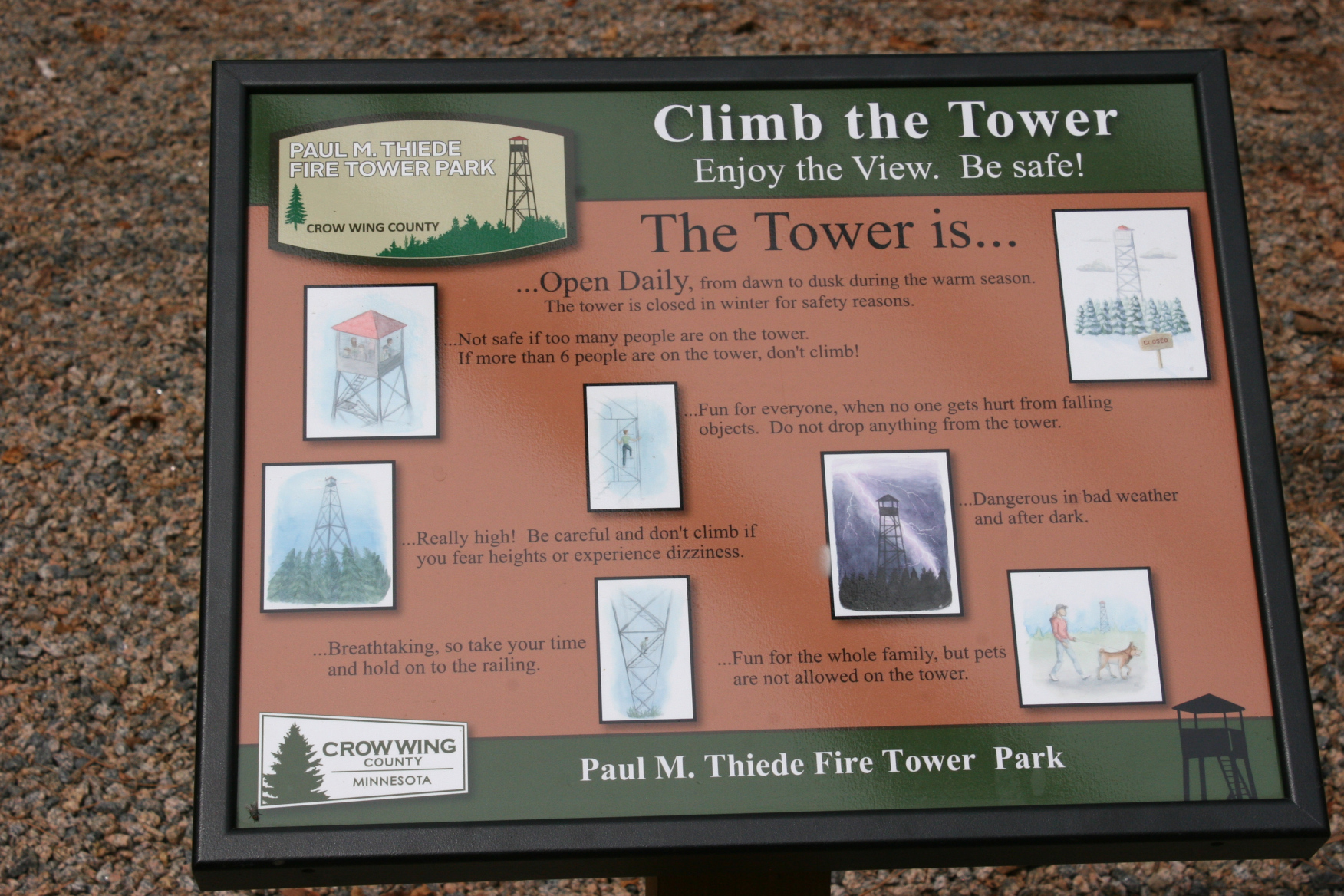
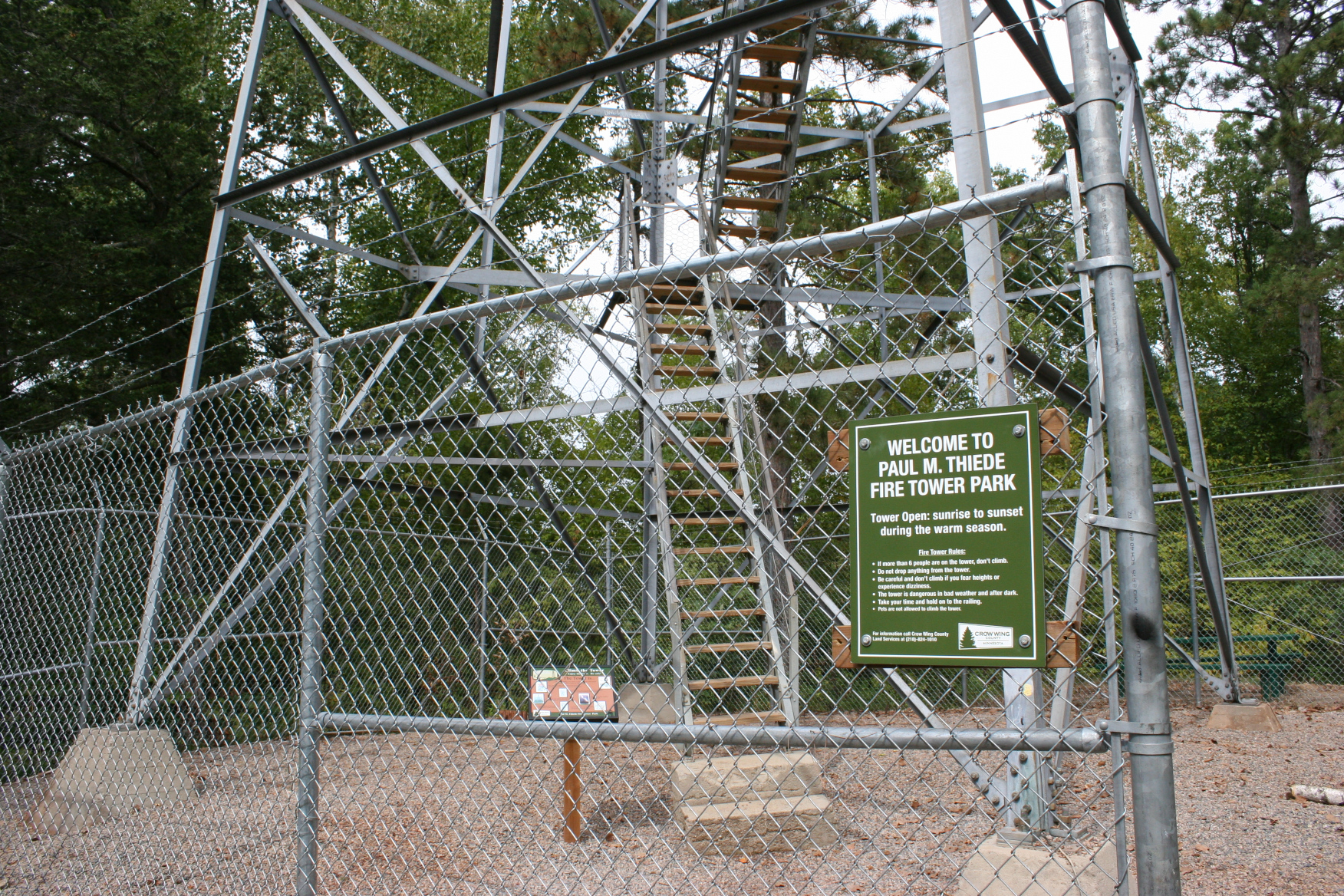
Really high! Be careful and don’t climb if you fear heights or experience dizziness.
The warning sign and rules posted at the base of the fire tower. Minnesota Prairie Roots copyrighted photo September 2021.
I heeded the warning and stayed put. Feet on the ground. Camera aimed skyward. Toward the 100-foot high Paul M. Thiede Fire Tower just outside Pequot Lakes in the central Minnesota lakes region. The top of the tower pokes through the trees, barely visible from State Highway 371. Turn off that arterial road onto Crow Wing County Road 11, turn left, and you’ve reached the fire tower park.
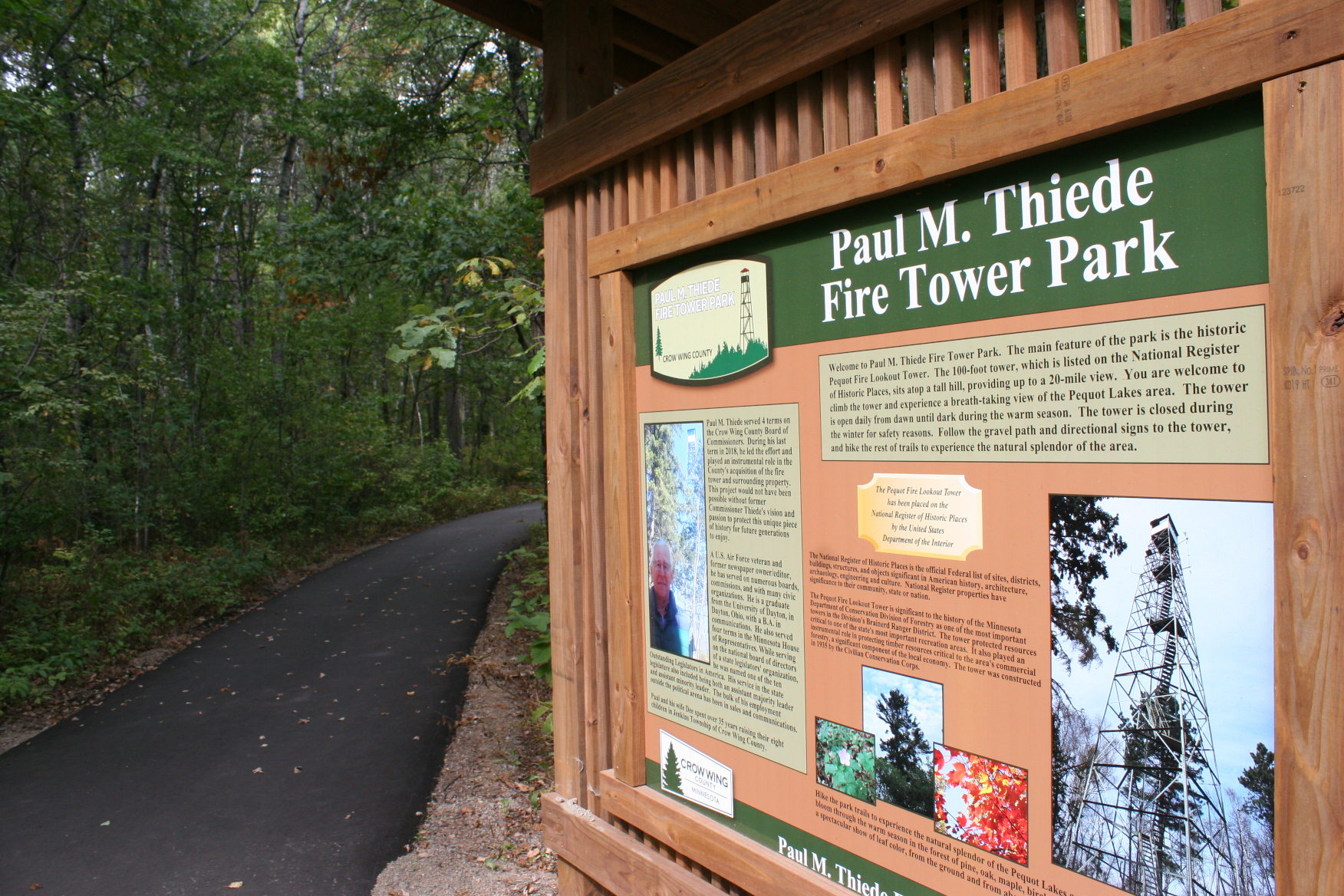
A little background on the park. Minnesota Prairie Roots copyrighted photo September 2021.
The Paul M. Thiede Fire Tower Park (named after the county commissioner instrumental in developing this 40-acre park) offers visitors an opportunity to hike to, and then climb, the historic tower built in 1935 by the Civilian Conservation Corps. As one who prefers low to high, I was up for the 0.3 mile hike, but not the climb.
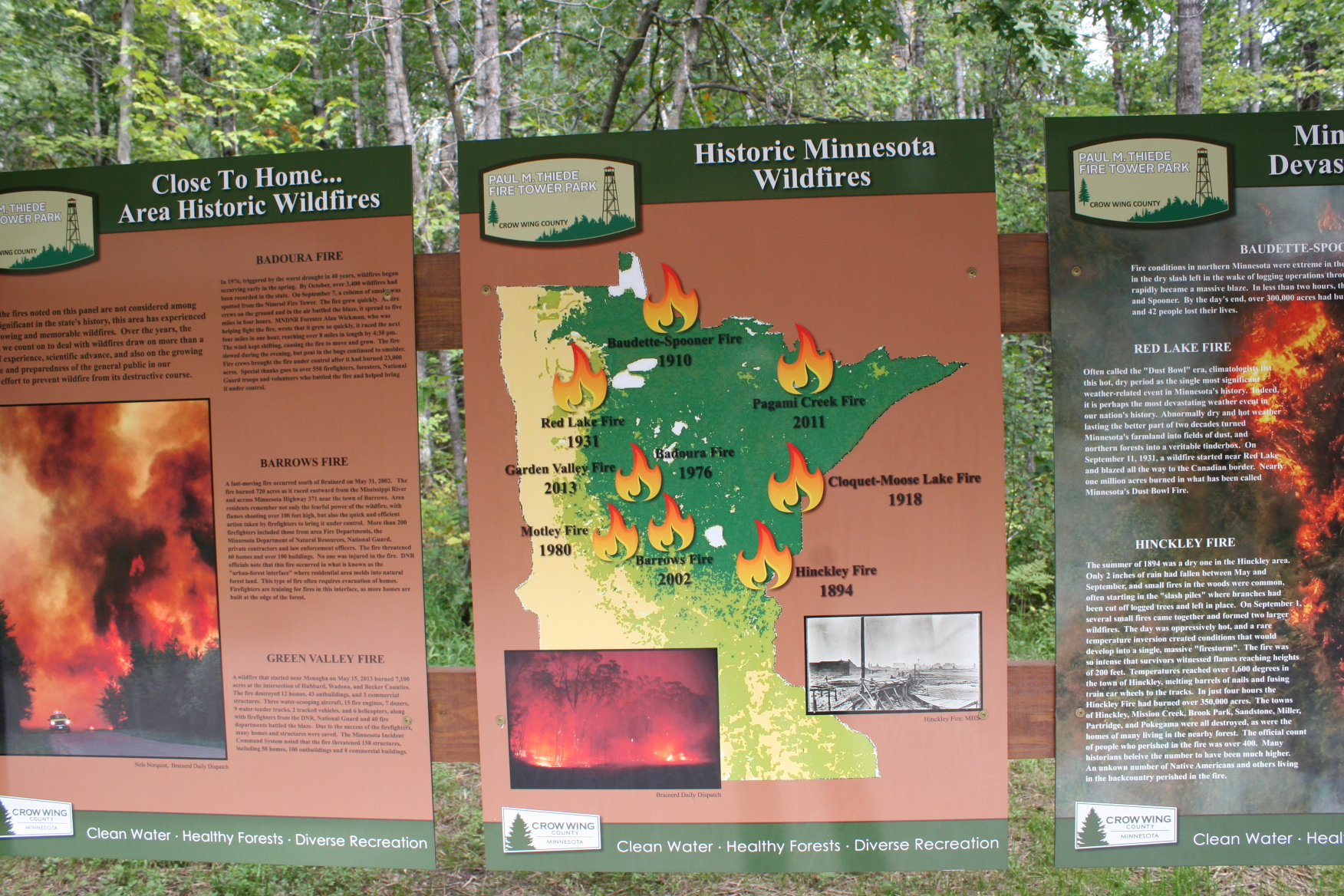
Lots of info packs signs in the outdoor interpretative area. Minnesota Prairie Roots copyrighted photo September 2021.
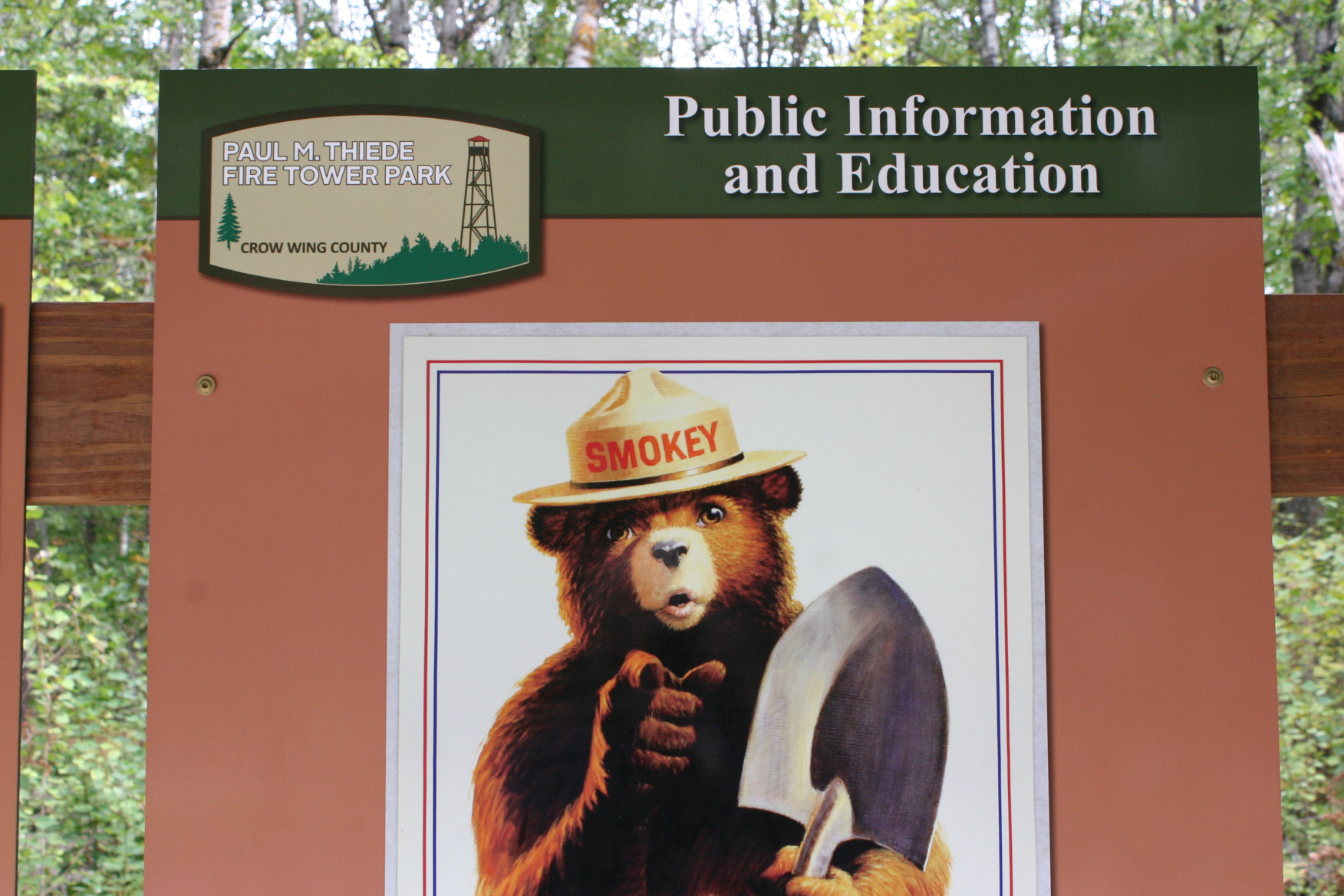
The iconic Smokey the Bear reminds us that we can prevent forest fires. Minnesota Prairie Roots copyrighted photo September 2021.
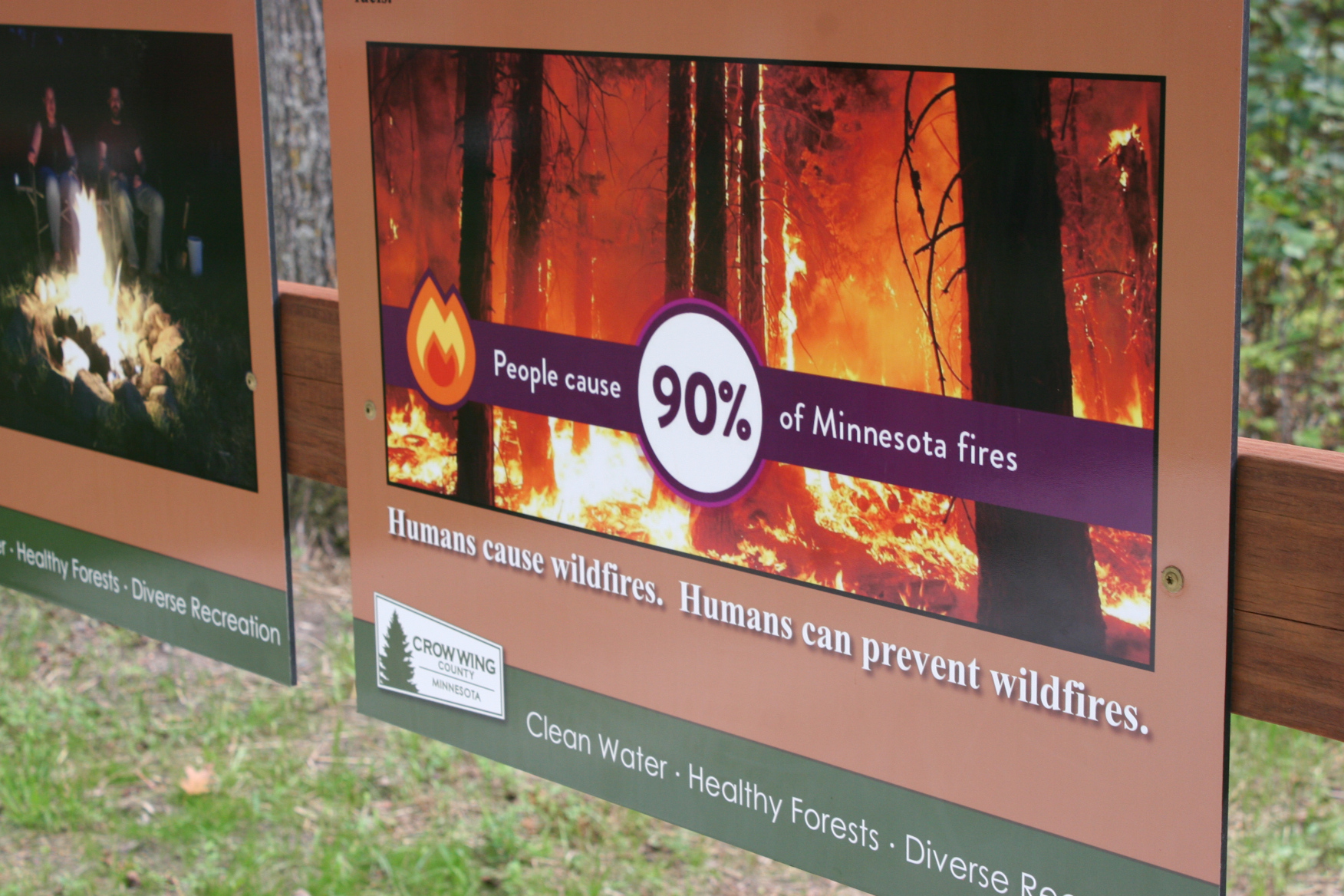
Weare to blame for nearly all of Minnesota’s wildfires, according to this park sign. Minnesota Prairie Roots copyrighted photo September 2021.
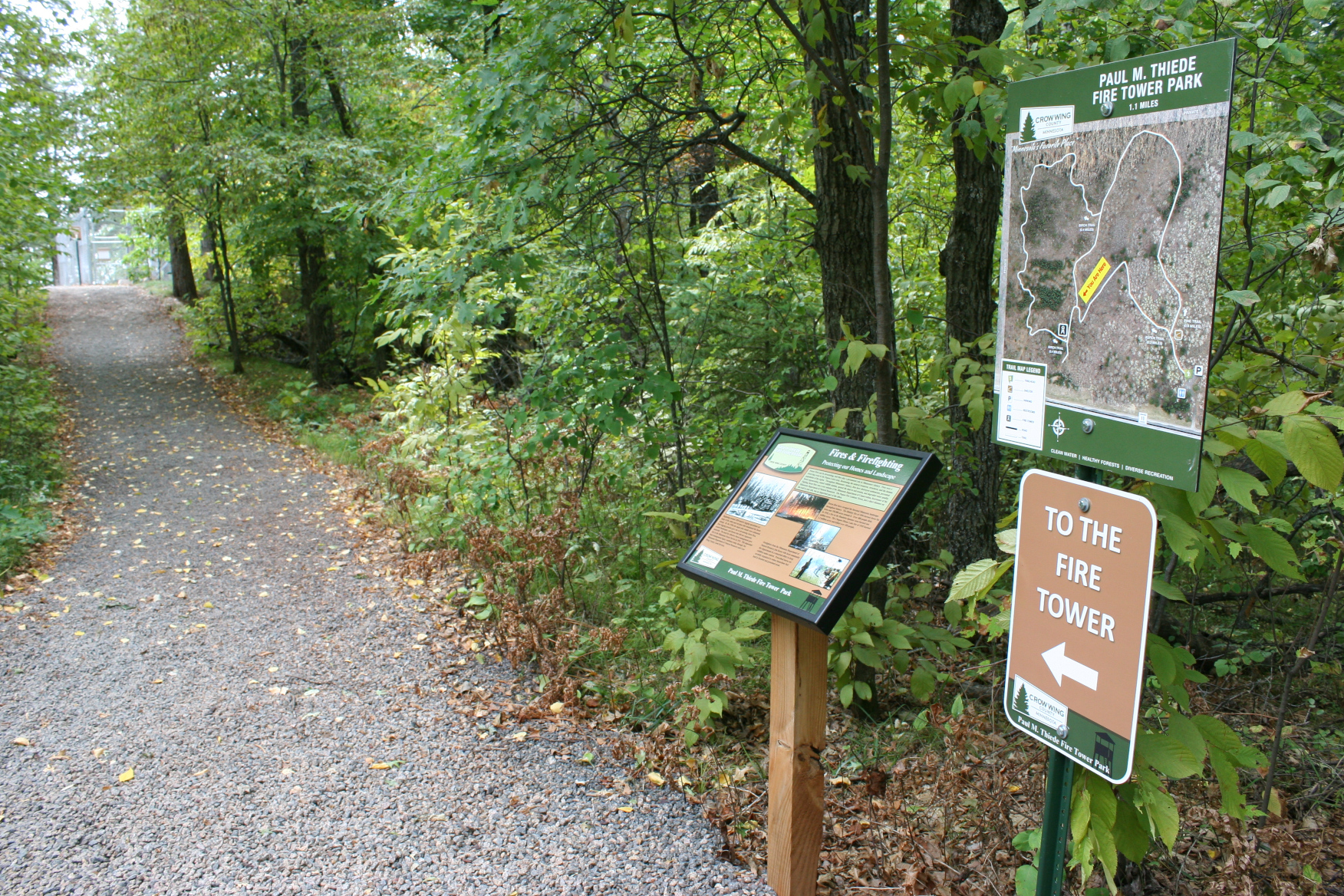
Before Randy and I headed onto the trail, though, we read the interpretative signage featuring information on the tower (which is on the National Register of Historic Places), Minnesota wildfires and other notable fire facts. This summer marked an especially busy fire season in the northern Minnesota wilderness. Those of us living in the southern part of the state felt the effects also with smoke drifting from the north (including Canada) and from the west (California). That created hazy skies and unhealthy air some days, unlike anything I’ve ever experienced.
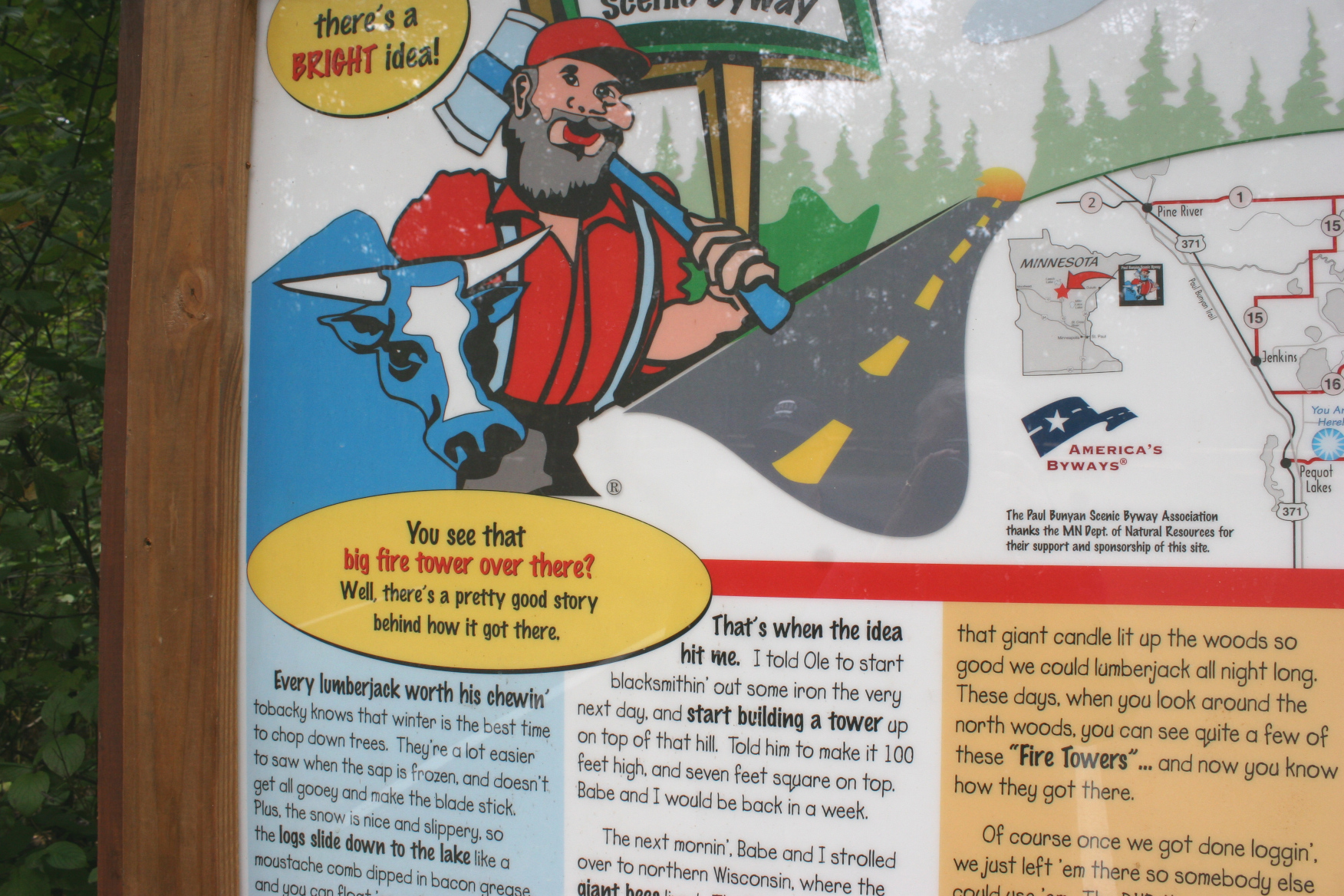
Lots to read here, including Paul Bunyan’s fire tower story. Minnesota Prairie Roots copyrighted photo September 2021.
We also read a bit of Paul Bunyan lore, a fun addition to the park located in the Paul Bunyan Scenic Byway area. This region of Minnesota is big on lumberjack stories about Paul and his sidekick, Babe the Blue Ox. The Pequot Lakes water tower is even shaped like Paul’s over-sized fishing bobber.
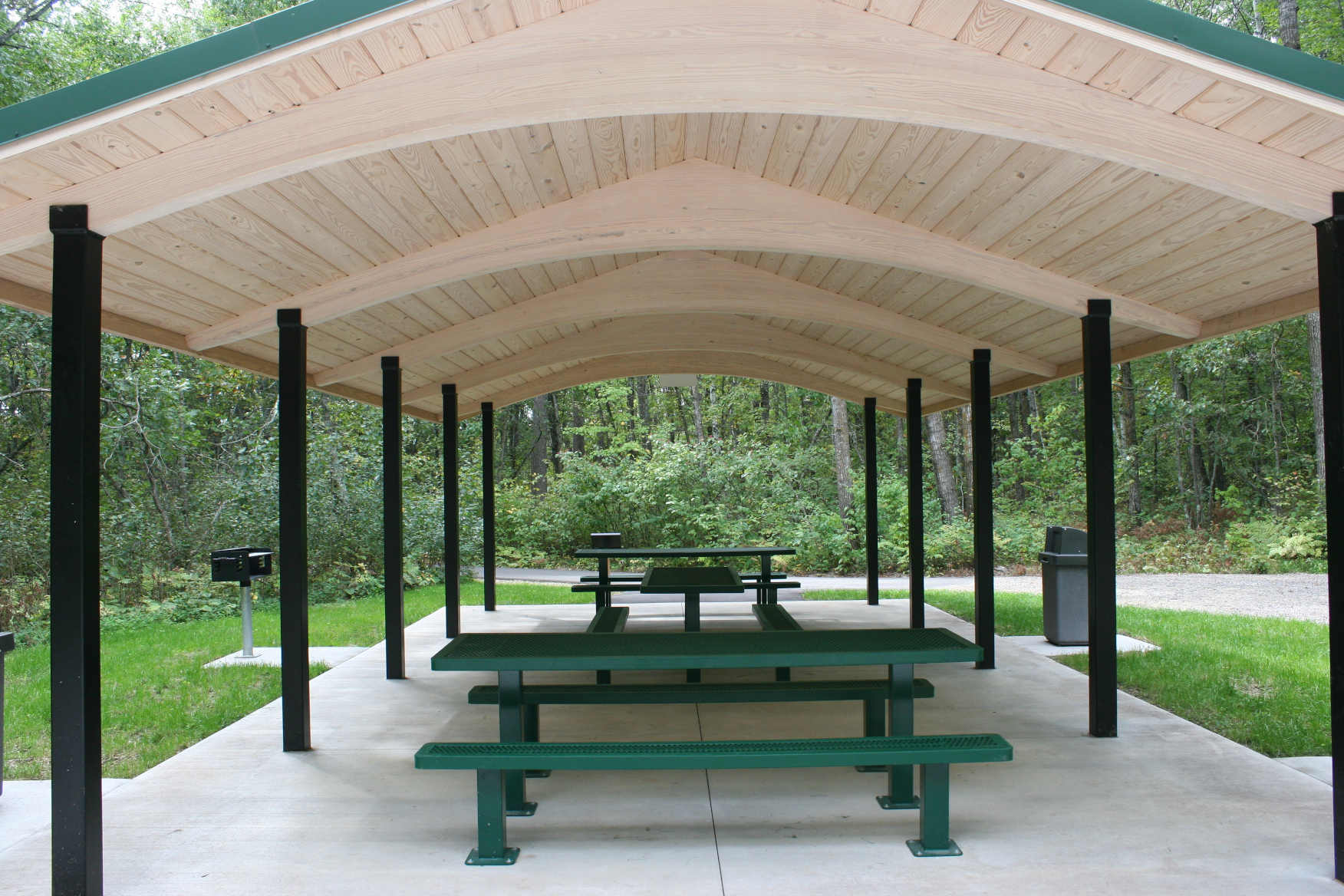
The pristine picnic shelter. Minnesota Prairie Roots copyrighted photo September 2021.
Signs point the way to the fire tower trail. Minnesota Prairie Roots copyrighted photo September 2021.
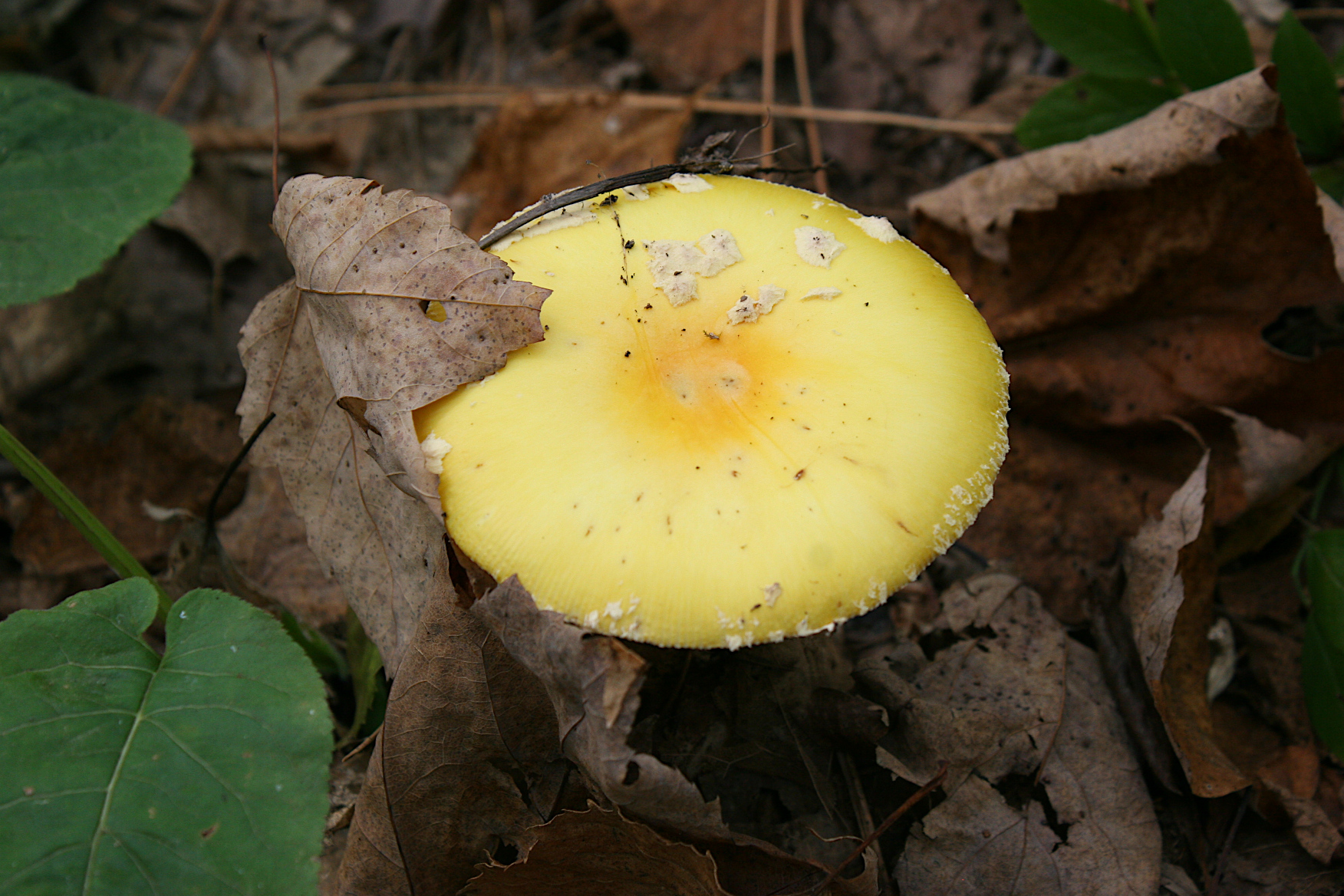
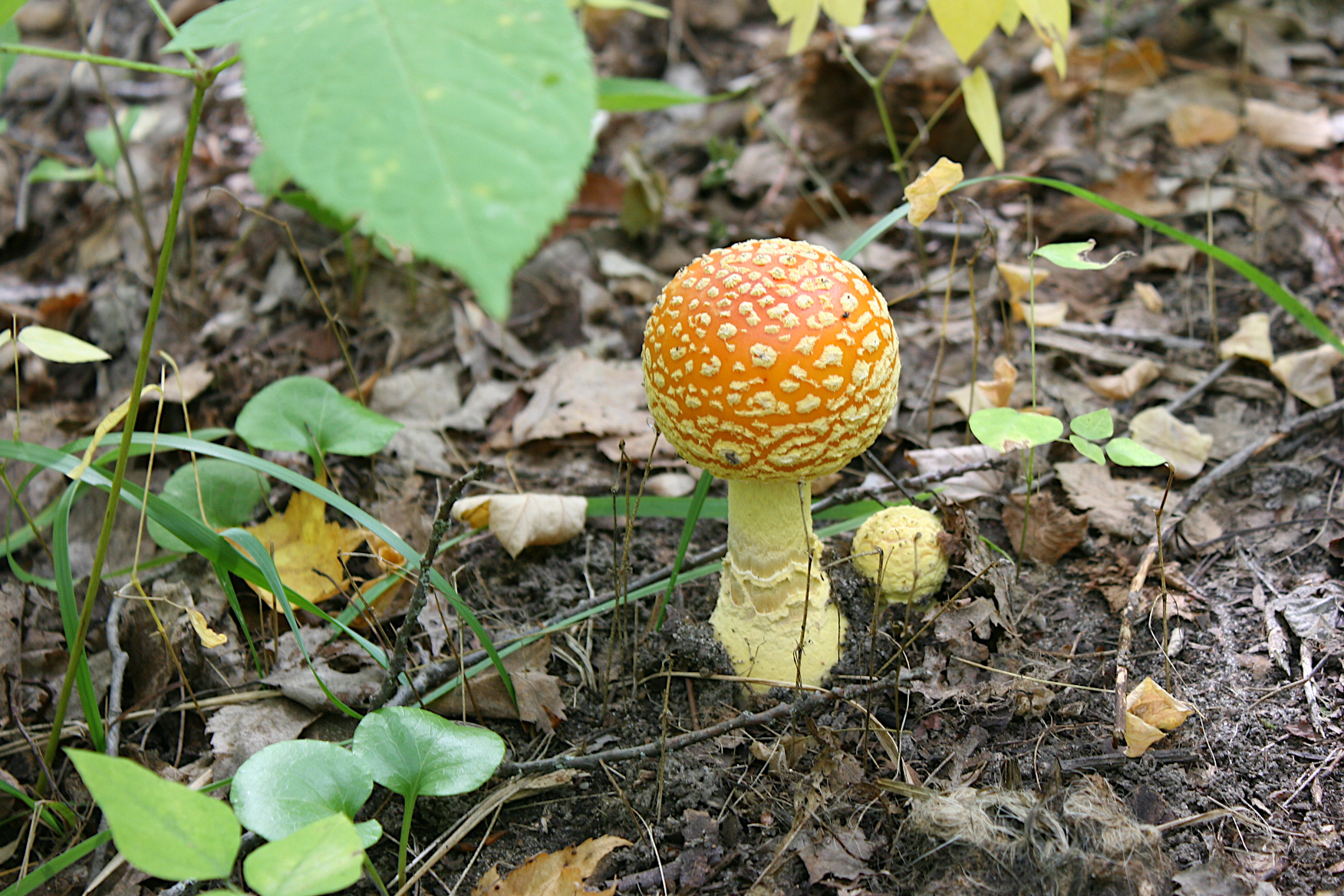
On the way to the tower, this large yellow mushroom temporarily distracted me. Minnesota Prairie Roots copyrighted photo September 2021.
Once we’d finished reading, and then admiring the beautiful new picnic shelter, we started off on the pea rock-covered trail through the woods and toward the tower. Up. Up. Up.
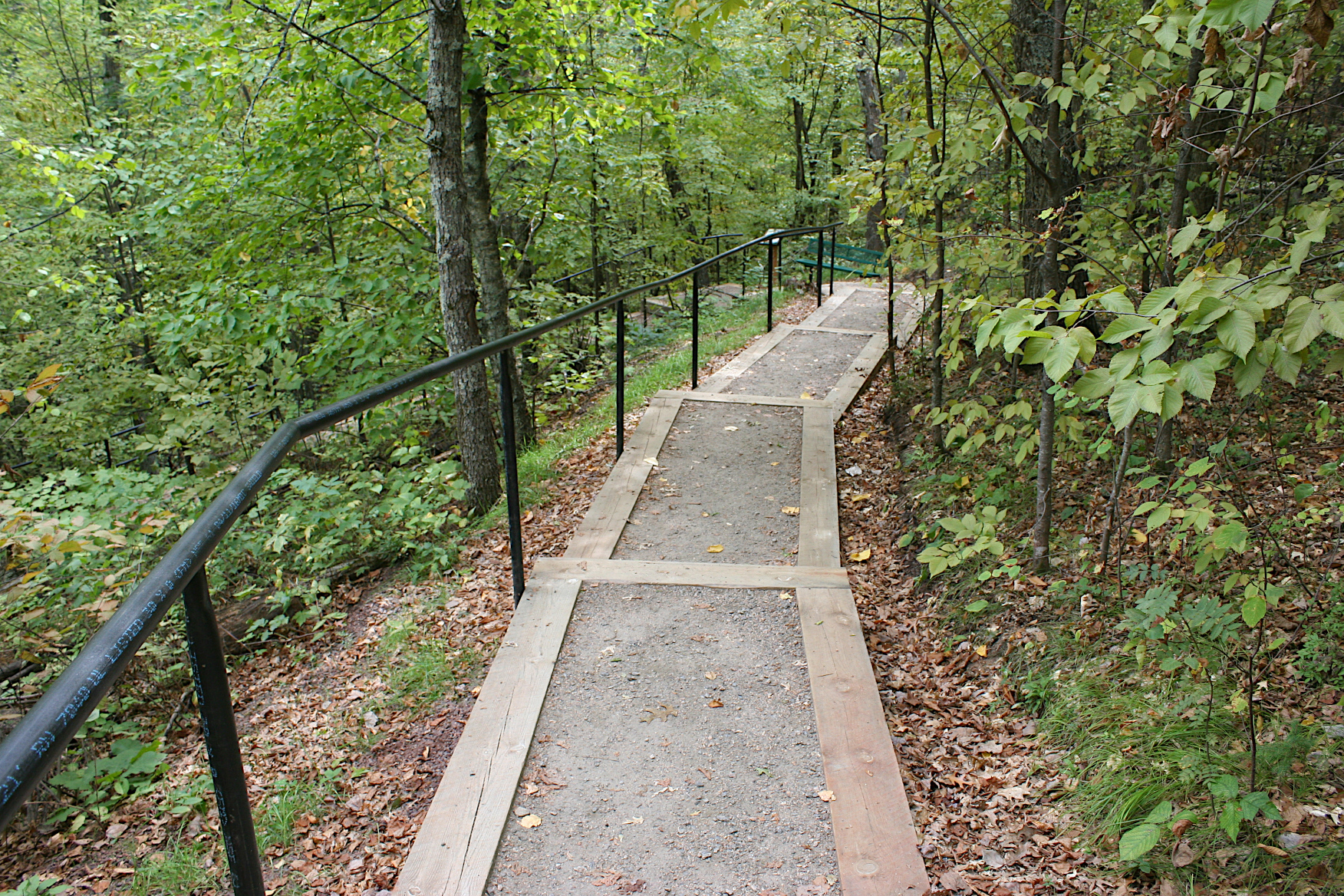
When the trail gets especially steep, steps aid in the climb. I took this photo on the descent. Minnesota Prairie Roots copyrighted photo September 2021.
After awhile, I began to tire, to wonder, how much farther? And just as I was about to declare myself done climbing steps, Randy assured me the tower was just around the bend. Yes.
Looking up at the tower, all of which I couldn’t fit in a photo, I determined I was not climbing that high. Minnesota Prairie Roots copyrighted photo September 2021.
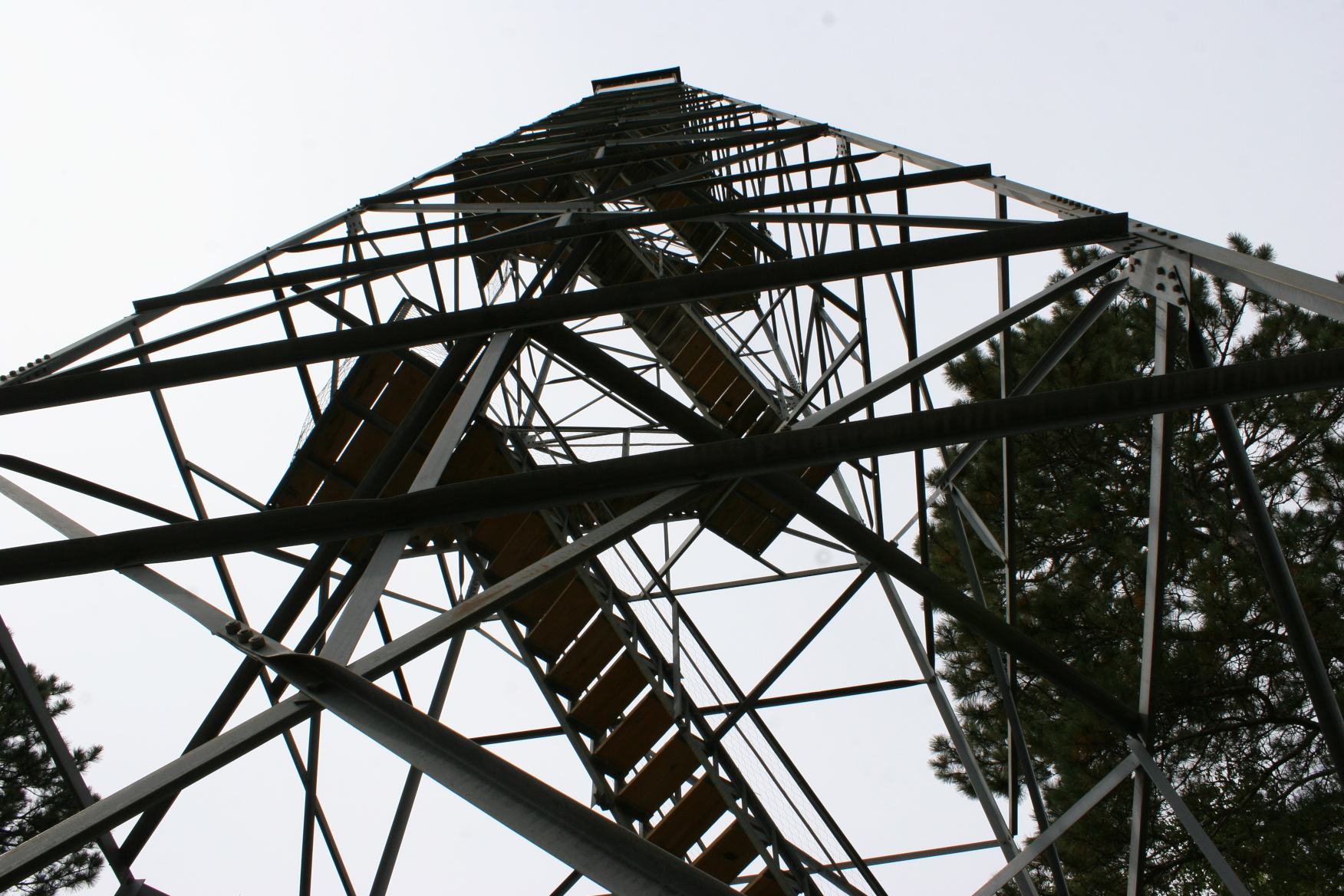
Once there, I stood at the base of the tower, reading the rules and warnings. I decided I best admire the ironwork from below. And I did. There’s a lot to be said for the 1930s workmanship of skilled craftsmen.
The underside of the tower shows layers of stairs. Minnesota Prairie Roots copyrighted photo September 2021.
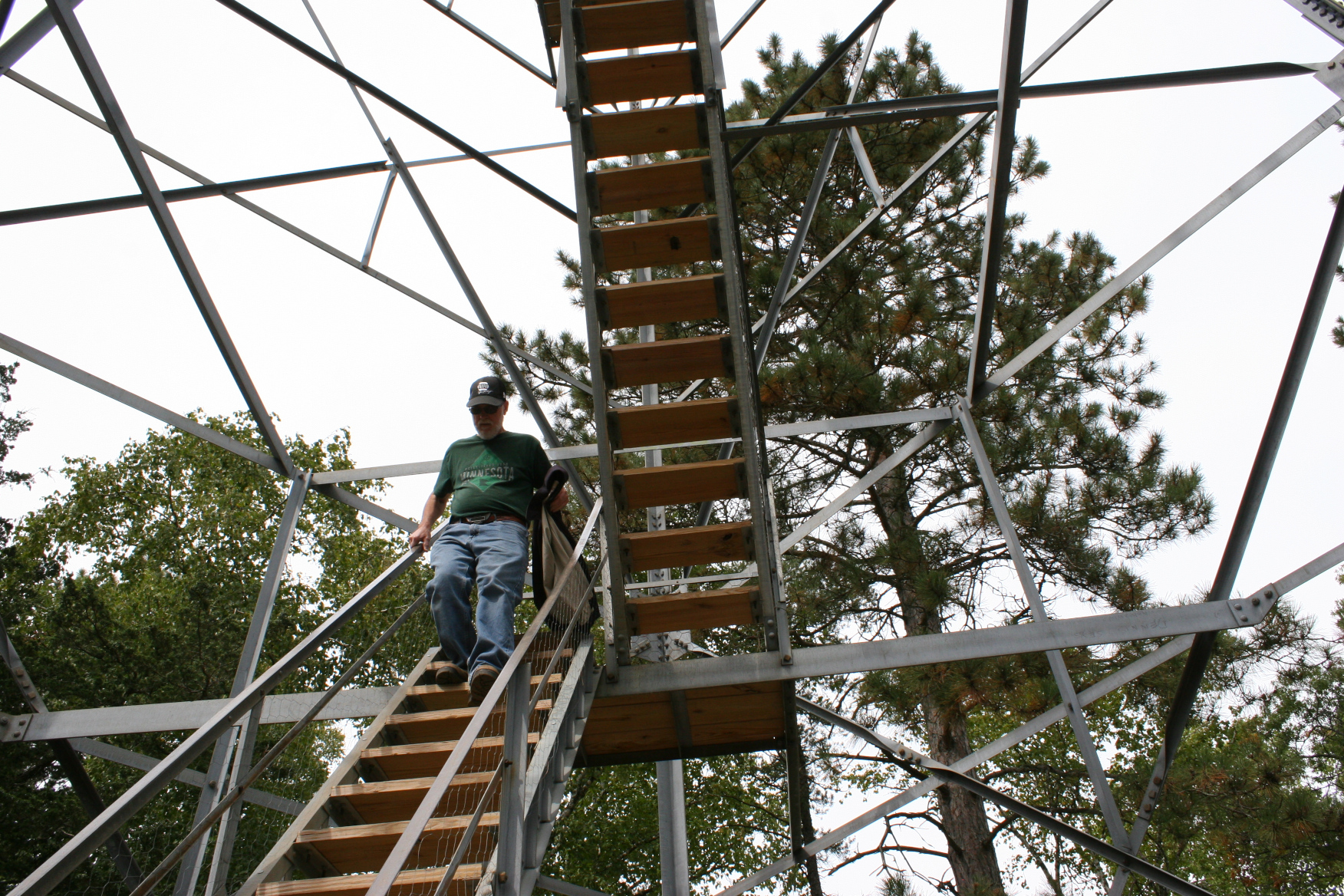
Randy, though, started up the layered steps leading to a seven-foot square enclosed look-out space at the top of the tower. At that height, fire watchers could see for 20 miles.
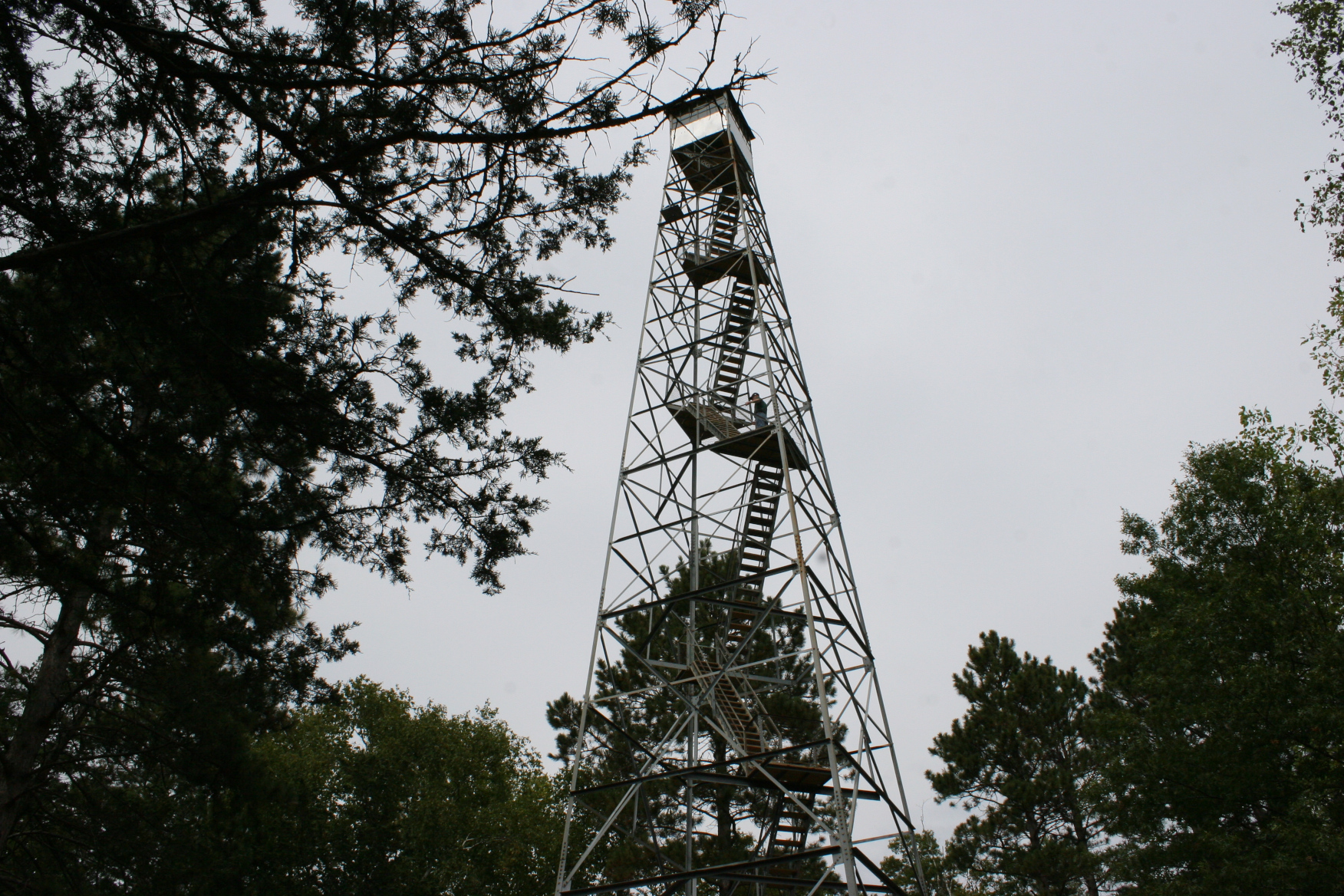
If you look closely, you can see Randy with only a few more flights to reach the top. At this point, he decided not to go any farther. Minnesota Prairie Roots copyrighted photo September 2021.
As I watched, Randy climbed. Steady at first, but soon slowing, pausing to rest. “You don’t have to go all the way to the top,” I shouted from below. He continued, to just above treetop level, and then stopped. He had reached his comfort height level.
The tower is fenced at the base. Minnesota Prairie Roots copyrighted photo September 2021.
I can only imagine how spectacular the view this time of year, in this season of autumn when the woods fire with color. We visited in mid-September, when color was just beginning to tinge trees.
Randy exits the tower, several flights short of reaching the top. Minnesota Prairie Roots copyrighted photo September 2021.
Eventually, we began our retreat down the trail, much easier than ascending.
An incredibly vibrant mushroom thrives trailside. Minnesota Prairie Roots copyrighted photo September 2021.
Occasionally I stopped to photograph scenery, including species of orange and yellow mushrooms. Simply stunning fungi.
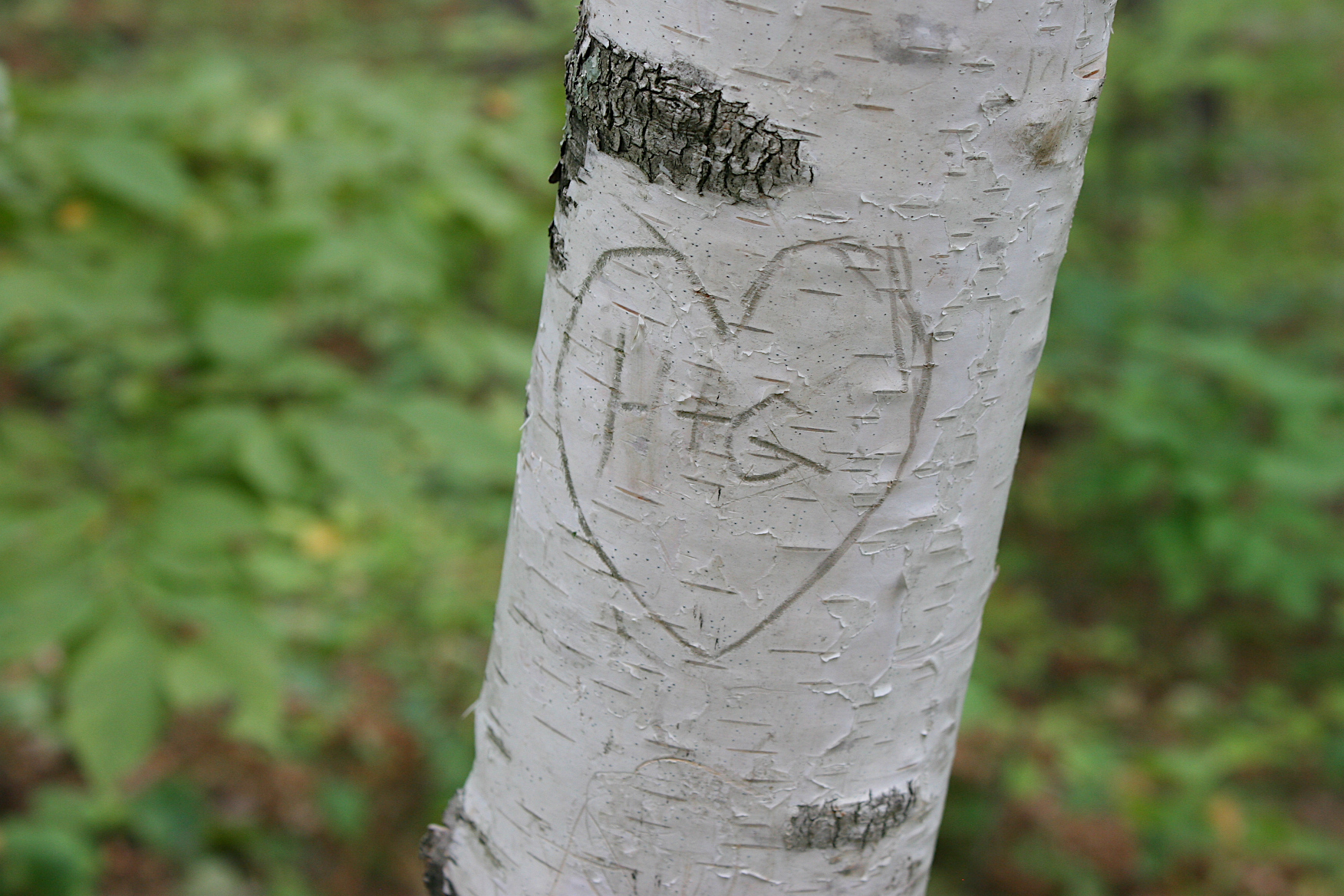
Sadly…a carving on a birch tree along the trail. Minnesota Prairie Roots copyrighted photo September 2021.
We also paused to visit with a retired couple on their way to the tower. They have a generational lake home in the area, like so many who vacation here. While we chatted, a young runner passed us. I admired her stamina and figured she’d face no physical challenges climbing the 100-foot tower.
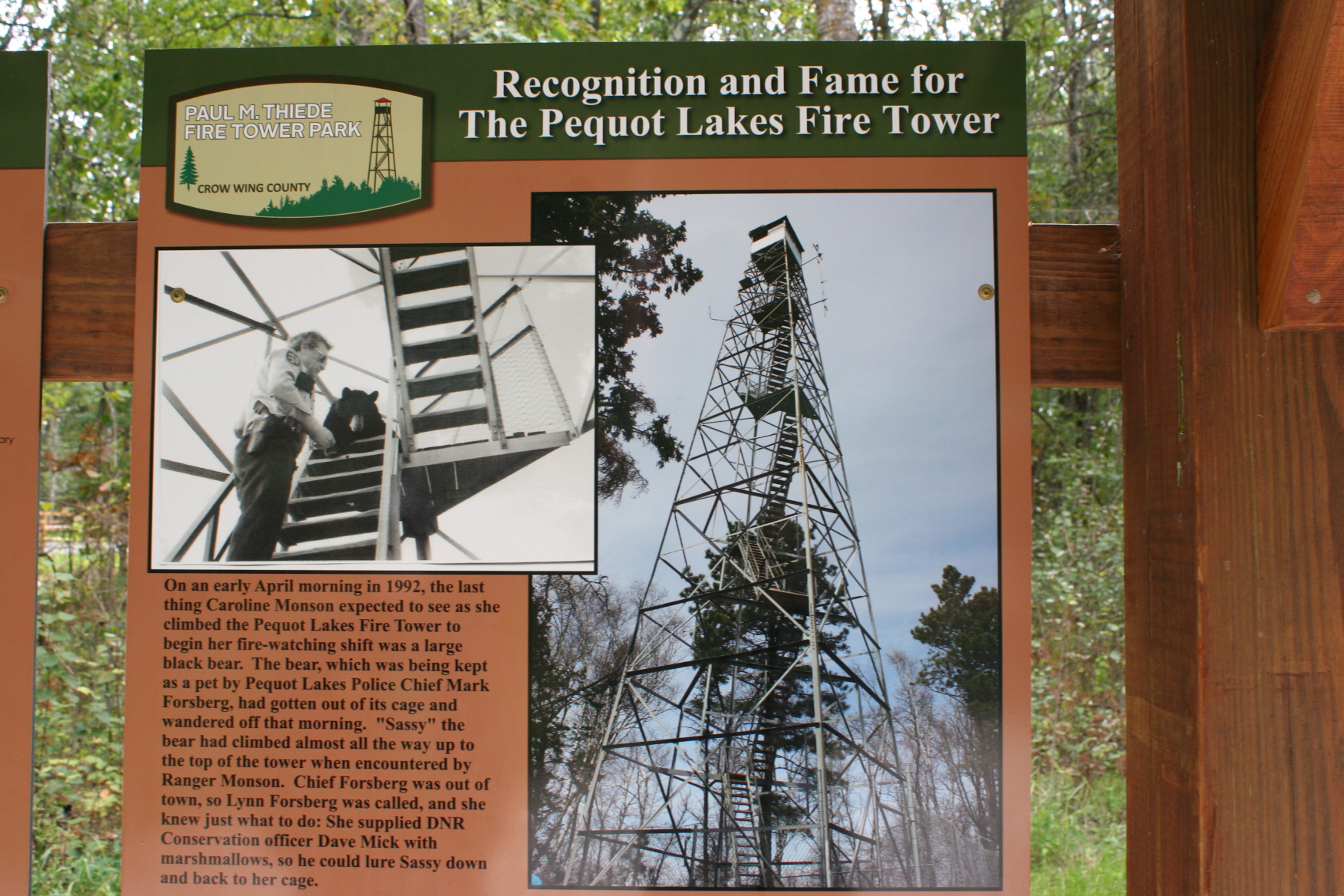
The story of Sassy the bear is included inthe interpretative area. Minnesota Prairie Roots copyrighted photo September 2021.
Just like a domesticated black bear that once escaped and scampered up the tower. A ranger lured him down with a bag of marshmallows. That is not the stuff of Paul Bunyan lore, but of life in the Minnesota northwoods. This historic fire tower, which once provided a jungle gym for a bear and a place to scout for wildfires, now offers a unique spot to view the surrounding woods and lakes and towns. If you don’t fear heights or experience dizziness.
FYI: The Paul M. Thiede Fire Tower is open from dawn to dusk during the warm season, meaning not during Minnesota winters. Heed the rules. And be advised that getting to the tower is a work-out.
Right now should be a really good time to catch a spectacular view of the fall colors from the fire tower.
Babe the Blue Ox, public art and photo op in Pequot Lakes. Minnesota Prairie Roots copyrighted photo.
ONLY RECENTLY HAVE I begun to explore the central Minnesota lakes region and small towns therein. Thanks to the generosity of a sister-in-law and brother-in-law, who are sharing their guest lake cabin with extended family, going Up North to the cabin is now a reality rather than a life-long dream. I feel incredibly blessed and grateful to experience what, for many Minnesotans, is a multi-generational part of their summers.
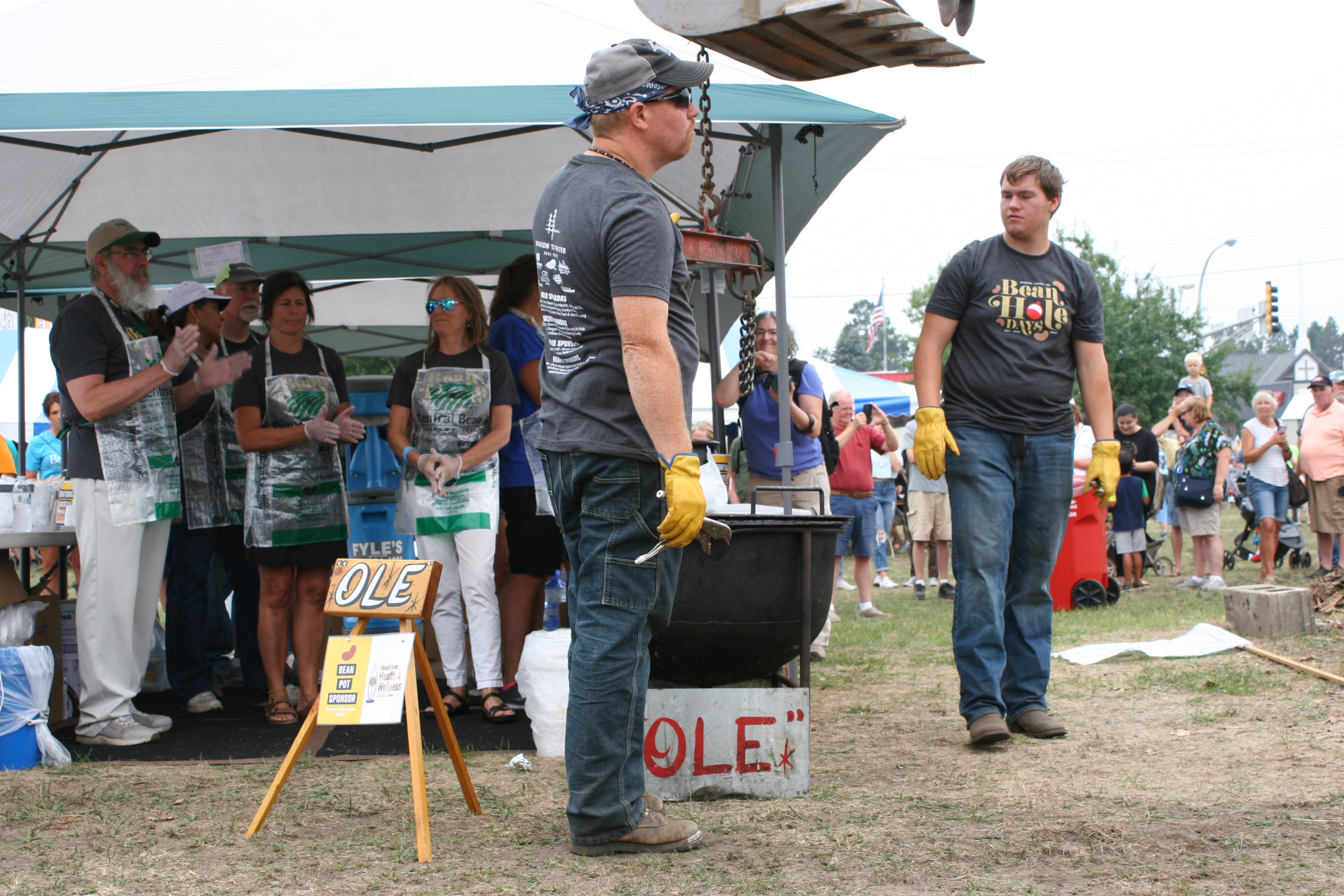
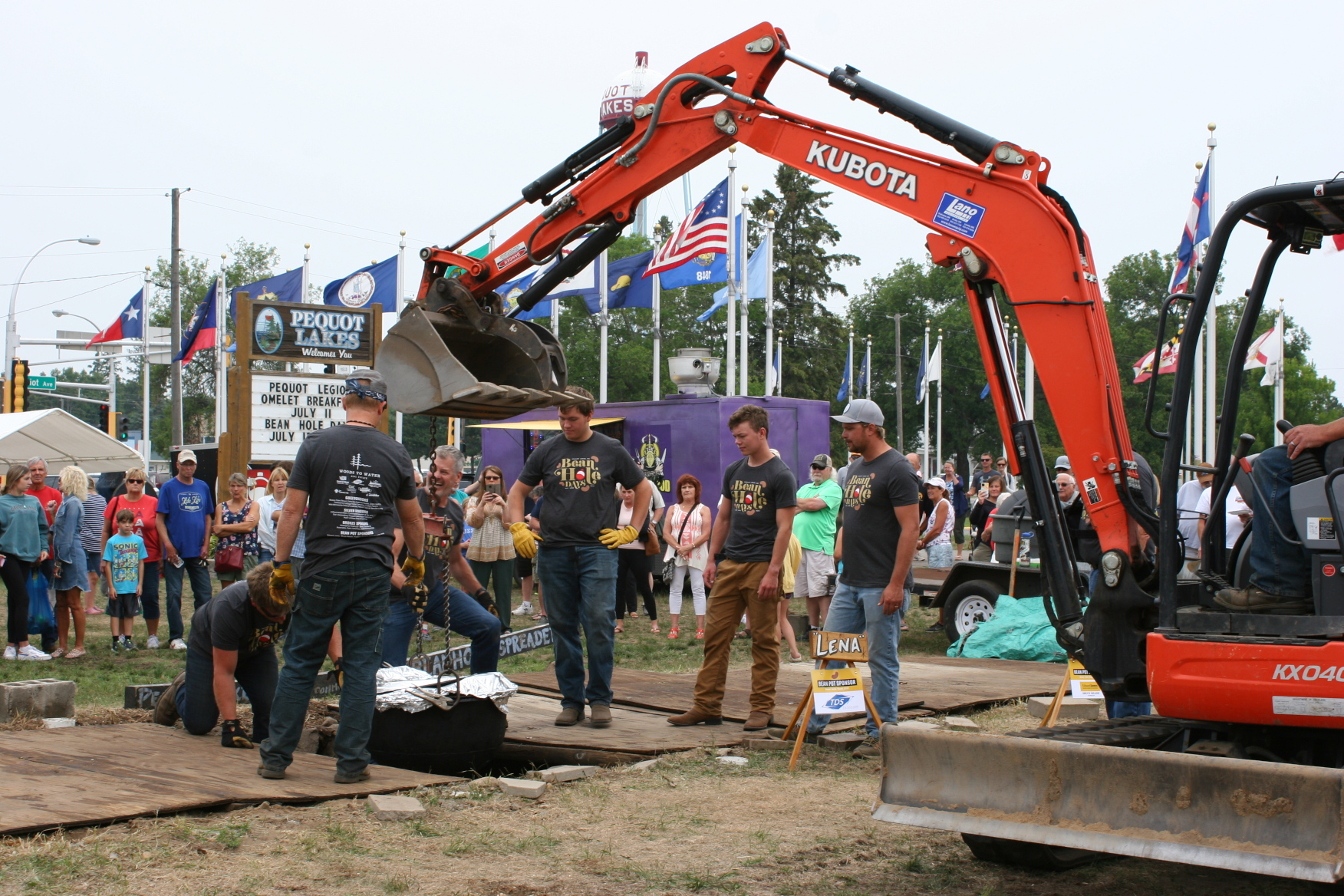
Kettles of baked beans, lifted from an underground pit, await serving during Pequot Lakes’ recent Bean Hole Days. Minnesota Prairie Roots copyrighted photo.
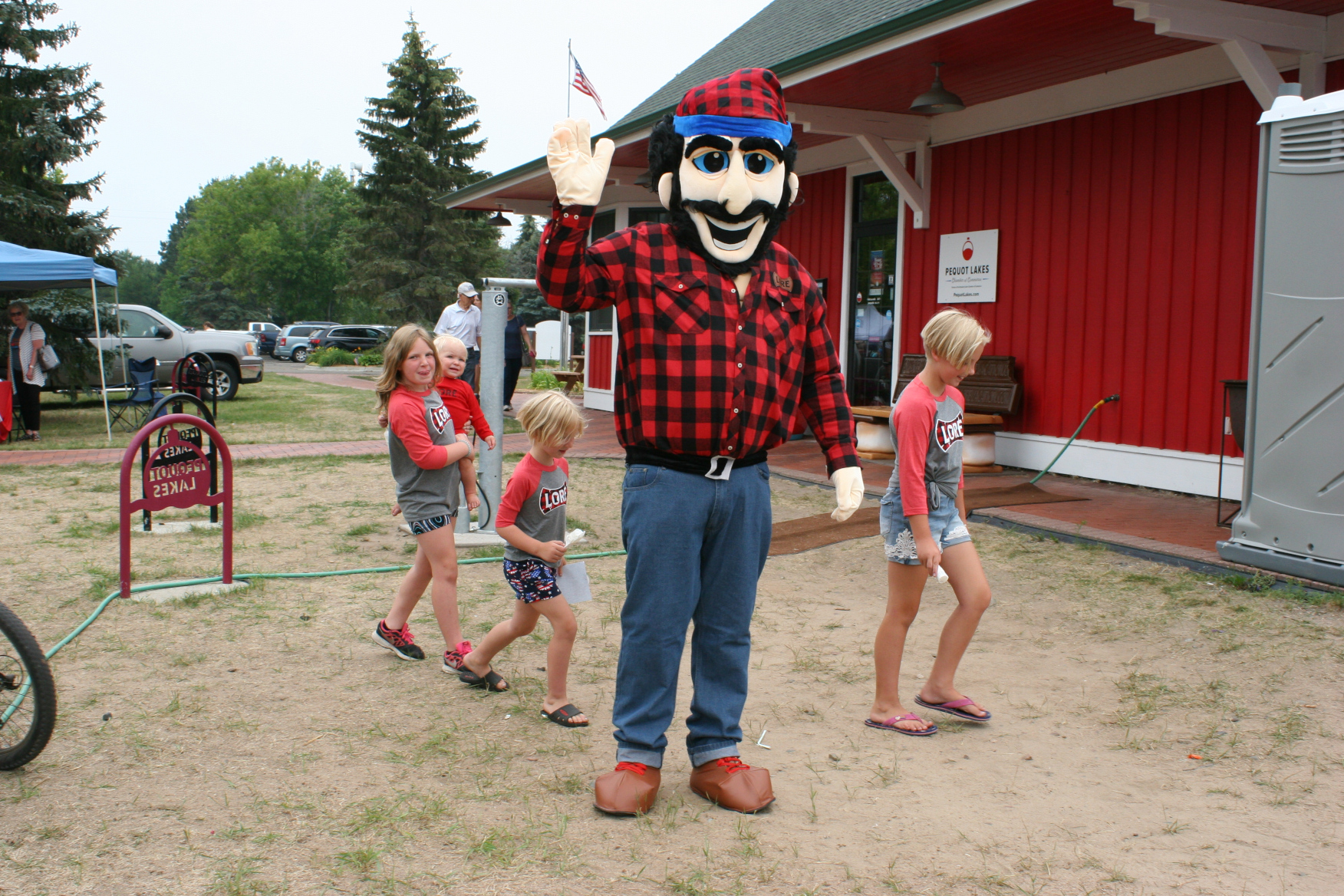
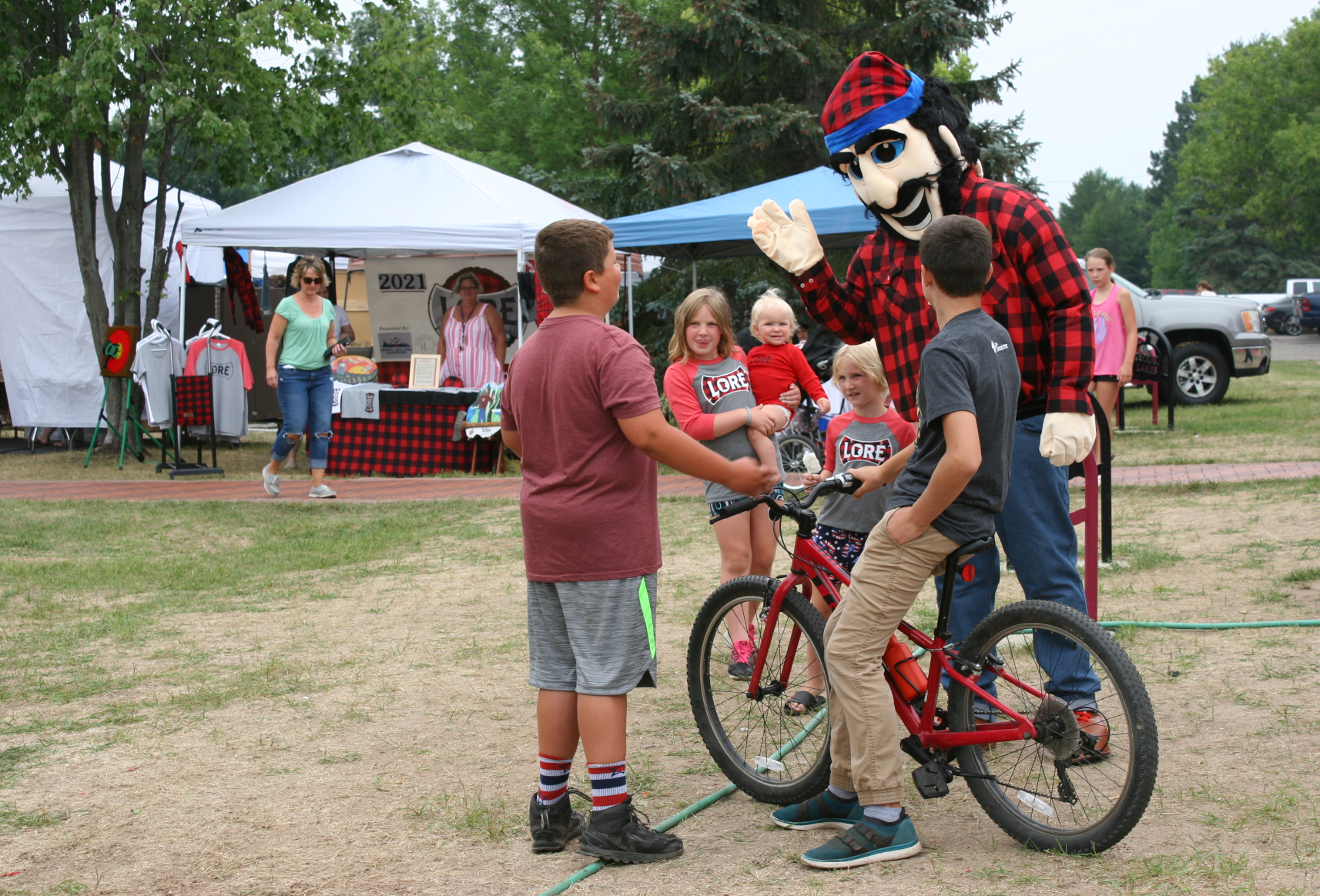
A friendly Paul Bunyan mingles with the crowd during Bean Hole Days. Minnesota Prairie Roots copyrighted photo.
This is Paul Bunyan land. The place of lumberjack lore. So different from my home in southeastern Minnesota. Paul and his side kick, Babe the Blue Ox, are universally appealing, creating a strong tourism branding identity for this region.
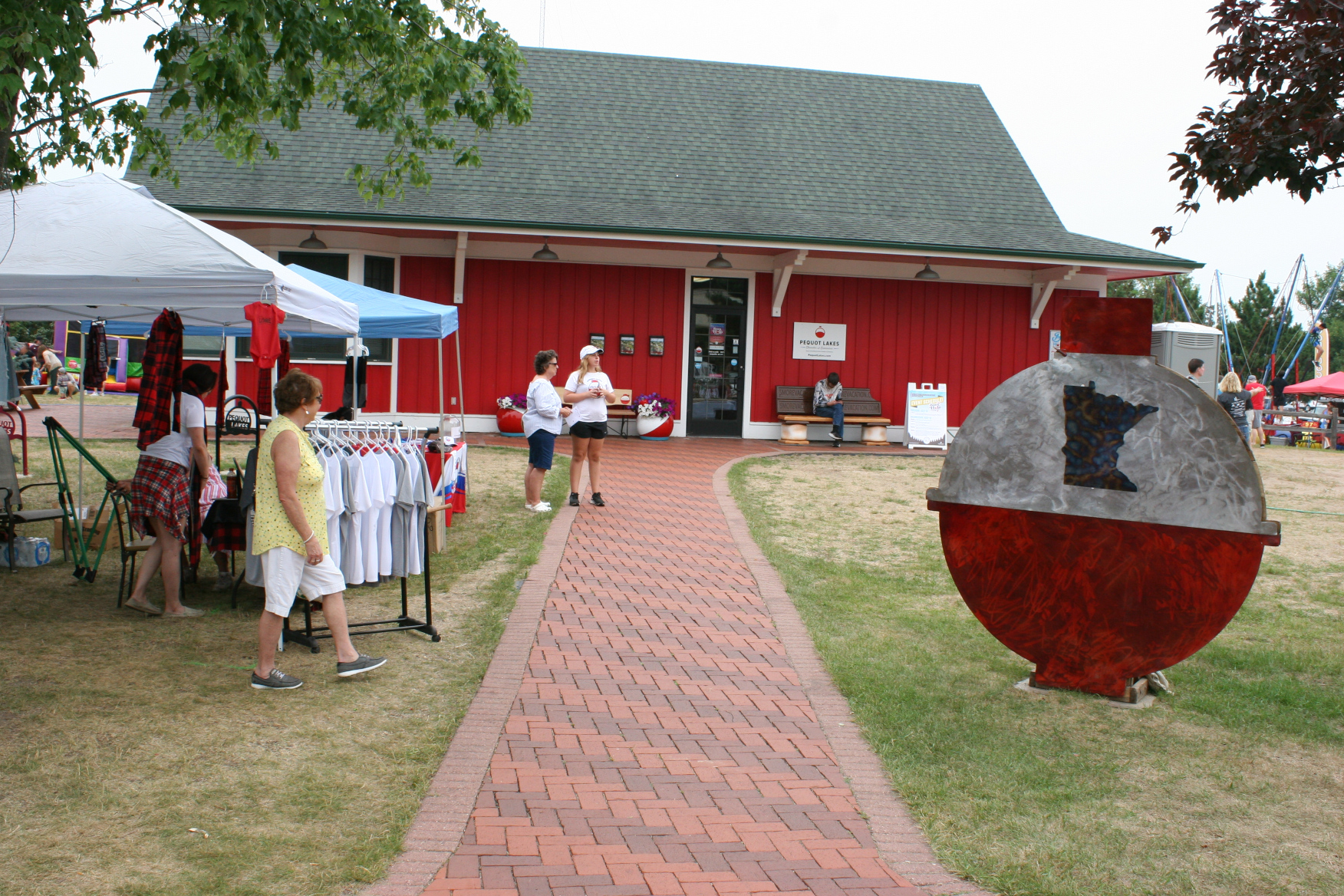
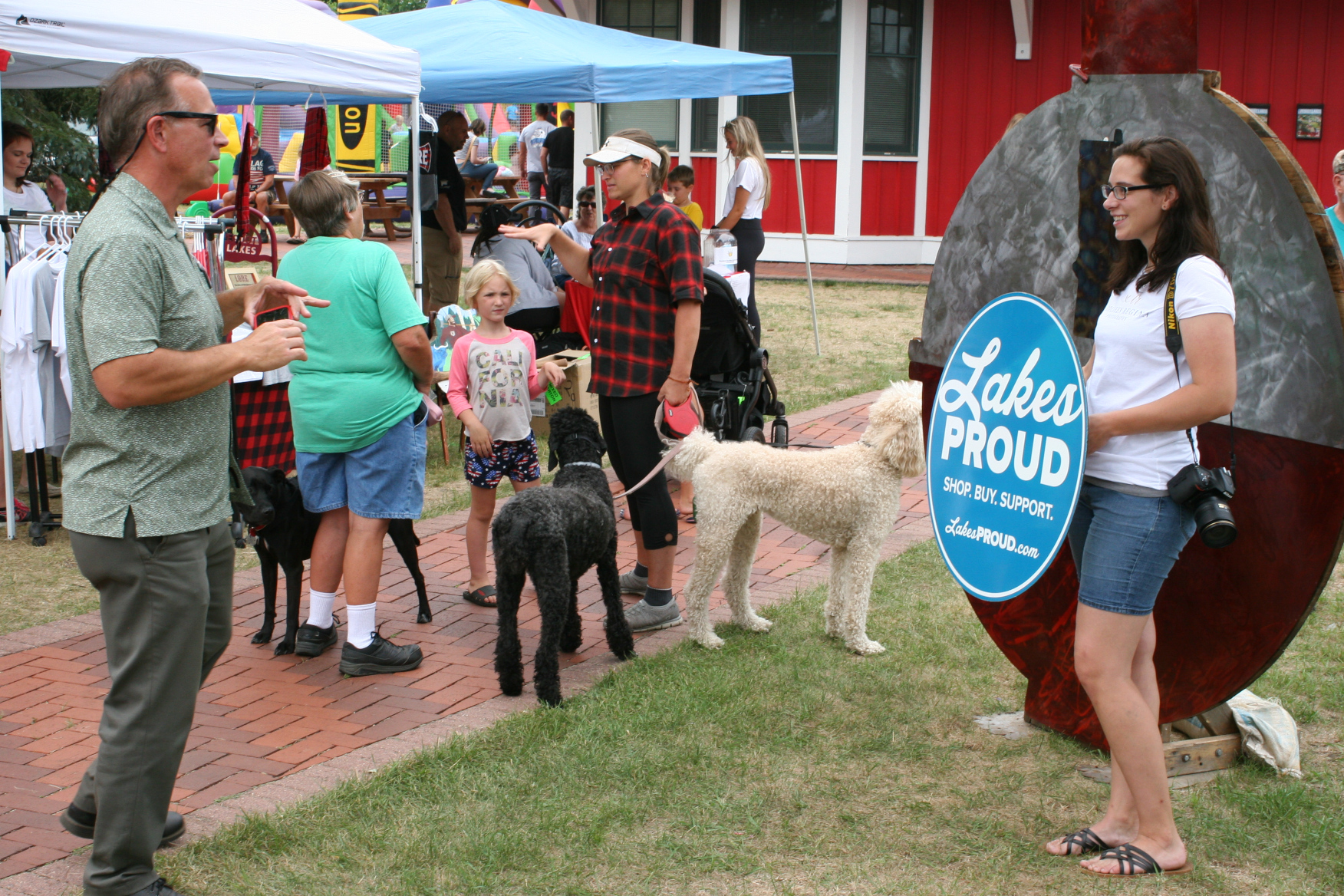
In Trailside Park, bobber sculpture and the Chamber of Commerce and Tourism office draw visitors. Minnesota Prairie Roots copyrighted photo.
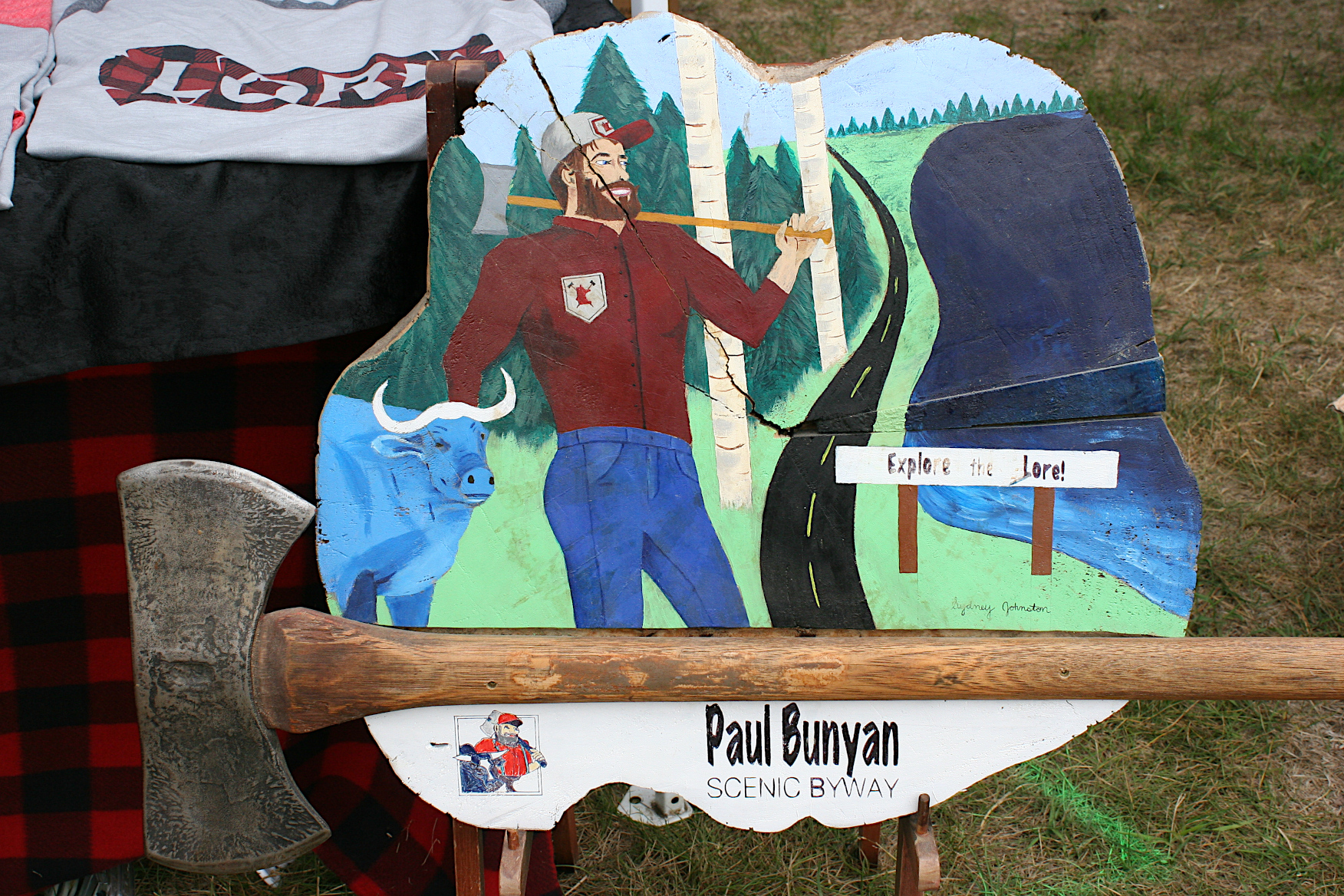
Paul Bunyan art promoting the scenic byway, spotted at Bean Hole Days. Minnesota Prairie Roots copyrighted photo.
And the Paul Bunyan Scenic Byway, a 54-mile route along county roads in scenic northern Crow Wing County and a portion of Cass County, also passes through Pequot Lakes.
The bobber sculpture proved popular with visitors during Bean Hole Days. Minnesota Prairie Roots copyrighted photo.
To visit this region is to appreciate and embrace the stories and character of Northwoods strong Paul Bunyan. And his sweetheart Lucette Diana Kensack (seen in Hackensack, a bit farther to the north).
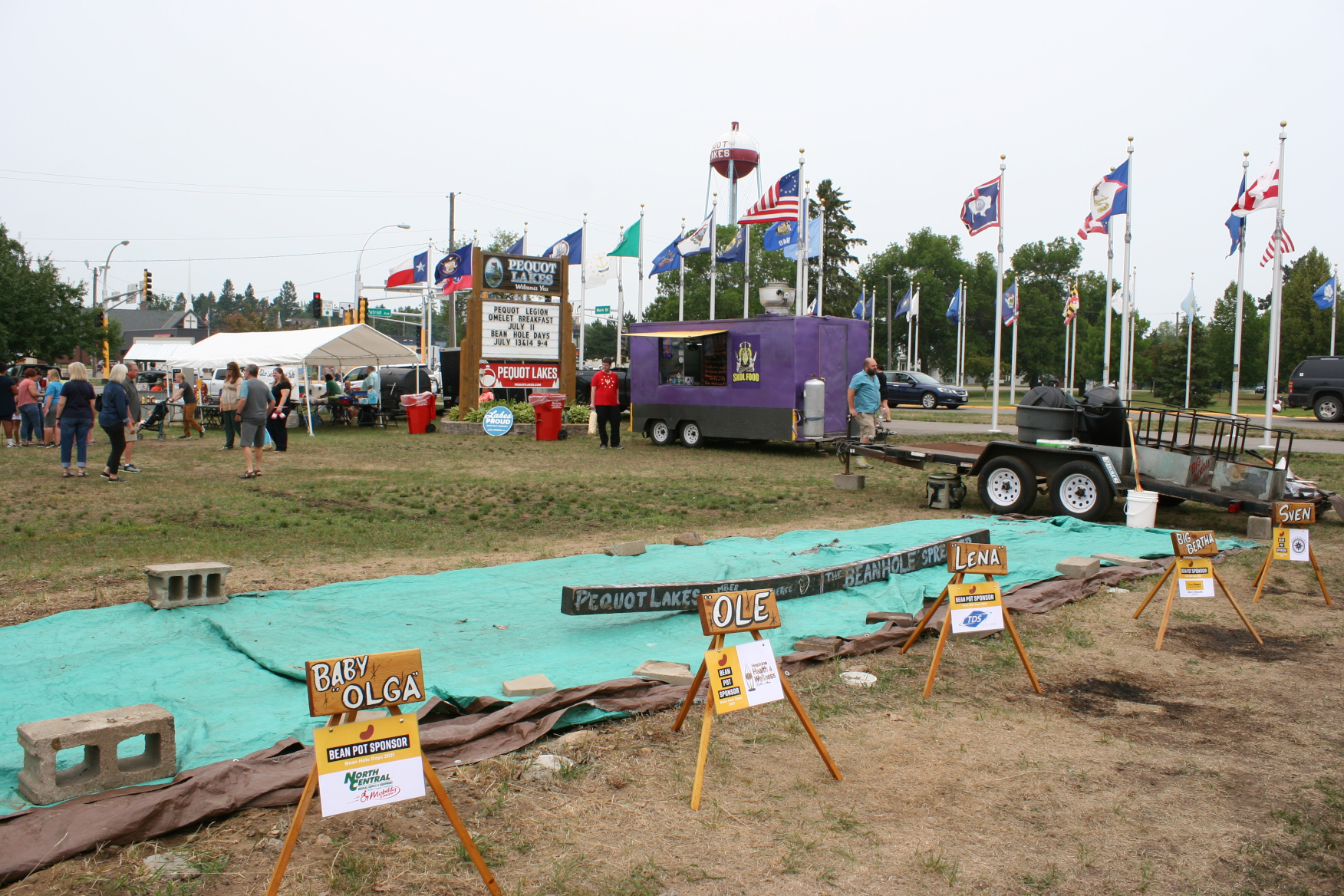
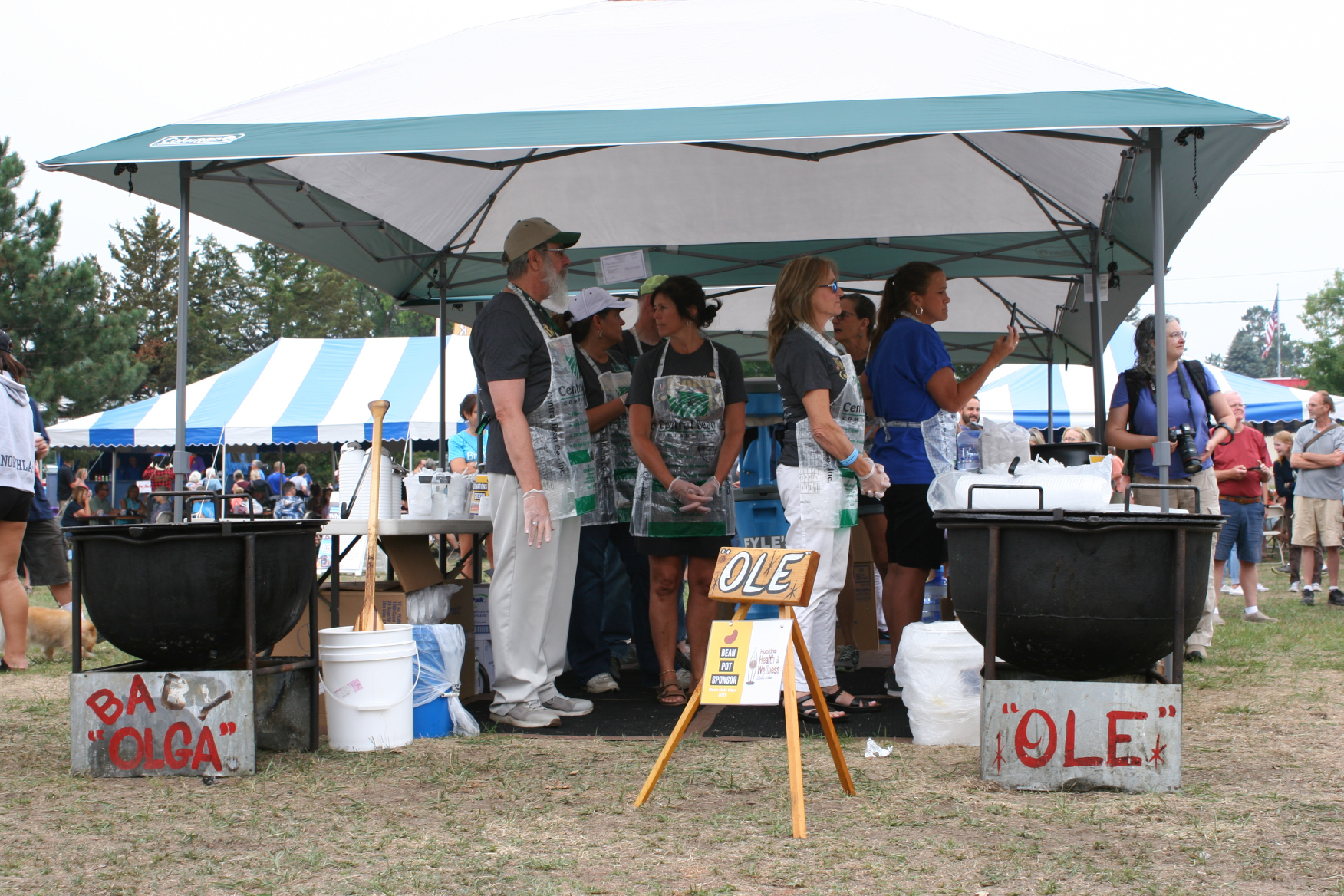
Kettles of beans bake in a covered pit. Each is named. Minnesota Prairie Roots copyrighted photo.
I appreciate how hard the good folks of this area work to brand this region and to create events that entertain and also provide visitors with unique experiences. Bean Hole Days, for example, rates as unlike anything I’ve ever attended. I loved everything about it from the people to the phenomenal homemade beans baked underground in Paul Bunyan-sized kettles.
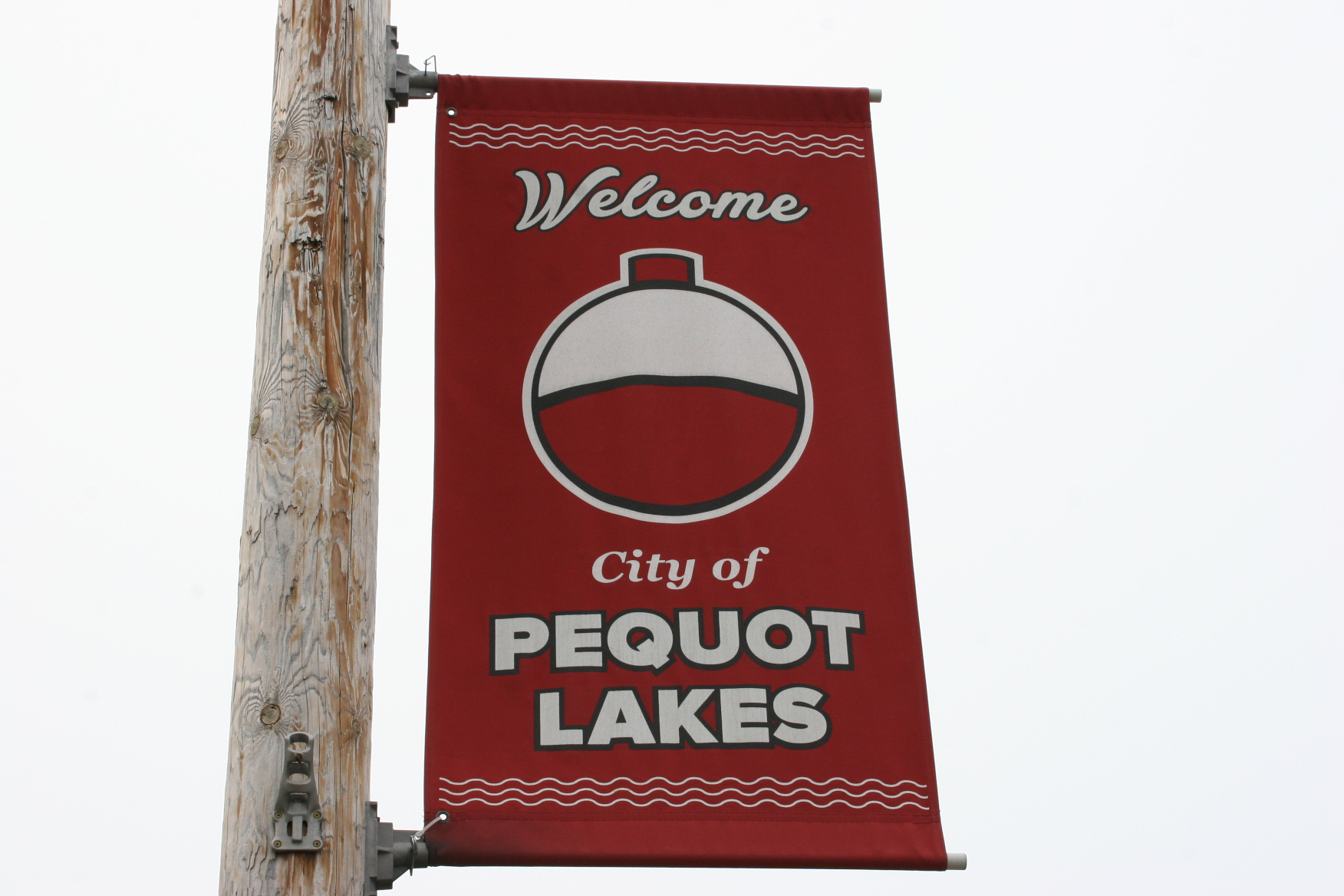
The bobber brands Pequot Lakes. Minnesota Prairie Roots copyrighted photo.
In about 10 more days, on Saturday, August 7, Pequot Lakes hosts another celebration—a Chokecherry Festival. Chokecherries are a tiny stone fruit often used in making jellies and jams. Pequot Lakes calls itself the Chokecherry Capital of Minnesota. I’m quite familiar with these berries, having picked more pails full than I care to remember while growing up on a southwestern Minnesota farm.
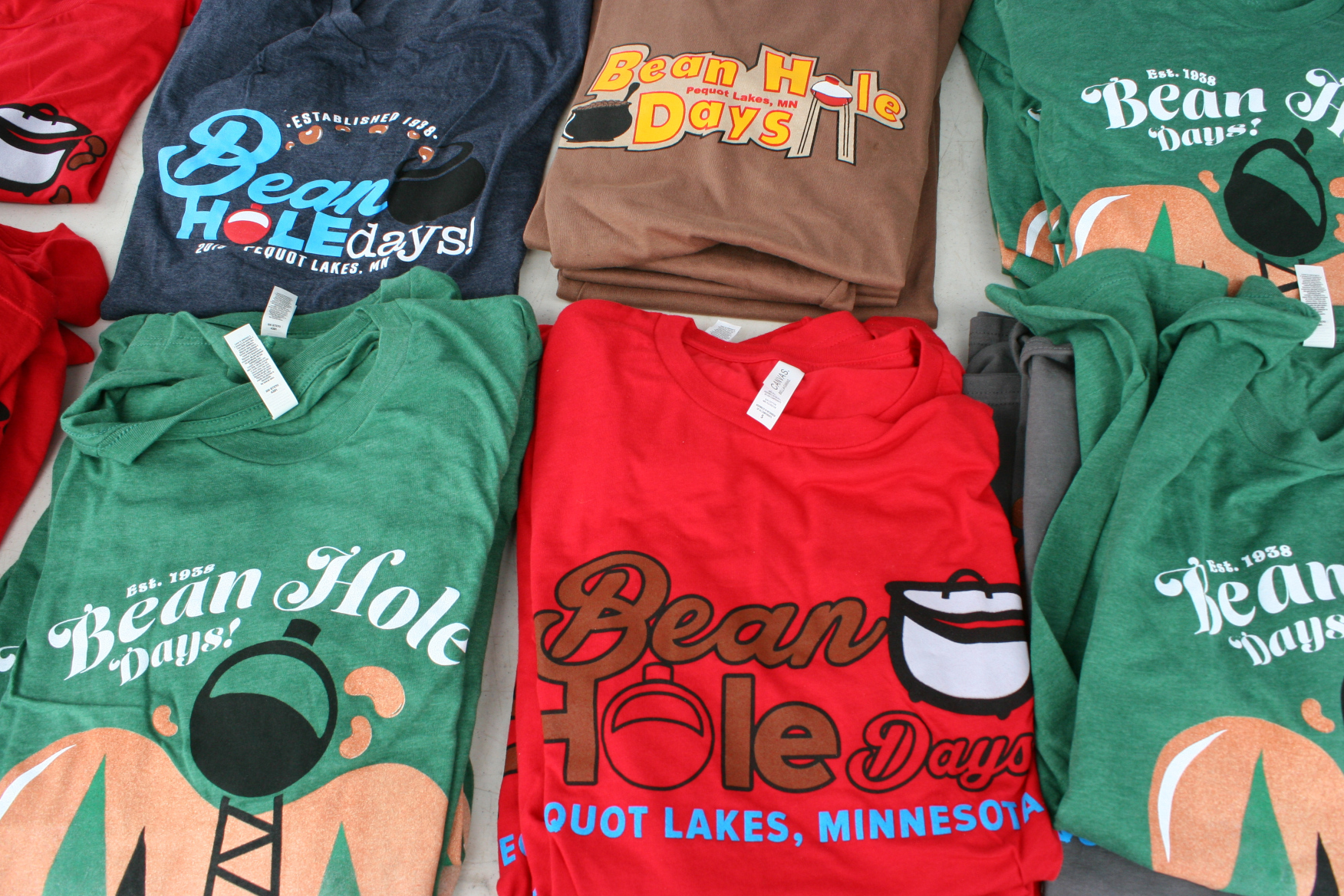
I expect vending of tees at the Chokecherry Festival, just like at Bean Hole Days. Minnesota Prairie Roots copyrighted photo.
That aside, it doesn’t appear the Pequot Lakes celebration includes any chokecherry harvesting. But it does feature a Pit Spitting Contest and a Chokecherry Culinary Contest with four categories. Jams/jellies/preserves, pastries, wine and originality.
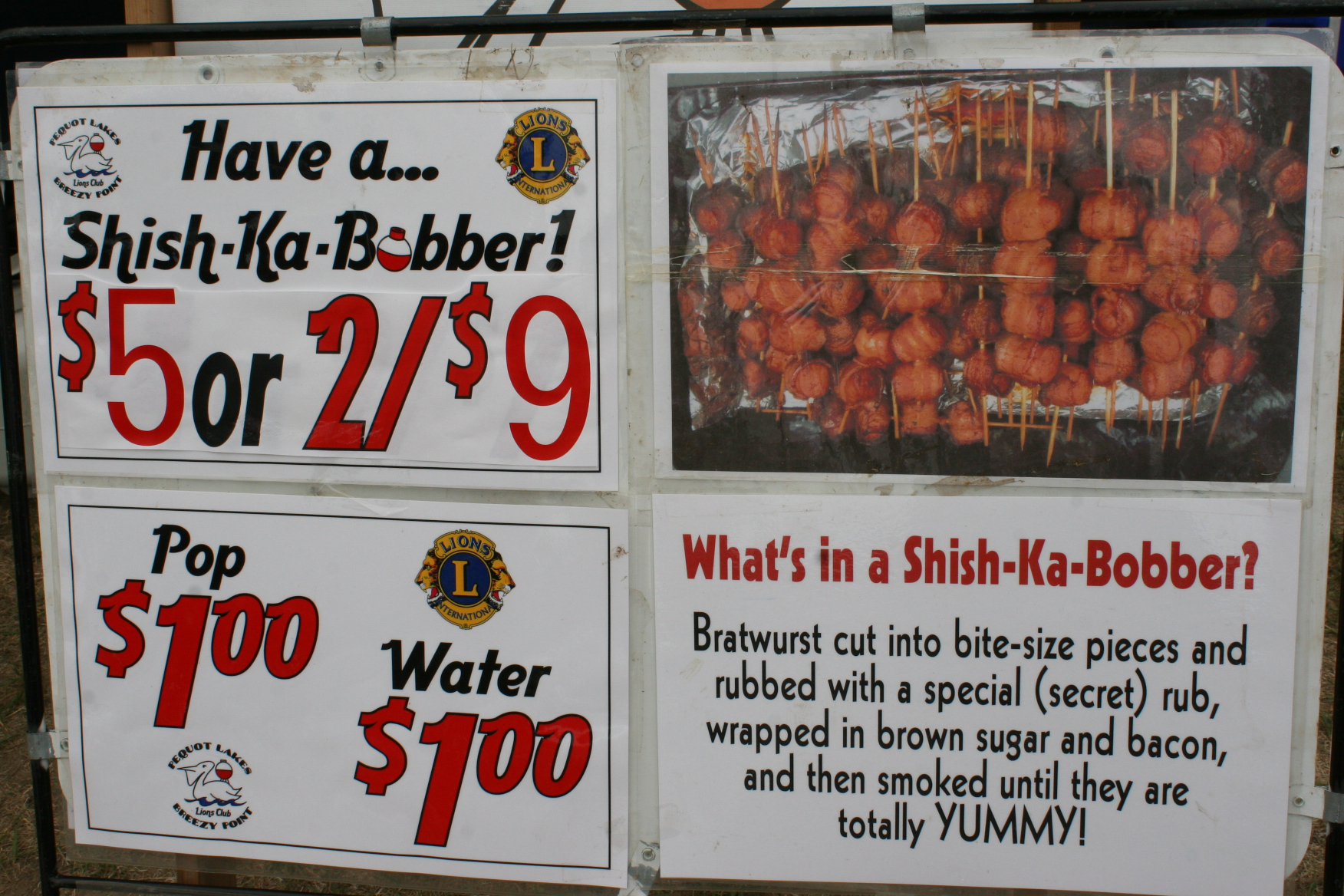
Festival food offered by the Pequot Lakes/Breezy Point Lions Club. Minnesota Prairie Roots copyrighted photo.
And just like at Bean Hole Days, the 9 a.m. – 4 p.m. event in Trailside Park includes an Arts-Crafts Fair, food vendors, kids’ activities and more.
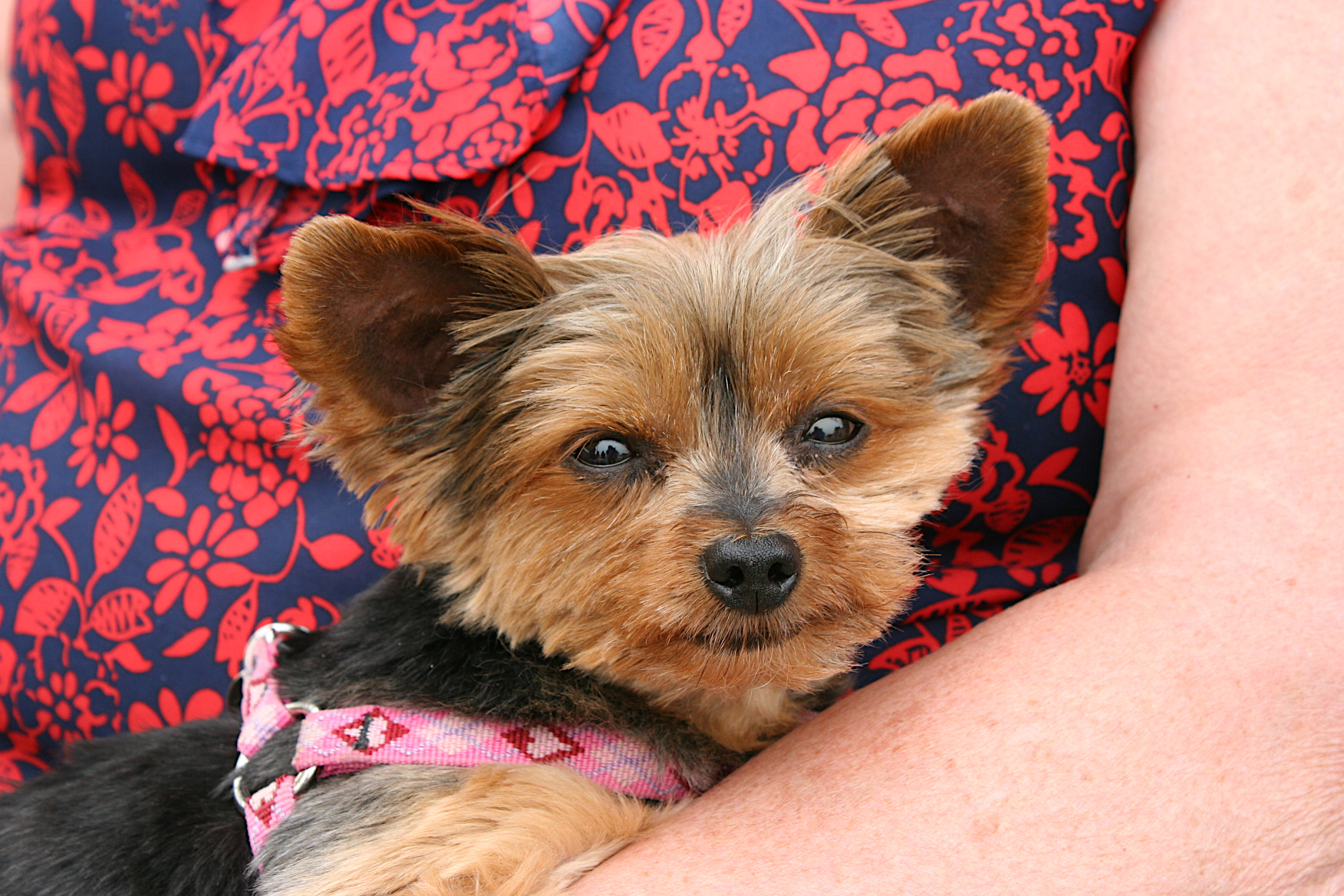
Dogs are welcome. I photographed this one in the arms of a Arts/Crafts Fair vendor at Bean Hole Days. Minnesota Prairie Roots copyrighted photo.
I encourage you to take in small town celebrations like those offered in Pequot Lakes and neighboring communities in Paul Bunyan land. To do so is to experience the Northwoods culture, at least the side that draws tourists to town.
#
This marks the third, and final, in a series of posts on Pequot Lakes.
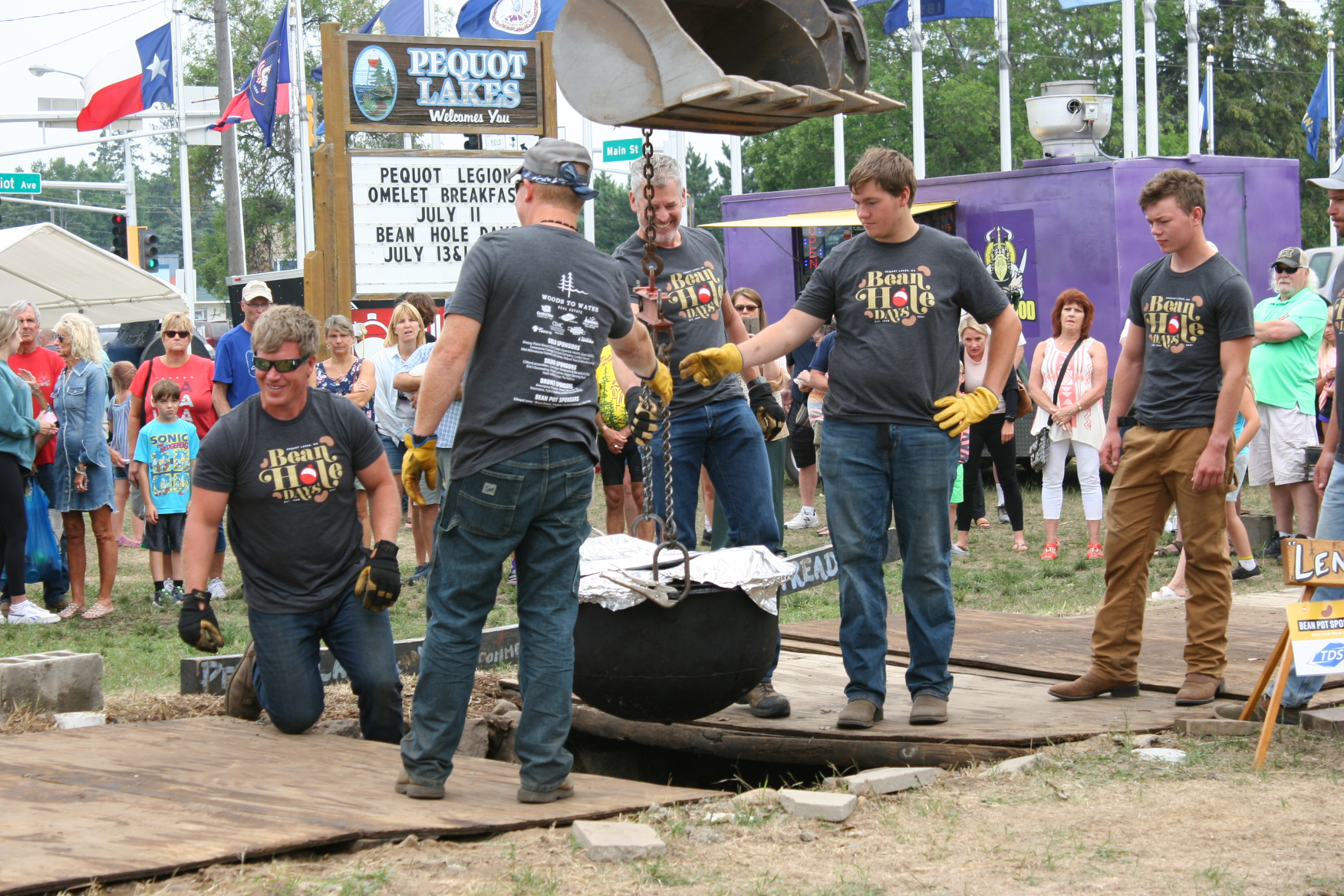
The Bean Hole crew guides a kettle of beans from an underground cooking pit at Bean Hole Days in Pequot Lakes. Minnesota Prairie Roots copyrighted photo.
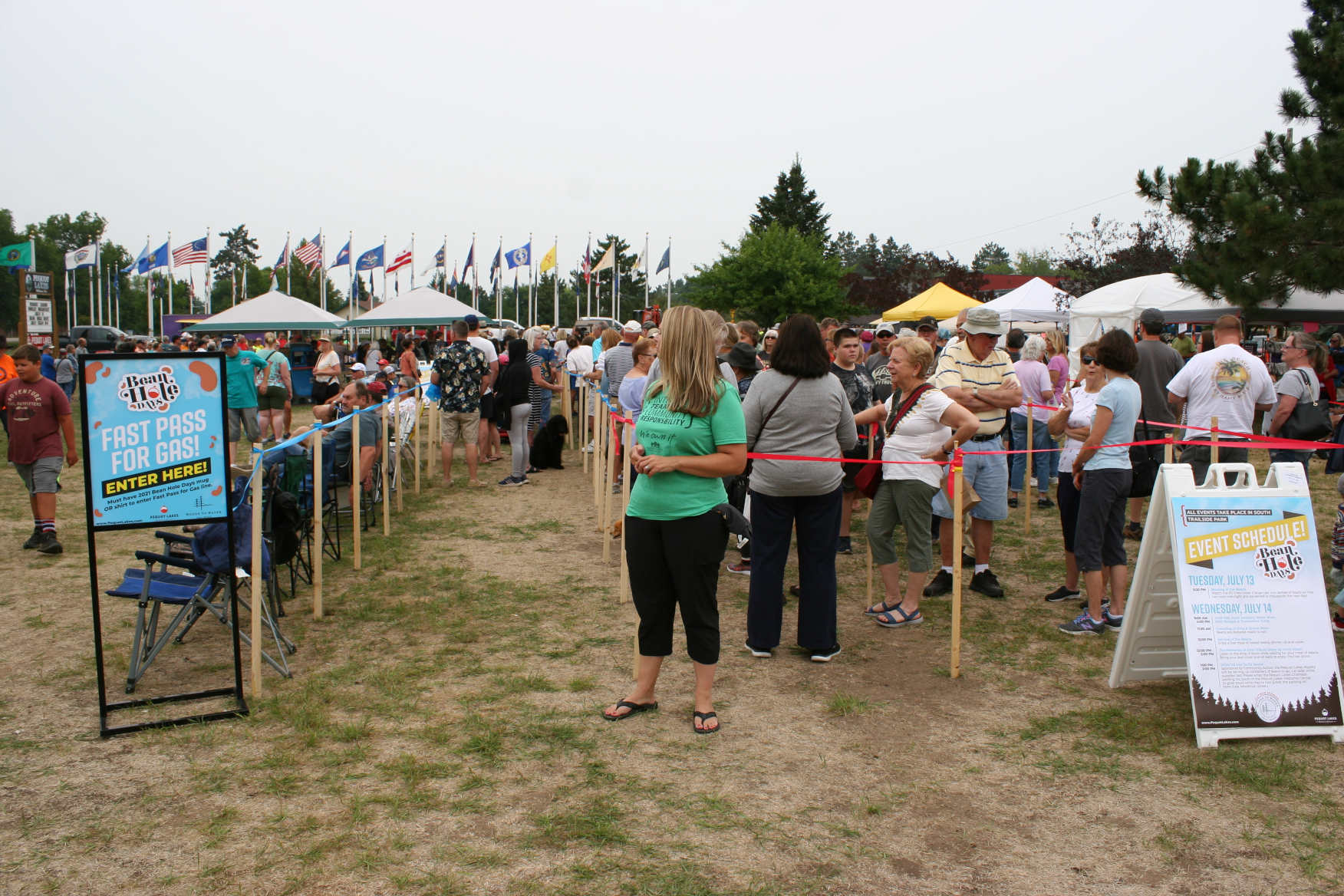
LONG LINES FORMED an hour before the event in makeshift narrow aisles crafted from stakes and ribbon. Folks waited not for Paul Bunyan, although he was there, working the crowd. And not for Elvis, although he performed. Rather, they waited for a serving of baked beans.
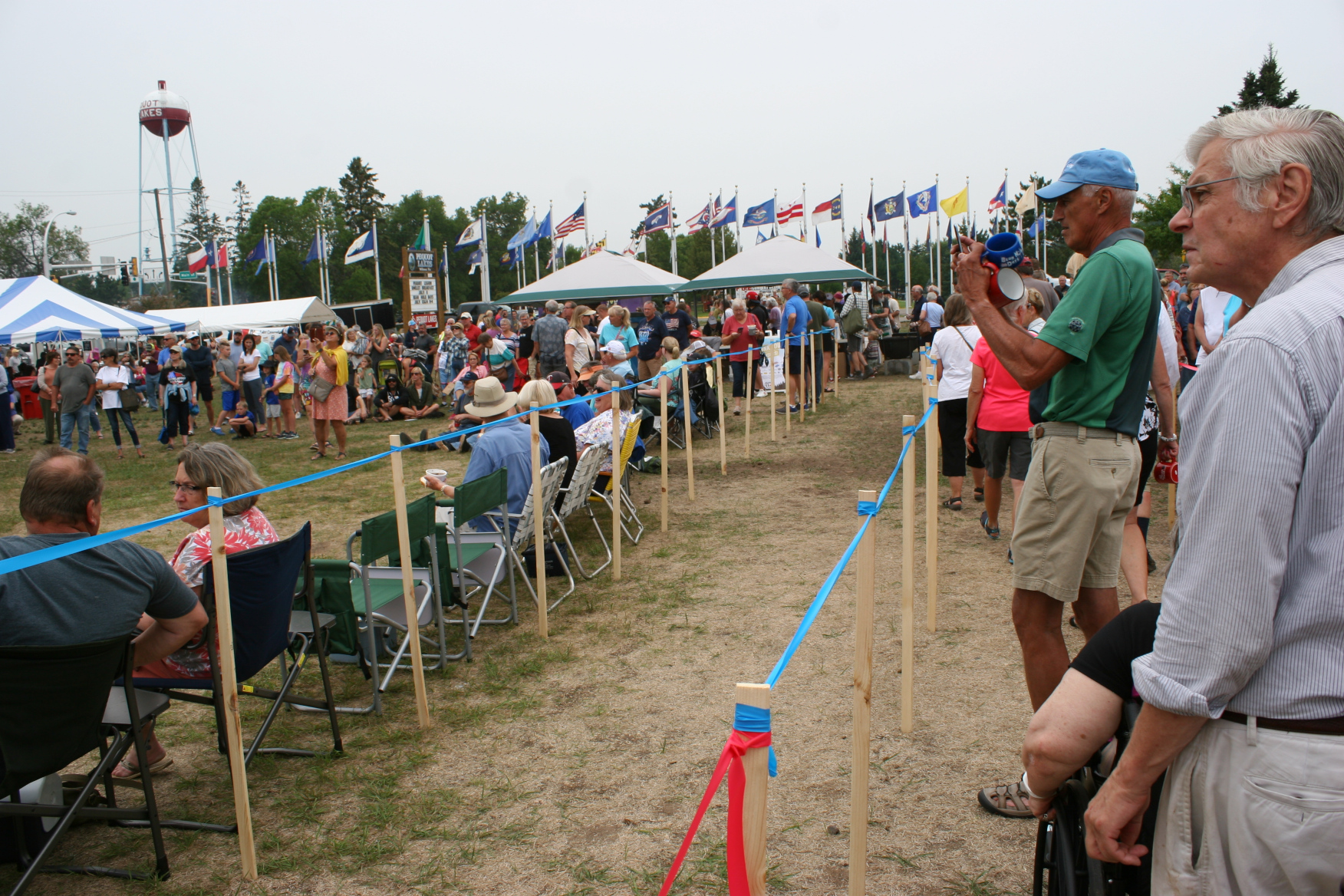
Thousands line up for a bowl of baked beans. Minnesota Prairie Roots copyrighted photo.
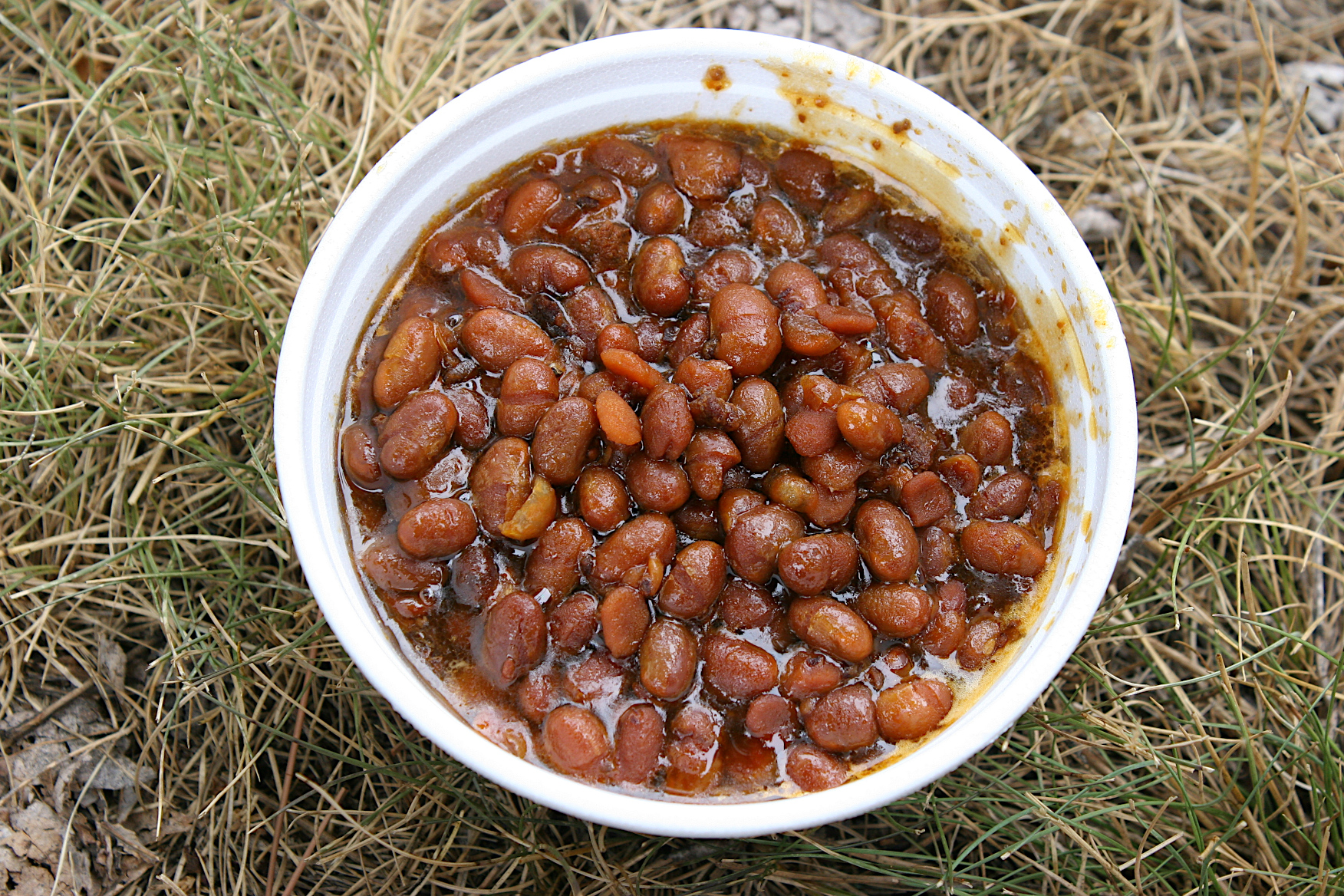
My bowl of baked beans. The beans are fee with donations accepted. Minnesota Prairie Roots copyrighted photo.
Lifting the kettles from the pit requires machinery and manpower. Minnesota Prairie Roots copyrighted photo.
This scene unfolded on Wednesday, July 14, during Bean Hole Days in Pequot Lakes, a small town in the central Minnesota lakes region. Randy and I, staying at a family member’s guest lake cabin south of nearby Crosslake, attended for the first time. And it was quite the experience. I mean that in a truly positive way. While I don’t like waiting, waiting for a generous serving of bacon-laced navy beans baked in a wood-fired pit proved well worth my time. I’ve never tasted better homemade baked beans.
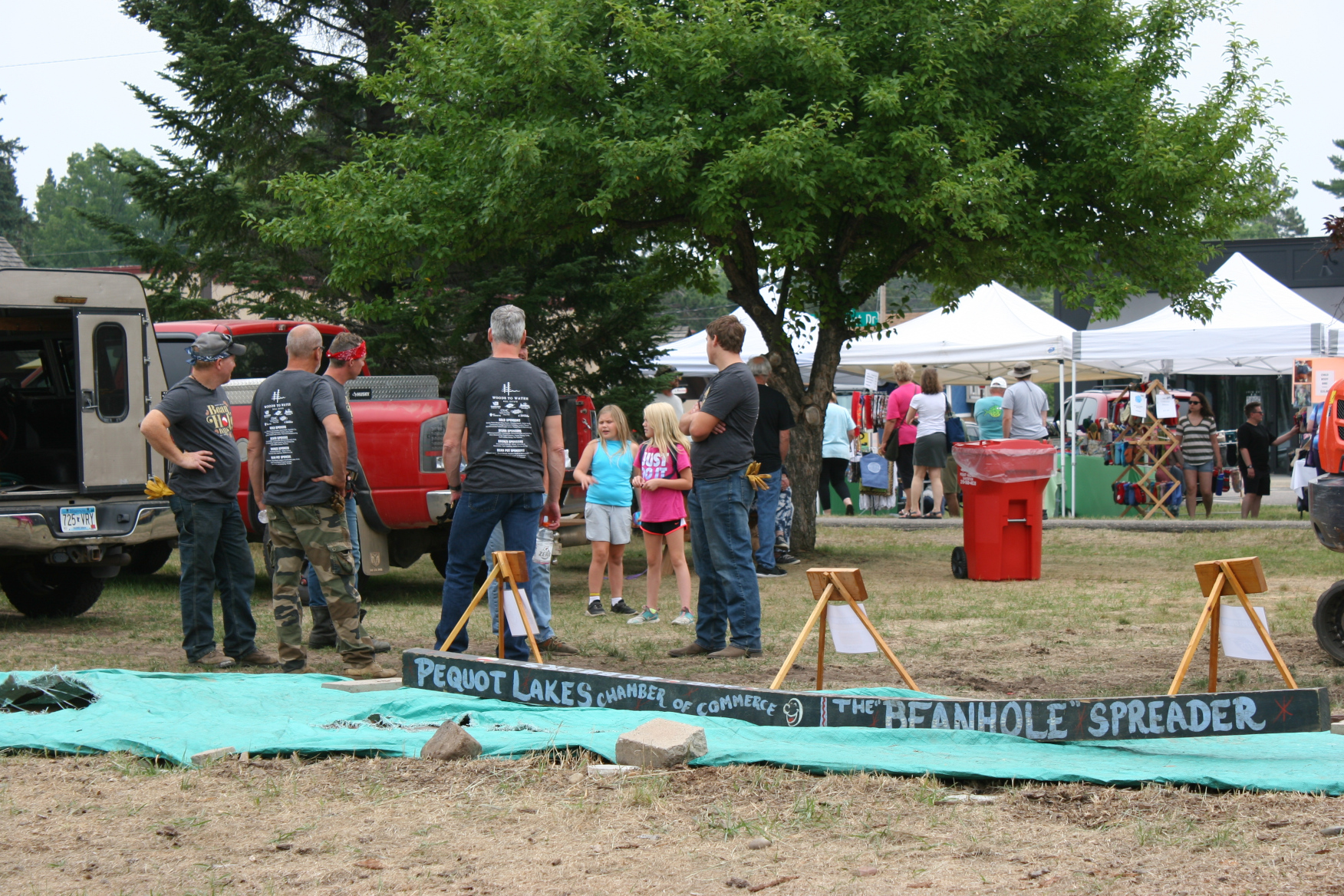
The bean crew waits near the pit where the beans bake. Minnesota Prairie Roots copyrighted photo.
The process of crafting these beans is impressive. I missed the prep and lowering of massive cast iron kettles into the ground Tuesday. But in chatting with a bean crew member on Wednesday, I learned that the 350 pounds of navy beans were soaked and partially cooked with propane before lowering the cauldrons into the pit of wood coals for overnight baking. And yes, it takes a knowledgeable team and machinery for this operation.
Almost ready to serve beans. Minnesota Prairie Roots copyrighted photo.
My bean crew source wasn’t sharing details about ingredients, with the exception of 126 pounds of bacon mixed into the beans. The special “sauce,” which definitely tastes of molasses, is a guarded secret. And that’s all right. It adds to the mystery, the intrigue.
Lining up for beans under the direction of a volunteer. Minnesota Prairie Roots copyrighted photo.
From my observations, volunteers have this bean-baking down to a science. And they should. Bean Hole Days began in 1938 as a way for local businessmen to thank farmers for their business. Today, the focus seems more on drawing vacationers into town—to the local shops and restaurants. While waiting in line for 45 minutes, I chatted with couples from Baxter and the Twin Cities.
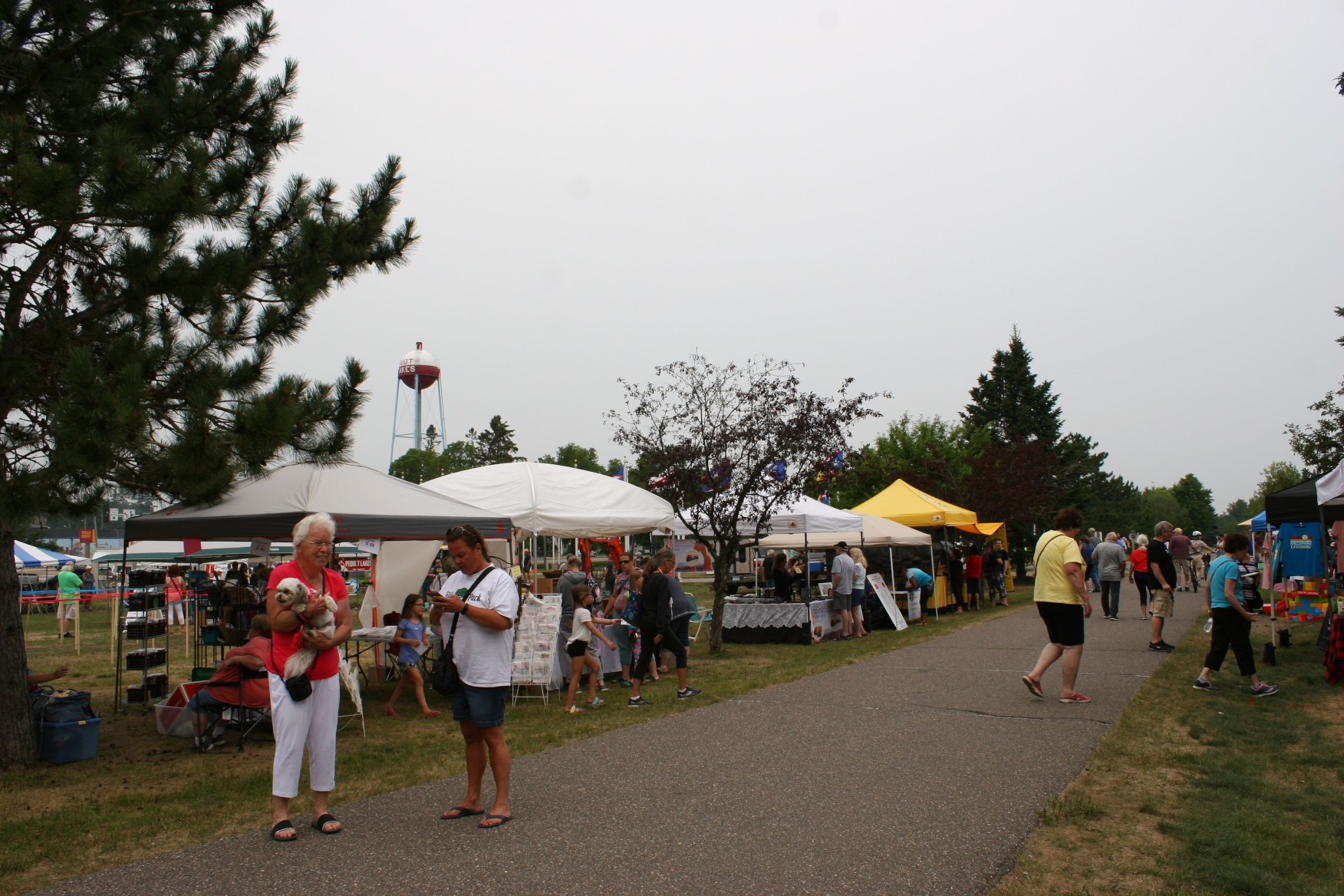
We arrived early with plenty of time to check out the arts and crafts. Minnesota Prairie Roots copyrighted photo.
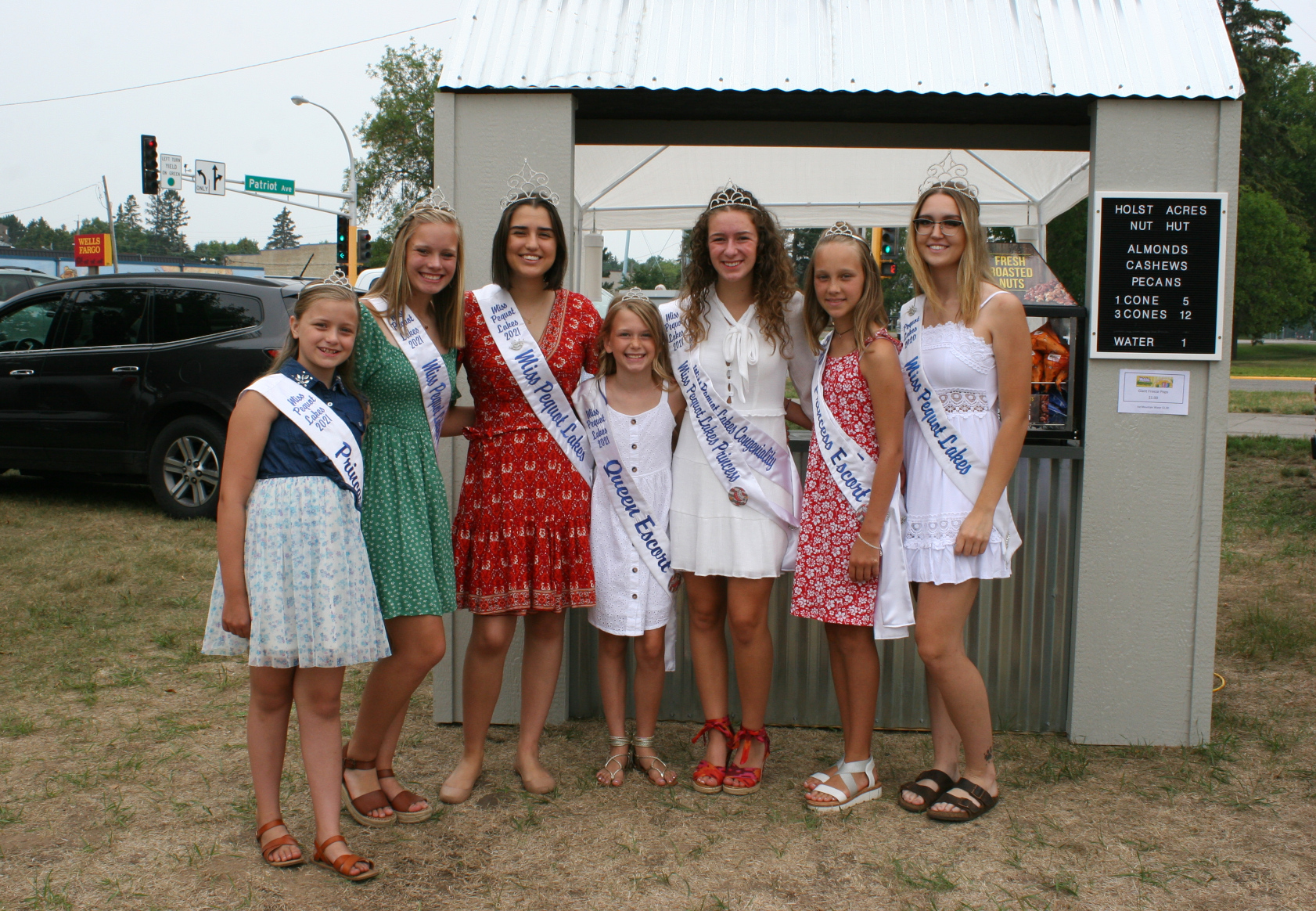
Bean Hole Days royalty. Minnesota Prairie Roots copyrighted photo.
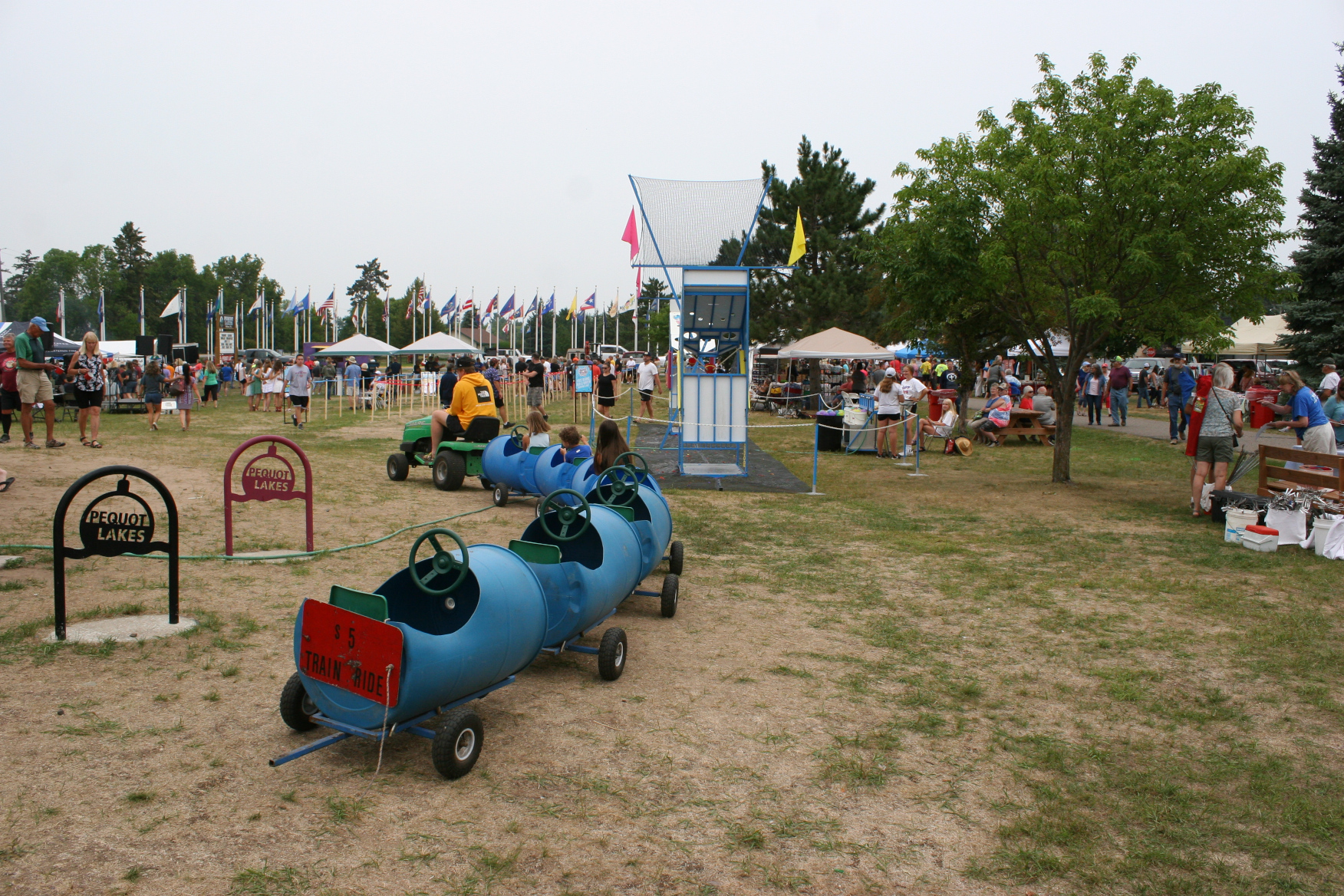
An old-fashioned barrel train weaves through the festival grounds. Minnesota Prairie Roots copyrighted photo.
This event at Trailside Park is about much more than beans. It also features an arts and craft fair, a small kiddie carnival, food vendors and crowning of Bean Hole royalty. And this year free COVID-19 vaccinations.
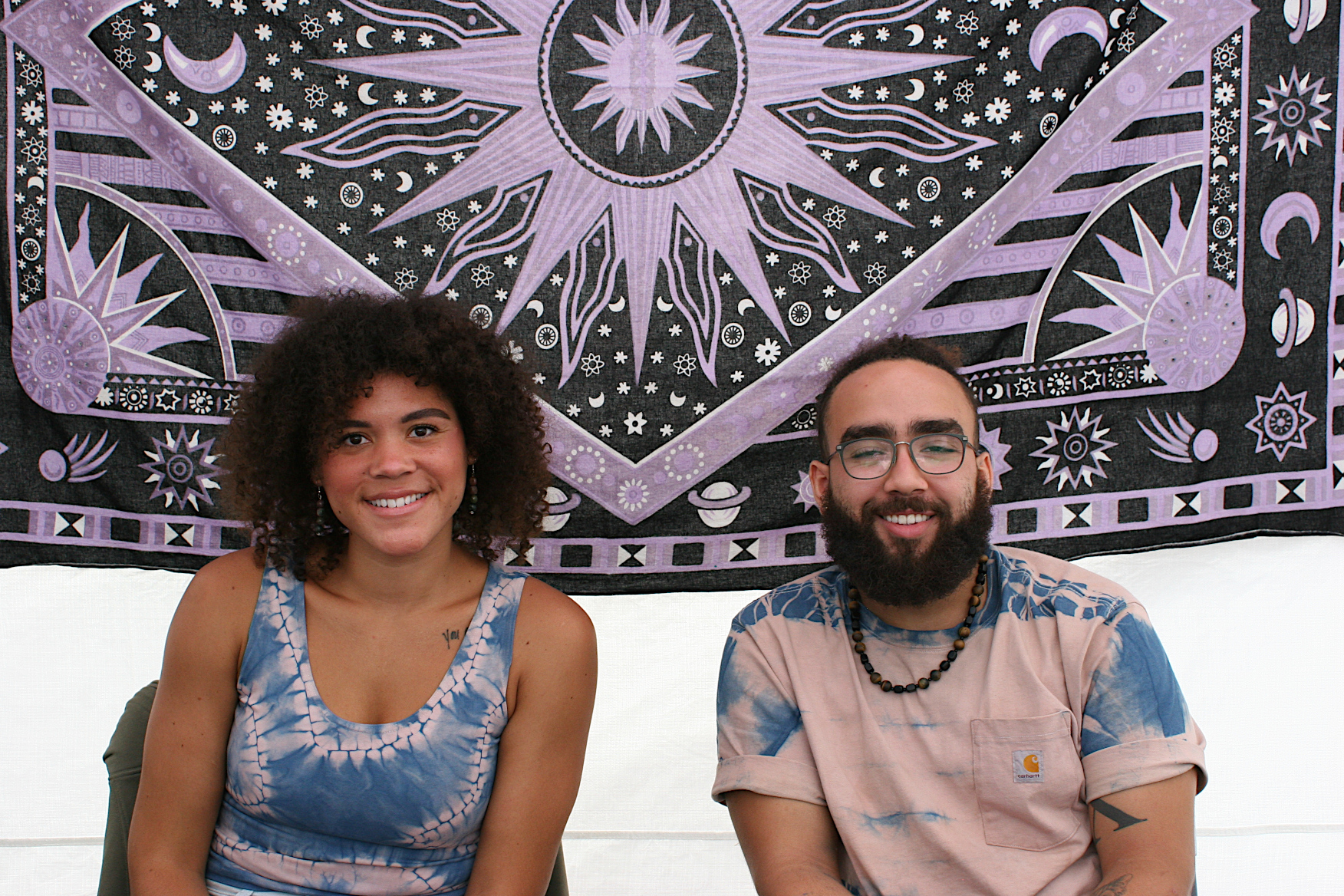
These friendly vendors sold art (Shea J. Maze) and naturally-dyed goods (Diaspora Textiles). Minnesota Prairie Roots copyrighted photo.
I enjoyed chatting with vendors, mingling, watching. And photographing.
Paul Bunyan greets Bean Hole Days attendees. Minnesota Prairie Roots copyrighted photo.
Bean Hole Days, because of its location in Pequot Lakes among lakes and pines in cabin country, reflects the Minnesota northwoods and all that entails. Fishing. The town water tower is shaped like a bobber. Paul Bunyan and Babe the Blue Ox. Paul shook hands, posed for photos and generally welcomed guests. Babe and bobber sculptures provided photo ops.
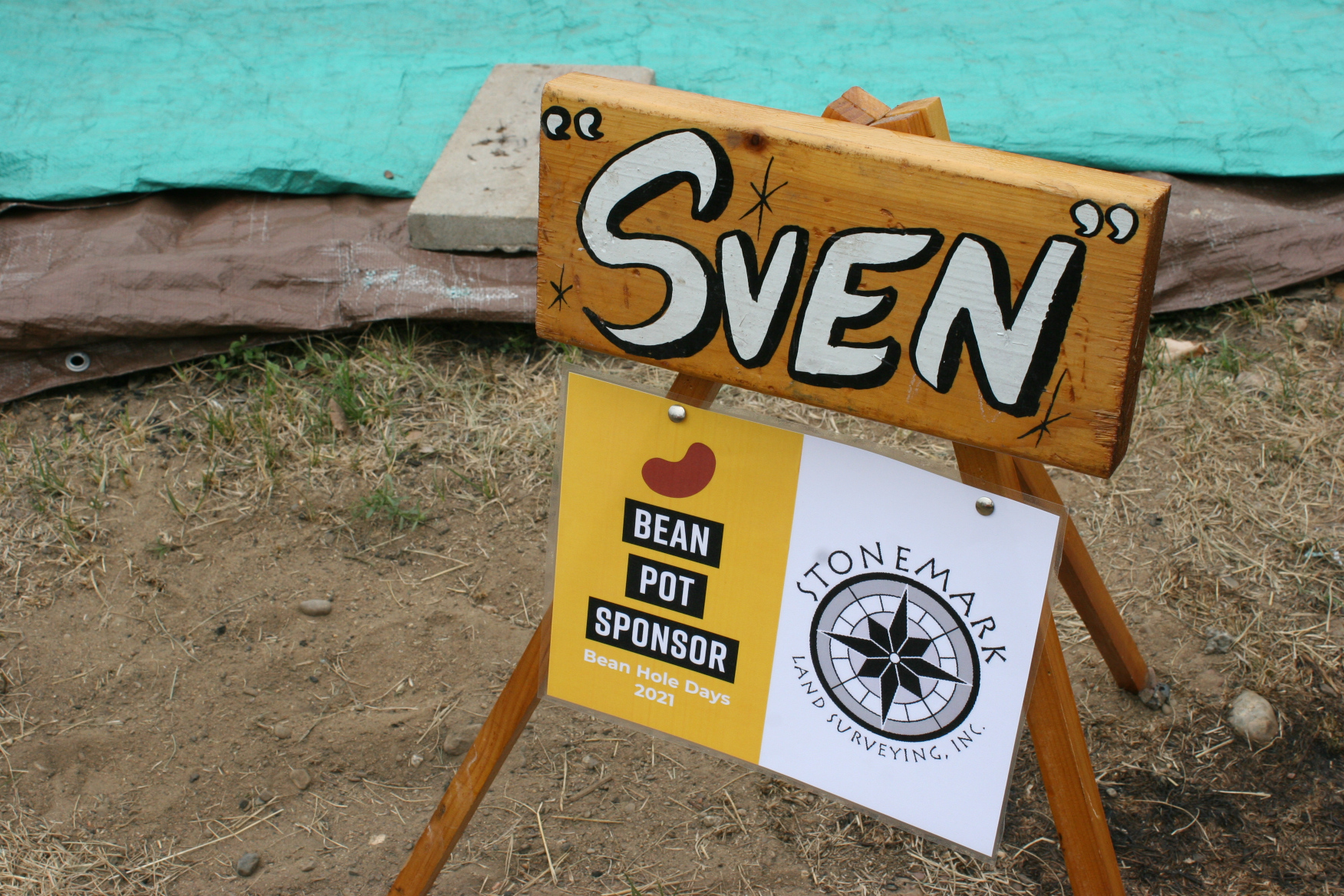
The kettles of beans are given Scandinavian names. Minnesota Prairie Roots copyrighted photo.
Even the kettles of beans, sponsored by area businesses, feature names connecting to the region’s heritage. Lena. Sven. Ole. And more.
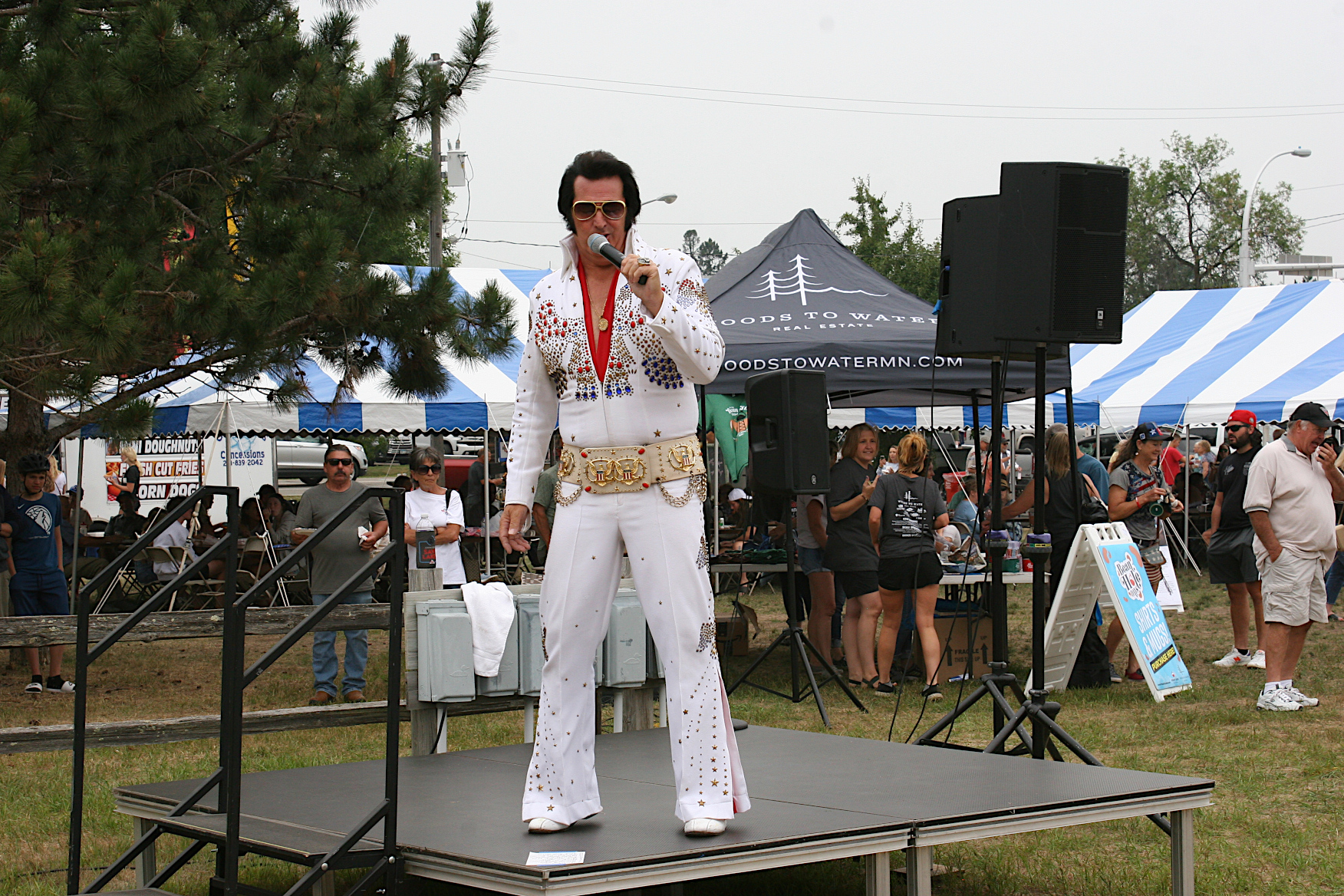
Elvis entertains the waiting crowd. Minnesota Prairie Roots copyrighted photo.
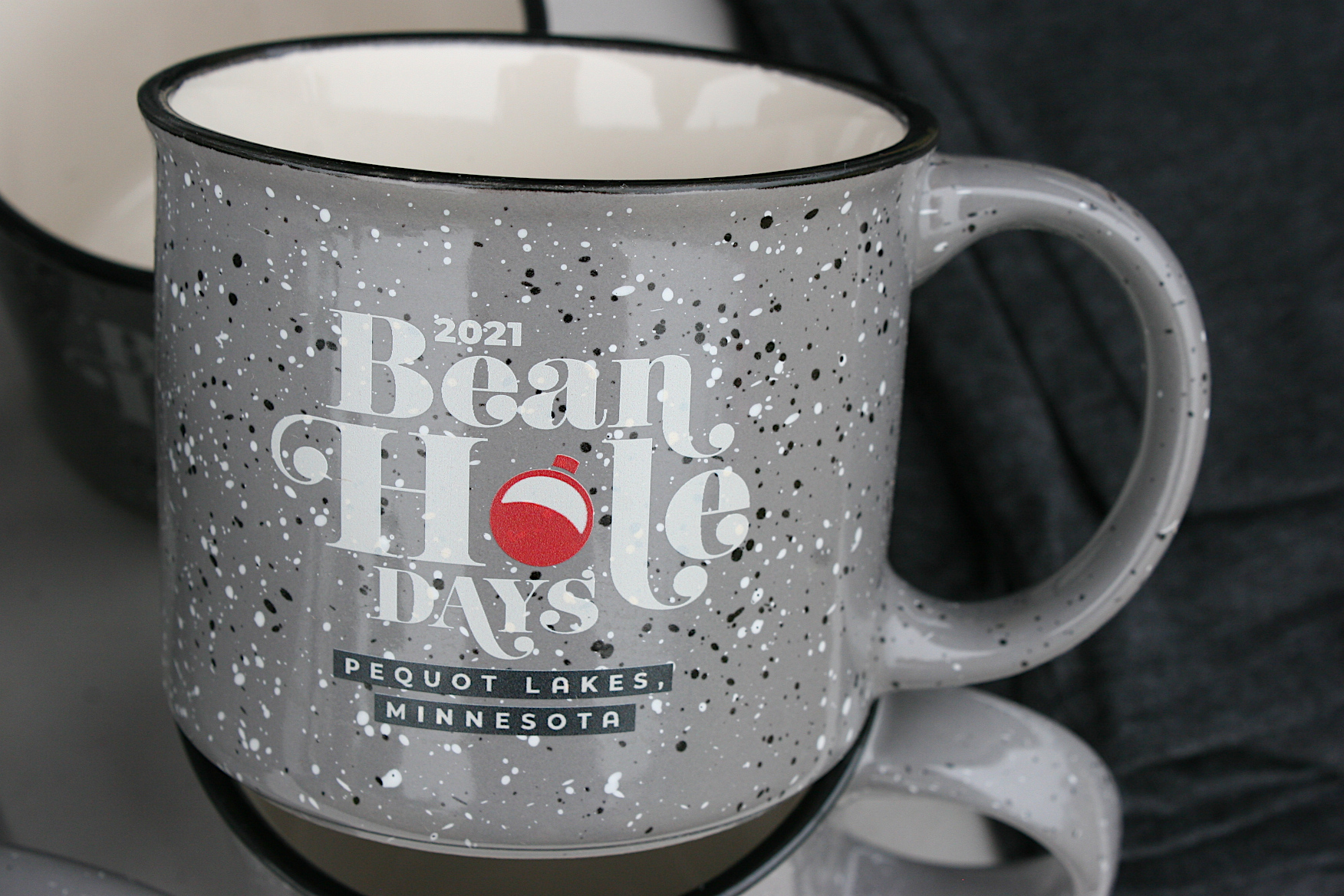
This mug allows you to go in the fast/first serving line. Minnesota Prairie Roots copyrighted photo.
Buy a mug and enter the fast lane. Minnesota Prairie Roots copyrighted photo.
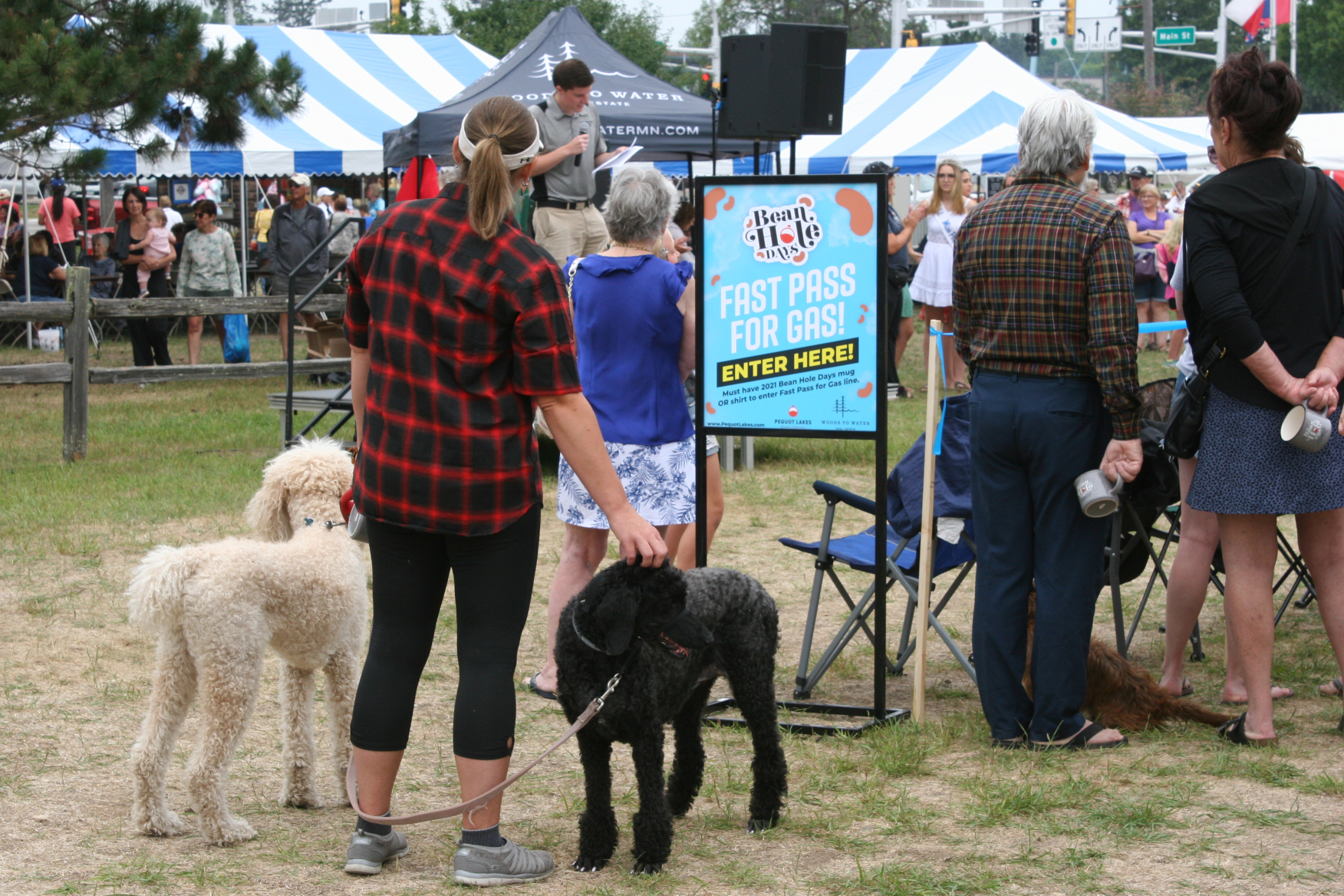
As I waited in line for beans, I danced to the music of Elvis performing live. That garnered a compliment from a volunteer guiding guests to the right serving kettles. Those who purchased a 2021 Bean Hole Days mug advanced through the FAST PASS FOR GAS line. I appreciated the humor. While Randy and I didn’t buy mugs, we left a donation.
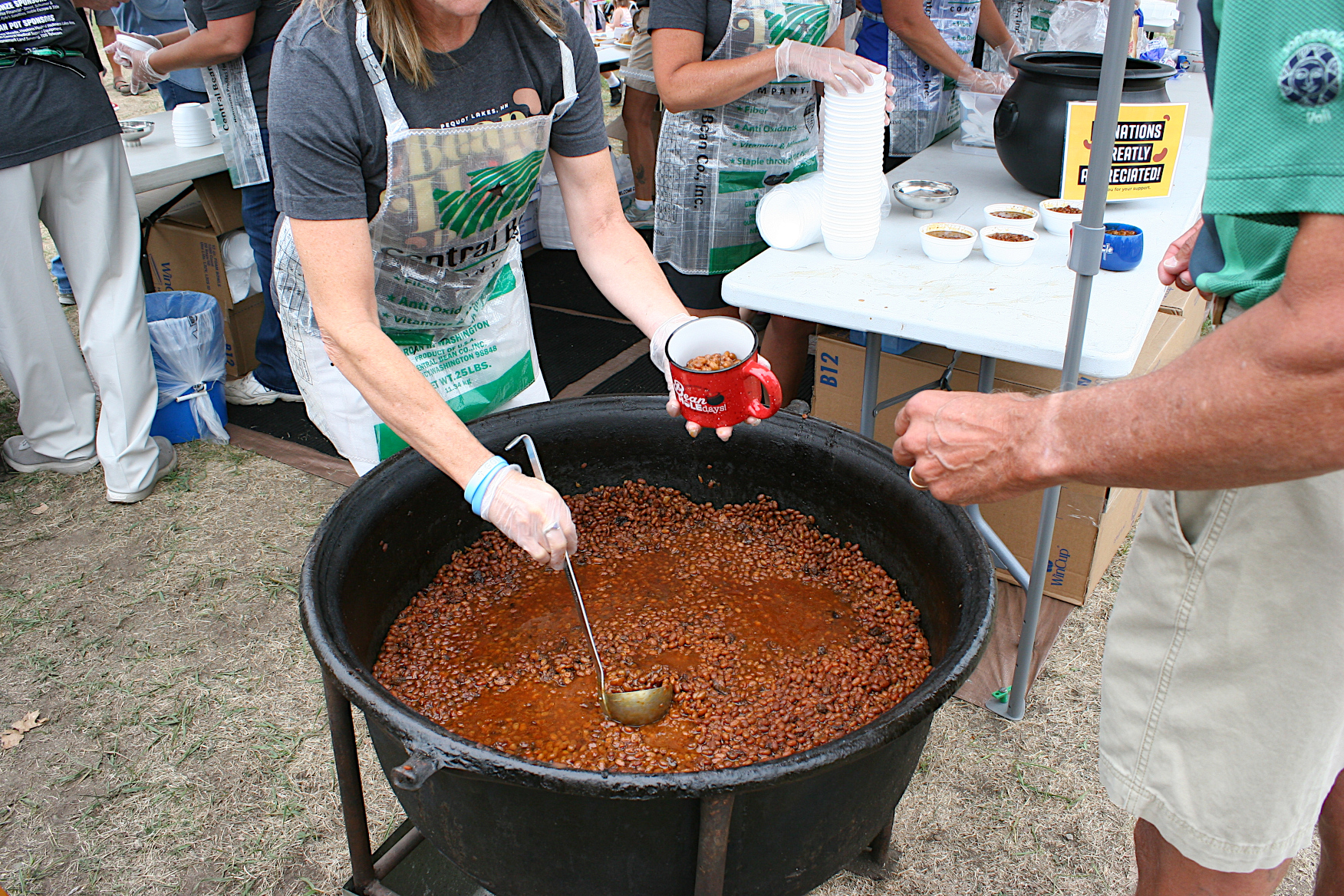
Volunteers ladle generous portions of baked beans. Some people brought their mugs from past years. Minnesota Prairie Roots copyrighted photo.
And we left full of beans and appreciative of all the people who put together this unique small town Minnesota northwoods experience.
#
Please check back for more photos from Bean Hole Days as I couldn’t possibly fit everything into a single post.
Me in flannel. Minnesota Prairie Roots file photo.
MINNESOTA STATE LEGISLATORS recently considered the Labrador retriever as our state dog. The loon is our state bird, the Lady Slipper our state flower. And so on.
Now, if our elected officials decided we also need a state winter dress code, I’d push for flannel shirt and jeans. That’s my outfit of choice from late autumn into spring, or whenever winter ends. Because I work out of my home office, Friday casual fits daily. And because I’ve never been pegged as a fashionista (ask my sister who got my childhood hand-me-down clothes and still reminds me to this day of my horrible fashion sense), I embrace comfortable attire. Like blue jeans and flannel.
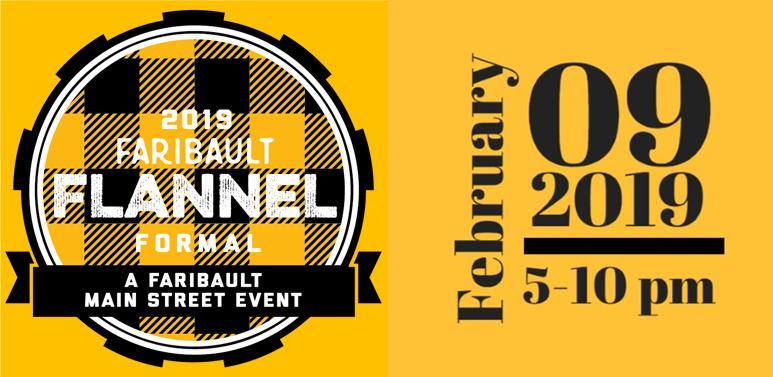
Source: Faribault Main Street Facebook page.
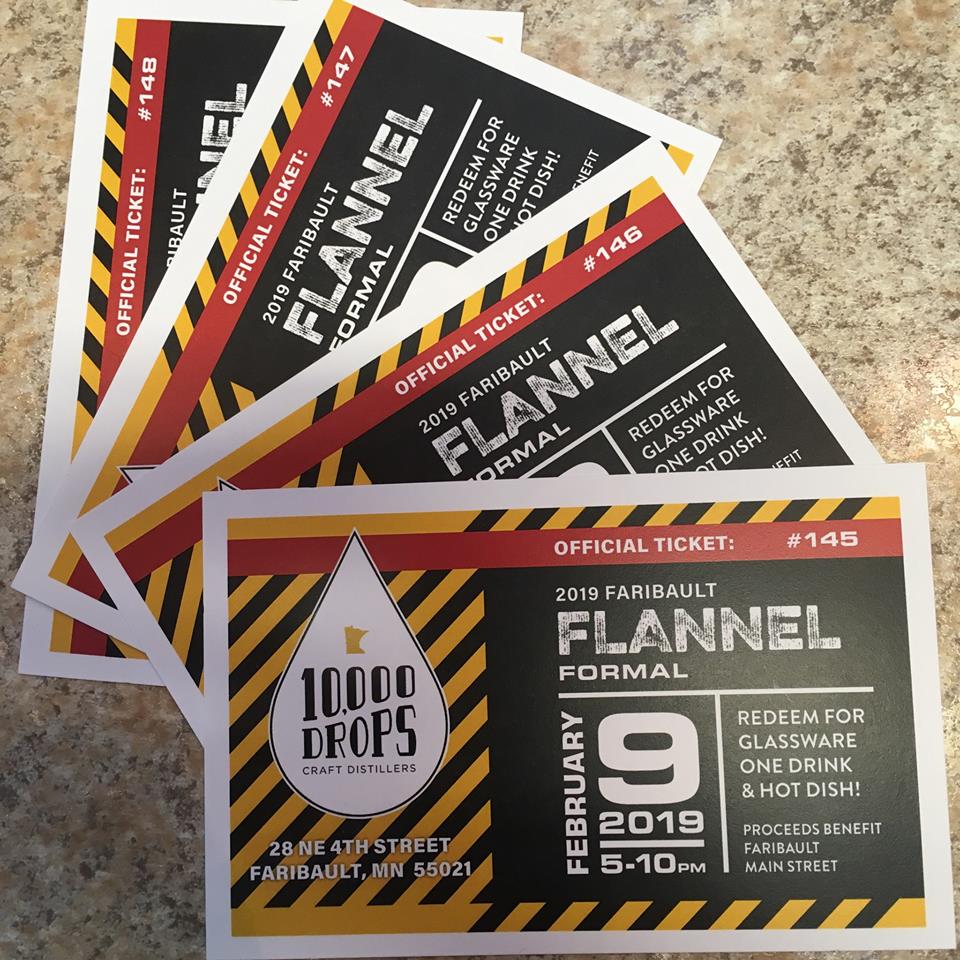
So does my community. From 5 p.m. – 10 p.m. this Saturday, February 9, Faribault Main Street celebrates its annual Faribault Flannel Formal. It’s a fitting event for Minnesota, home of legendary lumberjack Paul Bunyan, typically dressed in red and black buffalo plaid flannel and sturdy jeans.
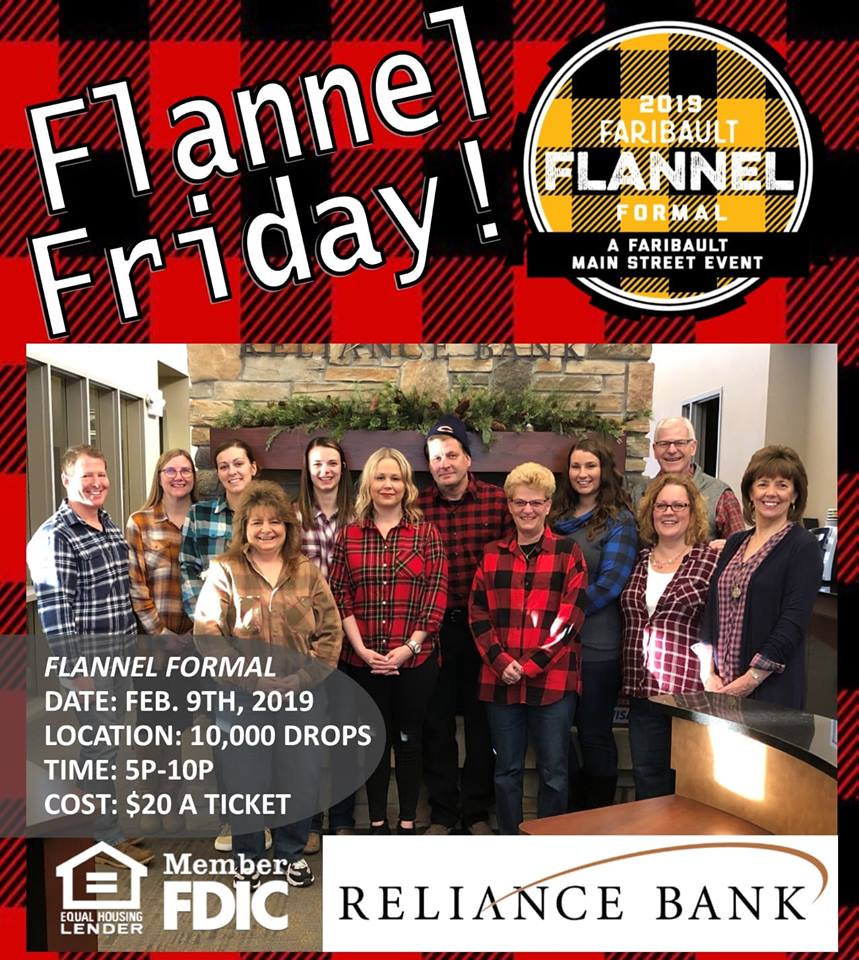
Photo source: Faribault Main Street Facebook page.
To promote the event, locals have been wearing flannel to work and about town on Flannel Fridays.
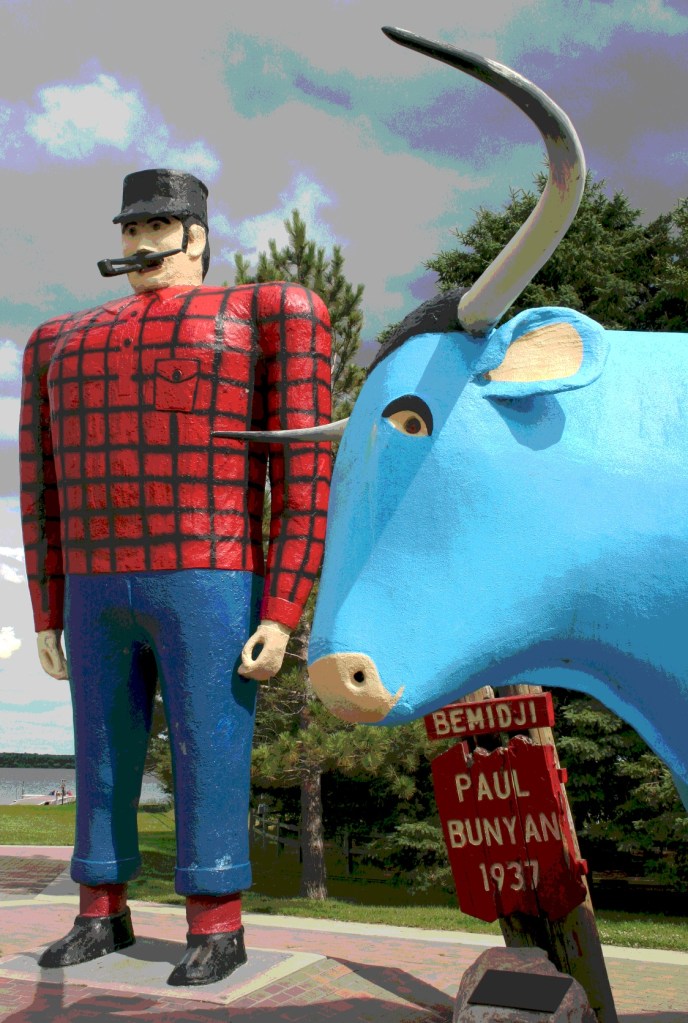
Legendary Paul Bunyan and Babe the Blue Ox in Bemidji, Minnesota. Minnesota Prairie Roots edited file photo.
The lumberjack theme is very much a part of the Faribault event at 10,000 Drops Craft Distillers and adjoining Corks and Pints in the heart of our historic downtown, just a block off Central Avenue. The dress code obviously calls for flannel with honors awarded to the best-dressed lumberjack and lumberjane.
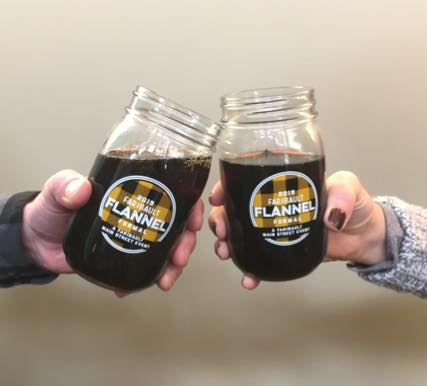
A ticket to the Formal will get you a free commemorative jar. I love these. Photo source: Faribault Main Street Facebook page.
Attendees can also get into the Paul Bunyan spirit by competing in lumberjack themed games—the giant beaver toss, hammerschlagen and duck the branch.
A wonderful blend of textures is presented in this hotdish. Minnesota Prairie Roots file photo.
Another Minnesota staple—hotdish (not casserole)—also is an integral part of the Faribault Flannel Formal. Folks are invited to cook up their favorite hotdishes for sampling and a $100 Chamber Check top prize. Who doesn’t love hotdish, the ultimate Minnesota winter comfort food? I’ll take Minnesotan Amy Thielen’s Chicken and Wild Rice Hotdish, thank you. She hosts Heartland Table on Food Network, among other accomplishments.
No Formal is complete without music. The Rochester Caledonian Bagpipers kick off the evening with the classic rock tribute band Horizontal Hero following.
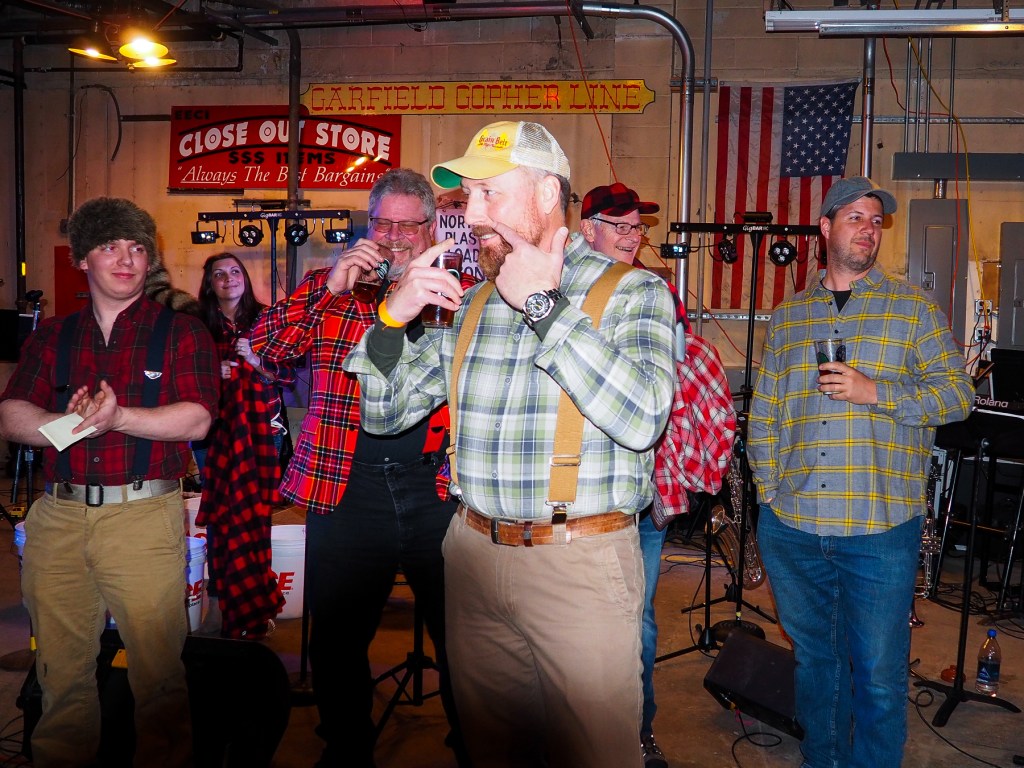
Past Faribault Flannel Formal attendees. Photo compliments of Faribault Main Street.
While I’ve not attended a Formal yet, I’m pretty certain I’d enjoy it. I mean, I wouldn’t need to dress up. The challenge would come in choosing which flannel shirt to wear. Blue/gray/black? Red/black/gold? Green and black? Teal/black/subtle orange? Green and brownish? Yup lots of choices in my closet.
Photo source: Faribault Main Street Facebook page.









 Minnesota Prairie Roots
Recent Comments