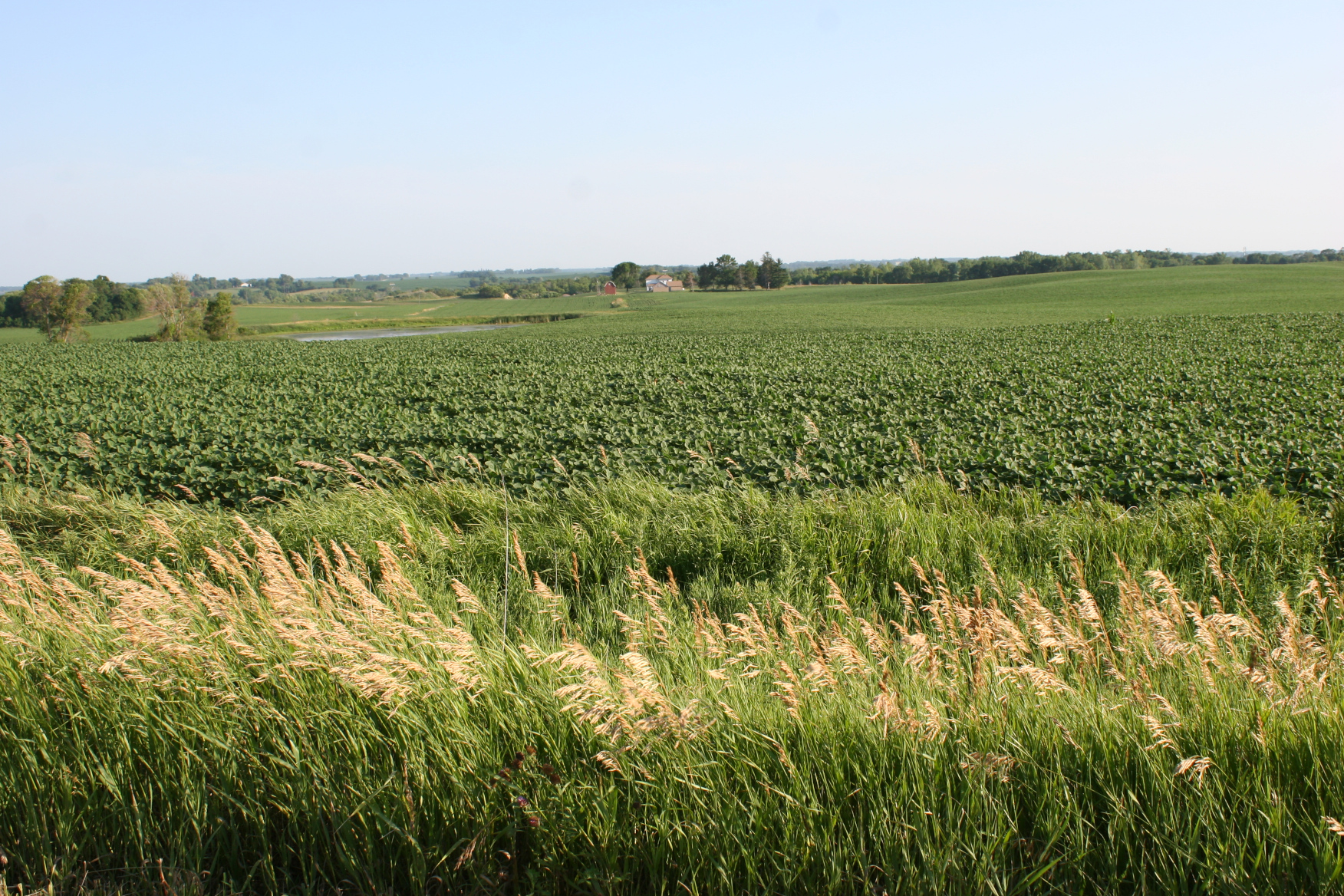
Gravel roads, sky and fields stretch before us in the southern Minnesota countryside. (Minnesota Prairie Roots copyrighted photo October 2021)
Polka music pulsed through the van in a rhythmic beat. It was an unusual station choice given I listen primarily to contemporary Christian music on KTIS and Randy enjoys talk radio. But, occasionally on his 22-minute drive home from work, Randy tunes in to KCHK to listen to late afternoon featured 50s-70s music.
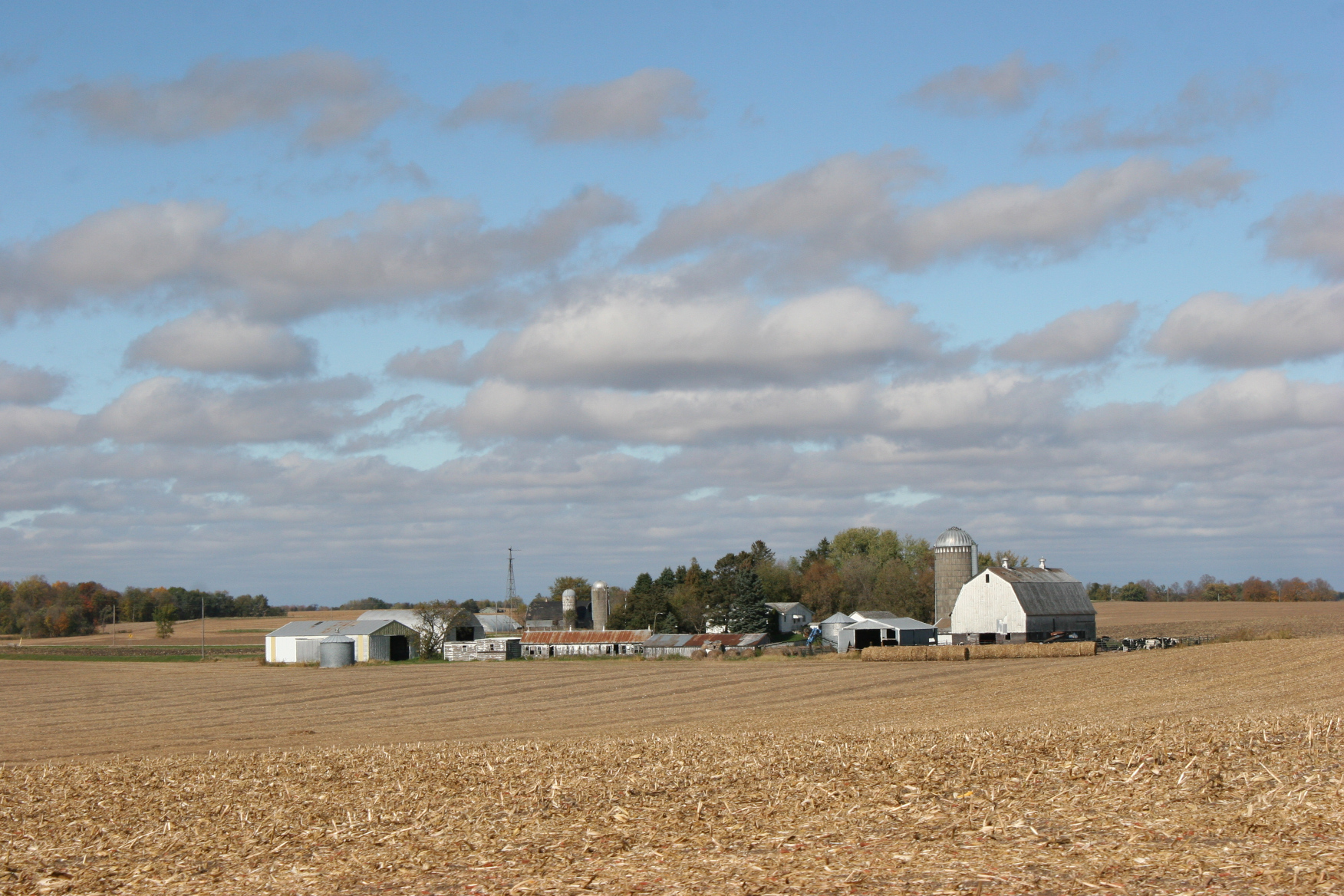
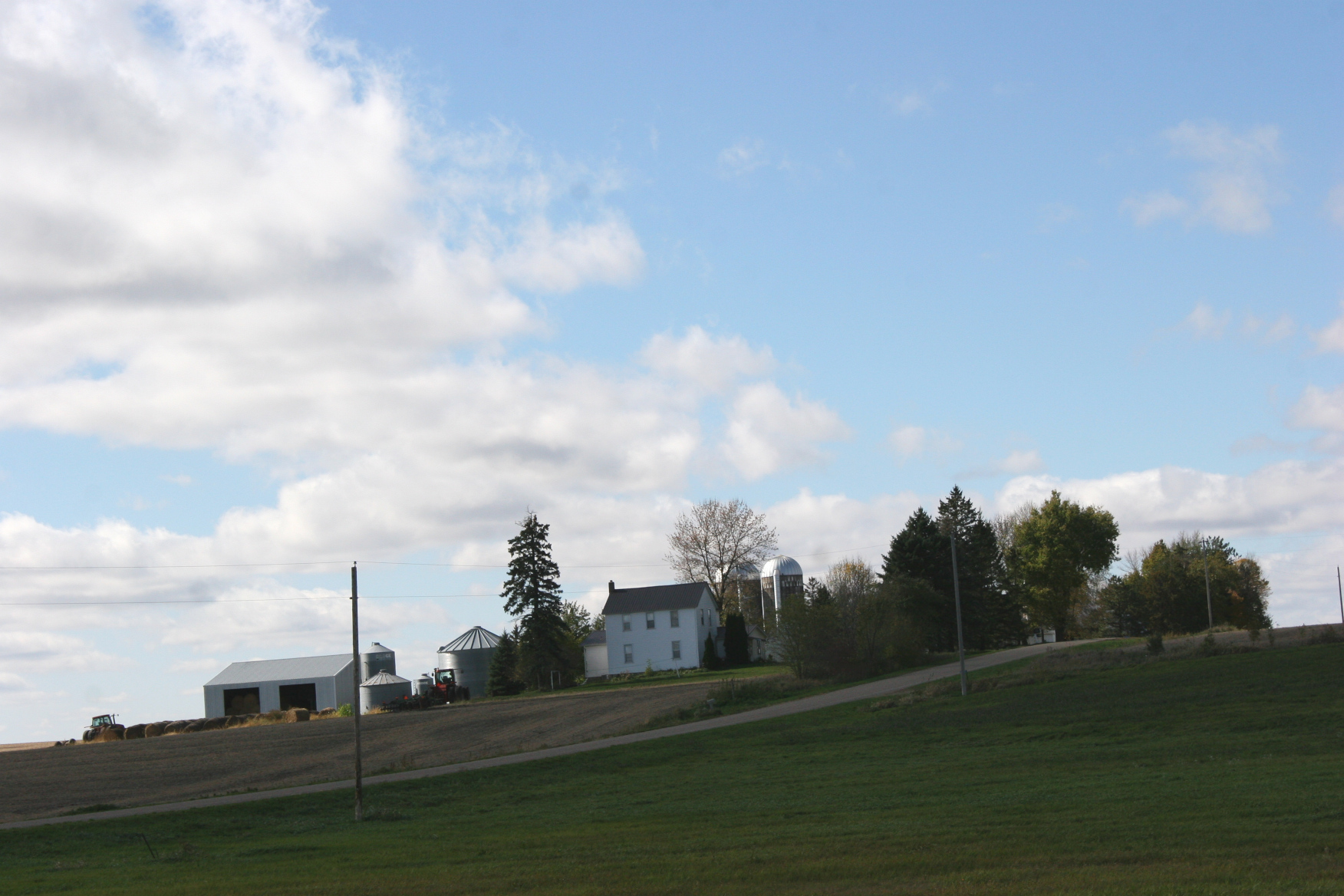
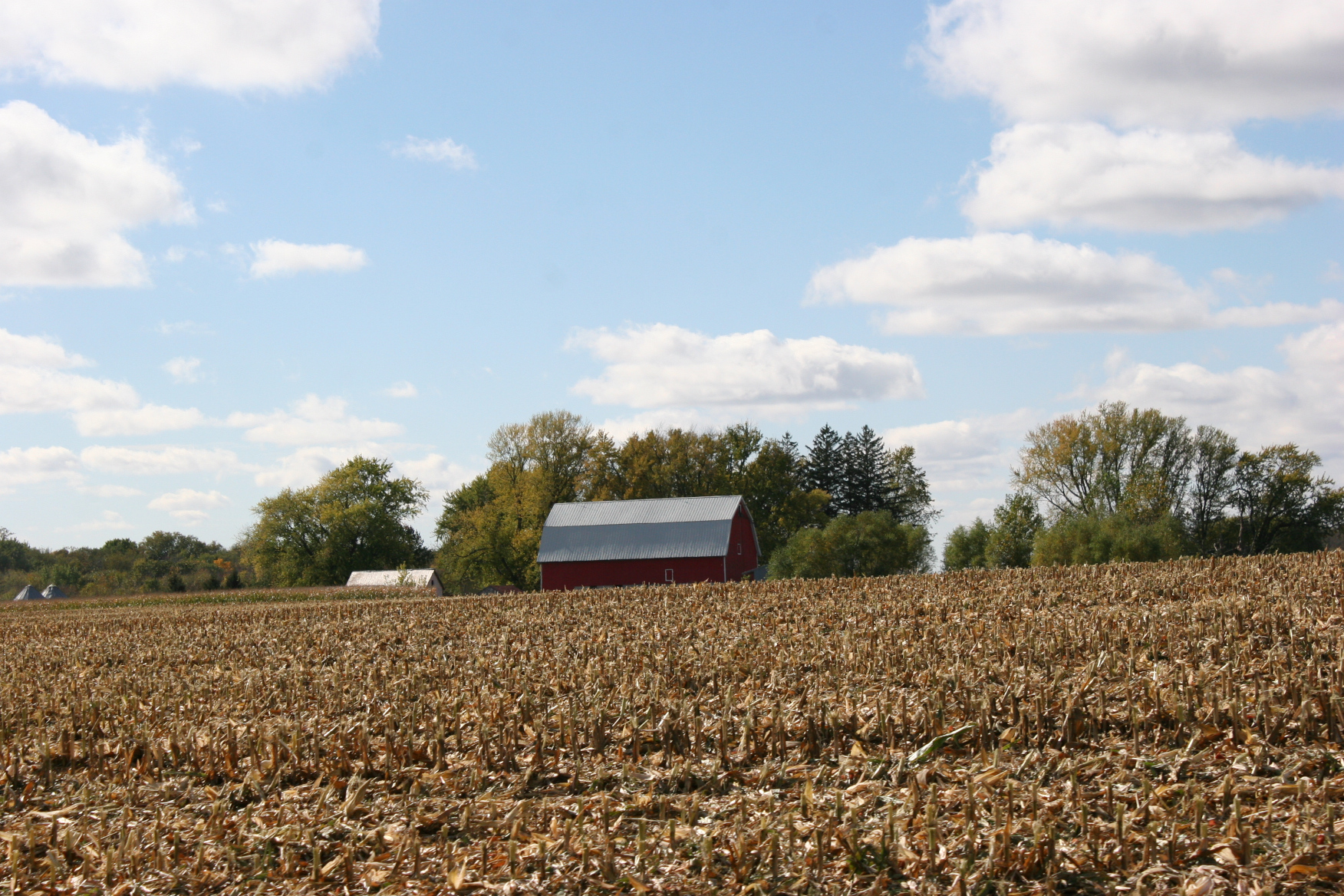
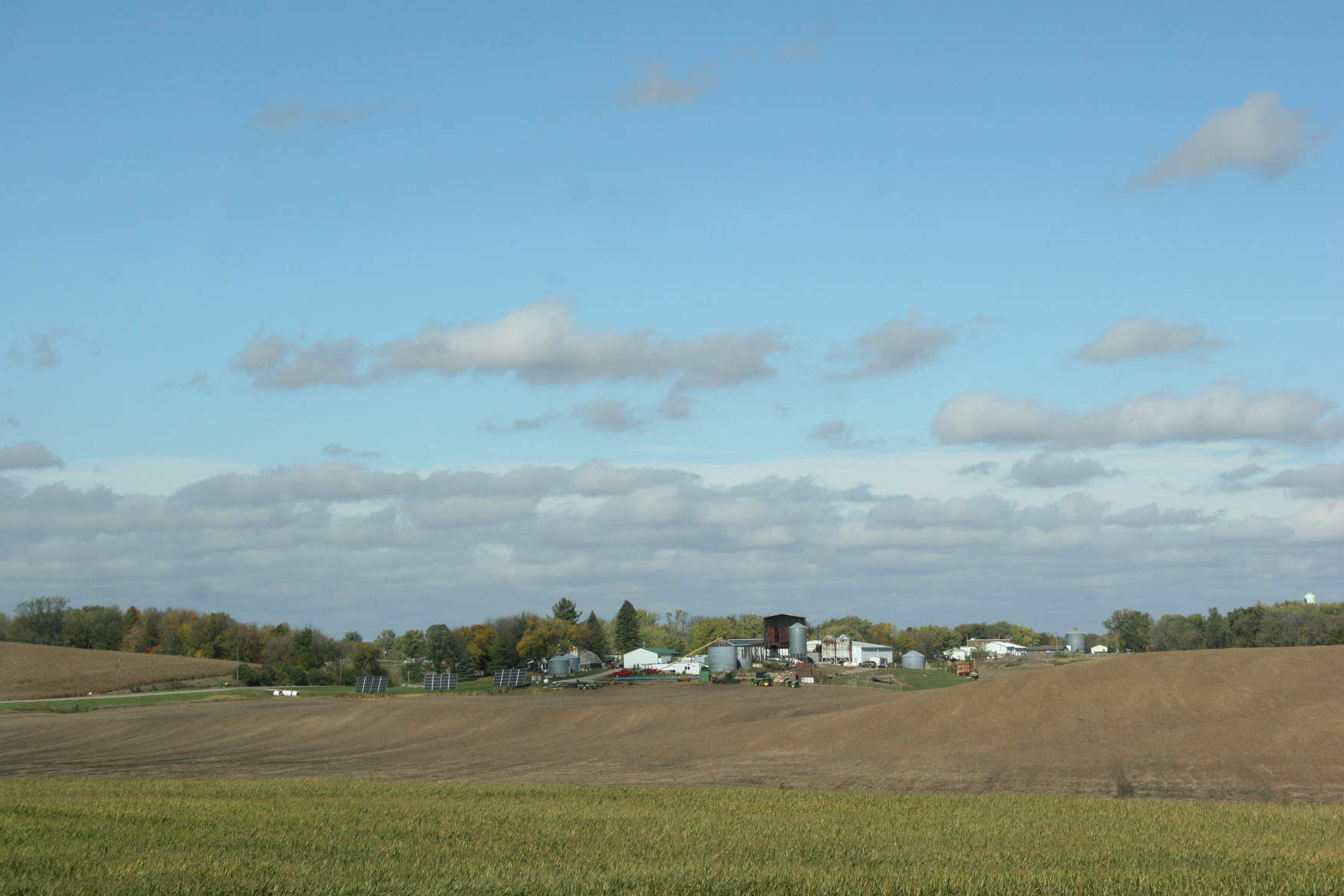
A farm site tucks behind a hillin LeSueur County. (Minnesota Prairie Roots copyrighted photo October 2021)
In the heart of Czech country, though, the radio station is known for its day-time polka programming.
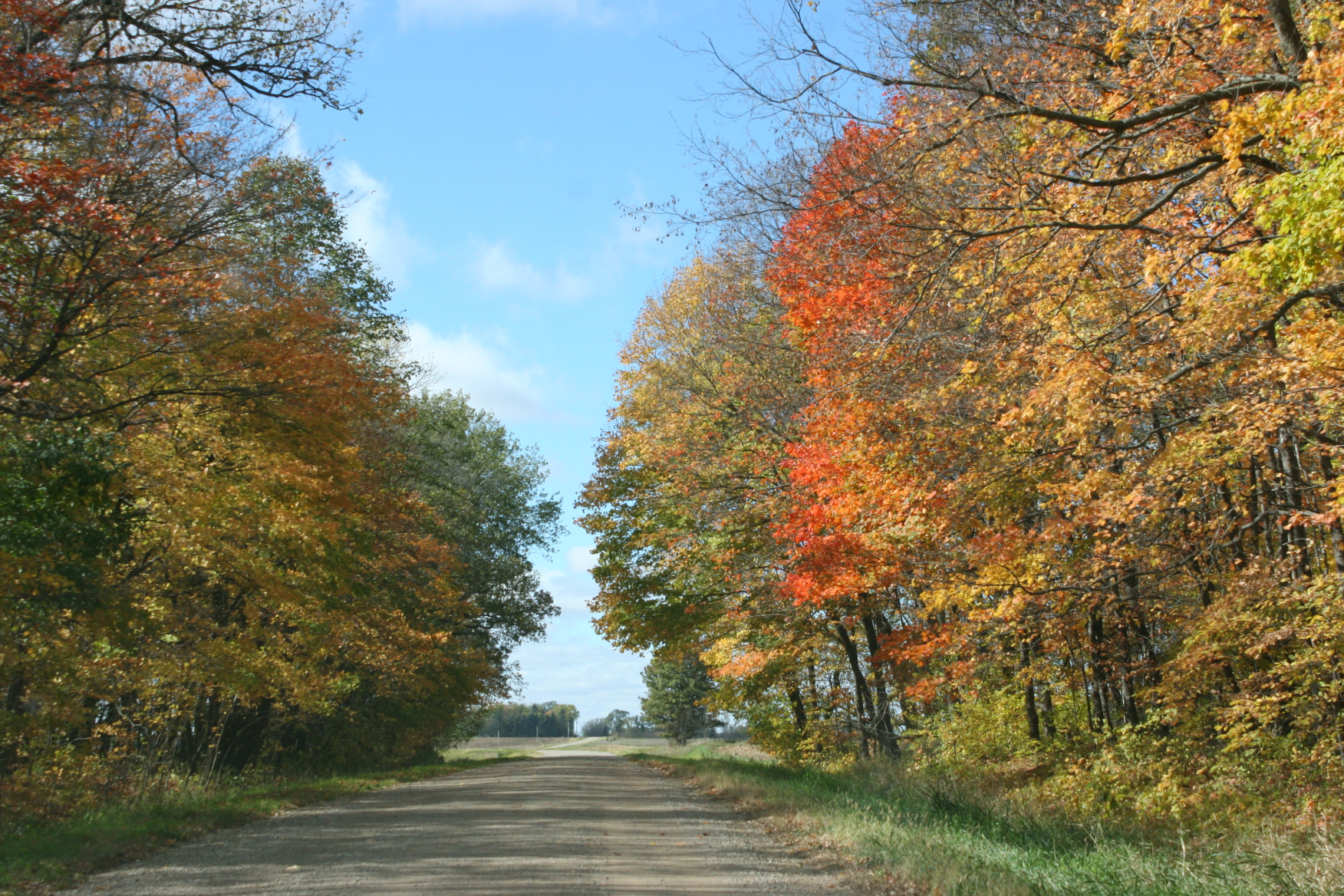
Occasionally we passed between colorful treelines. (Minnesota Prairie Roots copyrighted photo October 2021)
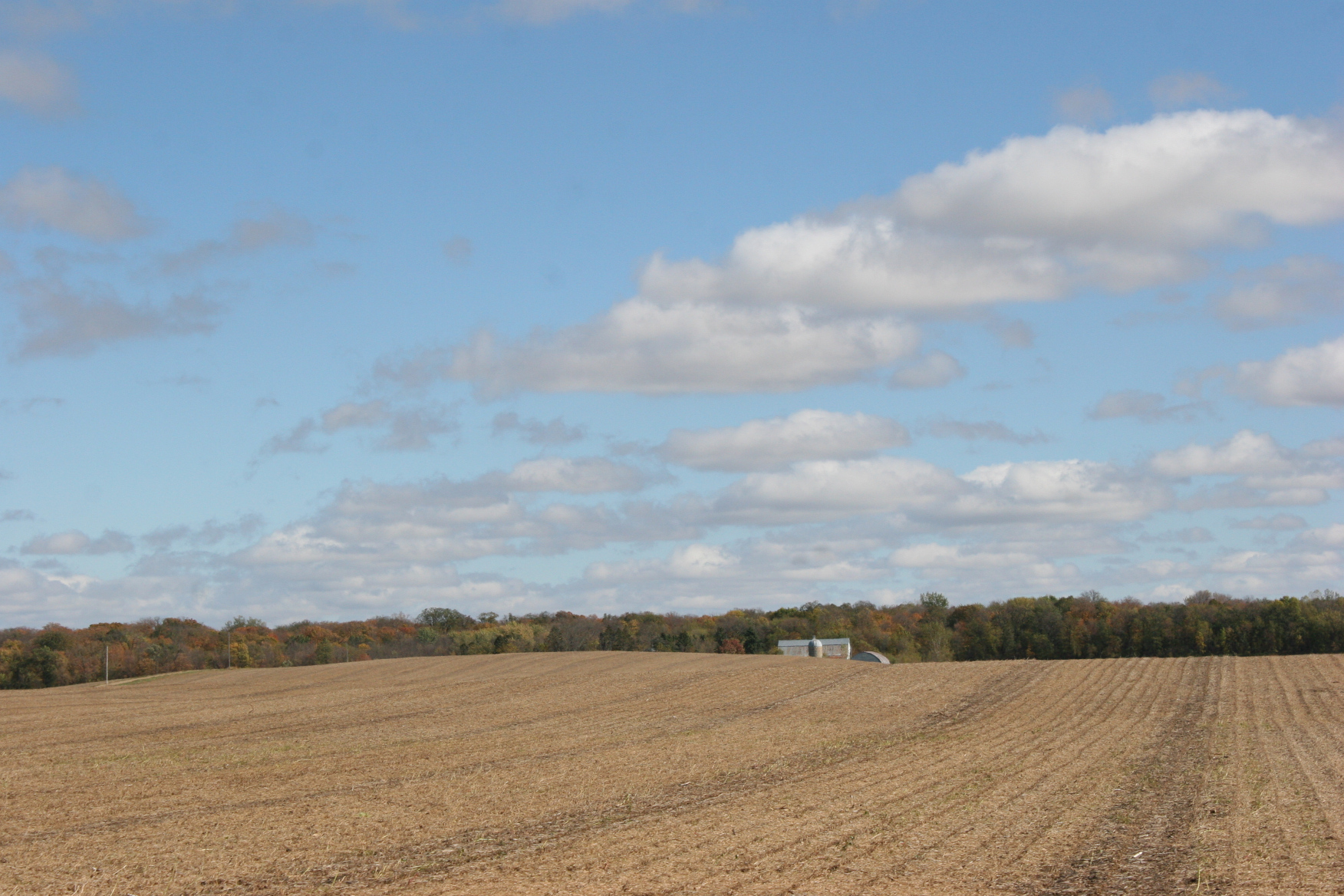
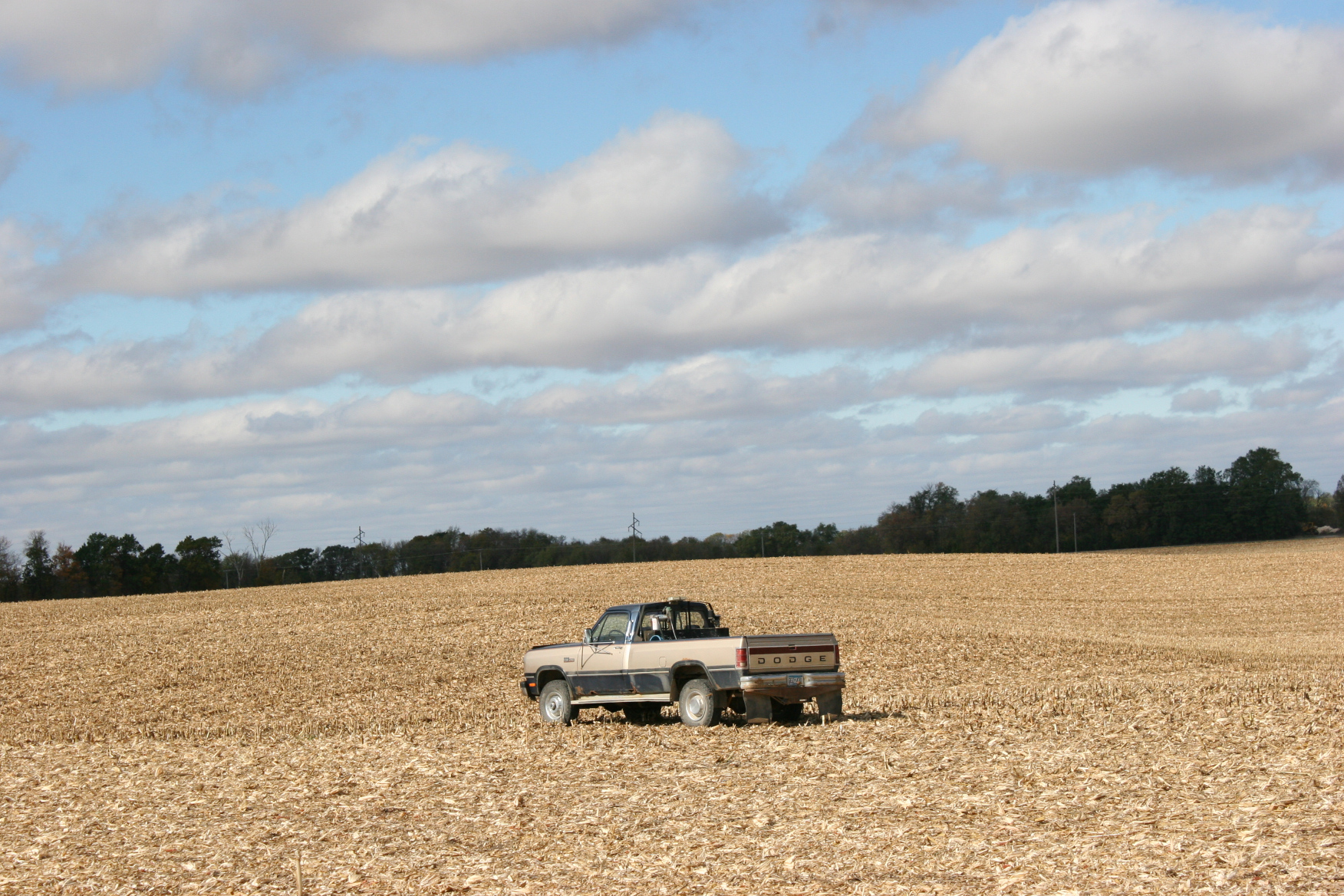
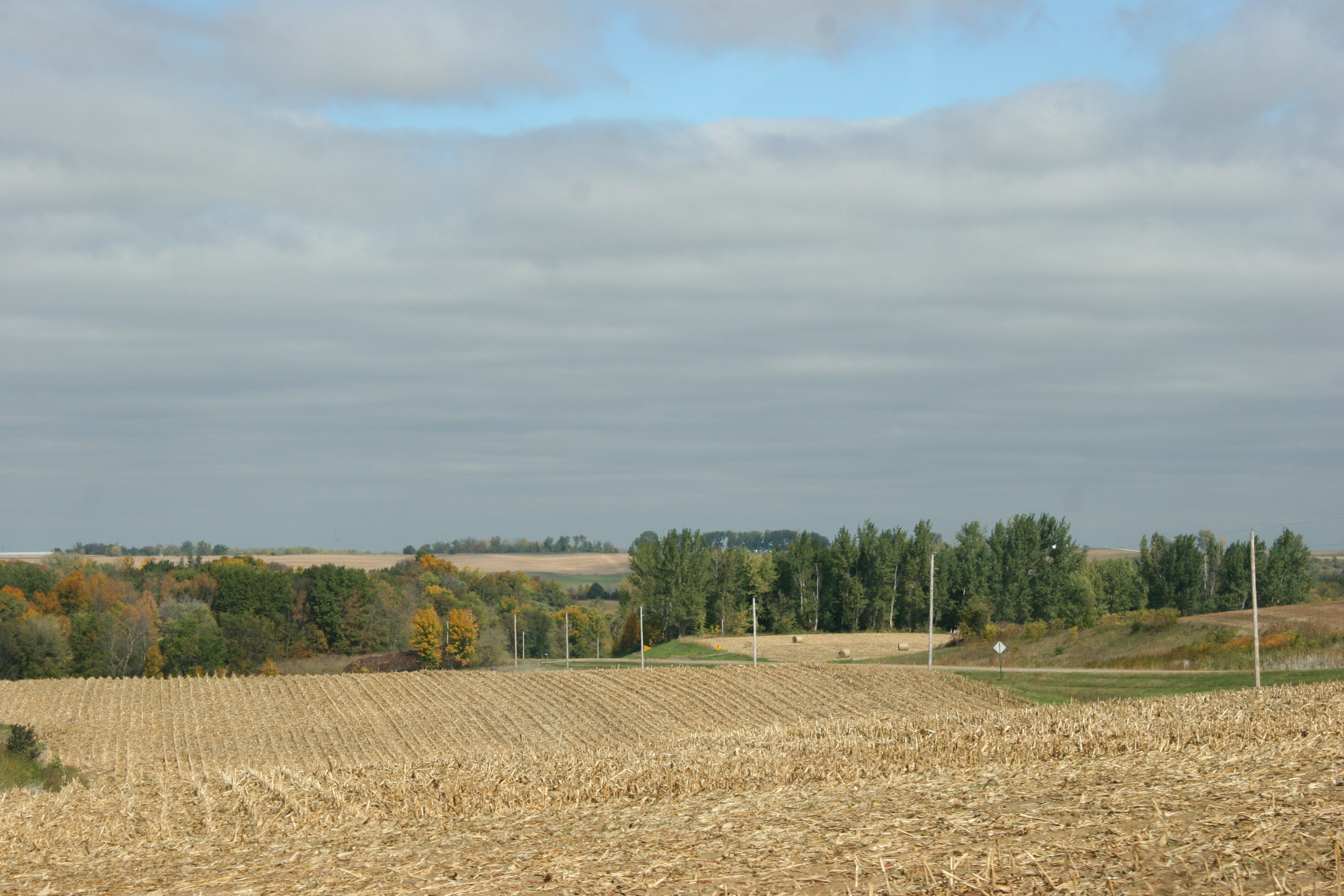
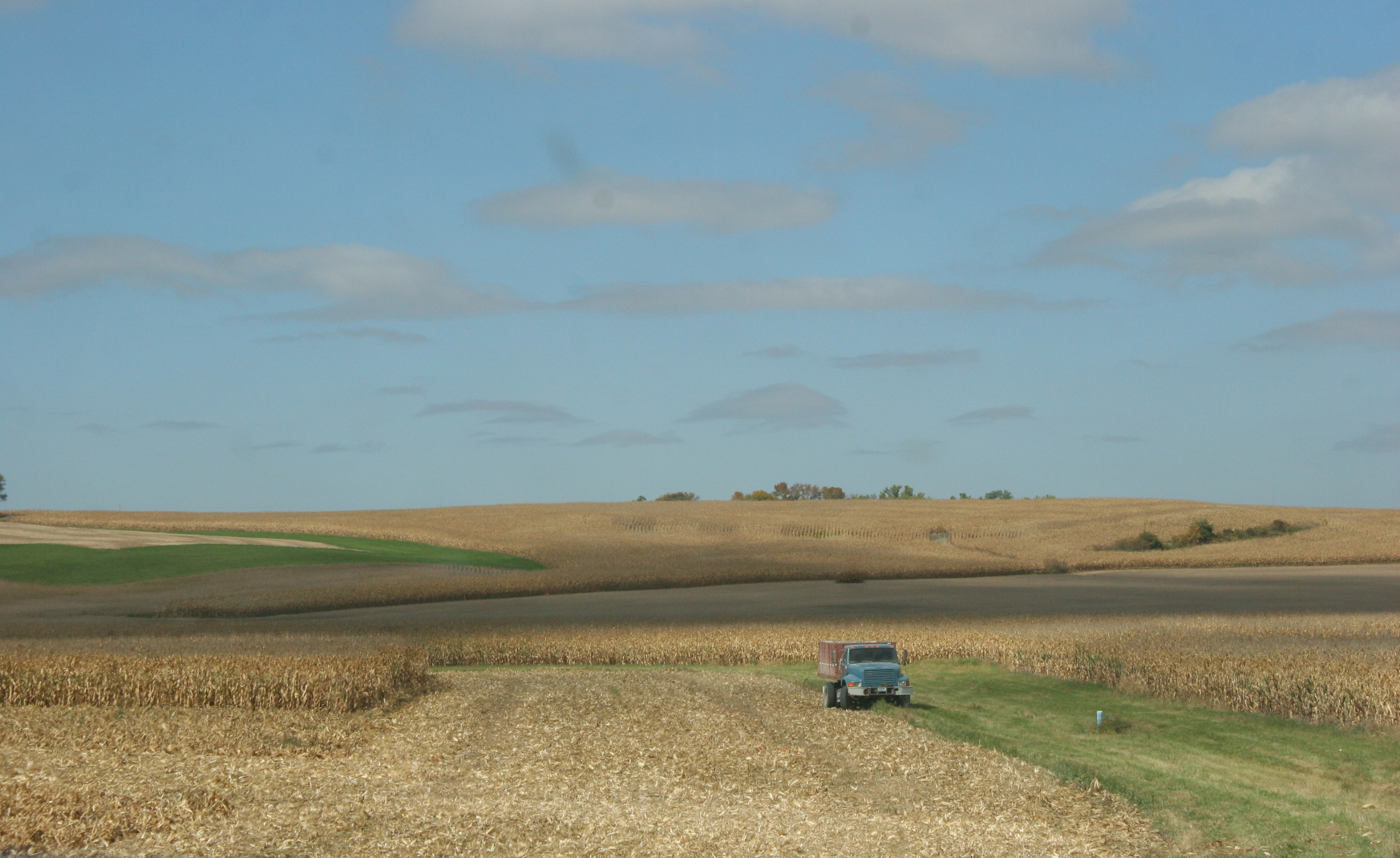
A common Minnesota harvest scene: a farm truck parked in a field. (Minnesota Prairie Roots copyrighted photo October 2021)
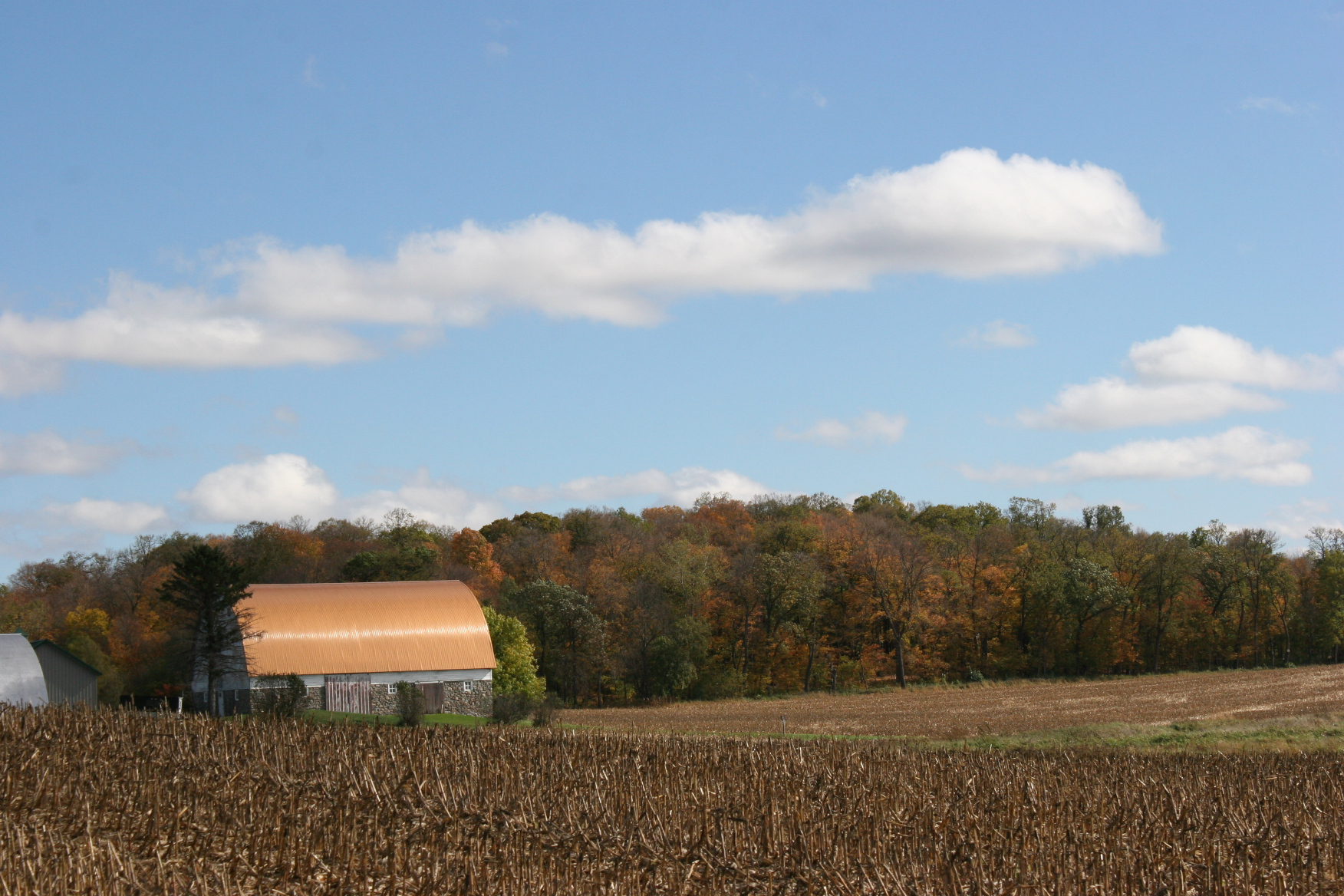
Love the copper hue of this barn roof on a farm just off State Highway 13 between New Prague and Montgomery. (Minnesota Prairie Roots copyrighted photo October 2021)
As we drove along back country gravel roads—past farm sites and harvested fields and farmers working in the fields—the rhythm of polkas, of accordions pushed in and pulled out to create music, set a joyful tone. The music fit the scenes unfolding before us.
The music reminded me, too, of wedding dances back home decades ago in southwestern Minnesota. Of couples twirling across a well-worn wooden dance floor. Of booze bottles wrapped in brown paper bags. Of extended families gathered in a simple town hall to celebrate a marriage. Of The Bunny Hop and The Butterfly and all those dances that brought people together for an evening of fun.
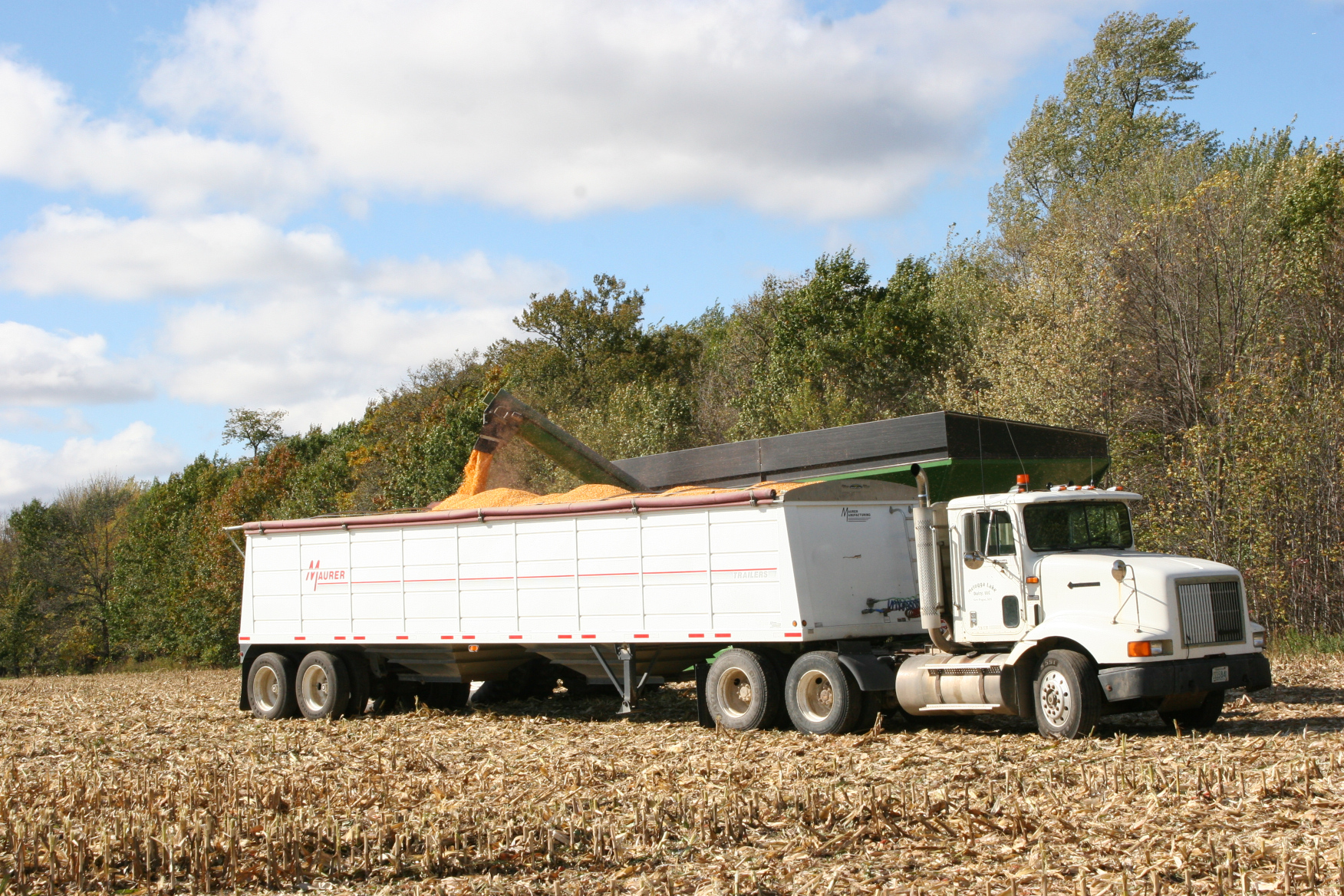
Just harvested corn flows into a grain truck along Lake Avenue west of Lonsdale. (Minnesota Prairie Roots copyrighted photo October 2021)
Those memories lingered as polkas played on KCHK. As just-harvested corn flowed into a grain truck. As we passed a mailbox with the name Skluzacek posted thereon. We were deep in the heart of Czech country near New Prague/Lonsdale/Montgomery.
Near Richter Woods County Park west of Montgomery, a farm site overlooks the countryside. (Minnesota Prairie Roots copyrighted photo October 2021)
There is something incredibly comforting about the mix of memory and music and meandering in rural Minnesota. Moments like this impress upon me the need to simply be. To recognize the value in an afternoon drive in the country. No destination. No haste. No agenda.
A farm site hugs a cornfield along Lake Avenue west of Lonsdale. (Minnesota Prairie Roots copyrighted photo October 2021)
Time to just appreciate. The hard work of the farmer during harvest. The farm sites. Gravel roads.
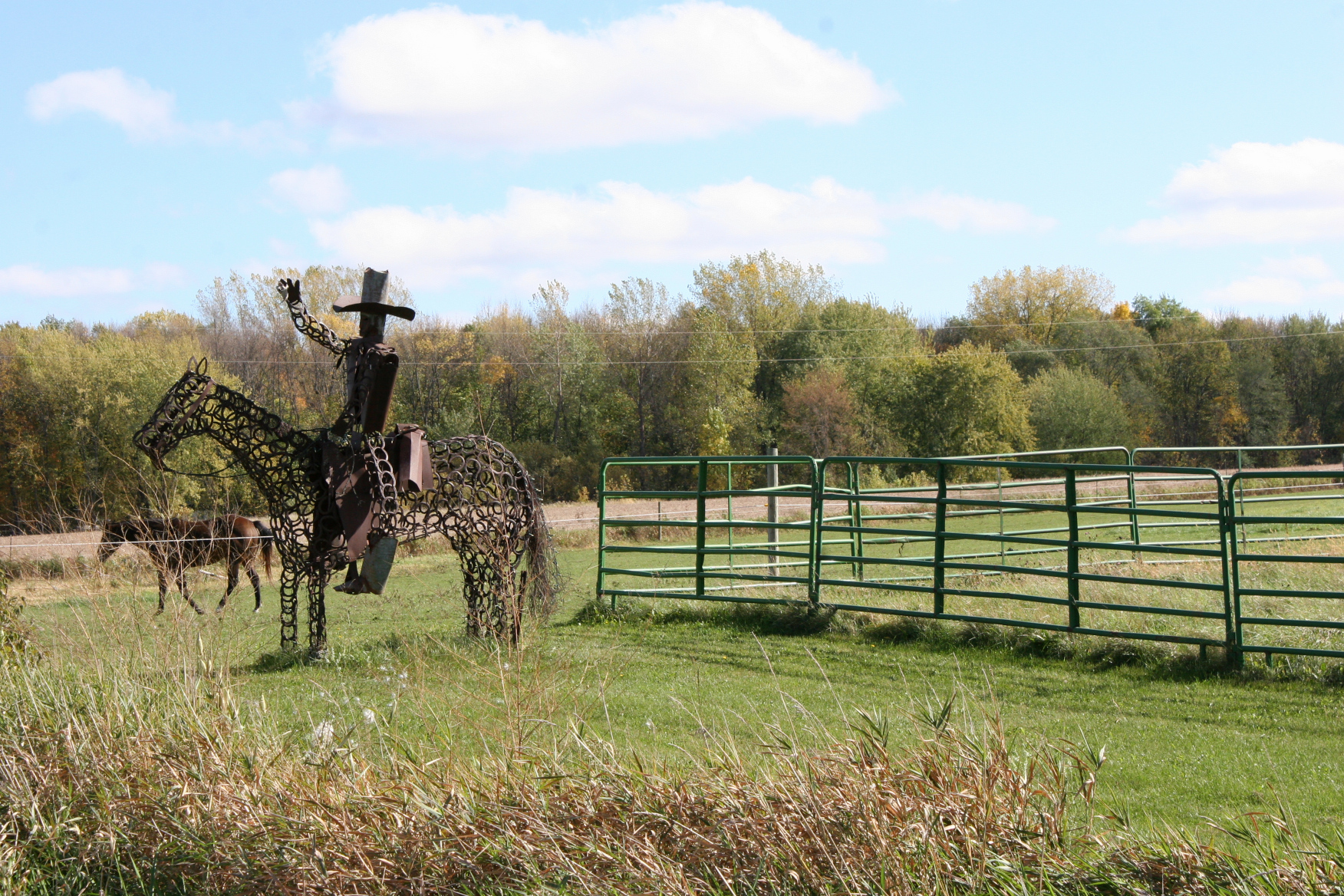
As we passedthis rural property along 60th Street West southeast of New Prague, I photographed this horse sculpture. (Minnesota Prairie Roots copyrighted photo October 2021)
And the unexpected sighting of horseshoe art where horses graze.
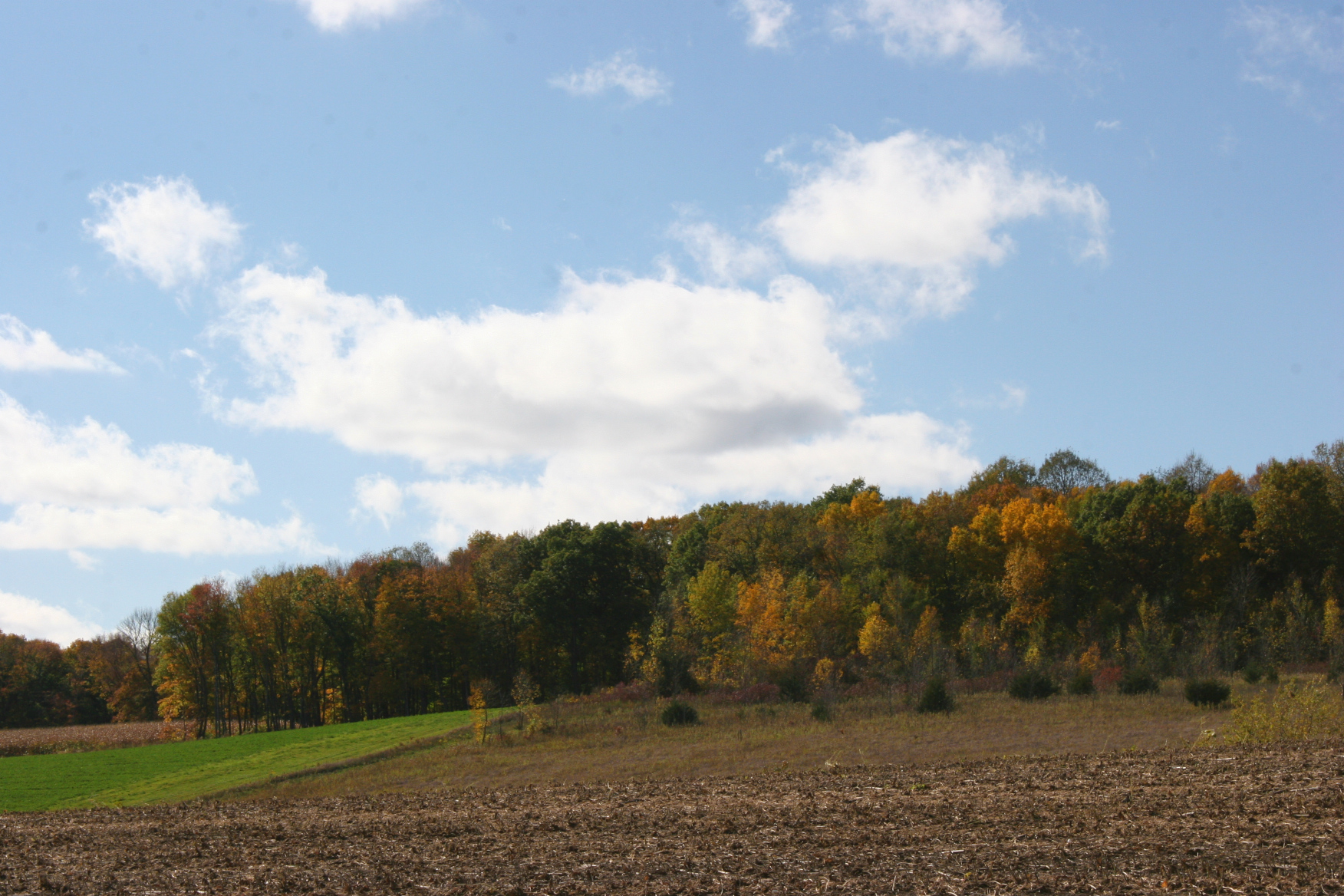
Oh, the glorious hues of autumn in rural southern Minnesota. (Minnesota Prairie Roots copyrighted photo October 2021)
I treasure the memories shared and made with my husband of nearly 40 years as we followed rural routes, polka music thrumming in the background.
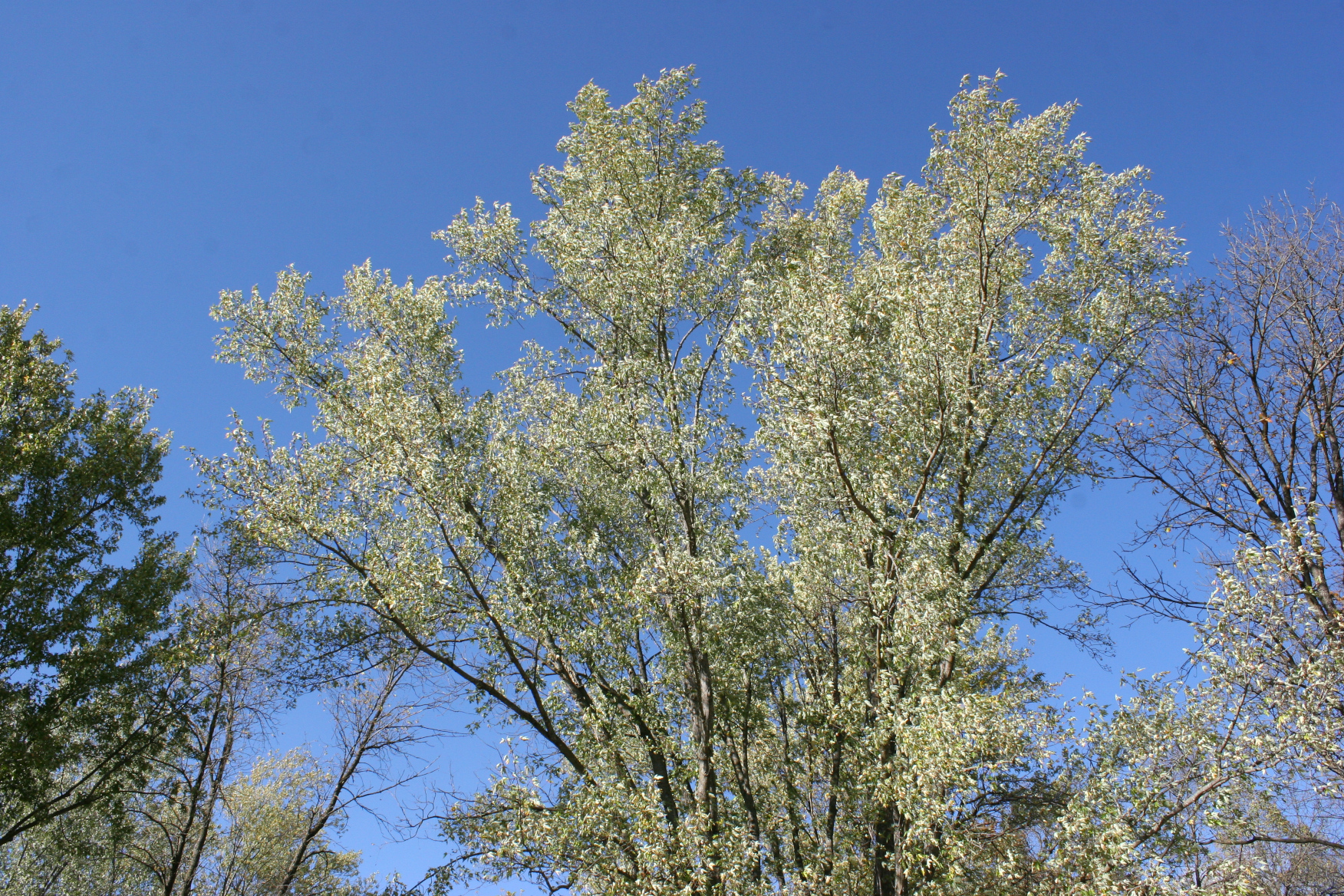
On the expanse of grass outside the woods, silver maples shimmer against the blue sky of autumn. Minnesota Prairie Roots copyrighted photo October 2021.
A MILE EAST OF FARIBAULT just off Minnesota State Highway 60, the 61-acre Falls Creek County Park offers an escape into the woods. Mostly undiscovered, it’s rare to encounter others while hiking here.
Last Sunday afternoon, Randy and I headed to the park, pulling into the vastly over-sized gravel parking lot pocked with potholes. From there, we headed downhill across a grassy expanse, past the picnic shelter and toward an opening in the woods.
A wooden footbridge over Falls Creek allows entrance to narrow dirt trails. There are no maps to guide hikers, so you must rely on visual cues, obscured in October by fallen leaves. But we’ve been here before, always taking the main trail following the creek.
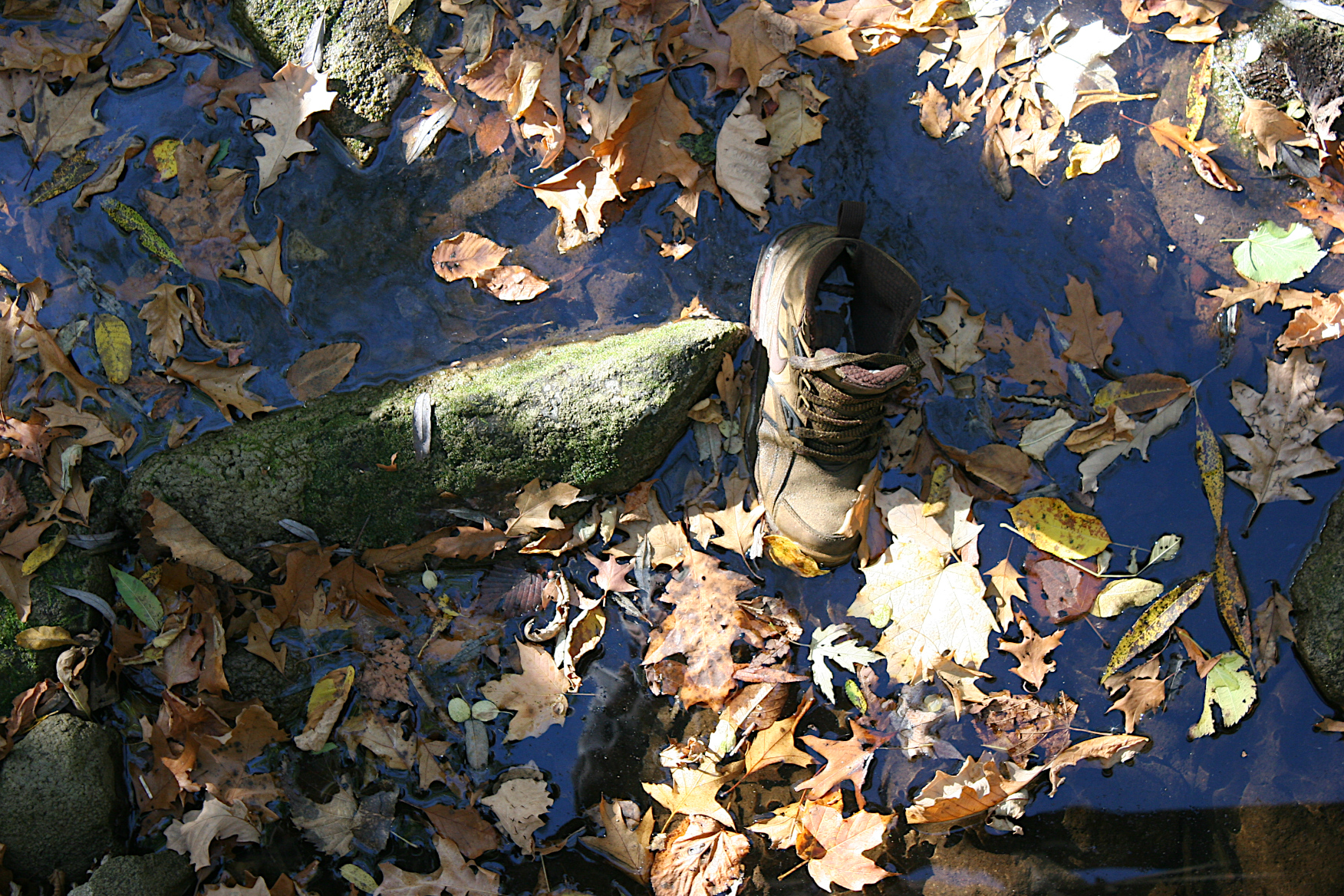
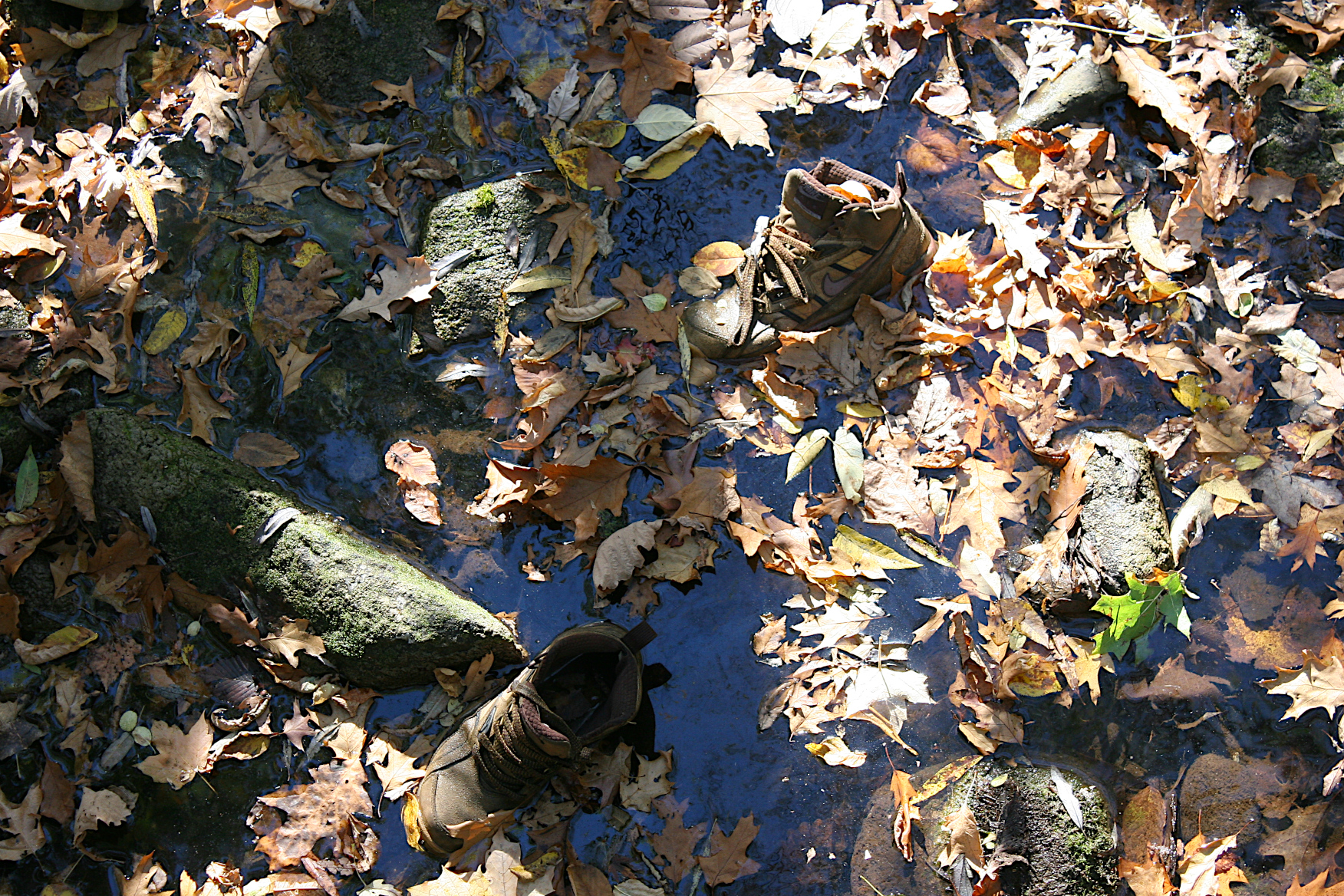
An unusual find in the creek: shoes/boots. Minnesota Prairie Roots copyrighted photo October 2021.
The creek is always my first stop. I pause on the bridge, typically to watch water rush over and around rocks. But this visit, the shallow water pooled, littered with leaves and a pair of hiking boots—perfectly good hiking boots from the looks of the shoes. I wondered how they landed there, in the water.
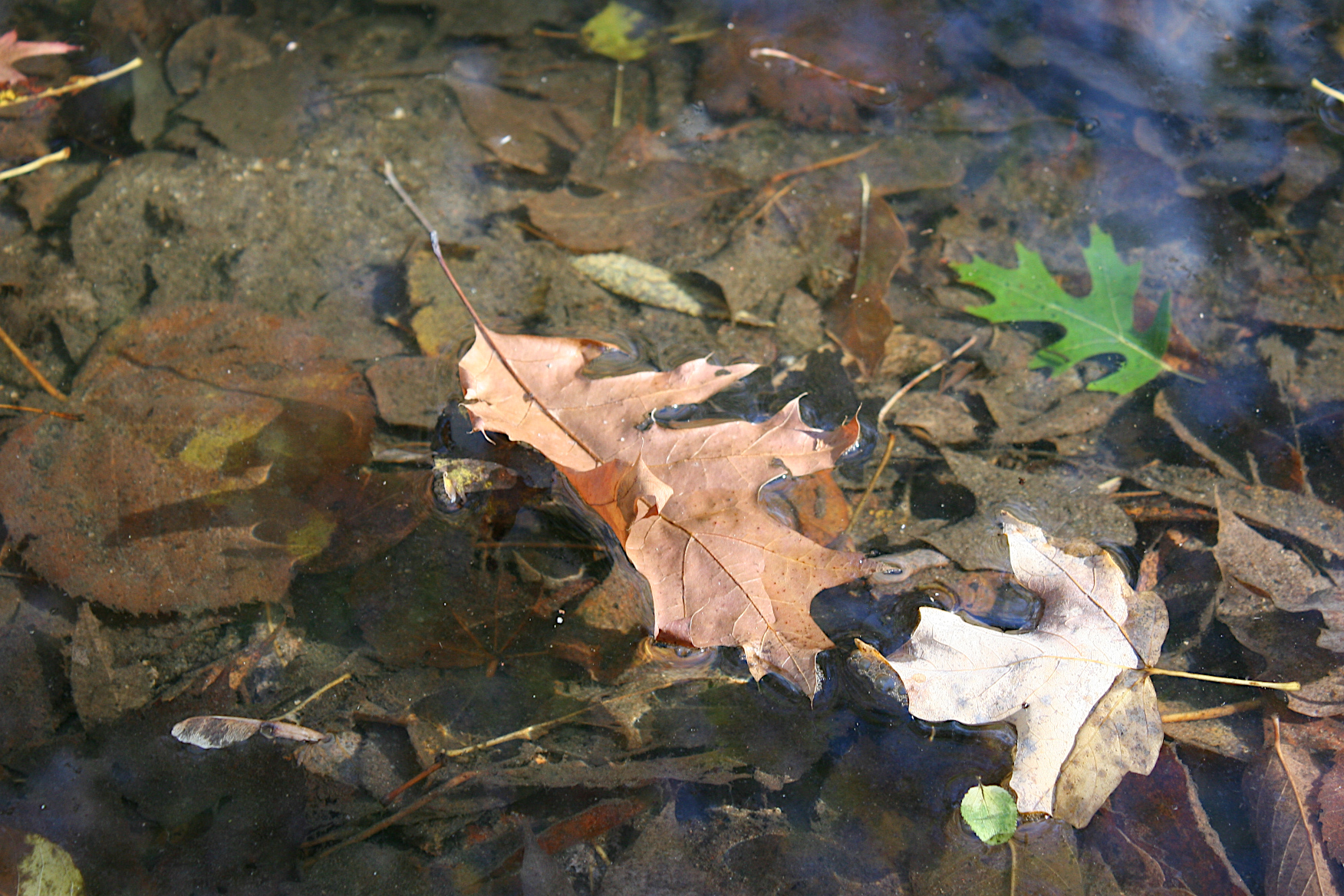
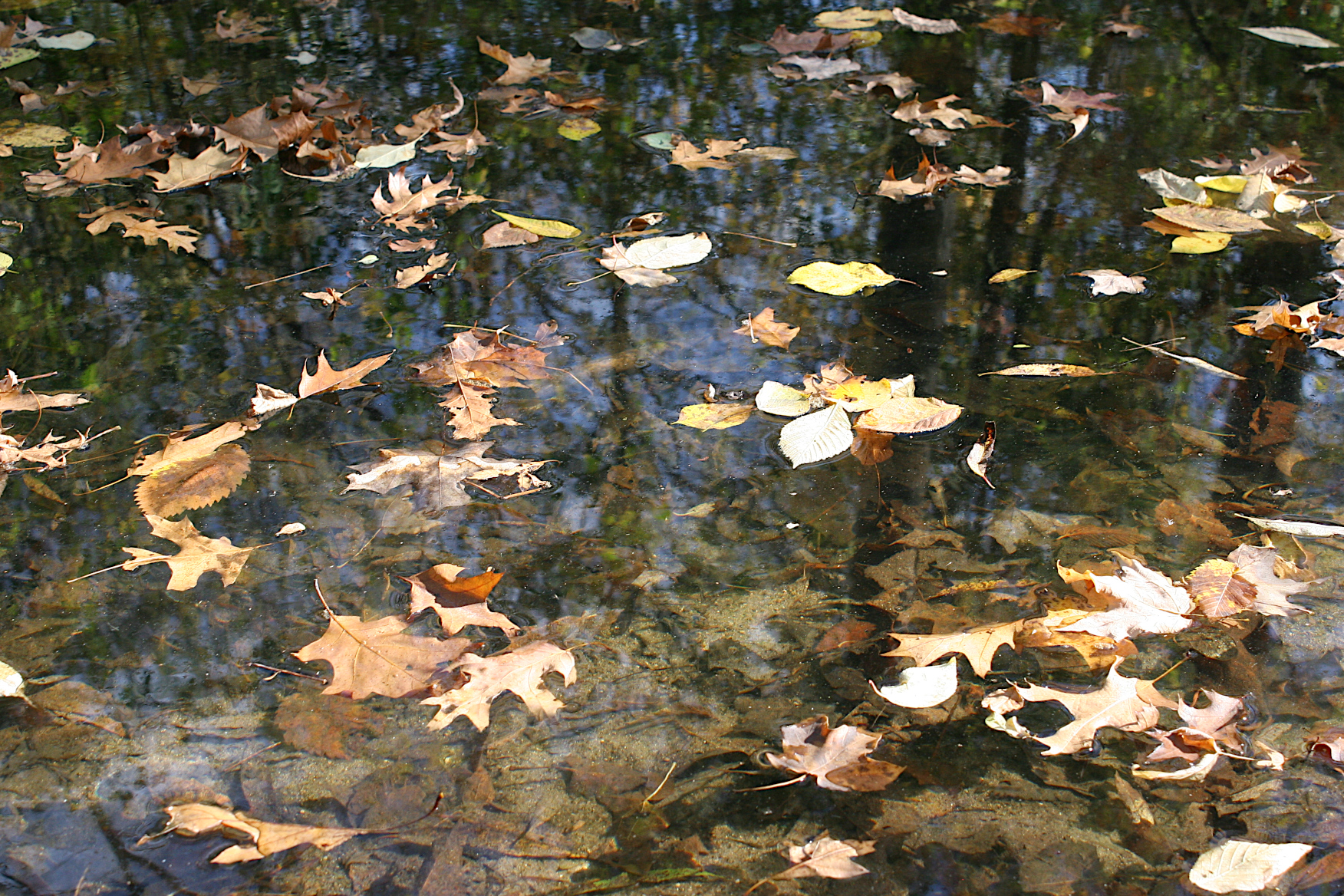
In the places where water remains in the creek, leaves float.Minnesota Prairie Roots copyrighted photo October 2021.
Mostly, the creek bed was dry, a result of this year’s drought. In areas where water remains, minnows darted. The water is at least clear, a rarity in this agricultural region.
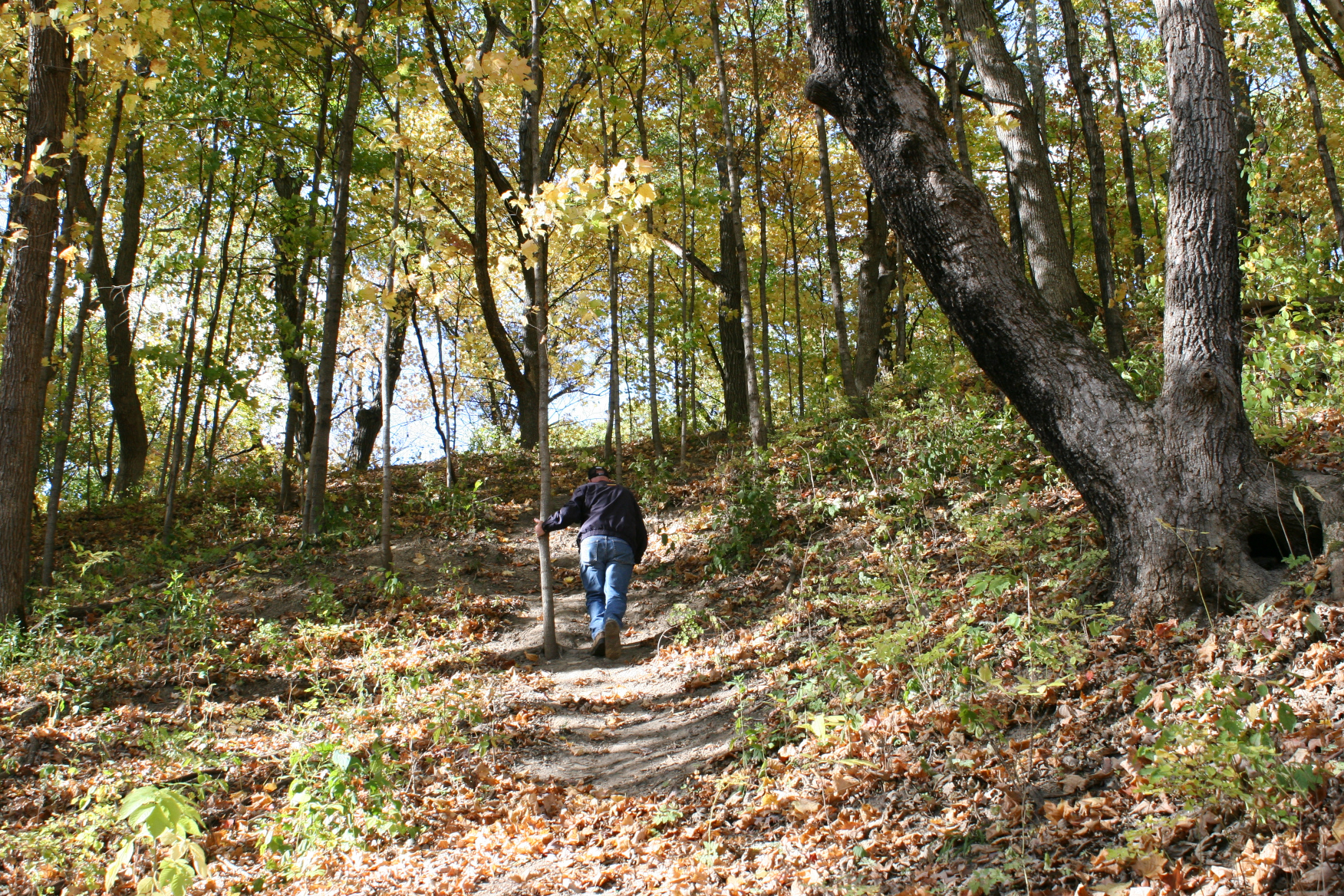
Randy scales a steep hill into the woods. Minnesota Prairie Roots copyrighted photo October 2021.
A short distance into the woods, Randy spotted a worn path up a steep hillside. I’d never noticed this during prior visits. Before I could dissuade him, he hoofed his way up, slipping and sliding and grabbing onto trees. When Randy lost his footing, I feared he would tumble and injury himself. As much as I yearned to follow, I recognized my limitations and my desire to keep my bones in-tact.
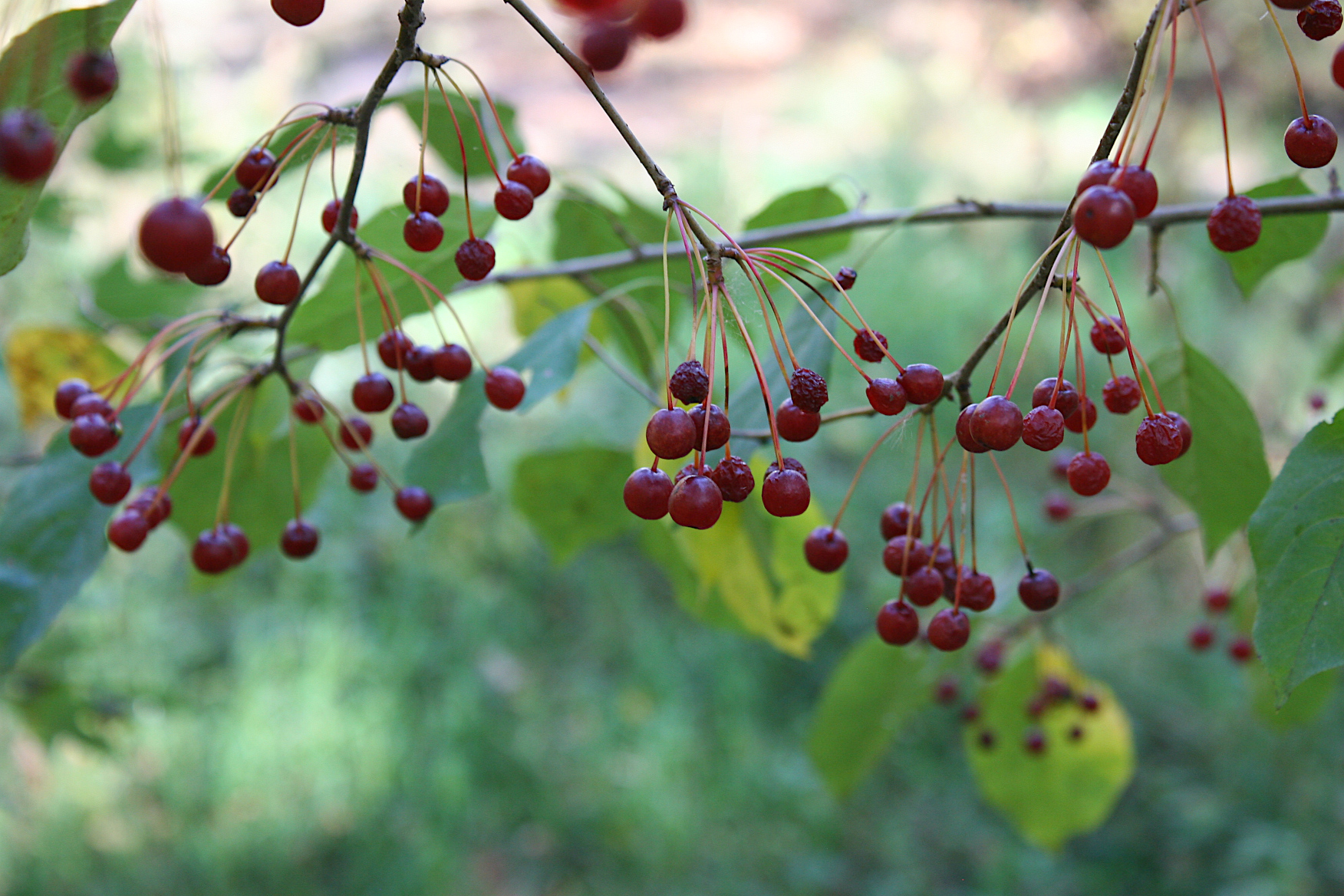
Berries jolt color into the woods. Minnesota Prairie Roots copyrighted photo October 2021.
As he disappeared along the hilltop treeline, I continued along the creek route. But soon my mind went to that niggling place of worry, about the time I reached the point where the path sidles next to the eroded creek bank. One misstep and I could plunge over the edge. Not that it’s that high. But far enough to cause injury.
I backtracked, dug in my backpack for my cellphone (hoping for service), and then called Randy. He answered. “I didn’t come here to walk alone,” I told him, also inquiring about his location. He couldn’t pinpoint that except to say that he would head back. I feel thankful that Randy, unlike me, possesses a good sense of direction.
Remembering the hiking boots/shoes in the creek. Minnesota Prairie Roots copyrighted photo October 2021.
“I don’t like being out here alone,” I added, noting that I’d observed two people on the path, too far away for me to clearly see them. Obviously those hiking shoes dumped in the creek prompted the beginning of a mystery plot in my writer’s brain.
Despite that concern, I aimed for the strangers…finding a cordial couple about my age examining mushrooms on a decayed tree. We talked mushrooms and my missing husband and they offered to help find him should need be. Their story of getting lost in these very same woods did nothing to assure me that Randy would find his way back. But he did. At a different point, where an unseen spring ran down the hillside and he did more slipping and sliding, this time in mud.
Randy follows the leaf-laden trail as it edges close to the eroded creek bank. Minnesota Prairie Roots copyrighted photo October 2021.
We reversed course and, together, followed the creek-side path deeper and deeper into the woods…until turning around and retracing our steps. I wished again for a trail map guide.
Near the footbridge, pools of water remain, collecting the fallen leaves of autumn. Minnesota Prairie Roots copyrighted photo October 2021.
We veered briefly off the path to another trail leading to the creek. Again, no water. Only rocks on a dry creek bed.
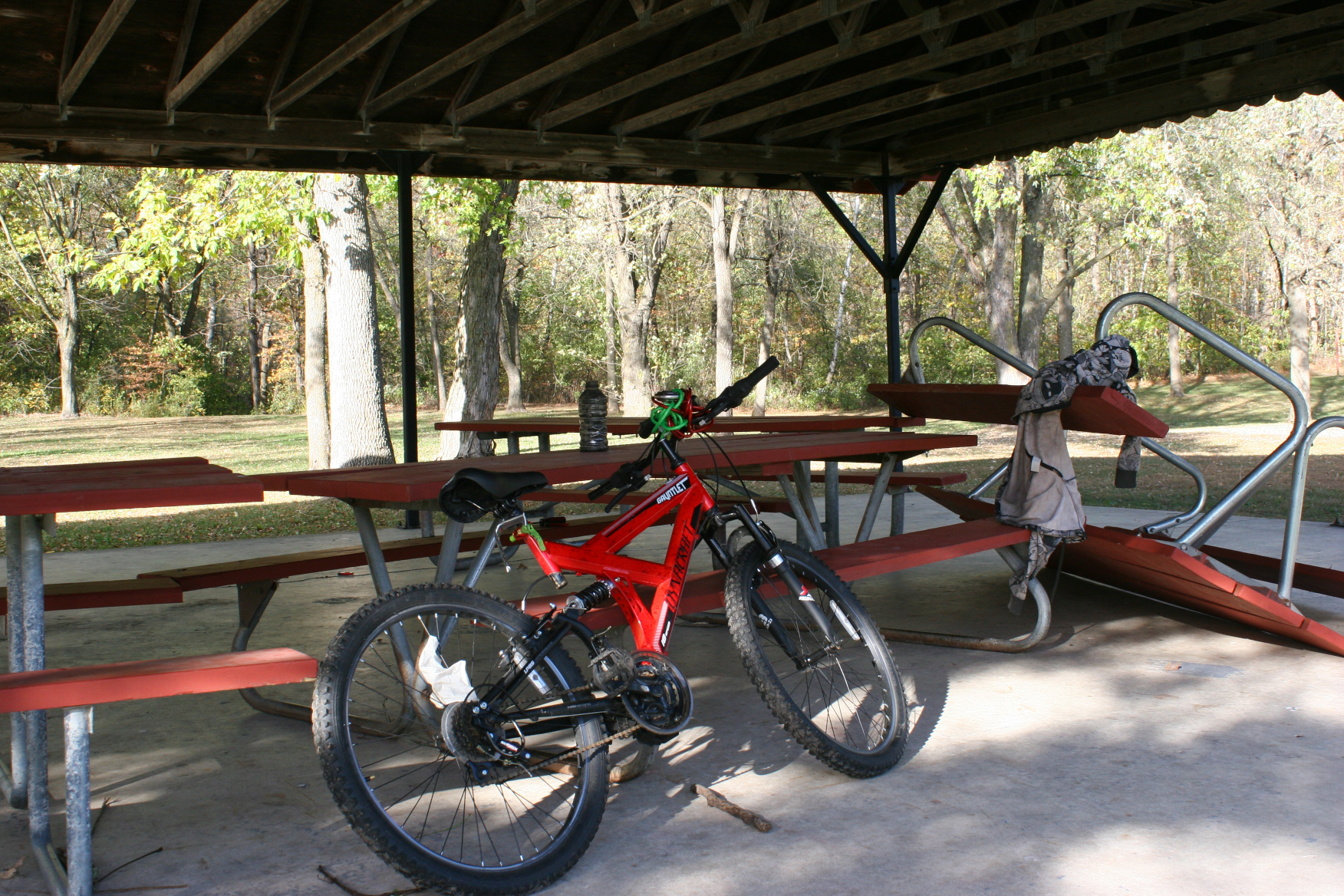
Seemingly abandoned in the shelter. Minnesota Prairie Roots copyrighted photo October 2021.
Then it was back to the main route, a pause on the bridge to again wonder about those hiking boots and then a pause at the shelter to speculate about an abandoned bike, jacket and beverage bottle.
Not a soul remained at Falls Creek Park. At least no one visible to us. Only mysteries—of abandoned and tossed belongings and of unmarked trails leading deep into the woods.
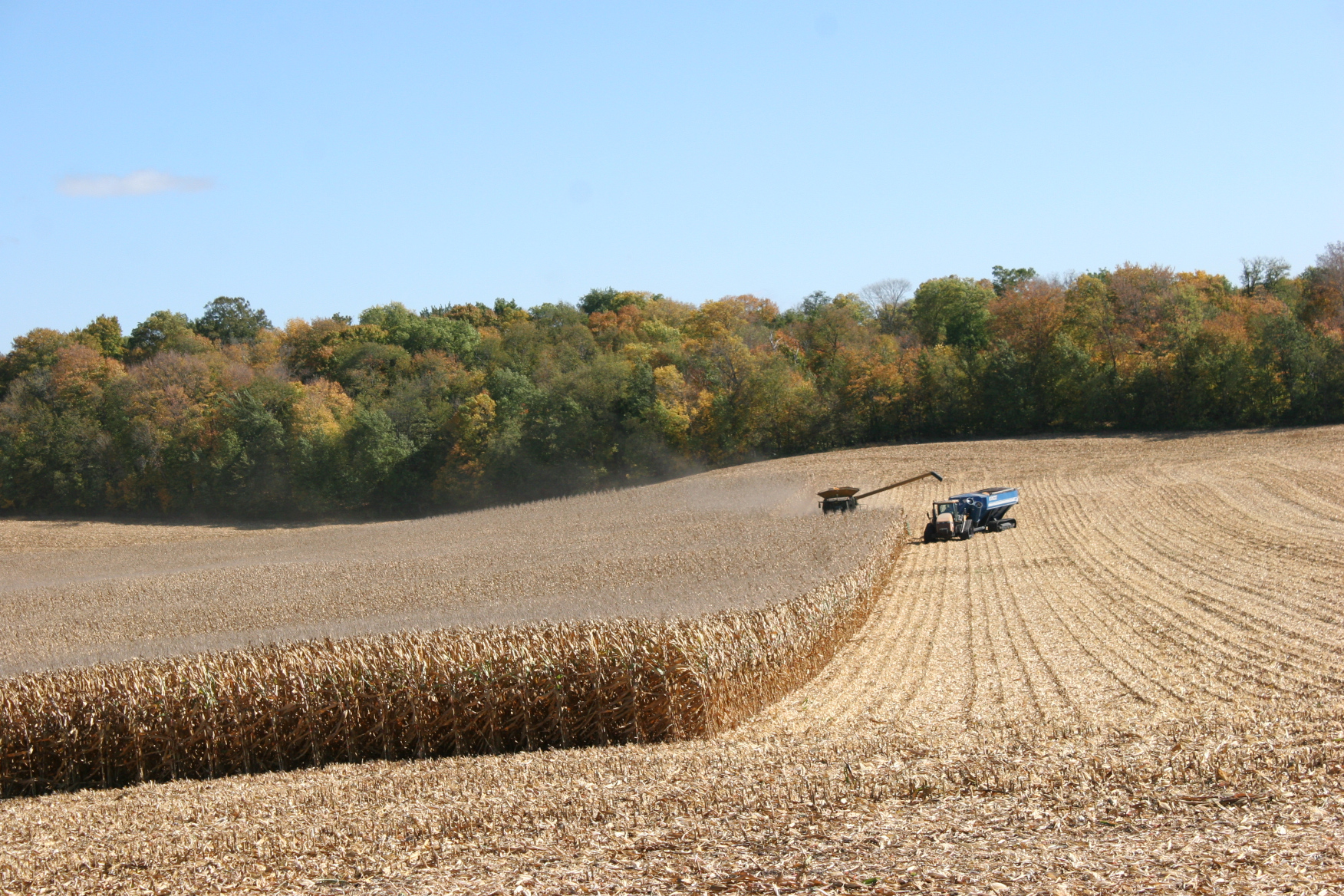
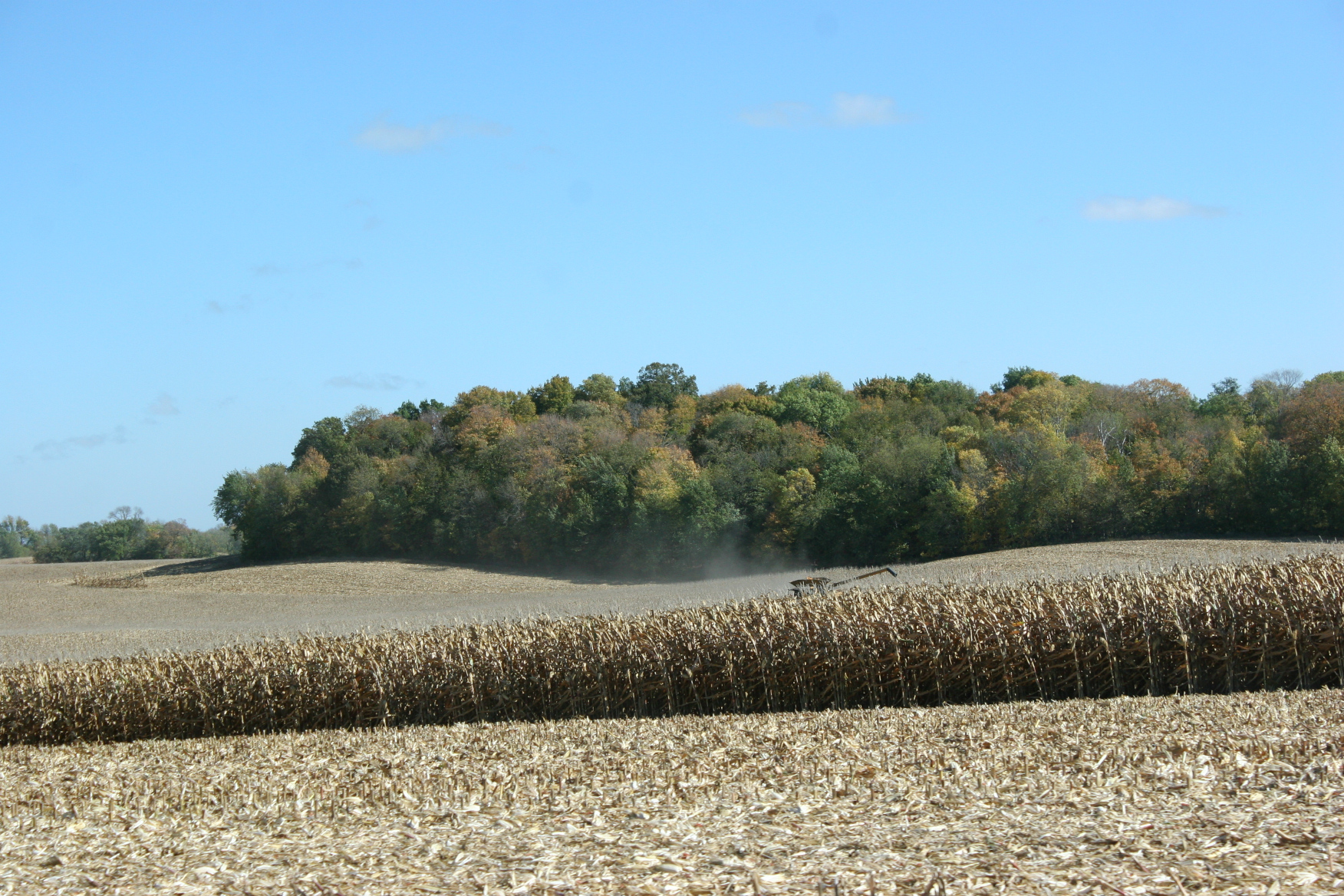
Harvesting corn in southern Minnesota. Minnesota Prairie Roots copyrighted photo October 2021.
DUST RISES FROM FIELDS, clouding the air as combines rake through rows of dry soybeans.
Barely visible, the top of the same combine featured in the photo above. Minnesota Prairie Roots copyrighted photo October 2021.
Combines comb corn rows, too, in this season of harvest in southern Minnesota.
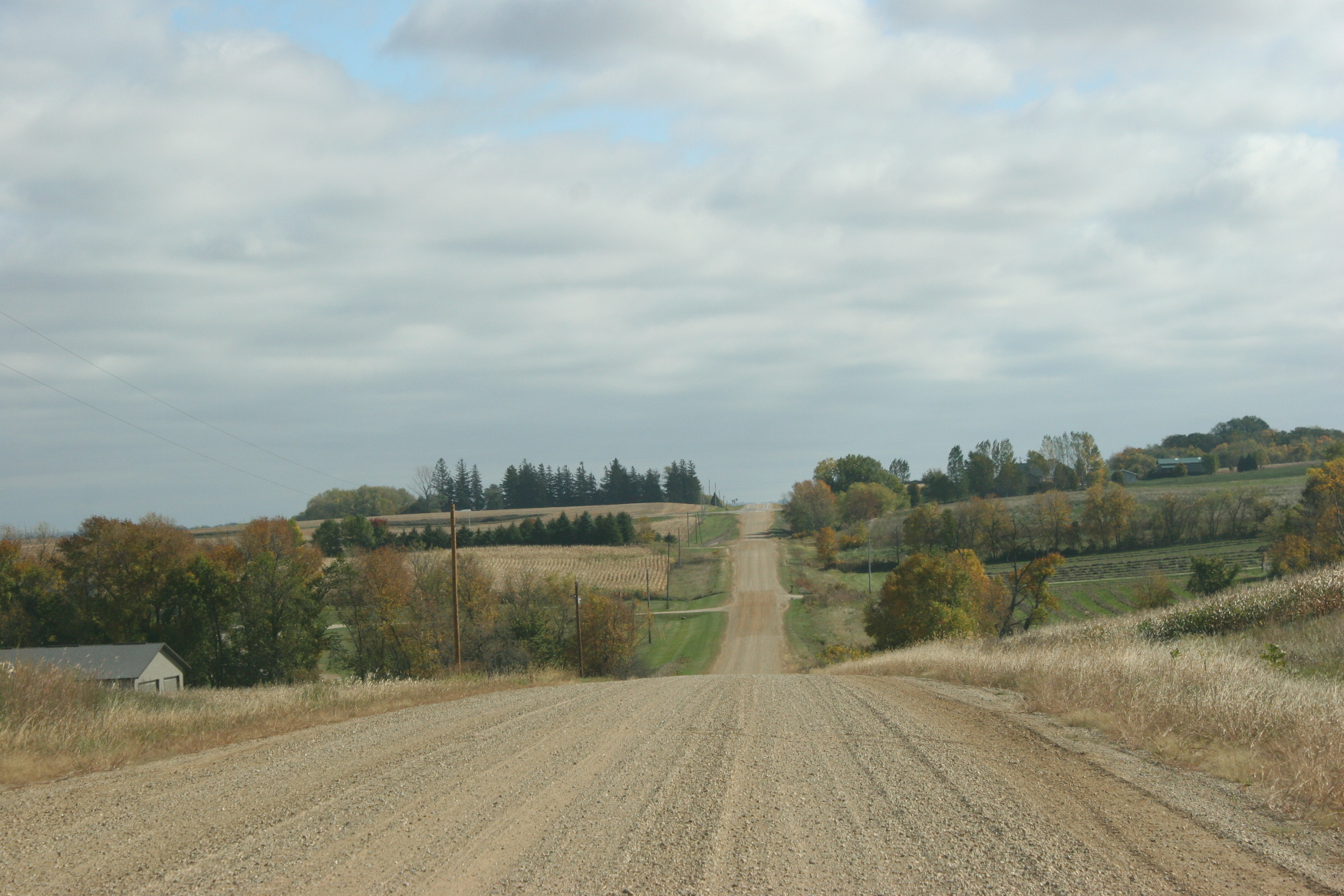
Follow country roads, like this one in eastern Rice County, to view fields at a slower pace. Minnesota Prairie Roots copyrighted photo October 2021.
Take a drive in the countryside these days and you will observe farmers hard at work, bringing in the crops.
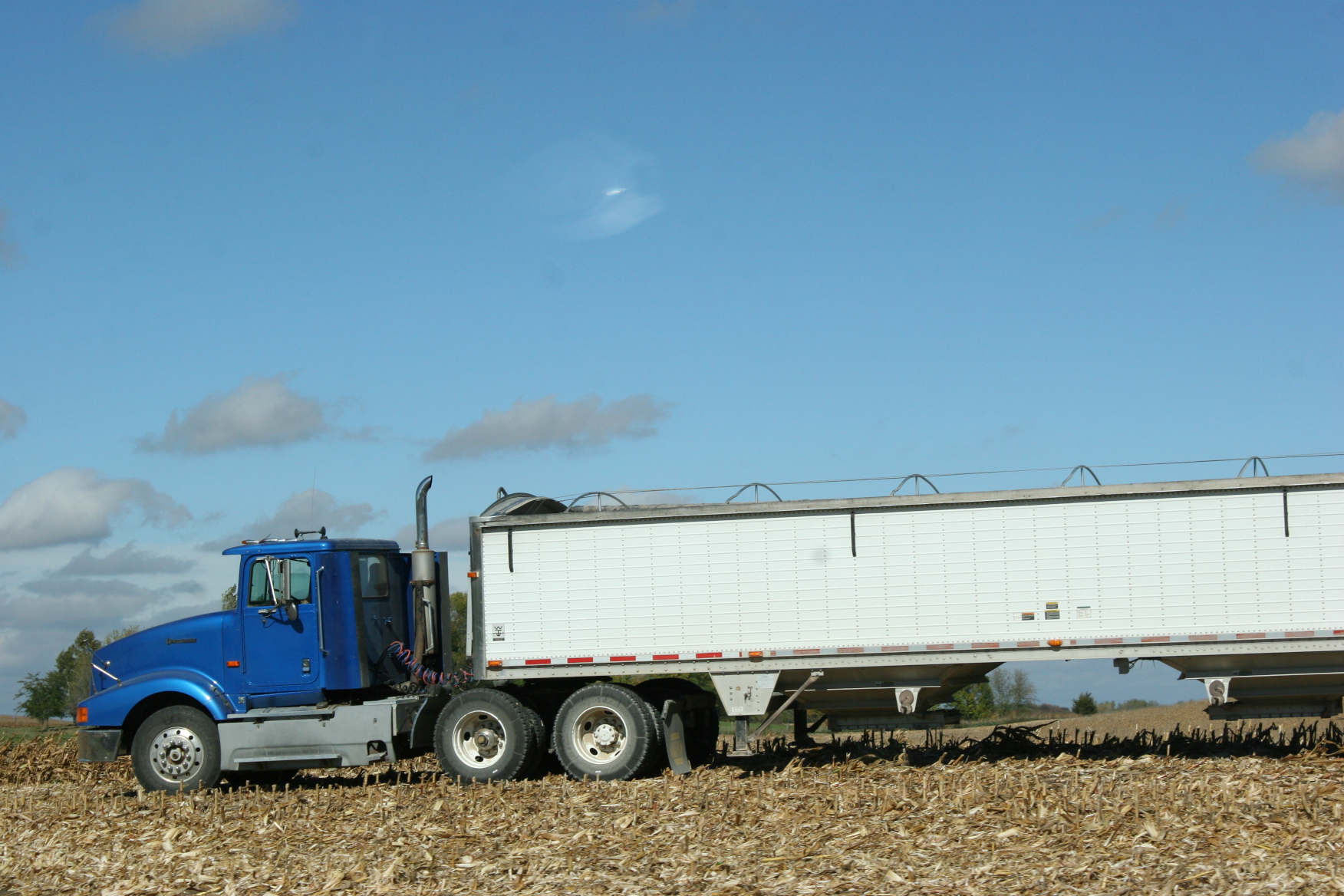
A common site, semi trucks parked in fields, awaiting the yield, this one in western Rice County. Minnesota Prairie Roots copyrighted photo October 2021.
As October moves to mid-month, a sense of urgency presses into long days in the field. By 7 pm, darkness envelopes the land and farm machinery still moves, like a mammoth beast lumbering across acres of corn and soybeans, eyes aglow.
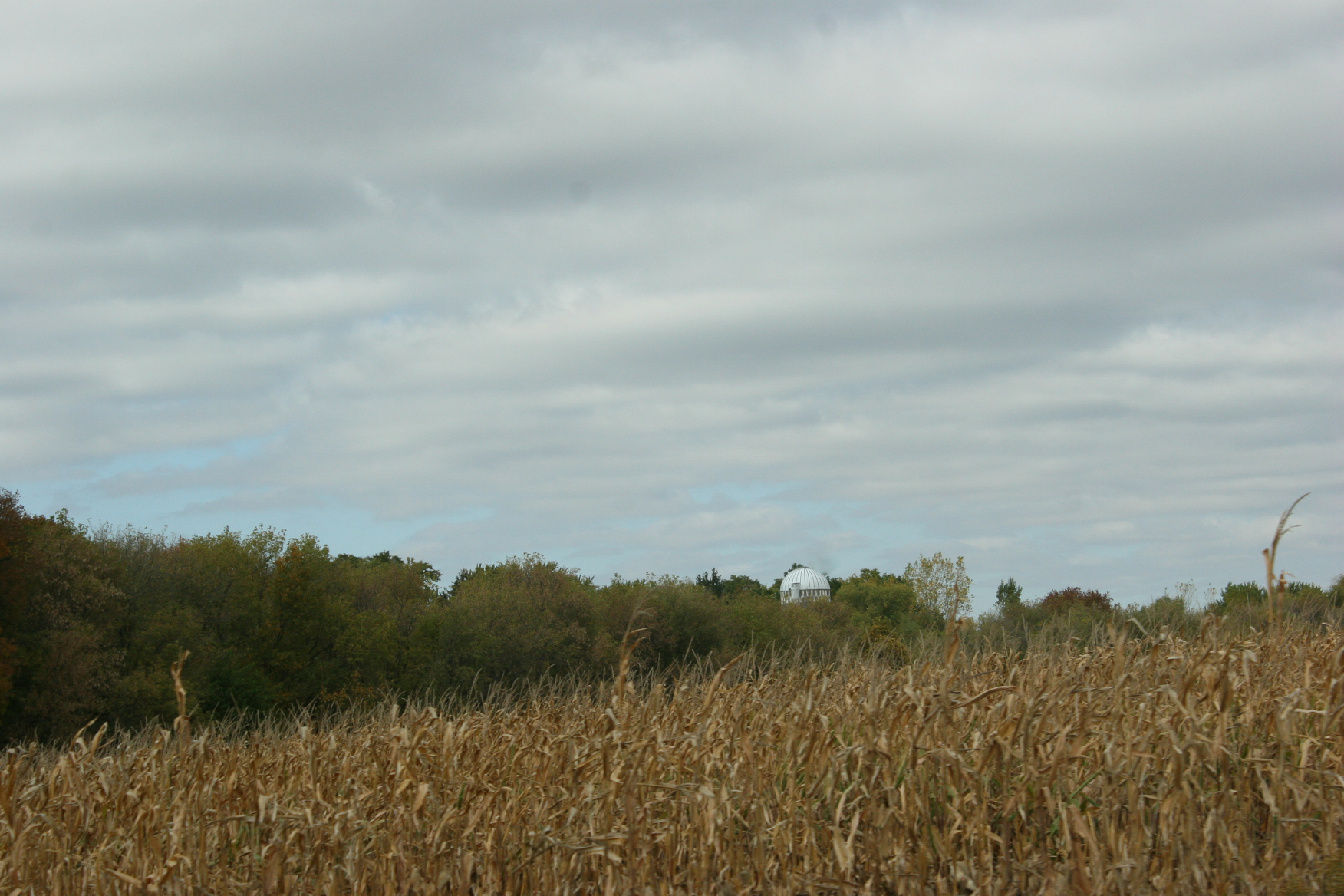
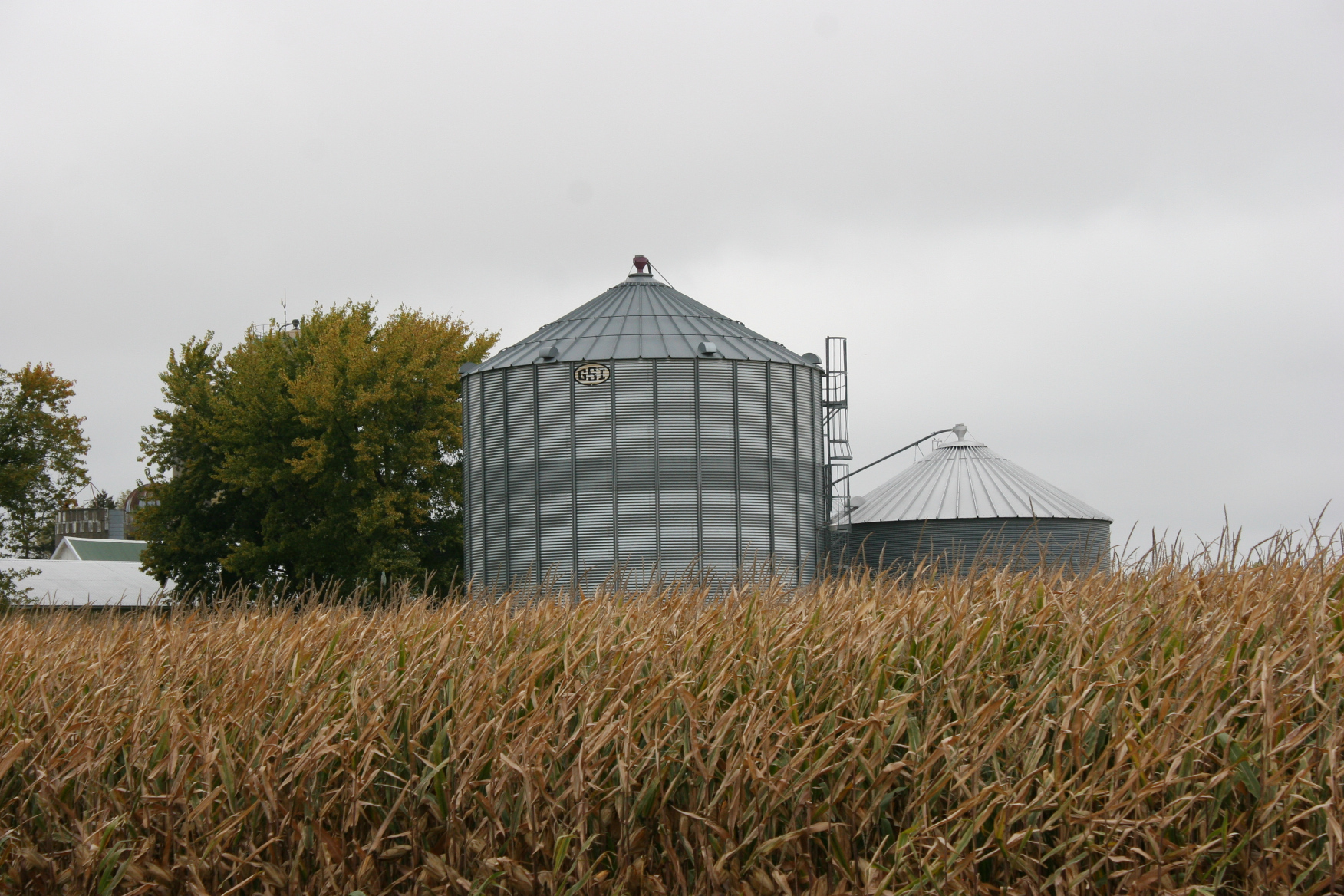
A silo peeks above a cornfield in eastern Rice County. Minnesota Prairie Roots copyrighted photo October 2021.
It is in this season of harvest that I feel a bit melancholy, missing my once close connection to the land. The scent of earth. The view of acres and acres and acres of crops drying to muted hues, visual evidence of a farmer’s work. The sound of combines roaring. The taste of dust and dirt. Golden orbs of soybeans sifting between fingers spread wide.
A farm site spreads across the land in western Rice County. Minnesota Prairie Roots copyrighted photo October 2021.
While I once experienced all those first-hand on my childhood farm in southwestern Minnesota, today I feel an outsider looking in. Watching. Remembering. Feeling grateful for the years I lived on a farm, never realizing then just how much those days would mean to me later in life.
Grain bins, like these in eastern Rice County, symbolize harvest as storehouses for grain. Minnesota Prairie Roots copyrighted photo October 2021.
Each autumn I yield to the call of harvest. I reconnect to the land. Observing. Recalling. Missing my farmer dad and my Uncle Mike, a bachelor farmer who lived the next farm place over to the east. They are decades gone now, their final harvests long-finished.
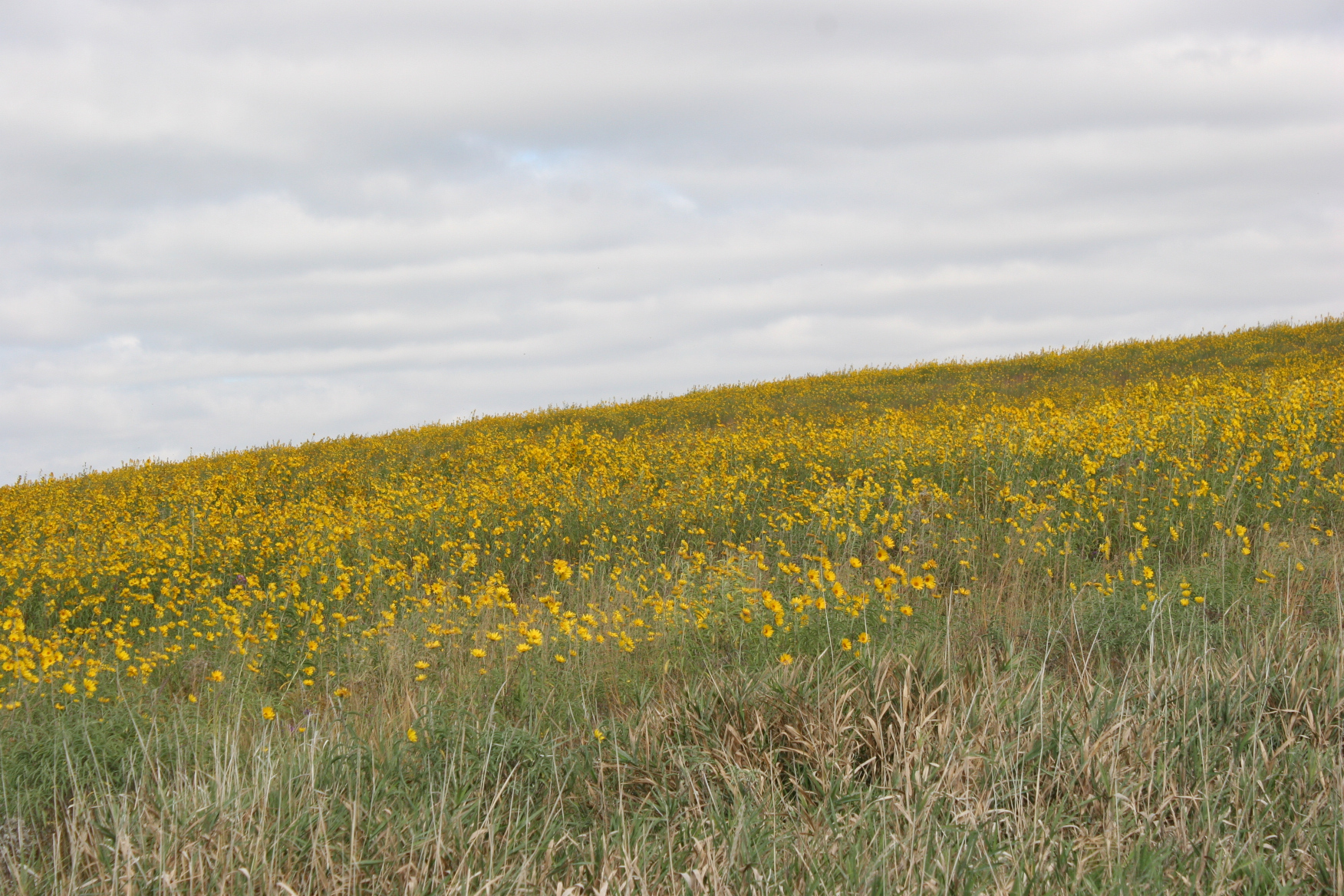
Acres of wildflowers bloom in a field off Rice County Road 20 between Northfield and Cannon City. Minnesota Prairie Roots copyrighted photo October 2021.
These emotions rush like a blustery October wind into my thoughts as winter approaches. As harvest continues, as seasons pass and life goes on.
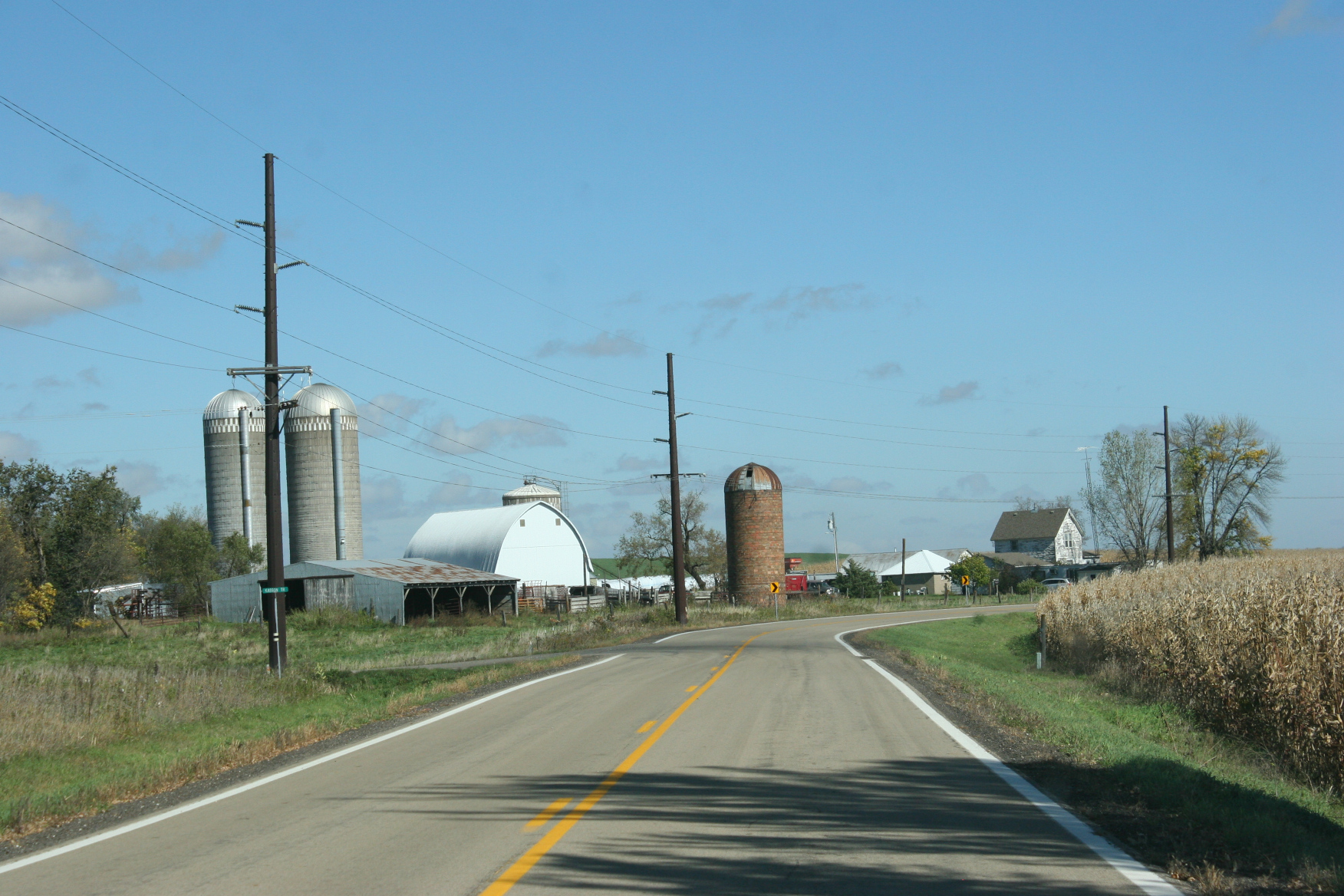
Cornfield to the right, farm site to the left, all part of a Sunday afternoon country drive in southern Minnesota. Minnesota Prairie Roots copyrighted photo October 2021.
TELL ME: Do you go for country drives to view the harvest? Or, if you live in a city, how do you celebrate autumn? I’d like to hear, wherever you live. I welcome harvest memories also.
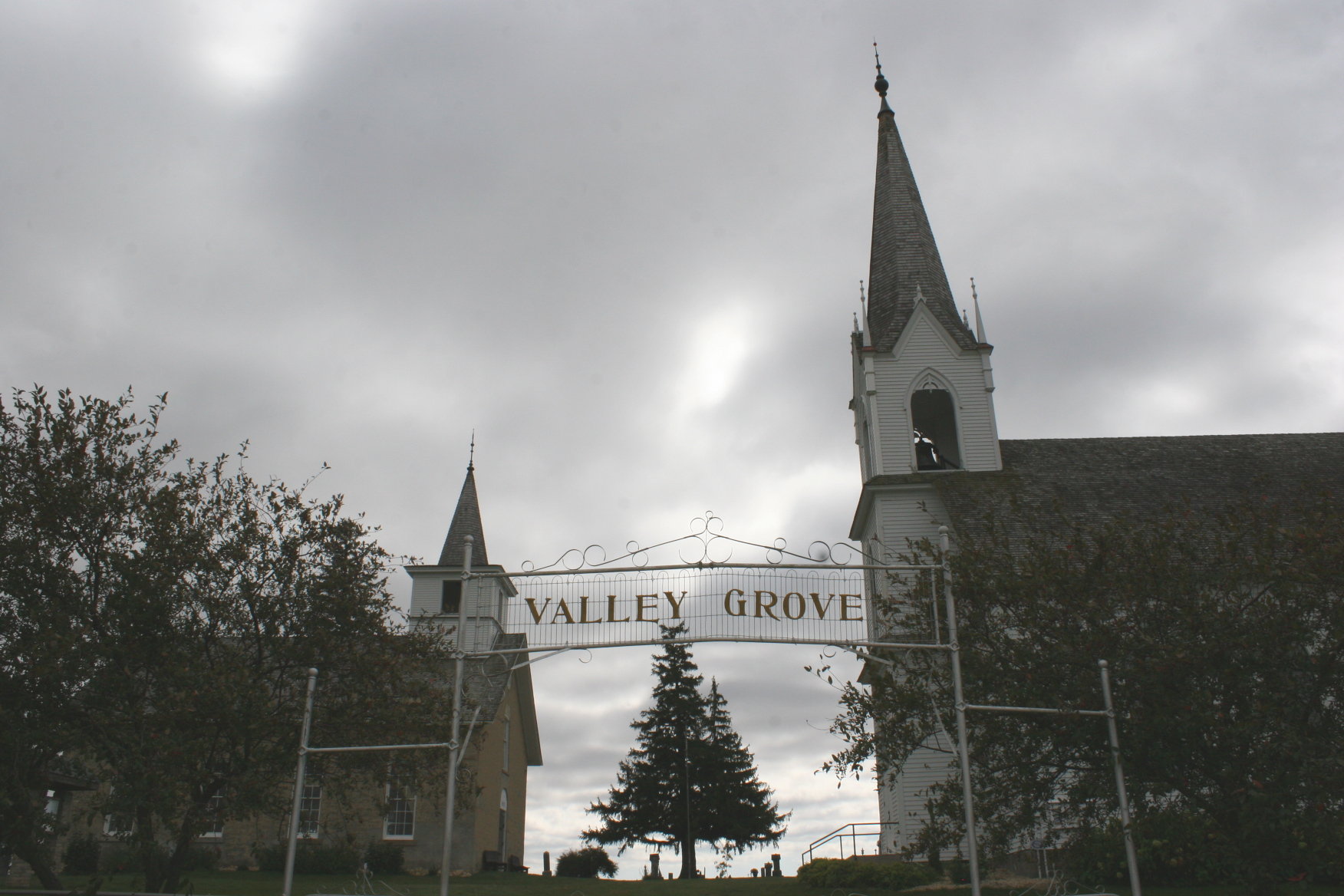
The artful gated entrance to Valley Grove. Minnesota Prairie Roots copyrighted photo October 2021.
I EXPERIENCE SOMETHING SACRED in this place. This preserved parcel of land where two aged churches rise atop a hill in rural Nerstrand.
Looking down the driveway from the hilltop church grounds, a beautiful view of the valley below. Minnesota Prairie Roots copyrighted photo October 2021.
The newer of the two Valley Grove churches. Minnesota Prairie Roots copyrighted photo October 2021.
On a recent Sunday afternoon, Randy and I sat on the front steps of the 1894 white clapboard church eating a picnic lunch. Bothersome bees hovered, drawn by the sweetness of Randy’s soda and fruit-laced yogurt and homemade chocolate chip cookies.
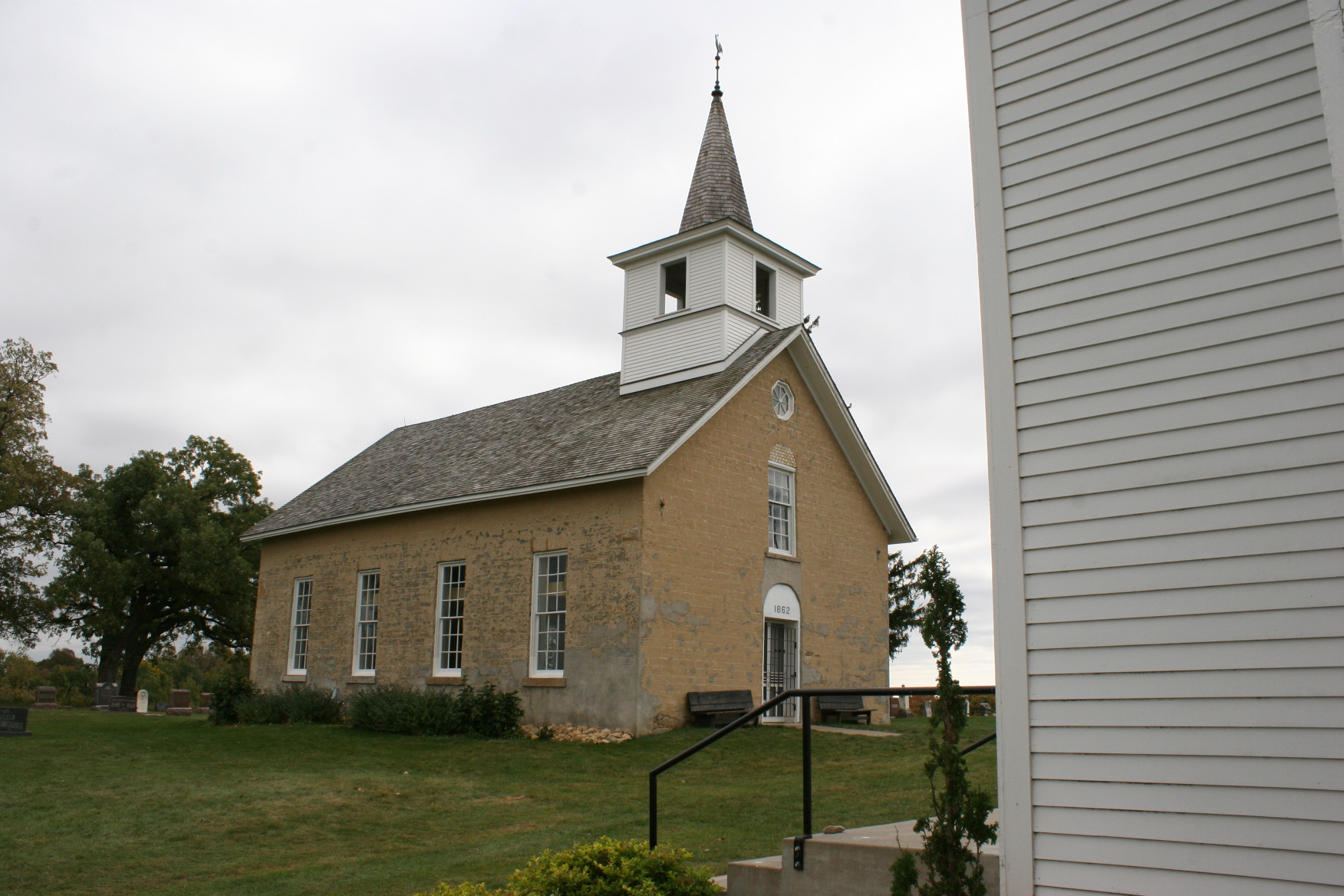
Photographed from a side of the clapboard church, the limestone church a short distance away. Minnesota Prairie Roots copyrighted photo October 2021.
A stone’s throw away across the lawn sits the 1862 limestone church, constructed in the year of the U.S.-Dakota Conflict raging many miles away to the west.
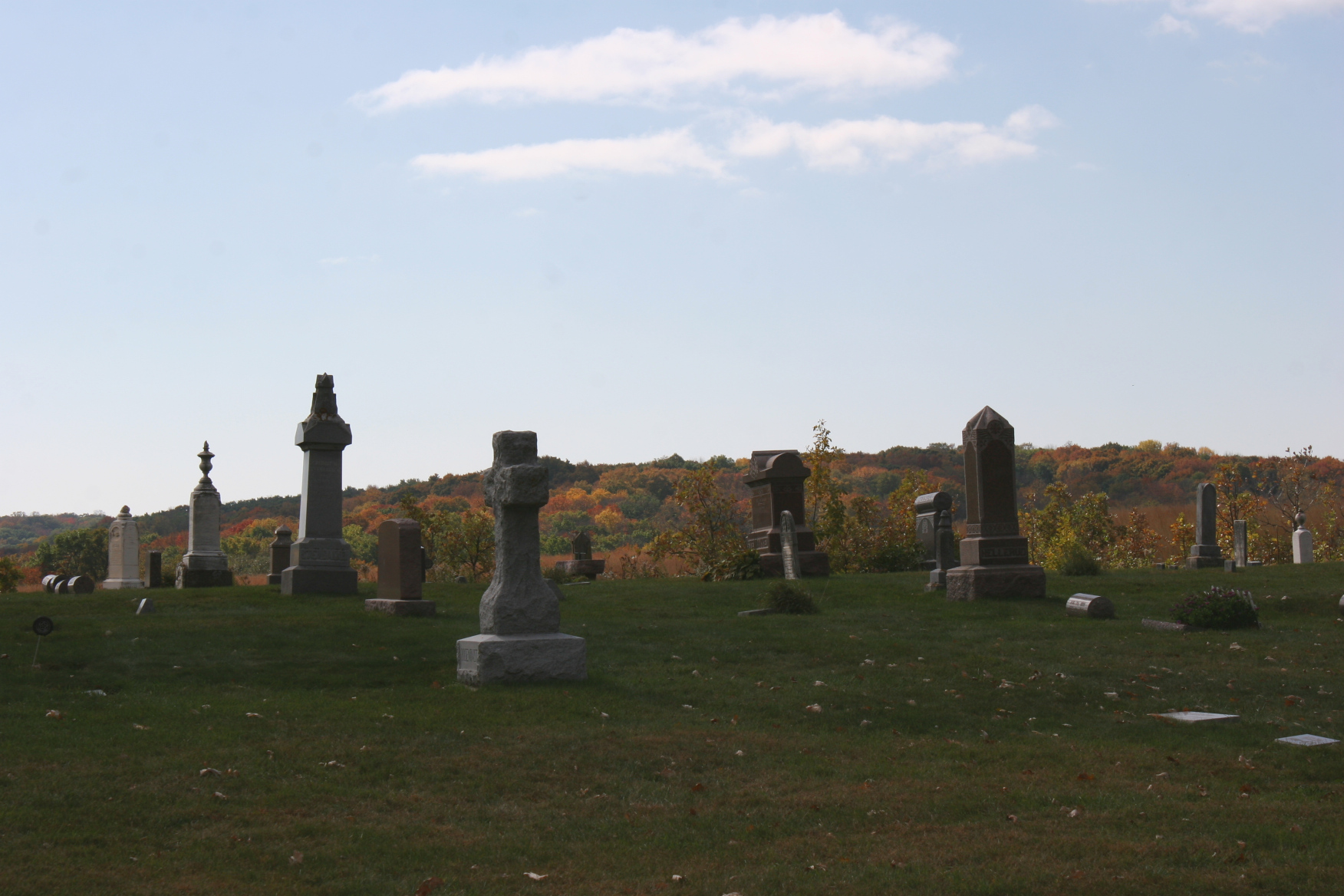
The cemetery offers history, art and a place for quiet contemplation against a beautiful natural backdrop. Minnesota Prairie Roots copyrighted photo October 2021.
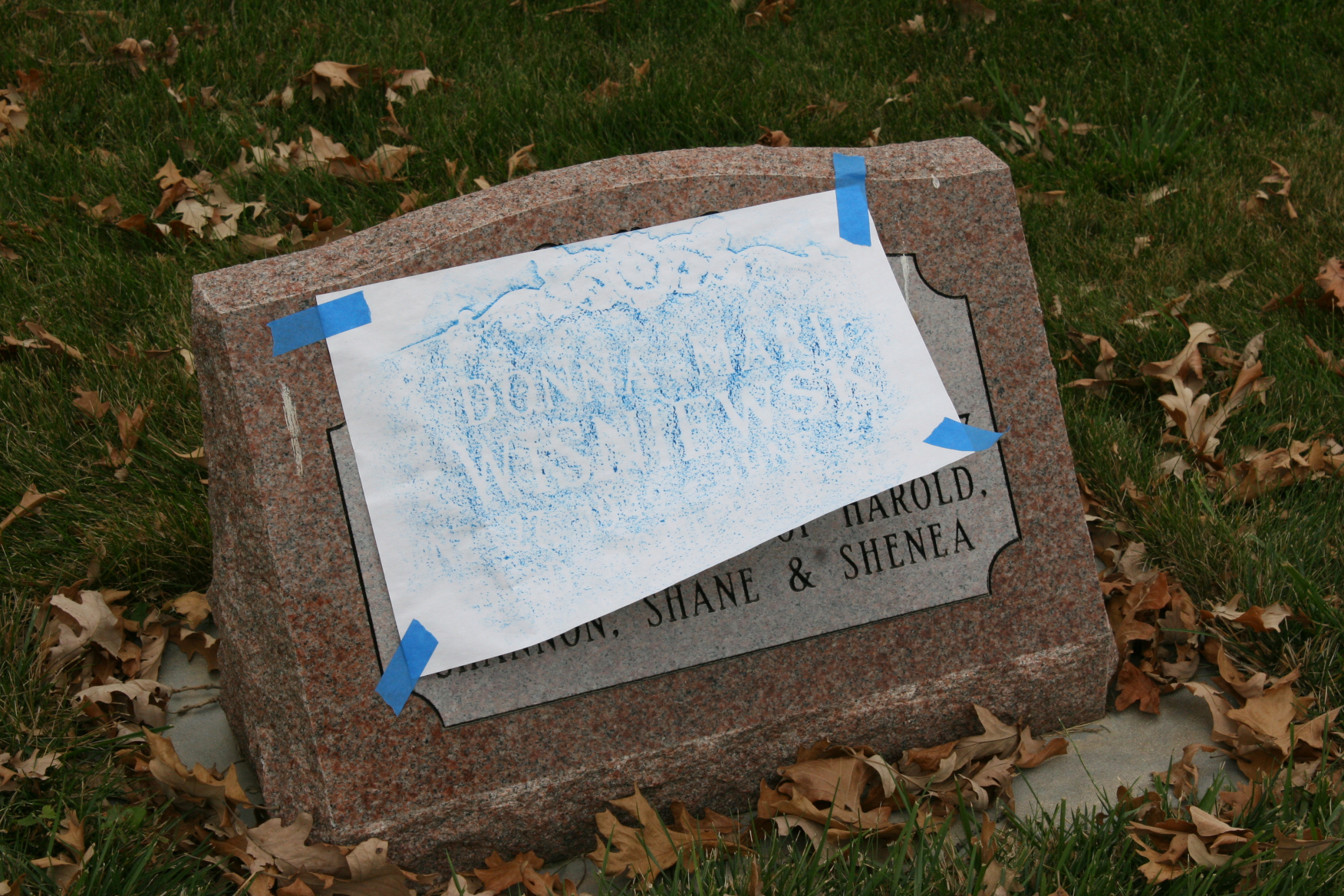
An in-process gravestone rubbing. Minnesota Prairie Roots copyrighted photo October 2021.
I find gravestone engravings especially interesting and often touching. Minnesota Prairie Roots copyrighted photo October 2021.
Valley Grove holds its own history as a community and spiritual gathering place for the area’s Norwegian immigrants. Walk the grounds of the cemetery next to the churches and you’ll read names of those of Norwegian ancestry. The cemetery remains well-used with new tombstones marking the passage of yet another loved one.
Information about Valley Grove is tucked inside a case on the side of the clapboard church. Minnesota Prairie Roots copyrighted photo October 2021.
I have no personal connection to Valley Grove. But I hold a deep appreciation for the history, honored via the Valley Grove Preservation Society. That organization maintains and manages the church and grounds. And its a lovely, especially in autumn, acreage.
Farm sites and farmland surround Valley Grove. Minnesota Prairie Roots copyrighted photo October 2021.
Once I’d finished my turkey sandwich and other picnic foods, I set out with my camera to document. The views from this hilltop site are spectacular. Farm land and farm sites, the low moo of a cow auditorily reminding me of this region’s agrarian base.
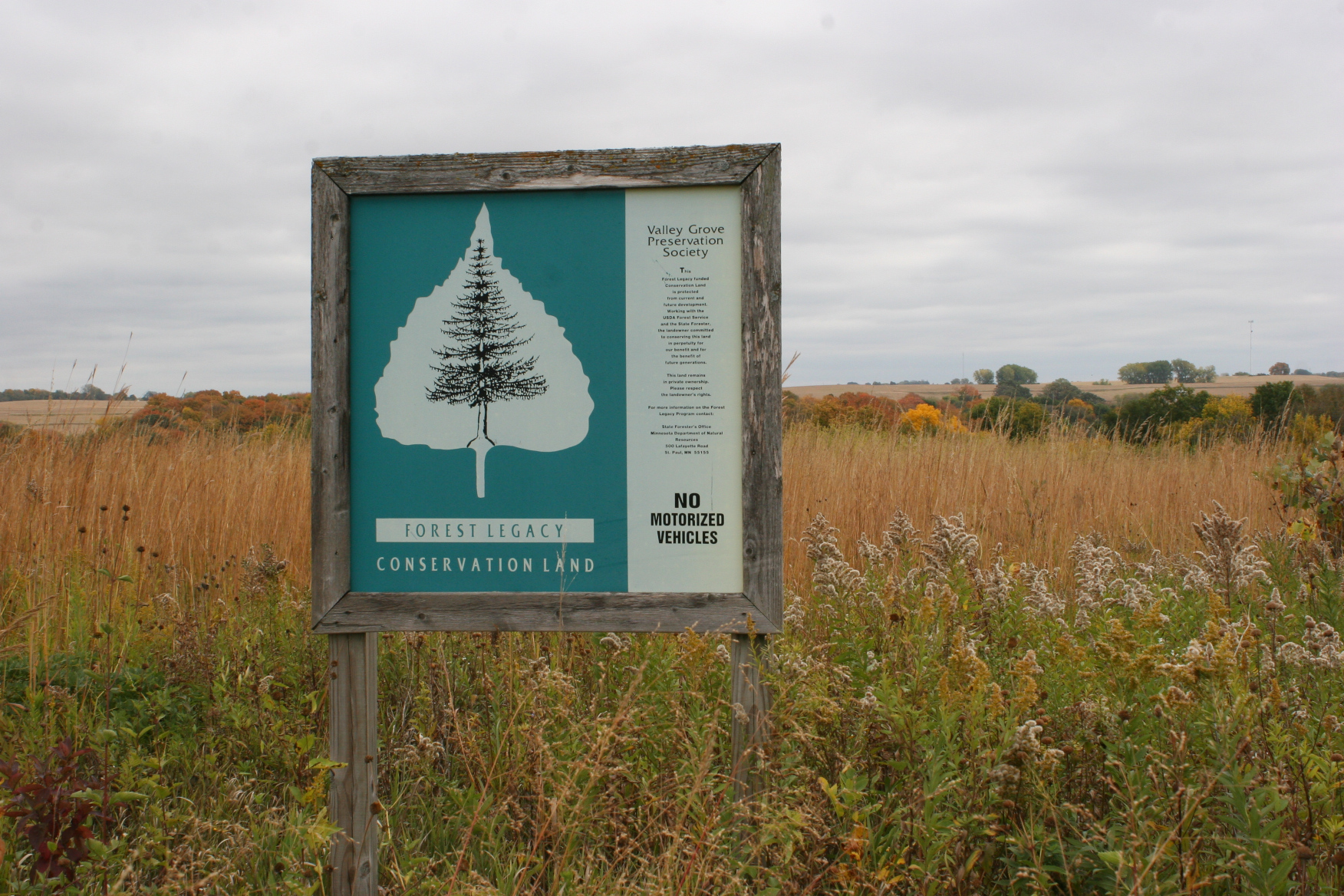
Conservation and legacy are valued at Valley Grove. Minnesota Prairie Roots copyrighted photo October 2021.
Remnants of the Big Woods remain and can be seen from Valley Grove. Minnesota Prairie Roots copyrighted photo October 2021.
Following the prairie path back to the church grounds, just over the hill. Minnesota Prairie Roots copyrighted photo October 2021.
Tall dried prairie grasses frame nearly every view. Those who tend this land value its natural features of prairie and oak savanna. Paths lead visitors along prairie’s edge and onto the prairie to view distant colorful treelines, part of the Big Woods. The hilltop location offers incredible vistas.
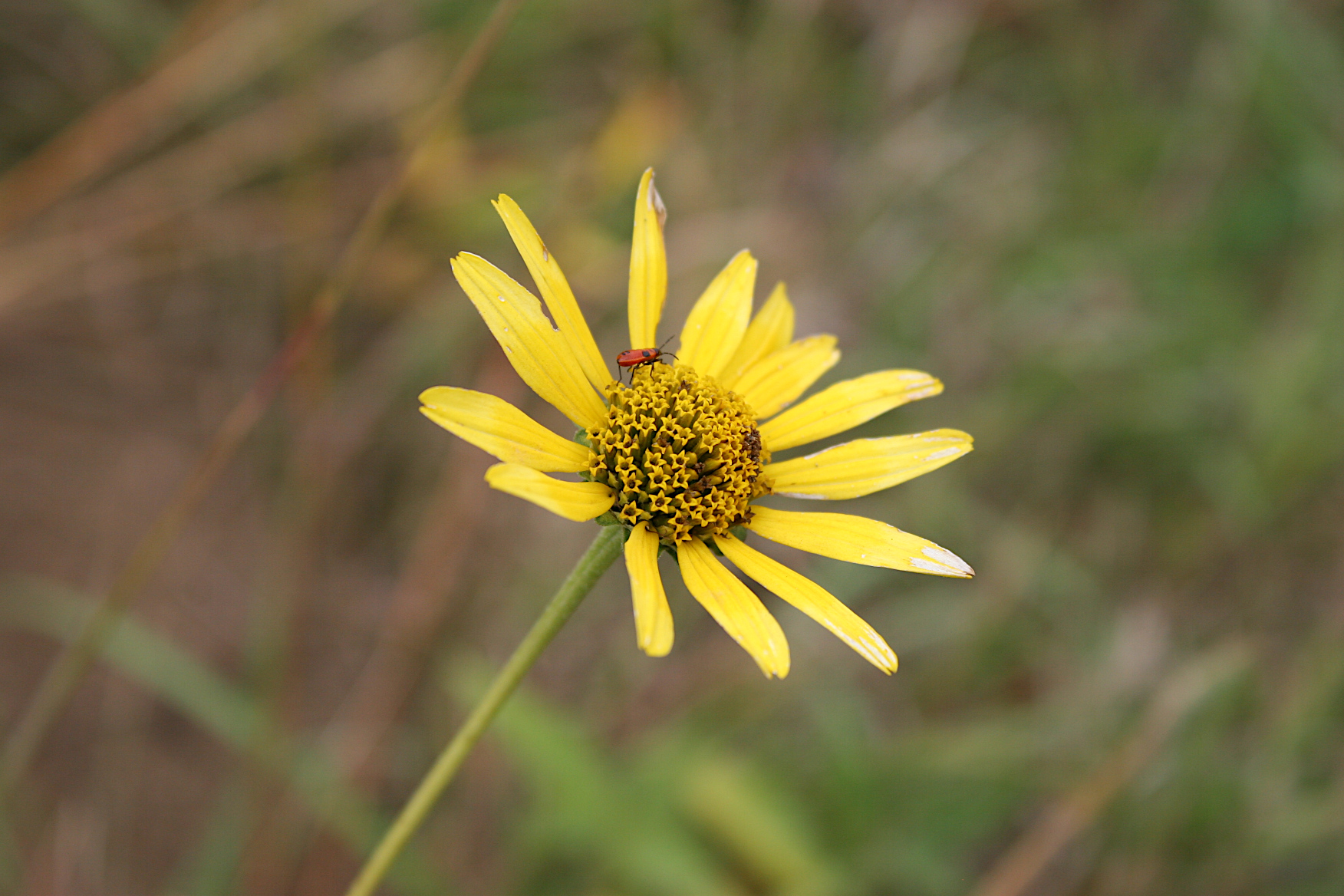
On a mixed October afternoon of sun and clouds, a wildflower jolts color into the landscape. Minnesota Prairie Roots copyrighted photo October 2021.
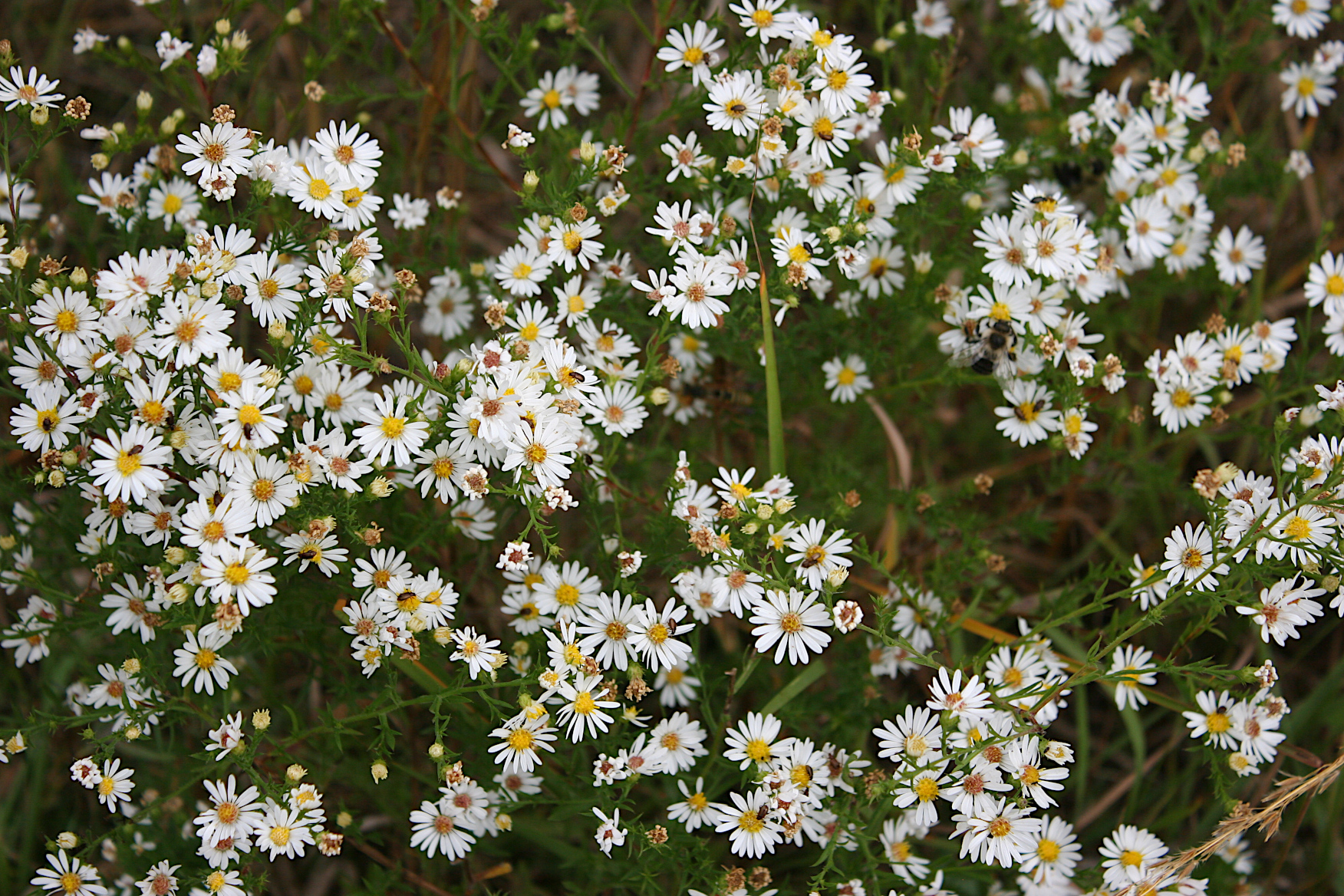
But up close is worth noting, too, especially the wildflowers.
An unexpected delight in the cemetery was an old-fashioned rosebush in full bloom. Minnesota Prairie Roots copyrighted photo October 2021.
And in the cemetery I found an old-fashioned rosebush abloom in pink roses. Just like a rosebush that graced my childhood farm far away in southwest Minnesota where settlers and Native Peoples once clashed. I dipped my nose into blossom after blossom, breathing in the deep, perfumed, intoxicating scent.
Lots of wildflowers to enjoy. Minnesota Prairie Roots copyrighted photo October 2021.
Spending time at Valley Grove, even when church doors are not open, seems sacred. I feel the peace of this rural location. The quiet. My smallness, too, within the vastness of sky and land and spires rising.
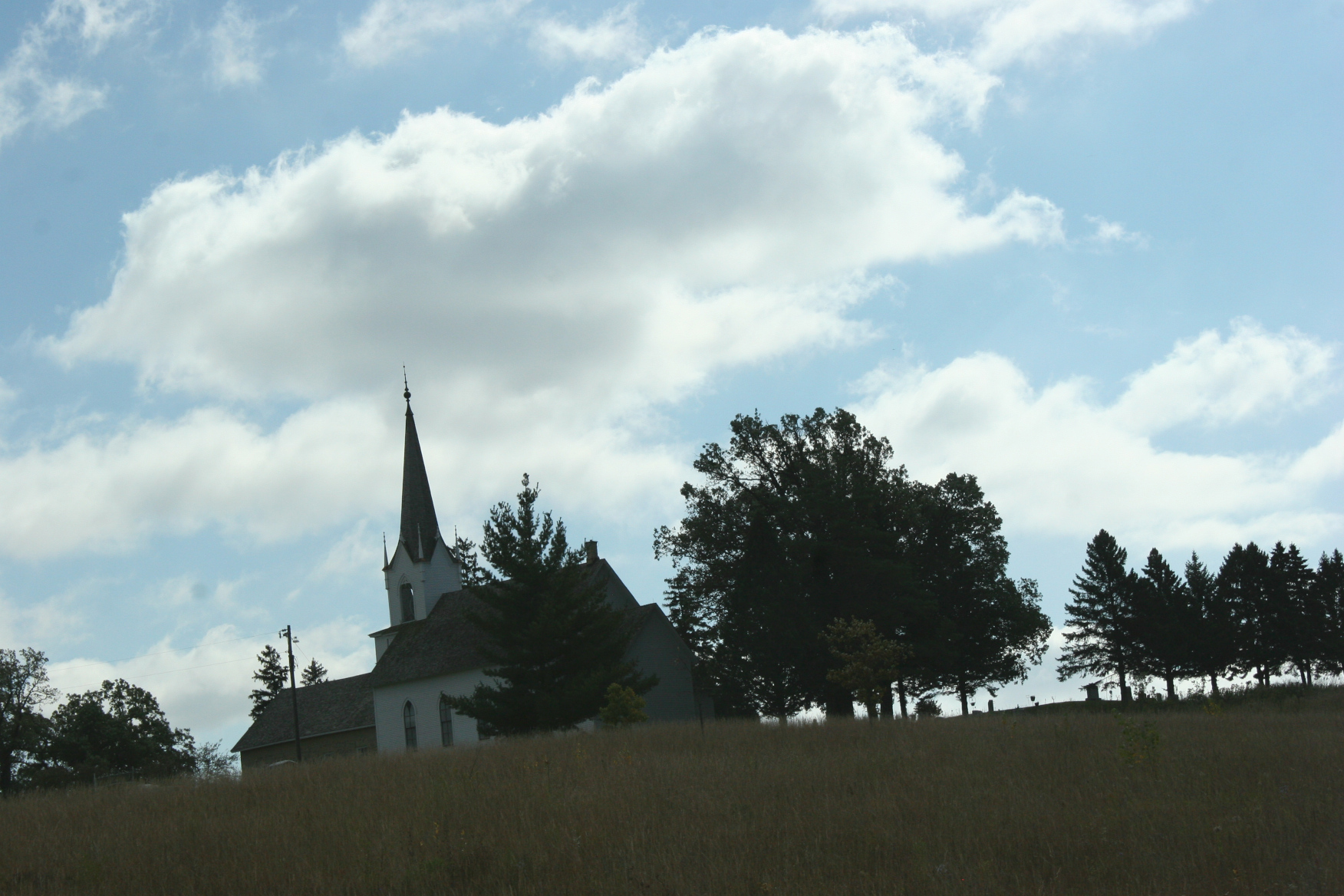
High on the hill…Valley Grove churches. Minnesota Prairie Roots copyrighted photo October 2021.
To walk here, to sit on the front steps of a church on the National Register of Historic Places is to feel a sense of gratitude for those who came before us. For those who today recognize the value of sacredness and continue to preserve Valley Grove. Who understand that the spiritual stretches beyond church doors. To the land. To the memories of loved ones. And to future generations.
Inviting decor and outdoor seating create a welcome seasonal setting outside the boutique/store at Apple Creek Orchard, rural Faribault. Minnesota Prairie Roots copyrighted photo October 2021.
MORE AND MORE, MINNESOTA apple orchards are growing more than just apples. They are growing memories, meeting public demand for experiences.
Bagged apples fill a crate just outside the boutique entry. Minnesota Prairie Roots copyrighted photo October 2021.
Apple Creek Orchard, located in the countryside just northwest of Faribault at 5524 185th Street, is among those producers embracing that trend. Here, in this rural setting, visitors can find not only 21 pre-picked apple varieties—including popular choices like Honeycrisp, Haralson, Zestar, SweeTango, Cortland and the new First Kiss—but also Halloween Town.
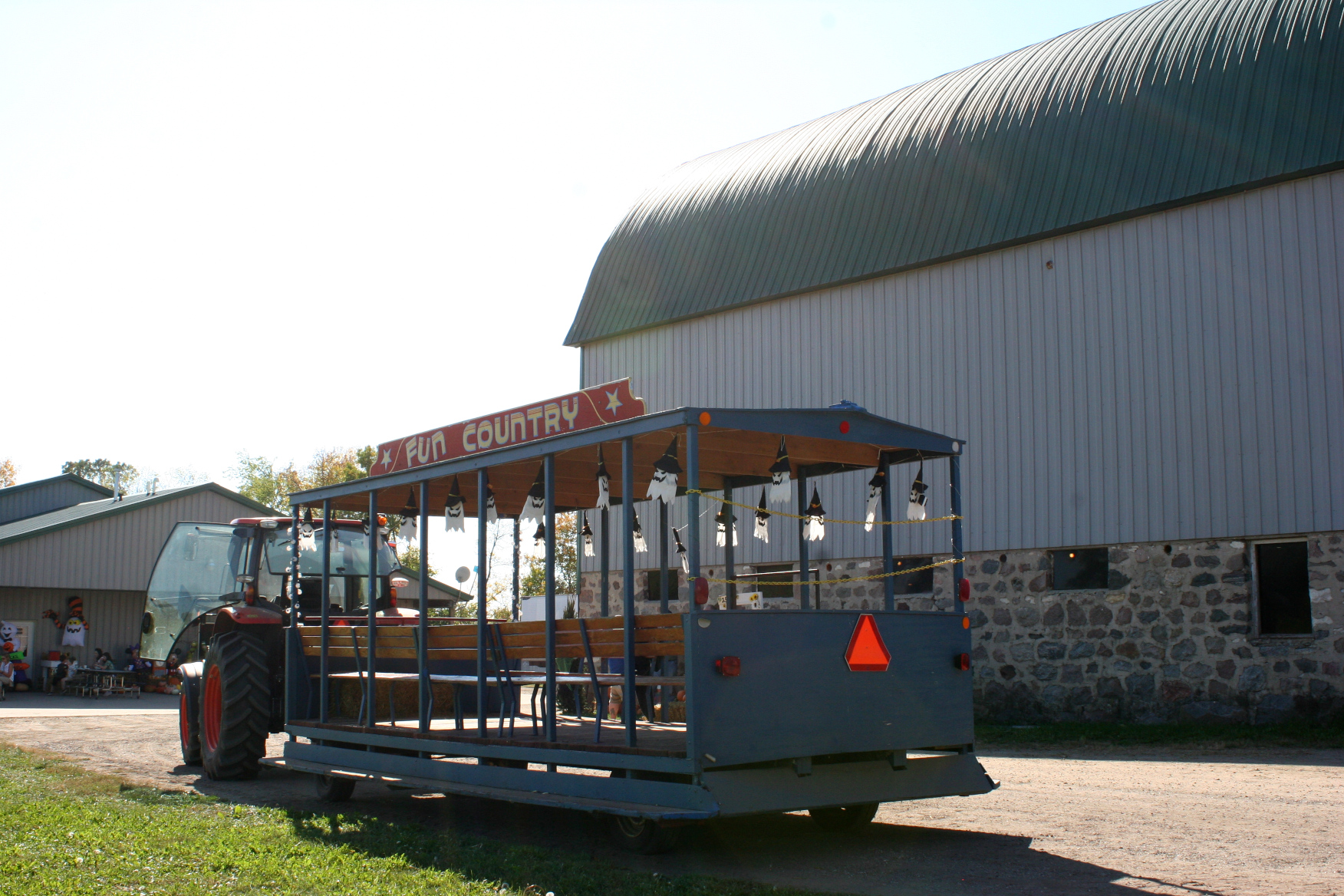
Riders spilled off this wagon shortly after our arrival. Minnesota Prairie Roots copyrighted photo October 2021.
That October attraction includes a Haunted Trail Wagon Ride (Friday-Sunday), Haunted Corn Maze and apple slinging.
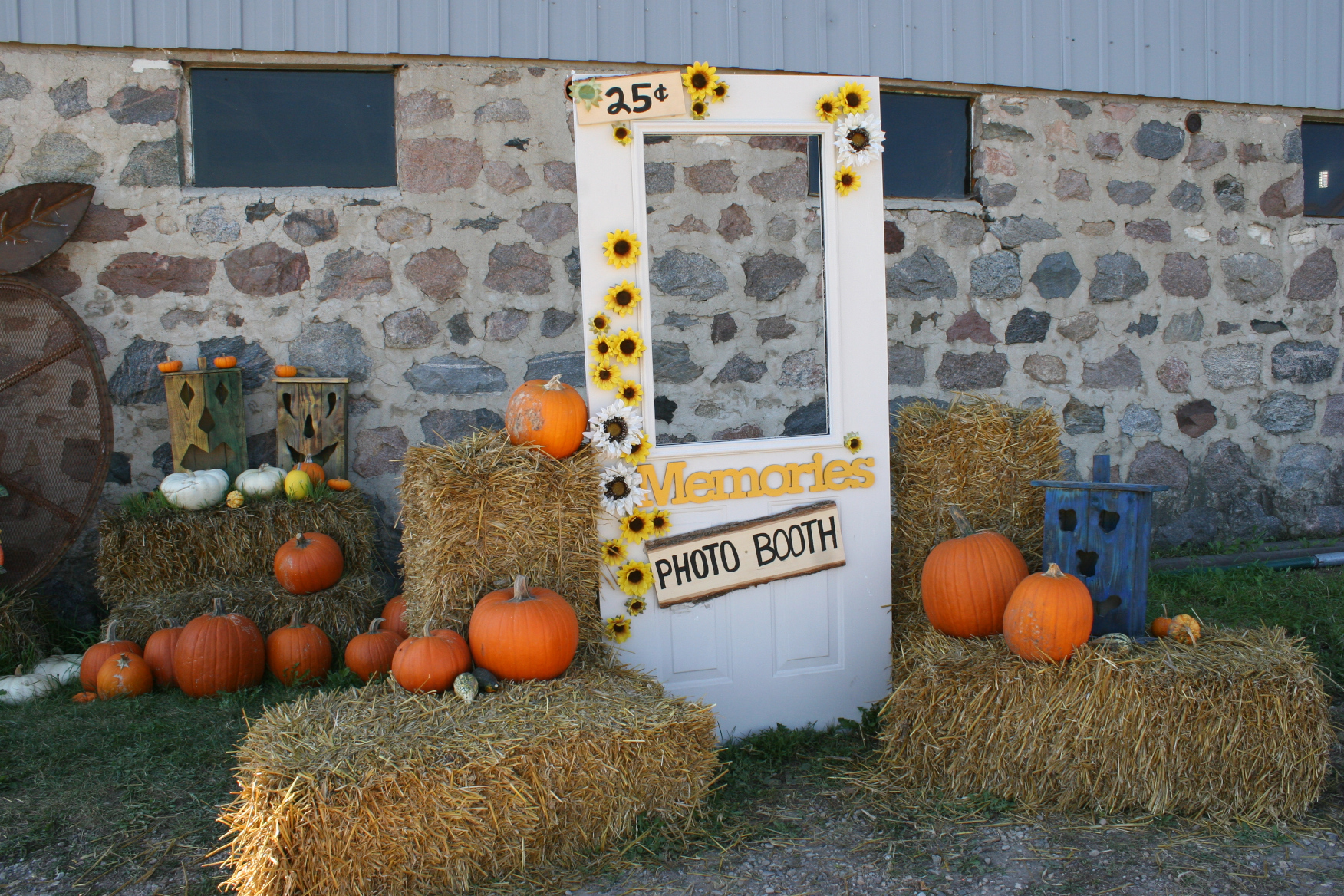
I saw many families posing here for photos. Minnesota Prairie Roots copyrighted photo October 2021.
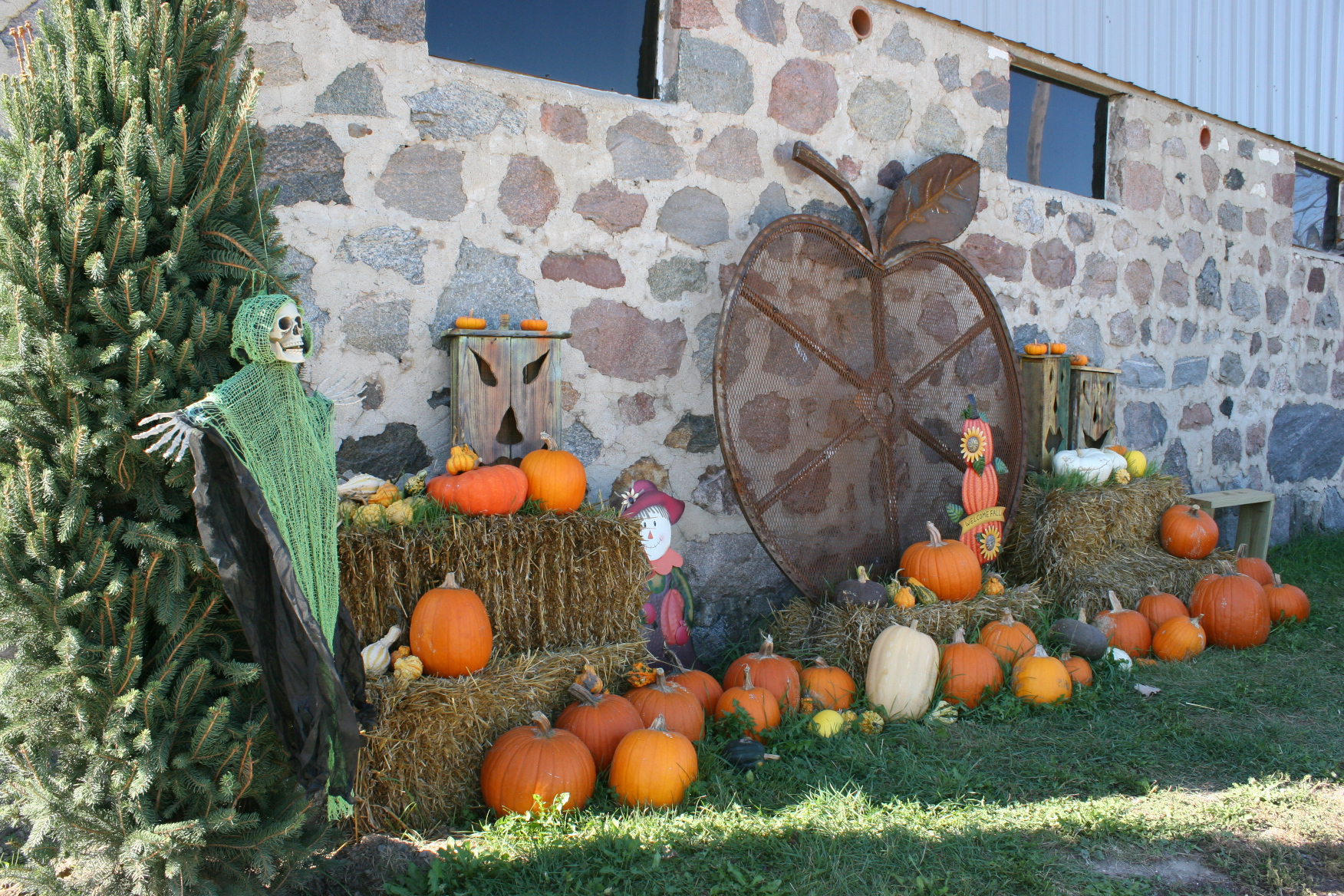
Last Sunday afternoon, Randy and I popped in for a bag of apples while on a country drive to view the fall colors. We had no idea the orchard had evolved into more than a place to buy local apples…until we pulled into the farmyard. There, next to the aged mammoth barn with fieldstone foundation, I spotted a seasonal display of pumpkins and other décor staged on/aside straw bales. Plus a photo prop.
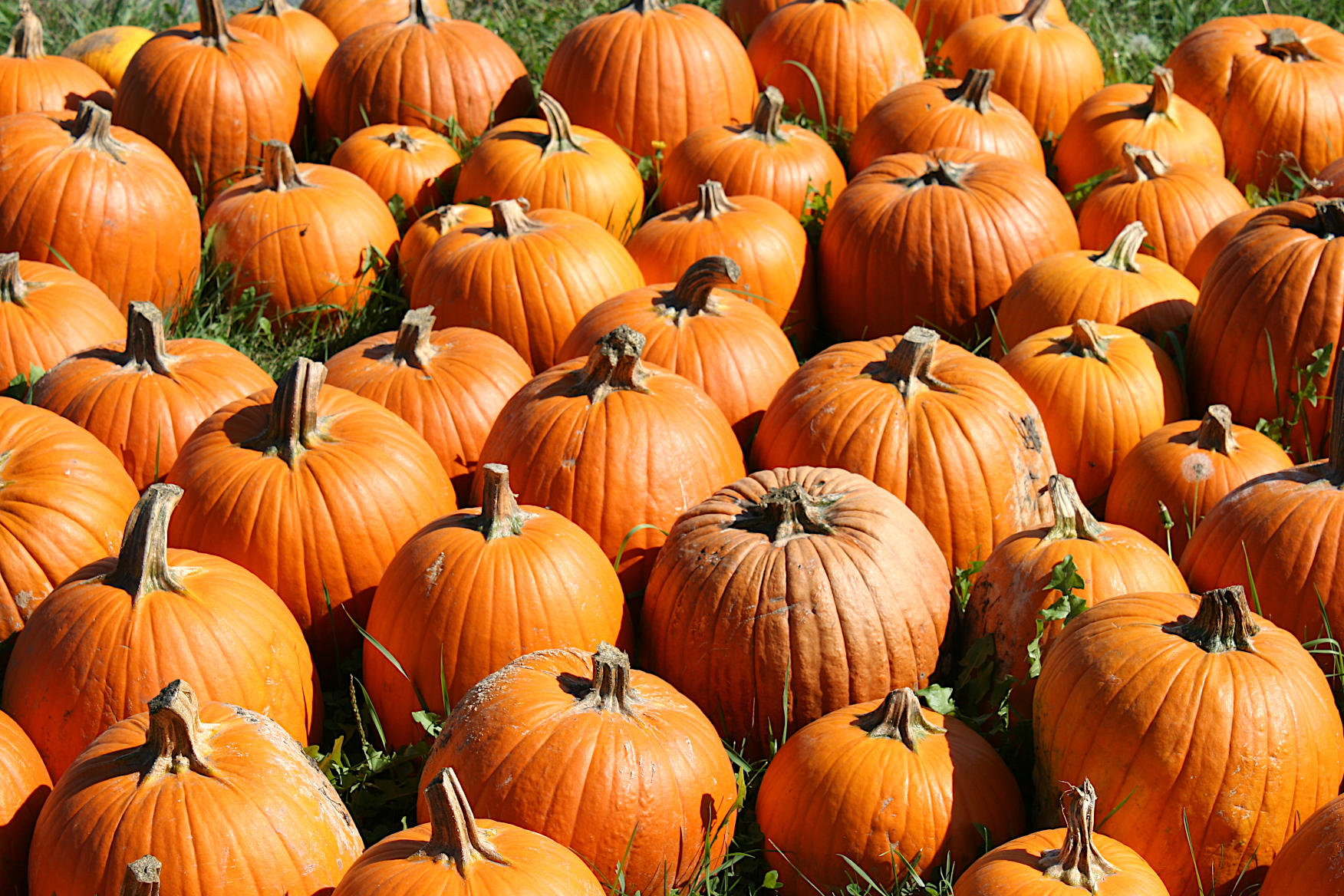
Plenty of pumpkins are available for purchase. Minnesota Prairie Roots copyrighted photo October 2021.
Rounding the end of the barn, I saw more. Vehicles lined along lawn’s edge near the barn and the multi-purpose poleshed housing Apple Creek Boutique. And up the hill, additional photo staging.
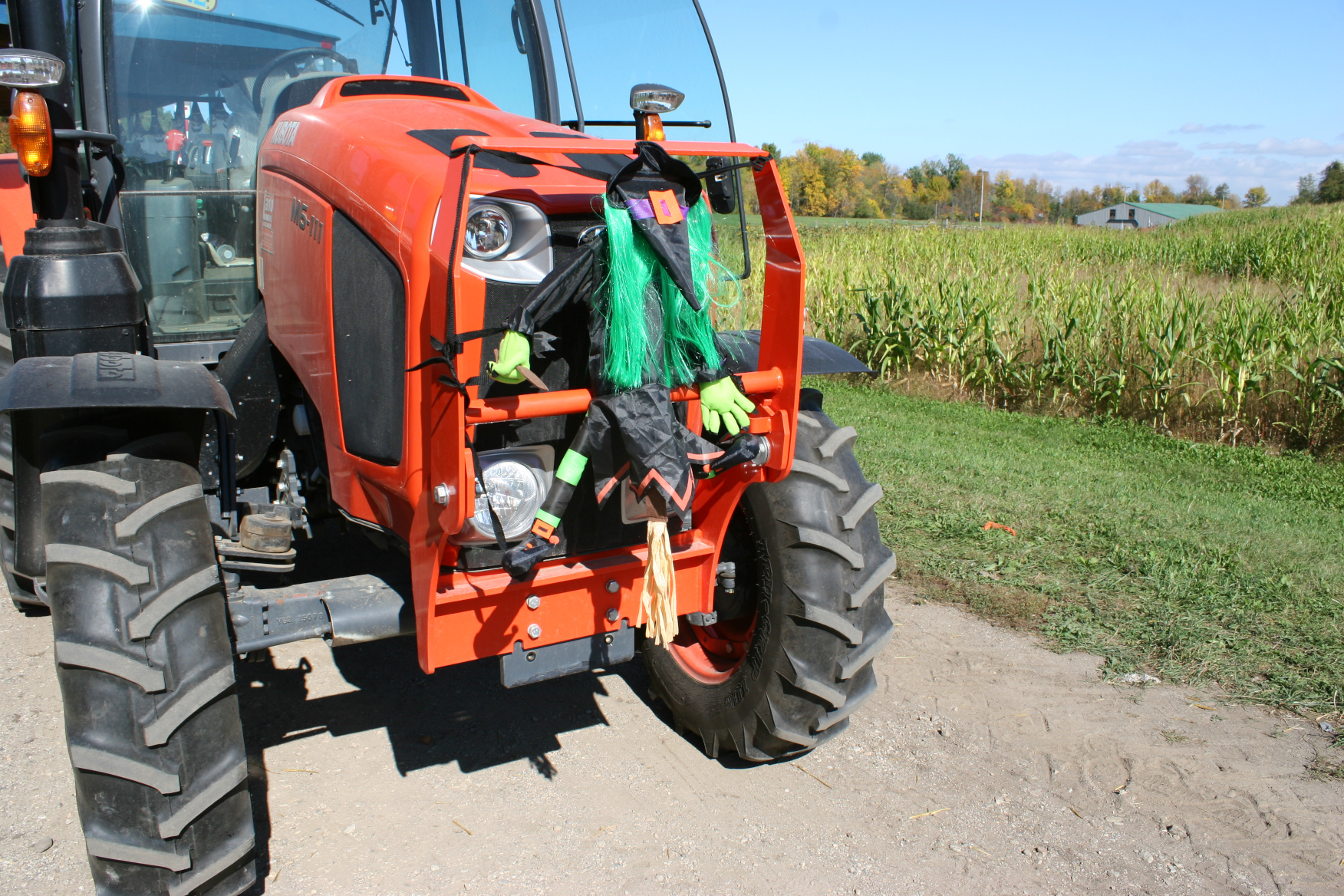
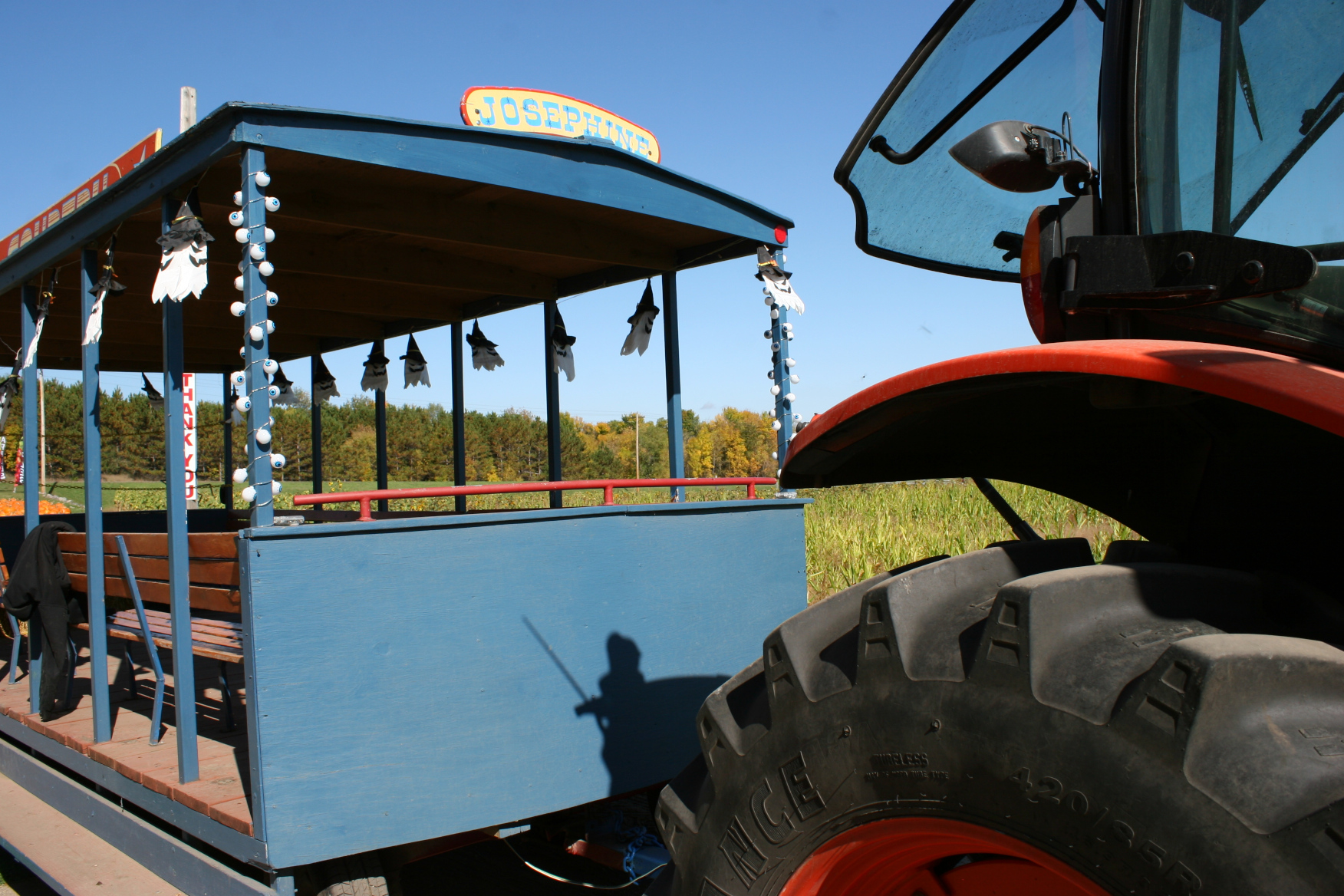
A fun touch on the front of the tractor adds to the Halloween spirit. Minnesota Prairie Roots copyrighted photo October 2021.
On this glorious autumn afternoon in rural Minnesota, folks clearly arrived here not only for the apples, but also for the experiences. Young families. Grandparents. Couples. Many boarded the Fun Country wagon for a ride through the property. Former orchard owner Dan Abelman steered the Kubota M5-111 tractor pulling the wagon. We chatted with him briefly afterwards. He sold the orchard to Tami and Kevin Theis late this summer and continues to help with the transition. He’s supportive and enthusiastic about the changes the couple has made. And ready, too, to be moving into retirement.
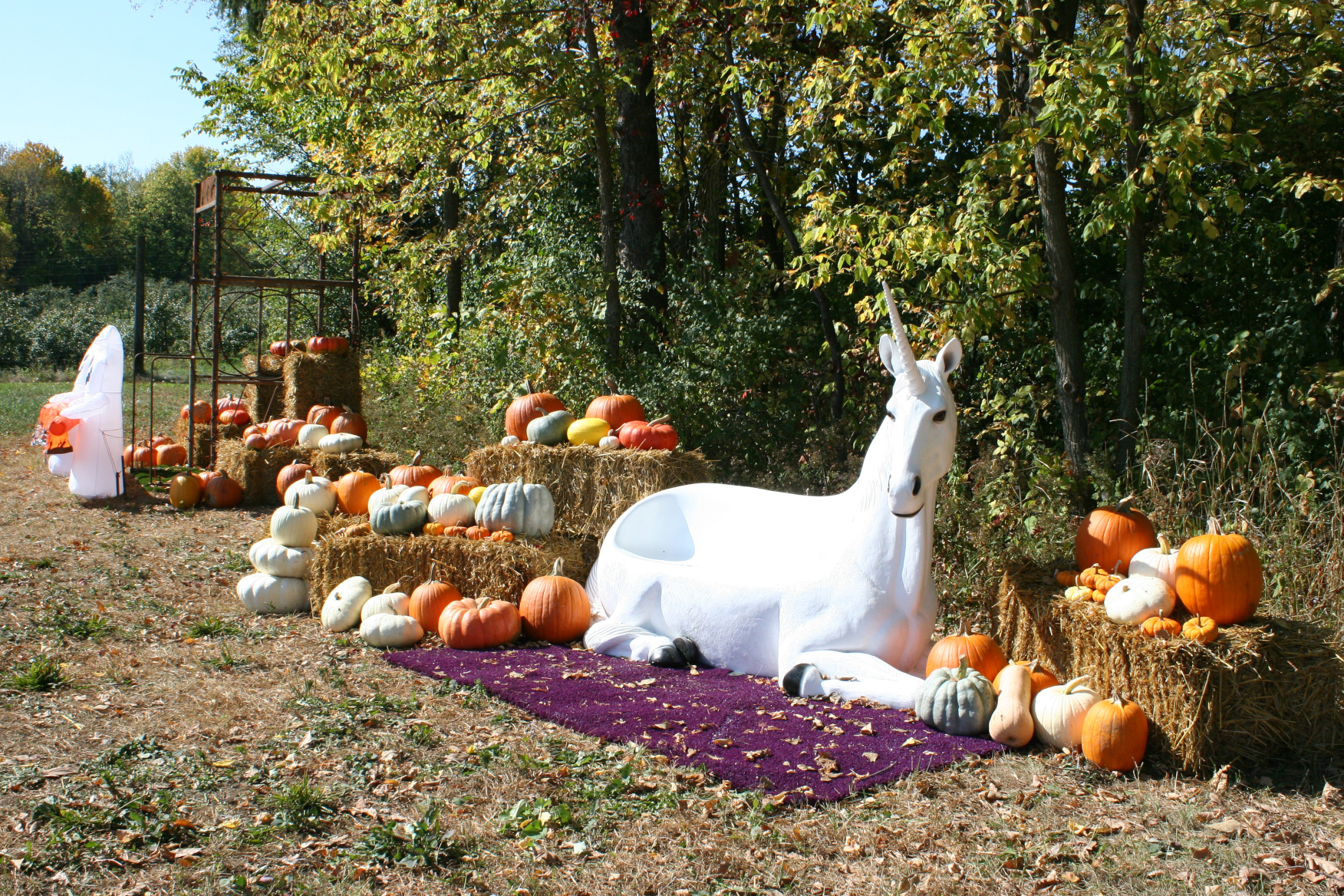
Hank the Unicorn, a popular photo prop for visitors. Minnesota Prairie Roots copyrighted photo October 2021.
We didn’t go on the Haunted Trail Ride on a wagon named Josephine (my maternal grandmother’s name), but we roamed the grounds. There I found more photo props. Randy prompted me to sit on Hank the Unicorn so he could take, and text, a photo to our 5-year-old granddaughter. Already I was thinking, we need to bring Isabelle and Isaac here next fall.
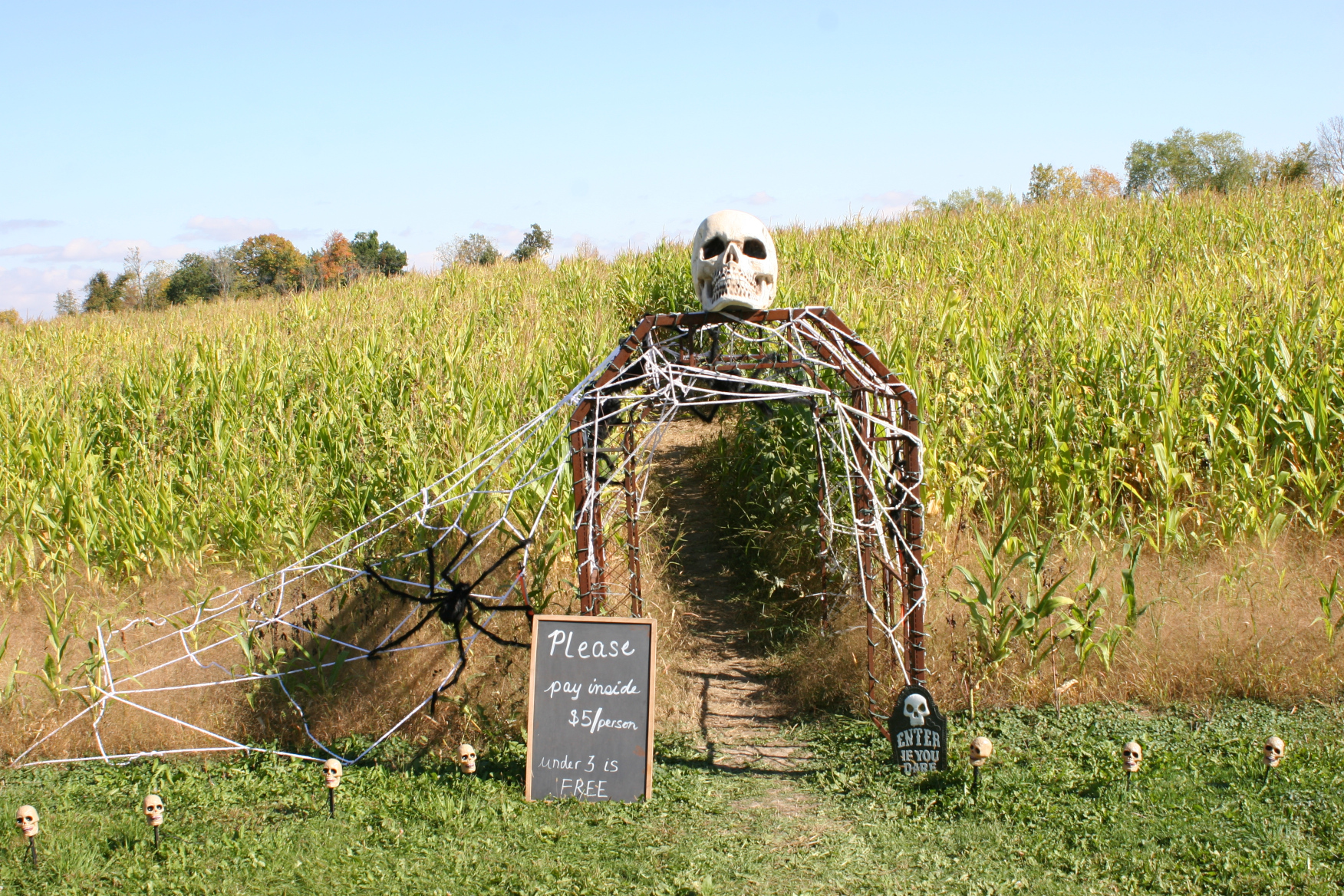
The frightening entry to the hillside corn maze. Minnesota Prairie Roots copyrighted photo October 2021.
While they may be a bit young for the 3-acre Haunted Corn Maze, I know they would enjoy the pumpkins, the autumn displays, the photo props…the experience…the time together as a family.
In the sunflower patch. Minnesota Prairie Roots copyrighted photo October 2021.
A path runs between the sunflower and corn fields with a vintage tractor parked field side. Minnesota Prairie Roots copyrighted photo October 2021.
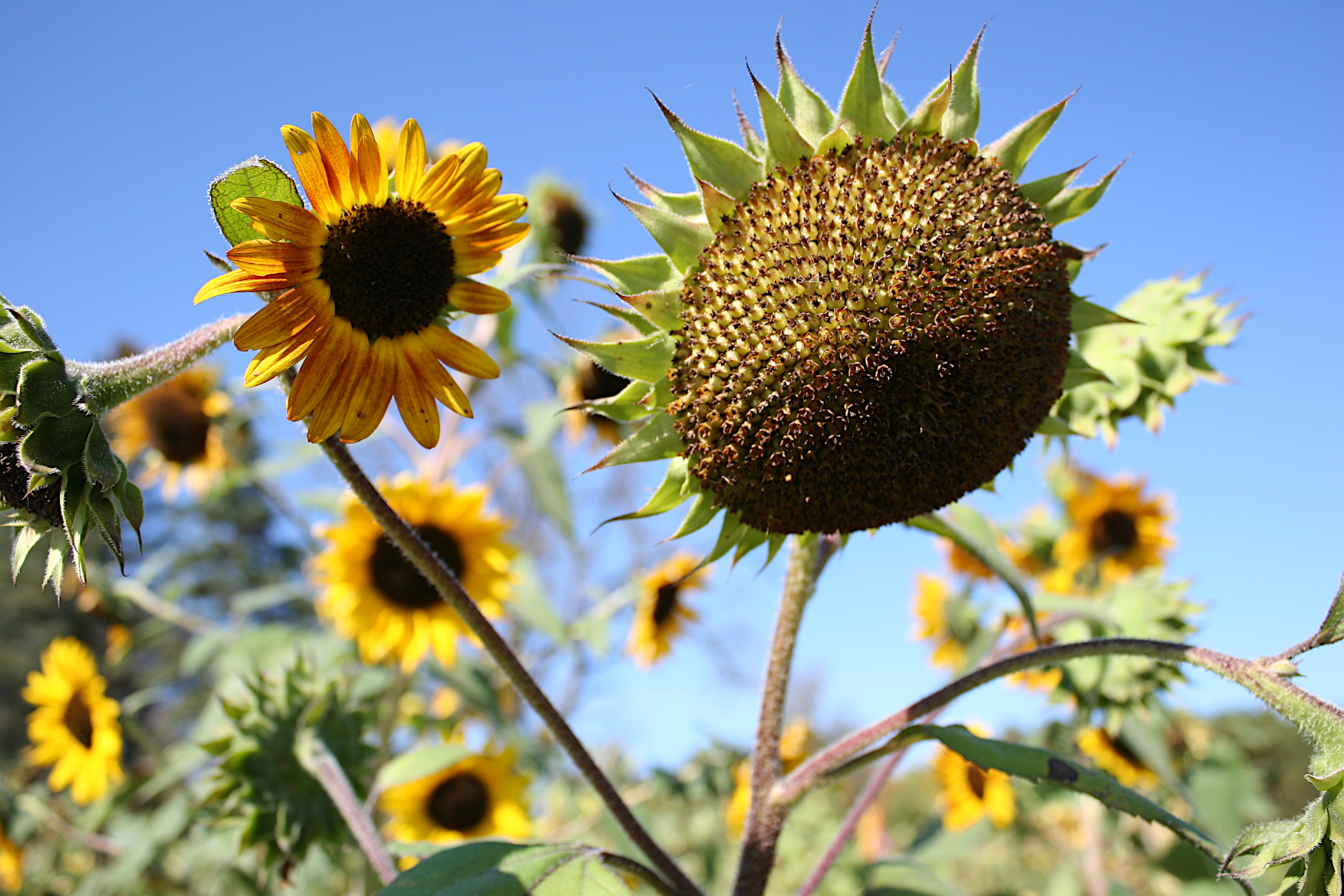
Some sunflowers were still blooming. Minnesota Prairie Roots copyrighted photo October 2021.
I got sidetracked also by a field of sunflowers, past their prime, but still a visual delight.
Details in decorating. Minnesota Prairie Roots copyrighted photo October 2021.
Inside the on-site store, tagged Apple Creek Boutique because you’ll find more than fresh apples here, I poked around. There you’ll find local honey, apple juice-infused meat snack sticks and sausage from Odenthal Meats of New Prague, caramel apples, cider, Grandma Eileen’s homemade apple pies, mugs, seasonal décor and much more. But we came for the apples, stashed in a cooler. I opted for a bag of my favorite, Honeycrisp.
Love the thought put in to seasonal decorating. Minnesota Prairie Roots copyrighted photo October 2021.
In the future, Apple Creek Orchard hopes to offer pick-your-own apples. There are more plans in the works, too. Co-owner Tami Theis, a certified wedding planner, shared that a section of the poleshed will be converted in to an event venue, The Blossom. Also coming in 2022 are homemade pizzas, donuts and cider, plus a wiffle ball field.
Parked before the next boarding for a wagon ride. Minnesota Prairie Roots copyrighted photo October 2021.
I left feeling excited about this new local option for families, and others, to enjoy in rural Rice County. To learn more about apples. And to create memories via the agri entertainment now offered at Apple Creek Orchard.
Other area orchards include Trumps Orchard on Faribault’s east side; Montgomery Orchard, rural Montgomery; and Fireside Orchard & Gardens, rural Northfield. I’ve patronized each of these. What’s offered at each varies, so please visit their websites for details.
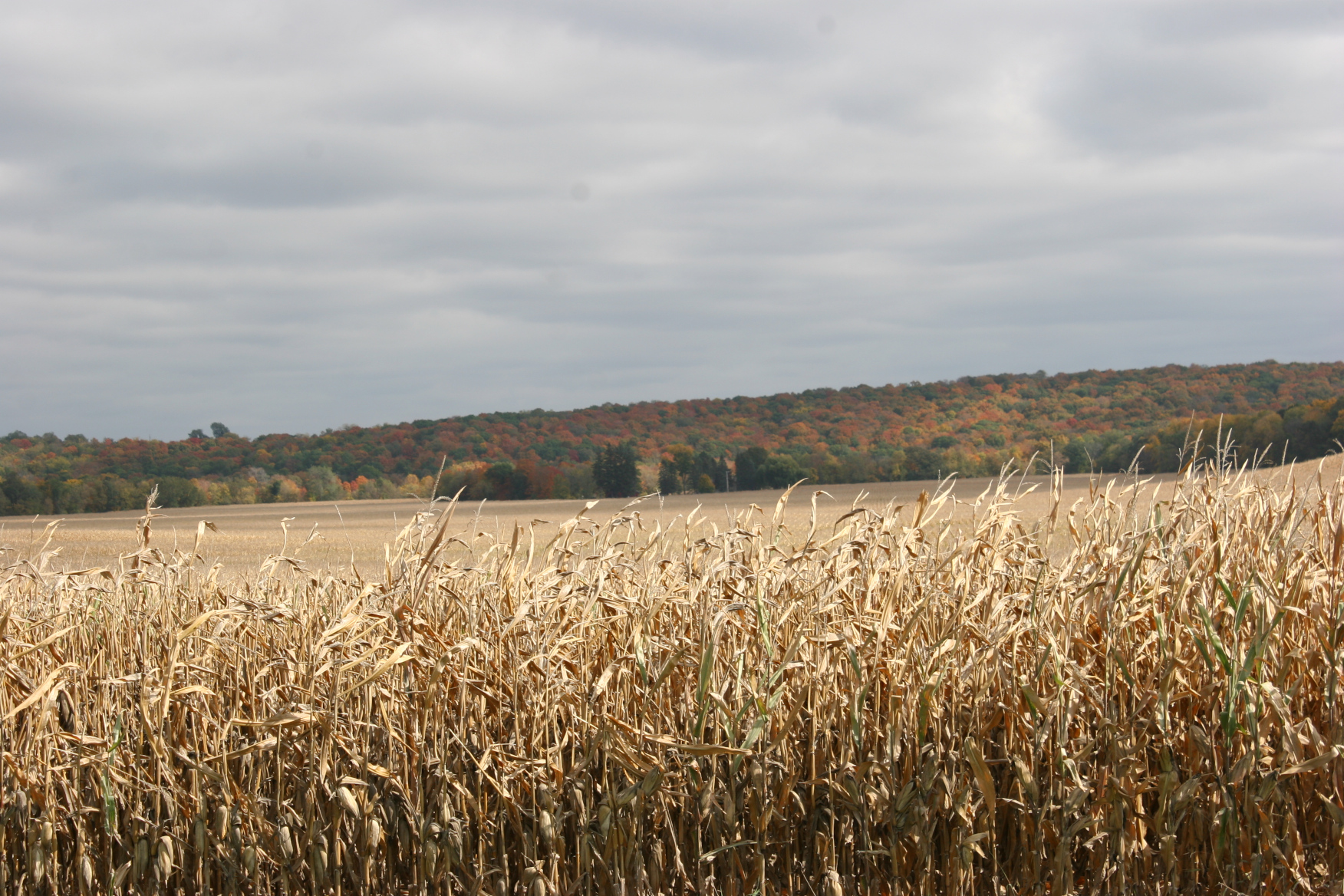
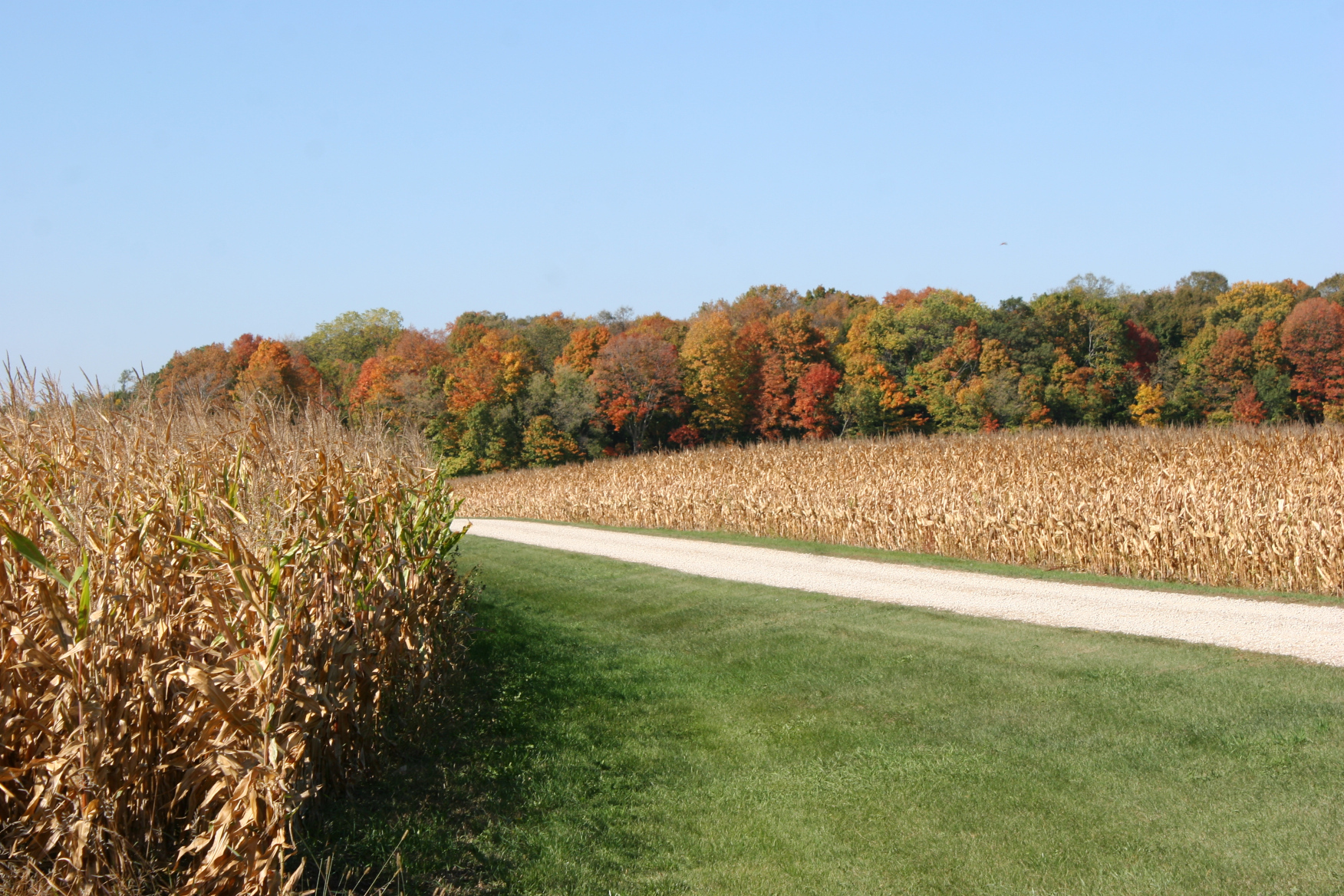
Just days ago color tinted trees edging a cornfield in rural Rice County. Minnesota Prairie Roots copyrighted photo October 2021.
THE MUTED AND VIBRANT HUES of autumn mix in the rural Rice County landscape, creating stunning seasonal scenes. If you crave color and harvest, this is your moment to get out for an afternoon country drive.
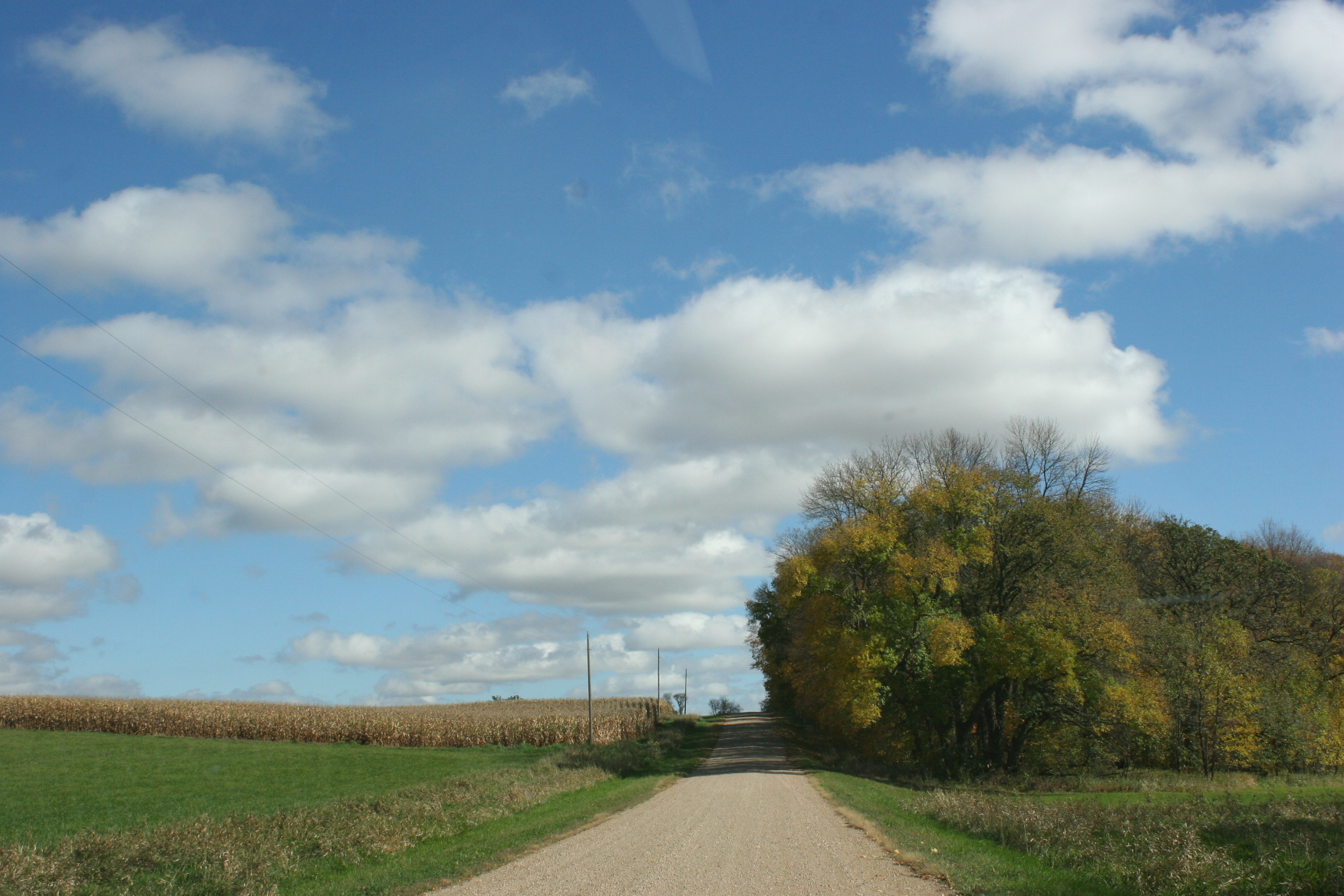
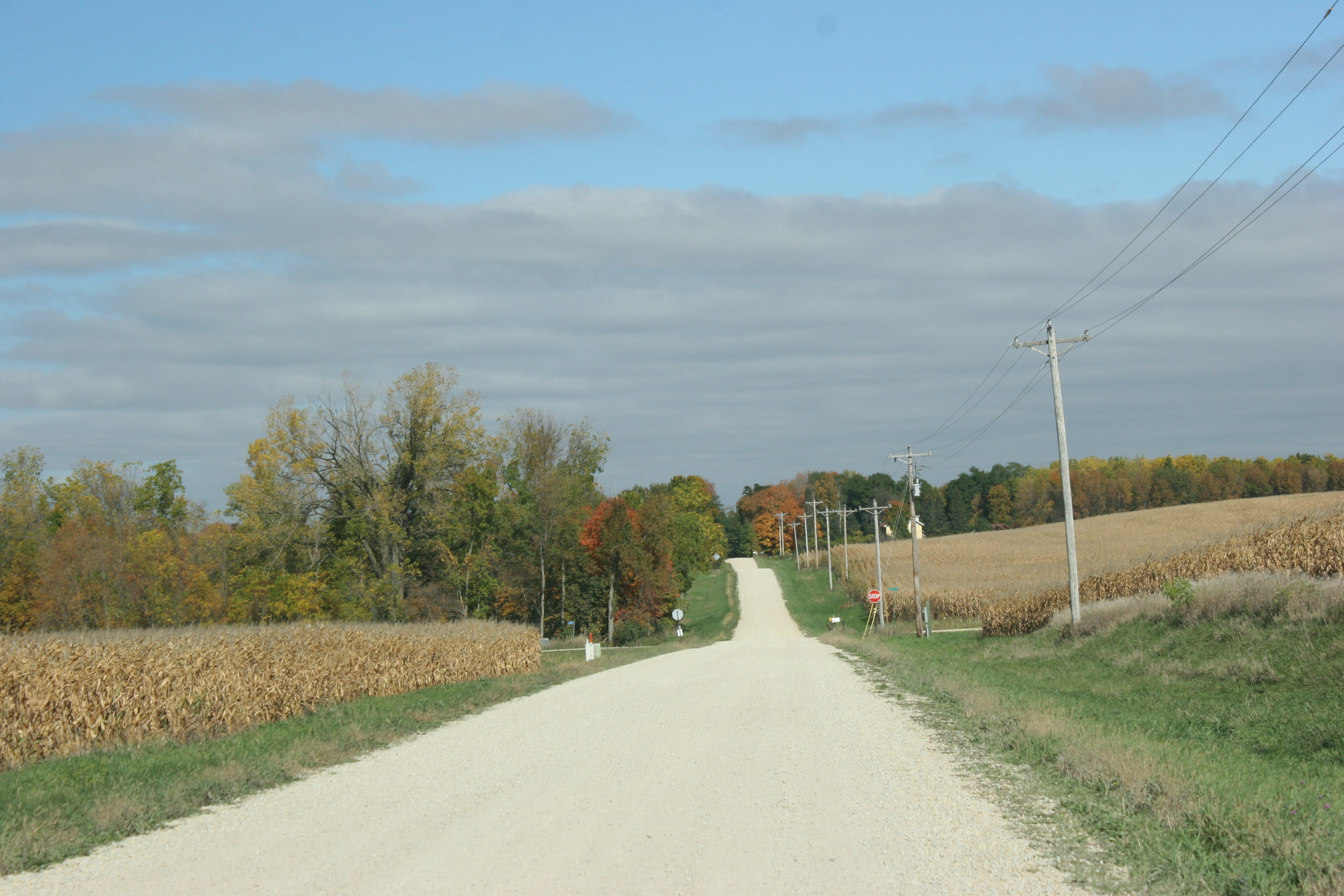
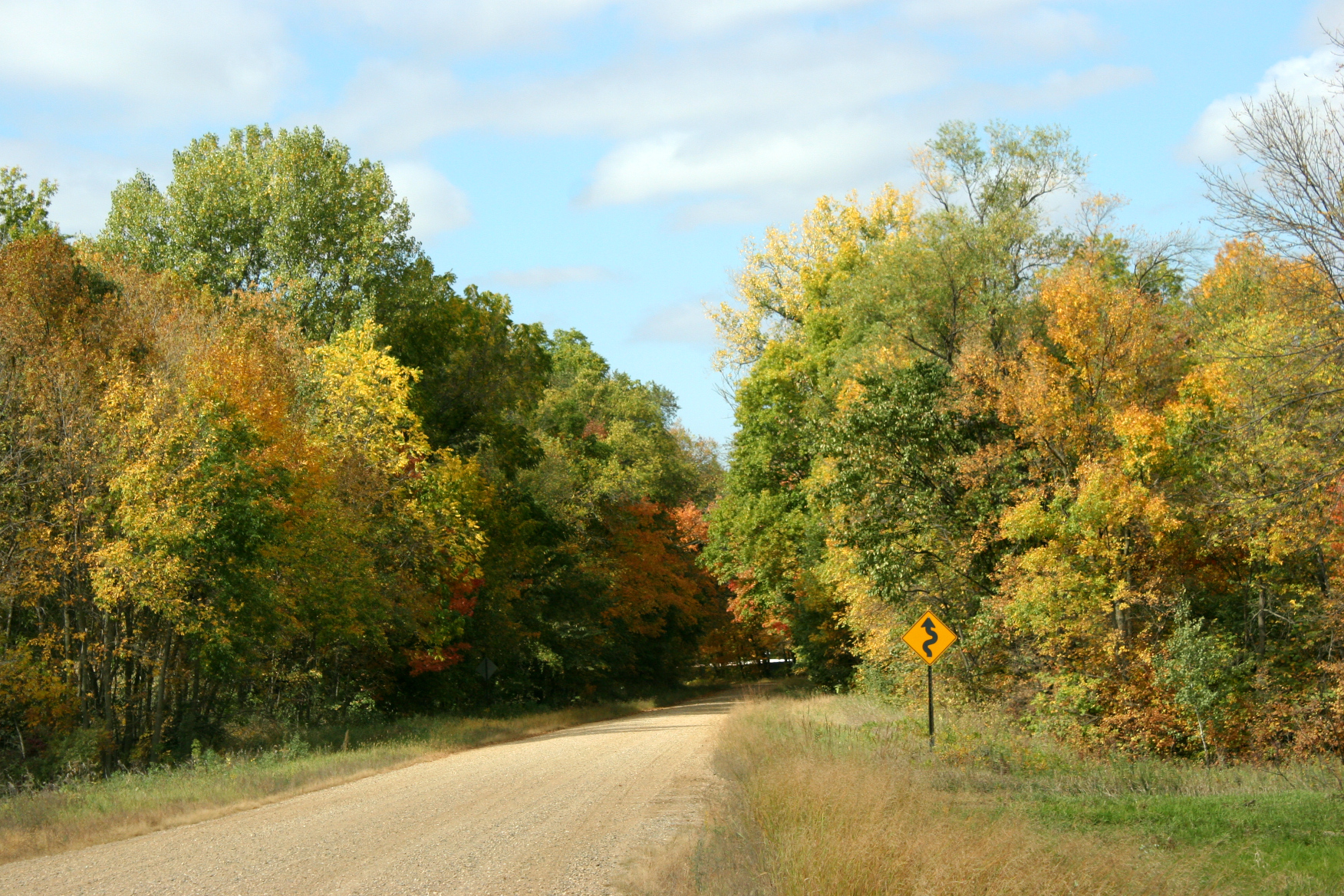
Choose a gravel road, any gravel road, and see where it leads you, here past fields and trees turning color. Minnesota Prairie Roots copyrighted photo October 2021.
Randy and I consider our county a best-kept-secret-place to view fall colors. Last weekend we traveled mostly gravel and county roads from Faribault to the Nerstrand area and back and then west to Kelly Lake. In between, we stopped for a hike at Caron Park, a picnic lunch at the hilltop Valley Grove churches and then for apples at Apple Creek Orchard.
Harvest is well underway in Rice County. Minnesota Prairie Roots copyrighted photo October 2021.
As farm-raised kids—me in southwestern Minnesota and Randy in central Minnesota—we find ourselves drawn to the countryside, especially during spring planting and then again during fall harvest. Our weekend drives updated us on harvest progress as we passed fields of corn and soybeans. Some picked. Some still drying under the intermittent autumn sun.
Even under partly sunny skies, the colored hillside of trees were beautiful. This is on a gravel road (Falk Avenue) off Rice County Road 20 northeast of Cannon City. Minnesota Prairie Roots copyrighted photo October 2021.
Across an expanse of cornfield on County Road 84/Falk Avenue (just off County Road 20 between Cannon City and Northfield), we paused to admire a treeline in the distance. We return here each year to simply stop and appreciate the hillside aflame with the hues of autumn.
Entering the woods on Farmers Trail. Minnesota Prairie Roots copyrighted photo October 2021.
Likewise, we also follow nearby Farmers Trail, a remote gravel road (off Falk Avenue) which winds through woods. Primarily maples as evidenced by the colors and by the blue maple syrup tube collection system that weaves through the trees.
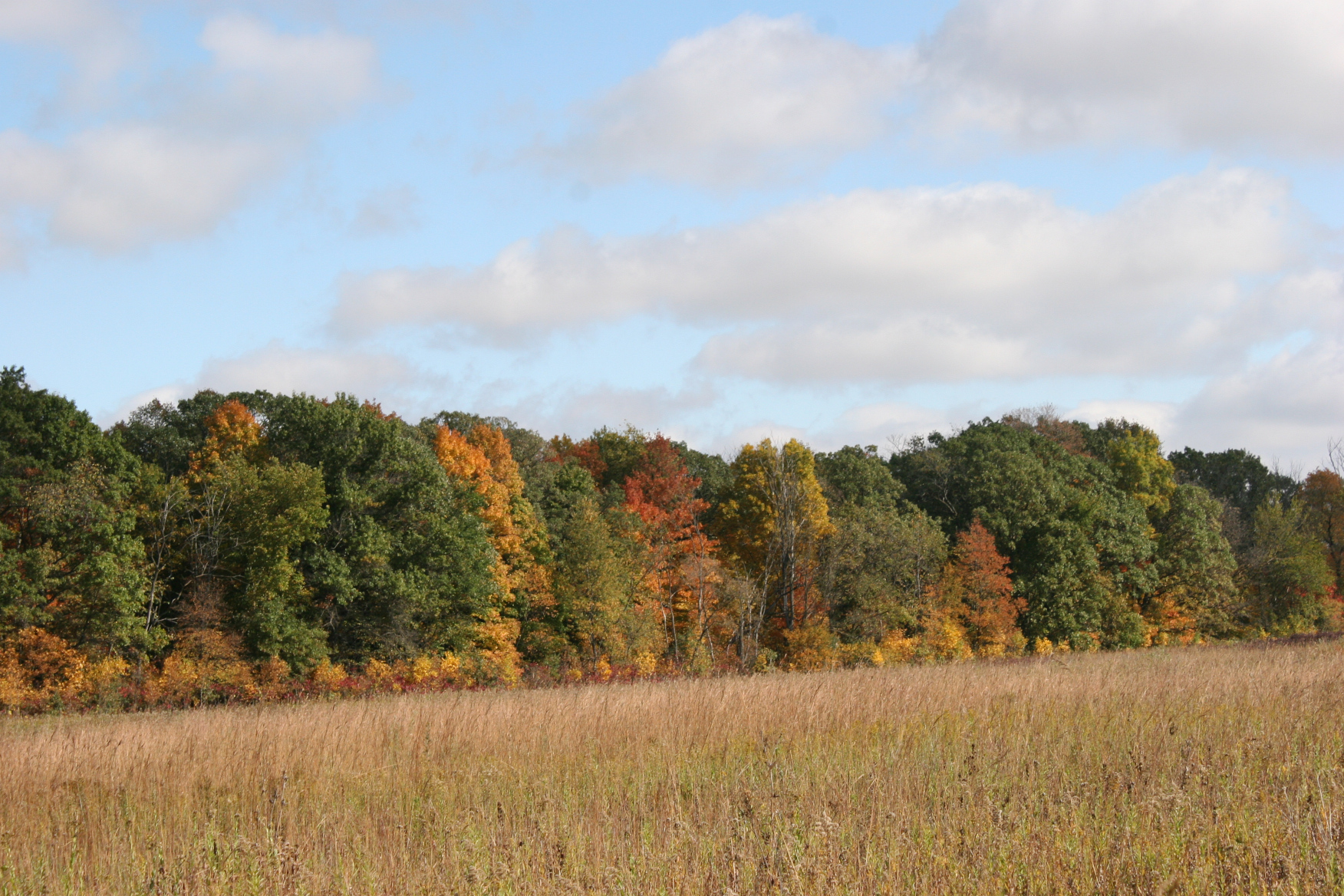
The beautiful treeline at Caron Park. Minnesota Prairie Roots copyrighted photo October 2021.
Caron Park, too, draws us to stop and hike into the woods. It’s a less-crowded option than the nearby popular Nerstrand Big Woods State Park. The treeline at Caron Park, behind an open field of muted, dried grasses, is particularly stunning.
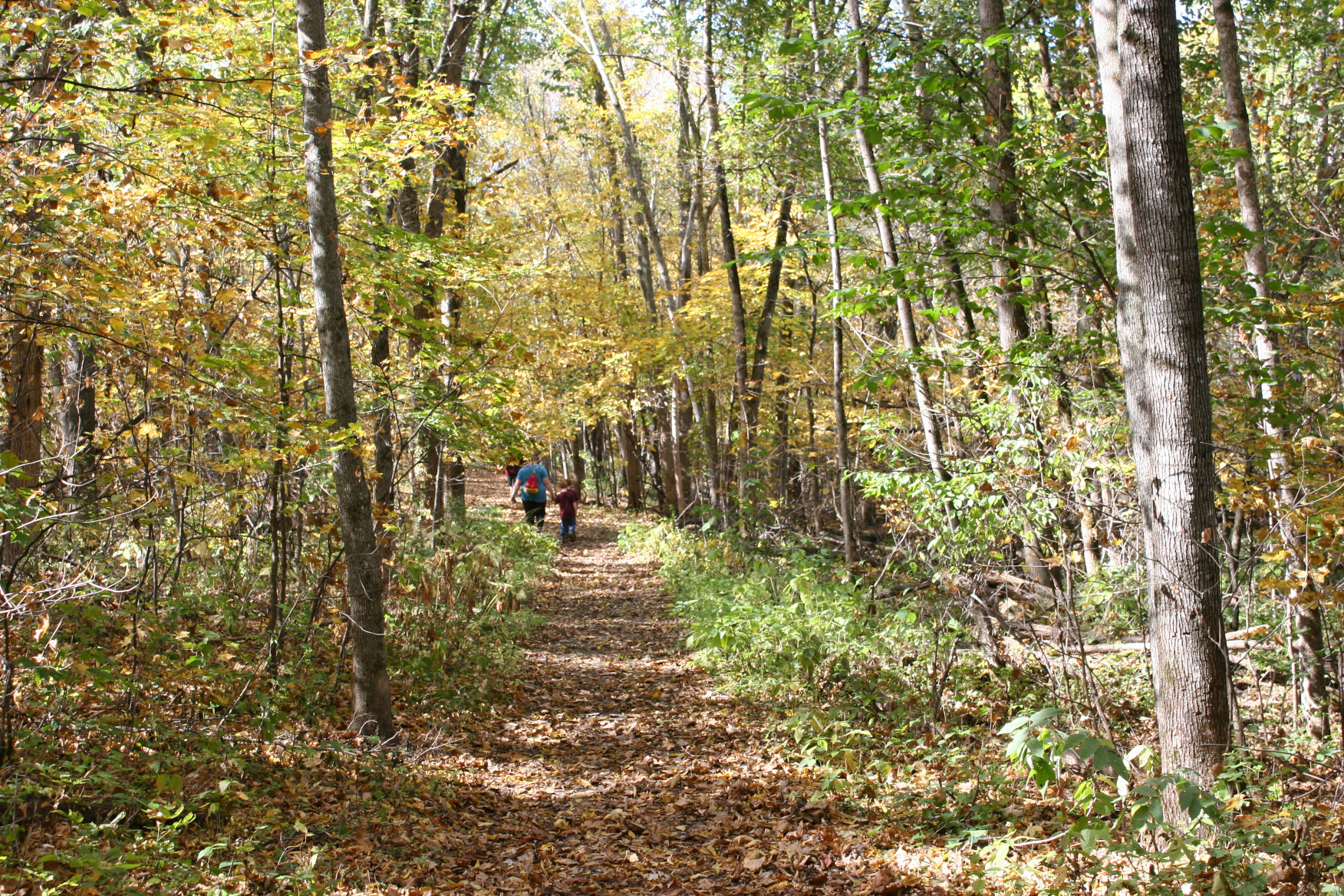
A family walks through the woods at Caron Park. Minnesota Prairie Roots copyrighted photo October 2021.
We walked into the woods, following a leaf-covered, eroded dirt trail that made me uncomfortable and unsure of my footing. Tree roots presented potential tripping obstacles. I focused more on staying upright than anything. Yet, despite that, I enjoyed the quiet and beauty of the woods. As did others, mostly young families.
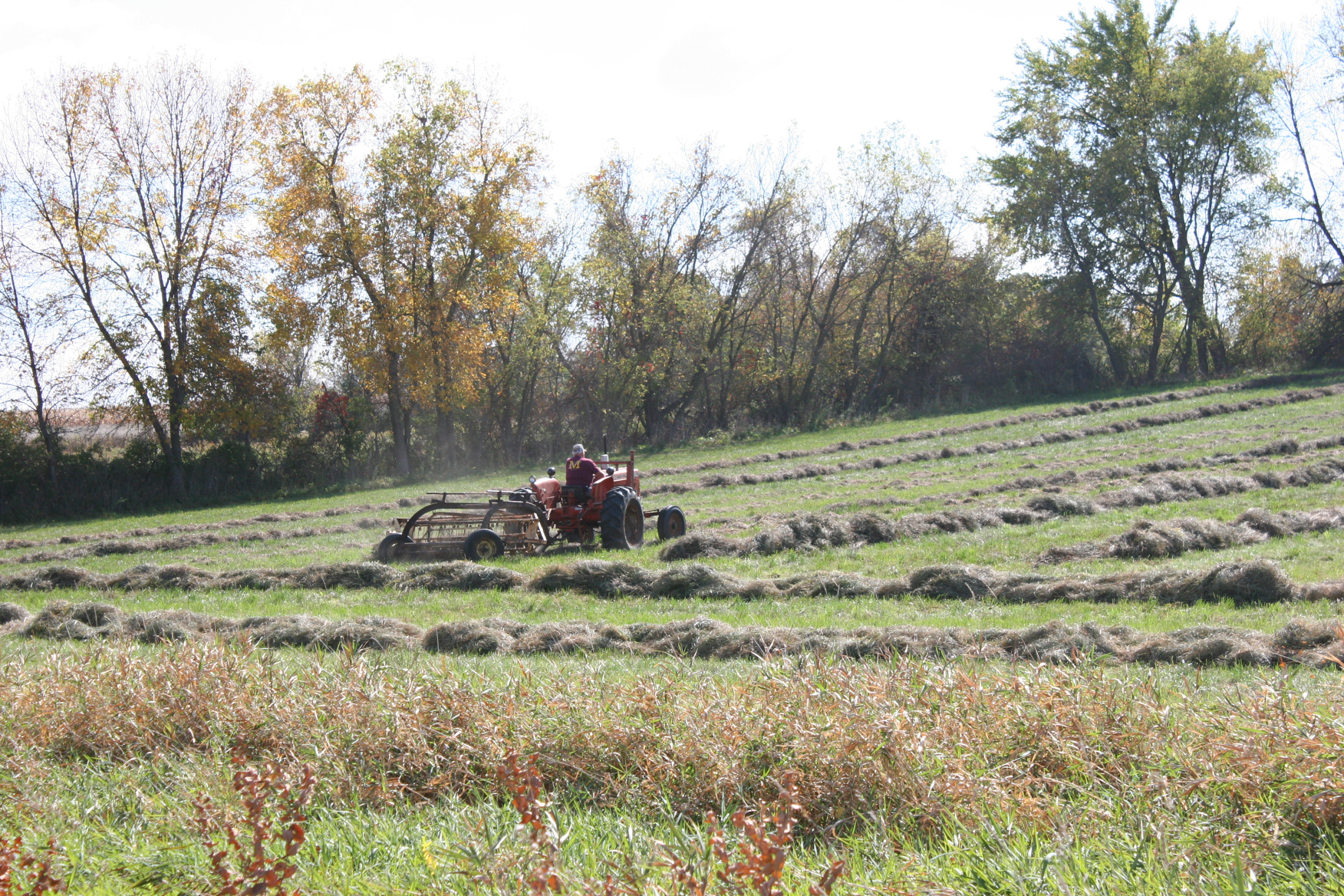
We came across this farmer raking hay, like a scene from the past. Minnesota Prairie Roots copyrighted photo October 2021.
As we continued to follow country gravel roads, we sometimes drove in clouds of dust trailing pick-up trucks. That, too, reminds me of my agrarian upbringing. Yes, nostalgia often seeps into our view and our conversations. Once a farm girl/boy, always a farm girl/boy. Even if we’re decades removed from the farm.
Beauty in autumn ruralness. Minnesota Prairie Roots copyrighted photo October 2021.
I love how the rural countryside of Rice County often sweeps in valleys and hills, providing incredible vistas. Of farmland. Of wooded and open hillsides. Of land and sky connecting. All connected by gravel roads. This rural setting rates as particularly stunning in autumn.
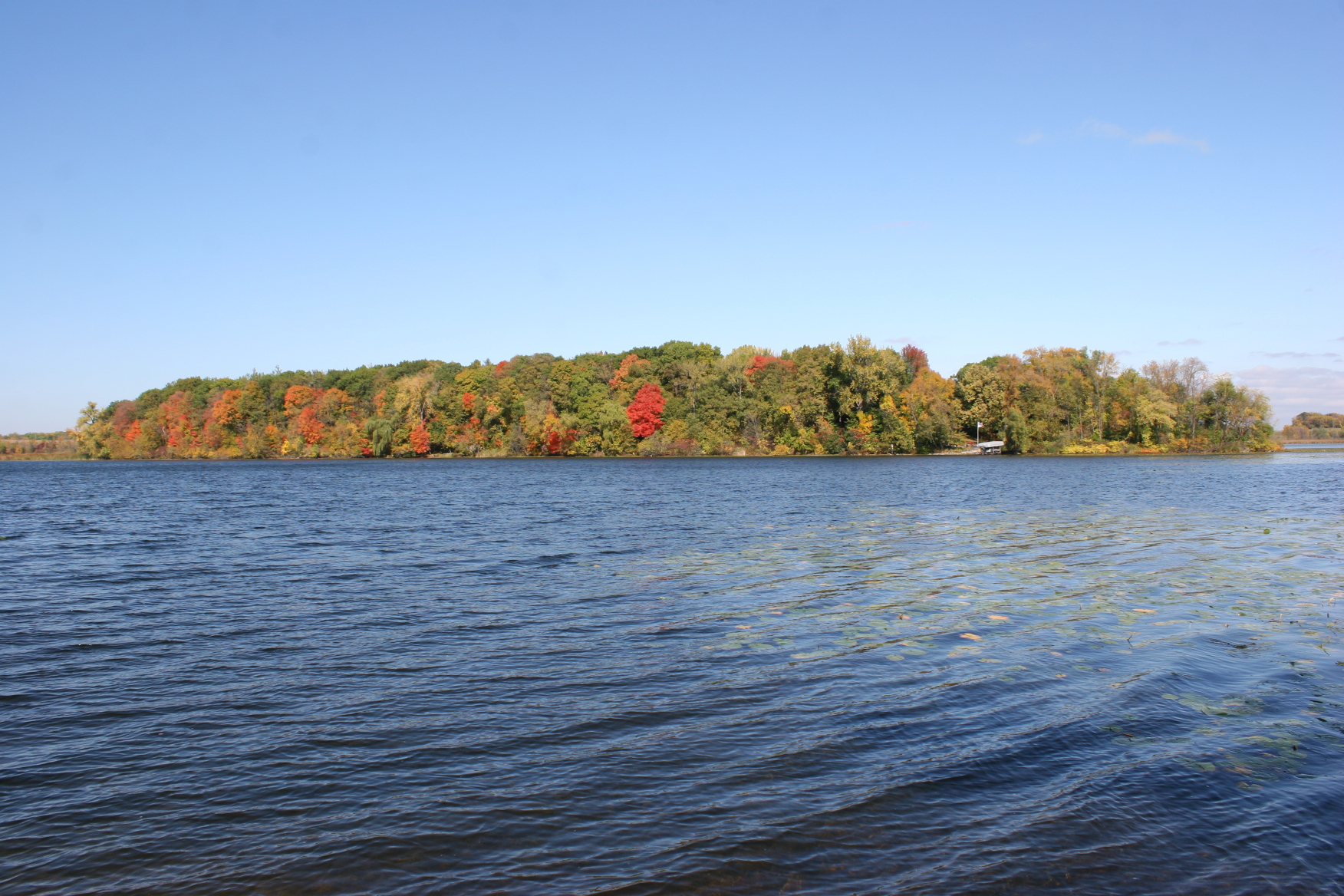
The treeline across Kelly Lake is particularly beautiful in autumn. It should be even prettier than this soon. Minnesota Prairie Roots copyrighted photo October 2021.
We ended our drive at another favorite fall destination, the public boat landing at Kelly Lake northwest of Faribault. The view of the treeline across the water—which was unusually clear—always looks particularly lovely, although the colors were not at their peak yet during out stop. Soon.
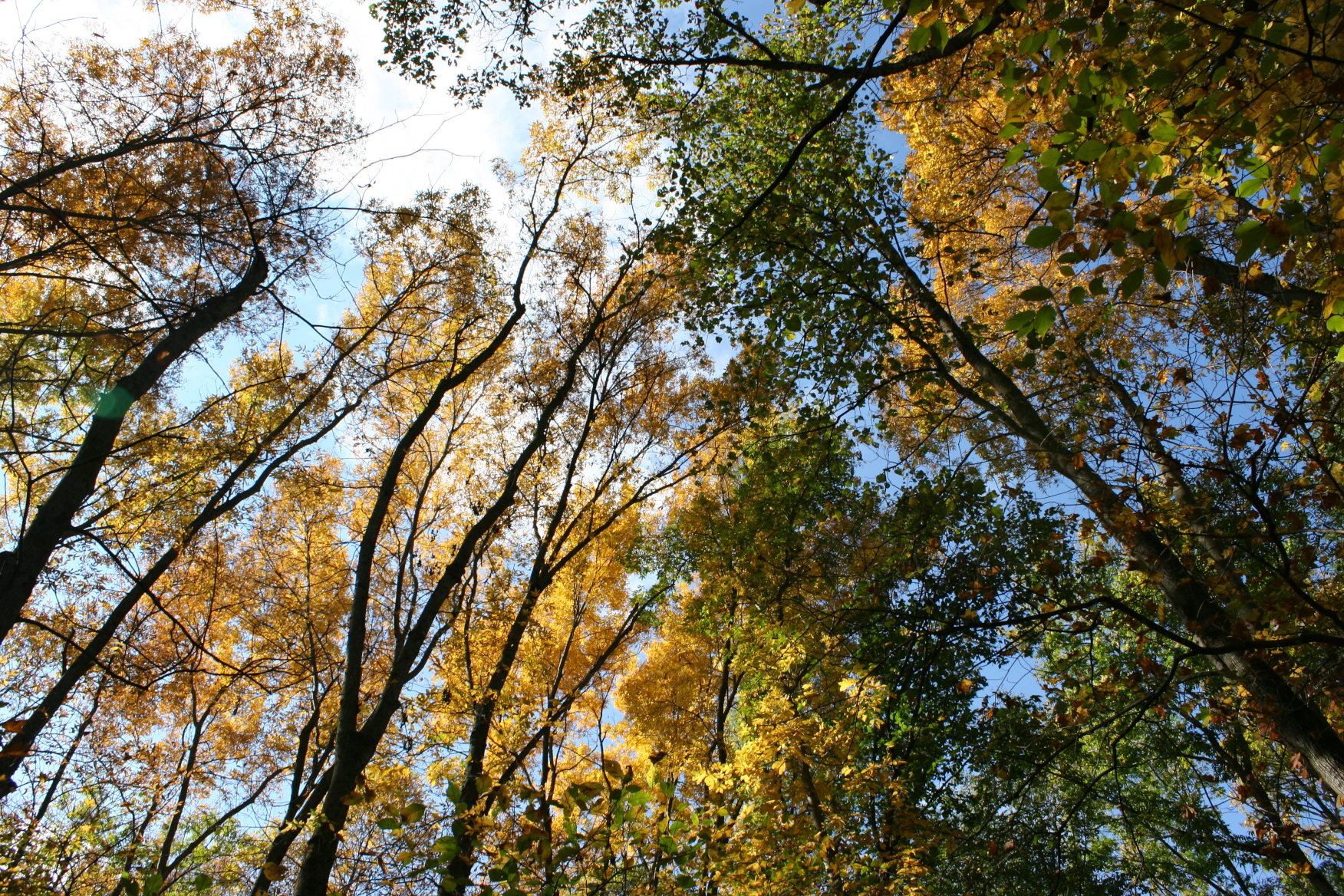
Appreciating the trees overhead while hiking in Caron Park. Minnesota Prairie Roots copyrighted photo October 2021.
Heading back into Faribault toward home, I admired, too, how beautiful the trees in my community. Seventh Street. Second Avenue. There’s much to be said for looking in your own backyard for autumn’s glory. And I’ve found it. Right here, in Rice County.
FYI: Please check back for more photos from our country drive and for separate posts on Valley Grove churches and Apple Creek Orchard.
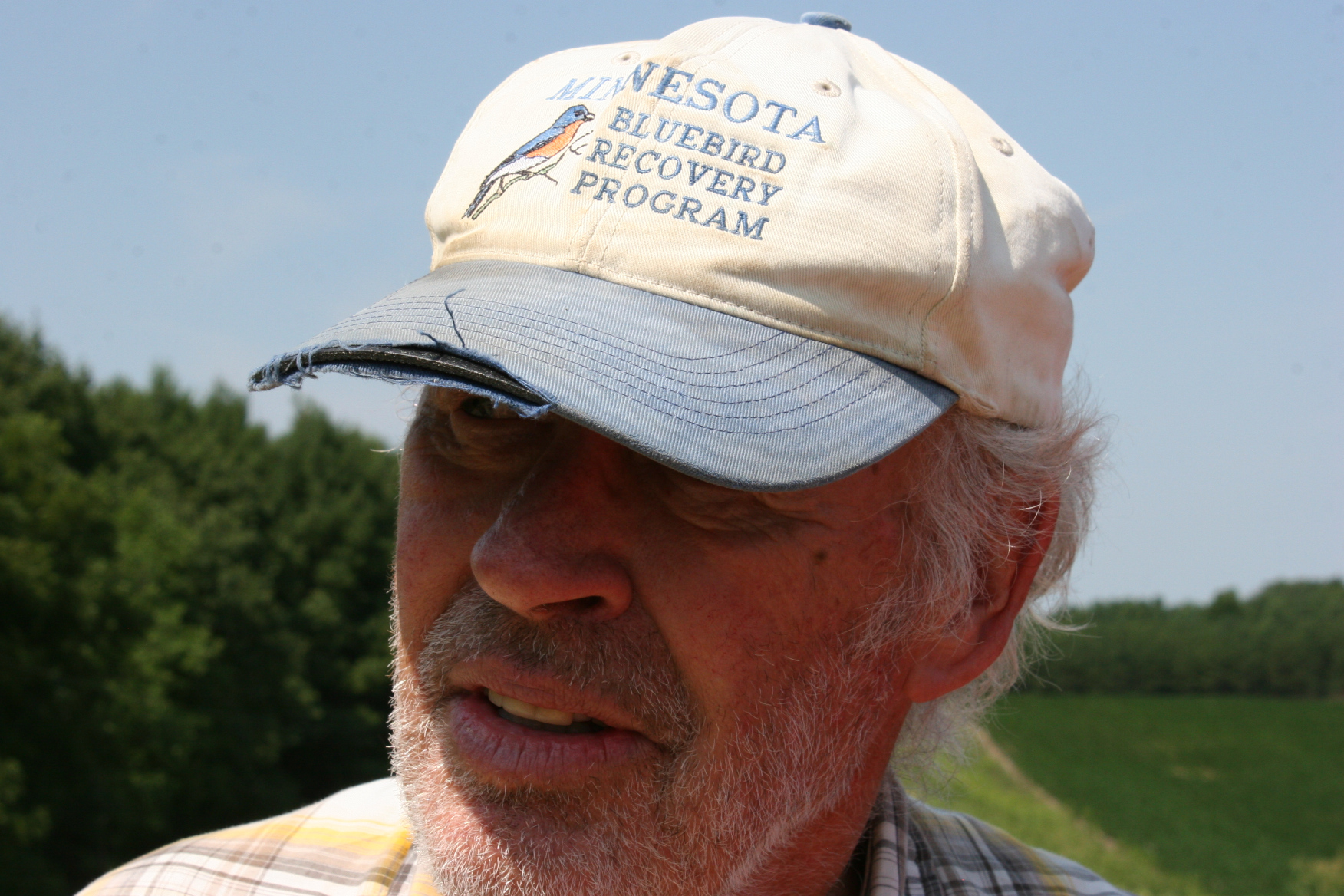
Mr. Bluebird, Keith Radel. Minnesota Prairie Roots copyrighted photo July 2021.
DOWN THE GRAVEL ROAD, I saw him exit the ditch, cross the roadway and then climb into his red pick-up truck.
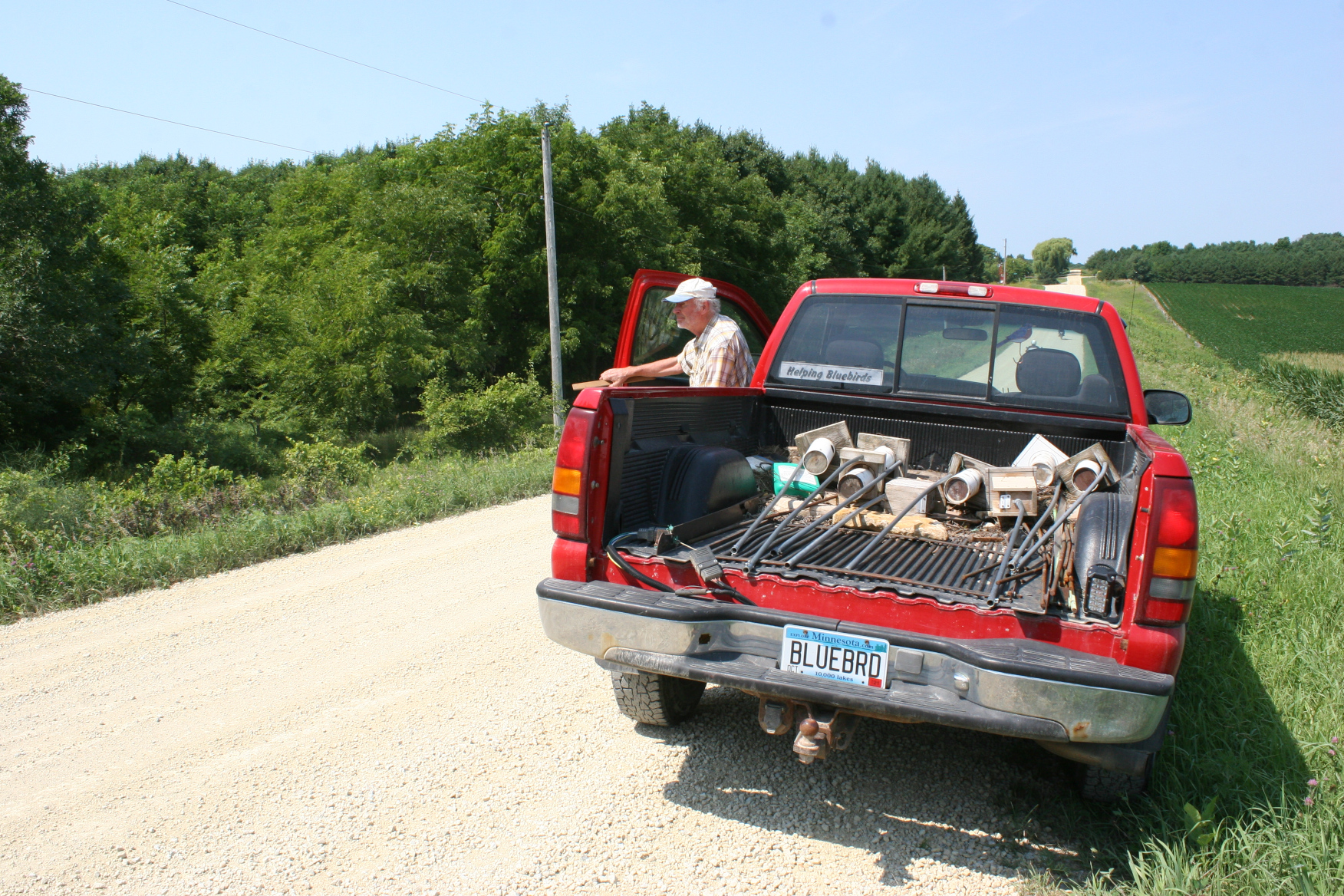
A man on a mission, to save bluebirds. Those are nesting boxes in the truck bed. Minnesota Prairie Roots copyrighted photo July 2021.
“That’s Keith,” I told Randy. Even from a distance I recognized the tall, lean profile of Keith Radel. Known as Mr. Bluebird, he travels the backroads of Rice County checking bluebird nests.
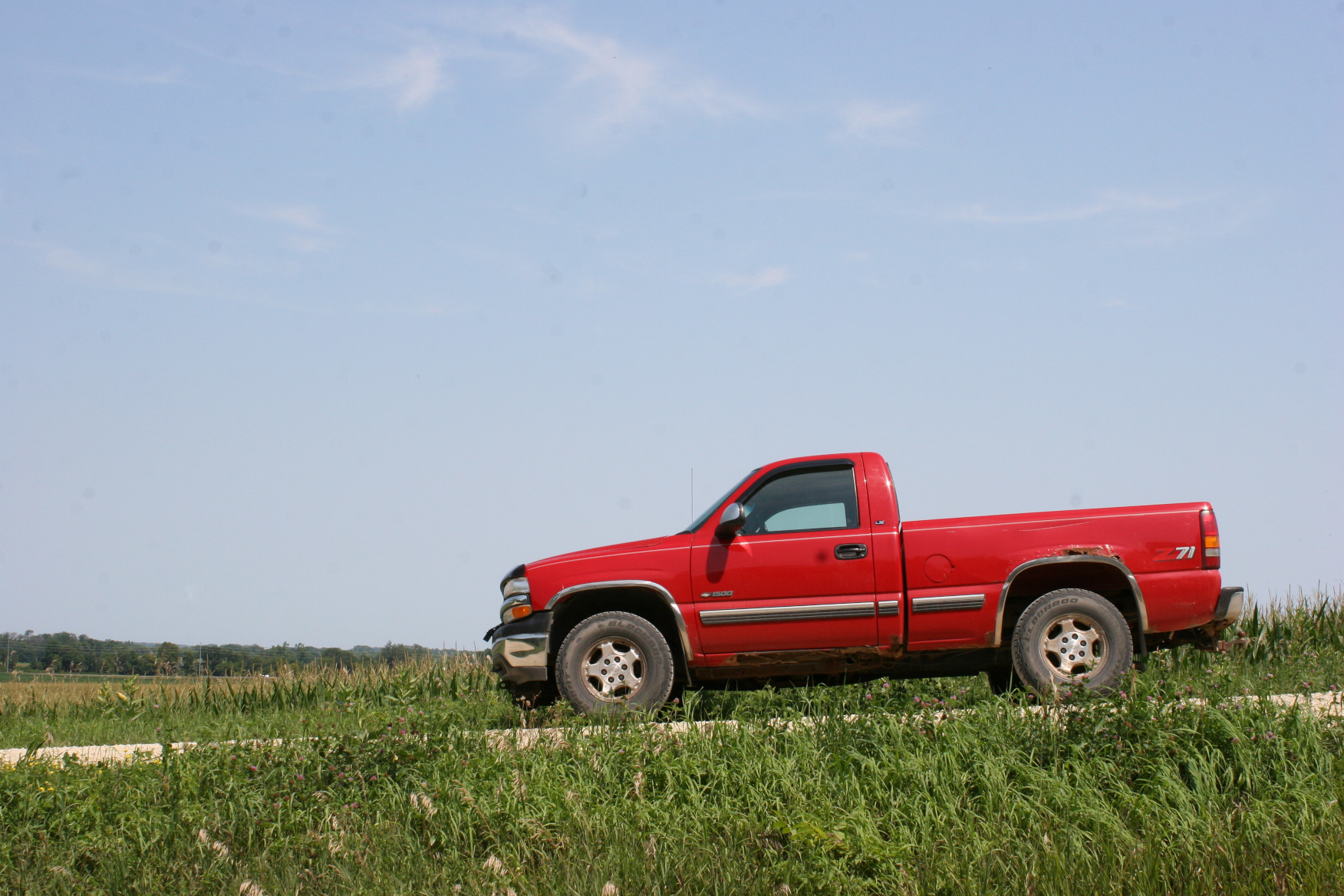
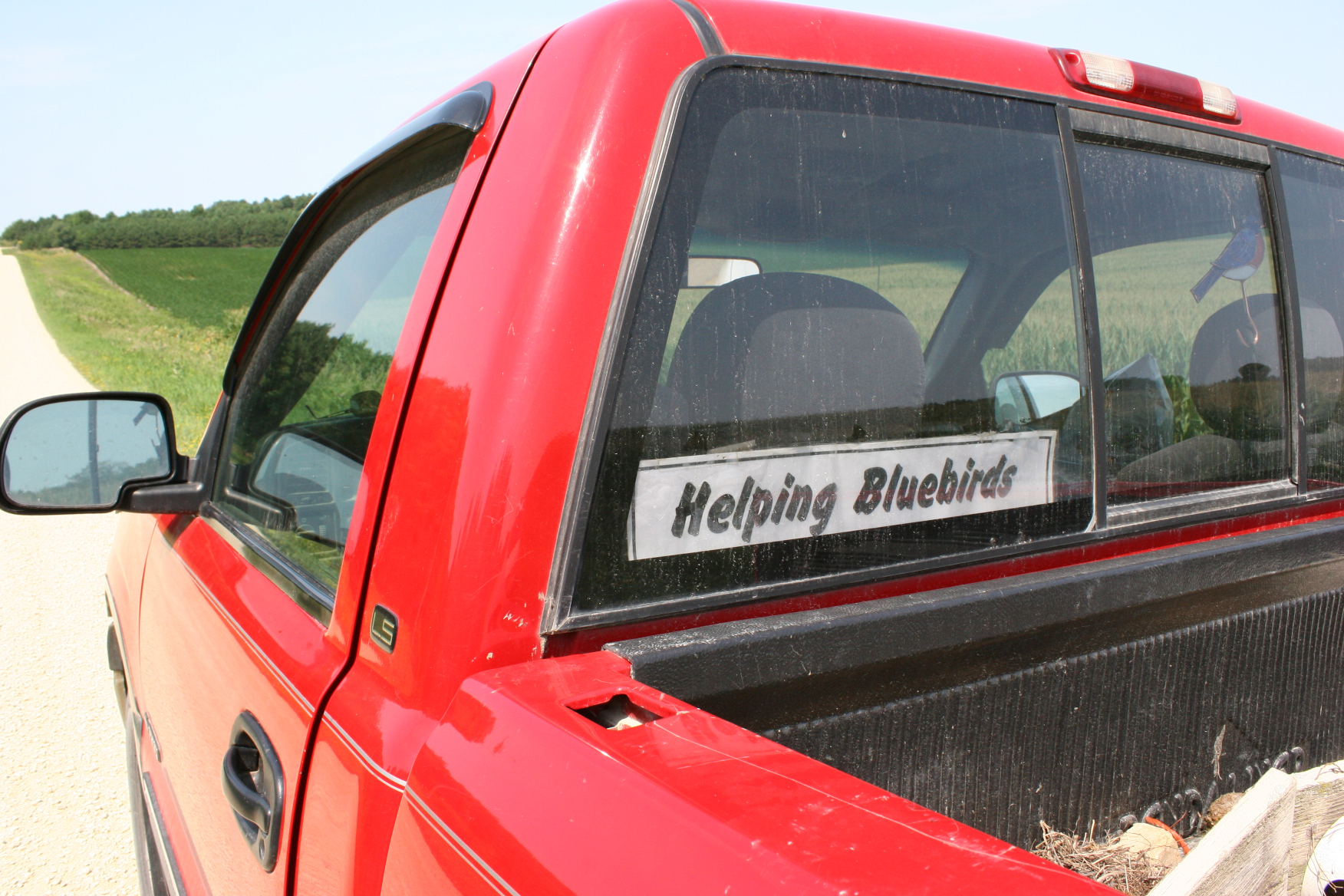
Keith puts on countless miles in his red pick-up truck. Minnesota Prairie Roots copyrighted photo July 2021.
Randy and I had just finished a short hike at the nearby Cannon River Wilderness Park when I spotted Keith on a gravel road in rural Dundas. We paused, his pick-up and our van pulled side-by-side, windows rolled down, the three of us conversing like farmers meeting on a rural road to talk crops.
Keith’s simple mission statement.Minnesota Prairie Roots copyrighted photo July 2021.
Except we were talking bluebirds. Not that I know much about these songbirds. But Keith, who’s been tracking, counting and caring for bluebirds for nearly 40 years, does. He’s relentless in his passion to assure this bird thrives. And that devotion drives him to drive miles upon endless miles to check nest boxes and count eggs and do whatever it takes to assure bluebird survival. Rice County has the most successful bluebird recovery program in Minnesota.
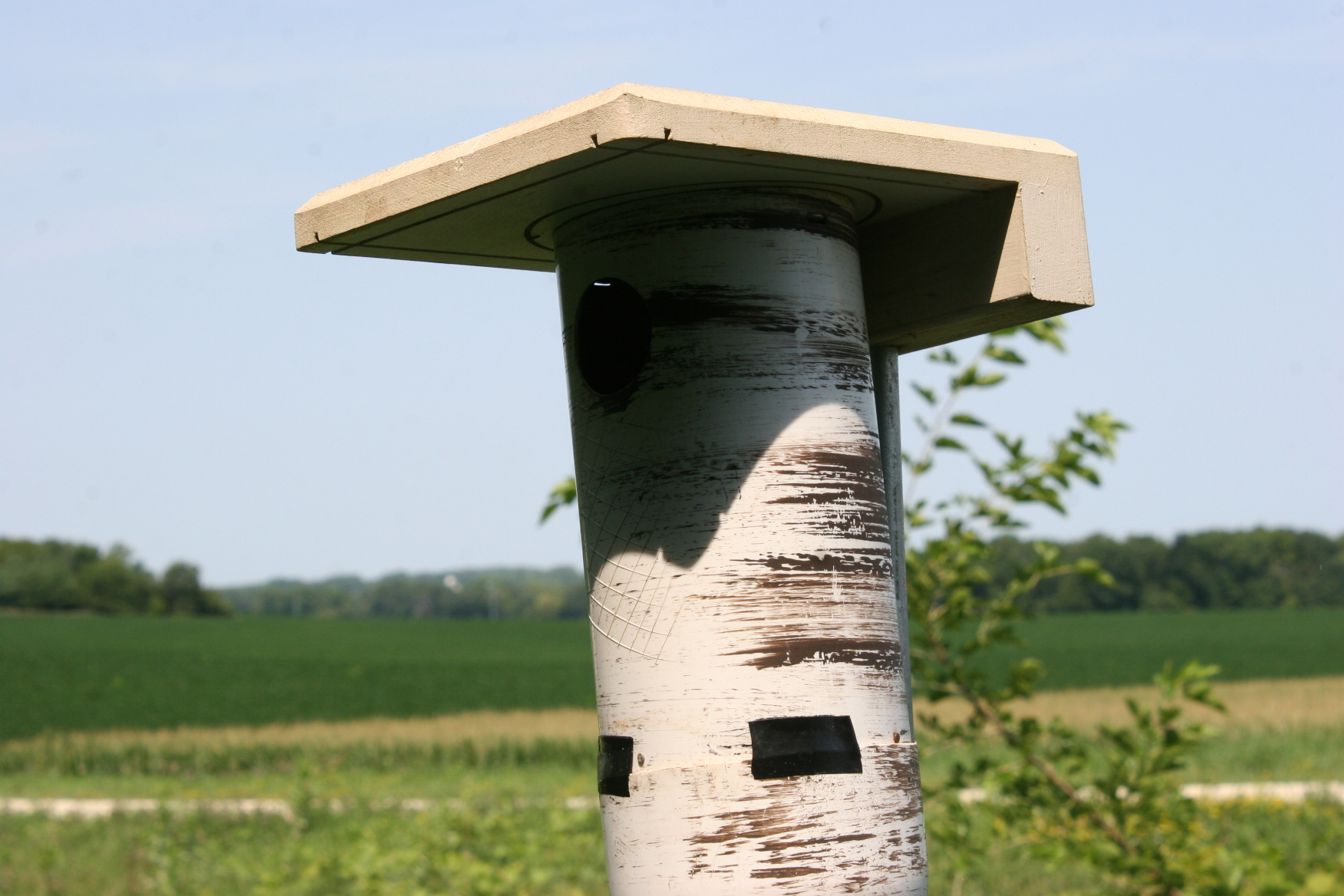
A nesting box for bluebirds. Minnesota Prairie Roots copyrighted photo July 2021.
I didn’t take notes when we were talking, although I recall Keith saying major ice storms in Texas this year had a devastating effect on the current bluebird population. He keeps meticulous notes on each nesting box.
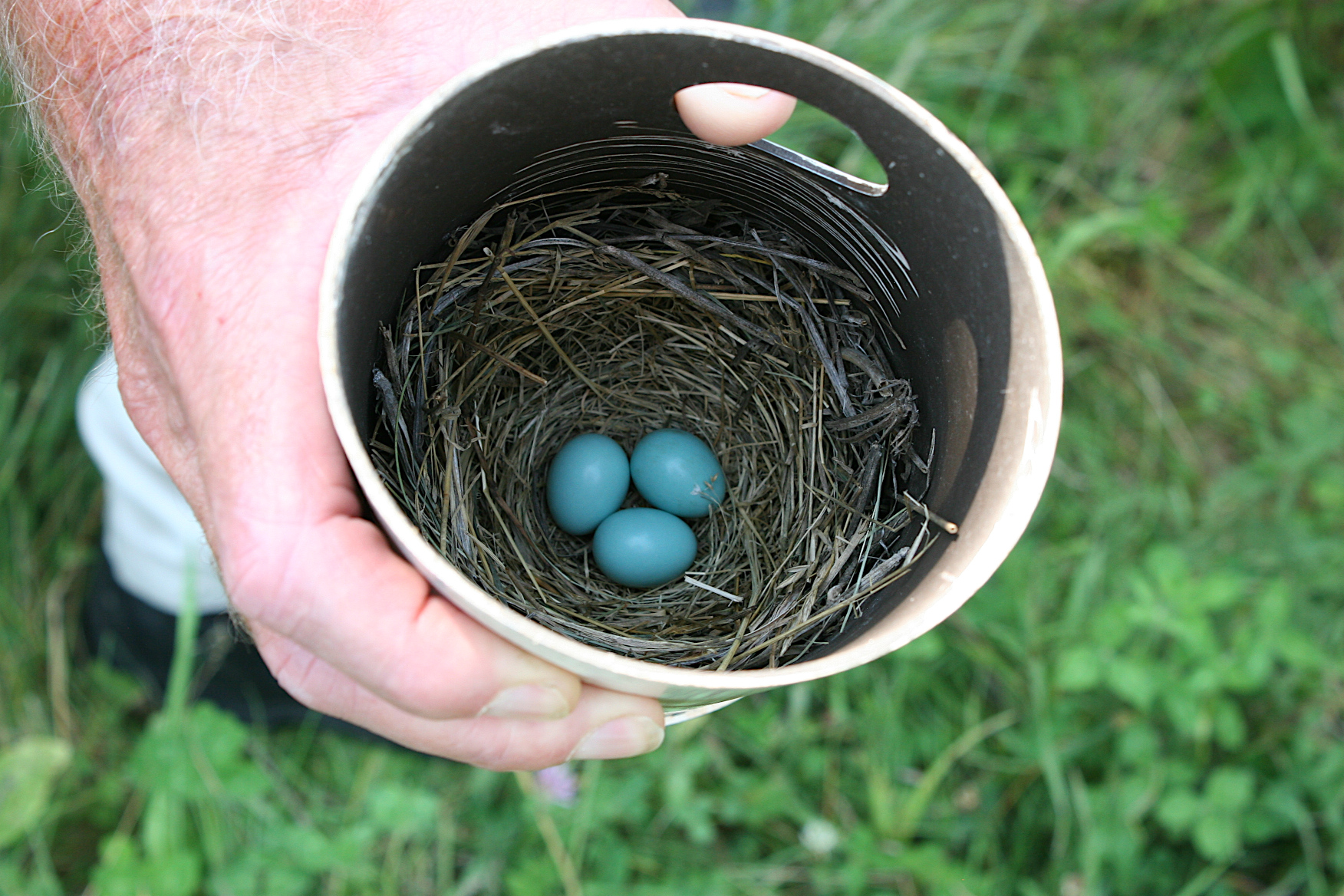
Bluebird eggs. We didn’t see any bluebirds. Minnesota Prairie Roots copyrighted photo July 2021.
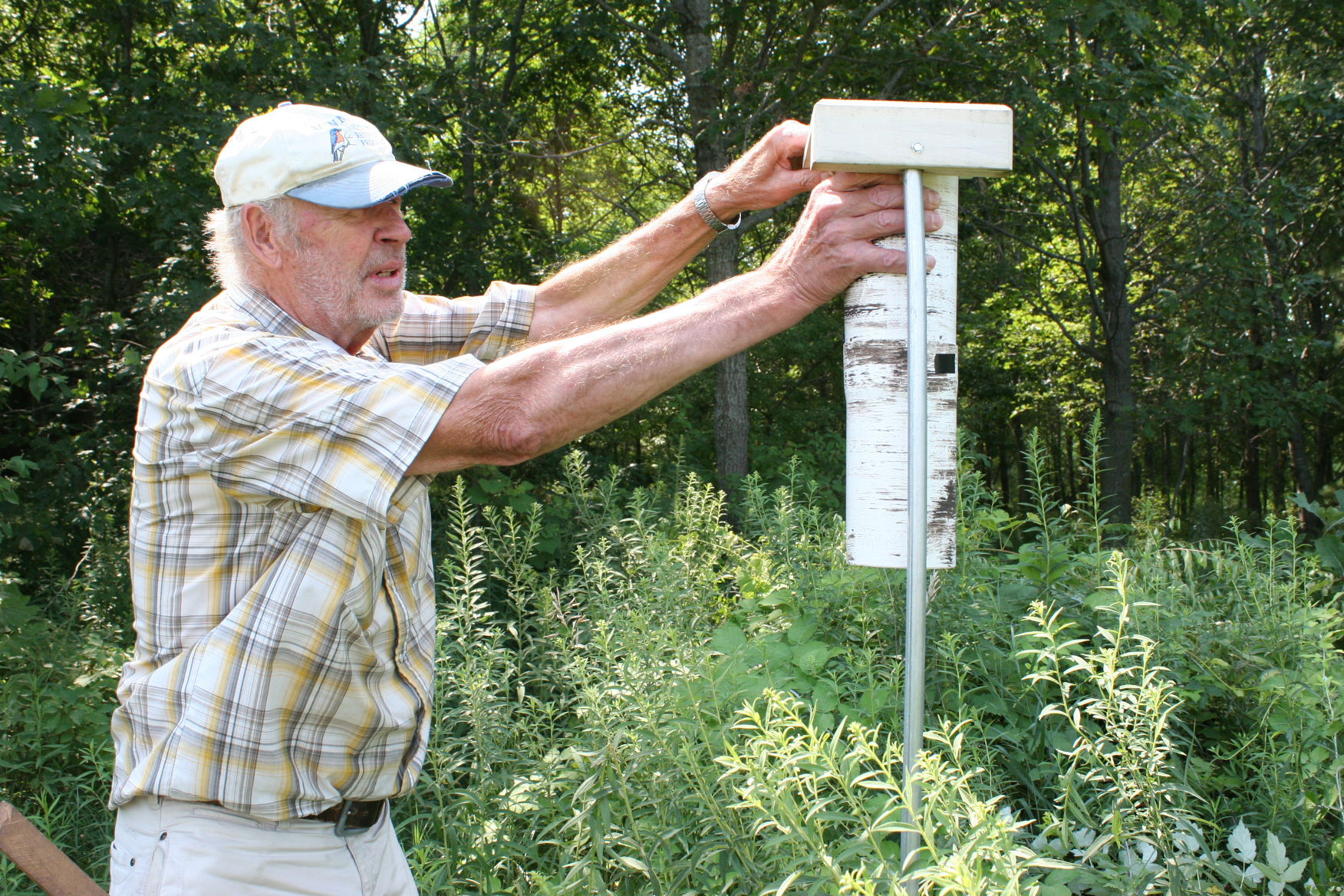
Mostly, I focused on being in the moment. When Keith offered to show us two bluebird nesting boxes just down the road, we didn’t hesitate, reversed course, our van following his truck in a trail of dust. Once parked, Keith led us down the side of a ditch, lifting the nest cylinder from its post to reveal three beautiful blue eggs inside. The next nest held only a single egg.
Keith checks a bluebird nest. Minnesota Prairie Roots copyrighted photo July 2021.
Soon we were on our way, Randy and I looking for a place to eat a picnic lunch and Keith continuing with his bluebird checks.
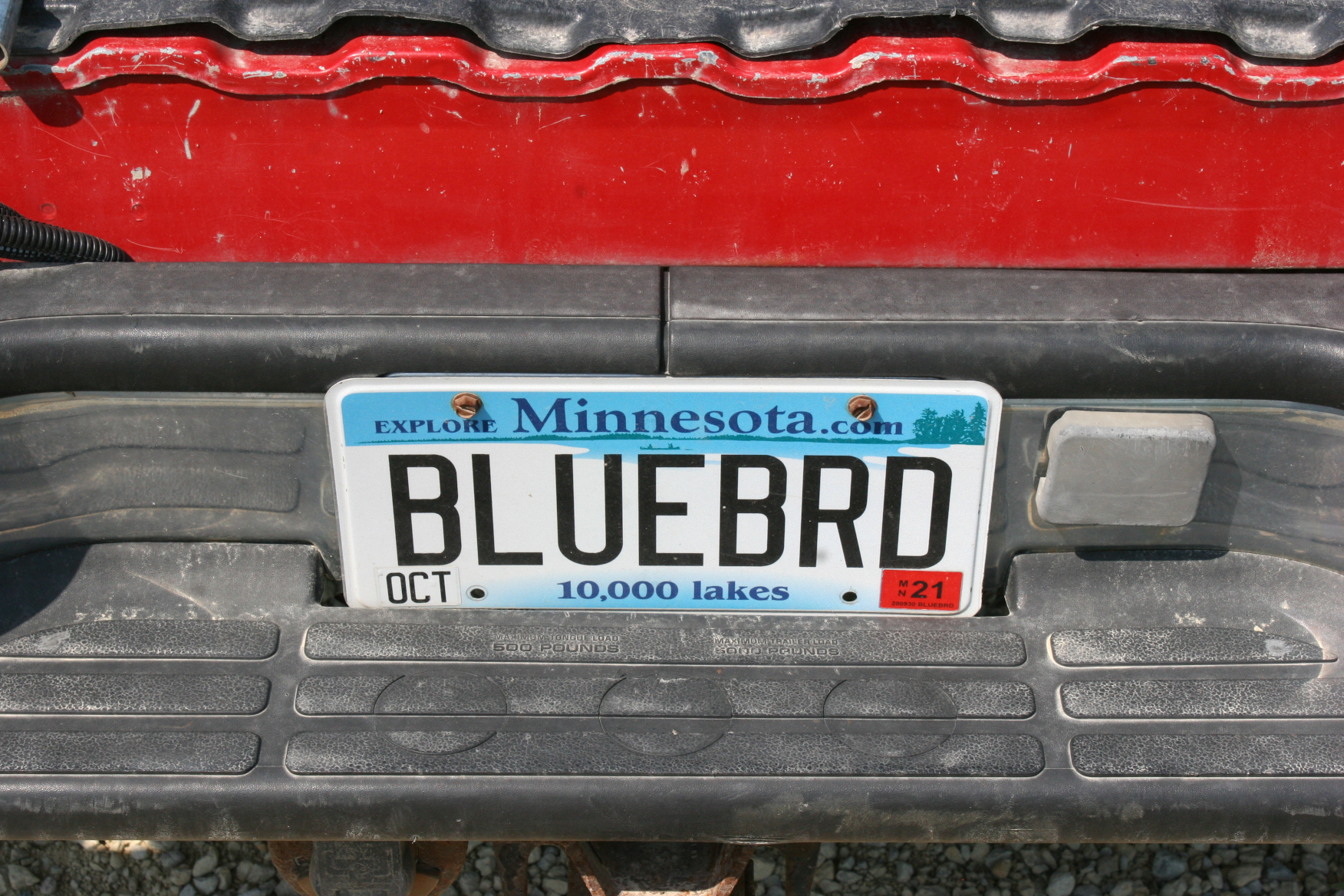
The personalized license plate on Keith’s pick-up truck. Minnesota Prairie Roots copyrighted photo July 2021.
But there’s more to this story than that of a man sporting a MINNESOTA BLUEBIRD RECOVERY PROGRAM cap with a specialty BLUEBRD license plate and a window sticker on his pick-up that proclaims his mission, Helping Bluebirds. There’s a personal connection. Keith is from my hometown of Vesta on the southwestern Minnesota prairie. He grew up north of town. I grew up south of town. Both of us on family farms.
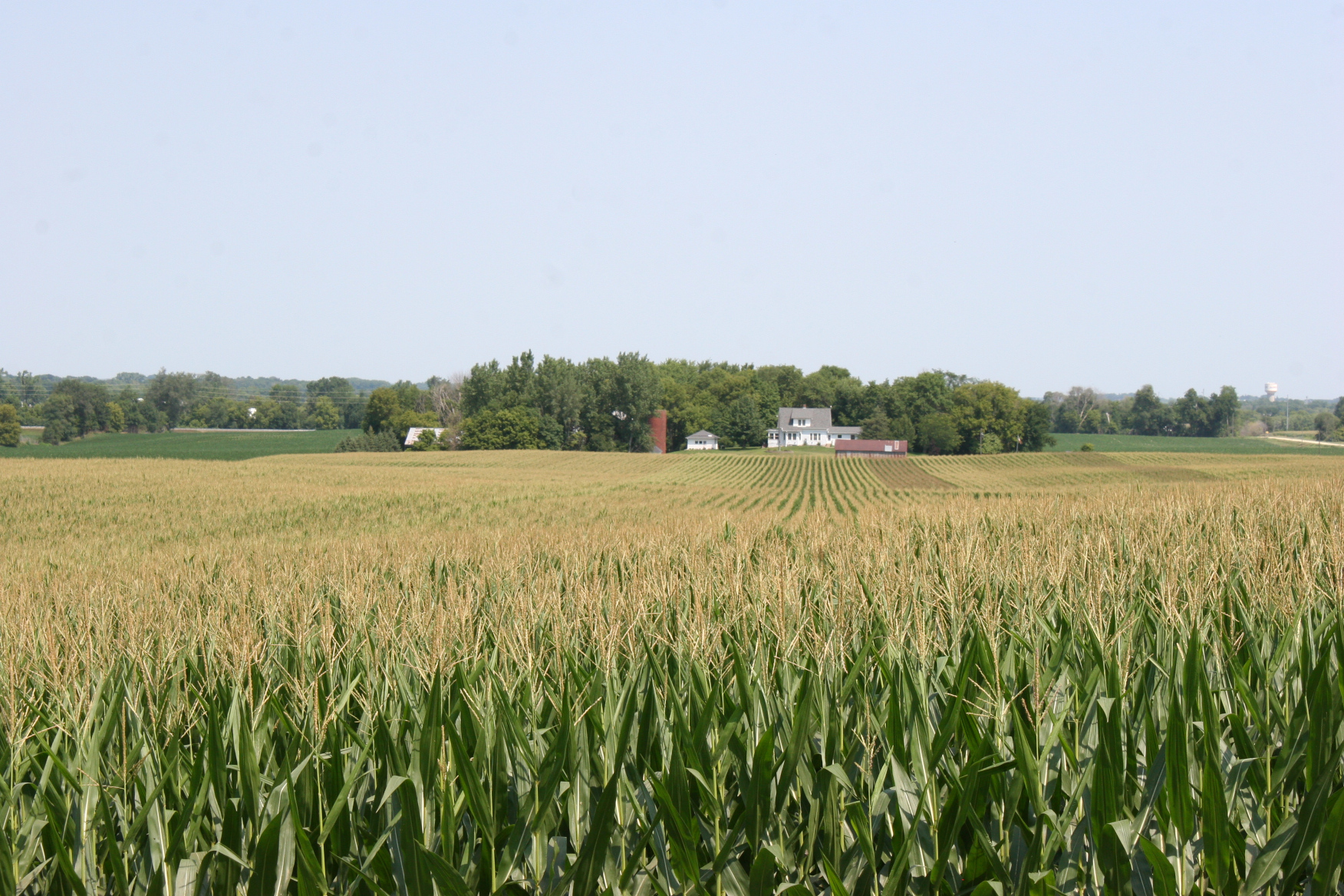
I photographed this cornfield and farm site from the gravel road where we stopped with Keith to check a bluebird nesting box. Minnesota Prairie Roots copyrighted photo July 2021.
Place connects us. Most people in Rice County are clueless as to the location of Vesta, or even our home county of Redwood some 120 miles to the west. So whenever I see Keith, I feel this sense of connection to my home area, to the land. When we met on that gravel road on a July afternoon, Keith understood my need to exit Faribault, to follow gravel roads, to reconnect with the land. And, yes, even to look at the crops.
SHE DEFINES SADNESS in these words: an ocean filled with nothing.
That definition comes not from a poet or a songwriter, but rather from 12-year-old Matilda Breimhorst in a May 1, 2020, podcast interview with Michael Barbaro of The New York Times, The Daily.
The Rev. Craig Breimhorst died on April 16, 2020, due to complications of COVID-19. He was the first person in my county of Rice to die of the virus. That county death tally has since risen to 113. As shared in my post yesterday, Breimhorst’s life will be celebrated on Saturday during his funeral.
When I published that post, I was unaware of the podcast. But Minnesota Prairie Roots reader Sandy Varley directed me to the NY Times podcast and for that I feel grateful. Please, take 20 minutes of your time to listen to Tilly talk about her Papa.
About the grandfather who climbed with her onto their special spot on the roof of his house to talk and star gaze. About the grandfather who would show up unexpectedly at school to eat lunch with Tilly (even stealing her chips) and tell stories to her and her friends. About the grandfather whose t-shirt she slept in when he lay dying in the hospital.
I admire the strength of this 12-year-old in telling her story, sharing her grief. Her words are powerful, her insights remarkable for someone so young. Via this podcast, via the bravery and honesty of Tilly, Rice County’s first COVID-19 death transforms from a statistic to a granddaughter remembering and grieving her grandfather. Her beloved Papa.
I remember well the shocking headline in the local newspaper: Faribault pastor dies from COVID-19 complications. That singular head and the story that followed shook me and imprinted upon me the seriousness of this virus. This was no longer a virus an ocean away or half a country away in New York. This was here. In Minnesota. In my county. In my community.
MORE THANNUMBERS, THESE WERE INDIVIDUALS WHO LOVED & WERE LOVED
Now more than ever with the highly-contagious and more serious delta variant, we need to care. And take care. Breimhorst’s online obituary ends with this requirement: Everyone not vaccinated of all ages are requested to wear a mask (at the funeral). Among Rice County residents ages 12 and older, 60.7 percent are fully-vaccinated, according to data listed by the Centers for Disease Control. Additional stats show 52.3 percent of the county’s population fully-vaccinated. That leaves a lot of unvaccinated people in Rice County. Too many by choice. And then those under 12 who are not yet eligible for vaccination and have no choice.
PLEASE, WEAR A FACE MASK
Rice County remains in the high community transmission category for COVID. And that is leading our local school district to rethink its “no masks when school starts” stand of just a few weeks ago. The Faribault School Board will vote soon on whether to require masks of staff and students when classes resume. We, as a community, owe it to our kids to protect them, to offer the safest and healthiest environment possible in which to learn. I cannot even fathom why anyone would object to masks to protect our children, especially. But then I can’t fathom either why people refuse vaccination.
A recent article in the Faribault Daily News quotes local student representatives saying that students feel wearing masks “is a small request…if it means staying in school in person.” Additionally, those reps state that vaccine hesitancy “seems to come from parents more than students themselves.” That doesn’t surprise me. Even though I don’t have kids in school, I still care about kids in Faribault.
I feel thankful for businesses, churches and others who are now asking, even requiring, the public (both vaccinated and unvaccinated) to wear face masks in an effort to stop the spread of COVID. Rice County is once again requiring face coverings to be worn in all county government buildings. And, yes, I’m definitely masking in indoor public places, adding another layer of protection to my vaccine protection. I don’t want to get a break-through case of COVID and then perhaps unknowingly spread COVID to my friends, family, neighbors or strangers. I feel a strong sense of personal, social and community responsibility.
I would like to think that I am also honoring the Rev. Craig Breimhorst by masking. A line in his obit reads: With Craig, love always won and love will always win. Those are words to ponder, to take to heart as this pandemic rages, to remember that love is more than a word. It is an action.
#
NOTE: If you are anti-vaccine or anti-masking, please do not comment. I moderate all comments and will not give voice to those views on this, my personal blog.My stands on wearing face masks and vaccination are rooted in care. And in love.
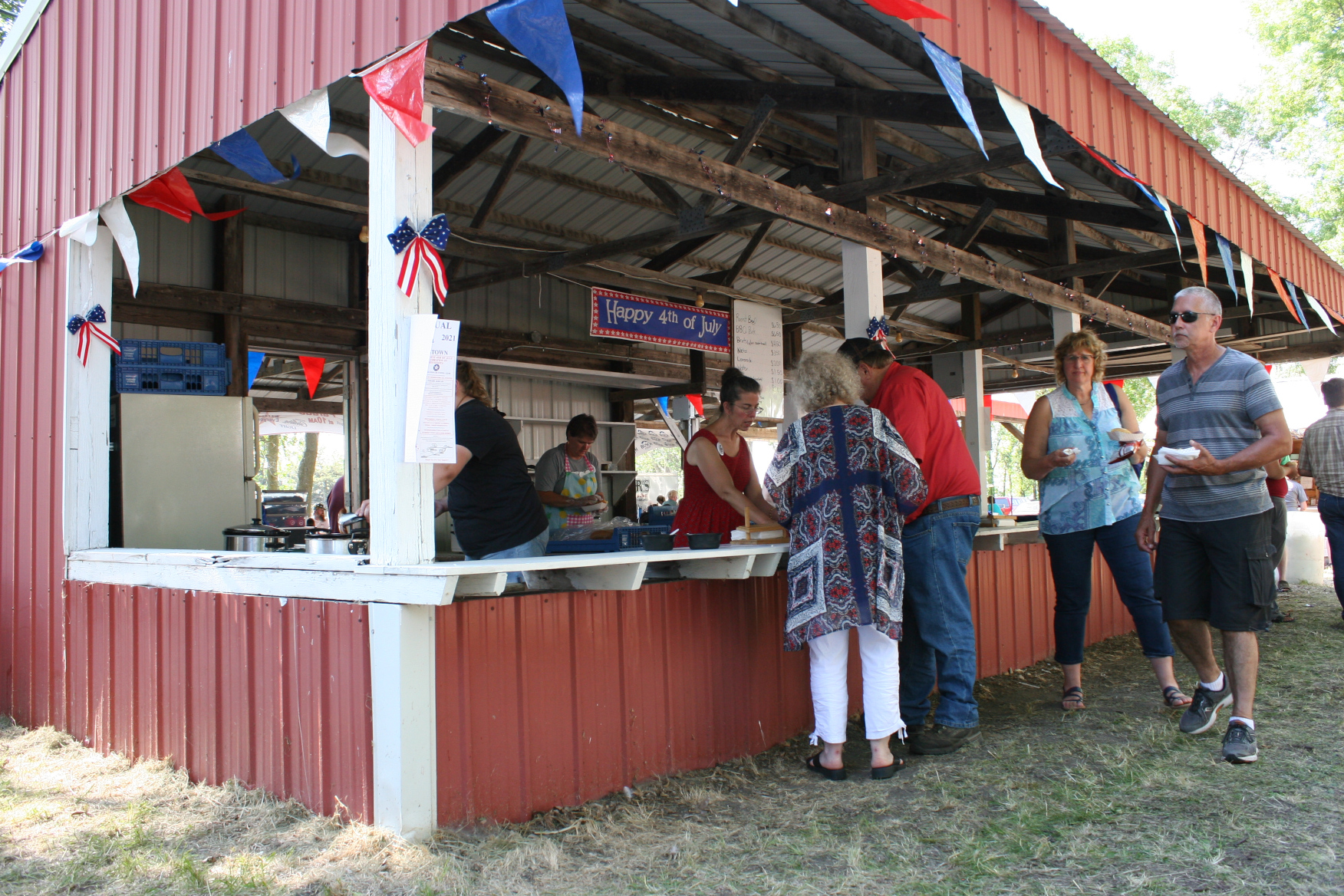
Pork and roast beef sandwiches were sold at this stand along with beverages. Minnesota Prairie Roots photo.
NORTH MORRISTOWN on the Fourth of July suits me and my rural roots. Not that I’m rooted to this place in the middle of farm country in southwestern Rice County. But the down-to-earth basics of this nearly 130-year-old Independence Day celebration appeal to the raised-on-a-Redwood-County-farm girl in me.
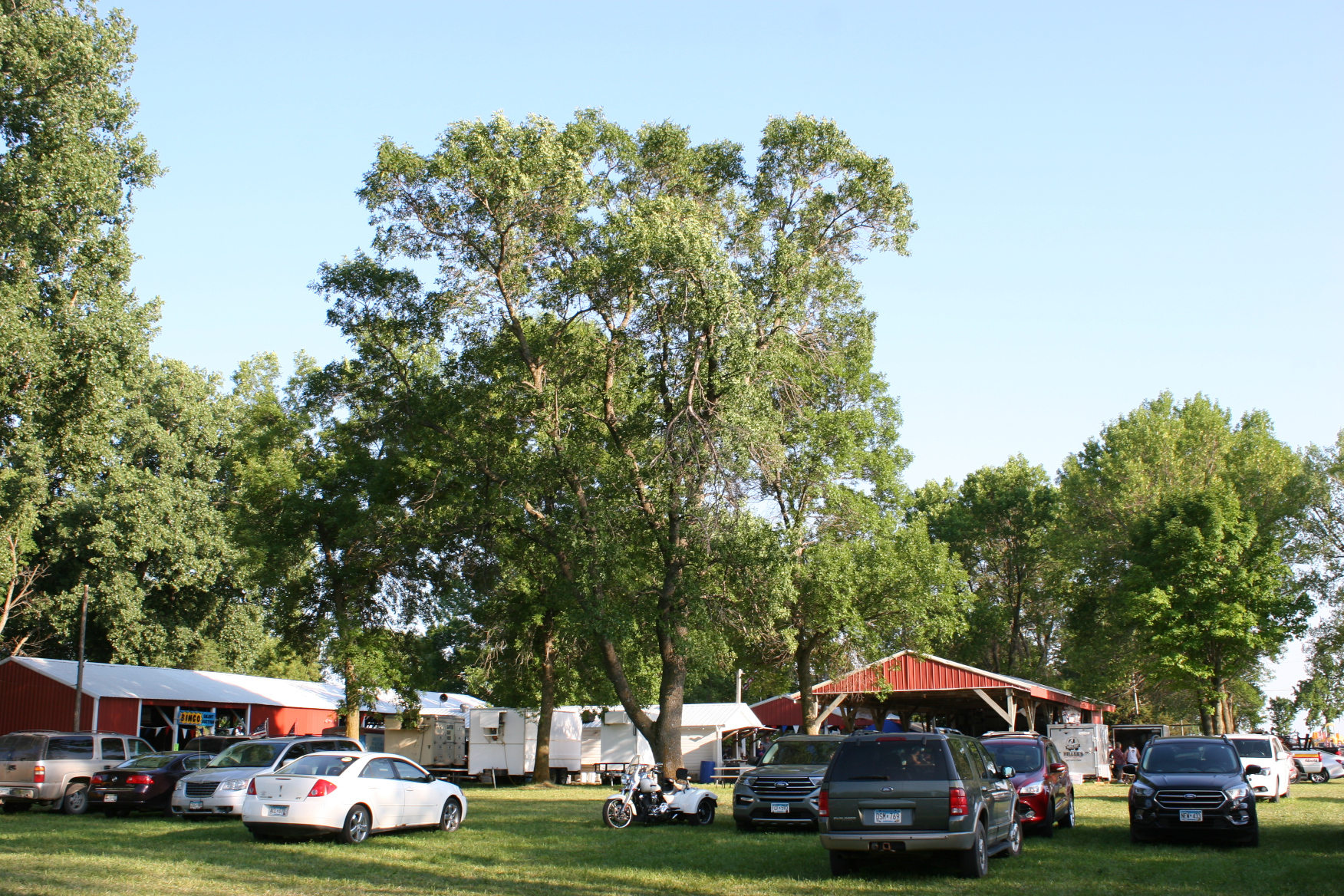
A look toward the fest grounds from the parking area early Sunday evening. Minnesota Prairie Roots photo.
I appreciate how this event, held annually on festival grounds in a rural Minnesota landscape, remains basically unchanged. Just like North Morristown, which is not a town, but rather farm sites, fields, a Lutheran church and school, and the grassy, shaded celebration site.
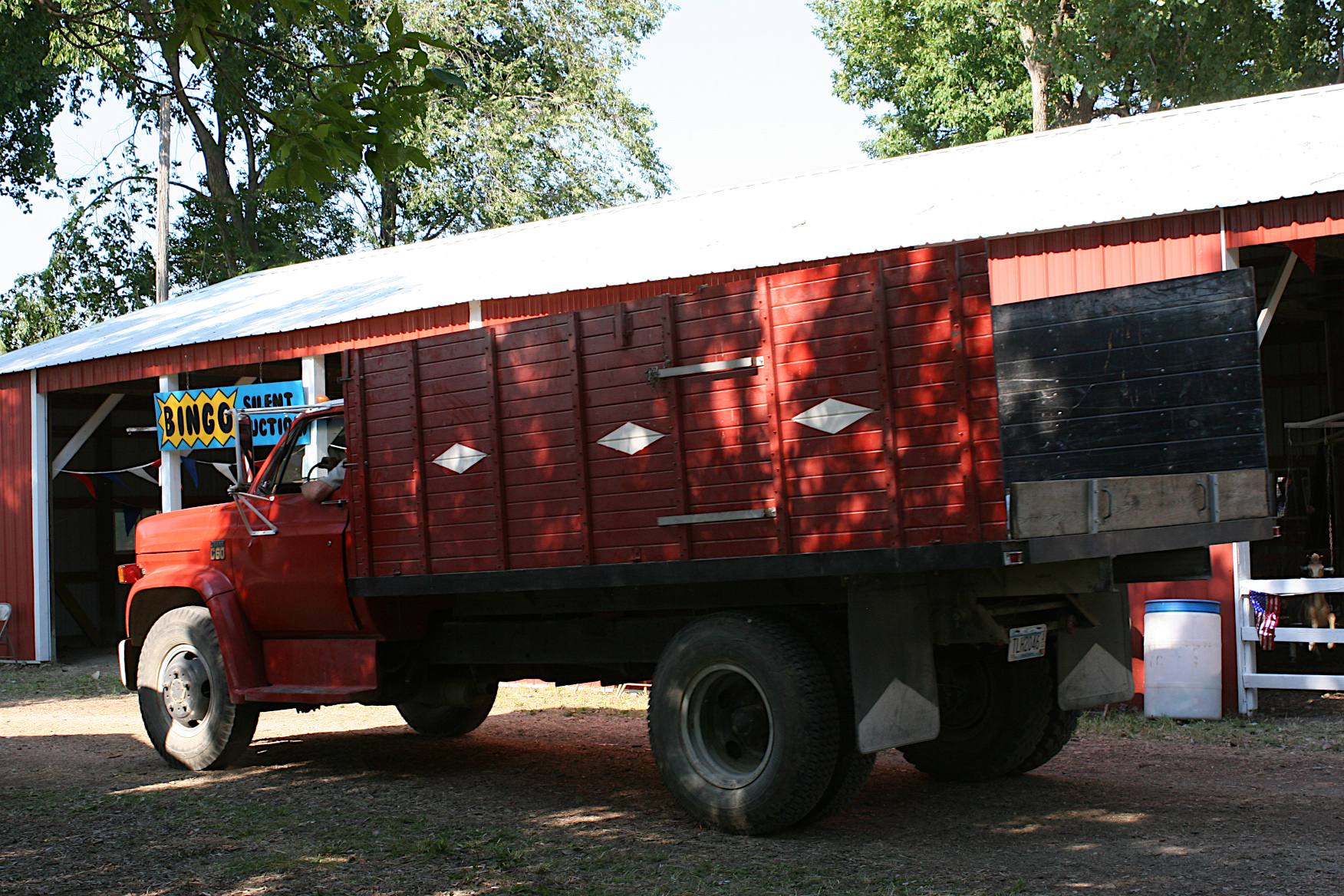
A grain truck drives through the festival grounds, I believe to pick up garbage. Minnesota Prairie Roots photo.
The rural character of July Fourth here prevails. In tractors and grain trucks. In barns, machine sheds and farmhouses. But it stretches beyond that to the people, to families rooted in North Morristown for generations. In many ways, Independence Day here is as much a celebration of our nation’s birthday as it is one big family reunion. With guests, like me, welcomed.
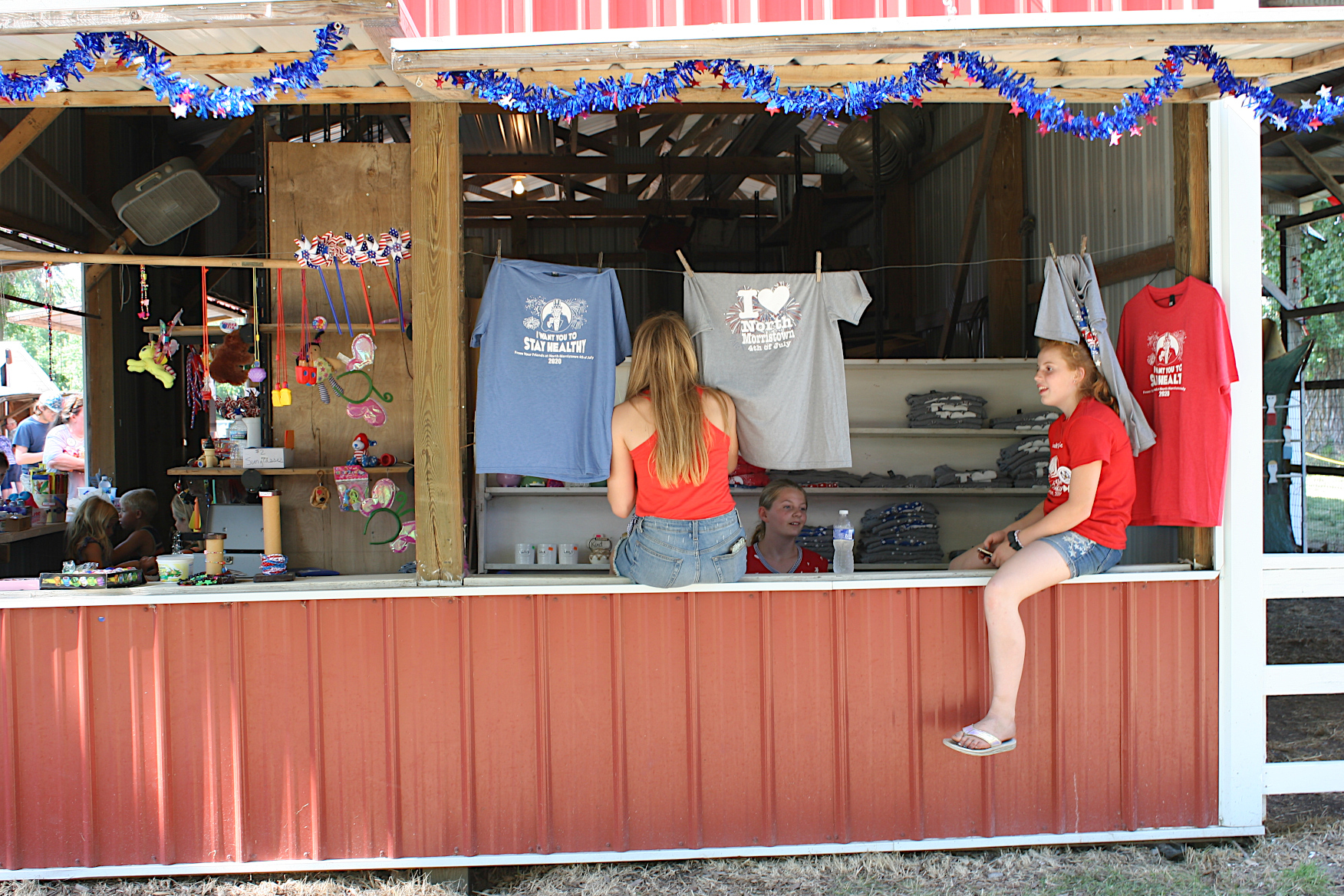
The next generation sells tees in the novelty shop. Minnesota Prairie Roots photo.
The event feels friendly and comfortably homey. I recognize that doesn’t come without a lot of planning, time, effort and hard work on the part of volunteers. I’ve coordinated and led events much smaller than this and fully realize the work and commitment.
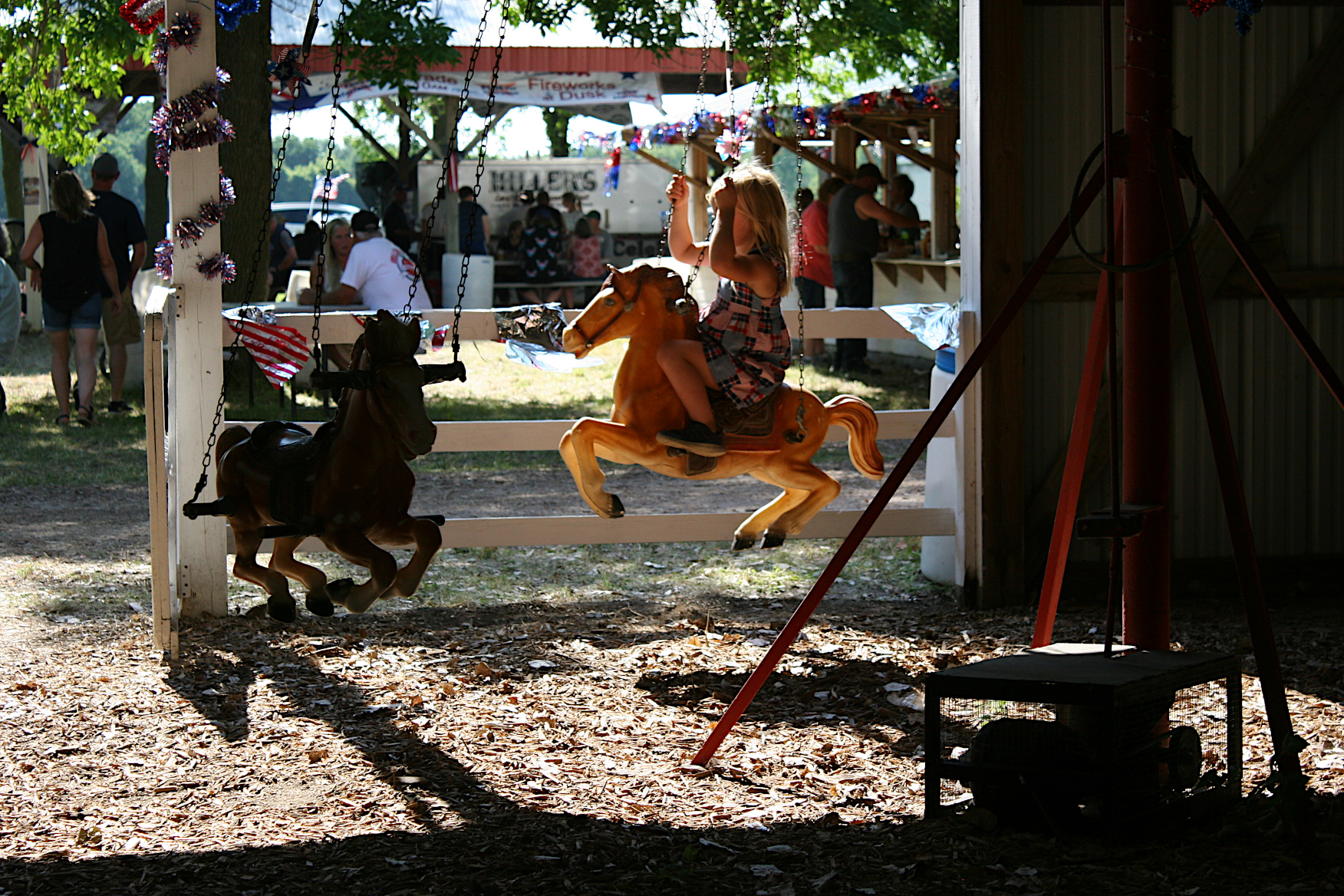
There’s nothing high tech about the vintage rides. Minnesota Prairie Roots photo.
So to those who spearheaded this year’s Fourth of July in North Morristown, thank you. And to those who have led in the past, thank you also. You are bringing joy to a lot of people. You are preserving the past. You are bringing people of all ages together from all over, this year from as far away as the Philippines. You are strengthening families and building memories. You are offering an alternative to high tech everything.
One of the many vintage kiddie rides. Minnesota Prairie Roots photo.
In a fast-paced world, we need a place and event like North Morristown on the Fourth to remind us to slow down, to sit for a spell. To listen to the music. To savor a slice of homemade pie or a pork sandwich. To visit with friends and family and strangers. To watch babies toddle in bare feet and kids climb onto vintage horses. To play BINGO or hunt for a hidden medallion. To feel grateful for faith and family and health and country.
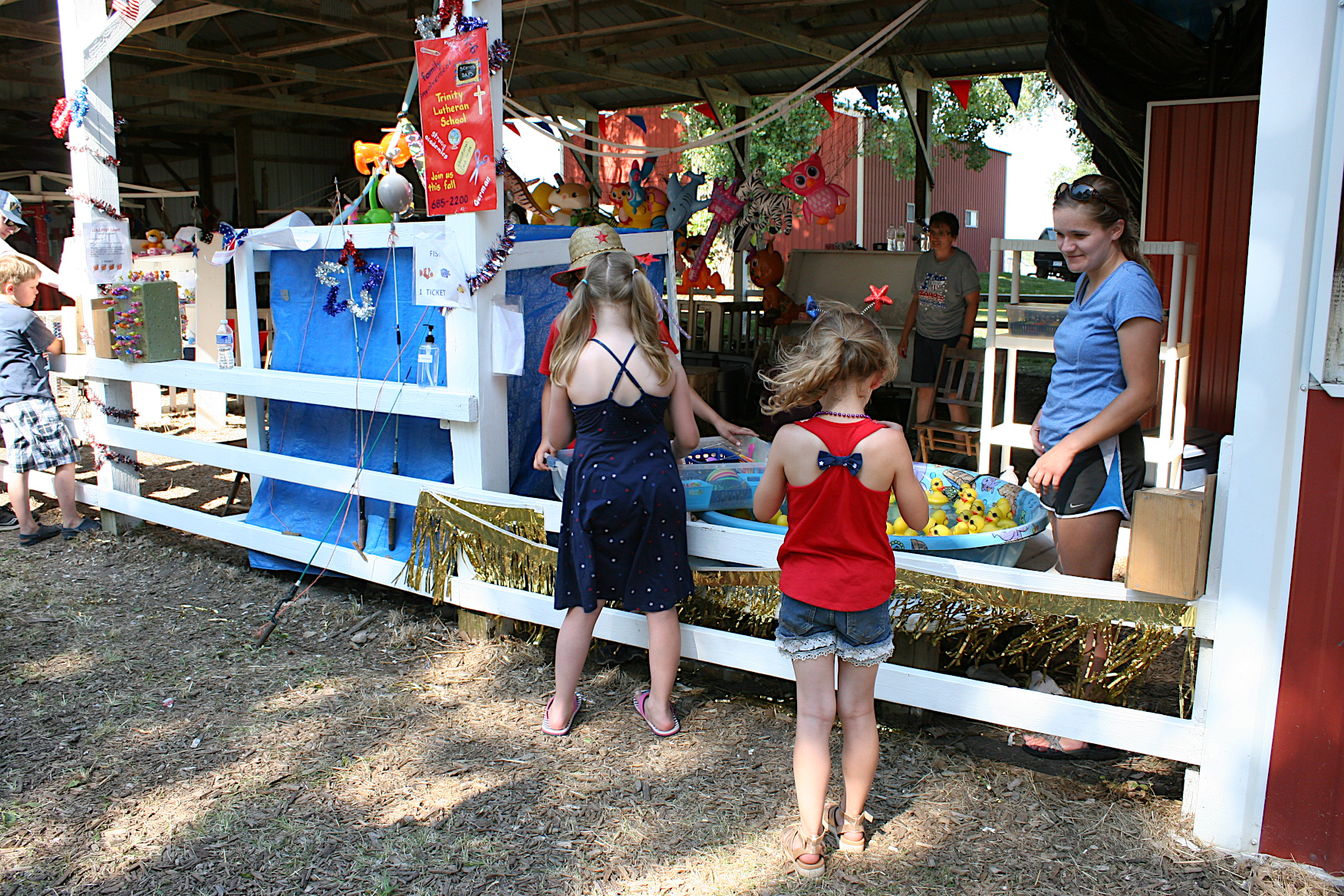
The kiddie games are simple, like the duck pond. Minnesota Prairie Roots photo.
At its core, North Morristown on the Fourth represents so many things I hold dear. I expect others feel the same.
The countryside near North Morristown. Minnesota Prairie Roots photo.
TELL ME: Did you attend the North Morristown July 4 celebration or one similar? I’d like to hear.



















 Minnesota Prairie Roots
Recent Comments