
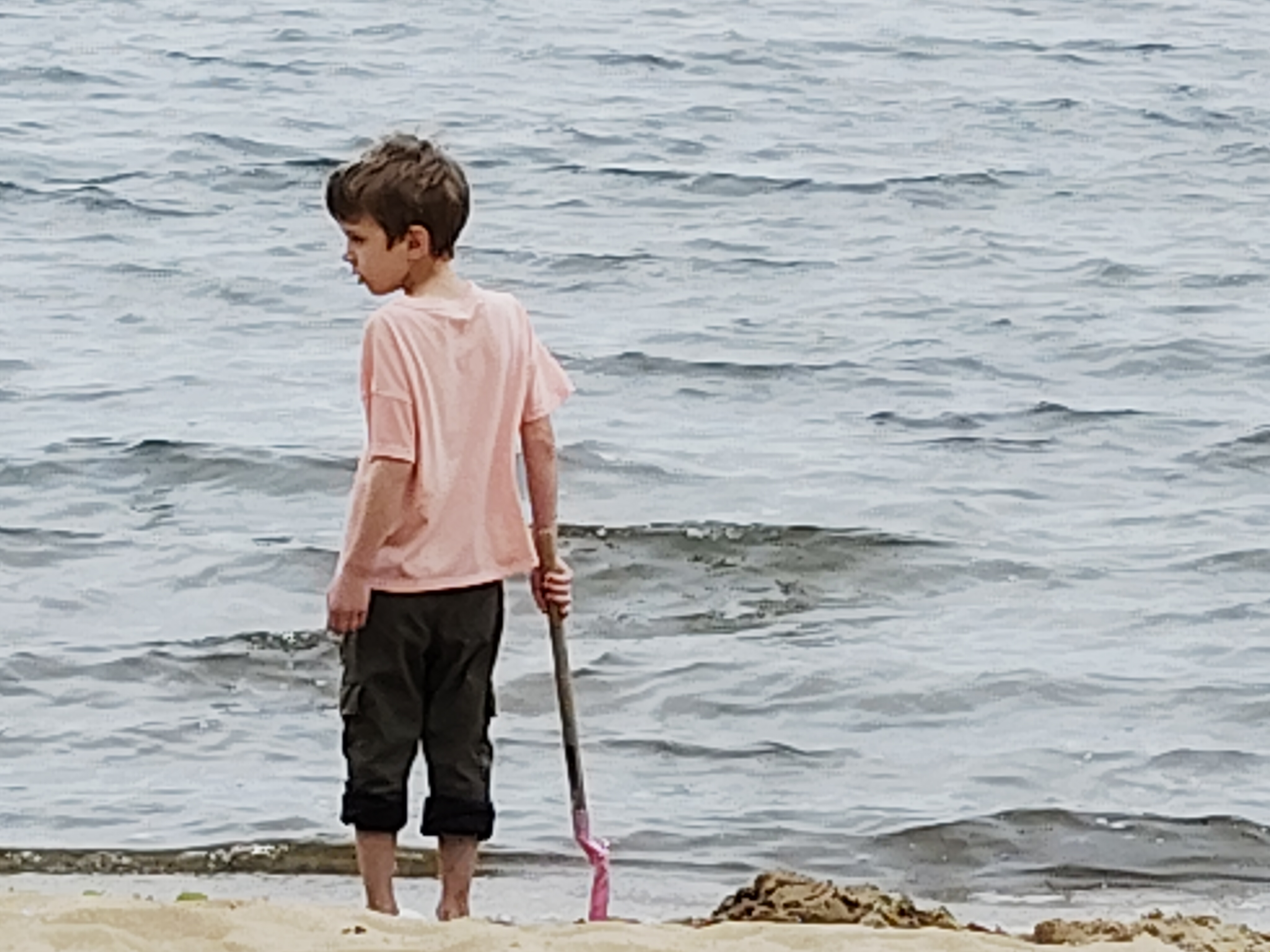
SOMETIMES A PHOTO isn’t perfect. And this one certainly isn’t, at least not technically. The image of my 6-year-old grandson is not sharp. And that’s because I was sitting a beach away, zooming in with my cellphone camera.
My 35 mm Canon was inside the cabin. I knew I would either have to shoot with my phone or miss the moment. I opted to click the white circle on my Android.
Why do I love this photo, despite its technical flaws? I love the moment in time I’ve captured of my young grandson. Isaac was busy digging in the sand at lake’s edge when he paused. I don’t recall the reason he stopped shoveling. And that in itself holds appeal as those who view the image can imagine what Isaac is seeing to his left.
I remember the set up of this scene, though. Randy and I were on lakeside grandparent watch while Isaac’s parents headed into Nisswa for coffee. We were all vacationing together at a family member’s Horseshoe Lake cabin in north central Minnesota. Isaac’s older sister was inside the cabin reading.
The day was cold with a strong wind churning the water. Not a day for swimming or for sunbathing. But, for Isaac, it was still a good day for digging in the sand. He kept venturing closer and closer to the lake, water lapping at his pant legs. I asked Randy to roll up Isaac’s pants.
There’s something about a boy by the water, pants legs rolled up, shovel in hand that speaks to carefree days of summer, to youthfulness and to simple child’s play in the great outdoors. I love seeing kids playing outside, away from video games and electronics. I’m all for handing a child a stick (or a shovel) to encourage creative play.
I love this photo also because it tells a story in a simple and uncomplicated scene of water, sand, shovel and boy. Photography, for me, is often about storytelling.
I like the composition of this photo, too, with Isaac off-center, the sand pile on the right side of the frame. And then the wavy lake seemingly takes on a personality of its own like a threatening intruder. But Isaac didn’t let the moody lake, the cold day or the strong wind deter him from his work.
As with any photo, lighting ranks high. I like the lighting in this image. I like the simplicity of the photo.
Even though not technically perfect, this photo holds what’s most important to me—love. Do you see it?
© Copyright 2025 Audrey Kletscher Helbling




























Hearing, listening & the drone of war August 14, 2025
Tags: Alaska, commentary, hearing, listening, listening exercise, meeting, news, President Donald Trump, President Vladimir Putin, Ukraine, Volodymyr Zelenskyy, war
IF I LISTEN CLOSELY, I can hear the incessant chirp of crickets beneath the steady drone of traffic rushing past my house. I live along a busy street, where noise is a constant except in the deep hours of the night. Even then, though, the lone blare of a siren may pierce the night silence, enough to awaken me.
I hear lots of sounds. But that’s not the same as listening. There’s a difference. Hearing is simply taking in sound waves. But listening requires intentional focus. Not only physically hearing, but also paying attention, picking up on verbal and non-verbal cues, remaining quiet.
Many of us are not particularly good at listening. It requires discipline, silence and an understanding that whatever we hear holds significance. Chirping crickets signal the end of summer. Screeching sirens indicate an emergency. And when someone is speaking to me, it means they have something to say. And I need to listen.
I consider myself to be a pretty good listener. As a journalist, I really honed my listening skills, a necessity in covering any news story, doing any interview. And on a personal level, I’ve always been more interested in what others are saying than in hearing my own voice.
Therein lies the problem. Too many of us like the sound of our own voices. If someone starts sharing their own story, their own challenges, we tend to interject our own stories. That’s when a push “pause” seems appropriate. Our listening skills need to kick in as we clamp our lips in silence and remember that the conversation is not about us.
So all of this leads me to the meeting between President Donald Trump and Russian President Vladimir Putin on Friday in Anchorage, Alaska, to discuss the war in Ukraine. Noticeably absent will be Ukrainian leader Volodymyr Zelenskyy. Now you’d think, given the war is raging in Ukraine, that Zelenskyy should be at the table. He asked to be there. But, if the two other leaders heard, they didn’t listen. A pre-meeting conversation between Trump and Zelenskyy isn’t the same as including the Ukrainian president in the summit.
From all accounts, the Trump administration is now billing Friday’s meeting as a “listening exercise.” I find that to be an interesting choice of words. I can’t imagine that either Trump or Putin will really be “listening,” based on past meetings between the two and observations I’ve made about them. But, hey, maybe this time they really will hear the crickets chirping above the drone of war, the blaring of sirens.
© Copyright 2025 Audrey Kletscher Helbling