Minnesota Prairie Roots

Writing and photography by Audrey Kletscher Helbling

A look at Taopi, plus an overview of failures, injustices & war in Minnesota October 9, 2023

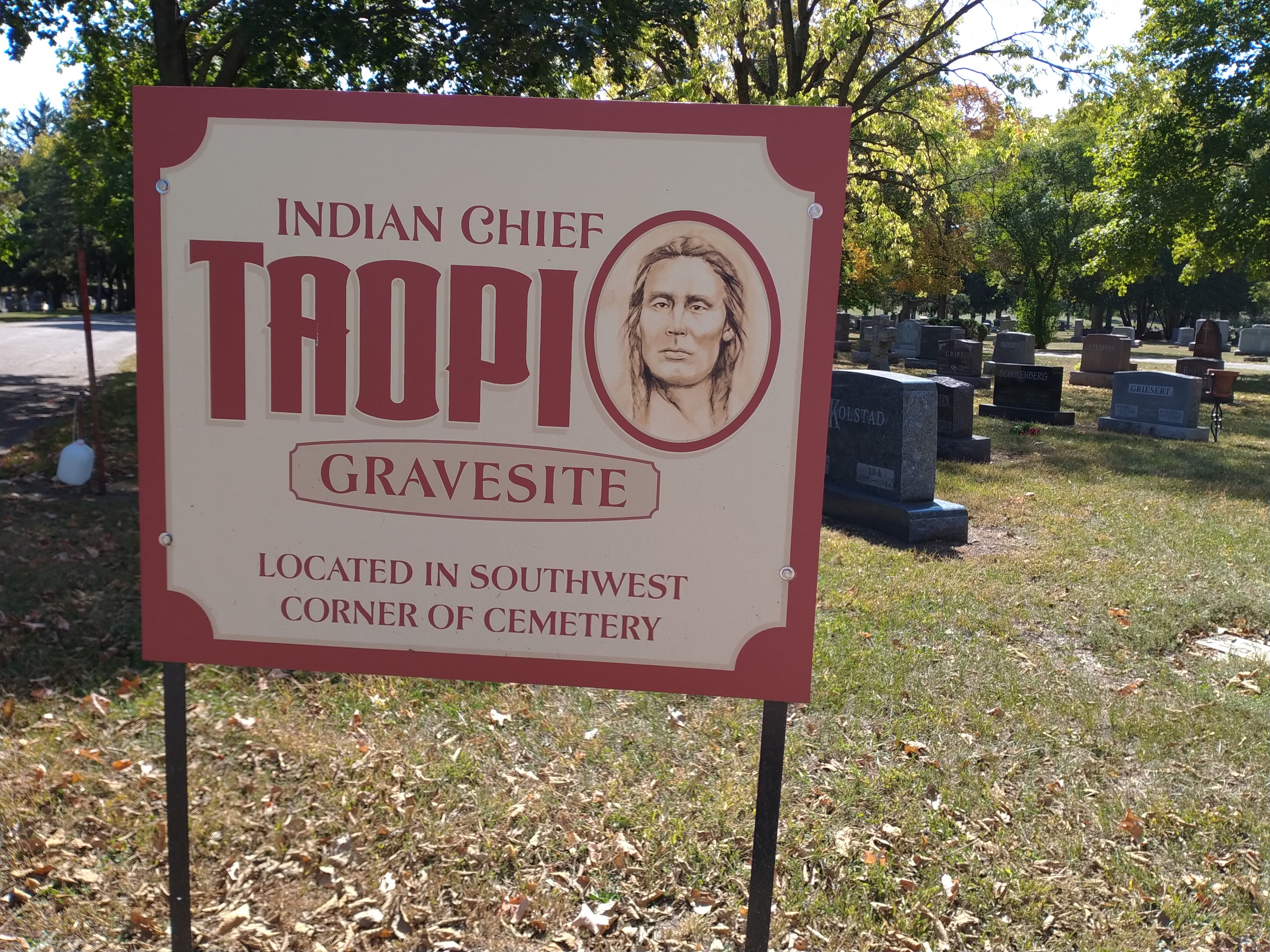
Just inside the entrance to Maple Lawn Cemetery, a sign directs visitors to Taopi’s gravesite. (Minnesota Prairie Roots copyrighted photo October 2023)

MY GOAL WAS SIMPLE—to write a piece honoring Indigenous Peoples’ Day. My focus, I initially decided, would be on Taopi, a member of the Little Crow Band of the Mdewakanton Dakota Tribe. Taopi is perhaps best known in Faribault, where he lived for a while and is buried. A small Mower County town near the Iowa border also honors him in name. But my writing expanded beyond Taopi.
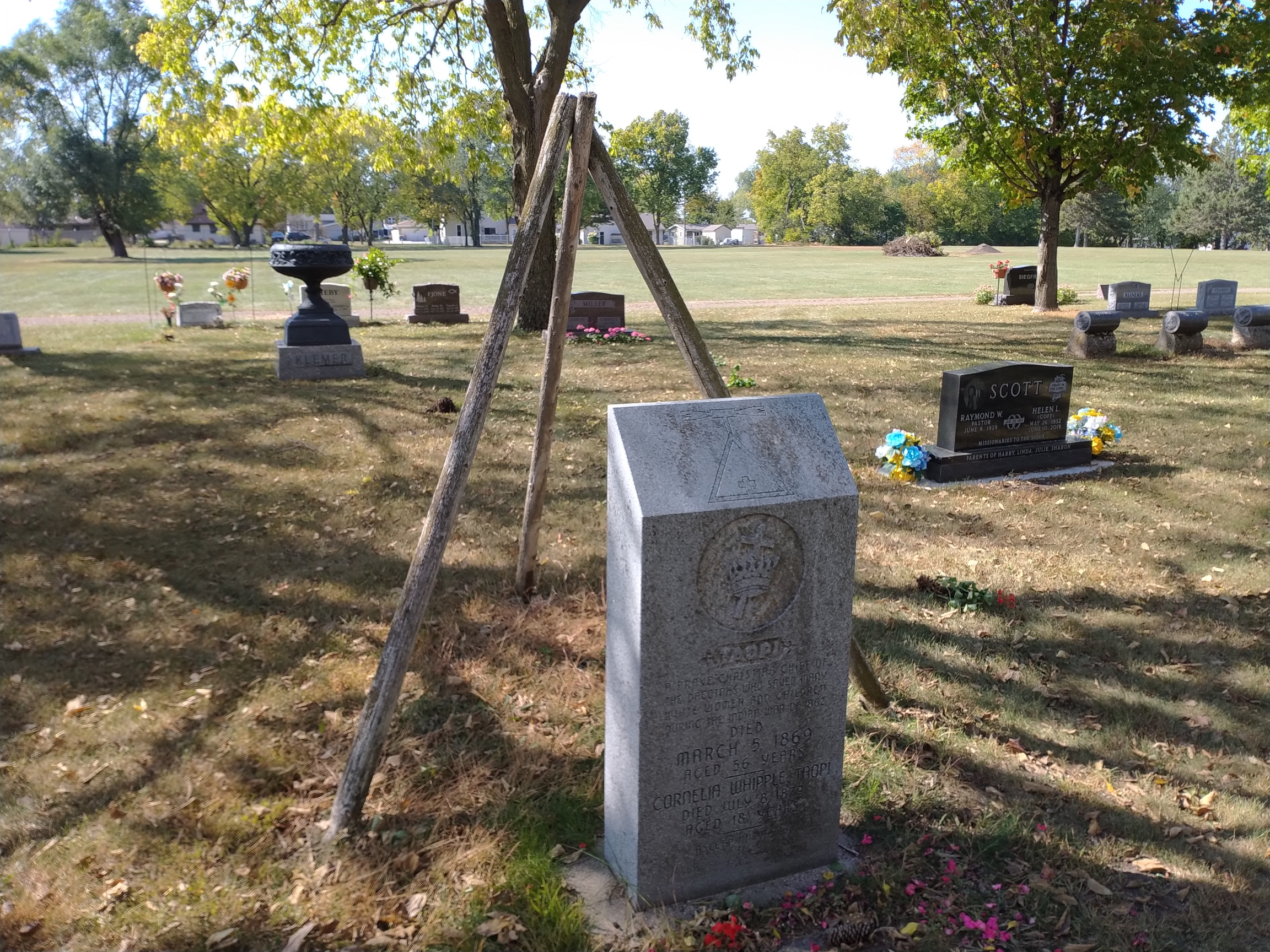
Taopi’s grave, and that of his daughter, are easily spotted via the propped poles. (Minnesota Prairie Roots copyrighted photo October 2023)

Recently I visited Taopi’s gravesite at Maple Lawn Cemetery. My interest piqued. I wanted to learn more about this Dakota leader and his importance in my community and in Minnesota history. His place in history connects to the US-Dakota War of 1862, a war all too familiar to me. My native Redwood County, where the Lower Sioux Agency was located, centered that deadly, short-lived conflict between white people and Native Peoples.

Now, viewing this war through a lens not tinted primarily by a white perspective, I understand the injustices. Decades ago, when I wrote a high school term paper on the war, I admittedly wrote a biased, unbalanced report based on biased, unbalanced research sources.

With time and maturity came the realization of the great injustices done, first when the US government acquired Indigenous Peoples’ land at a seemingly low cost and then failed to honor those treaties. The treaties opened nearly 24 million acres to white settlers. It was the Natives, the original inhabitants of this land, who found themselves cheated of government annuities, starving, pushed off their land and confined to strips of land along the Minnesota River. That includes the Wahpekute, a small band of the Dakota who lived in south central Minnesota, including the Faribault area. I live just below a Faribault city park called Wapacuta.
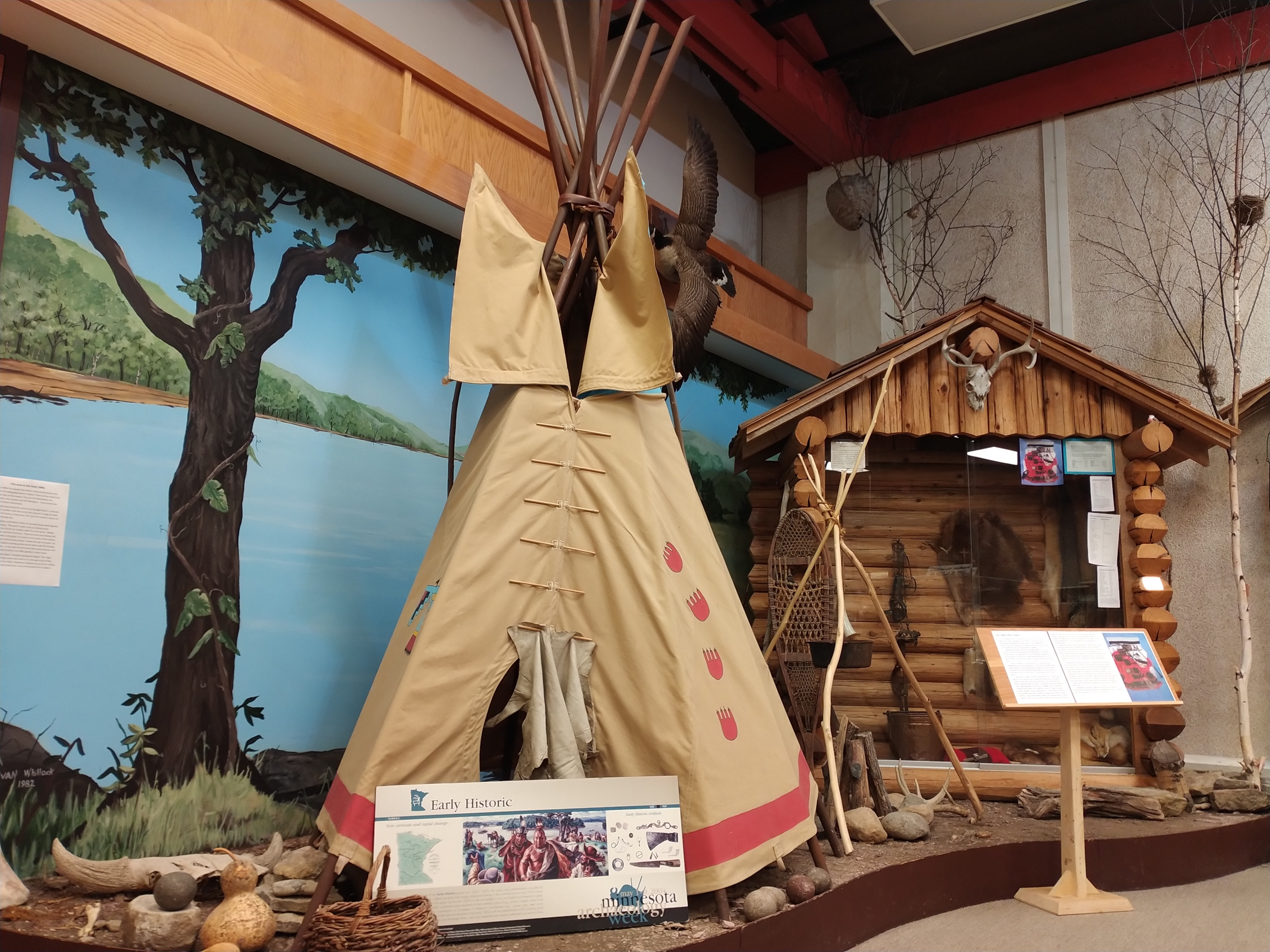
An exhibit at the Rice County Historical Society Museum. Artifacts from Indigenous Peoples are also displayed in cases. (Minnesota Prairie Roots copyrighted photo October 2023)

At the time of the US-Dakota War of 1862, Taopi was in the thick of all of it as a “farmer Indian,” the name tagged to Native Peoples who opted to farm, adapting the ways of the white man in occupation, dress and sometimes religion. He lived near the Lower Sioux Agency, relocated to a reservation there following the Treaty of Mendota in 1851. Those who continued with their hunting and fishing culture were known as “blanket Indians.” Taopi assuredly felt the animosity of his own people for the lifestyle and other choices he made.
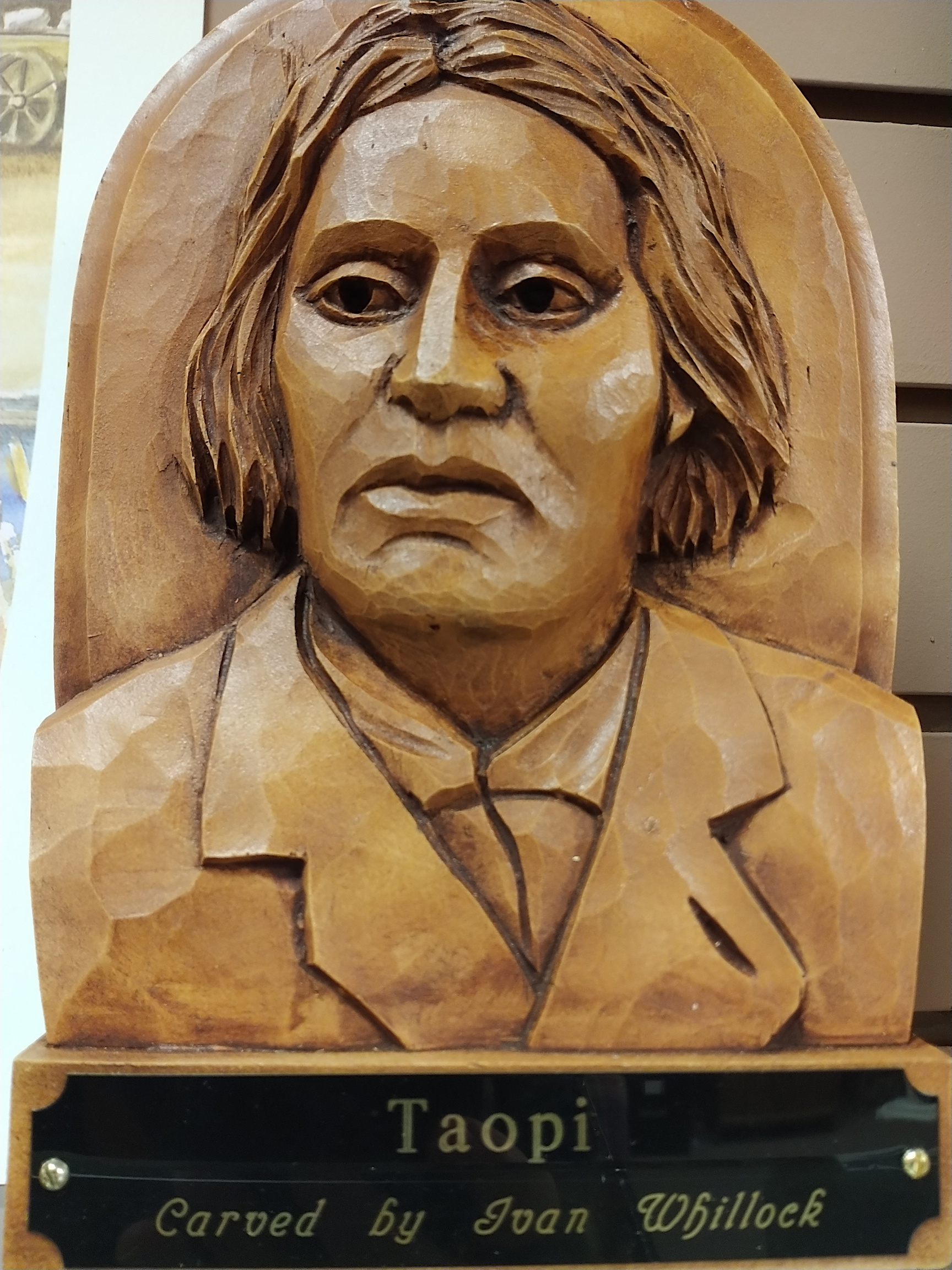
A woodcarving of Taopi by noted Faribault artist Ivan Whillock is for sale in the Rice County Historical Society Museum’s gift shop. One is also displayed in a museum exhibit on Taopi. (Minnesota Prairie Roots copyrighted photo October 2023)

I can only imagine the pressure Indigenous Peoples experienced as white settlers moved into the area. The change, at times, had to feel overwhelming. Life would never be the same. Long-time homelands were lost, tradition and culture endangered. And so Taopi and others adapted, likely accepting that change was inevitable.
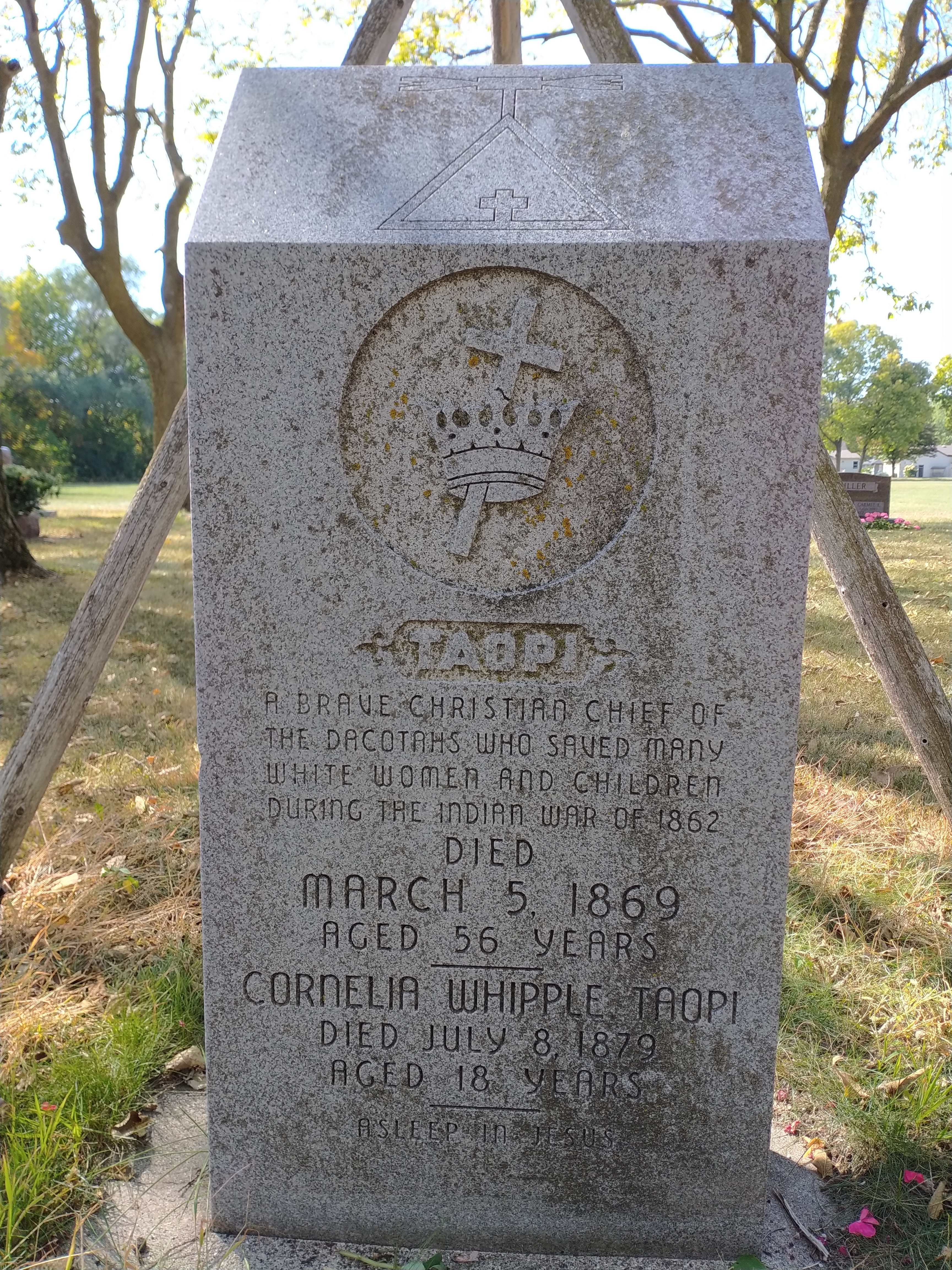
The gravesite of Taopi and his daughter, Cornelia Whipple Taopi (named after Cornelia Whipple, married to Bishop Henry Whipple). (Minnesota Prairie Roots copyrighted photo October 2023)

But one thing that remained constant with Taopi was his focus on peace. He opposed the war and was a leader in the Dakota Peace Party. He is credited with saving the lives of many.

Yet, at war’s end, Taopi found himself caught—disliked by his peoples, who considered him a traitor, and disliked by whites holding a deep animosity toward any Native person. In Faribault, though, he had a friend in Bishop Henry Whipple, a strong advocate for First Peoples, and in town founder Alexander Faribault. Eventually, Taopi and other Natives moved onto land owned by Alexander Faribault, living under his protection on a bluff overlooking the Straight River. Taopi died in 1869. In 1895, the Indigenous Peoples of Faribault were displaced once again, moved to the Lower Sioux Reservation. They had always existed on the fringes in Faribault, never fully-accepted by most residents while under the protection of the bishop and town founder.
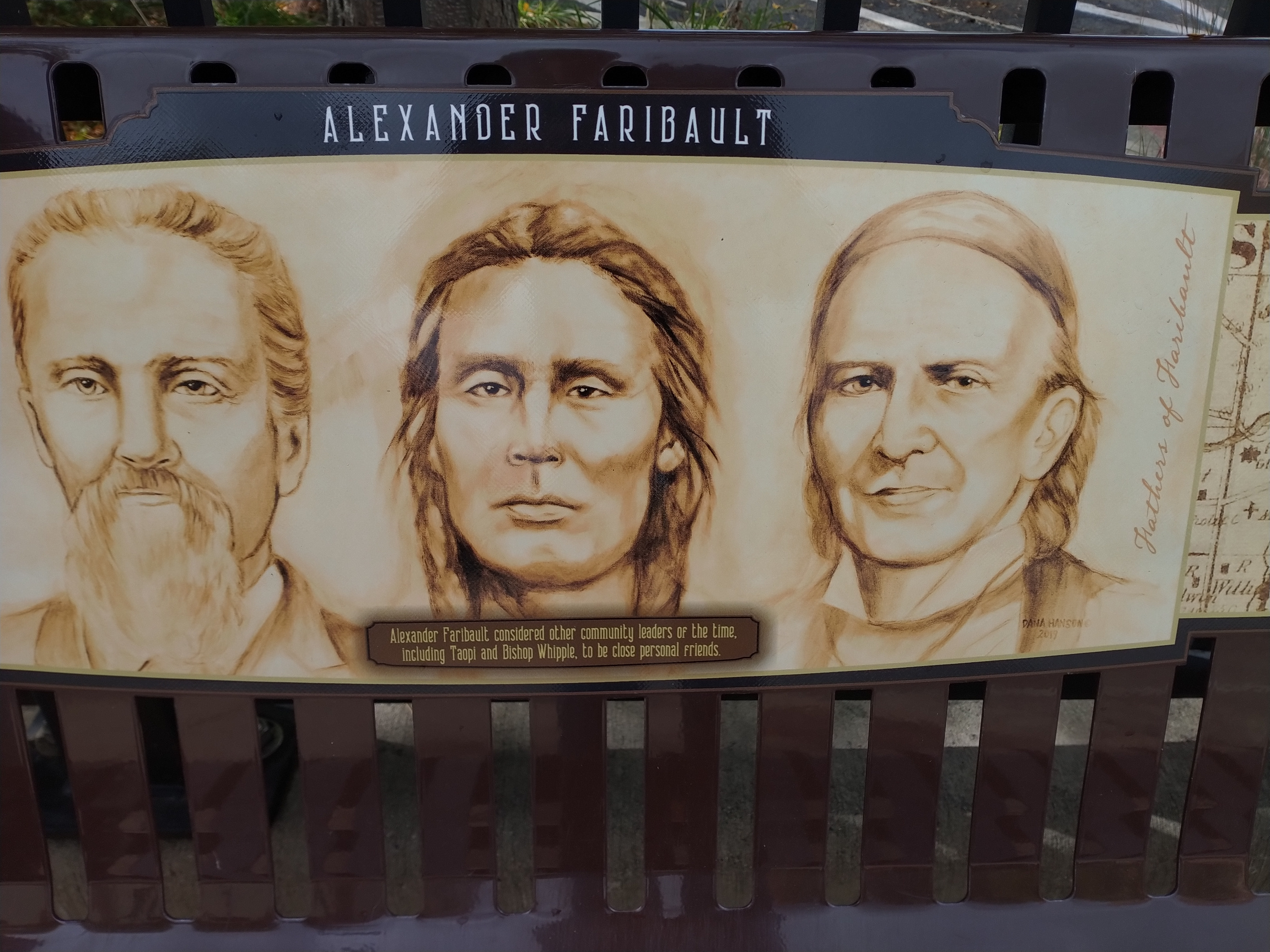
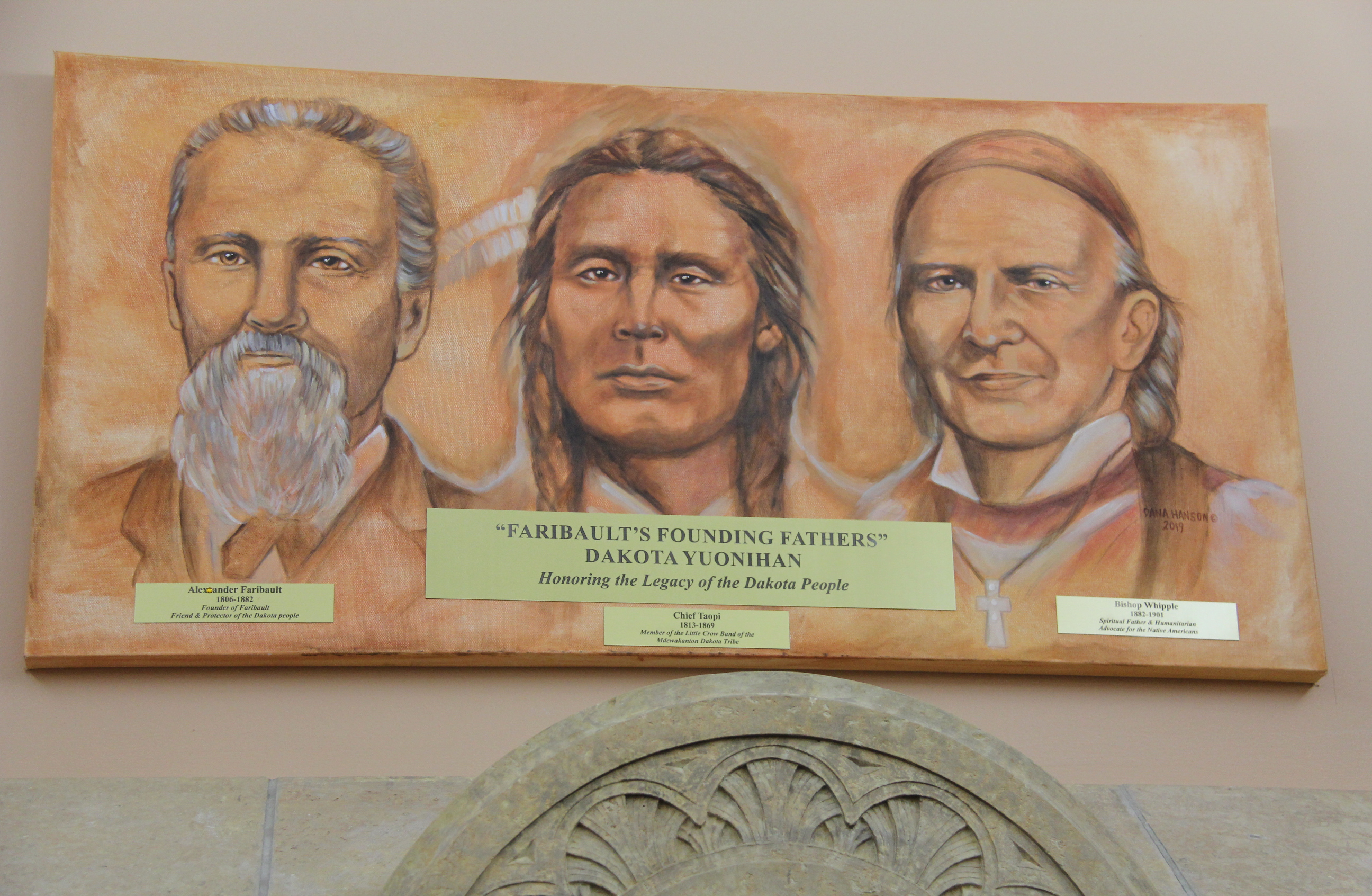
Dana Hanson’s “Father’s of Faribault” (left to right, Alexander Faribault, Taopi and Bishop Henry Whipple) featured on a bench along Central Avenue in downtown Faribault. The same artwork hangs inside Buckham Memorial Library. (Minnesota Prairie Roots copyrighted photo October 2023)

And so that is a brief look at Taopi, whose gravesite I visited. His presence remains visible elsewhere in Faribault. He’s featured in an exhibit at the Rice County Historical Society Museum. A “Fathers of Faribault” portrait of Taopi, Bishop Whipple and Alexander Faribault by Dana Hanson hangs at Buckham Memorial Library. Just a block to the north, that same artwork graces an historic-themed bench. Taopi was, most assuredly, a man of importance in local and state history. I will remember him primarily as a man of peace in a time when peace was decidedly elusive.

#

© Copyright 2023 Audrey Kletscher Helbling

Sources: The First Cathedral, an Episcopal Community for Mission by Benjamin Ives Scott and Robert Neslund; the Minnesota Historical Society website; and the Rice County Historical Society Museum’s Taopi display.

 

In Seaforth: Celebrating books, art & people October 4, 2023

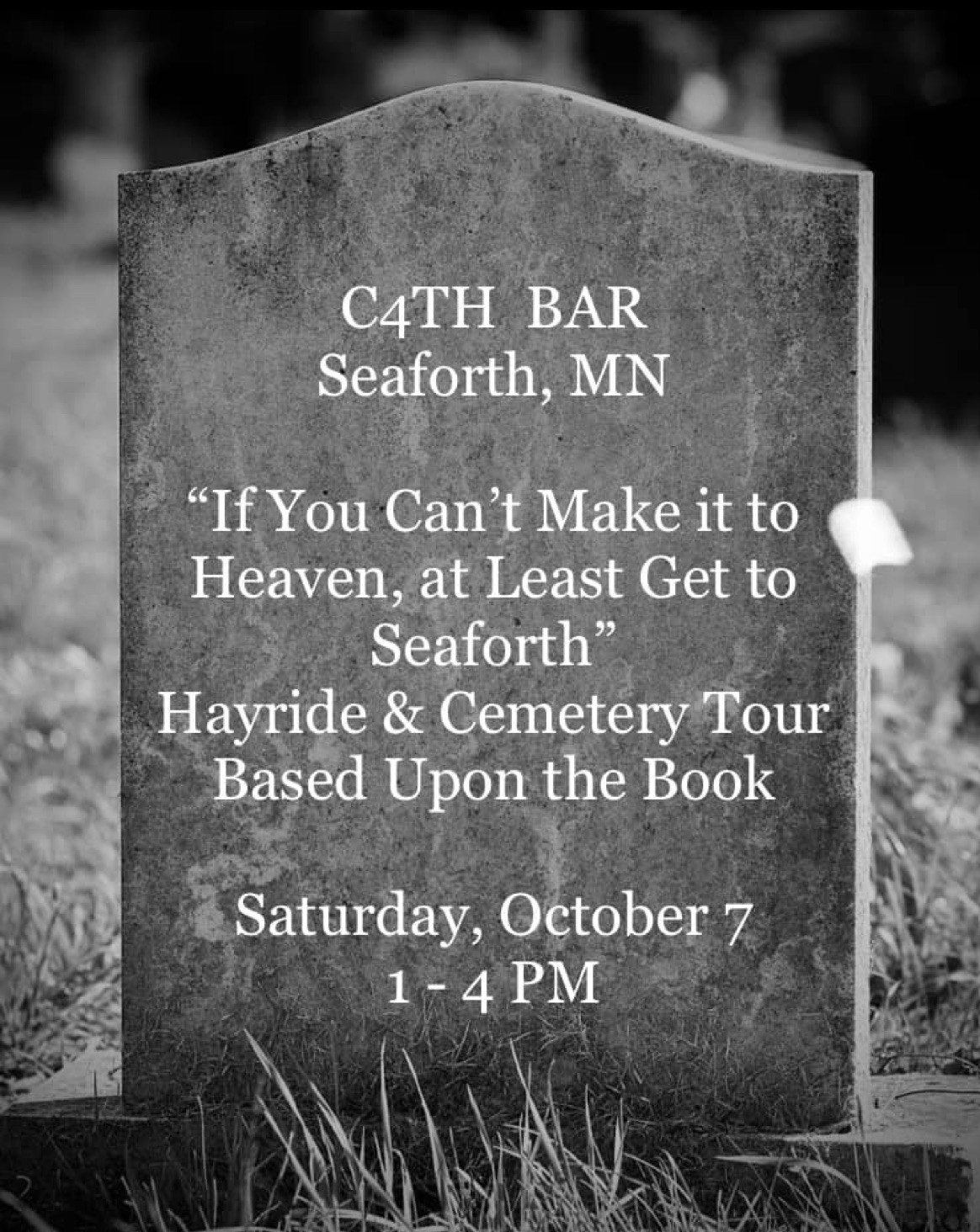
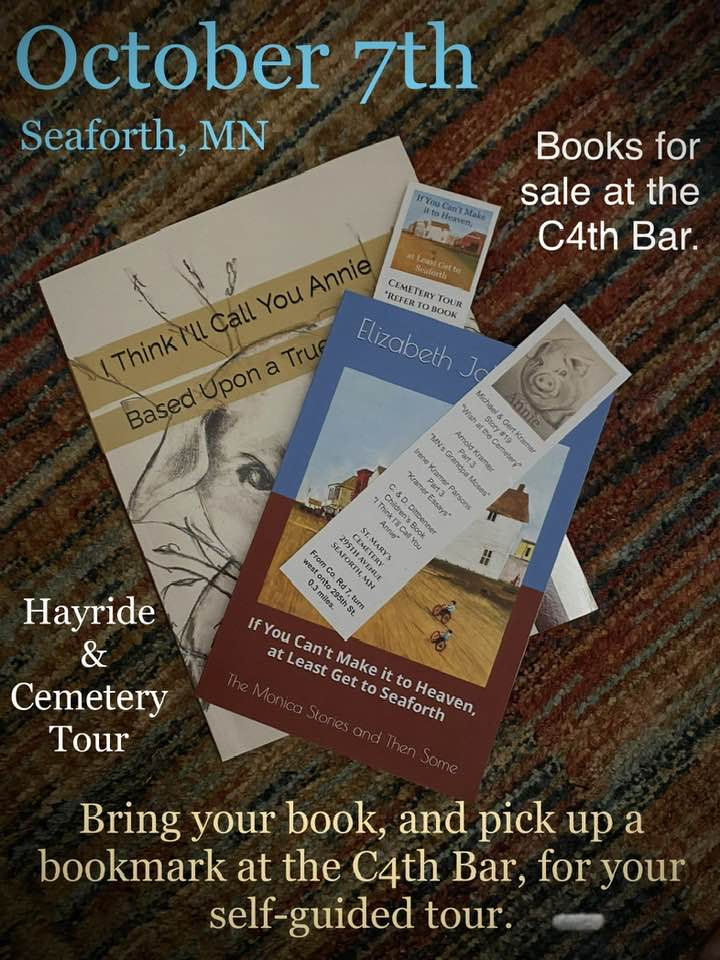
Promo for Saturday’s event, courtesy of Elizabeth Johanneck.

THEY ARE LONG-TIME FRIENDS. Friends who grew up together, who have a history of experiences and stories and of being there for one another. And they are both authors of books rooted in rural Redwood County, the land which shaped and grew them and their enduring friendship.

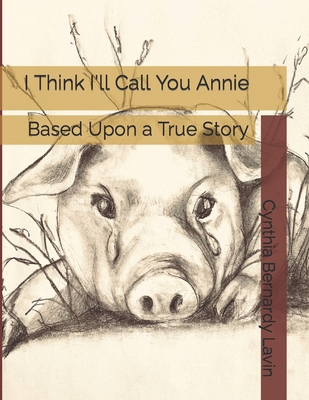
On Saturday, October 7, Twin Cities resident Elizabeth “Beth” Johanneck, author of If You Can’t Make it to Heaven, at Least Get to Seaforth—The Monica Stories and Then Some, and Granite Falls resident Cynthia “Cindy” Bernardy Lavin, author of the children’s book I Think I’ll Call You Annie: Based Upon a True Story (which Beth illustrated), return to Seaforth, population 77, for a 1-4 pm event sure to draw lots of interest.

The C4th Bar hosts the afternoon activities, which include a meet-and-greet (1-3 pm) with the authors and Monica Pistulka Fischer, prominently featured in Beth’s collection of short stories and art from the Seaforth and Wabasso areas. Books will be available for purchase.

Event promo courtesy of Elizabeth Johanneck.

But there’s much more planned than a book signing and time to chat with the long-time friends. The event also includes a hayride and self-guided tour of St. Mary’s Cemetery just northwest of Seaforth. Attendees can visit the gravesites of locals included in both books.

Image sourced online.

Back at the bar, Cindy, a retired elementary school teacher, will read her book about Seaforth’s most famous pig and offer a pig art project for kids.

The original painting of “Seaforth Main Street,” featured here on the cover of Beth’s book, will be on display at Saturday’s celebration. (Minnesota Prairie Roots copyrighted file photo 2023)

Art is an important part of this celebration as art is an integral part of Beth’s book. Her book includes the only printed collection of selected paintings by her grandfather, Arnold Kramer, dubbed “Minnesota’s Grandpa Moses.” He documented early to mid 1900s rural life and scenes, creating an historical agrarian treasure of some 400 paintings upon his retirement from farming. His original painting, “Seaforth Main Street,” which graces the cover of Beth’s book, will be displayed at Saturday’s celebration.

The C4th Bar is also honoring Kramer and several other Seaforth residents (and one pig) with special drinks: “The Grandpa Moses” for folk artist Arnold Kramer; “The Angie” for business owner Angie Bergen; “The Monica” for Monica Pistulka Fischer; and “The Annie” for Dana and Connie Dittbenner and Annie the Pig. “The Monica” and “The Annie” are non-alcoholic drinks. Hot chocolate and make your own s’mores will also be available.

No event is complete without music. The celebration features the live music of Cowboy Dave Gewerth.

It will be quite an afternoon in Seaforth. I can almost envision the scene of a packed bar, of Beth and Cindy mingling, of glasses raised, of stories shared, of memories made. That’s the thing about small towns, especially—you may leave, but you remain forever connected to the place, the events, the people. Like Beth and Cindy, long-time friends who on Saturday return to their roots to celebrate publication of their books, but, more importantly, Seaforth and its residents.

#

FYI: To purchase If You Can’t Make it to Heaven, at Least Get to Seaforth—The Monica Stories and Then Some, click here. (Also available through Barnes & Noble and independent bookstores, including Chapter Two Bookstore in Redwood Falls.) To read my review of the book, click here.

To purchase I Think I’ll Call You Annie, click here. Also available at independent bookstores and Barnes & Noble.

Disclaimer: I edited and proofed the manuscript for Beth’s book. My poem, “Her Treasure,” is printed in the book as a companion piece. Beth, Cindy and I attended Wabasso High School together, graduating with the class of 1974. Beth and I were also lockermates.

© Copyright 2023 Audrey Kletscher Helbling


Lutefisk, bars, kolacky, horseradish & more October 3, 2023

Across the cornfield stands Vang Lutheran Church north of Kenyon and home to an annual lutefisk supper. (Minnesota Prairie Roots copyrighted file photo October 2011)

IN THIS SEASON of church dinners, I am reminded of an event I covered decades ago as a young reporter fresh out of Minnesota State University, Mankato, with a journalism degree. My editor assigned me to write about and photograph the annual Lutefisk Dinner (or maybe it was supper) at Bernadotte Lutheran in Bernadotte, an unincorporated community northeast of New Ulm.

Having heard a few things about lutefisk—cod soaked in lye—I was in no hurry to undertake this assignment. But work is work and I eventually headed to this rural church to get the story. I don’t recall all the details from that late 1970s introduction to lutefisk. But I do remember a hardworking crew of volunteers, enthusiastic diners packing the church basement and my first taste of this Scandinavian seafood. A generous dose of melted butter made lutefisk, which reminded me of warm Jell-O, palatable. Sorry, Norwegians.

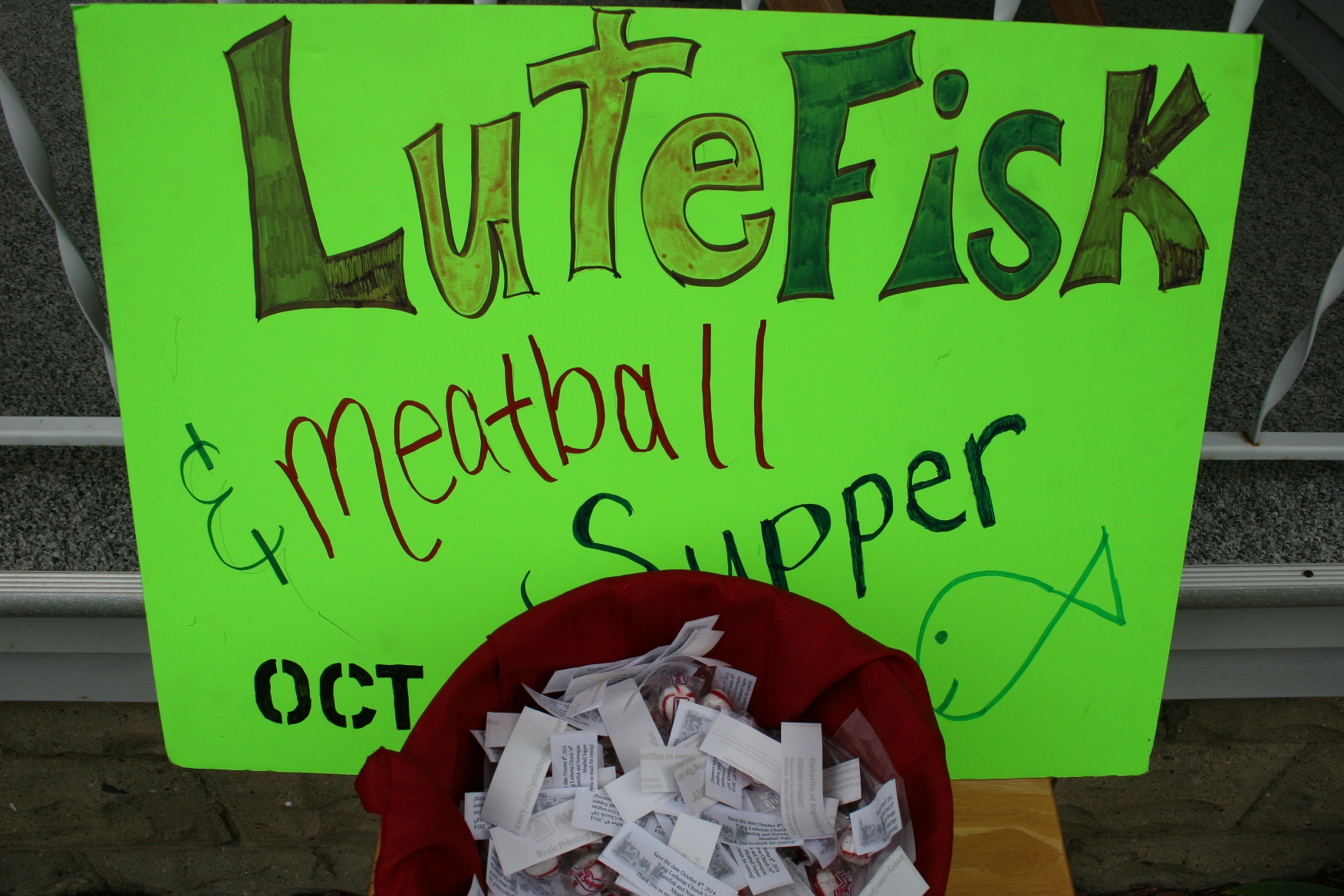
A sign promoting Vang’s 2014 Lutefisk & Meatball Supper. (Minnesota Prairie Roots copyrighted file photo 2014)

Lutefisk dinners remain popular in Minnesota’s Scandinavian enclaves. Like Vang Lutheran, rural Dennison, hosting a Lutefisk and Meatball Dinner on Wednesday, October 11, starring lutefisk and Norwegian meatballs with gravy plus fruit soup, lefse and Norwegian pastries. On Saturday, October 14, First Lutheran in Blooming Prairie is also serving a Lutefisk and Meatball Dinner. Except their meatballs are Swedish (what’s the difference?). Sorry, folks, all three dine-in seatings at First Lutheran are sold out, proving just how popular lutefisk dinners are in these parts. The Blooming Prairie lutefisk dinners have been around since 1934.

Bars. (Minnesota Prairie Roots copyrighted file photo)

BARS & BARS, NOT TO BE CONFUSED

This got me thinking about ethnic and unusual foods some of us love and others of us don’t. For example, this past July while vacationing in the central Minnesota lakes area, I came across turkey gizzards and pickled eggs prominently displayed on an end cap at a Crosslake grocery store. You couldn’t pay me to try the gizzards, priced at $12.49 for 16 ounces. But I’d give pickled eggs a try. Apparently there’s a market in Paul Bunyan country for these delicacies. And in some Minnesota bars, not to be confused with the bars we Minnesotans eat.

Ah, bars. They hold two definitions. I recall my native-born California son-in-law’s confusion about bars. It took a bit of explaining for him to understand that bars, besides a place to imbibe, are also, in Minnesota, a sweet treat that is not a cookie, cake or brownie. But similar, made in a cake pan and cut into squares.

Prune kolacky ready to bake at Franke’s Bakery. (Minnesota Prairie Roots copyrighted file photo March 2013)

KOLACKY OR SAUERKRAUT

Then there are kolacky, a Czech pastry unknown to me until I moved to this region. It was at Franke’s Bakery in nearby Montgomery, self-proclaimed “Kolacky Capital of the World,” that I first tasted this dough into which prunes, apples, raspberries, blueberries and other fruit or a poppy seed filling are folded. Kolacky are so popular in this Czech stronghold that Franke’s baked nearly 1,800 dozen of the treats for the annual town celebration, Kolacky Days, in July. That’s a whole lot of kolacky, like nearly 22,000.

Me? I prefer a Bismarck oozing with custard. And, yes, I am German, which might also explain my love of sauerkraut. Henderson, where my paternal great grandparents settled upon arriving in America, celebrates Sauerkraut Days annually. And, yes, there’s a sauerkraut eating contest. I grew up eating homemade sauerkraut fermented from cabbage grown in our large garden. My grandma made kraut and my dad thereafter.

Homemade horseradish in jars. (Minnesota Prairie Roots copyrighted file photo October 2012)

HOW ABOUT HORSERADISH OR COTTAGE CHEESE PIE?

Dad also made horseradish, a tradition which continues in my extended family today, 20 years after his death. Horseradish seems an acquired taste. Not everyone likes a condiment that burns nostrils, clears sinuses, waters eyes, nips the tongue. But I do.

And once upon a time I also ate SPAM, a canned meat made in Austin, Minnesota, and wildly popular in Hawaii. I liked it in Pizza Burgers—SPAM, onion and American cheese ground in a hand-cranked meat grinder and then canned chili (without beans) stirred in. I haven’t quite figured out the “without beans” in chili. Mom made and spread the mix on homemade bun halves, broiled until the cheese bubbled. Yum. I no longer eat SPAM. Or Jell-O. Make that red Jell-O with bananas, a staple of extended family gatherings many decades ago.

On the shelves at Reed’s Market in Crosslake. (Minnesota Prairie Roots copyrighted photo July 2023)

Food, in many ways, connects to memories, traditions, heritage. You won’t find me eating peanut butter on pancakes or Cottage Cheese Pie, food oddities my husband brought into our marriage. I don’t much like pancakes and I’ve never made the Helbling signature pie. Nor have I made my mom’s favorite pie, Sour Cream Raisin. But I love cottage cheese and I eat Raisin Bran cereal. Just don’t ask me to eat turkey gizzards. Or lutefisk. Once was enough for this writer.

© Copyright 2023 Audrey Kletscher Helbling


Spotlighting cancer in the light of hope October 2, 2023

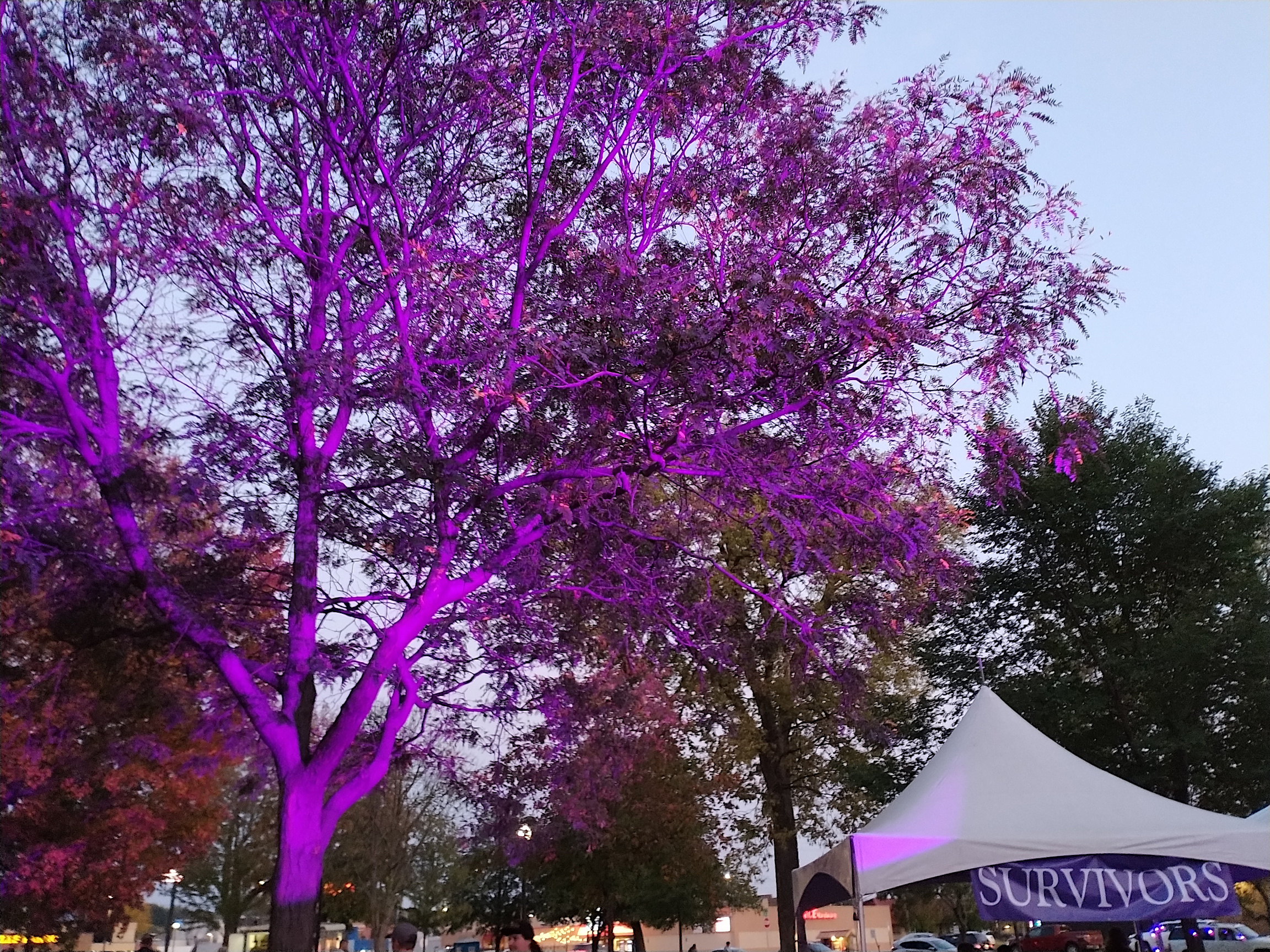
Purple spotlights transformed trees to shades of purple. (Minnesota Prairie Roots copyrighted photo September 2023)

IN THE EARLY EVENING DARKNESS of Faribault’s Central Park, on an unseasonably summery September Saturday, I felt enveloped in a magical world of autumn leaves sparkling purple. The setting seemed surreal, magical, enchanting. And the feeling felt hopeful.

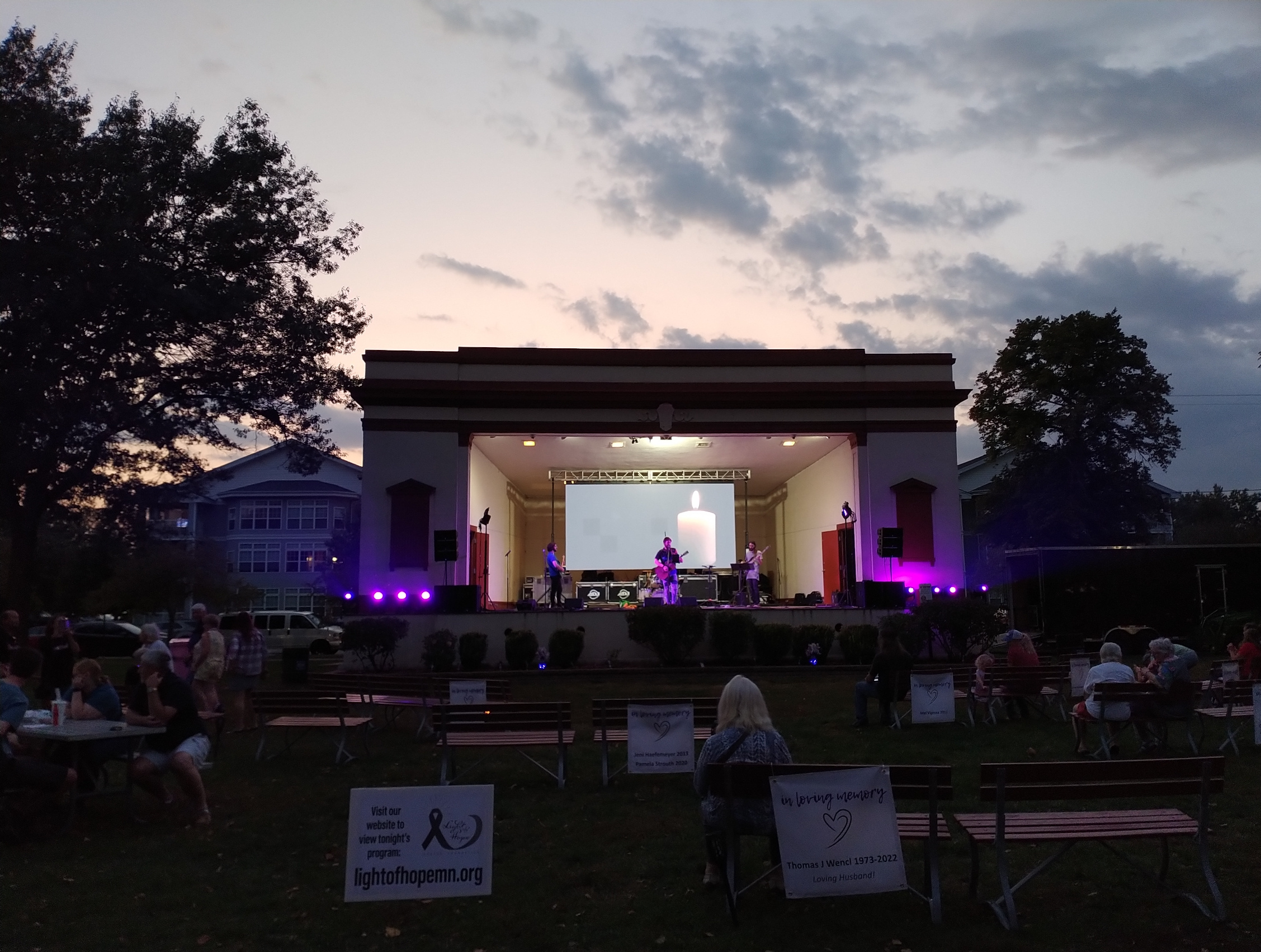
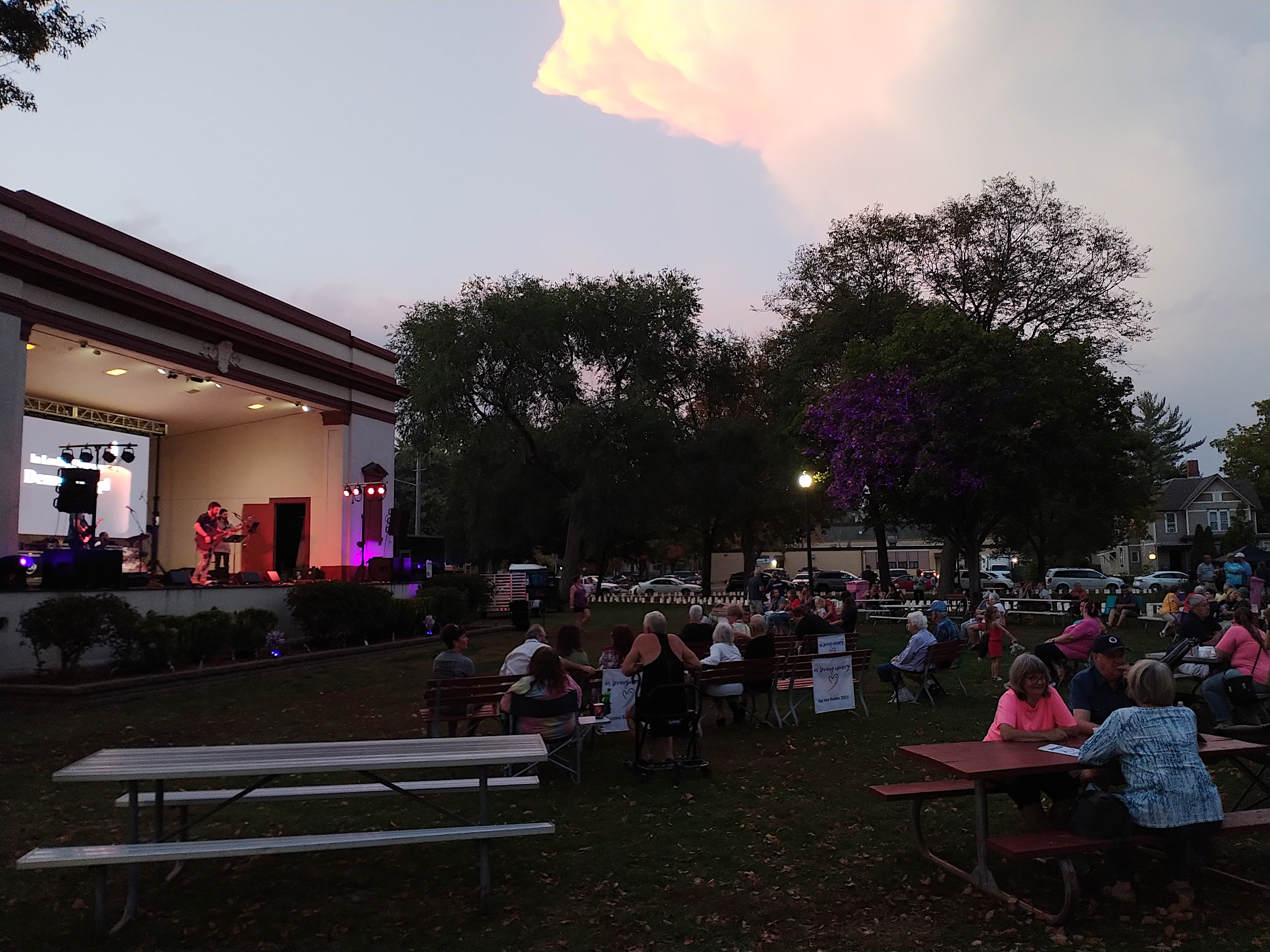
Musician Steve Huber performed first followed by Joe and the Mechanics in the Central Park Bandshell. (Minnesota Prairie Roots copyrighted photo September 2023)

I was among hundreds gathered for the first-ever Light of Hope Celebration to recognize those lost to cancer, those battling cancer, those who’ve survived cancer…and those of us who love (d) them. Purple spotlights shone on trees centering the park, creating a serene, yet celebratory, scene while musicians performed in the bandshell, speakers spoke and kids engaged in activities just for them.

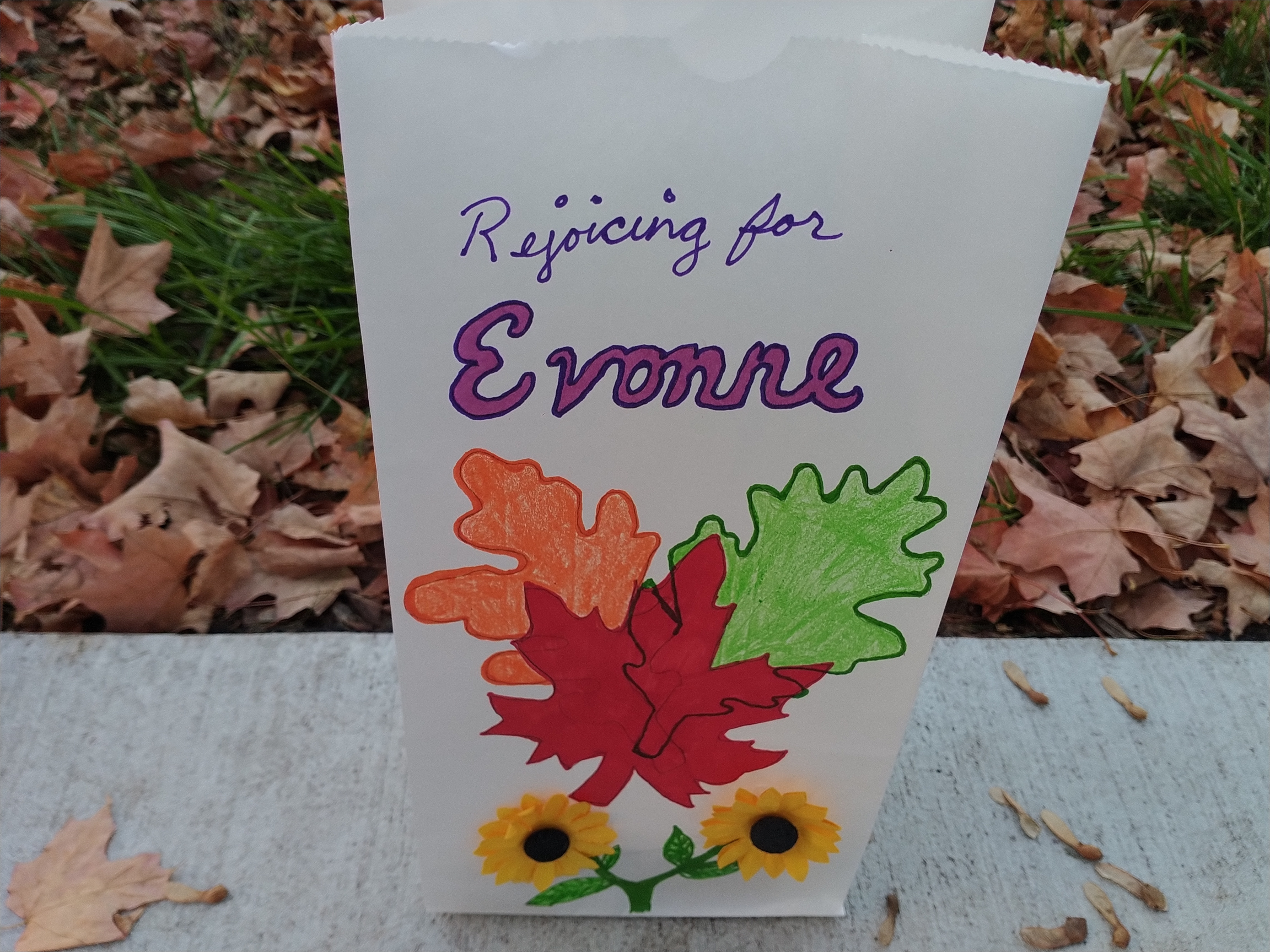
An autumn-themed luminary for a cancer survivor. (Minnesota Prairie Roots copyrighted photo September 2023)

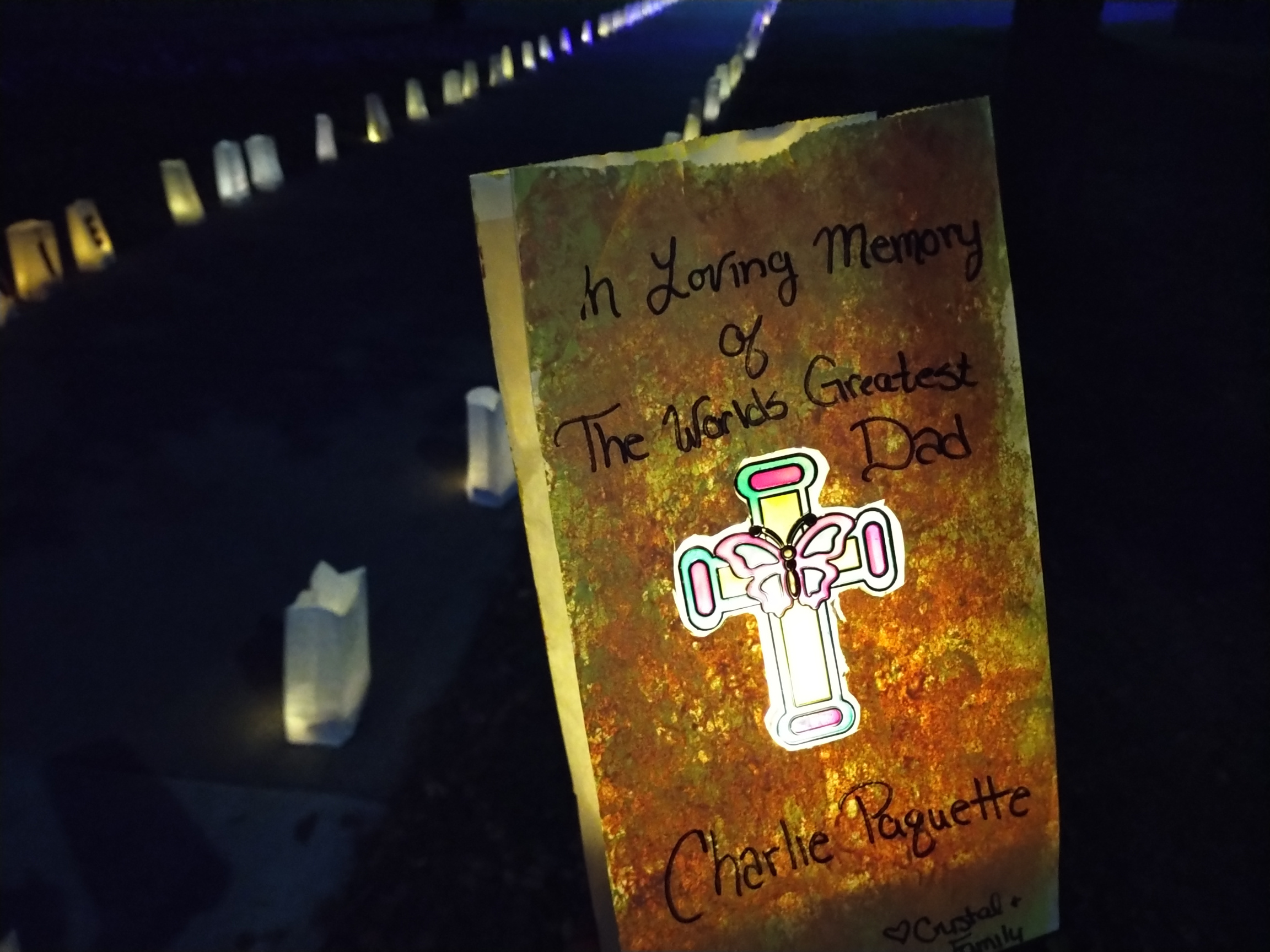
My focus, though, was on the hundreds of luminaries lining the sidewalks that edged and crisscrossed this central community gathering spot. I walk here daily, among the towering trees and scampering squirrels. The din of traffic, the presence of others, the locations of St. Vincent de Paul and the Cathedral of Our Merciful Saviour across the streets are all reminders that Faribault truly is about community. We need one another. And I felt, at this event, a strong sense of community, of coming together, of leaning on one another.

Gathering to talk, to listen to music, to celebrate. (Minnesota Prairie Roots copyrighted photo September 2023)

I felt such love as I hugged the local x-ray tech who did my recent mammogram. I assured her my results were good. She and I have a history, meeting several years ago in the hospital ER when I broke my wrist. I hugged others, too, whom I haven’t seen in a while. It felt right, to reach out and encircle these individuals who, at some point, have been there for me, whether personally or professionally. And if my cousin and a friend, who are currently undergoing chemotherapy for aggressive, advanced breast cancer, had been there, I would have held them close in prolonged hugs also.

I saw so much love written upon luminaries by those who lost loved ones to cancer. (Minnesota Prairie Roots copyrighted photo September 2023)

Twenty years ago I was on the receiving end of many hugs as I stood inside my hometown church, St. John’s Lutheran in Vesta, embracing family and friends at the death of my dad. He died of esophageal cancer and other health issues. At the cemetery, I wrapped my arm around my mom, shaking with cold and grief on that brutal winter day. She was a breast cancer survivor.
Many family—including my husband, a sister and sister-in-law—and friends have survived cancer. Many family—including a dear nephew and aunt—and friends have died of cancer. And today many in my circle are battling cancer, including a much-beloved cousin, a brother-in-law and a dear friend. Cancer is brutal and awful and horrible. And it seemingly spares no family.

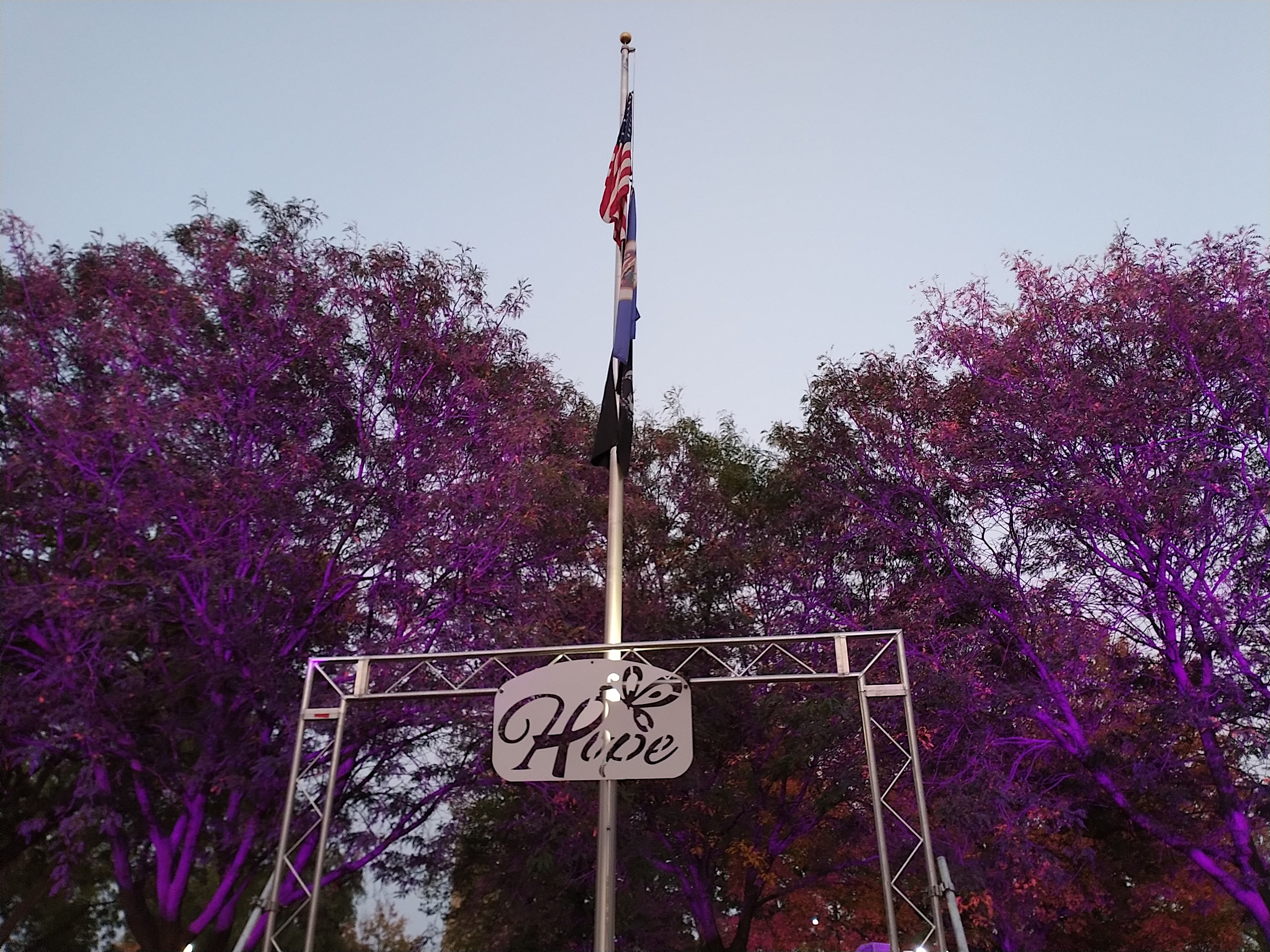
A beautiful hope sign suspended in the center of the park. (Minnesota Prairie Roots copyrighted photo September 2023)

But there is hope. In the support of others. In events like the one on Saturday organized by the Light of Hope Cancer Foundation with a mission “to empower local cancer patients and families to focus on treatment and healing by providing immediate and practical financial support while advocating and fundraising for research, education and cancer prevention.” There is strength in a supportive and caring community.

A survivors’ tent, right, offered survivors of cancer a place to gather, celebrate and enjoy cake. (Minnesota Prairie Roots copyrighted photo September 2023)

And there is hope, too, in knowing options are available for treatment. That is also personal for me as my uncle, Dr. Robert M. Bowman, developed the drug Letrozole (Femara), approved by the Food and Drug Administration in 1998 to treat certain types of breast cancer in post-menopausal women. Today, as my retired chemist uncle lies in hospice suffering from Parkinson’s, his wife, my beloved Aunt Dorothy, tells me how grateful Robin feels for having created a life-saving drug. He gave women hope.

I shot this scene shortly before leaving at 7:45 pm. So beautiful…the luminaries, the trees morphed purple by spotlights. (Minnesota Prairie Roots copyrighted photo September 2023)

As I walked among the hundreds of luminaries, first in the light of early evening and then in the darkness, I remembered, grieved silently, contemplated, celebrated… And I felt hope. Strong, beautiful, powerful hope.

© Copyright 2023 Audrey Kletscher Helbling


The centenarian, the seamstress & the tortoise September 27, 2023

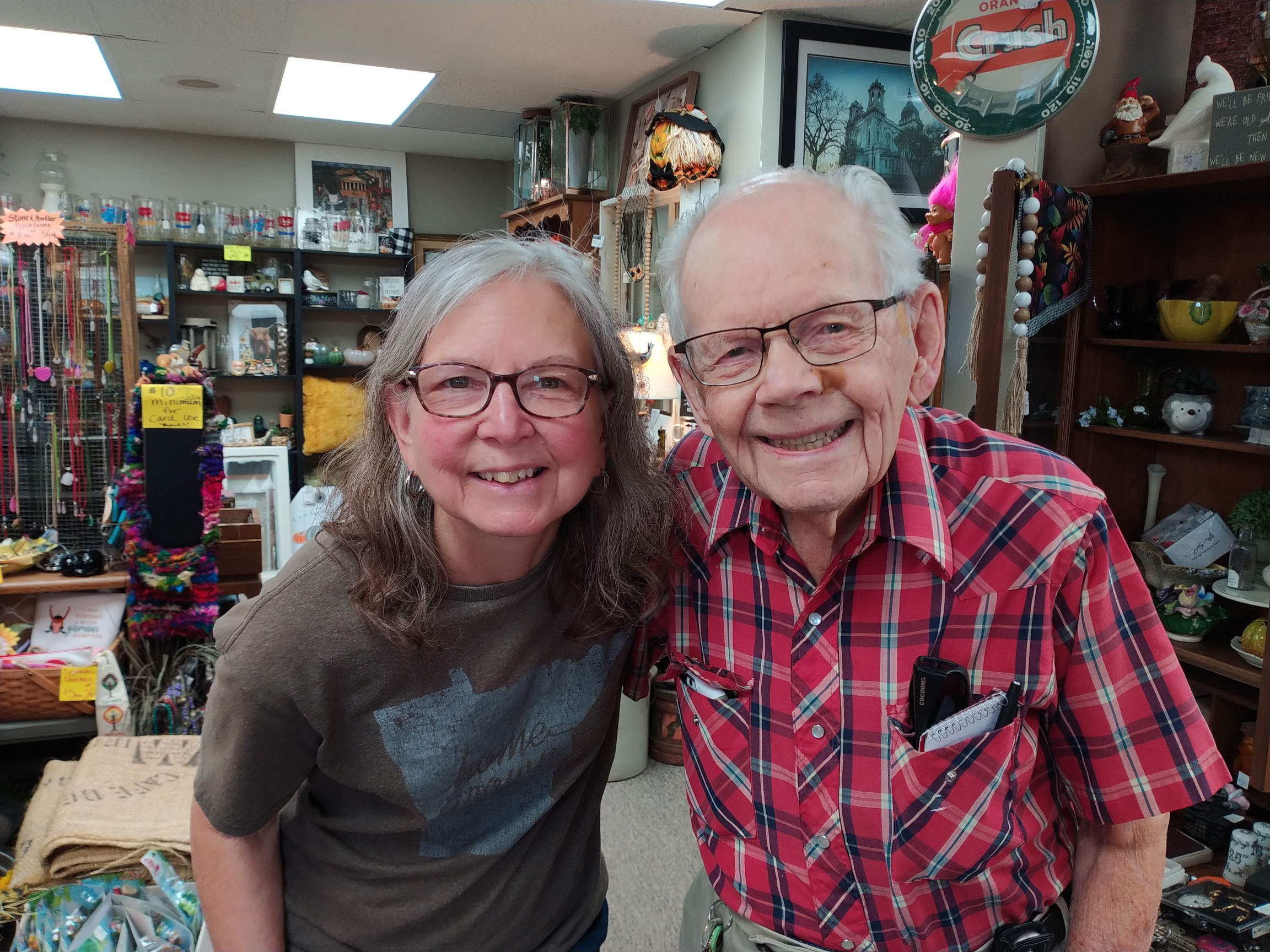
Audrey Kletscher Helbling and Mickey Nelson inside The Junk Monkey. (Copyrighted photo by Randy Helbling, September 2023)

IN THE EVERYDAY MOMENTS of life, I often strike up conversations with strangers given my innate desire to hear their stories, to connect, to learn, or simply to show I care. Through such encounters, I’ve met the most delightful individuals.

THE CENTENARIAN

Take Mickey Nelson, 103, of Clarks Grove.

“You’re 103?” I overheard the question, edged with disbelief, while recently browsing a local vintage, collectibles and treasures shop. That was enough for me to pause and head to the front of the store to meet this centenarian engaged in conversation with shopkeeper Theresa.

When I spotted Mickey, I understood why Theresa sounded so incredulous. Mickey looked not a day over 80. His smile, which reached his eyes, exuded positivity, joy. And then I heard his story, realizing I’d heard it three years earlier.

Mickey is, in every way, extraordinary. In 2020, he walked 100 miles in his small southern Minnesota community to celebrate his 100th birthday. He didn’t walk just to walk. Mickey walked for a purpose, to raise money for the Salvation Army. And he raised a whole lot—$115,000, his daughter Michelle said.

I was beyond impressed by this WW II veteran and his generosity. Mickey remembered the bread lines during the Great Depression. That sparked his 100-mile mission to gather monies for Salvation Army food assistance during COVID-19. A similar effort by an aged veteran in England, who walked 100 laps in his garden during the pandemic and raised $30 million for Britain’s healthcare system, also proved motivating for Mickey.

On this day, I felt honored to meet Mickey, whose story was broadly shared in the media in 2020, the reason it was familiar to me. I decided right then and there that I wanted my photo taken with this celebrity, a remarkable man not only for his generosity of spirit, but also for the spirit of joyfulness he exudes.

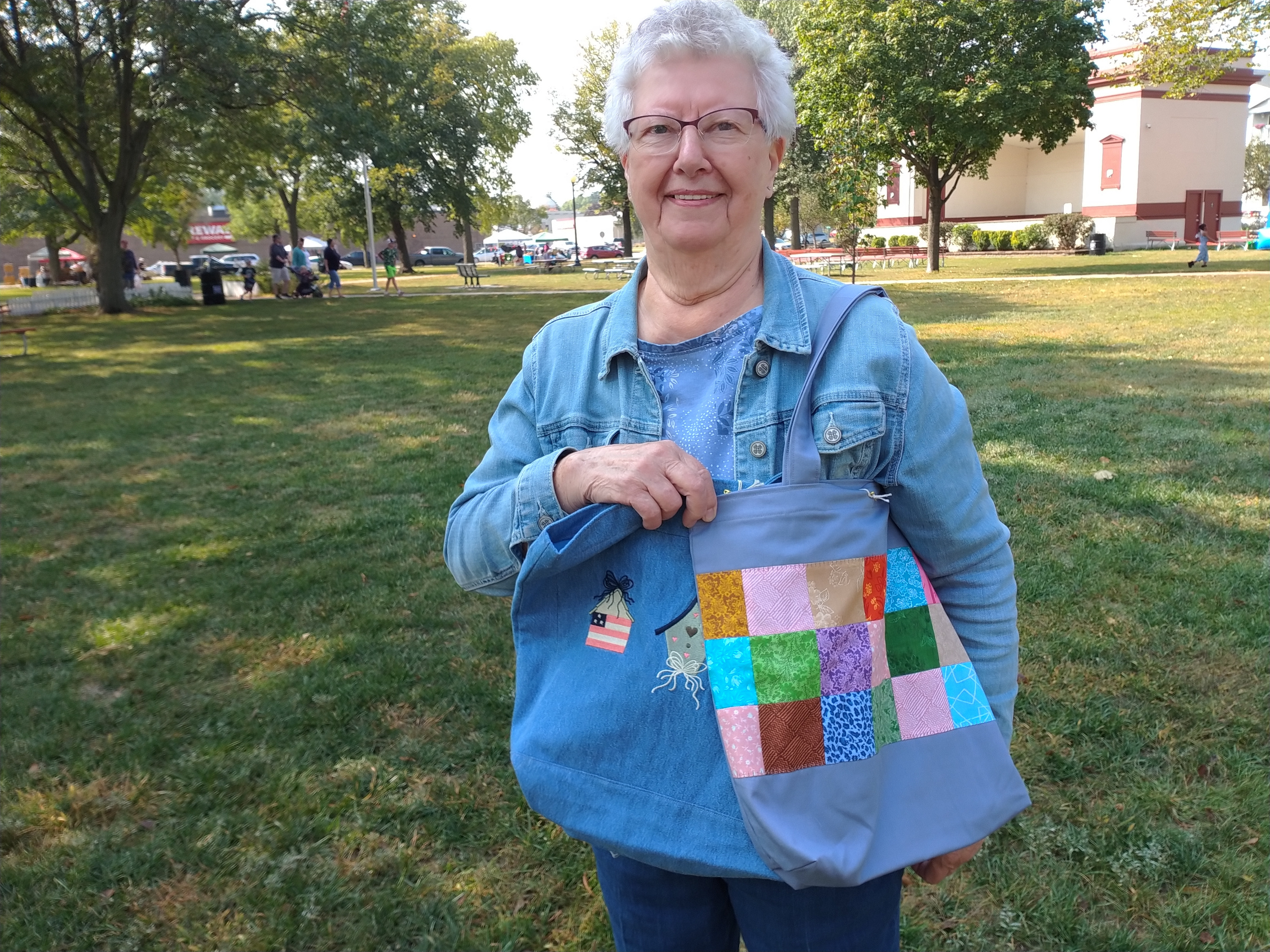
Virginia Malecha displays two of her tote bags, among creations she was vending at the Faribault Farmers’ Market. (Minnesota Prairie Roots copyrighted photo September 2023)

THE SEAMSTRESS

The same can be said for Virginia Malecha of Millersburg, whom I met while enjoying a pork burger during a recent event at the local co-op. She, like Mickey, exudes joy. And she, like Mickey, is generous. Virginia has sewn 200 cloth bags for patrons to use at the Northfield Public Library. As we talked, I learned that this seamstress has been sewing since age nine. She clearly enjoys the craft, stitching totes from recycled materials (such as clothing and duvets) and from her fabric stash collected through the decades.

Virginia invited me to stop at the Faribault Farmers’ Market to view more of her creations, including dish towels she machine embroiders, scrubbies and more. Two days later, I did just that. I was impressed by this kind, generous and friendly woman. She not only sews, but also taught herself to play the concertina and raised her family on a dairy farm (another connection given I grew up on a dairy farm). I asked to take her photo. I wanted to remember her beautiful smile and how she, like Mickey, inspired me. And it all started with a conversation over burgers in a co-op parking lot.

Not a tortoise, but a turtle, which is nearly as slow as a tortoise. (Minnesota Prairie Roots copyrighted file photo June 2020)

THE TORTOISE

And then there was the recent afternoon I met Paul (whose last name I never got) in the same park where Virginia vended her wares. He was walking, just like my husband and me. Randy and I were, however, going at a much faster pace. That led to a humorous moment, when Paul called us the hares, himself a tortoise. But, I reminded him, the tortoise wins the race.

On this day, though, I truly was the winner given the conversation that followed. We chatted a bit about retirement and other topics. But even before Paul mentioned that he was a retired Lutheran pastor from New Richland now relocated and living across the street from the park, I recognized his compassion. He listened as I shared about my neurological health issues caused by a virus in early January. His wife, he said, suffered a traumatic brain injury. Her challenges in many ways mimic mine. I felt, in that moment, understood, uplifted and incredibly thankful for this caring man.

Like Mickey and Virginia, we connected in an everyday moment of life. And I am the better for having met the three of them—the centenarian, the seamstress and the tortoise.

© Copyright 2023 Audrey Kletscher Helbling


No more VR roller coasters for this graduate September 26, 2023

(Minnesota Prairie Roots copyrighted file photo May 2016)

CUE “POMP AND CIRCUMSTANCE.” Wednesday, September 20, marked graduation day for me. After six months of vestibular rehab therapy at Courage Kenny Rehabilitation Institute in Faribault, I graduated.

It was a milestone day for me in managing the neurological issues I’ve faced following a *viral infection in early January. Twenty-one therapy sessions later and I’m much-improved. Not cured. Not fixed. Not all better. I’ll never be the same as I was pre-virus. But, through targeted therapy exercises, a lot of hard work and simply easing back into life, I’ve built my tolerance for everyday experiences. I can better handle sensory input. I can walk without feeling unbalanced. I can manage beyond sitting in a room with the curtains drawn to shut out light, windows closed to keep out noise.

I still have challenging days. I still struggle. But I am in a much better place than even a month ago.

And so I graduated. Not because I wanted to leave Courage Kenny and my incredibly knowledgeable, supportive and caring therapist. But Ryan and I mutually agreed that I was ready. And so he asked, on that final day together, whether he should cue “Pomp and Circumstance” on his laptop, the same laptop he used to introduce me to virtual reality roller coasters as part of my therapy. I told him we could pass on the music. And I am happy to pass on roller coaster rides.

But I did bring celebratory homemade carrot cake cupcakes with homemade cream cheese frosting. Ryan laughed when I walked through the door carrying that box of cupcakes to share with the Courage Kenny team. When I’d asked the week prior if we would have graduation cake, he said only if I brought it. So I did, along with a thank you card and homemade chocolate chip cookies for this professional who worked tirelessly to improve my health. I always felt like we were a team.

And now, like any new graduate, I hold the knowledge and tools that will help me handle daily living. I participated in class (kinda hard not to when you’re the only student). I did the assigned homework each week. I followed through by getting back into the real world, sometimes failing in my efforts, sometimes succeeding. I’ve done my best, through tears and discouragement and struggles, to rise above the challenges. And now I’ve graduated. Onward.

© Copyright 2023 Audrey Kletscher Helbling

* Even though I self-tested negative twice for COVID in January, my primary care doctor believes I had COVID, the cause of my multiple, ongoing neurological issues.


Celebrating the nearly $3 million legacy of Bob Crandall in Faribault September 25, 2023

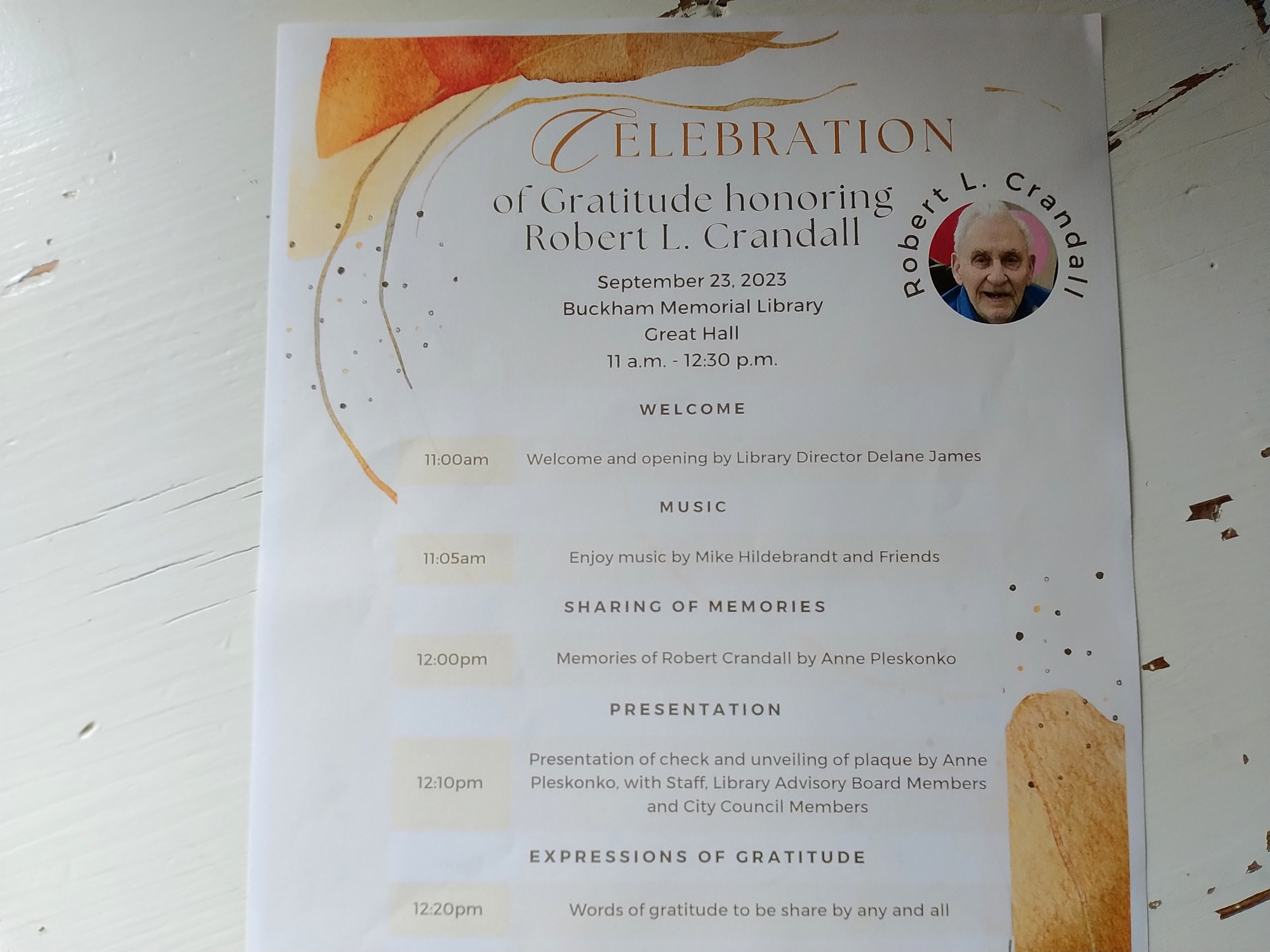
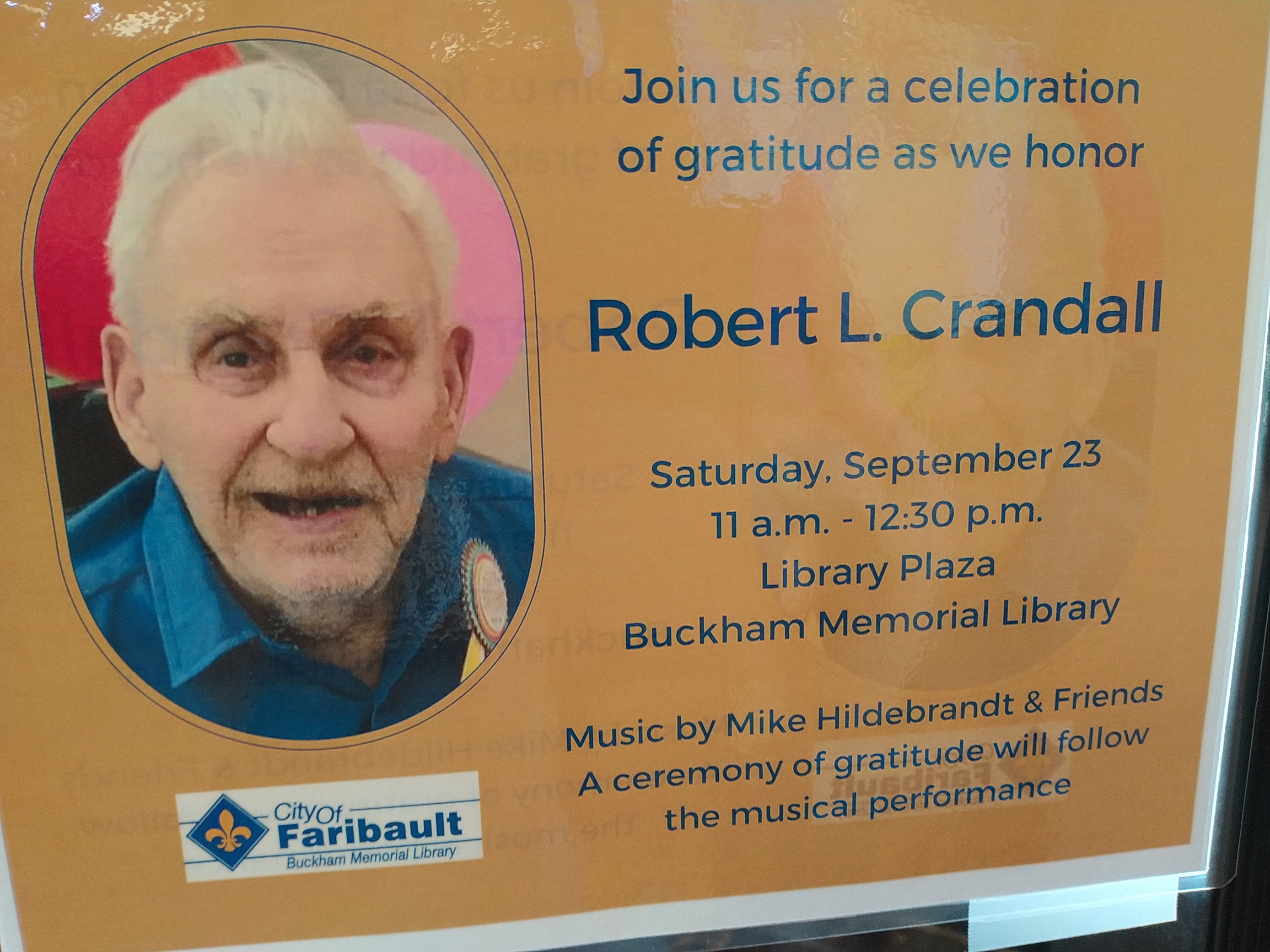
A portion of the program for the celebration honoring Robert L. Crandall. (Minnesota Prairie Roots copyrighted photo September 2023)

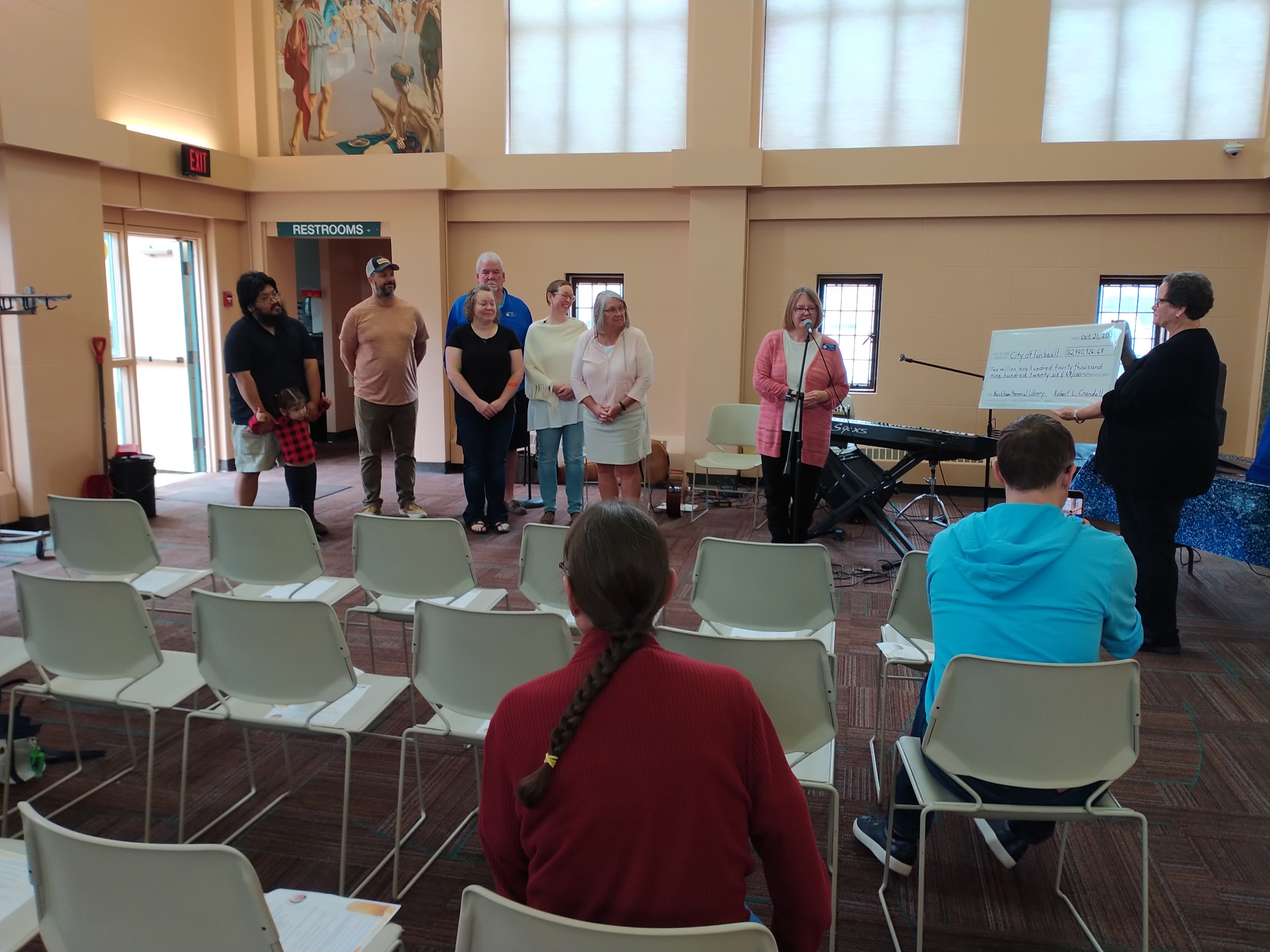
AS I SIPPED ROOT BEER through a colorful striped straw, the soda mixing with melting vanilla ice cream, I thought of the 93-year-old who enjoyed this simple summer treat. Bob, born Robert Lee Crandall, delighted in root beer floats. And on this first day of autumn, in the Great Hall of Buckham Memorial Library, an appreciative group gathered to honor this Faribault man for the legacy he left in his community.

Crandall, who died in January 2021, gifted nearly $3 million to the City of Faribault, designated specifically for the benefit of his beloved local library. That mega gift came in four installments totaling $2,940,927.

Anne Pleskonko, right, who knew Bob Crandall personally, presents a mock check for nearly $3 million to the Library Advisory Board, city officials, Library Director Delane James and others on Saturday.

What a gift. What a reason to celebrate with music (by Mike Hildebrandt, Dallas Musselmann and Doug Madow), memories and presentation of an over-sized check representing Crandall’s generosity. He will also be recognized with a permanent plaque to be installed in the library entry. Grateful words cast thereon will honor his gift and its impact on future generations.

Buckham Memorial Library, Faribault. (Minnesota Prairie Roots copyrighted file photo November 2022)

The monies, according to Library Director Delane James, will be used in three ways, in a plan created by the Library Advisory Board and approved by the Faribault City Council: A third of the original gift will become a permanent endowment that benefits both present and future library users. Another third will be used to upgrade the library’s current space. James cited technology, hearing loop system and acoustic treatments upgrades to the Great Hall, for example. And the final third of Crandall’s original gift will go toward equipping a future maker space incubator.

I’d like to think Crandall, old enough to remember the Great Depression as a young boy, would approve of this sound financial plan. He spent hours at the library, quietly reading and studying books about investing. And he kept up on the daily stock market, said Anne Pleskonko, who met Crandall six years ago in her then-job at Milestone Senior Living. She got to know the man behind the legacy—a man fond of John Wayne movies and television series like “The Andy Griffith Show” and “Columbo”.

She spoke of his sense of humor, of his walking and biking the Sakatah Singing Hills State Trail, of his fondness for bacon, molasses cookies and pickled pigs’ feet. And root beer floats.

A snippet of the words to be engraved on a permanent plaque honoring Robert Crandall. (Edited Minnesota Prairie Roots image, September 2023)

As I finished the last of my root beer float, I considered Pleskonko’s closing statement that Crandall’s nearly $3 million gift is “a gift for all for generations to come.” I understood that fully as I observed the young families surrounding me, including the sweet blonde-haired girl toddling across the carpet, leaving so many of us smiling. I’d like to think that Crandall would be smiling, too, happy to see little ones in the library he loved, the place where he gained knowledge on investing, the place he clearly held so dear.

© Copyright 2023 Audrey Kletscher Helbling


Celebrating a Faribault library patron’s $2.7 million legacy September 21, 2023

Posted on a door at Buckham Memorial Library, Faribault. (Minnesota Prairie Roots copyrighted photo September 2023)

IN LIFE AND IN DEATH, there are reasons to celebrate. And this Saturday, September 23, from 11 am – 12:30 pm, the City of Faribault will celebrate the legacy of Robert L. “Bob” Crandall.

The 93-year-old Faribault man, who died in January 2021, left $2.7 million to the city, specifying that his gift be used for the benefit of Buckham Memorial Library. Saturday’s gathering in the library’s Great Hall marks a public celebration of gratitude honoring Crandall and his gift.

The celebration has been moved inside to the Great Hall due to an uncompleted renovation project on the Library Plaza steps. (Minnesota Prairie Roots copyrighted file photo 2022)

He held a deep love for his local public library. According to his obituary, Crandall “spent many hours at the Buckham Memorial Library studying and reading books on investing.” He also watched CNBC to stay updated on the stock market. I can only assume that his focused reading and television viewing led to sound and knowledgeable investment strategies. As a result, my community, my library, is benefiting from this avid reader’s generosity.

I expect Saturday’s event, which begins with music by Mike Hildebrandt & Friends followed by a ceremony of gratitude, will reveal how some of Crandall’s legacy money was spent. The Faribault City Council, Library Advisory Board and staff tasked themselves with working together to ensure his gift would “make a positive and lasting impact for the citizens of Faribault.”

Inside a section of Buckham Memorial Library. (Minnesota Prairie Roots copyrighted file photo 2018)

Aside from his interest in investing, Crandall liked John Wayne movies and stamp collecting. And bacon. He also hiked, biked, played cards and vacationed in Mexico. Plus, he spoke fluent Spanish. I bet this nonagenarian shared many an interesting story about his travels, his life experiences, but in a humble and gracious way. He moved to my community decades ago to work at the then Faribault Regional Center.

The obituary for this Anoka-born man lists no surviving family, but many friends at his final home, Milestone Senior Living in Faribault. But he certainly leaves many other friends, people like me who appreciate his multi-million dollar gift to a place I love, too, Buckham Memorial Library.

Story updated at 9 pm Thursday, September 21, to reflect a new location for the celebration inside the library Great Hall rather than outdoors on the front plaza.

© Copyright 2023 Audrey Kletscher Helbling


Invisible, but, oh, so real September 20, 2023

Early on in my diagnoses, my brain felt like this, scrambled. Art by Bill Nagel, previously exhibited at the Paradise Center for the Arts, Faribault. (Minnesota Prairie Roots copyrighted photo March 2023)

FOR ME, THE FEELING of imbalance started shortly after an early January virus, likely *COVID-19. At the time I didn’t make the connection between the two. But eventually medical professionals did. That led to multiple diagnoses of vestibular neuritis, Meniere’s Disease and peripheral sensory neuropathy. Yes, it’s been a lot to handle. But I’m in a much better place health-wise than nine months ago thanks to professional intervention and a whole lot of hard work.

The thing about having a vestibular disorder is that it’s unseen. You can’t see inside my brain to view the damage. And, for the most part, you can’t see the effects of a malfunctioning vestibular system, unless you’re my husband or eldest daughter who can. Randy and Amber can look at my face, see my eyes squinting, my look of fatigue, tell-tale signs I’m not doing well. And if I’m closing my eyes or holding my hands on the sides of my face, I’m blocking my peripheral vision, thus reducing visual input.

All of that aside, I’ve at least reclaimed my balance. Most days. Brief bouts of vertigo set me back mid-summer. Via vestibular rehab therapy to retrain my brain, I’ve learned to manage and live with my many ongoing symptoms and mostly get on with my life. Maybe not as I did previously, but with a renewed appreciation for something as simple as walking with confidence, as watching TV, as shopping for groceries.

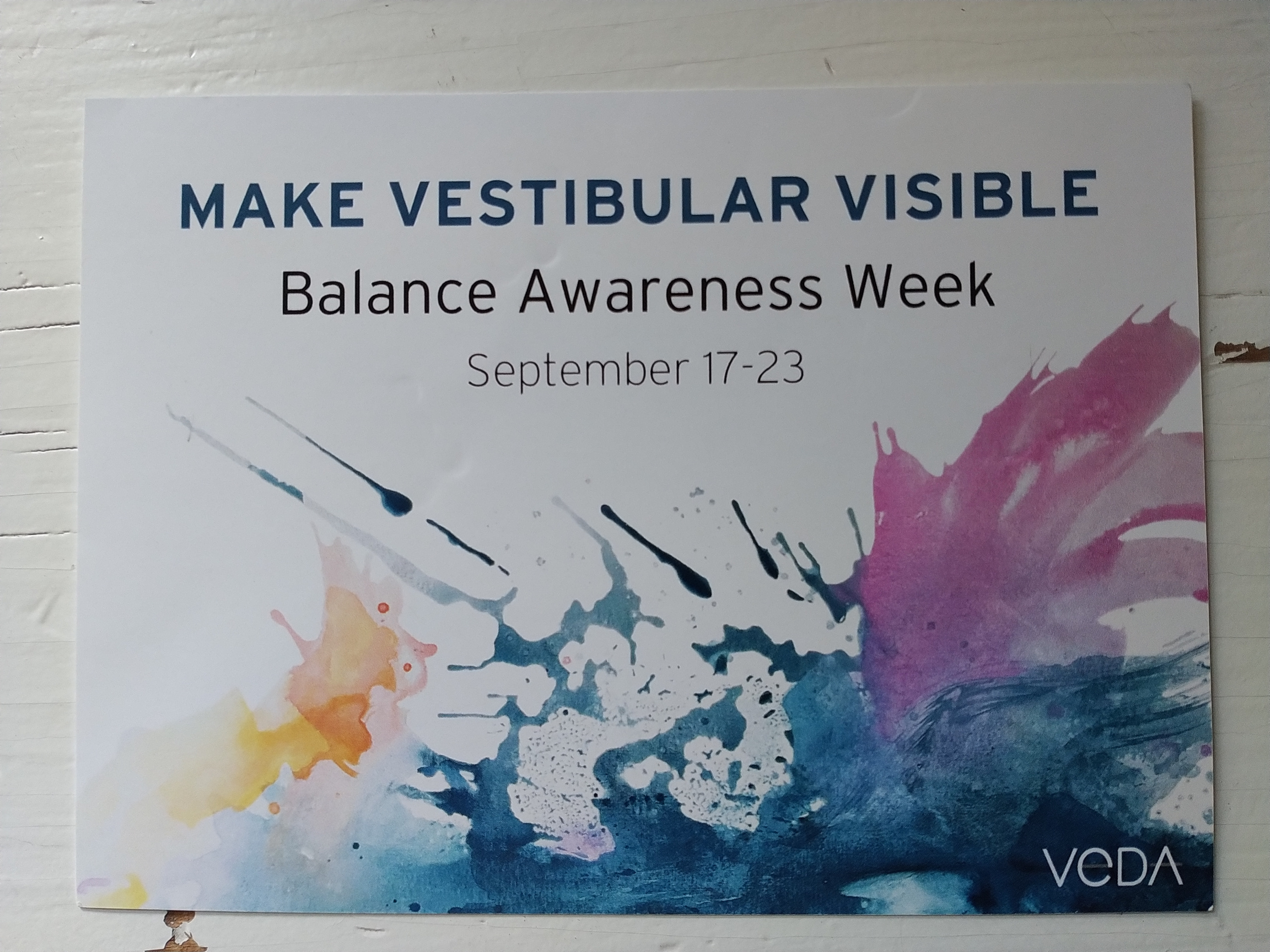
A promo postcard from VeDa. The painting, “Uncharted Waters,” is by vestibular patient Nicolle Cure.

FOCUS ON BALANCE

Today, though, I want to focus on balance, for two reasons. Imbalance was the first issue I overcame. And secondly, September 17-23 marks Balance Awareness Week, started in 1997 by the Vestibular Disorders Association. That national nonprofit is “a lifeline of support to anyone affected by vestibular (inner-ear and brain balance) disorders.” VeDA has proven an invaluable resource for me in learning about my vestibular-based diagnoses.

Knowledge is power. Just ask my physical therapist at Courage Kenny. Ryan answered many questions during my vestibular rehab therapy sessions, especially early on when I was just learning about my health issues. He always replied thoughtfully, helping me to understand what was happening in my brain and how we would work together through targeted exercises to manage my symptoms.

I’ve come a long way from the days of standing in place turning my head back and forth to the beat of a metronome. Today I’m power walking 15 minutes in the morning, 15 minutes in the evening with Randy. Even I’m amazed that I can do this. Not all that long ago, I couldn’t walk a block, often needing to hold onto Randy.

Fiona the Flamingo is VeDA’s Balance Awareness Week logo/mascot.

EVEN THOUGH MY DISORDER IS INVISIBLE, I STILL NEED TO BE SEEN, ENCOURAGED…

There is hope for anyone dealing with a vestibular disorder. Many seniors (and, yes, I’m a “senior”) struggle with balance. So do those who’ve suffered traumatic brain injuries like concussions. That includes my sister-in-law Rosie, my go-to support. Because she understands. And encourages. She realizes the importance of physical therapy in recovery.

In sharing a bit of my story with you, I am aiming to increase awareness. Make Vestibular Visible themes Balance Awareness Week. A promo from VeDA reads: Balance Awareness Week is our time to shout from the rooftops: “I have a vestibular disorder and this is my story.”

This is my story. One of challenges, of professional intervention, of hard work, of acceptance, of perseverance, of relying on others, of patience, of strength, of gratitude, of tears, of resilience, of focusing on what I can do (and not what I can’t). It is also a story of recognizing that no matter what we face in life—whether visible or invisible—we all need to be seen, to be uplifted, to feel cared for and loved.

#

© Copyright 2023 Audrey Kletscher Helbling

*I self-tested negative twice for COVID, but those tests (if done incorrectly and for other reasons) can be wrong, my primary doctor told me. He guesses I had COVID in January, and I agree based on my symptoms.


The power of hair among Native Peoples September 19, 2023

“My Powerful Hair,” published in 2023 by Abrams Books for Young Readers. (Book cover source: Abrams Books)

SOME OF THE MOST MEANINGFUL, enlightening and powerful books I’ve read, I’ve found in the children’s picture book section of my local public library. That includes My Powerful Hair written by Carole Lindstrom and illustrated by Steph Littlebird.

I happened upon this book while searching for recently-published astronaut and geography books for my 4-year-old grandson. I never did find those sought-after titles. Not that it mattered. What I discovered instead were three must-read books: My Powerful Hair, Boycott Blues—How Rosa Parks Inspired a Nation and We Are Better Together.

Parks is certainly familiar to me as the Black seamstress who in 1955 refused to give up her seat to a white man on a city bus in Montgomery, Alabama. That sparked a bus boycott and the Civil Rights Movement. Likewise, working together to effect change, to improve our world, to help one another is a familiar theme.

“The Native Man, His Eagle & His Chanupa,” an oil painting by Dana Hanson and part of her 2018 “Healing the Land” exhibit at the Owatonna Arts Center. (Minnesota Prairie Roots copyrighted file photo 2018, used for illustration only. Art copyrighted by Dana Hanson.)

THE IMPORTANCE OF HAIR REVEALED

It is the story on hair, though, which proved a particularly teachable read. My Powerful Hair focuses on Native Peoples’ hair and its importance in their culture, their history, their lives. Through the writing of New York Times bestselling and award-winning author Lindstrom, who is Anishinaabe/Metis (and an enrolled citizen of the Turtle Mountain Band of Ojibwe), and Indigenous artist Littlebird of Oregon’s Confederated Tribes of Grand Ronde, I learned the symbolism and power of hair in Native American culture. Admittedly, this is something I should have known, having grown up on the southwestern Minnesota prairie between the Upper Sioux and Lower Sioux Indian Reservations (today termed “communities”). I thought I was informed. But I wasn’t, not about hair.

Told from the perspective of a young Native girl, My Powerful Hair explains the reasons Native Peoples grow their hair long. And keep it long. Hair holds stories, memories, strength, sorrow, connections to each other and to Mother Earth. And more. Page after page, the narrator shares events in her life that weave into her hair. When Nimishoomis (her grandfather) taught her to fish, her hair reached her ears. When her cousins taught her to make moccasins, her hair flowed past her shoulders. In the sharing of these moments, I began to understand the power of hair in Native American culture.

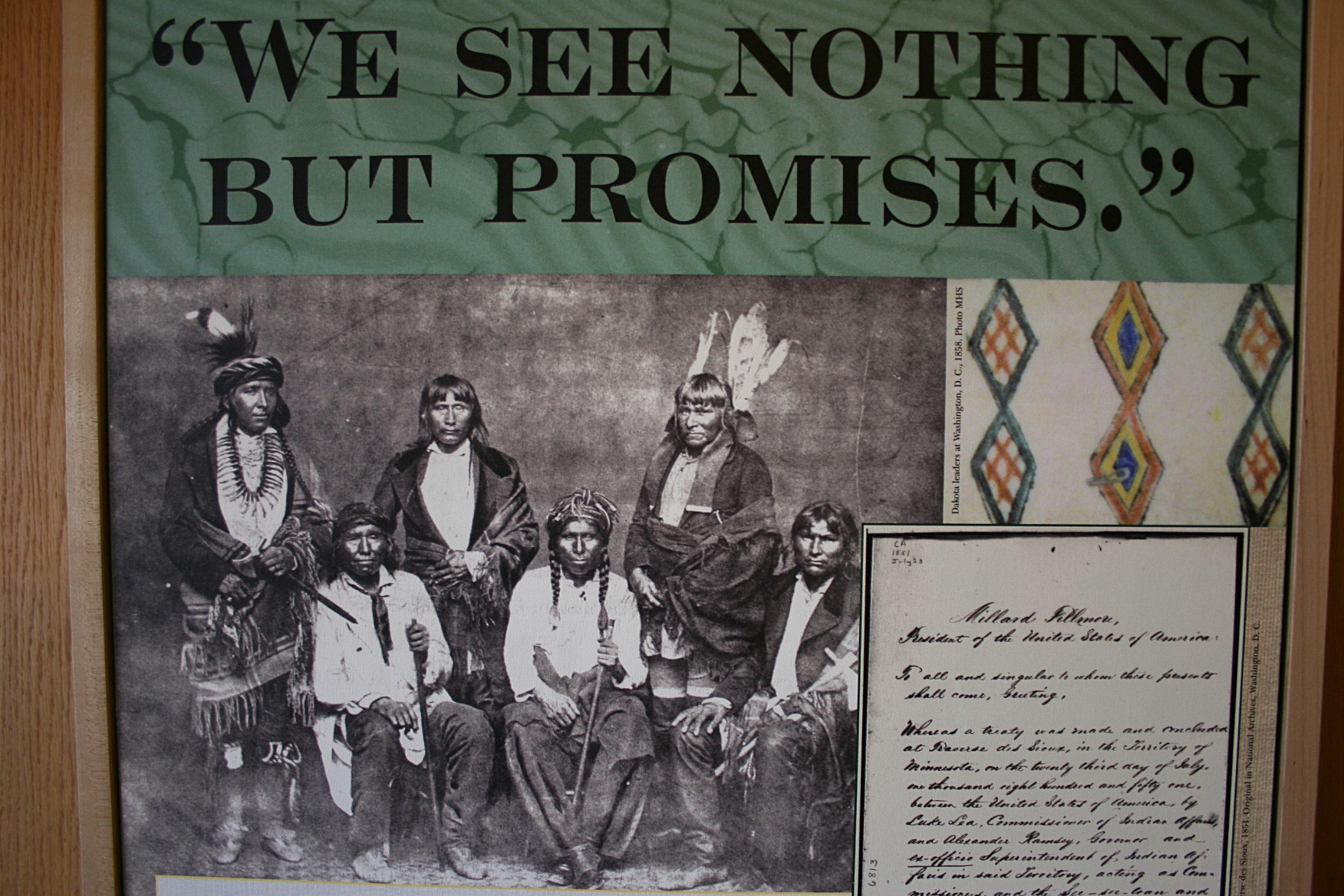
A photo panel at the Traverse des Sioux Treaty Center in St. Peter shows Dakota leaders photographed in Washington D.C. in 1858. The photo is from the Minnesota Historical Society and is used here for illustration only.

FORCED HAIRCUTS

I also understood fully, for the first time, the trauma inflicted upon Indigenous individuals forced long ago by white people to cut their hair. The writer and illustrator don’t hold back. In the first few pages, a young Nokomis (grandmother) is in tears as the hands of a Catholic nun grasp, then cut, her braids. It’s an emotionally impactful visual.

But this was reality at Indian boarding schools, within faith communities and elsewhere back in the day, in a time period when efforts focused on erasing Indigenous culture, on conforming Native Peoples to European ways. It was wrong.

Displayed at Bridge Square during Northfield’s Earth Day celebration in 2022. (Minnesota Prairie Roots copyrighted file photo April 2022, used for illustration only)

A TERRIBLE INJUSTICE”

A blogger friend from the central Minnesota lakes region recently shared a bit of her family’s experience per my request. Of unverified (records were often destroyed) Cherokee ancestry, Rose speaks of her mother’s trauma after being sent to a Catholic girls’ school in Crookston. “Mom didn’t tell us much about her experience there,” Rose says, “only that they made her cut her long black hair. My mom never cut her hair again for the rest of her life. She saw the forced haircut as a terrible injustice.” Injustice seems a fitting word.

In an author’s note, Carole Lindstrom shares the same trauma, documented, she writes, in a photo of her grandmother and two great aunts with their black hair shorn above their ears. They were forced into an Indian boarding school in the early 1900s.

“Honoring the Legacy of the Dakota People” focuses this artwork by Dana Hanson. Chief Taopi centers the painting with Alexander Faribault to the left and Bishop Henry Whipple on the right. The word “Yuonihan” means honor or respect. This art hangs inside Buckham Memorial Library. (Minnesota Prairie Roots copyrighted file photo November 2022. Art copyrighted by Dana Hanson.)

POWER IN STORIES, IN HERITAGE, IN RESPECT

Rose is thankful for books like My Powerful Hair. “I am glad that stories like this are being told,” she says. “Much First Nations history nearly disappeared. And many First Nations keep their ceremonies and other information ‘secret’ so it won’t be distorted or misused by people who don’t understand, or who seek to harm them.” Based on history, that seems warranted.

This Minnesota woman has one more reason to feel grateful for children’s picture books by Indigenous Peoples. Her grandchildren are of Ojibwe heritage; their other grandmother lives on the White Earth Nation in northwestern Minnesota. “My hopes for my grandchildren are that they learn all they can about their Ojibwe ancestors and customs and values,” Rose says. “I hope they can choose what lessons they want to carry forward in their own life. I hope they are fantastic examples of how people from different backgrounds can get along and respect and love one another.”

And so I learned, not only from Rose, but from reading My Powerful Hair. Stories woven into our hair matter. For they are powerful.

© Copyright 2023 Audrey Kletscher Helbling