Minnesota Prairie Roots

Writing and photography by Audrey Kletscher Helbling

Stitches of love April 6, 2011

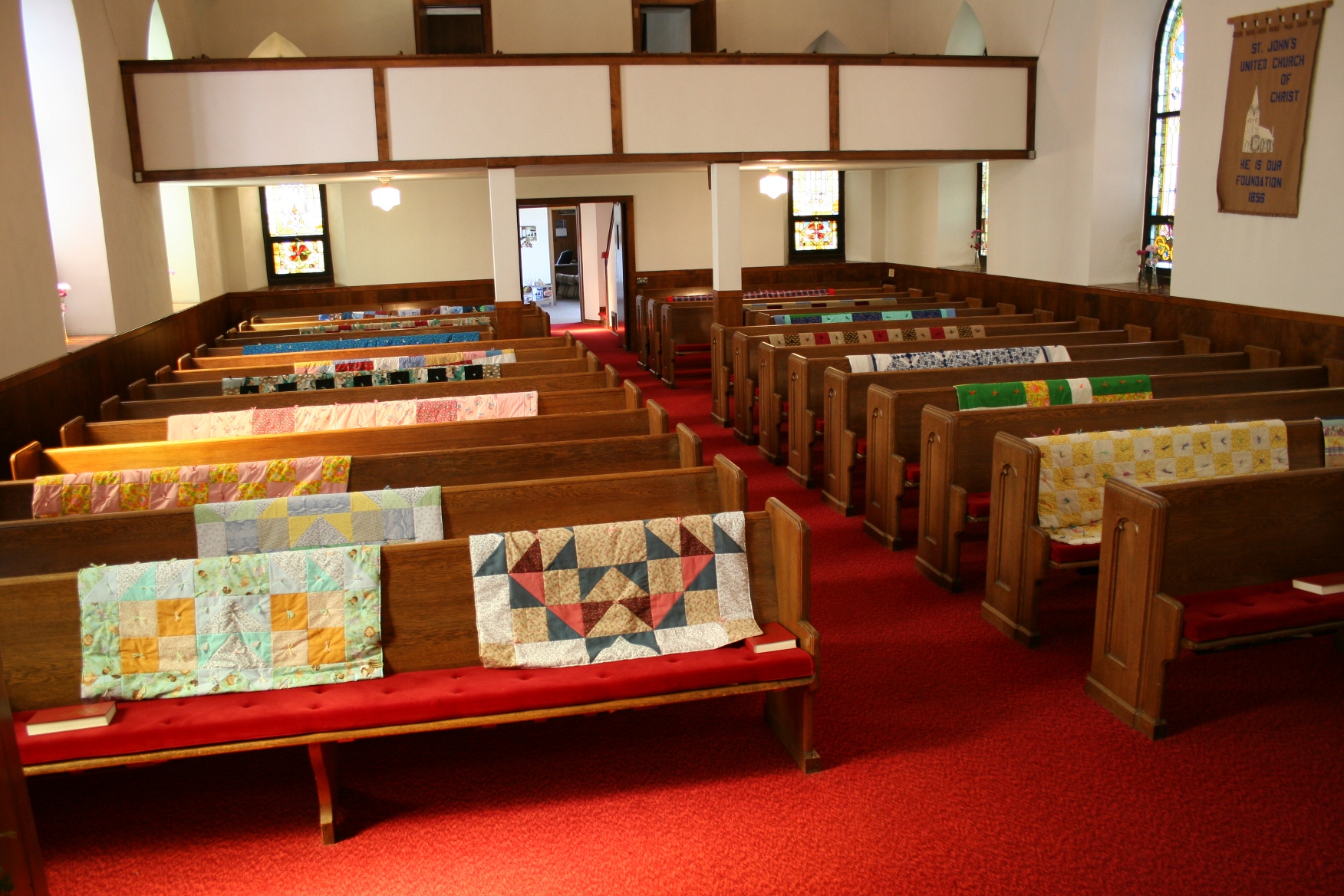
Handmade quilts drape across pews at St. John's United Church of Christ.

INSIDE THE LIMESTONE CHURCH, patchwork quilts drape across the backs of pews, spilling onto cushy red seat cushions.

Only hours earlier during the Sunday morning church service, worshippers settled onto the quilts handmade by St. John’s United Church of Christ members.

On a Saturday in February, members of the Women’s Guild, and a few husbands, gathered at this country church in Wheeling Township in southeastern Rice County to stuff the quilts with batting, add backings and tie together the layers with snippets of yarn.
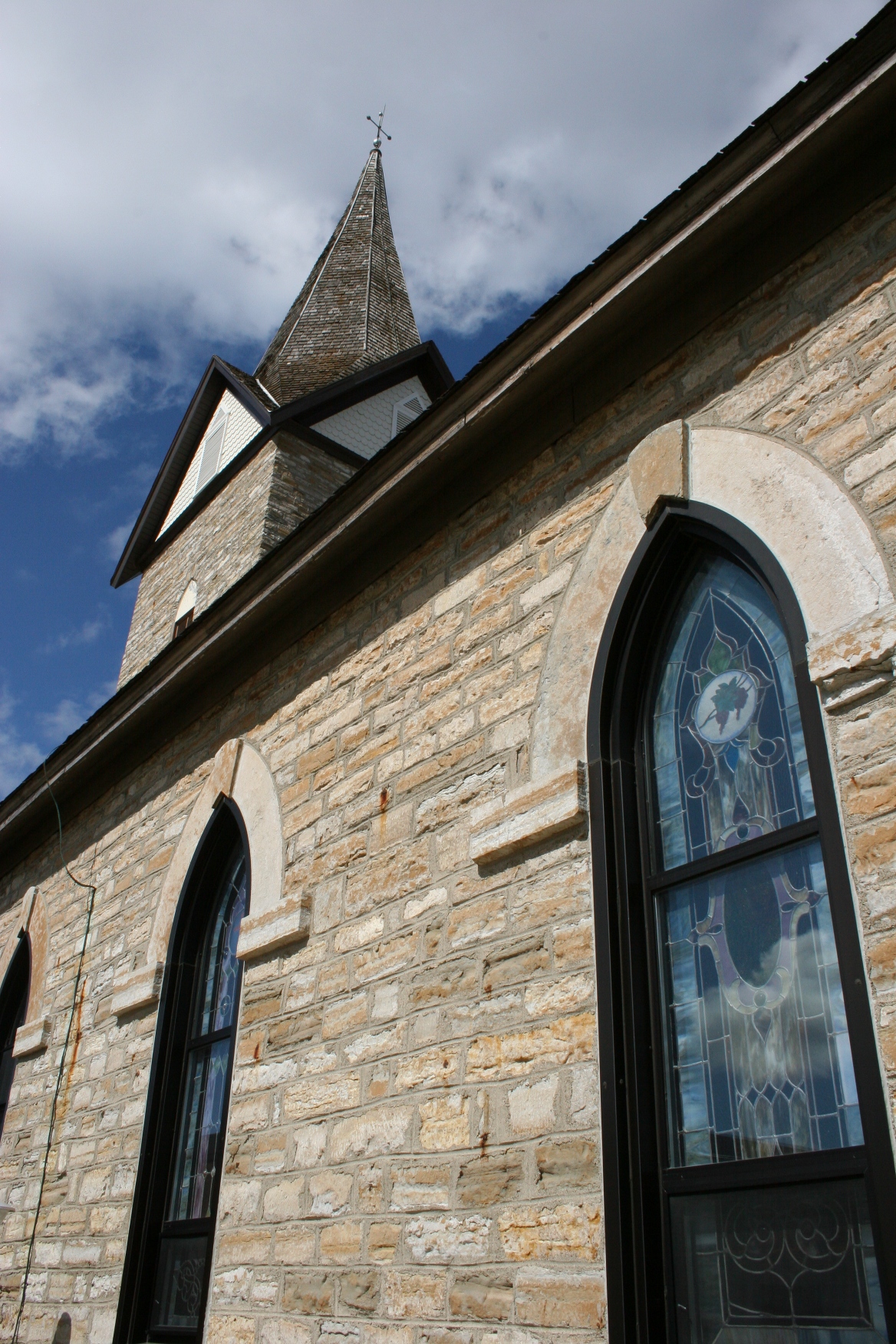
 

St. John's old stone church has been in continuous use for more than 150 years. German settlers founded the congregation in 1856.

This year, according to church member and quilter Kim Keller, the quilters made 13 baby quilts and 13 big quilts.

The handmade blankets will go to graduating high school seniors—two at St. John’s this spring—and to missions, mostly local.
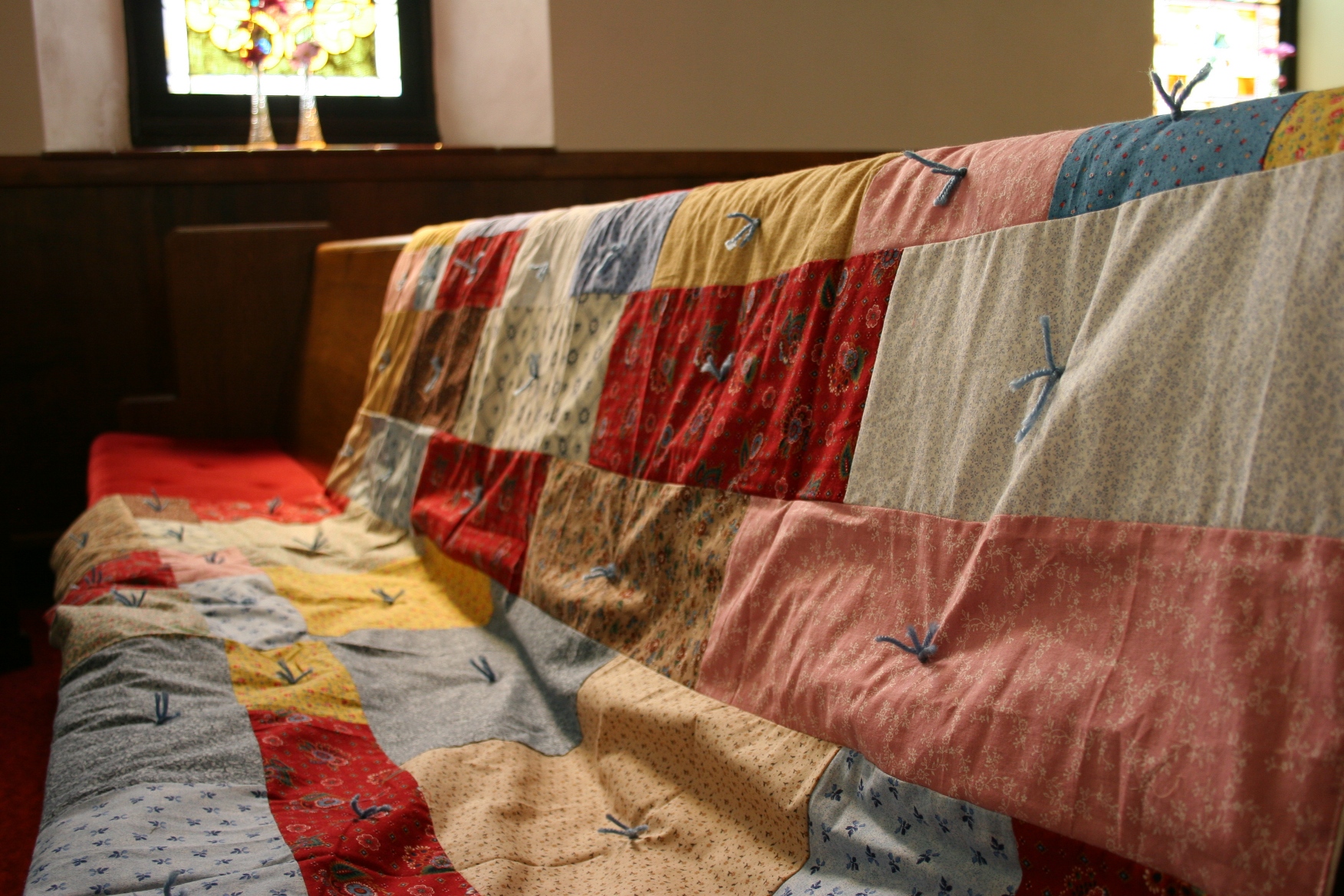
 

One of the many handmade quilts that will be given away.

As I perused the quilts, I considered the devotion of those who piece together the swatches of fabric, tie together the layers and knot the strands of yarn. These quilts represent gifts that touch the recipients physically, but, more importantly, emotionally and perhaps spiritually.

Stroke the fabric and you can almost feel the love stitched into each quilt.

That these blankets are then displayed for worshippers to see, and sit upon, adds another dimension to the project. As I photographed the quilts, as the sun streamed through the church’s restored stained glass windows, I thought of the blessings received by both the givers and the receivers. Joy that comes in selfless giving. Joy that comes in knowing someone cares enough about you and your needs to stitch a quilt.

“It is more blessed to give than to receive.” Acts 20:35
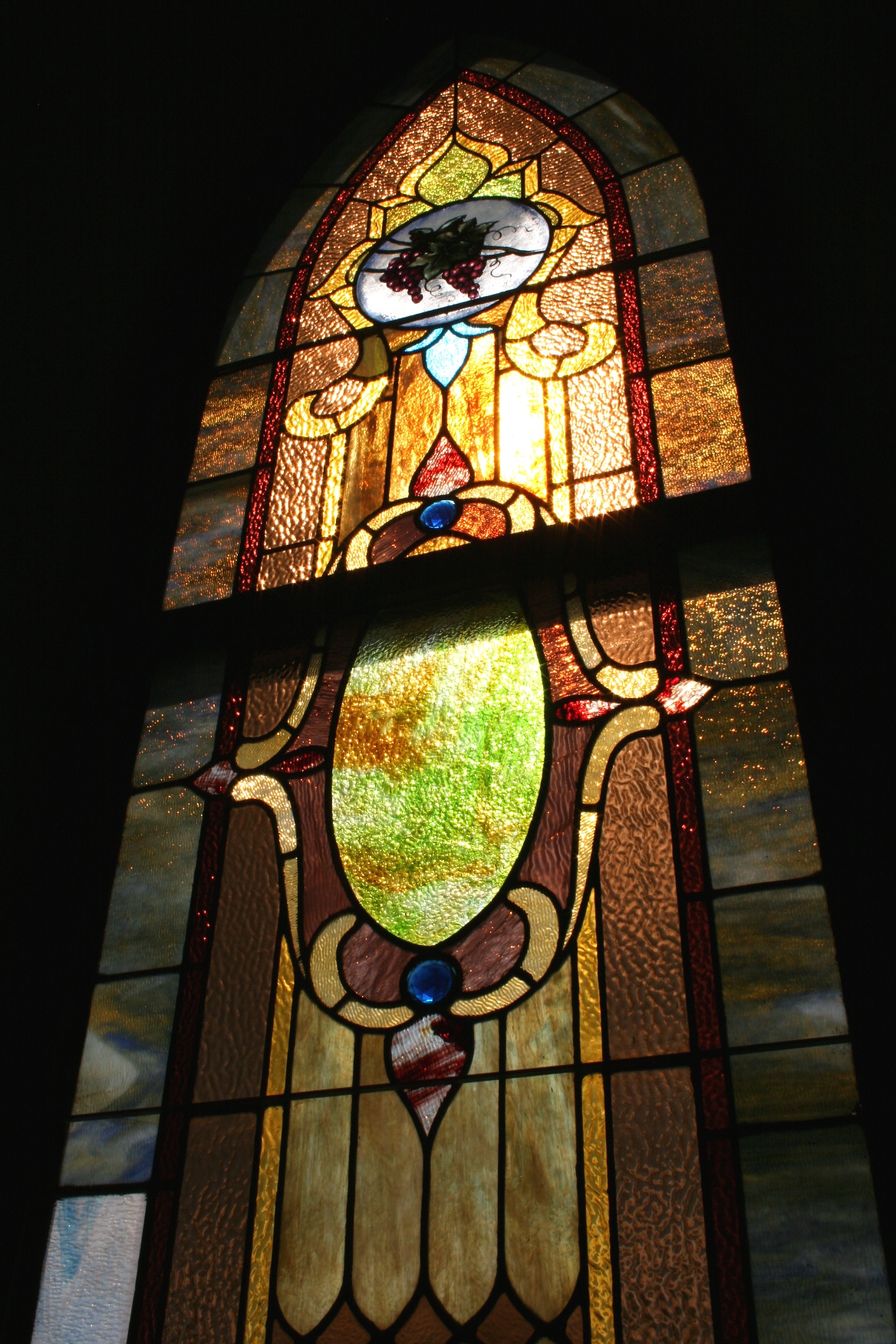
The stained glass windows at St. John's were restored between 2004 - 2006 at a cost of more than $30,000.
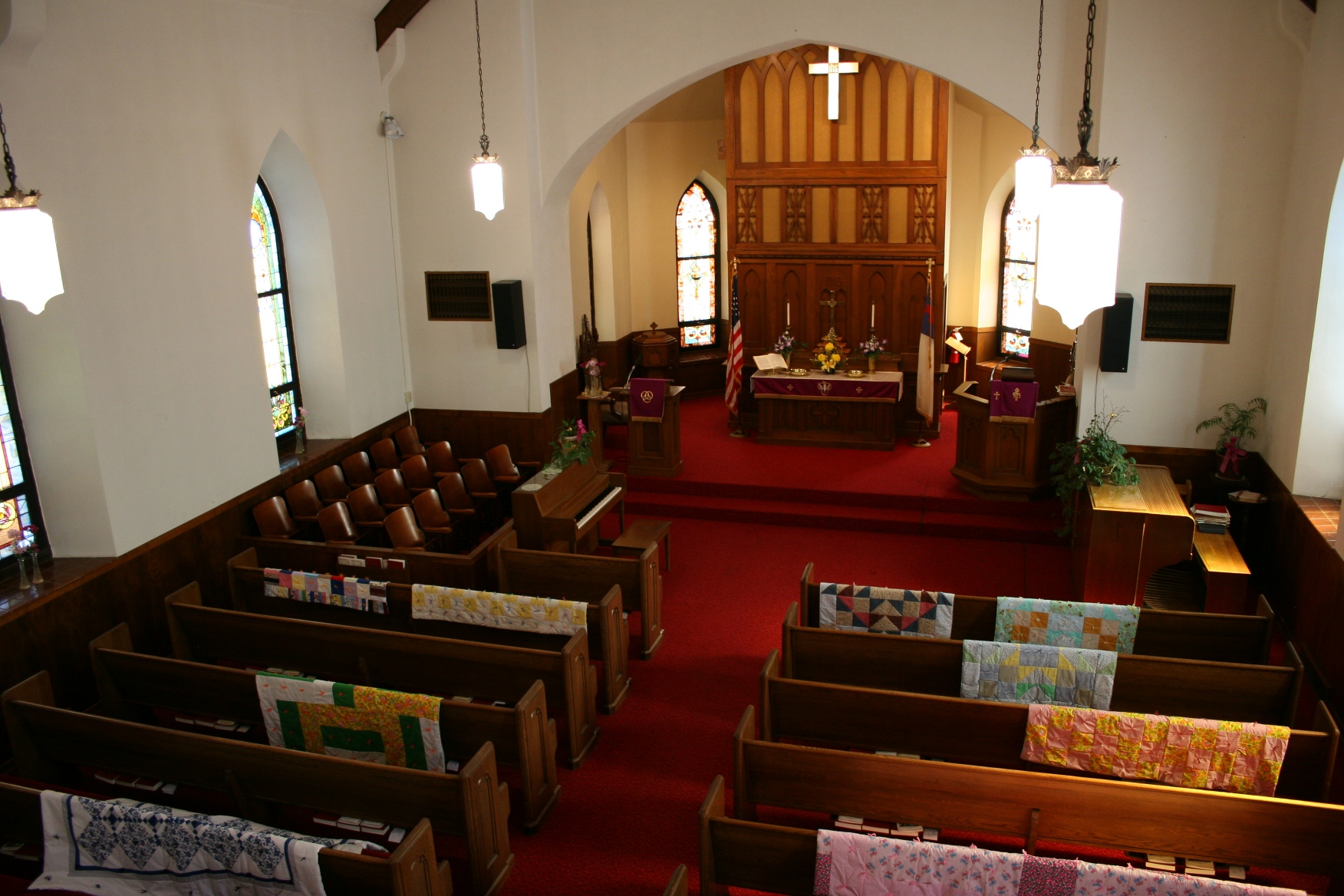
 

A view from the St. John's balcony of the church interior and the quilts.

TEN MILES AWAY in Faribault, about a dozen women at my church, Trinity Lutheran, meet every Wednesday morning from September through May to finish quilts that are donated to those in need. Seamstresses sew the quilt tops at home and then bring them, along with the backings, to church where the Trinity Quilters add the batting and then tie together the layers with yarn.

For 60-plus years now, the women of Trinity have been stitching quilts. “It’s a mission project,”  says long-time quilter Betty Gudknecht. “I want to help other people. You want to do things for the Lord because you want to do it (not because you’re paid).”

With that spirit of giving and serving, the Trinity quilters make about 200 quilts annually. They donate them to places like Minnesota Teen Challenge, the Orphan Grain Train, the Red Cross, Burdens to Blessings, Lutheran World Relief, Lutheran Association of Missionaries and Pilots, and to others in need. Trinity’s graduating high school seniors also receive quilts.

This week the Trinity Quilters are auctioning off three quilts in a silent auction that ends mid-morning on Sunday, April 10. They need the auction money to purchase batting for their 60 x 80-inch quilts. A single roll of recently-purchased cotton batting, which will make 16 quilts, cost $90, and that was at 50 percent off.

In the past, the quilters have gotten creative, using old blankets, mattress pads and even the outsides of electric blankets, as “batting.” They still plan to use those resources, but would also like to use the softer, purchased cotton batting.

While the quilt-makers sometimes buy fabric, most often it is donated.

If you’re interested in bidding on one of the quilts at Trinity Lutheran Church—and I’m sorry, I don’t have photos of the quilts—get your bids in this week.

Cash donations are also being accepted to help the quilters purchase batting.

“It is more blessed to give than to receive.”
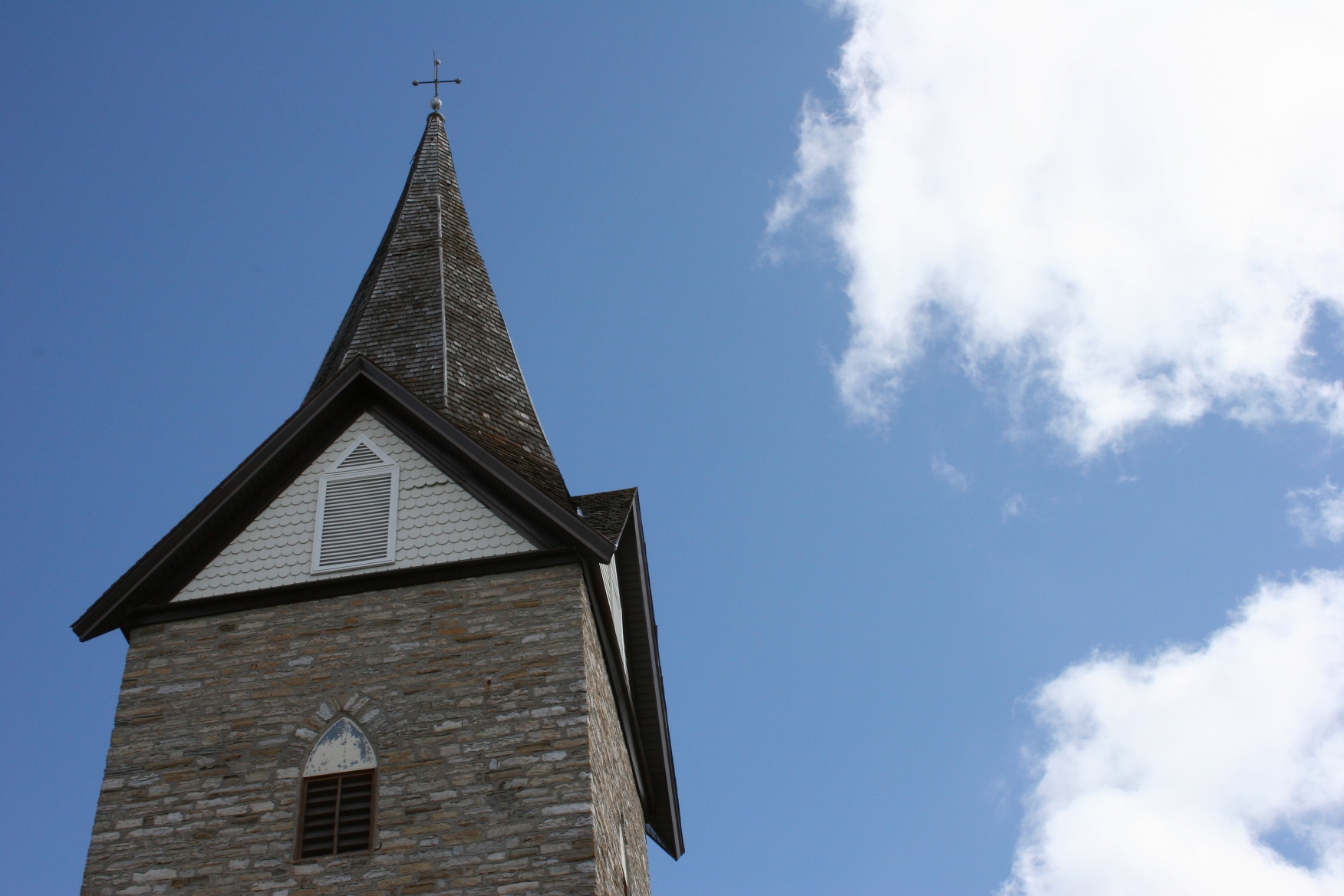
 

The steeple of St. John's United Church of Christ, Wheeling Township, Rice County, Minnesota.

© Copyright 2011 Audrey Kletscher Helbling


Some fine examples of giving in rural Minnesota April 5, 2011

WHEN I READ through the March 31 edition of The Gaylord Hub, a rural Minnesota weekly newspaper where I worked from 1978 – 1980, something caught my eye.

The 10-page paper was packed with stories about community members helping one another. The quantity of articles impressed me enough to write this post, to emphasize to you that even during these challenging times, Minnesotans are reaching out to one another.

These are stories we need to read among the hard news stories of floods and earthquakes, wars and suicide bombers, rising gas prices and falling property values, the news that causes us to ask, “What is this world coming to?”

The articles I read reaffirm that among all the bad in the world, plenty of good still exists. And often, young people are leading the way to assist those in need.

In Gaylord, the Sibley East Junior High Student Council recently raised $600 for the Sibley County Food Shelf. Likewise, the Gaylord Cub Scouts, Boy Scouts, leaders and parents collected 1,032 pounds of food and $70.65 for the county food shelf in a one-day drive.

Students from Sibley East Elementary Schools in Gaylord and Arlington raised $10,431.32 in the Pennies for Patients fundraiser for the Leukemia and Lymphoma Society, placing in the top 25 among 473 participating schools. How’s that for a small school (between 200 – 499 students) in rural Minnesota?

The adults in the Gaylord area aren’t sitting idly by watching the younger generation pursue charitable giving.

The winner in a local drawing chose Sibley County Food Share, Inc., as the recipient of a $2,500 donation from the Monsanto Fund.

Sertomans, at their weekly meeting, discussed plans for a benefit to help the Lindemann family as their daughter, Paisley, battles cancer.

The newspaper also published a story about an education memorial fund established for Kaylee and Gavin, the young children of Michael Struck, a Minnesota Department of Transportation worker who died after his backhoe was swept away recently in flood waters.

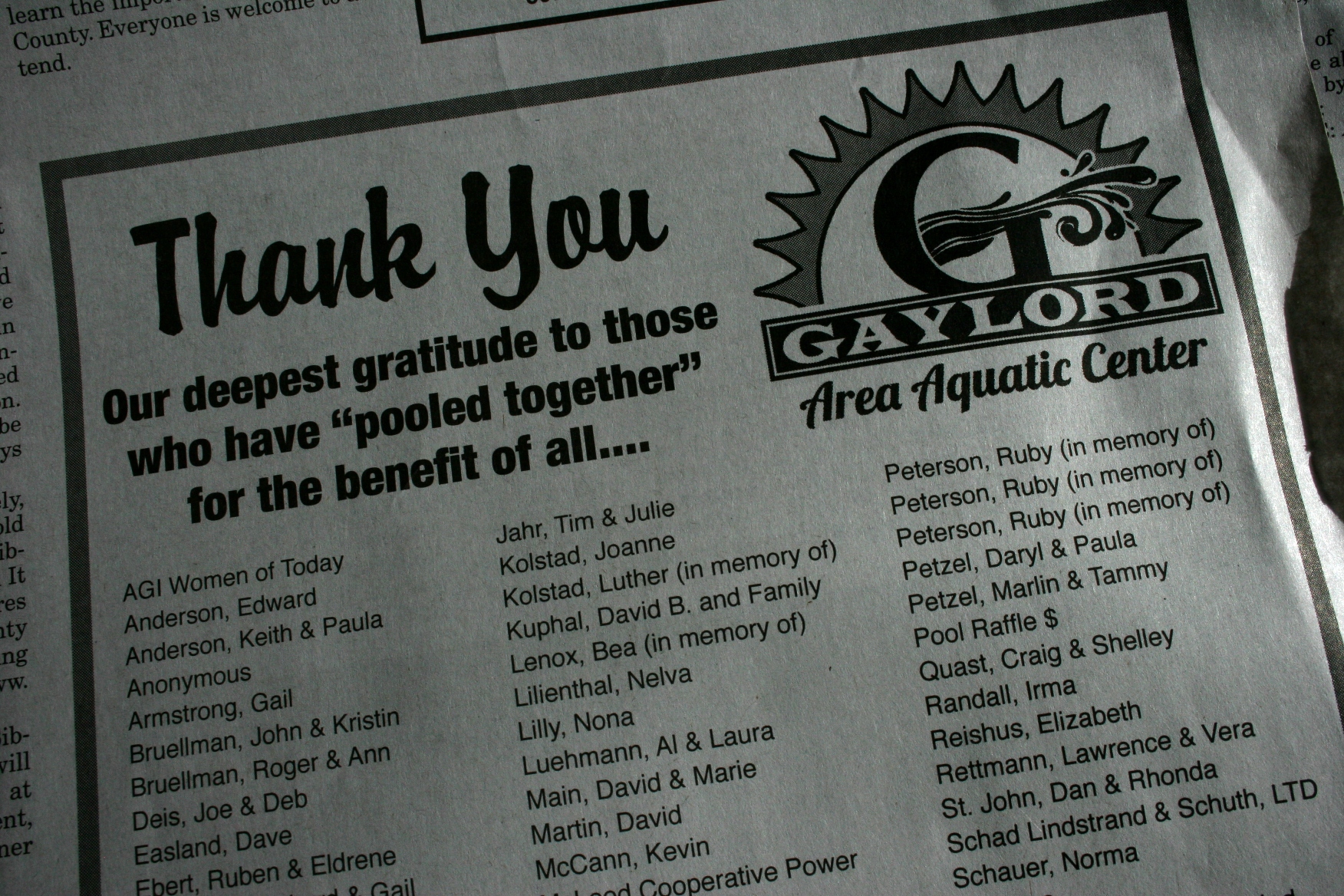
And then, in a front page article, readers learned that $63,000 in donations have been made to Gaylord’s new aquatic center. Donations will be used to buy amenities (play features) for the pool. All 69 donors are listed in an ad published on page 5.

This is just an observation I’ve made over the years—and I think it’s an accurate one—but residents of small towns are often willing to open their pocketbooks to projects that in larger cities would be funded with taxpayer dollars. Why? I think community pride and ownership and the deep personal connections small town residents have to one another prompt such generosity.

Finally, the last philanthropic piece of news was buried deep in a front page article titled “Fire Department receives FEMA grant.” After explaining that the local department has received a nearly $60,000 grant to purchase firefighting equipment, the reporter writes about the annual firemen’s banquet.

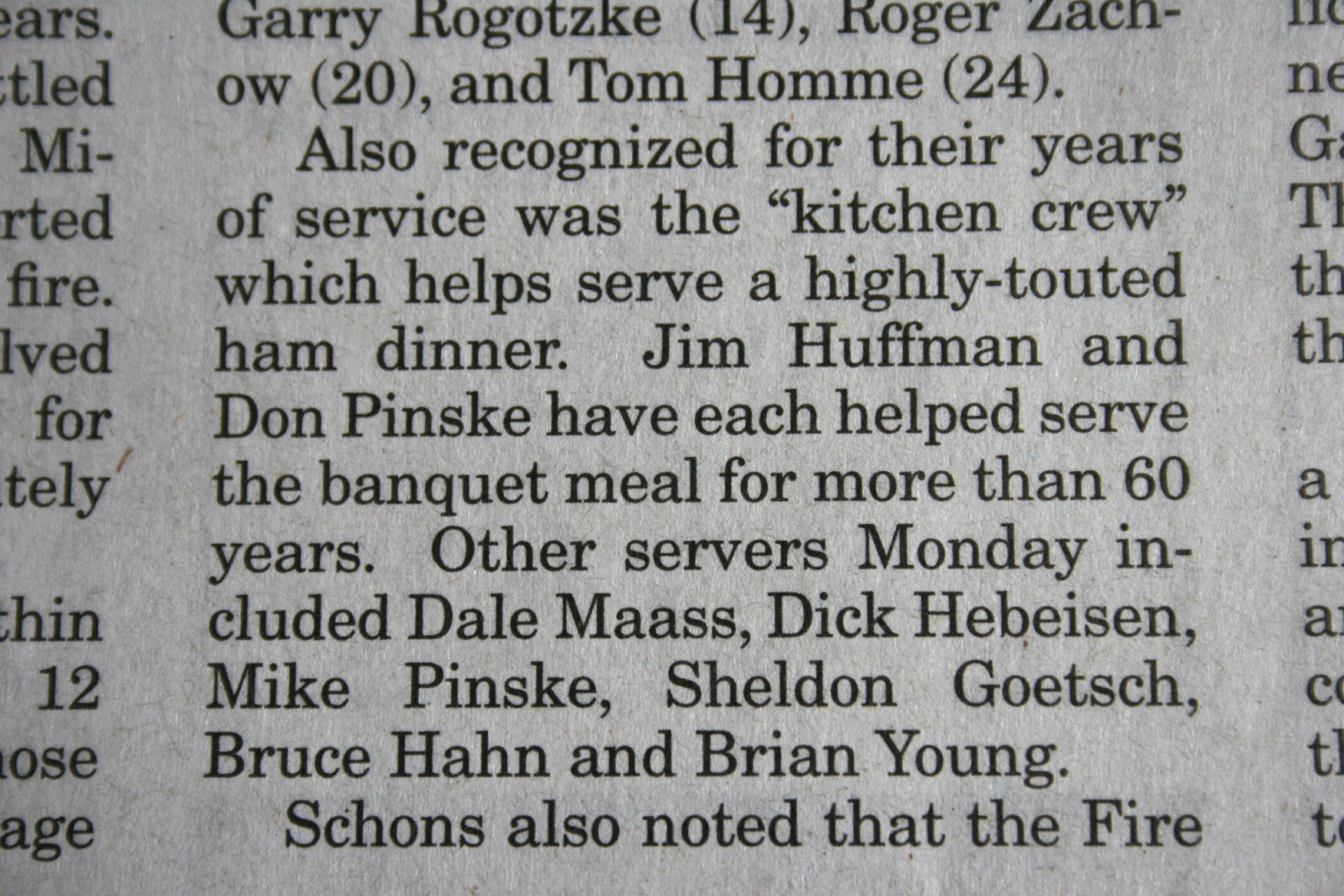
And that is where I found this little gem: “Also recognized for their years of service was the ‘kitchen crew’ which helps serve a highly-touted ham dinner. Jim Huffman and Don Pinske have each helped serve the banquet meal for more than 60 years.”

Sixty years. Now that’s dedication and an outstanding example of selfless giving back to the community.

© Copyright 2011 Audrey Kletscher Helbling

 

Honoring the memory of my dad April 4, 2011

Elvern Kletscher's 1950s military photo

HIS OBITUARY READS IN PART: From 1952-1953, he served in the U.S. Army during the Korean Conflict. He served on the front lines, receiving the Purple Heart after being wounded…He enjoyed his weekly visits with his veterans support group. He enjoyed bird watching, making horseradish and tomato juice with his family.

Elvern Kletscher passed away Thursday, April 3, 2003, at the Sunwood Good Samaritan Center in Redwood Falls, Minnesota at the age of 72 years and 29 days.

Yesterday, on the eight-year anniversary of my father’s death, I failed to remember. How could I? How could I forget the day he died, the day I lost my dad? How could I?

It breaks my heart that I would forget. This failure to remember the date of his death seems like a dishonor to the father I loved. He was a man who worked hard tending the earth, who loved his family and God. He was a soldier who served his country and, because of his time on the killing fields of Korea, suffered from a lifetime of demons that at times robbed me of my father.

But in the end, in his last days, I came to terms with the issues that sometimes made life with him difficult and challenging. I saw only the goodness as I stood at his bedside in the Veterans Administration Hospital where he lay dying of cancer and congestive heart failure.

As I held his hand, stroked his thick white hair, held a straw to his lips, I tried to be brave, to cheer him, to comfort him.

But when I couldn’t keep my emotions in check any more, I fled his room, stood outside his hospital room and wept.

Once I pulled myself back together, I returned to his bedside, listened to him tell me he was going to a better place, that he wanted all of us to take care of Mom. And then I cried, right there, holding nothing back because I couldn’t no matter how hard I tried.

Two days later, after being transported back to his home county, into a nursing home, my dad died.

And on April 7 we buried him, deep in the soil, in the hillside cemetery that overlooks his beloved prairie, the place where, except for his time in the military, he lived his entire life.

On that gloomy April day of biting cold wind, I held my mom close, my arm wrapped around her shoulders as she shivered uncontrollably. Together with my siblings we huddled inside a tent, next to the coffin.

As the guns fired in a military salute, as taps sounded their mournful wail, as my mom accepted a carefully folded American flag, I wept.

Today I weep, too, as I remember the father I loved.

© Copyright 2011 Audrey Kletscher Helbling
 

A lesson in Minnesota sales taxes

Filed under: Uncategorized — Audrey Kletscher Helbling @ 7:09 AM
Tags: , , , , , , , , ,

How much does your community tax purchases?

“ARE YOU A SEVEN?” she asked.

“What?” I asked her to repeat what she’d just told me over the phone.

“Are you a seven?” she repeated.

Still, I didn’t understand. Then she—the saleswoman at J.C. Penney in the Burnsville Shopping Center—explained that sales tax rates vary, depending on where you live in Minnesota. She wondered if I lived in an area with a seven percent rate.

Huh? I had no idea, about the rate or that such differences existed.

I live in Faribault. Is that a “seven,” or some other number?

The helpful saleswoman, who was trying to calculate the cost of pleated shades (which I’m not buying because they are way too costly at nearly $400 for two windows, but which I really, really want), was confusing me. Apparently orders shipped to my home would be taxed based on where I live, or something like that.

Not one to simply let this piece of information slip through the recesses of my brain, I googled “Minnesota sales tax” and ended up on the Minnesota Department of Revenue sales tax rate calculator website. It’s an easy-to-use site where I could type in Minnesota zip codes, a dollar amount and, zip, the sales tax rate appeared. The calculator covers Minnesota and local general sales and use taxes. Any other special taxes, such as those on entertainment, liquor, dining and lodging, are not figured into the totals.

First, I needed the nine-digit zip codes for my sample towns. Once I had those zip codes from a U.S. Postal Service link, I typed the numbers and my sample dollar amount of $10 into the tax calculator website.

I quickly discovered that Faribault is not a seven. Our sales tax rate, like that of my brother who lives in Redwood County in rural southwestern Minnesota, is 6.875 percent. We would each pay 69 cents in sales tax on a qualifying $10 purchase in our parts of Minnesota. We have no extra taxes, just the 6.875 state-wide basic sales tax levied by the state.

My daughter who lives an hour away from me in south Minneapolis, however, will pay more for purchases made in her area. The sales tax rate for her address is 7.775 percent. That breaks down to the standard state sales tax rate, plus an additional 0.15 percent levied by Hennepin County, 0.5 percent by the city of Minneapolis and 0.25 percent for Transit Improvement. She would pay 78 cents in taxes on a $10 purchase.

In Woodbury, where my youngest brother and his family live, a 0.25 percent Transit Improvement levy is also in place. It’s the only extra sales tax in that city, so tax on a $10 purchase there would be 71 cents.

I was surprised to learn that St. Cloud also has an extra tax, of 0.5 percent, pushing the sales tax rate there to 7.375 percent. That helped pay for an airport and other projects. You’d pay 74 cents sales tax on a $10 purchase.

But my biggest surprise came when I typed in a friends’ nine-digit zip code up in Duluth. There the local government has imposed a one percent additional general sales tax, pushing the sales tax in that port city to 7.875 percent. The tax on a $10 purchase is 79 cents. Authorized in 1973, that special tax “may be used for any city purpose, as determined by the city council.” It has no expiration date and is the longest-running local sales tax listed on a September 2010 document from the Minnesota House of Representatives Research Department.

Now, if you’re like me, you’ve just gotten a good basic education on sales tax rates in Minnesota.

Funny, isn’t it, how that J.C. Penney employee’s seemingly simple question—“Are you a seven?”—educated me about sales tax rates in Minnesota.

THE MINNESOTA LEGISLATURE is considering legislation that would loosen current restrictions on local sales taxes. Under the proposal, cities or groups of cities could impose local sales taxes with local voter approval. Twenty-two Minnesota cities currently have a local option sales tax.

© Copyright 2011 Audrey Kletscher Helbling
 

Crocus promises April 3, 2011

Filed under: Uncategorized — Audrey Kletscher Helbling @ 11:21 AM
Tags: , , , , , , ,

THE FIRST FLOWER of spring has sprung in my Minnesota front yard. It is the crocus, beautiful to behold because it symbolizes, for me, the end of winter.

New life.

Hope for warm, sunshine-drenched days and the promise of summer.

Bouquets of colorful zinnias. Sweet perfume of peonies. Hydrangea mopheads leaning to kiss the earth. Geraniums mixed with fragrant alyssum in patio pots.

As the tight purple petals of the crocus open to the warmth of an April day, my gardener’s eyes open, too, to a new season of possibilities.

Copyright 2011 Audrey Kletscher Helbling


Tips for on-the-road photography April 2, 2011

HOW OFTEN HAVE YOU been traveling along a roadway, saw a subject worth photographing but were in too much of a hurry to stop?

That’s happened to me more often than I wish. However, I’ve found a solution that’s worked well with some incredible photo results.

I’m issuing a disclaimer here, though. I’m not advocating photographing and driving. This photographic option should be used only when you are a passenger because you’ll be operating your camera while your vehicle is moving.

First, set your camera at a sports action shutter speed, place it on your lap, grip the camera body and be prepared to snap away at a moment’s notice.

Click. Click. Click. With a fast shutter speed, you can quickly fire off three frames before you’ve bypassed the intended subject.

OK, it’s not quite that easy. You must anticipate just the right moment to take your photos. That means paying attention to what lies ahead of you along the roadway. Click too soon and you miss the shot. Click too late and you miss the shot.

It’s partially luck, partially skill that will nail a great photo.

I’m always watching too for telephone and electric poles and roadside signs that can obstruct an otherwise good image.

I’m also always trying to balance my photos so they are well-composed.

All of this moving of the camera and adjusting the lens and framing the image must happen in a split-second. I can’t even begin to tell you how many shots I’ve missed because I’ve moved too slowly or failed to notice a photo op until it passed me by.

That’s the other part of successful on-the-road photography. You need a watchful eye for subjects that will make interesting and great photos. Too many people look, but don’t really see, what’s around them. Perhaps because I’ve grown so accustomed to viewing my world through a camera lens and because I’m a writer, I notice more than the average person.

Yet all of this effort will be wasted if you’re shooting through dirty vehicle windows. Clean your windows. If you live in a state like Minnesota, where road spray from sand and salt and melting snow is a problem, you may just have to abandon this traveling photo option in the winter.

Unless you’re traveling through a town, at low speeds, I don’t recommend opening your window. You risk getting dust or dirt into your camera sensor.

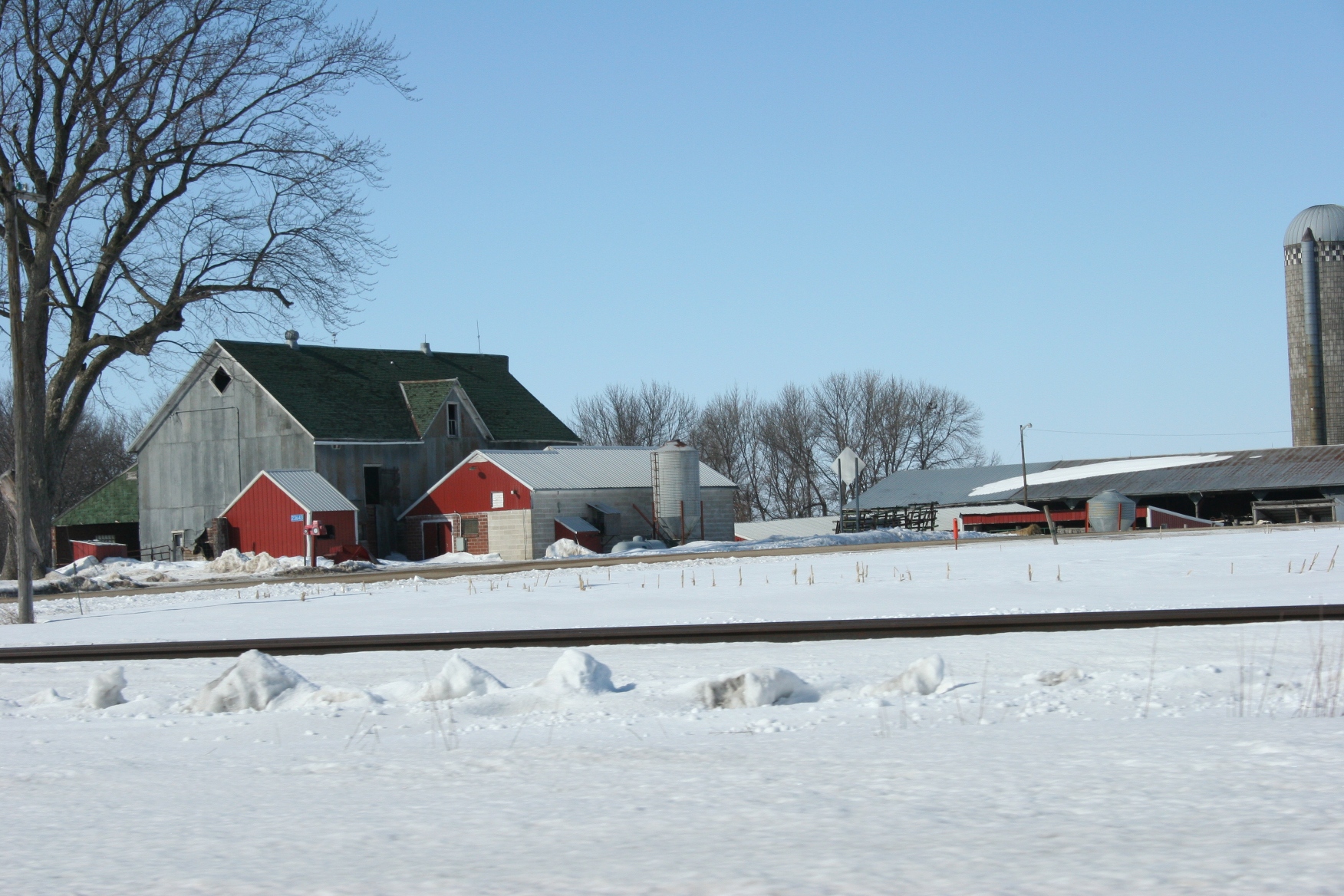
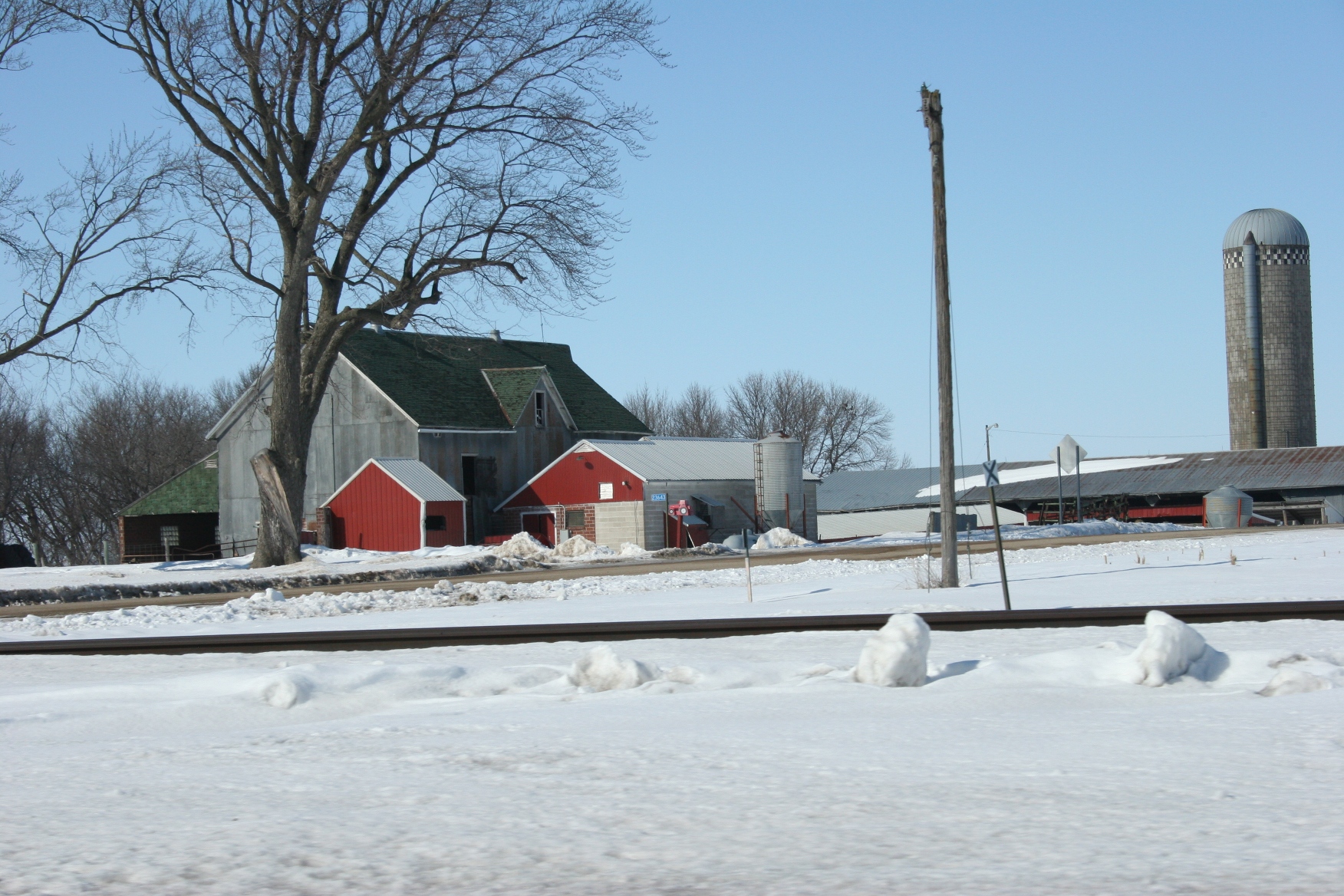
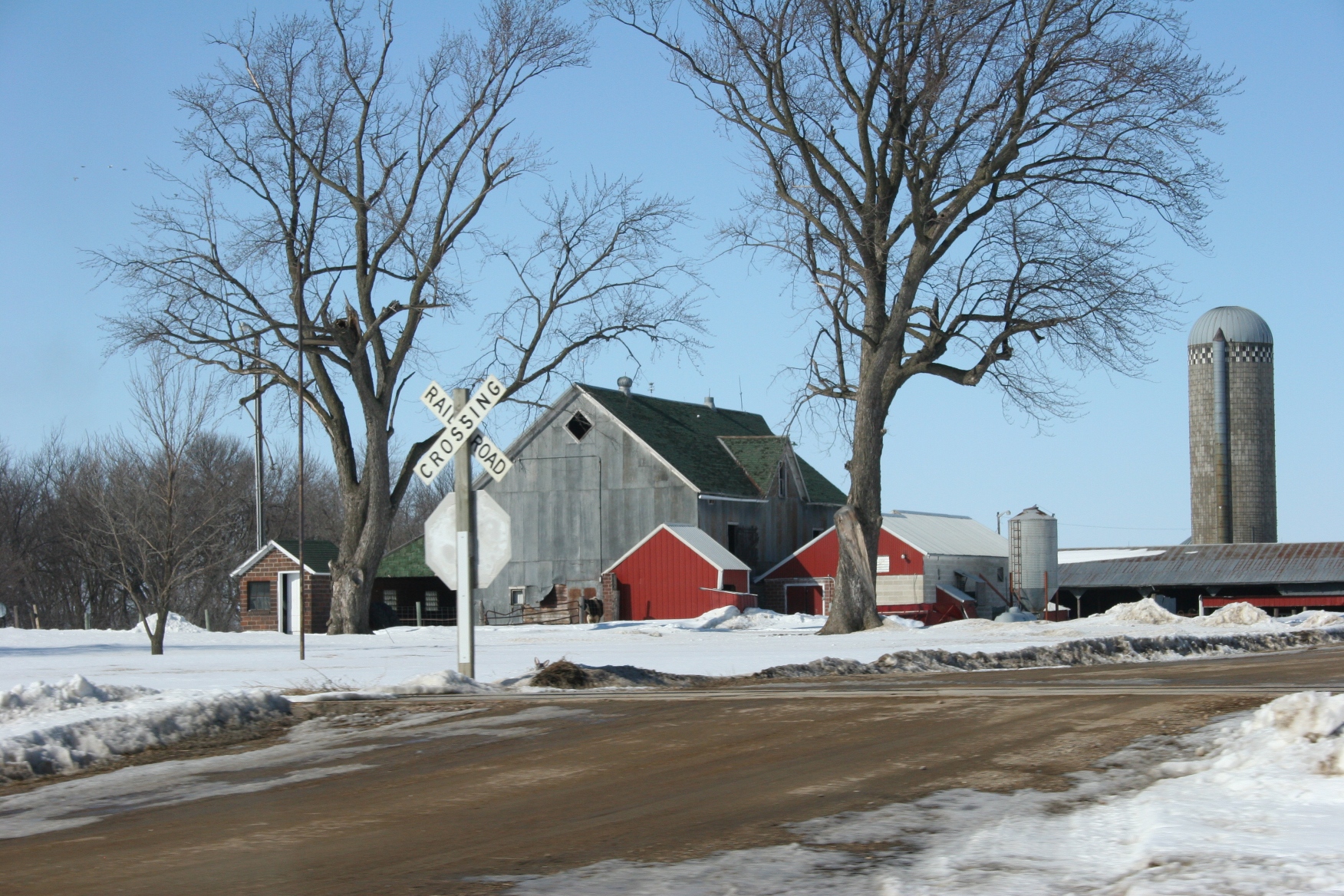
That said, here’s a trio of photos I shot in early March along U.S. Highway 14 between Essig and Sleepy Eye in southwestern Minnesota while traveling at 55 mph.

Other than downsizing these images, I’ve not edited them.

Here’s why these images are so good. The exposure is perfect. The photos are well-composed. The horizontal line of the railroad track in the first two frames sits at an eye-pleasing one-third position. The color contrasts of red against gray and blue make these photos pop. The subject is beautiful in its simplicity.

If you’re never tried traveling photography, give it a shot. You may be as pleasantly surprised as me with the results.

FYI: I shoot with a EOS 20D DSLR Canon camera. Yes, it’s a “fancy” digital camera, not a point-and-shoot. If you ever see a photo on Minnesota Prairie Roots that you are interested in purchasing, please contact me via a comment (won’t be published) or an e-mail.

© Copyright 2011 Audrey Kletscher Helbling


Blogging in April April 1, 2011

Filed under: Uncategorized — Audrey Kletscher Helbling @ 7:59 AM
Tags: , , , , , , ,

DEAR READERS,

After much thoughtful consideration, I have decided to stop blogging. This writing endeavor is sucking up too much of my time for little no pay.

OK, if your heart skipped a beat there for a moment, good. If you panicked at the thought of missing your daily dose of Minnesota Prairie Roots, good. If you wonder what prompted this decision, good.

Stop. You needn’t worry. That first paragraph is an absolute falsehood/lie/lame attempt at an April Fool’s joke.

I could no more stop blogging than I could cut off my hand.

So you are stuck with me and my writing. I have no intentions of closing up shop at this blog.

Why do I keep doing this day after day when I’m not earning a nickel penny from publishing here at Minnesota Prairie Roots? (OK, sometimes my blogs end up revamped as articles published, for pay, in magazines.)

I blog because I “have to.” I love language and writing and telling a good story and sharing my thoughts that much. Think about the single thing that is your passion in life and you will understand mine. Writing.

Clearly, trying to pull off a joke on April Fool’s Day, and most any day, is not my talent. I am too honest to continue a charade for more than two sentences.

Even as a child, I struggled to, with a straight face, attempt an April Fool’s joke. My siblings failed to believe “The school bus is here” or “Your toast is burning.” I could have thought of something more creative like “The cows are out.”

Or I could have been really, absolutely, undeniably creative like my cousin Jeff, the mayor of Floodwood, who 21 years ago today announced in an announcement mailed to his unsuspecting parents that he had gotten married. He hadn’t married a northwoods woman. Let me tell you, that fib didn’t go over too well with the parents. I think they laugh about that April Fool’s joke now. Maybe.

How about you? Have you pulled off the ultimate April Fool’s joke. I’d like to hear your stories. Submit a comment. We’d all like a laugh or three on this gloomy Friday morning in Minnesota with snow in the forecast for the weekend. And that’s no April Fool’s joke.

© Copyright 2011 Audrey Kletscher Helbling

 

I can’t hear you March 31, 2011

Filed under: Uncategorized — Audrey Kletscher Helbling @ 8:01 AM
Tags: , , , , , , ,

COULD SOMEONE PLEASE answer the phone, turn off the radio and fix the potholes?

That isn’t going to happen. Not for me now, anytime soon or perhaps ever.

Welcome to my new world of ringing telephones, annoying transistor radios and bothersome potholes. I’ll explain after giving you some background.

Three weeks ago I suffered a sudden sensory hearing loss. One minute I could hear mostly fine in my right ear. The next minute it was as if someone had closed the door to my hearing.

At this point, why I suddenly lost 70 percent of the hearing in my right ear remains an unknown. It could be related to an ear trauma three years ago at a Wisconsin waterpark where a waterfall pounded my head. That caused permanent nerve damage, and some hearing loss, to my right inner ear. Or it could be the result of a viral infection, or something else.

Whatever the cause, I now have only 30 percent of my hearing in my right ear.

Thus, the ringing telephone, the transistor and the problem potholes have become issues for me. It’s not like I didn’t try to eliminate all three.

I tried a 10-day mega dose of inflammation-reducing steroids in an attempt to salvage some, if not all, of my hearing. The Prednisone didn’t work, only made me jittery, sleepless and emotional. I noticed no improvement in my hearing. The drug is typically most effective within 48 hours of symptom onset and my treatment started long after that.

I see a specialist next week to recheck my hearing and perhaps get some answers.

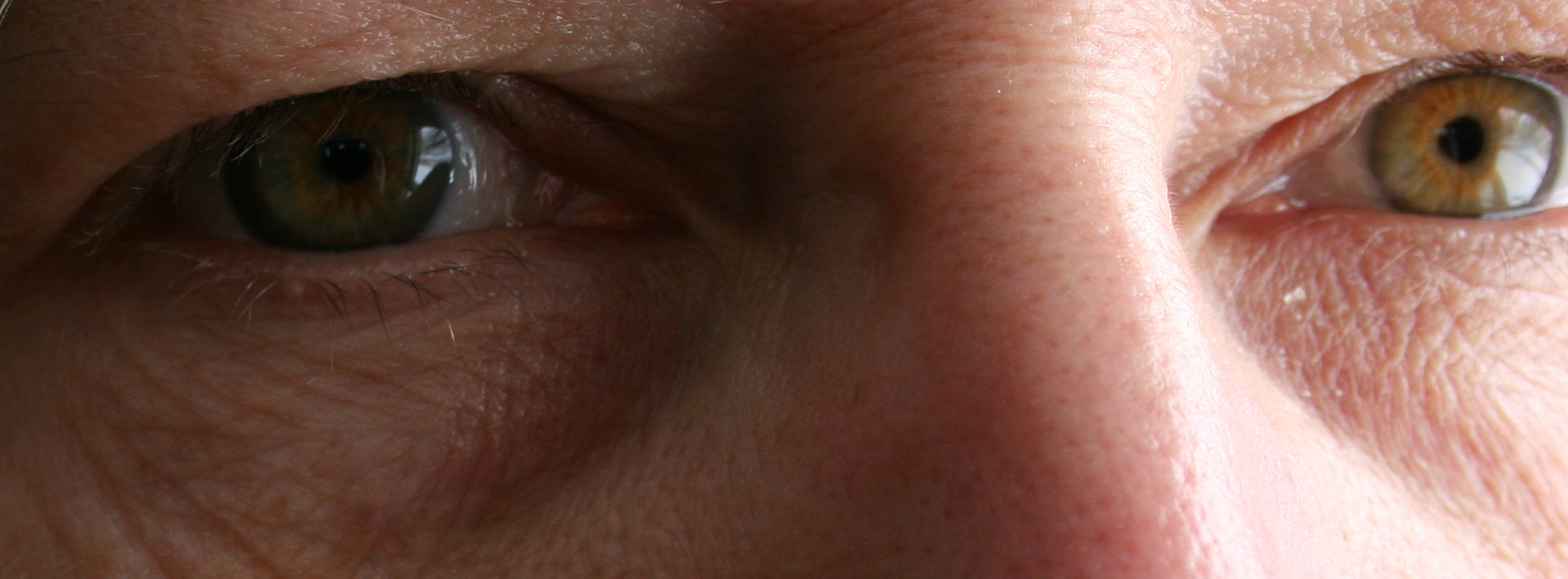
I took this photo of my eyes last week when I wasn't getting much sleep due to the effects of my steroid treatment. I'm still having sleep issues.

For now, I’ve accepted the fact that this is my new world of hearing. Sometimes the tinnitus is so bad that I joke to my husband, “Can you please answer the telephone?” Only problem, the telephone is inside my right ear.

As for the transistor, those of you old enough to remember transistor radios will also recall how they were often plagued by poor reception resulting in lots of static. I’m hearing that type of static now in my right ear more often than I like.

With my “bad” right ear I hear just “noise,” nothing as clear or distinct as an individual word.

Driving over an uneven roadway surface, like a pothole or a crack, hurts my ear with the thump echoing unpleasantly inside my ear.

I’m trying to adjust to this hearing loss. But, honestly, it’s not always easy. I can barely tolerate the organ music in church and singing isn’t too much fun any more.

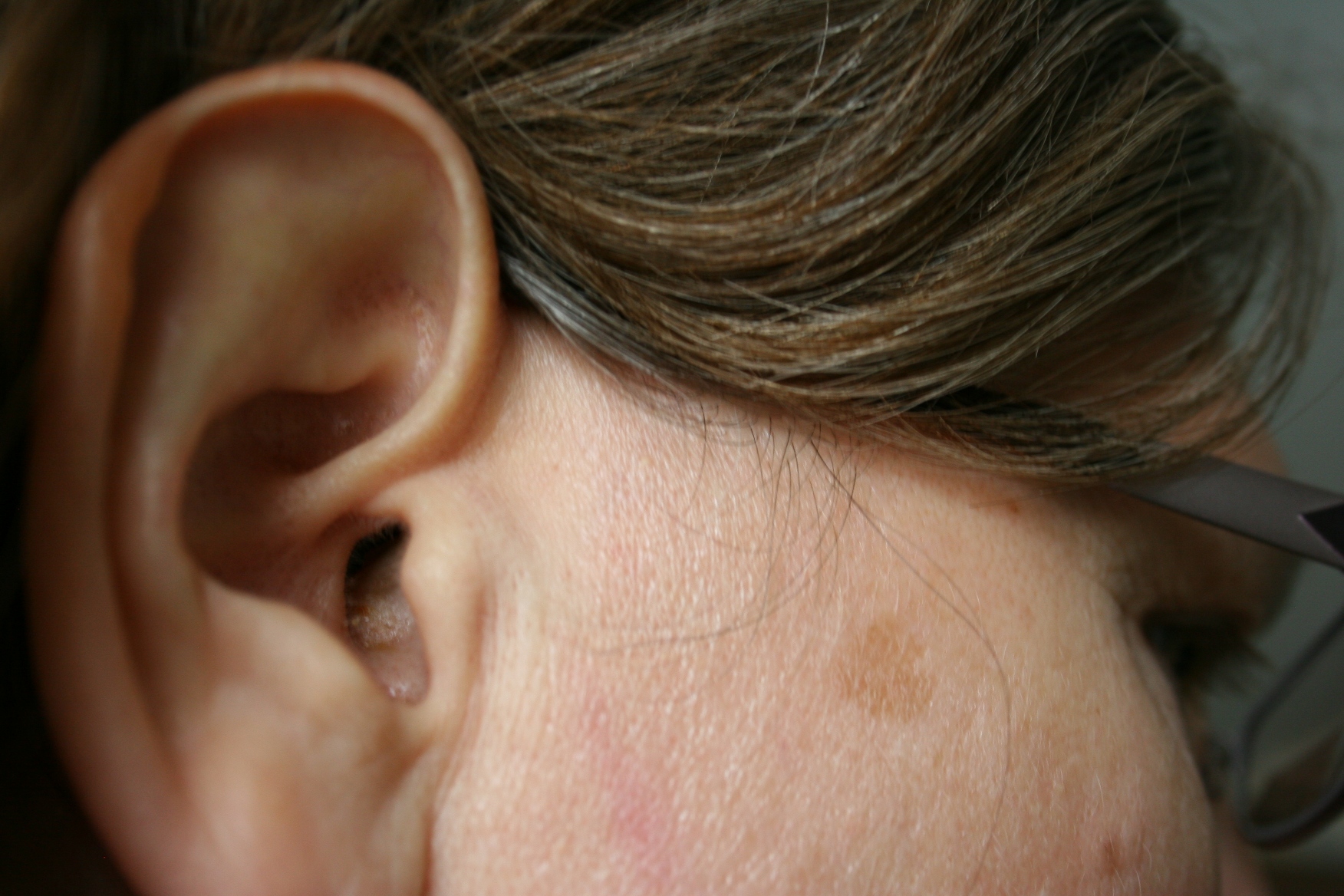
My right ear, in which I've lost 70 percent of my hearing due to a sudden sensory hearing loss.

But most difficult for me, like anyone with a hearing loss, is the inability to clearly hear conversations. And for me, a blogger and writer, that’s a very big deal. I need to hear, and hear accurately.

All too often I find myself asking others to speak louder. I’m sure they’re thinking, “Why doesn’t she just get a hearing aid?” It’s not that simple. An audiologist and an ear/nose/throat doctor have told me that a hearing aid will not help, not with this type of hearing loss.

Put me in a room full of people, and I struggle to hear.

The other night while waiting in a check-out line at the grocery store, I was frustrated because I couldn’t hear everything the young male checker in the lane next to me was telling the bagger. He was offering her relationship advice, something about his fiancée who’d gone to college on the East Coast and who’d cheated on him. I caught the advice about hanging on to someone you care about and to, basically, not mess it up. It would have been a great blog topic, but I couldn’t hear enough of the conversation to accurately pull together a post. My days of eavesdropping may have ended with this sudden sensory hearing loss.

Despite all of this, I realize my health issues could be much worse and that many people suffer from severe hearing losses.

Like all other challenges I’ve faced in my life, I’ll adjust, adapt, accept and move on.

Yet, if I feel the need to cry, which I have several times already, I’ll cry.

© Copyright 2011 Audrey Kletscher Helbling

 

Prom economics 101: Lessons in giving March 30, 2011

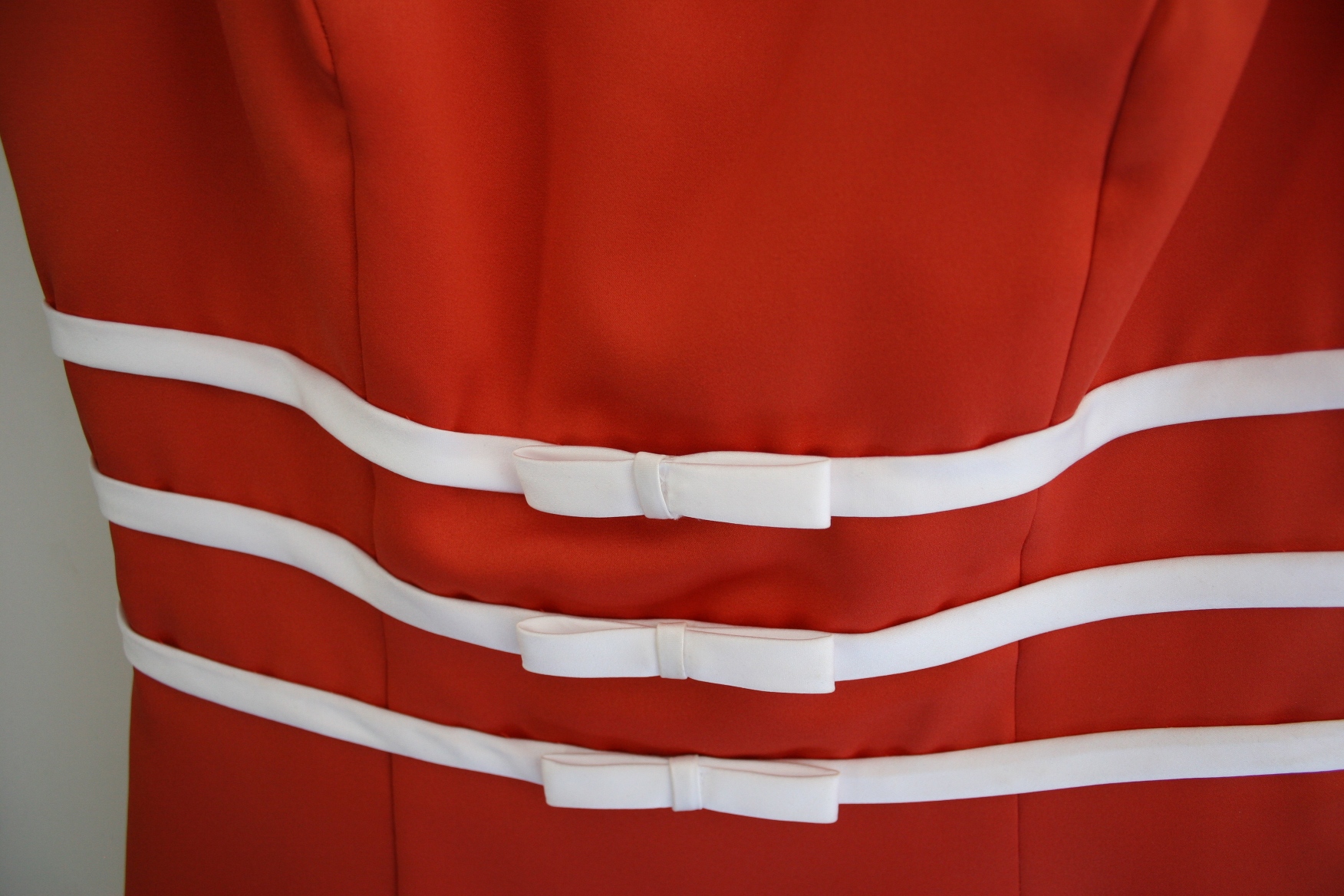
The 1984 formal I donated to the FHS NHS Prom Dress Drive .

SEVERAL WEEKS AGO my husband stuffed a 1984 lavender formal into the back seat of our car and delivered it to Faribault High School. (I was sick that day or I would have dropped off the old bridesmaid’s dress myself.)

He was donating my dress, which has hung in an upstairs closet for decades, to the FHS National Honor Society’s first-ever Prom Dress Drive.

Naturally, I couldn’t allow this event to pass without asking whether a local high school student will wear “my” dress to the April 30 FHS prom. I also wanted to know how the drive went.

Although several young women tried on my lavender formal and one in particular with sewing abilities considered changing it up, no one bought it, says NHS co-advisor and FHS English language arts instructor Rachael Hoffman.

However, Hoffman, who is also the FHS theater wardrobe director, says she’s keeping my cast-off for possible use in future FHS theatrical productions.

Of 80 – 85 donated dresses, about 15 were sold with prices ranging from $2 – $50 and averaging around $20. Donations included vintage to current fashionable dresses, a few with price tags still attached. Shoes and jewelry were also contributed.

Hoffman, while grateful for the quantity of dresses donated, was hoping for more shoppers. Yet her enthusiasm for the project and its purpose cannot be quelled.

I’ll let her share a story that nearly moved me to tears. “I was overjoyed to hear a student say that she wouldn’t have to order a dress to fit her size this year since she found one at our drive,” Hoffman writes in an e-mail. “You could see on her face that she felt pretty and I really felt that made the drive worth it.

I also think that some of the NHS students who worked at the drive with me got to put themselves in other students’ shoes for a moment. It was a valuable experience.”

Lessons like that can’t be taught in a classroom.

While the project was a fundraiser for the NHS (the group raised about $400), Hoffman says more importantly that it was a service to the students and the community during difficult economic times. “It was my personal hope that a student who could not afford a dress would come and buy one. We did, in fact, have a few students who showed up with this purpose. It was a wonderful reward.”

Lessons like that can’t be taught in a classroom.

Hoffman clearly understands her students. “As a teacher at FHS, I know that many of these young people work jobs not merely for themselves but to contribute to their families in these hard times, or to save for college,” this astute educator observes. “We really wanted to serve our community in this way. Prom is a special occasion and many families cannot afford ‘extras’ right now. We wanted to make this less of a stressor on normal working families and more of an event to look forward to for the students.”

No one left the Prom Dress Drive without a dress, if they wanted one, Hoffman says. Prices were negotiable and most donors told organizers to give away their dresses (if they could not sell them) to anyone who needed a formal.

Lessons like that in giving from the heart can’t be taught in a classroom.

Details on the front of a lovely formal that also hangs in my closet and which my eldest wore in a friend's wedding. It would make a lovely prom dress, but it wasn't mine to give. Maybe next year?

THE GIVING DIDN’T END in Faribault. Extra Prom Dress Drive formals which won’t be utilized locally were donated to Total Care Cleaners. The south metro business sells the dresses for $10 to any prom-goer who needs one. Total Care also gives away $10 in dry cleaning services for each donated dress.

“They were so appreciative of the donations and excited to give more students this option for a prom dress,” says Julie Petersen, a co-advisor for Faribault’s NHS and a FHS Spanish instructor. “The owner said that many of the girls he helps would not be able to go to prom if not for the dresses he gets donated.”

That economic reality extends nationwide. At donatemydress.org, a national network connecting local dress drive organizations across the country, you’ll find a state-by-state listing of groups sponsoring these dress projects. Scroll to Minnesota and you can link to five metro area formal dress drives—Ever After Gowns, Operation Glass Slipper and The Paperbag Princess—and the two businesses-based projects at Vista Images and Total Care Cleaners.

I expect there are other Minnesota dress drives not listed on this website.

At least one of the prom projects, South St. Paul-based The Paperbag Princess, also accepts suits. Some take accessories too. Ever After Gowns will even accept spa products and new makeup.

I commend groups like the FHS National Honor Society for undertaking a drive like this which offers affordable prom attire to young women. NHS members seem to have benefited from the project, in lessons learned, as much as the young women who found prom formals.

Now, if only the cost of attending the FHS prom—$175 per couple for the event to be held at a South Saint Paul night club—would be more affordable…

© Copyright 2011 Audrey Kletscher Helbling


Kudos from MPR for Minnesota Prairie Roots March 29, 2011

OK, I’M NOT EVEN GOING to apologize for tooting my horn here today. It’s not something I’m all that comfortable doing. But, hey, every once in awhile it’s alright to let everyone know you’ve been recognized.

That latest recognition for me as a writer comes via Minnesota Public Radio’s Bob Collins. He publishes a popular online MPR weekday column, News Cut. He’s a professional blogger, meaning he gets paid for blogging, which I aspire to accomplish.

I’m a News Cut fan, and not just because Collins has referenced my Minnesota Prairie Roots posts numerous times. I sincerely enjoy reading the content he pulls together and comments and encourages discussion on.

MPR Public Relations Manager Christina Schmitt interviewed Collins about News Cut for an article published in the Plugged In Minnesota Public Radio highlights section of Minnesota Monthly’s March issue. The “Behind the Blog: Bob Collins” article titled “Looking Sharp,” runs on pages 6 and 7.


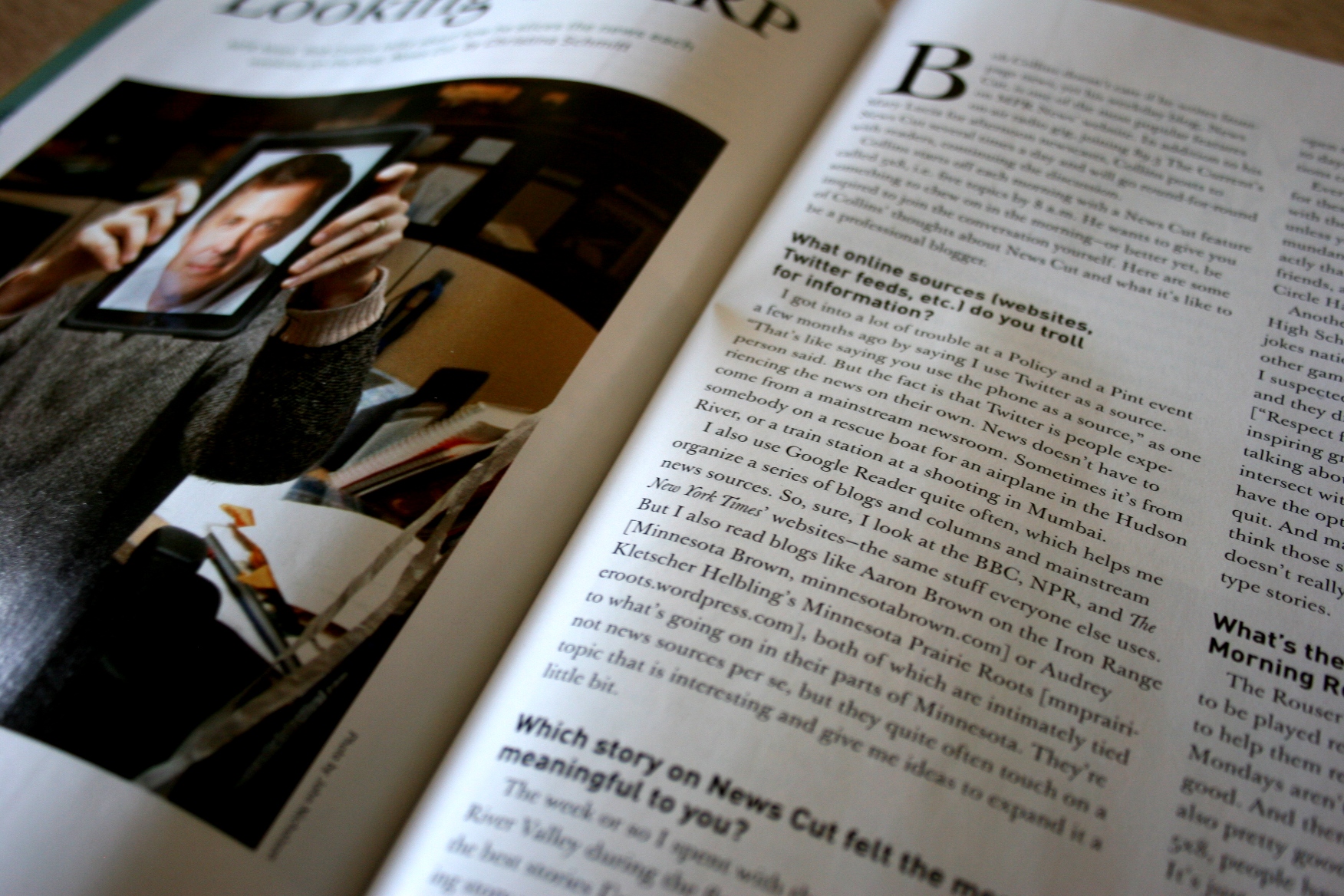
This two-page spread in Minnesota Monthly's March issue features an interview with MPR's Bob Collins in which Minnesota Prairie Roots is mentioned.

And that’s where I’m mentioned, on the second page, when Schmitt asks Collins which online sources he trolls for information.

He taps into Twitter. And, like everyone else, Collins says he checks the BBC, National Public Radio and The New York Times. But then Collins shares that he also reads blogs like…ta-da, drum roll here, please…Iron Ranger Aaron Brown’s Minnesota Brown and Audrey Kletscher Helbling’s Minnesota Prairie Roots.

I’m honored, humbled and more than a tiny bit giddy that Collins would single the two of us out from among the hundreds, if not thousands, of writers out there in the Minnesota blogosphere.

Such an endorsement from a well-respected entity like MPR means a lot to me as a professional writer. It validates that I can blog, and blog well, or at least blog well enough to grab Collins’ attention and interest.

In the interview, Collins tells Schmitt that Minnesota Brown and Minnesota Prairie Roots “are intimately tied to what’s going on in their parts of Minnesota. They’re not news sources per se, but they quite often touch on a topic that is interesting and give me ideas to expand it a little bit.”


Right here, in the fourth paragraph, Collins talks about Minnesota Brown and Minnesota Prairie Roots.

So there you have it. Direct from News Cut.

To read the full story, track down Minnesota Monthly’s March issue. I’m looking for copies now as I only learned several days ago about this article. Gotta show my mom, you know. So…, if you have any extra copies of the magazine, send them my way.

© Copyright 2011 Audrey Kletscher Helbling