Minnesota Prairie Roots

Writing and photography by Audrey Kletscher Helbling

Preserving yesterday at rural-themed show, rural Dundas September 2, 2022

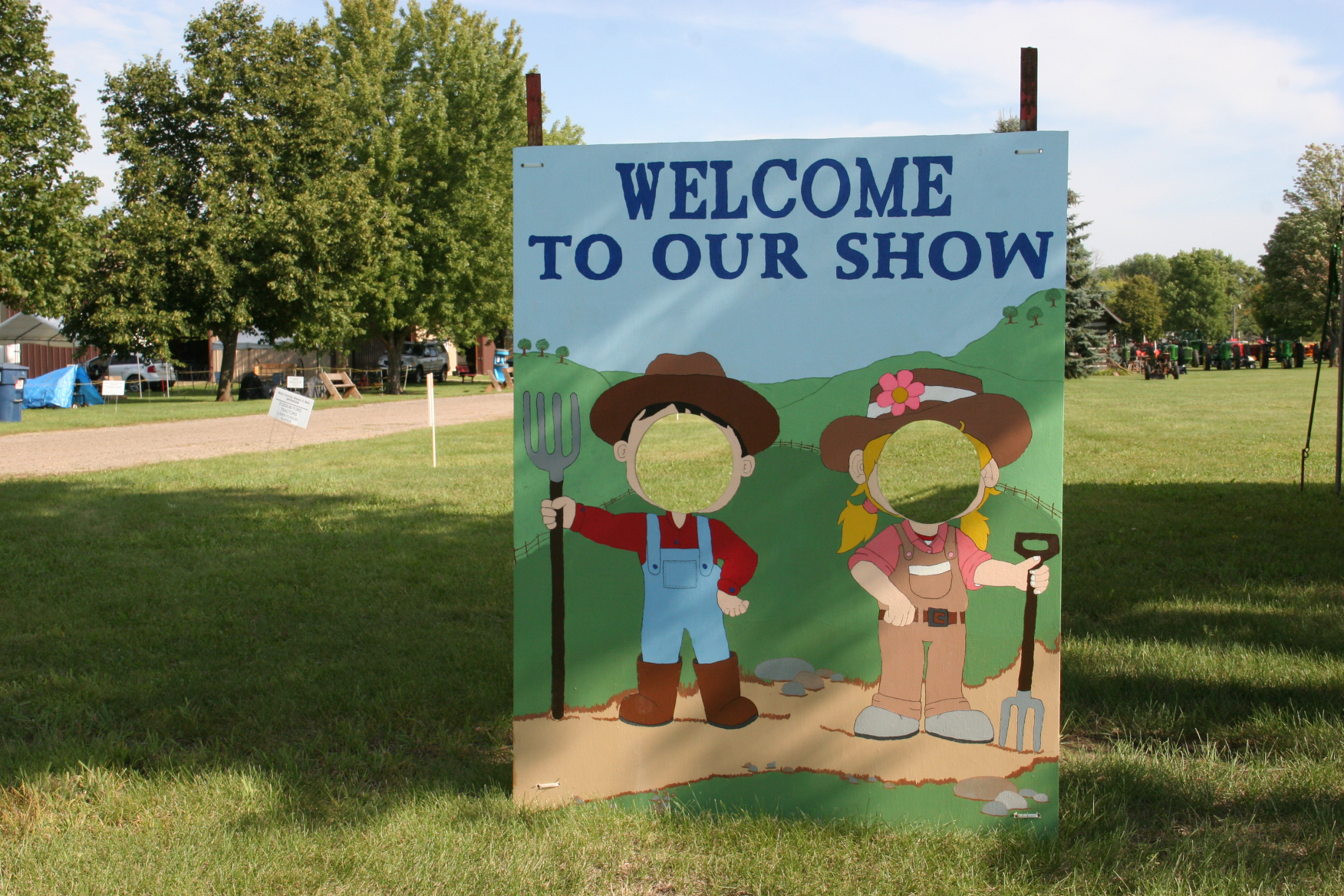
Photo cut-outs just inside the entrance. (Minnesota Prairie Roots copyrighted photo September 2022)

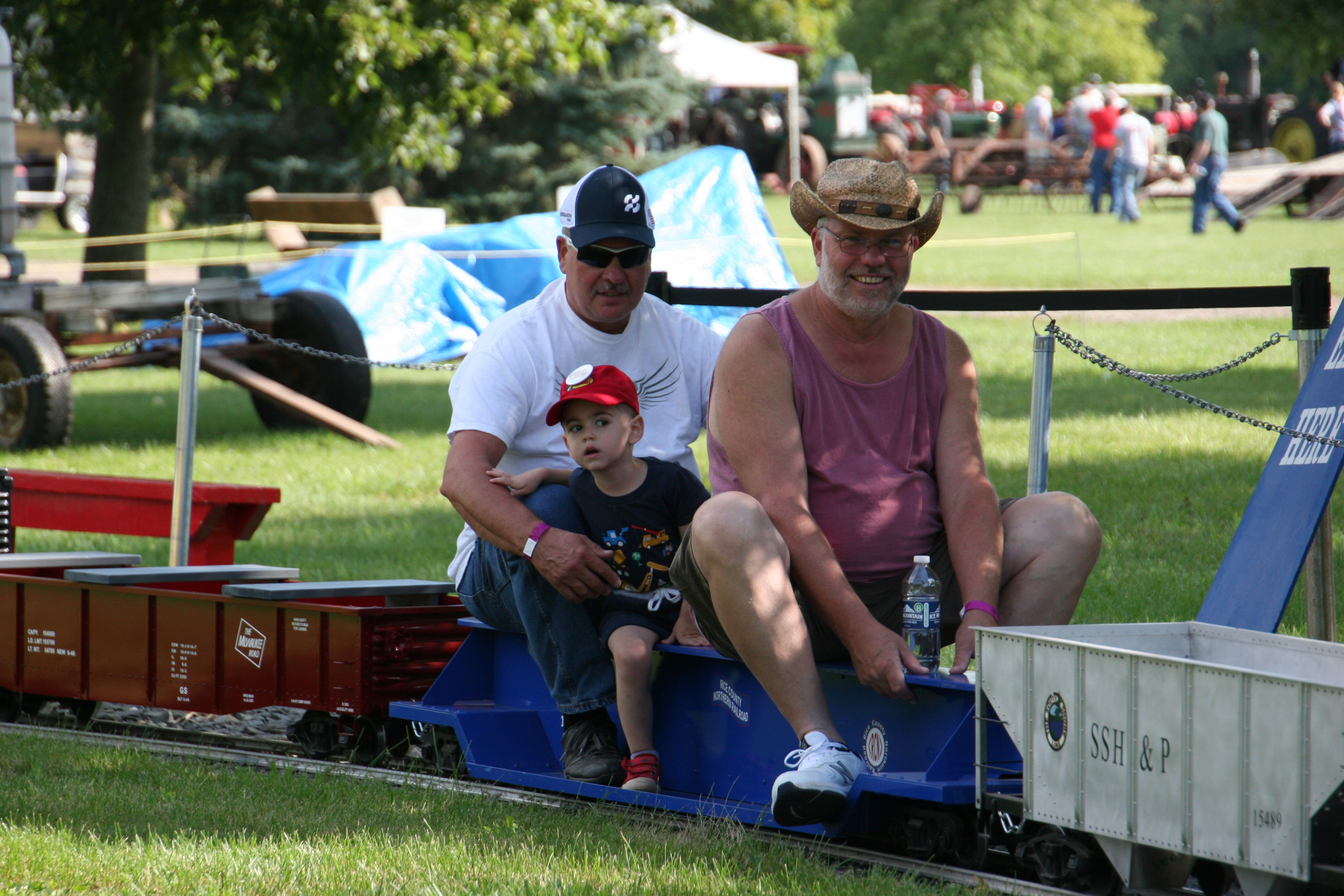
BARELY INSIDE THE GATES of the Rice County Steam & Gas Engines Show mid Friday morning, I boarded a train. It was an unexpected ride, this double loop around the tracks while straddling a slightly swaying model train car. I thought these free train rides were only for kids. Not so, the crew assured me.
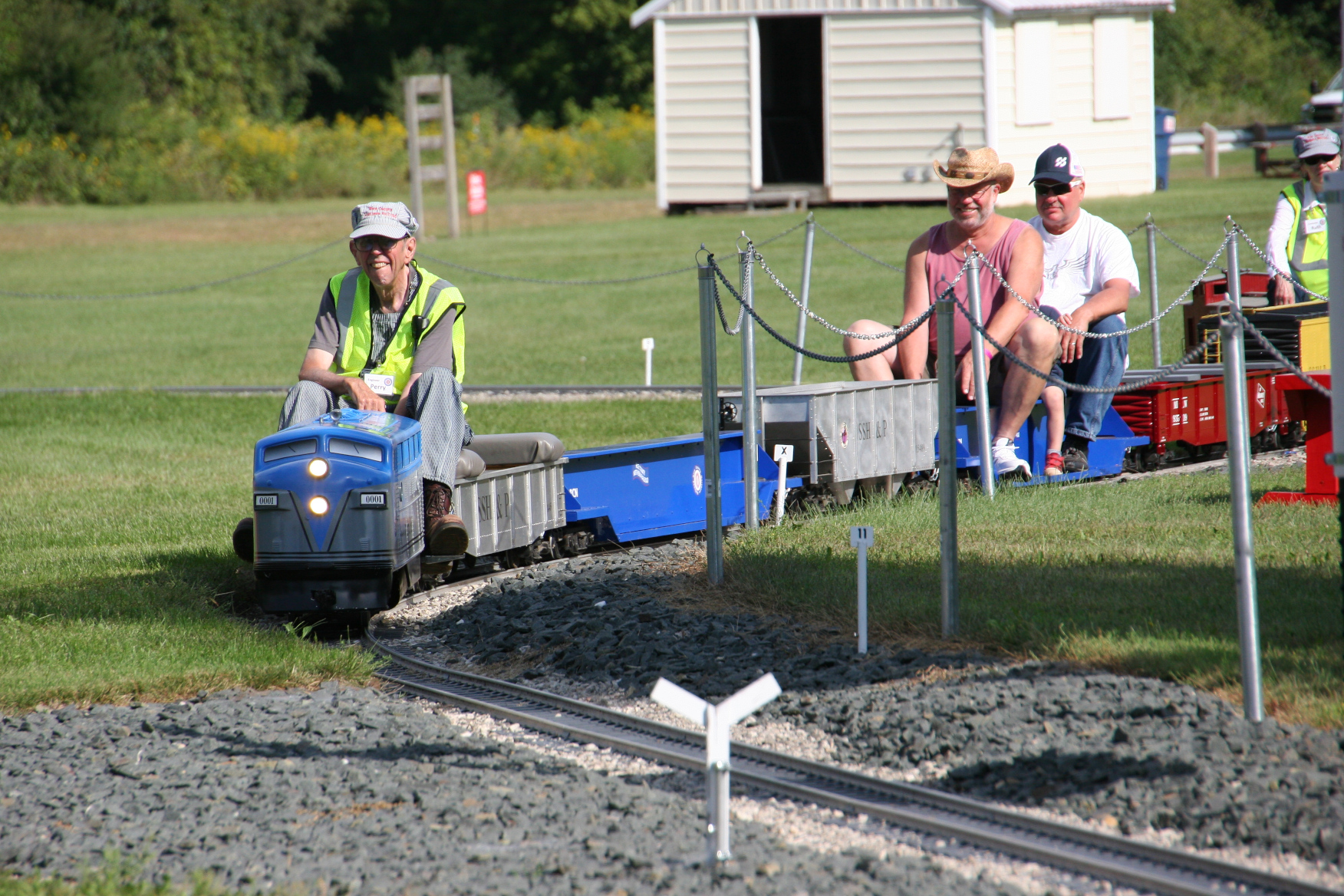
The model train carries all ages. (Minnesota Prairie Roots copyrighted photo September 2022)

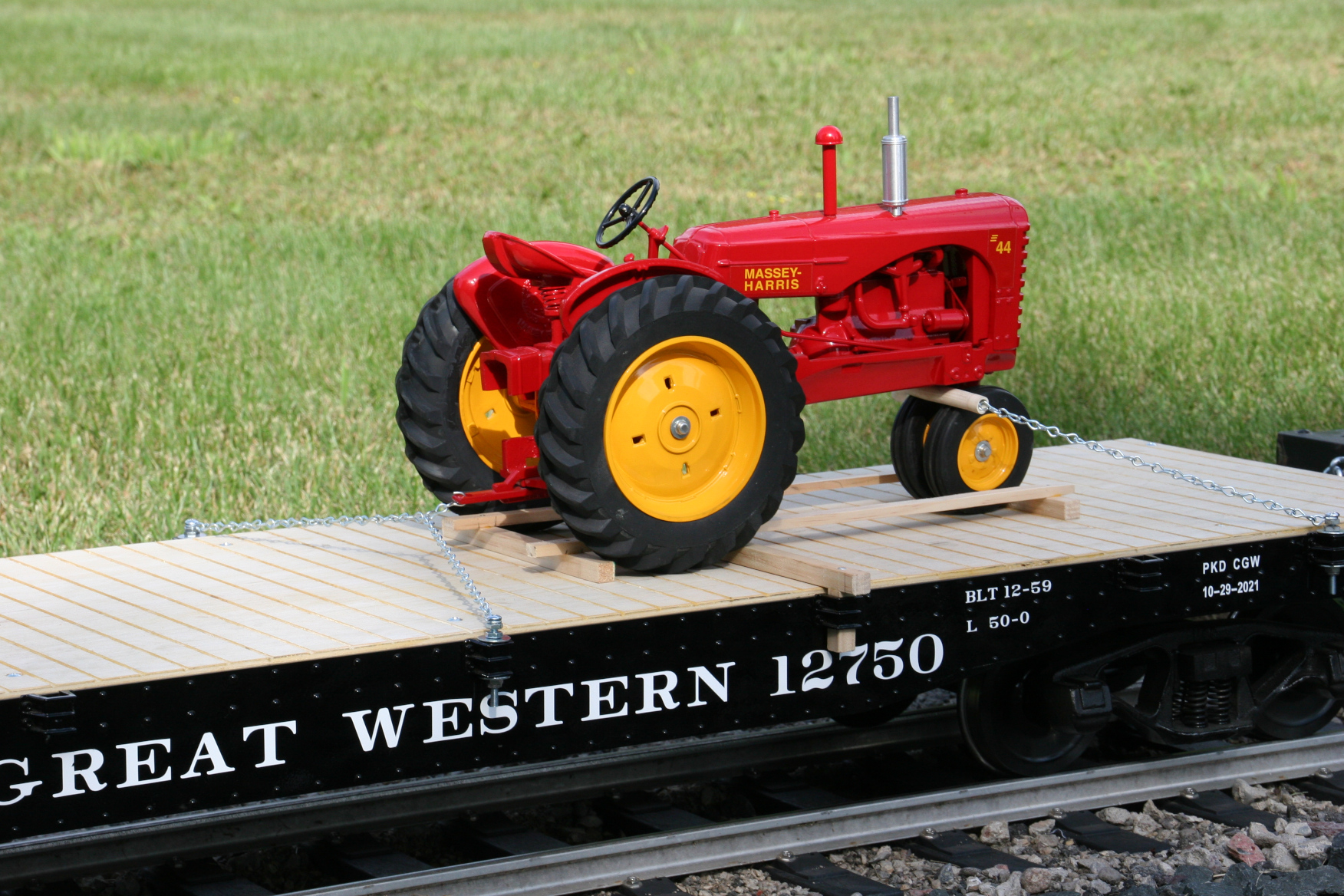
On a train car, a mini Massey-Harris the featured tractor. (Minnesota Prairie Roots copyrighted photo September 2022)

Riding the rails. Kids must be accompanied by an adult. (Minnesota Prairie Roots copyrighted photo September 2022)

When I disembarked, a preschooler sandwiched between two adults for his turn on the rails.
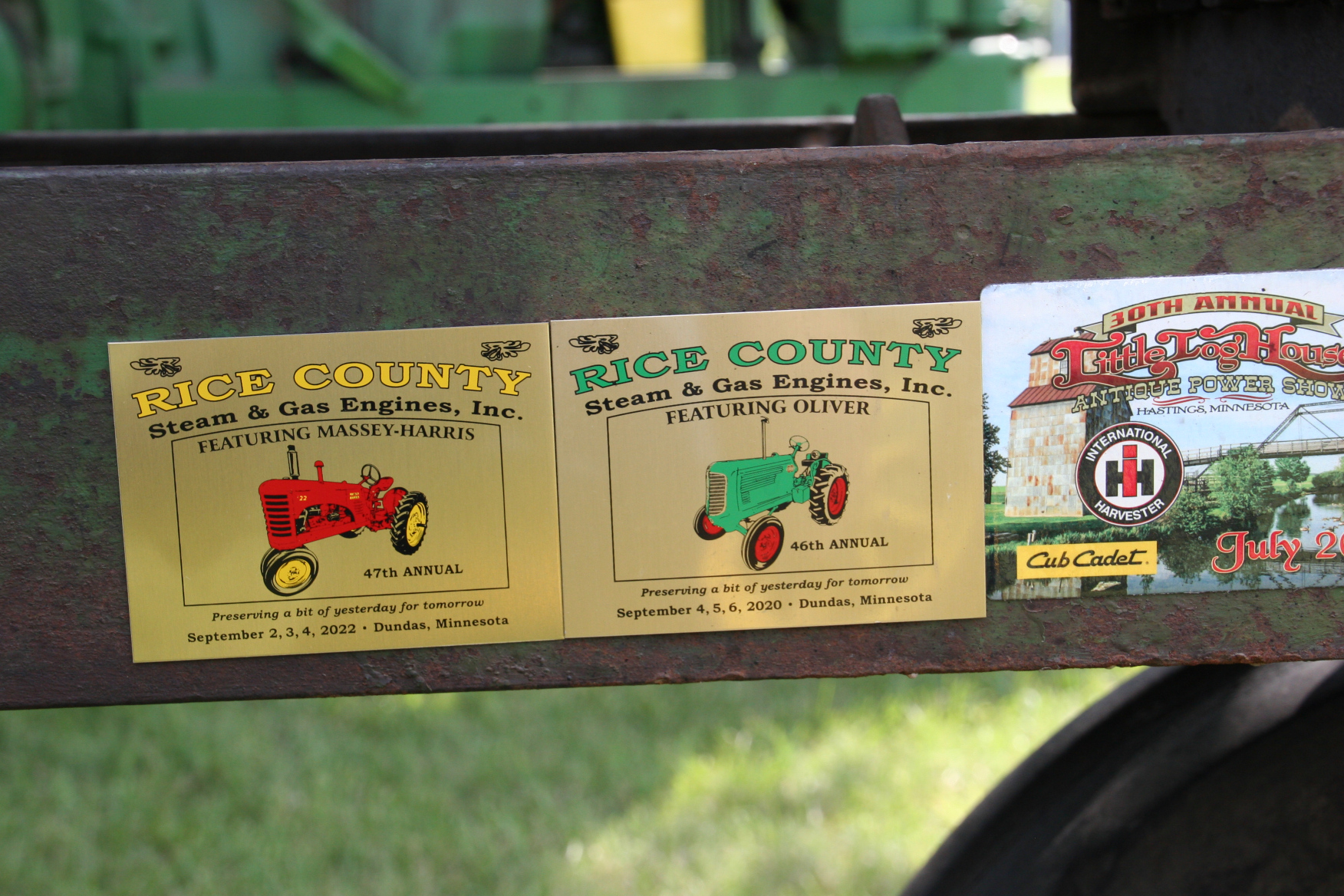
Photographed on a tractor, show stickers. (Minnesota Prairie Roots copyrighted photo September 2022)

What a fun way to begin my four hours at the show, which continues through Sunday at the event grounds south of Dundas, which is south of Northfield. This 47th annual gathering is about “Preserving a Bit of Yesterday for Tomorrow.” And that’s exactly what you will find here. Old. Aged. Vintage. Snapshots into the past. Farming as it was done back in the day. Agriculture/farming/rural life center the show.
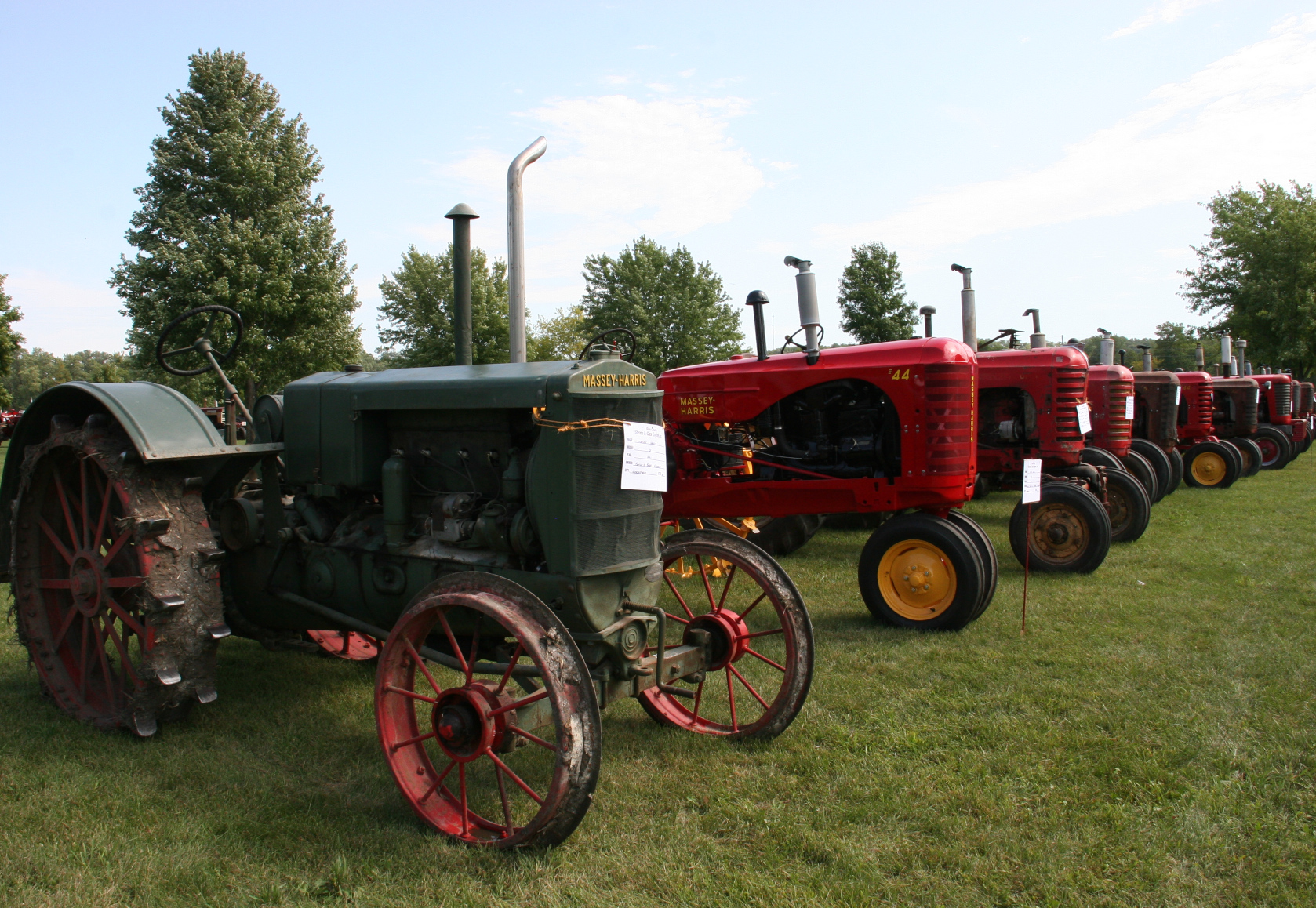
Massey-Harris tractors all in a row. (Minnesota Prairie Roots copyrighted photo September 2022)
Conversation while leaning on a John Deere. (Minnesota Prairie Roots copyrighted photo September 2022)
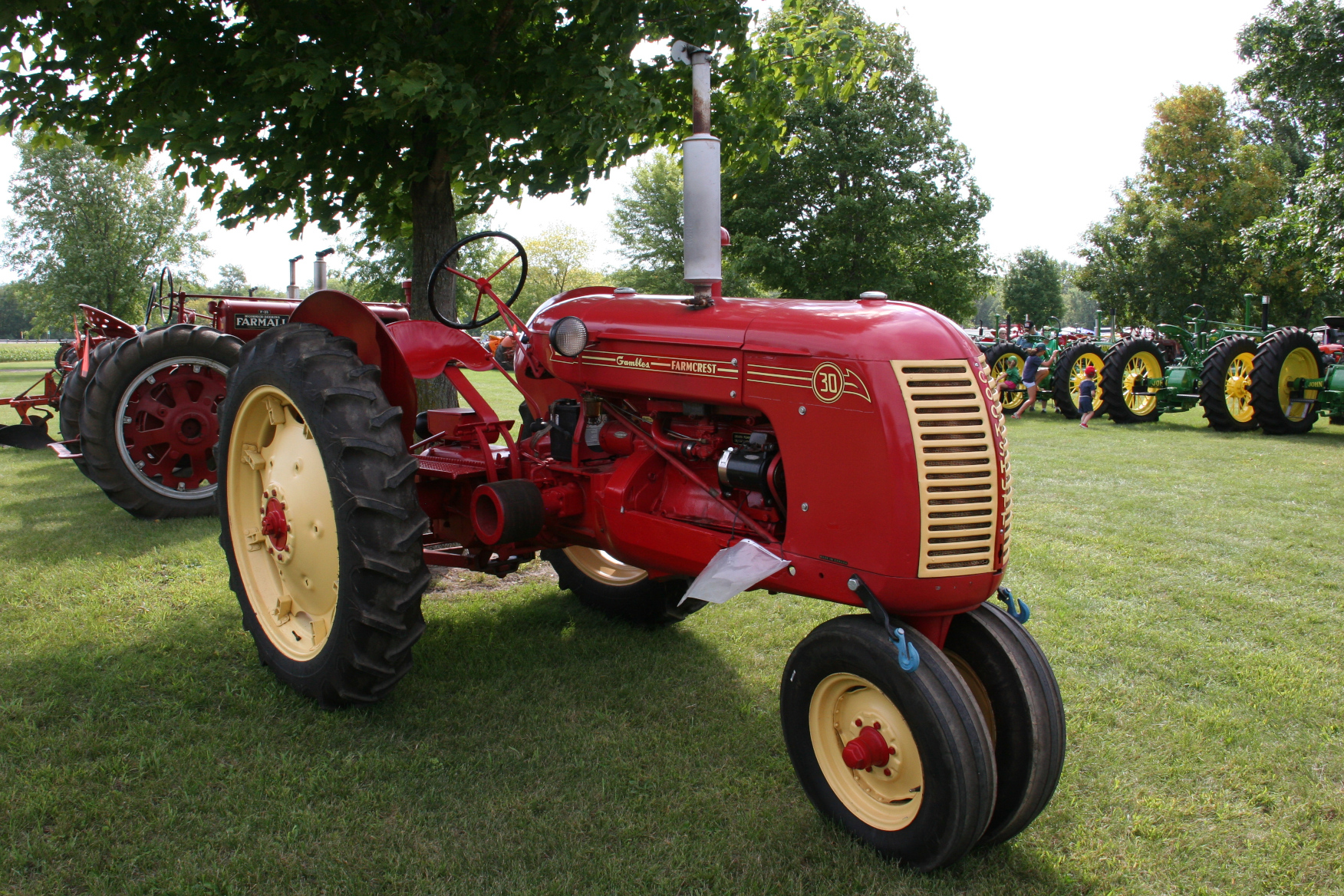
A tractor made by Cockshutt and marketed by Gambles. (Minnesota Prairie Roots copyrighted photo September 2022)

Vintage tractors are the focus with a field of tractors on display. This year’s featured brand is Massey-Harris. But brands ranging from the well-known John Deere, Allis Chalmers, International Harvester…to the rare Gambles line the grassy grounds.
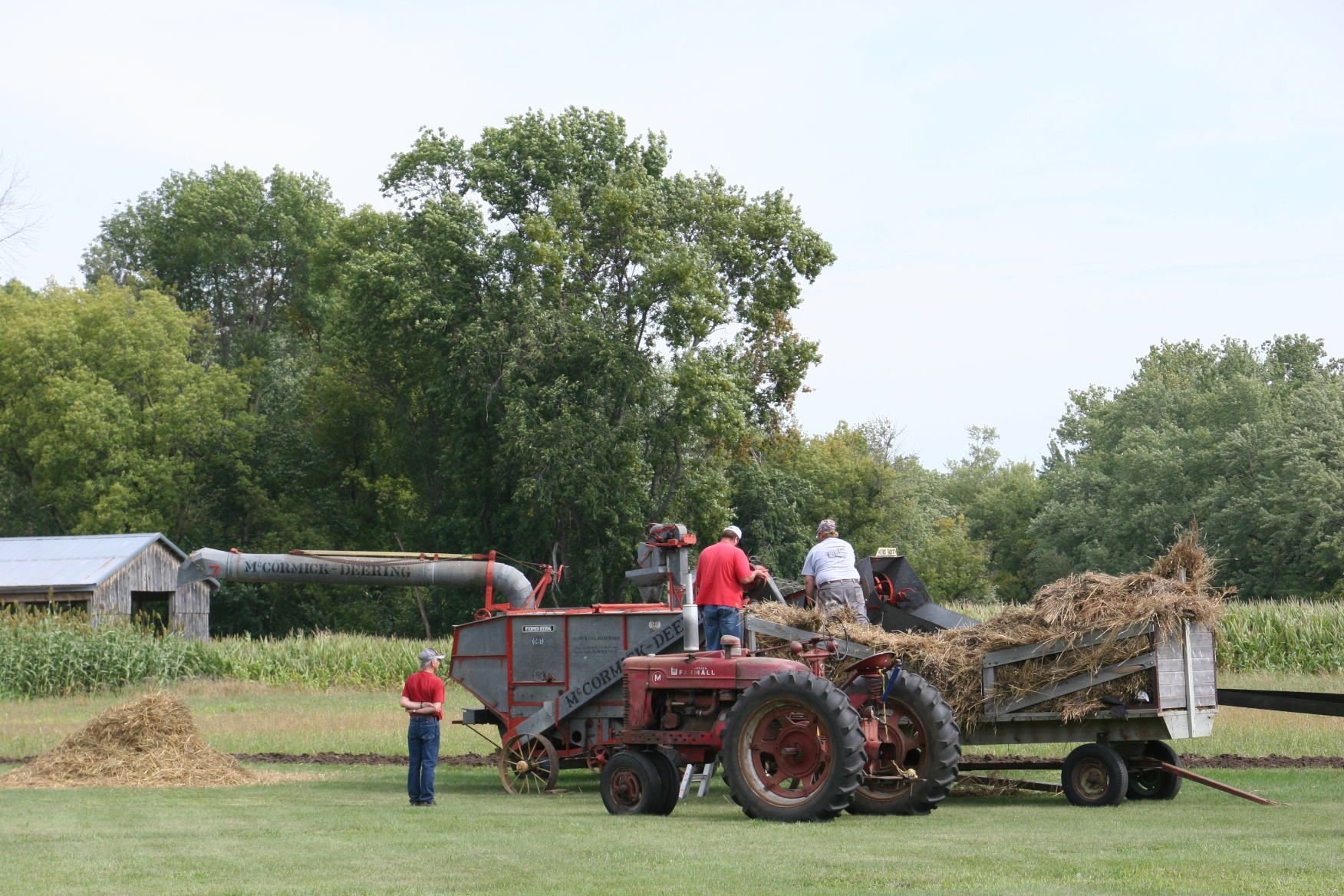
The threshing crew. (Minnesota Prairie Roots copyrighted photo September 2022)

Other farm machinery is also on-site, including a threshing machine, typically threshing oats, but under repair during my visit.
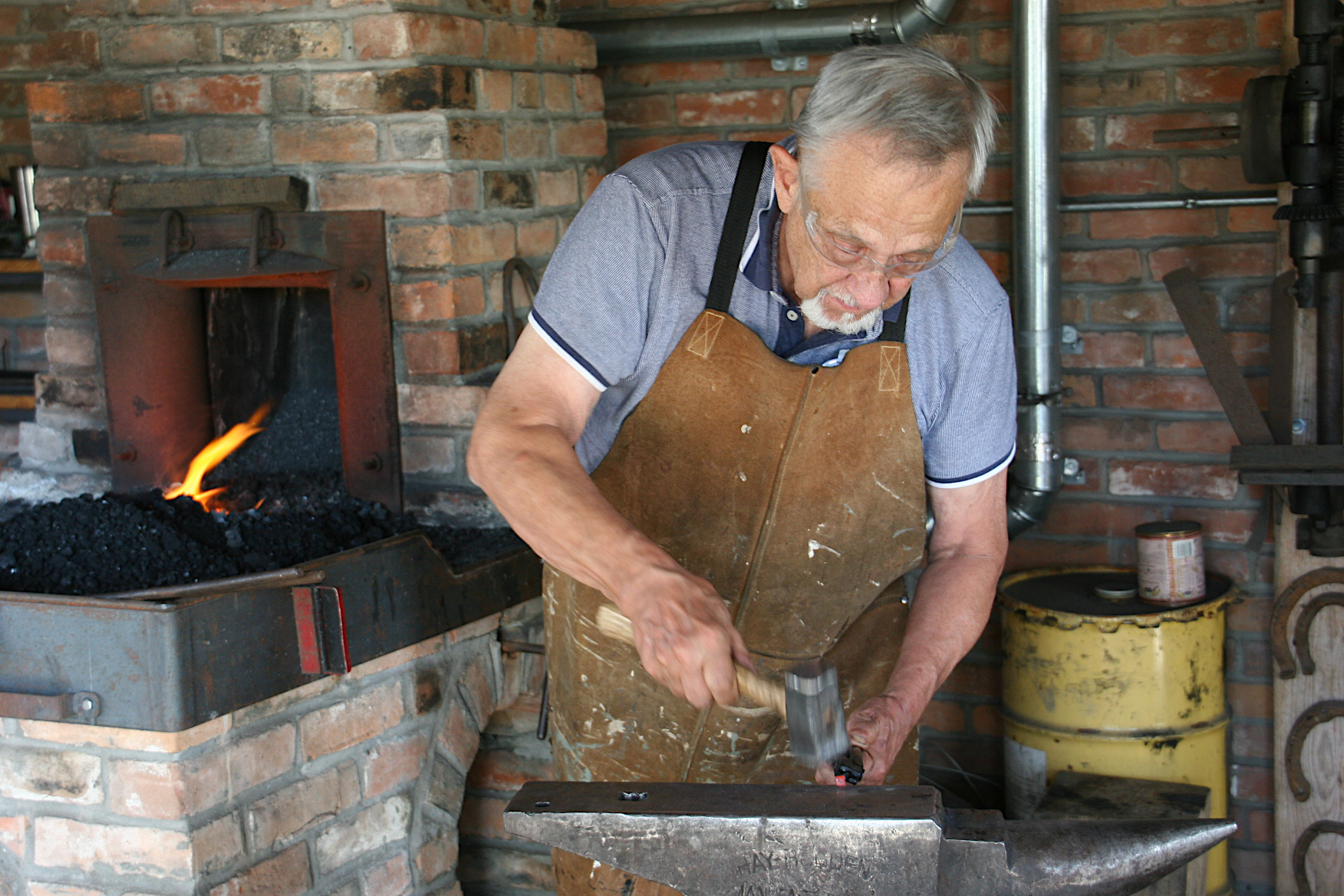
The blacksmith at work. (Minnesota Prairie Roots copyrighted photo September 2022)

There’s simply so much to see here, so much equipment to take in, so many demonstrations to watch. I observed blacksmithing and sorghum pressing. There’s also syrup making, corn shelling, flour milling, lumber sawing… Not all were up and running yet Friday morning.
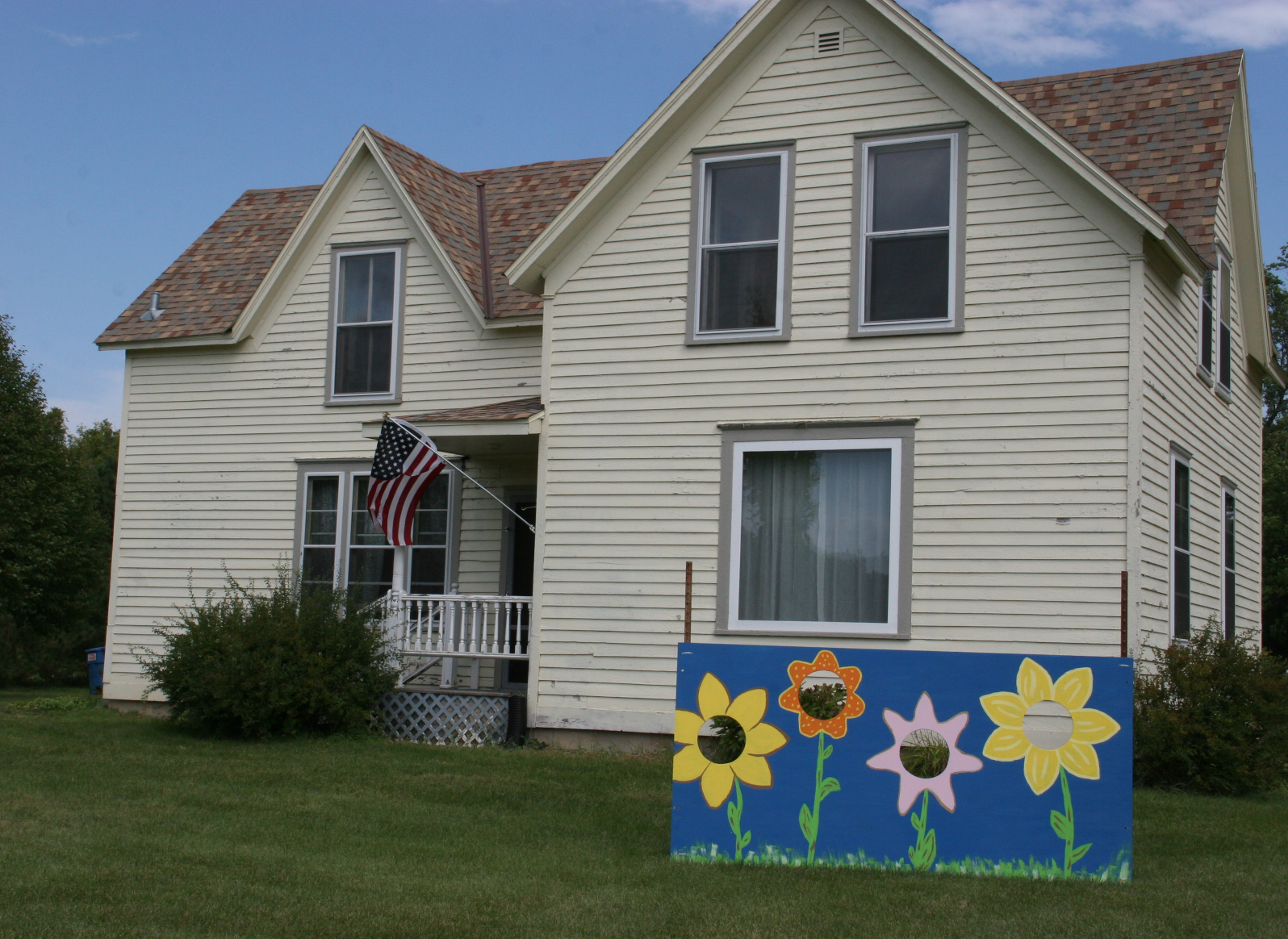
The 1912 farmhouse. (Minnesota Prairie Roots copyrighted photo September 2022)

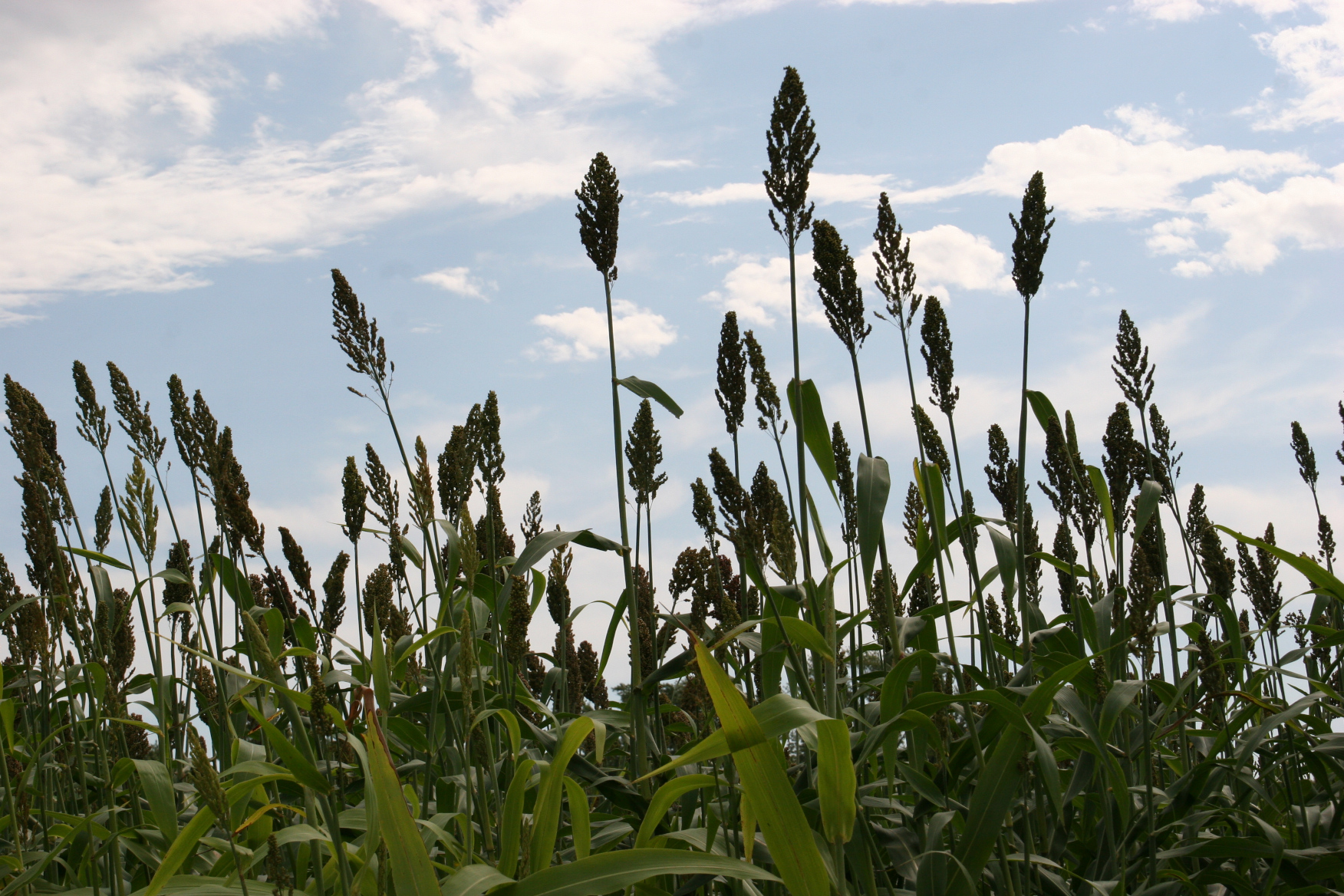
Sorghum towers in a field. (Minnesota Prairie Roots copyrighted photo September 2022)
Delicious cookies made with sorghum. (Minnesota Prairie Roots copyrighted photo September 2022)

While demonstrations are a major draw, so are the aged farm buildings moved onto the grounds. Inside the 1912 Drentlaw farmhouse, my friend Ruth served cookies made with sorghum.
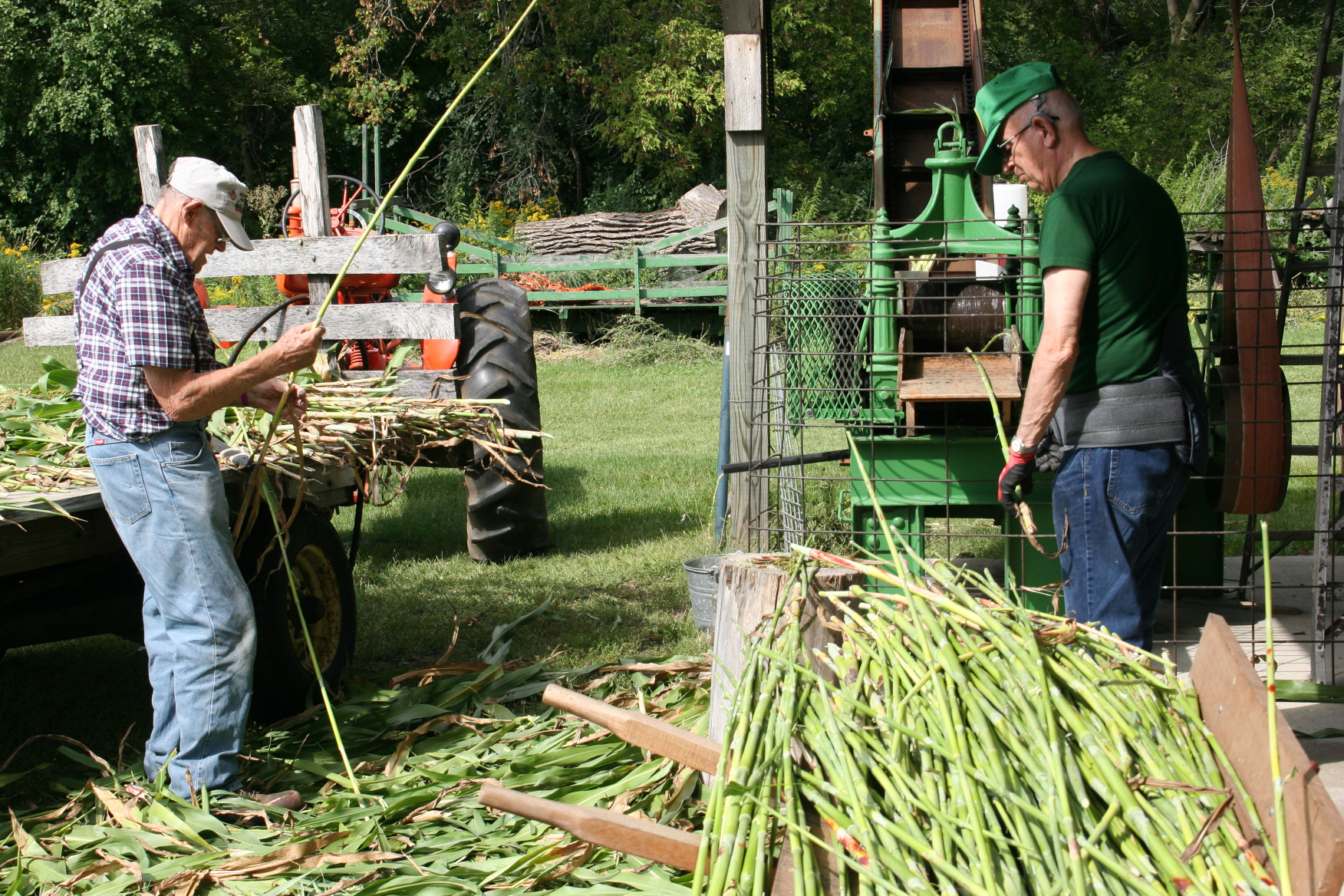
Pressing sorghum. (Minnesota Prairie Roots copyrighted photo September 2022)

Across the way, two men fed sorghum stalks into a press, liquid streaming into a bucket.
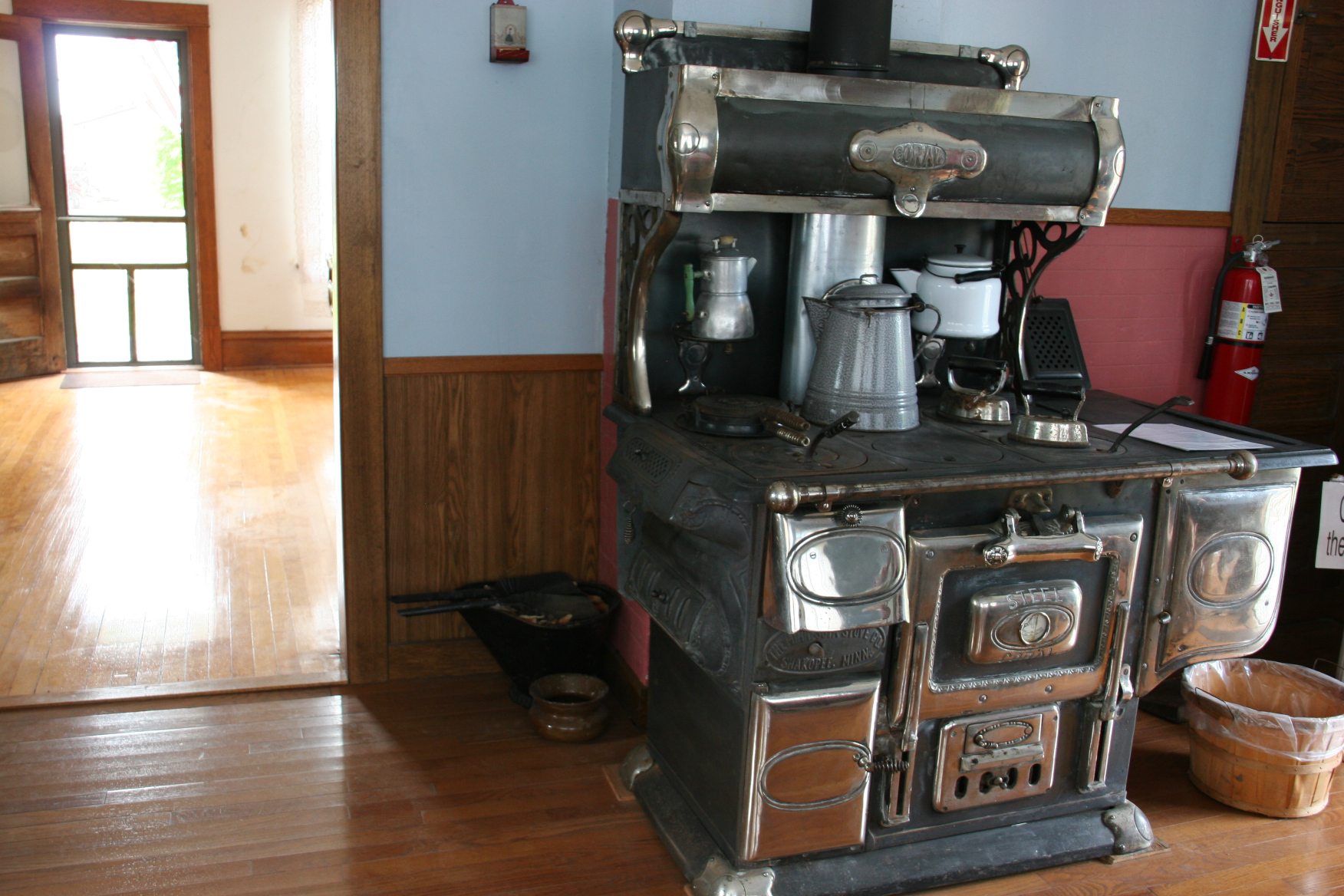
A massive stove defines the farmhouse kitchen. (Minnesota Prairie Roots copyrighted photo September 2022)

As I walked upon the wood floors of the farmhouse, I felt immersed in the past. A wood-burning stove anchors the small kitchen where a water dipper rests in an enamelware bowl in the sink. Embroidered dish towels drape a drying rack.
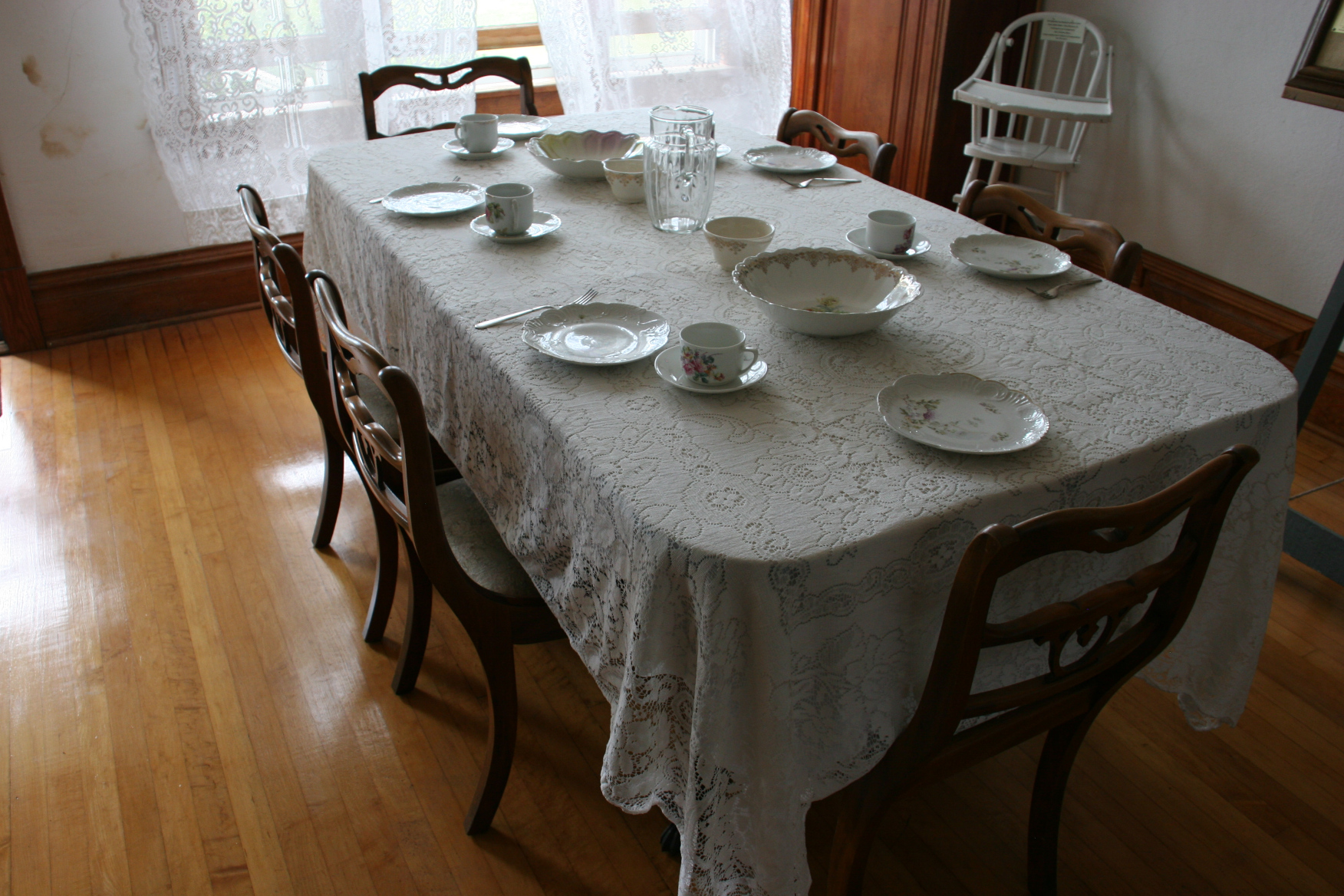
The dining room table set for guests. (Minnesota Prairie Roots copyrighted photo September 2022)

In the dining room, with fine china set upon a lace-covered table, the morning breeze billowed lace curtains.
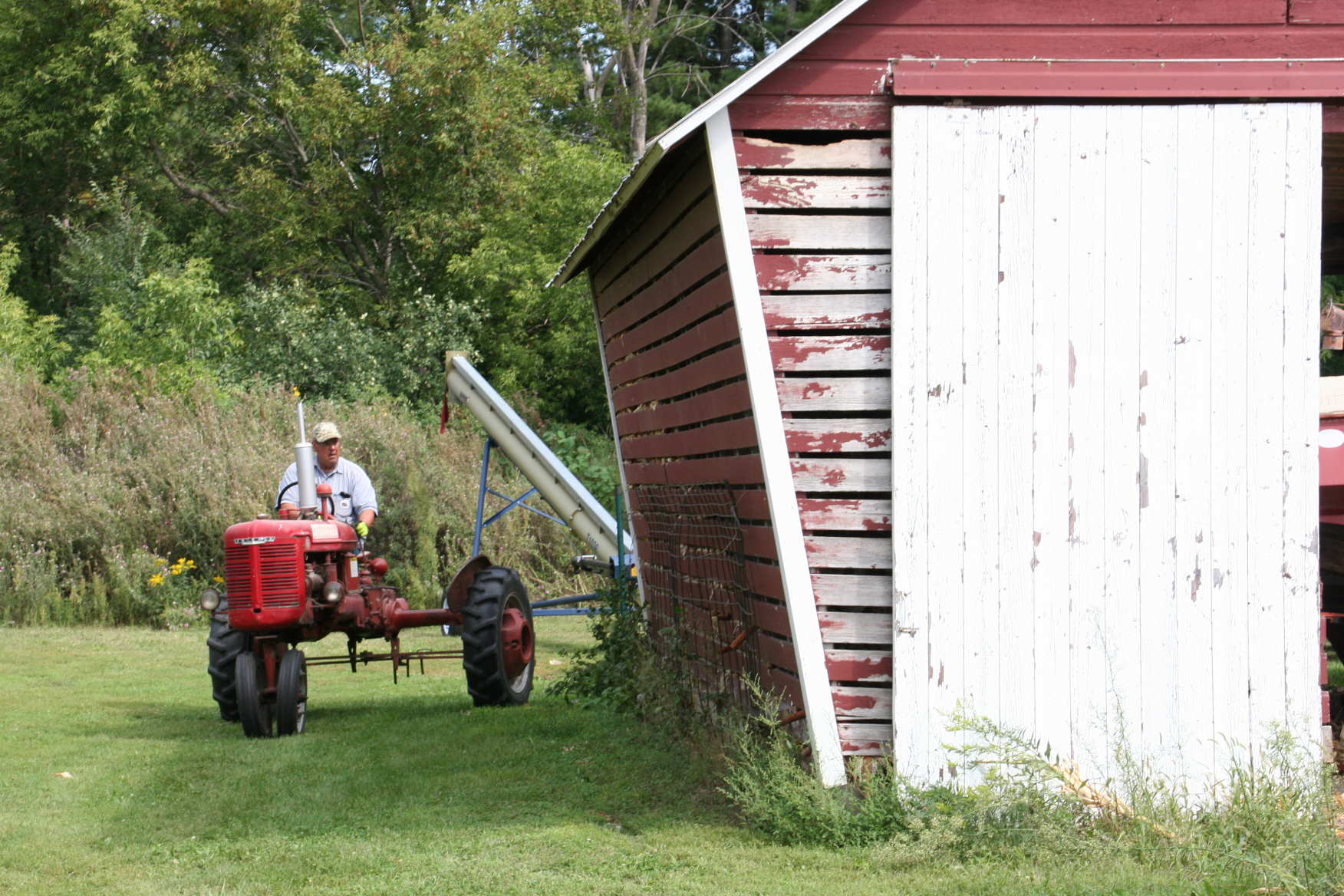
Rounding the corn crib… (Minnesota Prairie Roots copyrighted photo September 2022)

Outside the main house sits a summer kitchen with a corn crib and granary nearby. Replicating a farm site of yesteryear seems a goal. As a farm girl, I appreciate these efforts to preserve a bit of yesterday. Our Minnesota agrarian history needs to be shared at events like this which connect all ages to a way of life that is quickly vanishing.
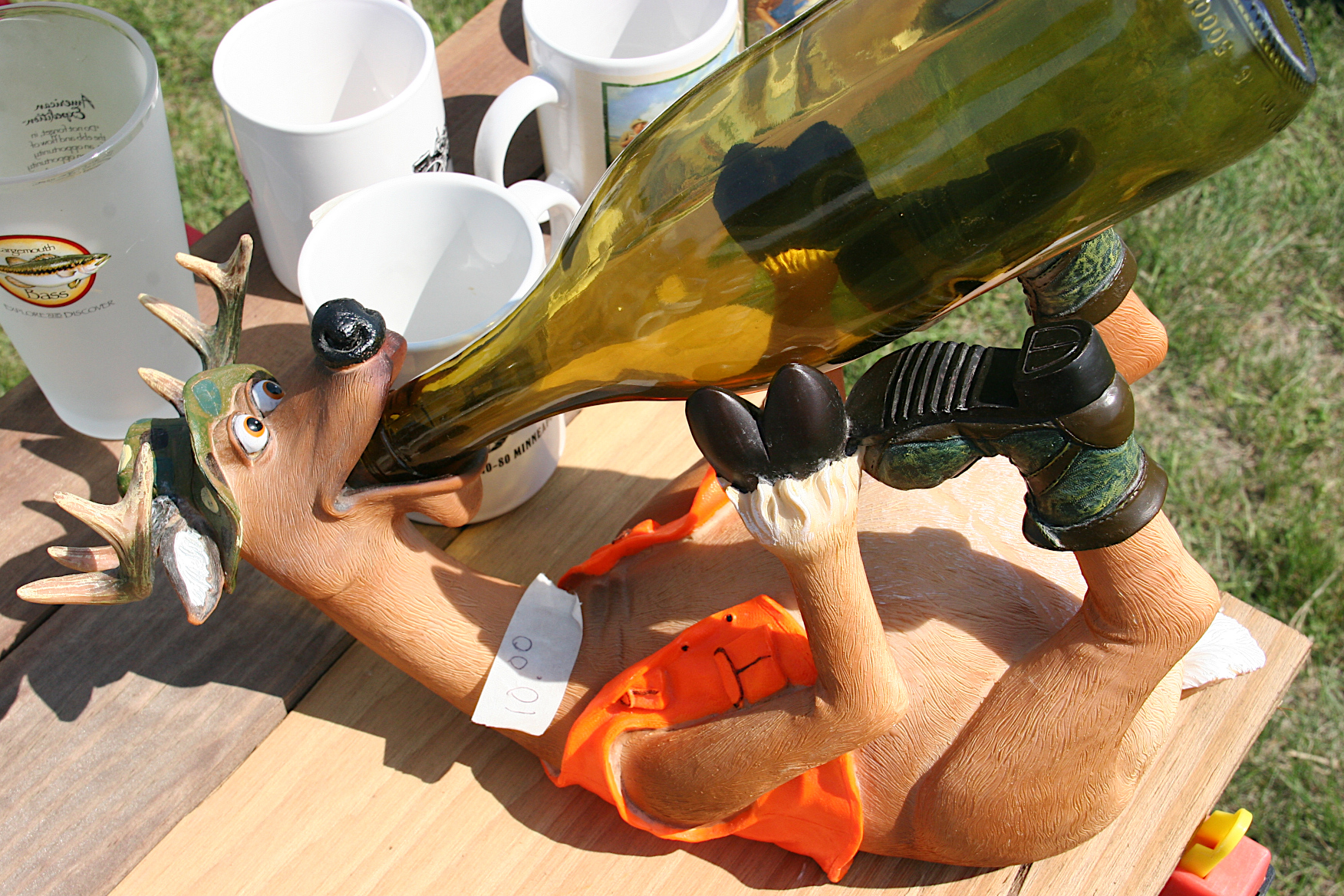
My oddest find at this year’s flea market. (Minnesota Prairie Roots copyrighted photo September 2022)

Even the flea market connects attendees to the past where old stuff mixes with crafts and an assortment of other merchandise. Every time here, I challenge myself to find oddities, weird whatever that makes me do a double take. This year’s vendors did not disappoint me.

A burger basket from the Northfield Knights of Columbus. (Minnesota Prairie Roots copyrighted photo September 2022)

Nor did the food. Vendors offer an assortment of tasty food and beverages ranging from burgers and fries to Mexican food, milkshakes, lemonade, kettle corn, mini donuts and more. It’s all about food and conversation and watching the daily tractor parade at noon while seated at a picnic table in the Food Pavilion.

One of three musicians in the band Steam Machine performs Friday afternoon. (Minnesota Prairie Roots copyrighted photo September 2022)

Over in the poleshed style music building, I listened to the bluegrass band Steam Machine. A couple danced across the cement floor, nearby hay racks piled with oats bundles. I photographed, then attempted to cool down after too much time in the heat and humidity.
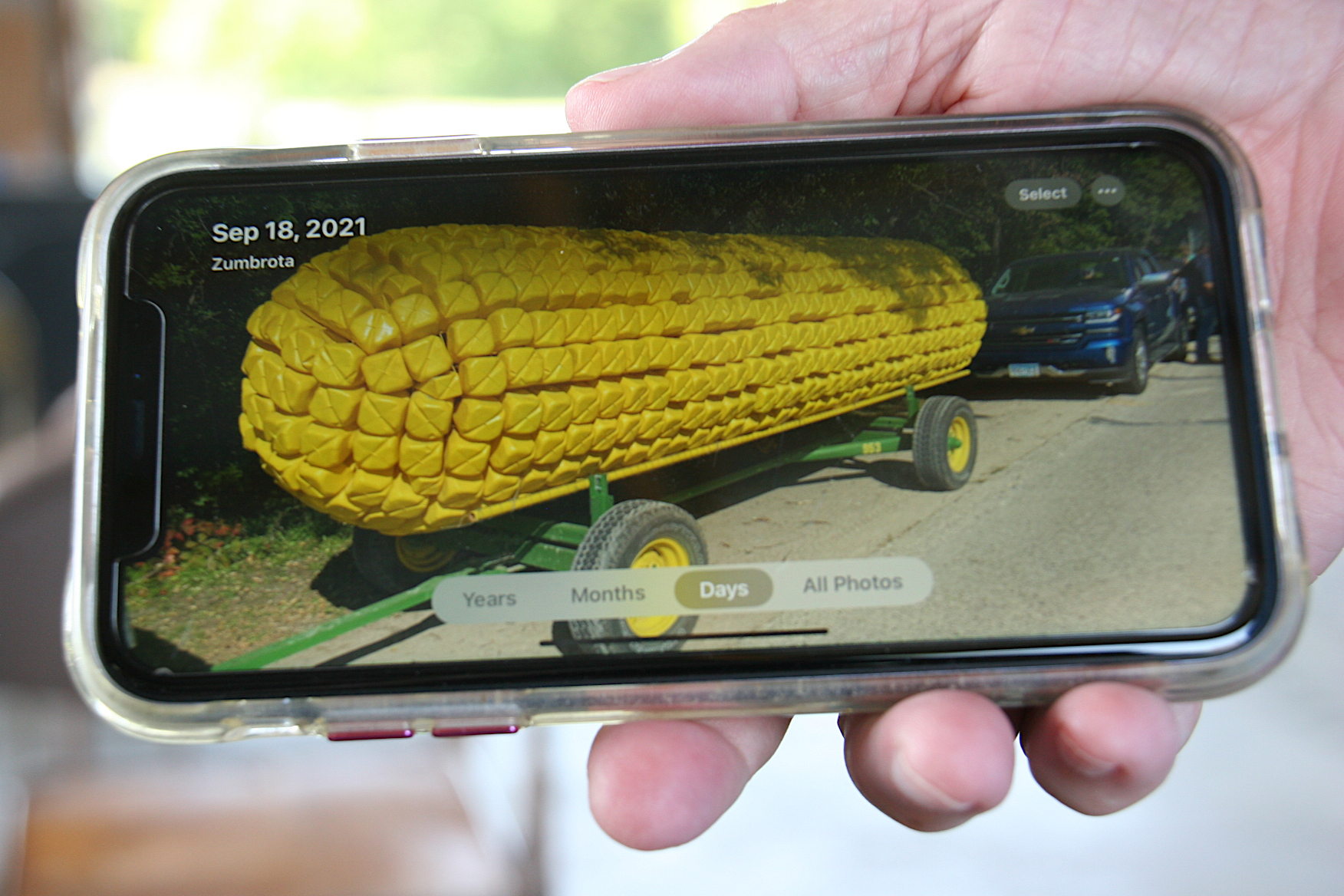
A gigantic ear of corn made of milk jugs. (Minnesota Prairie Roots copyrighted photo September 2022)

Another music appreciator stepped off her golf cart to show me a photo on her phone—an image of an over-sized ear of corn crafted from 1,000 gallon milk jugs by her cousin in Wisconsin and gifted to her. He’s made six. The corn art will be displayed at the 22nd Annual Corn Shredding Autumn Harvest Days on September 24 and 25 in rural Lake City.
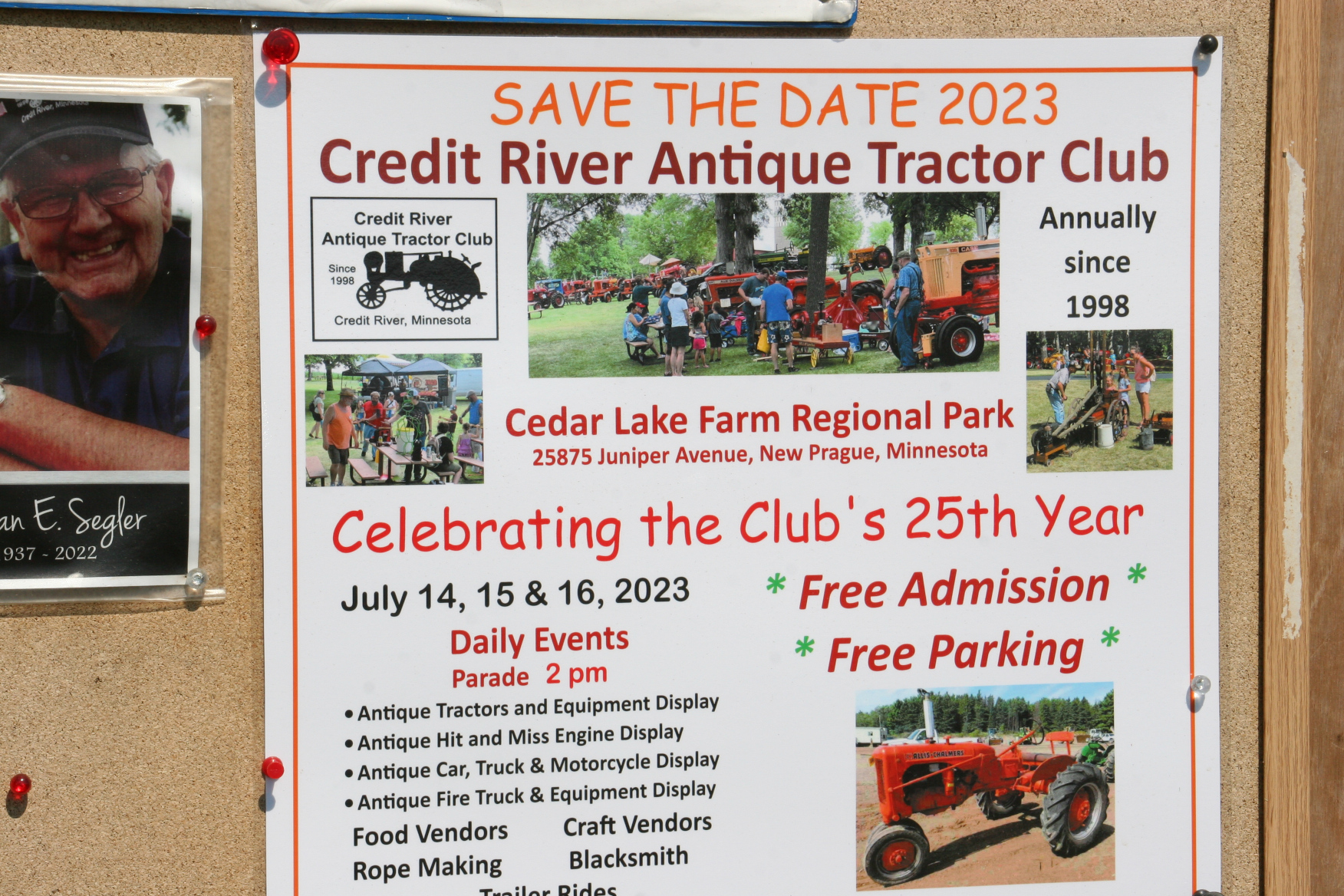
A poster promotes the 2023 Credit River show. (Minnesota Prairie Roots copyrighted photo September 2022)

I love how so many people care about our agricultural history. That includes the guys from the Credit River Antique Tractor Club who were selling raffle tickets for a 1952 Ford 8N tractor. Their annual show is set for July 14-16, 2023, in rural New Prague.
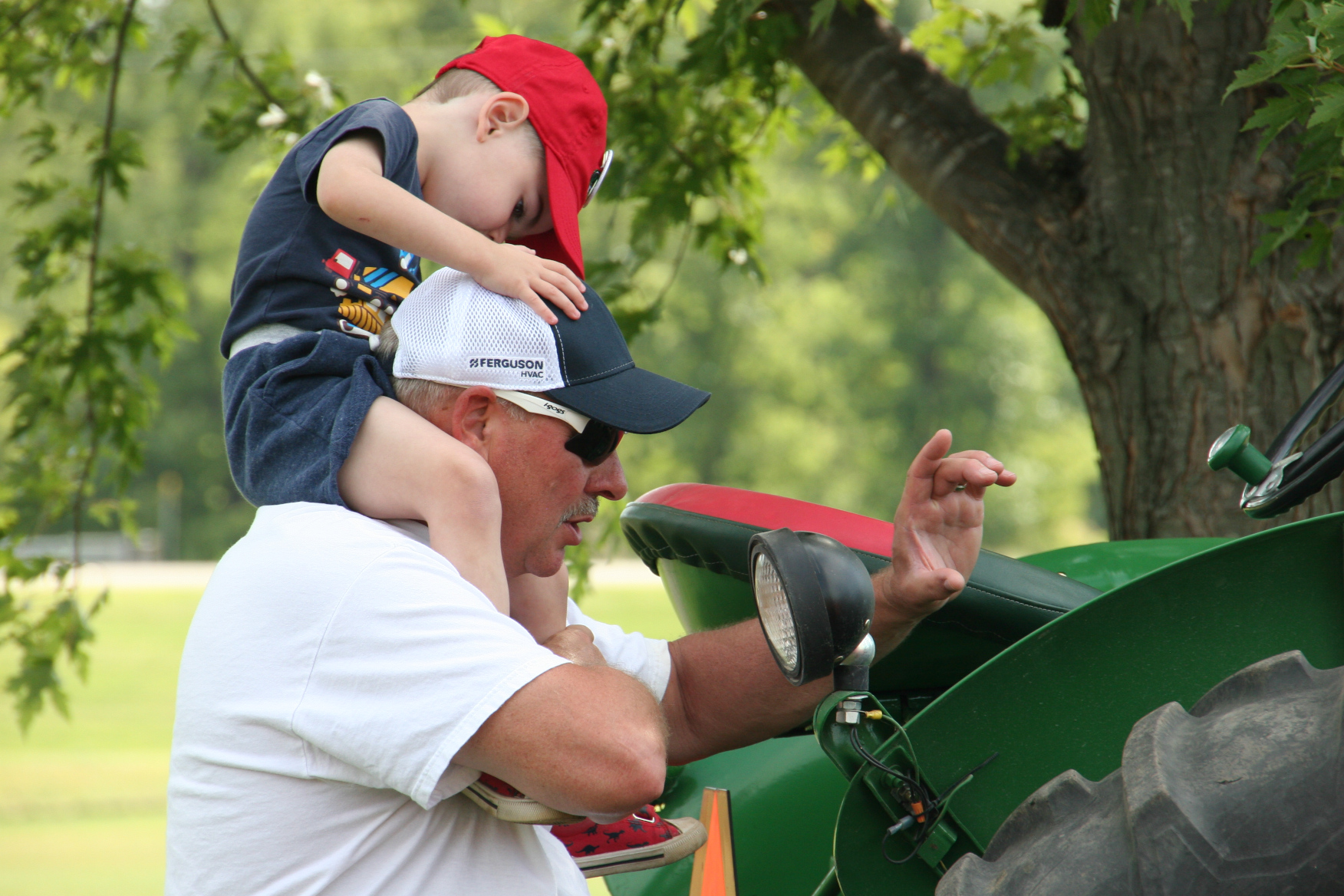
Teaching the younger generation about tractors. (Minnesota Prairie Roots copyrighted photo September 2022)

The Rice County folks will be back, too, in 2023, “Preserving a Bit of Yesterday for Tomorrow.” There will be a tractor parade, a Kids Pedal Pull, demonstrations, tractors galore and, oh, so much more at the Labor Day weekend show. Even train rides…

#

FYI: Visit the Rice County Steam & Gas Engines website for more information. The show continues Saturday and Sunday from 7 am – 5:30 pm. Admission cost for the entire weekend is $10 with 12 and under admitted for free.

The club also hosts a Swap Meet and Flea Market on Memorial Day weekend and Minnesota Military Days in June.

© Copyright 2022 Audrey Kletscher Helbling


New Minnesota State Fair food features duck eggs from Graise Farm August 26, 2022

All Quacked Up! open-faced sandwich. (Photo source: The Hideaway Speakeasy Facebook page/Minnesota State Fair)

WHEN MY FAIR-THEMED FOOD POST published yesterday, I had no idea that duck eggs from a rural Faribault farm are the focus of a new Minnesota State Fair food.

But then a newsletter from Graise Farm landed in my email Thursday morning and I knew immediately I needed to share this fair food update. Duck eggs from the farm owned by Tiffany Tripp and Andy Olson are featured in All Quacked Up!, a new open-faced sandwich created by The Hideaway Speakeasy. This is kind of a big deal for co-owners of this farm north of Cannon City, which is northeast of Faribault.

Graise Farm eggs, photographed at the Cannon Valley Farmers’ Market. (Minnesota Prairie Roots copyrighted file photo May 2021)

On Tuesday, Andy delivered 2,600 duck eggs to the Hideway fair location in the upper grandstand veranda area. Graise Farm has committed to providing 5,000 eggs.

Besides my excitement for Tiffany and Andy, who truly are deserving of this sale and the resulting exposure this will give their business, I love the name. All Quacked Up! is memorable and just plain fun. And even if I’m not a fried egg foodie, the sandwich sounds tasty. Here’s its description:

Fried, farm-fresh duck egg from Graise Farm in Faribault atop shaved smoked ham, aged cheddar cheese, tomato and spinach, served open-face on toasted sourdough bread with paprika aioli.

When I consider a fried egg sandwich, I think of my dairy and crop farmer father who often ate fried eggs for breakfast. Chicken, not duck, eggs. Plain, not fancy. Fried in lard, seasoned with salt and pepper. I can picture him now in his striped bib overalls, forking mouthfuls of egg, the yolk running across his dinner plate. And then, when the egg was mostly gone, he sopped up the remaining yolk with a slice of toasted homemade bread.

I expect many other farm kids share that fried egg memory. Perhaps even Tiffany, who left the family farm after earning degrees in agricultural economics and Spanish to work and travel the world, then returned to the family farmstead in 2012. Andy isn’t a farm kid. But, together he and Tiffany embrace rural life, sharing their passions of “raising animals humanely and eating healthy, delicious food grown locally.” Their animals are pasture-raised and/or organic-fed, including those free-range ducks.

You’ll find Graise Farm eggs at this food co-op in Northfield, Minnesota. (Minnesota Prairie Roots copyrighted photo October 2021)

The pair raises ducks, chickens, pigs and goats. They sell eggs, pork, and stew chickens and ducks. For more information, visit the Graise Farm website, which lists locations to buy those typically jumbo-sized duck eggs. And, yes, that includes in the Twin Cities metro.

#

FYI: Tiffany was instrumental in establishing the Cannon Valley Farmers’ Market with food and products from small-scale farmers and producers in the Cannon River Valley. In the warm weather months, that market is open from 4 – 7pm Thursdays at the Rice County Fairgrounds in Faribault. Cold weather moves the market indoors to the Faribo West Mall.

Copyright 2022 Audrey Kletscher Helbling


Spring planting in Minnesota & why I care May 25, 2022

Filed under: Uncategorized — Audrey Kletscher Helbling @ 5:02 AM
Tags: , , , , , , , ,
Seed source, rural Elgin, Minnesota. (Minnesota Prairie Roots copyrighted photo May 2022)

THE 2022 PLANTING SEASON has proven exceedingly challenging for Minnesota farmers. A late spring with unseasonably cold temps, coupled with too much rain, has delayed seeding of corn and soybeans.

A picturesque farm site in southern Minnesota, field in the foreground. (Minnesota Prairie Roots copyrighted photo May 2022)

Some areas of our state have experienced widespread flooding, creating muddy conditions and lakes. Not exactly what farmers need in May. To add to that, destructive storms damaged or destroyed farm buildings and equipment, especially in the western region of Minnesota.

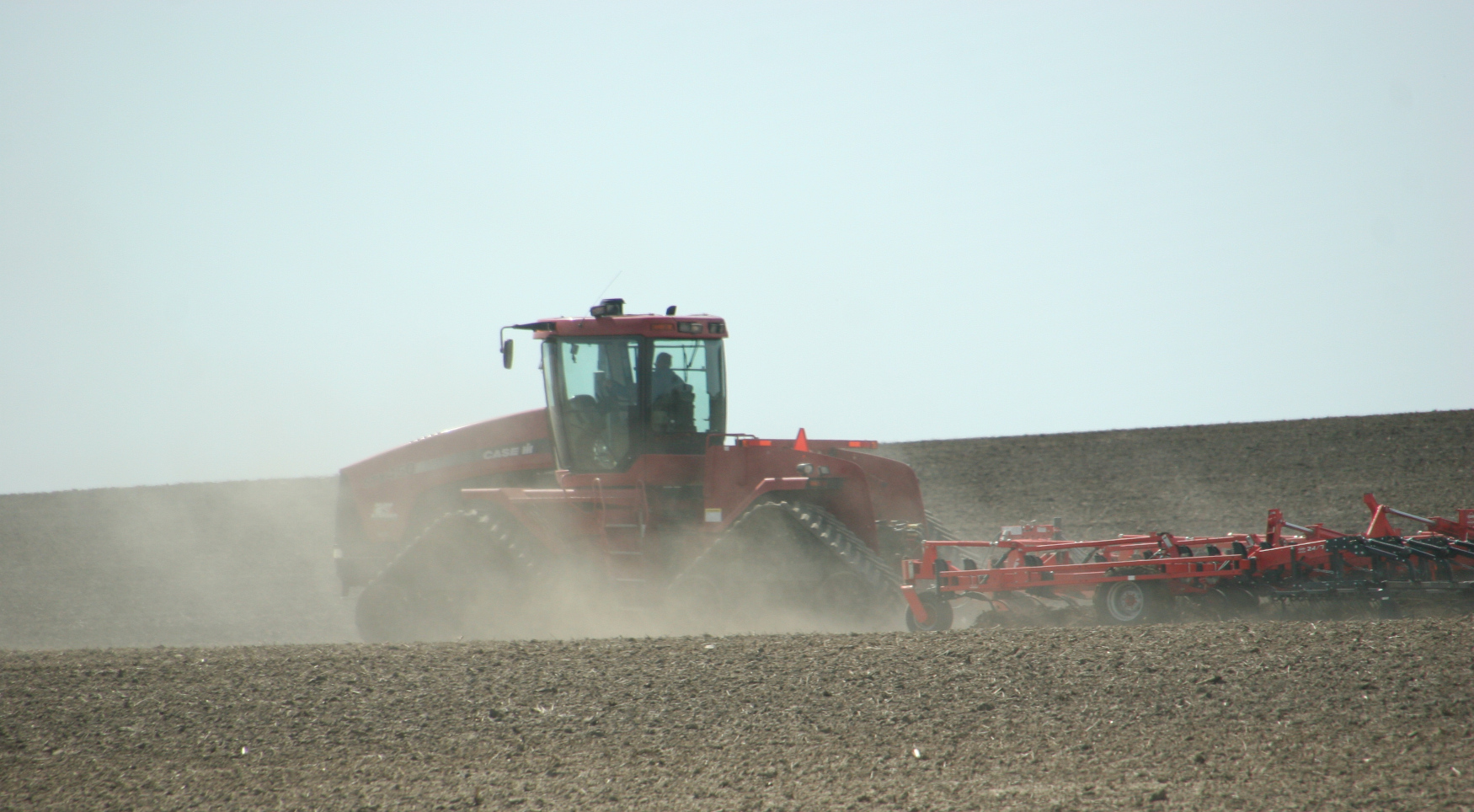
Soil type and topography (here on a hillside) affect tilling and planting, along with the biggest factor, weather. (Minnesota Prairie Roots copyrighted photo May 2022)

Corn planting data from the United States Department of Agriculture (updated every Monday) shows below average planting progress throughout the Midwest, West and in some states east of Illinois. In Minnesota, only 60 percent of the corn was planted as of May 23. That compares to 98 percent last year and a 5-year average of 86 percent. That puts into perspective the 2022 planting delays.

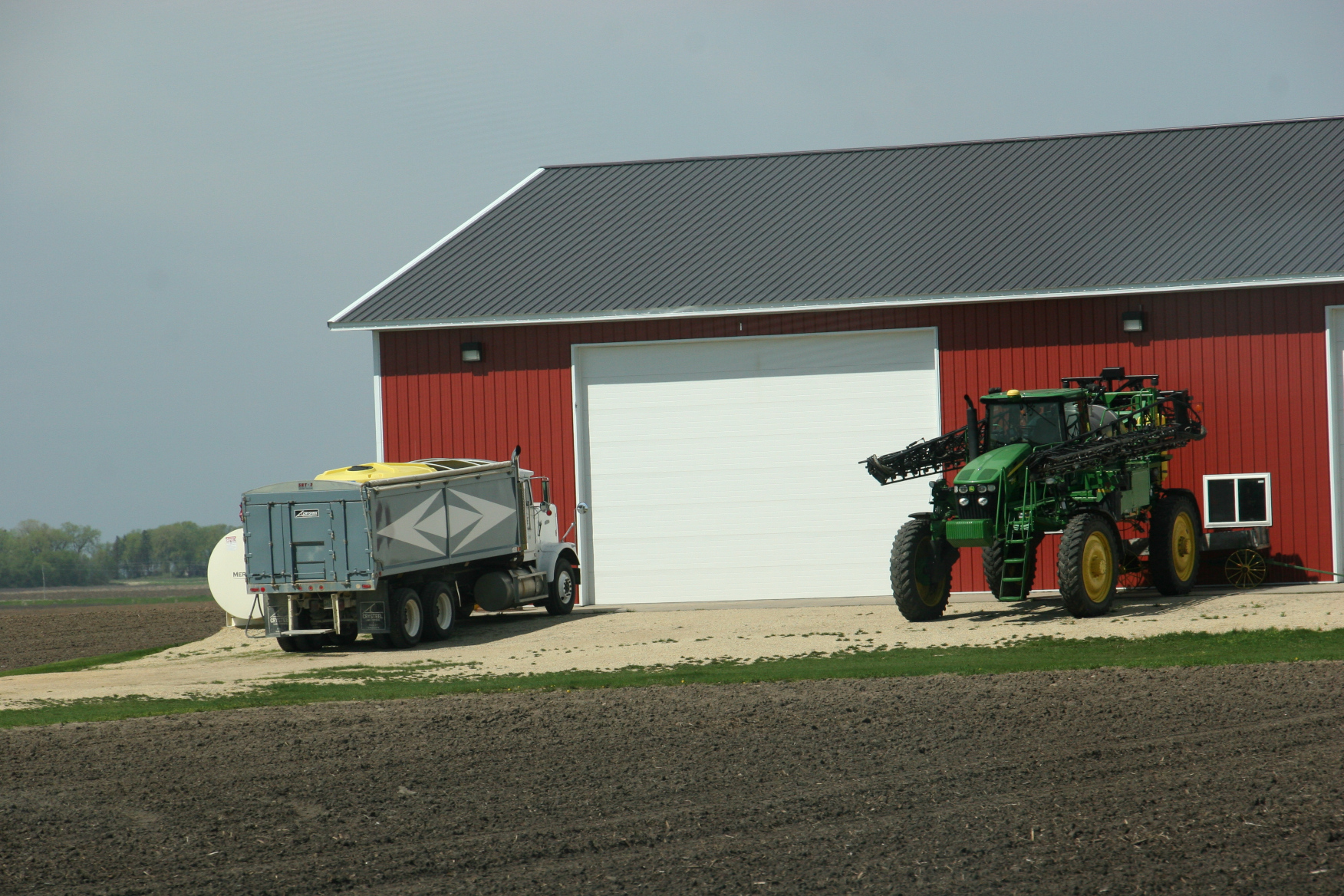
Equipment, outside a farm outbuilding, ready for spring field work. (Minnesota Prairie Roots copyrighted photo May 2022)

Yet, if you farm, you realize a stretch of good weather can quickly change everything for the good. Time will tell how this all plays out.

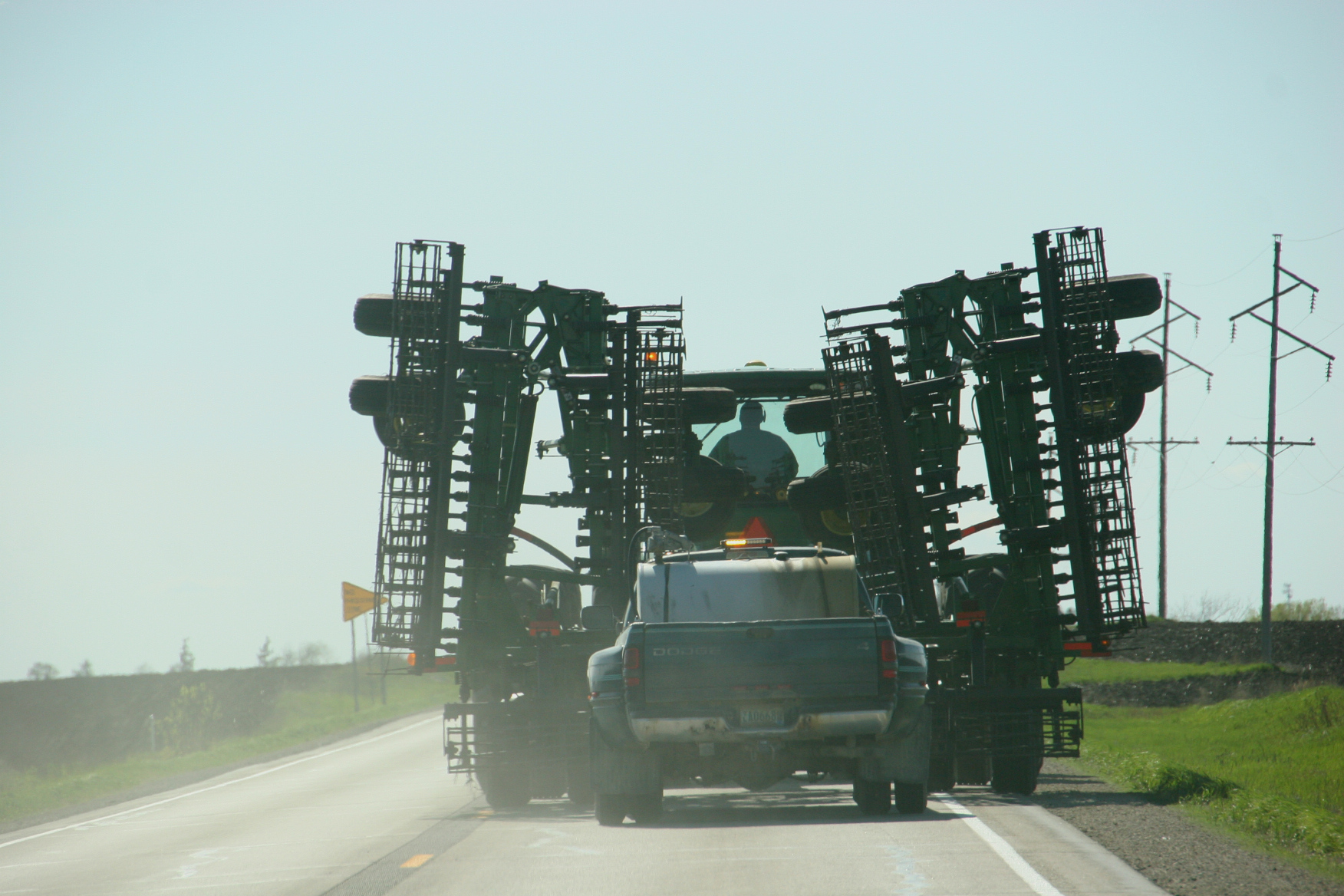
Following farm equipment on Minnesota State Highway 60. This is a common sight in spring which requires patience and caution by motorists. (Minnesota Prairie Roots copyrighted photo May 2022)

I find it interesting that, nearly 50 years removed from the farm, I still pay attention to spring planting, and, later, harvest. I have friends who farm. But, more than that, farming is part of my history, part of who I am, even as an adult decades distanced from living on the land. I am proud of my rural heritage. It shaped me. It grew me. I see that rural influence in my writing, my photography, in the places I value and, I suppose, even in the way I live my life.

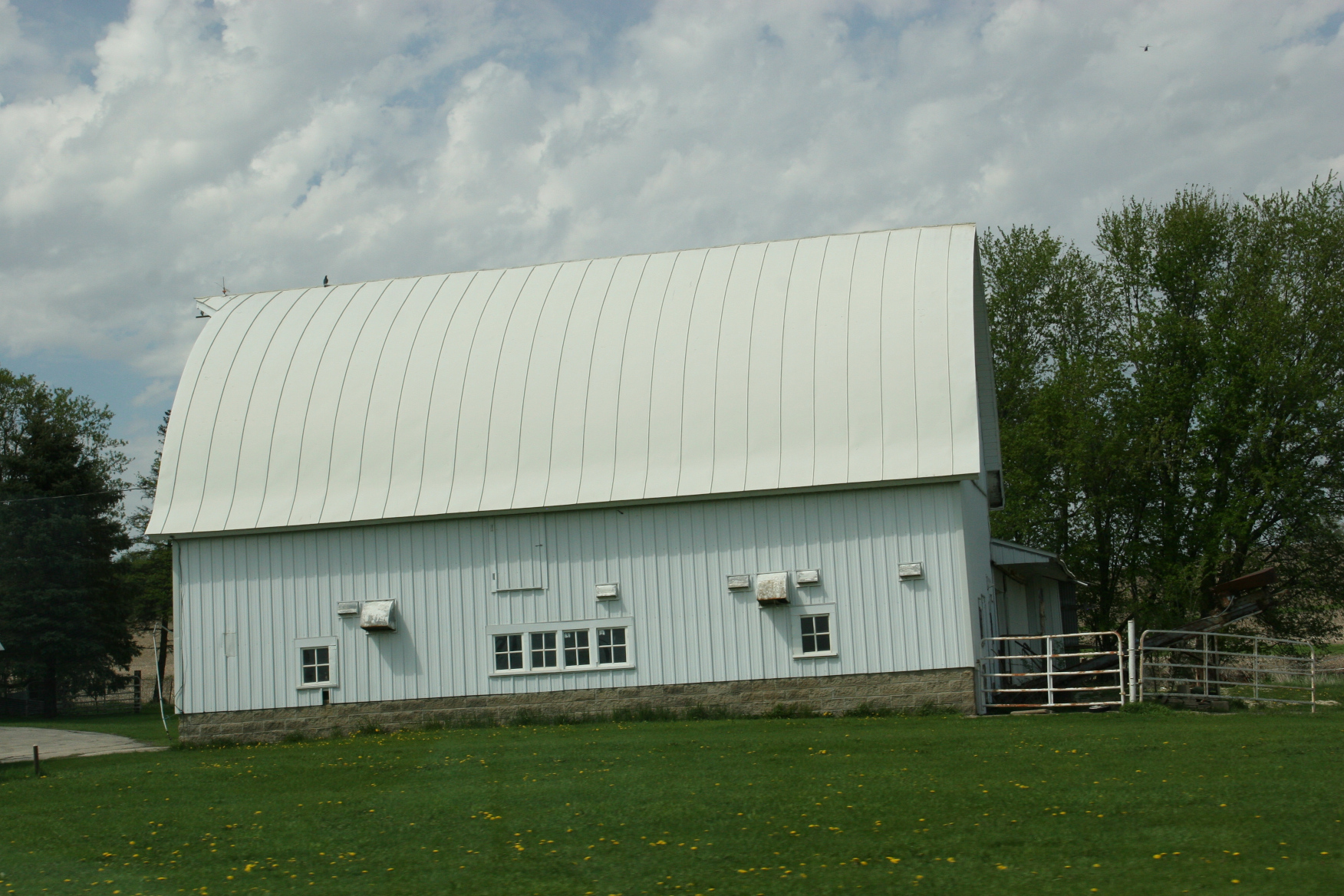
A well-kept barn in southern Minnesota. (Minnesota Prairie Roots copyrighted photo May 2022)

I am, and always shall be, honored to call myself a farm girl.

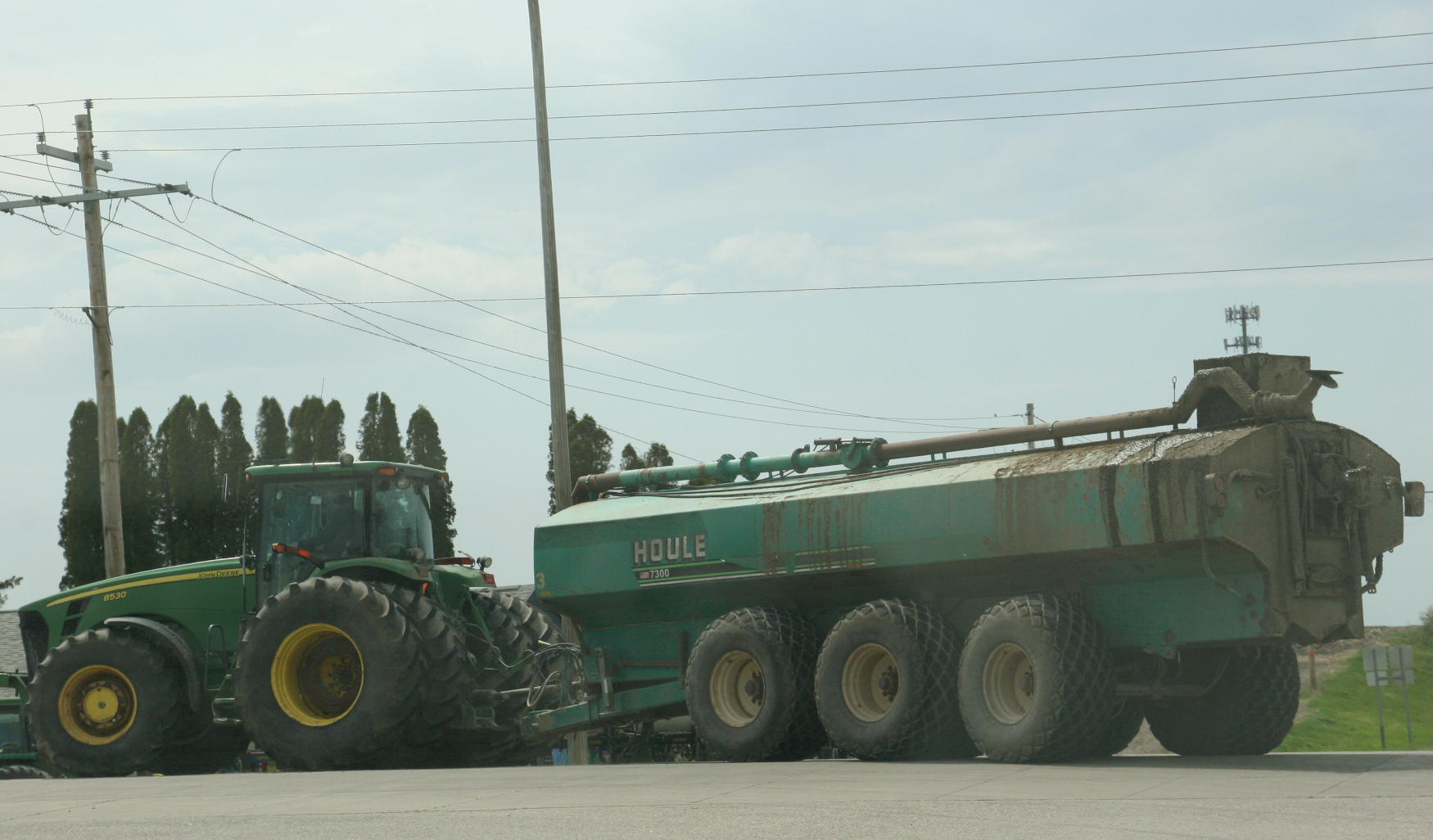
Another common sight on Minnesota roadways in the spring–a farmer hauling liquid manure to spread on fields. Not really anything you want to follow and I was thankful when the tractor turned. (Minnesota Prairie Roots copyrighted photo May 2022)

HOW ABOUT YOU? Did place shape you? I’d like to hear.

NOTE: I took these photos on May 14 in Goodhue, Olmsted, Rice and Wabasha counties in southeastern Minnesota. All images were taken through the passenger side windshield or side window while traveling on the roadway.

© Copyright 2022 Audrey Kletscher Helbling
 

Featuring fun finds, farm-fresh, fiddling & more May 10, 2022

At last spring’s RCHS Spring Flea Market. (Minnesota Prairie Roots copyrighted photo May 2021)

AFTER AN INCREDIBLY long winter followed by an exceptionally cold, cloudy and wet spring, we Minnesotans are ready to get outdoors. We are ready to celebrate. We are ready to let the sun shine into our lives. And this weekend, opportunities abound locally to get out and enjoy spring in southern Minnesota.

Spotted at the spring 2021 flea market. (Minnesota Prairie Roots copyrighted file photo May 2022)

Rise and shine early on Saturday, May 14, to hit the Rice County Historical Society Spring Flea Market from 8 am – 2 pm in the parking lot and behind the RCHS museum in Faribault. I’ve attended many times and enjoy meandering among the vendors of antiques, collectibles, crafts and junk. I mean “junk” in a positive light.

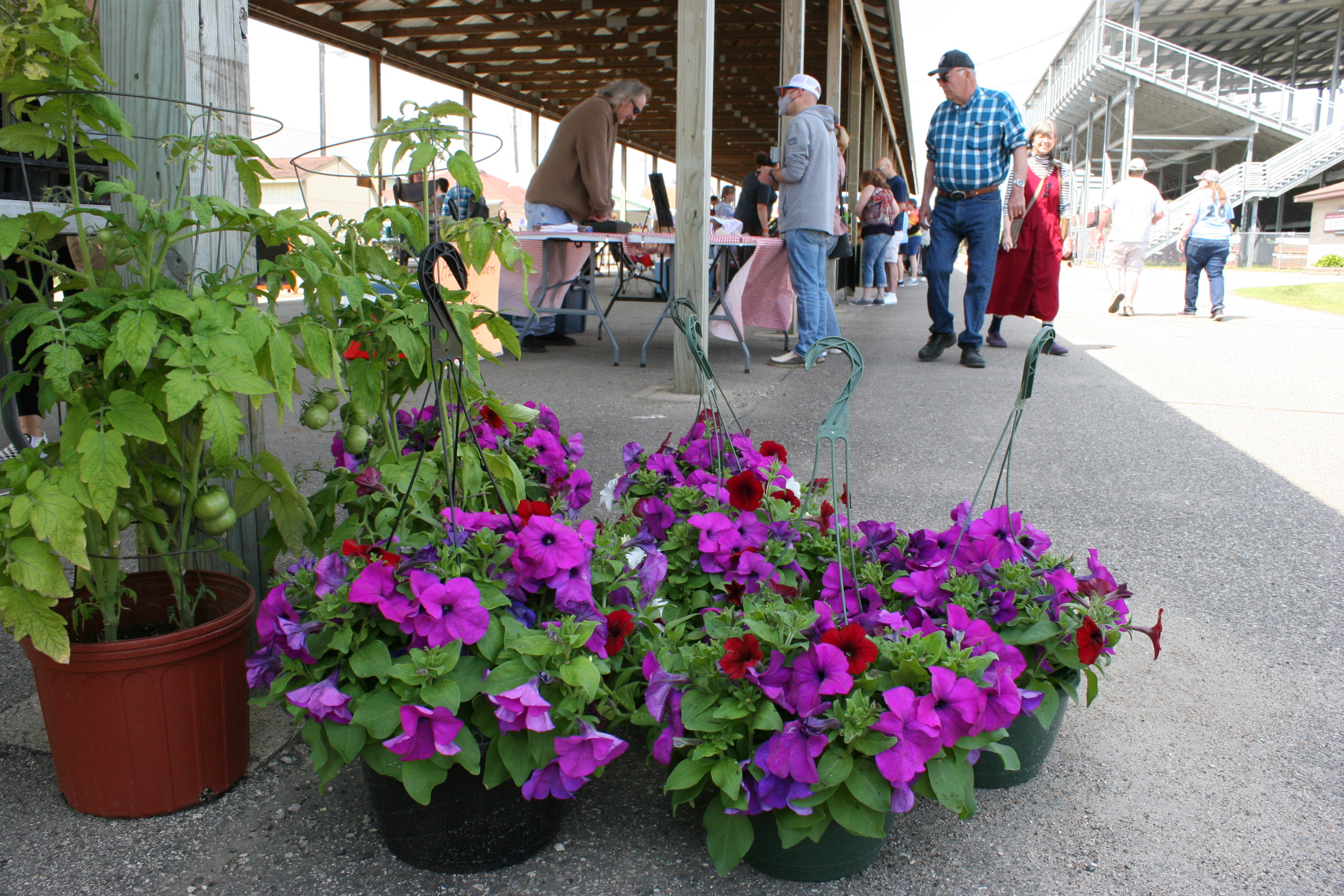
Plants available for purchase a year ago, looking toward the vendor site under the fairgrounds car port. (Minnesota Prairie Roots copyrighted file photo May 2021)

While there, also check out the Cannon Valley Farmers’ Market under the carport at the Rice County Fairgrounds from 10 am – 2 pm. Some 20 area/regional vendors will market spring produce, locally-grown starter plants, cheese, honey, pastries, woolen products, homemade soaps and much more.

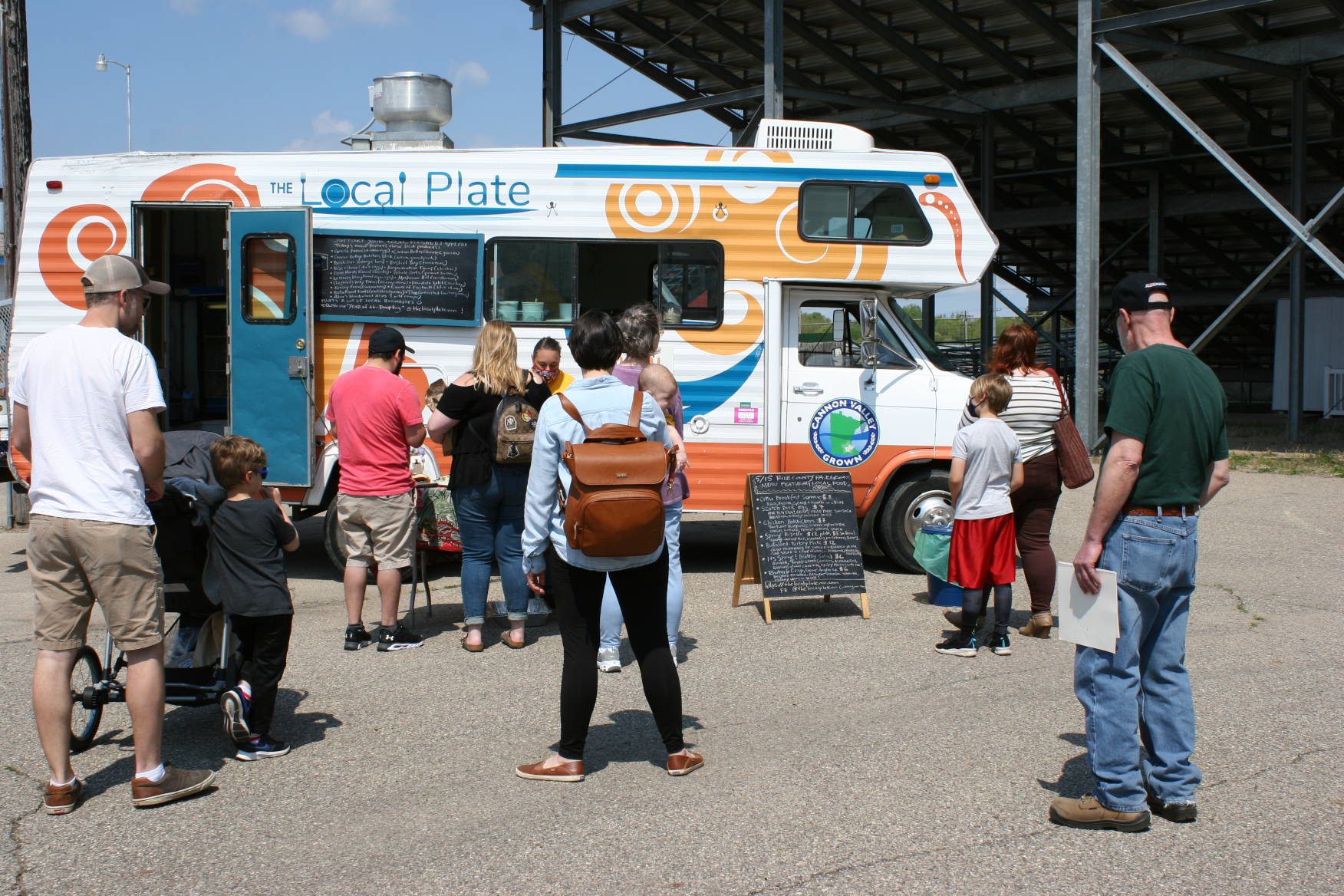
Customers place orders at the Local Plate food truck at the May 2021 Cannon Valley Farmers’ Market. (Minnesota Prairie Roots copyrighted file photo.)

Adding to the farmers’ market draw are local food trucks on site.

A group of mostly Northfield area musicians performed as Hutenanny at a past Valley Grove Country Social. Minnesota Prairie Roots copyrighted file photo September 2010)

On Sunday, May 15, two area historic Norwegian churches celebrate Syttende Mai, Norway’s Constitution Day. Both events begin at 2 pm.

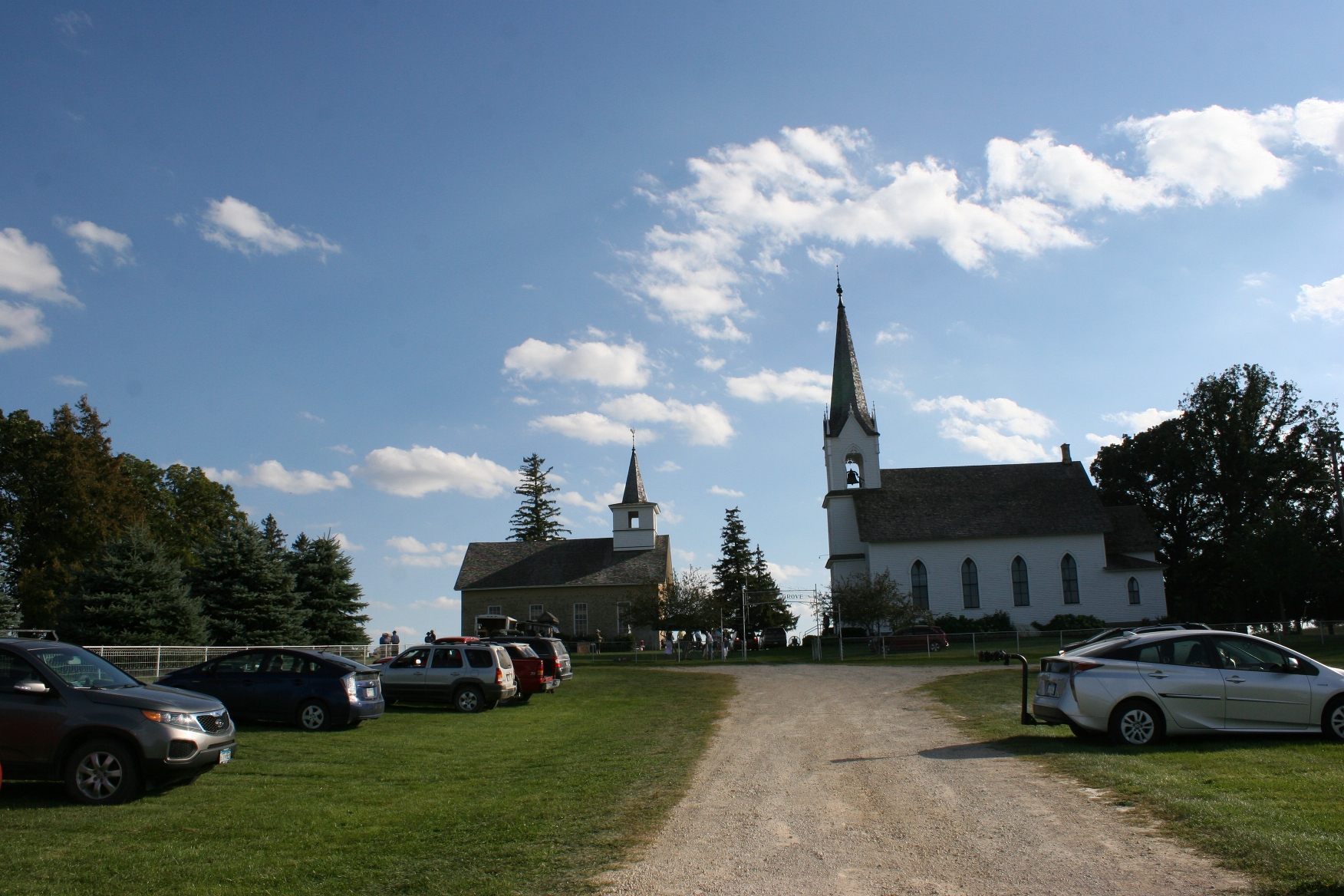
Duo churches grace the hilltop at Valley Grove. (Minnesota Prairie Roots copyrighted file photo 2018)

At Valley Grove churches, rural Nerstrand, the gathering focuses on the dedication of tapestries woven by Robbie LeFlueur. The Minneapolis weaver was commissioned to create four tapestries—three will be complete by May 15—that illustrate church history, the congregation and the surrounding flora and fauna. She will also give a weaving demo. Hardanger fiddlers from St. Olaf College will provide entertainment. Valley Grove, atop a hillside near Nerstrand Big Woods State Park, is a favorite destination of mine given its beautiful and peaceful country setting. I’ve attended numerous celebrations, or simply walked, there and always enjoyed myself. The Syttende Mai event goes until 4 pm.

Completed in the fall of 1899, the second Trondhjem Church sits atop a 100-foot high hill. Listed on the National Register of Historic Sites in Minnesota, this Norwegian church has walls constructed with 24 corners to brace it against the wind. Minnesota Prairie Roots file photo)

In northern Rice County, the Norwegians of Old Trondhjem Church, rural Lonsdale, are hosting Tjarnblom, a Scandinavian folk group as their Syettende Mai celebration begins at 2 pm. There’s a brief meeting of the preservation society followed by coffee (of course), treats (of course) and fellowship (of course). I’ve also attended events at Trondhjem and recommend you join in this Norwegian celebration.

There you go. Four places to go in Rice County that will bring sunshine into your May weekend.

© Copyright 2022 Audrey Kletscher Helbling


About those Northfield cows April 25, 2022

Filed under: Uncategorized — Audrey Kletscher Helbling @ 5:02 AM
Tags: , , , , , , , , ,
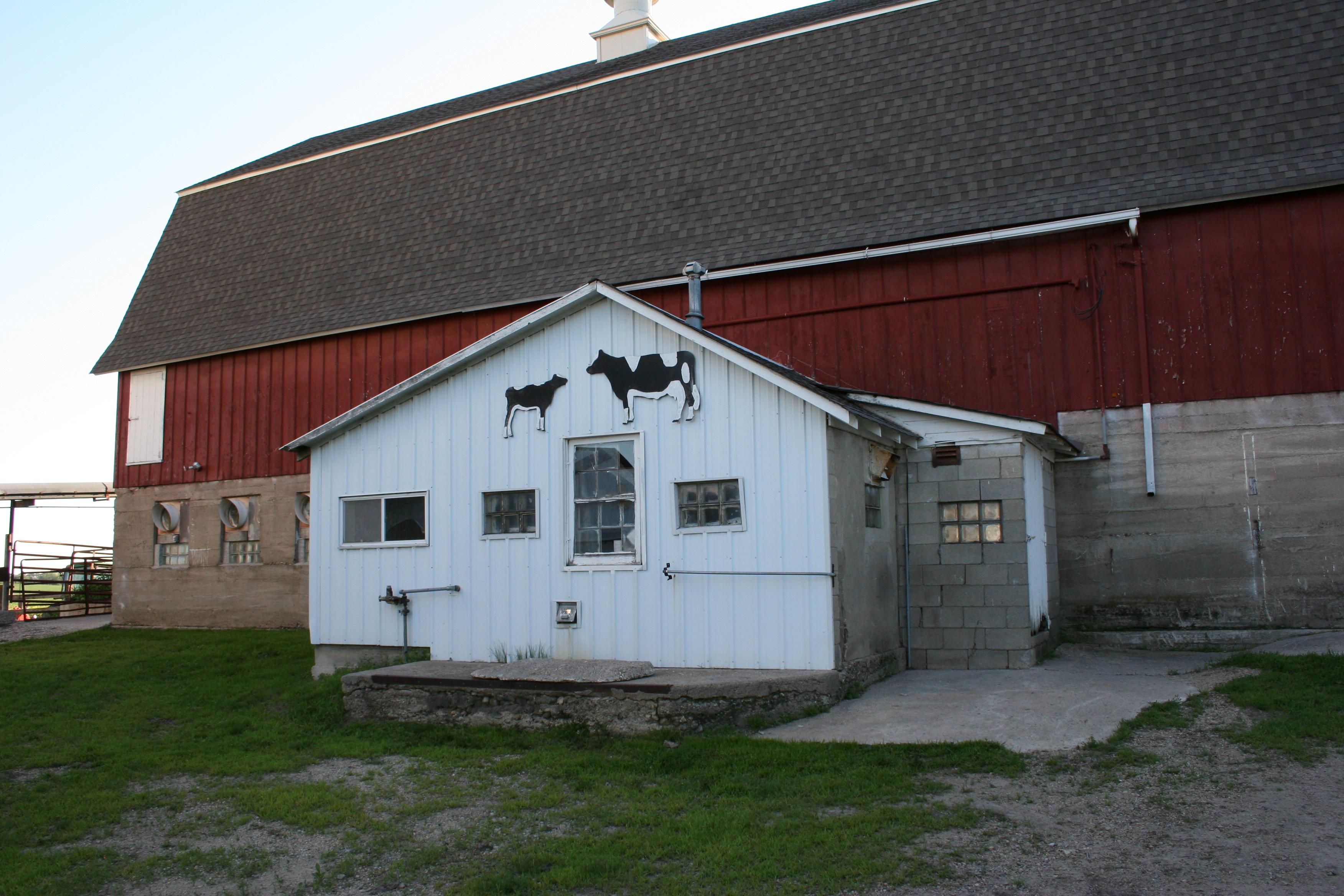
Holstein cow art adorns the milkhouse on the barn of friends in rural Dundas (near Northfield). These farmers once milked Holsteins. (Minnesota Prairie Roots copyrighted file photo September 2011)

NOW BILLED AS “A Classic American River Town” by the local tourism office, Northfield fits that description. This southern Minnesota community, where the James-Younger gang was defeated in 1876, hugs the Cannon River. The historic downtown is filled with mostly home-grown shops and eateries. And, as cliché as it sounds, Northfield is quaint and charming.

I love Northfield. If the cost of houses in 1984 had not been significantly higher than in neighboring Faribault, Randy and I would be living there. Instead, Randy has commuted from Faribault to Northfield to work as an automotive machinist for too many decades. But such is life and we’re happy to call Faribault home.

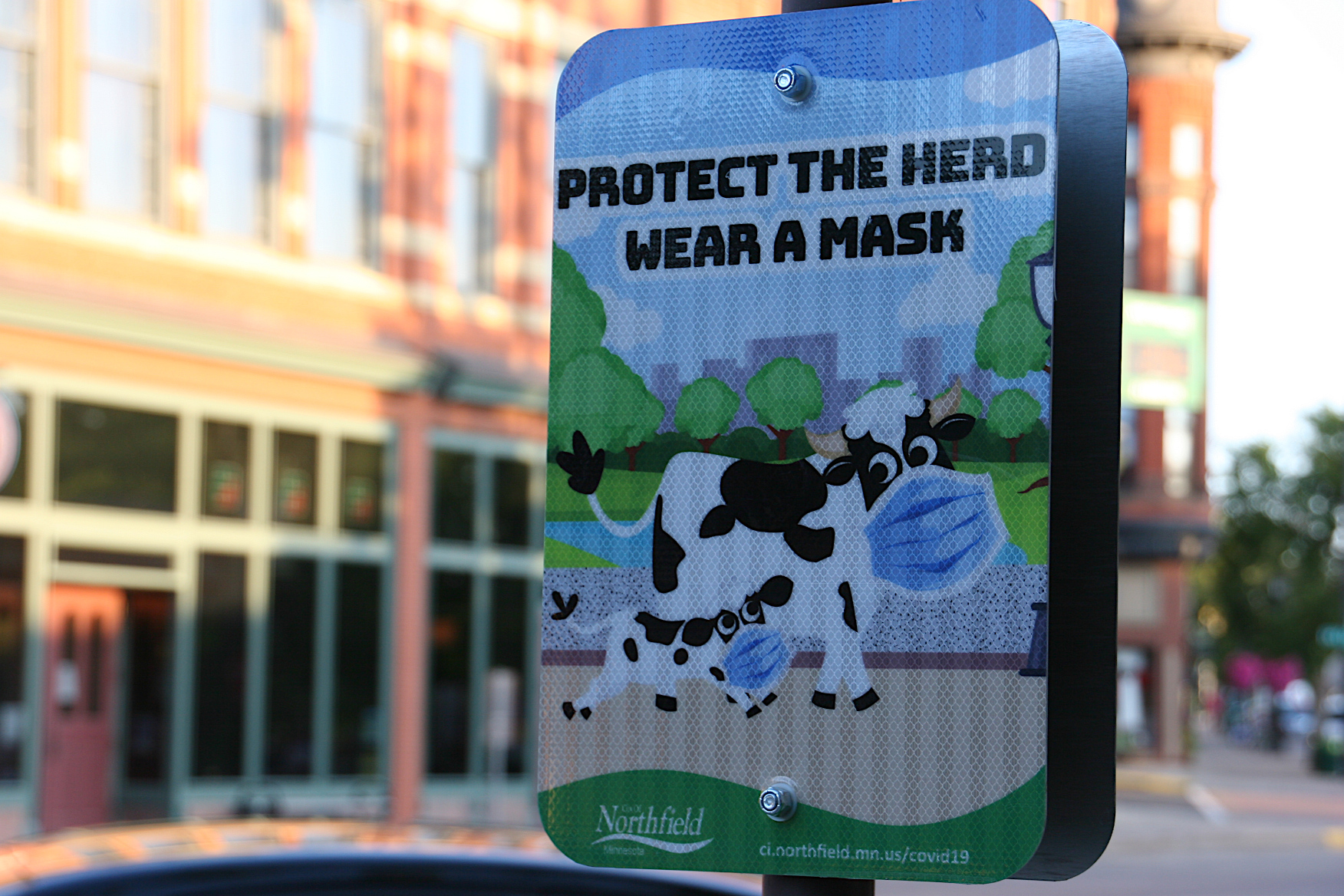
“Protect the herd” plays off the city’s “Cows, Colleges & Contentment” slogan. (Minnesota Prairie Roots copyrighted file photo 2020)

But back to Northfield. There was a time when this city actively tagged its community with the phrase “Cows, Colleges & Contentment.” That slogan still graces some signage. I observed a cow-themed sign encouraging masking early in the pandemic. “Protect the herd” focused the message from the City of Northfield. I thought that incredibly powerful and catchy. You know, we’re all in this together type attitude. Care about one another.

I understand how “contentment” fits this community. And colleges, too, as Northfield is home to St. Olaf and Carleton colleges.

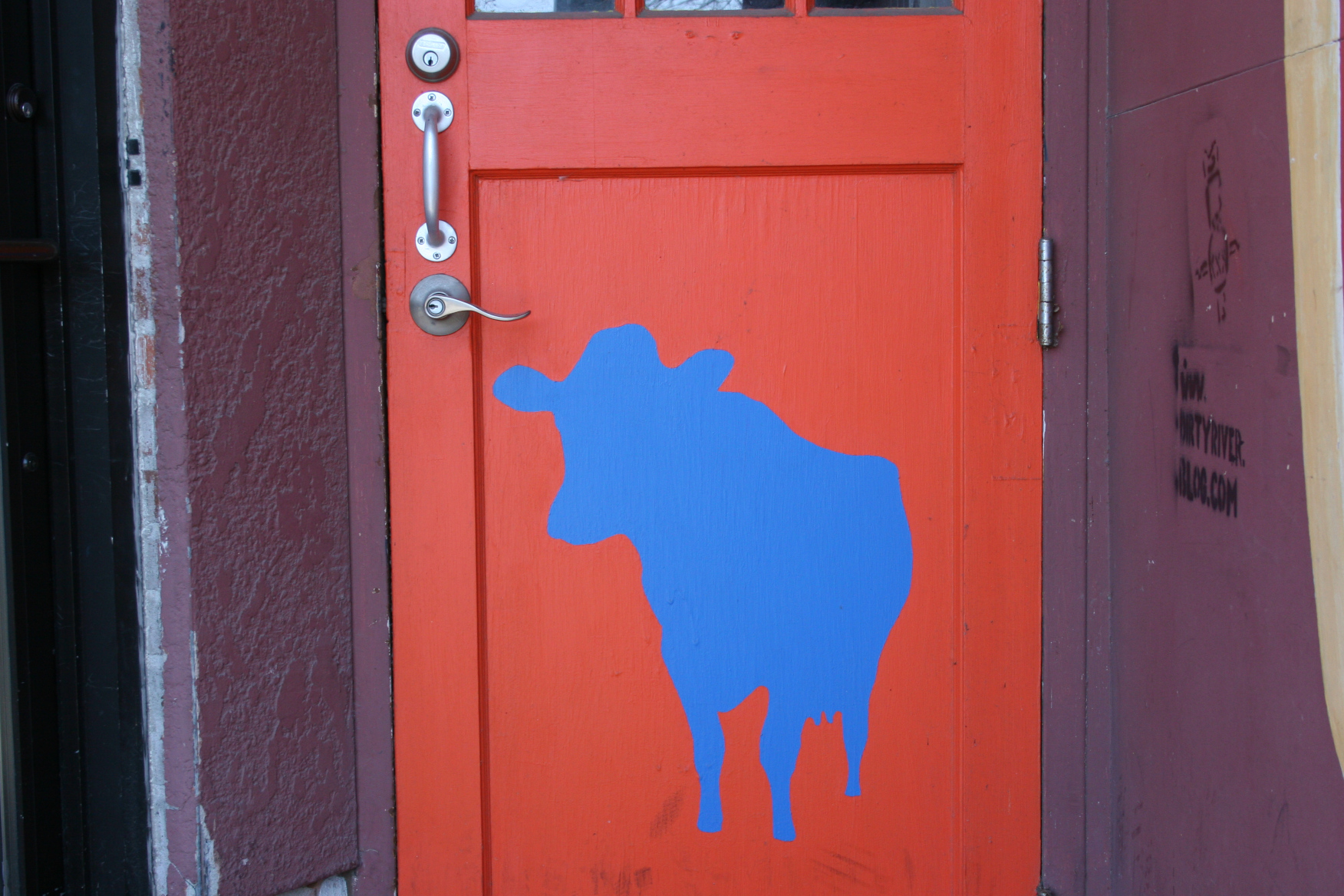
The blue cow I spotted recently in downtown Northfield. (Minnesota Prairie Roots copyrighted photo 2022)

But I didn’t quite get the “cows” part until I found an explanation on the Visit Northfield website. In summary, in the late 1890s, a local farmer/newspaper editor suggested Northfield could attract businesses by focusing on breeding of Holstein cows. That eventually happened with 5,532 Holstein dairy cattle and 261 breeders in the area by 1916, a Northfield Holstein Club and the moniker, “Holstein Capital of America,” attached to Northfield. The aforementioned colleges also established Holstein herds. I encourage you to read the full story about the Northfield cows by clicking here.

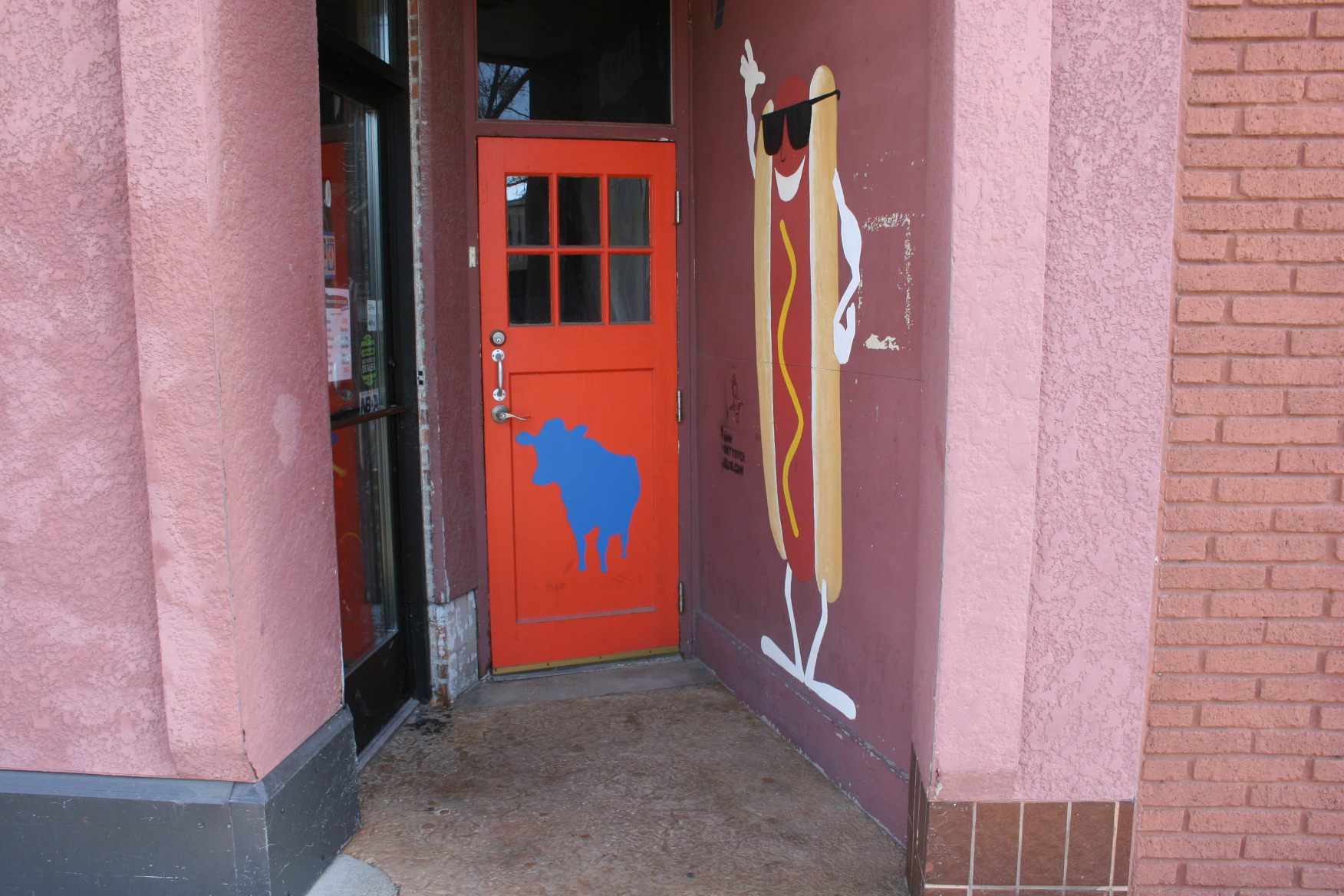
Downtown Bicycles’ blue cow image. Now, what’s with the hot dog? (Minnesota Prairie Roots copyrighted photo 2022)

On a recent walk through downtown Northfield, I didn’t see any Holsteins. But I happened upon a blue cow painted on an orange door. The cow graphic marks Downtown Bicycles, 321 Division Street. Seeing that cow brought to mind the “Cows, Colleges & Contentment” theme, which led me to uncover the story behind the bovines of Northfield.

© Copyright 2022 Audrey Kletscher Helbling
 

Another world award for Caves of Faribault cheese March 21, 2022

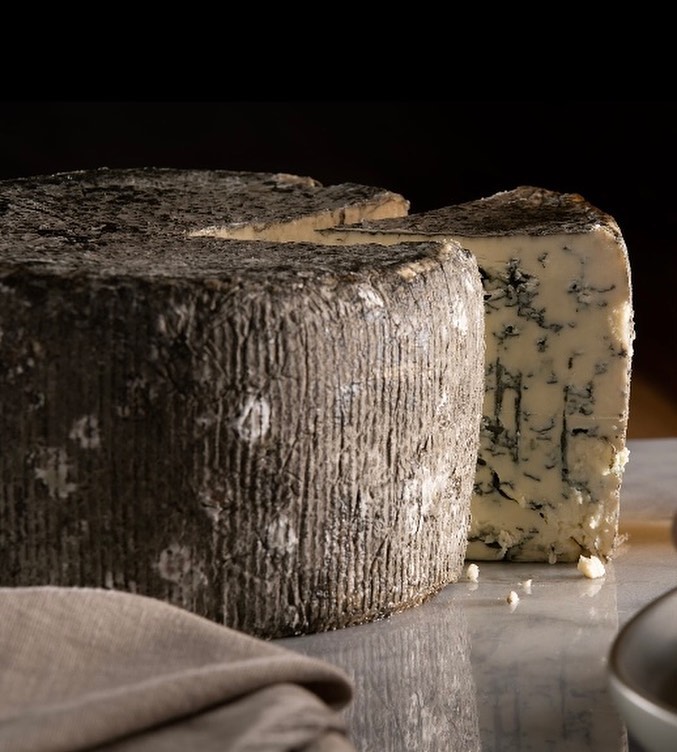
Felix, Caves of Faribault’s latest award-winning blue cheese. (Photo source: Caves of Faribault Facebook page)

THERE SEEMS TO BE no middle of the road here, no riding the fence. Either you like it or you don’t. And I, for one, love blue cheese. I cannot think of a cheese I don’t love, although processed cheeses rate lower than others on my taste buds.

I live in a community where world class cheese is produced. This year the Caves of Faribault team brought home the bronze in the Blue Veined Cheeses with Exterior Molding category of the World Championship Cheese Contest held recently in Madison, Wisconsin. That award was given to Felix blue cheese, named after Caves founder, Felix Frederiksen.

Award-winning Amablu Gorgonzola from Caves of Faribault. (Minnesota Prairie Roots copyrighted file photo 2010)

The number of awards won by Caves of Faribault cheesemakers in the past dozen years in numerous competitions is lengthy and impressive. (See the awards list here; you’ll scroll and scroll.)

Surprisingly, I have not yet tasted Felix blue cheese. Described as having a “dense, fudgy texture,” it’s aged for 60 days minimum in caves carved in the 1850s into sandstone bluffs along the Straight River. Originally, those caves were used by local beer-makers. The process for crafting Felix allows the sandstone caves to “create a natural rind that picks up on the different microflora that inhabit the caves,” according to the Caves website. That’s the basic scientific explanation. I mostly just care that the blue cheese tastes good.

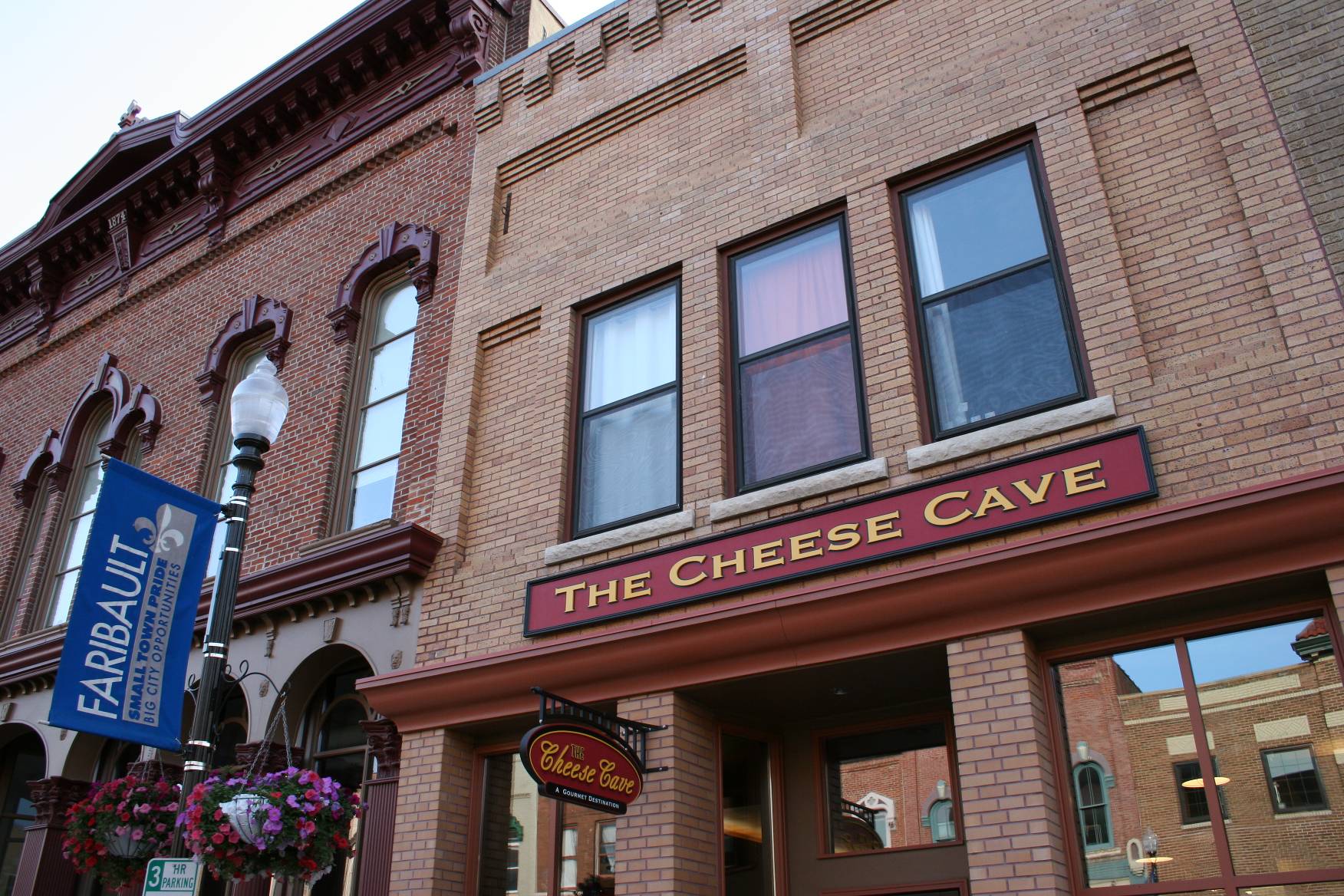
Once my primary source of local cheese, The Cheese Cave closed several years ago. (Minnesota Prairie Roots copyrighted file photo)

My go-to Caves cheeses have been their long-standing Amablu®, Amagorg® (Gorgonzola) and St. Pete’s Select® (blue cheese). With the closing of the Caves downtown Faribault retail store and restaurant a number of years ago, finding our Caves cheese locally has dropped to one source, HyVee grocery store. Note that it’s available in many other places throughout Minnesota and in all other 49 states and internationally. Illinois-based Prairie Farms Dairy Inc now owns Caves of Faribault. Ownership changes often result in changes away from local focus.

Sliced strawberries, cucumbers and Amablu Gorgonzola cheese added to Romaine lettuce make a perfect salad, topped with lemon poppyseed dressing. (Minnesota Prairie Roots copyrighted file photo 2011)

Cheesemaking has a history in Faribault tracing back to 1936 and that first cheesemaker, Felix Frederiksen. Faribault, according to the Caves website, is the home of America’s first blue cheese. And now, 86 years later, local cheesemakers continue to craft award-winning blue cheese in sandstone caves along the river. Cheese that I, for one, love.

Big Woods Blue from Shepherd’s Way Farms, rural Nerstrand, by the Big Woods (Minnesota Prairie Roots copyrighted file photo)

FYI: There are other award-winning cheesemakers in this region of southern Minnesota, including Shepherd’s Way Farms, rural Nerstrand, and CannonBelles Cheese, Cannon Falls. Both are part of the Cannon Valley Farmers’ Market producers group. That locally-sourced/grown/raised/crafted market held its last inside winter market recently, but restarts in the warm season at its outdoor location under the carport at the Rice County Fairgrounds in Faribault. The first outdoor market is from noon – 3 pm Saturday, April 16. The next follows from 10 am – 2 pm on Saturday, May 14.

© Copyright 2022 Audrey Kletscher Helbling
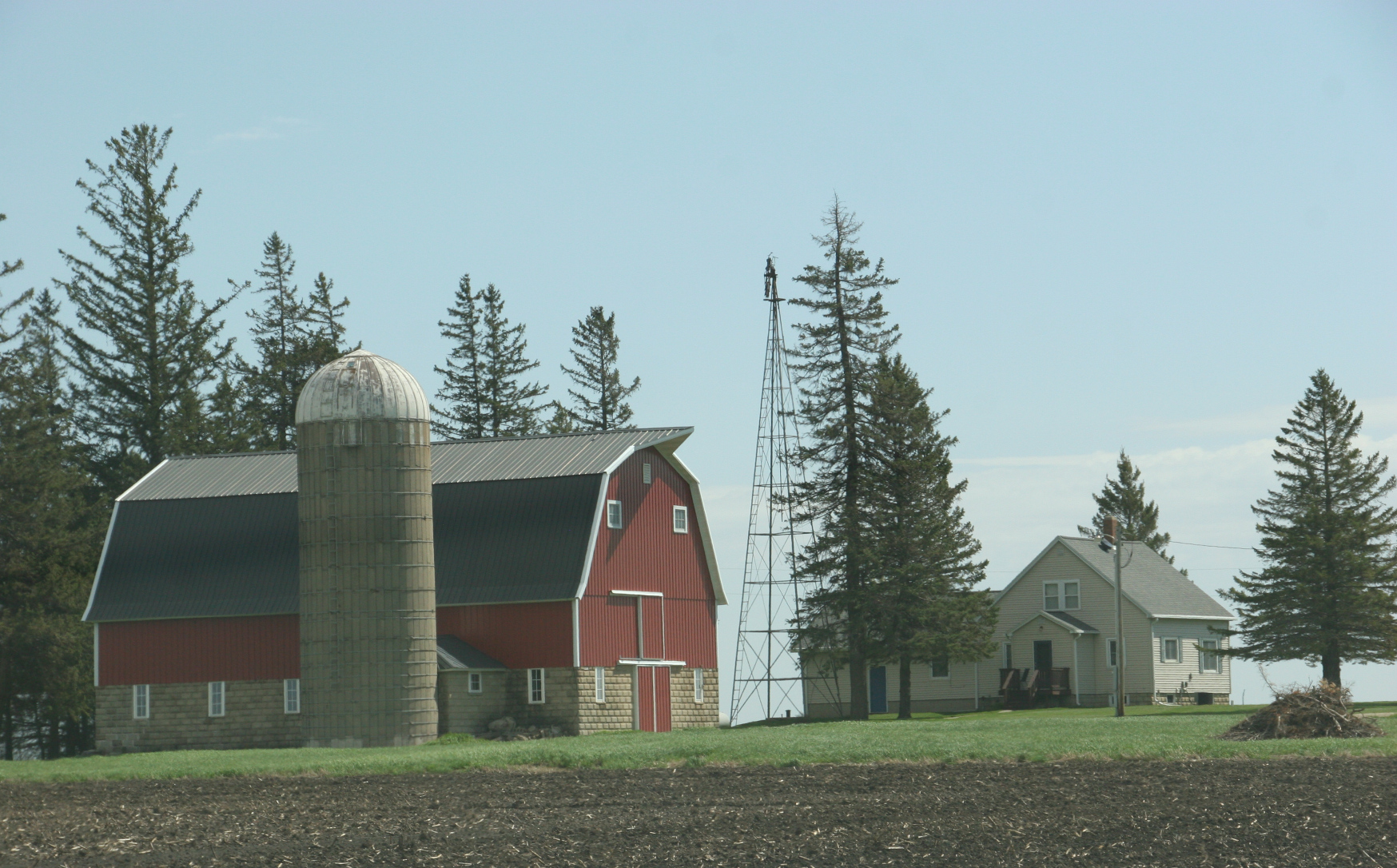
Photo credit: Caves of Faribault Facebook page


Mary Welke’s art reconnects me to my rural roots March 8, 2022

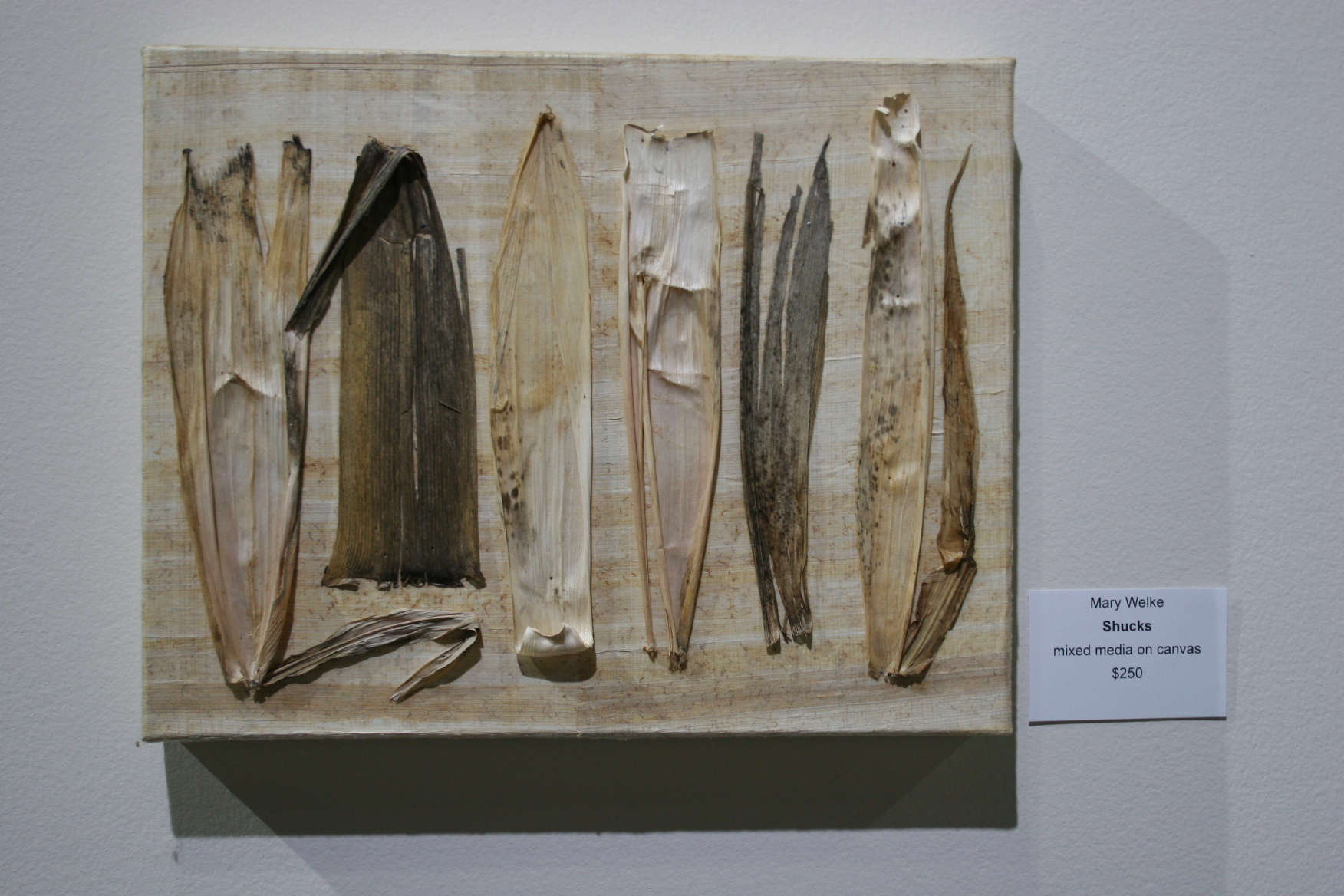
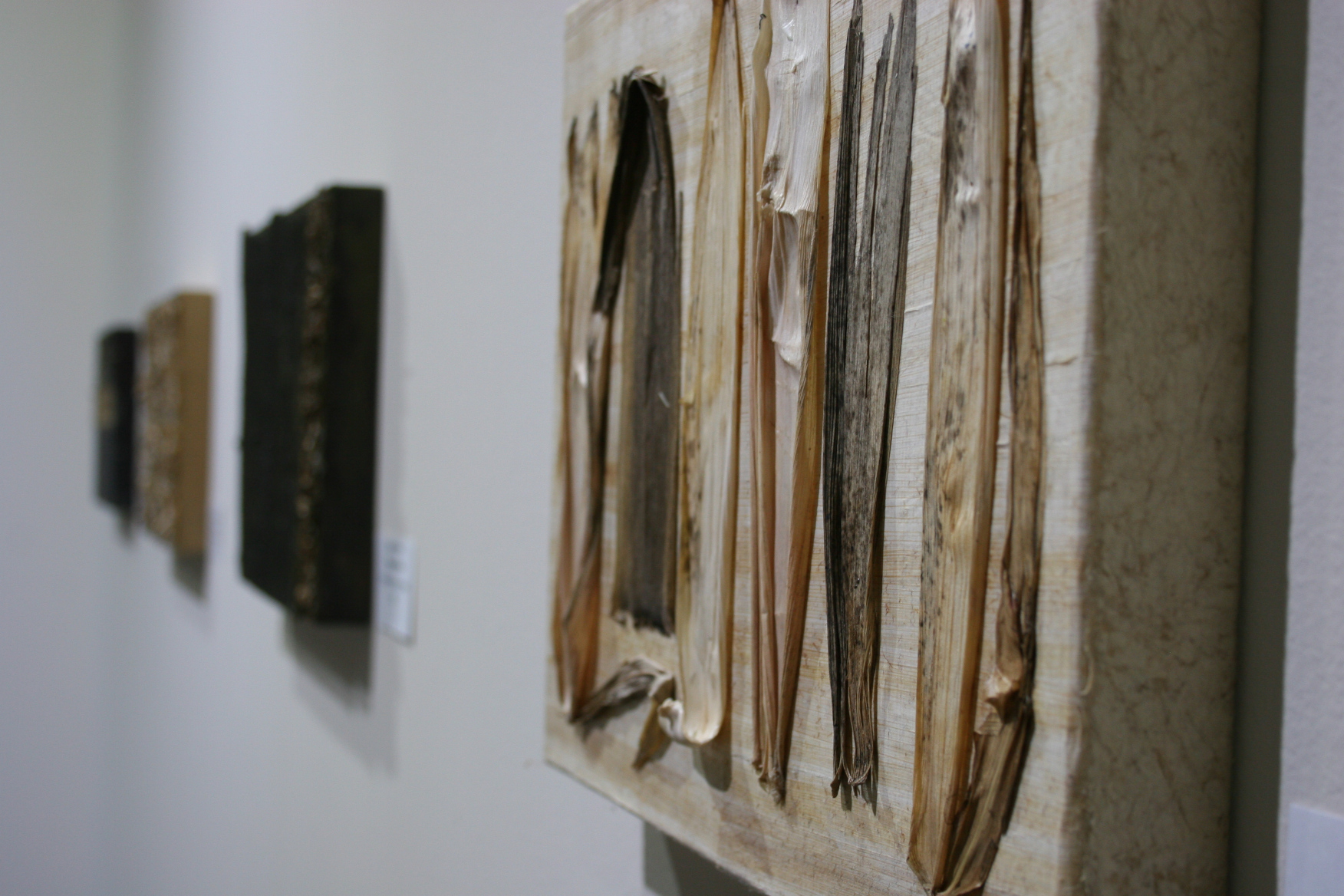
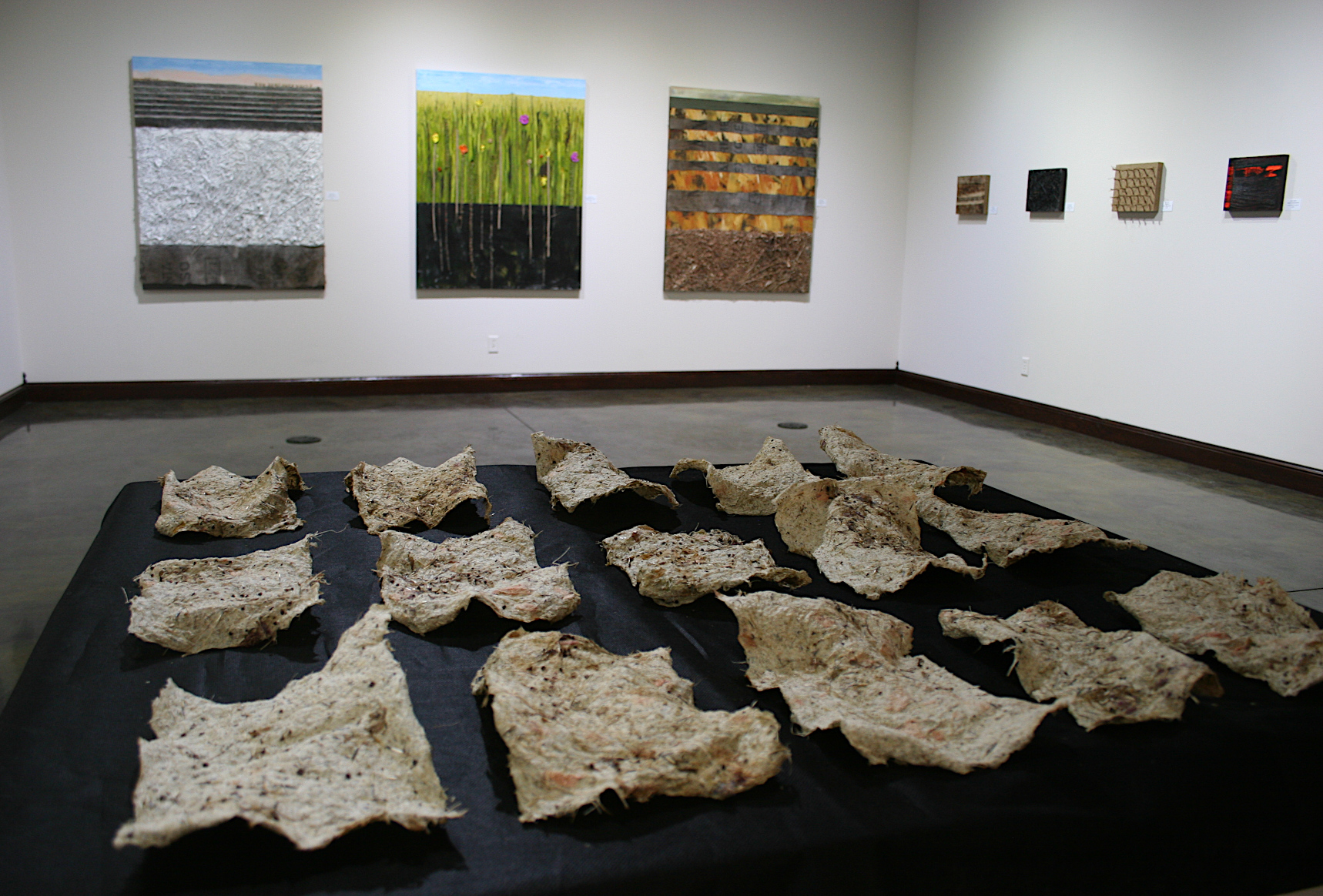
Corn husks define Mary Welke’s mixed media on canvas, “Shucks.” (Minnesota Prairie Roots copyrighted photo March 2022)

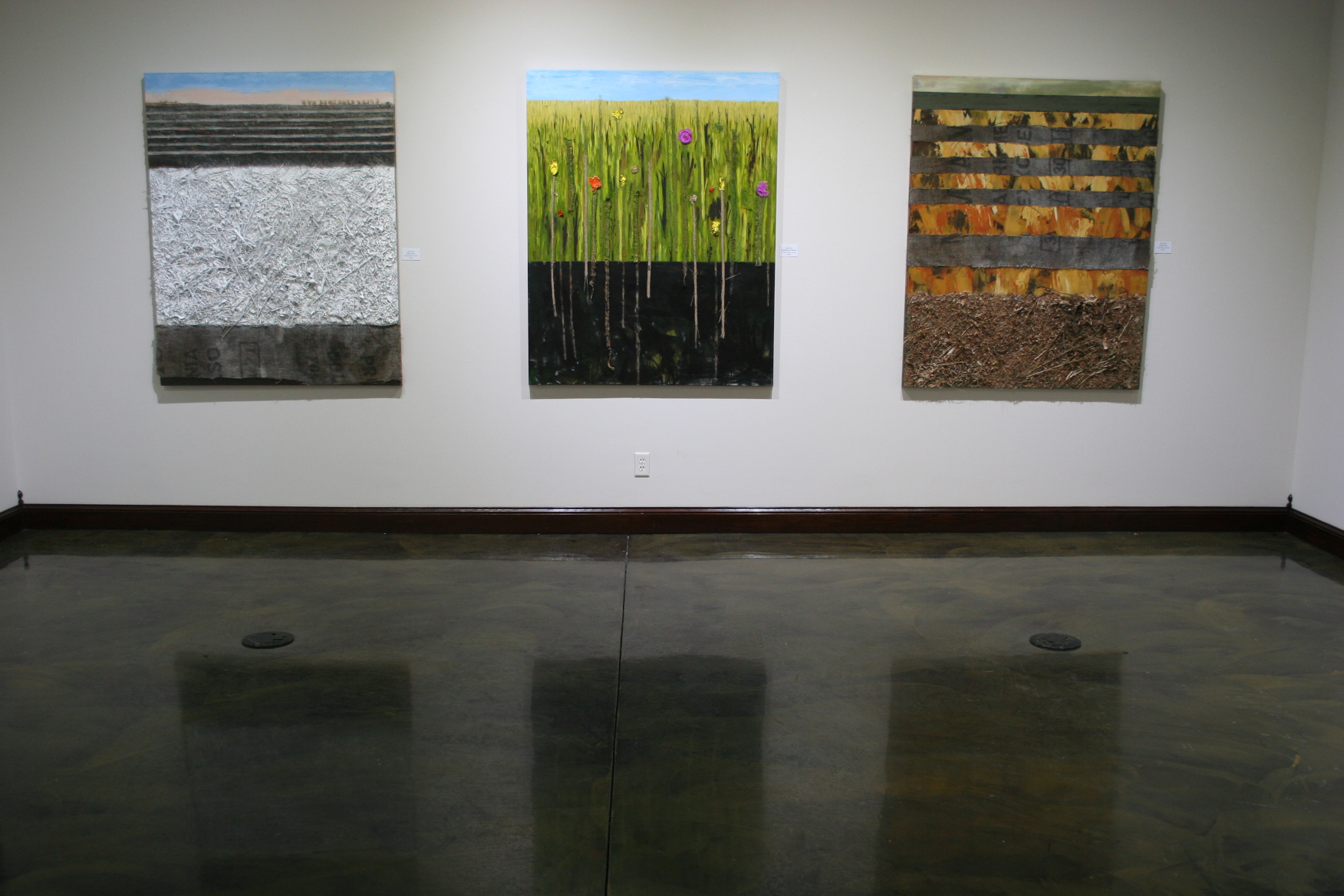
I FELT CONNECTED, oh, so connected to Minneapolis artist Mary Welke’s art as I viewed her exhibit at the Paradise Center for the Arts in historic downtown Faribault.

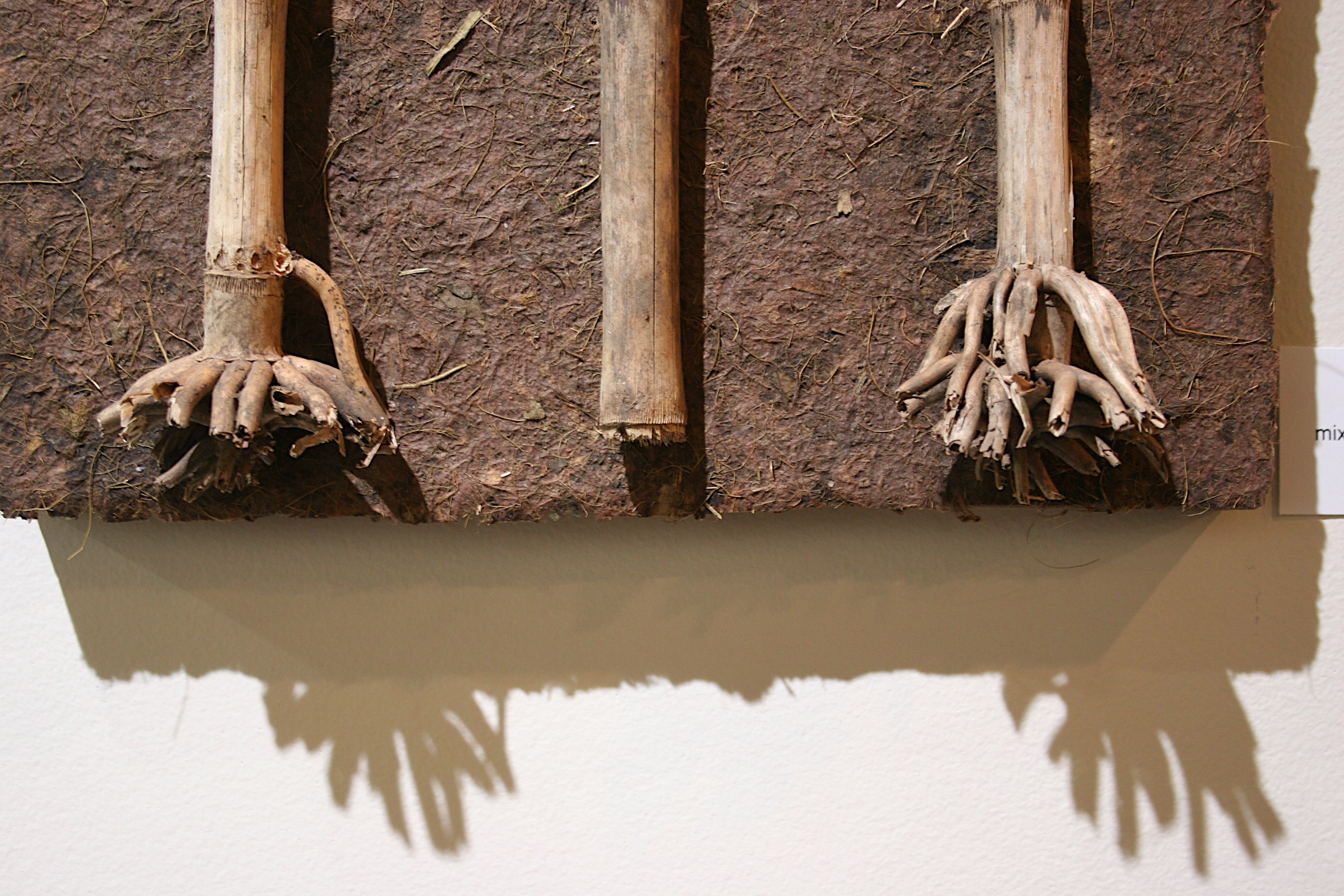
The lower portion of “Roots” shadows on the gallery wall. These are dry corn roots. (Minnesota Prairie Roots copyrighted photo March 2022)

Welke’s mixed media art is unlike any I’ve ever seen. It resonates with me, reconnecting me to my southwestern Minnesota prairie roots. To the farm. To the land. The place that shaped me as a person, writer and photographer.

Nature inspires Mary Welke as seen in these oversized mixed media art pieces. (Minnesota Prairie Roots copyrighted photo March 2022)

That I experienced such a strong emotional reaction is a credit to this artist, who grew up near the Mississippi River in northeast Minneapolis. Her childhood exploration of river and fields and time with her grandmother in a sprawling vegetable garden instilled an early appreciation of nature, which inspires her art.

“Autumn Yield” by Mary Welke. (Minnesota Prairie Roots copyrighted photo March 2022)

Understanding that background explains how this urban resident came to create “Field and Farmland,” a project funded by a 2020 Minnesota State Arts Board Artist Initiative Grant. She also did her homework—visiting, researching and documenting the prairie and meeting with farmers. The result is art reflecting the prairie, prescribed burns and farmland restoration.

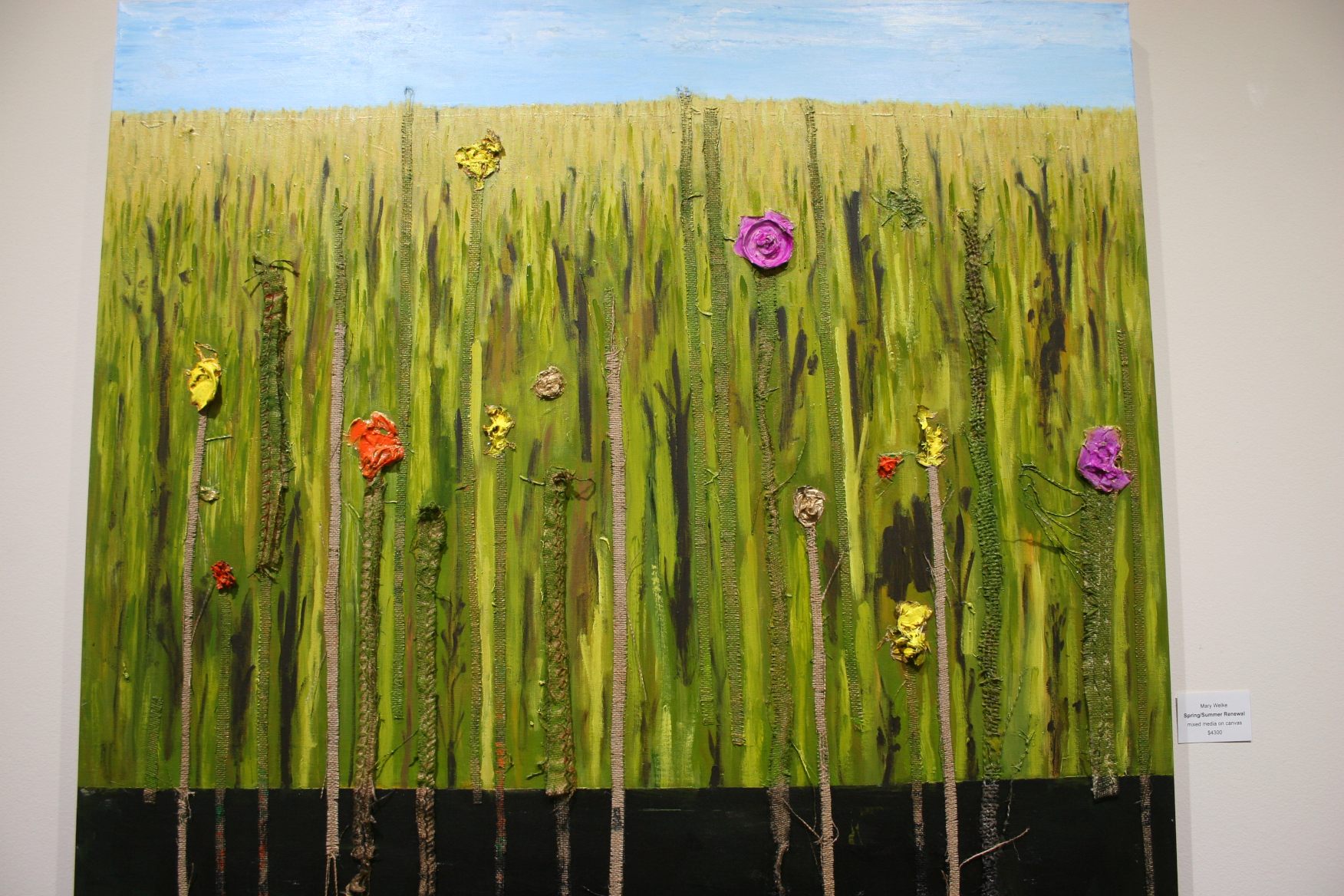
“Spring/Summer Renewal” by Mary Welke. (Minnesota Prairie Roots copyrighted photo March 2022)

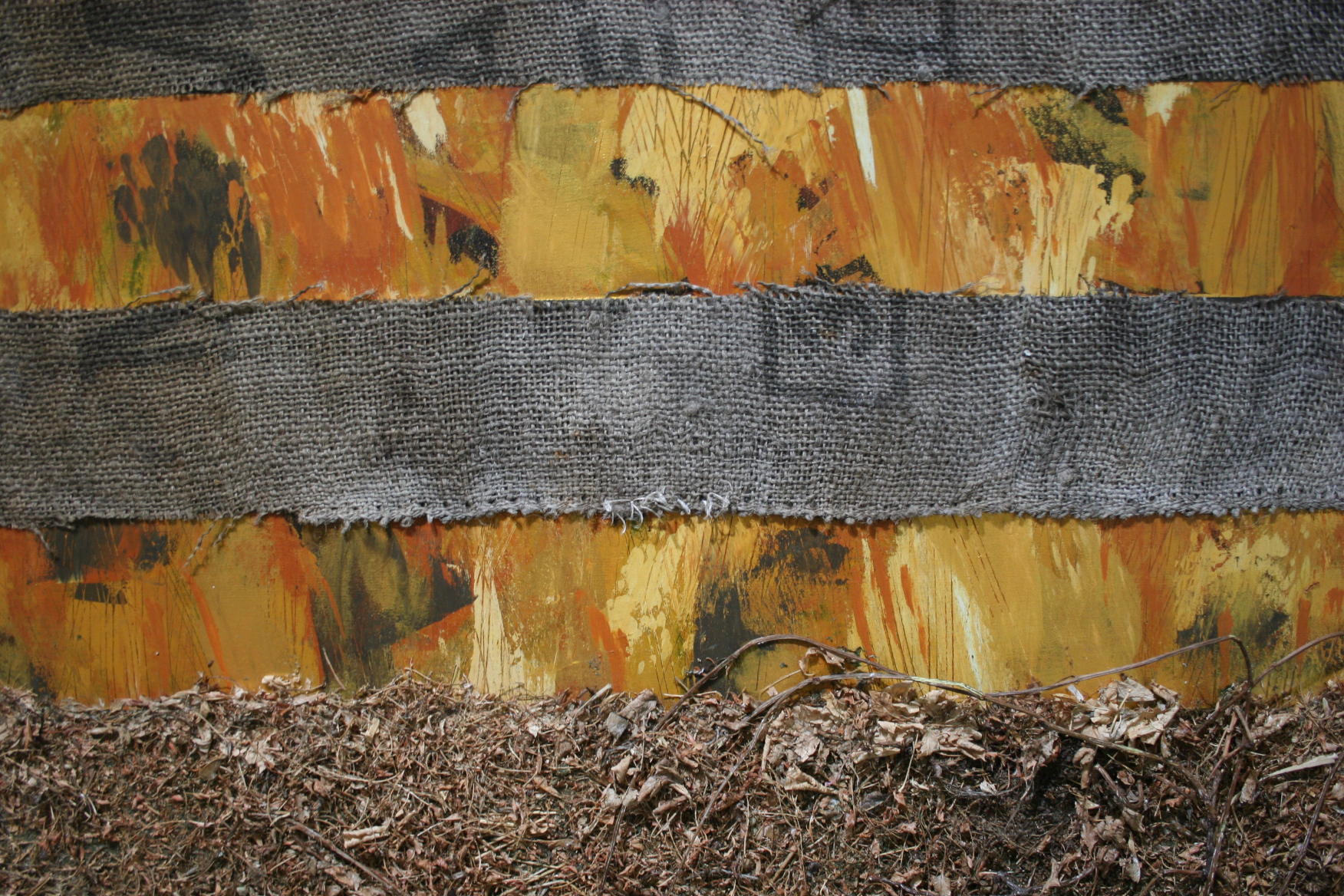
The incorporation of organic materials like soil, corn roots and leaves, other crop residue and more drew me into Welke’s art. I felt as if I was back on the farm, watching my dad turn the rich black soil toward the sun for spring planting. I felt, too, like I was walking the rows of a harvested corn field, the scent of autumn lingering in the prairie wind.

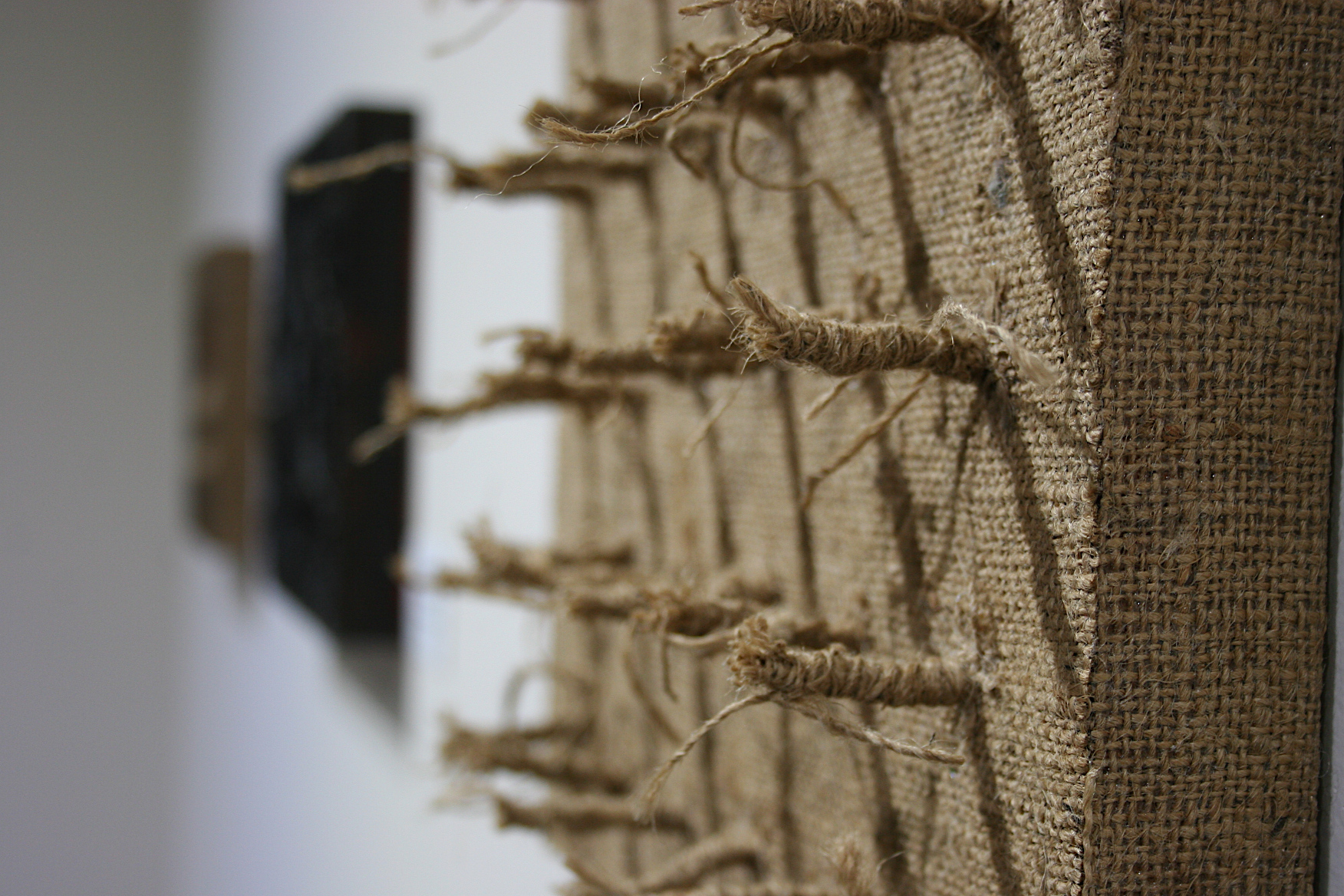
I didn’t note the title of this art featuring burlap and twine. (Minnesota Prairie Roots copyrighted photo March 2022)
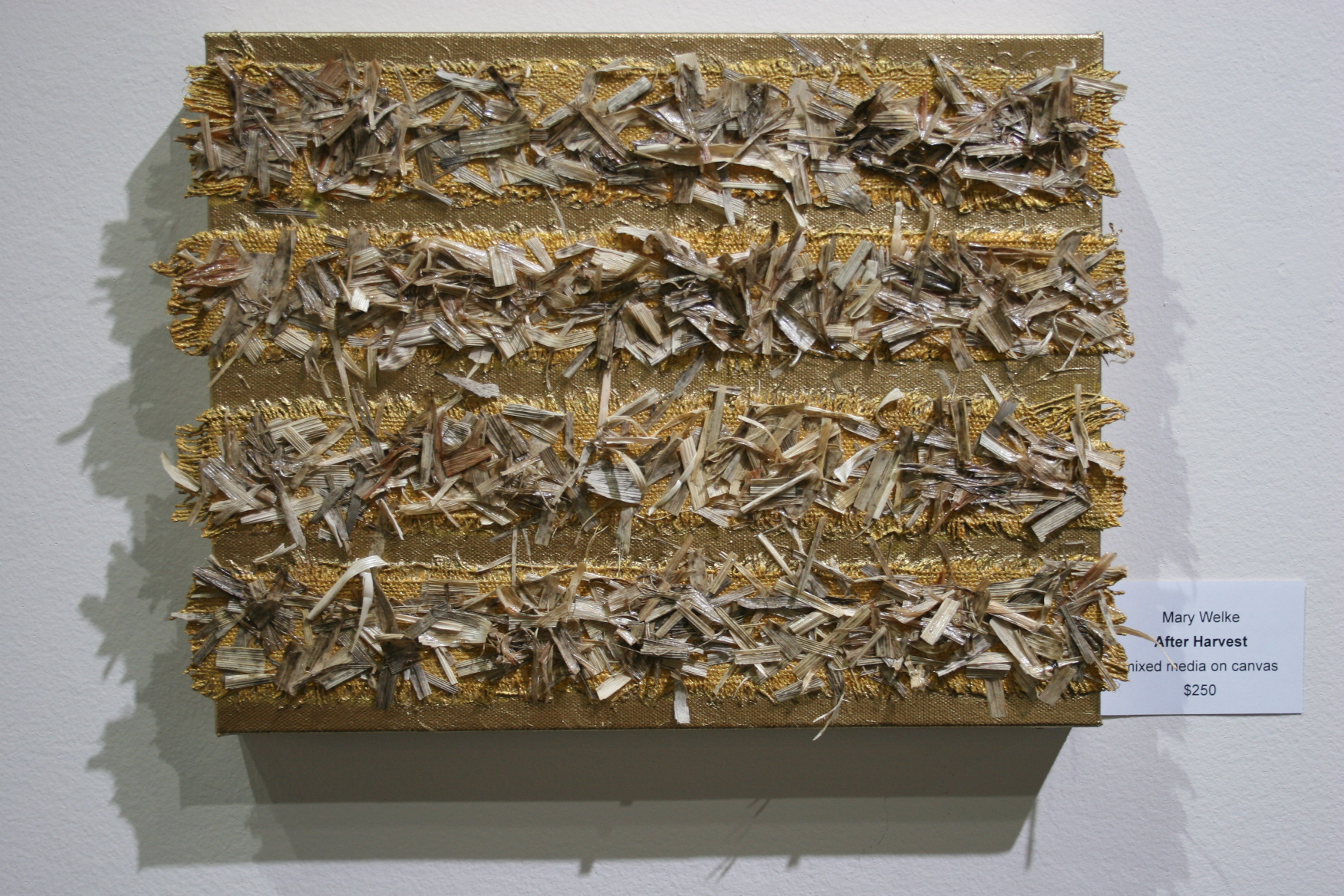
So much texture in “After Harvest” by Mary Welke. (Minnesota Prairie Roots copyrighted photo March 2022)
Corn husks up close in Mary Welke’s “Shucks.” (Minnesota Prairie Roots copyrighted photo March 2022)

Welke’s art is layered. Textured. It holds not only a visual depth, but a depth of connection to the land, to farming.

Mary Welke’s “Topographical Prairie Lands” scattered across a black surface. (Minnesota Prairie Roots copyrighted photo March 2022)

This is what I love about art. The ability to relate. To stand in a gallery and contemplate. Remember. Appreciate. And, with Welke’s work, especially, to feel rooted in the land.

#

NOTE: Please check back for more posts on other exhibits currently at the Paradise Center for the Arts. Artists Mary Welke, Kate Langlais, Michael Stoecklein and Summer Heselton will participate in a Visual Artists Talk at 6:30 pm on Thursday, March 10. See the Paradise Center for the Arts Facebook page for more info. The art of all four will be on display at the Paradise through March 19.

© Copyright 2022 Audrey Kletscher Helbling
 

Along Goodhue County Road 8, past fields, farms & ghost towns November 16, 2021

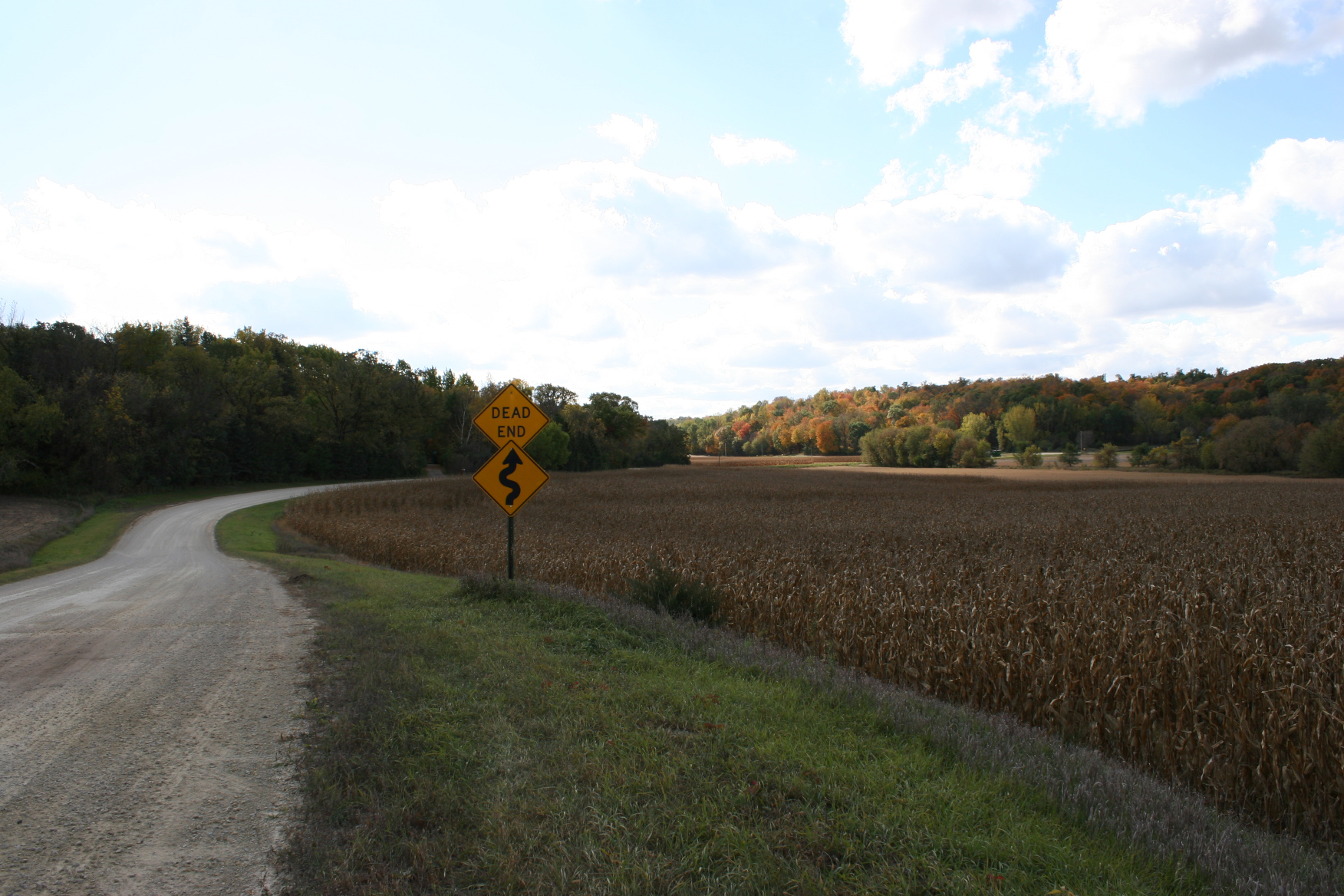
Just outside of Cannon Falls along Goodhue County Road 8, we stopped to admire the treeline and the gravel road winding toward it. (Minnesota Prairie Roots copyrighted photo mid-October 2021)

WHITE ROCK. Belle Creek. Hader. They are among the 60-plus ghost towns of Goodhue County. Places that once thrived, marked now only by signs along a road, a cluster of homes, perhaps a church or abandoned buildings.

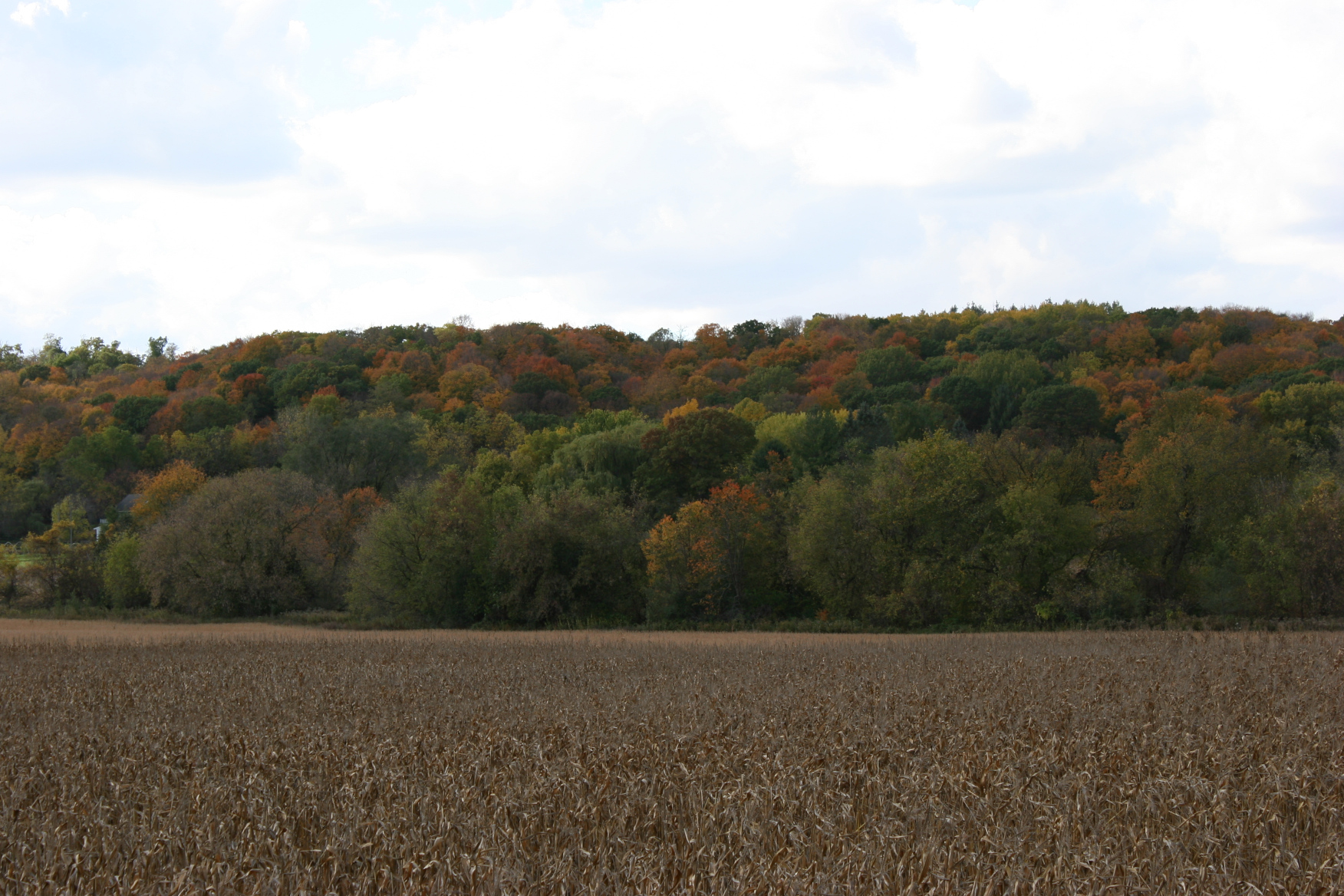
Oh, lovely hues of autumn near Cannon Falls. (Minnesota Prairie Roots copyrighted photo mid-October 2021)

Yet, acknowledging their existence, as the Goodhue County Historical Society does with roadside signs, matters. Because these towns mattered to previous generations and still matter to those with connections to the likes of Aspelund, Burr Oak Springs, Crystal Springs, Eidsvold, Skyberg and so many more with names that hint at heritage and sound poetically beautiful.

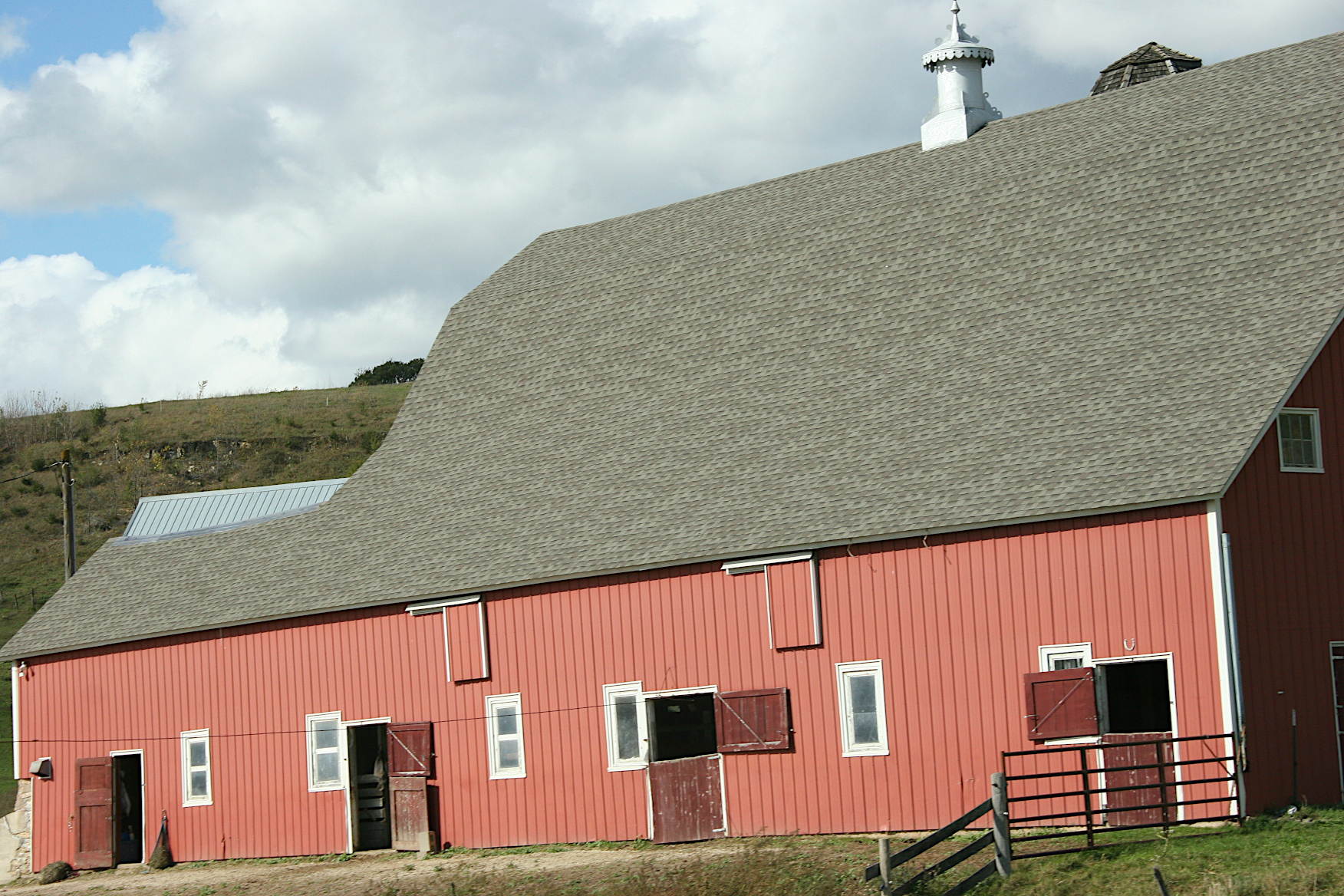
Snugging CR 8, a well-kept barn. (Minnesota Prairie Roots copyrighted photo mid-October 2021)

On a road trip to Goodhue County a month ago, Randy and I followed County Road 8 east and then south of Cannon Falls back toward Faribault.

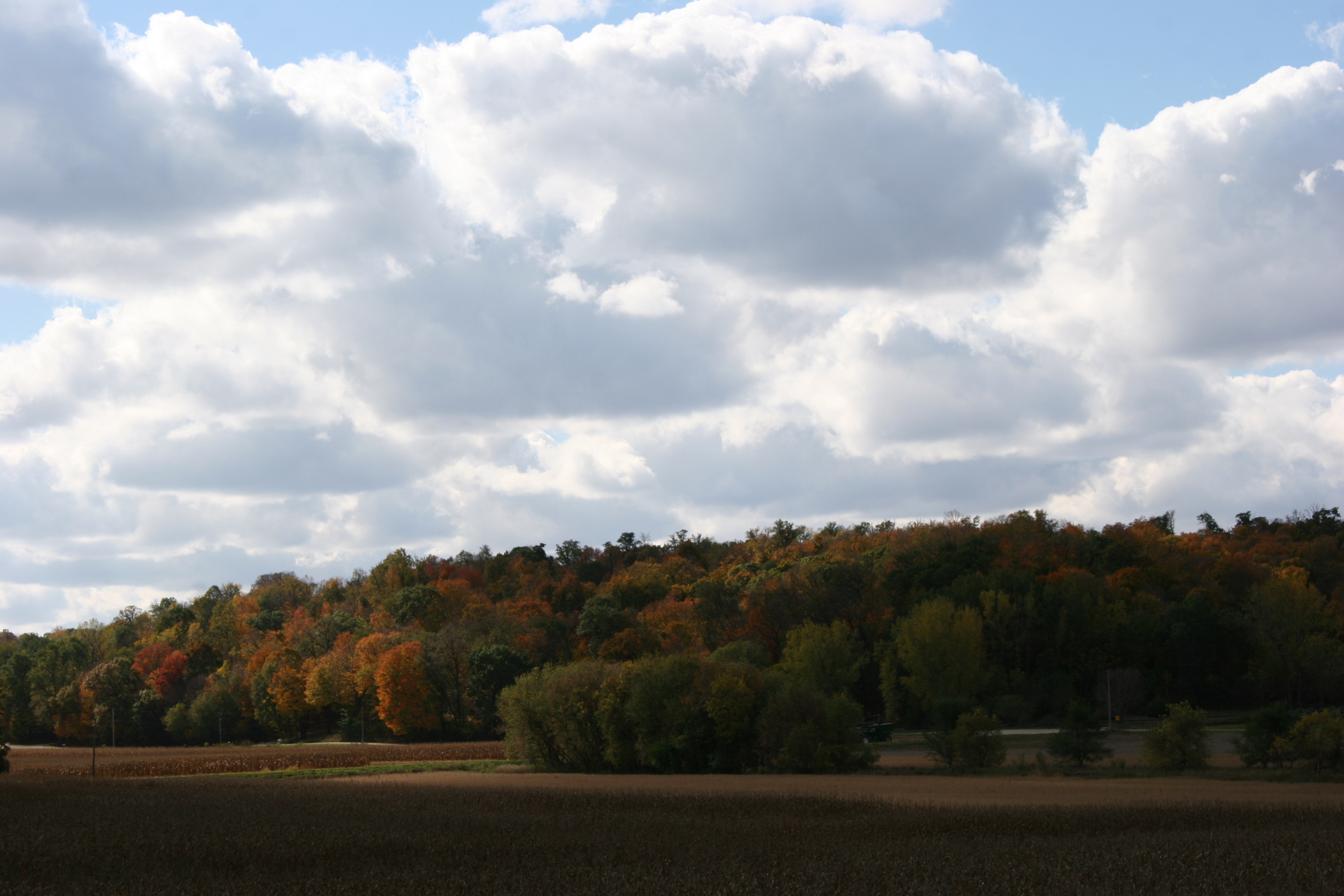
Clouds and trees and field along CR 8. (Minnesota Prairie Roots copyrighted photo mid-October 2021)

Our route took us past clusters of woods, some tinged in autumn hues.

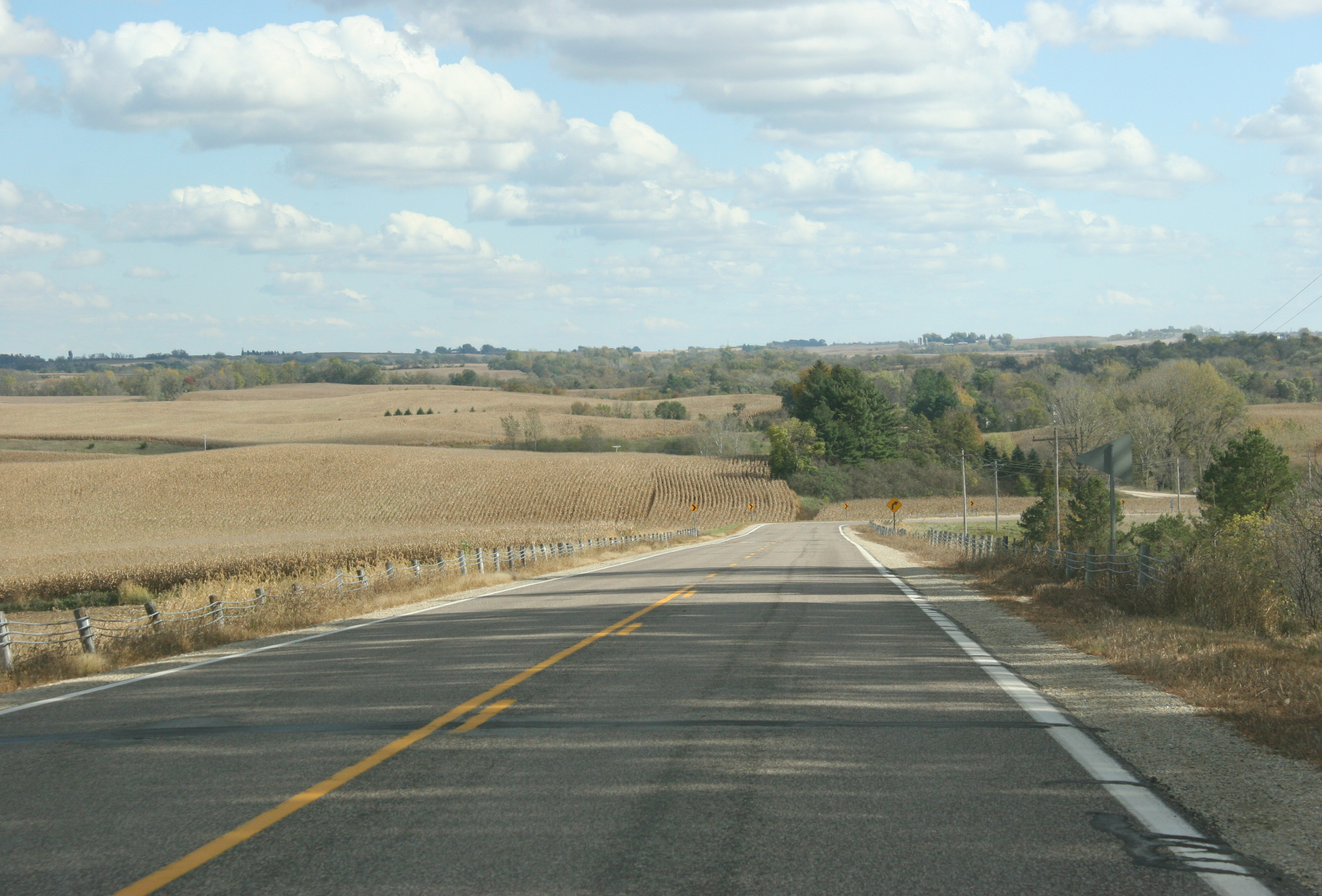
Goodhue County Road 8 near Cannon Falls sweeps into the valley. (Minnesota Prairie Roots copyrighted photo mid-October 2021)

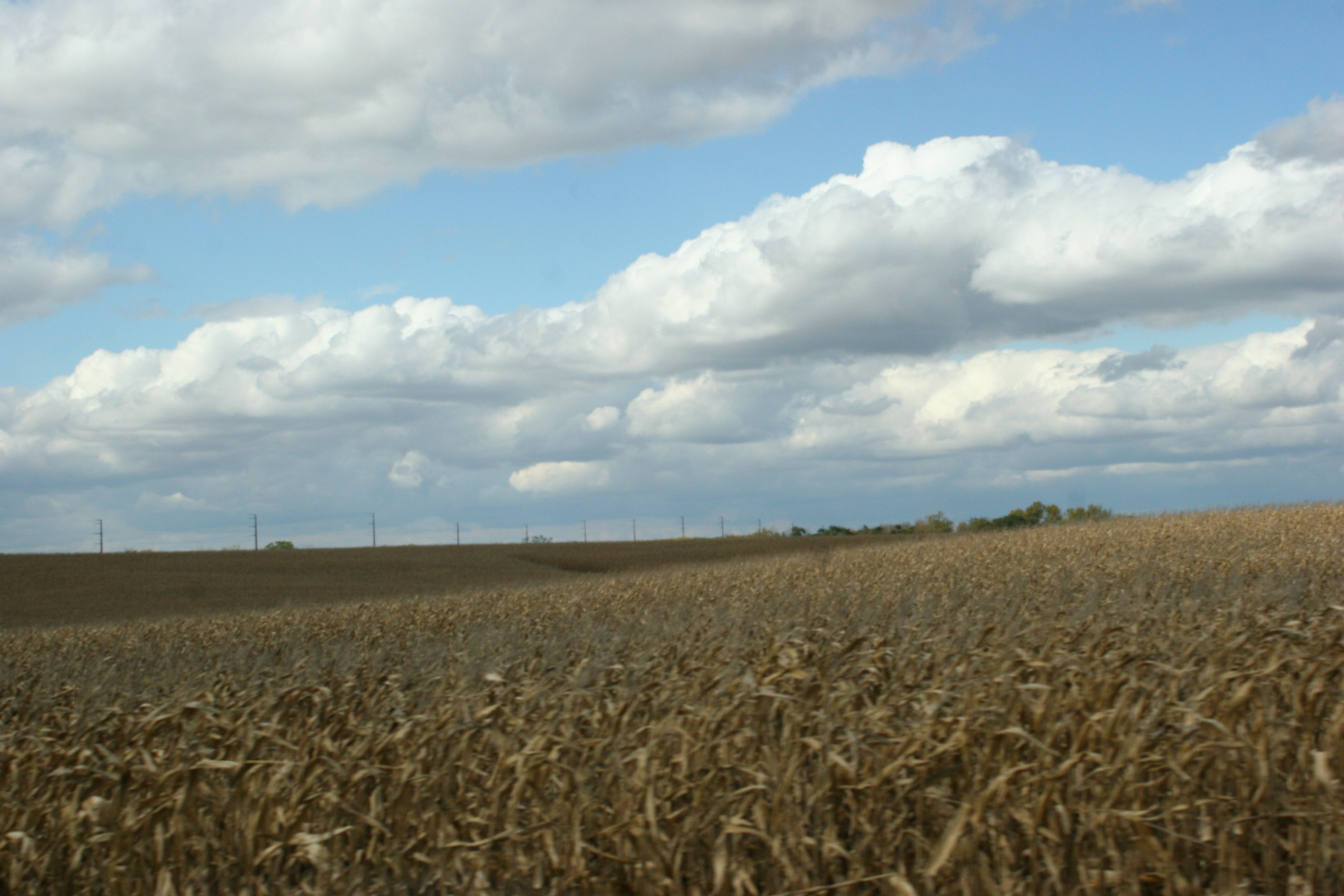
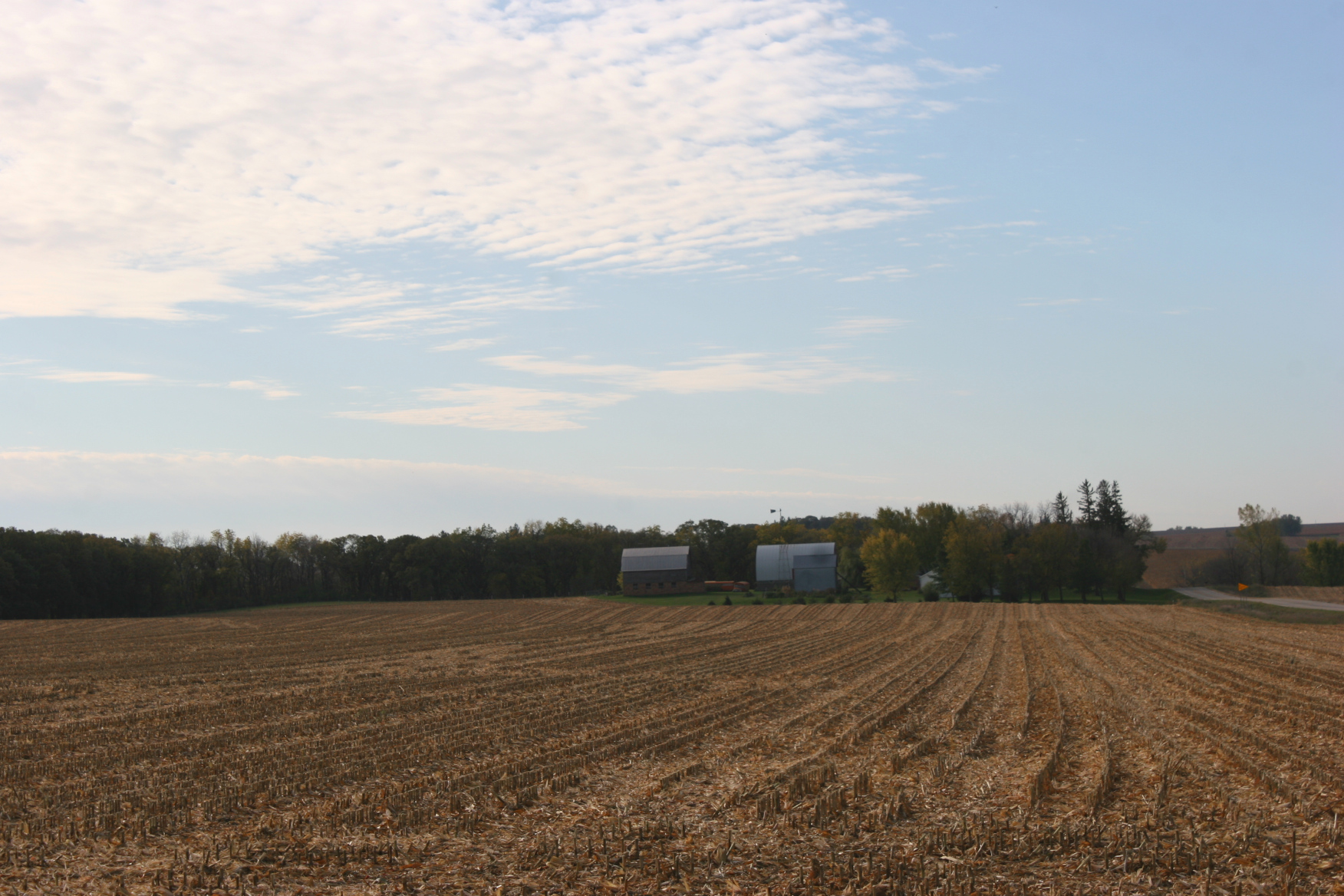
Soon the road curved and swept into the valley, rows of corn rolling across the landscape. Only groves of trees surrounding farm sites broke the vista of endless unharvested fields.

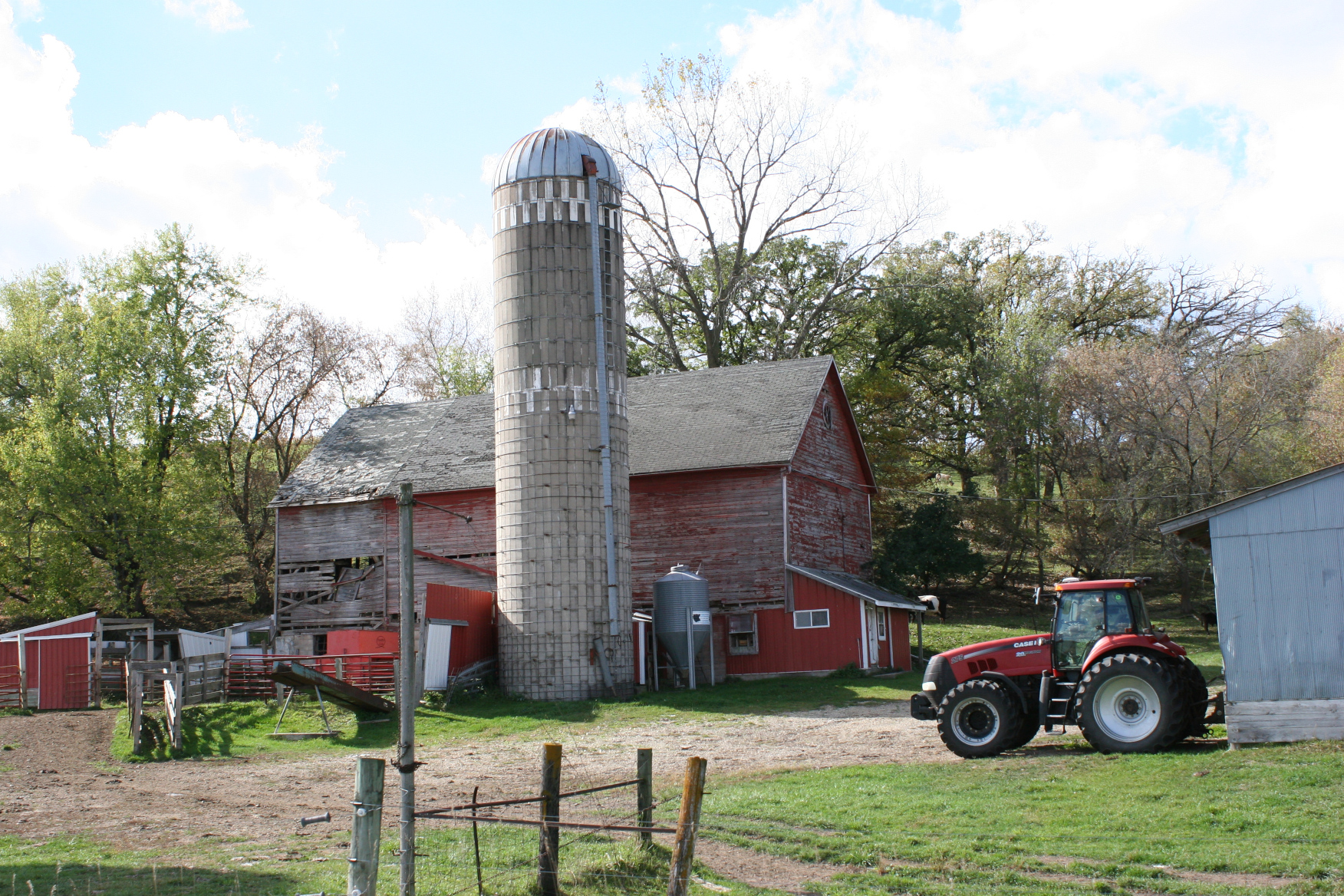
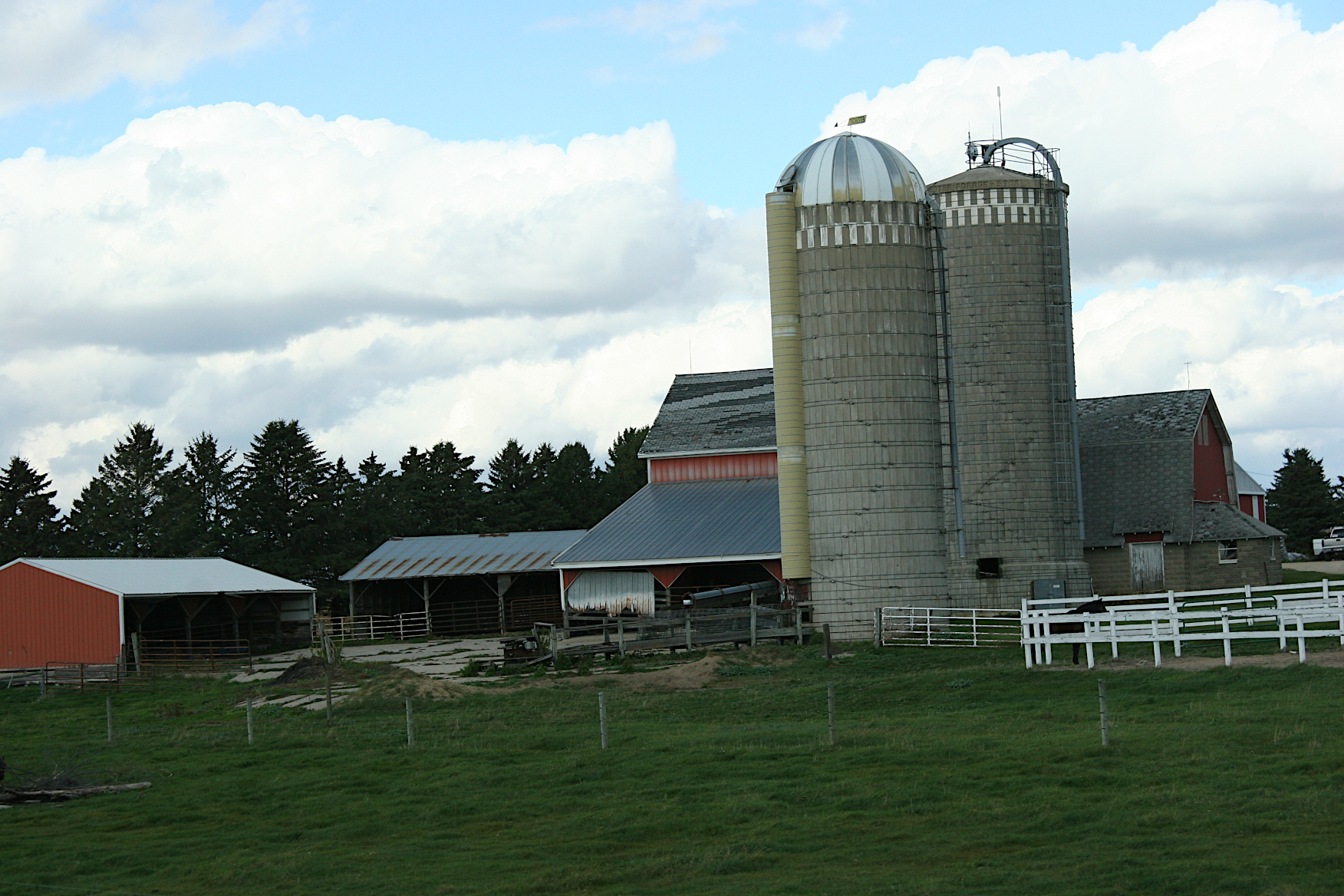
Somewhere between White Rock and Belle Creek, this farmyard drew my eye. (Minnesota Prairie Roots copyrighted photo mid-October 2021)

Sometimes those farmyards hugged the paved road and I caught a close-up glimpse of farms, some with aged weathered barns and outbuildings, others updated with modern equipment and structures.

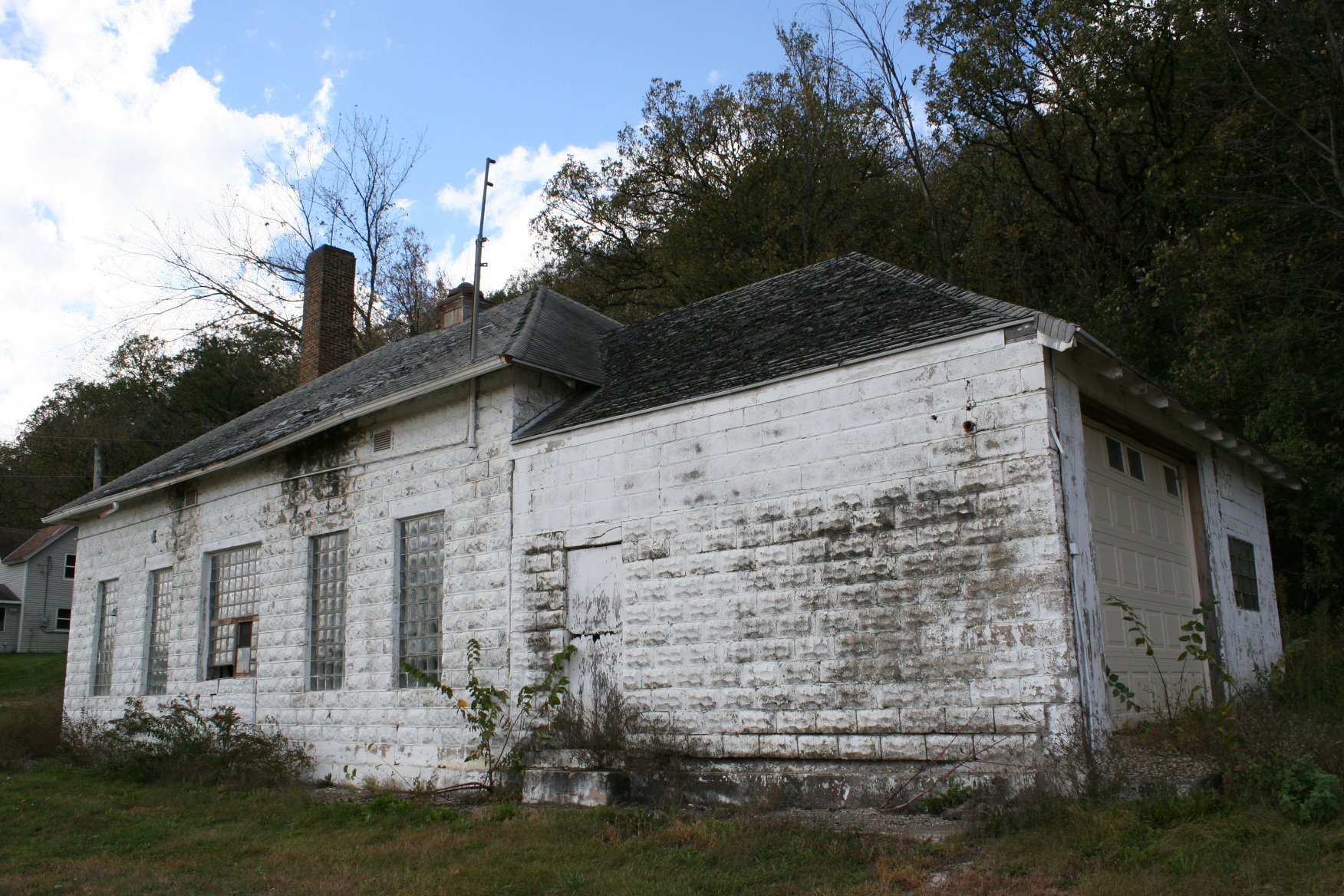
Likely a former creamery in Belle Creek. (Minnesota Prairie Roots copyrighted photo mid-October 2021)

In Belle Creek, Randy and I noticed a white building, likely a former creamery. Creameries often graced these small settlements, a necessity for farmers who sold cream for butter-making.

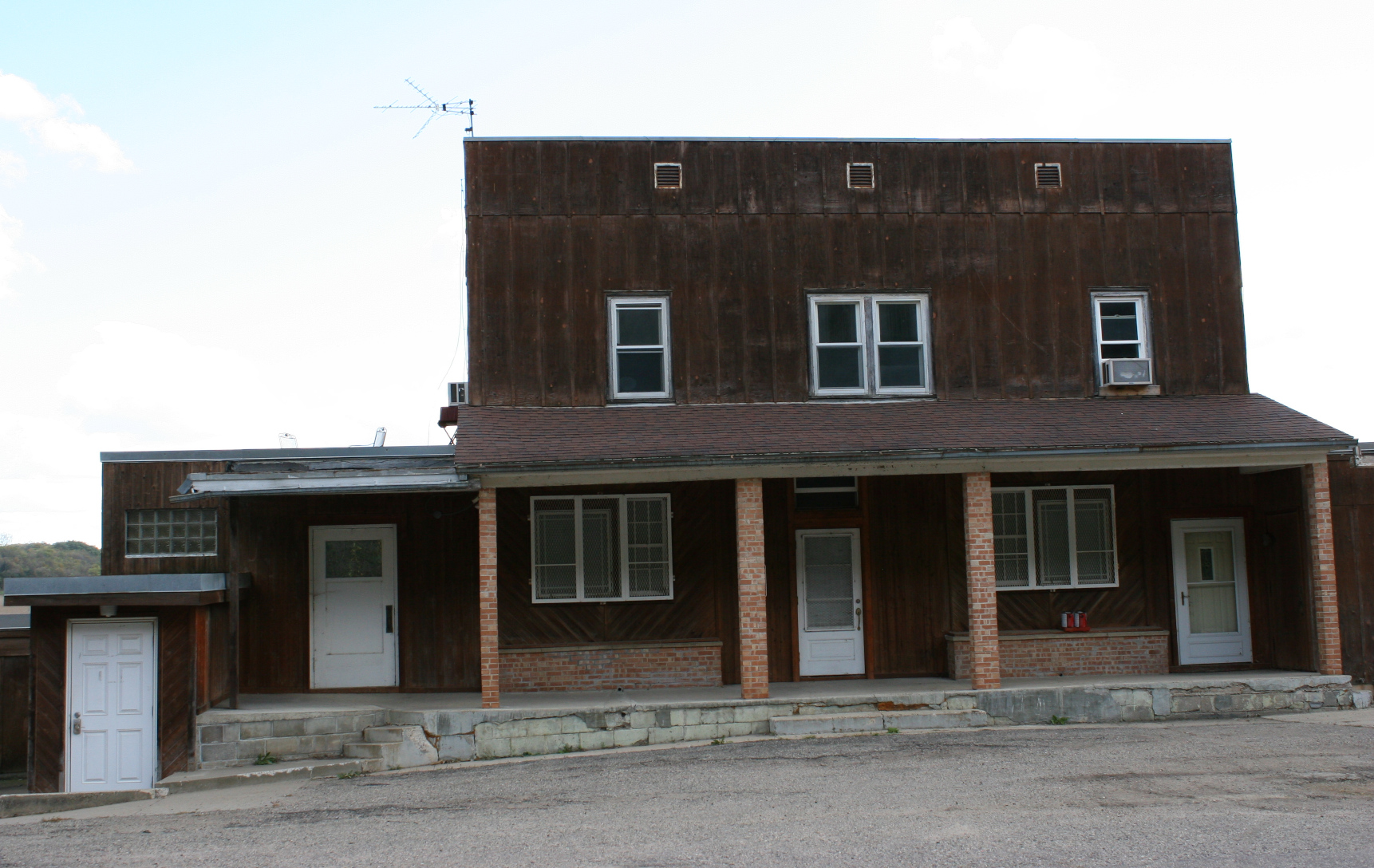
In Belle Creek, a building with an unknown-to-us story. (Minnesota Prairie Roots copyrighted photo mid-October 2021)

Another building in Belle Creek left us guessing at its past life. Perhaps a general store. Then a dance hall. We could be way off…

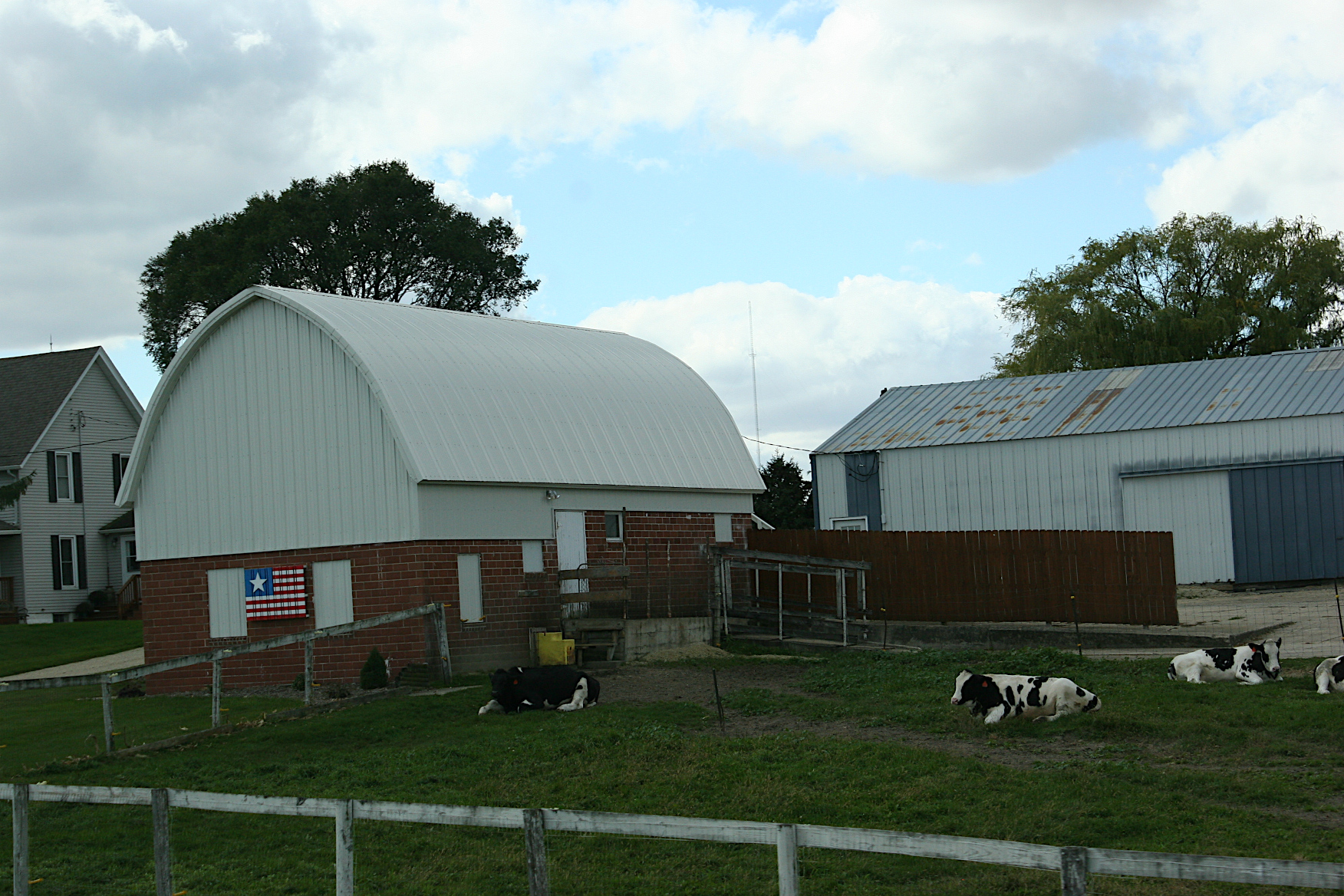
Seeing cows in the countryside takes me back in time. (Minnesota Prairie Roots copyrighted photo mid-October 2021)
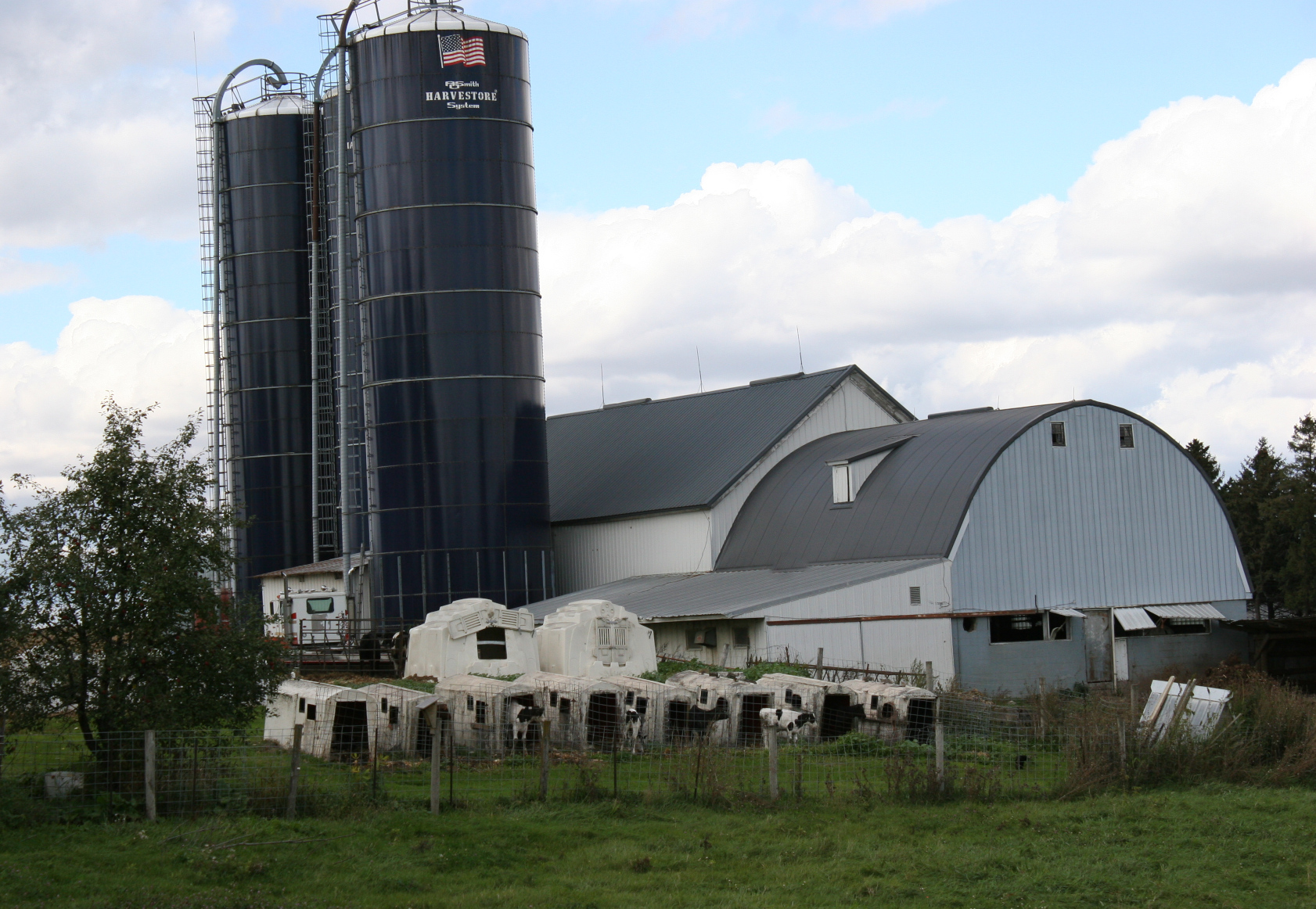
Near Hader, I spotted calves outside their huts. (Minnesota Prairie Roots copyrighted photo mid-October 2021)

Occasionally, we spotted cattle, cows, calves. Growing up on a dairy farm, I delight in seeing bovines, especially Holsteins. But rare are the small family farms today that still raise animals. Corporate and mega farms have mostly replaced that self-sufficient lifestyle. That’s reality.

Lots of sky and cornfields along CR 8 in Goodhue County. (Minnesota Prairie Roots copyrighted photo mid-October 2021)

Just like ghost towns, many farms have become, in some ways, ghost farms. They are but ghosts of the past. Ghosts of their former selves and purposes. I see that in decaying, empty buildings, especially barns. I see that in the absence of livestock. I see that in families who can no longer support themselves solely via the farm.

Farm after farm after farm defines this area of Goodhue County. (Minnesota Prairie Roots copyrighted photo mid-October 2021)

All of this is unsettling. But with time comes change. And with change must come acceptance and perhaps also an added historical appreciation for the past.

© Copyright 2021 Audrey Kletscher Helbling
 

On the backroads of Sogn Valley November 9, 2021

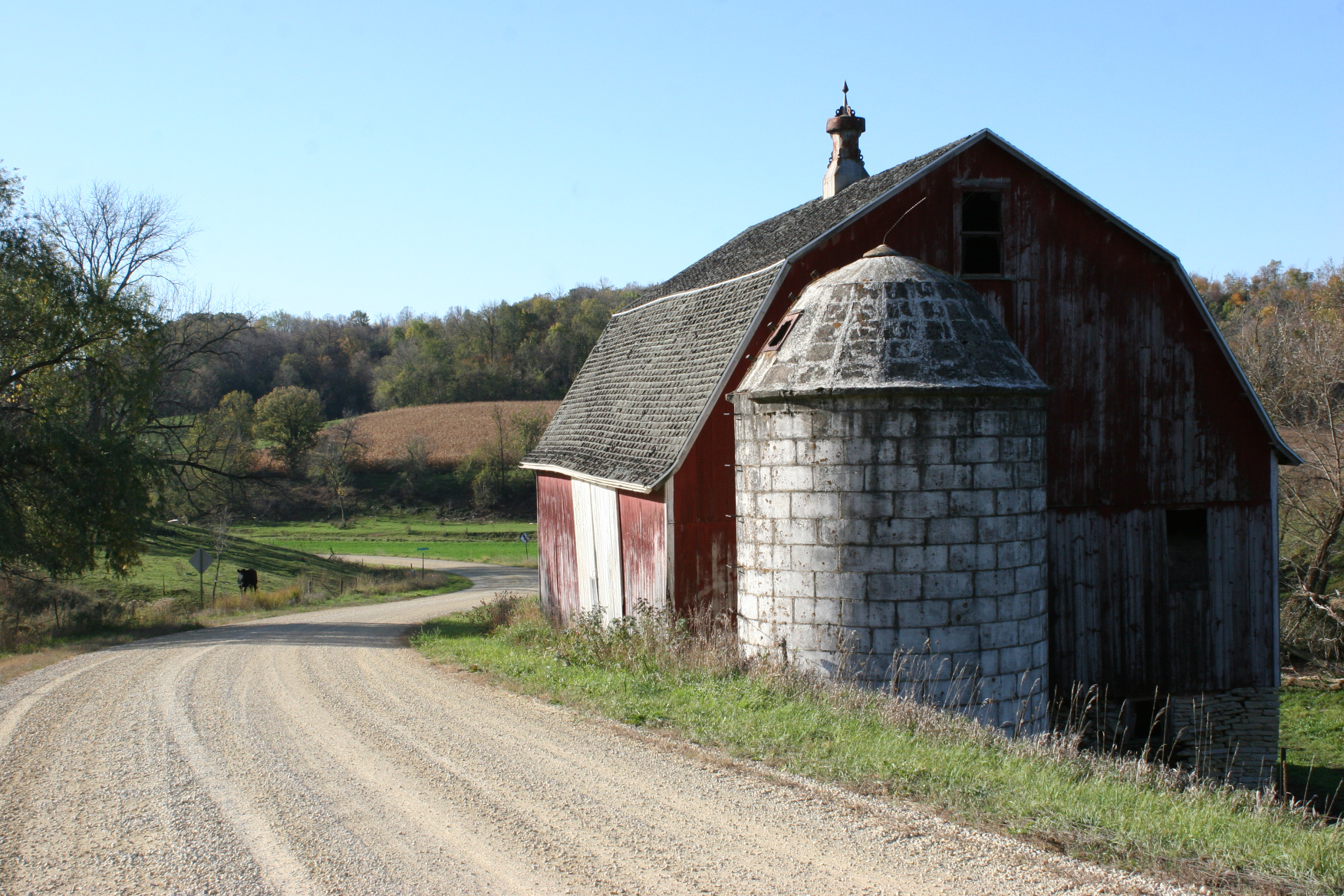
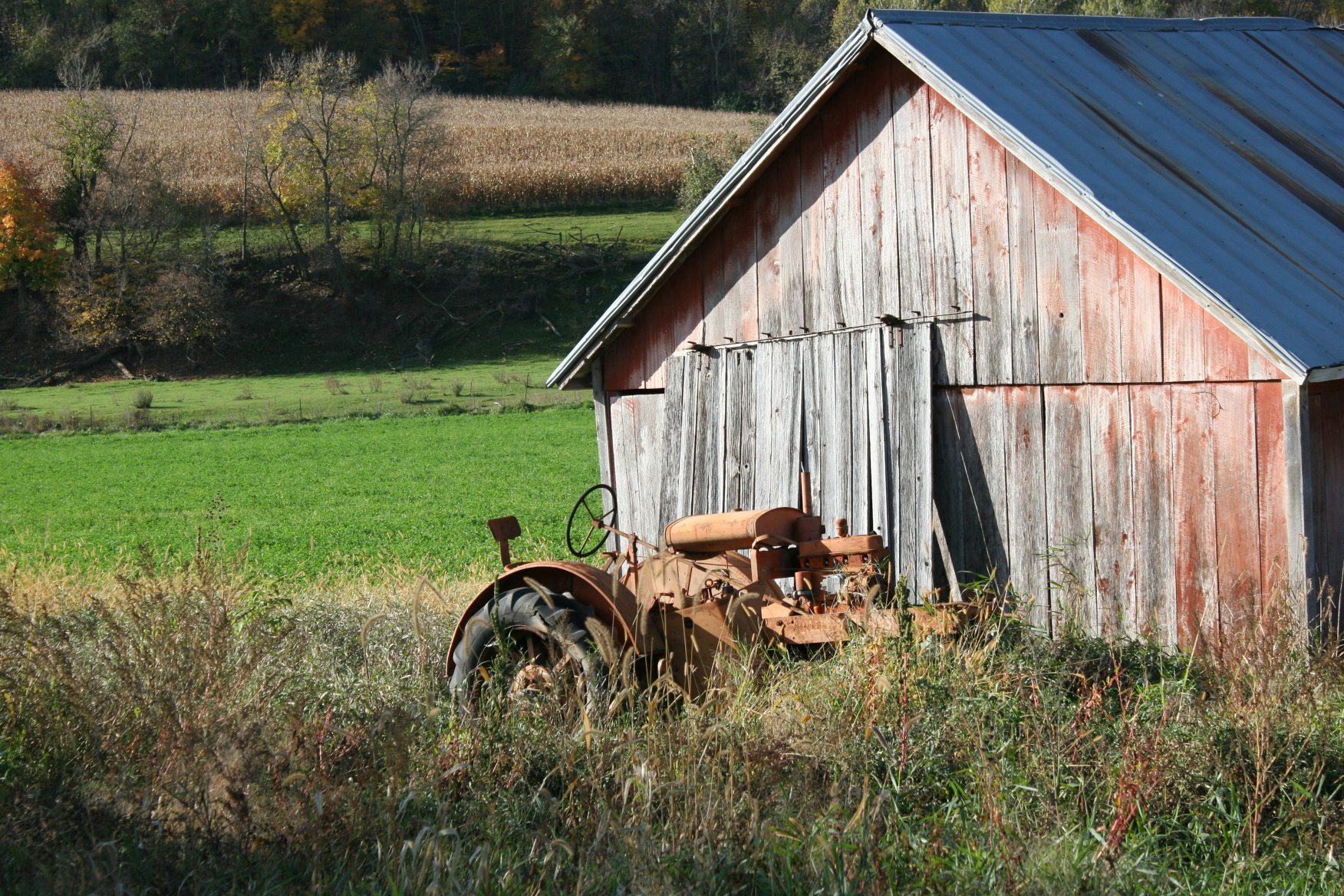
Along a backroad in the Sogn Valley, an aged barn and silo hug a curve on a gravel road. (Minnesota Prairie Roots copyrighted photo October 2021)

MINNESOTA’S DIVERSE LANDSCAPE inspires. From the vast prairie to the northwoods. From lakes to rivers. From hills to valleys. My home state, minus mountain ranges and ocean, is truly a beautiful place. We are so much more than cold and snow, as many non-residents equate with Minnesota.

The countryside near Nerstrand, on our way to Sogn Valley. (Minnesota Prairie Roots copyrighted photo October 2021)

Autumn, especially, showcases Minnesota’s natural beauty. This fall, Randy and I took many rural drives to immerse ourselves in the countryside and the season. We chose road trips over staying home and doing chores on the weekends. Our priorities change as we age. The work can wait. We recognize, too, the approach of winter. We felt an urgency, a need, to hit the road before the snow flies.

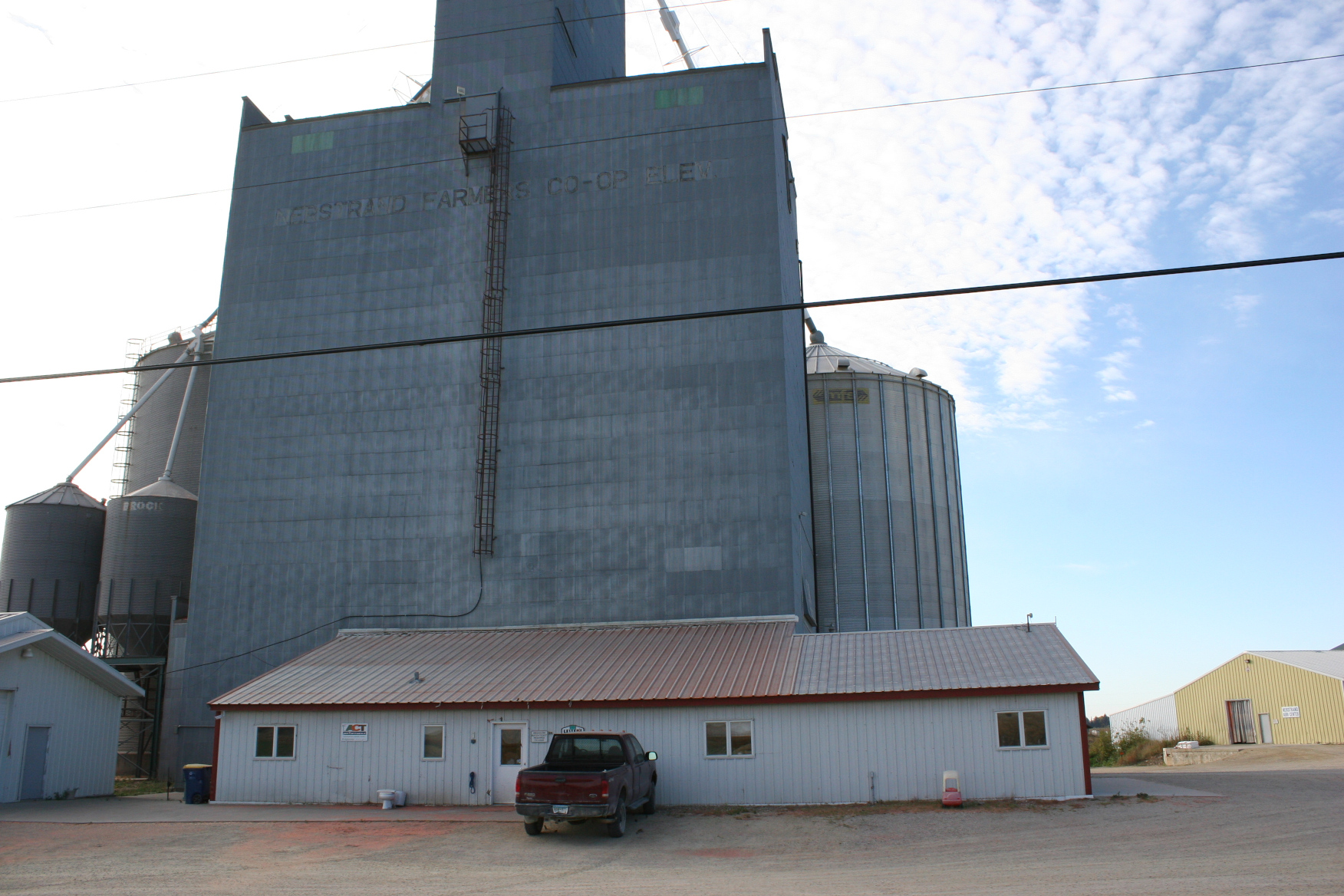
We drove through Nerstrand, past the grain elevator, on our way to the Sogn Valley. (Minnesota Prairie Roots copyrighted photo October 2021)

Often we choose a destination, this time Cannon Falls. But sometimes we simply head in a general direction, oversized Minnesota Atlas & Gazetteer available to guide us. We prefer paper maps to GPS. This trip, we aimed east toward Goodhue County, driving through the picturesque Sogn Valley.

The rolling countryside of the Sogn Valley provides a beautiful backdrop for farms. (Minnesota Prairie Roots copyrighted photo October 2021)

I love this rural region defined by farms and fields and winding gravel roads. Hills and river valleys and prairie intermingle and it’s all like poetry writing upon the land.

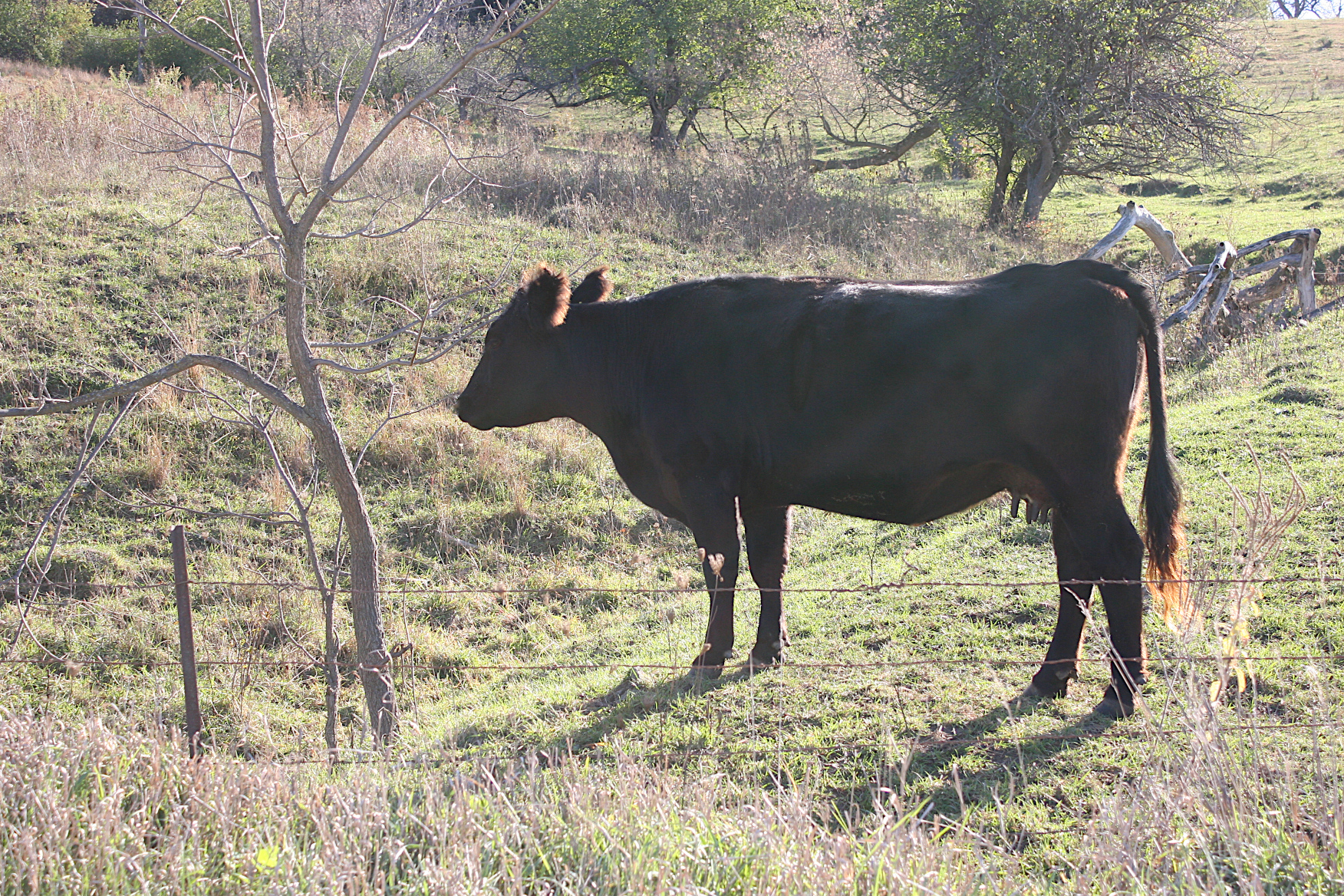
I delight in finding cows grazing deep in Sogn Valley. (Minnesota Prairie Roots copyrighted photo October 2021)

As a farmer’s daughter, I hold a fondness for aged barns, at one time the anchor of an agrarian life. I labored for years on my southwestern Minnesota childhood family dairy and crop farm, most of that time inside the barn. Or the silo.

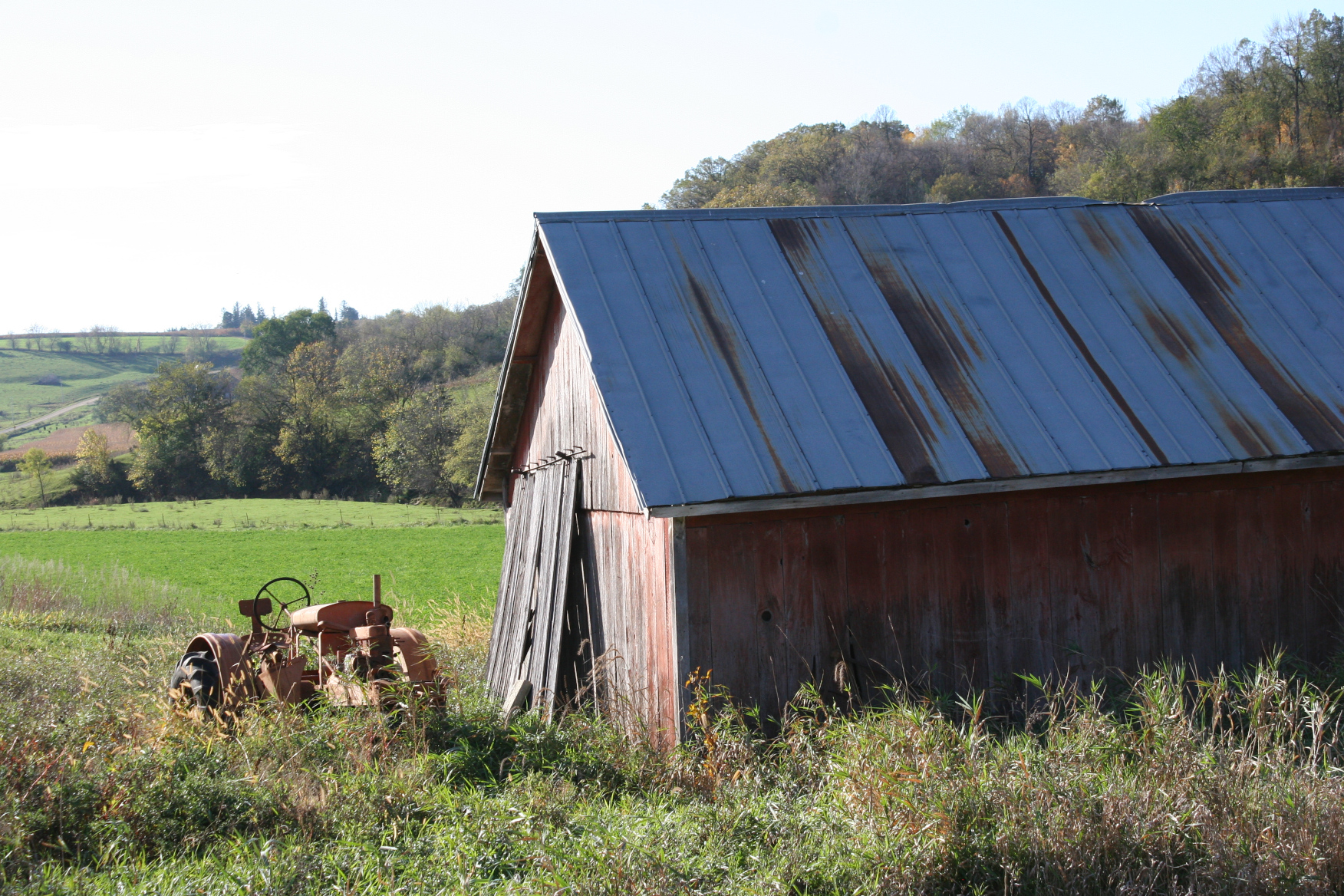
Abandoned building, abandoned tractor in the Sogn Valley. (Minnesota Prairie Roots copyrighted photo October 2021)

Now, when I pass by barns weathering in abandonment, I feel overcome by sadness. I recognize that a way of life is vanishing. I understand and appreciate advances in agriculture while simultaneously grieving the loss of farm life as I knew it.

I worry about all the barns we are losing. They hold history. Stories. Memories. And they are falling in heaps of rotted wood.

Eidsvold Norwegian Methodist Church, rural Goodhue County. (Minnesota Prairie Roots copyrighted photo October 2021)

But, on this drive through the Sogn Valley, we happened upon a small country church that uplifted my spirits. Country churches and adjoining cemeteries rate as another draw for me deep into rural Minnesota. They are historically, poetically, spiritually and artistically relevant.

Along 70th Street in Goodhue County, on a small plot of land ringed by a row of trees and set among cornfields, Eidsvold Norwegian Methodist Church rises. The last service was held here in 1949. Yet, the aged clapboard structure remains. Important to someone. And on this Friday morning in mid-October, appreciated by me.

PLEASE CHECK BACK tomorrow as I take you on a tour around, but not inside (it was locked), Eidsvold church.

© Copyright 2021 Audrey Kletscher Helbling
 

In the heart of historic Cannon Falls November 1, 2021

Signage on the building housing Antiques on 4th, a bright, uncluttered shop with artfully-displayed merchandise and friendly shopkeepers. (Minnesota Prairie Roots copyrighted photo October 2021)

YOU CAN LEARN much about a small town by simply walking. And looking, really looking.

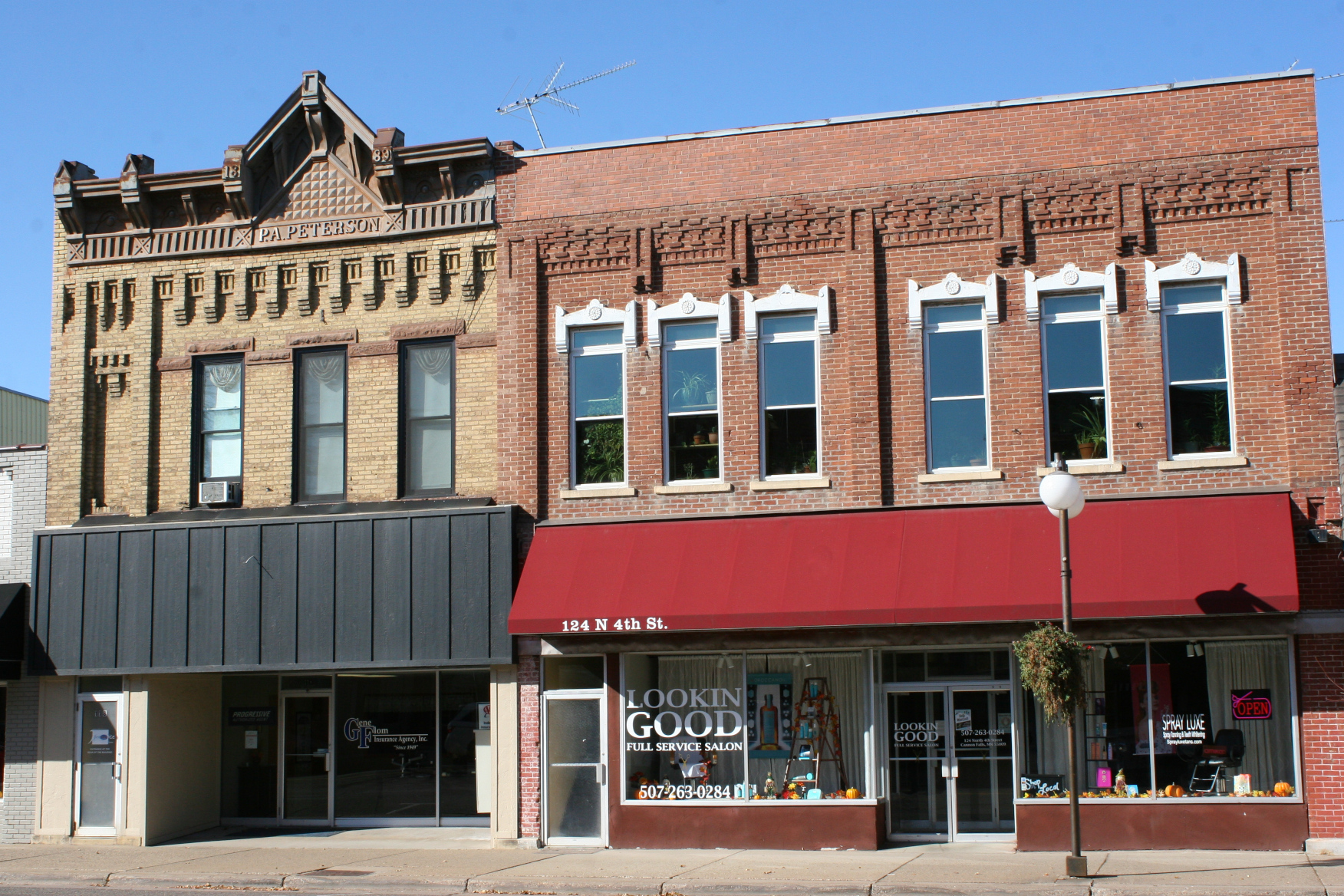
Two historic buildings in downtown Cannon Falls. (Minnesota Prairie Roots copyrighted photo October 2021)

On a recent day trip to Cannon Falls, I explored part of the downtown business district. Now on the National Register of Historic Places, the Cannon Falls Historic District includes 22 historically-significant structures.

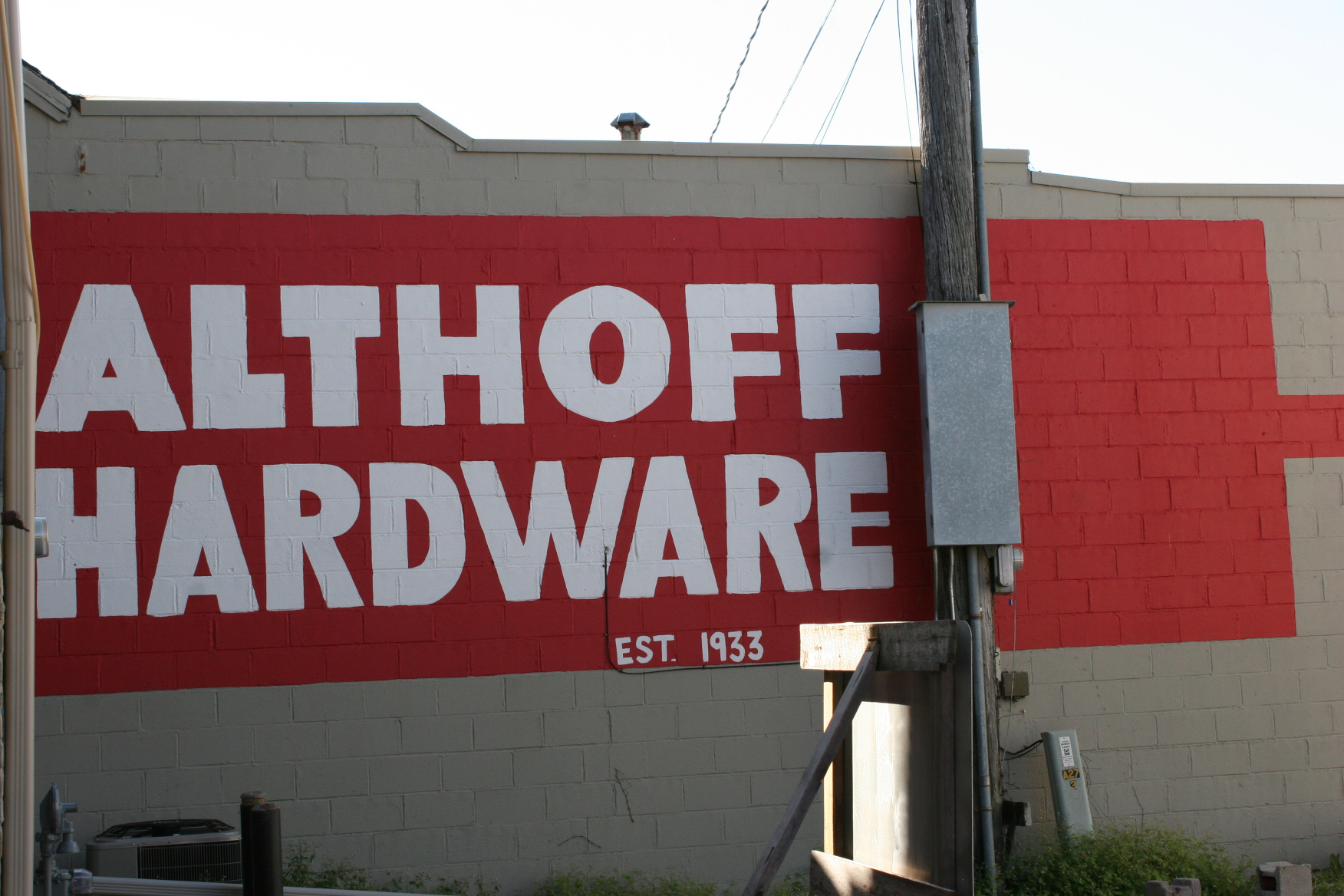
Bold art on the side of the building identifies the local hardware store. (Minnesota Prairie Roots copyrighted photo October 2021)

Given my love of historic architecture, and art, this Goodhue County community of 4,220 within a 40-minute drive of Minneapolis and St. Paul rates as a favorite regional destination.

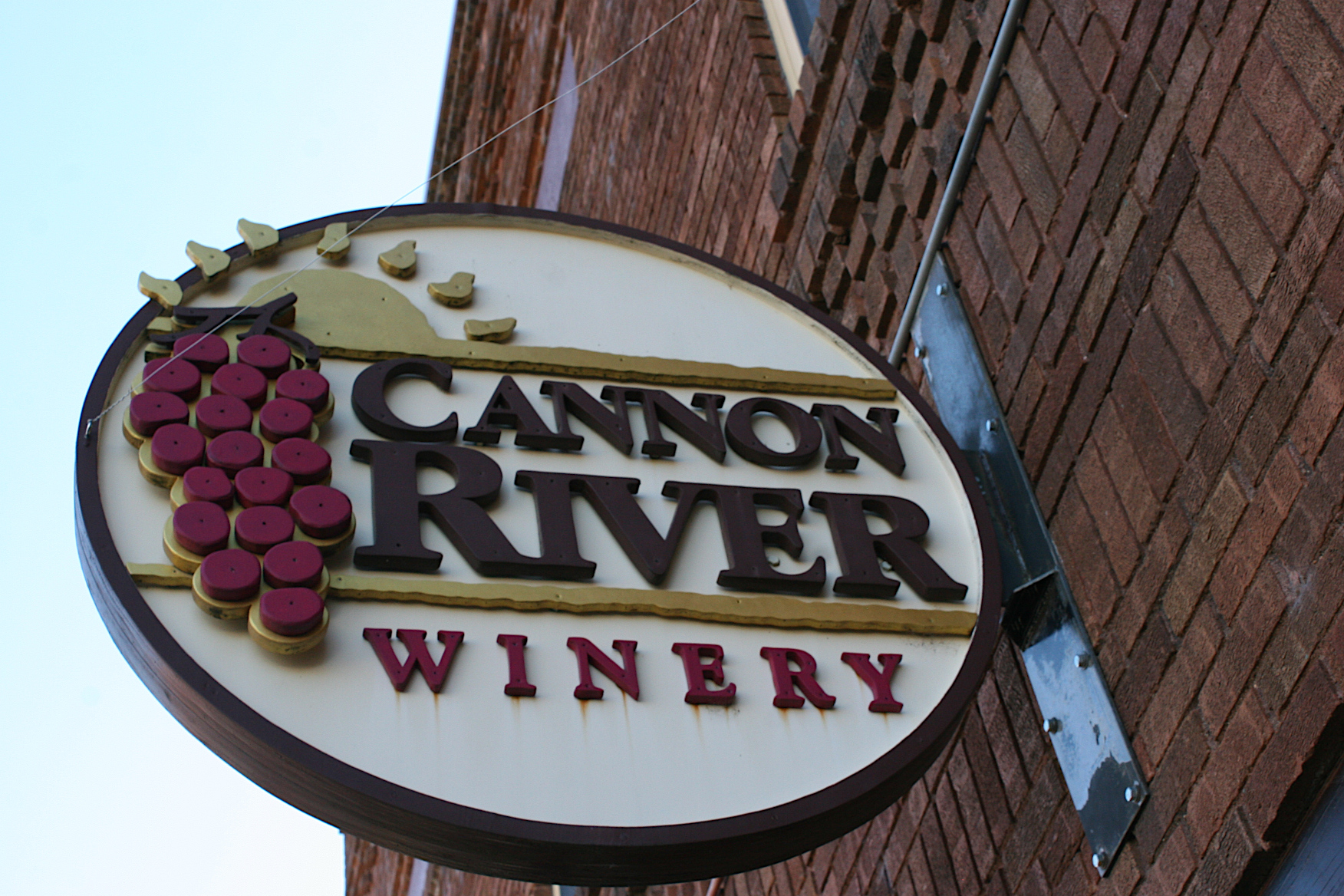
Signage marks the popular winery in Cannon Falls. (Minnesota Prairie Roots copyrighted photo October 2021)

Cannon Falls thrives with a well-known winery and bakery and an assortment of shops from antique to gift to hardware store. Toss in a mix of eateries, bars and a brewery and, well, there’s lots to see and do here. Plus, the town attracts outdoor enthusiasts who canoe the Cannon River and/or bike/hike the Cannon Valley Trail and Mill Towns Trail.

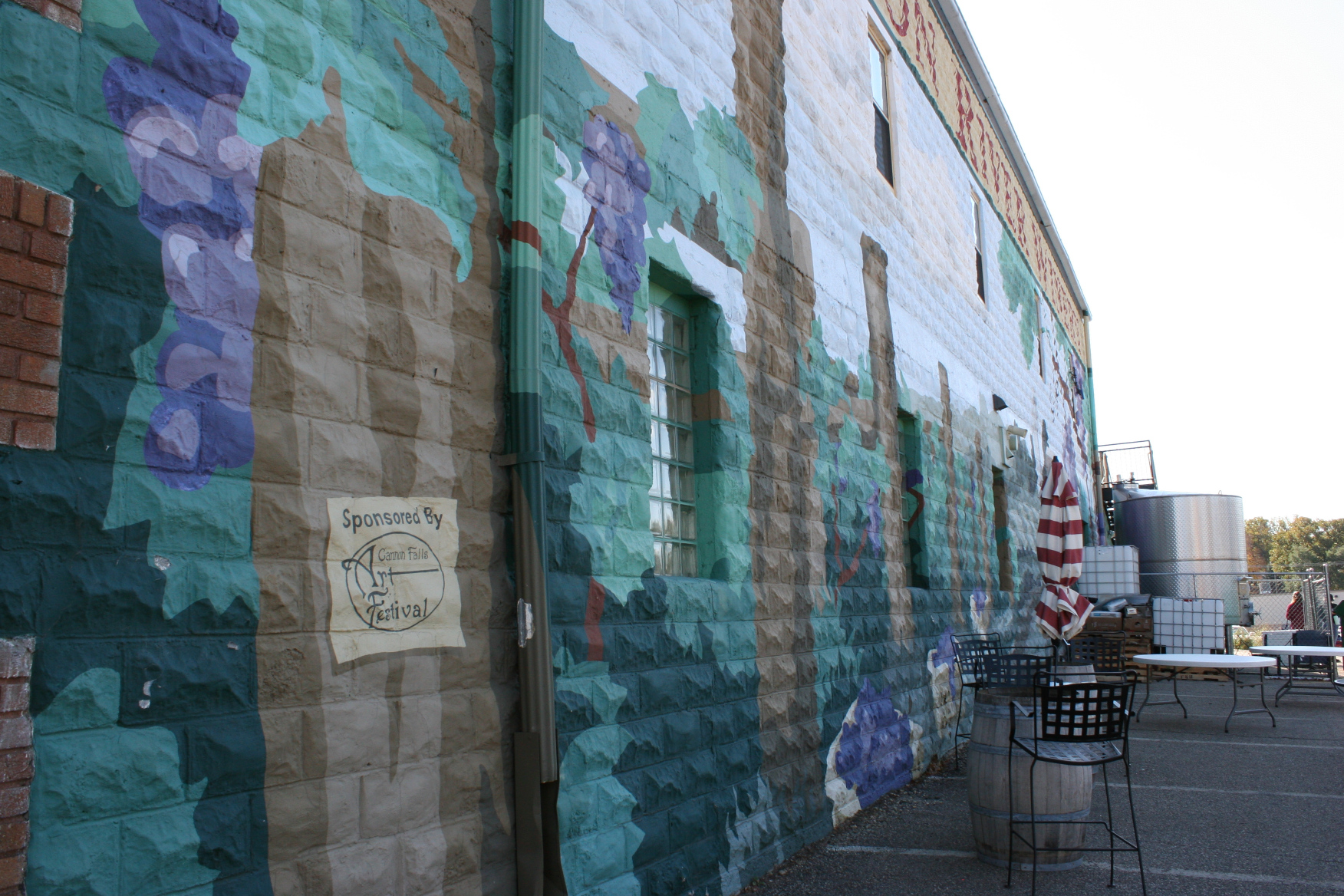
A mural at Cannon River Winery provides a backdrop for an outdoor space. (Minnesota Prairie Roots copyrighted photo October 2021)

During my mid-October visit, I popped into a few shops (including the bakery), discovered the lovely library and admired a new downtown mural. Because of COVID concerns, I skipped dining and imbibing. It was too early in the day and too cool to enjoy either outdoors.

Cannon Falls’ newest mural, a 2021 Youth Mural Arts Community Project, highlights geography, history and local interests. (Minnesota Prairie Roots copyrighted photo October 2021)

Still, I found plenty to take in from the colorful new mural to the art inside the library to ghost signage.

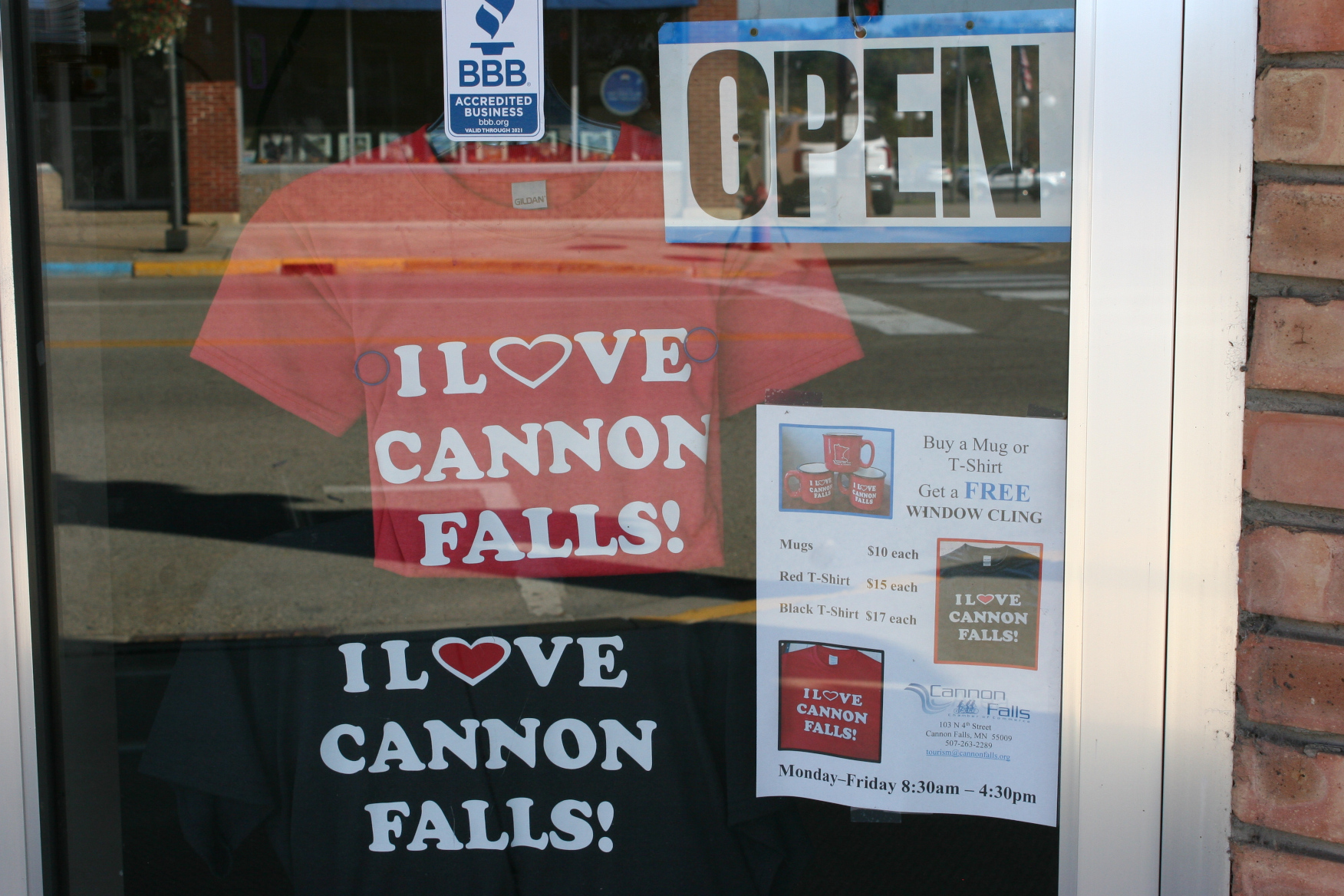
Showing some love for Cannon Falls. (Minnesota Prairie Roots copyrighted photo October 2021)

I noticed, too, hometown pride in the I LOVE CANNON FALLS! tees in a storefront window.

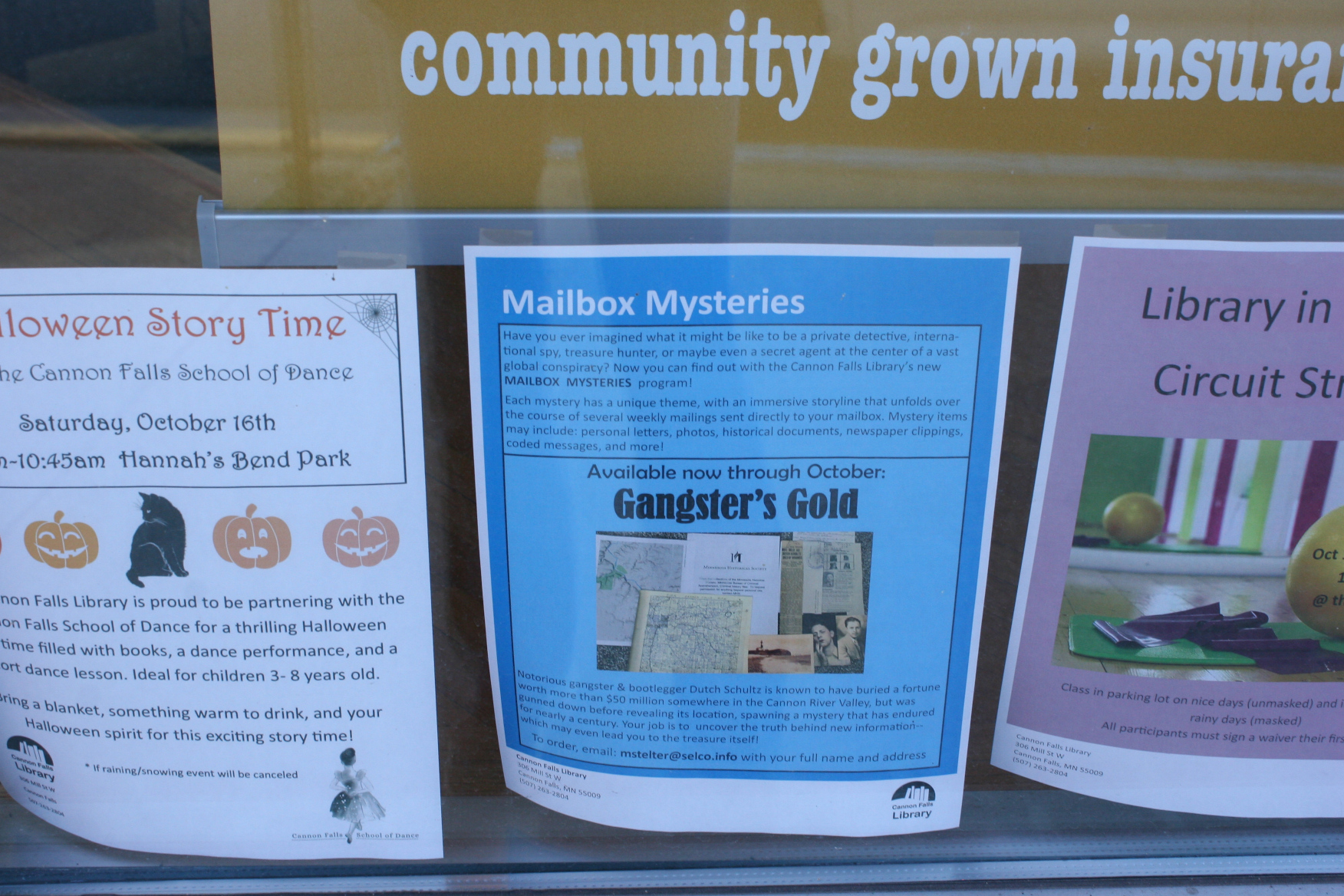
I learn so much about communities by reading signs in windows. (Minnesota Prairie Roots copyrighted photo October 2021)

I noticed also notices taped in a display window, one of which alerted me to Mailbox Mysteries, which led me to the library around the corner which led me to sign up for this challenging endeavor. Now I’m trying to solve the “Gangster’s Gold” mystery with weekly clues snail mailed to me by the library.

Inside the library, I found this vivid “Once Upon a Time” mural. (Minnesota Prairie Roots copyrighted photo October 2021)

Had I not done this walk-about through downtown Cannon Falls, I likely would have missed these nuances. The details which help define this community.

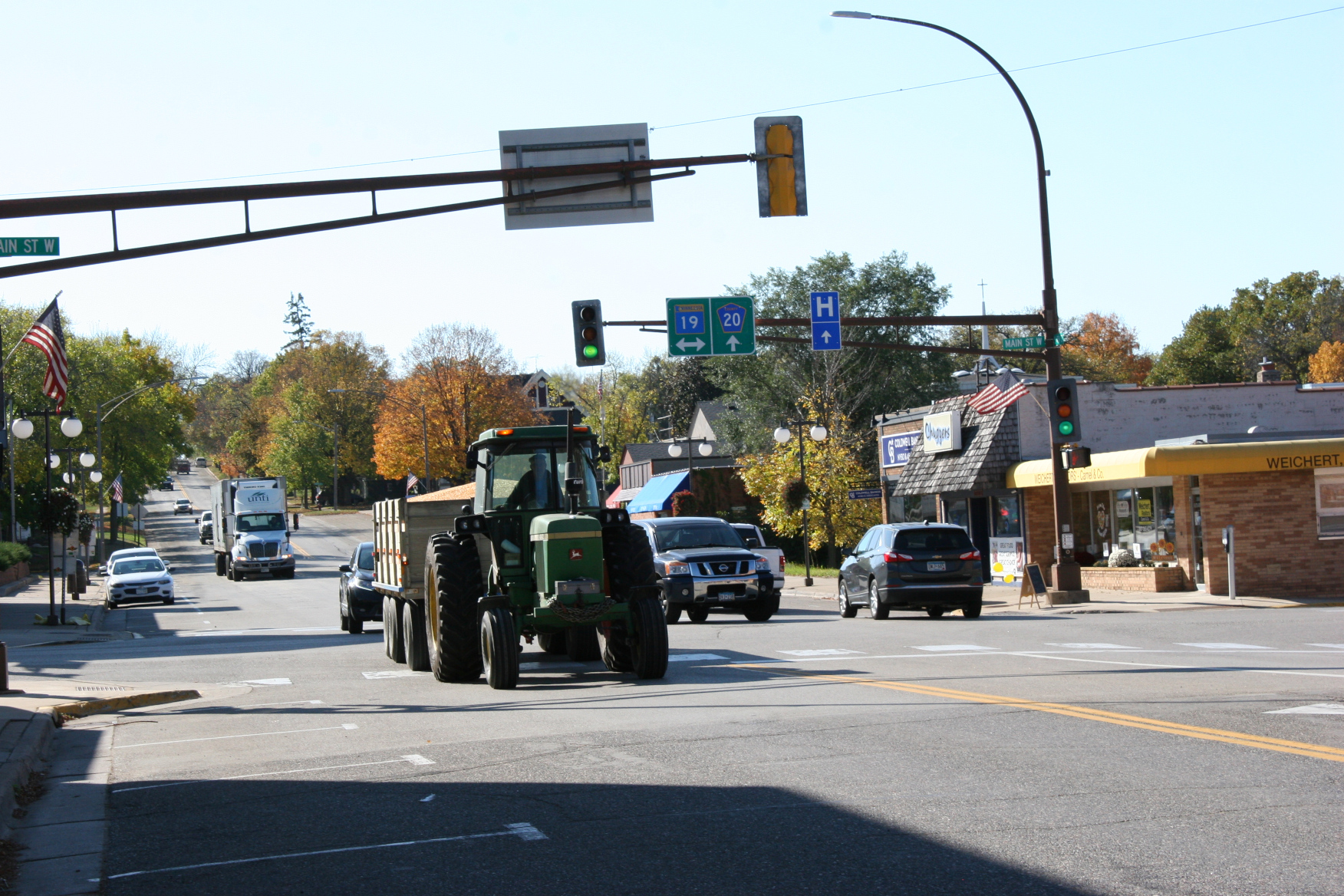
A scene in the center of downtown Cannon Falls reminds me of the town’s rural roots. (Minnesota Prairie Roots copyrighted photo October 2021)

As I meandered, I paused to watch a John Deere tractor roll through downtown pulling a wagon heaped with golden kernels of corn. This is, after all, an agricultural region.
A grain complex in Cannon Falls. (Minnesota Prairie Roots copyrighted photo October 2021)

Later, Randy and I picnicked at Hannah’s Bend Park, the local grain elevator complex defining the nearby skyline. As we finished our lunch, a bald eagle soared overhead, wings spread wide. I expect the Cannon River drew the majestic bird here, to this small southeastern Minnesota town, this Cannon Falls.
#

FYI: Please check back for more posts from Cannon Falls and the surrounding area, including the Sogn Valley. Also enjoy my earlier post on Hi Quality Bakery by clicking here.
© Copyright 2021 Audrey Kletscher Helbling