Minnesota Prairie Roots

Writing and photography by Audrey Kletscher Helbling

Growing up with 21 siblings in rural Minnesota, a memoir June 10, 2025

This book is also packed with candid and posed photos of the Miller family, adding to the text. (Book cover sourced online)

THIS COULD BE MY STORY or that of any other Baby Boomer who grew up in rural southern Minnesota. With one primary exception. None of us had 21 siblings. Yes, twenty-one. I had only five—three brothers and two sisters.

But Helen Miller had seven brothers and 14 sisters, all single births, all born to the same parents, Lucille and Alvin Miller of rural Waseca, over a span on 26 years. She’s chronicled the family’s life in a self-published memoir, 21 Siblings—Cheaper by the Two Dozen.

I happened upon this book, printed in 2018, after visiting the Waseca County History Center and seeing an exhibit about this unusually large family. I knew then that I needed to read this story by Helen, 13th in line. She’s just a bit older than me. I expected my farm upbringing during the late 50s through the 60s and into the early 70s would be similar in many ways. I was right.

WHITE RICE & PANCAKES

This book proved a stroll down memory lane. I remember meals of mostly meat and potatoes with a side vegetable given that was the preferred meal of my farmer father. He, like Alvin Miller, was quite content to eat those basics and didn’t care for any deviations. Large gardens were the norm, no matter family size. Lucille Miller canned fruits and vegetables, just like my mom, except a whole lot more. And, when food supplies ran low, both our mothers cooked a meal of white rice and cinnamon. I detested that and to this day still don’t like plain white rice.

I also do not much like pancakes, although I have no particular reason to explain that dislike. Helen Miller should. She writes of the family receiving boxes and boxes of pancake mix following a railroad accident. Except they didn’t get the pancake mix until months later…when weevils had infested the food. The Millers simply sifted out the bugs, prepared and ate the pancakes. They weren’t about to turn down free food.

Specific stories like these point to the challenges of feeding a mega family, even with their own garden produce, chicken, pork and eggs. With that many people to feed and to shelter, you can only imagine the logistics of running the household. Older siblings were responsible for younger siblings. Everyone pitched in with chores. They shared a lot—clothes, shoes, a singular cup for drinking water (same as my family), rooms, a love of music and a strong faith.
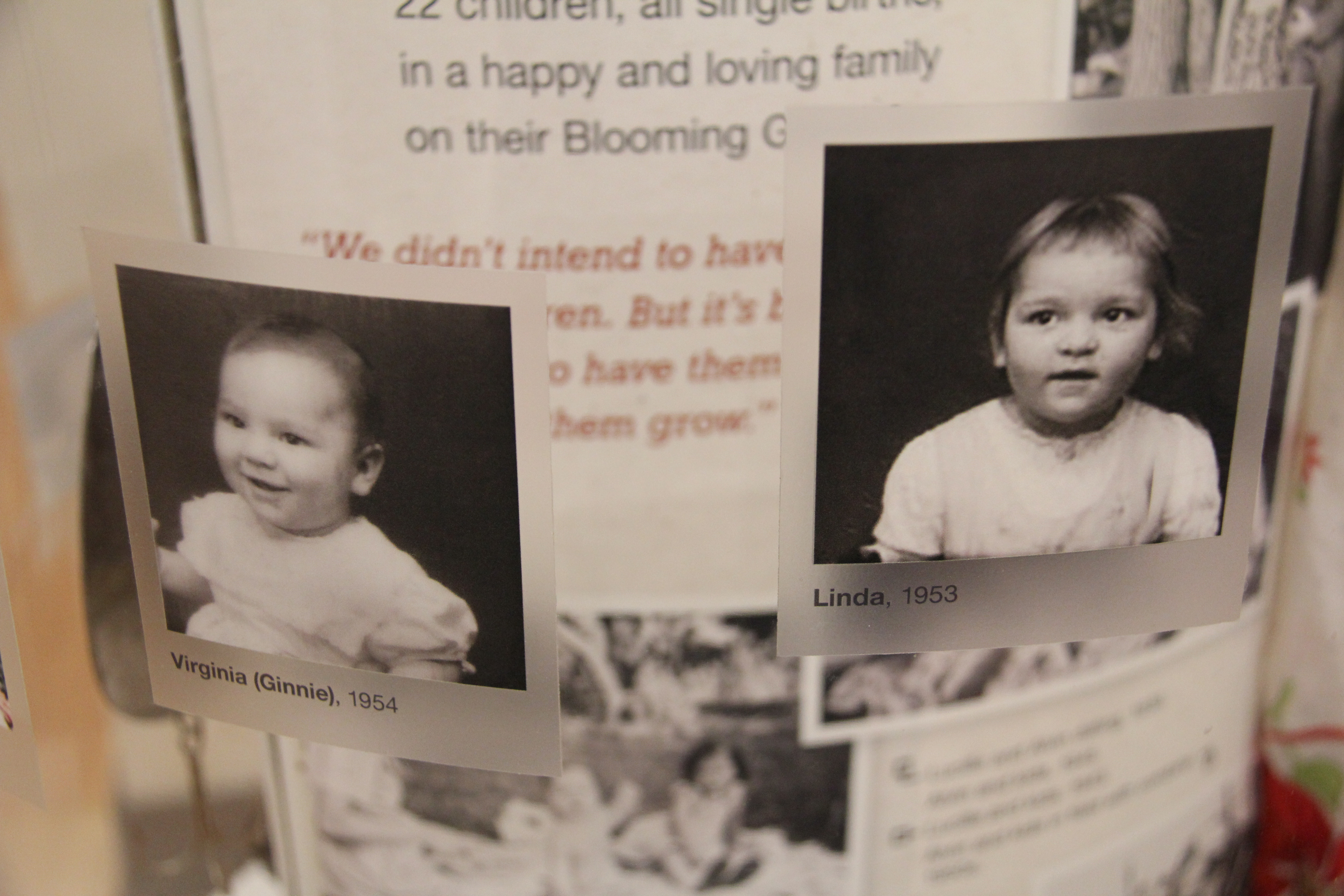
This shows part of the Miller family exhibit at the Waseca County History Center. (Minnesota Prairie Roots copyrighted file photo May 2025)

THE IMPORTANCE OF FAITH

The Millers’ Catholic faith centered their lives. Lutheranism centered mine. Faith carried the Millers through an especially tragic event—the deaths of their aunt, Irene Miller Zimmerman, and her six young children in 1959. An unseen train broadsided their station wagon just blocks from Sacred Heart School, the same school Helen and her siblings attended. She writes: It was under this veil of grief that I grew up a rather serious child. She was only four years old.

Amid the difficult moments, Helen documents light-hearted moments, too. One in particular caused me to burst into laughter. As a seven-year-old, Helen went to Confession for the first time, thinking she had not broken any of the Ten Commandments. But she had to confess something to the priest. Helen admitted to disobeying her parents twice, having false gods twice and then, and here’s the kicker, committing adultery three or four times. Now there’s nothing funny about that sin. But when an elementary-aged girl confesses to something she clearly doesn’t understand, well, I wonder how that priest kept from laughing aloud. He didn’t laugh, or correct her, according to Helen, who twice confessed to breaking the Sixth Commandment.

SEWING, FISHING & A WHOLE LOT OF PATIENCE

Story after story reveals a childhood upbringing that many times mimicked my own. Like Helen, I learned to sew because, if I wanted new clothes as a teen, I needed to stitch them. I babysat children for fifty cents an hour, just like Helen. I fished, occasionally, with my family. But the Millers fished often, usually at their rustic cabin along Reeds Lake a short drive from their farm. Vacations and dining out were not part of our youthful experiences. The list of similarities goes on and on among the many differences.

I can never fully relate to having 21 siblings. But this rural Waseca family managed and, by all accounts, well. With a whole lot of organization, love, strength and patience. And, Helen notes, with an eternally optimistic and patient mother. Just like my mom.

© Copyright 2025 Audrey Kletscher Helbling


A traffic stop & conversations about race & identity January 7, 2025

Book cover sourced online

EARLY ON A RECENT WEEKDAY MORNING, my husband was pulled over by a deputy sheriff while driving to work. Randy had no idea why he was being stopped on the edge of Faribault. The officer who approached the passenger side of our rusty 2005 white van and rapped on the window did not immediately tell Randy why he pulled him over.

But the questions and actions that followed left me unsettled and thinking about what could have unfolded. You see, I was in the middle of reading Our Hidden Conversations—What Americans Really Think About Race and Identity by Michele Norris, creator of The Race Card Project. That partially prompted my adverse reaction.

As I listened to Randy’s retelling of the traffic stop, I felt thankful that he is a past-middle-aged White guy. I felt a bit guilty for thinking that. But…

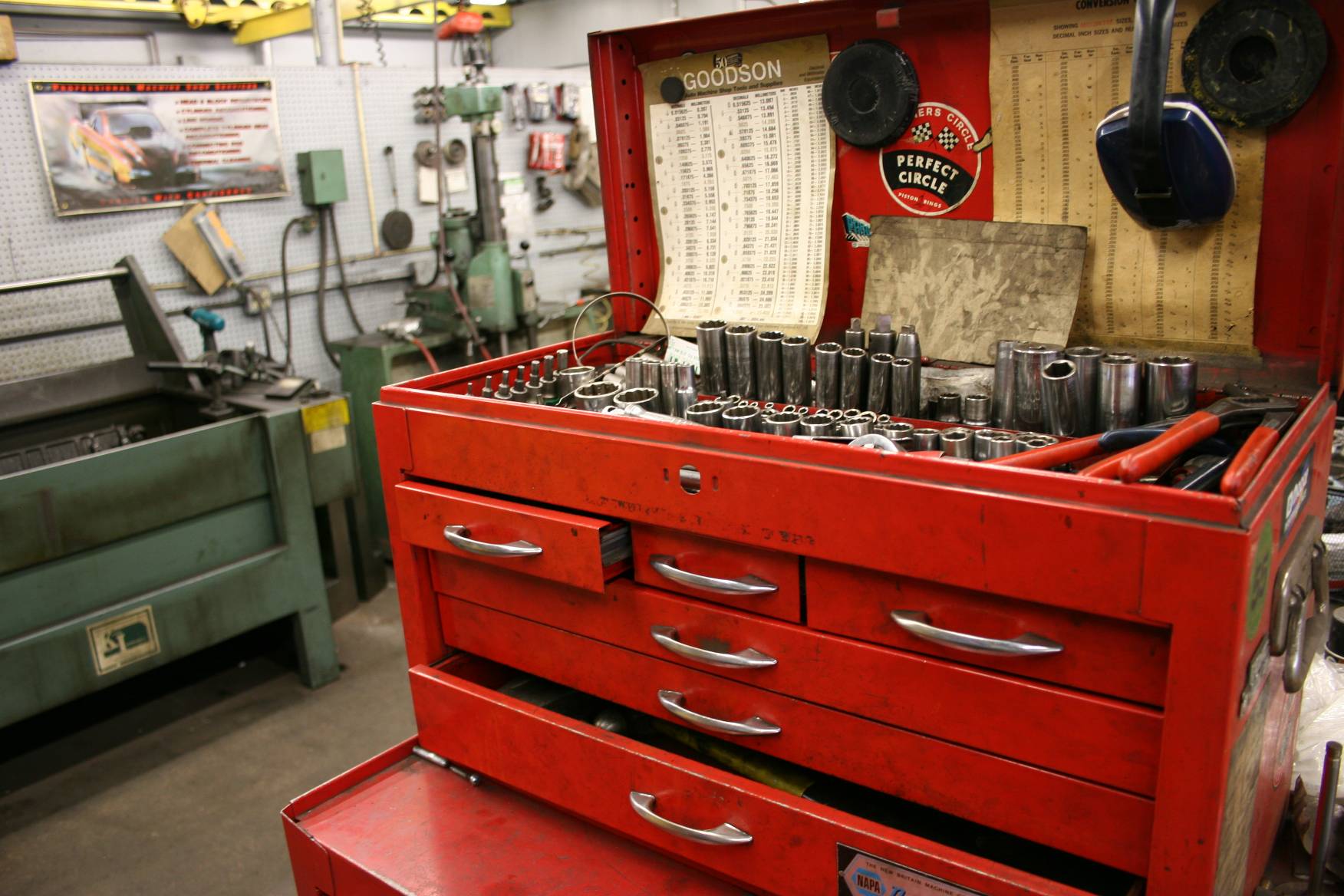
Randy, in his work jacket and uniform, was just driving to work at his job as an automotive machinist when he was pulled over and questioned. (Minnesota Prairie Roots copyrighted file photo)

DO YOU HAVE A WEAPON?”

After requesting the usual identifying documents, the officer asked Randy where he was going, where he worked, whether his address was current and how long he’s lived there. All seemed odd questions. But the next question proved even more unusual. The officer, peering into the van, asked Randy if he had a weapon. Thinking he was referring to an item on the floor between the seats, Randy leaned down and said, “No, it’s a snow brush.”

My immediate reaction to this part of the story was this: “You did what? You could have been shot!”

The deputy wasn’t referencing the brush on the floor, but what he thought was a weapon lying on the passenger seat. He reached inside the van and moved a pair of gloves aside to reveal the case for Randy’s glasses. The supposed gun.

I wasn’t there. I don’t know what was going through the deputy’s mind before and during the traffic stop. But I do recognize what could have happened had the cop felt threatened.

Only after all of this and after the deputy ran a license check did he tell Randy why he’d been stopped—because the brake light in the middle of the tailgate door was not working. Randy has since replaced the bulb.

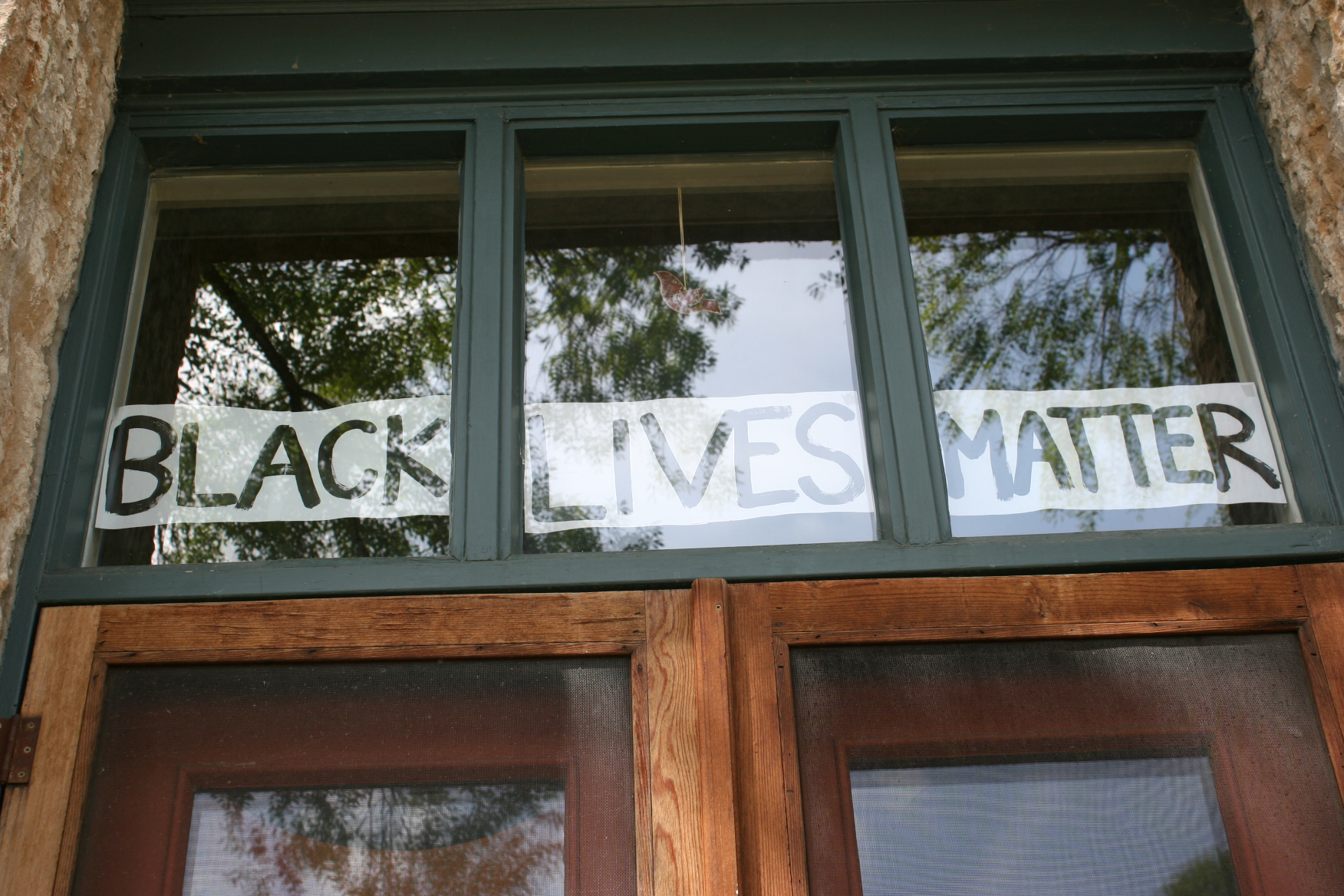
Posted on a house in small town Dundas. (Minnesota Prairie Roots copyrighted file photo 2020)

THE “WHAT IFS?”

Why am I sharing this story? It’s not because I’m anti-law enforcement. I appreciate and respect our police and the important work they do in serving our communities and keeping us safe. Yet, had Randy been a person of color in the wrong place on the wrong day with an officer who perceived his actions as a threat, this traffic stop may have ended differently. Again, I’m not criticizing this specific cop or law enforcement in general.

Admittedly, Randy should not have reached toward that snow brush. But it is not ingrained in his mind to limit his movements, to think about how his actions may be perceived. Black men, especially, cannot risk such behavior. That I understand based on conversations with my son-in-law, who is biracial; on traffic stop shootings of Black men; and on the stories shared in Our Hidden Conversations—What Americans Really Think About Race and Identity.

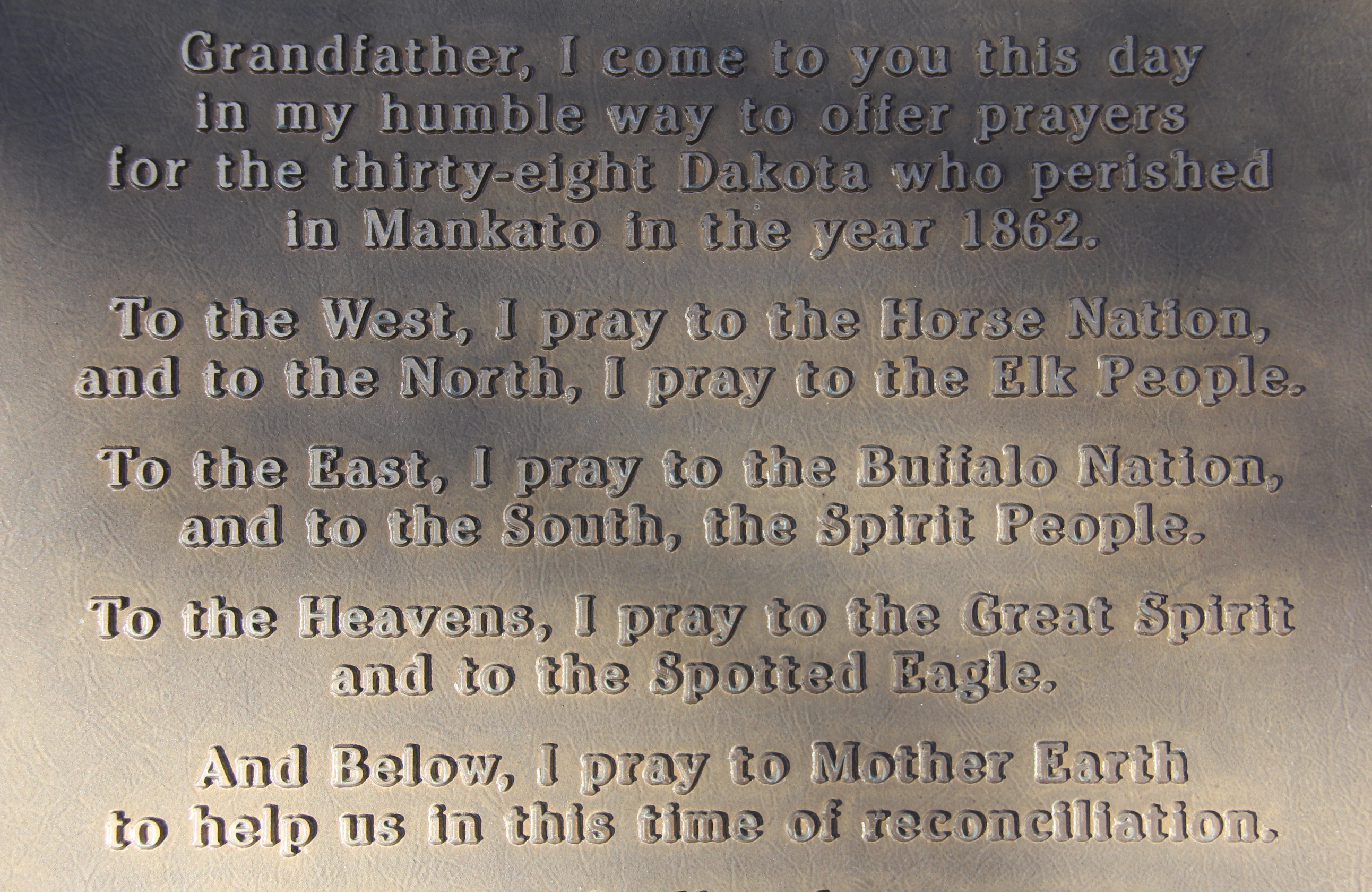
A Dakota prayer focuses on reconciliation at the Dakota 38 Memorial in Reconciliation Park, Mankato. (Minnesota Prairie Roots copyrighted file photo November 2023)

READ OUR HIDDEN CONVERSATIONS

If you read one book in 2025, I encourage you to read this one. The author, who grew up in Minneapolis, is a well-respected, award-winning journalist and former host on National Public Radio. For 14 years, Michele Norris has collected responses to this prompt: Race. Your story. 6 words. Please send. Those responses, submitted on specially-printed postcards and online, shape Our Hidden Conversations. This ranks as one of the most powerful books I’ve ever read on race and identity and should be required reading for every American.

Norris does not focus solely on Blacks in her collection of stories shared by thousands. She also writes about the discrimination, the prejudices, the challenges faced by many others. One entire section, for example, is devoted to Indigenous Peoples. That includes information about long ago Indian boarding schools (specifically the one in Morris, Minnesota) and about the 38 Dakota men who were hung in Mankato, Minnesota following the U.S.-Dakota War of 1862. She writes about Japanese internment camps in America during WWII. She writes about challenges faced by people with disabilities. This is hard stuff. But so necessary to read, to understand the backstory, the history and how things have, and have not, changed. The author writes about lynching, about adopting Black babies, about Blackness perceived as a threat…

The lengthier sections penned by Norris are interspersed with shorter stories from those responding to The Race Card Project prompt. The six word responses are scattered throughout the pages, printed exactly as submitted. One mother wishes her Black son was a girl.

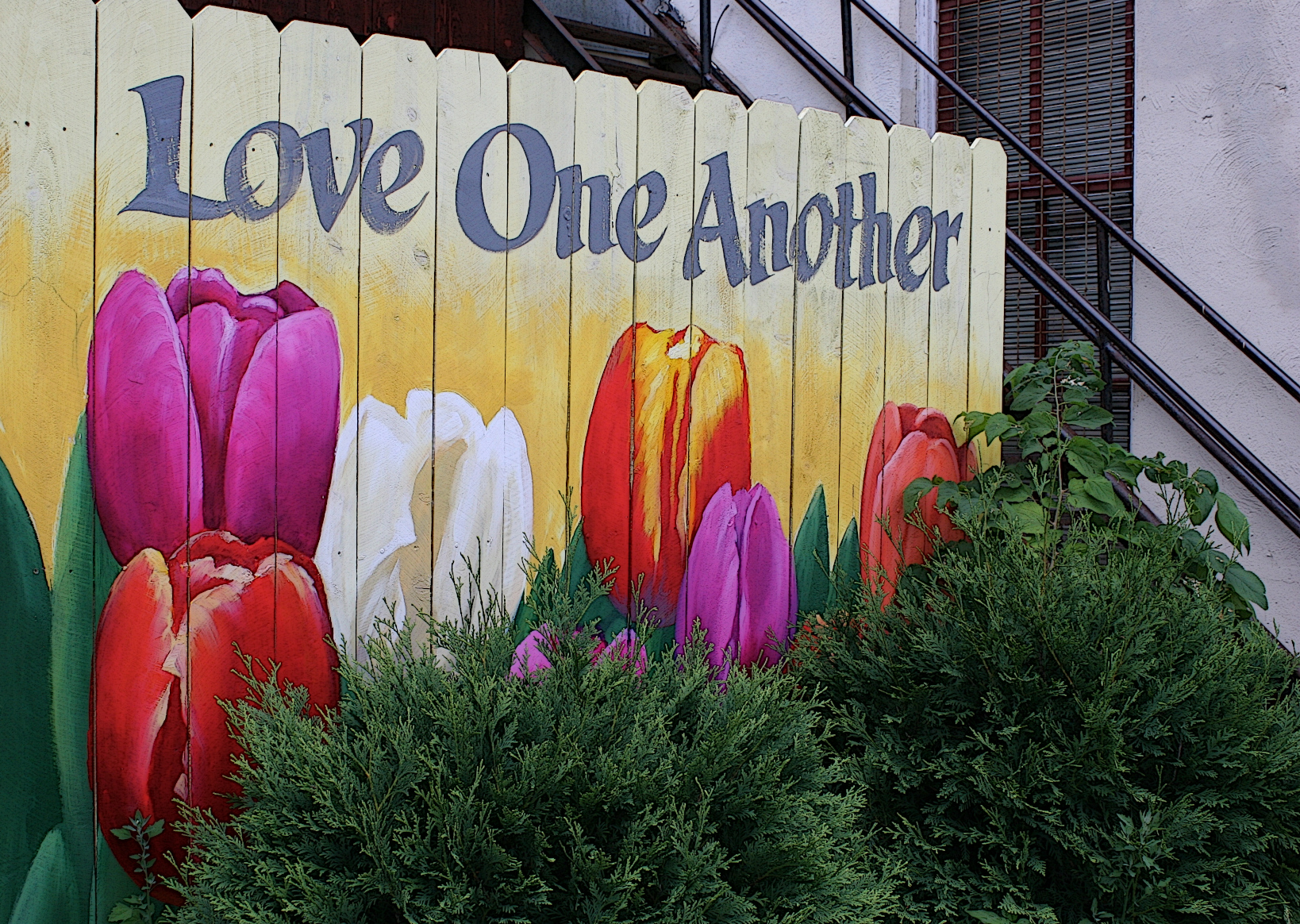
An especially bright spot with an uplifting message in a downtown Faribault pocket park. (Minnesota Prairie Roots copyrighted file photo 2019)

PAINFUL & REVEALING

I cannot even begin to tell you how painful it was at times to read the heartbreaking words printed in this book. It seems unfathomable that we as human beings can treat others with such inhumanity simply because of skin color or other differences. Yet, I saw myself in some of those words, specifically in the subtle (and sometimes not so subtle) racially-charged words that I heard and repeated as a child. I didn’t understand then that the rhyme I was reciting or the term my dad used for Brazil nuts were offensive. I recognize that now.

Like many others quoted in this book, I am determined to grow my knowledge, listen, treat others with respect and compassion, recognizing that we can all do better. I want that for my soon-to-be-born grandson, whose father is biracial, whose mother is White. I want him to grow up in a world where color matters not, where he is appreciated and valued for who he is (and not judged by his skin color), where he doesn’t have to think about what could happen if he is someday pulled over during a traffic stop.

© Copyrighted 2025 Audrey Kletscher Helbling
 

A humorous book rooted in rural November 18, 2024

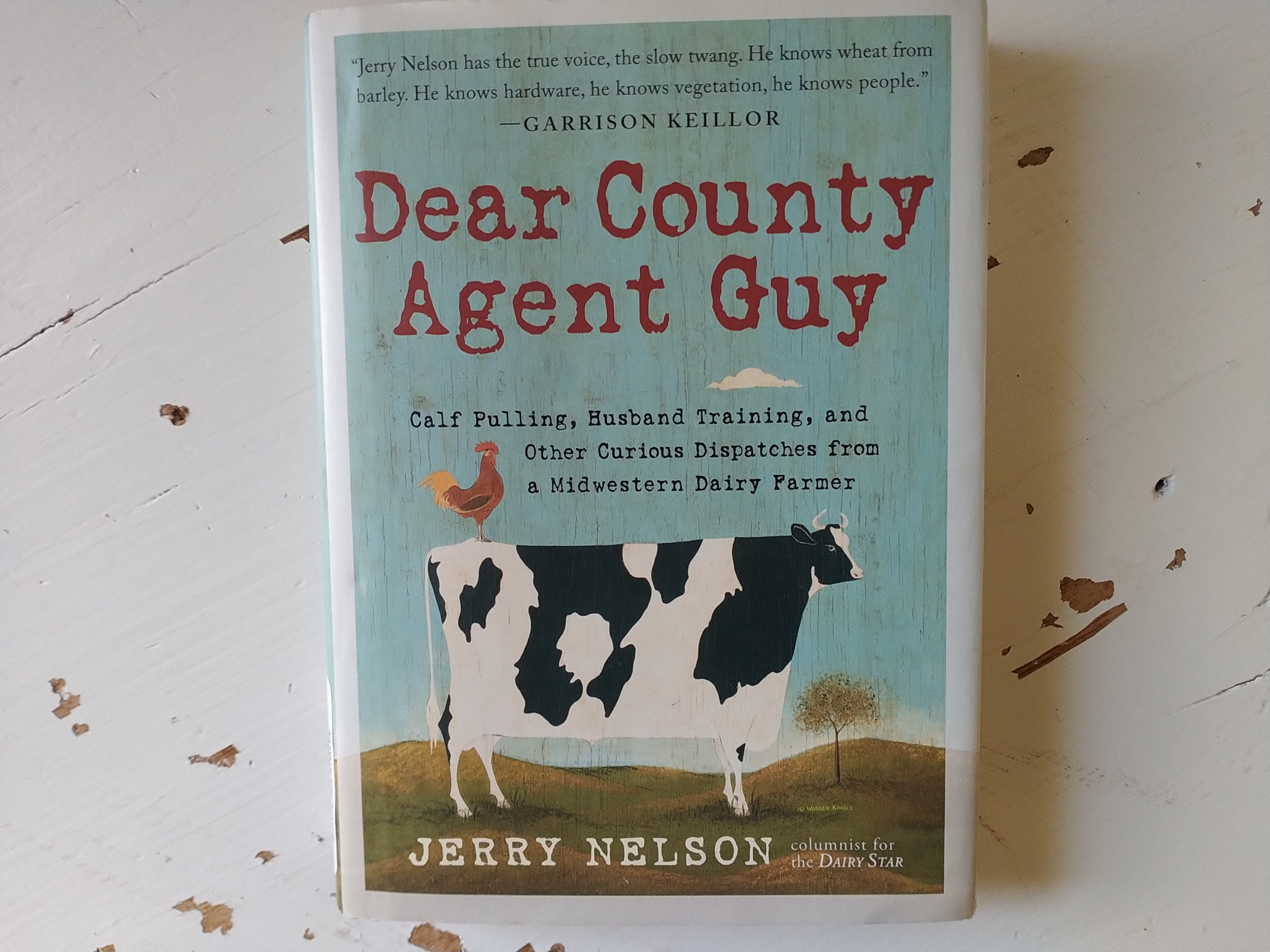
This book published in 2016. (Minnesota Prairie Roots copyrighted photo November 2024)

I NEEDED TO LAUGH. So I picked up a book I started a while ago, but which I’d set aside. That book is Dear County Agent Guy by South Dakota humor writer Jerry Nelson.

First, let’s clarify “county agent” for those of you who may not have rural roots. A county agent (kinda an old school term) is someone specifically trained to share information and research with individuals and the community. Farmers might contact the county agent about issues related to crops or livestock, for example. In Minnesota the entity heading extension services is the University of Minnesota. The U’s efforts cover agriculture, natural resources, health and wellness, youth (4-H) and more.

In his book, the author, who grew up on and then operated a South Dakota dairy farm, focuses on farm life. I, too, was raised on a dairy farm, but then left for college when I turned seventeen. This collection of humorous short stories is so relatable. Many of Nelson’s stories could be mine, although I am German, not Scandinavian, and assuredly do not like lutefisk.

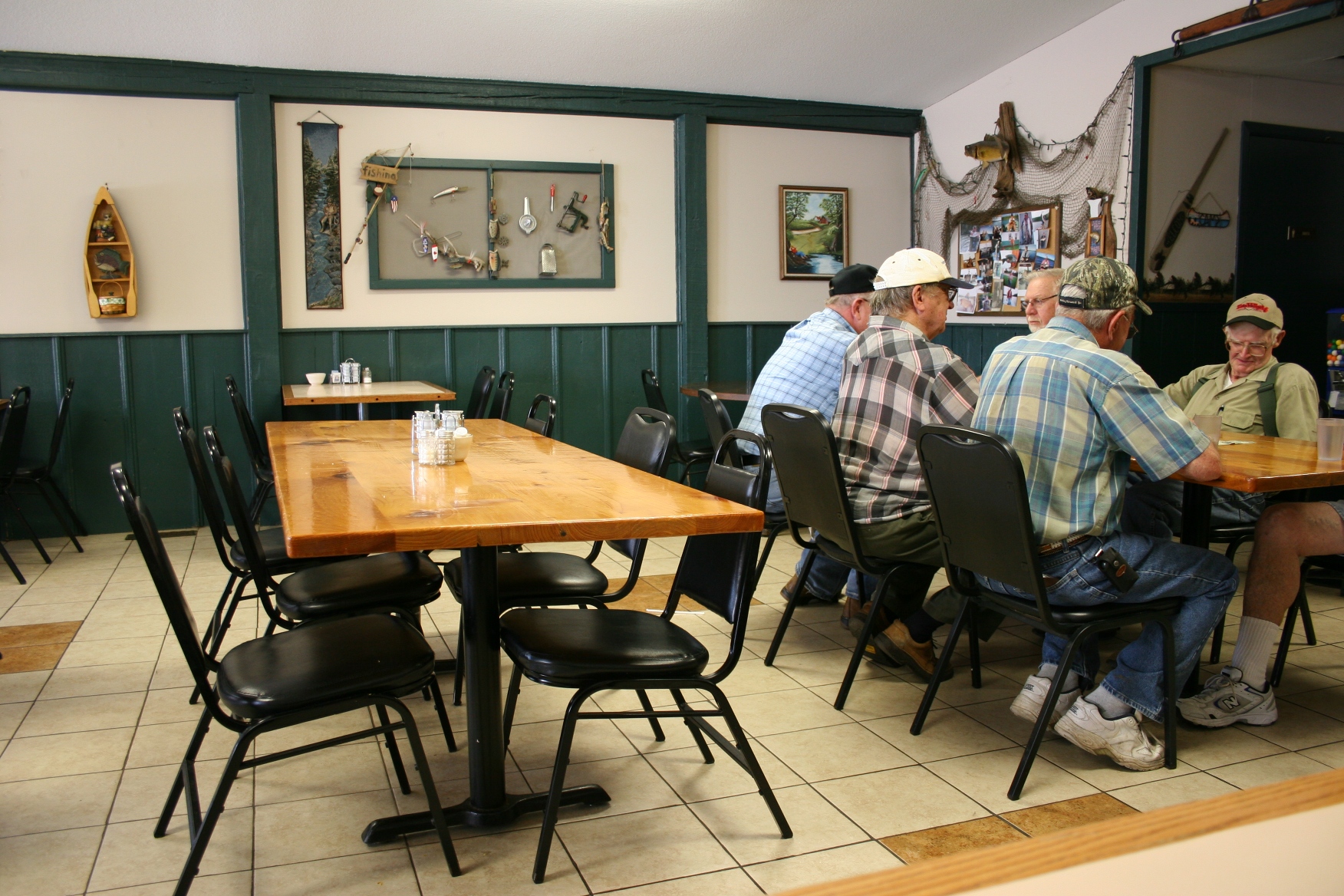
Friends gather for coffee and conversation at the Whitewater Cafe in St. Charles, Minnesota, in 2011. (Minnesota Prairie Roots copyrighted file photo)

A GIFTED RURAL STORYTELLER

Nelson’s writing made me laugh out loud at stories overflowing with humor. He’s a heckuva storyteller. I could picture him gathered with a bunch of other farmers, and a few townies, at the local cafe. Drinking coffee. Shaking dice. Exchanging stories and advice. And laughter. Lots of laughter. But I’m glad he opted to compile his stories in a book. Nelson also writes a column for Dairy Star, a Minnesota-based publication for dairy farmers in eight states. He’s among a lengthy list of columnists that include Minnesota’s Princess Kay of the Milky Way. His work publishes in many other farm publications.

The book subtitle of Calf Pulling, Husband Training, and Other Curious Dispatches from a Midwestern Dairy Farmer pretty well summarizes the content therein. It helps to have a farm background when reading this collection. But even if you don’t, you can still read, learn and laugh.

A snippet of the land where I grew up in rural Redwood County, Minnesota. My father farmed this land and my middle brother after him. The farm is no longer in the family. (Minnesota Prairie Roots copyrighted file photo)

MEMORIES GALORE FOR ME

There’s lots of nostalgia packed into these stories. How well I remember playing in the grove (the shelterbelt of trees surrounding our farm site), getting company (unexpected family and neighbors showing up to visit) and stretches of winter days stuck on the farm without electricity. Just as Nelson remembers. How well I recall Dad needing to assist a cow in giving birth (using a calf puller). How well I remember the earthy scent of freshly-turned soil.

While humor and nostalgia decidedly center Nelson’s stories, he also offers good, sound wisdom—about the importance of finding time to fish (or whatever) in a work-life balance, about appreciating family, about recognizing that life can end, just like that. Nelson nearly lost his life in a manure pit. He climbed inside to fix malfunctioning equipment when hydrogen sulfide gas overtook him. He was found floating face-up in the pit. His is a story of survival and resulting gratitude for every new sunrise.

Nelson’s writing shines with humor rooted in rural. I am grateful for his book, which shines sunshine into the world and made me laugh.

#

THANK YOU to Noreen, who follows my blog from Washington state and who gifted me with a hardcover copy of Dear County Agent Guy. I am grateful for your sharing this collection with me.

© Copyright 2024 Audrey Kletscher Helbling


A mouse in the house August 26, 2024

Filed under: Uncategorized — Audrey Kletscher Helbling @ 10:51 AM
Tags: , , , , , , , , ,
Mouse art displayed in a show at the Owatonna Arts Center many years ago. (Minnesota Prairie Roots copyrighted file photo)

I AWAKENED HOPEFUL this morning. Hoping the mouse that ran into the living room Sunday evening, scurrying into a corner behind a floor lamp when I screamed, was trapped. Dead. That did not happen.

We awakened Monday morning to two unsprung traps still baited with fresh peanut butter. One in the basement, the other between the stove and cupboard.

Have I mentioned that mice terrify me? Or maybe, more accurately, that I am terrified of mice. I detest, hate, abhor them. Always have. I recognize it’s rather ridiculous to be afraid of mice given my size compared to theirs. But they are quick and creepy and varmints I do not want inside my space.

(Book cover source: lindsaystarck.com)

So there I was Sunday evening, feet up in the recliner, semi-watching the 9 pm news between reading Minnesota author Lindsay Starck’s terrifying novel, Monsters We Have Made, when I saw movement out of the corner of my eye. A mouse. Eeeek! I screamed, grabbed my phone, shot to the bedroom, slammed the door and climbed onto the bed. Rats. I forgot my book.

But at least I could Google “why mice come into your house in the summer” while Randy tracked the mouse. Apparently when the temps are as hot as they are now, they, too, want to cool off. Just as in winter, they want to be warm. I can’t fault them for that thinking. Do mice even think?

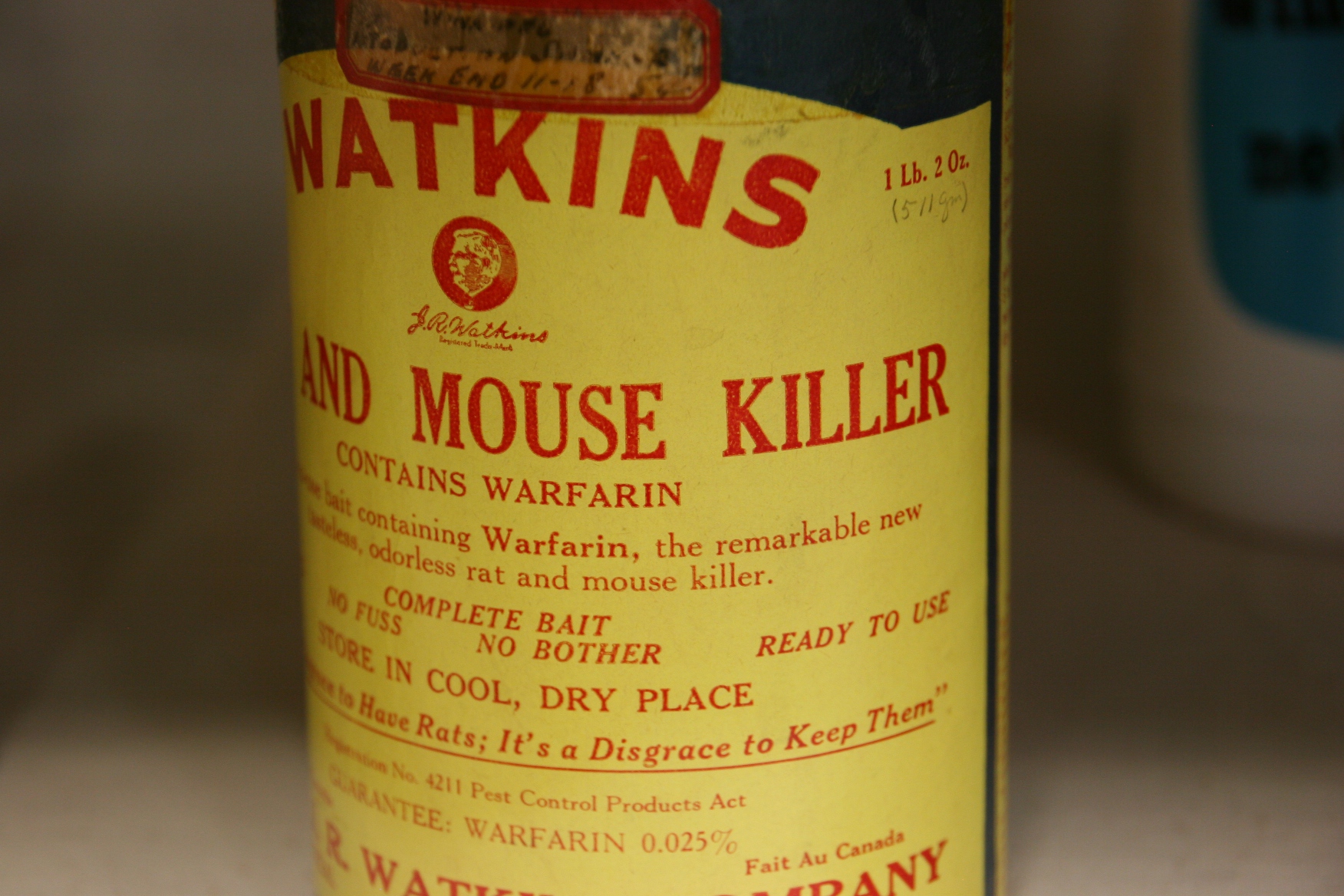
Mouse and rat killer spotted in The Watkins Museum in Winona during a visit years ago. (Minnesota Prairie Roots copyrighted file photo)

As I hunkered atop the bed, I felt hopeful that Randy would find and kill the mouse. I didn’t think that through. How? With his bare hands? Randy observed the mouse hurry behind the fridge. So he moved the fridge. We haven’t seen it since. But he did catch a mouse in the garage overnight. Same mouse? Highly unlikely.

We live in an old house, next to a wooded hillside, with lots of entry points for mice. So I expect mice and we have caught many in our 40 years living here. Typically, though, they stay in the dark basement. I never invited them onto the main floor. The neighborhood mice apparently did not get the warning memo to stay out. They are risking their lives.

Now why do I detest mice? It started with the scritch-scratch of mice running inside the bedroom walls of my childhood farmhouse. Mice in the house. Mice in the barn. Mice in the hay and straw bales. Mice in the granary. Even with a passel of roaming cats.

In college, I opened a silverware drawer to see a mouse staring up at me.

When I was nearly third trimester pregnant with my youngest, I awakened to pee in the middle of the night at my in-law’s farmhouse. There, in that tiny closed bathroom, a mouse circled. Screaming drew no one to my rescue. Eventually, I climbed onto the edge of the bathtub, tossed a pile of wet towels on the mouse and fled upstairs to my sleeping husband. True story.

Years later, I reached into the sink one morning to empty water from a crockpot left soaking there overnight. Atop the water floated a dead mouse. Enough to scare anyone, especially me. At least it was dead, the sole consolation. I slammed the lid on the crockpot, carried it outside and Randy dealt with it after work. That crockpot never cooked another meal.

Yes, I have experienced mouse trauma. Too often. Traps are set. Should I see the mouse again this evening, I will be sure to grab Monsters We Have Made before sequestering myself in my bedroom to read before dreaming nightmares of monstrous, uncaught mice.

TELL ME: Are you afraid of mice? Any mouse stories to share? Or cats to share?


House of Kahmanns: A story of trauma, family love & resilience May 1, 2024

IT WAS A TUESDAY in January 1964. Wash day in the Kahmann household. Outside, a ground blizzard raged, reducing visibility on the southwestern Minnesota prairie. The events of that morning, of that day, would forever change the lives of siblings Karl, Patsy, Eric, Andy, John, Paul, Kevin, Katy, Karen, Phillip, Jim and Beth, and their parents, Jack and Della.

That sets the scene for House of Kahmanns, a memoir by P.G. (Patsy) Kahmann, oldest daughter, second oldest among 12 children. Sixteen months earlier, the family moved from Kansas City, Missouri, to Minnesota when Jack, a traveling salesman in a farm business, was relocated. They settled near their maternal grandparents, into a rental home by Granite Falls.

I expect Jack Kahmann was driving in weather and road conditions similar to this. (Minnesota Prairie Roots copyrighted file photo, January 2020, used for illustration only)

This is familiar land to me in a familiar time. I was not quite eight years old in January 1964, living on a farm some 30 minutes away in neighboring Redwood County. I understand full well the fierce prairie wind that whips snow into white-out conditions. On that blustery morning, as Jack and Della and Della’s parents set out for medical and business appointments in Minneapolis, leaving the oldest, Karl, to care for the youngest children, Patsy and her school-age siblings boarded the school bus.

Rosary beads. (Minnesota Prairie Roots copyrighted file photo used for illustration only)

Patsy was in English class when she got the devastating news. There had been a crash. A bread truck driven by an unlicensed 14-year-old ran a stop sign and then a yield sign before slamming into the 1957 Chevy driven by Jack. Della, mother of a dozen, was the most seriously injured. “How many Hail Marys will it take to save my mother’s life?” Patsy asks herself.

An altar in a southern Minnesota Catholic church. (Minnesota Prairie Roots copyrighted file photo used for illustration only)

Faith, a strong Catholic faith, threads through this story. The Kahmanns were devout, prayerful, always in church. The church, or rather the local parish priest, would play the primary role in turning the initial tragedy into even more intense pain, suffering, separation and trauma for the family. Father Buckley demanded that the 12 children be placed with Catholic families while their parents recovered at a hospital 70 miles away. That, even though a Lutheran couple offered to move into the Kahmanns’ farm home and care for the children. Together.

At this point in the book, I felt my anger flashing. Anger over the inhumanity of a man of the cloth who is supposed to exude compassion, care and love. More atrocities by the priest followed. By the time I read the epilogue, I was irate, forgiveness far from my mind.

Love and forgiveness were taught in the Kahmann home. (Minnesota Prairie Roots copyrighted file photo used for illustration only)

But the Kahmanns were a loving and forgiving family. (Not necessarily of that priest.) One evening after they are all reunited, Jack asks his family to pray blessings upon the driver of the bread truck. Three-year-old Phillip mishears. “God bless the red truck!” he shouts. Laughter erupts. I needed that humor in a story weighing heavy upon my soul.

I wanted to step into the pages of the book and hug those kids and make everything better. Just as Millie Bea did when the Kahmanns lived in Kansas City and Jack was traveling around the country and Della needed extra help with the kids. The book flips back and forth in time and place between Missouri and Minnesota, before and after the crash.

The Kahmanns were not unfamiliar with trauma. In June 1955, Andy’s hand was nearly severed in a hand cement mixer. A Kansas City surgeon successfully reattached his limb, even though a priest told Jack that his son’s hand had been amputated. That was untrue.

Family love is such a strong theme in this book. (Minnesota Prairie Roots copyrighted file photo used for illustration only)

Through all of this, themes of love, strength and resilience thread. The Kahmann siblings clearly looked out for and loved one another and got through some pretty awful stuff. Their motto, Patsy writes, was “No one died. We all survived.” They never talked about the accident. I’m not surprised. Who did back then? Eventually the family would relocate to Bird Island, 32 miles directly east of Granite Falls. It was a new start in a new place following their 75 days apart, “75 days of confusion, anxiety and foreboding.”

And now, with publication of House of Kahmanns—A Memoir, A story about family love and shattered bonds, about finding each other in the aftermath, perhaps these siblings are talking about all they endured. For Patsy, it is also about keeping a promise. In the book dedication she writes: To Mom and Dad/I promised you I would write this story. And she did, with honesty, pain and a great deal of strength.

© Copyright 2024 Audrey Kletscher Helbling


“Winter’s Song,” memories, reflections & writing from Minnesota March 21, 2024

This abandoned farmhouse once stood along Minnesota State Highway 19 east of my hometown of Vesta on the southwestern Minnesota prairie. It’s no longer there. (Minnesota Prairie Roots copyrighted file photo 2013)

A TIME EXISTED when I loved winter. The snow more than the cold. During my growing up years on a southwestern Minnesota farm, I could not wait for the first snowfall, which then piled snow upon snow upon snow for months.

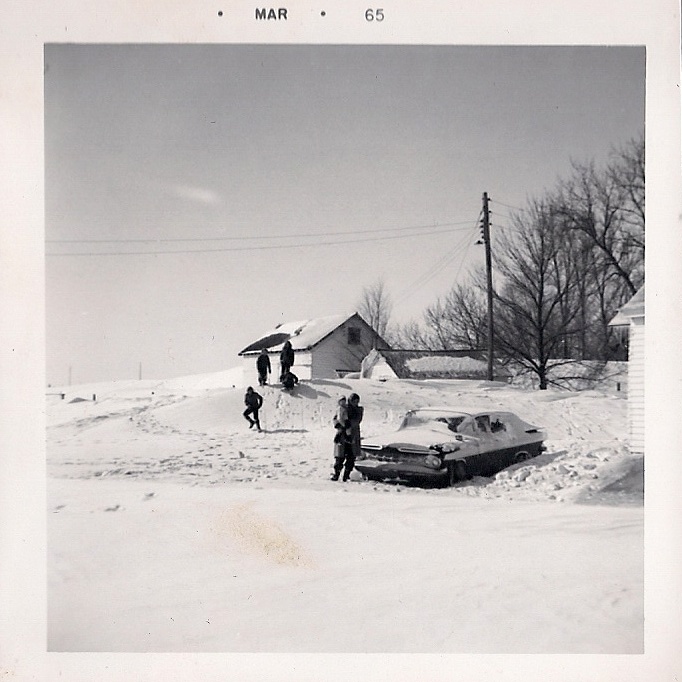
This huge, hard-as-rock towering snowdrift blocked my childhood farm driveway in March 1965. (Photo credit: Elvern Kletscher)

Fierce prairie winds swept snow around outbuildings, sculpting rock-hard drifts, an ideal landscape for Canadian Mounties. Snow pushed into piles by the loader of Dad’s John Deere tractor became mountains, rugged terrain to conquer. And pristine snow presented the perfect canvas for a game of Fox and Goose.

Our southwestern Minnesota farmyard is buried in snowdrifts in this March 1965 image. (Photo credit: Elvern Kletscher)

I remember, too, the crisp winter evenings of walking from barn to house after finishing chores. Packed snow crunched beneath my buckle overshoes. Frigid air bit at my nose, my mouth streaming billows of vapor. Overhead a billion stars pricked light into the immense black sky. Ahead of me, windows glowed in our tiny wood-frame farmhouse.

Those are the good memories I choose to remember. Not the near-frozen fingers. Not the pot on the porch because we had no bathroom. Not the house foundation wrapped in brown paper to seal out the cold. Not the central oil-burning stove that never kept the house warm enough.

Today I have it so much better. A warm house with a bathroom. No cows or calves to feed or straw bales to shake or manure to scoop. No dealing with cracked, chapped, bleeding hands. I have every reason today to embrace winter minus many of the hardships of yesteryear. But I find I don’t.

I’m working, though, on shifting my attitude back to that of appreciating a season which is often harsh here in Minnesota, although not in this unseasonably mild and nearly snow-less winter of 2023-2024. Last winter, now that was a record snowfall winter which tested many a life-long Minnesotan. Except perhaps my friend Jackie of Rochester, who loves winter.

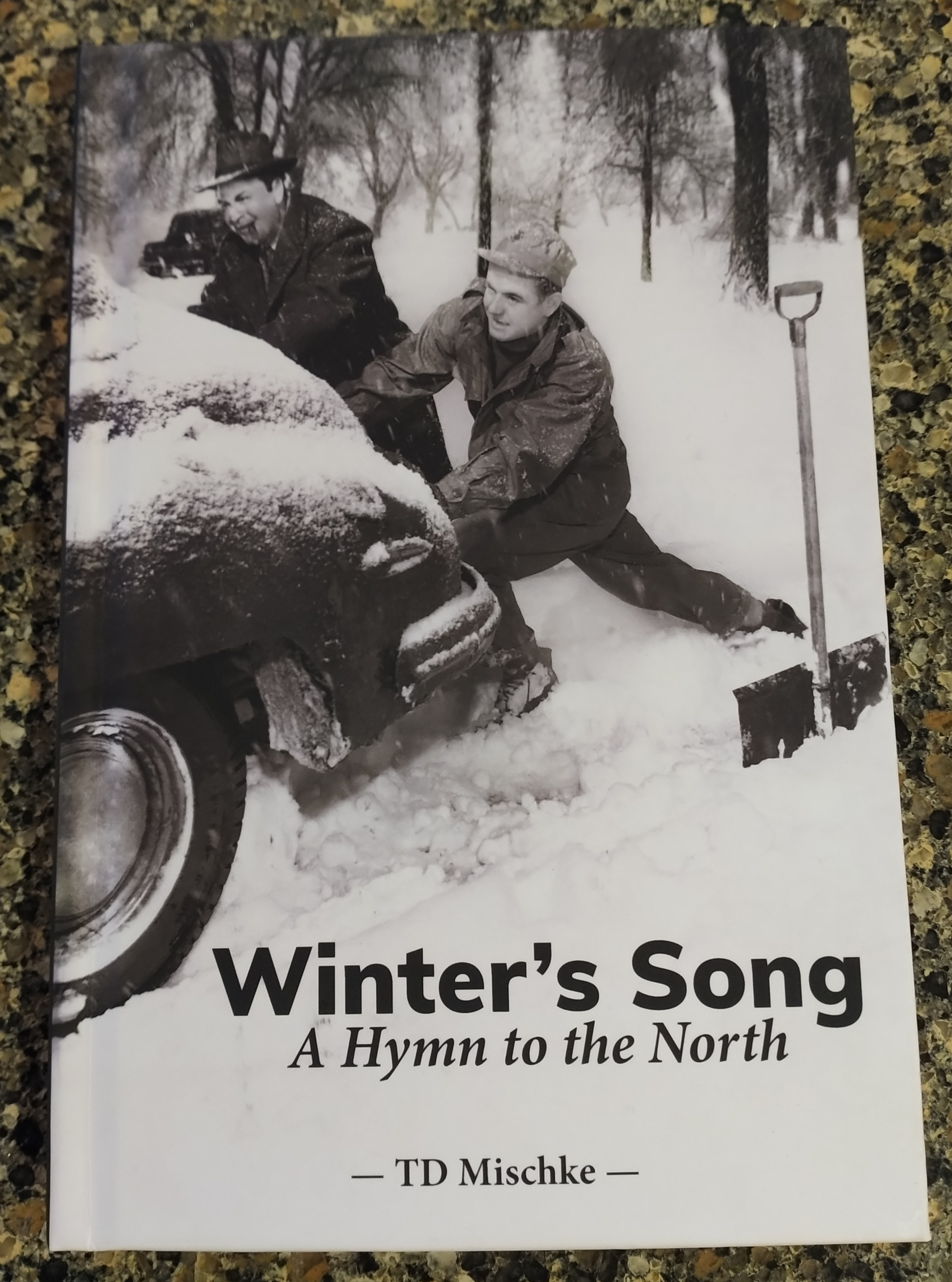
The vintage winter photo gracing the cover of Mischke’s book is from the archives of the Minnesota Historical Society. (Minnesota Prairie Roots photo)

Writer, musician, podcaster and former radio talk show host TD Mischke also loves winter (most of the time) as evidenced in his book Winter’s Song—A Hymn to the North, published in 2023 by Skywater Publishing Cooperative. I happened upon his collection of winter writing at my brother-in-law and sister-in-law’s house north of the metro. Jon is about as avid an outdoorsman as they come. Hunting. Fishing. And in the dead of winter, spearfishing on the frozen lake. This seemed a book written just for him.

Recognizing the Mischke name, I immediately inquired whether the writer, TD Mischke, was any relation to Sy Mischke, friend of my late father-in-law. Sy, a “character” by my definition, was TD’s uncle. TD Mischke certainly writes about characters in Winter’s Song.

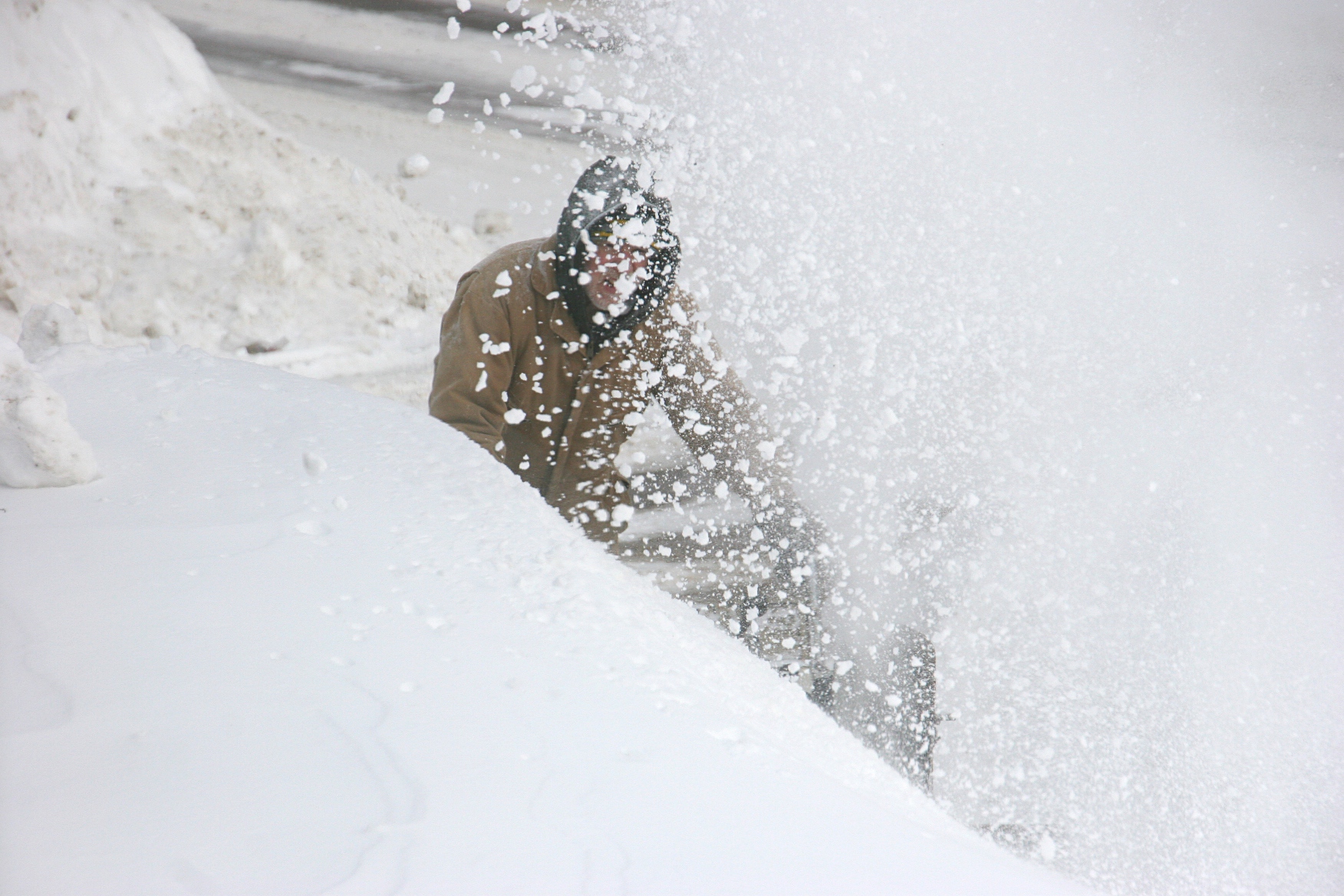
Clearing snow is a sometimes endless task during a Minnesota winter. (Minnesota Prairie Roots copyrighted file photo)

His collection of short stories, essays and three poems honors Midwest winters. Not in a fully nostalgic way, but with a mix of reality. Winters are, admittedly, brutal. But also brimming blessings. The word “hymn” in the book title fits.

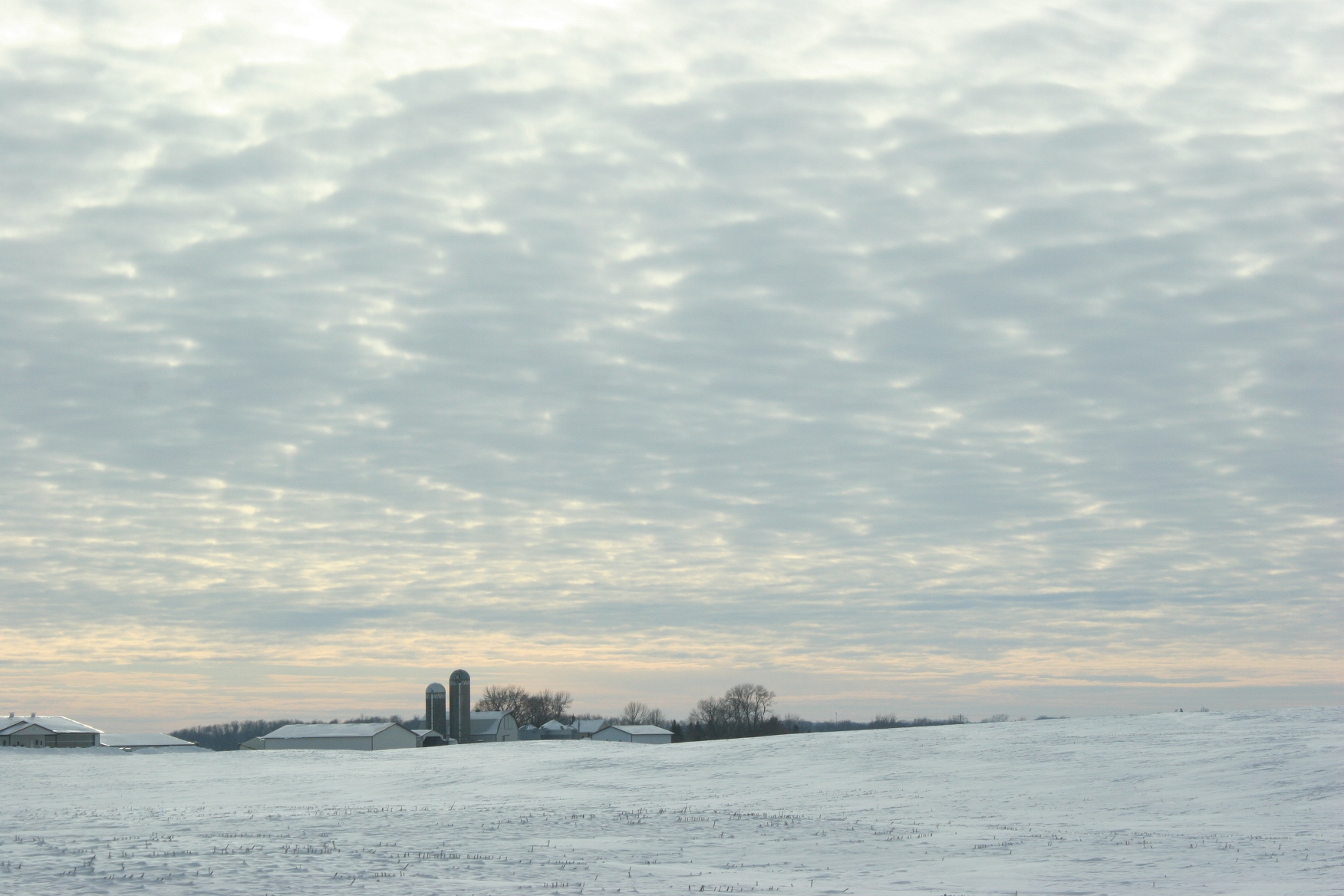
A lovely winter scene photographed in 2019 north of Faribault. It portrays the beauty of winter. (Minnesota Prairie Roots copyrighted file photo 2019)

As I read through the short chapters, I found myself liking winter more and more. And that’s thanks to Mischke’s storytelling skills, his attention to detail, his introspective writing, his humor, his honest portrayal of winter in Minnesota. Not everyone is meant to live here. That Mischke acknowledges. But he also acknowledges the toughness, stamina, strength and endurance of those who call the North home. I agree that it takes a bit of fortitude to manage some six months of winter. I felt in that moment a sense of pride as a life-long Minnesotan.

Spring erupts in budding trees at Falls Creek Park, rural Faribault. (Minnesota Prairie Roots copyrighted file photo May 2019)

That brings me to the second to last chapter of Winter’s Song—“Lessons of March.” It seemed only fitting that I was reading this chapter near the end of March on a day of predicted snow. I’ve never liked March much. But Mischke reminded me that this often grey month, which can throw in surprise snowstorms, should be appreciated for the simple reason that it makes us appreciate April even more. The arrival of spring. He’s right. Winter is often about perspective. After finishing Winter’s Song, I feel my thoughts shifting toward a renewed appreciation for this longest of seasons here in Minnesota.

FYI: Winter’s Song—A Hymn to the North is a finalist for the 2024 Emilie Buchwald Award for Minnesota Nonfiction. Minnesota Book Award winners will be announced May 7. To listen to TD Mischke’s podcast, The Mischke Roadshow, click here.


Heartache. Hope. Help. October 19, 2022

Sunrise on Horseshoe Lake in the central Minnesota lakes region. (Minnesota Prairie Roots copyrighted photo September 2022)

I’M FEELING A BIT INTROSPECTIVE these days. Perhaps it’s the season. Perhaps it’s the state of the world. Perhaps it’s the challenges faced by people I love, people in my circle. I can’t pinpoint a specific reason for feeling this way, only a recognition that my thoughts seem more reflective.

(Book cover credit: Milkweed Editions)

My reading follows that thread. I just finished Graceland, at Last—Notes on Hope and Heartache From the American South by Margaret Renkl. A friend recommended this award-winning book published by Minneapolis-based Milkweed Editions. She knew I would appreciate the essays therein which cover topics ranging from politics to social justice to the environment to family, community and more. So much resonated with me, inspired me, focused my thoughts. To read about these issues from a Southern perspective enlightened me.

Yes, this book includes political viewpoints that could anger some readers. Not me. Equally as important, Renkl also writes on everyday topics like the optimism of youth. I especially appreciated her chapter, “These Kids Are Done Waiting for Change.” In that essay on youth activists, she concludes: They are young enough to imagine a better future, to have faith in their own power to change the world for good.

Sam Temple, 21, is running for county commissioner in Rice County. (Minnesota Prairie Roots copyrighted photo July 2022)

That quote fits a young candidate running for Third District county commissioner in my county of Rice. Last week I attended an American Association of University Women-sponsored debate between the two candidates, one 21, the other 67. It’s refreshing to see a young person running for public office, someone who cares deeply about his community, about issues, about history, about humanity. He is well-informed, experienced in public service, thoughtful, a good listener, invested, and brings a new, young voice into the public realm. I felt hopeful as I listened to the two candidates answer written questions submitted by the audience. There was no mud-slinging, no awfulness, but rather honest answers from two men who seem decent, kind, respectful and genuine. Those attributes are important as I consider anyone running for public office. Candidates may disagree, and these two do on some issues, but that didn’t give way to personal or political attacks.

Among Faribault’s newest apartment complexes, Straight River Apartments. Many new apartment buildings have been built in the past year with more under construction. Yet, this is not enough to meet demand. (Minnesota Prairie Roots copyrighted file photo 2022)

Renkl, in Graceland, writes on pertinent topics of concern to many of us, including those seeking election to public office. In “Demolition Blues,” an essay on housing changes in her neighborhood, she shares how housing has become unaffordable for many who work in the Nashville metro. The same can be said for my southern Minnesota community, where high rental rates and housing prices leave lower income and working class people without affordable housing. That’s linked to a severe shortage of rentals and single family homes.

It would be easy to feel discouraged by real-life issues that flow into our days whether via a book, an election, personal experiences, media… But then I think of those young activists, the young candidate running for office in my county, and I feel hope for the future.

Among the many sympathy cards I received after my mom died. (Minnesota Prairie Roots copyrighted file photo January 2022)

I feel hope, also, within. We each possess the capacity to “do something.” That needn’t be complicated as Renkl writes in her essay, “The Gift of Shared Grief.” She reminds readers of the importance of sending handwritten condolences. I understand. My mom died in January and I treasure every single card with handwritten message received. There’s something profoundly powerful and personal about the penned word, about connecting beyond technology. It doesn’t take much effort to buy a greeting card, write a few heartfelt sentences and mail it. Yet, the art of connecting via paper is vanishing. I’d like to see more people sending paper birthday cards again…I miss getting a mailbox filled with cards.

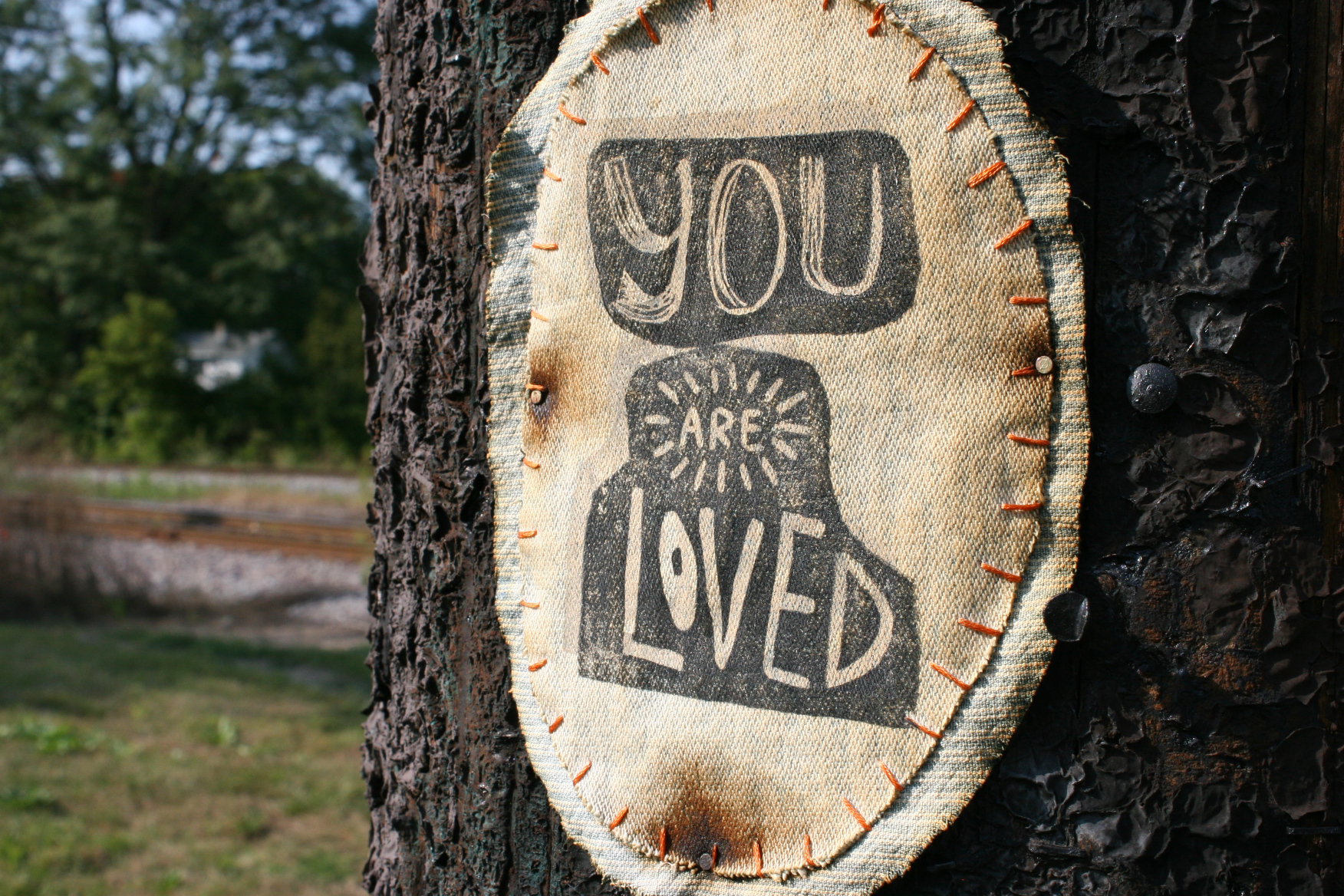
I photographed this message along a recreational trail in the Atwood Neighborhood of Madison, WI., several years ago. To this day, it remains one of my favorite public finds and photos. (Minnesota Prairie Roots copyrighted file photo)

One final essay penned by Renkl, “What It Means to Be #Nashvillestrong,” took me back to that candidate forum last Thursday. When asked to identify the most pressing issue people face locally, the younger candidate replied with “personal issues.” He’s right. No matter what we face jointly as a society (such as inflation), it is personal issues which most challenge us. Author Renkl, referencing a text from a friend, calls those—cancer, death, etc—our “private Katrina.” That in no way minimizes the death and destruction of large-scale disasters like Hurricane Katrina. But we all have something. Her friend texted: One day the sun is shining and all is intact, the next day everything is broken. And the rest of the world goes on. You’re trapped in your own crazy snow globe that’s been shaken so hard all the pieces fly loose.

And when those pieces fly loose in our circle, in our community and beyond, what do we do? We can, writes Renkl, be the hands that help our neighbors dig out.

© Copyright 2022 Audrey Kletscher Helbling


Strength & hope October 14, 2022

The Straight River roils by at the dam in Owatonna. I see struggles. I see strength. (Minnesota Prairie Roots copyrighted file photo)

WHAT’S YOUR DEFINITION of strength? Whom do you consider strong? Have you faced a challenge, or multiple challenges, in life that required strength? While our answers vary, especially on the third question, I expect threads of commonality in responses.

Strength, from my perspective, is about fortitude and endurance. It’s about somehow finding the ability to face a challenge, to persevere, to come out on the other side with a renewed sense of personal power. Not power in the sense of control, but power that reaffirms one’s ability to deal with whatever life throws at us.

We all have something, right? Financial hardships. Health issues. Loss. Pain. Family members who are struggling. But, admittedly, when we are in the middle of a lot, it can sometimes feel like we are alone, that others live perfect lives unencumbered by issues that drain, stress and, yes, sometimes overwhelm. Nothing could be further from the truth. I repeat: We all have something, whether individually or within our families. We are not alone.

(Cover image from Goodreads)

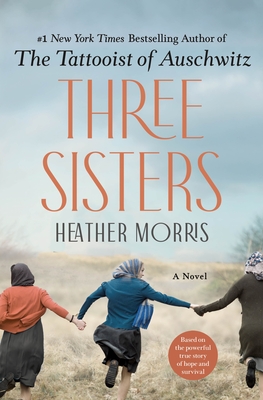
The novel, Three Sisters by Heather Morris, prompted me to write on the topic of strength. Although fictional, the book is based on a true story about three sisters held in a concentration camp. This is a story of indescribable atrocities witnessed and experienced. This is also a story of irrepressible strength and hope. I encourage you to read this novel and also watch Ken Burns’ newest documentary, “The U.S. and the Holocaust,” which happened to air at the same time I was reading the book. Together, the two were almost too much for me to emotionally take in. It’s a lot to comprehend the inhumanity and cruelty of mankind. Those sent to concentration camps certainly exhibited strength, whether they survived or not.

The iris symbolizes hope. (Minnesota Prairie Roots copyrighted file photo 2021)

In reading Three Sisters, I learned that gladiolus (the flower) signify strength. And the iris, which is part of the glad family, denotes hope. The iris was my mom’s favorite flower. “Hope” is a word I’ve held, and continue to hold, close. “Hope” is not simply a wish. By my definition, it is an active verb that focuses on light shining through darkness. It is a word, too, that envelopes gratitude and believing that things will get better.

I keep this stone on my office desk. (Minnesota Prairie Roots copyrighted file photo)

My name, Audrey, means noble and strong. I wish I’d asked my mom why she chose that name for me, her first-born daughter. I never did, and now she’s gone, but the name fits. I’ve had to be strong many times throughout my life. We all have something, right? Challenges can make us better, more empathetic and compassionate people. That is the good that arises from struggles.

This message refers to struggles with mental illness. (Minnesota Prairie Roots copyrighted file photo)

This week, especially, with World Mental Health Day on October 10, I consider mental health. From anxiety to depression to brain disorders like bi-polar and schizophrenia, these are undeniably hard diagnoses which require incredible strength to face. Simply getting up in the morning, functioning, can prove difficult. There are no cures. No quick fixes. Medication can manage, therapy can help. And even though we are getting better at recognizing and understanding, stigma remains. We can do better at supporting, encouraging, helping. We need more mental health professionals to meet the growing demand for mental health care.

Strength. Hope. Those two words inspire and uplift. Gladiolus and iris. Those two flowers represent the same. From the pages of a novel about three Holocaust survivors to my name to life experiences, I understand what it means to be strong, to feel hope.

TELL ME: I’d like to hear your thoughts on strength and hope.

© Copyright 2022 Audrey Kletscher Helbling


When you’re reading a book and… August 23, 2022

Filed under: Uncategorized — Audrey Kletscher Helbling @ 5:00 AM
Tags: , , , , , , , , , ,
Book cover source: Goodreads

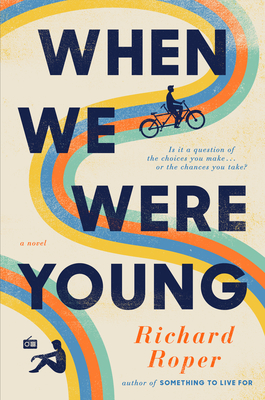
MY APOLOGIES TO ANYONE who checks out When We Were Young by Richard Roper from Buckham Memorial Library. I’m sorry about the smears at the top of page 309 in chapter forty-eight, the chapter wherein main characters Joel and Theo get some really good news. I did not intentionally smear the page with an unknown-to-the-next-reader substance.

Near shore, a seagull wings across Mille Lacs Lake in central Minnesota. (Minnesota Prairie Roots copyrighted file photo September 2017)

Here’s my story, summarized in a family text I sent Sunday evening:

I just had the most disgusting thing happen. I’m sitting on the patio reading & I feel something wet hit the side of my face. A bird pooped on my face, my glasses & my book! Yuck! Dad looked up to see a bunch of gulls flying around. This is NOT Duluth or anywhere near water.

It should be noted here that, before texting anyone, I wiped the bird poop from below my eye and from the book and that Randy washed my glasses. A bit later I also splashed water into my eye, which was feeling a tad odd.

A gull landed by Randy and me as we ate a picnic lunch near Serpent Lake in Crosby earlier this summer. (Minnesota Prairie Roots copyrighted photo July 2022)

I should have anticipated that my family would have a bit of fun with this unfortunate incident. The granddaughter hoped for a photo. Randy said he could have taken one. He observed that the gulls had a pretty good aim for being 200 feet high. Gee, thanks, dear husband. He also wondered whether our actuary son-in-law could determine the chances of this happening again. That’s OK. I don’t need to know those odds.

But the other son-in-law shared that being pooped on by a bird means good luck in England, where he lived as a child and was also pooped upon once. I confirmed that in an online search—the poop-luck correlation. Now luck I’ll take, even though I didn’t feel one bit lucky when I felt a splat upon my face and then realized what had happened.

Yet, the poop did land on that page in a fictional book when two friends get double good news. Now what are the odds of that?

TELL ME: Do you have a similar story to share?

© Copyright 2022 Audrey Kletscher Helbling


Remembering the 35W bridge collapse 15 years later August 1, 2022

This photo shows the opening spread of the feature article published in the November/December 2007 issue of Minnesota Moments. Casey McGovern of Minneapolis shot the bridge collapse scene. To the far left is Garrett before the collapse, to the right, his rescuer. The next photo shows his Ford Focus which plummeted into the Mississippi River. And to the right are newly-engaged Garrett and Sonja, before the collapse.

FIFTEEN YEARS AGO THIS EVENING, 13 people died and 145 were injured when the 35W bridge collapsed during rush hour in downtown Minneapolis. Vehicles plunged into the Mississippi River. Others clung to the tilted, broken span of roadway. Lives were forever changed at 6:05 pm on August 1, 2007, when faulty gusset plates gave way and the bridge broke.

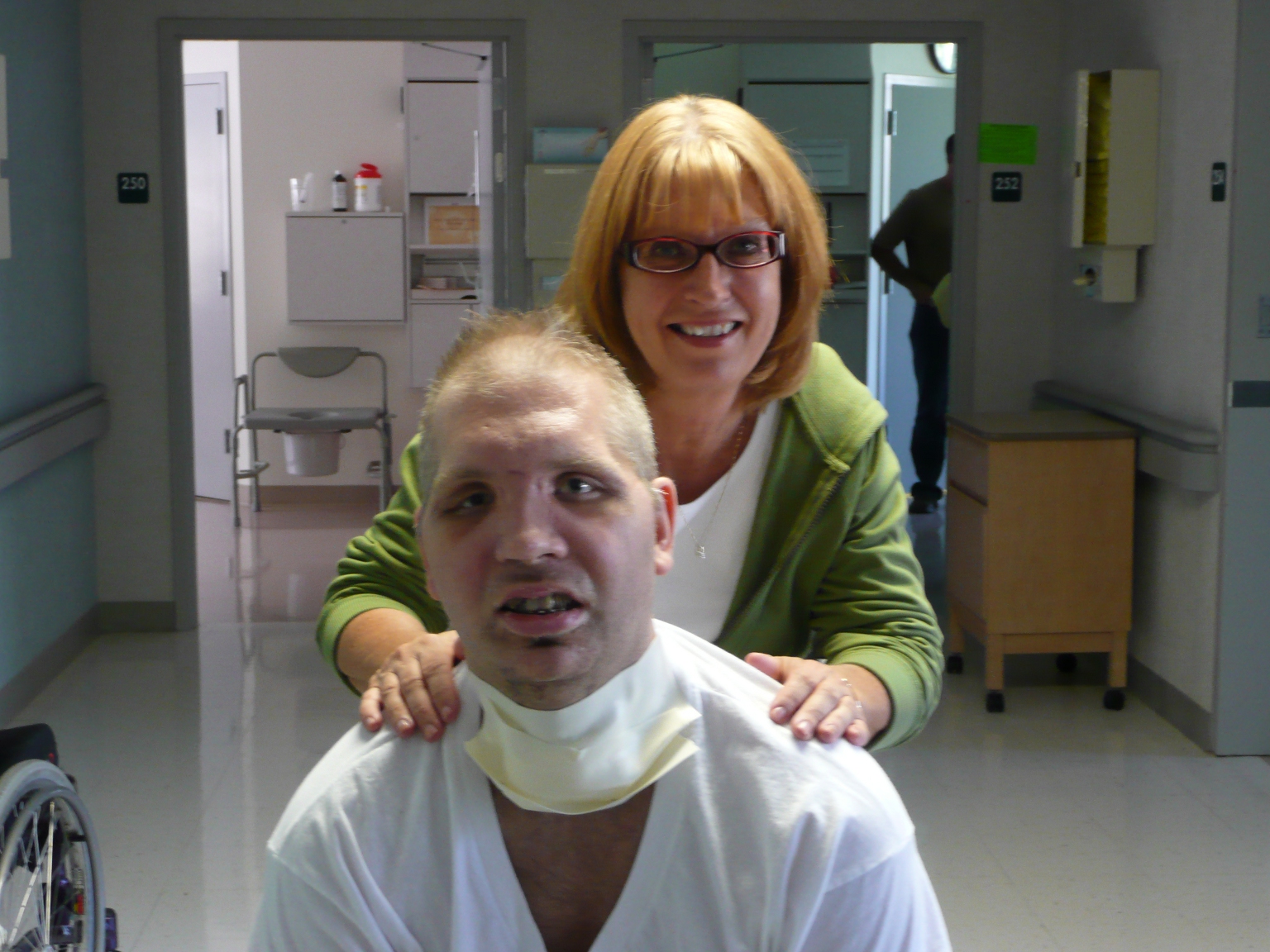
Garrett with his mom, Joyce Resoft, about a month after the bridge collapse. (Minnesota Prairie Roots file photo 2007. Photo courtesy of Garrett’s family)

Among those most seriously injured was then 32-year-old Garrett Ebling, former managing editor of The Faribault Daily News. He suffered a traumatic brain injury, severed colon, broken left arm and ankles, a spinal injury and more after his Ford Focus nosedived 110 feet, the equivalent of an 11-story building, into the river. That he survived seems miraculous. He spent weeks in the hospital, where he underwent multiple surgeries. A lengthy rehab followed. His life, physically, mentally and emotionally, was forever changed.

Within months of the collapse, I penned a feature story about Garrett for Minnesota Moments, a now-defunct magazine. Mine was one of the few initial interviews Garrett granted and I was both humbled and honored to share his story as a freelance writer. Prior to his departure from the editorial job in Faribault, we had connected. I remember Garrett’s kindness and compassion toward me after my son was struck by a hit-and-run driver in May 2006. I took great care in writing his story, recognizing that another journalist was trusting me to get it right.

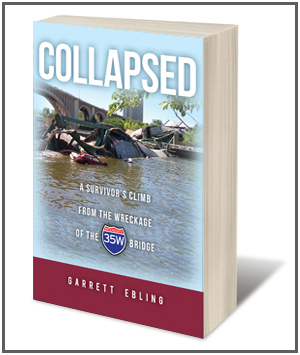
Garrett Ebling’s book.

In 2012, Garrett wrote about his experiences and life thereafter in a book, Collapsed—A Survivor’s Climb From the Wreckage of the 35W Bridge. I reviewed that revealing and emotional book in which this survivor held nothing back.
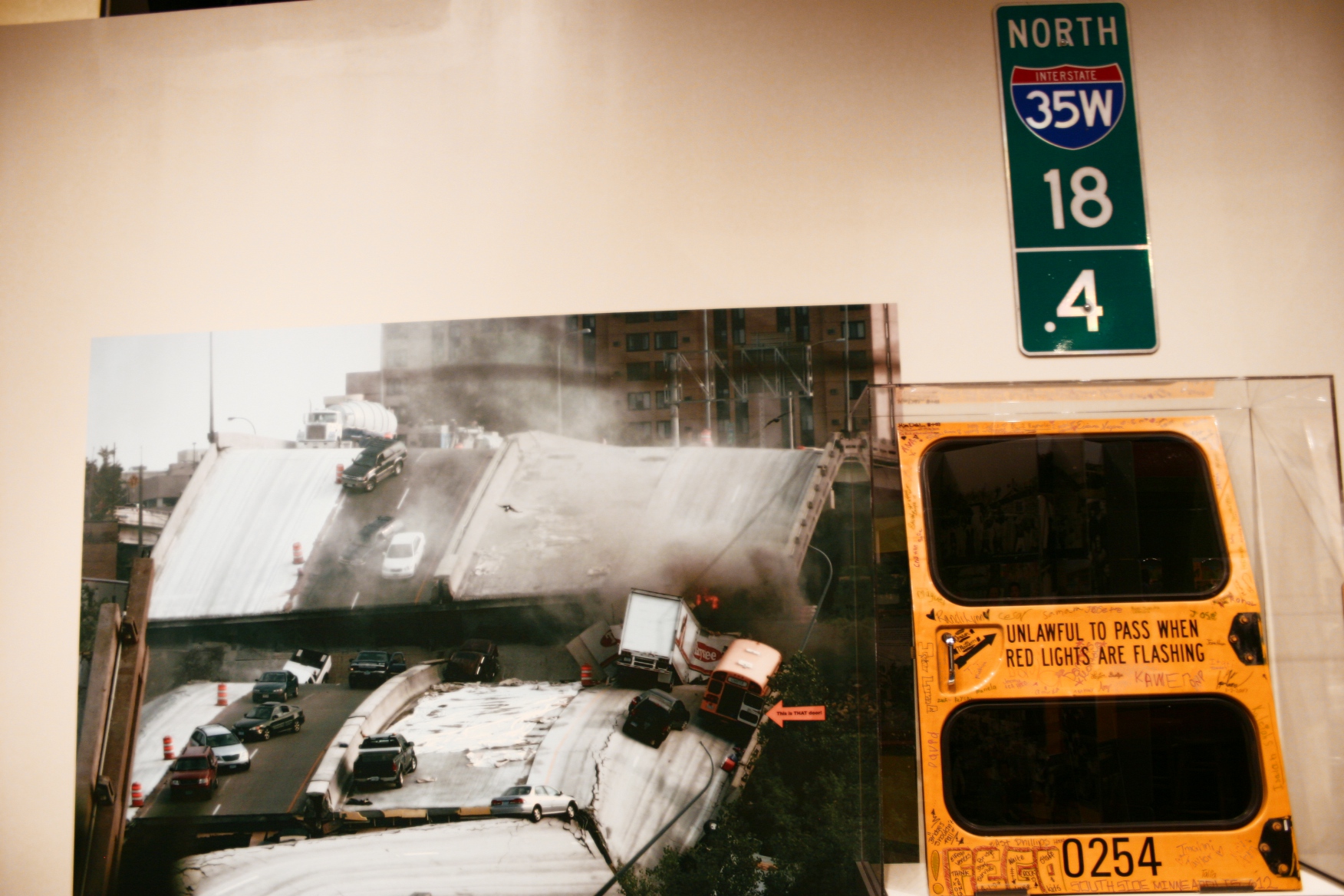
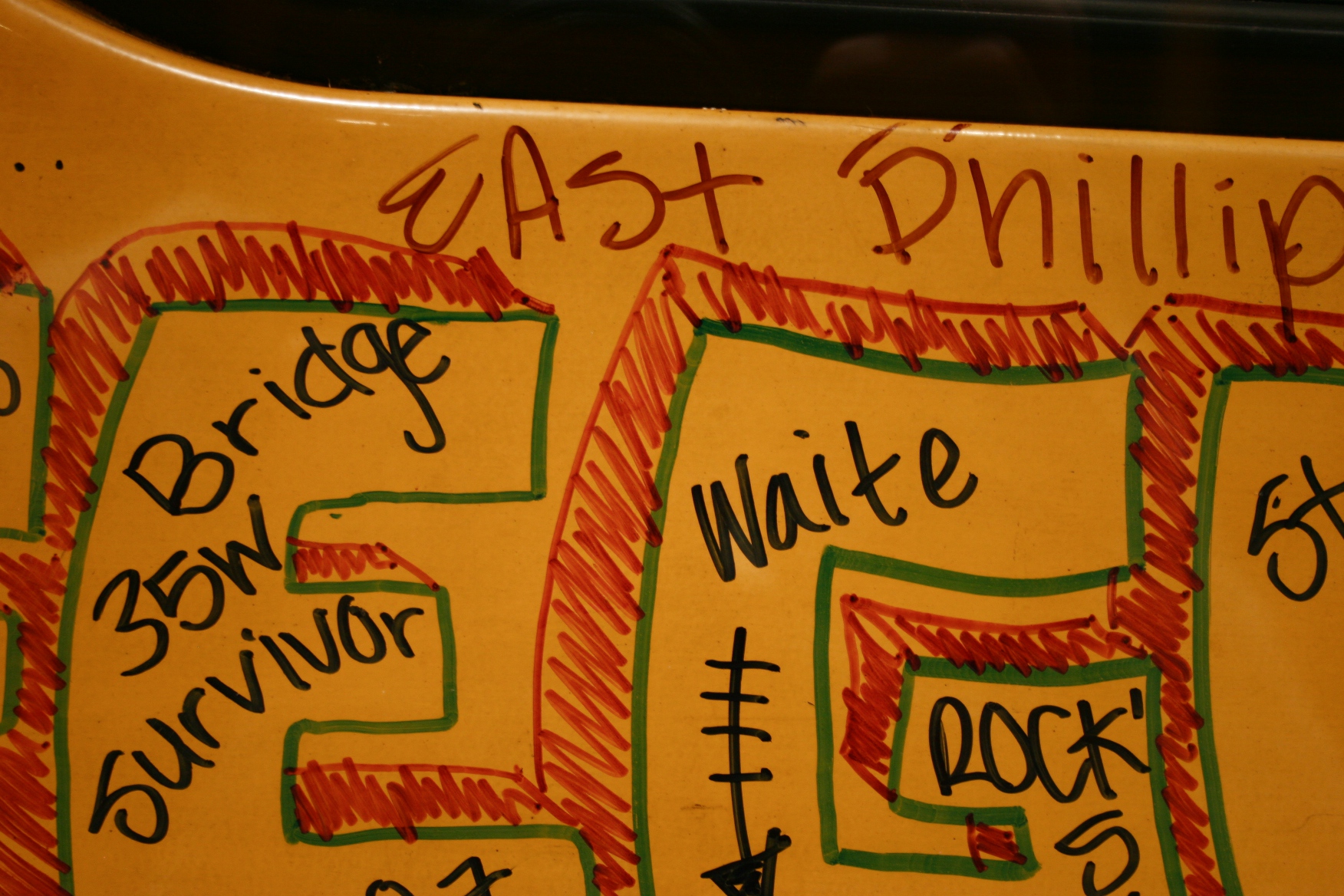
A section of the then now wow exhibit at the Minnesota History Center in St. Paul features the 35W bridge collapse. This image shows the collapsed bridge and the emergency exit door from a school bus that was on the bridge when it collapsed. All made it safely off the bus (Minnesota Prairie Roots file photo)

Since then, I’ve lost track of the “author, father and 35W bridge collapse survivor,” as Garrett labels himself on his Twitter account. But I expect today, the anniversary of the bridge collapse, is difficult for him as it is every survivor and every single person who lost a loved one 15 years ago in downtown Minneapolis when the unthinkable happened. When a bridge fell.

All the children and adults on the bus signed the door on display at the Minnesota History Center. (Minnesota Prairie Roots copyrighted file photo)

There are moments in history that we never forget and, for me a Minnesotan, August 1, 2007, is one of those dates. When I heard the breaking news of the bridge collapse, I worried first about extended family who live in the metro. They were not on the bridge. While that diminished my personal angst, it does not diminish the tragedy of that day for those who were on that bridge. Like Garrett Ebling, the 144 others injured and the 13 who died. It is a tragedy, too, for those who loved them and for us, collectively, as Minnesotans.

© Copyright 2022 Audrey Kletscher Helbling