Minnesota Prairie Roots

Writing and photography by Audrey Kletscher Helbling

Bone break related topics on a Saturday morning August 18, 2018

Filed under: Uncategorized — Audrey Kletscher Helbling @ 12:14 PM
Tags: , , , , , , , ,

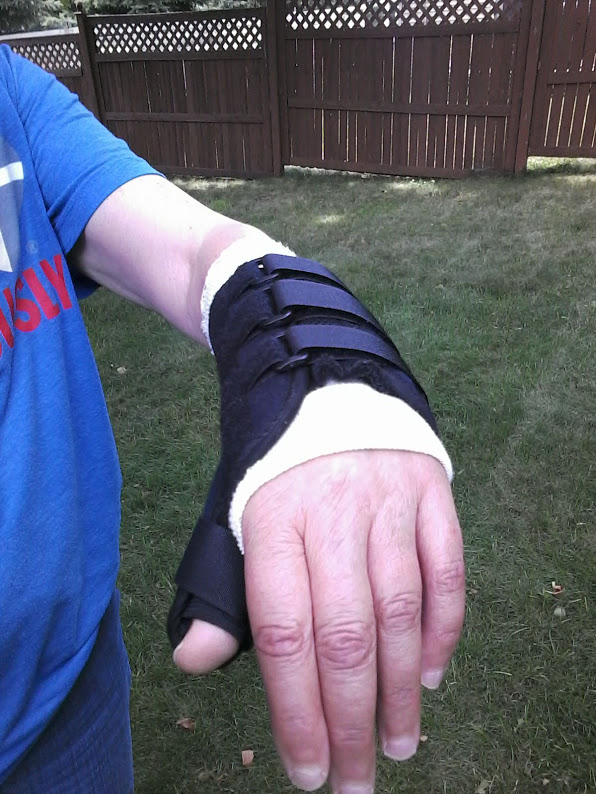
This splint holds my healing left wrist in place. Minnesota Prairie Roots file photo.


WHEN A THICK ENVELOPE arrived in the mail this morning from my insurance company, I felt angst. I expected it would contain information on a $19,431 claim for surgery to implant a plate into my broken left wrist. I was right.

Recently I received a nearly $15,000 hospital bill for that surgery with nothing covered by insurance except an allowed amount of $4,662. I reacted as nearly anyone would—with disbelief, anger and tears. I pay $1,000/month for health insurance and already paid my $3,600 deductible. So the thought of paying another $15K pushed me over the edge. One phone call later and the hospital billing department assured me I didn’t owe $15,000 and that, due to a “processing error,” the claim would be reprocessed.

The insurance paperwork I got today includes two code notations:

Based on additional information received, this service will be processed on a new claim.

We are making this adjustment to a previously processed claim.

Those codes flag most, but not all, of the claims in four pages of claims. So is this a done deal? I don’t know. I hope so. Zeroes fill every space in the amount I owe columns. I choose for now to think this ends a stressful ordeal.

Speaking of end, the question of the week to me has been: “How much longer do you have to wear that?” The questioners, at least a half dozen yesterday, are referring to the splint on my wrist. The last time my orthopedic doctor discussed this with me, he said I would be wearing the brace well into late September. I see him next week. Maybe he will shorten that time. Range of motion therapy continues to go well. Strengthening therapy comes next. I’m now more than two months out from my bone break.
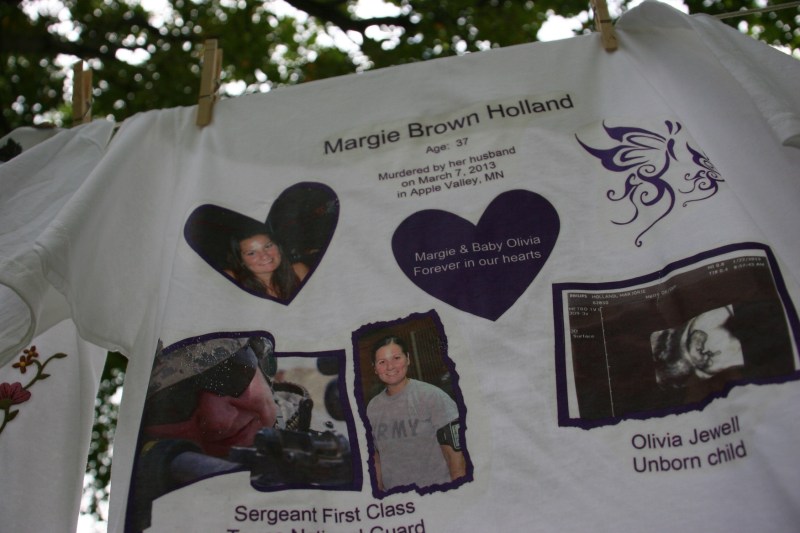
 

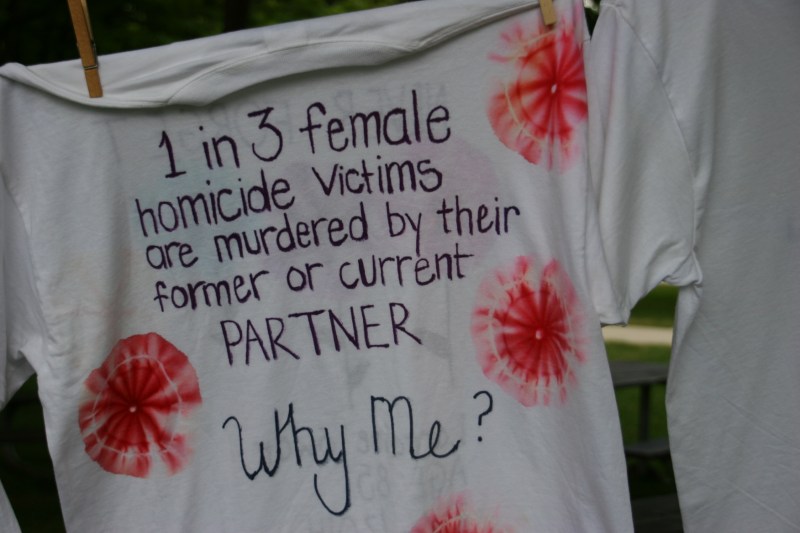
Margie Brown Holland (formerly of Faribault) and her unborn daughter, Olivia, were murdered by Margie’s husband in 2013. This t-shirt, part of The Clothesline Project, honors the two. The Minnesota Coalition for Battered Women coordinates the project to honor victims of domestic violence. Minnesota Prairie Roots file photo.


This plaque at the Faribault Area Chamber of Commerce and Tourism office honors employee Barb Larson, shot to death in the tourism office by her ex-husband, a retired Faribault police officer.
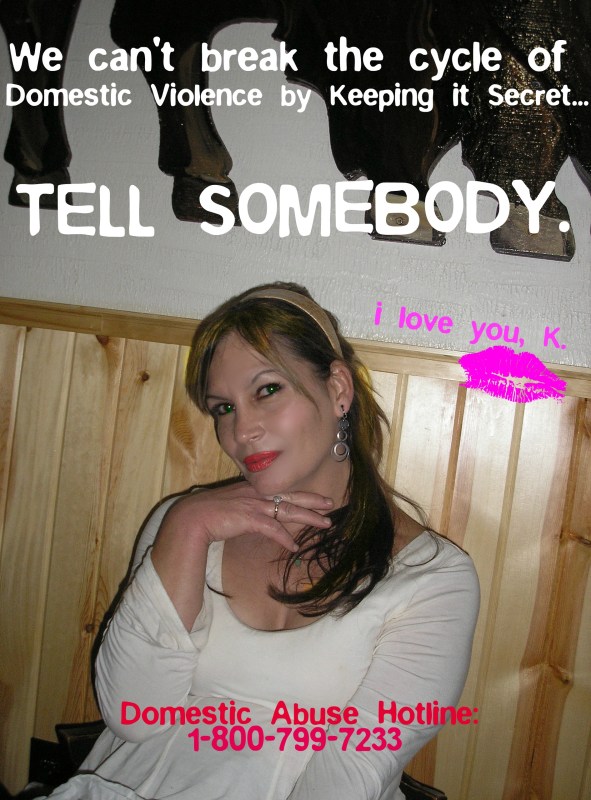
 

Kim Sisto-Robinson of Duluth created (and shared) this graphic honoring her sister Kay. Kay’s husband shot and killed Kay in 2010. Kim has made it her mission to be a voice for Kay, to speak out on the topic of domestic violence. File photo, courtesy of Kim.


One issue still lingers, though, and it’s something I dislike as much as that incorrect $15K hospital bill. Just last evening a burly stranger joked that my husband hurt me. Not funny. Not funny at all. I don’t care who you are. To suggest that domestic violence is in any way funny rankles me. There is absolutely nothing humorous about any aspect of abuse, whether psychological, mental, emotional, spiritual, financial, technological or physical. I’ve heard more times than I can count that insensitive, uninformed and supposedly funny comment that Randy must have pushed me or hit me. He didn’t. I fell on rain-slicked wooden steps. I don’t understand this attitude. Women (and sometimes men) are being assaulted and dying every single day in this country from domestic violence. I find absolutely nothing funny in that. Nothing.

THOUGHTS ON ANY of this?

© Copyright 2018 Audrey Kletscher Helbling


The not-at-all amusing topic of domestic violence June 22, 2018

Filed under: Uncategorized — Audrey Kletscher Helbling @ 5:00 AM
Tags: , , ,

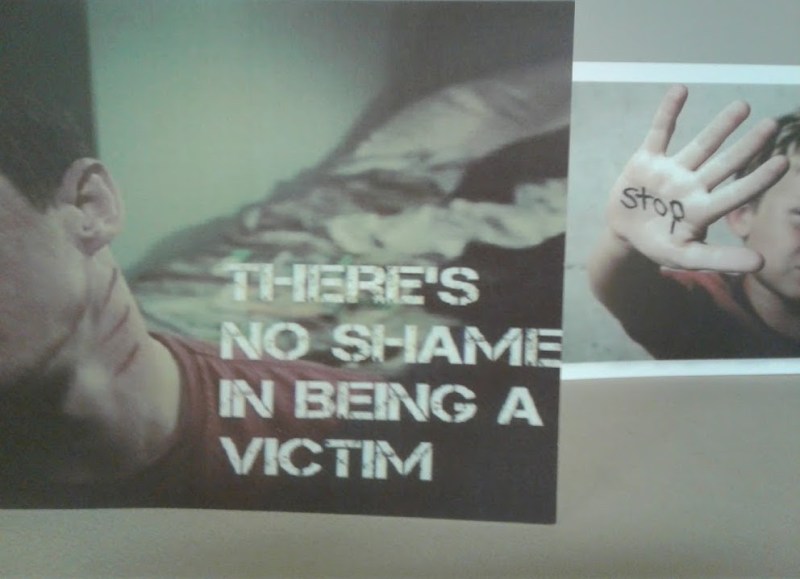
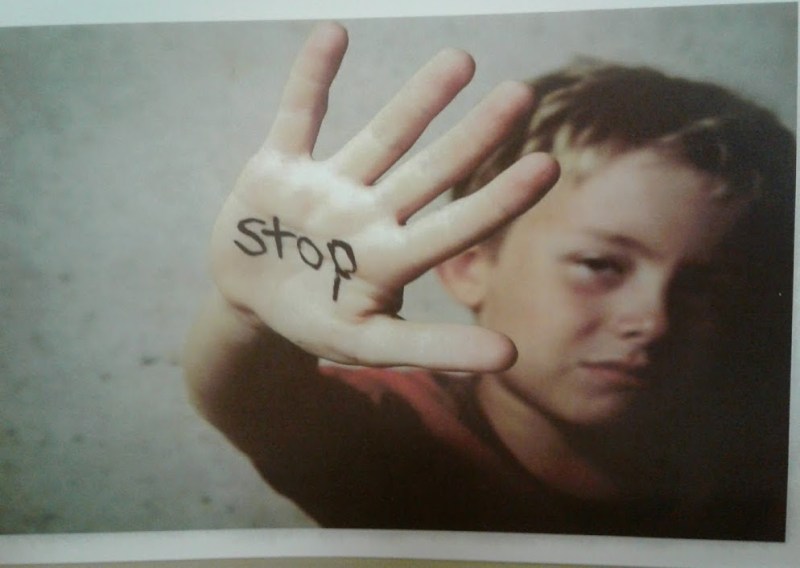
I took a photo of this photo at a domestic violence awareness event in Faribault. The word STOP and outstretched hand (exactly how I landed, palm down when I fell) hold double meaning as it relates to this post. Minnesota Prairie Roots file photo.


PERHAPS I’M MORE SENSITIVE than many people on the subject. But I have personal reasons for my feelings about domestic abuse. Many women who are friends or family have been directly or indirectly affected by domestic abuse or violence. Some of those victims are dead. Shot. Beaten. Attacked. Dead. (Click here. Here. Here. And here.

So when someone sees my broken left forearm, laughs and suggests that my husband assaulted me, I get angry. Inside. I try to react with words that are kind, yet clearly reveal that I am not amused. There is nothing even remotely funny about domestic violence or any violence against a human being.


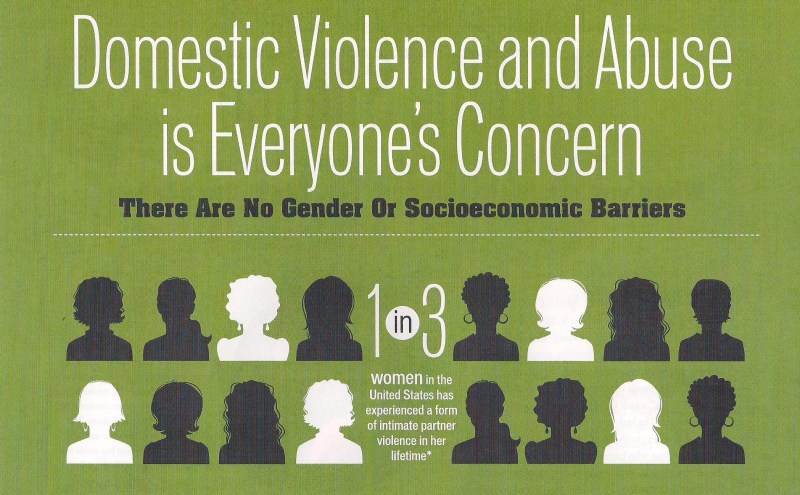
A snippet of a domestic violence poster published by the Lutheran Church, Missouri Synod. File image.


I understand the medical personnel who ask me to repeat the story of my fall. It’s their job to be aware of possible domestic violence, sometimes hidden by the victim. They need to look for inconsistencies in my story, especially since I fell and broke my right shoulder just a year ago (while at the hospital to donate blood).

But I want to state here, publicly, that my husband of 36 years has never abused me. Ever. To suggest that in jest offends me. I heard the “humorous” accusations last year against Randy and now I’m hearing them again. Not funny.


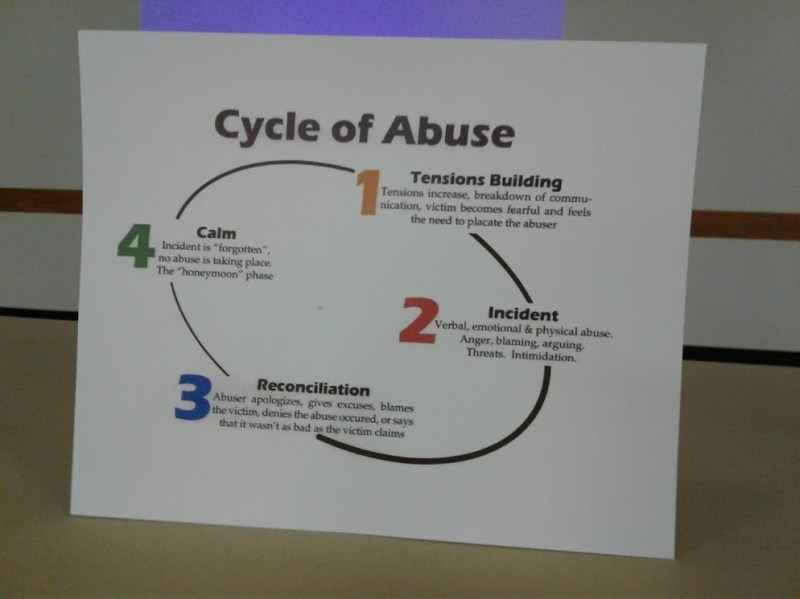
Domestic violence cycle of abuse as photographed at a local awareness event. Minnesota Prairie Roots file photo.


That said, if you sincerely suspect a friend or family member has been abused in any way, don’t ignore what your gut, your observations, are telling you. Seek professional advice at a women’s shelter or advocacy center so you can help. Likewise, I urge you, if you are an abuse victim, to seek help. You deserve to live a life free of any type of abuse.

There, I got that out.


© copyright 2018 Audrey Kletscher Helbling
 

Beyond the final rose, a billboard message that really matters March 14, 2018


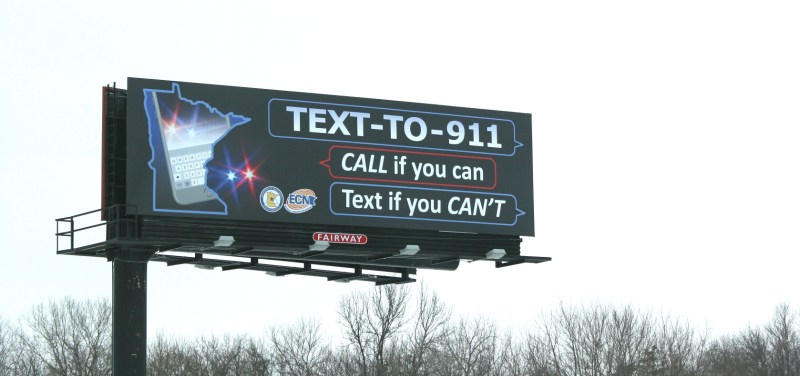
Minnesota Prairie Roots file photo.


DO PEOPLE NOTICE billboards? Apparently yes, if based on all the media hype last week about billboards supporting Becca Kufrin, the young Prior Lake woman dumped by bachelor Arie Luyendyk Jr. From LA to Minnesota to Times Square, digital billboards proclaimed their love for this Minnesotan to whom Arie initially proposed during the reality TV show The Bachelor.

While it’s nice to read that Minnesota Nice message—Becca—You’ll always have a rose from Minnesota—there are much more important public messages that should grab our attention.


That includes a billboard just north of Faribault along Interstate 35 which promotes texting 911. In December, Minnesota rolled out this option to reach emergency services in our state. For those with a hearing loss, the texting option is a valuable tool.

But it’s valuable to others, too, including victims of domestic abuse and violence. In many cases, they may be unable to safely call, and talk to, a 911 dispatcher. Texting offers an option, one that could save a life.

We need to care as much about domestic abuse and violence as we do some reality TV show and whether or not someone gets a rose.

FYI: Click here to learn more about Minnesota’s 911 texting system.

© Copyright 2018 Audrey Kletscher Helbling
 

Domestic abuse awareness takes center stage in Owatonna February 16, 2018

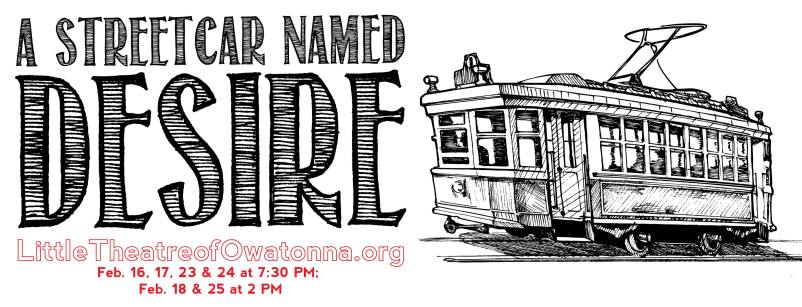
This graphic from the Little Theatre of Owatonna Facebook page promotes its current show, “A Streetcar Named Desire.”


WITH DOMESTIC VIOLENCE remaining in the national spotlight, most recently via accusations against a former staff secretary to President Donald Trump, it’s important to remember that this issue reaches beyond DC and Hollywood. In every corner of our country—from rural to city—abuse happens. To think otherwise is to turn our eyes from the problem.

That’s why I so appreciate efforts to discuss domestic violence locally. Little Theatre of Owatonna is tackling the topic as it presents Tennessee Williams’ “A Streetcar Named Desire.” The storyline of this Pulitzer Prize winning drama deals, in part, with domestic abuse.

Rather than simply practice, perform and then move on to the next production, LTO is seizing the opportunity to educate its audience on domestic abuse. The theatre troupe will provide information from the Crisis Resource Center of Steele County at each of its shows. And following the 2 p.m. matinee this Sunday, February 18, Jeffrey Jackson addresses how he approached the subject of domestic abuse in his director’s role.

I applaud this director, this cast, this small town Minnesota theatre company for taking that extra step to create awareness of domestic abuse and violence. It would be easy enough for them to let the curtain fall and walk off stage. But they are choosing to make a difference, to care, to educate, to enlighten. They understand this is their issue, too, not just something that happens in DC and Hollywood. But in Owatonna, Steele County, Minnesota. They understand that domestic abuse happens across the street, across the aisle, across town and perhaps even within their own families and/or circle of friends. They get it. And for that I am grateful. Awareness breaks the silence, brings hope and help to victims, to survivors and to those who love them.


A must-read report: Murders due to domestic violence in Minnesota in 2017 February 1, 2018

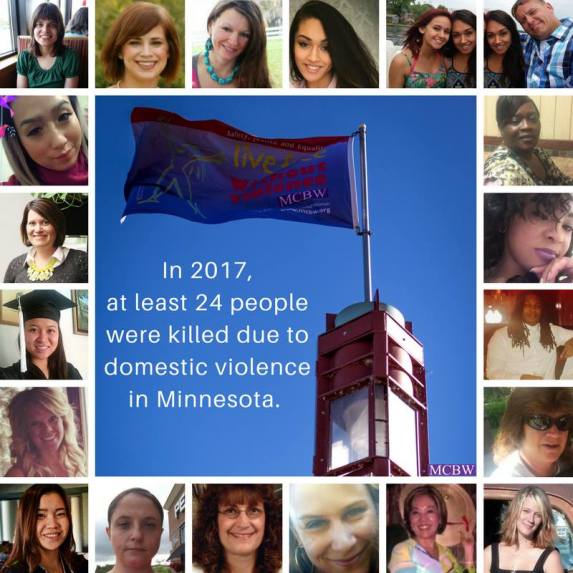
Photos of victims released with the 2017 Femicide Report. Source: Minnesota Coalition for Battered Women Facebook page.

THE 2017 FEMICIDE REPORT: Domestic Homicide Violence in Minnesota is out. This year in my state, 24 people lost their lives due to domestic violence, according to this report released by the Minnesota Coalition for Battered Women.

Of those, 19 were women murdered by current or former intimate partners. The other five were family members/friends/interveners.

Senicha, Dawn, Jessica, Phanny, Sarah…

Slightly more than half were shot, the rest beaten, strangled, stabbed and killed by other methods. Their stories break your heart. These were women (and two men) who were loved and valued in their families, their communities, their workplaces. They are not simply statistics.

Please take time to read this report by clicking here. Beyond data, you will see the victims’ faces and learn of the circumstances related to their murders. You will read also about the “Red flags for batterer lethality” and findings and recommendations from the MCBW. At 44 pages, it’s a lengthy report packed with plenty of valuable information. But it’s well worth your time if you care about this issue, and you should. It’s vital that we are educated and aware. These are our mothers, our daughters, our sisters, our nieces, our friends, our neighbors, our co-workers.

We cannot, must not, remain silent.

FYI: If you are in an abusive relationship and in immediate danger, call 911. The time period in which a woman is leaving or has just left her abuser is the most dangerous. Have a safety plan in place. Reach out to a local women’s advocacy center for help. Or start by talking to a trusted family member, friend, co-worker…you are not alone.

Please also click here and read an article by Bob Collins at MPR about a Minnesota Supreme Court ruling that toughens the state’s Domestic Abuse Act.


Copyright 2018 Audrey Kletscher Helbling


Domestic violence awareness event stresses collaboration & a directive to speak up January 18, 2018


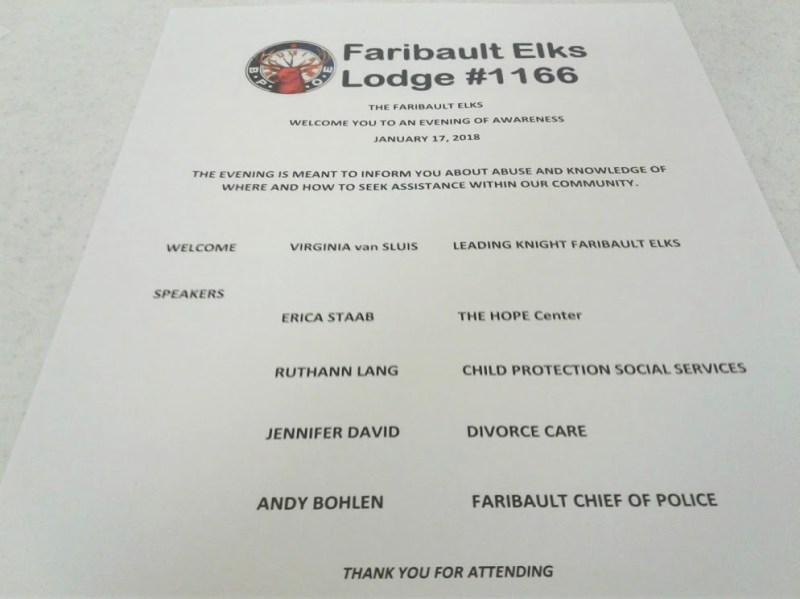
A YEAR AFTER TWO HIGH PROFILE murder-suicides in my community, a small group of Faribault residents and several professionals came together for a community-wide meeting on the topic of domestic violence Wednesday evening.


While statistics show substantial (49 and 121 percent respectively) increases in cases of domestic and sexual assaults in Faribault last year, the numbers don’t necessarily equate a significant rise in those crimes. Rather, there’s a heightened community awareness, resulting in more cases being reported, according to Erica Staab-Absher, executive director of HOPE Center.


Staab-Absher focused on the progress Faribault has made in the past year, specifically through the Blueprint for Safety Program. The program is a collaborative effort of HOPE Center, local law enforcement and other agencies that communicate and work together in addressing the issue of domestic violence. Professionals have been trained in the past year, for example, on strangulation and stalking. Law enforcement officers now carry a card listing questions to ask suspected victims of domestic abuse/violence. Advocates are called to the scene immediately to help victims and to assess their situations and the dangers they face. Most important, victims know help is available to them.

That theme of cooperation and heightened awareness threaded throughout Wednesday’s meeting as did the admonition that “we all have a calling to help our neighbors.”


Two of the speakers, Ruthann Lang of Rice County Child Protection Services and Faribault Police Chief Andy Bohlen, cited specific cases (the murder of a child and the current case in California of 13 malnourished children held captive by their parents) of people failing to intervene. They stressed the importance of speaking up rather than remaining silent.

The topic of mental health also surfaced, the police chief expressing frustration with the lack of mental health services available locally.


Many frustrations remain and much work still needs to be done. But I am hopeful. Any time a community improves communication, works together, creates awareness, we break the barriers of silence. Domestic abuse thrives in silence. In Faribault I hear a voice rising against domestic abuse and violence: No more. No more.

© Copyright 2018 Audrey Kletscher Helbling

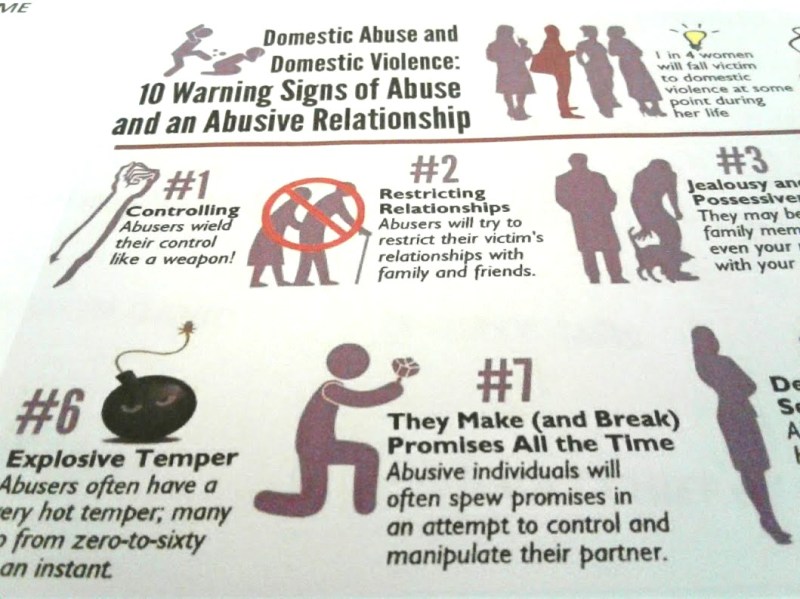
All graphics published in this post were available to the public at Wednesday’s awareness meeting.


Just an important reminder… January 17, 2018


Graphic courtesy of the Faribault Police Department Facebook page, via Peter van Sluis.


Take Two: Raising awareness about domestic abuse & violence in my community January 16, 2018

Filed under: Uncategorized — Audrey Kletscher Helbling @ 5:00 AM
Tags: , , , , , , ,

A snippet of the domestic violence poster published by the Lutheran Church, Missouri Synod. Minnesota Prairie Roots file photo 2015.


ON THE EXTERIOR, everything seemed normal. Julie and her husband attended church services every Sunday. She worked a 9 – 5 job at a local law office. Steven worked in sales. He came across as a charming guy with a strong opinion on everything. Julie, although friendly enough, was much more reserved. Quiet in the shadow of Steven’s overwhelming presence. Yet they appeared happy enough to those who knew the couple.

But something seemed off to Julie’s co-worker, Kathryn. She couldn’t pinpoint the reason for her concern. But it lingered, just below the surface. Kathryn caught unguarded moments of sadness in Julie’s eyes, unfounded anxiousness whenever she asked about Steven. Something wasn’t right.

Still, Kathryn felt it wasn’t her place to probe. If Julie and Steven had problems, they would work the issues out themselves. She didn’t want to meddle. Besides, she was probably just being overly-sensitive.

But Kathryn should have trusted her gut. Julie was in an emotionally abusive relationship. While Steven had yet to raise his hand against his wife, he had already intimidated Julie into silence, convinced her to lie for him, controlled their finances, pulled her away from friends and even belittled her with demeaning names. Julie feared losing Steven’s love if she resisted, disagreed, shared her worries about Steven’s behavior.


Photographed on the inside of a women’s bathroom stall at Lark Toys in Kellogg in 2015. I found this to be one of the most powerful messages I’ve ever read on domestic violence. Minnesota Prairie Roots file photo.


The above story is fictional. But it could be your story, your neighbor’s story, that of the woman sitting next to you in church or across the hall in your workplace. You could be Julie. Or you could be Kathryn.

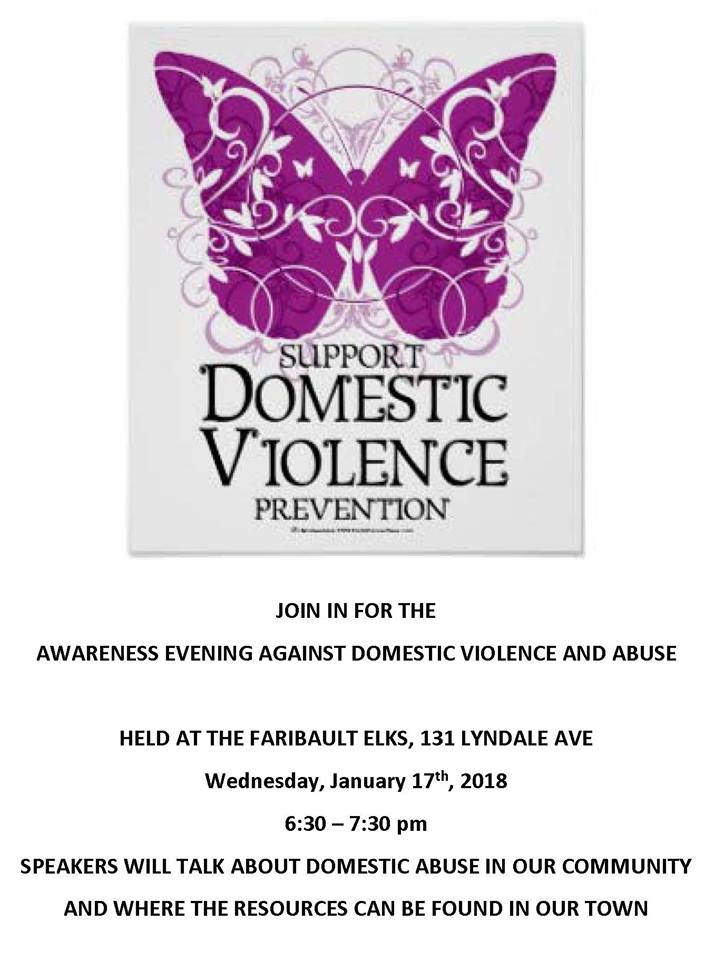
This Wednesday evening, January 17, the Faribault Elks Lodge hosts its second annual community-wide forum on domestic abuse and violence. The event begins at 6:30 p.m. and features talks by Faribault Police Chief Andy Bohlen, HOPE Center Executive Director Erica Staab-Absher, Ruthann Lang of Rice County Social Services and Jennifer David of DivorceCare.


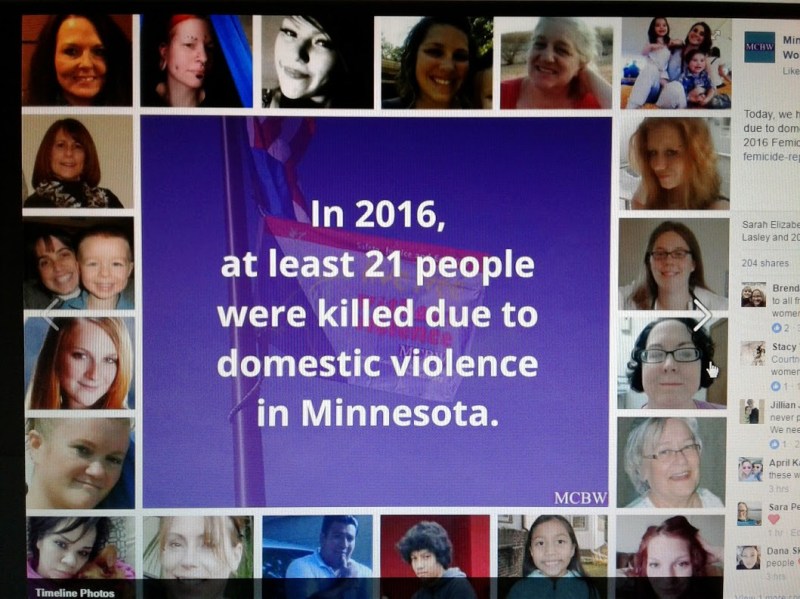
A photo of a graphic posted on the Minnesota Coalition for Battered Women Facebook page shows photos of all 21 individuals who died as a result of domestic violence homicide in 2016 in Minnesota. Barb Larson, left (second from top) was among those murdered. The 2017 Femicide Report releases soon. At least 24 people were killed in Minnesota in 2017 due to domestic violence. Minnesota Prairie Roots file photo.


I’d encourage you, if you live in Faribault, Rice County or a neighboring community, to attend. We all need to be educated and aware. Abuse thrives in silence. We each have the power within us to make a difference and that starts with knowledge.


Northfield, Minnesota, native Becky Kasper was only 19 and a student at Arizona State University when her abusive ex-boyfriend killed her on April 20, 2013. Her murderer is serving a total of 30 years in prison followed by a life-time of probation with mental health terms. Read Becky’s story by clicking here. She died in a vicious act of domestic violence. Minnesota Prairie Roots file photo.


If you are in an abusive relationship like Julie, you can break free. No one has the right to control any aspect of your life. Help is available. If you are intuitively sensing abuse like Kathryn, it’s important for you to trust your feelings. Connect with an advocate so you can best help your friend, co-worker, loved one.

No one has to go this alone. Not today. Not tomorrow. Not ever.

FYI: If you are in an abusive relationship and in immediate danger, call 911. Know that the period in which you leave a relationship and immediately thereafter are the most dangerous times for you. Have a safety plan in place. Don’t rely on a piece of paper (an order of protection, for example) to keep you safe. Reach out to a women’s advocacy center or shelter in your community for help.

UPDATE, 12:53 p.m. Tuesday: This post has been updated with the correct time of Wednesday’s meeting, which differs from previously published information. The hour-long forum begins at 6:30 p.m. at the Elks.

© Copyright 2018 Audrey Kletscher Helbling
 

Remembering Barb Larson one year after her murder via an act of domestic violence December 21, 2017

Barb Larson, an employee of the Faribault Area Chamber of Commerce & Tourism, was murdered on December 23, 2016, at her workplace. A memorial mosaic on the building exterior honors her.


ON DECEMBER 23, 2016, Barb Larson was murdered inside the Faribault Area Chamber of Commerce and Tourism office. She was shot by her ex-husband, a former cop, who then turned his gun on himself.


This plaque fronts the artwork.


The murder of Barb Larson and the suicide of her killer, Richard Larson, just days before Christmas 2016 stunned my community. Both were well-known in Faribault. For Barb to die in an act of domestic violence in the workplace—in a place promoting our community—seemed unfathomable.


Caron Bell’s mosaic is titled “Love Remains” and was designed with input from Barb’s family and friends.


But it happened. Just like domestic abuse and violence still occur daily in my city. And in yours, too. Most often the violence does not result in death. Sometimes, tragically, it does.


I see grief, a swirling of emotions, in the grey tile.


A year out from Barb’s murder, I wonder if anything in my community has really changed. Reports of domestic-related calls continue to fill police reports published in the local newspaper. Domestic violence stories still cover too many column inches.


Even after Barb’s death, beauty and hope still bloom.


Are we more aware, educated, alert now than we were before Barb’s high profile death? And if we are, what are we doing to make a difference in the lives of those affected by domestic abuse and violence? I’m talking individuals here, not those who already serve victims/survivors/families through advocacy programs like those at HOPE Center and through Ruth’s House, a local shelter for women and their families.


Inspirational and honoring words are embedded in the mosaic tile.


Initially, some positive action followed—a Faribault church gave away battery-operated candles to shine the light of hope; the Chamber celebrated Happy Barb Day on what would have been Barb’s 60th birthday; public art exhibits honored Barb and spotlighted the darkness of her death and hope rising; a statewide It Happens Here awareness campaign highlighted the issue of domestic violence; and HOPE Center staffers attended a Domestic Violence Homicide Memorial event honoring Barb and other victims.


In addition to the art commission, the Chamber interior was refurbished by volunteers after Barb’s murder there. Inside the office, a word collage also honors Barb as does a fiber art piece by long-time friend and Northfield artist Judy Sayes-Willis.


As a Chamber employee, Barb was especially welcoming.


Additionally, the Chamber commissioned an art piece by Minneapolis artist Caron Bell. Titled “Love Remains,” the mosaic on the exterior of the Chamber office honors Barb through a peaceful landscape scene and six words describing her: friendly, passionate, hopeful, beautiful, strong and welcoming.


“Love Remains” needs to be viewed up close to see all the words celebrating Barb.


I didn’t know Barb personally. But I especially appreciate the words hopeful and strong. Strong and hopeful.


I’m thankful for these multiple efforts focusing public attention on the issues of domestic abuse and violence. I hope these efforts continue. Our awareness and concern must remain even when headlines vanish into the next day’s news.


In the year since Barb’s death, 21* known individuals have died in Minnesota due to domestic violence. That’s too many in 2017, or ever. We need to remember these victims and their families and friends. And we need to care about those who remain in abusive relationships. Whether sisters by blood, sisters by community connection, sisters by workplace, sisters by church or neighborhood or friendship, we must pledge to believe them, support them, help them. Stop blaming them.

We need also to question why men continue to abuse women. Beyond that, how can we prevent such abuse and change the negative ways in which some men and boys view women and girls?

We need to break the silence. We need to do something. And that starts with each of us.


Please click on the highlighted links within this post (especially in the final paragraphs) to view enlightening and informative stories and videos on the topics of domestic abuse and violence. These are important and worth your time. 


FYI: If you are in an abusive relationship, please seek help. Confide in someone you trust such as a family member, friend, co-worker, pastor, women’s advocate… You are not alone. There is hope and help. You deserve to be free of any type of abuse whether verbal, emotional, psychological, mental, financial, spiritual, technological and/or physical. Believe in yourself and in your strength.

If you are in immediate danger, call 911. The time period in which you try to leave (or after you’ve left) your abuser is the most dangerous time for you. Have a safety plan in place. In Barb’s case, a harassment restraining order had been served on her ex-husband the week he murdered her. Don’t rely on a piece of paper or “the system” to protect you.

If you know someone in an abusive relationship, offer your support, love and care. Educate yourself. Seek professional advice so you best know how to help a victim. That’s vital.


* This number may actually be higher, but is the most recent figure published on the Minnesota Coalition for Battered Women Facebook page.

NOTE: Since most victims of domestic abuse and violence are women, I choose to use that gender when I write on this topic. I am aware that men can also be victims.

© Copyright 2017 Audrey Kletscher Helbling
 

Beyond recent headlines, my thoughts on domestic violence December 7, 2017

Filed under: Uncategorized — Audrey Kletscher Helbling @ 5:00 AM
Tags: , , , , , ,

Statistics on a The Clothesline Project t-shirt from the Minnesota Coaltition for Battered Women. Minnesota Prairie Roots file photo.


Assault by strangulation charged in 3 separate incidents

Alleged assault leaves woman with fractured hip

The headlines, written within five days of each other, recently bannered the second page of my local newspaper, the Faribault Daily News.

From the bold headers, my eyes moved down to the copy that told of hands and belt around necks, black eyes, punches and threats and stalking and, finally, that push resulting in a broken hip.


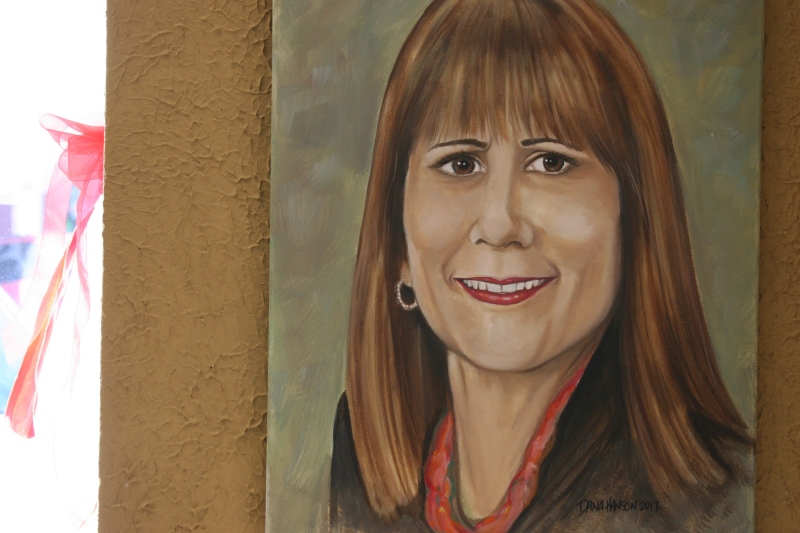
A portrait of Barb Larson by Faribault artist Dana Hanson. Barb was shot and killed by her ex-husband just before Christmas 2016 inside the Faribault Area Chamber of Commerce and Tourism office where she worked. Her death rocked my community. Minnesota Prairie Roots file photo.


The news stories are difficult to read. Such violence perpetrated upon another human being seems unfathomable. Yet, it happens every day. Here in my community of Faribault. And in your community, too.

I am thankful none of these women died. They easily could have given the choking, the hits, the pushes and punches and more. Already in Minnesota this year, 21 people have been murdered due to domestic violence. Let’s call it what it is—murder. The term domestic violence has always seemed to me to diminish the crime.


Margie Brown Holland and her unborn daughter, Olivia, were honored in The Clothesline Project coordinated by the Minnesota Coalition for Battered Women. Margie was the daughter of my former neighbor in Faribault. She and her unborn baby were murdered by her husband. Minnesota Prairie Roots file photo.


Semantics aside, we need to understand that domestic violence is pervasive in our society. And we need to understand that domestic abuse and violence are rooted in power, control and manipulation. The abuse often begins insidiously. That guy who seems initially charming early on in a relationship emerges as a controlling narcissist. He twists and turns words and situations to his advantage, to make himself look good, to degrade women, to get his selfish way, to gain power. He’ll lie, belittle, intimidate, mimic, isolate and the list goes on. He’ll never accept responsibility for his actions. The woman is to blame. Not him. So he claims.

But she isn’t to blame. No woman deserves psychological, spiritual, emotional, mental, financial, technological or physical abuse. Ever. We as a society need to recognize that.

We need also to stop blaming women for staying in relationships with abusers. We need to believe these women, support them, protect them, help them. I’m tired of abusers who get second and third chances—until they seriously injure or kill someone. Enough.


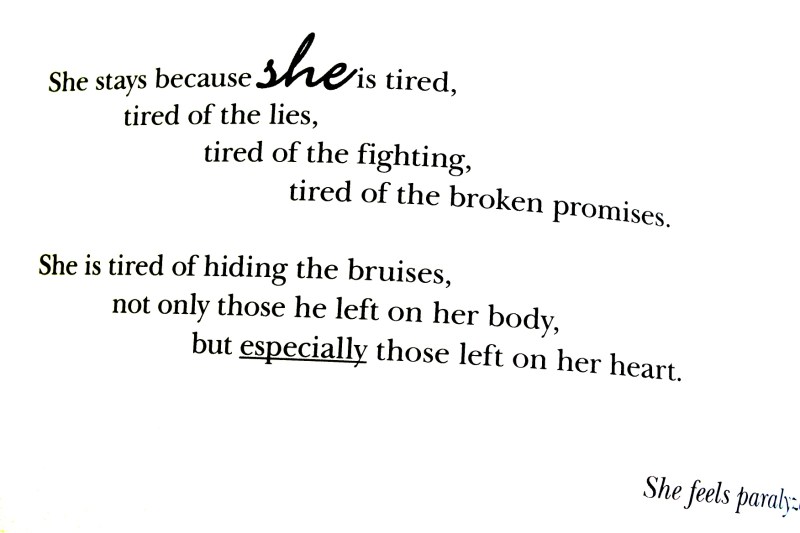
Reasons she stays, published on page 18, of She Stays, a book by HOPE Center (Faribault) Director Erica Staab. Text copyright of Erica Staab.


Leaving an abuser seems simple enough. Just walk away, right? It’s not that easy when someone is controlling you, monitoring you (including cell phone usage), threatening you in subtle, and not so subtle, ways. Fear, and “love,” hold great power.


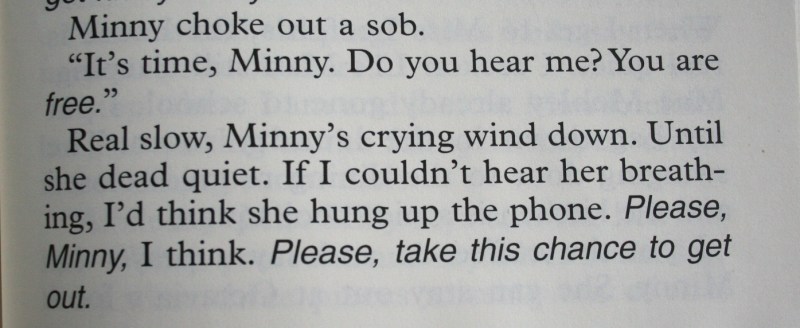
Profound words for anyone who’s been abused or known someone who’s been abused or is in an abusive relationship. These words are from the book, The Help. Minnesota Prairie Roots file photo.


For those of you in any type of abusive relationship, I encourage you to take that first bold step of confiding in someone you trust whether a friend, family member, co-worker, neighbor, clergy, advocate or whomever. Once you’ve done that, devise a safe plan to permanently leave your abuser. You are in greatest danger when you attempt to leave the person abusing you.


Turn to professionals. Within every county, if not community, you will find professionals (advocates in women’s shelters and resource centers) trained to help. You are so worth it. Don’t wait for fingers to press upon your airway, for hands to push you to the ground, for fists to blacken your eyes. Trust your gut and yourself. Get out. You deserve to live your life free of abuse. You are stronger than you think, stronger than the person who thinks he owns you.

To those women in my county who were allegedly assaulted, threatened and/or stalked by Michael, Triston, Mason, John, Richard and Jeremiah, I hope this marks a new beginning for you free of abuse. I hope, too, that the criminal justice system works for you. Stop believing your abuser’s lies. Believe in yourself and in your strength.


FYI: If you are in an abusive relationship and in immediate danger, call 911.

Texting 911 is now available in Minnesota (and other states), a service which will be especially valuable to victims of domestic violence who are unable to safely call for help. Read all about that new service by clicking here.

Note: I realize that men can also be victims of domestic abuse and violence. But because the majority are women, I wrote this post from their perspective.

© Copyright 2017 Audrey Kletscher Helbling