Minnesota Prairie Roots

Writing and photography by Audrey Kletscher Helbling

An enlightening talk focuses on Minnesota’s “Hooded History” February 21, 2025

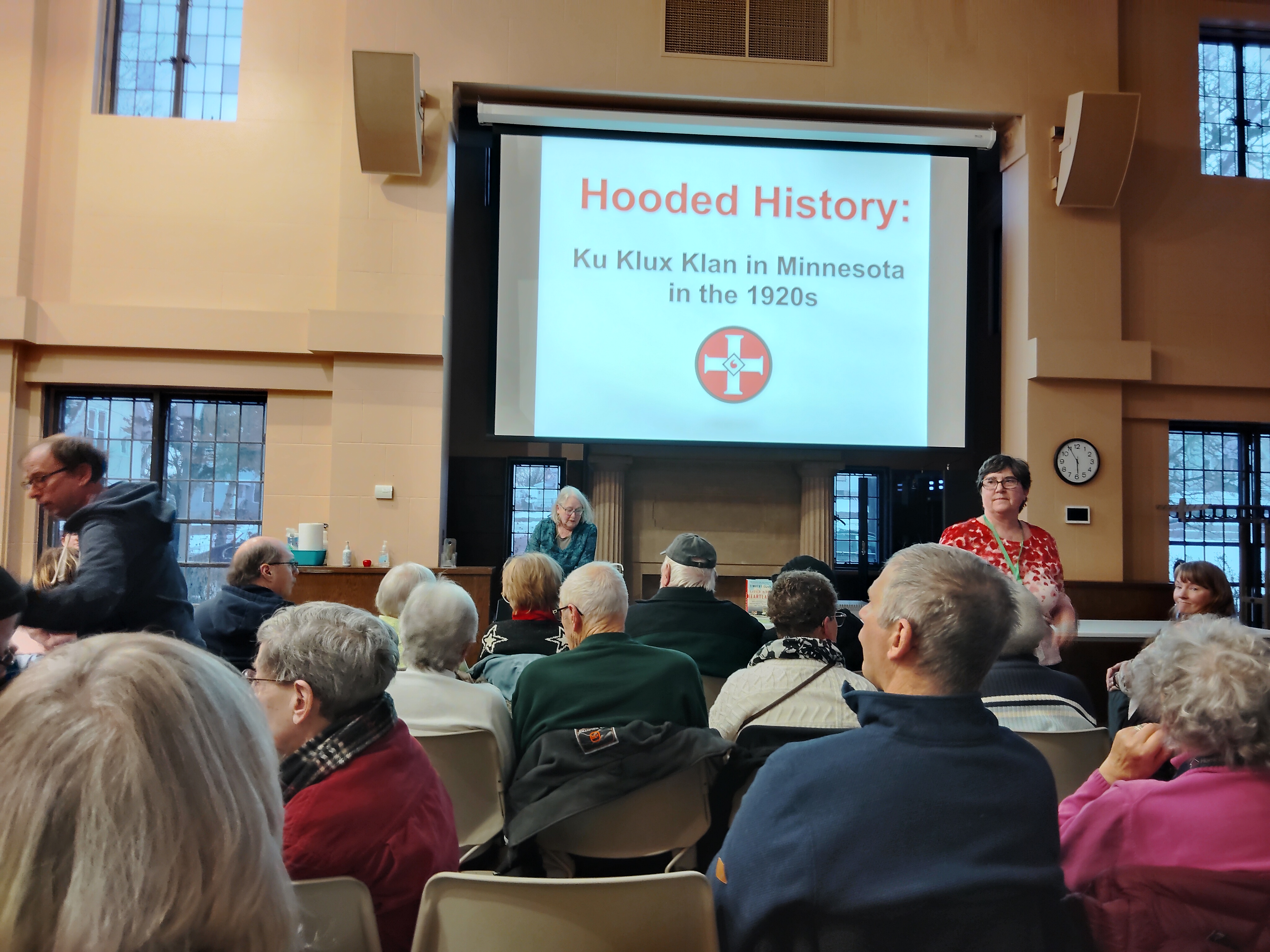
The audience settles in as Nancy Vaillancourt, center, is about to begin her presentation, “Minnesota’s Hooded History.” (Minnesota Prairie Roots copyrighted photo February 2025; all photos taken with my smartphone)

NOT MUCH HAS CHANGED in 100 years. That summarizes my thoughts after attending a talk, “Minnesota’s Hooded History—The Ku Klux Klan in 1920s Minnesota,” followed by a Q & A Thursday evening at my local library. Hate groups still exist in America, just with different names, different targets, different locations, different levels of participation.

But the core ideology of these groups, based on what I heard and what I’ve read, remains unchanged. The same in 1925 as in 2025. Historian and retired librarian Nancy Vaillancourt could have been talking about current day America when she shared her research into the KKK in Minnesota. The KKK professed a strong Christian faith, patriotism, Americanism, American ideals and more as they targeted first Blacks, then Catholics, Jews and others, including immigrants. Sound familiar? Today this hatred and intolerance is coming not only from organized hate groups, but also from individuals and from people in positions of power.
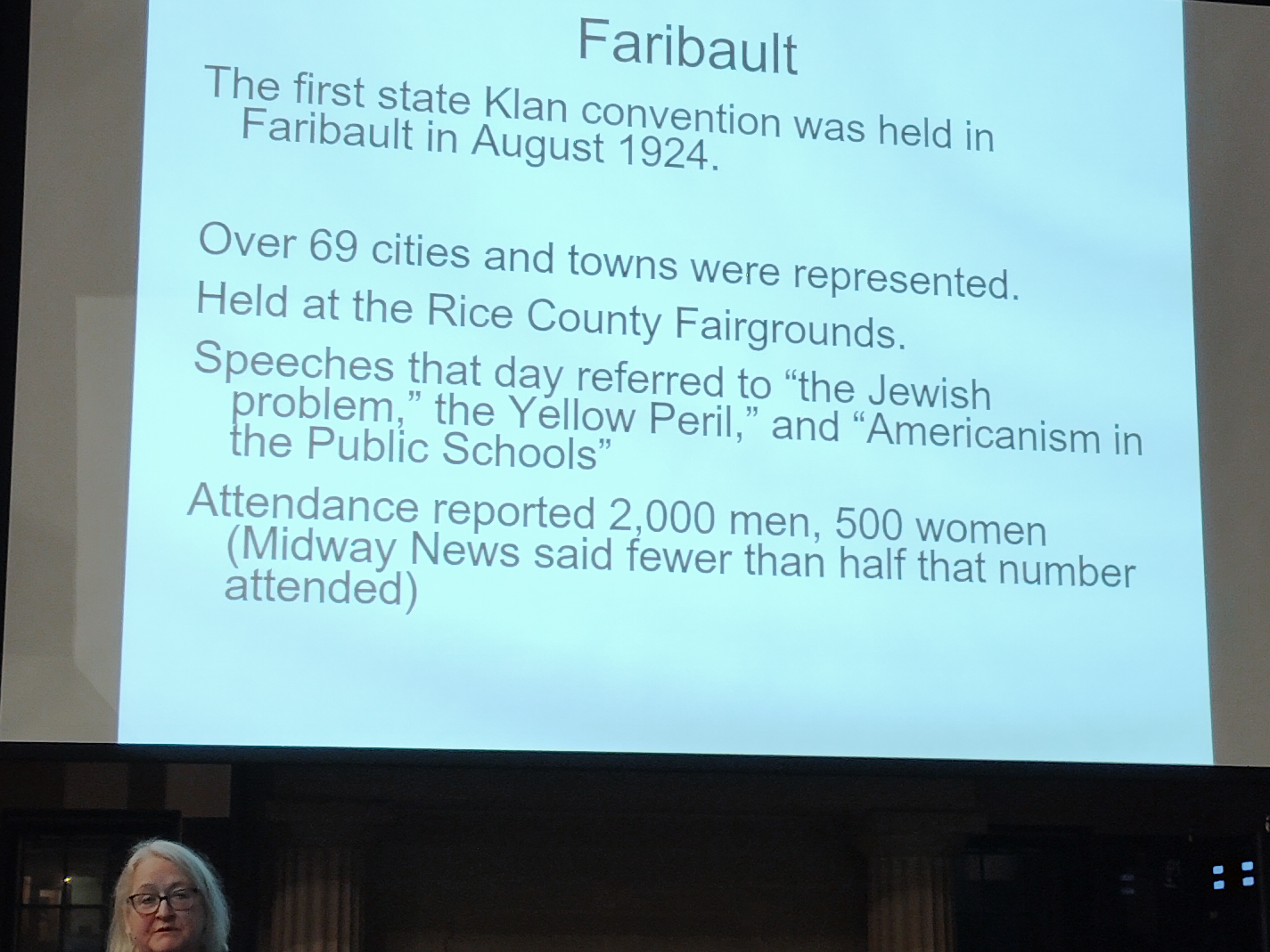
Faribault hosted the first state Klan convention, with details outlined in this slide presented by Nancy Vaillancourt. (Minnesota Prairie Roots copyrighted photo February 2025)

Back to Vaillancourt’s presentation Thursday evening. About 100 attendees packed the Great Hall meeting room at Buckham Memorial Library to capacity in a city which hosted Minnesota’s first state Klan convention in August 1924. Klan members from 69 cities and towns attended the event at the Rice County Fairgrounds in Faribault with the KKK claiming 2,500 in attendance. A publication noted fewer than half that number actually attended. Inflated crowd numbers. Sound familiar?
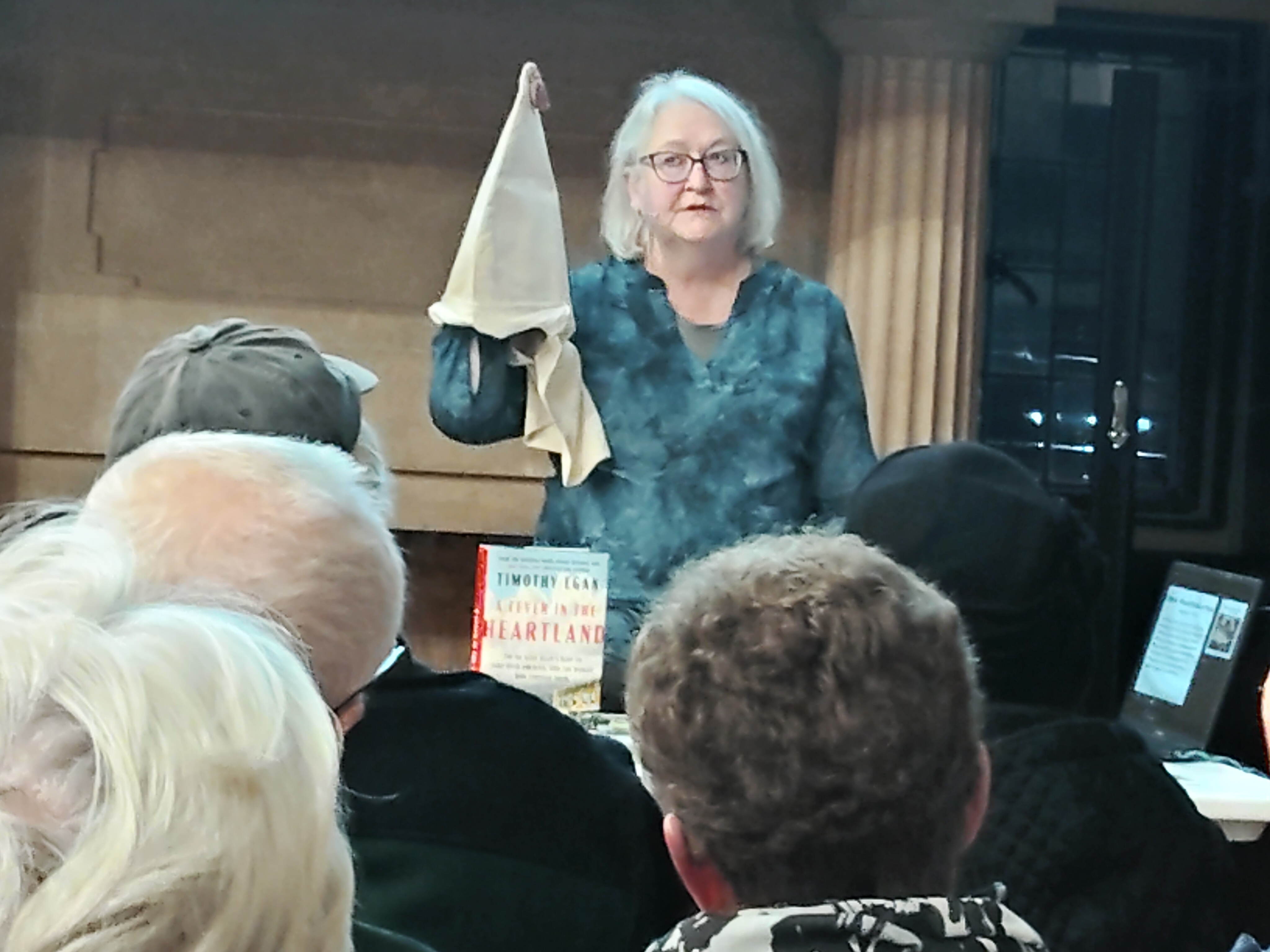
Nancy Vaillancourt displays an authentic Klan hood given to her by a woman from Blooming Prairie. She warned audience members that some items she would be showing may be disturbing and that they could step out if necessary. (Minnesota Prairie Roots copyrighted photo February 2025)

Certainly, hosting a state KKK convention is not a proud moment in a city’s history. But it is history none-the-less and important to know. We cannot deny our past, even if hurtful and painful and awful. And Vaillancourt revealed plenty of hurt and hate as she presented, focusing on the KKK in my region of southern Minnesota. She confirmed the presence of Klan chapters in nearly 60 Minnesota counties at one time. Groups of men, women and sometimes children who, in their hooded coverings, spewed hatred and intolerance while waving American flags and singing “Onward Christian Soldiers.”

Cross burnings occurred in Faribault, (including on the bluffs below St. Mary’s Hall), Stockton, Red Wing, Winona and other locations cited not only by Vaillancourt, but by audience members. Like Teresa, whose husband’s grandmother had a cross burned in her yard near Waterford (outside Northfield) because she was Catholic. Klan hatred toward Catholics was particularly strong in 1920s Minnesota.

A Catholic mother, who had just given birth, watched as the KKK paraded past the Owatonna hospital while en route from the Steele County Fairgrounds to Central Park during the state Klan convention in 1926. Can you imagine the fear she felt? Not unlike the fear targeted groups of people are experiencing today in this country.
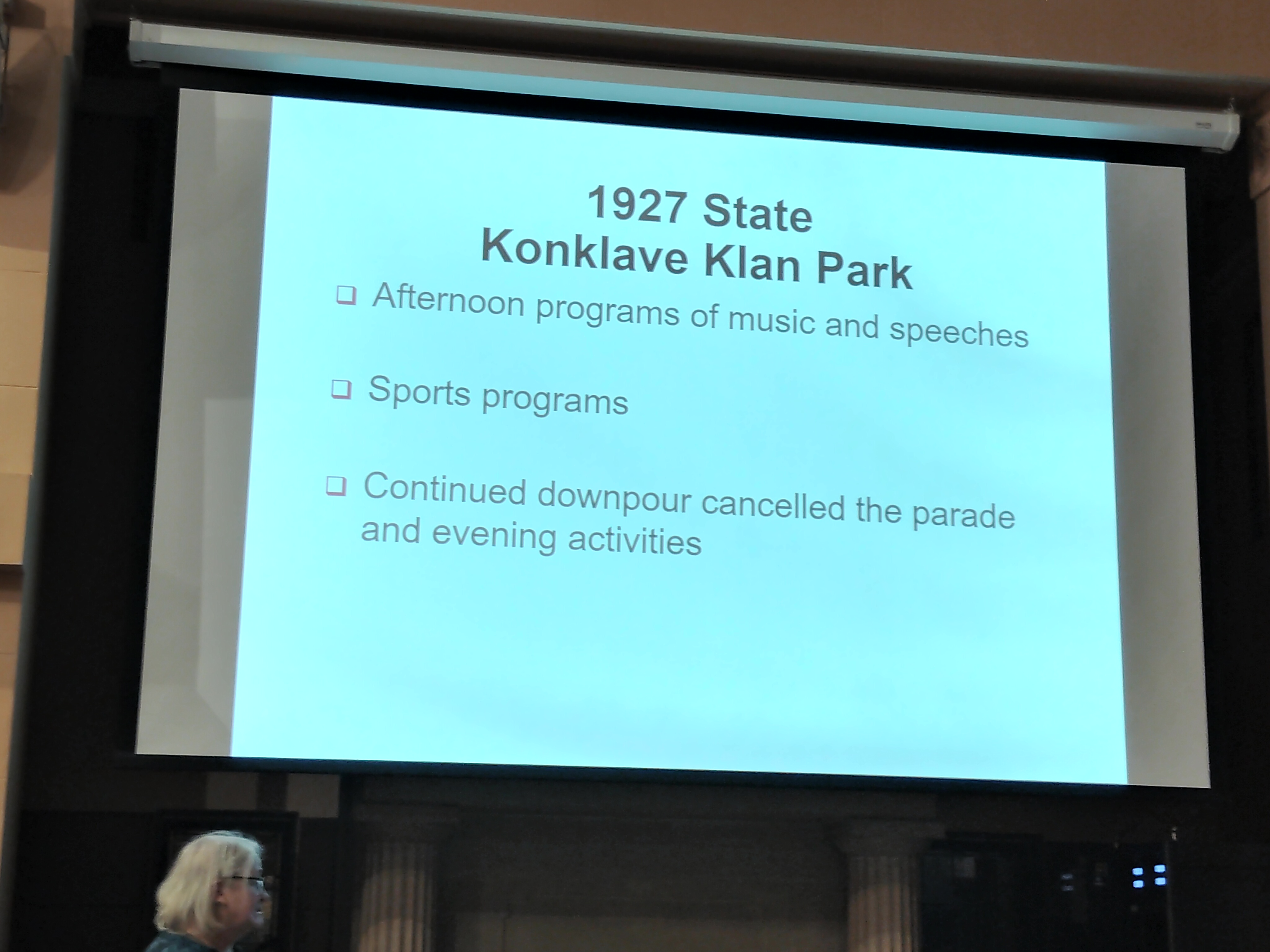
Sounds like a deceptively wholesome gathering at the Klan Park in Owatonna. (Minnesota Prairie Roots copyrighted photo February 2025)

Because Vaillancourt is from Owatonna, much of her talk focused on that community just south of Faribault along Interstate 35. Owatonna, it seems, was a hotbed of Klan activity, hosting local and state gatherings. But the fact that stood out for me was the Klan’s purchase of 20 acres of land east of downtown Owatonna. That land became Klan Park, a place to gather, organize and socialize. The local chapter even constructed a meeting house there. While it is disheartening to hear this, it was uplifting to learn that the land was sold in 1945—to a man whose wife was Catholic. Attendee Bonnie shared that bit of information about her great uncle, who was invited to join the Klan, declined because of his wife’s Catholicism and then eventually bought the land. Today that former KKK park is the site of soccer practice fields, Vaillancourt noted, where a diverse group of youth play.

Vaillancourt covered a whole lot more in her presentation. Like how the Klan recruited from fraternal orders, Protestant churches, via fiery speeches, by invitation. Fear and social and economic pressure were used to draw people into the Klan. Sound familiar? In Virginia, in northern Minnesota, the entire school board claimed Klan membership and made Bible reading in school compulsory. The mayor of St. James was a major grand dragon of the KKK. The Northfield Klan hosted a KKK homecoming Labor Day parade in September 1926. The Klan was big on parades. That makes sense given the intimidation and fear a mass of hooded marchers can instill in the public. And Owatonna residents were afraid, Vaillancourt said.
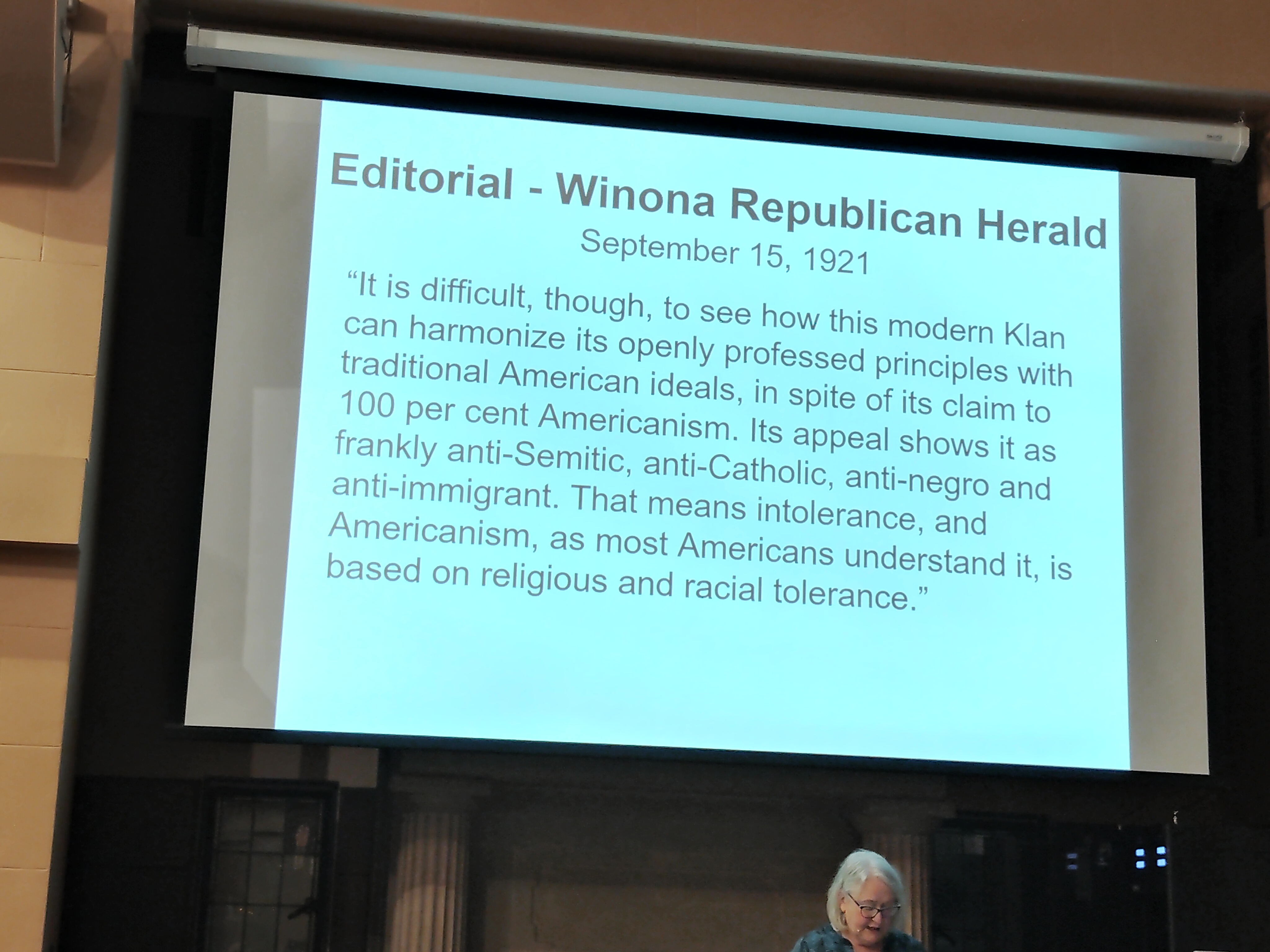
A powerful editorial from a southeastern Minnesota newspaper. (Minnesota Prairie Roots copyrighted file photo February 2025)

Yet, there were individuals—like Bonnie’s great uncle—organizations and media who resisted and challenged the Klan. The NAACP, the National Vigilance Association, the Knights of Columbus… Vaillancourt specifically noted the Catholic-based KC group for effectively exposing Klan members in a community.

This gives me hope, when I hear of media, individuals and organizations that stood up and refused to accept hatred and intolerance. It gives me hope, too, when members of my community turn out in strong numbers to learn about “Minnesota’s Hooded History.” Knowledge is powerful. It gives me hope, too, when someone like Nancy Vaillancourt cares, researches and shares because, she says, she wants “to get the truth out.” Even while some still deny it.

#

FYI: To learn more about the Ku Klux Klan and about other hate groups in America, visit the Southern Poverty Law Center.

A photo gallery exhibit, “Testify—Americana Slavery to Today, The Diane and Alan Page Collection,” will be displayed in the hallway connecting Buckham Memorial Library and the Faribault Community Center from April 1-23. The exhibit will also be at other libraries throughout the Southeastern Libraries Cooperating (SELCO) system.

The “Minnesota’s Hooded History” program was made possible with support from Minnesota’s Arts and Cultural Heritage Library Legacy Fund and SELCO.

© Copyright 2025 Audrey Kletscher Helbling


“Beets,” a relevant play that bridges differences February 7, 2025

Former Faribault Daily News reporter Pauline Schreiber photographed these Faribault POW camp barracks shortly before they were torn down in 1990. (Photo courtesy of the Rice County Historical Society)

THE SETTING COULD BE FARIBAULT or any other Minnesota community which, in the latter part of World War II, housed German prisoners of war in POW camps. But the setting is at a camp in Greeley, Colorado, and on a farm site in nearby Berthoud. Locations matter not. The story does.

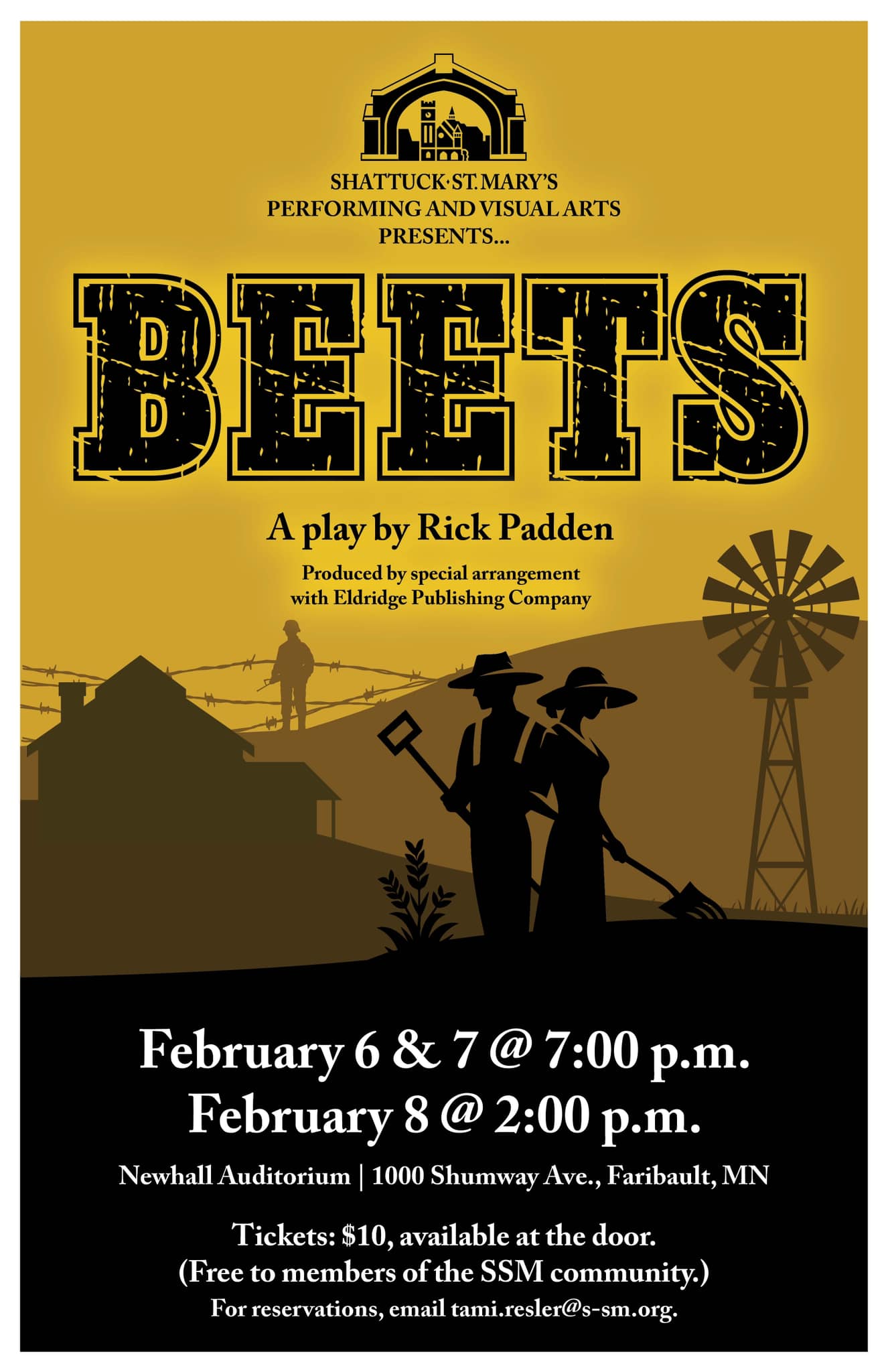
A promo for “Beets.” (Credit: Shattuck-St Mary’s School Facebook page)

Thursday evening, I sat in the sparse audience of the historic Newhall Auditorium on the campus of Shattuck-St. Mary’s School, a private college prep school on Faribault’s east side, watching a story unfold in the theatrical production, “Beets.” An incredibly talented nine-member student cast immersed themselves in the roles of a farm family, German POWs, guards and a family friend to share a bit of history. And much more.

This play about POWs working on the Hunt family’s sugarbeet farm is more than a retelling of history. It is also about relationships, fear, culture and love. It is about the perceived differences that divide us and about the commonalities that unite us.

This is a play for our times. In a nation today divided by politics, by fear, by hatred and animosity, “Beets” is absolutely relatable.

As the storyline evolves, conflicts arise. Farmer Fred Hunt spews his hatred of the Germans. His wife, Isabelle, exudes compassion and love. And their daughter, Anna, settles somewhere in between, leaning initially toward dislike and distrust of the German POWs who have come to work her father’s land. Anna’s thoughts often turn to her brother, Jake, fighting the Germans abroad.

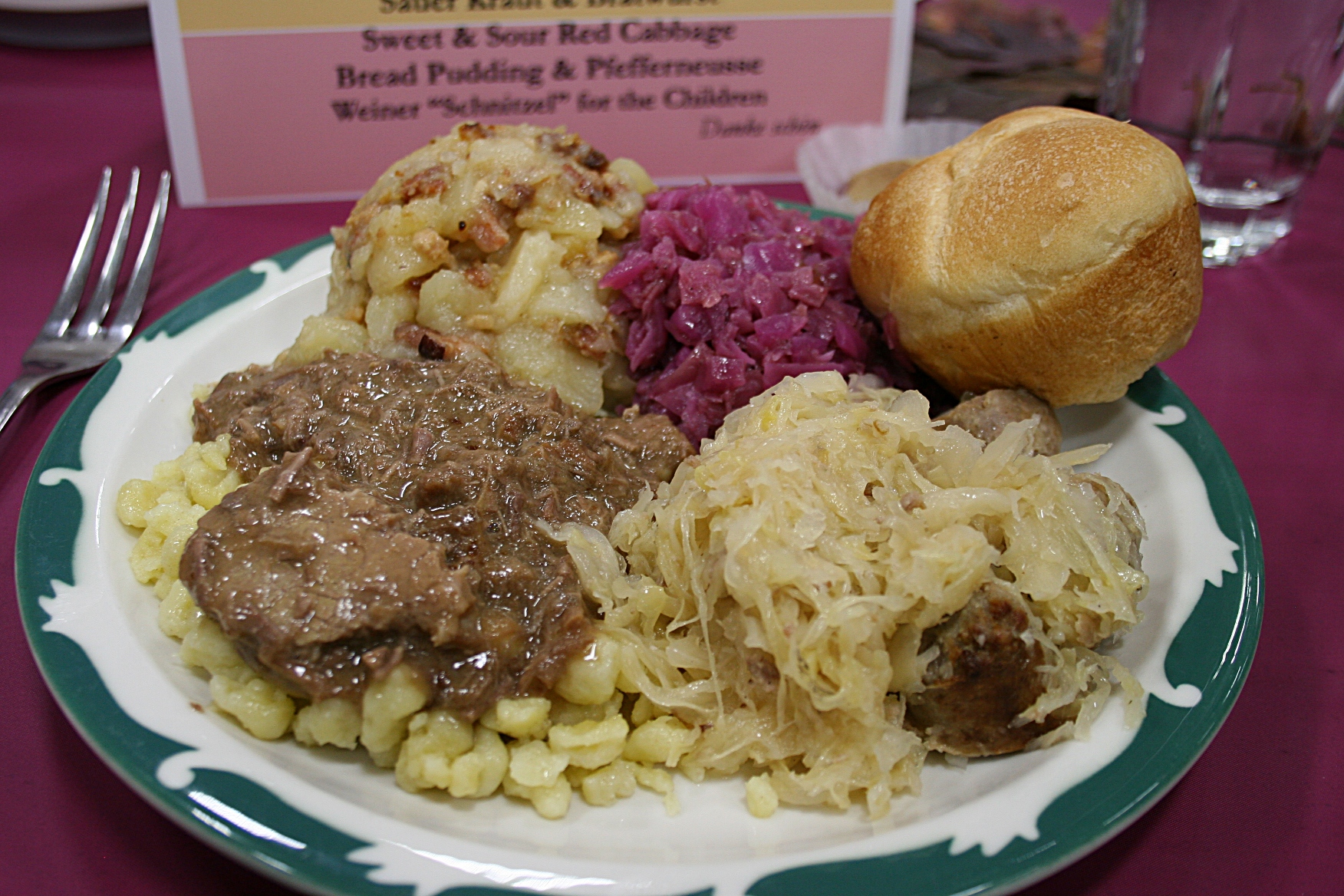
A German meal: sauerbraten and spaetzle on the left, German potato salad, sweet and sour cabbage, dinner roll and sauerkraut and brats. (Minnesota Prairie Roots copyrighted file photo)

Slowly, interaction by interaction, things begin to change. The American farm family and the German prisoners realize they share a love of Bach. (Yes, a German composer.) And while the German POWs profess they will never eat corn, because that’s for pigs and cows—although Anna explains the difference between corn for livestock and sweetcorn—they all understand that they need to eat. The scenes in which Anna and Isabelle serve potatoes and cake to the POWs show how food brings people together. Trust grows. When Fred learns details about POW Dieter Meuhler’s family, he begins to understand the personal side of a man he saw only as an enemy. The walls of distrust, disdain and differences start crumbling, albeit slowly.

It is not lost on me that the Shattuck performers are themselves of diverse backgrounds. That only adds to the performance.

There are differences in beets (these are not sugarbeets), just like in people. (Minnesota Prairie Roots copyrighted file photo)

There are lessons to be learned from “Beets,” written by Rick Padden. First, we are all, at our core, just human beings with the same basic needs. Secondly, to overcome differences, we need to connect on a personal level. We need to open our hearts and minds, to embrace cultural and other differences. We need to show compassion and care, as farm wife Isabelle Hunt did on stage. We need to recognize that love is universal, as Anna and Dieter discovered.

“Beets” is one of those plays I wish everyone could see, especially now in these challenging days. I left the theater at Shattuck-St. Mary’s feeling a sense of hope. The fictional characters in “Beets” changed, for the better. They opened their hearts and minds to each other, despite their differences, or perceived differences. Perhaps we can do the same.

#

FYI: Two performances of “Beets” remain at Shattuck, one at 7 pm Friday, February 7, and the second at 2 pm Saturday, February 8. It’s a two-hour show (includes a 10-minute intermission) I highly recommend to anyone who enjoys well-done theater, history and a play with strong messages relevant to today.

© Copyright 2025 Audrey Kletscher Helbling


When a rock riffle replaces a traditional dam February 5, 2025

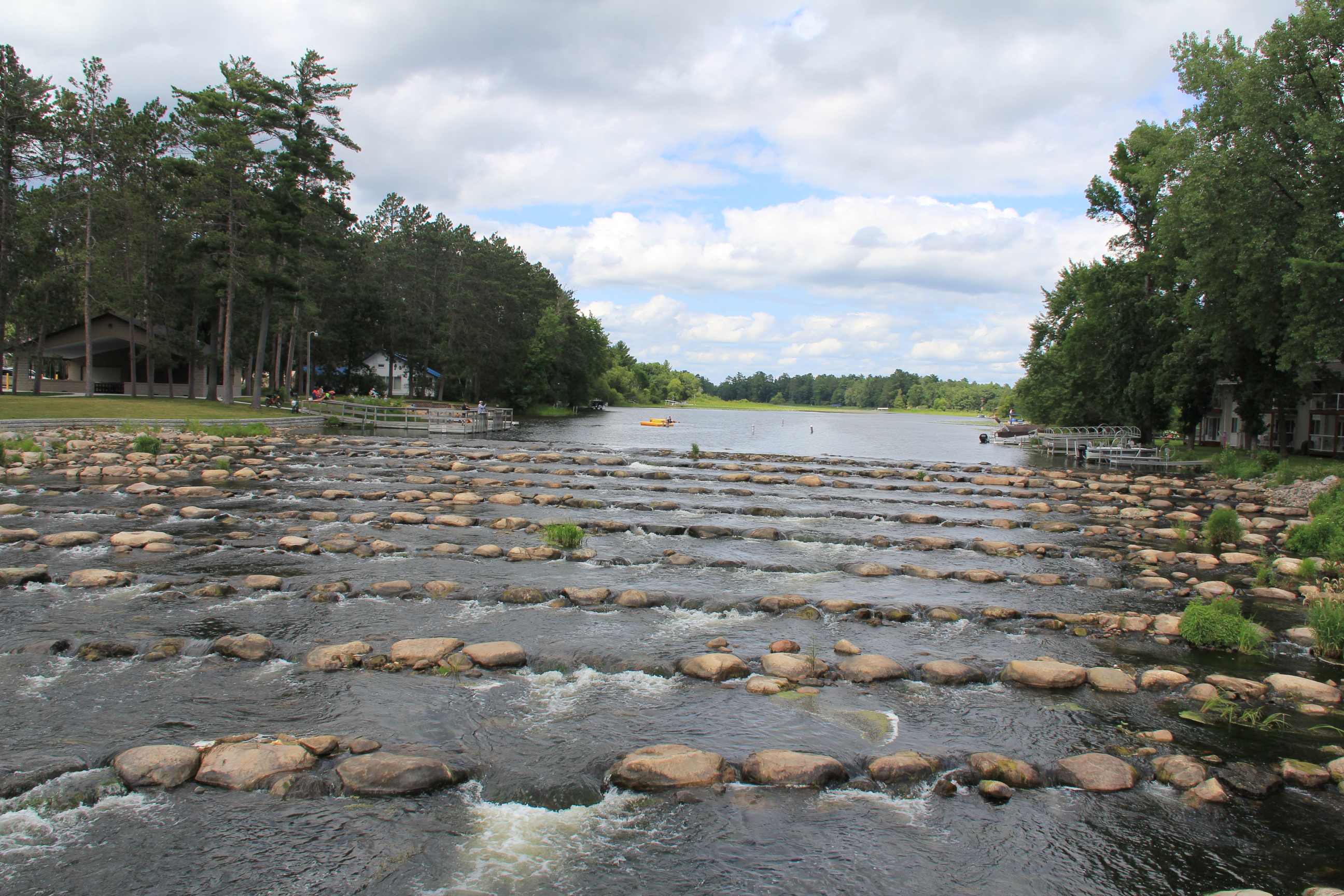
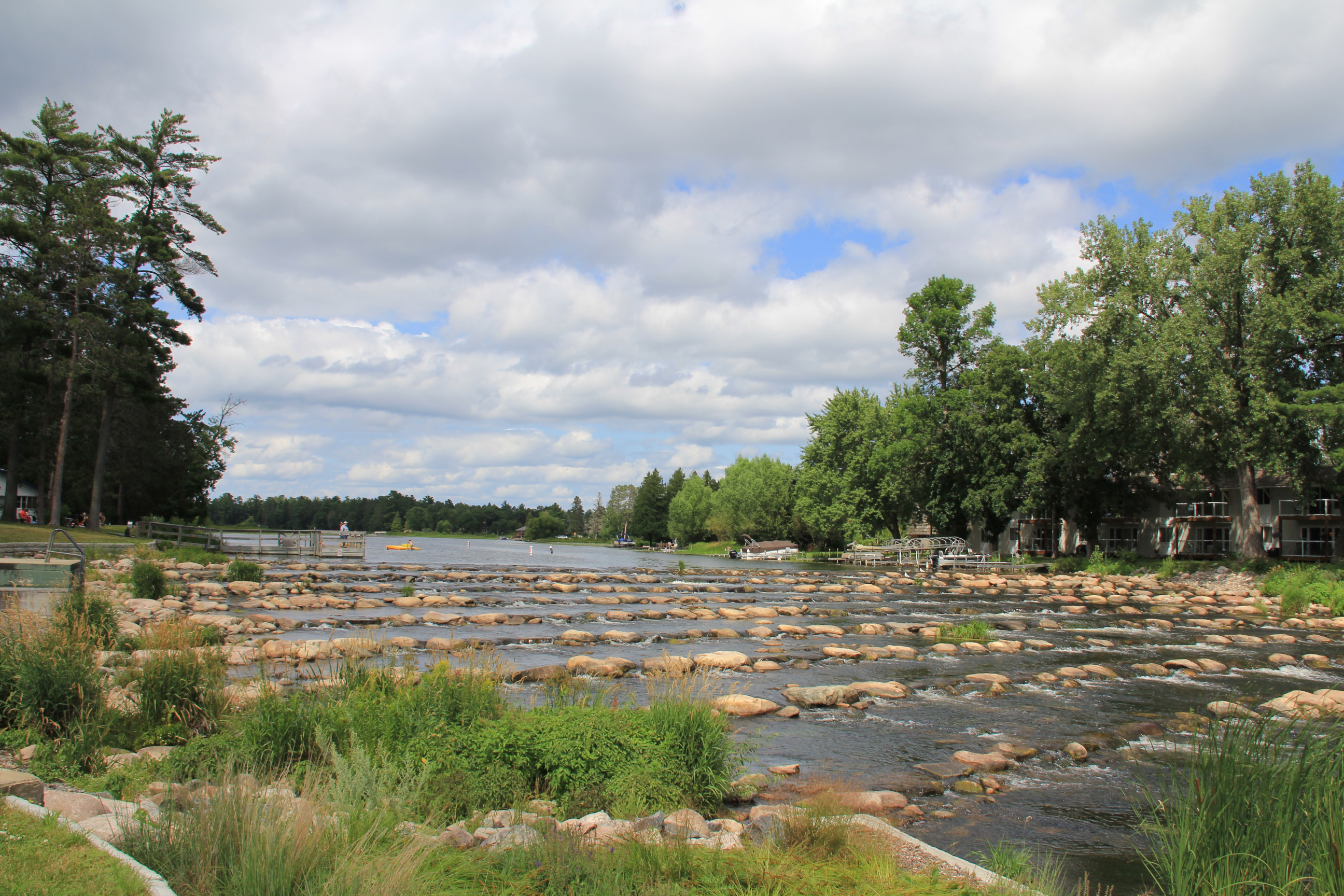
This rock riffle in Pine River replaced a traditional dam built in 1910 to hold back water flowing from Norway Lake into the Pine River. The old dam was designated as “high hazard,” thus in need of replacement. (Minnesota Prairie Roots copyrighted photo July 2024)

WIND AND WATER. Both prove soothing and calming elements of nature. Except when destructive.

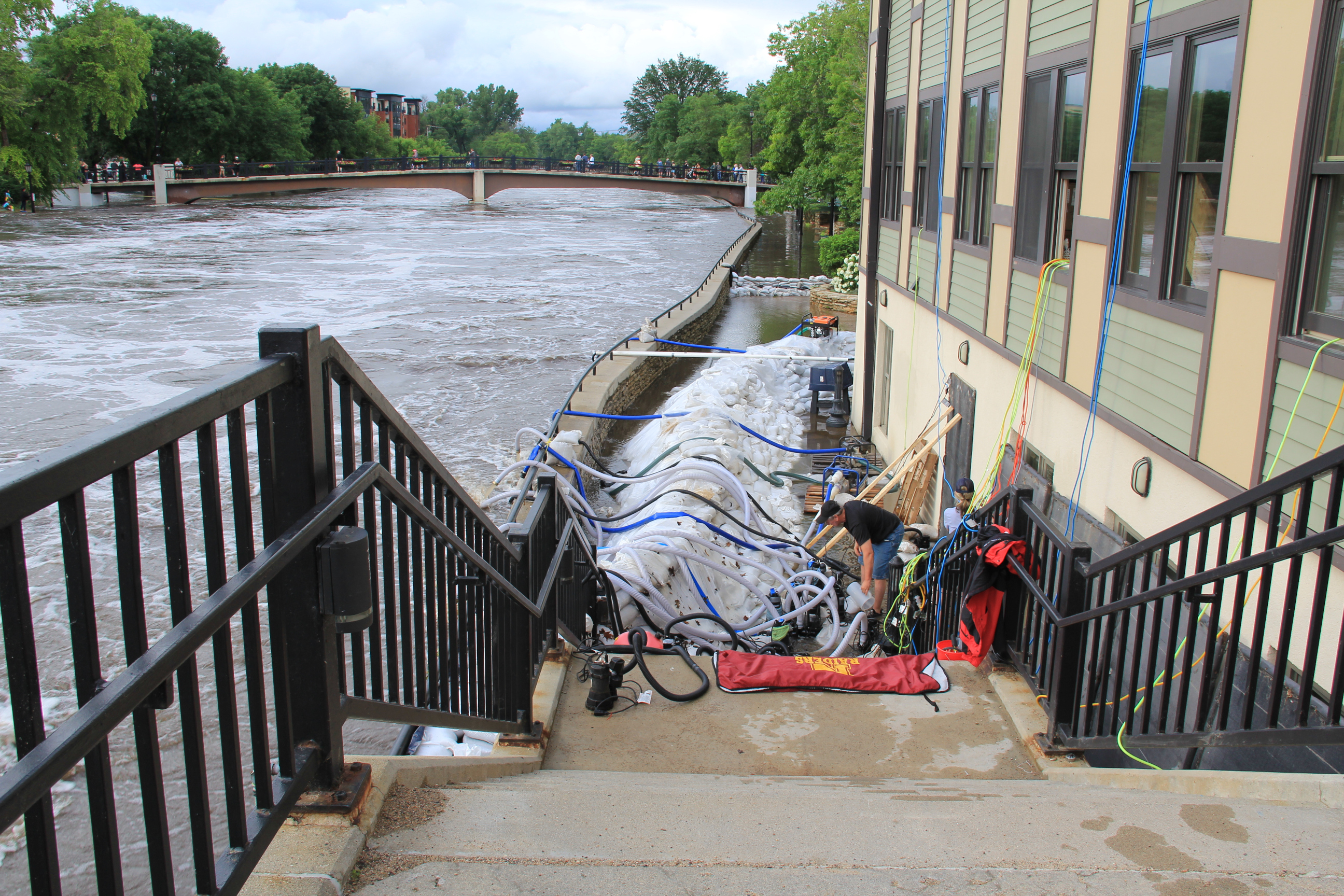
Sandbagging along the flooding Cannon River in downtown Northfield last June. The traditional dam in Northfield was not compromised, unlike in some Minnesota locations. (Minnesota Prairie Roots copyrighted file photo June 2024)

Last June, excessive rainfall led to devastating floods in parts of southern Minnesota, especially in Waterville, a 20-minute drive southwest of Faribault. Farther to the west in Rapidan, the Blue Earth River raged, causing a partial dam collapse and erosion of the land. That led to loss of a house and of the much beloved The Dam Store. In Northfield, 20 minutes from Faribault, the Cannon River flooded the Riverwalk and threatened riverside businesses. In Faribault, the Cannon and Straight Rivers spilled from their banks, flooding parks and several city streets. The powerful river also eroded the shoreline near the Faribault Mill Dam. Boulders were hauled in and placed beside the dam to contain the river and prevent additional erosion.

The Dam Park, with a pavilion, is to the left of the tree-edged Pine River in this photo, private homes to the right. (Minnesota Prairie Roots copyrighted photo July 2024)

Now, many months later, Faribault city officials are considering options for the Faribault Mill Dam. And that got me thinking about Pine River. In this north central Minnesota community, a rock riffle/rock arch rapids replaces a 200-foot long by 13-foot high traditional dam built in 1910. The result is nothing short of stunning.

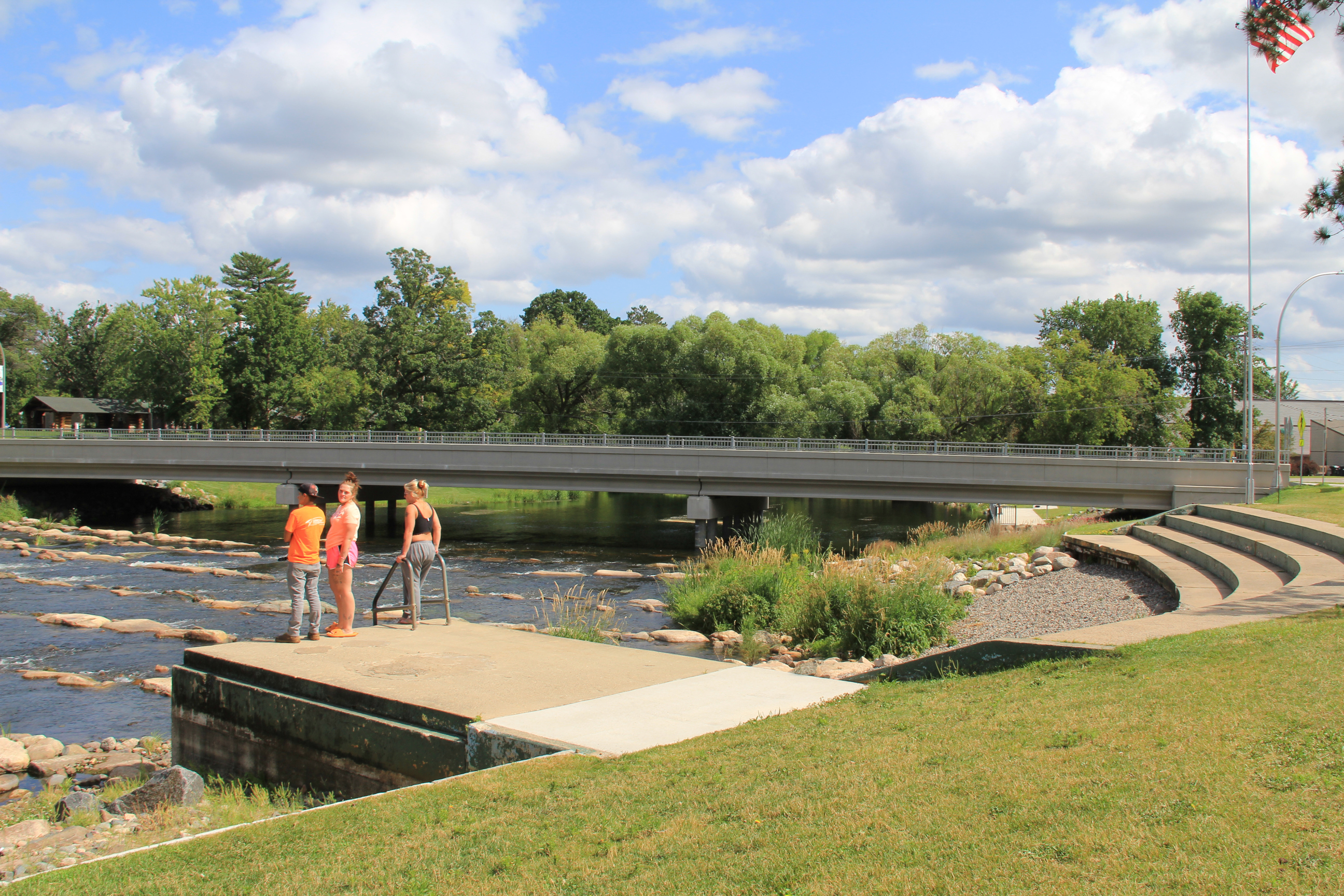
The concrete steps and platform remain from the original dam construction project. This image shows a view of the rock riffle looking downstream. (Minnesota Prairie Roots copyrighted photo July 2024)

Let me explain. Smaller rip-rap rocks, larger rocks and boulders were placed in sloping rows across the Pine River to replace the dam. Water spills over the rocks as the rows descend for several hundred feet. Except for the precise placement of the rock rows, the rapids appear almost natural. And that is much more visually pleasing than a wall of concrete.

It’s mesmerizing to watch and listen to the river spill over the man-made rock riffle in Pine River. (Minnesota Prairie Roots copyrighted photo July 2024)

The sound, too, is pleasing. I have always loved the sound of water rushing over rocks. It’s calming, soothing, mesmerizing. As is watching the water pour over and around rocks.

The traditional dam proved a significant fish barrier. Installation of the rock riffle has improved fish habitat in the river, which feeds into the Whitefish Chain of Lakes in north central Minnesota. (Minnesota Prairie Roots copyrighted photo July 2024)

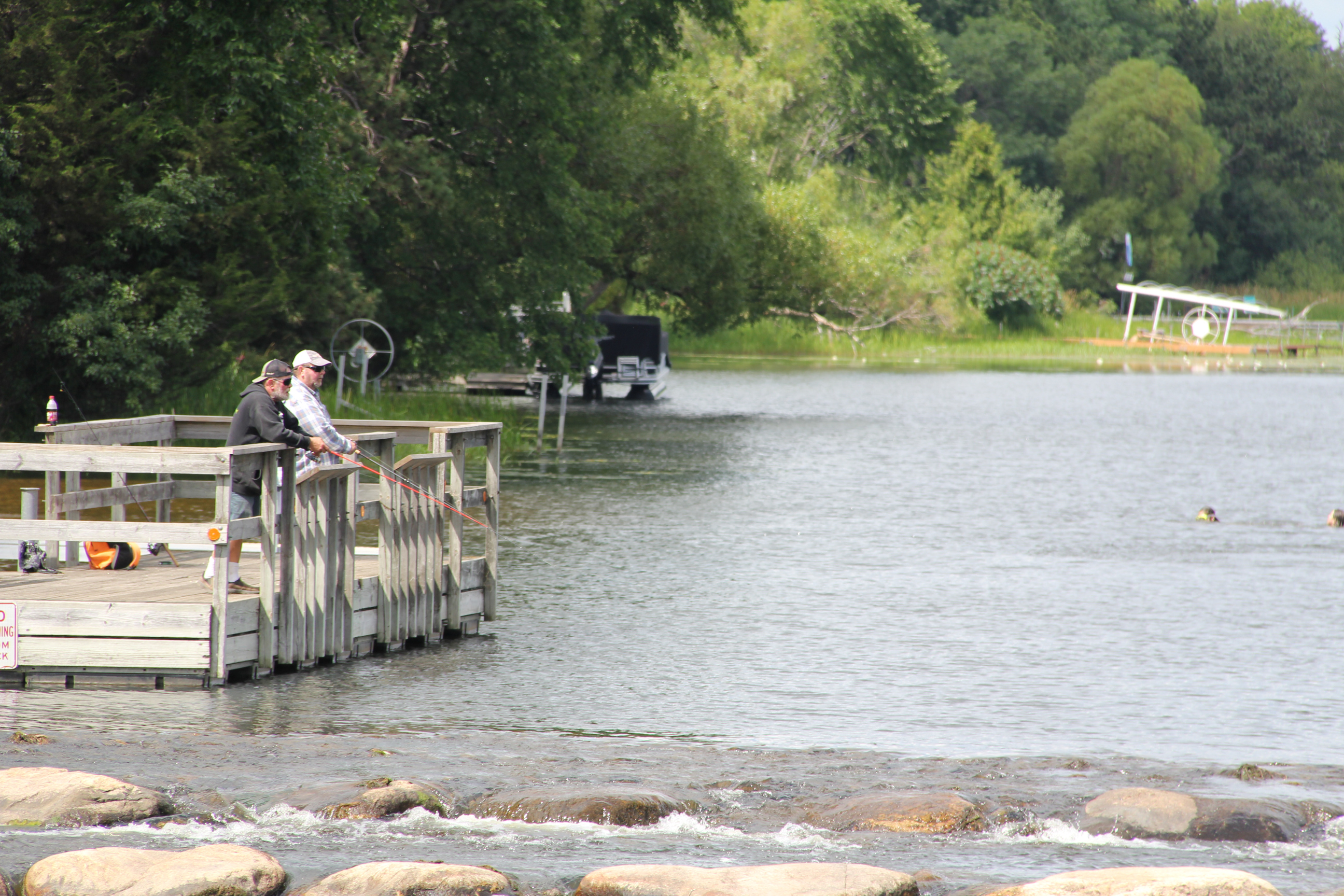
But this award-winning rock riffle dam in Pine River offers much more than a place to sit riverside and relax. It’s also a popular recreational area. During my mid-week July 2024 visit, anglers fished the river from a pier and from shore downstream. Swimmers jumped from floating platforms into the water above the rock riffle. There’s a sandy beach, too. And although I didn’t see any, kayakers can also navigate the rapids. And anyone can cross the river on the rocks, but at their own risk.

On a summer day, swimmers jump off a swimming platform above the rock riffle into the river. Dam Park includes a sandy beach. (Minnesota Prairie Roots copyrighted photo July 2024)

This revamped area, as I viewed it, draws people outside to the river. To recreate. To gather. To enjoy nature. There’s even a playground and a pavilion with a kitchen in Dam Park. What Pine River has created with this rock riffle is a community centerpiece that is beautiful in every way.

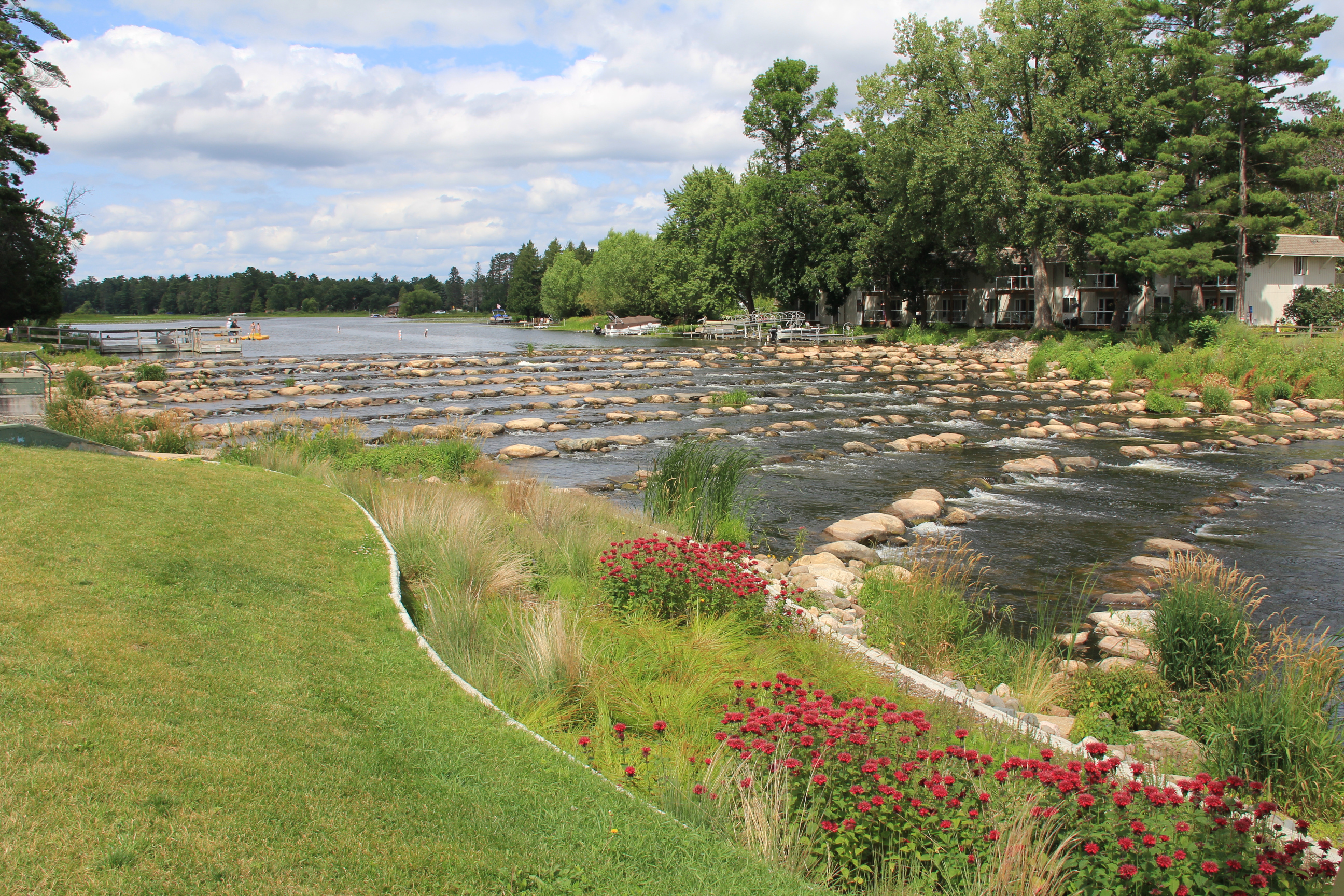
Plantings of flowers and grasses protect the river shoreline by the rock riffle. (Minnesota Prairie Roots copyrighted photo July 2024)

Now, whether this will work at the Faribault Mill Dam, I don’t know. I’m no engineer. But rock riffles have been placed in some 75 rivers and lakes across Minnesota. The one in Pine River is the first I’ve seen. I’d like local city officials to consider a rock arch rapids, maybe take a field trip to Pine River or elsewhere and see (and hear) just how inviting and lovely, calming, soothing and mesmerizing a rock riffle is compared to a traditional dam. See how this dam removal and rock riffle replacement in Pine River creates a recreational oasis, a beautiful gathering spot that grows community.

© Copyright 2025 Audrey Kletscher Helbling
 

An African spiritual plus my thoughts during Black History Month February 3, 2025

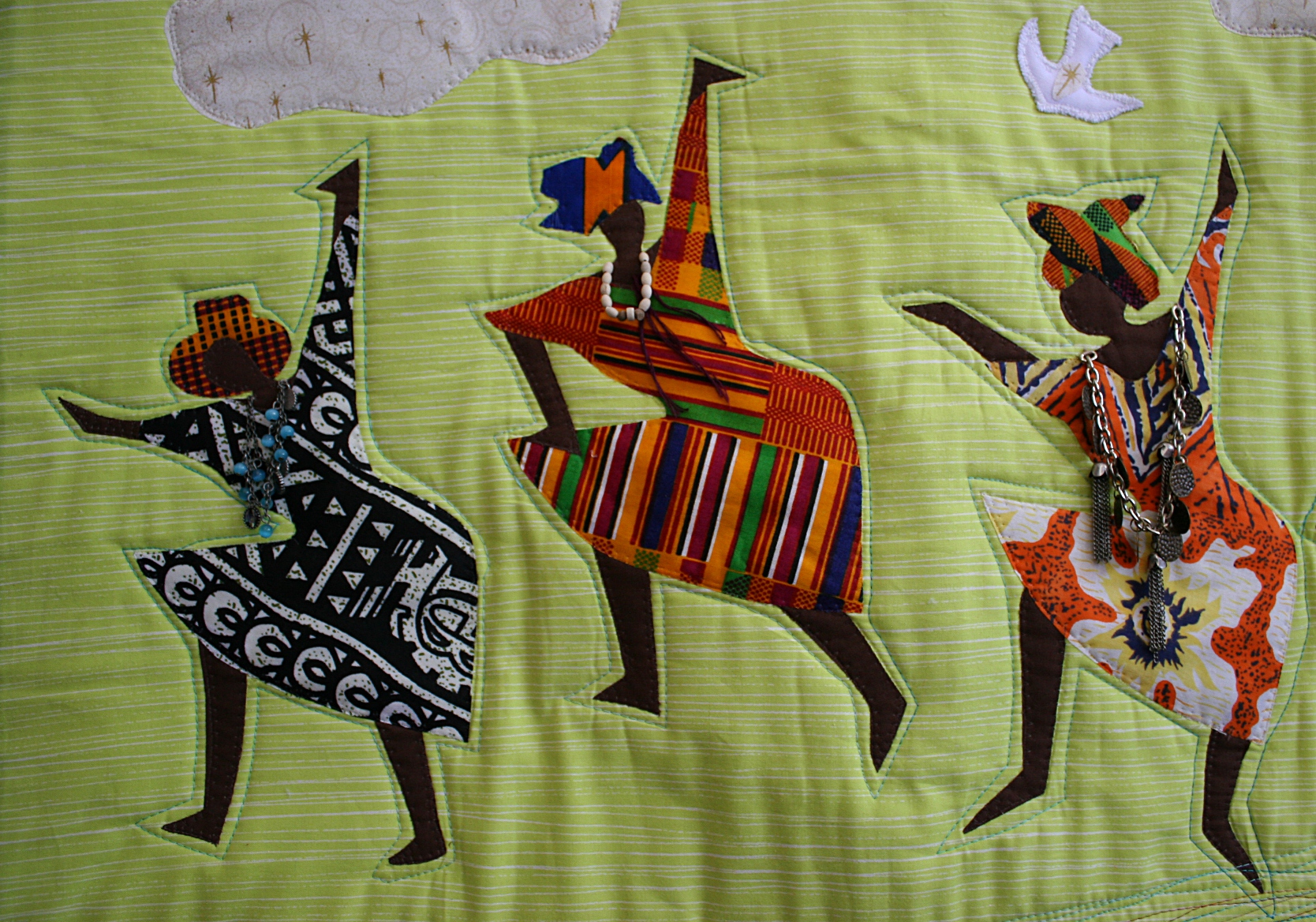
This Nigerian-themed quilt art was created years ago by my friend Susan. The art reflects to me the joy of an African spiritual. The fabric came from Nigeria, where Susan’s father-in-law served as a Lutheran missionary. (Minnesota Prairie Roots copyrighted file photo)

THE SONG WAS UNEXPECTED during Sunday morning worship at the conservative Lutheran church I attend in Faribault. But it was fitting for the day and for my feelings, which have leaned deeply into discouragement recently.

The African American spiritual, “There Is a Balm in Gilead,” proved a temporary balm for my soul. The old school word “balm” holds a healing connotation. The song’s refrain encourages: There is a balm in Gilead to make the wounded whole. There is a balm in Gilead to heal the sin-sick soul.

As I sang the refrain, I wondered, what or where is Gilead? Later research revealed that, during Old Testament days, Gilead was a mountainous region east of the Jordan River and an important source of medicinal herbs. That makes sense as it relates to the lyrics.

Christ’s face in a stained glass window in the sanctuary of my church, Trinity Lutheran, Faribault. (Minnesota Prairie Roots copyrighted file photo)

In the New Testament, “balm of Gilead” refers not to an herb which heals physically, but to Jesus through whom spiritual healing comes. That also makes sense as it relates to lyrics of the song printed on page 749 of the Lutheran Service Book.

Events of recent weeks in this country have me feeling apprehensive, unsettled, worried, in need of a healing balm. I know I am not alone in these feelings as we face economic challenges, upheaval, chaos and uncertainties on endless levels. Each day seems to bring something of new concern. No matter where you stand politically or spiritually, you have to feel the tension and uncertainties in this country.

A snippet of a photo by Stephen Somerstein from the exhibit, “Selma to Montgomery: Marching Along the Voting Rights Trail,” which I saw at St. Olaf College in Northfield, Minnesota, in 2015. (Minnesota Prairie Roots copyrighted file photo)

On Sunday, as I sang the African American spiritual, I allowed myself to be swept into the healing words of hope and comfort. It was not lost on me that, sitting on the end of my pew, was a family of mixed race—an African American father, White mother and three biracial children, one a darling baby boy of ten months. I thought of my own newborn grandson, who is mixed race. What does the future hold for these two little boys? Will they face challenges simply because of their skin color? I’d like to think not. But…

And I thought, too, of the new calendar month of February, in which we celebrate Black History Month, focusing on Black history, culture and education. I reflect on slavery, on Civil Rights leaders, on racial disparities, diversity, equity and inclusion, wondering how I, personally, can educate myself and make a difference.

A message left by a visitor to the Selma exhibit at St. Olaf College. It’s so applicable to today. (Minnesota Prairie Roots copyrighted file photo)

It truly does start with each of us standing up for what is good and right and decent and not going along with what we know in our hearts, minds and souls to be wrong. And then, maybe then, we’ll find our balm in Gilead.

© Copyright 2025 Audrey Kletscher Helbling
 

An historic connection between Faribault and Benson January 22, 2025

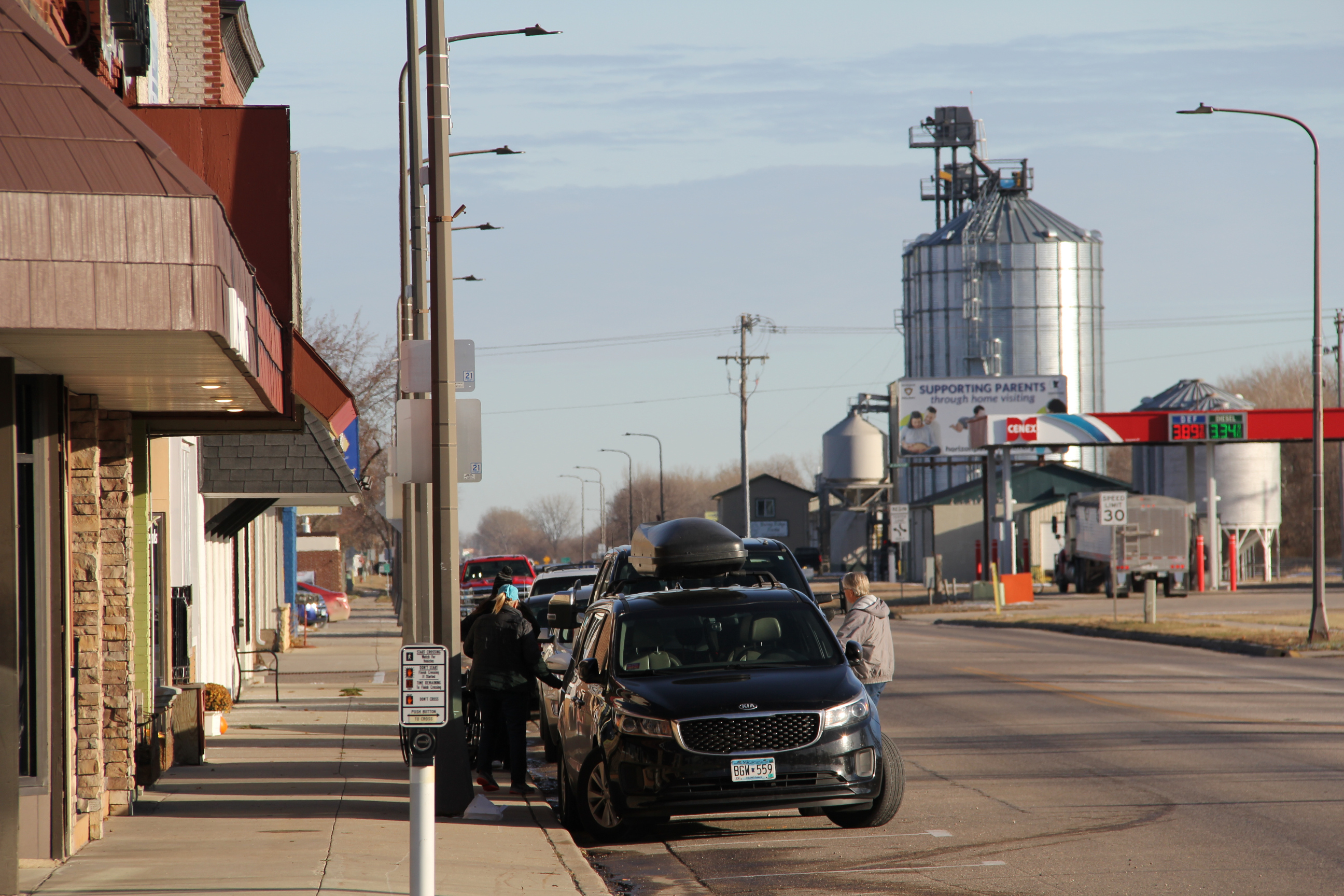
A scene from downtown Benson, Minnesota. (Minnesota Prairie Roots copyrighted file photo November 2024)

SOME 170 MILES separate my community of Faribault from Benson, a small agricultural community in west central Minnesota near the South Dakota border. At first glance, it seems the two share little in common. But they do, a discovery I made following a brief stop in Benson in late November.

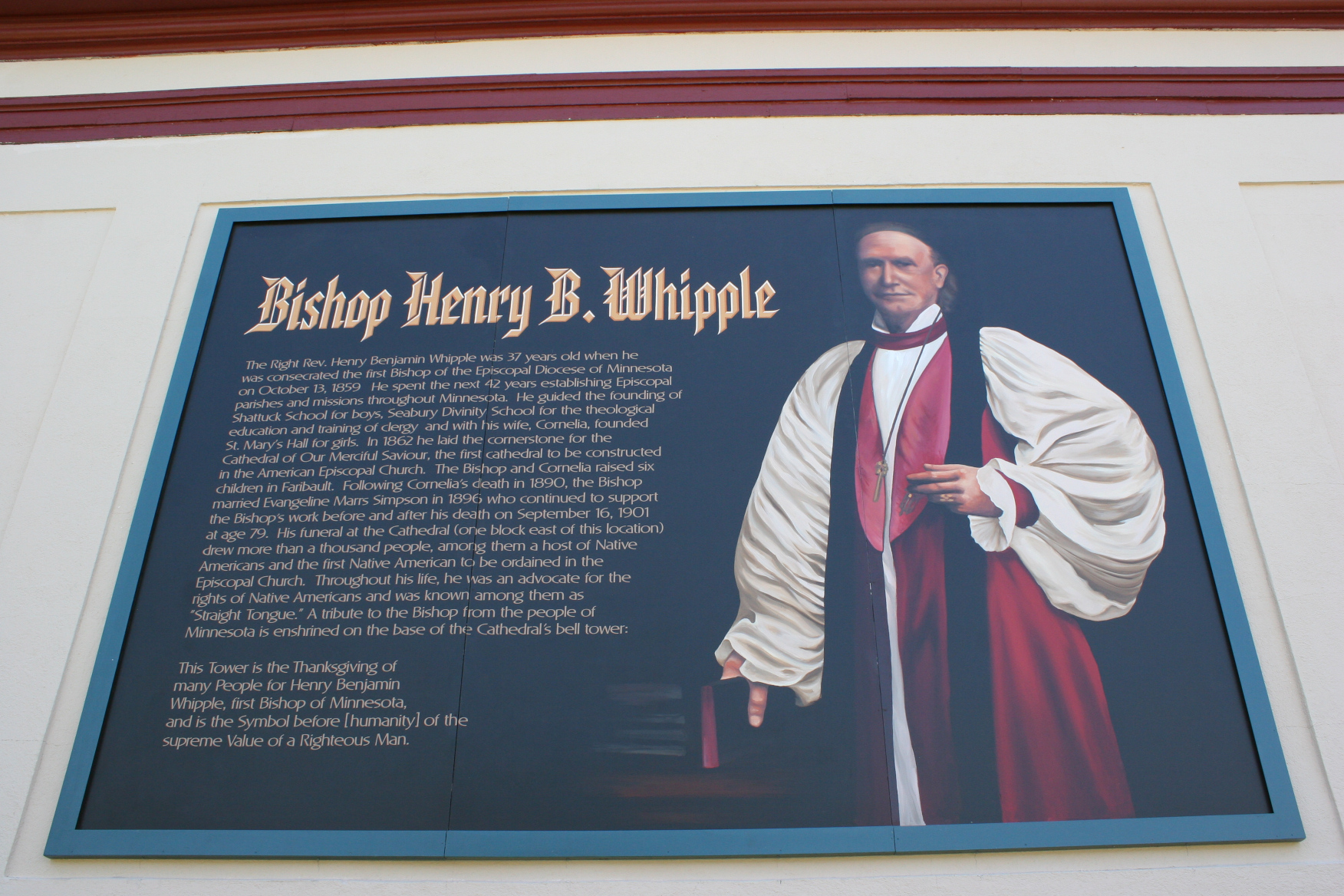
Bishop Henry Whipple, featured in a mural on the bandshell at Faribault’s Central Park, across the street from the Cathedral of Our Merciful Saviour. (Minnesota Prairie Roots copyrighted file photo)

Bishop Henry Whipple, the long ago Episcopal bishop of Minnesota, links Faribault and Benson. Whipple, a missionary based in Faribault, traveled around the Minnesota frontier in the early years of statehood in an effort to spread the Christian faith. That included visits to Benson where, in 1879, Christ Episcopal Church was built for $1,650 by local carpenters. Whipple visited occasionally to lead services and confirm new members.

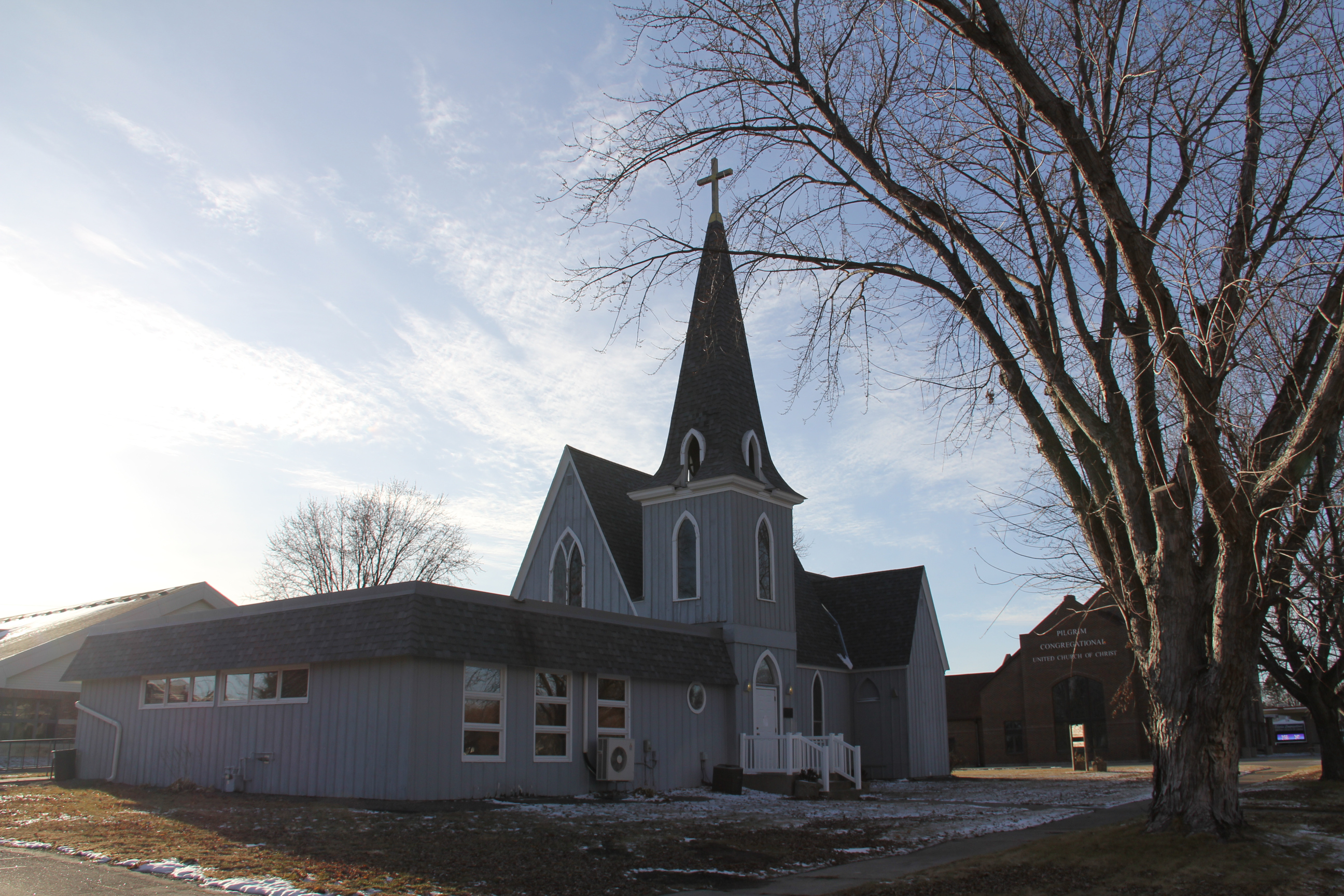
Christ Episcopal Church, Benson. (Minnesota Prairie Roots copyrighted photo November 2024)

That early Gothic Revival style church with gray board and batten siding caught my eye during a brief drive around Benson’s downtown core. More accurately, the seven-story Parkview Manor apartment across the street from the church initially grabbed my attention. The 55-unit high-rise looks very much out of place in this prairie town. It dwarfs residential houses and the historic church. Typically grain elevators and church steeples mark small town skylines, not a towering 1967 apartment complex.

Parkview Manor, where the church was once located. (Minnesota Prairie Roots copyrighted photo November 2024)

Christ Episcopal Church once sat on the apartment land, but was moved across the street after the Housing and Redevelopment Authority bought the property in 1966. At some point the church, founded by English and Yankees (as New Englanders were once termed), closed due to dwindling membership. Today the building serves as the Swift County Drop In Center, “a safe haven for adults to go to experience life free of stigma.” I think Bishop Whipple would have liked that, knowing the former church serves as a gathering place, a safe spot to just be.

The church sits in a residential neighborhood near downtown. (Minnesota Prairie Roots copyrighted photo November 2024)

Some day I’d like to tour the aged church, which was added to the National Register of Historic Places in 1985. Perhaps I would feel the presence of Benson’s early settlers, hear the words of comfort, peace, hope and unity preached by Bishop Whipple.

While Whipple is primarily viewed as a man who befriended Indigenous Peoples, he was also part of the long ago mindset to assimilate and “civilize” them. That’s a side not often discussed when talking about a man, a missionary who shared his biblical teachings while also compassionately advocating for Native Americans. Whipple is highly-revered in Faribault, where he is buried beneath the Cathedral of Our Merciful Saviour, an historic cathedral worthy of visiting, too.

The Cathedral of Our Merciful Saviour, Faribault. (Minnesota Prairie Roots copyrighted file photo July 2024)

The immense Faribault cathedral differs vastly from the unassuming small church in Benson. Yet, history and a missionary link the two. To uncover that connection simply because I noticed an out-of-place apartment high-rise and then the old steepled church across the street reveals just how small this world really is if only we pause to notice, then uncover the connections.

© Copyright 2025 Audrey Kletscher Helbling

 

In the deep of January, floral murals jolt joy January 21, 2025

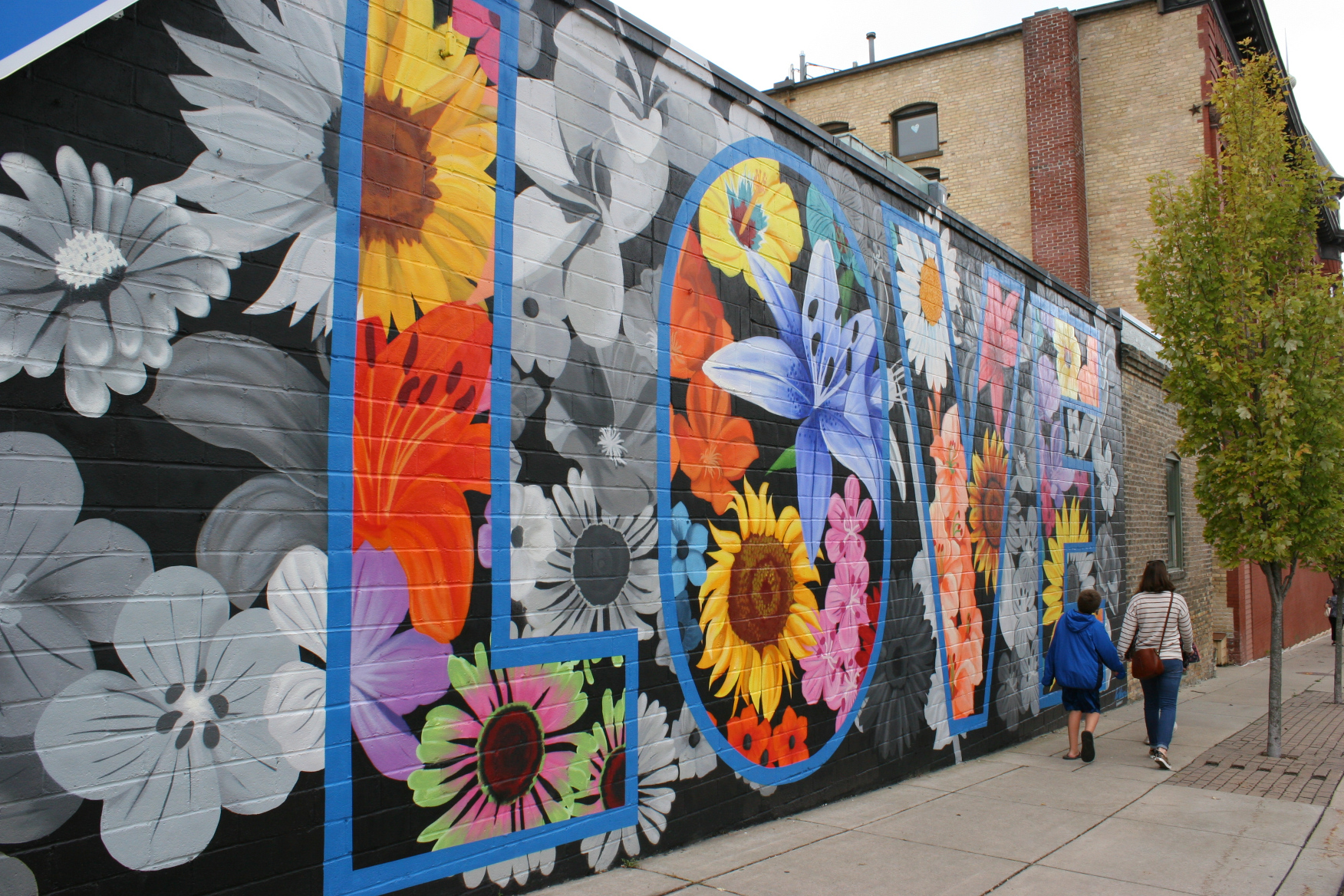
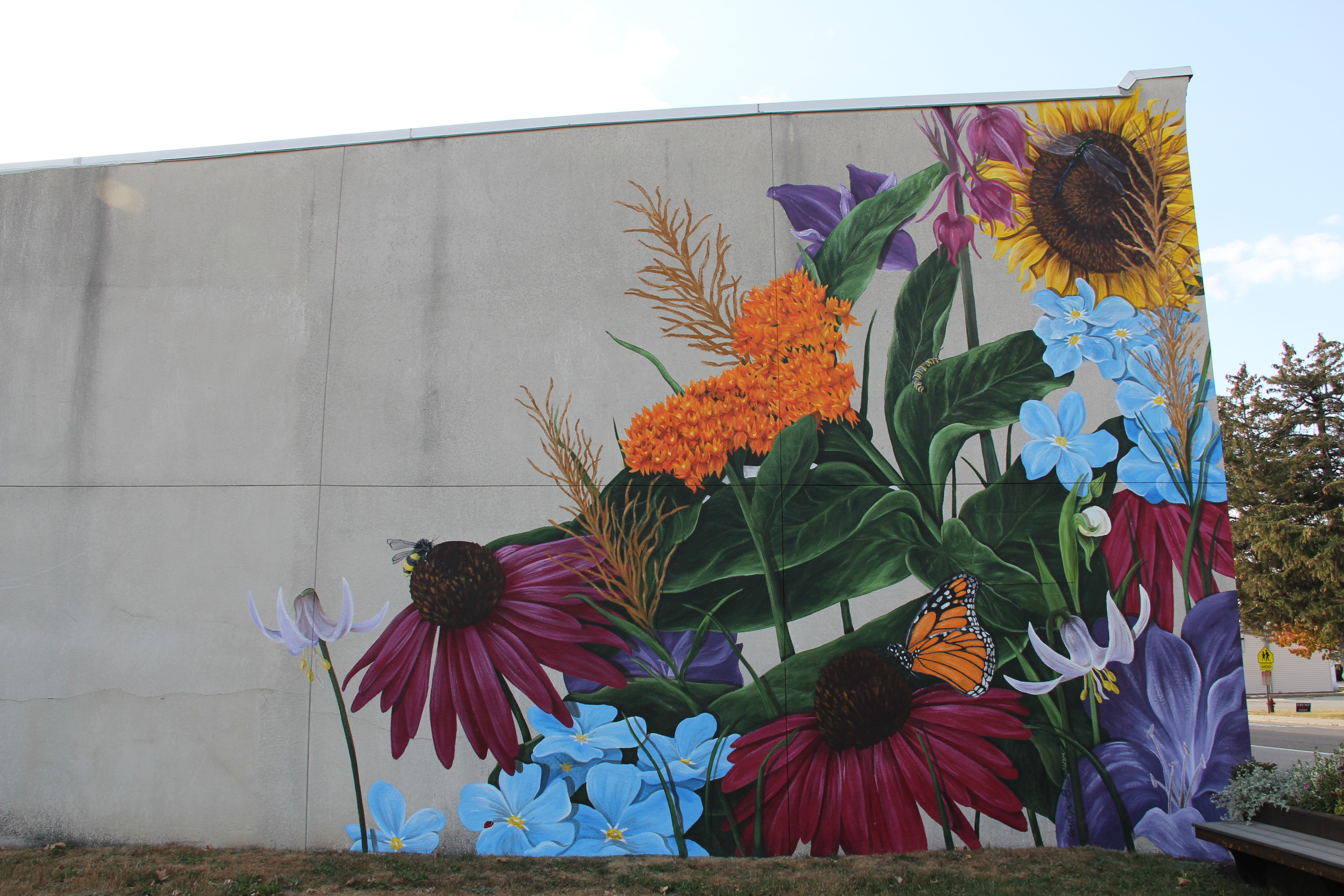
A Northfield Arts and Culture Commission mural by Brett Whitacre, just off Division Street in Northfield, blooms love. (Minnesota Prairie Roots copyrighted file photo)

IS IT COLD out there?” I asked before rolling out of bed on a recent subzero morning.

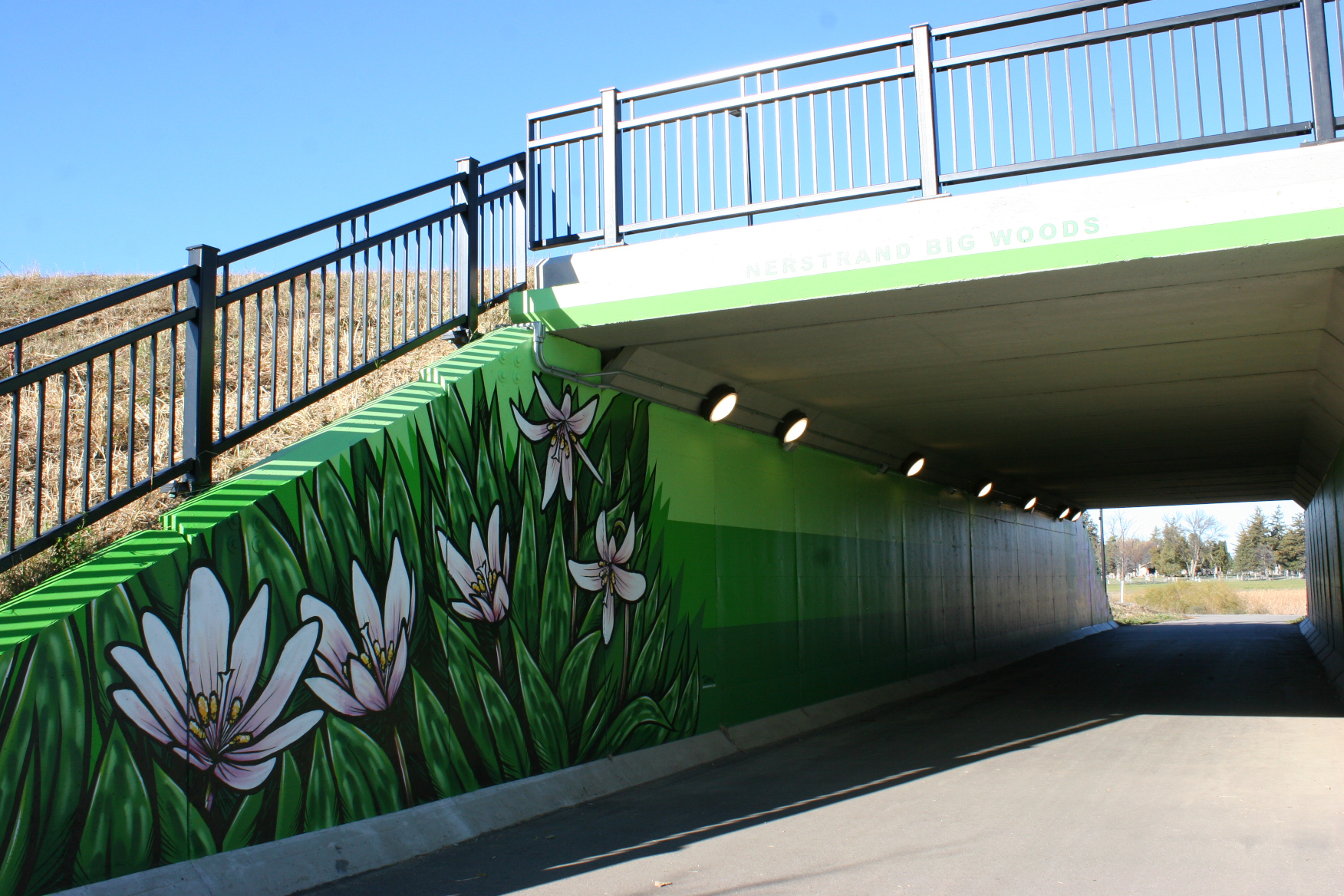
In an underpass tunnel along a recreational trail in Northfield, Adam Turman created this summer scene on a mural. (Minnesota Prairie Roots copyrighted file photo)

“No, it’s summertime,” he answered.

A Montgomery Wings Mural Walk wing on Lanette’s Coffee Shop features flowers watered by Scarlett, who is wearing traditional Czech clothing. That honor’s the Czech heritage of Montgomery, MN. (Minnesota Prairie Roots copyrighted file photo)

That sarcastic response from my husband acted as a writing prompt during this week of cold weather advisories and warnings in Minnesota. We’ve experienced wind chills ranging from -25 to -50 degrees across the state. That’s brutally cold.

Wild geraniums painted by Adam Turman inside an underpass tunnel in Northfield. (Minnesota Prairie Roots copyrighted file photo)

On the morning I asked Randy about the cold, the 7:17 a.m. air temp registered -12 degrees. With the wind chill, it felt like -29 degrees. That marked the coldest day in six years. I know we are not alone here in Minnesota as frigid air and snow sweep the country, including into the deep South.

Flowers fill the LoveForAll mural by Jordyn Brennan in downtown Faribault. (Minnesota Prairie Roots copyrighted file photo)

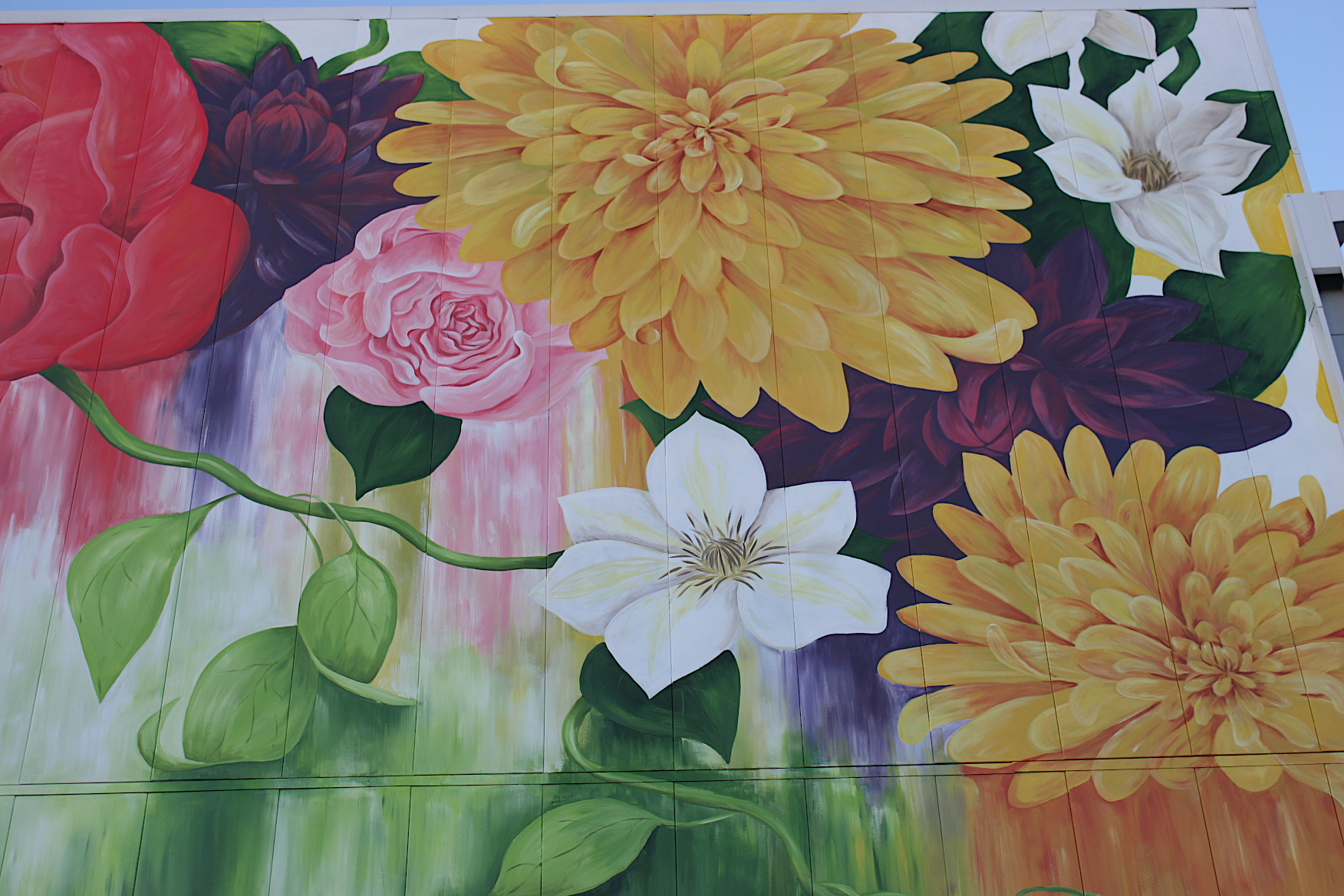
Because I can’t flee to a warmer location, I opted to transport myself from the currently cold, colorless landscape of southern Minnesota to a place of beauty. Without leaving the area. For me, that comes in photos I’ve taken of floral-themed murals blooming throughout the area. In the deep of winter, these paintings hold the hope of warmer days, of sunshine and flowers.

My most recent mural discovery was several months ago on Wild Wood in Nerstrand. (Minnesota Prairie Roots copyrighted file photo)

I love when communities embrace this form of public art, because murals are accessible to anyone, anytime. They spark joy, generate interest in place, show community pride. I get excited when I unexpectedly happen upon a mural.

The rare Dwarf Trout Lily grows only in Rice, Steele and Goodhue counties in Minnesota and is depicted here by Adam Turman on an underpass tunnel wall in Northfield. (Minnesota Prairie Roots copyrighted file photo)

Floral-themed murals, especially, have a way of uplifting spirits, of celebrating all that is beautiful and lovely. Bold, vivid hues in the deep of January in Minnesota, offer a welcome visual respite.

A close-up of mums and peonies, forefront, in Jordyn Brennan’s LoveForAll mural. Faribault was once renowned for those two flowers. (Minnesota Prairie Roots copyrighted file photo)

I can almost imagine meandering through a flower garden, dipping my nose into blossoms, appreciating each scent, each petal, each stem. Oh, the beauty of it all.

Floral-themed wings appropriately placed outside Posy Floral & Gifts in Montgomery as part of the Montgomery Wings Mural Walk. (Minnesota Prairie Roots copyrighted file photo)

On these frigid days, when I view a drab landscape of muted tones, trees stripped of leaves, snow layering the earth, I delight in sharing the floral murals I’ve photographed. No one ever promised me a rose garden. But these murals hold the promise of spring and of summertime in Minnesota.

© Copyright 2025 Audrey Kletscher Helbling
 

From Books on Central: A success story about books, dragons & community January 9, 2025

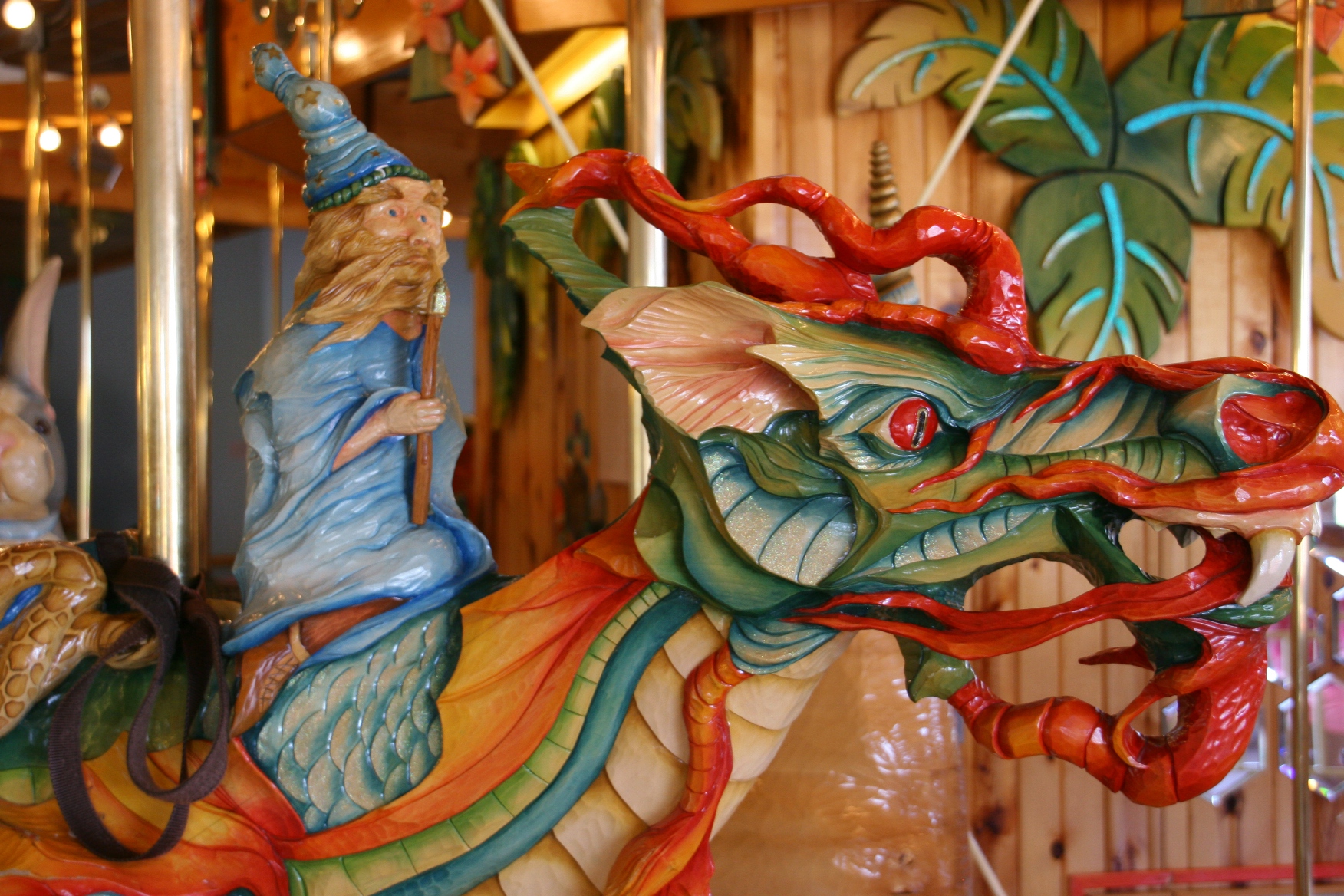
An imaginative depiction of a dragon on the merry-go-round at LARK Toys, Kellogg, perhaps not unlike dragons featured in fantasy novels. (Minnesota Prairie Roots copyrighted file photo)

I LOVE WHEN KIDS, like my 8-year-old granddaughter, Isabelle, love to read. It sets them on a path for success in school. If you can read, you can learn anything. I’ve always believed that, except perhaps when it comes to math. Reading didn’t help me there.

Book cover image sourced online.

But Izzy isn’t thinking about math; her dad is a math whiz anyway. Rather, she’s focused on reading for the love of reading a good story. On a recent visit, she could barely contain her excitement about Dragon Rider by Cornelia Funke. Izzy quickly finished the first volume in the series and then breezed through the next two.

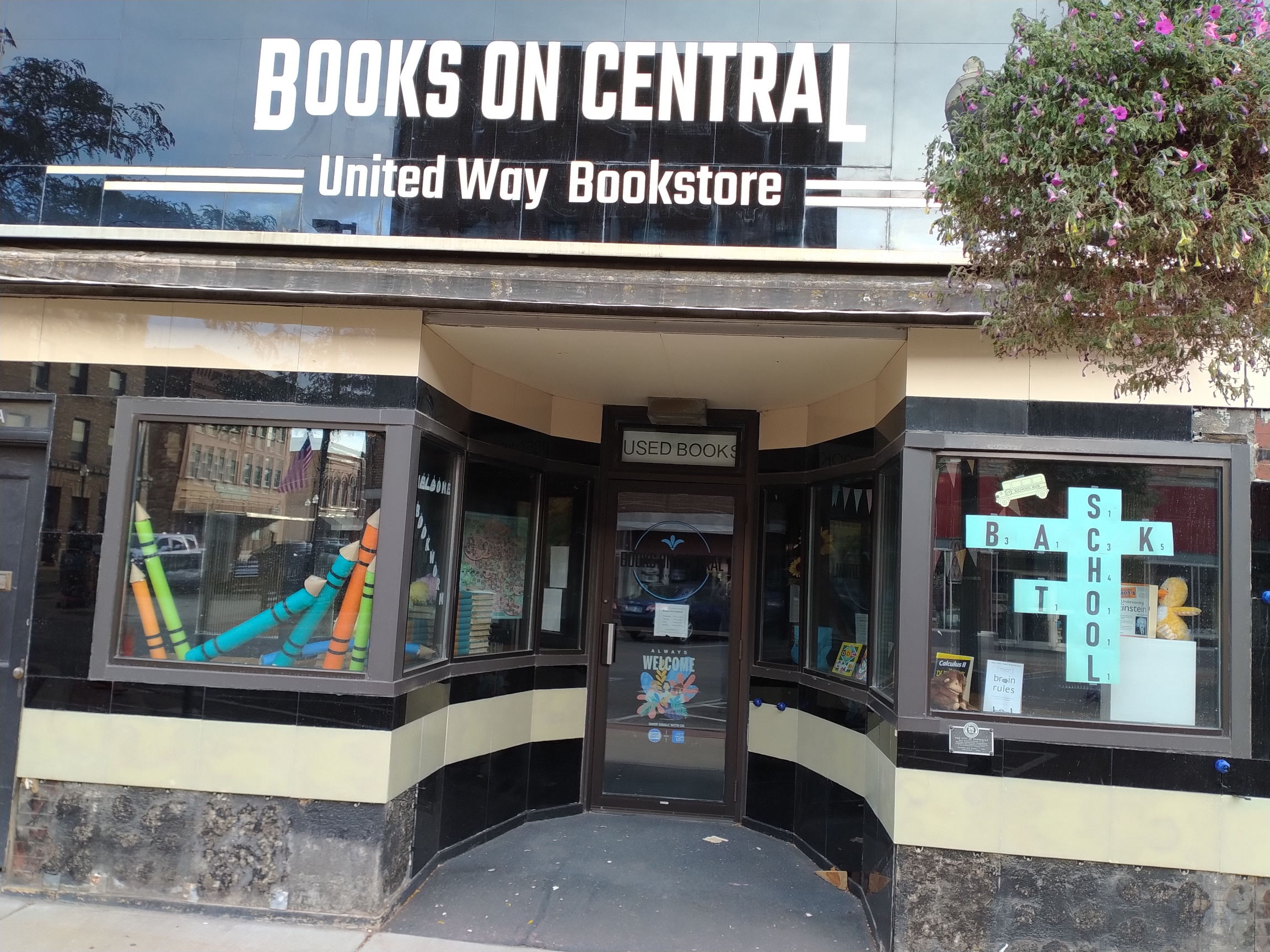
A back-to-school display filled the bookshop windows at the start of the 2024-2025 school year. (Minnesota Prairie Roots copyrighted photo 2024)

There’s a story here about Dragon Rider. Izzy’s mom, my eldest, found the fantasy novel while we were shopping at Books on Central, a used bookstore run by Rice County Area United Way at 227 Central Avenue North, Faribault. All proceeds go to local nonprofits supported by the United Way. Initially, Izzy wasn’t too excited about the book. But soon after we arrived home, she was snugged in the recliner reading.

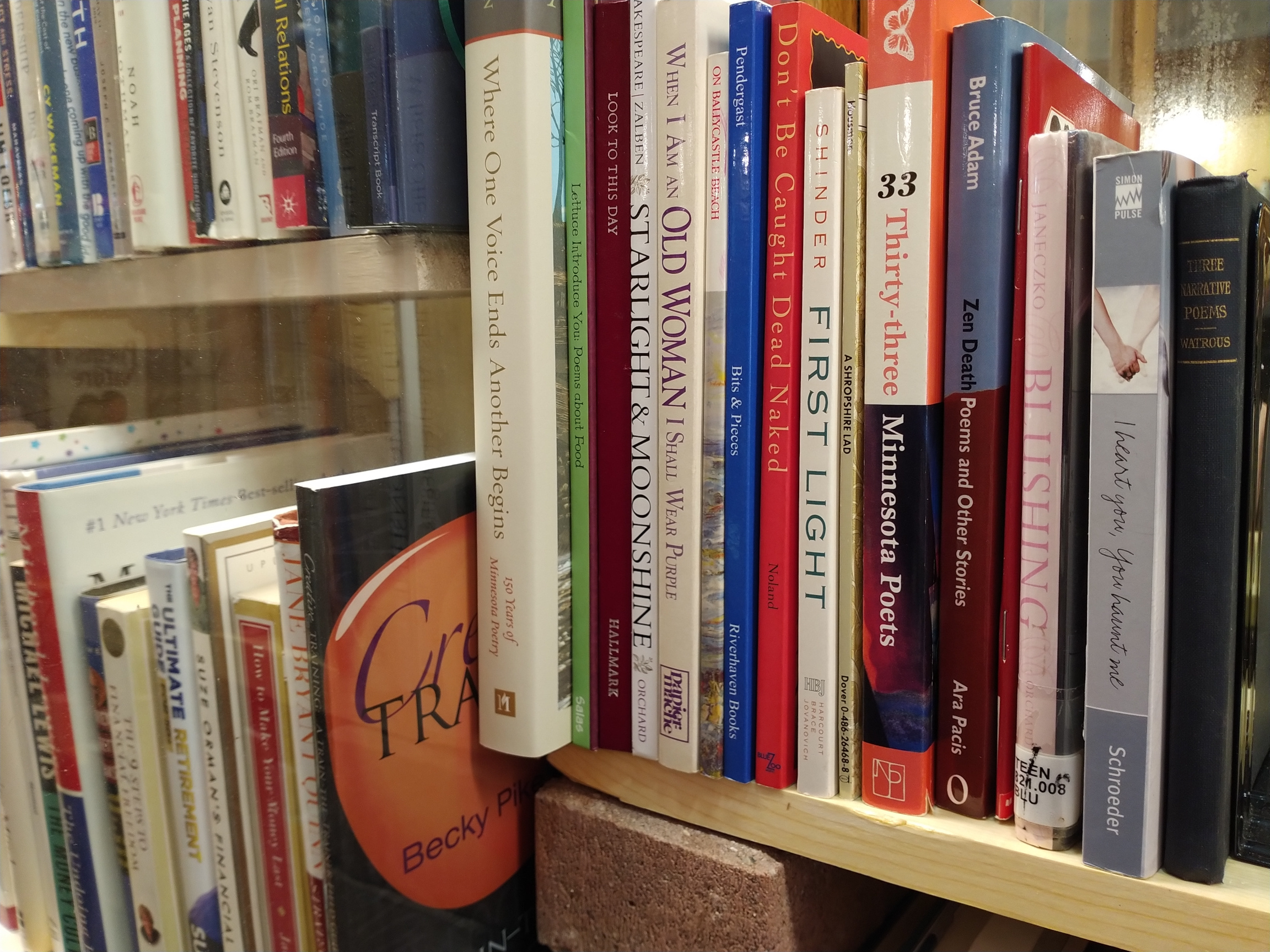
I photographed the poetry section, right, during one of my visits to the bookshop. (Minnesota Prairie Roots copyrighted photo 2024)

This is exactly what grandparents, parents and the good folks at Books on Central like to see. The volunteer-run bookshop just completed its first full year of operation with more than $30,000 in used book sales during 2024, according to lead volunteers Dave and Jeanne Campbell. That’s a whole lot of books considering kids’ books sell for a buck or two and adult books for a bit more.

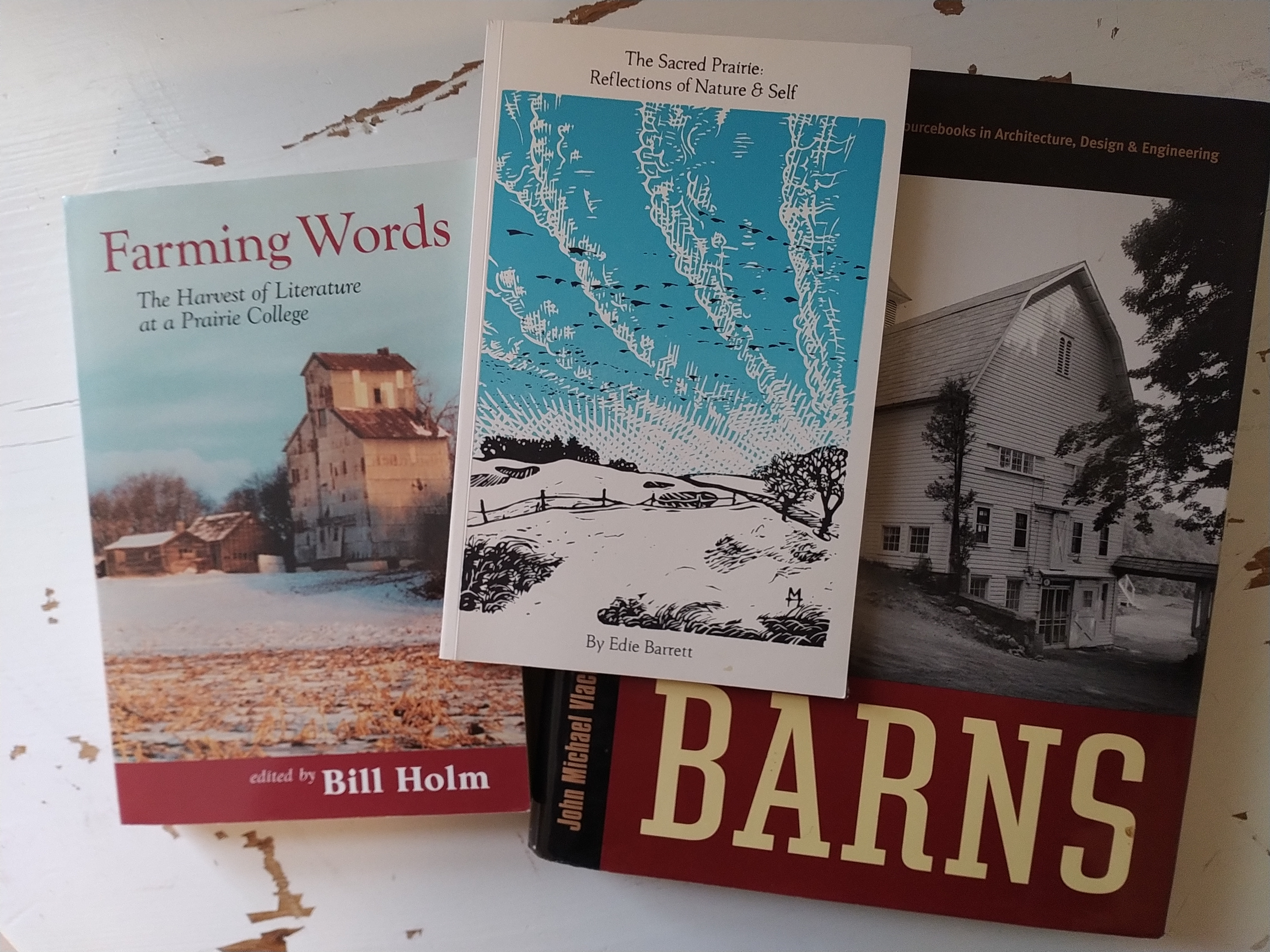
Among the books I’ve purchased at Books on Central. The book on the left features a cover photo of an elevator moved from my hometown of Vesta onto a nearby farm. The book includes writing by Larry Gavin of Faribault. (Minnesota Prairie Roots copyrighted photo 2025)

I’m thrilled that the Faribault community and beyond has embraced and supported this used bookstore by donating books and by buying them. It’s a win-win for everyone. People can get rid of books they no longer need, find books to read and help their neighbors. Bookshop proceeds assist The United Way in their mission of focusing on financial stability, health and education.

Previously in the display window at the bookshop. (Minnesota Prairie Roots copyrighted file photo)

And education includes reading. The local United Way supports Dolly Parton’s Imagination Library, which provides a free book a month to registered area children for the first five years of their lives. Dolly’s Book Bash, an annual fundraiser to support the program, is set for Friday, January 24, with doors opening at 6:30 p.m. at the Northfield Ballroom. The event features music, line dancing, an auction and games.

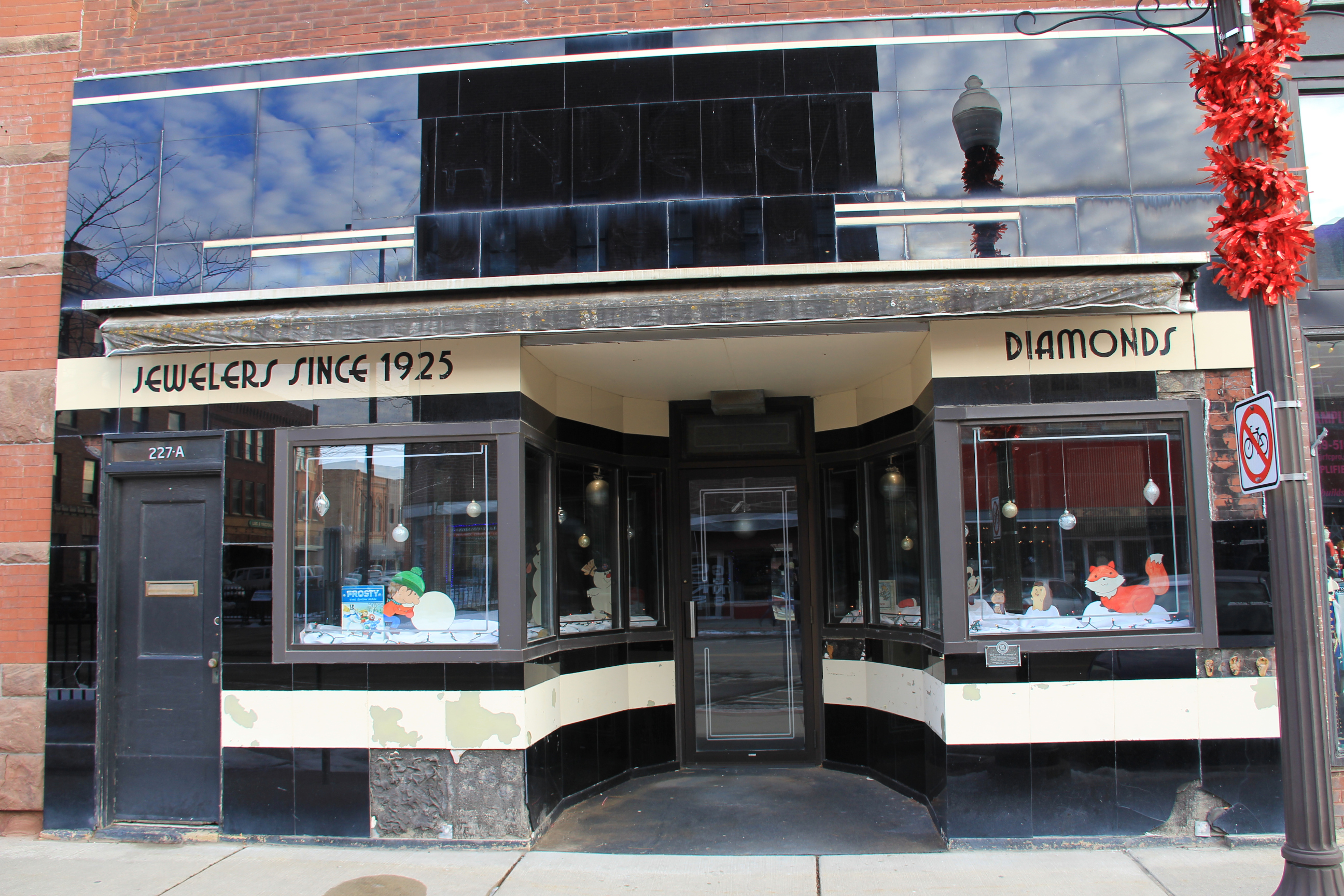
Signs marking the location as a former jewelry store remained when the bookshop opened. (Minnesota Prairie Roots copyrighted file photo)

Back at Books on Central in Faribault, the bookshop is, in some ways, magical. The setting is in the former Dandelet Jewelry with beautiful built-in wooden shelving and drawers and a chandelier centering the space. In the back, kids have an area all their own to peruse the many books ranging from board books for babies to picture books to novels like Dragon Rider. The whole space feels inviting, enchanting.

This is a well-organized bookshop. Volunteers know the books and where to find them. Inventory changes often. (Minnesota Prairie Roots copyrighted photo 2024)

Sales of 2,661 books totaling about $9,000 in the last quarter of 2024 reflect the incredible support and enthusiasm for Books on Central. Those numbers are remarkable considering the bookshop is typically open only 24 hours a week and is totally volunteer-run. Volunteer hours in 2024 totaled 4,479.

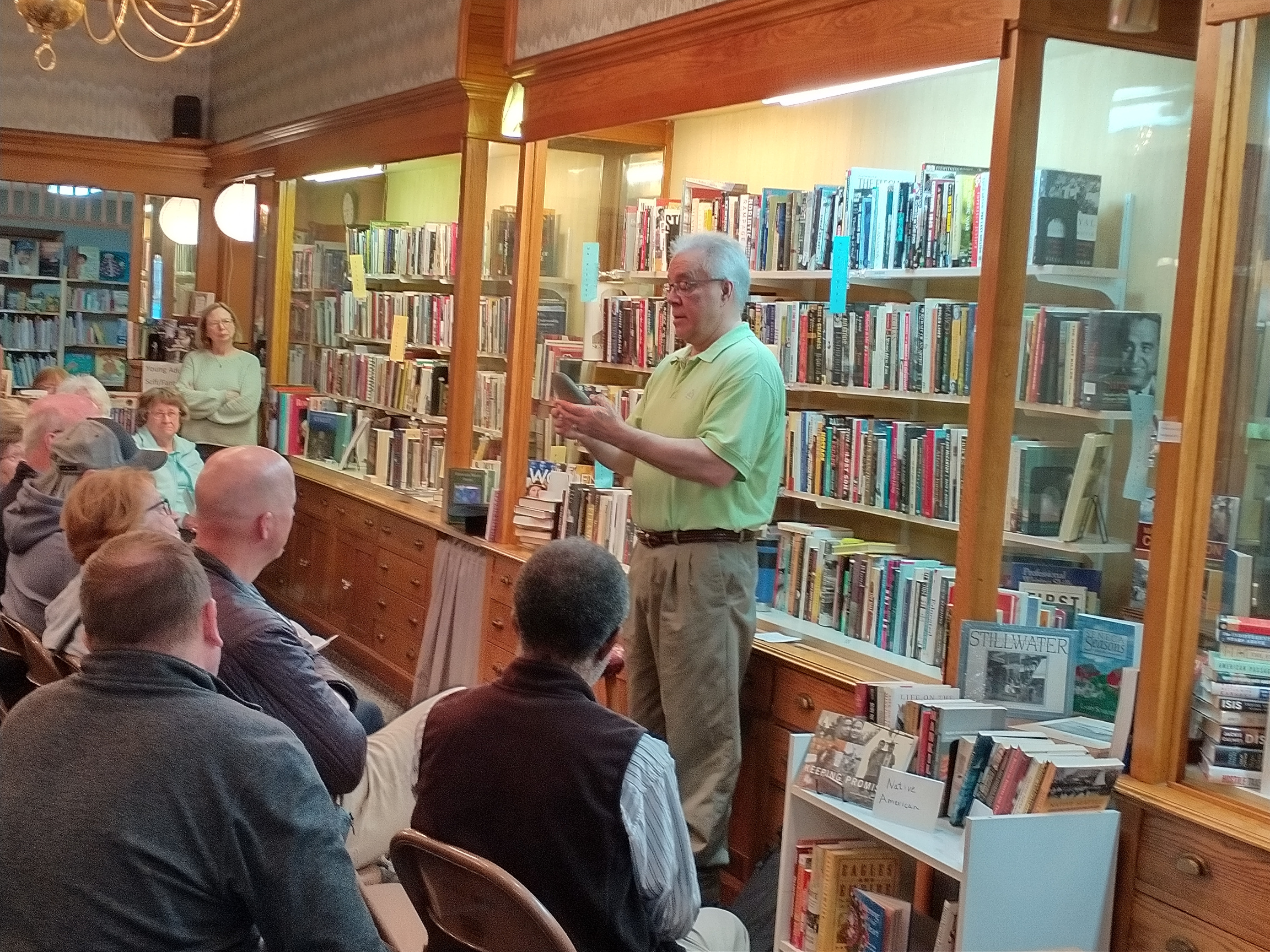
Jeff Jarvis talks about the Dakota during a June presentation at Books on Central. (Minnesota Prairie Roots copyrighted file photo June 2024)

This place is more than a volunteer-run used bookstore. It’s also a place to connect, to build community, to learn. Books on Central hosts frequent literary events featuring area writers. I attended a poetry reading by published poet, retired Faribault High School English teacher and friend Larry Gavin. I could listen to Larry read poetry all day. The way language flows from his mind to his fingertips to create poems, well, it’s magical. He has a radio reading voice that mesmerizes. I also listened to a group of Northfield poets read their poems at Books on Central. I heard local historian, writer and artist Jeff Jarvis talk about the Faribault Dakota. And I delighted in the engaging storytelling of native Tanzanian Joseph Mbele, a St. Olaf College professor, consultant and author of several books, his newest Chickens in the Bus—More Thoughts on Cultural Differences.

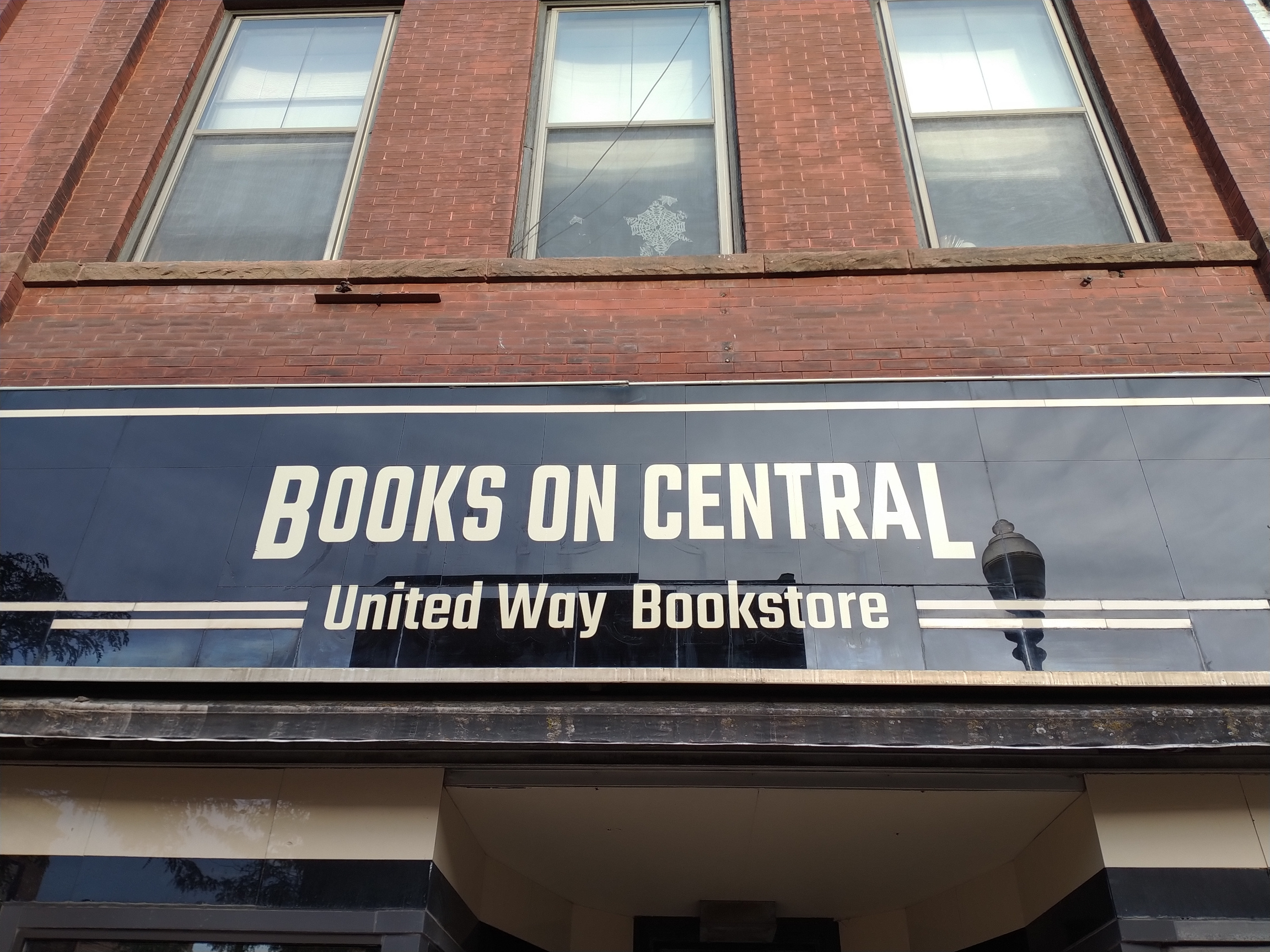
New signage was installed on the building in late 2024. (Minnesota Prairie Roots copyrighted photo 2024)

I love that my granddaughter enjoys going to Books on Central. She’s discovered it’s a special place where, if you look (or let your mom look), you’ll discover a silver dragon flying between the pages of a book.

#

FYI: Books on Central is open from 11 a.m.-5 p.m. Wednesday-Friday and from 10 a.m.-4 p.m. Saturdays. Donated books are accepted, but must be in good condition. Volunteers sort and clean the books, determining which to stock. You will not find musty and moldy smelling books here.

© Copyright 2025 Audrey Kletscher Helbling
 

Five especially memorable personal moments in 2024 December 31, 2024

Time passes… (Minnesota Prairie Roots copyrighted file photo)

THE END OF A YEAR always evokes a time of personal reflection. A time to consider the events, the moments, the feelings, the blessings that stood out in the 366 days passed. I’ve selected five, from the many, that happened in my life. Certainly, there’s much more that affected me personally. But these are ones that imprinted deeply upon me.

My unborn grandson’s room, photographed at Thanksgiving. (Minnesota Prairie Roots copyrighted photo November 2024)

1. A BLESSING BREWING

The year 2024 brought incredibly joyful news to my family. That news came in a six-pack of all natural & locally brewed craft beer from Big News Brewing Co. My second daughter and her husband brought the beer in August, when they arrived from Madison, Wisconsin for the annual Helbling family reunion.

I was excited to taste this beer from a new brewery (so I was told) in Madison. I pulled out a bottle, read the label, BABY Boyd IS BREWING—ARRIVING JANUARY 2025, and realized this was no ordinary beer. I was about to become a grandma for the third time. Miranda and John pulled off the surprise. I was so focused on the journalistic aspect of the Big News Brewing Co. name that I totally missed the bare baby feet graphics on the necks of the bottles. Soon that baby boy will arrive.

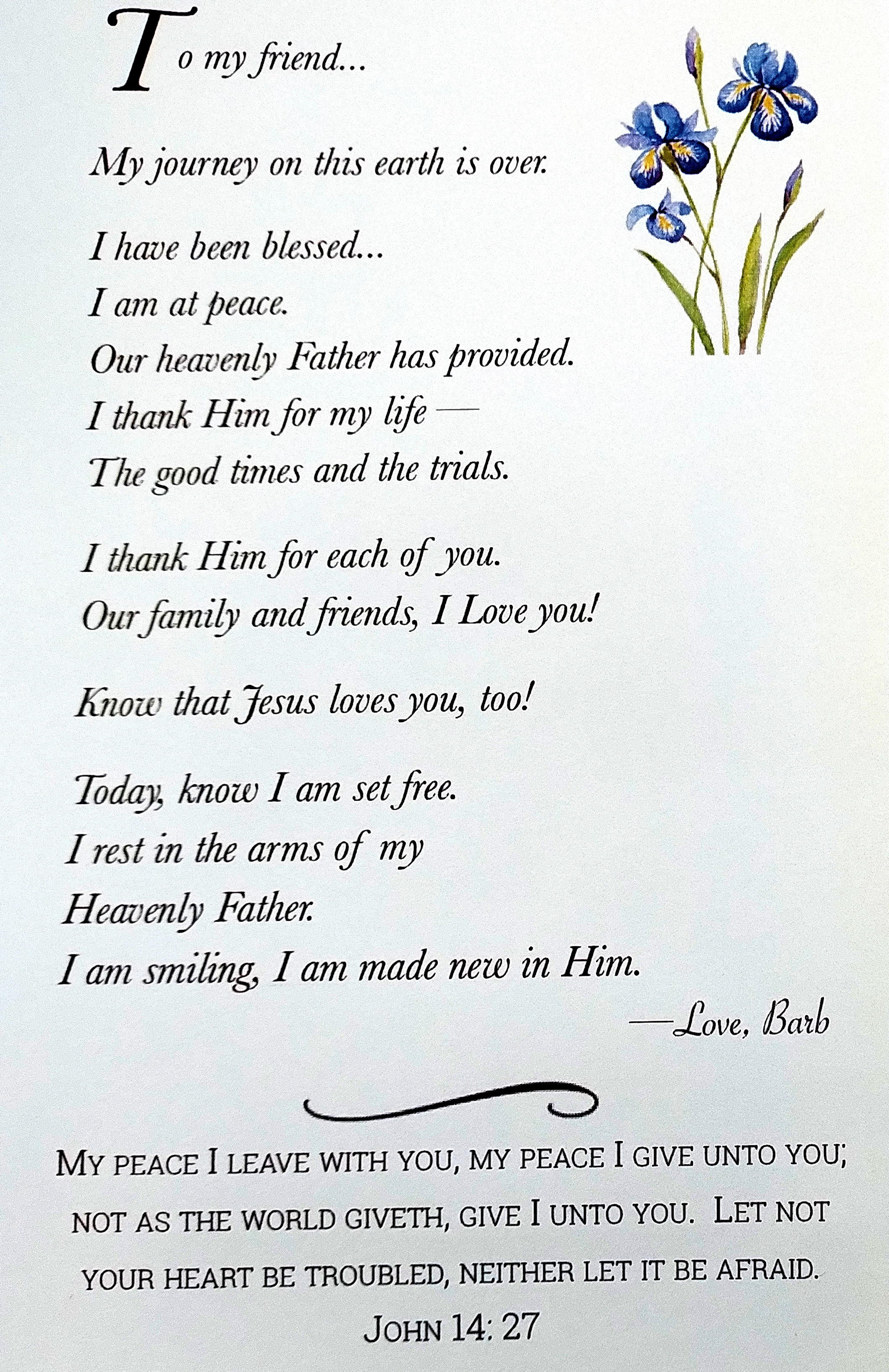
A message from Barb, published in the memorial folder at her funeral. (Minnesota Prairie Roots copyrighted file photo April 2024)

2. THE BLESSINGS OF FRIENDSHIP

On the flip side of birth is death. And in 2024, I lost a dear friend, Barb, to cancer. We have been part of the same couple’s bible study group for some 20 years. I’ve lost track. As she neared the end of life, Barb and her family opened their doors wide so family and friends could come and go. We carried in meals and, more importantly, love. Barb, no matter how awful she felt, always had time for visitors. Her strength, her unwavering faith, her cheerful attitude uplifted all of us. She understood the value in being together, of approaching death with courage and faith. Of saying goodbye.

But it was after Barb’s funeral, as her casket was wheeled out of church to the waiting hearse, that I felt the full blessings of the friendship we (and by “we” I mean our bible study group) shared. Barb had chosen the guys as pallbearers. We six women stood side-by-side waiting as our husbands gathered around the casket. I stretched out my arms, motioning for my friends to come close, to wrap our arms around one another. There we stood, a line of women linked. Linked in grief, friendship and love. It was a powerful moment.

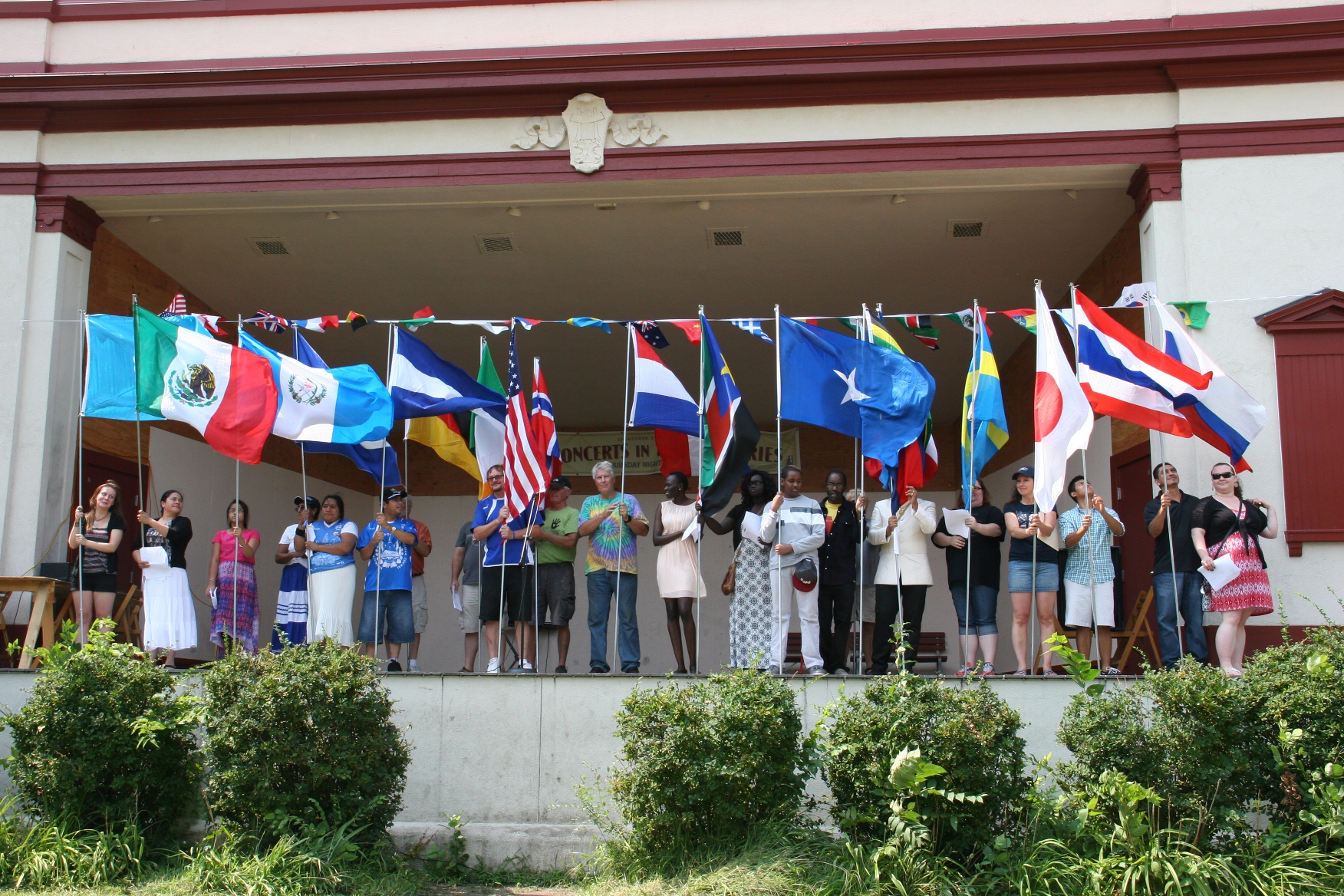
Flags for countries of origin displayed at a past International Festival in Faribault celebrating my community’s diversity. (Minnesota Prairie Roots copyrighted file photo)

3. A BLESSING FROM A NEW FRIEND

Also powerful was the moment I met a Venezuelan immigrant while on a walk in Faribault’s Central Park. Adolfo was pushing his one-year-old grandson, Milan, in a stroller when I paused to greet them. I learned that Adolfo had fled violence and Communism in his home country and wanted desperately to get his family to America. His pain was palpable. “We’re so happy to have you here,” I told my new friend. Adolfo responded with a broad smile and the words “God bless you” as he made the sign of the cross and held his hands to his heart. I will forever cherish that moment and the memories of the morning I met Adolfo and Milan in Central Park.

A graphic of the first coronavirus. Source: CDC

4. BLESSING ANOTHER

I am also grateful for the opportunities I’ve had in 2024 to encourage a young man, whom I’ll call J, in his struggles with long haul COVID. A friend, after a short conversation in a grocery store parking lot, connected me to J’s mom and from there the door was opened. I understand how devastating this diagnosis. I spent six months in vestibular rehab therapy in 2023 trying to overcome the many debilitating symptoms of long haul COVID. I’m better now, but still experience residual, primarily with sensory overload issues.

J’s case is much more severe than mine, especially physically. He had to drop out of college, used a wheelchair, struggled with overwhelming symptoms too numerous to mention. I tried to offer him hope, support and encouragement. Empathy, compassion and understanding. I also referred him to my physical therapist, whom J is now seeing. Few people understand this chronic condition, or even make an effort to understand, which makes working through long haul COVID even harder. That I could take my experiences and help J, and his mom, has helped me, too. I can see the good in a very difficult year in my life when I was basically home-bound. Empathy and the capacity to help others grows with each challenge we face in life.

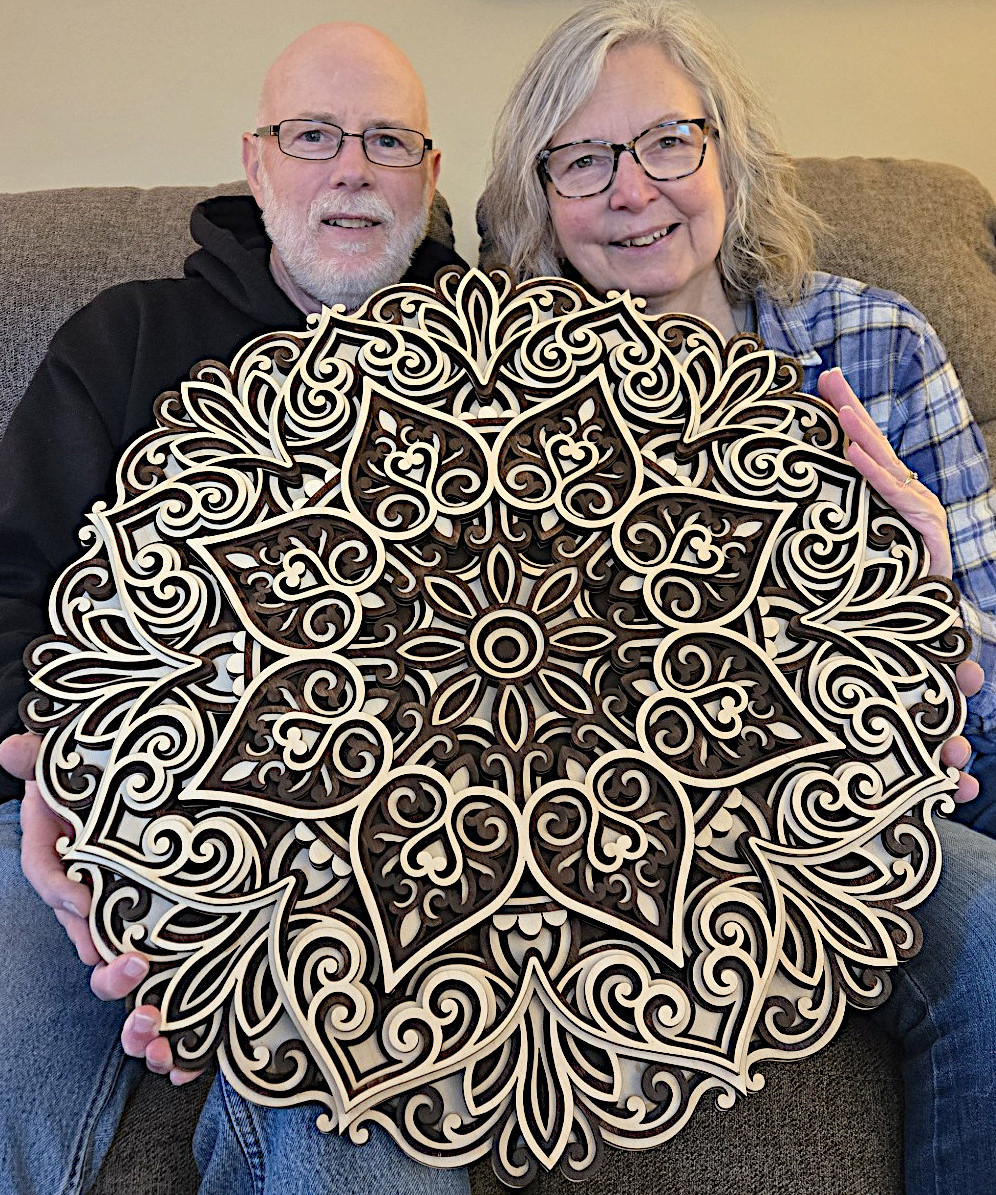
Randy and I with the mandala our son crafted for us. (Copyrighted photo by Caleb Helbling)

5. BLESSED WITH LOVE

Finally, my last memorable moment of 2024 came just recently with a Christmas gift from my son, who was visiting from Boston. Caleb gifted Randy and me with a mandala he laser cut from plywood, stained and glued together. Six layers. When I realized what it was, I wept. I cried because of the love Caleb’s gift represents. I cried because I recognized the time, effort and thought he put into crafting this artwork for us. Hearts theme the piece. It speaks “family.” If art can capture love, this mandala holds endless love.

And so 2024 ends. A year that brought joy and sadness. But also a year overflowing with love…from family to friends to community.

© Copyright 2024 Audrey Kletscher Helbling
 

Celebrating the bald eagle locally, elsewhere in Minnesota & now nationally December 26, 2024

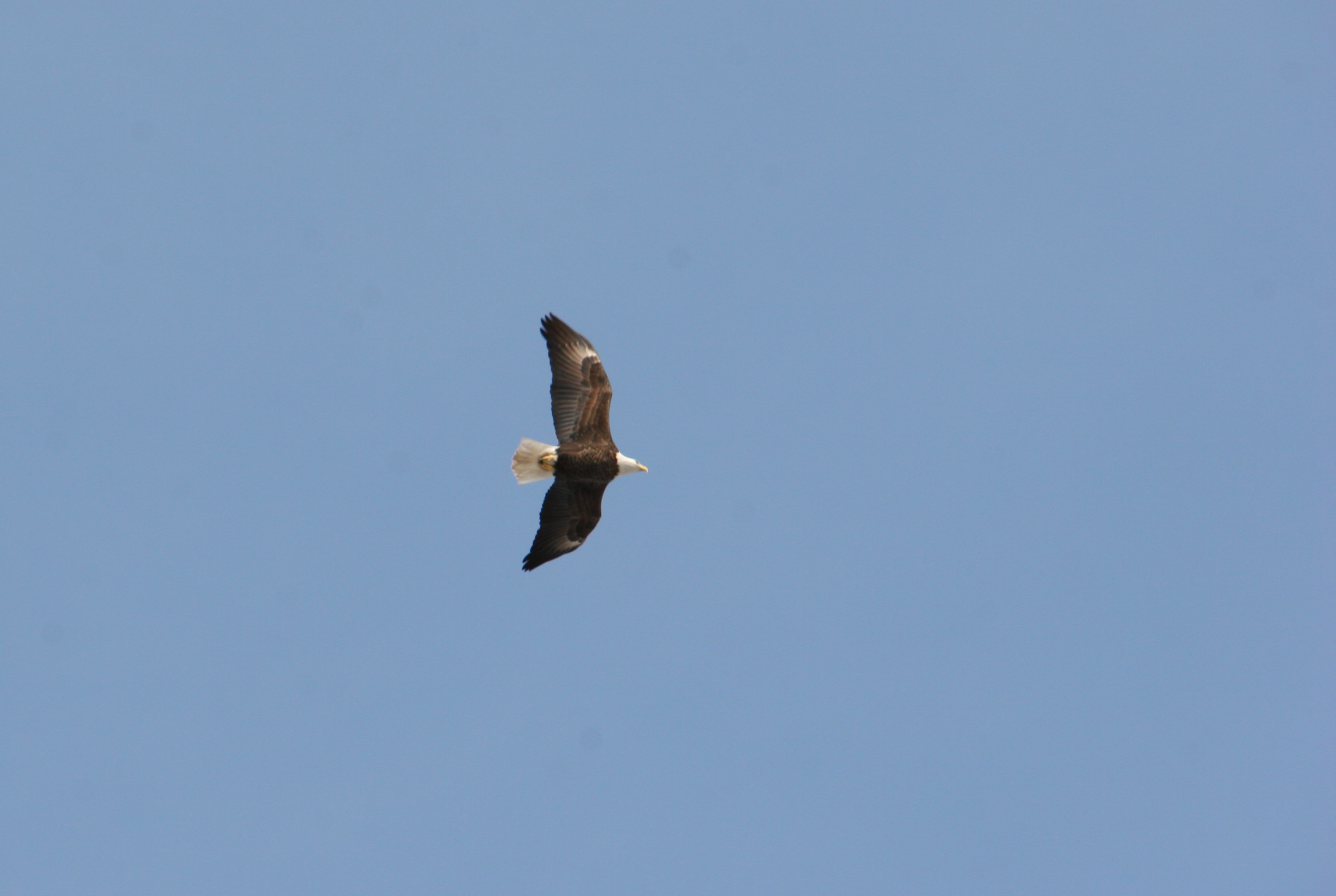
A bald eagle photographed in Faribault by the Cannon River. (Minnesota Prairie Roots copyrighted file photo March 2018)

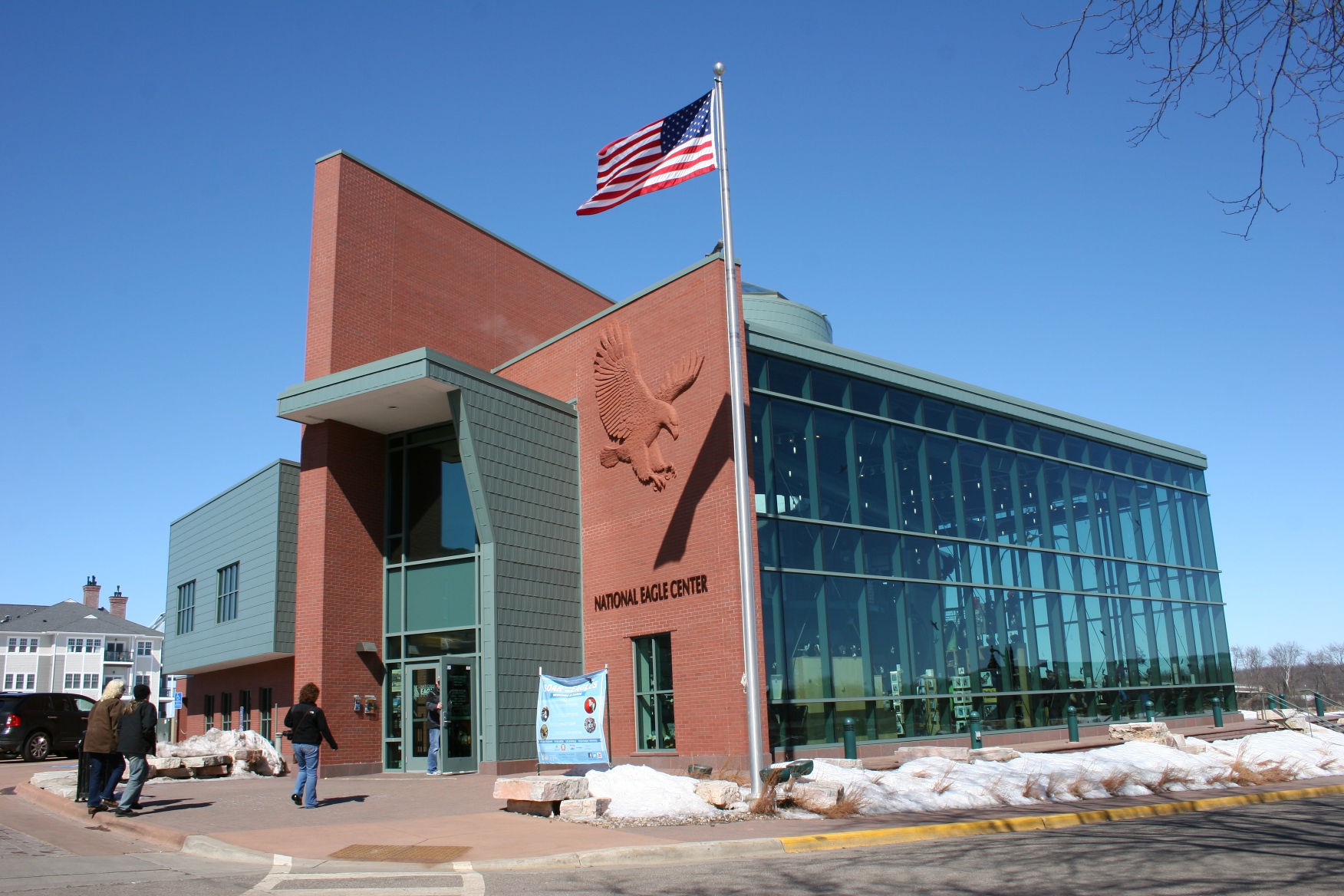
THE BALD EAGLE IS NOW America’s official national bird as of a bill signed into law on Christmas Eve. And that’s exciting, especially for Minnesota, home to the National Eagle Center in Wabasha and home to the second largest population of eagles in the US, behind Alaska.

The National Eagle Center in Wabasha. (Minnesota Prairie Roots copyrighted file photo 2014)

I expect this designation will draw more visitors to Wabasha. I last visited the Eagle Center in 2014 and need to return as it was recently expanded and updated, building on an already impressive place to learn about eagles.

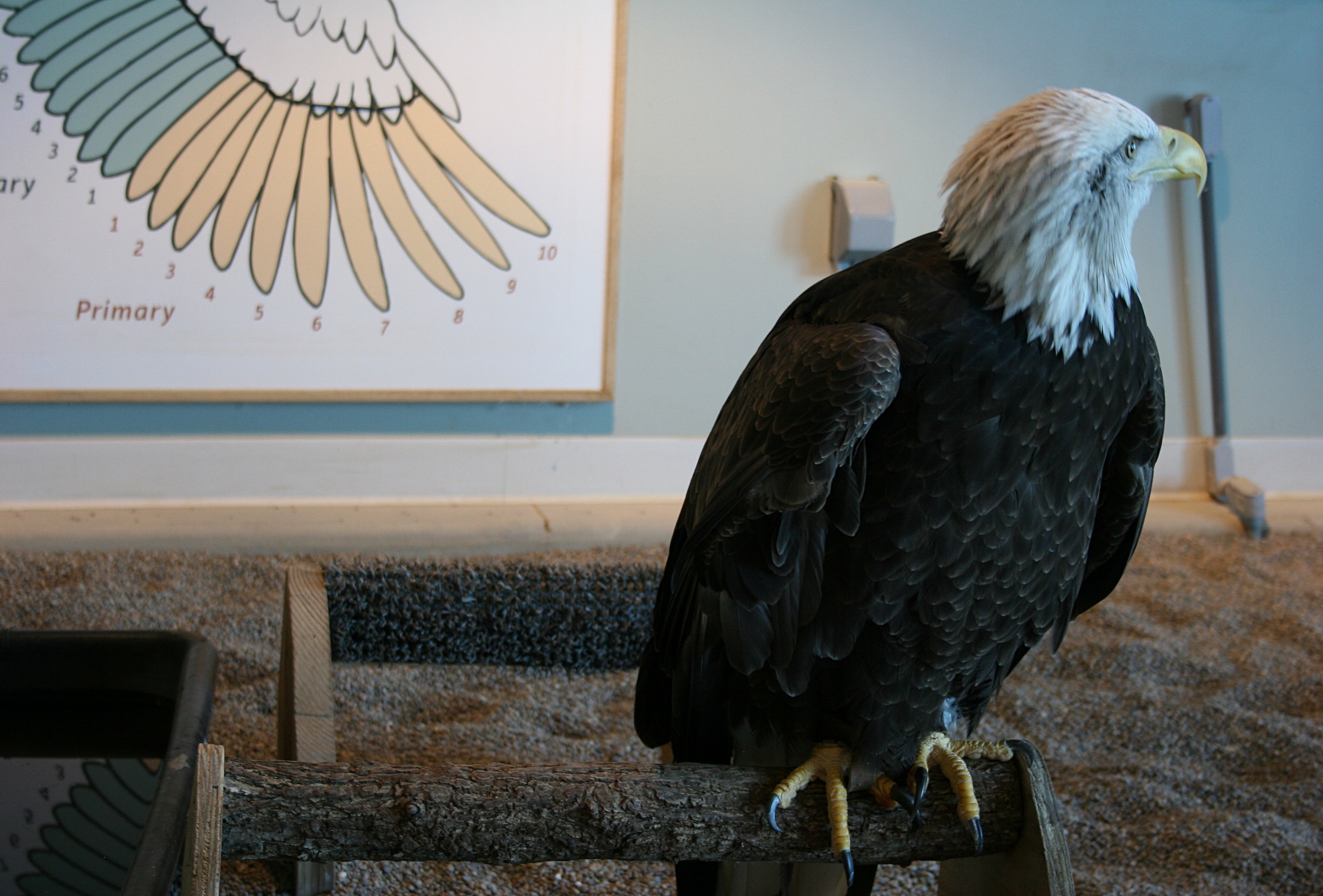
Up close with an eagle at the National Eagle Center along the Mississippi River in Wabasha. (Minnesota Prairie Roots copyrighted file photo 2014)

Wabasha’s National Eagle Center not only houses rehabilitated resident eagles (used in programming), but also features eagles in art, history and more. I’m all about learning more about a bird which I never tire of seeing. There’s something about an eagle soaring that imprints upon me a sense of awe.

The Bicentennial Eagle by A. Giannelli inside the National Eagle Center. (Minnesota Prairie Roots copyrighted file photo 2014)

On Christmas Day, as Randy and I sat home alone eating French toast (instead of a ham dinner due to illness in the family), I looked out the dining room window to see a large bird flying directly toward our house. Even as high as the bird flew, I recognized it as an eagle. Soon I spotted a second trailing eagle.

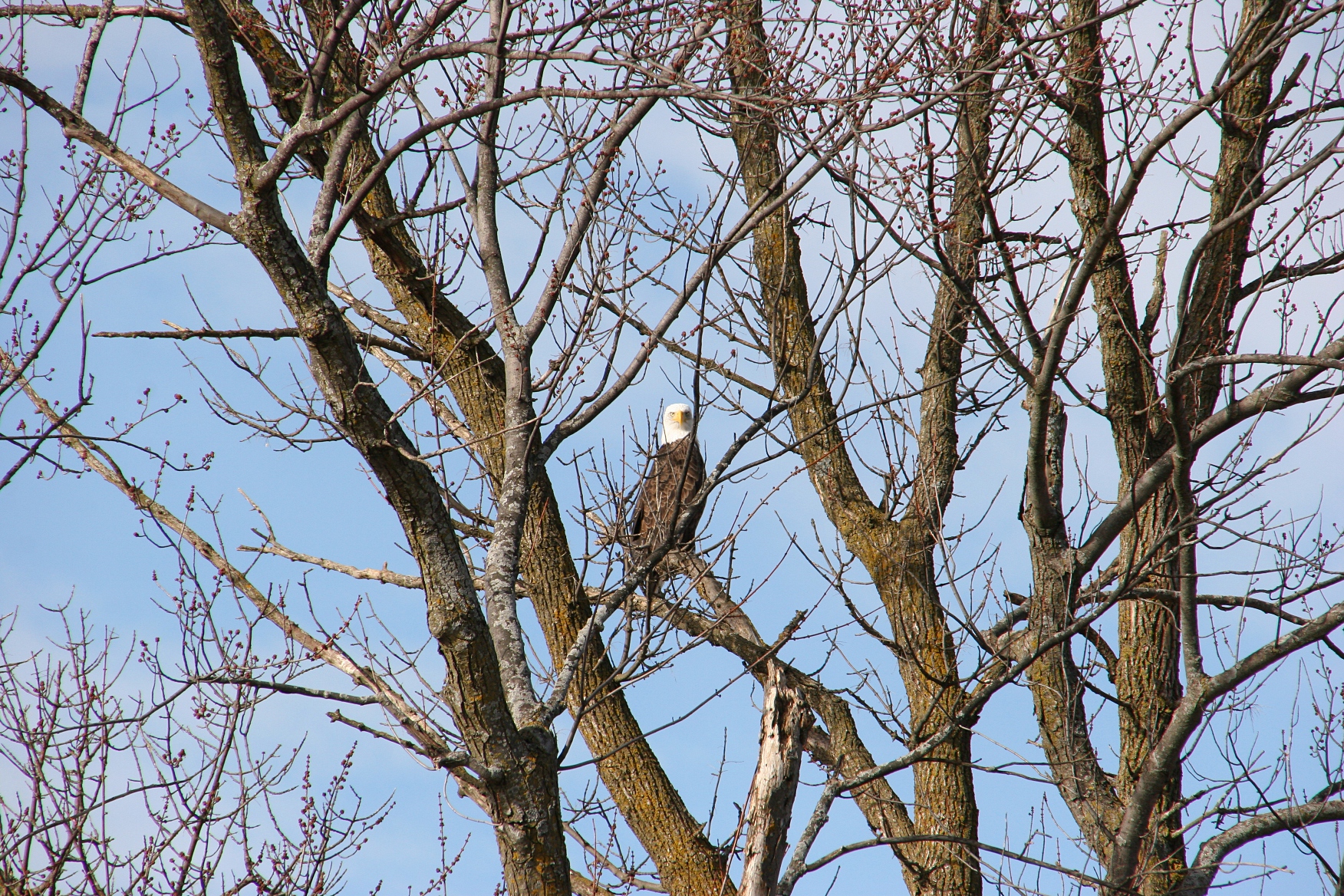
Just south of Union Lake Trail along Rice County Road 46, a bald eagle watches me. (Minnesota Prairie Roots copyrighted file photo 2018)

This isn’t the first time I’ve seen bald eagles simply by looking out windows in my south Faribault home. I’ve watched an eagle glide low past our picture window. I’ve seen one a block away flying at treetop level. Several blocks up the hill, an eagle flew above Fourth Avenue Southwest. I’ve observed an eagle following the course of the Straight River while dining at The Depot Bar & Grill. On Faribault’s north side, I’ve spotted eagles flying near the Cannon and Straight Rivers. On the way to Dundas, eagles perch in a nest visible from Minnesota State Highway 3.

Eagles perch in a tree near Waseca. (Minnesota Prairie Roots copyrighted file photo 2012)

I’ve seen eagles in other areas of Rice County and in Waseca County. They are seemingly everywhere throughout Minnesota.

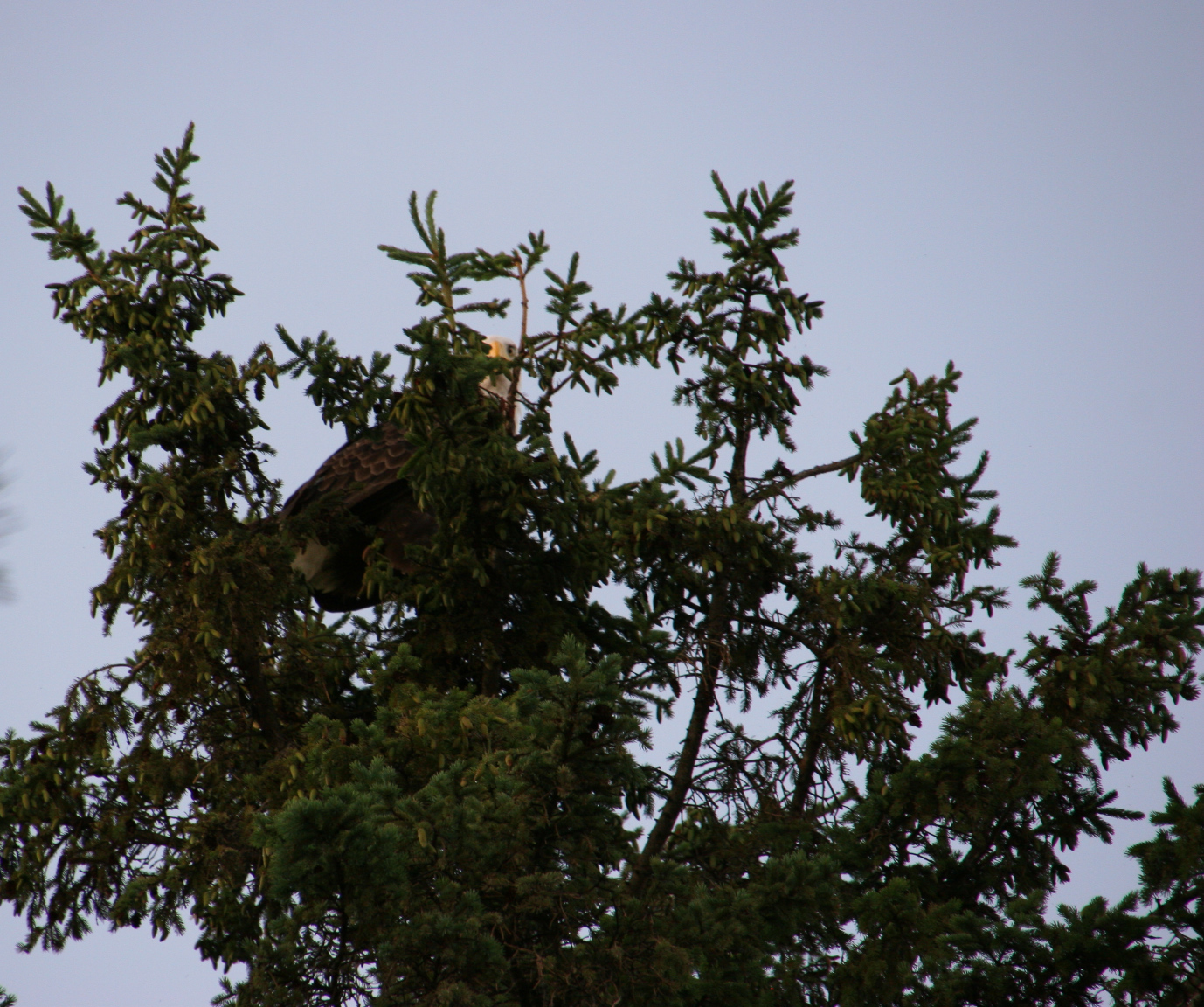
Glimpse of a bald eagle in a lakeside treetop south of Crosslake in central Minnesota. (Minnesota Prairie Roots copyrighted file photo)

To the north in the Brainerd lakes area of Central Minnesota, eagles once nested in a tree at a family member’s lake cabin. The nest fell in a storm, but the eagles relocated along Horseshoe Lake. So there’s still plenty of eagle watching at the cabin.

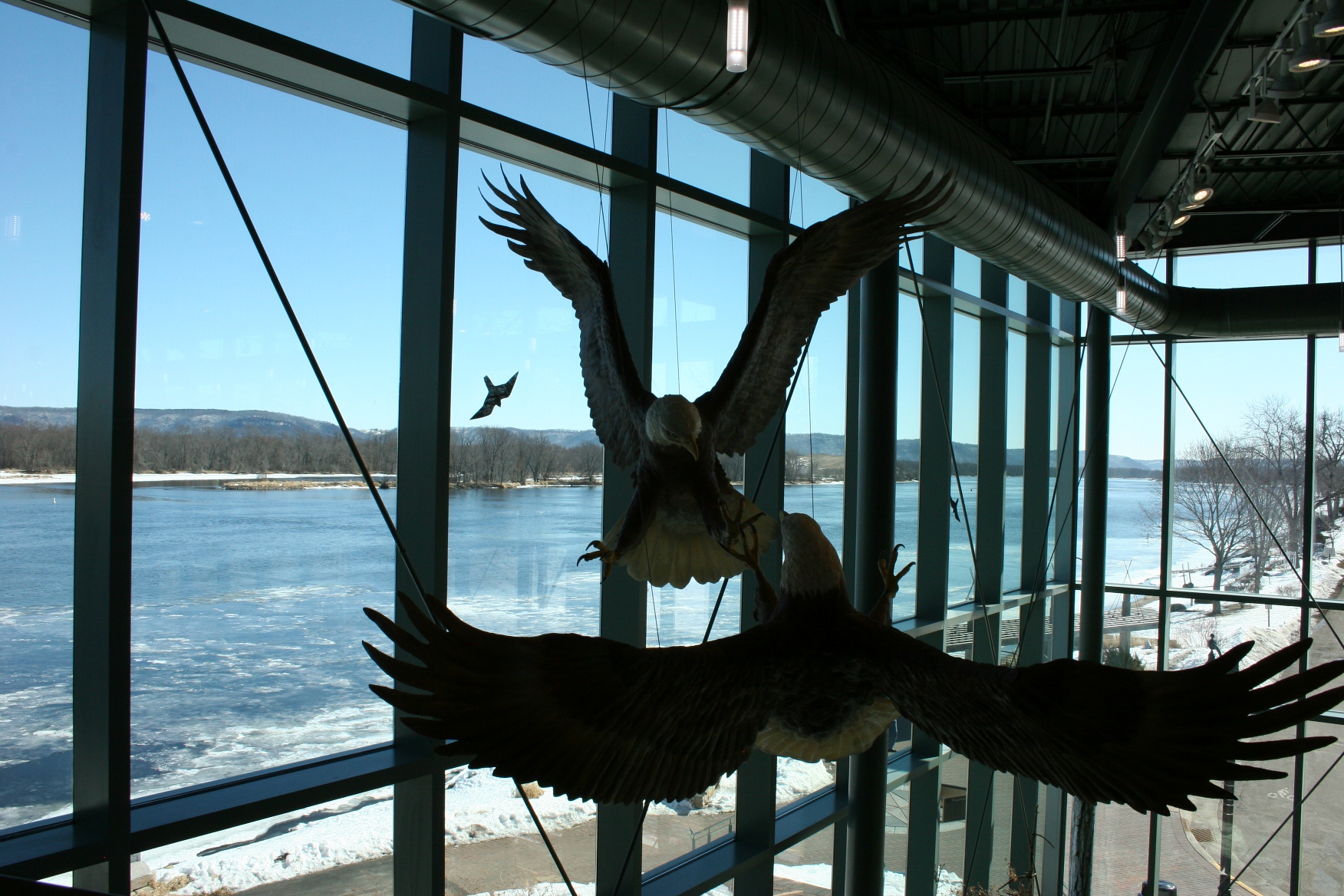
Eagles suspended from the ceiling and a view of the Mississippi River from the second floor of the National Eagle Center. (Minnesota Prairie Roots copyrighted file photo 2014)

We once nearly hit a bald eagle south of Hackensack as it lifted off the shoulder just as our van passed. Let me tell you that seeing the massive wing span (from 5 to 8 feet) of an adult eagle passing across your windshield is not only startling, but scary. Fortunately, the eagle cleared the windshield. Near Kenyon another grazing-on-roadkill eagle took flight within seconds of our van striking it. Aside from those close encounters, eagle watching has proven pleasant.

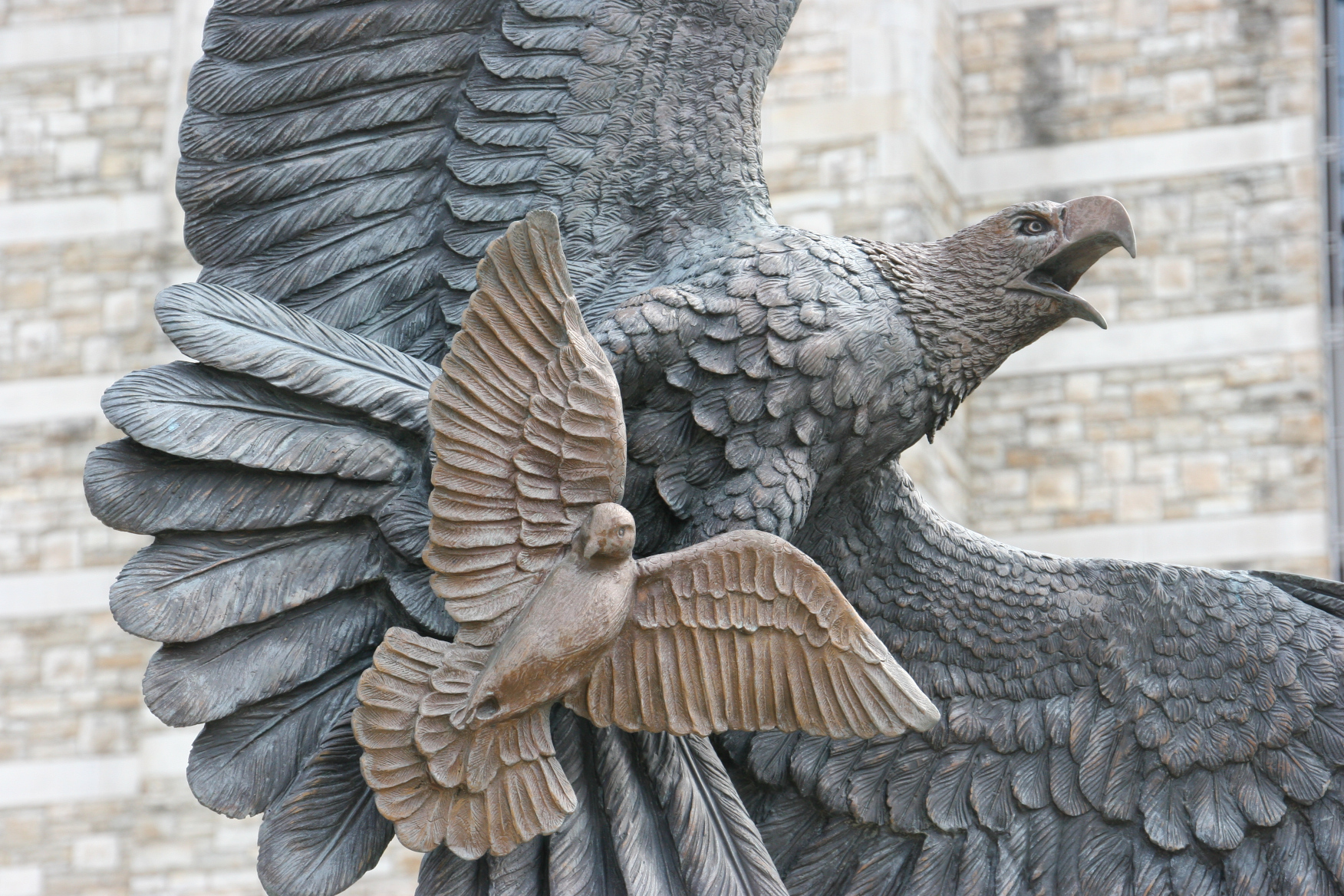
My photo of an eagle and dove at the Rice County Veterans Memorial now hangs in the Minnesota Veterans Home, Bemidji. (Minnesota Prairie Roots copyrighted file photo)

I also appreciate how bald eagles are incorporated into many veterans memorials as symbols of America and of freedom. I’ve photographed many of those memorial eagle sculptures, including one right here in Faribault. Today that photo from the Rice County Veterans Memorial graces a wall at the new Minnesota Veterans Home in Bemidji. along with five other veterans memorial photos I took. What an honor to have my work displayed there for veterans and others to appreciate.

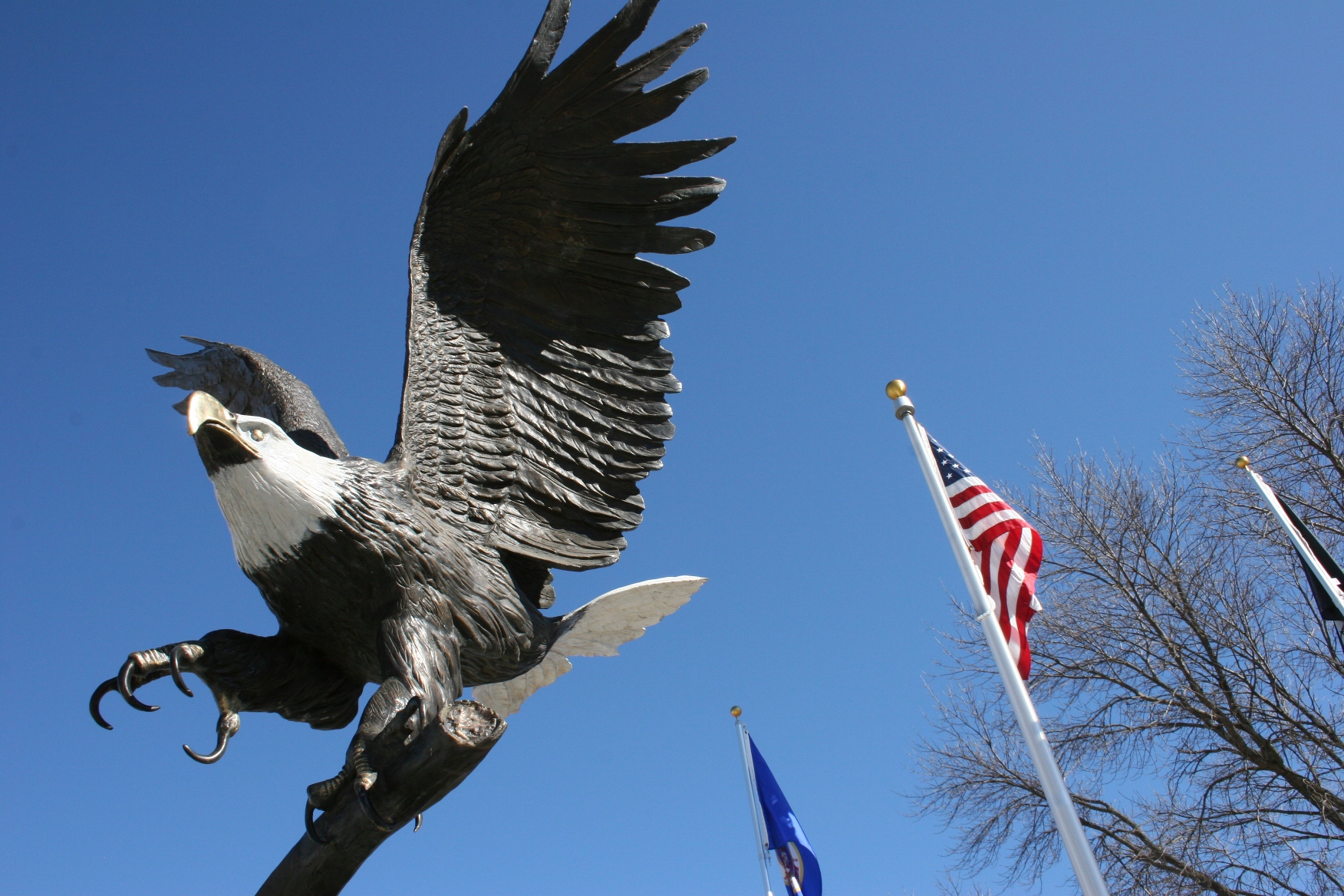
The bald eagle at the vets park in Morristown flanked by flags. (Minnesota Prairie Roots copyrighted file photo)

The bald eagle symbolizes freedom and strength. Now to have this majestic bird as our national bird seems fitting. And long overdue. The bald eagle is a powerful symbol connected to democracy. To see an eagle soar is to see freedom soaring.

© Copyright 2024 Audrey Kletscher Helbling

 

Connecting past to present via my “Charlie Brown” Christmas tree December 16, 2024
Me, in the red jumper, with my siblings Doug (back) and front, left to right, Monica, Brian and Lanae on Christmas Eve 1964 in our childhood home. (Minnesota Prairie Roots copyrighted file photo)

NOSTALGIA SHAPES my Christmas tree choice, as I expect it may yours. I want a tree that is short-needled, imperfect, leaning toward Charlie Brownish. That type of unshaped tree is the tree of my childhood Christmases on a southwestern Minnesota dairy and crop farm.
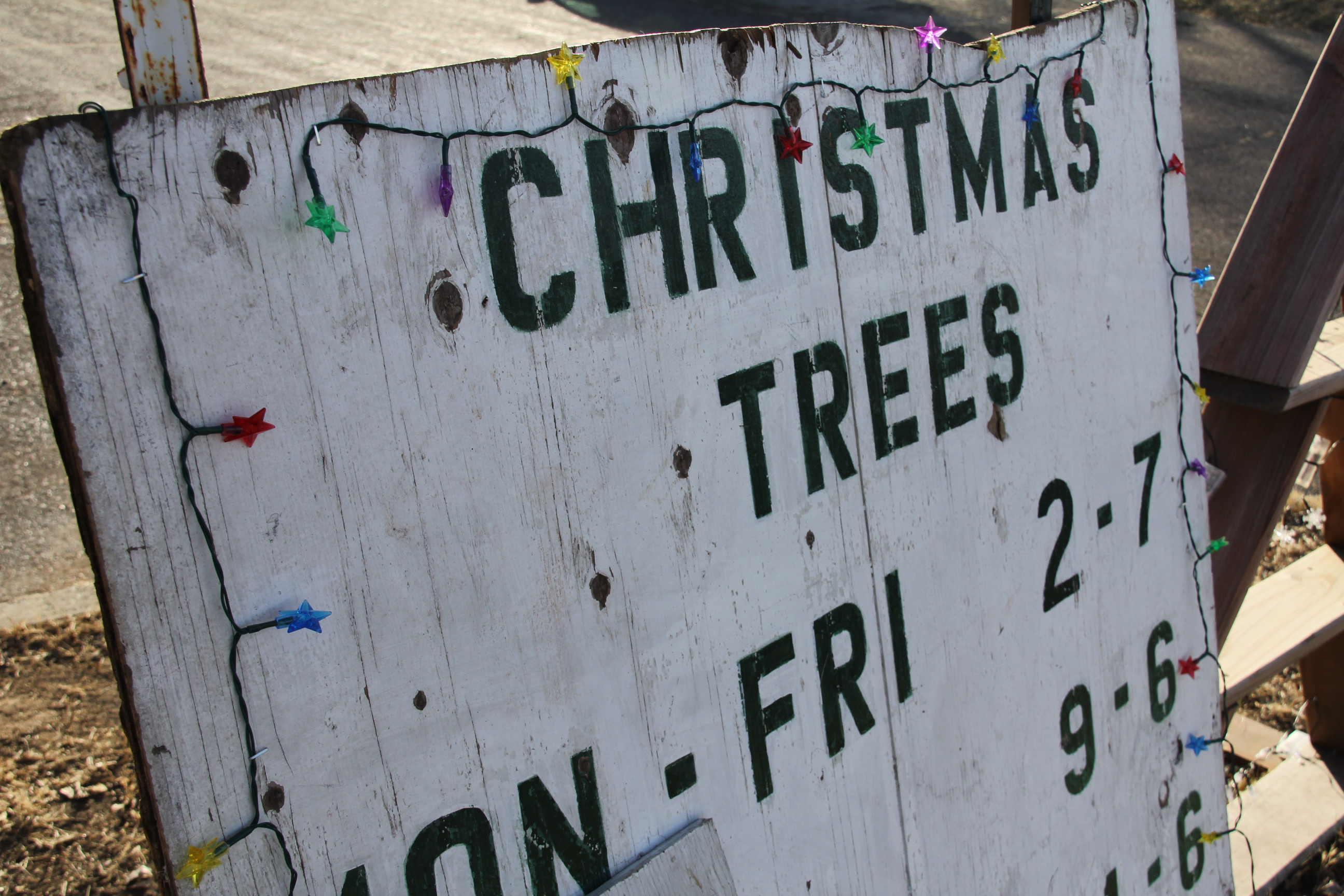
UPDATE: Ken’s Christmas Trees, 1407 Fourth St. NW., Faribault, has closed for the season. (Minnesota Prairie Roots copyrighted photo December 2024)

In the old 1 ½-story wood-frame farmhouse where I lived the first 11 years of my life with my parents and four of my five siblings (Brad wasn’t yet born, the new house not yet built), our Christmas tree sat on the end of the Formica kitchen table. The house was too small to put the tree elsewhere. An oil-burning stove occupied much of the tiny living room, which would be the usual spot to place a tree.
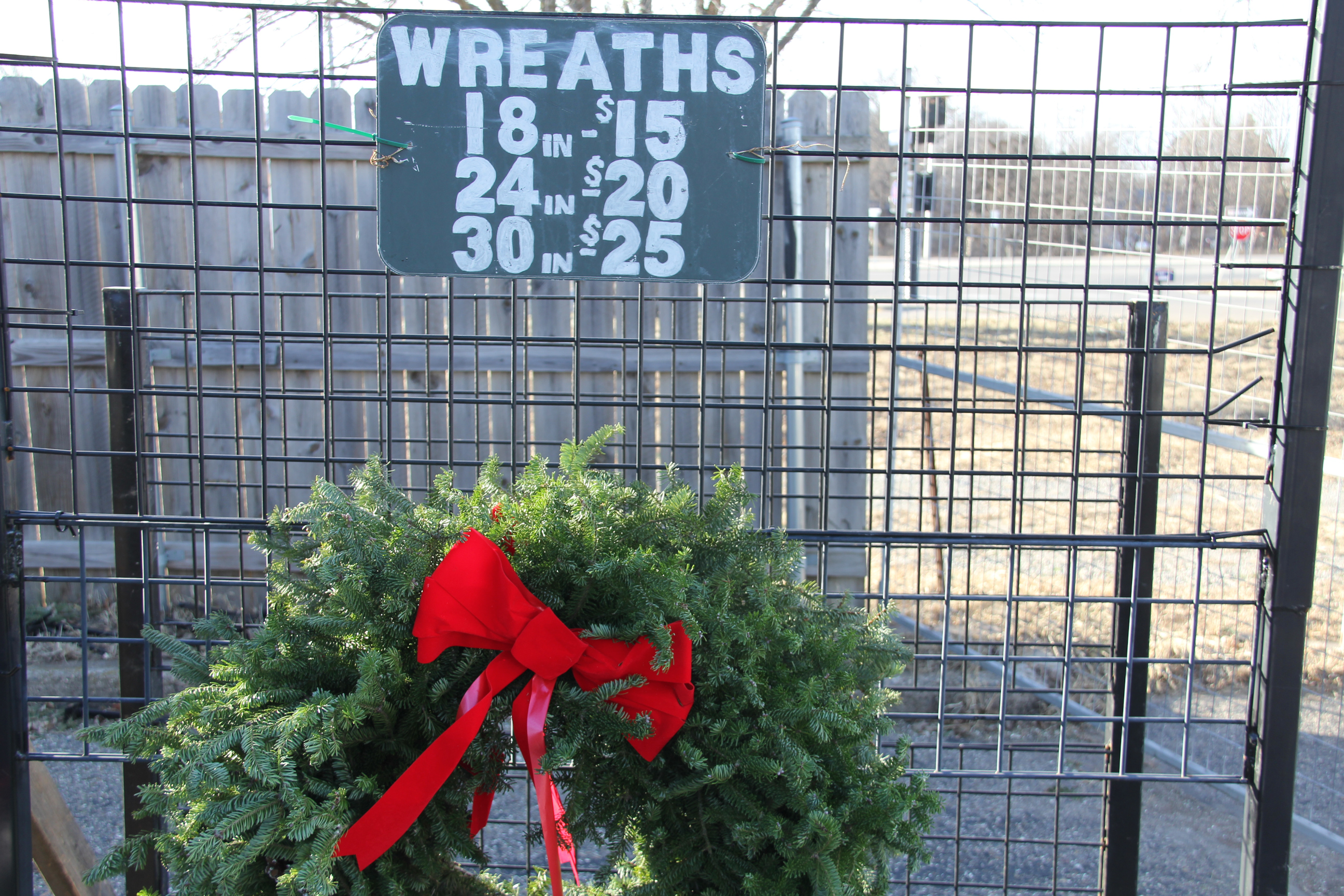
A touch of red at Ken’s Christmas Trees, which also sells wreaths and evergreen garland. (Minnesota Prairie Roots copyrighted photo December 2024)

I loved that the tree sat on the table, which was draped with a red-and-white checked oilcloth tablecloth matching the red-and-white checkered linoleum tile floors. Kitchen walls were painted yellow on top with some type of red-bordered gray wall covering below. A maroon Naugahyde rocker sat in front of the trap door leading to the dirt-floored cellar.

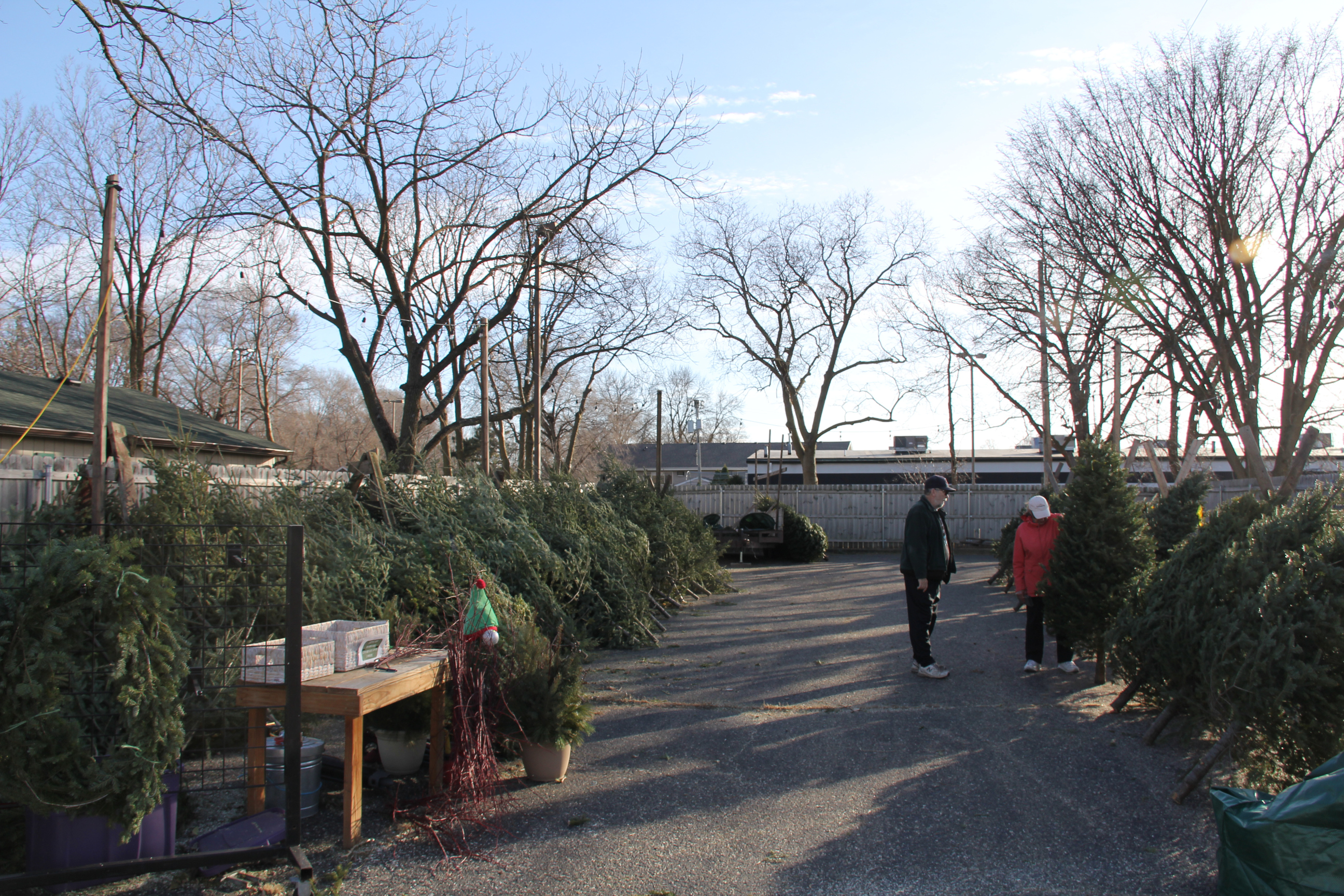
An overview of Ken’s Christmas Trees, located in a lot next to Jersey Mike’s. (Minnesota Prairie Roots copyrighted photo December 2024)

In that setting, Dad placed our grocery store Christmas tree. On the kitchen table, on the end next to the window facing west. Imagine gathering there in the dark of December, Dad in from doing chores, Mom dishing up meat, boiled potatoes, gravy and a side vegetable to pass around. Homemade bread piled on a plate. Milk from our cows poured into cups. Meals during the holiday season held a bit of magic because of that tiny Christmas tree.

Tinsel sparkled in the glow of holiday lights. To this day, I drape tinsel on my tree even if it’s a bit of a hassle. I love the old-fashioned look, the memories connected to tinsel.

This paper Baby Jesus goes on my Christmas tree every year. It’s from the 1960s, from my Sunday School Christmas lesson. (Minnesota Prairie Roots copyrighted file photo)

I remember favorite ornaments, too. The wax lamb, which Mom cautioned not to hang too close to the heat of a bulb. The glittery gray dove. The mini white church with a red window, hung near a red bulb so the window glowed. The colorful vintage round ornaments that we handled with care lest they break, and some did. I have a few of those. And then the paper baby Jesus, nestled in a manger, and an angel robed in white. I have both, cut from Sunday School lessons and looped with yarn to hang from evergreen boughs.

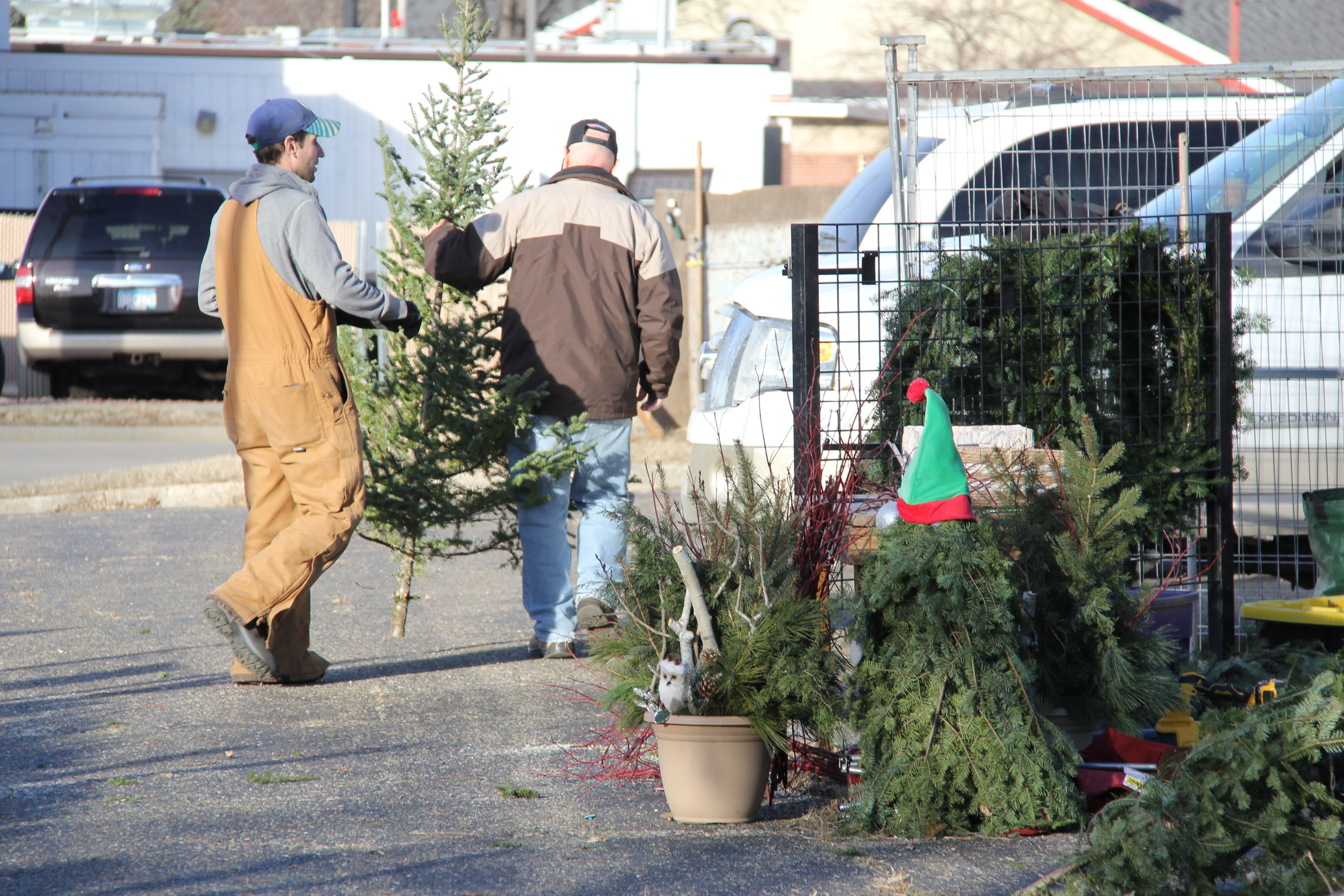
My husband, Randy, accompanied by Ken’s son, carries our $37 tree to the van. (Minnesota Prairie Roots copyrighted photo December 2024)

When I shop for my Christmas tree each December, usually at Ken’s Christmas Trees in Faribault, these visuals guide me. I am, I suppose, attempting to recapture those Christmases of yesteryear. A time when, unencumbered by the responsibilities of adulthood, I experienced the absolute joy of the season. There were no worries—only that of remembering my line for the Sunday School Christmas service.

This cut-out of Ken Mueller stood at the tree lot in 2023. Mueller faced a major health crisis this past year, but has since recovered. His kids are now running the tree lot. It’s all about family with the Muellers, too. (Minnesota Prairie Roots copyrighted file photo December 2023)

Today I experience Christmas through my grandchildren, Isabelle, 8, and Isaac, almost six. Next Christmas another little one—my second daughter is due to deliver a boy in January—will add to the magic of the season. Kids have a way of infusing anticipation and unbridled joy into Christmas.

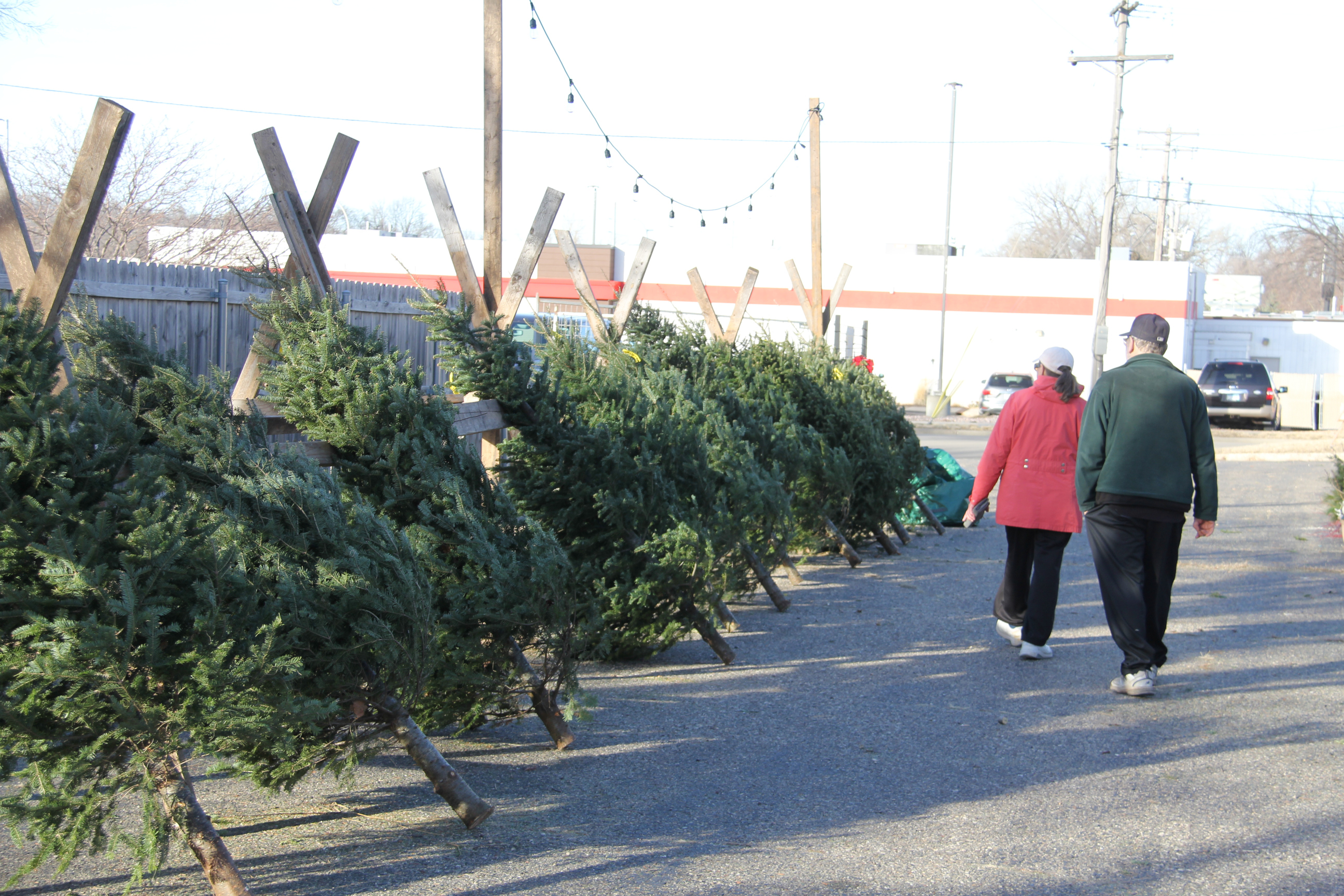
Shoppers search for the “perfect” tree, for them, at Ken’s lot. (Minnesota Prairie Roots copyrighted photo December 2024)

When my core family (minus the pregnant daughter and her husband, who live 260 miles away) gather around my Charlie Brownish tree in the living room (not the kitchen) on Christmas Eve, I hope they feel the magic. The magic and joy that come in being together, especially with the son in Minnesota from Boston. Celebrating the birth of Christ. Celebrating family. Understanding that, no matter what tree decorates a home, it is the homecomings, the conversation and laughter that matter most. The love we feel for one another centers our family celebrations.

Our 2023 Christmas tree purchased at Ken’s tree lot and placed in a corner of our living room. (Minnesota Prairie Roots copyrighted file photo December 2023)

The tree is simply a decoration, a memory, a focal point. In the living room. Not atop the kitchen table.

© Copyright 2024 Audrey Kletscher Helbling