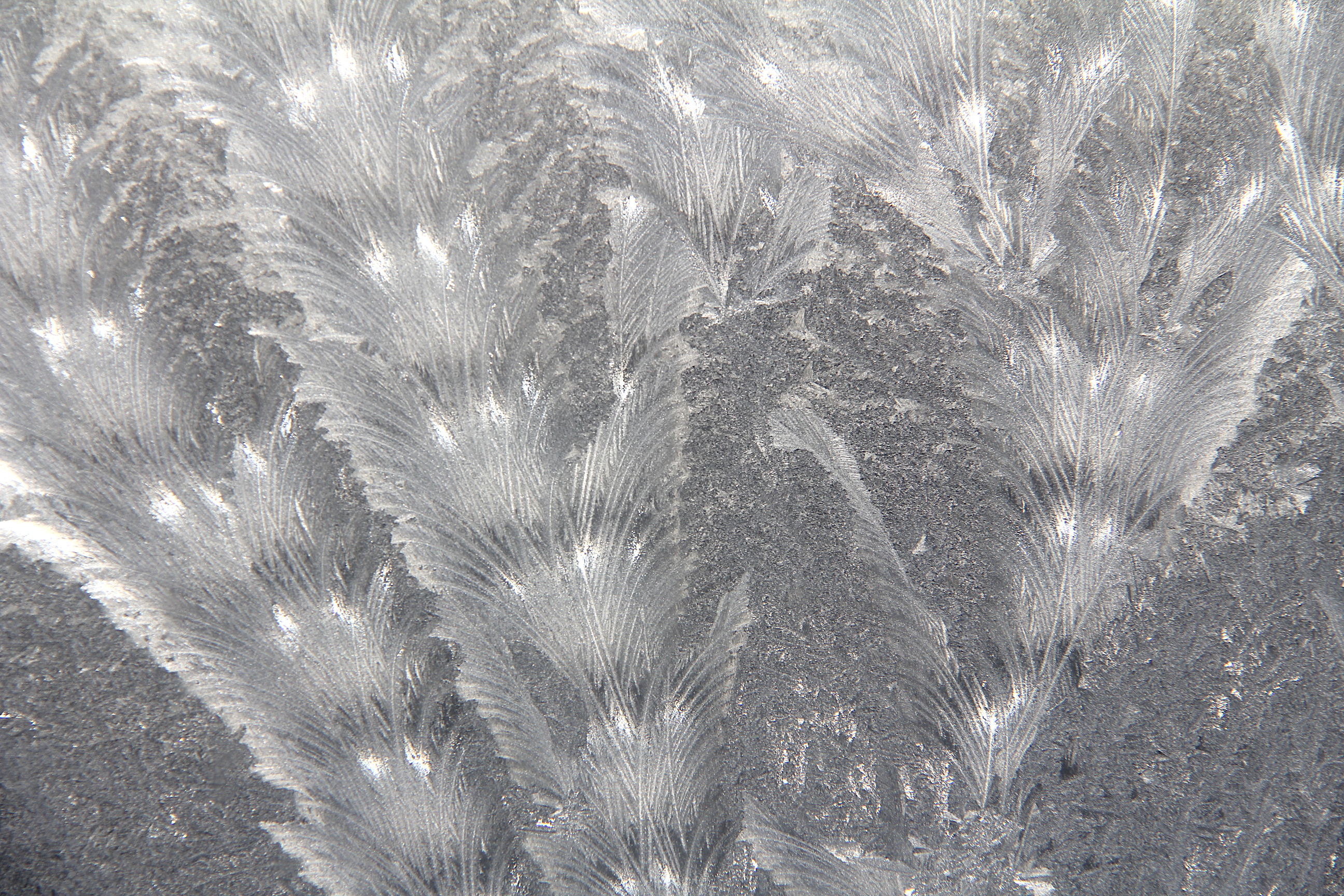
“Branches” (or perhaps “Tendrils”) by Jack Frost. (Minnesota Prairie Roots copyrighted photo February 2023)
DURING ONE OF SOUTHERN MINNESOTA’S recent cold snaps, I pulled out my camera to photograph some particularly intricate art. Not artwork in a public gallery exhibit, but rather art displayed in a private space—my upstairs bedrooms.
I live in a 90+-year-old house, built sometime in the 1930s. Locally, it’s the Swanson house, although Randy and I have owned this 1 ½-story structure since 1984. But it will forever be the home of its former owners.
The canvas for Jack Frost’s art. (Minnesota Prairie Roots copyrighted photo February 2023)
Although we’ve made many improvements through the decades, including installing a new furnace and central air conditioning that included additional duct work, the upstairs remains notably cold in the winter and hot in the summer. A single heat vent opens to both bedrooms. Updated replacement windows installed some 30 years ago also did little to improve cold weather heat retention on the second floor.
And so Jack Frost finds our second floor vacant bedrooms a welcoming short-term studio in the deep cold of a Minnesota winter. With the three kids long-grown into adulthood and us empty nesters for 11 years now, he can settle in as an artist-in-residence without notice.
When temperatures drop into that frigid category of frostbite warnings, tires crunching on snow and extra blankets layered on the bed, Jack Frost arrives. It’s OK hosting him as a short-term guest, but anything beyond a few days and I’m ready to boot him out.
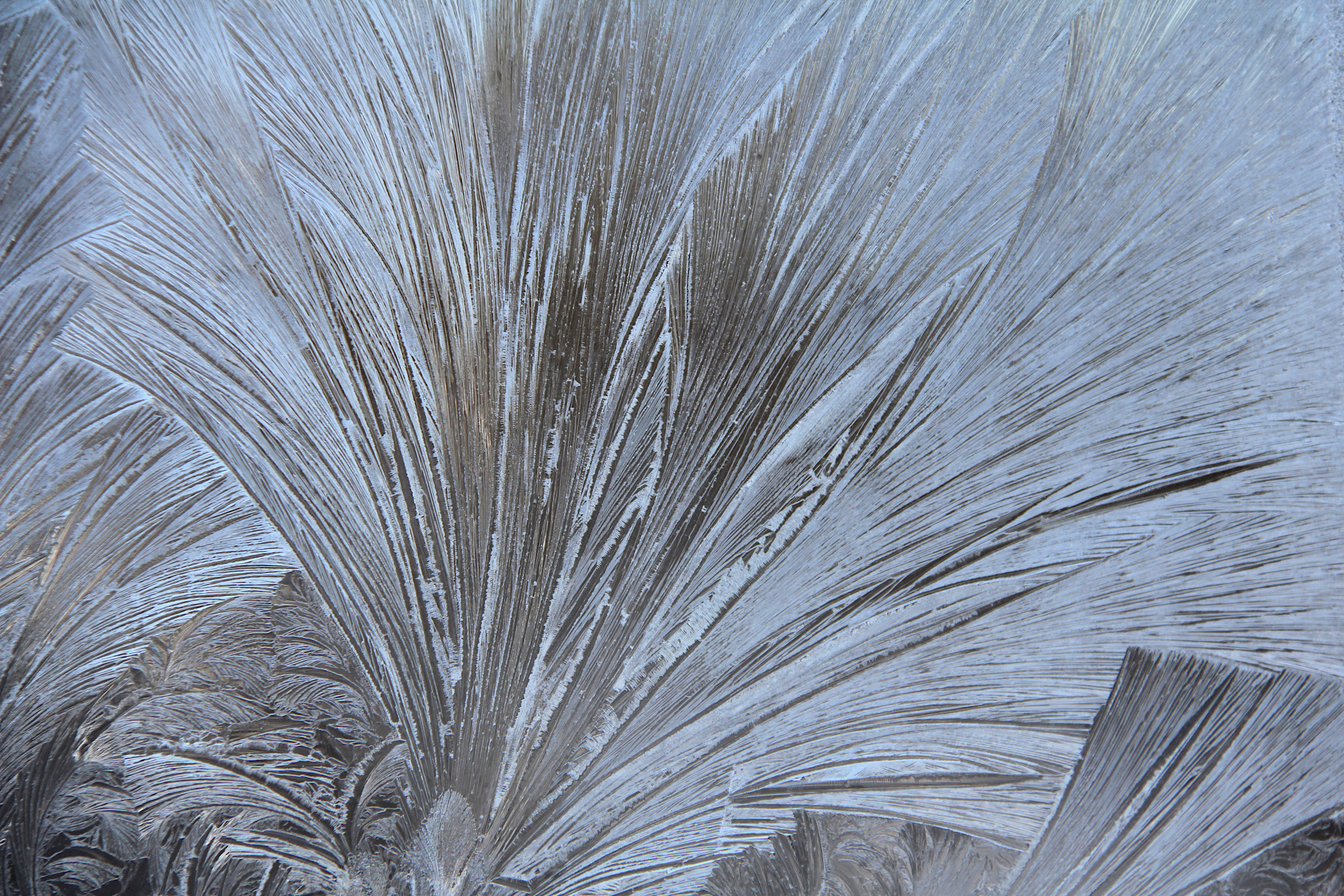
“Feathers” by Jack Frost. (Minnesota Prairie Roots copyrighted photo February 2023)
He does some creative work on the canvas of cold window panes. Whether he etches or paints or draws or exactly how he crafts his art remains an unknown to unscientific me. But I’m impressed by the primarily nature-themed work he designs.
“Feathered intricacies” by Jack Frost. (Minnesota Prairie Roots copyrighted photo February 2023)
In his last exhibit, Jack Frost incorporated mostly branches, grass stems, water and feathers. They were beautiful in their detailed intricacy, a Frost signature style.
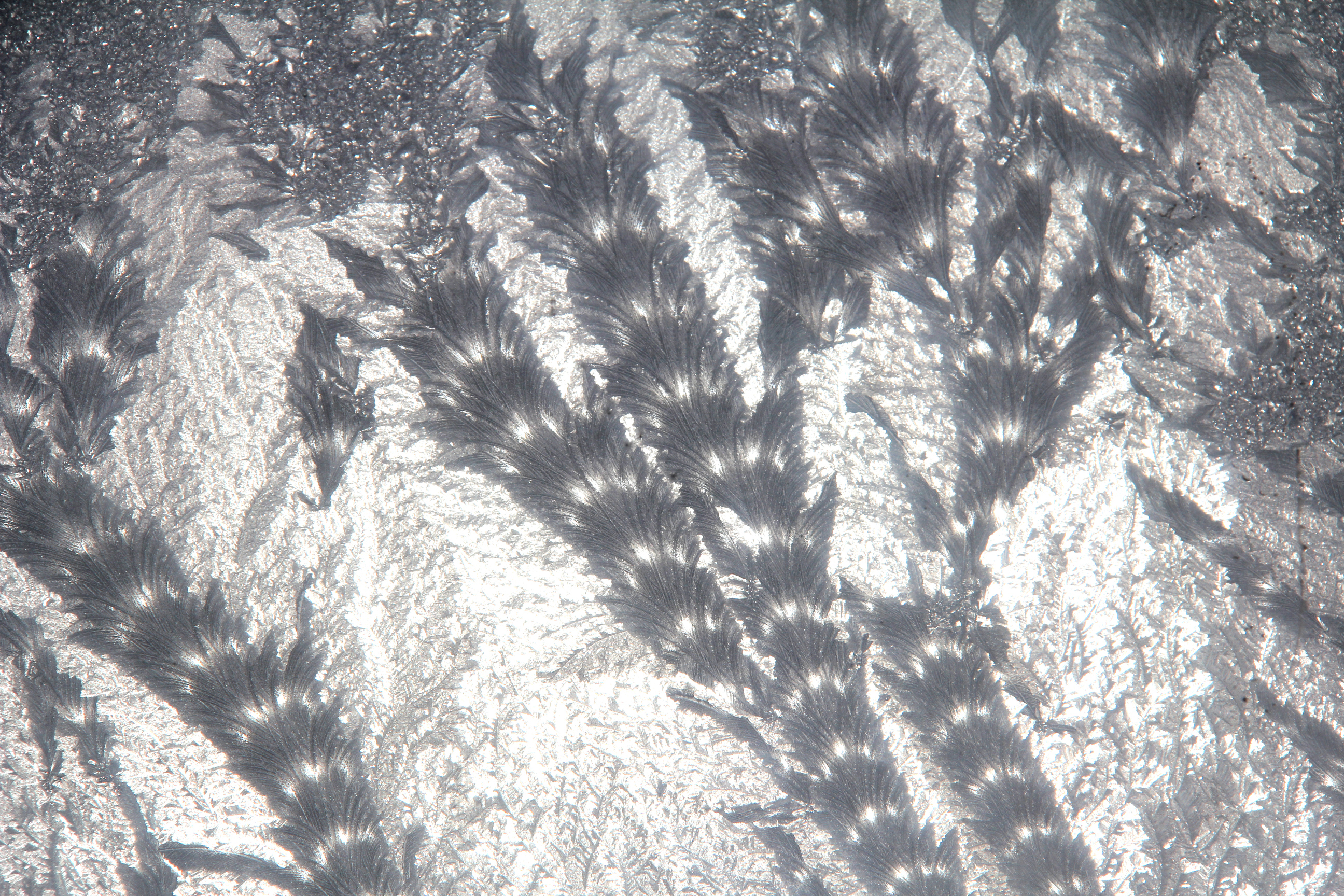
“Prairie Grasses in the Morning Light” by Jack Frost. (Minnesota Prairie Roots copyrighted photo February 2023)
When sunlight shown on the eastern window in the morning, the contrast of light and dark in the artist’s art sharpened. Dazzled, almost.
“Drips” or “Tears,” depending on your mood and perspective. (Minnesota Prairie Roots copyrighted photo February 2023)
Yet, even in diminished light, the graininess of some pieces produced more introspective and moody scenes.
Jack Frost has a sense of humor, creating this “I Bet You Wish You Were Here” beach art. (Minnesota Prairie Roots copyrighted photo February 2023)
Jack Frost’s art installations in my second story home gallery are typically short showings of several days. Just enough time for me to pause and appreciate his work before outdoor temperatures rise, the sun melts his art and he vanishes. Poof. I can’t say I welcome him with open arms because I really don’t like sub-zero temps. But I can appreciate Jack Frost’s art as more than just frost accumulating on energy inefficient windows.
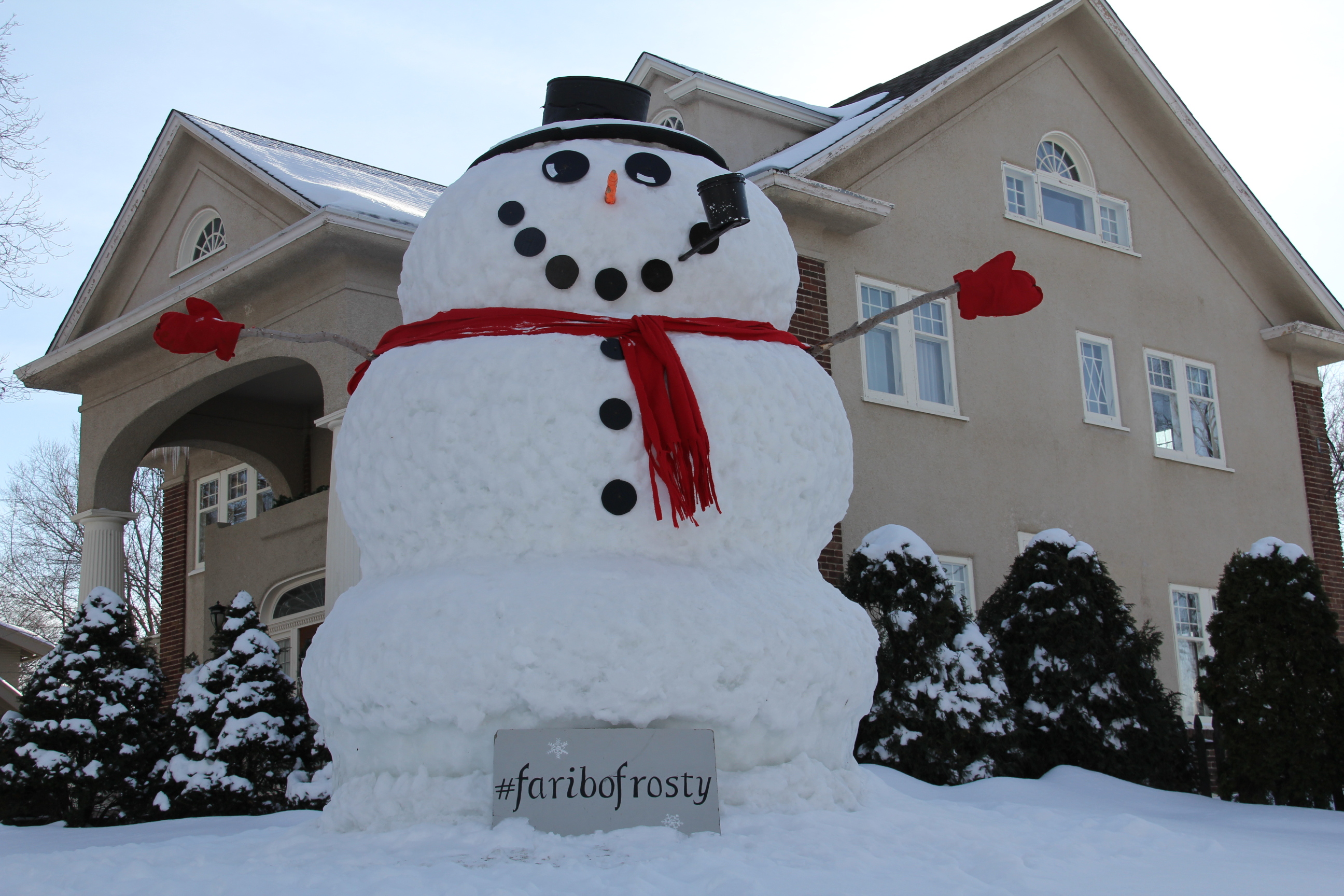
Faribo Frosty, a Faribault icon. (Minnesota Prairie Roots copyrighted photo February 2023)
NOSTALGIA WEAVES into our lives the older we grow, time blurring the edges of memories. But then something comes along to jog the mind into recalling a sweet childhood memory. For me, that’s Faribo Frosty.
Faribo Frosty’s smile brings so many smiles. (Minnesota Prairie Roots copyrighted photo February 2023)
Since 2005, the Hoisington family has built my community’s version of Frosty the Snowman. I loved Frosty as a child—the song, the Little Golden book, the animated holiday cartoon narrated by Jimmy Durante. There’s something so compelling about a snowman that comes to life via a magical top hat. And when he melts, oh, the sadness.
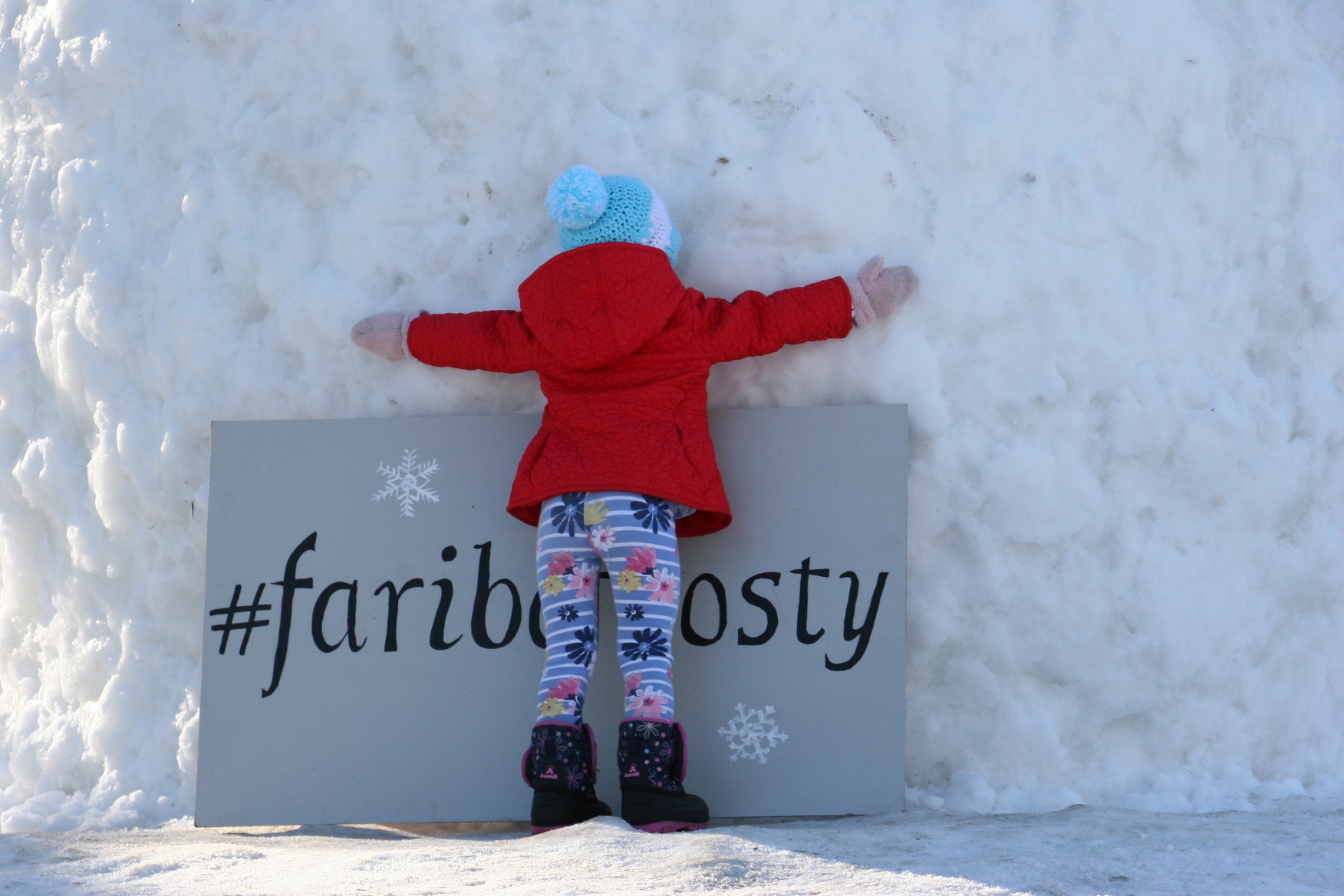
My then 2 1/2-year-old granddaughter hugging Faribo Frosty in December 2018. (Minnesota Prairie Roots copyrighted file photo December 2018)
But the melting of Faribo Frosty, given his robust size and current height of 17 or so feet, is not imminent. Lead creator Andy Hoisington cares for Frosty with the devotion of a man who recognizes the importance of his snowman. Families and grandparents and couples come to the corner of First Street Northwest and Third Avenue Northwest to see Faribo Frosty in the Hoisington’s front yard. I’ve been there with my grandkids, most recently a few weeks ago. When my granddaughter was two, she stretched her arms wide to hug Frosty. Couples have gotten engaged here and been photographed here to announce a pregnancy.
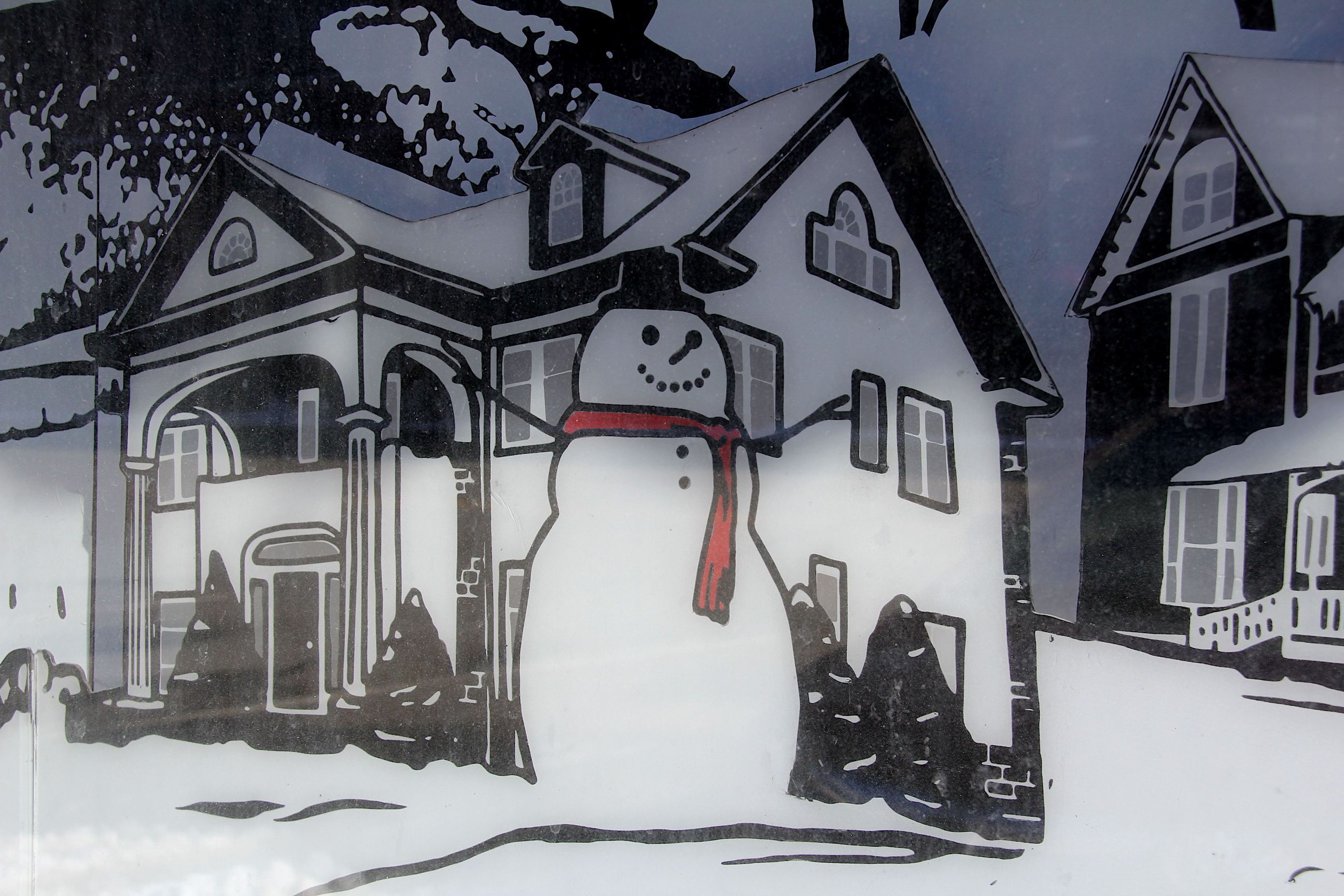
I photographed this Faribo Frosty art through the storefront windowof Actualize Fabrication in the 300 block of Central Avenue in historic downtown Faribault. (Minnesota Prairie Roots copyrighted and edited photo February 2023)
Ginormous Faribo Frosty, crafted with shaved ice from the local ice arena and from snow by Andy and his family (including adult sons Jake and Josiah and son-in-law Nick), attracts visitors from well beyond Faribault. He’s also been filmed for metro area television features, including KARE 11 Boyd Huppert’s “Land of 10,000 Stories.”
Jake, left, and Andy Hoisington work on Faribo Frosty in this December 2020 image. (Minnesota Prairie Roots copyrighted file photo 2020)
I’ve watched the Hoisingtons work on Frosty, shoveling shaved ice from a trailer, climbing a ladder to pack and shape the beloved snowman. He requires constant maintenance given Minnesota’s diverse winter weather. This is truly a labor of love after 18 years.
The Hoisington’s beautiful historic home is a lovely backdrop for their snowman. (Minnesota Prairie Roots copyrighted photo February 2023)
I am grateful for this family’s dedication to bringing joy into my community with their version of Frosty. Faribo Frosty makes me happy. He makes me smile with his wide smile, his bright carrot nose, his over-sized signature red scarf and mittens, even his black bucket pipe and his black top hat. Faribo Frosty is, in every way, nostalgically magical.
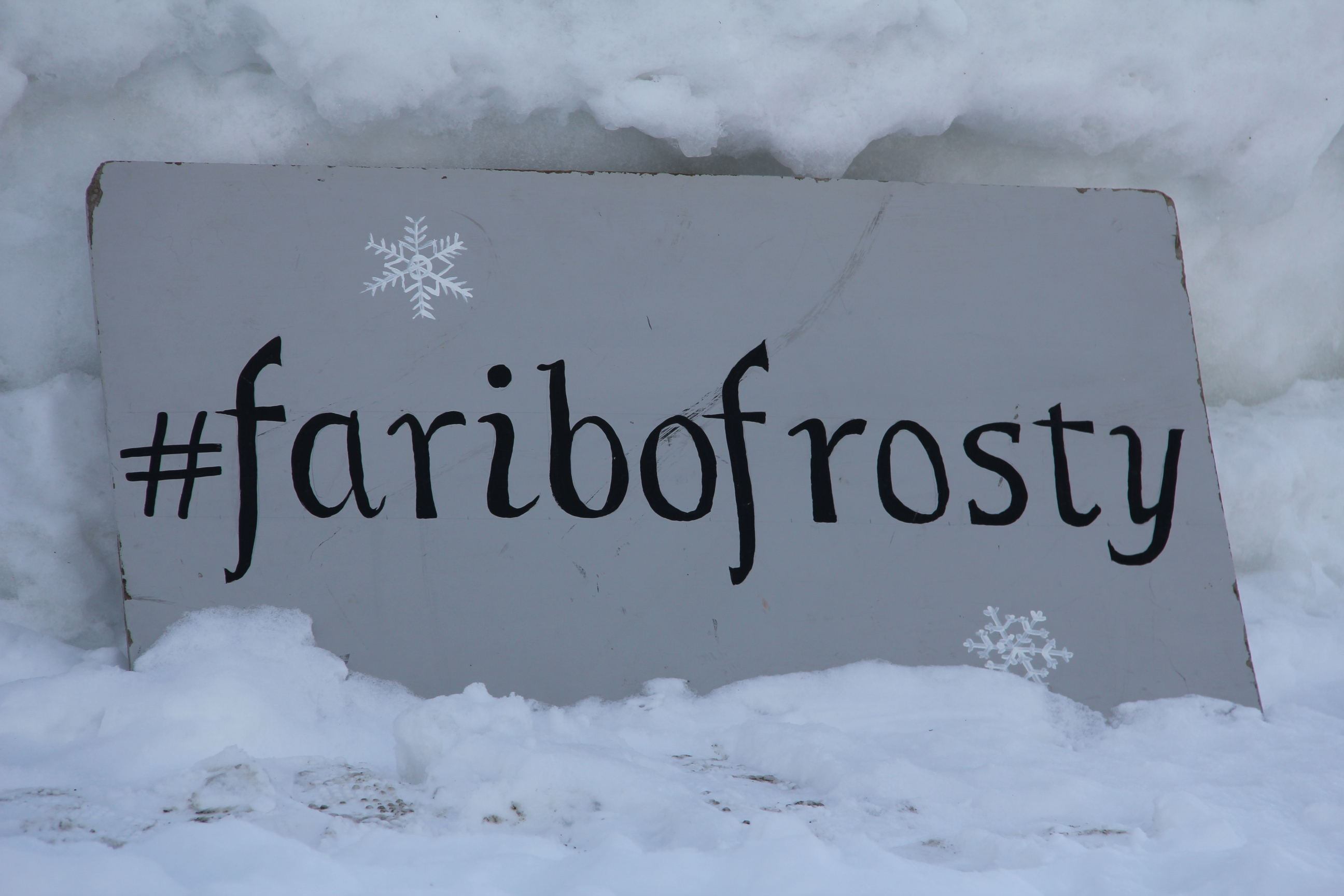
This sign standing in front of Frosty encourages others to share the snowman on social media with this hashtag. (Minnesota Prairie Roots copyrighted photo February 2023)
TELL ME: If you live in southern Minnesota, have you seen Faribo Frosty? If you live in another cold weather area, do you have a similar winter attraction or have you seen one?
THE LITTLE DAIRY QUEENOF FARIBAULT opened a week ago, marking the unofficial start of spring in my southern Minnesota community, and we missed it. I’m bummed.
Traditionally, Randy and I stop by during this late February opening of the walk-up/drive-up DQ for the bargain Peanut Buster Parfaits. When the DQ closes for the season at the end of October, we’re there, too, for the discounted parfaits.
Typically, we wait in line behind a long string of vehicles for the coveted treat. Last October we pulled up to the drive-up window only to learn that they’d just run out of ice cream and there would be no more with the shop temporarily closing. Disappointed doesn’t quite describe my emotion in that let-down moment. I’d been anticipating the taste of sweet and salty—hot fudge and peanuts atop that sweet, snow white soft-serve ice cream.
And now here it is, March 3, and I missed opening weekend with the $2.49/each Peanut Buster Parfait three-day special. Perhaps this winter of too much snow distracted me. Even if the calendar shows that spring is only officially 17 days distant, nothing feels or looks remotely like spring here. And so, I reason, this is why I missed opening weekend at The Little Dairy Queen of Faribault. My thoughts remain deeply entrenched in this winter of deep snow.
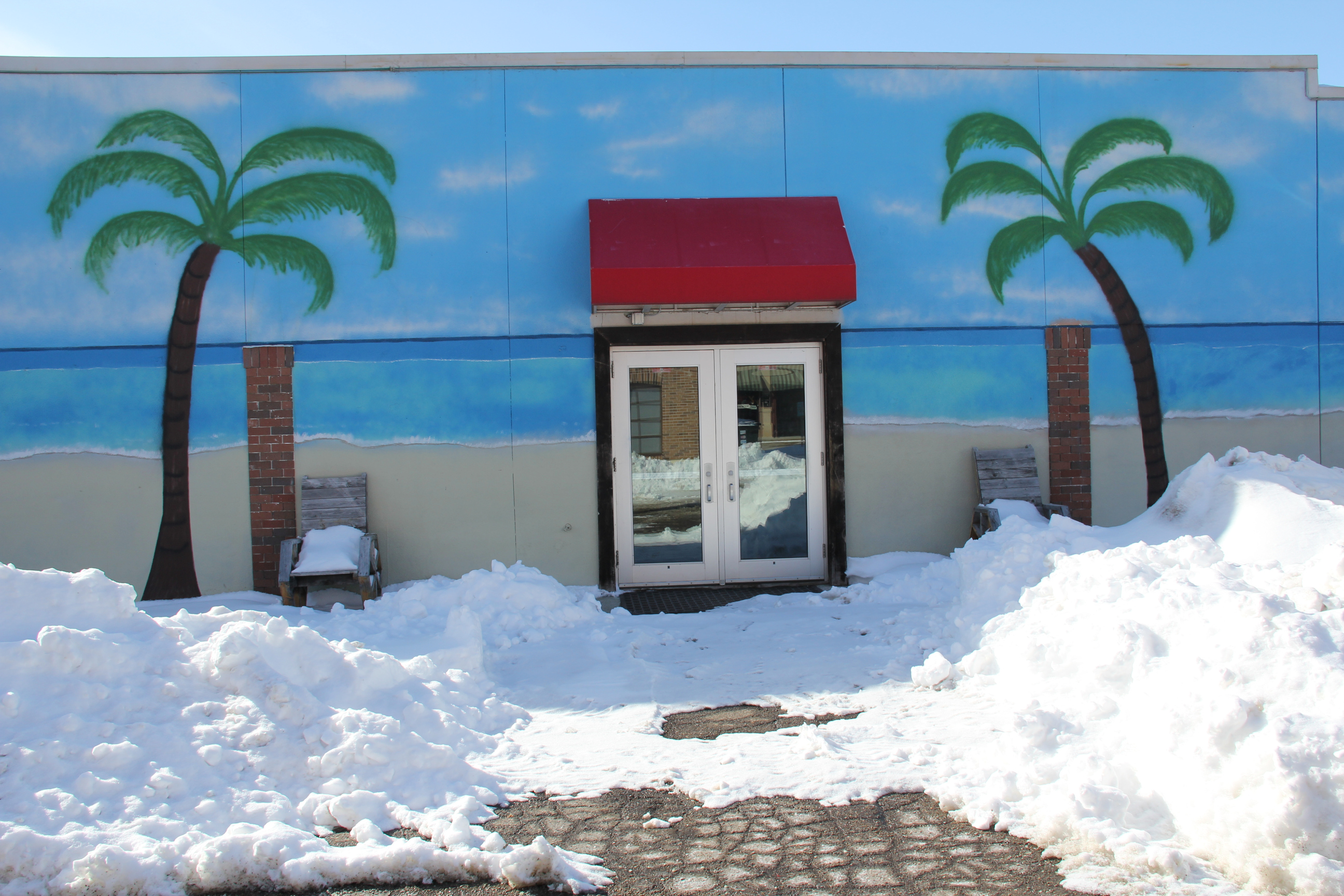
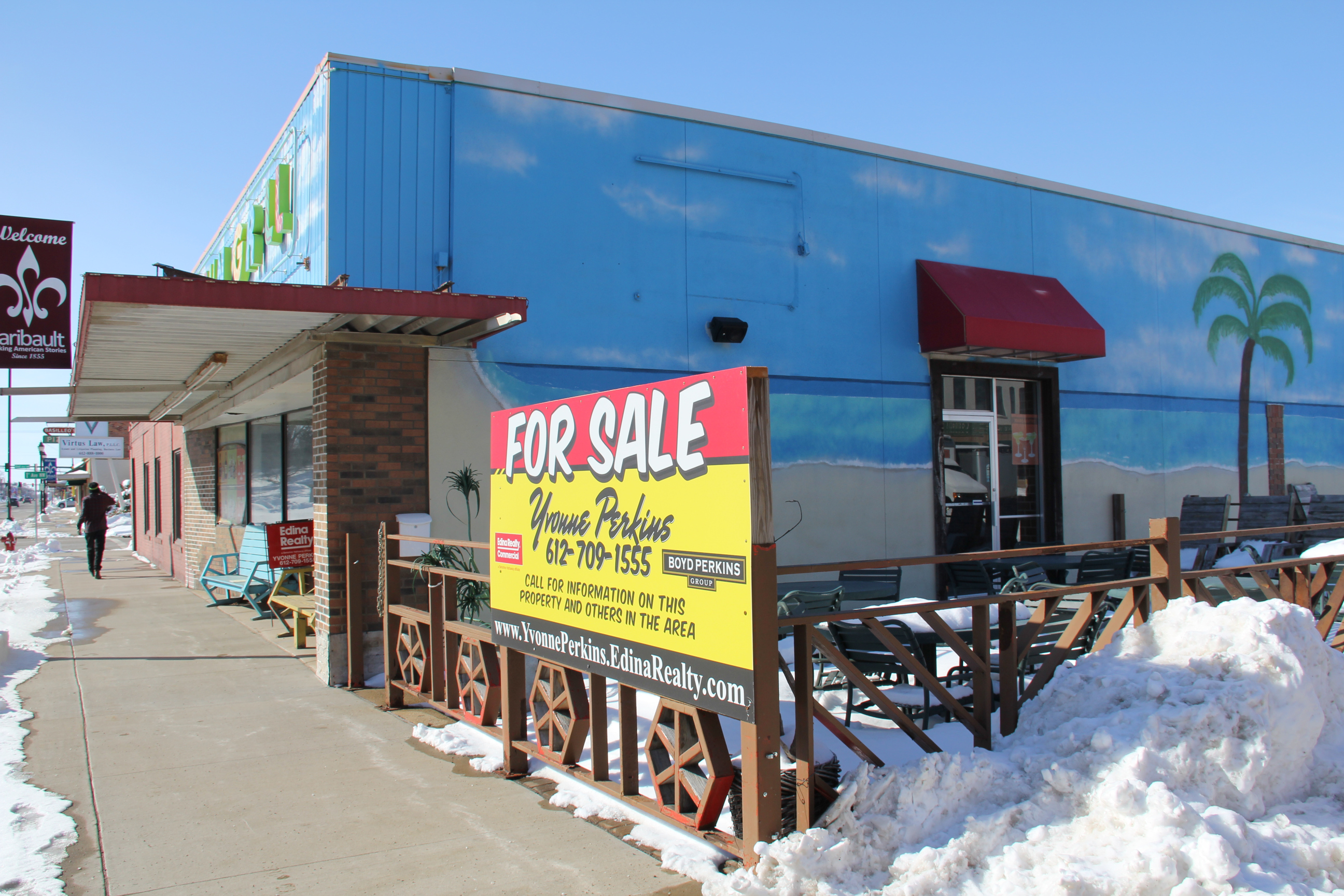
This tropical mural graces the side of the former Cancun Grill Mexican Restaurant in downtown Faribault. (Minnesota Prairie Roots copyrighted photo February 2023)
IF NOT FOR THE SNOW, I can envision this as some place warm and sunny. Some location other than here. Some place with real palm trees, not just those painted on the side of a building.
The closed restaurant is located downtown along a busy state highway that runs right through the heart of Faribault.(Minnesota Prairie Roots copyrighted photo February 2023)
I can picture myself on the patio, relaxing and conversing at a table with friends, drinking margaritas while the hot sun bakes my skin. But wishful thinking doesn’t land me in Arizona or Texas or California or Florida or Mexico. I am in Minnesota, outside the shuttered Cancun Grill Mexican Restaurant, drawn here by an inviting tropical scene of ocean and palm trees.
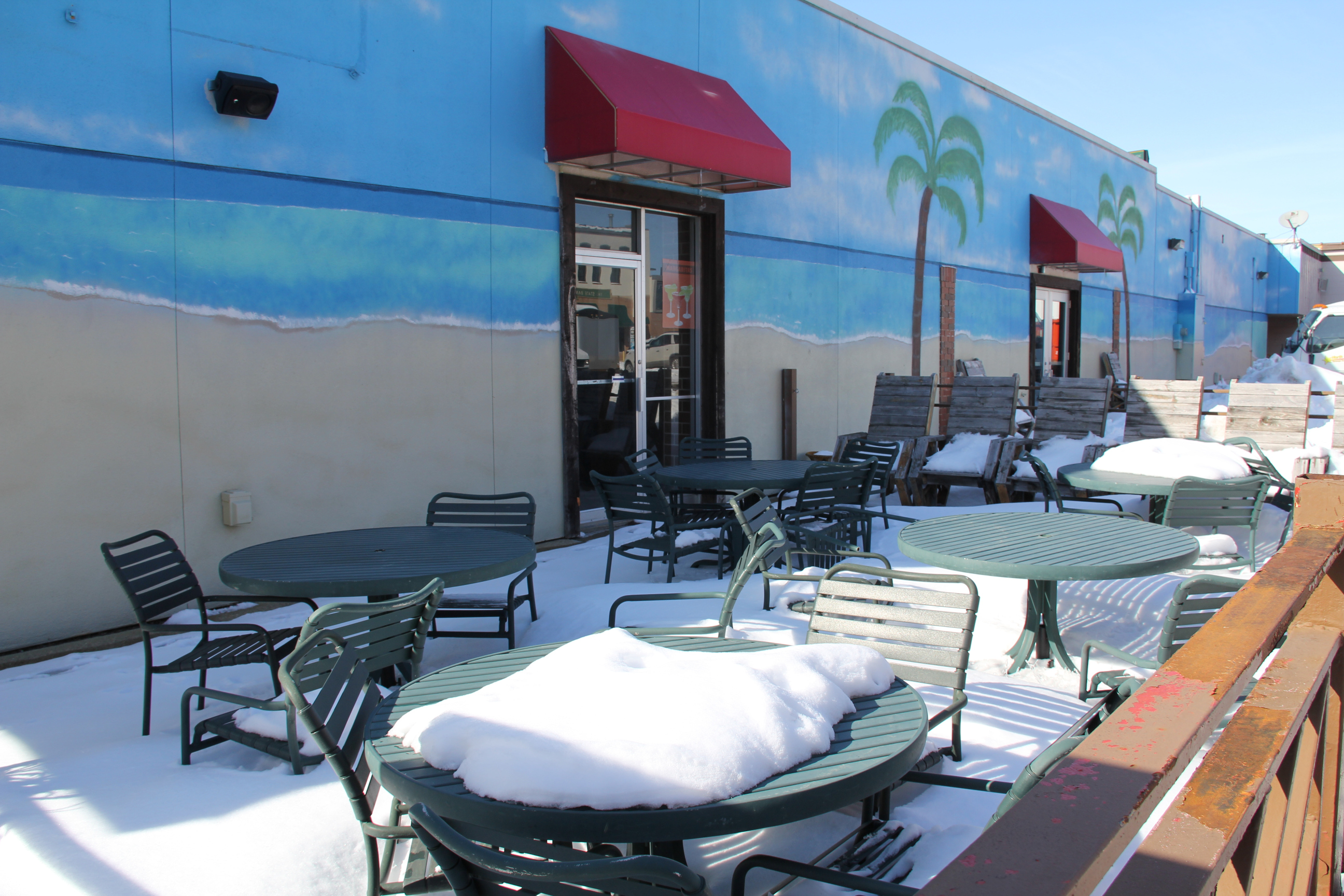
Snow blankets an otherwise inviting outdoor dining and drinking space. (Minnesota Prairie Roots copyrighted photo February 2023)
Just days after a major multi-day winter storm dumped some 14 inches of snow on Faribault, I find myself photographing the “for sale” restaurant. The contrast of snow layering tables, chairs and patio against the backdrop tropical-themed mural catches my creative eye, allowing for a visual and mental escape from all this winter.
I’ve never dined at this restaurant, although I wish I had based on the positive online reviews: Authentic wonderful Mexican cuisine. Best tacos here. Excellent burritos and margaritas. Large portions. Delicious. Great service.
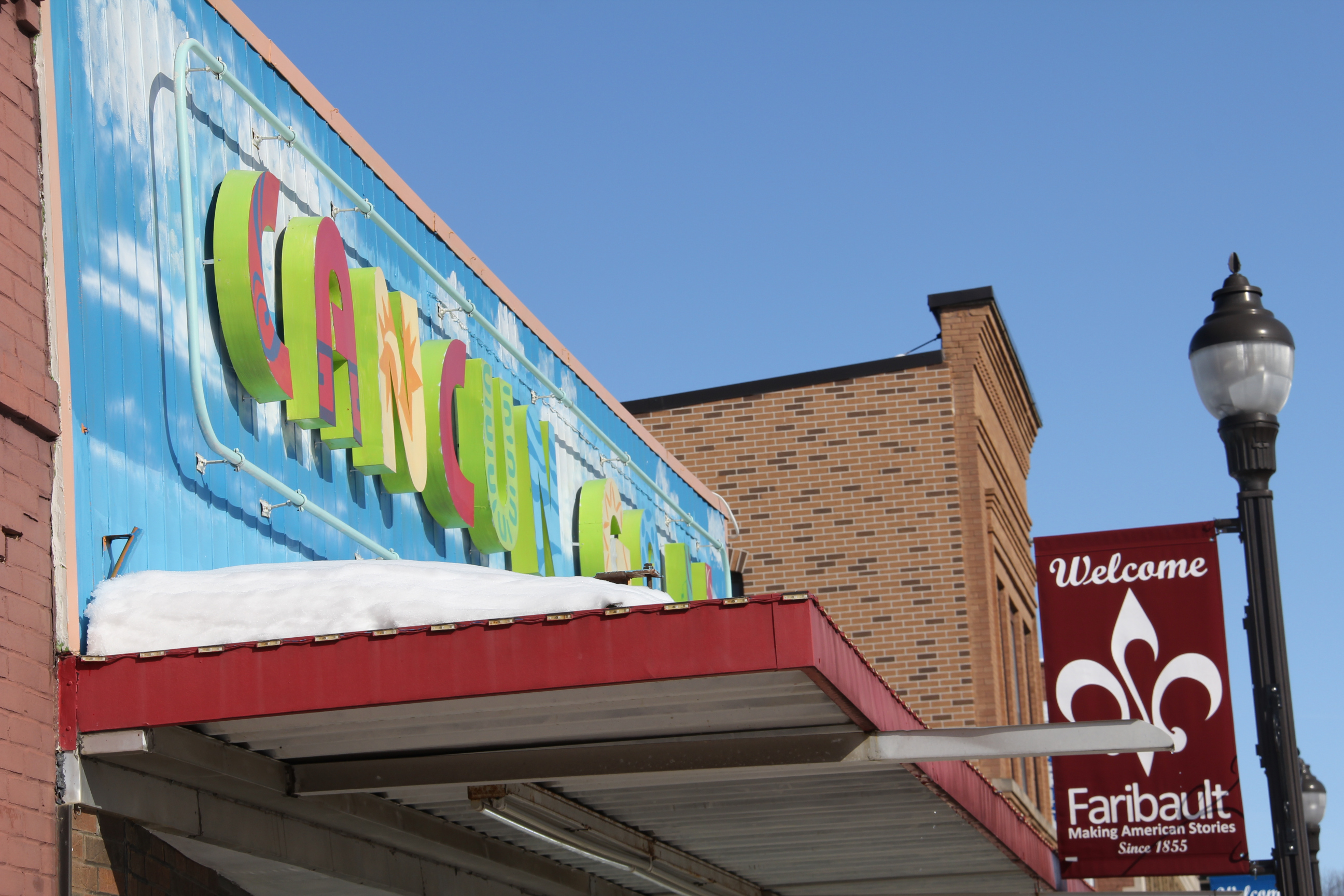
Even the Cancun Grill business sign is tropically inviting. (Minnesota Prairie Roots copyrighted photo February 2023)
Now it’s too late to experience this taste of Cancun in my southern Minnesota community. But I can dream. I can dream of palm trees I’ve never seen, except at Como Park Conservatory in St. Paul. I can dream of places I’ve never visited. I can dream of staying at an all-inclusive fancy resort, of warm beach sand filtering through my toes and sunshine on my face. I can dream of lazy days lounging by the sea with a good book rather than time spent shoveling snow.
In this moment I am not in Minnesota, enveloped in a wintry landscape. Rather, my imagination melts away the snow, replacing it with beach sand so white I need sunglasses. Ah, this is lovely, this Cancun of fleeting travel.
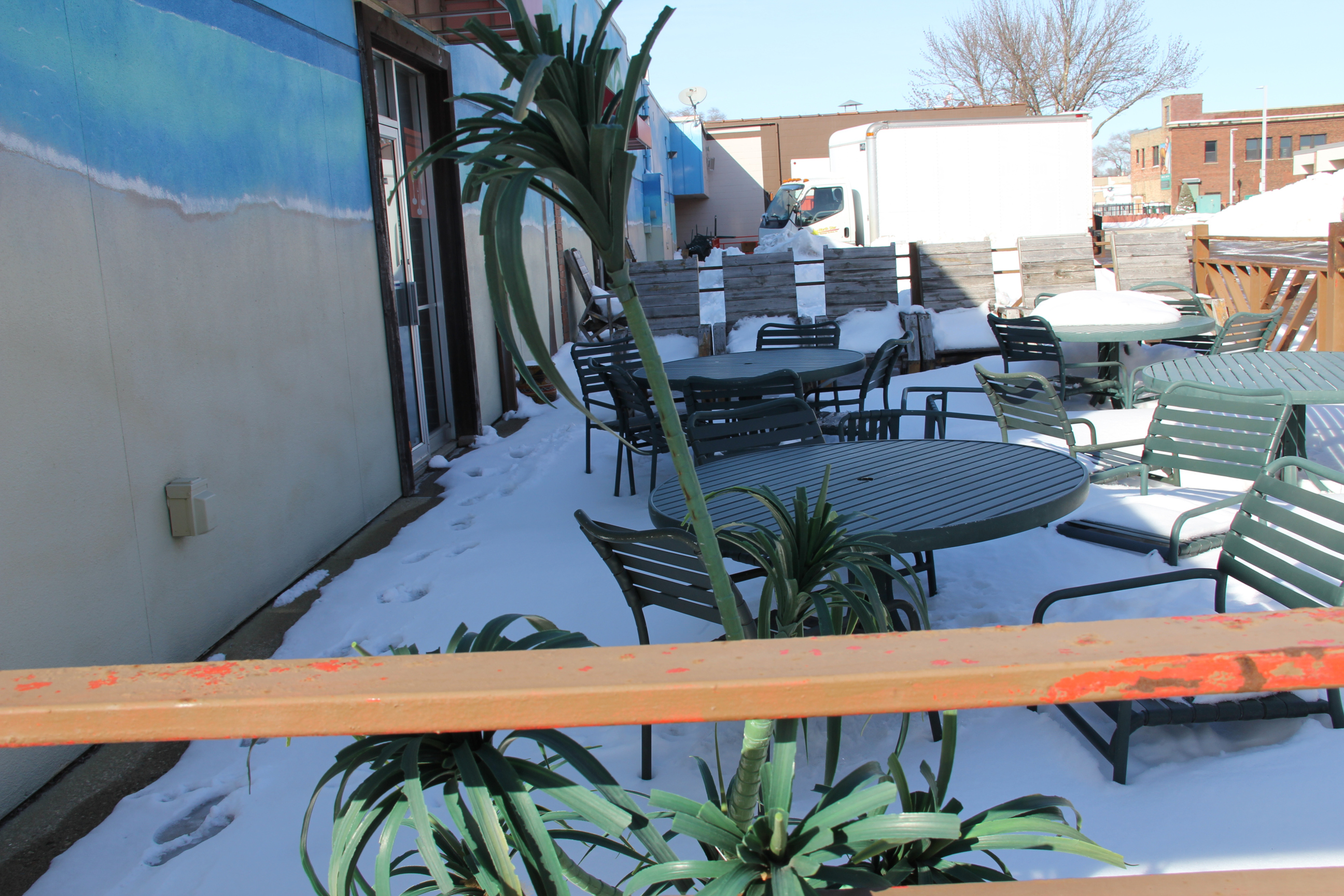
A fake tropical plant stands inside the gated patio next to the tropical mural. (Minnesota Prairie Roots copyrighted photo February 2023)
This permanently closed restaurant along busy Fourth Street Northwest/Minnesota State Highway 60 in Faribault offers me a momentary escape. I feel the breeze as palm trees sway against the merging blue sky and water while I sip a strawberry margarita on the sun-drenched patio.
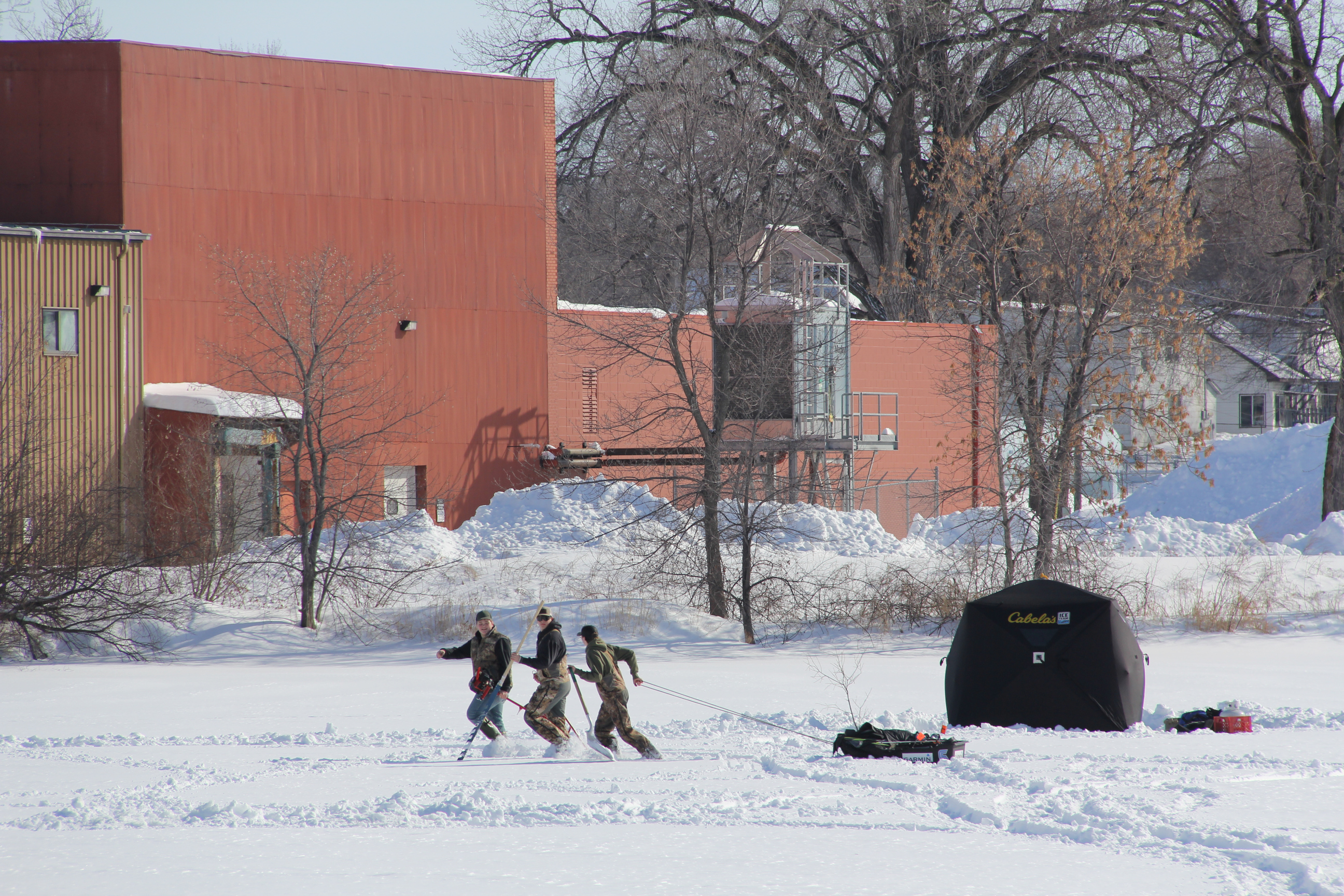
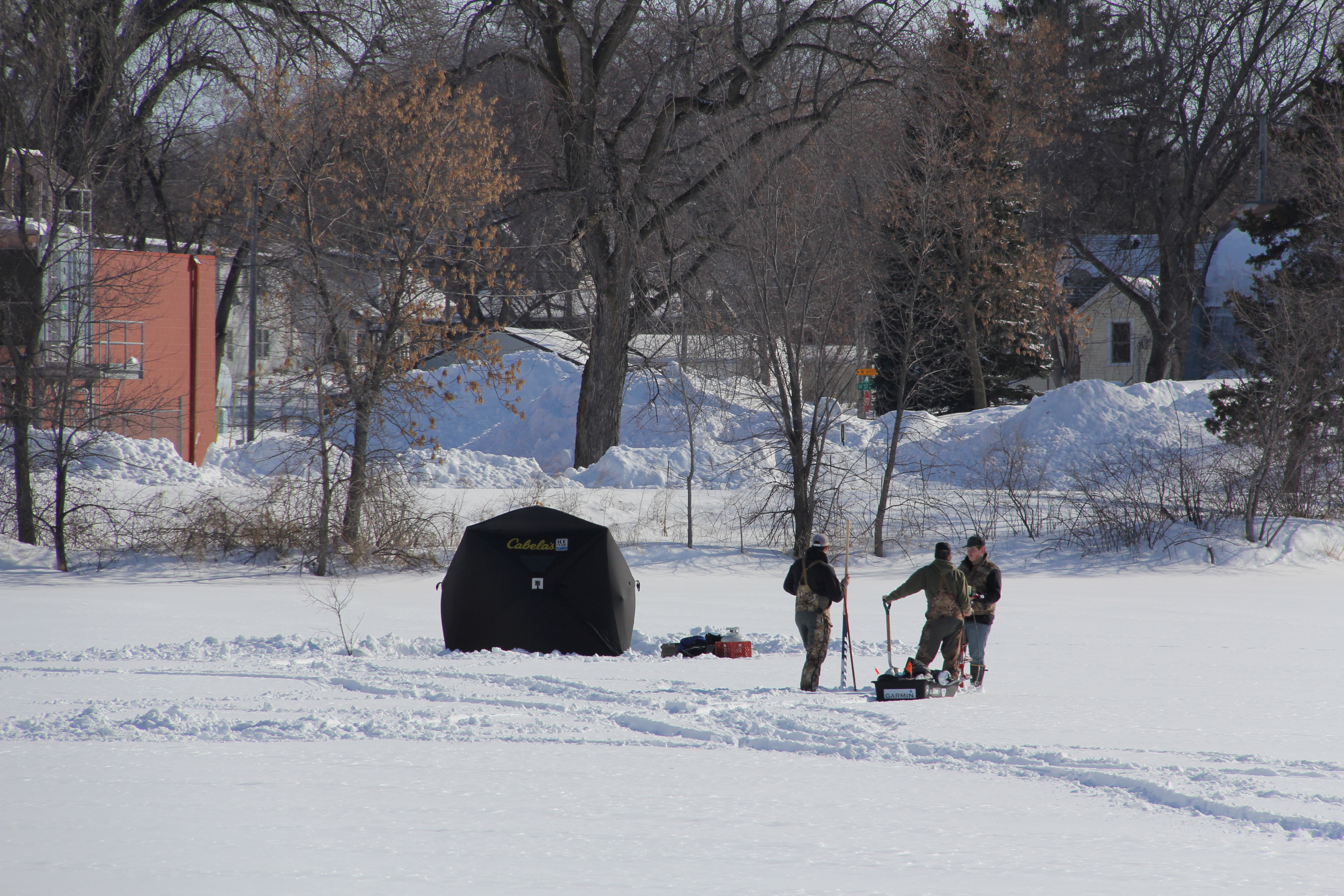
Carting ice fishing gear across the snow-covered Cannon River by the Faribault Mill. (Minnesota Prairie Roots copyrighted photo February 2023)
ICE FISHING RATES AS A SPORT that must seem absurd to anyone living in a warm weather climate.
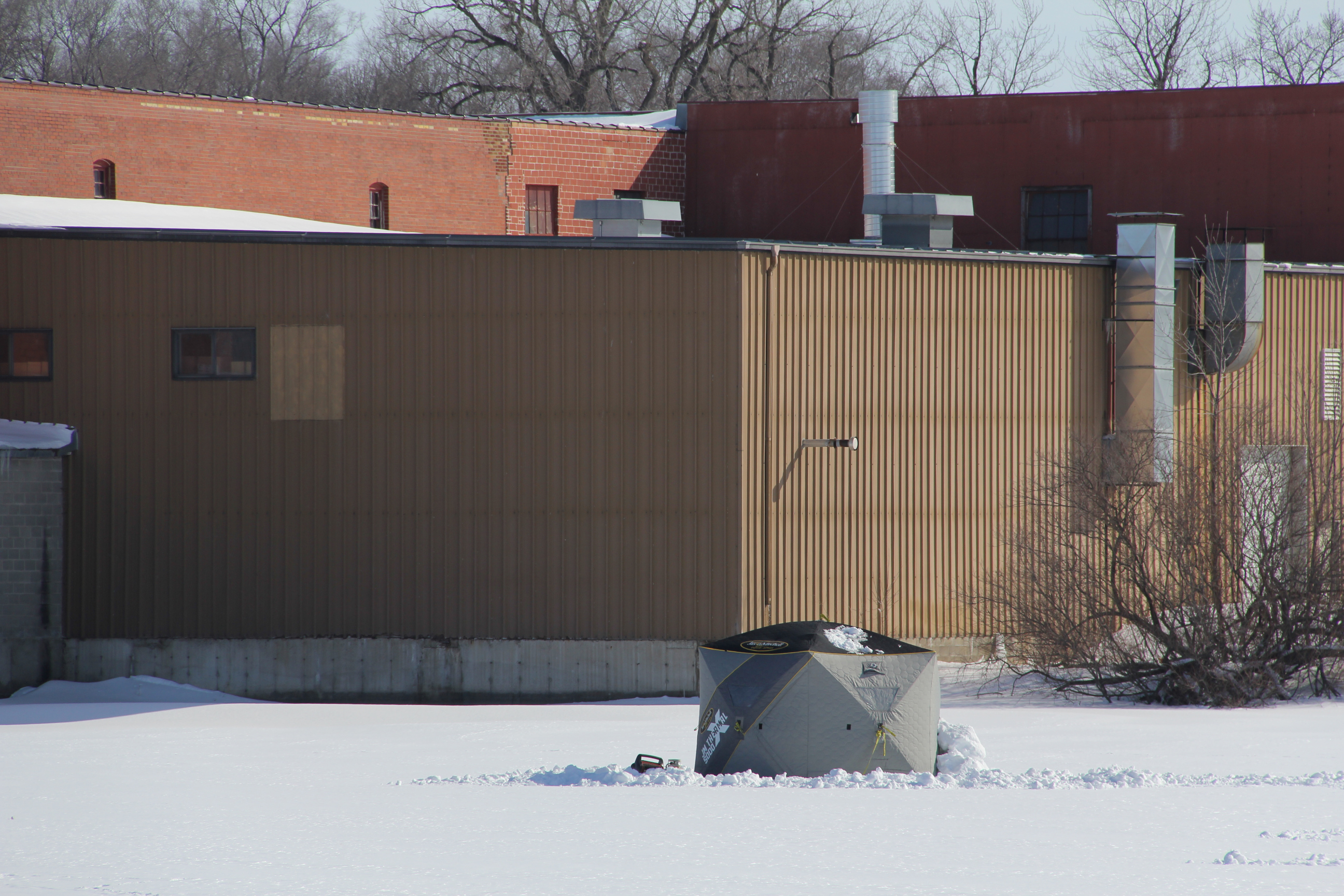
The second portable fish house the anglers set up on the Cannon River near the mill. (Minnesota Prairie Roots copyrighted photo February 2023)
I mean, if you aren’t from a place like Minnesota or Wisconsin, how would you react to anglers driving their vehicles onto a frozen lake, fish houses in tow? That seems reckless and unsafe and dangerous, and it can be. No ice is ever considered 100 percent safe. But, take precautions like knowing your lake (or river) and its ice thickness, driving with windows rolled down and carrying safety equipment, and the sport can be relatively safe.
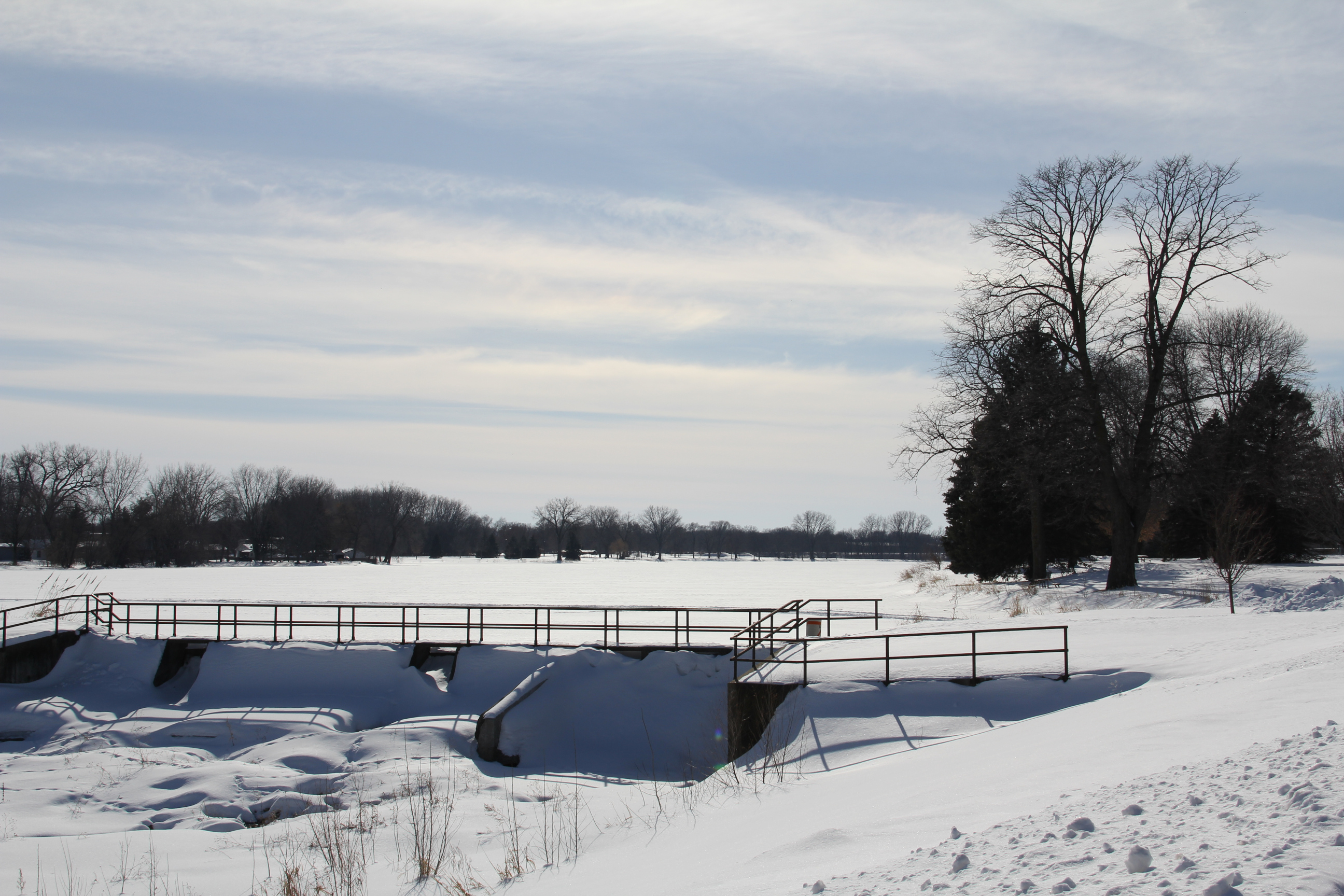
A view of the dam and frozen Cannon River from the recreational trail in North Alexander Park. There are two dams in this location, one next to the woolen mill and then this one. (Minnesota Prairie Roots copyrighted photo February 2023)
Still, this time of year and with the particularly snowy winter we’ve had in Minnesota, ice fishing right now doesn’t seem all that safe to me. Snow acts like a blanket, insulating the ice, resulting in thinner, inconsistent and weaker ice. Decades have passed since I engaged in the sport so I am not writing from current day experience, only from basic knowledge.
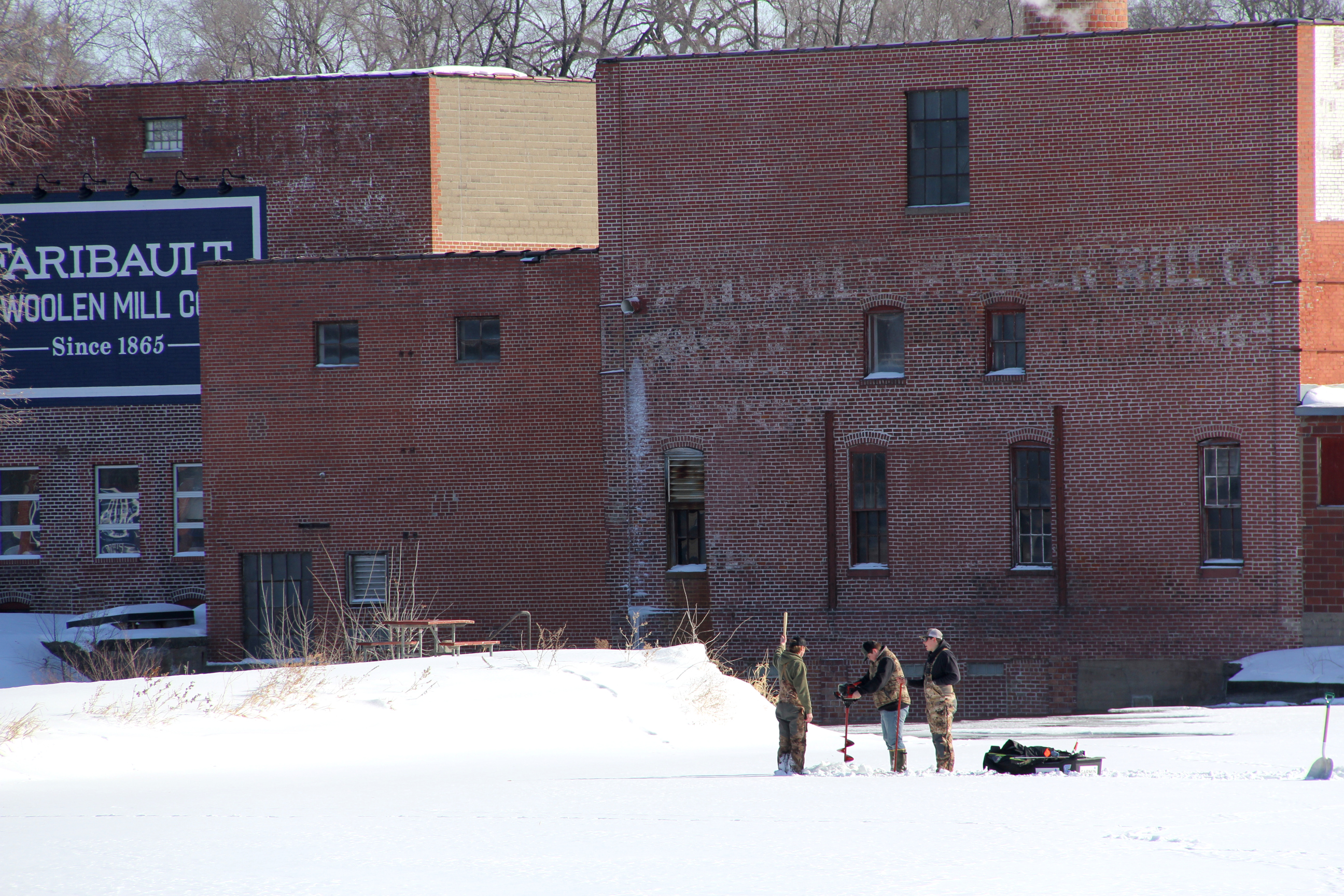
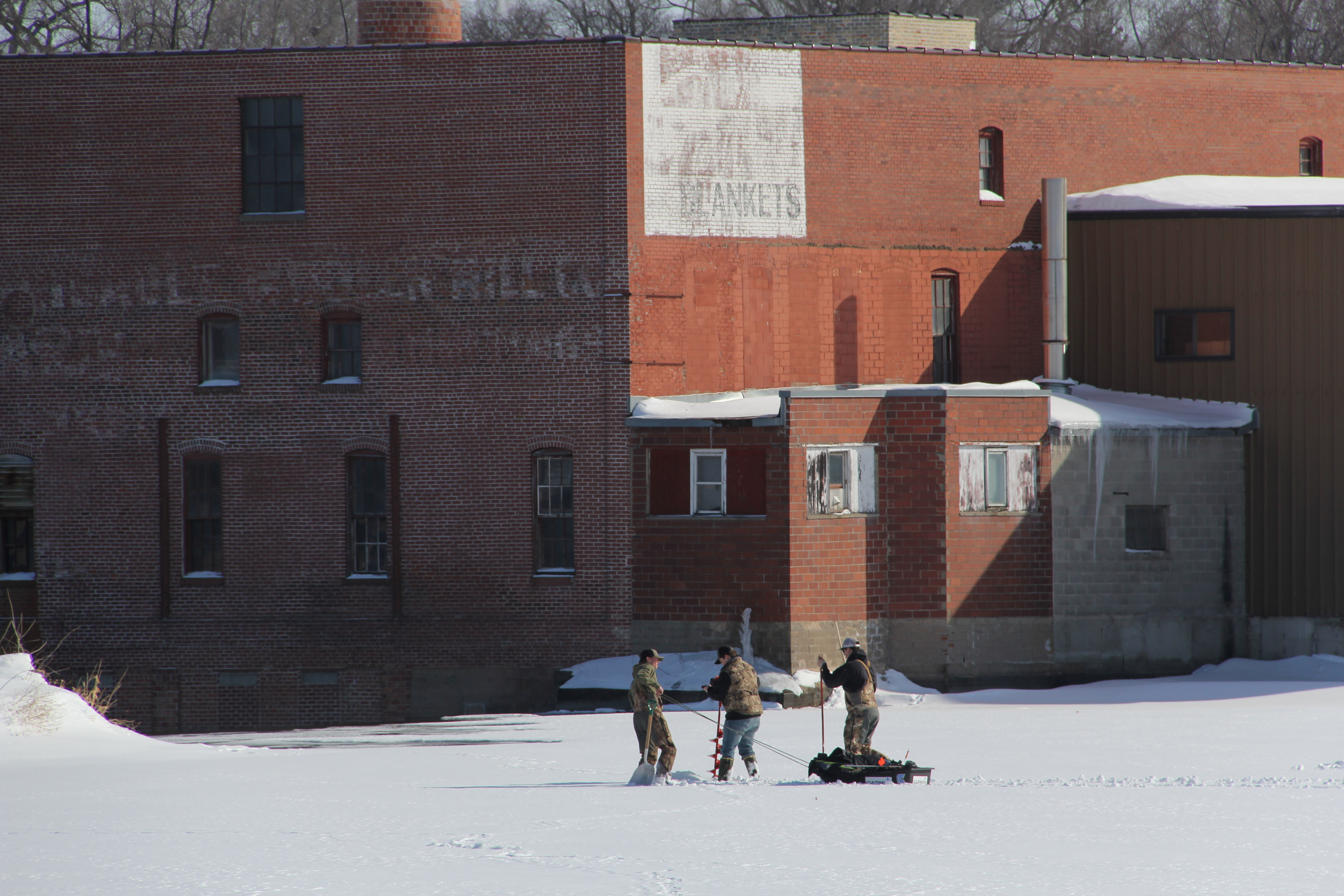
Drilling a hole in the frozen river near the top of the Woolen Mill Dam. (Minnesota Prairie Roots copyrighted photo February 2023)
Sunday afternoon while out and about in Faribault, I came upon three guys with ice fishing equipment on the frozen Cannon River Reservoir by the Woolen Mill Dam. As I watched, I hoped they knew what they were doing because I didn’t feel all that confident in the strength of the river ice with water flowing below.
I can almost hear the discussion about where to drill holes in the ice. (Minnesota Prairie Roots copyrighted photo February 2023)
But I appreciated that they were out enjoying the 30-degree sunny afternoon, warm enough even to shed their gloves and heavy coats. They’d already set up two portable fish houses by the time I arrived at North Alexander Park. I stood there and observed as the trio carried ice auger, ice saw, and scoop shovel and towed a sled with fishing gear across the snow-covered river. I was uncertain whether they were spearing for or simply angling for fish. Turns out neither.
Local avid outdoorsman and columnist Larry Gavin clarified: Those guys were actually netting carp. The net is stretched from one tent to the other using a hook and a series of holes. They were checking to see if the location was a good one. Every year they net Wells Lake and get a semi tanker full of carp that are shipped overnight to Chicago. There is a high demand for carp as a food source in some ethnic dining.
Turning the ice auger into the ice to create a hole. (Minnesota Prairie Roots copyrighted photo February 2023)
It was such an iconic Minnesota winter scene, the fishermen in their camouflage attire, a visual clue that they are year-round sportsmen. I can only imagine the camaraderie, the BS, the anticipation of these friends as they searched for fish.
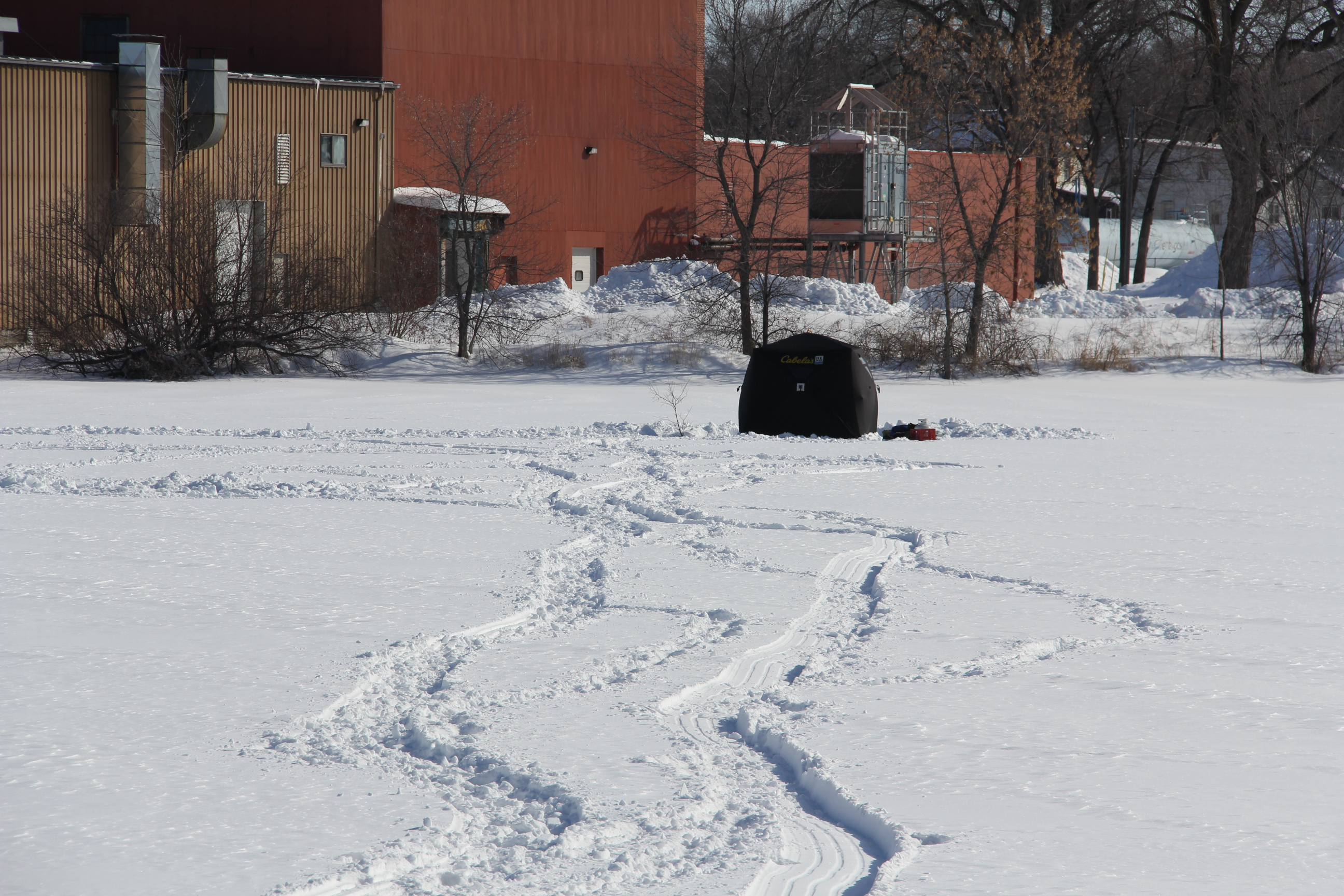
A sled trail across the river to the portable fish house. (Minnesota Prairie Roots copyrighted photo February 2023)
I loved the way their sled left a snaking trail across the Cannon, almost like a line of poetry winding through the snow, writing of winter outdoors, of fish tales, of ice fishing in Minnesota.
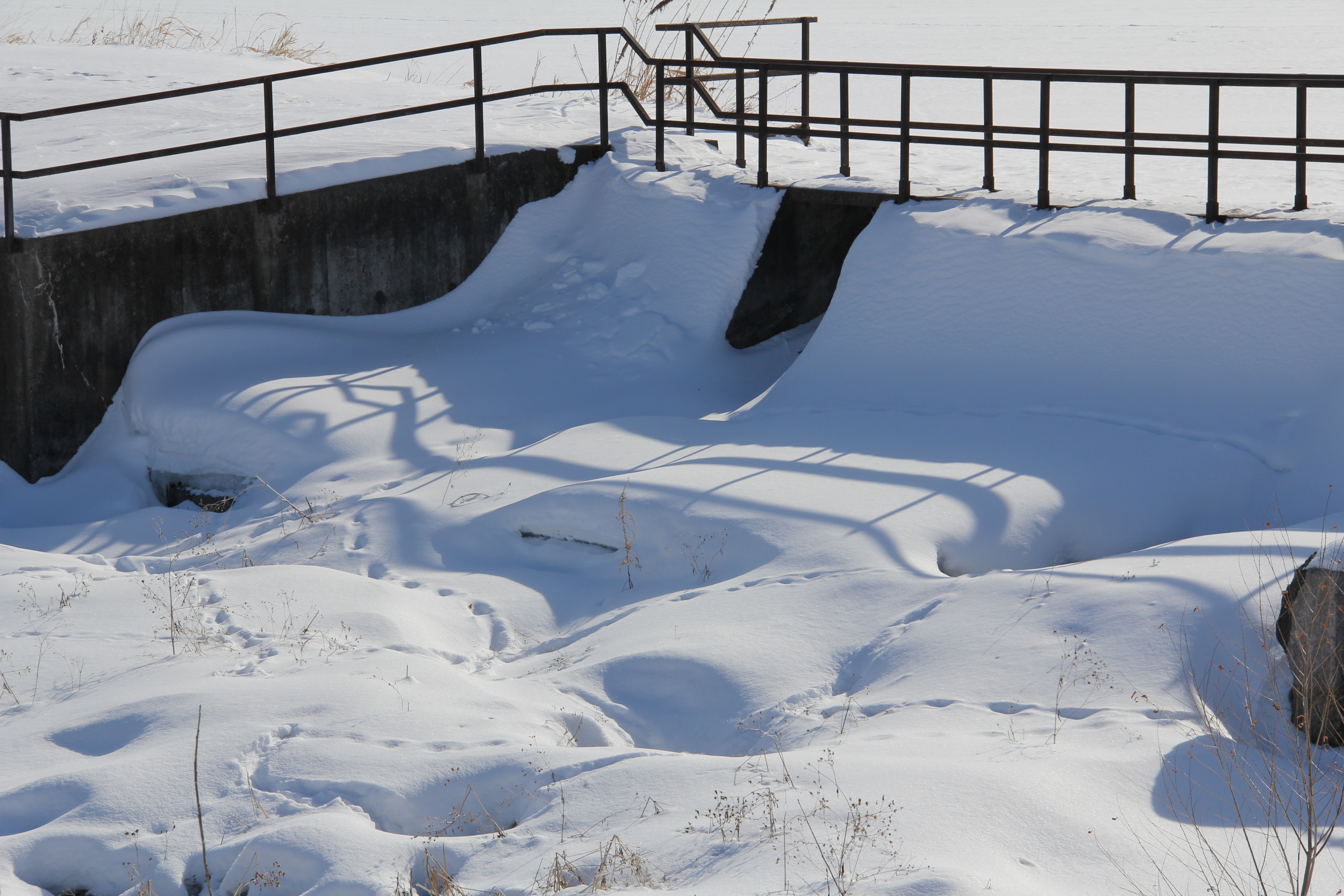
Animal tracks through the snow below the Cannon River dam nearest the recreational trail. (Minnesota Prairie Roots copyrighted photo February 2023)
FYI:The ice fishing season is winding down in Minnesota. All dark houses, fish houses and portables must be off inland lakes by the end of the day beginning on March 6 in the southern two-thirds of the state and by March 20 in the northern third. You can still ice fish, just can’t leave houses unattended. Local officials can set different restrictions if unsafe conditions call for such action.
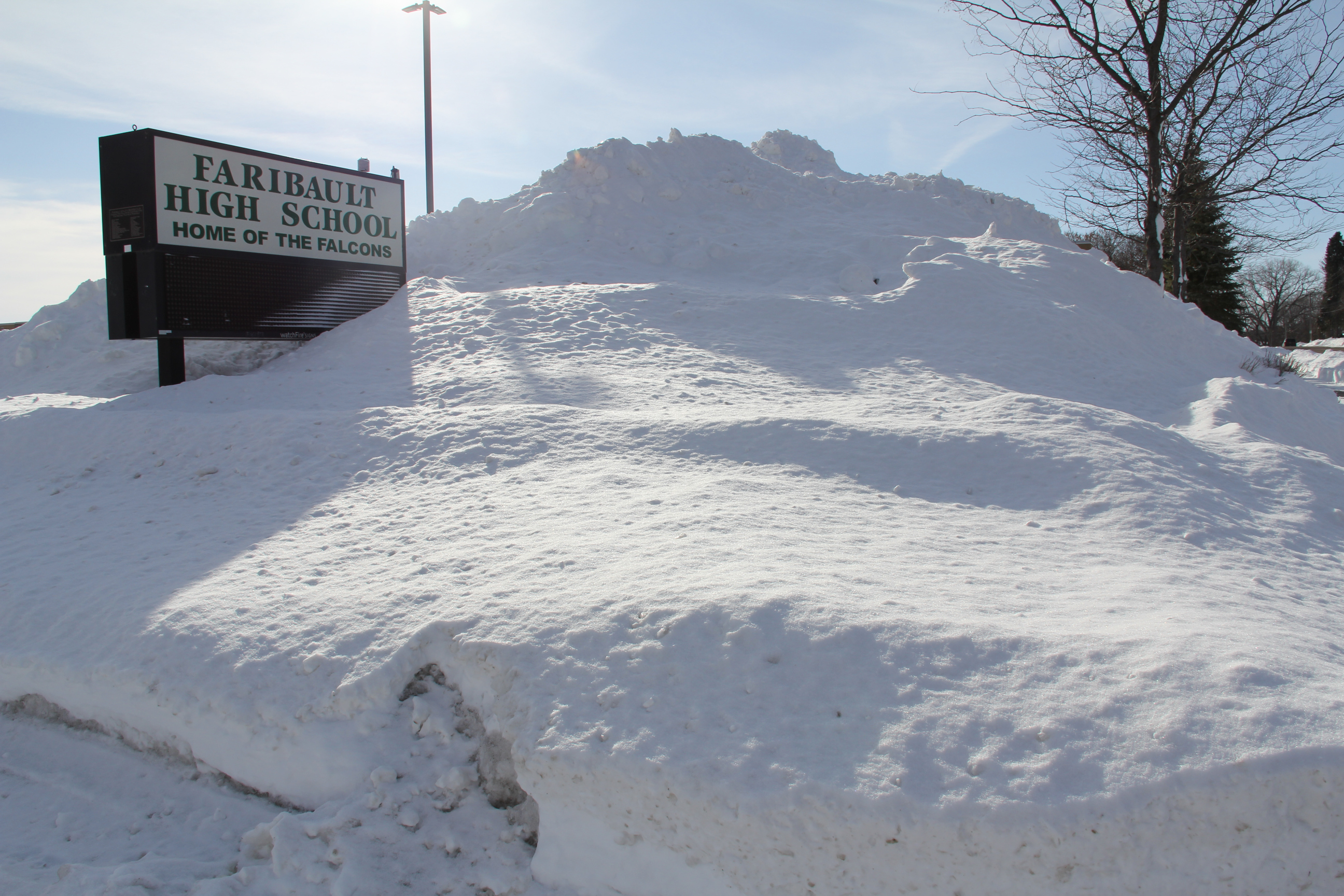
A massive snow pile fills a corner and side of the Faribault High School parking lot. (Minnesota Prairie Roots copyrighted photo February 2023)
BEFORE THE RAIN OF MONDAY, which reduced our significant snow pack, I determined to document the snowy landscape of Faribault. Plus, Randy and I needed to get outdoors, stretch our legs and embrace the 30-some-degree warmth of a sunny Sunday afternoon.
A different view of the FHS snow pile shows the length and height of the mountain in comparison to the vehicle pulling up to the intersection. (Minnesota Prairie Roots copyrighted photo February 2023)
Traveling around town these days requires a bit of extra caution, starting in our driveway. The towering snowbanks flanking the ends necessitate creeping out, all the while trying to see whether any vehicles are approaching. The same goes for many intersections around my community. It’s been a few winters since I’ve seen snow mounded this high. City crews are doing a good job of moving or removing snow to increase visibility. They were on my corner Monday morning to clear snow from the storm sewer drain and intersection.
From behind the massive FHS snow pile, the rambler across the street is barely visible and seems dwarfed in comparison. (Minnesota Prairie Roots copyrighted photo February 2023)
Parking lots hold mountains of snow which take me back to just how much fun I had as a kid playing on the massive piles of snow my dad built with the loader on his John Deere tractor. Up and down the snow hills my siblings and I ran, playing Canadian Mounties or whatever our imaginations decided.
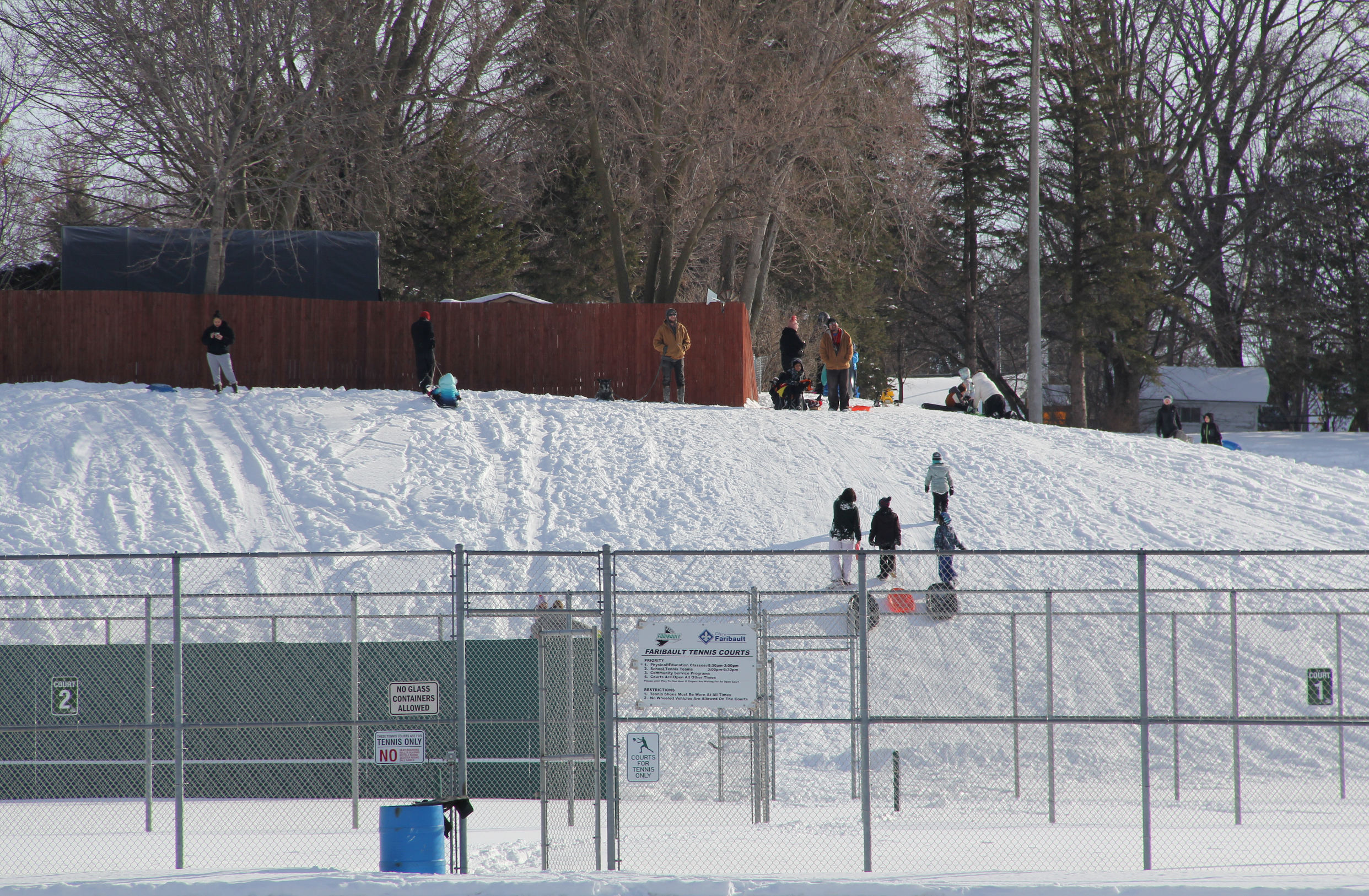
The sledding hill by Faribault High School proved a popular place Sunday afternoon. (Minnesota Prairie Roots copyrighted photo February 2023)
In Faribault on Sunday, I observed families scaling the hill by the high school after sliding down. I love seeing kids enjoying winter outdoors in Minnesota.
Many Minnesota schools, including Faribault Public Schools, have closed during snowstorms and gone to distance and/or e-learning. (Minnesota Prairie Roots copyrighted photo February 2023)
In a corner of the high school parking lot, the snow is pushed so high that I’m clueless as to how it got that high. It’s impressive. I don’t even want to think about how long it will take for that glacier to melt. June?
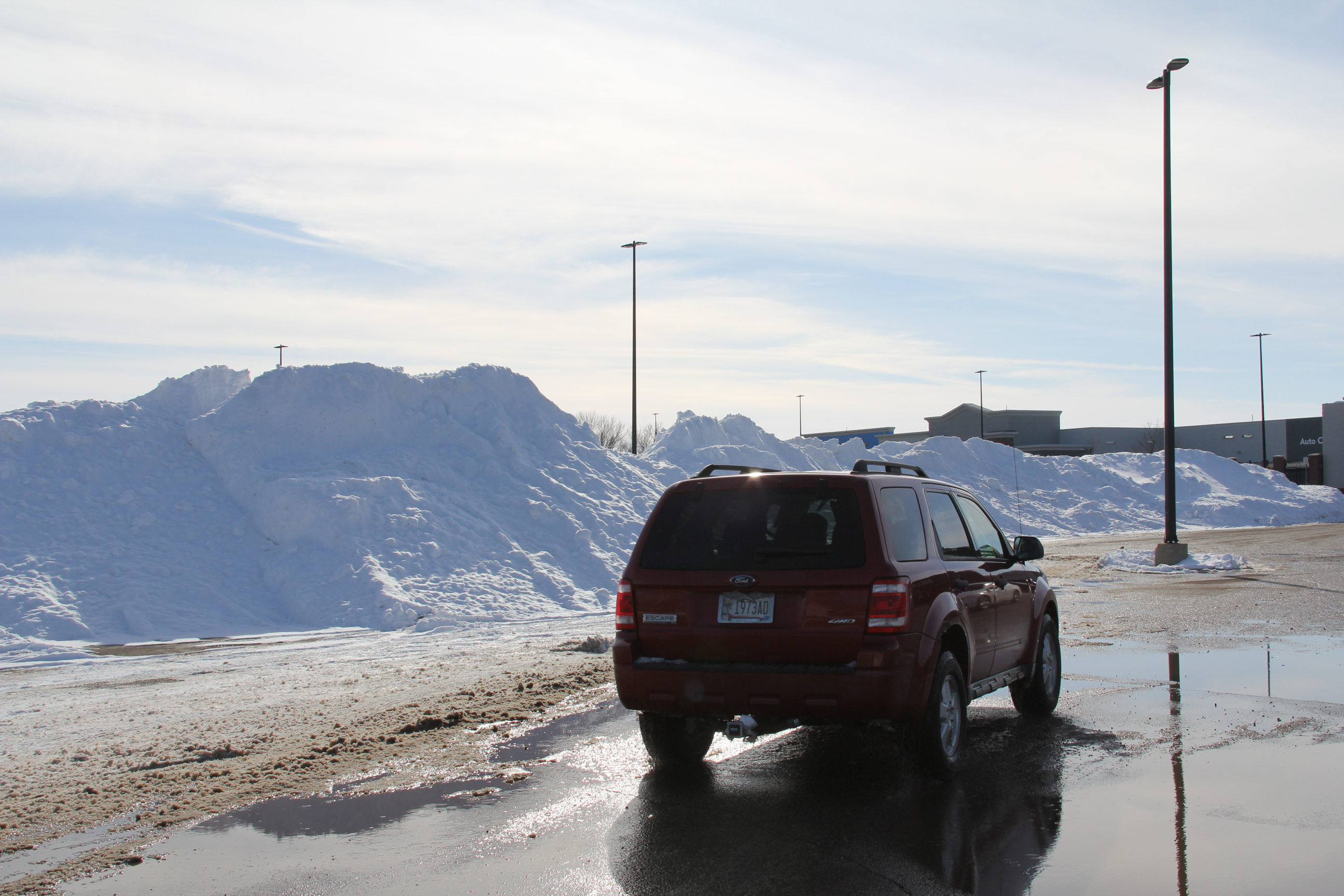
Mountains of snow fill the parking lot at the Faribo West Mall. Walmart is barely visible in the distance. (Minnesota Prairie Roots copyrighted photo February 2023)
The same goes for the snow piled in the Faribo West Mall parking lot. Or maybe it’s the Walmart parking lot. The roofline of the discount retailer is barely visible.
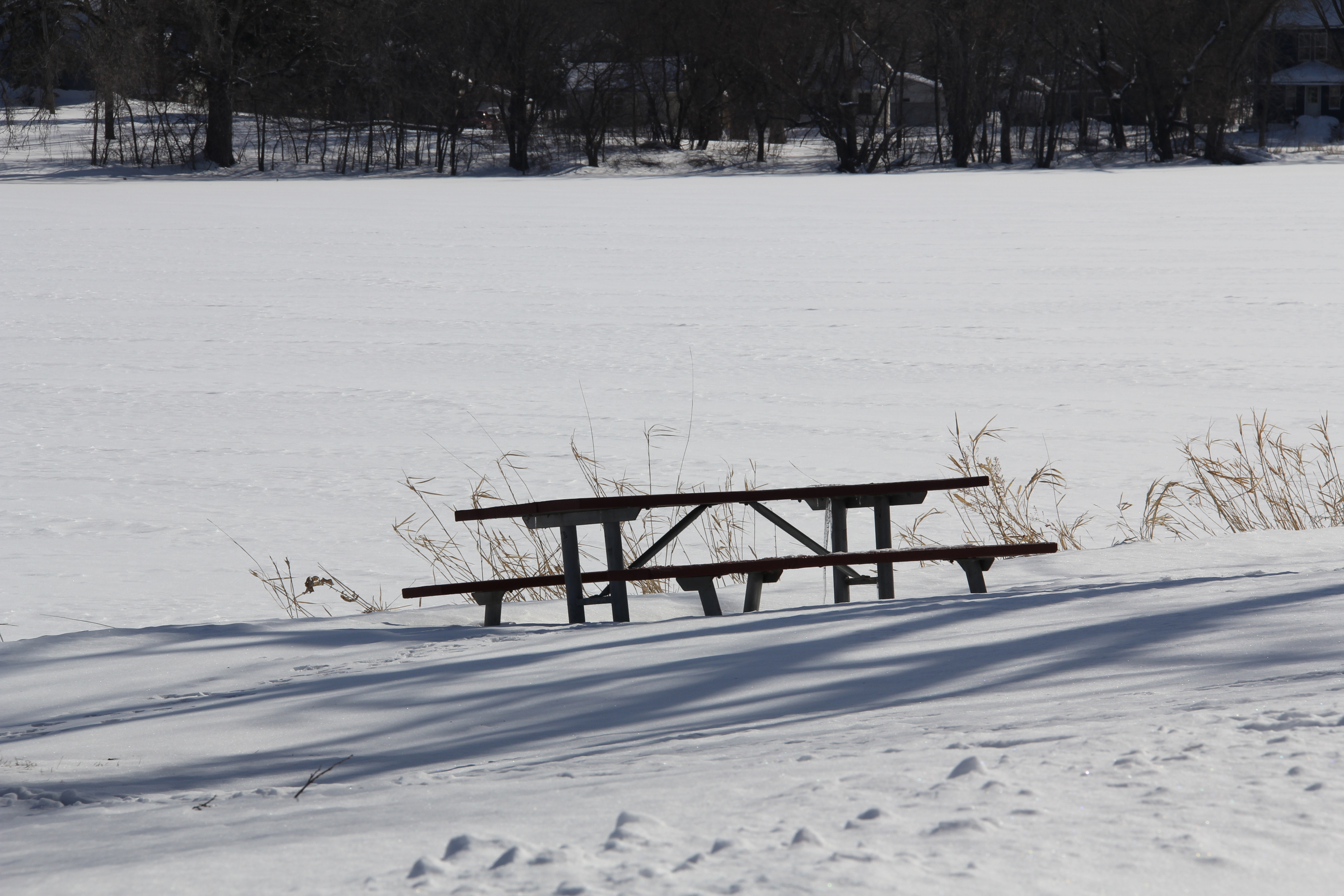
A picnic table sits along the bank of the frozen and snow-covered Cannon River in Faribault’s North Alexander Park. (Minnesota Prairie Roots copyrighted photo February 2023)
Along and near the river in two city parks, picnic tables surrounded by snow remind me that many months will pass before anyone can picnic. Well, I suppose, technically one can picnic in winter, if you are willing to slog through a foot plus of snow to dine.
Carrying ice auger and ice saw and pulling a sled full of gear, this trio of ice fishermen aim toward a spot to fish on the Cannon River by the Woolen Mill Dam. They had set up two portable fish houses. Check back for more images. (Minnesota Prairie Roots copyrighted photo February 2023)
To my photographic delight, though, three ice fishermen slogged through the snow to fish on the Cannon River by the Faribault Woolen Mill Dam. Randy suggested I might want to walk out there for some close-up photos rather than rely on my zoom lens. No, thank you. At this stage in winter, especially, with snow acting as insulation on ice, I don’t trust the ice. These guys, with their portable pop-up fish houses, clearly think differently than me.
My thoughts about right now are those of being ready for winter to end. But, realistically, I understand that we have two months of winter remaining here in Minnesota. As a life-long Minnesotan, I can’t deny that. Onward, into March.
I shot this photo through a partially-frosted upstairs window as Randy began clearing snow from the driveway near the garage. (Minnesota Prairie Roots copyrighted photo February 2023)
THURSDAY MORNING, 10:30 a.m. AND SNOW is still falling here in Faribault. But the sun is breaking through and I am hopeful the snow will soon end. The unofficial yardstick reading on our patio is 14 inches from this three-day weather event.
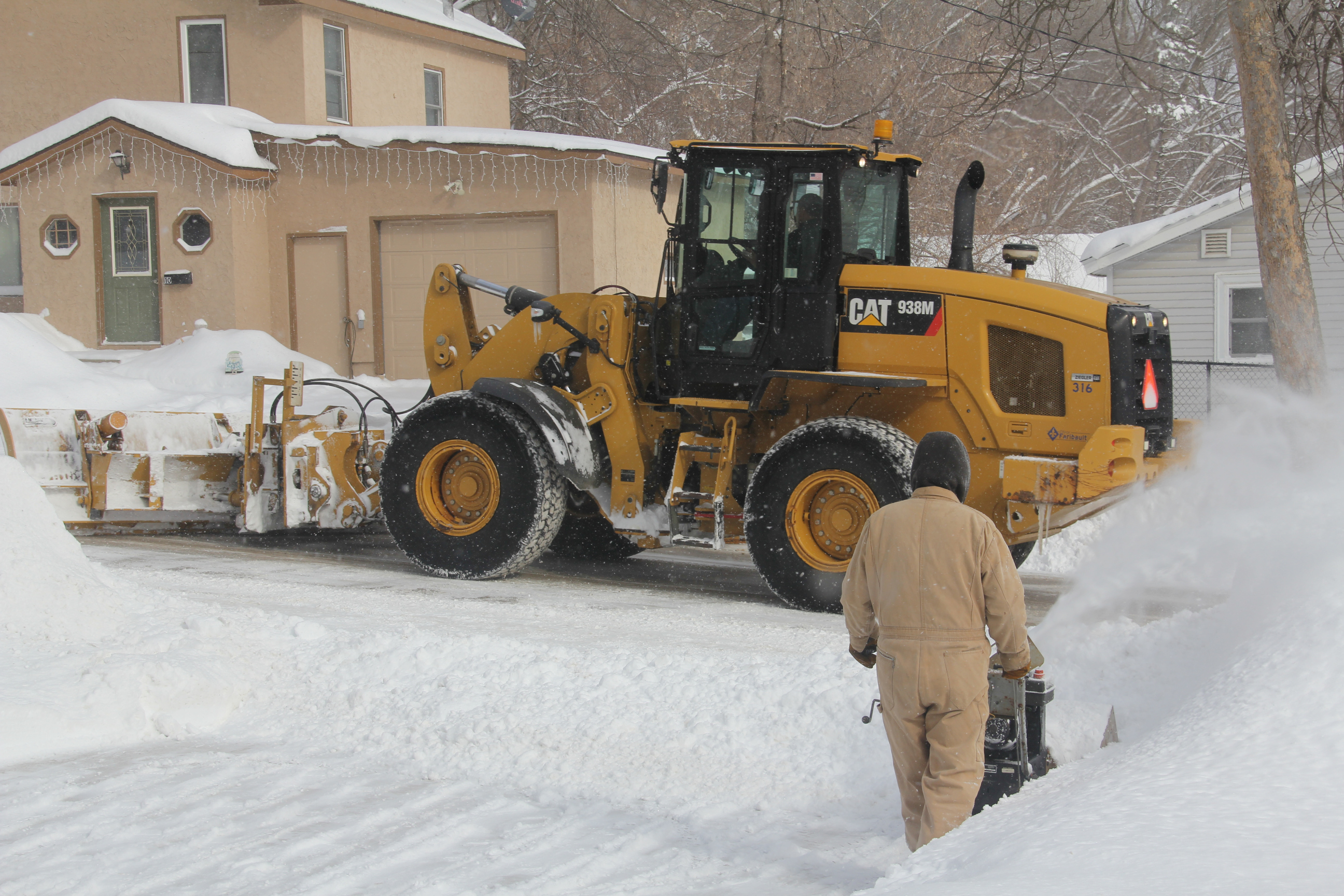
The city snow plow arrives about the same time Randy finishes clearing the driveway, leaving a new ridge of snow. (Minnesota Prairie Roots copyrighted photo February 2023)
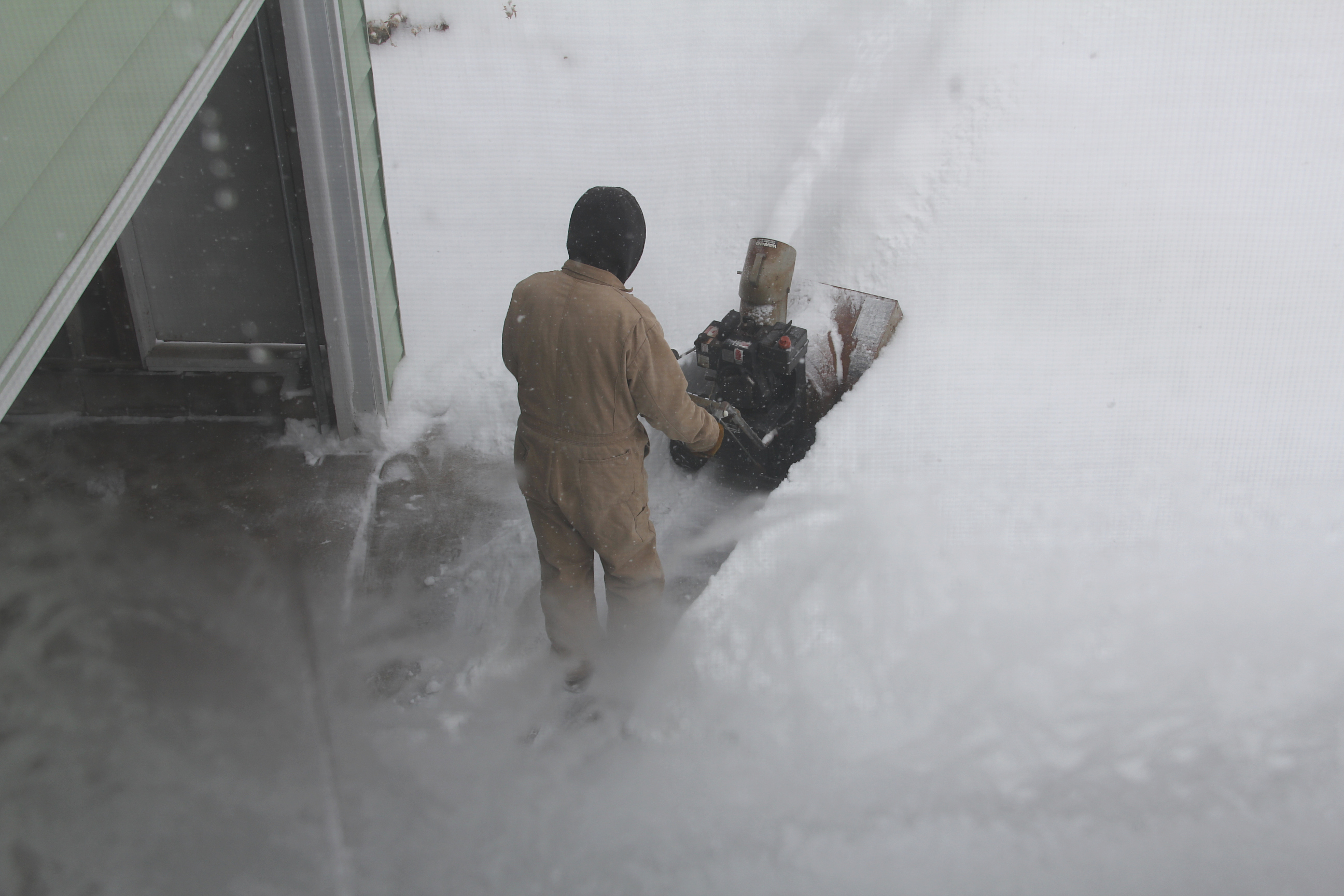
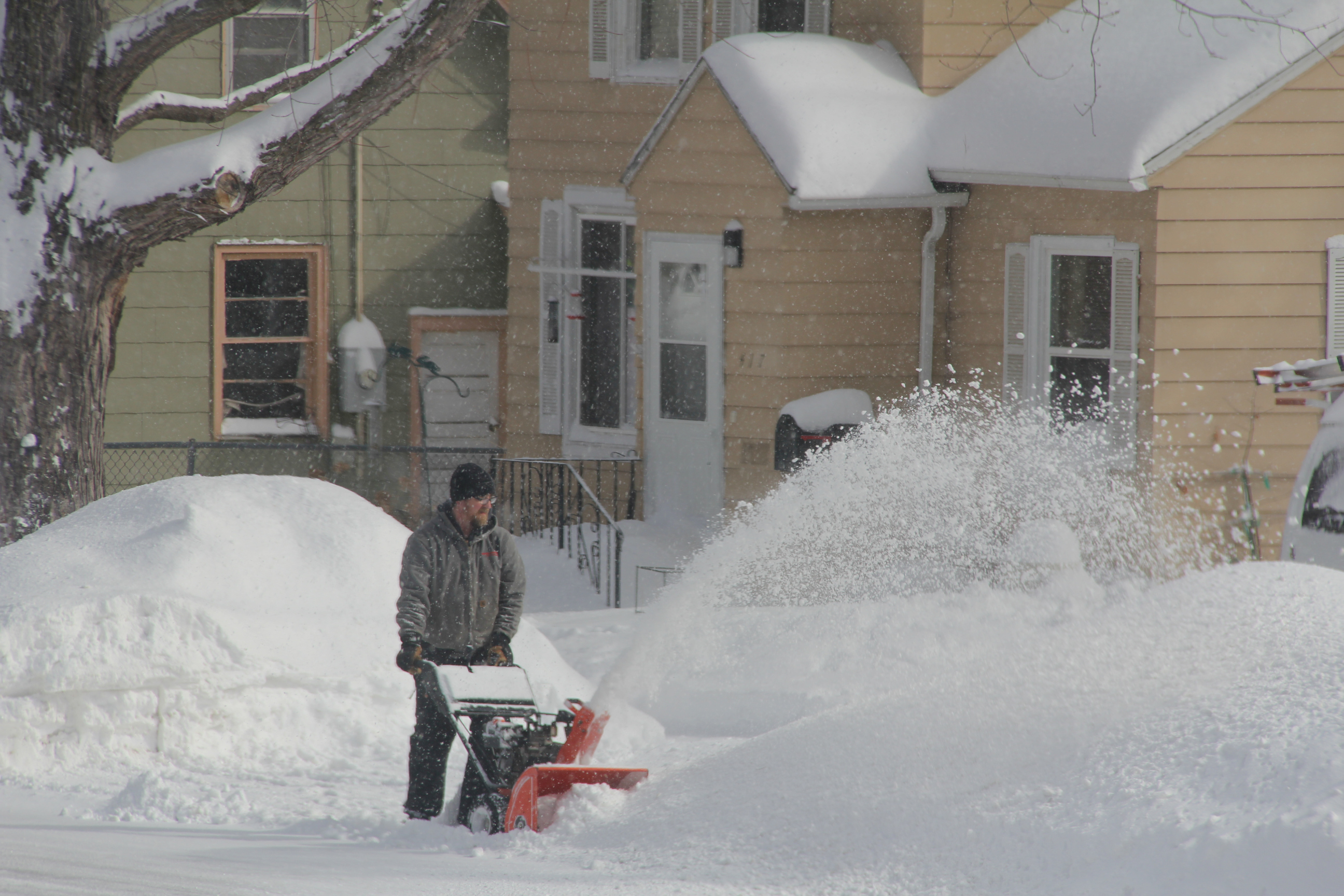
Randy is blowing the driveway open as I write. Just as he nearly finished clearing the end, the city plow arrived, blading a windrow of snow back across the driveway. Timing. Now he’s working on removing that ridge. This is not unexpected; we Minnesotans assume this will always happen.
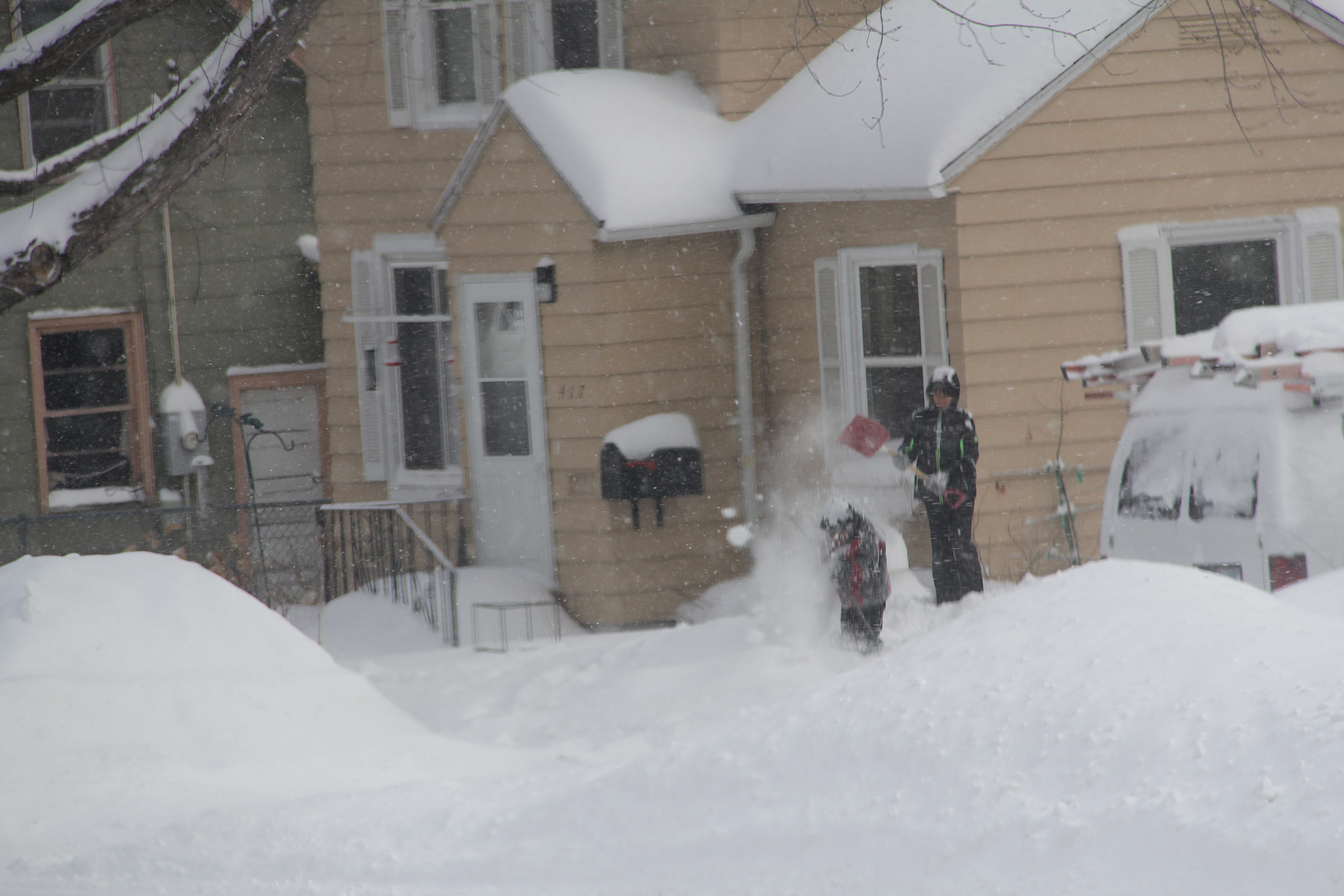
I caught the exact moment one brother dropped snow on the other. (Minnesota Prairie Roots copyrighted photo February 2023)
Neighbors have emerged, too, blowing snow from sidewalks and drives. Across the street, neighbor boys are outside playing. I watched as one scooped snow onto his shovel, waited and then promptly dumped the load onto his brother’s head. Nearby, Dad continued working the snowblower.
A snowy scene in my neighborhood mid-morning Thursday when snow was still falling at a steady pace. (Minnesota Prairie Roots copyrighted photo February 2023)
This is a snow day for Minnesota kids. E-learning and distance learning or maybe no learning at all.
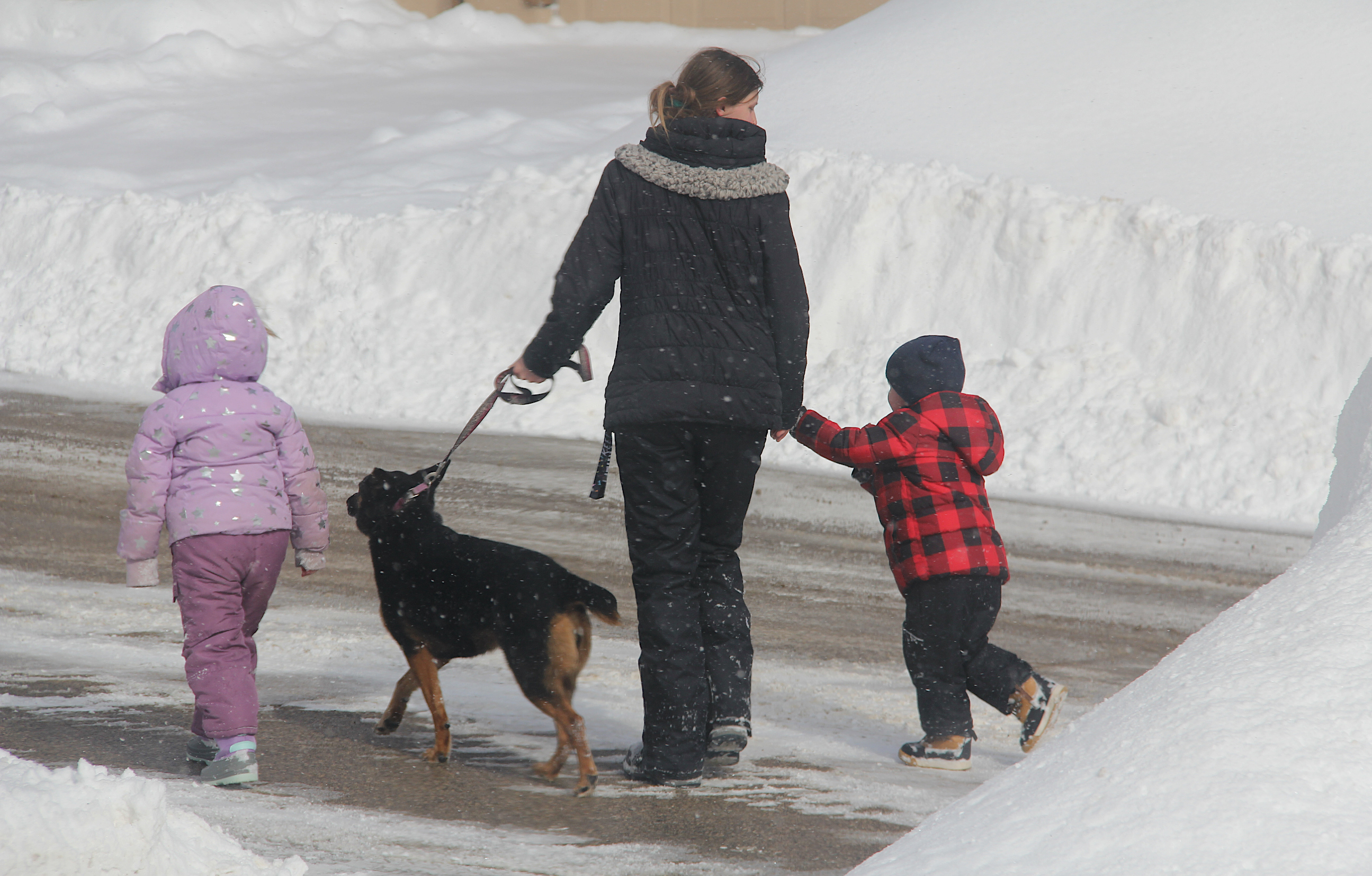
A young family walks their dog late Thursday morning along the snow-banked city street past our driveway. (Minnesota Prairie Roots copyrighted photo February 2023)
A mom and her two little ones are out walking the dog.
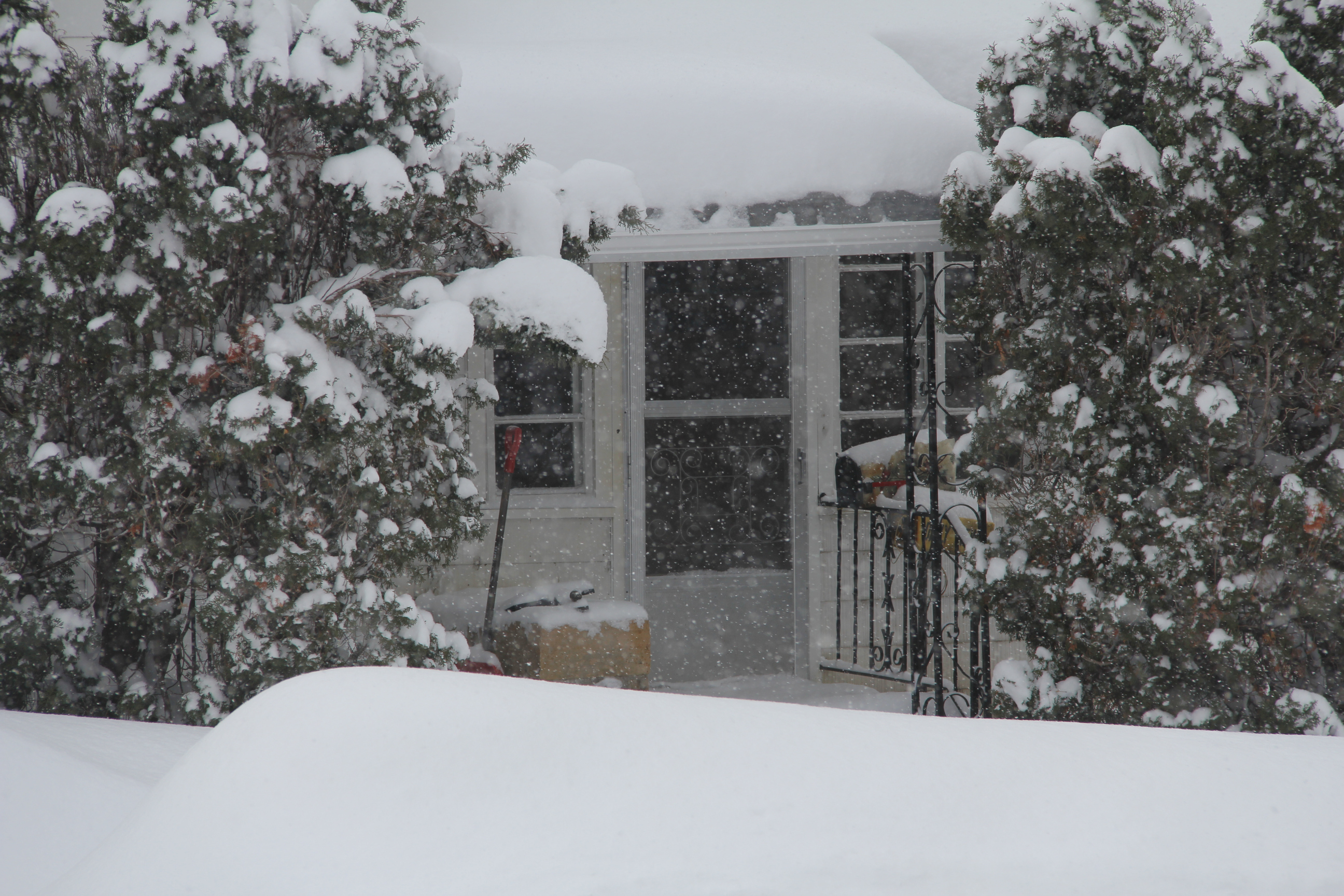
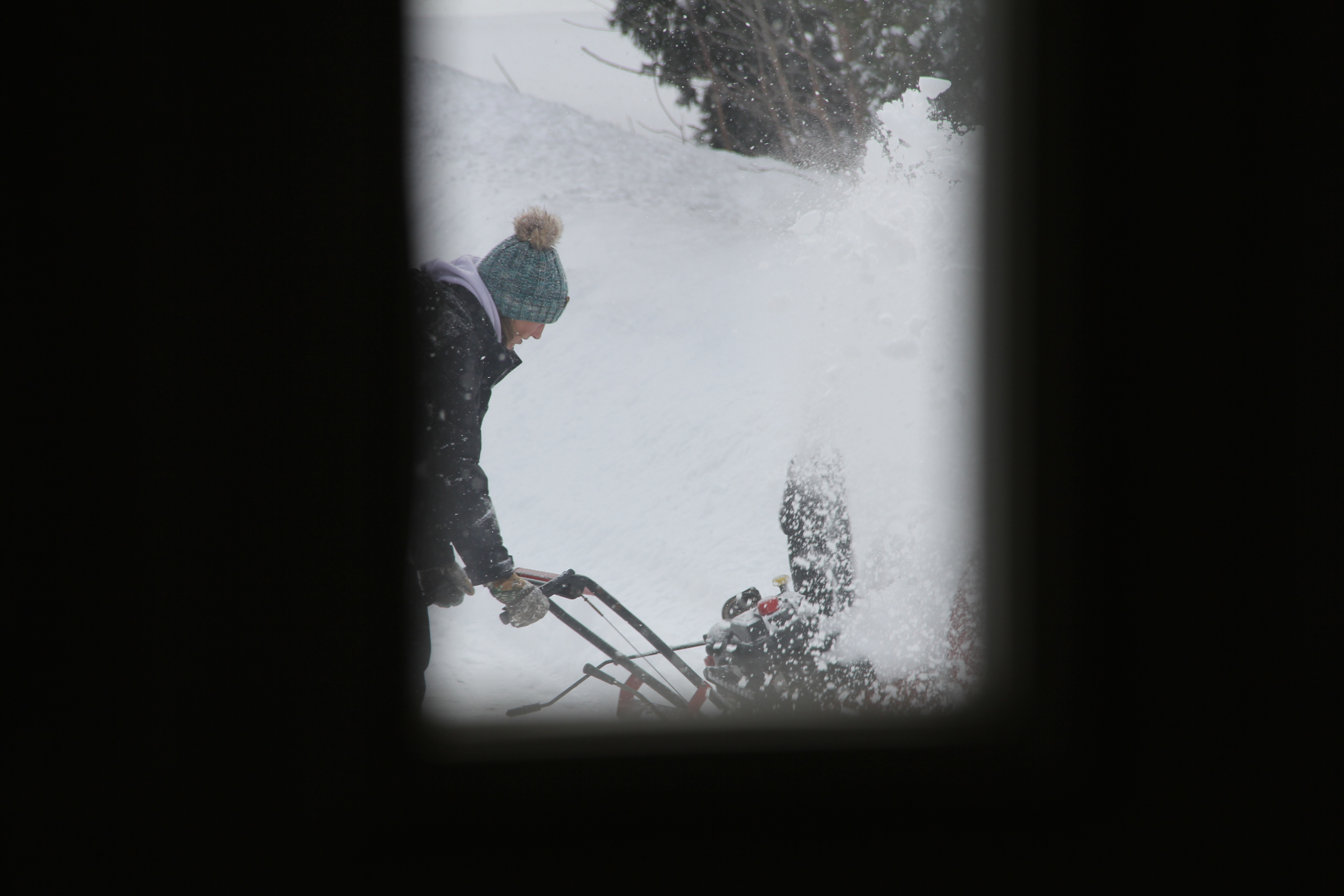
Bent into the task of blowing snow, a neighbor is framed through the window in my front door. (Minnesota Prairie Roots copyrighted photo February 2023)
Businesses and public places—the arts center, the library, the mall, the shoe store—are either closed or opening late. People seem to be heeding the warnings to stay home and off roadways. Even Randy is staying home from work today.
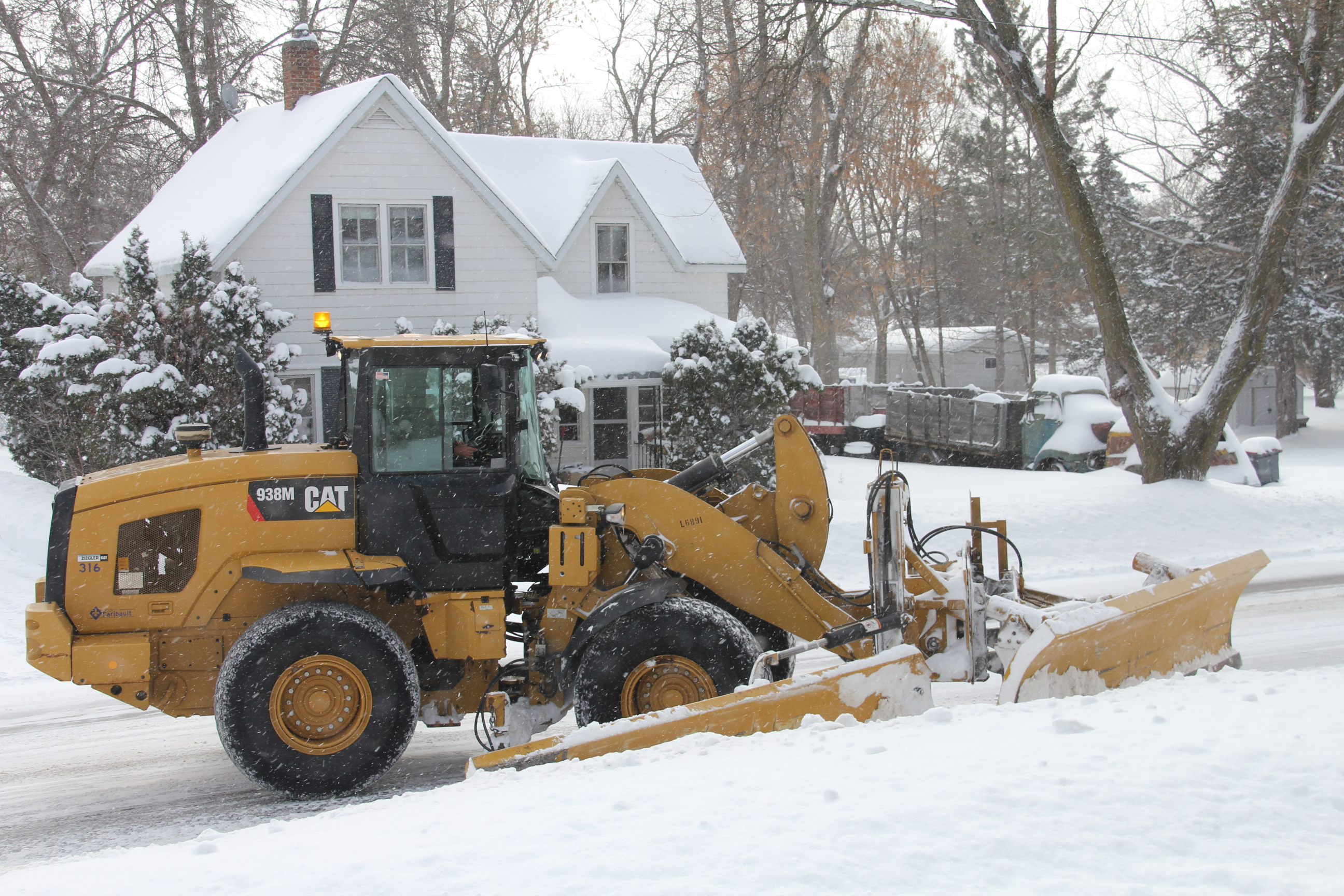
The city plow blades snow from the intersection toward the boulevard in front of our house. (Minnesota Prairie Roots copyrighted photo February 2023)
Traffic, mostly non-existent earlier, is picking up along our main arterial street. Mostly snowplows and pick-up trucks pulling trailers loaded with snow removal equipment.
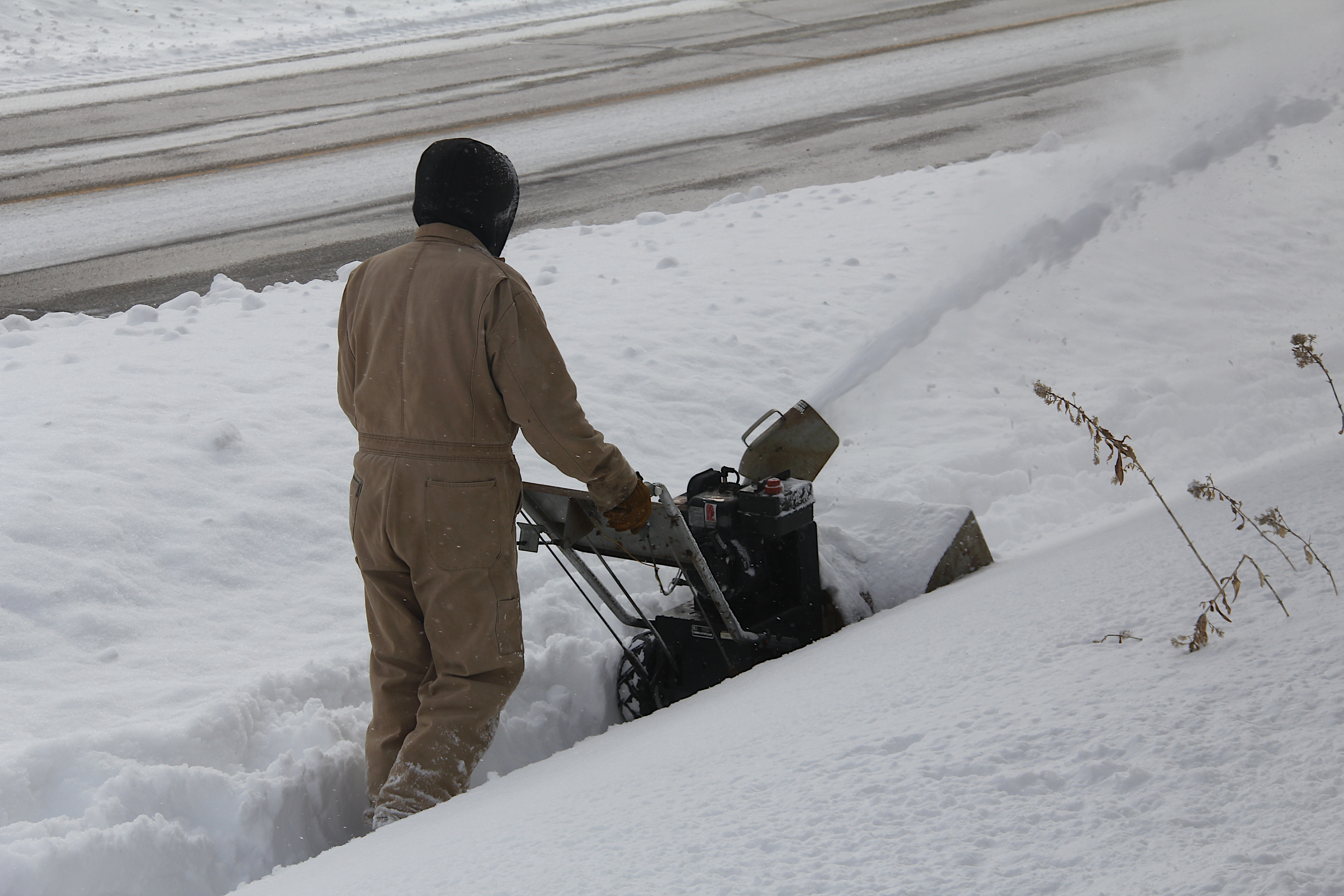
Randy guides the snowblower down the sidewalk past our house and our neighbor’s house. (Minnesota Prairie Roots copyrighted photo February 2023)
In the extreme southwestern corner of Minnesota, my native prairie, a portion of Interstate 90 remains closed along with many state highways. Wind whips this light snow, creating whiteout conditions, snowdrifts feet high and impassable roads. The National Guard is standing by to launch roadside rescues if needed.
A neighbor clears the end of his driveway. (Minnesota Prairie Roots copyrighted photo February 2023)
As snowstorms go, I’ve experienced much worse, especially as a Redwood County farm kid. I respect winter in Minnesota, understand the dangers when a major storm descends. And today, although this storm was not quite the historic storm predicted, I’m good with that. With some 14 inches of total snowfall, that’s enough for me, and Randy.
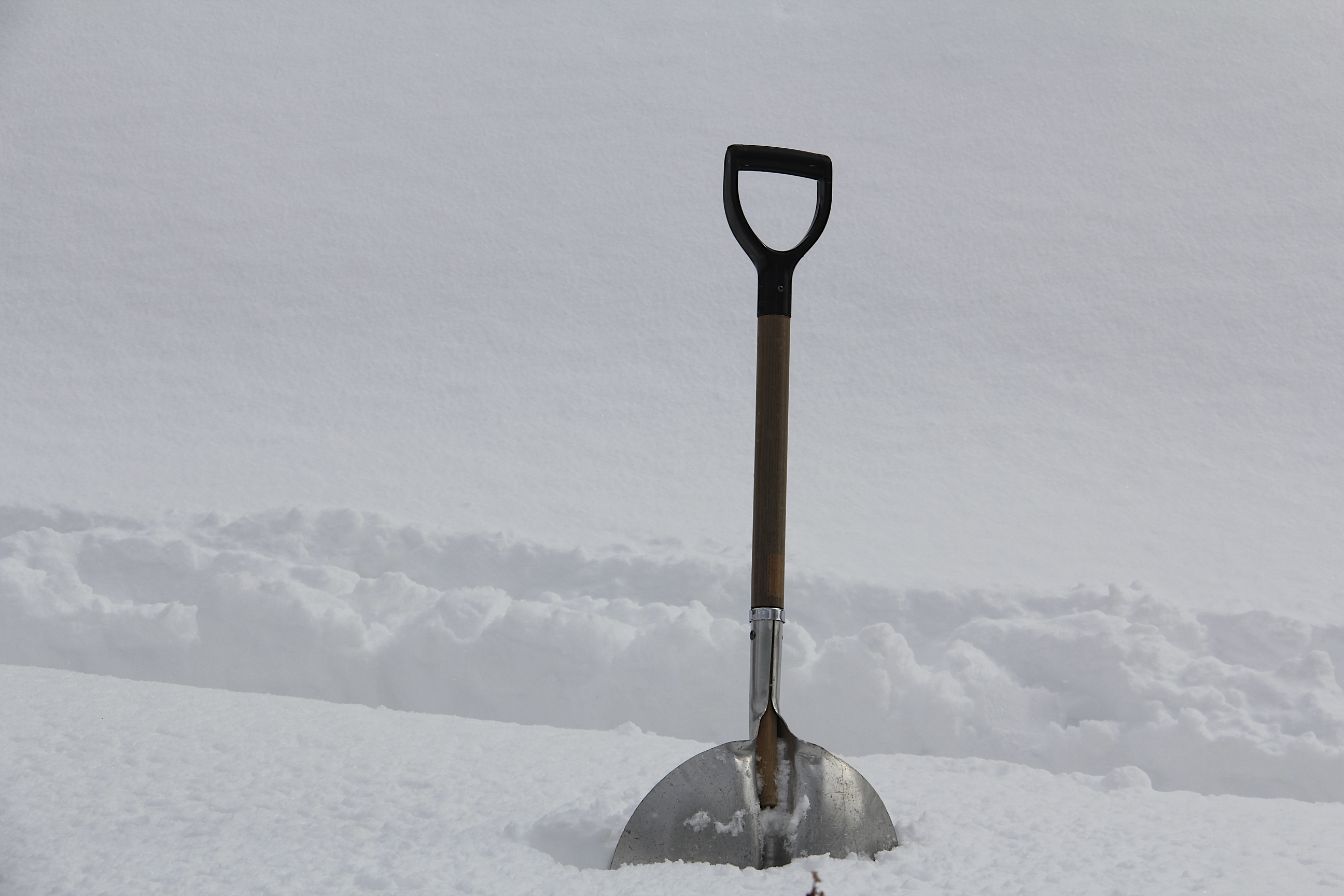
Another snow removal tool, a scoop shovel stuck here in the snow next to the sidewalk. We use it to clear our front steps. (Minnesota Prairie Roots copyrighted photo February 2023)
TELL ME: If you live in Minnesota, how much snow did you get? If you live elsewhere, are you experiencing any bad weather? I’d like to hear your stories.
WHEN A MAJOR WINTER STORM is in the forecast for Minnesota, we Minnesotans listen intently. And then we stock up on eggs, milk and bread. Or so the joke goes. But, in reality, grocery stores do experience an uptick in business. Liquor stores, too. And for anyone who owns a snowblower—and that’s most of us—having enough gas to fuel snow removal is a must, not an option.
So here we are, poised to get massive quantities of snow over several days. Faribault is in the 17 to 22-inch snowfall range, according to the National Weather Service forecast on Monday. That bull’s eye target of snow stretches from western to eastern borders across a wide swatch of southern Minnesota from around Mankato in the south to St. Cloud in the north.
And then as if the large amounts of snow aren’t enough, winds are anticipated to rage, blowing around all that light, fluffy snow. The 40-45 mph winds gusting up to 50 mph will create white-out and blizzard conditions in many regions, especially on the prairie.
This looks to be a doozy of a winter storm that begins on Tuesday afternoon, ends on Thursday evening. Forecasters seem quite confident it will play out as predicted. I expect closures of schools, businesses and more. I expect snow gates (yes, there’s such a thing) to be pulled across interstates and other highways. There will be winter storm (our warning starts at 3 pm today) and blizzard warnings, travel advisories, “no travel recommended” and most likely stranded motorists who need rescuing.
Randy and I are prepared. I have a stack of library books to read. We have 2 ½ dozen eggs (thanks to a friend who has free-range chickens), enough milk and nearly a full loaf of bread. The snowblower gas tank is topped. And the mini fridge in the basement is stocked with craft beer. Yup, we’re ready…
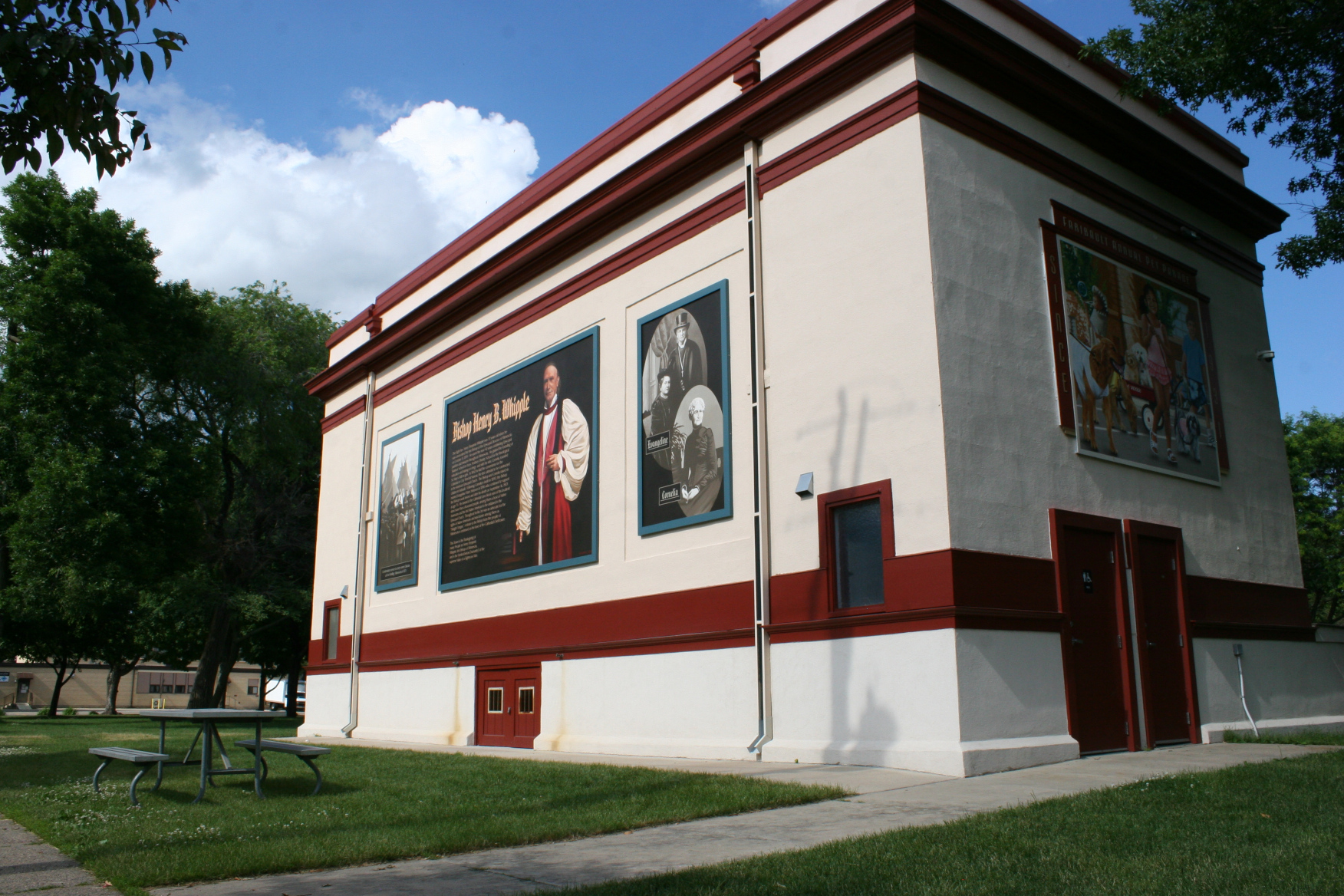
A painting of Bishop Henry Whipple and information about him grace a mural on Faribaults’ Central Park Bandshell. (Minnesota Prairie Roots copyrighted file photo June 2020)
He was known as “Straight Tongue” for his honesty. He was disparagingly called “The Sympathizer” by others for the compassion and care he held for the Dakota. He was Bishop Henry Whipple.
Thursday evening, Rice County Historical Society Executive Director David Nichols spoke to a packed room about this Episcopal priest who played such a pivotal role in Minnesota history, specifically during the time shortly before, and then after, The U.S.-Dakota War of 1862. For me, personally, Nichols’ focused talk connected my home region of Redwood County, the area in which the war centered, to my home of 40 years, Rice County.
I grew up with a limited (white) perspective of the war with no knowledge of Whipple. I only learned of this New York born clergyman upon my move to Faribault in 1982. Nichols broadened my understanding during his presentation and during a question and answer session that followed.
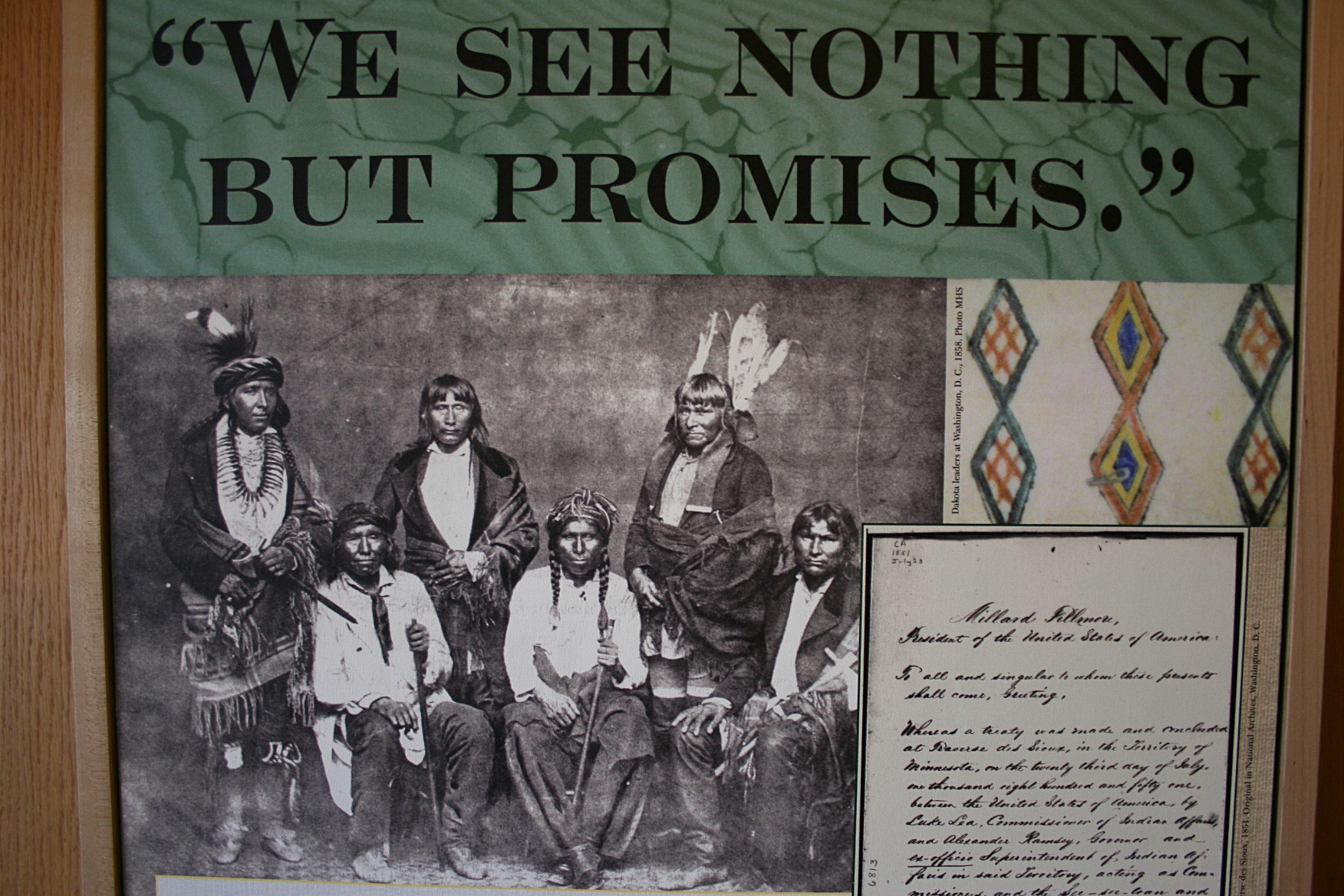
A panel at the Traverse des Sioux Treaty Center in St. Peter shows Dakota leaders photographed in Washington D.C. in 1858. The photo is from the Minnesota Historical Society. It references broken treaty promises and rising tension. (Minnesota Prairie Roots copyrighted file photo)
HIGH TENSIONS
Whipple arrived here in 1860 as the newly-elected Bishop of Minnesota, settling in Faribault. Already at that time, tensions were mounting among settlers and the first peoples of Minnesota, Nichols said. Tensions also existed between the “Farmer Indians” (those who adapted to Euro culture) and “Blanket Indians” (who maintained their Native culture, traditions and lifestyle). Conditions on reservations were terrible with disease, starvation, and dishonest agents failing to provide promised government annuities.
That is the situation Whipple found when he landed in Minnesota. It was a time, noted Nichols, of “tensions about to boil over.” And eventually they did with the outbreak of war in August 1862. It was a decidedly bloody and awful war, as all wars are. Some 600-800 died and the Dakota were eventually displaced from their land.
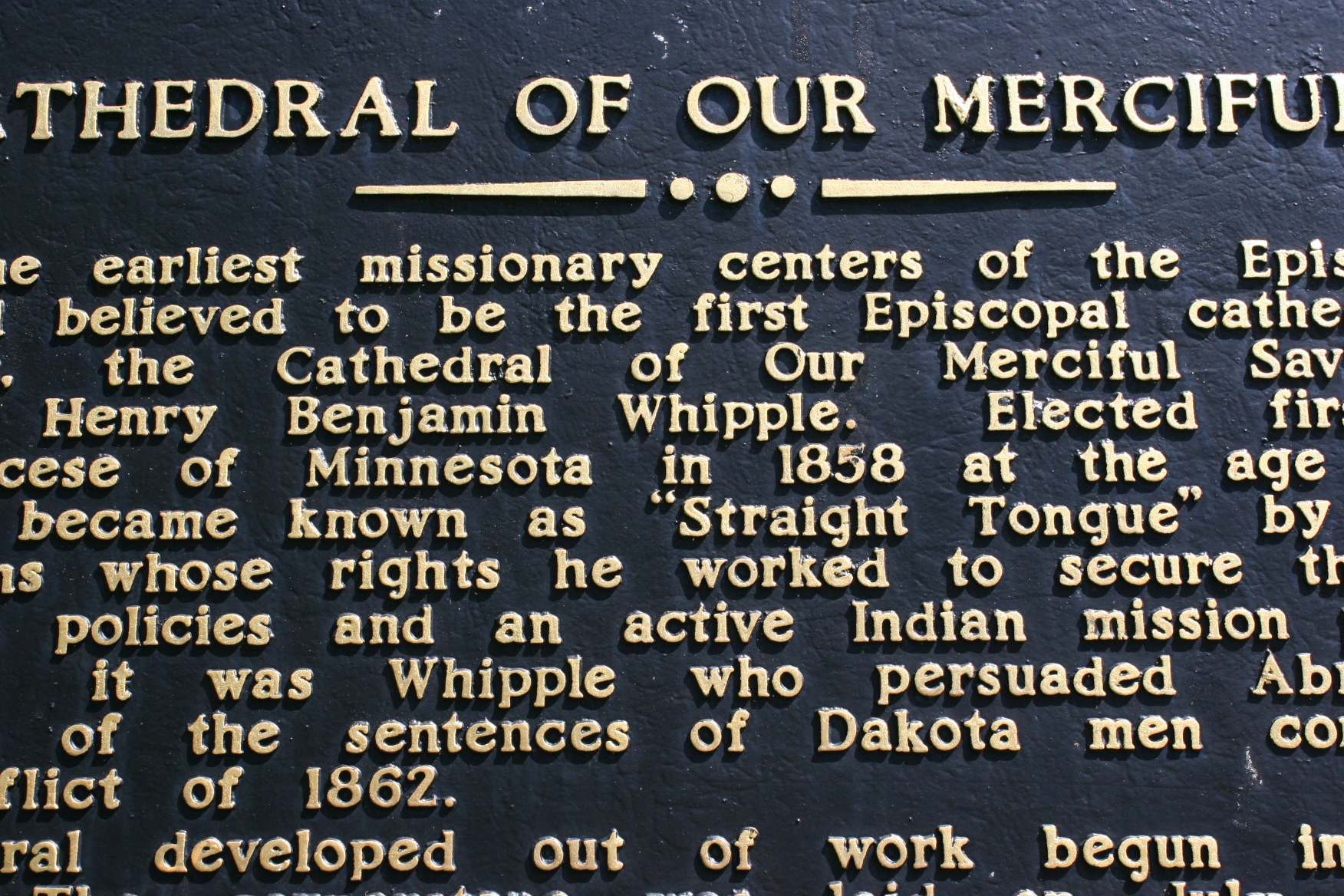
Details on a sign outside The Cathedral of Our Merciful Saviour, Whipple’s church in Faribault. (Minnesota Prairie Roots copyrighted file photo 2020)
THE SHAPING OF A HUMANITARIAN
To understand Whipple’s position and part in this, Nichols provided background. Whipple was involved in New York politics as a “conservative Democrat,” a term which drew laughter from the crowd at Thursday’s presentation. He briefly attended Oberlin College, notable because the college was among the earliest to admit women and African Americans. And Whipple was ordained in 1849, during the so-called “Second Great Awakening” with a focus on civil rights.
Learning this helped me better understand the bishop. All of these experiences shaped a man who spoke with honesty and compassion, advocated for Minnesota’s Indigenous Peoples (both the Dakota and the Ojibwe, natural enemies), called for reform and peace and understanding. Whipple was, said Nichols, a voice for calm, calling for justice, not vengeance, when the short-lived U.S.-Dakota War ended.
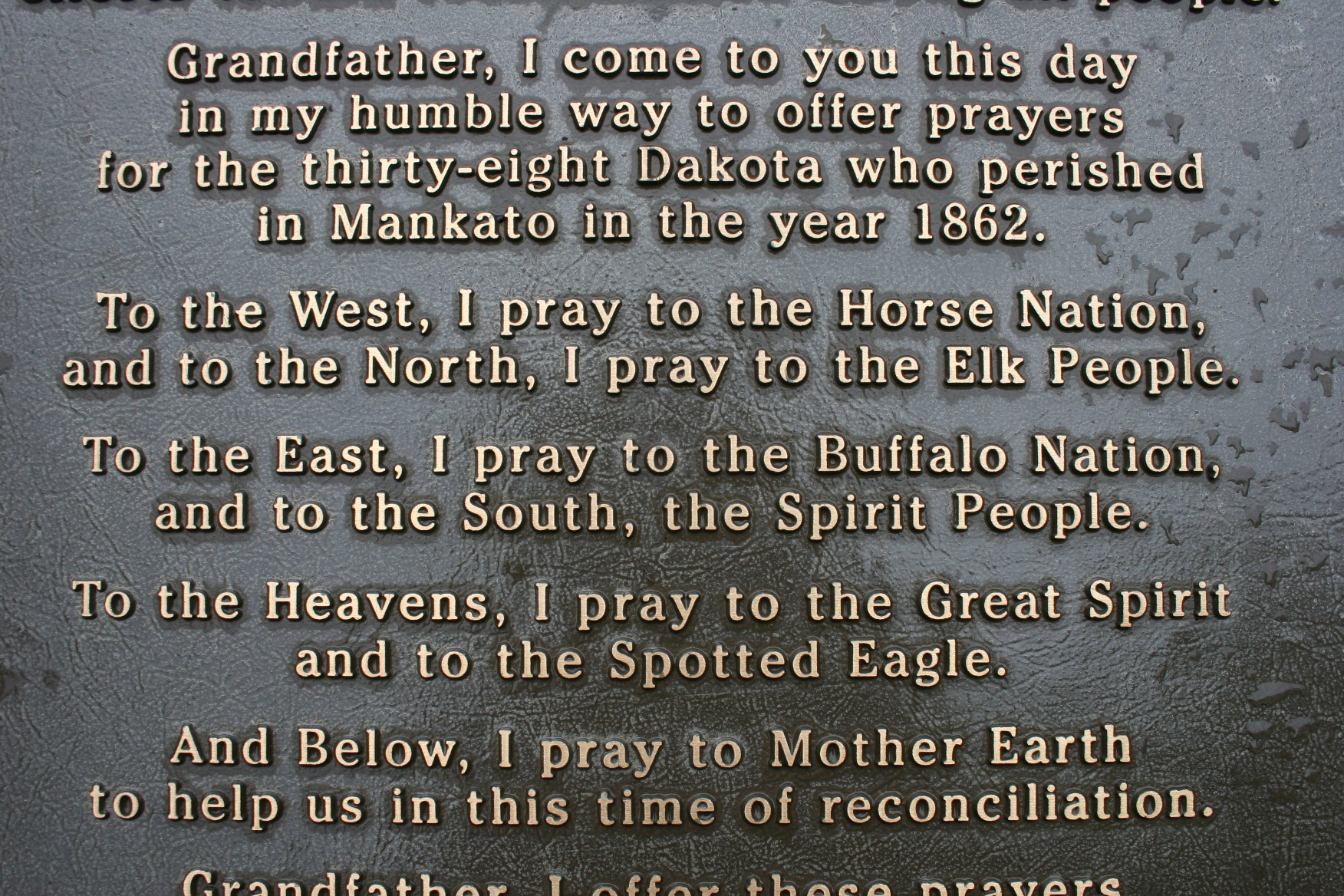
Words on a marker in Reconciliation Park in Mankato where 38 Dakota + 2 were hung on Dec. 26, 1862. (Minnesota Prairie Roots copyrighted file photo May 2012)
ADVOCATING FOR PARDONS
In his many years of missionary work and advocacy, even when his life was threatened by those who viewed him as an “Indian sympathizer,” one singular moment stands out to me. And that is Whipple’s efforts to save the lives of 303 Dakota men sentenced to death after the war. He met with President Abraham Lincoln and was “partly responsible,” Nichols said, for Lincoln’s eventual pardon of all but 38 Dakota. The 38, plus two others, were hung in a public mass execution in Mankato on December 26, 1862. It is a terrible and profoundly awful moment in Minnesota history, especially the history of the Dakota.
A full view of the bandshell mural featuring Bishop Whipple and his first wife, Cornelia, and his second wife, Evangeline. (Minnesota Prairie Roots copyrighted file photo)
ASSIMILATION
While listening to Nichols’ presentation on Whipple, I felt conflicted. Conflicted because the bishop was, he said, “a strong assimilationist.” That label bothered me until I talked further with Nichols. He explained that Whipple did not view himself and Europeans as superior to Native Peoples, but rather observed, in the context of place and time and thinking, the need to adapt versus being driven out. That helped me better understand Whipple’s approach. I recognize, though, and acknowledge the current-day struggles with assimilation, especially as it relates to Indian boarding schools. I appreciate the recognition of, and return to, culture, tradition and heritage today.
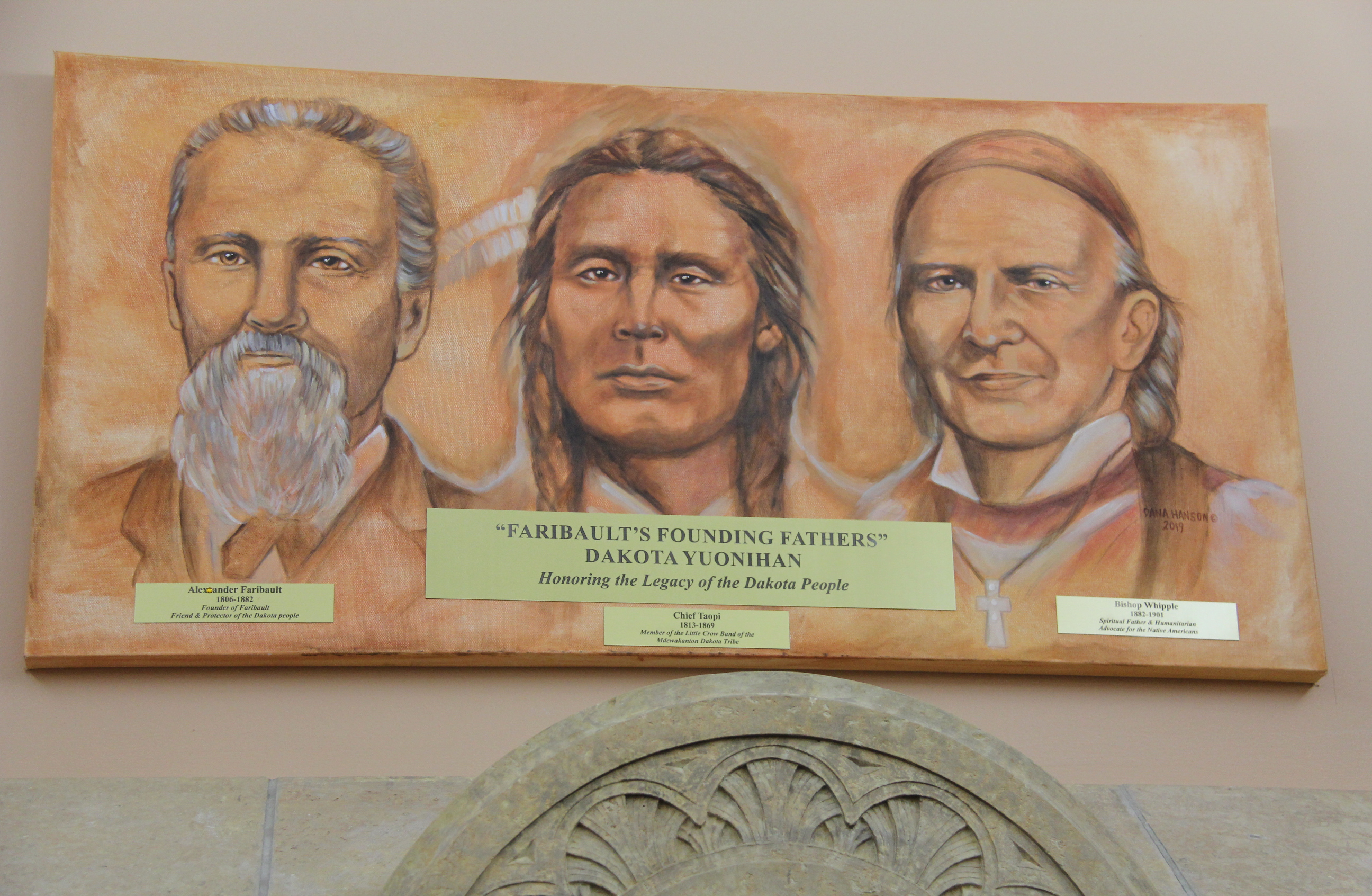
“Faribault’s Founding Fathers,” portraits of Alexander Faribault, left to right, Chief Taopi and Bishop Henry Whipple, by Dana Hanson hangs in Faribault’s Buckham Memorial Library. (Minnesota Prairie Roots copyrighted file photo November 2022)
WELCOMING THE DAKOTA TO FARIBAULT, OR NOT
Whipple, by his words and actions, embraced the Dakota and Ojibwe who called Minnesota home long before white settlers arrived, long before he moved to Faribault. My community, founded by fur trader Alexander Faribault, himself half Dakota, was a safe haven for the Dakota (“you don’t attack family”) during the 1862 war and thereafter, Nichols said. Faribault and Whipple worked together to move 180 Dakota from St. Paul’s Fort Snelling, where they were held following the war, to live on land Alexander owned along the Straight River in Faribault.
I wondered, “Were they welcomed here?” The answer, given by former RCHS Executive Director Susan Garwood, was as I expected. Mixed. While some supported the Dakota’s presence in Faribault, others were vocal in their opposition. In that moment, I thought of our ever-growing immigrant population in my community. Many welcome our newest neighbors and, like Alexander Faribault and Bishop Henry Whipple, support and encourage them. But many also want them gone. History repeats.
An inscription honors Whipple on the Cathedral bell tower. (Minnesota Prairie Roots copyrighted file photo June 2020)
MARKING HISTORY
Walk around Faribault today and you will see many reminders of the work Whipple did not only locally, but across Minnesota. Historical markers and inscriptions about the bishop grace The Cathedral of Our Merciful Saviour, his faith base. He’s buried under the altar there. Across the street at Central Park, Whipple-themed murals cover the west side of the historic bandshell. Downtown, one of many history-focused benches honors Whipple. And across town, at the Chapel of the Good Shepherd on the campus of Shattuck-St. Mary’s School, a marker notes his role in founding Shattuck and other schools in Faribault.
Efforts are underway now locally to recognize the Dakota as well, to publicly mark their place in the history of Faribault. I’d like to think Bishop Henry Whipple, also known as “Straight Tongue” and “The Sympathizer,” would welcome the idea, would even step up to fund raise, just as he did some 160 years ago to support the relocation of 180 Dakota from Fort Snelling to Faribault.
Not candy conversation hearts…buta collection of my mom’s vintage valentineswhich can also be conversation starters. (Minnesota Prairie Roots copyrighted file photo)
CANDY HEARTS. I’ve never liked their chalky texture and taste. But these hard pastel candies are as much a part of Valentine’s Day history as valentines, red roses and chocolates. And they are a starting point for conversations: Be mine. Hugs. Love.
What exactly is love? It’s not a word completely defined without context. Yet, there is a basic understanding of romantic love, of love within a family, of love between friends. But what about the everyday love that we can express in words, especially towards those not in our friends and family circles?
Let me explain as I reflect on several conversations with strangers over the weekend. There’s nothing particularly dynamic about these brief encounters. Still, they are worth noting given each exchange reaffirms the importance of connecting with others as we go about our daily lives, sort of like handing out candy conversation hearts. I should note that I am comfortable initiating conversations with people I don’t know, if it feels right.
(Minnesota Prairie Roots copyrighted file photo)
HEART HAPPY
So there I was, in the check-out lane at a local grocery store when I noticed the man behind me with a shopping cart full of healthy foods. (Yes, I do notice what others are buying.) “You eat oatmeal, too,” I said, nodding toward the two cylinders of old-fashioned rolled oats standing side by side in his cart.
“Ever since I had my heart attack 13 years ago,” he said.
While I don’t remember my exact rambling reply, it went something like this: “Oatmeal’s supposed to be good for your cholesterol and the first time I ate it I thought I can’t do this every morning and then I added fruit…”
“Lots of fruit,” he qualified, when my run-on sentence ended. We fully agreed on the need for lots of fruit.
“Good for you that you’re eating healthy.” And then I wanted to tell him about how my father-in-law hated oatmeal and stuffed it in his pockets at Catholic boarding school in North Dakota but then I ran out of time because my groceries were being scanned and I had to move on, minus any old-fashioned oats in my cart.
Heart-shaped cut-out cookies I baked on a previous Valentine’s Day. (Minnesota Prairie Roots copyrighted file photo)
HOMEMADE SWEETNESS
That same morning, I popped into the post office to mail homemade M & M cookies to my son in Indiana. He’d celebrated his birthday only days prior and I’d failed. I failed to mail him a box of goodies. He obviously expected one. The day before his birthday, Caleb texted to ask if he should be expecting a package. Uh, no. My mom guilt kicked in big time and the next morning I was in my kitchen baking cookies.
Waiting in line at the post office, I wondered how long it would take those sweets to arrive in Lafayette. I once shipped homemade cookies that somehow ended up in Montana, arriving 10 days later in Indiana. So you can understand my apprehension. As I stepped up to the window, the postal clerk asked the usual “anything liquid, hazardous, perishable…?
“Are cookies considered perishable?”
I expected the usual no, but instead got a yes. The clerk clarified by asking if I baked the cookies. When I confirmed I had, she advised me to touch “yes” on the screen, further clarifying that this didn’t mean the cookies would arrive any earlier or that they wouldn’t be diverted to Montana. But I am happy to report the package arrived in Lafayette on Monday, unbelievably fast. I appreciated that the postal clerk appreciated that homemade cookies lack preservatives and are, indeed, perishable or at least capable of going stale. I have to think that conversation with her factored into the swift delivery.
Red roses from my husband for a previous celebration. (Minnesota Prairie Roots copyrighted file photo)
LIKE GETTING A DOZEN ROSES
On to another grocery store, once again waiting in line, this time on a price check for the customer ahead of me. I decided to guess the price of the mixed bouquet of wrapped flowers he held. “I’d pay $7.99 for them,” I said. “But they’re probably lots more because of Valentine’s Day.” I was way off. They were nearly $17.
“You should have guessed higher,” he said.
“Whoever they’re for, she’ll appreciate them.” The cashier concurred.
“They’re for my daughter, for her dance recital.”
That simply made me smile in the sort of way that filled my spirit with happiness and joy. The love of a father for his daughter. Had I not initiated a conversation, I never would have experienced this everyday, love-filled dozen roses moment.
A fused glass heart created by Northfield artist Geralyn Thelen for the “Spreading the Love” sculpture, public art installed in downtown Northfield. (Minnesota Prairie Roots copyrighted file photo)
SUNSHINE ON MY SATURDAY
As I moved ahead, waiting for a teenager to bag my groceries, I noted her long hair cascading in ringlets. “I love your hair. It’s beautiful. How do you get it to curl like that?”
She explained how she rolls curlers into her hair and sleeps in them overnight. Her wide smile revealed to me just how much she appreciated my sincere compliment. As she pushed my shopping cart across the grocery store parking lot toward the van, this bubbly young woman commented on the sunny day and asked how mine was going. Her very being radiated warmth like the February sunshine. It was as if we were exchanging conversation hearts when she wished me a wonderful day and I reciprocated.
Life is filled with opportunities like this. Maybe not to talk about oatmeal or cookies or flowers or curly hair or sunny mornings. But to interact, to connect, to show others that we value them, that they matter to us in the everyday moments of our lives.























 Minnesota Prairie Roots
Recent Comments