Just Santa and one of his ants… (Minnesota Prairie Roots copyrighted photo December 2022)
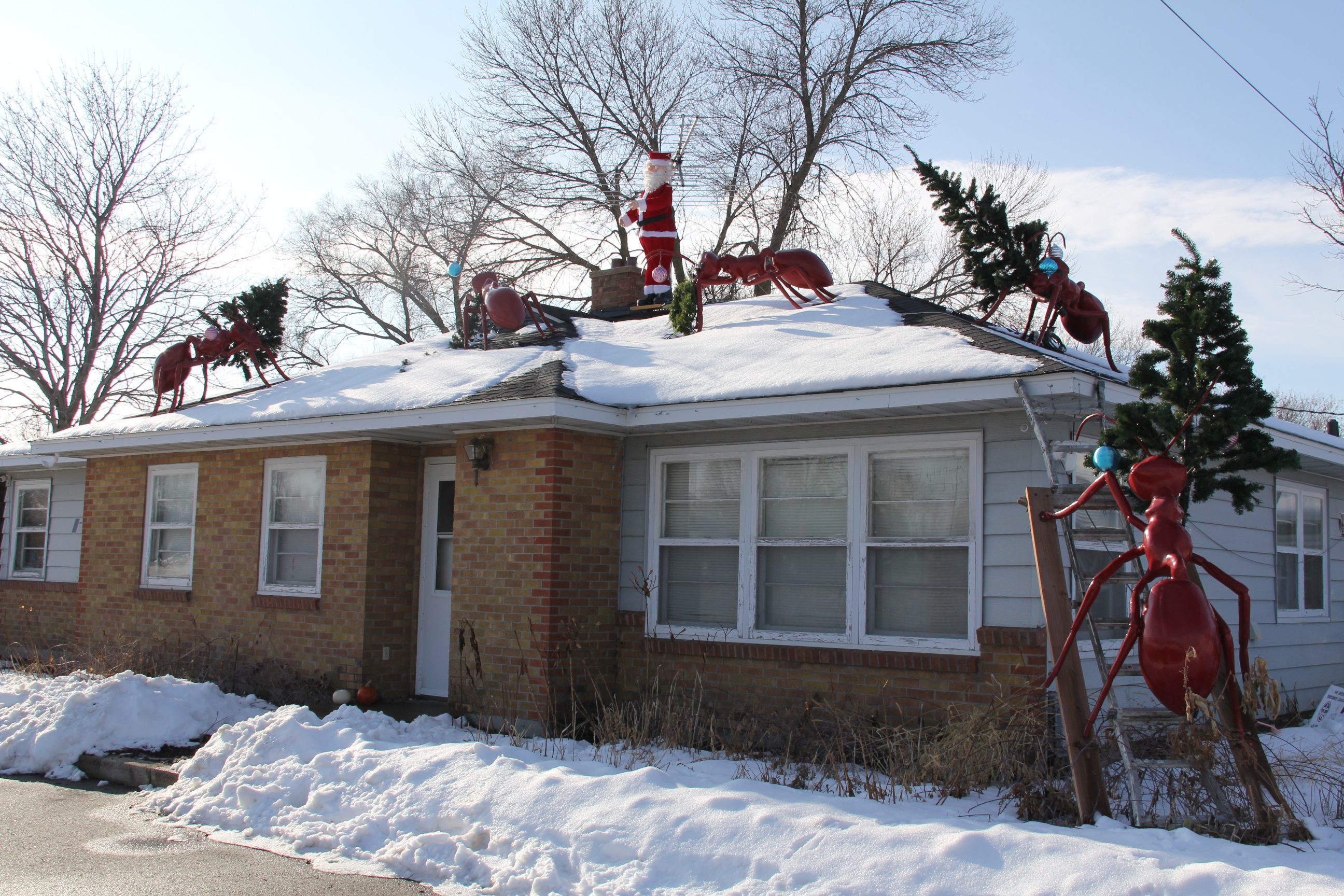
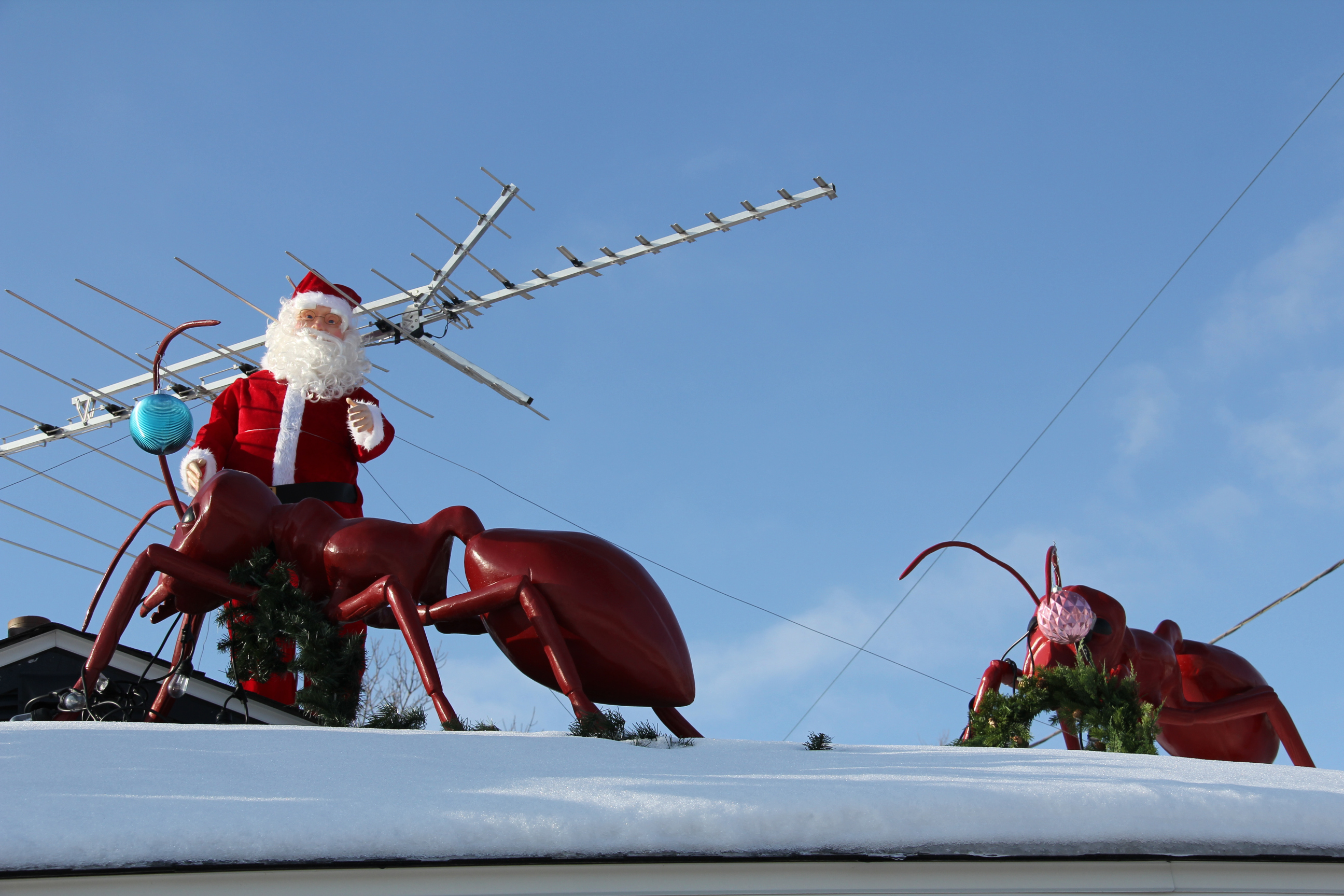
UP ON A ROOFTOP in Faribault, Santa guides not his reindeer, but a team of ants. Unusual? Yes, unless your pest control company is headquartered inside the rambler at 904 N. Lyndale Avenue.
Santa and his ants at Francis Animal & Pest Control, Faribault. (Minnesota Prairie Roots copyrighted photo December 2022)
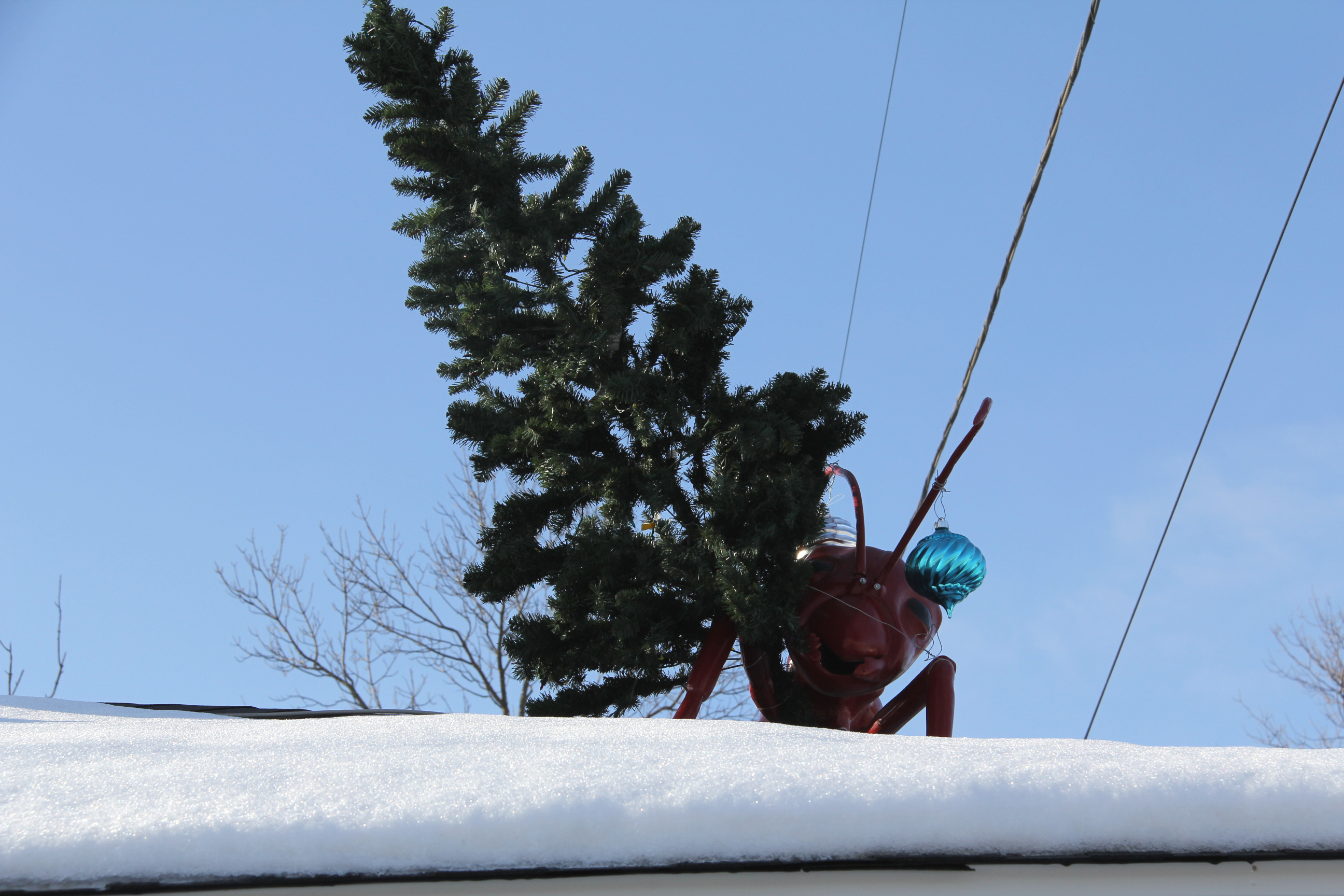
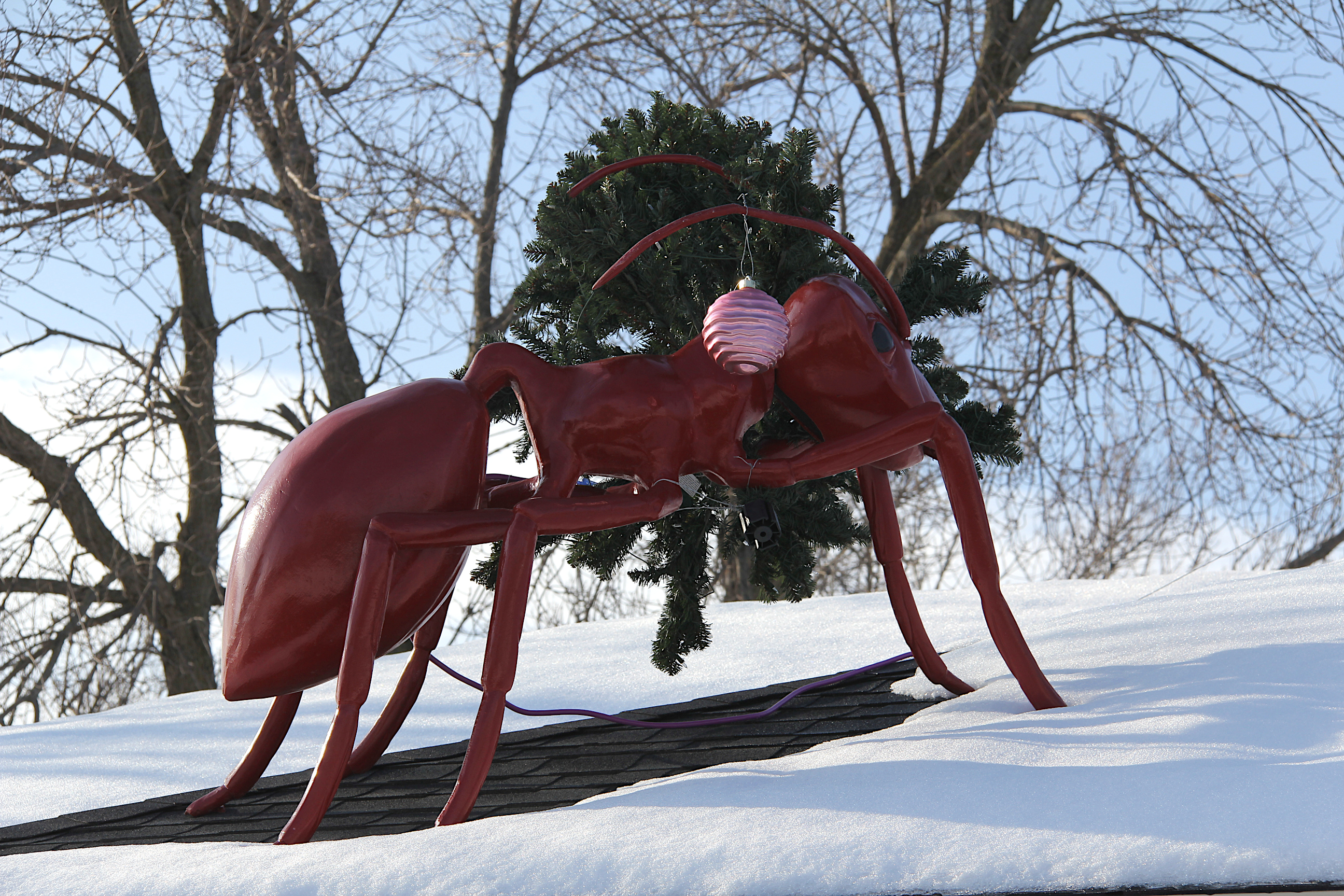
Sean Francis heads up Francis Animal & Pest Control where Santa stands next to the TV antenna, near the chimney, looking down on five red ants, four on the roof, one scaling a ladder. Three carry Christmas trees, the others a wreath and garland.
Toting a tree that lights at night. (Minnesota Prairie Roots copyrighted photo December 2022)
This pest control business owner of 29 years installed the ants earlier this year, hauling the four hefty 60-70 pound aluminum ants onto the roof and keeping one on the ground. A cricket perches atop the garage roof. Francis is used to rooftop work as he’s on roofs daily dealing with squirrels, bats, birds and other pest issues throughout Minnesota.
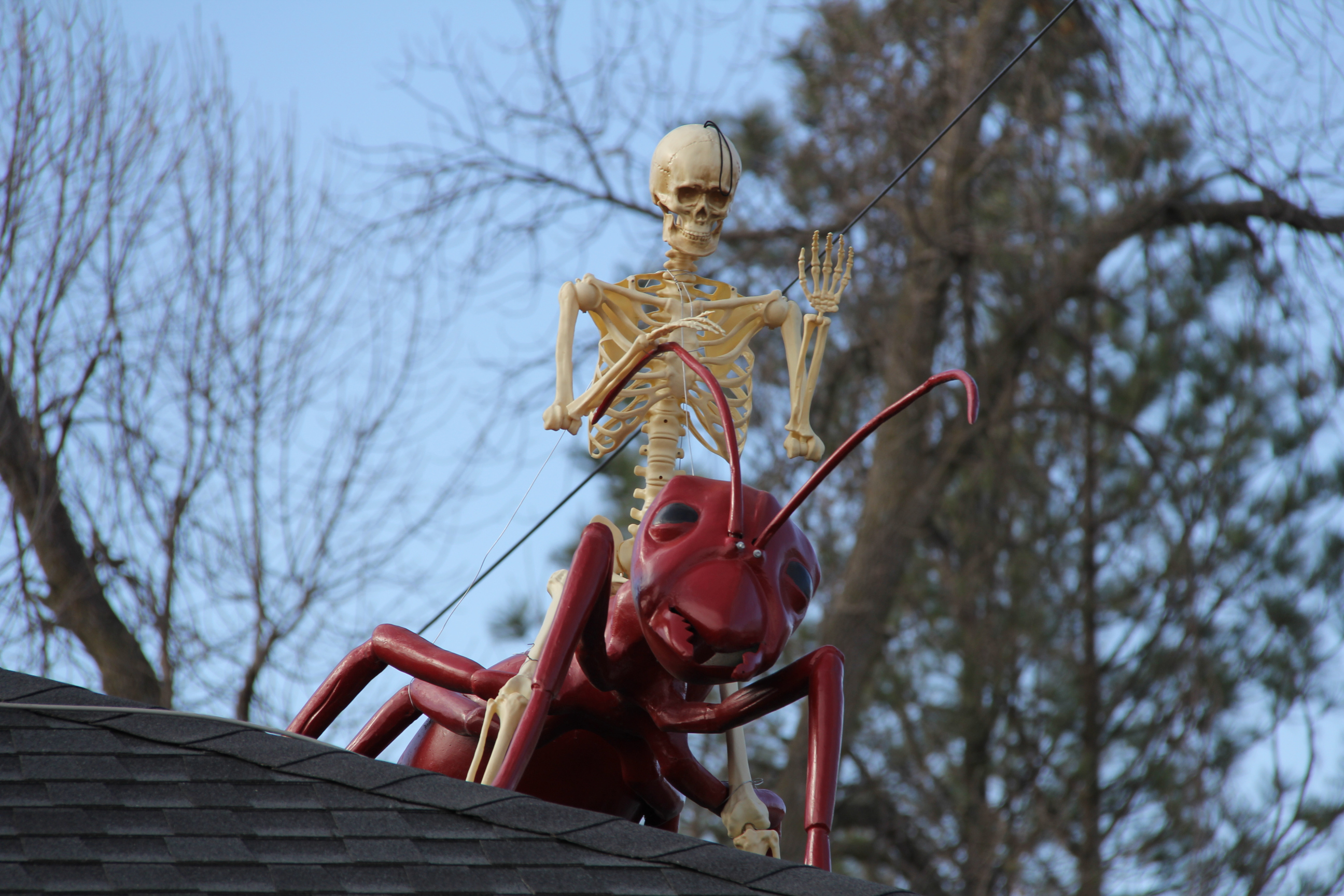
One of the ant-riding skeletons posed atop the roof for Halloween. (Minnesota Prairie Roots copyrighted file photo October 2022)
The ants, he said, add a fun element and draw attention to his business. His four kids, ages 7 to 14, love the ants. And so does the general public, he said. They especially liked the skeletons he added at Halloween.
Up on the rooftop…Santa and his ants. (Minnesota Prairie Roots copyrighted photo December 2022)
The Christmas ants and Santa have been in place for about a month. Whether Francis continues to change things out depends on time and ideas.
Bulbs, greenery and lights transform the ants for Christmas. (Minnesota Prairie Roots copyrighted photo December 2022)
The Faribault businessman first came up with the rooftop ants idea when he saw large-scale ants at a vintage shop in Albert Lea. But when he returned to buy them, they were gone. The hunt began. After 6.5 years of searching, Francis finally found the Mexico-made ants in Sioux Falls, South Dakota, where they are assembled.
Santa and the ants add a festive flair to the snow-covered roof of Francis Animal & Pest Control. (Minnesota Prairie Roots copyrighted photo December 2022)
Now they’re comfortably colonizing in southern Minnesota, drawing attention to the pest control company along a busy four-lane in Faribault. They’ve become a humorous roadside oddity and, in this season of Christmas, a one-of-a-kind holiday attraction.
I hope Sean Francis comes back with a new idea for his rooftop ants. (Minnesota Prairie Roots copyrighted photo December 2022)
TELL ME: Do you have any suggestions for these ants after Christmas? What should Sean Francis do with them next?
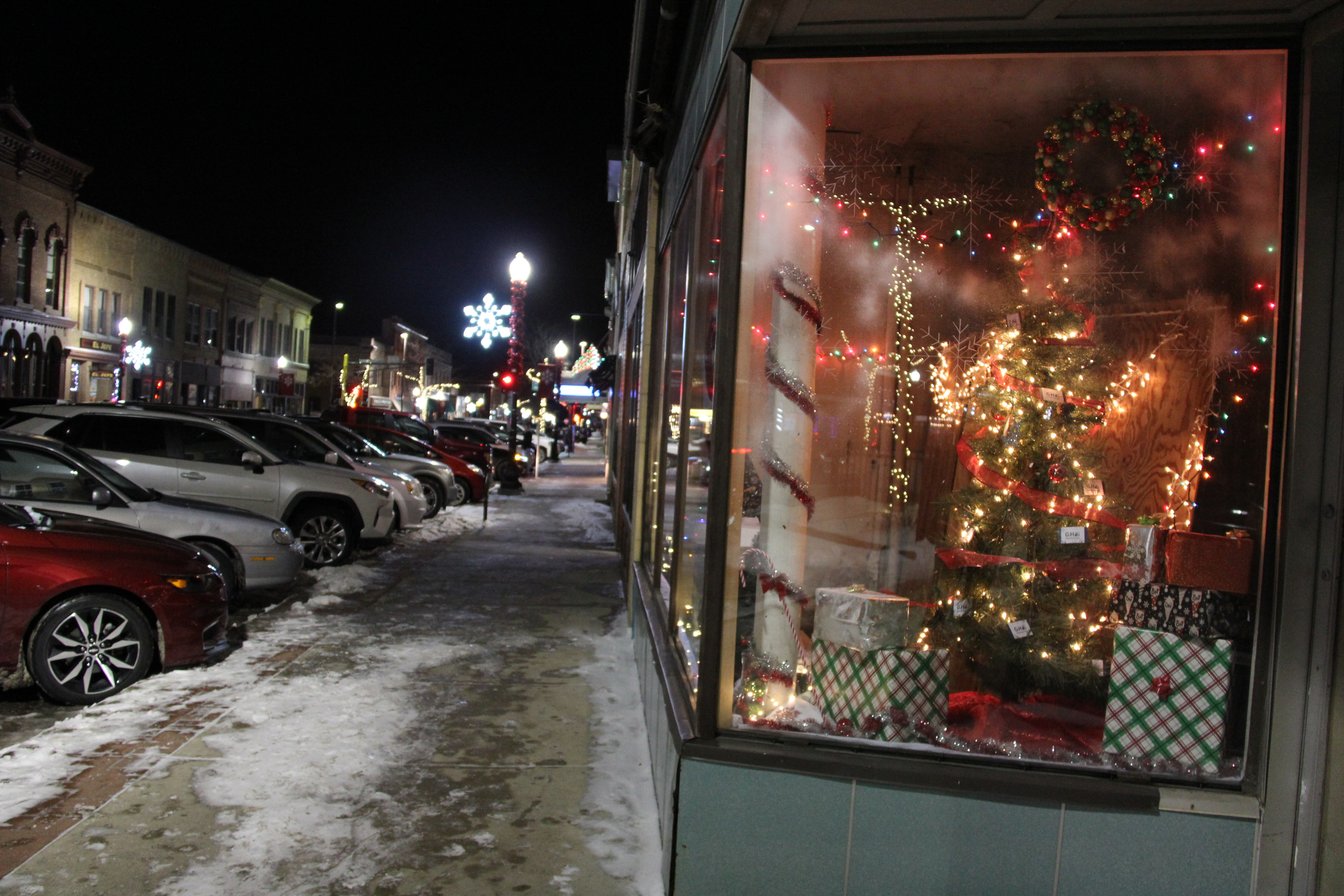
One of the many festively-decorated storefront windows along Central Avenue in Faribault. (Minnesota Prairie Roots copyrighted photo December 2022)
AS PART OF ITS RECENT WINTERFEST,Faribault Main Street sponsored a Holiday Window Decorating Contest. I love this idea, which inspires downtown merchants to share the spirit of the season in an artistically festive way.
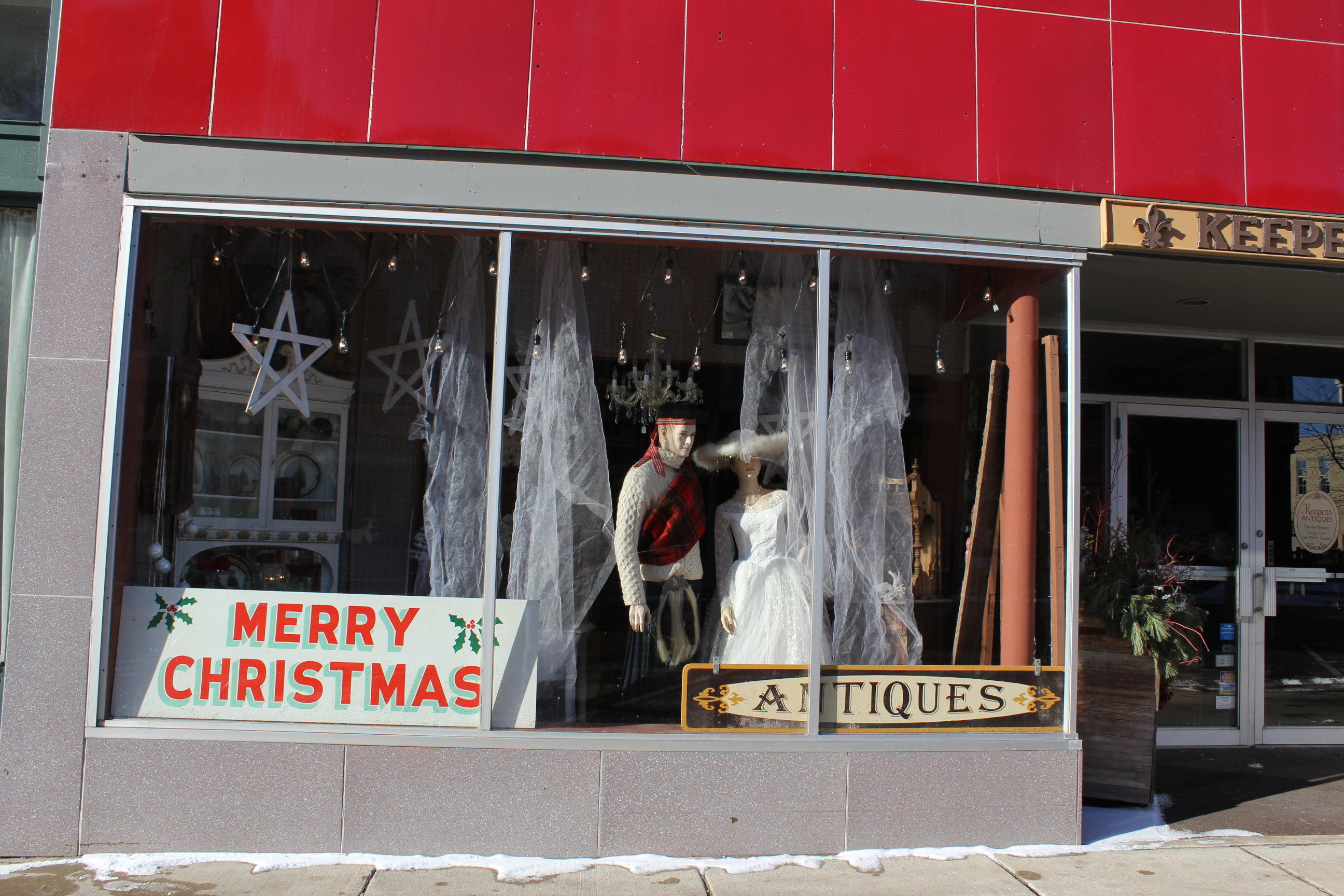
Keepers Antiques always features beautiful window displays, not just during the Christmas holiday. (Minnesota Prairie Roots copyrighted photo December 2022)
Window displays can create a joyful mood that encourages people to step inside a shop, to peruse merchandise and perhaps buy local. We all want to feel welcome when we approach a shop. Creatively-decorated storefronts present an inviting front door welcome that says, “Come on in.”
These simple stars seen in a downtown business window shine light and joy. (Minnesota Prairie Roots copyrighted photo December 2022)
For those who are trying to make a go of it as independent businesses owners, efforts like this can make a difference. A window decorating contest tells me shop owners care and want me as a customer.
In these challenging economic times, supporting local businesses like those in the heart of downtown Faribault is more important than ever. I want to see these entrepreneurs doing well. I want to see vacant buildings filling with new businesses. I want to see a healthy and vibrant business community.
Frosty has always been a holiday favorite of mine, so I really liked this Frosty-themed window display. (Minnesota Prairie Roots copyrighted photo December 2022)
On Saturday, I popped into The Junk Monkey, which recently relocated to a larger space at the corner of Fourth Street/Minnesota State Highway 60 and First Avenue in downtown Faribault. This shop brims with antiques, collectibles, thrift finds and some new merchandise. There’s a lot to take in. I left with a Minnesota-made, Minnesota-themed puzzle. What I love about this store, besides the sheer volume of unique merchandise, is shopkeeper Theresa. She engages with customers in a friendly, yet unobtrusive, way and genuinely loves what she does.
Even the Faribault Community Center set up a window display, including this Santa. (Minnesota Prairie Roots copyrighted photo December 2022)
That can be said for many a merchant in our historic downtown area. A few weeks ago when my second daughter and her husband were visiting from Madison, Wisconsin, we stopped by Cry Baby Craig’s. There Craig’s marketing lead took the time to chat with us about the hot sauces crafted right here in my community. The sauces are wildly popular in the Twin Cities metro. The Wisconsin pair left with three bottles of sauce. I already had mine.
The evening streetscape with December’s holiday lights and decorations is especially beautiful along Faribault’s Central Avenue. (Minnesota Prairie Roots copyrighted photo December 2022)
Half a block away in the 300 block of Central Avenue, artists vend their creations at the Paradise Center for the Arts Holly Days Sale and, across the street, at Fleur de Lis Gallery. Jewelry artist and gallery owner Jess Prill always greets me with a smile and conversation. A few summers ago I ran into Jess, her husband and little girl at the park just up the hill from my house. Her daughter and my granddaughter hit it off, playing together until thunder sent us all scurrying toward home. I love seeing these business owners out and about in my community, part of the fabric of Faribault. Jess also owns the women-run Good Day Coffee right across the hall from Fleur de Lis. I love the energy and enthusiasm this young business owner brings to our historic downtown.
Also women-led are Finally A Gift Store (18 NE Second Street) and Janna’s Market Grill, further down Central. Janna Viscomi has been an important part of the downtown business community for many years. She also serves on the city council.
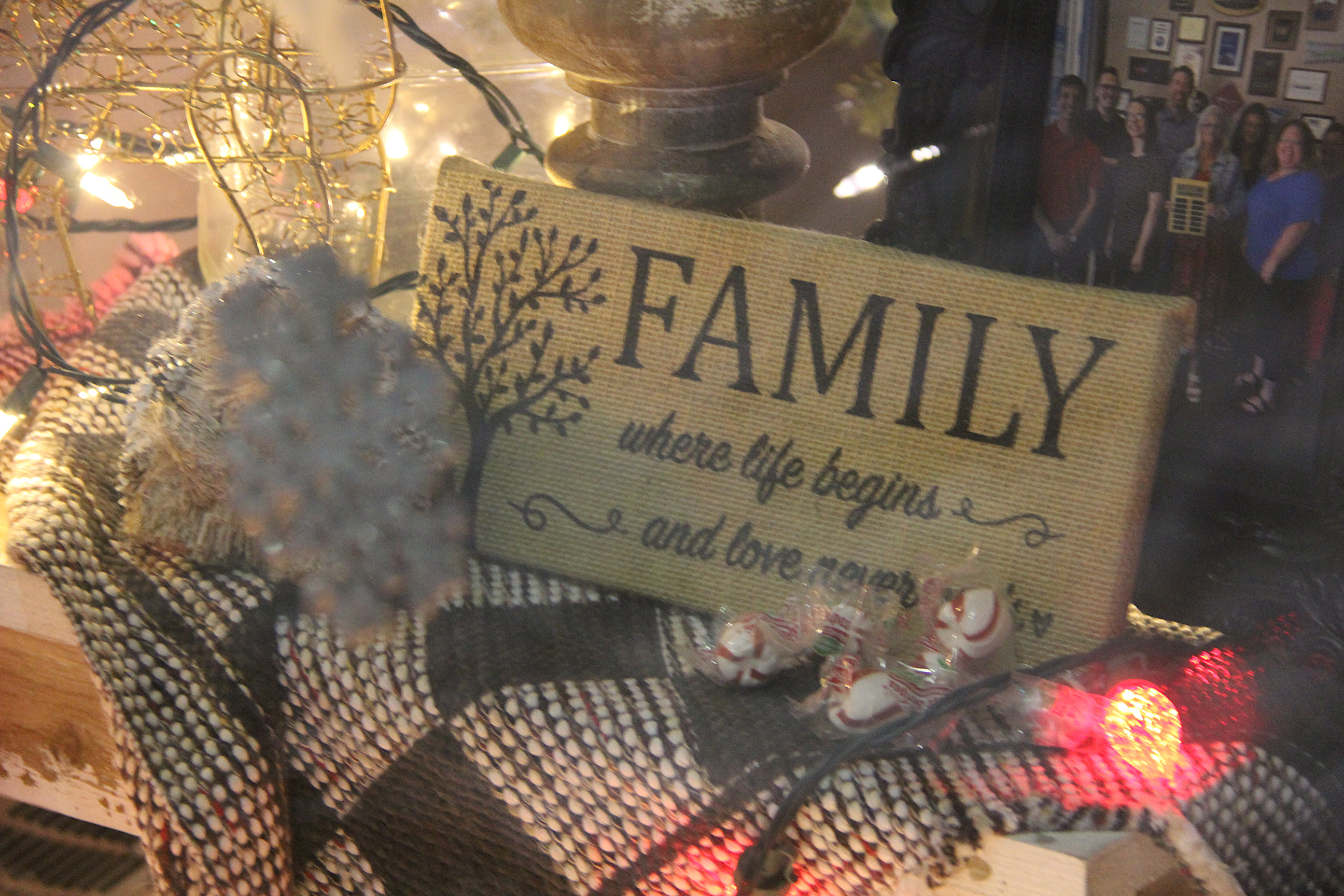
Love this family theme at Heartman Insurance. (Minnesota Prairie Roots copyrighted photo December 2022)
Across the street from Jana’s restaurant sits third-generation family run Burkhartzmeyer Shoes. This fall Randy purchased work boots there. We can always count on excellent customer service with high-quality footwear and a great fit. Plus engaging conversation reflecting the care and compassion of a much-beloved family.
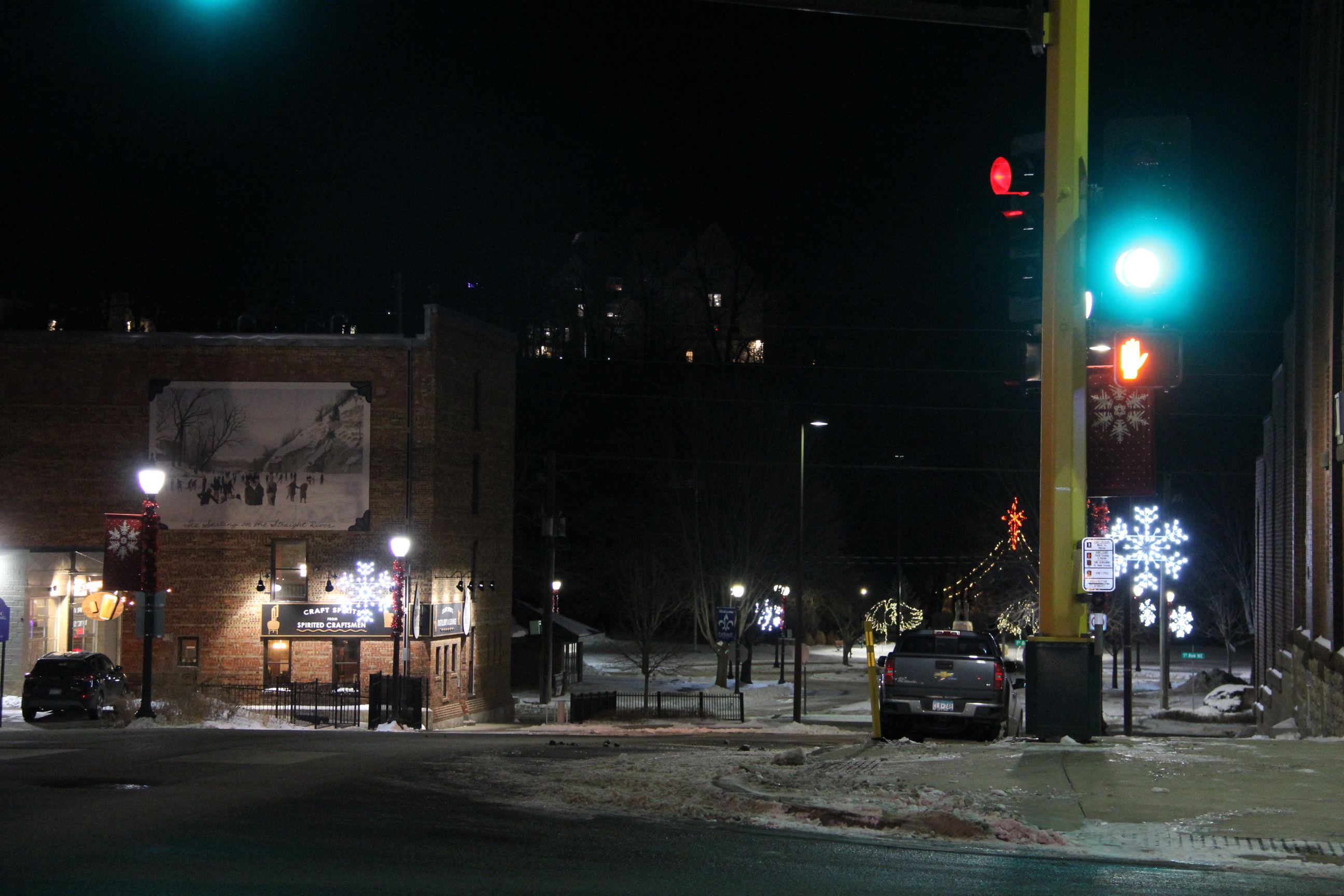
Any visit to Faribault should include a stop at 10,000 DropsCraft Distillers for a locally-made cocktail or non-alcoholic drink served in a beautiful historic setting that encourages lingering and conversation in cozy spaces. A mural of ice skating on the Straight River adorns the building and is among the many murals found downtown. (Minnesota Prairie Roots copyrighted photo December 2022)
If I sound like I’m pitching downtown Faribault, I am. This time of year especially, when many storefront windows are decorated for Christmas, it’s particularly visually appealing. But even more, I feel comfortably at home here among friendly shopkeepers. And that matters to me.
FYI: This post highlights only some of the businesses in downtown Faribault. There are many more to explore. I’d also encourage you to check out the Eclectic Alliance inside the Faribo West Mall. It features primarily locally-made, collectibles/antiques and more.
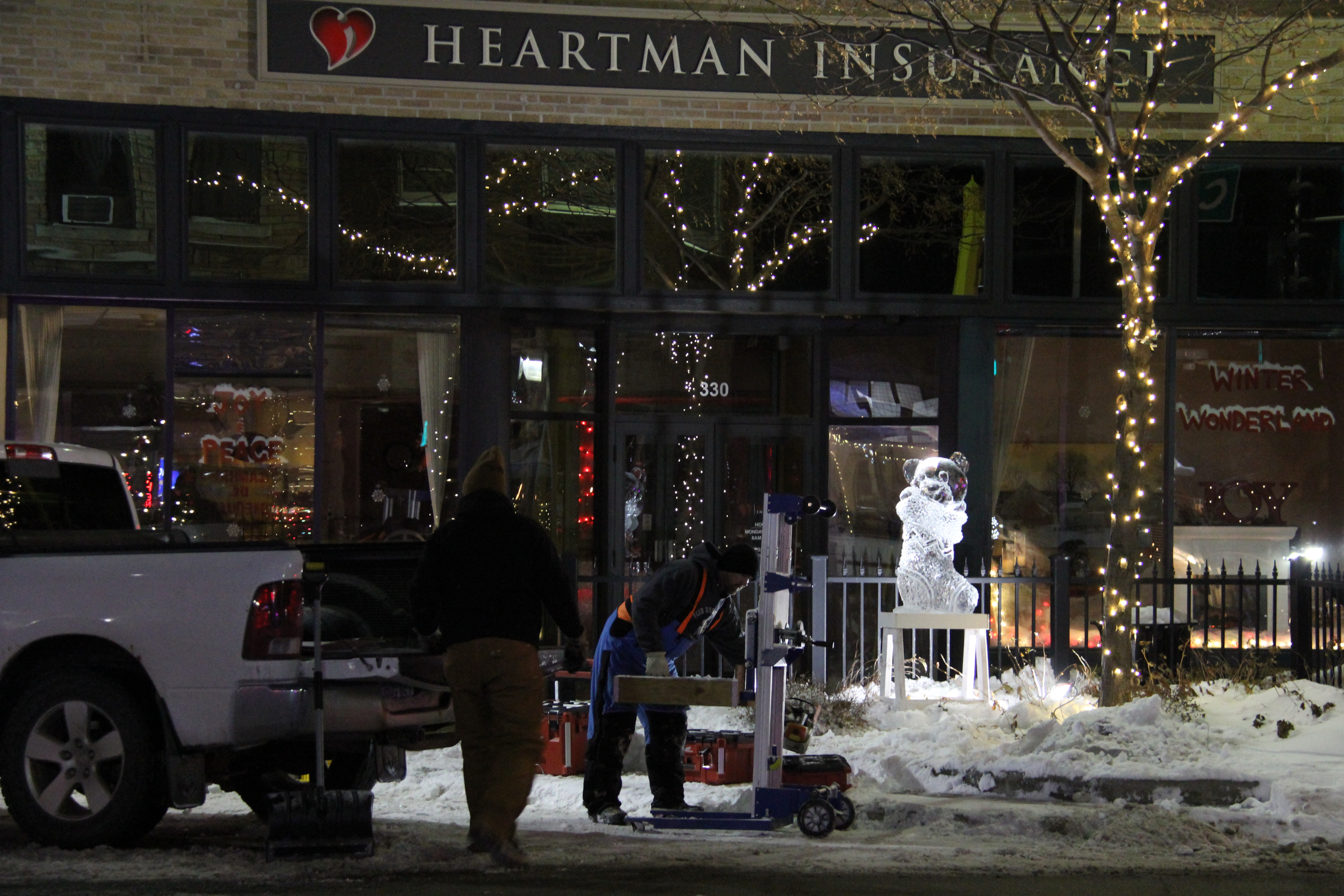
Sakatah Carvers pack their equipment after carving an ice sculpture at the corner of Central Avenue and Fourth Street/Minnesota State Highway 60 in Faribault during Winterfest. (Minnesota Prairie Roots copyrighted photo December 2022)
ONCE UPON A TIME, which is longer ago than I care to admit, I welcomed winter. Snow equated outdoor fun on the farm of my youth in southwestern Minnesota. Prairie winds swept the snow into rock-hard mountainous drifts around buildings and windbreaks. My siblings and I pulled on our winter gear and for hours played atop those mountains and the snow piles mounded by Dad with the bucket of his tractor.
The completed sculpture. (Minnesota Prairie Roots copyrighted photo December 2022)
And then there were the icicles hanging along the milkhouse roof. Those became swords for hard-fought battles against one another. Ice clashing against ice until a sword, or both, broke. Somehow we avoided poking out each other’s eyes.
I found those icicles, some the length of our torsos, magical. They appeared seemingly overnight, glistening in the sunlight, water frozen clear and beautiful.
The other side of the sculpture, photographed from across the street, with part of the equipment to the left. (Minnesota Prairie Roots copyrighted photo December 2022)
Likewise, I felt the same about ice patches that formed on field’s edge. To slide across that ice in my buckle overshoes proved freeing and powerful. I was a champion figure skater in my own imaginative world. When the ice rink opened in my hometown of Vesta in the shadow of the grain elevator, I donned my Aunt Dorothy’s hand-me-down skates and raced from one end to the other, flying like the fierce prairie wind.
Today I no longer skate or engage in sword fights. Rather I approach ice with the cautiousness of a Baby Boomer who’d rather not break a bone. I avoid ice if possible.
The teddy bear sculpture up close, glistening in the holiday and street lights. (Minnesota Prairie Roots copyrighted photo December 2022)
But there’s an exception. Ice sculptures. These are a thing of beauty, reminding me of long ago ice ponds and ice swords and my once-love of ice. Artists who can carve a block of ice into something magical and beautiful garner my appreciation. That includes the team from Sakatah Carvers, Signs and Creations, who recently sculpted a teddy bear inside a stocking for Faribault’s Winterfest.
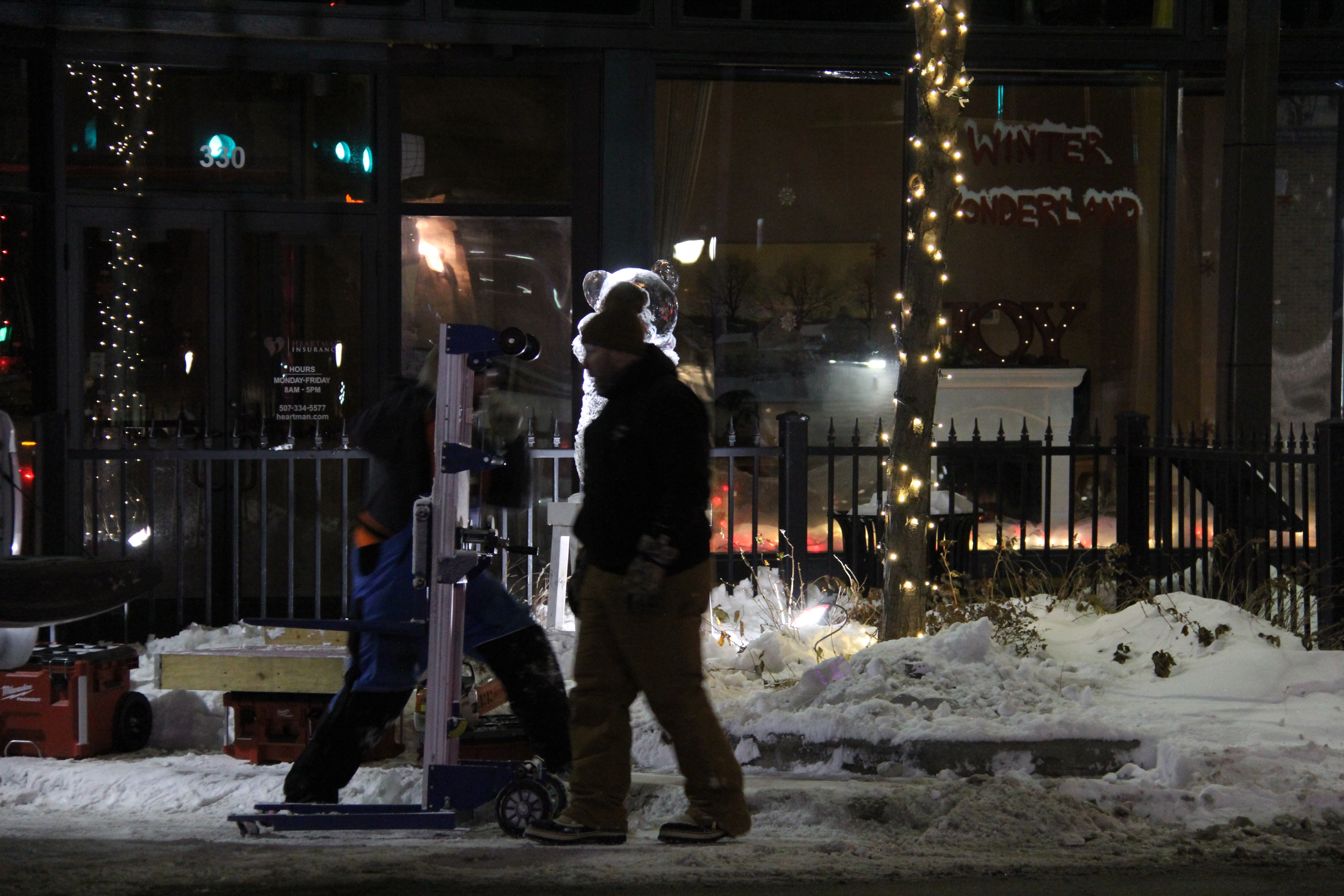
The second I snapped this frame, the ice carver blocked my view of the sculpture. But I like the results, highlighting the artist. (Minnesota Prairie Roots copyrighted photo December 2022)
While I didn’t witness the actual creation of the ice sculpture, I saw the warmly-dressed crew packing up their gear afterwards. It takes a love of winter and of ice to engage in this art form, which recalls for me prairie winters past of snow and ice.
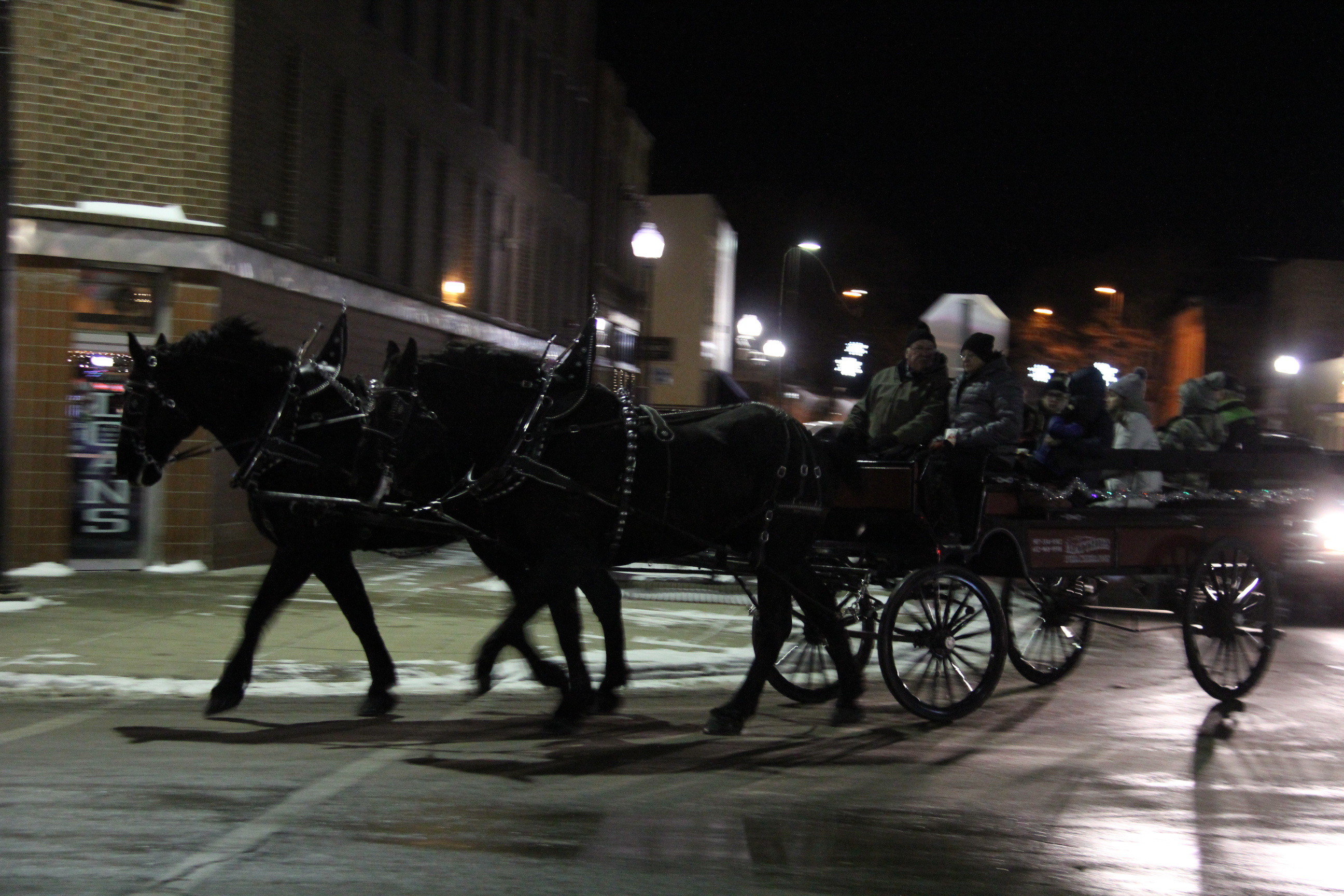
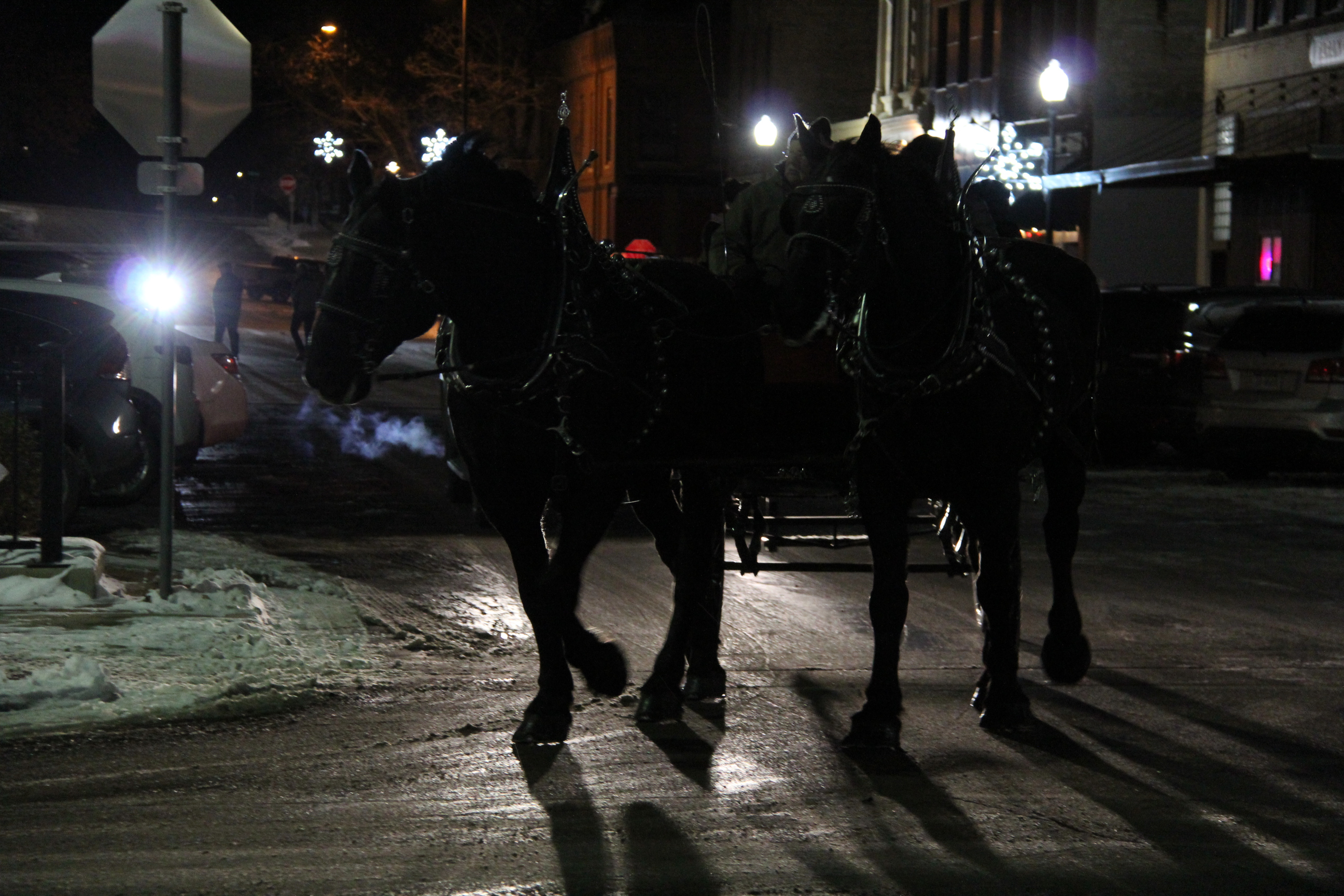
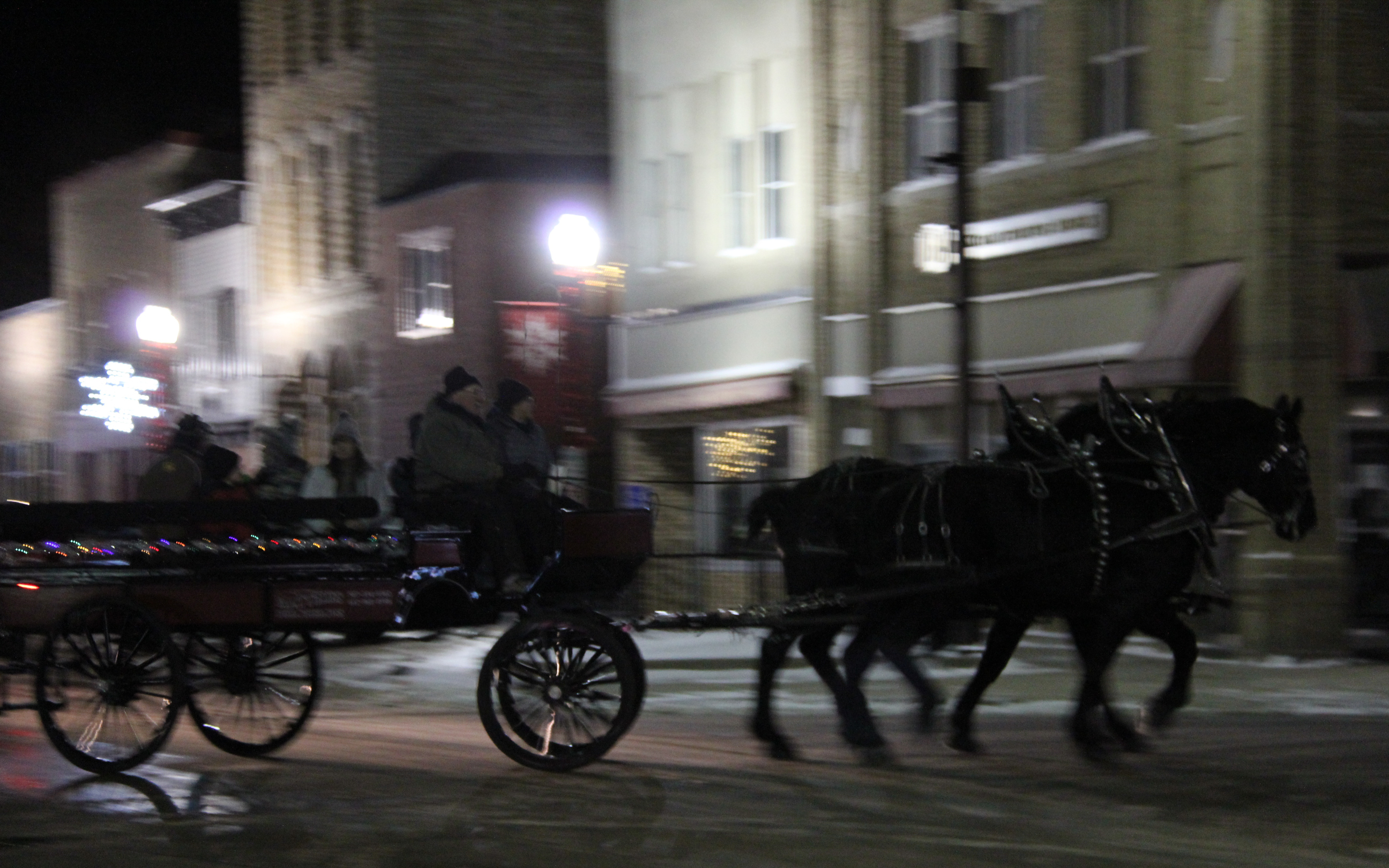
A horse-drawn wagon rounds the corner from a side street onto Central Avenue during Winterfest. (Minnesota Prairie Roots copyrighted photo December 2022)
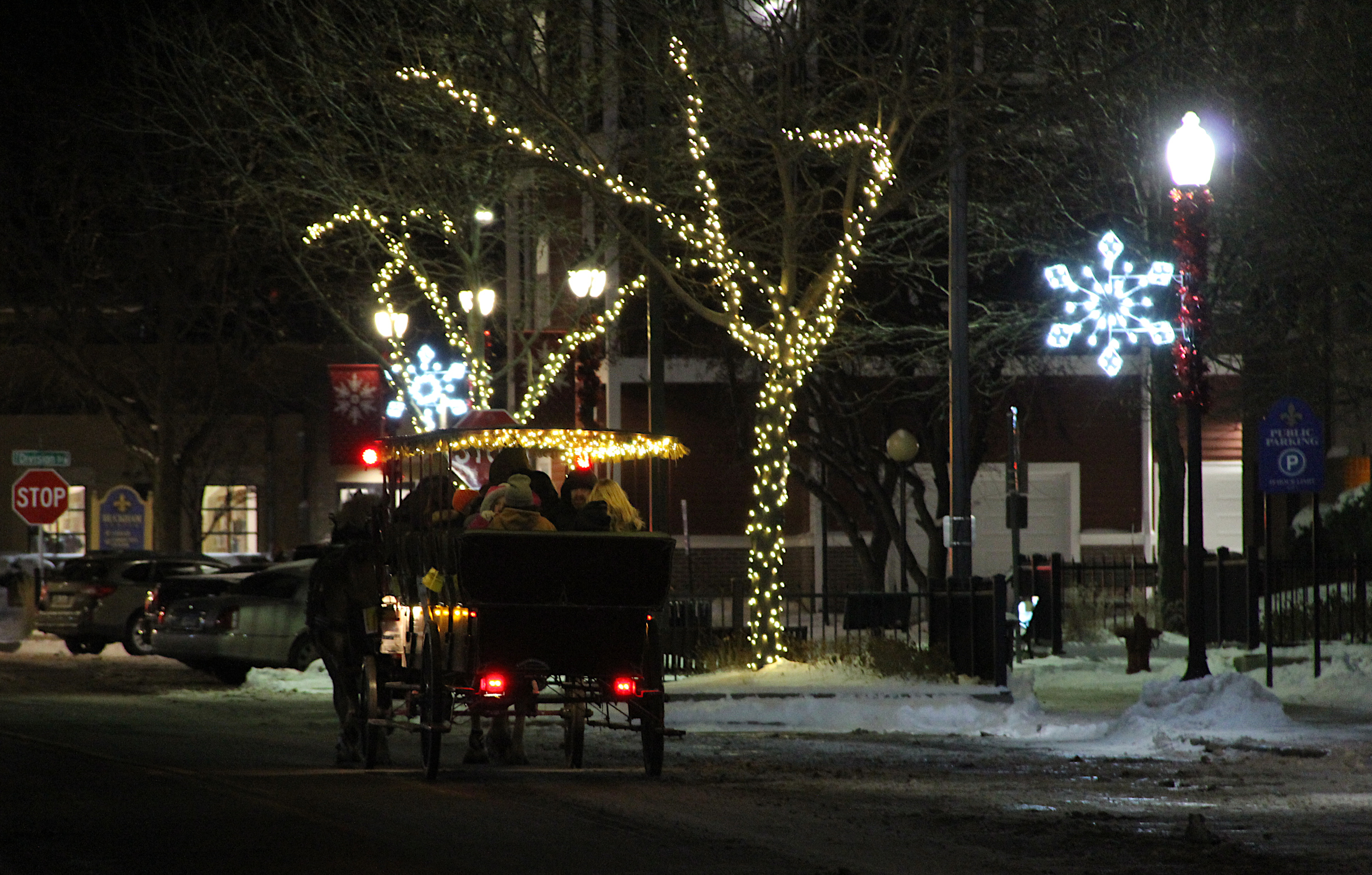
LAST WEEK THURSDAY EVENING, I hurried down the sidewalk in pursuit of horse-drawn wagons along Faribault’s Central Avenue. I hoped to catch a few photos, realizing the challenges of night photography with a moving target and a new-to-me camera.
Those beautiful horses up close. (Minnesota Prairie Roots copyrighted photo December 2022)
I try to be in the moment also, noticing details so I can convey the experience in words. But mostly on this evening I focused on catching up to those horses without falling on occasionally snow-packed and slippery sidewalks. It wasn’t easy. Hurry with caution.
And while I hastened, I felt the cold nipping my exposed fingers. Another hazard of winter photography in Minnesota. I own mittens that flip open to reveal partially-gloved fingers. But on this evening, those were stuffed inside my coat.
The horse-drawn wagon, one of two, giving free rides on a Winterfest evening. (Minnesota Prairie Roots copyrighted photo December 2022)
In the end, I got some photos. None clear. But I rather like the blurred images, which convey a sense of movement. At one point during the chase, I was nearly slammed into by a man exiting a restaurant. It wasn’t intentional. I was walking close to the building to avoid snow and he happened to exit at the exact time I passed by.
Almost back to the starting point at Buckham Center. (Minnesota Prairie Roots copyrighted photo December 2022)
The whole chasing-the-horses episode seems a misadventure. I should have prepared better, planned ahead, given myself more time to photograph this Winterfest event before I had to be elsewhere. But I didn’t. I expect many of you are feeling like me, somewhat overwhelmed by all you need to get done during the holidays. Shop. Bake. Write out Christmas cards. Attend holiday events. It’s a lot.
But too often we put this pressure on ourselves. We don’t have to do it all. We can choose to slow down, to hear the clomp of horses’ hooves on pavement, to hear the jingle of bells on harnesses and, yes, even to feel the bite of cold on our fingers.
A banner in downtown Faribault recognizes Winterfest sponsors last week. (Minnesota Prairie Roots copyrighted photo December 2022)
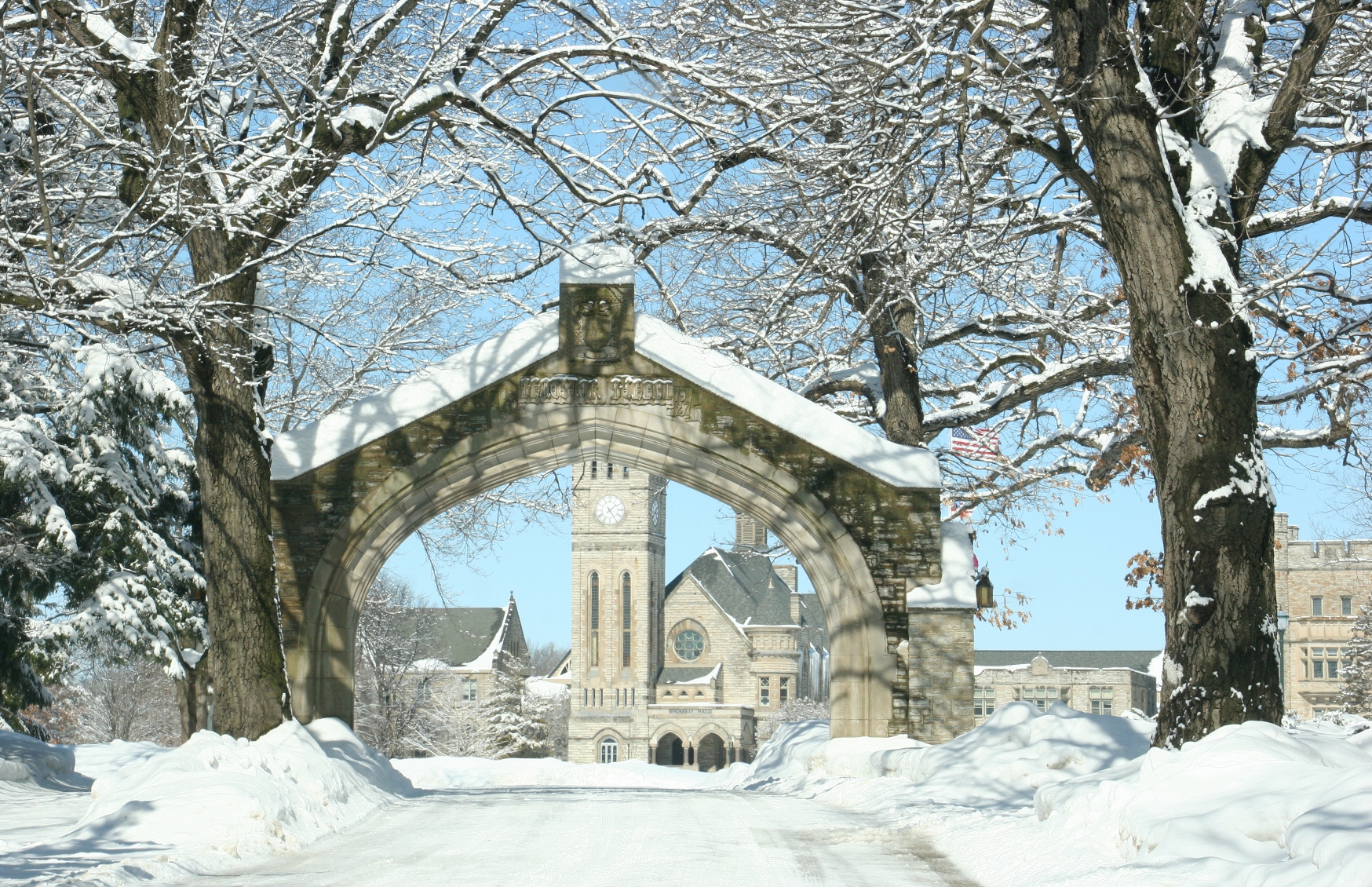
One of the most scenic settings in Faribault–the arched entry to Shattuck-St. Mary’s School, upper campus. (Minnesota Prairie Roots copyrighted file photo)
ON FARIBAULT’S EAST SIDE, students from across the country and world come to learn at Shattuck-St. Mary’s School, a private college preparatory boarding school. The upper campus is especially beautiful, entered through a stone arch, historic buildings ringing a vast green space. This time of year, Shattuck is decked out in festive holiday décor. Inside and out.
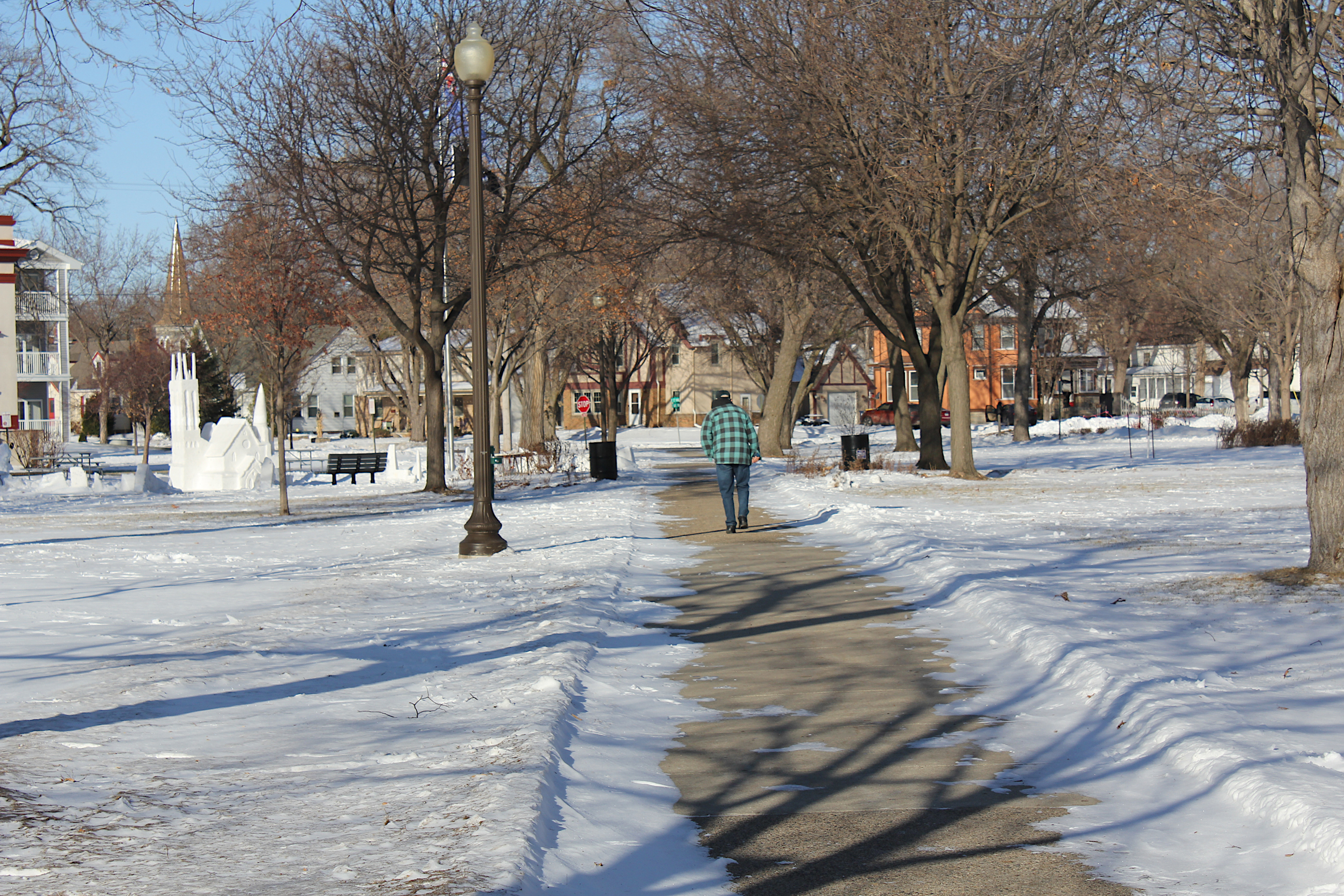
A man walks through Faribault’s Central Park, the cathedral snow sculpture ahead to his left. (Minnesota Prairie Roots copyrighted photo December 2022)
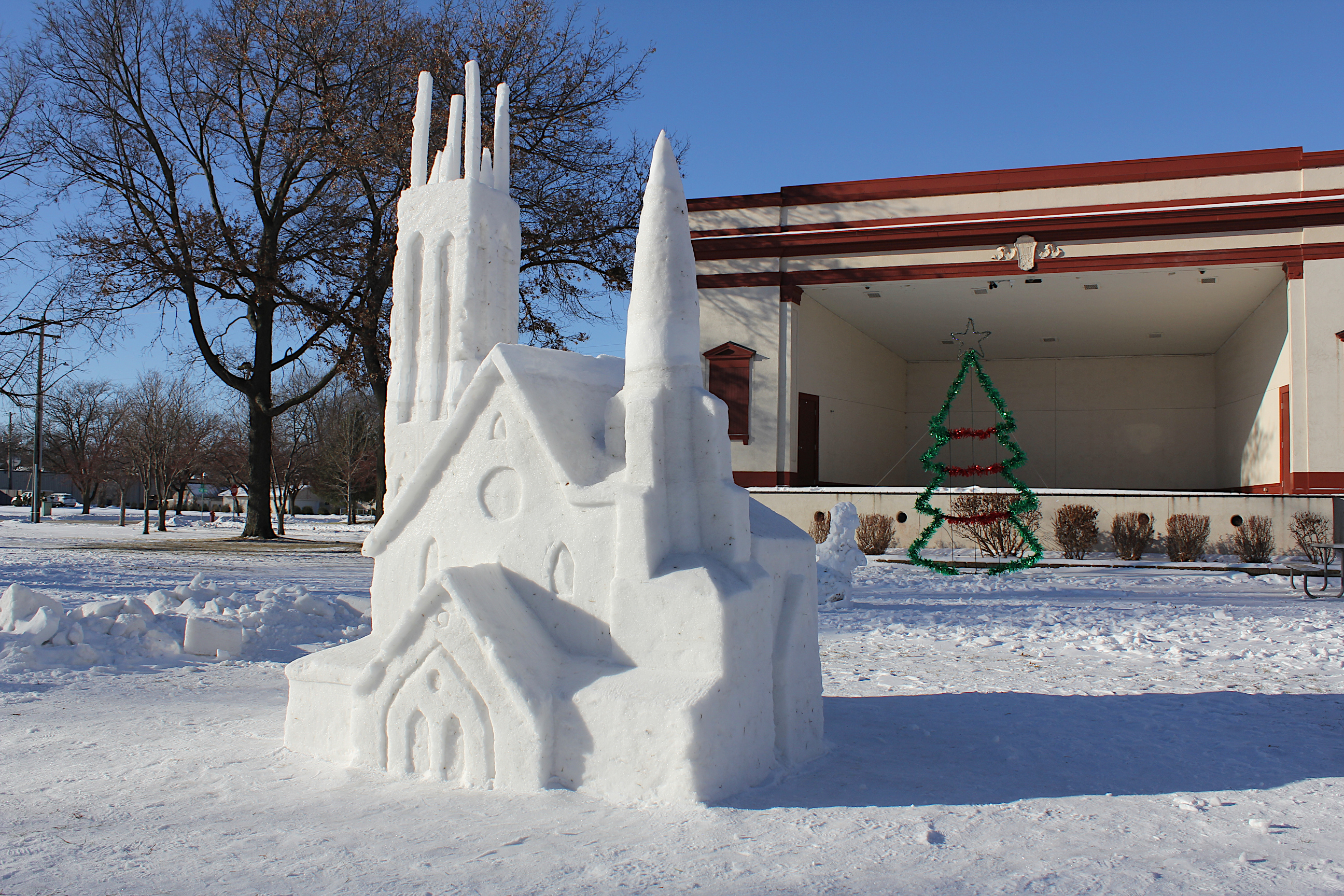
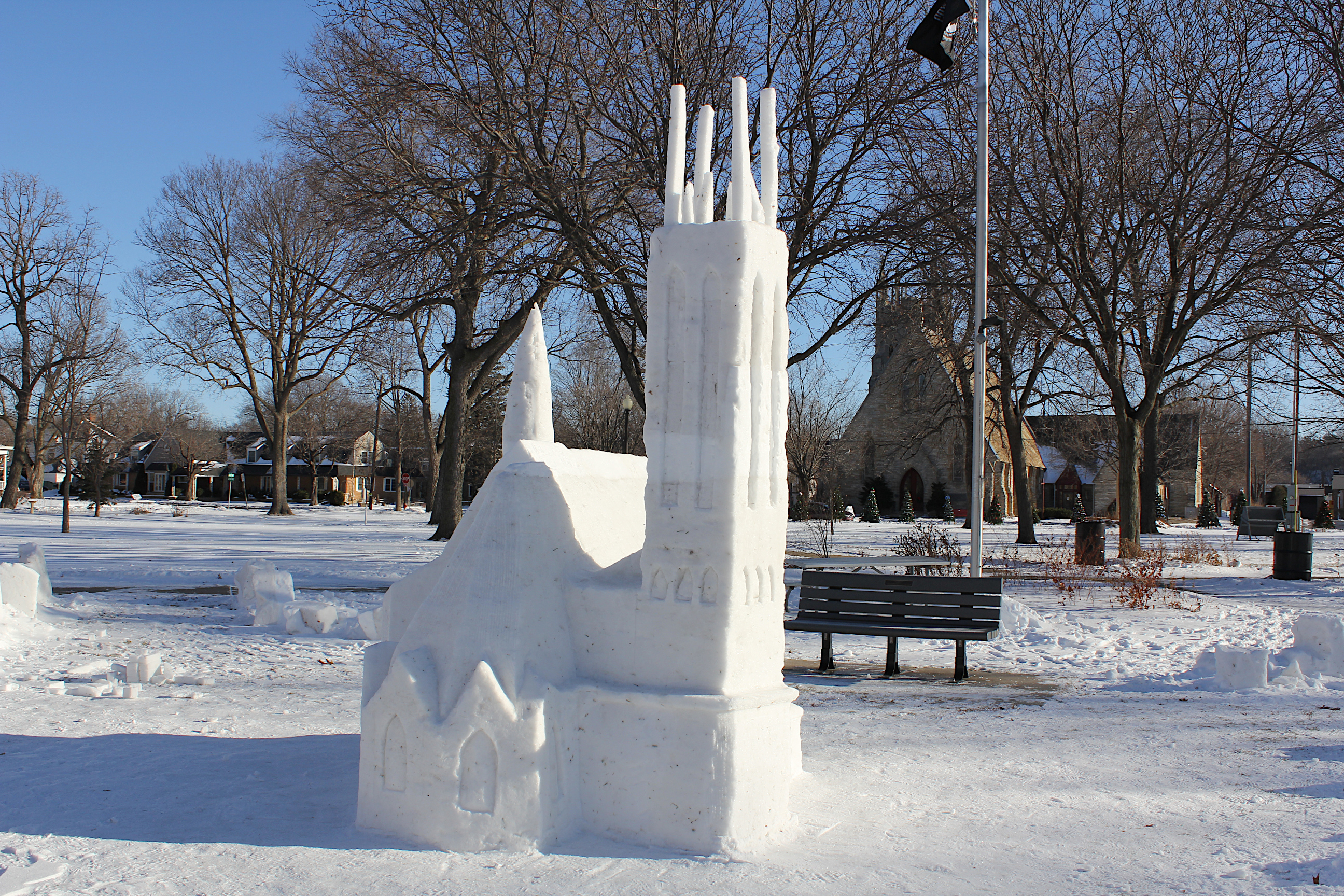
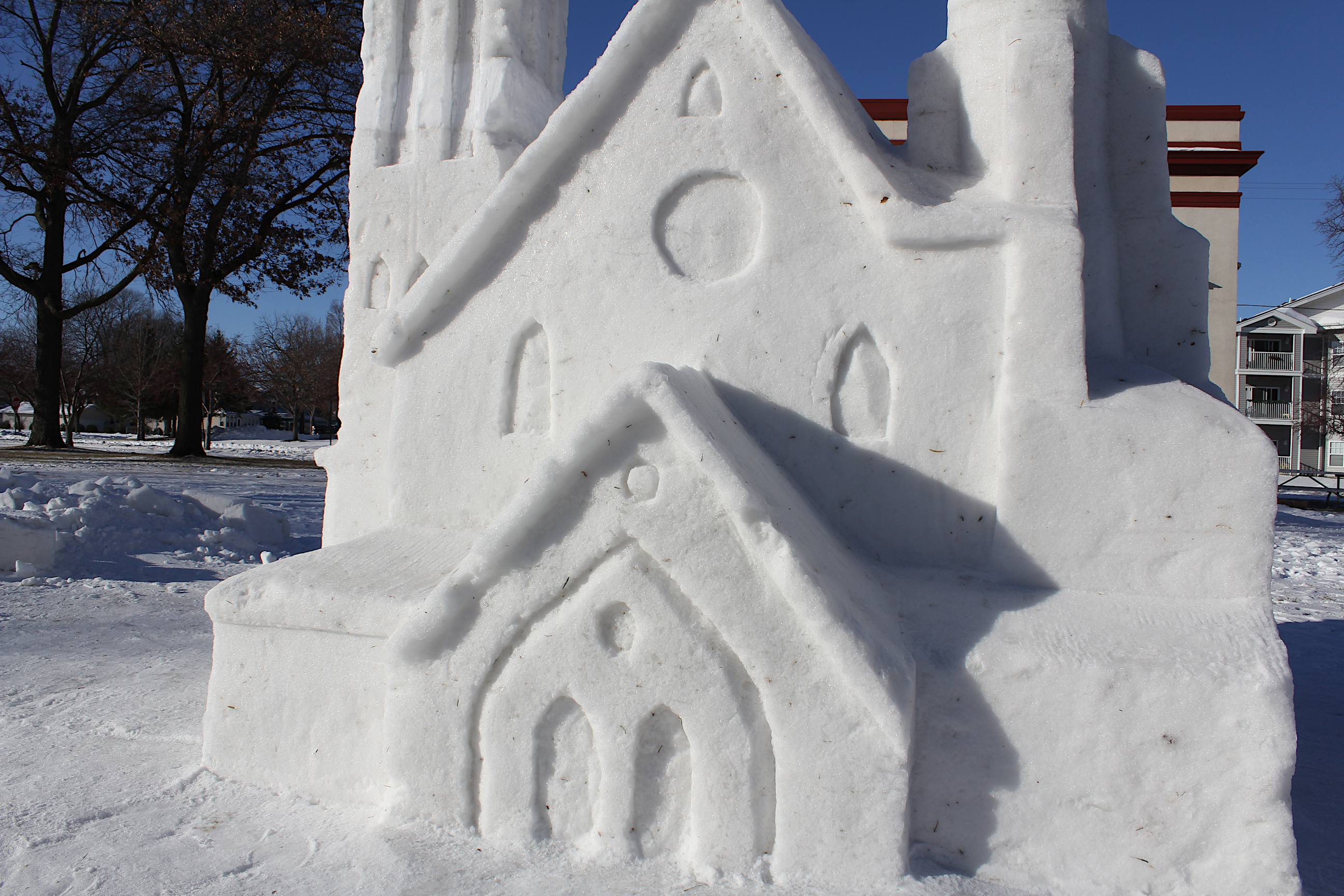
Across the Straight River in Faribault’s Central Park, a team of Shattuck students and staff recently shared their artistic skills with the community by creating a snow sculpture of the historic Cathedral of Our Merciful Savior. The massive cathedral sits within view of the sculpture along Second Avenue.
The historic bandshell, site of the Summer Concerts in the Park series, backdrops the cathedral sculpture. Holiday music was playing through a sound system when I stopped at Central Park. (Minnesota Prairie Roots copyrighted photo December 2022)
Although I didn’t see the carvers crafting this snow art, I enjoyed the results of their creativity during a walk through the park. The sculpture is centered near the historic bandshell.
In the distance, to the right, sits the historic Cathedral of Our Merciful Saviour. (Minnesota Prairie Roots copyrighted photo December 2022)
I appreciate when Shattuck engages with the community, this time adding another element to Faribault’s Winterfest. While that event has ended, the snow cathedral, weather permitting, should remain in place for awhile.
Skaters from Shattuck-St. Mary’s Figure Skating Center of Excellence presented a Christmas Spectacular on Ice during a past Christmas Walk. (Minnesota Prairie Roots copyrighted file photo)
This Saturday, December 10, Shattuck opens its campus to the public during the annual Christmas Walk. That begins with the “How the Grinch Stole Christmas Ice Show” at 12:30 pm in the Sports Complex. Shattuck is known for its excellent figure skating and hockey programs. I’ve attended these holiday ice shows several times and thoroughly enjoyed watching athleticism and creativity merge on the ice.
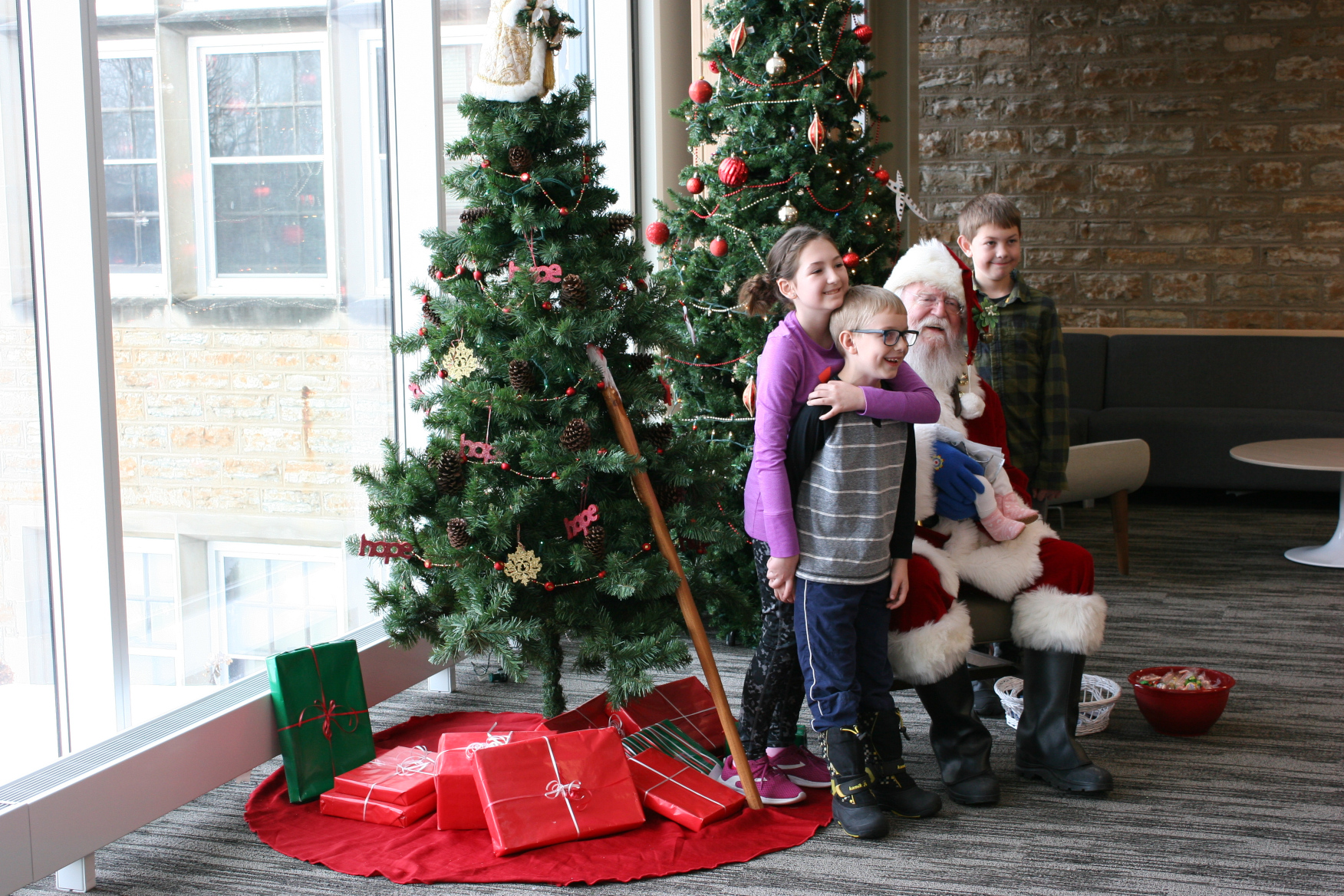
Posing for pictures with Santa at a Shattuck-St. Mary’s past Christmas Walk. (Minnesota Prairie Roots copyrighted file photo 2019)
The holiday event also includes visits with Santa, crafts for the kids and cookies, all from 1-4 pm in The Hub. Sleigh rides are available, too. At 3:30 pm, students will perform a holiday concert in the Chapel of the Good Shepherd.
The snow sculpture cathedral front entry doors mimic doors on the real cathedral across the street. (Minnesota Prairie Roots copyrighted photo December 2022)
Both of these—the Christmas Walk and the snow sculpting—are such positives. Open doors and open hearts make for a better, more connected community.
LIVING IN A MINNESOTA community with a sizable Somali population, I was excited to read the recently-published children’s picture book Fire and Ashes—A Boy and an African Proverb co-authored by Minnesotans Ahmed Hassan and Wes Erwin. Why? It’s important for me to learn about my new neighbors, their homeland, their culture, their experiences before resettling in Faribault. Reading books is one way to gain insights.
Fire and Ashes, even though a book geared toward children, is an enlightening read for adults, too. I found myself fully-engaged in the story of young Warfa, a refugee from Somalia who experienced unimaginable trauma. His trauma flares when he works on a school assignment—creating a poster about himself. I can almost feel my tummy hurting, my head spinning, my heart racing right along with Warfa as he relives terrifying moments in Africa. That includes witnessing the violent death of a neighbor. (Because of that, children should read this story with an adult.)
Award-winning children’s book illustrator Meryl Treatner reinforces the story line with art so realistic that I felt like I stepped into Africa and then into Warfa’s American classroom. I could almost smell the flowery scent of the acacia tree, feel the threat in a shadowy figure, hear Warfa’s uneven breathing.
It is Warfa’s grandma who helps her “little lion” deal with his anxiety via an African proverb and practical visualization and breathing techniques. Proverbs are used in many cultures to effectively teach, to pass along wisdom. The co-authors of Fire and Ashes, both licensed counselors, wrote this book not only to share a proverb, to tell Warfa’s story, but also to shine a light on mental health and self-care. The book includes authors’ notes and a link to additional supportive resources.
There are so many reasons to appreciate Fire and Ashes. The book gives readers like me a glimpse into atrocities experienced by my new neighbors. This book gives insights into culture. And for those who have endured any type of trauma, whether young like Warfa or two generations older, this book opens the door to discussion and then to healing, to an understanding that memories are ashes, not fire.
FYI:Fire and Ashes—A Boy and an African Proverb is available for check-out at Buckham Memorial Library in Faribault and the Lanesboro Public Library, local requests only. I hope other libraries in the 11-county Southeastern Libraries Cooperating system add this book to their collections. This book, published by The Little Fig, is the first in a series focusing on African proverbs. I’d recommend purchasing Fire and Ashes for your personal library or as a gift.
A nutcracker ornament nestles in a Christmas Tree at Faribault’s Central Park. (Minnesota Prairie Roots copyrighted photo December 2022)
WHENEVER I FEEL DISCOURAGED by disparaging attitudes in my community, I need only shift my focus to change my mindset. So many people in Faribault are doing really good things to help each other in a time when individuals and families are struggling. Never is that more evident than during the holiday season.
Some of the 47 trees edging the sidewalk. (Minnesota Prairie Roots copyrighted photo December 2022)
Buckham West, where parks & rec is based, donated a tree (Minnesota Prairie Roots copyrighted photo December 2022)
Love this elf tree topper. (Minnesota Prairie Roots copyrighted photo December 2022)
One example of community generosity is currently displayed at Central Park, where 47 decorated Christmas trees line the sidewalk along Second Avenue. These are more than simply trees adding a festive flair to Faribault. These are trees purchased and decorated by non-profits, businesses, service organizations and more through the city Parks and Recreation Department’s Adopt a Tree Program.
In the distance, to the far left is St. Vincent de Paul. (Minnesota Prairie Roots copyrighted photo December 2022)
The city works with local non-profit St. Vincent de Paul, just across the street from the park, to give the trees to families in need. This Thursday, December 8, the trees come down for distribution to those selected to receive this bit of holiday cheer.
The Lion’s Club is a community service focused orgnization. (Minnesota Prairie Roots copyrighted photo December 2022)
Stars shine light and hope, here in a tree topper. (Minnesota Prairie Roots copyrighted photo Decmeber 2022)
Many local businesses, like Affinity Plus, donated trees. (Minnesota Prairie Roots copyrighted photo December 2022)
As I view it, these donated trees stretch beyond decorating homes that would otherwise be without Christmas trees. These trees are about giving hope. These trees are about showing care, compassion and love. Both donors and recipients likely experience those feelings. A sense of community connection flourishes.
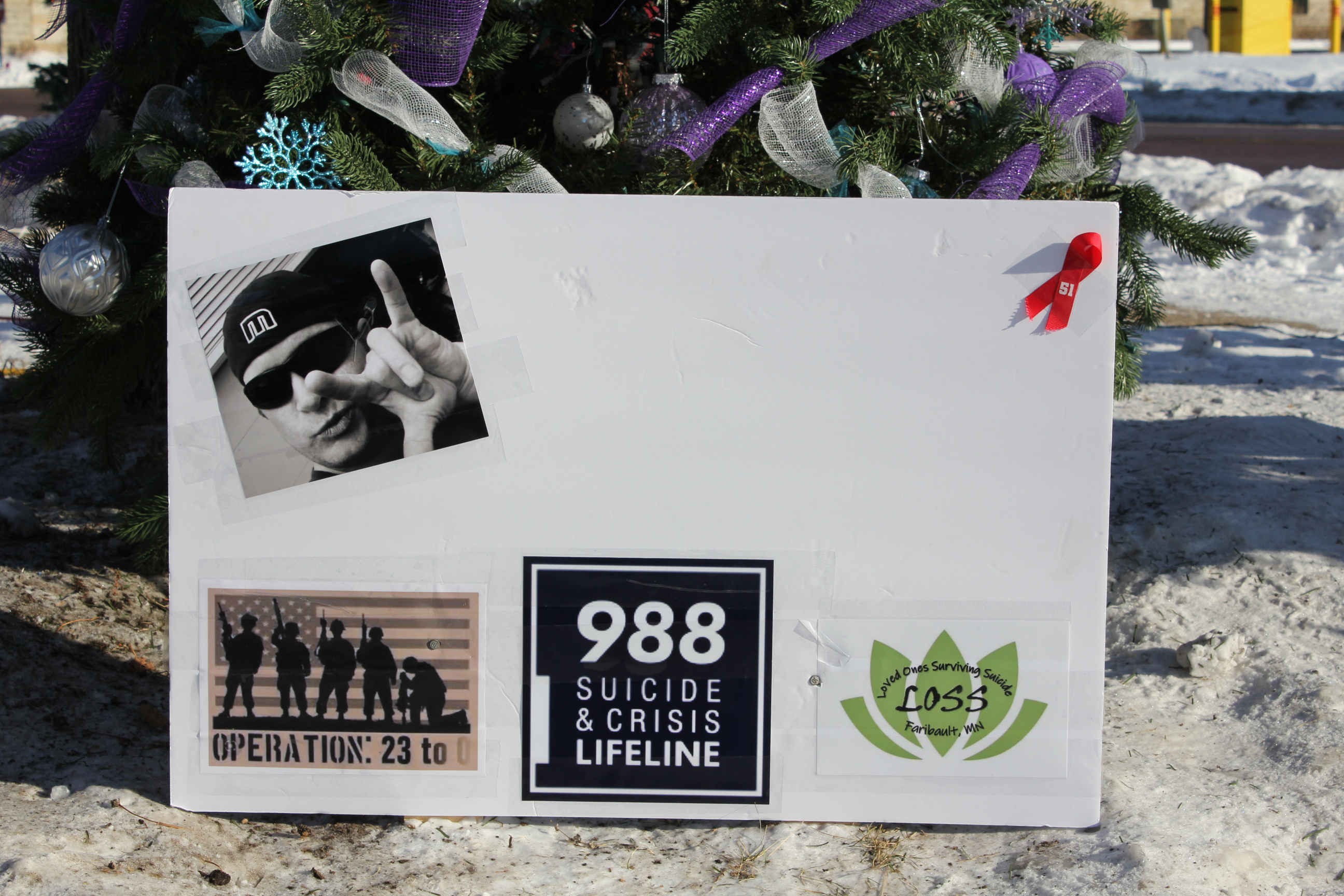
Sponsors of this tree focus on mental health, specifically suicide prevention and supporting survivors. (Minnesota Prairie Roots copyrighted photo December 2022)
In these assuredly tough economic and divisive times, we need, more than ever, to be there for one another. To see the humanity in each other, to respect one another, to support and care for one another. To connect as a community.
A gnome tops a tree. (Minnesota Prairie Roots copyrighted photo December 2022)
Looking at the trees toward the south. (Minnesota Prairie Roots copyrighted photo December 2022)
The variety of ornaments, including this shiny reindeer, is impressive. (Minnesota Prairie Roots copyrighted photo December 2022)
Only several years into Adopt a Tree, the program is growing with 15 more trees than in 2021. Such generosity of spirit touches me, shows me that the Faribault community cares. For that I feel grateful.
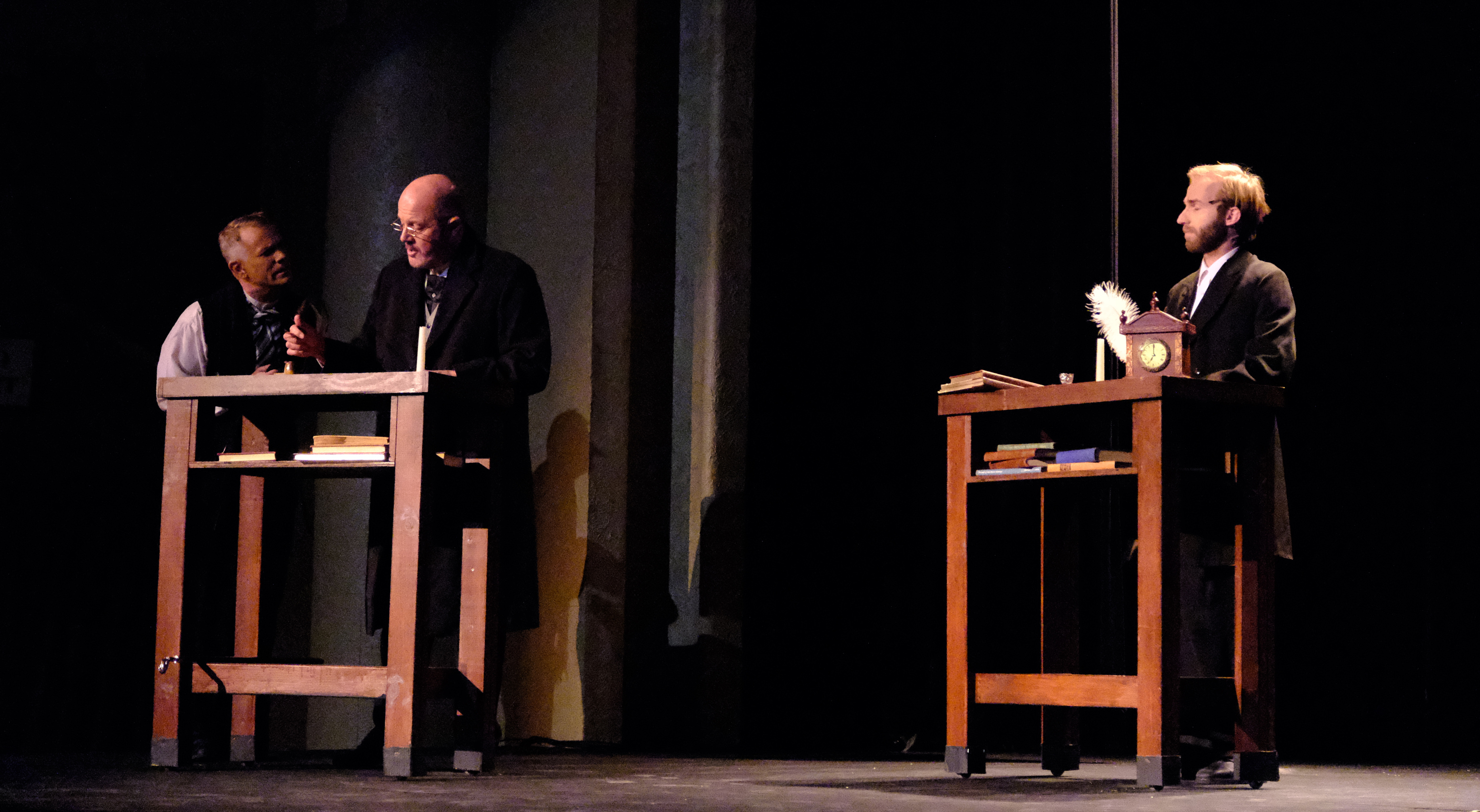
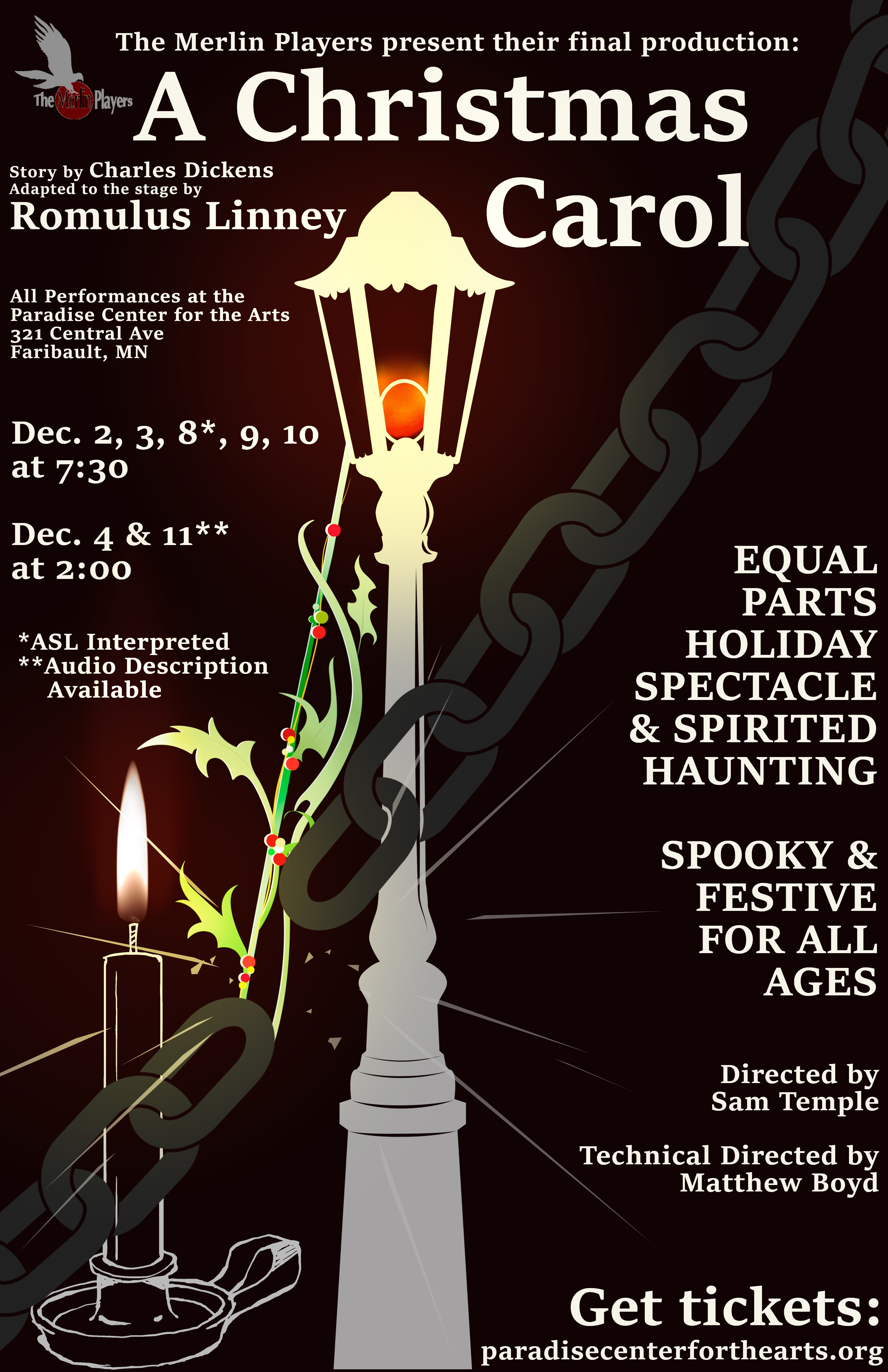
A scene from “A Christmas Carol,” now on stage in Faribault. (Photo courtesy of director Sam Temple)
ON THE MORNING OF OUR GRANDSON’S preschool holiday party, Randy took time off work to watch a group of preschoolers perform an unrehearsed version of the Christmas story. The little ones eagerly donned swatches of cloth, transforming into multiple Marys, Josephs, angels and shepherds. My eyes focused on Isaac, brown tunic slipped over his plaid flannel shirt, shepherd’s staff in hand. I worried he might bonk a classmate over the head. He never did. In the end, the pastor-directed impromptu play proved entertaining and joyful, a blessing to all.
Later that evening, after he returned from a half day of work, Randy joined me at the Paradise Center for the Arts in Faribault to watch an invitation-only final dress rehearsal of Charles Dickens’ A Christmas Carol performed by The Merlin Players. Well-rehearsed, directed, staged, acted and presented, this play contrasted sharply with the one we’d seen earlier that day. Yet, the messages of peace, love and good will (among others) repeated. The Dickens’ play ended with the line: “God bless us everyone!”
Two plays in one day—one familiar to me, the other not. One faith-based, the other centered on choices one makes in life. Both powerful in their own way. One loose and unstaged, the other professionally done.
The promotional poster for “A Christmas Carol.” (Courtesy of Sam Temple)
That I’ve never read or seen A Christmas Carol is something I hesitate to admit. I am, after all, an English minor, an avid reader, a writer. Of course, I knew the basic story line of main character Ebenezer Scrooge visited by the ghosts of Christmas past, present and future. But that’s about it. So I walked into the theater Thursday evening not quite knowing what to expect, although I anticipated another outstanding performance by The Merlin Players. Fifteen years ago they presented this same play at the Paradise. Now the theater company is disbanding, choosing to end with a repeat of A Christmas Carol, albeit different in presentation.
Posted in a window of the Paradise Center for the Arts, a quote by Jacob Marley, Ebenezer Scrooge’s business partner.(Minnesota Prairie Roots copyrighted photo December 2022)
As I sat in my theater seat listening and watching, central themes began to emerge. “There’s more to life than work,” Mrs. Fezziwig (Alane Bendtsen) states as Ebenezer Scrooge faces the Ghost of Christmas Past. I thought of my husband who just that morning missed work to attend our 3-year-old grandson’s preschool party and pageant. I felt grateful for his decision. Age has a way of shifting priorities. And in this theatrical production, a story has a way of exposing regrets. Scrooge focused his life on work, on making money, on getting things and, in the end, gave up so much, including love.
I expect we have all experienced many Scrooge moments, when we stand at a crossroads and make choices that aren’t the best, that, in the end, hurt us, those we love, even strangers. Choices that are self-serving and unkind. I expect we have all turned away those in need, like Scrooge did in a brief interaction with a child caroler (Ella Boland) in a moment I found especially touching.
Sam Temple, who directed the play, notes that “through this story, Dickens sought to solidify Christmas as a season for charity, kindness, and compassion for the downtrodden.” That carries through in the unfolding plot and dialogue with a message as timely today as in 1843 when Dickens penned this story.
Another scene from The Merlin Players’ production of Charles Dickens’ Christmas classic. (Photo courtesy of Sam Temple)
From the youngest to oldest, these 26 performers (all playing multiple roles except Steve Searl/Scrooge) pour their hearts and souls into retelling Dickens’ A Christmas Carol. I cannot imagine trying to direct a cast of this size; Sam Temple proved he was up to the task. The lines. The movement. The dancing. The costuming. The technical aspects. The music and singing—Jingle Bells, Silent Night, O Tannenbaum… The festive spirit of the season emerges. Everything comes together seamlessly.
That I came into this performance with no preconceived ideas, no comparisons to other productions, allows for an unbiased review. I sat back. Took it all in, appreciating the dramatic special effects which include the banging of chains, globes of floating light, a towering and menacing black Ghost of Christmas Yet to Come and more. I’m intentionally not revealing details. Technical Director Matthew Boyd and crew outdid themselves in creatively enhancing this theatrical version of Dickens’ Christmas classic.
A second quote by character Jacob Marley posted at the Paradise. (Minnesota Prairie Roots copyrighted photo December 2022)
I exited the theater feeling reflective and uplifted by the transformation of Scrooge from money-focused and miserly to kind, caring, compassionate. “I am not the man that I was,” he declares. He stood at a crossroads and, in the end, chose good will, kindness, love. He experienced what I would term A Christmas Awakening.
FYI: A Christmas Carol opens at 7:30 pm Friday, December 2, at the Paradise Center for the Arts along Central Avenue in historic downtown Faribault. Other 7:30 pm performances are on December 3, 8, 9 and 10. Two afternoon shows are set for Sunday, December 4 and 11 at 2 pm. If you plan to attend, I highly encourage you to reserve tickets now or you may not get a seat. Tickets are selling quickly. Click here for more info.
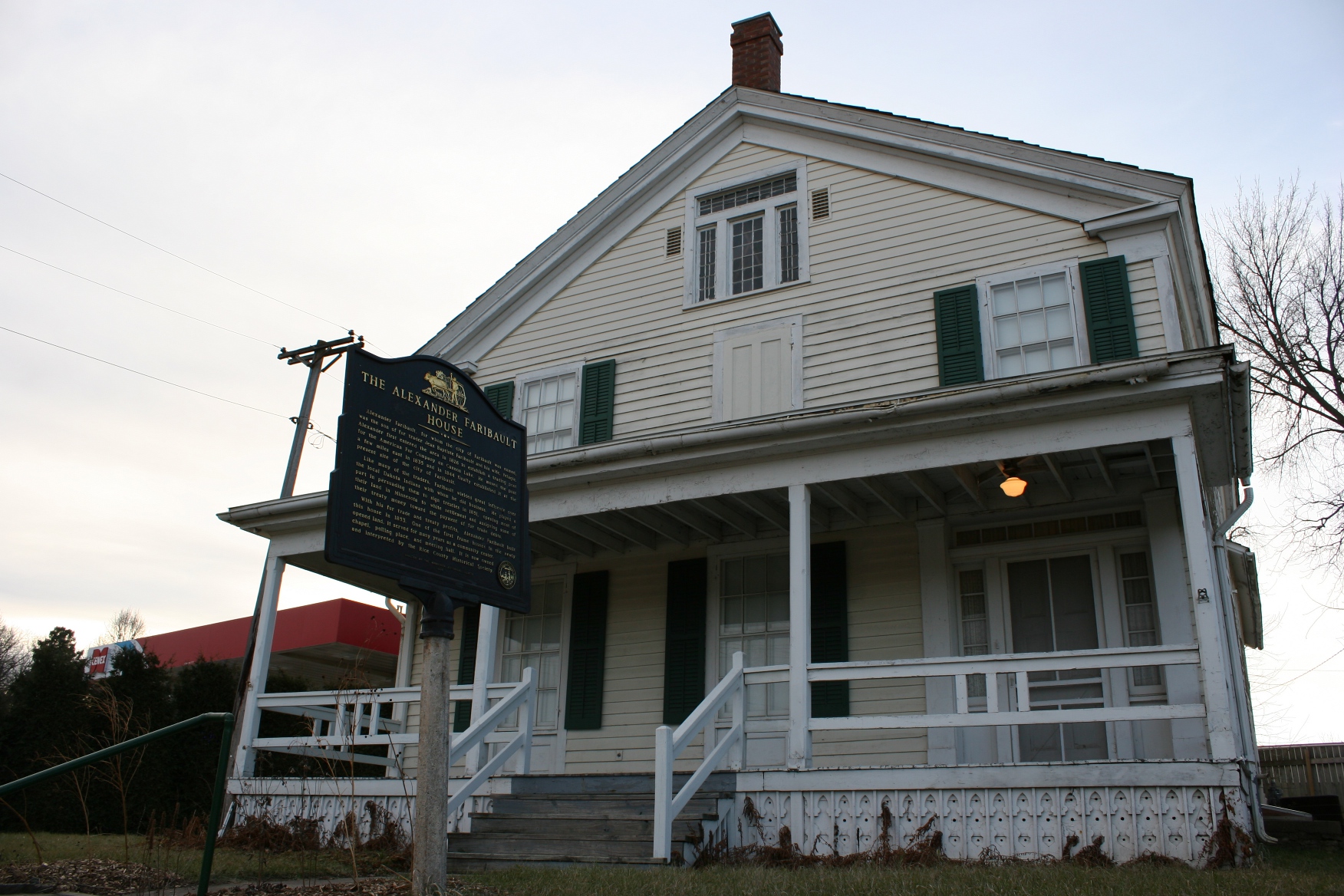
The home of town founder Alexander Faribault. (Minnesota Prairie Roots copyrighted file photo 2017)
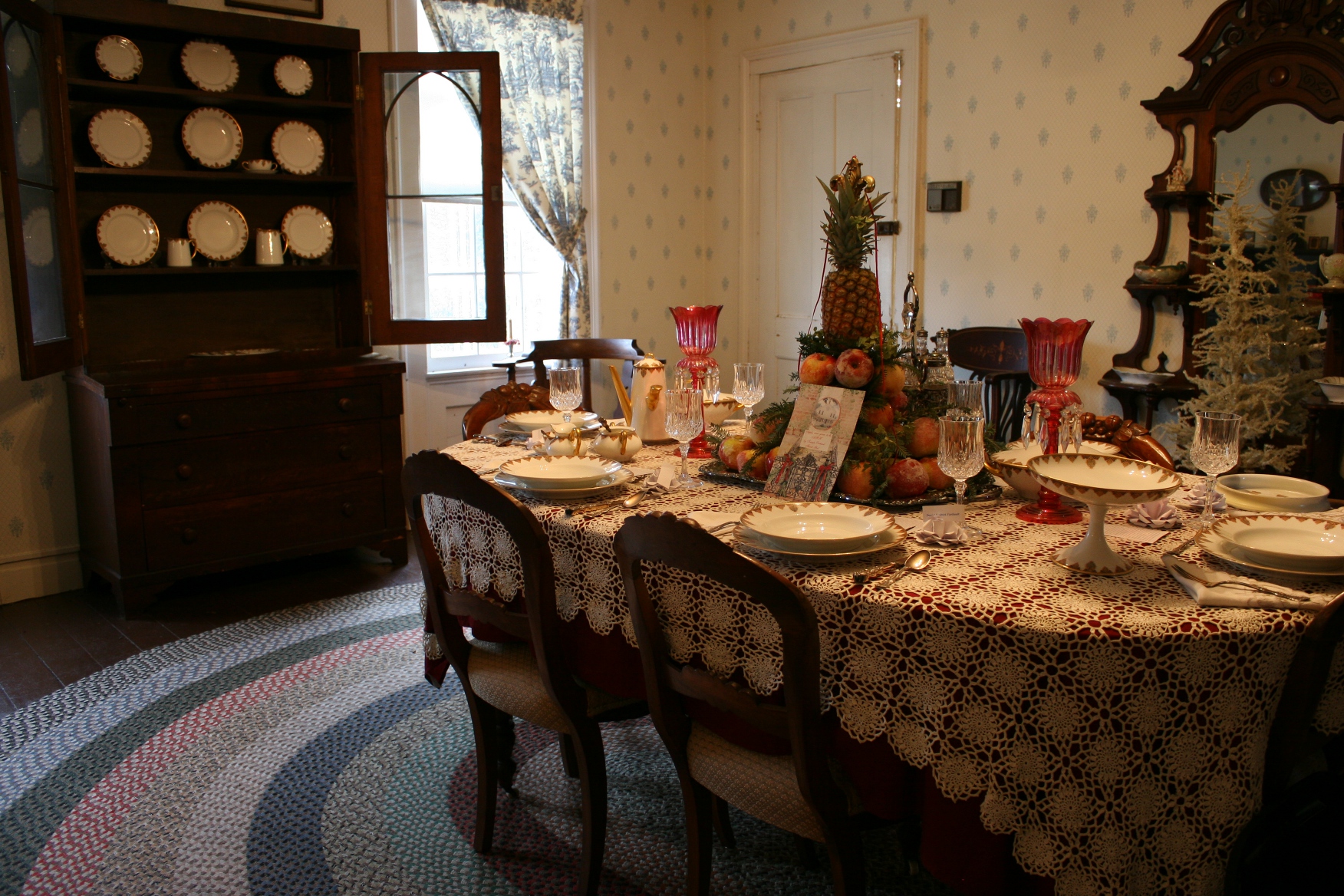
ON SATURDAY, THE HOME of Faribault’s founder, Alexander Faribault, opens for its 15th annual Christmas open house. The event features the 1853 house decorated for the holidays in the French-Canadian style. Faribault was of French-Canadian and Dakota descent.
The Faribaults’ dining room set for the holidays during the 2017 Christmas open house. (Minnesota Prairie Roots copyrighted file photo 2017)
To walk through the rooms of this historic home is to feel the presence of the Faribault family, including wife Mary Elizabeth Graham and their children. The Faribaults lived here only a few years before moving to a large brick mansion on the bluffs overlooking the Straight River. With 10 children, I expect they needed more space than the wood-frame house provided.
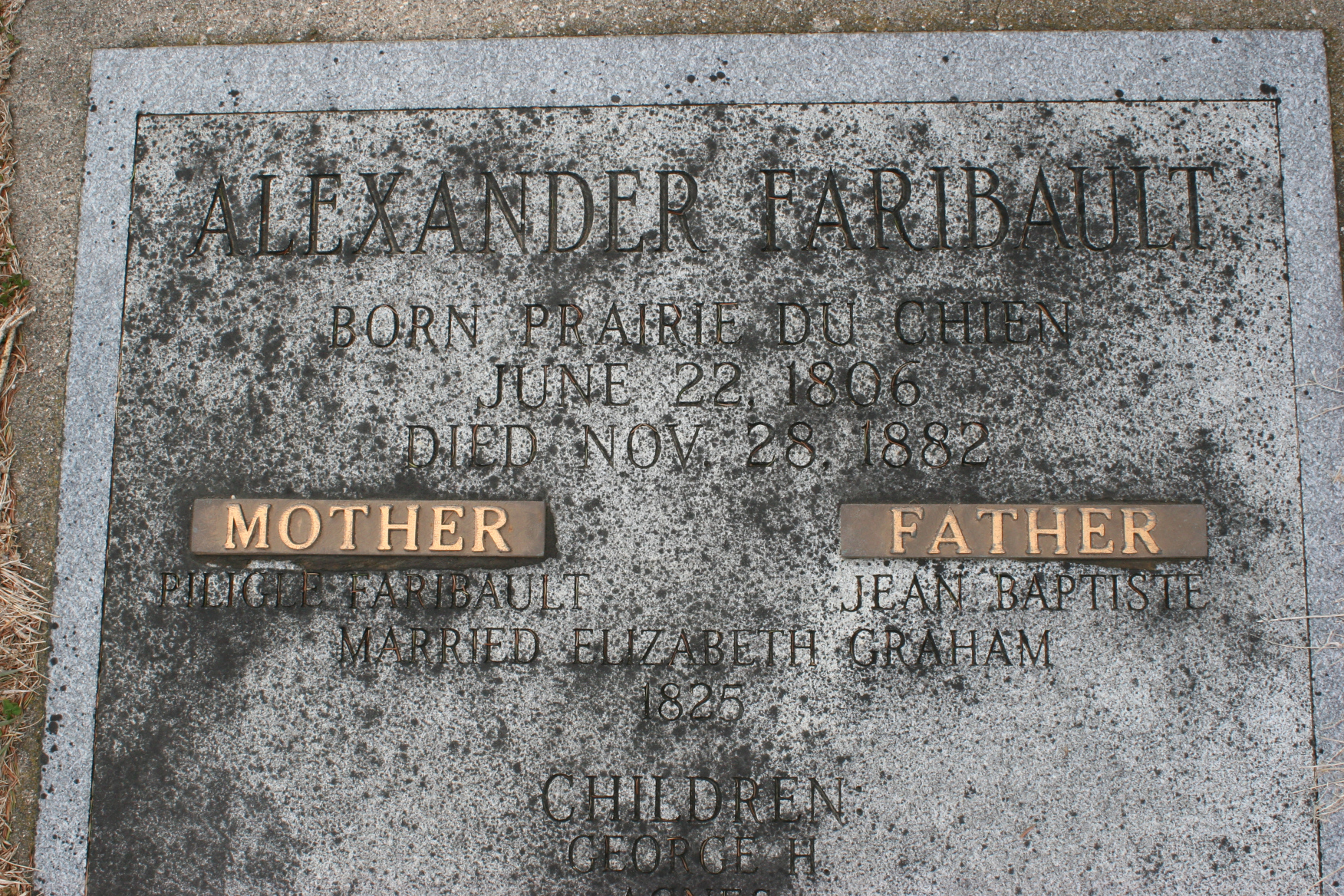
An overview of Alexander Faribault’s gravesite at Calvary Cemetery. (Minnesota Prairie Roots copyrighted photo April 2020)
Across town several miles to the west atop a hill overlooking the countryside on the edge of Faribault, the life of Alexander Faribault comes full circle. It is here, in Calvary Cemetery, that this fur trader, this friend of the Dakota, this town founder, this family man, is buried.
A memorial to Alexander Faribault stands at the Calvary Cemetery entrance. The birth date here differs from the one on Faribault’s tombstone. (Minnesota Prairie Roots copyrighted photo April 2020)
In April 2020, I visited this cemetery for the first time specifically looking for Faribault’s gravesite. I found it along with a memorial marker honoring him at the graveyard’s entrance.
Memorial marker words up close. (Minnesota Prairie Roots copyrighted photo April 2020)
Race or creed did not color his judgments, the marker states in part. That seems to match what I’ve read about Alexander Faribault. Both his mother and wife were of Dakota heritage, thus he and his children were, too. Alexander, who traded with and befriended the Dakota, later sheltered some of them on his land. Government treaties removed indigenous peoples from their land, including in current-day Faribault. Alexander Faribault served as an interpreter in the signing of regional treaties given his knowledge of the Dakota language and culture. I wonder if he felt conflicted by how the government treated the Dakota.
This sculpture of Alexander Faribault and a Dakota trading partner stands in Faribault’s Heritage Park near the Straight River and site of Faribault’s trading post. Faribault artist Ivan Whillock created this sculpture which sits atop the Bea Duncan Memorial Fountain. (Minnesota Prairie Roots copyrighted file photo)
Today, 216 years after Faribault was born on November 28, 1806, an awareness and acknowledgment that indigenous peoples were the first inhabitants of this area is rising. Long before fur traders like Faribault set up trading posts in the region, the Dakota lived here, hunted here, fished here, raised their families here, called this place home.
This shows a portion of an in-ground marker for Alexander Faribault. (Minnesota Prairie Roots copyrighted photo April 2020)
When I consider the friendships forged among fur traders and the Dakota, I think of the Faribault community today and those who call this place home. This city truly is a melting pot of cultures and peoples. I celebrate that. Some day I hope we can all, like our town founder, view each other through a clear lens without the filter of race or creed coloring judgment.
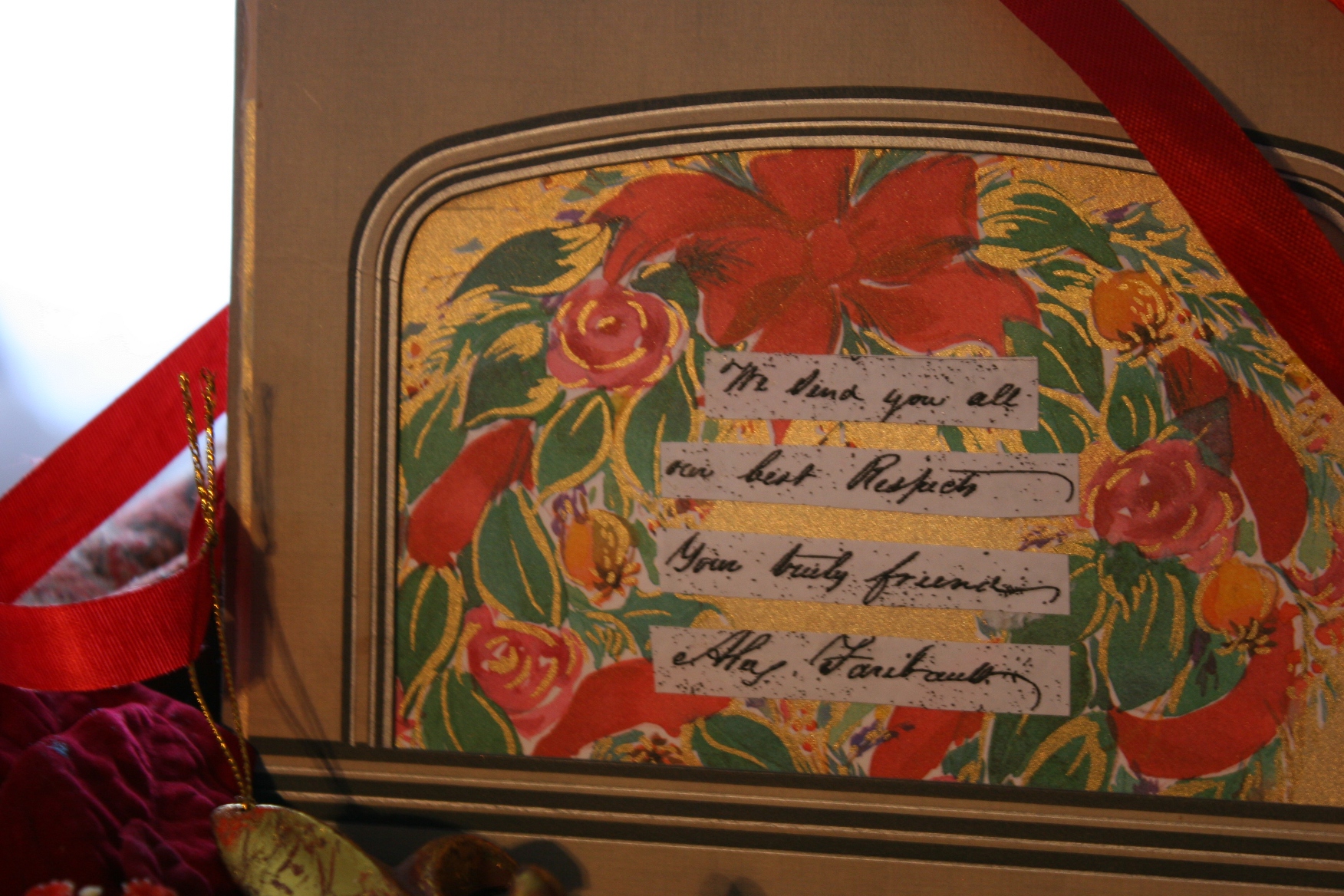
A holiday greeting from Alexander Faribault displayed at a past Christmas open house. (Minnesota Prairie Roots copyrighted file photo)
FYI: The Alexander Faribault House Christmas Open House is from 11 am- 3 pm Saturday, December 3, at 12 First Avenue Northeast, Faribault. The event is free and is part of this weekend’s Winterfest celebration in Faribault.
Words like strong, beautiful, hopeful and more are incorporated into “Love Remains,” a memorial mosaic honoring Barb Larson.The Faribault Area Chamber of Commerce and Tourism employee was shot to death by her ex-husband on December 23, 2016, at her workplace.(Minnesota Prairie Roots copyrighted file photo)
IN MY FOURTH EDITION hard cover copy of Webster’s New World College Dictionary published in 2000 and shelved on my office desk, you won’t find the word gaslighting. But today, gaslighting has been chosen as the 2022 word of the year by Merriam-Webster, America’s oldest dictionary publisher.
In many ways, I’m not surprised by the choice given the widespread manipulative use of language in today’s world. Gaslighting is exactly that, “the art or practice of grossly misleading someone, especially for one’s own advantage.”
Merriam-Webster reports a 1,740 percent spike in searches for the word gaslighting in 2022. Again, this doesn’t surprise me in today’s political climate, especially.
Yet, the term gaslighting is nothing new in the context of domestic abuse and violence. That tactic is often used by abusers to manipulate and control. The word traces to the 1944 film, “Gaslight,” (or the 1938 play, “Gas Light”) a psychological thriller in which the husband convinces his wife that the noises she hears, the dimming of gaslights and more are in her head and not real. His gaslighting is full-blown emotional and psychological abuse.
Information shared at a public forum following Barb Larson’s murder. (Minnesota Prairie Roots copyrighted file photo)
The reality is that abusers use gaslighting to effectively flame doubt in their partners, who begin to question themselves, their thoughts, actions and feelings. Confusion, anxiety, self-doubt, isolation, depression, hopelessness and so much more can flare. And in the end, the abuser gets exactly what he/she planned—power and control.
So, when I hear or read the word gaslighting, I think of domestic abuse and violence, of all those individuals being emotionally and psychologically abused by partners. I think of the put downs, the false narratives, the twisting of reality, the lies, the excuses…
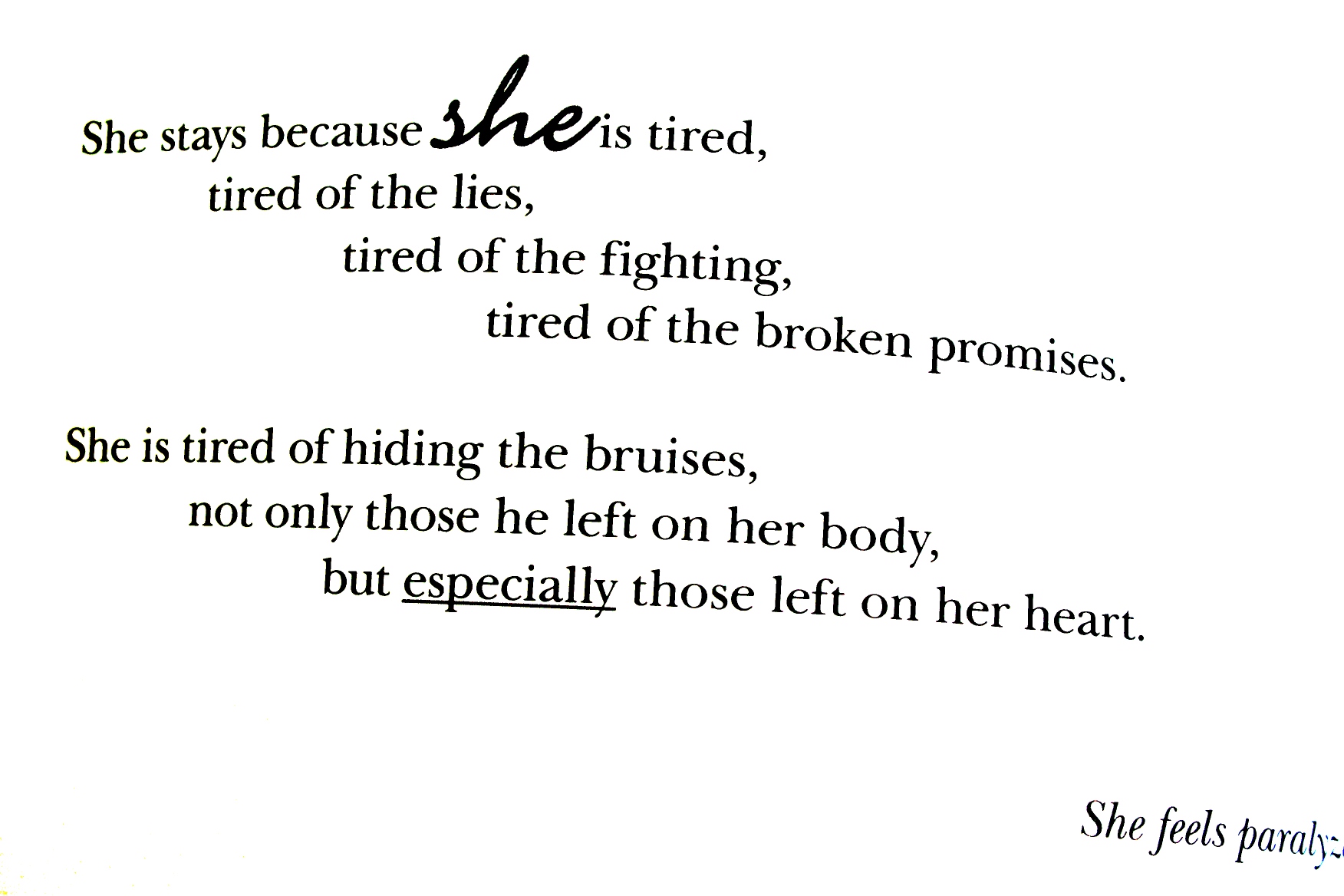
Reasons she stays, from page 18 of the book, “She Stays” by HOPE Center (Faribault) Director Erica Staab. Advocates like Staab bring hope and help. (Text copyright of Erica Staab)
My 20-year-old dictionary may not include gaslighting. But it does include the word advocate, defined in 2000 as “a person who pleads another’s cause.” For those gaslighted and otherwise abused, advocates are available to listen, to support, to help. To advocate. That singular word brings hope. Gaslighting may be the 2022 word of the year. But hope remains. Always.
FYI: If you are in an abusive relationship, please seek help. A good starting place is the National Domestic Violence Hotline, which provides information and resources. Or, if your community has a center focused on domestic abuse and violence, reach out locally. If you know someone in an abusive relationship, listen, support, encourage and advocate. If you are in immediate danger, call 911.


































 Minnesota Prairie Roots
Recent Comments