A member of the Faribault Color Guard holds the American Flag during the Memorial Day program. (Minnesota Prairie Roots copyrighted photo May 2025)
TWO THINGS IN THIS YEAR’S Faribault Memorial Day observances stood out for me from previous events. First, three military women—Kerrie Johnsrud, Peggy Johnson and Stephanie Johnsrud—were honored. Second, a soldier killed in action during the Vietnam War was remembered.
A large crowd (this shows only a portion) gathers in Central Park for the Memorial Day program. (Minnesota Prairie Roots copyrighted photo May 2025)
Both touched me in a memorable way. Too often, women have been overlooked. Not this year. Not in Faribault. Honored Combat Veteran Stephanie Johnsrud drove that point home by reminding the crowd gathered at Central Park that anyone can be a veteran, even a woman, and to break the stigma of women in the military. She served with the Army National Guard, including deployments to Kuwait and Iraq. Upon her return, the veteran wanted to have a welcome home party at a local military club, something met with a less-than-warm reception. It was heartbreaking to hear her words.
This banner of Thomas Eastman and other Faribault Hometown Heroes hangs in the front window of the former Eastman Music. (Minnesota Prairie Roots copyrighted photo May 2025)
Equally heartbreaking was the story of Army PFC Thomas Eastman, 21, of rural Faribault who was killed in Vietnam on May 5, 1966. He’d been deployed as an infantryman only months earlier. His name is listed on panel 7E, Line 30, of the Vietnam Memorial Wall, one of 1,086 Minnesotans listed on that monument.
Love seeing children in attendance, listening and learning. (Minnesota Prairie Roots copyrighted photo May 2025)
Keynote speaker and emcee Gordy Kosfeld shared a bit about this young man, a 1963 Kenyon High School graduate. It was that information which personalized Eastman, took him from statistic to a beloved son, brother, uncle and friend. He wore thick glasses, loved fast cars, dogs and reading. And he planned to return to the farm upon his discharge.
“All gave some. Some gave all.” A meaningful message on a t-shirt. I saw another message, “You matter,” printed on a plain black tee. I told the young man wearing it how much I appreciated those two simple, yet powerful, words. (Minnesota Prairie Roots copyrighted photo May 2025)
Eastman, Kosfeld said, sounded like “an ordinary guy” who died in a far away land in service to country. He was and he did. I think sometimes, in the mass of numbers, we forget that our military men and women are, like Eastman, individuals with families and stories, likes and dislikes, and loved ones back home who miss them. And, if they are killed in action, with loved ones who deeply grieve their tragic deaths. That includes 58,000-plus during the Vietnam War.
The emcee pointed out this unexpected patriotic visual, worn by a young woman on stage. (Minnesota Prairie Roots copyrighted photo May 2025)
During the past year, many grieved the loss of 109 Rice County veterans. Our veterans are aging. Dying. Men like Carl W. Ames, Phillip J. Dorn and my friend, 100-year-old Elmer R. Schulz. And, among all those male veterans, four deceased female veterans, Donna L. Schultz, Beverly J. Miller, Donna M. Cleland and Debra G. Norman. All 109 names were listed on the Memorial Day service program, a visual reminder that imprints upon the spirit the importance of honoring veterans not only in death, but in life.
A veteran pays his respects by saluting. (Minnesota Prairie Roots copyrighted photo May 2025)
And that we did on Monday morning in Faribault’s Central Park. Young and old. We listened. We honored. We remembered.
Members of the Faribault American Legion Auxiliary placed wreaths, each representing a war or conflict, on or at the base of this cross during Faribault’s Memorial Day program. (Minnesota Prairie Roots copyrighted photo May 2025)
A horse-drawn wagon leads the parade along the gravel road to the Cannon City Cemetery. (Minnesota Prairie Roots copyrighted photo May 2025)
MEMORIAL DAY IN CANNON CITY is decidedly simple and old-fashioned, marking a 100-year-plus tradition of gathering in the 1867 cemetery to remember and honor veterans. This observation also embraces community with a mixture of mostly locals and those born here returning home for the 2 p.m. program followed by visiting, lots of visiting.
Several vintage vehicles and a pickup follow. (Minnesota Prairie Roots copyrighted photo May 2025)
Although I have no connection to this unincorporated village a few miles northeast of Faribault, I’ve found myself often drawn here on Memorial Day. The countryside setting and the way in which the day is celebrated appeal to my rural roots and upbringing 130 miles away on the southwestern Minnesota prairie.
A few people walked the parade route, here past farm land. (Minnesota Prairie Roots copyrighted photo May 2025)
Monday’s event at Cannon City began with a parade from the nearby former country school to the cemetery. A small contingent of horse-drawn wagon, vintage vehicles and several walkers followed the gravel road past homes and farm fields to the fenced cemetery. I walked alongside the group in the road ditch, photographing the scene as they neared the graveyard.
Vintage vehicles set an historic scene outside the cemetery gates. (Minnesota Prairie Roots copyrighted photo May 2025)
It was not difficult in that moment to imagine the long ago school children proceeding to the cemetery, carrying homemade floral wreaths of lilacs and other flowers in bloom. Several years ago that original Decoration Day parade tradition was revived. It’s a lovely nod to history.
A crowd gathers for the Memorial Day program centered under the trees. (Minnesota Prairie Roots copyrighted photo May 2025)
All ages attended, including Levi, almost two, who wore these patriotic boots. His grandpa is the cemetery caretaker. Levi helps him and his dad by picking up sticks before mowing. (Minnesota Prairie Roots copyrighted photo May 2025)
The Sartor Brothers lead musical selections. (Minnesota Prairie Roots copyrighted photo May 2025)
Inside the cemetery gate, folks gathered in the shelter of cedars and pines to listen to inspirational readings and poetry; to sing; to hear the names of 52 veterans buried here read aloud; and more.
Handing out poppies to attendees. Members of the Faribault American Legion Auxiliary and other volunteers crafted the paper flowers. (Minnesota Prairie Roots copyrighted photo May 2025)
Organizer Kathleen Kanne led the program and talked about Jean Ann Pederson. The plaque in front of Kanne was given in honor of Jean Ann. (Minnesota Prairie Roots copyrighted photo May 2025)
A woman’s t-shirt focuses on poppies, representing the blood of heroes who died in war. (Minnesota Prairie Roots copyrighted photo May 2025)
This year the “more” included excerpts from an interview with Jean Ann Greenville Pederson, a Cannon City native interviewed by Kathleen Kanne and Mel Sanborn. She died in February, shortly after her 93rd birthday. Each May, Jean Ann shared a bit of local Memorial Day history and read “In Flanders Fields” to attendees. Kanne, program organizer, announced the placement of a small “In Flanders Fields” graveside plaque honoring Jean Ann. She then invited us to read the poem together. I recited it, having memorized “In Flanders Fields” as a child tasked with sharing the poem several times during my hometown Memorial Day program. In Flanders fields the poppies blow/Between the crosses, row on row…
American flags marked the graves of veterans in the Cannon City Cemetery. (Minnesota Prairie Roots copyrighted photo May 2025)
Throughout this commemorative event in the Cannon City Cemetery, I was intimately aware of my surroundings. Under the trees. Next to farm fields. The wind sweeping across the hill. Birds chirping. It felt reverent, almost holy—this place like a sanctuary. For the living and the dead.
Visiting after the program. (Minnesota Prairie Roots copyrighted photo May 2025)
After the program concluded, families meandered among the gravestones. Stopping. Gathering. Others remained under the cedars and pines, connecting and reconnecting. I grabbed a chocolate chip cookie and went in search of my friend’s, veteran Rhody Yule’s, grave. I found it, flat against the ground, hidden by a bush.
I heard Steve Bonde play taps at the Memorial Day service in Faribault in the morning and then again at Cannon City in the afternoon. (Minnesota Prairie Roots copyrighted photo May 2025)
Later, as I headed toward the van to leave, I heard Steve Bonde, who earlier played patriotic music, playing more tunes. It was the perfect way to end my time here, where respect for veterans, for community and for tradition carries through generations of those rooted in Cannon City.
Veteran Kirk Mansfield carries the American flag as part of the Color Guard during the parade. (Minnesota Prairie Roots copyrighted photo May 2025)
I GREW UP RECOGNIZING Memorial Day for what it is—a day to honor those who have died in service to our country. My parents instilled in me the importance of this day, a value I’ve carried throughout my life. Nearly every year I’ve attended an event recognizing our military men and women, especially those who made the ultimate sacrifice.
A large crowd gathers for the Memorial Day parade along Central Avenue in Faribault. (Minnesota Prairie Roots copyrighted photo May 2025)
On Monday morning I headed downtown Faribault to the Memorial Day parade followed by a program in Central Park. In the afternoon Randy and I drove a few miles out of town to the Cannon City Cemetery and a program there.
This year’s honored veterans were all women: Kerrie Johnsrud, Peggy Johnson (pictured here as honorary parade grand marshal) and Stephanie Johnsrud. (Minnesota Prairie Roots copyrighted photo May 2025)
At each of these events, I observed a deep sense of patriotic pride and love of country among attendees. That came in an abundance of American flags; patriotic music, poetry, readings and speeches; red-white-and-blue attire; salutes; and smiles.
Veterans throw candy to the kids. (Minnesota Prairie Roots copyrighted photo May 2025)
In a time when this country feels incredibly divided, it uplifted me to witness this appreciation for America, for the men and women who fought to preserve our freedom and for those who continue to do so. For this one day I felt a sense of unity, a coming together to honor and to uphold democracy.
Kids participated in, and attended, the parade. (Minnesota Prairie Roots copyrighted photo May 2025)
I especially delight in seeing so many children at these Memorial Day events. It’s important for them to recognize that this date should not be noted as the unofficial start of summer, but rather as a sacred day of remembrance.
A cluster of happy kids with flags and candy. (Minnesota Prairie Roots copyrighted photo May 2025)
Sure, at some of their young ages, these kids are coming for the candy and American flags handed out at the parade. They’re coming, too, to be with their families and friends. But their understanding of Memorial Day will grow—at least I hope it will—as they mature. Kids learn from their parents and grandparents. Our choices show them what’s important.
Scouts and others passed out American flags. (Minnesota Prairie Roots copyrighted photo May 2025)
I am thankful for my Korean War veteran father and American Legion Auxiliary mother who instilled in me and my five siblings the necessity of attending and participating in Memorial Day events. On that singular May day each year, we gathered with community to honor, to remember and to, yes, celebrate freedom. This is a tradition I hold dear, for I recognize the freedom preserved and protected by those who served, and still serve, our country.
Faribault is a diverse community with many of our newest residents arriving from war-torn countries to settle here, work and raise their families. (Minnesota Prairie Roots copyrighted photo May 2025)
I have the freedom to speak. To write. To make choices. To agree or disagree. Not everyone does, even in our own country. That’s another reason Memorial Day holds such value. It reminds us of our core values as a nation. How much we value democracy and freedom. We are a country of spacious skies and amber waves of grain…and of patriot dream that sees beyond the years.
Patriotic pride shines. (Minnesota Prairie Roots copyrighted photo May 2025)
We are a land, that even in the darkness of difficult days, still shines from sea to shining sea!
A contingent of horses and their riders always end the parade. (Minnesota Prairie Roots copyrighted photo May 2025)
FYI: Please check back for two more Memorial Day posts, these about programs I attended.
A piano at the Arts Center of Saint Peter. Photo used for illustration only. (Minnesota Prairie Roots copyrighted file photo October 2024)
MOMENTS IN LIFE EXIST that imprint upon the spirit a deep sense of contentment, peace and joy. That happened Sunday afternoon as I sat inside St. John’s Lutheran Church, Lakeville, for a piano recital. As the 11 pianists, including my 9-year-old granddaughter, Izzy, played selections on the grand piano rolled to the front of the sanctuary, I thought, life is good.
And it was good in the 45 minutes when family and friends gathered to hear these young musicians, and one mom, also a piano student, play. Love filled the space. I could feel it. I could hear it in the music, in resounding applause, in congratulatory words. I could see it in broad smiles, practiced bows, photos snapped, hugs shared, and flowers and other gifts given.
Life at its basic is about loving and supporting and encouraging and celebrating.
A SANCTUARY
The recital inside the sanctuary felt, too, like a sanctuary from all the hard stuff happening in the world today. We all need a break from that. These pianists provided that escape as they played tunes like Whispering Wind, Lemonade Stand, Spanish Dancer and the more familiar Linus & Lucy and Star Wars. I swayed to the music, smiling the entire time.
JOY IN CREATIVITY
When young Scarlett and her teacher, Roxanne, played Ode to Joy together, I was whisked away to a wedding. More joy.
The students’ playing was flawless, practiced, disciplined and filled with a creative spirit. I admired the players’ skills, from novice to more advanced, as their fingers landed upon piano keys.
When a young mom stepped up to play two selections, I spotted her husband across the pews. He was beaming, so proud of this woman who studied piano as a child and decided to resume lessons as an adult. She wants a grand piano, she shared in a brief conversation with me after the recital. But that meant convincing her husband. I’d say she’s convinced him.
LIFE IS GOOD
Likewise, Audra, Brysen, Ellie, Evan, Evie, Grayson, Izzy, Jessica, Oscar, Scarlett and Viva convinced me that a piano recital is about much more than just playing and listening to music. It is about family and friends and love. It’s about creativity and celebrating and delighting in one of life’s basic joys—music. Life is good, oh, so good when listening to Trampoline Tumble, Banana Split, Twilight Reverie and 18 other songs played on a grand piano on a Sunday afternoon in May in southern Minnesota.
Vendors set up and shoppers shop in front of an historic church and school at the 2024 RCHS Spring Flea Market. (Minnesota Prairie Roots copyrighted file photo May 2024)
TIS THE SEASON of sales for anyone who appreciates used and local handcrafted and homemade goods. That would be me.
The seasonal-themed paint-by-number paintings I regret not buying at a past RCHS Flea Market. (Minnesota Prairie Roots copyrighted file photo 2022)
Saturday brings a flood of such sales to my area beginning with the Rice County Historical Society Annual Spring Flea Market from 8 a.m.-2 p.m. at the RCHS in Faribault. I’ve attended this spring and fall event often, both as a shopper and a photographer. Well, and also as a place to connect with others. From antiques and collectibles to glassware, handcrafted goods and more, the offerings are varied and many, as are those who attend. I love catching up here with people I haven’t seen in a while.
Flea market merch, old Minnesota polka albums. (Minnesota Prairie Roots copyrighted file photo)
Over in the much smaller community of Nerstrand to the east of Faribault, the town is hosting city-wide garage sales, also from 8 a.m.-2 p.m. Saturday. I’ve never been to yard sales in Nerstrand. But this Saturday may be a good time to start. Among those vending used goods are two churches. St. John’s United Church of Christ, Wheeling Township, will be selling at the city park pavilion. And Nerstrand United Methodist Church hosts its sale at the church, offering household items, clothing, vintage goods and more.
This sign marks a much-loved small town meat market. (Minnesota Prairie Roots copyrighted file photo)
That “more” includes food—donuts, rolls, beverages and Nerstrand weiners. The weiners, which I suppose you could say are “famous,” come from Nerstrand Meats & Catering. The meat market has crafted old-fashioned wood-smoked meats since 1890. Unfortunately, the market will be closed during the city-wide garage sales, likely to the dismay of my husband (who loves Nerstrand weiners; there’s a package in our fridge right now) and many others. But the butcher shop and its next door eatery, Boots and Lu’s Cafe, are temporarily closed for good reason. They are renovating and expanding with reopening set for early June.
In the meantime, Nerstrand Meats meats are available at their Lakeville storefront (didn’t previously know they had one) and in area grocery stores.
Artist Jordyn Brennan painted this mural on WildWood of Nerstrand. There’s a green space on this side of the event center/gathering place. (Minnesota Prairie Roots copyrighted photo October 2024)
A few doors down from the meat shop, WildWood of Nerstrand will host a May Market from 9 a.m.-2 p.m. Saturday inside and out its event center, easily-identified by a beautiful sprawling floral mural. Simply reading through the lengthy list of local crafters, artists, bakers and growers is enough to get me interested in attending. Here’s a sampling of those creative business names: The Dancing Baker Co., Papa Bear Bar-B-Que, Rustic Woods by Gavinn, Cookie Cruiser, Plants Need Sunshine, Grumpy Dwarf Iron & Fine Leather, and Happy HomeSteader. See what I mean?
WildWood is located in a renovated historic building in Nerstrand. (Minnesota Prairie Roots copyrighted file photo October 2024)
Besides all those handcrafted goods and homemade foods offered at the May Market, attendees can also enjoy outdoor music and treats. This event is about much more than local sales. It’s also about bringing people together, about connecting, about building and celebrating community.
One of two hardware stores in small town Waterville. (Minnesota Prairie Roots copyrighted photo June 2024)
Over in Waterville to the west of Faribault and in Lakeville to the north in the south metro, you will find more city-wide garage sales on Saturday. Tis the season when garage doors rise to a treasure-trove of goods, when driveways crowd with tables overflowing with excess and unwanted items, when another’s cast-offs may be just what you want or need. Or don’t need.
Shopping at the 2024 RCHS Spring Flea Market. (Minnesota Prairie Roots copyrighted file photo May 2024)
Happy shopping, wherever you live!
TELL ME: Do you shop flea markets, garage/yard/rummage sales and/or maker markets? If yes, why? I’d like to hear about your experiences, your finds.
Randy and I exit St. John’s Lutheran Church in Vesta following our May 15, 1982, wedding. I cherish this image because it’s a journalistic-style photo in the day of portrait-only wedding photos. I also cherish it because it shows loved ones, including some who have since died. (Photo credit: Williams Studio, Redwood Falls, MN)
FORTY-THREE YEARS. Three children. Three grandchildren. Three seems the focus number today, the date I married Randy 43 years ago.
It hardly seems possible that so many years, so many decades, have passed since the two of us exchanged vows at St. John’s Lutheran Church in my hometown of Vesta. On the Saturday afternoon of Minnesota’s 1982 weekend fishing opener, we gathered with family and friends in the church on the edge of town a half mile from my childhood family farm.
In hindsight, May was not the best month to choose for a wedding, especially when your dad and most of your paternal relatives are farmers. My parents never said a word about our chosen date of May 8. But my florist sister protested. That was Mother’s Day weekend and she firmly stated that she would not attend our wedding. So we changed the date to a week later. I should have called her bluff.
The Vesta Community Hall, site of our 1982 wedding reception and dance. I loved this building with its stage, wood floor and wood benches lining the edges of the dance floor. It’s no longer the community hall, sadly. (Minnesota Prairie Roots copyrighted file photo)
That aside, our May 15 wedding went on during spring planting season. Dad managed to take time away from the tractor to grill food for the groom’s dinner, to walk me down the aisle and to celebrate afterwards at the Vesta Community Hall. Some farmers missed our wedding to plant corn. And at least one angler opted to go fishing. Choices.
Life is all about choices. Randy and I chose to marry each other. And for that I am thankful. We’ve made a great team, facing life’s challenges and celebrating life’s joys together. I cannot imagine going through the difficult times alone, without Randy’s steady, calming presence. His laid-back, introverted personality balances my more extroverted emotional personality. Sometimes he frustrates me as I’m sure I do him. But it works, this balance.
Our similarities of background have proven a strength in our marriage. We both grew up on crop and dairy farms in families without much money, so we’ve always agreed on finances. At a young age, we were expected to pitch in and do farm chores. As the older among many siblings, we carried more responsibilities. We worked hard. We understood that our parents were counting on us. And when we talk about picking rock, we don’t need to ask, “What are you talking about?” I will say, though, that Randy picked a whole lot more rocks in rocky Morrison County than I did from my dad’s farm fields in Redwood County. But then again, Randy never worked an off-the-farm summer job detasseling corn.
Now here we are, 43 years later, Randy still working hard—full-time as an automotive machinist even though he supposedly retired several years ago. And me still writing and doing photography. But we make a conscious choice now to put our family before jobs. Or more like I “tell” Randy he needs to take off work so we can do whatever, such as travel four hours to Madison, Wisconsin, to see our four-month-old grandson. Oh, and Everett’s parents, too.
Audrey and Randy, May 15, 1982.(Photo credit: Williams Studio)
I love how Randy supports me in my writing, even attending the many poetry readings I’ve participated in through the years. I doubt my husband ever expected that he would be marrying a poet. Next week, at 6 p.m. on Thursday, May 22, I’m joining four other poets at Books on Central in Faribault to read poetry. Randy will be there in the chairs listening. I just need to “tell” him.
And I need to tell him this also. Happy 43rd anniversary, Randy! I love you! Thank you for being my partner in life.
Rendezvous re-enactors visit near the pirate ship. (Minnesota Prairie Roots copyrighted photo May 2025)
I’M INTERESTED IN HISTORY, although not as much as my husband. He reads history-themed books, remembers historical dates and facts, and leaves a museum with more info imprinted on his brain than me. I learn about and retain history better when I can actually “see” and experience it. That’s why I find events like the recent Riverside Rendezvous and History Festival in Faribault especially appealing.
One of many tents where you could learn and also buy goods. (Minnesota Prairie Roots copyrighted photo May 2025)
That same connective shift is something I see happening more and more in history centers and museums. And that’s a good thing—to have interactive and creative exhibits that draw people into history. It is via connecting with our past that we begin to understand today.
Fur pelts and hats at the Mountain Man Hat Making tent. (Minnesota Prairie Roots copyrighted photo May 2025)
After attending the Riverside Rendezvous, I hold a deeper understanding of early life in Minnesota, specifically the Faribault area. Fur trading shaped the local economy. Those long ago fur traders and Indigenous Peoples got along, realizing they could help one another by exchanging goods. It seemed to work for a long time, until European settlers moved in, pushing the Dakota off their native land. Cultures clashed. War ensued. Everything changed.
This historian talked about whip making. His partner later cracked the whip. (Minnesota Prairie Roots copyrighted photo May 2025)
Change is inevitable. The Rendezvous provided ample visual evidence of that by focusing on everyday life in the 1700s and 1800s. Each encampment participant highlighted a specific area of yesteryear. And by that I mean a skill—like pounding metal, stitching leather, shaping hats and much more.
Jenna Nelson demonstrates candle making. (Minnesota Prairie Roots copyrighted photo May 2025)
My grandson layers hot wax onto a wick as he builds his candle. (Minnesota Prairie Roots copyrighted photo May 2025)
That included candle making, something my kindergarten-aged grandson tried. Under the watchful guidance of Rice County Historical Society Curator Jenna Nelson, Isaac dipped a wick into a pot of hot wax and then into a jar of cold water, repeating the process until he had a thickened candle.
This toy of yesteryear fascinated my young grandson as he adjusted the wooden figure in varying positions. (Minnesota Prairie Roots copyrighted photo May 2025)
Isaac also tried his hand at stitching a leather pouch, rug weaving and playing with toys of yesteryear. He smiled the entire time. He is very much a hands-on kid who loves creating. His older sister, not so much.
A tent full of books. bowls and hats for sale at the Rendezvous. (Minnesota Prairie Roots copyrighted photo May 2025)
But Izzy did race to a tent full of books and happily accepted rock candy from a costumed character at the axe-throwing station.
Lots of kids attended the Rendezvous. Here a young girl and her stuffed animal, wait inside Baby’s Indian Frybread tent. (Minnesota Prairie Roots copyrighted photo May 2025)
I give great credit to the Rendezvous re-enactors who engaged with all ages, who clearly know their crafts and who were excited to share their knowledge of both skills and history with attendees.
From rugged to well-dressed, period attire varied depending on character role-playing. (Minnesota Prairie Roots copyrighted photo May 2025)
I zoomed in on this lovely lady from afar, so I don’t know her story. But she was the most fancily-dressed at the Rendezvous. (Minnesota Prairie Roots copyrighted photo May 2025)
I saw lots of leather, fur, jewelry, piercings and tattoos. (Minnesota Prairie Roots copyrighted photo May 2025)
And that they played the parts by dressing in period costume certainly made the experience real, as in really stepping back in time. Just ignore the ringing cellphones.
Stitching a buckle on a leather belt, right, at a trading post type tent. (Minnesota Prairie Roots copyrighted photo May 2025)
I gathered in chatting with these historians that attending rendezvous is part of their way of life. They become like family to one another. I expect their love of these history festivals grows with each experience, each interaction. They are a friendly lot. Engaging.
Leather bags and blankets available at the leather stitcher’s booth. (Minnesota Prairie Roots copyrighted photo May 2025)
This approach to history carried me back to the past in a way I’ve not previously experienced. Visually, I saw history unfold before my eyes at the Riverside Rendezvous. And that I’ll remember.
The rope maker. (Minnesota Prairie Roots copyrighted photo May 2025)
Learning about pirates at the pirate ship sitting near the Cannon River. (Minnesota Prairie Roots copyrighted photo May 2025)
TO READ ABOUT THE PAST is one thing. To learn about history via people passionate about the past is quite another.
Folk singers Curtis & Loretta from Minneapolis perform Sunday morning. (Minnesota Prairie Roots copyrighted photo May 2025)
The past came alive over the weekend at the first-ever Riverside Rendezvous and History Festival in Faribault organized by the Rice County Historical Society. I spent four hours of my Mother’s Day roaming the festival grounds alongside the Cannon River at North Alexander Park. Listening. Learning. Connecting. Questioning. Observing. And photographing.
Many rendezvous feature medallions (like these for the Faribault festival) which participants post on their tents. (Minnesota Prairie Roots copyrighted photo May 2025)
This re-enactor taught kids and adults to stitch mini leather pouches. (Minnesota Prairie Roots copyrighted photo May 2025)
Small handcrafted leather bags for sale. (Minnesota Prairie Roots copyrighted photo May 2025)
The Rendezvous covered 1701-1900 with participants dressed in period costume. Think top hats, mountain hats, head scarves, long skirts, lots of leather and fur.
Before shooting off three cannons, this re-enactor talked about cannon balls, loading and firing a cannon, and safety. (Minnesota Prairie Roots copyrighted photo May 2025)
Firing one of three cannons. (Minnesota Prairie Roots copyrighted photo May 2025)
Before the cannons were fired, fest attendees were told to cover their ears “like fish.” The boom was loud. (Minnesota Prairie Roots copyrighted photo May 2025)
The re-enactors shared their period skills from blacksmithing to hat making to cannon shooting, rug weaving, leather stitching and much more. There was a lot to see, a lot to learn. And a lot to do, if you chose to participate.
Spools of colorful string for rug weaving fill a vintage suitcase. (Minnesota Prairie Roots copyrighted photo May 2025)
Folks gather around Lori Feltis as she weaves on her portable loom and talks about rug making. She operates Bohemian Rag Rug Studio near Stewartville. My grandkids enjoyed some hands-on weaving with Lori. (Minnesota Prairie Roots copyrighted photo May 2025)
A narrow strip woven on Lori’s loom. (Minnesota Prairie Roots copyrighted photo May 2025)
I left the hands-on activities to others, including two of my elementary-aged grandkids. They joined many kids trying out new skills, making memories. School classes attended the festival Thursday and Friday. So many lessons taught and learned.
Valin with his “pet” skunk. (Minnesota Prairie Roots copyrighted photo May 2025)
My biggest personal lesson of the day came in an unexpected way, and not until I arrived home. While walking from one tent to another at the Rendezvous, I crossed paths with Valin cuddling his pet skunk. I’d never seen a real skunk up close and I was rather excited to photograph Little Stinky. I even called my husband over for a close-up look. Valin assured me Stinky’s stinky part had been removed. Back home, Randy revealed to me that Little Stinky was a pelt. “Didn’t you see his (Valin’s) hand underneath moving the skunk?” Uh, no. I can only imagine the story Valin told around the evening campfire about the lady who thought his skunk was alive. This is now the stuff of laughter and legend for my family. Lesson learned: Everything is not as it appears.
Sam Temple presented about early Minnesota history with a focus on Faribault. (Minnesota Prairie Roots copyrighted photo May 2025)
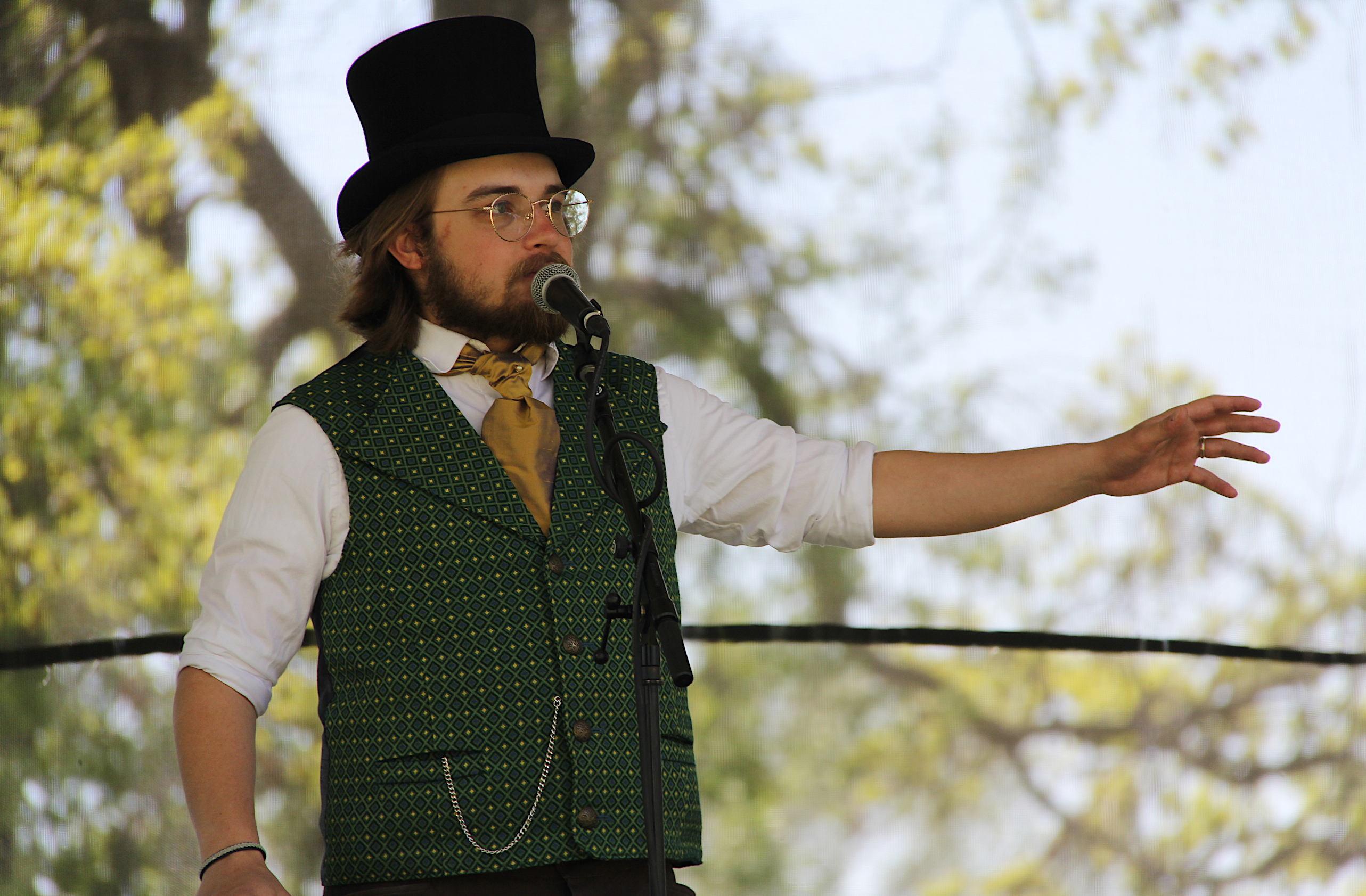
That humorous moment aside, I did appreciate the honest and informative storytelling of local historian and documentary filmmaker Sam Temple. Smartly attired in a top hat and dress clothes, he talked about early Minnesota, about Indigenous Peoples, about the illegal French Canadian fur traders who came here first—about their relationship of interdependence and co-existence with Native Peoples and how a new mixed race culture developed.
Scraping a beaver hide, the woman in this tent focused on the Dakota, their connection to nature and how that wove into their way of living. They traded furs for goods. (Minnesota Prairie Roots copyrighted photo May 2025)
Temple shared much more before shifting his focus to Faribault town founder Alexander Faribault, of mixed race (his mother was part Dakota) and a licensed fur trader by age 21. Alexander arrived in a multi-cultural community with “a foot in both worlds,” Temple said. Wood-frame houses and teepees stood side-by-side. As I listened, I considered my multi-cultural community today. Getting along, but not always. By the time Alexander Faribault, who was historically-influential both locally and state-wide, left Faribault, “the teepees were missing and his mother’s culture was gone,” Temple said.
There were several food and beverage vendors on-site, with Baby’s Indian Frybread proving especially popular. (Minnesota Prairie Roots copyrighted photo May 2025)
If there’s something else I learned while attending the Rendezvous it is that I absolutely love fruit-filled Indian frybread, which I’ve not previously eaten. The sugar-topped pie-like dessert oozed blueberry filling and cream cheese. It was beyond decadent.
A blacksmithing demonstration. (Minnesota Prairie Roots copyrighted photo May 2025)
As much as I loved frybread and Little Stinky, the good folks who participate in history fests like the Riverside Rendezvous assuredly love stepping back in time. Their passion and desire to present the past in a way that engages people in history was something I felt, saw, heard while moving from tent to tent, space to space. To be part of this proved a cultural, historic experience, growing my knowledge and appreciation of those who shaped Minnesota and Faribault, this place I call home.
Tents were scattered across the spacious, shady grounds of riverside North Alexander Park. (Minnesota Prairie Roots copyrighted photo May 2025)
FYI: Please check back for more photos from the Riverside Rendezvous and History Festival in Faribault.This year’s Rendezvous was so successful that the Rice County Historical Society is planning a second one for 2026, but a weekend later so the event does not fall on Mother’s Day and the fishing opener weekend.
This page from an altered book crafted by my friend Kathleen shows my mom holding me. Mom died in January 2022. I love the quote. (Minnesota Prairie Roots copyrighted file photo)
THREE MOTHERS. Three strong women. Three remarkable experiences. This Mother’s Day I feel compelled to share the stories of a trio of moms. Their stories are decidedly different, yet similar in the common denominators of strength and love.
Photographed in a small southern Minnesota town, a box containing Naloxone used as an emergency treatment for an opioid overdose or suspected overdose. (Minnesota Prairie Roots copyrighted photo May 2025)
MOTHER OF A RECOVERING ADDICT
Let’s start with the woman checking out my clutch of greeting cards recently at a local chain discount store. As I stepped up to the counter, a young man bade her goodbye. “I love you, Mom,” he said while walking toward the exit.
It was one of those moments when I simply had to say something. “That’s so sweet,” I said, looking directly at the clerk.
I don’t remember our entire conversation. But I do recall the highlights. Her son is a recovering addict two years sober. “I almost buried him,” she told me.
“You must be so proud of him,” I replied. And she was and is and I wanted to reach across that check out counter and hug her. But I didn’t. My encouraging words would have to suffice. I walked out of that store feeling grateful for this mom who never gave up on her son and for the son who recognizes the value of her ongoing love and support.
This shows two of the 22 Miller siblings featured in an exhibit at the Waseca County History Center. (Minnesota Prairie Roots copyrighted photo May 2025)
MOTHER OF TWENTY-TWO
Then there’s Lucille Miller of rural Waseca, married to Alvin and mother of their 22 children. Yes, twenty-two, all single births. I learned about the Miller family recently while touring the Waseca County History Center. An entire display focuses on them.
Lucille gave birth to her first child in December 1940 at age 17 and her last in January 1966 at age 43. Fifteen girls and seven boys (oldest to youngest): Ramona, Alvin Jr., Rose, Kathleen, Robert, Patricia, Marylu, Diane, John, Janet, Linda, Virginia, Helen, Art, Dolores, Martin, Pauline, Alice, Angela, Marcia, Gregory and Damien.
I can’t even fathom being pregnant that often, birthing that many children, or coming up with that many names. But Lucille Miller did just that and raised her children on the family’s Blooming Grove Township farm. She died in August 2006, her husband not even a year later. Lucille and Alvin never intended to have 22 kids. But these deeply spiritual parents considered each and every one a blessing.
Information I found online backs that up. This mother of many also “took in” several kids, led two women’s organizations and worked to establish local group homes for the disabled. Three of the Miller children had disabilities.
Helen Miller’s book about growing up in a Minnesota farm family of 22 children.
Helen Miller, 13th in line, calls her mom “a saint.” (I certainly don’t question that assessment.) She’s written a book, 21 Siblings: Cheaper by the Two Dozen, about growing up in this mega family where the Catholic church and school centered life and organization was key in keeping everyday life running smoothly. Chores were listed, then assigned, and siblings used the buddy system. I have not yet read the book, but intend to do so.
I expect the obituary of Lucille’s daughter, Virginia Miller Pelto, 60, who died on May 8, 2014, just days before Mother’s Day, reflects the way in which her mother lived: Of the many things Virginia loved, above all she loved people. As a very spiritual person, she put the world on her shoulders and in her prayers. She donated time to her church, her community and anyone who needed to just talk. Any mother would be proud to have a daughter with such a giving and compassionate spirit.
My daughter Miranda and grandson Everett, 3 months old when this photo was taken. (Photo courtesy of Miranda, April 2025)
MOTHER OF EVERETT
Finally, there’s the story of my second daughter. Miranda became a first-time mom in mid-January. Considered a “geriatric mom” given her closing-in-on-forty age, she was closely-monitored throughout her pregnancy. Miranda was in excellent physical condition—she’s a letter carrier. Her pregnancy proved uneventful with labor commencing the day before her due date. But then everything changed. For the worse. Labor was long, delivery difficult with baby’s head and shoulder getting stuck. Once Everett—all 10 pounds of him—was born, Miranda experienced extensive postpartum hemorrhaging requiring the transfusion of three units of blood. A team of doctors and other medical personnel at a Madison, Wisconsin, hospital worked to save her life.
A week later, after Miranda and John were semi-settled at home with Everett, Randy and I traveled to Madison to see all of them. When the new parents recounted harrowing details of that difficult birth, my strong strong daughter said she feared she might die. Before she saw her son.
As Miranda and I stood in the nursery, arms wrapped around each other gazing down at newborn sleeping Everett, I felt overwhelmed with emotion. I still get emotional thinking about how I nearly lost my daughter on the day my second grandson was born. I’ve written about that experience in a short story, “Birthing Everett,” which will publish in late August in The Talking Stick anthology.
We all have mothers. We all have stories, whether we are sons or daughters or mothers ourselves. Today I honor all mothers, especially Miranda, Lucille Miller and the store clerk who nearly buried her son. They are three strong women.
An1849 map of Minnesota Territory and more as seen through a magnifying lens inside the Rice County Historical Society Museum. Minnesota became a state in 1858. (Minnesota Prairie Roots copyrighted file photo)
HISTORY COME TO LIFE appeals to me because of the immersive experience. I learn better, retain more, when I can engage. This weekend offers ample opportunity to get into history at the Rice County Historical Society’s first-ever Riverside Rendezvous and History Festival along the banks of the Cannon River in Faribault’s North Alexander Park.
A scene inside an 1856 log cabin during a past living history event at the Rice County Historical Society. This weekend’s festival will be outdoors in a park in an encampment type setting. (Minnesota Prairie Roots copyrighted file photo)
Organizers promise that the trades, traditions and history of the 18th and 19th centuries (1701-1900) will come alive via hands-on activities, demonstrations, workshops, storytelling, music and special events. Hours are 9 a.m.-5 p.m. Saturday, May 10, and Sunday, May 11. Mothers get in free on Mother’s Day. Otherwise ticket prices are $10 for adults, $5 for children 6+ and $30 for a family pass.
Admittance buys you a whole lot of history-based entertainment, knowledge and fun. For example, the hands-on history happening all day both days includes candle making, rope making, tomahawk throwing, historic toys and games, quill making, log cutting and shops at which to shop, not trade.
This sculpture of Alexander Faribault and a Dakota trading partner stands in Faribault’s Heritage Park near the Straight River and site of Faribault’s trading post.(Minnesota Prairie Roots copyrighted file photo)
But you can learn about the fur trade at noon either day as local historian and documentary filmmaker Sam Temple talks about town founder Alexander Faribault and the fur trade. Todd Finney, a descendant of the Wahpekute band of the Dakota (original inhabitants of the land which is now Rice County), will speak at 3 p.m. Saturday and again at 11 a.m. Sunday about the Wahpekute Dakota.
You can learn about hat making, pirates (yes, pirates with MN Jack Sparrow), historic clothing and weapons, things that do and don’t go boom, Civil War medical care and more during workshops and demos.
And then there are four special events, the first a Cane Pole Fishing Tournament starting at 10 a.m. Saturday. Bring your cane pole, not your rod and reel. Some cane poles will be available for participants. Saturday also brings Voyageur Games at 1 p.m. On Sunday, there’s a Tomahawk Throwing Competition at 1 p.m. followed by a Log Cutting Contest at 3 p.m.
I’ve never attended a rendezvous, so I have nothing with which to compare this event. But just reading through the schedule, I’m excited to take in this history festival with my two elementary-aged grandchildren, their parents and my husband. I expect we will all learn a lot and make some great memories.
Vendors will be selling food and beverages. (Minnesota Prairie Roots copyrighted file photo used for illustration only)
One more thing, food and beverages will be available for purchase, the food being cheese curds (no festival is complete without that deep fat fried fair food), hot dogs, corn dogs, assorted frybreads, and candy and fudge.
All in all, the Riverside Rendezvous and History Festival looks to be an interesting, informative and enjoyable event for history lovers, families and anyone who’s looking for something different to do on a beautiful spring weekend in southern Minnesota.
Recent Comments