Minnesota Prairie Roots

Writing and photography by Audrey Kletscher Helbling

In which I meet Wilson, a member of the fun-loving Schrot family July 25, 2012

Filed under: Uncategorized — Audrey Kletscher Helbling @ 7:21 AM
Tags: , , , , , , ,

JIM SCHROT WORRIES about his relative, Wilson Schrot. After all, Jim caught Wilson attempting to steal gas from the gas barrel at Jim’s rural Faribault home last Thursday evening.

Jamie, Jim’s grown and married daughter, figures Wilson simply ran out of gas for his lawnmower and decided to help himself. She appears willing to overlook Wilson’s latest antic.

“He (Wilson) gets into a lot of trouble,” Jim says. The two don’t elaborate, but say Wilson shows up in the most unexpected of places at the most unexpected of times.

Jamie once discovered Wilson inside her tent, curled up in her bed. He’s climbed into family-owned tractors and trucks, but stopped short of stealing them.

Not that he could. Wilson, you see, is a dummy. You know, a mannequin.

See Wilson Schrot sitting there in the front passenger seat of Jim’s 1940 Ford. (I noticed several dummies in the storefront window behind the car. Wilson’s friends, perhaps, keeping a watchful eye on him?)

The Schrot family has, for the past several years, embraced Wilson and his shenanigans, ever since a cousin dragged him home from somewhere. No one seems to remember details. Or at least they weren’t sharing that information with me when I first spotted Wilson in the front passenger seat of Jim’s 1940 Ford at last Friday evening’s Faribault Car Cruise Night.

My first photo of Wilson, taken shortly before Jamie showed up to snap pictures with her cell phone.

I was photographing the Hawaiian shirt clad dummy with the blonde mullet wig when Jamie showed up to snap photos of him, too. I engaged her in conversation and that’s when I was introduced to Wilson, named after the volleyball in the Tom Hanks’ film, Cast Away.

Not that Wilson is a castaway. I mean, Jim didn’t abandon Wilson after he caught him trying to steal gas. Instead, he brought him to the car show in an apparent half-hearted attempt to find a date for Wilson.

But, Jim admits, “He doesn’t get too many chicks because of his mullet.”

Jim and Jamie suggest Wilson switch out his hair piece—he has several—to improve his appearance and likelihood of landing a date.

I’m not sure Wilson needs the Schrots help, though. He seems to draw plenty of attention on his own. An unidentified man backing his classic car into the space next to Jim’s Ford asked Wilson, “I’m not getting too close to your car, am I?” Then he noticed that the freckled Wilson with the duct taped arm was a dummy. “I’m glad no one was there to hear me.”

Jim reposed Wilson, who recently had carpal tunnel surgery (thus the duct tape), so the story goes.

The Schrot family has given Wilson a life, even going so far as to establish a Facebook page for him. Ask Jamie if she set up Wilson’s Facebook account and her quick, snipped response of “maybe” is enough to tell you she did.

Based on Wilson’s Facebook page—the public part that I can read because I’m not on Facebook—he is a country boy who likes his beer. He also likes singer Johnny Cash; the movie, The Adventures of Bob & Doug McKenzie: Strange Brew; the book, I Hope They Serve Beer in Hell; and the tv show, Richard Bacon’s Beer & Pizza Club. He also enjoys the sport of beer darts.

Wilson certainly keeps the extended Schrot family entertained, laughing, making up stories and plotting his next adventure.

It is the stories, Jamie says, which make the whole Wilson gig fun, if not crazy. For example, when Wilson was caught trying to steal that gas, Jamie got the story rolling about his lawnmower running out of gas.

Ask if their family is kind of crazy and Jamie shoots back: “Everybody else is crazy, but we’re normal.”

Uh-huh, Jamie. What’s that story about the time Wilson was dismembered at a party, or as Jim corrects, a “social gathering?”

Meet Jim Schrot, not to be confused with Wilson. I first spotted Jim in September 2009 at the Rice County Steam and Gas Engine show and dubbed him the flamboyant John Deere guy. It fits. See why this family embraces the likes of Wilson Schrot.

© Copyright 2012 Audrey Kletscher Helbling


For your entertainment: Two perspectives on Faribault’s Car Cruise Night July 24, 2012

Filed under: Uncategorized — Audrey Kletscher Helbling @ 7:26 AM
Tags: , , , , , , ,

A Ford Model A drives into downtown Faribault on Central Avenue during the July 20 Faribault Car Cruise Night.

I NEVER THOUGHT I would find old cars and trucks interesting. Not in a million years.

But I’ve acquired, in recent years, an appreciation for the vehicles of yesterday displayed at local car shows. I credit my smart and talented automotive machinist husband, who is like a walking Wikipedia when it comes to knowledge of vehicles, for my interest. Randy finally convinced me to tag along once to a car show and that was it.

HIS VIEW: Not my color, not at all.  MY VIEW: The graceful curves of a swan hood ornament draw my eye to this street rod.

Our reasons, though, for appreciating these cars and trucks of the past differ. He’ll peer under the open hoods and such while I’m admiring hood ornaments and emblems, the curve and sweep of metal, paint colors and more.

HIS VIEW: Lotta teeth there.  MY VIEW: Can you see my reflections in the shiny, curvy bumper art on this car?

My interest springs from an artistic and photographic perspective. His is more mechanical and practical.

And as a bonus, if I overhear or discover a story or two at these shows, I value the displayed vehicles even more. Watch in upcoming days for several interesting stories from the July 20 Faribault Car Cruise Night. It was quite a night for stories, as you will read. Until then, enjoy these photos.

HIS VIEW: Let’s buy one, but not a yellow one.

MY VIEW: Look how the setting sun glints across the hood as I photograph those magnificent, detailed wheels.

HIS VIEW: That would be a nice old pickup to own.  MY VIEW: Loving the stylish sweep of the front end.

HIS VIEW: Why are you photographing that taillight?  MY VIEW: Just look at those shimmering reds, the honeycomb effect and that royal art.

HIS VIEW: A good cruisin’ car.  MY VIEW: It’s the stripes, the stripes, oh, yes, the stripes that lead my eye across the trunk and beyond.

HIS VIEW: I’d love to own that 1930s vintage Chevy truck.  MY VIEW: I know you would, dear. It is pretty sweet.

HIS VIEW: I didn’t know grasshoppers grew that big.  MY VIEW:  Thanks for making me laugh and bringing back memories, for me at least, of all those grasshoppers on the farm when I was growing up.

HIS VIEW: That’s the inside of a 1967 Chevy Impala Super Sport.  MY VIEW: Look at all those circles, circles, circles.

HIS VIEW: A good looking Pontiac Firebird.  MY VIEW: Art.

HIS VIEW: Insert key here.  MY VIEW: I’ve never noticed a rocket emblem before on a car (Oldsmobile Ninety Eight).

HIS VIEW: Check out the motor.  MY VIEW: One sweet Chevy.

HIS VIEW: Just the front of a Buick.  MY VIEW: Vertical lines on the front of the car and the building behind create a pattern.

MY VIEW and maybe HIS VIEW, too: Nice curves.

MY VIEW: A fancy, schmancy MG with a royal air. HIS VIEW: I never cared too much for British cars.

OUR VIEW: Lost in the 50s, 60s, 70s…on a Friday evening in downtown Faribault.

© Copyright 2012 Audrey Kletscher Helbling
 

The old blacksmith is watching, just ask John July 20, 2012

A sign tacked onto the blacksmith shop at the Village of Yesteryear in Owatonna reads: It reminds us of the “horse and buggy” days gone by. A lot of horseshoes, buggy and wagon wheels came in and out of the Bixby shop, as well as other blacksmith shops throughout the county. These shops were an essential part of all villages, towns and cities in the 1800’s.

INSIDE THE OLD BLACKSMITH SHOP, John Styndl is reading the newspaper on a lazy summer Sunday afternoon. He has no intention of firing up the forge or picking up the tools to demonstrate how his great great grandfather, Frank Styndl, once pounded hot metal into useful equipment or shaped shoes for horses.

Instead, he takes pride in telling visitors about the blacksmith shop Frank built on his farm east of Bixby in 1896, ten years after the Styndl family immigrated to the U.S. from the Czech Republic. Frank worked as a blacksmith in the Old Country and then in his own shop in Steele County, Minnesota, until his death in 1931.

Today that blacksmith shop sits on the grounds of the Steele County Historical Society’s Village of Yesteryear in Owatonna which, on a recent Sunday, hosted an historical extravaganza. John was volunteering in the blacksmith shop when I entered through double sliding doors into a dark room illuminated by the blinding glare of a bare light bulb and sunlight filtering through doors.

John in Frank’s blacksmith shop where, “all the equipment in the shop such as wheelbenders, drill presses, bench vises, foot grinders, files, hammers, tongs and other equipment were used by Frank.”

Rusty tools and horseshoes cling to the walls and a cut out, near life-sized photo of Frank leans next to an anvil draped with horseshoes as great great grandson John speaks about his interest and work in preserving the blacksmith shop.

He remembers biking past the abandoned blacksmith shop as a kid, asking his father about the faded signage on the building. His father and a great uncle did occasional blacksmithing, but nothing like that of three generations of the Styndls prior who earned their livelihoods as blacksmiths.

John dreamed of someday moving Frank’s shop to the Village of Yesteryear. Eventually that became a reality and, from 1991 – 1996, his family and neighbors worked to restore the building. He even found an old house chimney from the appropriate time period, knocked off the mortar and rebuilt the 240 bricks into a new chimney.

Family photo of John and Frank Styndl.

“I’m glad to be able to preserve it,” John says of F. Styndl’s blacksmith shop. He’ll tell you, though, that he gets a bit uneasy with Great Great Grandpa Frank’s likeness watching his every move.

About that time in our conversation, another visitor steps into the blacksmith shop and shares how he remembers, years ago, observing his local blacksmith, bent over, toiling in the heat of his shop. “He was always cranky,” he notes.

The three of us laugh and figure we’d be crabby, too, in such uncomfortable working conditions.

It is stories and remembrances like this which make a building like the old blacksmith shop more than just a structure occupying space at a site such as the Village of Yesteryear.

Stories connect buildings to people and to the past.

You need only take the time to pause and ask, to listen and to observe, if you are to understand the history that has molded lives and communities and is still shaping the future.

CLICK HERE TO READ a previous blog post about the Steele County Historical Society’s Extravaganza at the Village of Yesteryear. Then click here to read a second post on the event.

© Copyright 2012 Audrey Kletscher Helbling
 

Five things to do this weekend in the Faribault area July 19, 2012

FROM TEA TO TRACTORS and plenty of in-between interesting attractions, you’ll find lots to do this weekend in my region of southeastern Minnesota.

I shot this image at the Rice County Free Fair several years ago.

Already underway and running through Sunday is the Rice County Free Fair in Faribault. Evening grandstand shows include Enduro Auto Races on Thursday, an All-Star Pro Rodeo on Friday, a National Truck & Tractor Pull on Saturday and a Demolition Derby on Sunday. Besides the entertainment, you’ll want to stroll through the barns, the midway and the exhibit buildings, plus sample some fair food.

John Deere tractors galore lined up at the 2009 Rice County Steam & Gas Engine Show. I have never attended the Credit River Antique Tractor Club Show near New Prague.

In nearby Scott County, tractors take center stage (or rather space) at the annual Credit River Antique Tractor Club Show which runs from 8:30 a.m. – 7 p.m. Friday, July 20, through Sunday, July 22. To get there, take Exit 76 on Interstate 35 and go west on Scott County Road 2 for about 11 miles.

From a tractor parade to flea market, entertainment and more, this promises to be a family-friendly event in a beautiful rural setting. My friend Nancy Fredrickson of Lakeville tipped me off to the tractor show. Says Nancy: “It’s set up at Cedar Lake Farm Regional Park outside of New Prague where the tractors and vendors are scattered under big beautiful trees on hillsides that lead past the old barn and down to Cedar Lake shore.”

Nancy and her husband, Gordon W. Fredrickson, will be there, near the entrance, selling their collector series Farm Country Tales and If I Were a Farmer books. Readers, Nancy and Gordon are two of the finest, down-to-earth people you will meet. Plus, their rural-themed picture books are about as real and honest and authentic as they come. I highly-recommend these books to anyone interested in farming from years past.

Hanging out along Central Avenue during Faribault Car Cruise Night in May.

If classic cars are your thing, then take in, or participate in, the Faribault Car Cruise Night from 6 p.m. – 9 p.m. Friday in the 400 and 500 blocks of Central Avenue in the heart of historic downtown Faribault. According to the group’s Facebook page, “…if you have a cool car or truck or motorcycle, bring it down.”

The Paradise Center for the Arts theater, this photo from several years ago and the set for “South Pacific.”

Also on Friday, but in the 300 block of Central Avenue, the fractured fairy tale, “Into the Woods,” opens at 7:30 p.m. at the Paradise Center for the Arts. The Faribault theater and the Northfield Arts Guild are collaborating on the musical which continues on selected weekdays and weekends through August 5.

Betsy cuts Tacy’s hair in this snippet from a mural by artist Marian Anderson in the Maud Hart Lovelace Children’s Wing at the Blue Earth County Library in Mankato.

Finally, 40 miles away in Minneapolis and Mankato, the Betsy-Tacy Society is holding its annual convention. The organization focuses on celebrating the Betsy-Tacy children’s book series written by Mankato author Maud Hart Lovelace. I love, love, love these books about three friends growing up in Deep Valley (Mankato) in the late 1800s and early 1900s. I read the series to my young daughters two decades ago and we, even to this day, occasionally call my second daughter Tib, after Tib from the books.

It’s probably too late to get into the convention, but you can still join in on some of the fun by attending the free Betsy-Tacy Storytime Tea from 10:30 a.m. – noon Saturday at the Barnes & Noble Bookstore, River Hills Mall, Mankato. A Maud Hart Lovelace interpreter will read from Betsy-Tacy and photos can be taken with Betsy and Tacy. Visitors can also shop at the Betsy-Tacy Bookfair at Barnes & Noble.

The childhood home of Maud Hart Lovelace (aka Betsy), author of the Betsy-Tacy series first published in 1940.

The houses where Lovelace (Betsy in the books) and her friend Frances “Bick” Kenney (Tacy) grew up are owned by the Betsy-Tacy Society and are open to the public. They are a must-see for any fan of Lovelace’s books, although this weekend may not be the best time to tour the homes if you prefer elbow room to crowds.

There you go. Five things you can do within 40 miles of Faribault this weekend.

What are your plans?

FYI: You probably already know this, but just in case you don’t…  By clicking on the highlighted phrases/sentences within the post, you will be directed to more detailed information about the featured events.

© Copyright 2012 Audrey Kletscher Helbling
 

Join efforts to connect neighbors in a celebration of cultural diversity July 14, 2012

Several Latinos lead in singing of Mexico’s national anthem last September during the International Festival Faribault at Faribault’s Central Park.

ORGANIZERS OF THE SEVENTH ANNUAL international festival celebrating the cultural diversity of Faribault are looking for participants, help and donations for the Saturday, August 25 event.

Can you help?

And when I say “you,” I mean anyone, whether you live in or near Faribault or not.

Served at the 2011 fest: Guatemalan chuchitos– chicken, corn and salsa wrapped in a corn husk.

Drive on down from the Cities; we’re only an hour from downtown Minneapolis. Or drive across town to set up a booth showcasing your culture at International Festival Faribault. Sell ethnic cuisine. Pedal your ethnic arts and crafts or other merchandise. Show and tell and educate the public about your culture in this event pegged as “neighbor meeting neighbor.”

I like that neighborly phrase, for it is when we meet face-to-face and engage in conversation and sample each others food and learn each others customs that the cultural barriers begin to fall and friendships (or at least understanding) form.

Vendors, like this Somali woman, peddled their wares at the 2011 festival.

Table and booth space at the 10 a.m. – 4 p.m. festival are currently available to the public for a $20 fee. But get this: You keep all profits earned. Non-profit organizations get free space.

Now if that isn’t enough incentive to book a spot in Faribault’s Central Park for the day, consider how you will help advance the mission of the non-profit International Festival Faribault. Here’s the organization’s mission:

…to promote understanding between diverse cultures within Faribault, MN; uniting the community with music, dance, ethnic foods and merchandise which is experienced at a once a year festival organized by the committee.

Hoop maker, performer and teacher Adrienne Lee teaches a Girl Scout the art of hoop dancing. The Girl Scouts were among the non-profit groups with booths at the 2011 fest.

Already, Spanish and Somali singers, a local dance academy and several small bands have committed to providing on-stage entertainment. A hula hooper and jugglers are signed on to wander through the crowd.

The scramble for candy after the pinata is broken at last year’s festival.

What can you contribute? Dancing, singing or other musical entertainment from your culture? On-site ethnic art/crafts demonstrations? Are you willing to sing your country’s National Anthem on the Central Park Bandshell stage? How about presenting a mini drama or storytelling focused on your ethnicity? Can you plan and lead ethnic activities for kids?

The group also needs volunteers to assist with set-up and clean-up, help throughout the day, etc.

Monetary and silent auction donations are also needed. Do you have a tent and/or tables the group can borrow? Can you help with banners or flyers? Donate food items?

Yes, the list of needs is lengthy. But remember the “neighbor” part of this festival? Neighbors help neighbors.

Colorful skirts for sale at Riyaam’s booth during the 2011 celebration.

If you are interested in participating, contributing or helping in any way, email internationalfestivalfaribault@gmail.com or call (507) 412-9139. You must complete an application form and submit the $20 payment in advance to reserve a booth/table space.

Also, click here to visit the festival website at http://internationalfestivalfaribault.blogspot.com.

Finally, even if you’re unable to participate or donate, mark your calendar for 10 a.m. – 4 p.m., Saturday, August 25, for the International Festival Faribault. Admission is free and I promise, you’ll come one step closer to understanding your neighbors.

A young girl’s henna stained foot, photographed at the 2011 fest..

© Copyright 2012 Audrey Kletscher Helbling
 

Place it near a cornfield and they will come, or something like that July 13, 2012

Filed under: Uncategorized — Audrey Kletscher Helbling @ 7:09 AM
Tags: , , , , , , , ,

“IF WE DON’T FIND a bathroom soon, I’m just going to go in a cornfield.”

Such prophetic words I pronounced as my husband and I recently entered the burg of Bellechester, population 172, mostly in Goodhue County, partly in Wabasha County, in southeastern Minnesota.

Honestly, it isn’t like I haven’t peed in a cornfield. I detasseled corn in the 1970s; I’ve squatted between corn rows.

But I’m not exactly a teen any more and the idea of walking into a cornfield on a scorching summer morning to pee didn’t appeal to me.

So, after asking a local where I could find a public restroom in Bellechester and being told there were none and we’d need to drive 12 miles to Lake City, the cornfield option seemed a very real possibility.

Not quite believing the man, though, my husband directed our van toward Bellechester’s one-block business district. Spotting the Bellechester Tavern and the Bellechester American Legion, I figured I’d dash inside one or the other and we’d be on our way.

This former bank is home to the Bellechester American Legion. Yes, I took time to photograph the Legion and the tavern even though I really, really had to go. I love old buildings, what can I say?

Look at the gorgeous architectural detail on the former bank. Yes, I know, I really should be moving along.

But wait, one more photo. Look at this faded signage on the side of the Legion.

Well, as long as I’m taking pictures, I may as well show you the bar I wished was open.

As luck would have it, the tavern and the Legion were closed. I considered the busy repair shop on the corner, for like two seconds. There’s something about walking into a garage full of men that left me crossing my legs (figuratively speaking) and nearly sprinting the other direction.

And that direction would be toward the porta potty which my kind, kind husband spotted way over yonder on the far end of a park, by the ball diamond and next to…the cornfield.

As close to a cornfield as it could be without being “in” the cornfield.

I started heading that way until my thoughtful spouse suggested we drive over there since it was too far to walk in the heat of the morning. That worked for me.

Around the corner and down a gravel road he drove to the edge of the cornfield. I handed my camera to him (I always have my camera out) and nearly rocketed out the door and into the porta potty next to the cornfield.

When I flung open the outhouse door while simultaneously buckling my belt (Hey, would you stay inside a porta potty any longer than you had to?), I realized I had made a major mistake.

After stepping out of the porta potty and before realizing the paparazzi was snapping pictures. I was reaching up to buckle my belt, just in case you are wondering whether I’m examining my hand.

That error would have been handing my camera over to my husband after carrying on about peeing in a cornfield. He most definitely recognized a photo op when he saw one.

And that, dear readers, is my peeing (almost) in a cornfield story and I’m sticking to it.

© Copyright 2012 Audrey Kletscher Helbling
 

St. Paul artist connects art to geocaching via her GeoNiche Project July 11, 2012

A ST. PAUL ARTIST and educator with roots in the southwestern Minnesota prairie is bringing her art to the public via a project that links art to geocaching.

Felice Amato, who grew up in Cottonwood and Marshall, has hidden about 15 original works of ceramic art in St. Paul and in southeastern Minnesota through her GeoNiche Project, funded by a Minnesota State Arts Board Artist Initiative Grant awarded in 2011. To date, she’s stashed her sculptures at Swede Hollow, a St. Paul Park, and in or near Faribault, Red Wing and Winona. She’s created pieces for the Red River Valley area, too, but has yet to install them. And she would also like to sculpt GeoNiche art for her native prairie.

Amato follows the geocaching model wherein geocachers use GPS devices or smart phones to find her art based on geographic coordinates and clues. Her caches are listed on Geocaching.com as felice.amato and on Opencaching.com as felice1.

The project evolved as Amato considered a unique way to get the ceramic niches and tableaus she’s made for years out to the public. “My sister, brother and aunt are avid geocachers and it just struck me that this could be an interesting way to make my work public,” she explains.

Finding no one out there doing exactly what she proposed, Amato moved forward with the GeoNiche Project and her unifying theme of women’s lives.

“I wanted to create secular niches that spoke to a sense of place, history and continuity—and that honored the important life moments that we all experience,” she says.

“Under the Arbor,” one of the GeoNiches placed in Swede Hollow. Photo courtesy of Felice Amato.

She placed her first GeoNiche close to home, a mile away in Swede Hollow, a St. Paul valley originally settled in the mid 1800s by Swedish immigrants and thereafter by Polish, Italians and Spanish Americans. “The rhythm of settlement in Swede Hollow made that especially rich,” Amato says. “Flooding, impermanence and the piecing together of community shanty by shanty—the thriving, the dispersal, the abandoning, the reclaiming—it all inspires my imagination.”

This photo, courtesy of Felice Amato, shows houses and quilters in progress for Swede Hollow.

Amato was inspired to shape pieces like “Mother and Child by the ‘Hobo’s Washroom’,” “Little Girl with birds,” “Bread house” and three other larger works for Swede Hollow. Those GeoNiches hint at folktales based on the experiences of the immigrants who once called this place home. A hand-drawn map to those artworks can be found inside a GeoNiche by Swede Hollow Cafe (coordinates N 44° 57.551’ W093° 04.330’) as Amato awaits approval of official Geocaching.com listings for Swede Hollow.

“Seamstresses” in place at the historic Faribault Woolen Mill along the Cannon River blends seamlessly into its environment. Photo by Audrey Kletscher Helbling.

In Faribault, she was naturally drawn to the Faribault Woolen Mill, she says, because of an art series initiated several years ago on women in factory settings. Amato created “Seamstresses” and tucked it into a niche along a retaining wall at the mill next to the Cannon River.

Amato’s sculptures tell a story as seen in this close-up of woolen mill factory workers. Her sculptures are made from paperclay with wire details. Photo by Audrey Kletscher Helbling

Explains Amato of her women in factory art:

The metaphorical potential of women and labor—especially manual and repetitive labor—is enormous with so many different layers it makes my mind explode. To what did/do women give their lives? What other inner lives (maybe as poets or artists, or dreamers) did they have especially at times where realizing those passions was even more difficult than it is today? I wanted to speak to a sense of honor and even sacredness in the making, the plodding, the rote quality of manual tasks—often just a part of an end product. Sewing and weaving itself is rich with metaphor as is the factory setting: the balance of isolation and comradery.

Amato secured “Prairie” onto a tree near a bike trail west of Faribault. Photo by Kevin Kreger.

Outside of Faribault, lashed onto a tree along a bike trail, Amato switches to a rural theme in “Prairie,” a definitive piece which connects to her prairie roots. The sculpture was partially-influenced, she says, by “the solitude and perseverance of the prairie woman in her battles with so many forces—the soil, the wind, the grasshoppers, the fires.”

Geocacher Kevin Kreger of Faribault, who sought out both Faribault area GeoNiche art pieces, says he was drawn in by “Prairie” and found the placement of “Seamstresses” at the Woolen Mill a fitting location.

The sweet surprise GeoNiche at the Faribault Woolen Mill. Wear solid walking shoes as you will need to walk over rocks (not the ones photographed here) to reach this art treasure. Amato encourages finders to sign the logbook tucked into a plastic bag behind “Seamstresses.” Photo by Audrey Kletscher Helbling

“The idea (GeoNiche) delights me,” says Kreger who has been geocaching for half a dozen years everywhere from New York City to the Oregon coast and as near as a local county and city parks. “Turning the corner, seeing another’s idea of beauty in an unexpected spot, it’s one of those unanticipated sweet spots in life.”

The first entry in the “Seamstresses” logbook. Photo by Audrey Kletscher Helbling

Amato hopes for that type of positive reaction from those who discover her public art hidden in niches. “Many people seem to really experience my work, seeing it as meaningful to them and that it is meaningful to me,” she says. “It evokes stories of memories or hooks people’s imagination and emotions.” She wants finders of her art to interact with her, to share their thoughts in her on-site logbooks and/or online.

Kreger appreciates the time and skill Amato has invested in creating her art, made from “paperclay,” a method of mixing paper pulp into recycled clay. He wonders, though, how long the GeoNiches will stay in place, comparing them to performance art and as a gift the artist must be willing to give up.

Another sculpture hidden in Swede Hollow Park. Photo courtesy of Felice Amato.

While one of her Swede Hollow GeoNiche sculptures was smashed, the rest have remained intact with one even moved to a more logical and visible location. Amato’s considered taking the pieces down for the winter or sealing them to protect the vulnerable clay from the elements. But she’s unsure. “When I installed “The Potter” in the pottery dump at Red Wing and looked at all the shards of broken ceramic work, I thought eventually she will be among that and it felt OK,” Amato says.

An overview of the location for “Seamstresses.” Look and you will find her sculpture in this image. The positive responses from the people of Faribault have been a huge incentive, Amato says, to explore the area more. Photo by Audrey Kletscher Helbling

Exact placement of her art is most successful, she adds, when the spot is discovered as though it was waiting.

Even though the grant period for her GeoNiche Project has ended, this St. Paul artist intends to seek additional funding to continue creating and hiding her art for geocachers and others who may happen upon it. She plans to work, also, with artist friends interested in GeoNiche. And she’s contemplating offering a GeoNiche workshop.

While she’ll seek out funding for her innovative project of connecting art and geocaching, Amato says she’s not a geocacher or a seeker.

“I would imagine,” she says, “most people are primarily either seekers or hiders. I am a hider.”

Artist Felice Amato. Photo courtesy of Felice Amato.

FYI: Felice Amato, the mother of two daughters, has been a public school teacher for nearly 20 years (teaching first Spanish and then art) and has also taught summer art classes and camps for children through the St. Paul non-profit, Art Start. She is an artist specializing in clay and tile making. Her artwork has been exhibited in numerous shows and in several galleries during the past 10 years with an upcoming show set for October 18 – November 17 at The Phipps Center for the Arts in Hudson, Wisconsin. For more information about Amato, click here to link to her Facebook page and here to link to her website.

Click here to link to Amato’s GeoNiche website.

And click here to check out her GeoNiche Project Facebook page.

© Copyright 2012 Audrey Kletscher Helbling
Photos by Audrey Kletscher Helbling, Felice Amato and Kevin Kreger


If only I’d known the prize was chocolate… July 7, 2012

The words for “My Country, ‘Tis of Thee” are projected onto a screen at the front of Bethel Ridge Lutheran Brethren Church.

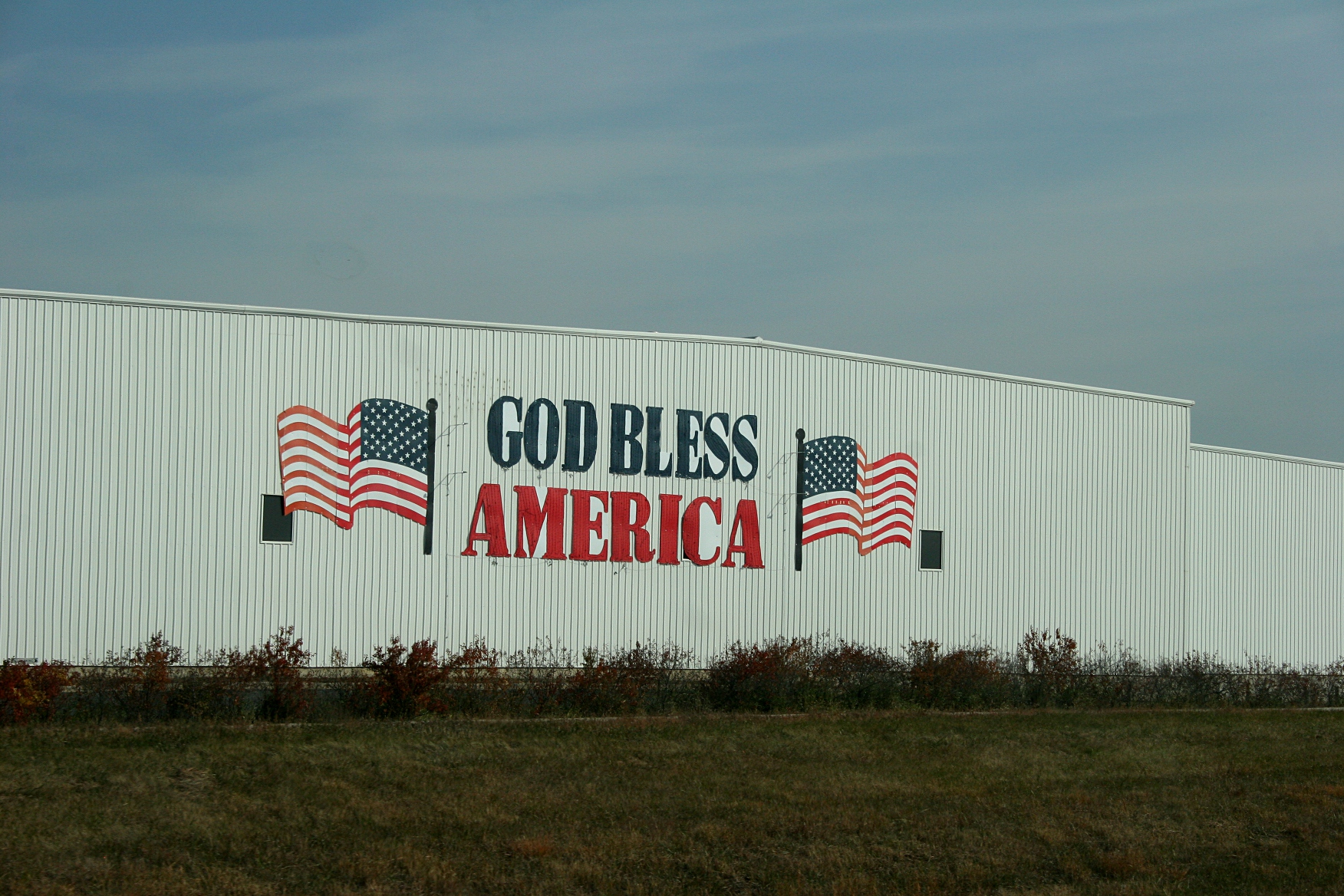
WHEN WAS THE LAST TIME you listened to a reading of the Preamble to the Declaration of Independence?

Or the last time you sang “My Country, ‘Tis of Thee,” or “The Battle Hymn of the Republic” or “God Bless America?”

When did you last place your hand across your heart and recite The Pledge of Allegiance?

Have you ever taken a patriotic quiz and realized how much you’ve forgotten about American history or perhaps never have known?

All four of the above, plus quotes from our nation’s founding fathers and leaders, were included in a Patriotic Program I attended on the Fourth of July at Bethel Ridge Lutheran Brethren Church in Faribault.

An audience overview at the July Fourth Patriotic Program.

Although the number in attendance was small—around 30—I’m quite certain those of us attending left inspired, uplifted and certainly more knowledgeable.

Let’s test your smarts. What’s the longest possible time a person could now serve as President of the United States? What was our nation’s first Constitution called? Who was our country’s first Vice President?

Had you correctly answered those three questions (10, The Articles of Confederation and John Adams) and six more at Bethel’s Patriotic Program, you would have won a Hershey’s milk chocolate candy bar. The winning team missed only one of 10 questions. I cried foul. My team, which included a history major, missed three. I contended to a program leader that, had I known chocolate was on the line, we all would have tried harder.

Performers in a skit recite The Pledge of Allegiance along with audience members. The skit was based on a supposedly true story of an American soldier who was captured by the North Vietnamese. As the story goes, he stitched an American flag inside a shirt using a bamboo needle and fabric from clothing and other items.

Before and after the competition we settled into our pews, listening to quotes by the likes of George Washington, James Madison, Ulysses S. Grant, Abraham Lincoln, Theodore Roosevelt and more.

“It is impossible,” said President George Washington, “to (rightly) govern the world without God and the bible.”

Said President Theodore Roosevelt: “A thorough knowledge of the bible is worth more than a college education.”

And apparently a thorough knowledge of American history is worth a chocolate candy bar.

© Copyright 2012 Audrey Kletscher Helbling
 

It’s hot as you know where in Minnesota July 6, 2012

Filed under: Uncategorized — Audrey Kletscher Helbling @ 7:18 AM
Tags: , , , ,

I CANNOT RECALL ever watching fireworks from the car. But on the Fourth of July, my husband Randy and I sat in our air-conditioned car parked at a hilltop Faribault church and took in the patriotic display. It wasn’t only the oppressive heat and humidity which drove us into our vehicle, but also the mosquitoes.

It’s been a miserable week of weather here in Minnesota. But I don’t need to tell you that if you live here. You know.

The National Weather Service office in Chanhassen has issued an excessive heat warning for much of central and southern Minnesota numerous times during the past several days. One remains in effect until 7 p.m. tonight in southern Minnesota and west central Wisconsin with temps soaring into the 90s and a heat index of 102 – 112 degrees.

Here’s that warning defined, directly from the NWS website:

AN EXCESSIVE HEAT WARNING MEANS THAT A PROLONGED PERIOD OF
DANGEROUSLY HOT TEMPERATURES WILL OCCUR. THE COMBINATION OF HOT
TEMPERATURES AND HIGH HUMIDITY WILL COMBINE TO CREATE A DANGEROUS
SITUATION IN WHICH HEAT ILLNESSES ARE LIKELY. DRINK PLENTY OF
FLUIDS…STAY IN AN AIR-CONDITIONED ROOM…STAY OUT OF THE SUN…
AND CHECK UP ON RELATIVES AND NEIGHBORS.

That word, “dangerous,” should be heeded.

I suspect Randy and I were feeling the effects of that heat on Tuesday when we took a day trip to Lake City. We were in and out of our air-conditioned van and Lake City businesses during the peak heat of the afternoon. I suffered an on-again-off-again headache.

Not until we were back home did Randy tell me he also had a headache and simply did not feel well. He didn’t drink nearly as much water as me and I suspect he was dehydrated and perhaps a bit overheated.

A crew patches a section of Brown County Road 29 just outside of New Ulm on Monday afternoon.

Now imagine if you were a road construction worker or a roofer or anyone else who toils in the outdoors. If we felt uncomfortable  just walking in and out of shops on a hot and humid afternoon, they must have felt 1,000 times more miserable.

Working as a flag man with the same crew under the hot afternoon sun had to be pretty darn hot.

That said, be safe and stay cool. We have one more day of this sultry, oppressive, can’t-breathe kind of day to get through until the heat and humidity levels drop.

How do you beat the heat and humidity?

Some members of my extended family beat the heat on Saturday by jumping/running/walking through a sprinkler.

Cooling off in a make-shift fire department swimming pool during a celebration in Belview.

The Belview Fire Department filled a temporary water reservoir for the kids to splash in during a tornado recovery celebration on a sultry July 1 at the city park in Belview in southwestern Minnesota.

© Copyright 2012 Audrey Kletscher Helbling
 

“…take this house into your protection” July 5, 2012

Filed under: Uncategorized — Audrey Kletscher Helbling @ 7:01 AM
Tags: , , , , ,

IT HAD BEEN AWHILE, I suppose, since they needed extra hymnbooks at a Sunday morning worship service.
But this past Sunday at my home congregation, St. John’s Lutheran in Vesta, the ushers and elders pulled out and dusted off surplus hymnals before distributing them to worshipers seated in the social hall overflow section.

The last time I saw those hymnbooks, they were stacked on counters in the church kitchen. And the fellowship hall, where I was sitting on a folding chair, was crammed with pews and pew cushions, banners, a dismantled statue of Jesus, and an assortment of items moved there from the sanctuary following a damaging summer storm.
Hymnals were stacked on the kitchen counter after the storm.

The pews and other items from the church were moved into the undamaged social hall.

St. John’s, hours after a July 1, 2011, storm. Photo courtesy of Brian Kletscher.

A year ago, a storm packing 90 – 100 mph winds ripped half the roof from St. John’s sanctuary, leaving the congregation without a permanent home for 10 months. Members worshiped at their sister congregation, Peace Lutheran in nearby Echo, before returning on May 6 to their church in Vesta.

St. John’s, one year after the storm with a new roof and an addition.

However, the dedication of the addition—which includes an office, storage space, handicapped accessible bathroom and enlarged narthex—and rededication of the repaired sanctuary were delayed two months to coincide with the one-year anniversary of the July 1 storm.

Standing inside St. John’s sanctuary in September 2011, I listened to the wind flap the tarp that covered the damaged roof.

A view of the same ceiling/roof area a year later.

On Sunday, I attended the service of prayer and thanksgiving, of dedicating the addition and rededicating the sanctuary “to the glory and the service of the Lord,” according to the Rev. Dale Schliewe.

Worshipers gathered July 1, 2012, in the repaired sanctuary with overflow into the social hall.

Singing words like “Christ is our cornerstone, on him alone we build…built on the rock secure…here is the day’s dedication…,” we celebrated.

It felt good to be there, in my home church, the building in which I was married, the place where I have mourned the deaths of loved ones, the sanctuary where I have celebrated confirmations and baptisms and weddings and many Christmases and Easters.

It was good to be home, to bow my head and fold my hands and pray: “…contine to take this house into your protection… Be with us always to bless, to keep and to save.”

Amen.

The southern half of the roof was ripped off by high winds and toppled onto the bell tower, which was removed. It was attached to the sides of the entry, as seen in this image from September 2011

Here you see the addition to the south side of the church. Worshipers now enter through south-facing doors.

© Copyright 2012 Audrey Kletscher Helbling