Minnesota Prairie Roots

Writing and photography by Audrey Kletscher Helbling

Did they crown her with a ……….? January 16, 2012

SATURDAY EVENING while flipping through television channels, I came across the talent portion of the Miss America Pageant.

I have not watched this competition in years so, when I saw that Miss Wisconsin was still in the running for the crown, I remained tuned in. I had to root for the Midwest girl. And now that my second daughter lives in eastern Wisconsin, I also have taken a greater interest in Minnesota’s neighbor.

When Miss Wisconsin, 23-year-old Laura Kaeppeler, was crowned Miss America, I fired a text off to my daughter.

ME: Miss Wisconsin was just crowned Miss America.

I photographed this couple modeling cheesehead hats in a Wisconsin cheese store last spring.

DAUGHTER:  Was she wearing a green dress w/ a yellow sash? Did they crown her w/ a cheesehead instead of a tiara?

(Note, dear readers, that I am, at this point, laughing so hard that I can’t immediately text back. My daughter is, of course, referring to the gold and green colors of the Green Bay Packers and to the popular cheesehead hats worn by many a Packers fan. Since we were on a humor roll, I decided to tell a little fib.)

ME:  She has a big G tattooed on her shoulder.

DAUGHTER:  Are u making that up?

ME:  What do u think? U live in Packerland.

DAUGHTER:  Lol. Well it was probably a wash off one then.

ME:  Maybe.

(Dear Wisconsinites, I know you possess a sense of humor or I would not have shared this exchange with you. I love your state and your Packers mania and your cheese and your Spotted Cow beer and your cranberry wine and your old barns and small towns and historic buildings and beautiful, changing countryside…)

© Copyright 2012 Audrey Kletscher Helbling


Meet 10 Minnesota bloggers, a contest winner & more January 11, 2012

THEY WRITE FROM EVERY section of the state—from the southwestern Minnesota prairie to up north on the Gunflint Trail and the Iron Range to the heart of the Twin Cities metro area and places in between.

They are your next-door neighbor, the guy in the office, the young mother down the street, the 20-something…just regular folks who write online.

They are bloggers.

Thus, dear readers of Minnesota Prairie Roots, begins a feature package on 10 Minnesota bloggers, plus one (that would be me), just published in the winter issue of Minnesota Moments.

As a writer for this central Minnesota based magazine, I have the opportunity to present story proposals to the editor and then, when approved, pursue those ideas.

In the blogger package, you’ll meet these Minnesota bloggers with distinct voices: Aaron J. Brown, Nina Hedin, Ada Igoe, Beth Johanneck, Laura Karsjens, Gretchen O’Donnell, Gary Sankary, Brenda Score, Michael Wojahn and Emily Zweber. (Click here to read the story online.)

Prior to my search, I’d already been following about half of these writers. Finding the remaining five proved more challenging than I anticipated. Eventually I found them and if you check out their blogs, I think you will agree that they write in a way that’s as comfortable as sharing conversation over a cup of coffee.

MY SECOND MAJOR PROJECT for this issue focused on a contest, “Snapshots of Love,” which I created and curated. Magazine readers were invited to submit vintage black-and-white candid photos on the theme of love and then share what the photos told them about love.

We received some truly impressive images and stories that made selecting a winner difficult. However, in the end, Jeanne Everhart of Erhard was chosen as the winner with a 1948 picture of her and her sister riding the tricycle they shared. Her story will move you. View all of our contest entries by clicking here.

Jeanne Chase hitches a ride from her sister Sylvia in this 1948 photo taken at the sisters' home in Inman Township, Otter Tail County, Minn.

Since I came up with this contest idea, I also had to find prizes for our winner. I didn’t need to look far. Nina Hedin, one of the featured bloggers, also runs an etsy shop, Camp Honeybelle, and agreed to contribute a $25 gift certificate toward the prize package.

Bernie Nordman Wahl, a Duluth native now living in Billings, Montana, graciously created a card-a-month collection of vintage style greeting cards for our winner. Bernie sells her handmade cards on her Budugalee etsy shop. You simply must see her cards; this artist possesses a delightful sense of humor. Be sure also to visit Bernie’s One Mixed Bag blog. If Bernie still lived in Minnesota, she most definitely would have been included in my Minnesota bloggers feature.

But…, Bernie is in this issue. Her story, “A simple wooden plate equals love,” was published in our “moments in time” reader-submitted stories section. It’s a sweet story of family love.

Mary Bruno of St. Joseph-based Bruno Press and the subject of a story in Minnesota Moments’ fall issue, rounded out the prize package by contributing a letterpress, vintage graphics fine art print. If you’ve read my post on the Hamilton Wood Type and Printing Museum in Two Rivers, Wisconsin, you know how much I appreciate vintage printing.

One of the 26 handmade cards with a vintage flair crafted by Bernie Nordman Wahl for contest winner Jeanne Everhart.

VINTAGE COULD ALSO DEFINE the subject of one other story I  wrote for this issue—a “back in the day” piece on The Last Supper Drama which will be presented for the 50th time this Palm Sunday at St. John’s United Church of Christ, Wheeling Township, rural Faribault. Yes, that’s right: 50 consecutive years.

I’ve attended this interpretation of The Last Supper twice and blogged about it. Click here to read that blog post. The photos published in the magazine printed way too dark, so the quality is not what you have come to expect in my photography. Please try to overlook that when you read the story.

A scene from the 2011 Last Supper Drama at St. John's UCC.

FINALLY, THIS CANNOT GO without mentioning. Swanville, Minnesota, native Joanne Fluke, who is a New York Times best-selling author, has a full-page ad on the inside front cover of this issue. She writes the “Hannah Swensen Mystery with Recipes!” series. She was the subject of a feature I wrote several years ago for the magazine. Her “Hannah” stories are set in fictitious Lake Eden, Minnesota.

Anyway, Joanne’s publisher, Kensington Publishing, is sponsoring a contest right now with a chance to win a Joanne Fluke gift basket.

So there, dear readers, you have just one more reason to check out the winter edition of Minnesota Moments.

© Copyright 2012 Audrey Kletscher Helbling
 

New Year’s thankfulness January 3, 2012

Filed under: Uncategorized — Audrey Kletscher Helbling @ 9:57 AM
Tags: , , , , , , , , ,

The sun begins to set as we drive west on Interstate 90 near St. Charles on New Year's Day.

FOR EVERY MILE WEST my husband and I drove Sunday afternoon, I felt as if the bully wind shoved us two miles back east into Wisconsin. The wind, raging in from the northwest on January 1, seemed that forceful. It was a long 300-mile drive back to Minnesota from our daughter’s Appleton, Wisconsin home, bucking winds of 30 – 45 mph, at our estimate.

Whipped by strong winds, snow sweeps across farm fields along I-90 in southern Minnesota Sunday afternoon.

Despite the powerful winds, I was thankful for the minimal snow cover. Any more snow than the two inches or less covering the ground between eastern Wisconsin and our southern Minnesota home, and we would have been stranded in Appleton. As it was, the occasional snow squall reminded us just how quickly visibility can become an issue.

Not until we reached the two-lane section of U.S. Highway 14 between Dodge Center and Owatonna, on the final stretch of our journey, did drifting snow sometimes become a concern. The highway wasn’t blown shut, but conditions left me wishing we’d taken our usual U.S. Highway 52 from Rochester to Zumbrota then State Highway 60 to Faribault route.

Despite the gas-sucking travel on Sunday, we drove on mostly snow-free roadways, a bonus on a weekend when two separate snowfalls created occasionally hazardous driving conditions through-out Minnesota and Wisconsin.

High winds pushed eastbound traffic, like this car, along I-90 late Sunday afternoon.

Late Friday morning while traveling along Interstate 90 east of Rochester, we encountered a partially-closed traffic lane due to an earlier accident. A flat-bed semi trailer was parked along the east-bound shoulder with the driver loading debris scattered in the median.

We would learn upon our return Sunday evening that a family member was injured in a crash with an enclosed semi along I-90 on Friday morning. We’re not sure whether the scene we passed by was the site of the accident involving our nephew’s wife. But we do know that Heidi was traveling from Winona to work in Rochester when her car hit an icy patch as she was changing lanes, spun out of control into a semi and was then struck by a pick-up truck.

She had to be cut out of her car.

Thankfully, Heidi was not seriously injured and is apparently going to be OK. She was transported to St. Mary’s Hospital in Rochester, where she was diagnosed with a concussion and held overnight for observation. She’s bruised, sore and now back home recovering.

Heidi’s car, according to her mother-in-law (my sister-in-law) did not fare so well. The passenger side was pushed in and the back end was shoved into the back seat leaving only the driver’s seat, where Heidi was sitting, intact.

That’s how bad this accident was in terms of potential for serious injury, or death.

You can bet my extended family is offering prayers of thanksgiving that Heidi, the mother of two young children, survived, and survived without serious injury.

“The Lord,” says my sister-in-law, “was with her (Heidi) all the way.”

The County Road 32 overpass over I-90 near St. Charles slices across the wide sky as the sun sets on Sunday.

© Copyright 2012 Audrey Kletscher Helbling
 

Rebuilding a rural Minnesota church January 1, 2012

St. John's Lutheran Church in Vesta, hours after a July 1 "series of downbursts" with winds of 90 - 100 mph ripped half of the south roof off. Photo courtesy of Brian Kletscher.

FOR SIX MONTHS NOW, since strong winds ripped half the roof from St. John’s Lutheran Church in my hometown of Vesta, the congregation has been without a permanent place to worship.

The southern half of the roof was ripped off by high winds and toppled onto the bell tower, which has since been removed. It was attached to the sides of the entry, as seen in this image from September.

Inside the sanctuary I listened to the wind flap the tarp that covered the damaged roof in September.

The pews and other items from the church were moved into the undamaged social hall.

Ponder that for a moment. If you are a church-going person, how would you be impacted by the temporary closure of your church building?

Here’s how St. John’s members have dealt with the situation: They are worshipping at their sister congregation, Peace Lutheran in Echo, about 10 miles away. They are holding Sunday School classes in the Vesta Community Hall. They are rebuilding and expanding St. John’s.

Repairs and building expansion are underway at St. John's in this photo taken on December 23.

The south side church expansion includes an office, handicapped accessible bathroom and an enlarged narthex, according to my mom, who attends St. John's.

Like the strong prairie people they are, St. John’s folks are adapting. They are helping one another, offering rides to those who can’t/don’t wish to drive to Echo, especially during the winter months.

Yet, this absence of their church within their community can’t always be easy. Imagine losing a loved one who attended St. John’s, whose death could not be mourned in the comfort of familiar surroundings. The same goes for celebrating baptisms and weddings.

In a small town like Vesta, population around 330, a church knits people and lives together into a community of care. That still exists. But, without a building, it takes extra effort to maintain that closeness.

For those who call St. John’s home and for those of us who grew up in this congregation, the reopening of these church doors cannot come soon enough.

Will “soon” be Easter?

© Copyright 2011 Audrey Kletscher Helbling
 

Christmas fun with the family December 28, 2011

Filed under: Uncategorized — Audrey Kletscher Helbling @ 9:12 AM
Tags: , , , , , , ,

CHRISTMAS WITH THE KLETSCHERS could never be termed as uneventful. Thanks to my fun-loving family (typically led by one especially crazy sister), we are always assured that our time together will be laced with laughter, love and a few surprises.

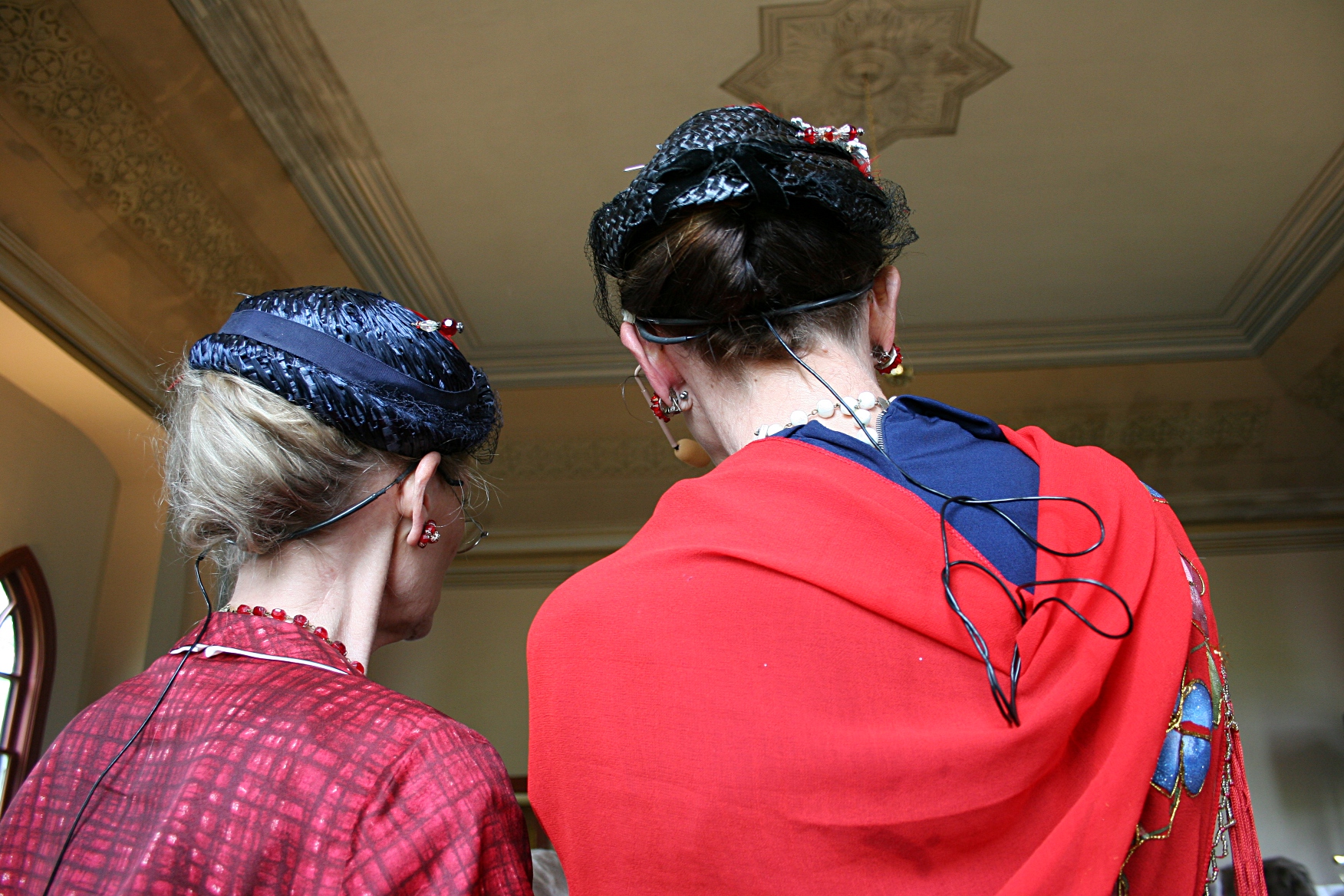
This year the party planning sister arrived at our middle brother’s house on the southwestern Minnesota prairie with an armful of vintage hats for the women, and occasionally the men, to wear. We were remarkably chic. Not a single hat resembled the hideous ribbon-style fascinator sprouted by Princess Beatrice at Prince William and Kate Middleton’s wedding. We Minnesota women possess far better taste than English royalty.

My party-planning sister and her daughter in their hats. My niece's hat is actually a re-purposed baby birds hand puppet that matches her mom's bird nest hat.

I suggested my eldest daughter start a new fashion trend in Minneapolis with her hat.

A few of the guys, including this unidentified family member, briefly wore vintage hats.

I can’t say the same for all attire worn at the holiday gathering. At one point my eldest daughter donned a Christmas sweater, duly admired by her grandmother who likely did not realize the sweater was a joke.

Look to the center of this image and you'll see my sister in her Grinch outfit ready to lead us in the gift exchange.

However, we all roared at the outfit my sister slipped into for the entertaining gift exchange that involves much hoopla and swapping of presents. Only this sister could carry off wearing a Grinch shirt with such fashionable flair.

My fun-loving middle brother suggested this photo op contrasting the modern Kindle with the antique crank wall telephone. There's also a crank phone in the basement and sometimes we pretend to call from the basement to the upstairs, shouting as loud as we can.

Later, a Kindle quickly became a source of entertainment for, ahem, those of us who’ve never seen such technology.

Santa surprised us all. Much laughter and many hugs and lots of photos followed.

Santa swooped in for a surprise visit, bringing back memories for the 20 – 30-something age group who remember past family Christmases with the old young jolly man in attendance.

For the second Christmas in a row we gathered outside for...sorry can't tell you.

We topped off the evening by shrugging into our winter coats and gathering outside the garage for…well…I can’t reveal that part of our family celebration. Suffice to say you would be impressed.

HOW DOES YOUR FAMILY make Christmas fun and memorable? Let’s hear. We’re always open to new entertainment options.

© Copyright 2011 Audrey Kletscher Helbling
 

In praise of old, familiar Christmas hymns December 25, 2011

The doll representing the Christ Child during the Trinity Lutheran Sunday School program on December 17.

FOR THE FIRST TIME in as long as I can remember, I missed Christmas Eve worship services. We were traveling home from a family gathering in southwestern Minnesota.

So this morning, back in Faribault, my husband, eldest daughter, son and I attended Christmas Day services at Trinity Lutheran Church in Faribault.

While a morning worship service doesn’t hold quite the mood-setting anticipation of worshiping on Christmas Eve with candles glowing soft and white holiday lights sparkling bright in the fading daylight and kids restless with excitement, I appreciated the contentment of singing old, familiar hymns on Christmas morning.

From the opening “Oh, Come, All Ye Faithful” to the recessional “Joy to the World,” and many songs in between, I was reminded of all those childhood Christmas Eve worship services at St. John’s Lutheran in Vesta.

Dad hurried to finish the milking early so we could get to church, to participate in the Sunday School program and sing the same old, familiar hymns we sang today: “Hark! The Herald Angels Sing,” “It Came Upon a Midnight Clear,” “From Heaven Above to Earth I Come,” and “Angels We Have Heard on High.”

Although we didn’t sing “Silent Night, Holy Night” this morning, we listened to a teenage girl coo a sweet, lovely rendition. And we heard another teen strum “What Child Is This?” on his guitar.

It was a lovely service of praise, voices uplifted in the joyful comfort of aged hymns to celebrate Christ’s birth.

From my family to yours, we wish you a most blessed Christmas.

© Copyright 2011 Audrey Kletscher Helbling
 

Downtown Faribault in December in black & white December 22, 2011

The former Security Bank building anchors a corner of Central Avenue in downtown Faribault.

PHOTOS DEVOID of distracting color possess a certain surreal, dreamy quality and a vintage feel that have always appealed to me.

Some of the best images I’ve seen hearken from years ago which just goes to prove that technology doesn’t always equate better results.

While filing through photos I shot in historic downtown Faribault on Saturday afternoon and evening, I decided to play with my photo editing tools and desaturate several images. I liked the results so much that I stripped every frame of color.

The results, I think, impress even more upon the viewer the history of this early Minnesota community that stretches back to its founding by fur trader Alexander Faribault in 1852.

We’re a city rich in history with 40 properties on the National Register of Historic Places.

With that perspective, please join me on a quick photo tour of the downtown area. Certainly much more comprises our downtown than what you see in the seven images here.

I invite you to explore on your own, to immerse yourself in the history that defines Faribault.

Historic buildings along Central Avenue.

Dandelet Jewelry occupies the former 1882 Dandelet Dry Goods building, which was renovated in 1985.

A scene from the movie, "Grumpy Old Men," was shot in the former drug store to the right in this image. Today the building houses a pawn shop.

A holiday display window at Erickson Furniture, in business since 1956 and located along Fifth Street Northwest just a block off Central Avenue. Erickson Furniture won first place in the Main Street window decorating contest with its suspended green chairs, holiday ornaments and lights.

Holiday decorations in a business window along Third Street Northwest just off Central.

A sign in the window of Burkhartzmeyer Shoes, a third-generation family-owned shoe store founded in 1949.

CLICK HERE to read a previous post about Faribault’s historic downtown.

Copyright 2011 Audrey Kletscher Helbling
 

Appreciating historic downtown Faribault, especially in her holiday finery December 21, 2011

Strolling along Central Avenue in historic downtown Faribault late on a Saturday afternoon in December.

SATURDAY AFTERNOON, while my husband shopped for dress shoes at Burkhartzmeyer Shoes in historic downtown Faribault, I meandered a block north to view Central Avenue dressed in holiday finery.

She’s stunning with sparkles and ribbons and Christmas reds and greens befitting any holiday party.

Keepers Antique Store decorated the wrought iron fencing on a downtown street corner as part of a "Winter Wonderland" themed decorating contest.

Honestly, I love the look and feel of my downtown. Even without the glitz and glamour of the holiday season, Faribault shines. The old brick buildings, the comforting small-town vibe, the ease of parking, the slow pace and the friendliness of shopkeepers appeal to me.

Next to the Signature Bar & Grill, a lovely holiday-bedecked street corner.

An elf outside The Crafty Maven, "featuring a unique mix of new and vintage items."

Quotes from Charles Dickens' "A Christmas Carol" portrayed in store-front windows.

I am always surprised when locals fail to appreciate downtown. How can you not value this treasure of a business district with arched windows, decorative trim and more on vintage buildings that impart an historic and homey feel to our town? Perhaps because I didn’t grow up here, I can truly see the beauty that native residents often overlook.

Another seasonally-decorated street corner charms visitors to Central Avenue.

I am always surprised, too, that Faribault hasn’t been discovered—like Red Wing or Stillwater or Wabasha or neighboring Northfield—as a destination city. The potential exists to draw tourists here into our specialty shops and arts scene. It’s not for a lack of effort, but…we’re not there yet.

I aimed my camera skyward as the setting sun caught the tops of historic buildings along Central Avenue.

First, we need to sell our own residents on the value of Central Avenue, our Main Street. Do we truly realize how fortunate we are to have a solid, core downtown like ours with a deep history and an inviting character?

Mega malls and strip malls and Big Box retailers—and I shop at those places, too—have nothing on Main Street.

Yes, I grew up in the 1960s and 1970s, meaning my perspective evolves from memories of shopping in a downtown, not a mall.

When I stroll along Central Avenue in Faribault, nostalgia accompanies me. And she’s a mighty fine friend to walk with, especially during the holiday season.

Outside Keepers Antique Store, a rustic vignette charms.

Across the street at That Scrapbooking Place, a punch of color on the front window backed by a holiday display and reflections of historic buildings.

Sweet, dreamy gingerbread houses fill the display window at Sweet Spot, a Central Avenue candy and ice cream shop. I love how the reflection of an old building across the street melds with the gingerbread house.

IF YOU’VE NEVER been to Faribault, consider a trip here. We’re located along Interstate 35, just an hour south of Minneapolis. You’ll find antique, craft, candy, cheese and many other specialty shops and businesses, hometown eateries, as well as an arts center, along Central Avenue. If you have a specific question about Faribault, ask and I’ll answer.

LOCALS,  if you haven’t been downtown in awhile, I’d encourage you to park your vehicle, walk and appreciate your town. She’s all glammed up right now and a wonder to behold.

READERS, PLEASE CHECK back on Thursday for more Central Avenue holiday-themed images.

© Copyright 2011 Audrey Kletscher Helbling


Part II: Life as an orphan in Owatonna December 20, 2011

The main building at the orphanage, built in 1886, housed offices, a reception room, chapel/auditorium, boys' cottage, living quarters for employees, a sewing room, attic and linen storage. This main portion today serves as the Owatonna city administration building.

THE TOWERING BRICK building with the enchanting turret represents no fairy tale. Not at all.

Within the confines of this place and the outlying cottages, some 12,000 – 15,000 children spent their formative childhood and teenage years institutionalized in the Minnesota State Public School for Dependent and Neglected Children. They were the orphaned, the abused, the abandoned, the unwanted.

The "State School Kids" memorial stands in front of the main building and was dedicated in 1993.

Information in a brochure I picked up on a recent visit to this 1886- 1945 orphanage in Owatonna reads:

Such children became wards of the state and, in most instances, all parental rights were cancelled. Parents did not always realize they were relinquishing all rights to their children when they signed the State School commitment papers. Some parents returned to try to regain custody of their children and were refused.

Can you imagine?

Residents of Cottage 11, which housed boys ages 6 - 13, pose for a photo now on exhibit at the museum.

While some children adjusted to living within the strict regiment and rules of the school, many did not. You will hear and read their tragic memories when you visit the orphanage museum. Be forewarned: These stories are difficult to hear.

A room in cottage 11 features the photos and memories of the boys who lived there.

Cottage 11 residents

The boys remember scrubbing floors throughout the cottage, including in the bathroom..

Beds were packed tight into sparse bedrooms in the cottage.

I’ve read several books written by former “state schoolers,” as they were called. Harvey Ronglien, who was the motivator behind the museum and the orphan’s memorial, wrote A Boy from C11, Case #9164, A Memoir. Peter Razor wrote While the Locust Slept, winner of a Minnesota Book Award. I read both books, as well as Crackers & Milk by Arlene Nelson, many years ago and still can’t shake the haunting memories of neglect and abuse and struggle.

Particularly troubling are the reports of abusive, neglectful and unloving matrons. Equally disturbing are the stories of children who were indentured to farm families and then treated like slaves.

Each boy was assigned to a chair in the basement and could not leave the Cottage 11 basement without permission. This was a method used to keep order and control over the children.

Within the confines of the basement, the boys played with marbles, puzzles, checkers and other toys.

A sign on a stairway landing tells visitors about the boys' dreams of escaping via rail and of their admiration for hobos. Some boys did hop trains and ran away.

Children were educated through the eighth grade, with some selected during the early years to attend Owatonna High School. In later years, all students were allowed to attend high school.

If you’ve never visited the Minnesota State Public School Orphanage Museum, I’d encourage you to do so.

This exists as part of our state’s history. We need to know and understand life here.

Considering the thousands of children who lived in the orphanage during its 60-year span, I expect many Minnesotans are still carrying the emotional scars whether directly or indirectly passed through the generations.

IF YOU LIVED in the orphanage or have a family member who did, I’d like to hear from you. What’s your story? Good or bad.

The feet of the children in the memorial statue on the orphanage grounds.

CLICK HERE to read a previous blog post I published about Christmas in the orphanage.

© Copyright 2011 Audrey Kletscher Helbling


In Owatonna: Stories of an orphan’s Christmas December 19, 2011

Cottage 11, built in 1923, as one of 16 cottages at the former Minnesota State Public School for Dependent and Neglected Children. Designed to house 25 boys ages 6 - 13, this cottage typically was home to 30 - 35 youth.

AS WE HURRY ACROSS the hilltop campus toward Cottage 11 at the former Minnesota State Public School for Dependent and Neglected Children, the raw wind slapping our cheeks, Silvan Durben advises us to refrain from jumping on the beds.

He’s a character, that Silvan, energetic and flamboyant and passionate. And truthful. This director of art at the Owatonna Arts Center, which is housed in the main building of the former orphanage, shares a tidbit of truth. The children who once lived here weren’t allowed to sleep on their pillows. So if my husband and I slid the for-show-only pillows off the beds and onto the floor, we’d have it right.

The boys' bedrooms are stark, devoid of anything homey. This small room slept three.

With that piece of information imparted, Silvan unlocks the door into Cottage 11, today preserved as part of the Minnesota State Public School Orphanage Museum complex in Owatonna.

Within these walls, which housed boys ages 6 – 13 from 1923 – 1945 in the state school orphanage, we will learn more of the unsettling truths during a self-guided tour. Typically, the cottage is staffed, but on this Sunday afternoon it is not and Silvan has allowed us inside, on our own, to explore. He trusts us, he says, and I am grateful for this opportunity to wander.
Entering a now-enclosed porch that serves as a gift shop and then stepping into the adjoining living room, I am surprised that I feel, initially, impressed by my surroundings. Visually, I am pleased by the natural light flooding this room through the abundant windows, by the dark woodwork, by the fireplace, by the narrow wood-slat floor, by the cozy cluster of vintage furniture grouped near the Christmas tree surrounded by piles of presents.

But looks, as I immediately learn, can be deceiving.

The living room was off limits to the boys except on special occasions.

A view from the hallway looking toward the living room fireplace. Each week the boys polished the floor and furniture in this forbidden space. They also scrubbed floors throughout the cottage.

The posted words of the orphan boys reveal the truth:

…the toy trucks were taken away a few days after Christmas and hidden in the attic to be gifted again the next year.—Cottage 11 Boy

The truth revealed about Christmas from the memories of the Cottage 11 boys.

And the lovely living room? Apparently just for show, too, except on special occasions like Christmas Eve when the boys gathered here around the tree and were allowed to stay up past their usual 7:30 p.m. bedtime until 9 p.m.

Christmas brought but a moment of happiness to these children who otherwise lived under rigid rules and the domination of mostly uncaring matrons. (Arguably, some of these children may have lived equally difficult, or worse, lives had they remained in their previous circumstances/environments.)

Some happy Christmas memories from the boys.

Christmas brought the local Rotarians into the school auditorium to sing carols and pass out boxes of hard candy. Christmas brought several gifts—perhaps Tinker Toys, or marbles or puzzles—for each child.

The stairway between the first and second floors and a shot of the cottage's front door at the bottom of the frame. The boys were never allowed to use the front door. They entered and exited through the basement.

I cannot even begin to fathom living here under unforgiving discipline, sleeping in stark bedrooms crammed with kids, missing out on the love of family.

Unlike the mother image she was expected to portray, Miss Morgan (the matron) could be hard and cruel. Only rarely could she be kind and compassionate.

As I meander through the rooms peering at the black-and-white photos of mostly unsmiling boys and reading about their fears of scoldings and spankings and of scrubbing floors on their hands and knees and being confined primarily to the basement, my heart hurts. Truly.

You can see it in the boys' faces, the desperate need to be loved.

On signage titled “The Basement,” I read of  the prevailing authoritarian attitude:

Permission was always required to leave the basement.

Each boy was assigned a chair in the basement. "The chair kept order and accountability" to the matron.

Listening to a recording of a man who as a boy had his head slammed into a wall for prematurely removing a tie and cuffing a matron, I can still hear the hurt in his voice.

I can almost feel the pain experienced by cottage resident Arlend “Buzz” Wilson who slipped and scalded himself with hot water while scrubbing the basement steps. He ended up hospitalized for his burns.

In the first floor matron's quarters, a young boy was placed in the rocking chair to the left and his head slammed into the wall for disobedience. He removed his tie too soon and cuffed the matron.

But for all the awful stories shared here, occasionally glimmers of hope slip through—of boys who admired hobos and hopped the nearby train to escape and of “Wednesday Night at the Movies,” when movies were shown in the school auditorium. Those “brought great joy to us children.”

And then, the single gem I found among all the stones:

FYI: Cottage 11 is open from1 p.m. – 3 p.m. Tuesday – Sunday. However, I advise calling in advance (507-774-7369) as it was not open when we arrived on a Sunday afternoon. Hours at the main museum, 540 West Hills Circle, Owatonna, are from 8 a.m. – 5 p.m. Monday – Friday and from 1 p.m. – 5 p.m. on weekends. I have previously toured the museum, but did not do so again on this most recent visit.

PLEASE CHECK BACK for additional photos of Cottage 11.

© Copyright 2011 Audrey Kletscher Helbling