Minnesota Prairie Roots

Writing and photography by Audrey Kletscher Helbling

Exploring the Kasota Prairie on an October afternoon October 7, 2010


A rock juts into the Kasota Prairie.


I CAN HEAR, in the distance, the steady thrum of traffic, presumably from U.S. Highway 169 or perhaps from nearby Minnesota Highway 22. I’m uncertain because I’ve never been here before and I haven’t consulted a map to pinpoint my location.

If not for the endless drone, I could be standing in the middle of a remote South Dakota or western Minnesota prairie.

But I am in south central Minnesota, at the Kasota Prairie, on a 90-acre remnant of the prairie land which comprised one-third of our state before 1850. Here native prairie grasses remain and grazed lands have been restored.


A view from the parking lot with a stone wall framing the prairie.


On a Friday afternoon, my husband and I discover this scenic spot in the Minnesota River valley two miles from Kasota. Because I favor the sweeping, wide open spaces of the prairie, the place of my roots, to the cramped confines of wooded land, I am comfortably at home here.

Prairie meets sky at Kasota. Stems of grasses dried to the muted earthen shades of autumn sway in the wind, mingling with the wildflowers and the berries I can’t always identify.

Occasionally a block of ancient rock juts through the soil, breaking the vista of plant life.


Water, rock, sky and prairie meld in this scenic Kasota Prairie landscape.


I pause often along the walking trails, even stray from the trampled paths, to examine the mottled stone, to admire a lone, rock-encircled barren tree atop a hill, to identify the red berries of wild roses, to study a clutch of feathers left by a predator, to take in the distant hillside of trees tinted in autumn colors.


My favorite image from the Kasota Prairie, a barren tree encircled in rock.


Wild rose berries on the Kasota Prairie.


Trees on a distant hillside change colors under October skies.


There is so much to appreciate here. Wind. The sky, quickly changing from azure blue wisped with white to the angry gray clouds of a cold front. Land, rolling out before me, unbroken except for sporadic pockets of water, the occasional tree or cluster of trees and those rocks, those hard, ancient rocks that interrupt this land, this Kasota Prairie.


A sign marks the Kasota Prairie entrance.


To truly appreciate the prairie, notice the details, like the berries growing among the grasses.


A narrow path runs along the barbed wire fence border line of the prairie.


FYI: To find the Kasota Prairie, take Le Sueur County Road 21 one mile south of Kasota. Then turn west onto township road 140 and go one mile.

© Copyright 2010 Audrey Kletscher Helbling


Barns full of memories October 6, 2010

Filed under: Uncategorized — Audrey Kletscher Helbling @ 7:39 AM
Tags: , , , , , ,

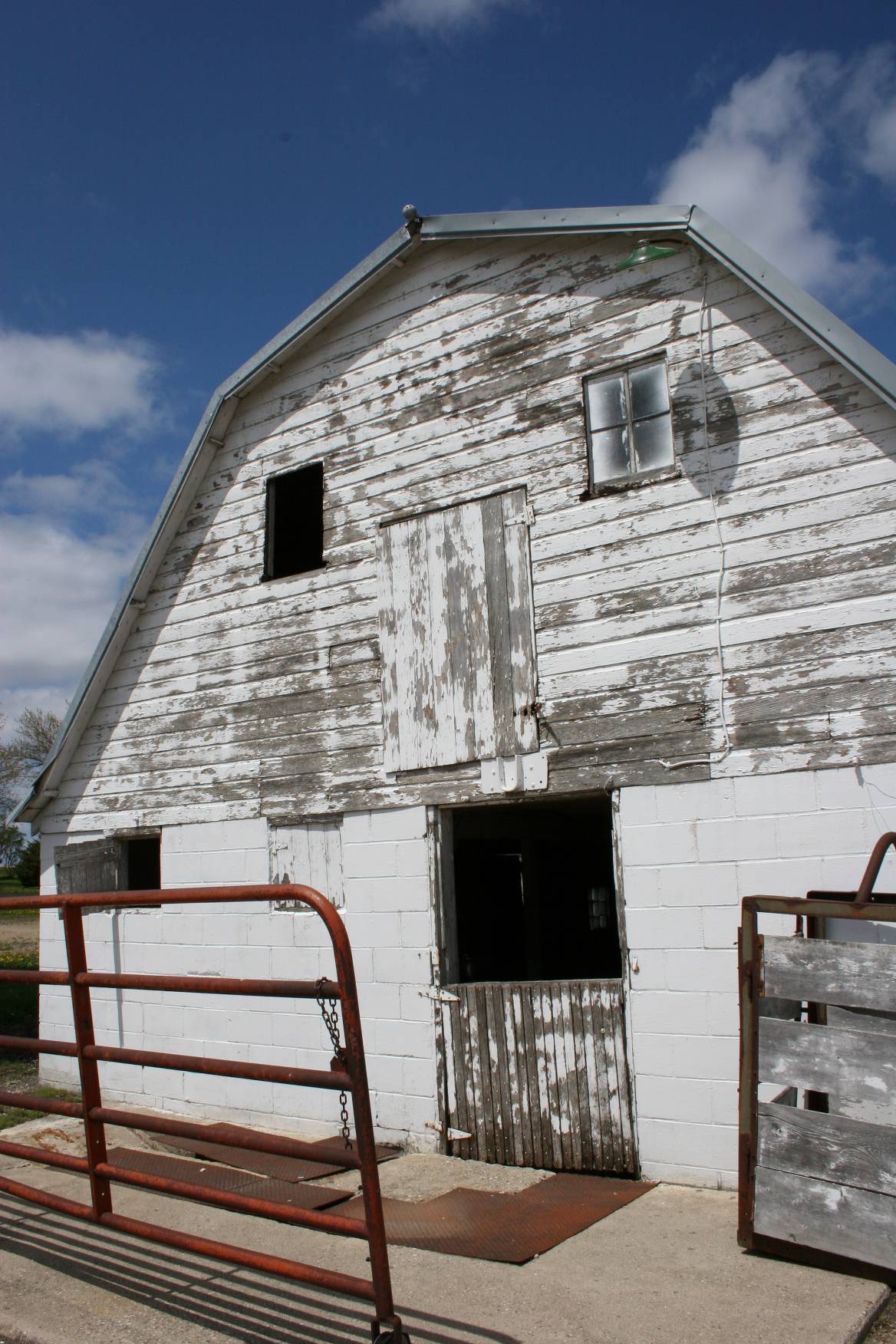
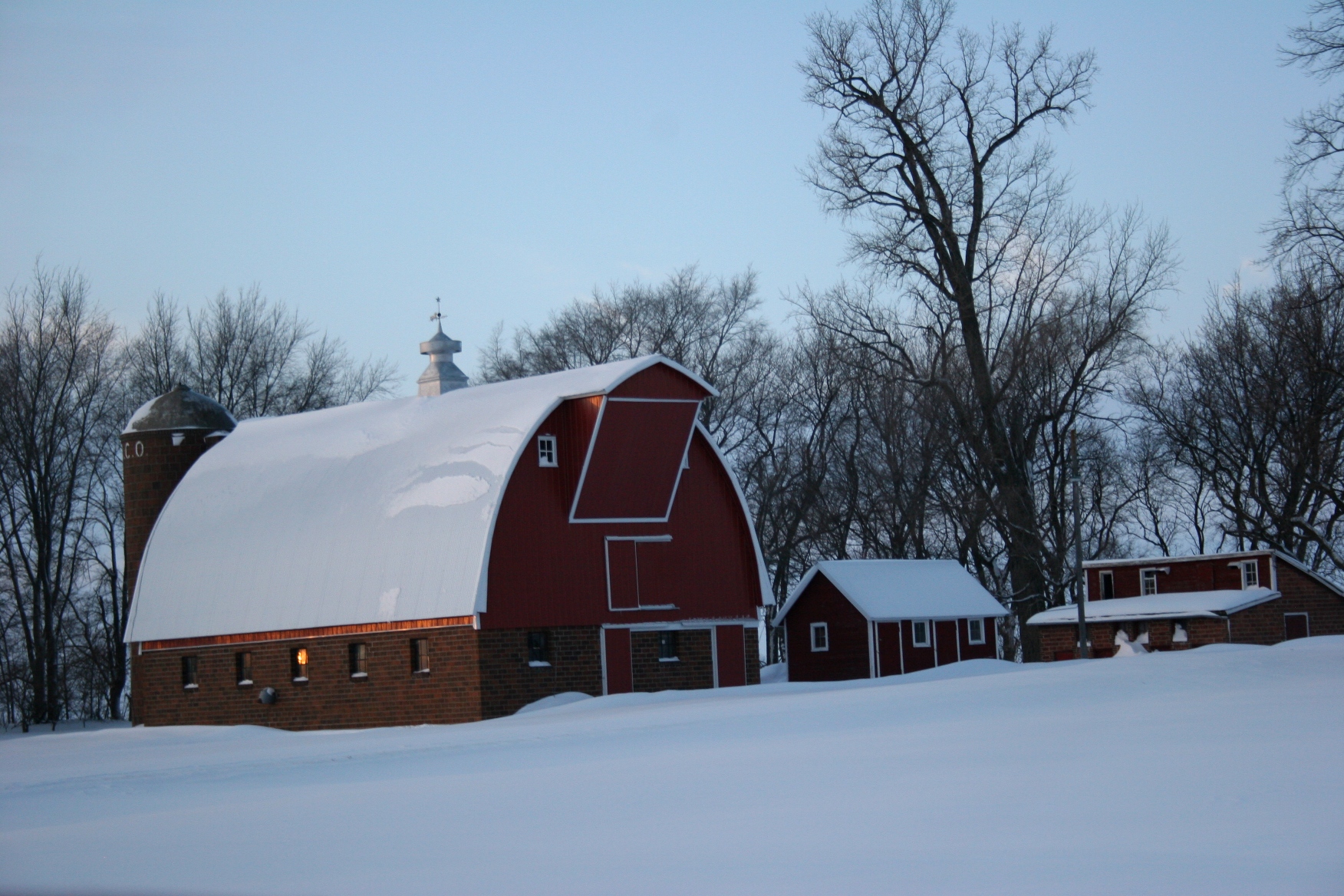
I photographed this barn along Le Sueur County Road 21 while on a recent drive to see the fall colors.

LIKE COUNTRY CHURCHES and abandoned farmhouses, old barns draw me close, calling me to not only look, but to truly see.

All too often these days, though, my view is periphery, a quick glimpse from a car window of a barn that stands straight and strong or crooked and decaying.

Because these are not my barns on my property, I typically settle for photographing them from the roadway, although I would like nothing more than to meander my way around the farmyard.

Barns evoke memories—of sliding shovels full of cow manure into gutters, of dumping heaps of pungent silage before stanchions, of pushing wheelbarrows overflowing with dusty ground feed down the narrow barn aisle, of dodging streams of cow pee, of frothy milk splashing into tall metal pails, of Holsteins slopping my skin with sandpaper tongues.

Such memories come from years of hard work on my childhood dairy farm in southwestern Minnesota. That barn stands empty now, has for longer than I care to remember. No cows. No kids. No farmer. No nothing.

I have only my memories now and those barns, those roadside barns, which symbolize the hope, the fortitude and the dreams of generations of Minnesotans.

The early 1950s barn on the Redwood County dairy farm where I grew up is no longer used and has fallen into disrepair.

A close-up image of the red barn (above), snapped while driving past the farm.

Another barn in Le Sueur County.

Old silos, like this one along Rice County Road 10, also intrigue me. Growing up on a farm, I climbed into the silo to throw down silage for the cows. Below my brother scooped up the silage to feed cows on his side of the barn. It took me awhile to figure out what he was doing, and that was making me do half his work.

If ever a barn could impress, it would be this one I spotted on the Le Sueur/Blue Earth County line, I believe along Le Sueur County Road 16. I doubt I've ever seen such a stately barn.

Here's another angle of the sprawling old barn. Yes, I trespassed and tromped across the lawn to capture this photo. Imagine the dances you could host in this haymow. What a fine, fine barn.

I zoomed in even closer to capture the barn roof and a portion of the silo.

© Copyright 2010 Audrey Kletscher Helbling


Navigating through flood-damaged Teepee Tonka Park October 5, 2010

Filed under: Uncategorized — Audrey Kletscher Helbling @ 7:34 AM
Tags: , , , ,

UNDERNEATH MY FEET the ground felt spongy, earth saturated with too much water. So when I could skirt the matted-down, unstable lawn, I did. I moved onto the sand, sculpted across the ball field where once there had been grass.

Sand sweeps across a ball field at Teepee Tonka Park.

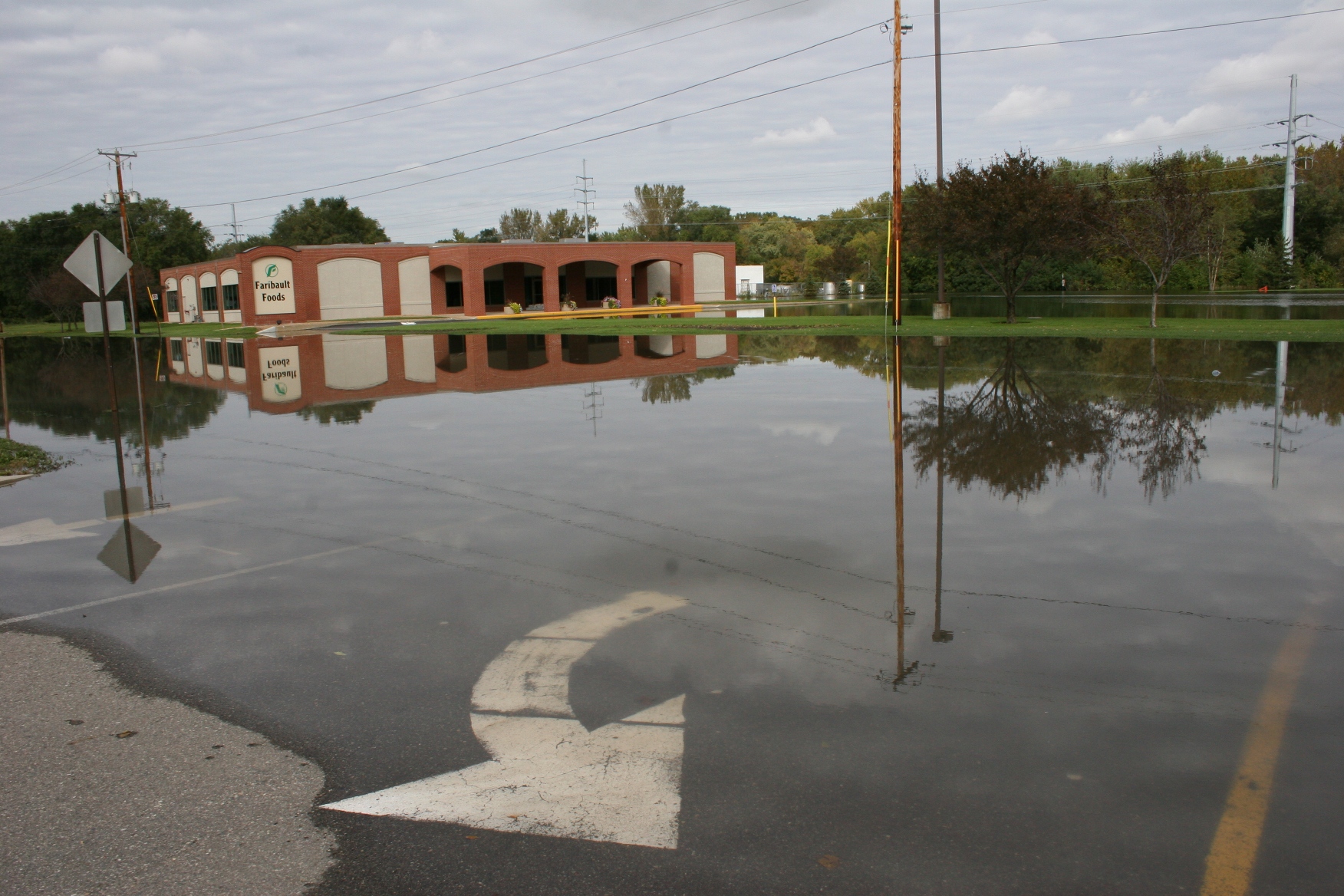
This is Teepee Tonka Park in Faribault, some 10 days after torrential rains caused the Straight River to rise and inundate this city park. Situated next to the river on the city’s east side, this low-lying park is prone to spring flooding.

But this time the floodwaters swept across Teepee Tonka in a rare autumn flood, wreaking havoc on a park that is now closed for the season due to all the damage.

Sunday afternoon I walked across the bridge, which just 10 days earlier had been covered by rushing Straight River waters that rose an estimated 10 feet. It seemed nearly improbable to me that the waters could already have receded this much, back into the confines of the river channel.

During the flood, the Straight River flooded the bridge into Teepee Tonka Park.

Waters have receded, allowing entry across the bridge into Teepee Tonka Park.

As I walked across the park, across the grass flattened to the earth, across ballpark fences slammed to the ground by the powerful floodwaters, past bleachers swung into awkward, out-of-place positions, I marveled at the force of nature. Imagine how impressed I would be with buildings shoved by the angry river.

Floodwaters twisted and flattened ballpark fences, swirled bleachers and redeposited sand.

A displaced dead tree limb in the ball field.

But on this Sunday afternoon, calmness prevailed. A young boy dug, with his parents, in piles of sand, for earthworms. And nearby, within its banks, the Straight River, which is misnamed given its winding path, flowed strong and steady.

During the flood, the Straight River rose over the Teepee Tonka bridge in the foreground and overflowed its banks underneath the viaduct in the background.

I shot this image of the Straight River from the Teepee Tonka bridge Sunday afternoon.

Floodwaters have receded from under the viaduct just outside Teepee Tonka Park.

I took this photo during the flood, when the Straight River overflowed its banks under the viaduct.

© Copyright 2010 Audrey Kletscher Helbling
 

Appreciating quilt art at the cathedral October 4, 2010

A banner in front of the Cathedral of Our Merciful Saviour along Second Avenue N.W. in Faribault draws visitors to the Rice County Piecemakers Quilt Show.

AS MUCH AS I ENJOYED the Rice County Piecemakers Fall Splendor Quilt Show at the Cathedral of Our Merciful Saviour in Faribault this past weekend, I was nagged by guilt.

First, my paternal grandma was a quilter. Therefore, it seems I should be genetically predisposed to quilting. But I am not.

Second, I won a door prize—a stash of fabric pieces—that I was delighted to win because I like to win. The patches were even in my favorite color, green. But, because I don’t quilt, I almost felt like I should return the prize to be awarded to some deserving quilter. I didn’t. Instead, I gave the pieces to my friend Marilynn and her daughter Kellie, who are beginning quilters.

Third, several of the quilters asked if I was a quilter. I replied that I made several baby quilts more than 20 years ago and that I sewed nearly all of my clothes when I was a teenager. I don’t think they were impressed. But it was the best I could offer.

Really, these quilters were very nice and they do some mighty fine work. Their quilts are works of art, masterpieces, examples of detailed stitchery and creativity that leaves me wishing I possessed even an ounce of their talent.

Pam Schuenke received the Viewer's First Choice Award in the Challenge Division for her 28-inch square pineapple block pattern creation. She pieced together 150 fabric swatches into nine blocks and added some autumn pizazz by blanket-stitching the seams with gold metallic thread. Entrants in the Challenge Division had to visibly incorporate five specific fabrics into their quilt pieces. Pam also won the top award in the miscellaneous category with an oriental table runner. She's been a Piecemakers member since the late 1980s.


Rows of quilts hung in the cathedral's Guild House.

Quilts and stained glass complemented each other.

Brenda Langworthy created this whimsical "Dog Show" quilt.

Some of the challenge quilts, which included five selected fabrics.

Twyla Sporre quilted "Pop Goes the Weasel" in the challenge competition of the Piecemakers exhibit.

The Piecemakers laid quilts across the 50 some pews in the sanctuary. A total of 200 quilts were shown through-out the church complex. Visitors were asked to vote for their favorites in the following categories: bed quilts, throws/lap quilts, baby items, wall hangings, miscellaneous and challenge quilts.

These adorable quilted bear potholders were on sale in the dining room.

Mary Peterson created "My Fine Sweet Girls," and here's one of those sweet girls.

THE RICE COUNTY PIECEMAKERS meet from 7 – 9 p.m. on the third Thursday of the month at Fourth Avenue United Methodist Church, 219 N.W. Fourth Avenue, Faribault. Meetings feature speakers, demonstrations, and “show and tell.” There are no dues and the club’s motto is “Sewing friendships one stitch at a time.”

© Copyright 2010 Audrey Kletscher Helbling
 

A country school preserved in Millersburg October 3, 2010

MY HUSBAND THRILLS in talking about the coyotes at Chimney Butte School.

You have to admit that just the name of the rural North Dakota school, which Randy attended for 14 months in the 1960s, draws you in to listen.

His tale is short. One day Randy and his classmates couldn’t go outside for recess because of coyotes in the schoolyard. That’s it. Yet, the story deserves telling. How many men in their early 50s attended a country school? Furthermore, how many of those students encountered coyotes on a school day?

Preserving such memories is important. So is preserving the actual school building. Last Sunday I stepped inside a one-room Minnesota country school that has been restored and transformed into a museum. That’s nothing new, really. Old schoolhouses have also become township halls, private residences and businesses, although some have been abandoned and simply fallen into heaps of rotting wood.

Members of The Christdala Preservation Association are assuring that doesn’t happen to the District 20 Millersburg School in rural Rice County. The association has acquired the former schoolhouse and is transitioning it into a museum for the Millersburg community.

The 1881 Millersburg School is now a museum.

The old country school sits across the road from Boonie's restaurant and bar along Rice County Road 1.

Inside I discovered records and artifacts from the school and nearby Christdala Evangelical Swedish Lutheran Church, historic photos, an old buggy, military memorabilia and more.

Mostly, though, I appreciated the care taken to restore the building. Gleaming wood floors made me want to push back the tables and chairs and host a square dance. These preservationists paid attention to detail, right down to the American flag and portrait of George Washington.

As this museum evolves, I expect, hope, that the preservation association will open the doors on a regular basis to the public. And I expect, hope, that those who gather there will exchange stories about their days in a country school, coyotes or not.

The refurbished wood floor shines under the wheels of an 1887 Michigan Buggy Company buggy which was taken apart and reassembled inside the schoolhouse museum.

At the front of the schoolroom hangs the American flag and a Presidential portrait below the period ceiling.

The 1889 Swedish bible used in worship services at Christdala Evangelical Swedish Lutheran Church, located just down the road from the school.

A page from the 1889 Swedish bible.

Among the museum photos is this portrait of the Peter Gustafson family. Peter was among the founding members of Christdala. He was also the brother of Nicolaus Gustafson who was murdered by outlaw Cole Younger during an attempted 1876 bank raid in nearby Northfield. At the time of Nicolaus' death, the Millersburg Swedish community had no church or cemetery. Nicolaus' untimely death prompted the Swedes to form Christdala. Peter Gustafson's 18-year-old twin son, Eugene, died tragically in March 1905 when a log rolled forward on a wagon and crushed him. This information is published in The History of the Christdala Evangelical Swedish Lutheran Church of Millersburg, Minnesota, written by B. Wayne Quist.

An old wooden pail rests inside a simple cupboard in a corner of the schoolhouse.

I spied this old piano stool tucked under a table. A museum visitor pulled the stool out and suggested perhaps naughty students sat on it in a corner.

Of all the historic photos I viewed in the museum, this one is my favorite. It's clear the boys really don't want to be there, with their mom's arms draped around them. But she appears to be a strong, determined woman.

How many stories could this old water pump, next to the school, tell?

© Copyright 2010 Audrey Kletscher Helbling
 

Serving up bullheads in Elysian October 1, 2010

Filed under: Uncategorized — Audrey Kletscher Helbling @ 8:18 PM
Tags: , , , ,

A sign advertises the October 2 Bullhead Feed at the Elysian Legion, 106 E. Main St.

OK, FOLKS, if you’re looking for something different to do on Saturday night, how about attending a Bullhead Feed?

Yeah, that’s as in those yellow-bellied, whiskered fish that are about as ugly as a fish can be.

Anyway, American Legion Post #311 in Elysian is hosting its first Bullhead Feed of the season on Saturday. I know because I was in Elysian this afternoon and read the sign posted on the Legion.

I’ve heard about these first-Saturday-night-of-the-month feeds from my brother-in-law, who happens to be a native of Waterville, Bullhead Capital of the World, just down Minnesota Highway 60 from the Bullhead Feed site.

Although my relative raves about the bullheads, he hasn’t quite convinced me that they’re worth eating. I ate bullheads as a child, but I didn’t know that tastier fish existed. Heck, at least they weren’t fish sticks was my naïve opinion back then.

But apparently plenty of Elysianites, Watervillians and others like bullheads as the Legion offers these monthly feeds from October through May in this town of 580.

I’m unsure what time the Legionnaires start serving bullheads. But I figure if you show up around 5 p.m., you might find the door open. Just make sure you use the bar door.

A sign on the Legion directs patrons to the bar door.

© Copyright 2010 Audrey Kletscher Helbling
 

Poetry and cheesecake

Filed under: Uncategorized — Audrey Kletscher Helbling @ 8:01 AM
Tags: , , , , , , , , , , ,

My daughter's homemade chocolate cheesecake, my birthday cake.

I FELT JUST LIKE a queen, waiting patiently at the dining room table to be served a slice of decadent chocolate cheesecake.

I must say, it’s a wonderful feeling to be on the receiving, rather than the giving, end. And that’s how it is now when I celebrate my birthday.

On Monday, a day after my birthday, my daughter drove down from Minneapolis for an appointment and later dinner out with me, her dad and her brother. But afterward, ah after that meal, I really enjoyed the celebration.

My first-born had baked a from-scratch, all-chocolate cheesecake. She clued us in that the recipe called for melted peanut butter chips mixed into the chocolate batter. But she scorched the peanut butter chips and had to substitute chocolate chips. That produced some gentle teasing about a many-years-earlier chocolate pudding cake disaster.

Clearly, she’s learned a thing or two about cooking and baking as the cheesecake was pure chocolate perfection.

As much as I enjoyed the rich creamy dessert, even more I appreciated that my daughter chose to make a cheesecake. She knows it’s my favorite dessert.

Then I opened my gift from her and appreciated even more that my eldest had chosen items perfectly suited for me. She didn’t buy just any old thing just to give me a present. Rather, she shopped at a south Minneapolis antique store—one with lots of antlers and a place she nearly walked out of due to all those antlers on the walls.

Inside the antique shop, she found a slim volume of poetry, Minnesota Skyline, published in 1953. The book wasn’t priced, she said, and clerks discussed, in front of her, the price she should pay.

Minnesota Skyline, a vintage poetry collection I think worthy of reprinting.

I flipped through the pages and knew I would enjoy this collection with poems like “Wind in the Corn,” “Pioneers of Southern Minnesota,” and “Spring on the Prairie.”

I haven’t had time yet to indulge in the anthology. But that evening, after I opened my daughter’s gift of poetry, I read aloud a verse from “Delano on Saturday Night” by Margaret Horsch Stevens of Montrose:

Men, bent, with toil, feel younger in the glare

Of lights, exchanging jokes and arguments;

And women brighten as they meet and talk

Of recent births, and brides, and home events.

We laughed as we pictured families gathered in downtown Delano on a Saturday night in the 1950s. How times have changed.

After that impromptu poetry reading, I pulled four slim yellow trays from my birthday gift bag. Once again, my daughter had selected an ideal present for me. I collect vintage metal trays and these were unlike any I have or any I’ve seen. For now I’ve propped two atop a shelf—art leaning against a wall.

My daughter gave me four vintage metal trays for my collection.

There’s something to be said for aging, when you can see your children as grown adults, who are caring and loving and giving and who know that you love poetry and cheesecake.

My husband also remembered my birthday with a colorful daisy bouquet.

© Copyright 2010 Audrey Kletscher Helbling
The Lund Press, Inc., of Minneapolis published Minnesota Skyline.


Flood clean-up help needed in Faribault and surrounding area September 30, 2010

Filed under: Uncategorized — Audrey Kletscher Helbling @ 2:26 PM
Tags: , , , , ,

Floodwaters flooded this rural home (left) at the intersection of Minnesota Highway 3 and Rice County Road 29 north of Faribault. This photo was taken late last Saturday morning from CR 29 by the Straight River bridge.

IF YOU’RE WILLING AND ABLE, you can assist residents of Faribault and the surrounding area with clean-up following last week’s devastating floods.

That’s according to a Code Red recorded telephone message I just received from Rice County Sheriff Richard Cook. After I got over the initial scare of hearing the words “Rice County Sheriff’s Department,” I listened, and then listened again to the request.

Here’s the deal: If you can volunteer with flood clean-up, report to the volunteer coordination center at the Rice County Fairgrounds 4-H building in Faribault. Or, you may register to volunteer by calling (507) 332-6234.

Those in need of clean-up assistance may also call (507) 332-6234.

Click here for flood information updates from Rice County.

If you can assist, please do. Organize your friends, your co-workers, fellow church members, neighbors, whomever, and help with the clean-up.

Rice County Road 29 northeast of Faribault was closed last week due to flooding in the area along the Straight River. The road and adjoining Highway 3 were reopened by Sunday.

The rushing Straight River touched the underside of the Rice County 29 bridge.

© Copyright 2010 Audrey Kletscher Helbling
 

Celebrating history and heritage at Christdala Church

Filed under: Uncategorized — Audrey Kletscher Helbling @ 7:45 AM
Tags: , , , , ,

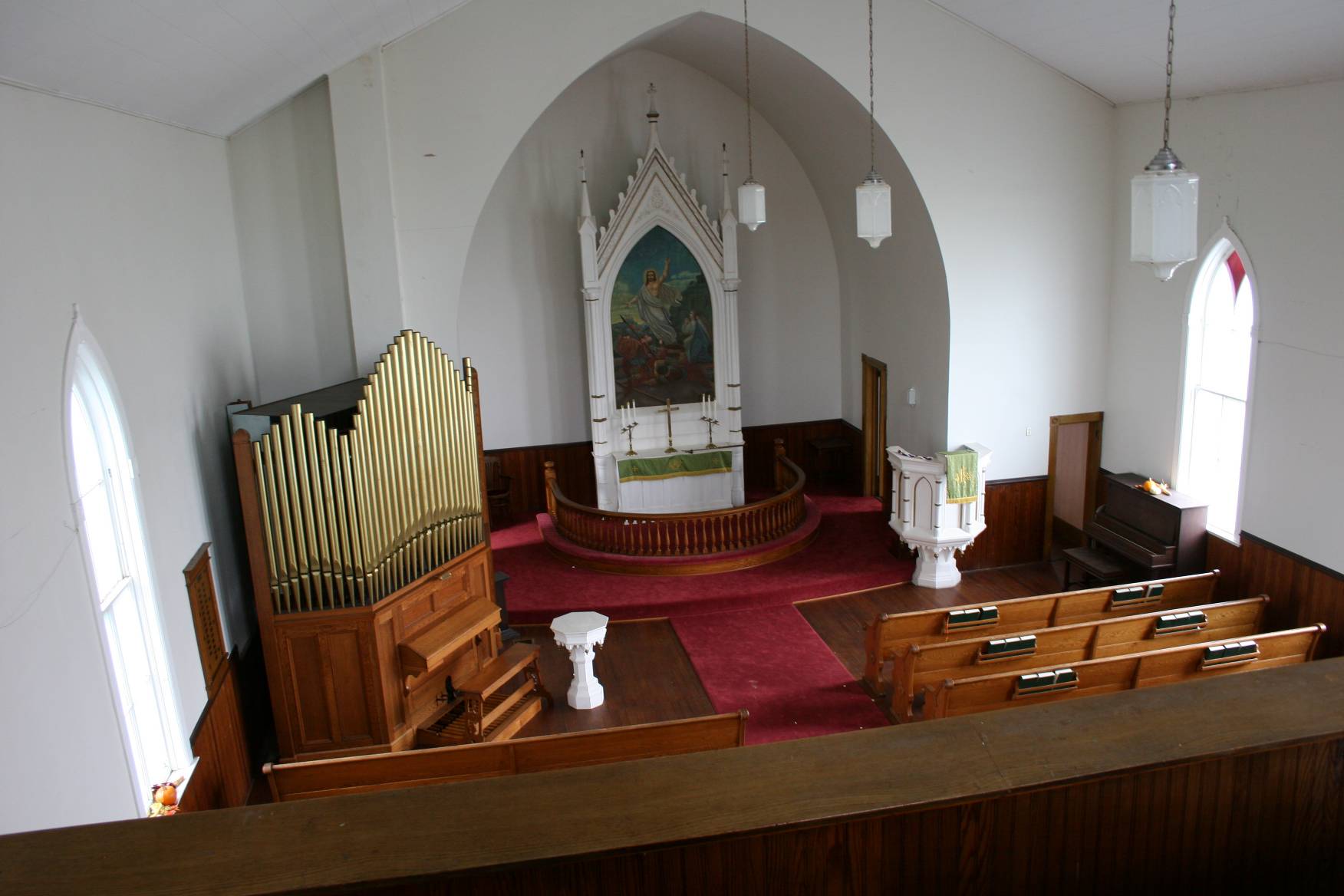
Christdala's 1880 altar and pulpit join at the front of the Swedish Lutheran church.

THEY COULD NOT HAVE KNOWN, but a hymn they/someone chose for the annual church celebration happened to be my favorite.

Beautiful Savior, King of creation,

Son of God and Son of Man!

Truly I’d love thee, truly I’d serve thee,

Light of my soul, my joy, my crown.

And so I sang, in verse two of fair meadows. Verse three, of bright the sparkling stars on high. And the final verse—glory and honor, praise, adoration.

Only occasionally did I glimpse at the service program, at the words I’d memorized in childhood, sung decades later at my wedding. Beautiful Savior.

Everything about Sunday afternoon at Christdala Evangelical Swedish Lutheran Church in rural Millersburg was beautiful. Sunshine. The pure, clear voice of the soloist singing of saints gathering at the beautiful river. The wisps of steam rising from a percolating coffee pot that I glimpsed through a church window while sitting in a front pew. Art on the lawn by my friend Rhody Yule.

On this September day, descendants of the Gustafsons and other Swedish immigrants who founded this church in 1877 gathered to celebrate their heritage and the 1878 Gothic Revival style wood-frame church that has been preserved.

Voices raised together in song, accompanied by the 1886 pump organ, the church’s second organ. Heads tilted to hear the pastor speak: “Jesus is all about setting us free. Today you are set free.”

The clunk of wood as worshipers settled into pews. Bread dipped into wine. Bowed heads and box elder bugs.

And outside, on the lawn, ham sandwiches and lefse and cake in a lunch spread out on tables, in an open stretch of grass between gravestones.

Hugs exchanged. Here, atop a hill, they gathered—friends and family—to worship, to honor the Swedish immigrants who established this congregation, Christdala, Christ’s Valley.

Communion ware at Christdala and a memorial inscription on the altar cross.

Christdala's baptismal font

Numbers on the hymn board mark the celebration date, September 26, 2010.

Hymn board numbers are worn from years of use, reflecting the long history of this church.

Restoration and preservation of Christdala was detailed, right down to matching the replacement carpet, left in photo, to the original framed carpet sample at the right.

Reminders of the Swedish heritage rest atop a cupboard in a corner of the sanctuary.

All of the windows in Christdala are tipped in blue and yellow, the colors of the Swedish flag. This shows the front door opening south to an archway that frames the valley below.

Inside the entry of Christdala, fresh fall flowers sit next to a print of Christ, the Good Shepherd.

The front doors of Christdala open to reveal a painting of the church hanging inside the entry.

Christdala Swedish Lutheran Church sits atop a hill along Rice County Road 1 west of Millersburg.

© Copyright 2010 Audrey Kletscher Helbling
 

An attack in Argentina and how I’m dealing with the crime in Minnesota September 29, 2010

Filed under: Uncategorized — Audrey Kletscher Helbling @ 7:50 AM
Tags: , , , , ,

WHEN THE PHONE RANG early Tuesday afternoon and I picked up to a dial tone, I didn’t think much of it. Just another telemarketer, I figured. But then, the phone sounded again and my 20-something daughter was on the line, speaking to me from Argentina.

“It’s good to hear from you,” I say, surprised really that she is calling given we spoke only several days earlier.

“Well, uh, Mom, I was robbed last night,” she tells me.

I am shocked, momentarily speechless, until I spit out the dreaded words, “Are you OK?”

She is. But her purse and all of its contents are gone—her debit and credit cards, and other important identification, her cell phone and camera. She is stranded, without money, or access to money, with only her passport, in northern Argentina, hours and hours away from her temporary home in Buenos Aires and 6,000 miles from her Minnesota home.

I am thankful, first, that she has not been physically hurt. She sounds fine; she’s had more time than me to digest what’s happened.

Then I ask for details because I need to know how this happened. My daughter shares how she and her friend Ivanna were walking through a “nice neighborhood” toward downtown around 8:30 p.m. Monday when a man came out of nowhere from behind them. He grabbed for my daughter’s purse and as she fought off her attacker, Ivanna screamed for help. Eventually the man got the purse as my daughter fell to the ground. Her assailant, in his mid 30s, sprinted away, hopping onto the back of a motorcycle driven by his accomplice.

Then my second-born tells me she saw no gun, no knife, and I am relieved, yet scared all over again thinking about the possibilities.

All I want is to see my daughter, to hug her, to feel her hair brushing against my cheek, to tell her I love her, to keep her safe.

But for now I can only listen and offer words and lay out a plan to deal with the aftermath of this crime. She and Ivanna immediately went to the local police station. My daughter tells me they waited for an interminable time to speak to the single employee who was working. Several other employees there were simply joking around, she says, and offered no assistance.

Vicariously I am already angry with the police system in this large northern Argentine city. I wonder what today will bring when the two must return to the police station to work on a composite sketch of their attacker.

Back here in Minnesota, I have already spent hours on the phone contacting companies and agencies about the stolen cards. Everyone I’ve talked to has been kind and understanding when I explain what has happened. That reduces the stress level some. Yet, all the phone calls, all the directives to do this and that are wearing on me. During several conversations my voice cracks and I struggle to keep from totally breaking down.

I know this could happen to anyone, anywhere. My oldest daughter, who lives in Minneapolis, tells me this, that this crime could happen on the streets of Minneapolis. She is right. Yet, when an assault like this occurs in a foreign country, 6,000 miles from Minnesota, the whole situation becomes more complicated by distance and communication issues.

I have no doubt that my daughter will recover. She is a strong woman.

As for me, I am counting the days now—23 of them—until she arrives at The Minneapolis-St. Paul International Airport. I cannot wait to have my daughter back, safe in my arms, far from the men who would rob her, and me, of our security.

© Copyright 2010 Audrey Kletscher Helbling