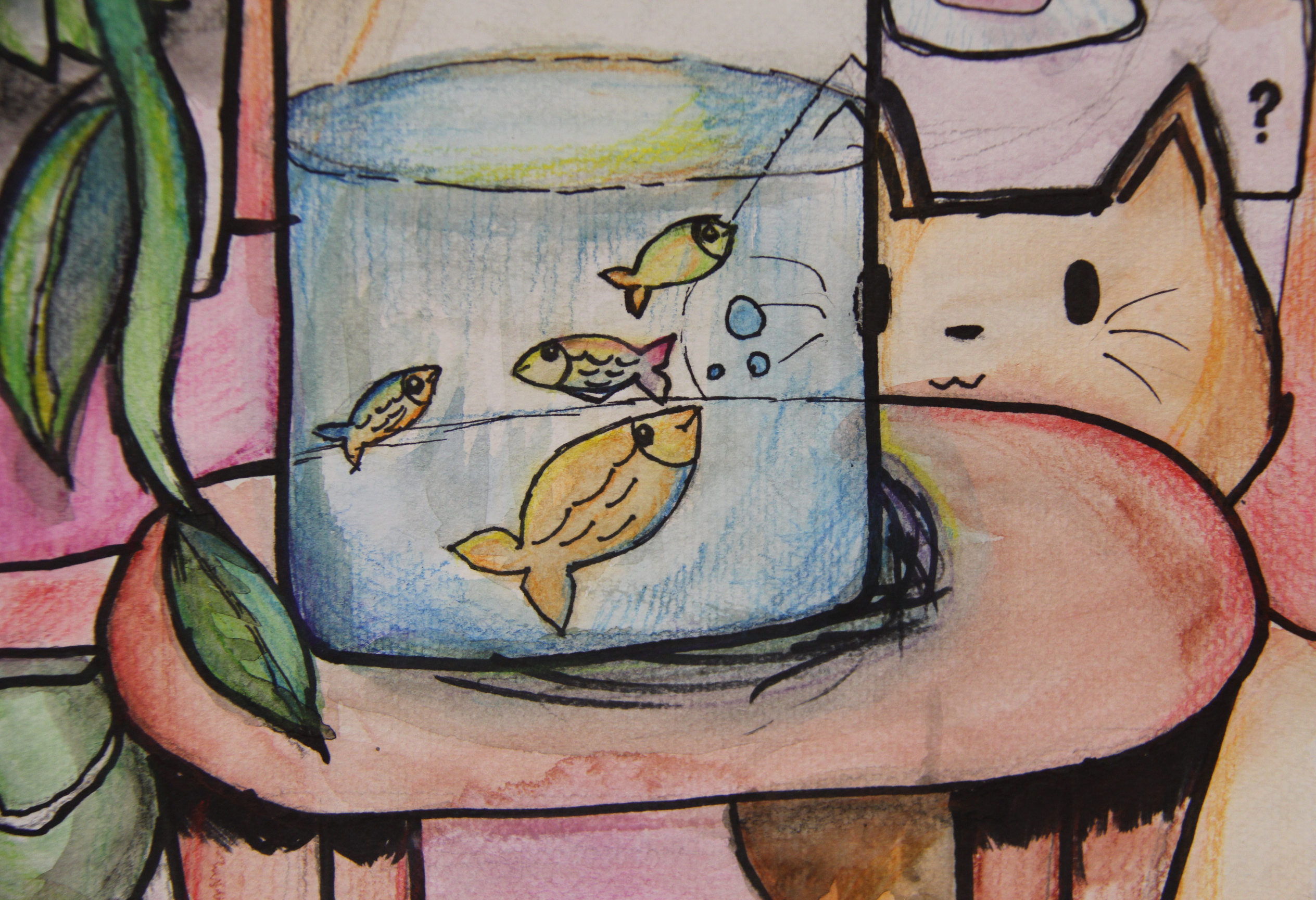
Art created by Briana, Faribault Middle School sixth grader. (Minnesota Prairie Roots copyrighted photo March 2023)
“THAT LOOKS LIKE an illustration in a children’s picture book” I think while viewing a drawing of a cat eyeing fish in a fish bowl. But I’m not paging through a book. Rather I’m appreciating a work of art by Faribault Middle School sixth grader Briana in the All Area Student Art Show at the Paradise Center for the Arts. The exhibit with student art from eight schools closes April 8.
A sampling of artwork in this exhibit, here the art of Faribault Middle School students. (Minnesota Prairie Roots copyrighted photo March 2023)
Likewise, I envision other art on t-shirts, note cards, mugs, places beyond the walls of this Minnesota center for the arts in historic downtown Faribault.
I am grateful to the Paradise Center for the Arts showcasing student art annually. (Minnesota Prairie Roots copyrighted photo March 2023)
Yet, on this day I value this student art in its role as part of a gallery exhibit, showcased to the public. This annual show is always such a delight in the variety of art, the talent, the way these young artists pour themselves into their work. Some pieces, more than others, offer glimpses into personalities and interests.
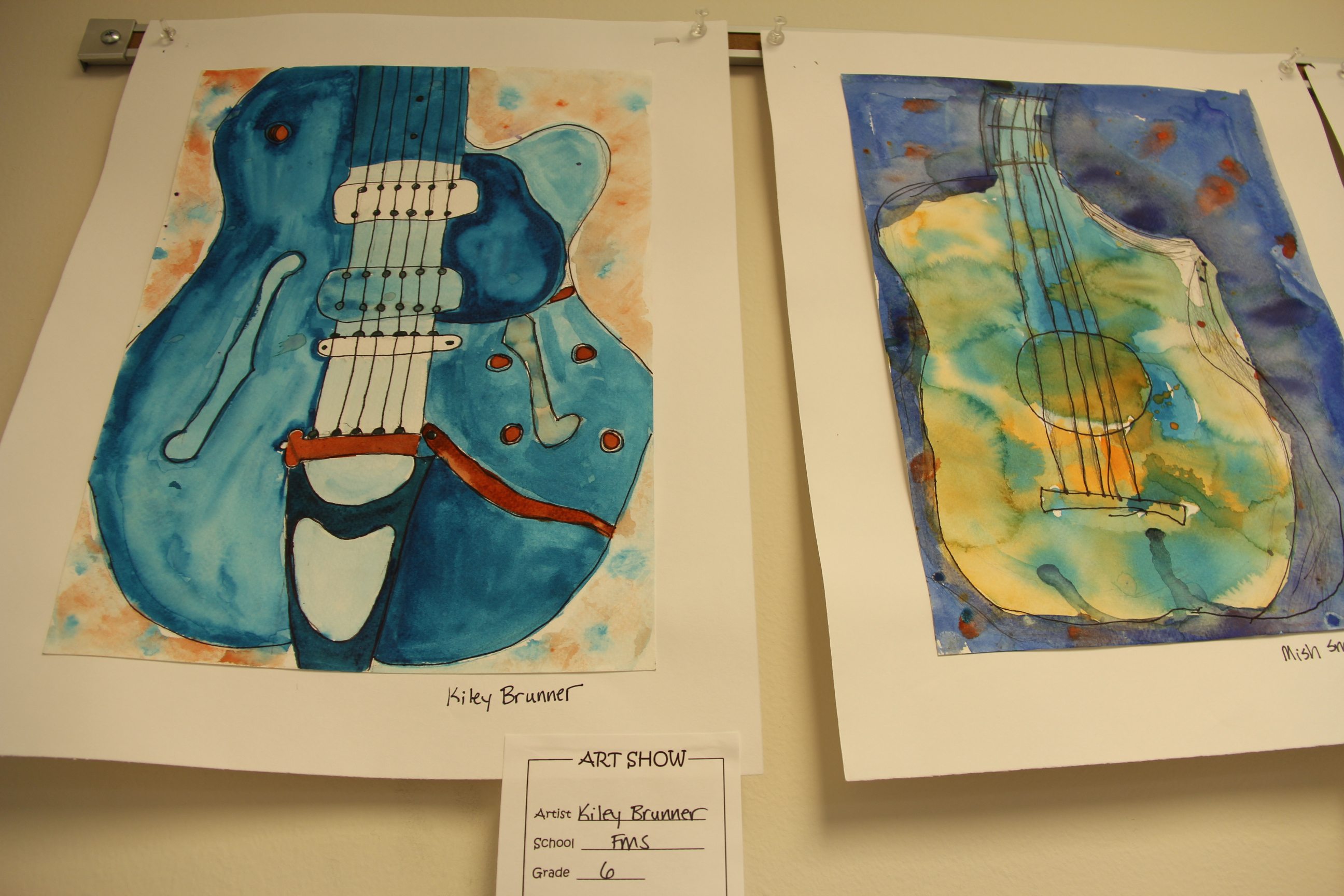
Making music via the visual arts. Guitars by Kiley, left, and Mish of Faribault Middle School. (Minnesota Prairie Roots copyrighted photo March 2023)
I can feel my fingers press into the strings of a guitar, the beat of music filling the room.
Paper collages by Faribault Middle School eighth graders Claire, left, and Maddie. (Minnesota Prairie Roots copyrighted photo March 2023)
I can hear the rhythmic thump of a basketball upon the floor, feel my foot connecting with a soccer ball, see a tennis ball fly across the net toward me. I can hear a dog panting, feel its presence nearby.
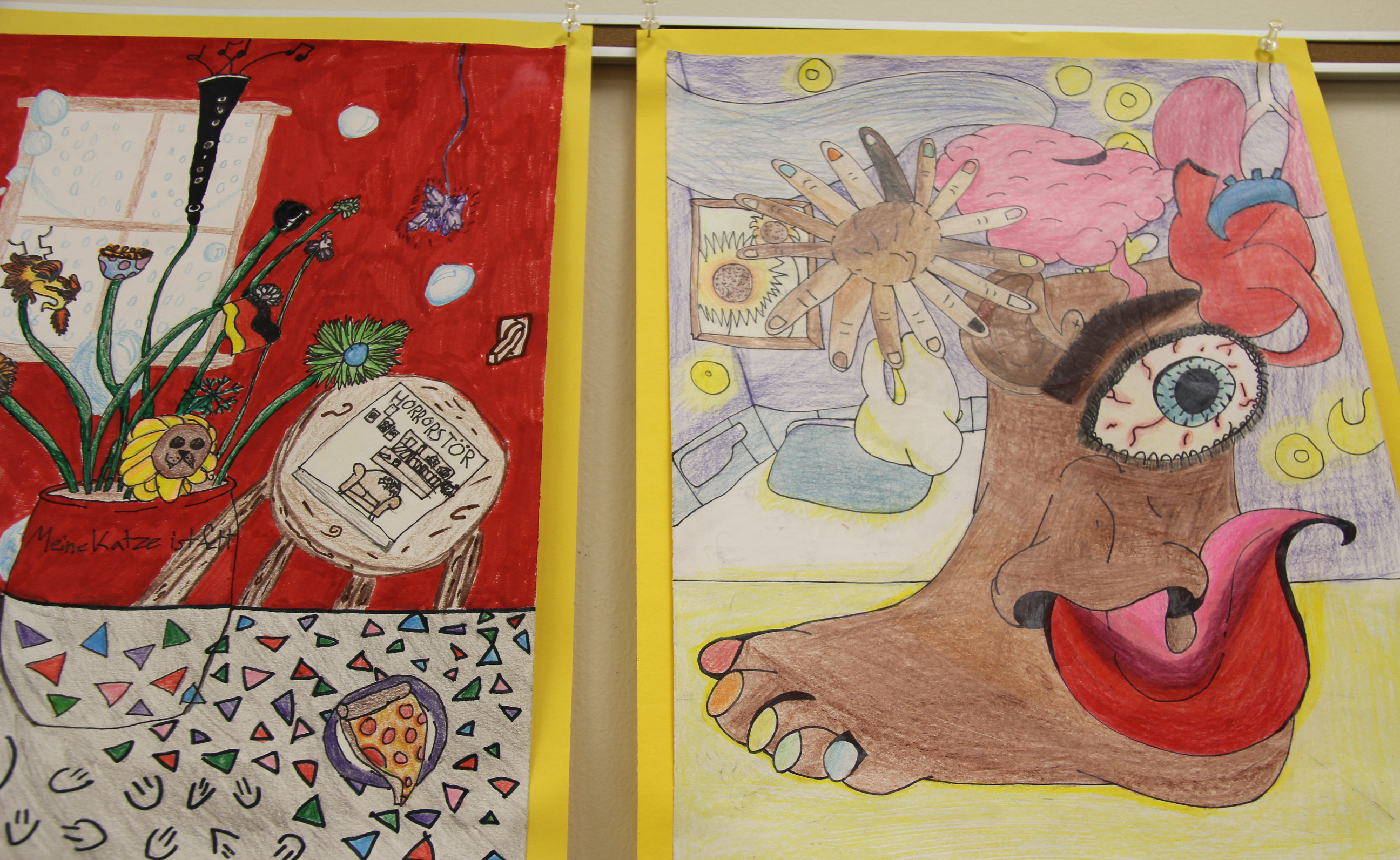
Two especially creative pieces of art from Kylie, left, and Cassie, Faribault Middle School sixth graders. (Minnesota Prairie Roots copyrighted photo March 2023)
I can see my beautiful multi-hued nails, a reflection of this beautiful, diverse world.
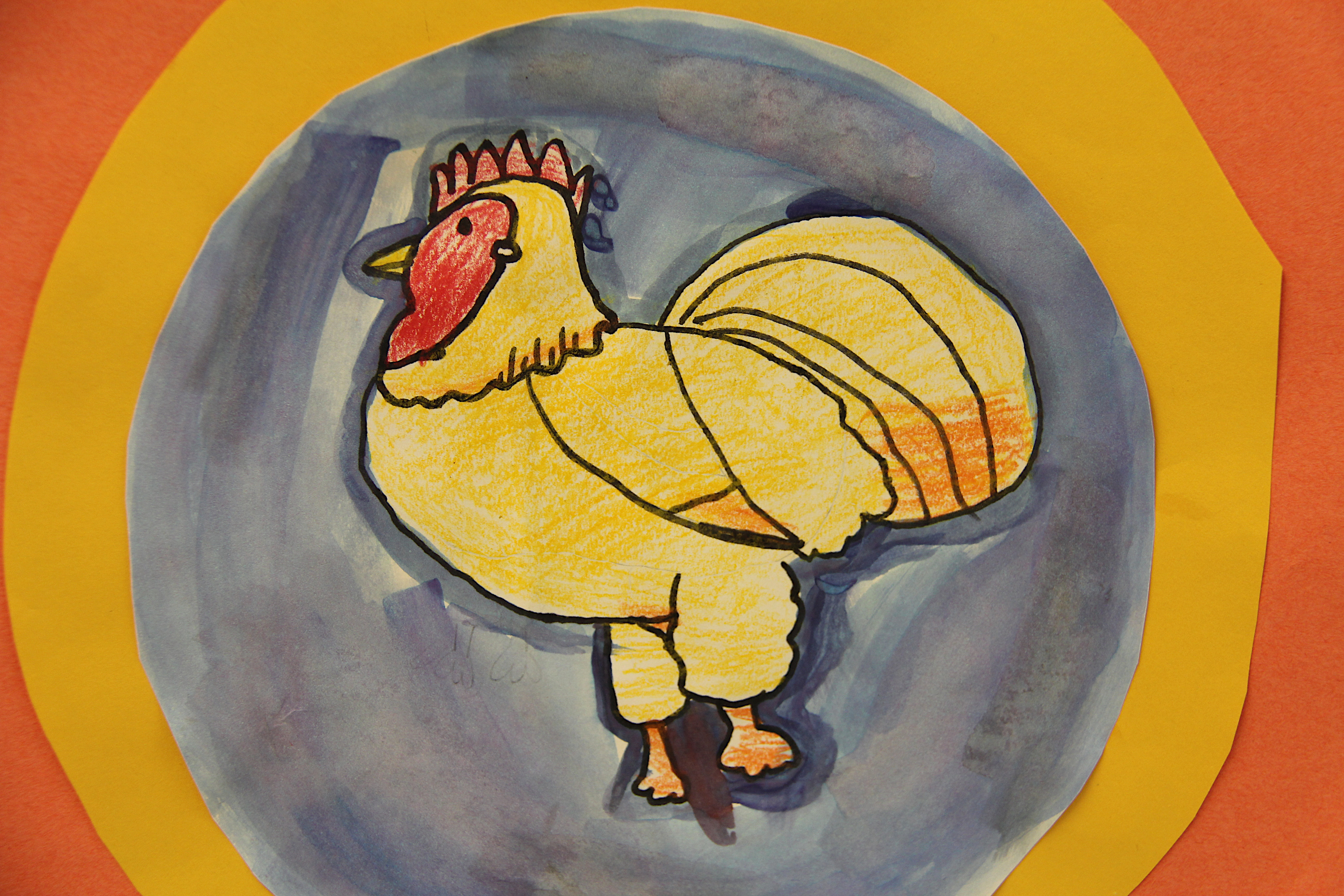
Belinda, Roosevelt second grader, created this bold rooster. (Minnesota Prairie Roots copyrighted photo March 2023)
I can hear the rooster crowing, the chicken clucking, the dog barking.
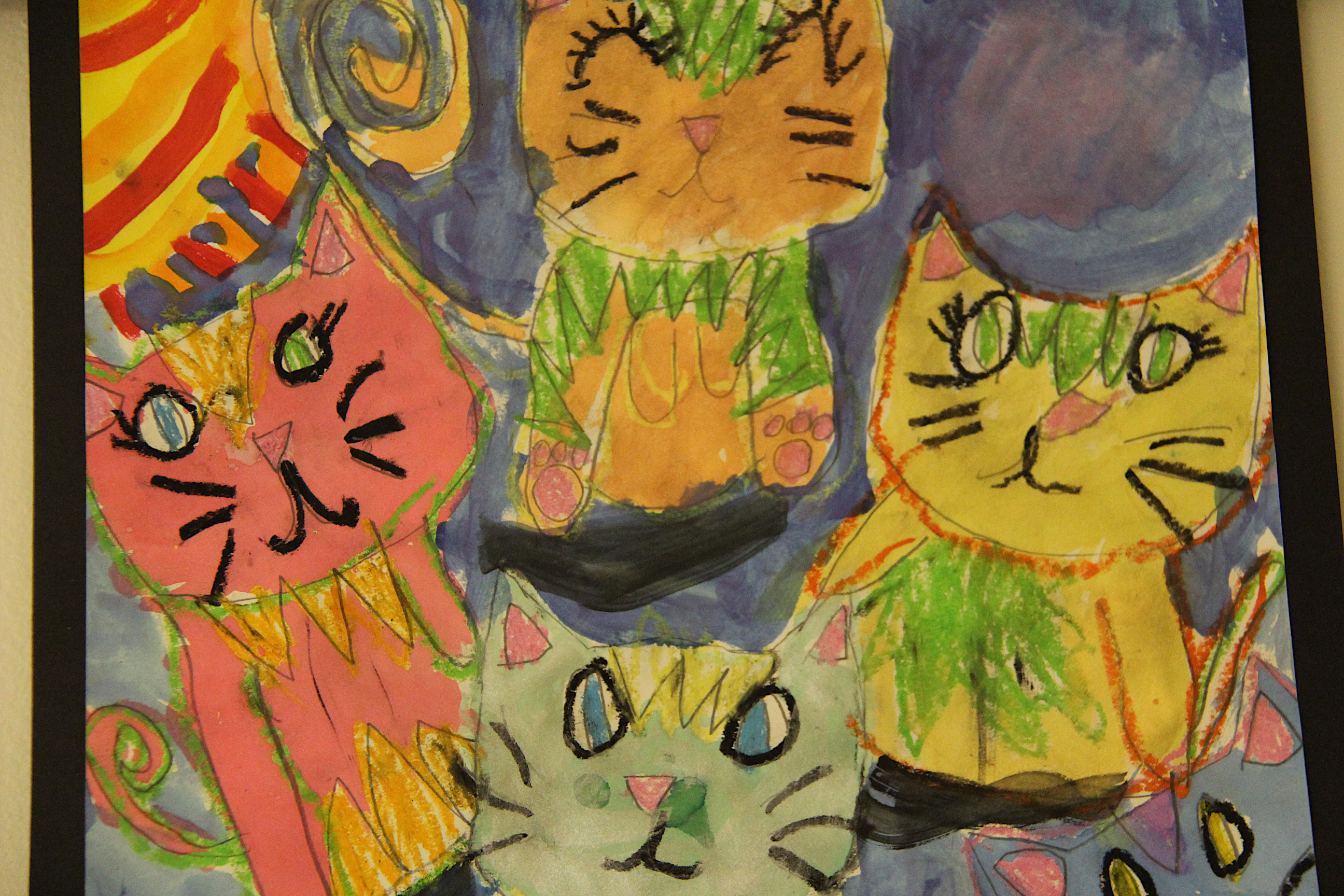
A collection of kitties drawn by Kennedy, first grader at Roosevelt. (Minnesota Prairie Roots copyrighted photo March 2023)
I can feel a hundred cat eyes on me, watching, waiting.
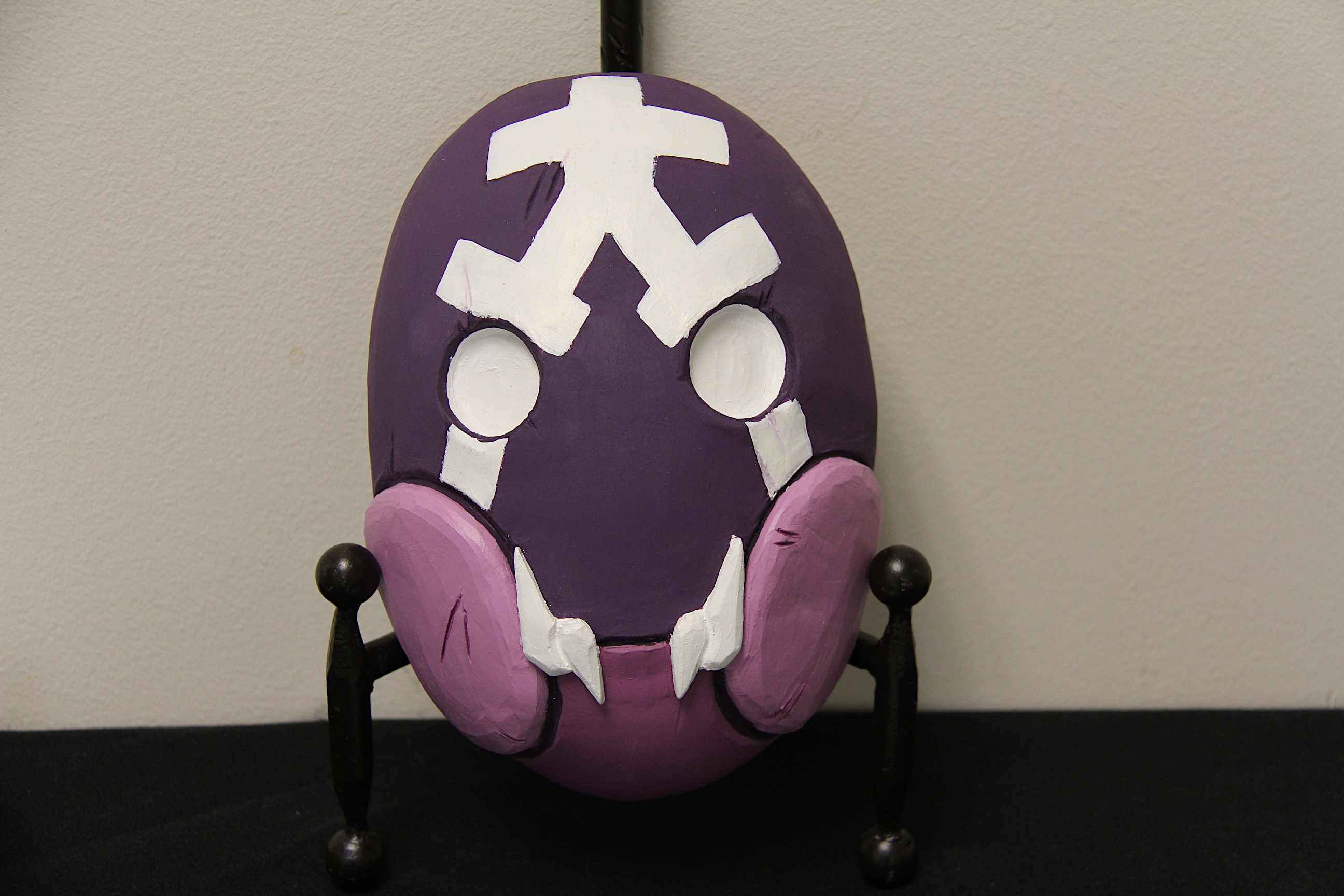
Holly, a senior at Faribault Area Learning Center, crafted this mask. (Minnesota Prairie Roots copyrighted photo March 2023)
It doesn’t take much to immerse myself in this student art, to experience it. Art can take us places. Geographically. Mentally. Back in time, forward in time. Into an imaginative place. Into a real place. Art can be healing and therapeutic and so many other things. Art can make a statement.
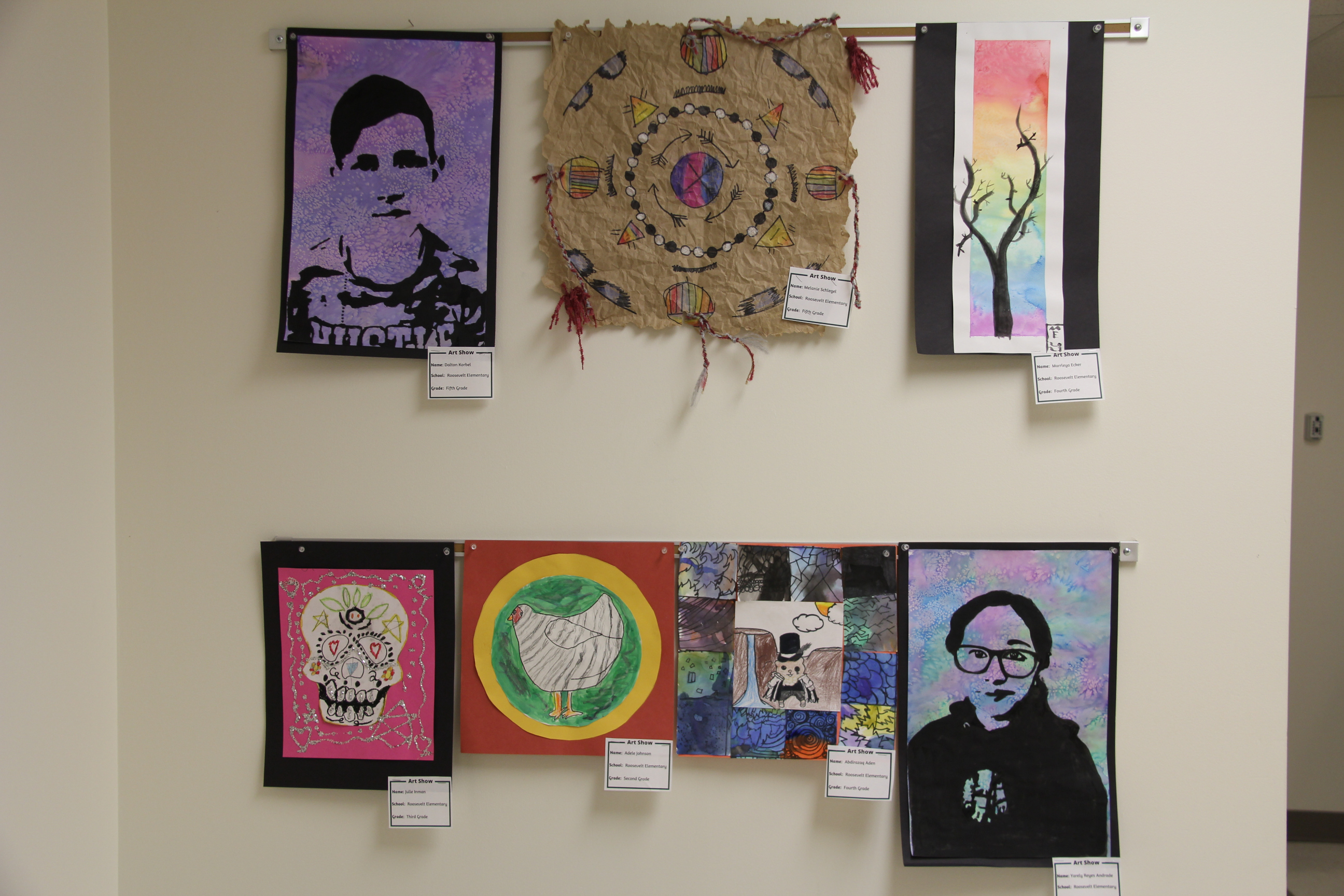
A sampling of art by students from Roosevelt Elementary School. (Minnesota Prairie Roots copyrighted photo March 2023)
To confine art’s purpose to a sentence or two would be like locking ideas inside a box. It can’t be done. As long as creatives create, the expanse of art’s reach is endless. Today these youth have shown me their evolving, developing creativity. And that gives me hope in a world that needs art today more than ever.
CHRISTIAN FAITH COMMUNITIES have long integrated art into their houses of worship. Whether in stained glass windows, sculptures, paintings or other art forms, this art is an important way to visually connect worshipers with Scripture, with foundational teachings.
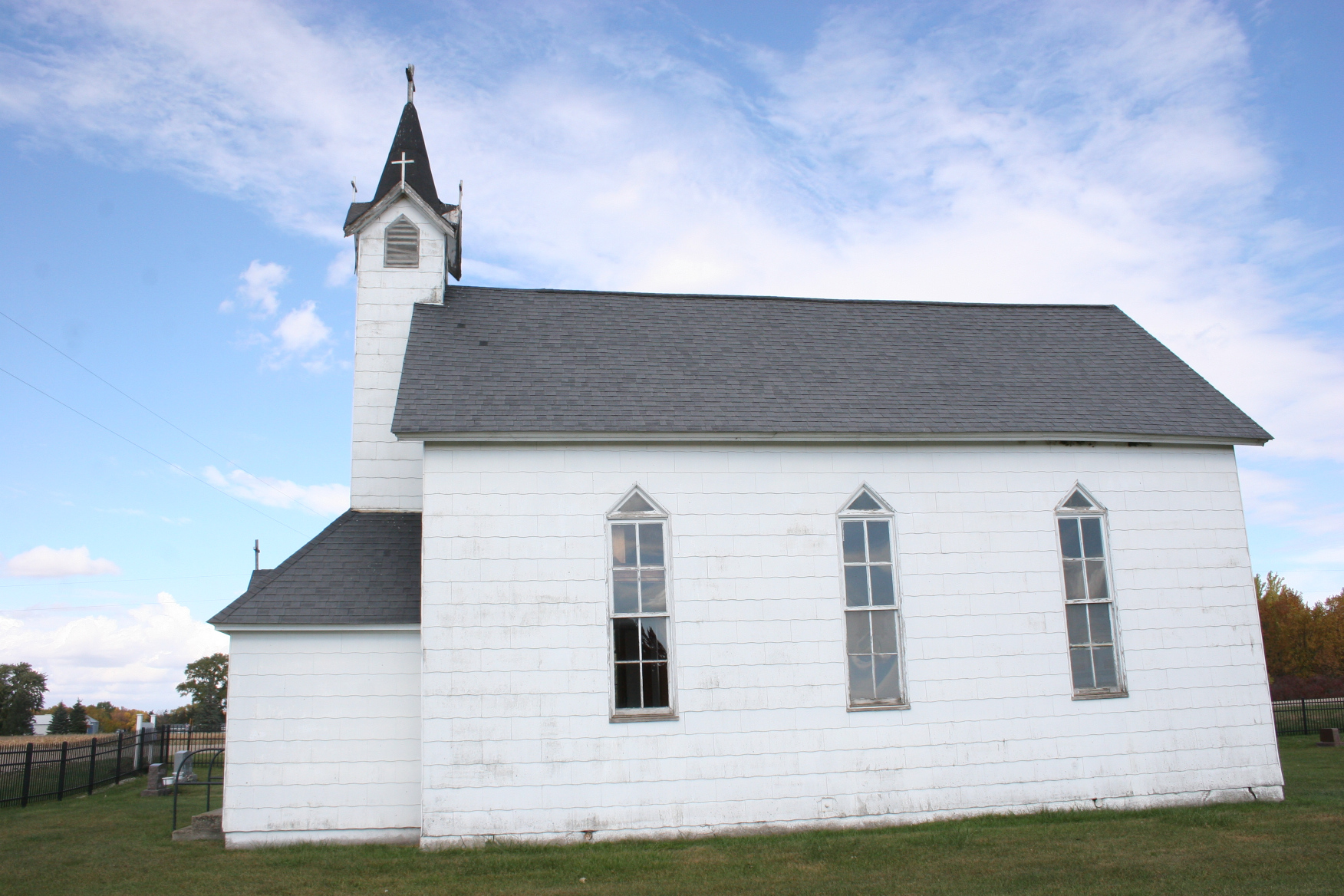
The historic Immaculate Conception of the Virgin Mary Church in Shieldsville Township, rural Rice County, sits isolated along a gravel road, edged by the Trebon Cemetery. The Czech church closed long ago and is locked. But I’ve wandered the cemetery grounds and found unusual art. (Minnesota Prairie Roots copyrighted file photo October 2022)
This week, Holy Week, I consider the art of churches I’ve visited in my area of southern Minnesota. Aged sanctuaries graced with connective and inspiring art. I never tire of stepping inside a rural church or meandering through a country cemetery to view faith-focused art. It’s beautiful in its own way, often in the visual storytelling of events documented in the Bible.
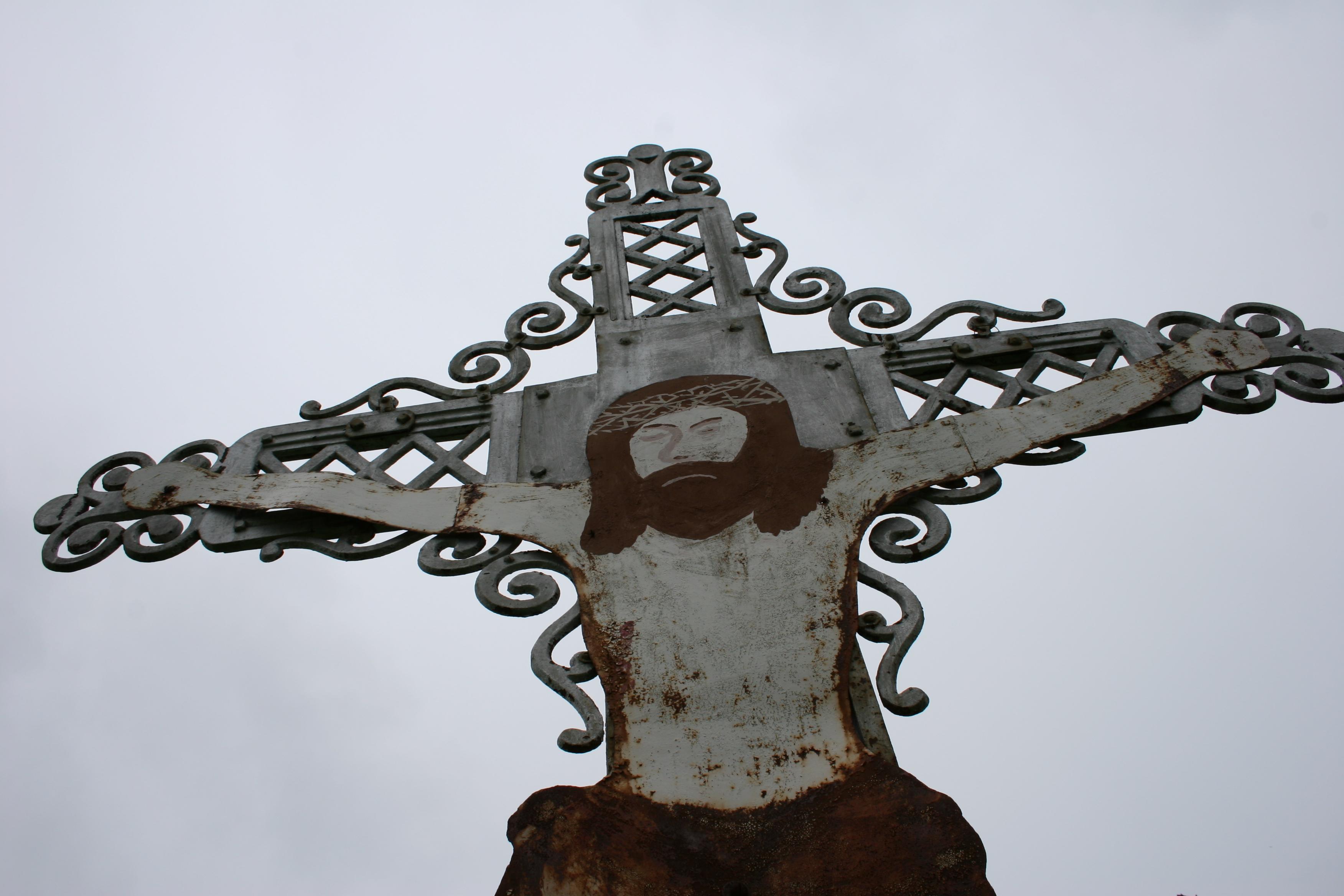
Folk art in the Trebon Cemetery honors the crucified Christ and the deceased. (Minnesota Prairie Roots copyrighted file photo April 2014)
As a woman of faith, the days leading up to Jesus’ crucifixion and subsequent resurrection on Easter morning make this week particularly meaningful.
This artistic rendition of The Last Supper hangs in the St. John’s United Church of Christ, Wheeling Township, rural Faribault, Fellowship Hall. (Minnesota Prairie Roots copyrighted file photo April 2012)
From Jesus praying in the Garden of Gethsemane to The Last Supper to his betrayal by Judas and then his crucifixion and resurrection, the events of Christ’s final days unfold in art inside sanctuaries and on cemetery grounds.
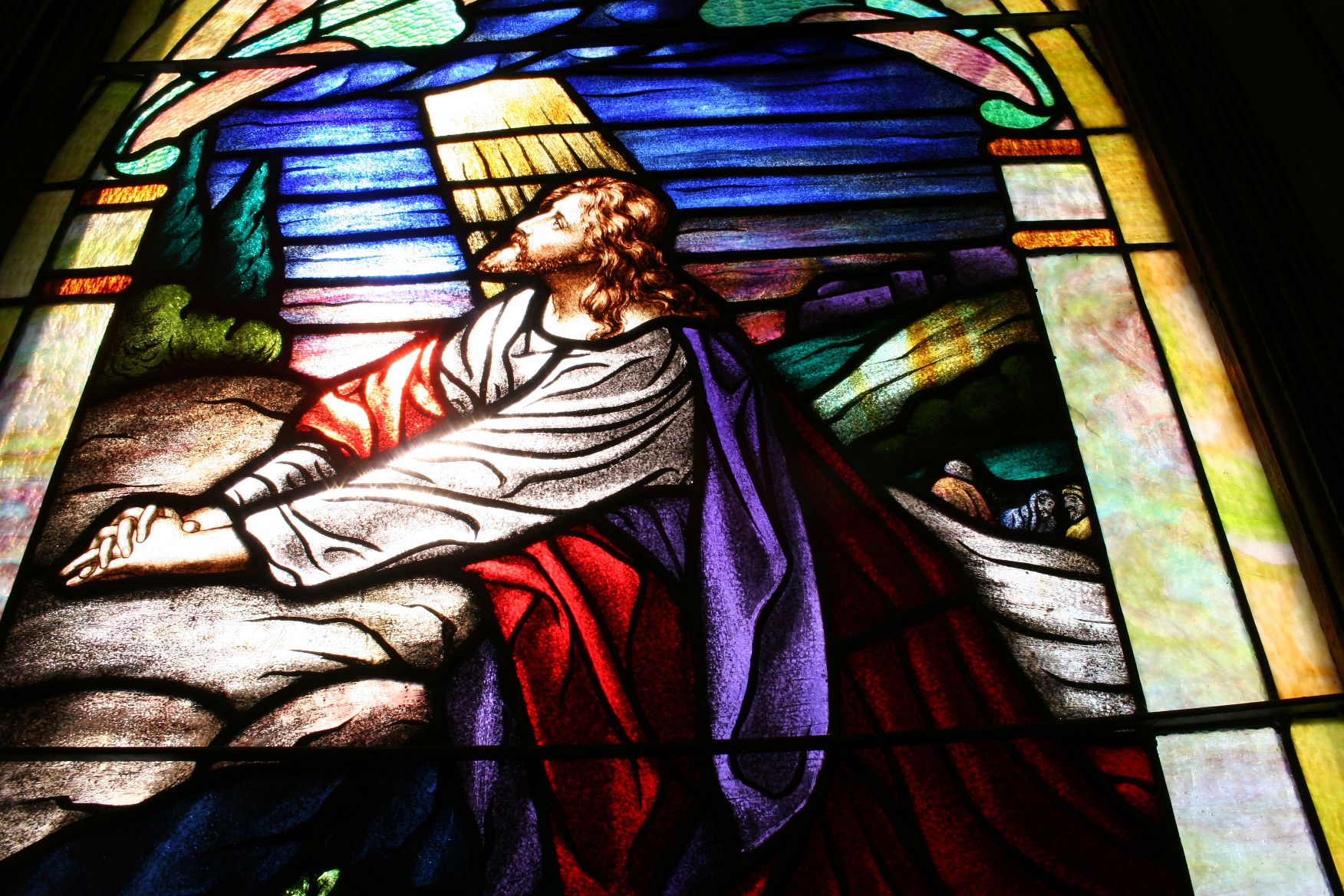
Inside Vang Lutheran Church, rural Dennison, a stained glass window shows Christ praying in the Garden of Gethsemane. (Minnesota Prairie Roots copyrighted file photo 2014)
I feel a certain reverence for the artists who designed and crafted stained glass windows that rise high inside sanctuaries, sunlight streaming through colorful glass. It’s almost as if the beauty therein beams directly from heaven, filling dark souls with light.
In the face of Mary, I see profound grief in losing her son. This statue is inside St. Mary’s Catholic Church, New Trier. (Minnesota Prairie Roots copyrighted file photo)
Likewise, statues, most often found in Catholic churches, add a down-to-earth human element in their life-sized presence. I have the urge to reach out, to touch a hand or a face, to offer comfort, to extend compassion. Art, especially faith-based art, holds that power.
Centering the altar is this depiction of Jesus’ crucifixion inside St. Mary’s Catholic Church, New Trier. (Minnesota Prairie Roots copyrighted file photo)
Whether centering an altar or hanging on a church fellowship hall wall, biblically-based artwork is an important part of Christianity. I appreciate the ornate and the simplistic. The oversized and the understated. The all of it, uplifting, inspiring, moving me.
This shows the resurrected Christ in a snippet of the center stained glass window in a trio above the altar at Trinity Lutheran Church, Wanamingo.(Minnesota Prairie Roots copyrighted file photo March 2016)
During this Holy Week, I reflect on the art gracing churches throughout my region. Art that truly is a spiritual treasure. Art that carries a heritage of faith.
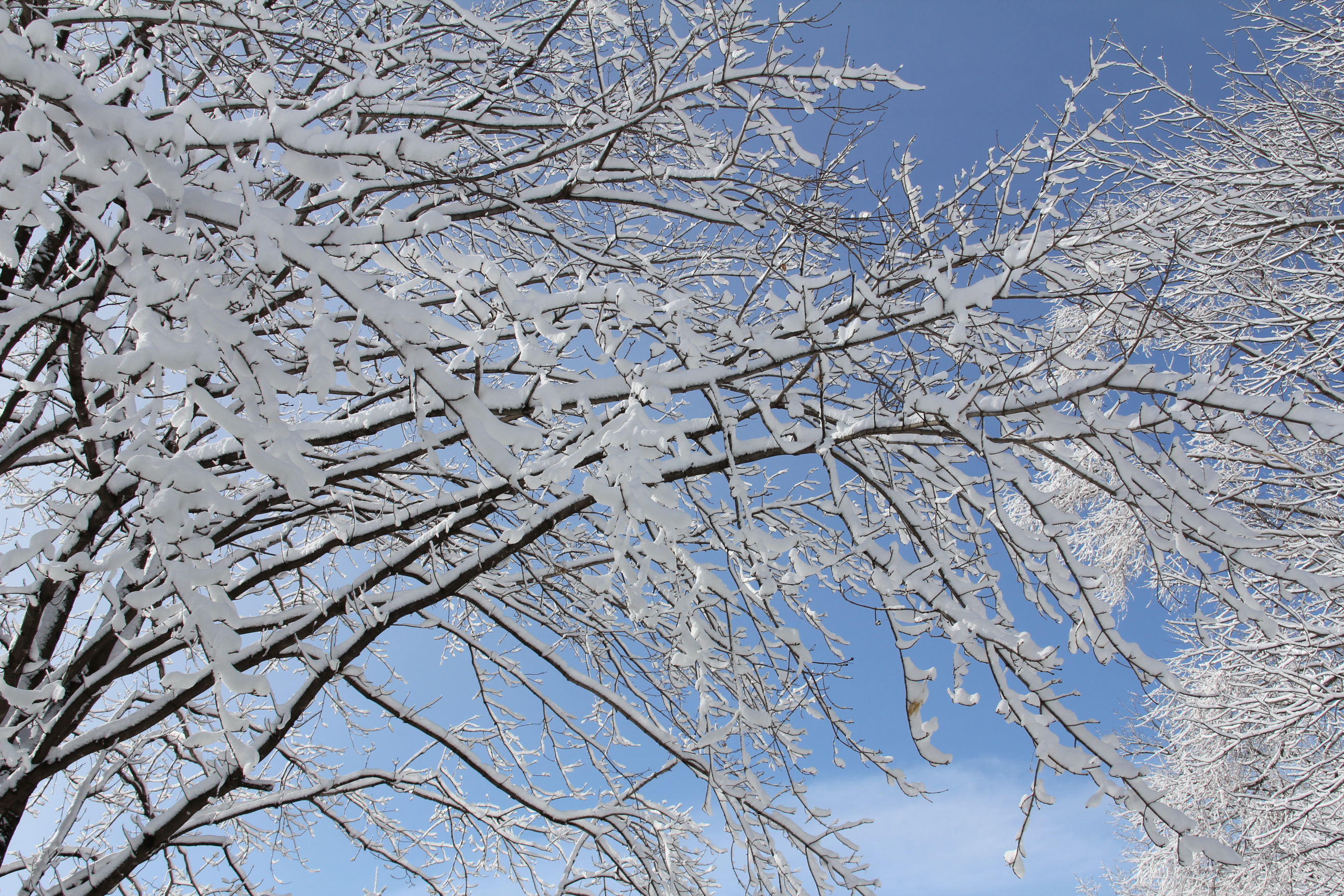
Trees viewed from my backyard were layered in snow Saturday morning. (Minnesota Prairie Roots copyrighted file photo April 2023)
SO… THAT MAJOR WINTER STORM predicted for this past Friday into Saturday transitioned into a blizzard here in southern Minnesota. Not that I witnessed the heavy snowfall of an inch or more per hour and the accompanying strong winds. I didn’t. I was sleeping. Snow didn’t begin here in Faribault until around 10 pm Friday and stopped before I awoke.
Saturday morning we arose to a winter wonderland. Truly, it was that beautiful with the landscape draped in a pristine white blanket. The landscape this late in the season is not pretty with dirt deposited atop snow remnants. New snow refreshes, covers the snirt.
Snow weighs my neighbor’s evergreens. We got about 5 inches of snow in Faribault in the most recent storm. (Minnesota Prairie Roots copyrighted photo April 2023)
As weary as I feel about this relentless winter season, now our third snowiest ever, I appreciated the beauty of Saturday’s snowfall. The trees, especially, were lovely with snow outlining bare branches of deciduous trees and bending boughs on coniferous trees.
Snow and blue sky contrast Saturday morning. (Minnesota Prairie Roots copyrighted photo April 2023)
White contrasting against a bold blue sky is particularly stunning.
I love how the frosty branches shadow on a neighbor’s house in the morning light. (Minnesota Prairie Roots copyrighted photo April 2023)
However, snow piling on utility lines, roofs, sidewalks and driveways caused problems. Here in Faribault, a house fire started when a snow-weighted electrical line broke lose, falling against aluminum siding, igniting a blaze. Thankfully the occupants were up, smelled the fire and escaped before firemen arrived.
In Browerville, the roof of the school gym collapsed under the weight of the heavy, wet snow. Such roof collapses occur occasionally, including in mid-March at a shopping mall in the port city of Duluth. Most memorable, perhaps, is the collapse of the roof on the Hubert H. Humphrey Metrodome (then Minnesota’s professional sports stadium) in December 2010.
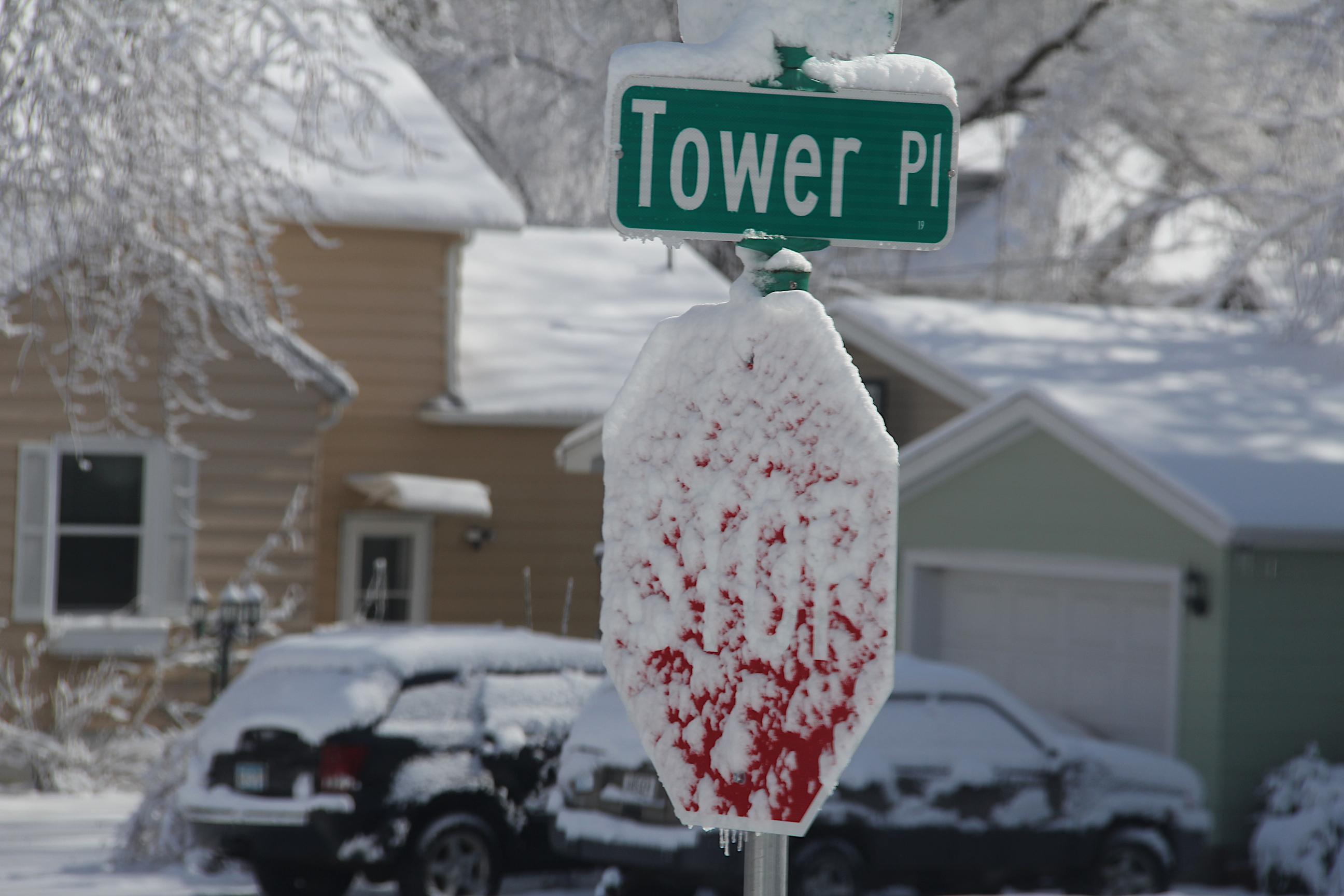
It’s as if Mother Nature played an April Fool’s joke on Minnesota, leaving a message by covering this stop sign with snow. (Minnesota Prairie Roots copyrighted photo April 2023)
For the average Minnesotan, though, the latest winter storm meant firing up the snowblower and pulling out the shovels to clear snow. That we’re all tired of this endless chore is evident in how some sidewalks went uncleared in Faribault, how even city crews did not clear all walkways like they usually do. I expect expenditures for snow removal have stretched or exceeded city budgets. Plus, this time of year, the sun, if accompanied by warm temps (“warm” being 40 degrees or above), result in Mother Nature removing snow via melting.
Faribo Frosty was not smiling on Sunday afternoon. (Minnesota Prairie Roots copyrighted photo April 2023)
Faribo Frosty, Faribault’s iconic landmark snowman crafted by the Hoisington family each winter, is beginning to show the effects of warmer weather. He’s slimming down. On a drive-by Sunday afternoon, I noticed his weight loss and his pipe fallen from his mouth.
But it was the lack of a smile on Frosty’s face that was most noticeable. He’s frowning now. I suppose if I was a snowman and recognized my days were numbered, I might feel the same. I can’t/won’t apologize to Frosty, though, for not sympathizing with his plight. I just want winter gone. Frosty will be back again some day. Just like winter will be back mid-week, when more snow is predicted for parts of Minnesota. Not here. I hope.
It’s still cold enough for winter gear here in Minnesota. (Minnesota Prairie Roots copyrighted file photo January 2018)
WINTER RETAINS ITS firm grip on Minnesota, even in this official season of spring. We are in a Winter Storm Warning for Friday evening through Saturday morning with some 4-6 inches of snow forecast for my area along with wind gusts to 45 mph. Other parts of Minnesota will see more snow and wind, resulting in blizzard conditions.
Temps have also been unseasonably cold. Think below zero in some areas of our state earlier in the week. We did not reach 50 degrees in March, unusual even by Minnesota averages.
What to do? Endure. Escape. Or embrace.
The definition of endure is obvious. Don warm clothes, crank up the heat and wait.
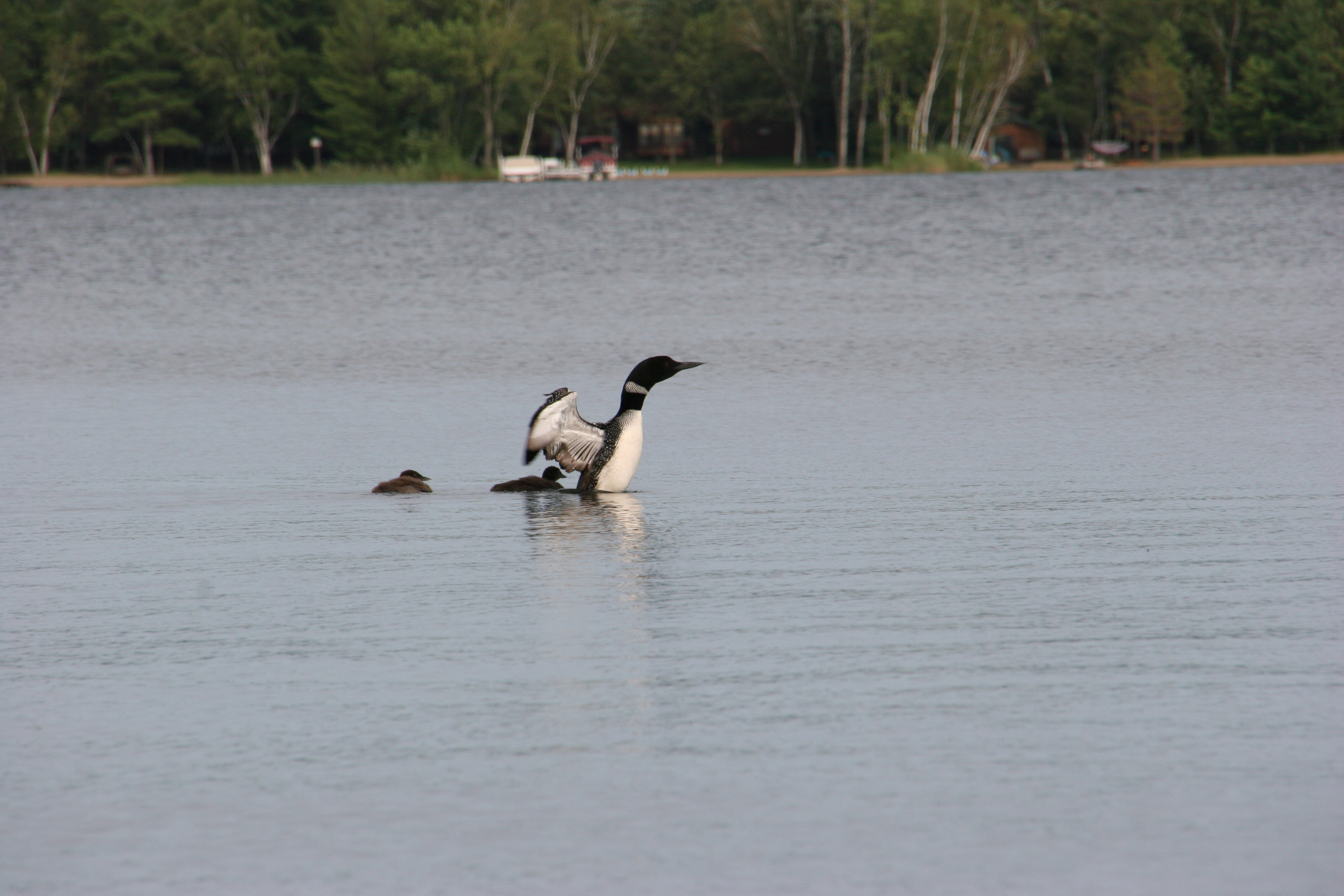
A loon family on Horseshore Lake south of Crosslake in central Minnesota. (Minnesota Prairie Roots copyrighted file photo July 2020)
Escape means traveling to some place warm, like Arizona or Florida or California or Texas. Plenty of Minnesotans do exactly that over spring break. Or, when that’s not an option, envision the summer ahead and a Minnesota northwoods lakeside cabin. I’m picturing that in my mind, in mid-July, warm sand between my toes, water lapping, blue skies, loons calling…
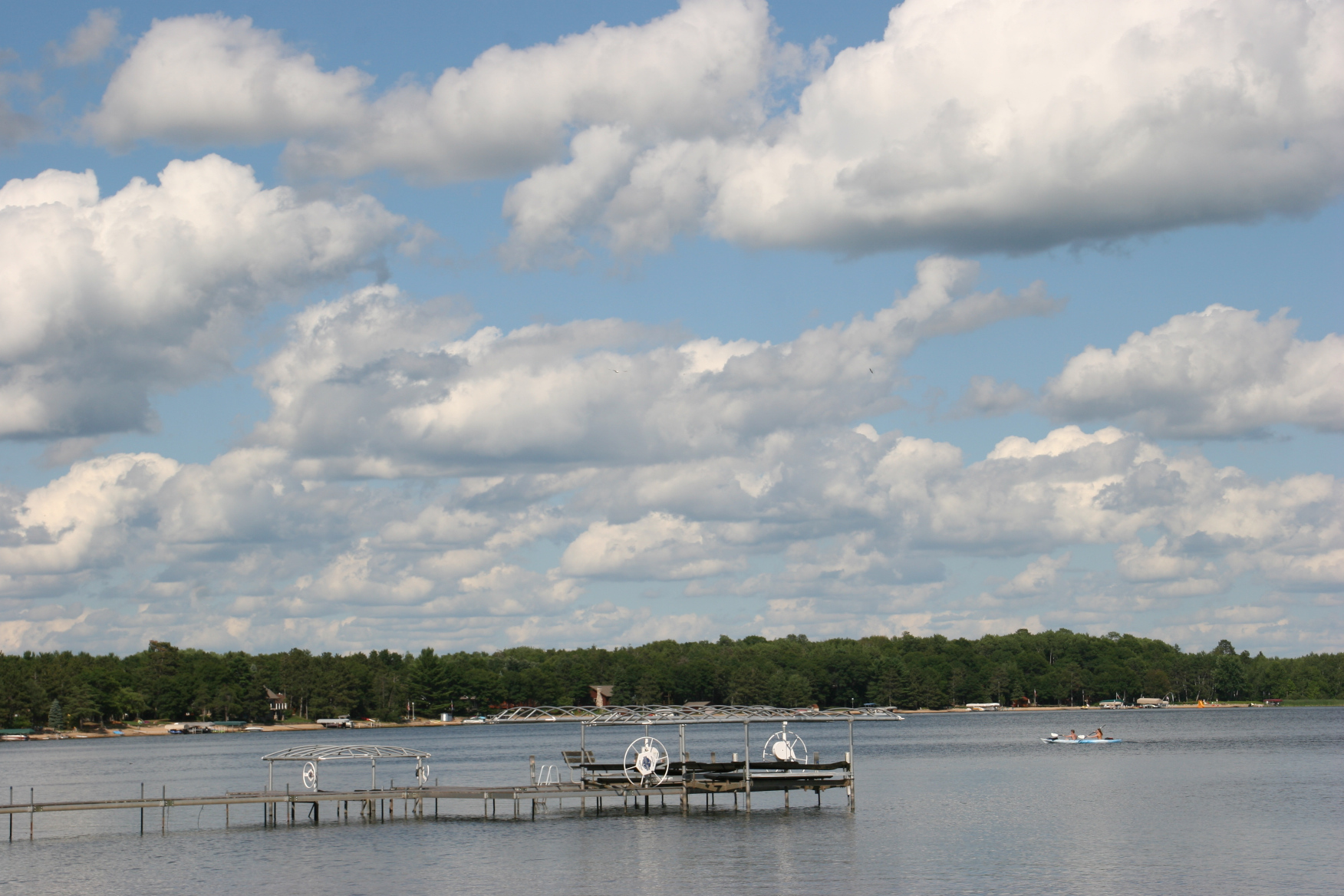
A beautiful summer day at Horseshoe Lake. (Minnesota Prairie Roots copyrighted file photo July 2020)
Or, if you’re a south metro first grade teacher, you can embrace, or rather defy, the cold with Beach Day. On a 10-degree morning, my almost 7-year-old granddaughter headed off to school in a tank top and shorts, prepared to celebrate a day at the beach. An oversized sun and waves graphic defined her defiant, colorful shirt. Per her mom’s care, Izzy layered her snowpants and winter coat over her summer attire and packed a sweatshirt.
On the beach at Horseshoe Lake. (Minnesota Prairie Roots copyrighted file photo July 2020)
The wise teacher advised students they could wear shorts, “if you want to be cold.” Apparently Izzy and a few others wanted to be cold. Ah, the optimism of youth who weren’t about to allow a low morning temp of 10 degrees to spoil their day at the beach.
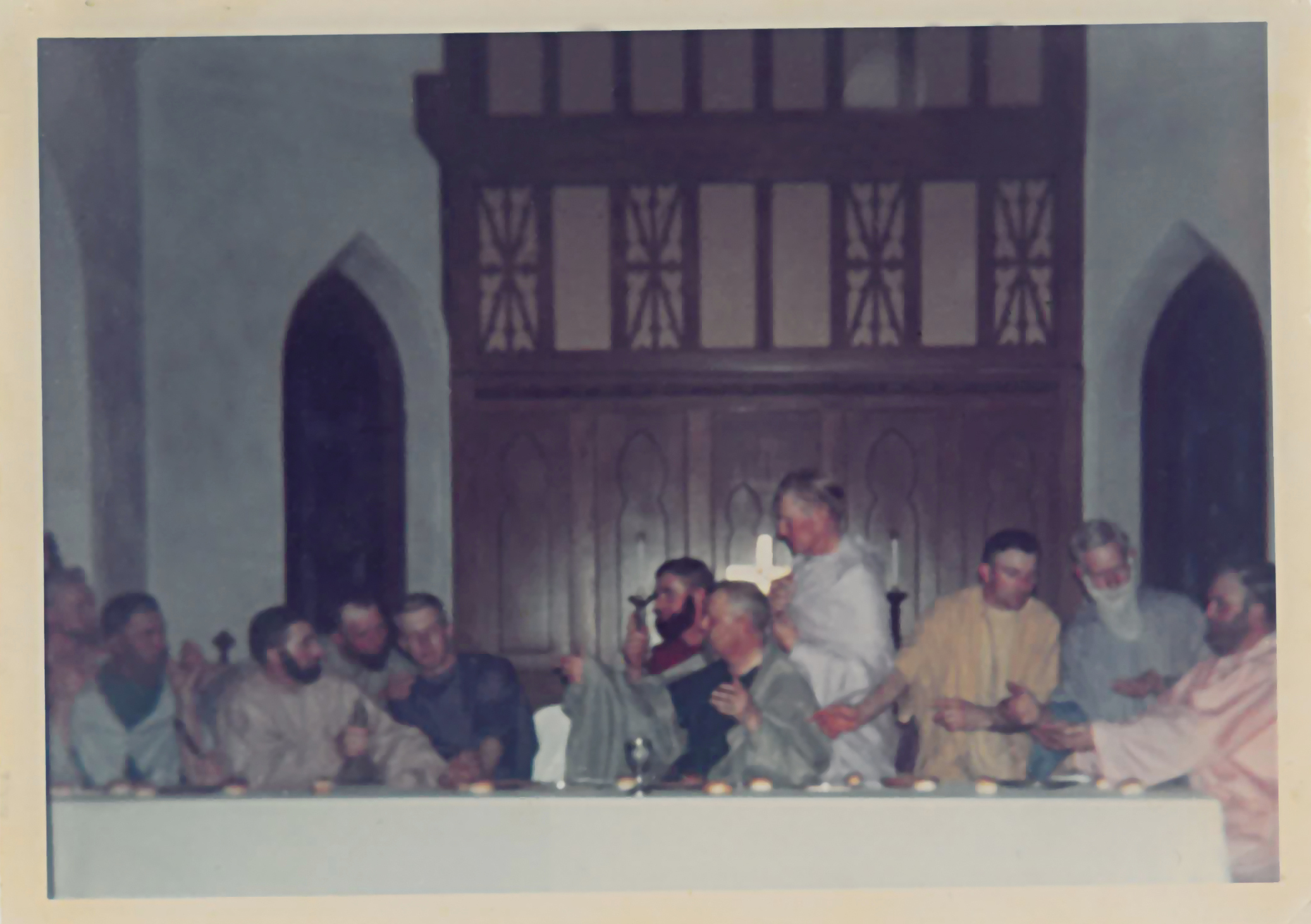
St. John’s members portray the disciples in this undated vintage photo, the first record of a photograph from “The Last Supper Drama.” Actors, from left to right, are Luverne Hafemeyer, Earl Meese, Victor Luedke, Howard Meese, Virgil Bosshart, Arnold Keller, P.L. Golden, Alvin Bosshart, Paul Bauer, Elmer Covert Sr. and Arnold Bauer. (Photo courtesy of St. John’s)
FROM MILAN TO MINNESOTA, Leonardo da Vinci’s “The Last Supper” painting continues to leave its imprint. For more than 500 years, this rendition of Jesus’ final meal with his 12 disciples has held a sacred place among those of the Christian faith, including me.
The parking lot at St. John’s United Church of Christ, Wheeling Township, is nearly full 20 minutes before the congregation’s annual performance of “The Last Supper Drama.” (Minnesota Prairie Roots copyrighted filephoto April 2011)
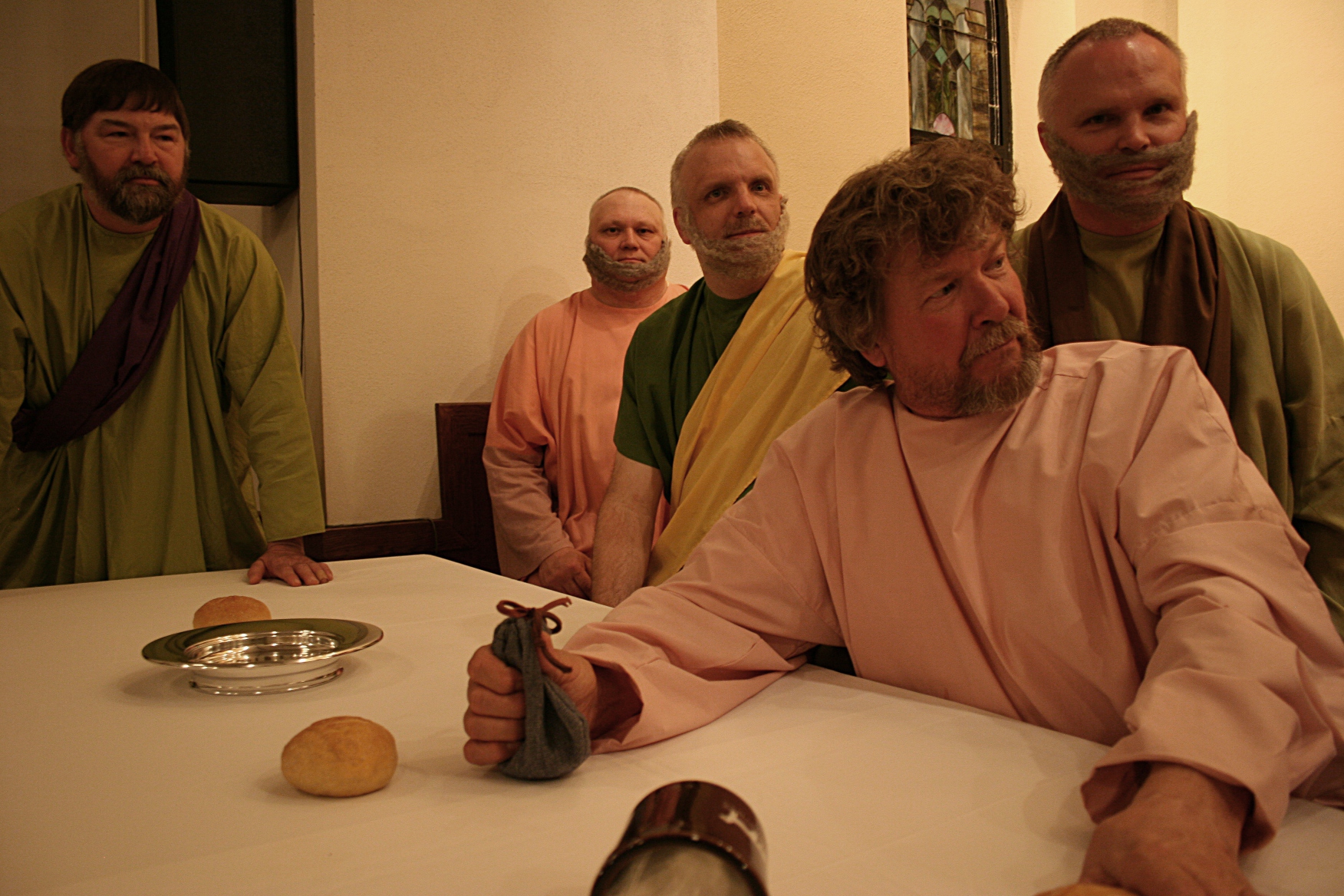
Judas grips the bag of silver, his reward for betraying Christ. (Minnesota Prairie Roots copyrighted file photo April 2012)
I’ve attended this long-running monologue of each disciple and their relationship with Christ many times. Although the script and music remain the same, the actors change from year to year. Yet, there’s a consistency in that, too, with many of the men switching parts, perhaps taking a year off. I recognize actors’ surnames like Bauer, Keller, Little, Meyer, Wiegrefe and another Keller (Craig) always at the organ.
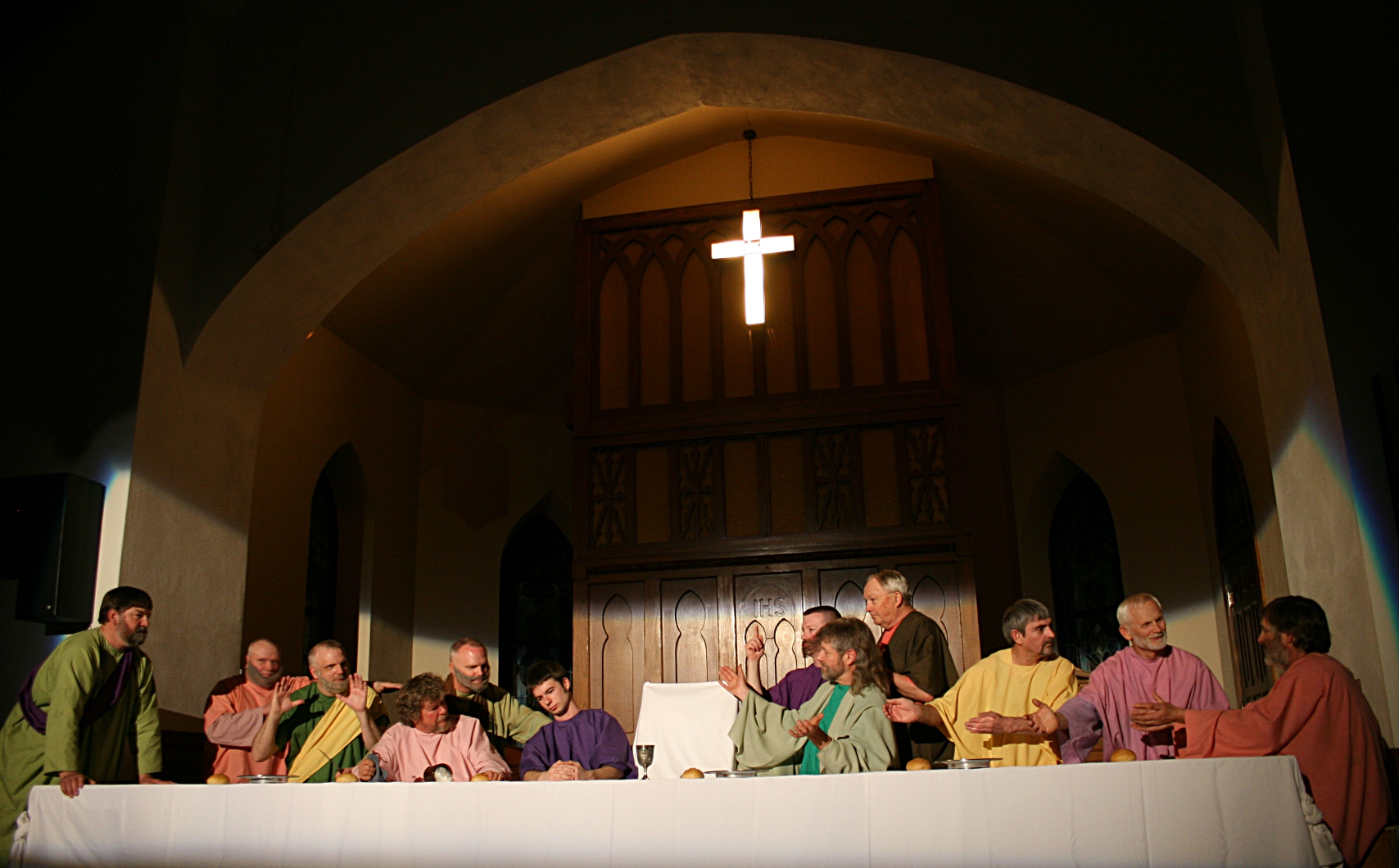
St. John’s 50th presentation of “The Last Supper Drama.” (Minnesota Prairie Roots copyrighted file photo April 2012)
There’s a sameness to St. John’s presentation of “The Last Supper.” And that is comforting. The darkening of this 1800s limestone church. The mood-setting music. The disciples processing in to sit at a long table set before the altar. The statue-like poses. The spotlight focus on each disciple. The bold, sometimes heart-wrenching, monologues. The emotion. The pain. Then the spotlight shifting to the empty chair representing Christ.
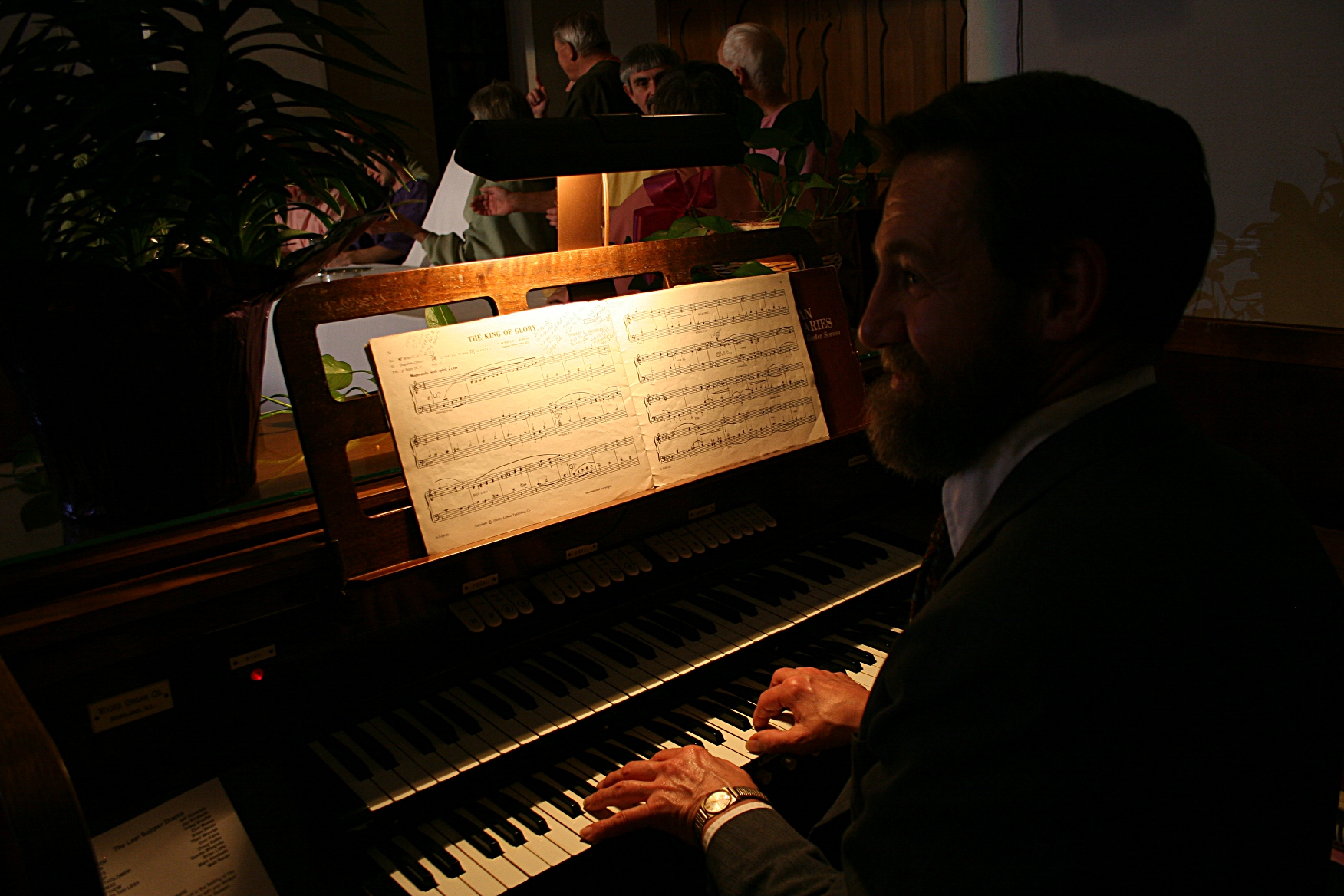
Craig Keller has been the long-time drama organist, playing the same music every year. The script and music remain unchanged. (Minnesota Prairie Roots copyrighted file photo April 2012)
Even after seeing this drama many times, I pick up something I haven’t in prior viewings. I always exit the sanctuary feeling reflective, emotional, even a bit sad. The tone is set for the beginning of Holy Week, transitioning to Jesus’ crucifixion and then, on Easter, his joyful resurrection.
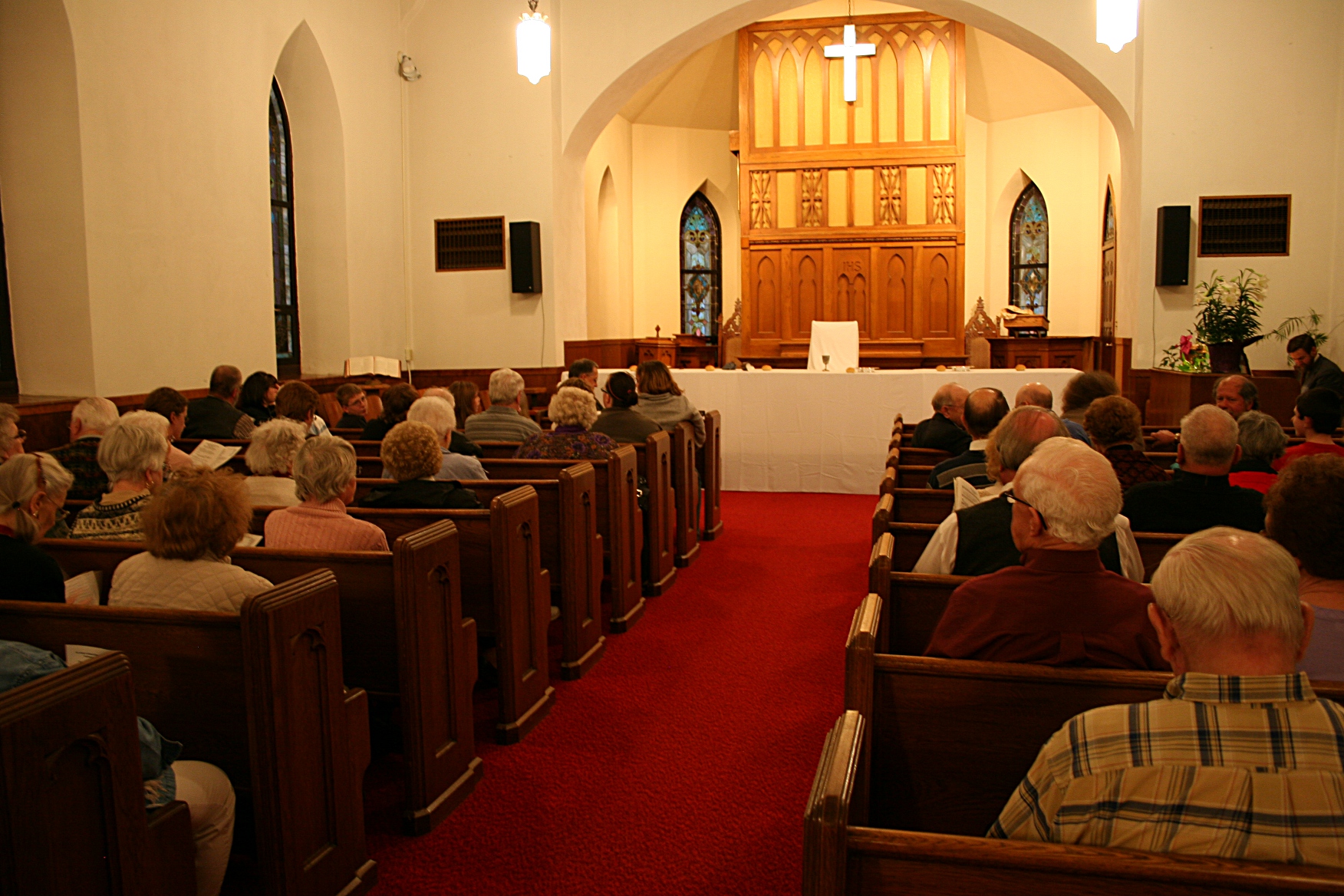
The sanctuary fills prior to the drama in 2012. (Minnesota Prairie Roots copyrighted file photo April 2012)
This tradition at St. John’s is part of this congregation’s history. Part of their faith heritage. And a gift to the greater community. To settle into a pew in this country church and watch the drama unfold is to appreciate da Vinci’s art in a way that touches the soul.
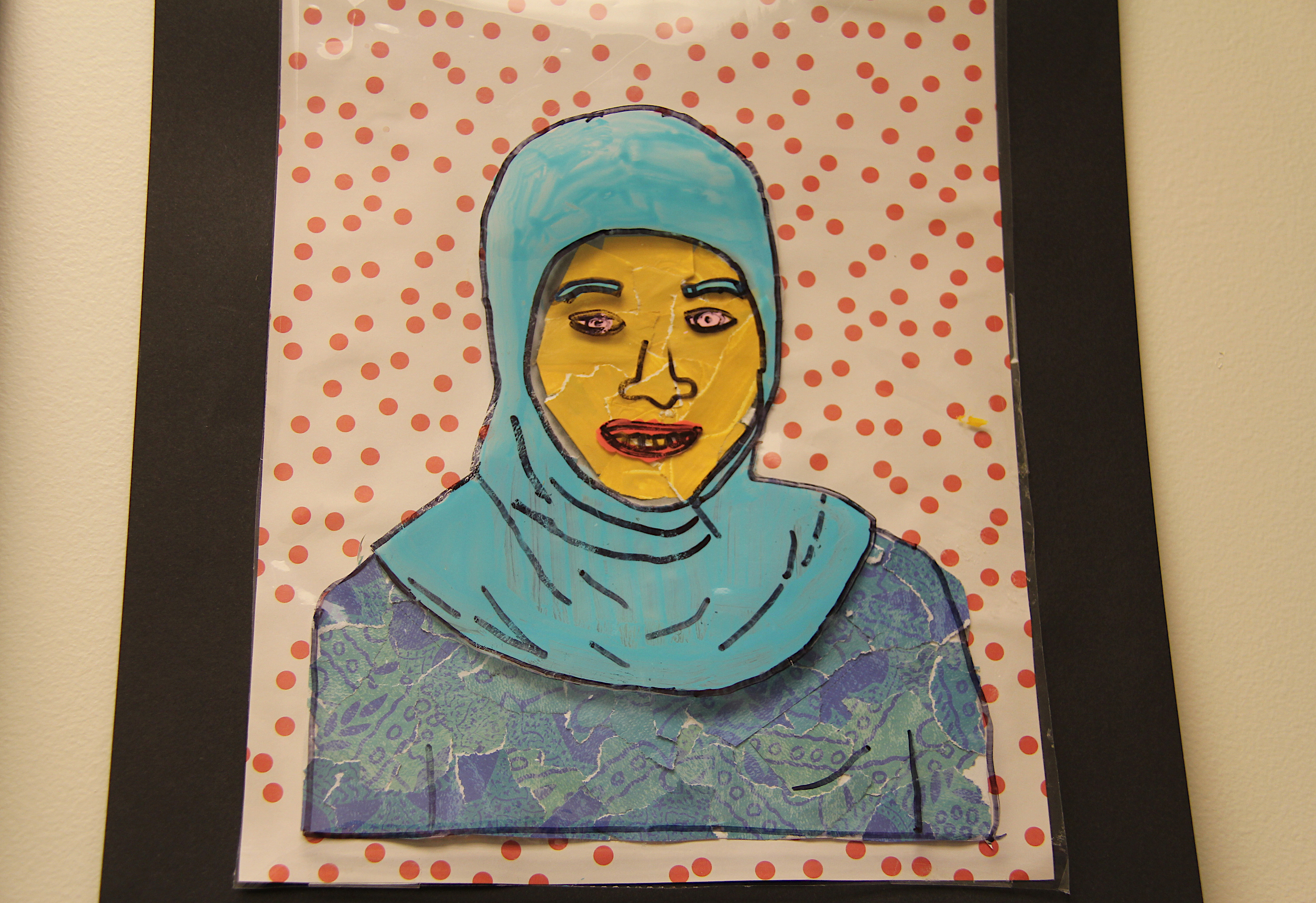
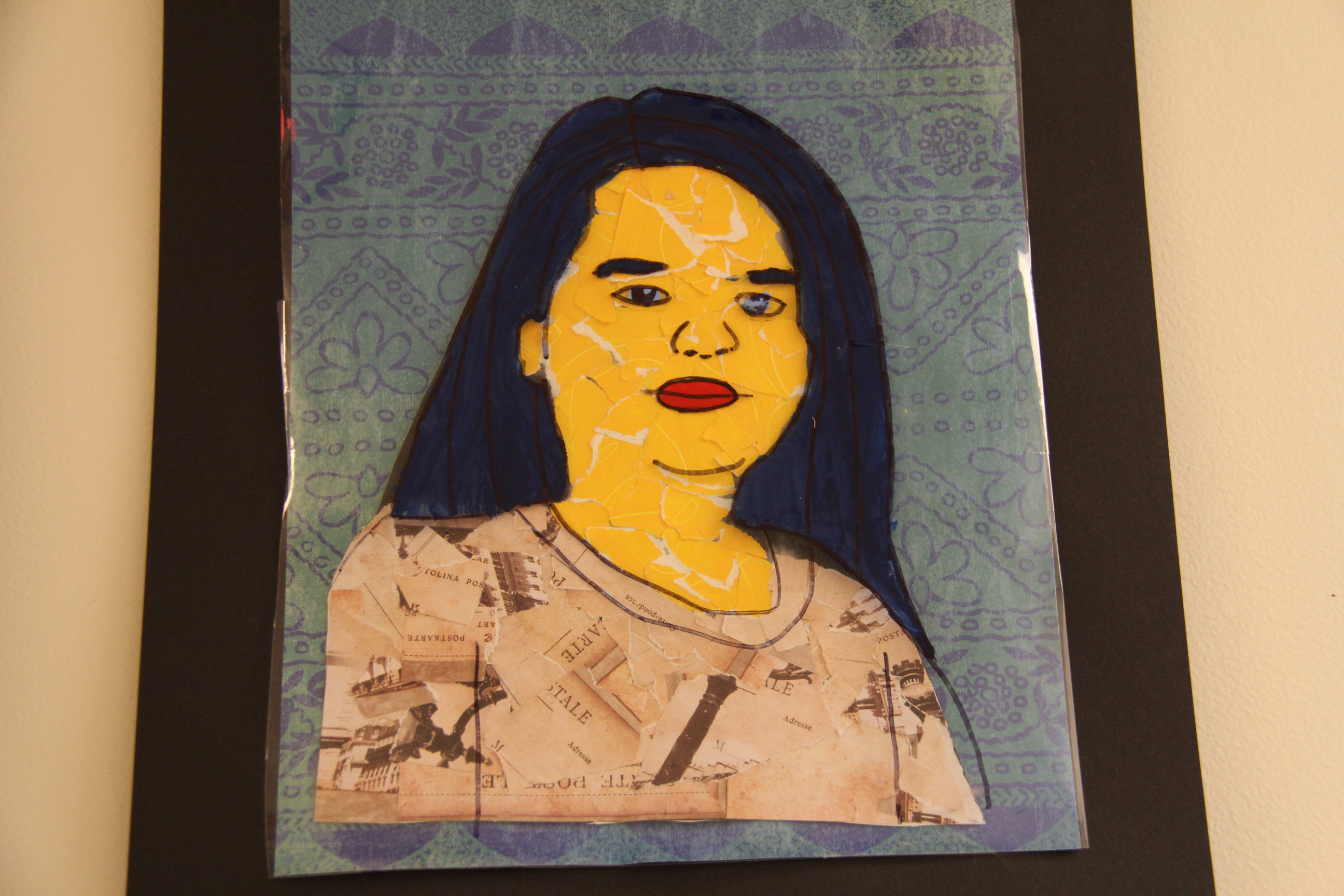
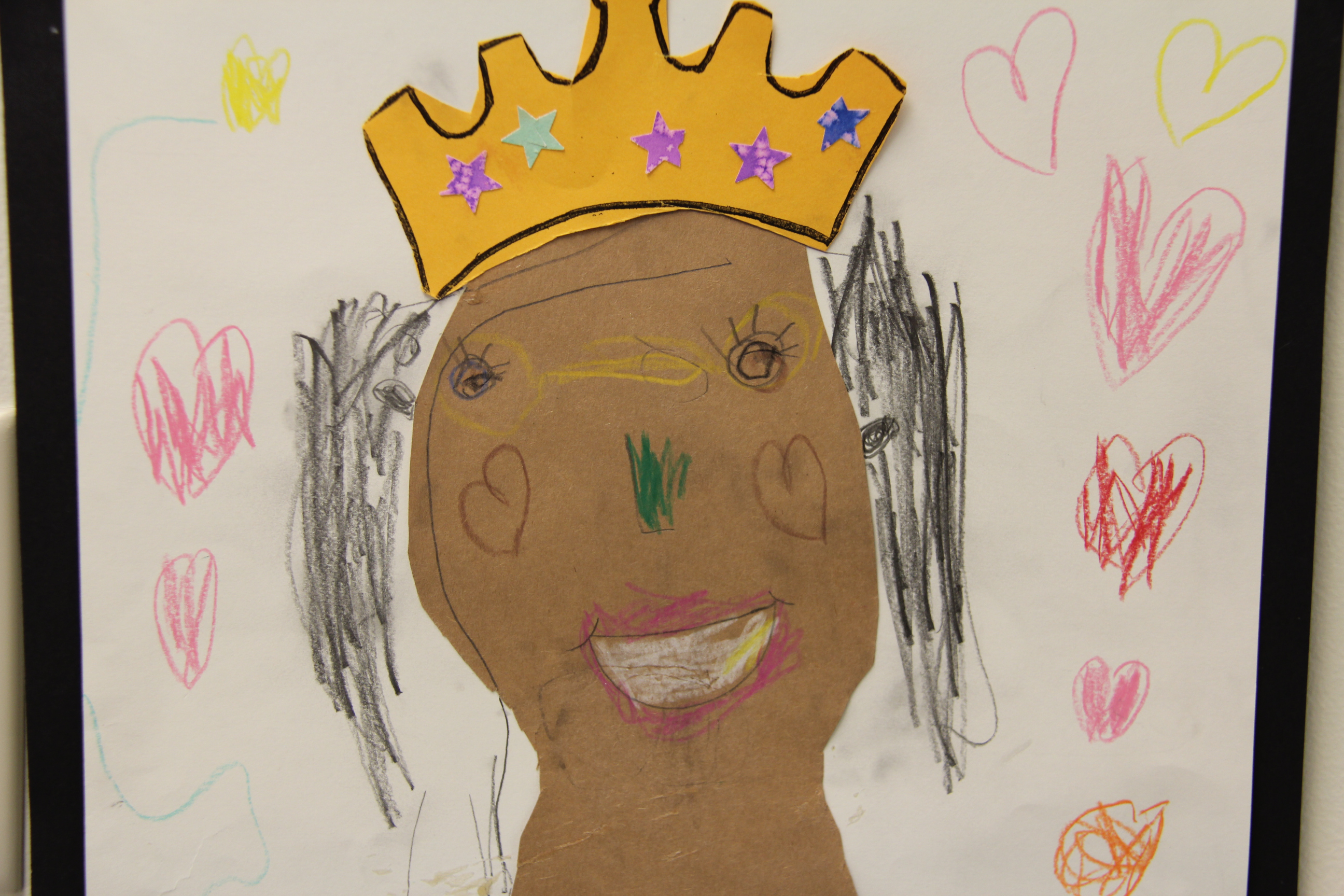
“Bisa Butler-Inspired Collage Portrait” by Ilwad, Lincoln Elementary School fourth grader. Bisa Butler is an award-winning African American textile artist. (Minnesota Prairie Roots copyrighted photo March 2023)
WHAT DO YOU NOTICE first in a human face? Perhaps it’s eyes or a smile, or the lack thereof. Or maybe you see the whole without attention to the details that comprise a face. However you view someone on the exterior, it is the interior which holds the essence of a person.
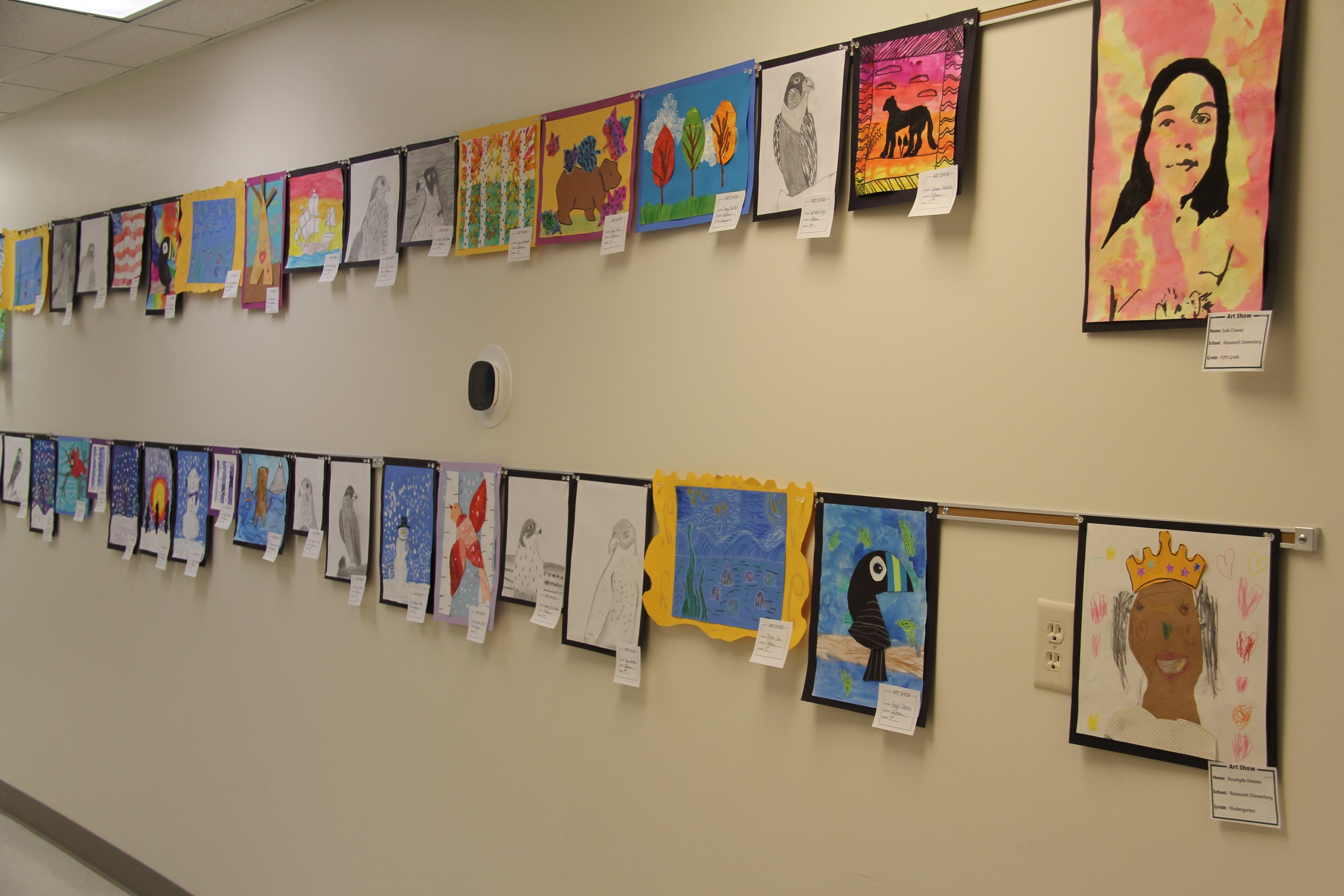
An assortment of student art lines hallways and a room. (Minnesota Prairie Roots copyrighted photo March 2023)
Another Bisa Butler-inspired portrait collage, this one by Lincoln fourth grader Rain. (Minnesota Prairie Roots copyrighted photo March 2023)
If I could, I would sit down with these young artists and ask: “What do you notice first in a human face? Is the essence of this person in the portrait you created? What process did you use to make this portrait?” I am assuredly an inquisitive writer of many questions. I am a listener, an observer, a gatherer of information. I expect answers to my inquiries would vary.
Students from Bethlehem Academy drew these portraits. They are by Martin, left to right, Dania and Mera. (Minnesota Prairie Roots copyrighted photo March 2023)
But one thing is certain. The artists behind the portraits saw a face—whether in a mirror, a photo, his/her imagination, etc. Then their individual perspectives, interpretations, skills factored into creating these portraitures.
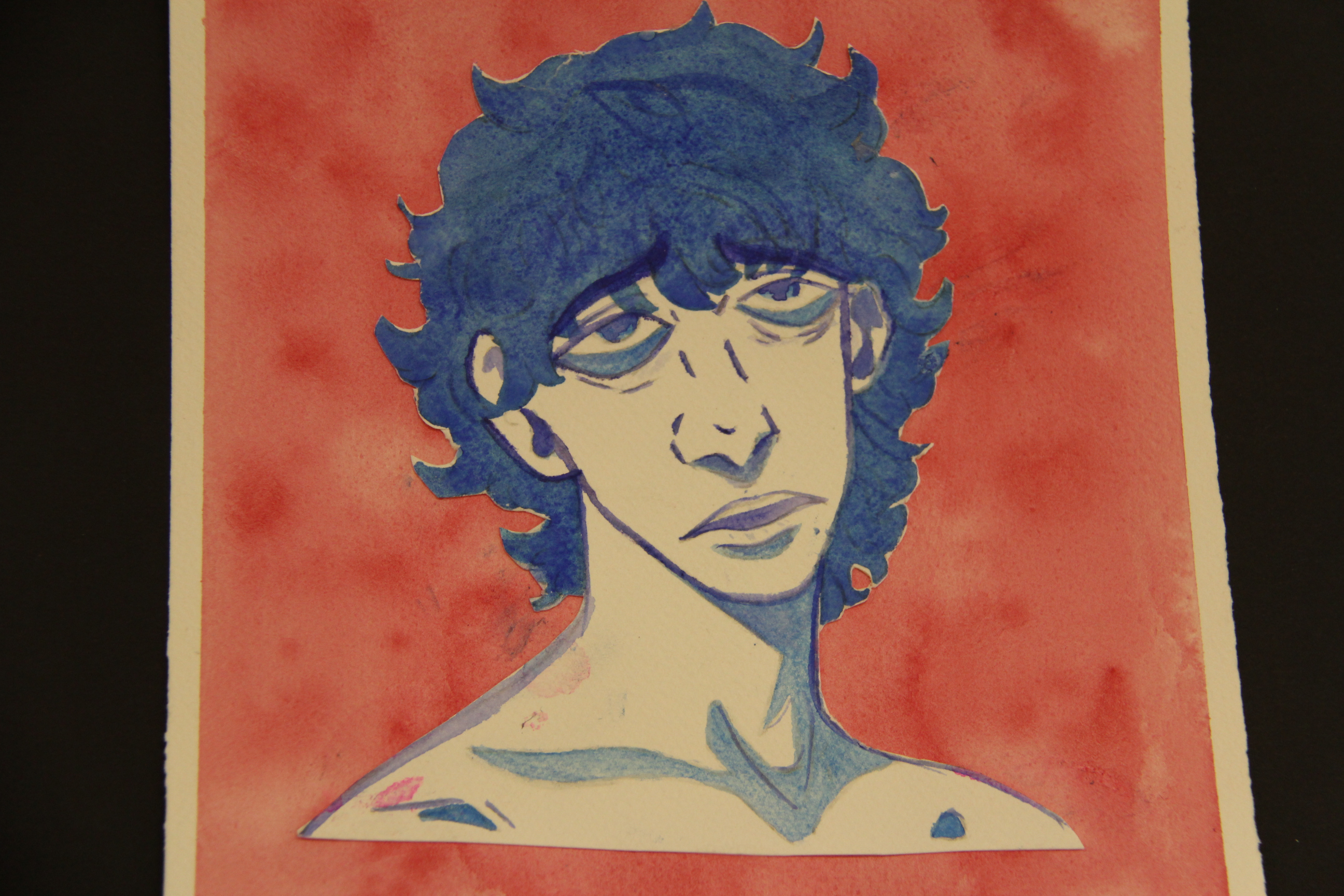
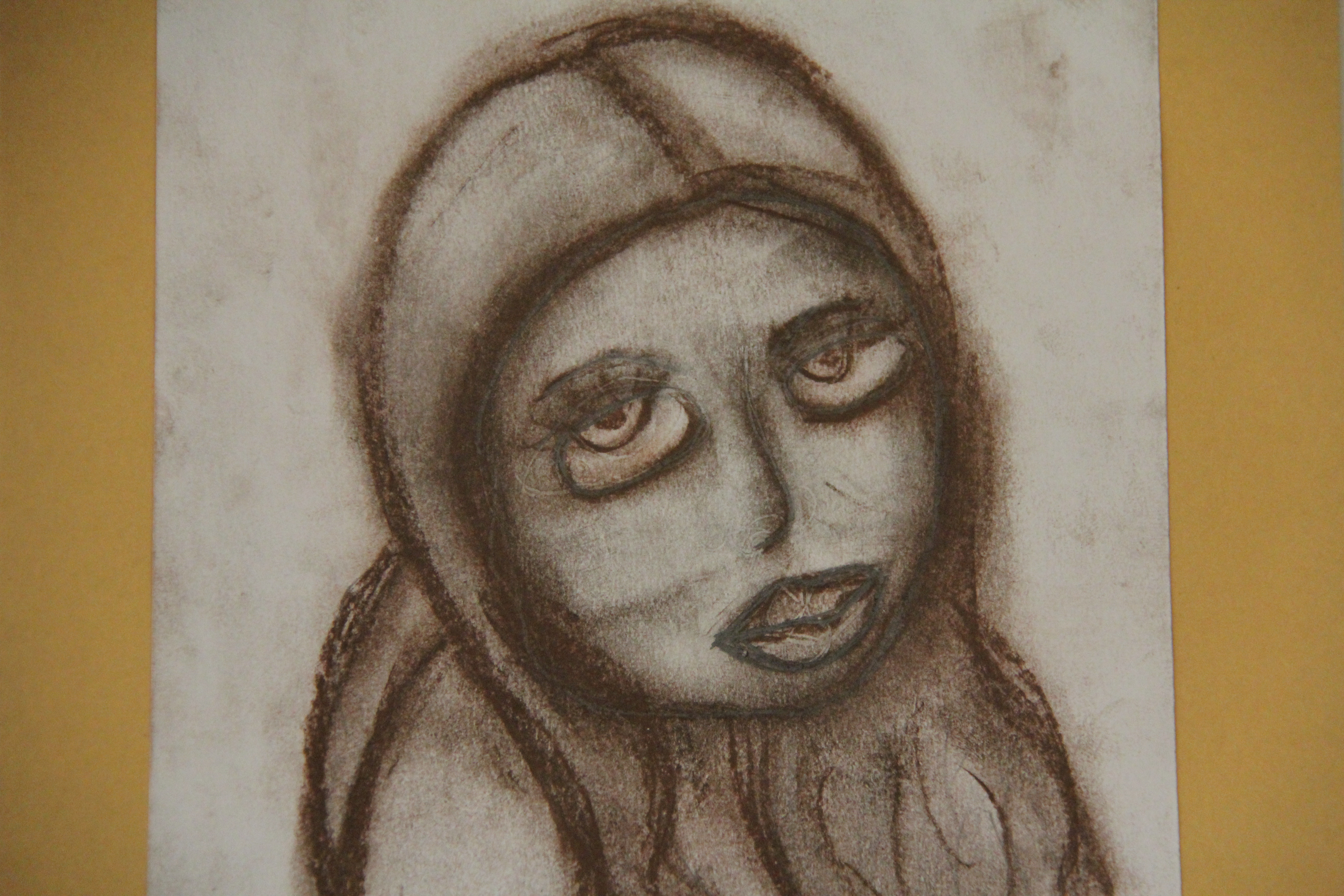
Dexk, a senior at Faribault Area Learning Center, painted this watercolor portrait. (Minnesota Prairie Roots copyrighted photo March 2023)
If I study each work of art, I see personality traits emerging in the subjects. Reserved. Joyful. Tentative. Compassionate. Inquisitive. Even especially creative. I could be right. Or I could be wrong in my observations. Faces can reveal a lot, but can also hide a lot.
A portrait by Yarely, Roosevelt fifth grader. (Minnesota Prairie Roots copyrighted photo March 2023)
I recognize that for these young artists, such deep thoughts may not have presented themselves. And that’s OK. Perhaps just the challenge of creating a portrait was enough without the added distraction of introspection.
Roosevelt Elementary School kindergartner Ruweyda created this joyful portrait. (Minnesota Prairie Roots copyrighted photo March 2023)
I admire the talent of these student artists ranging from kindergartners to seniors in high school. While I don’t hold any art training, portraits seem particularly difficult to create. They would be for me, unless I captured a portrait with my camera. And even then I don’t claim to be a portrait photographer, except in the journalistic style.
One in a series of developing portraits by Alaina, Faribault Middle School eighth grader. (Minnesota Prairie Roots copyrighted photo March 2023)
Portraits anchor a corner, top row, in the student art exhibit. (Minnesota Prairie Roots copyrighted photo March 2023)
“Winter Self-Portrait Mixed Media” by Evelynn, Lincoln Elementary School first grader. (Minnesota Prairie Roots copyrighted photo March 2023)
When the youth artists in the Faribault art show look at their work and look in the mirror, I hope they see beautiful, creative faces. I hope they see the talent they hold. I hope they understand that they are unique and valued and supported. I hope, too, that creativity continues to be an important part of their lives, a lens through which they can see the world and then share it with others.
A soulful portrait by Grace, Waterville-Elysian-Morristown School eighth grader. (Minnesota Prairie Roots copyrighted photo March 2023)
Art matters. And so do each and every one of these developing young artists. They are our future, wherever their talents take them in this world.
FYI: Paradise gallery hours are noon – 5 pm Wednesday – Friday and 10 am – 2 pm Saturday. This exhibit runs until April 8.Photos were taken with permission of the Paradise. Original copyrights to the art are owned by the individual artists.
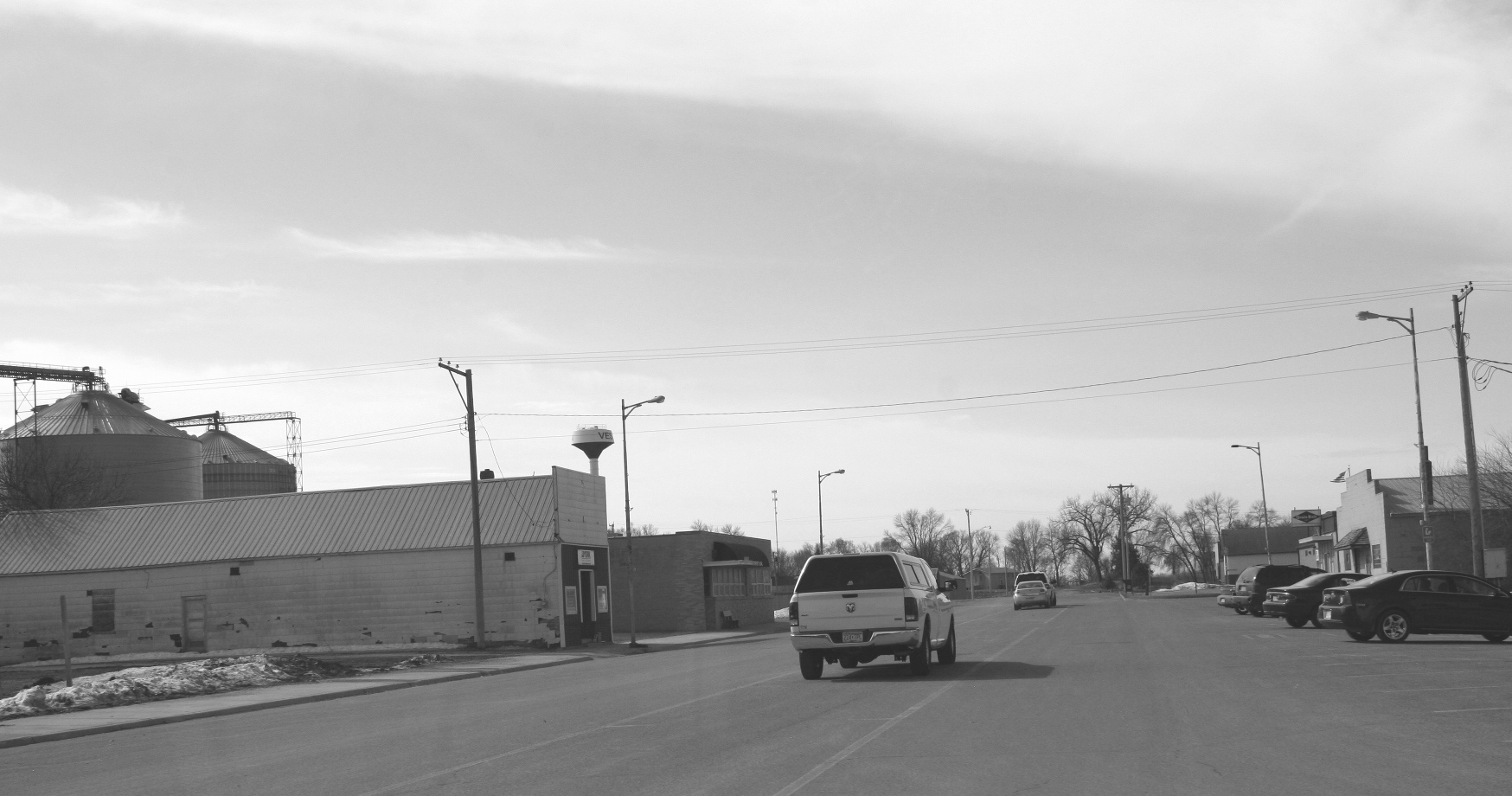
Downtown Vesta, Minnesota, photographed in 2018. (Minnesota Prairie Roots copyrighted file photo April 2018)
WHEN I READ A RECENT POST on the City of Vesta Facebook page, I knew I needed to share this story with you. It is a heartwarming story of kindness and gratitude that renews my faith in the goodness of humanity. And it is, too, a moment in which I feel overwhelming pride in my hometown.
Before I get to the referenced post, I expect many of you are wondering, “Where is Vesta?” I’ve found in my 41 years of living in southeastern Minnesota that most people have no clue. Vesta is west of Mankato, west of New Ulm, west of Redwood Falls. The small Redwood County farming community of around 320 sits along Minnesota State Highway 19 half way between Redwood and Marshall. It is the only town directly aside that highway for the 40 miles between the two larger cities.
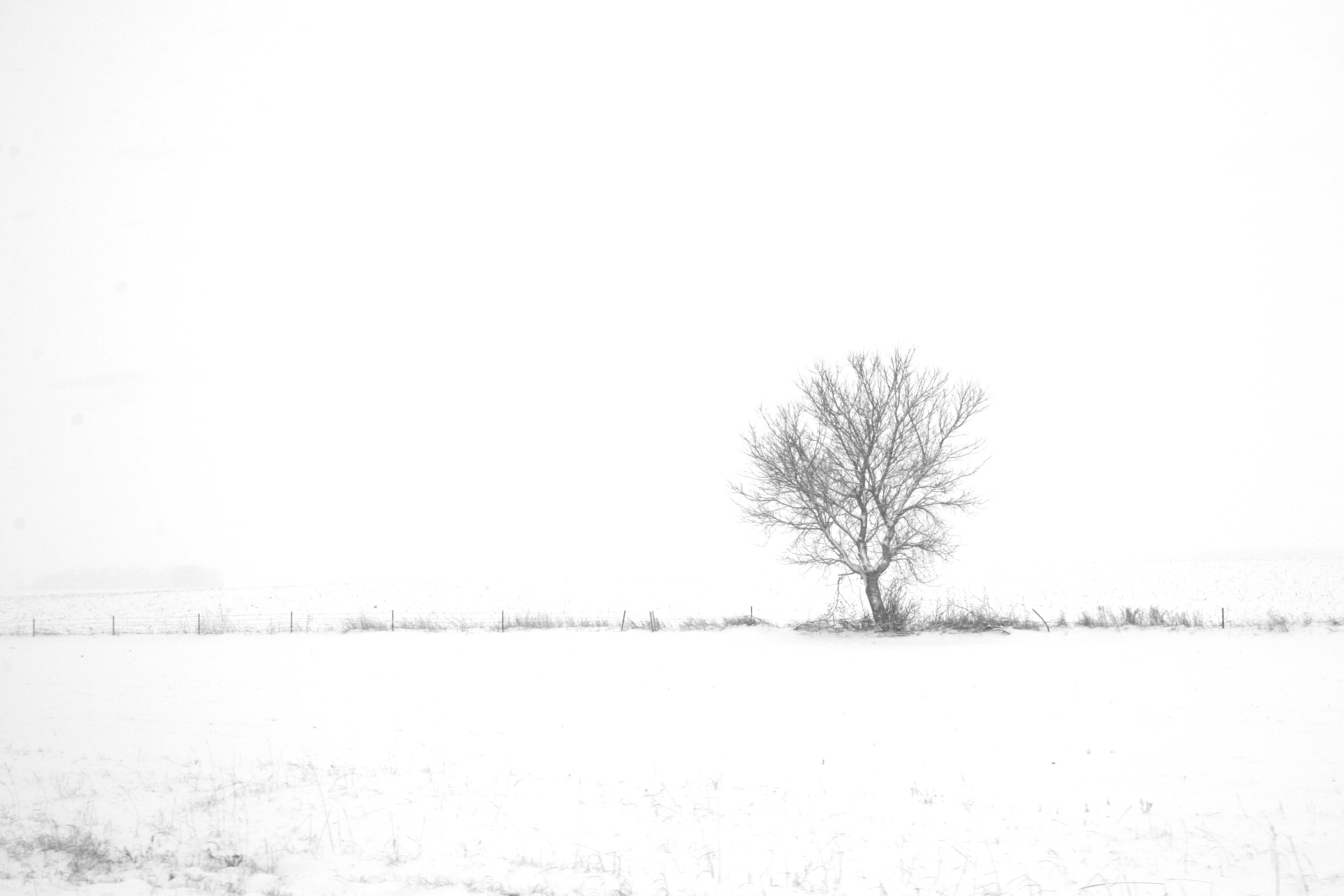
A lone tree along a fence line on the southwestern Minnesota Prairie. (Minnesota Prairie Roots copyrighted file photo March 2012)
Vesta is in the middle of the prairie, the windswept prairie. If a winter storm sweeps in with strong winds, then conditions quickly deteriorate to blizzard status. You don’t want to be caught on the road if that happens. It’s dangerous.
I shot this on the Minnesota Highway 19 curve just north of Vesta in March 2012. The recently-stranded motorist was at about this point on the highway, but in far worse weather conditions. (Minnesota Prairie Roots copyrighted file photo March 2012)
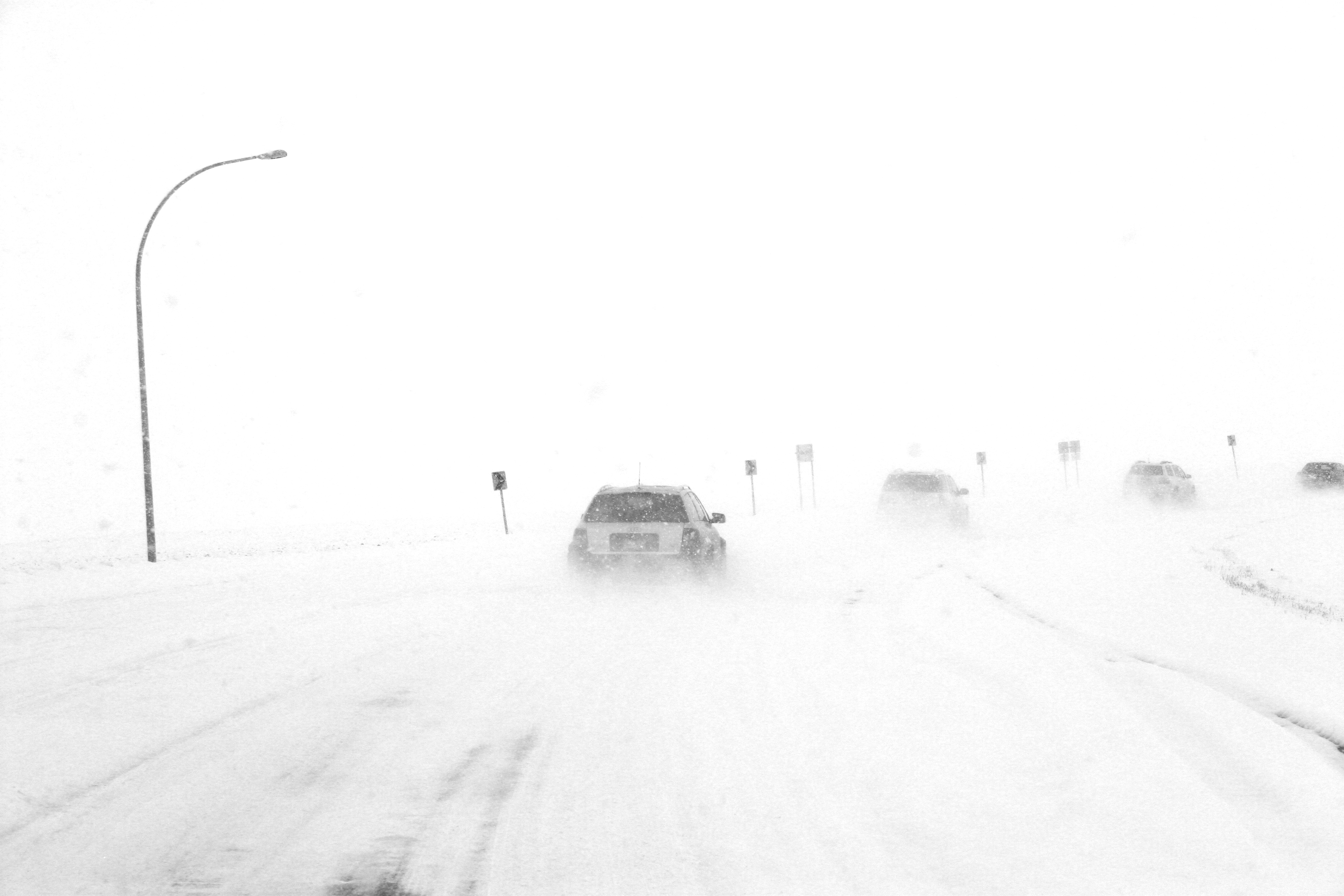
Recently, a motorist found herself in such dire conditions while driving Highway 19 toward Watertown, South Dakota, to visit grandchildren. Forty mph winds, blowing snow and zero visibility—to the point where she had to stop to see if she was still on the road some two miles from Vesta—resulted in a life-saving decision. She got off the highway at Vesta.
And that’s where this story begins to unfold into a story of generosity and kindness in my hometown. The first person she encountered was Dave and his buddy, out on four-wheelers. I knew exactly who she meant. Dave owns an auto body and repair shop in Vesta. He also plows snow for locals. When my mom was alive and still living in Vesta, it was Dave who cleared her snow. It was Dave who answered Mom’s calls for help with car issues. I always felt reassured that he was, in some ways, looking after her and so many other seniors.
I digress. Dave directed the recently-diverted motorist two blocks east to the community center, a designated shelter for stranded travelers. Upon arrival at the former Vesta Elementary School, the grateful traveler found the doors locked. So off she went to find someone, anyone, to let her inside. She noticed two trucks parked outside the grain elevator, which led her inside and directly to Vesta’s emergency coordinator. Jeremy drove home and got the key to open the shelter.
A plate of spaghetti, photo used for illustration purposes only. (Minnesota Prairie Roots copyrighted file photo July 2013)
Now if that was the end of the story, that would be a nice ending. But there’s more. The out-of-town guest got a tour of the community center and was also advised she could help herself to the spaghetti and chicken noodle soup in the fridge, watch TV in the work-out room and then sleep on a cot, pillows provided. She was also given the Wi-Fi password. Later the city clerk’s husband brought an extra blanket after the clerk stopped to ask if the shelter guest needed anything.
Now if that was the end of the story, that would be a nice ending. But there’s more. Soon town kids showed up, per a text sent by Jeremy that they could hang out in the community center during the blizzard. The way-laid motorist soon found herself in rousing games of dodge ball and kickball inside the gym where I played as a grade-schooler.
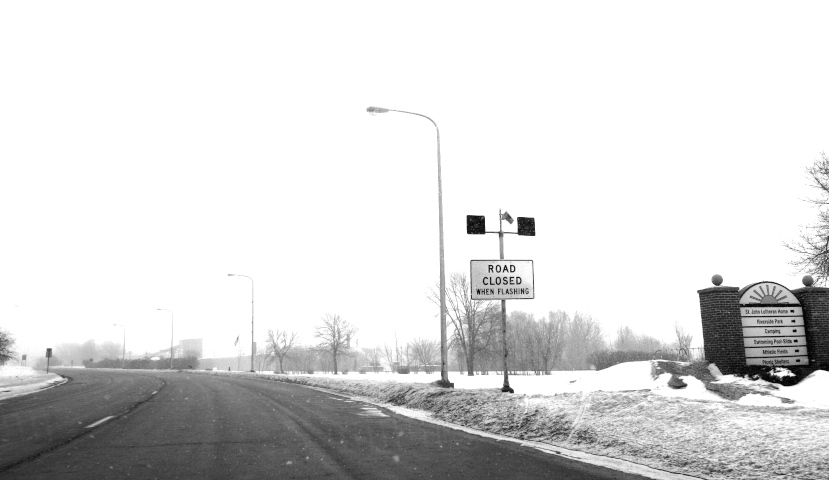
Road closed signs like this one near Springfield can be found along southwestern Minnesota highways, including highway 19. (Minnesota Prairie Roots copyrighted file photo March 2011)
Now if that was the end of the story, that would be a nice ending. But there’s more. Jeremy kept in touch, texting that the local bar was open if she wanted pizza. She was happy with the soup. The next morning the emergency coordinator texted again, notifying the overnight guest that roads had been plowed. He’d also reached out to the Marshall Police Department to assure that roads were open to motorists. Drive on a “closed” road and you risk a $750 fine. Jeremy went that extra mile to assure the woman could resume her journey to Watertown.
Her lengthy post to the City of Vesta Facebook page shows deep gratitude for all those who made her feel welcomed and safe in my hometown. She wrote: It was quite a night in the Vesta Community Center. Everyone’s kindness in this town was so timely and heartfelt that, rather than feeling like a stranded traveler, I felt like a VIP walking down a red carpet.
I am not surprised by the goodness of the folks in Vesta. This is small town southwestern Minnesota at its best. Caring, kind, compassionate, loving, welcoming. I’ve always felt embraced by the place of my roots, even decades after leaving. I understand this place. These will always be my people. My prairie people.
Colorful fish art by Dallas, 3rd grader, Roosevelt Elementary School. (Minnesota Prairie Roots copyrighted file photo March 2023)
I APPRECIATE ART. All of it. From performing to literary to visual, art inspires me, uplifts me, causes me to pause and think. Art makes me feel joyful. I am so thankful I live in a Minnesota community where art is valued.
The beautiful Paradise Center for the Arts in downtown Faribault. (Minnesota Prairie Roots copyrighted photo March 2023)
The Paradise Center for the Arts centers the arts in Faribault. From theatrical performances to concerts to gallery shows and more, the opportunity to embrace the arts awaits me inside this historic venue. How grateful I am for that.
This poster posted inside the Paradise lists all the schools participating in the 2023 student art exhibit. (Minnesota Prairie Roots copyrighted photo March 2023)
Recently I toured the All Area Student Art Show, an annual exhibit featuring the art of students from area schools—this year eight. From kindergartners to high school seniors, the talent of these students is beyond impressive. Even more, I love that they are given this opportunity to share their work with the public. I often think how this builds self-confidence and encourages these kids to perhaps pursue art, or, at the least, to value it.
Jocelyn, an 11th grader at the Faribault Area Learning Center, created this butterfly. (Minnesota Prairie Roots copyrighted photo March 2023)
Lincoln kindergartner Reggie created this “Symmetry Butterfly Specimen in Mixed Media.” (Minnesota Prairie Roots copyrighted photo March 2023)
As I slowly walked three hallways where student art lines walls and then entered a room exhibiting more artwork, I pondered what I would photograph. I knew I needed to choose samples from each school. I also wanted a range of ages and art mediums, and also to showcase what spoke to me. Art is, in many ways, deeply personal, whether in creating or viewing.
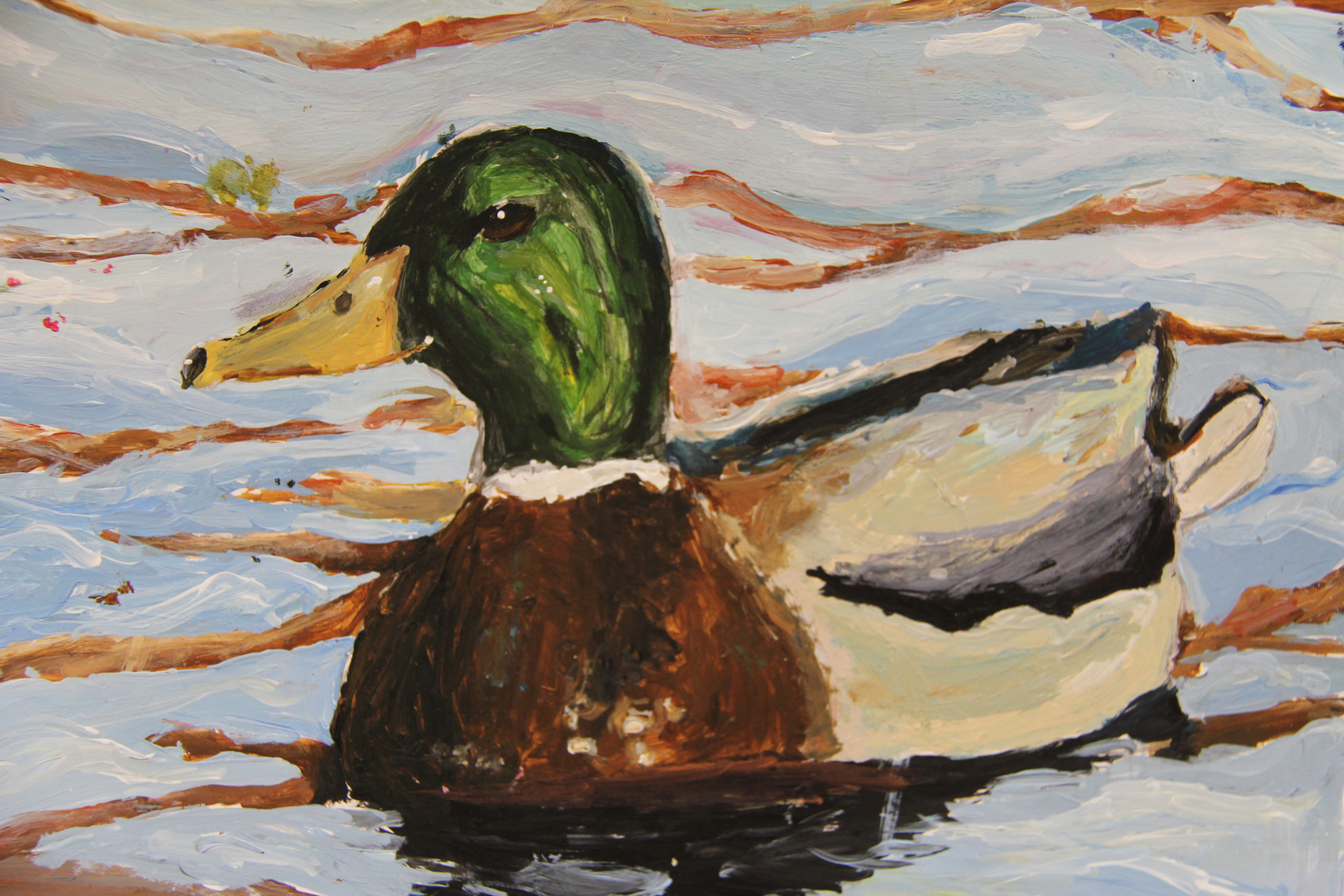
Mallard drake by Adeline, Cannon River STEM School, 7/8 grade. (Minnesota Prairie Roots copyrighted photo March 2023)
Granted, this art was mostly guided by teacher assignments. But still, that leaves space for each artist to infuse his/her style into a piece. Copying art is different than creating art. These students create art.
A block print by Madison, 7th grader at Waterville-Elysian-Morristown Schools.(Minnesota Prairie Roots copyrighted photo March 2023)
Showing you the art I photographed requires more than one post. I took an excess of images, which tells you something about how much I enjoyed this second floor exhibit. Like an editor edits an author’s writing, I had to go through my photos frame by frame and edit. And then I grouped the photos by theme to make this all manageable.
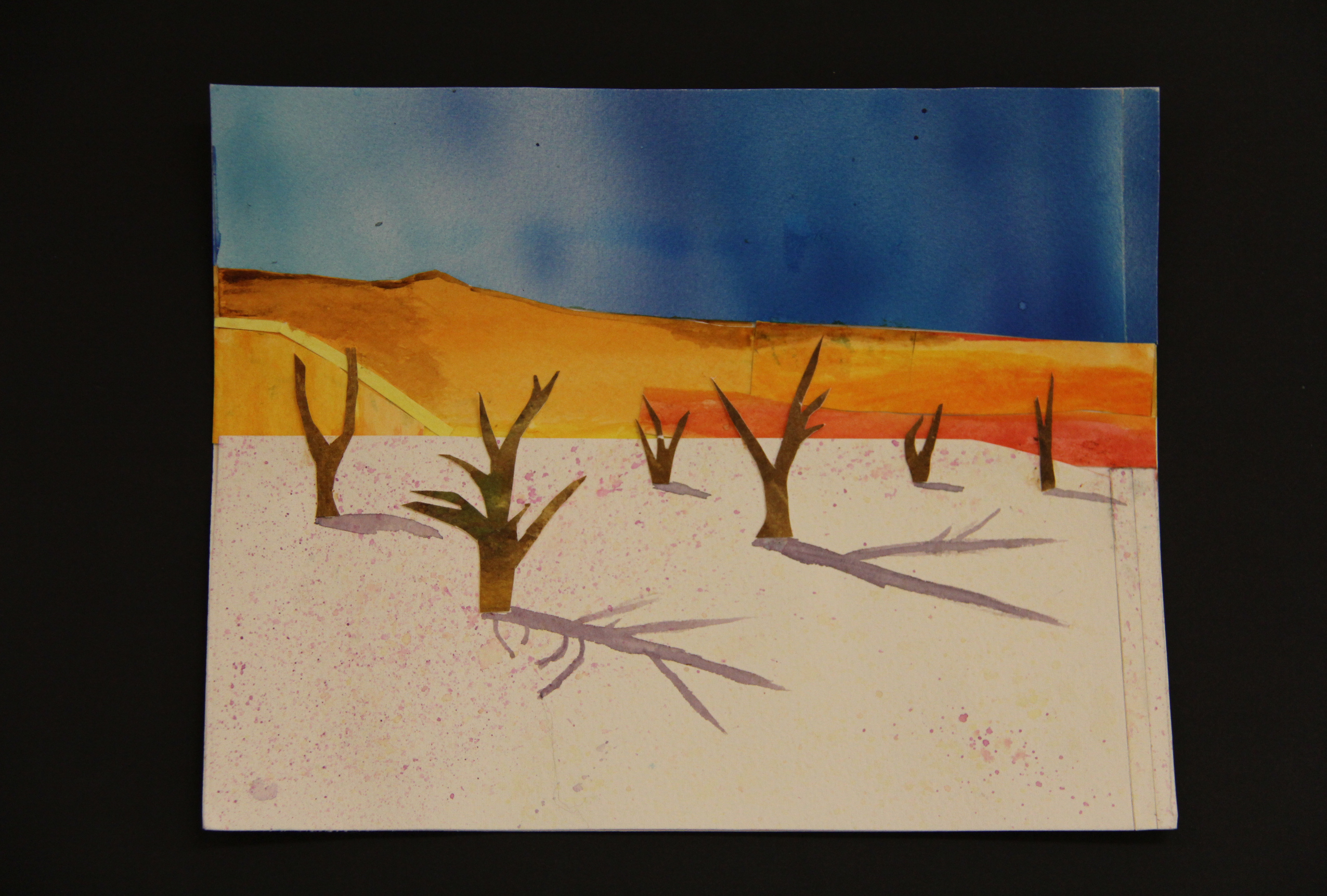
“Tri-Fold Cut Landscape in Crayon” by Addyson, Lincoln Elementary School 5th grader. (Minnesota Prairie Roots copyrighted photo March 2023)
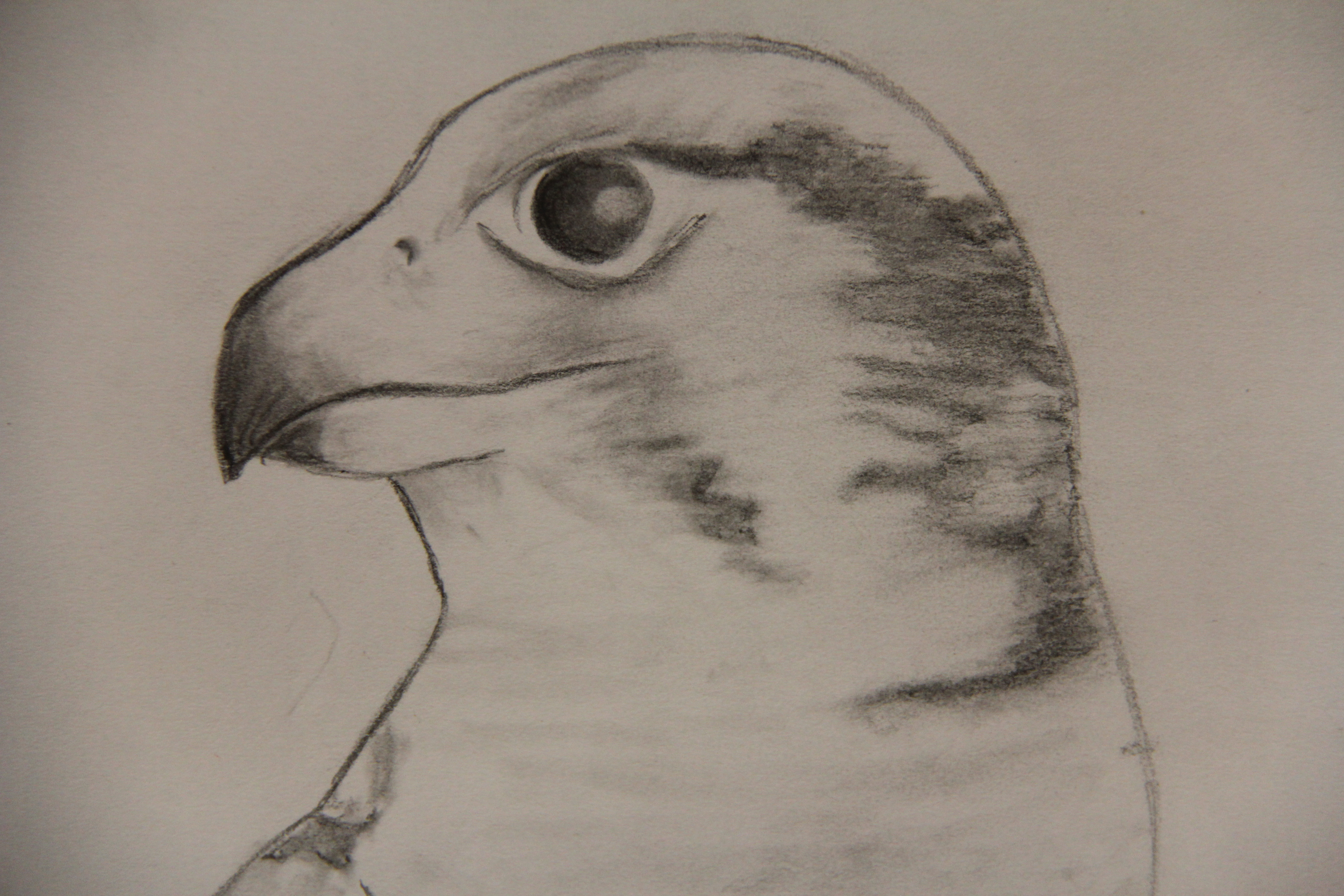
A hawk by Jefferson Elementary School 5th grader Annalicia. (Minnesota Prairie Roots copyrighted photo March 2023)
A watercolor flower by Alaina, 8th grade, Faribault Middle School. (Minnesota Prairie Roots copyrighted photo March 2023)
Today’s post is nature-themed. From vivid butterfly to sun-splashed landscape to subdued bird of prey drawn in charcoal, these artistic renditions of our natural world create a sense of wonderment. What a beautiful world we live in, from garden flower to mountain grandeur. These student artists see that, imagine that, create it.
Faribault Area Learning Center 12th grader Josh created this treescape. (Minnesota Prairie Roots copyrighted photo March 2023)
Being in nature takes me to a place that quiets my spirit, feeds my soul, calms me. It doesn’t take much—the rush of water, a vivid blue sky, the silhouette of a tree branch, a blazing sunset. This nature-themed art offers escape, restoration, a momentary respite from our busy lives. I hope these student artists realize the impact of their creativity.
A trio of nature-inspired art by Roosevelt Elementary School students Jeffry, left, Hadia and Steven. (Minnesota Prairie Roots copyrighted photo March 2023)
I hope, too, that these teachers realize how much I value their work in guiding and inspiring their students. Art is as important as any subject in school. I think how art provides not only a way to express creativity but how it also factors into mental health. Just the physical act of using one’s hands can diminish anxiety, ground thoughts, perhaps even spark joy. The benefits are endless from both personal and educational perspectives.
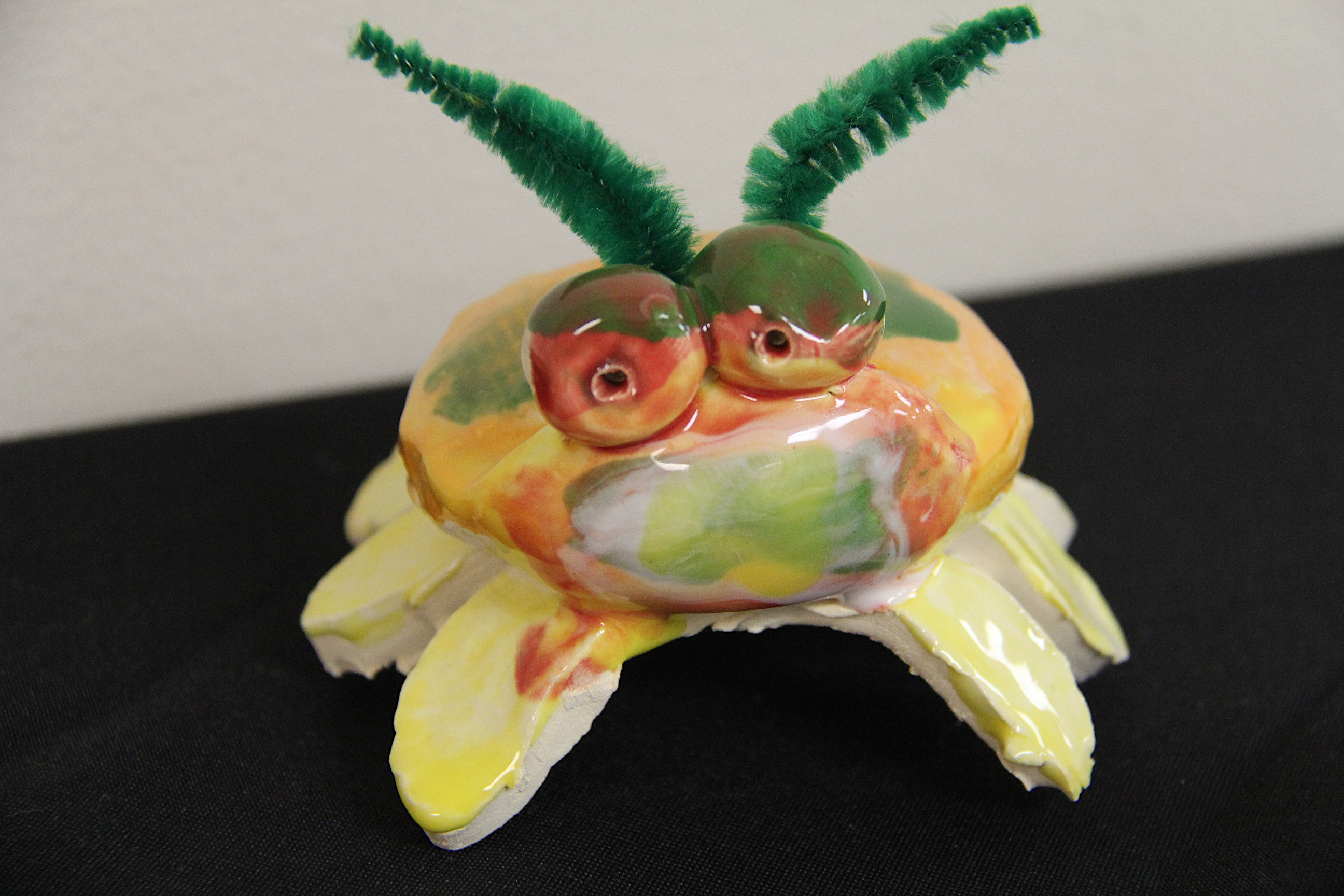
A Ceramic “Squish” Bug with Shoe Impression by Leyton, kindergartner at Lincoln Elementary School. (Minnesota Prairie Roots copyrighted photo March 2023)
My appreciation for this student art show stretches across a spectrum of gratitude. How thankful I feel for these young artists, for the educators who guide them and for the arts center that values their artwork.
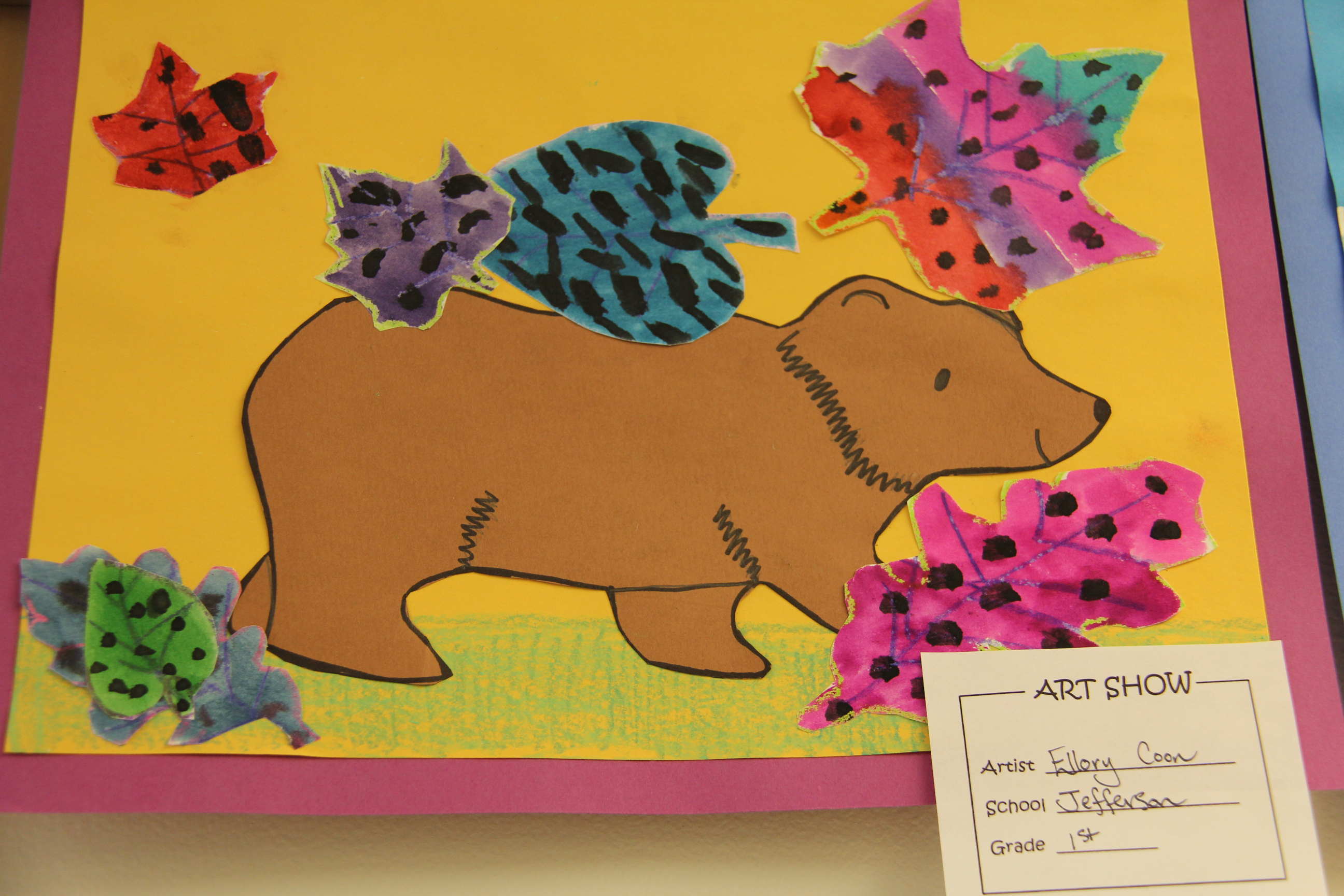
Colorful, patterned leaves fall around a bear created by Jefferson 1st grader Ellory. (Minnesota Prairie Roots copyrighted photo March 2023)
FYI: The All Area Student Art Show will run until April 8 at the Paradise Center for the Arts, 321 Central Avenue North, Faribault. Gallery hours are noon – 5pm Wednesday-Friday and 10 am-2 pm Saturday.
Art was photographed with permission from the Paradise. Individual artists hold original copyrights to their art. Please check back for more posts on this student art show.
A Brandenburg bison photo hangs to the left and the photographer talks about his work in a video, right, inside the Brandenburg Gallery.(Minnesota Prairie Roots copyrighted file photo 2013)
OF ALL THE PHOTOGRAPHY—from general to portrait to sports to nature and wildlife—it is wildlife photography that most impresses me as particularly challenging. And now one of the best wildlife and nature photographers in the world, who happens to be a native of my beloved southwestern Minnesota prairie, has received National Geographic’s Lifetime Achievement Award. Luverne-born and raised Jim Brandenburg, today based in Ely in northern Minnesota, won that top honor. He’s so deserving. His photos are beyond any star rating.
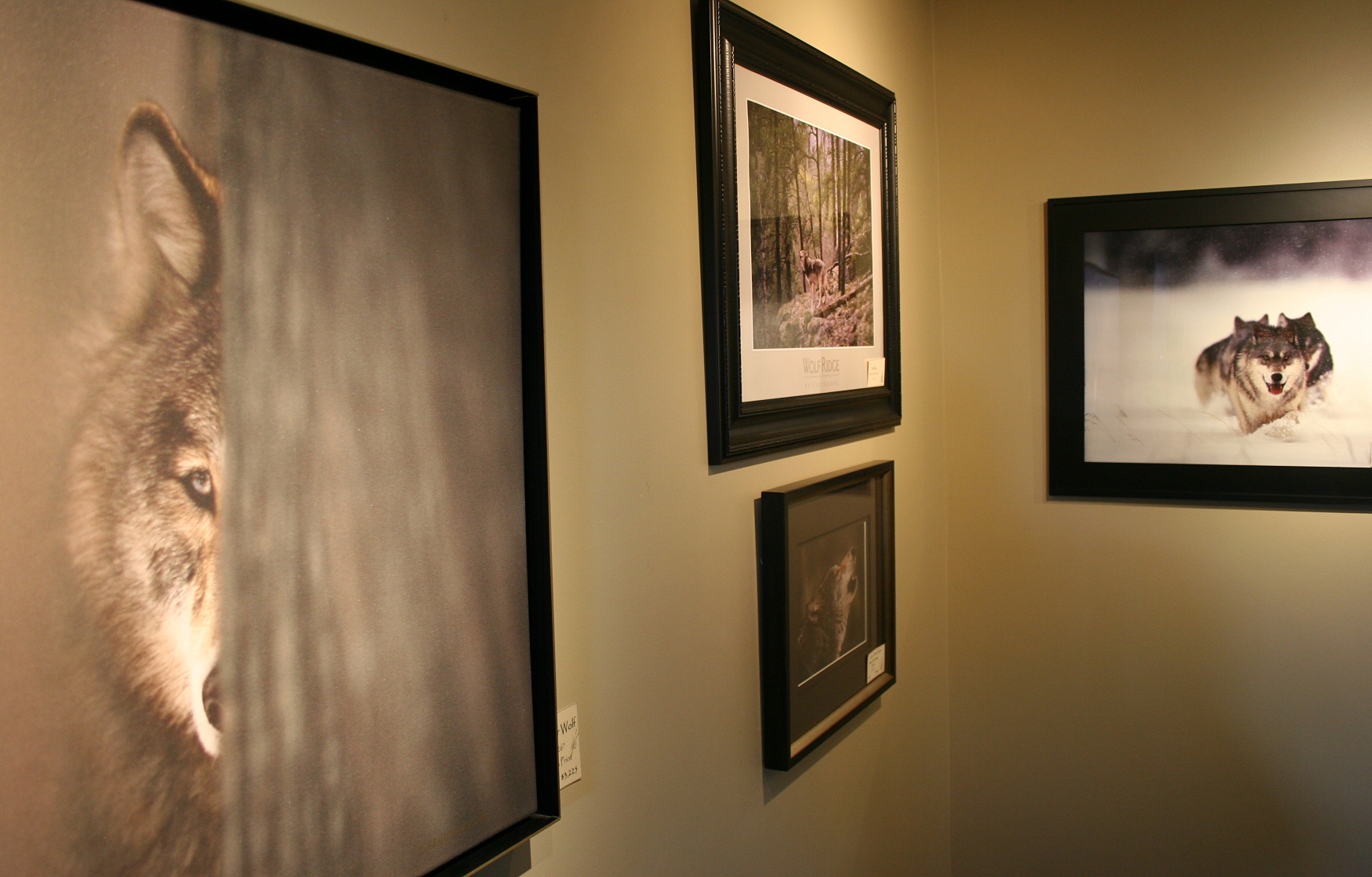
Brandenburg’s published books include “Brother Wolf–A Forgotten Promise.” He is known for his wolf photos, including these displayed in the Luverne gallery. (Minnesota Prairie Roots copyrighted file photo 2013)
Brandenburg joins only five other National Geographic photographers who’ve received this award. That he hails from the prairie, my homeland, makes me especially proud.
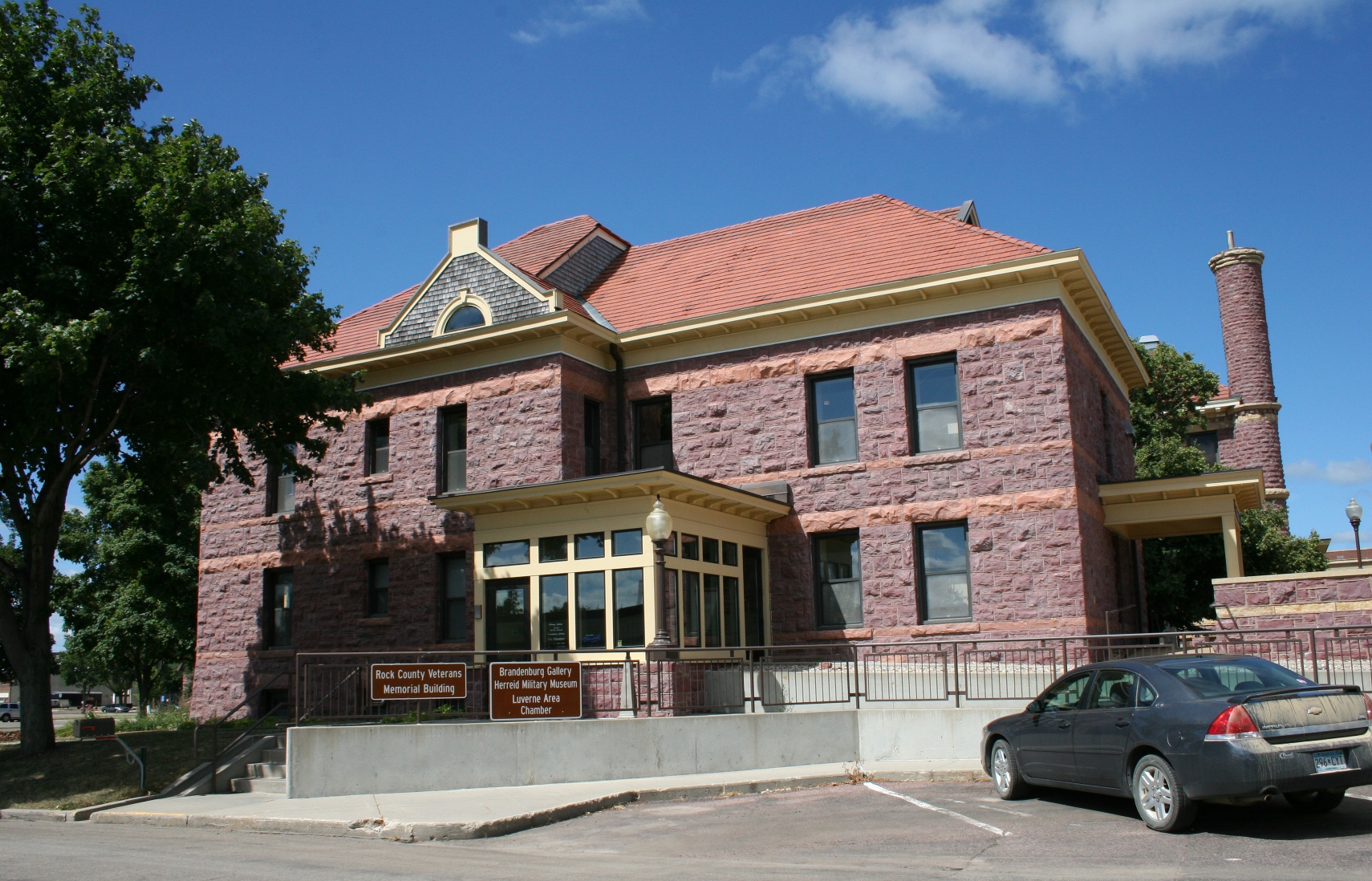
The entry to the gallery, located in the Rock County Courthouse square. (Minnesota Prairie Roots copyrighted file photo 2013)
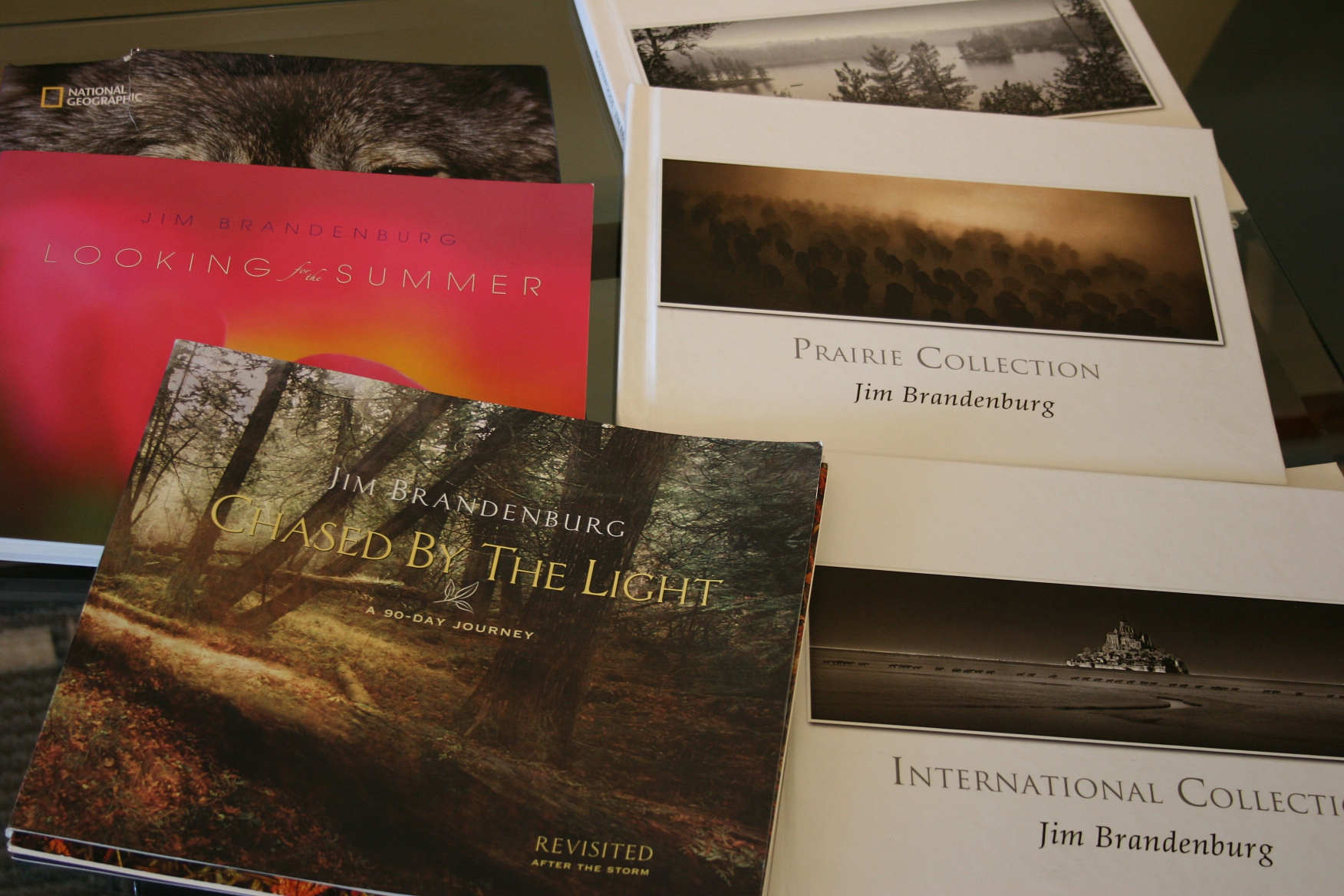
Some of Brandenburg’s photo books displayed in the Luverne gallery. (Minnesota Prairie Roots copyrighted file photo 2013)
I have no ambition to pursue wildlife photography. I don’t have the interest, talent, knowledge of the natural world or patience required for the craft. But I appreciate those who excel in this specialized photography and I can learn from them. Brandenburg has been honing his craft for some 50 years with National Geographic. He’s won countless awards, produced many books filled with his images.
In all of this, this world travel, this move from southern to northern Minnesota, from prairie to northwoods, he’s remained rooted to his roots. He established the Luverne-based Brandenburg Prairie Foundation with a mission “to educate, preserve and expand native prairie in southwest Minnesota.” Brandenburg’s Foundation and the U.S. Fish and Wildlife Service bought 800 acres of untilled prairie in Rock County some eight miles northwest of Luverne, where visitors can immerse themselves in tallgrass prairie. I regret not walking the Touch the Sky Northern Tallgrass Prairie National Wildlife Refuge during my 2013 visit to this area. I need to return.
Hiking the path up and through the prairie grass at Blue Mounds State Park. (Minnesota Prairie Roots copyrighted file photo 2013)
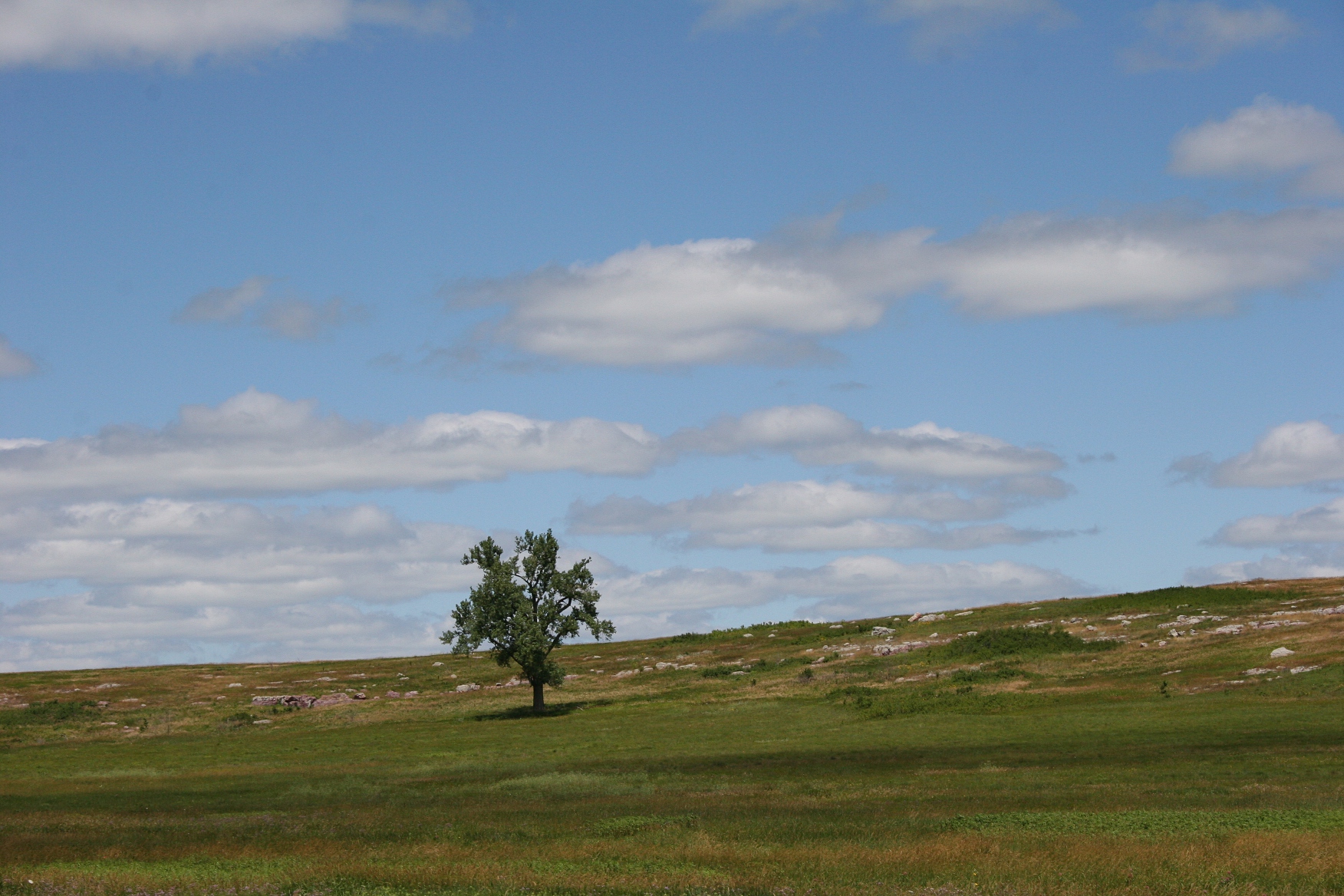
I recognize that to many, this region of Minnesota seems desolate, lacking in beauty, just a place to get through when traveling. But for prairie natives like me, beauty is everywhere. In the wide sky. In sunsets so profoundly beautiful that they almost defy description. In farm sites set like islands among endless fields. In small towns and acres of corn. In prairie grasses swaying in the breeze. I can forever sing the praises of the prairie in refrains of howling wind and songbird and the silence of quiet.
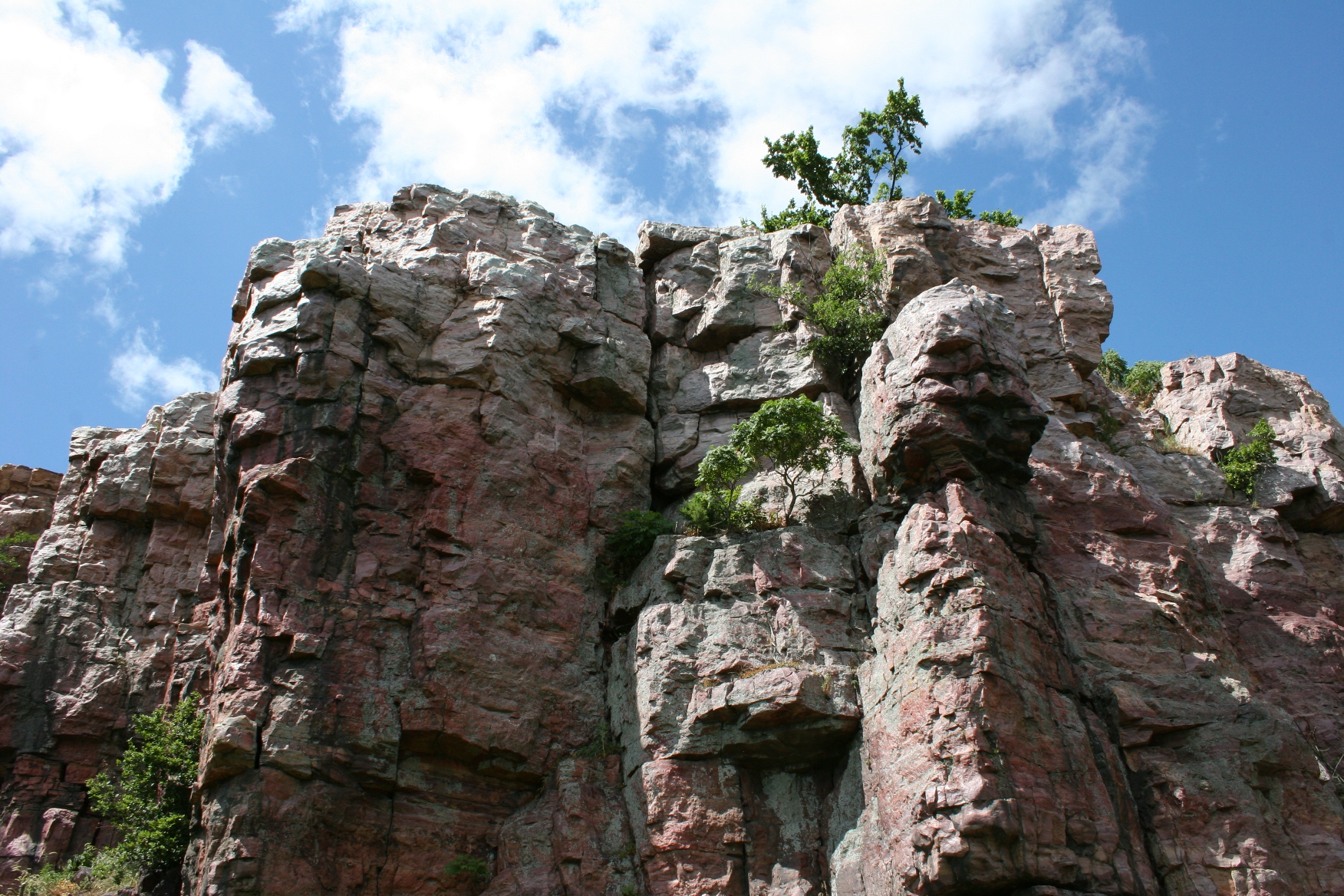
An impressive quarry wall of Sioux quartzite.(Minnesota Prairie Roots copyrighted file photo 2013)
Brandenburg, I expect, experienced all of these, even if his native Rock County differs from my home county of Redwood a bit farther to the north and east. Even on the prairie, landscapes vary. Near Luverne, at Blue Mounds State Park, cliffs of Sioux quartzite rise 100 feet above the plains. It’s amazing, unexpected in this place where prickly pear cacti also grow, where bison graze, where wildflowers bloom.
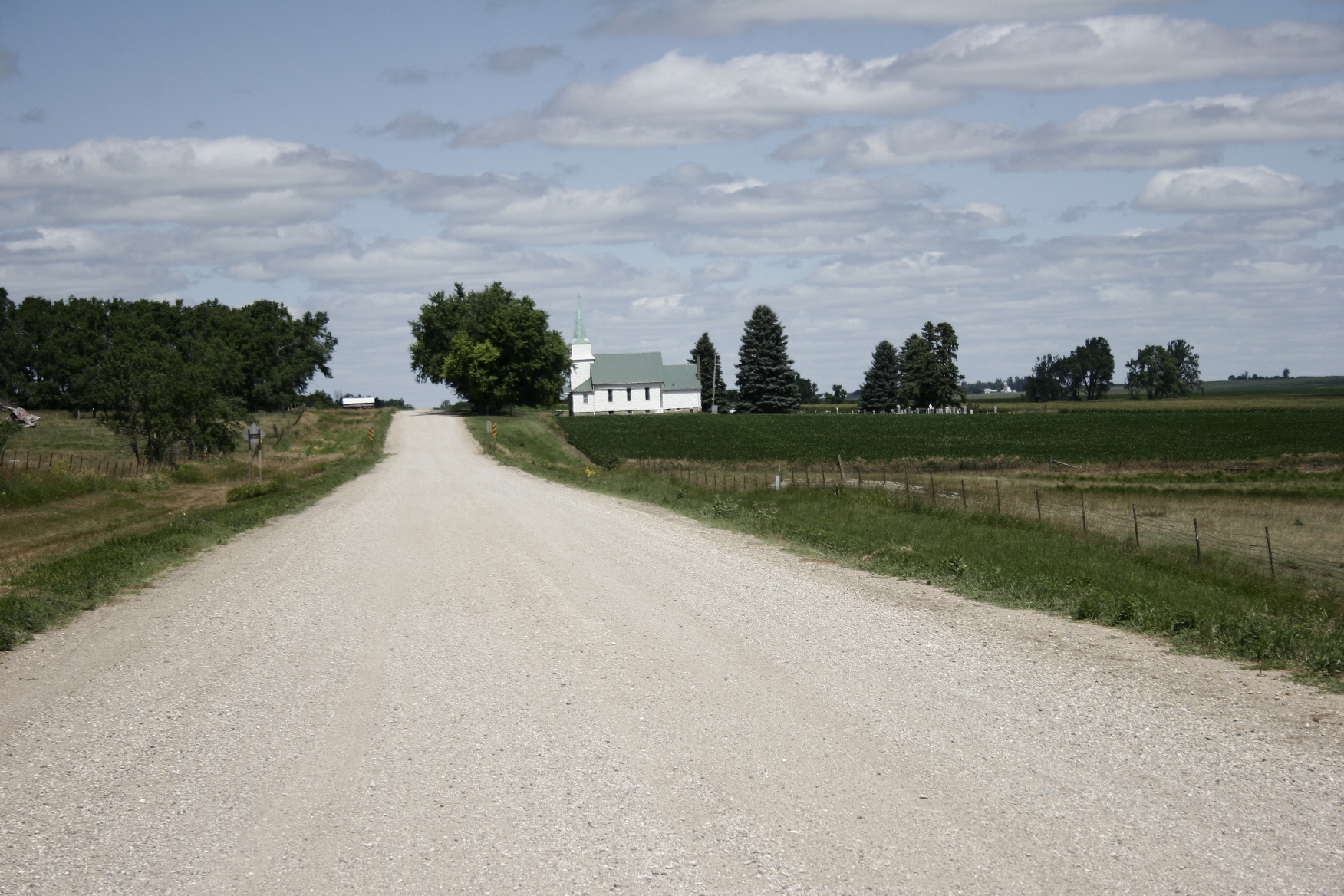
A gravel road around the state park passes a sheep pasture and country church. (Minnesota Prairie Roots copyrighted file photo 2013)
I encourage you, if you’ve never spent time in southwestern Minnesota, to do so this spring or summer. View the landscape through an appreciative lens that takes in every nuance, every detail. Notice the light. Feel the wind. Hear the quiet. Settle into the simplicity of this place that renews the spirit, that a world-class photographer called home. That I, too, once called home.
Inside the Paradise Center for the Arts theater in 2009, two years after it opened. (Minnesota Prairie Roots copyrighted file photo August 2009)
THEY’VE HAD A 16-YEAR RUN, “they” being the recycled seats filling the Paradise Center for the Arts theater in historic downtown Faribault. Now it’s time for those seats to take a bow, exit and make way for new seating.
The aged chairs landed here as a donation from Albert Lea High School. The Merlin Players theatrical troupe then recovered and repaired the chairs before the PCA opened in 2007. It was the right decision at the time, financially and otherwise.
Watching the 2015 Kentucky Derby at the Paradise. (Minnesota Prairie Roots copyrighted file photo May 2015)
Since then, thousands have settled into those orangish chairs, including me. I’ve enjoyed plays, musicals, concerts, comedy shows, speakers and even a viewing of the Kentucky Derby while sitting on those chairs. I’ve laughed and I’ve cried while seated here. After years of use, an upgrade to more comfortable seating for 278 is definitely needed.
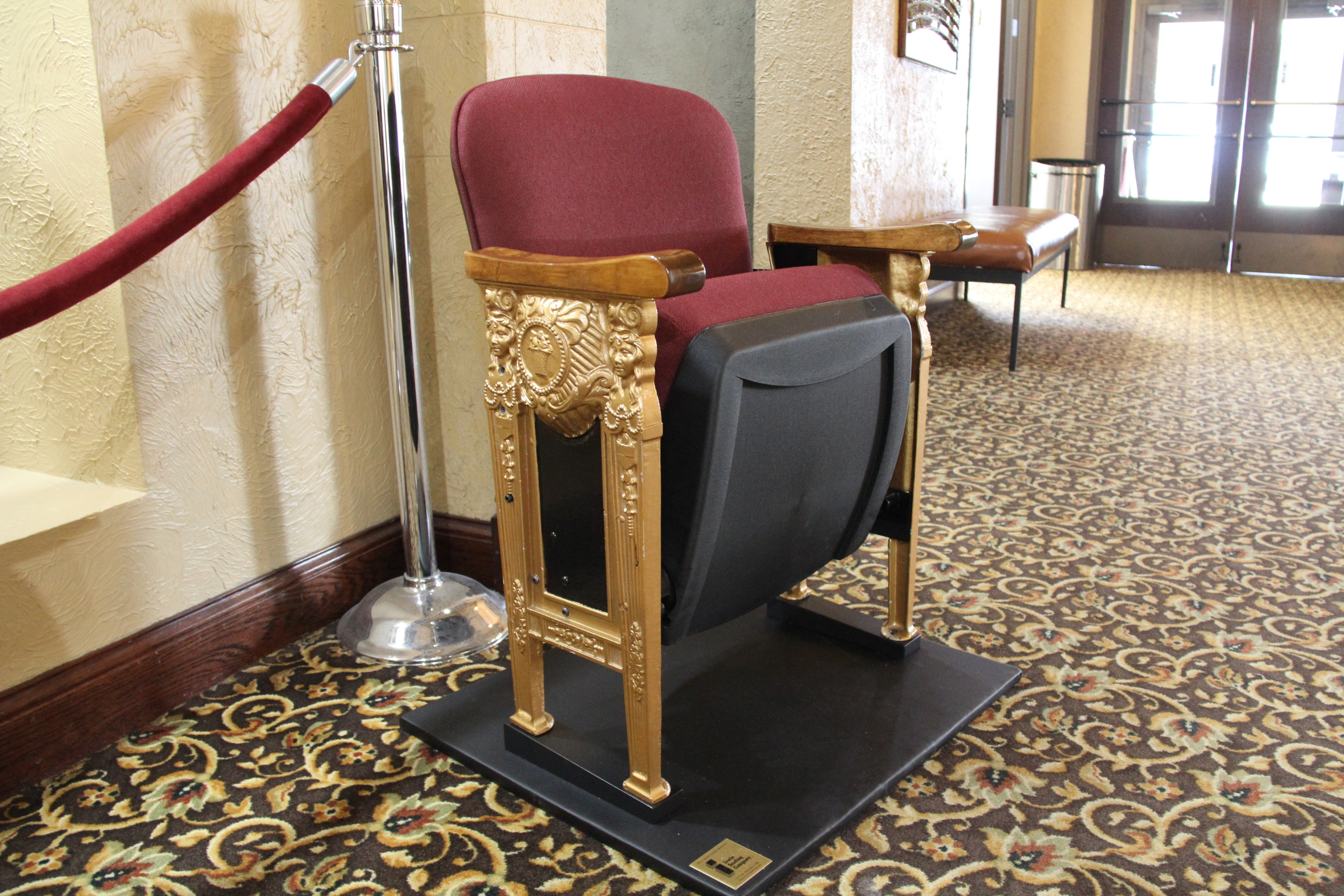
In the lobby of the Paradise, you can try out a model of the new chairs, with the original ornate standards (ends) retained. (Minnesota Prairie Roots copyrighted photo March 2023)
When I stopped at the Paradise recently to see the current gallery exhibits, I noticed a model of the new seats in the lobby. Days later, I received a news release from the PCA with more info and then followed up with a few questions.
I like the plan to install chairs with more comfort, strength and durability, but also with an appreciation for the past. The current ornate ends and the numbered arm rests will be kept. That’s important to me given the historic charm of the auditorium and also as someone who believes strongly in reusing/recycling/upcycling.
One especially nice addition will be cup holders, placed between the two seats in front of each guest. That will certainly cut down on accidental spillage which can occur when drinks are set on the floor.
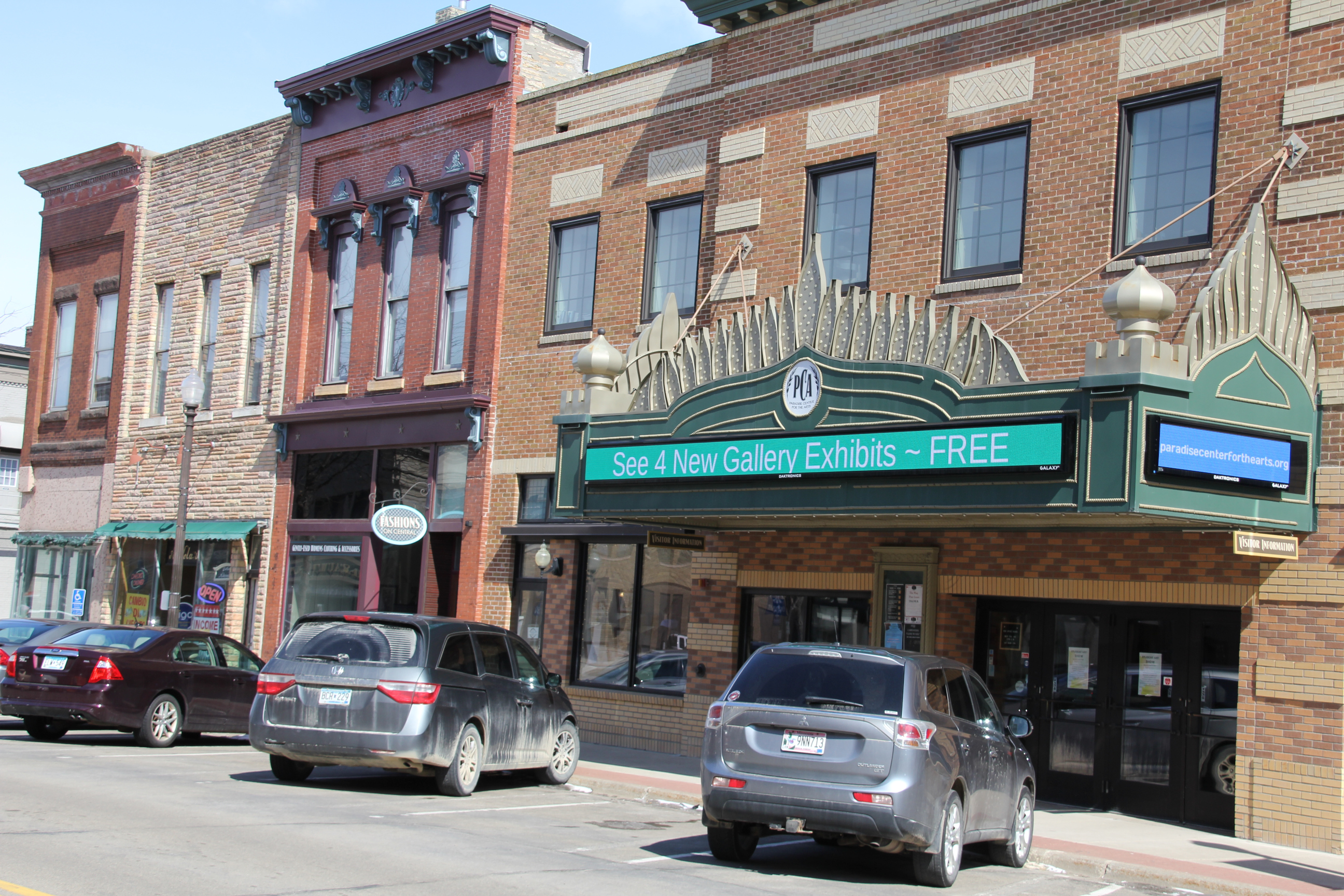
The lovely Paradise, 321 Central Avenue North, in the heart of historic downtown Faribault. (Minnesota Prairie Roots copyrighted photo March 2023)
Now efforts are underway to fund this $460/chair or $128,000 project via donations. If you would like to donate, go to the Paradise website and click on “Donate,” then “Support,” then specify “chairs” in designating your donation. Or call 507-332-7372. Donors will be listed on a plaque.
I look forward to settling into one of these comfortable new maroon chairs to enjoy the performing arts in my community, inside the Paradise.


































Recent Comments