Minnesota Prairie Roots

Writing and photography by Audrey Kletscher Helbling

How my poetry inspired a still life painting of lilacs April 10, 2014

POETRY INSPIRING ART. It’s a fabulous concept and even better when you are part of such a pairing.

A poem I penned has inspired art for Poet-Artist Collaboration XIII, which opened March 31 and runs through May 15 at Crossings at Carnegie, 320 East Avenue, Zumbrota.
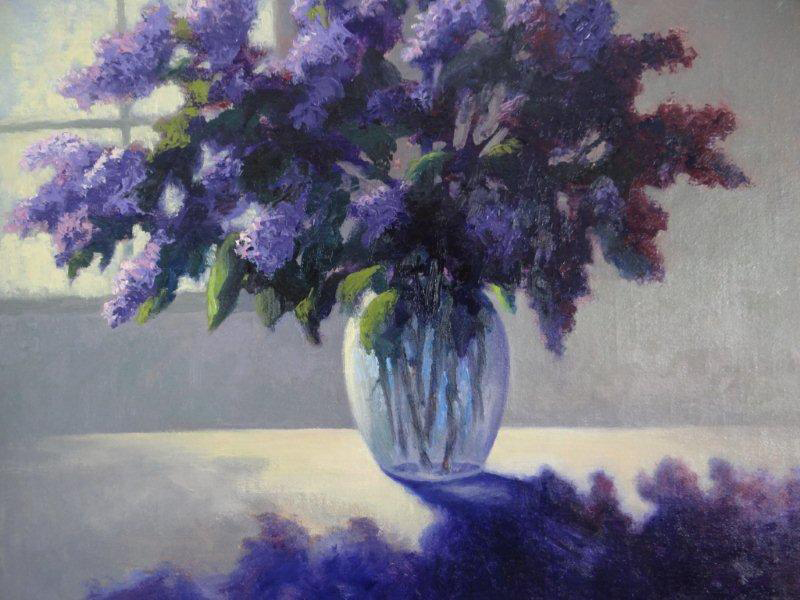
"Lilacs on the Table" by Jeanne Licari

“Lilacs on the Table” by Jeanne Licari. Photo courtesy of Crossings at Carnegie.

I recently connected with “my” artist, Jeanne Licari, to learn how my poem, “Lilacs,” inspired her to paint “Lilacs on the Table,” an 11 x 14-inch still life oil on linen.

Twenty-six poems were chosen from nearly 210 submissions with 26 artists then selected via a juried process. This is Jeanne’s ninth time participating in the collaboration and my second.
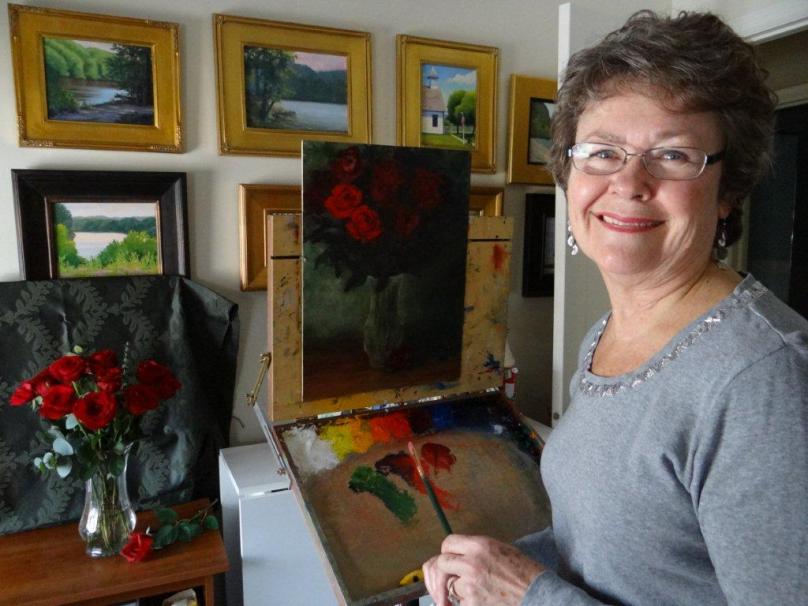
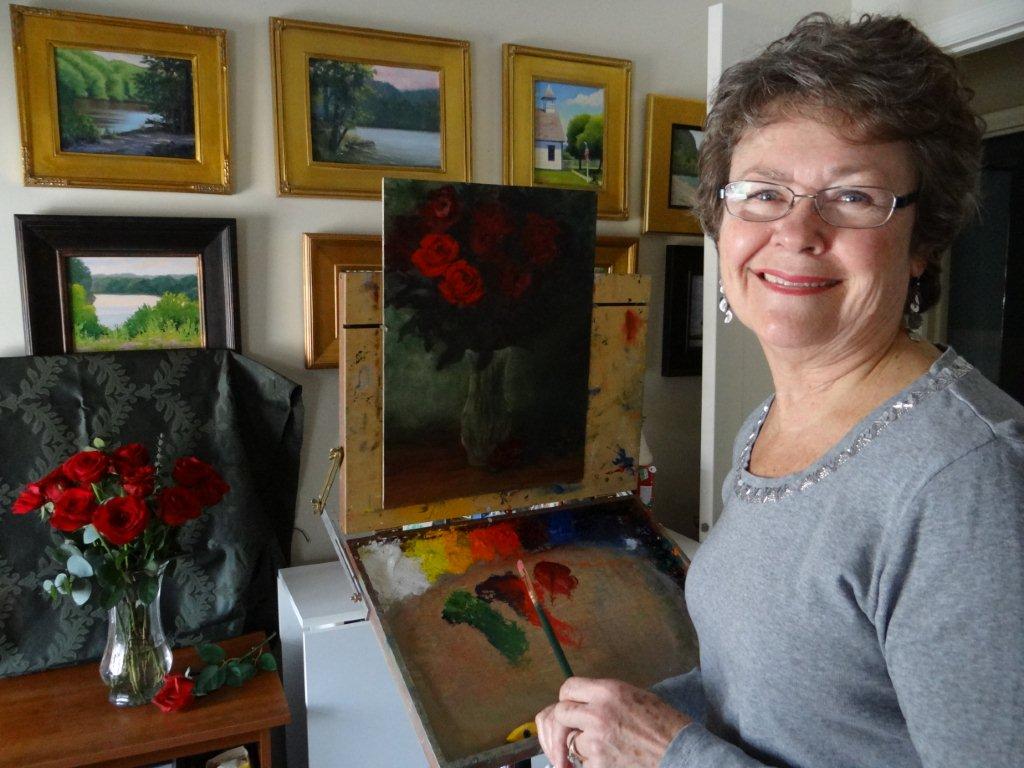
Artist Jeanne Licari

Artist Jeanne Licari in her studio. Photo courtesy of Jeanne Licari.

A mostly self-taught artist who drew and painted as a child, this Rochester resident also furthered her talent through painting classes and workshops. She terms herself a representational oil painter who prefers to paint from life, whether a landscape or a still life.

Jeanne is both plein air—painting outdoors on location—and studio painter.

“My art reflects the beauty I see in mankind and nature,” she says. “My paintings are a direct response to what I see.”

Or, in the case of “Lilacs,” to what she read.

Lilacs

Breathing in the heady scent of lilacs each May,
I remember my bachelor uncle and the gnarled bushes,
heavy with purple blooms, that embraced his front porch
and held the promises of sweet love never experienced.

He invited his sister-in-law, my mother, to clip lilacs,
to enfold great sweeps of flowers into her arms,
to set a still life painting upon the Formica kitchen table,
romance perfuming our cow-scented farmhouse.

Such memories linger as my own love, decades later,
pulls a jackknife from the pocket of his stained jeans,
balances on the tips of his soiled Red Wing work shoes,
clips and gathers great sweeps of lilacs into his arms.
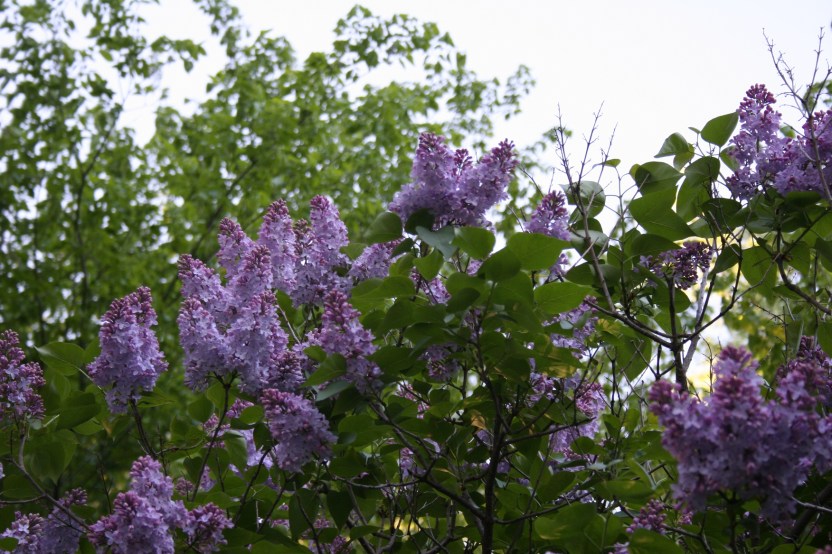
Plenty of lilacs to gather in the spring.

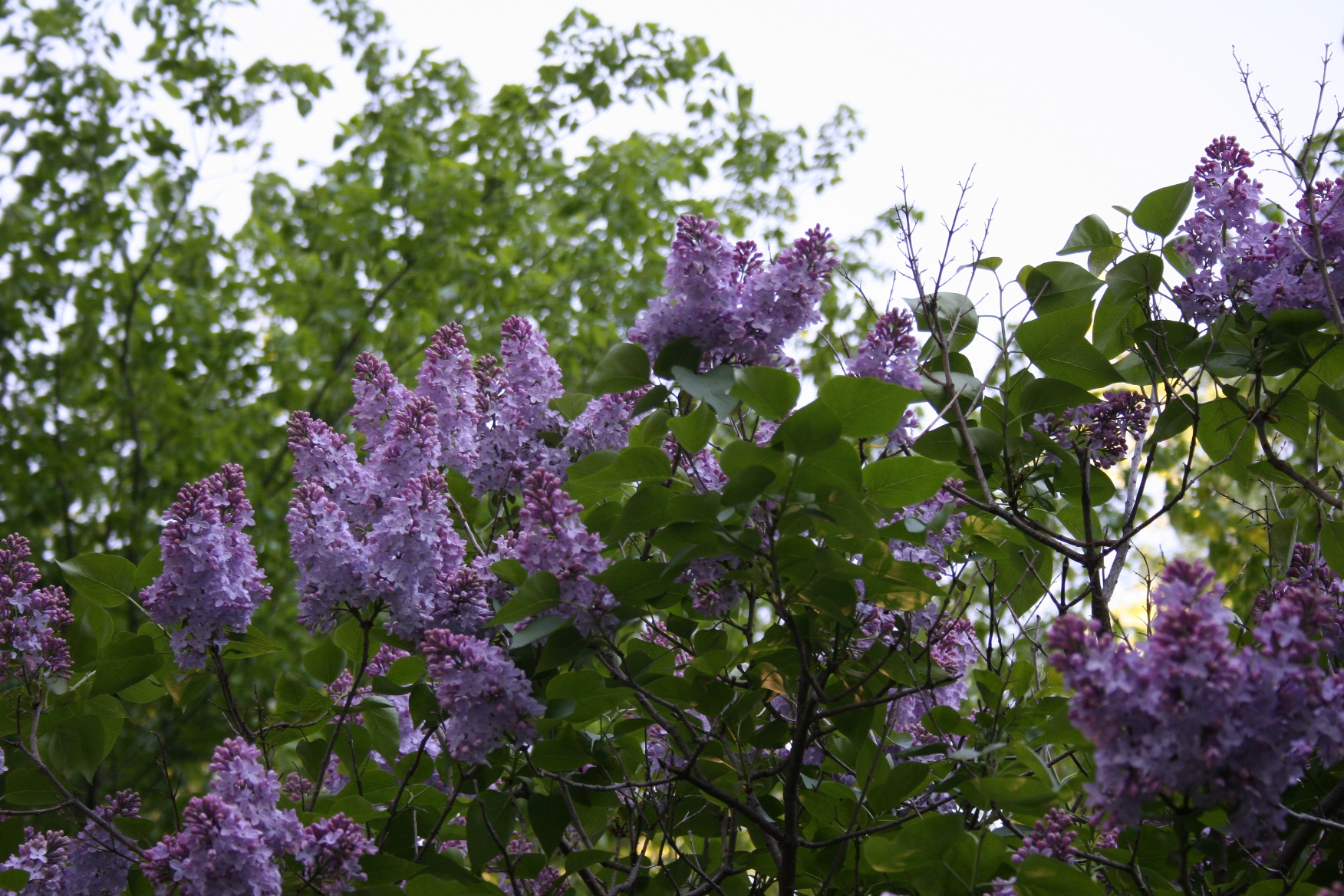
Minnesota Prairie Roots file photo of lilacs.

Jeanne explains how she created “Lilacs on the Table”:

“…I wanted to tell the viewer how I felt about lilacs. The poem triggered memories of many bouquets of lilacs in my lifetime. I love the dense bouquet of purple flowers, the beauty of the different pinks and purples against the green leaves, and the abundant fragrance of lilacs. Since there were no lilacs blooming in March, I painted them using memories of lilacs and how they grew, an oil study of lilacs painted from life, and photos.

I painted the lilacs on a table in response to the line, ‘to set a still life painting upon the Formica kitchen table.’ That line, plus the words about farming, made me remember many bouquets of lilacs on our Formica table in my childhood home on the farm.”

How fabulous to know that Jeanne comes, like me, from a rural background. Her words and oil painting show me that she understands and connects to my words in a deeply personal way.

And that is my hope as a poet—that those who read my poetry will connect to it.
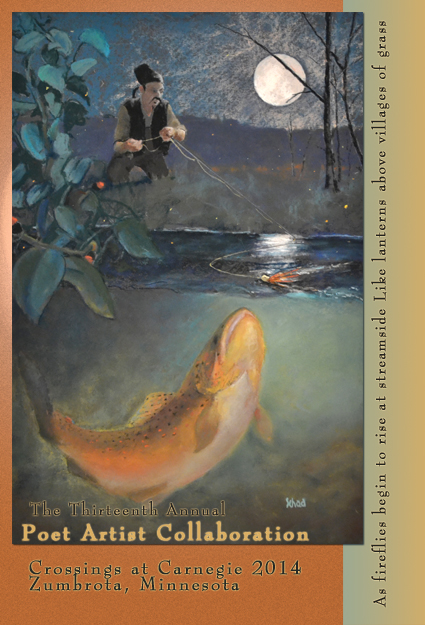
A promotional for the collaboration features "Li Bai at the South Fork," art by Mike Schad inspired by a poem of the same name written by Justin Watkins for the 2013 Poet-Artist XII collaboration.

A promotional for the collaboration features “Li Bai at the South Fork,” art by Mike Schad inspired by a poem of the same name written by Justin Watkins for the 2013 Poet-Artist Collaboration XII.

FYI: A reception, poetry reading and slide show honoring the featured poets and artists is set for Saturday, May 10. Mingle and meet for an hour beginning at 6:30 p.m. in the Crossings gallery. Then, at 7:30 p.m., move next door to the historic State Theatre where poets will read their works and artists will also briefly discuss their art, shown on a screen.

Another poet from my community of Faribault, Larry Gavin, who has published several poetry collections and teaches English at Faribault High School, will read two of his selected poems, “Ashes” and “Two Cranes.”

Collaboration participants come from Minnesota, Iowa, North Dakota and Wisconsin.

The featured artwork is available for sale, including “Lilacs on the Table,” priced at $395. Jeanne Licari’s art is also sold at the SEMVA (South Eastern Minnesota Visual Arts) Gallery in downtown Rochester.
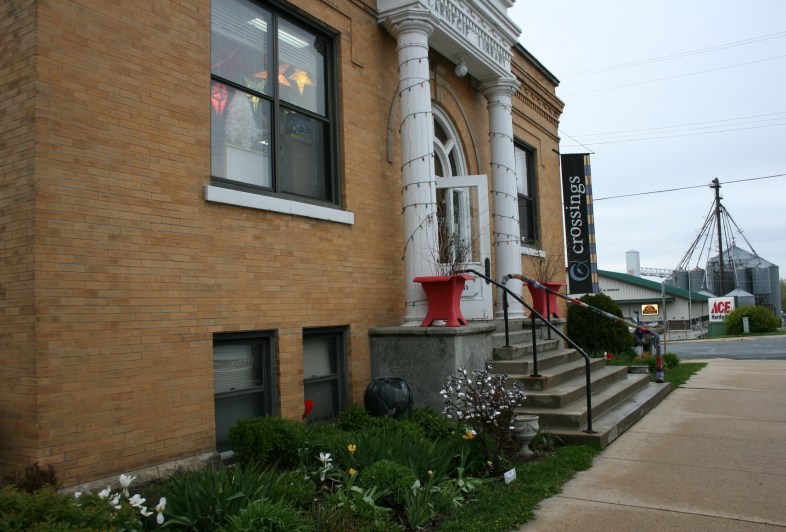
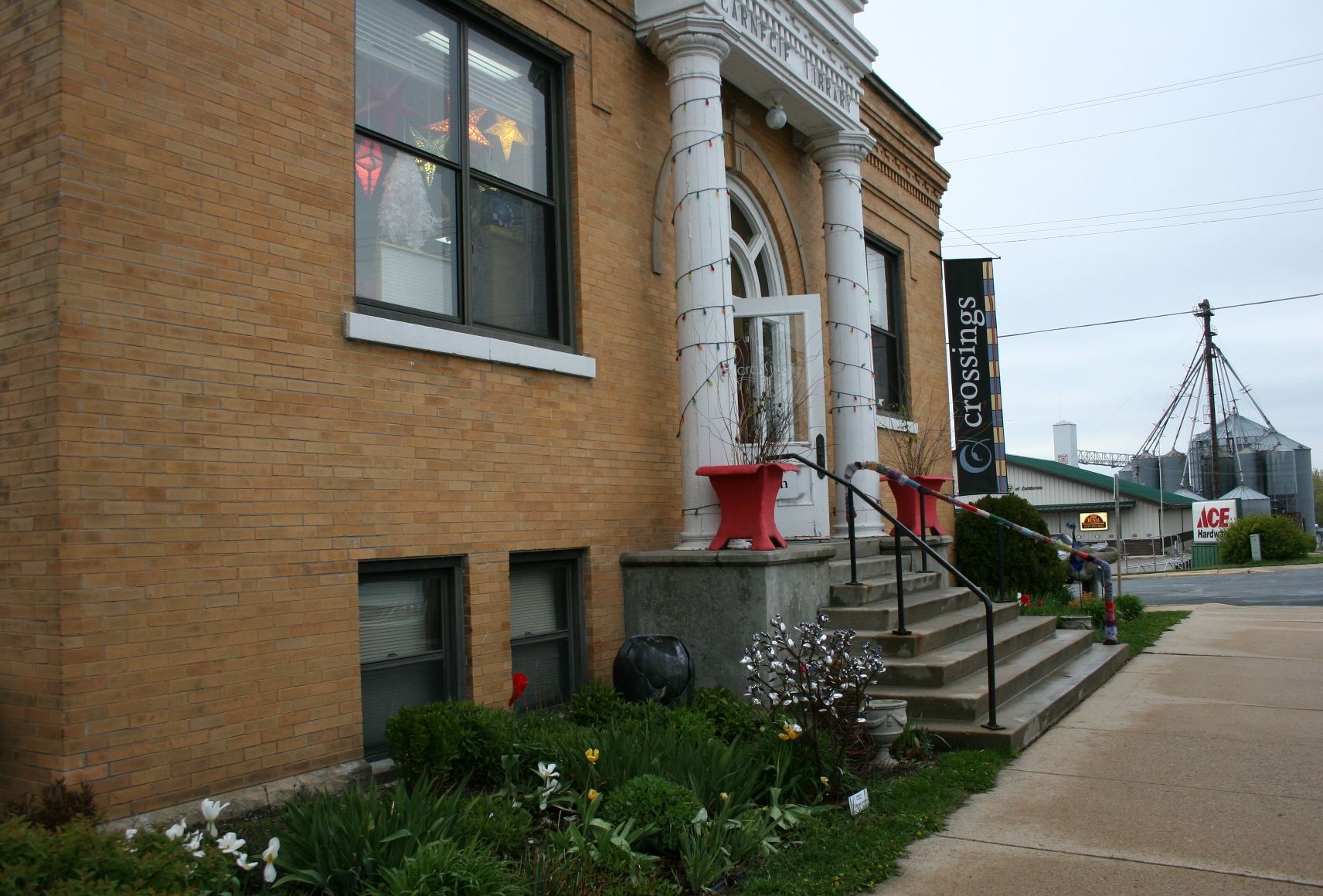
Crossings at Carnegie, housed in a former Carnegie library, is a privately-owned cultural visual and performing arts center in Zumbrota. I love the rural atmosphere with the hardware story and grain elevator just down the street.

Crossings at Carnegie, housed in a former Carnegie library, is a privately-owned cultural visual and performing arts center in Zumbrota. Minnesota Prairie Roots file photo 2012.

If you can’t attend the May 10 reception, you can view the exhibit during gallery hours from 10 a.m. – 5 p.m. Monday, Tuesday, Wednesday and Friday; from 10 a.m. – 8 p.m. Thursday; or from 10 a.m. – 4 p.m. Saturday.

Click here for more details about Poet-Artist Collaboration XIII.

Click here to see how my poem, “Her Treasure,” inspired Connie Ludwig to paint “Pantry Jewels” for the Poet-Artist Collaboration XI in 2012.

© Copyright 2014 Audrey Kletscher Helbling


How the Minnesota prairie ignites my poetry April 2, 2014

WHAT IS IT ABOUT POETRY?

Do you embrace or shun it? Write it or read it? Do you even care?

April marks National Poetry Month, a full thirty days initially established by the Academy of American Poets in 1996 to focus on poetry.

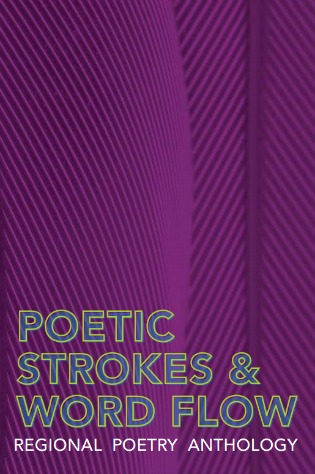
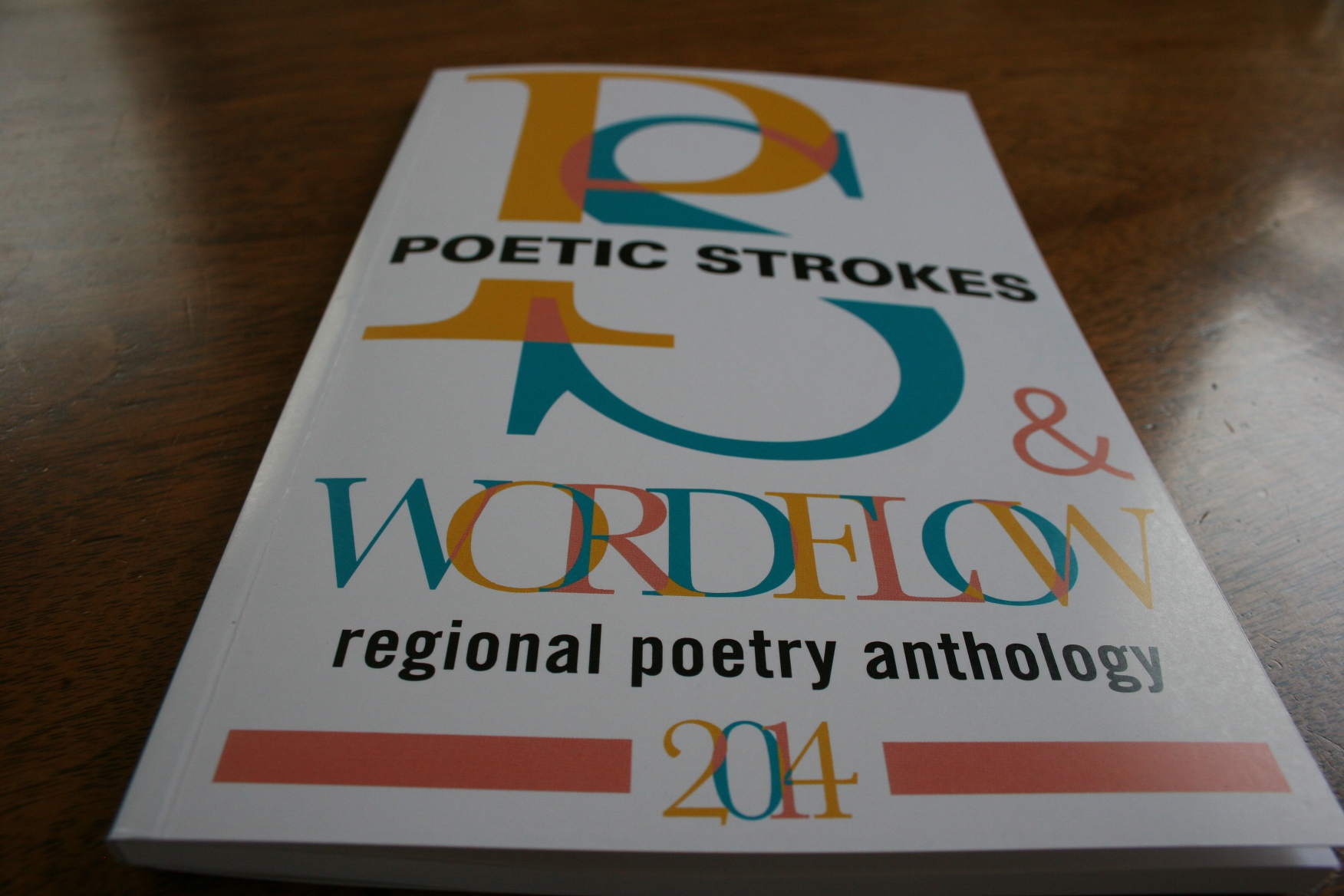
My most recent poem, "The Farmer's Wife, Circa 1960, has been published in Poetic Strokes, an anthology published by Southeastern Libraries Cooperating. My poem was one of 23 selected from 196 submissions. The anthology should soon be available for check-out by library patrons in the SELCO system.

My most recent poem, “The Farmer’s Wife, Circa 1960,” has been printed in Poetic Strokes, an anthology published by Southeastern Libraries Cooperating. My poem was one of 23 selected from 196 submissions. The anthology should soon be available for check-out by library patrons in the SELCO system.

If you haven’t read poetry in years, I’d suggest you revisit poetry. Long gone, mostly, are rhymed verses.

Instead, you will find poets penning free verse that correlates to an abbreviated form of storytelling or a spilling of emotions or a harmony of detailed observations and more.

Despite differences in subject matter and style, poets share a common love of language. Alliterations. Personification. Similes and metaphors. Strong verbs.

Poetry, though it may appear easy to write, is not.

Details matter. Each word matters. The sound of a poem read aloud matters.

A poem I wrote about my mother, published in Poetic Strokes 2014.

A poem I wrote about my mother, just published in Poetic Strokes 2014, A Regional Anthology of Poetry from Southeastern Minnesota.

Every poet possesses a style. I’d define mine as rooted in my native southwestern Minnesota prairie. That stark land shaped me as a writer. My poems convey a strong sense of place, words wheeling like a prairie fire across the landscape of a page.

With so few distractions, the prairie presents an ideal environment to notice details—the grate of the wind, the lean of an outbuilding, the weathered grey of an abandoned farmhouse, the isolation, the calloused hands of a farmer, green corn leaves unfurling against rich black soil, the horizontal grid of township gravel roads, power lines stretching into infinity…

Those who’ve never lived on the prairie often fail to understand its beauty, dismissing it as the middle of nowhere.

But this land holds my heart and memories and continues to inspire me. Not all of my verse. But much of it.

Some of my prairie-inspired poetry includes:

    • “This Barn Remembers,” Lake Region Review #1
    • “Taking Lunch to the Men in the Field,” Lake Region Review #2
    • “Abandoned Barn,” The Talking Stick, Volume 20
    • “Broken,” The Talking Stick, Volume 21
    • “The Farmer’s Song,” The Talking Stick, Volume 22
    • “Prairie Sisters,” Poetic Strokes, Volume 2
    • “Abandoned Farmhouse,” Poetic Strokes, Volume 3
    • “Walking Beans,” Poetic Strokes, Volume 3
    • “A school without a library,” Poetic Strokes, Volume 4
    • “Saturday night baths,” Poetic Strokes, Volume 4
    • “Her Treasure,” 11th annual Poet-Artist Collaboration, Crossings at Carnegie
    • “Lilacs”, 13th annual Poet-Artist Collaboration, Crossings at Carnegie and honorable mention at 18th annual Northwoods Art & Book Festival

And that poetry, my prairie poetry, has graced billboards, walls, recreational signage, galleries, and the pages of magazines, newspapers and anthologies. 

Perhaps it’s time to consider compiling those poems and others into a collection. Thoughts?

© Copyright 2014 Audrey Kletscher Helbling
 

In Paul Bunyan land: Hackensack hosts art and book fest August 16, 2013

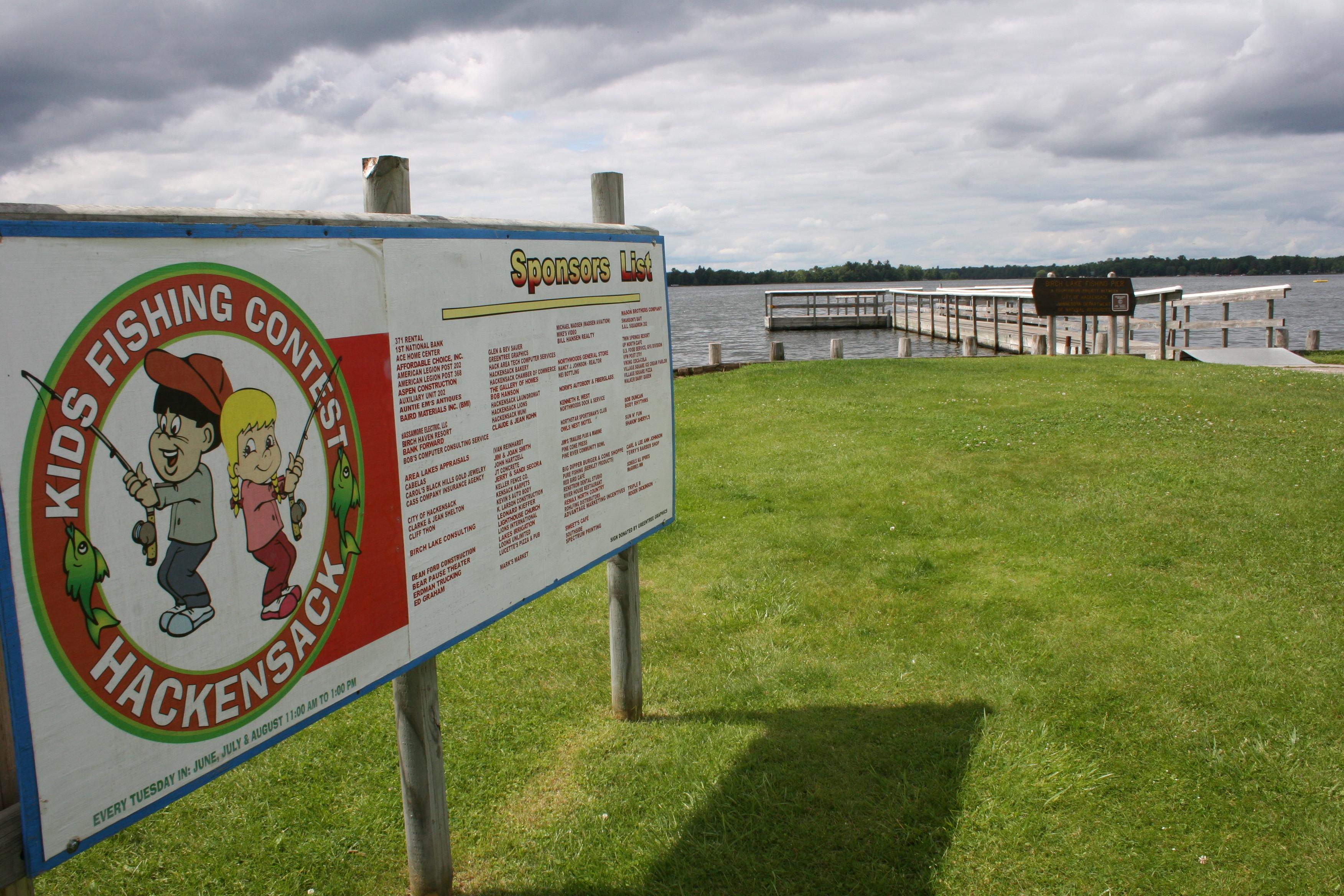
Every Tuesday during the summer months, Hackensack hosts a kids' fishing contest.

Every Tuesday during the summer months, Hackensack hosts a kids’ fishing contest on Birch Lake. Minnesota Prairie Roots file photo.

IT’S A SWEET SMALL TOWN snugged in Minnesota’s northwoods north of Brainerd, half way to Bemidji.

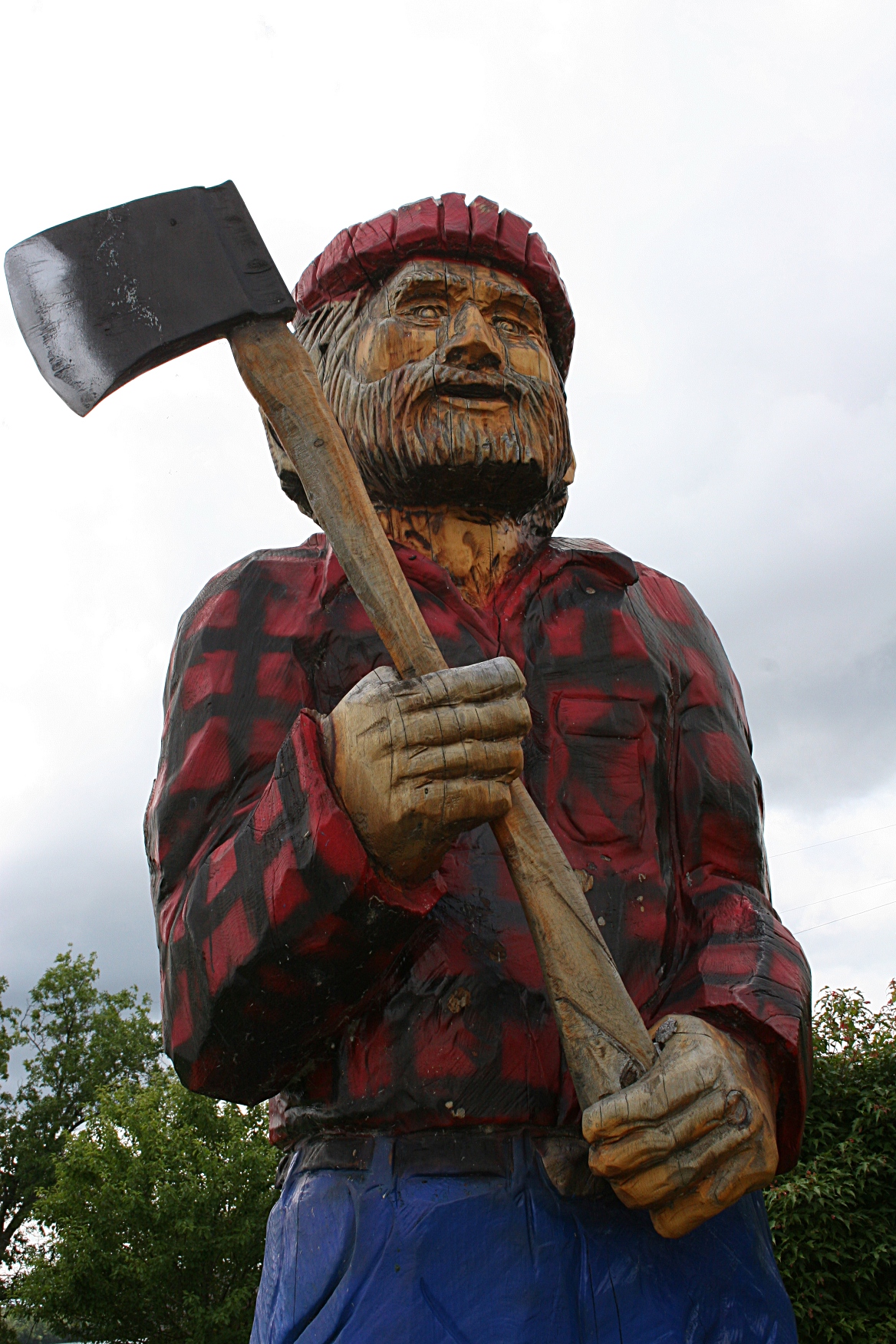
This would be lumberjack Paul Bunyan.

This would be lumberjack Paul Bunyan. Minnesota Prairie Roots file photo.

You’ll find statues of legendary Paul Bunyan here…

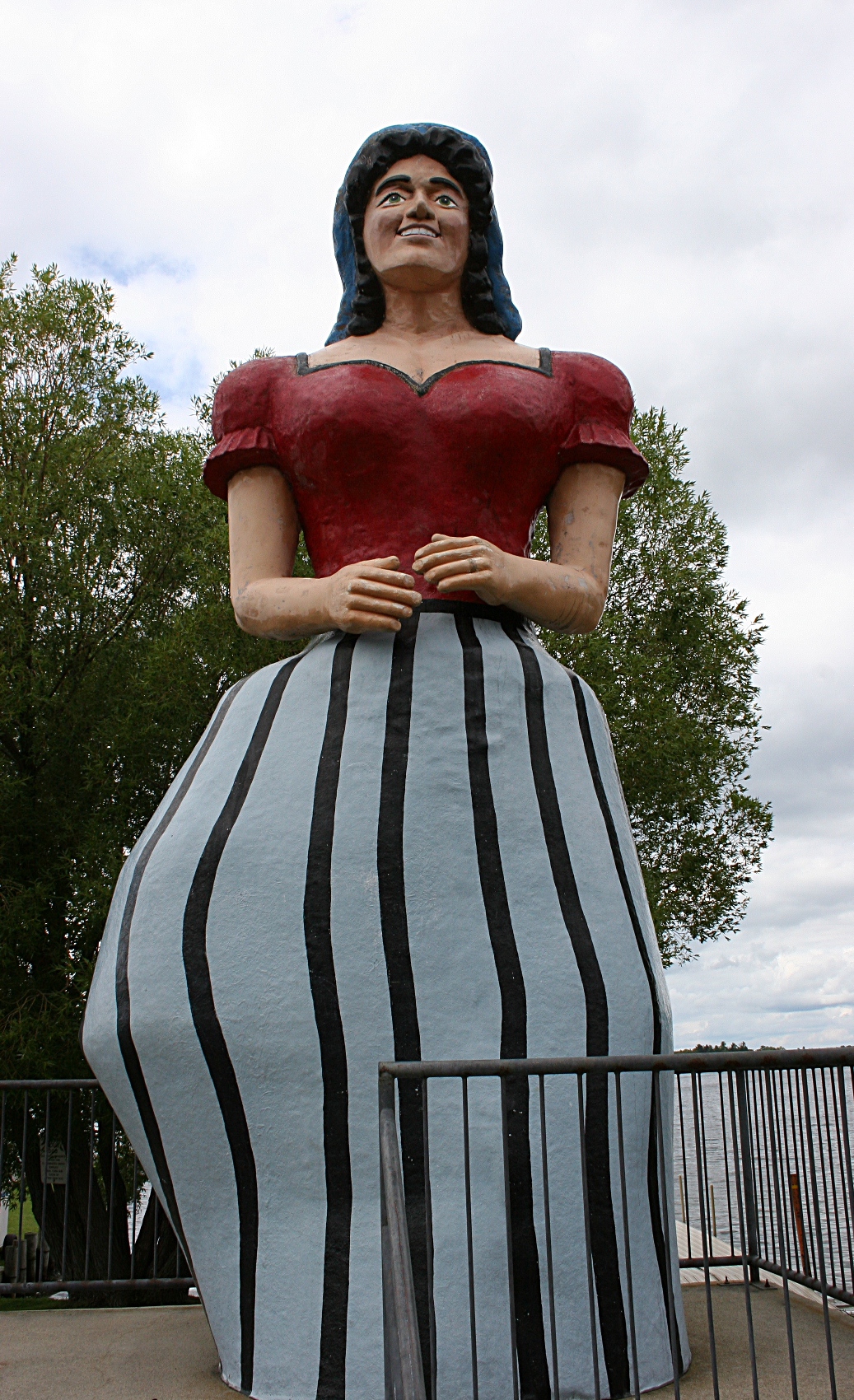
Paul Bunyan's sweetheart, Lucette, stands next to the library along Birch Lake.

Paul Bunyan’s sweetheart, Lucette, stands next to the library along Birch Lake. Minnesota Prairie Roots file photo.

and of his bride, Lucette. She stands near Birch Lake, next to an old log cabin that houses a library run by volunteers.

Several summers ago I photographed this log cabin library in Hackensack.

The Hackensack library. Minnesota Prairie Roots file photo.

It’s no wonder Hackensack, home to not quite 300 permanent and who knows how many seasonal residents, will host its 18th annual Northwoods Art & Book Festival from 9 a.m. – 3 p.m. this Saturday, August 17.

I’ll be there. Sort of.

I’ve submitted two poems to the Sixth Annual Poetry Display/Recognition, as I’ve done for several years.

Fest-goers can peruse the poems inside the Union Congregational Church and vote for their favorites for the six Popular Choice awards. The poetry committee will also select six Works of Merit. Poets will read their poems beginning at 1:30 p.m. with award winners announced afterward. Local newspapers will publish the winning poems.

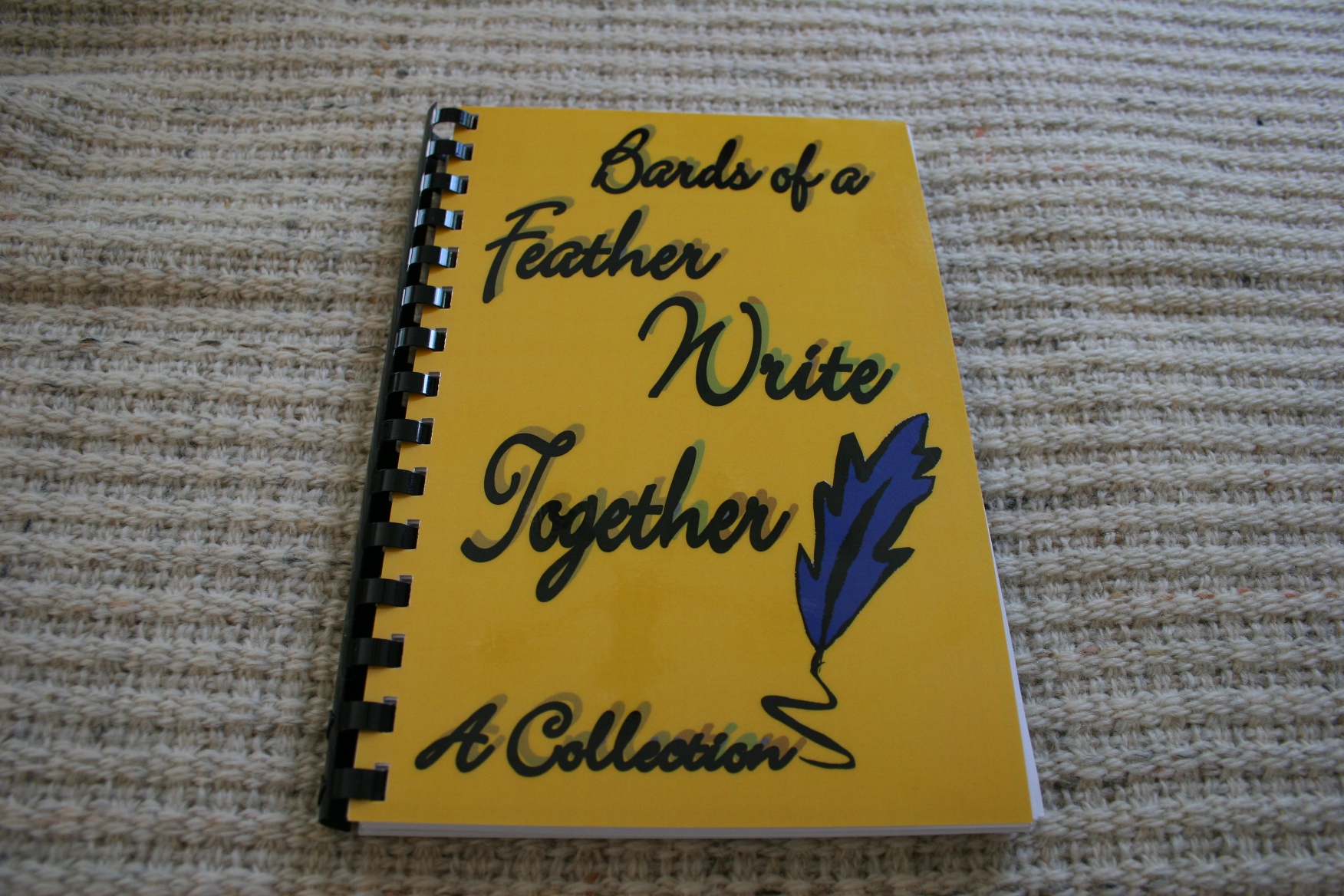
A collection of works by eight Minnesota writers.

A collection of works by eight Minnesota writers.

But there’s more. Twenty-plus Minnesota authors and poets will sign and sell their books throughout the day. Sweet. Any event that promotes Minnesota writers and artists gets my support. Among the literary offerings is Bards of a Feather Write Together—A Collection. It features the poetry, fiction and memoirs, some previously published, of eight Minnesota writers, all members of the writing group Bards of a Feather. I am currently reading this debut anthology and thoroughly enjoying the variety of voices and content therein.

Visual artists will also be part of the Hackensack fest, selling their original artwork. Original and created by the artist. No resale items. Splendid.

No Minnesota festival is complete without food, which you’ll find in the food court.

I wish I could join this celebration of Minnesota writers and artists. But distance and previous commitments won’t allow me to be there. My poems will have to do. For this year.

FYI: For more information, click here to reach the Northwoods Arts Council website. The council is the festival sponsor.

DISCLAIMER: I received a complimentary copy of Bards of a Feather Write Together for review purposes.

Copyright 2013 Audrey Kletscher Helbling
 

Bringing poetry to recreational trail users in Mankato & I’m in June 9, 2013

NOT EVERYONE EMBRACES POETRY. I get that.

But I appreciate how, in recent years, poetry has become more accessible to Minnesotans. Perhaps, in the process, a few non-poetry lovers have learned to like poetry, to appreciate its value as a form of expression, as an art, as a link to the past, and as a connection to each other and the land and emotions.

These new public poetry forms have surfaced on sidewalks, billboards, and in motionpoems, for example.

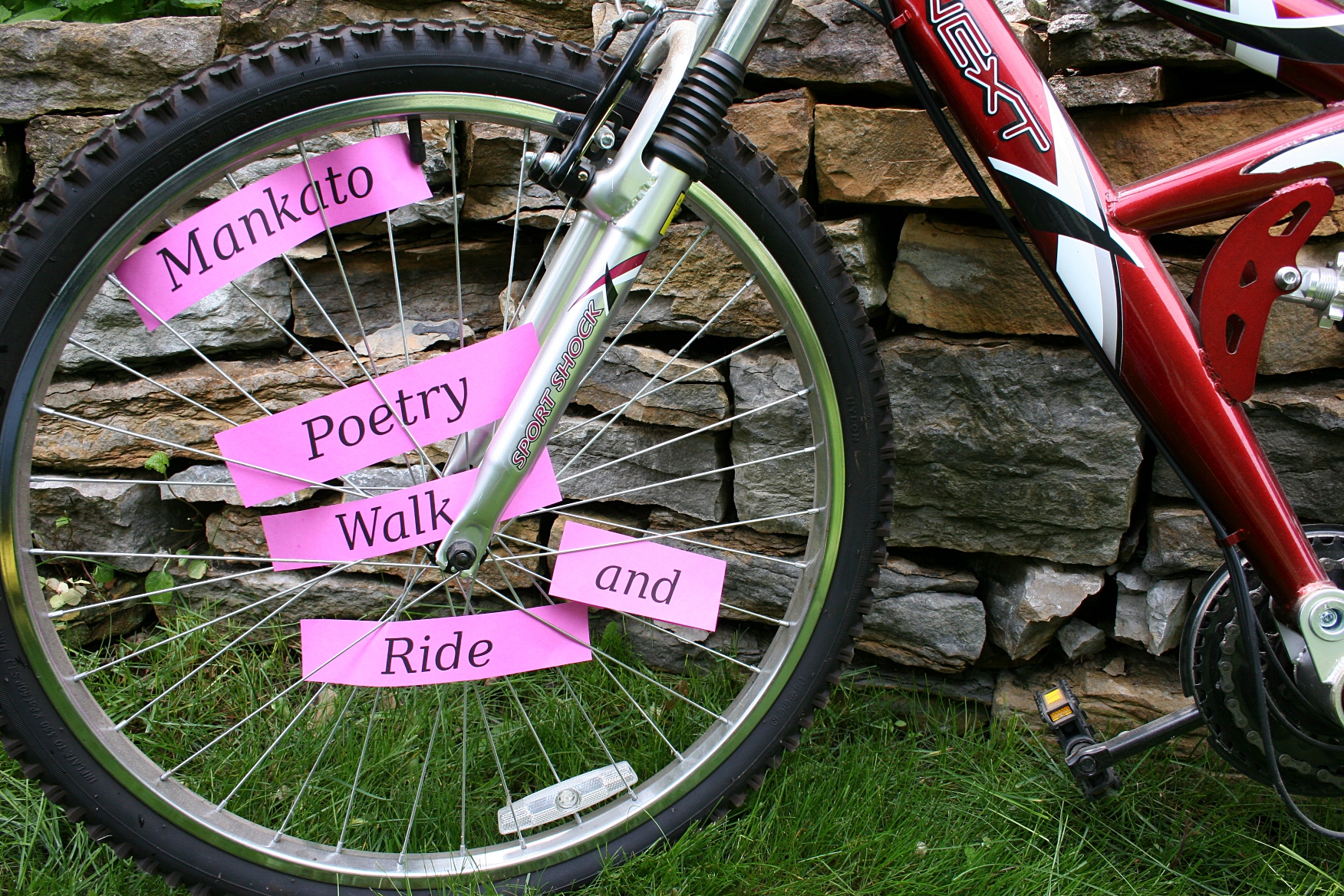
My artsy effort to illustrate this post.

My artsy effort to illustrate this post.

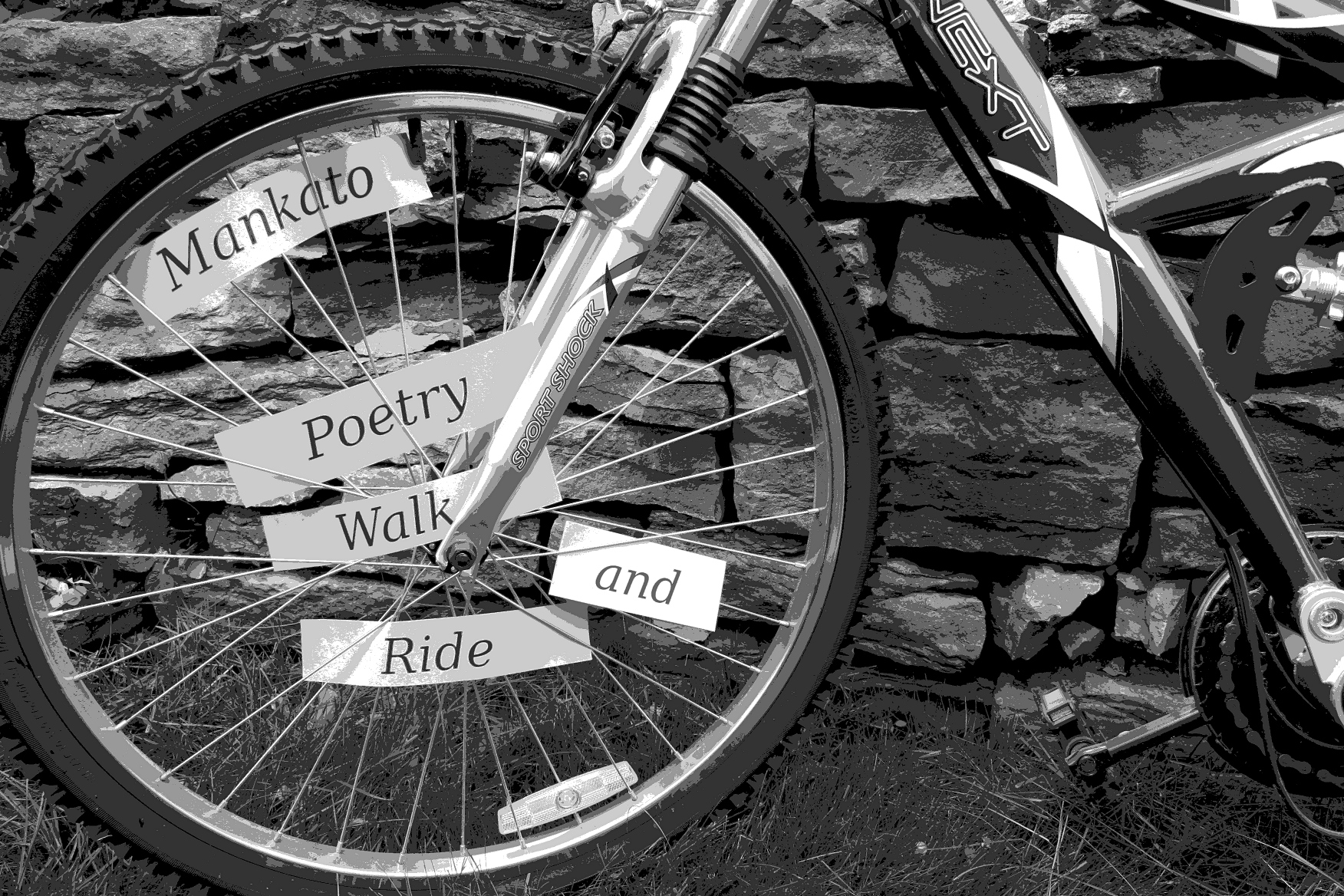
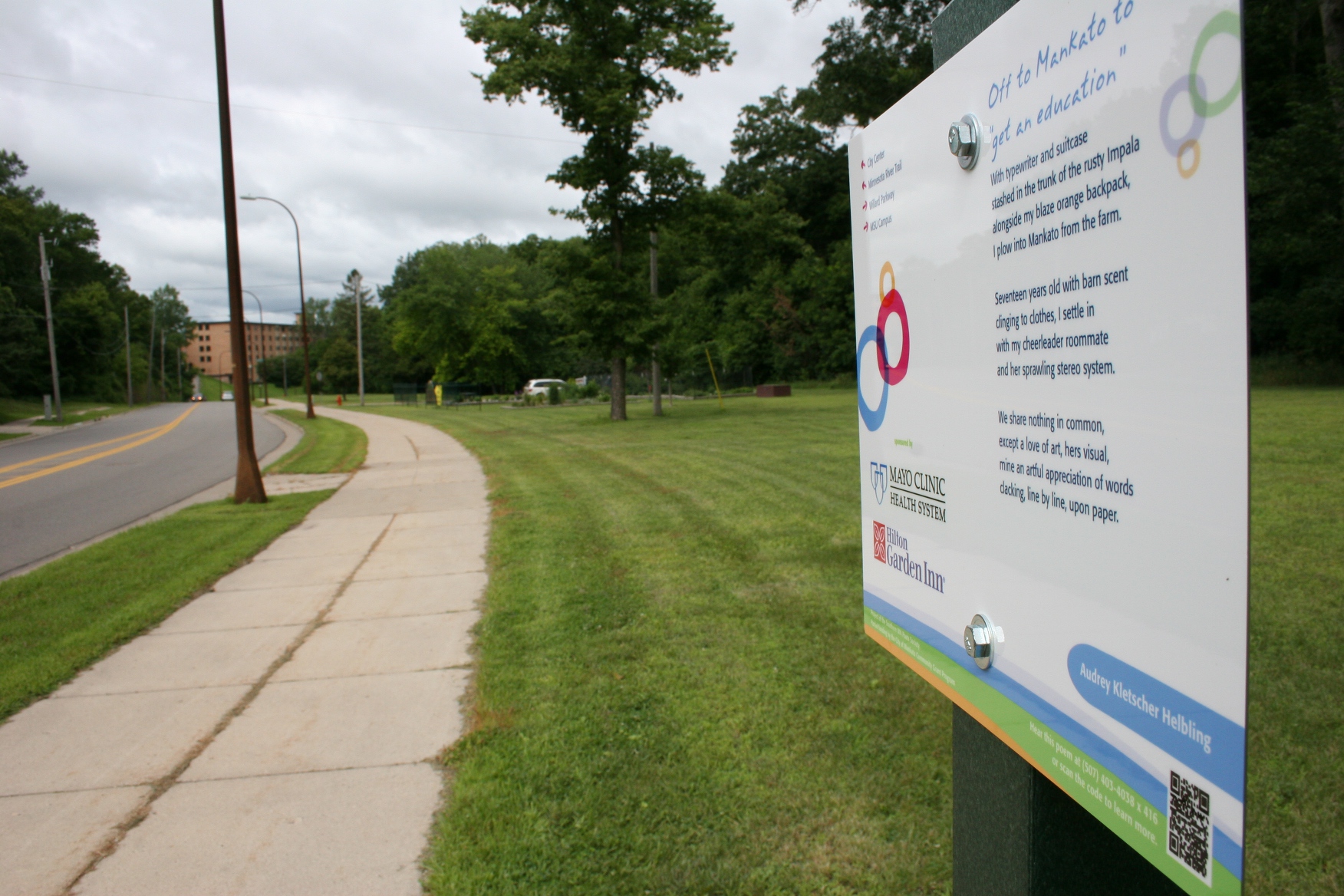
And now, in Mankato and North Mankato, poetry will be posted on signs along biking and walking trails as part of the newly-launched Mankato Poetry Walk and Ride.

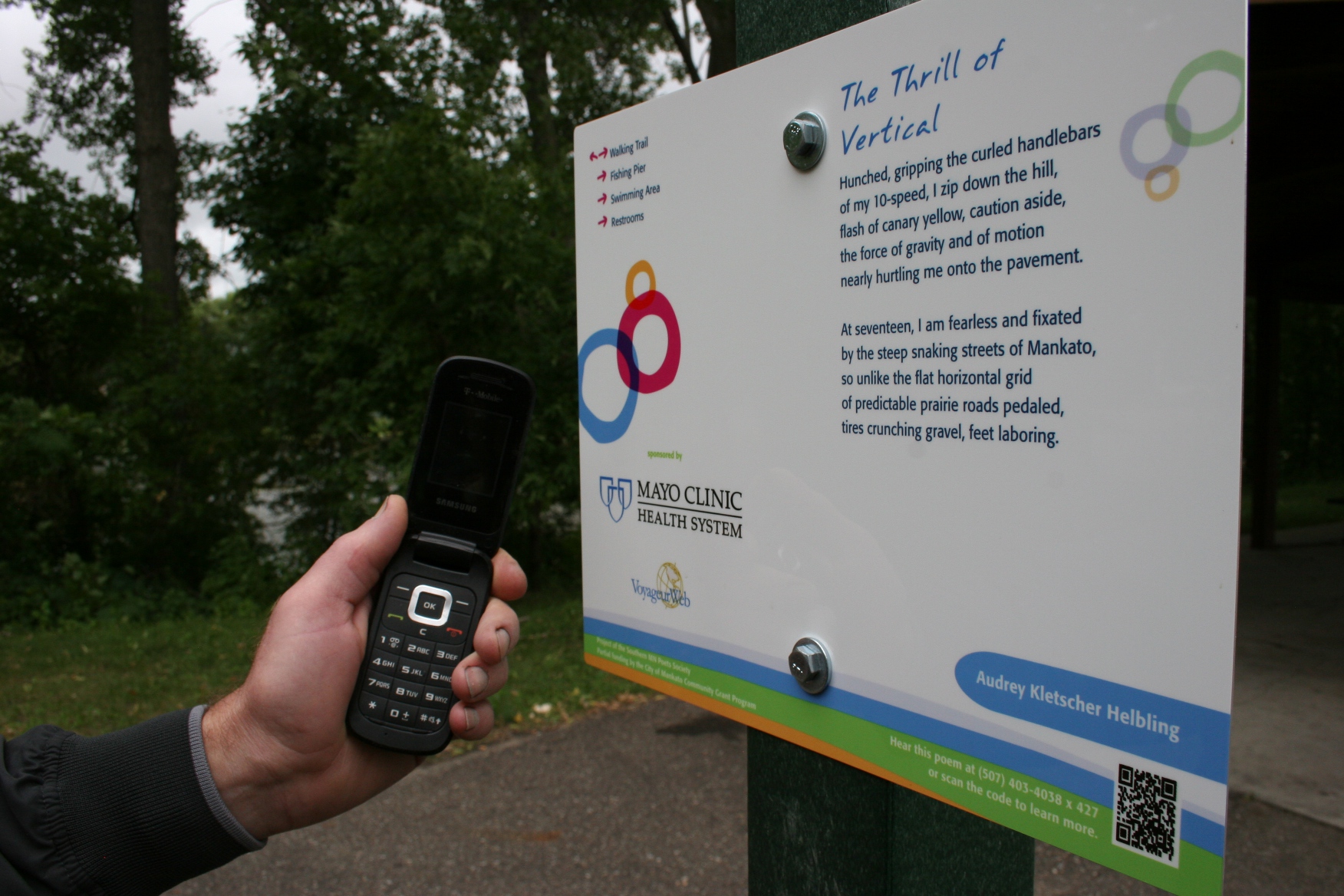
I am delighted to have two of my poems—“Off to Mankato to ‘get an education’” and “The Thrill of Vertical” selected from among more than 120 submissions for this project supported by business and corporate sponsors and the cities of Mankato and North Mankato.

The contest was open to anyone living within a 45-mile radius of Mankato with suggested themes of CityArt sculptures, Mankato history or culture, nature and/or family and relationships. Lines were limited to sixteen with a maximum of forty characters per line. There were serious and humorous divisions for adults and general poems for several youth brackets.

I tapped into my past, my four years attending college in Mankato—Bethany Lutheran and Minnesota State University, Mankato—to write my winning poems:

Off to Mankato to “get an education”

With typewriter and suitcase
stashed in the trunk of the rusty Impala
alongside my blaze orange backpack,
I plow into Mankato from the farm.

Seventeen years old with barn scent
clinging to clothes, I settle in
with my cheerleader roommate
and her sprawling stereo system.

We share nothing in common,
except a love of art, hers visual,
mine an artful appreciation of words
clacking, line by line, upon paper.

Remember, this was the late 70s, dear readers.

You’ll need to visit Mankato to read my second poem, among the 27 selected during anonymous judging by Doris Stengel, past president of the National Federation of State Poetry Societies, and by Peter Stein, League of Minnesota Poets youth chairperson. The poems are expected to be in place by the end of June.

As a bonus, poets are recording their poems so bikers, walkers and others can pause along the trails and hear the poems read via their phones.

Bonus two, the Southern Minnesota Poets Society, which coordinated the contest, is publishing a chapbook of the winning poems.

I don’t have details yet on where my poetry will be located. But, be assured that when the poems are posted, I’ll head to Mankato to check mine out and some of the twenty-five others like “Everything is Sky Tonight,” “The Sounds of the Red Jacket Trail” and “Night Fishing.”

JUNE 11 UPDATE: My poems will be posted at the intersection of Glenwood Avenue and Division Street and at Hiniker Pond Park in Mankato.

© Copyright 2013 Audrey Kletscher Helbling


Presenting poetry: Practice makes perfect December 7, 2012

THAT WELL-KNOWN ADAGE of “practice makes perfect” proved prophetic for me Thursday evening during a poetry reading in Faribault.

An event which I had fretted/worried/stressed about for the past week nearly went off without the proverbial hitch. (I struggled only once, as I read a poem about my son being struck by a hit-and-run driver six years ago.)

Peter Allen presented with me Thursday evening at the Faribault library. I handed my camera to my husband and he tried to get some decent shots shooting available light. This one is the best.. And, no, I am not not sleeping. I'm either contemplating Peter's poem or glancing at my script. Photo by Randy Helbling

Peter Allen presented with me Thursday evening at the Faribault library. I handed my camera to my husband and he tried to get some decent shots shooting in available light. This one is the best. And, no, I am not not sleeping.

Yes, I did it. I stood before an audience and read/discussed poetry along with a co-presenter for 1 ½ hours.

The secret to that success most certainly was practice and, as I emailed my virtual, now real-life, blogger friend Beth Ann, prayer. Beth Ann traveled all the way from Mason City, Iowa, 20 miles south of the Minnesota border, with her husband, Chris, to hear me and Peter Allen present.

Me reading "Prairie Sisters," my first poem of the evening. The poem was published in volume two of Poetic Strokes.

Me reading “Prairie Sisters,” my first poem of the evening. The poem was published in volume two of Poetic Strokes.

About that practice… I’ve been reading my poetry and scripts to my kitchen walls for the past week, rehearsing twice on Thursday and even more on Wednesday. When I phoned my husband, Randy, late Thursday afternoon to remind him of the presentation (he’d asked me to do so), he inquired, “Have you been smoking? Your voice sounds hoarse.”

He was joking, of course, as I don’t smoke and can’t even tolerate cigarette smoke.

I’d been practicing, I told him. Perhaps I’d rehearsed enough if my voice was growing raspy.

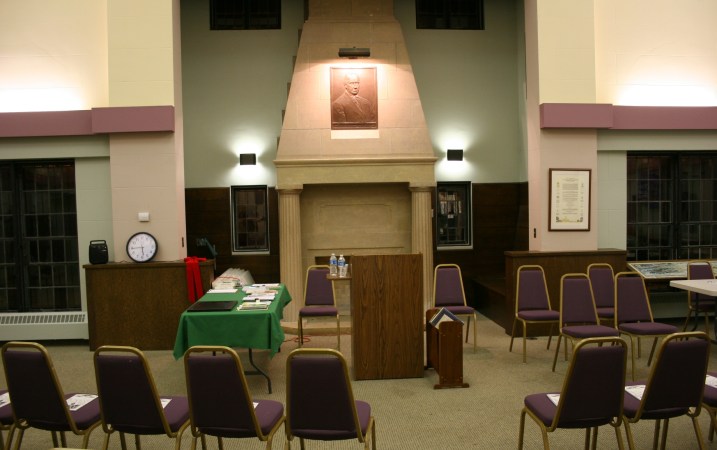
The scene in the Great Hall before the audience arrived. It's a gorgeous venue.

The scene in the Great Hall before the audience arrived. It’s a gorgeous venue. I used a few props and visuals in presenting.

Here’s one of the biggest surprises of all from the evening: Because I felt so confident going into the presentation, I actually, truly, enjoyed myself. Who would have thought? Not me.

Second, the turn-out of 32 audience members floored me and Peter. I expected perhaps a dozen. Buckham Memorial Public Services Librarian Allyn M. McColley, who coordinated the event, shared my enthusiasm for the high audience attendance. And, honestly, I did not personally invite a single person, although I did post about the event here last week.

I am grateful that so many ventured out of their warm homes on a cold December evening to embrace poetry. Such interest warms this poet’s heart. I could hear that interest in the laughter, in the questions, in the comments.

It also warms my heart that my two dear friends, Billie Jo and Tammy, both the mothers of young children, would choose to hear me read poetry on their girls’ night out.

And then to think that blogger Beth Ann, whom I’d never met prior to Thursday evening, drove more than an hour with her husband from northern Iowa to listen to me and Peter present simply touches me. (Beth Ann blogged this morning about our meeting and the poetry presentation, so be sure to click here and read her engaging piece.)

Finally, my dear husband, Randy, who helped me tote a van full of props and books and food to the library and then assisted with props and hand-outs, took me out to dinner afterward. We dined at a lovely Italian restaurant, Augusto’s Ristorante, several blocks from the library. It was the perfect way to end a fabulous evening.

FYI: Click here to link to photos posted on the Buckham Memorial Library website.

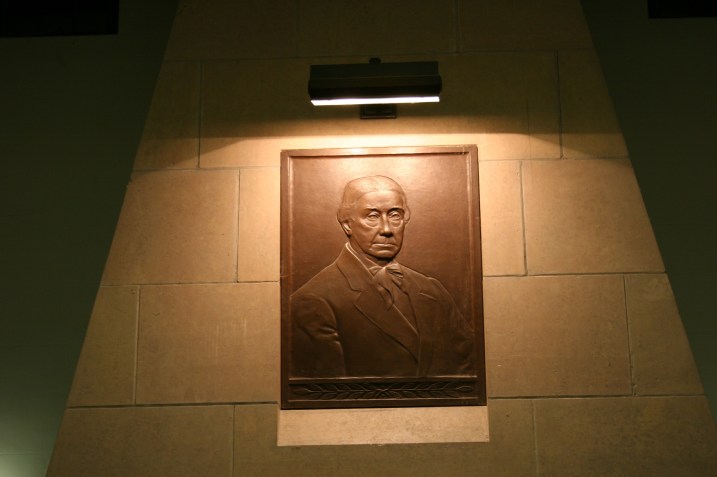
I believe this is a bust of Judge Thomas Scott Buckham, after whom the library is named. His wife, Anna, gifted the city of Faribault with this Art Nouveau/Greek Revival style building constructed in 1929-1930. The bust is located above the fireplace in the Great Hall, right behind where Peter and I presented.

I believe this is a bust of Judge Thomas Scott Buckham, after whom the library is named. His wife, Anna, gifted the city of Faribault with this Art Nouveau/Greek Revival style building. The bust of this pioneer settler is located above the fireplace in the Great Hall, right behind where Peter and I presented.

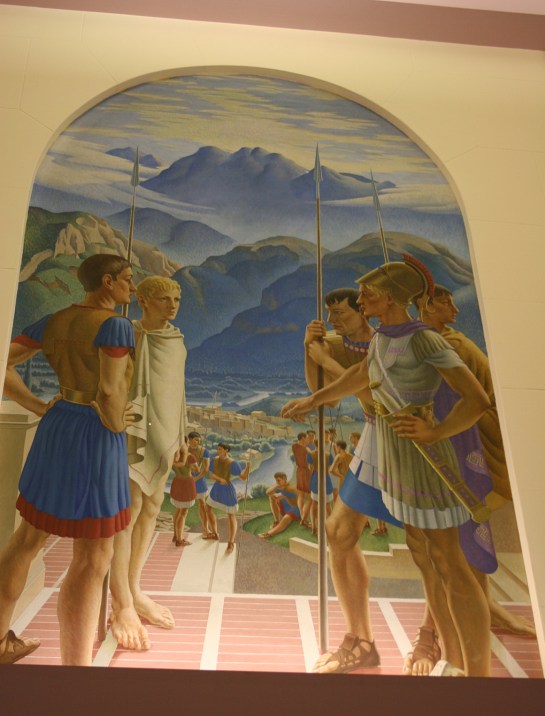
One of several Greek murals gracing the Great Hall.

One of several Greek murals gracing the Great Hall.

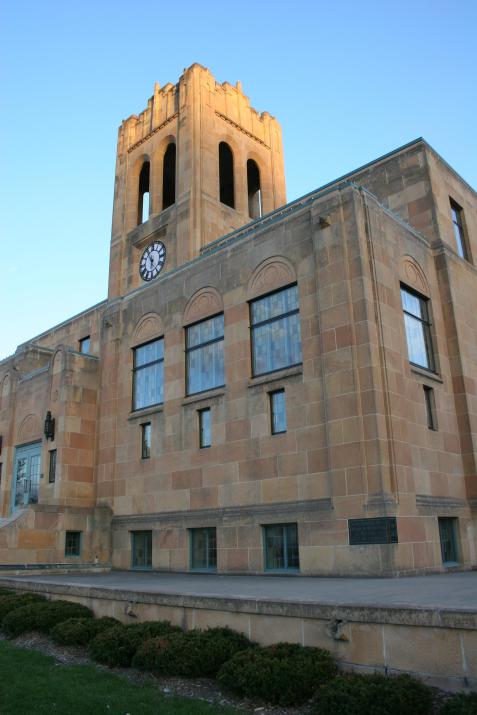
Buckham Memorial Library, Faribault, was built in 1929 with a Greek theme. Interior features include a Charles Connick stained glass window and Greek murals.

Buckham Memorial Library, Faribault, was built in 1929-1930 with a Greek theme. Interior features include a Charles Connick stained glass window and Greek murals. Minnesota Prairie Roots file photo.

© Copyright 2012 Audrey Kletscher Helbling
 

Poets, photographers & penny pinchers connect in Zumbrota October 21, 2012

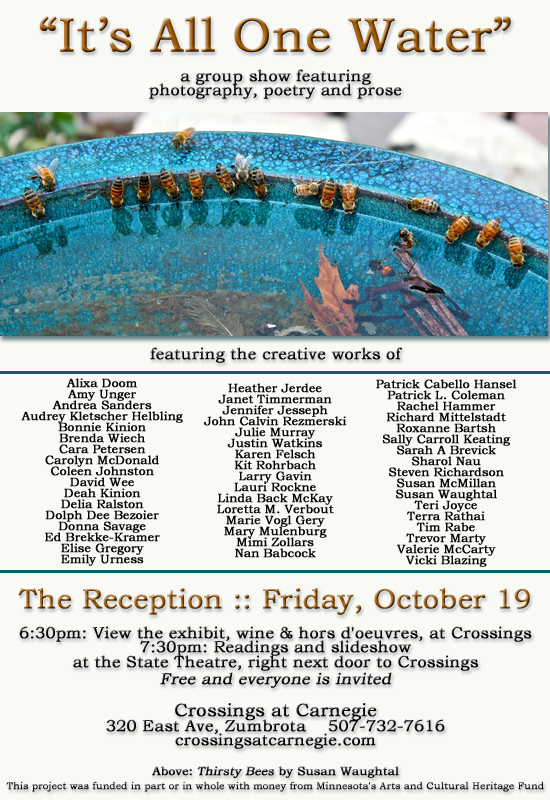
FRIDAY EVENING I SUCCESSFULLY read a poem about water before an audience of other poets and photographers and guests in an historic Zumbrota, Minnesota, theatre as part of the “It’s All One Water” exhibit.

I tell you this because I prefer to quietly write and read poetry (to myself) as opposed to standing before an ocean of seats in a darkened theatre with my lips pressed close to a microphone. But practice, practice, practice made all the difference in my feeling fairly confident and comfortable this go around.

(Yes, I’ve read in the State Theatre previously and you can read about that poet-artist collaboration by clicking here.)

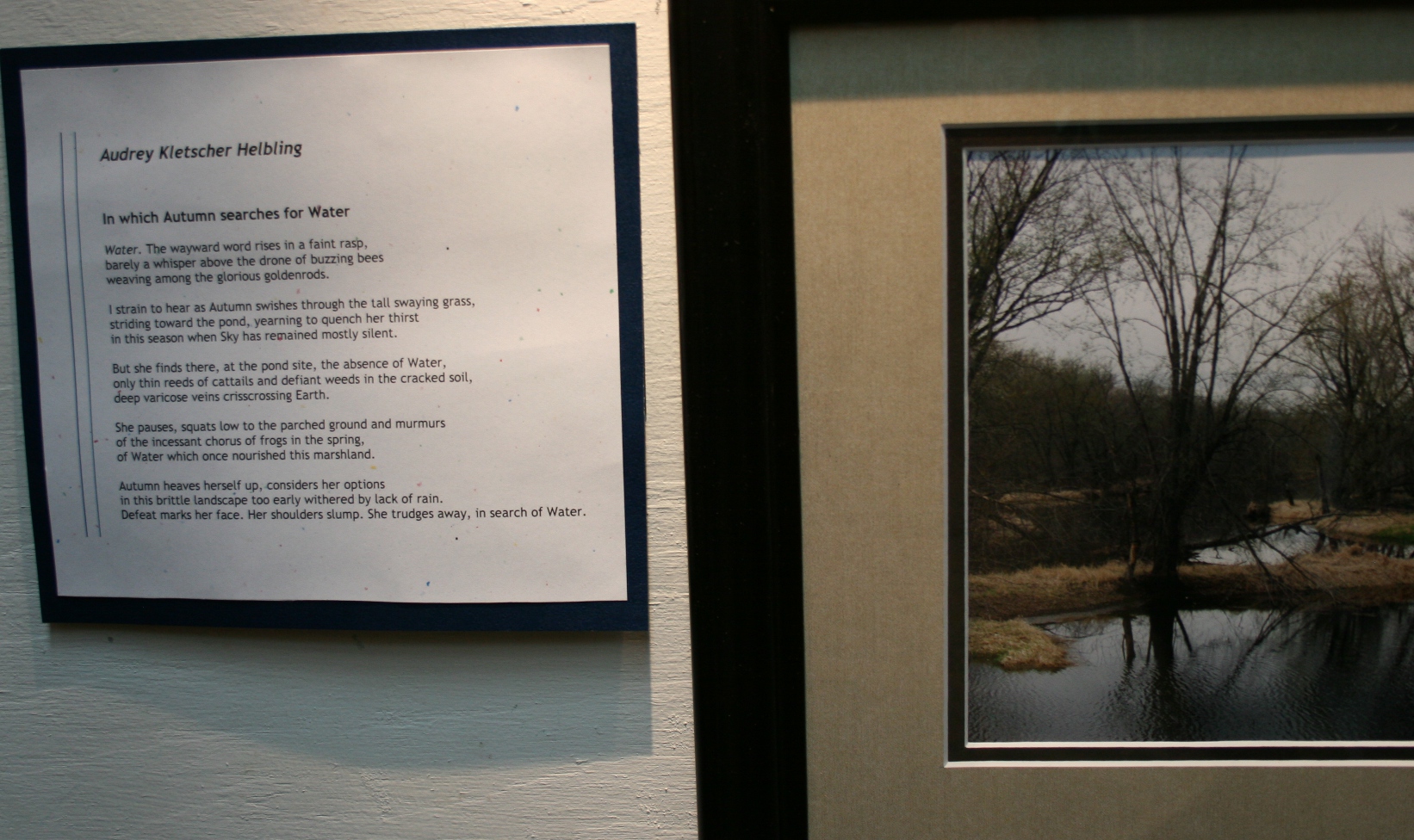
My poem,  left, was one of 28 selected and hung in a juried writing competition. Photos themed to water were also part of the “It’s All One Water” show which continues through the end of October at Crossings at Carnegie, 320 East Avenue, Zumbrota.

You’ll just have to imagine me reading my poem:

In which Autumn searches for Water

Water. The wayward word rises in a faint rasp,
barely a whisper above the drone of buzzing bees
weaving among the glorious goldenrods.

I strain to hear as Autumn swishes through the tall swaying grass,
striding toward the pond, yearning to quench her thirst
in this season when Sky has remained mostly silent.

But she finds there, at the pond site, the absence of Water,
only thin reeds of cattails and defiant weeds in the cracked soil,
deep varicose veins crisscrossing Earth.

She pauses, squats low to the parched ground and murmurs
of the incessant chorus of frogs in the spring,
of Water which once nourished this marshland.

Autumn heaves herself up, considers her options
in this brittle landscape too early withered by lack of rain.
Defeat marks her face. Her shoulders slump. She trudges away, in search of Water.

The “It’s All One Water” event included so much more than reading and listening to poetry and viewing photos on the subject of water. It was about mingling with other writers and artists, about connecting, or reconnecting.

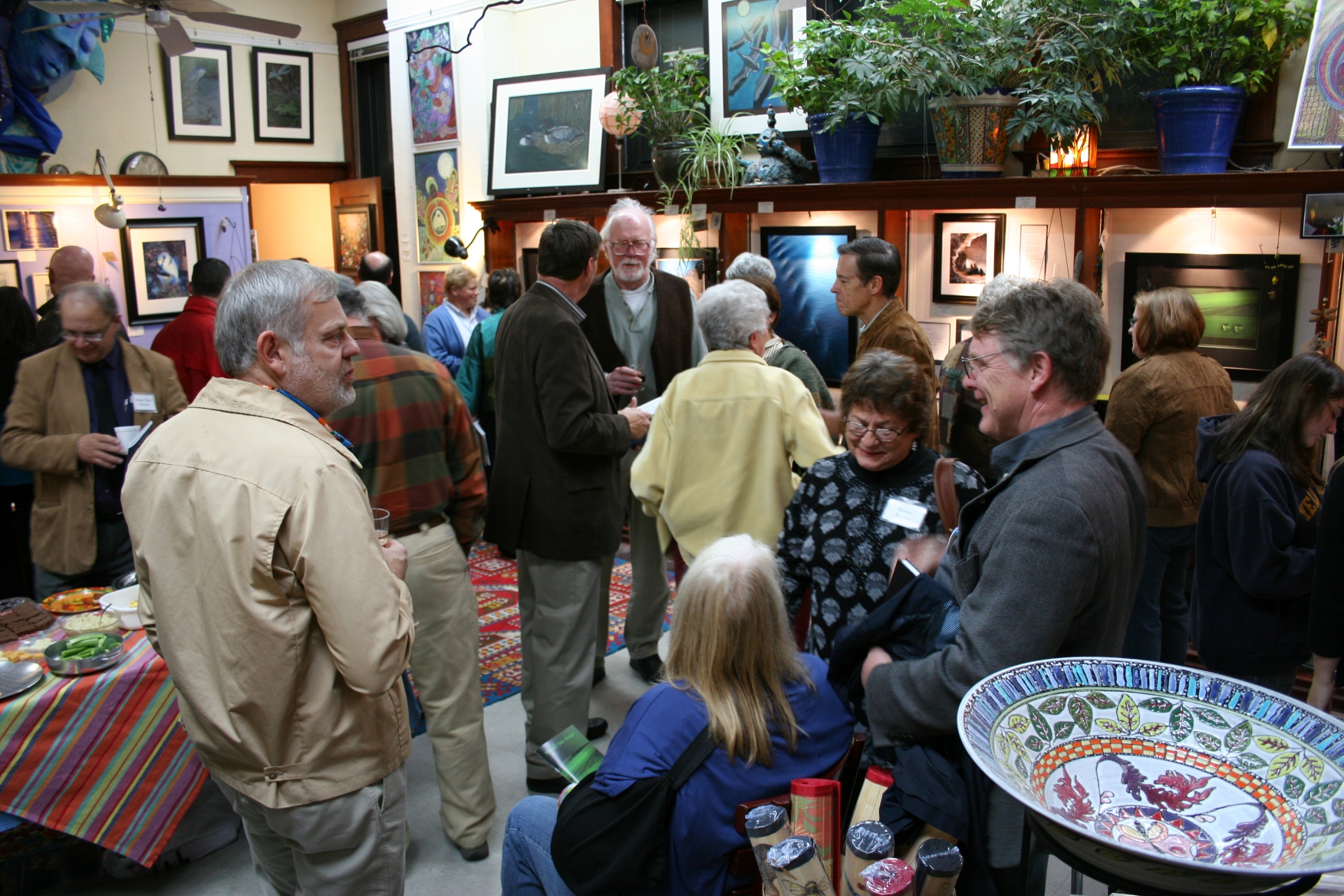
Poets, photographers and others mingle over wine and snacks at Crossings prior to the readings a block away at the State Theatre.

I chatted briefly with poet Patrick L. Colemen of Minneapolis, whom I met at Crossings at Carnegie, (the arts venue supporting the show) last spring, and caught up with him on the mystery book he is writing.

I talked with John Calvin Rezmerski of Mankato, a poet who is eons ahead of me, having published several books of poetry and having taught writing at the college level. I met him last year at a poetry-photography show/reading in Mankato. More connecting there and encouragement from other poets.

That is, I have found, the true benefit of attending events like the Friday evening reception and reading in Zumbrota. Connecting. Encouragement for me personally in my writing.

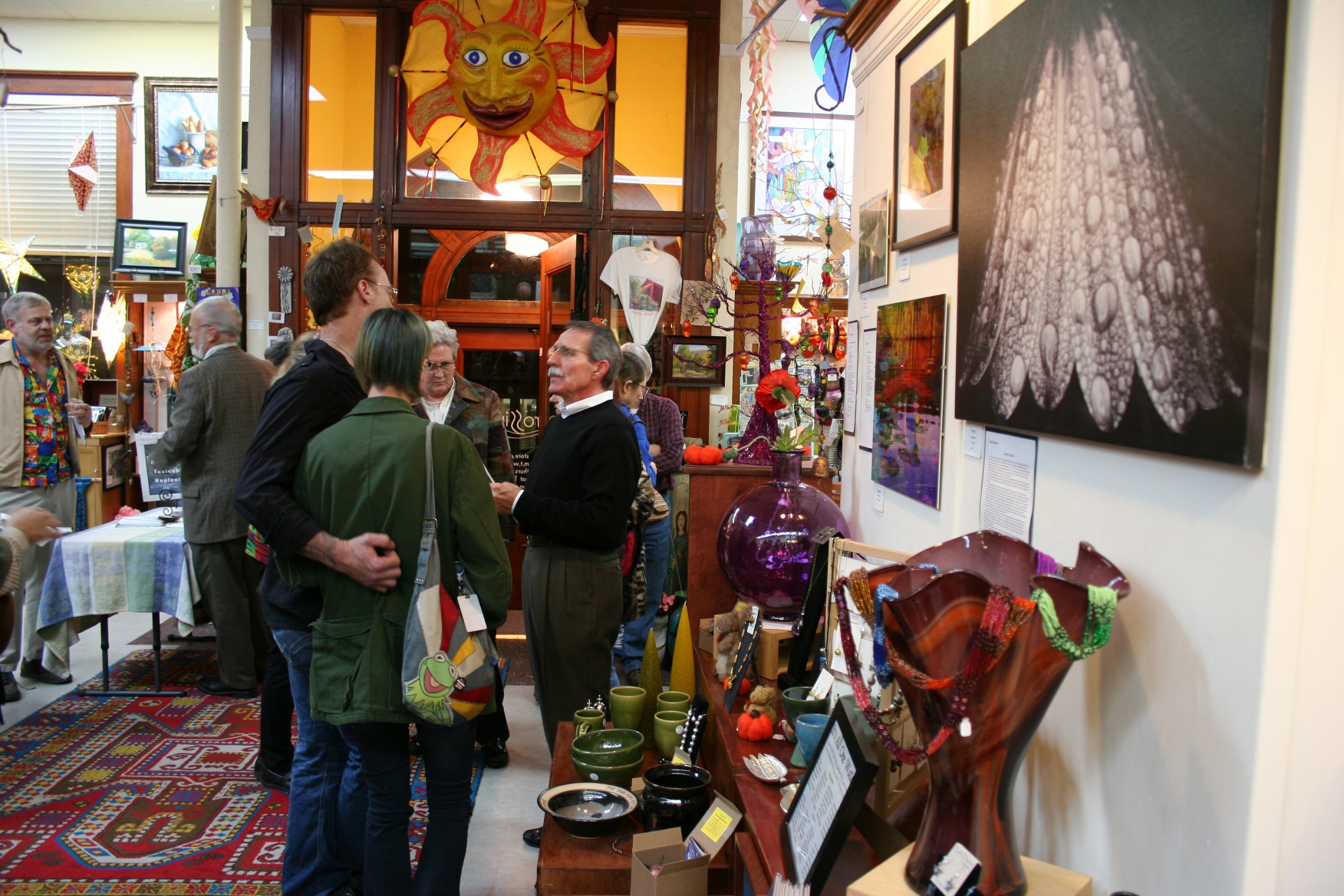
More mingling at Crossings, this time after the poetry readings. To the right is the photo “Tiffany” by Tim Rabe of Rochester. All of the “It’s All One Water” photos are for sale.

Among all the unfamiliar faces was the familiar face of Peter Allen, a gifted Faribault poet who lives several blocks away and a street over from me. Peter and I will be presenting on poetry at Buckham Memorial Library in Faribault in early December. Peter gave me two thumbs up for my poetry reading Friday evening.

I don’t know how Faribault High School English teacher Larry Gavin (he’s taught all three of my children) would have graded my reading. But he was in Zumbrota, too, on Friday evening reading his two poems. He, like Rezmerski, has published several volumes of poetry and reads with the confidence of a seasoned poet who truly has mastered the craft of entertaining an audience.

Likewise Susan Waughtal of Oronoco entertained the audience with her “Farm Water Cycle” poem which resonated with me, a former farm girl. Afterward I chatted with Susan and her husband. They are, she says midlife crisis farmers (farming since 2008) who live and farm on a 10-acre sustainable farmstead, raising chickens (and more), tending bees, operating community supported agriculture, and supporting music and the arts… Susan recently quit her off-farm job to work full-time on the farm.

When Susan told me about the old granary converted into an antique/thrift/arts shop on Squash Blossom Farm and how much she thrills in thrifting, I connected even more for I, too, am a thrifter.

Poets and photographers and penny pinchers. Wonderful company to keep on a Friday evening in October.

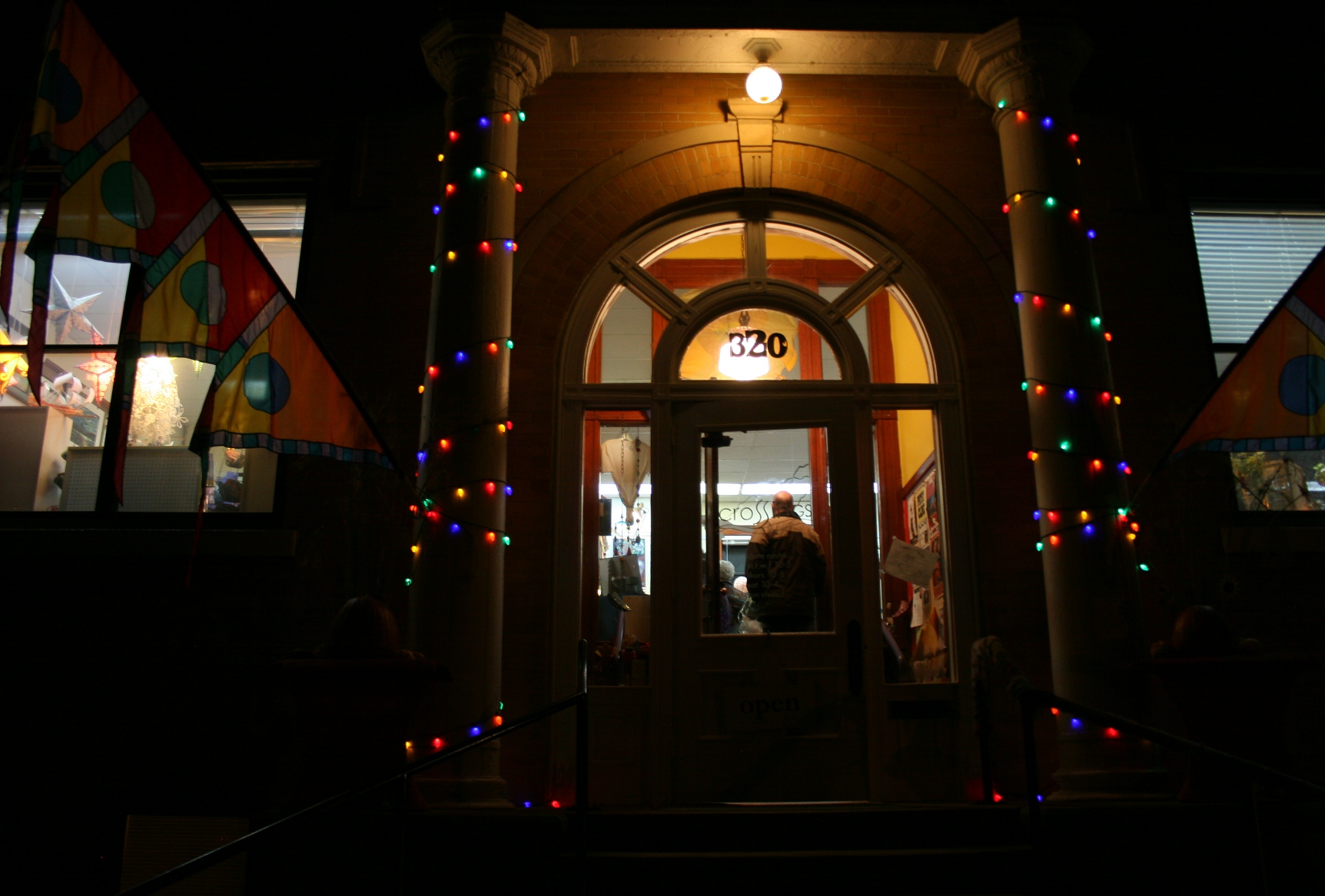
The festive exterior of Crossings at Carnegie, a privately-owned art center housed in a former Carnegie library.

FYI: For more information about Crossings at Carnegie, which collaborated with the Zumbro Watershed Partnership on “It’s All One Water,” click here.

© Copyright 2012 Audrey Kletscher Helbling
 

Zumbrota exhibit explores water during this year of extreme drought October 19, 2012

I LOVE THE ARTS.

And I expect part of that passion comes from the lack of arts in my life when I was growing up on the southwestern Minnesota prairie. Back in the 1960s and 1970s, out there in “the middle of nowhere,” as some would say, life focused more on survival than anything.

By survival I mean my father earning enough money to support his wife and six children on a modest crop and dairy farm.

So much depended on the weather, on the rain or lack thereof. Enough rain meant a bountiful crop to feed the cattle and/or sell grain on the market. Too little rain meant scrimping on feed and less money to pay the bills, buy the groceries, clothe the family.

But let’s circle back to my original statement about loving the arts and connect that to water.

Recently I entered, and successfully competed in, an “It’s All One Water” poetry competition sponsored by the Zumbro Watershed Partnership and Crossings at Carnegie, a privately-owned art center in Zumbrota.

This evening a public reception will be held at Crossings, 320 East Avenue, beginning at 6:30 p.m. It is an opportunity to view works by 56 writers and photographers who “explored the aspects of water which fascinate them and created their own artistic expression of this most basic foundation for life,” according to promo info for the event.

At 7:30 p.m., writers, photographers and guests will move down the block to the historic Zumbrota State Theatre where writers will read their works while the water-themed photographs are projected onto a screen.

I will read my “In which Autumn searches for Water.”

My poetic expression about water traces back to my farm roots, to that constant and undeniable link between the land and the sky.

That connection is so much a part of my fiber that I cannot think about water in recreational terms—I can’t swim, don’t like being on the water and grew up in a Minnesota county without a natural lake. Rather, for me, water has always been about sustaining life, about growing a crop, about watering the cows or watering plants or measuring rainfall.

So when I learned of the “It’s All One Water” poetry competition shortly after an autumn walk at the River Bend Nature Center in Faribault, where I found dry ponds, I knew exactly what I would write. I personified Autumn, creating a thirsty woman in search of an also personified Water. It works and I think well, especially given the current historic drought conditions throughout our country.

About a third of Minnesota is suffering from extreme drought. On Thursday the Minnesota Department of Natural Resources issued a news release urging Minnesotans to adopt water conservation measures (no washing vehicles, watering lawns and trees, etc.) as drought conditions are straining our state’s water resources.

Here’s a snippet of my drought-related water poem, verse three of five:

But she finds there, at the pond site, the absence of Water,
only thin reeds of cattails and defiant weeds in the cracked soil,
deep varicose veins crisscrossing Earth.

You can hear me read “In which Autumn searches for Water” this evening or view the entire exhibit from now until the end of October at Crossings. Hours are 10 a.m. – 5 p.m. Monday, Tuesday, Wednesday and Friday; 10 a.m. – 8 p.m. Thursdays; or from 10 a.m. – 4 p.m. Saturdays. A limited number of chapbooks are available. Monies from Minnesota’s Arts & Cultural Heritage Fund helped to fund the “It’s All One Water” exhibit.

CLICK HERE to reach the Crossings at Carnegie website.

CLICK HERE to link to the Zumbro Watershed Partnership website.

CLICK HERE TO VIEW drought conditions in the U.S.


Roses & poetry September 29, 2012

Birthday roses from my husband, Randy.

WHAT WOMAN DOESN’T love roses and poetry?

After work on Wednesday, my 56th birthday, my dear husband brought me a dozen wrapped long-stem roses. Then he disappeared, tools and parts in hand, down the basement stairs to the laundry room to repair my clothes dryer which no longer was producing heat. Roses from the repairman. Perfect.

Simultaneously, I was upstairs in my office checking my email while my birthday supper, homemade lasagna, finished baking.

Crossings at Carnegie, housed in a former Carnegie library, is a privately-owned cultural visual and performing arts center in Zumbrota. Minnesota Prairie Roots file photo.

Waiting in my in-box was this message from Crossings at Carnegie, a privately-owned arts center in Zumbrota:

Thank you for submitting poetry/prose to be considered for Crossings’ “It’s All One Water” exhibit. We received about 110 poems, from which jurors chose 28. It was exciting to receive such a fine outpouring of exceptional work from so many talented writers. Jurists told us they were a pleasure to read, and selecting those to be included was a difficult task.

We are pleased to inform you that your entry, “In which Autumn searches for Water,” was chosen to be part of this exhibit. Your poem will be on display, along with other written works and photographs, through the month of October.

How sweet is that? Another dozen roses, figuratively speaking.

I’ll admit that when I submitted “In which Autumn searches for Water,” I was confident my poem would be selected for Crossings’ joint collaboration with the Zumbro Watershed Partnership. I don’t mean that in an arrogant, haughty way. But I think those of us who write realize when we’ve written a piece that sings.

Not that I’m going to sing. You would not want to hear me sing. But I will read my water-themed poem during the Friday, October 19, “It’s All One Water” reception which begins at 7 p.m. A reading of written pieces, with screen projection of water-themed photos, will start at 7:30 p.m. next door to Crossings at the Zumbrota State Theatre.

A chapbook of selected photos and writing (maybe my poem?) also will be published.

There you have it, roses and poetry. Perfect.

#

ANOTHER FARIBAULT RESIDENT, Larry Gavin, a writer who teaches English at Faribault High School (he’s taught all three of my kids), is also among the “It’s All One Water” selected poets. Larry, however, is eons ahead of me in poetry. He’s already published three poetry collections. Like me, though, he also was published on Roadside Poetry project billboards (now ending after a run of 22 seasonal poems). You can learn more about this gifted Faribault poet in a post I published nearly a year ago by clicking here.

© Copyright 2012 Audrey Kletscher Helbling
 

The Beat: “In Minnesota, poetry matters” September 27, 2012

WHY DID IT TAKE ME until recently to determine that poetry is meant to be read aloud, preferably by the poet, and not just silently to one’s self?

I came to that realization in April after reading my poem, “Her Treasure,” to an audience gathered in an historic Zumbrota theater for Crossings at Carnegie’s “Poet-Artist Collaboration XI.”

That poetry-inspired art celebration proved pivotal for me, prompting a personal recognition that poetry is as much performance art as it is an intimate experience.

The Beat logo

And now the independent, nonprofit Northern Community Radio, with studios in Grand Rapids and Bemidji, Minnesota, recognizing the importance of poetry read aloud, is bringing poetry to the public via The Beat, broadcasting a poem a day by a poet with a Minnesota connection.

The Beat, according to NCR’s website is “Northern Community Radio’s daily reminder that, in Minnesota, poetry matters, and Minnesota poets are proving that every day.”

I proved that on September 17 with the reading of my poem, “Her Treasure.” Because traveling hundreds of miles up north from southern Minnesota was neither practical nor cost effective for me, The Beat producer Steve Downing, himself a published poet, read my poem. You can listen to Downing’s fine rendition of “Her Treasure” by clicking here.

Minnesota’s 2011 Poet Laureate, Joyce Sutphen of Chaska.

Since early July, an assortment of about three dozen poets—from the well-known John Berryman, James Wright, Joyce Sutphen, Louis Jenkins, Will Weaver and Sean Hill—to the complete unknowns have been featured on The Beat.

Poet Sean Hill recently moved from Bemidji to Alaska where he is teaching creative writing at a university in Fairbanks. Milkweed Editons will publish his second collection of poetry in 2014.

The show airs weekdays between 7:30 – 8 a.m. and then again between 3:30 – 4 p.m. on 91.7 FM in north-central and northeastern Minnesota, 90.5 FM in north-central and northwestern Minnesota and on 89.9 FM in the Brainerd area. With 150,000 listeners under the NCR signal, coverage extends from Grygla on the north to Pierz on the south to Fertile on the west and Hermantown on the east.

And for those outside the coverage area, like me, The Beat can be heard via audio streaming from kaxe.org or via the KAXE online archives.

“Reaction from poets and listeners, including folks who thought they hated poetry, has been unconditionally affirmative, making us think this was a success story waiting to happen,” says producer/poet Downing, also a former high school English teacher, published essayist, arts administrator and lifelong musician.

Steve Downing, poet and producer of The Beat

He and two others—NCR’s program director, who interviews writers for her long-standing RealGoodWords show, and a design-artist NCR staffer who is also a poet and has taught English at the college level—have been evaluating the hundreds of poetry submissions coming in from across the state.

“We didn’t know what to expect, but no one thought we’d be swamped, which we are,” Downing says. “It’s a nice problem to have but a problem nevertheless.”

The three-person jury meets every Friday to look at/listen to submissions. “The jury looks for creative work that, first, sparks a positive ‘gut’ response; that demonstrates originality; that makes smart word choices; and that’s provocative, in the best sense of the word,” Downing explains.

He advises submitting poets to avoid the topics of partisan politics, religion and lost love and to remember that the Federal Communications Commission is listening.

The range of topics is “all over the place,” Downing says, although some poems are somewhat “Minnesota-centric,” covering subjects like family farms, old barns, and the state’s flora, fauna and weather.

Broadcasting these poems on its community-based public radio stations helps fulfill NCR’s overall mission “to build community in northern Minnesota by way of radio programming, cultural events and interactive media.”

The Beat is currently funded by a one-year $30,000 allocation from the Minnesota Arts & Cultural Heritage Fund.

The history of The Beat, however, stretches back several years to The Beat Cafe, a live-on-air pledge drive program which, among other Beat content, featured Downing reading his poems, with live bass and percussion accompaniment. The success of that first show prompted discussion on how to make this happen again. So come spring 2013, The Beat Cafe fundraiser will be back with live-on-air poetry and music.

Says Downing: “Think berets, dark glasses, shawls, candles in wine bottles…”

Between now and then, though, Downing will continue to air selected poetry by Minnesota poets, known and unknown, and will apply again for state funding to continue the popular poetry program, The Beat.

#

FYI: If you’re a Minnesota poet and would like your writing considered for The Beat, email text or, preferably, audio versions (e.g. MP3) of your poetry to Downing at this address: sdowning@kaxe.org

A poem should take three minutes or less to read.

Once accepted for The Beat, poets have recorded their poems at KAXE in Grand Rapids, KBXE in Bemidji and at KFAI in Minneapolis or on their own devices. NCR also offers the option of Downing or others reading a selected poem if the poet cannot record his/her work.

I contacted Downing about writing this post after my poem was selected by the jury for airing on The Beat.

© Copyright 2012 Audrey Kletscher Helbling
Artwork and photos courtesy of Northern Community Radio


A Minnesota arts collage, from theater to poetry September 15, 2012

FOR A FEW SECONDS THERE, I searched the dictionary of my brain for that word which temporarily eluded me. Collage. That would be it.

Remember when that art form was especially popular, when, as a school assignment, you had to scrounge up ten zillion magazines and then snip out images themed to a specific subject and glue it all in a jumbled mess onto a piece of paper?

Today I present a collage—not a jumbled mess, though—of art.

Let’s take the biggest focal piece first. A Hudson.

A Hudson, like this one I photographed several years ago at a Faribault car show, centers “The Car.” Do not expect, though, to see a real Hudson on stage, only the shape of one.

The Hudson centers the stage at the Paradise Center for the Arts during a production of The Car by Carol Wright Krause. My husband and I saw this play by the Faribault-based The Paradise Community Theatre Friday evening. I’d rate it as one of the best I’ve ever seen performed locally.

Here’s a summary of the play written by director Gabe Talamantes:

The Car is about a family’s car, which as Ed (a character in the five-person drama) puts it “is a miracle of modern American engineering.” This miracle car is a character in itself, a highly theatricalized version of a 1954 Hudson. It takes us on a journey into the lives of the Banners and the challenges an all American family faces as they struggle through two decades of change at home and abroad. We will see how they choose to overcome such difficulties.

Now, why am I so enthusiastic about The Car? Because it moved me to tears. When a theatrical performance can evoke such a strong emotional reaction from me, I will embrace it with unbridled enthusiasm.

That break-down moment for me came near the end of the play, when Vietnam War veteran Hal Banner (played by Todd Ginter), broke down in the arms of his father, Ed Banner (Chuck Larsen). He was no hero, Hal said, pointedly telling his father that he (Ed) would never understand the horrors of war. And then Hal got specific, talking about seeing the eyes of those he killed.

That’s when the tears trickled down by cheeks and I struggled mightily to keep from sobbing. In that moment, I heard my Korean War veteran father, not Hal/Todd. My dad, too, spoke of seeing the eyes of those he killed on the front lines in Korea.

Later, when I congratulated Todd on his performance, he told me that he had talked to several veterans in preparation for his role. And it was the eyes which they spoke of and which he knew he needed to emphasize in that heartrending father-son conversation. It is easily the most powerful moment in the play.

I wondered how many audience members might be veterans and at that moment suppressing war memories and feelings, as my father did.

But this play is about so much more than war. It also addresses the issue of prejudice when Hal brings home a Japanese wife, portrayed by Carrie Jendza whose mother came here from Korea some 40 years ago. Carrie presents a stunning performance as do Susan Dunhaupt as Ed’s wife, Geneva, and Faribault High School sophomore Emily Remmey as Beth Banner, Hal and Sumiko’s daughter.

The prejudice starts right away when Ed Banner insists on calling Sumiko the Americanized “Sue.” He slides in references to “slant eyes” (there’s the “eye” thing again) and other derogatory comments.

In real-life, prejudice is an issue in Faribault, home to many Latino, Somali and Sudanese family. It is no secret that prejudice exists in my community. You can read about it in a previous post by clicking here.

I didn’t spot a single minority in the audience Friday evening,  not unusual despite Faribault’s sizable minority population.

There, that’s all I’m telling you about The Car, other than to advise you to see this powerful and memorable production. It’s community theater at its best for the superb acting and the unforgettable messages delivered.

Faribault artist Vivian Jones created this watercolor, “It Was Grandma’s Car,” for the current “car pARTS” show.

Additional performances of The Car at the Paradise, 321 Central Avenue, Faribault, are set for 7:30 p.m. on September 15, 20, 21 and 22 and at 2 p.m. September 16. Call (507) 332-7372 or click here to reach the Paradise website. According to info published in the theater program, production of The Car is made possible through a Minnesota State Arts Board Operating Support Grant.

While you’re at the play, be sure to check out the exhibit, “car pARTS,” in the Carlander Family Gallery.

The Beat logo.

NOW LET’S PLACE another piece in that art collage. On-air poetry.

In July, Northern Community Radio began airing poetry on its weekday morning show during a segment called The Beat.

On Monday my poem, “Her Treasure,” will air on 91.7 KAXE (89.9/Brainerd) and on 90.5 KBXE. Now I won’t be able to listen to whomever reads my poem between 7:30 a.m. – 8 a.m. and again between 3:30 p.m. – 4 p.m. Faribault is well outside the coverage area which extends from Thief River Falls to Hermantown to Pierz. Eventually, though, I’ll be able to listen to the reading of my poem online.

You can listen to The Beat via online streaming. (I’m not smart enough to figure that out and my former in-house techie now lives at NDSU in Fargo.)

I’m in the company of some mighty fine poets, from novices to Minnesota’s 2011 poet laureate, Joyce Sutphen, to well-known Minnesota writer Will Weaver. You can check out the current listing of The Beat poems/poets by clicking here.

The poems chosen for airing were selected through a juried process.

Connie Ludwig, right, and I pose for a photo with her watercolor, “Pantry Jewels” (above my head) inspired by my poem, “Her Treasure.” This photo was taken in April at Crossings at Carnegie in Zumbrota.

Just, FYI, “Her Treasure” is the same poem featured in “Poetry Artist Collaboration XI” at Crossings at Carnegie in Zumbrota last April. To read my poem, click here.

I love this whole concept of The Beat, of Northern Community Radio’s “daily reminder that, in Minnesota, poetry matters, and Minnesota poets prove that every day.”

You can expect a forthcoming detailed post from me on this project funded by Minnesota’s Arts & Cultural Heritage monies.

The cover of last year’s The Talking Stick 20.

NEXT, LET’S PLACE the third piece in this arts collage. More poetry, plus fiction and creative nonfiction.

Today I’m missing out on a book release party for The Talking Stick 21 in the Park Rapids area. This anthology, published by The Jackpine Writers Bloc, represents some fine writing by Minnesota writers. You can, referencing back to The Beat, listen to the poetry of Sharon Harris, a Jackpine member and one of the key producers of the collection.

I’ve been published in two previous volumes of The Talking Stick (including receiving an honorable mention for my poem, “Hit-and-Run,” in volume 19) and will be published again in this newest volume. My poem, “Broken,” was chosen from among 275 submissions for publication.

To learn more about The Talking Stick, click here. To learn more about The Jackpine Writers’ Bloc, click here.

THAT’S IT. Now, go ahead, add your own pieces to this art collage via your comments.

© Copyright 2012 Audrey Kletscher Helbling