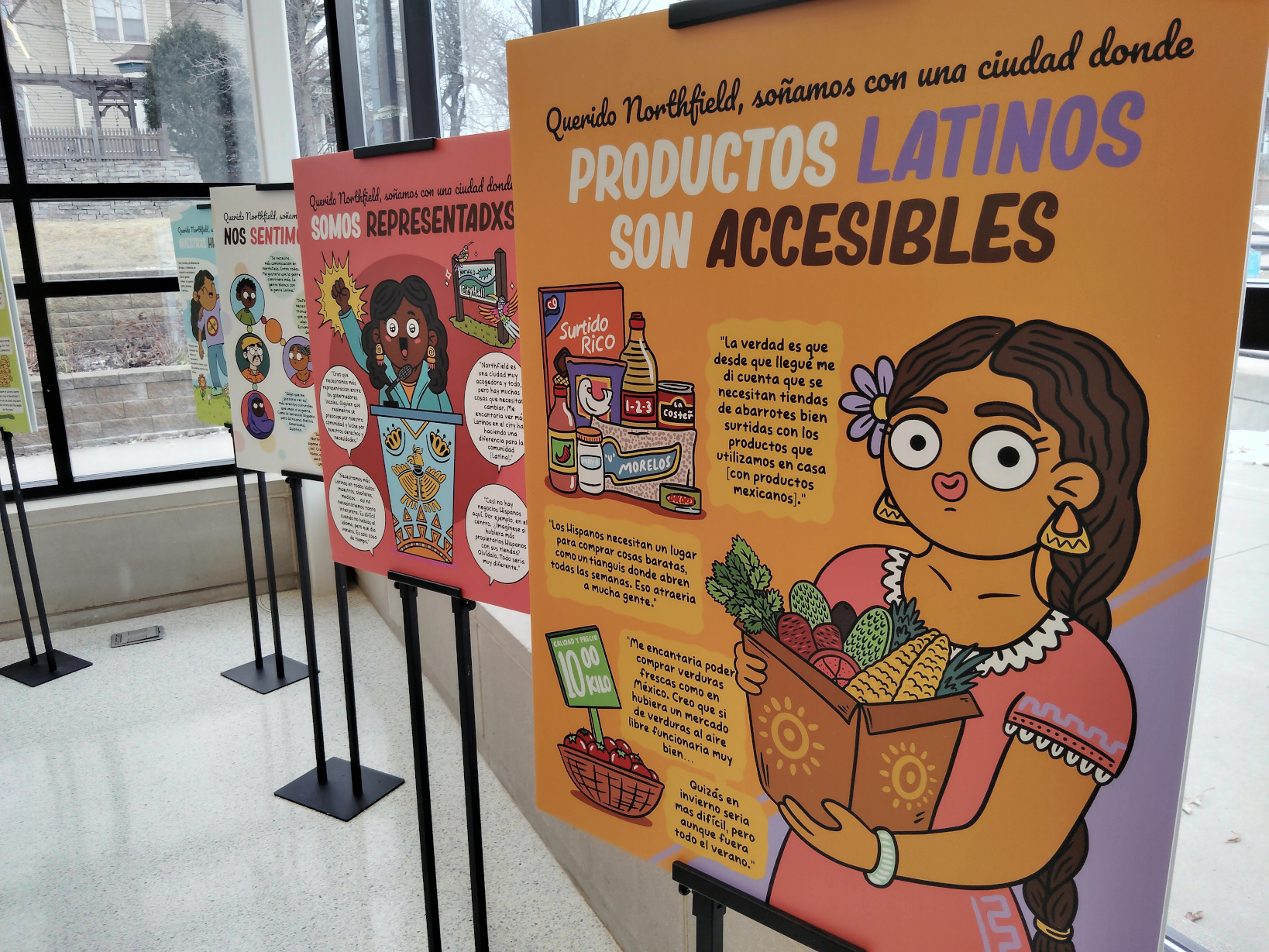
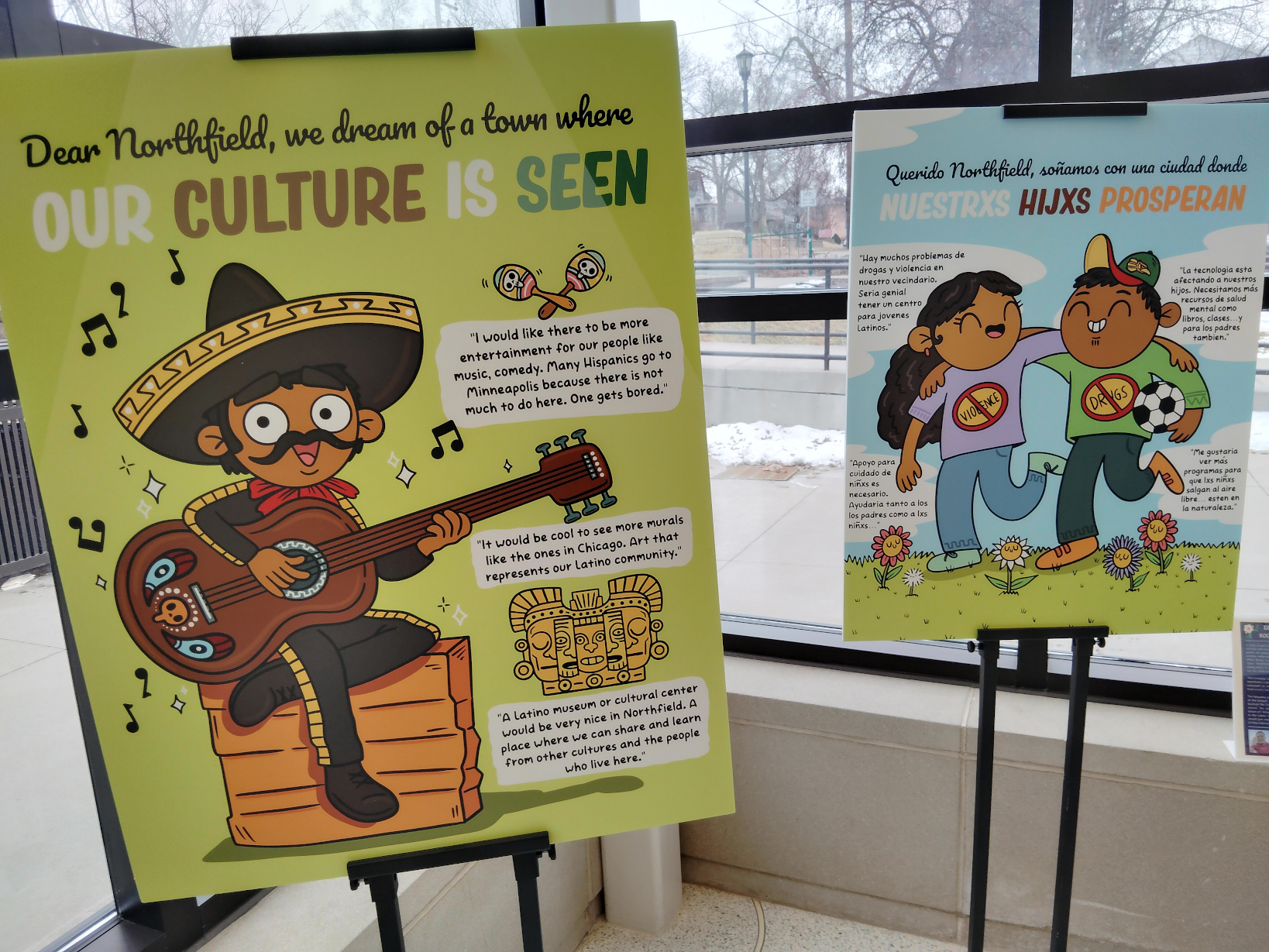
Panels created by Rocky Casillas Aguirre are written in both Spanish and English, on display recently at the Northfield Public Library. (Minnesota Prairie Roots copyrighted photo February 2026)
I APPRECIATE WHEN LEADERS think outside the box, using creative ways to gather and share information.
Take a project in the southern Minnesota riverside college town of Northfield, home to more than 2,000 Latinos, representing some 10 percent of the city’s population. A 2023 city-inspired effort led by a collective of local Latino artists and activists was tasked with developing a connective public art project focused on Latino voices.
Getting the conversation going…(Minnesota Prairie Roots copyrighted photo February 2026)
Among the results was a poster campaign, “Dear Northfield,” by Latino artist Rocky Casillas Aguirre. He interviewed 100 Latino residents, asking this question: “If you could write a letter to the people who govern our city, what would you tell them?”
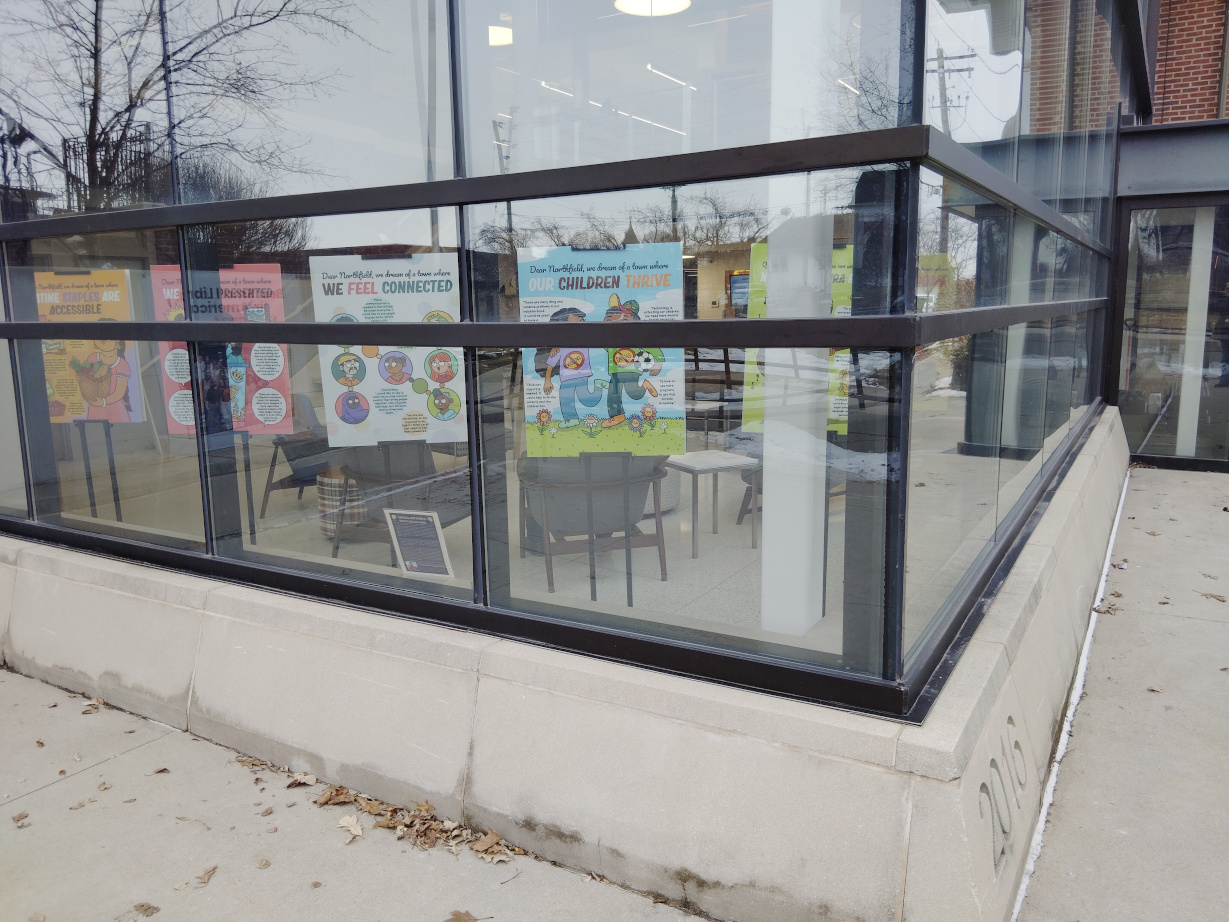
The results are colorful, eye-catching panels that reveal invaluable insights from Northfield’s Latino population. I recently saw six of Aguirre’s art posters displayed in the atrium of the Northfield Public Library, a community gathering spot.
At first glance, the artwork reminds me of illustrations in a children’s picture book or drawings in a cartoon. That’s a signature style of Aguirre, born in Mexico, raised in Northfield and a resident for more than 20 years. His art grabs attention in vivid cultural colors.
But it is the comments on those posters which especially deserve a close look as they address topics like housing, transportation, food, culture, communication and connection.
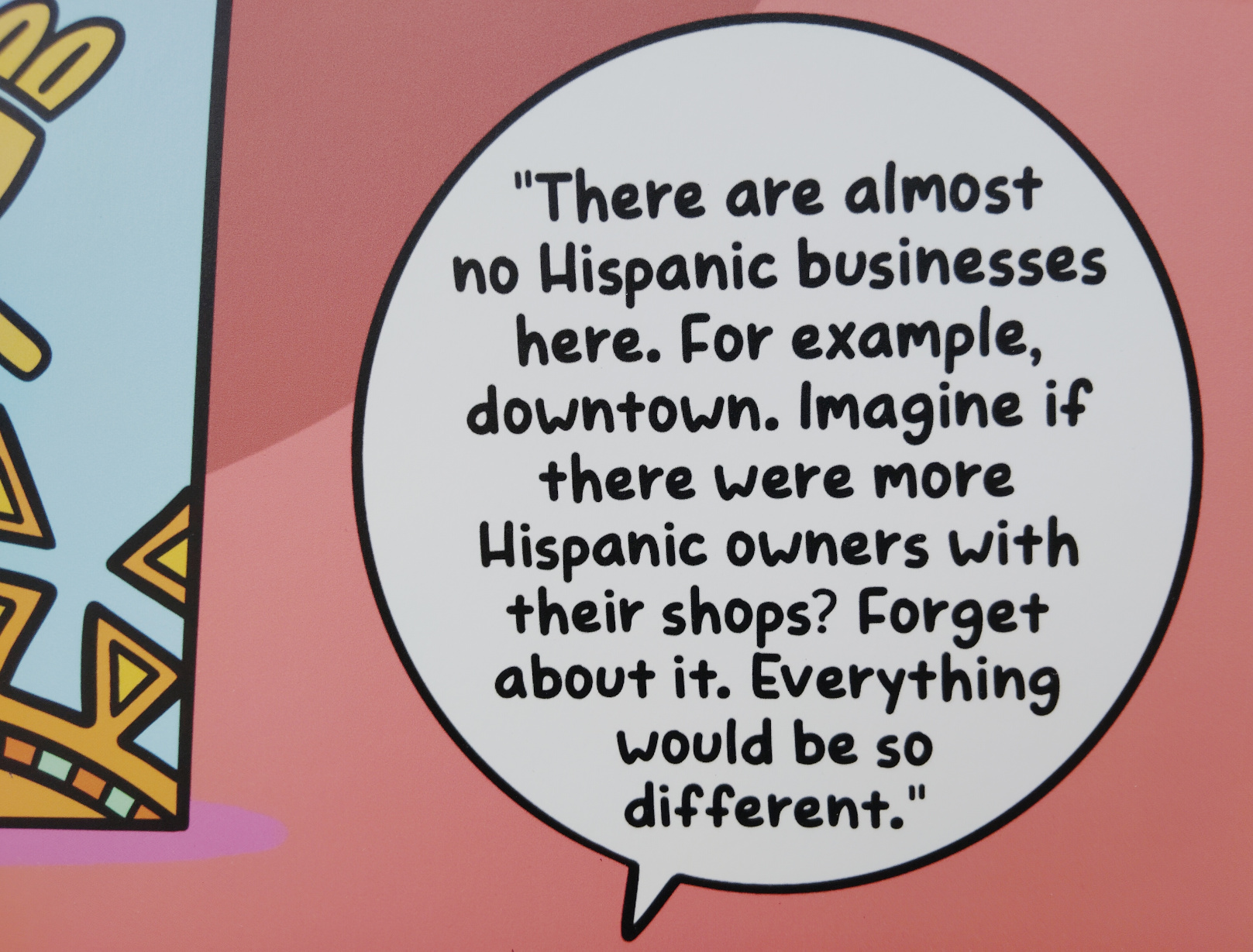
On the topic of local businesses… (Minnesota Prairie Roots copyrighted photo February 2026)
In their own words, Latino residents of Northfield share their thoughts, their concerns, their hopes, their dreams. They wish for Latino businesses downtown, shops where they can buy Mexican-made products, foods familiar and comforting to them.
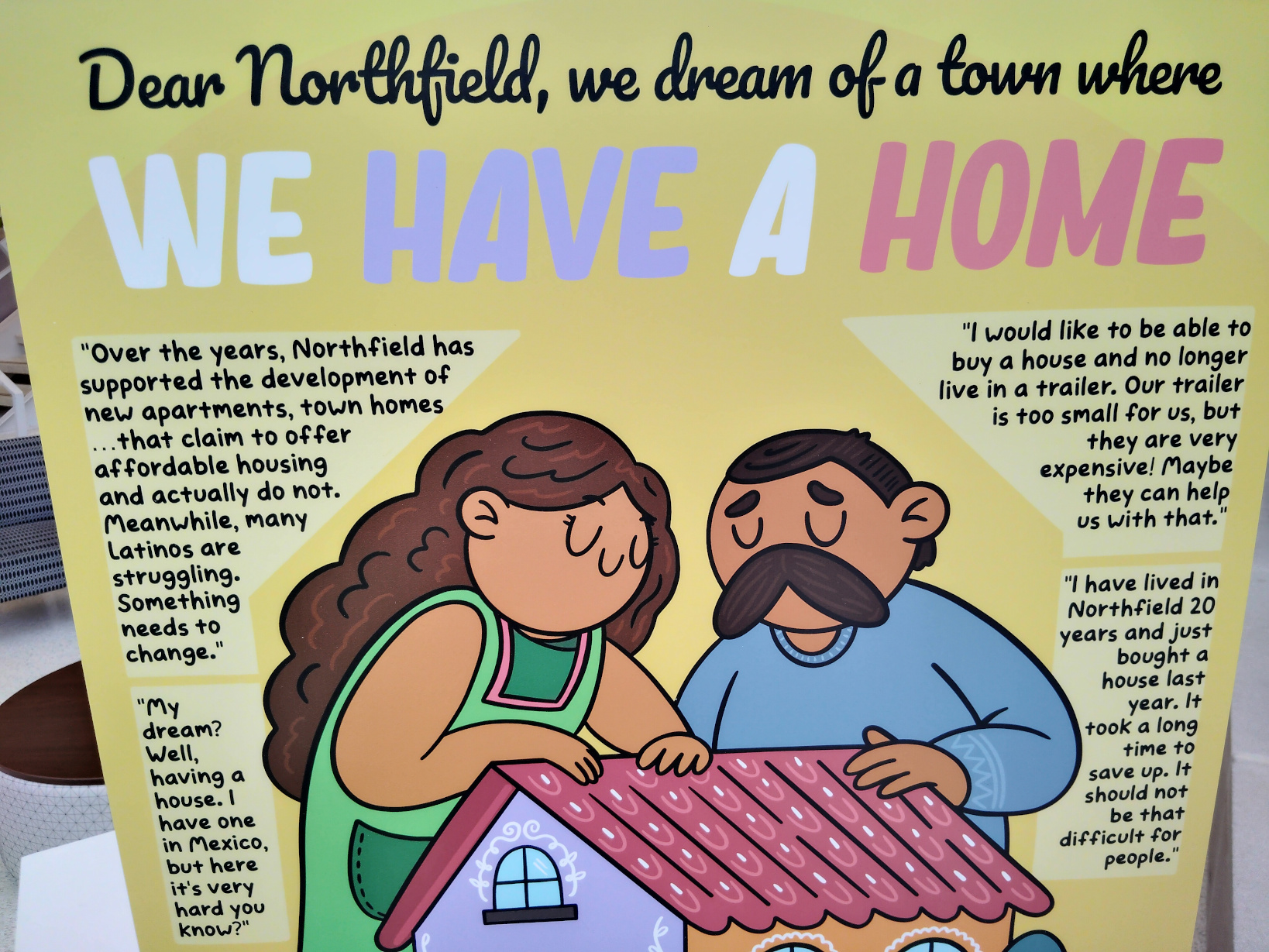
On the topic of housing… (Minnesota Prairie Roots copyrighted photo February 2026)
They want affordable housing, options other than living in trailer houses and apartments.
On the topic of culture and entertainment… (Minnesota Prairie Roots copyrighted photo February 2026)
They want local Latino-based cultural choices in music, entertainment and art, specifically naming murals. That seems doable in Northfield, which has always embraced public art and has multiple murals.
They want more options for youth, like a Latino youth center.
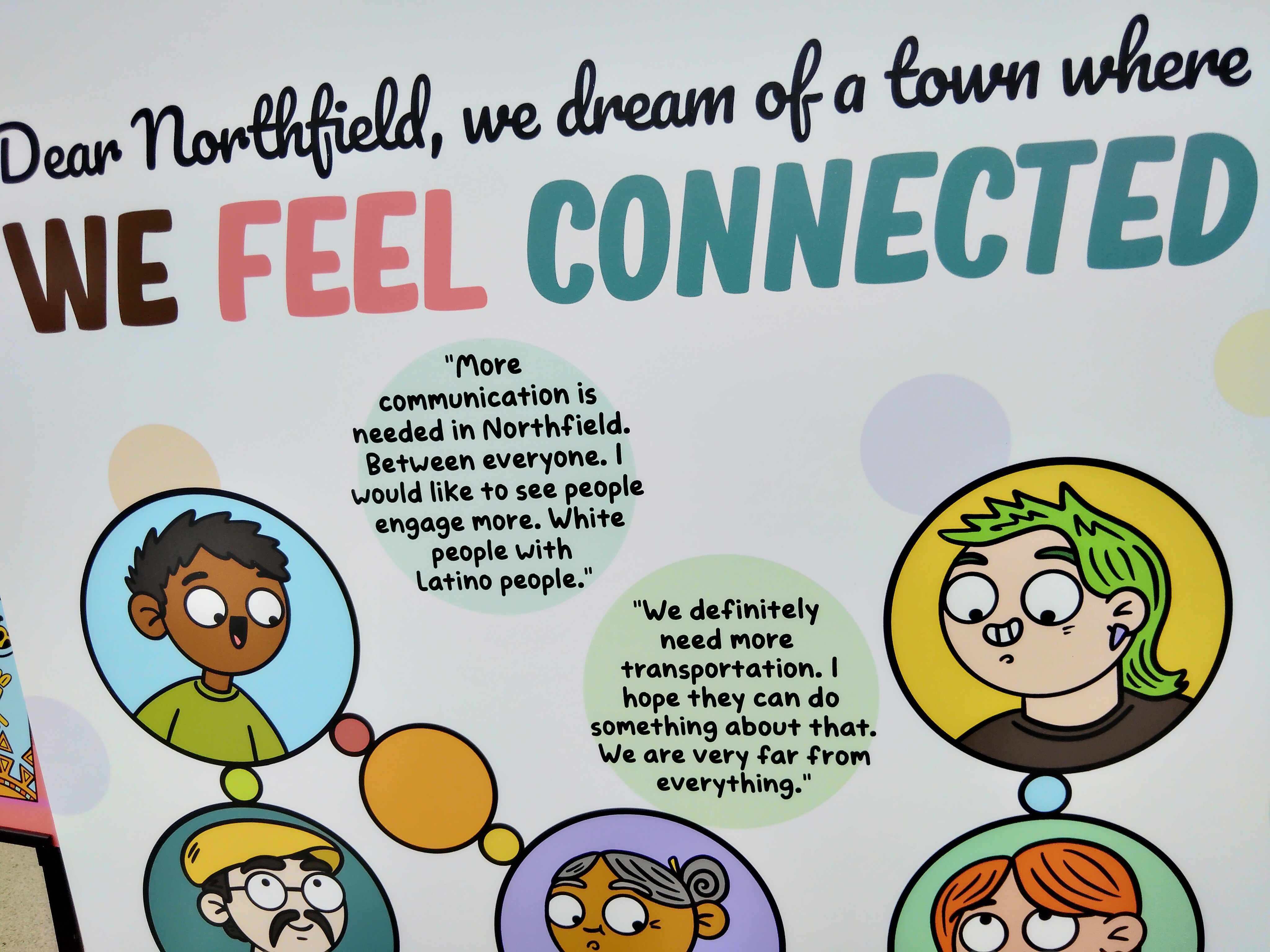
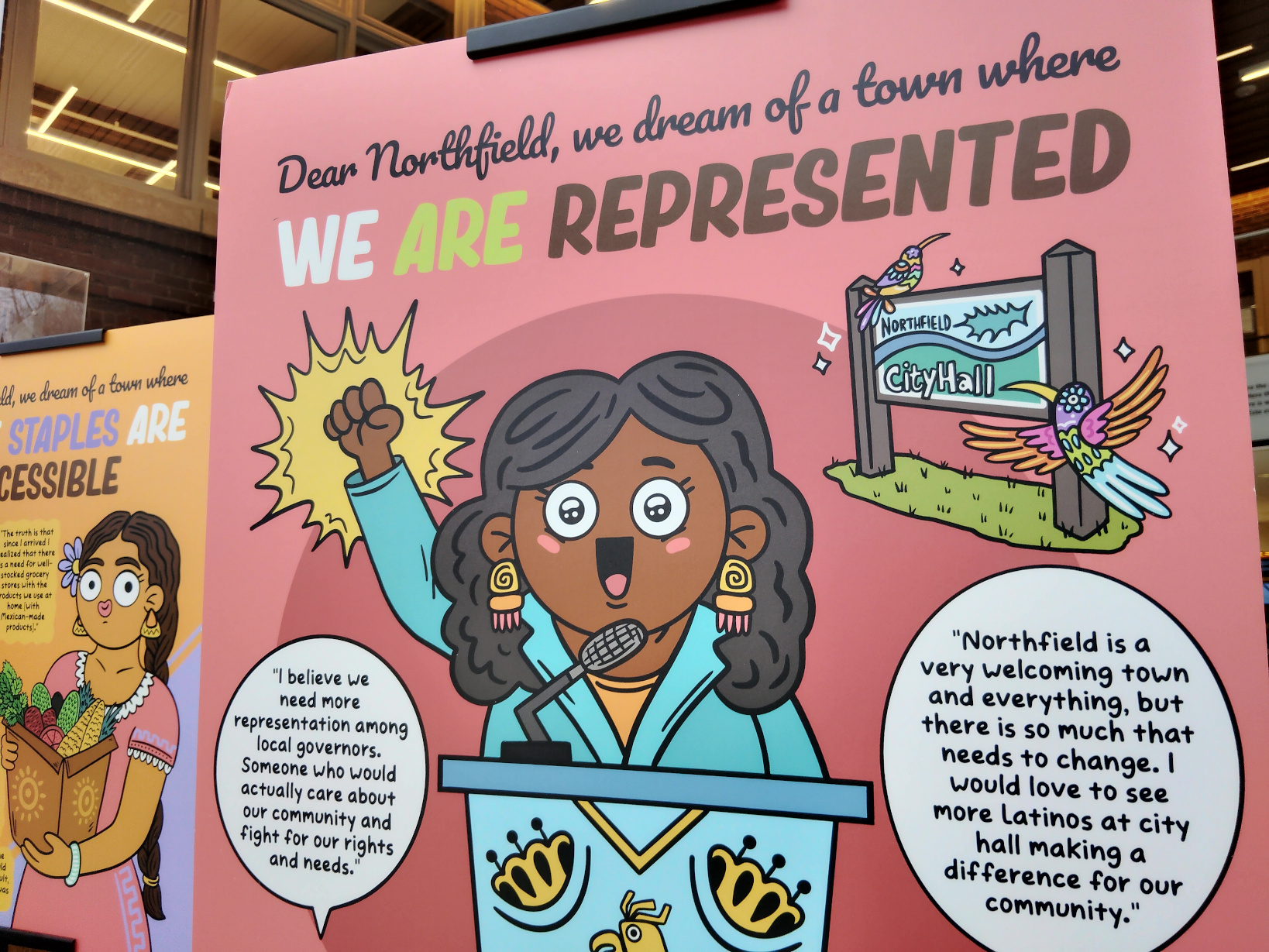
On the topic of representation in local government… (Minnesota Prairie Roots copyrighted photo February 2026)
They want more representation in city government and increased connections and engagement between white people and Latinos.
None of these seem like particularly big asks, although some certainly take time and money to implement. It’s good to get the conversation going.
The panels as viewed from outside the Northfield Public Library. (Minnesota Prairie Roots copyrighted photo February 2026)
I hope other communities follow Northfield’s example and use art as a way to share information that will help build a stronger, better and more culturally-aware and diverse city. A place where everyone can thrive, no matter their color, no matter their language, no matter their culture.
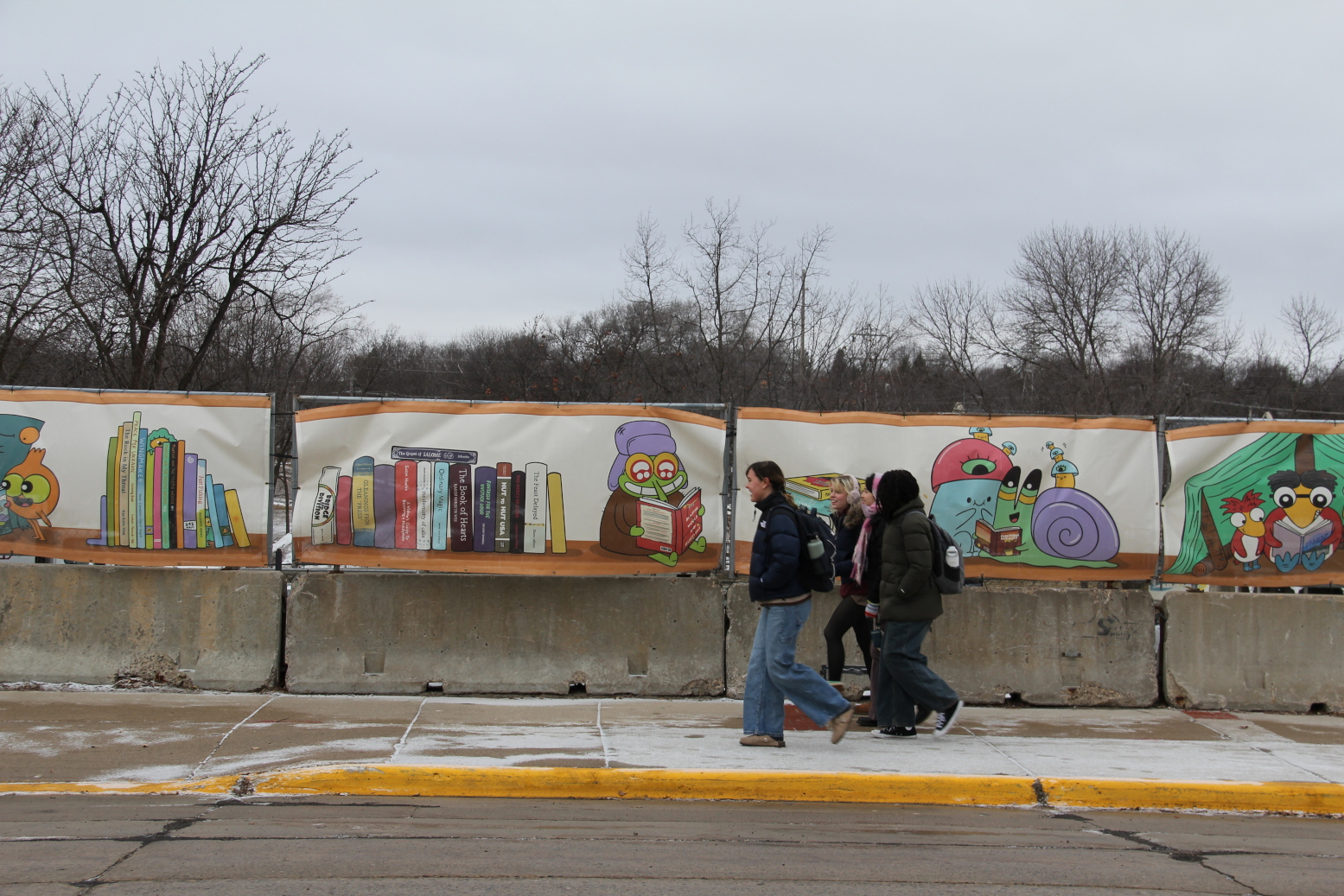
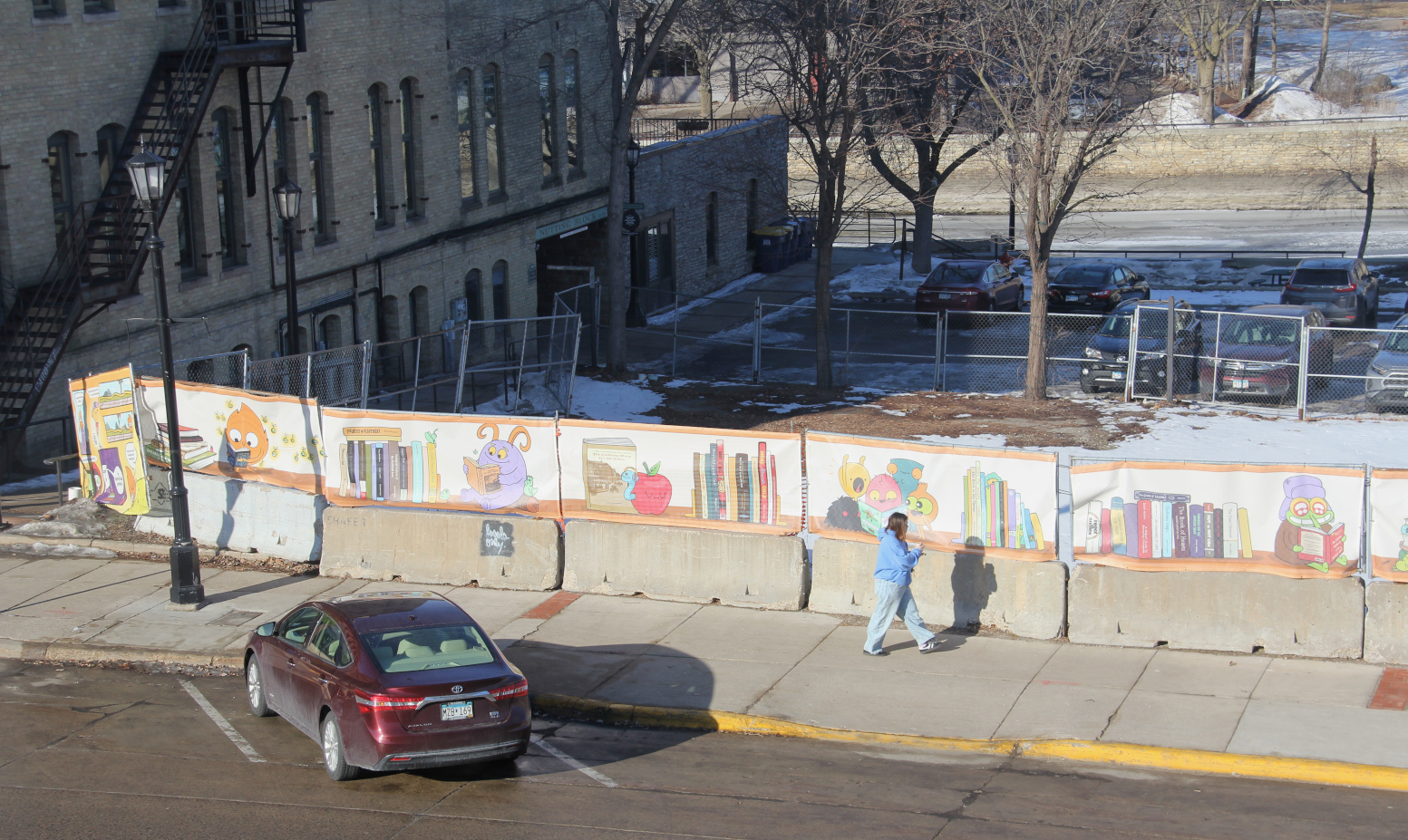
College students walk past a public mural fronting a vacant lot in downtown Northfield. (Minnesota Prairie Roots copyrighted photo January 2026)
BETWEEN DIVISION STREET and the Cannon River in downtown Northfield across from the public library, an art installment stretches, hiding a fenced, vacant spot of land.
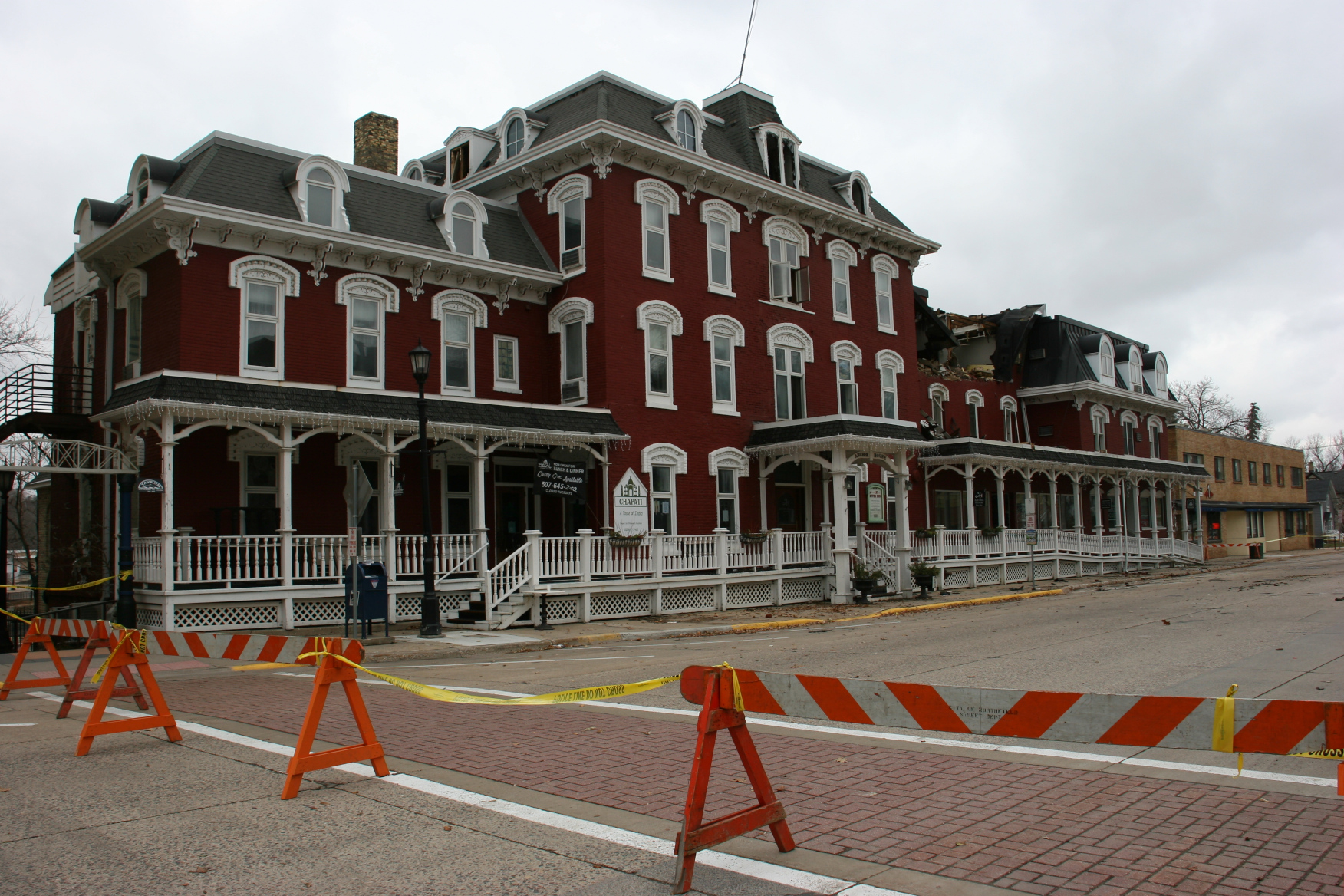
Barricades block entry to the historic Archer House, damaged by a 2020 fire and later demolished. The public art installation covers the length of the hotel. (Minnesota Prairie Roots copyrighted file photo November 2020)
Here the historic Archer House River Inn once stood, a sprawling complex of hotel and businesses until a November 2020 fire severely damaged the building. It was later demolished, leaving a gaping hole in the heart of this thriving southern Minnesota college town.
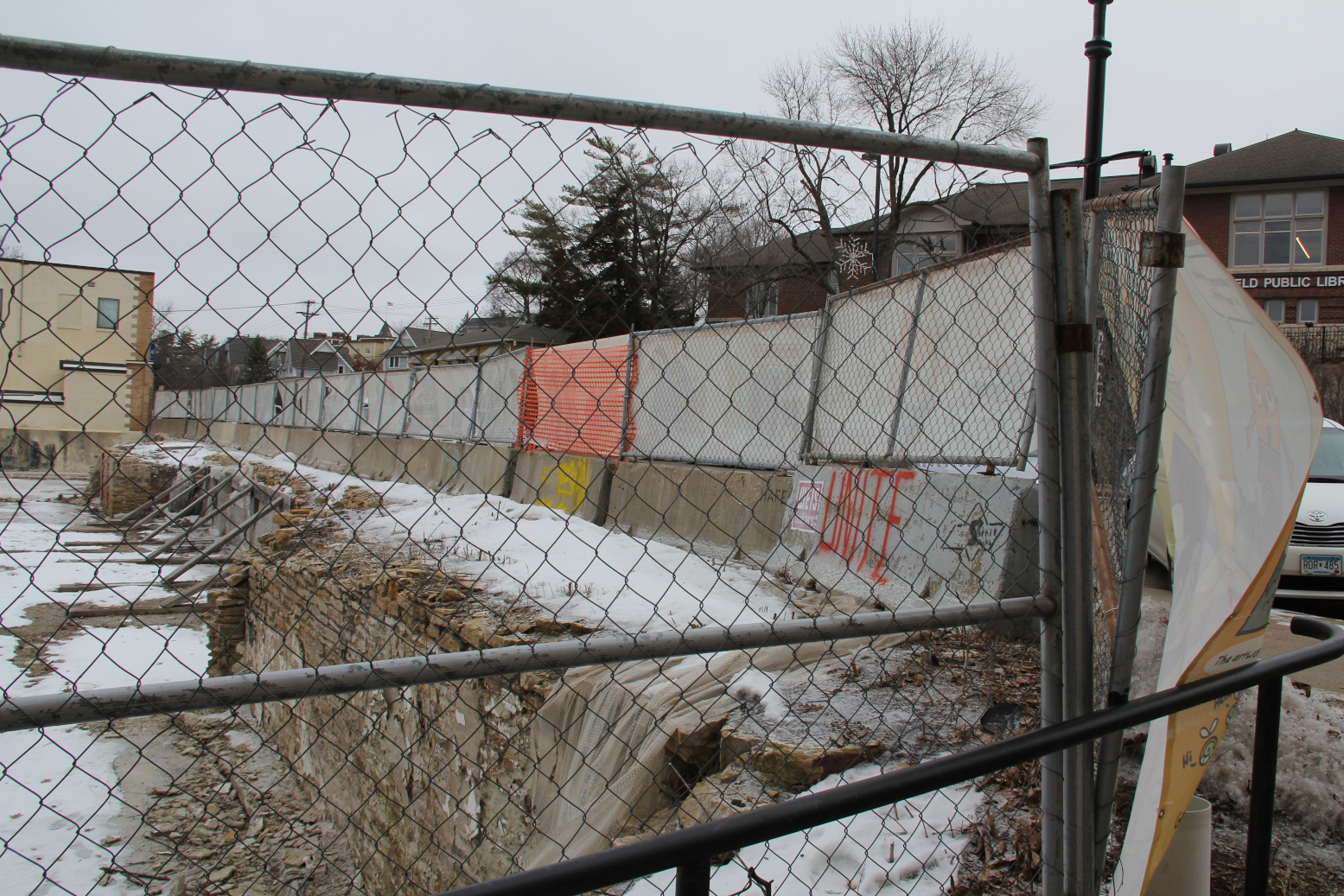
The back view behind the panels shows the foundation of the Archer House. The Northfield Public Library sits in the background across Division Street. (Minnesota Prairie Roots copyrighted photo January 2026)
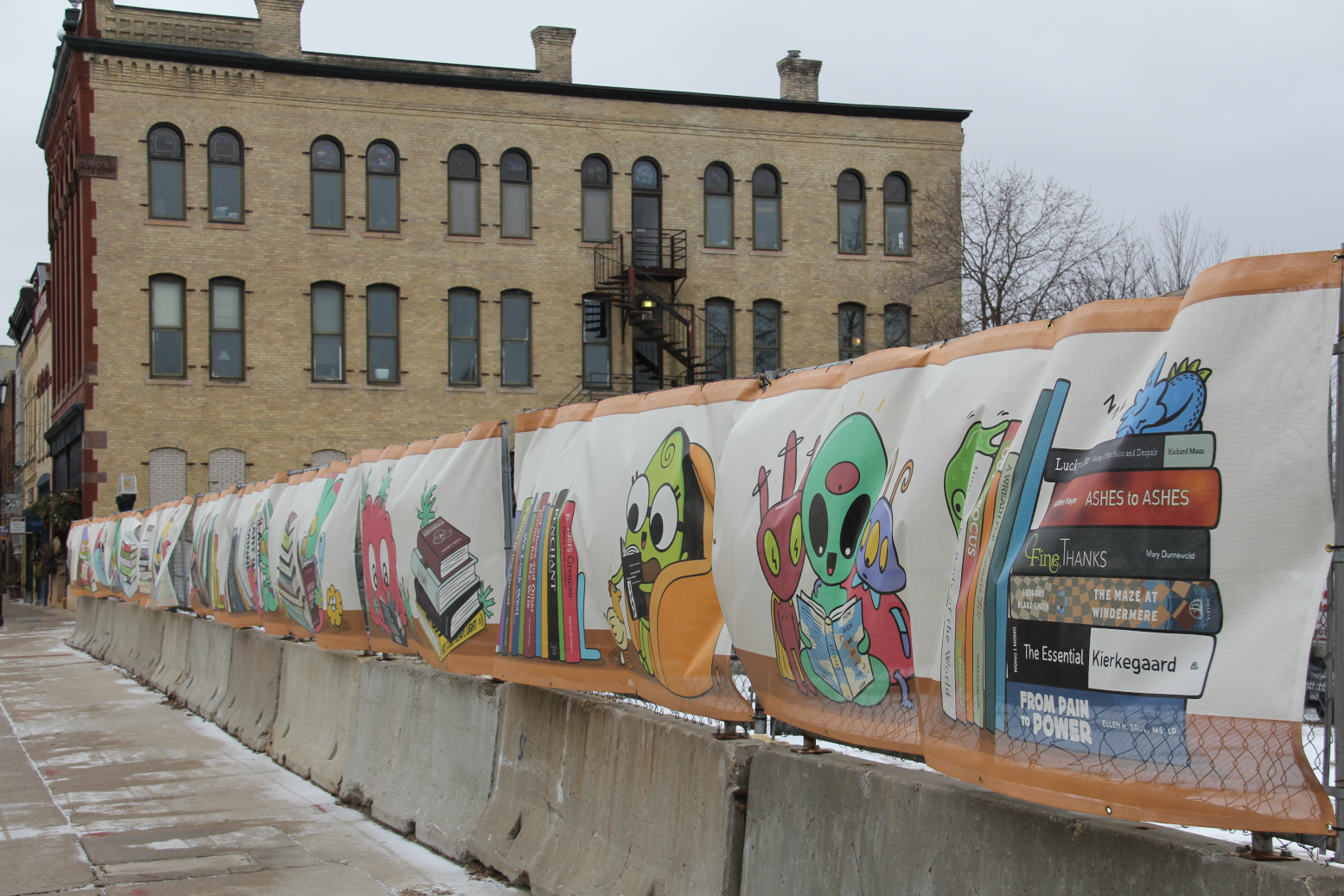
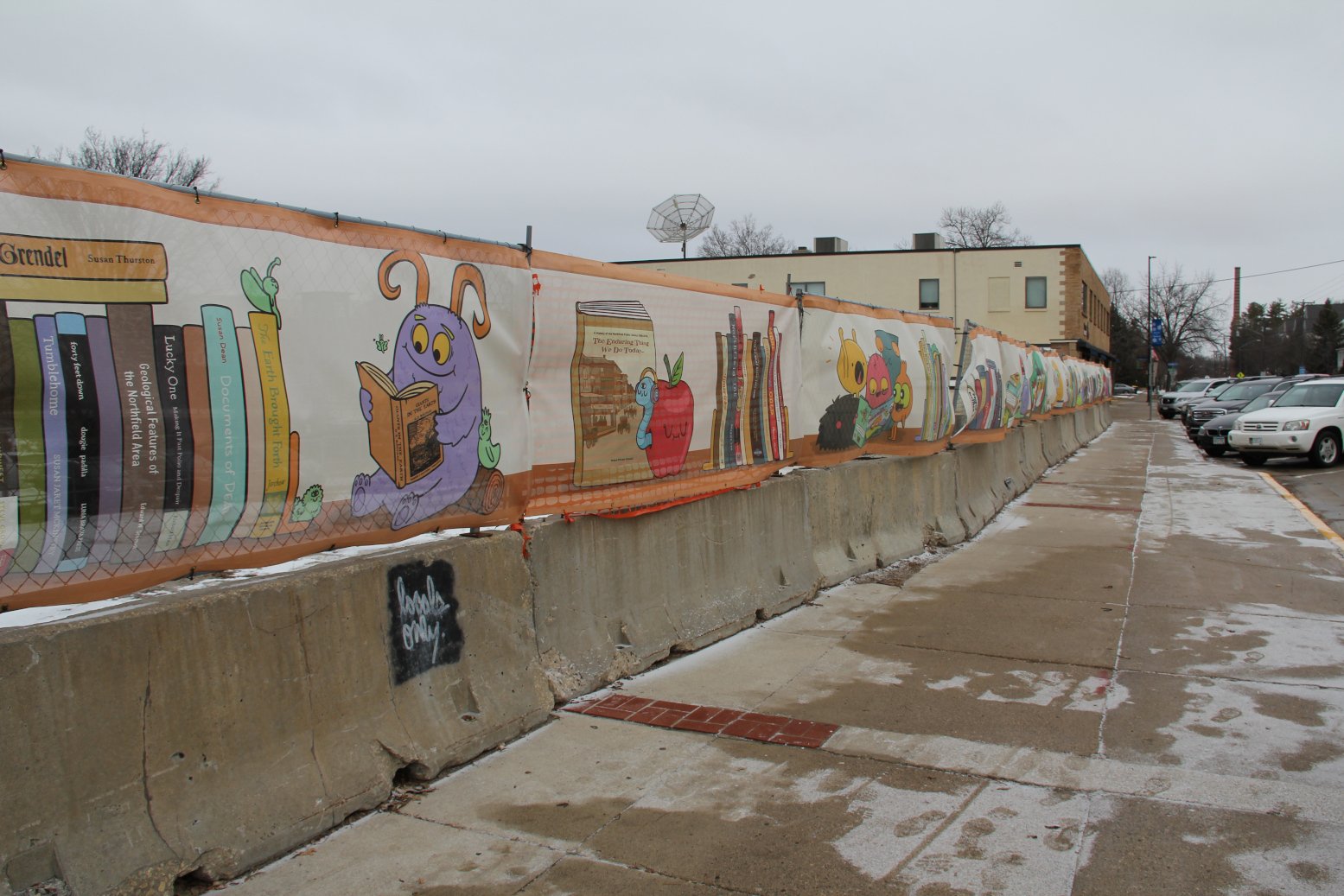
Flash forward years later and a 170-foot long length of 17 individual mesh fabric murals now hang on fencing surrounding foundation remnants and earth. Until the land is developed, this public art installation hides an eyesore and stands as a tribute to the creatives in the Northfield community.
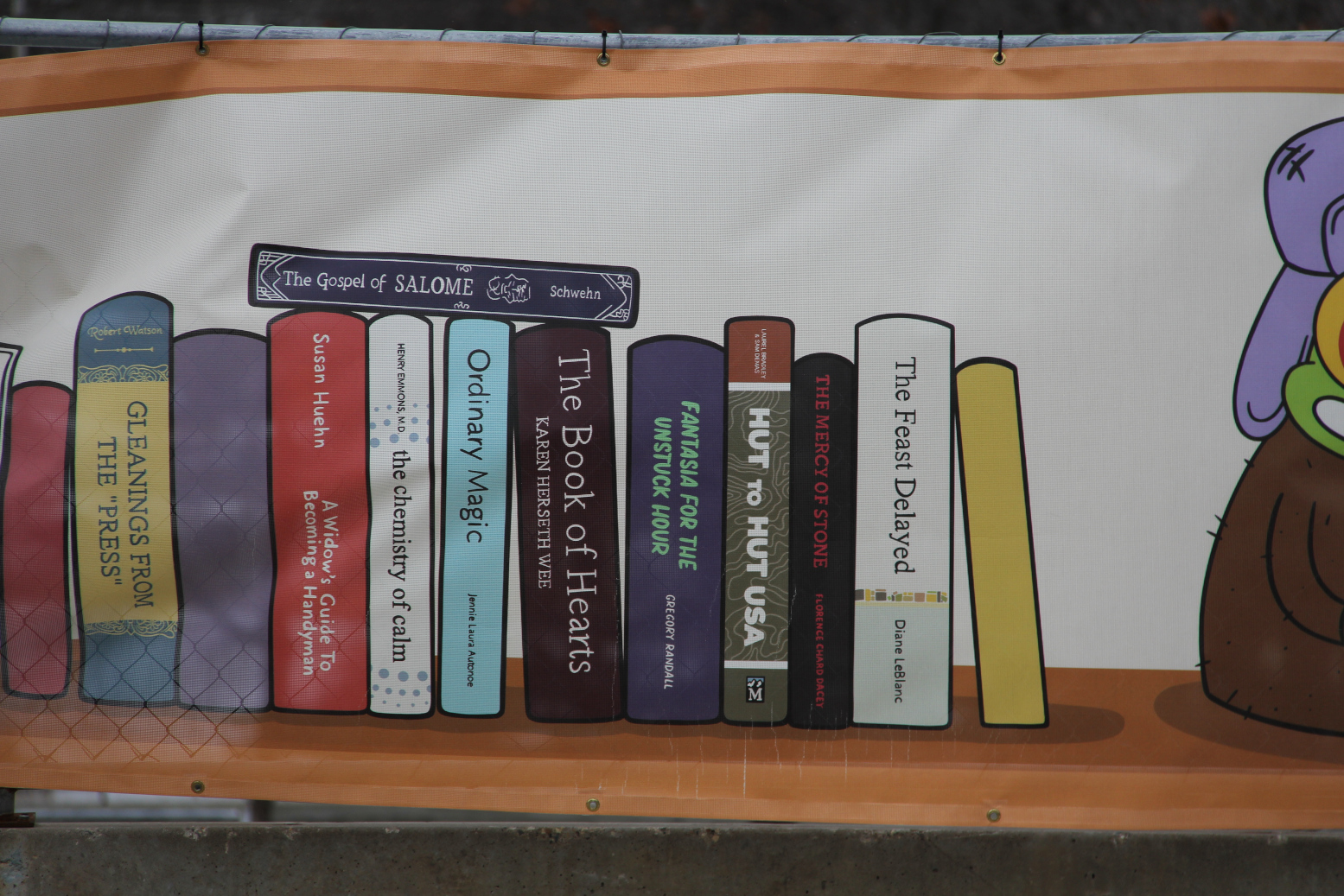
Northfield library staffers compiled a list of books by Northfielders, past and present, to incorporate into the panels. (Minnesota Prairie Roots copyrighted photo January 2026)
As a lover of both art and books, I appreciate this unique community endeavor to create something artistically beautiful and informative.
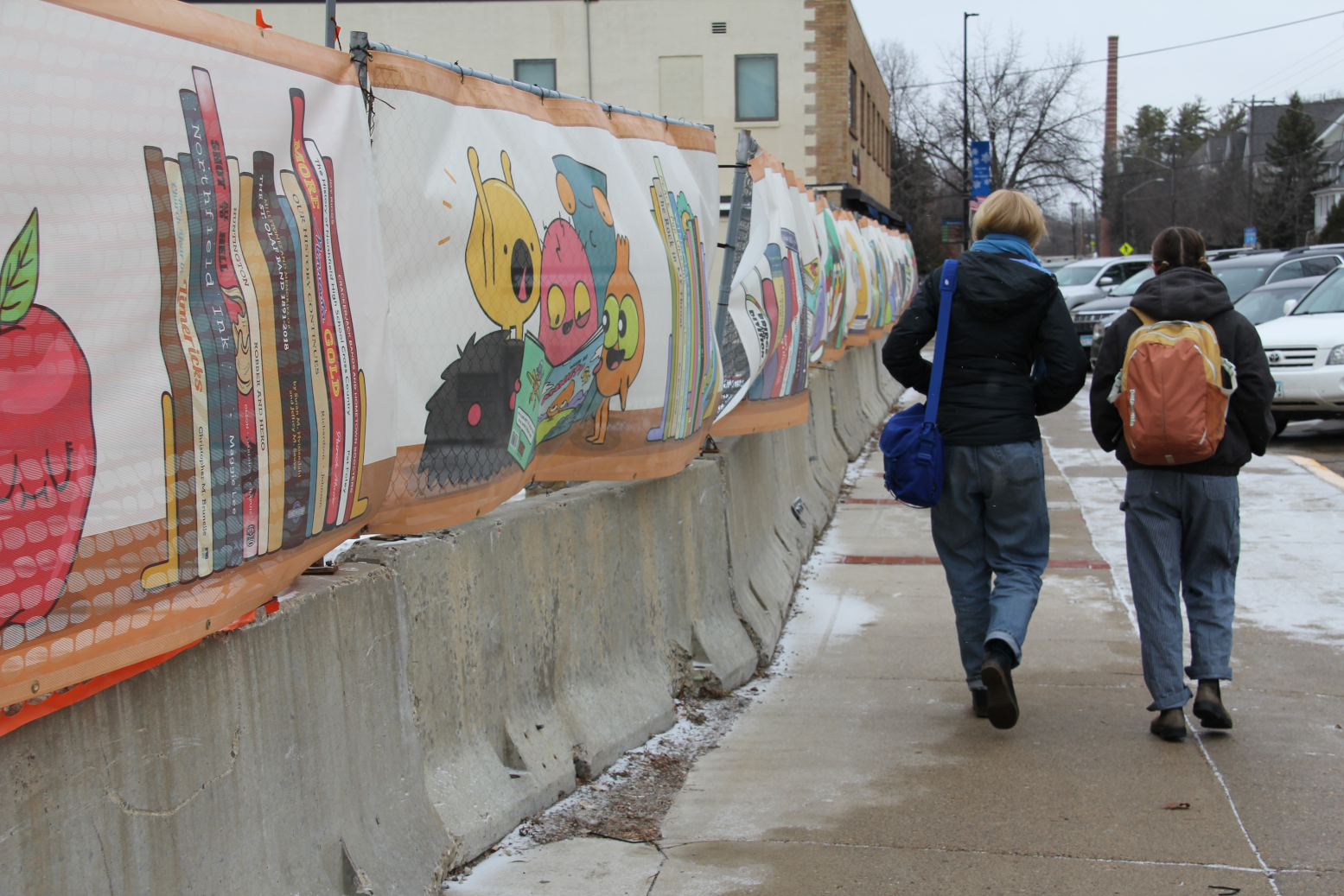
College students pass by the mural panels while I photograph the installation. (Minnesota Prairie Roots copyrighted photo January 2026)
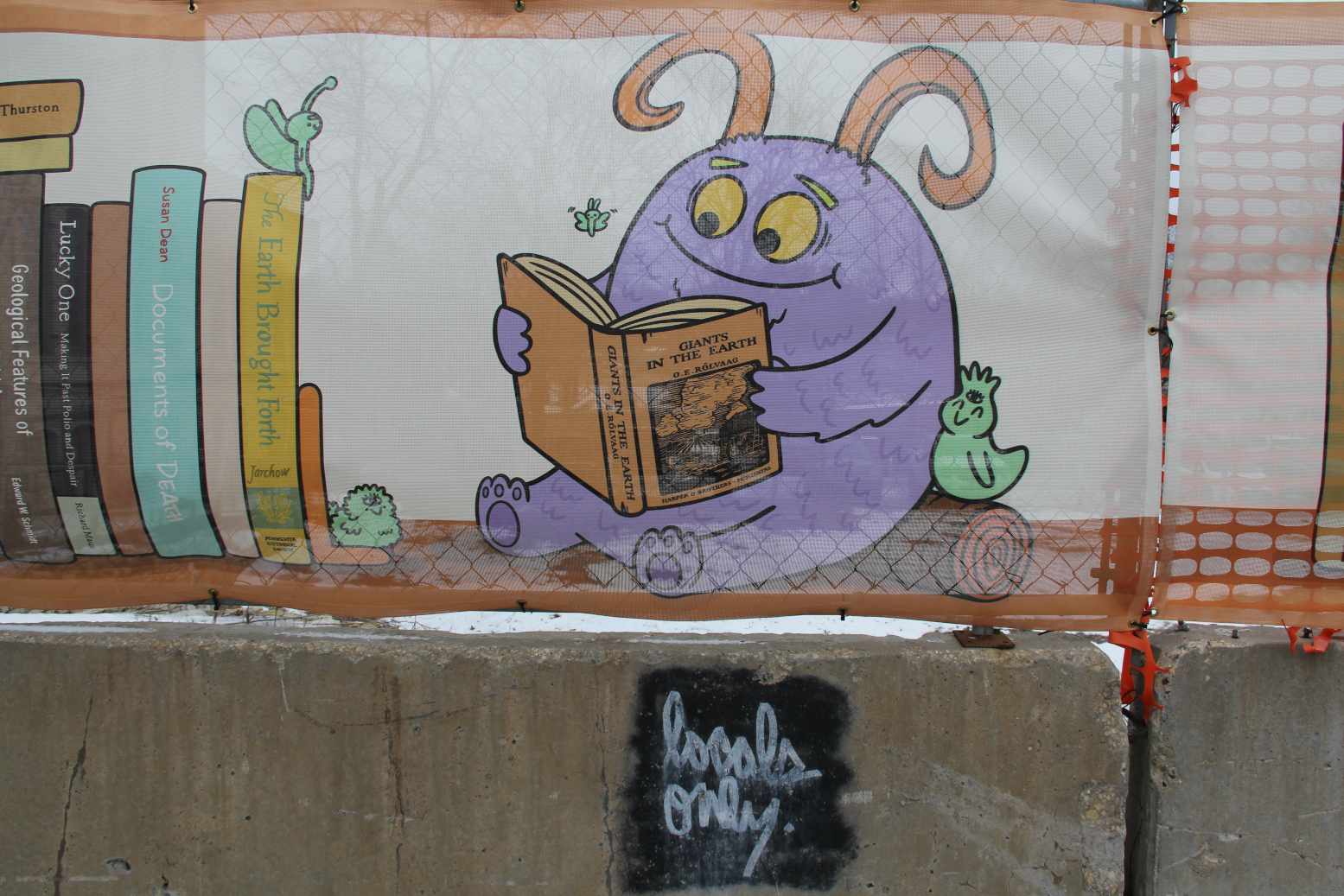
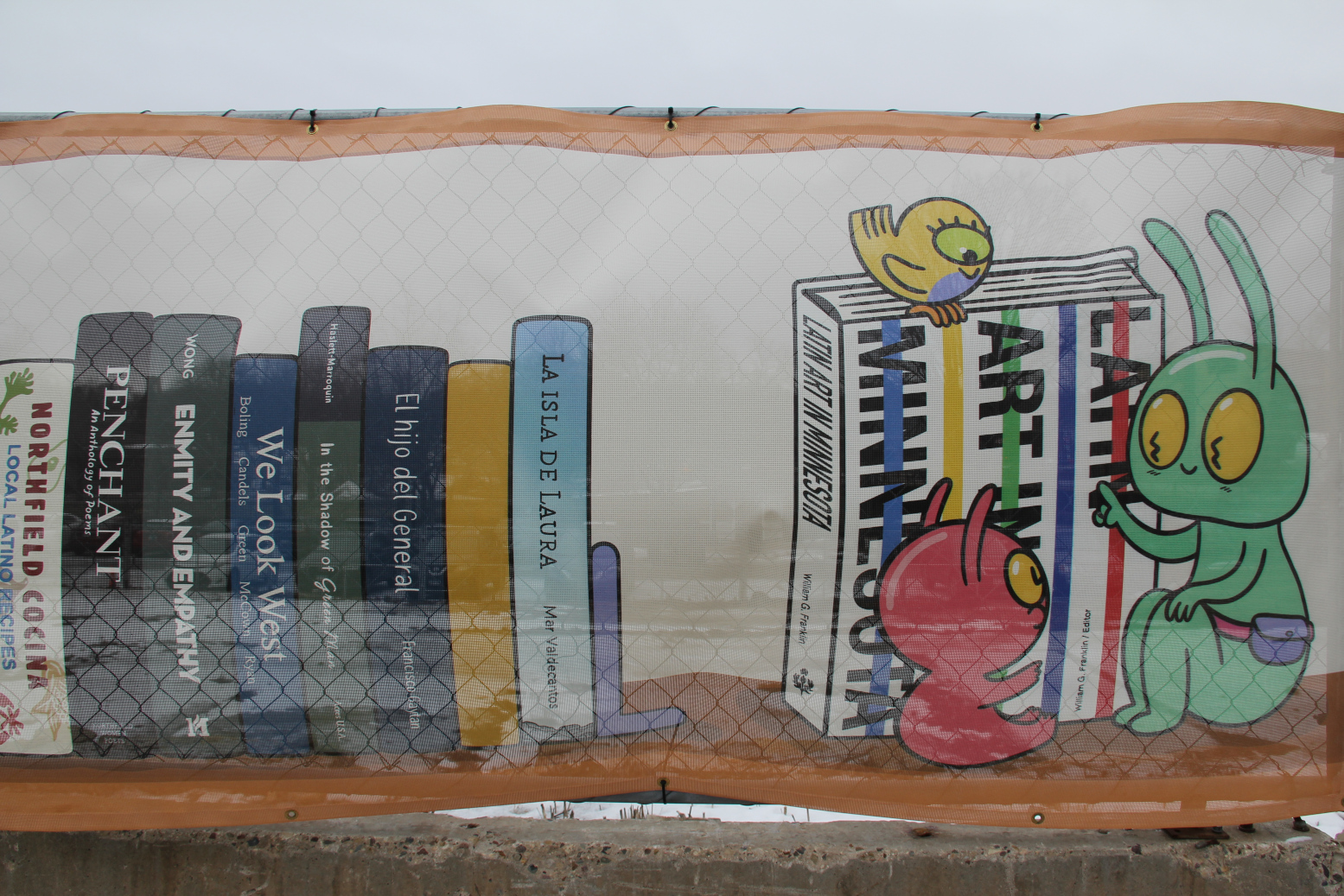
The Northfield Public Library worked with local Latino artist Rocky Casillas Aguirre on the project, which features more than 100 books by Northfield authors showcased on bookshelves printed on fabric. Walking along the mural scanning the titles is almost like walking into the library across the street up the hill and searching for a book.
One of Aguirre’s characters reads “Giants in the Earth.” (Minnesota Prairie Roots copyrighted photo January 2026)
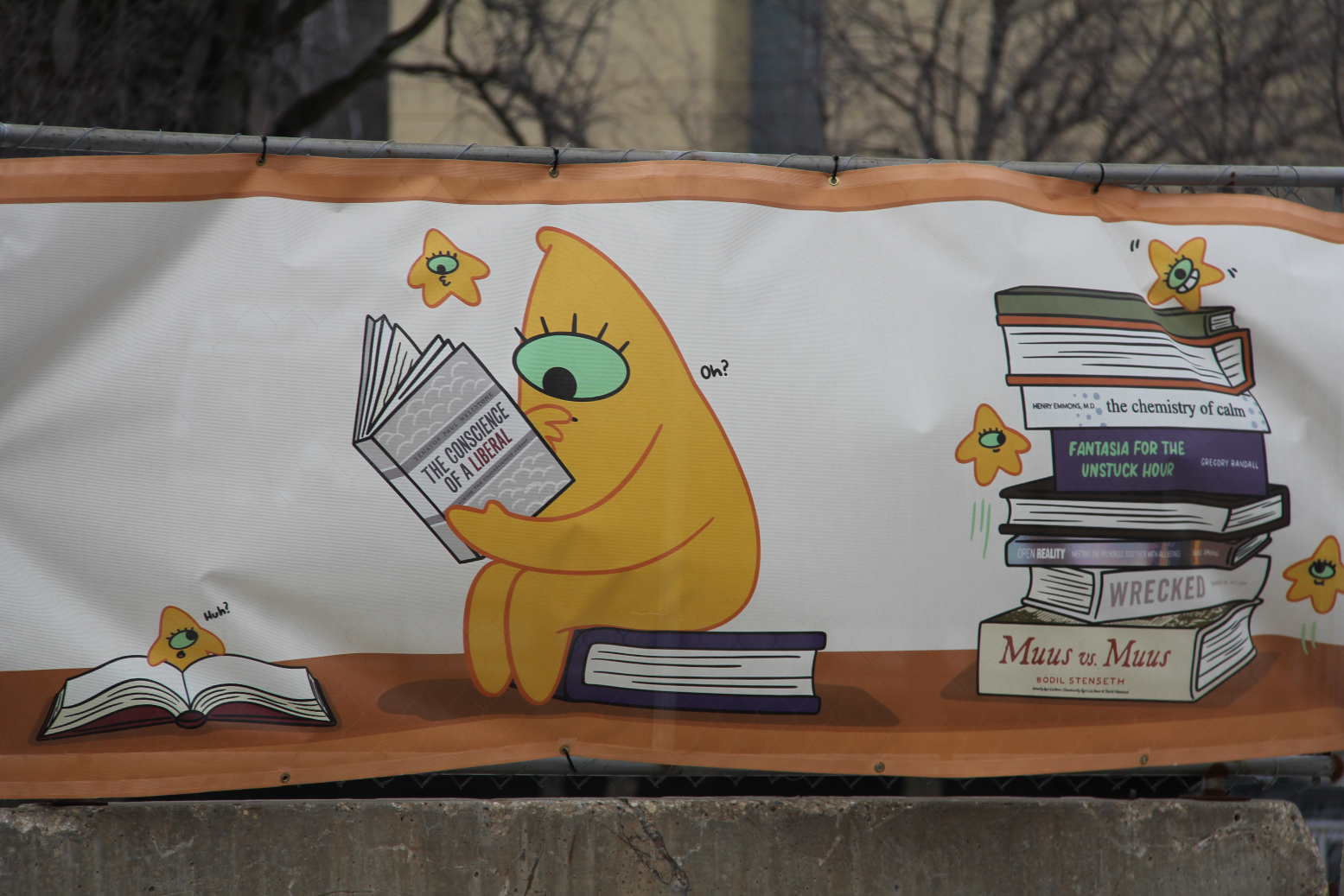
As I followed the installation, photographing and reading book titles, I found books familiar and unfamiliar. Some are widely-known, like Giants in the Earth, a story about Norwegian immigrants homesteading in Dakota Territory during the 19th Century, by Ole E. Rolvaag. Or Minnesota Senator Paul Wellstone’s The Conscience of a Liberal—Reclaiming the Compassionate Agendas. He died in a 2002 plane crash.
Characters created by Rocky Casillas Aguirre mix with books by Northfielders. (Minnesota Prairie Roots copyrighted photo January 2026)
Then there are poetry collections by Northfield poets—Bridge and Division, We Look West… This is a community rich in poets, a city where poems imprint upon concrete in a Sidewalk Poetry project.
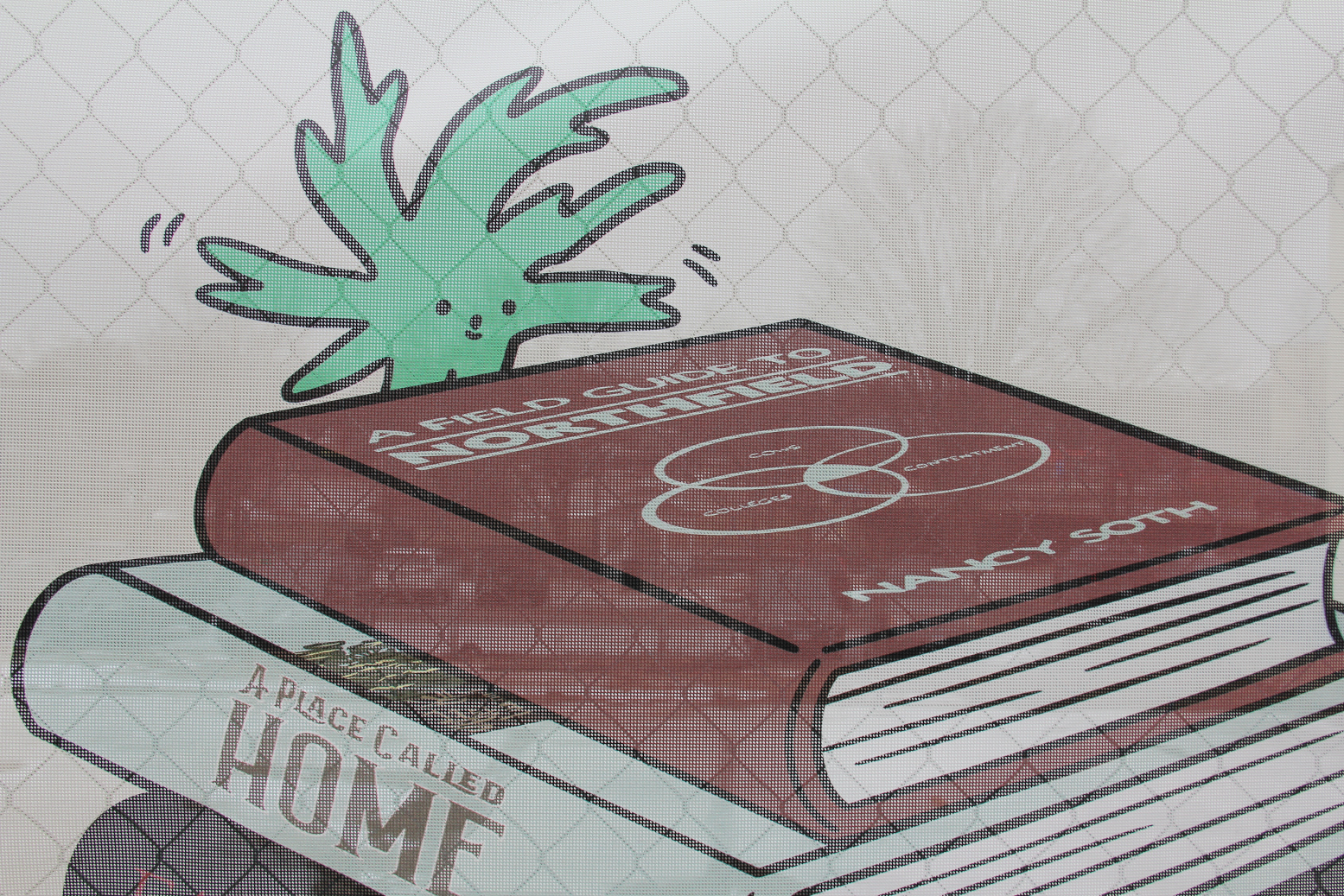
Some of the books by Northfield authors are specifically themed to Northfield. (Minnesota Prairie Roots copyrighted photo January 2026)
Other titles also drew my eye like A Field Guide to Northfield by Nancy Soth, Peace for Ukraine Coloring Book, Northfield Cocina: Local Latino Recipes and many more.
Lots of the artist’s cartoon characters are busy reading books. (Minnesota Prairie Roots copyrighted photo January 2026)
Beyond those 100 plus books featured in the art installation are the colorful characters Aguirre creates for his books, cartoons and stand alone art. They are interspersed among the titles—reading, interacting, resting, adding elements of color and interest.
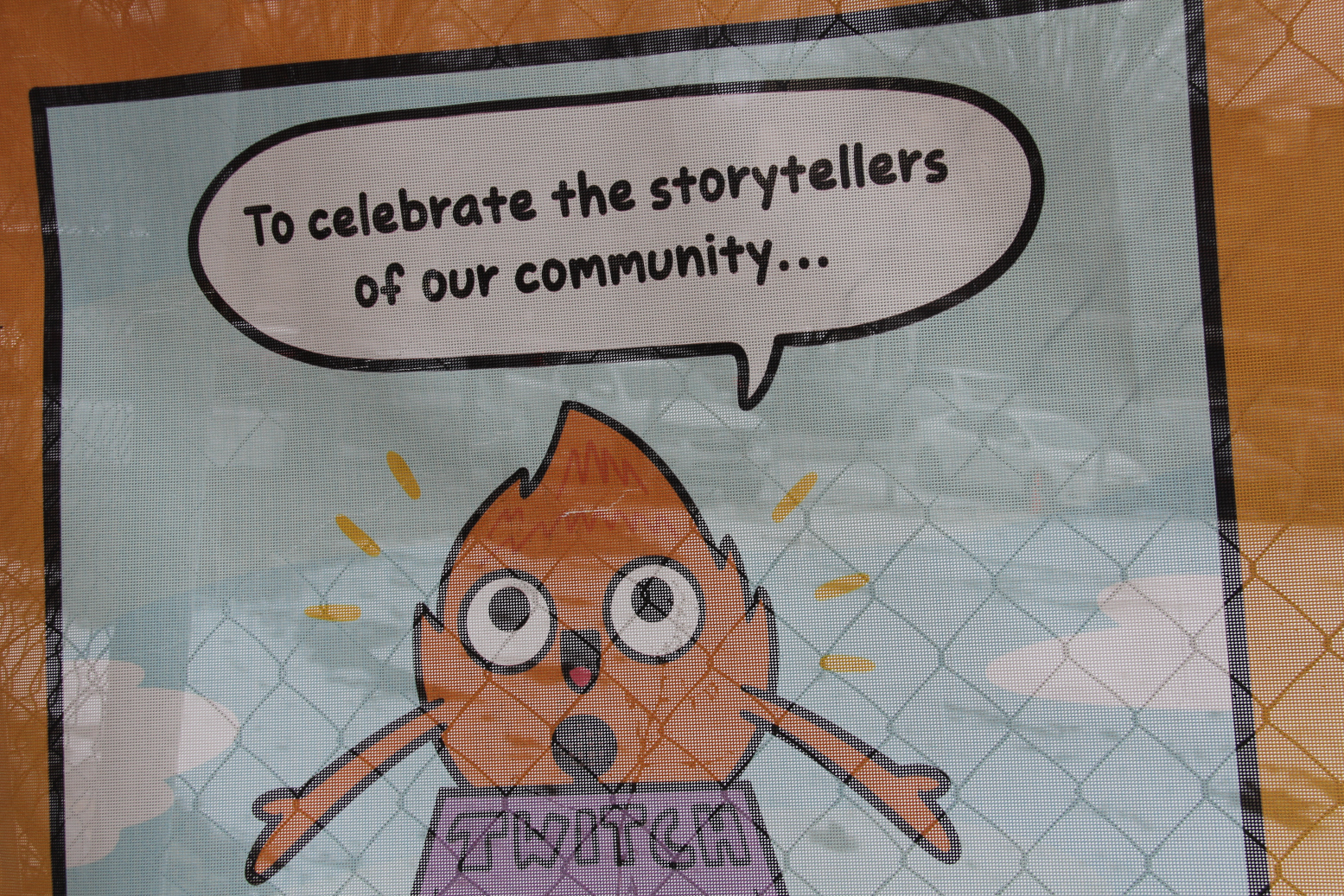
Twitch, a magical campfire created by the artist for his own art, is incorporated into the murals. (Minnesota Prairie Roots copyrighted photo January 2026)
Aguirre, who has dealt with anxiety and depression, focuses his art on raising awareness about mental health, especially among youth. Twitch, a magical campfire, is among the characters he’s created and which can be spotted on the downtown mural.
Another view of the panels, looking south on Division St. (Minnesota Prairie Roots copyrighted
This artist, born in Mexico but raised in Northfield and a resident for more than 20 years, also worked with the local Latino community on another city-supported art project, “Dear Northfield.” He interviewed 100 local Latinos, among the 2,000 who live in the city, to get their insights on topics like housing, food, transportation and more. The result is a series of bi-lingual posters that inform, raise awareness and connect. “Dear Northfield” is currently displayed at the Northfield library.
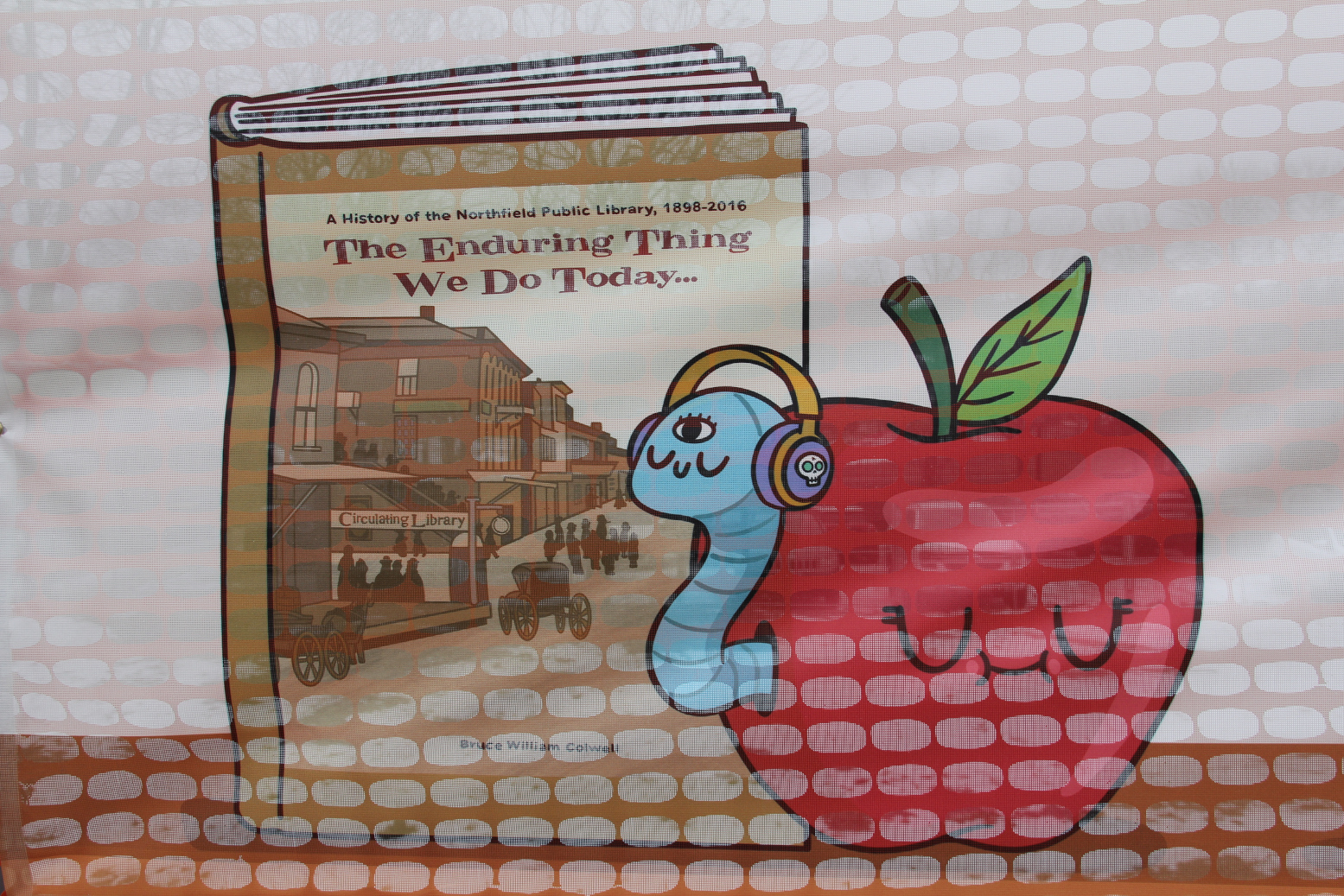
Even the library has its own history book. (Minnesota Prairie Roots copyrighted photo January 2026)
I learned a lot by simply walking along the mural panels attached to fencing at the site of the demolished Archer House. I learned that Northfield has far more authors than I ever imagined. Authors who write in all genres.
Looking at the mural north along Division Street. (Minnesota Prairie Roots copyrighted photo January 2026)
An overview of the art installation photographed through a second floor library window looking down on the Division Street scene. (Minnesota Prairie Roots copyrighted photo February 2026)
I’m excited to see more and learn more. The visual arts are such a gift, whether hung on a fence screening a vacant lot or hung in a gallery inside an arts center. Art holds the power to move us, inform us, enlighten us and, sometimes, even to change us.
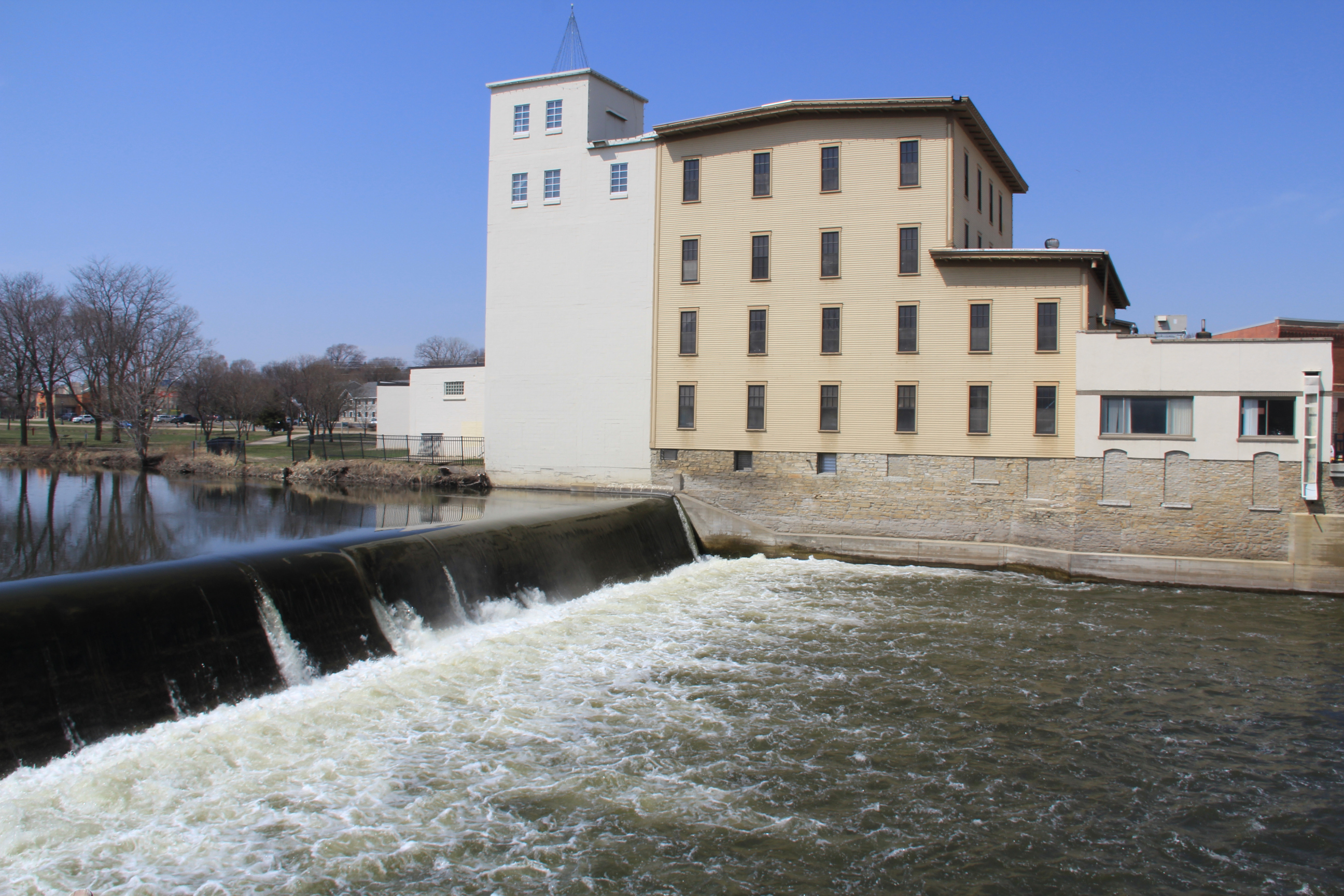
The Cannon River spills over the dam by the historic Ames Mill. (Minnesota Prairie Roots copyrighted photo April 2025)
WE COME TO THE RIVER. The Cannon River, spilling over the dam by the Ames Mill. Roaring. Churning. Then flowing under the bridge and between the walls of the Riverwalk in downtown Northfield.
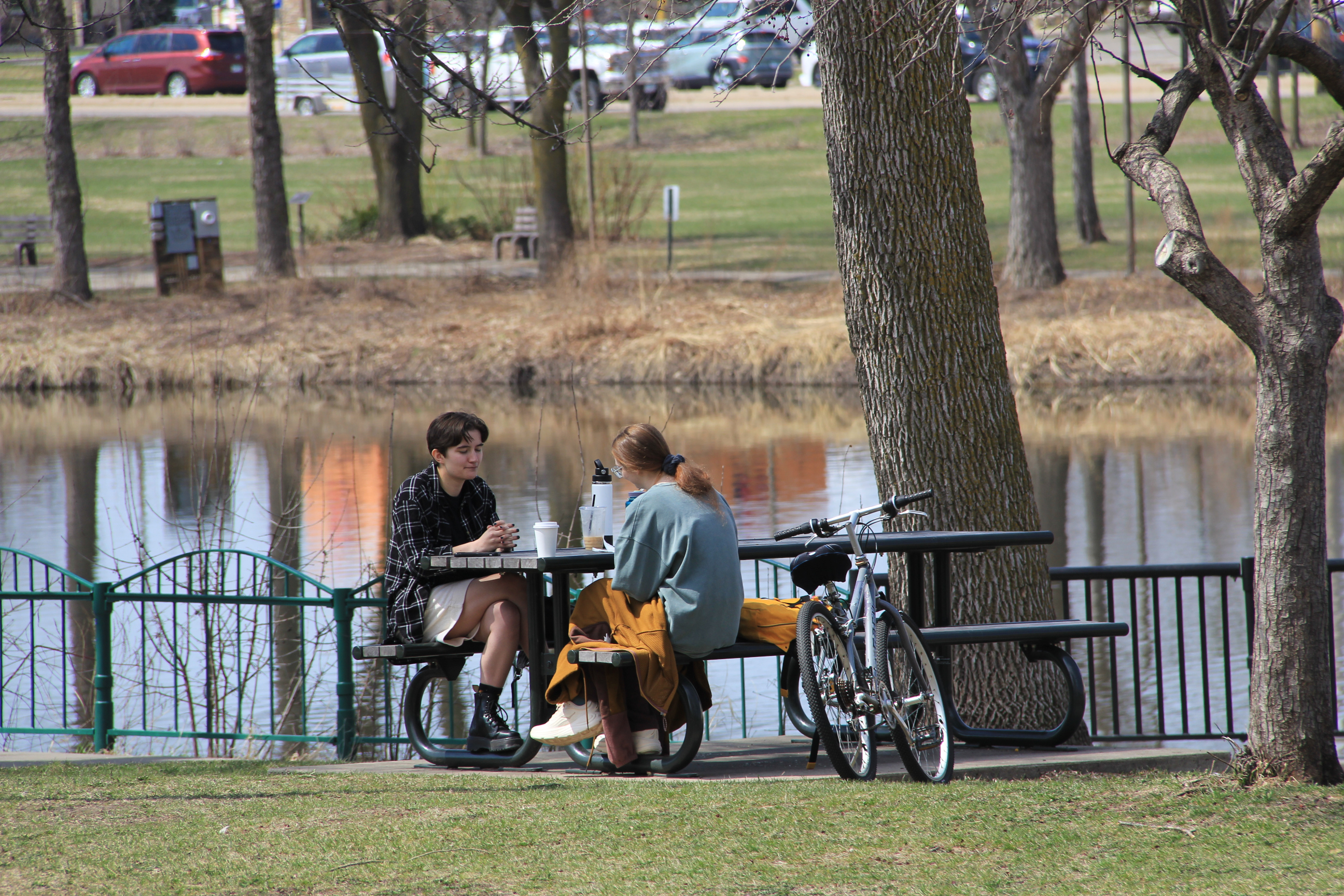
Enjoying beverages and time together beside the Cannon River in Bridge Square. (Minnesota Prairie Roots copyrighted photo April 2025)
We come here on a Sunday afternoon, on an April day of temps pushing into the sixties, the sun beaming warmth upon us, upon the land, upon the river. To sit. To walk. To lean toward the river. To simply be outdoors on an exceptionally lovely spring day in southern Minnesota.
The mood feels anticipatory, joyful, as we walk ourselves, and some their dogs, along the riverside path.
Historic buildings hug the Cannon River (and Division Street) in Northfield’s quaint downtown. (Minnesota Prairie Roots copyrighted photo April 2025)
I come with my Canon camera in hand. An observer. An appreciator of the sun, the sky, the warmth, the river, the historic buildings, the people and activities happening around me. In some ways, the scene seems Norman Rockwell-ish, Busy, yet tranquil. A slice of small town Americana. Everyday people enjoying each other, nature, the outdoors. Life.
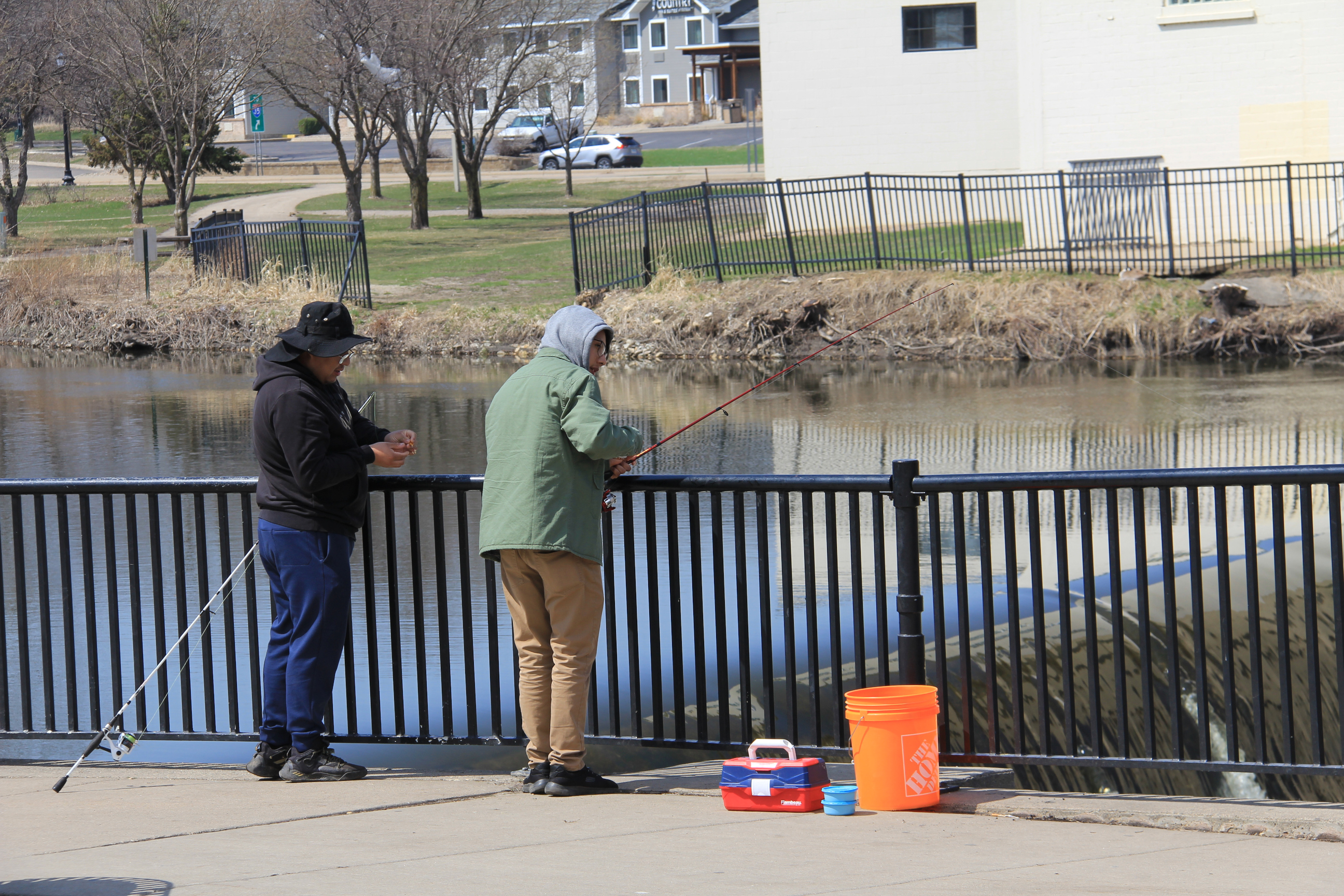
Fishing by the Ames Mill dam. (Minnesota Prairie Roots copyrighted photo April 2025)
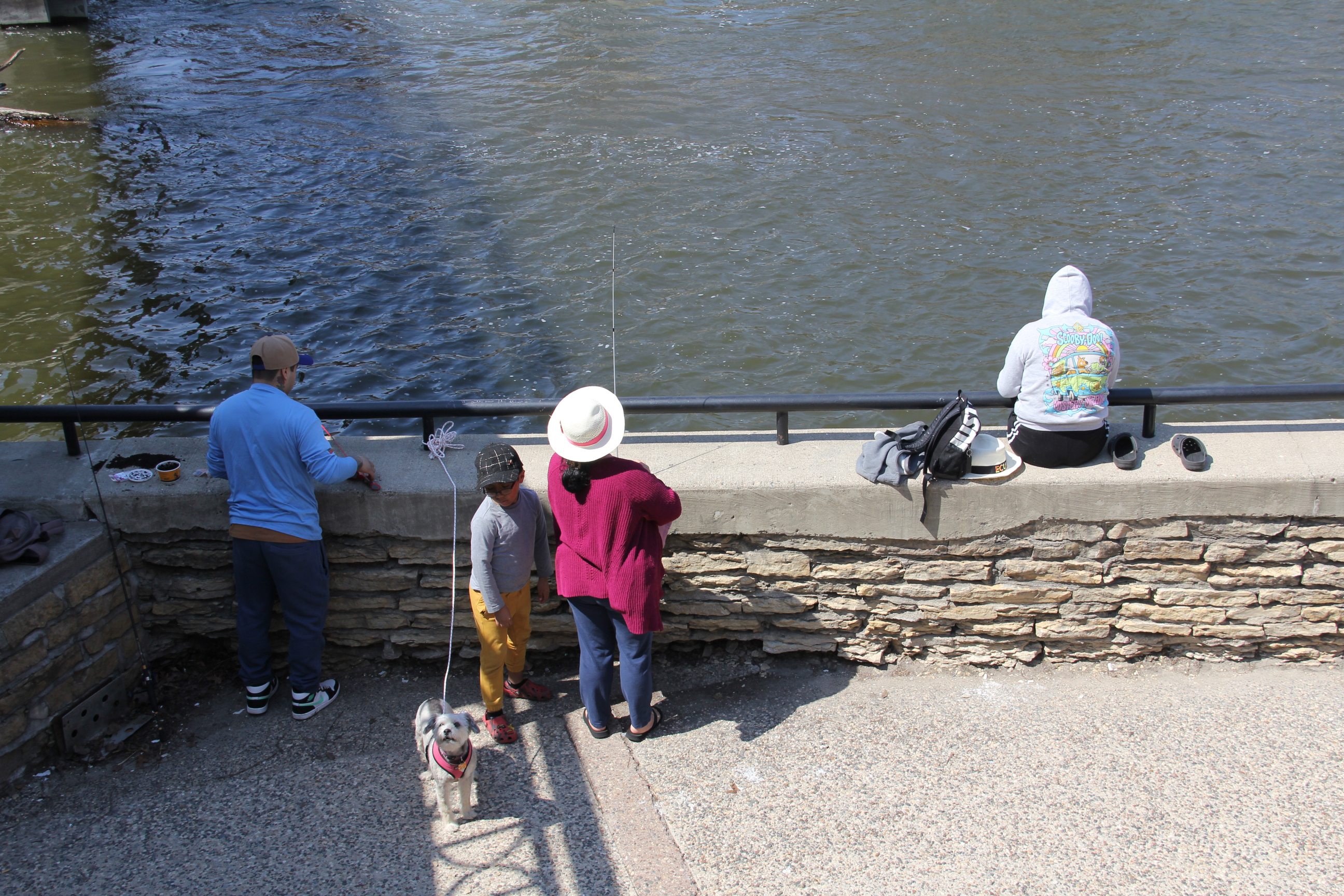
Many carry fishing poles, tackle boxes, containers of bait. Anglers press against the riverside railing, dropping lines into the water far below.
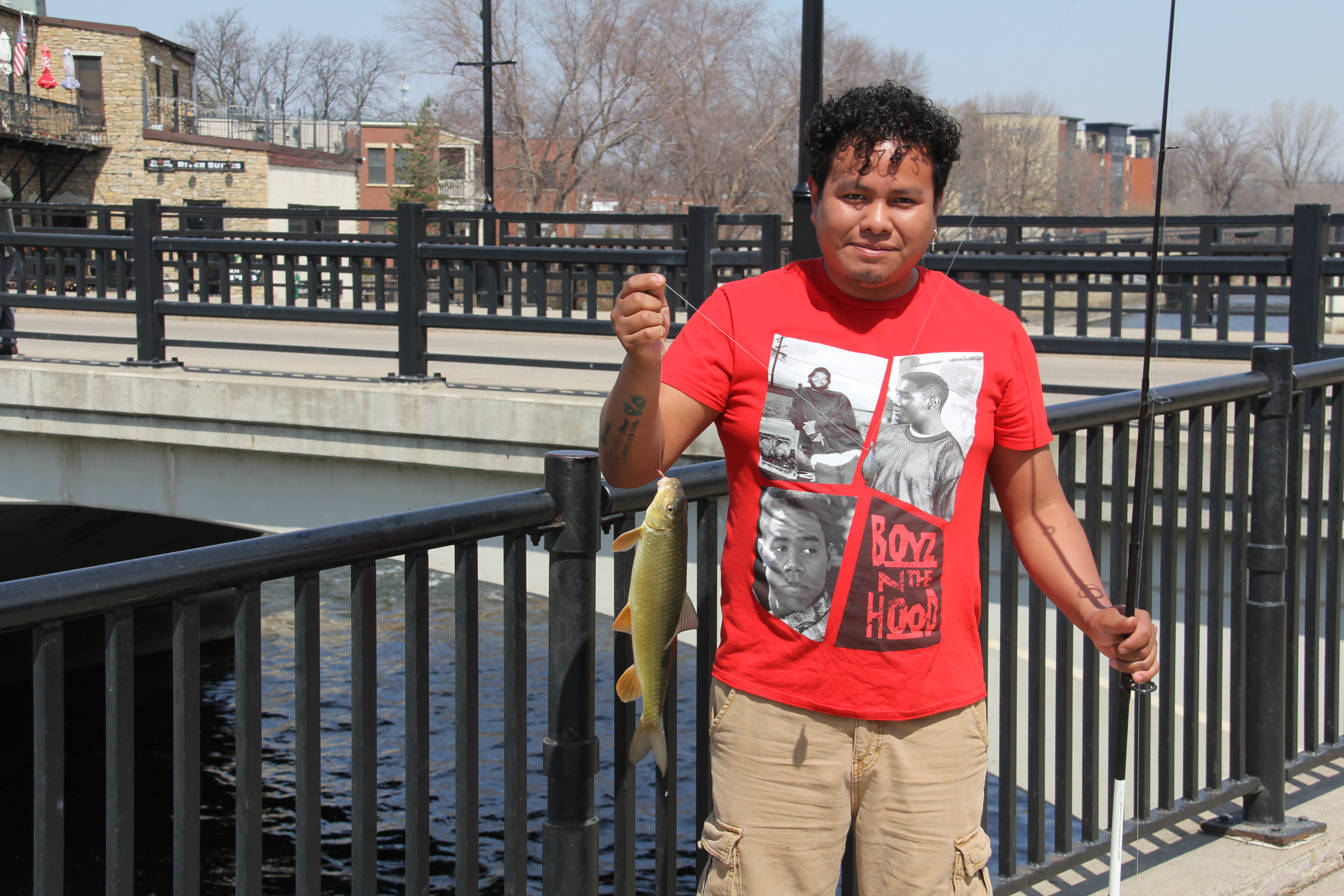
Caught in the Cannon, a sucker fish. (Minnesota Prairie Roots copyrighted photo April 2025)
I watch as a young man pulls in an unidentifiable-to-me fish (later identified as a white sucker by my husband). His friend snaps a photo of the proud angler and his first catch of the day.
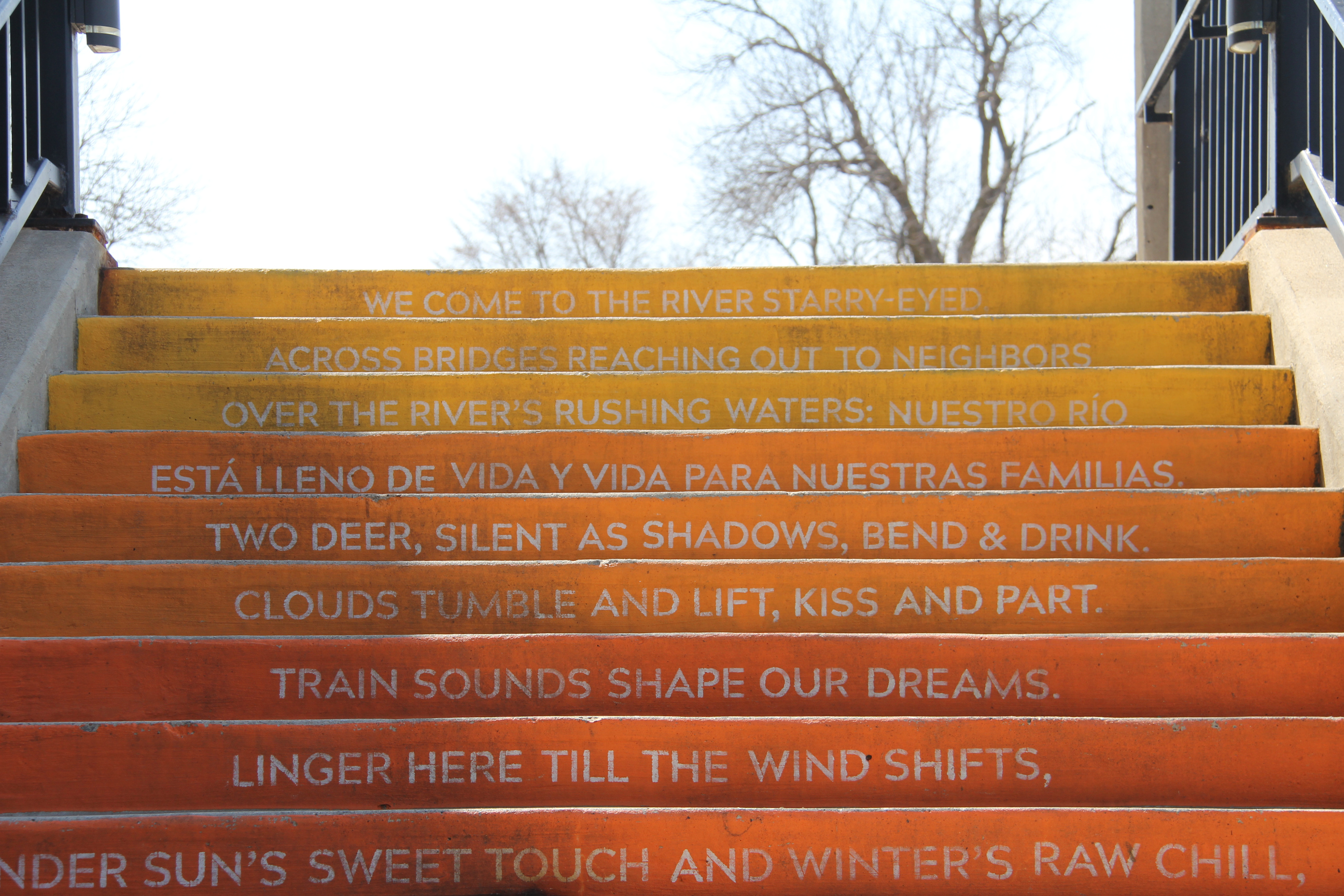
The top section of the Riverwalk Poetry Steps. (Minnesota Prairie Roots copyrighted photo April 2025)
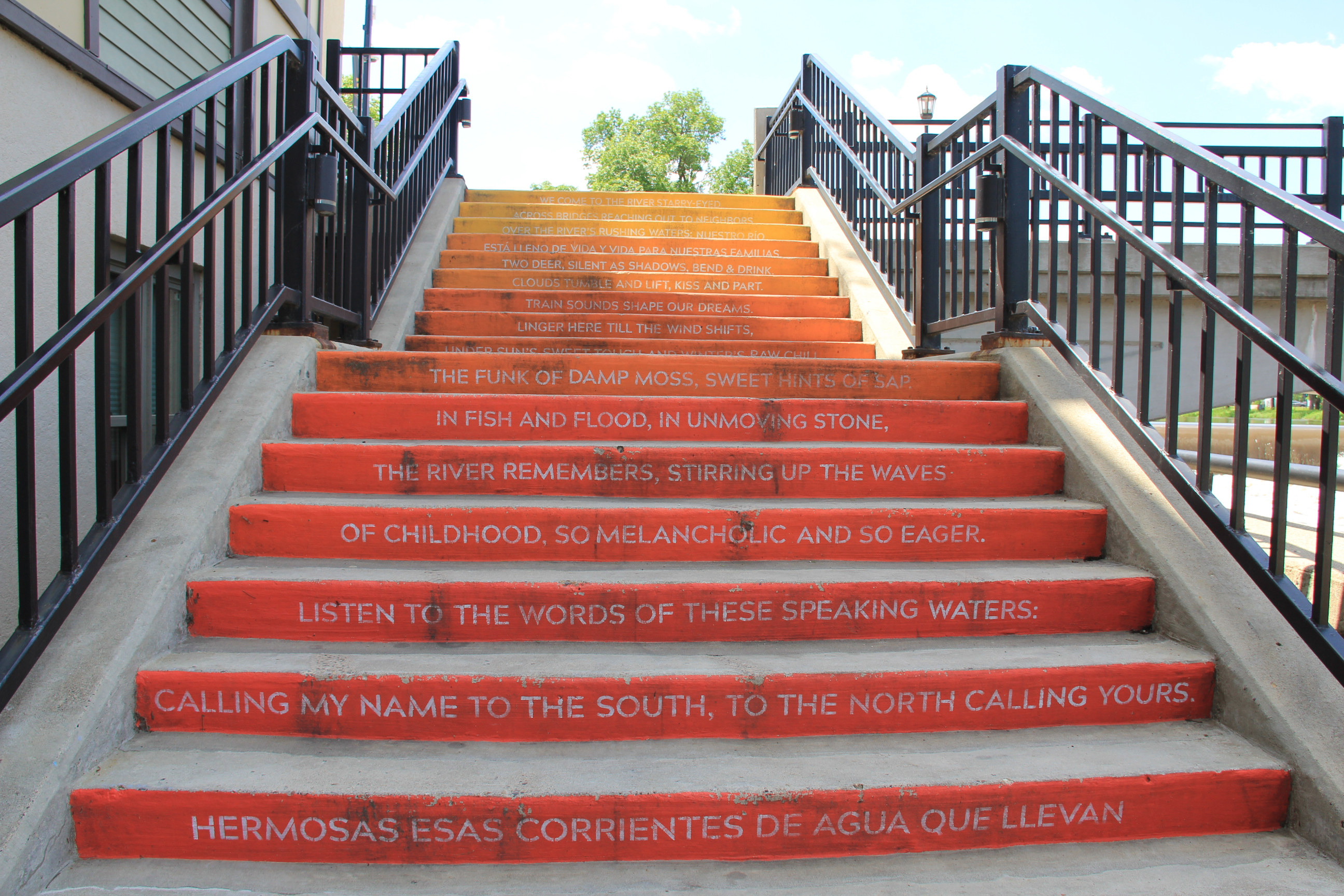
After hanging around the river by Bridge Square for a bit, I descend the colorful Riverwalk Poetry Steps, a river poem crafted by a collaboration of 17 poets. We come to the river starry-eyed/across bridges reaching out to neighbors/over the river’s rushing waters…
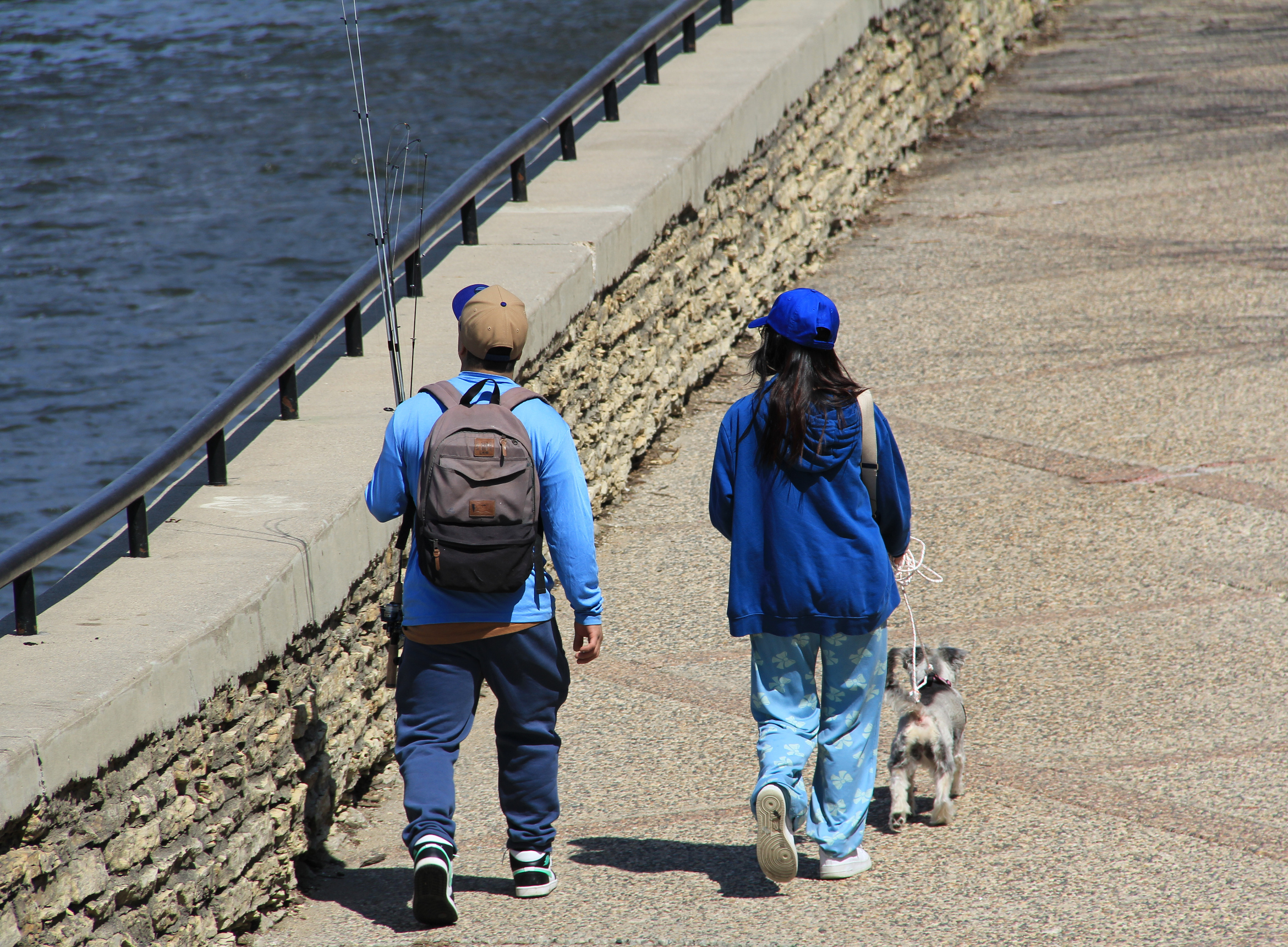
Following the Riverwalk to find a fishing spot along the Cannon River. (Minnesota Prairie Roots copyrighted photo April 2025)
I trail behind a couple, a family, a dog, another family, all of us connected by the water, by this place, on this spring day. I’m the only one to pause and read the poetry.
A family fishes the Cannon. (Minnesota Prairie Roots copyrighted photo April 2025)
Atop the river wall, young women sit, sans shoes, while they fish. We all watch the river flow. Bobbers bob. A pair of ducks—one pure white—flies low, skimming the water before landing upon the surface of the Cannon.
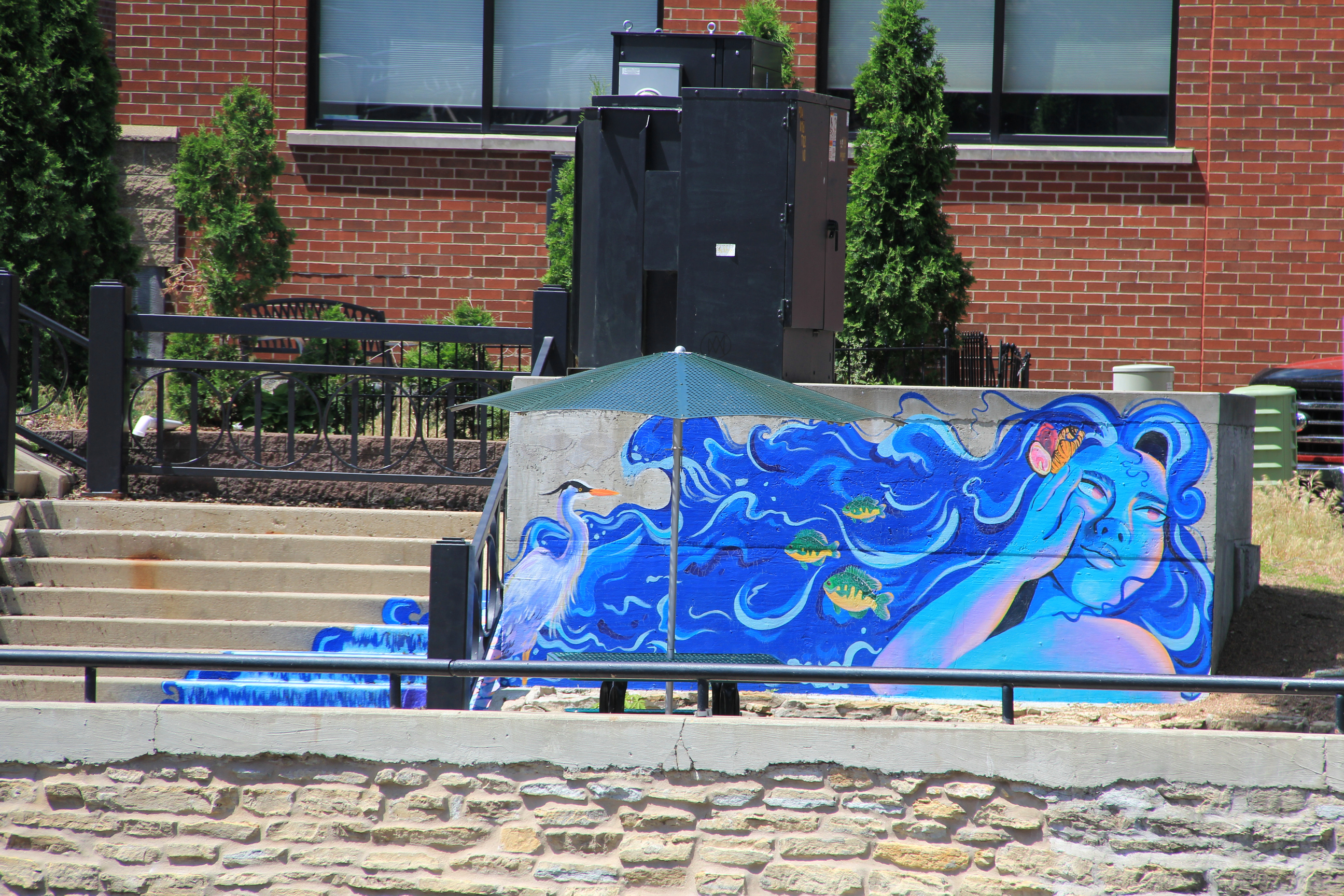
“Lady Cannon,” a riverside mural by Maya Kenney and Raquel Santamaria. (Minnesota Prairie Roots copyrighted photo April 2025)
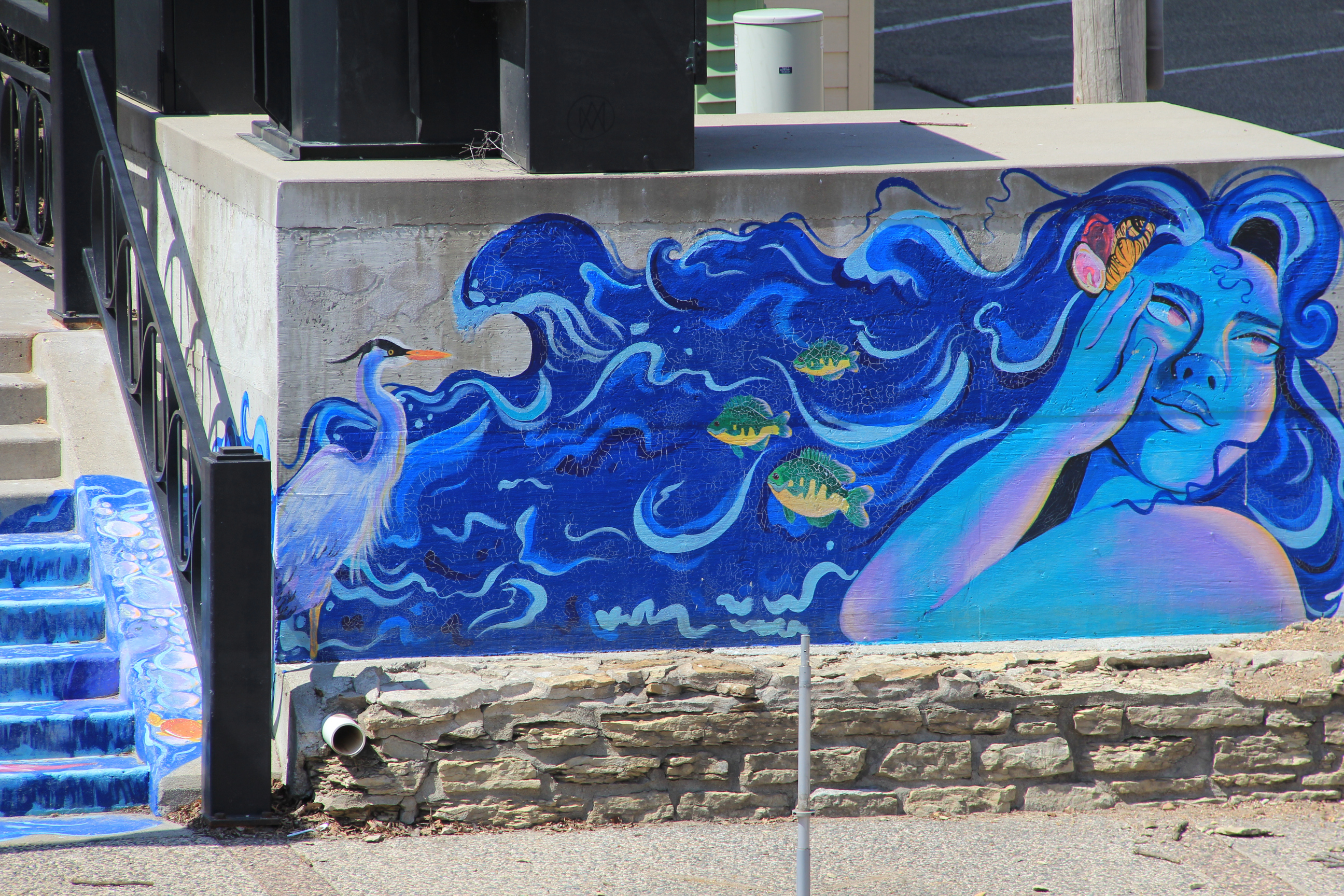
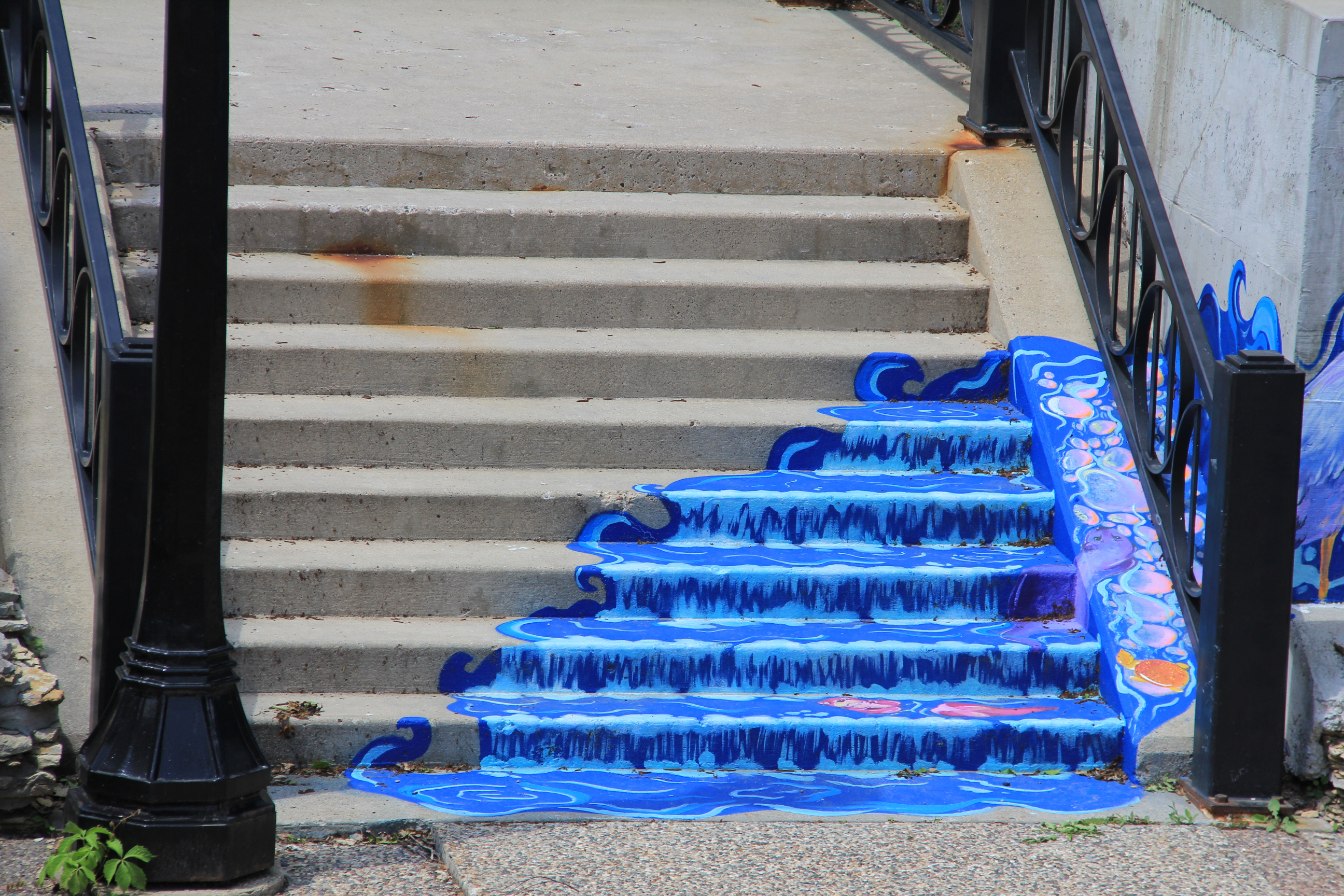
Across the river, Lady Cannon watches. Fish swim in her tangled waves of locks, flowing like water down steps toward the river. She is the art of the Cannon.
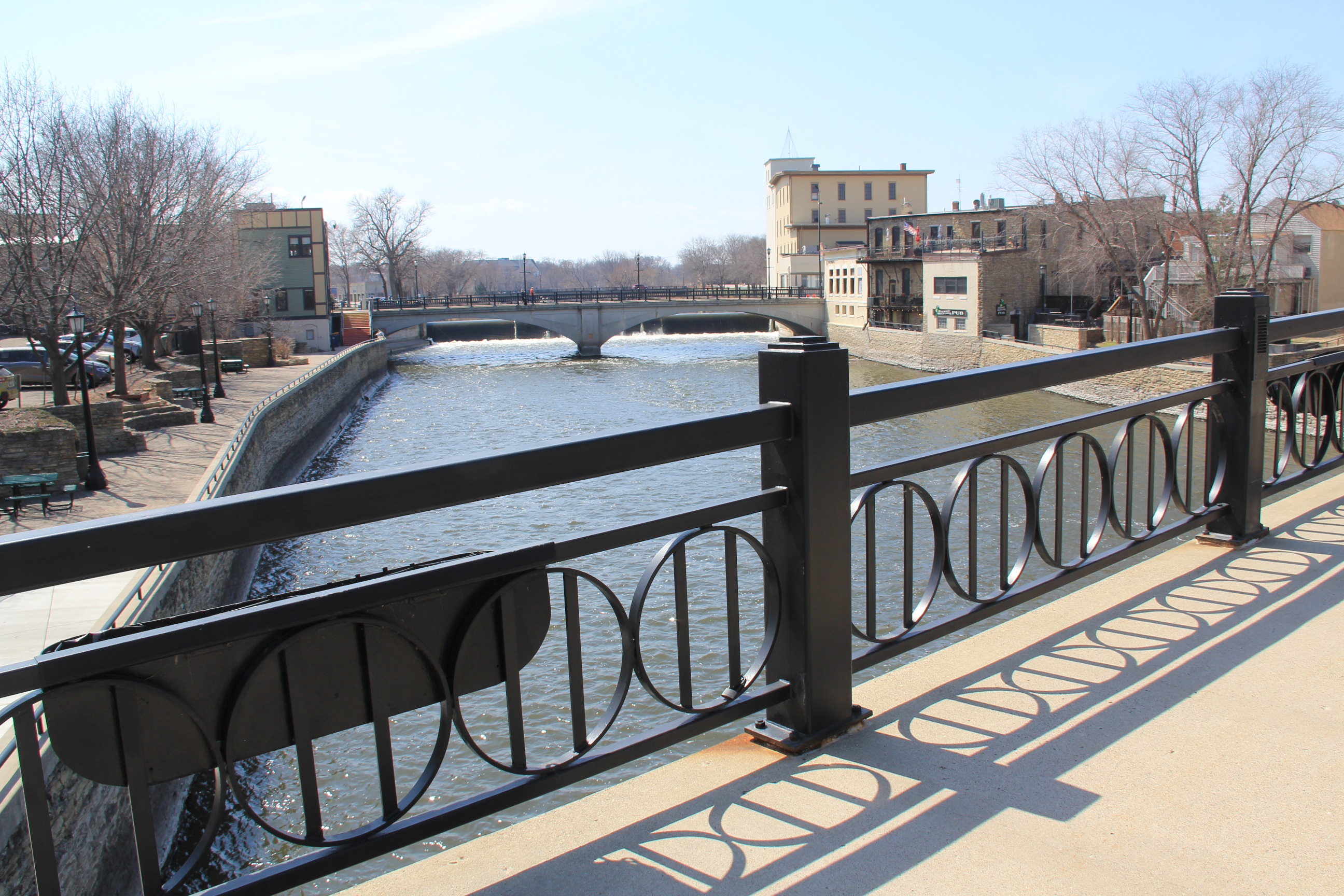
On the pedestrian bridge looking toward the Cannon and the Ames Mill, right in the distance. (Minnesota Prairie Roots copyrighted photo April 2025)
I see art, too, in a railing shadowed upon the pedestrian bridge. I linger, mesmerized by the moving water, the riverside historic flour mill a block away.
There’s so much to take in here. So much that connects us. The sun, the sky, the land. And the river that flows beside and below us.
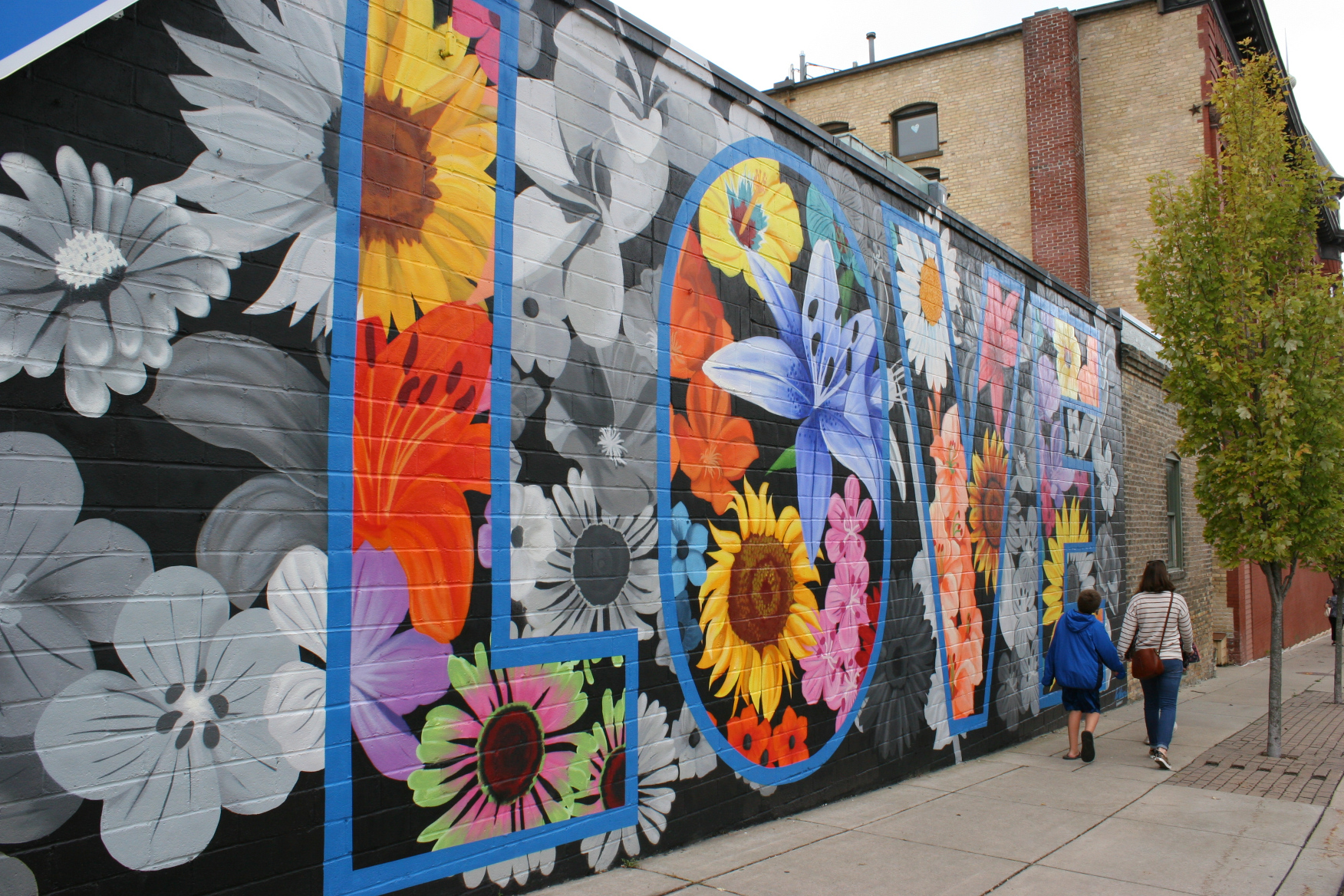
A Northfield Arts and Culture Commission mural by Brett Whitacre, just off Division Street in Northfield, blooms love. (Minnesota Prairie Roots copyrighted file photo)
IS IT COLD out there?” I asked before rolling out of bed on a recent subzero morning.
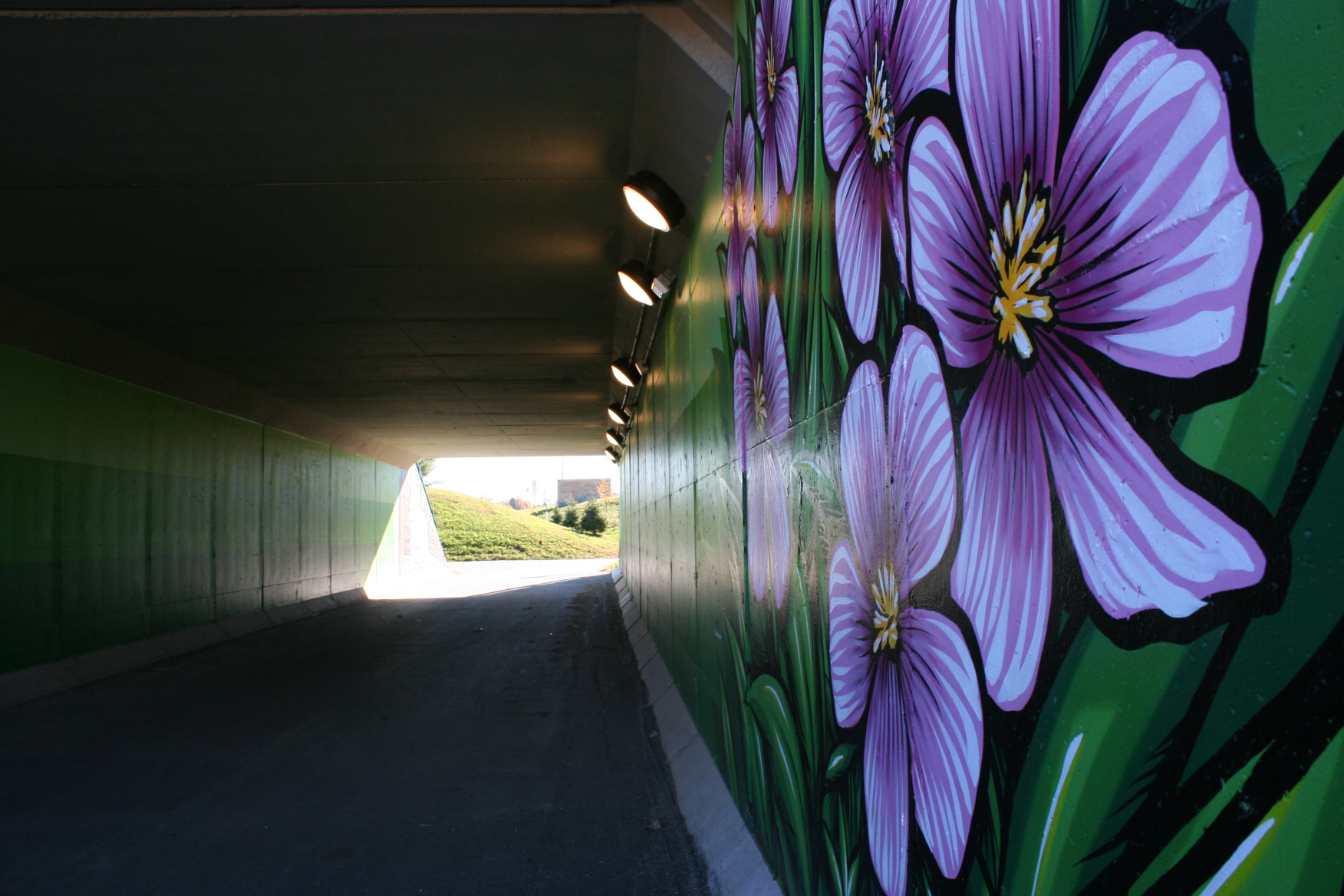
In an underpass tunnel along a recreational trail in Northfield, Adam Turman created this summer scene on a mural. (Minnesota Prairie Roots copyrighted file photo)
“No, it’s summertime,” he answered.
A Montgomery Wings Mural Walk wing on Lanette’s Coffee Shop features flowers watered by Scarlett, who is wearing traditional Czech clothing. That honor’s the Czech heritage of Montgomery, MN. (Minnesota Prairie Roots copyrighted file photo)
That sarcastic response from my husband acted as a writing prompt during this week of cold weather advisories and warnings in Minnesota. We’ve experienced wind chills ranging from -25 to -50 degrees across the state. That’s brutally cold.
Wild geraniums painted by Adam Turman inside an underpass tunnel in Northfield. (Minnesota Prairie Roots copyrighted file photo)
On the morning I asked Randy about the cold, the 7:17 a.m. air temp registered -12 degrees. With the wind chill, it felt like -29 degrees. That marked the coldest day in six years. I know we are not alone here in Minnesota as frigid air and snow sweep the country, including into the deep South.
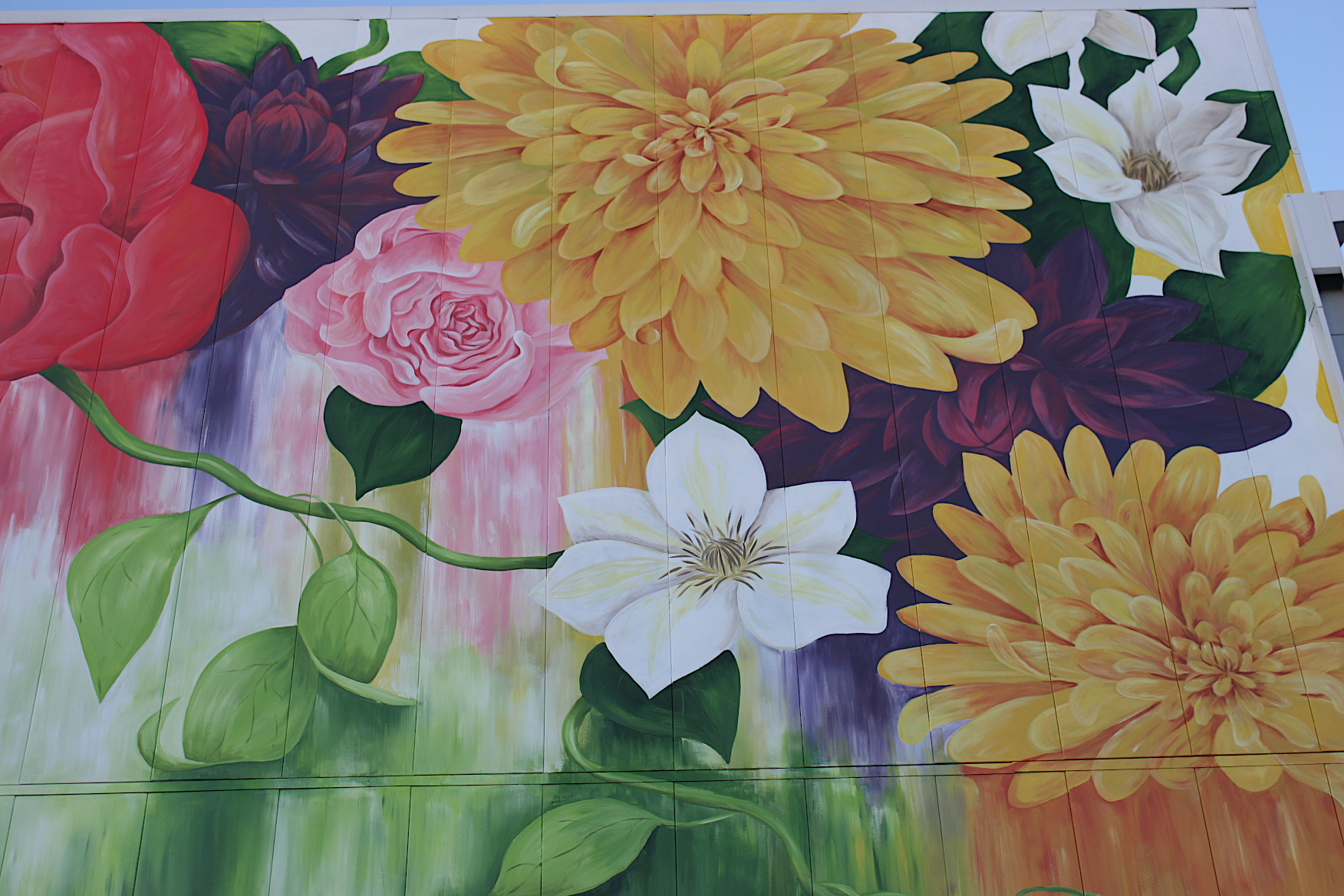
Flowers fill the LoveForAll mural by Jordyn Brennanin downtown Faribault. (Minnesota Prairie Roots copyrighted file photo)
Because I can’t flee to a warmer location, I opted to transport myself from the currently cold, colorless landscape of southern Minnesota to a place of beauty. Without leaving the area. For me, that comes in photos I’ve taken of floral-themed murals blooming throughout the area. In the deep of winter, these paintings hold the hope of warmer days, of sunshine and flowers.
My most recent mural discovery was several months ago on Wild Wood in Nerstrand. (Minnesota Prairie Roots copyrighted file photo)
I love when communities embrace this form of public art, because murals are accessible to anyone, anytime. They spark joy, generate interest in place, show community pride. I get excited when I unexpectedly happen upon a mural.
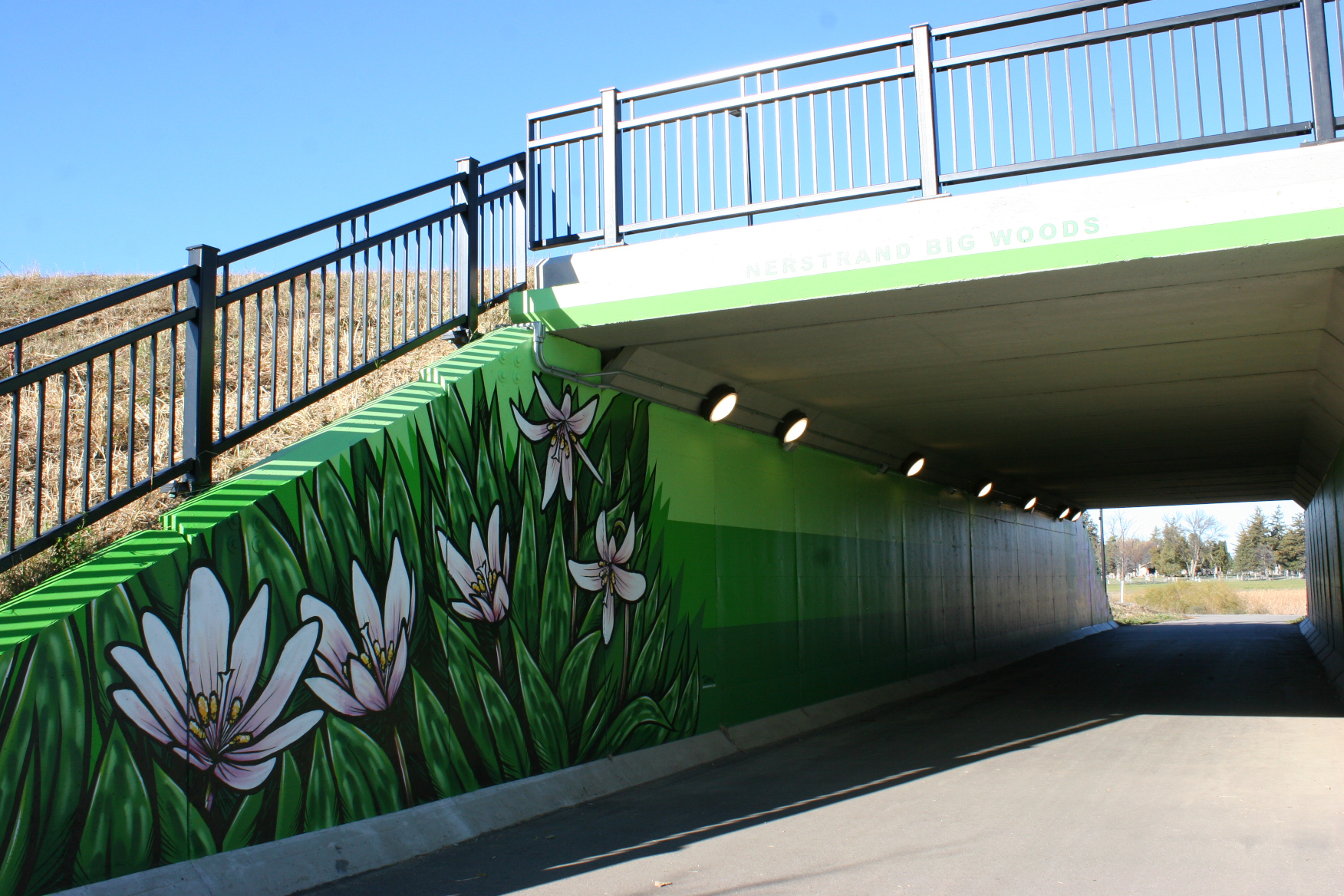
The rare Dwarf Trout Lily grows only in Rice, Steele and Goodhue counties in Minnesota and is depicted here by Adam Turman on an underpass tunnel wall in Northfield.(Minnesota Prairie Roots copyrighted file photo)
Floral-themed murals, especially, have a way of uplifting spirits, of celebrating all that is beautiful and lovely. Bold, vivid hues in the deep of January in Minnesota, offer a welcome visual respite.
A close-up of mums and peonies, forefront, in Jordyn Brennan’s LoveForAll mural. Faribault was once renowned for those two flowers. (Minnesota Prairie Roots copyrighted file photo)
I can almost imagine meandering through a flower garden, dipping my nose into blossoms, appreciating each scent, each petal, each stem. Oh, the beauty of it all.
Floral-themed wings appropriately placed outside Posy Floral & Gifts in Montgomery as part of the Montgomery Wings Mural Walk. (Minnesota Prairie Roots copyrighted file photo)
On these frigid days, when I view a drab landscape of muted tones, trees stripped of leaves, snow layering the earth, I delight in sharing the floral murals I’ve photographed. No one ever promised me a rose garden. But these murals hold the promise of spring and of summertime in Minnesota.
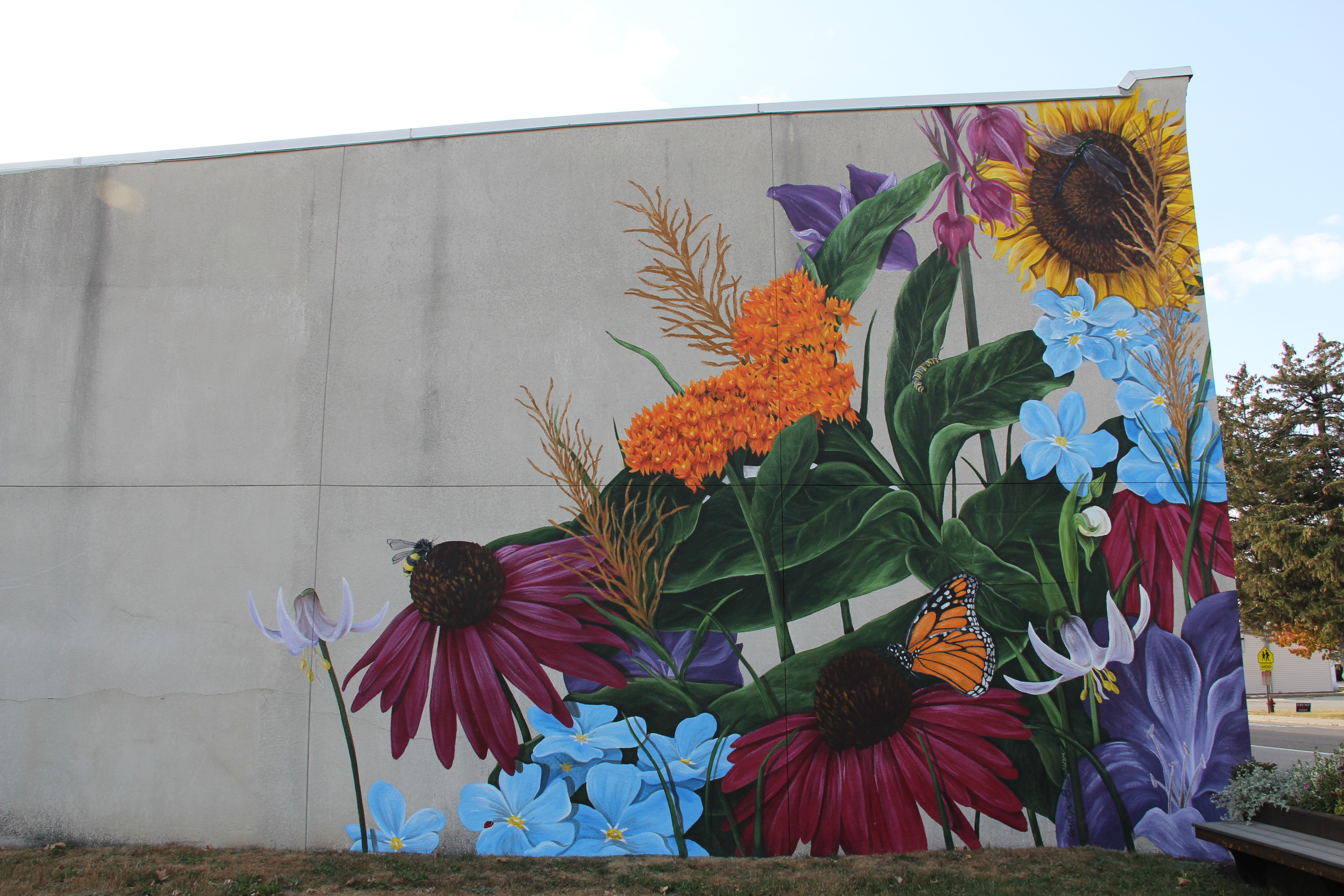
Wildflowers bloom on a mural along Main Street in Nerstrand. (Minnesota Prairie Roots copyrighted photo October 2024)
NERSTRAND, POPULATION 295, is one of those small towns where not a lot changes. Until something does, and then you notice.
The mural is painted onto a corner of WildWood of Nerstrand. (Minnesota Prairie Roots copyrighted photo October 2024)
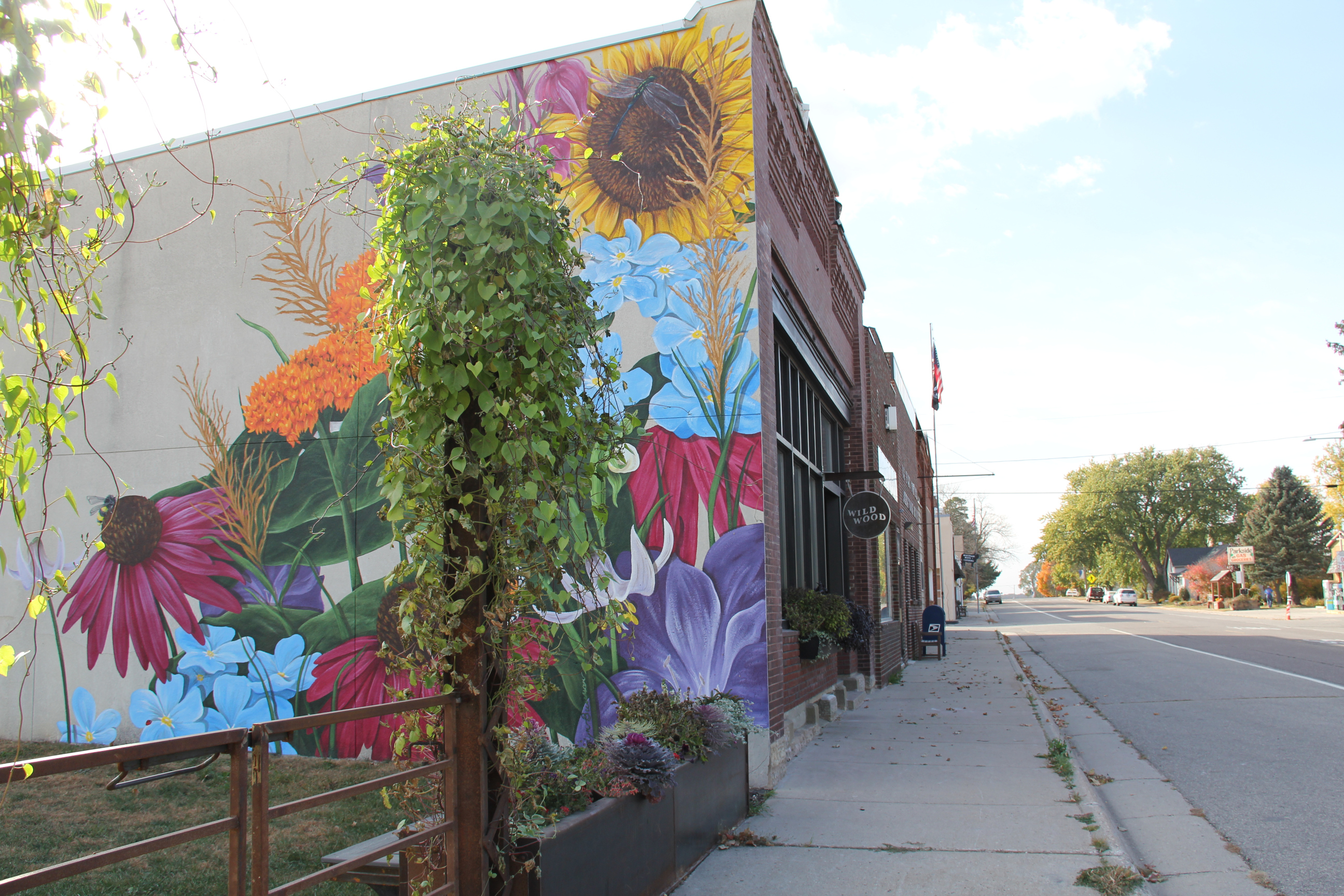
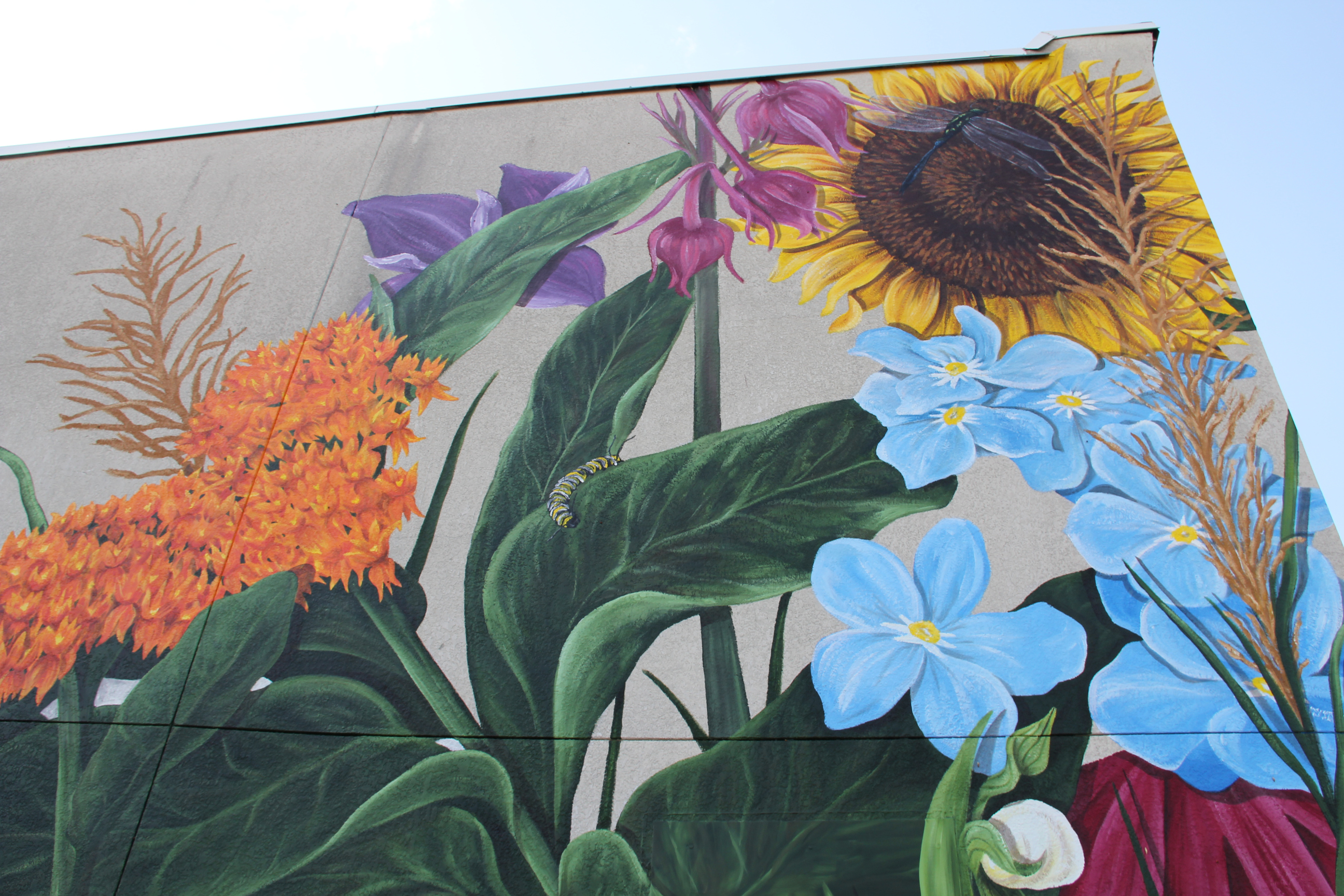
On a recent drive through this community in far eastern Rice County, I noticed something new. A mural. The wildflower-themed painting stretches across a corner of a brick building marked as WildWood.
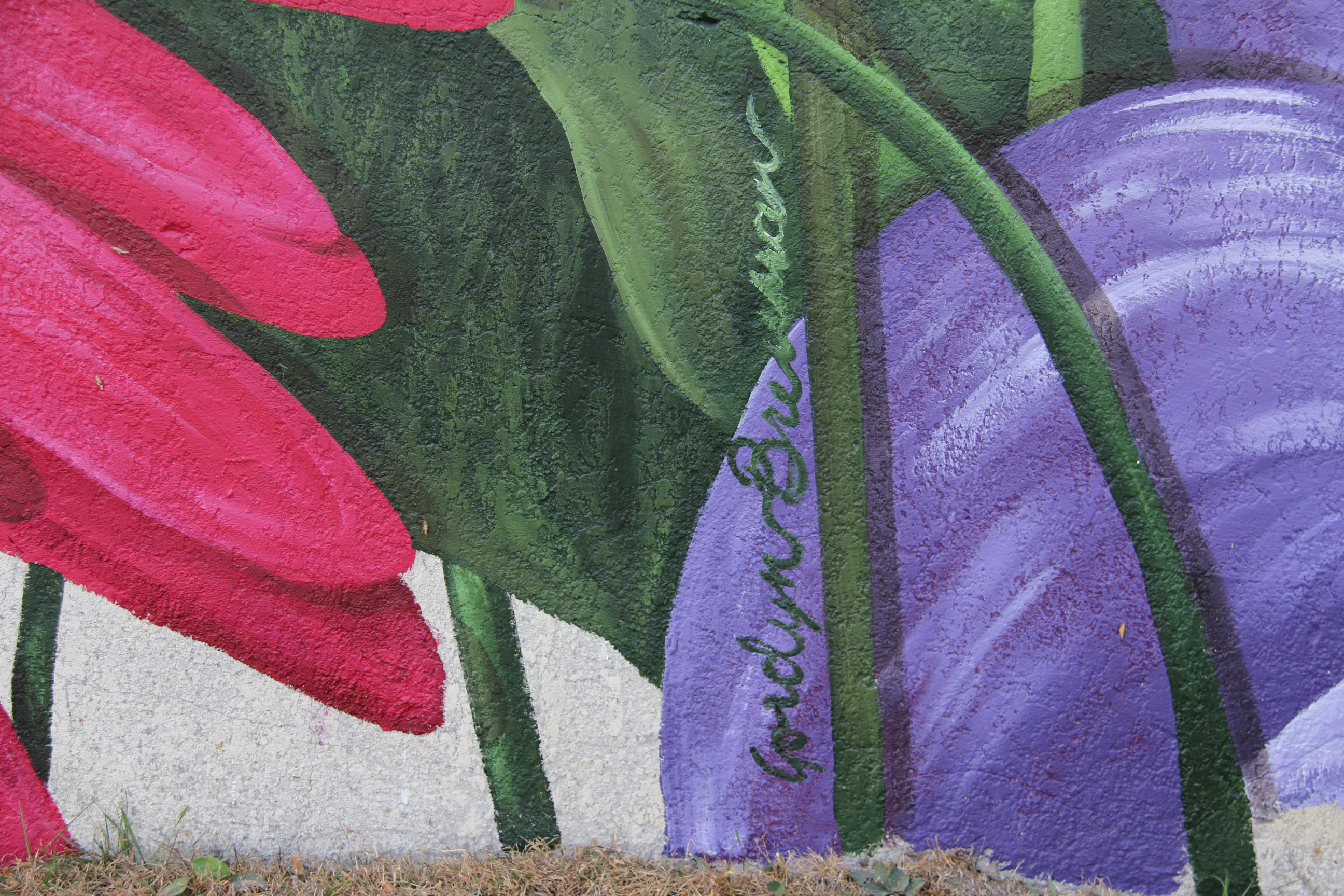
I found Jordyn Brennan’s signature down low on a lily stem. (Minnesota Prairie Roots copyrighted photo October 2024)
“Love for All,” a mural in Faribault that celebrates my community’s diversity. (Minnesota Prairie Roots copyrighted file photo)
I felt a sense of familiarity with the artwork. And then I saw Jordyn Brennan’s signature climbing the stem of a dwarf trout lily. The Minneapolis artist’s colorful “Love for All” mural, complete with hands signing the word “LOVE” and plenty of flowers, covers a spacious exterior building wall in the heart of downtown Faribault.
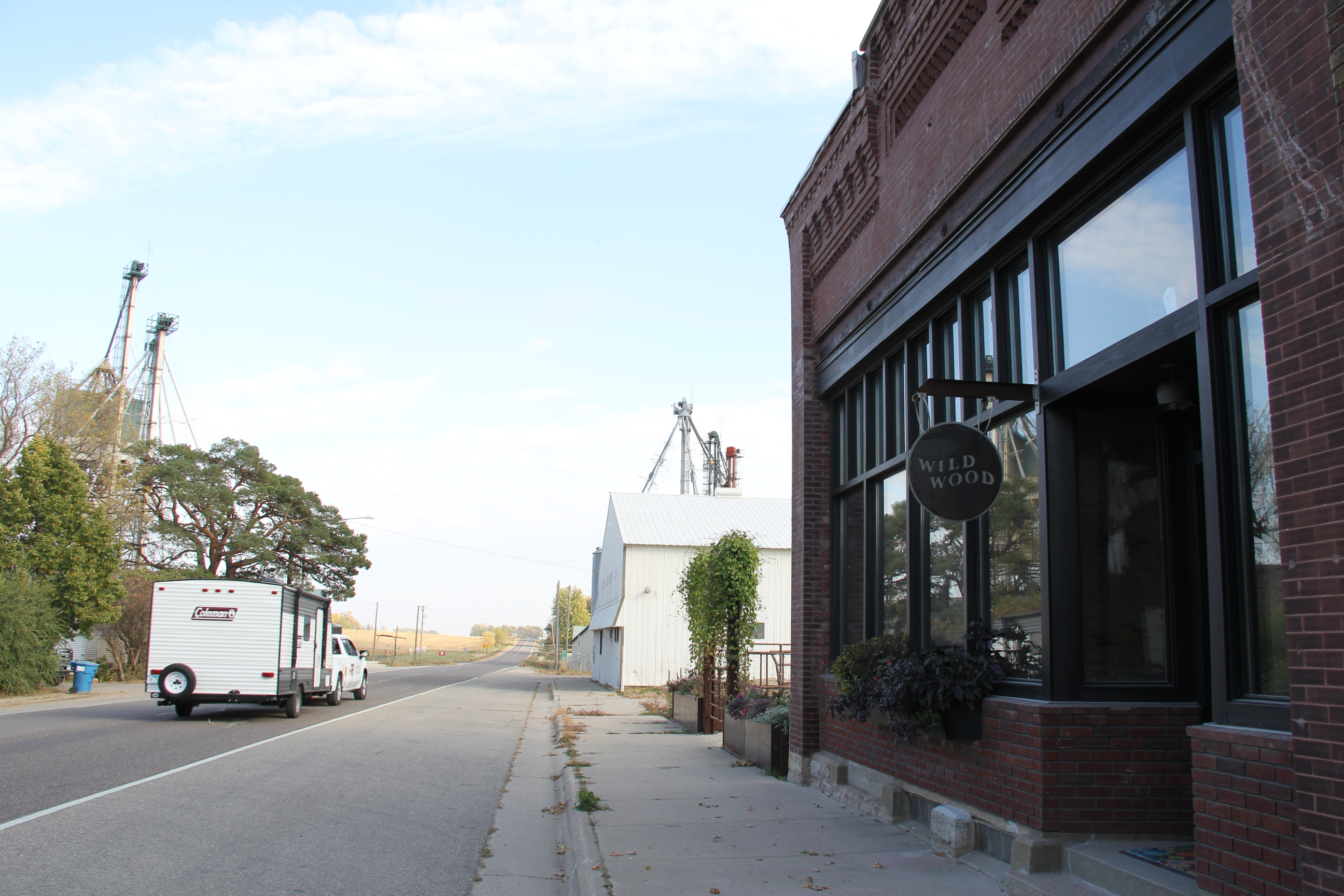
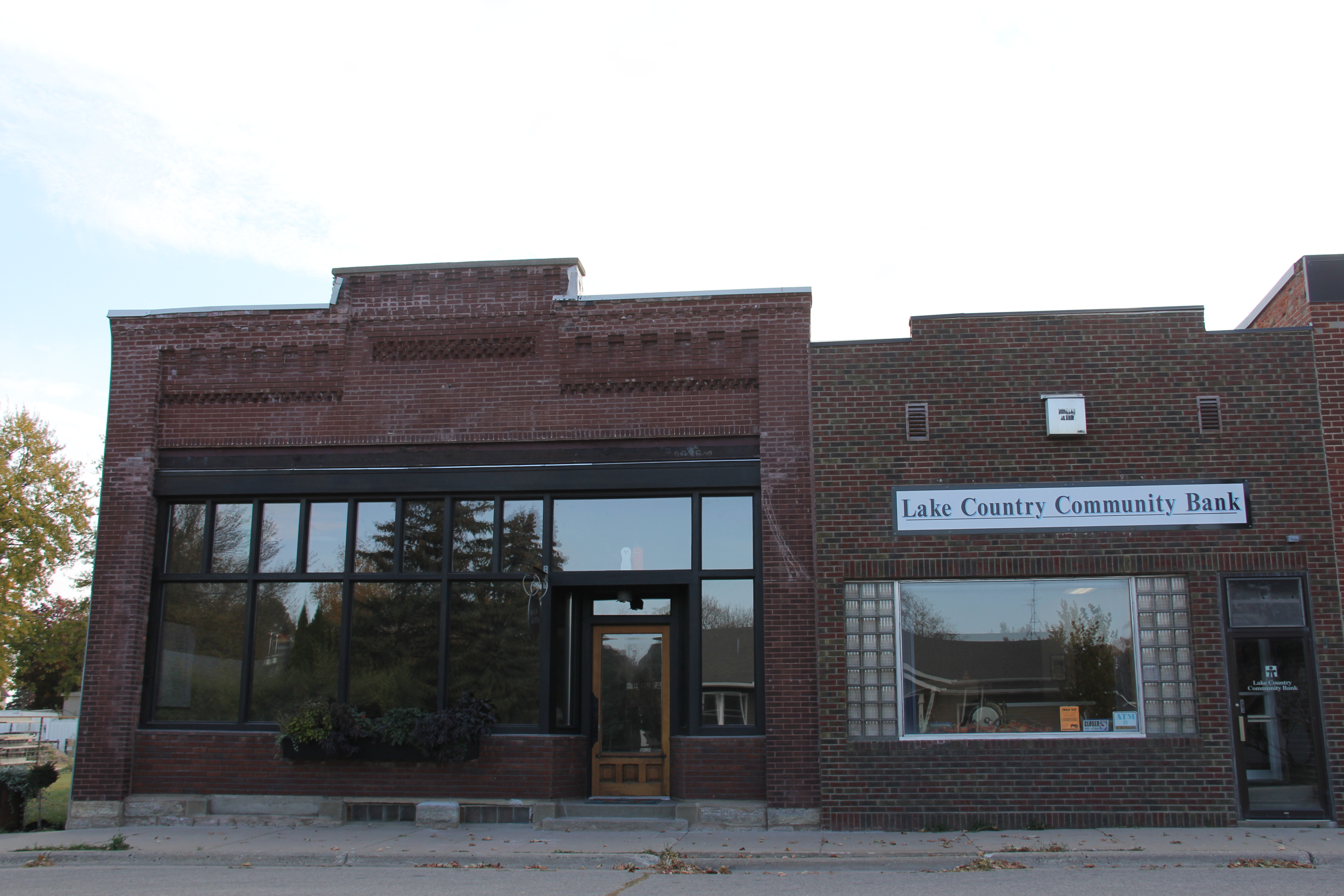
Heading east out of Nerstrand, WildWood is located at 315 Main Street, next to Lake Country Community Bank. (Minnesota Prairie Roots copyrighted photo October 2024)
And now her work can be seen in the heart of downtown Nerstrand on WildWood, a restored brick building housing an event space and photography studio. I peered through the window of the locked front door to see more brick and wood. Lovely. Rustic. Down-to-earth visually appealing.
The mural adds an inviting nature-themed backdrop to The Wilderness green space. (Minnesota Prairie Roots copyrighted photo October 2024)
Tricia and Nick Streitz, with the help of family and friends, worked many years to renovate the space, which previously housed a woodcraft business and was then used for storage. Tricia’s business, Sweet Shibui Photography, is now located in a portion of the historic building. The rest is available to rent for gatherings in the 1,800 square foot The Great Room and outdoors in the 2,400 square foot The Wilderness green space.
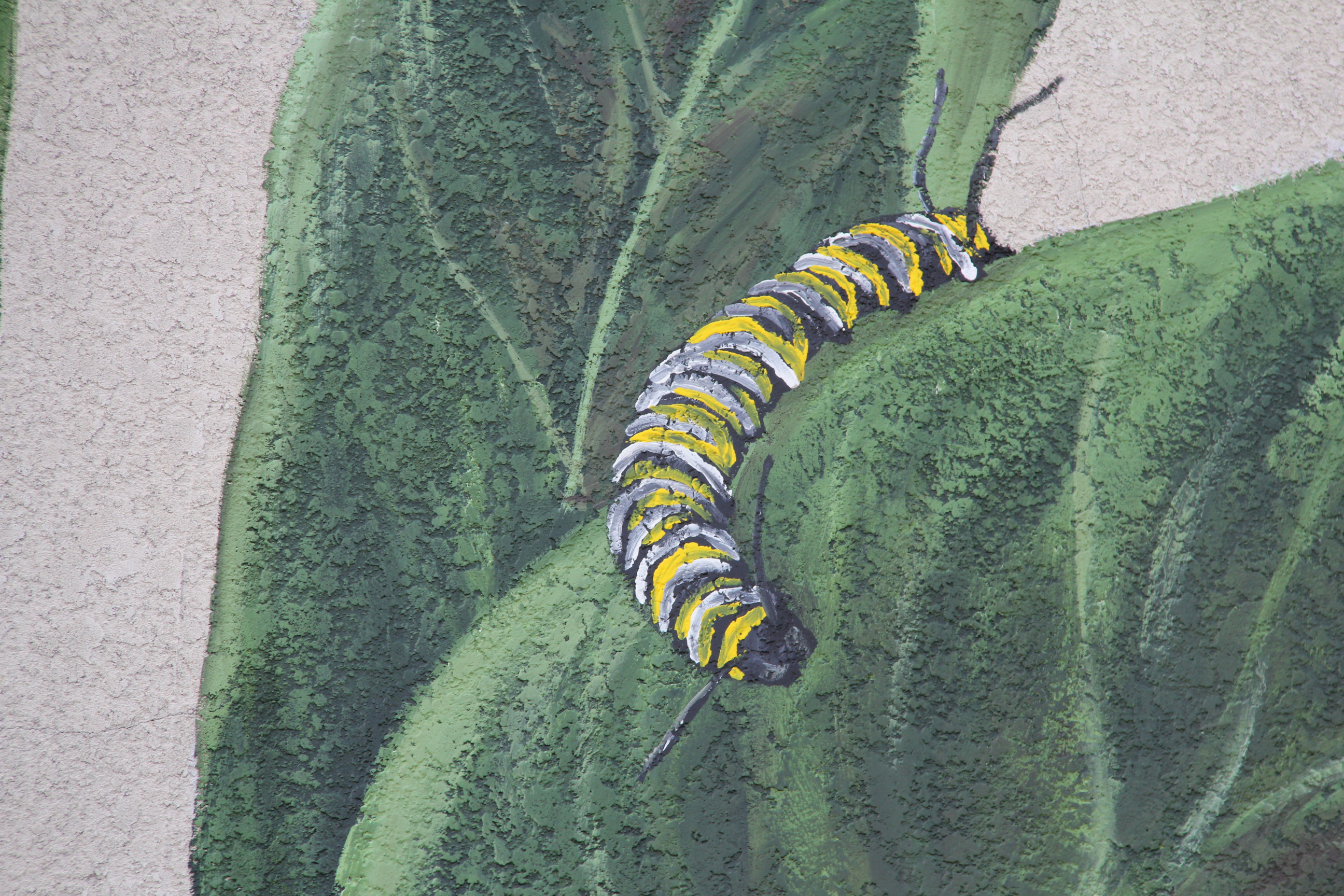
A Monarch caterpillar spotted among the flowers. (Minnesota Prairie Roots copyrighted photo October 2024)
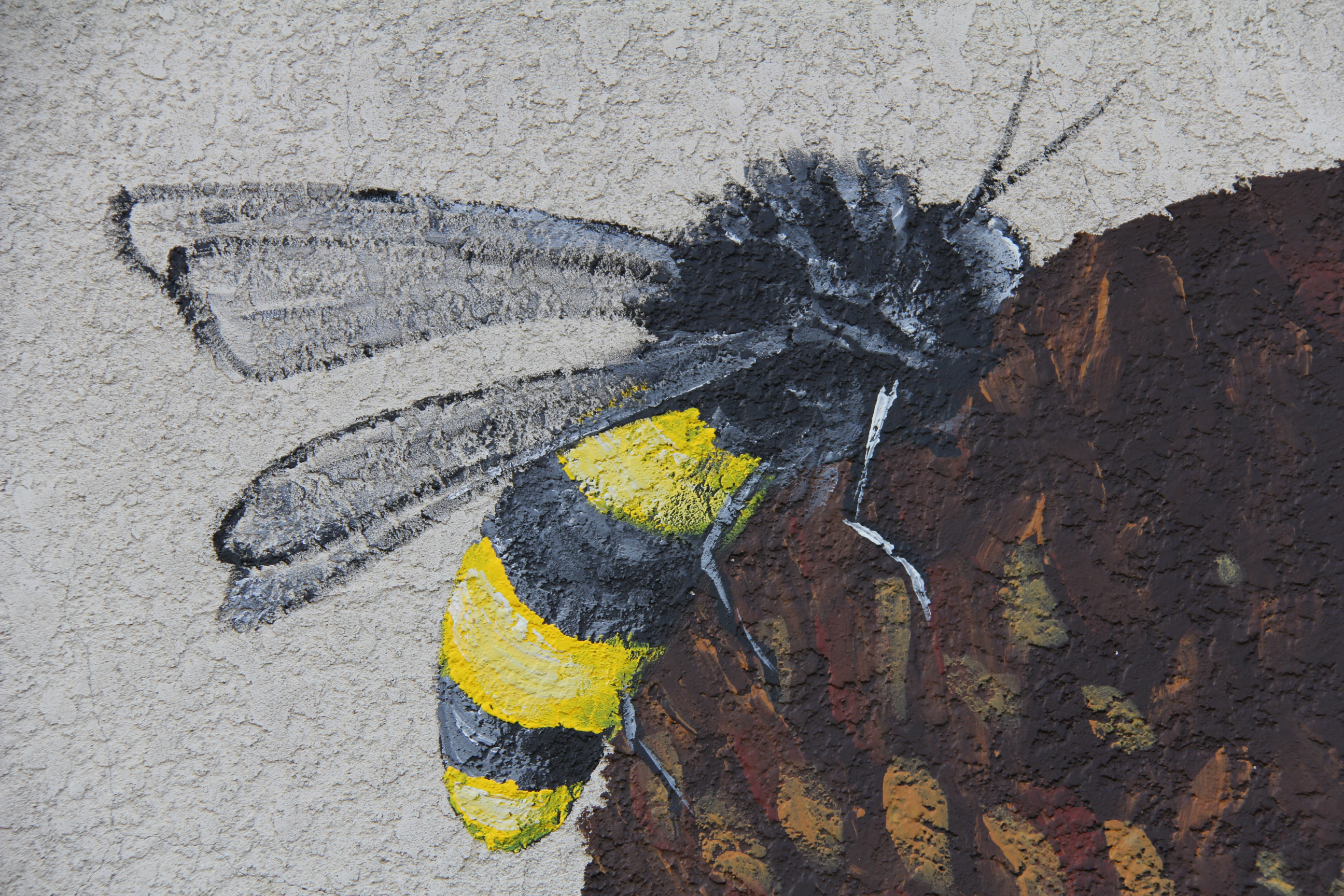
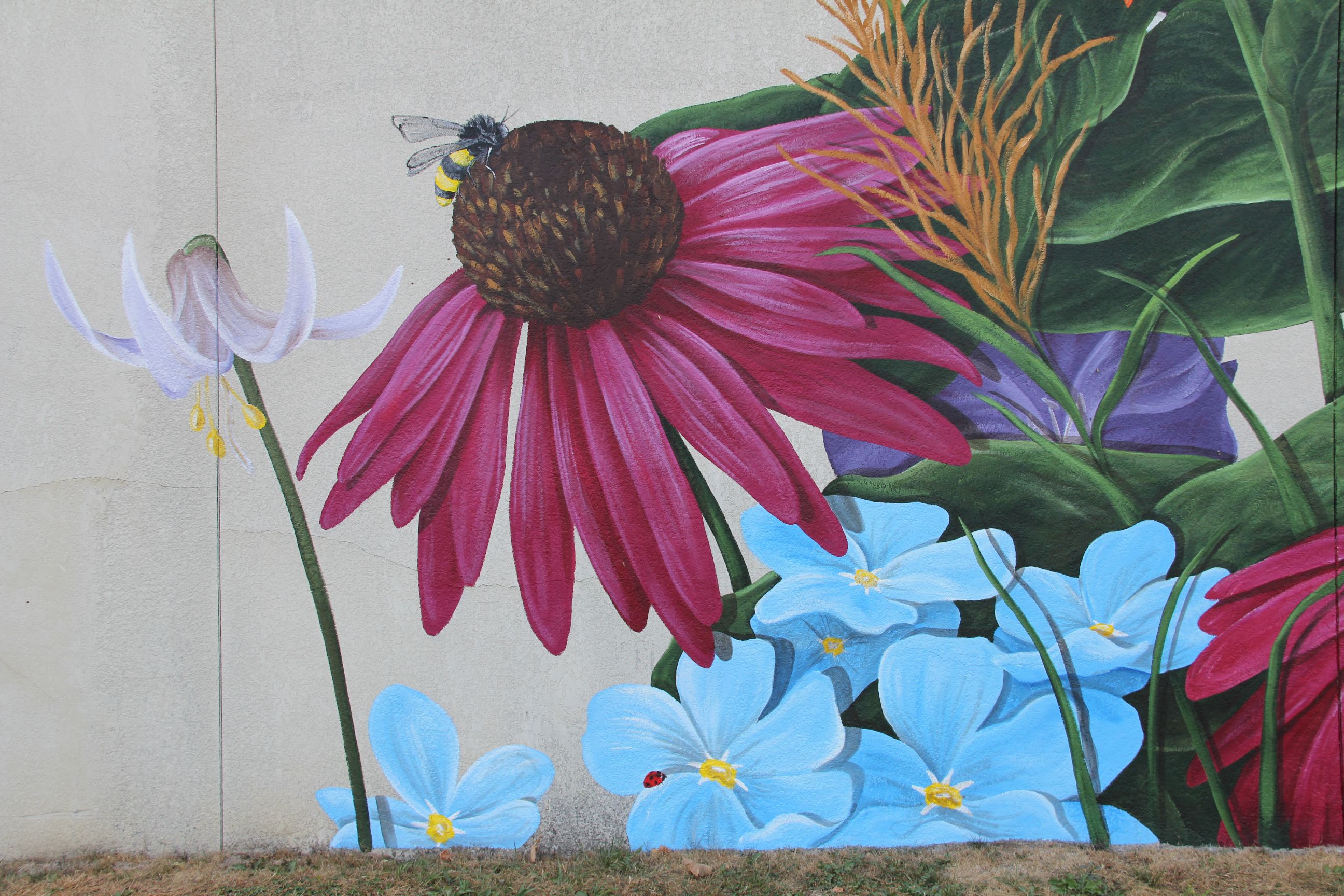
A bumblebee feeds on a coneflower. (Minnesota Prairie Roots copyrighted photo October 2024)
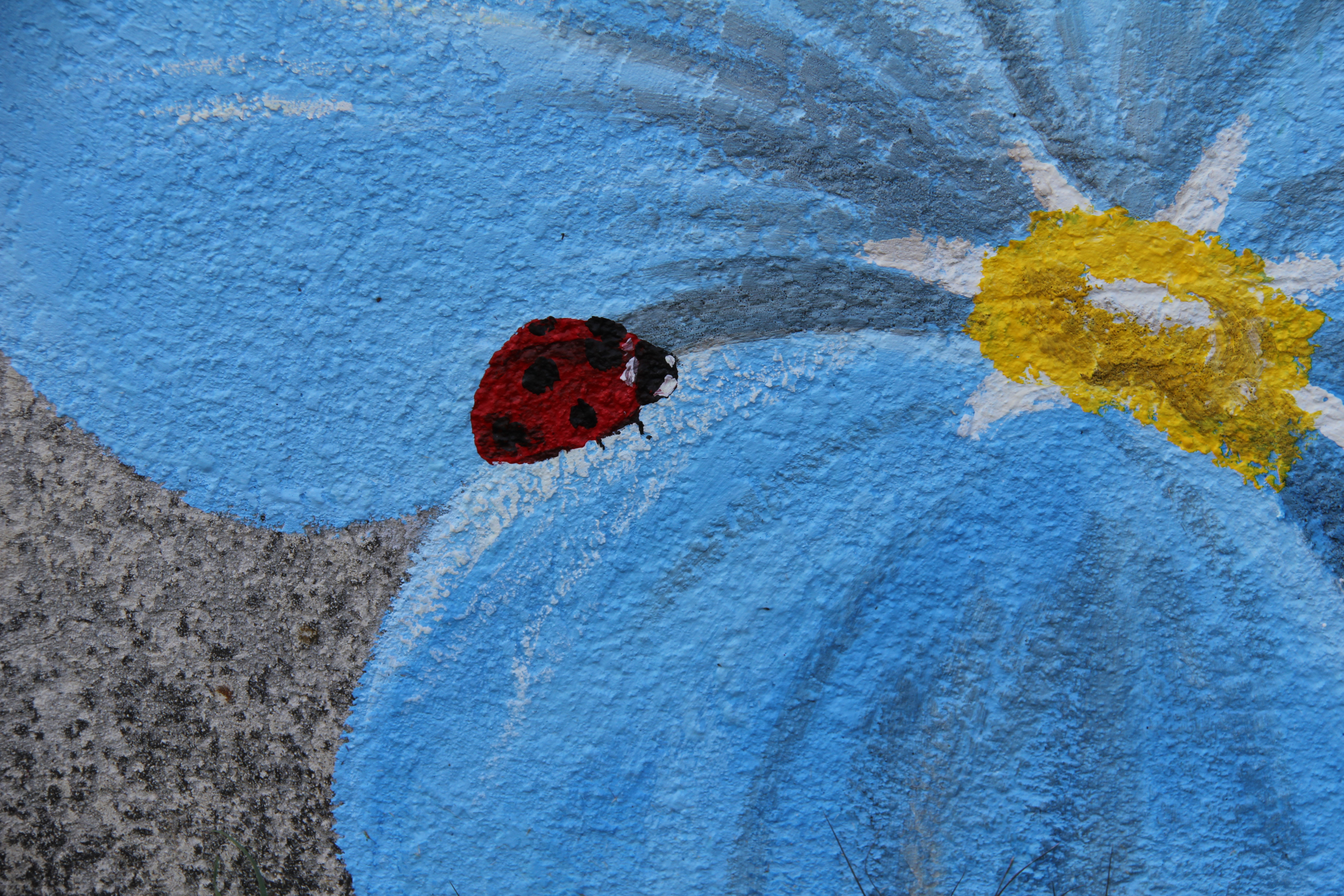
Way down low on the mural, near the ground, I found this ladybug. (Minnesota Prairie Roots copyrighted photo October 2024)
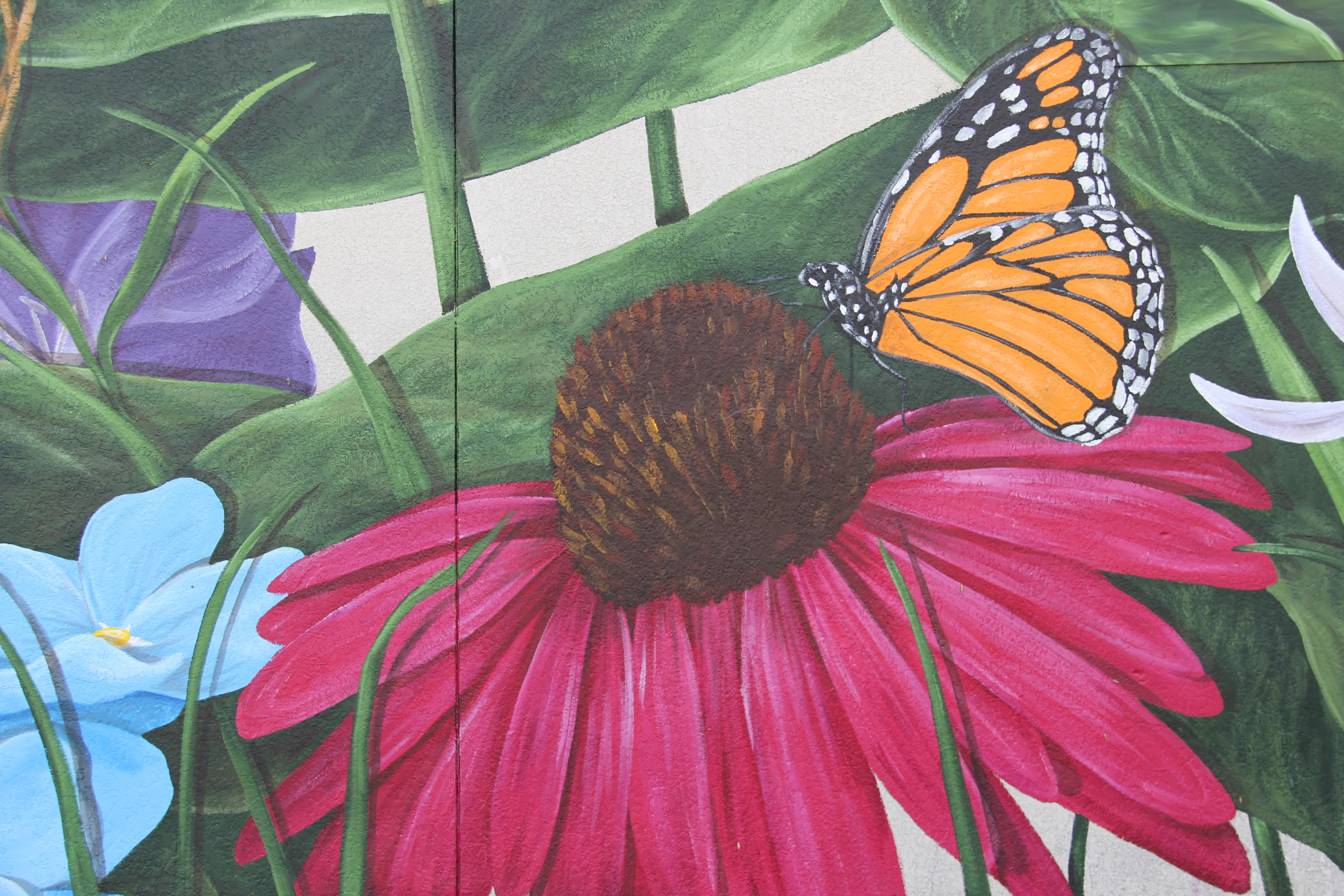
But on this Saturday afternoon in late October, I focused on the mural of coneflowers, dwarf trout lilies, sunflower, butterfly weed and several other wildflowers unknown to me. I found a Monarch caterpillar, Monarch butterfly, dragonfly and bumblebee interspersed among the florals, almost missing a ladybug.
The mural is on the left side of the WildWood building. (Minnesota Prairie Roots copyrighted photo October 2024)
I love public art, especially in small towns where art is often not easily accessible. This mural splashes color into the few blocks that comprise Nerstrand’s downtown business area. But the mural is also a backdrop for The Wilderness outdoor gathering space. I can easily envision family and friends gathering here and on the concrete patio to celebrate a small wedding, an anniversary, a graduation, a baby or bridal shower, whatever brings people together in life’s celebratory moments. Yard games are part of the package rental. WildWood is hosting an indoor/outdoor Makers Market from 9 a.m. – 1 p.m. Saturday, November 16.
That’s the rare dwarf trout lily to the far left in this section of the mural. (Minnesota Prairie Roots copyrighted photo October 2024)
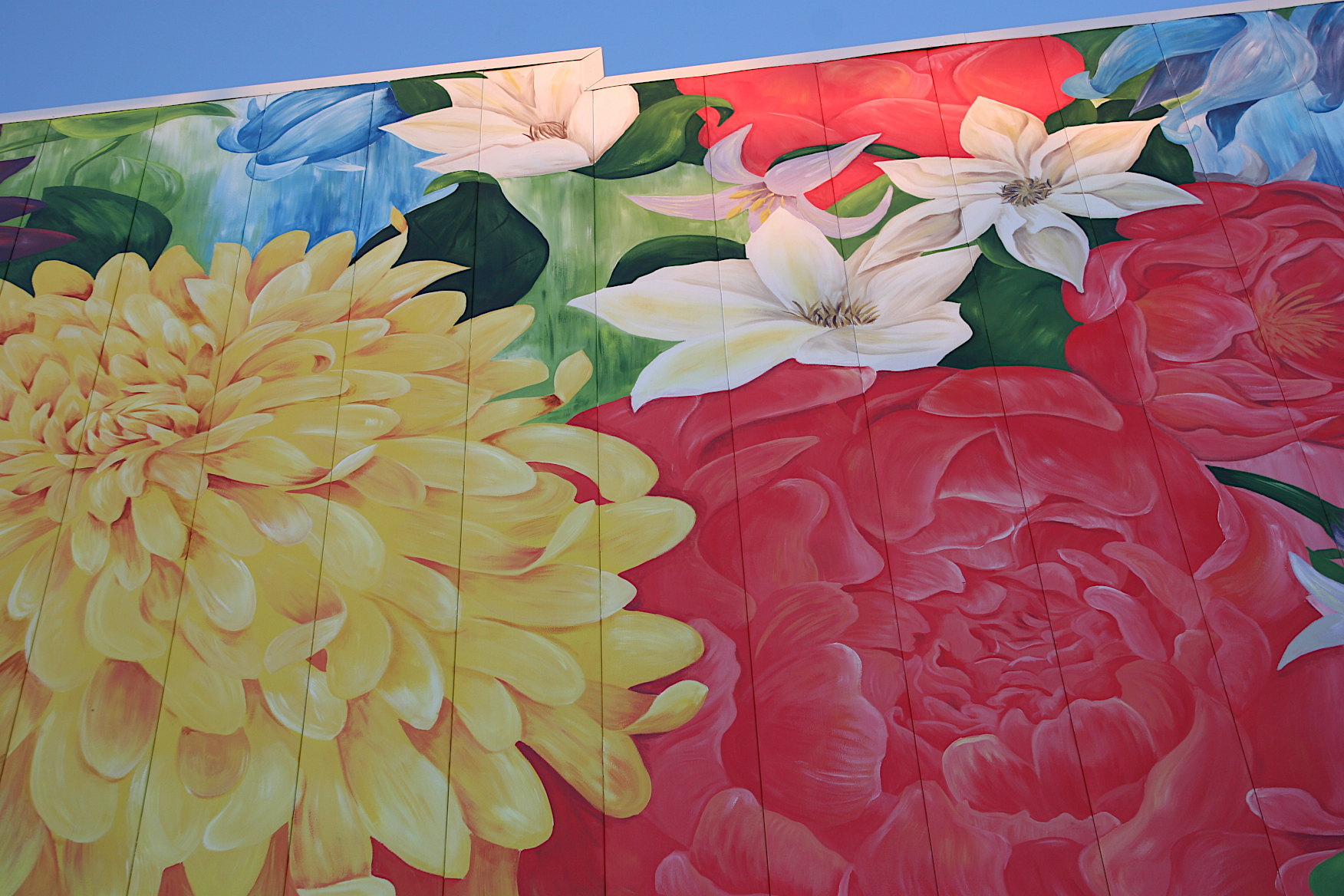
This day I celebrated the discovery of the wildflower mural on the side of a new business in town. The over-sized art honors nature, including the endangered dwarf trout lily, which only grows in three places (Rice, Steele and Goodhue counties) in the world. That includes in Nerstrand Big Woods State Park just to the west of town.
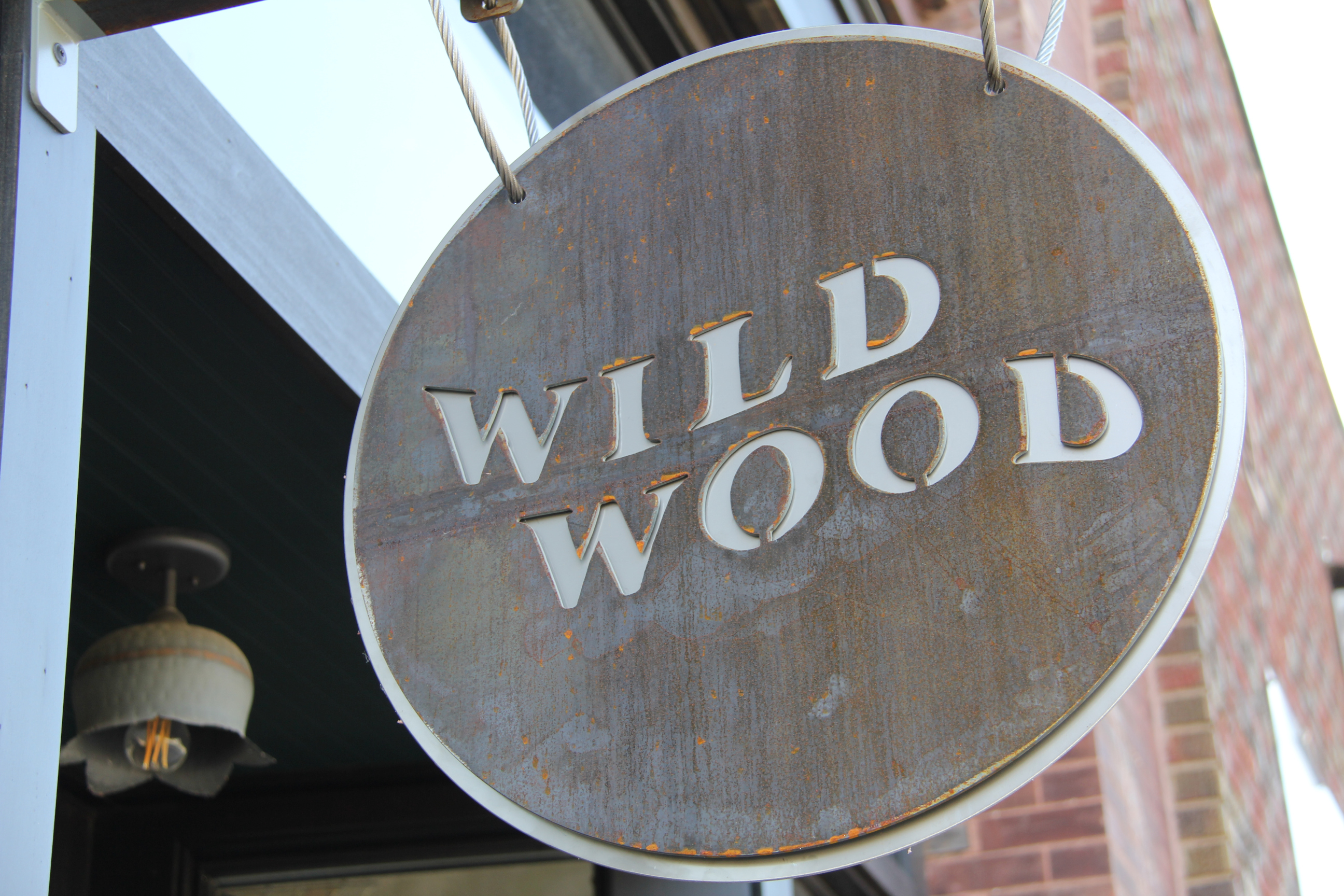
The WildWood name fits given the nearby Big Woods and Tricia Streitz’s backstory. (Minnesota Prairie Roots copyrighted photo October 2024)
Even the name of the business, WildWood of Nerstrand, is decidedly appealing for the images it brings to mind. A favorite young adult book and treasured childhood memories of playing in the woods inspired the name, Tricia Streitz shares on the company website. Hers is a poetically-beautiful story. Imagine children running free, into the woods, building forts, climbing trees…
A Monarch butterfly lands on a coneflower in Jordyn Brennan’s mural. (Minnesota Prairie Roots copyrighted photo October 2024)
All of this I learned following a drive into a small Minnesota town, a town where not much changes. Until it does. I noticed the change. Stopped. Embraced the beauty of that wildflower mural, public art that reaches beyond art to connecting community in a celebratory space.
NOT EVERYONE WOULD CELEBRATE a birthday by exploring historic ruins and then capping the day by creating art within an historic context. But then I am not everyone.
This week, on my closing-in-on-seventy birthday, I took a day trip to Wasioja and neighboring Mantorville. Randy and I packed our picnic lunches and then hit the road east in late morning. No need to rush and get going too early at our ages.
After a brief stop at a Kenyon thrift shop, which smelled strongly of natural gas, we made a quick exit. But not before warning the shopkeeper that he needed to check on the odor immediately. And don’t turn on a light switch, although the lights were already on, we advised. (The shop was still standing on our return route home.)
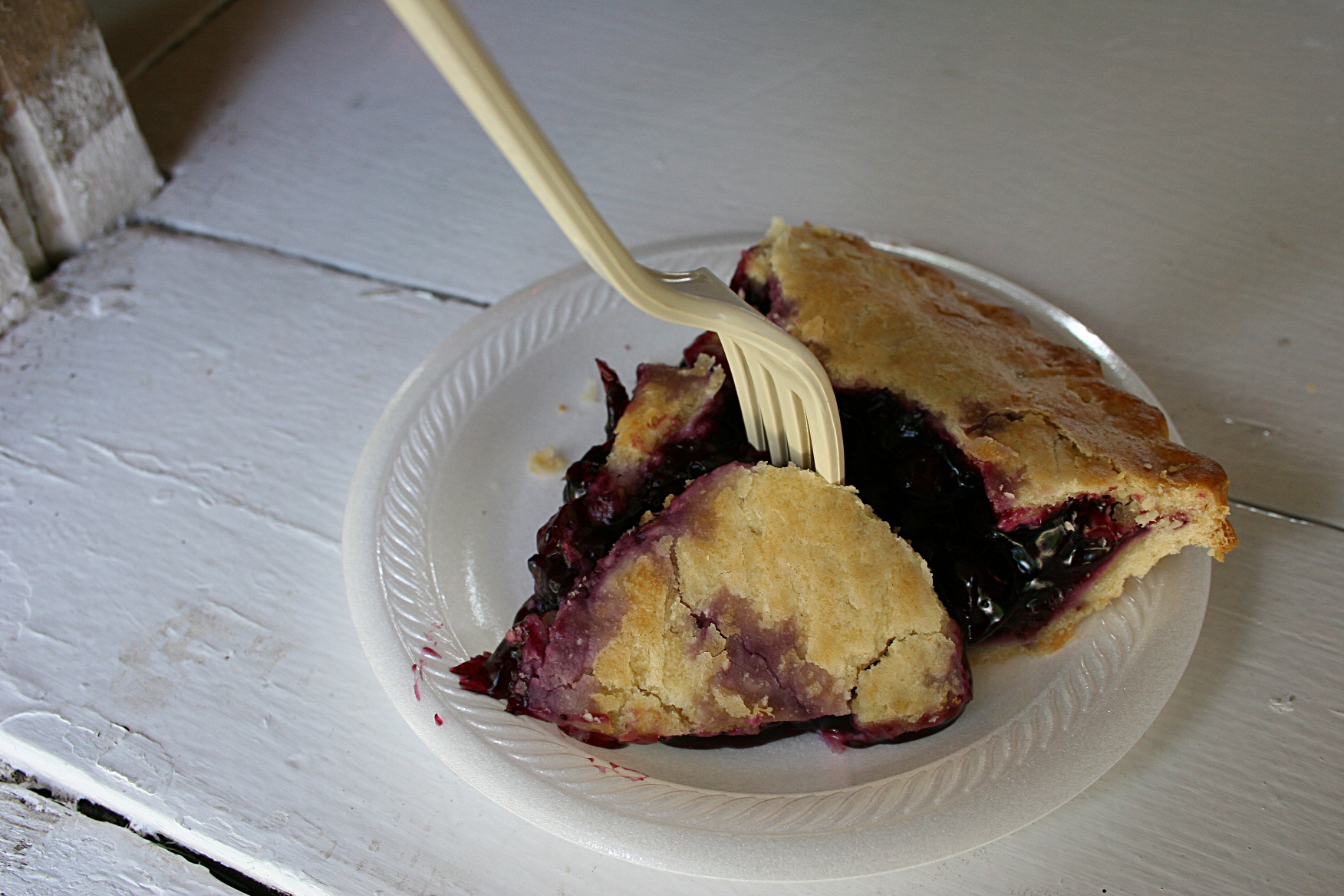
Blueberry pie. not from County Seat Coffee Shop. I didn’t photograph that pie piece. (Minnesota Prairie Roots copyrighted file photo)
GOING BACK IN TIME
I digress. In Wasioja, we discovered aged ruins and historic buildings, many connected to Minnesota’s involvement in the Civil War. I was aware of the Civil War recruiting station, but not some of the other sites. I’ll write more on our visits to Wasioja and Mantorville in future posts.
However, I should note now that Randy and I enjoyed slices of homemade blueberry and strawberry/rhubarb pie at County Seat Coffeehouse in Mantorville. It was, after all, my birthday. No sweet treat awaited me at home.
Back home by late afternoon with me feeling a bit tired after being on my feet all day (remember that broken right toe, which makes walking a tad more challenging), I put my feet up. Randy napped.
A promo for a 2022 talk by Mica Anders at the RCHS. (Promo credit of RCHS)
STEPPING BACK IN TIME WITH MICA ANDERS
And then, less than two hours later, we were off to the Rice County Historical Society for an interactive historical presentation by St. Paul genealogist and artist Mica Lee Anders. She was presenting on early (1850-1900) African American residents of Rice County. I’m always up to learning more about the history of this place I’ve called home for 42 years.
Anders made the entire event hands-on engaging by asking attendees to create flower mosaics that will honor the legacies of early African Americans. The flowers will be installed as public art at gravesites in Faribault and Northfield.
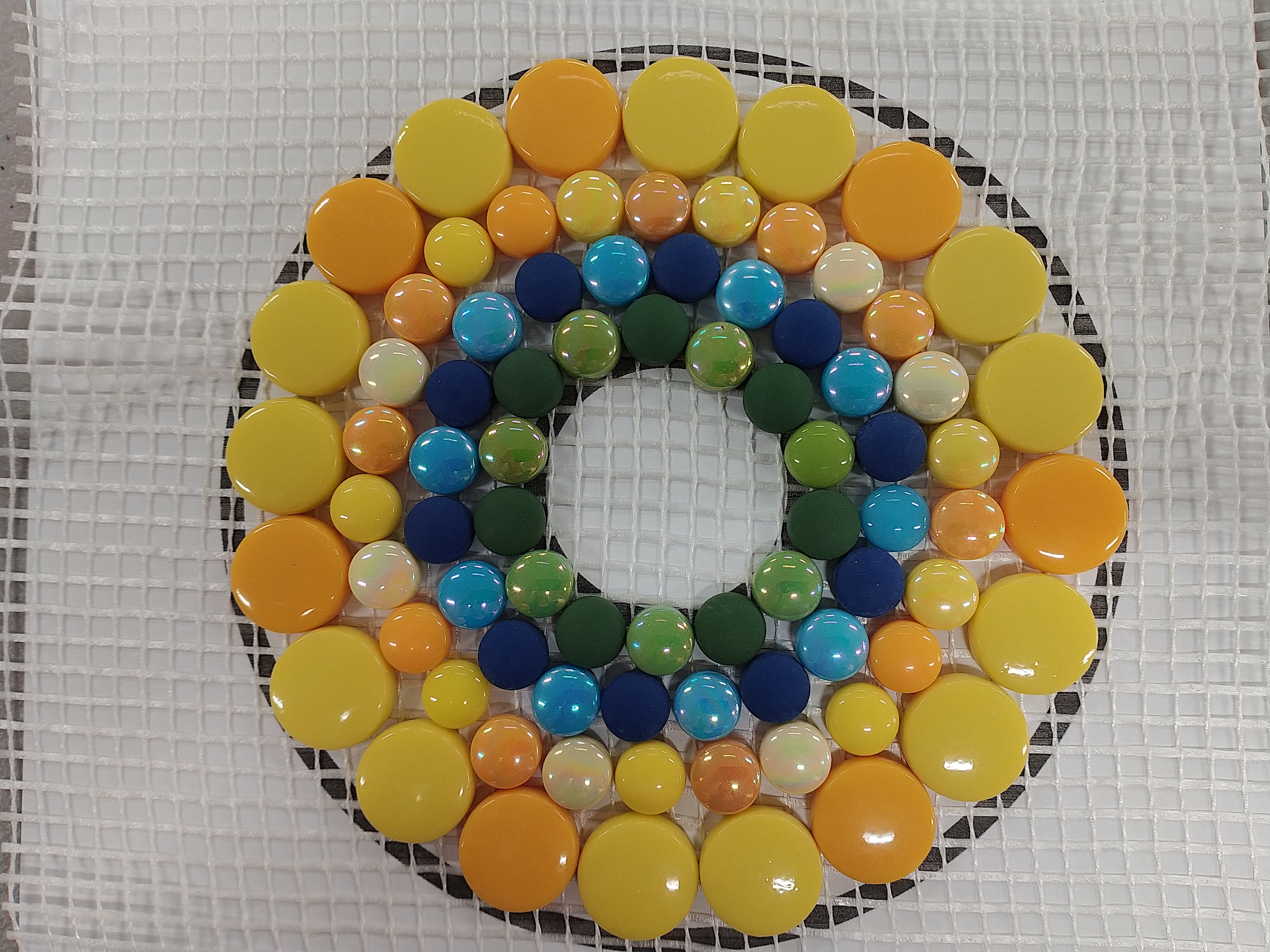
Not being especially artistic beyond creating with a camera and with words, I felt initially tentative about the whole idea. But Anders quickly put me at ease, explaining how to go about the process of creating mosaic flowers from glass tiles. We grabbed cupcake tins then scooped tiles in assorted shapes (mostly round) and colors (blues, greens, oranges and yellows) into individual holders. From there, we designed within a donut shape printed on paper. Later, we would transfer our designs onto sticky mesh.
As a perfectionist, I sorted my tiles by size and color before beginning to create. Part of me wanted to pause and take notes on everything Anders was sharing. But art won over being a journalist for the evening. I created. I listened. I asked questions. But I didn’t jot down a single word.
I heard about the success of those early African Americans who lived here. The barber. The young man who would become a doctor. The college grad. But I learned, too, of efforts to hide racial identity. Yet, races intermarried. And, said, Anders, Faribault was a welcoming place to those African Americans who settled here early on. To hear that pleased me greatly. Faribault has not always been a welcoming place for people of color.
The flower mosaic I created. Anders will finish the work. (Minnesota Prairie Roots copyrighted photo September 2024)
CONNECTING HISTORY & ART
Anders’ passion for history, genealogy and honoring the legacies of African Americans in southeastern Minnesota via her research and now her public art project coursed through the meeting room where a small group of us created colorful mosaics. It felt good to be part of something like this, a tangible way to honor those who came before us, who likely faced more struggles than I will ever know.
My mosaic was well thought out. I don’t usually randomly do anything. I used orange and yellow tiles in the outer two rings of my flower to represent the sun. The next ring featured blue round tiles representing the sky—dark blue for stormy days, lighter shiny blue for happier days. I finished my flower with an inner ring of green tiles representing the earth, growth, place.
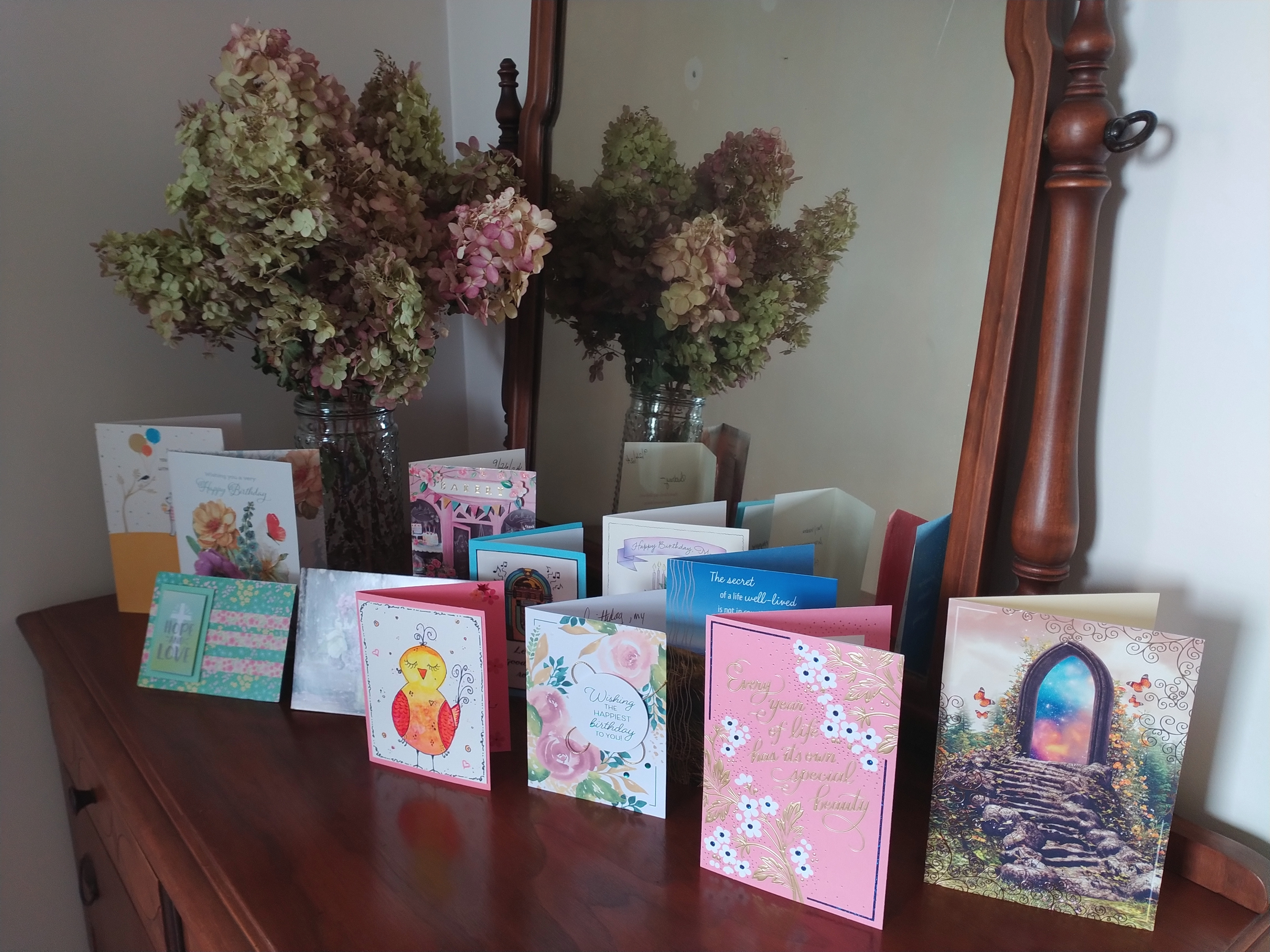
The birthday cards I received, displayed on a vintage family dresser in my dining room. (Minnesota Prairie Roots copyrighted photo September 2024)
THANKFUL
Thus I began another year of life. Learning. Creating art. Honoring. Celebrating. And feeling incredibly thankful for all the people who care about me. From greeting cards to an audio message, from texts to emails to calls (including a singing of “happy birthday”), I feel cherished and loved.
#
FYI: Mica Anders will host more workshops in Rice County (including in Northfield) to talk about early African Americans in southeastern Minnesota and to create flower mosaics. I encourage you to participate. Her project was made possible in part by Springboard for the Arts’ Rural-Urban Solidarity Initiative.
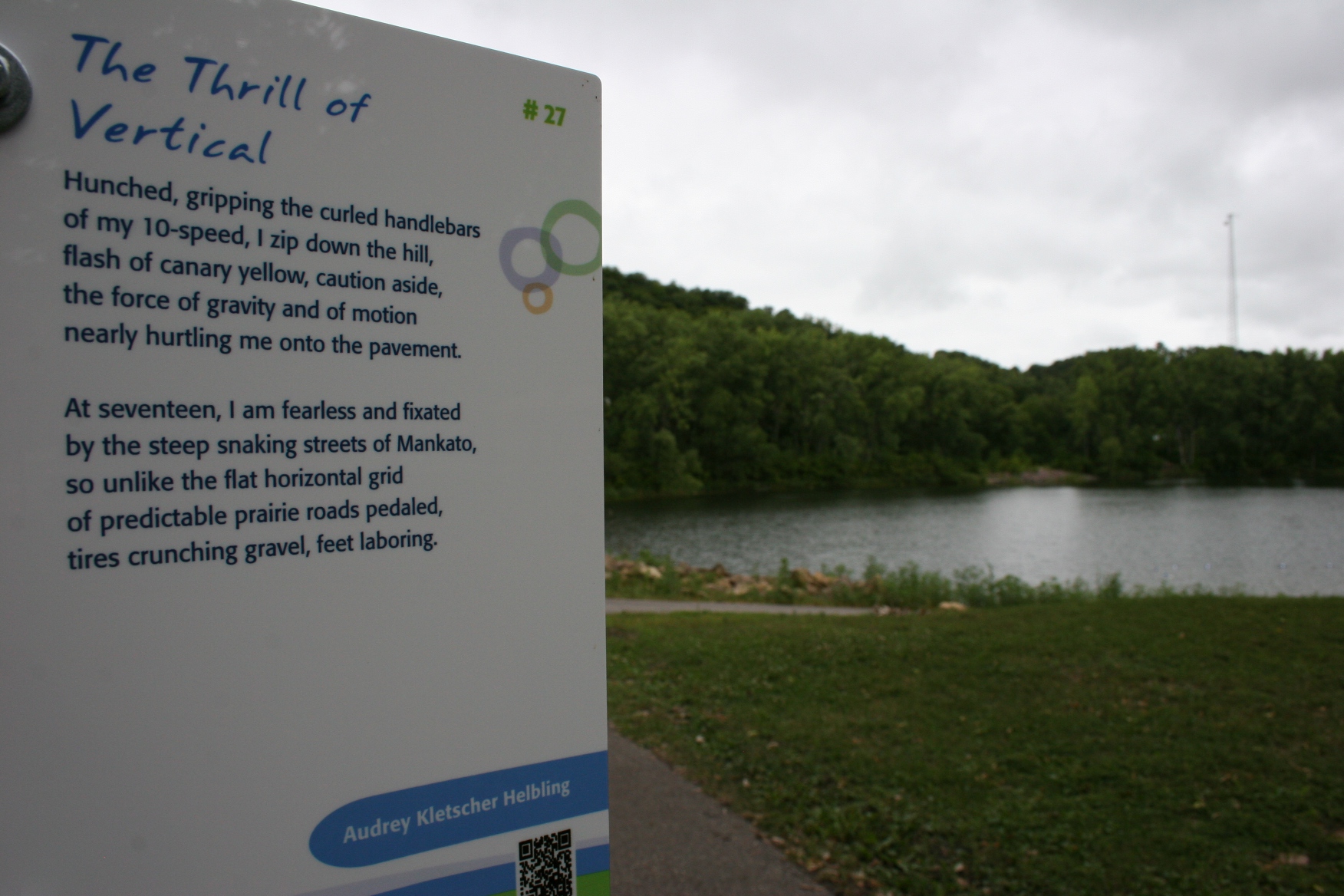
“The Thrill of Vertical,” posted on a sign in Spring Lake Park as part of the 2013 Mankato Poetry Walk & Ride, was inspired by my college years in Mankato. (Minnesota Prairie Roots copyrighted file photo 2013)
I ARRIVED IN MANKATO with a canary yellow 10-speed bike, a simple orange backpack, my Sears portable manual typewriter, a clock radio, a quilt stitched by Grandma Ida and a suitcase filled with clothes. The year was 1974, the beginning of my freshman year at Bethany Lutheran College, high atop a hill in this southern Minnesota city.
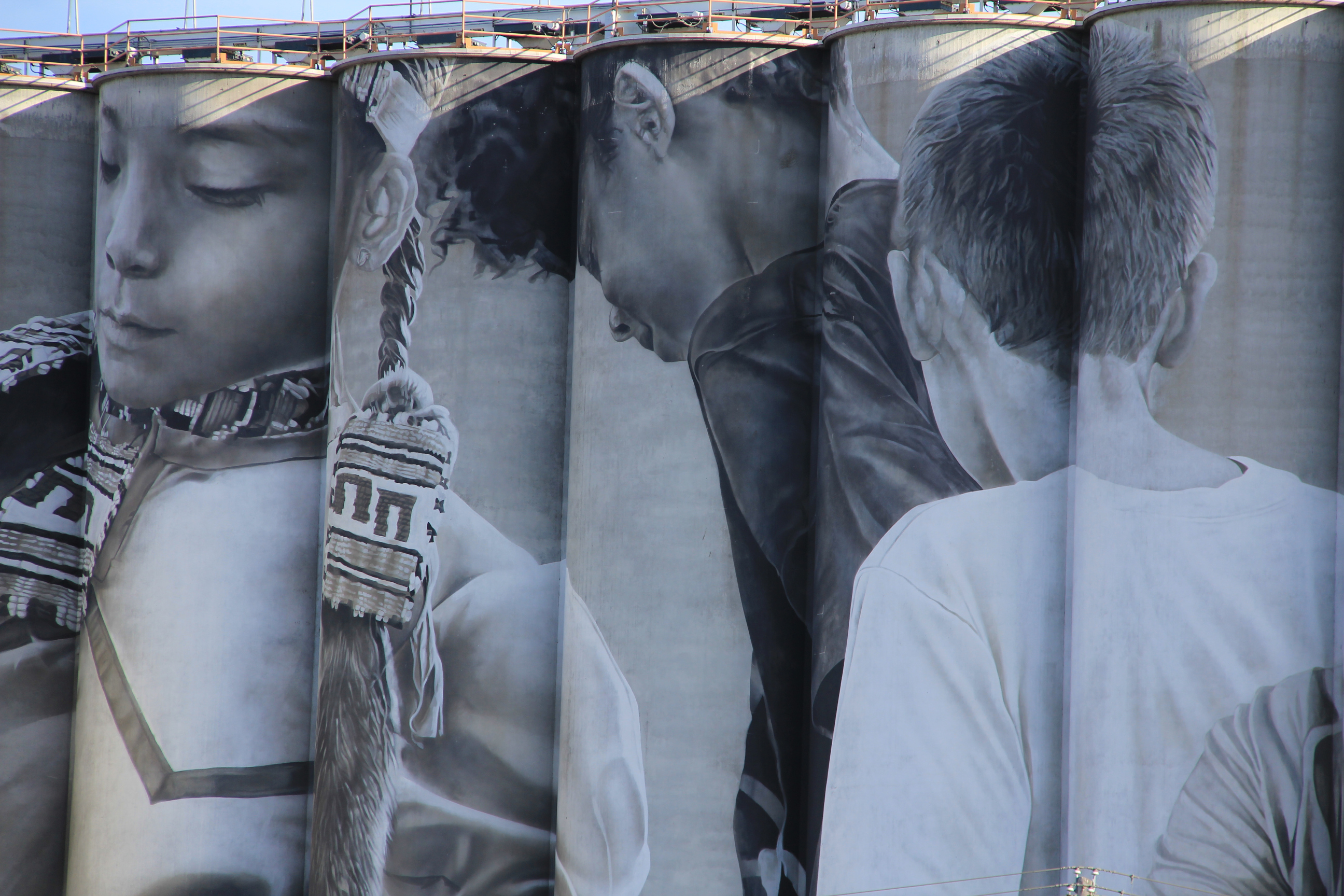
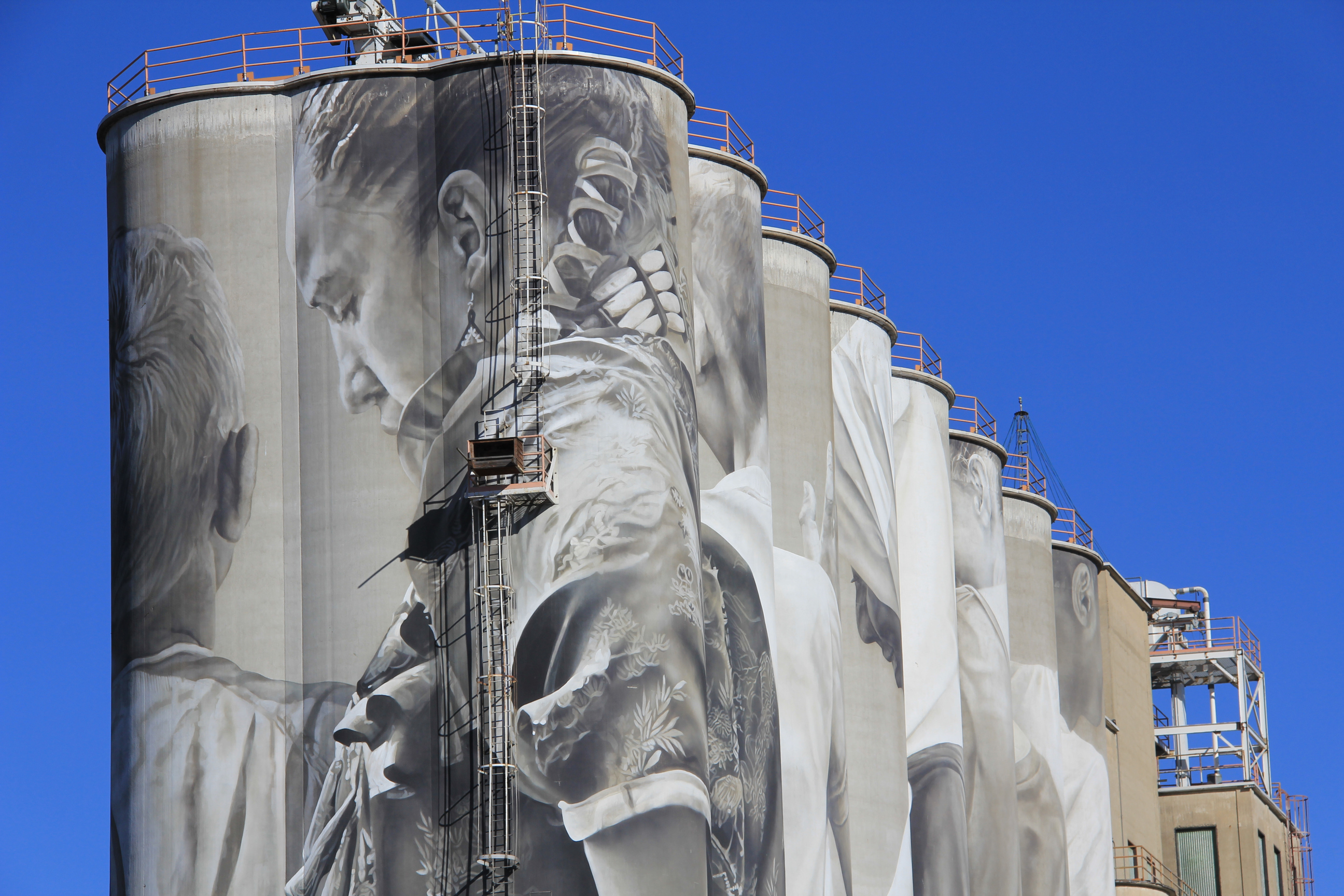
The Ardent Mills grain silos, a massive public art project, dominate the skyline along the Minnesota River in the heart of Mankato. The art depicts the diversity of the area. (Minnesota Prairie Roots copyrighted photo November 2023)
I was only 17, nervous, but ready to leave my childhood farm home some 85 miles to the west. I met my roommate, Rhonda, a beautiful high school cheerleader from western Wisconsin. She was well-traveled, outgoing, vastly different than me, quiet and shy. And she had a stereo for our cozy fourth floor corner dorm room. We were set. Despite our differences, we got along splendidly.
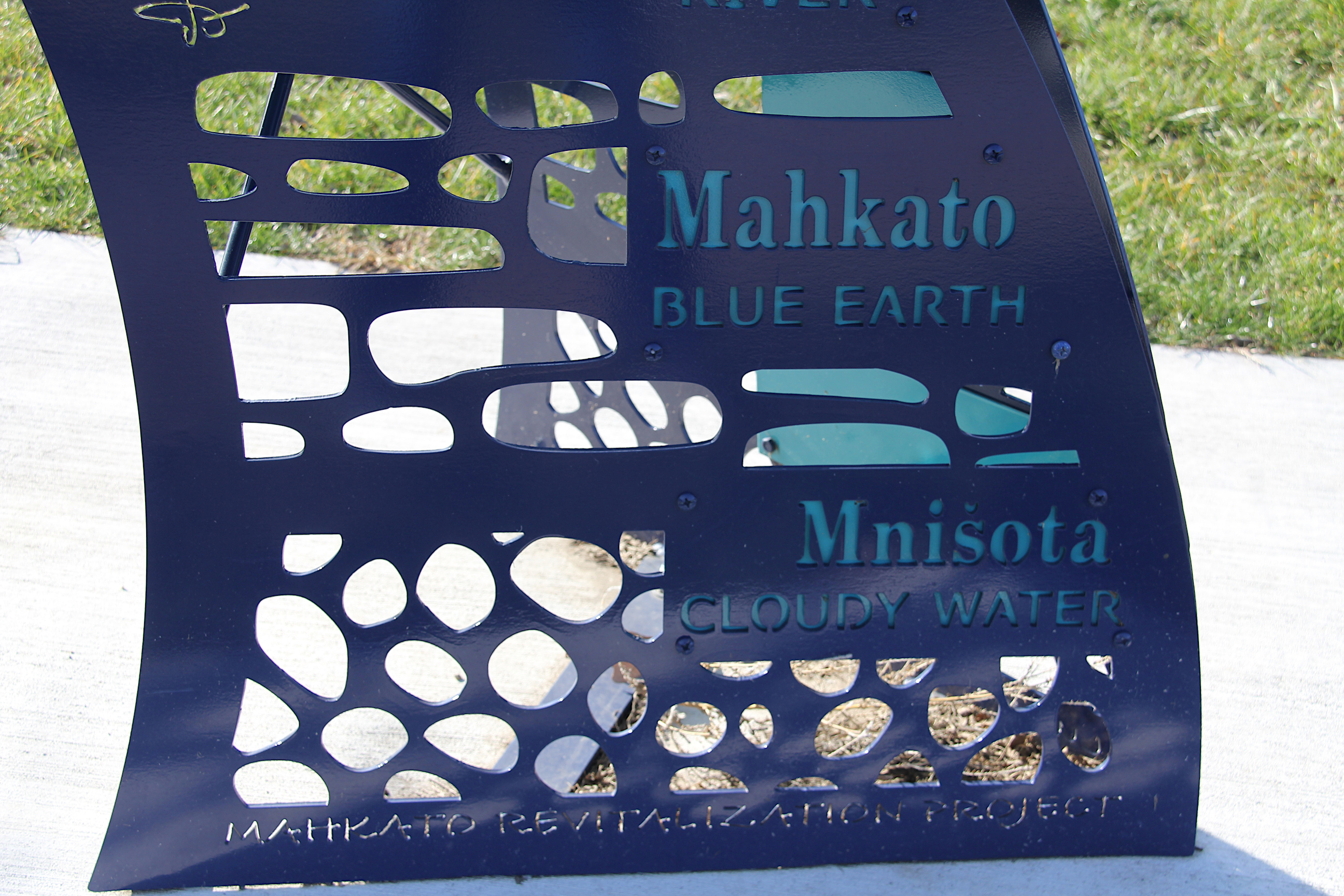
This shows the base of a place sculpture along the Minnesota River in Riverfront Park. The words for Mankato and Minnesota are written in the Dakota language and translated. (Minnesota Prairie Roots copyrighted photo November 2023)
As I settled into the big city (Mankato’s current population numbers around 45,000), big for me when you come from a town of 362, I began to feel at home. Not only on campus, but also in the community. Happy Chef became a go-to destination for conversation and for warm loaves of bread glazed with powdered sugar frosting. A Christian coffee house also drew me off campus. I wasn’t in to the bar scene.
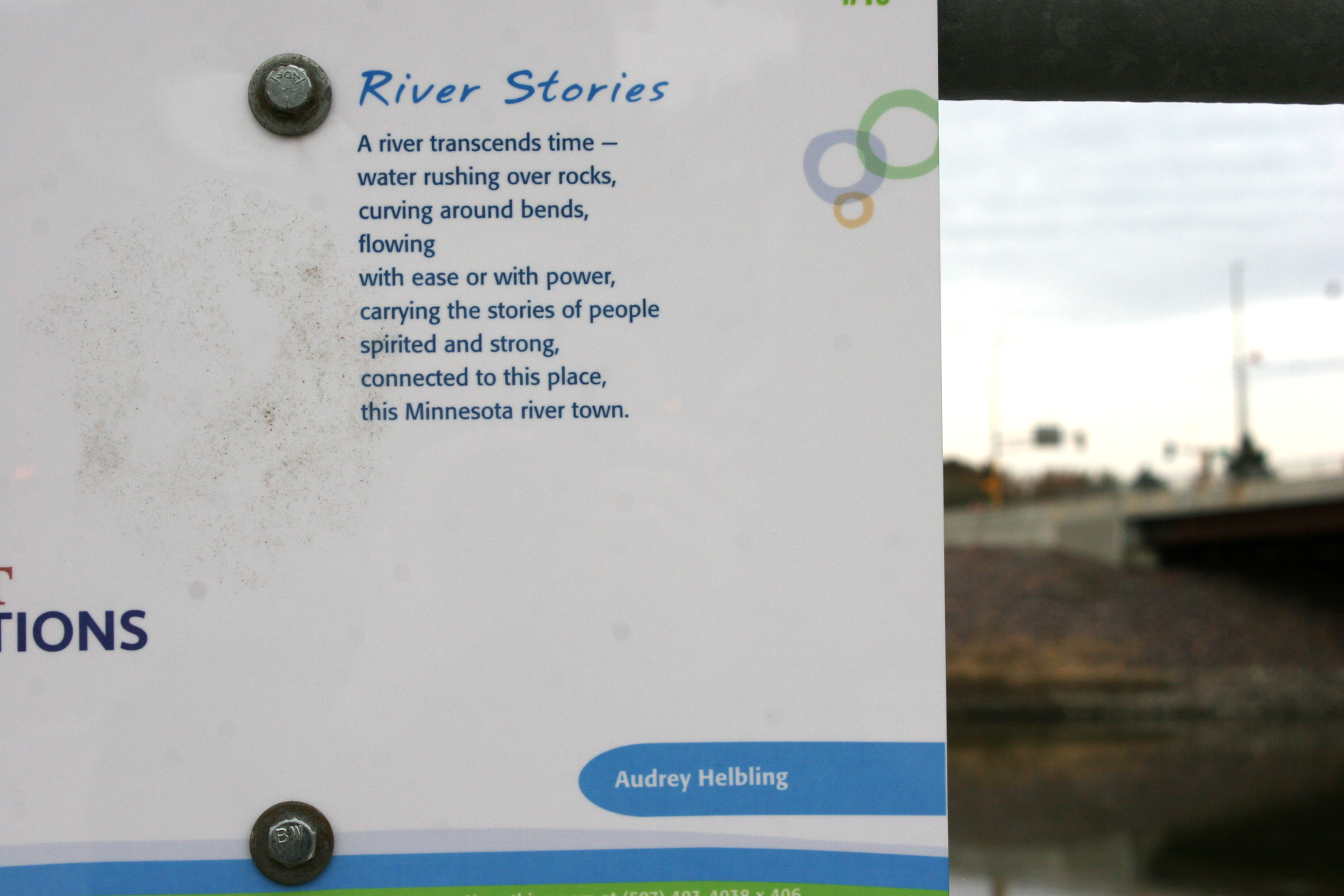
My poem, “River Stories,” highlights the Minnesota River, which winds through Mankato. It was posted along the river as part of the 2019 Mankato Poetry Walk & Ride. (Minnesota Prairie Roots copyrighted file photo 2019)
For nearly four years, Mankato became my home away from home. The place that grew me educationally and as a person. I earned an associate of arts degree from Bethany, then only a two-year college, before moving on to Minnesota State University, Mankato, to study journalism. I worked at the college newspaper, “The Reporter.” In the winter of 1978, I earned a mass communications degree with an emphasis in news/editorial. Soon thereafter, I started my career as a newspaper reporter and photographer. Years later I returned to work for “The Mankato Free Press,” heading up the paper’s St. James-based news bureau (me living and working from my apartment long before working remotely became a thing).
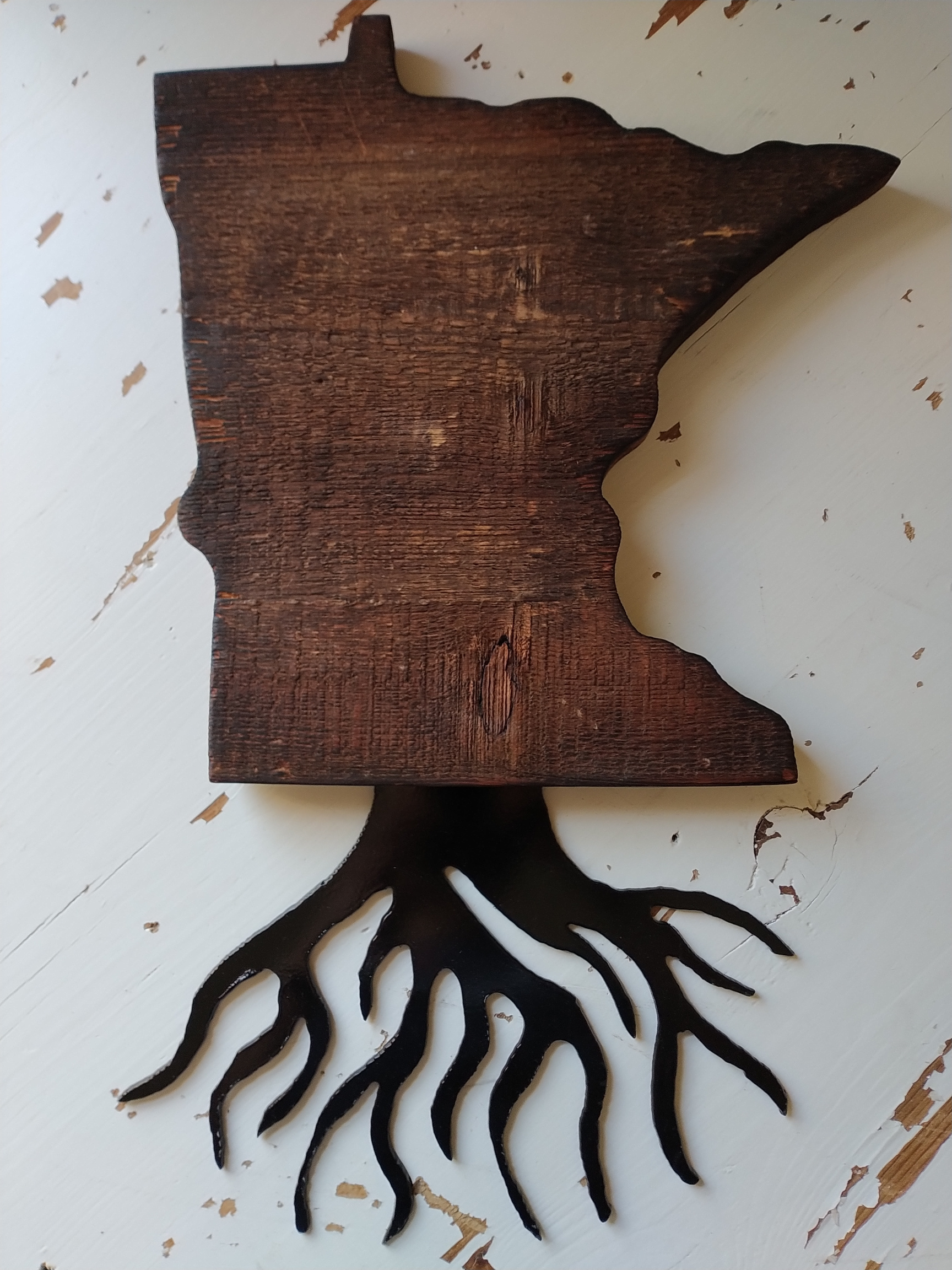
I am rooted in Minnesota. This art hangs in my home office. (Minnesota Prairie Roots copyrighted file photo)
Why am I sharing this with you today? Because of Minnesota Governor Tim Walz, now the vice presidential candidate on the DFL ticket. He lived in Mankato, where he worked as a social studies teacher and football coach at Mankato West High School. Walz, likely unfamiliar to most Americans up until recently, has put our state, specifically Mankato, on the map. As a life-long Minnesotan, I am proud to see my state, considered by many to be fly-over land, in the spotlight. No matter your political leanings, such publicity is good for Minnesota.
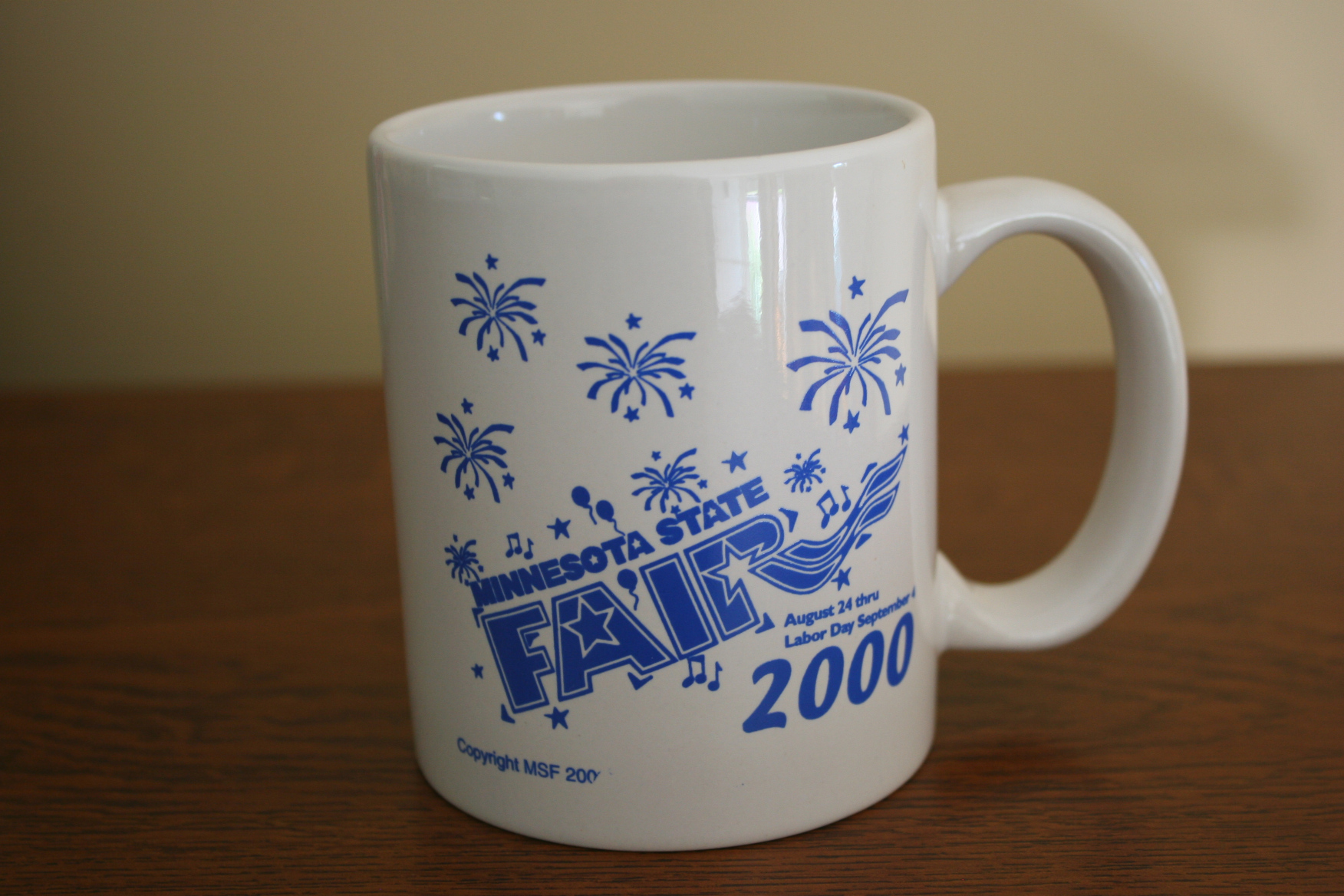
I’ve only attended the Minnesota State Fair a few times in my life. This mug came from my father-in-law’s collection. The State Fair started yesterday. (Minnesota Prairie Roots copyrighted file photo)
Like Walz, flannel shirts hang in my closet. I am wearing one as I write on this cool August morning. Flannel truly is a Minnesota thing, no matter political affiliations. We like our hotdishes (not “casseroles”) and the Minnesota State Fair (although not me; too many people), our cabins Up North. We claim musicians Bob Dylan and Prince, the Coen Brothers (of “Fargo” movie fame) and other notables like vice presidents Hubert Humphrey and Walter Mondale.
The grain silos are a massive work of public art. (Minnesota Prairie Roots copyrighted photo November 2023)
I cannot imagine living elsewhere, even if I don’t especially like the frigid cold and snow of a Minnesota winter. I loved winter as a Redwood County farm girl. Minnesota is home. I live 40 miles northeast of Mankato, a city originally inhabited by the Dakota. Mankato is a river town, a college town, a regional shopping hub, a community with a rich (but not always “good”) history. It is home to many creatives. I’ve been part of that with poetry showcased on signs through the Mankato Poetry Walk and Ride.
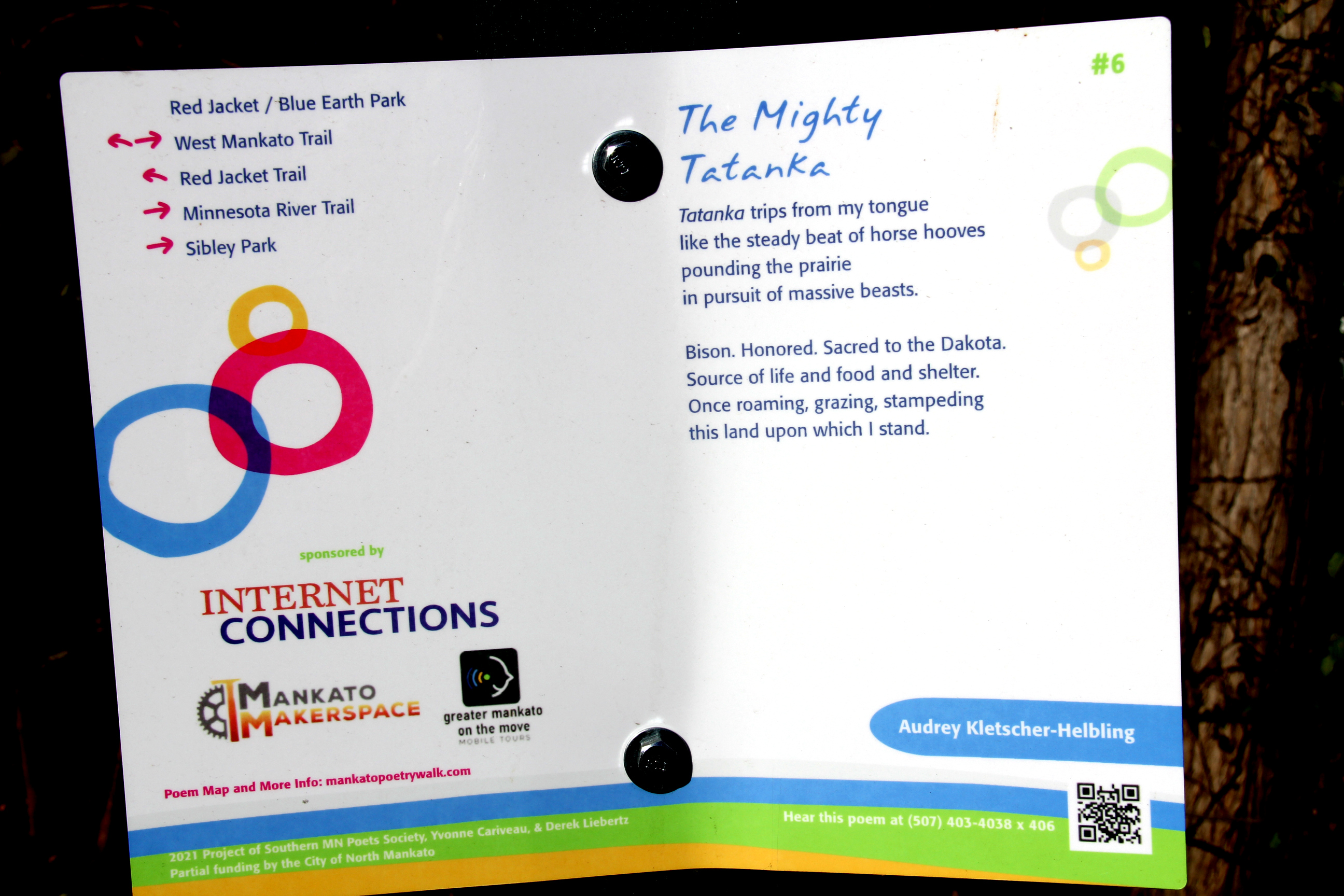
My latest poem, “The Mighty Tatanka,” posted along the West Mankato Trail near West Mankato High School. (Minnesota Prairie Roots copyrighted photo November 2023)
My connection with, and appreciation of, Mankato all started in that fourth floor dorm room with a roommate who was nothing like me. Despite our differences, we connected, forged a strong friendship, together grew and matured. We were on the cusp of our lives. Young. Open to new ideas and learning. The future held endless possibilities. For me, the 17-year-old with the canary yellow bike. And for Rhonda with her stereo system.
Wings grace the side of Franke’s Bakery, known for its kolacky, a fruit or poppyseed-filled Czech pastry. (Minnesota Prairie Roots copyrighted photo June 2024)
WHEN PEOPLE BRAINSTORM ways to build a stronger, better community, then implement those ideas, beautiful things happen. I see that each time I visit Montgomery, a community of some 3,200 in Le Sueur County.
Promoting Kolacky Days on wings on the Pillars Building. (Minnesota Prairie Roots copyrighted photo June 2024)
A single wing hangs on the Pillars Building. (Minnesota Prairie Roots copyrighted photo June 2024)
“We welcome you” in Czech on the Pillar Building wing. (Minnesota Prairie Roots copyrighted photo June 2024)
Historic Hilltop Hall houses the Arts & Heritage Center of Montgomery, right, and Posy Floral & Gifts, left. (Minnesota Prairie Roots copyrighted photo June 2024)
Now the Arts & Heritage Center has joined with the Montgomery Community Foundation and Tri-City United High School ARTeam to create and paint wings displayed throughout town and at an area winery. The wings are a colorful addition to the community, yet another reason to visit a place known for its bakery, its brewery and much more.
Poppy-shaped wings on the American Legion building honor the war dead. (Minnesota Prairie Roots copyrighted photo June 2024)
That “much more” includes a creative community that collectively creates. Locals of all ages met at the Montgomery Farmers’ Market, at Memorial Park, at Next Chapter Winery, at an Art Night to paint the colorful wings that have taken flight throughout primarily the downtown area. While visiting Montgomery recently, I searched for those wings.
Floral wings at Posy Floral & Gifts. (Minnesota Prairie Roots copyrighted photo June 2024)
Art-themed wings at the Arts & Heritage Center of Montgomery. (Minnesota Prairie Roots copyrighted photo June 2024)
One of three wings art posted at American Legion Post #79. (Minnesota Prairie Roots copyrighted photo June 2024)
Scissors wings at PinCurls Salon. (Minnesota Prairie Roots copyrighted photo June 2024)
From vivid flowers at Posy Floral & Gifts to paint splotches at the arts center to an eagle at the Legion to scissors at PinCurls Salon to baked goods at Franke’s Bakery, the wing art often fits the location. It is symbolic, colorful and meaningful. Eye-catching, ideal for photo ops.
A solitary wing on the side of LaNette’s Coffee Shop is watered by “Scarlett,” who circulates among the wing art. (Minnesota Prairie Roots copyrighted photo June 2024)
The wings, in many ways, tell a story. A story not only of specific place, but of community. Of ideas and talent merging to create this beautiful thing, this public art that brings joy to visitors like me. I admired. I smiled. I delighted. And I felt this sense of unity that comes from people working together on a common goal—to brighten their community with public art.
Angel wings at St. John feature lines from faith-based hymns and songs. (Minnesota Prairie Roots copyrighted photo June 2024)
Faith songs up close on the angel wings. (Minnesota Prairie Roots copyrighted photo June 2024)
It was a bit of a treasure hunt to find the wings given I didn’t have a map to guide me. But that’s OK. I like exploring. Local barber, Steve, tipped me off, though, to the newest one, song-themed angel wings—including the song “On Eagle’s Wings”—at St. John Lutheran Church.
These wings at the Legion honor all branches of the military. (Minnesota Prairie Roots copyrighted photo June 2024)
Every visit to Montgomery leaves me feeling happy, uplifted, impressed by this small town that hosts an annual Kolacky Days in July, honors veterans in photo displays downtown, cheers on the Mallards baseball team, showcases art in the town’s gallery and more, much more. I feel and see the spirit of community here.
Floral wings identify and celebrate local floral shop, Posy Floral & Gifts. (Minnesota Prairie Roots copyrighted photo June 2024)
As I was about to leave the downtown business district, I watched an older man exit Posy Floral & Gifts, a bouquet of pink roses in his arms. And I thought to myself, I really ought to photograph that scene. But, rather, I watched, taking in the magic of the moment. I wondered about the recipient, the reason for the flower purchase. My thoughts took wing. Were these roses to celebrate, to encourage, to thank? Or were they simply a “just because” way to brighten someone’s day? Just as the Wing Walk brightens the community of Montgomery, brightened my day.
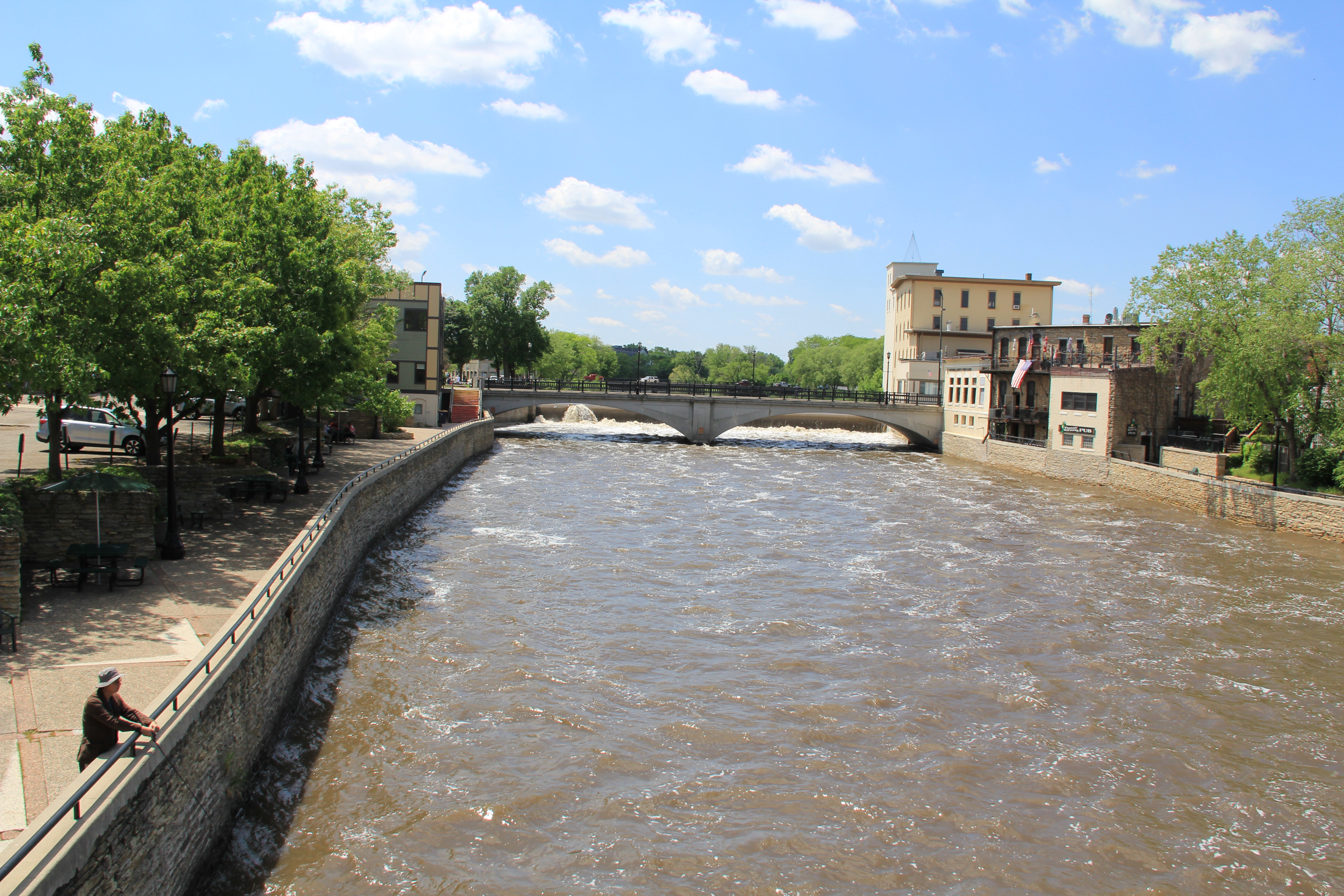
Looking down on the Cannon River from the pedestrian bridge, historic Ames Mill (and dam) in the distance, Riverwalk on each side of the river, where a man fishes, lower left. (Minnesota Prairie Roots copyrighted photo May 2024)
TO WALK ALONGSIDE a river, to watch a river, to hear a river is to experience the arts. A river, with its movement, is like a poetic dance. A river, when roaring over rocks or a dam, is like music. A river, too, is like watercolor flowing fluid and free.
Part of the “Creatures & Features of the Cannon River” art project by Kate Woodstrup and Kathy Larson Ness. (Minnesota Prairie Roots copyrighted photo May 2024)
In Northfield, the Cannon River and art flow one into the other along the Riverwalk in the heart of an historic downtown. This southern Minnesota community, in 2023, highlighted the river and the arts through the Artists on Main Street program. Eight art projects were chosen for these latest public art installments.
Part of the “Meet Me at the River” art. (Minnesota Prairie Roots copyrighted photo May 2024)
Recently I followed the Riverwalk to see the work of several creative placemaking artists. A $25,000 grant from the Minnesota State Arts Board and $10,000 from the City of Northfield 1% for the Arts Program funded last year’s “Meet Me at the River” artwork.
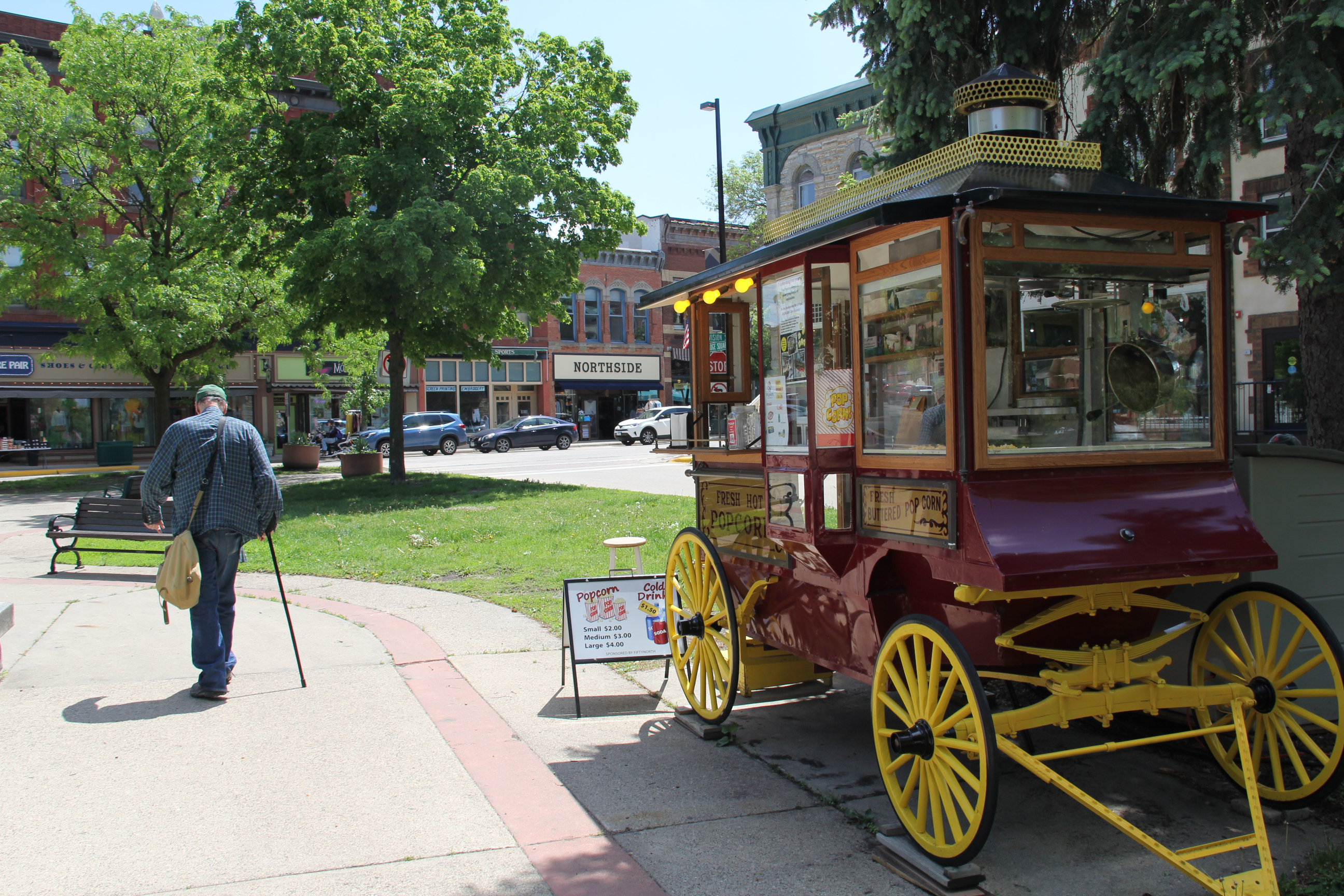
The popcorn wagon, operated by volunteers from FiftyNorth. (Minnesota Prairie Roots copyrighted photo May 2024)
I started at Bridge Square, a community gathering spot along the Cannon. The park centers the downtown business district. It’s a place to picnick, to meet, to buy popcorn from the popcorn wagon, to listen to music or to simply enjoy the outdoors next to the river.
Fishing the Cannon River at the Ames Mill Dam. (Minnesota Prairie Roots copyrighted photo May 2024)
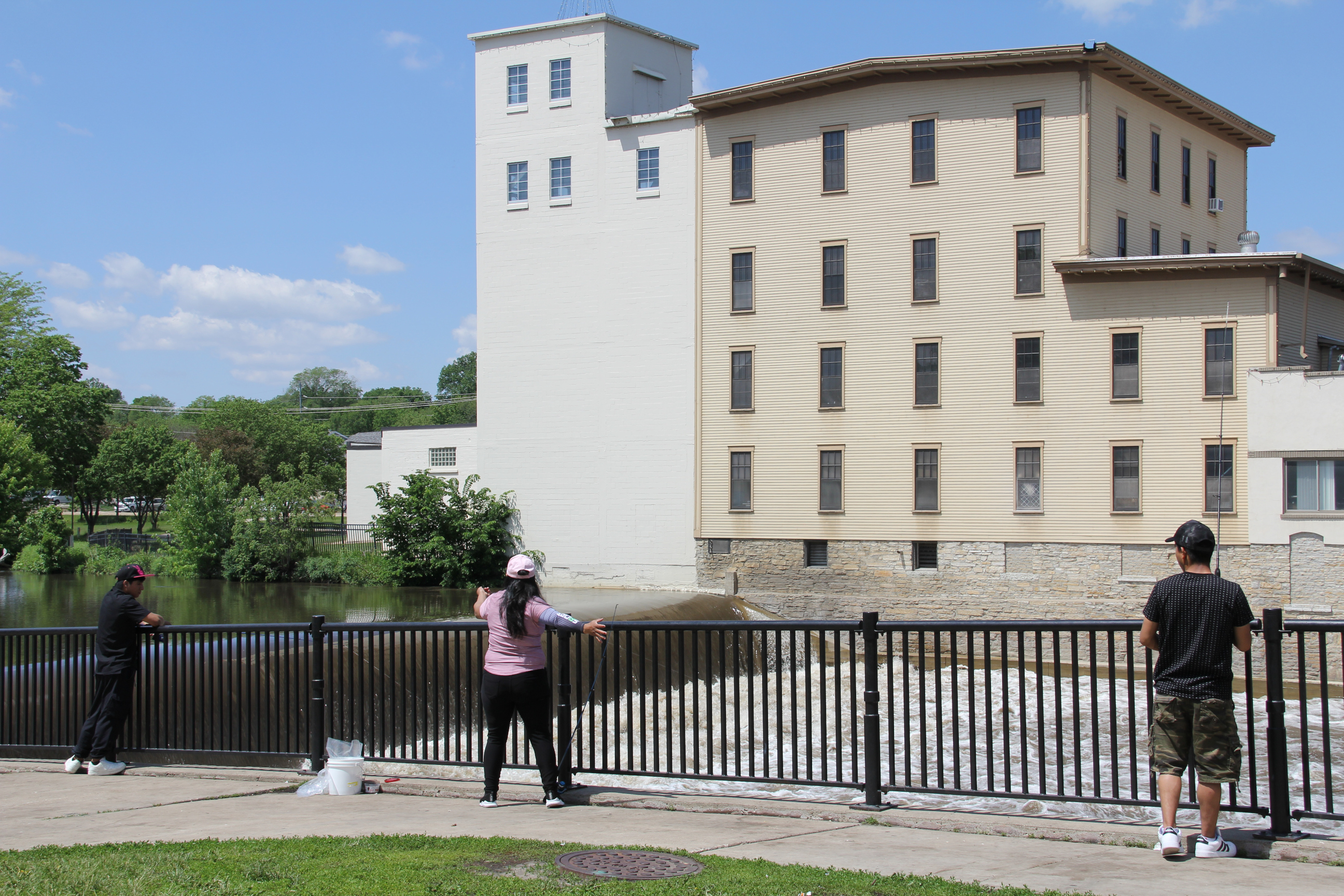
Here water rushes over a dam next to the historic Ames Mill. Anglers dangle lines in the water from the Riverwalk. It’s a popular fishing spot. Definitely a “Meet Me at the River” site.
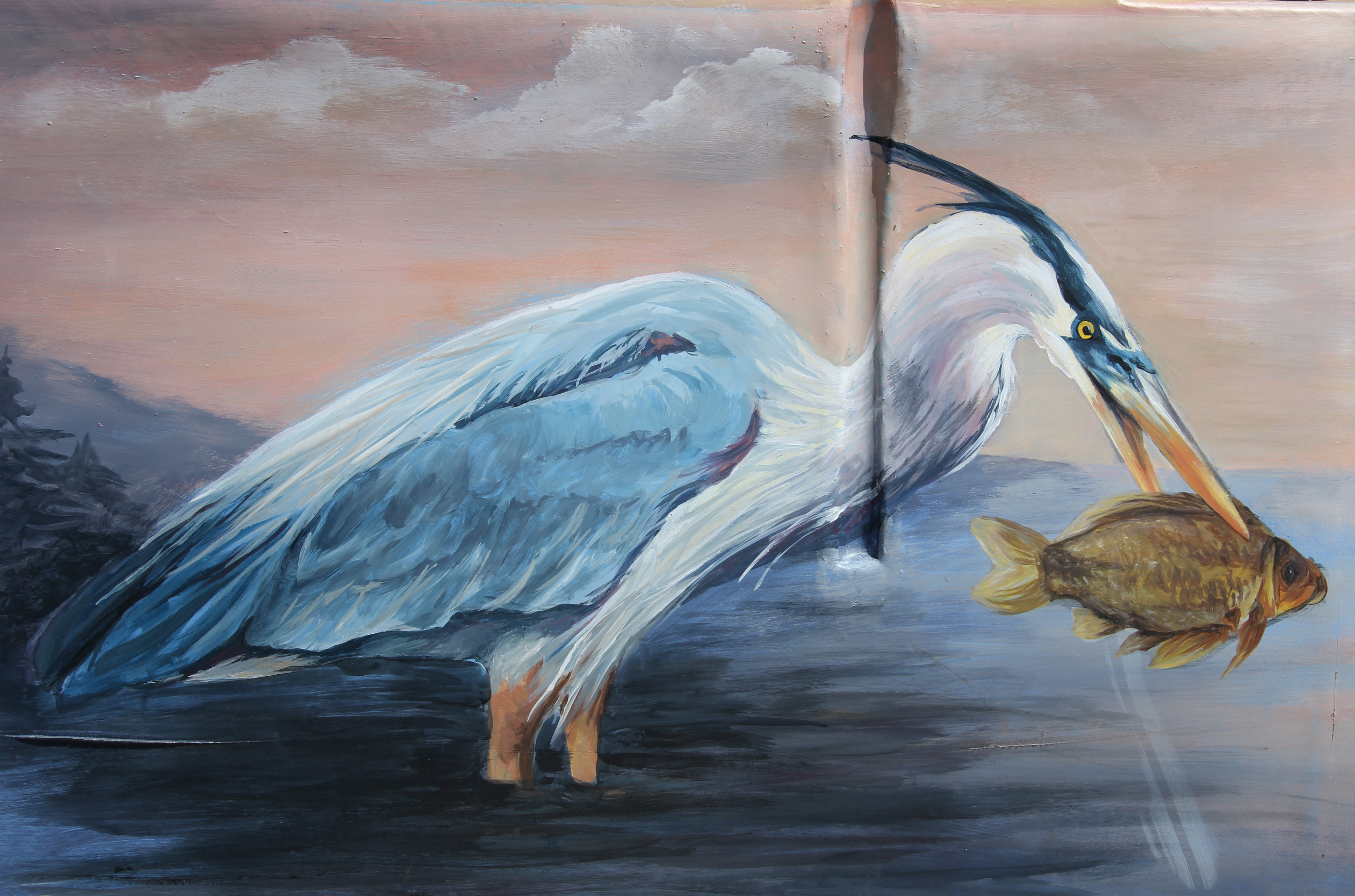
Blue heron art for “Creatures & Features.” (Minnesota Prairie Roots copyrighted photo May 2024)
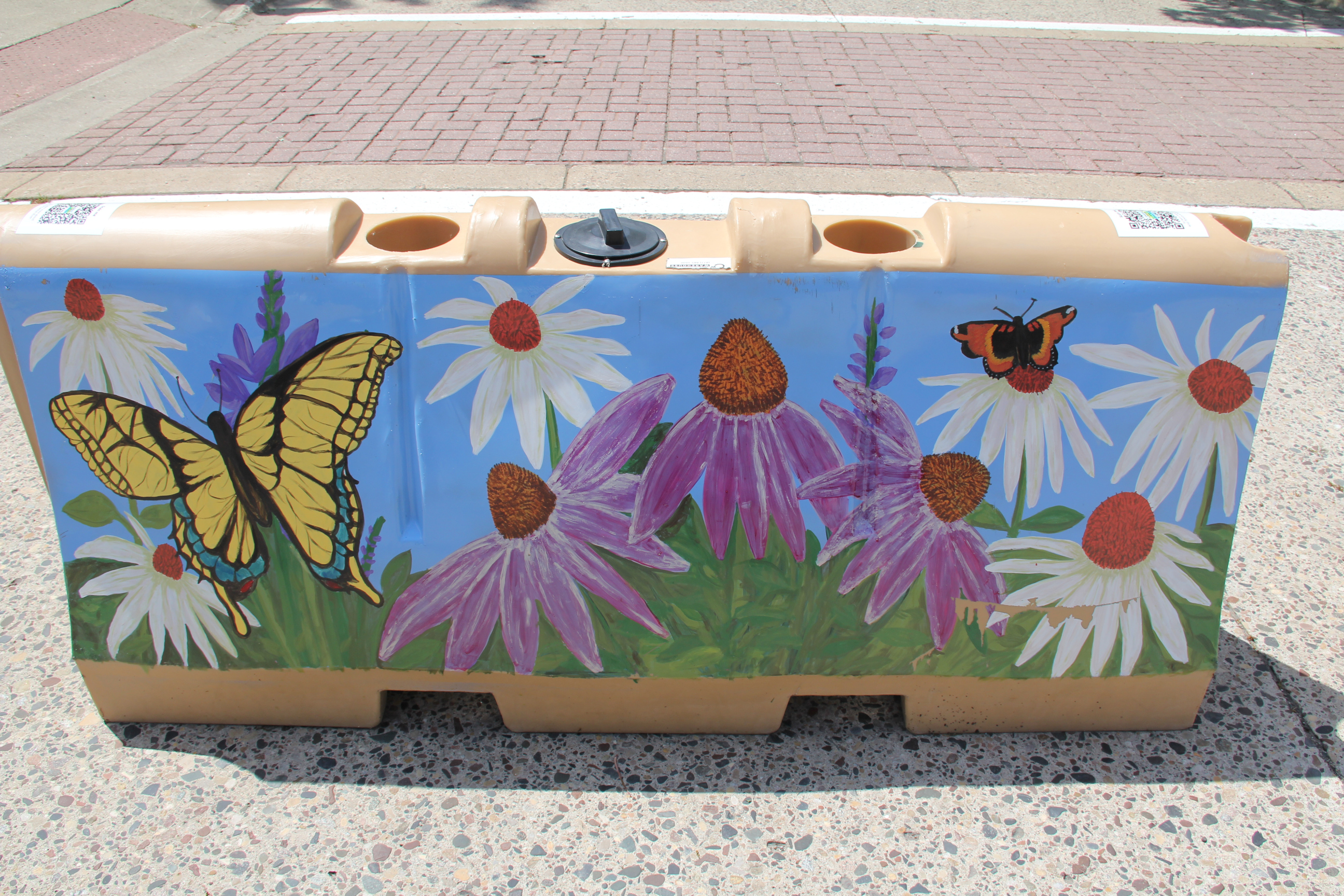
Butterflies and plants native to the Cannon River area. (Minnesota Prairie Roots copyrighted photo May 2024)
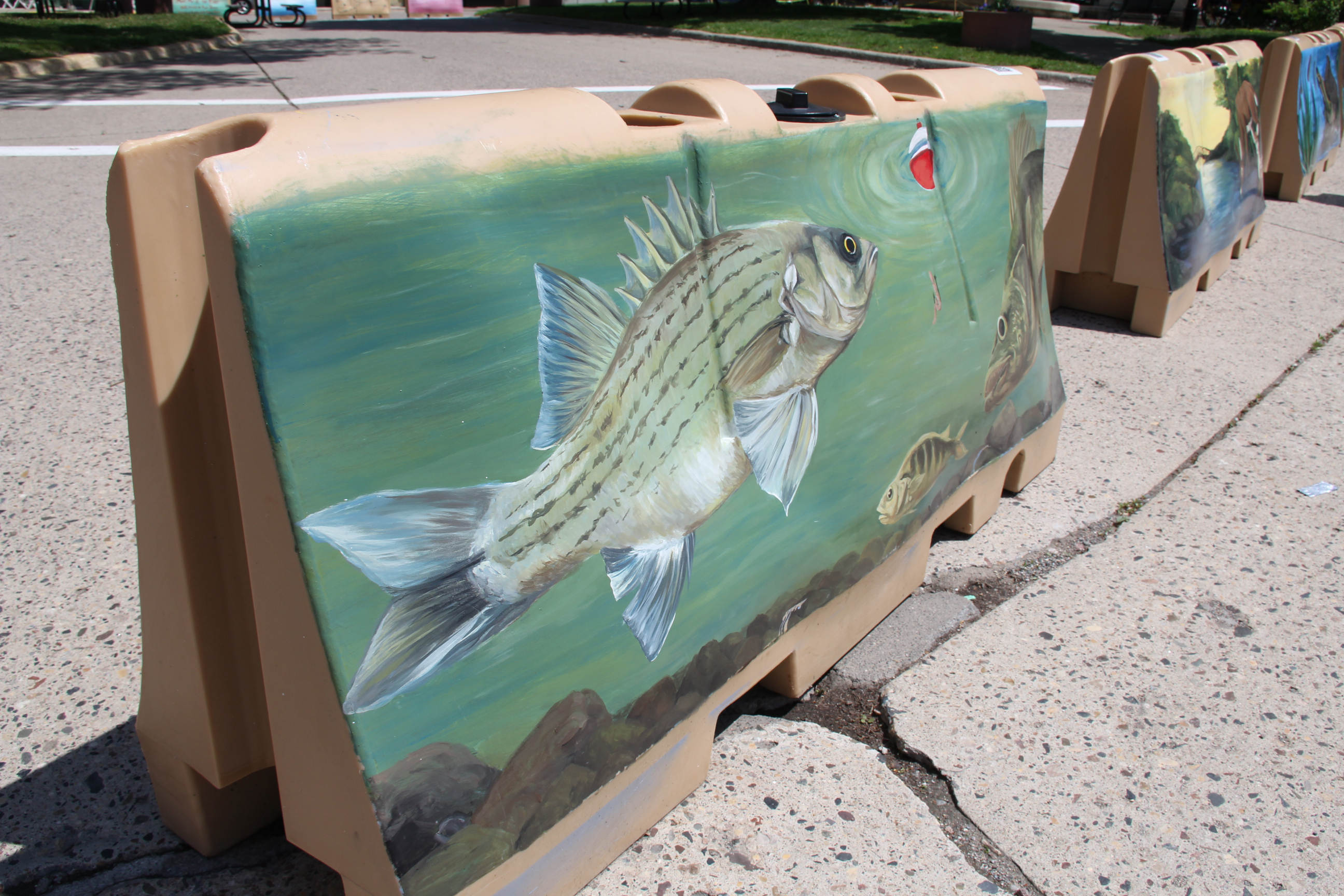
Among fish found in the Cannon, striped bass. (Minnesota Prairie Roots copyrighted photo May 2024)
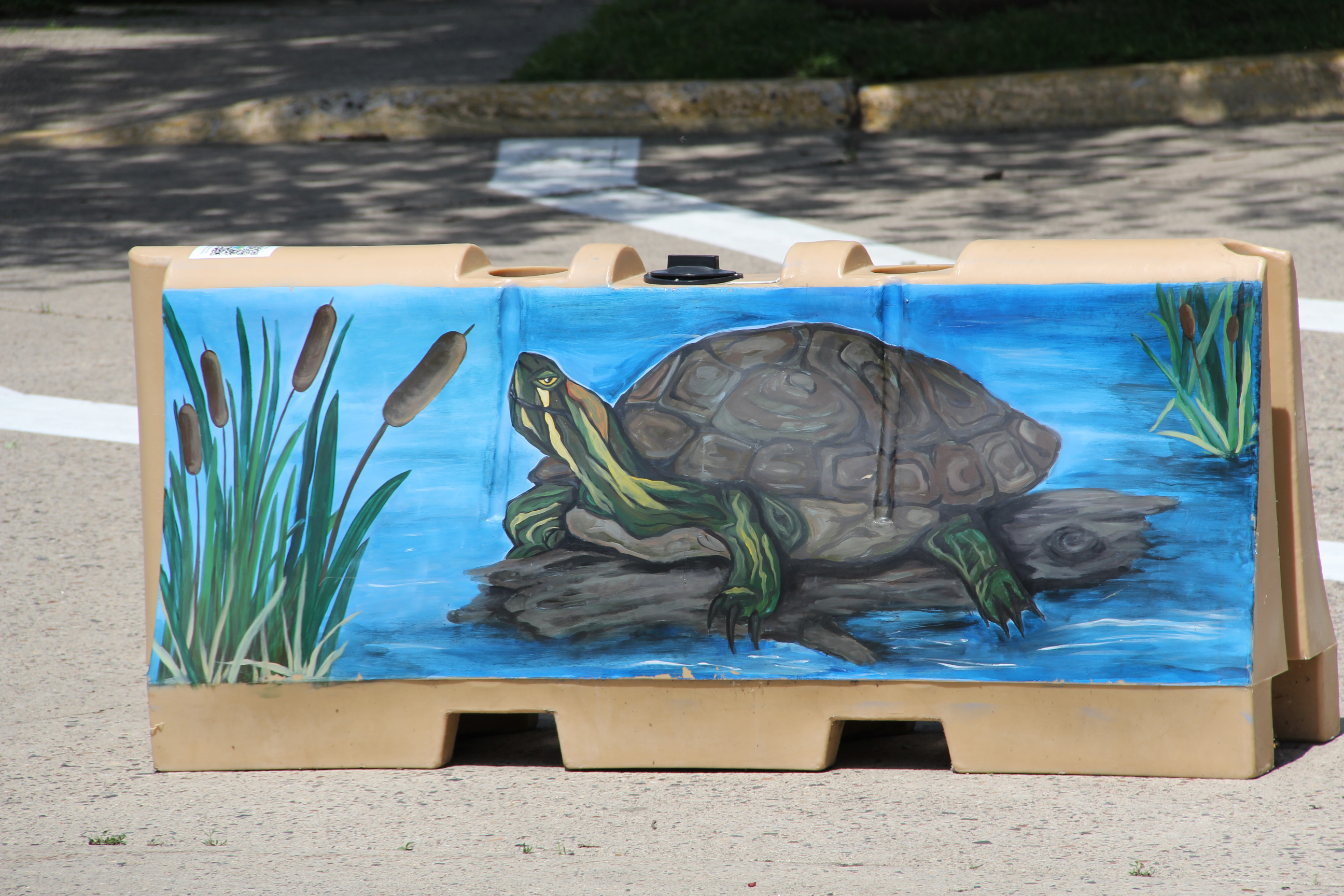
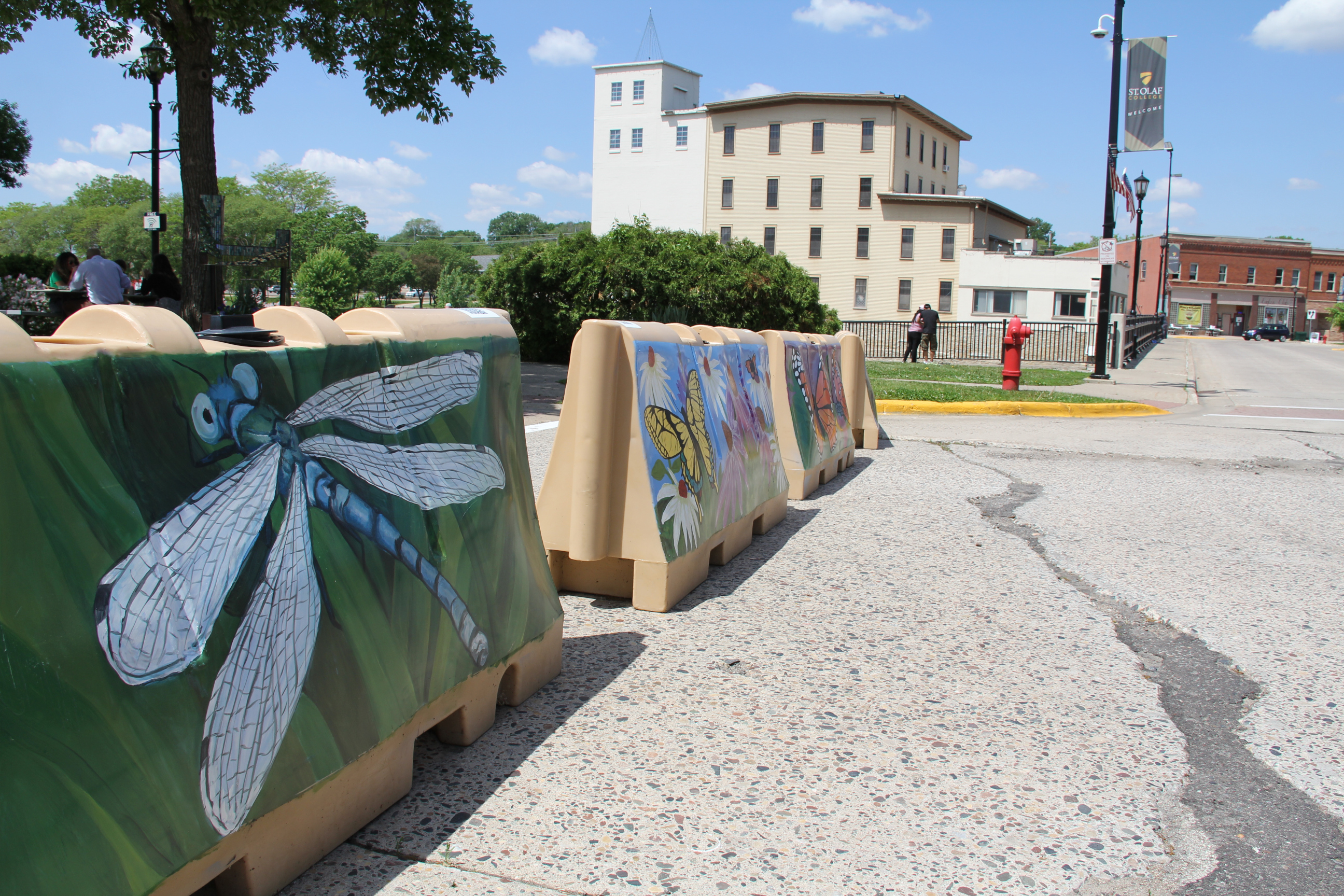
Artists Kate Woodstrup and Kathy Larson Ness added their art to Bridge Square via “Creatures & Features of the Cannon River” painted onto 11 plastic barriers that block traffic, keeping the square safe for pedestrians. A striped bass, blue heron, turtle, beavers, deer, frogs, butterflies, a dragonfly, native flowers and grasses, and more showcase life in and along the river. It’s a visual, nature-themed delight appealing to all ages. Part science. Part ecology. Part environmental awareness. Part art.
These “Poem Steps” lead up to Bridge Square, down to the Riverwalk. (Minnesota Prairie Roots copyrighted photo May 2024)
From Bridge Square, I aimed north, down the “Poem Steps,” a river poem collaboratively crafted by 17 Northfield poets during a past public arts project. Northfield has a strong community of poets. The city also stamps poetry into concrete as part of the Sidewalk Poetry initiative. The literary arts thrive in this college city.
“Lady Cannon” mural on the west side of the river along the Riverwalk. (Minnesota Prairie Roots copyrighted photo May 2024)
The goddess’ hair, like water, spills down steps. (Minnesota Prairie Roots copyrighted photo May 2024)
Next up, I spotted a colorful mural across the river. Maya Kenney and Raquel Santamaria created “Lady Cannon,” a water goddess whose flowing blue hair depicts the river. Fish weave into her locks and a heron stands riverside. This personification of the river connects people to the Cannon on a personal level. I crossed the pedestrian bridge for a closer look.
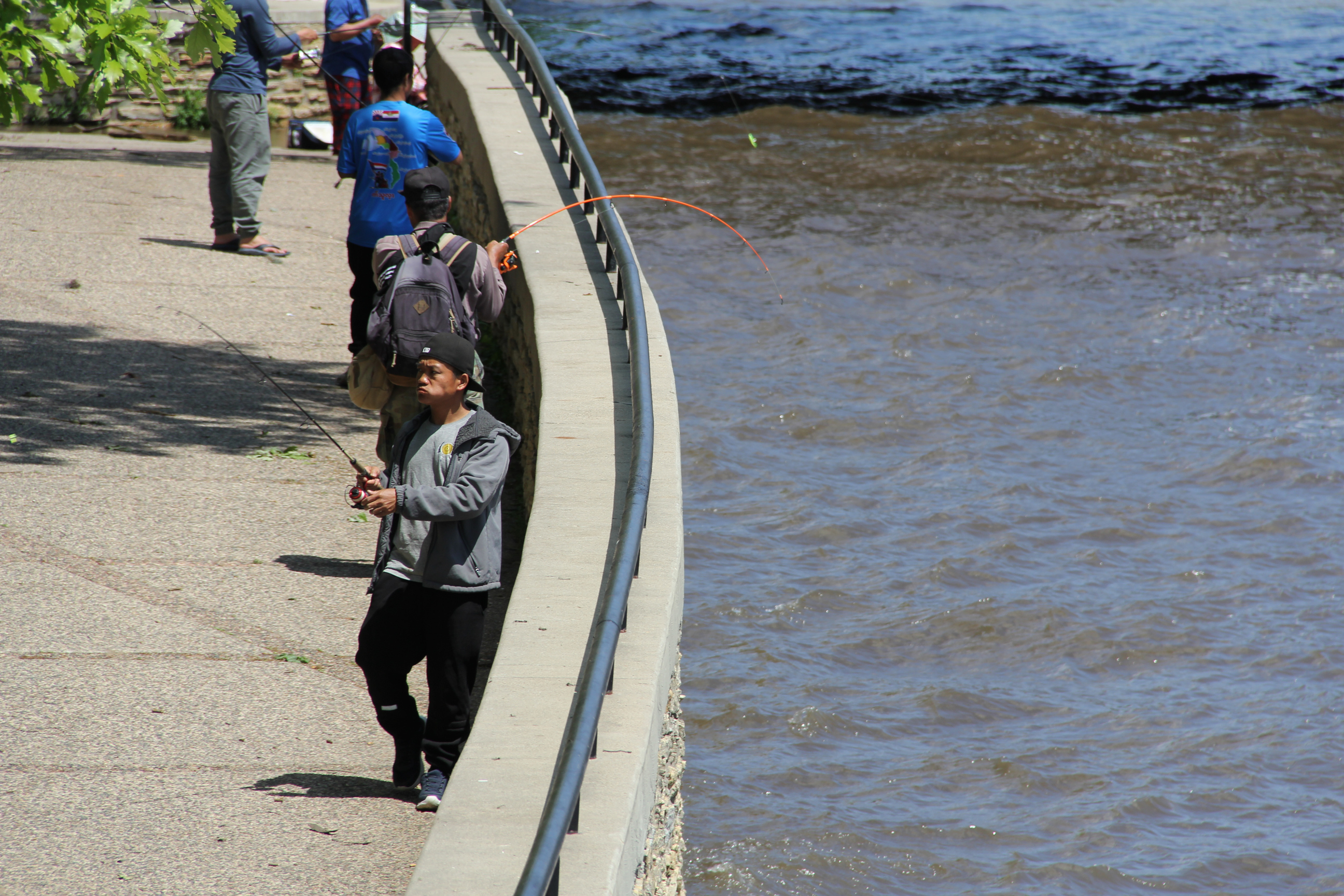
Fishermen line the Riverwalk on a May afternoon to fish the Cannon. (Minnesota Prairie Roots copyrighted photo May 2024)
A short distance from “Lady Cannon,” anglers stood nearly shoulder-to-shoulder fishing the river.
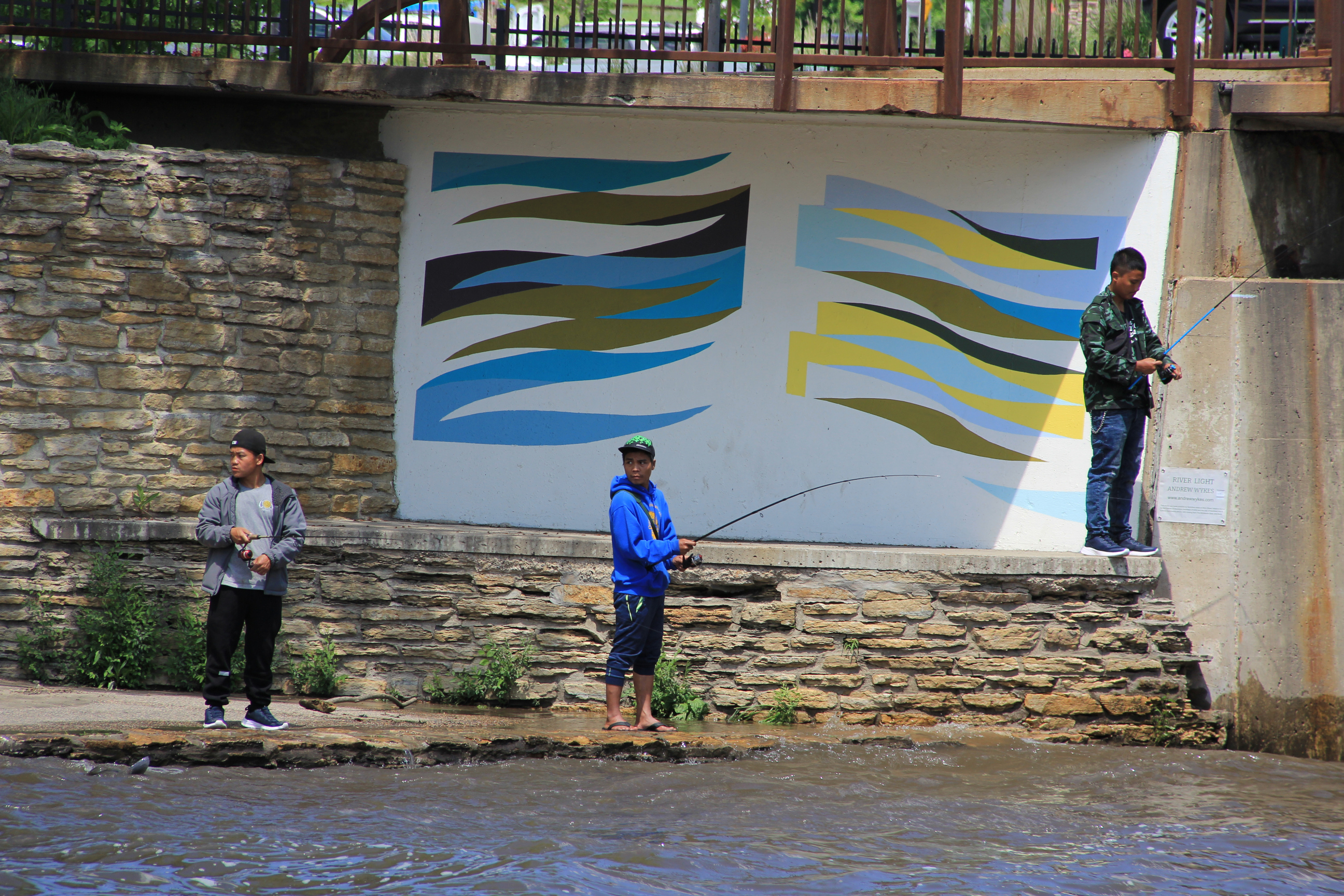
Fishing next to “River Light,” a mural by Andrew Wykes. (Minnesota Prairie Roots copyrighted photo May 2024)
Farther down, under the Second Street bridge, a trio of young men dropped lines in the water against backdrop art created by Andrew Wykes. His simplistic abstract mural, “River Light,” captures the movement, color and beauty of the Cannon River.
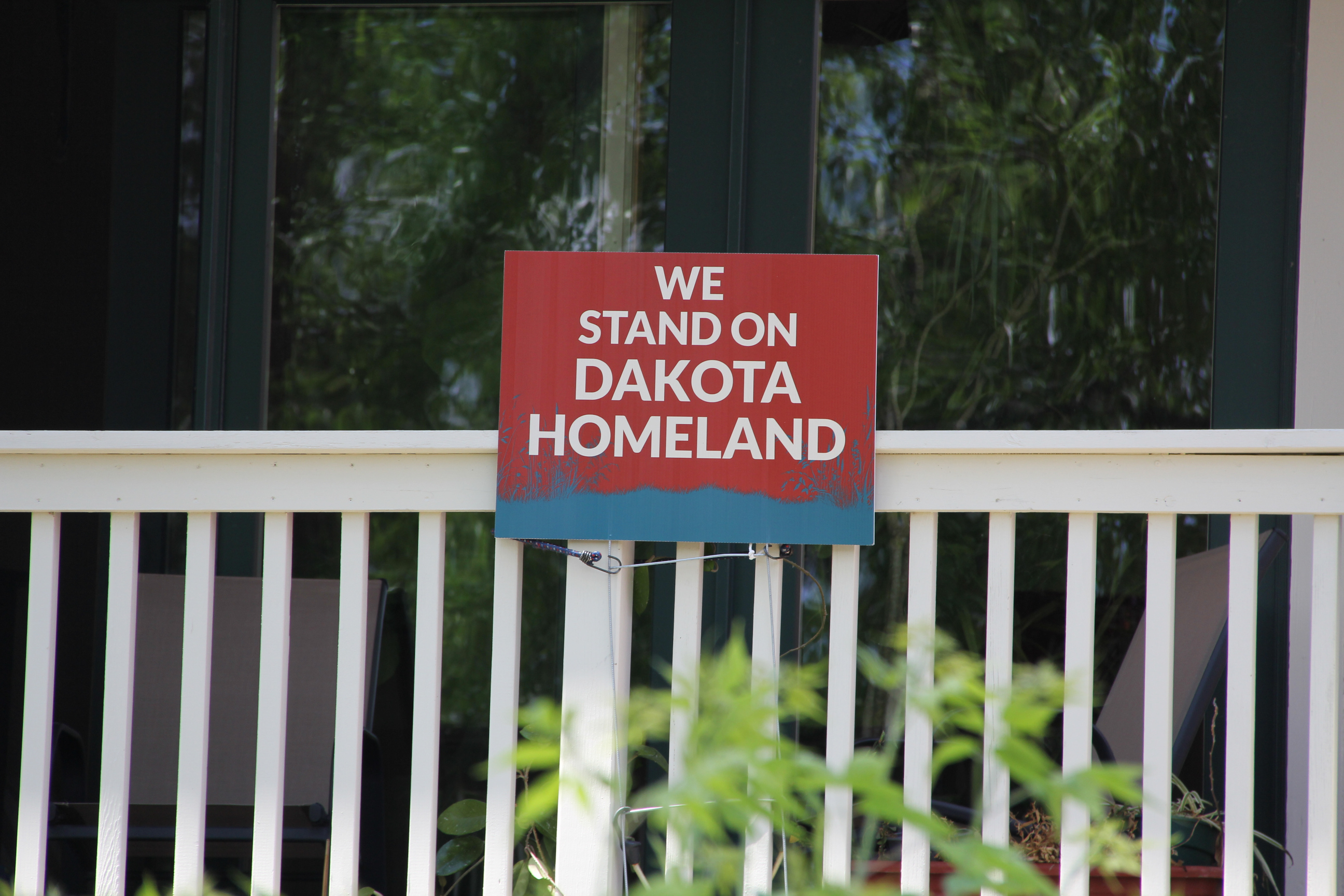
A sign spotted along the Riverwalk recognizes the Dakota’s homeland. (Minnesota Prairie Roots copyrighted photo May 2024)
The relationship between the river and people stretches back to a time long before these artists added their creative interpretations of the river and river life. A bold sign posted on a second story balcony high above the Cannon reads: WE STAND ON DAKOTA HOMELAND. Long before we became “Meet Me at the River,” the Dakota found, followed, fished this river. I appreciate the reminder that Indigenous Peoples were the original inhabitants of this land along the Cannon. They wrote the poetry, heard the music, watched the water dance, experienced the art of the river long before me, long before “Meet Me at the River.”
Pick a poem from a box at Mercado Local (and other locations) as part of a poetry initiative rooted in Northfield. (Minnesota Prairie Roots copyrighted photo April 2024)
PRINTED POETRY PLACED in public pleases me. Pleases me because putting poetry out there places this literary art into hands that might not otherwise pick poetry. I mean, if we’re honest, how often do we purchase a poetry book or pull a poetry volume from the 811. section of the library? Probably not all that often.
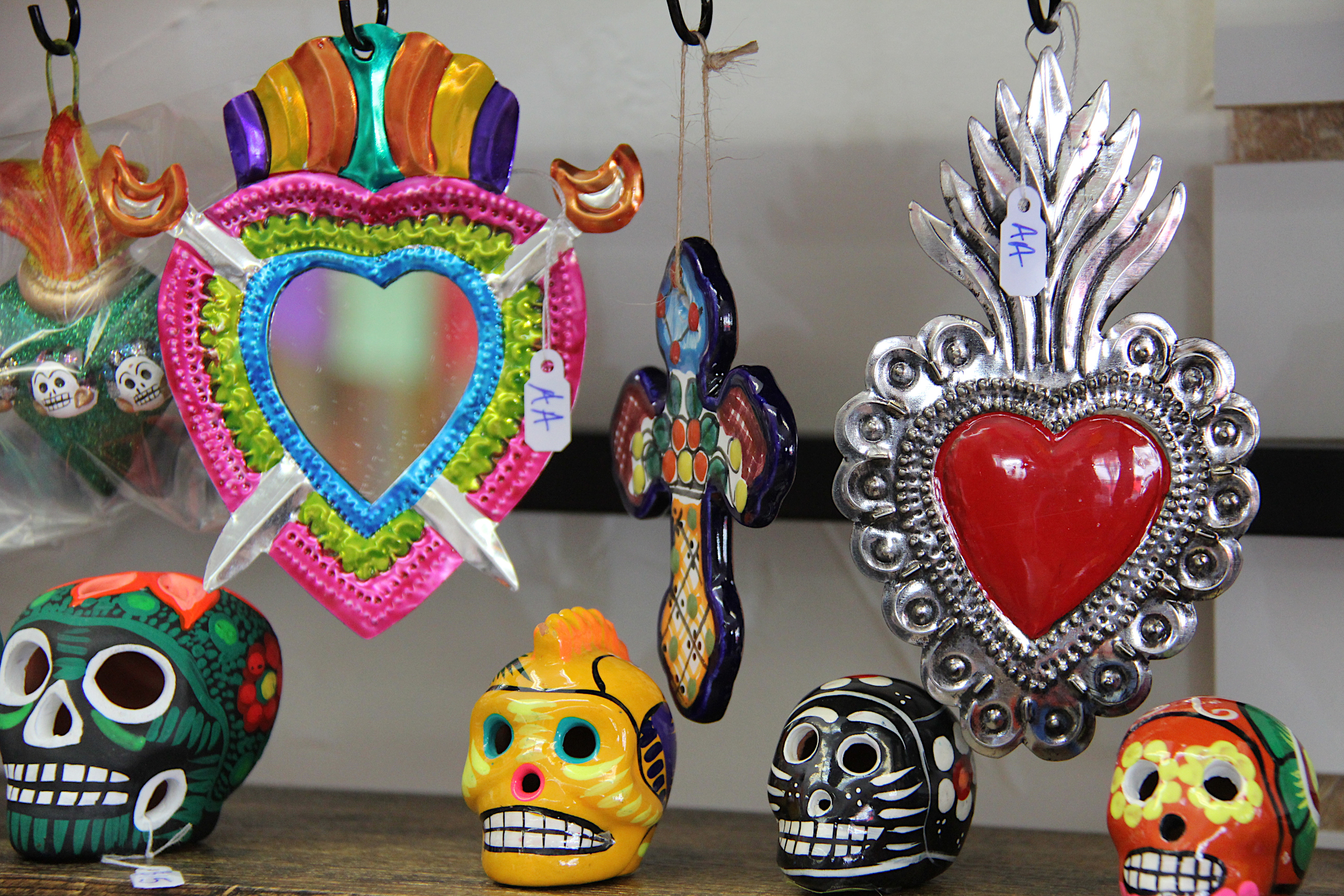
Among colorful merchandise sold by immigrant vendors at Mercado Local in Northfield. (Minnesota Prairie Roots copyrighted photo April 2024)
That is why I love the latest poetry project in my area—“Poem in a Bag.” Rice County Neighbors United, an advocacy group for low income and immigrant community members, recently launched this project in Northfield, a city rich in the arts, including poetry. Mar Valdecantos, RCNU advocate director and also a poet, writer, visual artist and art teacher, is leading this endeavor.
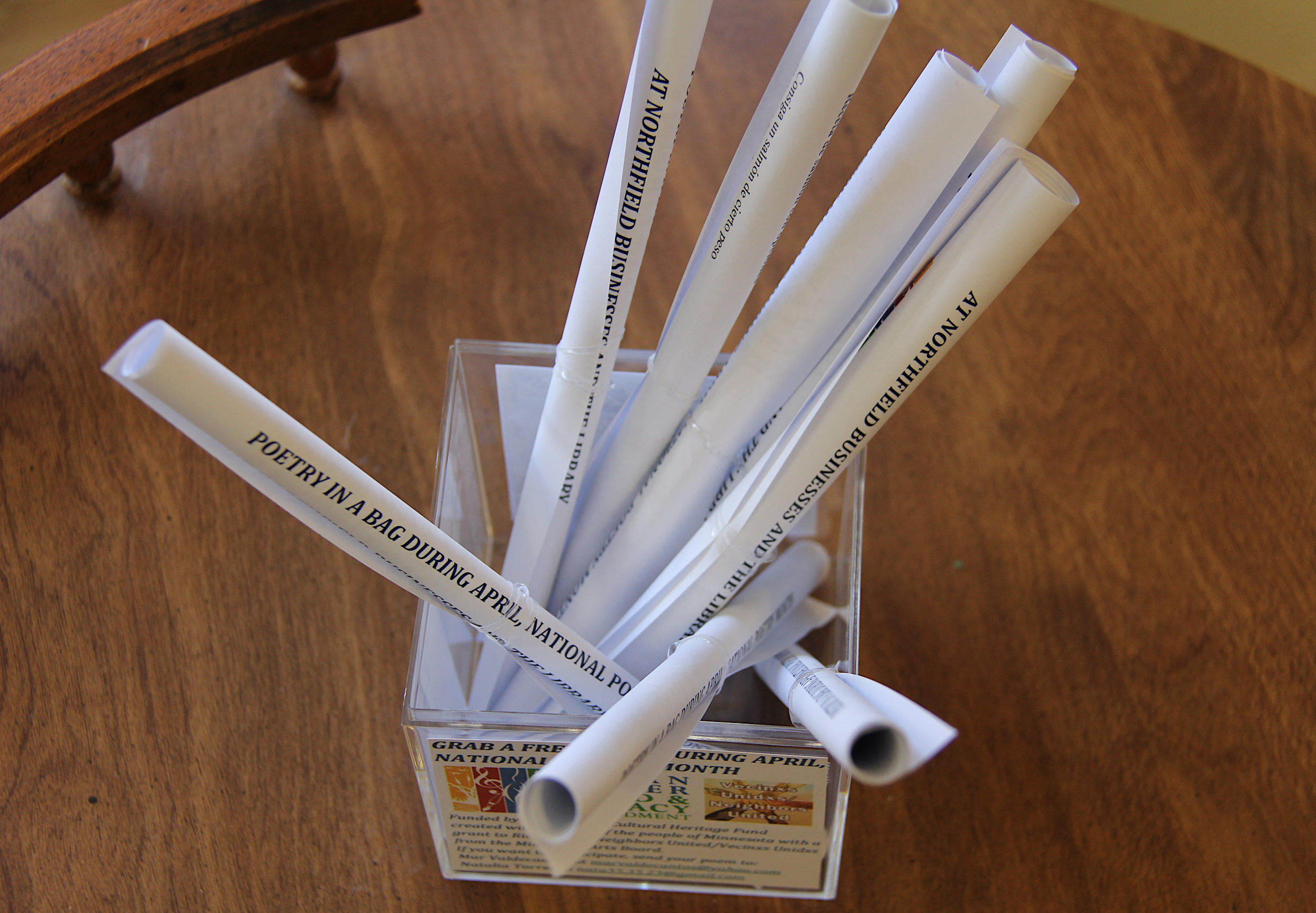
Grab a poetry scroll from the box. (Minnesota Prairie Roots copyrighted photo April 2024)
The concept is simple. Collect, translate, print and place poems inside a box (not a bag) in locations accessible to the public. The poetry, both original and favorites, is paired with local original art, including that of Valdecantos. Anyone can grab a poetry scroll and have instant access to literary and visual art.
Northfield is home to a sizeable Hispanic population. Immigrant vendors sell their art and more at Mercado Local. (Minnesota Prairie Roots copyrighted photo April 2024)
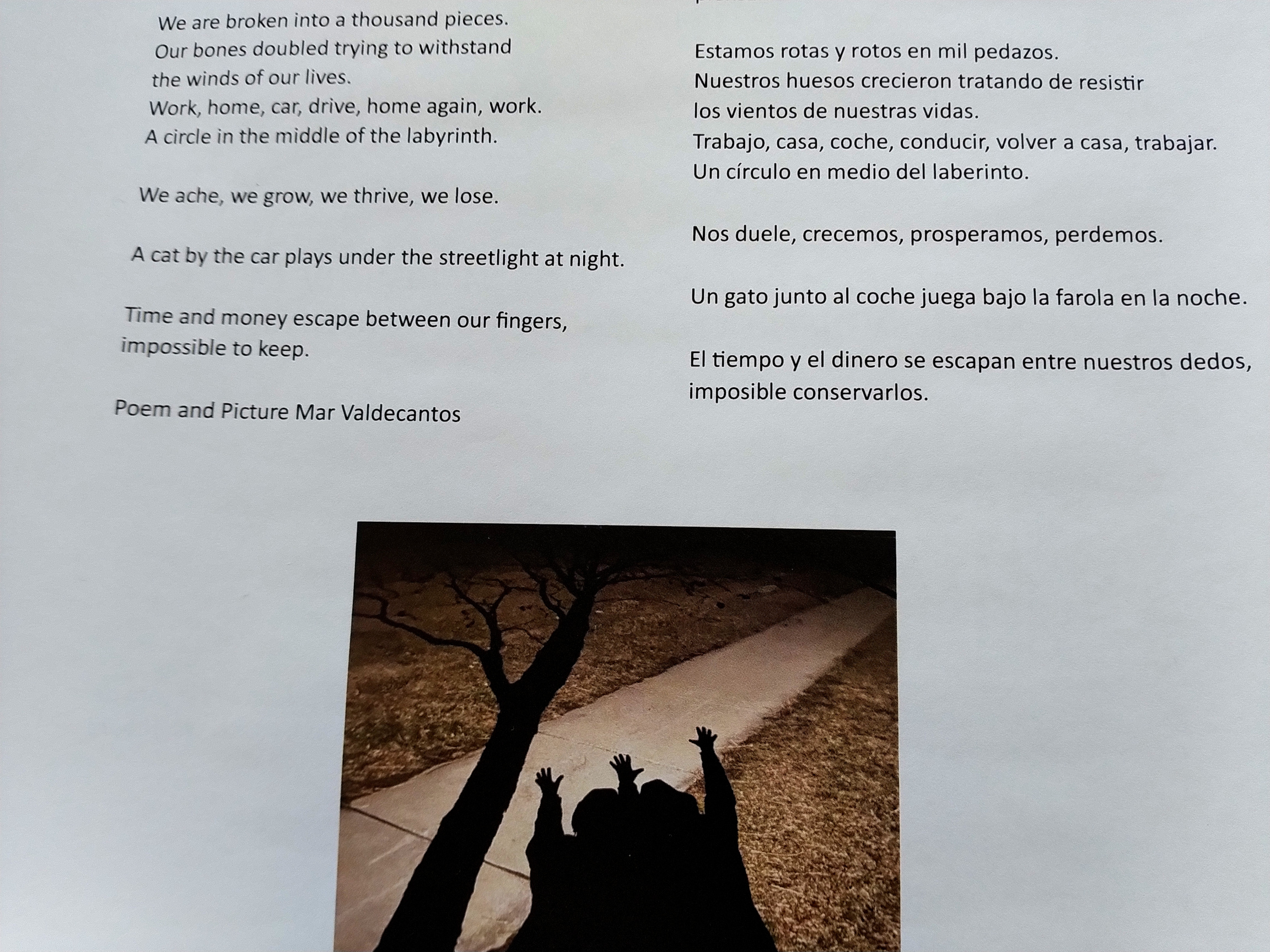
But there’s more. The poems are printed in Spanish and in English. I can’t read Spanish. (My second daughter can; she’s a former Spanish medical interpreter and translator.) That doesn’t matter. What matters is that each poem is printed in two languages, reflecting, respecting and celebrating cultural diversity in our region of southern Minnesota.
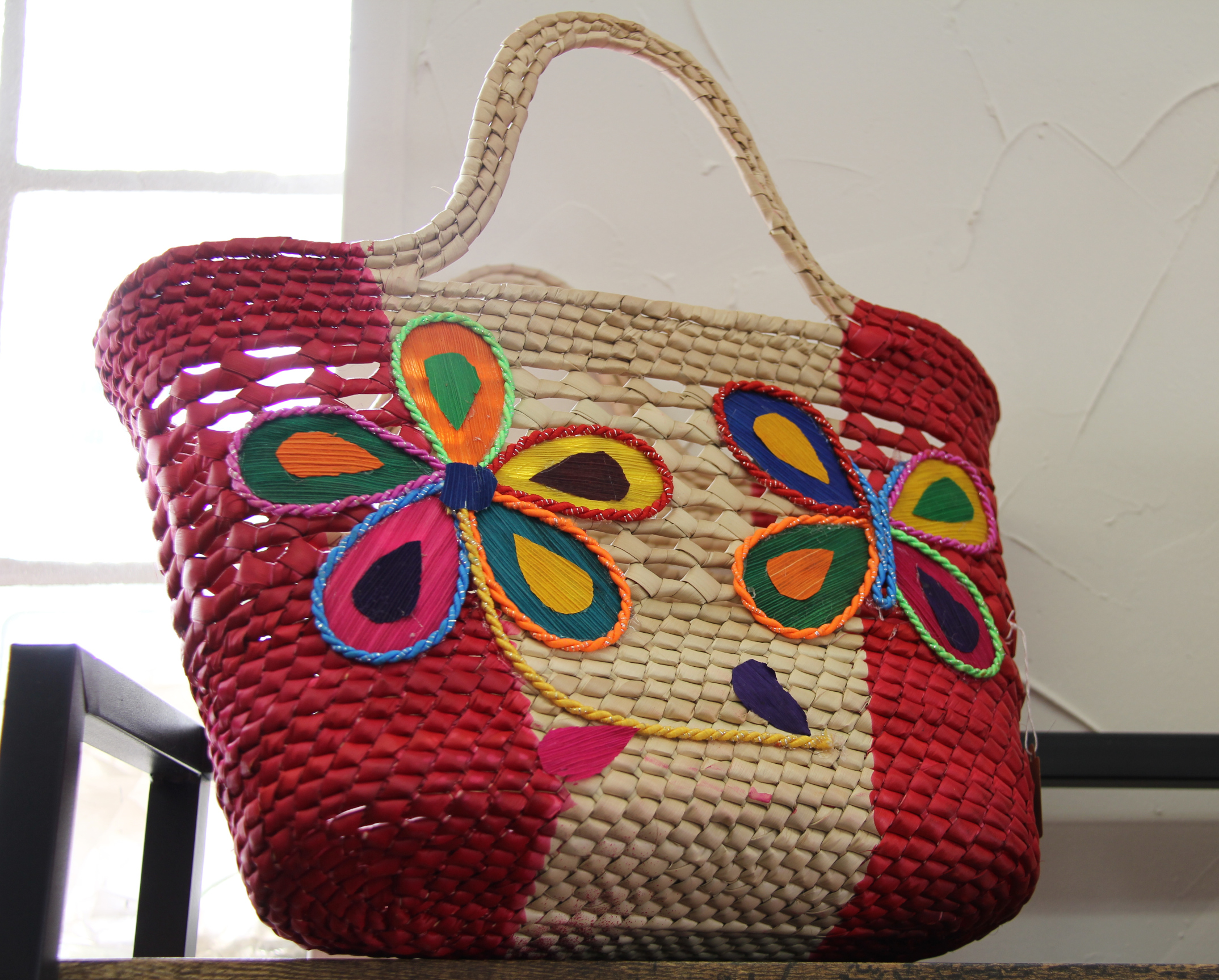
The merchandise inside Mercado Local, including this woven tote, is a colorful, visual delight. (Minnesota Prairie Roots copyrighted photo April 2024)
Rice County Neighbors United aims to raise cultural awareness via events and activities like “Poem in a Bag,” funded by a grant from the Minnesota Arts & Cultural Heritage Fund. The arts have always been a way to connect peoples, to communicate, to inspire and more. Whatever our differences, art is universal, linking us in our humanity.
A portion of the poem, “Streetlight at Night,” and art by Mar Valdecantos. All poems are printed in Spanish and in English. (Minnesota Prairie Roots copyrighted photo April 2024)
Poems submitted for this National Poetry Month project cover a range of topics, some specific, others broader. Sunrise, empanadas, children, cancer, loneliness, life, winter, salmon, even a dead mouse, are among the subjects of original poems. I’ve lent several poems for the project.
More cultural offerings at Mercado Local. (Minnesota Prairie Roots copyrighted photo April 2024)
And then there is the poetry of renowned poets—Latin American, Cuban, American—selected and submitted as favorite poems. Nature, the mother-child relationship, a white rose and service to others theme these. They, too, are accompanied by art.
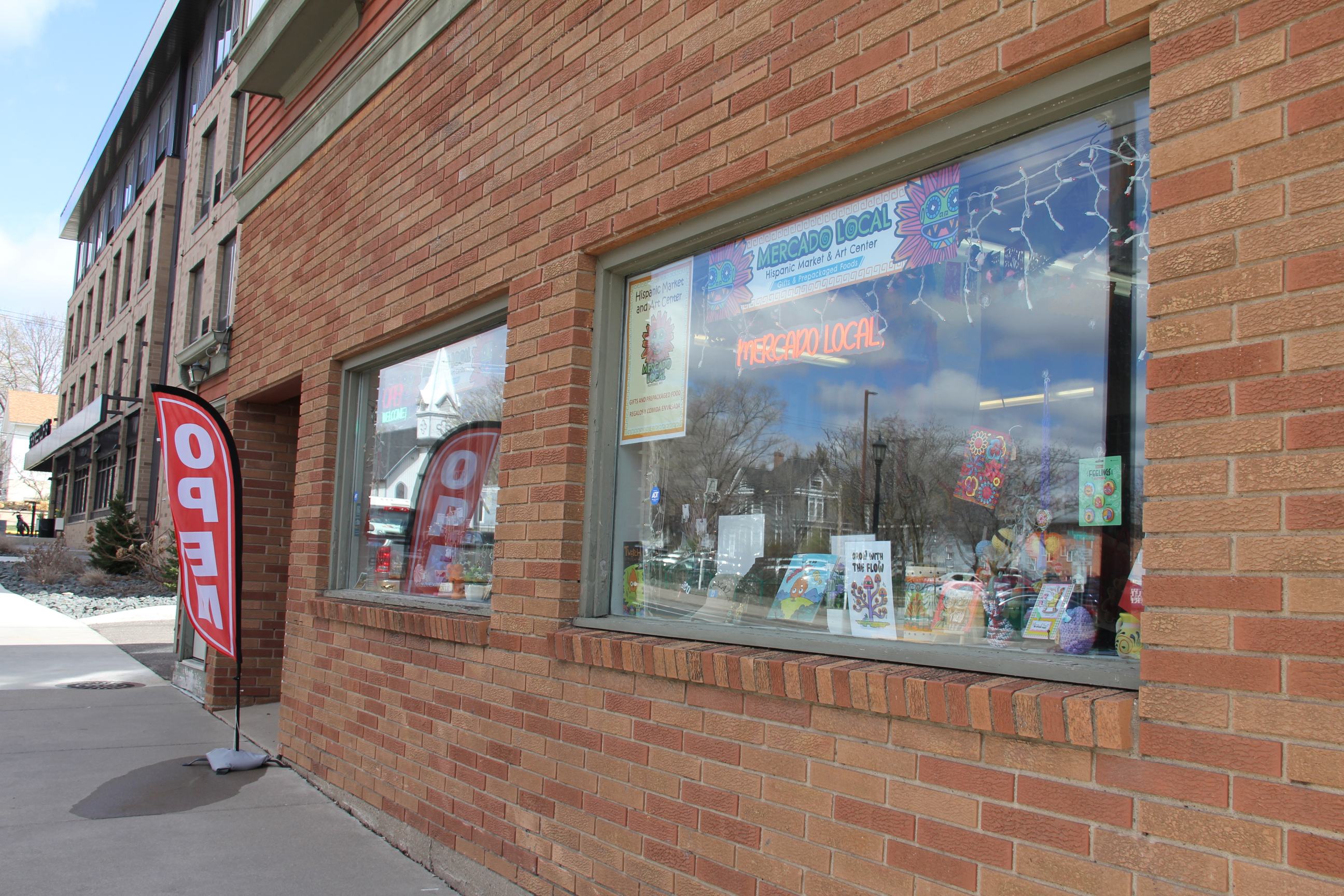
Mercado Local is located in the heart of downtown Northfield, just off Division Street. (Minnesota Prairie Roots copyrighted photo April 2024)
Art in all its forms is powerful. Rice County Neighbors United recognizes that, celebrating creativity and entrepreneurship at Mercado Local, a marketplace for immigrant vendors and also an art center, community room and education space located at 108 5th Street East in Northfield.
Mercado Local explodes with color. The “Poem in a Bag” box is on the cashier’s counter. (Minnesota Prairie Roots copyrighted photo April 2024)
“Poem in a Bag” poems are available at Mercado Local and at other Northfield businesses (currently Content Bookstore, Imminent Brewery and radio station KYMN) and at the Northfield Public Library. Valdecantos aims to get poetry boxes into more Northfield businesses. In Faribault, “Poem in a Bag” can be found at Books on Central, a used bookshop run by the Rice County Area United Way.
This is an ambitious undertaking, one Valdecantos hopes to repeat next April during National Poetry Month. She intends to extend this year’s “Poem in a Bag” into May with a poetry reading set for 6:30-8 pm Thursday, May 23, in the community room/art space at Mercado Local. I appreciate all of this. To place poetry in public places, to use art to connect cultures, is truly a welcoming, neighborly gift to our culturally diverse communities.















 Minnesota Prairie Roots
Recent Comments