Minnesota Prairie Roots

Writing and photography by Audrey Kletscher Helbling

A humorous book rooted in rural November 18, 2024

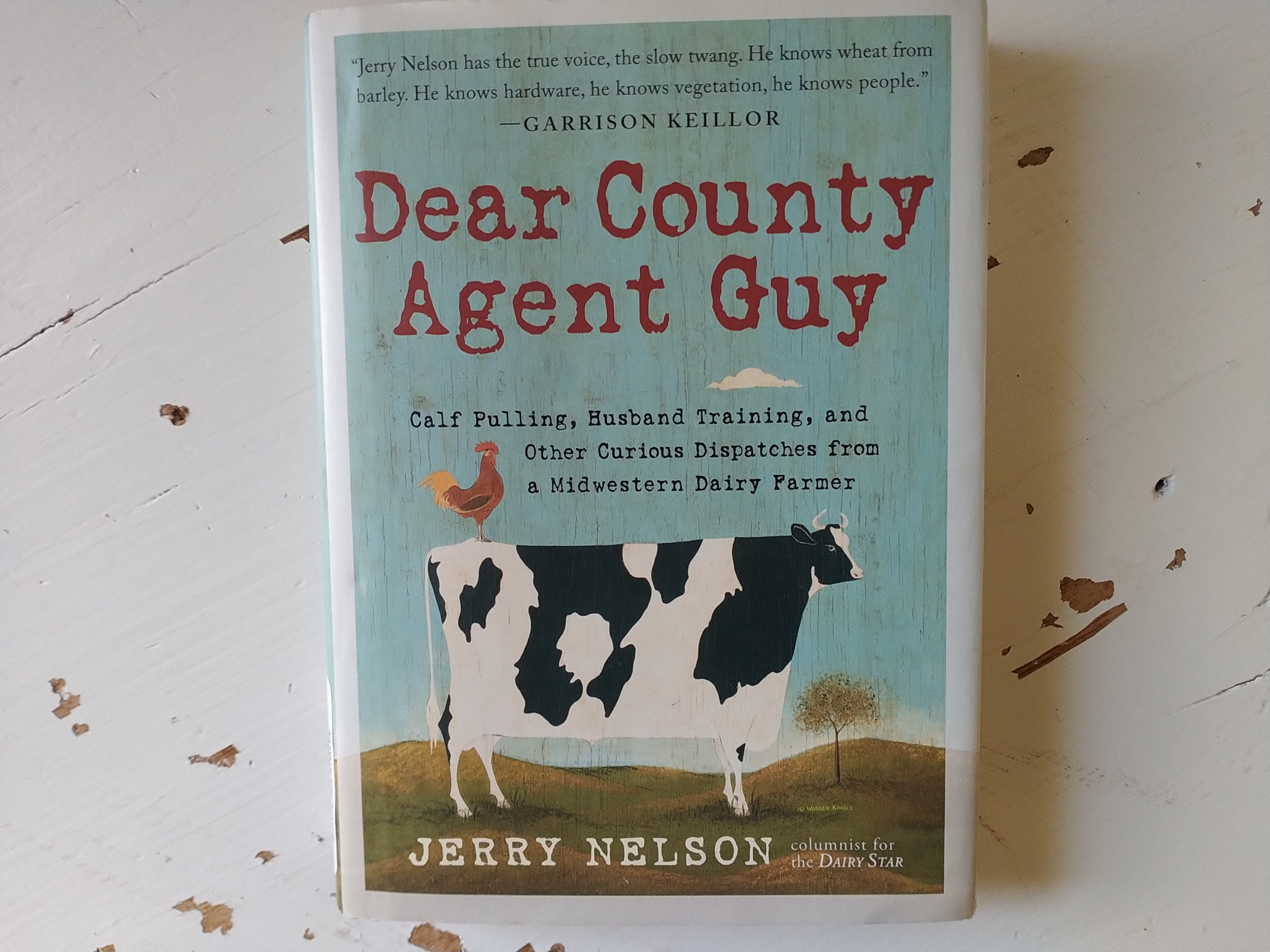
This book published in 2016. (Minnesota Prairie Roots copyrighted photo November 2024)

I NEEDED TO LAUGH. So I picked up a book I started a while ago, but which I’d set aside. That book is Dear County Agent Guy by South Dakota humor writer Jerry Nelson.

First, let’s clarify “county agent” for those of you who may not have rural roots. A county agent (kinda an old school term) is someone specifically trained to share information and research with individuals and the community. Farmers might contact the county agent about issues related to crops or livestock, for example. In Minnesota the entity heading extension services is the University of Minnesota. The U’s efforts cover agriculture, natural resources, health and wellness, youth (4-H) and more.

In his book, the author, who grew up on and then operated a South Dakota dairy farm, focuses on farm life. I, too, was raised on a dairy farm, but then left for college when I turned seventeen. This collection of humorous short stories is so relatable. Many of Nelson’s stories could be mine, although I am German, not Scandinavian, and assuredly do not like lutefisk.
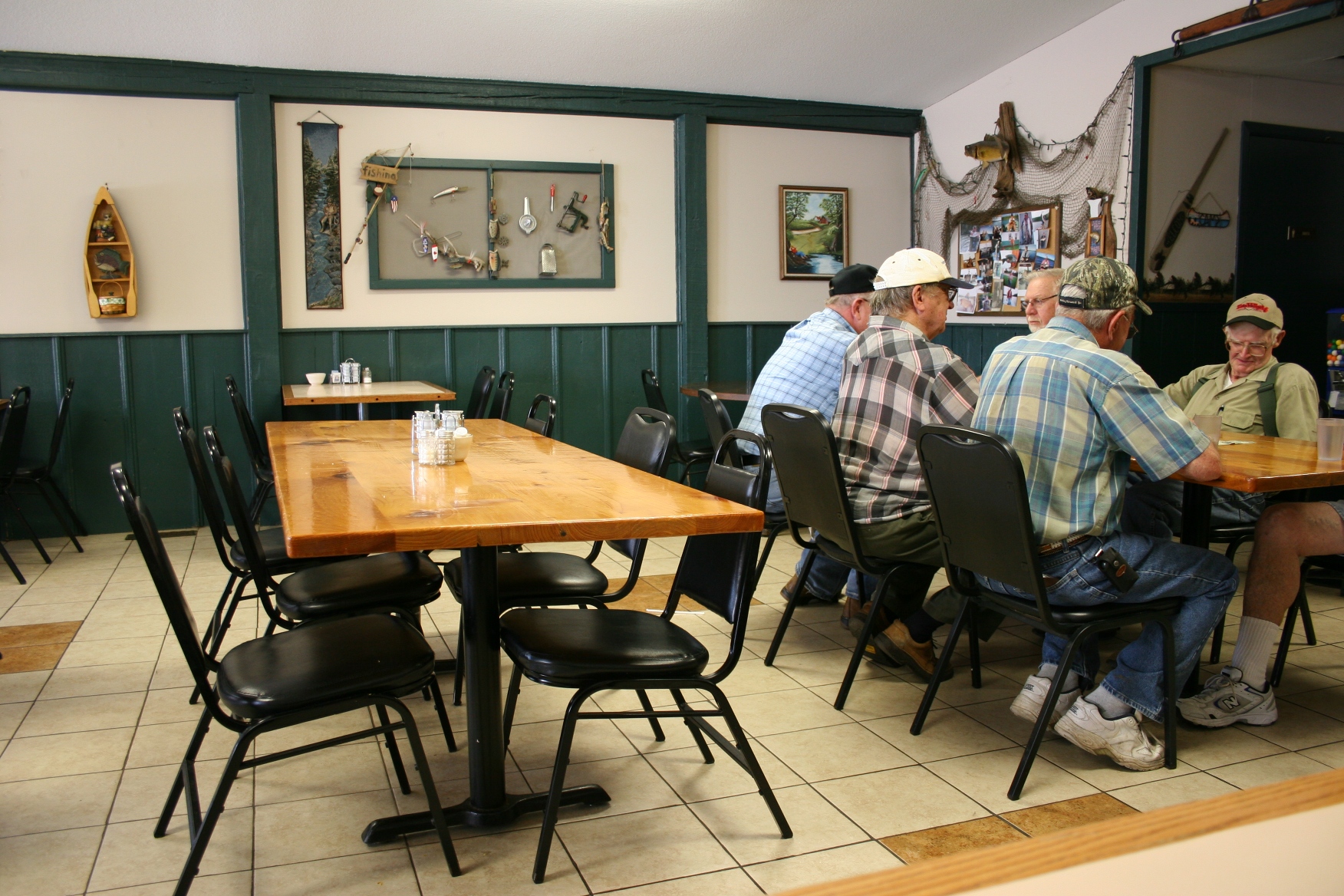
Friends gather for coffee and conversation at the Whitewater Cafe in St. Charles, Minnesota, in 2011. (Minnesota Prairie Roots copyrighted file photo)

A GIFTED RURAL STORYTELLER

Nelson’s writing made me laugh out loud at stories overflowing with humor. He’s a heckuva storyteller. I could picture him gathered with a bunch of other farmers, and a few townies, at the local cafe. Drinking coffee. Shaking dice. Exchanging stories and advice. And laughter. Lots of laughter. But I’m glad he opted to compile his stories in a book. Nelson also writes a column for Dairy Star, a Minnesota-based publication for dairy farmers in eight states. He’s among a lengthy list of columnists that include Minnesota’s Princess Kay of the Milky Way. His work publishes in many other farm publications.

The book subtitle of Calf Pulling, Husband Training, and Other Curious Dispatches from a Midwestern Dairy Farmer pretty well summarizes the content therein. It helps to have a farm background when reading this collection. But even if you don’t, you can still read, learn and laugh.
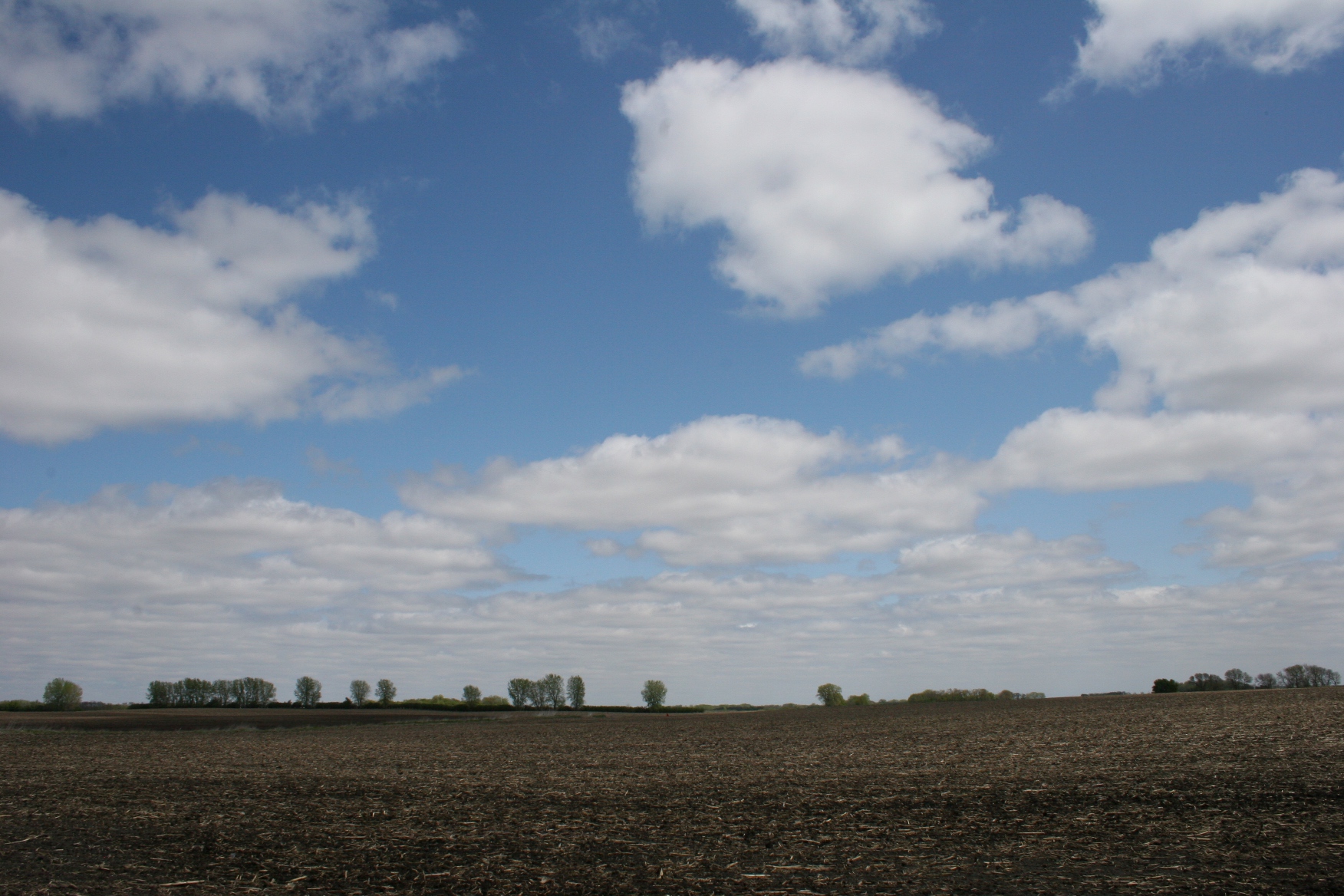
A snippet of the land where I grew up in rural Redwood County, Minnesota. My father farmed this land and my middle brother after him. The farm is no longer in the family. (Minnesota Prairie Roots copyrighted file photo)

MEMORIES GALORE FOR ME

There’s lots of nostalgia packed into these stories. How well I remember playing in the grove (the shelterbelt of trees surrounding our farm site), getting company (unexpected family and neighbors showing up to visit) and stretches of winter days stuck on the farm without electricity. Just as Nelson remembers. How well I recall Dad needing to assist a cow in giving birth (using a calf puller). How well I remember the earthy scent of freshly-turned soil.

While humor and nostalgia decidedly center Nelson’s stories, he also offers good, sound wisdom—about the importance of finding time to fish (or whatever) in a work-life balance, about appreciating family, about recognizing that life can end, just like that. Nelson nearly lost his life in a manure pit. He climbed inside to fix malfunctioning equipment when hydrogen sulfide gas overtook him. He was found floating face-up in the pit. His is a story of survival and resulting gratitude for every new sunrise.

Nelson’s writing shines with humor rooted in rural. I am grateful for his book, which shines sunshine into the world and made me laugh.

#

THANK YOU to Noreen, who follows my blog from Washington state and who gifted me with a hardcover copy of Dear County Agent Guy. I am grateful for your sharing this collection with me.

© Copyright 2024 Audrey Kletscher Helbling


Book review: A collection of short stories & art from the Minnesota prairie by Elizabeth Johanneck July 27, 2023

The cover of Elizabeth Johanneck’s new book features the art of her grandfather, Arnold Kramer. (Minnesota Prairie Roots photo July 2023)

DECADES REMOVED from southwestern Minnesota, Twin Cities writer Elizabeth Johanneck and I remain rooted to the prairie—the land and people and smalls towns which shaped us. We both grew up on Redwood County farms, were Wabasso High School classmates and today hold a deep respect and fondness for the place we once called home.

Beth, as she’s known to me, recently published a book, If You Can’t Make it to Heaven, at Least Get to Seaforth—The Monica Stories and Then Some. This book features short stories and snippet observations in Beth’s humorous storytelling style, plus paintings and photos. These could be my stories, my memories, just with different characters and settings. Any prairie farm kid likely will feel the same.

ABOUT SEAFORTH & MONICA

But where is Seaforth? And who is Monica? Seaforth, population 77, is a farming community located along County Road 7, south of Minnesota State Highway 19 in central Redwood County. It’s near my hometown of Vesta, seven miles to the northwest. Monica Fischer is Beth’s friend, former co-worker and a character. A baby shoe in a pot of egg coffee and pantyhose found clinging inside a pant leg during Catholic Mass are among the many entertaining Monica stories that left me laughing aloud. By the time I’d finished reading this section of the book, I felt like I knew Monica well. Everyone should have a friend like her.

GROWING UP ON THE MINNESOTA PRAIRIE IN THE 1960s

And everyone should be so fortunate to have experienced rural Minnesota life in the 1960s, as Beth and I did. It is Part 2, “Random Nonsense of a MN Country Mouse,” that I find most similar to my childhood. Both farmers’ daughters with many siblings, Beth and I share the commonalities of being raised on the land among aunts and uncles and cousins and grandparents and immediate family who loved us deeply.

As in “The Monica Stories,” Beth writes about her personal experiences in a casual conversational style. It’s as if she and I are chatting over cups of coffee, and Beth does like her coffee. I connect with her stories about “the grove,” jars of pocket gopher feet in the freezer, grab bags, bloodsuckers, The Weekly Reader, hearing corn grow and more.

Her humor-infused short stories stretch into adulthood, into becoming a parent and grandparent. These are not earth-shattering remembrances, but rather observations about everyday life and events that could be mine, could be yours, but are definitively Beth’s.

NIBBLES OF COUNTRY INSIGHTS

In a section titled “Country Mouse Nibbles,” Beth shares her thoughts on topics in a sentence or two, the first being “When You Are Raised Close to the Land.” I fully understand—the smell after autumn harvest, looking to the west for approaching storms, filled fruit jars crowding root cellar shelves… And “Holding onto Memories”—Distant cheers from a local ball game are souvenirs worth saving for winter. Truly poetic words.

FEATURING THE ART OF “MINNESOTA’S GRANDPA MOSES”

There is much to be cherished in this book beyond pages and pages of rural memories and insights. Beth also intersperses photos, most from Seaforth. But it is Part 3, “Paintings by Arnold Kramer, Minnesota’s ‘Grandpa Moses,’” which is an historic agrarian art treasure. Following his retirement, Seaforth farmer Arnold Kramer took up painting, visually documenting early to mid-1900s rural life and scenes. He became well-known for his folk art style paintings done in primary colors. Beth’s book holds the only printed collection of paintings by her grandfather. The self-taught artist created more than 400 works of art and was dubbed “Minnesota’s Grandpa Moses” by the University of Minnesota at the peak of his creativity in the 1960s.

Book signing promo courtesy of Elizabeth Johanneck.

BOOK SIGNING SATURDAY IN SEAFORTH

Like her grandfather before her, Beth is also a visual artist. She illustrated a just-published children’s picture book by her lifelong friend, Cindy Bernardy Lavin, our WHS classmate. Both writers, along with Monica Pistulka Fisher, are doing a book signing from noon to 3 pm this Saturday, July 29, at the C4th Bar during Seaforth’s Hometown Days celebration.

Beth’s book is also available for purchase at Chapter Two Bookstore in Redwood Falls and online at Amazon and Barnes & Noble. Both her book and Cindy’s achieved bestseller status on Amazon following their release.

Julie Kramer, author of bestseller Stalking Susan, praises Beth’s book in her back cover endorsement, calling it “a delightful collection from a farm girl who grew up near the Minnesota home of Laura Ingalls Wilder.” I agree. Fully.

#

Disclaimer: I edited Beth’s book and advised her on the manuscript. She also included my poem, “Her Treasure,” as a companion piece in the “Country Mouse Nibbles” section. For many years, Beth hosted a blog, Minnesota Country Mouse.

© Copyright 2023 Audrey Kletscher Helbling
 

Expressing my creative voice in “The Talking Stick” October 11, 2022

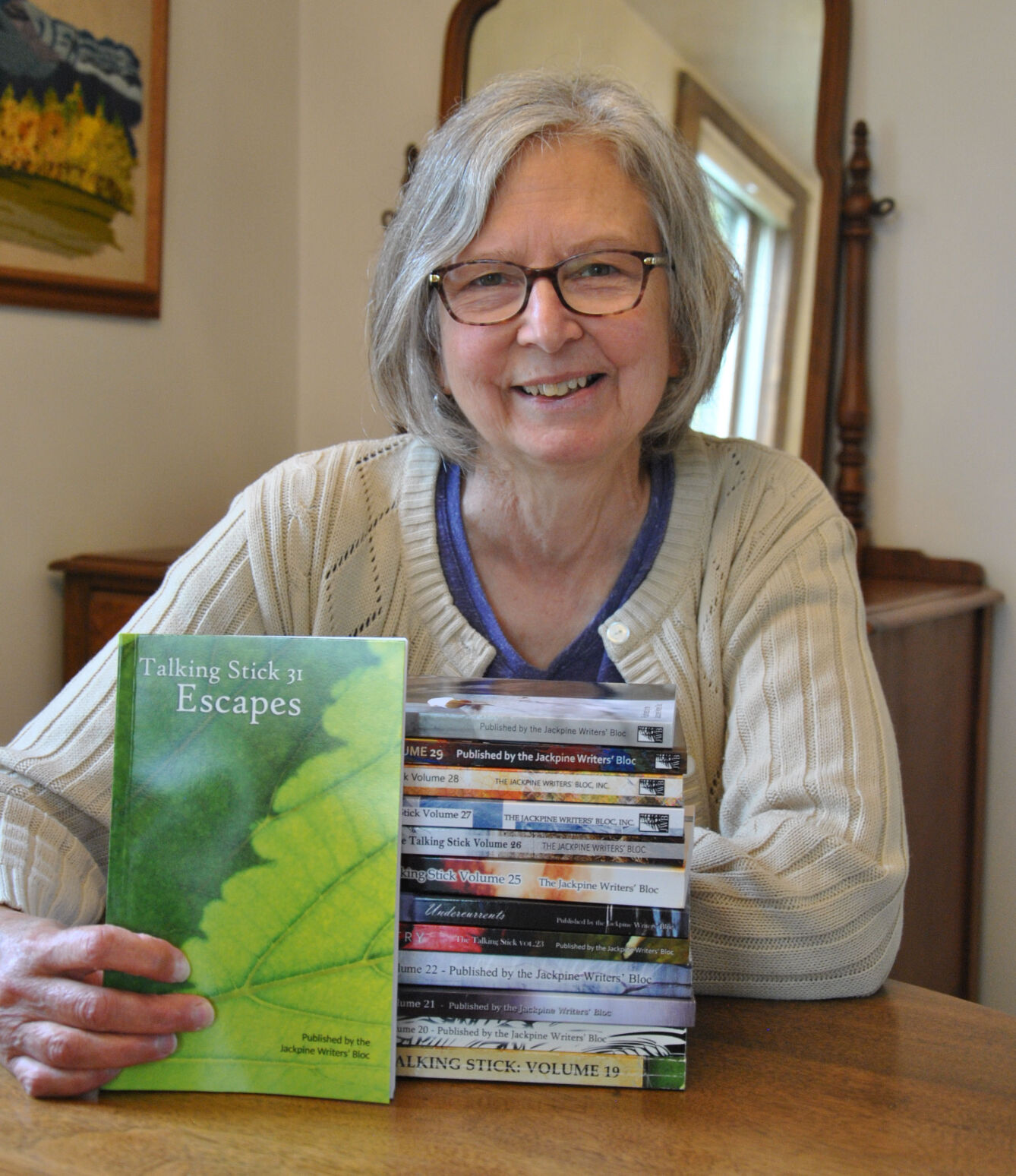
I’ve been published in 13 volumes ofThe Talking Stick,most recently InVolume 31, Escapes.” (Photo by Colton Kemp)

AS A WRITER, getting published adds to the joy of the craft. I write because it’s my passion, one which I want to share.

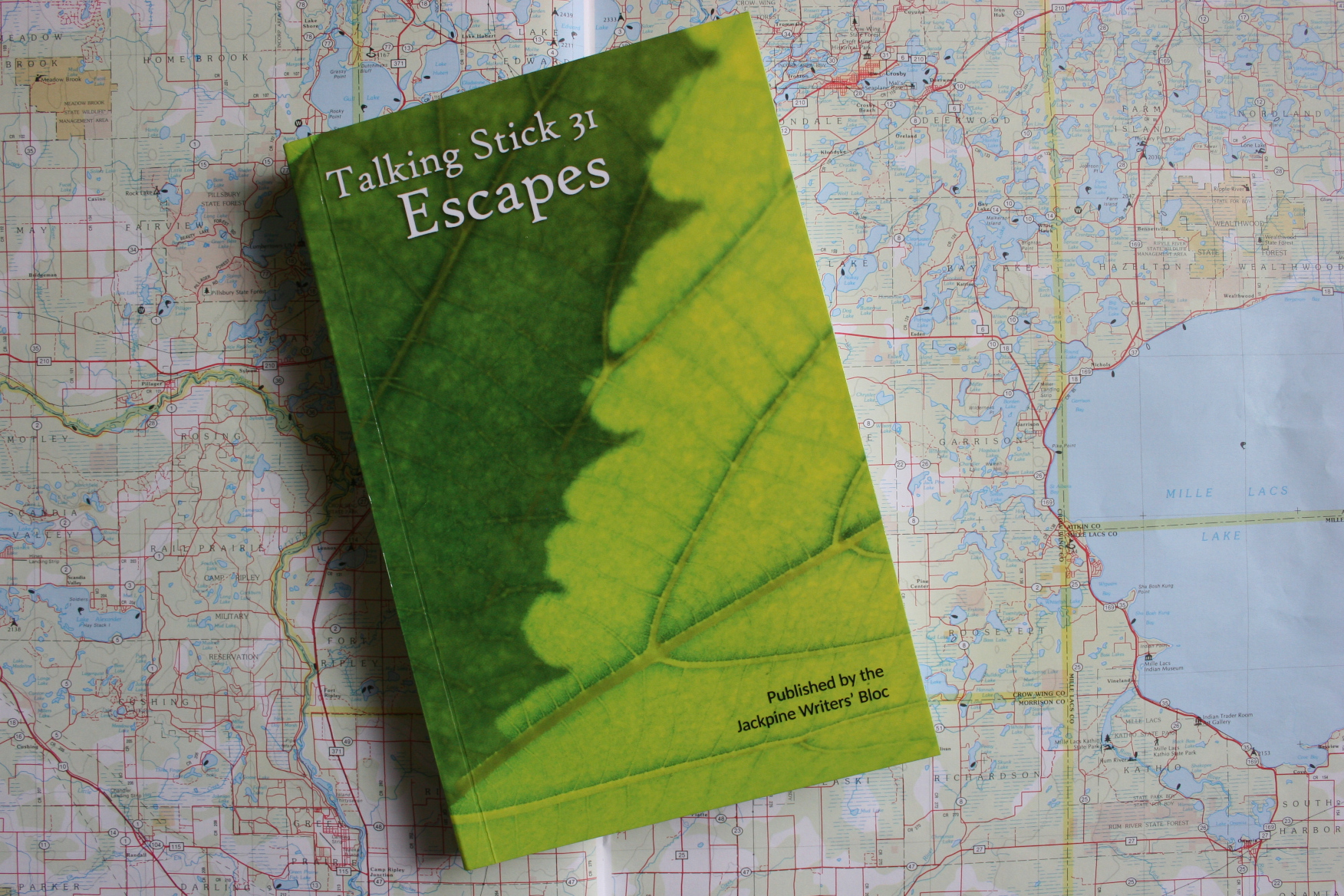
I laid the latest copy of The Talking Stick atop a page in a Minnesota atlas to represent escape in a sense of place. Reading and writing also provide an escape. (Minnesota Prairie Roots copyrighted photo October 2022)

The newest opportunity to share comes via The Talking Stick 31—Escapes, the latest anthology released in September by Park Rapids area-based The Jackpine Writers’ Bloc. The Talking Stick, published now for 31 years, features a collection of creative nonfiction, fiction and poetry by Minnesota writers or those with a connection to our state. This year, editors chose 83 poems, 28 creative nonfiction stories and 18 fiction stories for publication from 82 writers. More than 300 submissions came from 140 writers.

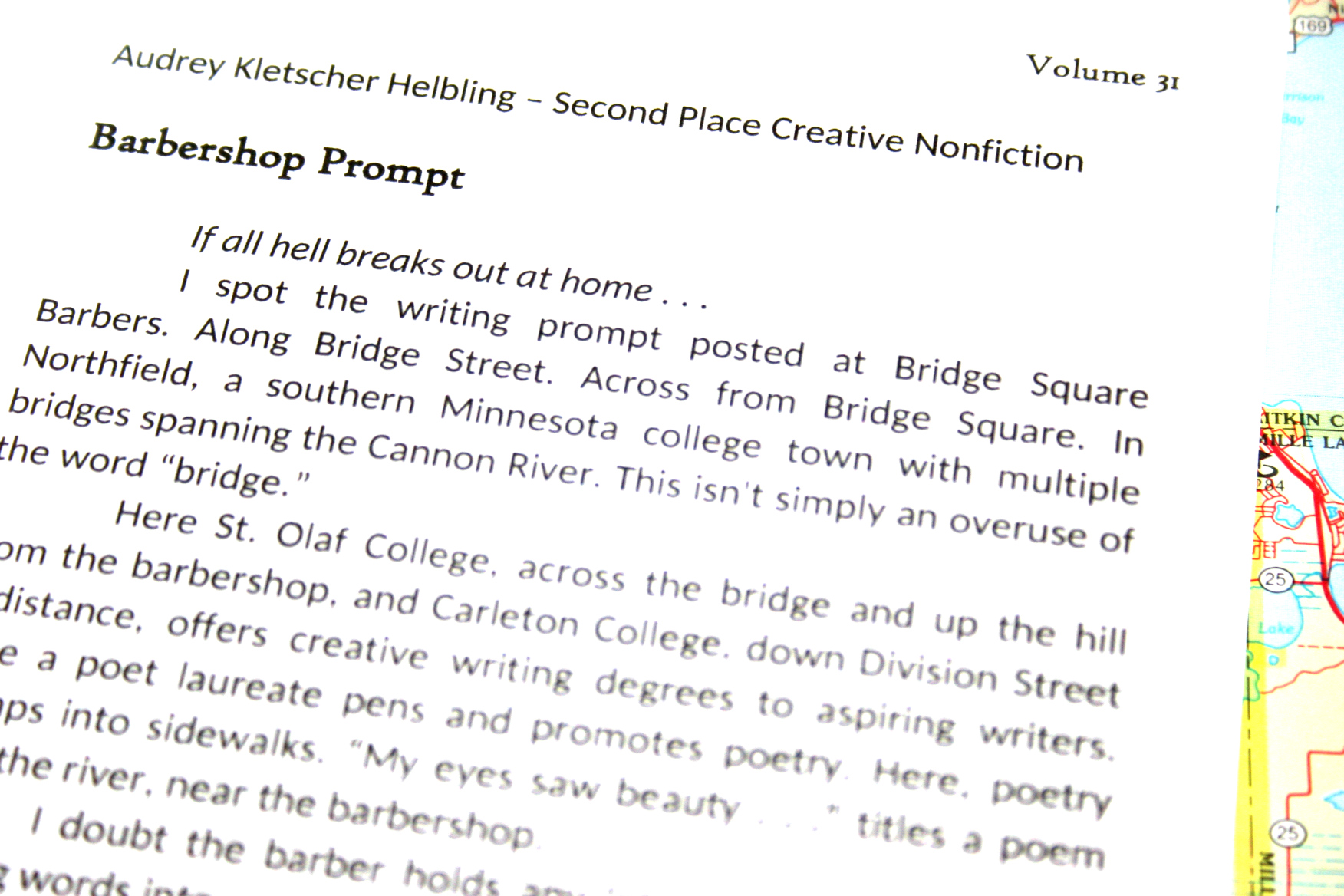
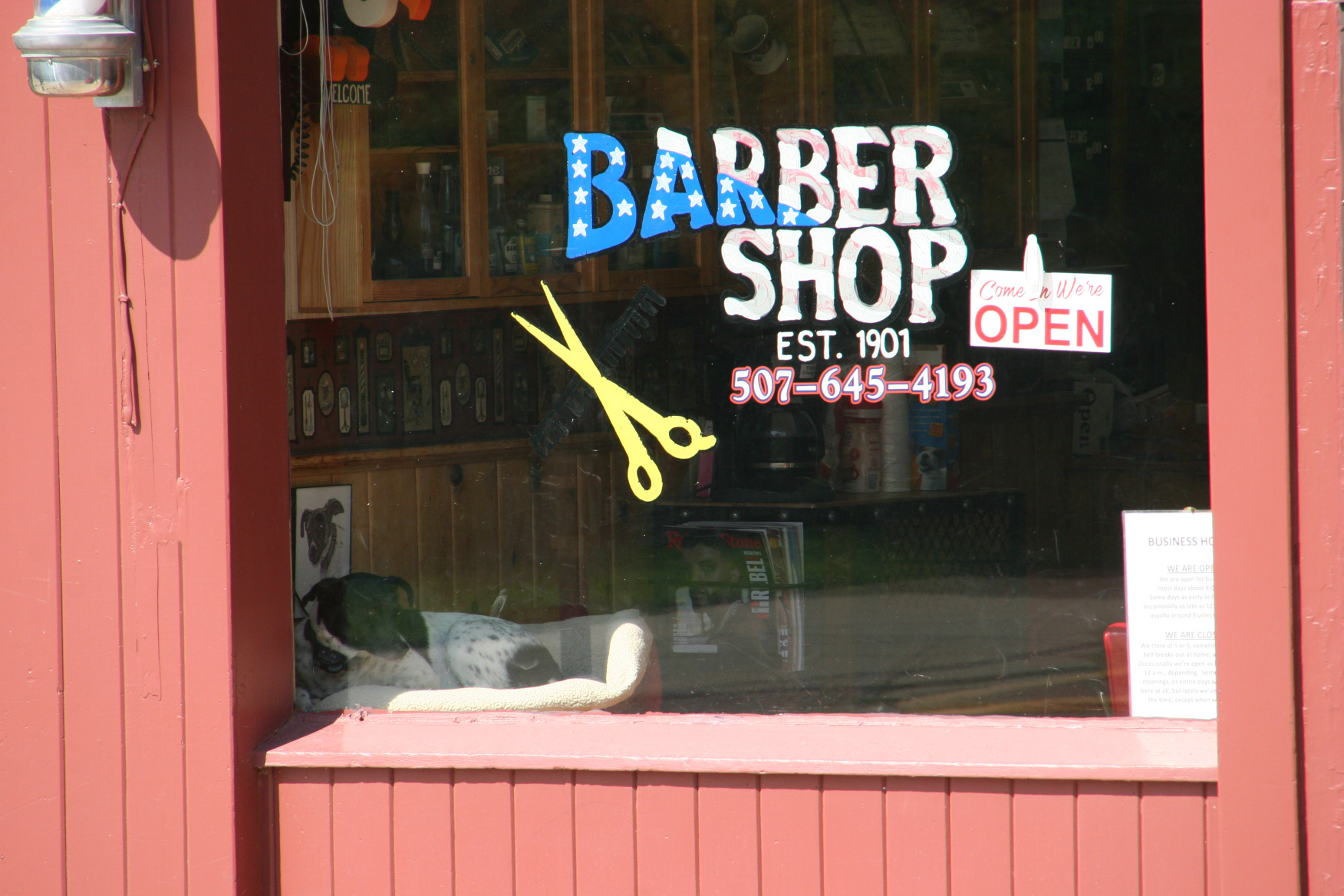
The beginning of my story, “Barbershop Prompt.” (Minnesota Prairie Roots edited and copyrighted photo October 2022)

I’m delighted to announce that three of my submissions are included in Escapes. My story, “Barbershop Prompt,” won second place and a cash prize in creative nonfiction. “Plans” earned honorable mention in fiction. And my second fictional piece, “Between Sisters,” simply published.

My writing has published in all 13 of these “The Talking Stick” volumes. (Minnesota Prairie Roots copyrighted photo October 2022)

To have my work selected and honored by peers is, for me, reaffirming. This marks the 13th year my writing—a total of 13 poems, eight creative nonfiction stories and nine fiction stories—have published in The Talking Stick. I’ve earned seven honorable mentions and two second placings through the years. Every year I’ve entered this competition, my writing has published. That proves personally validating.

When I first ventured into penning fiction, I did so with hesitancy. My journalism education, background and experience rooted me in gathering information and reporting the facts with no bend to fictionalize. I didn’t know I could write fiction until I tried. And I found I rather enjoy this type of writing. It stretches my creativity in a way that traditional factual writing doesn’t. Yet, even when I write fiction, there is some truth within. I weave into my writing (often in subtle ways) that which I know or care about or which has touched me. I expect most fiction writers would say the same.

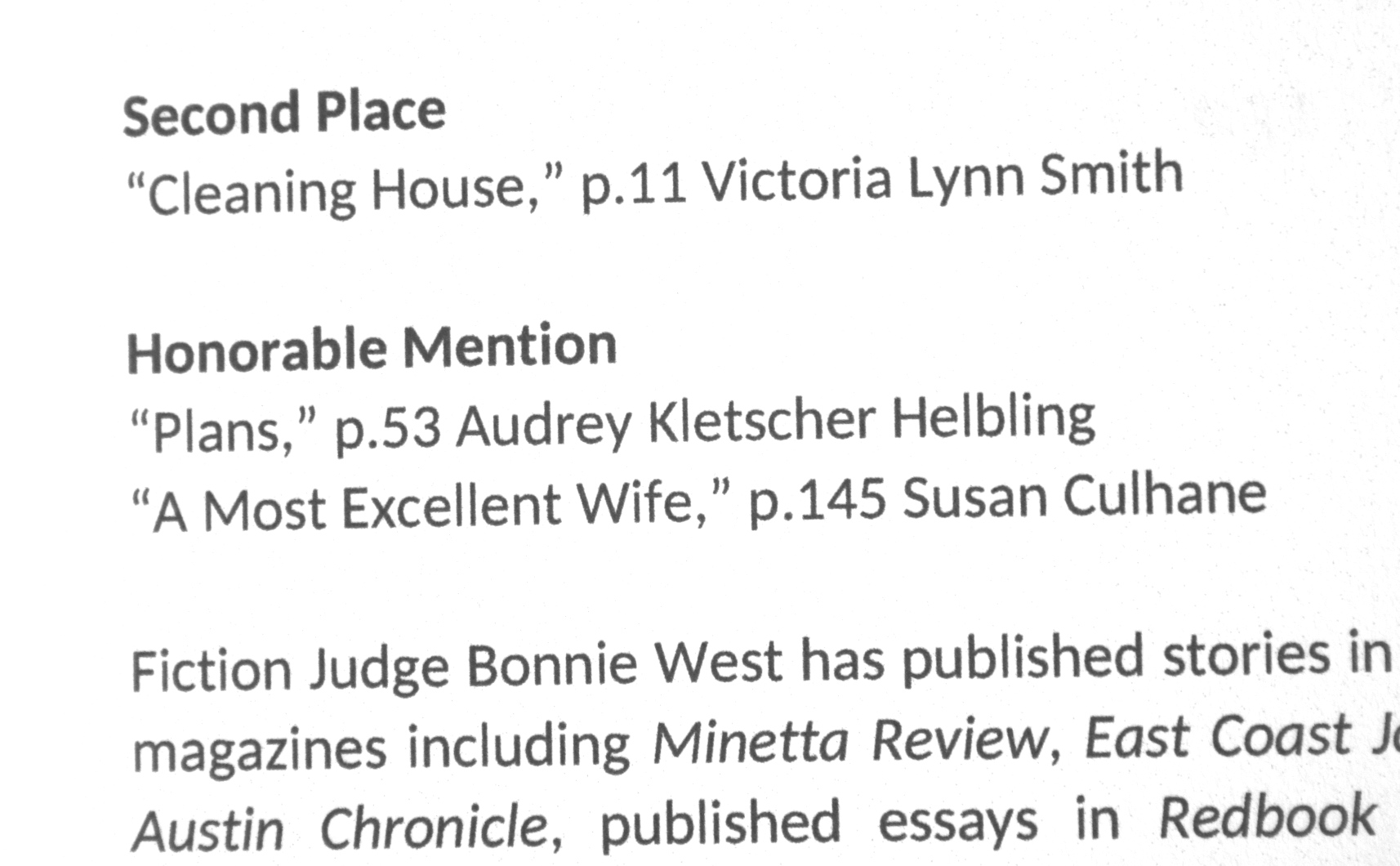
Partial winning credits in fiction and the judge’s bio. (Minnesota Prairie Roots edited and copyrighted photo October 2022)

My award-winning short story, “Plans,” focuses on abuse within a family. Abuse has not been my personal experience. But it runs rampant in society. “Plans” focuses on abuse from the perspective of Henrietta, or Henri as her father calls her. He wanted a son, not a daughter. I’m not revealing more except to say the story leaves the reader wondering. And that’s exactly as The Talking Stick editors intend. Submission guidelines call for focusing on short forms, on compressed creations which hint of a longer, more complex story. You get that in my 457-word “Plans.”

Here’s, in part, what fiction judge Bonnie West said about my short story:

What a good story. Very clever, but also very poignant and surprising! Thanks for this delightful and entertaining revenge story!

Bridge Square Barbers, the inspiration for my award-winning story. (Minnesota Prairie Roots copyrighted file photo August 2022)

I definitely appreciate West’s comment and that of creative nonfiction judge Marge Barrett. She evaluated “Barbershop Prompt,” praising the energy and cleverness of my story. A sign I spotted in the front window of Bridge Square Barbers by Bridge Square in Northfield prompted me to write this. I am an observer, someone who notices details. That often inspires. Like my winning fiction story, this fact-based story leaves the reader wondering, wanting more. The same can be said for “Between Sisters.”

The Talking Stick is an incredible collection of outstanding writing and I’m honored to be included with so much other Minnesota talent. Each year I see familiar names repeated, but then new voices, too. The small editorial team from the Jackpine Writers’ Bloc deserves recognition also for their hard work. This anthology truly is a labor of love. I’m grateful for their appreciation of Minnesota writers and for their dedication to the craft of writing.

FYI: I encourage you to support Minnesota creativity by purchasing a copy of The Talking Stick 31—Escapes by clicking here.

Colton Kemp, a reporter for the Faribault Daily News, wrote a feature on me which published in the Saturday, October 8, edition. I encourage you to read that also by clicking here. I am grateful for Colton sharing my story and for the opportunity to connect with him, another individual passionate about writing.

© Copyright 2022 Audrey Kletscher Helbling
 

To the Minnesota northwoods for a book release party September 20, 2017


TWO READINGS BEFORE MINE, Norma Thorstad Knapp stepped to the microphone to share “How Much She Had Lost.” As she read of her aging mother’s desire to waltz one more time, emotions rose. My throat constricted. Tears seeped from my eyes. Thinking of my 85-year-old mother, I wondered how I could possibly compose myself enough to read my short story.


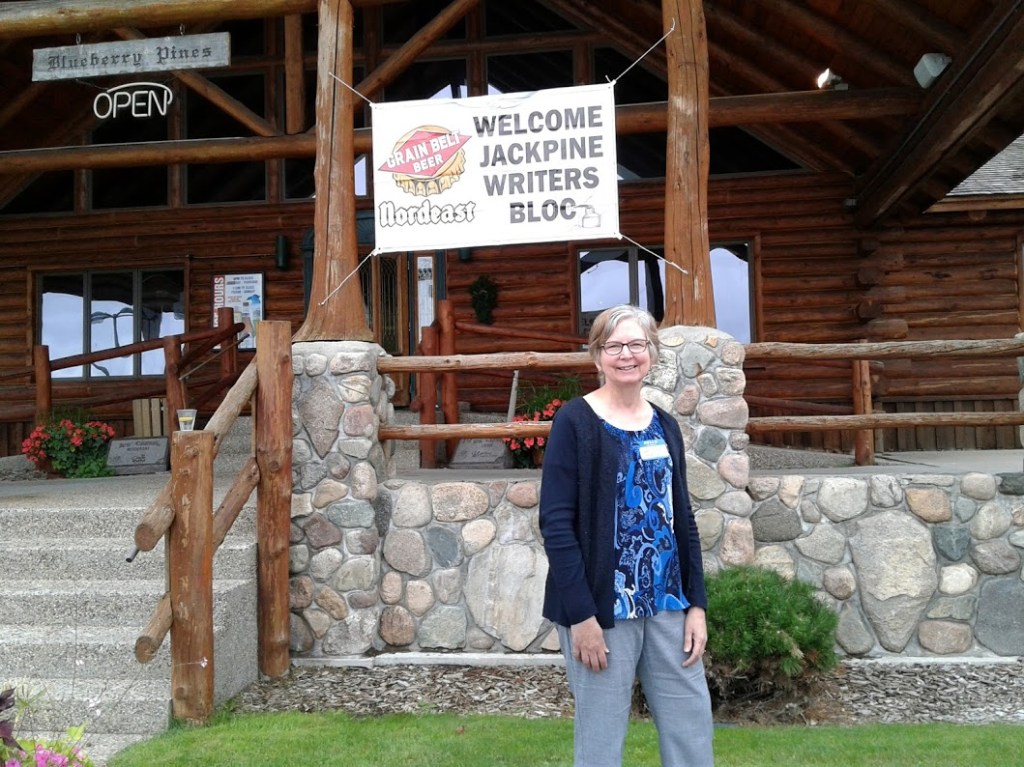
I pose in front of Blueberry Pines Golf Club, setting for The Talking Stick book release party. Photo by Randy Helbling.


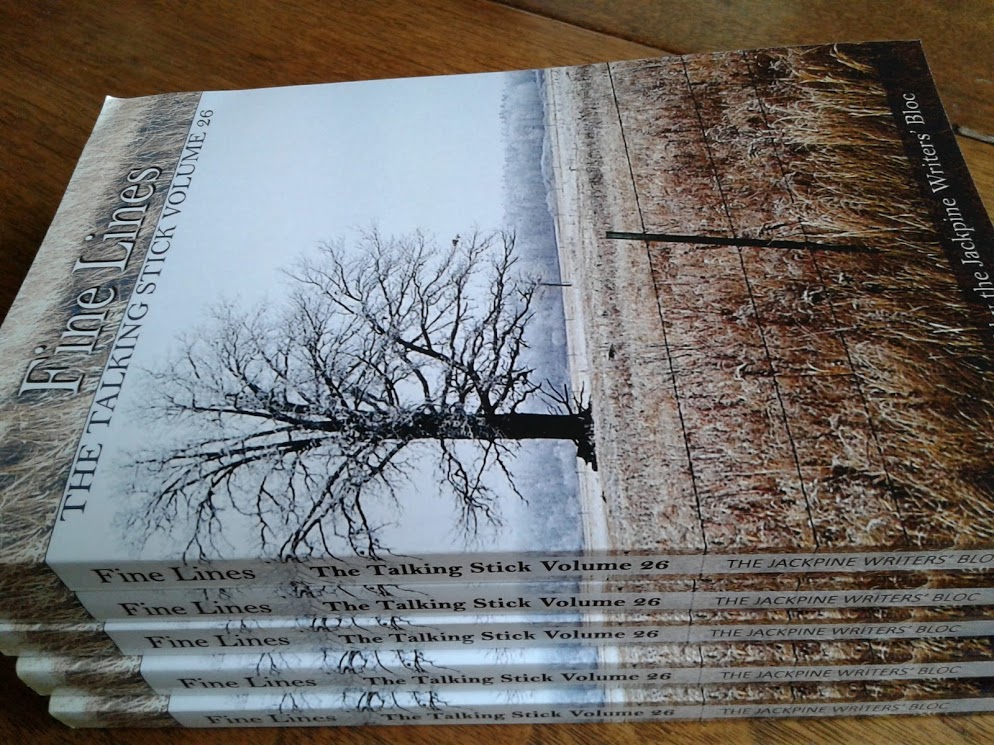
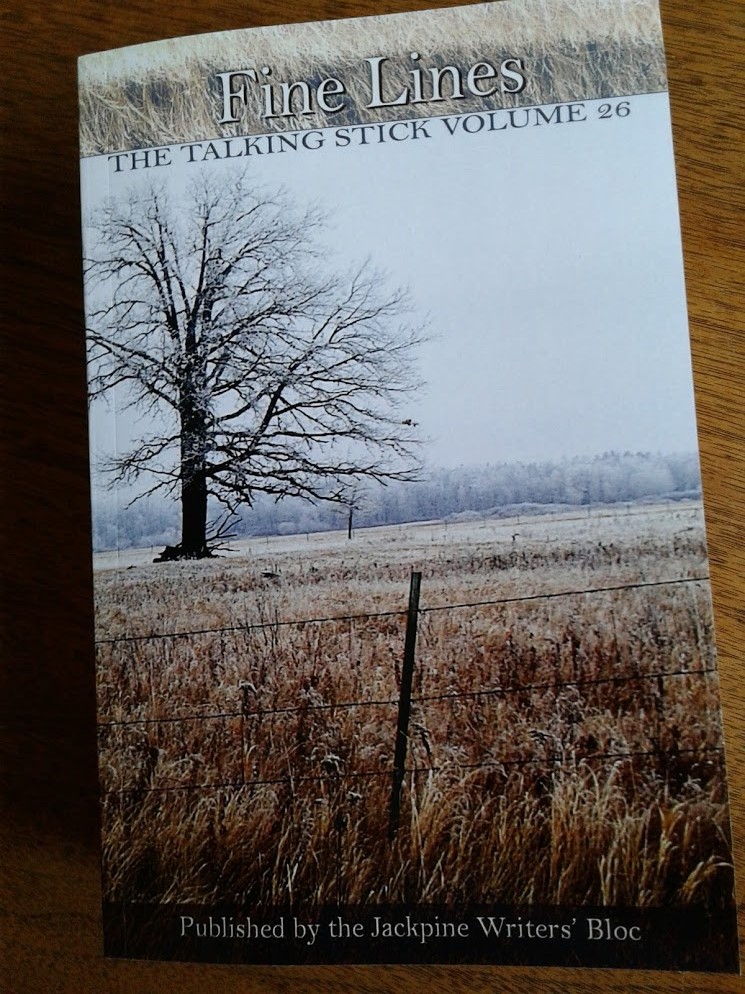
I signaled my husband for a tissue, then wiped my eyes. I sipped water through a straw. And I struggled to pull myself together before I stood behind the podium in this room full of writers and their supporters gathered at Blueberry Pines Golf Club between Menahga and Park Rapids for the release of Fine Lines, The Talking Stick, Volume 26.


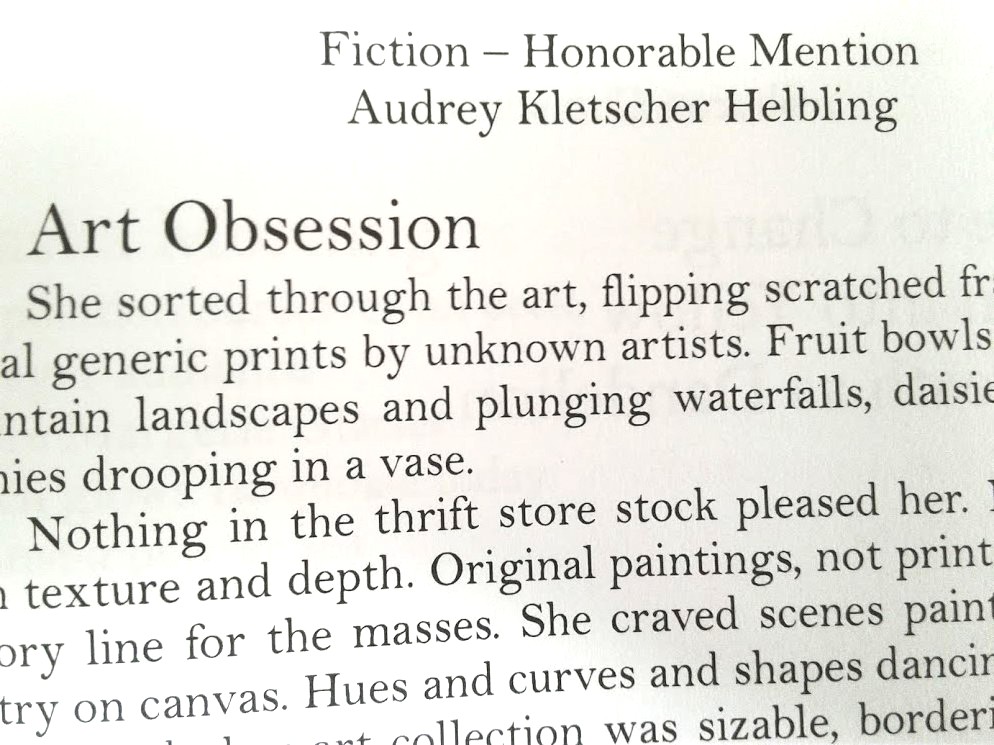
Too soon, Sharon Harris, co-editor along with her niece, Tarah L. Wolff, introduced me and my story, “Art Obsession.”


Reading “Art Obsession.” Photo by Larry Risser Photography, Minneapolis.


I was on, reading the words that this year earned an honorable mention in fiction. Four other pieces, among the six I submitted, also published: “Grocery Shopping” (fiction); “A Lot of Prairie and a Little New York” and “The Weekly Phone Call” (both creative nonfiction); and “Not Quite Perfect Penmanship” (poetry).


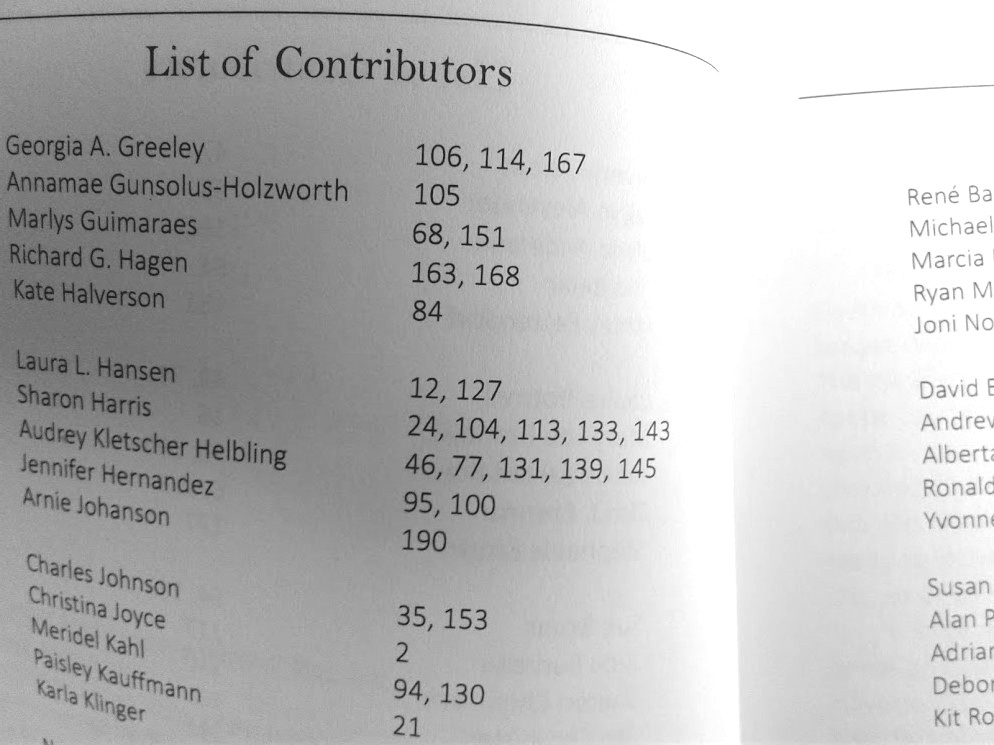
It’s an honor to have my writing published in this outstanding collection of works by Minnesota writers or those with a strong connection to Minnesota. The 2017 anthology includes 152 pieces by 100 writers. I don’t envy the task of The Jackpine Writers’ Bloc editorial board in selecting stories and poems for publication from among 370 submissions by 159 writers. Noted writers LouAnn Shepard Muhm, Marge Barrett and Rochelle Hurt selected the first and second place winners from the board’s top picks.

As I listened to stories and poems for several hours with minimal comprehension of time, I delighted in the talent of these writers. Marlene Mattila Stoehr drew me in with her “Spurned Heirloom” poem that left me pondering whether my family treasures will some day, too, end up as thrift store cast-offs.

I laughed at Charles Johnson’s “Jimmy Gets an Earful” poem that sounded, oh, so Minnesotan to my ears.


The book cover photo was taken by Tarah L. Wolff.


A strong sense of place, of Minnesota, imprints upon the pages of The Talking Stick. I can relate to the settings, the experiences, the observations and more crafted into so many of the pieces in this exceptional anthology.


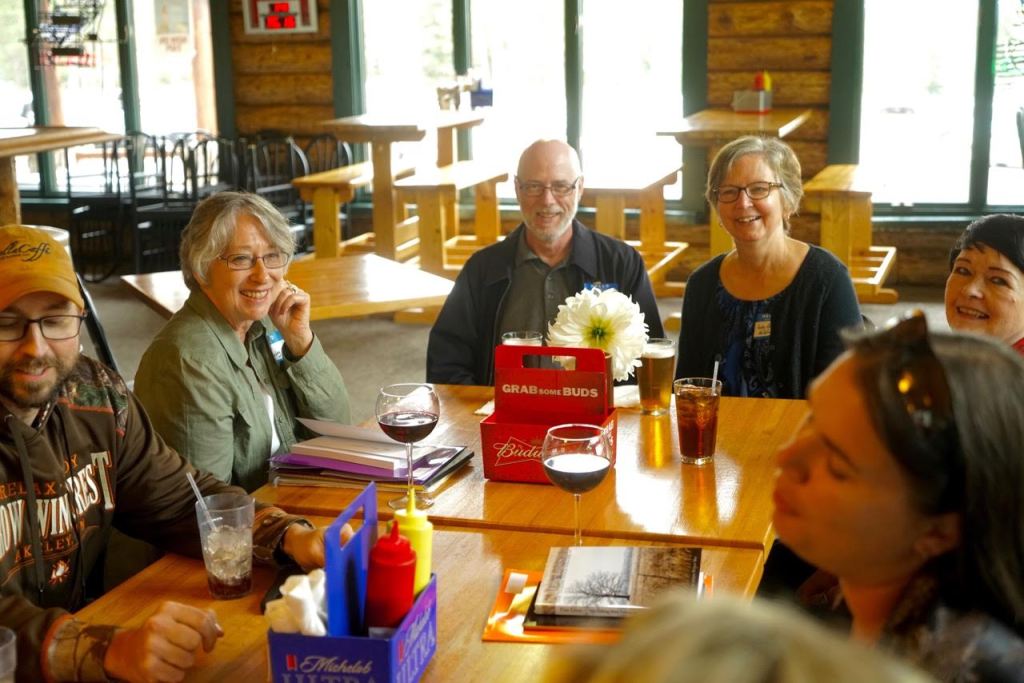
After the readings, some of us socialized. That’s Randy and me at the end of the table. I am seated next to Sharon Harris. Photo courtesy of Larry Risser Photography, Minneapolis.


This book is a labor of love for co-managing editor Sharon Harris. She holds a passion for writing and for this area of Minnesota. After the readings, a group of us gathered in the bar to celebrate and to talk. I’d never met Sharon, although we’ve corresponded and talked via phone many times through the years. Past commitments have kept me from attending previous The Talking Stick release parties. Sharon is as delightful in person as I anticipated. Her appreciation for the craft of writing is evident in her dedication to creating this anthology.


I felt an energetic vibe and sense of community among all of the writers. We share a love of writing. That passion flowed in words read to an appreciative audience gathered on a grey Saturday afternoon in a sprawling log cabin style building tucked among the jackpines of northern Minnesota.

Updated below at 4:30 p.m. September 20

FYI: I will be signing and selling (limited) copies of the anthology during a Local Authors Fair from 6 – 7 p.m. November 9 at Buckham Memorial Library in Faribault. Fine Lines, The Talking Stick Volume 26 is also available for purchase online. Check amazon.  Or order through The Talking Stick website by clicking here.

Photos by Larry Risser Photography are copyrighted and used with permission here.

Copyright 2017 Audrey Kletscher Helbling
 

Stepping off a fictional cliff & landing on my feet May 8, 2013

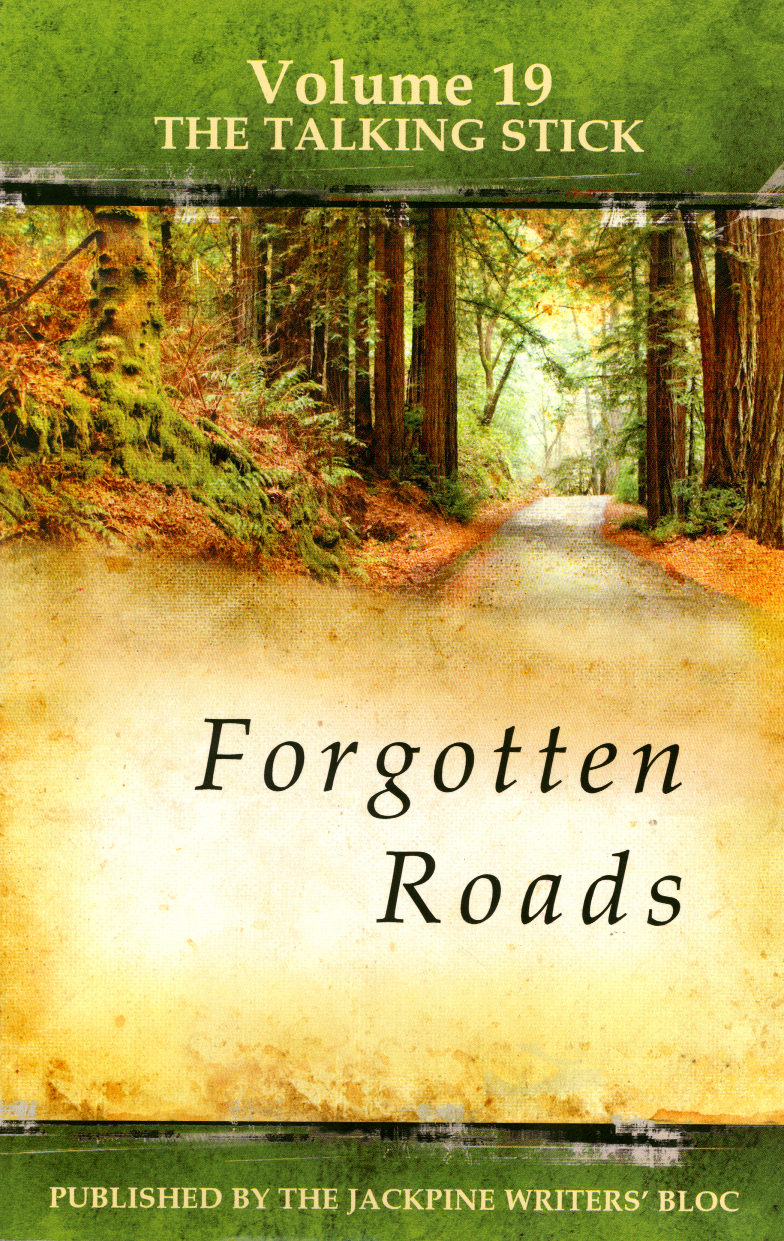
TS 19 in which my poem, "Hit-and-Run," received honorable mention.

TS 19 in which my poem, “Hit-and-Run,” received honorable mention.

IMAGINE THE SWEET SURPRISE of learning you earned honorable mention in a writing competition.

That would be reality for me, dear readers.

I received a thick envelope from Sharon Harris of the Menahga-based Jackpine Writers’ Bloc recently announcing that two of my entries, a poem titled “The Farmer’s Song” and a short story, “The Final Chapter,” were accepted for publication in The Talking Stick 22.

Getting my work accepted into this Minnesota anthology of fiction, creative nonfiction and poetry is nothing new; this marks my fourth time in the annual book. I’ve previously had poetry and creative nonfiction published here.

Neither is the award of an honorable mention novel. In 2010 I received honorable mention for my “Hit-and-Run” poem based on the real-life experience of my son being struck by a hit-and-run driver at age 12.

But this year marks my first time submitting a short story. Decades have passed since I penned fiction. I can’t recall ever entering fiction in a contest. So when I submitted “The Final Chapter,” I did so with minimal, if any, confidence.

I labored over every word, every paragraph, of my short story before finally deciding if I didn’t submit, I would never know whether I’d written a piece worthy of publication. Sometimes you just have to step off the cliff.

I would have been content simply getting my story about an 80-year-old woman losing her grip on reality accepted. (Twenty-five pieces of fiction were selected for publication.) But then, to experience that additional affirmation of honorable mention…, well, my confidence level soared.

It gets even better, dear readers. After members of the Jackpine Writers’ Bloc read all of the submissions, they forwarded their top picks to published writers in each category. St. Paul author John Reimringer, who won the 2011 Minnesota Book Award in novel and short story for his book, Vestments, chose and critiqued the top three short stories, including mine.

Rare is the opportunity to receive such personal, professional feedback. Until you read “The Final Chapter,” you will not fully understand Reimringer’s comment. But, here’s what he wrote:

I like the economical, unsentimental sketch of Clara’s life, and the way she chose third person narrative in the last few paragraphs keeps us in Clara’s pov (point of view) even as it’s clear she’s losing her grasp on reality.

OK, then, basically Reimringer likes my story, just as I enjoyed Vestments when I read, and then reviewed, his award-winning book several years ago for Minnesota Moments magazine. Little did I know then that I would connect with him several years later.

I was hopeful I could meet Reimringer at The Talking Stick book release party in late September. But that won’t happen. My eldest daughter is getting married the same weekend. And that wedding, dear readers, easily trumps honorable mention.

FYI: To learn more about The Talking Stick, which publishes for the 22nd time late this summer, click here. And click here to learn more about The Jackpine Writers’ Bloc.

© Copyright 2013 Audrey Kletscher Helbling

 

Northfield writer Scott Carpenter masters the craft of short stories in This Jealous Earth March 1, 2013

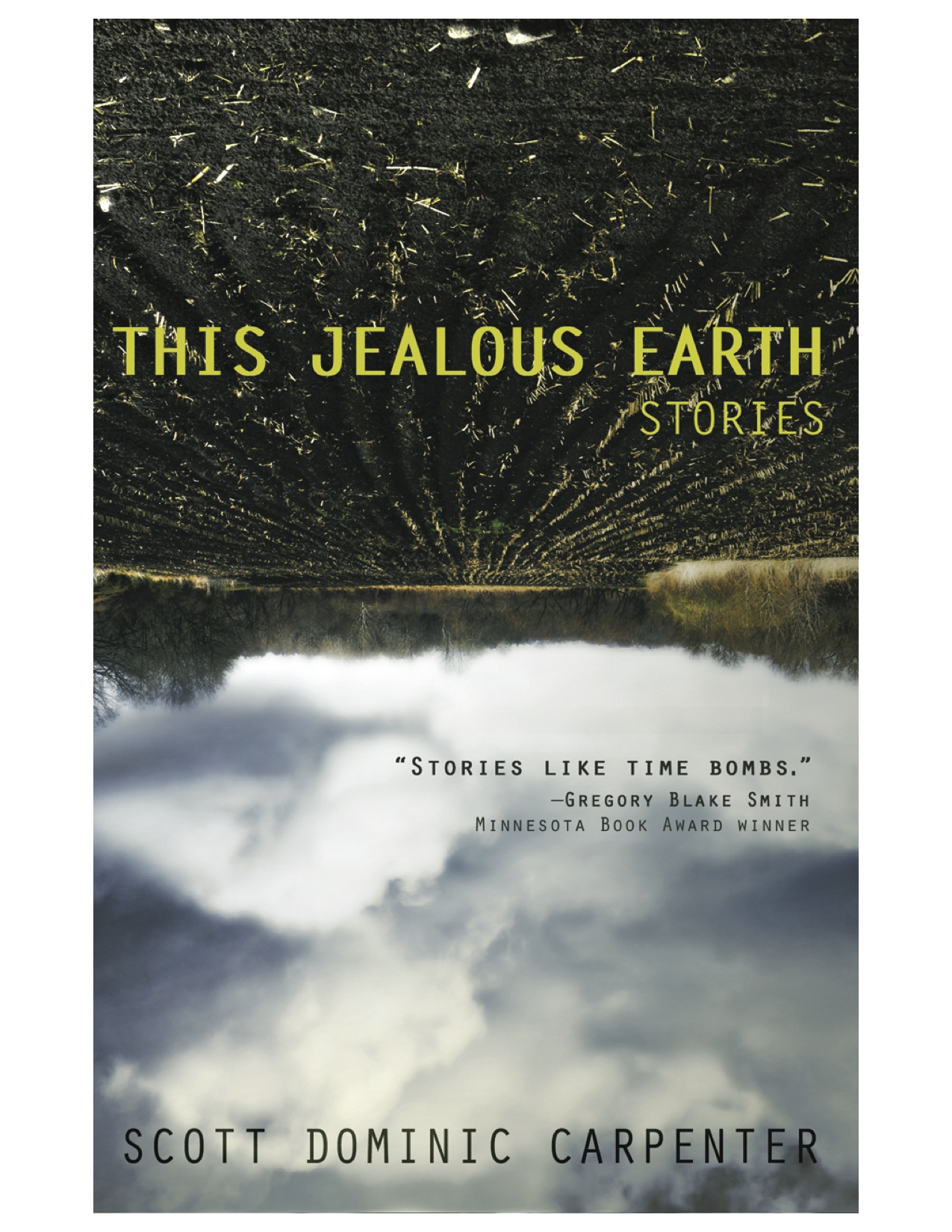
Intrigued by this cover image like me? Learn why  it was selected and placed upside down at the end of my review.

Intrigued by this cover image? Learn why it was selected and placed upside down at the end of my review.

I’VE STRUGGLED, since reading This Jealous Earth, to pinpoint a word which best describes my reaction to a collection of 16 short stories by Northfield (MN.) author Scott Dominic Carpenter. And that should be considered a compliment.

Carpenter’s stories about relationships and aging, choices and regrets, and more, hold an element of mystery, a deeper meaning which reveals itself as the plots progress, until the ending and the ah-ha moment evoked.

For example, in the first paragraphs of “The Tender Knife,” I expect a husband to kill his wife, not his koi. He didn’t, but he did. Now if that makes no sense, that is precisely my point. Carpenter possesses that unique ability to mess with your mind/throw you for a loop, cliché phrases that totally apply to a writing style that is anything but cliché.

He takes aspects of everyday life—vacations, marital and sibling discord, the death of a parent, aging, love, fear and more—and crafts stories to which his readers can relate. Aging Baby Boomers can surely empathize with Donna, married 30 years with three grown children and the main character in “Riddles.” She and her husband are on a long-awaited European vacation when she loses her way in an art museum. As she struggles to weave through a labyrinth of art she cannot understand, Donna understands she’s waited too long for this trip.

Carpenter writes, in Donna’s voice:

To think that she had begged for this trip! What in God’s name had she been thinking? What was the point? And what on earth were you to do after the scales have tipped in your life, after the children have gone, and all you have left to do is wait?

His stories mostly center on choices—to shoplift or not, to keep or to toss, to reconcile or give up, to attempt to save or to let go, to stand up for yourself or to submit, to simply accept or to challenge/change/question.

In “This Jealous Earth,” the story from which the book draws its title, a family awaits the rapture. But one, the non-believing son, Randy, will be left behind. Therein lies the conflict for his obedient younger sister, Cat. Will she choose faith or family? That dilemma, and the consequences, leave the reader hanging on every word until the clincher ending.

Likewise, in “The Visit,” the tension builds when a child goes missing on a rural acreage with a pond. I’m not going to reveal the ending, but I simply must share the final sentence of that story because it’s so powerful and perhaps so true of how we often choose to cover our fears with meaningless conversation:

And with lavish servings of words, always more words, they covered over the memory of the pond, black and still.

Carpenter chooses words with care. That is obvious, especially so in “The Spirit of the Dog” where even the name of the main character, Caleb, holds significance. Because I have a son named Caleb, I know the name means “dog” (although I chose my son’s name for the biblical Caleb and certainly not the canine reference). Read this story about miners, a dog that is killed, superstition and stolen possessions and you will understand the double-meaning in that name.

I couldn’t pen a fair review of This Jealous Earth without noting that I nearly stopped reading half way through the first story, “The Tender Knife.” I struggled with details in killing of the koi. Don’t allow that to distract if you are squeamish like me. The story is most definitely worth reading. Likewise, several stories include the f-word and sexual undertones that may offend. However, these are not used lightly, but as integral parts of shaping a character and/or developing the plot.

If Carpenter’s first book of fiction is any indication of what readers can expect from him, then I’m already a fan. His next book, Theory of Remainders, is due for release in May. Here’s the promo description: A suspenseful literary novel set in the lush backgrounds of Normandy, Theory of Remainders explores the secret ties between love, trauma, and language.

Carpenter has already proven to me that he can write, and with a strong voice definitively his.

Scott Dominic Carpenter

Scott Dominic Carpenter

FYI: To learn more about Carpenter and his writing, click here to reach his website.

His upcoming appearances include public readings at  6 p.m. Thursday, March 7, at Barnes & Noble, 14880, Apple Valley, and at 7:30 p.m. Friday, March 8, at Monkey See, Monkey Read, 425 Division Street South in downtown Northfield. Besides writing, Carpenter teaches French literature and critical theory at Carleton, a liberal arts college in Northfield.

BECAUSE I WAS PARTICULARLY intrigued by the upside down placement of the field and sky image on the cover of This Jealous Earth, I posed these questions to publisher MG Press:

Could you explain the photo selection and why it was placed upside down on the cover? What message/feeling/whatever are you hoping to evoke in the reader?

Here’s the response from MG’s Robert James Russell:

The fact that the photo is upside down aligns with the themes of miscommunication and the confrontations of strangeness inherent in all of the stories in the collection. The land (or earth, as it were), gives us a sense that the disconnect and strangeness is dealing with familiar things (that is, it is not a paranormal strangeness, or anything truly otherworldly).

It’s meant to be disorienting, but not jarring, and demonstrate how a simple choice or change of perspective can completely alter how something is viewed. These types of choices are the ones the characters in This Jealous Earth face in all of the stories, ones that will permanently alter how they view their lives.

On a more aesthetic level, we chose this image specifically because, quite simply, it was gorgeous and we felt the contrasting tones would work well to achieve our goal.

© Copyright 2013 Audrey Kletscher Helbling
Images courtesy of Scott Dominic Carpenter and MG Press
The book cover design is by Sarah E Melville, Sleeping Basilisk Graphic Design.
Author photo is by Paul Carpenter.