Minnesota Prairie Roots

Writing and photography by Audrey Kletscher Helbling

Always obey Rule 99 & other historic reflections July 12, 2012

VISIT A PLACE like the Village of Yesteryear in Owatonna, especially during a celebration such as last weekend’s Steele County Historical Society Extravaganza, and you get an in-depth glimpse of life back in the day.
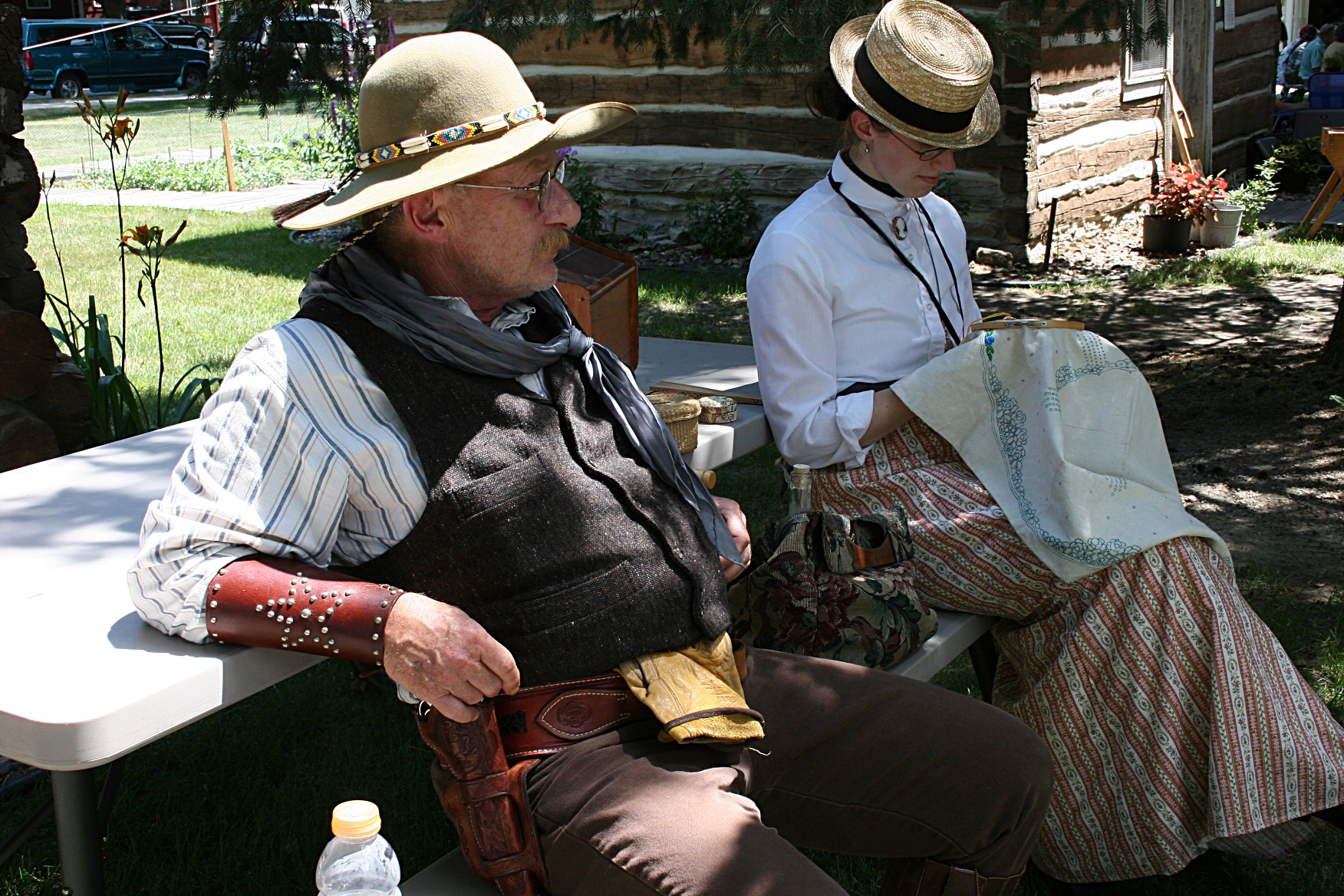
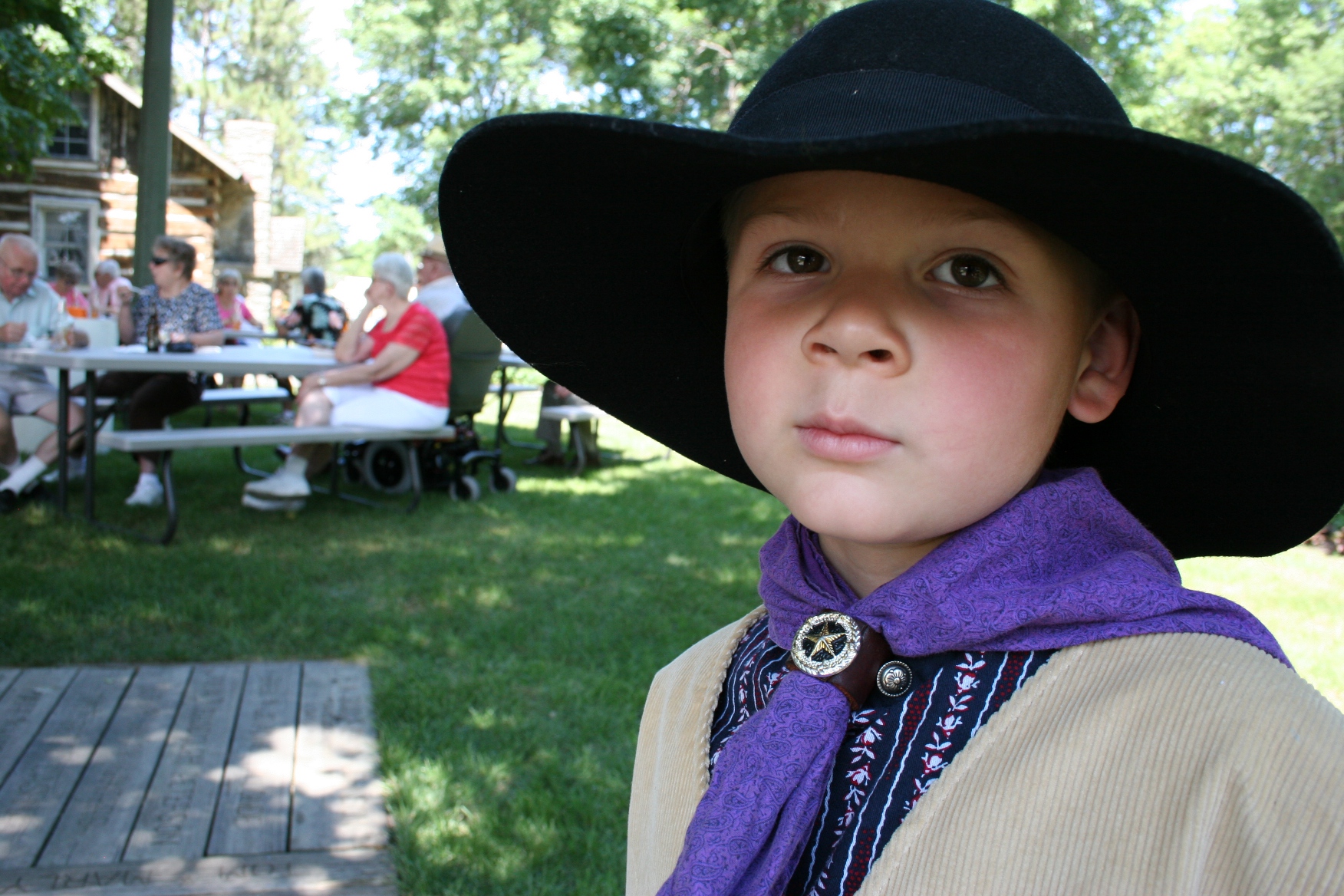
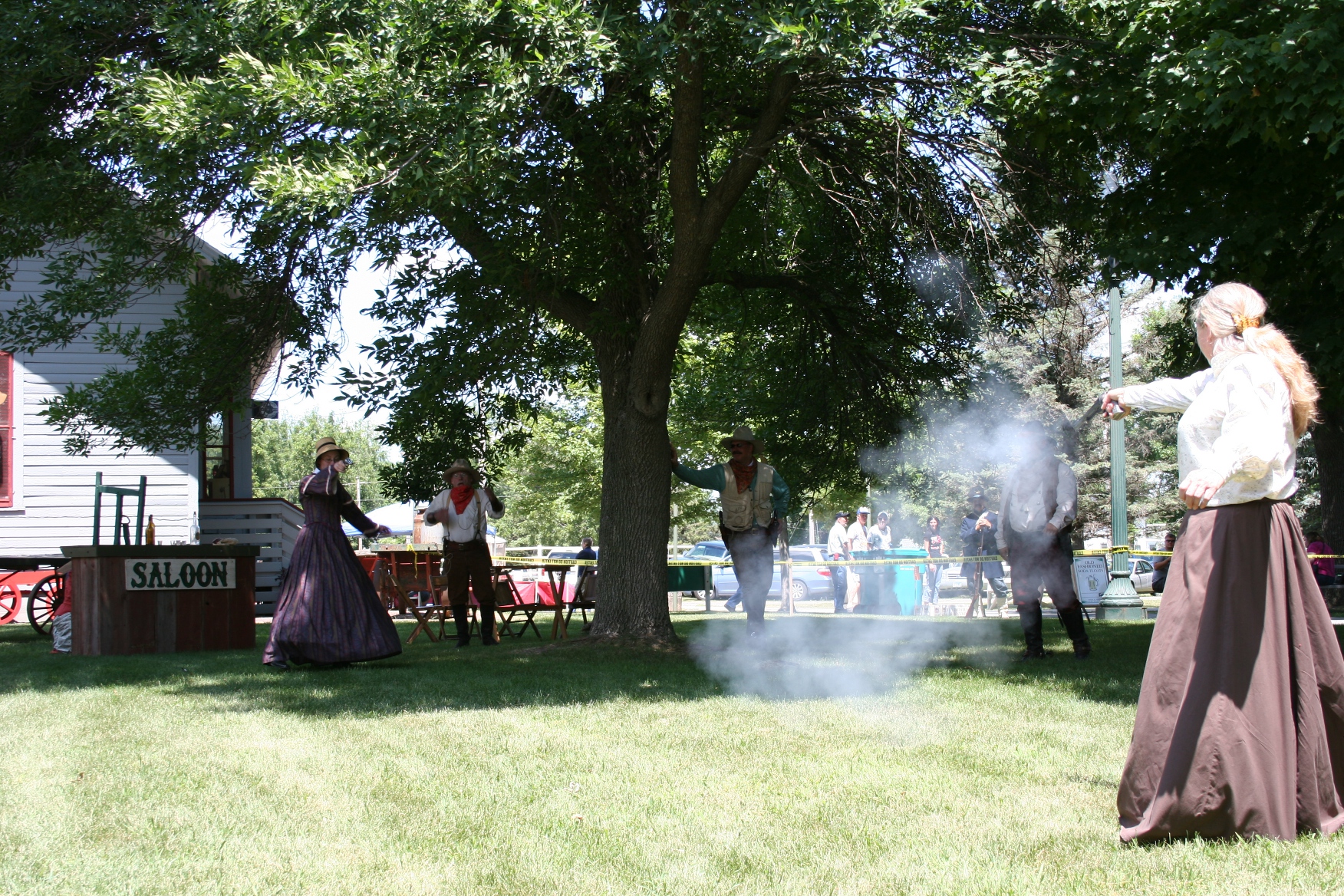
Dressed in period costumes, members of the Old West Regulators added a real-life element to the Extravaganza.

Guides, costumed reenactors and others, with their extensive historical knowledge, most assuredly add to the educational and entertainment value.

But, because it is impossible to speak with every one of them or to observe every activity or to read every informational sign, one must sometimes rely on simple observations to consider the historic stories and realities which define life years ago.

I therefore present these Extravaganza photos with basic information. Much more lies open to your interpretation, influenced perhaps by your experiences or the stories passed down from generation to generation within your family. That is your personal history. Take it. Remember it. Own it. Pass it along.
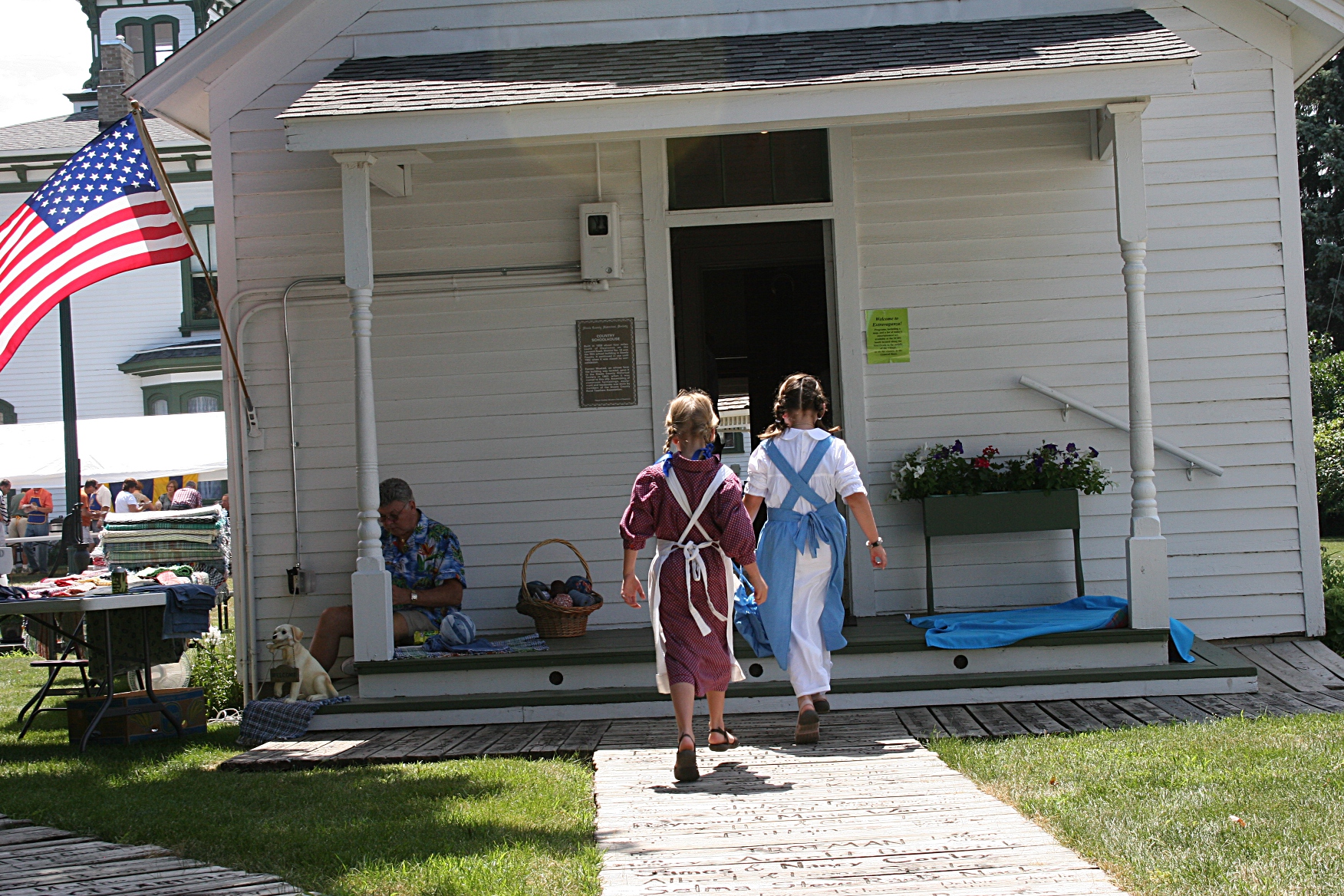
Memories of attending a one-room country school remain for many, including my 55-year-old husband. He attended Chimney Butte School in rural North Dakota and recalls the day students were kept indoors during recess because of coyotes roaming the schoolyard.

What memories does the District 14 country schoolhouse, pictured above, hold for those who were taught in this 1856 building four miles south of Owatonna until the school closed in 1962 due to consolidation?
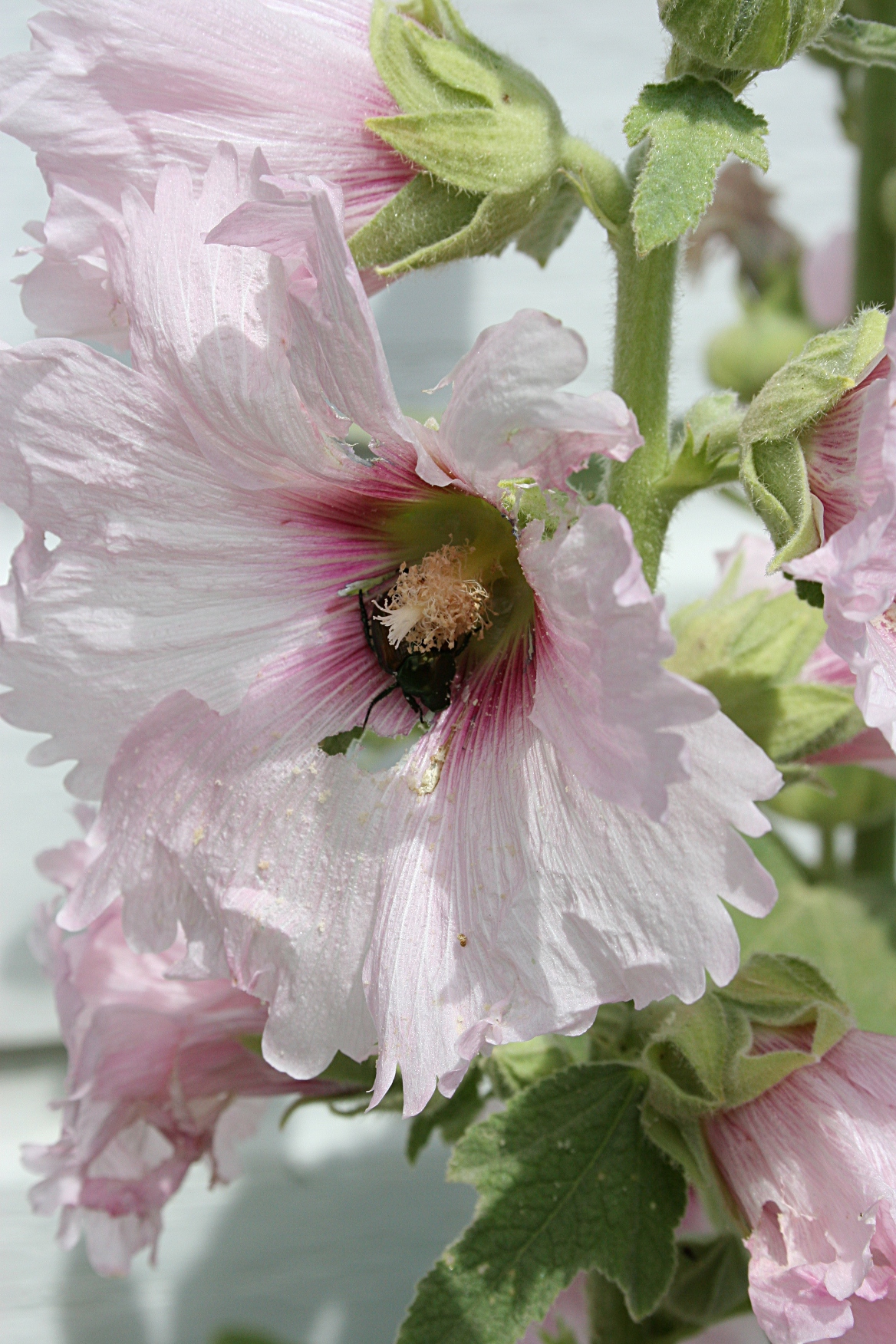
Hollyhocks stand strong and sturdy outside that same schoolhouse at the Village of Yesteryear.

But for me, hollyhocks belong next to the milkhouse, an odd place for flowers, it would seem. Yet, on the southwestern Minnesota dairy and crop farm where I grew up, that was their spot, a splash of beauty perhaps more for my mother than for her farmer husband.
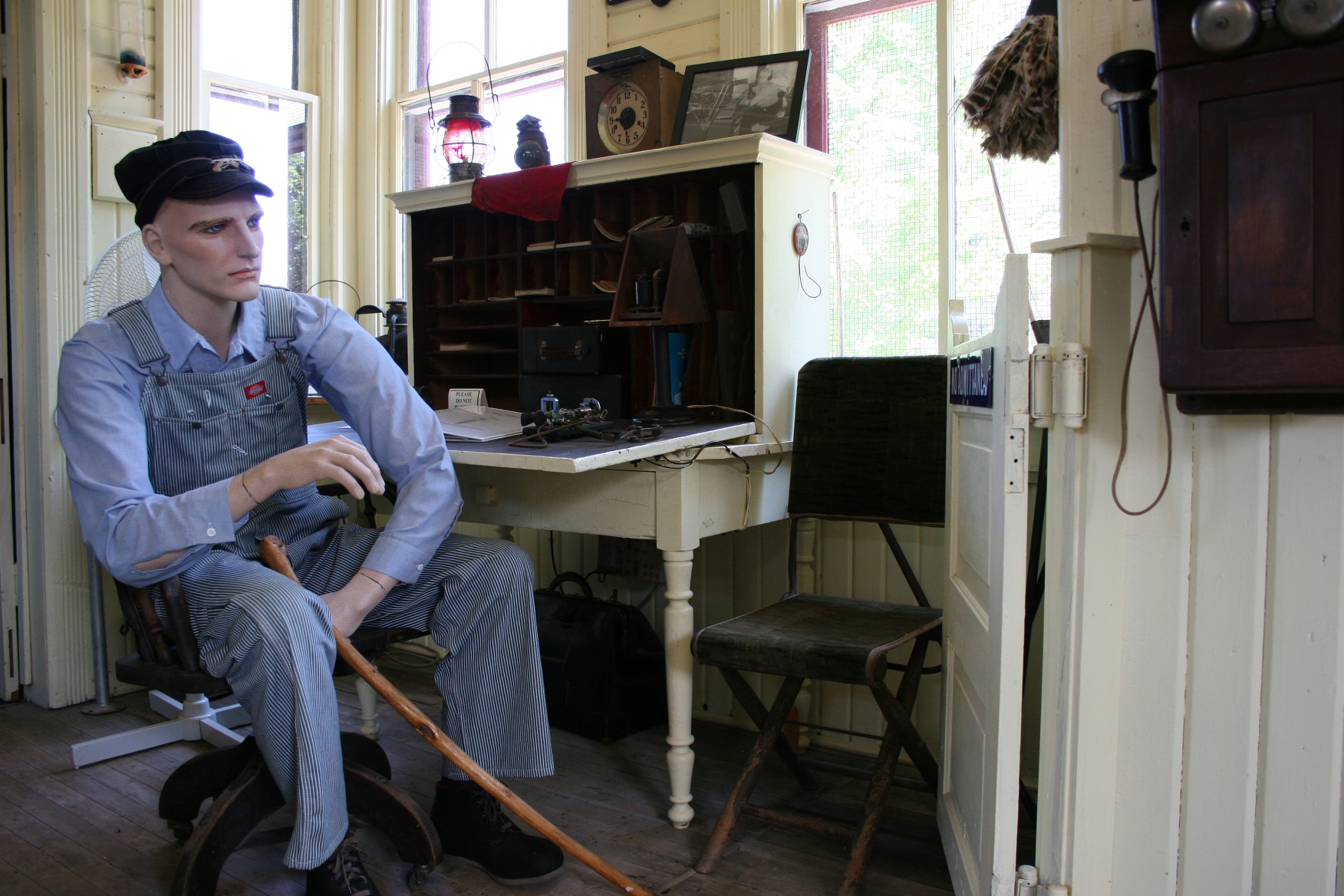
 A scene recreated in the 1866 Bixby railroad depot leaves you wondering about the railroad crew and passengers who waited here to board trains. Where were they going? And, for the passengers, why?
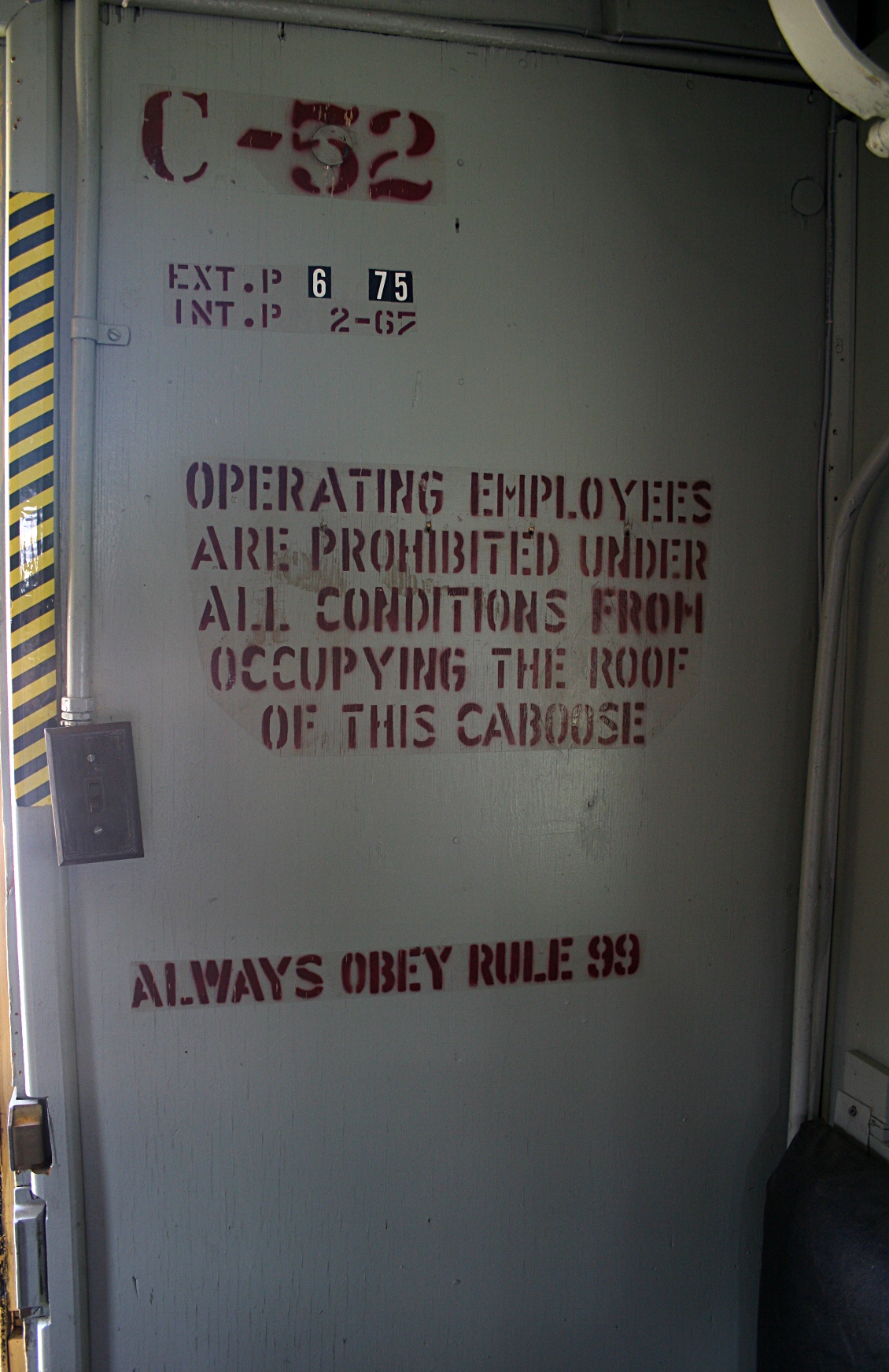
And then you see this sign inside an old caboose and completely forget about those passengers and question why the railroad employees climbed onto the roof of the caboose because they certainly must have or there would be no Rule 99.
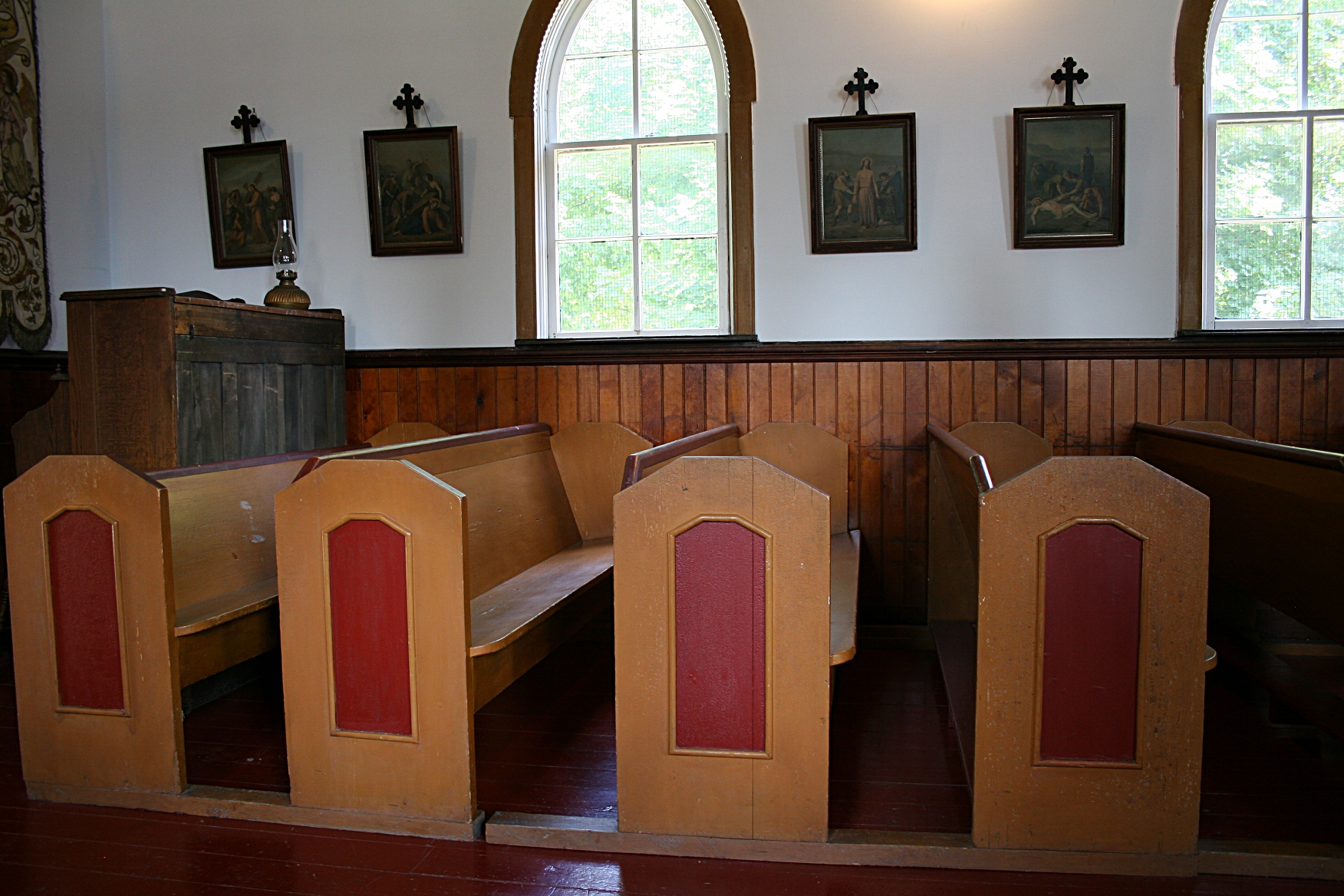
How many tears were shed, in joy and in sorrow, by those occupying these pews in the 1891 St. Wenceslaus Mission in Moravia Church built in 1891 in Moravia seven miles south of Owatonna? Who crafted these pews? And how did parishioners feel when their church closed in 1952?

Perhaps you could ask Tony Seykora, whose mother, Mary Meixner, attended St. Wenceslaus and whose daughter, Susan, was married here. He wasn’t sharing any stories on Sunday while touring his ancestral church at the Village of Yesteryear.
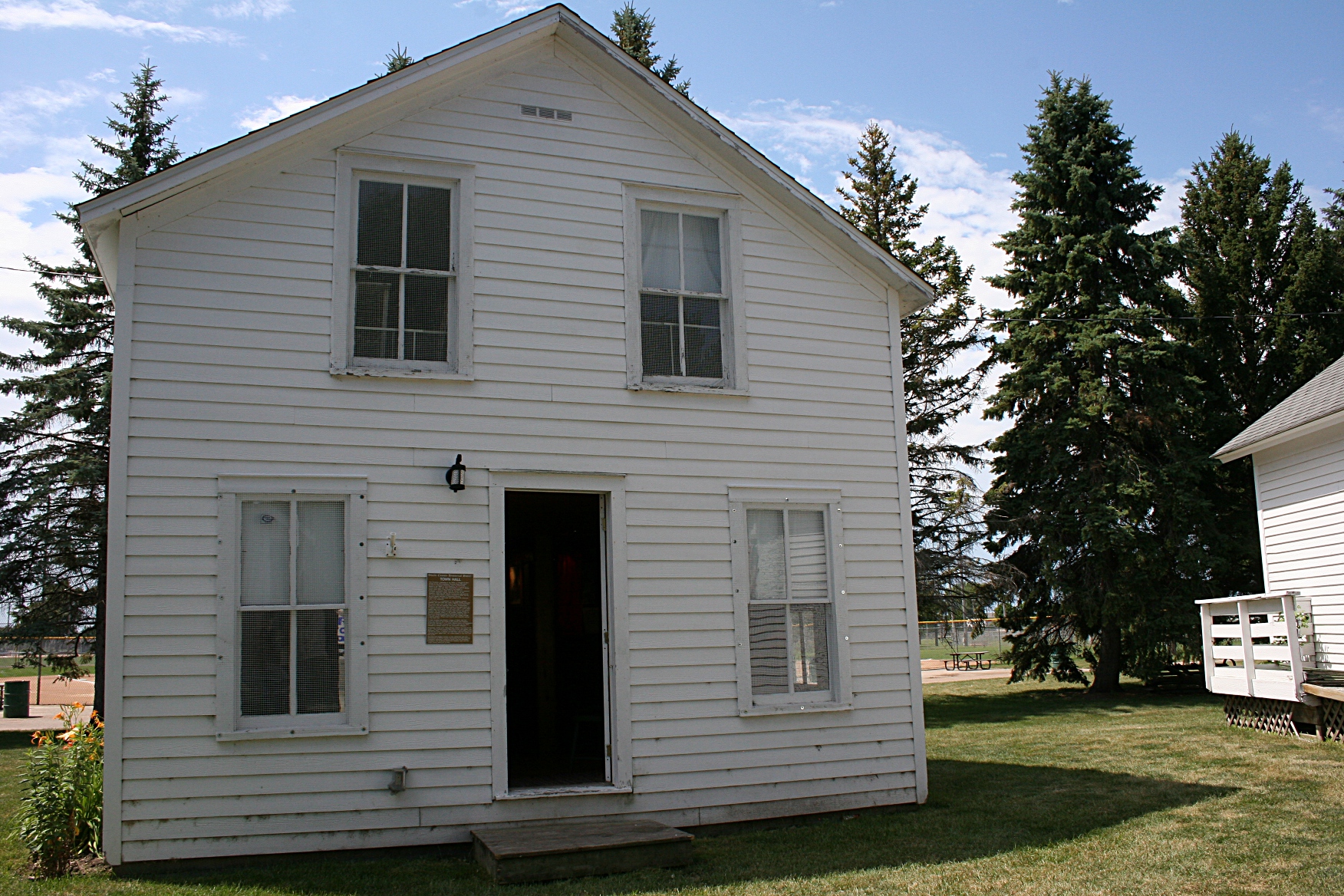
 Oh, the stories this old town hall, the Owatonna Town Hall built in the late 1850s, could tell about those who met here and shaped the future of the city.
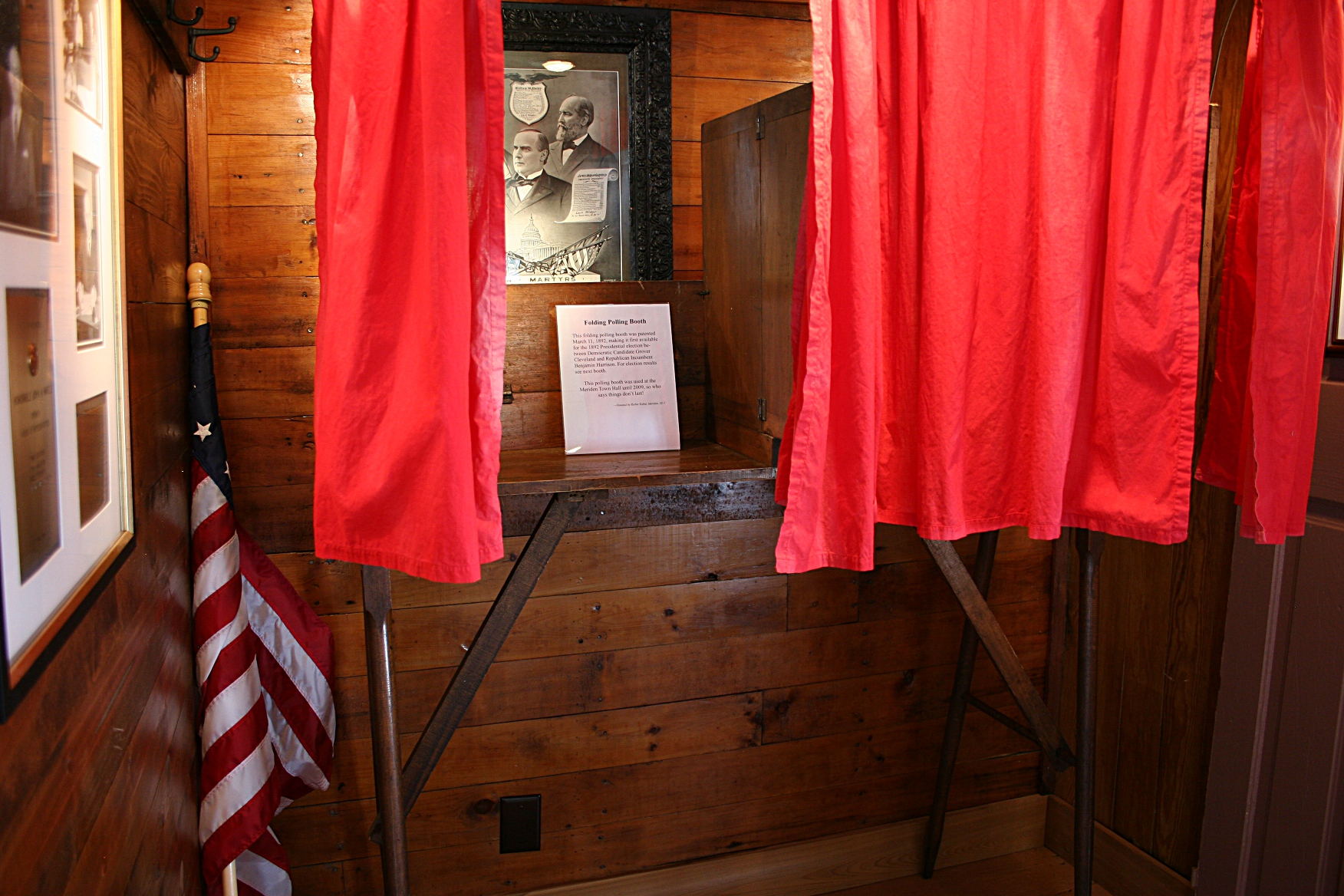
And if you could peek over their shoulders, would you to see how those in the Meriden area voted? This folding polling booth was patented in March of 1892 making it first available for the Presidential election that same year. The polling booth was used at the Meriden Town Hall until 2009. Until 2009, people.
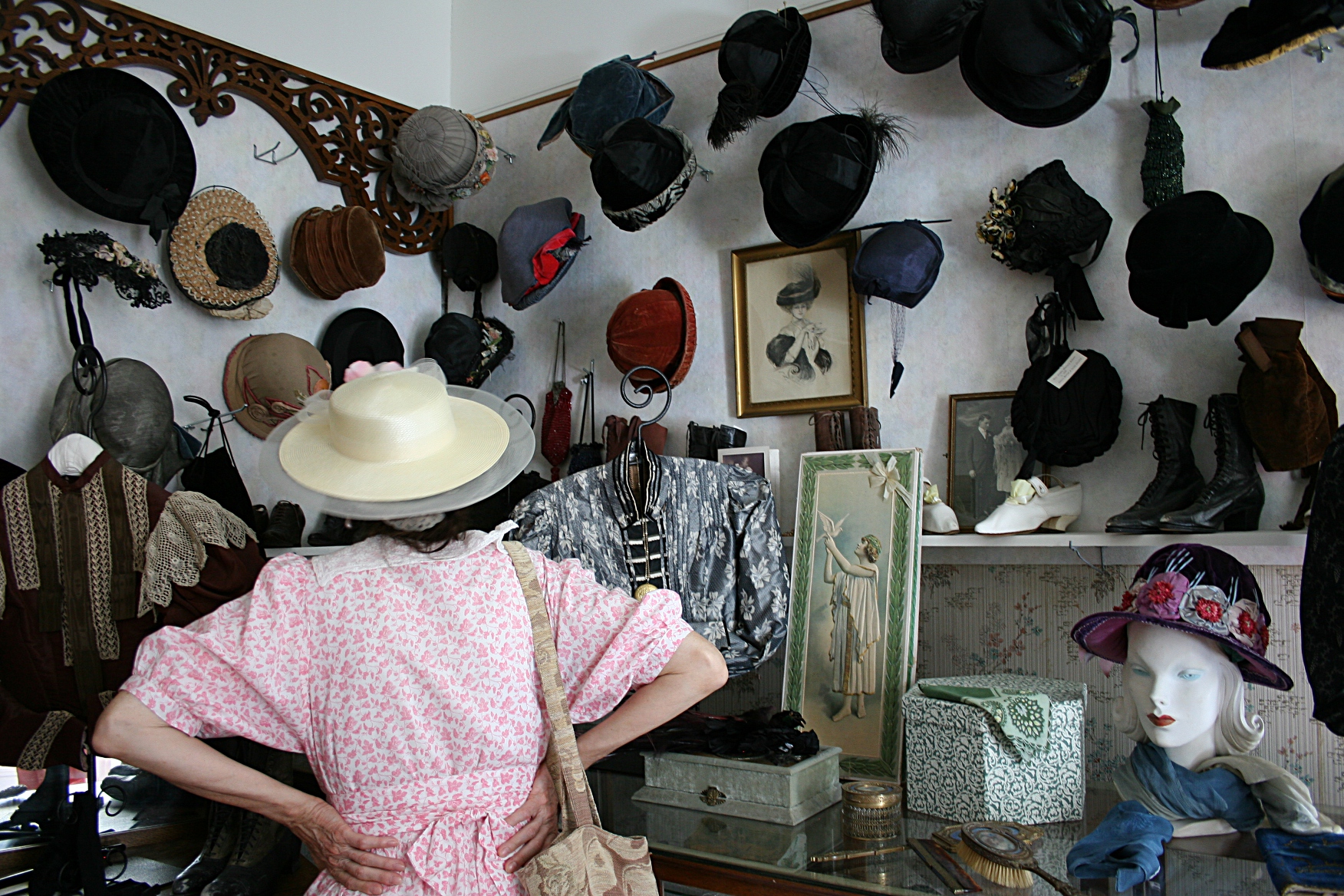
Who wore these hats displayed inside the historic 1868 Dunnell House, home of Minnesota legal scholar, educator and Congressman Mark Hill? Were they hats of mourning, hats of celebration, practical hats…?

A volunteer who works with the Blue Earth County Historical Society and the Betsy-Tacy Society in Mankato in decorating vintage hats studies the collection for ideas.
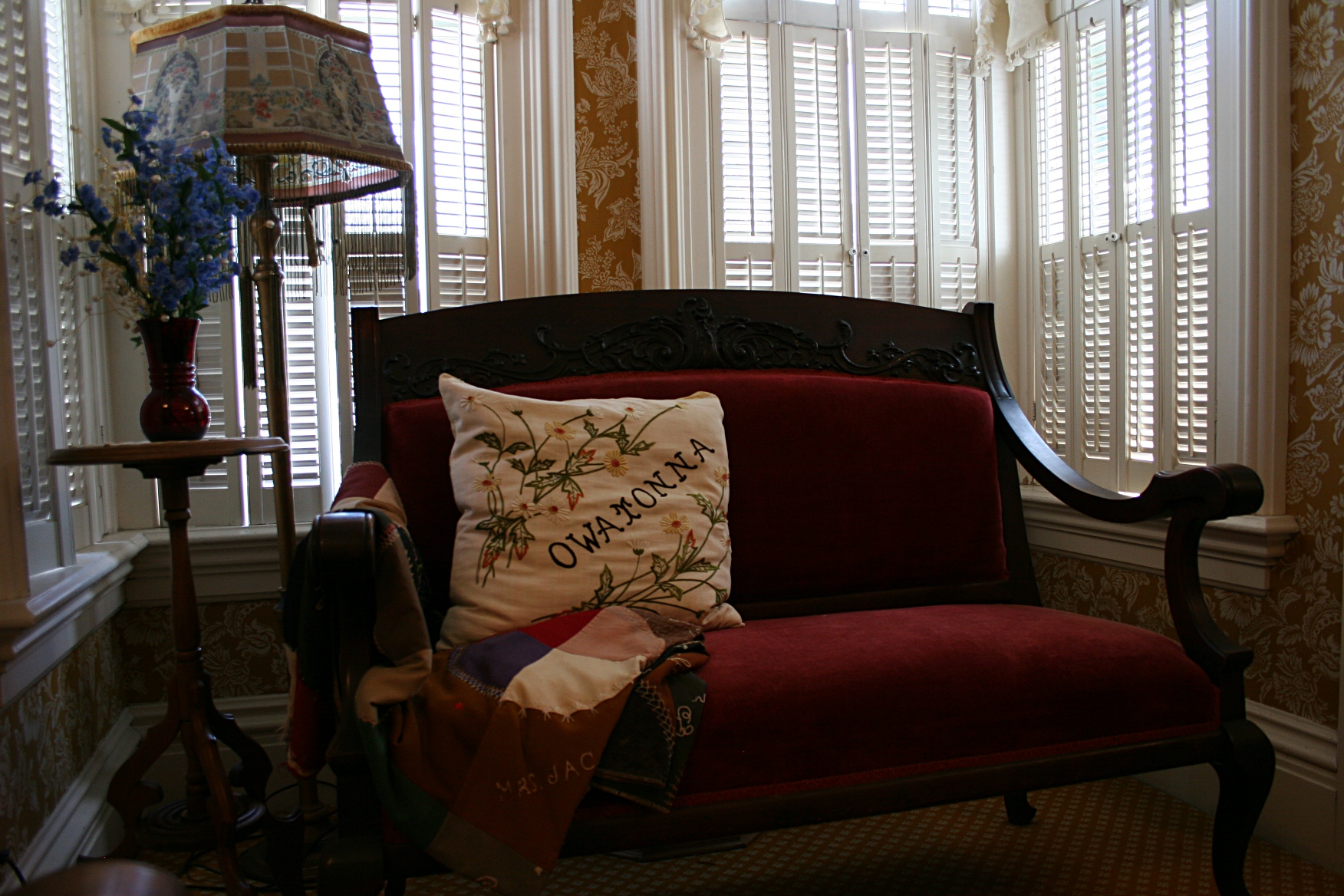
Also in the Dunnell House, a nook in the parlor offers a place for quiet conversation. Oh, to have been there, eavesdropping…the stories and secrets you may have heard about/from Congressman Hill and other legislators.
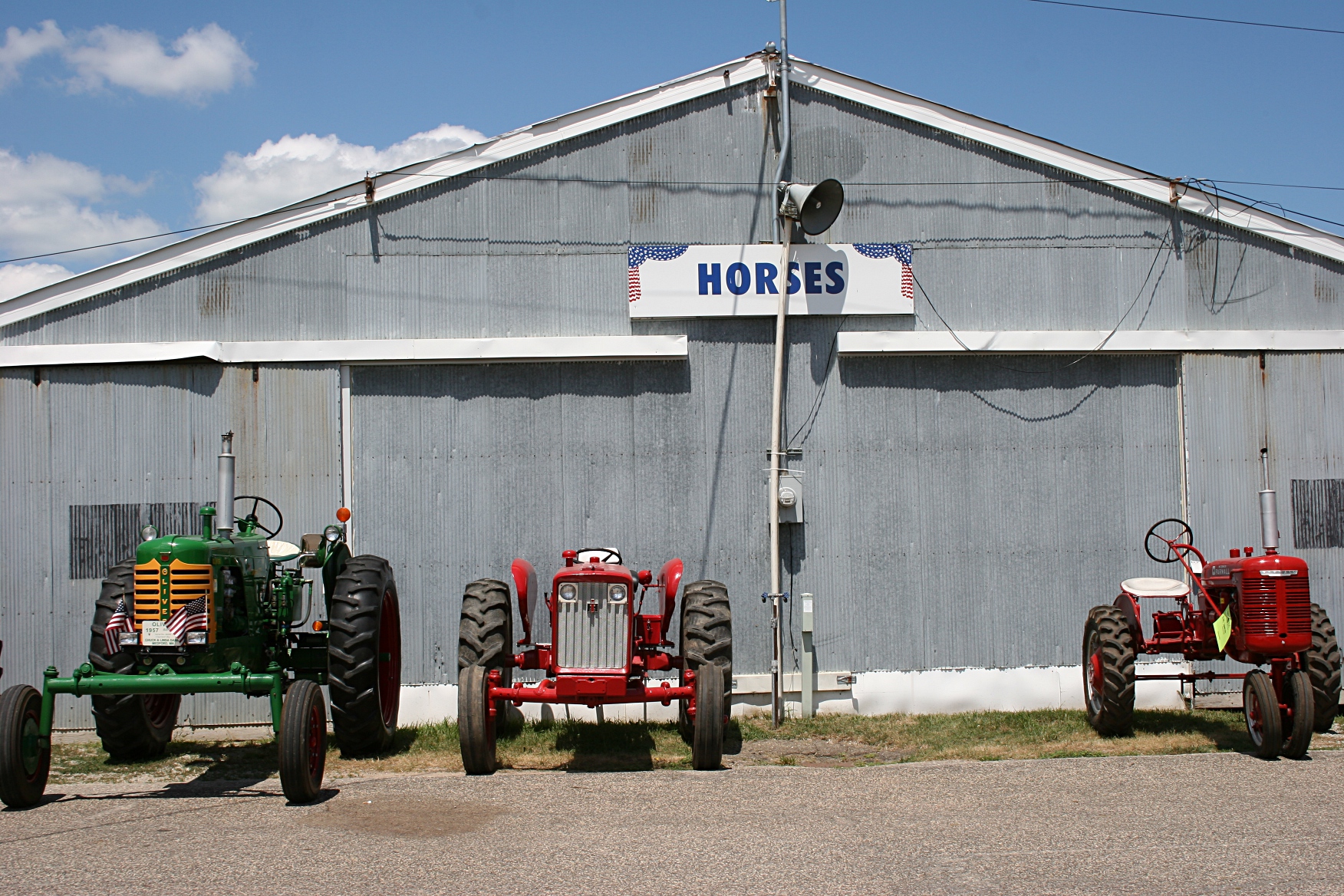
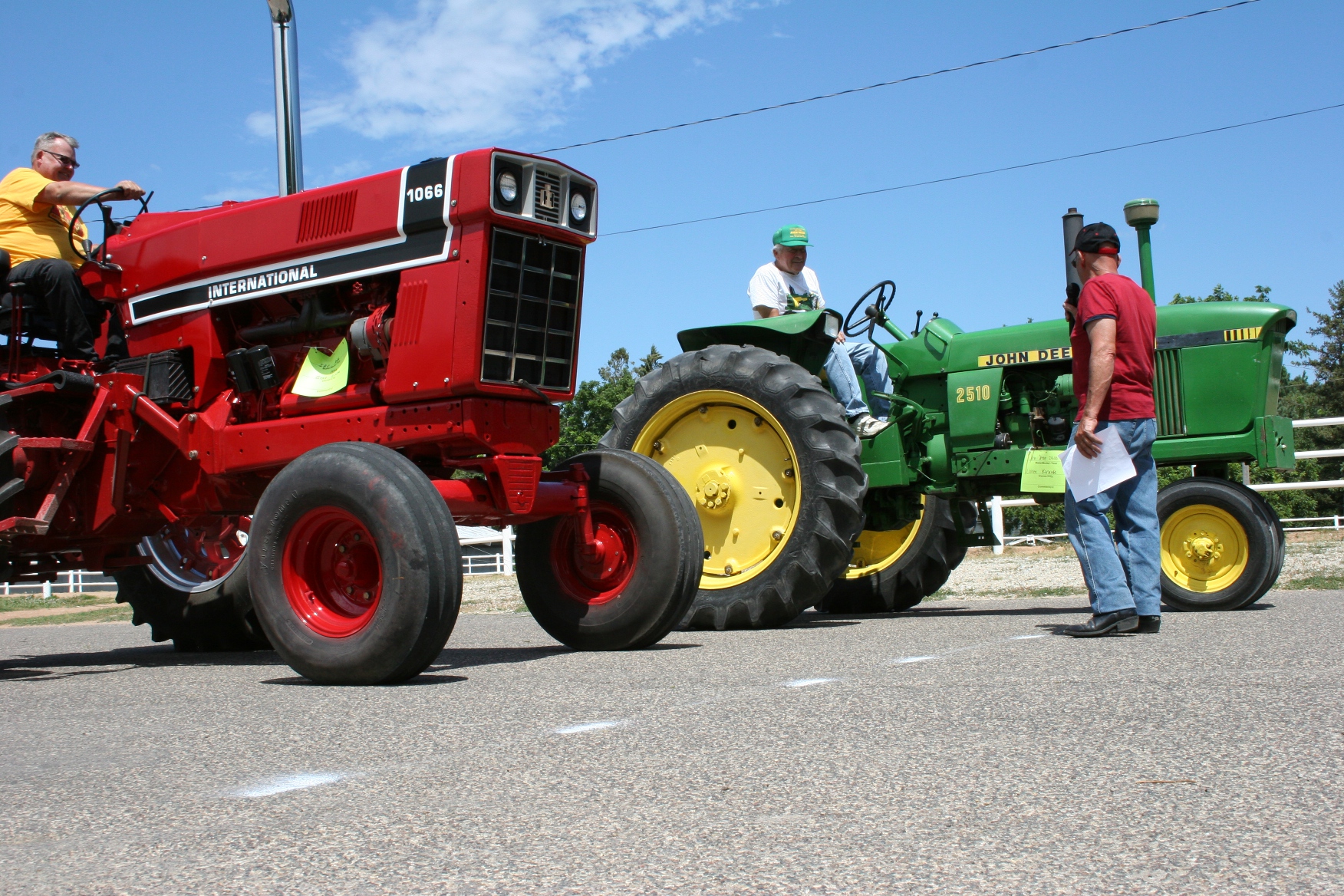
Horse power, but certainly not horses…these vintage tractors were parked next to the horse barn at the Steele County Fairgrounds. Surely they would speak of long, hard days on the farm, their wheels weighed down by the burdens of a farmer’s worries and the uncertainties that have always been a part of farming from the early days of Minnesota to current day Minnesota.
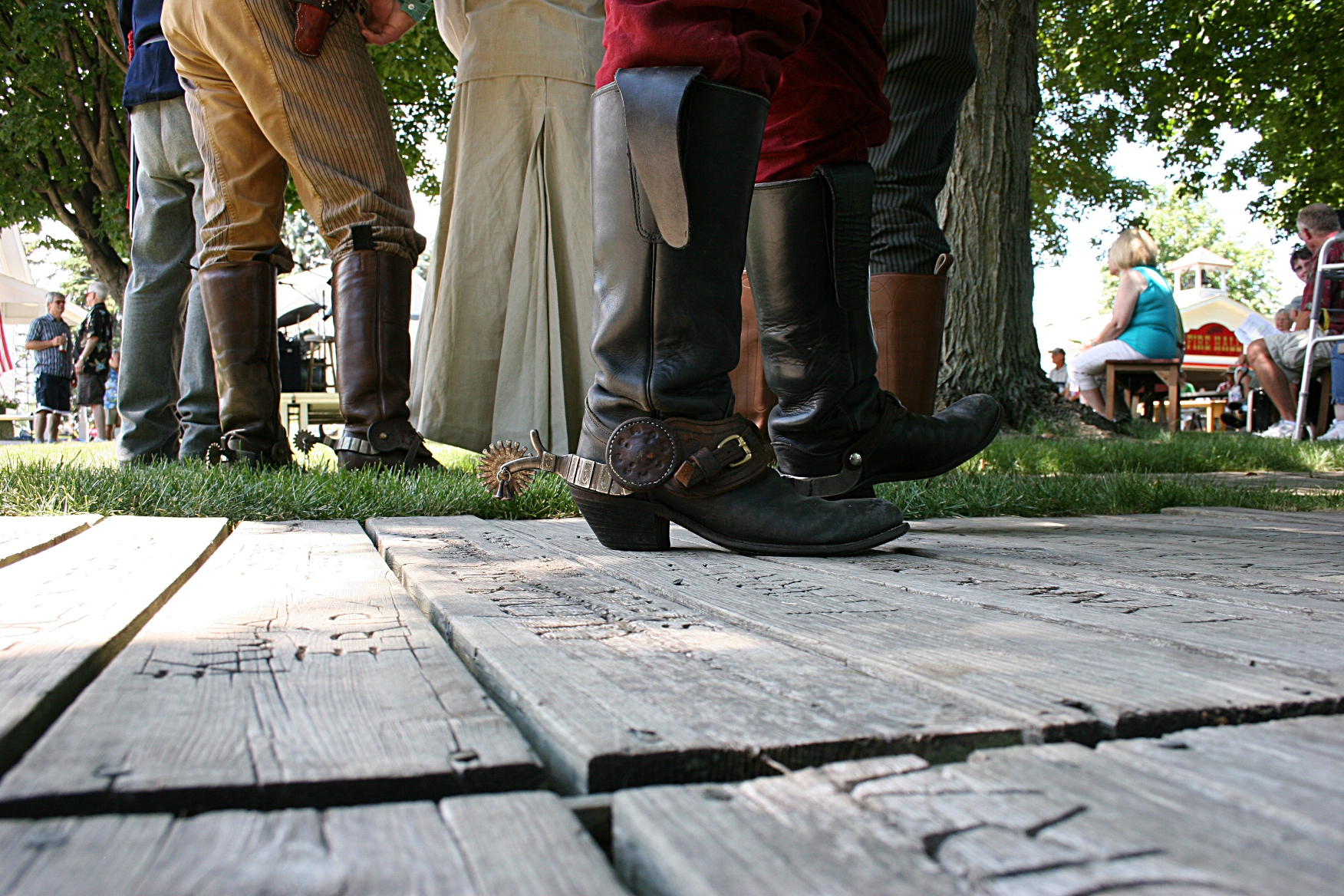
What is that saying? You haven’t walked a mile until you’ve walked in my shoes. Consider that, how challenging it would have been to walk in the boots/shoes of your ancestors for whom life presented so many daily challenges simply to survive.

FYI: To learn more about the Steele County Historical Society, click here.

CLICK HERE to read my first blog post about the Steele County Historical Society Extravaganza. Watch for one final, upcoming post.

© Copyright 2012 Audrey Kletscher Helbling


St. Paul artist connects art to geocaching via her GeoNiche Project July 11, 2012

A ST. PAUL ARTIST and educator with roots in the southwestern Minnesota prairie is bringing her art to the public via a project that links art to geocaching.

Felice Amato, who grew up in Cottonwood and Marshall, has hidden about 15 original works of ceramic art in St. Paul and in southeastern Minnesota through her GeoNiche Project, funded by a Minnesota State Arts Board Artist Initiative Grant awarded in 2011. To date, she’s stashed her sculptures at Swede Hollow, a St. Paul Park, and in or near Faribault, Red Wing and Winona. She’s created pieces for the Red River Valley area, too, but has yet to install them. And she would also like to sculpt GeoNiche art for her native prairie.

Amato follows the geocaching model wherein geocachers use GPS devices or smart phones to find her art based on geographic coordinates and clues. Her caches are listed on Geocaching.com as felice.amato and on Opencaching.com as felice1.

The project evolved as Amato considered a unique way to get the ceramic niches and tableaus she’s made for years out to the public. “My sister, brother and aunt are avid geocachers and it just struck me that this could be an interesting way to make my work public,” she explains.

Finding no one out there doing exactly what she proposed, Amato moved forward with the GeoNiche Project and her unifying theme of women’s lives.

“I wanted to create secular niches that spoke to a sense of place, history and continuity—and that honored the important life moments that we all experience,” she says.

“Under the Arbor,” one of the GeoNiches placed in Swede Hollow. Photo courtesy of Felice Amato.

She placed her first GeoNiche close to home, a mile away in Swede Hollow, a St. Paul valley originally settled in the mid 1800s by Swedish immigrants and thereafter by Polish, Italians and Spanish Americans. “The rhythm of settlement in Swede Hollow made that especially rich,” Amato says. “Flooding, impermanence and the piecing together of community shanty by shanty—the thriving, the dispersal, the abandoning, the reclaiming—it all inspires my imagination.”

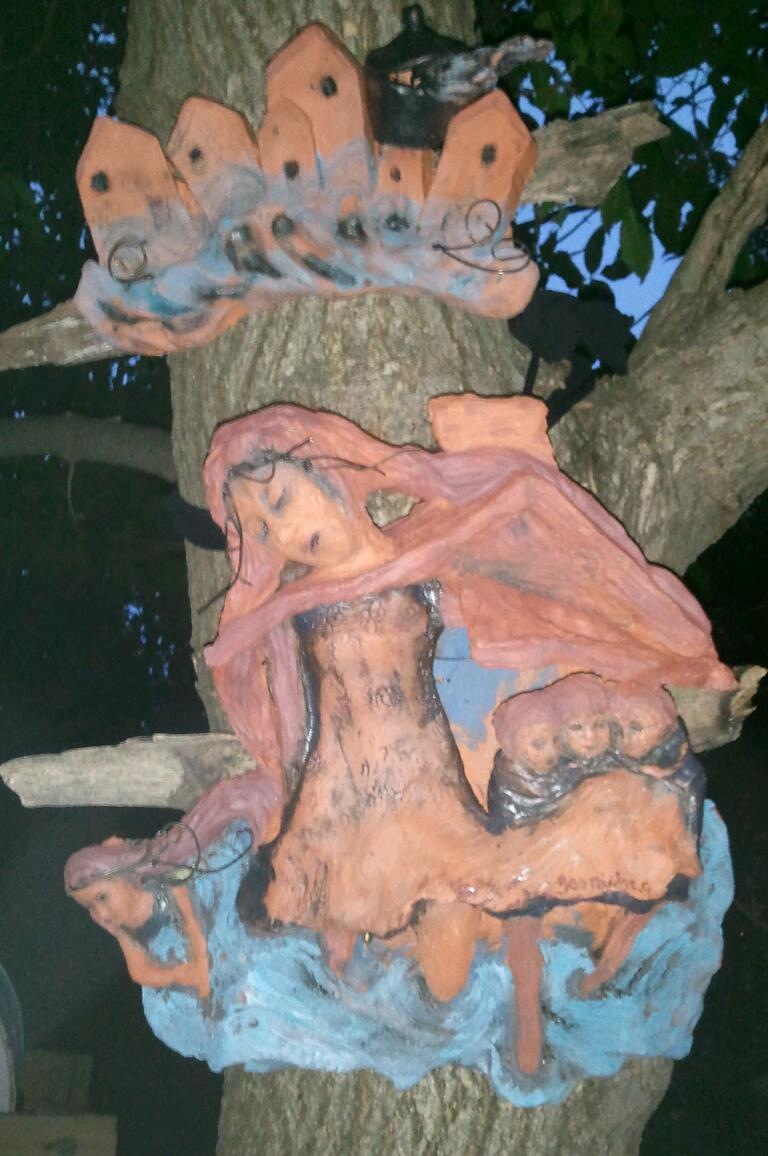
This photo, courtesy of Felice Amato, shows houses and quilters in progress for Swede Hollow.

Amato was inspired to shape pieces like “Mother and Child by the ‘Hobo’s Washroom’,” “Little Girl with birds,” “Bread house” and three other larger works for Swede Hollow. Those GeoNiches hint at folktales based on the experiences of the immigrants who once called this place home. A hand-drawn map to those artworks can be found inside a GeoNiche by Swede Hollow Cafe (coordinates N 44° 57.551’ W093° 04.330’) as Amato awaits approval of official Geocaching.com listings for Swede Hollow.

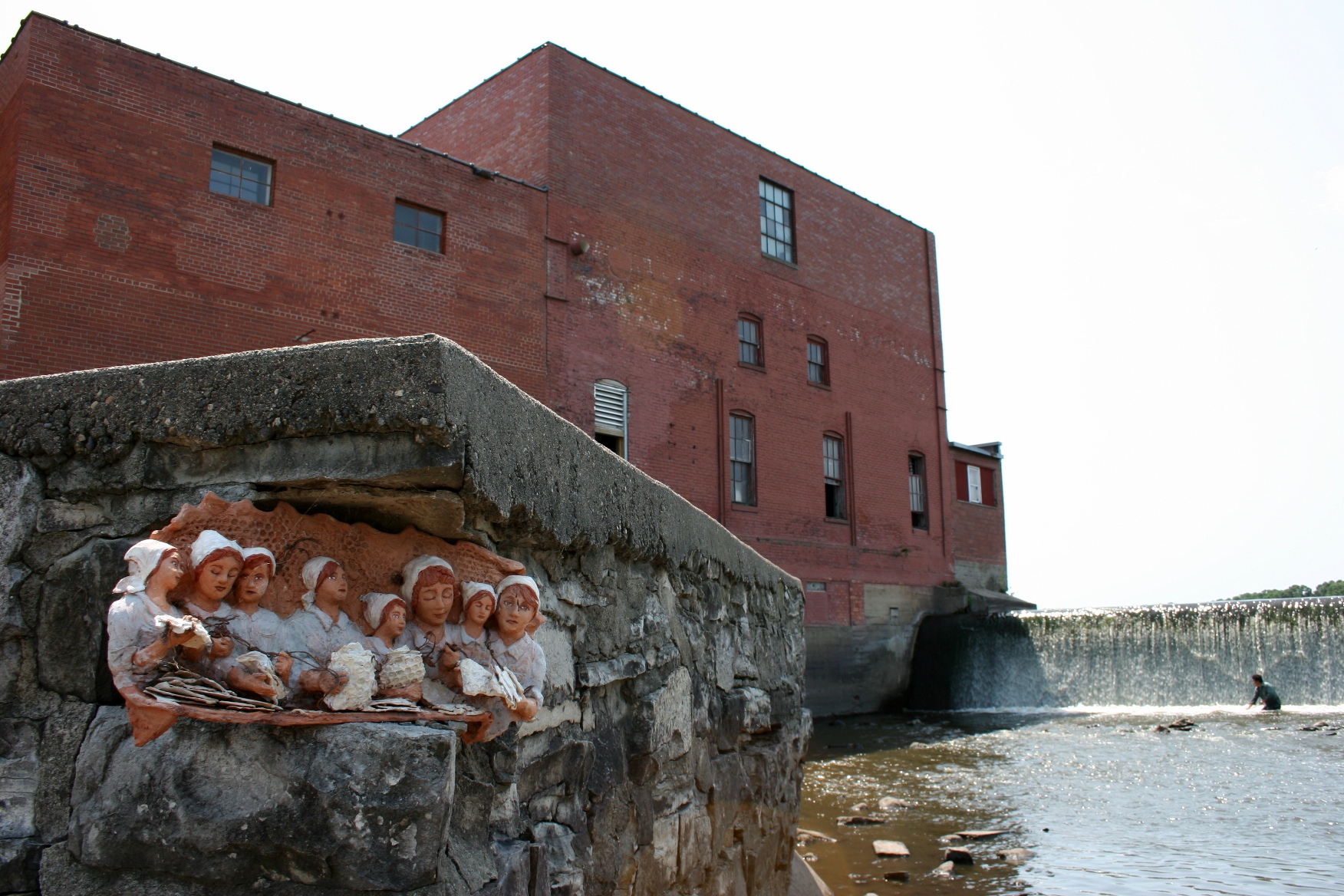
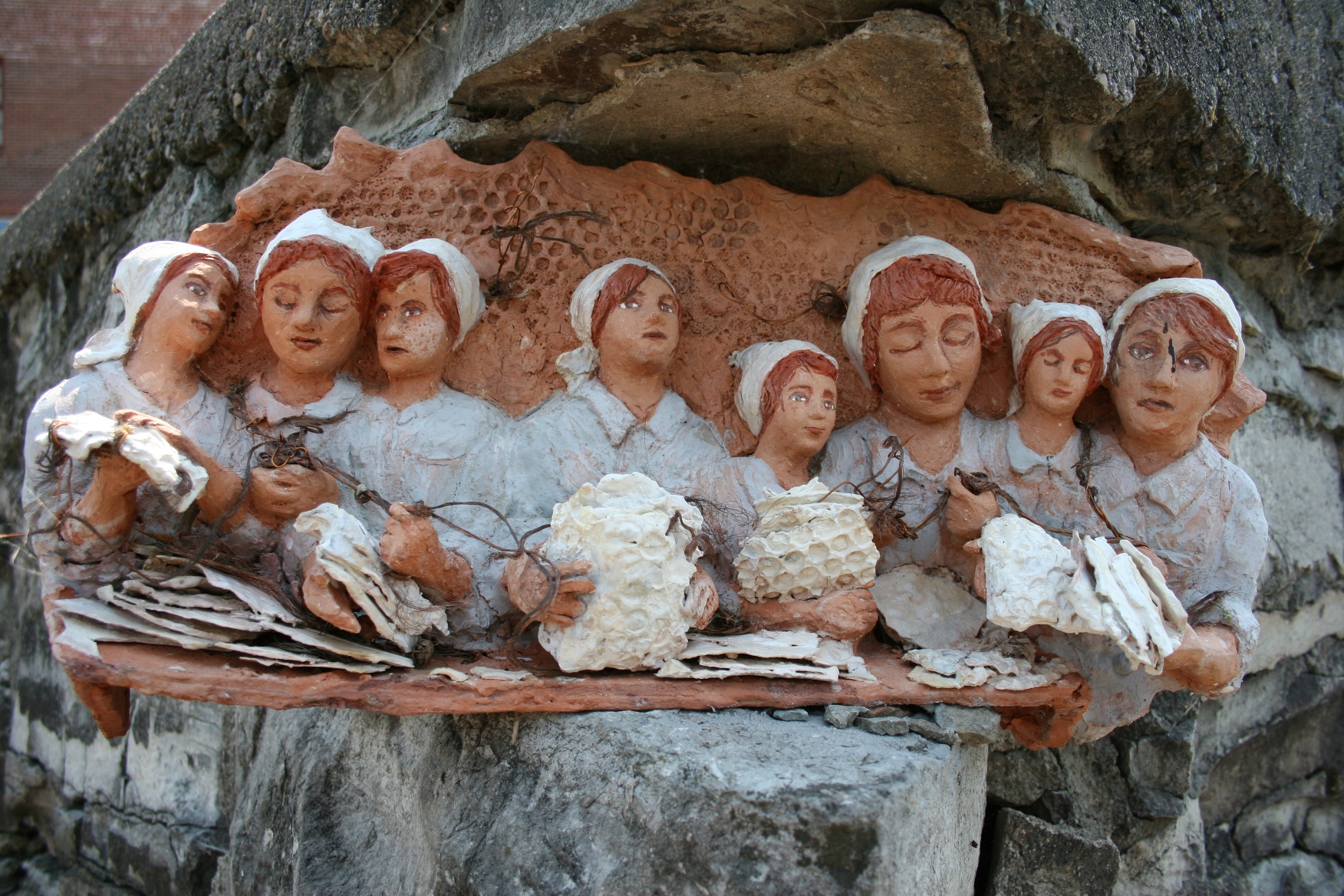
“Seamstresses” in place at the historic Faribault Woolen Mill along the Cannon River blends seamlessly into its environment. Photo by Audrey Kletscher Helbling.

In Faribault, she was naturally drawn to the Faribault Woolen Mill, she says, because of an art series initiated several years ago on women in factory settings. Amato created “Seamstresses” and tucked it into a niche along a retaining wall at the mill next to the Cannon River.

Amato’s sculptures tell a story as seen in this close-up of woolen mill factory workers. Her sculptures are made from paperclay with wire details. Photo by Audrey Kletscher Helbling

Explains Amato of her women in factory art:

The metaphorical potential of women and labor—especially manual and repetitive labor—is enormous with so many different layers it makes my mind explode. To what did/do women give their lives? What other inner lives (maybe as poets or artists, or dreamers) did they have especially at times where realizing those passions was even more difficult than it is today? I wanted to speak to a sense of honor and even sacredness in the making, the plodding, the rote quality of manual tasks—often just a part of an end product. Sewing and weaving itself is rich with metaphor as is the factory setting: the balance of isolation and comradery.

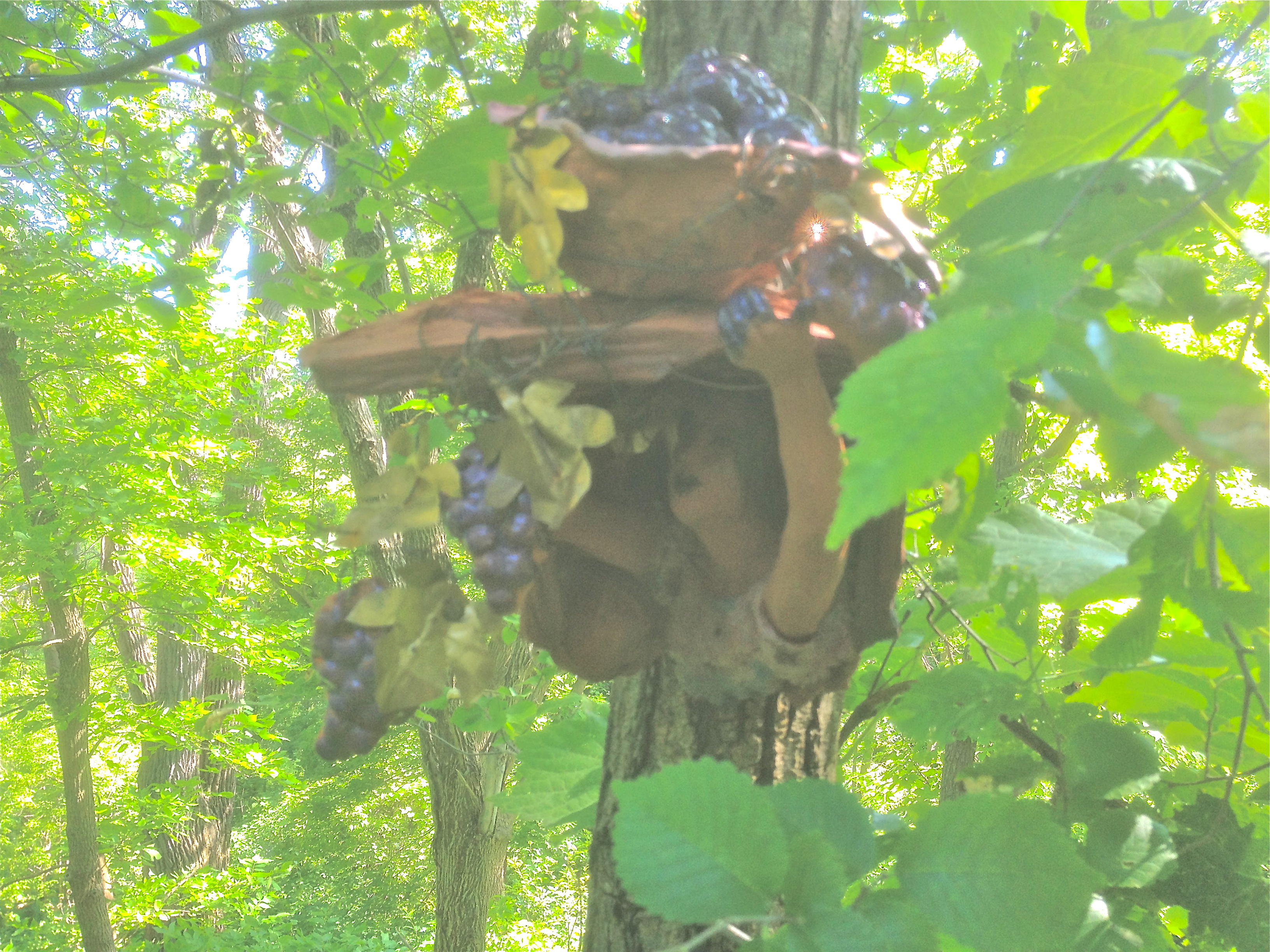
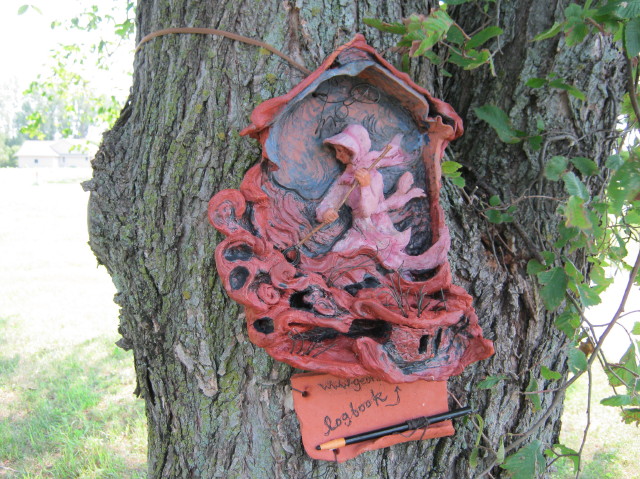
Amato secured “Prairie” onto a tree near a bike trail west of Faribault. Photo by Kevin Kreger.

Outside of Faribault, lashed onto a tree along a bike trail, Amato switches to a rural theme in “Prairie,” a definitive piece which connects to her prairie roots. The sculpture was partially-influenced, she says, by “the solitude and perseverance of the prairie woman in her battles with so many forces—the soil, the wind, the grasshoppers, the fires.”

Geocacher Kevin Kreger of Faribault, who sought out both Faribault area GeoNiche art pieces, says he was drawn in by “Prairie” and found the placement of “Seamstresses” at the Woolen Mill a fitting location.

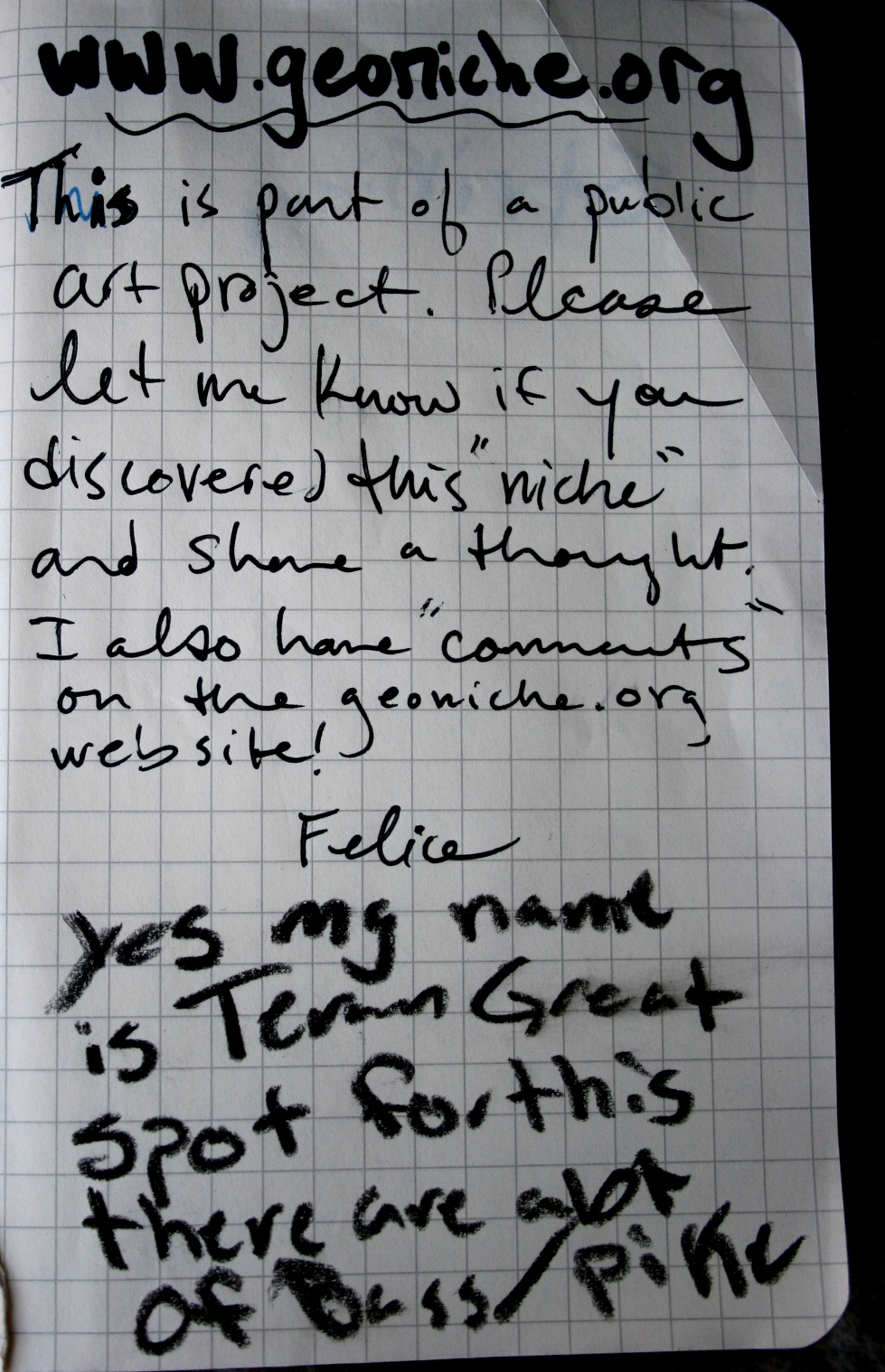
The sweet surprise GeoNiche at the Faribault Woolen Mill. Wear solid walking shoes as you will need to walk over rocks (not the ones photographed here) to reach this art treasure. Amato encourages finders to sign the logbook tucked into a plastic bag behind “Seamstresses.” Photo by Audrey Kletscher Helbling

“The idea (GeoNiche) delights me,” says Kreger who has been geocaching for half a dozen years everywhere from New York City to the Oregon coast and as near as a local county and city parks. “Turning the corner, seeing another’s idea of beauty in an unexpected spot, it’s one of those unanticipated sweet spots in life.”

The first entry in the “Seamstresses” logbook. Photo by Audrey Kletscher Helbling

Amato hopes for that type of positive reaction from those who discover her public art hidden in niches. “Many people seem to really experience my work, seeing it as meaningful to them and that it is meaningful to me,” she says. “It evokes stories of memories or hooks people’s imagination and emotions.” She wants finders of her art to interact with her, to share their thoughts in her on-site logbooks and/or online.

Kreger appreciates the time and skill Amato has invested in creating her art, made from “paperclay,” a method of mixing paper pulp into recycled clay. He wonders, though, how long the GeoNiches will stay in place, comparing them to performance art and as a gift the artist must be willing to give up.

Another sculpture hidden in Swede Hollow Park. Photo courtesy of Felice Amato.

While one of her Swede Hollow GeoNiche sculptures was smashed, the rest have remained intact with one even moved to a more logical and visible location. Amato’s considered taking the pieces down for the winter or sealing them to protect the vulnerable clay from the elements. But she’s unsure. “When I installed “The Potter” in the pottery dump at Red Wing and looked at all the shards of broken ceramic work, I thought eventually she will be among that and it felt OK,” Amato says.

An overview of the location for “Seamstresses.” Look and you will find her sculpture in this image. The positive responses from the people of Faribault have been a huge incentive, Amato says, to explore the area more. Photo by Audrey Kletscher Helbling

Exact placement of her art is most successful, she adds, when the spot is discovered as though it was waiting.

Even though the grant period for her GeoNiche Project has ended, this St. Paul artist intends to seek additional funding to continue creating and hiding her art for geocachers and others who may happen upon it. She plans to work, also, with artist friends interested in GeoNiche. And she’s contemplating offering a GeoNiche workshop.

While she’ll seek out funding for her innovative project of connecting art and geocaching, Amato says she’s not a geocacher or a seeker.

“I would imagine,” she says, “most people are primarily either seekers or hiders. I am a hider.”

Artist Felice Amato. Photo courtesy of Felice Amato.

FYI: Felice Amato, the mother of two daughters, has been a public school teacher for nearly 20 years (teaching first Spanish and then art) and has also taught summer art classes and camps for children through the St. Paul non-profit, Art Start. She is an artist specializing in clay and tile making. Her artwork has been exhibited in numerous shows and in several galleries during the past 10 years with an upcoming show set for October 18 – November 17 at The Phipps Center for the Arts in Hudson, Wisconsin. For more information about Amato, click here to link to her Facebook page and here to link to her website.

Click here to link to Amato’s GeoNiche website.

And click here to check out her GeoNiche Project Facebook page.

© Copyright 2012 Audrey Kletscher Helbling
Photos by Audrey Kletscher Helbling, Felice Amato and Kevin Kreger


Steele County showcases history in a big way July 10, 2012

Five-year-old David of Faribault, aka Apache Shadow, was among costumed reenactors from the Old West Regulators.

WHEN THE STEELE COUNTY HISTORICAL SOCIETY in Owatonna throws an extravaganza, they put on a heckuva an event.

Late Sunday morning my husband Randy and I headed about 15 miles south on Interstate 35 to the Village of Yesteryear for the historical society’s 26th annual celebration of history. I cannot believe that I’ve never known about this extravaganza, which I’d recommend to anyone interested in a free family-friendly day of learning about the past.

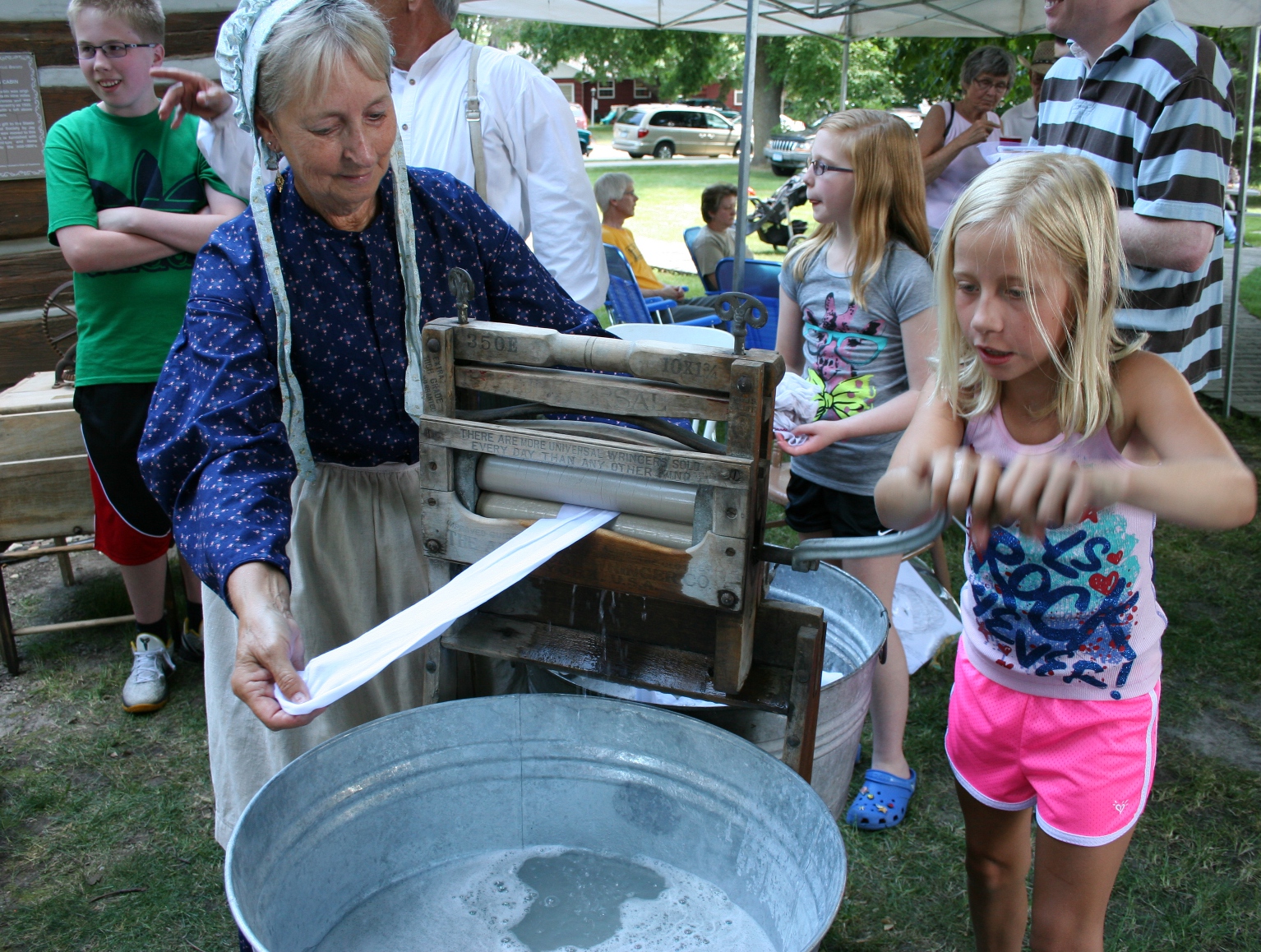
Kids, like Kennedy, right, were drawn to the water and the old-fashioned wringer.

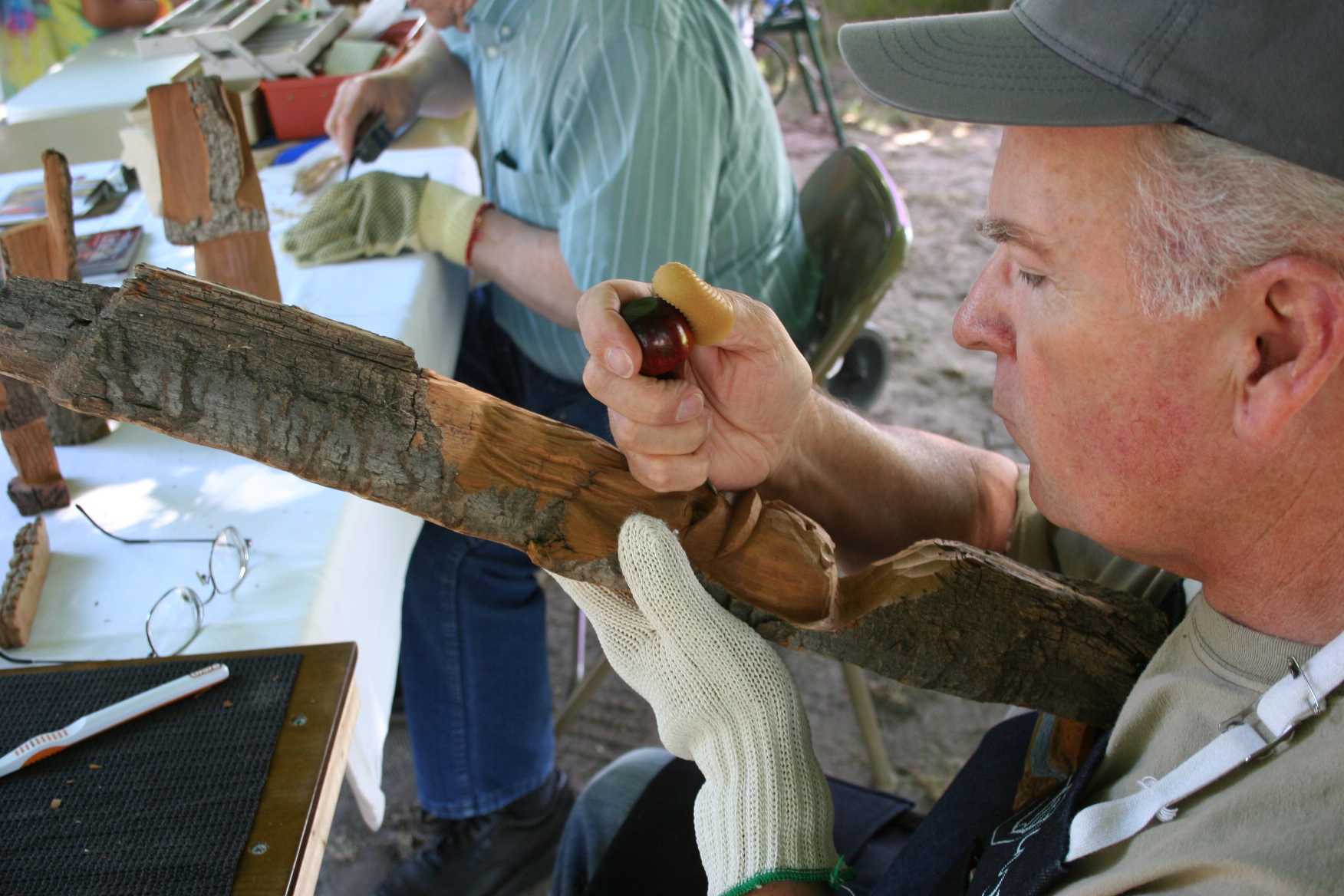
Owatonna resident Tom Gray carves a mountain man.

From hands-on demonstrations of rope making to washing clothes the old-fashioned way to printing on an aged press to carving wood and working with leather, and more, we observed an array of dedicated and passionate historians showcasing yesteryear.

Two actresses shoot it out in a scenario presented by the Old West Regulators.

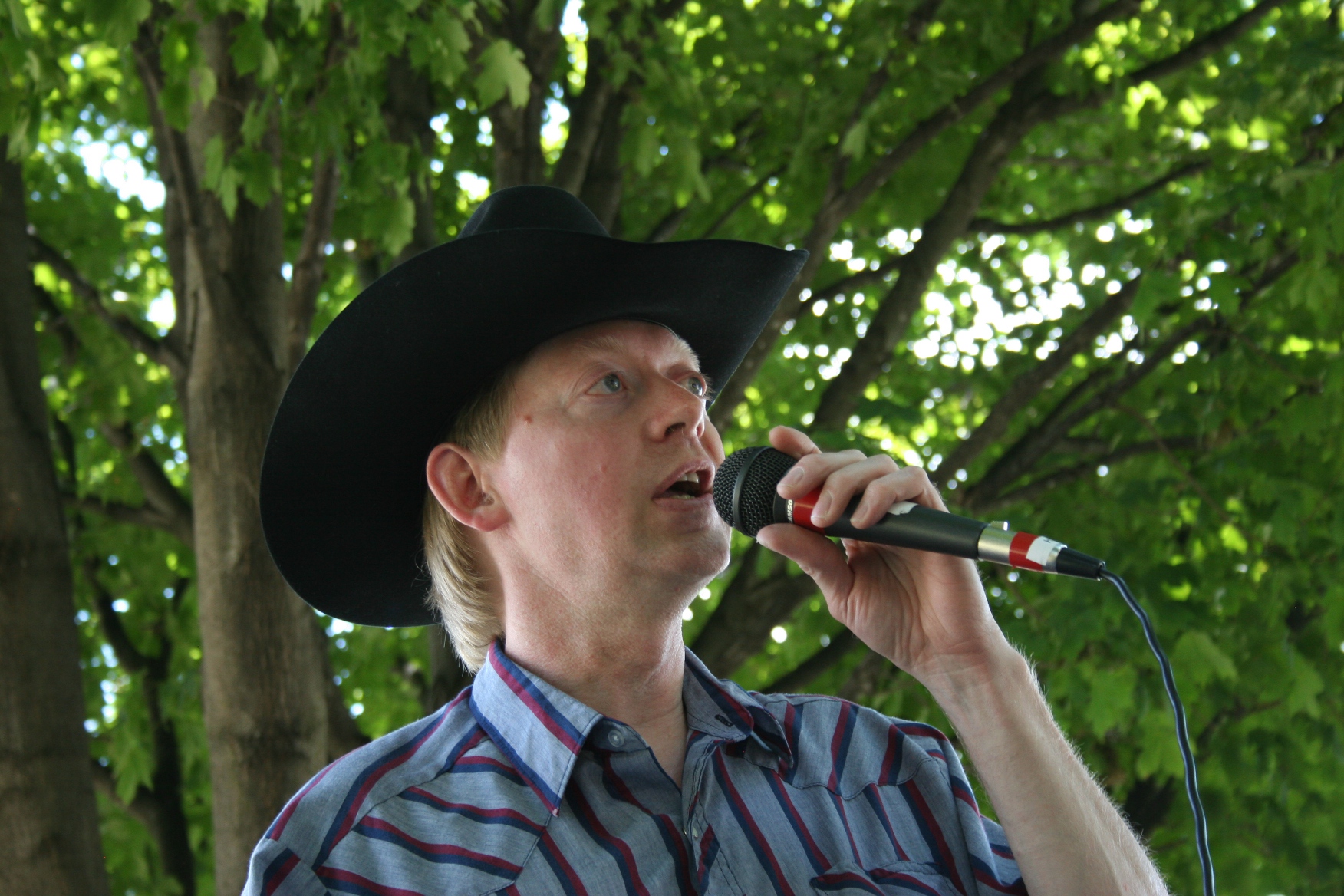
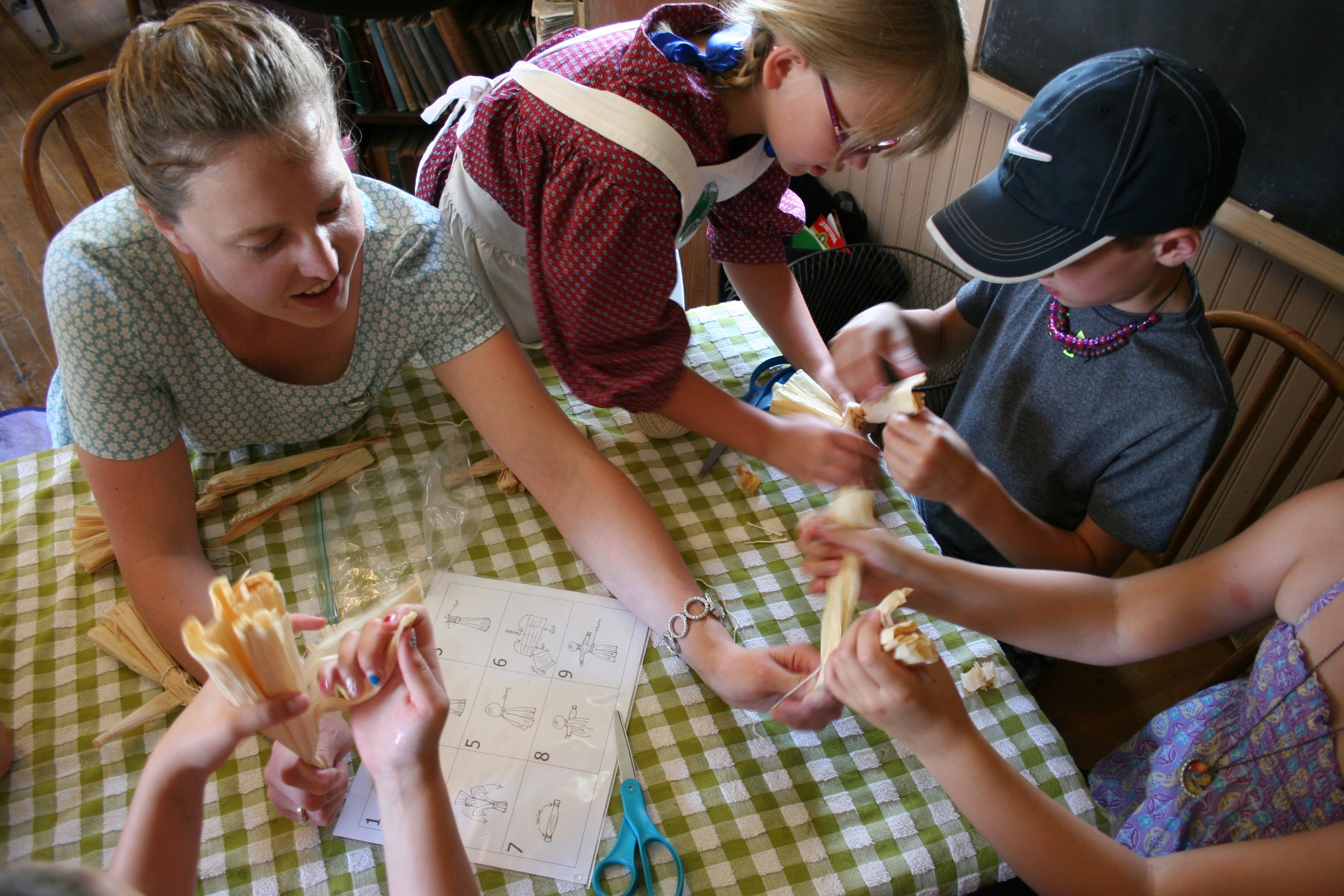
Add in costumed reenactors modeling period attire and shooting it out in mini dramas; a country singer crooning Hank Williams’ “Your Cheatin’ Heart;” kids circled around a table in an old country school crafting corn husk dolls; tractors snail-crawling toward the finish line in a slow tractor race; the tantalizing aroma of shredded pork sandwiches and the refreshing promise of icy root beer; 15 buildings, most of them vintage, plus a caboose to tour, and you have a full day.

Dunnell Lenort, who has performed at the Grand Ole Opry and elsewhere, presented a selection of songs, including “I Fought the Law.” It was, he said, “for those who have been on the wrong side of the law.”

Kids learned how to make corn husk dolls inside the former District 14 country school, built in 1856 and located about four miles south of Owatonna along Lemond Road. The school was closed by consolidation in 1962.

Lest you think the John Deere won this race, you would be wrong. The winner here was the tractor which drove the slowest along about a 50-foot stretch to the finish line in a slow tractor race.

Randy expected we would be there an hour; we left more than four hours later and could have stayed longer. We missed the vintage baseball game and other events.

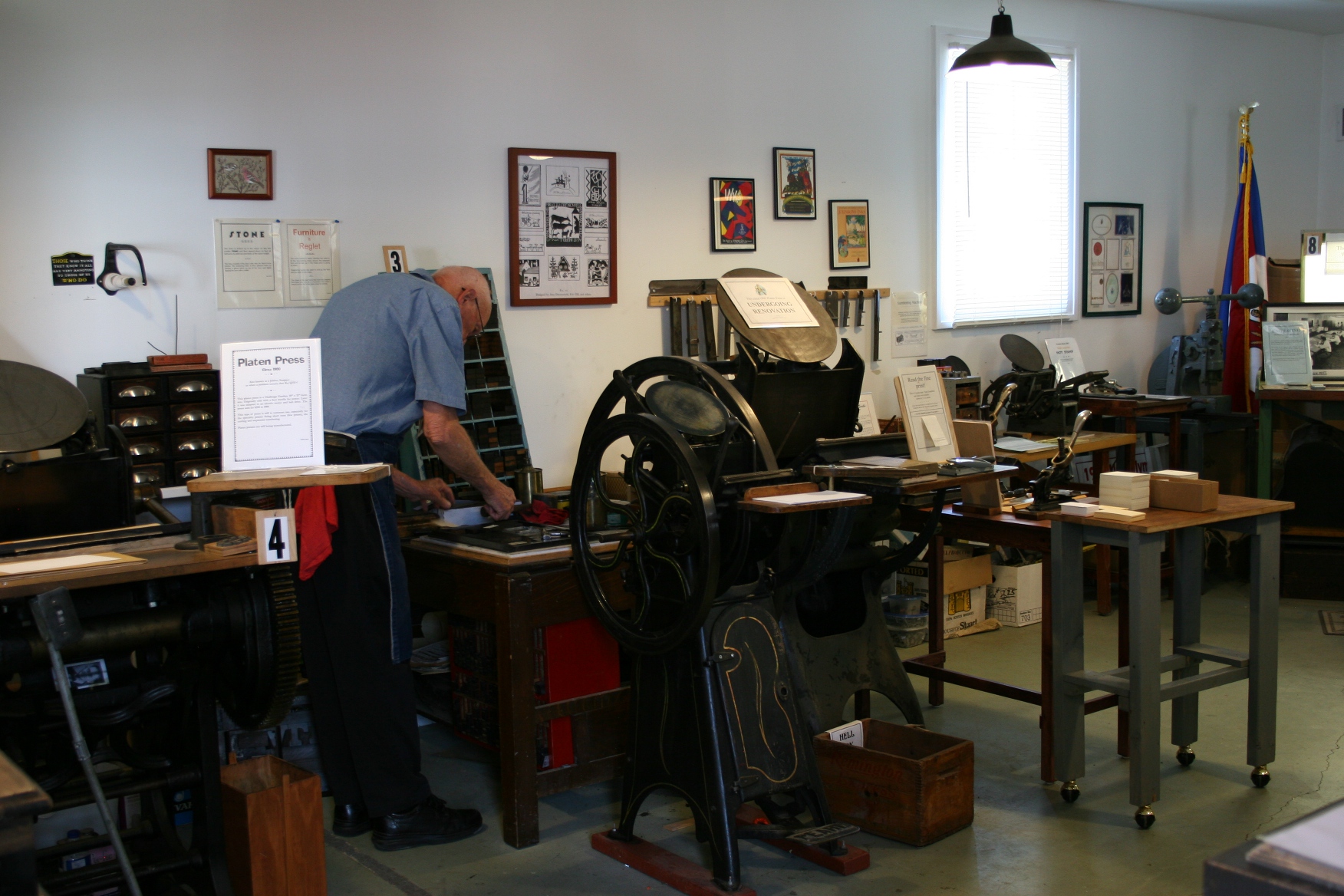
Pete the printer at work in the Village of Yesteryear print shop.

Of course, my spouse will tell you that, had I not been so interested in the village print shop, we could have knocked perhaps 30 minutes off our extravaganza tour. But given my journalism background; two years of employment at a weekly newspaper which printed auction bills and other items on an old Linotype machine; and my appreciation for the art of printing, I was fascinated by the working print shop and its resident printer, Pete Baxter.

Randy indulged my print obsession and I, likewise, later feigned interest in the engine display over in the agricultural section of the extravaganza.

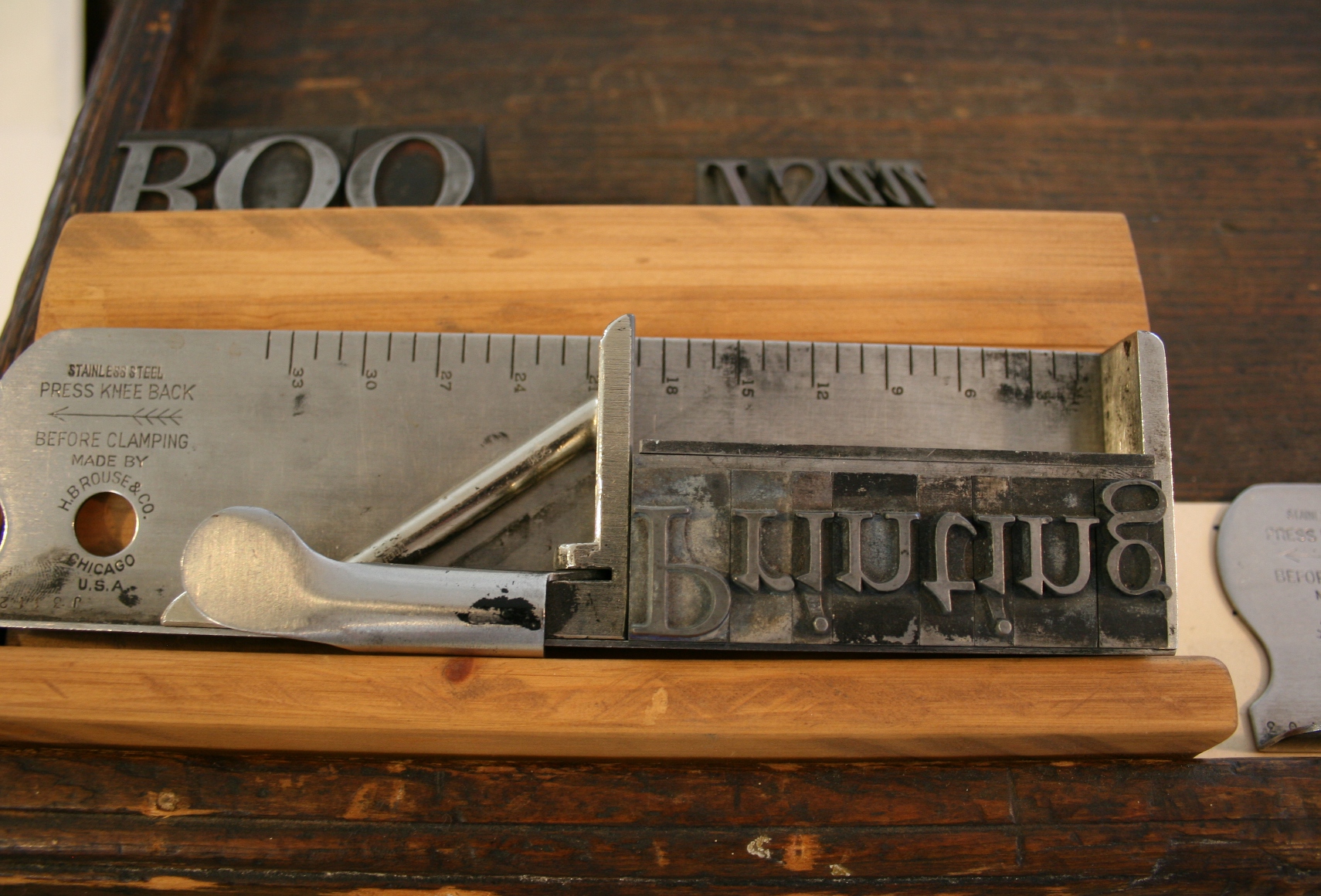
Letters laid out to spelling “printing.”

Let’s back up to that print shop and printer Pete, who once owned North Cal Printing, as you would expect, in California. Family brought Pete to Minnesota about a dozen years ago. And the old print shop at the Village of Yesteryear was one of the deciding factors in his settling specifically in Owatonna.

Today he’s an enthusiastic volunteer who dons a printer’s apron as he educates visitors, spins a few stories and inks up the press to spew out bookmarks and cards with messages like “Without a love for books the richest person is poor.”

Spend any time with this man who owns a library of 1,500 volumes; is a member of The Wördos, an organization which meets monthly in the metro to discuss errors in local and national media; and who knows the ins and outs of the printing business, and your interest in printing is likely to grow, too. When he mentioned the bit about The Wördos and their dissection of media grammar, usage and more, I wanted to grab back the business card I’d handed him for fear of him scrutinizing my writing. But I didn’t.

I wasn’t about to allow my insecurities to interfere with learning from an old-school printer educated in the 1940s at California Polytechnic State University during the transition from letterpress to offset printing.

Pete’s interest in printing stretches back to his childhood when he often accompanied his dad to a California street car station and stood at the window of a nearby newspaper office watching printers at work.

One day, as Pete dramatizes with arms gesturing, a worker exited the print shop, grabbed him by the arm and shouted, “Get your snot nose off my window.” He hauled young Pete inside, gave him a tour, and, as the printer says, “I was hooked.”

The next Christmas, he received a toy printing press and a case of type. Years later, he would earn a printing degree from Cal Poly and eventually own a print shop.

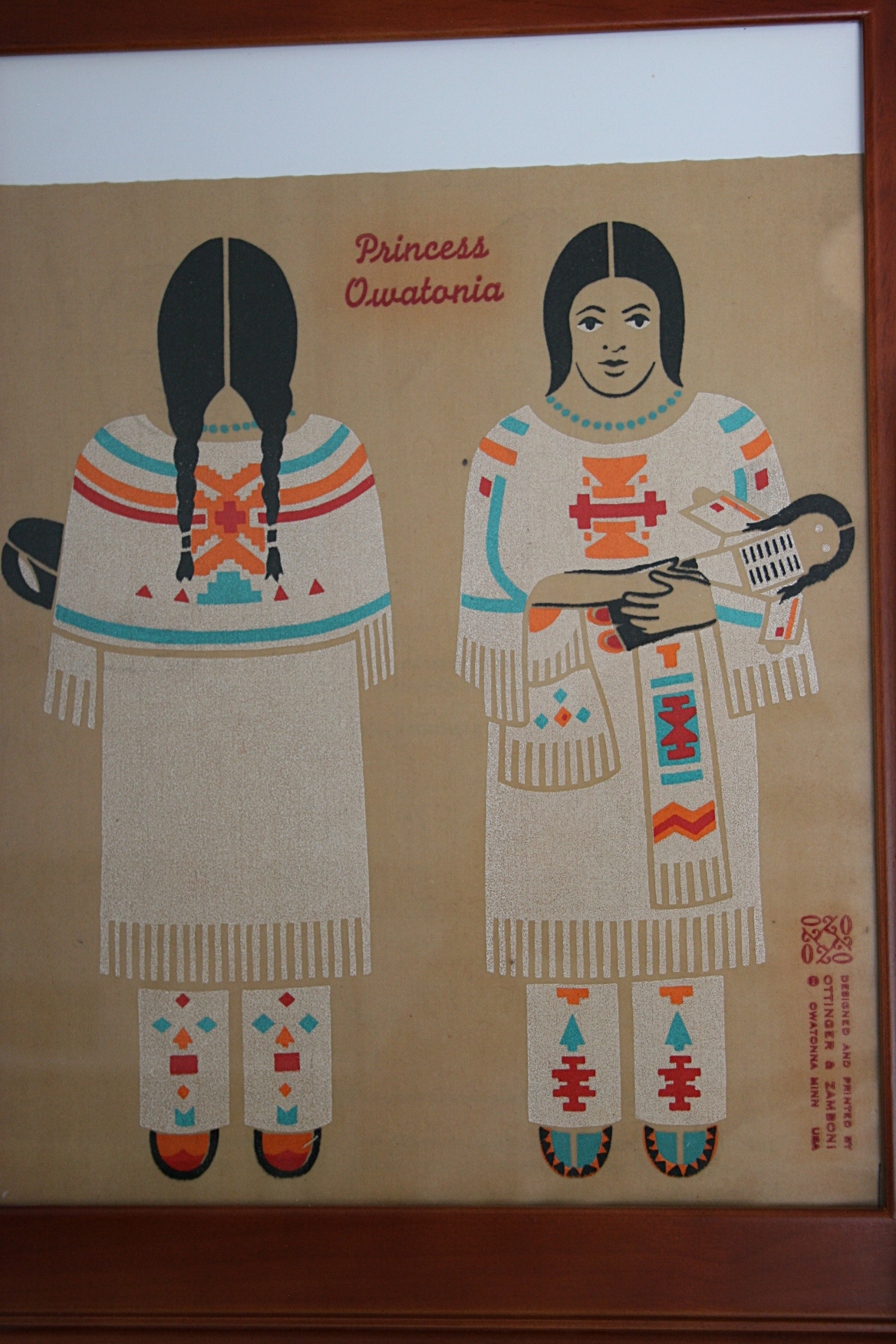
An original OZ Press print of the Indian princess after whom Owatonna is named, on display in the print shop.

That Pete the printer understands and appreciates printing is obvious to anyone who takes the time, as I did, to listen. He’s quick to spotlight the work of Owatonna’s probably most notable press, OZ Press. OZ co-owners Alice Ottinger and Jean Zamboni—thus the OZ name—donated an 1885 working printing press and artwork to the Village of Yesteryear print shop. Their press specialized in original art printing and silk screening during its 40 years in business, 22 of them in Owatonna.

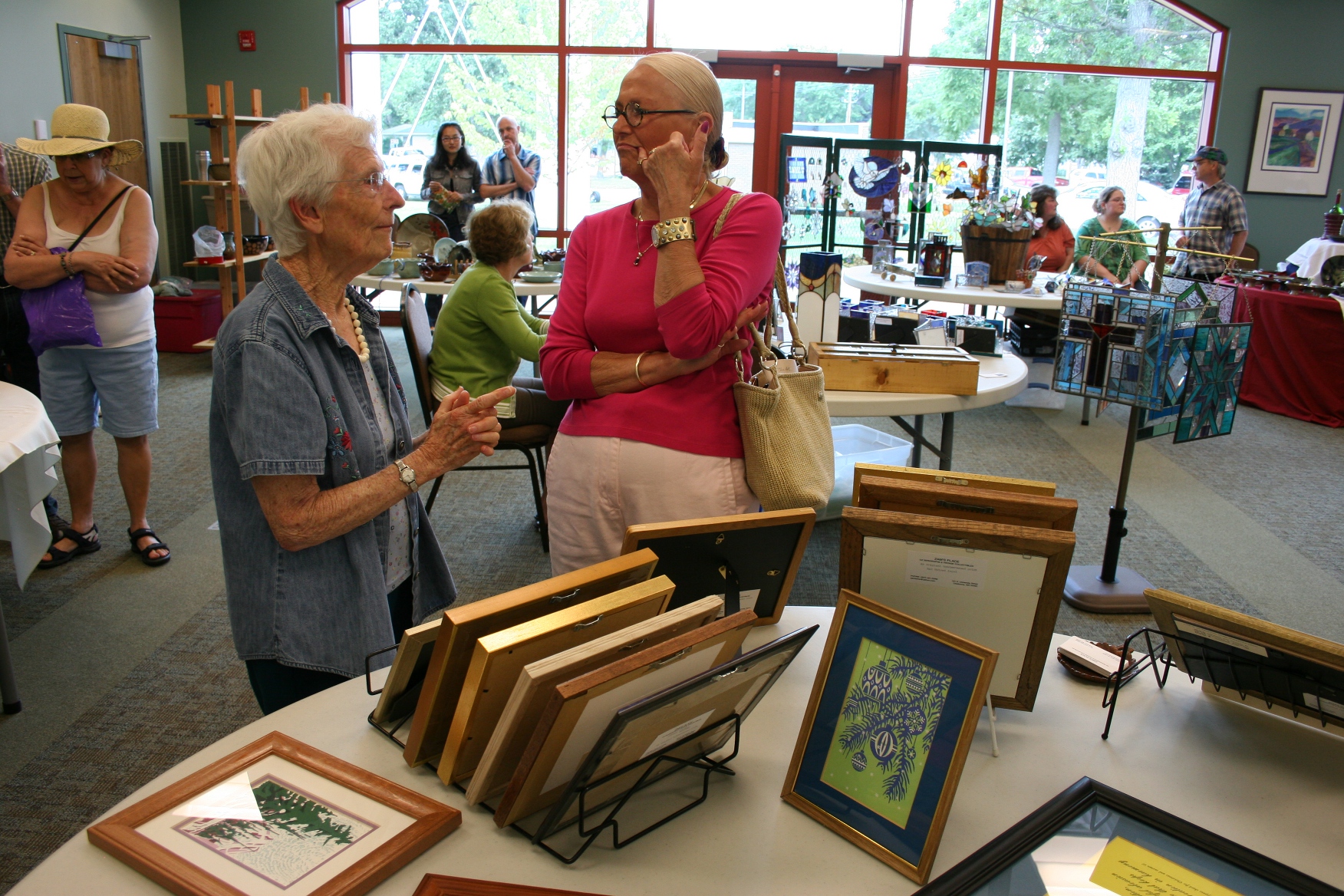
Jean Zambonia, left, talks about OZ Press at the artisan market. Framed OZ Press prints, on the table, were for sale.

Later I met Jean Zamboni in the new Steele County History Center and learned that she taught art at Minnesota State University, Mankato, before opening her press with friend Alice Ottinger. They designed some program covers for the college, did silk screening and eventually determined they could afford to start a press.

“So that was it,” Jean summarized as she stood next to a table where a limited selection of OZ framed prints were sold at the extravaganza. I wish now that I’d purchased one.

And you likely wish, about now, that I’d informed you of the Steele County Historical Society Extravaganza before the event. Mark it on your calendar for next July. Before that, though, you can attend Christmas in the Village, set for 4:30 – 8:30 p.m. Friday, November 30, and again from 10 a.m. – 2 p.m. on Saturday, December 1. The holiday celebration includes sleigh rides, visits by Santa and Mrs. Claus, children’s activities, selected buildings decorated for the season, a cookie sale, music and more. If it’s anything like the summer extravaganza, you will not want to miss it.

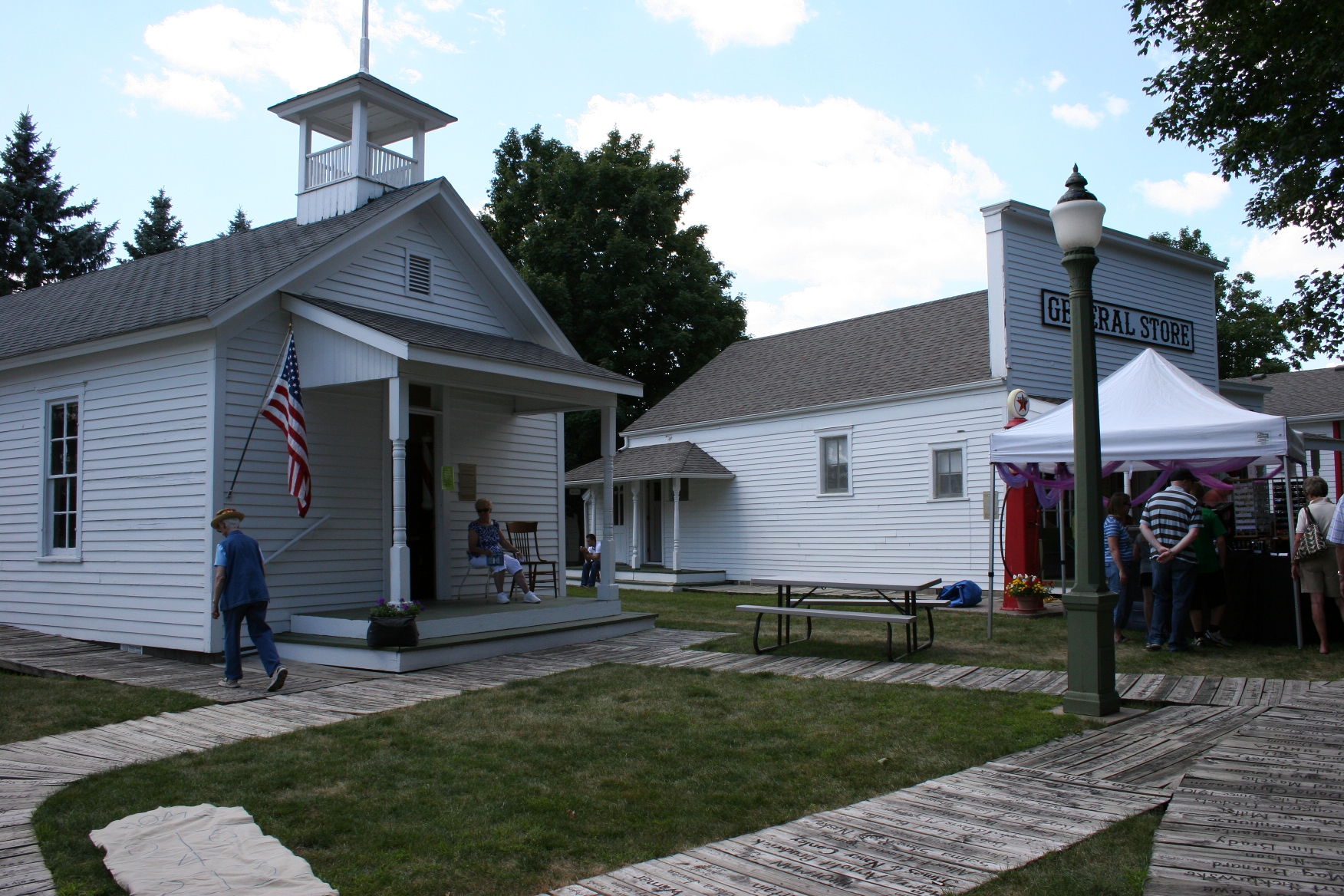
The general store and Museum of Professions at the Village of Yesteryear.

FYI: Click here to learn more about the Village of Yesteryear. Watch for several more posts from the extravaganza to be published here on Minnesota Prairie Roots.

© Copyright 2012 Audrey Kletscher Helbling


Gravel road on the prairie July 9, 2012

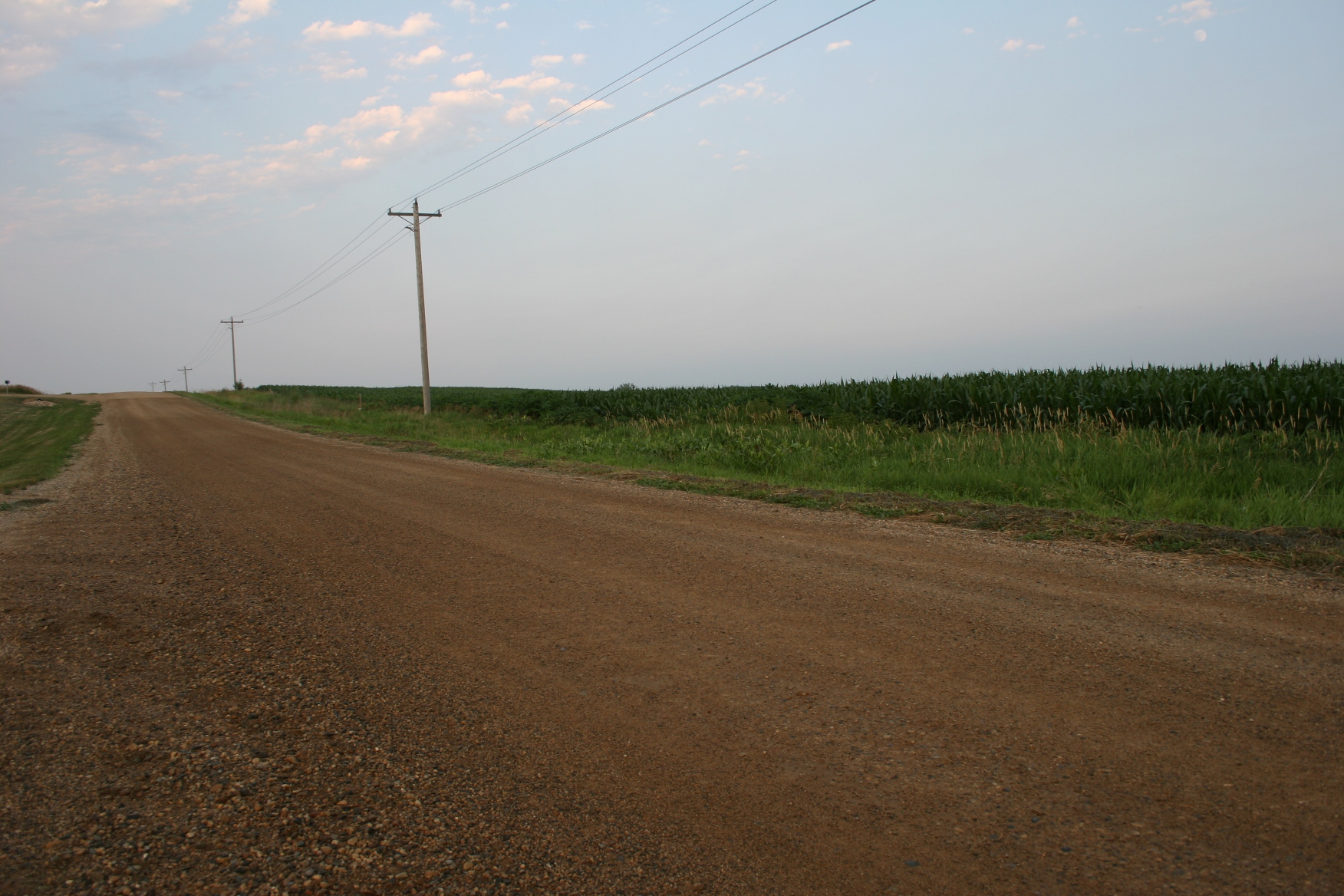
A gravel road just north of Lamberton in southwestern Minnesota.

WHAT IS IT ABOUT a gravel road?

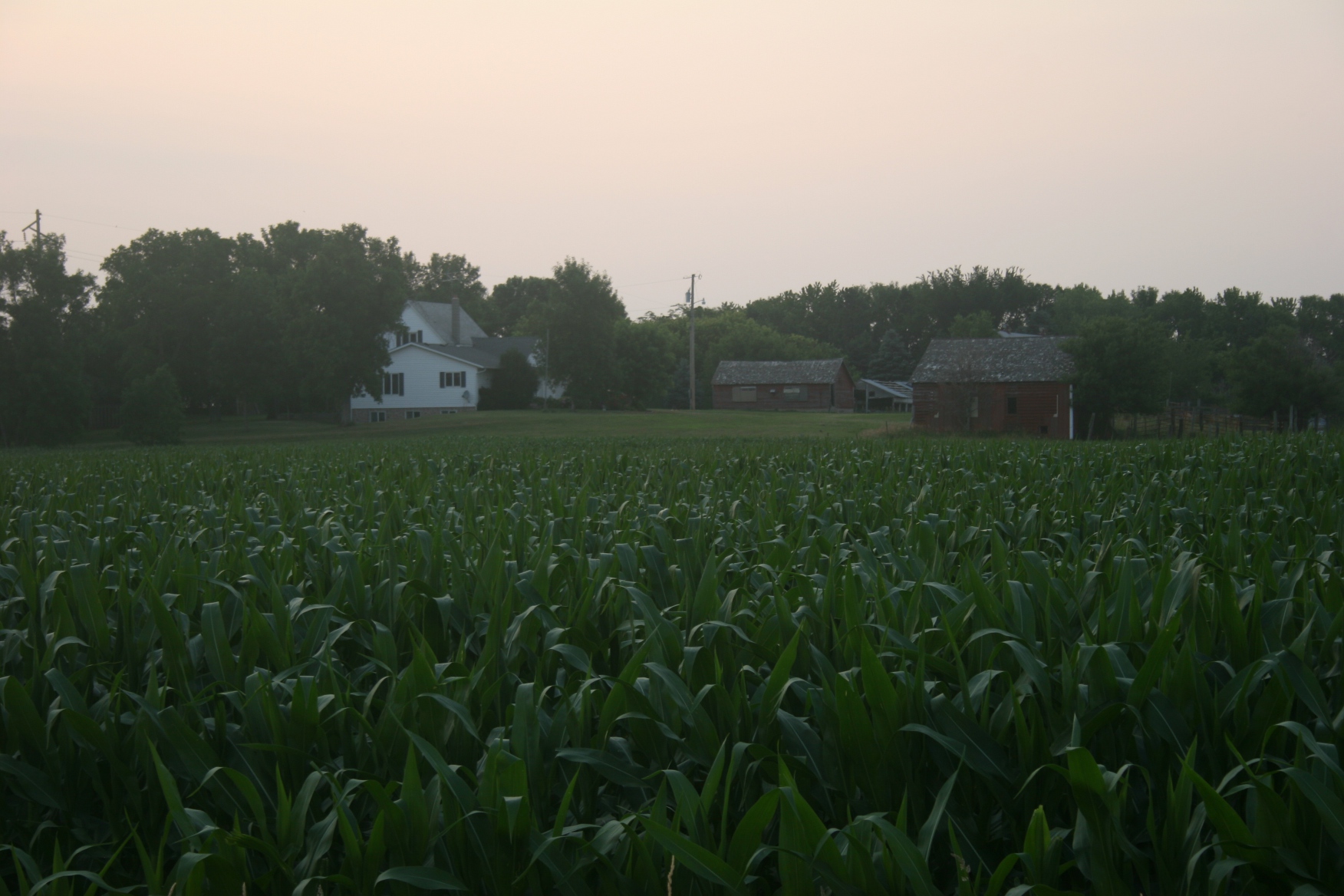
A picturesque farm site on a sultry summer evening as seen from a gravel road north of Lamberton.

It is poetry and peace, country and charm.

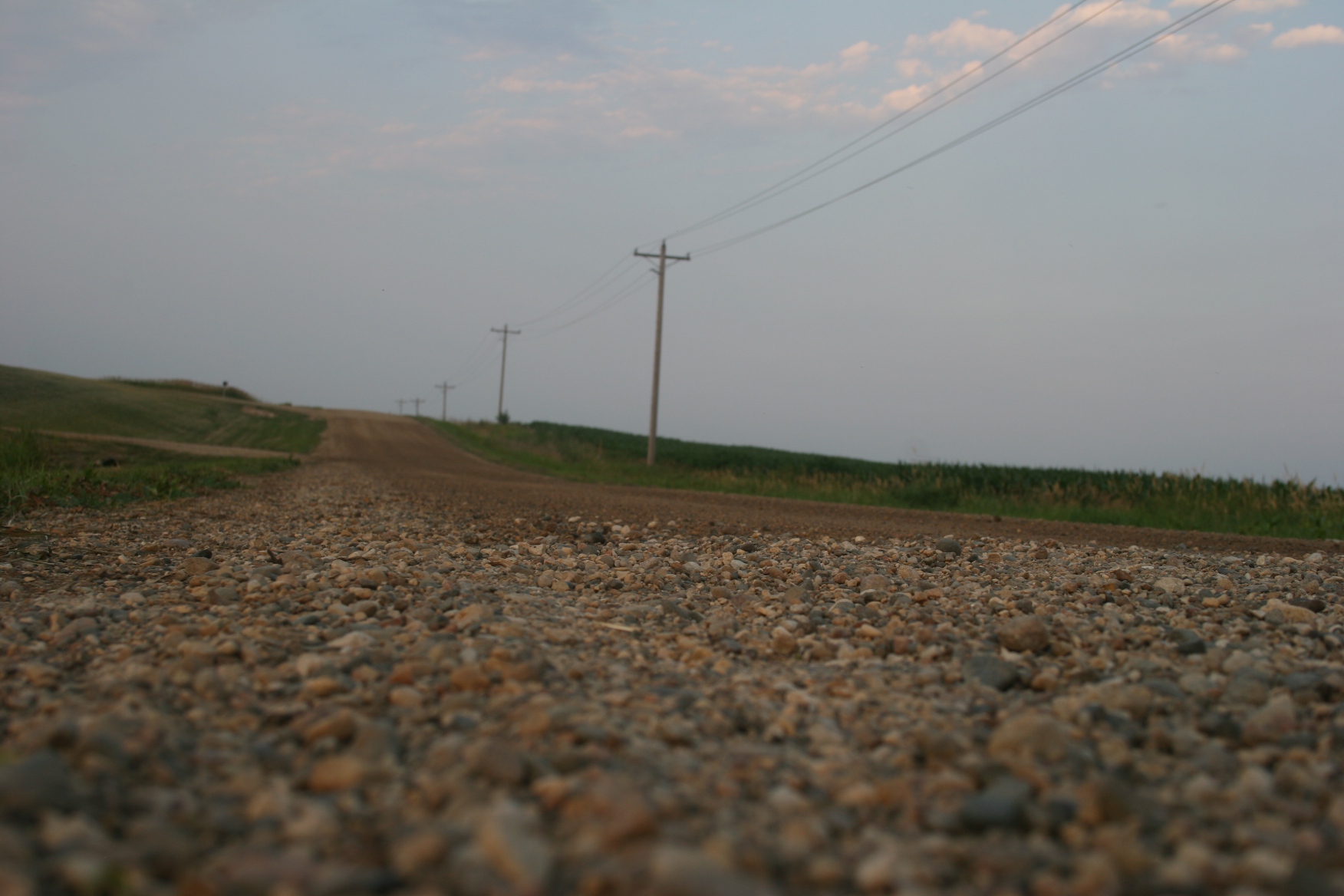
You can almost hear the crunch of the gravel in this image.

But it is more. It is small stones crunching under tires and feet as dust rises and lingers, marking the trail traveled.

As the sun sets on the prairie, a truck travels along a gravel road up to a paved roadway north of Lamberton.

It is a marker of townships, the route of massive yellow road graders blading the road surface to a flat finish or heaving snow toward ditches.

It is memories of bumpy school bus rides and squishing into the back seat of the family car between brothers and sisters.

It is Dad’s admonition to always, always, move to the right when cresting a hill.

Utility lines along the same gravel road stretch into forever.

It is the memory of pinpoint stars dotting the pitch black darkness of a prairie night and the sweet scents of wild roses (once) rambling in ditches and of freshly-mown alfalfa and of hay baled and stacked onto a swaying wagon.

A gravel road is all of these to me, and yet, in its most basic definition, it serves as a way to get from point A to point B, and marks borders between town and country.

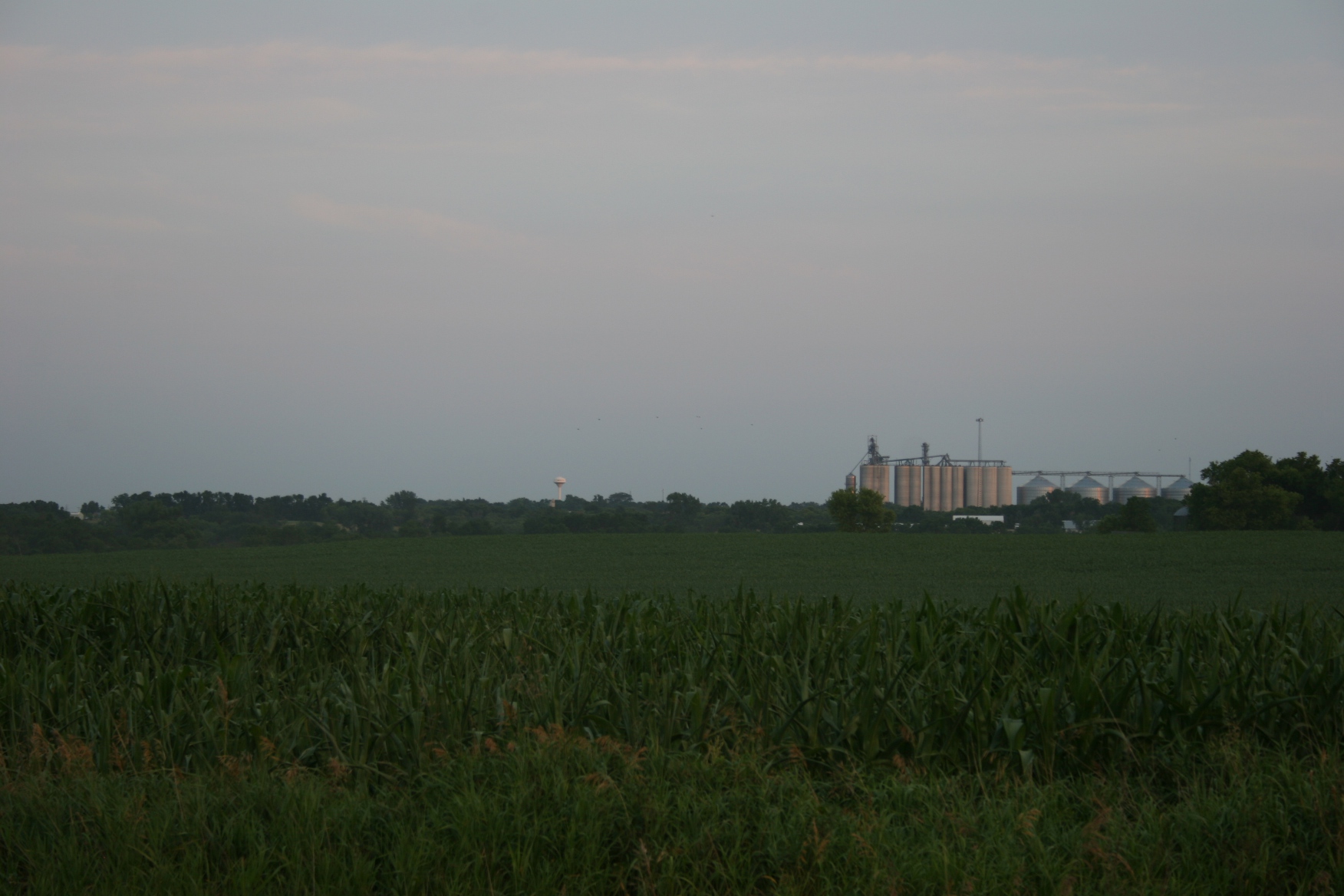
Standing on the gravel road, I turned south to photograph the cornfield and Lamberton in the distance.

It is a line in a plat book, a route connecting paved roads, a path to a rural home.

It is a gravel road on the prairie.

© Copyright 2012 Audrey Kletscher Helbling
 

Symbols of freedom at Fargo’s Lindenwood Park July 4, 2012

IF YOU VISIT the Fargo-Moorhead Sertoma Club website, you will read this:

Sertoma stands for the high and noble service to mankind through communication of thoughts, ideas and concepts to accelerate human progress in health, education, freedom and democracy.

Here a volunteer removes flags posted along Roger Maris Drive in Lindenwood Park on Flag Day.

Then, if you visit Fargo’s largest park, Lindenwood Park, around the Fourth of July or on Labor Day, September 11, Armed Forces Day, Memorial Day or Flag Day, you’ll see evidence of that mission. Some 75 American flags line Roger Maris Drive as part of the Sertoma Flag Service project.

I saw the impressive display of flags when I was in Lindenwood on June 14, Flag Day.

Volunteer Bruce Hanson gathers the flags, which typically are posted for several days on holidays and memorable historic occasions.

There I chatted briefly with Sertoman Bruce Hanson as he carried carefully rolled flags from the park grounds and placed them into a Sertoma trailer. The project, he says, has been ongoing in the city for a long time (since 1973, according to the website) and was moved to Lindenwood several years ago. Prior to that, the flags were scattered at businesses throughout Fargo and West Fargo. Grouping all the flags in one place makes more of an impact.

Businesses are still involved, Hanson says, via flag placement sponsorships. Proceeds from the flag project go back to the community.

The Sertoma Freedom Bridge over the Red River, linking Fargo and Moorhead.

I didn’t ask Hanson about the other Sertoma project I noticed in the park, the Sertoma Freedom Bridge, a foot-bridge which links Lindenwood Park on the North Dakota side of the Red River with Gooseberry Mound Park on the Moorhead side.

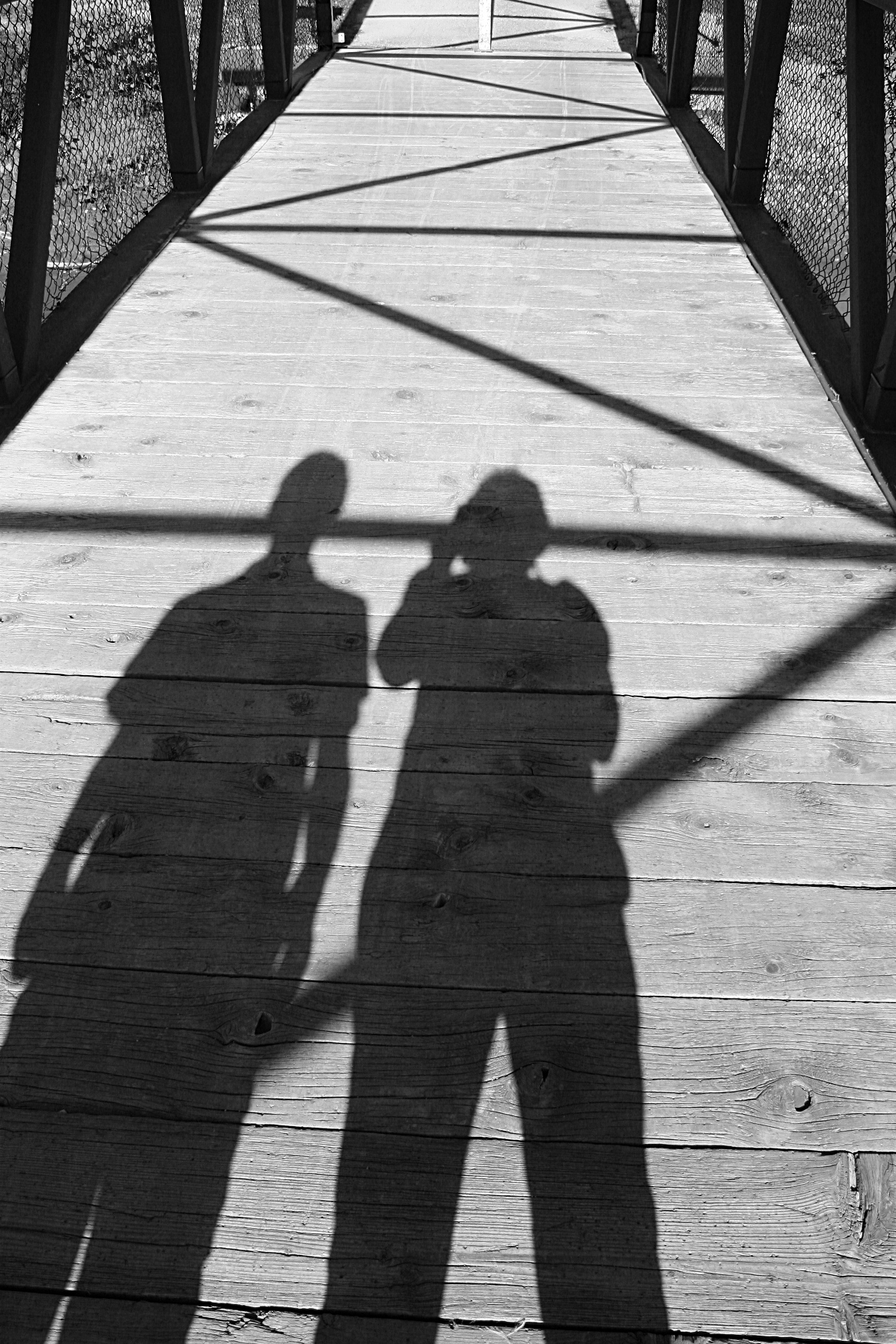
I photographed my shadow and that of my 18-year-old son on this popular biking and walking bridge.

The bridge closes July 9 for reconstruction and reopens October 1. I did a brief online search and learned that this bridge has been battered more than a few times by the raging floodwaters of the Red River. That was difficult to imagine given the docile nature of the narrow and muddy Red on the June evening I visited Lindenwood Park.

But I was assured by a man and his granddaughter that the river most assuredly spills from its banks and floods the lower park areas.

I’d really like to know more about the history of this pedestrian and bike bridge. When was it built? And why is it pegged “Freedom Bridge?”

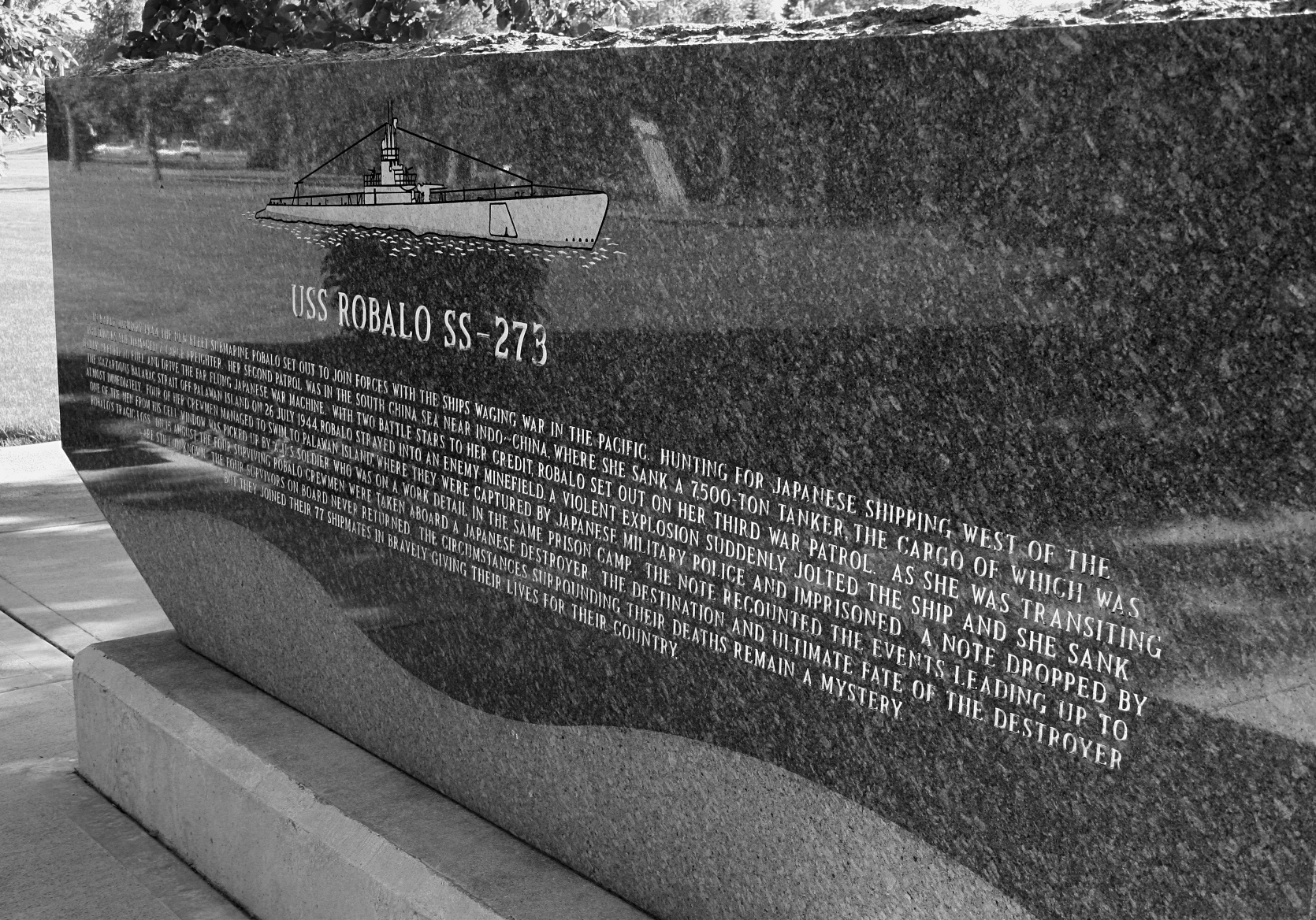
You’ll also find this symbol of freedom in Lindenwood Park. This memorial honors the 81 men who lost their lives on the WW II American submarine, the USS Rabalo. Four survived but died as Japanese prisoners of war after the submarine hit a minefield and sunk while passing through the Balabac Strait. The submarine was assigned to North Dakota for establishment of a monument.

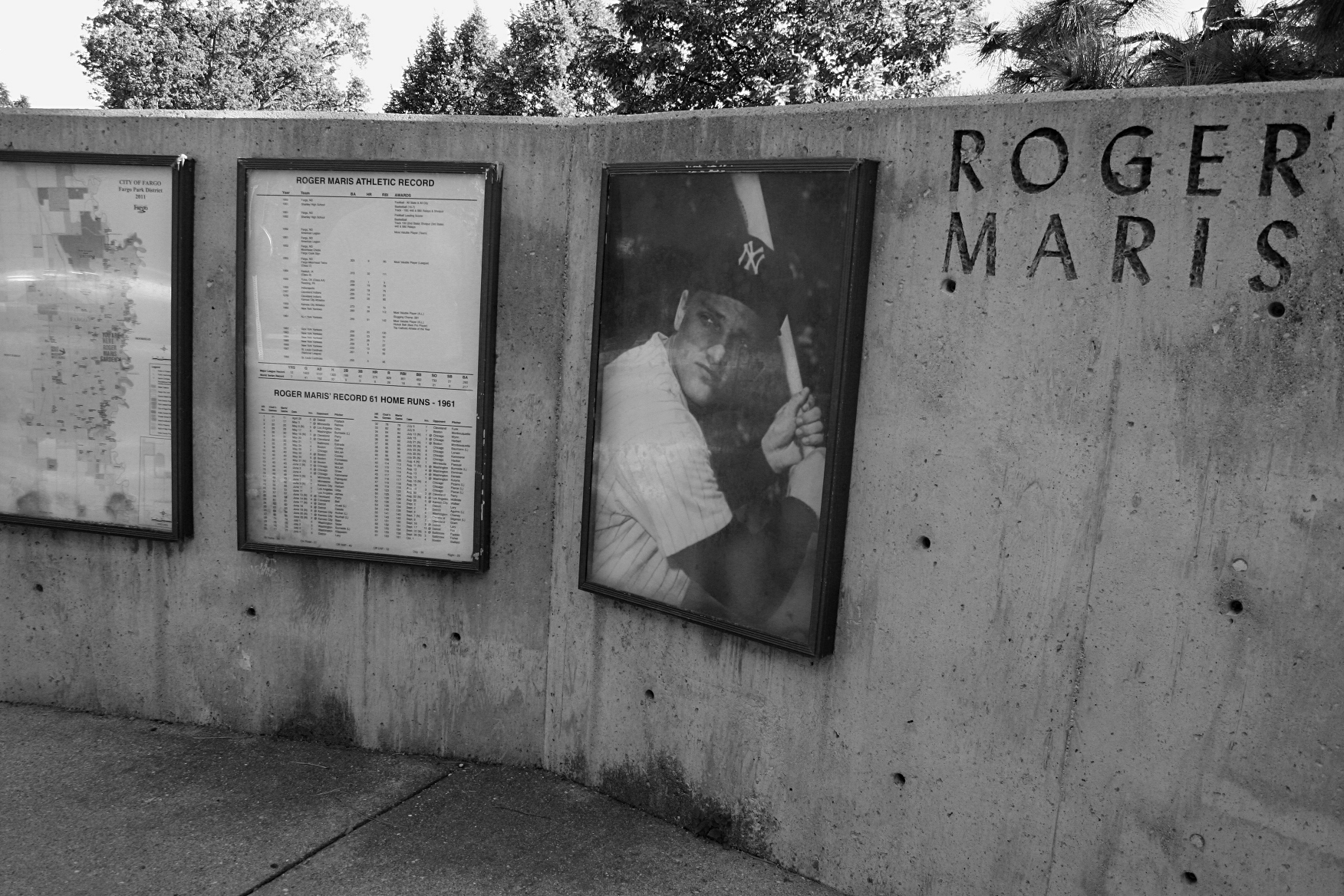
The Lindenwood Park monument to baseball player Roger Maris, who was born in Hibbing, Minnesota, but grew up in Fargo. This New York Yankees’ outfielder set a new major baseball league record in 1961 with 61 homeruns. That broke Babe Ruth’s record of 60. Maris was also a Most Valuable Player in the American League several times and played in seven World Series. Fargo is home to the Roger Maris Museum at the West Acres Shopping Center.

© Copyright 2012 Audrey Kletscher Helbling
 

Connecting to community at the Faribault Farmers’ Market June 26, 2012

Filed under: Uncategorized — Audrey Kletscher Helbling @ 6:47 AM
Tags: , , , , ,

A snippet of the Faribault Farmers’ Market on Saturday morning.

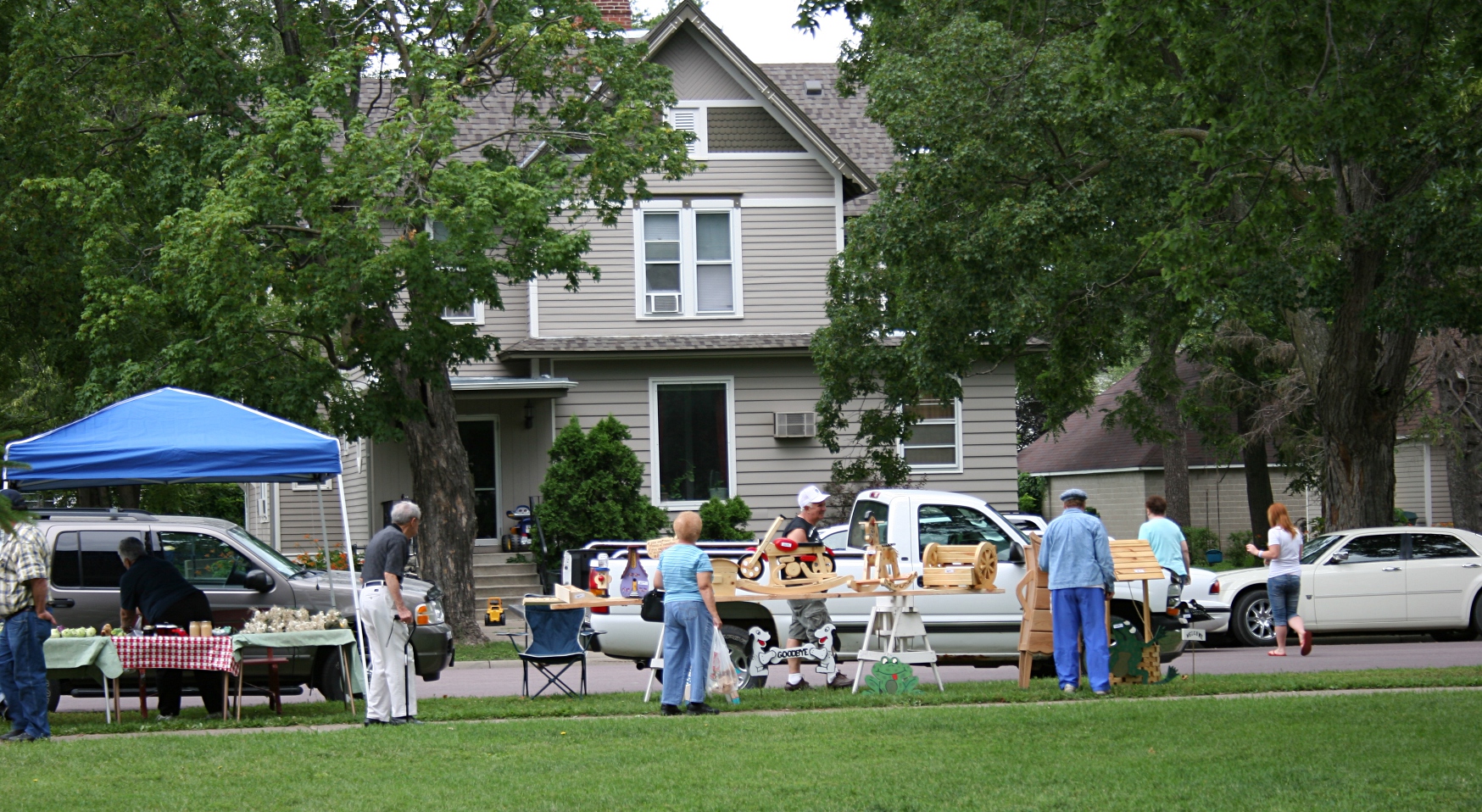
IT IS A PLACE of conversation and crafty creations, of canned garden goods and garden fresh produce, of homemade breads and muffins and sweet treats.

That, my friends, defines the Faribault Farmers’ Market in one swoop of a summary sentence.

Break that sentence down and you will meet Ken, the weaver; Bernie, the woodcrafter; Judy, the card maker; Sandi, the gardener; Denny, the candy maker; Rhonda, the crafter; Pat, the re-purposer of stuff; and many more vendors.

Bernie’s woodcrafted goods, right.

Saturday morning my husband and I shopped our local farmers’ market in Faribault’s Central Park because we appreciate these folks who work with their hands to bring us all that edible goodness, all those crafty creations, all those beautiful flowers and more.

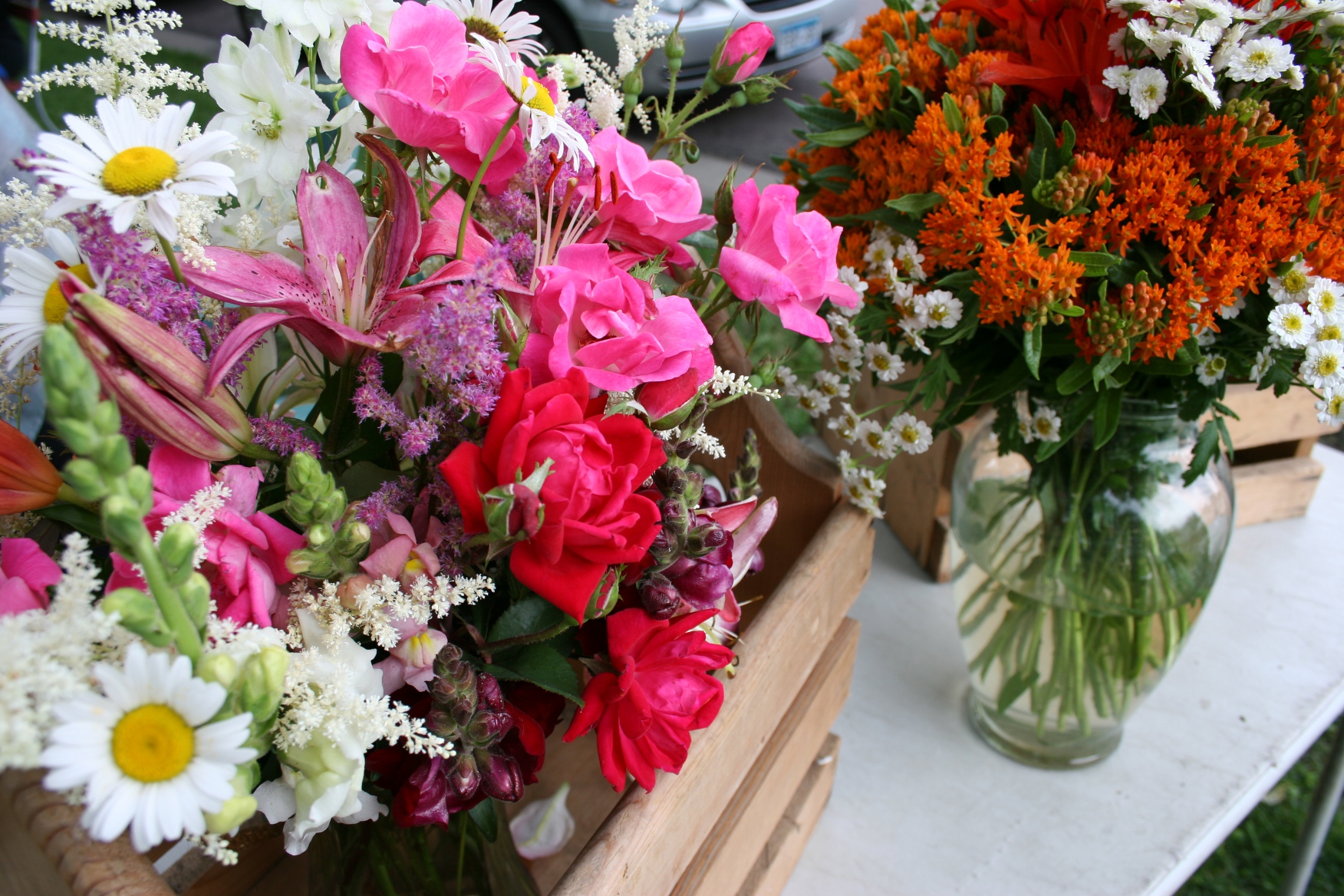
Sandi’s stunning Asiatic lilies.

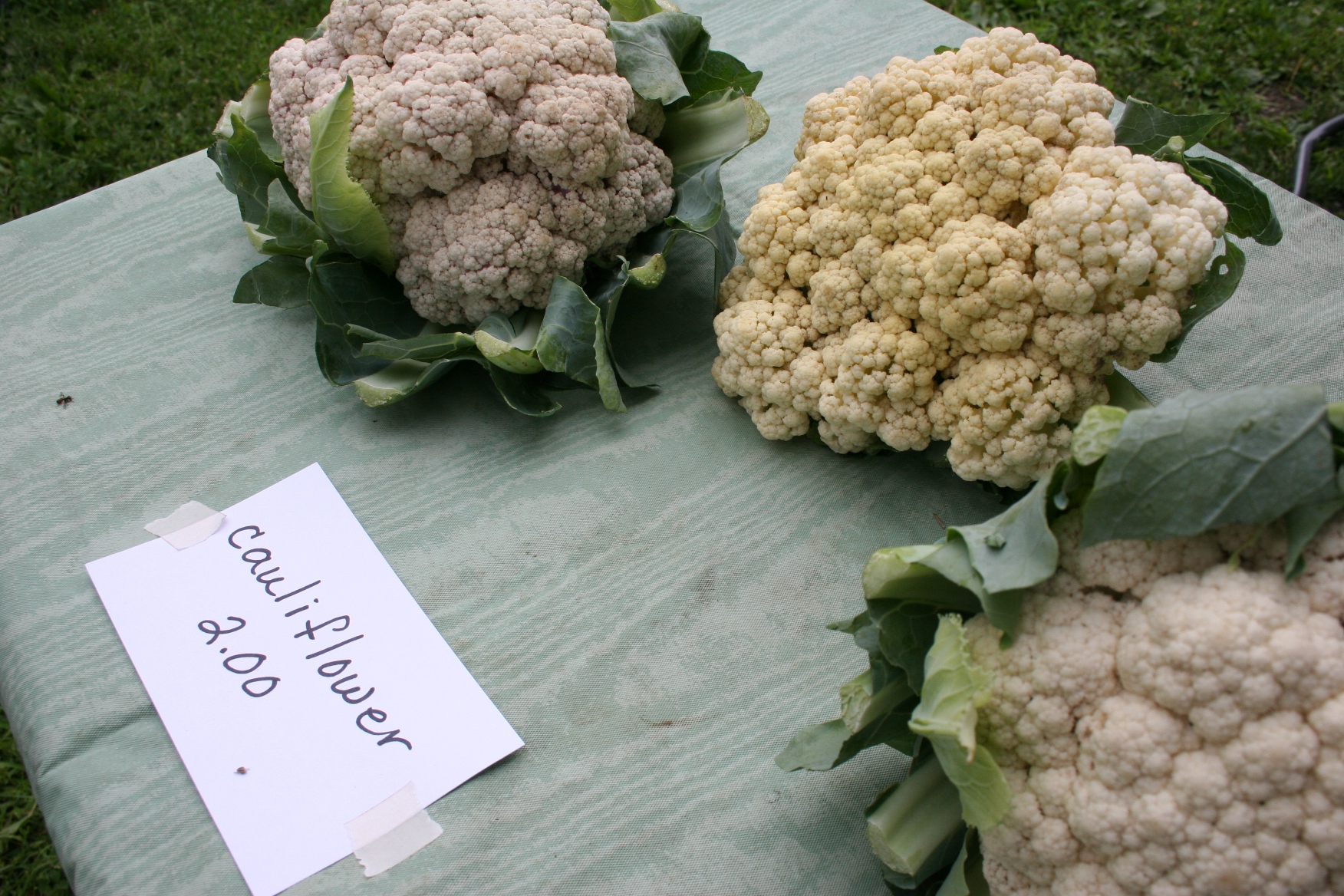
Cauliflower, from the chemical-free fields of a market vendor, in its natural, sun-exposed color.

More market flowers from a vendor who always sells beautiful, mixed bouquets.

We purchased Swiss chard, a bag of mixed green lettuce, red potatoes, cauliflower, a card to celebrate the birth of our new great nephew and four salted peanut bars, all for $12.25.

The red potatoes we purchased from Sandi, who planted her potatoes on April 13.

But the value of our shopping experience expands beyond our purchases. The value lies also in engaging with our community, with those who are our neighbors and friends and with those who become our friends through our conversations at the market.

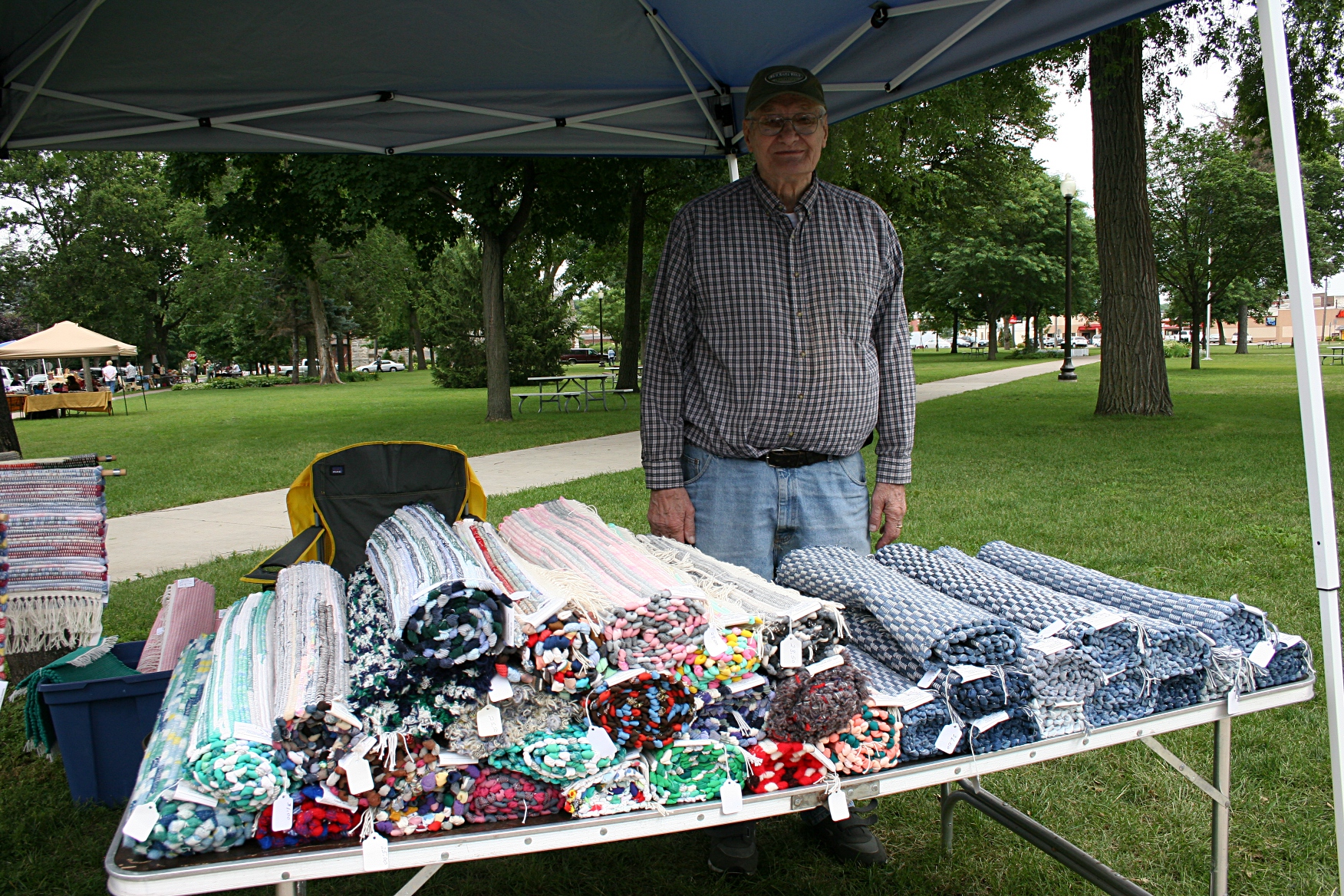
Ken of Wegner Weavers weaves these tightly woven, superb quality rugs, runners, placemats and coasters.

After chatting with Ken, the weaver, I was blessed with one of the nicest compliments I’ve ever received. Ken didn’t know me except as an occasional shopper. But he told me how much he enjoyed our visit, that I spoke in a comforting way. And, you know, I nearly cried for the unsolicited kindness of the weaver’s words weaving into my heart.

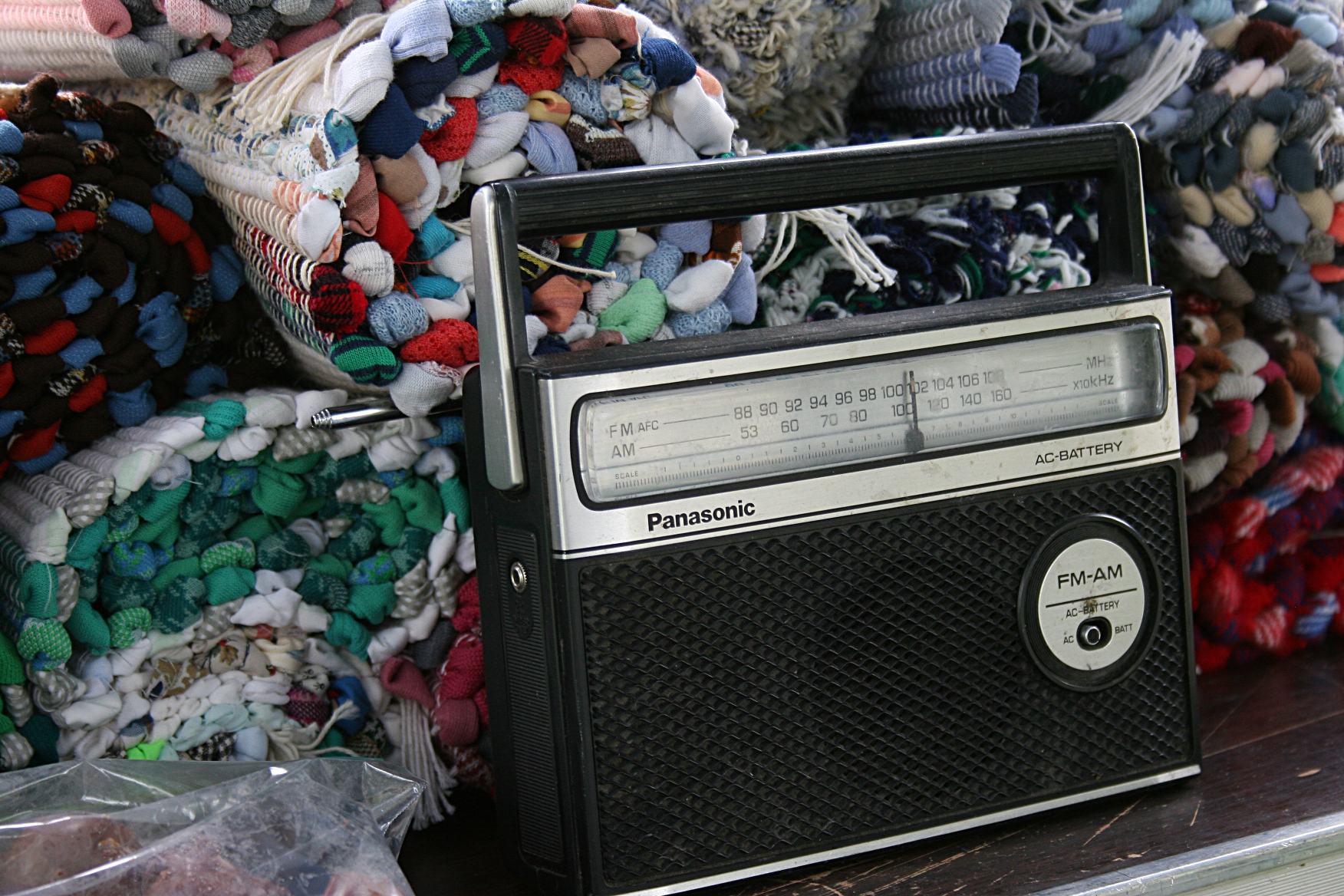
The vintage portable radio Ken, the weaver, brings with him to the market. In my opinion, Ken doesn’t need a radio; he makes music with his words. He says he doesn’t play the radio often as it can detract from business.

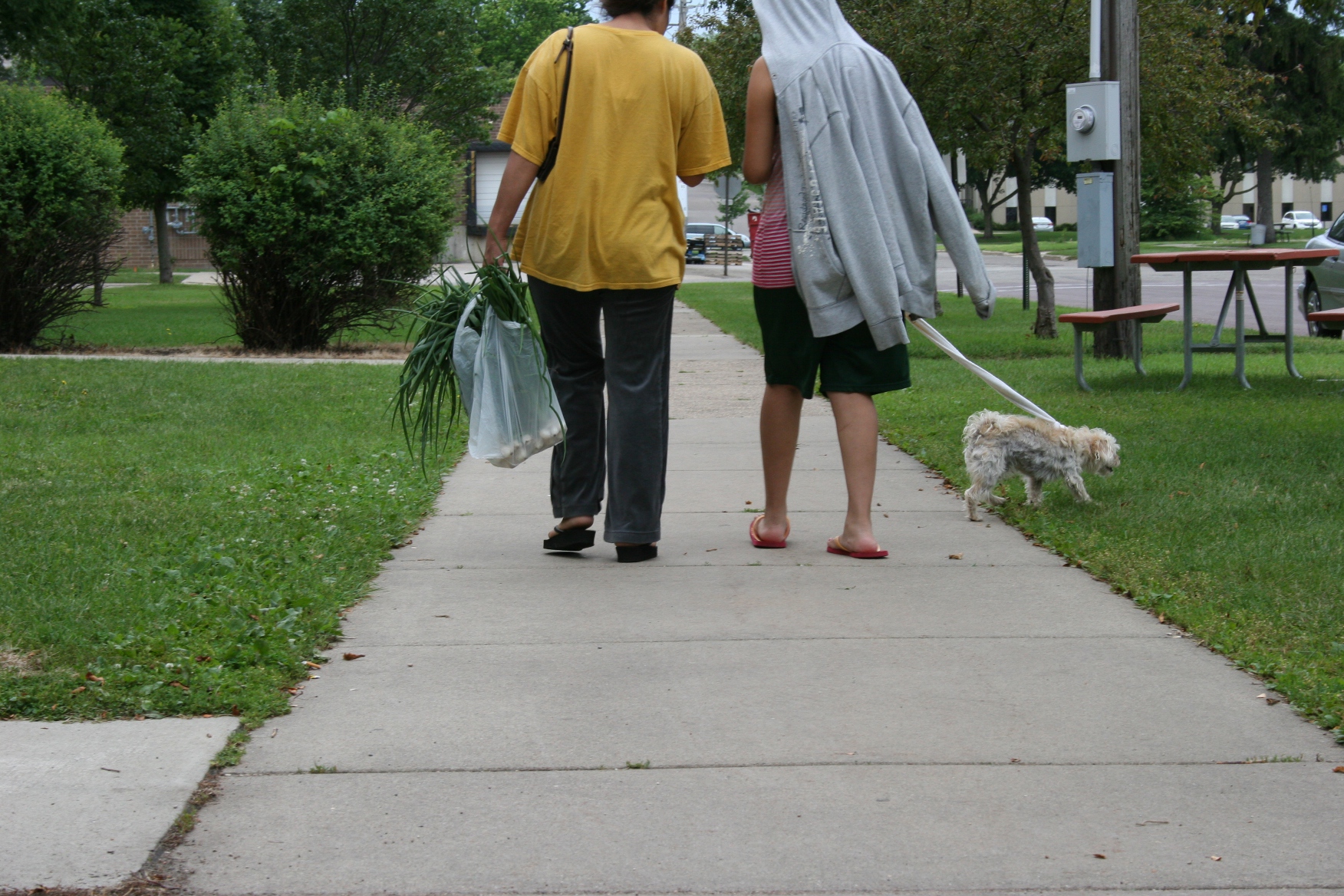
Satisfied customers leave the market with fresh onions.

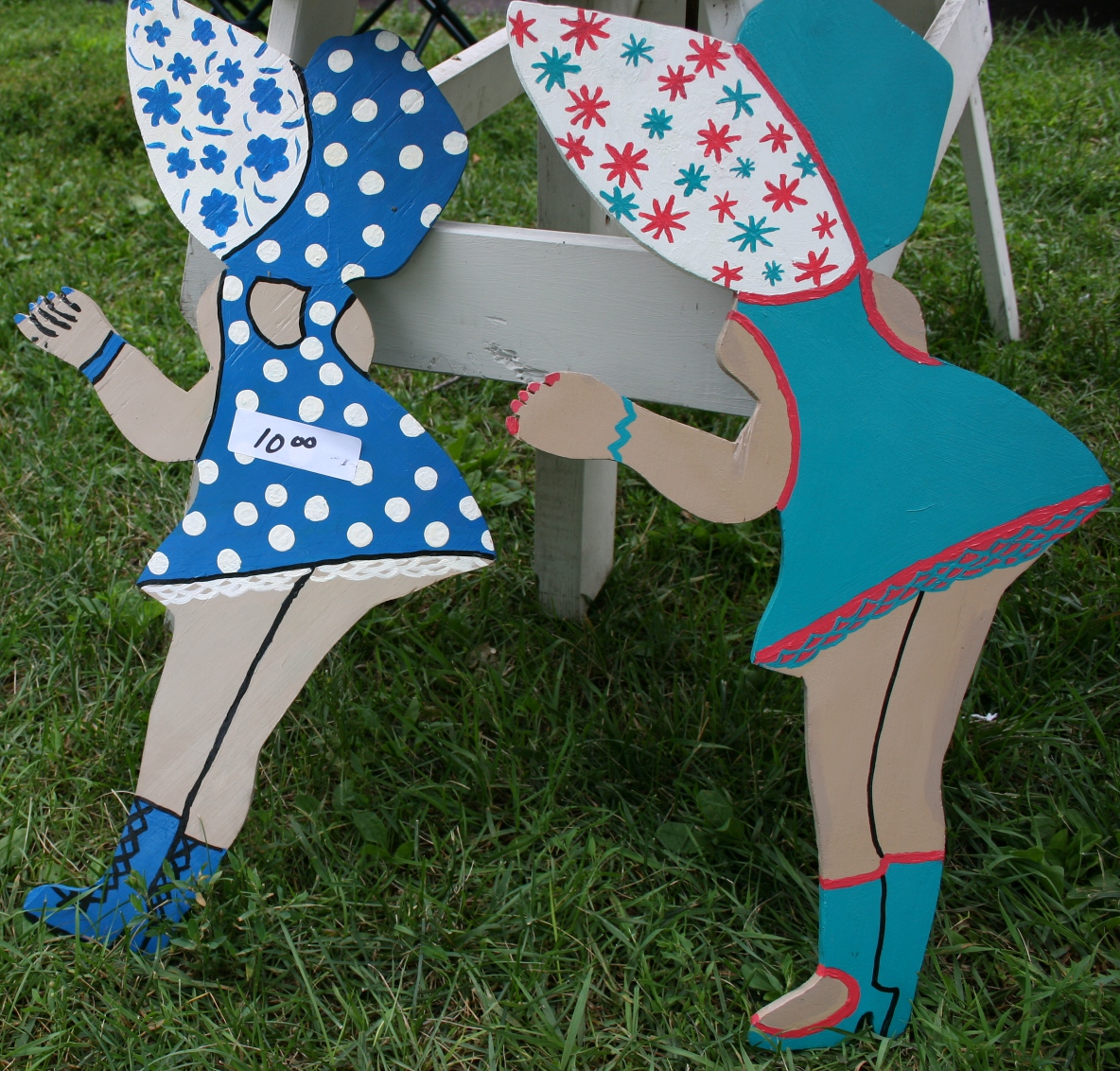
Bernie’s kitschy yard art.

FYI: The Faribault Farmers’ Market is open from 7 a.m. – noon on Saturdays. Beginning on July 11, it will also be open from 1:30 p.m. – 5 p.m. Wednesdays.

© Copyright 2012 Audrey Kletscher Helbling
 

A close-up look at a Midsommar celebration June 25, 2012

Filed under: Uncategorized — Audrey Kletscher Helbling @ 11:50 AM
Tags: , , , , , , ,

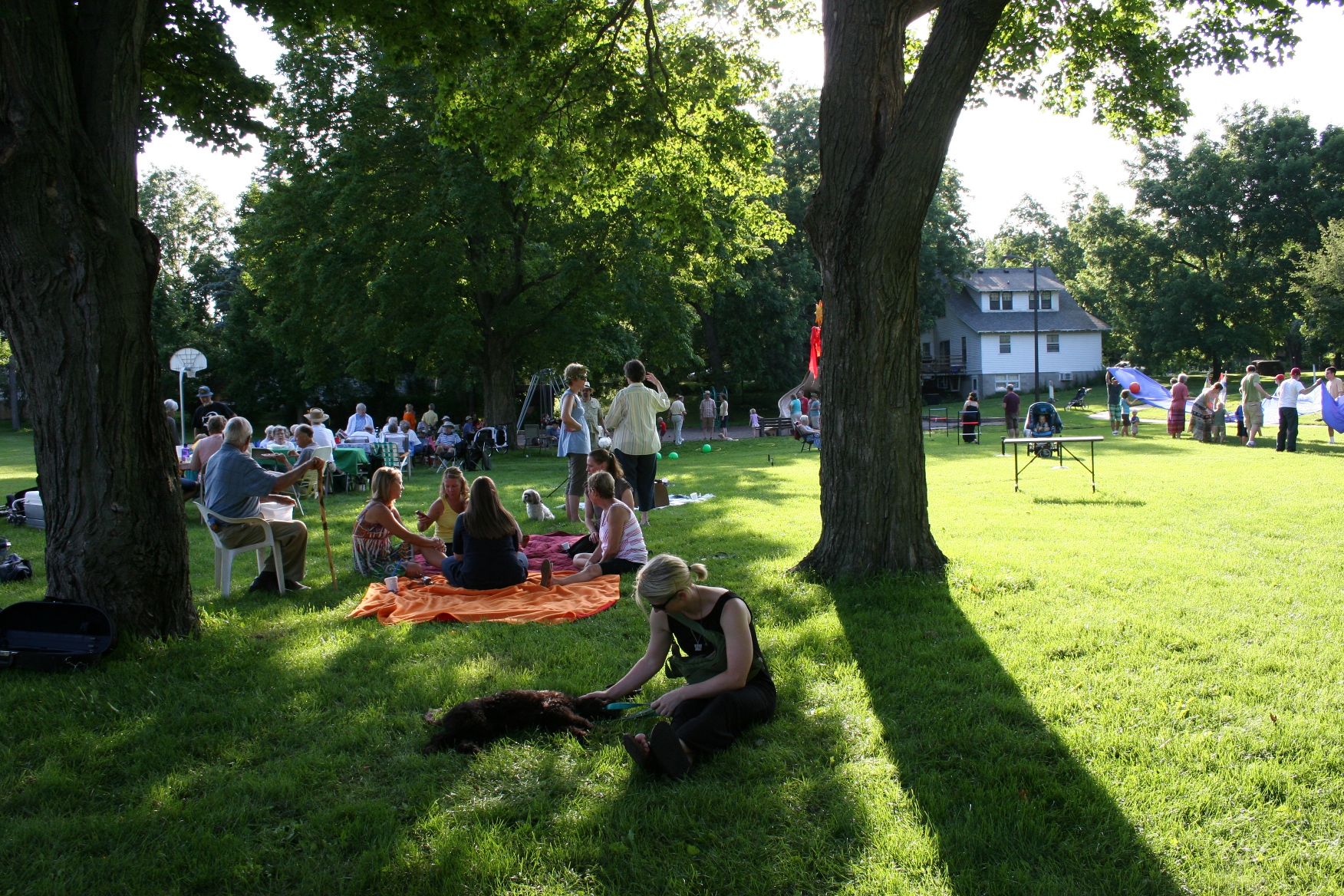
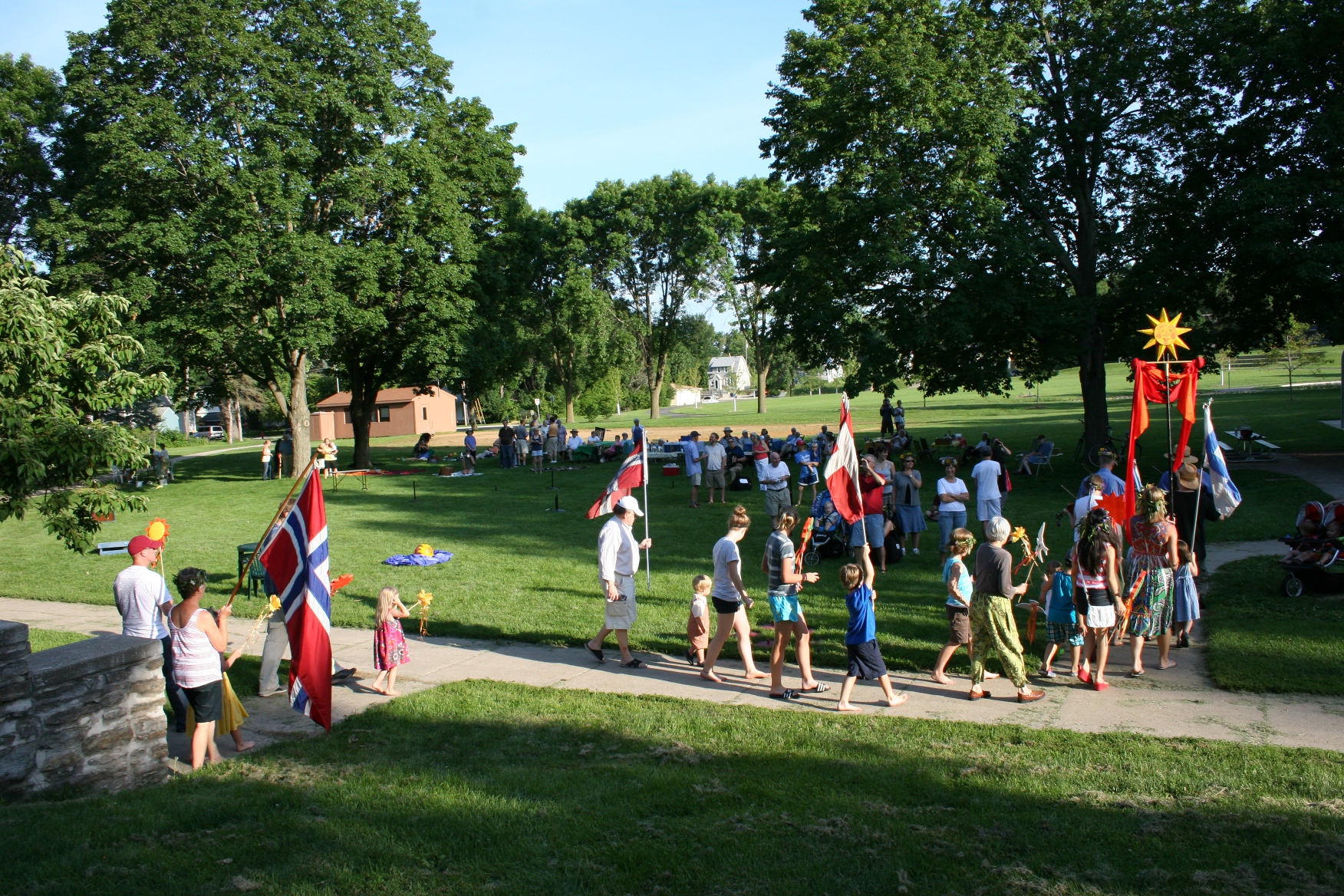
Picnicking, playing and celebrating in Way Park, Northfield, Minnesota, on Sunday evening.

WHEN YOU VIEW THIS SCENE, what do you see?

A bunch of people in a park on a summer evening, right?

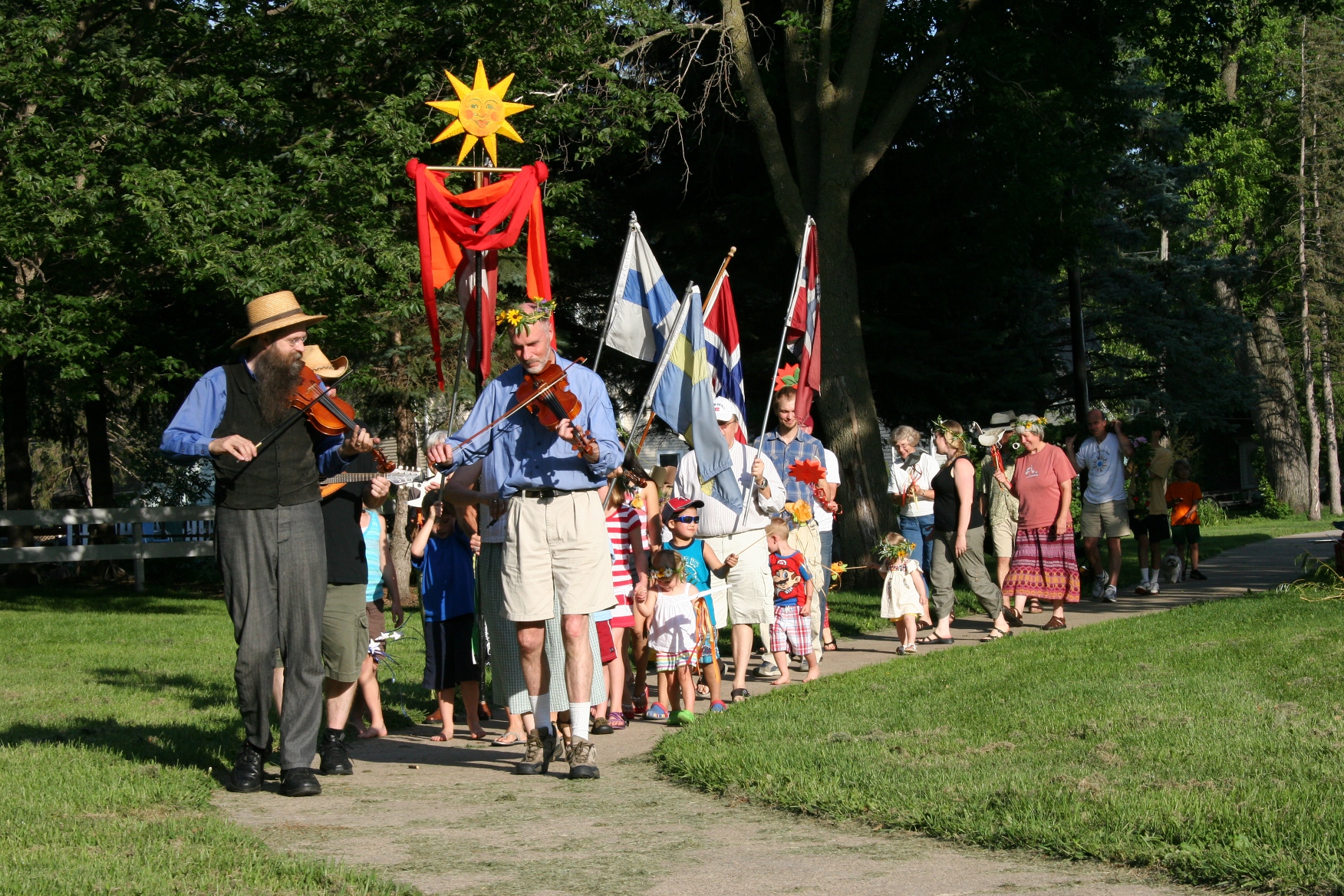
A procession of celebrants parade toward a center area where a maypole will be placed and dancing will follow.

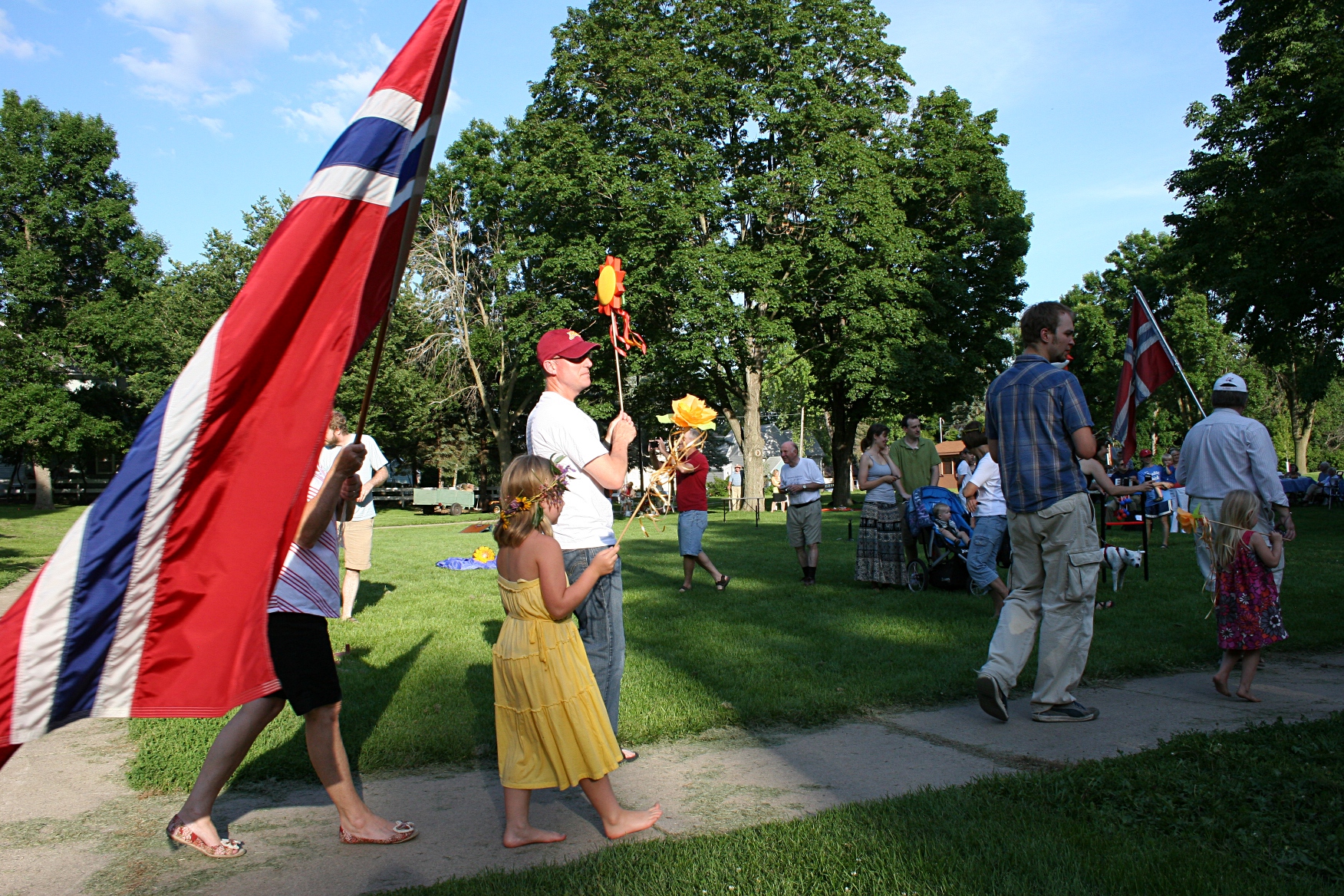
Here’s another photo from the same park, same June Sunday evening. But this is different. You notice flags and other festive details in what appears to be an organized parade.

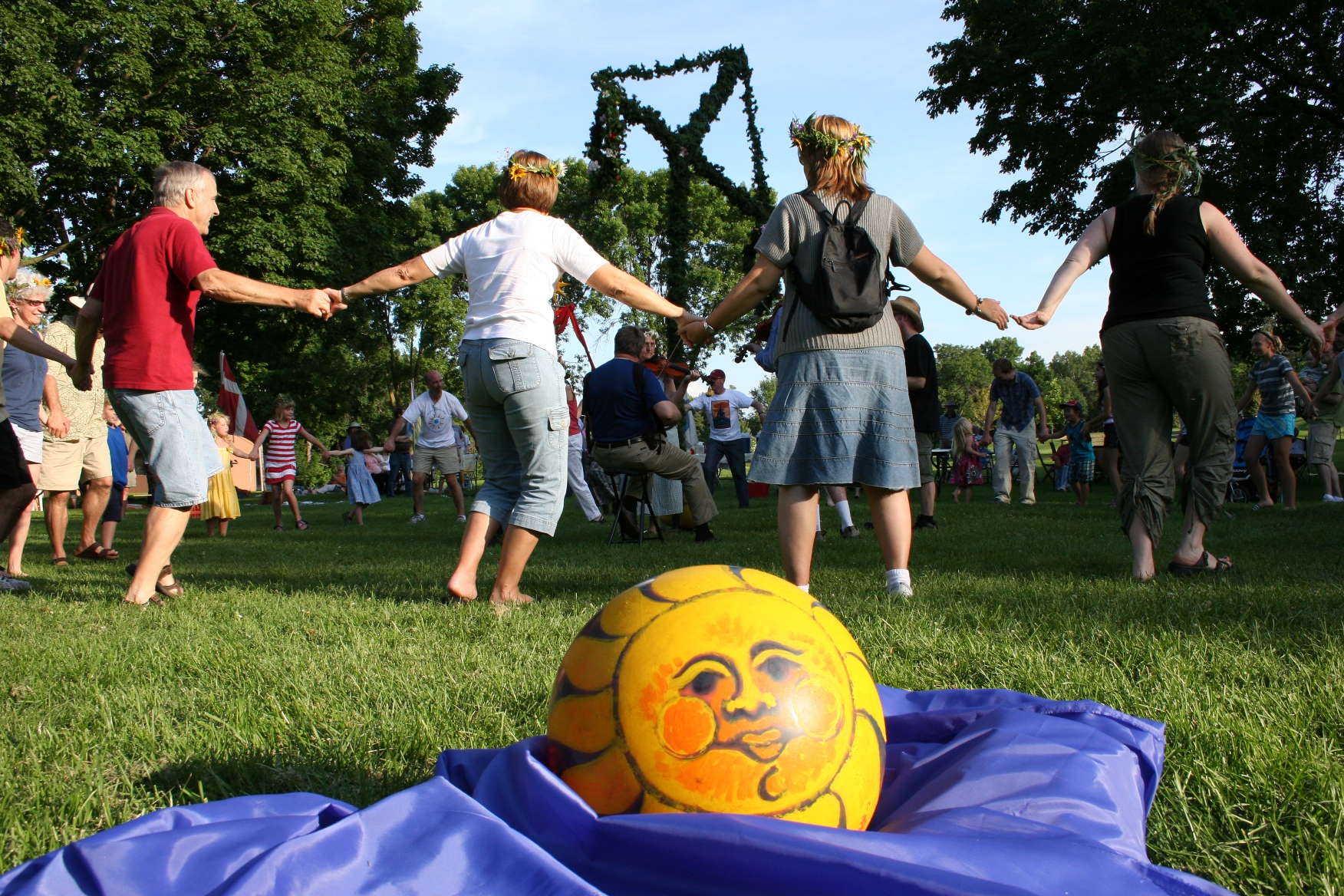
And you would be right. Both photos were taken at the annual Scandinavian Midsommar celebration at Way Park in Northfield and hosted by Friends of Way Park, the Northfield Swedish Club and Sons of Norway. That second image shows a parade leading up to dancing around a maypole.

It’s easy, when a mass of people gather like this, to miss the details. But it is the details which define our lives, our personalities, our days, or celebrations.

I looked for those details at Northfield’s Midsommar fest and, as always, delight in sharing my photographic observations with you.

I’d encourage you, always, to see and appreciate the details in life whether you’re Scandinavian, German, Latino or any heritage in between.

The Norwegian flag had a prominent place in the parade.

It took several good men to carry the maypole to the center of the festivities.

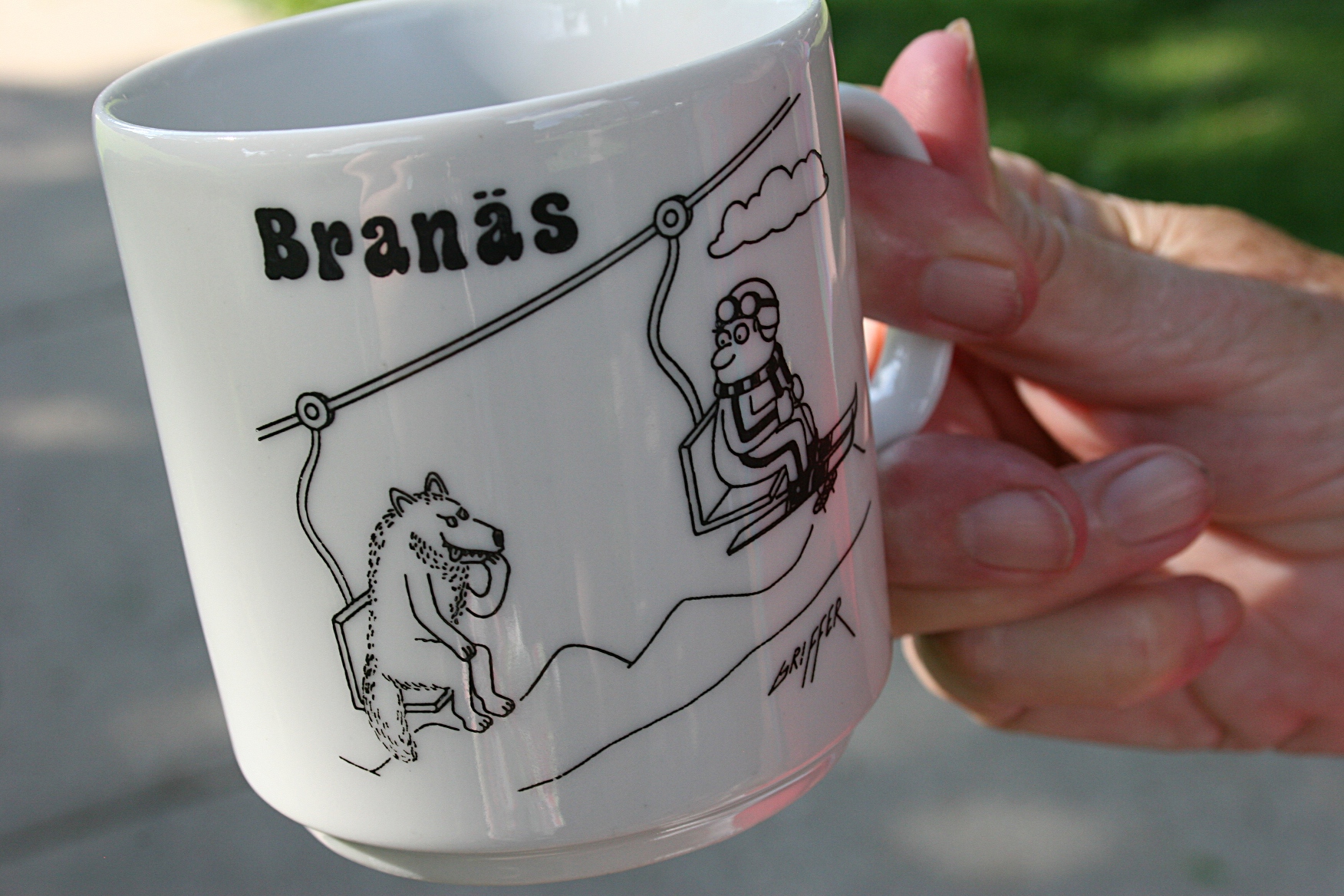
Lola, who is 100 percent Swedish, brought a mug from her ancestral home of Branas, filled it with coffee and munched on Krumkake (a Swedish sweet treat). Branas is a well-known ski area.

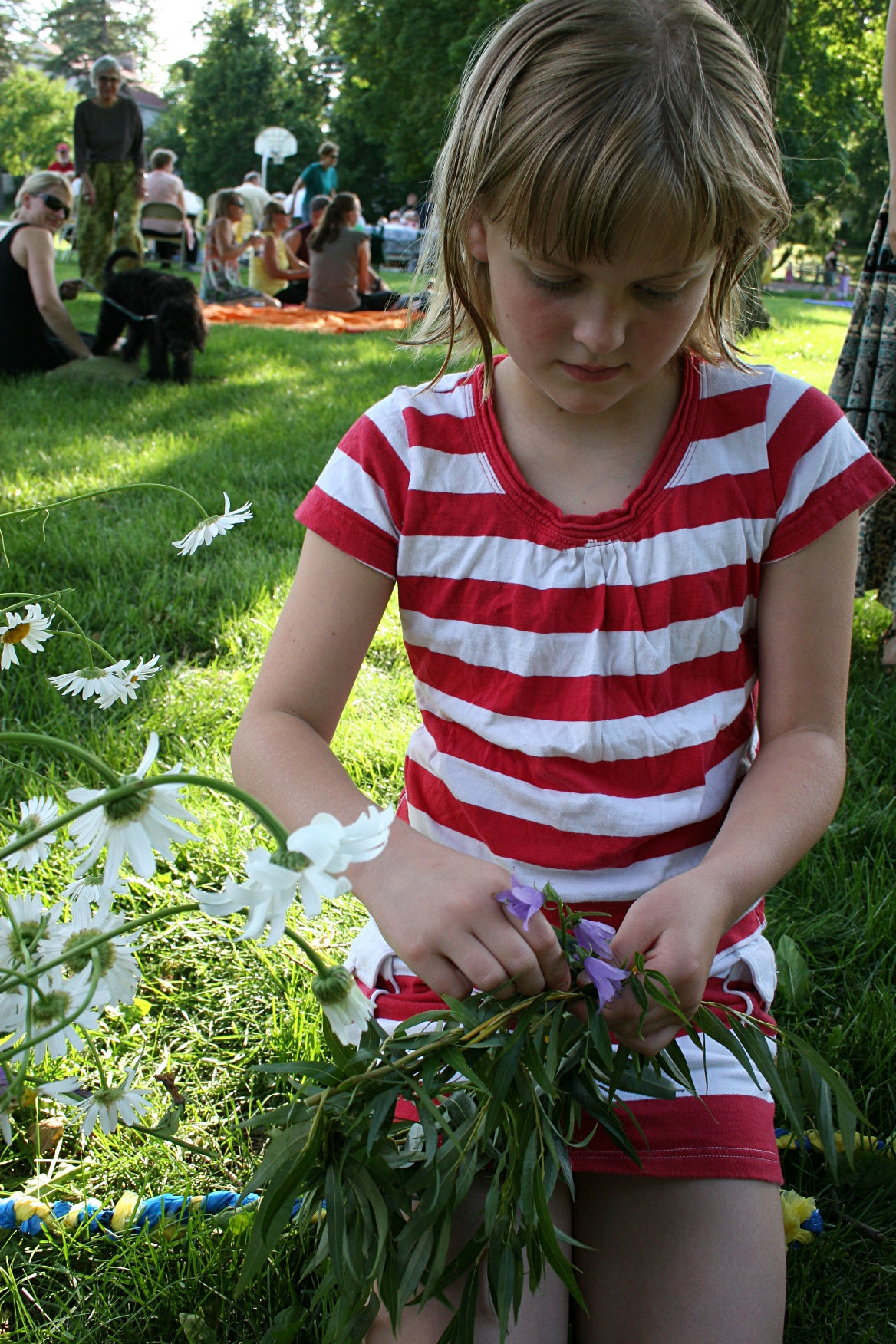
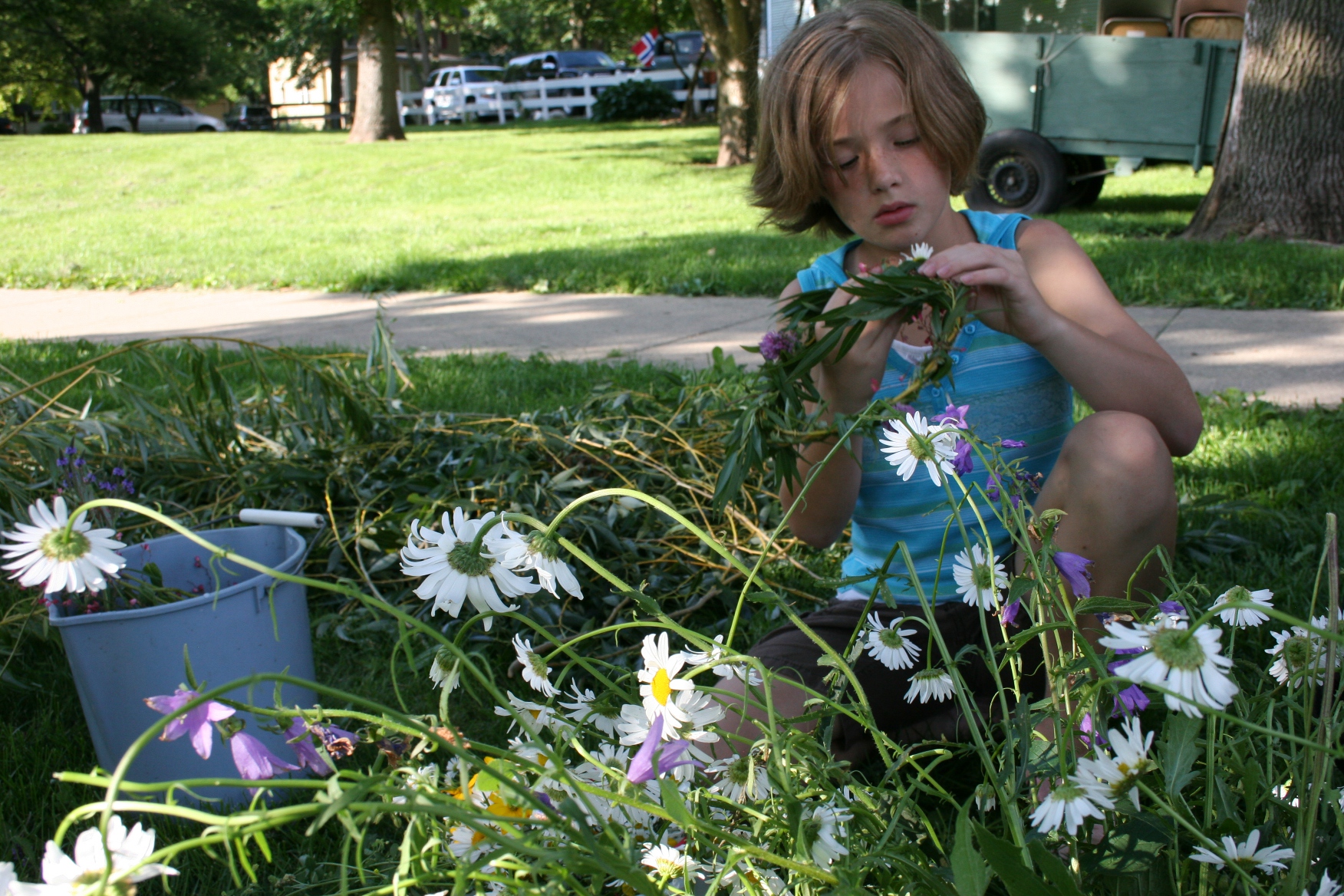
Weaving wreaths from willow and flowers proved a popular activity.

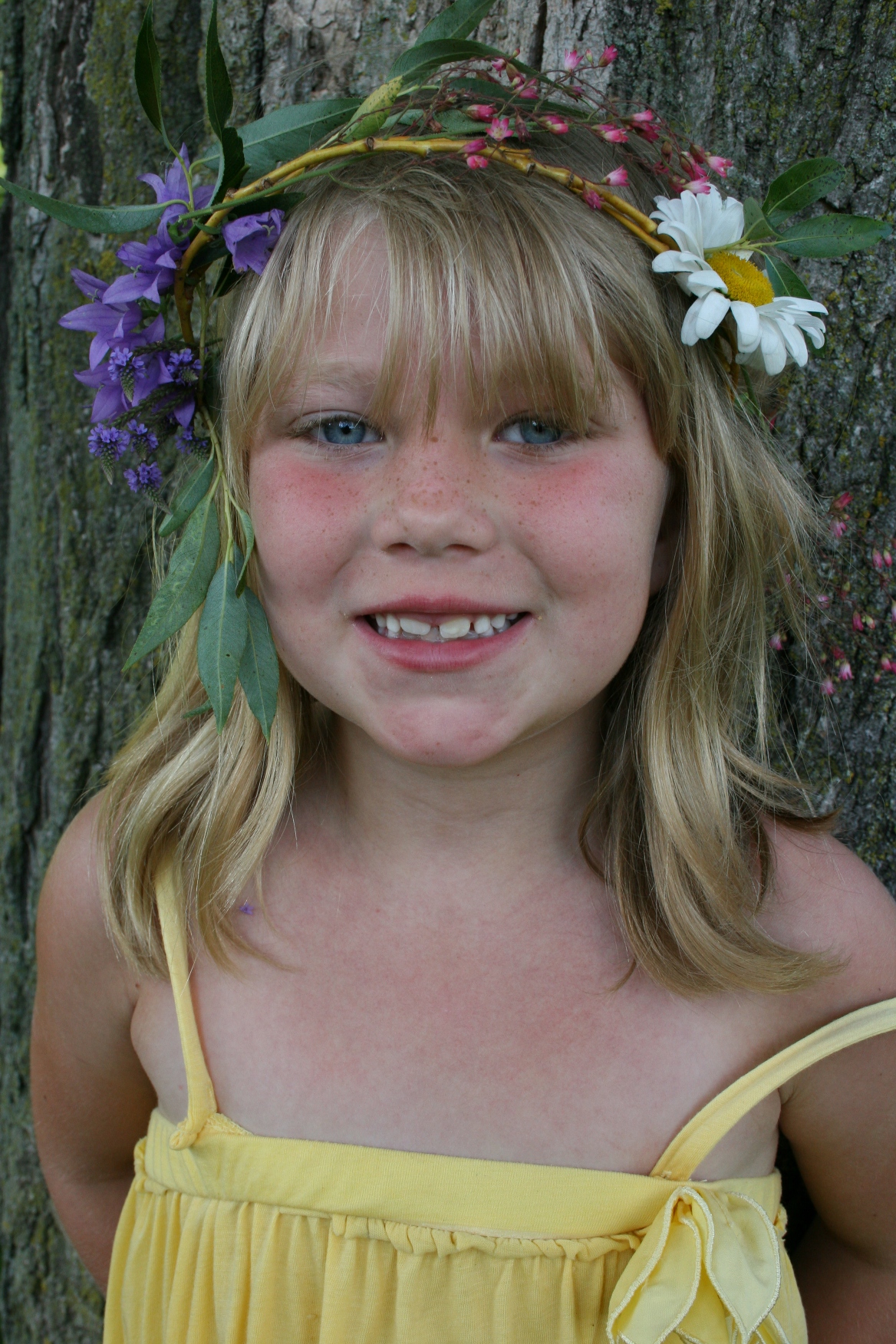
Seven-year-old Jordyn, who is part Scandinavian, part German, posed for photos after finishing her floral wreath.

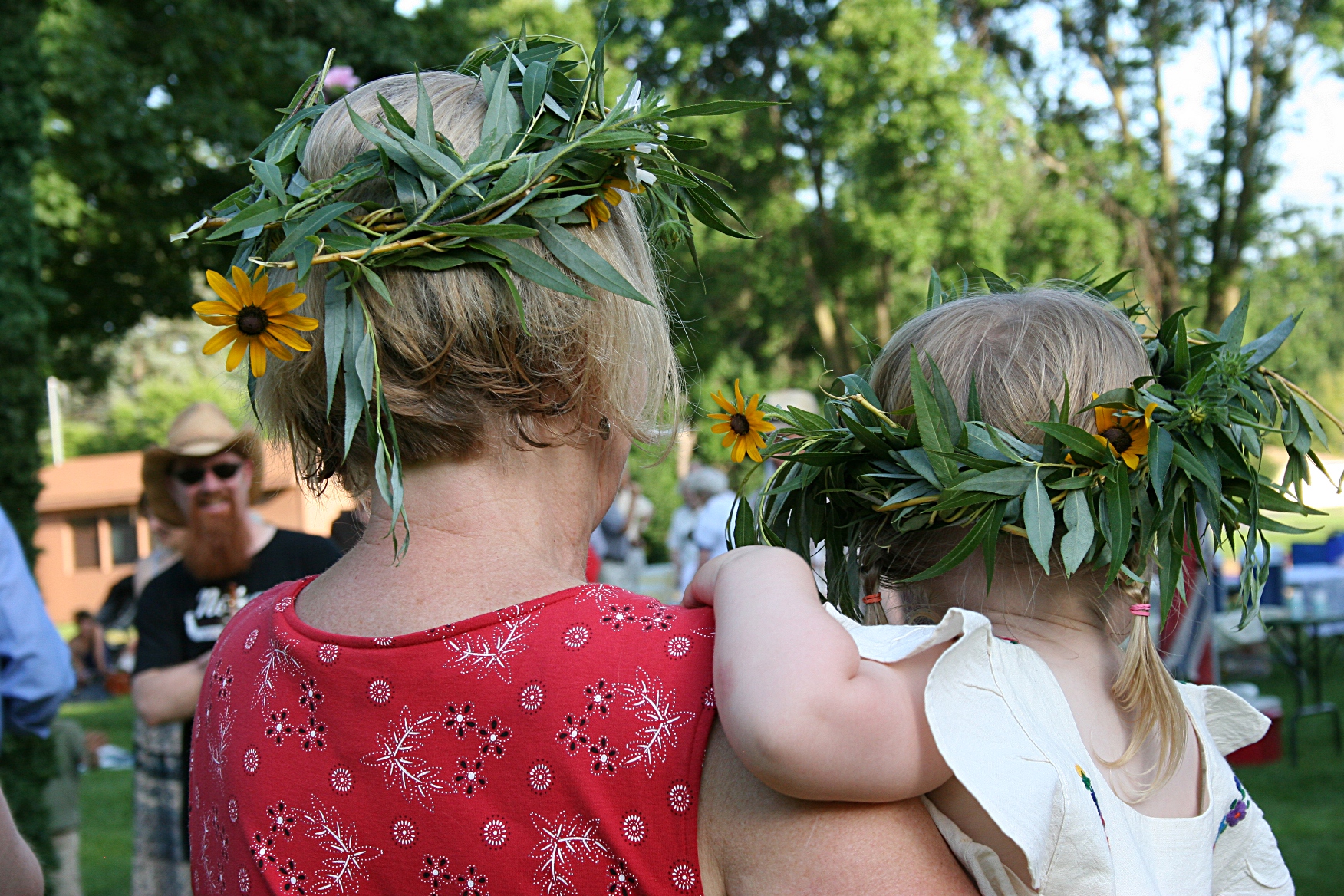
Bella, 10, tries on the wreath she just crafted.

Grace, 9, creates a celebratory head wreath.

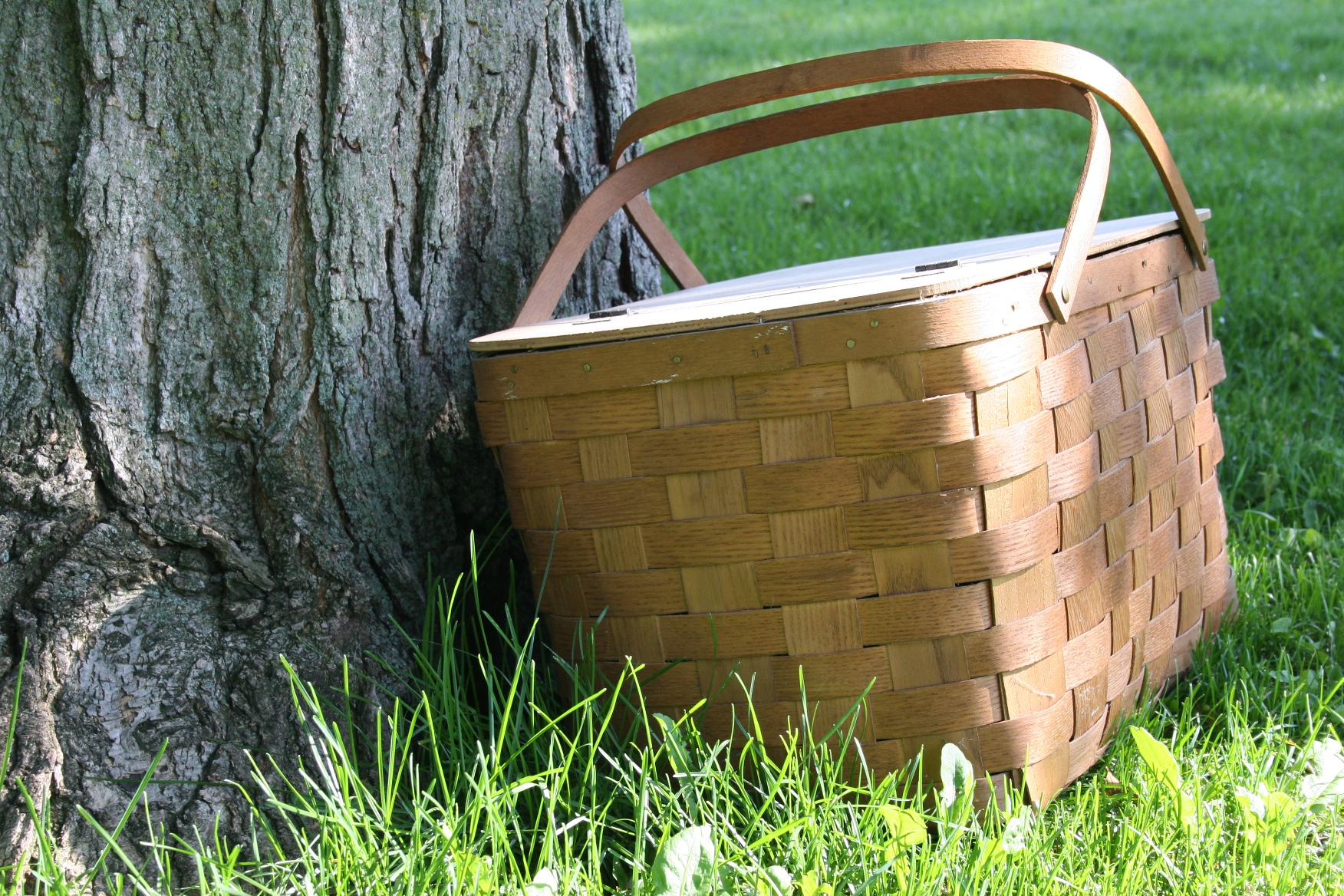
Midsommar celebrants arrived at Way Park with picnic baskets.

They arrived by bike and foot and in vehicles, proud of their heritage, as noted by this Norwegian flag on a bike trailer.

Even the old-fashioned wooden folding chairs had a Scandinavian connection. They were, I was informed, the chairs upon which attendees of the early St. Olaf College (a Northfiled college with a Norwegian heritage) Christmas concerts sat.

Wreaths and Midsommar, for all ages.

CLICK HERE to read an earlier blog post about Midsommar in Northfield.

© Copyright 2012 Audrey Kletscher Helbling


Welcoming summer at the Scandinavian Midsommar celebration in Northfield June 24, 2012

Filed under: Uncategorized — Audrey Kletscher Helbling @ 10:38 PM
Tags: , , , , , , ,

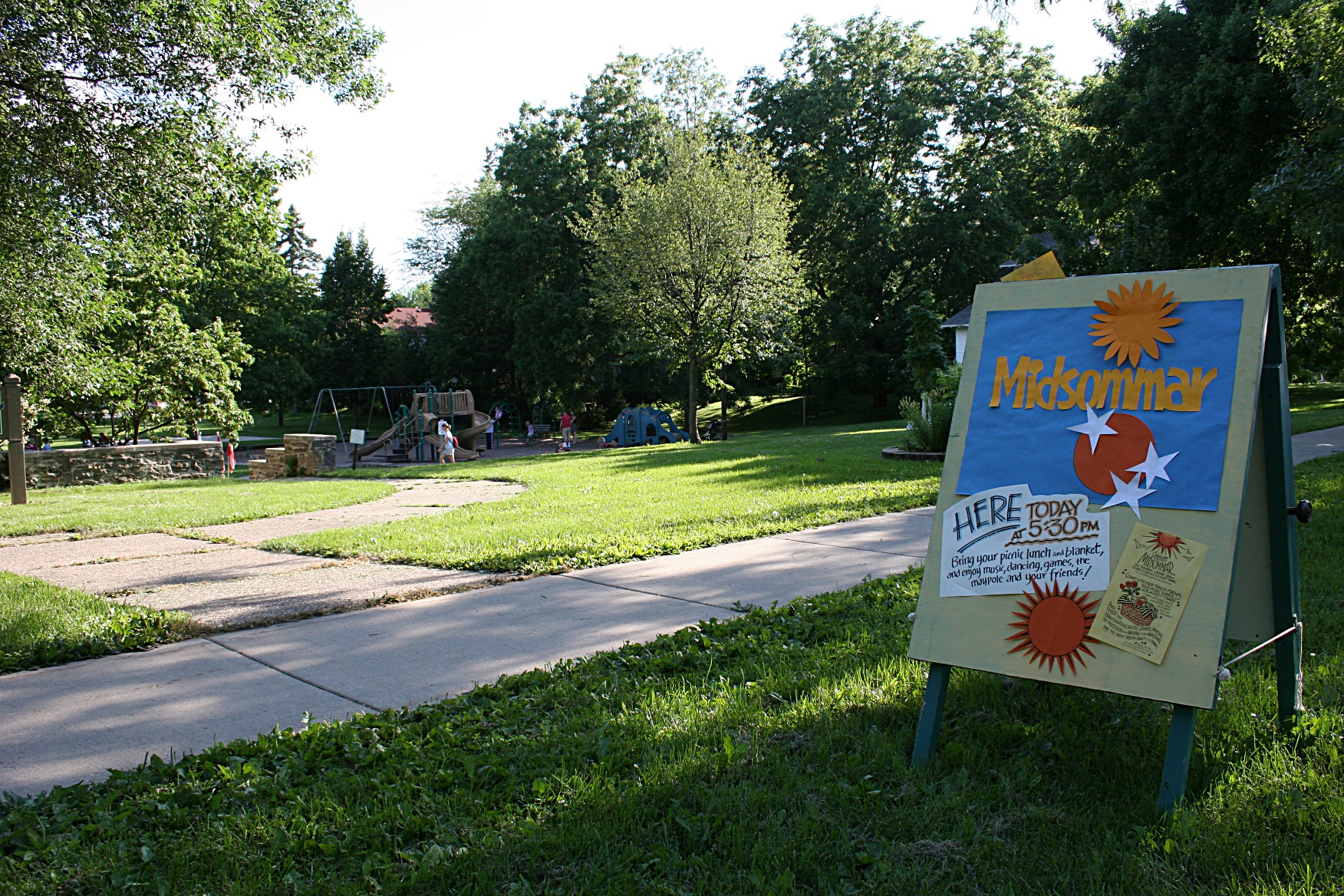
A sign welcomes visitors to the annual Scandinavian Midsommar celebration at Way Park on Northfield’s west side. The event has been going on here for about 20 years, following the Scandinavian tradition of celebrating the end of a long winter and the beginning of summer, typically on the day of the summer solstice.

THE SCANDINAVIANS (and non-Scandinavians) of Northfield (and elsewhere) welcomed summer to this southeastern Minnesota city with music and dance, games and picnic dinners on a perfect Sunday summer evening in Way Park.

Being 100 percent German and all, I’d never witnessed the tradition of celebrating the summer solstice.

Perhaps you haven’t either.

So join me for the festivities via this photo essay. Feel the hint of a summer breeze. Listen to the music singing from violins and accordions. Weave wisps of willows into wreaths accented by blossoms of daisies and clover, bee balm and coral bells.

Bite into a slice of juicy watermelon or a traditional Scandinavian open-faced sandwich.

Feel the anticipation of young and old alike as they line up to parade around the park, up and down the steps to cluster around the maypole.

Pick up your feet and dance. Dance away the memories of winter as you welcome summer.

The Midsommar parade, led by musicians, begins around the north end of Way Park.

Dancing around the maypole with a sun ball, from an earlier game, resting nearby.

For those who didn’t know the dances, instructions were printed on poster board.

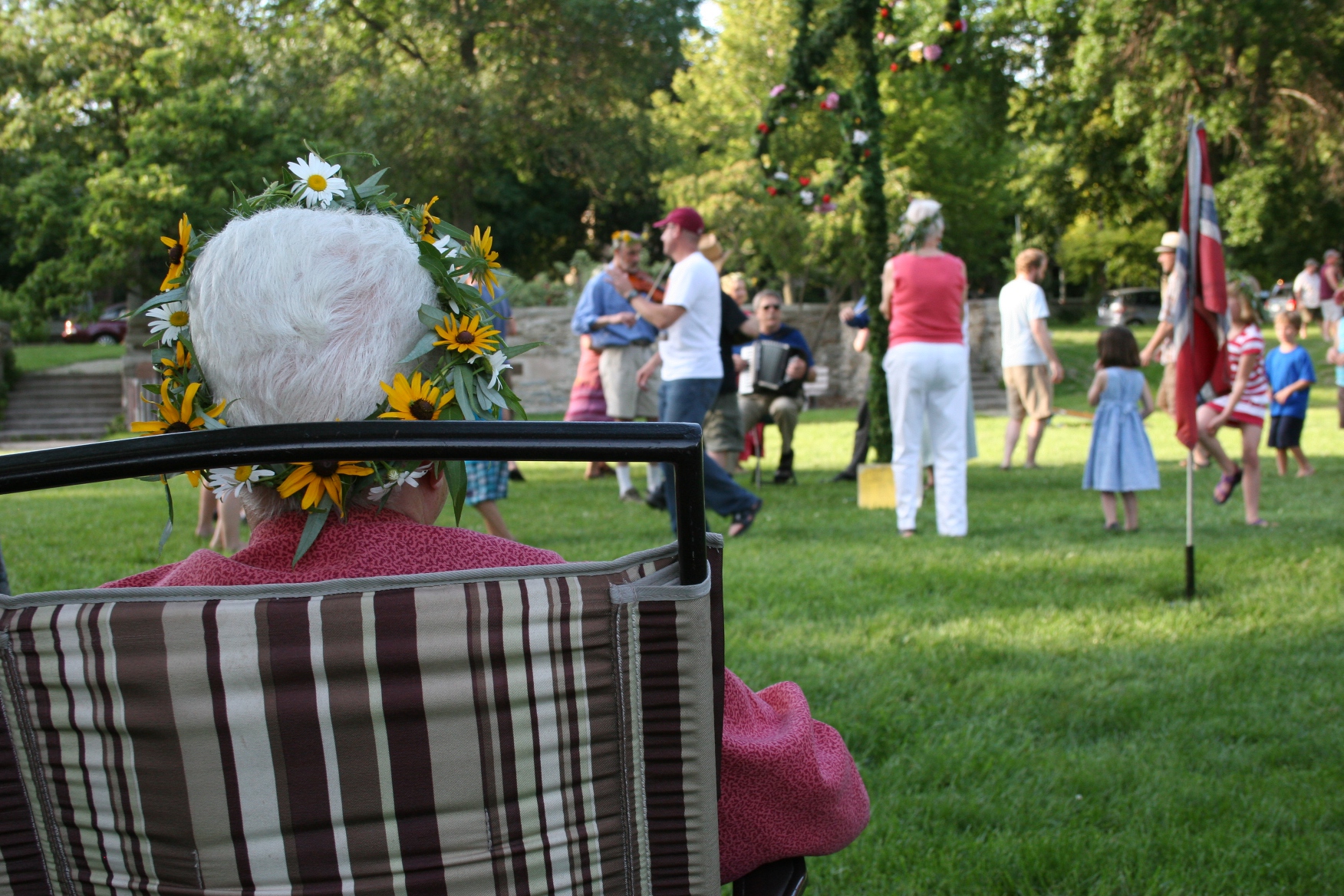
Those who can no longer dance simply watched and enjoyed.

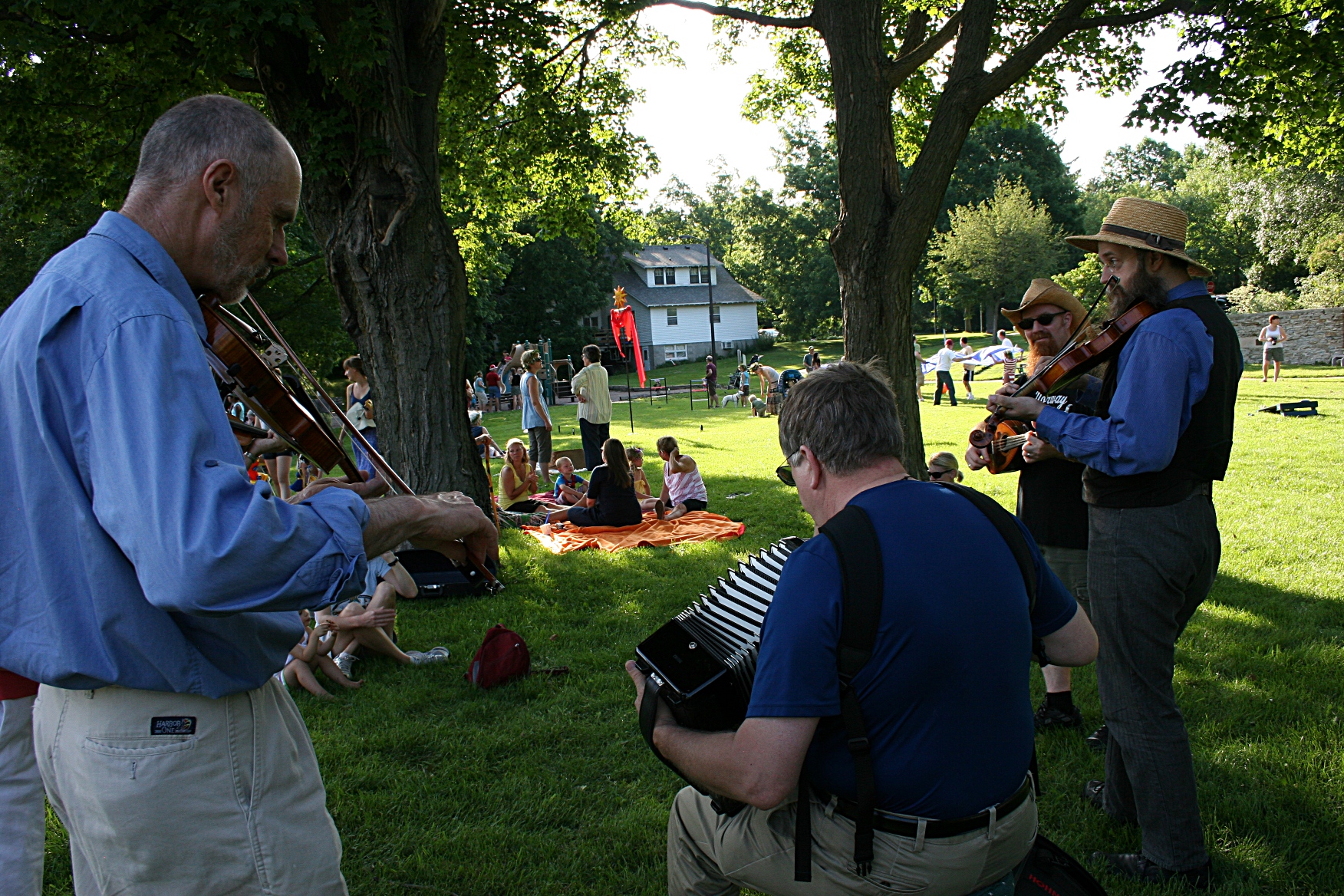
Before the dancing, the musicians gathered under shade trees to entertain the crowd that dined and made wreaths, visited…

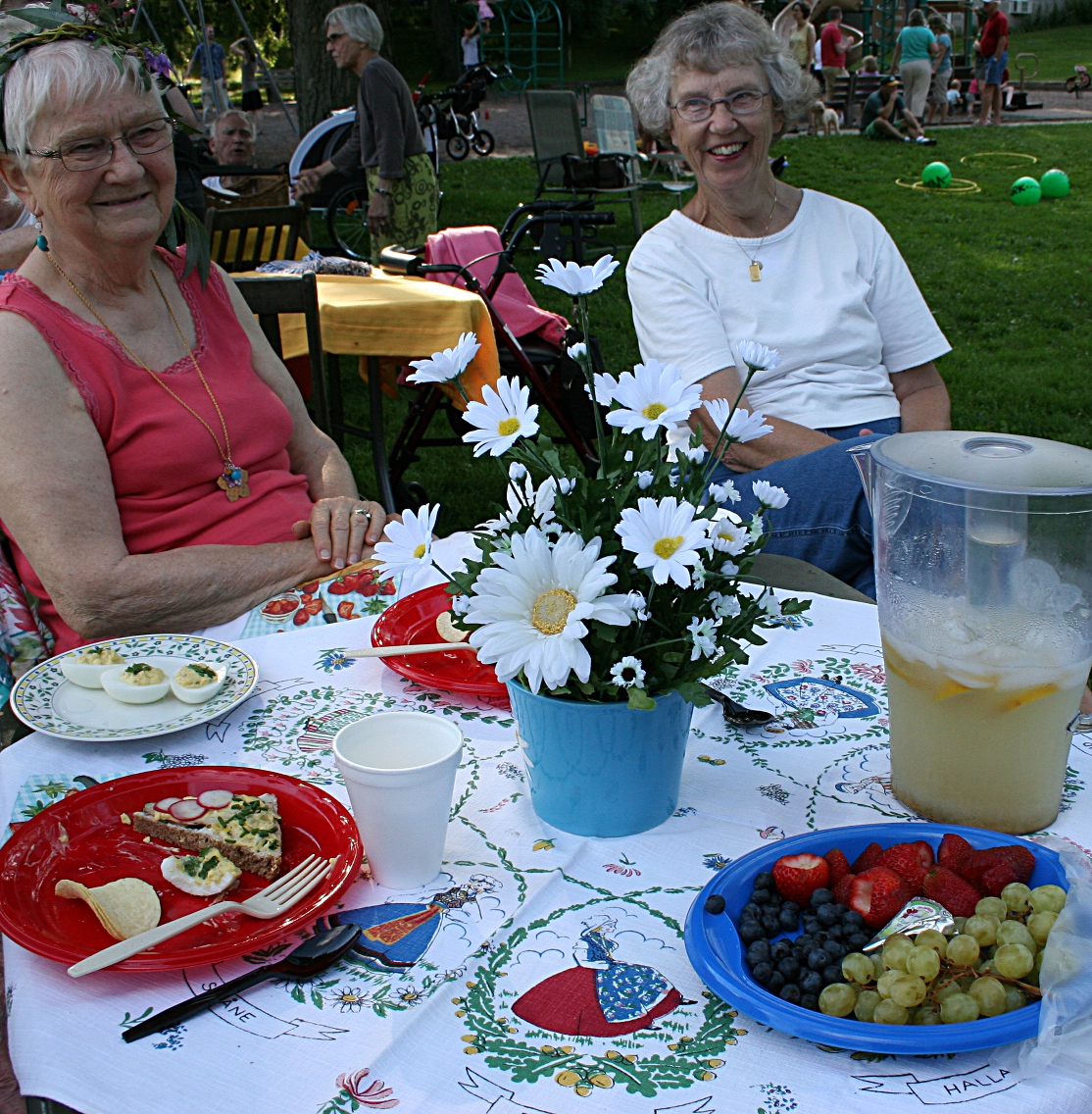
Eleanor Croone, left, and her husband, Al, brought a picnic lunch and spread it out on an authentic Swedish tablecloth accented by a daisy bouquet. They are, says, Al, 127 percent Swedish. The Swedes, he says, just pull off the road for picnics. Eleanor has an authentic Swedish costume but, since it’s made of wool, can’t wear it on a warm summer evening.

Ten-year-old Bella weaves a wreath for her head with willows and flowers.

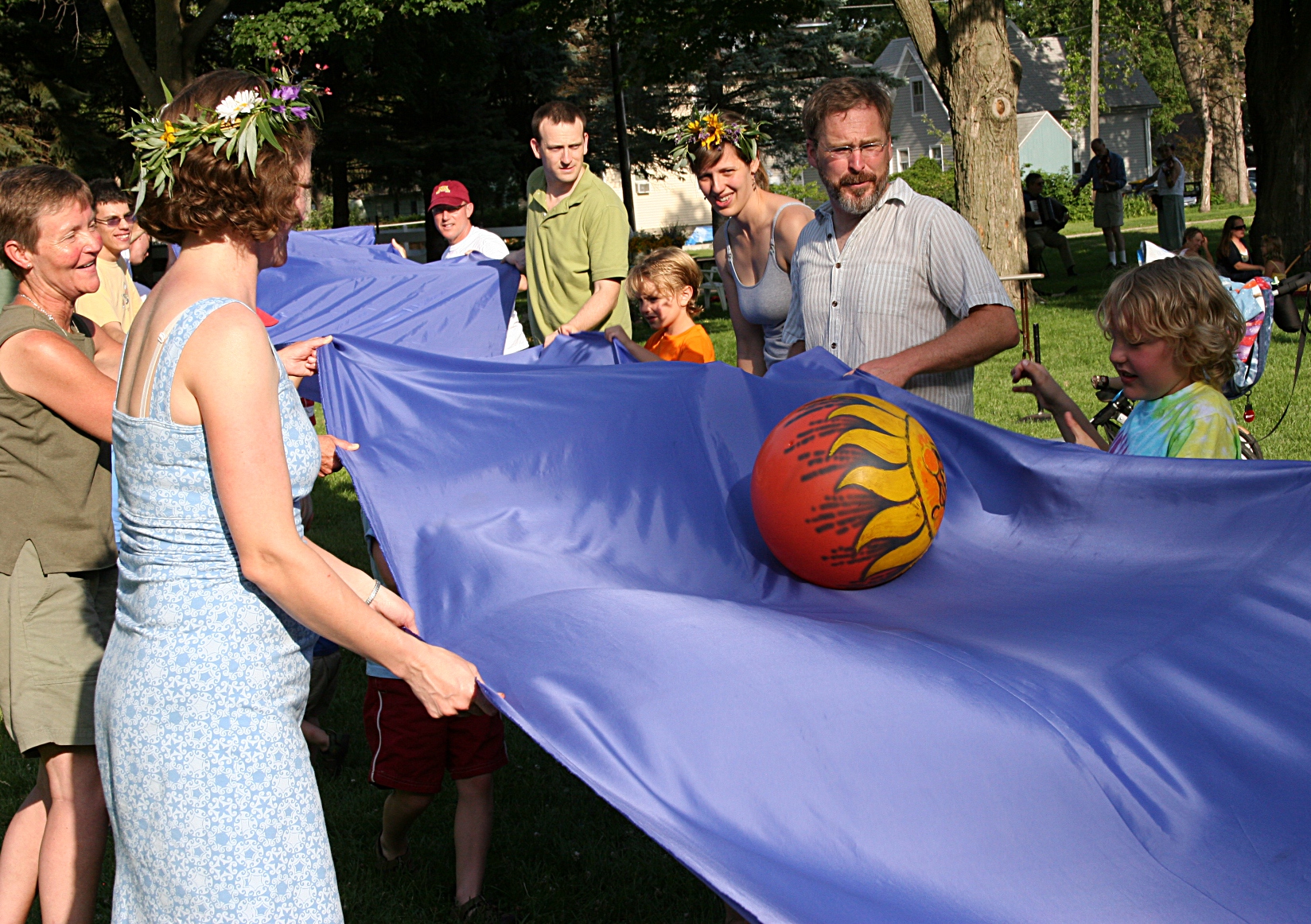
Adults and kids try to keep “the sun” in the sky as they celebrate the summer solstice, several days after the fact.

CHECK BACK for more photos of the annual Scandinavian Midsommar celebration in Northfield.

© Copyright 2012 Audrey Kletscher Helbling
 

Why we attended Bike Night in Moorhead instead of an art walk in Fargo June 22, 2012

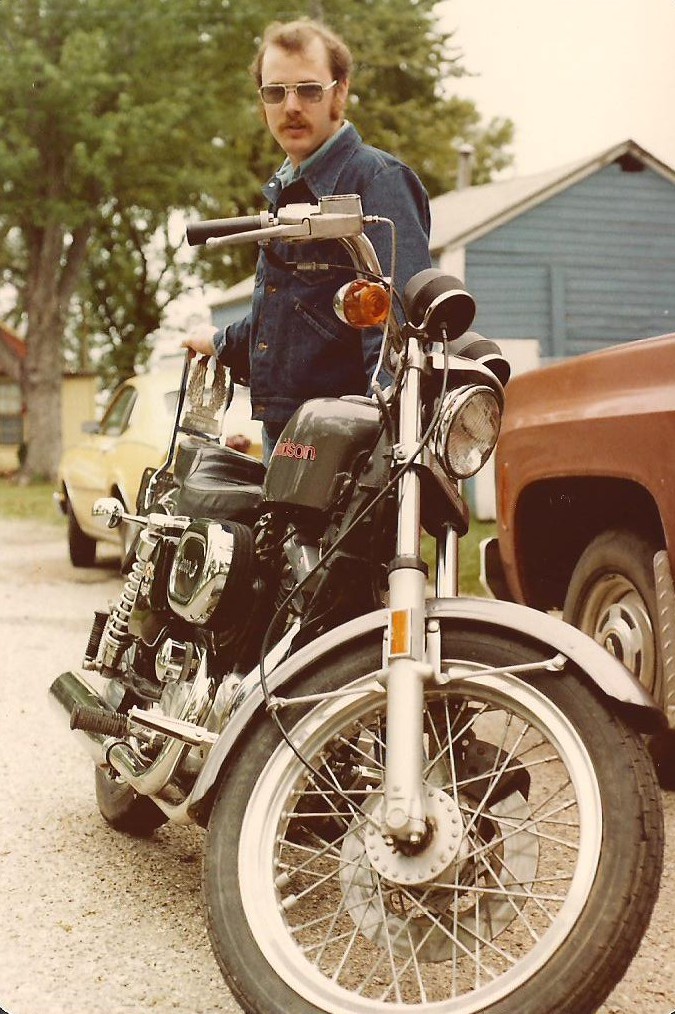
Randy with his 1977 Harley Davidson Sportster in the summer on 1981.

I’M NO BIKER CHICK or Motorcycle Mama.

But my husband, well, once a Harley guy, always a Harley guy. Randy hasn’t owned a bike, though, for 15 years. On a mid-June morning in 1997, a teen driver plowed his car into my spouse’s 1977 Sportster on a Northfield city street. Randy landed on his tailbone in the roadway and was transported by ambulance to the hospital. He experienced severe bruising, soreness and back pain for quite awhile, but suffered no other apparent injuries.

The insurance company totaled the Sportster.

Ever since then, Randy has longed for a replacement Harley. But finances and my worries have kept him bike-less. The 1997 accident marked his second bike incident. Previously Randy laid his Harley down on a Faribault highway to avoid a collision.

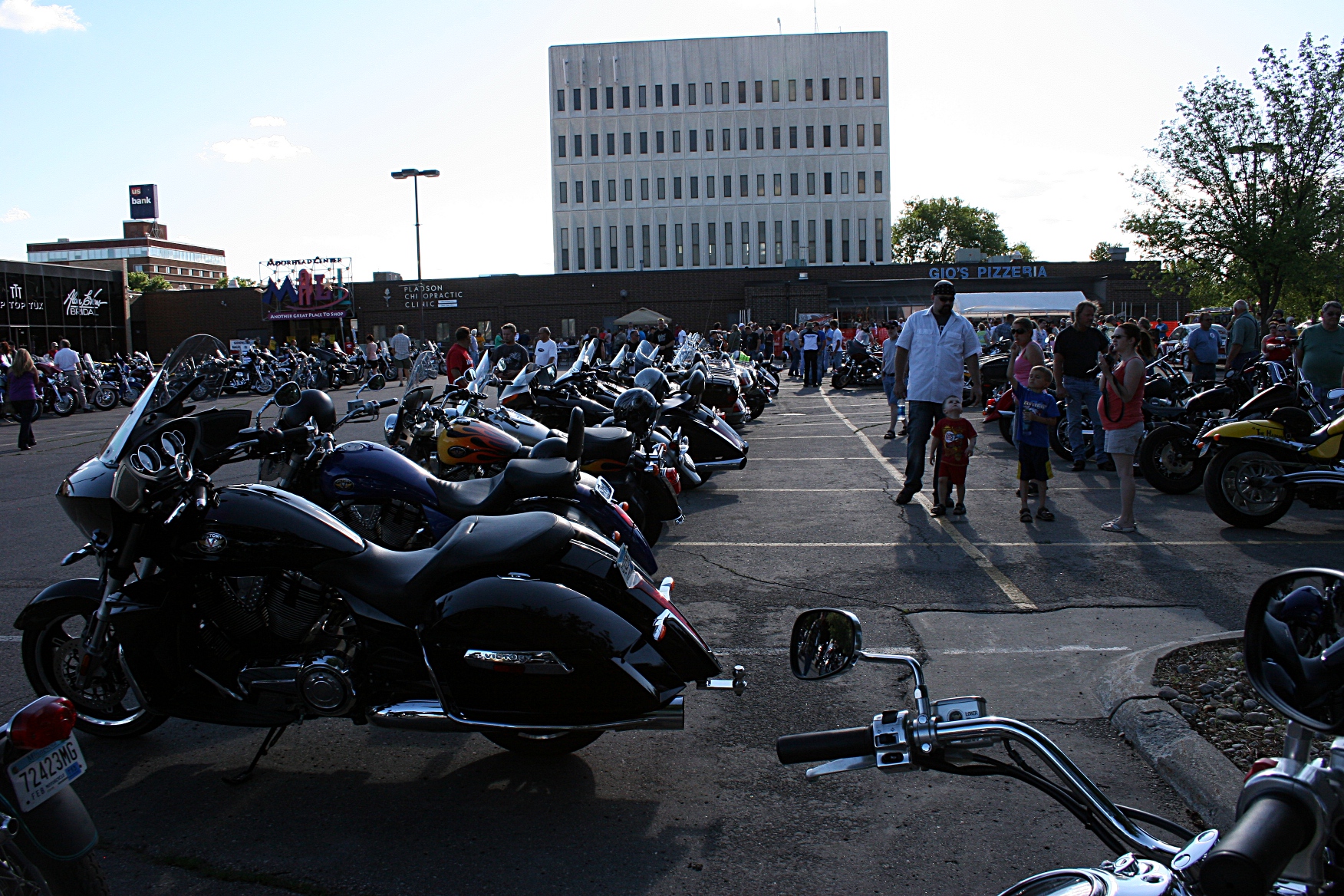
The June 14 Bike Night in the east parking lot of the Moorhead Center Mall.

Occasionally he’ll say, “I should get a bike.” Randy expressed that wish again recently when we attended Bike Night at the Moorhead Center Mall.

Bike Night wasn’t my choice of events to attend when we were in the Fargo-Moorhead area last week. I would have much rather strolled through downtown Fargo shops sipping wine and watching artists during the Corks & Canvas Art and Wine Walk than meander between motorcycles in a mall parking lot.

But, because marriage is about compromise and sometimes doing what the spouse wants, there we were, looking at bikes. I’ll admit to not being in the best of moods. I was hot, thirsty, tired, hungry and crabby upon our arrival.

Eventually, though, I figured out that I may as well make the best of it.

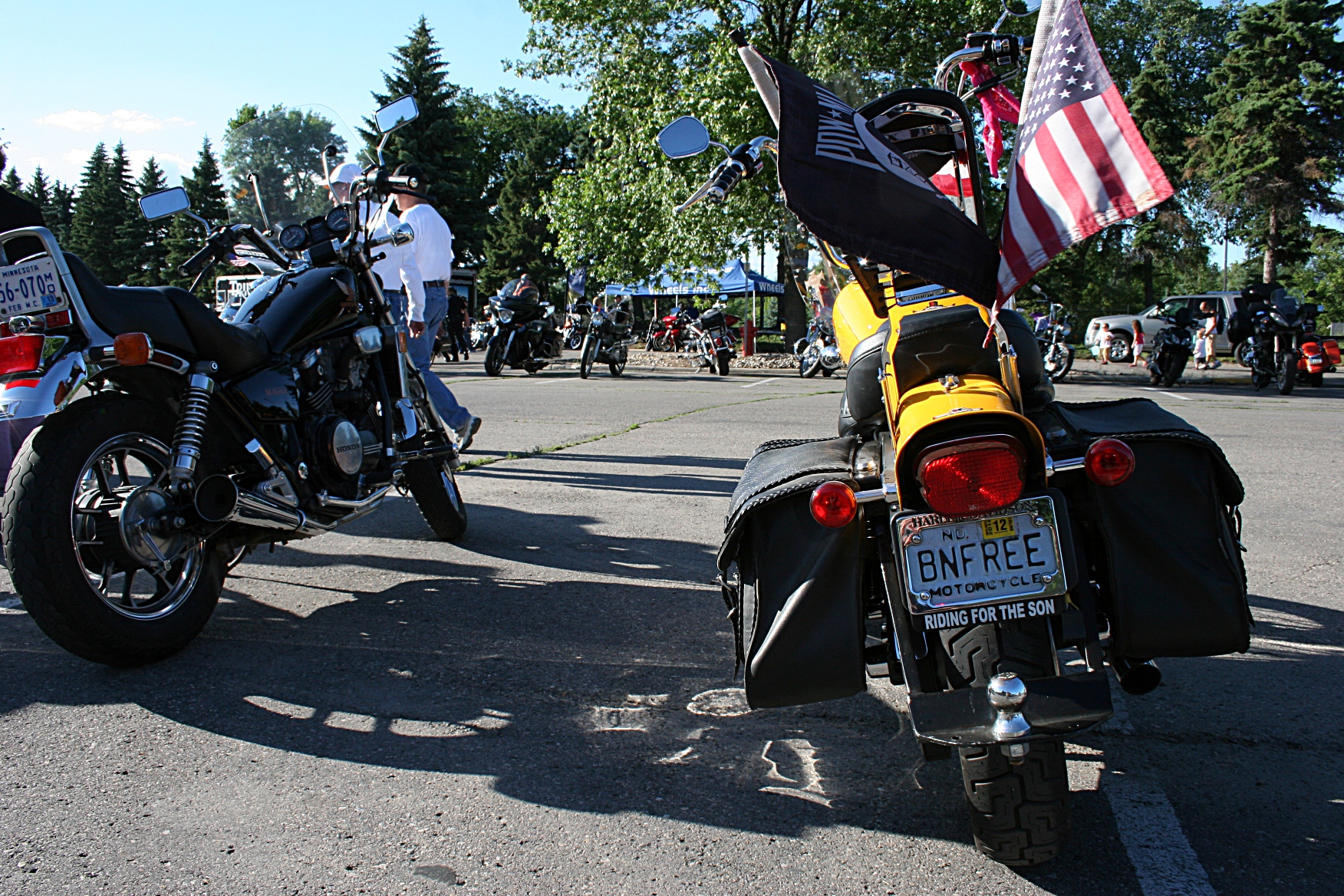
One of my favorite bikes at Bike Night because of the license plate, flags and message, “Riding for the son.”

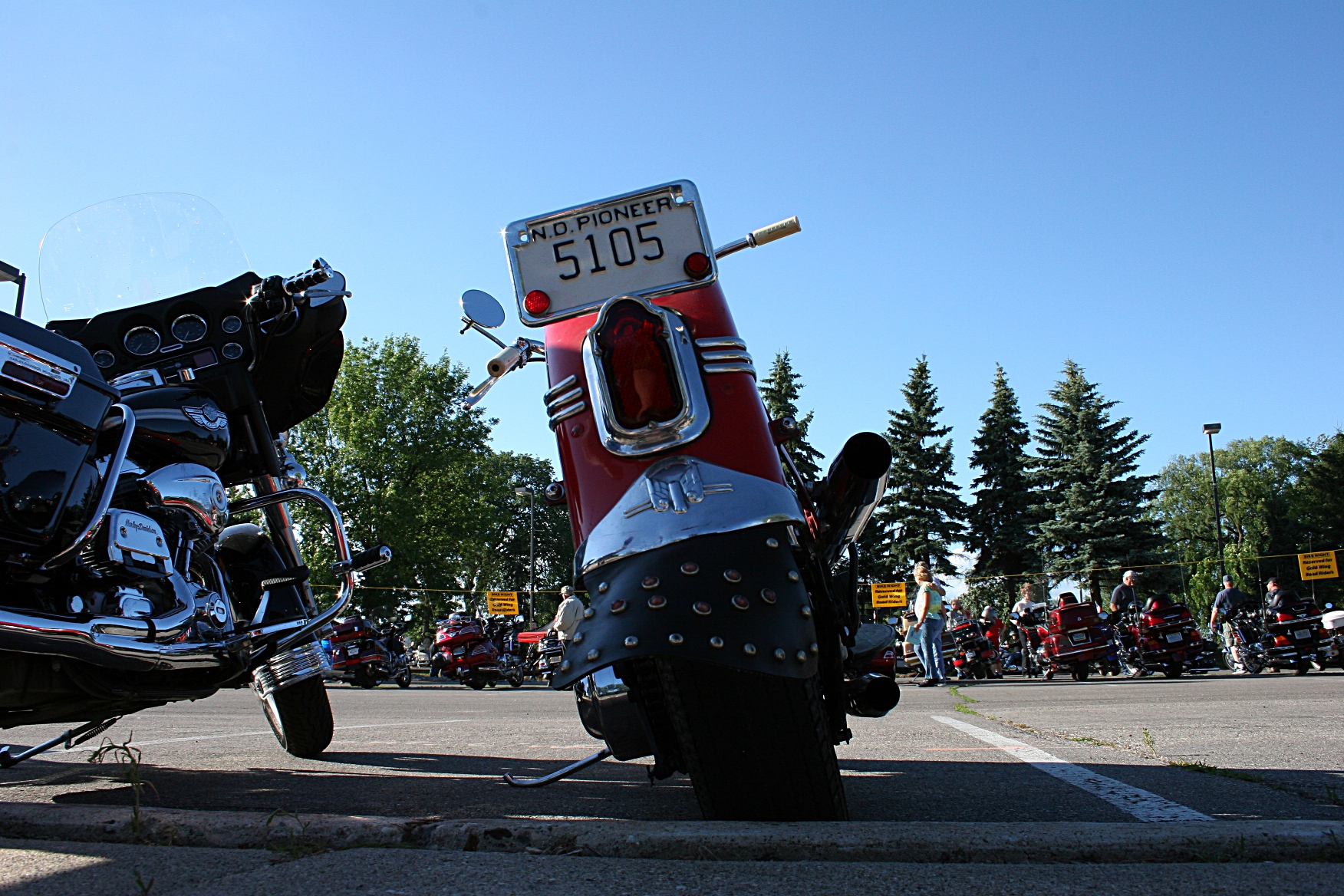
One of the oldest of the estimated 350 bikes at Bike Night.

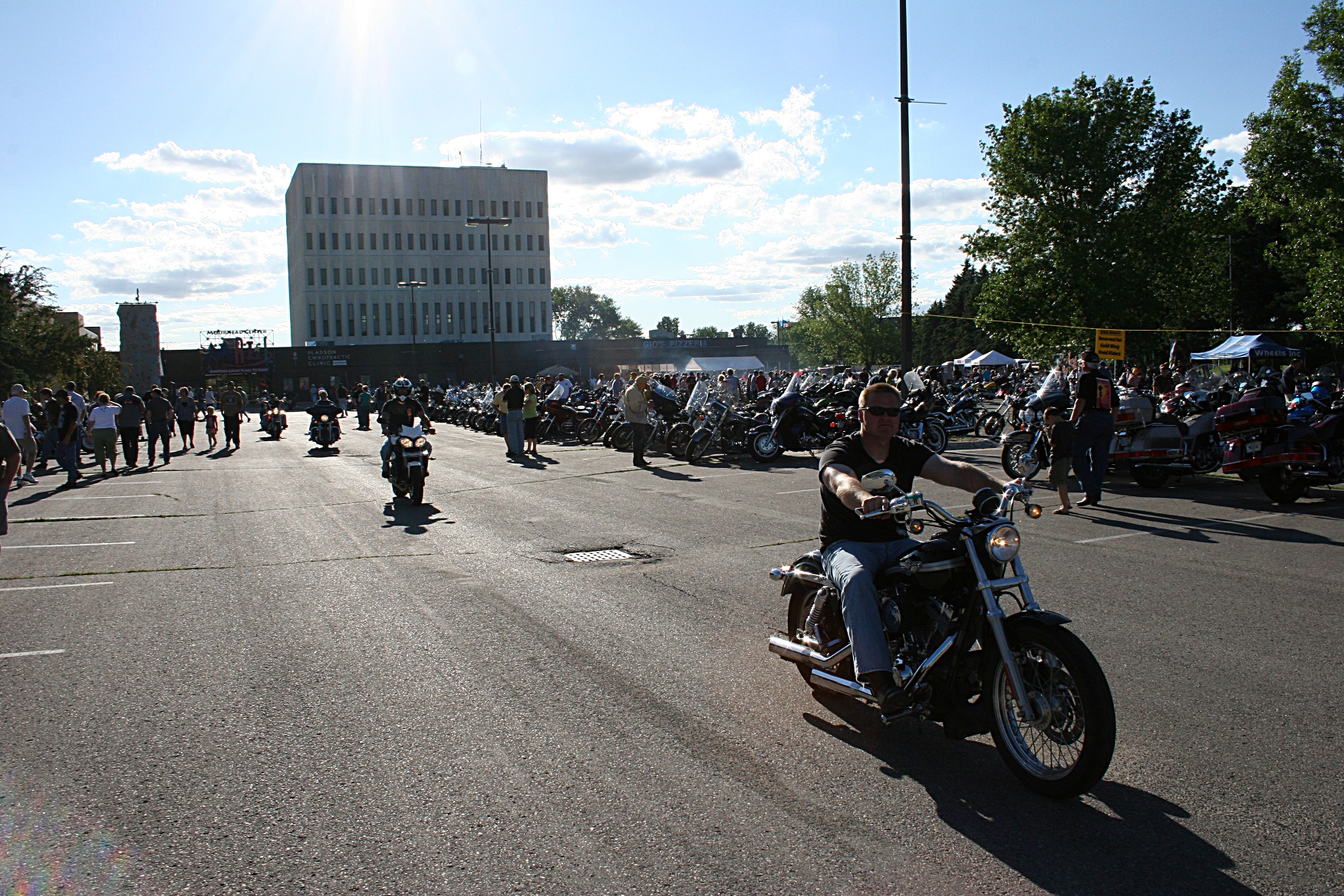
Biking through the Moorhead Center Mall east parking lot during the June 14 Bike Night.

So…if motorcycles are your thing and you’re in the Moorhead area, you have two more opportunities to attend Bike Night from 5:30 p.m. – 9 p.m. on July 12 and August 9. Non-bikers are supposed to park near Herberger’s, which we did not because we had a tough time even finding the Bike Night location. It’s in the east parking lot.

You’ll see plenty of bikes—an estimated 350 on the June evening we were there—and plenty of interesting characters. There’s food and beer, too, although we did not sample either.

If you’d rather sample wine and experience the art scene, do the Corks & Canvas Art and Wine Walk across the river in Fargo from 5 p.m. – 9 p.m. on July 12, August 9 and/or September 13.

Perhaps if I’d mentioned that Turtle Shell Stained Glass Gallery was on the art walk, my husband may have opted for the arts event. He’s taken a class in stained glass and created several pieces. But, naw, I don’t think it would have mattered. Bikes trump art anytime for him.

© Copyright 2012 Audrey Kletscher Helbling
 

We may have skipped class at NDSU, but… June 21, 2012

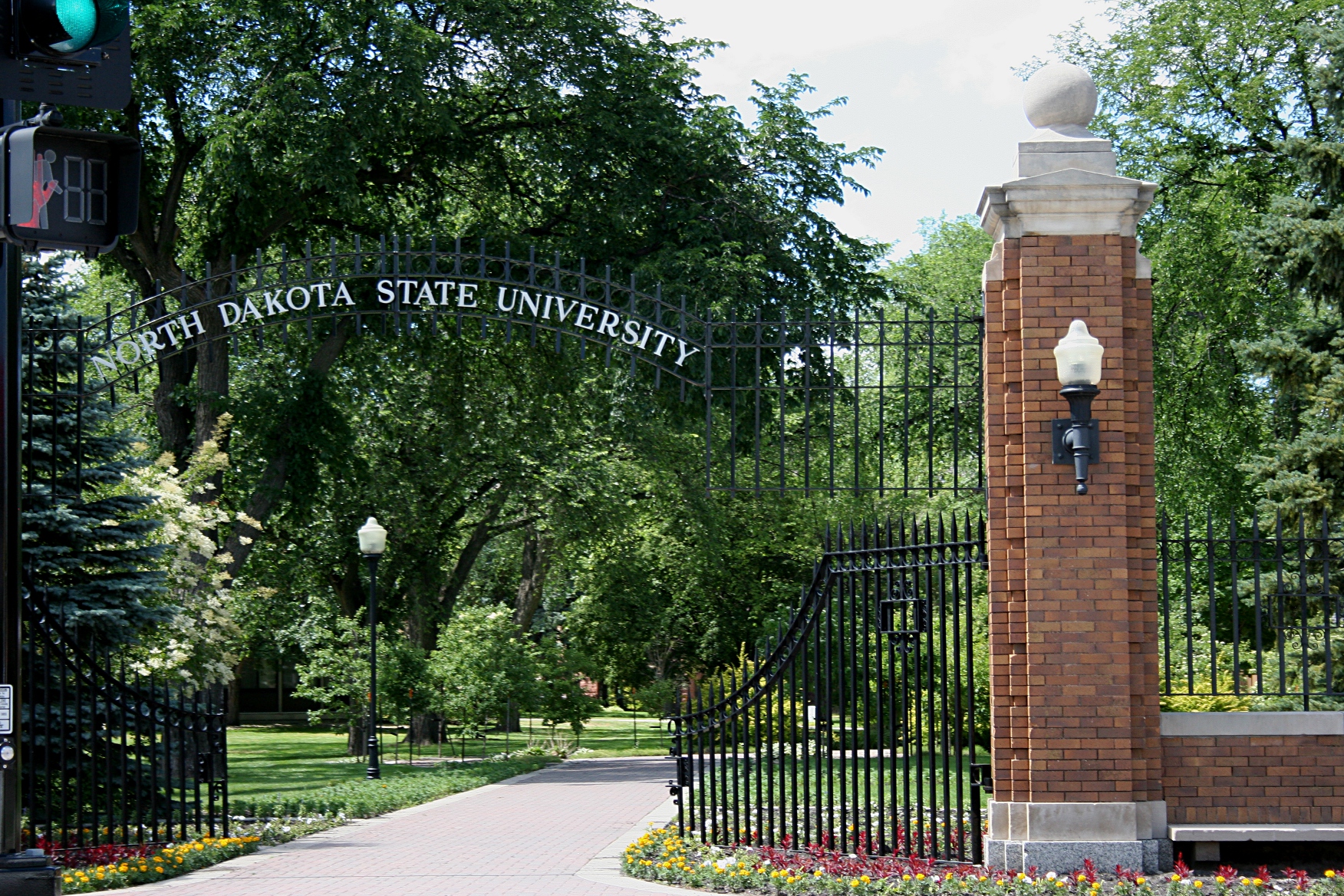
The main entrance to North Dakota State University in Fargo.

OLIVIA FROM THE NORTH DAKOTA STATE UNIVERSITY Conference, Orientation and Recruitment Team promised not to tattle on us, because, on our first day back at school, my husband and I skipped our afternoon classes.

We’re not setting a very good example for our 18-year-old son, who was also in class on the same day at NDSU. He didn’t skip.

But we were tired due to the noisy Fargo Holiday Inn guests who practically shouted their way past our room around 2 a.m. Friday. My husband struggled to stay awake during the first Friday afternoon orientation session. And I admit my eyelids were weighing heavy, too. We needed a break.

I mean no disrespect to NDSU as the university did an excellent job in programming at the orientation and registrations sessions my husband, son and I attended. But our youngest marks the third child we’ve sent off to college so we kind of know this basic college stuff already.

I wish I could spin some dramatic tale about the reasons for our truancy. But I cannot. It is what it was and Olivia promised not to report us.

Perhaps I can redeem our bad behavior by telling you that we pursued only educational opportunities during our time away from class.

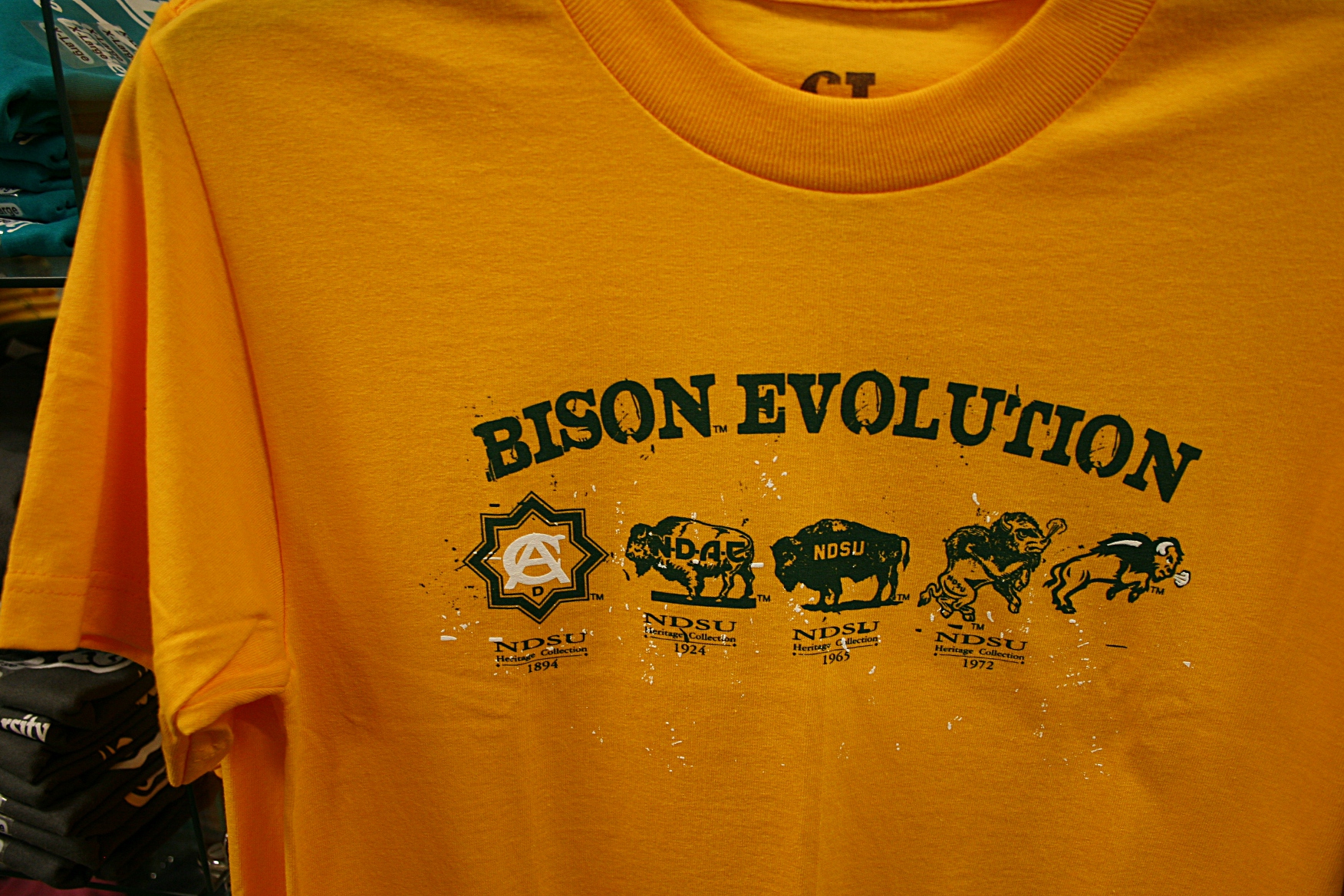
A Bison t-shirt in the NDSU Bookstore.

We started by stopping at the college bookstore to inquire about textbooks and to look at the Bison apparel. The bison is the university’s mascot.

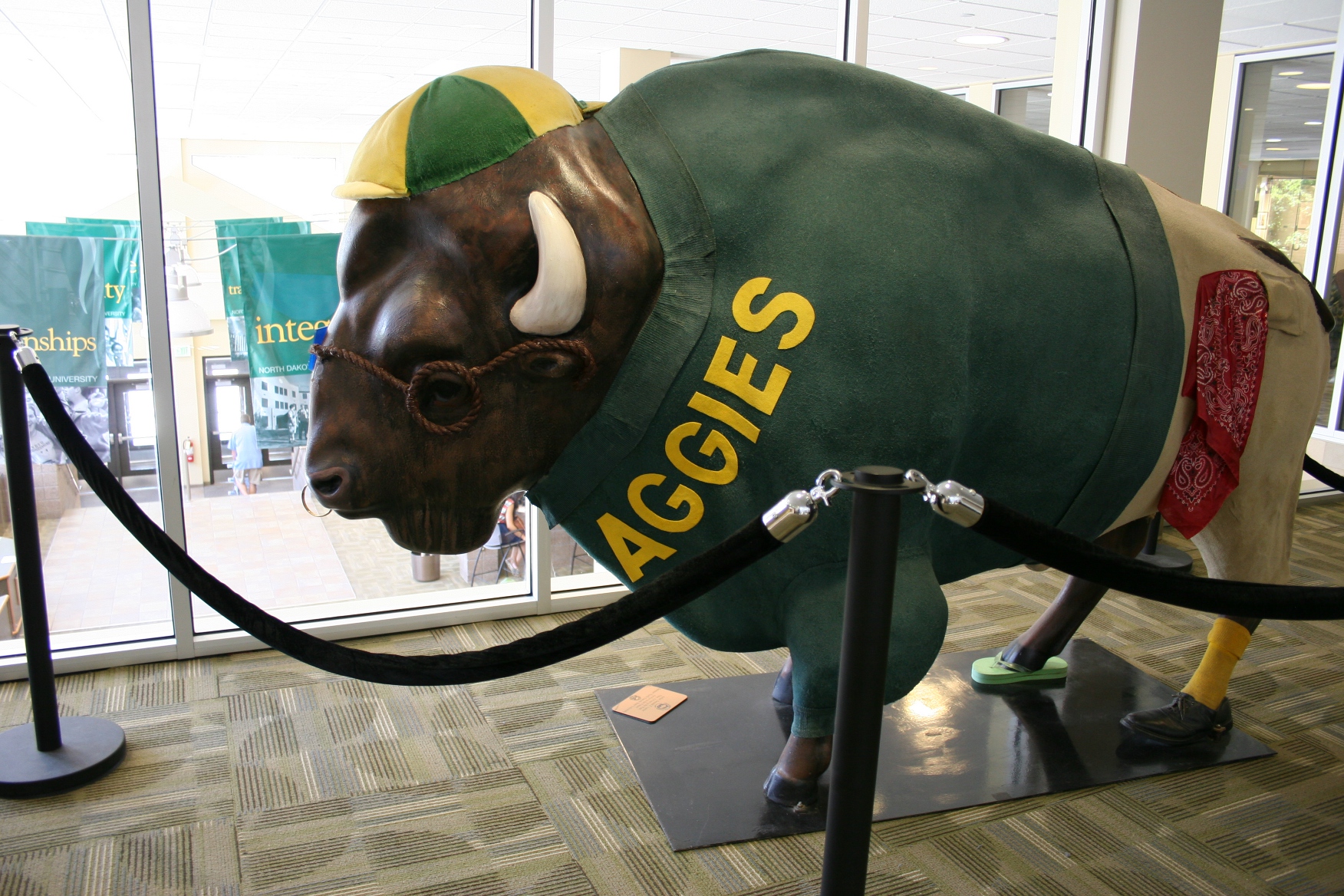
Inside the NDSU Memorial Union, I photographed this sculpture of a bison, the university’s mascot.

The NDSU Technology Incubator.

Next we weaved our way over to the NDSU Research & Technology Park, where, according to a pamphlet I picked up, “…university researchers combine their talents with private industry to create new technologies, methods and systems.” Our son was awarded an NDSU Entrepreneurial Scholarship which requires him to work and volunteer in the Technology Incubator during his four years at NDSU. We’re thrilled that he will have the opportunity to gain hands-on research experience and network with private industry as he prepares for a career in computer engineering.

We weren’t able to meet with any of the incubator clients, but at least we got inside the building and learned basics about the facility.

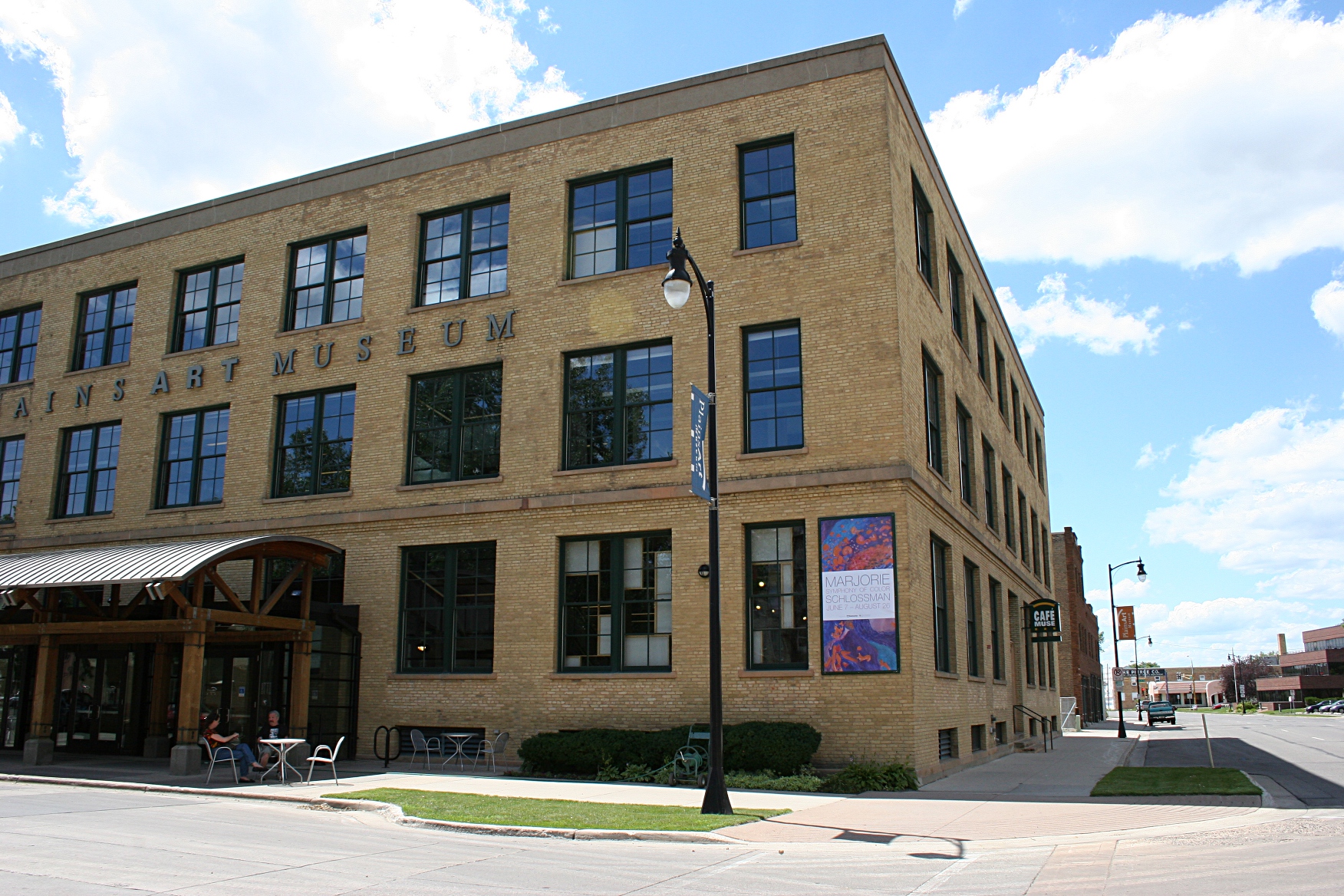
The Plains Art Museum in downtown Fargo.

From the technology park, we headed to the Plains Art Museum, an art center housed in a lovely, historic brick building along First Avenue North in downtown Fargo. Inside, we perused an outstanding/phenomenal/incredible collection of wood carvings by Willmar, Minnesota, artist Fred Cogelow. We also enjoyed the works of Luis Jimenez, whose notable “Sodbuster” sculpture is temporarily on exhibit. The works of Fargo abstract expressionist artist Marjorie Schlossman were also on display. Since neither my husband or I especially like abstract art, we breezed through those galleries.

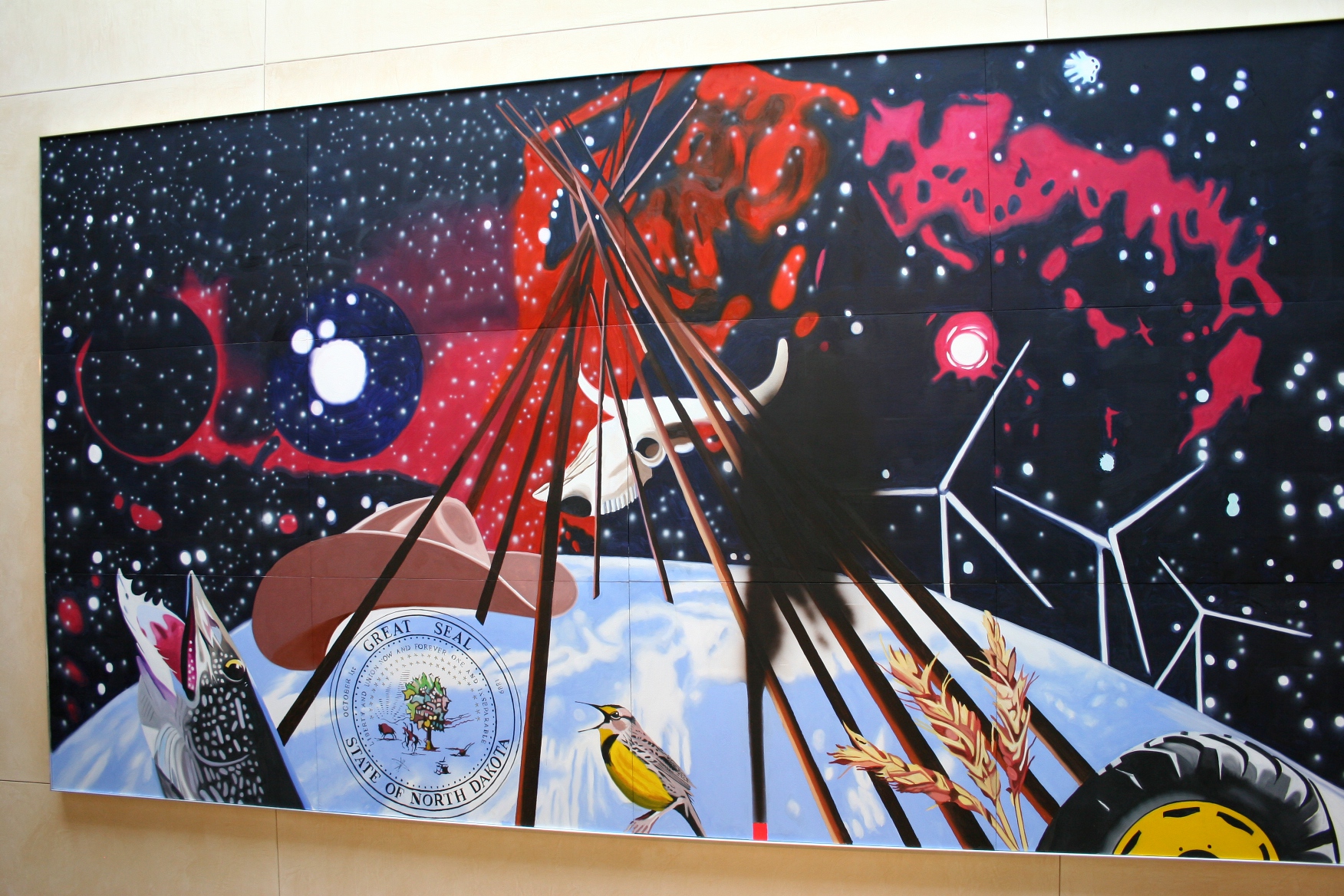
The North Dakota Mural by James Rosenquist installed in 2010 inside the Plains Art Museum.

I, of course, was quite disappointed that I couldn’t photograph any of the art except the North Dakota Mural on the first floor. It kills me to pack away my camera when I see so much I want to share with you.

The Plains Art Museum building was built in 1904 by International Harvester Company and originally served as a shipping, receiving and showroom space for farm implements. It’s a beautiful place with wooden floors, exposed support posts, rough brick walls and more.

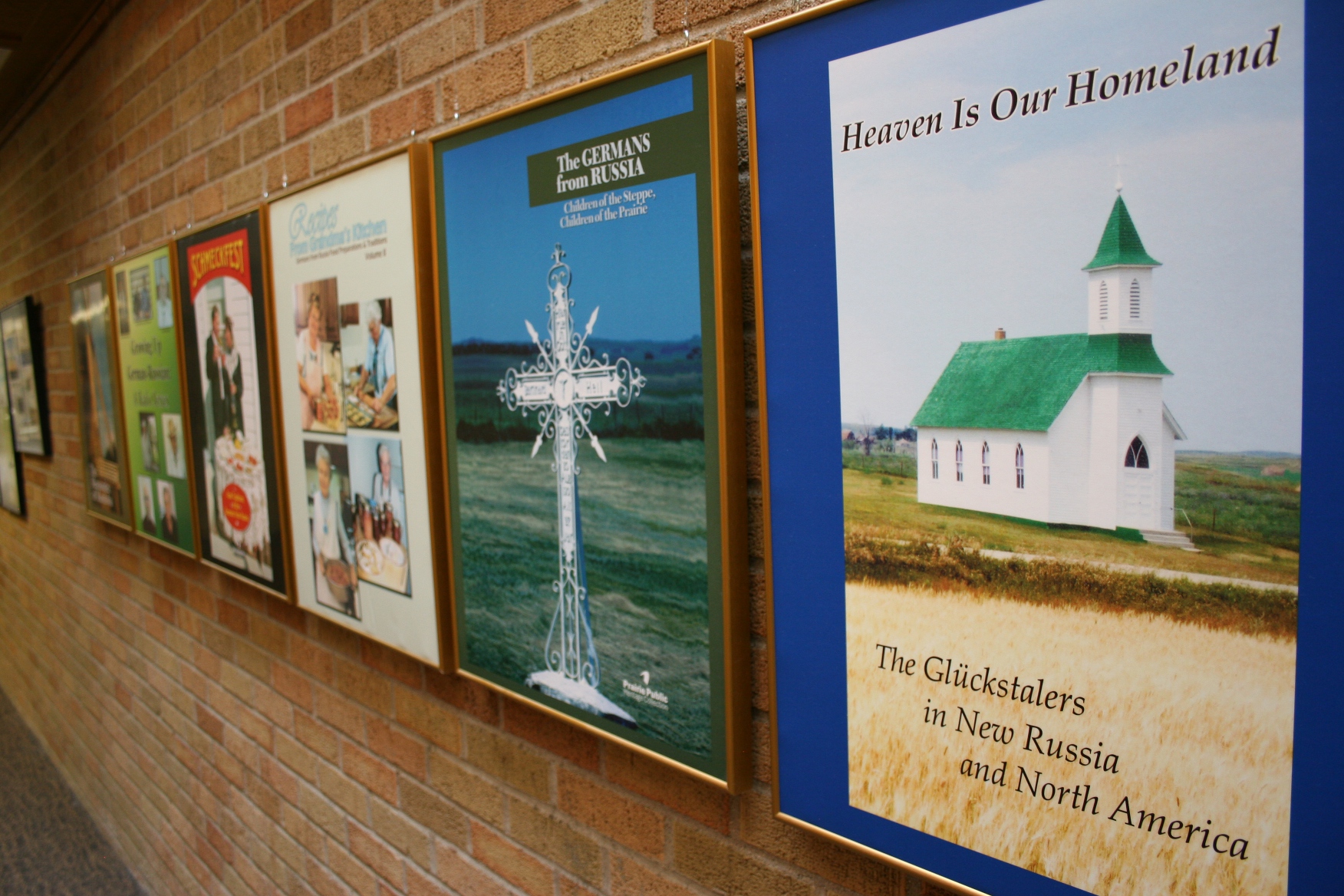
An informational display outside the research rooms of the NDSU “Germans from Russia” Heritage Collection.

After a short walk around the block and a stop at a gas station, we headed back to the NDSU campus and hung out at the library. Or, more specifically, my husband holed himself up in the “Germans from Russia” Heritage Collection rooms while I sat on a retaining wall outside because our cell phones did not work in the library and we were awaiting a call or text message from the son as to when he would finish registering for classes. (NDSU, please add some benches to your campus; the parents would appreciate resting spots.)

Eventually the husband extracted himself from digging into the history of the Helbling family whose roots run deep in North Dakota. His forefathers were among the “Germans from Russia” who settled in the Mandan/Bismarck area, home to the largest group of such immigrants in the U.S. My spouse’s parents relocated from North Dakota to central Minnesota in the 1960s.
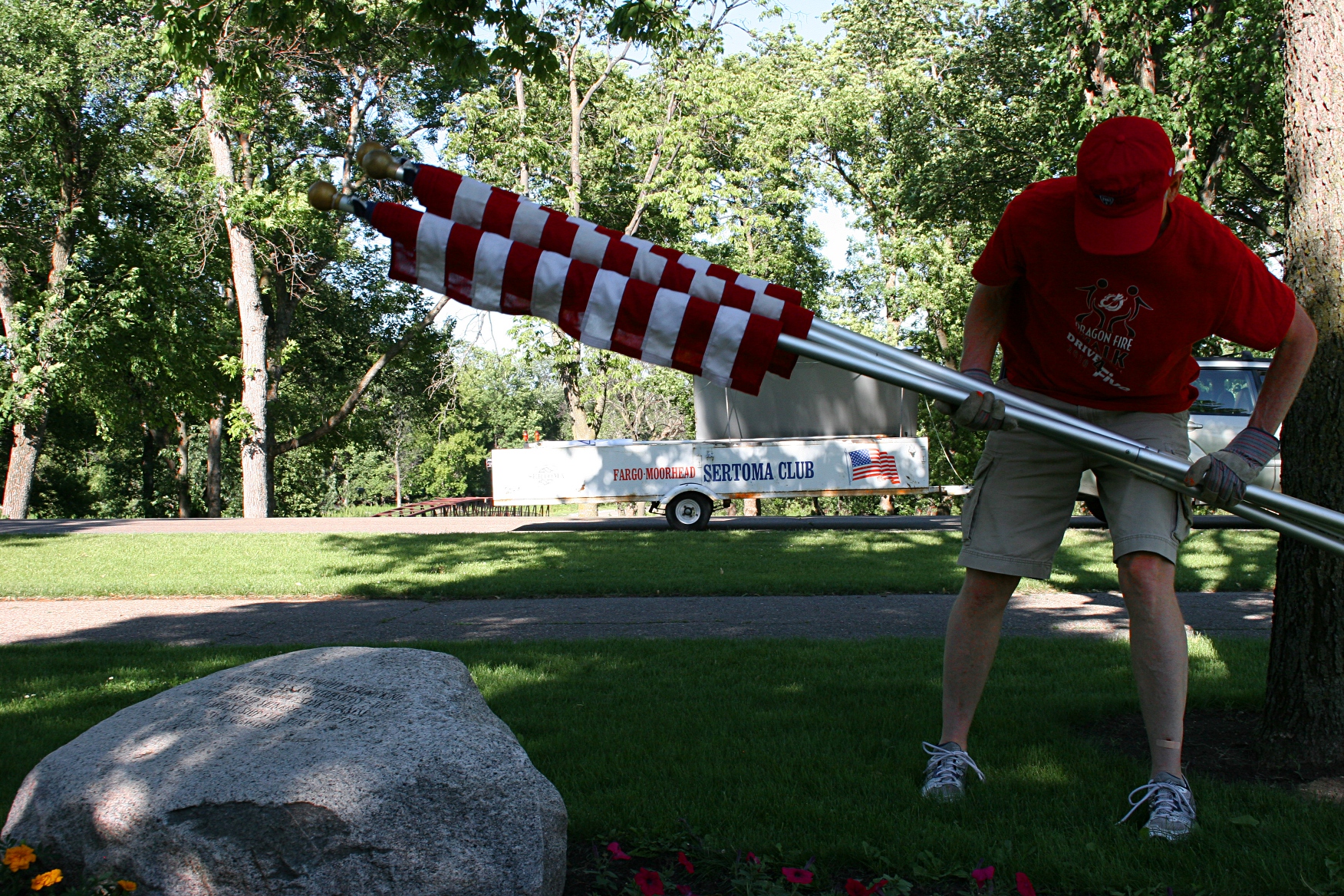
Now, some 50 years later, our son is coming full circle back to North Dakota, to the place where his paternal ancestors settled upon arriving in America so many, many years ago.
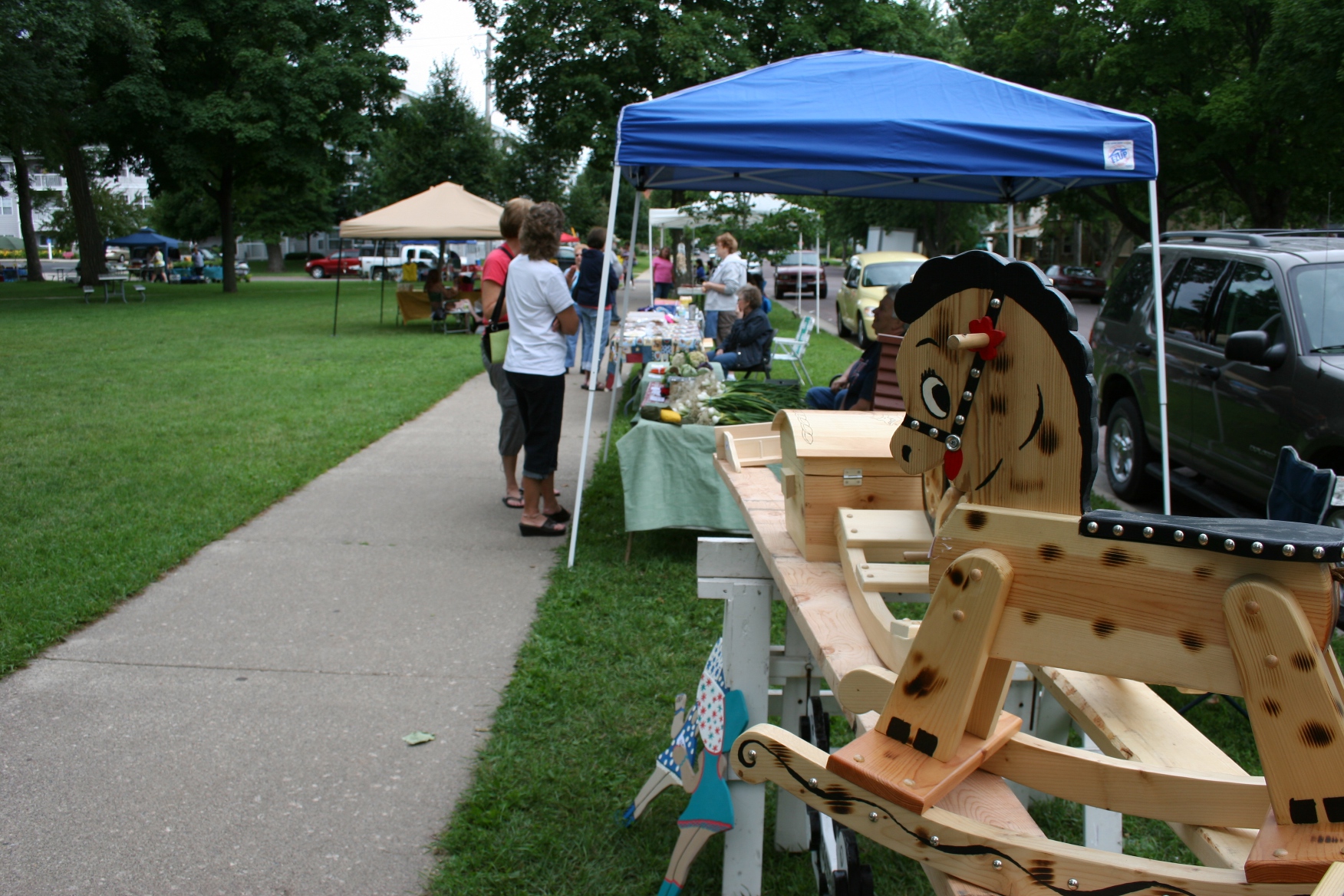
So, you see, my husband and I may have skipped our afternoon college classes. But we never stopped learning.

© Copyright 2012 Audrey Kletscher Helbling