Minnesota Prairie Roots

Writing and photography by Audrey Kletscher Helbling

How the Minnesota prairie ignites my poetry April 2, 2014

WHAT IS IT ABOUT POETRY?

Do you embrace or shun it? Write it or read it? Do you even care?

April marks National Poetry Month, a full thirty days initially established by the Academy of American Poets in 1996 to focus on poetry.
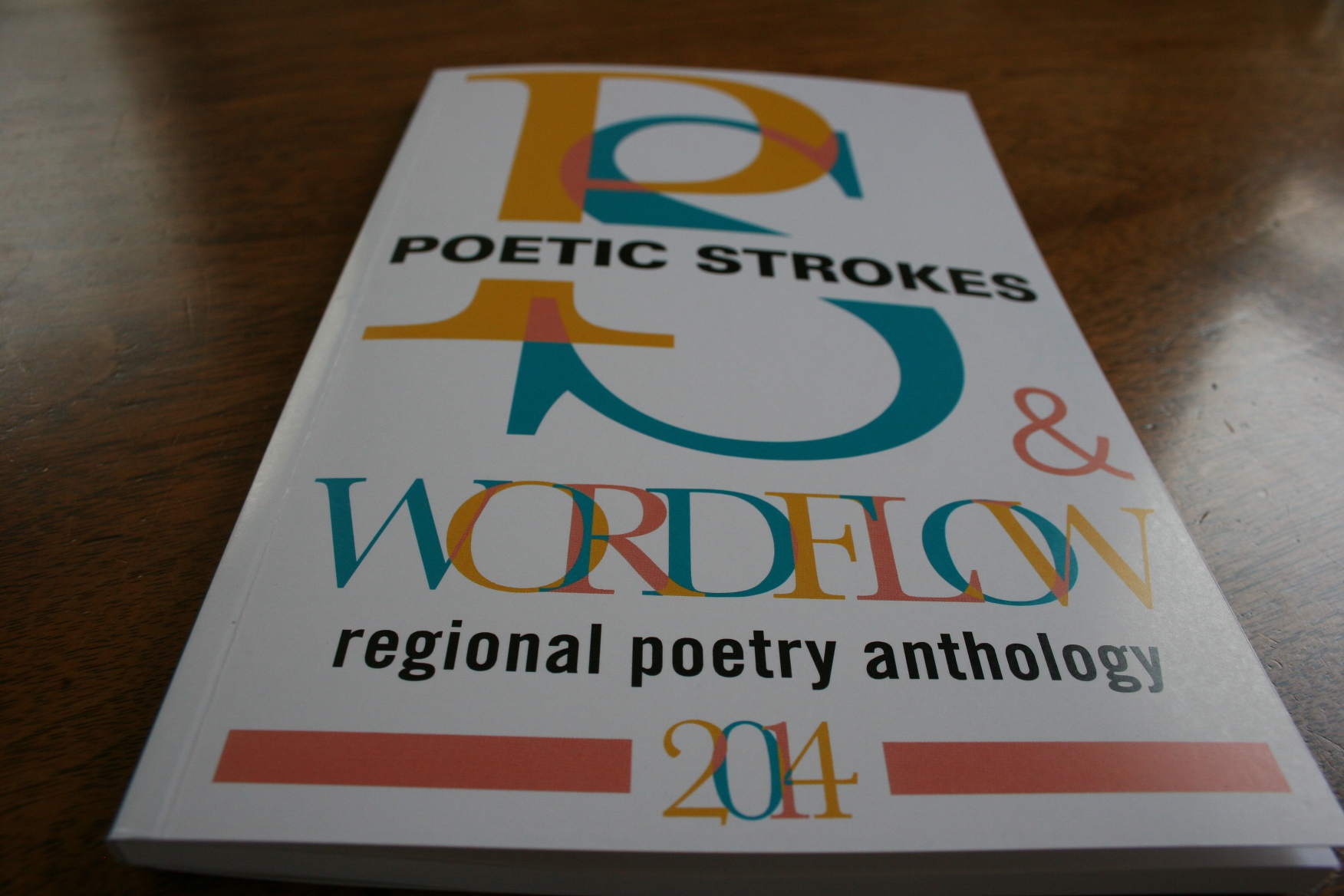
My most recent poem, "The Farmer's Wife, Circa 1960, has been published in Poetic Strokes, an anthology published by Southeastern Libraries Cooperating. My poem was one of 23 selected from 196 submissions. The anthology should soon be available for check-out by library patrons in the SELCO system.

My most recent poem, “The Farmer’s Wife, Circa 1960,” has been printed in Poetic Strokes, an anthology published by Southeastern Libraries Cooperating. My poem was one of 23 selected from 196 submissions. The anthology should soon be available for check-out by library patrons in the SELCO system.

If you haven’t read poetry in years, I’d suggest you revisit poetry. Long gone, mostly, are rhymed verses.

Instead, you will find poets penning free verse that correlates to an abbreviated form of storytelling or a spilling of emotions or a harmony of detailed observations and more.

Despite differences in subject matter and style, poets share a common love of language. Alliterations. Personification. Similes and metaphors. Strong verbs.

Poetry, though it may appear easy to write, is not.

Details matter. Each word matters. The sound of a poem read aloud matters.

A poem I wrote about my mother, published in Poetic Strokes 2014.

A poem I wrote about my mother, just published in Poetic Strokes 2014, A Regional Anthology of Poetry from Southeastern Minnesota.

Every poet possesses a style. I’d define mine as rooted in my native southwestern Minnesota prairie. That stark land shaped me as a writer. My poems convey a strong sense of place, words wheeling like a prairie fire across the landscape of a page.

With so few distractions, the prairie presents an ideal environment to notice details—the grate of the wind, the lean of an outbuilding, the weathered grey of an abandoned farmhouse, the isolation, the calloused hands of a farmer, green corn leaves unfurling against rich black soil, the horizontal grid of township gravel roads, power lines stretching into infinity…

Those who’ve never lived on the prairie often fail to understand its beauty, dismissing it as the middle of nowhere.

But this land holds my heart and memories and continues to inspire me. Not all of my verse. But much of it.

Some of my prairie-inspired poetry includes:

    • “This Barn Remembers,” Lake Region Review #1
    • “Taking Lunch to the Men in the Field,” Lake Region Review #2
    • “Abandoned Barn,” The Talking Stick, Volume 20
    • “Broken,” The Talking Stick, Volume 21
    • “The Farmer’s Song,” The Talking Stick, Volume 22
    • “Prairie Sisters,” Poetic Strokes, Volume 2
    • “Abandoned Farmhouse,” Poetic Strokes, Volume 3
    • “Walking Beans,” Poetic Strokes, Volume 3
    • “A school without a library,” Poetic Strokes, Volume 4
    • “Saturday night baths,” Poetic Strokes, Volume 4
    • “Her Treasure,” 11th annual Poet-Artist Collaboration, Crossings at Carnegie
    • “Lilacs”, 13th annual Poet-Artist Collaboration, Crossings at Carnegie and honorable mention at 18th annual Northwoods Art & Book Festival

And that poetry, my prairie poetry, has graced billboards, walls, recreational signage, galleries, and the pages of magazines, newspapers and anthologies. 

Perhaps it’s time to consider compiling those poems and others into a collection. Thoughts?

© Copyright 2014 Audrey Kletscher Helbling


Connecting art & poetry at Crossings & I’m in February 7, 2014

CONNECTING ART AND POETRY enhances both.

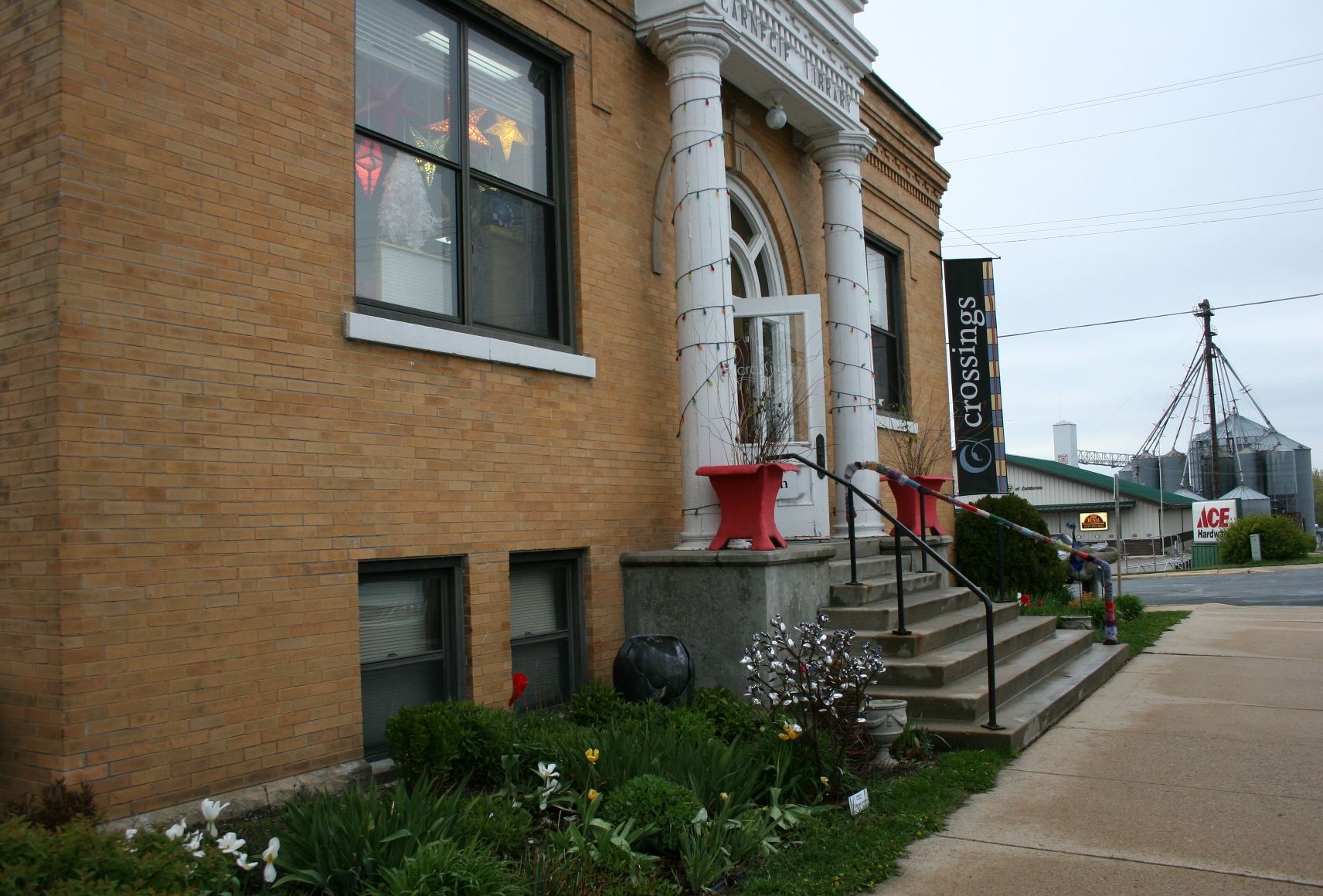
Crossings at Carnegie, housed in a former Carnegie library, is a privately-owned cultural visual and performing arts center in Zumbrota. I love the rural atmosphere with the hardware story and grain elevator just down the street.

Crossings at Carnegie, housed in a former Carnegie library, is a privately-owned cultural, visual and performing arts center in Zumbrota. I love the rural atmosphere with the hardware story and grain elevator just down the street. Minnesota Prairie Roots file photo 2012.

And I am pleased, for the second time, to have my poetry selected for inclusion in an annual poet-artist collaboration at Crossings at Carnegie in Zumbrota.

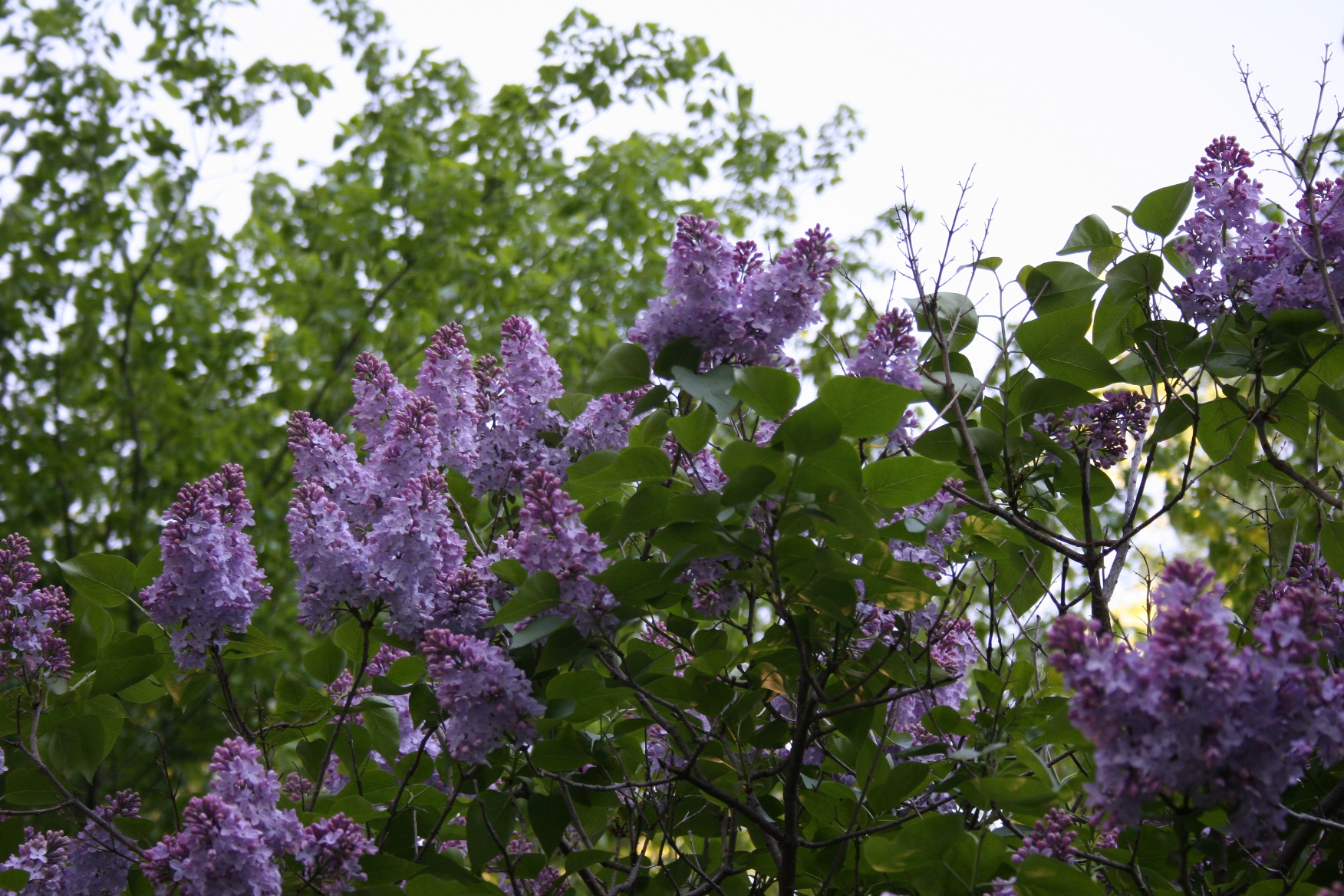
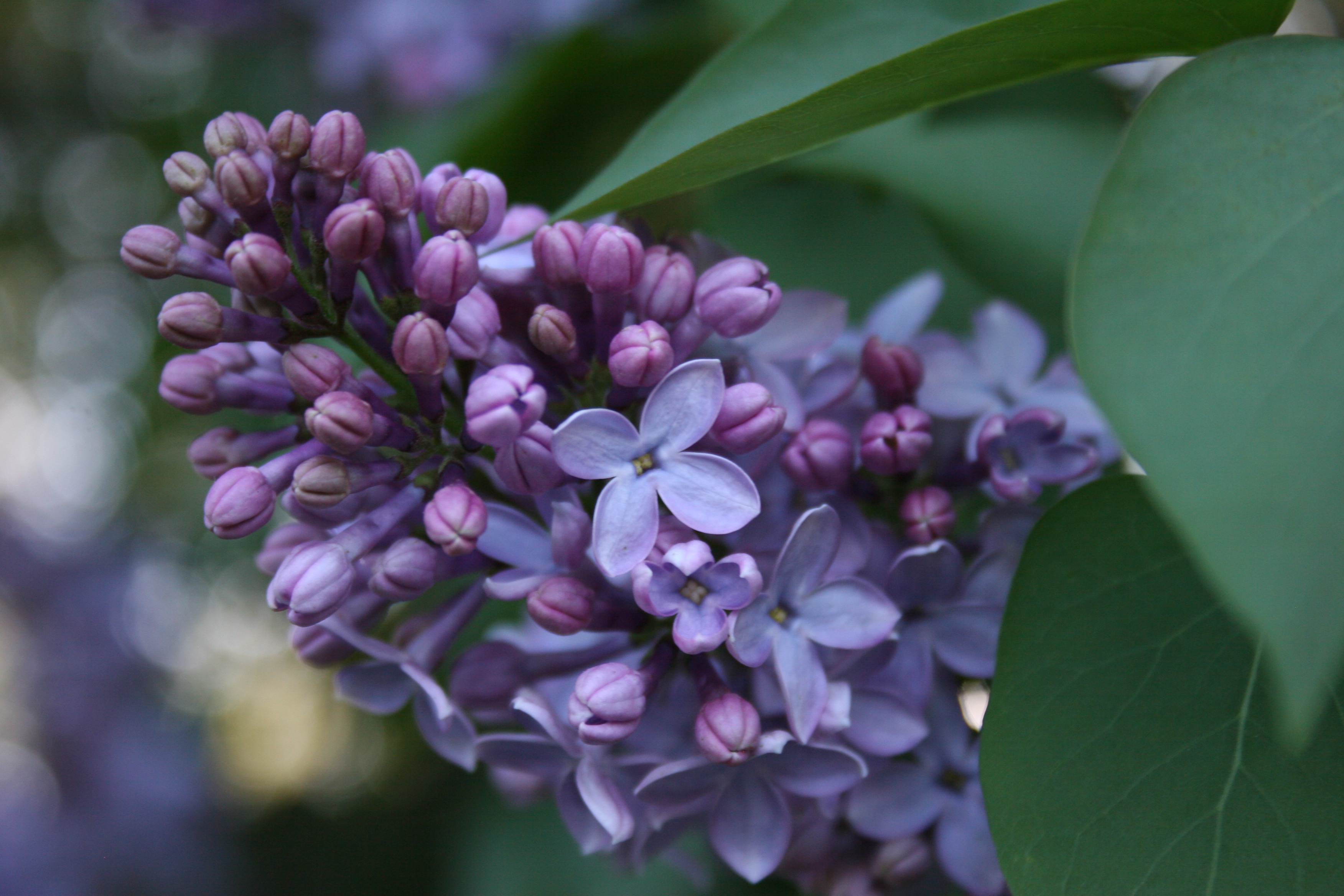
Lilacs, up close. Minnesota Prairie Roots file photo.

Lilacs, up close. Minnesota Prairie Roots file photo.

A juried artist will create a work of art based on my poem, “Lilacs,” one of 26 poems chosen from among more than 200 submissions for inclusion in Poet Artist Collaboration XIII.

Lucky thirteen. I’ve written poetry long enough, though, to understand that winning has nothing to do with luck, but rather with skill. Writing poetry is hard work. But when you nail a poem, like I did with “Lilacs,” it’s worth every minute anguishing over a word or a line.

“It was exciting to receive the outpouring of exceptional work from so many talented poets for this collaboration,” writes Marie Garvin of Crossings in an email. “Jurists told us they (the poems) were a pleasure to read, and selecting those to be included was a difficult task.”

The poems paired with art will go on display in April, National Poetry Month, at the Zumbrota gallery and gift shop. Poets will read their poems and artists will briefly discuss their artwork during a reception set for 6:30 p.m. Saturday, May 10.

Connie, right, and I posed for a photo after a 90-minute presentation in which poets read their poems and artists talked about how their art was inspired by the poem. Note Connie's "Pantry Jewels" painting just above my head to the left. If I could buy this $490 watercolor on aqua board, I would in a snap.

Connie Ludwig, right, and I pose for a photo after a 90-minute presentation in which poets read their poems and artists talked about how their art was inspired by the poem. Note Connie’s “Pantry Jewels” painting just above my head to the left. Minnesota Prairie Roots file photo 2012.

Two years ago, my poem was selected for Poet Artist Collaboration XI. Goodhue artist Connie Ludwig created a watercolor, “Pantry Jewels,” inspired by my poem, “Her Treasure.” (You can read about that by clicking here.)

That earlier poem and “Lilacs” draw on childhood memories from my native southwestern Minnesota, a major influence in my writing.

Plenty of lilacs to gather in the spring.

Plenty of lilacs to gather in the spring. Minnesota Prairie Roots file photo.

This marks the second time “Lilacs” has been recognized. This past summer, judges chose “Lilacs” as a Work of Merit in the 2013 Northwoods Art & Book Festival in Hackensack. Says Northwoods Arts Council Poetry Event Chair, poet and blogger Sue Ready “…we all see your work as creative and poetic that engages the reader.”

Sue is right. I always attempt to connect to the reader, whether through imagery, sensory words, emotions and more. Poetry should be an experience.

You can read “Lilacs” by clicking here.

I am grateful for this latest opportunity to share my poetry. And to have an artist find inspiration in my words and create a work of art pleases me even more.

© Copyright 2014 Audrey Kletscher Helbling
 

2013 in retrospect January 1, 2014

Filed under: Uncategorized — Audrey Kletscher Helbling @ 6:00 AM
Tags: , , , , , ,

REFLECTING ON 2013, it’s been a good year in many ways. Not without challenges—no one’s life is perfect or worry-free—but mostly the past year rates as a good one on personal and professional levels.

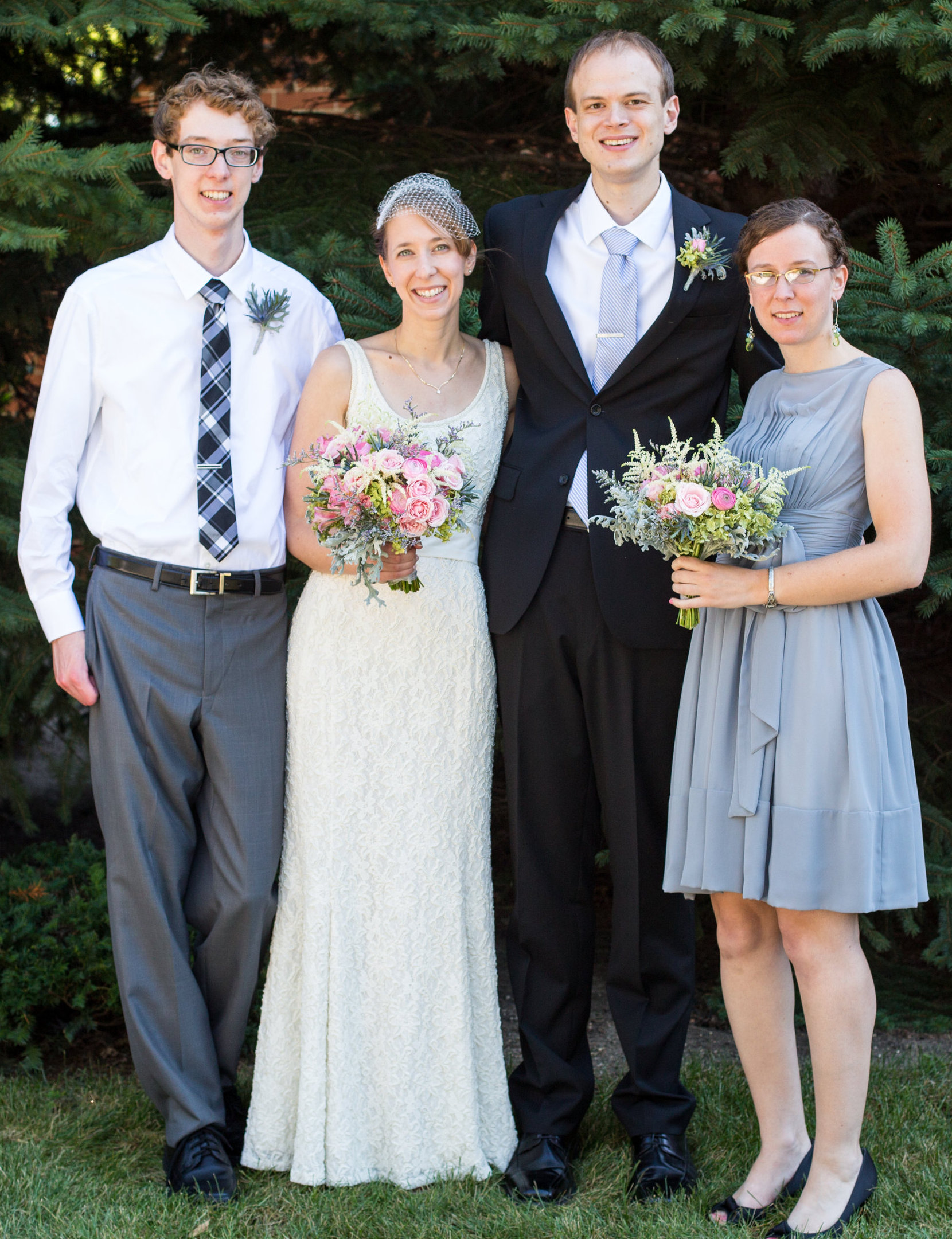
Newlyweds Amber and Marc with Amber's brother, Caleb, and sister, Miranda.

Newlyweds Amber and Marc with Amber’s brother, Caleb, and sister, Miranda.

I watched as my eldest daughter married the love of her life. I watched as my youngest, my 19-year-old son, headed off to Boston, to a university that challenges him.

My role as a mother is ever evolving as my three adult children (that always seems like such an oxymoron) stretch their wings wider and fly higher. I am thankful for the independence and confidence they possess, although at times I joke that I should have tossed them into the basement and locked the door, keeping them forever close.

Personally, I continue to be blessed by the presence of so many caring people in my life from loving family members to a supportive bible study group to bloggy friends who have become real-life friends, and more.

I am grateful, too, that God continues to bless me with a listening ear and a compassionate heart. My husband always tells me that I can make anyone cry, and he means that in the best of ways.

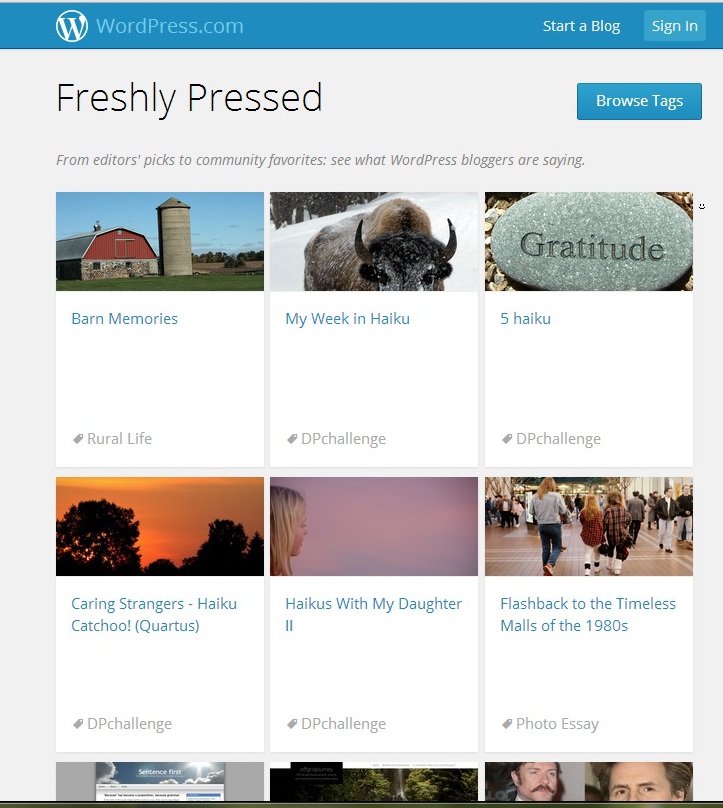
That's my post, labeled "Barn Memories," featured today on Freshly Pressed.

For the third time since I began blogging, my work was selected for Freshly Pressed in 2013. That’s my post, labeled “Barn Memories.”

On the professional side of my life, the past year has presented new opportunities and accomplishments. This blog continues to flourish with around 230,000 views in 2013 and a growing readership, now at 708 followers.

I am thankful for everyone who reads Minnesota Prairie Roots and to media outlets like Minnesota Public Radio (Bob Collins’ NewsCut) and MinnPost (Minnesota Blog Cabin), which occasionally pick up my work.

Me and my camera, a tool in the writing profession I love.

Me with my DSLR Canon EOS 20D.

I’ve always considered myself first and foremost a writer in my professional life. But in the past year, my confidence as a photographer has soared as I’ve sold numerous photos which have been featured in places like a cable TV show intro, a catalog in the UK, a corporate report and more.

Photos published on Minnesota Prairie Roots are for sale. Check my “About” page for a contact email address. Just don’t email and tell me you would like to use a specific photo and you will give me photo credit. I don’t give away my work (meaning photos and stories should not be lifted and used without my permission).

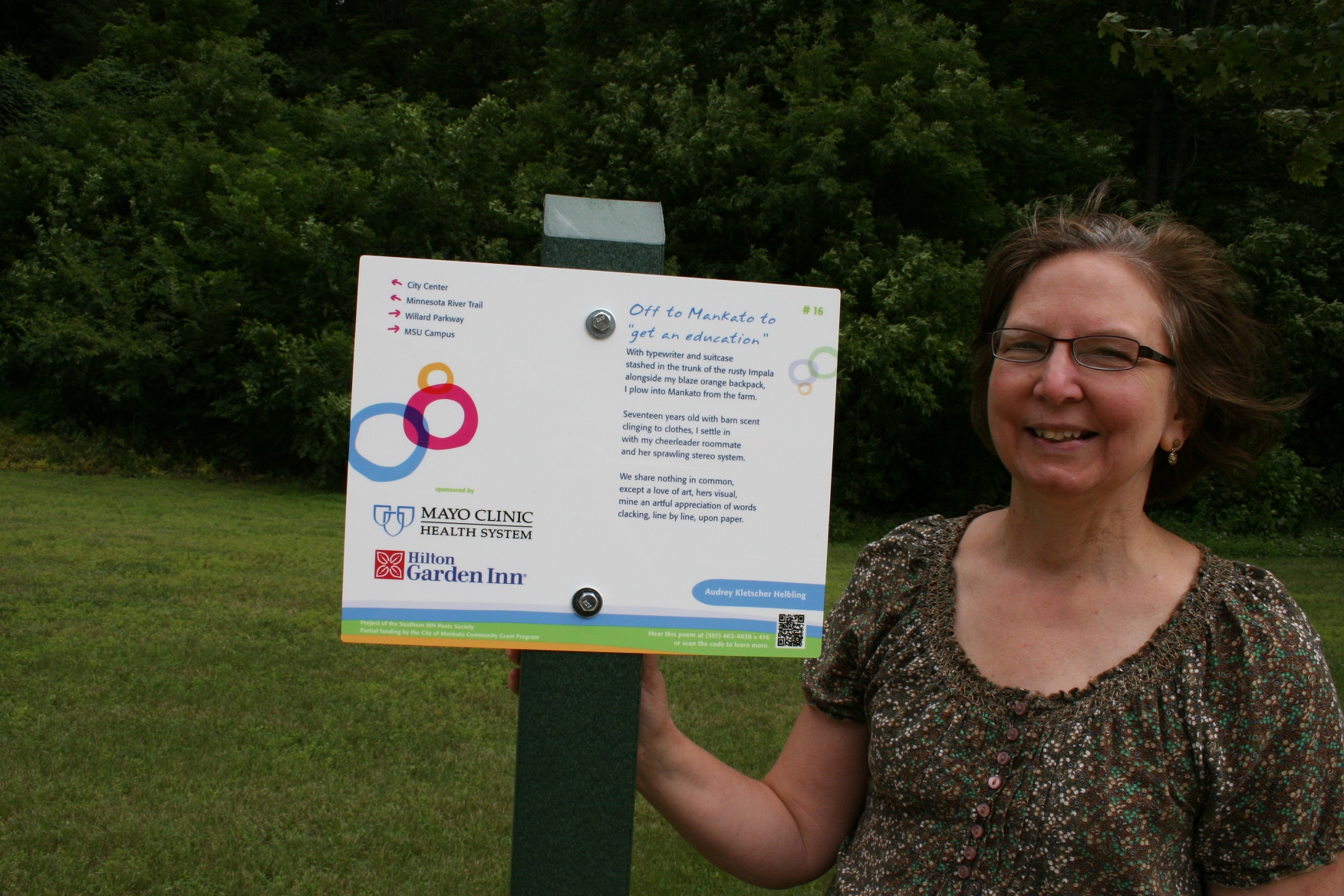
Me, next to my "Off to Mankato to 'get and education'" poem posted near Glenwood Gardens.

Me, next to my “Off to Mankato to ‘get an education'” poem posted near Glenwood Gardens in Mankato as part of the Mankato Poetry Walk and Ride.

Writing has always been my passion and that includes poetry. I don’t pen poetry as much as I should. But when I do, I often succeed in getting it published. This past year was no exception with, among other places, two of my poems published on signs posted in a park and along a recreational trail in nearby Mankato.

I wrote my first piece of fiction in years and won honorable mention for my short story, “The Final Chapter,” published in The Talking Stick, Volume 22, In Retrospect.

I continue to evolve as a writer and a photographer. Thank you, dear readers, for joining me on this journey, for allowing me to share my discoveries, insights and life with you via my images and words.

© Copyright 2014 Audrey Kletscher Helbling
 

I’ve been Freshly Pressed again November 30, 2013

“I HOPE YOUR BLOG is ready to welcome some new readers…”

That's my post, labeled "Barn Memories," featured today on Freshly Pressed.

That’s my post, labeled “Barn Memories,” featured today on Freshly Pressed.

With those words, I recently learned that my November 25 blog post, “An essay of barn photos & memories,” earned Freshly Pressed status on WordPress.com. (Click here to read that post.)

In the WordPress blogging world, that’s akin to winning an Emmy or an Oscar or something similar, although you could perhaps argue that I am exaggerating. I think not, though, given the half a million plus WordPress bloggers world-wide. (Click here to reach the Freshly Pressed page on WordPress.)

That said, I’d like to thank you, my readers, for your faithful following of Minnesota Prairie Roots. Just over 600 of you now follow my blog via subscription and I am grateful for each of you.

I’d also like to thank my husband, who is very much a part of this blogging journey via his support and company.

The Freshly Pressed tweet about my barn post.

The Freshly Pressed tweet about my barn post.

And, finally, I’d like to thank the editors at WordPress who daily hand-pick eight posts to feature on Freshly Pressed. My barn post is featured today on Freshly Pressed.

Here’s what WordPress editor Ben Huberman wrote in an email:

You struck such a delicate and moving balance in this piece between letting the photos you took speak for themselves, and sharing with your readers the memories and emotions they invoke in you. It’s a lovely, well-executed post that deserves a wider audience.

How sweet is that to get an editor’s comment on your work? It’s invaluable and uplifting and reaffirming.

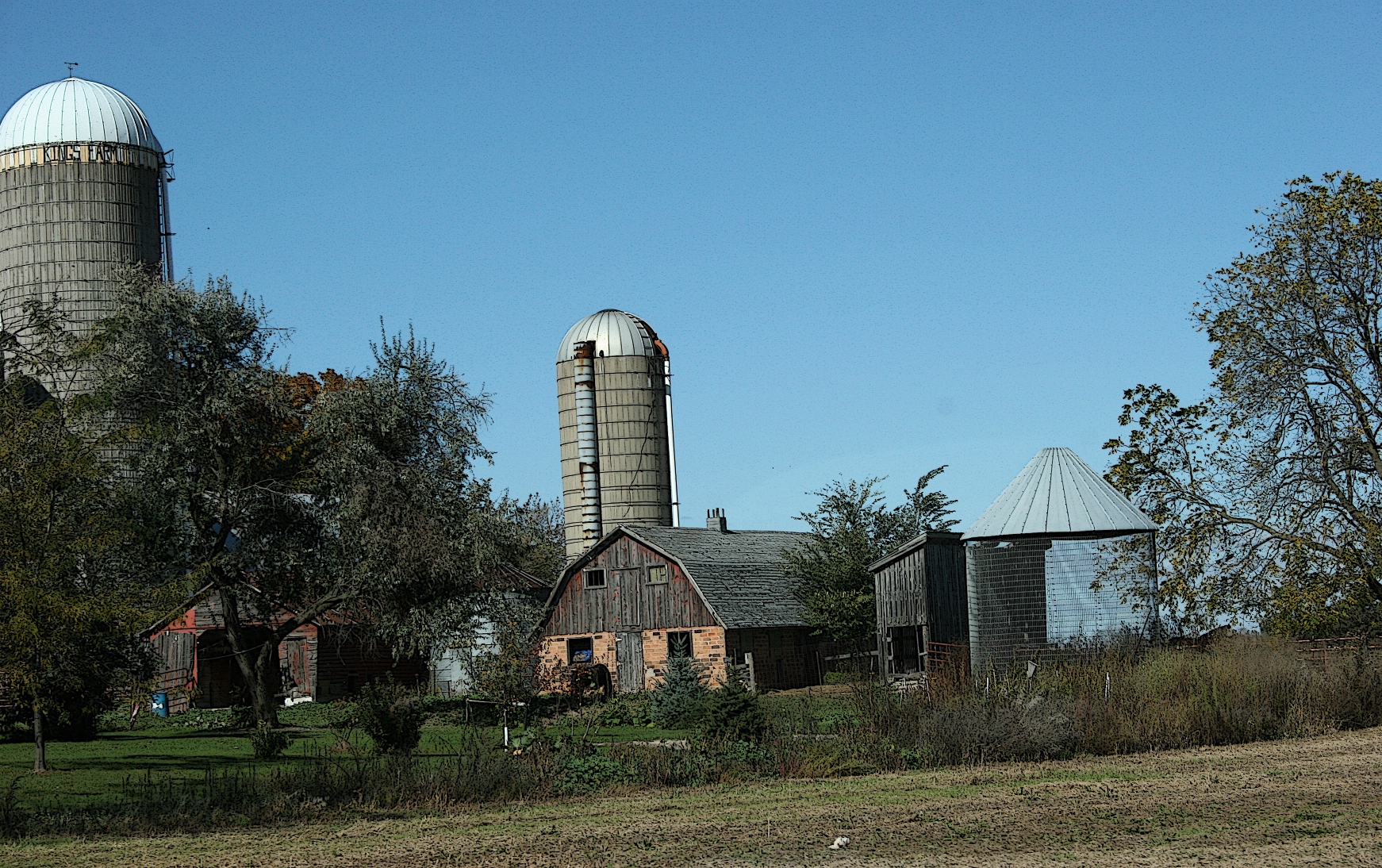
An old-fashioned farm along Wisconsin Highway 21.

An old-fashioned farm along Wisconsin Highway 21. This is one of the photos published in my winning post.

About the barn photos featured in my winning post… I shot all of them in mid-October while traveling through northeastern Wisconsin. And by traveling, I mean traveling. All six images were photographed from the passenger side of our family van while traveling down the highway at 55 mph. I had one, maybe two, opportunities to capture each photo I showcased. There was no stopping to compose a frame. Rather, I set my camera at a fast shutter speed, anticipated and clicked. That’s it. Either I got the photo or I didn’t. Clean windows help, too. Ask my husband about bottles of window cleaner and paper towels.

The words I paired with the six barn photos came from my heart, from my memories of laboring in my childhood dairy barn on the southwestern Minnesota prairie. Images and smells and textures and sound flowed from my memory onto the keyboard in a piece rich in imagery, heartfelt in emotions.

That combination of from-the-heart writing paired with just the right photos made this post stand out among the hundreds of thousands of others published on WordPress, apparently. For more information on how Freshly Pressed posts are selected, click here.

The homepage of WordPress.com, as photographed Thursday morning. My "In praise of preserving country churches" blog post is on the lower right.

The homepage of WordPress.com, as photographed in July 2010. My “In praise of preserving country churches” blog post is on the lower right. The story focuses on Moland Lutheran Church, rural Kenyon, Minnesota.

This isn’t the first time I’ve been featured on Freshly Pressed. My July 7, 2010, post, “In praise of preserving country churches,” (click here to read) was Freshly Pressed as was my June 11, 2012, post, “Testing the track during a Soap Box Derby trial run in Faribault” (click here to read).

A screen shot of the Tuesday, June 12, 2012, Freshly Pressed on the WordPress homepage. My post is featured in the bottom center. I've been Freshly Pressed twice since I began blogging, meaning my posts were chosen, for a single day, as among the top 10 WordPress posts in the world.

A screen shot of the Tuesday, June 12, 2012, Freshly Pressed on the WordPress homepage. My post is featured in the bottom center.

To earn Freshly Pressed status three times rates as rewarding for a blogger like me, who is undeniably passionate about writing and photography. Thank you for joining me on this blogging journey.

© Copyright 2013 Audrey Kletscher Helbling
 

Celebrating four years of blogging at Minnesota Prairie Roots July 15, 2013

Me and my camera, a tool in the writing profession I love.

Me and my camera, a tool in the writing profession I love.

FOUR YEARS AGO TODAY, I launched Minnesota Prairie Roots.

As the adage goes, “time flies when you’re having fun.” After writing more than 1,400 posts, I’m still passionate about blogging.

My approach to blogging hasn’t changed since publishing that initial post on July 15, 2009. I pledged then to write from the heart—about everyday life, about places I visit, things I do, observations I make about the world around me.

I told you then, and I’ll repeat now, that my writing reflects my down-to-earth personality and my appreciation for the simple things in life. I am the real deal. I really do like small towns and gravel roads, the prairie and sunsets and endless skies.

I’m the woman who hangs clothes on the line, relishes a good book, shops garage sales, savors the tang of rhubarb crisp, breathes in the intoxicating scent of freshly-cut alfalfa and appreciates Minnesota, the place I’ve called home for nearly 57 years.

Via my posts, I strive to show you those ordinary, yet extraordinary, people and places often overlooked.

To you, my readers, thank you for supporting Minnesota Prairie Roots via your readership and your comments. Some of you have become my real life friends, an unexpected blessing along this blogging journey.

I am also grateful to individuals like Bob Collins at Minnesota Public Radio for featuring my work in his online NewsCut column and to the folks at MinnPost for often choosing my posts for Minnesota Blog Cabin. Both have introduced my work to wider audiences.

Twice my work has been Freshly Pressed, meaning my posts have been selected as among the best in the world for a single day on WordPress.com.

Four years ago I was averaging about 50 daily views. Today that number is close to 700.

I also owe deep thanks to my dear husband, Randy, without whom I could not continue to pursue my passions of writing and photography. He has always been my strongest supporter and I am grateful for his encouragement.

My goal remains to someday earn money from blogging. Unrealistic? Perhaps. But a writer and photographer can dream. I’ve already sold quite a number of photos through my blog. So if you need/want a photo for professional or personal use or need a proofreader, editor or writer, contact me. You’ll find my email on my “About” page.

In all I write, photograph and do, and how I live my life,  I remain true to my values and upbringing rooted deep in my native Minnesota prairie.

© Copyright 2013 Audrey Kletscher Helbling
 

Stepping off a fictional cliff & landing on my feet May 8, 2013

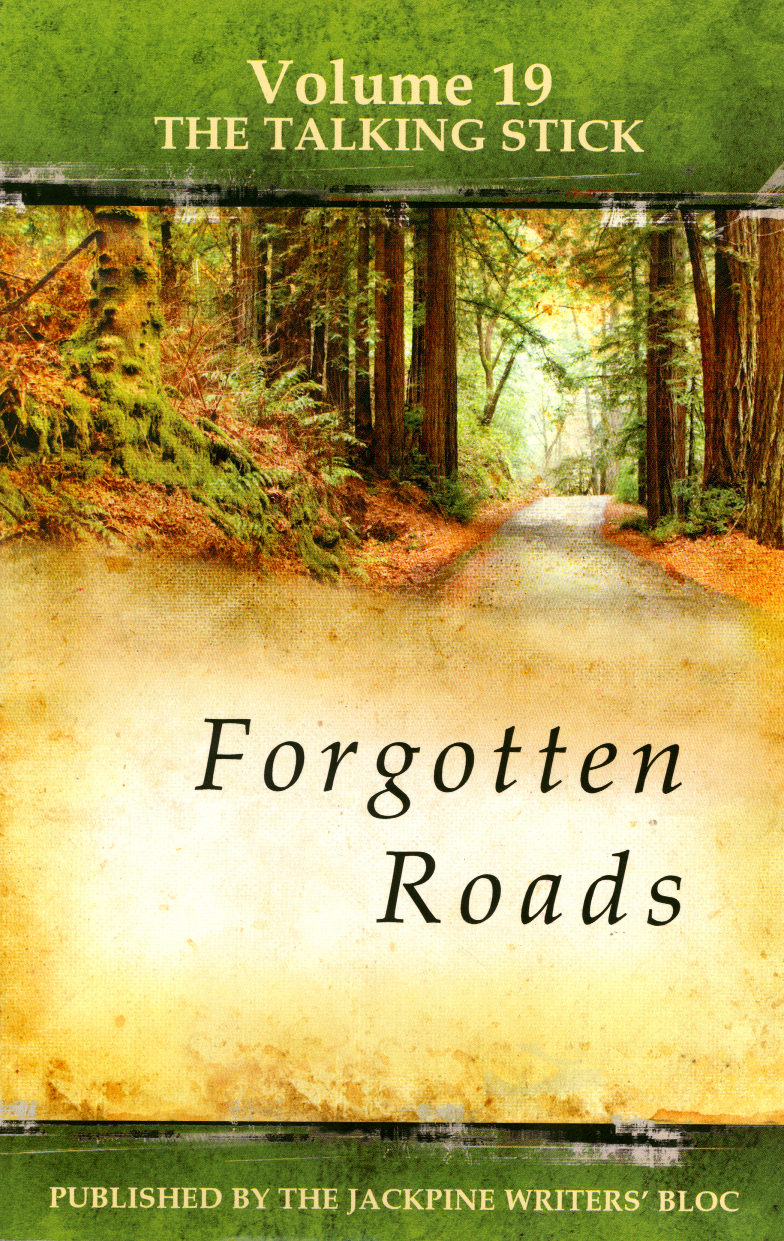
TS 19 in which my poem, "Hit-and-Run," received honorable mention.

TS 19 in which my poem, “Hit-and-Run,” received honorable mention.

IMAGINE THE SWEET SURPRISE of learning you earned honorable mention in a writing competition.

That would be reality for me, dear readers.

I received a thick envelope from Sharon Harris of the Menahga-based Jackpine Writers’ Bloc recently announcing that two of my entries, a poem titled “The Farmer’s Song” and a short story, “The Final Chapter,” were accepted for publication in The Talking Stick 22.

Getting my work accepted into this Minnesota anthology of fiction, creative nonfiction and poetry is nothing new; this marks my fourth time in the annual book. I’ve previously had poetry and creative nonfiction published here.

Neither is the award of an honorable mention novel. In 2010 I received honorable mention for my “Hit-and-Run” poem based on the real-life experience of my son being struck by a hit-and-run driver at age 12.

But this year marks my first time submitting a short story. Decades have passed since I penned fiction. I can’t recall ever entering fiction in a contest. So when I submitted “The Final Chapter,” I did so with minimal, if any, confidence.

I labored over every word, every paragraph, of my short story before finally deciding if I didn’t submit, I would never know whether I’d written a piece worthy of publication. Sometimes you just have to step off the cliff.

I would have been content simply getting my story about an 80-year-old woman losing her grip on reality accepted. (Twenty-five pieces of fiction were selected for publication.) But then, to experience that additional affirmation of honorable mention…, well, my confidence level soared.

It gets even better, dear readers. After members of the Jackpine Writers’ Bloc read all of the submissions, they forwarded their top picks to published writers in each category. St. Paul author John Reimringer, who won the 2011 Minnesota Book Award in novel and short story for his book, Vestments, chose and critiqued the top three short stories, including mine.

Rare is the opportunity to receive such personal, professional feedback. Until you read “The Final Chapter,” you will not fully understand Reimringer’s comment. But, here’s what he wrote:

I like the economical, unsentimental sketch of Clara’s life, and the way she chose third person narrative in the last few paragraphs keeps us in Clara’s pov (point of view) even as it’s clear she’s losing her grasp on reality.

OK, then, basically Reimringer likes my story, just as I enjoyed Vestments when I read, and then reviewed, his award-winning book several years ago for Minnesota Moments magazine. Little did I know then that I would connect with him several years later.

I was hopeful I could meet Reimringer at The Talking Stick book release party in late September. But that won’t happen. My eldest daughter is getting married the same weekend. And that wedding, dear readers, easily trumps honorable mention.

FYI: To learn more about The Talking Stick, which publishes for the 22nd time late this summer, click here. And click here to learn more about The Jackpine Writers’ Bloc.

© Copyright 2013 Audrey Kletscher Helbling
 

Celebrating the wordful art of poetry in southeastern Minnesota April 19, 2013

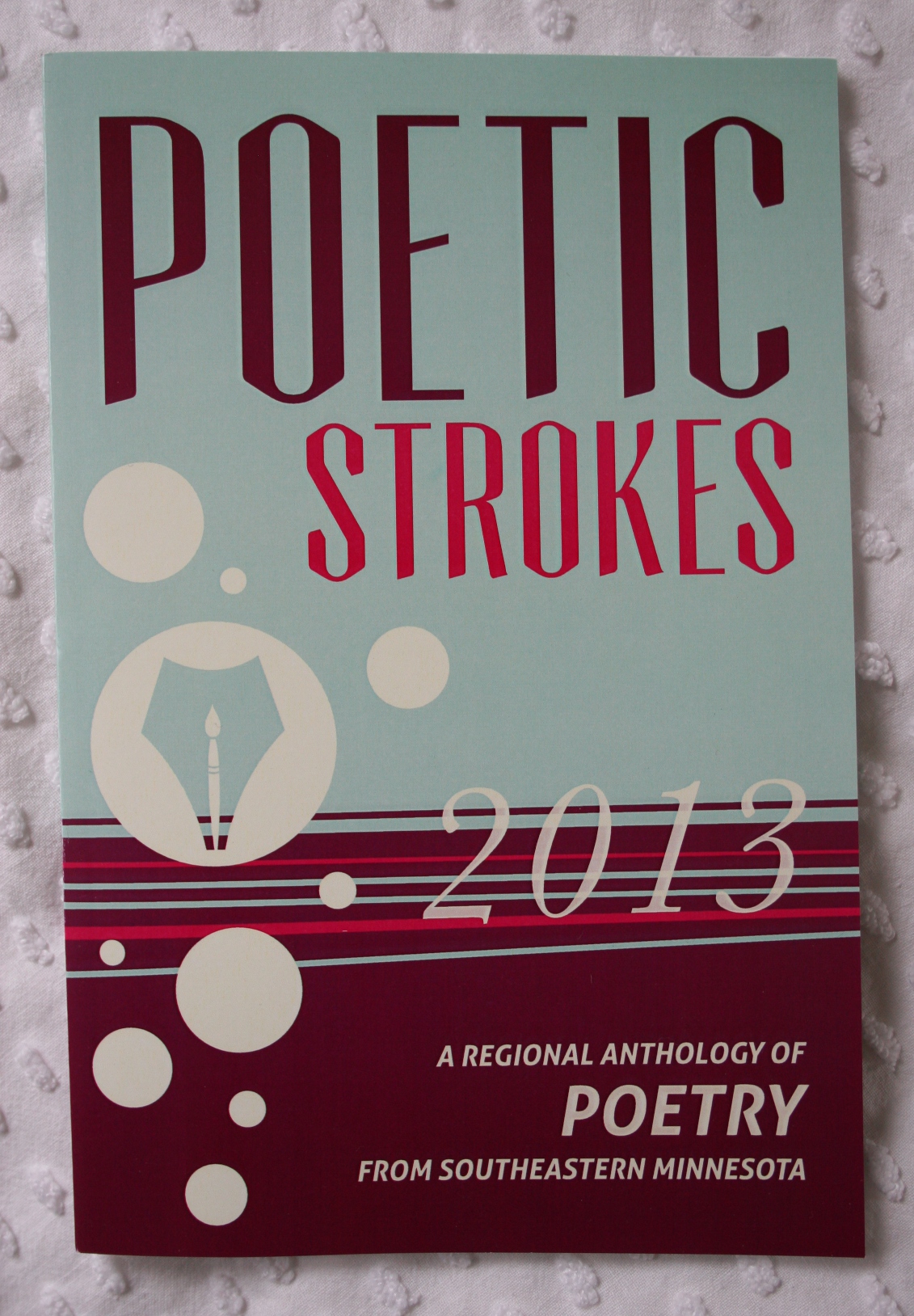
SELCO's seventh volume of Poetic Strokes.

SELCO’s seventh volume of Poetic Strokes.

POETIC STROKES. The title resonates with a graceful image of fountain pen dipped in ink sweeping words across a blank page.

In my idealistic poet’s eye, I envision letters flowing onto paper with ease and passion.

In reality, I understand that inspiration more likely comes in halting clicks on a computer keyboard, screen idling, fingers poised, poet pausing to claim the muse. If only poetry were as easy to write as it might seem.

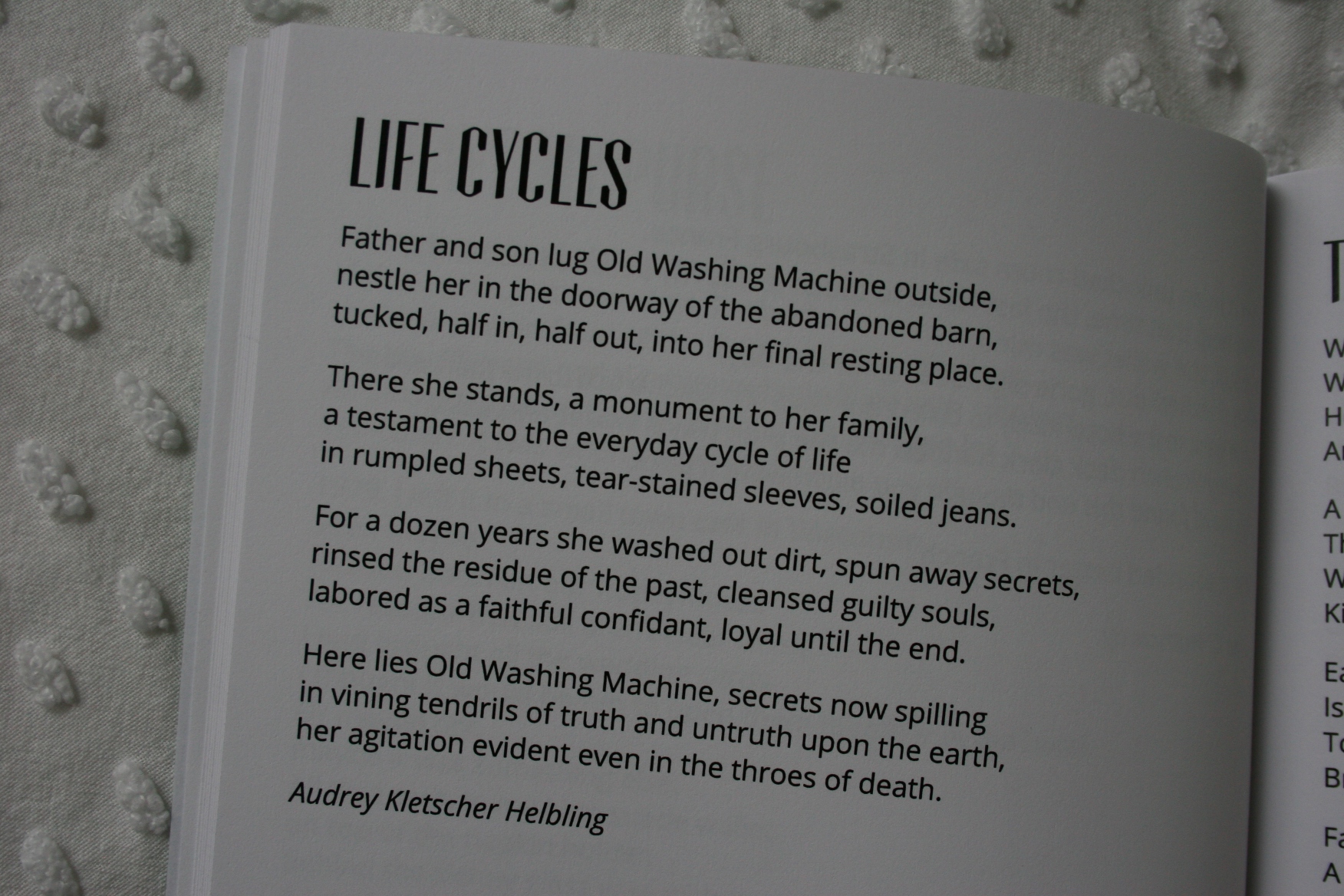
My poem, "Life Cycles."

My poem, “Life Cycles.”

These are my thoughts as I read the recently-released volume 7 of Poetic Strokes 2013—A Regional Anthology of Poetry from Southeastern Minnesota, published by Southeastern Libraries Cooperating (SELCO). My poem, “Life Cycles,” is among 18 selected for publication from 110 submissions. This marks the fifth Poetic Strokes volume in which my poetry has printed.

As I thumb through the pages of this anthology, which also includes youth poetry in a Word Flow section, I am impressed by the talent of poets who call this 11-county SELCO region home. Southeastern Minnesota claims some mighty fine poets. I recognize many poets’ names from past anthologies and other contests. I am in fine company.

If I were to ask these poets what inspires them, how would they respond?

How have they come to write about an aged woman going to the beauty shop, sweet memories from the summer of ’68, picking strawberries, perusing library shelves, baking bread and a dozen other topics which, without their creative pens, would seem rather ordinary topics?

The poet’s gift is to dip a pen into the inkwell of a memory, an emotion, a moment in time, a scene—whatever inspires—and create a wordful work of art. As a poet, there is nothing sweeter than words flowing into lines and verses, connecting to the reader in some way.

When I read about gardening or peeling an apple (not really about peeling an apple) or any of the other subjects covered in this seventh volume of Poetic Strokes, I take away my own interpretation based on my experiences. Therein lies a truth. Poetry is as much about writing as it is about experiencing this wordful art.

Eighteen poems were selected for publication from 110 submissions to Poetic Strokes. In the Word Flow section of the anthology, 14 poems were published from 99 submissions.

Eighteen poems were selected for publication from 110 submissions to Poetic Strokes. Faribault High School English teacher and writer Larry Gavin joins me as the other Faribault poet included in the anthology.  In the Word Flow youth section of the anthology, 14 poems were published from 99 submissions. All but two of those students attend Cannon Falls High School.

YOU CAN MEET Poetic Strokes poets at 6 p.m. on Tuesday, April 30, during a Meet and Greet hosted by the Owatonna Public Library and the Owatonna Poetry Writer’s Group in the third floor Gainey Room at the library, 105 North Elm Avenue. Poets will discuss and share their poetry. If you plan to attend, please RSVP to Bonnie Krueger at the library by emailing bonnie@owatonna.info or calling (507) 444-2460. Because refreshments will be served, she needs a head count.

Following the Meet and Greet, at 7 p.m., Minnesota Book Award Poet Todd Boss, one of my favorite Minnesota poets, will share his works. I cannot wait to hear Todd read during this “Poets at the Library Tour” event celebrating National Poetry Month in April.

THIS EVENING, Friday, April 19, Better Brew Coffeehouse, 301 North Main Street, Pine Island, is hosting an Open Mic Poetry Night beginning at 7 p.m. The event calls for participants of all ages and all forms of poetry to read their works or that of others. Participant registration opens at 6 p.m. Better Brew, the Van Horn Public Library and Pine Area People for the Arts are sponsoring the poetry reading. Given the unfolding weather situation, I’d advise checking whether this reading is still “on” or postponed.

FYI: If you live in the SELCO system, you can check out a copy of Poetic Strokes from your local library. The anthology was funded in part or in whole with money from Minnesota’s Arts and Cultural Heritage Fund. Click here to see the names of poets published in the 2013 Poetic Strokes. To read the list of youth poets published in Word Flow, click here.

© Copyright 2013 Audrey Kletscher Helbling


How I’ve composed poetry that dances (in the barn) April 4, 2013

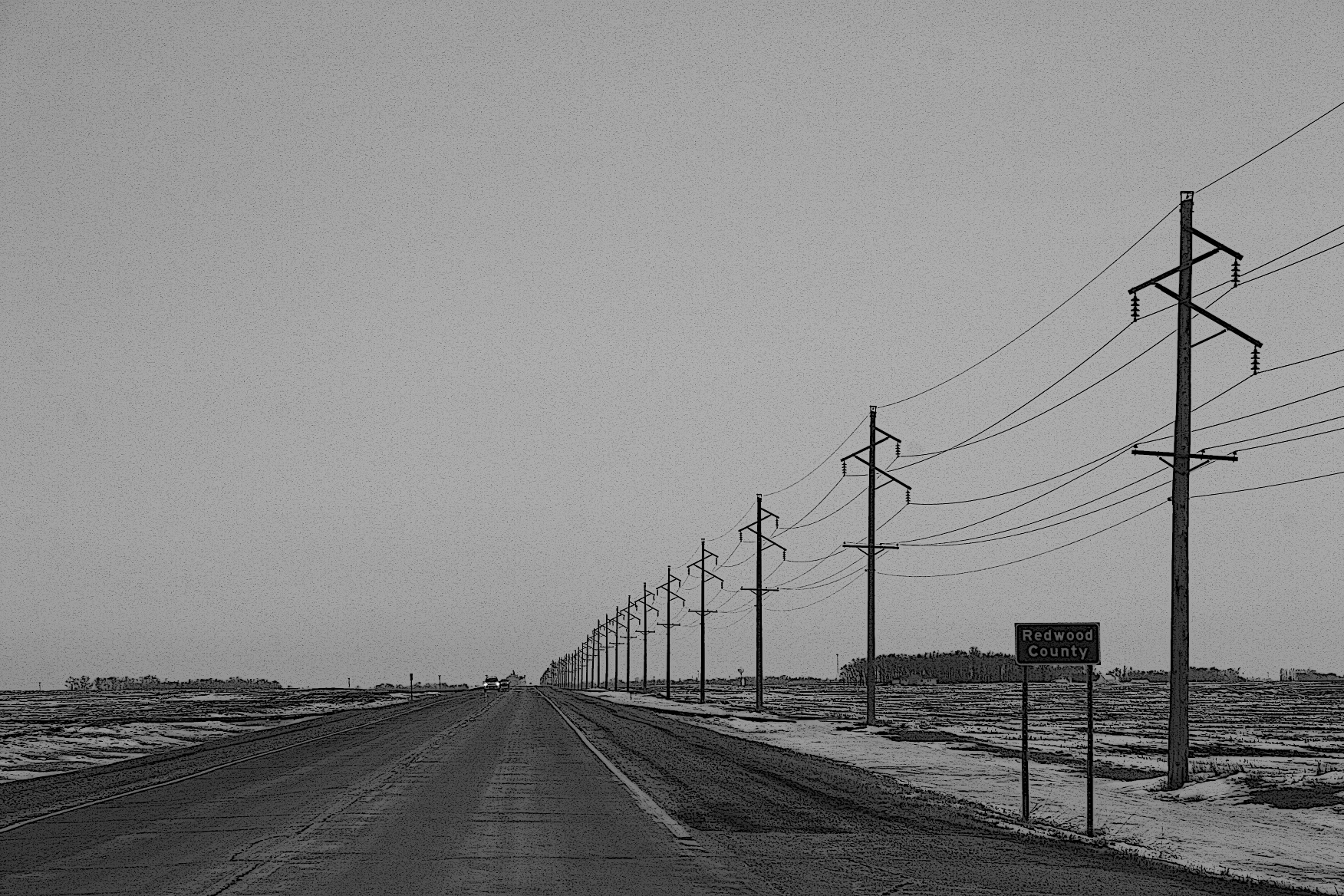
Entering my home county of Redwood along Minnesota State Highway 68 southeast of Morgan.

Entering my home county of Redwood along Minnesota State Highway 68 southeast of Morgan. Rural Redwood County is the setting for most of my poetry.

POETRY. That single word encompasses language, music, art, emotion and more. It’s a word to be celebrated in April, designated as National Poetry Month by the Academy of American Poets.

I’ve written poetry for about four decades, but not with particular passion or regularity until recent years. Something has evolved within me as a writer, directing me from the narrow path of journalistic style writing to the creativity of penning poetry.

Perhaps a parcel of my new-found enthusiasm can be traced to my publishing success. Seventeen, soon to be 18, of my poems have been published in places ranging from literary journals to anthologies to billboards to a devotional and more. I figure if editors have accepted my poetry for publication, I must be doing something right. And when they reject my poetry, as has happened often enough, they were correct in those decisions.

An abandoned farmhouse along Minnesota State Highway 19 east of Vesta on the southwestern Minnesota prairie.

An abandoned farmhouse, like this one along Minnesota State Highway 19 east of Vesta on the southwestern Minnesota prairie, inspired my poem, “Abandoned Farmhouse,” published in Poetic Strokes, A Regional Anthology of Poetry from Southeastern Minnesota, Volume 3.

Most of my poems are rooted in childhood memories from the southwestern Minnesota prairie. I write about topics like barns, walking beans, an abandoned farmhouse, canned garden produce, taking lunch to the men in the field and such.

My poetry rates as visually strong and down-to-earth. There’s no guessing what I am writing about in any of my poems.

Barns, like this one along Minnesota Highway 60 west of Waterville, have woven into my poetry.

Barns, like this one along Minnesota Highway 60 west of Waterville, have woven into my poetry.

Here, for example, is my poem which published in Volume One of Lake Region Review, a high-quality west central Minnesota-based literary magazine of regional writing. To get accepted into this journal in 2011 and then again in 2012 significantly boosted my confidence as a poet given the level of competition and the credentials of other writers selected for publication.

This Barn Remembers

The old barn leans, weather-weary,
shoved by sweeping prairie winds,
her doors sagging with the weight of age,
windows clouded by the dust of time.

Once she throbbed with life
in the heartbeats of 30 Holsteins,
in the footsteps of my farmer father,
in the clench of his strong hands
upon scoop shovel and pitchfork.

This barn spoke to us,
the farmer and the farmer’s children,
in the soothing whir of milking machines
pulsating life-blood, rhythmic, constant, sure.

Inside her bowels we pitched putrid piles of manure
while listening to the silken voices of Charlie Boone
booming his Point of Law on ‘CCO
and Paul Harvey wishing us a “good day,”
distant radio signals transmitting from the Cities and faraway Chicago.

This barn remembers
the grating trudge of our buckle overshoes upon manure-slicked cement,
yellow chore-gloved hands gripping pails of frothy milk,
taut back muscles straining to hoist a wheelbarrow
brimming with ground corn and pungent silage.

This barn remembers, too,
streams of hot cow pee splattering into her gutters,
rough-and-tumble farm cats clumped in a corner
their tongues flicking at warm milk poured into an old hubcap,
and hefty Holsteins settling onto beds of prickly straw.

A rural scene along U.S. Highway 14 near Nicollet.

A rural scene along U.S. Highway 14 near Nicollet.

Let’s examine “This Barn Remembers” to see how I created this poem. Always, always, when penning a poem like this, I shut out the present world and close myself into the past.

I rely on all five senses, not just the obvious sight and sound, to engage the reader:

  • sight—sagging doors, clouded windows, manure-slicked cement
  • sound—soothing whir of milking machines, grating trudge of buckle overshoes, silken voices of Charlie Boone
  • taste—tongues flicking warm milk
  • touch—in the clench of his strong hands, gripping pails of frothy milk, settling onto beds of prickly straw
  • smell—putrid piles of manure, pungent silage

Strong and precise verbs define action: shoved, throbbed, booming, gripping, brimming, splattering, flicking

Literary tools like alliteration—pitched putrid piles of manure—and personification—the barn taking on the qualities of a woman—strengthen my poem.

The words and verses possess a certain musical rhythm. This concept isn’t easy to explain. But, as a poet, I know when my composition dances.

I also realize when I’ve failed, when a poem needs work and/or deserves rejection.

That all said, the best advice I can offer any poet is this:

  • Write what you know.
  • Write from the heart.
  • Write in your voice.
  • Write with fearlessness and honesty. (Note especially this line: “…streams of hot cow pee splattering into her gutters…”)
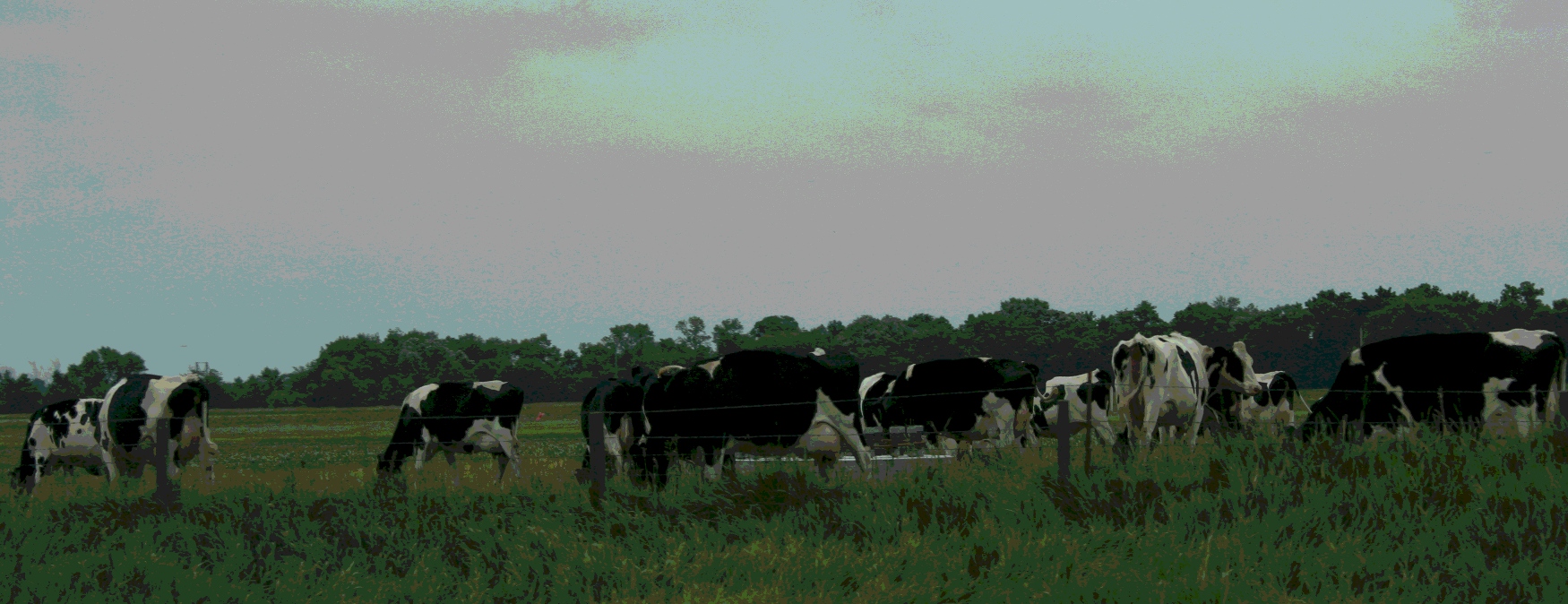
I grew up on a dairy and crop farm, so I know cows well enough to write about them in my poetry.

I grew up on a dairy and crop farm, so I know cows well enough to write about them in my poetry.

You can bet I smelled that hot cow pee, watched the urine gushing from Holsteins into the gutter, pictured a younger version of myself dodging the deluges, when I penned “This Barn Remembers.” Writing doesn’t get much more honest than cow pee.

IF YOU’RE A POET, a lover of poetry and/or an editor, tell me what works for you in composing/reading/considering poetry.

© Copyright 2013 Audrey Kletscher Helbling
 

“It was a dark and stormy night…” March 15, 2013

Snoopy's GuideJUST THINKING about the scene—my husband and kids lying belly down on the carpet reading the Sunday funnies—makes me smile.

My mother’s heart swelled with love to witness this weekly connection between father and daughters/son. Back then, I considered only that bonding aspect, that break from full-time mothering, the laughter that spilled from the living room.

I’ve never been a reader of comics, considering them a waste of time. Besides that, I’m a serious person, not inclined to reading anything remotely humorous. But now, at age 56, it is not too late to admit that I was wrong. Comics offer not only laughter, but insights into life and much more. Duh.

Thanks to Minnesota writer Sue Ready, who blogs at Ever Ready, I discovered the value in comic strips via her recommended reading of Snoopy’s Guide to the Writing Life, published in 2002 by Writer’s Digest Books and edited by Barnaby Conrad and Monte Schulz.

It was the title, not the comedic aspect, which grabbed my attention. I am always interested in reading about writing and this volume offers insights from noted authors like Ray Bradbury, Fannie Flagg and Danielle Steel, among about two dozen others.

Their advice, though, isn’t presented in a straight-forward manner. Rather, the selected writers are prompted by cartoonist Charles M. Schulz’s Snoopy strips, specifically featuring Snoopy the writer at his doghouse rooftop typewriter.

Why had I forgotten that Snoopy was a writer? Perhaps because I have not read all that many Peanuts cartoons.

Snoopy faces the sometime issues of writer’s bloc, criticism (from the ever present loud-mouthed Lucy), rejection and more. But the problems somehow seem funny when faced by Snoopy and not me.

The canine is stuck on beginning his stories with “It was a dark and stormy night,” or a slightly revised version. How often do we writers also become stuck, writing in the same way or, even worse, writing how we think we should write?

Author Fannie Flagg advises:

The joy about writing is that as long as you write from your heart, a thousand English degrees cannot compete with that.

How true. Readers can sense when you write from your heart.

I found Snoopy’s Guide to the Writing Life packed with pieces of useful advice, some which I already knew, some not. Here are some paraphrased gems I plucked from the book:

  • Too much time on the typewriter (translate computer) can cause double vision. (Correct.)
  • Avoid boring descriptions and heavy explanations.
  • Understand your subject and your market.
  • Surprise is an important element of humor (and writing in general, might I add).
  • Stop seeking approval and advice and trust your instincts.
  • “Try to leave out the parts that readers skip” (direct quote that I could not paraphrase).
  • Plot develops from character, a point emphasized by more than one writer.
  • Just write. Every day.

Now, one of my favorite lines comes from Monte Schulz, the son of Peanuts creator Charles M. Schulz. Monte surmises that writers write “for the music of beautiful language.” I love that phrase because I totally get what he means. As a writer, and especially as a poet, my heart rejoices when I find the exact word or line which makes my poem sing. It is a glorious moment.

Then, on the second to last page of Snoopy’s Guide, writer J.F. Freedman throws in that element of surprise, at least for me, when he writes:

 Great comic strips…are a fine introduction into literature, and are damn good writing in and of themselves…

And after reading (in this book) more than 180 “Snoopy at the typewriter” comic strips, likely more comics than I’ve read in my life, I’d agree with Freedman. Damn good writing, indeed.

WHAT WRITING TIPS can you offer? Let’s hear them.

© Copyright 2013 Audrey Kletscher Helbling


The evolution of poetry January 15, 2013

EXCEPT FOR THE POETRY of Robert Frost and Emily Dickinson, the poetry I studied in my youth seemed mostly complicated and unapproachable.

I expect you may have felt the same about any poetry you read, studied and critiqued as part of a high school and/or college English class. You could not wait to get through the required course and put poetry behind you.

Today, though, poetry has become much more approachable, even understandable. Would you agree?

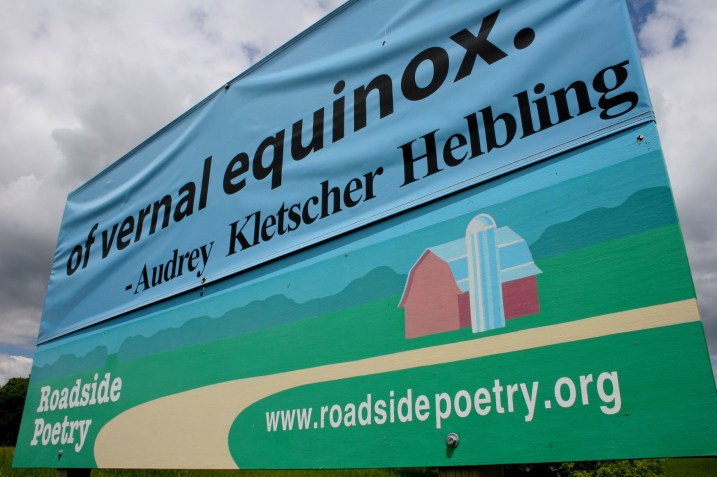
I write poetry. Seventeen of my poems have been published in places ranging from the pages of a newspaper, magazine and anthologies to billboards. Yes, billboards. Recently, the Roadside Poetry Project, which began in Fergus Falls, Minnesota, in 2008 and featured seasonally-changing poetry billboards, ended.

The last of four billboards featuring my Roadside Poetry spring poem.

The last of four billboards featuring my Roadside Poetry spring poem. Minnesota Prairie Roots file photo.

Venues like this expose poetry to the masses in an unassuming and everyday way. When a poem is limited to four lines, a maximum of 20 characters per line, every word, every letter, counts and thus the poem is penned with great care. Take my poem, winner in the spring 2011 Roadside Poetry competition:

Cold earth warmed
by the budding sun
sprouts the seeds
of vernal equinox.

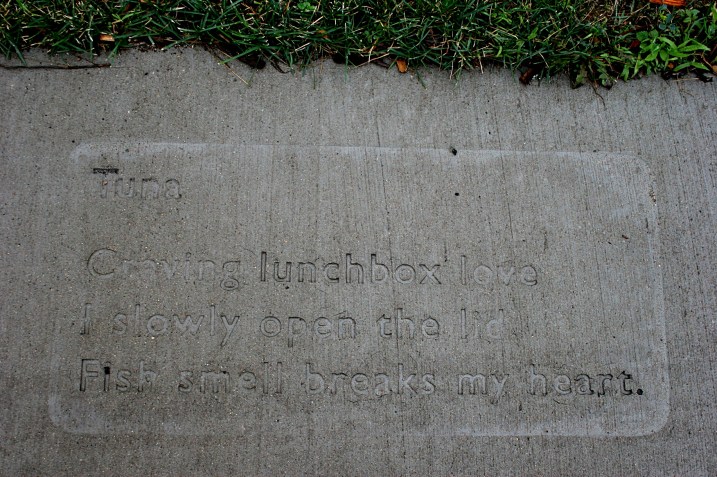
Sidewalk poetry, which graces Minnesota sidewalks in St. Paul, Mankato, Northfield and St. Cloud, also holds similar word limitations and a certain everyday appeal. Those who long ago dismissed poetry for its complexity and arrogance may develop a renewed interest in verse upon reading sidewalk poetry. That would be my hope.

A poem by Mankato resident Yvonne Cariveau imprinted  in the sidewalk at Riverfront Park, Mankato, as part of the WordWalk project.

A poem by Mankato resident Yvonne Cariveau imprinted in the sidewalk at Riverfront Park, Mankato, as part of the WordWalk project. Minnesota Prairie Roots file photo.

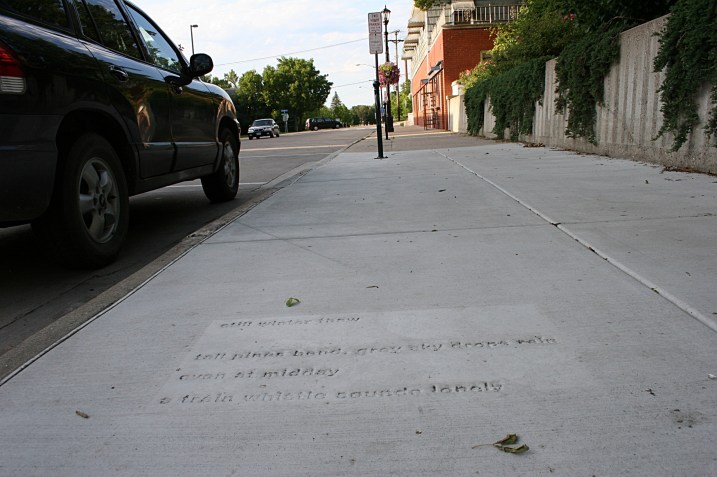
I’ve viewed some of the sidewalk poems in Mankato (WordWalk) and Northfield (Sidewalk Poetry). While these poems may be limited in words, they certainly are not limited in depth. Sometimes less is more. Writing a short poem with word limitations can be more of a challenge than penning a lengthy poem. Ask any poet.

A poem by Patrick Ganey is stamped into the sidewalk near the Northfield Public Library. It reads: still winter thaw  tall pines bend, grey sky drops rain  even at midday  a train whistle sounds lonely

A poem by Patrick Ganey is stamped into the sidewalk near the Northfield Public Library. It reads: still winter thaw/ tall pines bend, grey sky drops/ rain even at midday/ a train whistle sounds lonely. Minnesota Prairie Roots file photo.

This whole concept of stamping poems into concrete, putting poetry out there to the public, appeals to me as a truly creative way to bring verse to the people, to those who might not pick up a poetry book.

Even more creative is Motionpoems, a nonprofit poetry film initiative developed under the guidance of Twin Cities animator/producer Angella Kassube and St. Paul poet Todd Boss. The pair co-founded Motionpoems in 2009. The process “turns contemporary poems into (animated) short films.”

Among my favorite Motionpoems is an adaptation of Boss’ poem titled “The God of Our Farm Had Blades,” a poem about a windmill. While some would argue that visuals detract from the words and the reader’s interpretation of a poem, I would argue that visuals and listening to verse read aloud enhance the poetry experience.

Northern Community Radio, based in Grand Rapids and Bemidji, recently embraced poetry via “The Beat,” which each weekday features a poem by a poet with a Minnesota connection. How lovely is that to listen to a poem read on the air?

For those who still prefer the old-fashioned book-in-hand method of reading poetry, as I also enjoy, plenty of excellent collections exist out there, including Boss’ two books, Yellowrocket and Pitch.

Minnetonka poet Carol Allis also recently published a particularly understandable poetry collection appropriately titled Poems for Ordinary People. Her no-frills style of writing and the content of her verse allow readers to easily connect with her words.

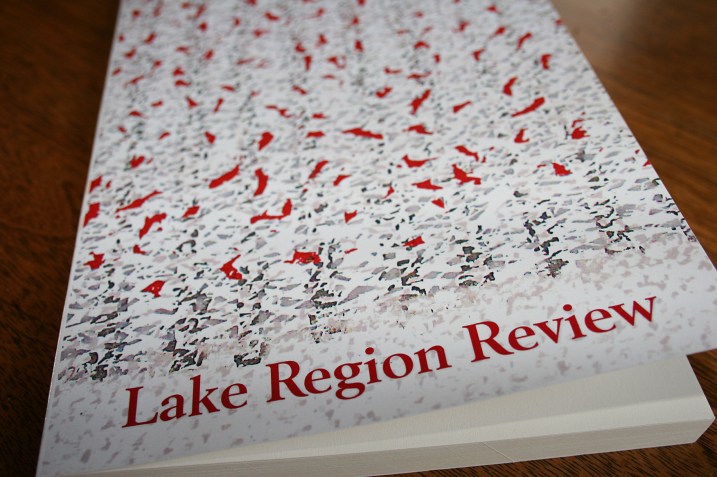
Lake Region Review, volume two, with cover art by  Charles Beck

Lake Region Review, volume two, with cover art by Charles Beck

I can’t end this post without recommending two outstanding Minnesota-based collections of regional writing (including poetry) in the long-standing The Talking Stick published by The Jackpine Writers’ Bloc and Lake Region Review, in its second year of publication by the Lake Region Writers Network. Both feature a diversity of fine, fine regional writing. (And just to clarify, my work has been published in both.)

NOW IT’S YOUR TURN. Tell me how you experience, or don’t experience, poetry. Do you write, edit, listen to, read poetry?

What are your thoughts on creative poetry venues like billboards, sidewalks and film?

What are your thoughts on poetry in general?

Let’s talk poetry.

© Copyright 2013 Audrey Kletscher Helbling