Minnesota Prairie Roots

Writing and photography by Audrey Kletscher Helbling

As Canadian wildfires rage: “What’s mine is yours” May 4, 2016

Minnesota Prairie Roots file photo.

Minnesota Prairie Roots file photo of unfurling leaves in my Minnesota backyard.

IT’S BEEN A GLORIOUS MAY day here in southern Minnesota. Sunshine. Clear blue skies. Leaves unfurling in a landscape that is a lush and vivid green.

Tomorrow, though, we can expect “milky skies,” according to the National Weather Service Twin Cities Twitter page. Smoke from Canadian wildfires is moving east into Minnesota. It will be a visual reminder of what our neighbors to the northwest are enduring as wildfires rage.

With some 88,000 people evacuated from the Ft. McMurray area and 1,600 structures already destroyed, it would be easy to feel overwhelmed by the scope of the disaster. And those feelings would be warranted.

But while I was reading about the fires and evacuation today, I was moved to tears by the goodness of people. Scrolling through posts on the Fort McMurray Evacuee Open Source Help Facebook page, I read offer after offer of help:

We have a house in north Edmonton. What’s mine is yours. Plenty of clothes for a female child age 4-6. Toys for any age. Room to park a small trailer. Room for a tent, basement and air mattress ready. Food, shower anything you need please call or text… Can pick you up and help with small children

Is anyone stranded on HWY 63 that needs fuel or supplies? Please let me know!

It’s not much. But if anyone should be coming through spruce grove on their journey tonight, I would like to give a hot meal. And a place to relax and regroup your thoughts and plans.

The Church of South Edmonton is opening its doors to those displaced by the fire. They’ll offer snacks, activities for kids, a BBQ, pastoral counseling, internet access—simply a place to recharge and refocus. People can sign up online to host a family.

Offers of help are also coming from Slave Lake, which only five years ago suffered from similar devastating wildfires:

I have a spare room ready for anyone in need in Sherwood park! Wanting to pay it forward as I’m from Slave lake and lost my house so I would love to help someone! Txt me at…

LIVESTOCK
If there’s anybody from Ft McMurray in need, I have feed and water pen space available for free in Slave Lake. Can take 10-15 head of horses/cattle

And, yes, the offers for assistance extend beyond helping people. Canadians are also opening their farms and homes to house displaced pets and livestock.

We live by Rocky Mountain house On a farm We have room and free feed for your large or small livestock for as long as needed. Also room for your rv. And a spare room. And a holiday trailer that sleeps 7 for as long as you need. We can also come up and pick you or your animals up.

If you want your faith restored in people today, then I’d encourage you to read the Ft. McMurray Evacuee Open Source Help Facebook page. Now.

© Copyright 2016 Audrey Kletscher Helbling


Details of weddings in Steele County, Part II

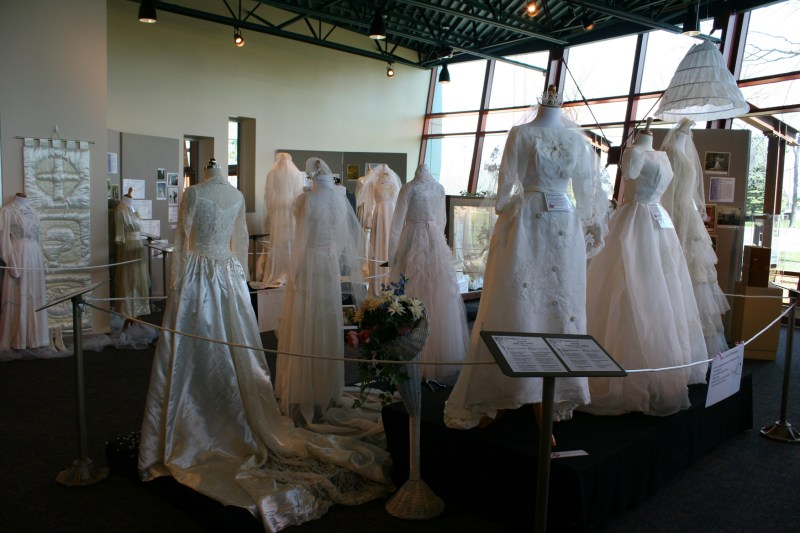
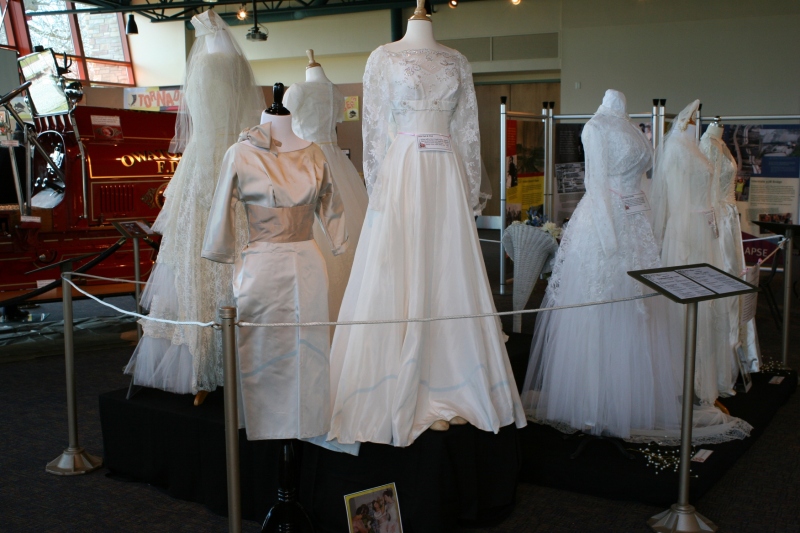
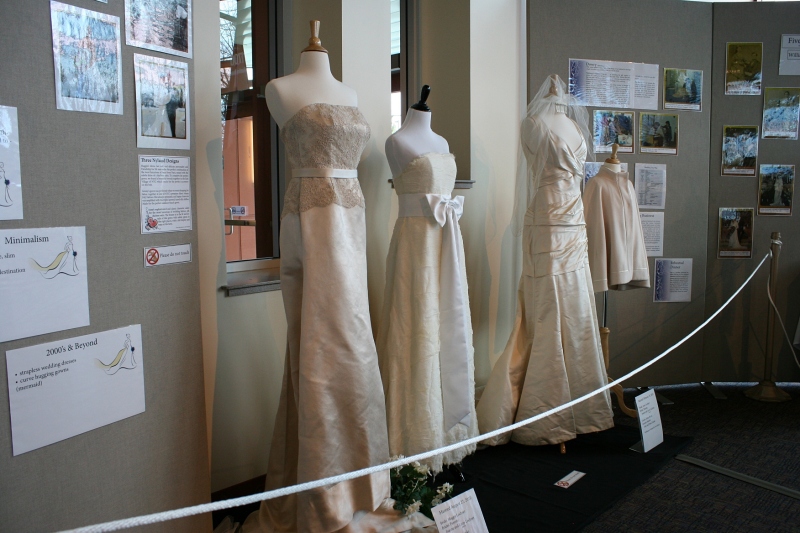
A sampling of dresses in the exhibit.

A sampling of dresses in the Wedding Traditions of Steele County exhibit.


AS A PHOTOGRAPHER AND WRITER, details matter to me. Likewise, details matter to historians. We are meticulous in our documentation. We understand that details tell the complete story.


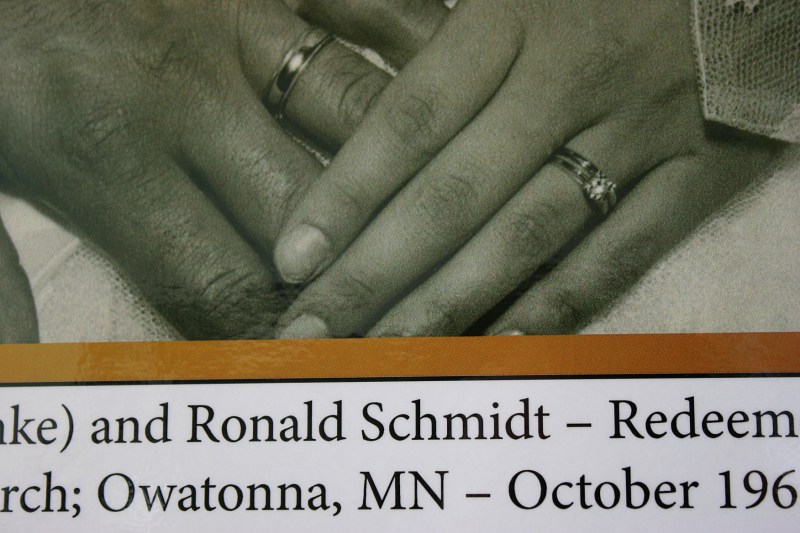
Details have always been important in wedding photography.

Details have always been important in wedding photography as shown in this exhibit photo.


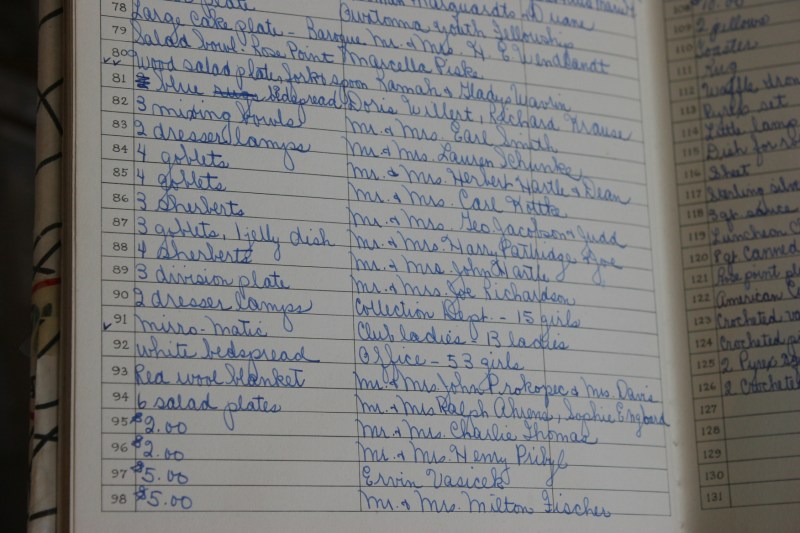
Wedding gifts are listed in this book on display.

Wedding gifts are listed in this book on display.


That is evident in Wedding Traditions of Steele County, a recently-opened exhibit at the Steele County History Center in Owatonna. Although bridal gowns certainly are the highlight, there is so much more to be seen—in the photos, in the genealogy, in the explanations of traditions.


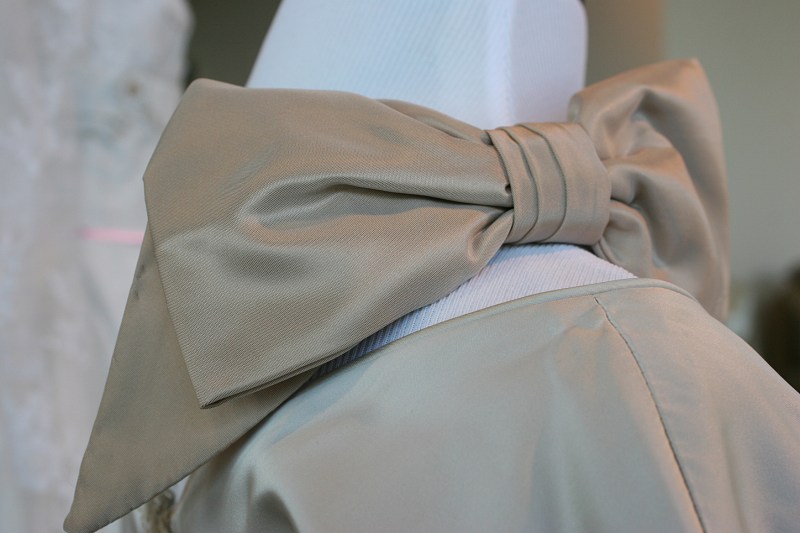
This bow sits on the shoulder/neckline of a dress.

This bow sits on the shoulder/neckline of a dress.


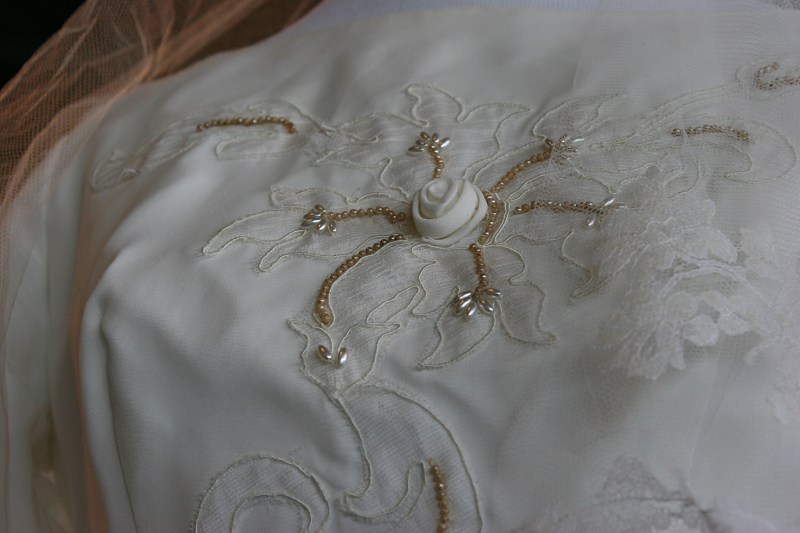
Lovely fabric rosettes adorn a 1964 bridal gown.

Lovely fabric rosettes adorn a 1964 bridal gown.


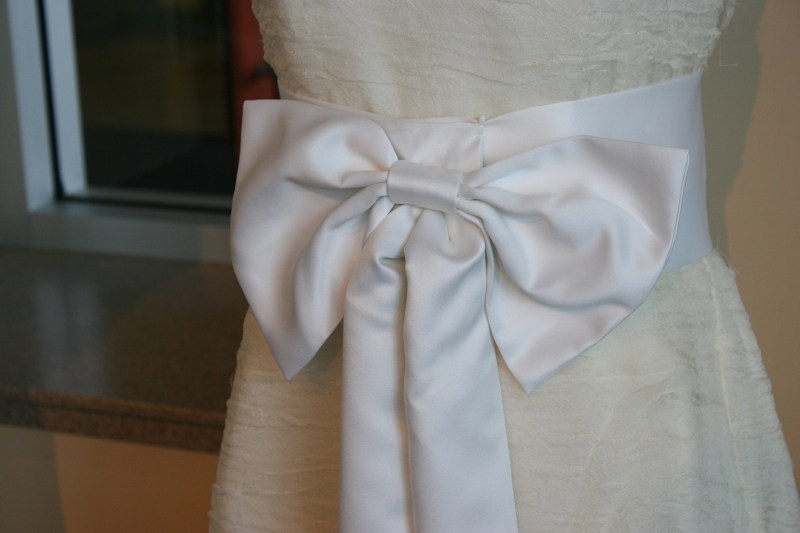
A sash ties in the front of a dress designed by Owatonna native Scott Nylund.

A sash ties in the front of a dress designed by Owatonna native Scott Nylund.


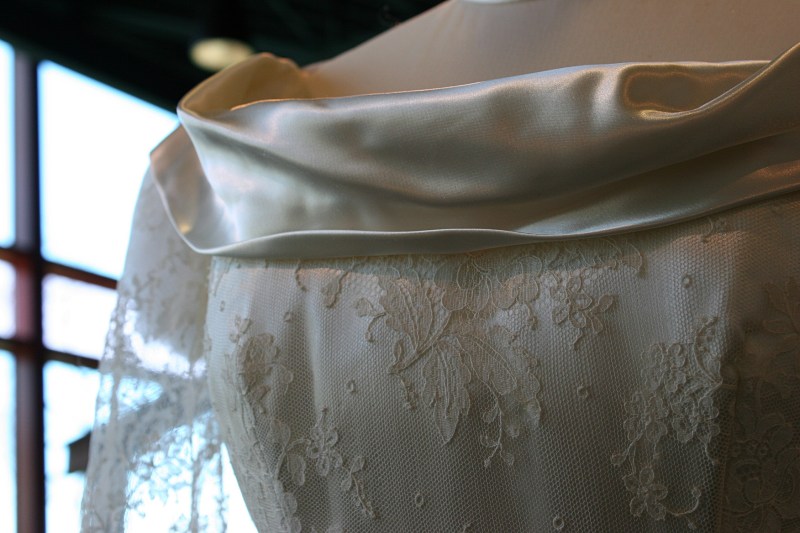
An illusion neckline drapes on a 1949 bridal gown.

An illusion neckline drapes on a 1949 bridal gown.


As I took in the displays, I found myself focusing on details in bridal gown design.


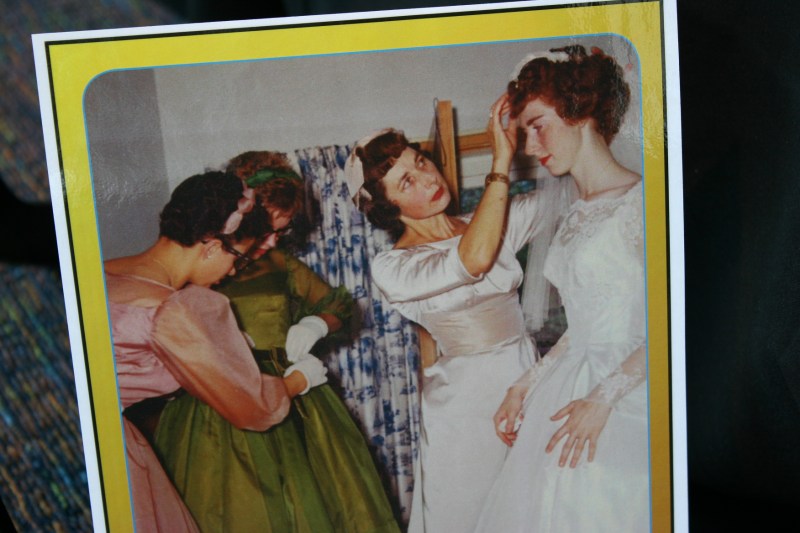
Sharon West and her wedding party party get ready for her September 1959 wedding at the United Methodist Church in Owatonna.

Sharon West and her wedding party get ready for her September 1959 wedding at the United Methodist Church in Owatonna. Although this vintage shot doesn’t look posed, it likely was.


And then I studied the wedding photos, noting how wedding photography has changed from mostly formal posed portraits to the journalistic style of today.


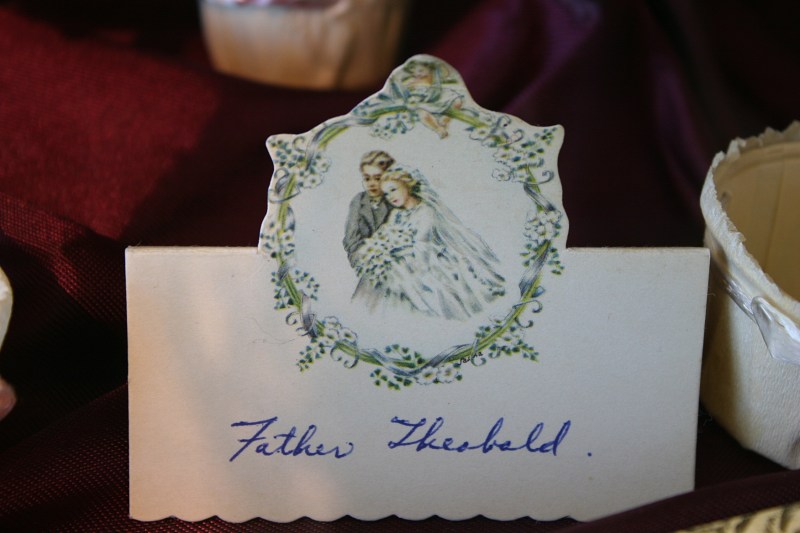
A name place card is among items displayed.

A name place card is among items displayed.


Details, details, details. In planning a wedding, they are essential. And this exhibit shows that.

FYI: Check back tomorrow for one final post in this Wedding Traditions of Steele County series. Click here to read my first post in this series.

© Copyright 2016 Audrey Kletscher Helbling


A historical look at weddings in Steele County, Part I May 3, 2016

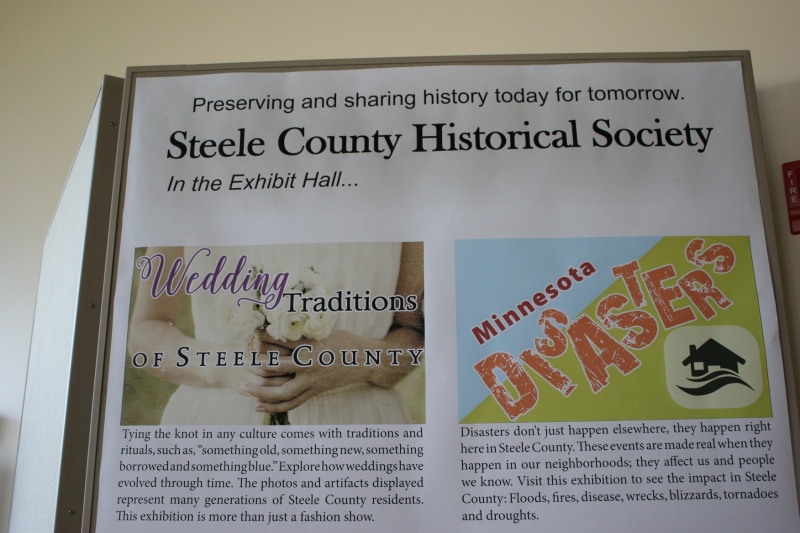
This sign marks the exhibits currently showing in the Steele County History Center through spring 2017.

This sign marks the exhibits currently showing in the Steele County History Center through spring 2017.

THE DETAILS ARE, OH, SO LOVELY. Dainty buttons. Lace. Shiny satin. You’ll see them all in Wedding Traditions of Steele County, a newly-opened exhibit at the Steele County History Center in Owatonna.

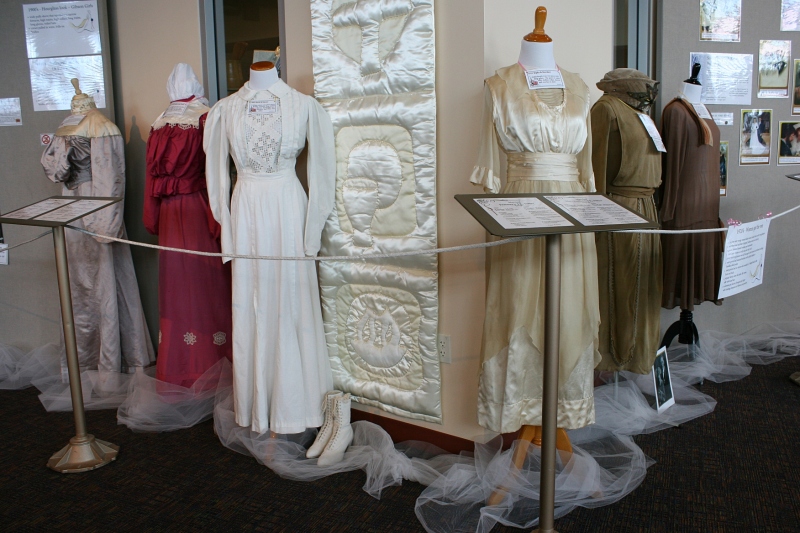
This section highlights dresses from the 1910s and 1920s.

This section highlights dresses from the early 1920s.

Nearly two dozen wedding dresses take center stage in this exhibit created by three volunteers and a museum staffer over some six months.

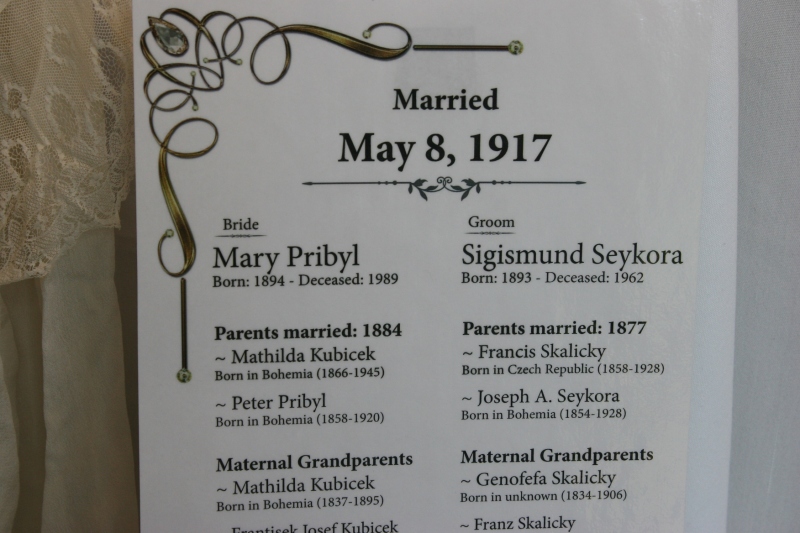
The exhibit team carefully researched the genealogies of the brides and grooms.

The exhibit team carefully researched the genealogies of the brides and grooms.

But this exhibit extends well beyond dresses to include wedding history, traditions and genealogy. It’s an impressive visual documentation, especially fitting as the wedding season begins.

The dress and matching feathered hat worn at this 1923 wedding are in lovely brown tones.

The dress and matching feathered hat worn at this 1923 wedding are in lovely brown tones.

Did you know, for example, that a bride didn’t always wear white? Prior to 1840, when Queen Victoria married Prince Albert in an all-white gown, a bride simply wore her best dress, no matter the color. Blue, rather than white, once symbolized purity.

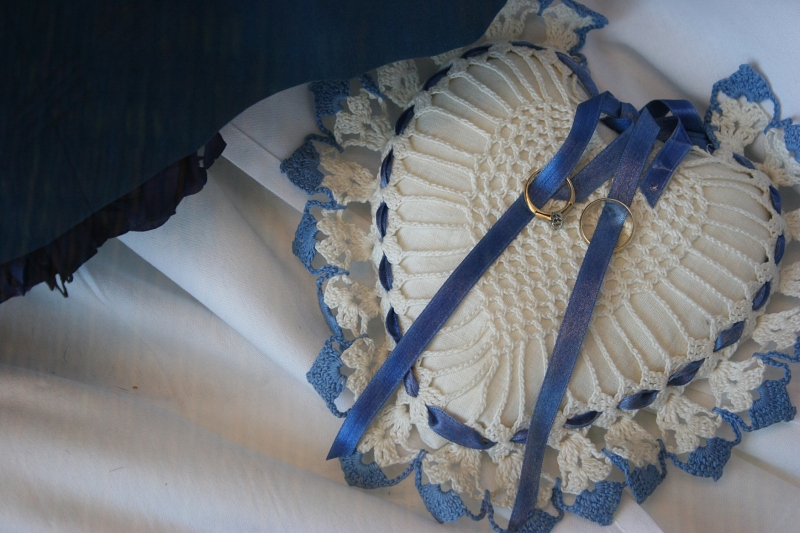
"Something blue" is woven into this crocheted ring bearer's pillow.

“Something blue” is woven into this crocheted ring bearer’s pillow.

And about that “something old, something new, something borrowed, something blue”…this started as a tradition to ward off evil spirits. You’ll learn that and a whole lot more as you peruse this multifaceted exhibit.

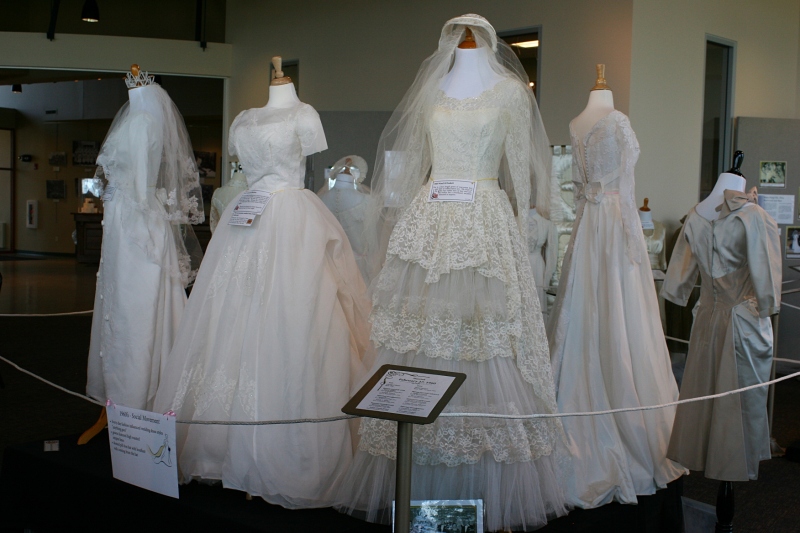
Fuller and lacier dresses defined the style of gowns in the 1950s.

Fuller and lacier dresses defined the style of gowns in the 1950s.

Volunteer Char Ost spent hours researching and planning with team members at meetings and at home as this exhibit came together. She’s a former museum staffer and board president who simply thought the project would be fun. The team reviewed photos of wedding dresses in the museum collection before choosing gowns that would display nicely and were in suitable condition to showcase, she said. Those selected gowns cover the time period from 1896 – 1997.

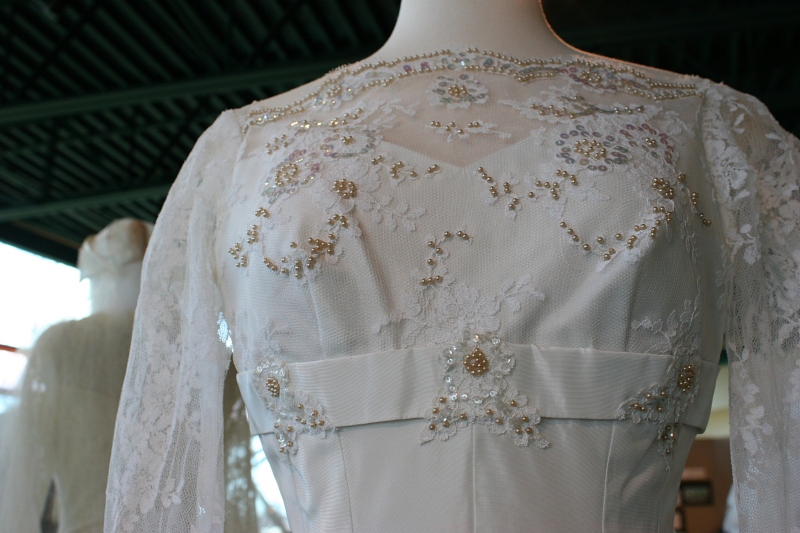
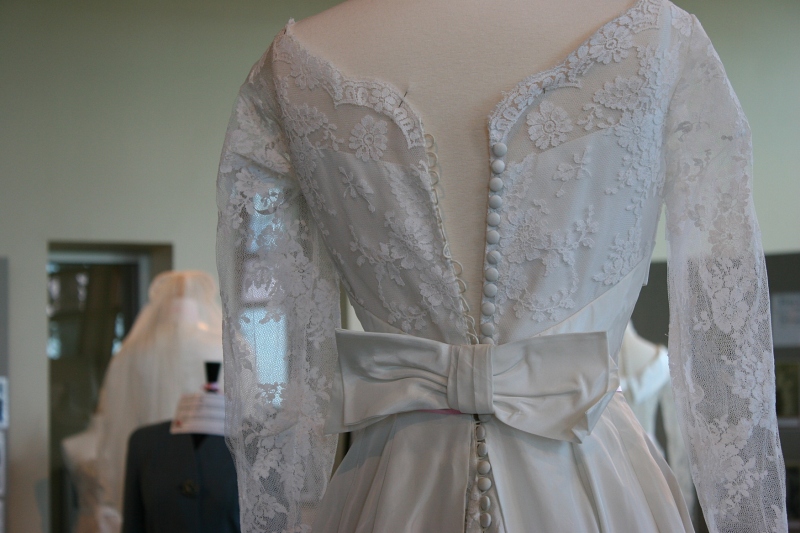
This photo shows the details on a 1950s dress.

This photo shows the bead and lace details on a 1950s wedding dress.

Missing, though, are wedding dresses from the 1980s and more from the 1990s. People are still familiar with those bridal gowns and those brides are not giving away their dresses, including to the museum, Ost noted. That explains why I didn’t see 1980s dresses reflecting the royal influence of Princess Diana’s wedding gown. I was married in 1982 and my $80 wedding dress definitely did not have beads, sequins, puffy sleeves or a long train like that of the princess.

Margaret Ringhofer wore this dress at her August 25, 1931, wedding. It reminds me of my Grandma Josie's bridal gown.

Margaret Ringhofer wore this dress at her August 25, 1931, wedding. It reminds me of my Grandma Josie’s bridal gown.

As I studied the gowns, grouped by time periods, it was easy to see the period influence. In the glass encased Depression era dresses, conservatism shows in neck lines, fabric choices and style. I spotted a 1931 gown that looks a lot like my maternal grandmother’s, a simple style I considered wearing on my wedding day until discovering I was considerably taller than Grandma Josephine.

Wedding dresses from the 1960s.

Wedding dresses from the 1960s.

In the 1960s, bridal gowns reflected “anything goes,” according to a posted sign. How true of that decade.

These three dresses were designed by Scott Nylund, a 1995 graduate of Owatonna High School. He once worked for music superstar Beyonce'.

These dresses worn by Maggie, Genny and Anne were designed by Scott Nylund, a 1995 graduate of Owatonna High School. He once worked for music superstar Beyonce’.

Three dresses from the 2000s are also included, specifically sought out for the exhibit. Owatonna native and fashion designer Scott Nylund created the gowns. They are luxuriously stunning with laces from Paris, a brooch from the East Village of NYC and fabrics of silk chiffon and silk duchess satin.

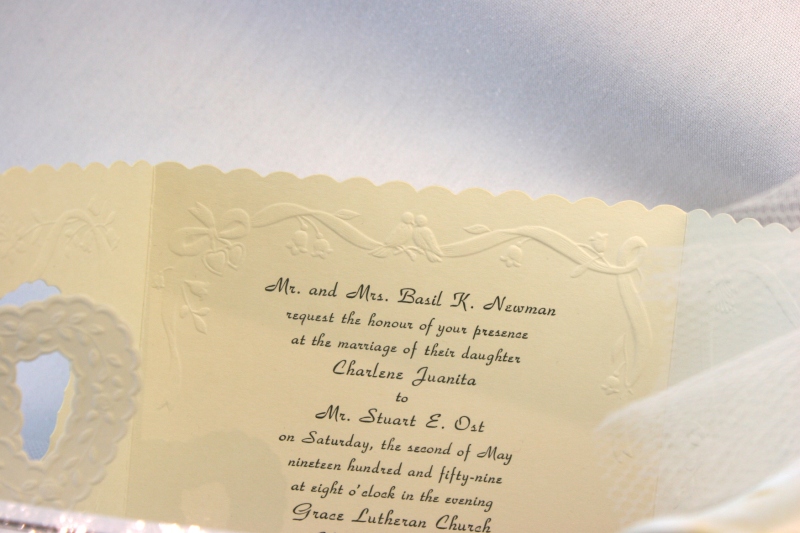
The invitation to the wedding of Charlene Newman and Stuart Ost is displayed in a case.

The invitation to the 1959 wedding of Charlene Newman and Stuart Ost is displayed in a case.

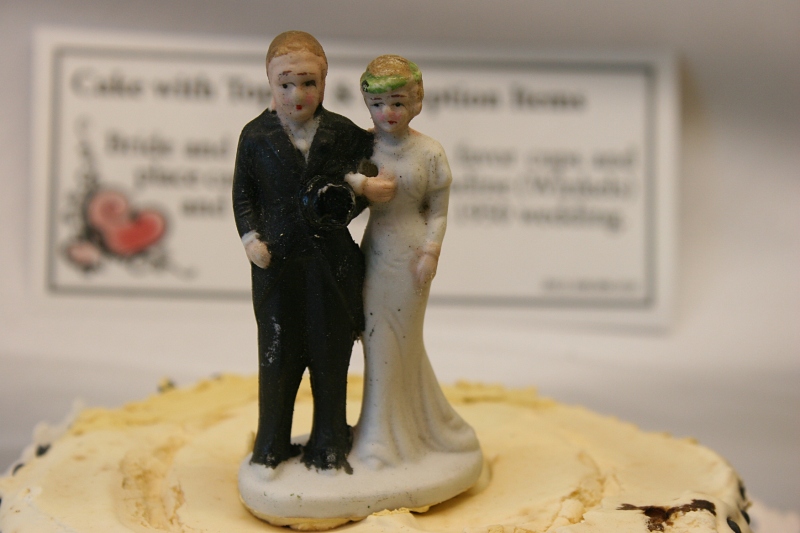
Char and Stuart Ost's 1959 wedding cake topper.

Char and Stuart Ost’s wedding cake topper.

You’ll find other wedding related items displayed, including an invitation, napkin, cake topper, photo and hand-sewn apron from volunteer Char’s 1959 wedding.

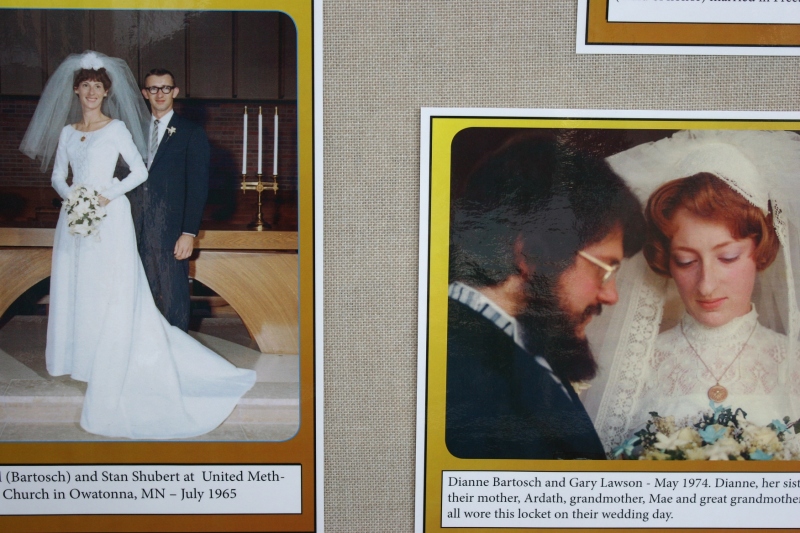
Portraits, too, tell a story about styles, traditions and even photography.

Portraits, too, tell a story about styles, traditions and even photography.

Many wedding portraits are interspersed with dresses as is information about traditions like dowries, engagement rings, feeding of the wedding cake and even the bunny hop.

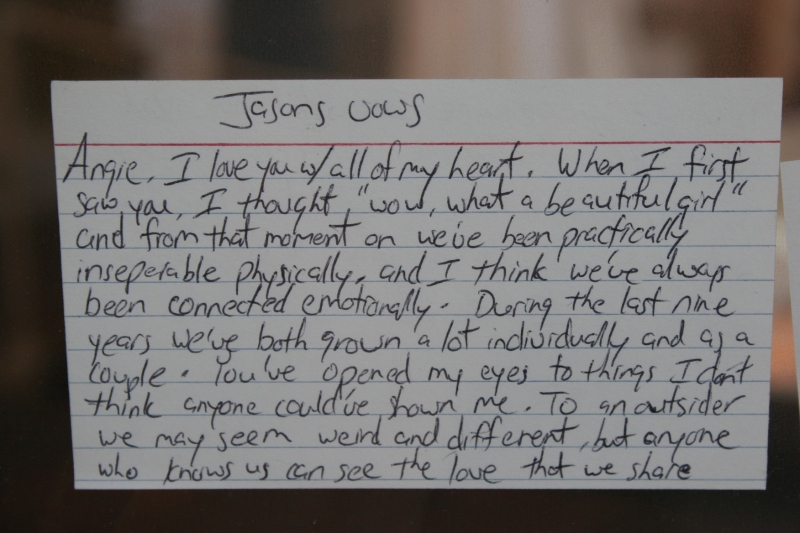
Even handwritten vows are part of the exhibit.

Even handwritten vows are part of the exhibit.

The display gets as personal as Jason and Angie’s wedding vows hand-printed on recipe cards.

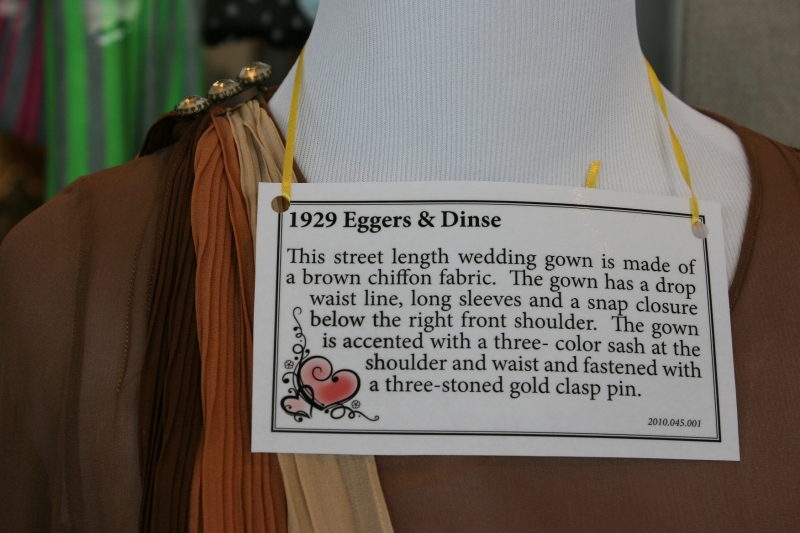
Volunteers worked hard to assure that descriptions of the dresses were accurate, team member Char Ost said.

Volunteers worked hard to assure that descriptions of the dresses were accurate, team member Char Ost said.

It’s clear the organizers of this exhibit invested a lot of time in gathering and sharing of information, from the genealogy associated with each dress to the descriptions of the dresses right down to the type of fabric, neckline, sleeves and more.

Some dresses could not be fully closed on the fuller forms.

Some dresses could not be fully closed on the forms.

Once all that research was completed, the crew faced one more challenge. “We did contortions to get some of those dresses on (the forms),” Char said, noting that perhaps corsets also should have been shown.

It was then that I suggested a follow-up exhibit, Wedding Traditions of Steele County II. I loved the exhibit that much.

FYI: Wedding Traditions of Steele County will be on display until the spring of 2017. Museum hours are 10 a.m. – 4 p.m. Tuesday, Wednesday and Friday; 10 a.m. – 8 p.m. Thursdays; and from 10 a.m. – 3 p.m. Saturdays. Closed on Sunday. The history center is located at 1700 Austin Road on the southeast side of Owatonna. Admission is charged. While there, you can also peruse an exhibit on disasters in Minnesota and in Steele County.

On Thursday, June 9, the history center will host Toss the Bouquet: The Wedding Professionals Spin from 7 p.m. – 8:30 p.m. Wedding industry leaders will share their thoughts on wedding trends and also talk about wedding planning details.

Check back tomorrow for Part II in this series on the Wedding Traditions of Steele County exhibit.

© Copyright 2016 Audrey Kletscher Helbling


Obviously ducks can’t read May 2, 2016

Filed under: Uncategorized — Audrey Kletscher Helbling @ 5:00 AM
Tags: , , , , ,

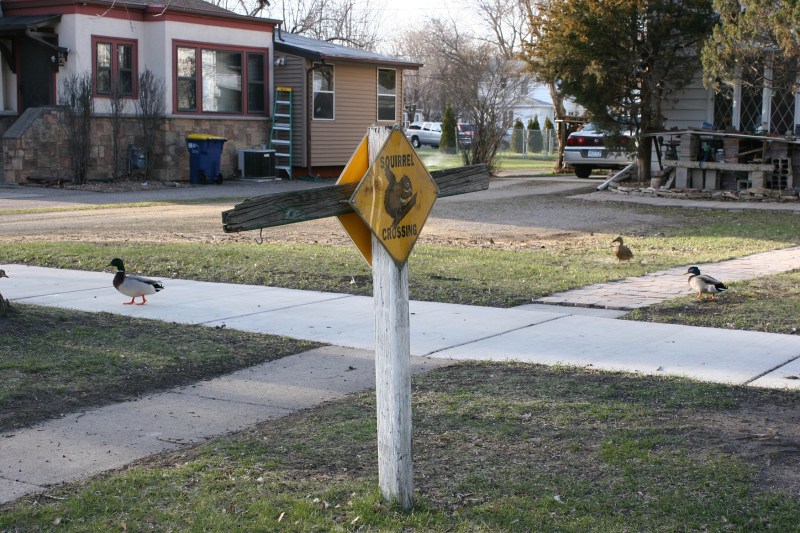
Ducks at a squirrel crossing, 178

…but they are smart enough to realize that words mean nothing to squirrels either. And if there’s corn available, as in this front yard along Fifth Street in Faribault (across from Trinity Lutheran Church), they will partake.

My question, though, is this: How did these ducks find this food? The house is not located anywhere near a water source. Did one of them fly over, spot the corn and call the family? I can never figure out this ducks wandering away from water thing.

© Copyright 2016 Audrey Kletscher Helbling


What a little cash & a little kindness are doing in North Dakota April 30, 2016

Filed under: Uncategorized — Audrey Kletscher Helbling @ 5:00 AM
Tags: , , , , , , ,
My creative graphic illustrating Kindness Cash.

My creative graphic illustrating Kindness Cash.

HOW WOULD YOU like to find $20 cash?

In our neighboring state to the west, Starion Financial has dropped 650 Kindness Cash wallets containing $20 each in eight North Dakota communities. The project celebrates Pay It Forward Day on April 28.

Now, if you do your math, that’s $13,000 left lying around in places like grocery stores, parks, hotels…

The idea is to use that money to do something good. And the finders are, according to Starion’s website. Organizations like a cancer support group, a domestic violence center and a humane society have already benefited from this project.

Others are enjoying treats from appreciative co-workers. Those are all great choices.

But the story that touches me most is that of Olivia, who found a Kindness wallet under a rock in a South Fargo park. Little Olivia is giving the money to someone at her school.

Likewise in Bismarck, someone found a Kindness wallet, added $80, and left it for two lucky women to find at the Comfort Inn.

I love sharing stories like this that uplift and restore my faith in the goodness of others. (h/t Fargo Forum)

TELL ME, HAVE YOU ever been the recipient of such a random act of kindness? Or have you engaged in a Pay It Forward project like this?

I’d like to hear about creative projects that encourage people to Pay It Forward, to be kind to one another.

© Copyright 2016 Audrey Kletscher Helbling


Tell me, how can a burger be angry? April 29, 2016

Filed under: Uncategorized — Audrey Kletscher Helbling @ 5:00 AM
Tags: , , , , , , , ,

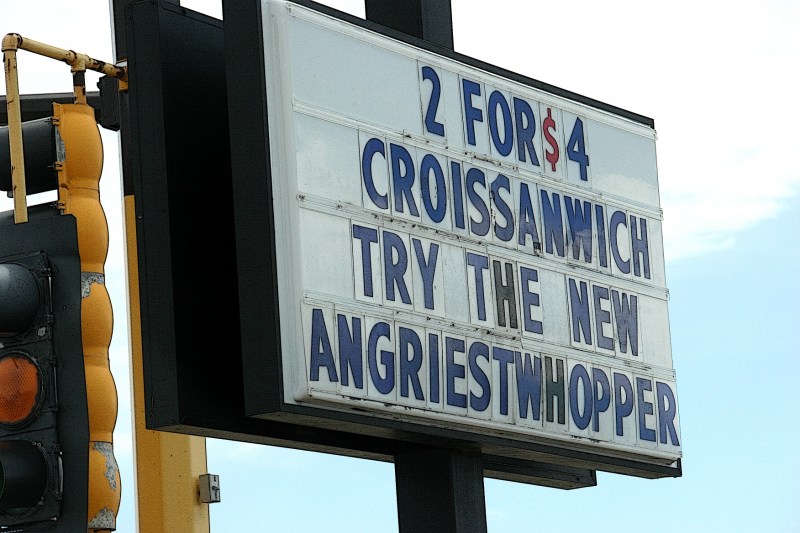
The Angriest Whopper sign in Owatonna


WHEN I SAW THIS SIGN advertising the new Angriest WHOPPER® near the Burger King in Owatonna, the journalist in me questioned how a burger can be angry. A burger is not a living breathing thing with feelings. Therefore it cannot be angry.

But whatever sells…right?

Knowing absolutely nothing about this burger given I rarely eat burgers and frequent fast food places maybe twice a year, I googled “angriest whopper.”

It is apparently the hot sauce, baked into the red bun and also layered on the burger along with jalapenos, that generates that word choice of “angriest.”

This follow-up to the Angry Whopper will be offered for a limited time only. Will I run out and try one? Not unless someone offers to buy this spicy burger for me.

Tell me, have you tried either of these Whoppers? And what do you think of the adjectives “angry” and “angriest” used to describe burgers?

#

ON A RELATED NOTE, Burger Kings across the country, including one in Coon Rapids, have been the victims of a hoax that had employees busting the fast food franchise’s windows. A caller claiming to be from the fire department advised employees to smash the windows to prevent an explosion due to a gas leak and build-up. Burger King employees did just that.

I bet there’s been plenty of anger at the affected Burger Kings.

© Copyright 2016 Audrey Kletscher Helbling


Faribault is about blankets, beer, blue cheese & a whole lot more April 28, 2016

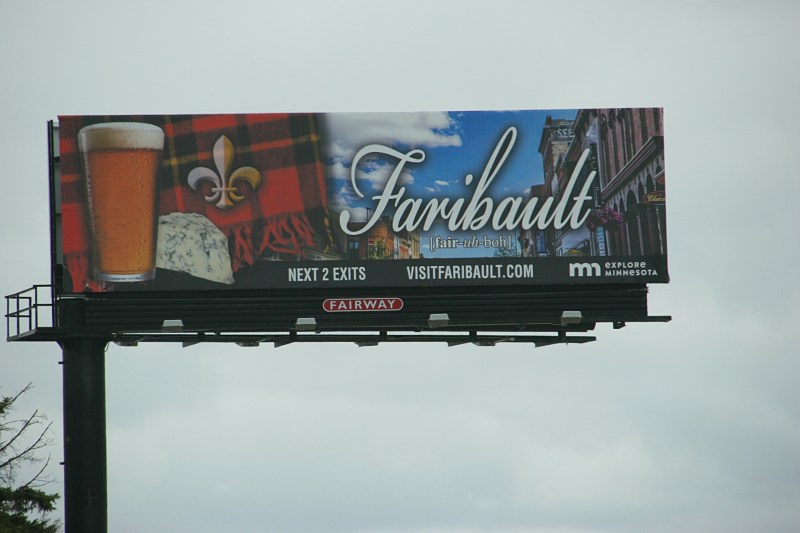
Faribault's new promotional billboard, visible while traveling southbound along Interstate 35 near the city. Faribault is about a half hour south of the Twin Cities metro.

Faribault’s new promotional billboard, visible while traveling southbound along Interstate 35 near the city. Faribault is about a half hour south of the Twin Cities metro and about an hour from the Iowa border. Perfect for a day trip.

MY COMMUNITY OF FARIBAULT could easily fall into that grey space of endless towns perched along Interstate 35 from the Texas-Mexico border to Duluth in northeastern Minnesota.

But Faribault, pronounced fair-uh-boh, because it’s a French name, isn’t just any other community. This is a city of some 23,000 with a strong sense of history. Drive a few miles off I-35 to see the aged buildings along and branching off Central Avenue and scattered throughout town. We have historic churches (like the Cathedral of Our Merciful Saviour) and the historic Shattuck-St. Mary’s School and wonderful old houses.

A new billboard along I-35 hints at what you’ll discover in this southeastern Minnesota community named after founder and fur trader Alexander Faribault.

Let’s zoom in on billboard details:
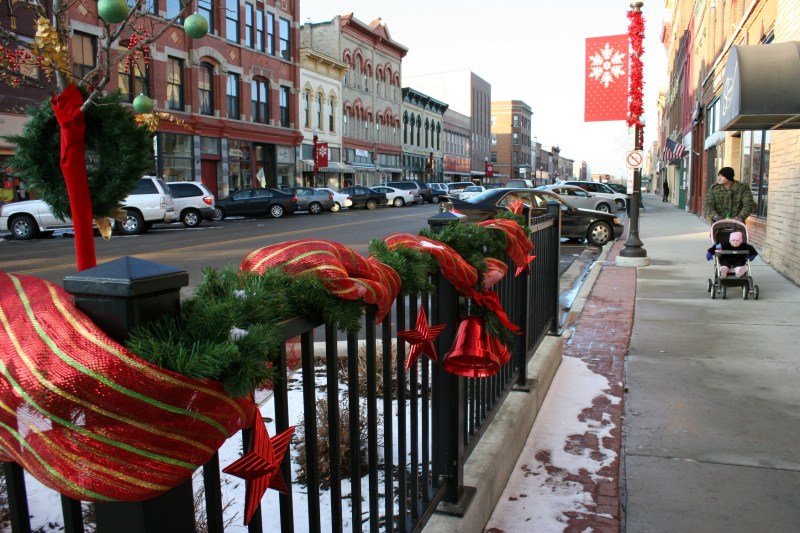
Strolling along Central Avenue in historic downtown Faribault late on a Saturday afternoon in December 2011.

This remains one of my all-time favorite shots of Faribault’s Central Avenue, our Main Street. It showcases the aged buildings and beauty of our historic downtown. Minnesota Prairie Roots file photo, December 2011.

HISTORIC DOWNTOWN: Aged buildings, most beautifully restored, border Central Avenue for several blocks. If you appreciate old architecture, history and home-grown businesses, then you’ll enjoy our downtown.
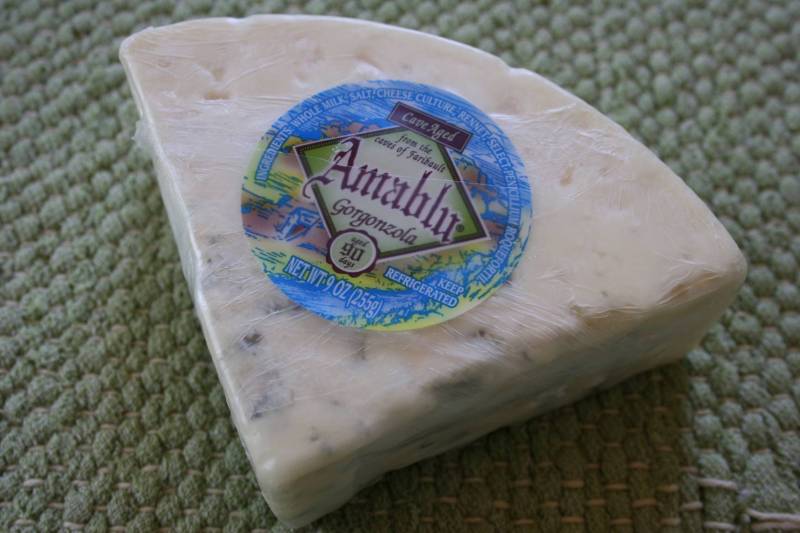
Award-winning Amablu Gorgonzola from Caves of Faribault.

Award-winning Amablu Gorgonzola from Caves of Faribault. Minnesota Prairie Roots file photo.

BLUE CHEESE: Award-winning blue and Gorgonzola cheeses are produced and aged in Faribault, in sandstone caves along the Straight River. I’m crazy about AmaBlu, St. Pete’s Select and AmaGorg cheeses. All are sold at The Cheese Cave, a Central Avenue retail shop that also serves up a limited menu of soup (seasonal), sandwiches, salads, pizza and more. The fresh cheese curds, flavored and plain, are a must-try. Iowa-based Swiss Valley Farms now owns the once locally-owned retail shop and cheese company.
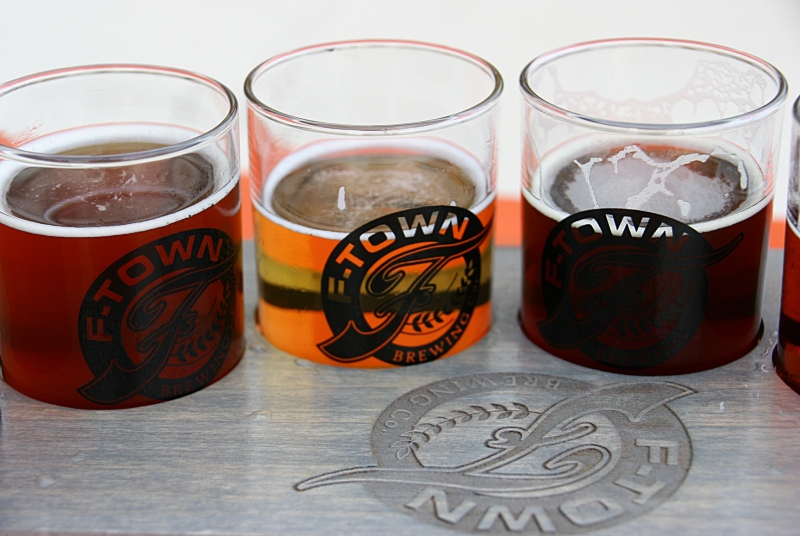
We wanted to sample all of the beers on tap, so we ordered a flight.

Samples from a flight of F-Town beer. Minnesota Prairie Roots file photo.

BEER: F-Town Brewing Company opened in the downtown historic district, just a half-block off Central Avenue, last summer. It’s a great addition to our community, continuing a tradition of early beer brewing in Faribault by the Fleckenstein brothers.
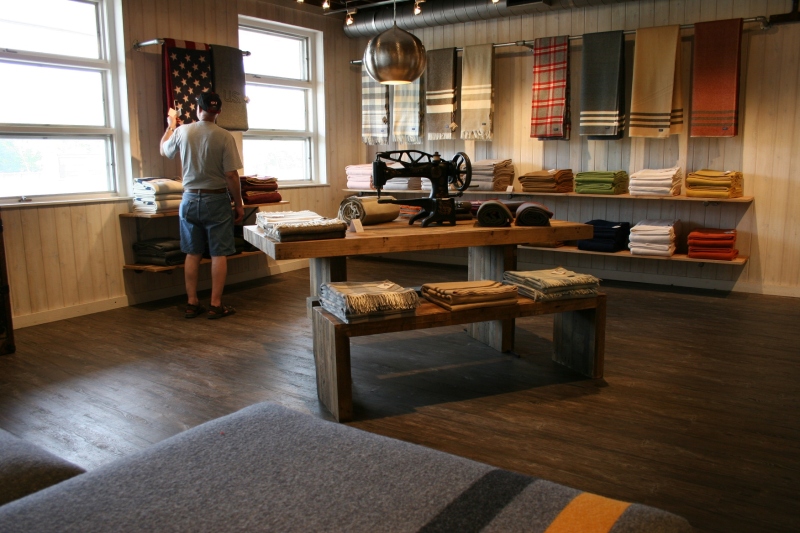
Perusing merchandise at the recently reopened Faribault Woolen Mill retail store.

Perusing merchandise at the Faribault Woolen Mill retail store. Minnesota Prairie Roots file photo.

BLANKETS: The historic Faribault Woolen Mill has been weaving blankets for some 150 years. Visit The Mill Store (open daily except Sunday) and/or tour the mill (every Friday or the second Saturday of the month) along the banks of the Cannon River. This business produces quality made blankets, throws, scarves, etc., in the time-honored tradition of hands-on looming by employees who’ve been around for a long time.

#

BILLBOARDS SHOWCASE only a quick visual of what any place offers. So here are additional personal recommendations from my favorites and must-see list of Faribault attractions:
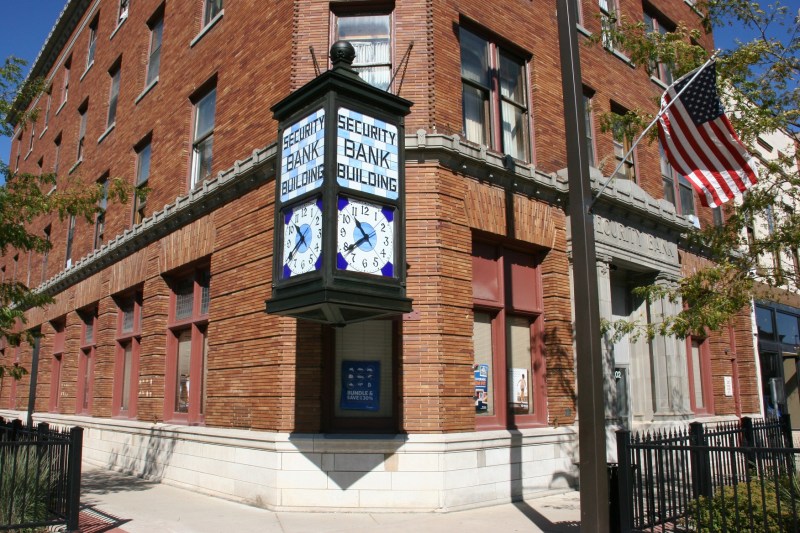
This restored 1915 clock was installed on the Security State Bank Building, 302 Central Avenue, on Saturday.

This restored 1915 clock was installed in 2015 on the Security State Bank Building, 302 Central Avenue. Minnesota Prairie Roots file photo.

ART: Stop at the Paradise Center for the Arts, a restored theater, to peruse the galleries and gift shops or to take in a show.

Admire the recently-restored Security Bank Building clock at 302 Central Avenue.

At the south end of Central Avenue, at its intersection with Division Street, admire the art throughout Buckham Memorial Library. Don’t miss the Charles Connick stained glass window, the Greek murals or the exterior clock tower.

Throughout the downtown area are numerous murals depicting scenes from Faribault history. I love this concept of combining art and history in such a highly-visible public way.

While I’ve never toured Whillock Studio, home to woodcarver Ivan Whillock, I’d suggest a visit. Locally, his work can be seen in churches, at the library and more. Noted woodcarver Marv Kaisersatt also calls Faribault home. Kaisersatt keeps a low profile. But I was lucky enough to visit his second floor downtown studio (not open to the public) several years ago when penning a magazine article.
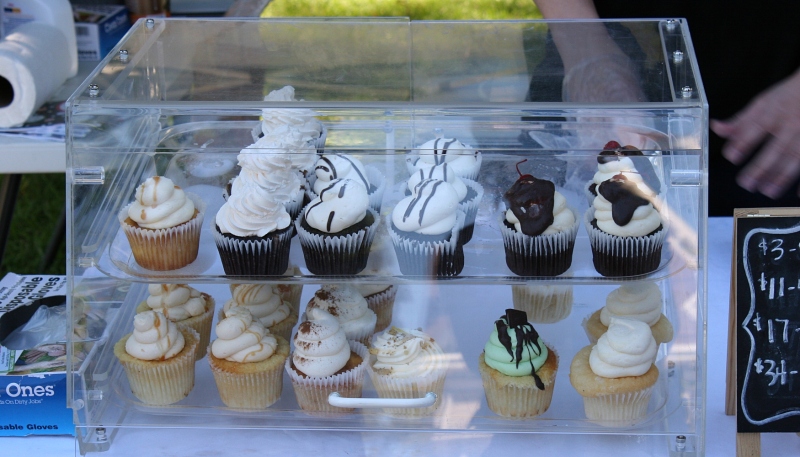
Folks waited in line for these cupcakes.

Folks waited in line at last summer’s Faribault Farmers Market for these cupcakes from Bluebird Cakery. The business now has a storefront location at 318 Central Avenue, Suite 101. Minnesota Prairie Roots file photo.

FOOD: Hands-down, The Signature Bar & Grill serves the best thin crust (or any) pizza in town. I always order the Italian sausage. The old-fashioned bar area is reminiscent of Cheers.

The Depot Bar & Grill, housed in an old train depot, is always a good dining choice. Warm weather outdoor dining is available on a patio next to the railroad tracks. It’s a thrill to feel the power of a train roar past only feet away.

Faribault offers many ethnic dining choices ranging from Mexican to Somali to Chinese, Thai, etc. Gran Plaza Mexican Grill downtown is a local favorite.

Fairly new to downtown Faribault is Bluebird Cakery, specializing in cupcakes (plus other sweet treats) and assorted coffees, etc. I’ve been there several times and each time it’s been super busy. Choosing cupcakes proves difficult given all of the enticing flavors.

I’m not a fan of fast food or fast food chains. But for an authentic American fast food dining experience, Faribault’s A & W still offers car hop service during the warm months. And I do love a frosty mug of A & W root beer.

New to Faribault, and hidden away in the Faribo West Mall, is Smoqehouse Restaurant. I’ve been there once and will definitely be back as I love pulled pork and other savory smoked meats. The smokey smell alone is enough to draw me in. Take note that if you want to eat here after the mall closes on say a Saturday evening, you need to use the back entrance across from the Walmart Auto Center.
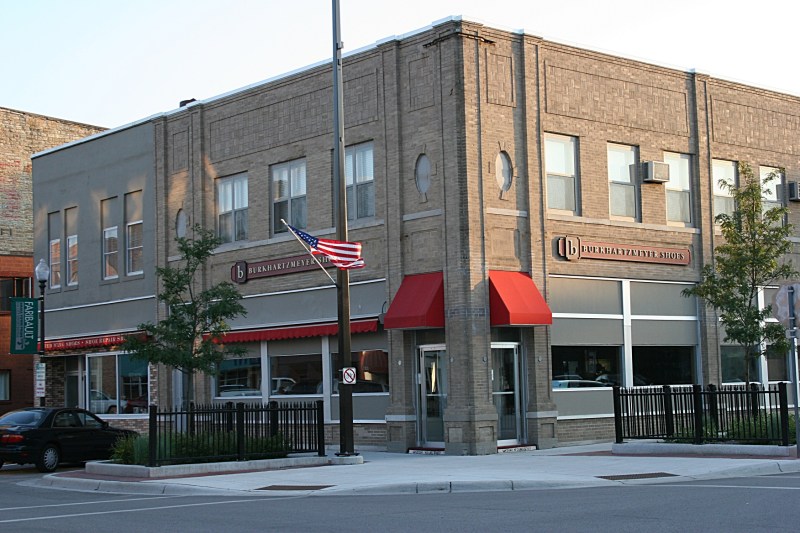
Burkhartzmeyer Shoes, a family-owned shoe store along Central Avenue in Faribault.

Burkhartzmeyer Shoes, a family-owned shoe store along Central Avenue in Faribault. Minnesota Prairie Roots file photo.

SHOPPING: I’m not much of a shopper. But I do like thrift stores–you’ll find Good Will, the Salvation Army, All Seasons Community Services Thrift and Jan’s Thrift Shop in Faribault along with some used clothing shops.

Third-generation family-owned Burkhartzmeyer Shoes is a Faribault staple offering full shoe-fitting services (yes, they measure your feet and put the shoe on your foot) and shoe repair. This place is reminiscent of a bygone era when outstanding personal customer service mattered. I know nearly everyone who works here and these are salt-of-the-earth wonderful people. Shoe boxes are tied with a cotton string and you’ll even get a sucker if you want one.

We also have gift shops, antique stores, an architectural salvage business and more in our historic downtown.
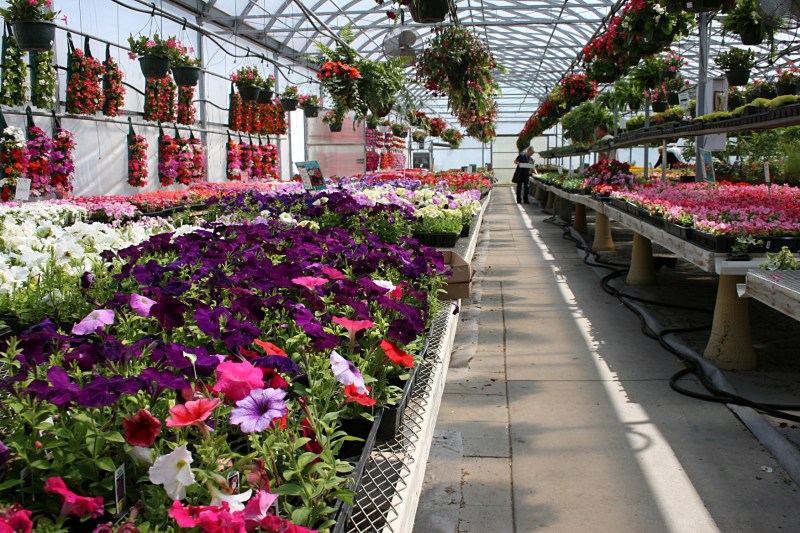
Tables packed with colorful flowers fill the Faribault Garden Center.

Tables packed with colorful flowers fill the Faribault Garden Center. Minnesota Prairie Roots file photo.

FOR THE GARDENER:

Farmer Seed and Nursery, in an aged building along Minnesota State Highway 60/Fourth Street, is a fun place to poke around for anything plant and garden related. This business has provided American gardeners with plants, bulbs, seeds, etc. for more than 120 years through its mail order catalog (also now online) business. It’s especially fun to tour during the holidays when themed Christmas trees pack the store.

Donahue’s Greenhouse is open for the season, drawing gardeners from all over to this massive family-owned greenhouse/retail shop at 420 SW Tenth Street. After a long winter, this feels like walking into summer. I get a bit overwhelmed with all of the choices at Donahue’s, thus I often shop at the smaller Faribault Garden Center or Northstar Seed & Nursery.

Twiehoff Garden & Nursery on the east side is another great choice for plants and then fresh produce throughout the growing season. Housed in a no-frills pole shed style building which lends an earthy authenticity, this 52-year-old business is operated by the friendly Twiehoff family. It’s one of my main sources for local fresh seasonal produce along with the Faribault Farmers Market.
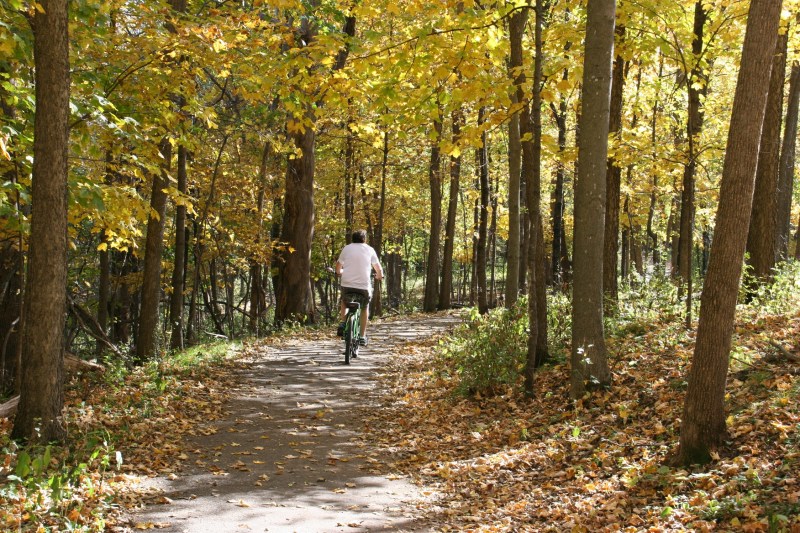
Biking through River Bend Nature Center.

Biking through River Bend Nature Center. Minnesota Prairie Roots file photo.

NATURE: One of my favorite places for an in-town get-away is River Bend Nature Center. Faribault also has an extensive trail system for biking and walking.

City View Park, on the east side by the water tower, offers a beautiful overlook of Faribault.

The restored Tilt-A-Whirl sits in downtown Faribault, just two blocks from Buckham Memorial Library.

The restored Tilt-A-Whirl sits in downtown Faribault next to Burkhartzmeyer Shoes, just two blocks from Buckham Memorial Library. Minnesota Prairie Roots file photo.

HISTORY: It’s everywhere in Faribault. In the architecture of old buildings. On murals. In the Rice County Historical Society Museum. In our churches, especially The Cathedral of Our Merciful Saviour. In the historic Hutchinson House Bed & Breakfast. Even in a restored Tilt-A-Whirl car located on the corner by Burkhartzmeyer Shoes. Yes, the Tilt-A-Whirl originated in Faribault and, up until a few years ago, was still made here.

I love Faribault. I’ve lived here more than half my life now. I don’t have the connection of family roots. But I do have the connection to place. Faribault is home.

DO YOU HAVE ANY QUESTIONS about Faribault? If so, ask away and I’ll try to answer.

FYI: Chambers of Commerce and tourism centers in Faribault, Owatonna and Northfield have joined in promoting visits to their communities through a Minne-Roadtrip venture. All three cities lie along the I-35 corridor, with Faribault in the middle. Click here to learn more about this promotion. I’ve explored all three communities; they are definitely worth your visit.

© Copyright 2016 Audrey Kletscher Helbling


An obit: I didn’t know Jim, but now I do April 27, 2016

Filed under: Uncategorized — Audrey Kletscher Helbling @ 5:00 AM
Tags: , , , , , ,
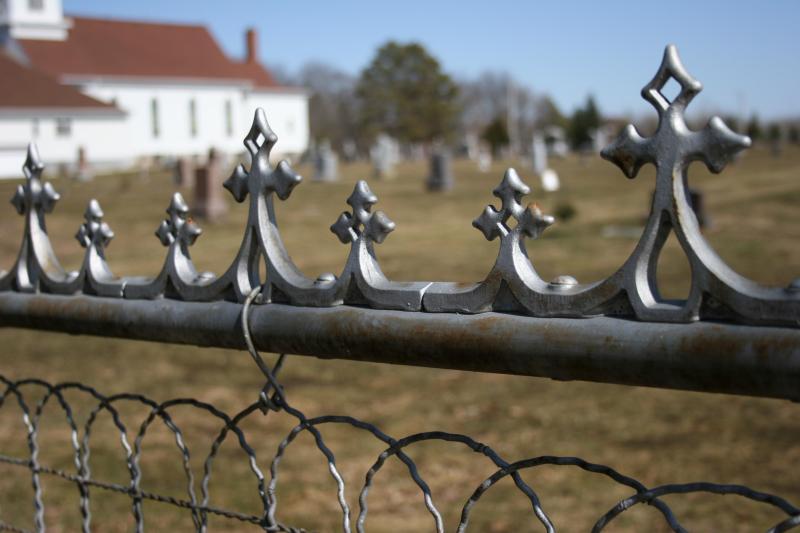
A fence surrounds the Urland Lutheran Church Cemetery in the Sogn Valley area.

A fence surrounds the Urland Lutheran Church Cemetery in the Sogn Valley area. Minnesota Prairie Roots file photo 2010 used here for illustration purposes only.

MORE AND MORE, I READ OBITUARIES. Probably because I am aging and more people I know are now dying.

I didn’t know Jim Mueller of Clearwater, though. Yet I still read his 22 column inch obit published April 21 in The Gaylord Hub, a small southern Minnesota weekly where I worked as a reporter for two years right out of college. The Hub arrives in my mailbox each week, a tangible reminder of my past and of the passage of time.

James Henry Mueller left his hometown of Gaylord in 1973, five years before I arrived. If he had still resided there, I likely would have interviewed him. He was that kind of guy. Socially active. A storyteller. A businessman. A character. He would have made for an interesting feature.

Consider this line from the beginning of his obit: Jimmy grew up doted on by his ma and arguing with his pa.

But it is the ninth and final paragraph of this lengthy obit which makes me wish I’d known this 88-year-old:

Jim’s many hats included: Veteran Navy Man, Well Driller, Grain Bin Mover, Beer Seller, Horse Wrangler, and Postmaster. He was a smooth dancer and an ace at bridge. He will fondly be remembered as a Teller of Tales, A Spinner of Yarns, and a Preacher of Sermons.

In addition, paragraph eight notes that Jim donated his body to science. Even in death, his story continues.

NOW IT’S YOUR TURN. How would you like to be remembered? What hats would others say you wore? What do you think of this trend to personalize obituaries with insights and commentary?

© Copyright 2016 Audrey Kletscher Helbling
 

If you’ve never understood why “she stays,” then you need to read this book April 26, 2016

Filed under: Uncategorized — Audrey Kletscher Helbling @ 5:00 AM
Tags: , , , , , , , ,

IN MY IGNORANCE, I often asked the question, “Why does she stay?”

I couldn’t understand why any woman would stay in an abusive relationship. I expect many of us, if we are honest, have blamed the woman, faulted her for staying with a partner who is verbally, mentally, emotionally, financially, spiritually and/or physically abusive.

Why does she stay?


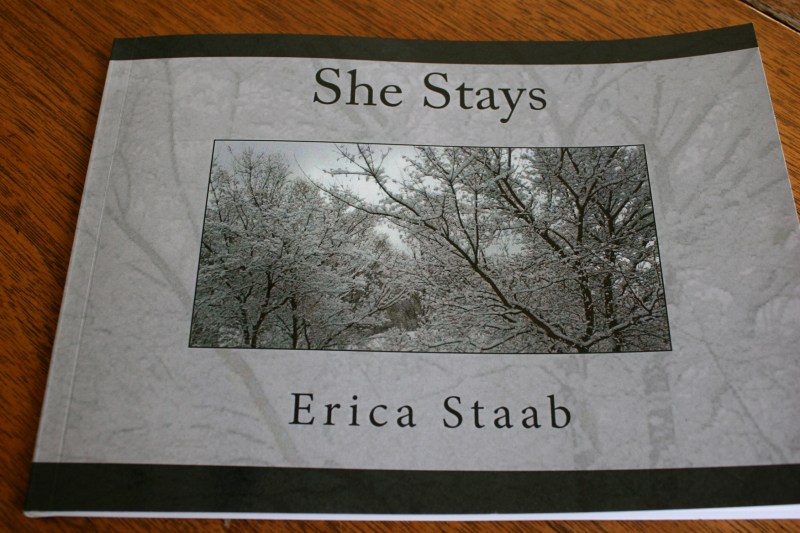
She Stays by Erica Staab


Erica Staab, director of the HOPE Center in Faribault, answers that question in She Stays. This self-published book is an absolute must-read for everyone. You. Your friends. Your daughter. Your niece. Your sister. Your brother. Your pastor.

Why?

Because you likely know someone who is a victim of domestic abuse. Maybe even you. And you need to know why she stays. It is only when we educate ourselves that we understand. And when we understand, we begin to make a difference.

Long before I read Erica’s recently-released book, I became educated on domestic abuse. Off the top of my head, I can list 13 women, by name, who are survivors. I don’t know the stories of each of these women. But some I do. They were in relationships with men who convinced them they had changed or whom the women believed they could change. These men professed their love. These men were initially charming, loving and attentive. Until they insidiously evolved into monsters who shoved, strangled, smothered, isolated, verbally-destroyed, brainwashed…

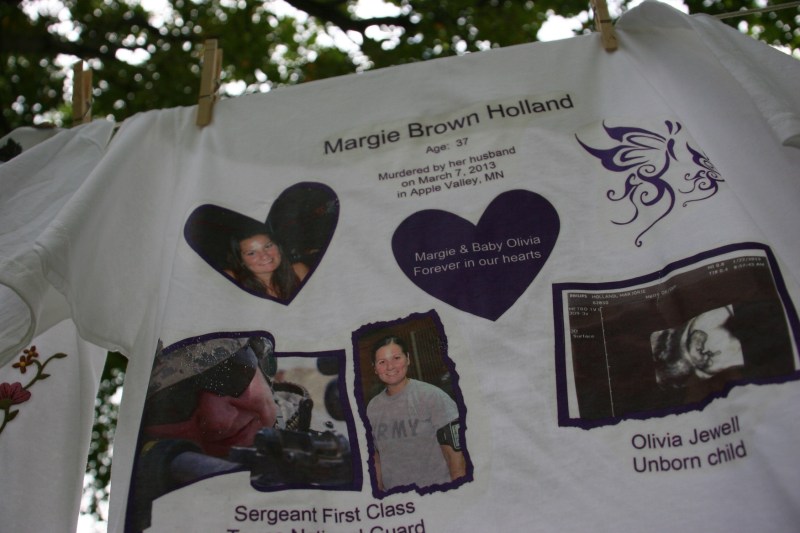
Margie Brown Holland and her unborn daughter, Olivia, were honored at The Clothesline Project display this summer in Owatonna. The Minnesota Coalition for Battered Women coordinates the project to honor victims of domestic violence. Redeemer Lutheran Church brought the project to Owatonna this past summer.

Margie Brown Holland and her unborn daughter, Olivia, were honored at The Clothesline Project display in the summer of 2015 in Owatonna. The Minnesota Coalition for Battered Women coordinates the project to honor victims of domestic violence. Redeemer Lutheran Church brought the project to Owatonna. Minnesota Prairie Roots file photo 2015.

I can also personally list the names of three women who were murdered by the men who supposedly loved them: Kay, Becky and Margie. Erica dedicates She Stays to her friend Margie Brown and unborn daughter Olivia. Margie’s dad once lived across the street from me. She also dedicates her book to Julie Carroll, another victim of domestic violence. I didn’t know Julie.

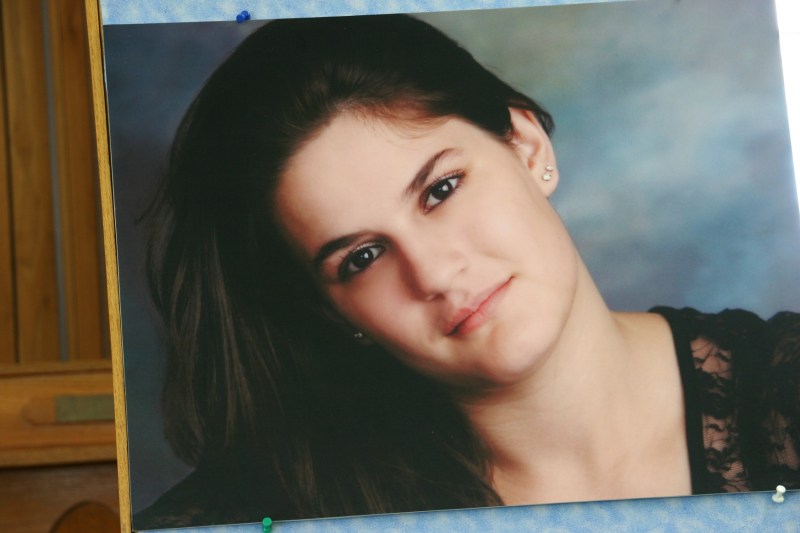
Becky Kasper's portrait.

Becky Kasper of Northfield was murdered in April 2013 by her former boyfriend. She was a student at Arizona State University. This portrait was posted by her father, Dan Kasper, who spoke about domestic violence at Redeemer Lutheran Church in Owatonna in January. Minnesota Prairie Roots file photo January 2016.

But I know that too many women are suffering and dying every day. Too many women are trapped in abusive relationships—whether because of fear, financial worries, even because of hope that the abuser will revert to the loving man he seemed at the beginning of the relationship. I doubt a woman ever enters a relationship thinking the man she loves will abuse her.

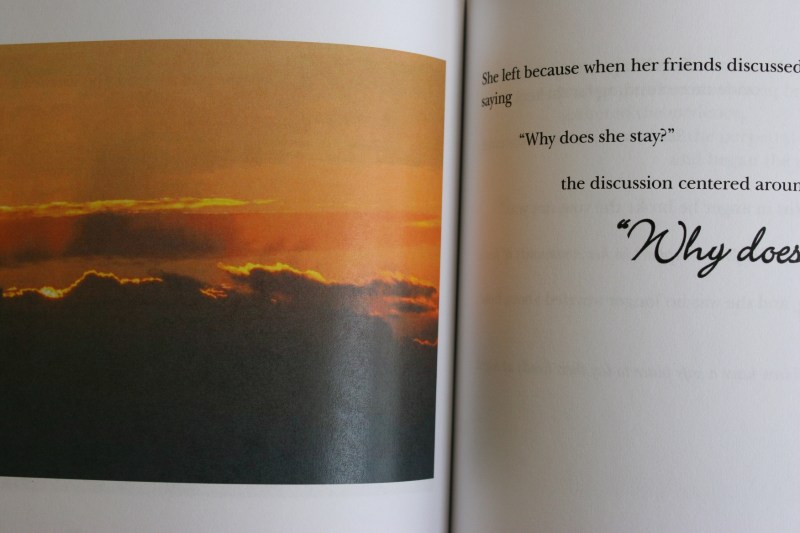
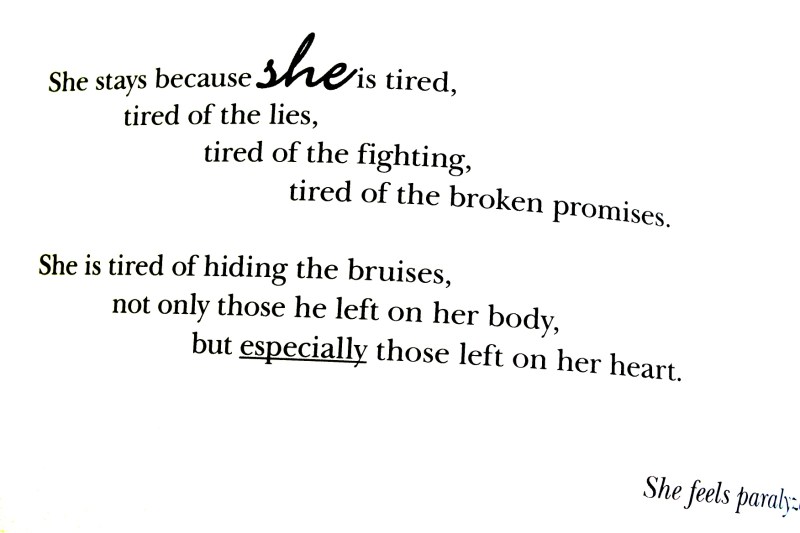
Reasons she stays, published on page 18. Text copyright of Erica Staab.

Reasons she stays, published on page 18. Text copyright of Erica Staab.

Erica lays out the reasons she stays in this compilation based on real stories of real women. And she writes in a way that is direct, honest and to the point. You can read this slim 42-page book in less than a half hour. It’s simplistic, state-it-like-it-is understandable.

Erica's book also focuses on reasons she leaves.

Erica’s book also focuses on reasons for leaving. Interspersed throughout this volume are Erica’s photos, primarily nature themed.

But this author and experienced advocate doesn’t end with she stays. She also writes about why she left. Therein lies another reason you must read this book. You will learn that listening, understanding and believing can make all the difference to a woman in deciding whether she stays or she leaves. You can offer hope.

On the final page of She Stays, Erica pens four powerful words: You are not alone.

A victim of domestic abuse should never feel alone. But all too often she does, because we continue to ask, “Why does she stay?”

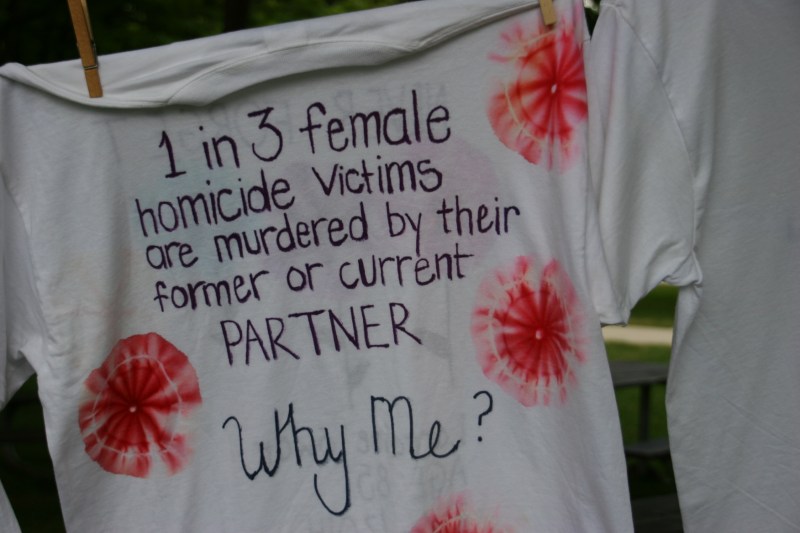
Statistics on a The Clothesline Project t-shirt from the Minnesota Coaltition for Battered Women..

Statistics on a The Clothesline Project t-shirt from the Minnesota Coalition for Battered Women, displayed this past summer in Owatonna. Minnesota Prairie Roots file photo.

FYI: To purchase a copy of She Stays, click here. Use this discount code to get $2 off: WCPXLKQS. All proceeds from the book will benefit HOPE Center, an advocacy organization in Faribault. Copies may also be purchased directly from HOPE Center.

If you are in an abusive relationship and in immediate danger, call 911 now.

Or contact a local crisis resource center for help and support.

You can find additional information through the following resources:

National Coalition Against Domestic Violence

Minnesota Coalition for Battered Women

NOTE: Men can also be victims of domestic abuse. But because the majority are women, I use that noun and the pronoun she. Just as Erica does in her book.

© Copyright 2016 Audrey Kletscher Helbling


How photos & life inspire poetry at a Mankato exhibit April 25, 2016

THE VARIETY OF POETRY a single photo can inspire always amazes me. As do other poets.

At the recent opening of Image and the Word 9 at the Emy Frentz Gallery in Mankato, I mingled with poets. One writes a poem a day. Amazing.

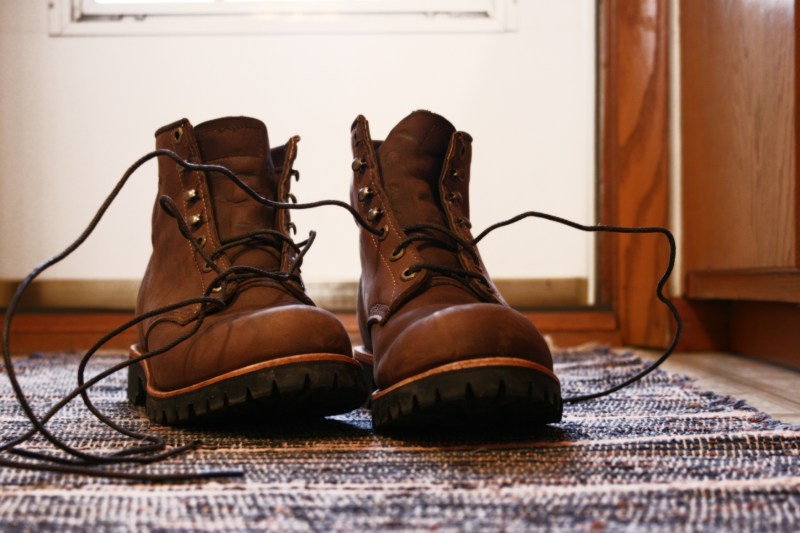
Each year for the past several, I’ve participated in this exhibit which features inspirational photos and reactionary poems by southern Minnesota photographers and writers. I wrote four poems, including one about my automotive machinist husband, Randy. A photo of laced work boots prompted that personal poem.


Chippewa boots have replaced athletic shoes.

A photo similar to this inspired the poem about my husband. Minnesota Prairie Roots file photo.


My Husband at the End of His Work Day

Leather boots lace your aching feet.
Grease outlines your fingernails.
Oil smudges stain your standard blue uniform.
You come home bone-weary, eat, shower, change,
then settle into the recliner with your Sudoku.
Your head nods. You are napping
long before the ten o’clock news,
just like every other hard-working blue collar man.


Standing in a small circle with poets Henry, Ed and Susan, I agreed that our experiences often shape our poetry. Consider that the next time you read a poem. We concurred also that we love words. As a poet, there’s a deep sense of joy and fulfillment in words falling together. Sometimes, oftentimes, we don’t understand how that happens. But when it does, it’s magical. It’s poetry.
FYI: The Image and the Word 9 exhibit will run through May 18 at the Emy Frentz Gallery, 523 South Second Street, Mankato. Gallery hours are from noon to 4 p.m. each weekday except Thursday, when hours are 4 p.m. – 8 p.m. Southern Minnesota Poets Society members Yvonne Cariveau and Derek Liebertz produce the exhibit annually.

© Copyright 2016 Audrey Kletscher Helbling