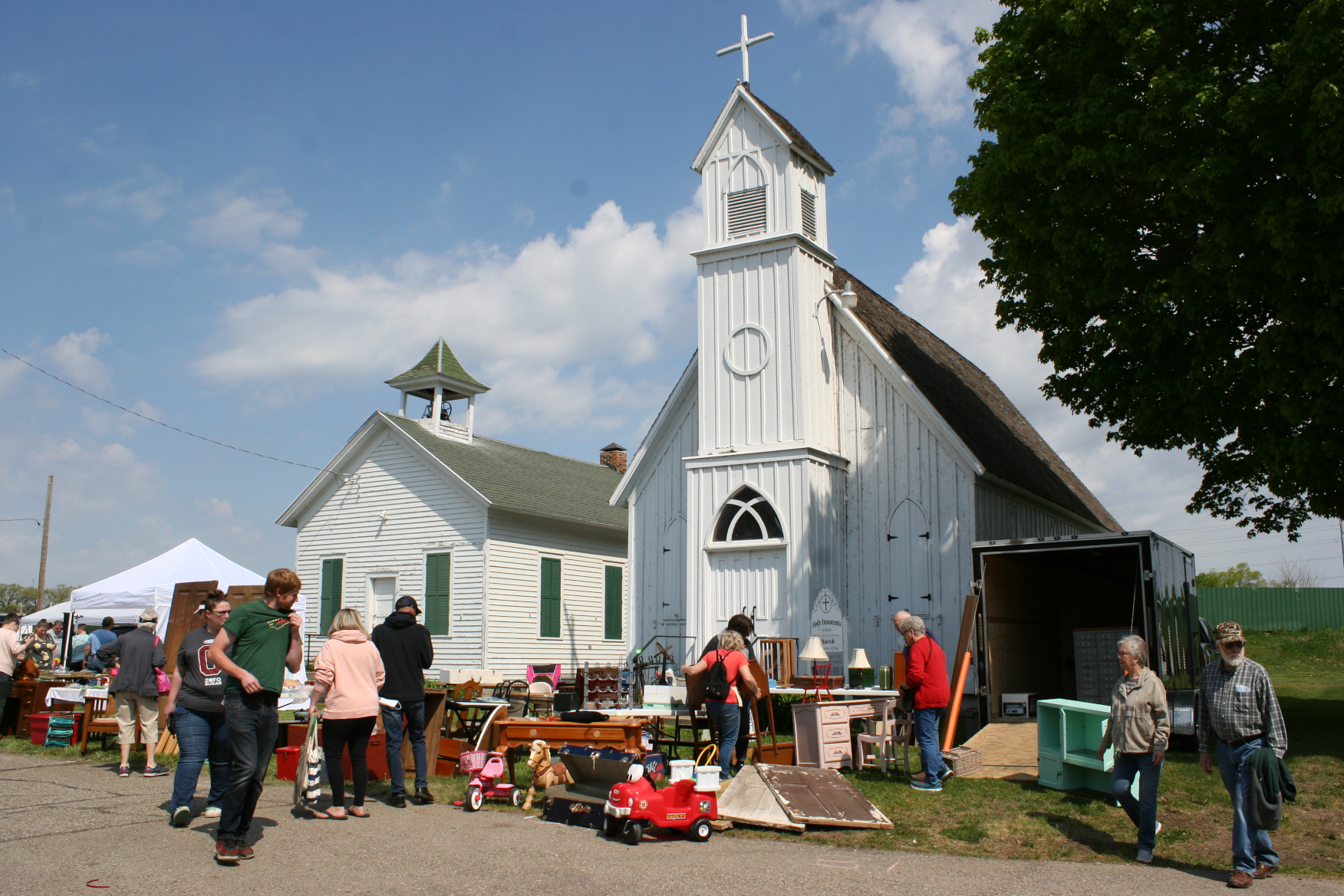
At last spring’s RCHS Spring Flea Market. (Minnesota Prairie Roots copyrighted photo May 2021)
AFTER AN INCREDIBLY long winter followed by an exceptionally cold, cloudy and wet spring, we Minnesotans are ready to get outdoors. We are ready to celebrate. We are ready to let the sun shine into our lives. And this weekend, opportunities abound locally to get out and enjoy spring in southern Minnesota.
Spotted at the spring 2021 flea market. (Minnesota Prairie Roots copyrighted file photo May 2022)
Rise and shine early on Saturday, May 14, to hit the Rice County Historical Society Spring Flea Market from 8 am – 2 pm in the parking lot and behind the RCHS museum in Faribault. I’ve attended many times and enjoy meandering among the vendors of antiques, collectibles, crafts and junk. I mean “junk” in a positive light.
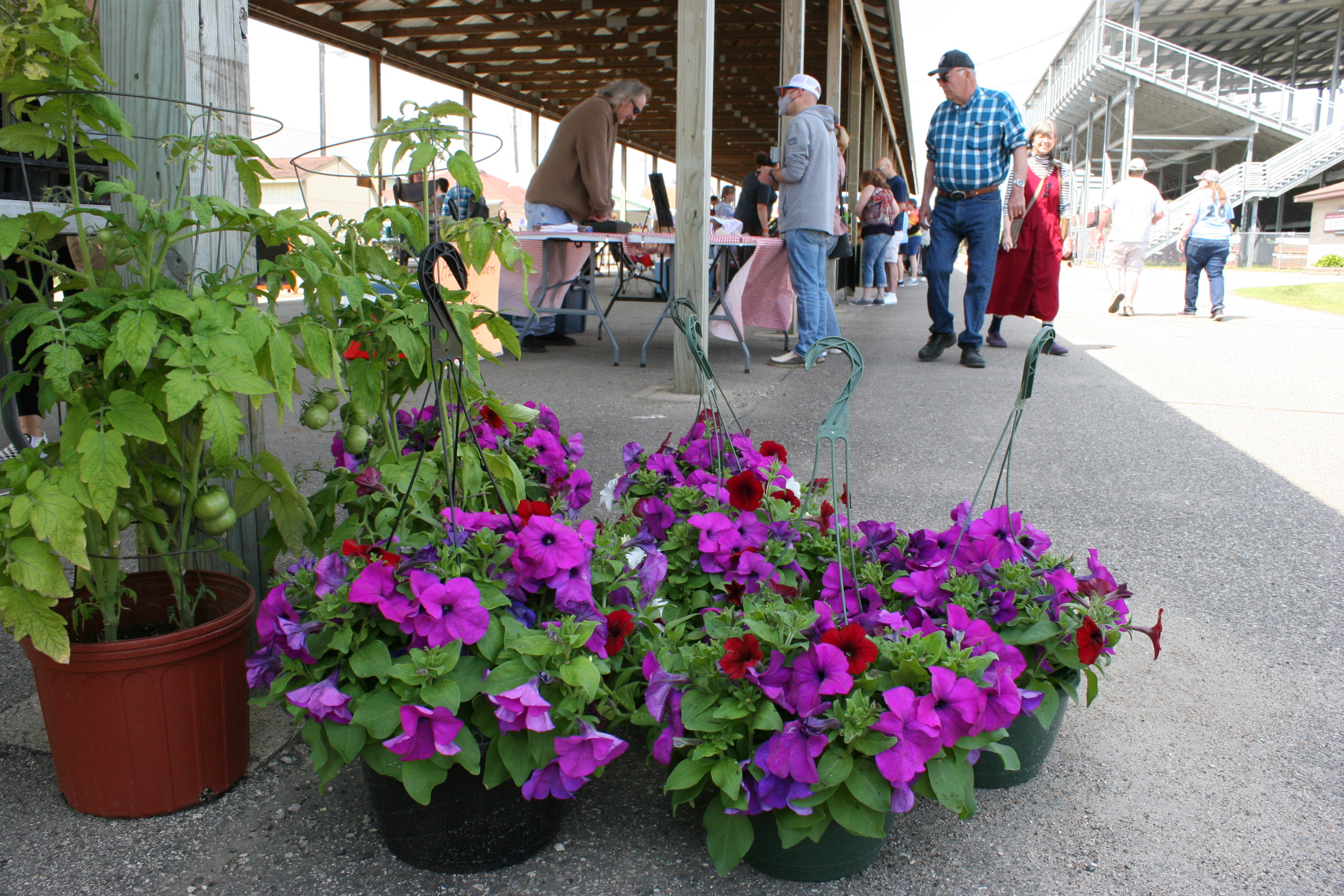
Plants available for purchase a year ago, looking toward the vendor site under the fairgrounds car port. (Minnesota Prairie Roots copyrighted file photo May 2021)
While there, also check out the Cannon Valley Farmers’ Market under the carport at the Rice County Fairgrounds from 10 am – 2 pm. Some 20 area/regional vendors will market spring produce, locally-grown starter plants, cheese, honey, pastries, woolen products, homemade soaps and much more.
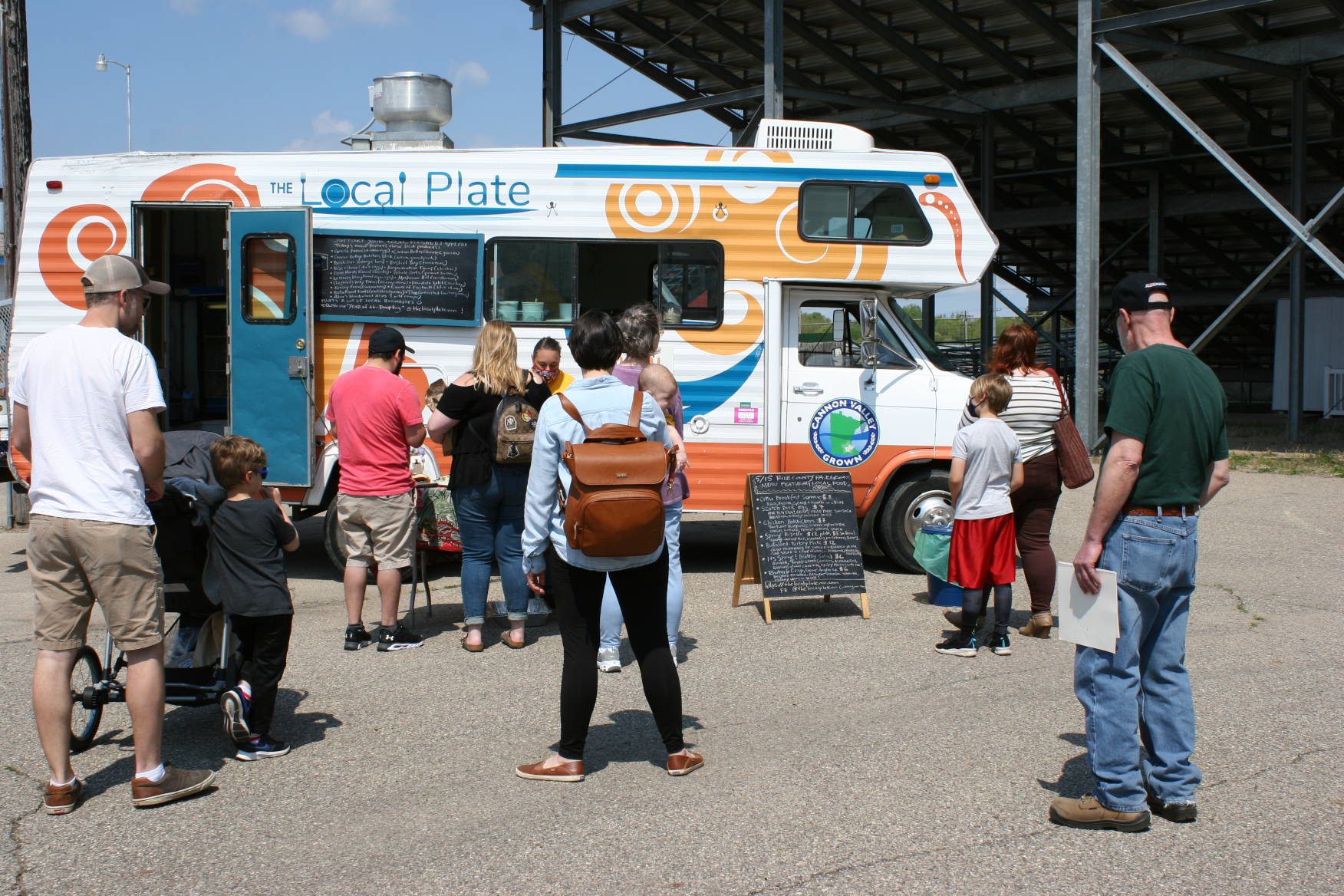
Customers place orders at the Local Plate food truck at the May 2021 Cannon Valley Farmers’ Market. (Minnesota Prairie Roots copyrighted file photo.)
Adding to the farmers’ market draw are local food trucks on site.
A group of mostly Northfield area musicians performed as Hutenanny at a past Valley Grove Country Social. Minnesota Prairie Roots copyrighted file photo September 2010)
On Sunday, May 15, two area historic Norwegian churches celebrate Syttende Mai, Norway’s Constitution Day. Both events begin at 2 pm.
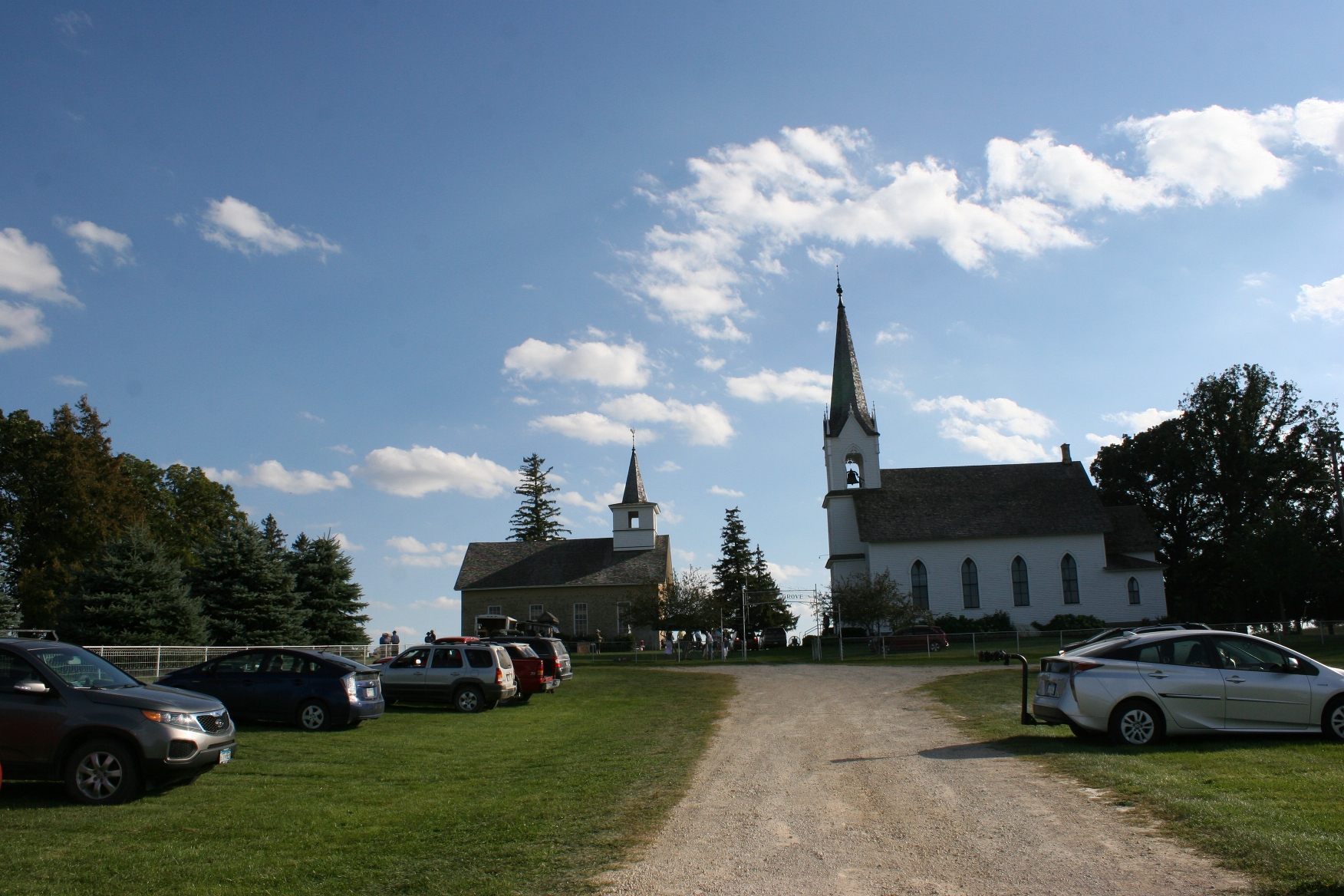
Duo churches grace the hilltop at Valley Grove. (Minnesota Prairie Roots copyrighted file photo 2018)
At Valley Grove churches, rural Nerstrand, the gathering focuses on the dedication of tapestries woven by Robbie LeFlueur. The Minneapolis weaver was commissioned to create four tapestries—three will be complete by May 15—that illustrate church history, the congregation and the surrounding flora and fauna. She will also give a weaving demo. Hardanger fiddlers from St. Olaf College will provide entertainment. Valley Grove, atop a hillside near Nerstrand Big Woods State Park, is a favorite destination of mine given its beautiful and peaceful country setting. I’ve attended numerous celebrations, or simply walked, there and always enjoyed myself. The Syttende Mai event goes until 4 pm.
Completed in the fall of 1899, the second Trondhjem Church sits atop a 100-foot high hill. Listed on the National Register of Historic Sites in Minnesota, this Norwegian church has walls constructed with 24 corners to brace it against the wind. Minnesota Prairie Roots file photo)
In northern Rice County, the Norwegians of Old Trondhjem Church, rural Lonsdale, are hosting Tjarnblom, a Scandinavian folk group as their Syettende Mai celebration begins at 2 pm. There’s a brief meeting of the preservation society followed by coffee (of course), treats (of course) and fellowship (of course). I’ve also attended events at Trondhjem and recommend you join in this Norwegian celebration.
There you go. Four places to go in Rice County that will bring sunshine into your May weekend.
Cry Baby Craig’s, Faribault made hot sauce, which I love. (Minnesota Prairie Roots copyrighted photo May 2022)
STEREOTYPICAL RURAL MINNESOTANS, especially those of Scandinavian descent—of which there are many—avoid spicy foods. Just a hint of heat in chili is plenty, thank you. And to flavor hotdish, pass the salt and pepper, please. Oh, and that hot sauce, no thank you.
But at least one Minnesota woman, arrested recently in Faribault, loves to spice things up.
Faribault police responded to a disturbance call on April 16 only to find the woman speeding away in her car, evading them. When she eventually stopped, the officer noticed signs of intoxication. But the 32-year-old refused to take field sobriety tests. This is all according to police reports.
A popular mass-produced hot sauce. (Minnesota Prairie Roots copyrighted photo May 2022)
As the officer was preparing a preliminary breath test, the woman “grabbed a bottle of hot sauce and began drinking it.” Yes, you read that correctly. She hit the hot sauce in an apparent effort to avoid alcohol detection. Once arrested and taken to jail, the driver refused to take a breathalyzer test.
Made in Faribault, Minnesota, Cry Baby Craig’s hot sauce. (Minnesota Prairie Roots copyrighted photo May 2022)
While the hot sauce consumption rates as not the brightest idea ever, I give the woman credit for creativity and for making me laugh. But the rest of this incident is not at all humorous, entertaining or smart. There is nothing funny or wise about allegedly driving while under the influence. She now faces charges of fleeing a peace officer in a motor vehicle, 2nd degree DWI, DWI test refusal and child endangerment. There were two children in the car with her. No amount of hot sauce will hide that fact.
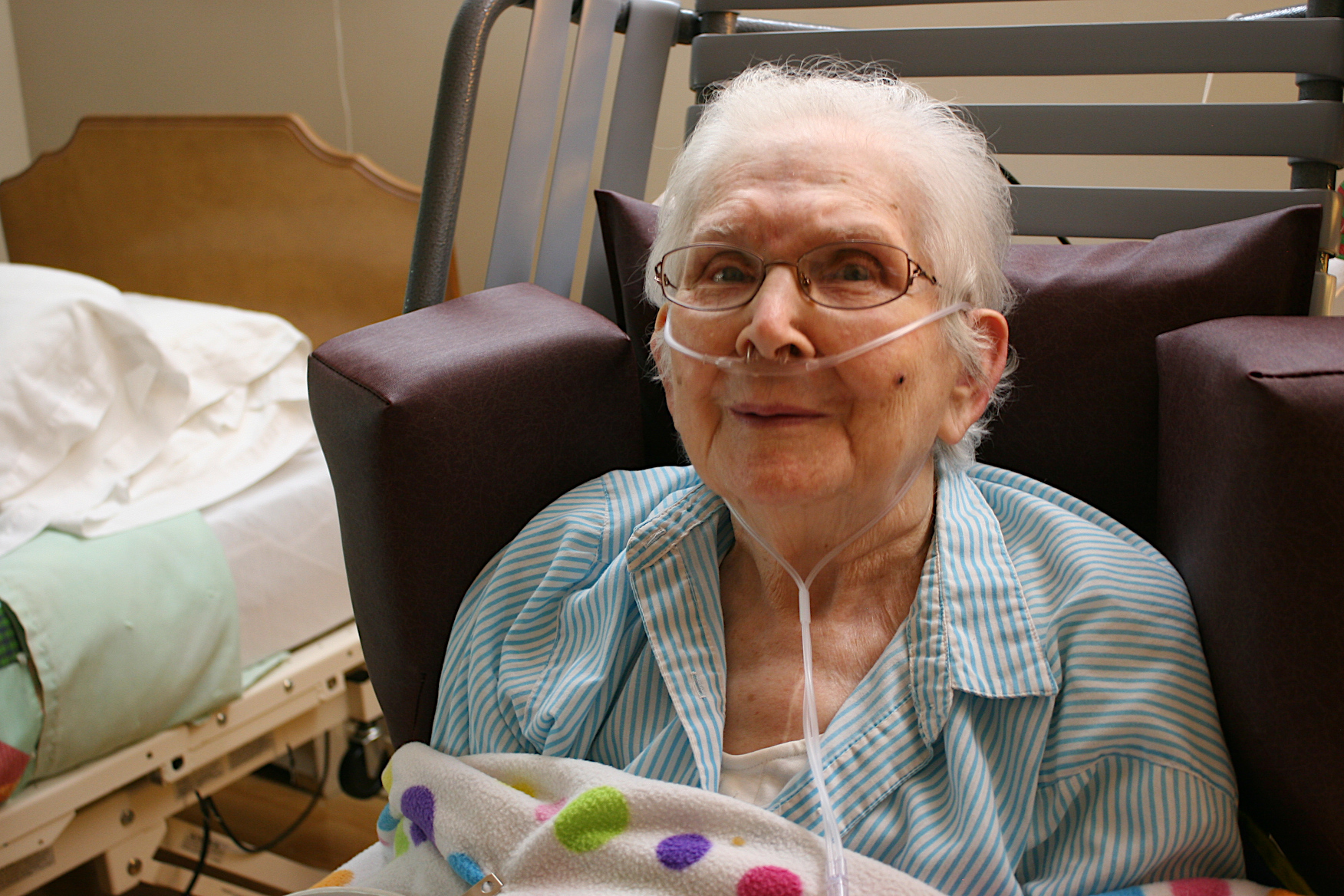
One of the last photos I took of my mom. (Minnesota Prairie Roots copyrighted file photo July 2021)
IN RECENT YEARS, as my mom’s health declined, I considered how I would feel when she was gone, when Mother’s Day would come and go without her. Now, four months after her death, I understand. I feel a deep sense of loss, but also thankfulness for the mother I loved and who loved me.
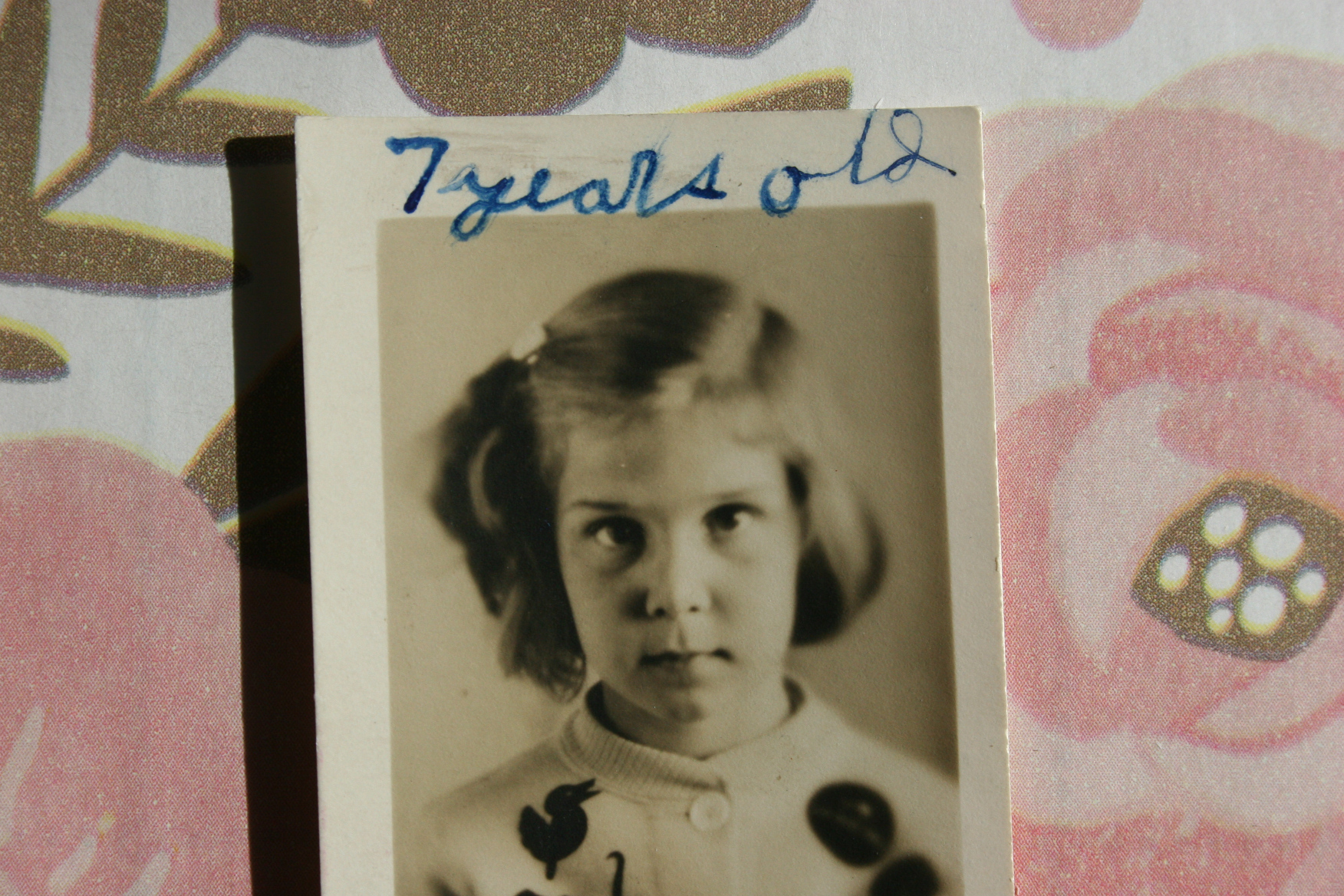
I love this sweet photo of Mom at age seven. (Minnesota Prairie Roots copyrighted photo)
Who was my mom? She was the oldest of five. (Her sister Deloris died in infancy.) She was valedictorian of her high school graduating class. She completed a short business college course thereafter and worked in an employment office before marrying my dad. Within a year of their marriage, the first of six children was born. I came next. And within two months of my birth, Mom’s mother died. Mom was 24, her mother only 48.
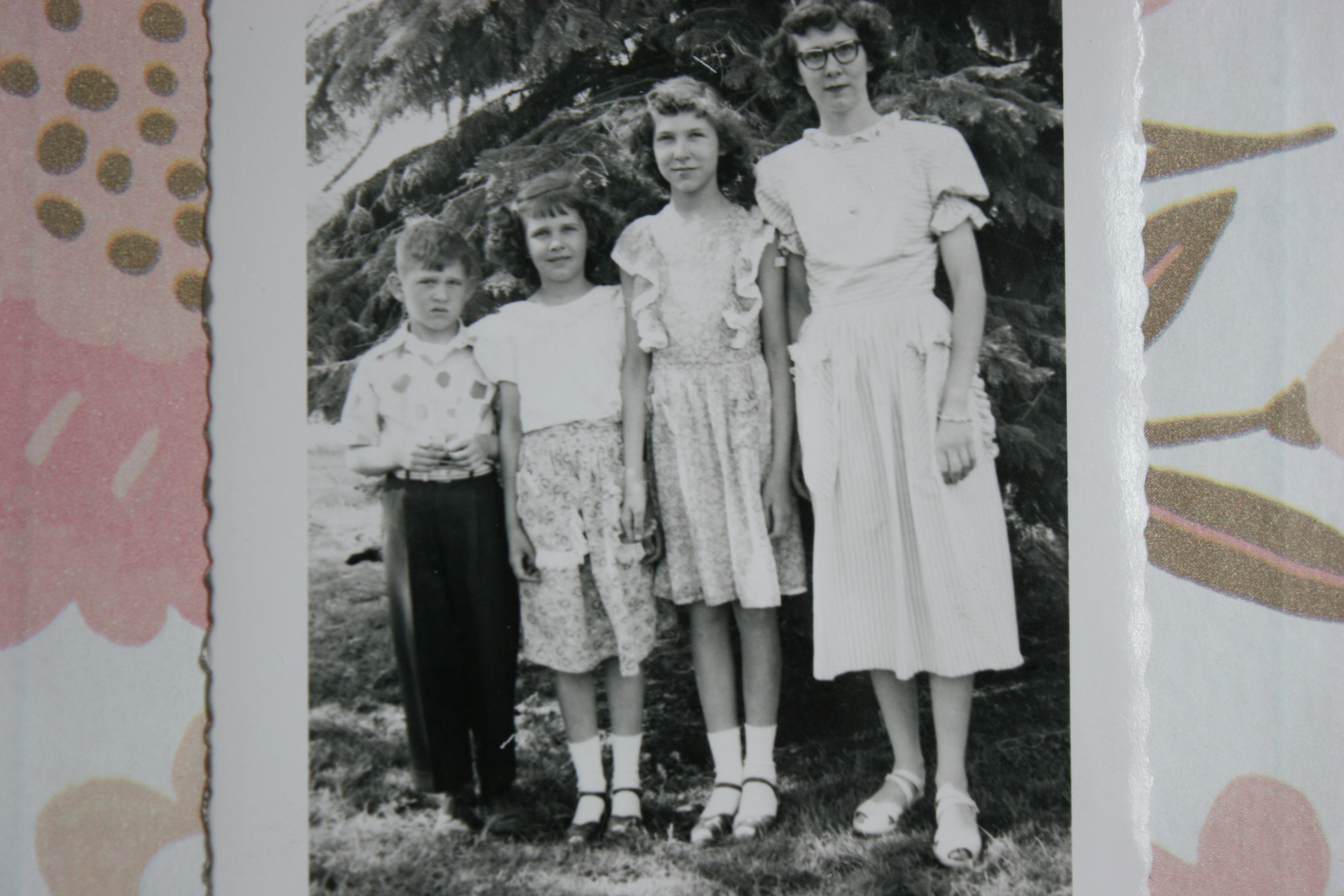
The Bode siblings, left to right: John, Rachel, Dorothy and Arlene. (Minnesota Prairie Roots copyrighted photo)
When I consider Grandma Josephine’s premature death, I wonder how Mom handled that. To lose her mother at such a young age is a profound loss. If only I had asked.
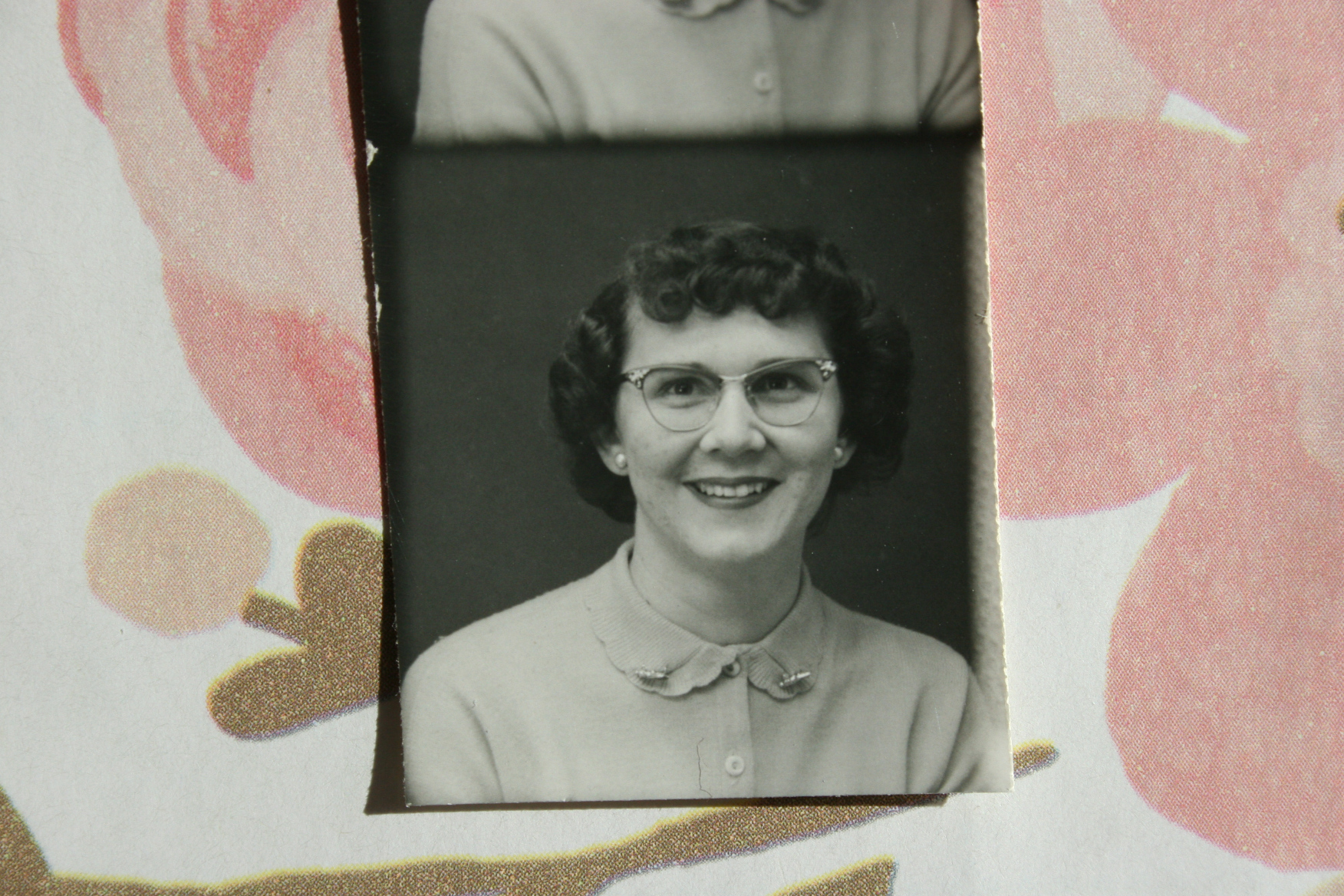
A portrait of Mom. I’m unsure of her age here, but probably around 20. (Minnesota Prairie Roots copyrighted file photo 2022)
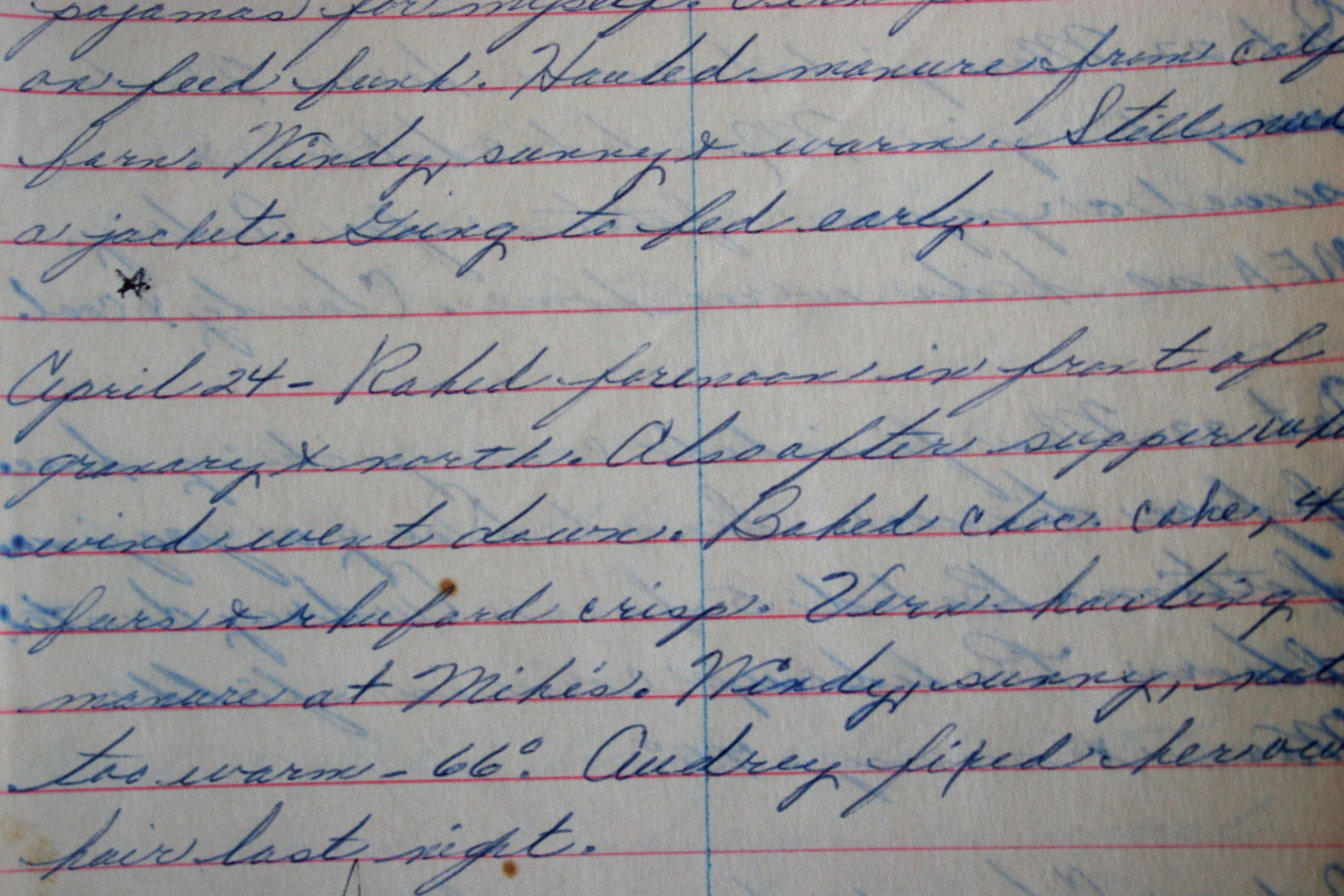
Mom left behind a collection of notebooks in which she wrote daily entries. Journals begun in high school and continuing into her senior years. The short entries are documentations of her life from student to full-time mother/southwestern Minnesota farm wife and, finally, a grandmother.
The only photo I have of my mom holding me. My dad is holding my brother Doug. (Minnesota Prairie Roots copyrighted file photo)
I wish her writing held personal thoughts and observations. But that is mostly missing, along with journals from around the years she met Dad. Not a surprise given that generation’s aversion to expressing emotions. I don’t recall either of my parents ever telling me they loved me, or hugging me, during my growing up years. It just wasn’t done. Yet, I inherently knew they loved me. Only in later years, long after I’d left home, did love-filled words and hugs come.
Entries from one of Mom’s earliest journals. (Minnesota Prairie Roots copyrighted photo 2022)
Since my mom’s death, I’ve dipped into some of her journals as has my eldest daughter. Mom’s one-paragraph daily entries about the weather, everyday farm life and the occasional trips into town and social outings reveal a hardworking woman. I never doubted just how hard Mom worked to keep our family fed, the house clean and six kids in line. I read of gardening, harvesting, preserving. I read of doing laundry (in a Maytag wringer washer), ironing, folding clothes. I read of endless baking, including occasionally making her favorite Sour Cream Raisin Pie. To this day I have never developed an appreciation for that pie. But I loved when she baked homemade bread, shaping tiny buns just for us kids to eat hot from the oven.
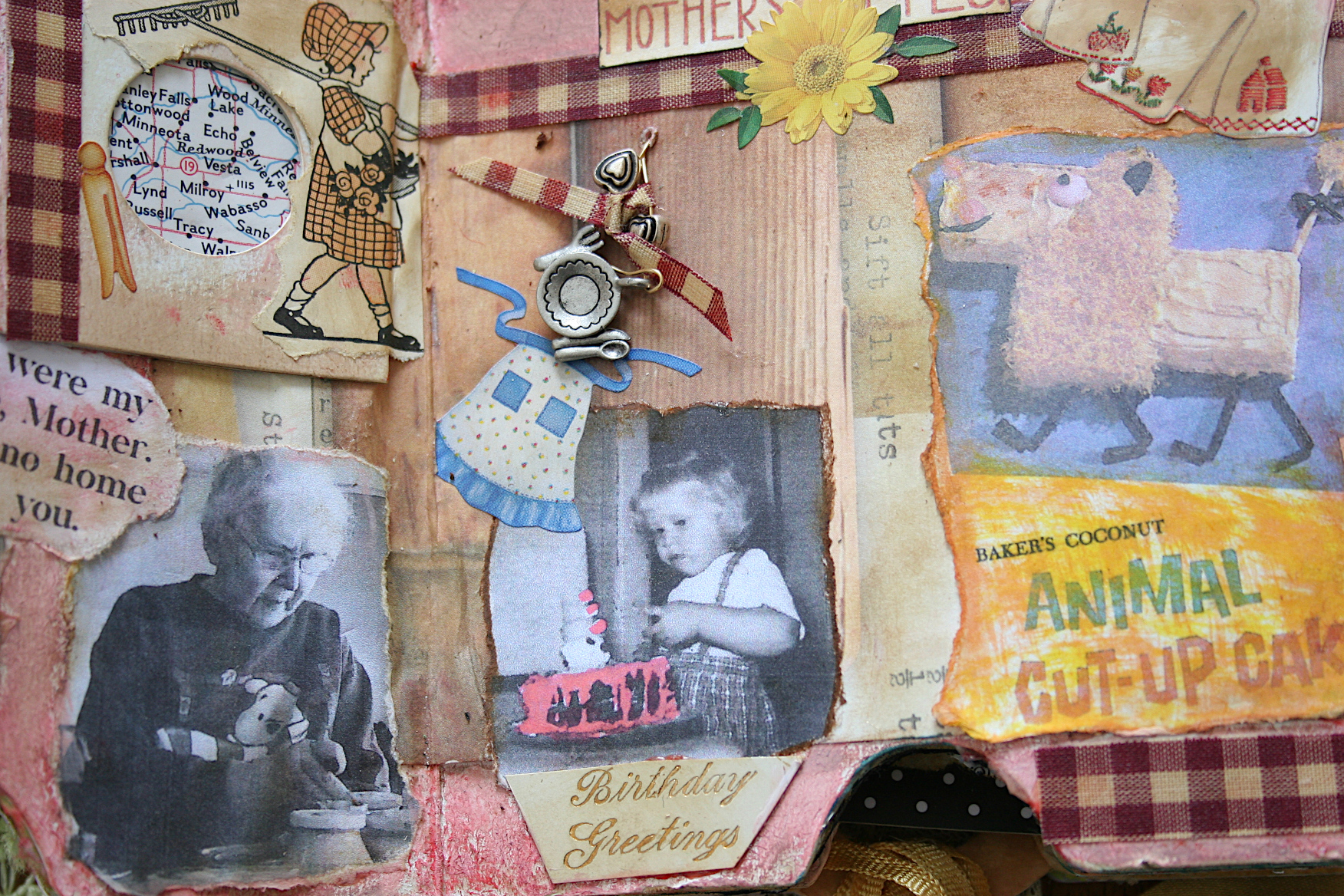
This page in an altered book created by my friend Kathleen focuses on the animal-shaped birthday cakes Mom made for me and my five siblings. (Minnesota Prairie Roots copyrighted file photo)
I also appreciated that Mom made birthdays special by creating animal-shaped birthday cakes from homemade chocolate cake and seven-minute frosting. Those cakes, selected from a cake design booklet, defined our childhood birthdays. Because my parents couldn’t afford gifts, Mom’s cake was our gift. Oh, the memories.
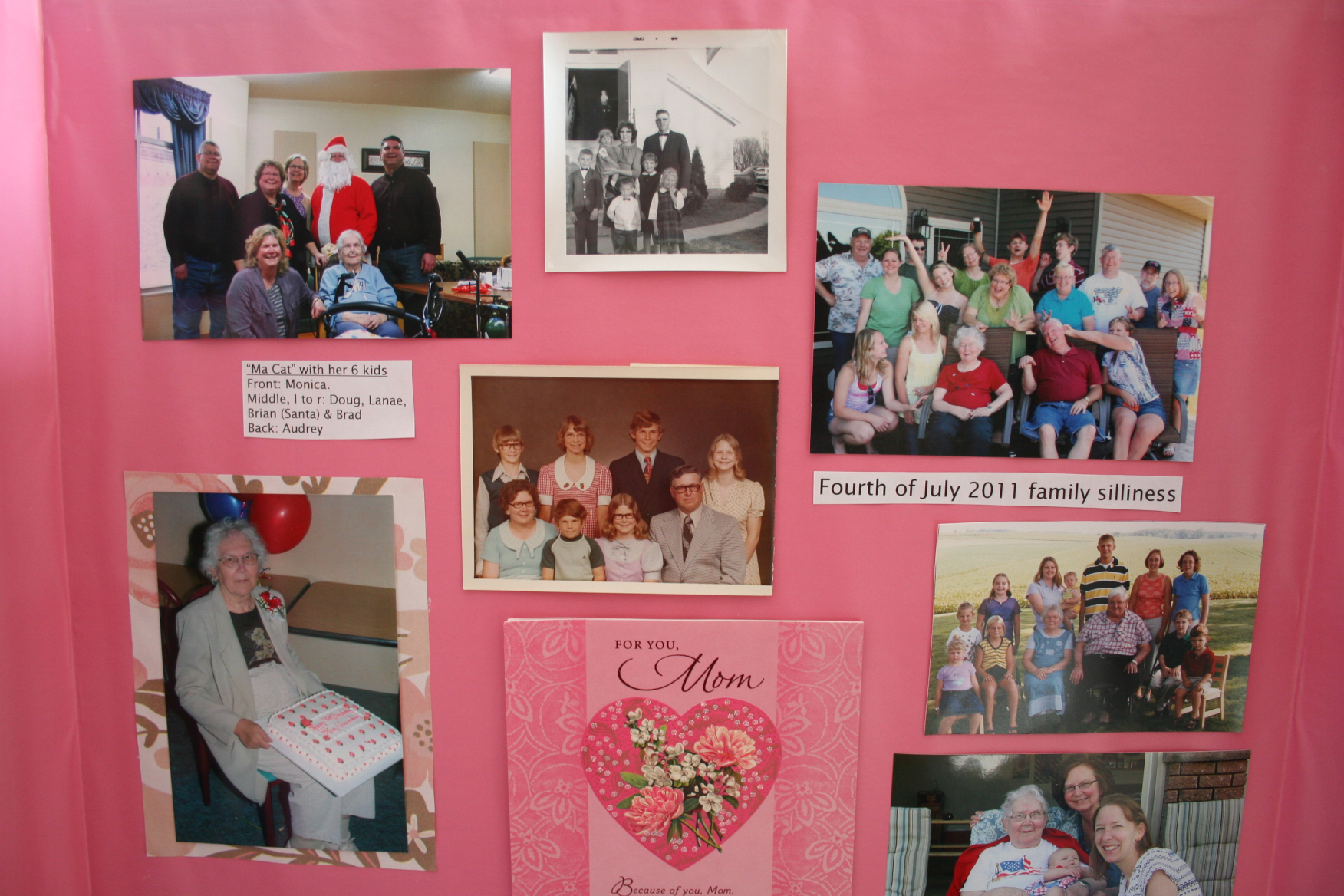
This shows family photos on a board I created for Mom’s funeral. The card at the bottom is a Mother’s Day card. (Minnesota Prairie Roots copyrighted photo January 2022)
That I never realized our family was poor is a credit to my mom. There was no emphasis on material possessions, but rather on self-sufficiency and contentment with what we had—each other and land, our land, all around us. Sure, I occasionally longed for rollerskates (like my friends Jane and Robin had), for shopping clothing racks other than the sales rack, for getting whatever toy I wanted from the Sears & Roebuck Christmas catalog. But, in the end, I didn’t care all that much. I had enough. I still do. And I still don’t get gifts on my birthday.
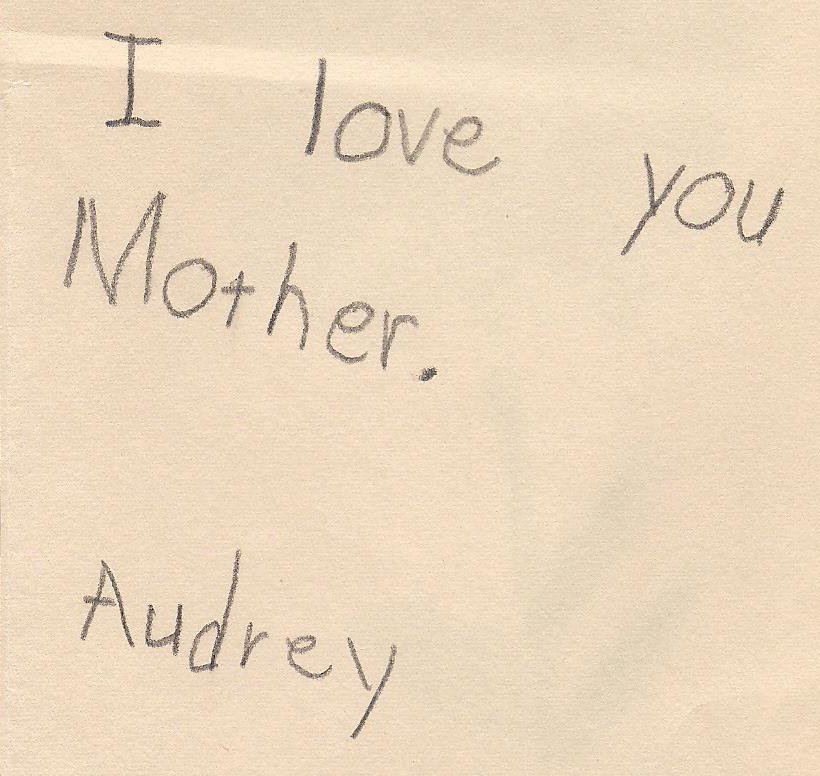
My mom saved everything, including this Mother’s Day card I made for her in elementary school. I cut a flower from a seed catalog to create the front of this card. (Minnesota Prairie Roots copyrighted file photo)
Mom’s gifts to me stretch well beyond anything tangible. She exuded a spirit of kindness. Soft-spoken, except when we kids occasionally overwhelmed her, Mom always encouraged us to speak well of others, to serve with humility. She did. At church, in the community. I’ve been told she was much like her sweet and loving mother, my Grandma Josie.
Me with my mom during a January 2020 visit. (Minnesota Prairie Roots copyrighted file photo January 2020 by Randy Helbling)
This Mother’s Day I hold onto the memories. The photos. The stack of journals. The lessons and qualities passed along to me that speak to a legacy of faith and kindness and love. Mom’s love. A love that endures in how I choose to live my life. A love that rises above grief to remind me how blessed I was to have my mother as my mother.
I printed this message inside a handmade Mother’s Day card for my mom back in elementary school. (Minnesota Prairie Roots copyrighted file photo)
In my last visit with Mom before her January 13 death, I said my goodbyes, told her it was OK to go. She was mostly unresponsive then, heavily-medicated. But when I spoke the words, “I love you,” for the final time, her lips curved into a smile so slight I wondered if I imagined it. I didn’t. That was her final gift to me—an expression of love I will forever remember and cherish, especially today, my first Mother’s Day without Mom.
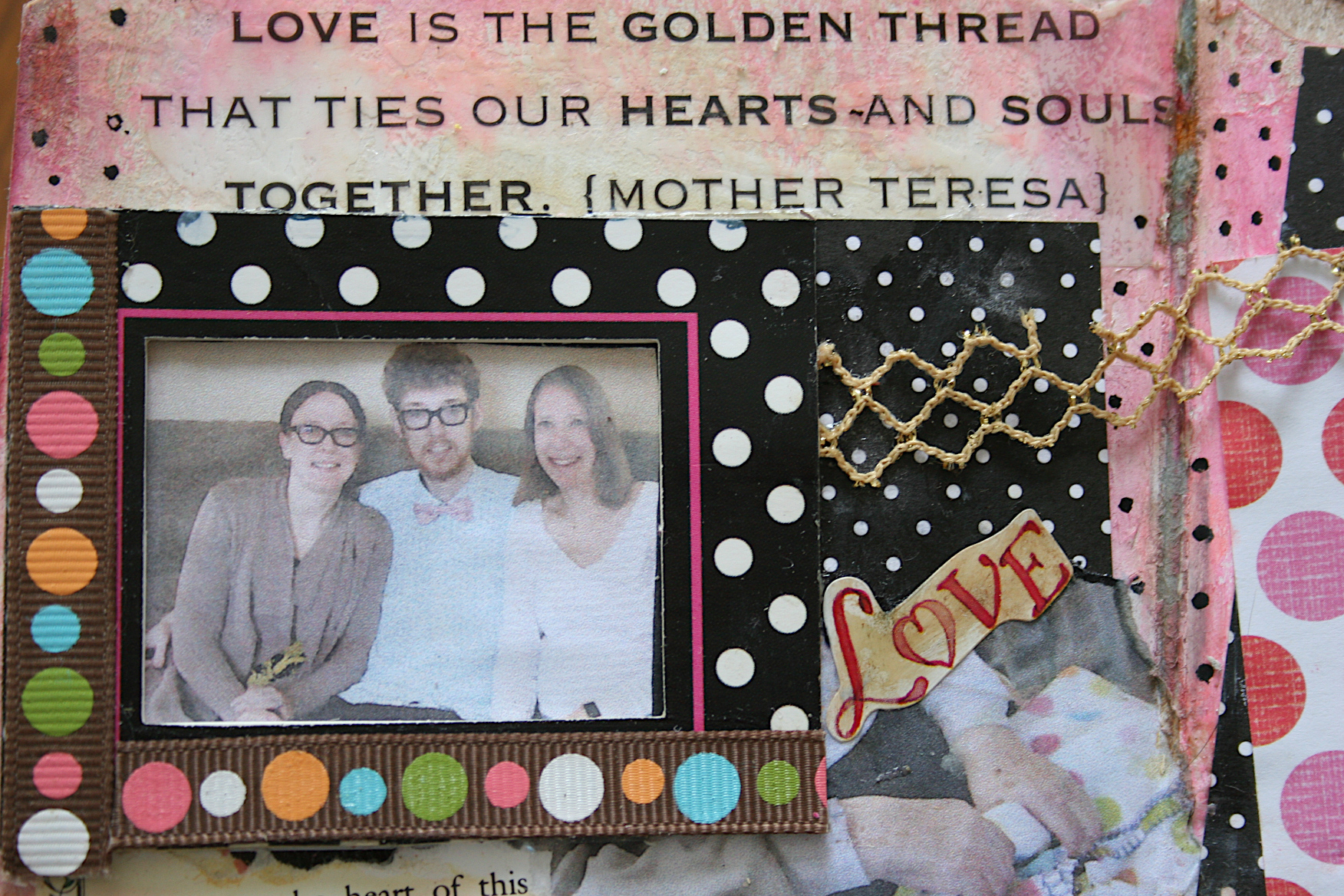
My friend Kathleen recently created an altered book honoring my mom, who died in January. She included a copy of this 2016 photo of my three adult children. (Minnesota Prairie Roots copyrighted file photo 2022)
TRAUMA WRITES INTO my Mother’s Day history. Two events. Two Mother’s Days. Two memories that, even with the passing of time, remain vivid.
The first occurred in May 1987. Randy and I had just gotten off the phone with our moms. We wished them Happy Mother’s Day and then told them we were expecting our second child, due in November. The grandmas were excited. We were delighted to share the news.
And then it happened. The bleeding. The panic when I realized what was happening. The call to the ER with instructions to lie down and see my doctor in the morning. I recall lying in bed, flat on my back, overwhelmed by fear. “I don’t want to lose my baby,” I sobbed and prayed.
How could this be happening? Moments earlier we’d shared such good news. And now the future of our baby seemed uncertain.
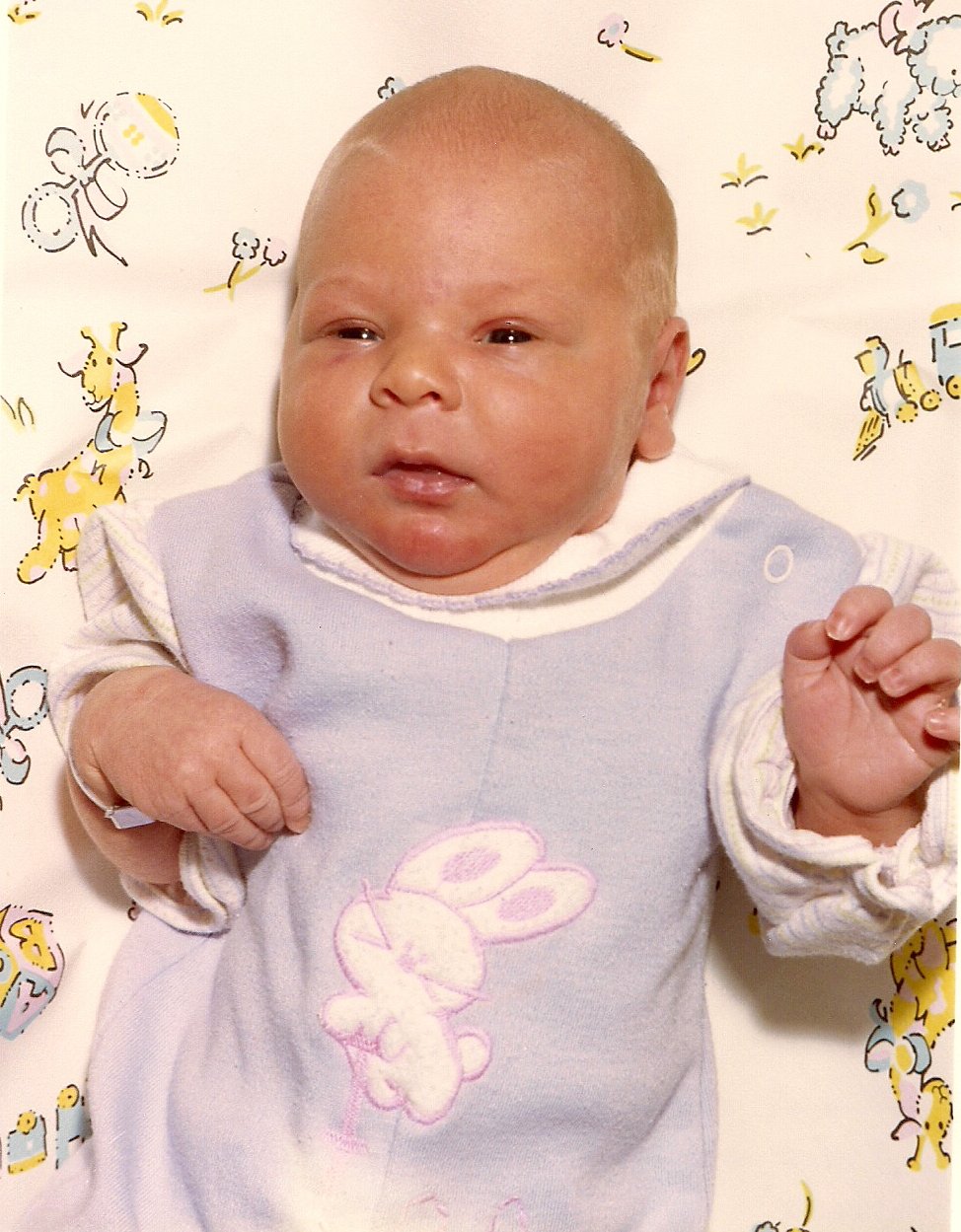
Miranda, five days old. Photo source: hospital photo
In the end, we didn’t lose that precious baby girl born to us six months later. Miranda. Beautiful in every way.
Fast forward to the morning of May 12, two days before Mother’s Day in 2006. Miranda was a senior in high school, her older sister just returned home from college. And their little brother, Caleb, 12, was on his way to the bus stop. Then the unthinkable happened. While crossing the street to his bus, Caleb was struck by a car. He bounced off the car, somersaulted, landed on the side of the road.
The moment when I heard the sirens, when I instinctively knew deep within me that something had happened to my son, terror unlike anything I’d ever felt gripped me. I can’t explain how or why I knew. I just did.
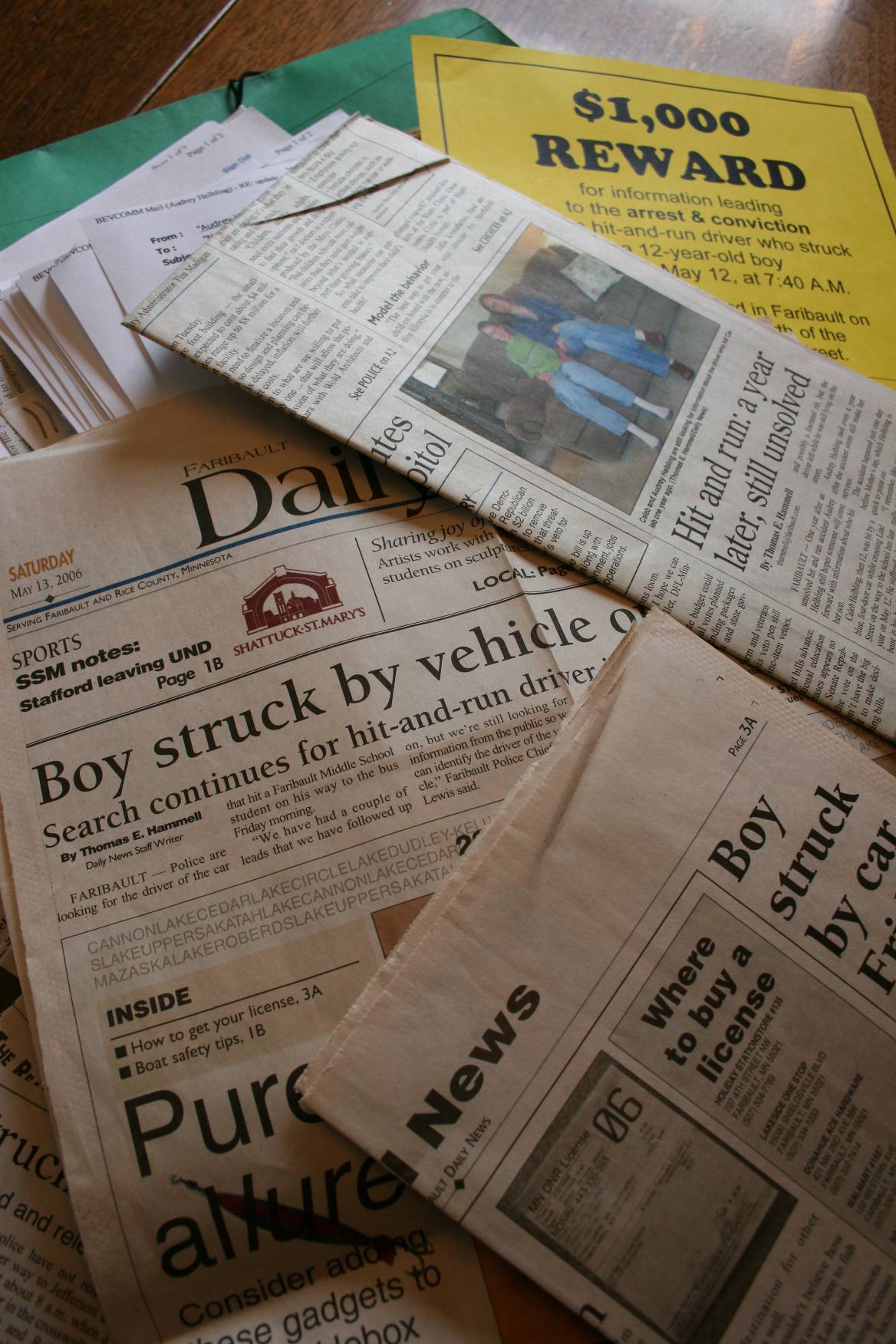
I have a file thick with information related to my son’s hit-and-run. The file includes newspaper clippings, e-mail correspondence with the police, medical and insurance papers and more. (Minnesota Prairie Roots copyrighted file photo)
In the end, Caleb suffered only a broken bone in his hand, cracked ribs, bumps and bruises. While it was a terrifying experience—compounded by the driver who left the scene and to this day has not been found—we felt relief in the outcome.
Even though I endured those Mother’s Day traumas in 1987 and in 2006, I did not lose a child. But in those experiences I gained empathy—for those who have lost children through miscarriage, still birth, disease, illness, accident, violence, suicide… And if that’s you, I am deeply sorry for the pain, grief and loss you’ve felt and feel.
My daughter Miranda and me. (Minnesota Prairie Roots file photo February 2016.)
Through those experiences I realized how deep my motherly love, how my children hold my heart in a way that the very thought of losing them caused me such angst. I would do anything to protect them from harm. Anything. Even today.
My son and I in 2016, when he graduated from Tuft’s University, Boston skyline in the background. (Minnesota Prairie Roots copyrighted file photo by Randy Helbling)
Through those experiences I grew stronger. And I recognized that, no matter what, we are not alone. When Caleb was hit by the car, our family received overwhelming support from family, friends, his school and the greater community. There were prayers, encouraging cards and phone calls, a stuffed animal and even a gift certificate to Dairy Queen. What love, compassion and care.
To my dear readers who are mothers, you are cherished, valued, loved. And the children you raised/are raising are equally as cherished, valued and, above all, loved.
TELL ME: If you have a story or thoughts you would like to share about being a mom or about what your mom meant/means to you, please comment. I’d love to hear from you.
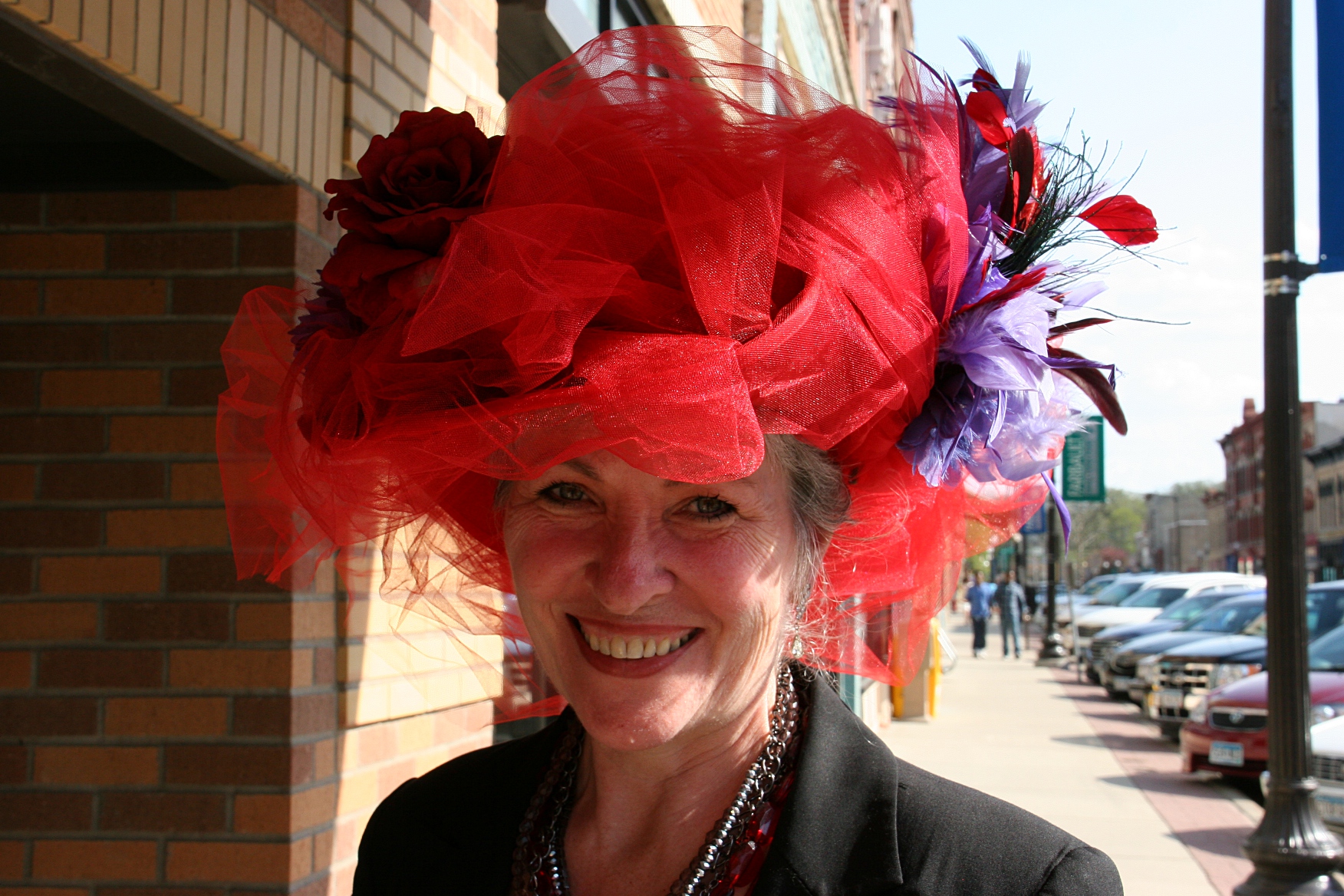
Watching the 2015 Kentucky Derby in the auditorium at The Paradise Center for the Arts, Faribault, during a “Big Hats & Big Hearts event. (Minnesota Prairie Roots copyrighted file photo May 2015)
MAY, MORE THAN any month, reminds me of my mom. And not just because of Mother’s Day.
Mom’s birthday falls in late May. She would have turned 90 this year.
A guest arrives for the Derby party at the Paradise Center for the Arts in 2015. (Minnesota Prairie Roots copyrighted file photo May 2015)
May also means Kentucky Derby time, an annual event Mom looked forward to with unbridled enthusiasm. It wasn’t only the horses which drew her interest. It was the fashion. Mom loved the big hats, the showiness of this social gathering.
I remember phone conversations when Mom talked about the upcoming Derby. I regret that she never attended the Kentucky race. But she saw several horse races at Canterbury Park in Shakopee, Minnesota. I have no doubt she would have loved the Kentucky Derby events set there for Saturday, including the Derby Fashion Show followed by live screening of the actual race.
This year’s race holds special interest for Minnesota as two of the horses are owned by Minnesotans. I expect Mom would have chosen Zandon or Zozos to win. Jeff Drown of Clearwater owns Zandon, #2 in the leaderboard rank. And Barry and Joni Butzow of Eden Prairie own Zozos, ranked #17. Both Drown and the Butzows have a long history in racehorse ownership.
Dressed in Derby Day fanciness, attendees view a hat-themed exhibit in the Paradise Center for the Arts gallery in 2015. (Minnesota Prairie Roots copyrighted file photo May 2015)
And my mom had a long history of loving horse racing. And of loving the fancy, wide-brimmed Derby hats adorned with flowers, feathers, bows, ribbons… Fashion focus didn’t fit Mom at all. She was a no-frills kind of woman. Basic wardrobe of nothing flashy or fancy. But when it came to the Kentucky Derby, she was fully-engaged in appreciating fashion.
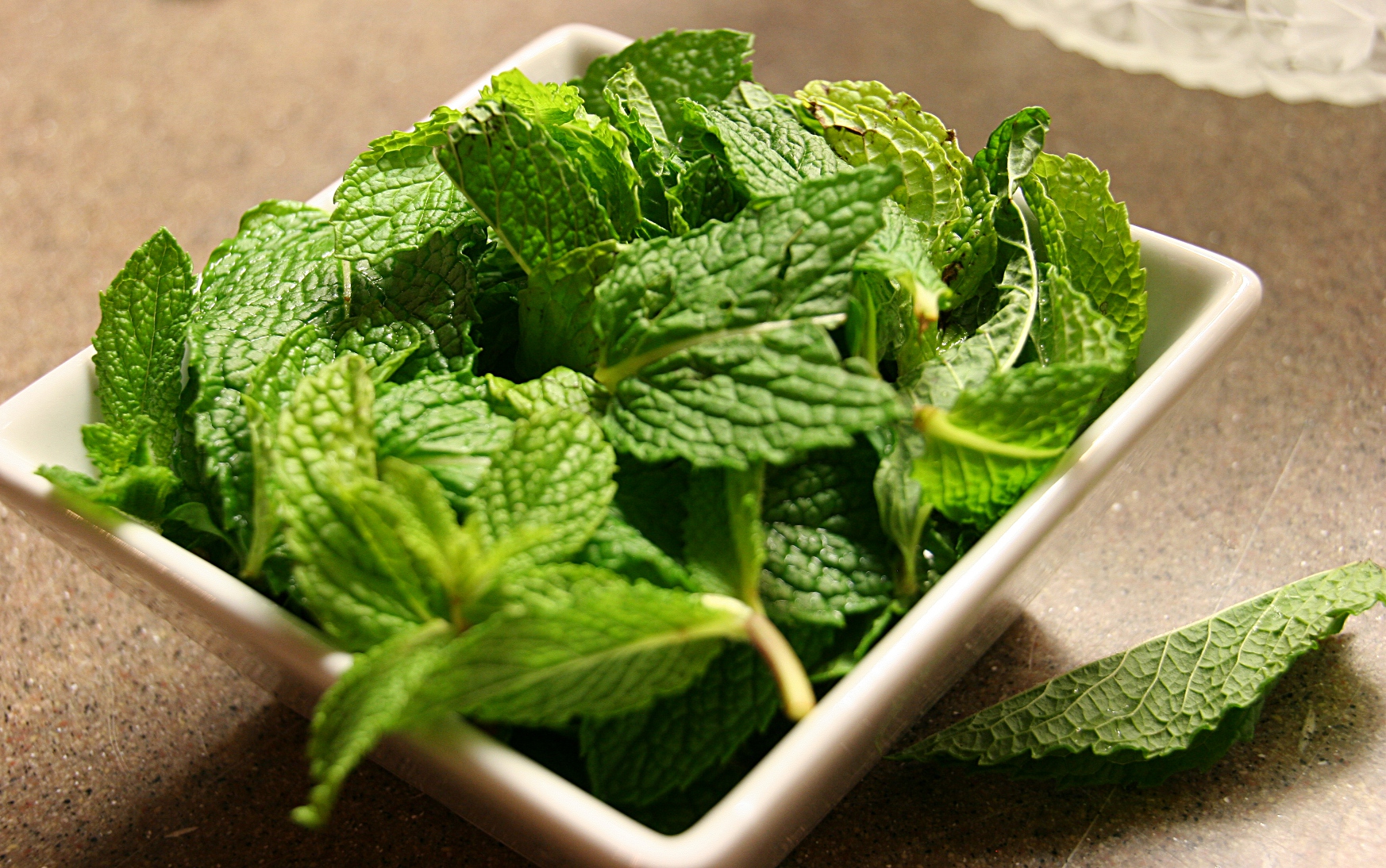
Fresh mint leaves for the mint juleps. (Minnesota Prairie Roots copyrighted file photo 2015)
This year, especially (four months after her death), I remember Mom’s unbridled joy in the Kentucky Derby—both the fashion and the race. I wish I could sit by her side, both of us sporting fancy Derby hats, sipping mint juleps, watching the race live on the screen.
My friend Beth Ann gifted me with official Kentucky Derby glasses from 1986 and 1991. (Minnesota Prairie Roots copyrighted file photo)
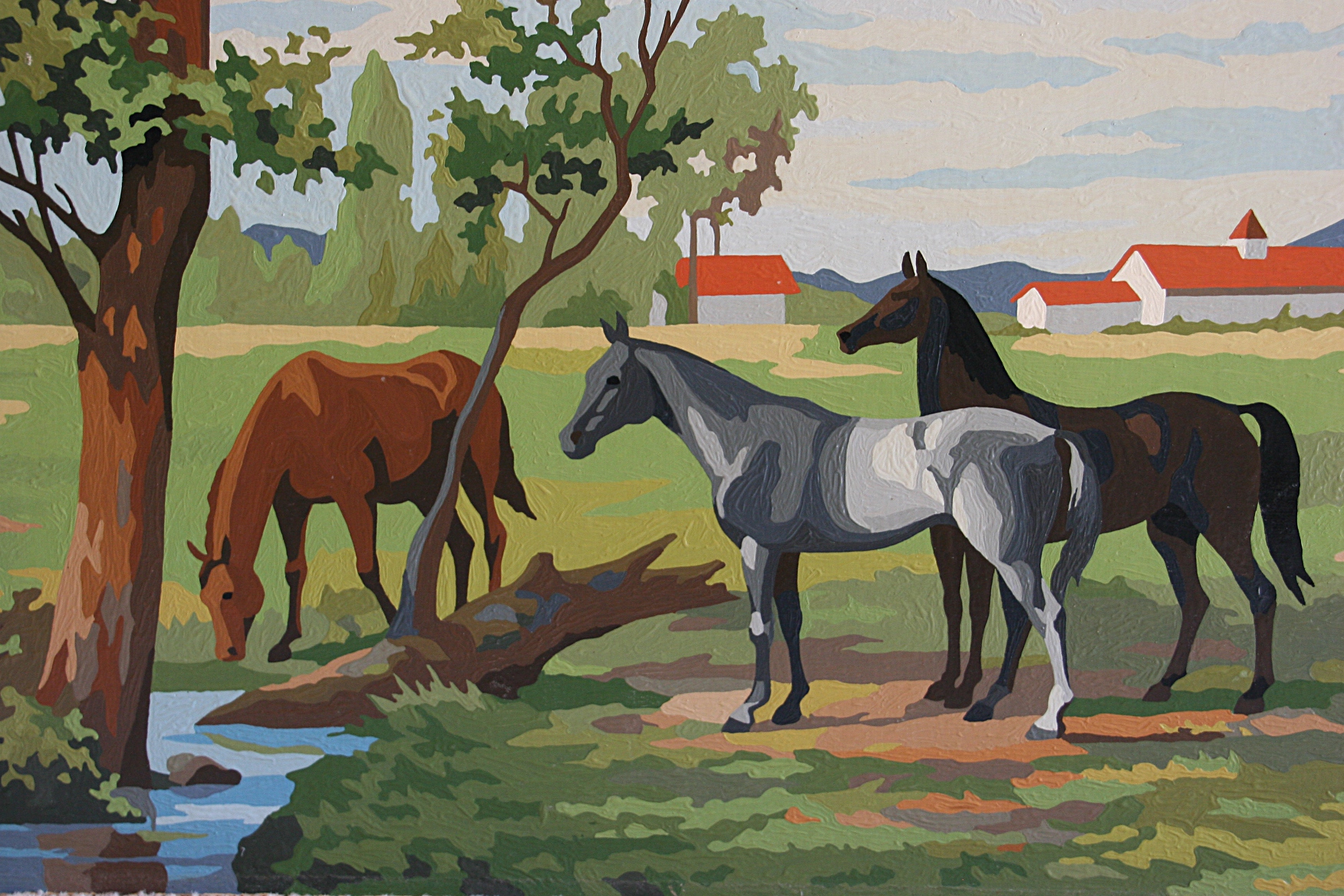
Yet, I can honor her via memories and via the horse art which I pull out each May. A paint-by-number horse scene purchased at a second-hand store. A painting of horses by my father-in-law. And two Derby drinking glasses gifted to me by a friend.
I purchased this stunning 24-inch x 18-inch paint-by-number painting at a Wisconsin second-hand/collectible/antique shop. The scene reminds me of the Kentucky Derby. (Minnesota Prairie Roots copyrighted file photo 2015)
There is comfort in memories, in remembering how very much my mom loved the Kentucky Derby. This Saturday, when I settle in to watch the horse race, I’ll think of Mom and how she delighted in “Southern Belle” inspired fashion while watching the Derby on TV from her Minnesota home.
NOTE: This is the first in three mother-themed blog posts leading up to Mother’s Day on Sunday, the day after the Kentucky Derby.
This message refers to the struggles with mental illness. (Minnesota Prairie Roots file photo September 2019)
A DAY BEFOREMental Health Awareness Month began on May 1, the Judd family lost their beloved Naomi “to the disease of mental illness.” She was a wife, a mother and a country western superstar singer. That the family chose to publicly attribute Naomi’s cause of death to mental illness shows strength and honesty. And a desire to increase awareness.
On my reading list…
Naomi was open about her severe, treatment resistant depression. She wrote about her mental illness in a book, River of Time: My Descent into Depression and How I Emerged with Hope, in 2016. I have yet to read this book, but I will. Soon.
Reflecting on Naomi’s death focused my thoughts on the many books I’ve read in recent years about mental health related topics. I’ve reviewed numerous books on my blog and written on the topic often. Why? Because I care. I care that people understand depression, bipolar, schizophrenia, anxiety… I care that we show compassion, support, encouragement and more to those dealing with these often overwhelmingly challenging and debilitating diseases. I care that stigmas vanish, that treatment options improve, that access to mental health care is easily and readily available to anyone anywhere anytime.
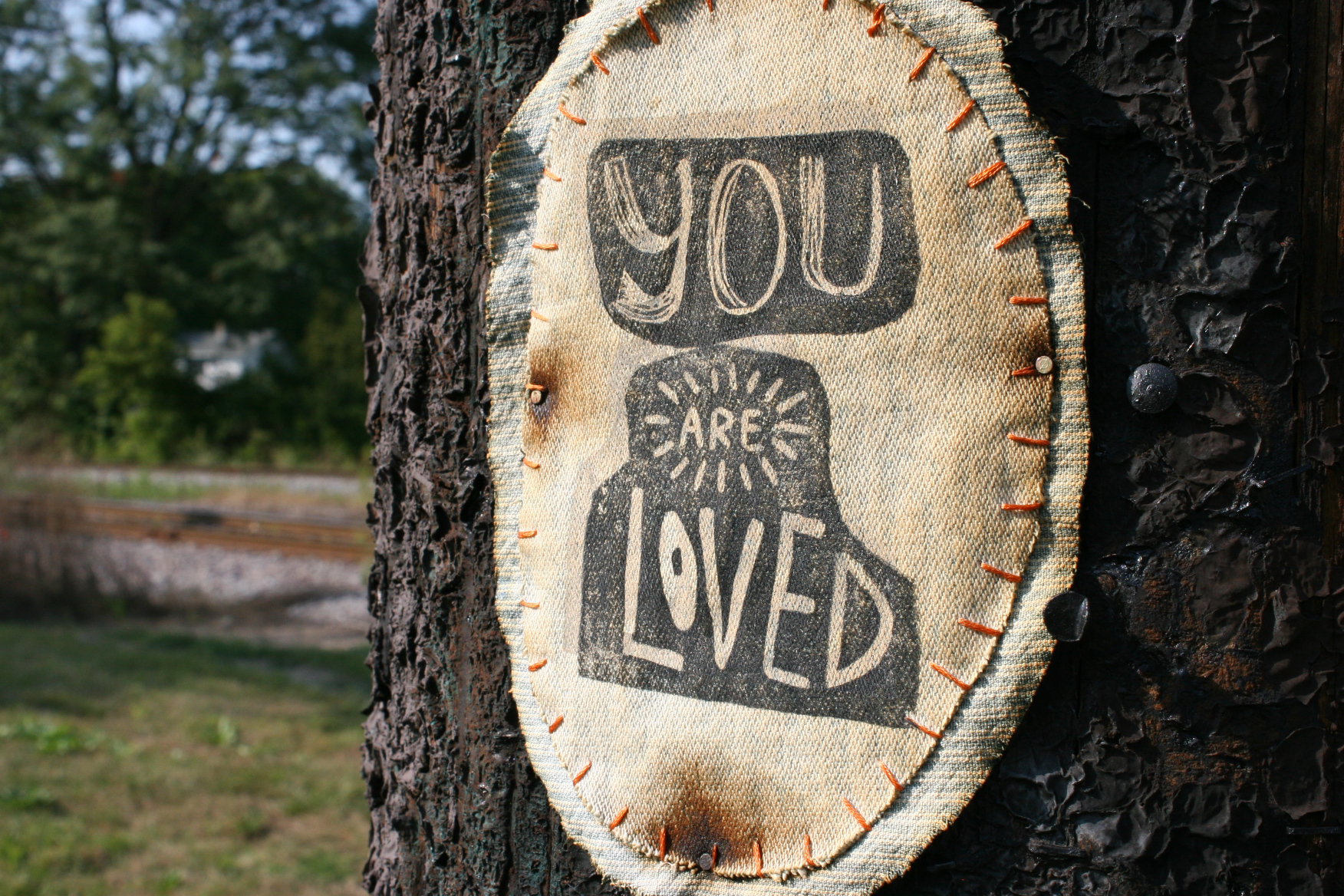
Love this message posted along a recreational trail in the Atwood Neighborhood of Madison, Wisconsin. (Minnesota Prairie Roots copyrighted file photo)
I care, too, that no one feels alone. That anyone dealing with a mental health issue understands they are loved, valued and cherished. That families, too, feel supported.
Much progress has been made in recent years to shine the light on mental health. I appreciate that. And I appreciate the efforts of groups like the National Alliance on Mental Illness. But, still, it is up to each of us individually to do what we can to educate ourselves and increase awareness, to offer love and support… To be there. To listen. To recognize the value of professional help.
Clinical depression like Naomi Judd experienced is deep and dark and debilitating. She couldn’t talk herself/smile herself/lift herself out of the depths of such depression. Not alone. That’s what we all need to understand. Hers wasn’t situational depression. Hers was persistent, powerful, all-encompassing. And, in the end, it killed her.
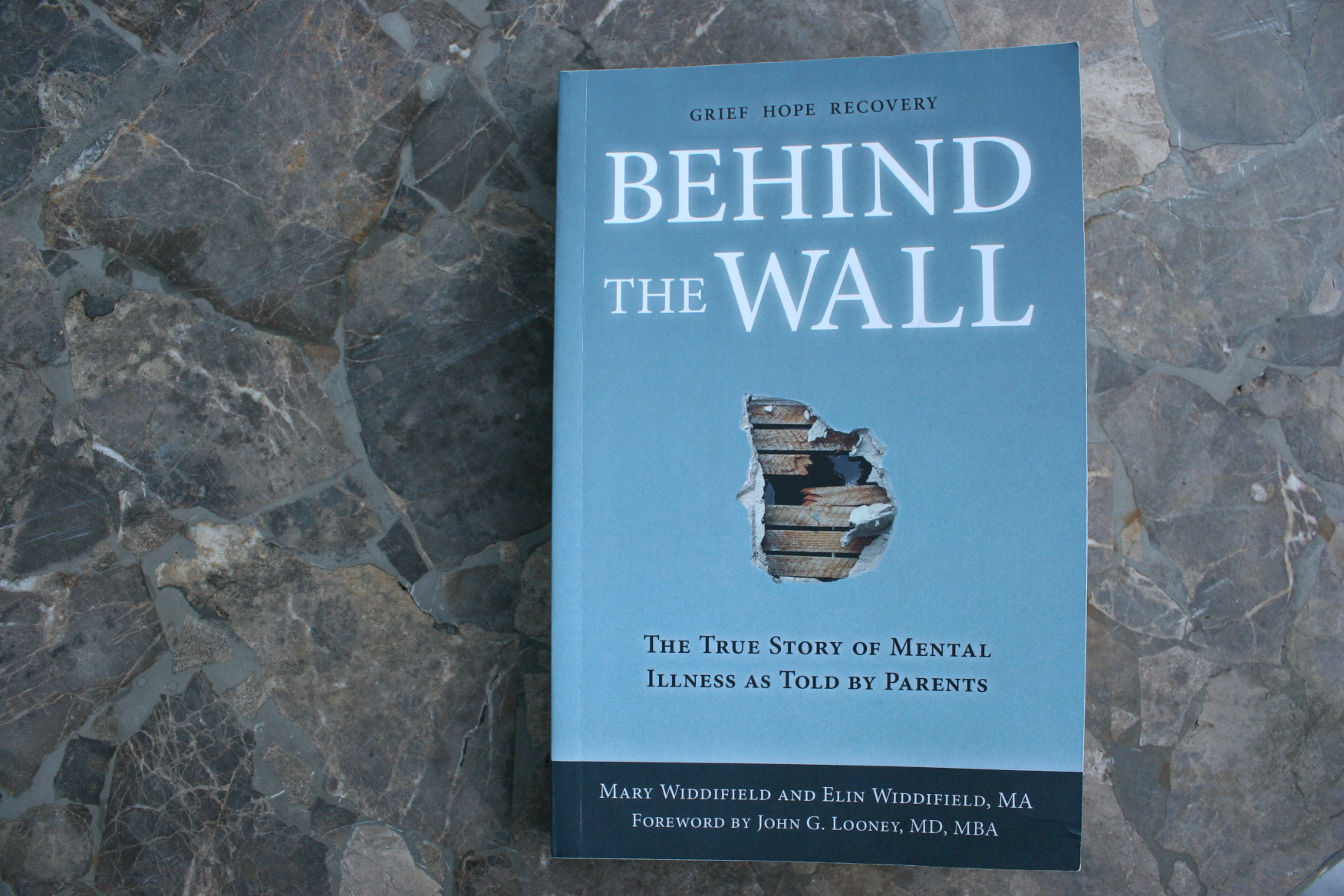
I find that reading or hearing personal stories is often the best way to understand anything. That includes mental health. For that reason, I recommend you read one or more of the following books, which I’ve previously reviewed on this blog (click on the title to read my review):
I highly-recommend this book, which is why it tops my list. (Minnesota Prairie Roots copyrighted file photo)
A must-read for connecting and ministering within faith communities.
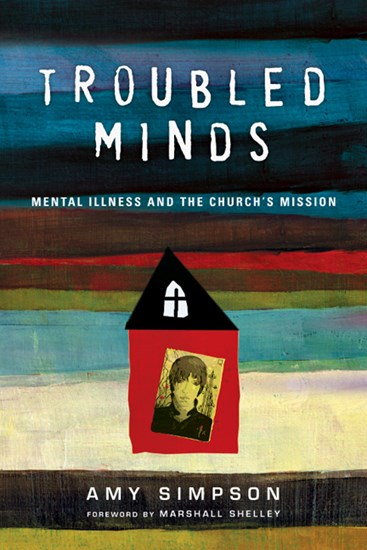
One other book, which I’ve read and highly-recommend (but have not reviewed) is Troubled Minds—Mental Illness and the Church’s Mission by Amy Simpson. A friend referred me to this book and it’s a must-read. I’ve marked the pages with about a dozen Post-It notes. It’s that good, that invaluable for faith communities. Anyone really.
Thank you for reading this post. Thank you for caring about mental health. Thank you for doing your part to shine the light. To be the light.
#
TELL ME: Are there any books about mental health that you recommend? Or, if you have other thoughts to share on the topic, please do. We can all learn from one another.
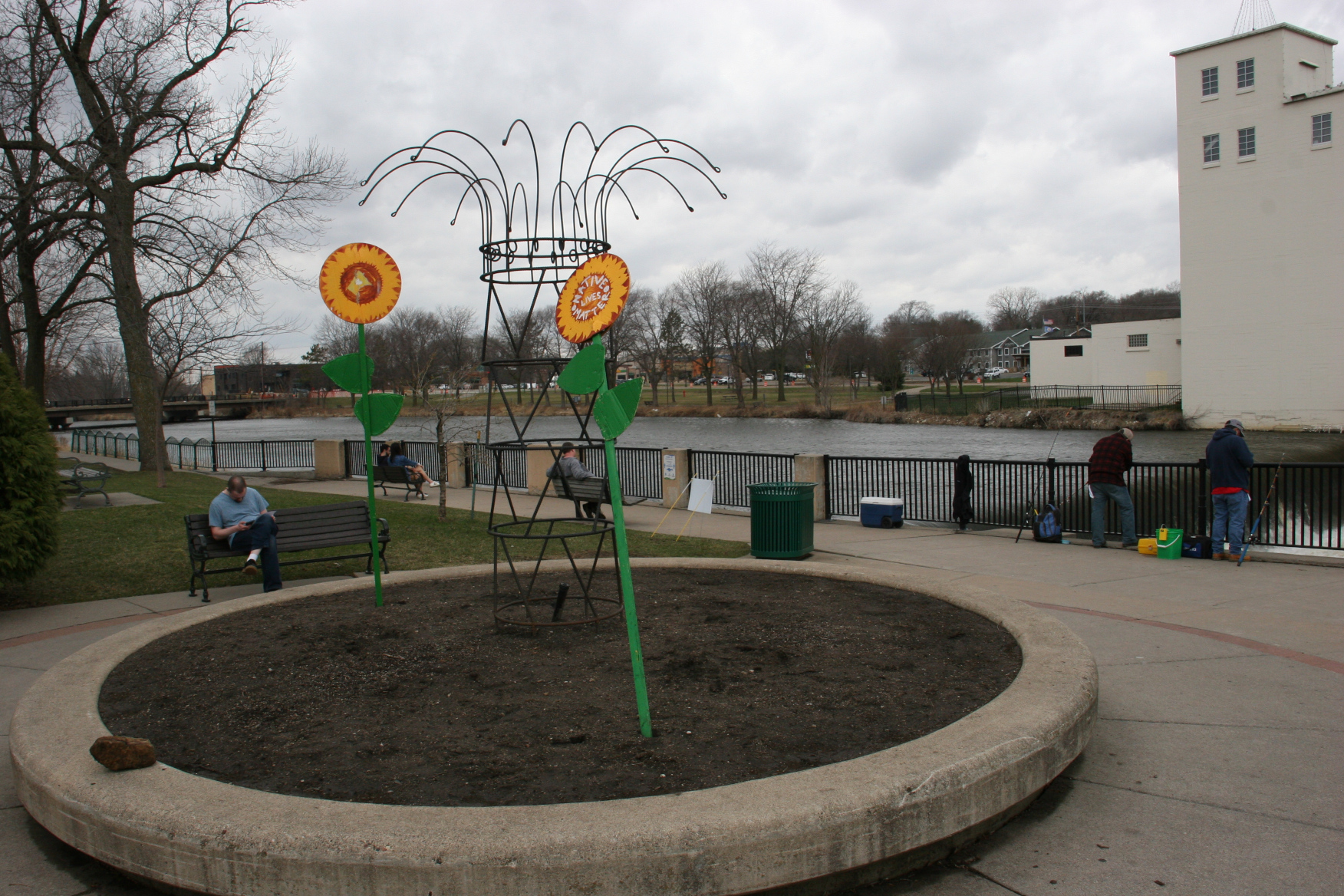
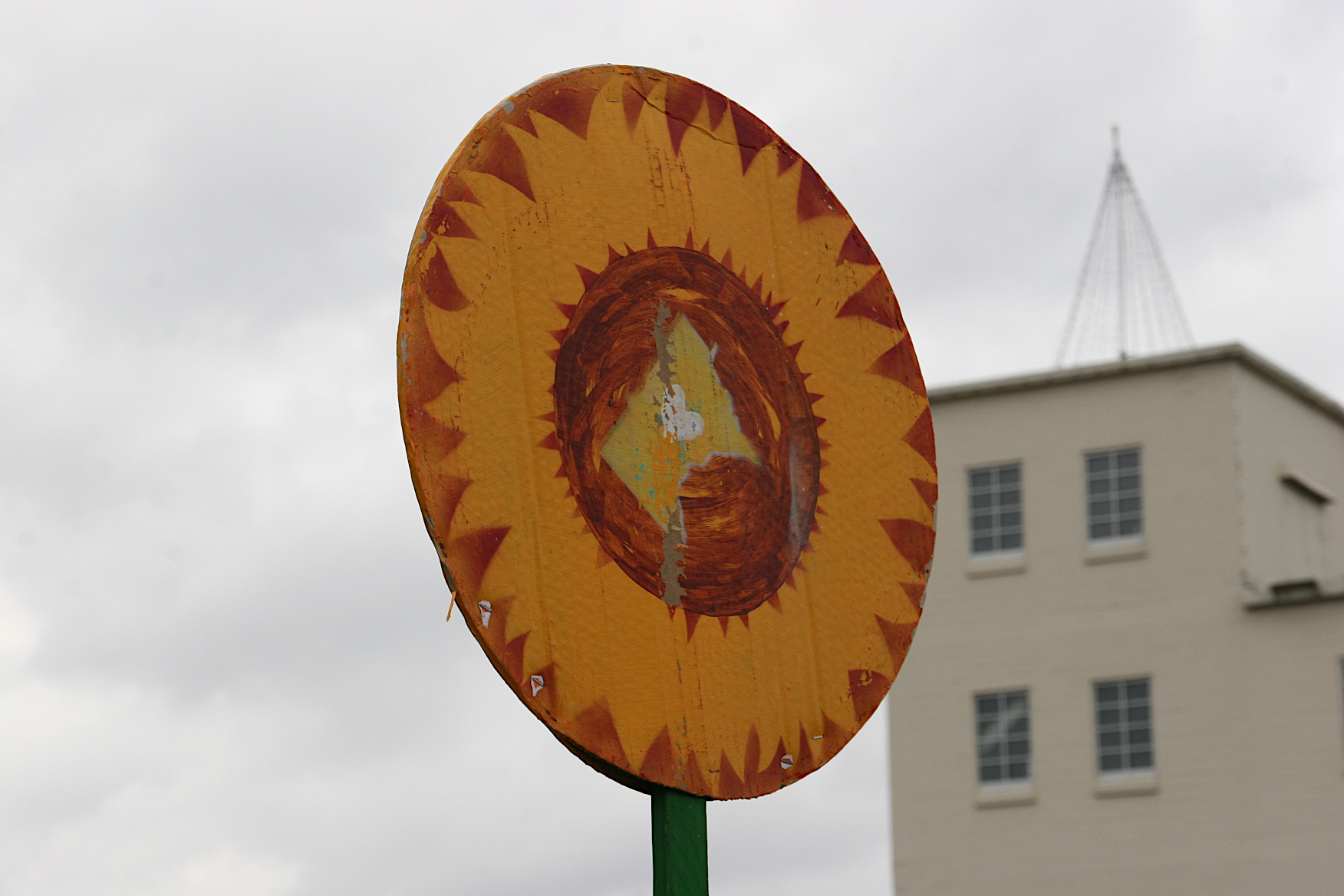
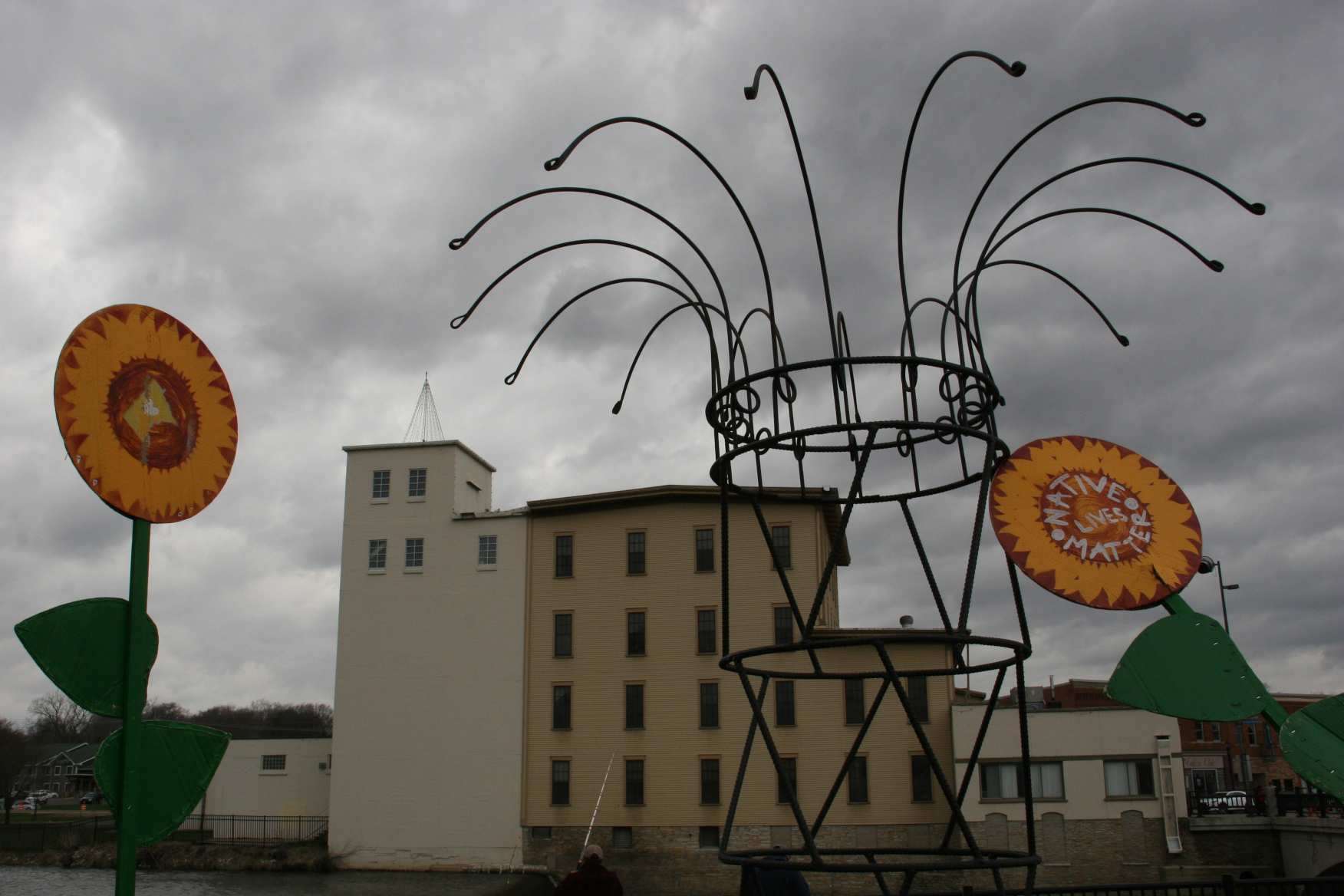
Part of a temporary public art installation at Northfield’s Earth Day Celebration. (Minnesota Prairie Roots copyrighted photo April 2022)
IN THE GEOGRAPHICAL BACKGROUND of my childhood, I knew of the “Indian Reservations” to the northwest near Granite Falls and then to the east near Morton. My hometown of Vesta sits between the two, no longer referred to as “reservations” but as the Upper Sioux Indian Community and the Lower Sioux Indian Community.
A Dakota man and Alexander Faribault are depicted trading furs in this sculpture at Heritage Park near the Straight River and site of Faribault’s trading post. Ivan Whillock created the sculpture which graces the Bea Duncan Memorial Fountain in my community of Faribault. (Minnesota Prairie Roots copyrighted file photo 2012)
Today I live 120 miles to the east in Faribault, next to Wapacuta Park. Rice County is the homeland of the Wahpekute (not Wapacuta), a tribal band of the Dakota.
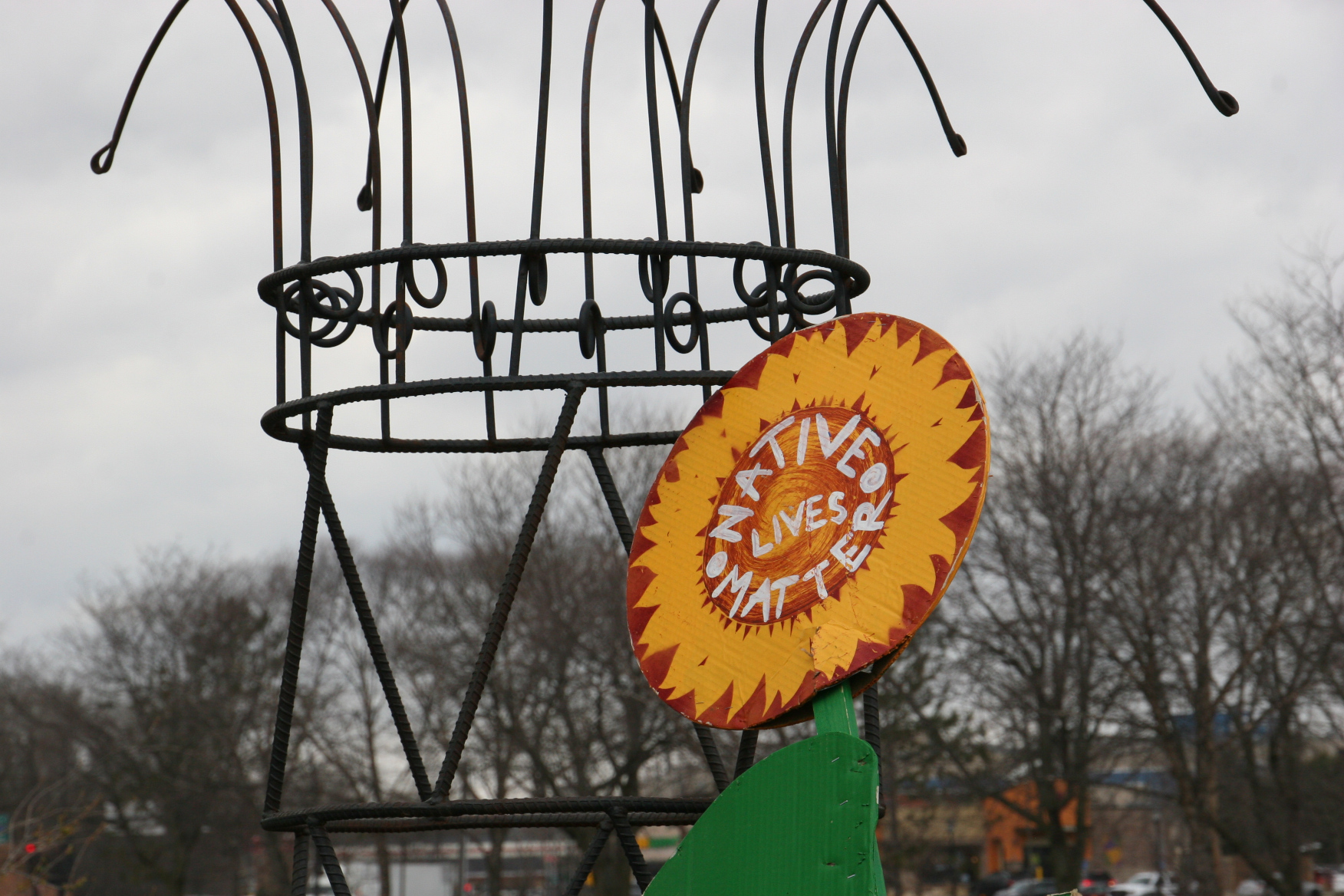
The Earth Day art carried two messages: NATIVE LIVES MATTER and CLIMATE JUSTICE. (Minnesota Prairie Roots copyrighted photo April 2022)
A temporary public art installation at the recent Earth Day Celebration in neighboring Northfield prompted me to reflect on Indigenous people in southern Minnesota. Growing up in Redwood County, my knowledge of area Native Americans focused primarily on “The Sioux Uprising.” History teachers then used that term, rather than the current-day “US-Dakota War of 1862,” which should tell you a thing or ten about how biased that perspective back in the 1970s. How thankful I am that my awareness and understanding have grown and that attitudes are shifting to better reflect all sides of history.
The message grows, blossoms in the Earth Day art. (Minnesota Prairie Roots copyrighted photo April 2022)
We stand on the homelands of the Wahpekute and other Bands of the Dakota Nation. We honor with gratitude the people who have stewarded the land throughout the generations and their ongoing contributions to this region. We acknowledge the ongoing injustices that we have committed against the Dakota Nation, and we wish to interrupt this legacy, beginning with acts of healing and honest storytelling about this place.
NATIVE LIVES MATTER fits the spirit of the Land Acknowledgment Statement. Those three words caused me to pause, to think, to consider what I’d been taught all those decades ago and how my thinking has shifted as I’ve aged, opened my mind and learned.
Dakota beadwork displayed and photographed at the Rice County Historical Society Museum, Faribault, in 2010. (Minnesota Prairie Roots copyrighted file photo 2010)
The Rice County Historical Society, which exhibits a collection of Native American artifacts in its Faribault museum, shares a statement similar to the City of Northfield’s on its website:
We acknowledge that the land that is now Rice County, MN, was their (Dakota) homeland and for many tribal members today, it is still their home.
In all of this, I feel a sense of gratitude regarding increasing public recognition of the land history and contributions of Indigenous People in Minnesota. In my home area of Redwood County, nearly 1,000 individuals from the Mdewakanton Band of Dakota call the Lower Sioux Indian Community home. To the east in Yellow Medicine County near Granite Falls, nearly 500 individuals from the Dakota Oyate call the Upper Sioux Indian Community home.
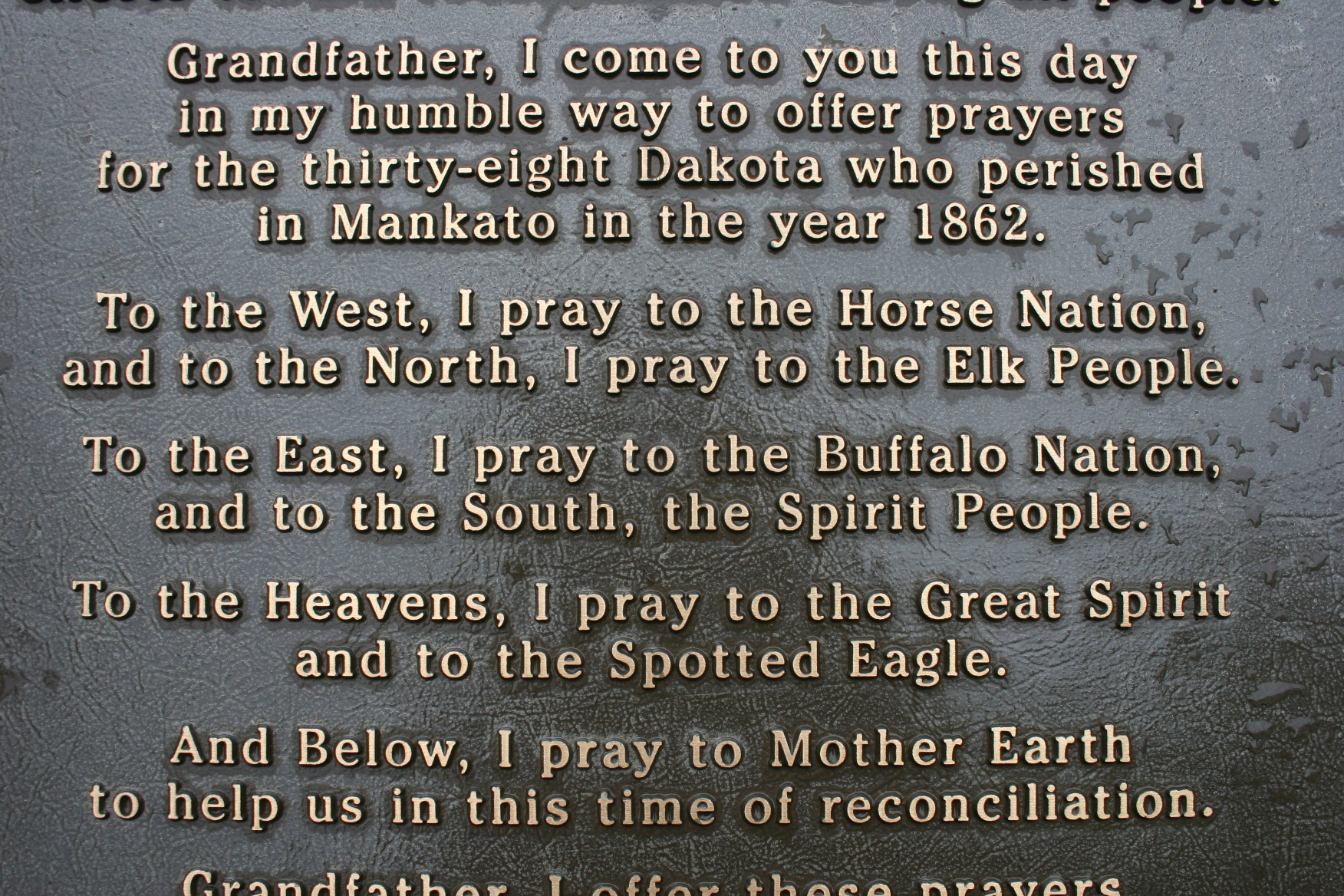
Words on a marker in Reconciliation Park in Mankato where 38 Dakota were hung on Dec. 26, 1862. (Minnesota Prairie Roots copyrighted file photo 2012)
I hope educators in my home area are today teaching students about the local Dakota and even bringing elders into classrooms. I graduated, after all, from Wabasso High School, the name Wabasso coming from a Native word meaning “white rabbit.” I would then go on to attend college in Mankato, site of the largest mass execution in the US with 38 Dakota killed in a public hanging on December 26, 1862.
I would be remiss if I did not share that, during the US-Dakota Conflict of 1862, family members on my mom’s side fled their rural Courtland farm for safety in St. Peter. They later put in a claim to the US government for crop loss.
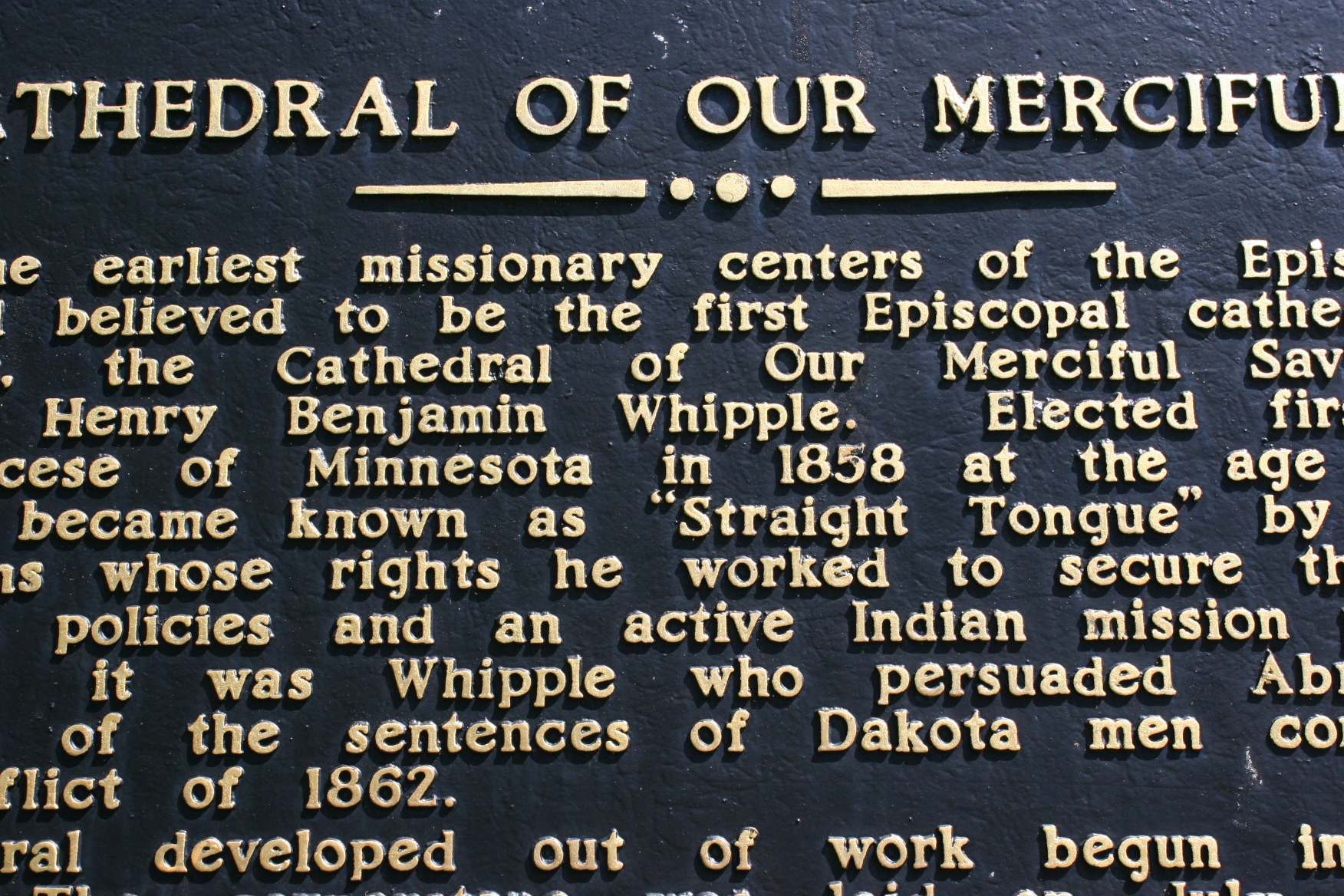
Details on a sign outside the Cathedral of our Merciful Savior in Faribault. Bishop Henry Whipple, who served here, advocated for the rights of Native Americans and had a strong friendship with them. (Minnesota Prairie Roots copyrighted file photo 2020)
Now, 160 years after that event in my ancestors’ history, I continue growing my knowledge, widening my understanding of Minnesota history and of the Indigenous people who first called this land home.
A graphic of Minnesota is painted on the back of the art installation. (Minnesota Prairie Roots copyrighted photo April 2022)
Also, I suggest you read an article on the Minnesota Public Radio website about efforts to change the Minnesota State flag. The flag depicts, among other details, a Native American in the background riding off into the sunset while a settler focuses the foreground, hands on a plow, rifle nearby. I agree that change is needed. But, as too often happens, the issue has become politically-charged.
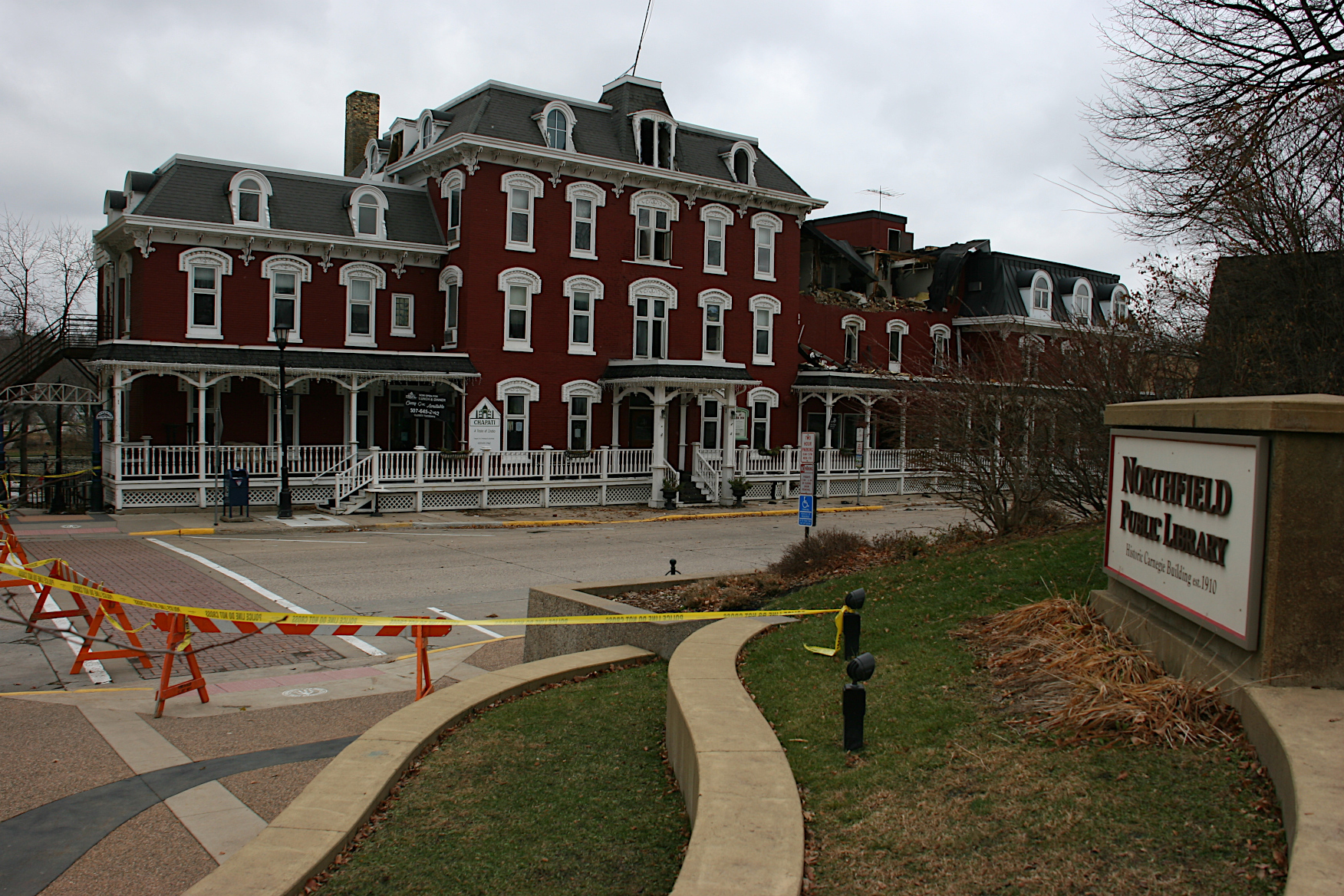
The Archer House River Inn in Northfield, following a devastating November 2020 fire. (Minnesota Prairie Roots copyrighted file photo November 2020)
ONCE UPON A TIME, three little pigs built three houses from assorted materials in an effort to keep the Big Bad Wolf from gaining entry. They soon discovered that houses constructed of straw and of sticks were easily blown over by a huffing, puffing, determined wolf. But, oh, the last house—the one built of bricks—stood strong. When the wolf attempted to gain entry through the chimney, he fell into a kettle of boiling water and that was the end of him. The pigs had anticipated his plan when they started a roaring fire in the hearth.
The fire began here, in the Smoqe House. (Minnesota Prairie Roots copyrighted file photo November 2020)
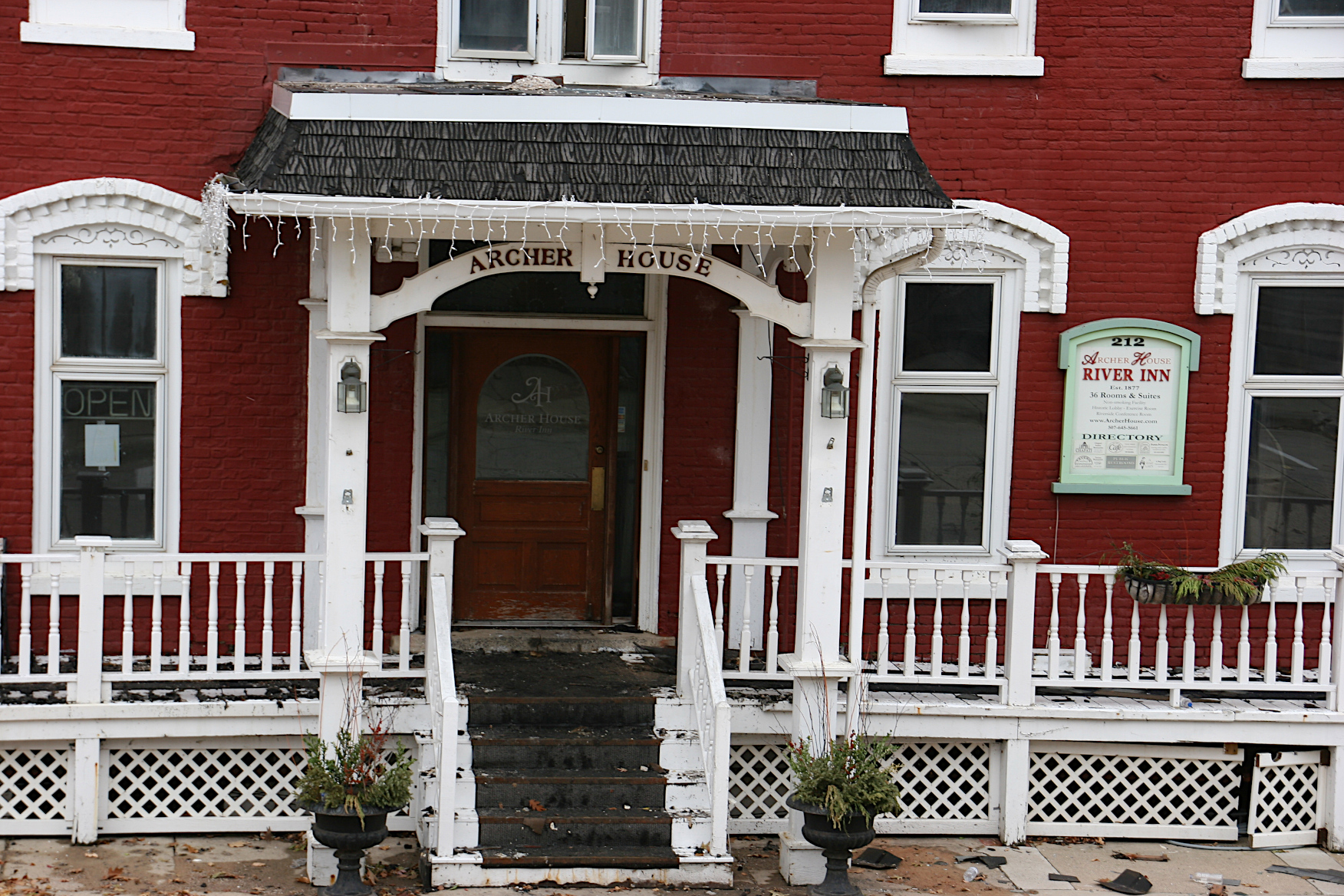
Shortly after the fire, the front entry to the historic Archer House River Inn. (Minnesota Prairie Roots copyrighted file photo November 2020)
The fenced lot where the Archer House River Inn once stood in downtown Northfield. (Minnesota Prairie Roots copyrighted photo February 2022)
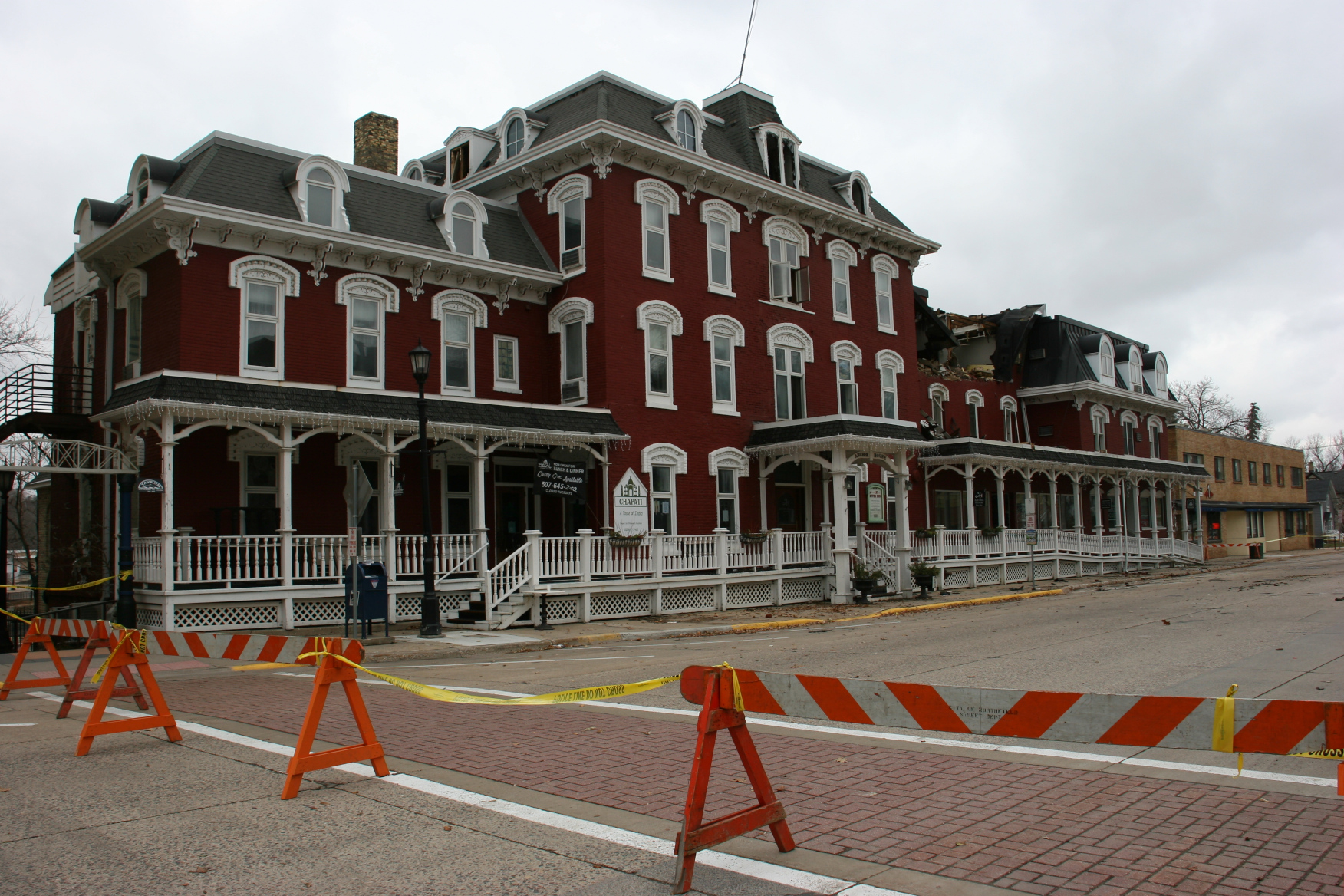
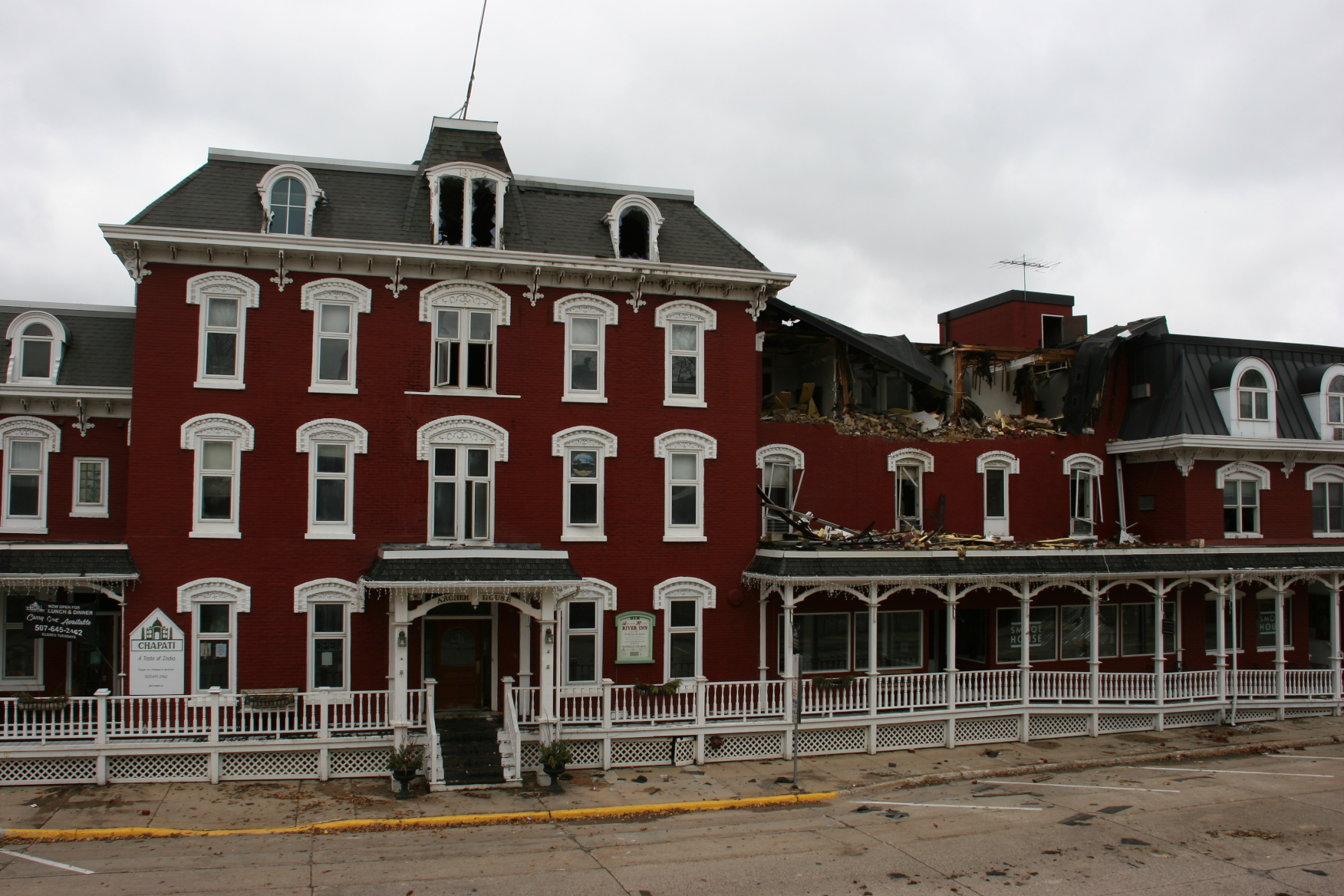
In real life, stories involving fire typically don’t end fabulously either. Such is the story of the historic 1877 Archer House River Inn. Today only a fenced, vacant lot marks the location of this iconic downtown Northfield landmark on the National Register of Historic Places. A November 2020 fire, which started in a commercial smoker inside Smoqehouse (a BBQ restaurant), resulted in the eventual total loss of the brick building. Water and weather, along with the original fire, took their toll. Portions of the structure eventually collapsed as time lapsed.
Much of the sprawling building complex remained following the initial fire. But, in the end, it couldn’t be saved. (Minnesota Prairie Roots copyrighted file photo November 2020)
For the community of Northfield, losing the Archer House was about more than losing a building which housed a riverside inn, restaurants and shops. It was about losing a lovely sprawling space that anchored the downtown along Division Street. The Archer House was the place of stories, of history, of memories. And so much more.
Debris from the Archer House inside the fenced lot. (Minnesota Prairie Roots copyrighted photo February 2022)
Now bricks salvaged from the Archer House will be sold to benefit the Northfield Historical Society. The Archer House Brick Sale happens from 9 am – 4 pm Saturday, April 30, at the NHS Museum Store. That’s located just across from Bridge Square, a community gathering spot downtown by the Cannon River, and just blocks from the fenced Archer House lot.
A side view of the former Archer House site. (Minnesota Prairie Roots photo February 2022)
Since this is a fundraiser that also allows access to a bit of history, the bricks are priced accordingly. Half a brick will cost $10. A complete brick, $20. Discounts are offered with three bricks for $50 and seven bricks for $100. A trailer load of bricks will be sold, the size of that trailer not noted.
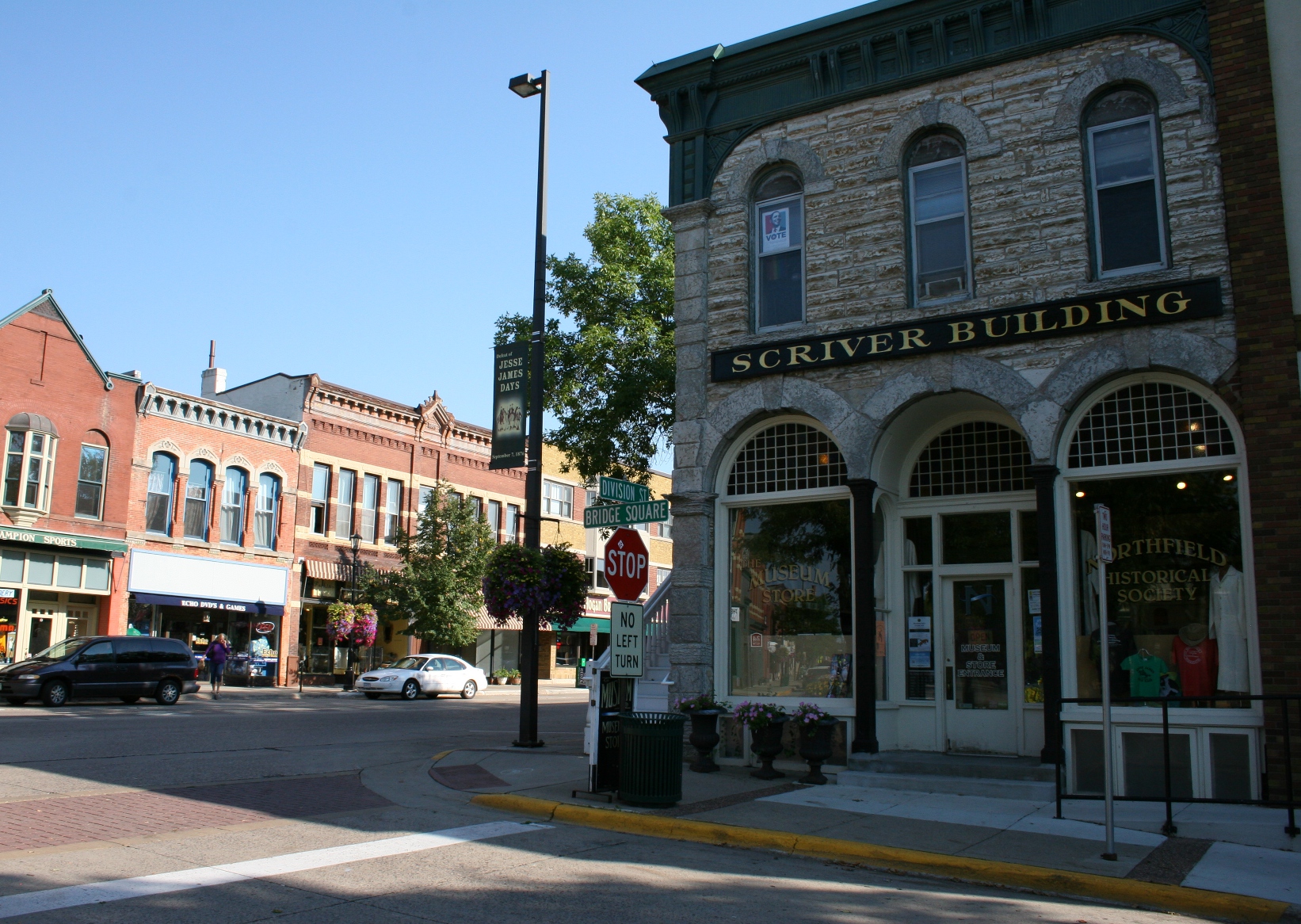
The exterior of the Northfield Historical Society, 408 Division Street, Northfield. (Minnesota Prairie Roots copyrighted file photo 2012)
In the end, there’s a bit of good in such immense community loss. Monies from the brick sale will go toward preservation of the Scriver Building, which houses the historical society. It was formerly the First National Bank, where the James-Younger Gang failed in an attempted bank robbery in September 1876.
Photographed from the library across the street shortly after the fire. (Minnesota Prairie Roots copyrighted file photo November 2020)
There’s a sequel to this tragic fire tale. Rebound Partners, the Northfield firm which owned the Archer House, plans to rebuild. Rebound promises to honor the history and riverside location in a mixed use building. It will never be the same as the historic Archer House. But Rebound’s past projects show their respect for history and for community. And that says a lot. The Big Bad Wolf, as in the story of The Three Little Pigs, cannot destroy a building built of bricks, at least not in memory and in history.
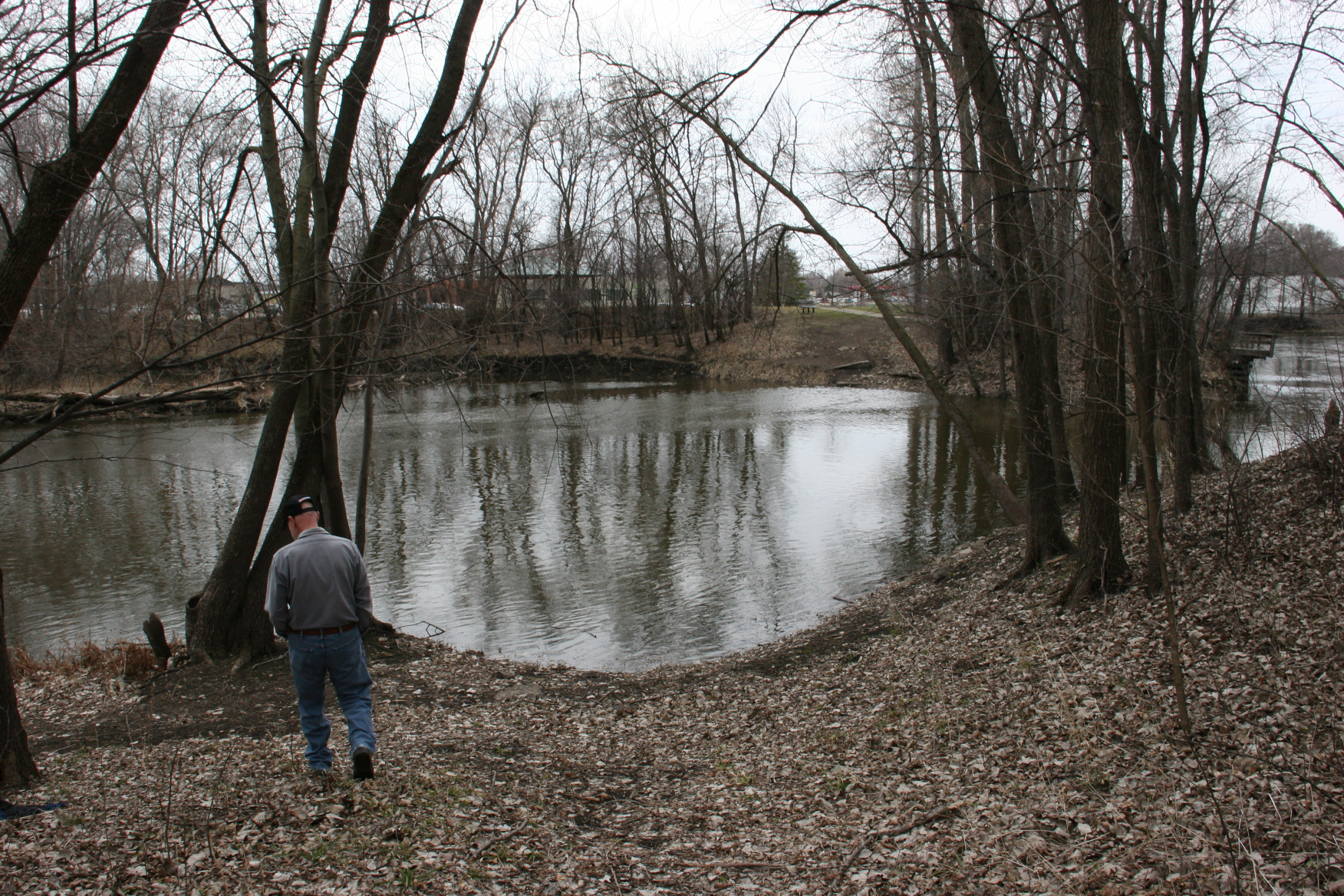
At the confluence of the Straight and Cannon Rivers in Faribault, the landscape appears more autumn than spring-like. (Minnesota Prairie Roots copyrighted photo April 2022)
MINNESOTANS LOVE to talk weather. And for good reason. Weather shapes our lives—what we do on any given day, how we feel, where we go…
At the April 23 Earth Day Celebration in Northfield, moody grey skies clouded the day. (Minnesota Prairie Roots copyrighted photo April 2022)
And right now, when we should be in the throes of spring, we Minnesotans feel like we’re stuck in winter. It’s been an unseasonably cold and rainy April that has truly dampened spirits. We want, OK, need, sunshine and warmth after too many months of winter. That said, I really shouldn’t complain. Up North, snow still layers the ground and ice 20 inches thick freezes some lakes.
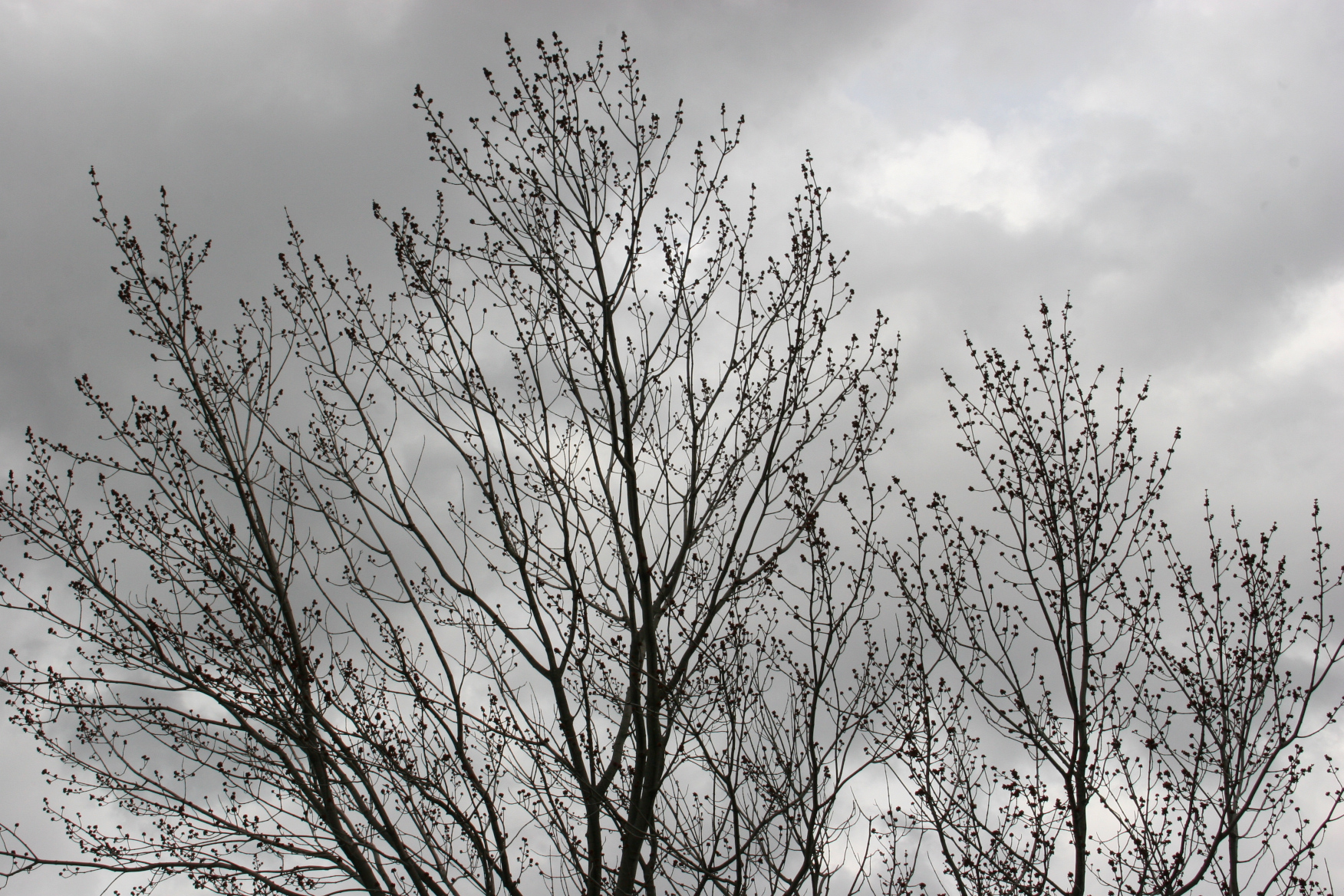
Treetops riverside against a grey sky in North Alexander Park. (Minnesota Prairie Roots copyrighted photo April 2022)
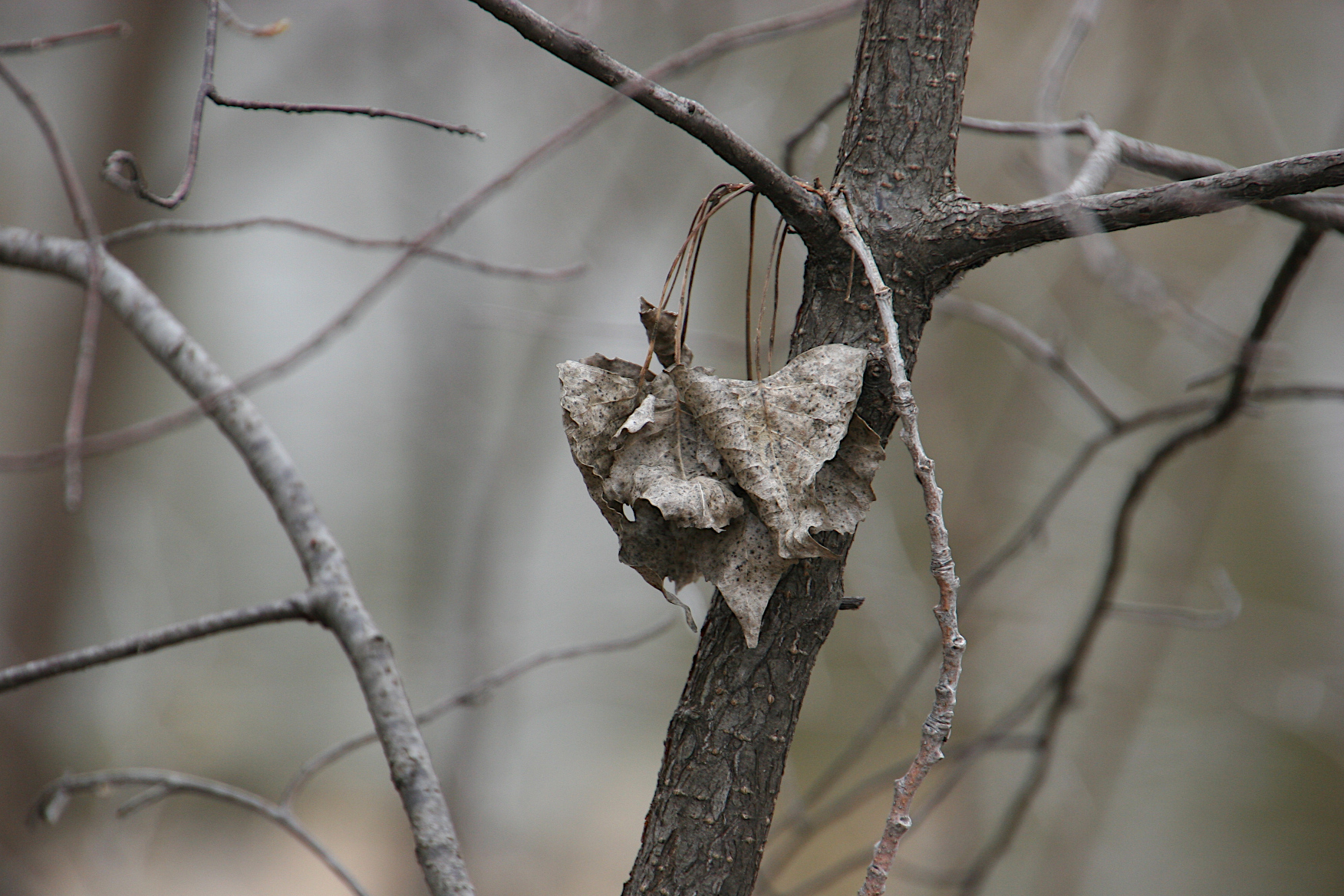
Autumns leaves remain, not yet replaced by spring growth. (Minnesota Prairie Roots copyrighted photo April 2022)
Devoid of color, the dock and river at Two Rivers Park. (Minnesota Prairie Roots copyrighted photo April 2022)
Yet, no matter where you live in Minnesota, day after day after day of grey skies coupled with low temps in the 20s and 30s takes a psychological toll. I should be wearing a spring jacket rather than a winter coat. My tulips should be blooming. Heck, the dandelions should be pushing through neighbors’ lawns. Trees should be budding green.
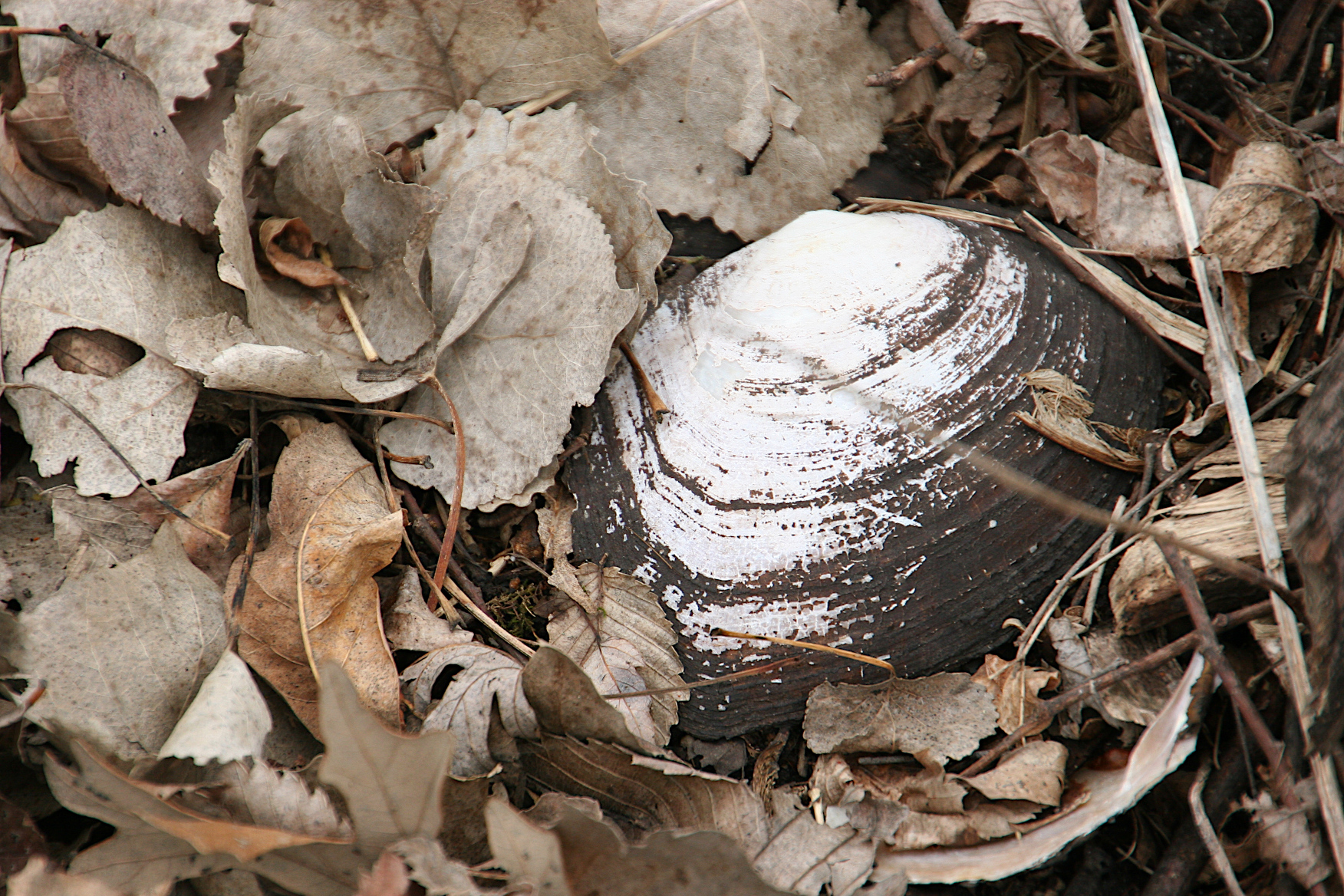
I spotted clam shells among dried leaves in the river bottom at Two Rivers Park. (Minnesota Prairie Roots copyrighted photo April 2022)
Instead, the overall landscape appears, well, pretty darned drab.
Canadian geese swim where the Straight and Cannon Rivers meet in Faribault. (Minnesota Prairie Roots copyrighted photo April 2022)
But, last Saturday we experienced a one-day reprieve of unseasonable warmth with the temp soaring to nearly 80 degrees. Typical high this time of year is around 60 degrees. It was a get-outside day. Don’t-waste-a-moment-indoors day. So Randy and I didn’t. We attended the Earth Day Celebration in Northfield, enjoyed craft beer at Chapel Brewing along the banks of the Cannon River in Dundas, walked a section of the Straight River Trail in Faribault and later followed part of the trail along the Cannon in North Alexander Park. Strong winds factored into every facet of our time outdoors, though.
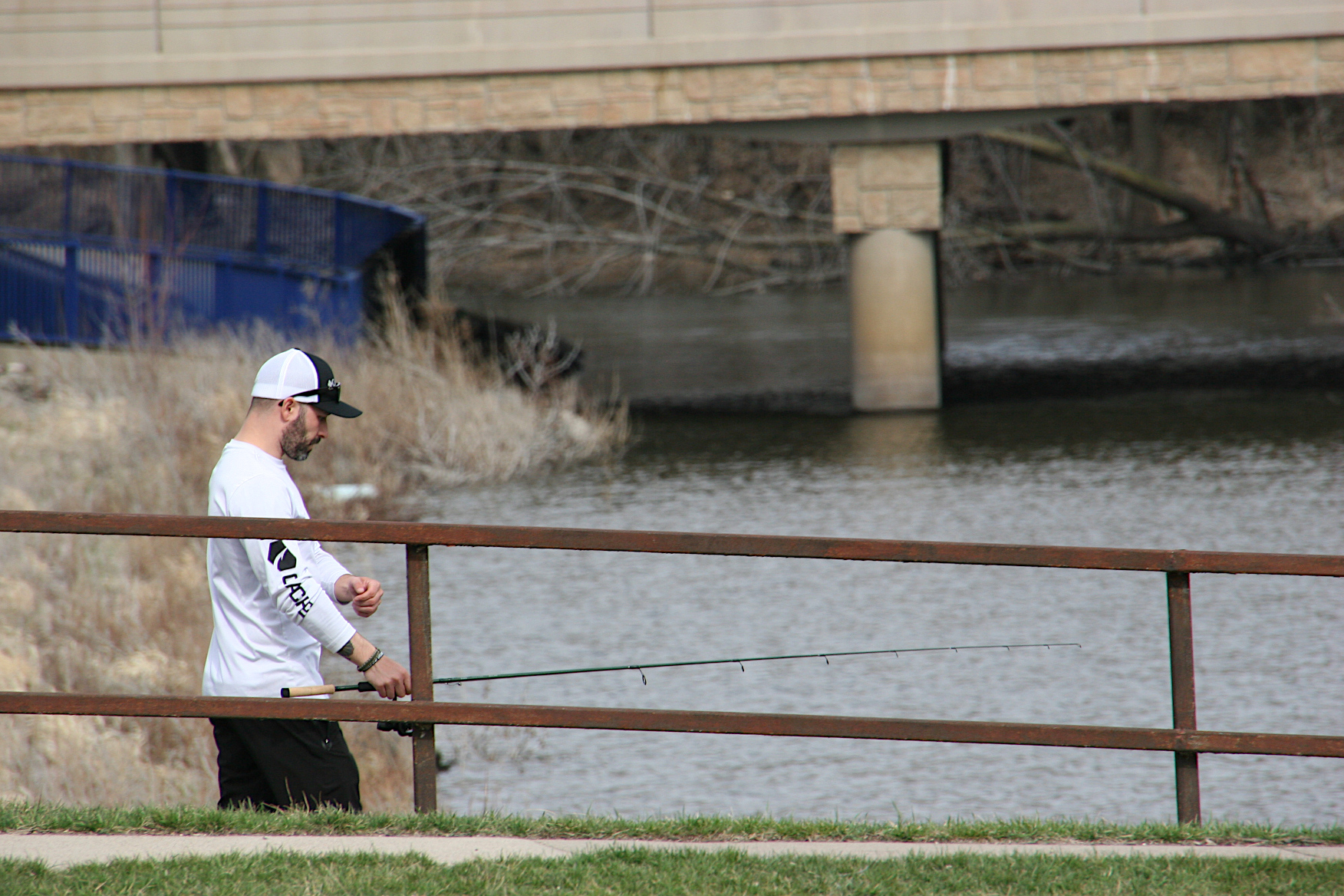
An angler makes his way toward the Cannon River in shirt-sleeve weather on April 23. (Minnesota Prairie Roots copyrighted photo April 2022)
But, oh, how glorious to walk in warmth.
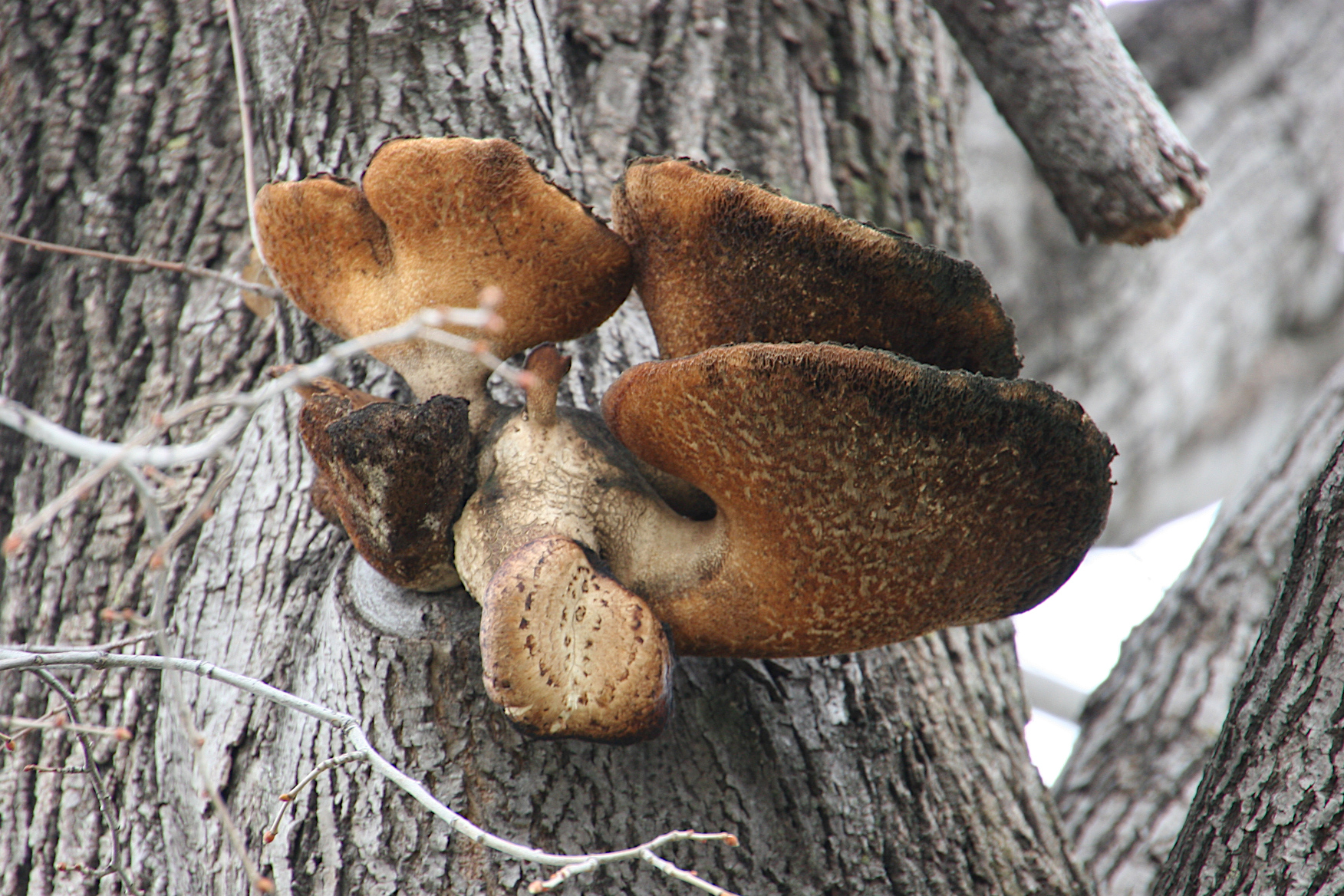
I zoomed in on this fungi high in a tree along the recreational trail in North Alexander Park. (Minnesota Prairie Roots copyrighted photo April 2022)
This feeling of remaining stuck in perpetual winter will end. I need to remind myself of that…even as the forecast for more rain and unseasonably cold temps (highs in the 40s) prevails.
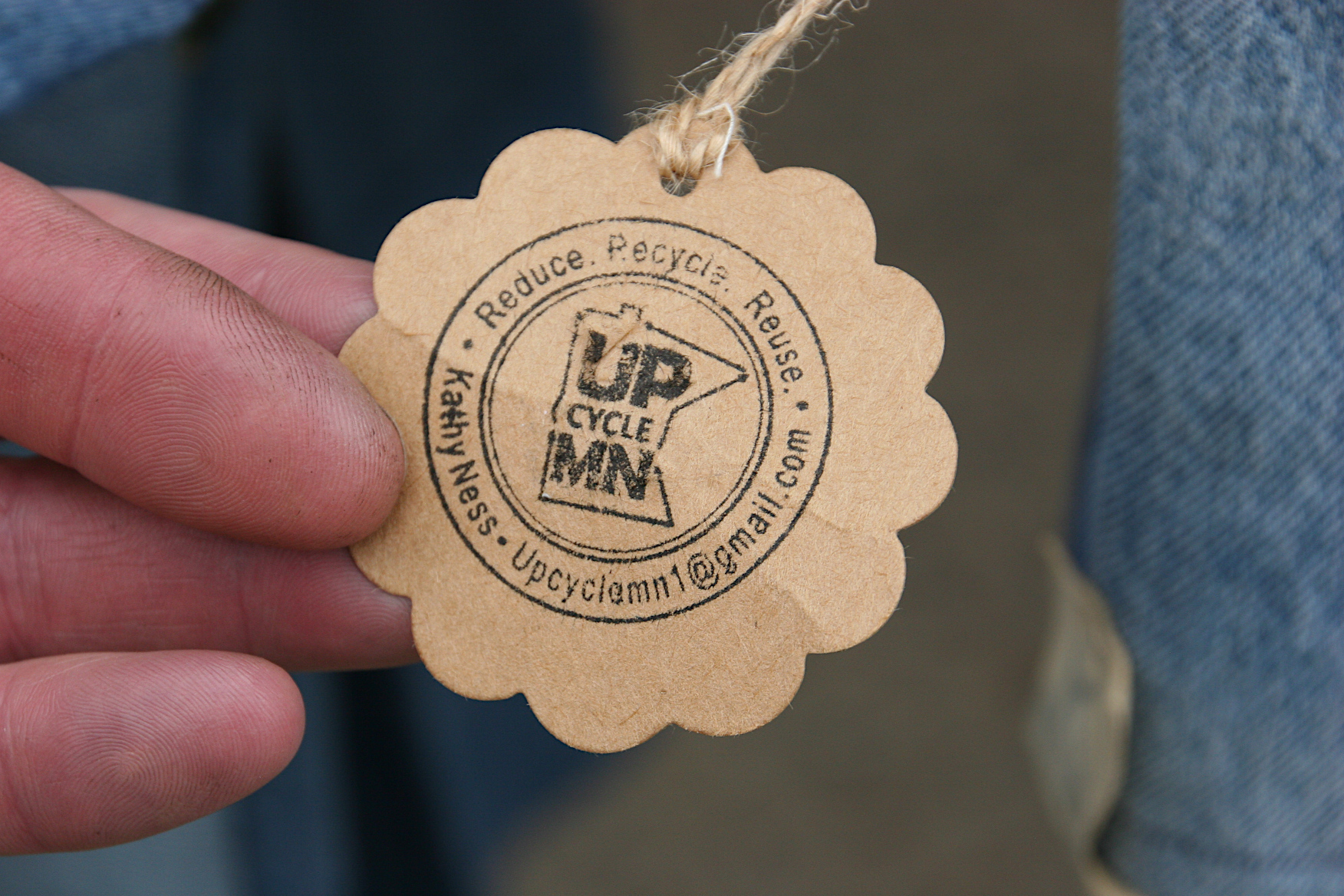
The label that tags UPcycleMN products. (Minnesota Prairie Roots copyrighted photo April 2022)
REDUCE. RECYCLE. REUSE. Those three verbs theme an environmentally-conscious business established by a retired Northfield children’s programming librarian. Kathryn Ness, “CEO & Head Scrounger,” who holds degrees in Fiber Arts and Art History, champions those 3 Rs in UPcycleMN.
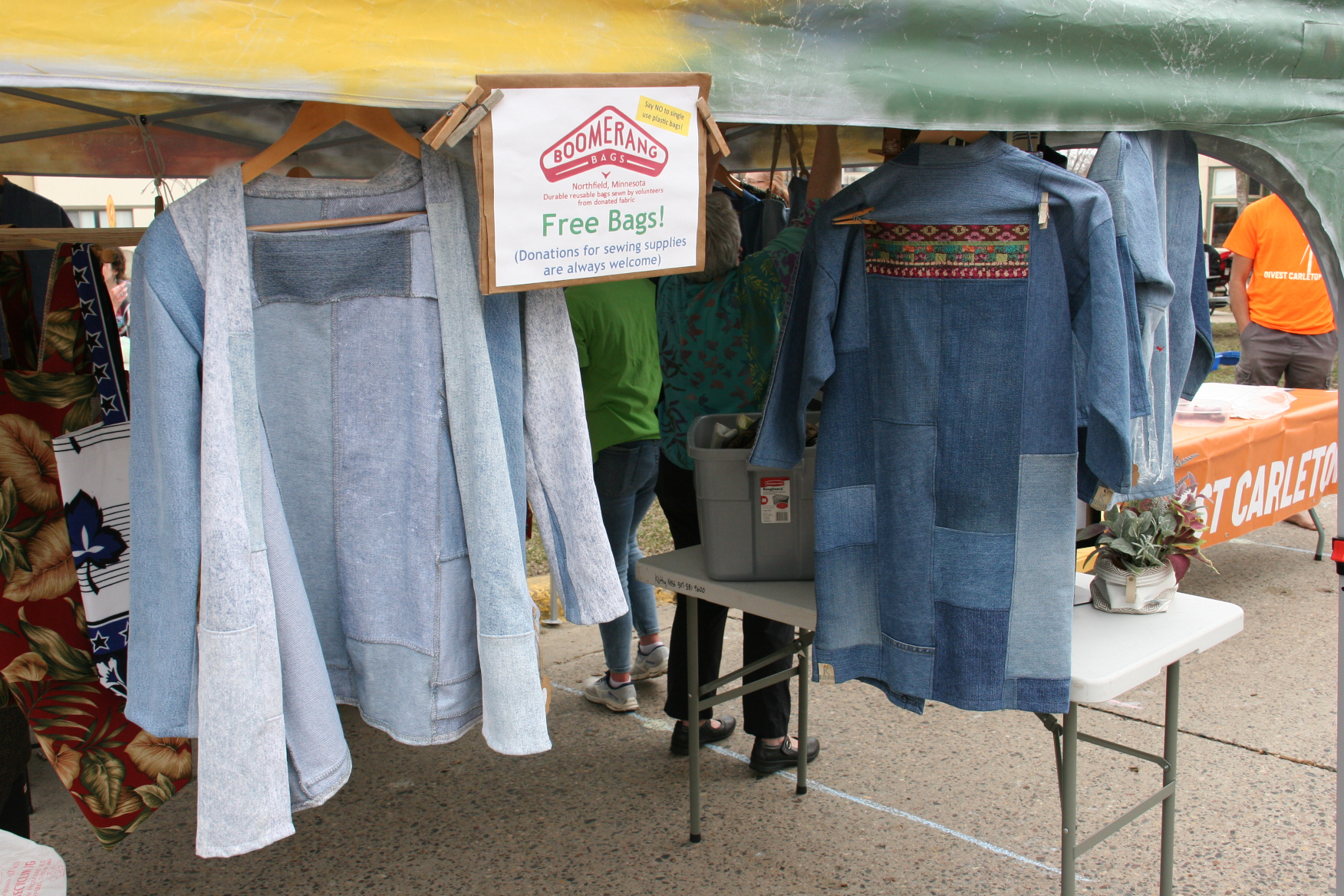
The UPcycleMN tent at Northfield’s Earth Day Celebration showcases jackets crafted from blue jeans. (Minnesota Prairie Roots copyrighted photo April 2022)
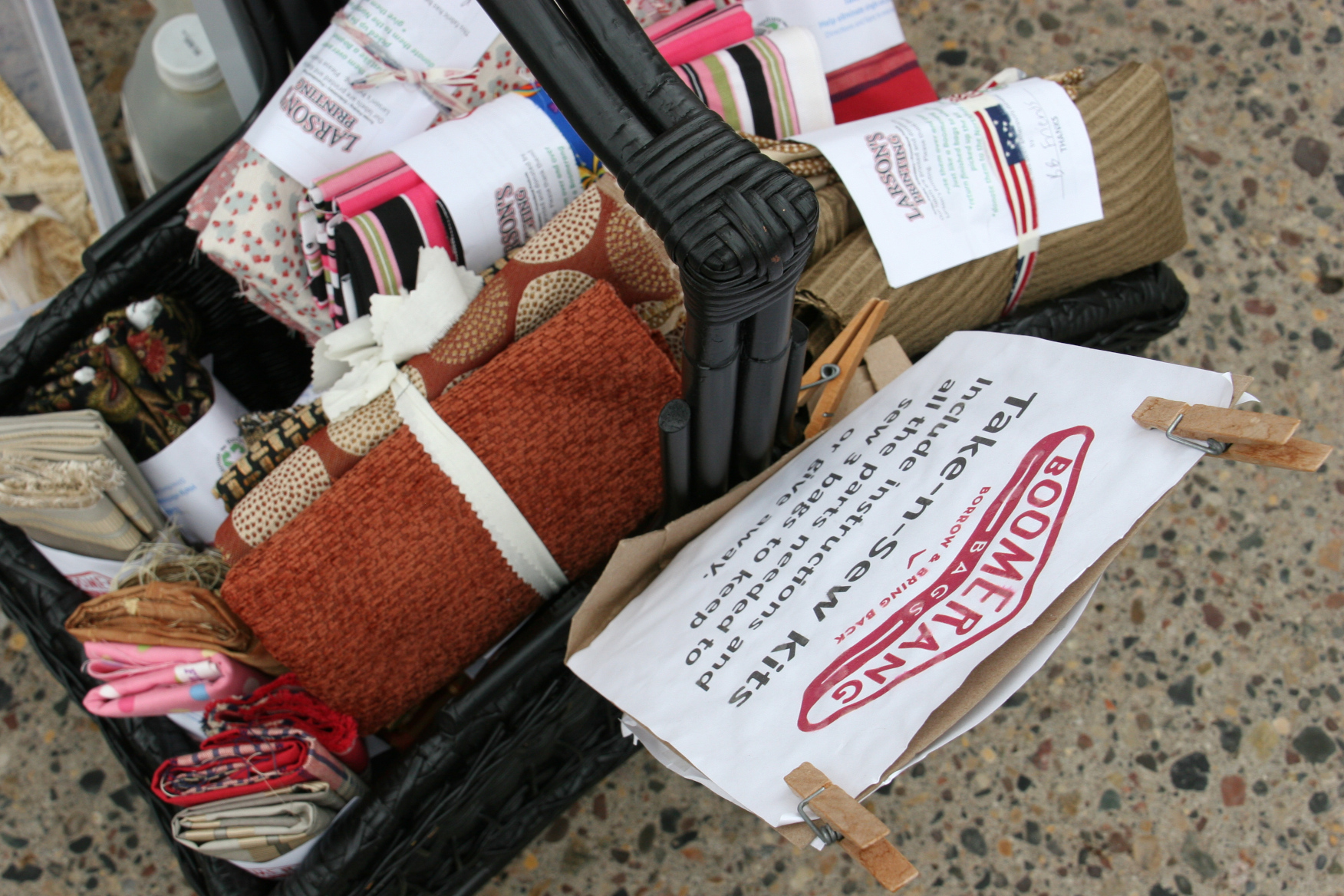
I met Ness at Northfield’s recent Earth Day Celebration at Bridge Square. A bold SAY NO! PLASTIC BAGS sign initially drew me to her vendor tent. There I admired blue jean jackets stitched together from used jeans. And I saw a basket filled with Take-n-Sew kits for Boomerang Bags. Ness was also giving away those cloth bags.
Kits to create Boomerang Bags. ((Minnesota Prairie Roots copyrighted photo April 2022)
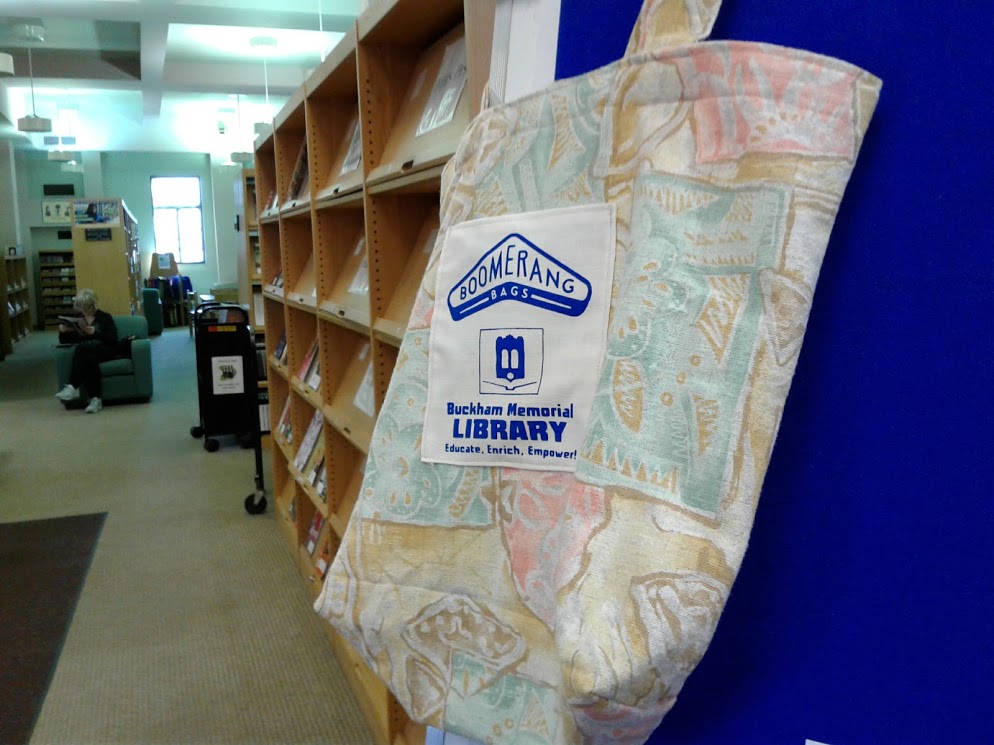
A brief conversation with this artist revealed that she introduced the Boomerang Bags project (which originated in Australia) to the area while working at the library. At one time libraries in the Southeastern Libraries Cooperating system bagged patrons’ books in plastic bags. Today the libraries use locally-made cloth bags. In Northfield, volunteers have sewn 4,000 Boomerang Bags from donated fabric, according to the UPcycleMN website.
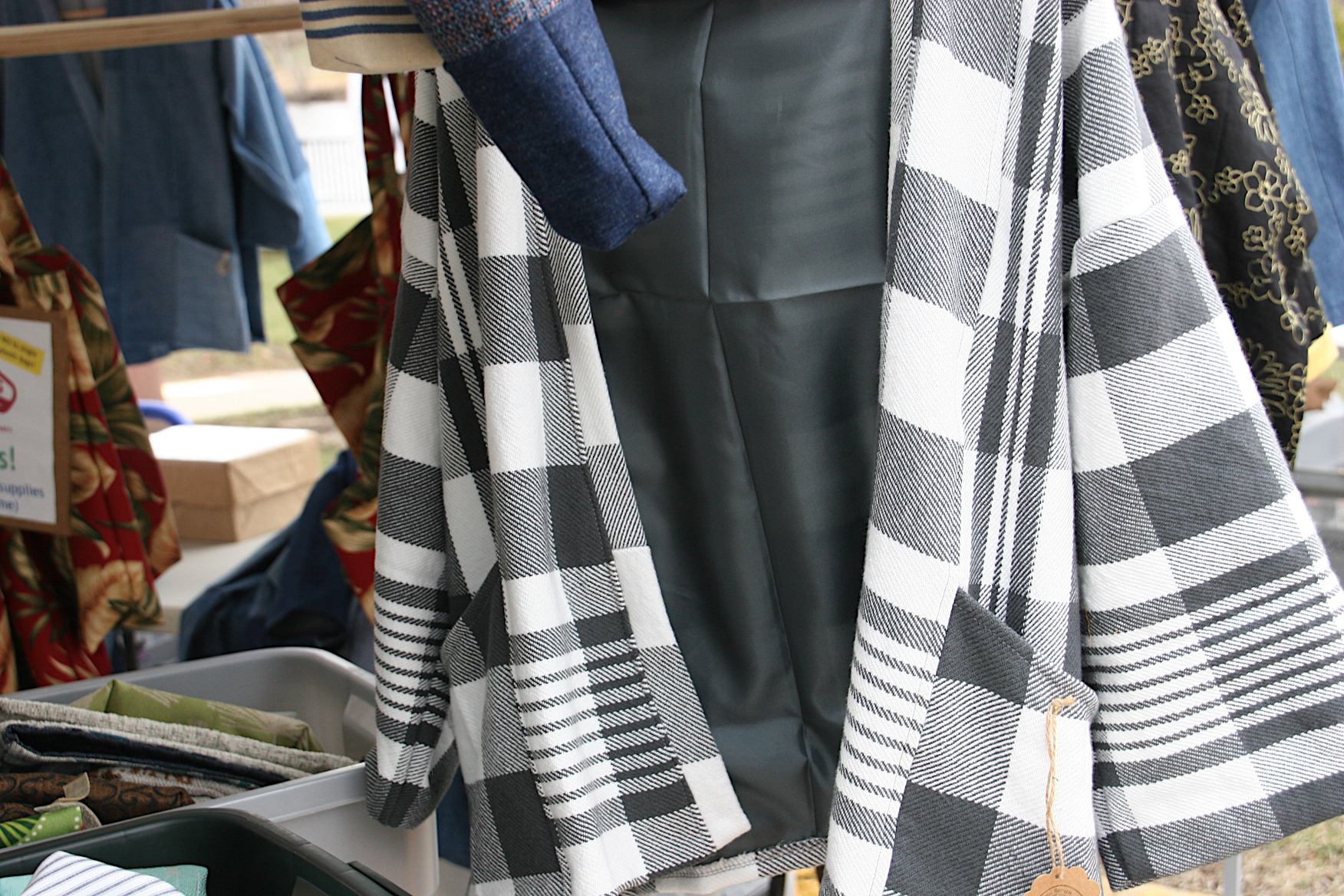
A jacket crafted from upcycled wool. (Minnesota Prairie Roots copyrighted photo April 2022)
Ness wants to eliminate single use plastic bags and also bring awareness to plastic and fabric waste in Northfield. But she’s not just making a statement. She’s doing something. Thus her UPcycleMN business focusing on taking a new or used item and creating something else from it to keep it out of the landfill. She collects fabric, upholstery remnants, curtains, old blue jeans and more to craft jackets, Fab-baskets, table runners, bags, totes…
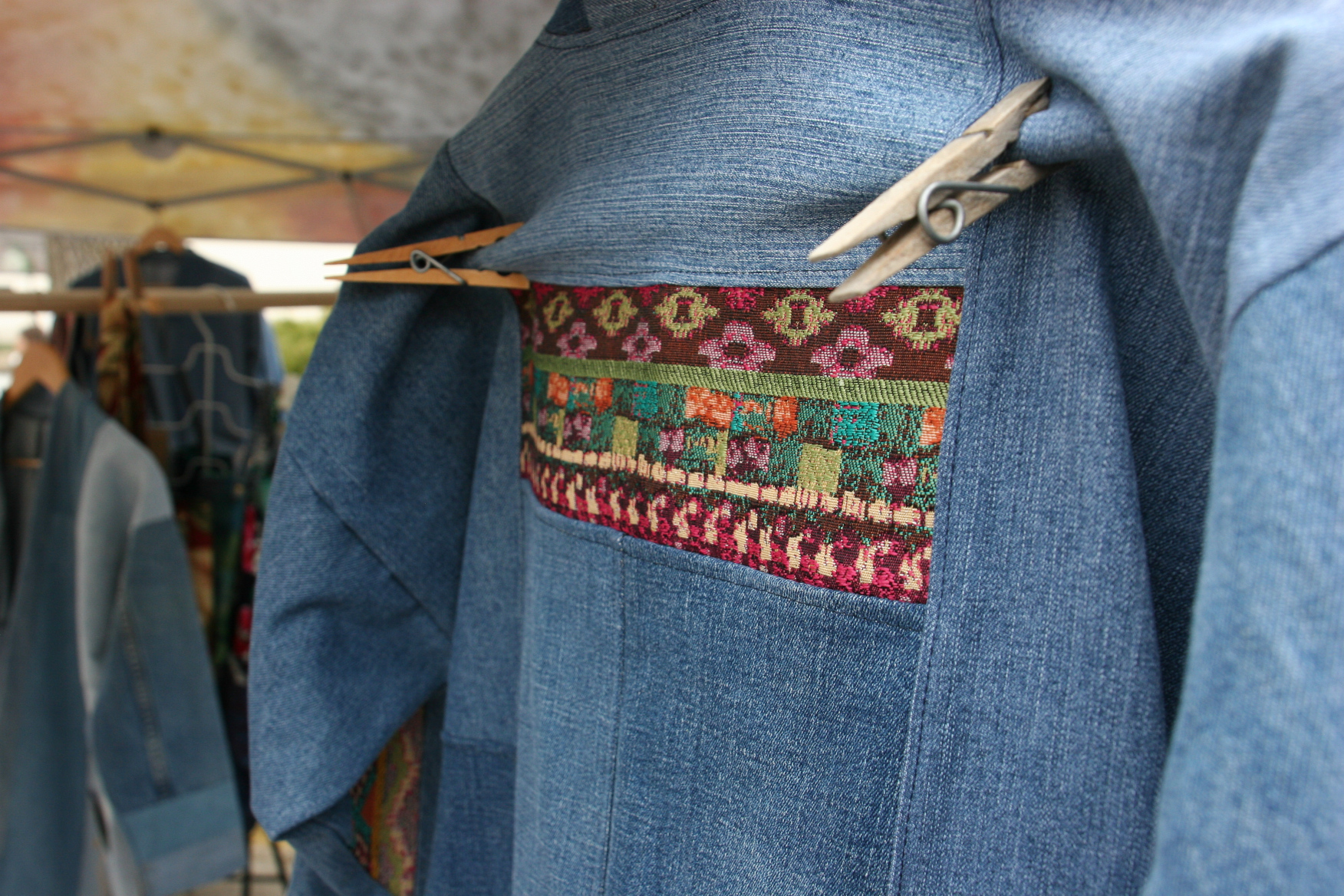
Artsy fabric incorporated into a jacket crafted from blue jeans. (Minnesota Prairie Roots copyrighted file photo April 2022)
She brings her artistic background and talents to her work, assisted by her daughter, Krista Ness Mullen. Her interest in the arts stretches back to junior high school art classes, where she learned batik, macrame’ and weaving.
A Boomerang Bag at my library in Faribault. (Minnesota Prairie Roots copyrighted file photo May 2018)
Today, with a focus on upcycling and the environment, Ness is stitching a message of reduce, recycle, reuse into the fabric of the Northfield community. And beyond.































 Minnesota Prairie Roots
Recent Comments