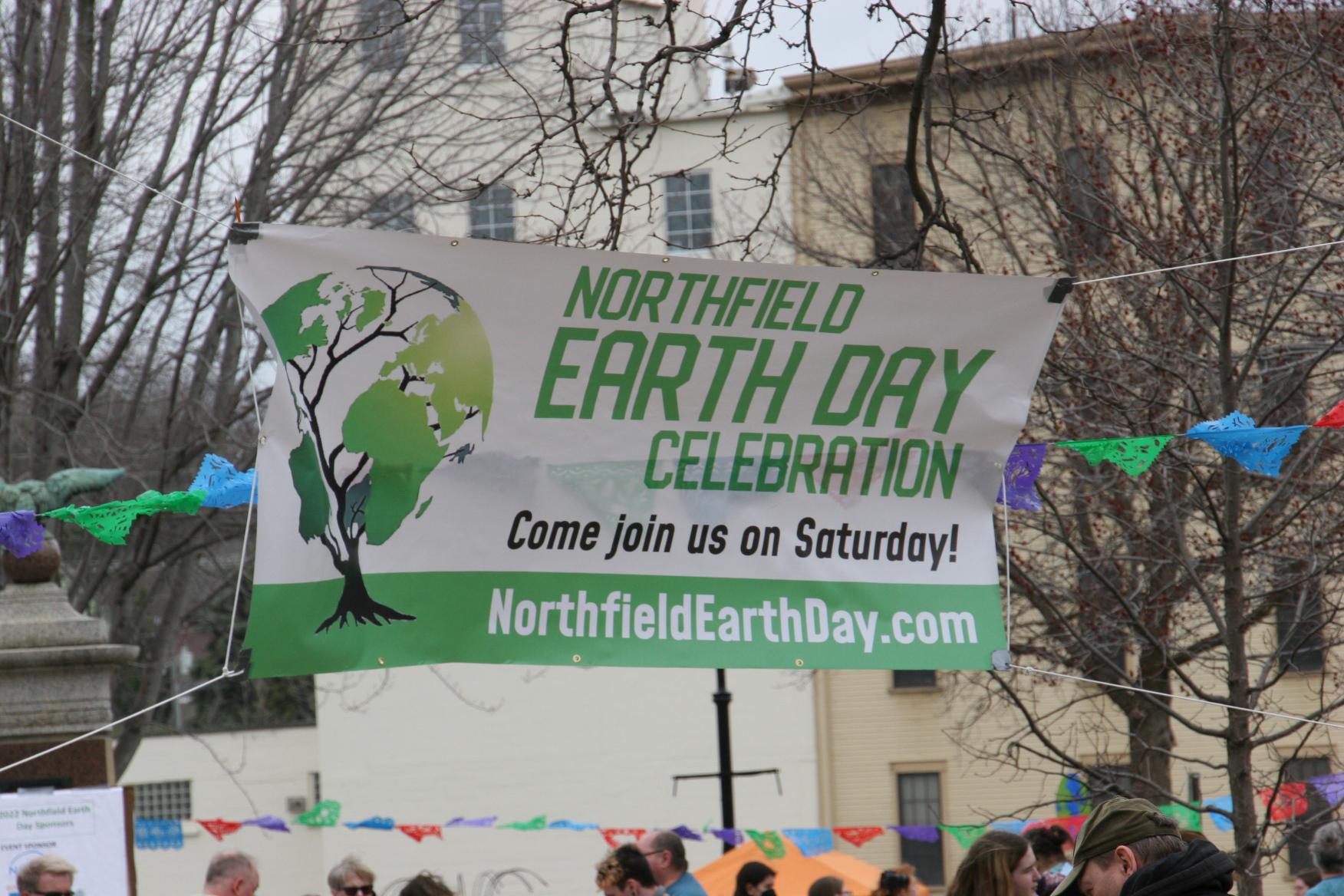
A banner marks Northfield’s Earth Day Celebration at Bridge Square. (Minnesota Prairie Roots copyrighted photo April 2022)
WARM WEATHER, albeit wildly windy, drove Minnesotans outdoors on Saturday to embrace a partial-day reprieve from the cold and rain defining this April.
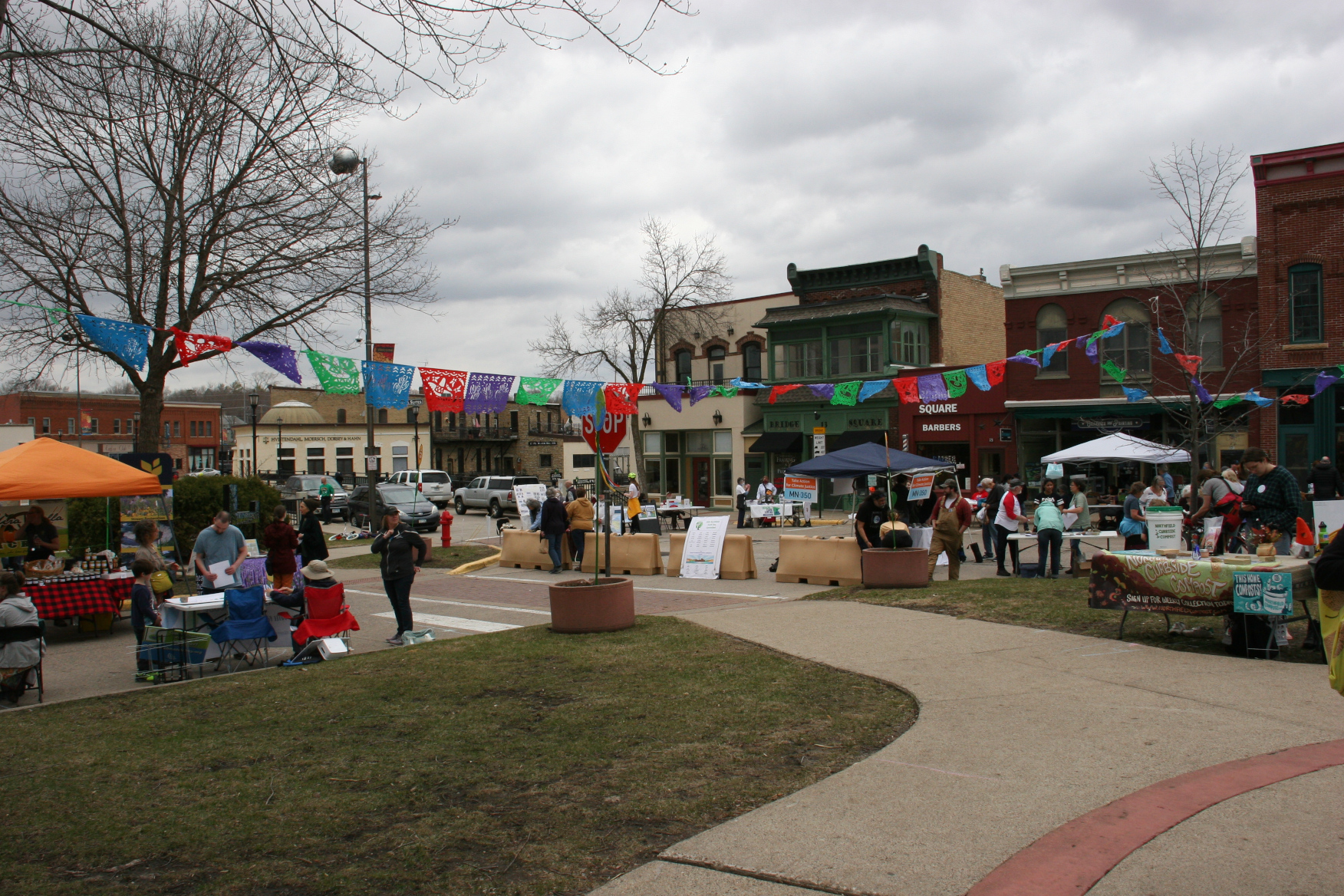
An overview of a section of the Earth Day Celebration. (Minnesota Prairie Roots copyrighted photo April 2022)
For Randy and me, that included a short drive to neighboring Northfield in the afternoon to check out the Earth Day Celebration at Bridge Square. I expected the event to draw a lot of locals and students from Carleton and St. Olaf Colleges. It did.
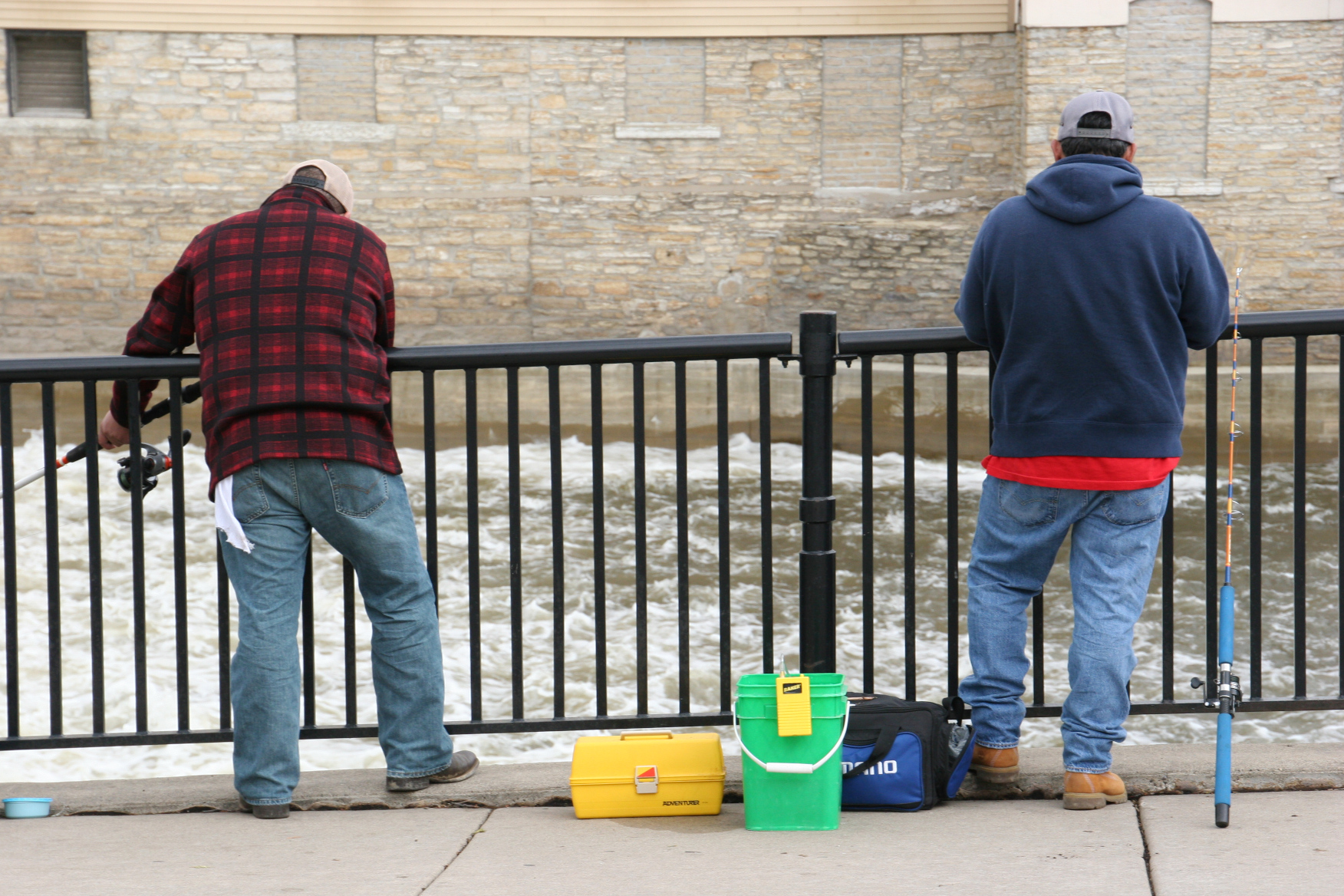
While the Earth Day Celebration happens behind them, these guys fish. (Minnesota Prairie Roots copyrighted photo April 2022)
In and surrounding Bridge Square, exhibitors shared information on topics ranging from climate change to water quality to composting to healthcare access and much more. Vendors from the Cannon Valley Farmers’ Market also set up shop. And kids created at several stations just a stone’s throw from fishermen angling in the Cannon River.
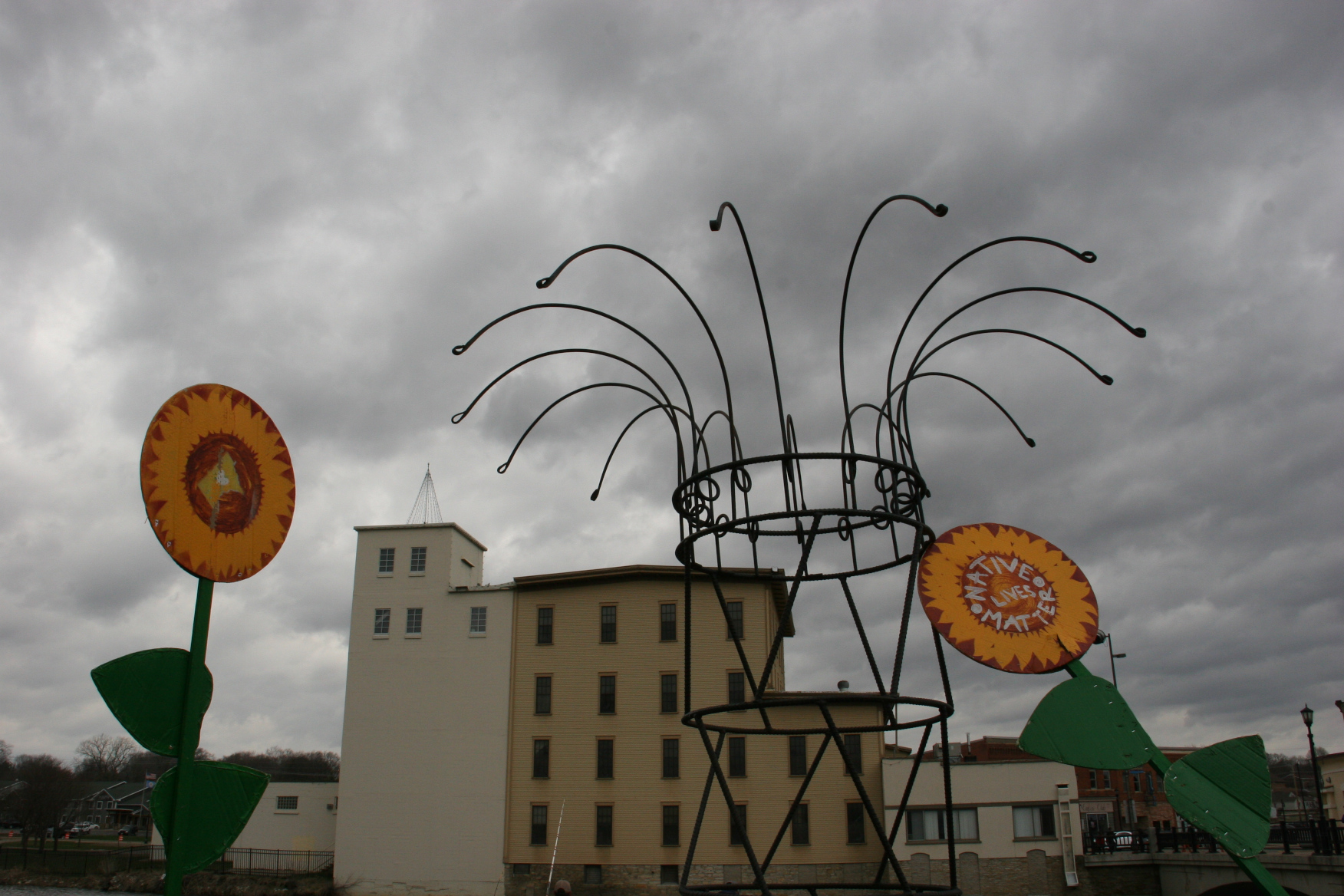
Near the river in Bridge Square, this temporary art installation focuses two messages: “NATIVE LIVES MATTER” and “CLIMATE JUSTICE.” (Minnesota Prairie Roots copyrighted photo April 2022)
We mostly meandered, our stay cut short by raindrops. I zipped my camera inside my sweatshirt as we headed back to the van.
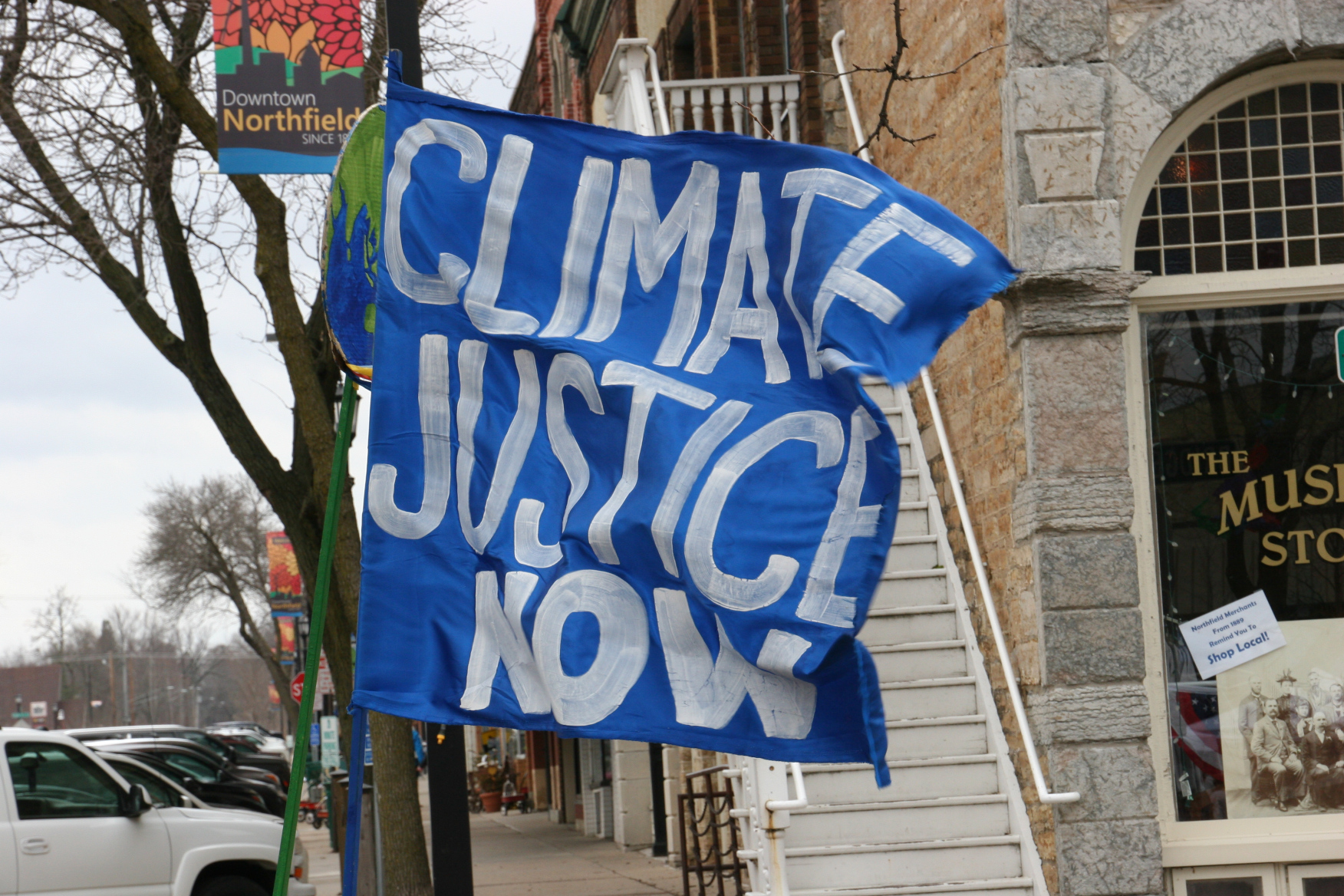
Bannering for a cause at the Earth Day Celebration. (Minnesota Prairie Roots copyrighted photo April 2022)
Yet, even during my brief time at Northfield’s April 23 Earth Day gathering, I felt the passion for taking care of this planet. Of being responsible stewards. Of engaging in conversation. Of doing our part.
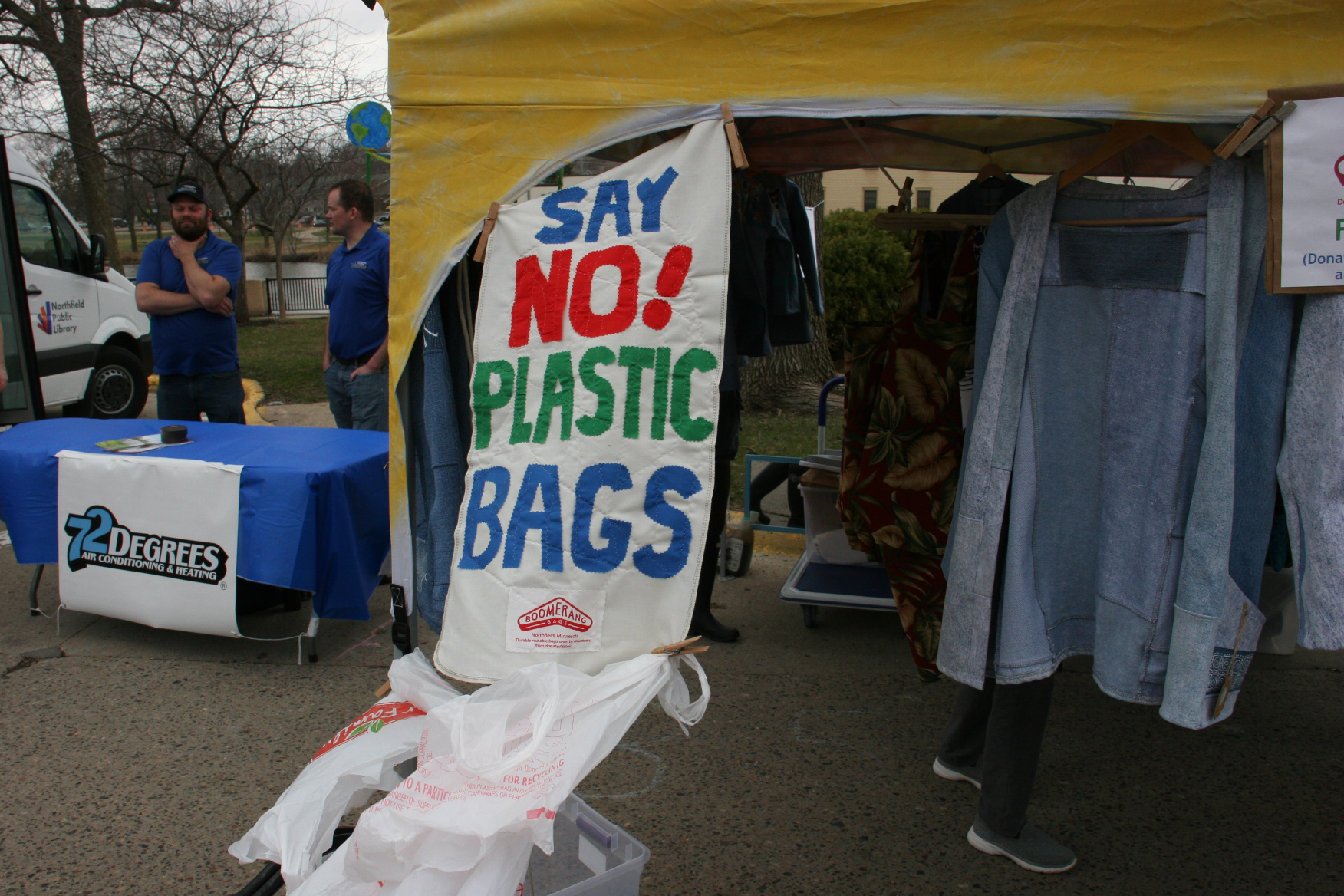
A sign on the UPcycleMN tent grabbed my attention. (Minnesota Prairie Roots copyrighted photo April 2022)
It’s refreshing to see, especially when I observe all the exposed winter-tossed garbage along roadways and read about endangered Minnesota rivers, our shorter winters and so many other climate and environmental concerns.
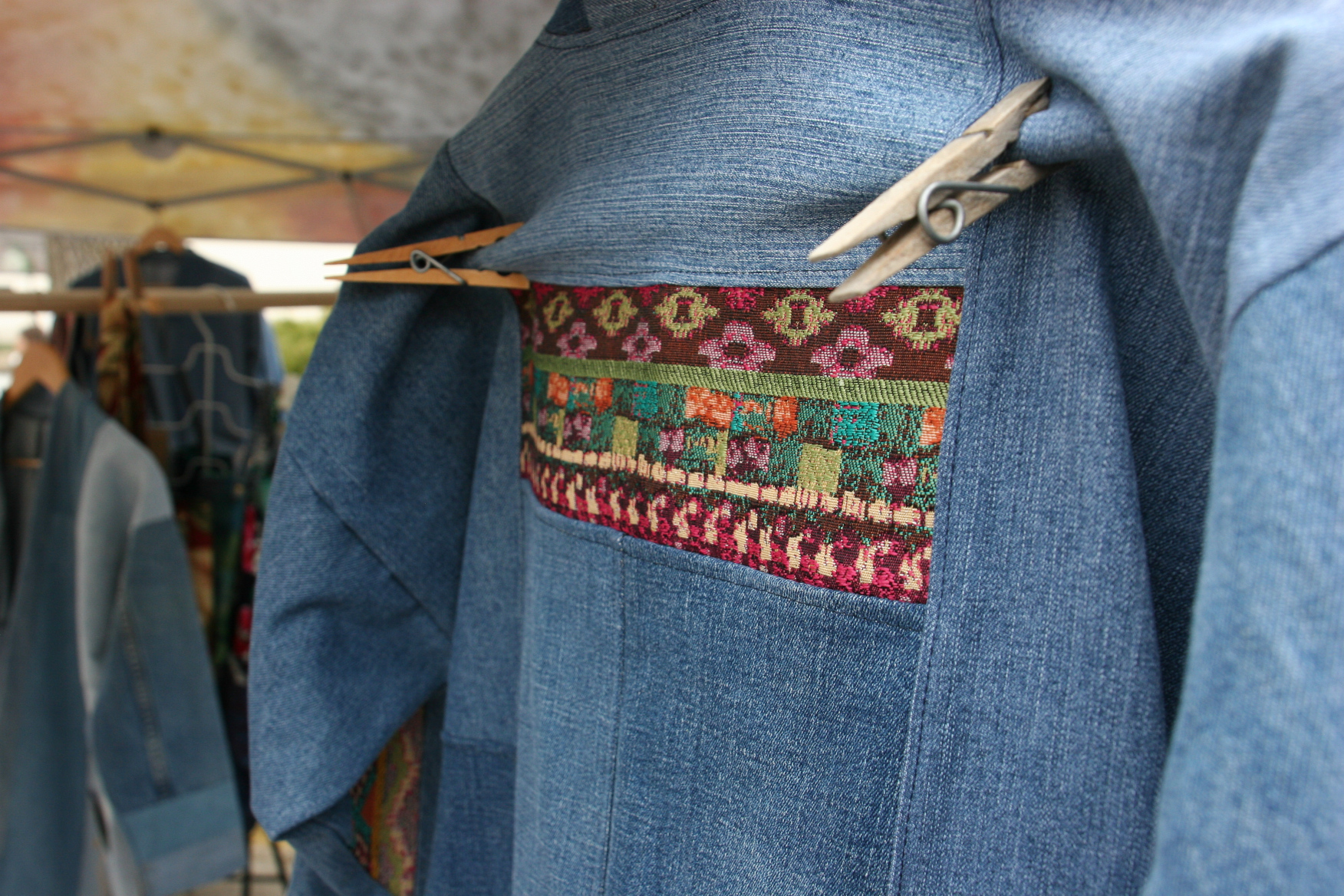
An example of an upcycled blue jean jacket crafted by Kathryn Ness of UPcycleMN. (Minnesota Prairie Roots copyrighted photo 2022)
I delighted in meeting former Northfield librarian Kathryn Ness who identifies herself as “CEO & Head Scrounger” at UpcycleMN. Signage and jean jackets drew me to her vendor tent and a short conversation. She upcycles used jeans into “new” jean jackets, crafts cloth bags and more. Kathy reminds me of my Uncle Bob, who weaves old jeans, bedspreads and more into beautiful, durable rag rugs. They are artists who are doing their part for our earth while creating.
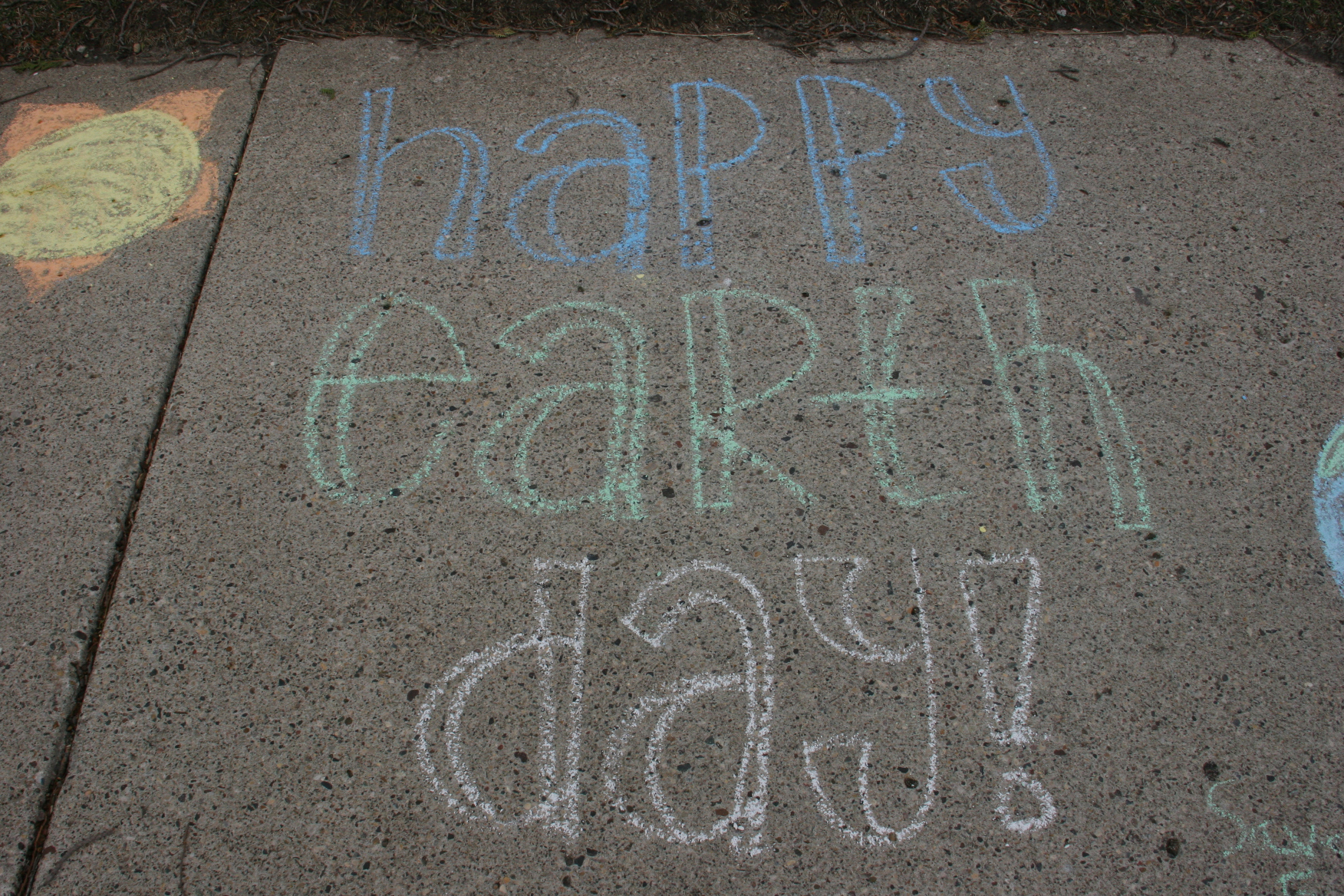
Bridge Square is often a canvas for chalk art, including during the Earth Day Celebration. (Minnesota Prairie Roots copyrighted photo April 2022)
Attending Earth Day in Northfield gives me hope. Hope because people care about this earth, this place we call home.
TELL ME: Did you attend an Earth Day celebration?
Please check back for additional posts that focus on UPcycleMN and on the temporary art installation.
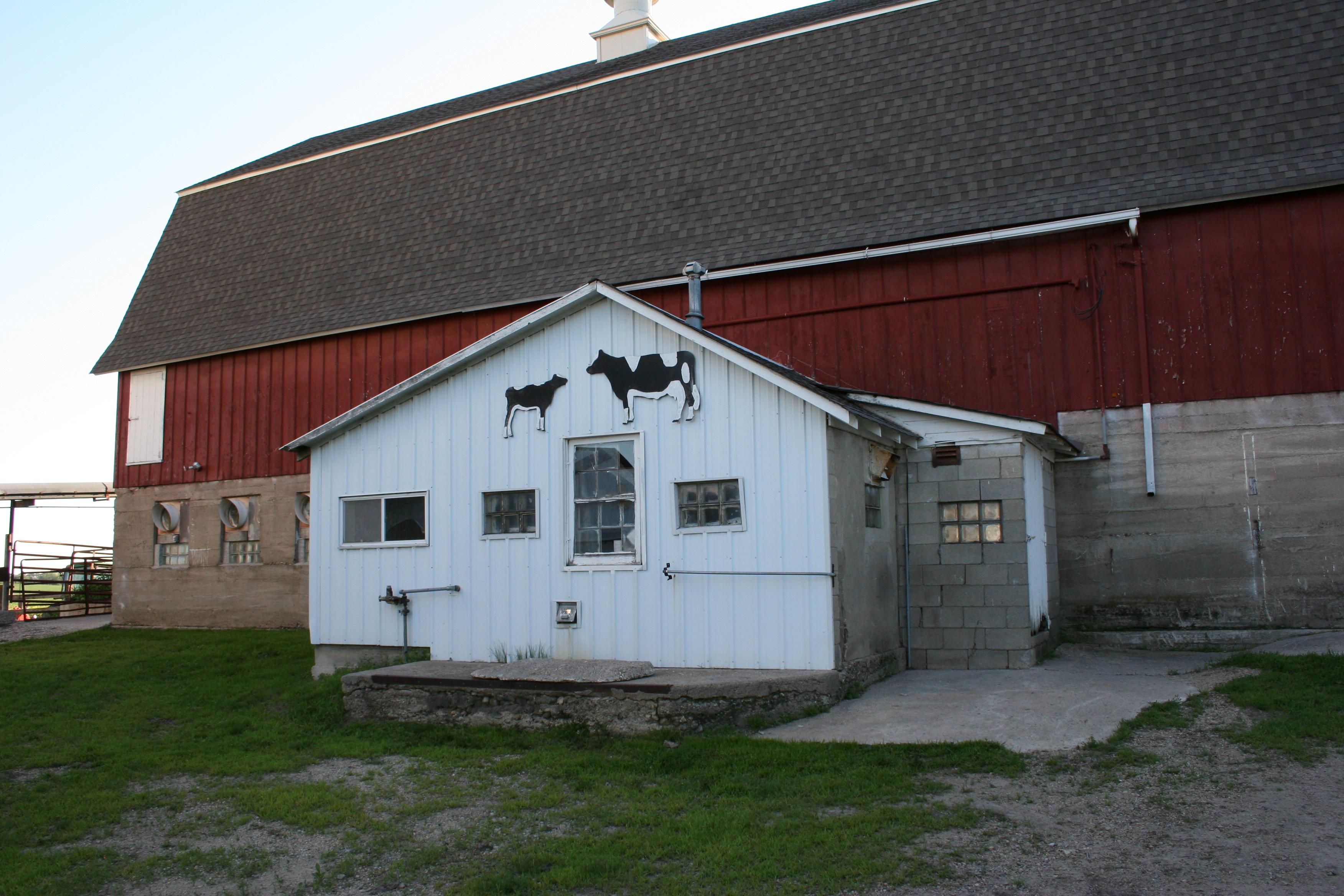
Holstein cow art adorns the milkhouse on the barn of friends in rural Dundas (near Northfield). These farmers once milked Holsteins. (Minnesota Prairie Roots copyrighted file photo September 2011)
NOW BILLED AS“A Classic American River Town” by the local tourism office, Northfield fits that description. This southern Minnesota community, where the James-Younger gang was defeated in 1876, hugs the Cannon River. The historic downtown is filled with mostly home-grown shops and eateries. And, as cliché as it sounds, Northfield is quaint and charming.
I love Northfield. If the cost of houses in 1984 had not been significantly higher than in neighboring Faribault, Randy and I would be living there. Instead, Randy has commuted from Faribault to Northfield to work as an automotive machinist for too many decades. But such is life and we’re happy to call Faribault home.
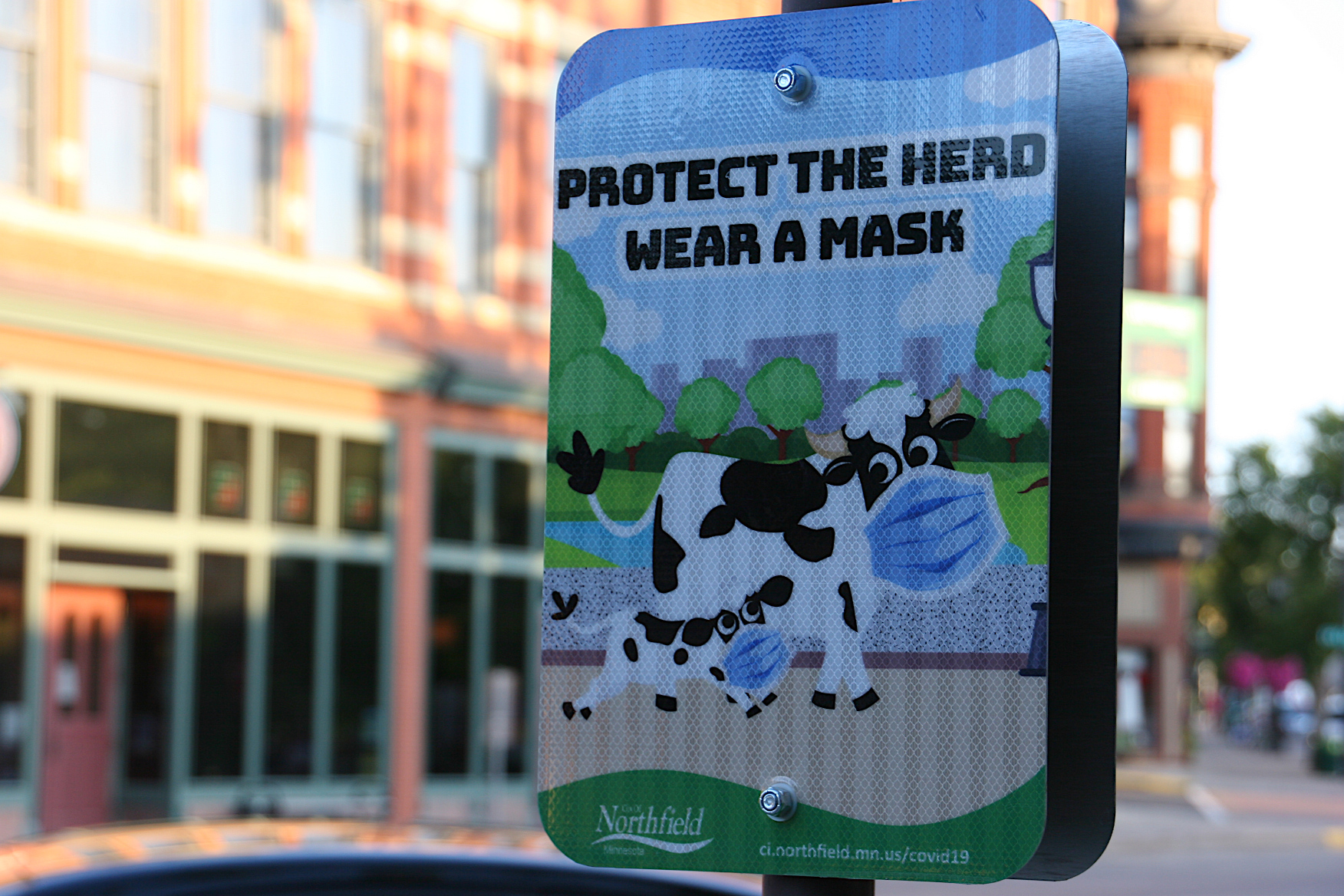
“Protect the herd” plays off the city’s “Cows, Colleges & Contentment” slogan. (Minnesota Prairie Roots copyrighted file photo 2020)
But back to Northfield. There was a time when this city actively tagged its community with the phrase “Cows, Colleges & Contentment.” That slogan still graces some signage. I observed a cow-themed sign encouraging masking early in the pandemic. “Protect the herd” focused the message from the City of Northfield. I thought that incredibly powerful and catchy. You know, we’re all in this together type attitude. Care about one another.
I understand how “contentment” fits this community. And colleges, too, as Northfield is home to St. Olaf and Carleton colleges.
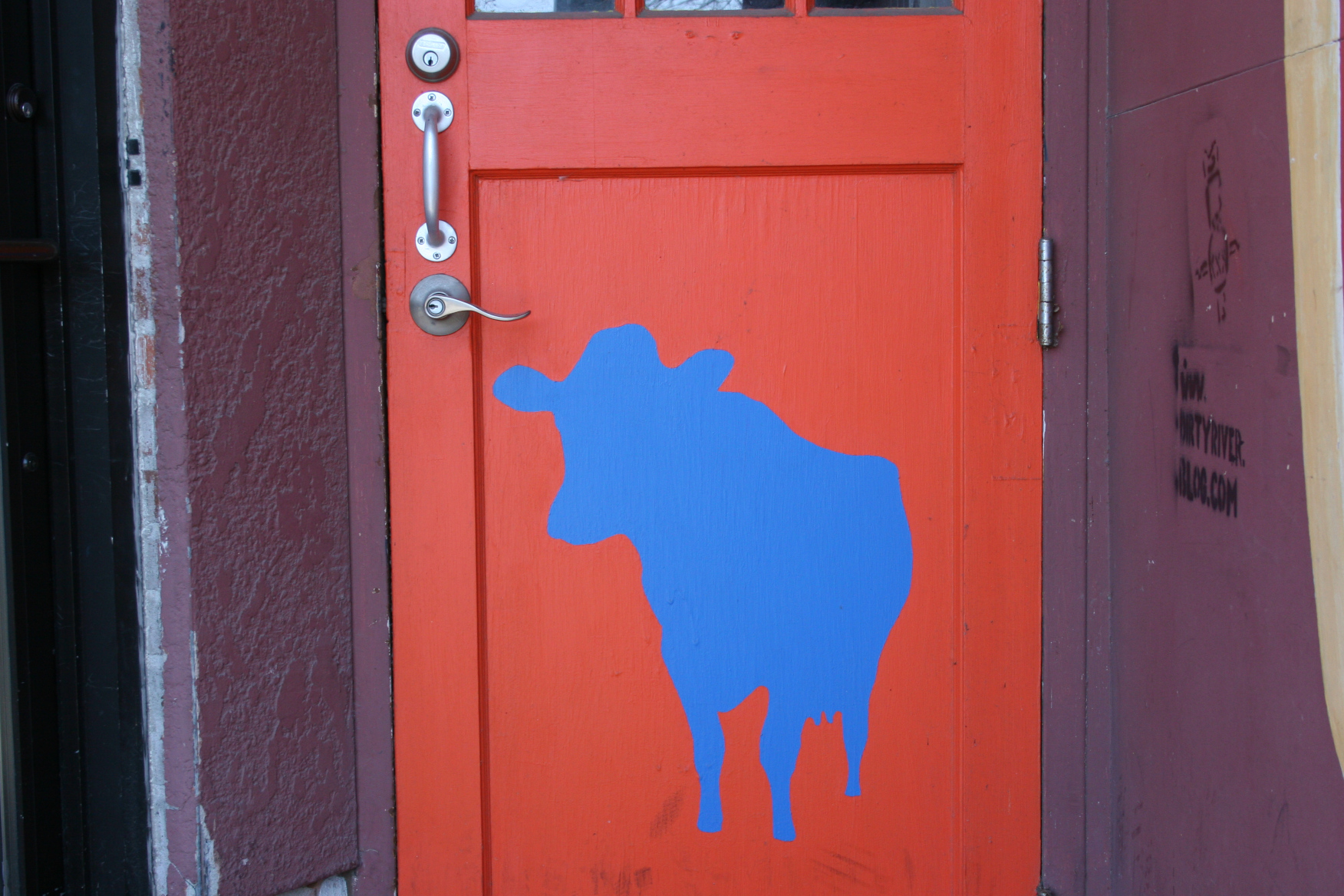
The blue cow I spotted recently in downtown Northfield. (Minnesota Prairie Roots copyrighted photo 2022)
But I didn’t quite get the “cows” part until I found an explanation on the Visit Northfield website. In summary, in the late 1890s, a local farmer/newspaper editor suggested Northfield could attract businesses by focusing on breeding of Holstein cows. That eventually happened with 5,532 Holstein dairy cattle and 261 breeders in the area by 1916, a Northfield Holstein Club and the moniker, “Holstein Capital of America,” attached to Northfield. The aforementioned colleges also established Holstein herds. I encourage you to read the full story about the Northfield cows by clicking here.
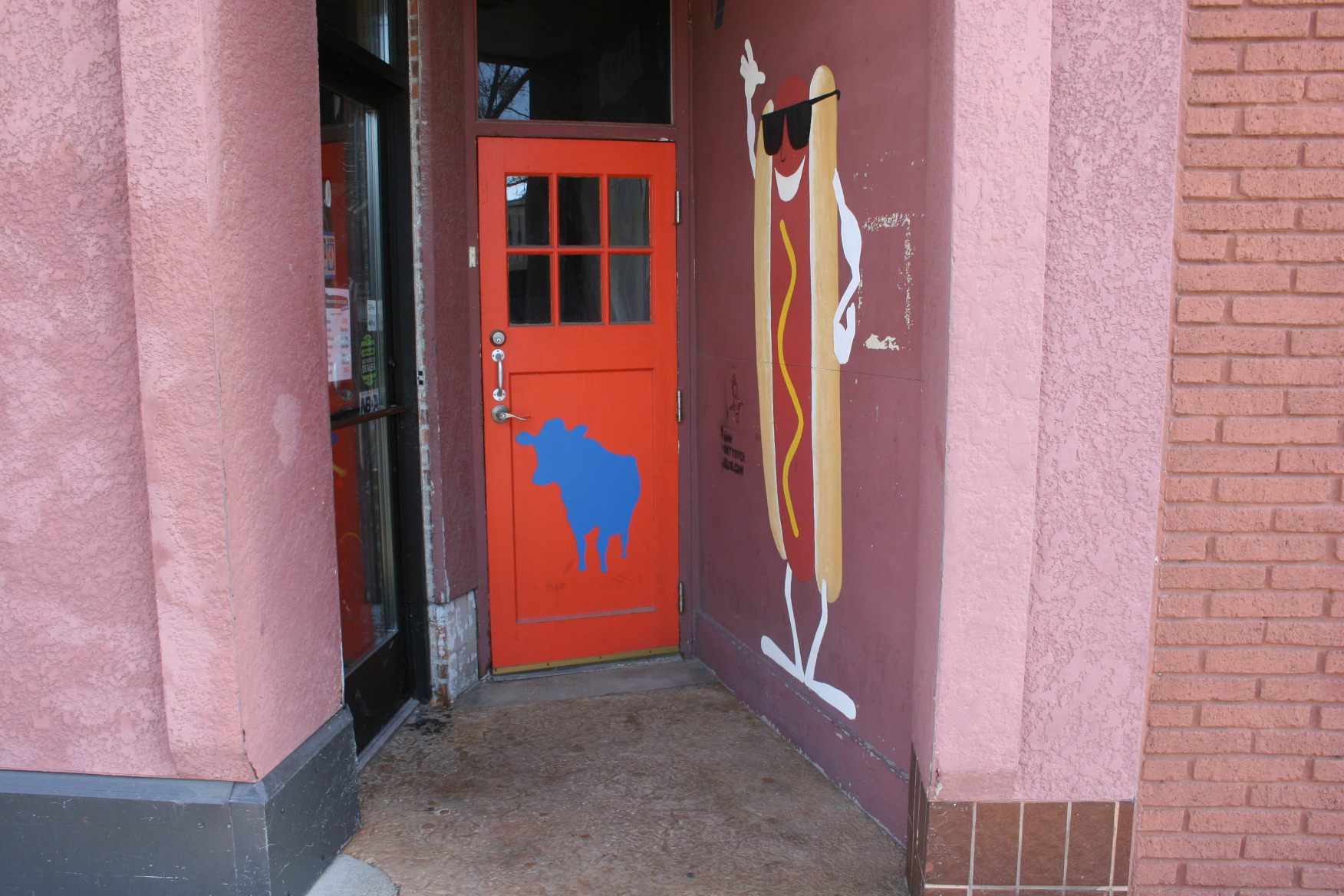
Downtown Bicycles’ blue cow image. Now, what’s with the hot dog? (Minnesota Prairie Roots copyrighted photo 2022)
On a recent walk through downtown Northfield, I didn’t see any Holsteins. But I happened upon a blue cow painted on an orange door. The cow graphic marks Downtown Bicycles, 321 Division Street. Seeing that cow brought to mind the “Cows, Colleges & Contentment” theme, which led me to uncover the story behind the bovines of Northfield.
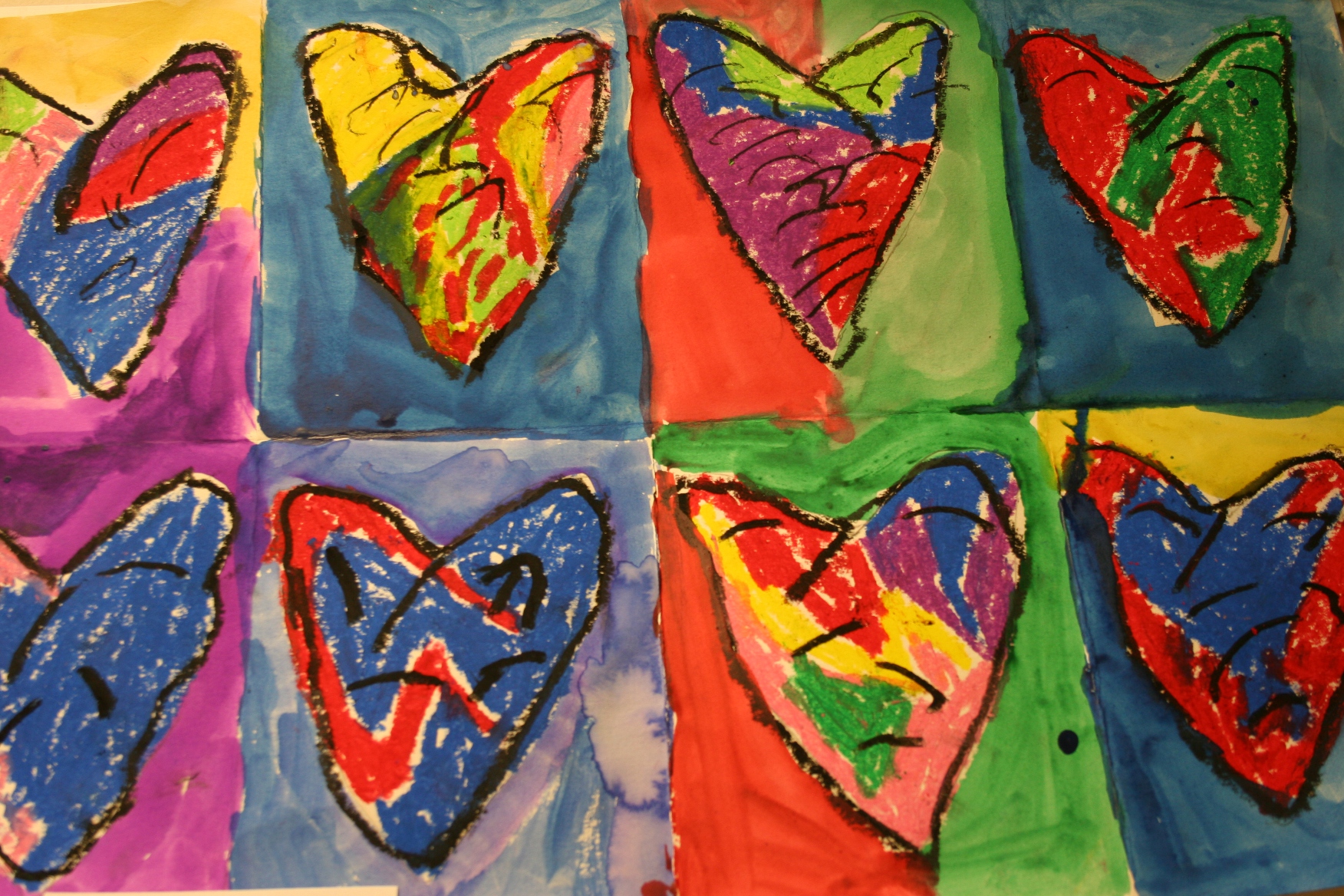
Third grader Henry Johnson of Nerstrand Charter School created this vivid work of art for a Student Art Exhibit at the Paradise Center for the Arts in Faribault. Published with this post for illustration purposes only. (Minnesota Prairie Roots copyrighted file photo)
I CONTEMPLATED WHETHER I should write about the tragic deaths of four Minnesota children recently. But it’s important for me, in some small way, to pause and share that which imprints sadness upon my heart. To lose a child is perhaps life’s deepest sorrow.
The first tragedy happened on April 15 in rural Wabasso—I graduated from Wabasso High School—in southwestern Minnesota. Braxton Welch, 20 months, died after being struck by a vehicle driven by his dad. I cannot even begin to fathom the grief this family is experiencing. This is personal to me because I know the Welch family back a few generations. I knew Braxton’s deceased great grandfather Gary, who lived in my hometown of Vesta and worked as a mechanic at my Uncle Harold’s service station. And I babysat Braxton’s grandfather (Gary’s son), Troy, and siblings a few times as a teen. Now Troy has lost his grandson, a sweet little boy with the brightest blue eyes. Braxton loved dancing and giggling and his big brother. And I expect so much more.
To the west, in rural Lynd, a 9-year-old girl (not yet identified) has died after being shot in the head on April 18. Authorities are classifying the shooting as “accidental.” Again, an unfathomable tragedy. UPDATE, April 26, 2022: The Lyon County Sheriff’s Department has identified Caitlin Renee Demuth as the young girl who died as a result of this tragic shooting. A public visitation will be held from 5 – 7 pm Friday, April 29, at the Hamilton Funeral Home in Marshall.
And then way up north, in the port city of Duluth, the Barry family was found shot to death in their beds on April 20. The victims include mom, Riana, 44; dad, Sean, 47; and their daughters, Shiway, 12, and Sadie, 9. The identified shooter, their 29-year-old nephew/cousin, also died, of a self-inflicted gunshot wound. Police continue their investigation into the motive while publicly stating the shooter struggled with mental health issues. This murder-suicide, resulting in the deaths of two children and three adults in a single family circle, is undeniably tragic. It is almost too much to bear and my heart absolutely breaks for everyone touched by this tragedy, especially family and friends but also the greater Duluth community and responding law enforcement.
Friends have set up a GoFundMe account to help extended family pay for the Barrys’ funerals and for travel and other expenses. I encourage you to visit that site, donate if you can and pause to read the comments written by those connected to the Barry family. You will read of a kind, loving and generous family who welcomed newcomers, of two little girls who sold Girl Scout cookies, of guinea pigs and bike riding and all those ordinary life events that, in death, take on new meaning.
Tears flow. I feel emotionally drained. My heart hurts. Yet, I recognize that what I feel is nothing compared to the friends and families of Braxton; the little girl from Lynd; and the Barry family. To experience their loss and grief seems incomprehensible. Tragic beyond words.
#
FYI:A public vigil for the Barry family will be held on Sunday evening, April 24, outside the family’s home at 715 E. 12th Street in Duluth. A short program begins at 8 pm with the lighting of holiday lights on the home. Christmas was one of the family’s favorite holidays. Attendees can also share stories at the event. The public is also invited to bring new children’s books to be donated in the family’s honor. The Barrys had a Little Free Library outside their home to share their love of reading and of books.
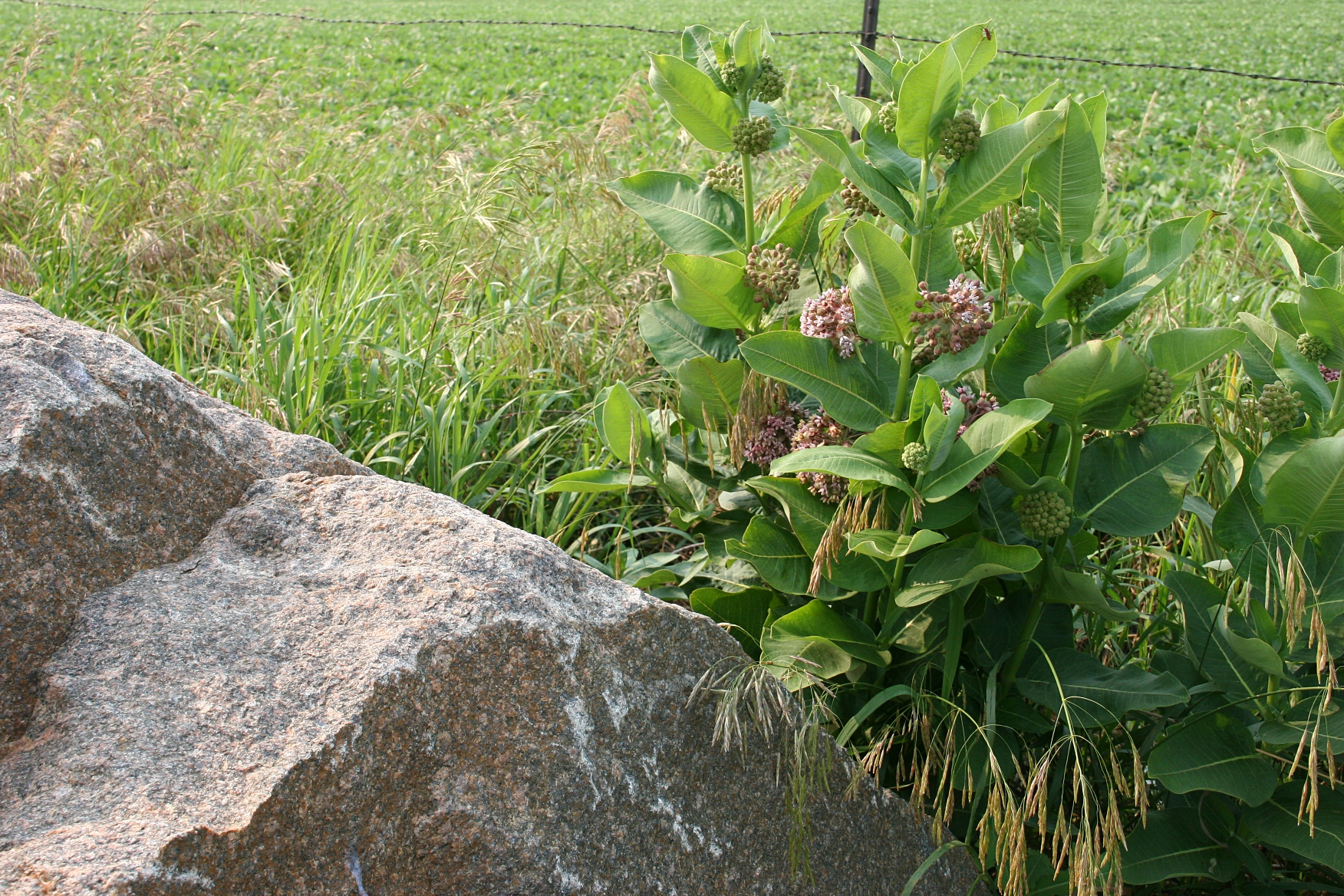
Monarch attracting milkweed grows next to a soybean field in southwestern Minnesota. Planting milkweed is one way to help the earth. (Minnesota Prairie Roots copyrighted file photo July 2015)
TODAY, APRIL 22, marks Earth Day, a day to focus on our planet, the environment and ways we, individually and globally, can protect both.
This day gives me pause to reflect on an event which began in 1970, when I was nearing young adulthood. I remember the anti-litter campaigns, the energy shortage and even Earth Shoes. Fifty-two years later, the focus has shifted to clean energy, Zero Waste and climate change.
But, taking it down to a personal level, what am I doing to honor the spirit and intent of Earth Day on a daily basis? Some examples follow. What are you doing?
WHEN I WORE FEED SACKS
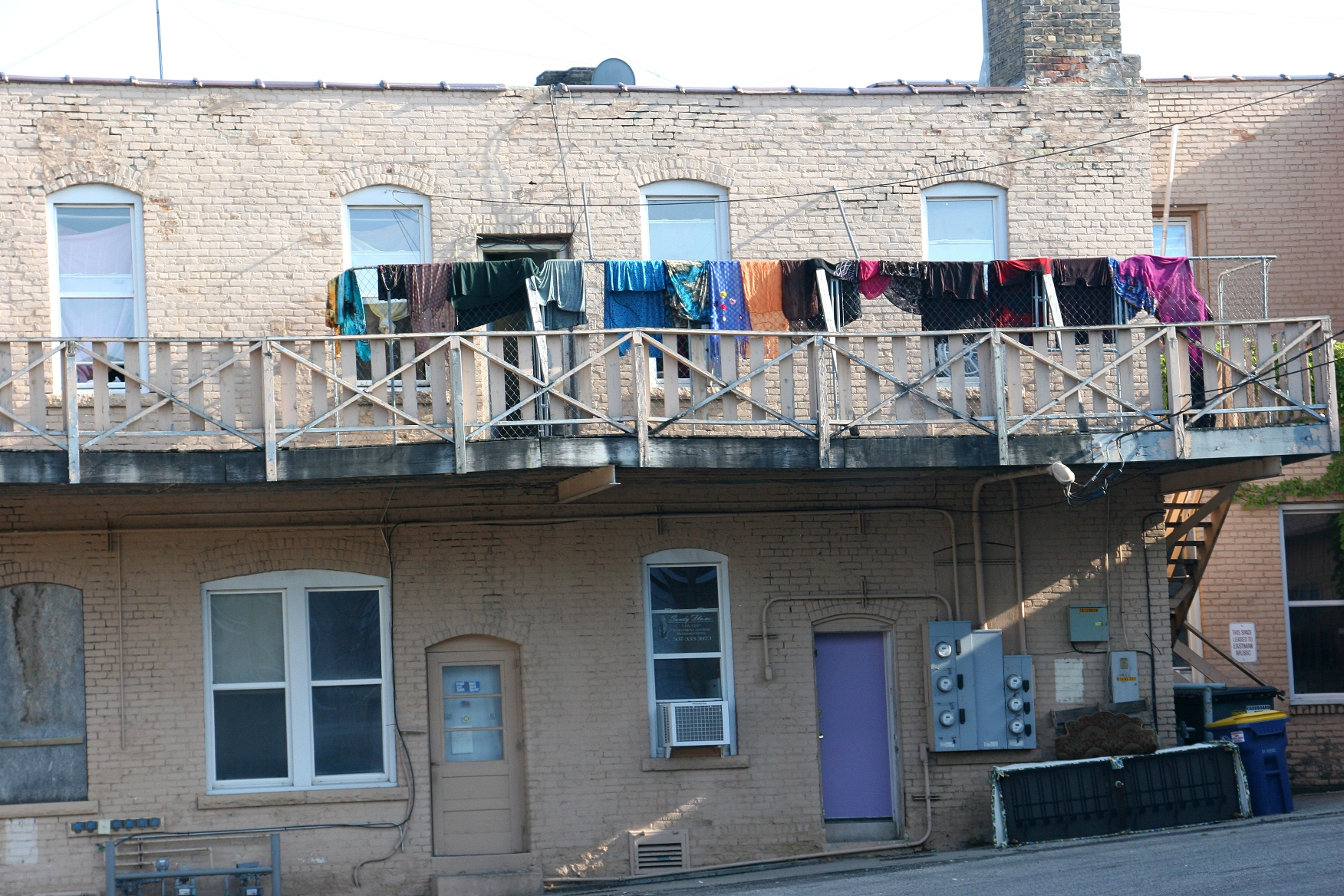
One of my all-time favorite images of laundry drying outside was taken on the back side of a building along Third Street N.E. in downtown Faribault, just across the alley from the post office. (Minnesota Prairie Roots copyrighted file photo July 2015)
I recognize that some of what I do is rooted in my past, where reuse was popular long before it became hip. For example, as a child I wore clothing stitched from feed sacks. Not all clothes, of course, but enough that I remember. Clothing was handed down the line from oldest to youngest siblings and sometimes among cousins. Whenever I got new clothes in my youth, they were either from the sales rack or sewn by my godmother or, later as a teen, by me. When I had children, most of their clothing came from garage sales. To this day, I dislike clothes shopping and gravitate to the discount rack. And, yes, I still occasionally buy second-hand. My approach to apparel is, I figure, earth-friendly.
Likewise when it comes to laundry, I either line dry outdoors or on a rack inside. To me hanging laundry isn’t a chore. I love the methodical rhythm of clipping laundry to the line early in the morning, then pulling it off when the sun has dried the clothes, towels, sheets… In the process, I’ve saved energy by not using my electric dryer.
SAVE THE BOWS, PLEASE, & THE CARDS
Examples of Christmas cards that were recycled into gift tags. (Minnesota Prairie Roots copyrighted file photo 2012)
I also save and reuse gift bags, tissue paper and ribbons/bows. Through the years, I’ve taken a lot of ribbing for that practice. But, frankly, I don’t care. Tossing those items seems wasteful to me. And I am simply following the example set by my mother who, Christmas to Christmas, saved and reused tissue, ribbons, bows and carefully-folded wrapping paper. (We didn’t get birthday gifts.) I don’t reuse paper. Mom’s reasons for reuse were not necessarily rooted in the environment, but rather in finances. Wrapping paper and all the embellishments cost money. She also saved Christmas cards, repurposing them as gift tags, something I also do.
BREAD BAGS & PEACHPAPER
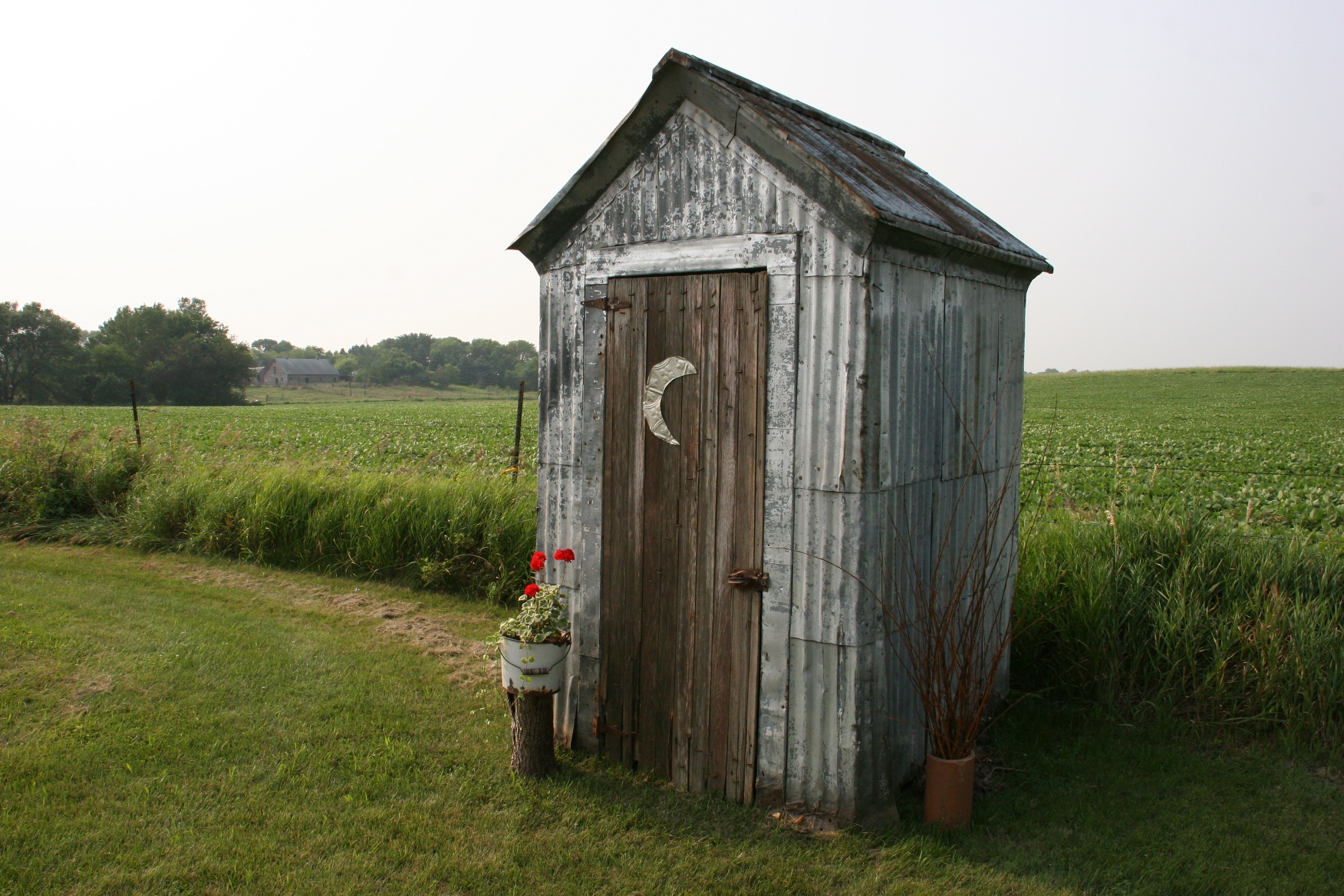
An outhouse repurposed as a storage shed on my middle brother and sister-in-law’s rural acreage near Lamberton. (Minnesota Prairie Roots copyrighted file photo 2015)
I also follow Mom’s example of washing and reusing plastic food storage bags. I don’t save bread bags, though. While growing up, I slid bread bags over my feet before slipping into boots. The bags kept my feet dry and warm, especially if my rubber boots leaked.
Thankfully I don’t need to repurpose the tissue from individually-wrapped crated peaches as toilet paper in the outhouse. Yes, I grew up using an outhouse in the warm weather months and a pot on the porch in the winter because our old farmhouse didn’t have a bathroom. I am quite appreciative of the small solo bathroom in my current house.
The one other area in which I’ve really focused on reuse is furniture. I just counted all the furniture pieces in the six rooms on our main level. Of the 20 pieces, we’ve purchased only five new—the sofa, recliner, entertainment center and my office desk and chair. The dining room table and chairs came from two auctions 40 years ago. Other furniture either came from garage sales or from family. Even our bedroom ensemble—hideous 1950s blonde—is used. Not the mattress or boxspring. In the two second floor bedrooms, all of the furniture is second-hand.
RECYCLED ART, OH, HOW I LOVE THEE
Donated art fills a gallery at the Paradise Center for the Arts. The center hosts an annual Recycled Art Sale. (Minnesota Prairie Roots copyrighted file photo 2014)
And then there’s art. I love art and own a stash of it thanks to thrift stores, garage sales, the local recycled art sale and my mom. My “newest” pieces are “Jesus, the Good Shepherd” and “Jesus Knocks,” wedding gifts to my parents in 1954. Budget-friendly sources of art have allowed me to curate pieces I love in an earth-friendly way.
Now, I’d like to hear from you. How do you honor the spirit and intent of Earth Day in your daily life? Let’s learn from one another about ways we can reuse, repurpose, recyle, upcycle, reduce waste…
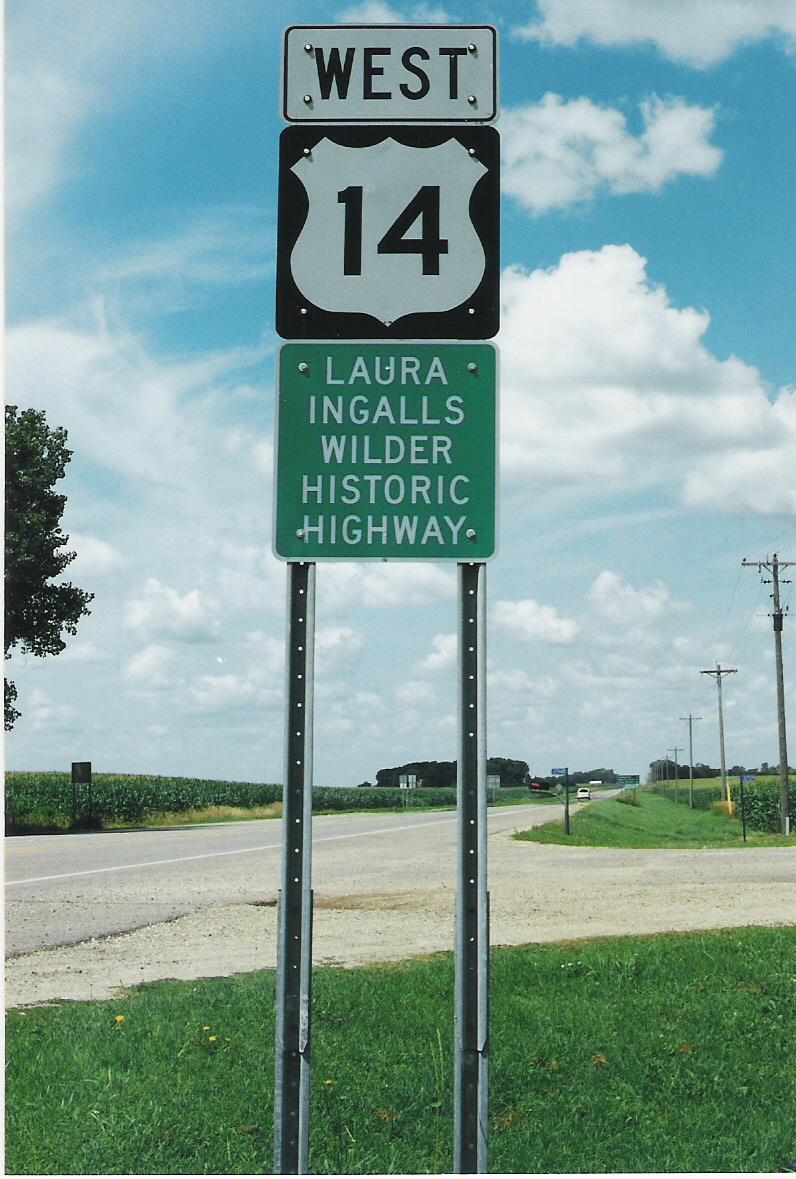
U.S. Highway 14 west of New Ulm in southwestern Minnesota. (Minnesota Prairie Roots copyrighted file photo)
IF YOU’RE A FAN of the “Little House on the Prairie” television series, you will recognize these town names: Walnut Grove. Sleepy Eye. Mankato. In the TV version, the Charles and Caroline Ingalls family lived in Walnut Grove, but also traveled to Sleepy Eye and Mankato. In her books, Laura Ingalls Wilder doesn’t write about journeying to either town from Walnut Grove. Hollywood added its creative perspective, including a setting that is not exactly accurate in its depiction of the prairie. I know this area well. My hometown of Vesta lies 20 miles north of Walnut Grove on the mostly flat prairie of big sky and wide open spaces.
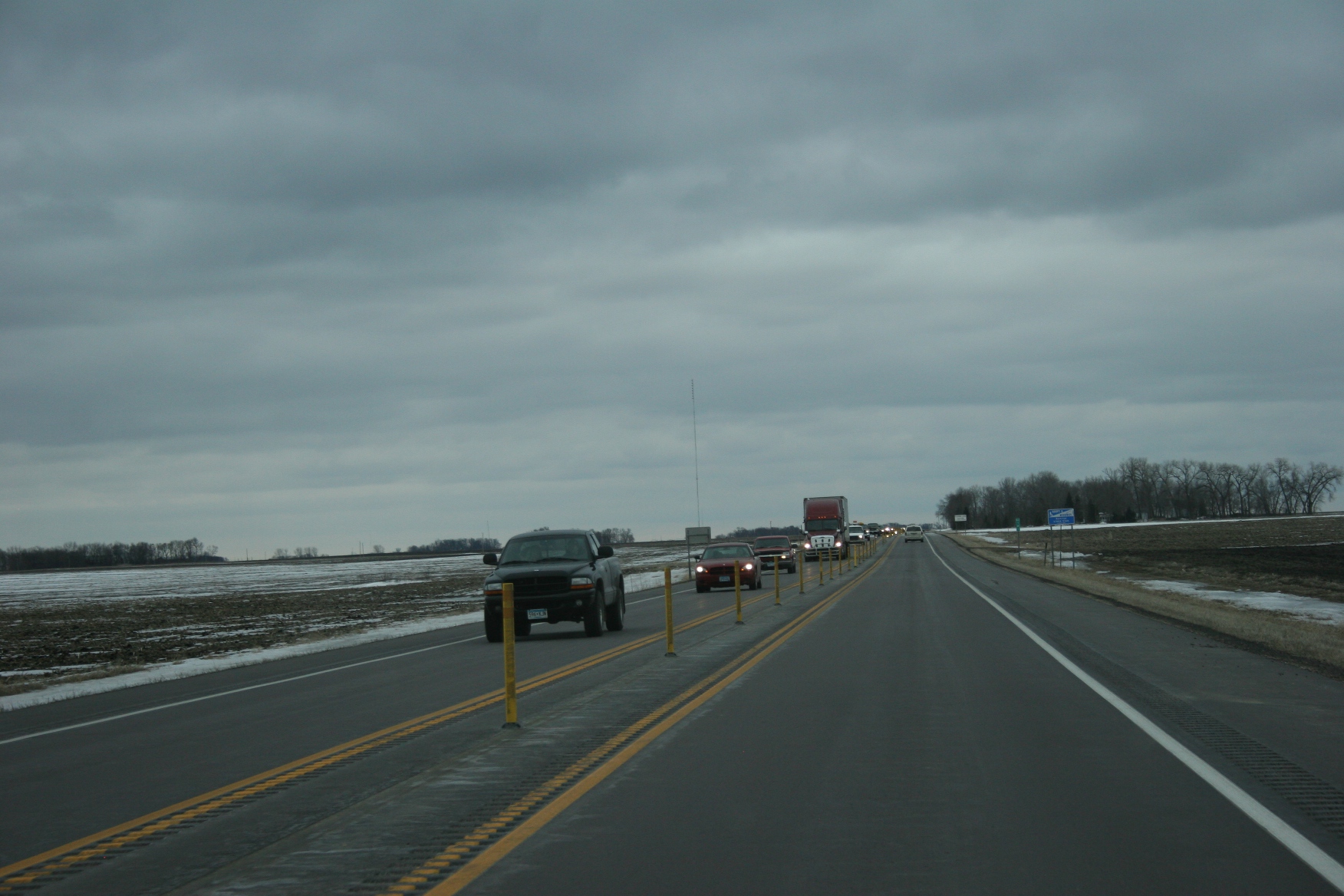
Heavy traffic on U.S. Highway 14 between Nicollet and North Mankato in March 2013, before that section of two-lane expanded to four-lane. (Minnesota Prairie Roots copyrighted photo 2013)
The trip back to Redwood County from my Faribault home takes me along U.S. Highway 14, also known as the Laura Ingalls Wilder Historic Highway. That road passes through Mankato and Sleepy Eye and many other communities into the heart of rural Minnesota, along a particularly dangerous stretch of roadway. Highway 14 has/had a reputation for above average deadly crashes. That’s no surprise given the narrow lanes carrying heavy traffic volumes.
West of Nicollet, signage warns drivers that Highway 14 goes back to two-lane. It’s at this point where the current four-lane expansion begins to New Ulm. (Minnesota Prairie Roots copyrighted file photo December 2016)
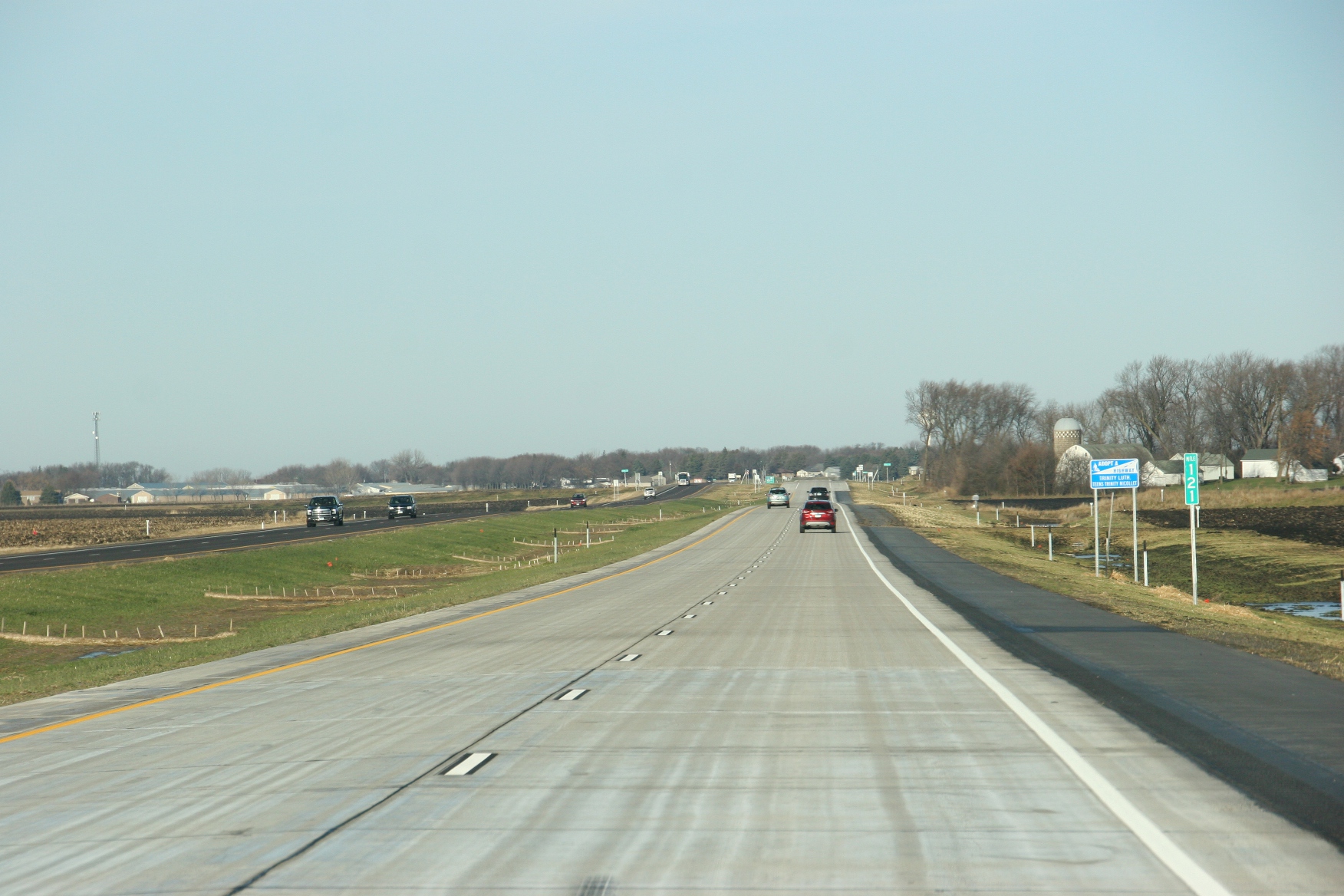
But that is all changing. Several days ago, government officials and others gathered for a ceremonial event to kick off a two-year road construction project that will replace 12 miles of two-lane roadway between Nicollet and New Ulm with a four-lane road. It’s about time. This is the last stretch of two-lane converting to four-lane from Rochester to New Ulm.
Westbound on Highway 14 heading to Nicollet from Mankato. (Minnesota Prairie Roots copyrighted file photo 2016)
I don’t get back to southwestern Minnesota all that often anymore, just for the occasional funeral or family gathering. But I’m thankful that come October 2023, the drive between Nicollet and New Ulm will be easier, safer, faster. Just like it is now between Mankato and Nicollet.
Once west of New Ulm, Highway 14 will remain the same. Narrow. Well-traveled. Not particularly safe. But for today, I’m grateful for the improvements to 12 miles of a route the Ingalls family didn’t follow, but which many fans of “Little House on the Prairie” travel today en route to Walnut Grove.
A portion of Rob Hardy’s poem displayed at the Northfield Public Library. (Minnesota Prairie Roots file photo)
ROB HARDY, poet laureate of Northfield, is the kind of laid back guy who appreciates a good craft beer. I know. Back in September 2017, I met him at Imminent Brewing, where we shared a table while enjoying a beer, listened to other beer lovers read poems about beer and then read our own beer poems. He organized that Beer Poetry Contest. Poetry at a brewery, how creative and fun is that?
In January 2019, I again found myself in the company of Hardy, and other gifted area poets, for a poetry reading at Content Bookstore in Northfield.
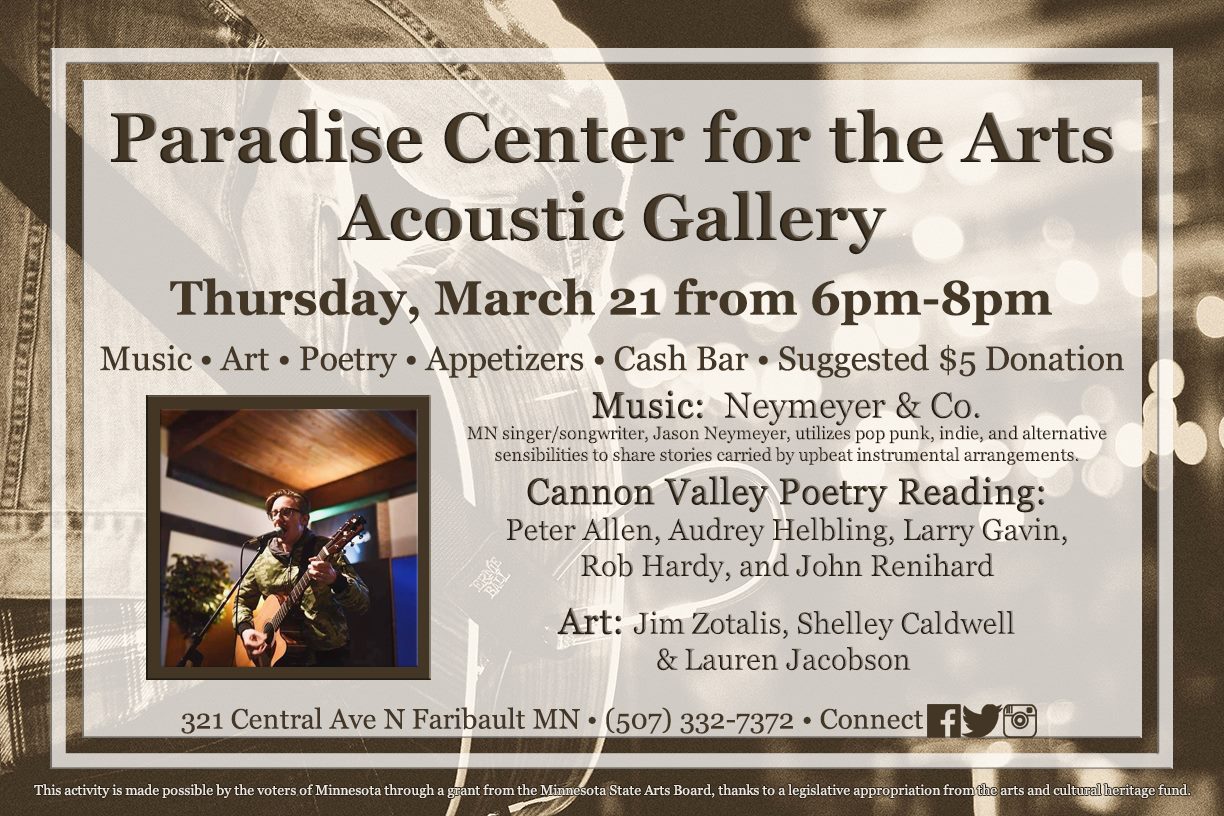
Promo courtesy of the Paradise Center for the Arts for a past event that included a poetry reading.
Hardy is a champion of poetry. He tirelessly promotes poetry in Northfield, where poems, including his, imprint sidewalks. He organizes poetry events and publishes a poetry-focused newsletter and even has a poem permanently posted at the public library.
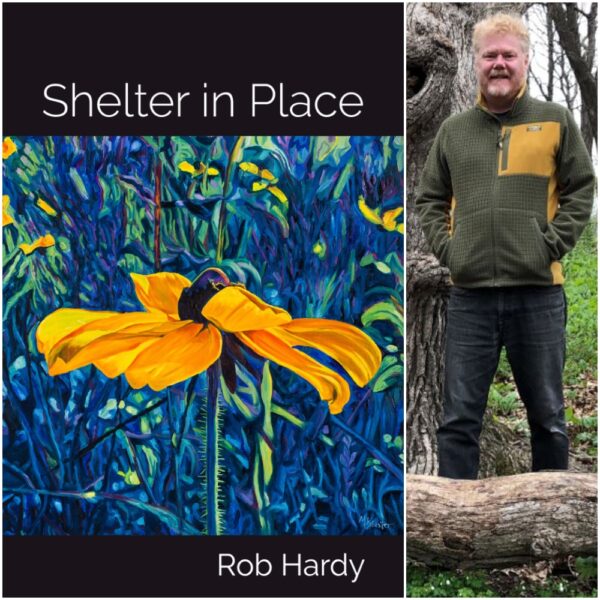
Rob Hardy, right, and his new poetry collection. (Photo source: Finishing Line Press)
The influence of the pandemic upon this poet’s life and writing is easy to see. In “Lyrical Dresses,” for example, he writes about looking at ordinary life through the wrong end of a telescope and sometimes crying for no reason. In “Today’s Headlines” the fourth line reads: Rice County has the highest rate of new cases in the country. That would be our county.
But these COVID-19 themed poems are not necessarily doom, gloom and darkness. They are an honest, reflective historical record of life during a global pandemic from the creative perspective of a wordsmith. Just as important as a news story in telling the story of this world health crisis. In “Grounded” he writes of pulling a shoe box from the closet to relive travel memories while unable to travel. While grounded.
He did, however, put his feet to the ground, immersing himself in nature through daily walks. He writes of birds and prairie and sky and river and wind…in poems inspired by his deepening connection to the natural world.
Shipwreckt Books Publishing published Northfield Poet Laureate Rob Hardy’s previous poetry collection.
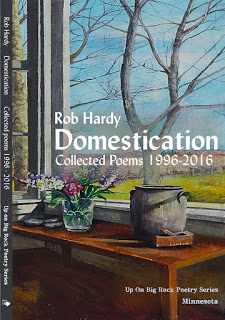
I encourage you to read Hardy’s Shelter in Place and/or attend a reading at Content Bookstore featuring Hardy and Greta Hardy-Mittell, a Carleton College student and writer. That event begins at 7 pm on Thursday, April 21. Click here for details. Rob Hardy is also the author of two other poetry collections, Domestication: Collected Poems, 1996-2016 and The Collecting Jar.
Oh, how lovely the textured bark. (Minnesota Prairie Roots copyrighted photo March 2022)
TREES DEVOID OF LEAVES open the woods to full view. Such is the benefit of this not-winter, not-yet-spring transitional time here in southern Minnesota.
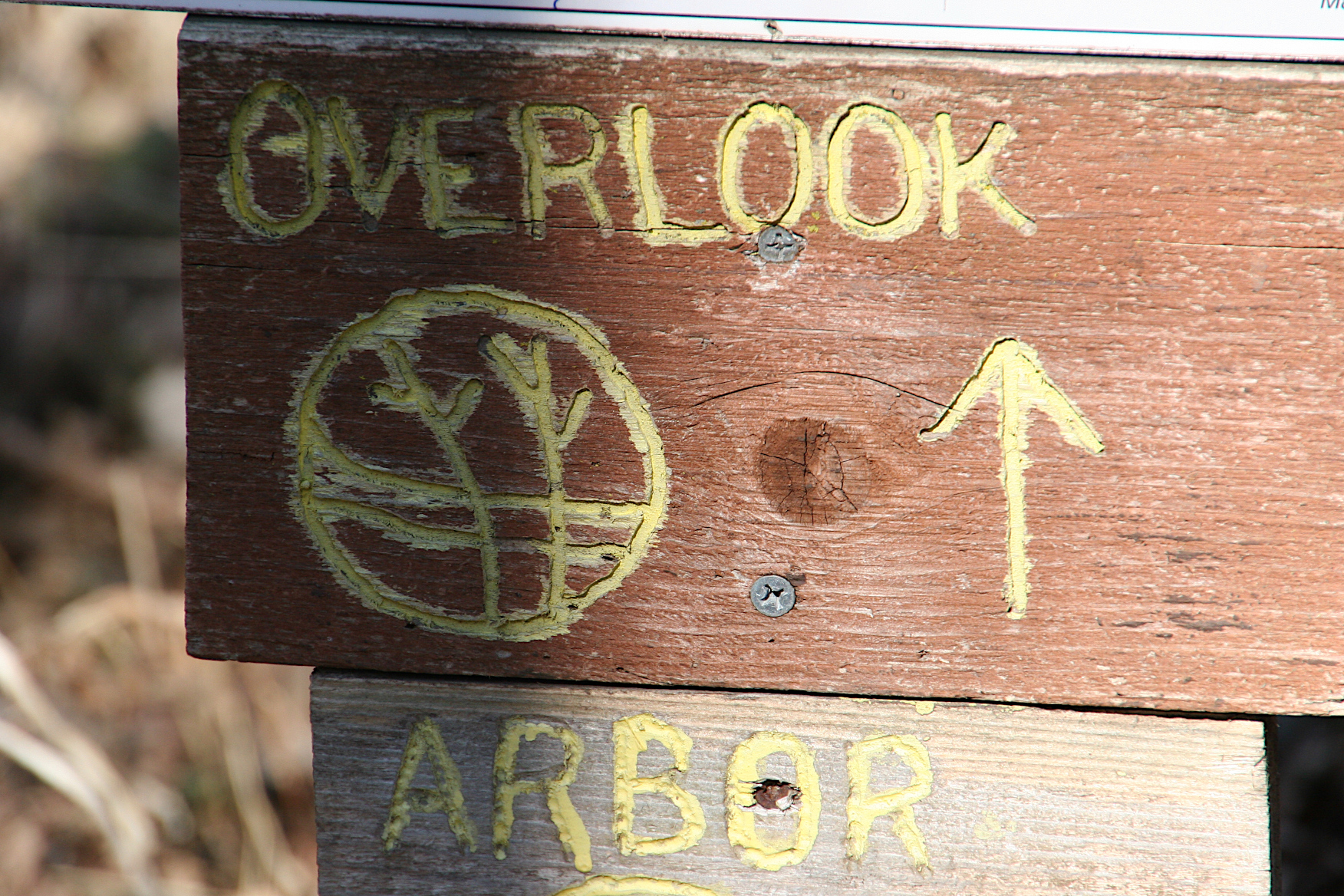
Signage identifies the the Arbor and Outlook Trails at River Bend Nature Center, Faribault. (Minnesota Prairie Roots copyrighted photo March 2022)
On a recent walk through Faribault’s River Bend Nature Center, I noticed nuances of nature that might otherwise not be seen in a leaf canopy, or at least not as deeply appreciated.
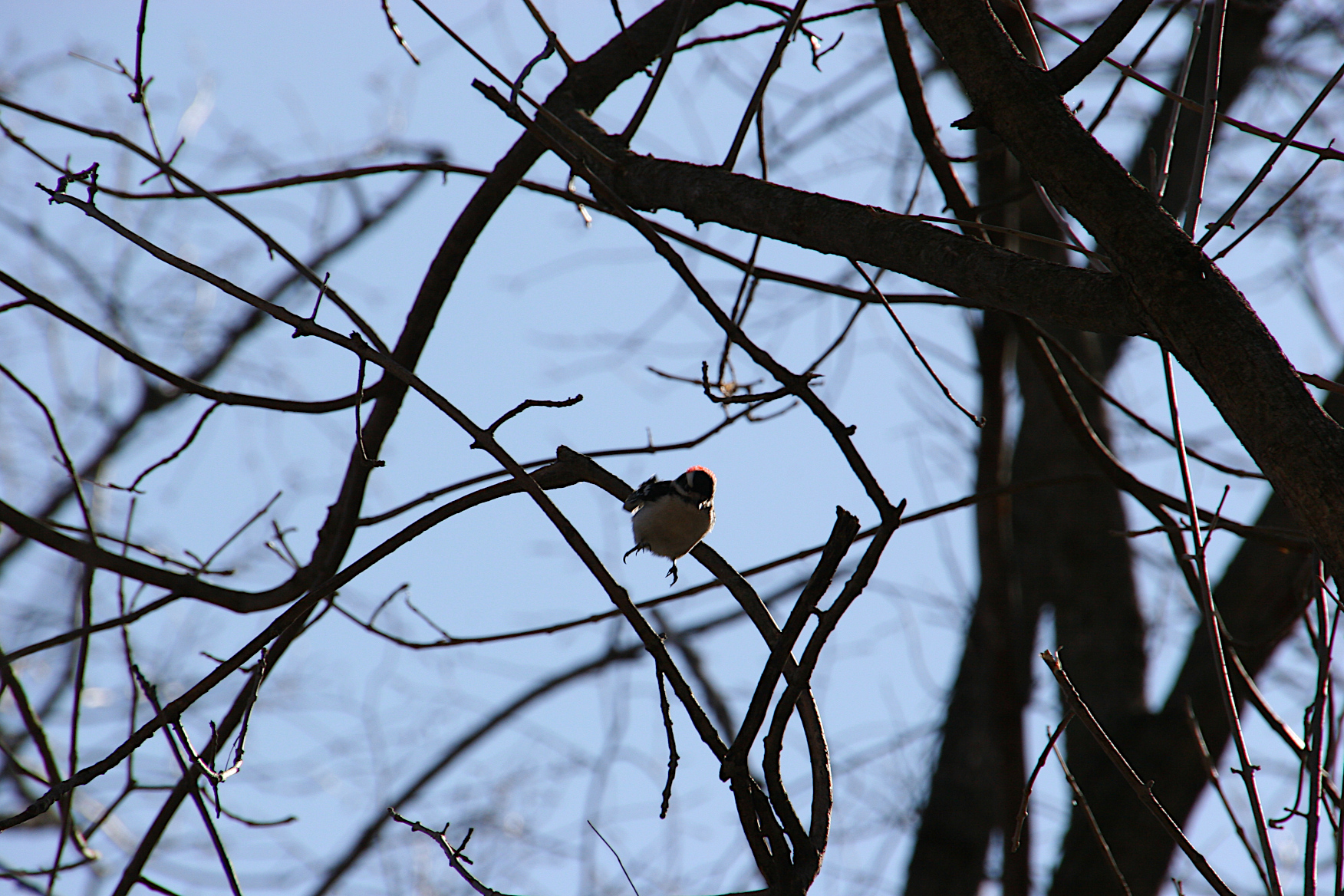
A woodpecker in flight. (Minnesota Prairie Roots copyrighted photo March 2022)
Following the Arbor Trail loop into the woods, I noticed first a red-capped woodpecker. I determined to get a photo. But, if you’ve photographed birds, you understand that such an endeavor requires patience, planning and a bit of luck. I caught the bird in flight. Maybe not the sharpest image, but certainly an unexpected moment I managed to snapshot.
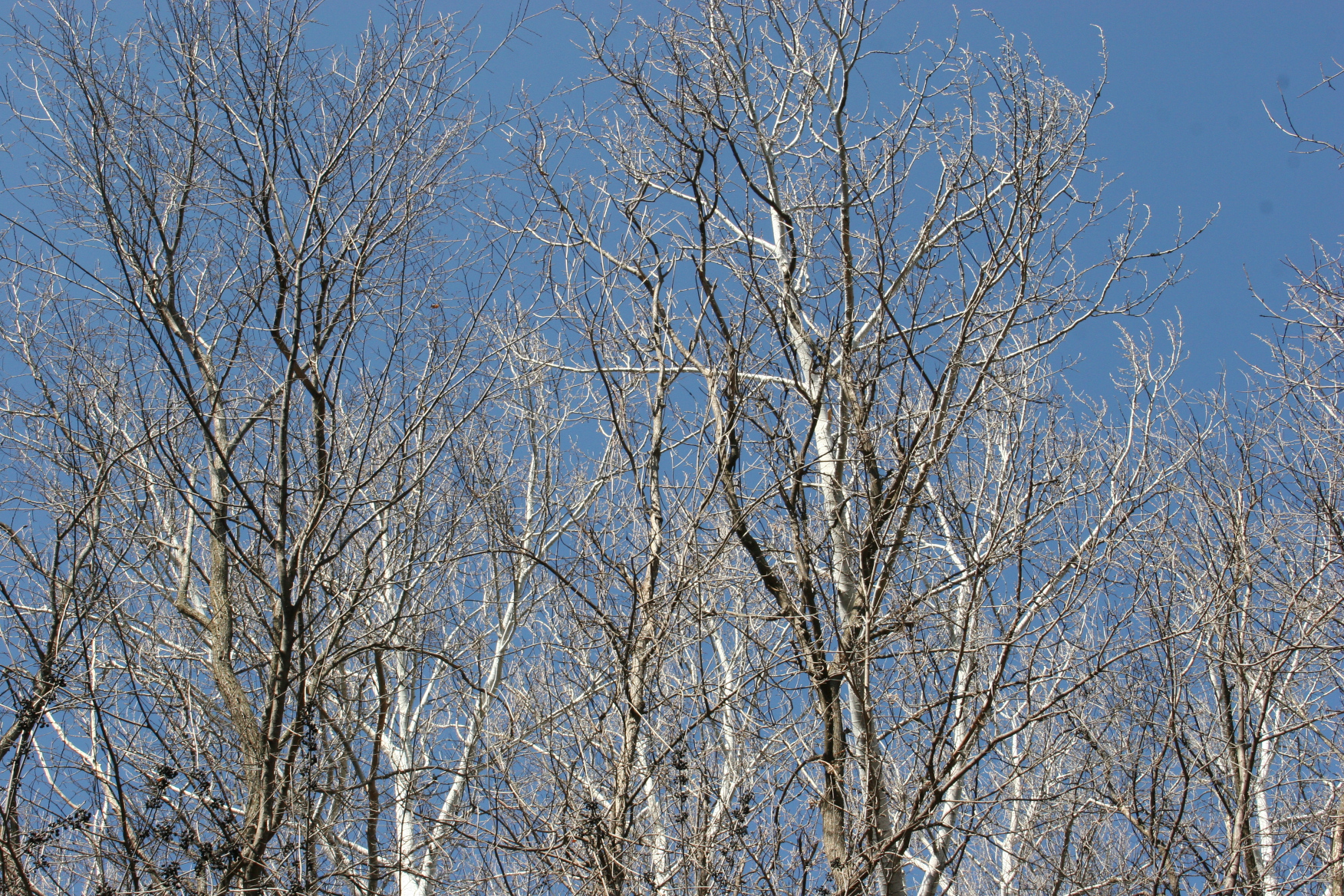
Bare treetops, beautiful against a bold sky. (Minnesota Prairie Roots copyrighted photo March 2022)
Trees themselves also draw my interest. I find myself especially drawn to oaks. Their sturdiness and expansive canopy exude strength and artistry. But I find birch trees equally as fascinating. Or at least those with white bark, which could be birch or aspen. Without leaves, trees are much more challenging to identify, at least for me.
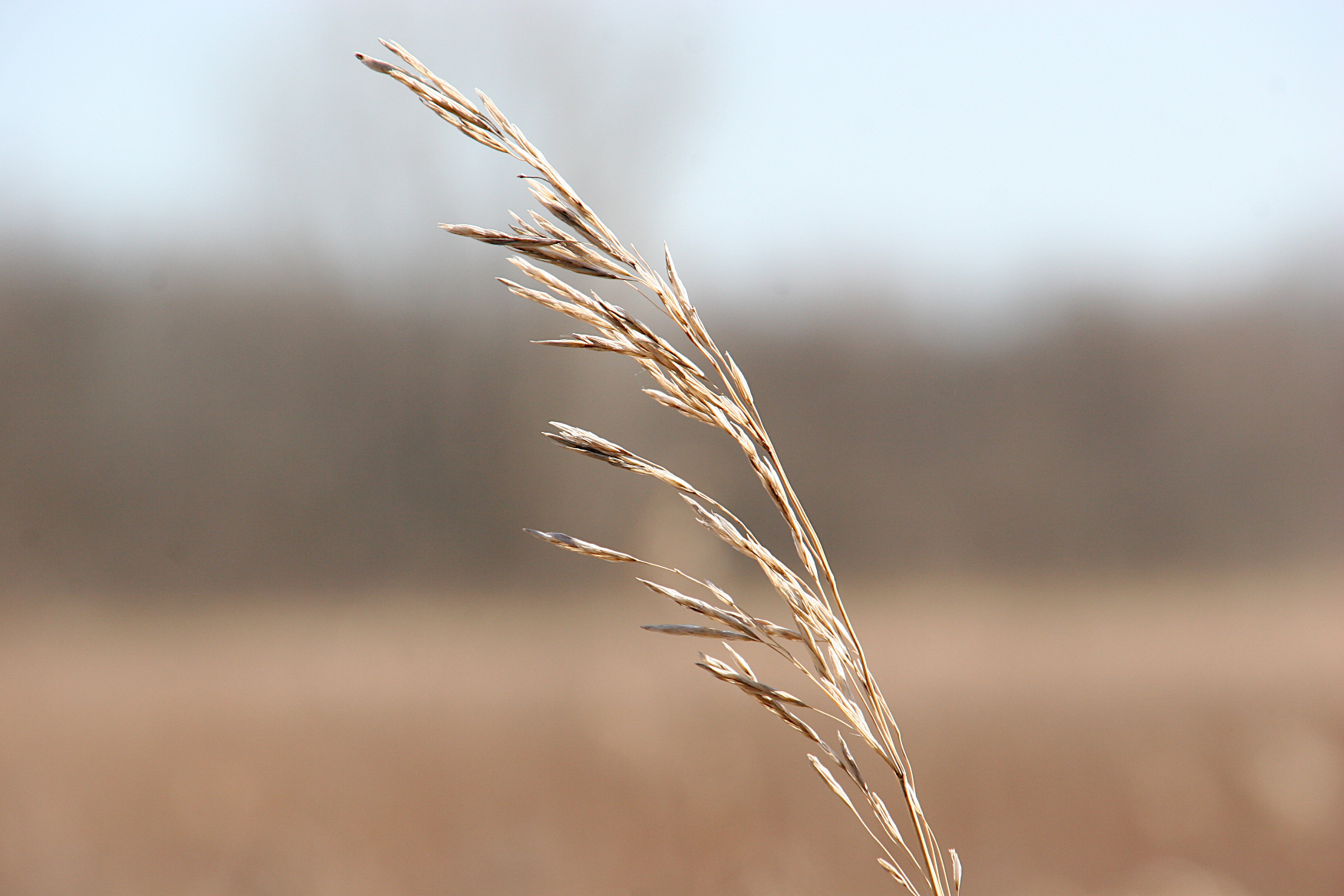
I love the beauty of dried grasses. (Minnesota Prairie Roots copyrighted photo March 2022)
As I forked off the Arbor Trail to the Overlook Trail, the vista opened to prairie. Now, as you would expect, this native prairie girl loves the prairie. No matter the season. I appreciate the tall dried grasses that arch and dip in the wind. Rhythmic. Poetic.
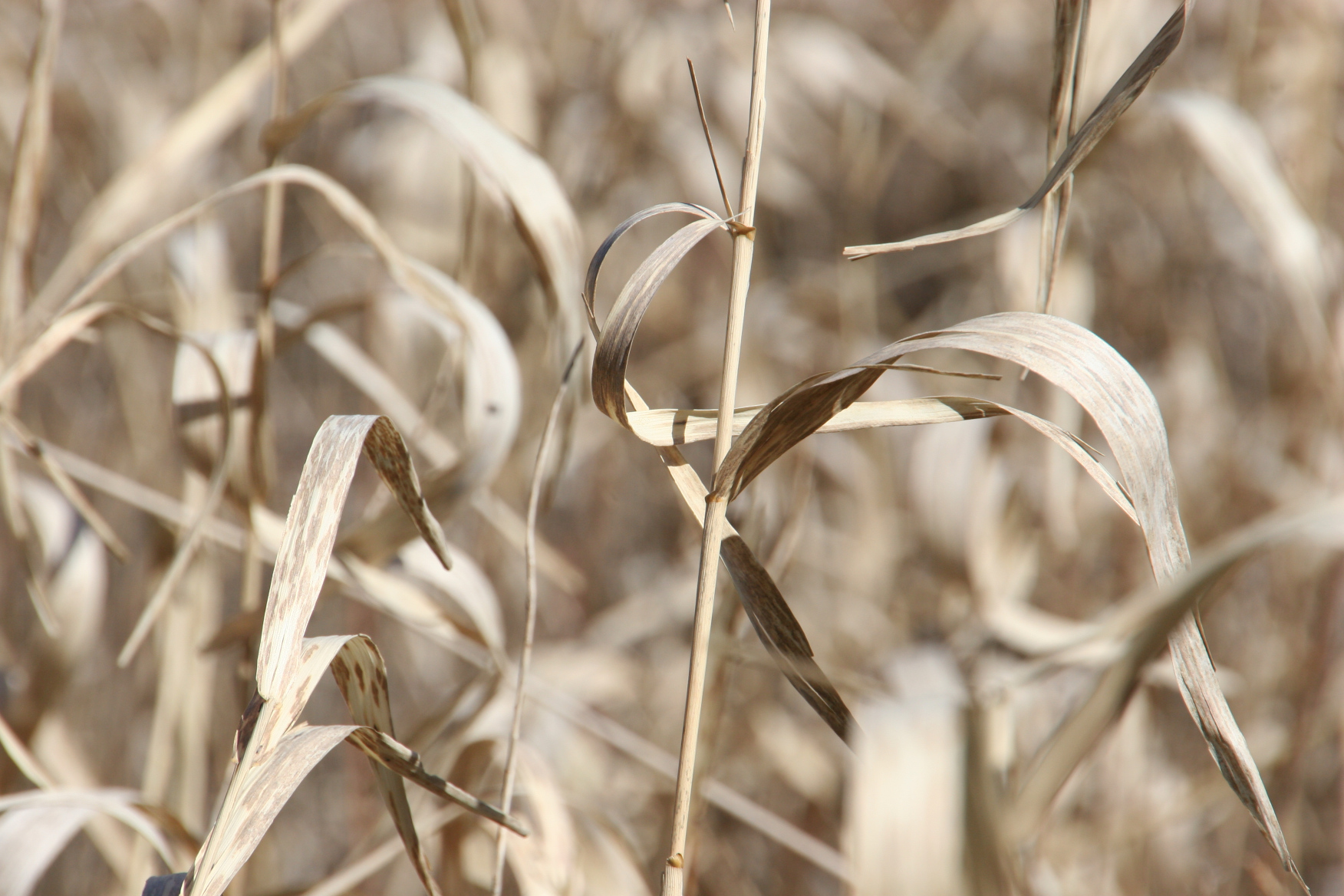
A solo grass stem bends in the wind. (Minnesota Prairie Roots copyrighted photo March 2022)
A single stem of grass reminds me of youthful summers on the farm, of playing in untamed tall grass. It reminds me, too, of the writing of Laura Ingalls Wilder, a favorite author. I grew up some 20 miles from her childhood home in Walnut Grove. Her ability to notice details inspires me in my writing.
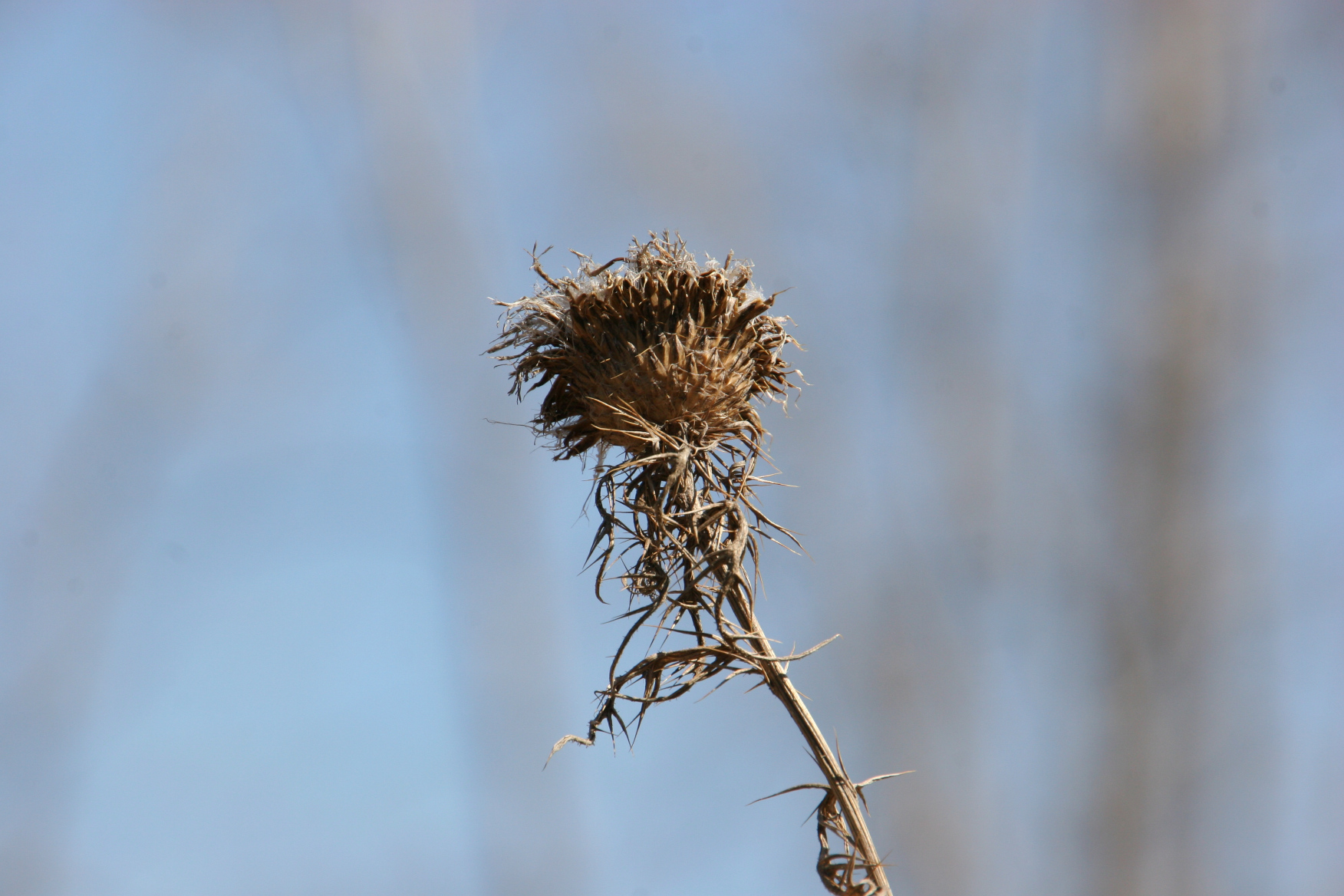
Beauty in a seed head. (Minnesota Prairie Roots copyrighted photo March 2022)
Dried seed heads catch my eye. Details. Promise of new growth from last season’s remnants.
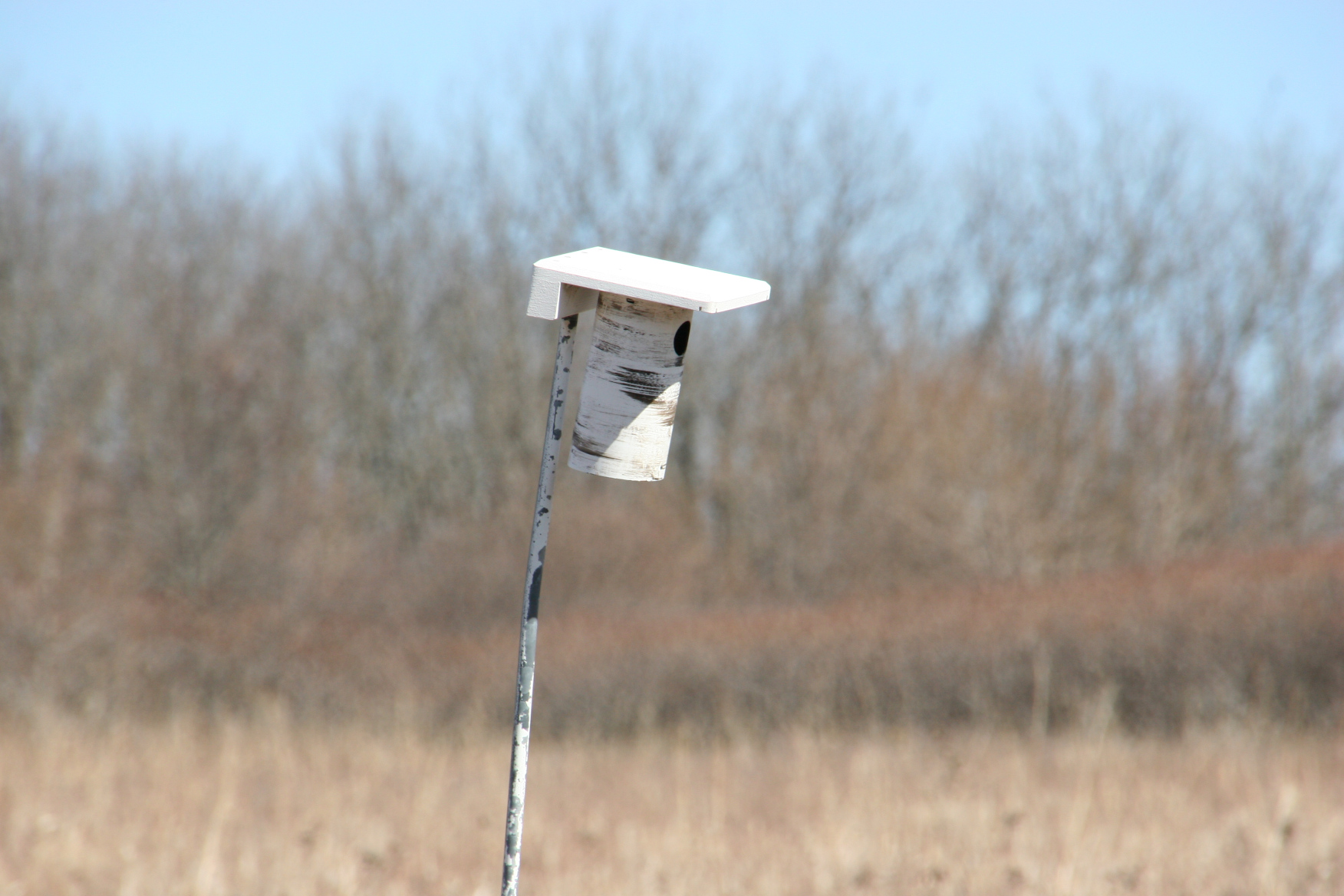
One of the many bluebird houses checked and maintained by volunteers. (Minnesota Prairie Roots copyrighted photo March 2022)
I notice, too, the bluebird house among the prairie grasses. Thanks to Keith Radel, who hails from my hometown and has lived in Faribault for decades, the bluebird thrives in these parts. Known as Mr. Bluebird, Keith appreciates bluebirds with a passion unequal. He’s determined to protect them, to assure they flourish. It’s heartening to see his devotion to this bird.
I see the deer and the deer see me through a treeline. (Minnesota Prairie Roots copyrighted photo March 2022)
As I return to the Arbor Trail, I wonder if I will see any deer, previously spotted in this area. And then Randy, my walking partner, alerts me to their presence. There, on the prairie, I observe four deer. I move quietly toward the edge of the treeline to photograph them through the trees. Careful. Cautious. Not wanting to scare them away before I can lift and focus my lens. But they are already aware, frozen in place, ears upright, faces turned toward me.
The deer vanish, nearly unseen, into the tall prairie grasses. (Minnesota Prairie Roots copyrighted photo March 2022)
Soon they are hightailing it away, vanishing, camouflaged by the high brown prairie grasses. I never tire of watching deer, even though I consider them too numerous and a roadway hazard.
In just a short distance, I’ve noticed nature’s nuances. In a woodpecker. In the bark of trees. In the prairie grasses. And, finally, in a quartet of deer. What a gift in this not winter, not-quite-spring season in southern Minnesota.
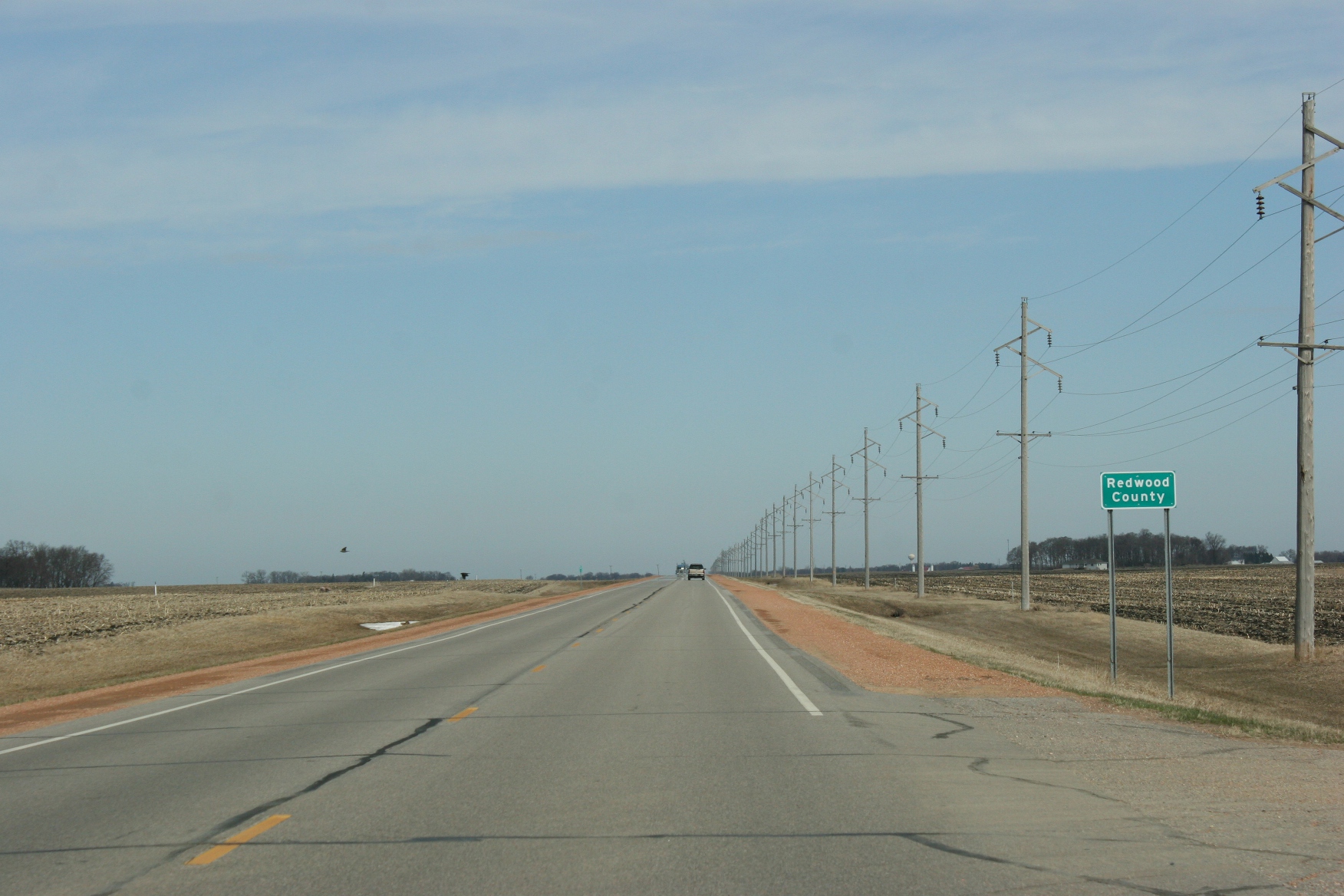
Entering my home county of Redwood along Minnesota State Highway 68 southeast of Morgan. (Minnesota Prairie Roots copyrighted file photo April 2018)
ON THE AFTERNOON of the April morning I scanned the #811 shelves at Buckham Memorial Library for poetry books, I raked a banana from the boulevard.
“Hey, I found a rotten banana,” I hollered to Randy, who had just switched off the lawnmower as he mulched leaves.
“You didn’t eat it, did you?” he asked.
“No,” I shouted back, rolling my eyes at his humor.
“I found a dead mouse or squirrel earlier,” he shared in an apparent effort to top my discovery of a dried black banana. (We never know what we’ll find while raking in the spring.) He walked across the lawn to the curb along busy Willow Street and kicked up the dried carcass I really did not want to see.
“Mouse,” I concluded, and looked away.
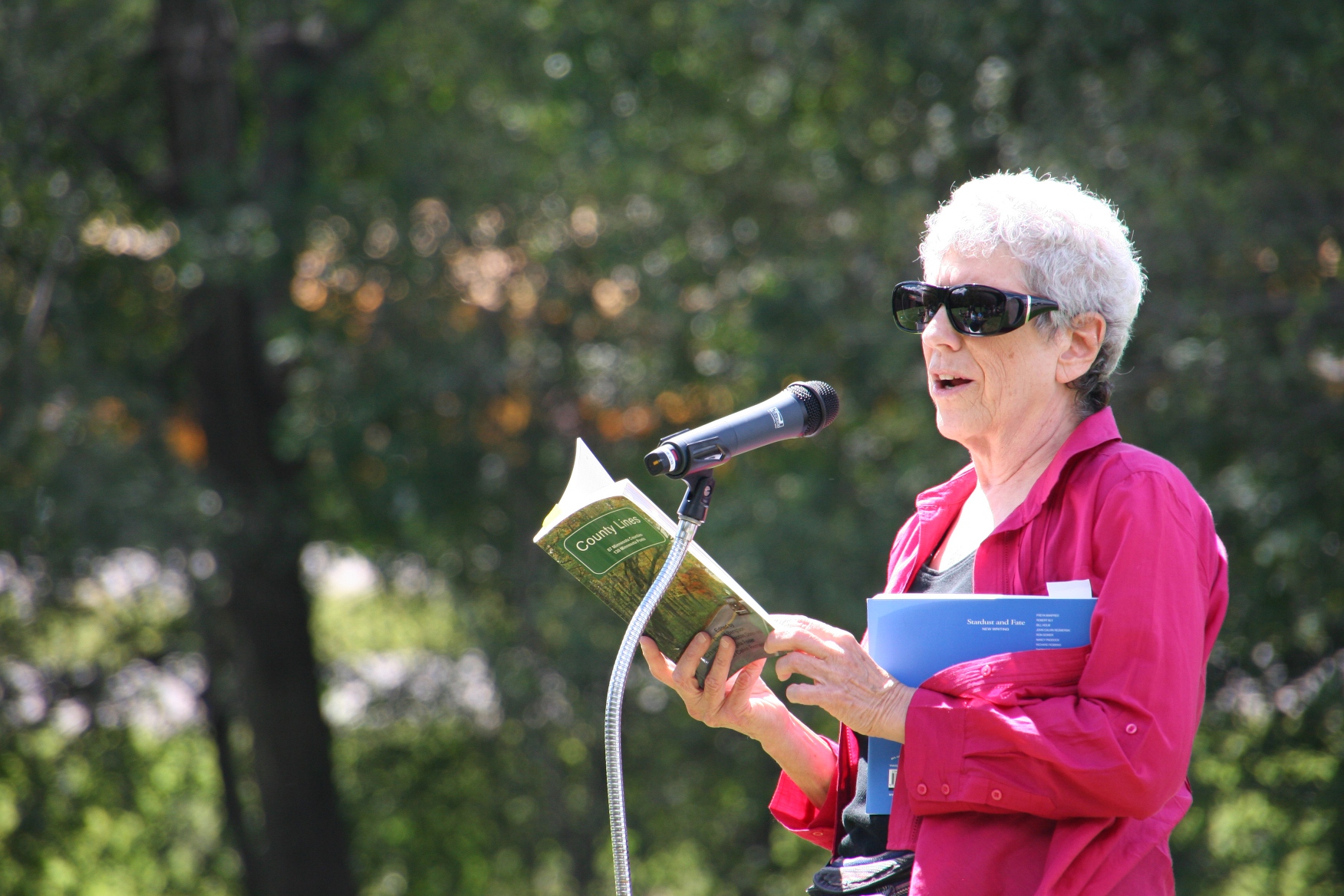
Mira Frank reads the works of Minnesota poets from “County Lines” at an event in St. Peter in 2016. (Minnesota Prairie Roots copyrighted photo August 2016)
It’s a must-read book which accurately, and poetically, reflects Minnesota. Among the poems published therein, “April” by Connie Wanek. The first four lines of her five-verse poem from St. Louis County, are so relatable. She writes:
When the snow bank dissolved
I found a comb and a muddy quarter.
I found the corpse of that missing mitten
still clutching some snow.
As someone who’s lived in Minnesota her entire life, I “get” most of the poetry published in this collection. These poets write about land and weather, experiences and observations, small town cafes and polka dancing and trains roaring down tracks and closing the cabin and picking rock and…
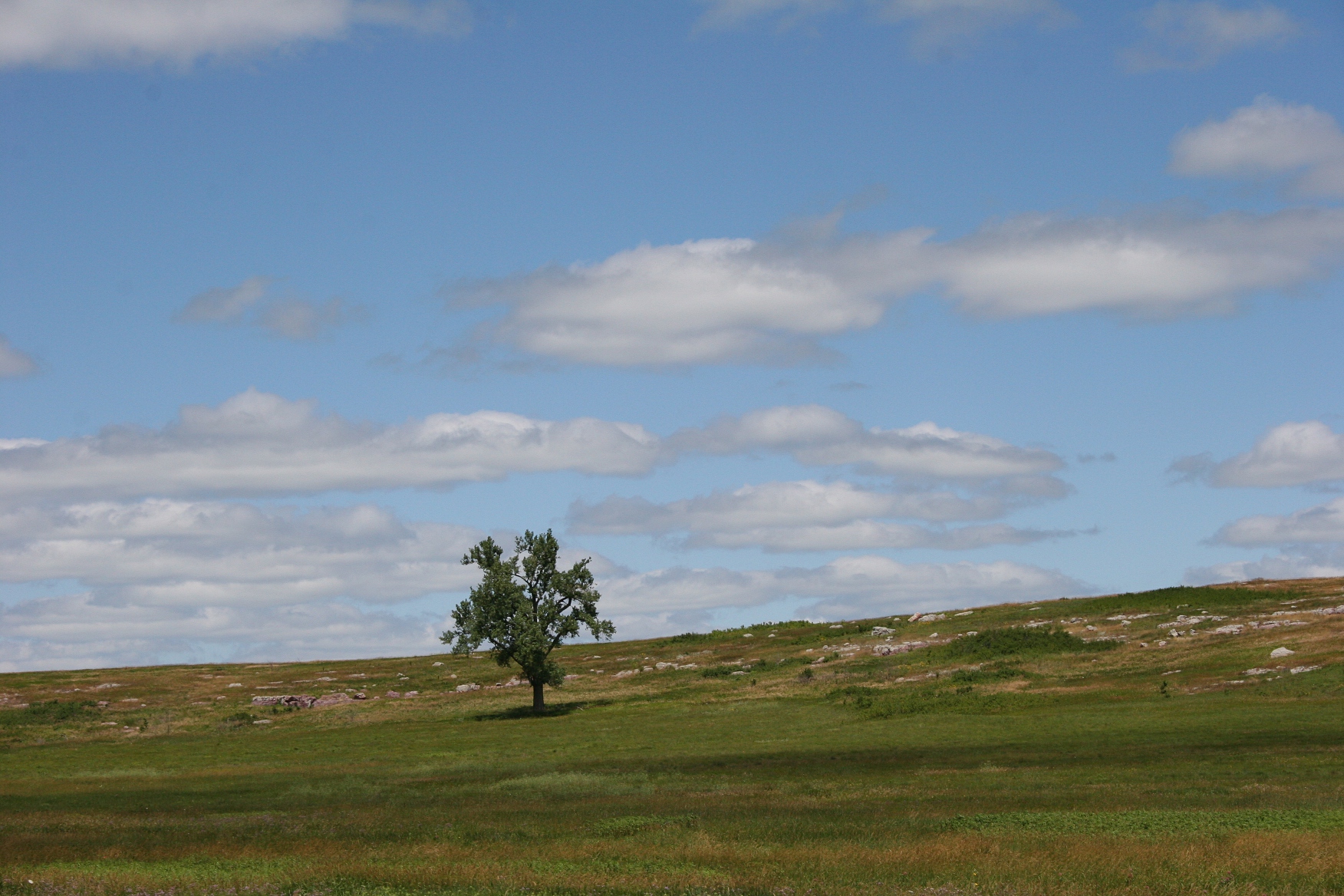
The plentiful large rocks pictured here at Blue Mounds State Park are likely similar to those referenced in Leo Dangel’s poem.The park in rural Luverne is about 20 miles from Jasper, which Dangel names in “Stone Visions.” (Minnesota Prairie Roots copyrighted file photo August 2013)
I laughed aloud when I read Leo Dangel’s “Stone Visions” from Pipestone County in my native southwestern Minnesota. The topic—picking rock. For those of you who’ve never picked rocks, it’s exactly what it says. Walking through a field gathering and tossing rocks that seem to sprout every spring. Poet Dangel viewed oversized stones in a field near Jasper in a poetic way while his farmer uncle observed, “I’d hate like hell to start picking rock in those fields.”
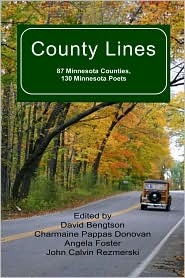
Image source: Goodreads.
Uncovering rocks. Uncovering a dried mouse carcass. Uncovering a dried black banana. Uncovering poetry that resonates. Within the span of several hours, I found winter’s remains and a treasure of a poetry collection.
County Lines uncovers the stories of Minnesota in poetic voice from lesser-known to well-known Minnesota writers. Poets like David Bengston, Robert Bly, Philip S. Bryant, Susan Stevens Chambers, Charmaine Pappas Donovan, Angela Foster, Larry Gavin, Laura L. Hansen, Sharon Harris, Margaret Hasse, Bill Holm, John Calvin Rezmerski, Candace Simar, Joyce Sutphen and so many more.
From Willmar to Hibbing to Lac qui Parle and, oh, so many places in between, the layers of our state, our people, our stories, our history, our heritage are revealed. This April day I celebrate National Poetry Month in a Minnesota poetry book pulled from the #811 shelves at Buckham Memorial Library in Faribault.
#
FYI: Former Minnesota Poet Laureate Joyce Sutphen will read from her newest poetry books, Carrying Water to the Field and The Long Winter, at 1 pm Saturday, April 23, at the Little Falls Carnegie Library. “Making Rural Connections Through Poetry with Joyce Sutphen” focuses on the loss of small farms in Minnesota. Sutphen grew up on a Stearns County farm. Three of her poems are featured in the “Stearns County” entries in County Lines.
TELL ME: Do you have a favorite book of poetry you’d like to recommend? Or, if you’ve written a book (s) of poetry, please feel free to share information here.
The birth of Christ depicted at St. Michael’s Catholic Church, Buckman, Minnesota. This is my husband’s home church. (Minnesota Prairie Roots file photo September 2020)
STAINED GLASS ART graces many a church. Most often that art depicts the history of Jesus’ birth, death and resurrection.
This stained glass window inside the Mother of Good Counsel Votive Chapel at The Shrine of Our Lady of Guadalupe, La Crosse, Wisconsin, depicts Mary and Jesus. I often think of Mary during Holy Week and how great her loss in losing her son. (Minnesota Prairie Roots copyrighted file photo 2015)
So it’s fitting that this week, Holy Week, I share some images from my archives of beautiful stained glass windows discovered in my wanderings. As a woman of faith, an art appreciator and one who values churches, I am drawn to this art form.
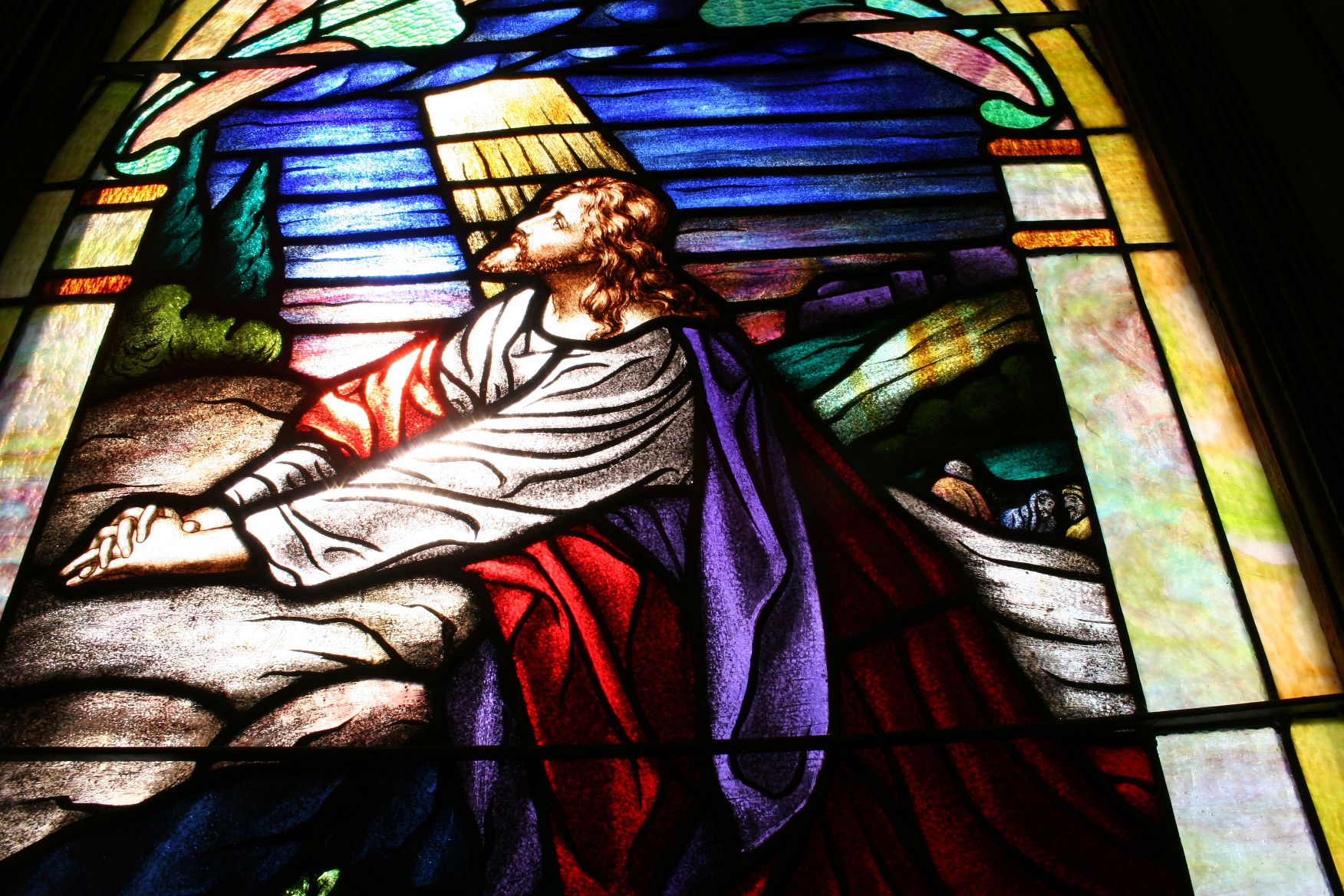
Jesus prays in the Garden of Gethsemane. Stained glass window in the sanctuary of Vang Lutheran Church, rural Dennison, Minnesota. (Minnesota Prairie Roots copyrighted file photo 2014)
My husband, Randy, has dabbled in stained glass art and I know from watching him that creating this art takes time, patience, skill and dedication. He took a stained glass class locally decades ago, has crafted several sun catchers and also repaired aged windows at our church, Trinity Lutheran in Faribault. I hope that when he retires, he can more fully embrace this art form.
Jesus carries his cross to Golgotha. Stained glass at St. Michael’s Catholic Church, Buckman. (Minnesota Prairie Roots copyrighted file photo September 2020)
That sidebar aside, I feel such gratitude to those long ago craftsmen who labored to create stained glass windows for churches. Such windows enhance worship, infusing a sanctuary with beauty and a visual telling of biblical stories. Like the birth of Jesus. The agony of his suffering, death and glorious resurrection.
Like illustrations in a book, the art of stained glass adds to the words, opens our eyes to better see that which we hear and read.
This stained glass window of the women and angel at Jesus’ empty tomb rises above the altar at Holden Lutheran Church, rural Kenyon, Minnesota. (Minnesota Prairie Roots copyrighted file photo 2016)
Art adds a depth to my understanding and to my faith.
This shows a snippet of the center stained glass window in a trio above the altar at Trinity Lutheran Church, Wanamingo, Minnesota. This section shows Jesus risen from the dead. (Minnesota Prairie Roots copyrighted file photo 2016)
As we near the end of Holy Week, please take time to reflect on the stained glass art here or within your own community.
A photo of Christ’s face from a stained glass window in my church, Trinity Lutheran, Faribault. (Minnesota Prairie Roots copyrighted file photo 2012)
And may this art bless you as it has me. Have a joyful and blessed Easter!
In all that time, I have yet to grieve like I feel I should. That is a heart-wrenching, full-out crying session of shoulders heaving, tears gushing, emotions overtaking me.
And I keep asking myself, “Why can’t I cry?” I loved my mom and I miss her and losing her is one of life’s greatest losses.
The answer to my self-imposed question seems multi-layered. Losing my mom was a gradual process. One of declining health paired with an inability to connect with her during these awful years of a global pandemic. Long before her death, she lost the ability to talk on a telephone. So my weekly Sunday evening phone calls to her ceased. My last long-distance conversations with her were via speaker phone, me talking “at” her rather than “to” her.
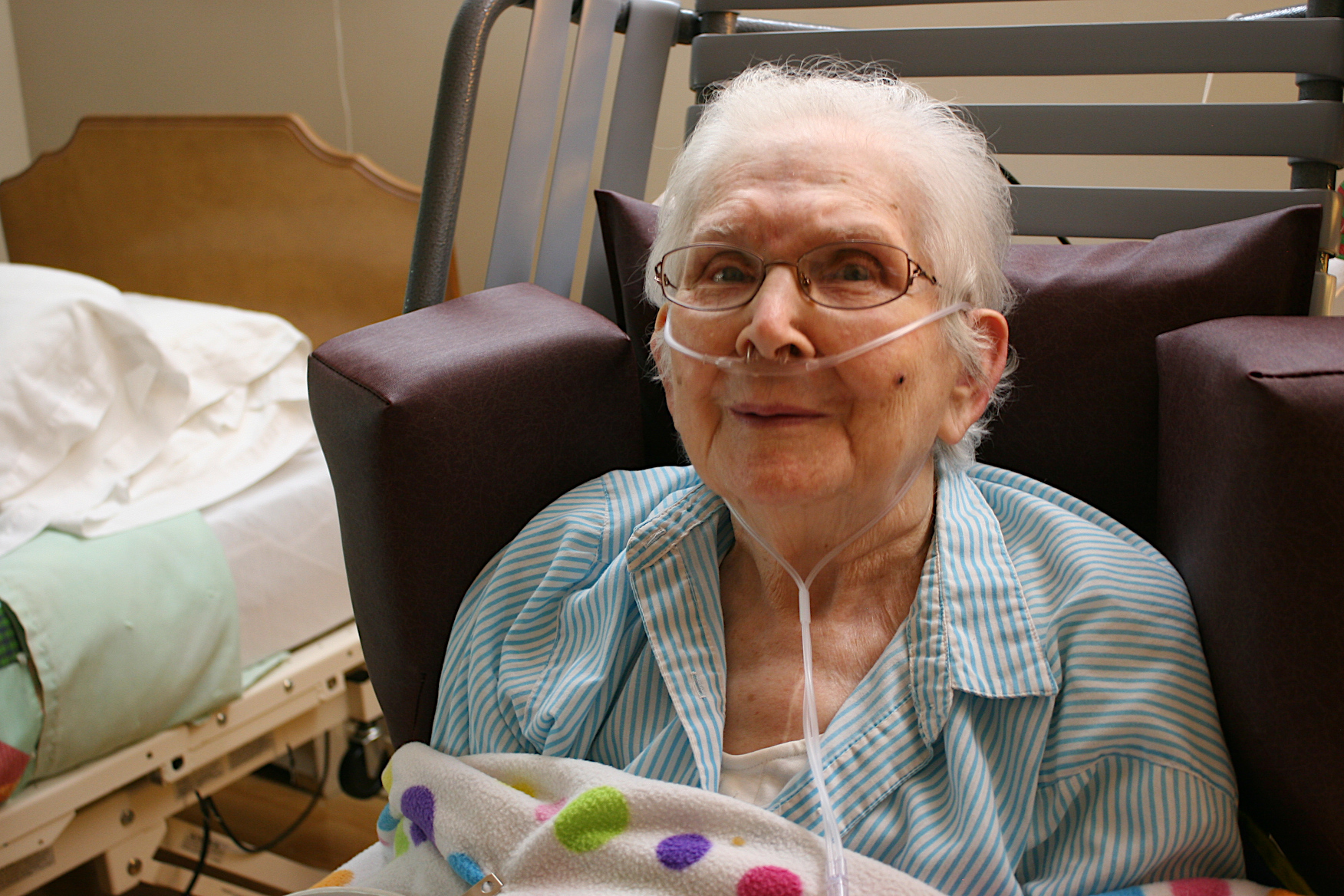
One of my last portraits of Mom. We had a particularly good visit that day. (Minnesota Prairie Roots file photo July 2021)
As Mom’s memory and overall health faded, even our rare in-person visits at her care center proved difficult. I reminded myself that I was there for her, not for me. And that helped. If she connected with a flicker of recognition or a smile or a few words, then I felt grateful. It was always about her. Not me. Always.
Today I feel an emptiness. A void. An absence.
Her public funeral (not something I wanted/supported) did not provide an outlet for my grief. It was not a funeral as usual for me at the height of omicron. I did not stand in a receiving line accepting hugs and hand shakes. That was way beyond my comfort level among the unmasked in a crowded fellowship hall and sanctuary in rural southwestern Minnesota. I felt disrespected as a grieving daughter and nearly did not attend the funeral due to the health risk (to myself and others). But I mustered through, feeling like a masked outsider at my own mother’s funeral. Grief and comfort eluded me on Mom’s burial day because of choices made. And not necessarily just my choices.
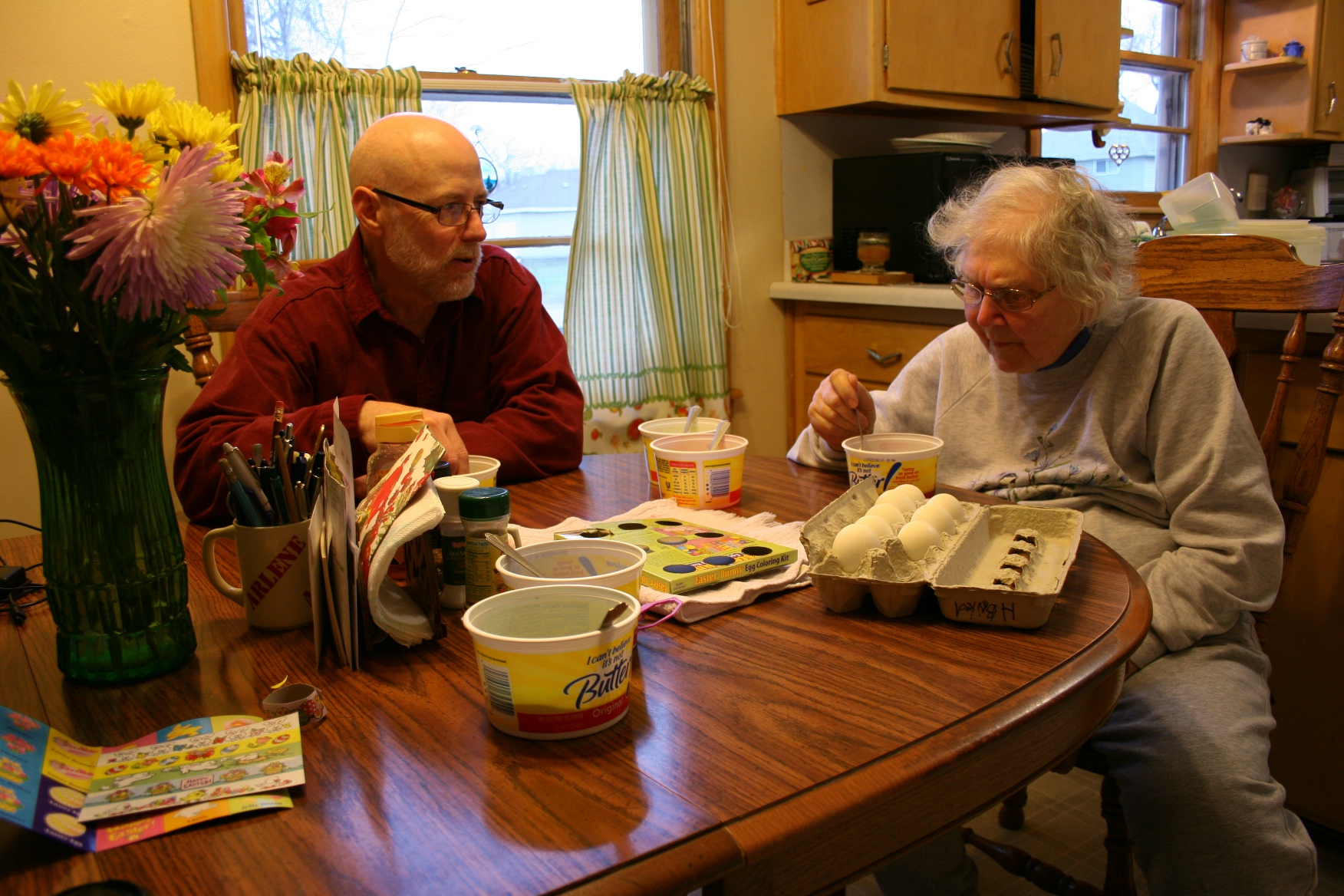
Randy and Mom dye Easter eggs in her home in 2014. (Minnesota Prairie Roots copyrighted file photo April 2014)
And so here I am today, three months later. Recently I stood before a rack of Easter-themed greeting cards at Dollar Tree. My eyes scanned the labels—for daughter, son, granddaughter, grandson…then focused on “Mom.” And in that moment I felt the pain of losing Mom and I remembered the Easter of 2014 when Randy and I traveled 120 miles to my hometown of Vesta to spend the holiday weekend with her. I recall how she delighted in dyeing eggs, giddy like a child. Oh, to bring her such joy. But that April visit also proved a pivotal point for Mom. We observed her debilitating chronic pain, her inability to get around. Shortly thereafter, she moved into assisted living. Eventually, she would land in the nursing home wing of Parkview, her home for nearly eight years.
One of the many inspirational pieces Mom clipped and saved. (Minnesota Prairie Roots photo)
As I reflect on Mom’s journey, I feel thankful that she lived to age 89, nearing 90. Too many times during her life, we did not think she would survive major health crises. A viral infection in her heart nearly killed her in the early 1980s. Open heart valve replacement surgery followed. She nearly bled to death another time. Pneumonia almost claimed her life years later. A broken neck resulting from a fall placed her in a metro area ICU trauma unit. Countless times we gathered at her bedside to say our goodbyes. But each time Mom pulled through and relief washed over me. Once more.
Did all of those near-death experiences factor into how I feel today about Mom dying? Perhaps. I’d mentally prepared myself and said “goodbye” so many times in the past. Now when I need to grieve, grief feels elusive.
Her name remains in black marker on my whiteboard prayer list. I thank God for bringing her to faith, for blessing me with her as my mother, for the long life she lived.
Her name remains inked, too, in my address book. I can’t bring myself to X it out, for doing so means finality.
I expect prior to Mother’s Day, when I’m standing before the card rack at Dollar Tree searching for a card for my daughter, my eyes will scan the labels then land on “For Mom.” And when that happens, grief will rise. Not in tears, but in the way grief sneaks up on you in the most ordinary of ways and clenches your heart with pain.
#
JUST A NOTE: I recognize that grief is a process, one that takes time and differs for everyone. I recognize that many of you are also grieving and that you, too, may have experienced a loss of public comfort and grief during the pandemic. I’m sorry. I understand. I empathize. You are not alone. I care. Others care.


















 Minnesota Prairie Roots
Recent Comments