Minnesota Prairie Roots

Writing and photography by Audrey Kletscher Helbling

In Faribault: Scholar to address Lincoln’s response to the U.S.-Dakota War of 1862 September 5, 2012

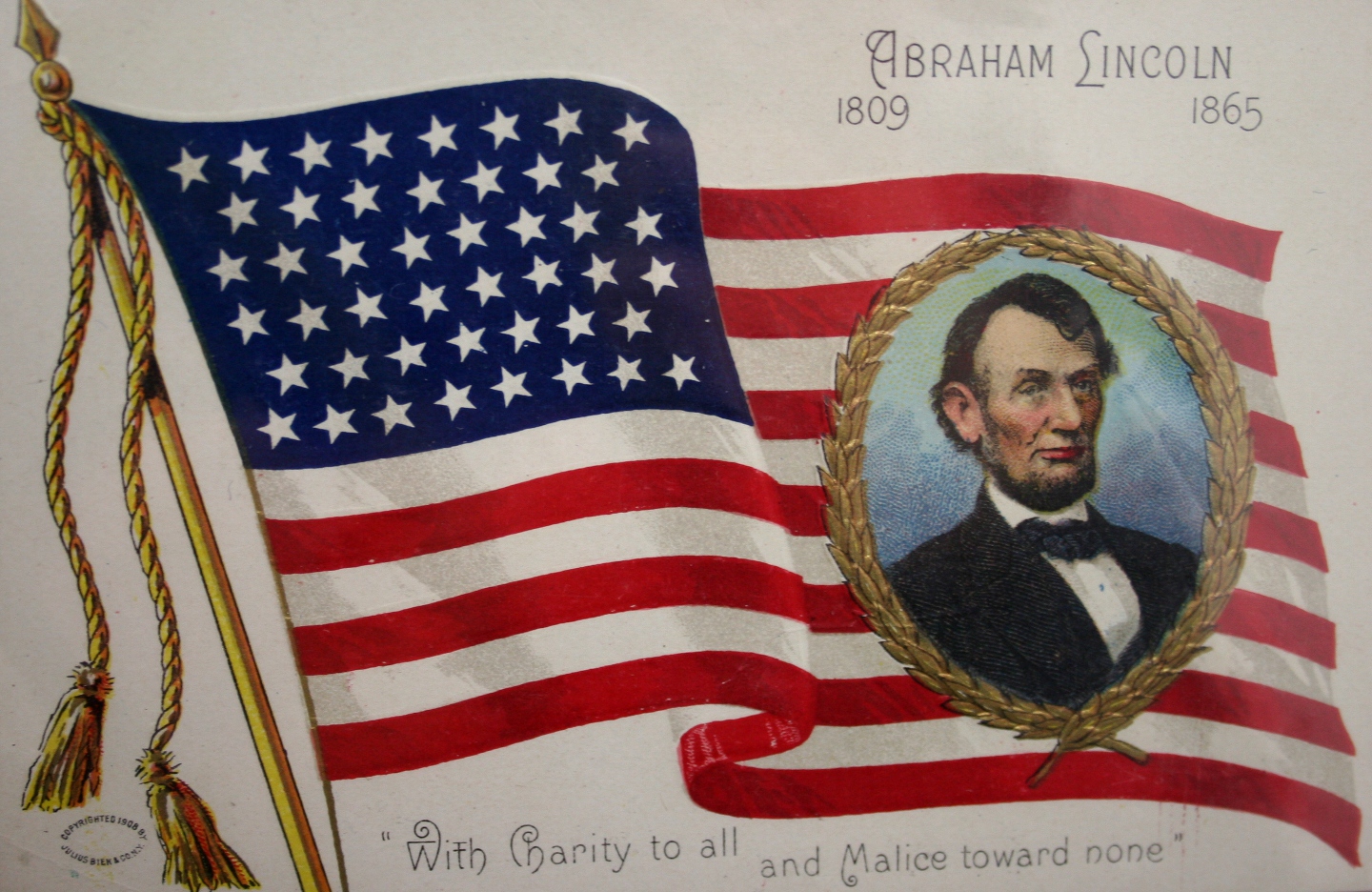
A Lincoln postcard which a collector brought to a Cannon Valley Civil War Roundtable meeting several years ago.

THE FIRST TIME I ATTENDED a Cannon Valley Civil War Roundtable meeting nearly three years ago, I arrived expecting to view slave documents. The presenter, however, left the papers at home and brought, instead, memorabilia specifically related to Abraham Lincoln.

He did not disappoint. I viewed vintage postcards and original photos of Lincoln, Civil War buttons and replicas of Mary Todd Lincoln’s White House china, among many other items.

An 1840 Philadelphia Derringer, like the pistol used to assassinate President Abraham Lincoln.

What impressed me the most, however, was the collector’s 1840 Philadelphia Derringer, exactly like the pistol with which John Wilkes Booth assassinated Lincoln. The weapon was nearly small enough to hide in the palm of my hand.

Visuals like that teach me more about history than any textbook ever will. So do guest speakers. They address the monthly meetings of the Roundtable whose 25 members are interested in preserving and interpreting the Civil War.

Now the Faribault-based Cannon Valley Civil War Roundtable is bringing in a scholar of Abraham Lincoln to kick off its eighth year as an organization. You needn’t be a Roundtable member to attend; I’m not.

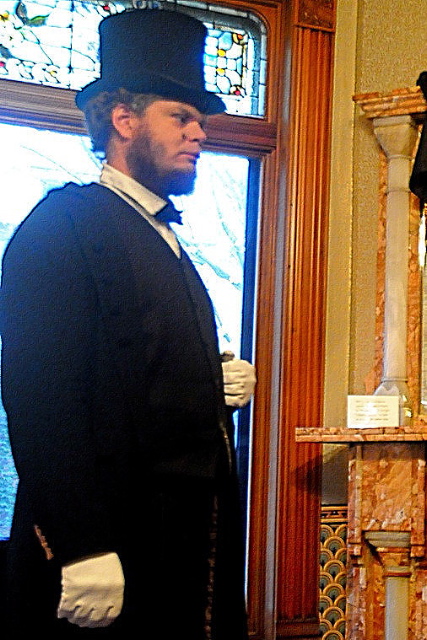
Bryce Stenzel of Mankato portraying President Abraham Lincoln. Stenzel, among other things, directs Lincoln’s Traveling Troupe, a group of students and community actors who bring Lincoln’s life and legacy to life via a dramatic, living history portrayal and authentic re-enactment.

Bryce Stenzel of Mankato, who developed a first-person portrayal of Abraham Lincoln in 1989 and since has traveled around the country presenting, will present “1862: Lincoln Trials by Fire” at 7:30 p.m. Thursday, September 20, at the Faribault American Legion, 112 Fifth St. N.E.

He will address, Stenzel says, “the ‘State of the Union’ as it existed in 1862 and Lincoln’s response to the U.S.- Dakota War, against the backdrop of the American Civil War and the issuance of the Preliminary Emancipation Proclamation on September 22, 1862.”

It’s a timely topic given this year marks the 150th anniversary of the U.S. – Dakota War.

Specifically, Stenzel details, his upcoming program “is a means for Faribault to acknowledge its unique connection to the U.S. – Dakota War by paying homage to its native son, Bishop Henry Whipple. Even though no fighting took place in Faribault, your community played an active role in influencing the final outcome.”

This historian, who has authored eight books on local historical and Lincoln-related topics, possesses an advanced history degree and has taught social studies/history at all levels, including college, has long taken a personal interest in the U.S. – Dakota War. His great-great grandmother and her two-year-old daughter escaped a band of Dakota warriors by hiding in tall prairie grasses. And his great-great grandfather served with the Fifth Minnesota Regiment and fought in the decisive Battle of Nashville in 1864.

Stenzel grew up in Mankato, where 38 Dakota were hung in the largest mass execution in U.S. history. President Lincoln commuted the death sentences of 265 Dakota.

Says Stenzel:

The central question of my presentation is why did Lincoln feel compelled to intervene at all, when he didn’t have to? In fact, from a political standpoint, Lincoln committed political suicide—most Minnesotans at the time believed it was both right and necessary to hang the Indians as a means of preventing such a tragedy from ever happening again. It is useful for the modern audience to consider that what was “politically correct” in the 19th century, is no longer. Historical interpretation changes with time.

Dan Peterson, a member of the Cannon Valley Civil War Roundtable who has heard Stenzel speak, fully endorses him: “(Stenzel)) reminds me of my love for Abraham Lincoln just to be in his audience or close to him. Lincoln is on our money, our named streets, one state capitol, highways, buildings, businesses, cars and more. You just cannot get away from him.”

FYI: Tickets to the dinner and program are on sale now at the Rice County Historical Society in Faribault or from Chuck Peterson (507-301-2470), Jan Stevens (507-244-0500) or Dan Peterson (507-459-3140). Cost is $22 for non-members and $20 for paid-up members of the Cannon Valley Civil War Roundtable.

Tickets for the meal of pork ribs with trimmings must be purchased by Saturday, September 8. The event begins at 5 p.m. on September 20 with a social and then dinner at 6 p.m.

If you want to attend just the Lincoln presentation by Stenzel, the cost is $10 for adults, $5 for students 16 and older, and free for those under 16. The program begins at 7:30 p.m.

The Cannon Valley Civil War Roundtable meets the third Thursday of each month at 7 p.m. at the Faribault Senior Center with a speaker at each meeting. In October, the topic will be the New Ulm raid as part of the U.S. – Dakota War; in November, the Antietam Battlefield; and in December, the annual Civil War food potluck (probably with possum soup, hardtack and more, Peterson promises).

© Copyright 2012 Audrey Kletscher Helbling
Bryce Stenzel photo courtesy of Bryce Stenzel


New exhibit highlights Rice County in the U.S.-Dakota War of 1862 September 2, 2012

IT IS EASY TO FORGET SOMETIMES, because I grew up in the region of Minnesota where the U.S.-Dakota War of 1862 was centered, that residents of the county in which I now live also played an integral role in the conflict.

Specifically, Rice County residents Bishop Henry Whipple and Alexander Faribault, after whom my community of Faribault is named, are key persons often noted in historical information written about the war.

I am always surprised that relatively few people from outside of southwestern and central Minnesota know so little about the bloody, six-week war between the Dakota and the white settlers and soldiers given it is a major, defining event in Minnesota history.

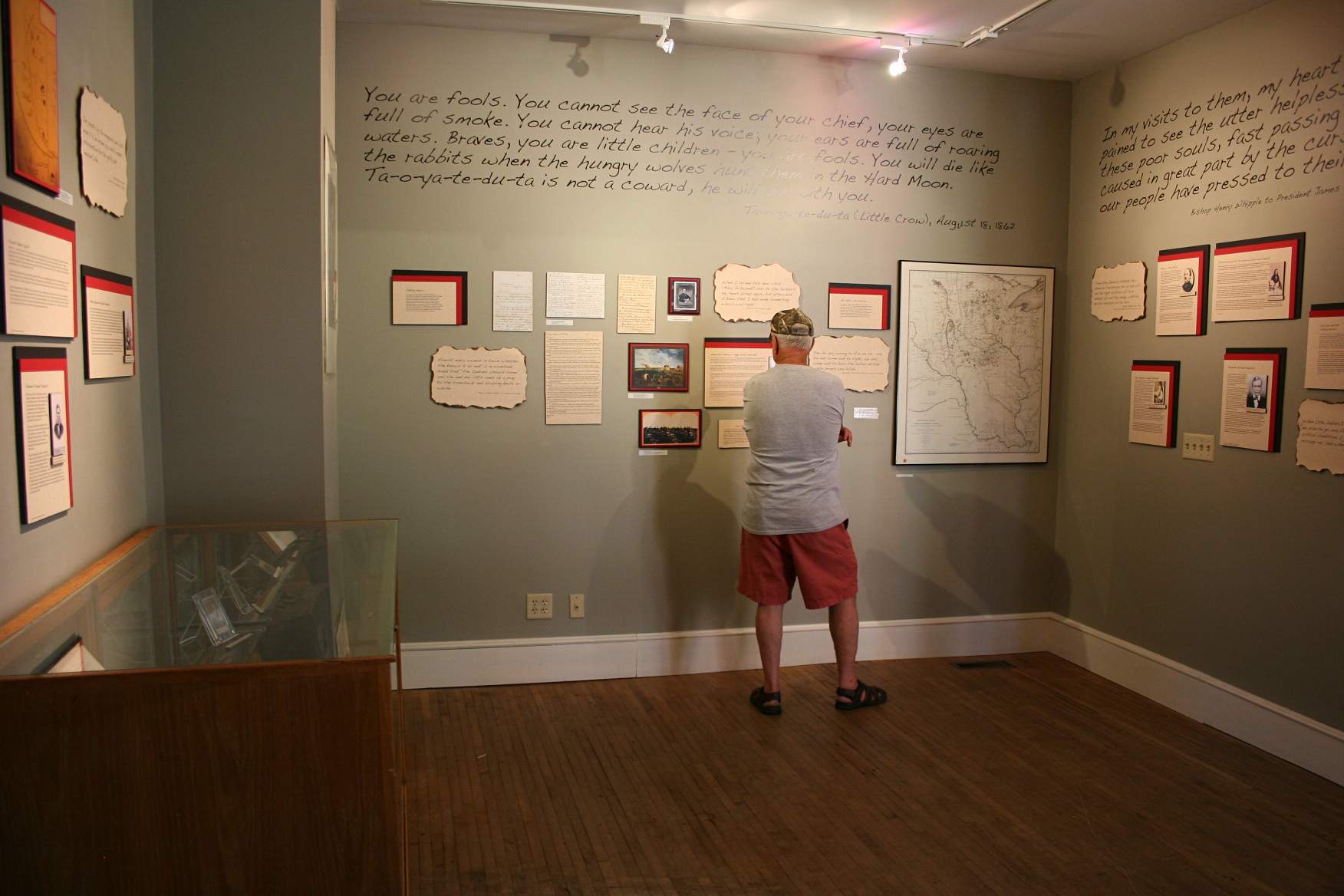
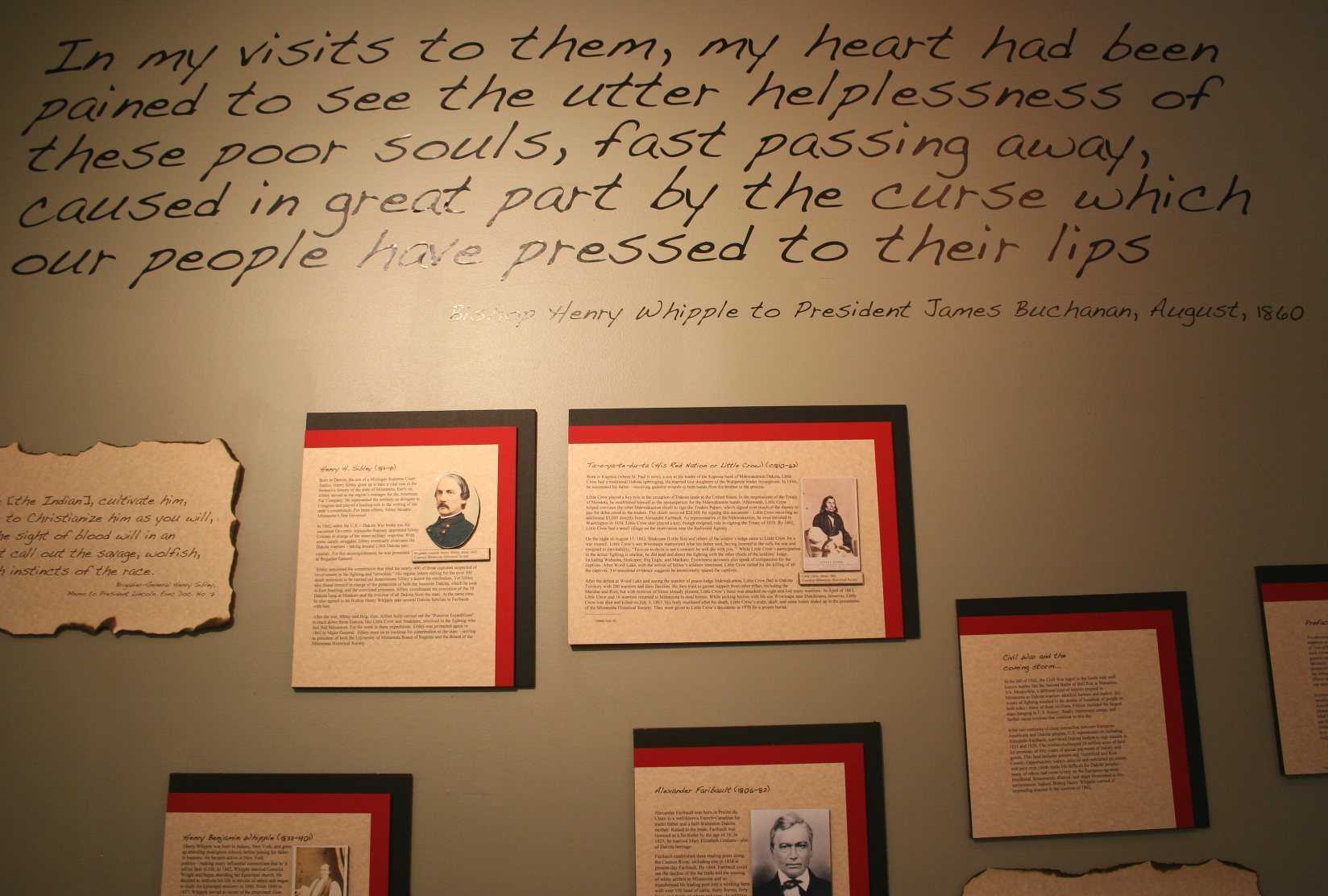
An overview of 1862, Through Rice County’s Eyes, which opened August 22 in Northfield.

However, awareness has grown considerably this year on the 150th anniversary of the war, including right here in Rice County. The Northfield Historical Society, partnering with the Rice County Historical Society, is currently showcasing an exhibit, 1862, Through Rice County’s Eyes.

I recently checked out the Northfield exhibit, which features mostly memorable quotes, volumes of summarized information and copies of photos. It’s a lot of reading.

But if you’re interested in educating yourself, it’s worth the time and concentration needed to absorb the information presented in this exhibit. And I’ll admit to occasionally skimming the postings because I am more of a visual, multi media, show-and-tell kind of history learner. I also had a pretty good background of knowledge going into the exhibit.

This sculpture of Alexander Faribault trading with a Dakota trading partner stands in Faribault’s Heritage Park near the Straight River and site of Faribault’s trading post. Faribault artist Ivan Whillock created this sculpture which sits atop a fountain known as the Bea Duncan Memorial Fountain.

I knew, for example, that fur trader Alexander Faribault was one-quarter Dakota and married to Mary Elizabeth Graham, whose mother was a family member of a Dakota chief. I knew, too, that Faribault was involved in the negotiating and translating of land treaties between the government and the Dakota before the war and that he benefited financially.

I was aware that Alexander Faribault sheltered the Dakota.

Above the photos and info is this quote by Bishop Henry Whipple to President Buchanan in August 1860: “In my visits to them, my heart had been pained to see the utter helplessness of these poor souls, fast passing away, caused in great part by the curse which our people have pressed to their lips.”

But I had forgotten that Bishop Henry Whipple, a long-time advocate for the rights of the Dakota and known to them as “Straight Tongue,” worked to find a safe refuge for them in the city of Faribault.

Alexander Faribault opened his land to the Dakota. Information in the exhibit states:

This land was the only safe-haven of its kind in a state now prejudiced in fear and anger against anyone with Dakota blood.

According to info in the exhibit, Alexander Faribault, whom you recall was one-fourth Dakota, also experienced prejudice against him. By 1869, this once successful fur trader, flour mill owner and politician had to sell his land and assets, including the land occupied by the Dakota.

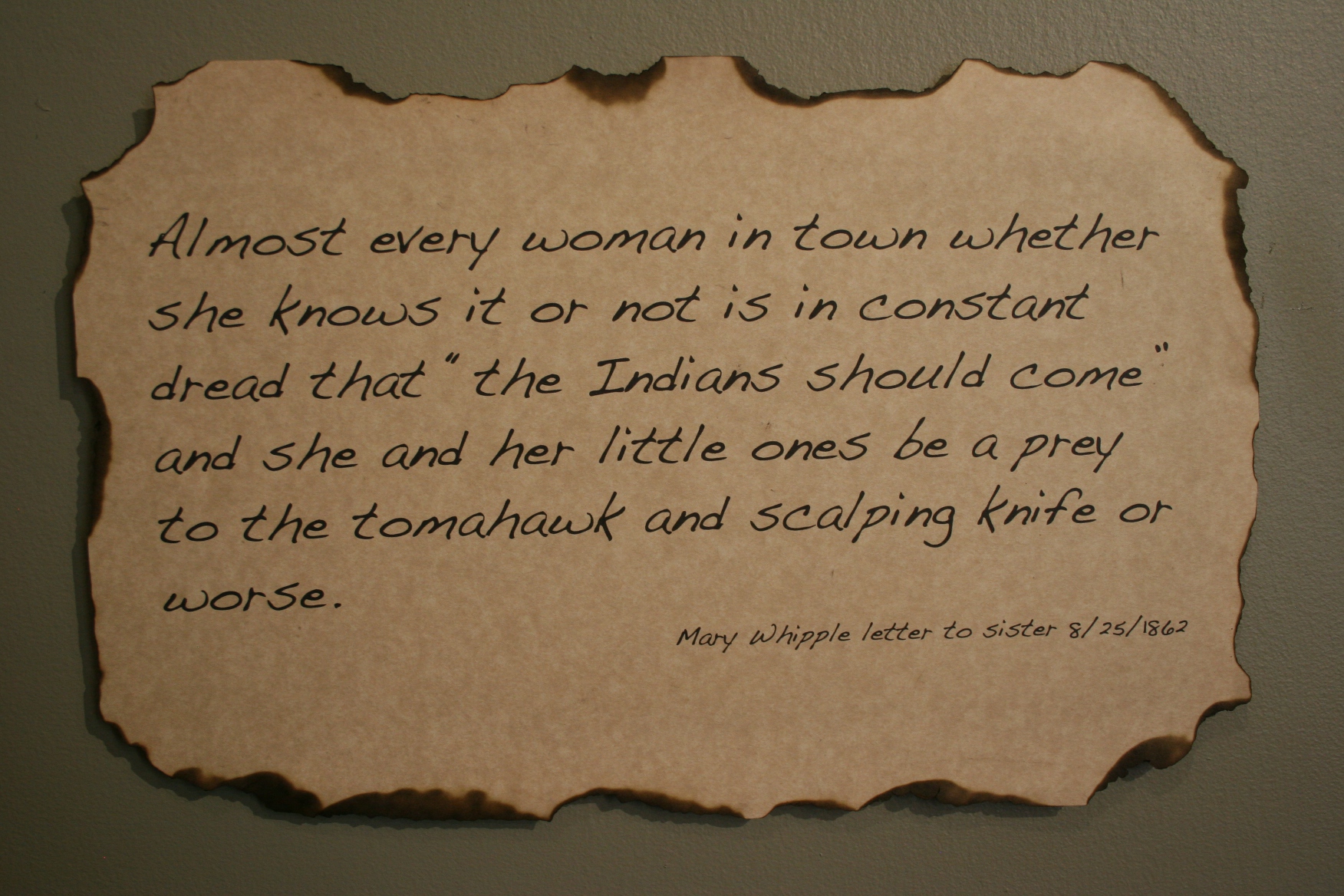
Equally interesting is the quote, below, attributed to Mary Whipple. Even though her husband, the bishop, worked tirelessly to help the Dakota, fear still existed in his home community.

A quote from a letter written by Mary Whipple to her sister during the U.S.-Dakota War.

Perhaps the most interesting fact I learned relates to that of Lt. Rollin Olin, a decade-long resident of Northfield. He was second in command of the Third Minnesota Regiment at the Battle of Wood Lake—the final battle of the war—and a member of a five-man military tribunal which tried the Dakota following the war. He signed more than 300 death sentences for nearly 400 Dakota charged with murder, rape and/or robbery.

For me, that raises the obvious question: How could someone who fought against the Dakota judge them without bias? All members of the tribunal, in fact, had fought the Dakota. The answer, of course, is that Lt. Olin and the other four could not.

Likewise, the Northfield Historical Society is wisely careful to indicate that its new, temporary exhibit may not please everyone or include everything on the topic of Rice County’s connection to the war. On the NHS website, you’ll read this disclaimer:

As varied as these and other local perspectives may be, any exploration of the U.S.-Dakota War of 1862 suffers from the inevitable limitations facing every historical examination—limitations such as scope and biases, past and present, which impact the telling and perception of the stories and data. In presenting the exhibit 1862, Through Rice County’s Eyes this fall, NHS endeavors to draw visitors into thoughtful interest and discussion of this momentous event and its aftermath by sharing local connections. Come and critically examine this exhibit.

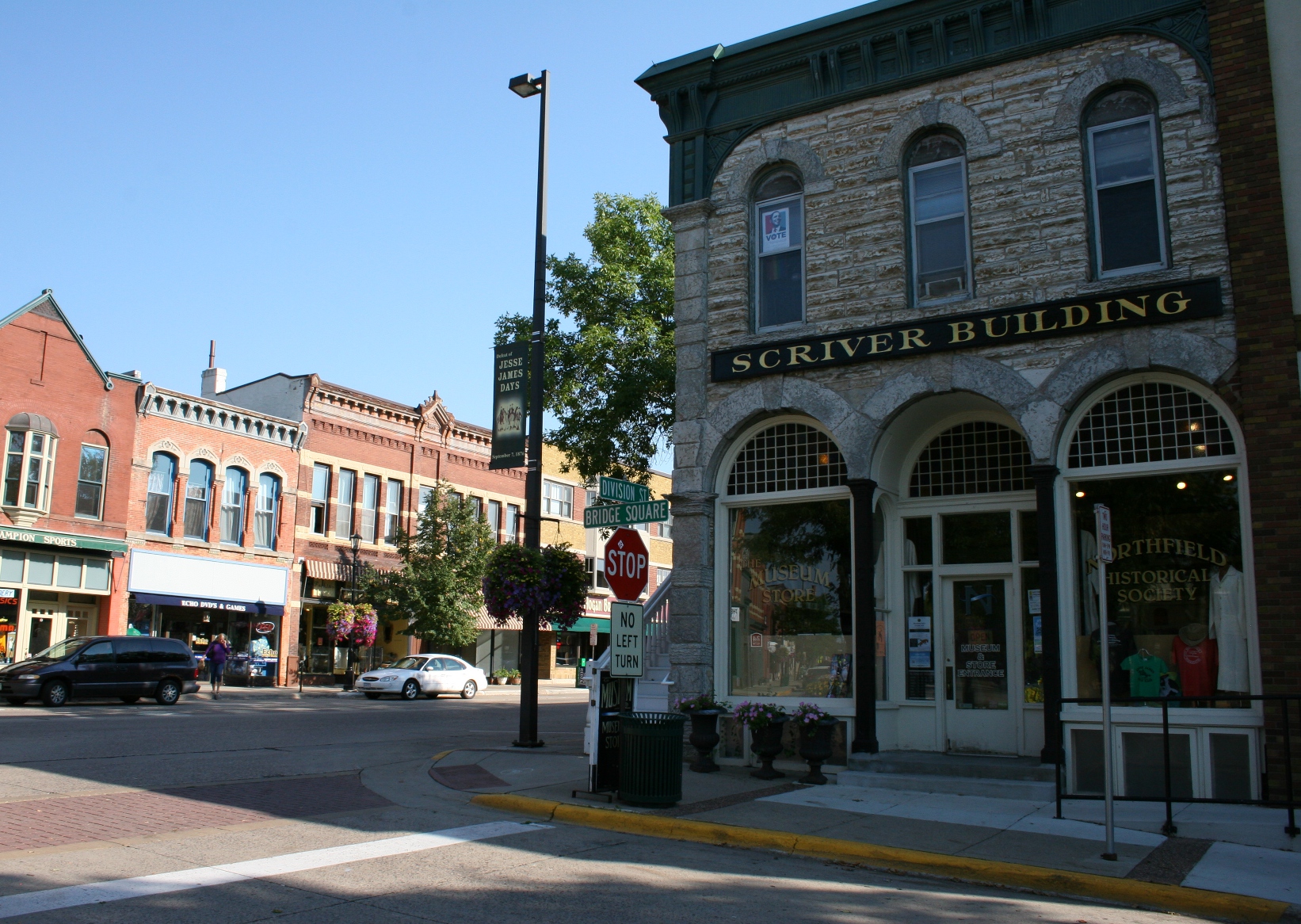
The exterior of the Northfield Historical Society, 408 Division Street, Northfield.

FYI: To learn more about 1862—Through Rice County’s Eyes, click here to the NHS website.

To learn more about the Minnesota counties, county by county, involved in the U.S.-Dakota War of 1862, click here.

© Copyright 2012 Audrey Kletscher Helbling


The Peach Project August 29, 2012

I GREW UP WITH DIRT under my fingernails, banishing weeds from the garden and then, later, harvesting and preparing veggies to eat fresh or preserve.

My mom canned some, froze some, storing away freezer boxes plump with green beans and beets, corn and other vegetables.

She also preserved fruit in quart jars, with the assistance of us kids, for the long Minnesota winter ahead. Applesauce and cherries. Peaches and pears.

A juicy Colorado peach, from which I must remove the skin because I can’t tolerate the fuzz (feels like a cotton ball) in my mouth.

And then, on a brisk winter evening, when Dad was about to come in for supper after finishing barn chores, she would lift the trap door in the kitchen and send one of us clomping down the creaky, rugged wooden steps to the dirt-floored cellar for a jar of sauce. Dessert. I would tug on the frayed cotton string to switch on the single bare light bulb. Then I would tiptoe reach for a jar of my favorite cherries or peaches.

We got a single box of freshly-picked Colorado peaches. When I was growing up, the peaches came in a wood-slat box that was nailed shut. Each peach was wrapped in tissue paper, which we recycled for use in the outhouse.

Those were my thoughts on Saturday when my husband and I picked up a 20-pound crate of peaches I’d ordered several weeks ago through the Cathedral Community Cafe, a Faribault soup kitchen which every Tuesday offers a free meal to those in need and/or seeking fellowship.

It is a worthy cause with some 9,000 dinners served in 2011 and averaging 150 a week this year. The effort involves about 140 volunteers, 12 churches and four teams of workers.

The Community Cathedral Cafe and First English Lutheran youth pre-sold 260 boxes of peaches and ordered an additional 60 to sell to walk-in customers. The peach project has been an ongoing fundraiser for around five years for the cafe and First English youth. About 50 boxes already had been picked up when I photographed this scene.

But like any such organization, the cafe needs money to keep going. The peach project will channel funds into the cafe’s coffers and I’m happy to support the fundraiser by purchasing a $30 crate of fresh Colorado peaches.

A sign outside the Cathedral Guild House directs customers to the peach pick-up point.

Now, what to do with all those fresh peaches. Thus far I’ve eaten many straight from the box. One evening I blended a peach and vanilla ice cream into a smooth shake. This morning I sliced one into my oatmeal. And I’ve also used thinly-sliced peaches to make a ham and peach panini.

I found the adapted sandwich recipe on Sue Ready’s blog and then tweaked it a bit.

Ham and Peach Panini

2 bread slices

deli ham

1 slice provolone cheese

1 thinly-sliced peach

1/2 teaspoon honey

Djon or spicy brown mustard

chopped fresh basil

Spread mustard and 1/2 teaspoon honey on one bread slice. Top with ham, cheese and thin peach slices. Top with chopped basil. Place other piece of bread on top and brush lightly with olive oil. Also brush other bread slice with oil. Grill in frying pan until golden brown, flip and grill other side.

Love, love, love this sandwich. My husband not so much. But he’s more an ordinary sandwich guy and I really had to persuade him to even take a bite.

Now, I expect when I bake a peach crisp or a peach cheesecake later this week, he won’t hesitate to scoop up a sizable helping.

Tyler Welander, 14, who’s raising monies for youth activities at First English, delivers boxes of peaches to vehicles. I suggested to the peach sellers that perhaps they could bake the pies, too, for me to pick up. But one man said, “Oh, that would be down the street at Trinity.” And he would be right. The Trinity Piemakers are currently selling fresh peach, among other, pies.  And since I attend Trinity, I can vouch for the delicious goodness of Trinity pies.

An elderly couple from Farmington ordered nine crates of peaches, seven of which they will deliver to friends.

WHAT’S YOUR FAVORITE peach recipe and what’s the best way to freeze peaches? I’d like to hear.

Click here to reach the website of the Cathedral of Our Merciful Saviour in Faribault, home to the community cafe.

Also, please click here to read a post which features a poem I wrote about canning and the watercolor Zumbrota artist Connie Ludwig created based on my poem. Oh, how I wish “Pantry Jewels” was hanging on my dining room wall.

Copyright 2012 Audrey Kletscher Helbling
 

Connecting, conversing and celebrating cultural diversity at Faribault festival August 28, 2012

This woman represents El Salvador during the International Festival Faribault on a drizzly Saturday. Flags suspended from the Central Park band shell in the background show the countries participating in the event.

DESCRIBING AN EVENT like International Festival Faribault within the confines of a blog post or two seems daunting. How do I adequately convey the essence of this fest celebrating the cultural diversity of my community?

You can view my first effort by clicking here and reading “Yearning for respect & equality, ‘no matter what color you are.’”

Now, as I scroll again through the many photos I took during the fest (when rain wasn’t drizzling upon my camera), I ponder which images to share, what words to pen.

Cultures connecting on the band shell stage between musical acts.

And “c” words—like color, connecting, communicating, conversation, coloring, candy, culture, care, colorful clothing—pop out at me as I view my photos.

I should perhaps add “confusing” to that list because I felt overwhelmed when trying to photograph the wood carvings from Somalia and Kenya peddled by Bashir Omar and Asher Ali.

A woman, without prompting, took this mask from the table manned by Bashir Omar and Asher Ali and asked me to photograph her.

Suddenly, it seemed, everyone wanted to pose for a picture. And I much prefer candid to set up shots. I obliged, though, because it seemed the easiest thing to do.

Lul Abdi shows off beautiful wood crafts from Kenya and Somalia.

Then Lul Abdi, who had grabbed a wooden platter and giraffe, and held them up for me to photograph, asked me to write in my blog that an election is coming up in Somalia and I should tell everyone to vote for whomever it is she supports. Bashir Omar translated my answer—I don’t write about international political issues.

While this back-and-forth translation was occurring, I felt befuddled because, when too much noise (in this instance lots of conversation going on around me and music in the background), is coming my way, my brain doesn’t process anything. That issue is related to the 70 percent hearing loss in my right ear.

Despite the difficulties, this muddle served as an aha moment. Imagine if I was Lul, struggling on a daily basis to understand those around me. Life would be challenging.

Busy artists at the kids’ activity table.

But sometimes we all speak the same language. And I saw, rather than heard, that on Saturday, at the festival, especially among the children. They sat side-by-side painting at the kids’ activity table, bounced side-by-side in the bouncy tent, stood side-by-side in line to take turns swinging at pinatas.

A little girl stands on the opposite side of the group of children waiting to swing at the pinata.

Differences in color and culture and language mattered not to these children. They shouldn’t matter to any of us. Therein lies the message I most want to communicate to you today and which was communicated so well via International Festival Faribault.

Happy children all focused on the same goal: breaking the pinata.

All around me, children and adults of all colors mingled.

The boy on the right was biking past Central Park and stopped to watch the activities at a distance.

The scramble for candy once one of three pinatas is broken.

AND HERE ARE SOME ADDITIONAL BONUS PHOTOS:

Masks displayed at the food vendor representing El Salvador.

Waiting at the bouncy tent.

A Mexican dish (help me out if you know, but I think tortillas) was wrapped in banana leaves. My husband and I tried this.

Conversation and connecting…, no other words necessary.

Necklaces and other jewelry from Kenya and/or Somalia and for sale at the festival.

Kids painted and colored, etc., elbow to elbow at the always busy kids’ activity table.

Some mischievous face painting was also part of the fun.

© Copyright 2012 Audrey Kletscher Helbling
 

Yearning for respect & equality, “no matter what color you are” August 26, 2012

I HAVE PHOTOGRAPHED them from a distance, their long skirts swaying as they walk across Central Park toward me.

Now the young women are standing before me and I am confused for a moment until Nasteho Farah tells me she wants to look her best and asks me to photograph them again.

Friends, Nimo Abdi, a sophomore at Faribault High School, left, and Nasteho Farah, a senior.

I agree as I already envision the portrait possibilities—the expressive brown eyes, the warm skin tone, the way Nimo Abdi leans toward her friend, her hijab brushing Nasteho’s cheek. They are beautiful young women and I take only one shot, knowing I’ve captured a memorable portrait.

I love this image of  a fest performer and her single audience member for the message it portrays– the one on one connection that helps us understand one another, no matter our culture or skin color.

These Faribault High School students are among those participating in the International Festival Faribault on Saturday, an event designed to connect cultures through music, arts and crafts, kids’ activities, international cuisine, education and, on a personal level, conversation.

That same little boy who was so intently focused on the musician performing in the band shell.

After I photograph the friends, we talk about their experiences living in Faribault. And what Nasteho shares with me so upsets me that I apologize to her for the utter disrespect shown to her and her friend, who stands silently listening.

The native of Kenya, a Faribault resident for five years and prior to that a resident of Rochester, Owatonna and Waseca, says she is criticized for the scarf she wears, for her culture, for her…

“They assume I’m a terrorist.”

Her words temporarily stun me and I can feel my jaw drop.

She doesn’t define “they” specifically, but says the insults, the prejudice, happens randomly—in school, in the streets, even at work.

A group of young Somali dancers perform on the band shell stage during the festival.

When I ask for examples, Nasteho mentions the middle-aged man who comes through the drive-through at McDonalds in Faribault where she works. He tells her she should stop wearing her head scarf. She’s talked to her manager about it and he’s been supportive. For now, she mostly tries to ignore the customer’s spiteful comments.

When she walks into other businesses, like the grocery store, she feels the stares. When driving, she’s been flipped off.

“There is no respect for Somalis,” Nasteho assesses.

Yet, she doesn’t seem visibly angry, choosing instead to speak up or to take the position that those who choose to attack her or her culture do not know her or understand her.

I admire Nasteho’s positive attitude. She tells me she didn’t experience prejudice living in Rochester—a larger and more diverse community—but that it’s been much harder in a smaller town like Faribault. She was too young to remember what life was like in Owatonna or Waseca.

Faribault High School seniors Shukri Aden, left, and Khadra Muhumed.

Faribault High School students Shukri Aden and Khadra Muhumed, who are volunteering with STOPS, Students Together Offering Peer Support, at the International Festival, have also been subjected to hurtful comments from those who tell them to go back to their own country or that they smell.

“I try to talk to them,” says Shukri, who has lived in Faribault for seven years, since she came to the U.S. at age 12.

She wants everyone “to be equal no matter what color you are…to get to know each other.”

Lul Abdi shows off beautiful wood crafts from Kenya and Somalia for sale at the fest.

And this FHS senior has dreams—of going to college to become a nurse and then returning to Somali to help those in need.

On this Saturday, at this International Festival, the words of these young Somali women evoke mixed emotions within me. I am saddened by those in my community who fail to see beyond the scarves, the culture, the skin color, the language.

Mother and daughter check out the artwork from Kenya and Somalia.

These women are not terrorists. They are someone’s daughters. They are high school students. They live here, work here, shop here, worship here.

Despite the clear prejudice which angers me, I feel hope. These young women possess a maturity and poise beyond their teenage years. They yearn for understanding, for respect, for the personal connections that define them as individuals.

And on this Saturday afternoon they are trying, through their volunteerism at the International Festival Faribault, to, as Nasteho says, “bring everybody together.”

A mother’s love and care, the same in any language, any culture, any skin color.

CHECK BACK FOR A FUTURE post with photos from the seventh annual International Festival Faribault. Thank you to the organizers and participants in this festival who are trying to connect cultures, to make Faribault a better place to live, no matter your culture, skin color or country of origin.

© Copyright 2012 Audrey Kletscher Helbling
 

Faribault Festival offers opportunity to bridge differences & connect August 23, 2012

Filed under: Uncategorized — Audrey Kletscher Helbling @ 7:15 AM
Tags: , , , , , , , ,

TODAY I’D LIKE TO EXTEND an invitation to you. Pull out your calendars right now and add this event to your schedule: International Festival Faribault, 10 a.m. – 4 p.m. on Saturday, August 25, Central Park.

Several Latinos lead in singing of Mexico’s national anthem last September during the International Festival Faribault at Faribault’s Central Park. The flags strung across the band shell represent the countries featured at the fest. This weekend’s celebration marks the seventh such international fest in Faribault.

There. Done. Right?

The scramble for candy after the pinata is broken at last year’s festival. Kids of all races participated with no concern for skin color or cultural differences. So refreshing to see.

Served at the 2011 fest: Guatemalan chuchitos– chicken, corn and salsa wrapped in a corn husk. You’ll find vendors offering a variety of authentic international foods.

OK, why do I think it’s important for you to attend this festival which features multicultural entertainment, arts and crafts vendors, authentic international cuisine, kids’ activities, a silent auction and more?

Simple. We as a community need to meet each other, to connect on a personal level, to understand each other if we are ever to overcome the very obvious cultural differences which divide us.

I met then 16-year-old Riyaam, an Owatonna High School student, at last year’s festival. She spoke openly about the prejudice at OHS and a white student’s single comment, “Somalis don’t belong here,” which led to racial clashes and tension. OHS has since instituted a policy of “you fight, you’re out.” It broke my heart to listen to Riyaam.

You know what I’m talking about, the differences in skin color and language, in culture and in dress.

There’s way too much suspicion and mistrust, cautiousness and prejudice toward the minorities living and working in Faribault. I’ve heard the derogatory comments about the Somali men who hang out on downtown street corners, the Hispanics who commit all the crimes, the immigrants who take away our jobs, the people who don’t speak English.

Seriously, these Somali men live downtown and the sidewalk is their yard.

“Mexicans,” and I’ve heard that word spit out of too many mean mouths, do not commit all the crimes in our community. Do you know any Hispanics personally? I do. They are probably the most family-oriented individuals I’ve ever met and we could learn a lot from them about the importance they place on loving and caring for one another.

And about those Somalis and/or Sudanese who supposedly steal our jobs—I expect most of us would not want to work the factory jobs they work. I mean no offense to the places which employ them, like the local turkey plant. But if we are honest with ourselves, we’ll admit that we likely never would work at these physically-demanding and not always pleasant jobs.

As for speaking English, have you, as an adult, tried learning a new language? Now attempt learning a new language in a foreign country. Not so easy. Think back to a few generations before you. I bet your great grandparents didn’t speak English. Even my own mother’s first language was German, not English.

The other evening while shopping at a local Big Box retailer, I witnessed how difficult it was for a Hispanic woman to communicate due to her limited English. I almost got on my cell phone to call my second daughter who works as a Spanish medical interpreter in eastern Wisconsin to ask her to interpret.

Did you know that, according to the 2010 U.S. Census, 17.4 percent of Faribault’s 23,352 residents have a language other than English spoken at home? Stats show 9.4 percent of our city’s residents are foreign-born.

Vendors, like Riyaam, peddled their wares at the 2011 festival.

Instead of criticizing those who speak and dress and live differently than the majority of us, let’s begin to understand them. Mostly, I think, our misconceptions, our prejudices, are based on fear. We fear what we don’t understand.

A young girl’s henna stained foot, photographed at the 2011 fest.

International Festival Faribault offers a common, public ground—a city park—on which to meet the minority individuals who call our community home. They are here to stay. Let’s get to know them. Engage in conversation. Show them you care, that you’re genuinely interested in learning more about them and their cultures. Once you’ve connected on a personal level, you will begin to view them as individuals and not by the color of their skin, the clothing they wear, the language they speak…

Xafsa, age 5, photographed at the 2011 festival.

FYI: Click here to link to the International Festival Faribault website.

While this post is directed specifically at the residents of my community, its content can apply to many communities. You’re all invited to Faribault for International Festival Faribault, no matter your community or country of origin. And just to be clear, many Faribault residents and organizations embrace the minorities who call our southeastern Minnesota city home. I in no way intend to mislead you into thinking we are all a bunch of bigots living here. However, neither am I going to hide the fact that obvious prejudices exist and are very much a concern in Faribault.

Click here to link to the post I wrote about last year’s International Festival Faribault.

© Copyright 2012 Audrey Kletscher Helbling


From shy teen to confident artist, entertainer & business woman August 21, 2012

Jodi Gustafson of Big Shoe Entertainment begins transforming young Owen’s face into a Ghost Rider’s skull mask at the recent Blue Collar BBQ & Arts Fest in Faribault.

IMAGINING 37-YEAR-OLD JODI GUSTAFSON—also known as Lollipop the Clown, Jenius Strangeways or the proprietor of Big Shoe Entertainment and Jodelle’s Finery—as a once shy teen weaving down the hallways of Richfield and Coon Rapids high schools seems an impossibility.

But this vivacious and confident small business owner, whom I met at the recent Blue Collar BBQ & Arts Fest in Faribault where she was transforming faces through her stunning full face painting, reveals an adolescent timidness that contradicts her very public professions.

“I hated being shy,” said Gustafson, who recalls turning red if anyone so much as said “hi” to her. Determined to overcome that shyness, she eventually, and purposefully, chose a job with the United Way which involved public speaking.

“I knew I would never change if I didn’t get out of my comfort zone.”

That decision proved pivotal for Gustafson when a company wanted a carnival theme for its campaign but couldn’t afford to hire a clown. Gustafson volunteered, thinking clowning couldn’t be all that difficult. She was wrong, but continued anyway with the clowning which led to painting cheek art and then, with the encouragement of Cindy Trusty of Cindy’s Creative Celebrations, to full face painting and finally the official formation of Big Shoe Entertainment in the early 2000s.

Owen’s half-mask skull evolves under Gustafson’s skillful hands. She contracts her work for community and private events (such as birthday parties) and with corporations (such as for company picnics).

Today this mother of three (ages three to 17) operates two successful small businesses from her Bloomington home. Big Shoe Entertainment, encompassing clowning, balloon twisting, airbrushed and glitter tattoos, henna and crazy hair, but primarily full face painting, keeps her crazy busy, especially during the summer, with gigs throughout Minnesota, Iowa and Wisconsin. The pace slows during the other seasons.

An assortment of the make-up, all with FDA-approved ingredients and meant to be used on the body and face, which Gustafson uses for face painting.

In anywhere from one to five minutes Gustafson, with brushes and make-up pads and an array of colorful make-up, can transform a face into a work of art. She’s morphed five billion faces, she exaggerates, into butterflies, and also creates lots of flowers and princesses, and masks such as skull, dragon and Mardi Gras.

She especially enjoys painting “gore” faces, but seldom has the opportunity.

Owen sits perfectly still as Gustafson paints. Some kids squirm or won’t close their eyes, meaning she sometimes needs to adjust her work to eliminate painting around the eyes or needs to explain step by step what she is doing. Typically, Gustafson doesn’t talk while painting faces.

She’s always learning—from videos, books, classes and practice. That practice includes painting designs all over her arms and legs while relaxing at home in front of the television. Gustafson puts her own spin on existing patterns via color choices and painting style, defining her work as her own in a profession that’s becoming more saturated. Yet, most are not at her level of expertise, she says, in an honest, but not boastful, way.

Gustafson works with two agents and occasionally hires independent contractors to assist at events where she can’t handle the volume solo. She’s picky, though, and chooses only the best artists.

American Family Insurance of Faribault sponsored free full face painting by Gustafson at the recent Blue Collar BBQ & Arts Fest. Lines were long. Gustafson painted for five hours, averaging 20 – 25 faces per hour. If she returns next year, she’ll bring another painter, she says, to shorten those lines.

All of this is interesting given Gustafson early on was intimidated by full face painting. Clearly she’s not anymore as she works with the swiftness and assurance of a skilled artist. She always had an interest in art, she says, but not the confidence. She took art classes in high school and moved on to painting still lifes in acrylic on canvas, something she has no time for now.

Besides mothering and operating Big Shoe Entertainment, Gustafson also owns Jodelle’s Finery, specializing in Renaissance and Victorian “garb.” That’s her term, “garb,” referencing the durable period clothing she fashions, as opposed to “costumes,” for the Minnesota Renaissance Festival and steam punk events. (Steam punk fashion, since I didn’t know and perhaps you don’t either, is Victorian clothing with a technological, sci-fi twist.)

Even Jodelle’s Finery, in typical Gustafson fashion, has an interesting beginning. When pregnant with her middle child, Gustafson was feeling quite domestic and taught herself to sew. Her first project was a baby quilt. Today she’s advanced to sewing that garb for others and for her role as the street performer Jenius Strangeways at the Minnesota Renaissance Festival.

Yes, this once shy teen morphed into an actress too—role playing at the Renaissance and on the stages of community theaters in Faribault (where she lived until moving to Bloomington in June), Owatonna and Northfield.

“I don’t like to be still,” claims Gustafson, who before she took on the Renaissance acting gig two years ago, worked in shops at the Minnesota festival.

Owen’s skull face mask is almost done.

Yet, in the middle of all that public busyness of painting faces and clowning and acting, Gustafson says she still occasionally slips back in to the quiet, nervous and shy Jodi of years past. That happens, she explains, if she’s not role-playing and doesn’t know anyone at an event she’s working.

Mostly, though, she’s made a choice to get past her shyness, to be the strong and confident woman who paints faces, entertains and clothes entertainers via her two successful businesses.

Owen opens his eyes for the great reveal.

FYI: Jodi Gustafson doesn’t have a website for Big Shoe Entertainment, so don’t bother trying to find one. You may contact her via email at gusjodi@gmail.com or call her at (952) 215-4544. You can also check out her Jodelle’s Finery Facebook page by clicking here.

I initially developed this post idea to showcase Gustafson’s full face painting because I was so impressed by her work. But when I interviewed her about a week later and learned how she overcame her shyness, that became the real story. I hope you will be inspired, as I am, by Gustafson’s determination to overcome an obstacle, change and pursue her passions in life as her professions.

Gustafson transformed Isaac into a tiger at the Faribault festival.

Isabella, 7, of Faribault, became a dalmatian under Gustafson’s crafting. Butterflies and dalmatians proved the most popular paintings chosen by attendees at the Faribault fest.

© Copyright 2012 Audrey Kletscher Helbling
 

The patriotic pride of Harley riders August 16, 2012

Bikers and others gather for a post hospice ride party at Faribault Harley-Davidson.

LONG GONE, at least in my mind, is the image of Harley riders as rough outlaw types roaring along our roadways, storming into towns, raising hell.

When they travel in a pack now, it’s usually for a purpose, like last Saturday’s fifth annual ride to benefit the Faribault Area Hospice.

While my husband and I missed the ride (he doesn’t have a Harley anymore, his 1977 Sportster being totaled more than a decade ago by a teen who ran a stop sign, plowed into the bike and sent Randy to the hospital), that didn’t keep us from checking out the post ride activities and bikes at Faribault Harley-Davidson.

I’ll be the first to admit that attending a biking event isn’t exactly on the top of my to-do list. But sometimes wives go along for the ride, just like husbands accompany their wives to artsy happenings that they’d probably rather skip.

As always, I carried my camera with hopes that maybe, just maybe, I’d find something worth photographing beyond the rows of bikes I knew Randy would be eying.

The Harley dress code: black leather.

Well, it wasn’t the masses of Harleys which caught my attention, but the details on individual bikes. I hope I didn’t make any of the Harley riders, who can appear intimidating in their black leather, nervous. I threaded my way among the parked bikes, bending, crouching, occasionally setting my camera onto the freshly seal-coated asphalt as I snapped photos.

The unique skull kickstand. Any significance to this skull, readers?

And as I wandered, a picture began to develop of the men and women who ride Harleys, or at least those in attendance at The Ride for Hospice party in Faribault. Except for the skulls on one bike and the boney foot kickstand on another, I found nothing particularly unusual.

The flag on the left honors SPC Mathew Kahler, killed in Afghanistan in 2008.

Rather, I discovered a common theme of patriotism among bikers who have served their country and/or want to honor those serving. It was heart-warming and uplifting to see such support.

One of two blessing stickers I noticed on bikes.

Equally pleasing were stickers I spotted on two bikes indicating they had been blessed. I expect blessings were flowing all around on Saturday as these bikers opened their wallets and their hearts to help hospice, an organization which, at some point, touches nearly all of our lives.

Another patriotically adorned bike and a Vietnam veteran’s jacket along with Ernie from Sesame Street.

Proud to be an American and driving an American made Harley-Davidson.

Patriotic patches seem a popular adornment on Harley attire.

These boots, sitting next to a bike, reminded me of the phrase “boots on the ground” when soldiers hit the ground running.

The yellow flag represents the Minnesota Patriot Guard.

Patriotism displayed, right down to the license plate on this bike.

© Copyright 2012 Audrey Kletscher Helbling
 

Carv-Fest brings together novices to pros in Faribault August 13, 2012

I WONDER WHAT THE ODDS ARE, that a community of some 22,000 would be home to two internationally-known, award-winning woodcarvers.

That would be Faribault. And they would be Marvin Kaisersatt and Ivan Whillock.

Woodcarvers, from novice to pros, participated in Carv-Fest 2012. Here are students and instructors in a Saturday morning session.

The carvings of these two gifted Minnesota artists, and gifted doesn’t even seem to begin to fit their talent, were among art displayed at the August 9 – 11 Carv-Fest 2012 which drew woodcarvers, from beginners to seasoned carvers, to Faribault.

The intricate chip carving of Marty Leenhouts of Garden City, Minnesota.

It may be summer, but Santa showed up in a woodcarving and classes at the festival.

Imagine if this had been a hand instead of a glove…

I roamed the fest on Saturday, seriously impressed by the intent concentration of the attending woodcarvers, the intricacies of the carvings, the variety of art created and the fearlessness in putting sharp tools to wood. No wonder they wear gloves.

Marv Kaisersatt sketched out the character he was teaching his students to carve on Saturday.

I didn’t know any of the carvers, except Marv, whom I interviewed in 2009 for a short magazine article which certainly should have been much longer had space allowed. He impressed me then for the simple life he lives in an upstairs apartment in downtown Faribault, carving caricatures. I can’t even describe talent of his level. But I can describe a man who is humble and funny, engaging and content with the creative process of sketching, shaping clay models and carving.

This retired math teacher also impressed me in that interview with the fact that he doesn’t sell his woodcarvings, choosing instead to occasionally donate his caricatures, carved from blocks of basswood, to nonprofit fundraisers.

Marv Kaisersatt assists a student in his class.

On Saturday, Marv circulated among his students, advising them on carving a Minnesotan (I presume) dressed for winter in stocking cap and chopper mittens, oversized boots weighing down his feet.

Marv gave me a polite nod and then it was all business teaching the students lucky enough to learn under his guidance.

A snippet of Ivan Whillock’s incredible, detailed and realistic carving.

Whillock, whose woodcarvings are the polar opposite of Marv’s work, wasn’t teaching. But given his woodcarving family organizes Carv-Fest, I expect he had more than enough to keep him busy. He carves religious and secular sculptures and reliefs, works of art that grace places like churches (including mine, Trinity Lutheran) and libraries (including Buckham Memorial Library in Faribault).

Whillock and his family are the key organizers of Carv-Fest which draws woodcarvers from all over.

A stunning, three-dimensional carving by Ivan Whillock.

Both men teach at Ivan Whillock Studio. They’ve written books and created patterns and developed an appreciative following of admirers across the world.

And if you saw their work, you would understand why they are so beloved among woodcarvers and those of us who wouldn’t dare pick up a knife for fear of slicing away a fingertip.

A carver brought his handcarved toolbox to a class on Saturday morning.

Just another example of the woodcarvings on display during the festival.

These students were hammering and chiseling away during a class, making quite a racket in the ice arena/fest site.

The step-by-step process to woodburn a wolf as taught by Nancy Dardis of  Dardis Designs, Bloomington.

A pheasant in wood, foreground, and students in class, background.

Learning the art of chip carving.

© Copyright 2012 Audrey Kletscher Helbling
 

Mixing art, music and BBQ at Faribault festival August 12, 2012

The banner and band scaffolding/set-up in the 300 block of Central Avenue during Saturday’s Blue Collar BBQ & Arts Fest in Faribault

FROM DEAFENING MUSIC that bounced between historic buildings along Faribault’s Central Avenue, to the savory taste and tantalizing, smokey smell of barbecued meat to the cheers of onlookers when a local celebrity plunged into the dunk tank to the clink of washers against asphalt in the washer tournament to human faces morphing, via paint, into animal faces, offerings at the fourth annual Blue Collar BBQ & Arts Fest in Faribault drew crowds, and smiles, on a picture perfect Saturday.

An overview of the crowd early into the event on Saturday, looking to the 300 block of historic downtown Farbault.

Coordinated by the Paradise Center for the Arts, the 13-hour free festival focused on bringing people into the historic downtown to enjoy/participate in the arts, music, food, a BBQ and homemade brew competition, and more.

The Black Widow BBQ team, one of about a dozen competing for top prizes of $500 in several categories.

BBQ teams set up along a side street to cook their meats and desserts.

A Texas native, now living in Faribault and a member of The Black Hat “BBQ” team, sprays apple juice onto his St. Louis style pork ribs during the BBQ contest.

Grill Cabin team members, from New Prague, prepare entries in the BBQ competition.

Retail stores like The Crafty Maven, 212 Central Avenue, at the heart of the arts and crafts fair and kids’ activities, expected an increase in business with an influx of an anticipated 5,000 people into the downtown for the festival. And that’s part of the plan, to celebrate downtown businesses, many of them event supporters. Other businesses in the community also sponsored parts of the festival.

Flower art and more, shaped and welded from old silverware, etc. is helping the DeWall brothers of DeWall Bros Metal Creations of Grand Meadow finance their college educations. Their art was for sale at the arts fest.

While the DeWall men were peddling their metal art, the women–mom/wife, Cindy, and girlfriend, Allison– were shopping and getting their faces painted by Jodi Gustafson of Big Shoe Entertainment.

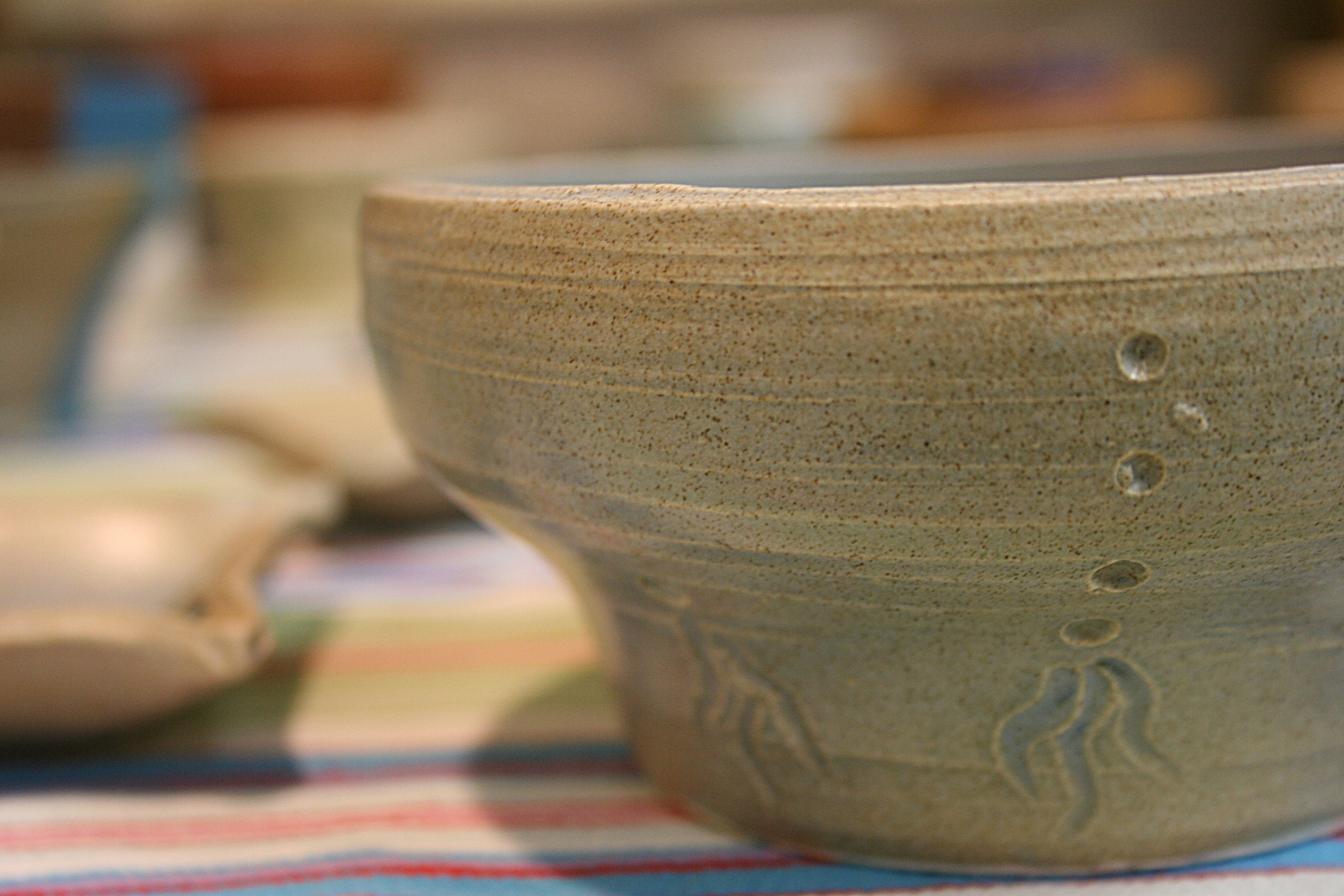
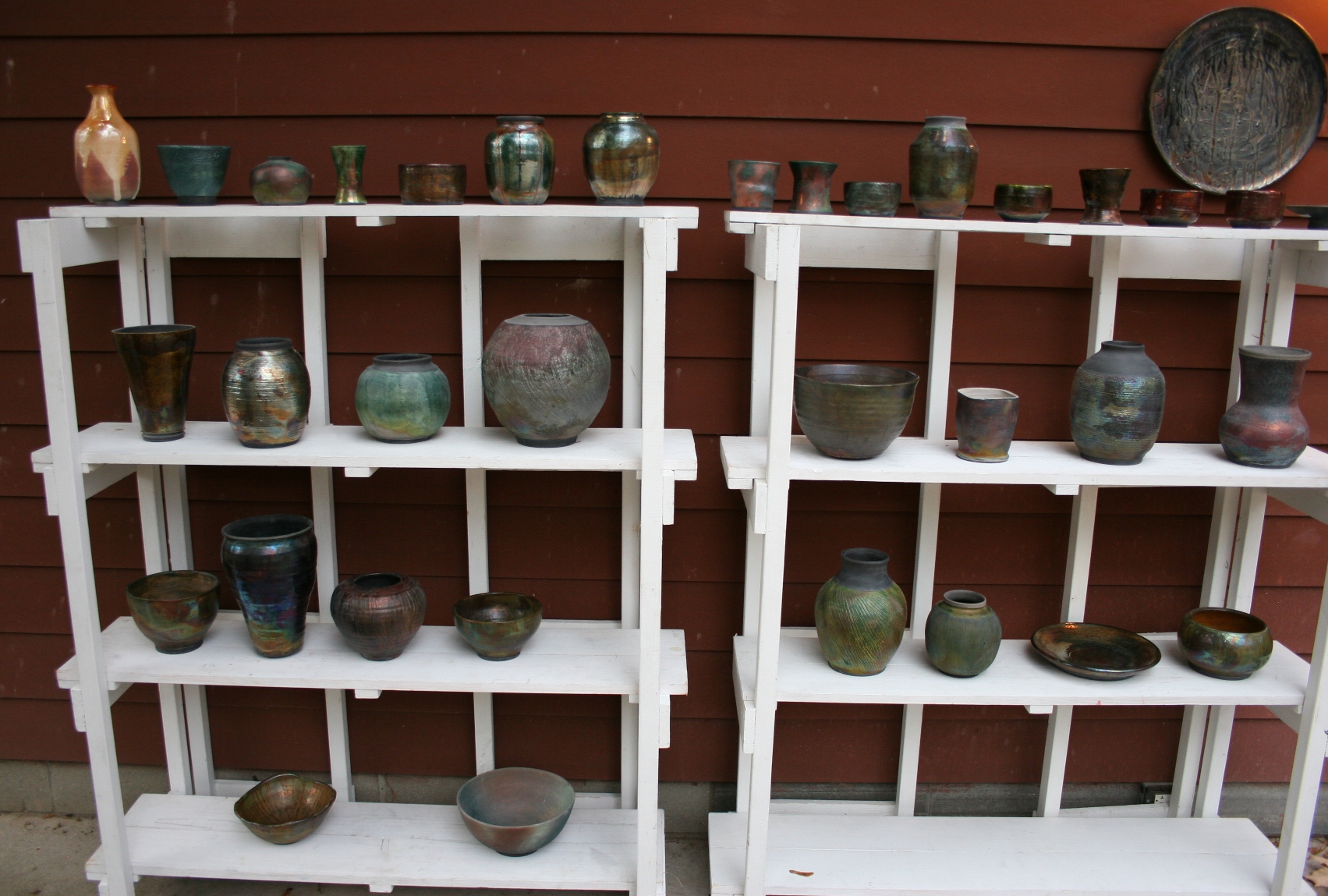
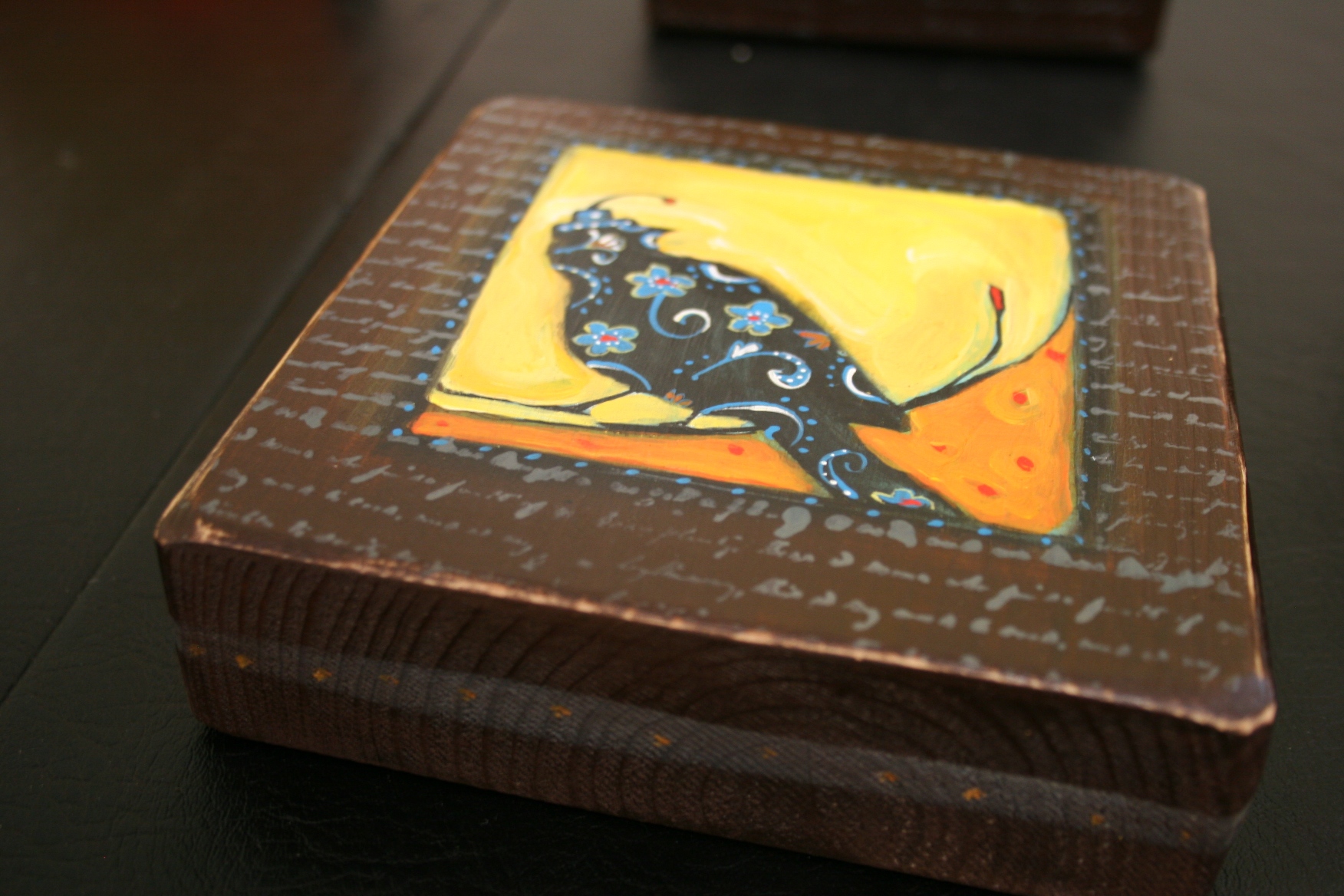
Bob Maegerlein of Rochester, specializing in Raku ware, sold his pottery at the arts fair.

I arrived late morning and wandered for several hours past vendors—wishing I could sample the meat smoking in BBQ contestants’ grills; admiring the artistic creations of artists and a gifted face painter; ducking into the Paradise Center for the Arts to photograph the current art show, Car pARTS; steering mostly clear of the north end of the 300 block of Central because I couldn’t tolerate the volume of the live band music; trying a vendor’s delicious BBQed meat trio sampler that was way overpriced for the quantity (plus, no forks included); and, finally, stopping at Pawn Minnesota and then a Somali clothing shop on my way to the car.

Blues-rock guitarist/musician Trent Romens was among six featured musical acts.

Did the festival accomplish for me what I expected? Yes. I was entertained, although I would have appreciated a much lower volume on the music. Ditto for the price on the meat sampler. And I would have liked access to the home brew competition, which was tucked into the Paradise somewhere.

But all in all, the festival provided a fun way to while away part of a Saturday. And, for those downtown business owners who hoped the event would draw shoppers into stores, it worked for me. I’d never been into the pawn store and wasn’t even aware of the Somali shop or another ethnic business across the street (which wasn’t open).

If you’re from Faribault, I hope you took  time on Saturday to attend the Blue Collar BBQ & Arts Fest and appreciate what we have, right here in our own community.

With the weather about as good as it gets on a summer day, attendance was high at the Blue Collar BBQ & Arts Fest.

Dad and grandpa watched the pets while the kids played in the bouncy inflatables. These pom pom pets were a popular item sold at the arts fair.

Kids practiced for the washer tournament. I was not convinced by a tournament organizer to participate. “She would throw the washer through a store window,” my husband told him. He would be right. Either that or I would have struck a passerby. We walked away, for the safety of those in attendance.

Isabella, 7, of Faribault, one of the many kids who lined up for the free face painting. Check back for an additional post featuring the artwork of professional face painter Jodi Gustafson of Big Shoe Entertainment.

Taking a turn in the dunk tank…

© Copyright 2012 Audrey Kletscher Helbling