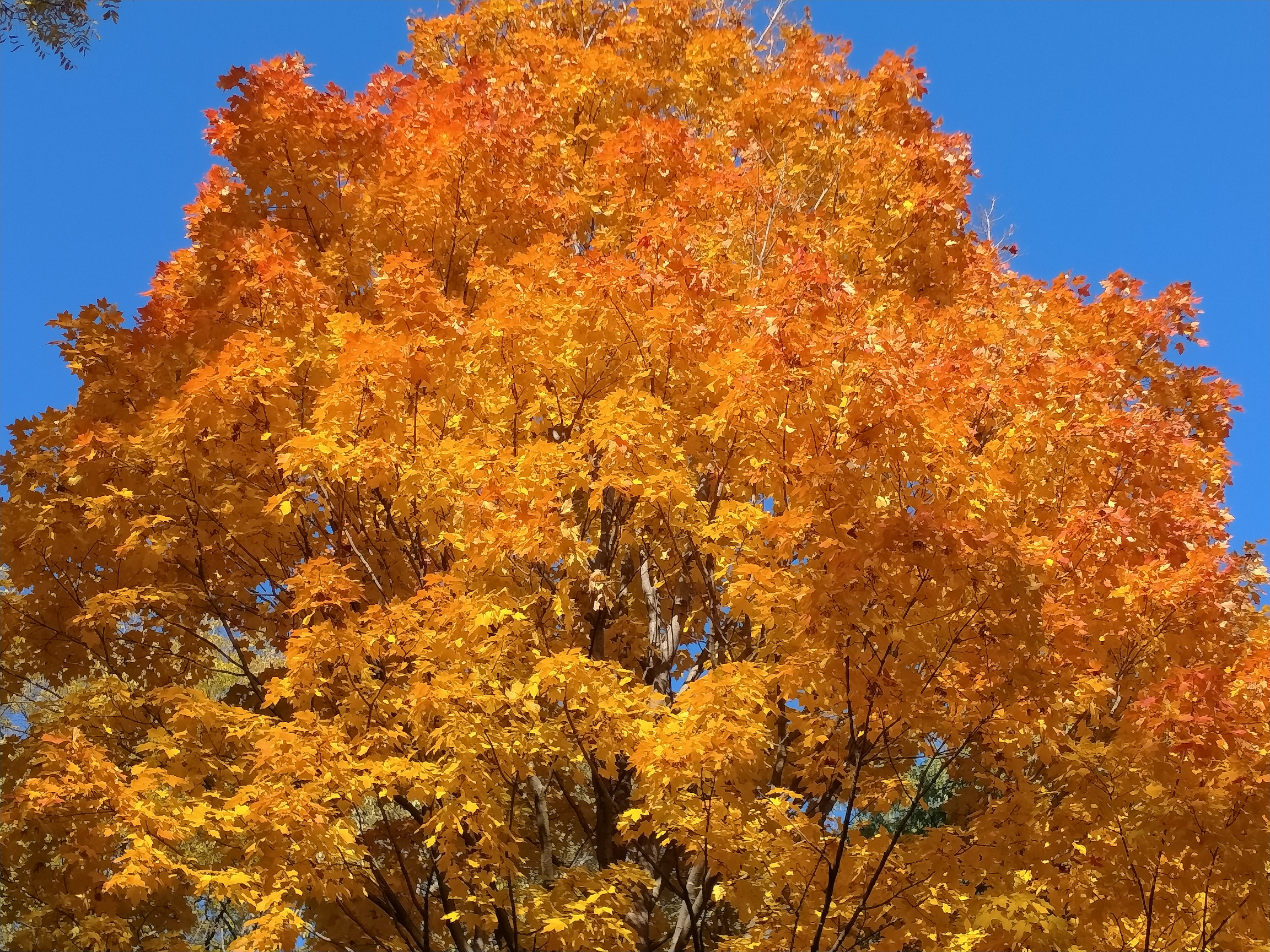
Individual leaves, like this maple, are works of art. (Minnesota Prairie Roots copyrighted photo October 2023)
TEMPS DIPPING INTO THE LOW 20s definitely feel more like winter than autumn here in southern Minnesota. I pulled on my parka, stocking cap and mittens earlier this week for my morning walk.
A still colorful treeline behind Pollard Hall. (Minnesota Prairie Roots copyrighted photo October 2023)
But the weekend, oh, the weekend, even if only in the 30s, was a wonderful one for final fall walks. I wanted one last glimpse of the foliage. Leaves have dropped from many trees, but some remain, like stubborn, defiant kids refusing to leave the playground.
A solitary oak set against the backdrop of Noyes Hall is simply stunning. (Minnesota Prairie Roots copyrighted photo October 2023)
Per our usual weekend walking route, Randy and I headed to the campus of the Minnesota State Academy for the Deaf on Faribault’s east side. I love walking here. It’s quiet, secluded and just plain achingly beautiful. From aged limestone buildings to green space to a wooded area behind the buildings, there’s much to appreciate. Nature and old architecture always appeal to me as does a safe, unimpeded place to walk.
The woods I was drawn to explore. (Minnesota Prairie Roots copyrighted photo October 2023)
Typically we stick to following sidewalks or crossing parking lots. But this time we diverged into the wooded area behind Pollard Hall, a boarded up building and the HVAC and maintenance headquarters. I’d previously seen people with their dogs tracking across the grass near woods’ edge. But we’d never detoured to explore, mostly because in the summer and early autumn the woods appear a dense forest. Now with most leaves fallen, the space opened up, drawing me in.
We followed a leaf-strewn, narrow dirt path for a ways into the woods. (Minnesota Prairie Roots copyrighted photo October 2023)
Since I’m directionally challenged in a town that is not prairie grid straight, I wondered what lay beyond the woods, below the bluff. After a bit of crunching over leaves, dodging branches and skirting trees, I saw the answer. Below lay the river and train tracks and Straight River Apartments next to Fleckenstein Bluffs Park. Finally, I understood my geographical placement.
Woods, hills, fallen leaves and creek bed meld behind MSAD. (Minnesota Prairie Roots copyrighted photo October 2023)
Mostly I took in the topography of hills bumping into each other, a dry creekbed twisting between. Yellow leaves covered the hillsides as thick as shag carpeting, but much lovelier.
Oak leaves blanket the lawn. (Minnesota Prairie Roots copyrighted photo October 2023)
Once out of the woods, Randy alerted me to two deer near the HVAC building. A third had already run away upon spotting us. But the other two stood still as statues, fully aware of our presence. We mimicked them, opting to stand quietly and appreciate their unexpected appearance. As much as I dislike deer along roadways, I find them endearing in any other location. Finally the pair decided they’d had enough of this stare off. They white-tailed it across the grass, disappearing over a hill.
Sometimes you have to look up, directly up, to see the beauty, like this oak tree. (Minnesota Prairie Roots copyrighted photo October 2023)
And so we continued on, me pulling out my cellphone once again to snap photos of the remaining colorful trees. My mind understands that soon this landscape will be devoid of color, transformed to the black-and-white of winter. But on this weekend, I pushed those thoughts mostly aside, focusing instead on autumn’s lingering beauty.
A box of food left inside the band shell at Central Park. (Minnesota Prairie Roots copyrighted photo October 2023)
A SHARP OCTOBER WIND cut across Central Park, chilling me as I walked. For several months now, Randy and I have power walked here and in the surrounding neighborhood as part of a new exercise routine. But these daily outings have proven to be more, much more, than an effort to raise our heart rates, build strong bones and stay in shape. They have opened our eyes to sides and peoples and challenges previously unseen by us in Faribault.
Left on a park bench, bedding and a bag. (Minnesota Prairie Roots copyrighted photo October 2023)
That includes homelessness. I’ve come to recognize those without housing security. And although I’ve never stopped to ask their stories, I’ve wondered. I wonder if they have enough food, where they sleep, why they are homeless. And I wonder, what are we as a community doing to help them find housing and more?
In the darkness of early evening, I found this box of food sitting next to a tree. (Minnesota Prairie Roots copyrighted photo October 2023)
On the evening I noticed a cardboard box aside a tree and investigated, I had even more questions. Food filled the box. Unopened boxes of Raisin Bran and baked goods mostly. Why was this box of food placed there, next to a tree near the band shell?
Bread simply dropped on the grass. (Minnesota Prairie Roots copyrighted photo October 2023)
The next morning the box sat inside the band shell, a single loaf of French bread lying on the grass. And three days later, when I noticed a cardboard box edging over a trash can, I investigated again. To my dismay, I found the food dumped, a head of cabbage, hazelnuts, baked goods and more inside the garbage barrel. I didn’t dig deeper. Why this unnecessary dumping of food?
A whole lot of food packed these abandoned boxes. (Minnesota Prairie Roots copyrighted photo October 2023)
A variety of foods fill two of the boxes. (Minnesota Prairie Roots copyrighted photo October 2023)
Several weeks later I spotted boxes of food again, this time three boxes left by a picnic table on the band shell’s north side. Inside were half-gallons of milk, eggs, dried lentils, cereal, baked goods, crackers, salad and, at the bottom, rotten pears. The temperature hovered at 60 degrees, not nearly cold enough to keep perishables. I expect someone had good intentions in leaving the food there.
St. Vincent de Paul, a charitable nonprofit located across from Central Park. (Minnesota Prairie Roots copyrighted photo October 2023)
I’ve observed people waiting in line for food, clothing and more across the street at The Society of St. Vincent de Paul Center for Charitable Services. I’ve observed, too, volunteers’ vehicles parked outside The Cathedral of Our Merciful Saviour, home to the Community Cafe, which every Tuesday evening serves a free meal. The church sits across from the park, next to a bank, a block from St. Vincent.
Signage posted outside the entrance to St. Vincent de Paul. (Minnesota Prairie Roots copyrighted photo October 2023)
An acquaintance, whom I suspect is homeless and whom I haven’t seen in the park since I asked if he has a home (I did so respectfully), told me he got food from St. Vincent, ate at the Community Cafe and at Buckham West Senior Center. So I know these outreaches are working.
Central Park, band shell in the background, during the light of early evening. (Minnesota Prairie Roots copyrighted photo October 2023)
Then there was the evening Randy and I witnessed a drug deal, or more accurately, a suspected drug deal. A motorbike drove into the center of the park and an exchange occurred between two young men. There was a bit of yelling before one of the guys (the one who’d been waiting on a park bench) dashed toward an empty parked car that we’d noticed idling upon our arrival. We’d been warned about drug deals at Central Park. But to be warned differs from witnessing.
And the day I found a small pack lying on the sidewalk, then opened it to check for identification, I discovered a stash of marijuana secured in plastic wrap, along with prescription eyeglasses and a large print Sudoku book. Randy reminded me that pot is now legal in Minnesota when I suggested turning the drugs in to police. So we left the bag, hanging it on a low lying park fence. Days later it was gone.
A empty bottle of alcohol discarded on a picnic table. (Minnesota Prairie Roots copyrighted photo October 2023)
There’s plenty of drinking happening at Central Park, too, even if consumption is banned, allowed by permit only. I’m no teetotaler. But I am a rule follower. And it troubles me to see this drinking and then alcohol bottles and cans and boxes strewn about. A liquor store sits right across the street. I once saw a young homeless man charging his cellphone in an exterior outlet of the liquor/grocery store. And I recently witnessed a woman, seated at a picnic table, chugging a Hamms beer too early in the day.
Food dumped in the trash at Central Park. (Minnesota Prairie Roots copyrighted photo October 2023)
All of this—the suspected drug deal, the abandoned food boxes and trashed food, the homelessness (including the person sleeping on a picnic table inside the band shell, bike nearby), and substance abuse—leaves me feeling melancholy. I don’t know the circumstances, the stories, the situations behind anything or anyone I’ve observed. I only know how I feel. And that is helpless, sad and with a whole lot of questions.
Left inside the band shell, a twin-sized mattress. We’ve also seen a flat screen TV left here. (Minnesota Prairie Roots copyrighted photo October 2023)
I recognize, though, that we each are likely only a financial, health or other crisis away from hunger, homelessness, addiction, despair. And that is, perhaps, what imprints upon me most. We are human. And to be human is to face challenges that can lead into the darkest of places. To be human is also to take an eye-opening walk through a city park to see that previously unseen and in the seeing to recognize the need is great among us.
A FEW DAYS AGO, I nabbed Jess Lourey’s The Taken Ones from the LUCKY DAY shelves at my local library. This is a section where new books are placed and, if you’re lucky to get a new release, then lucky you. Already I want to stay up late reading this Minnesota author’s latest thriller. Just as I did when I read The Quarry Girls, a fictional crime story set in 1997 in St. Cloud and winner of the 2023 Minnesota Book Awards in genre fiction.
My familiarity with Lourey’s writing stretches back many years to my time as a freelance writer with Minnesota Moments, a magazine no longer in publication. Back then I reviewed Minnesota-authored books for the magazine, including books in Lourey’s Murder by Month romcom series set in Battle Lake, a real Minnesota community where she lived at the time. I still remember the name of the main character, Mira James, in books like May Day and June Bug.
Book cover sourced online
But since I’m an appreciator of intense mysteries, I’m more drawn to Lourey’s suspenseful crime titles. That’s my go-to genre, reaching as far back as the Nancy Drew detective series.
The library’s promo for Thursday’s event.
All of that aside, Lourey will be at Buckham Memorial Library in Faribault at 6 pm Thursday, November 2, as part of Moving Words: Writers Across Minnesota series. Authors John Lee Clark and Nicole Kronzer will join her. How lucky we are to have three talented, award-winning, multi-genre authors here to talk about their craft.
Book cover sourced online
While Clark and Kronzer are unknown to me, their online bios reveal two gifted writers. Clark, a DeafBlind poet, essayist and actor, won the 2023 Minnesota Book Award in poetry for his How to Communicate: Poems. It seems particularly fitting that he is coming to Faribault, home to the Minnesota State Academies for the Deaf and the Blind.
Book cover sourced online
And Kronzer, a high school English teacher and former professional actress, writes young adult novels. In 2021, Unscripted was a Minnesota Book Awards finalist in young adult literature. Her second book, The Roof Over Our Heads, published in January.
I’ve already requested Clark’s poetry book and Kronzer’s Unscripted from the library. If those books were on the Lucky Day shelves, I missed them.
Now, time to take a break from writing to resume reading The Taken Ones. For it is also by reading that writers learn and grow their craft. And Lourey has that covered, too, in Rewrite Your Life: Discover Your Truth Through the Healing Power of Fiction, a book to first read then use as a writing guide.
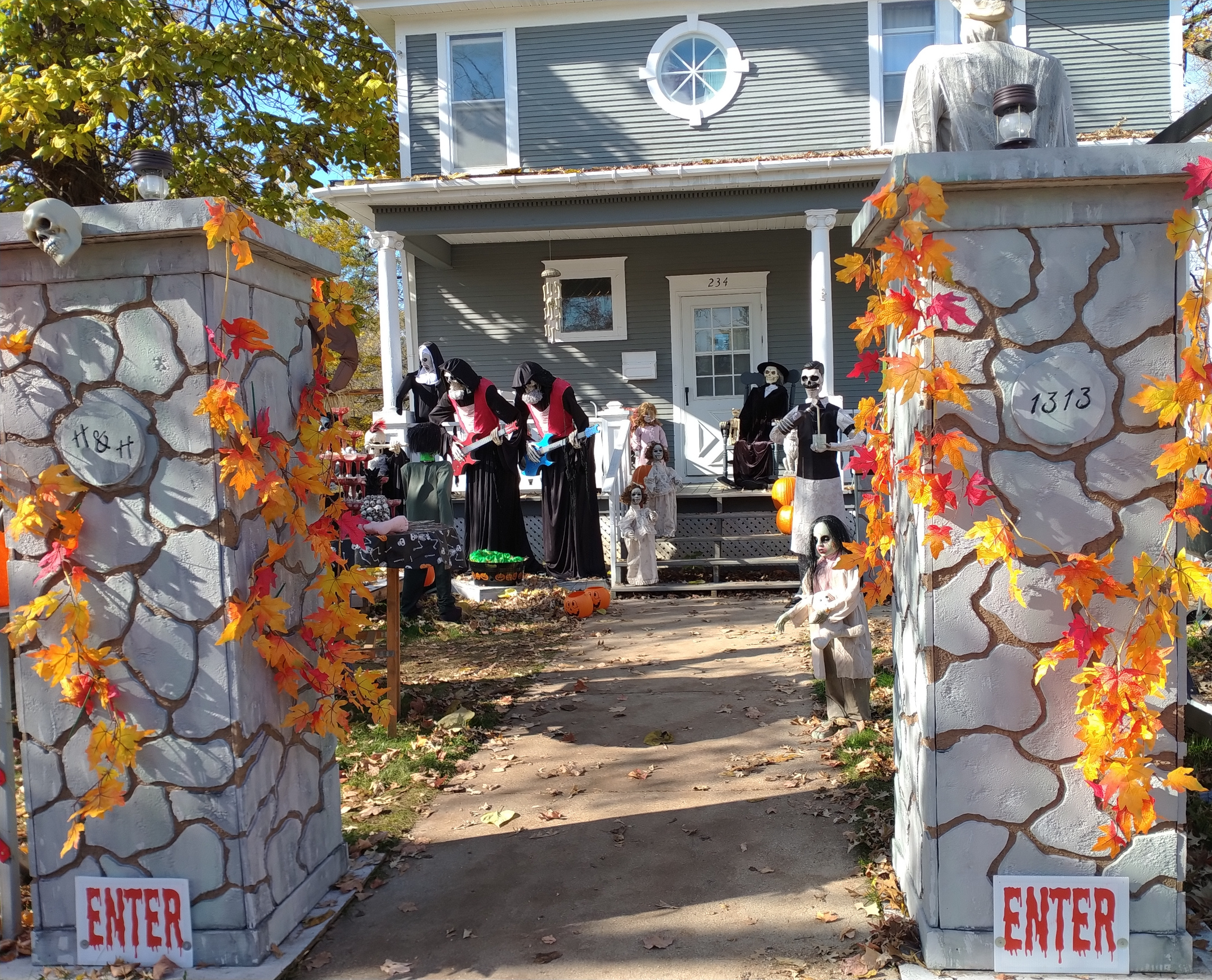
The entry to Coy and Kathy Lane’s second annual Halloween display in Faribault. (Minnesota Prairie Roots copyrighted photo October 2023)
IT’S SIMULTANEOUSLY CREEPY, creative and community-centered. That would be the Halloween display in the front and side yards of Coy and Kathy Lane, who live a block away from me up a steep side street.
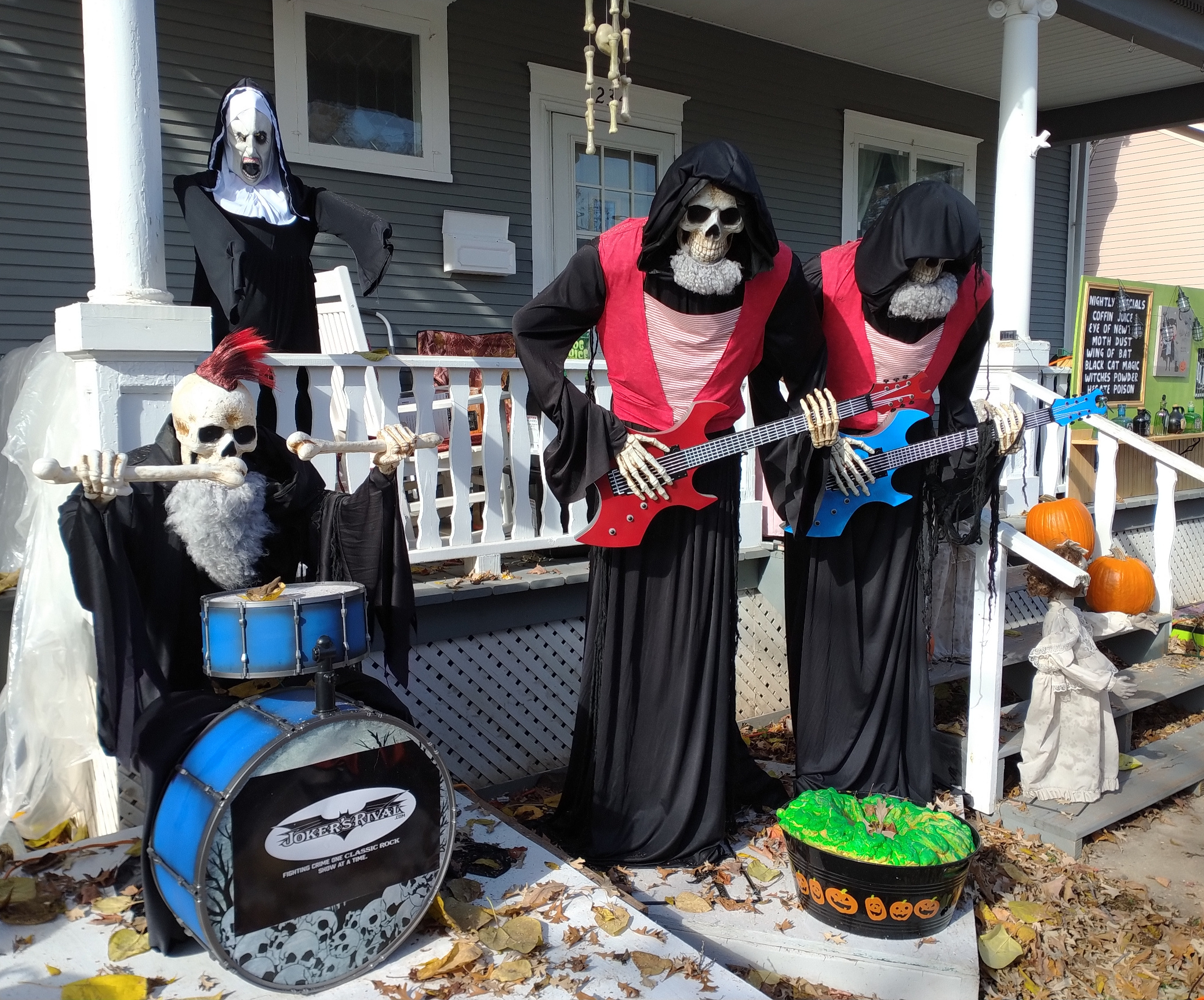
The band plays for wedding guests. (Minnesota Prairie Roots copyrighted photo October 2023)
Late Sunday morning Randy and I finally toured the Coys’ second annual Halloween creation, this year themed to the wedding of Stella Live and Noah Pulse. Kathy stepped outside her house to greet us and then to turn on the switches activating lights, sound and action. The Coys want visitors to walk into their yard for a fully-immersive experience. Already some 1,400 “guests” have stopped by to witness this wedding and attend the reception, according to Kathy. That’s double those who viewed their 2022 clown daycare display.
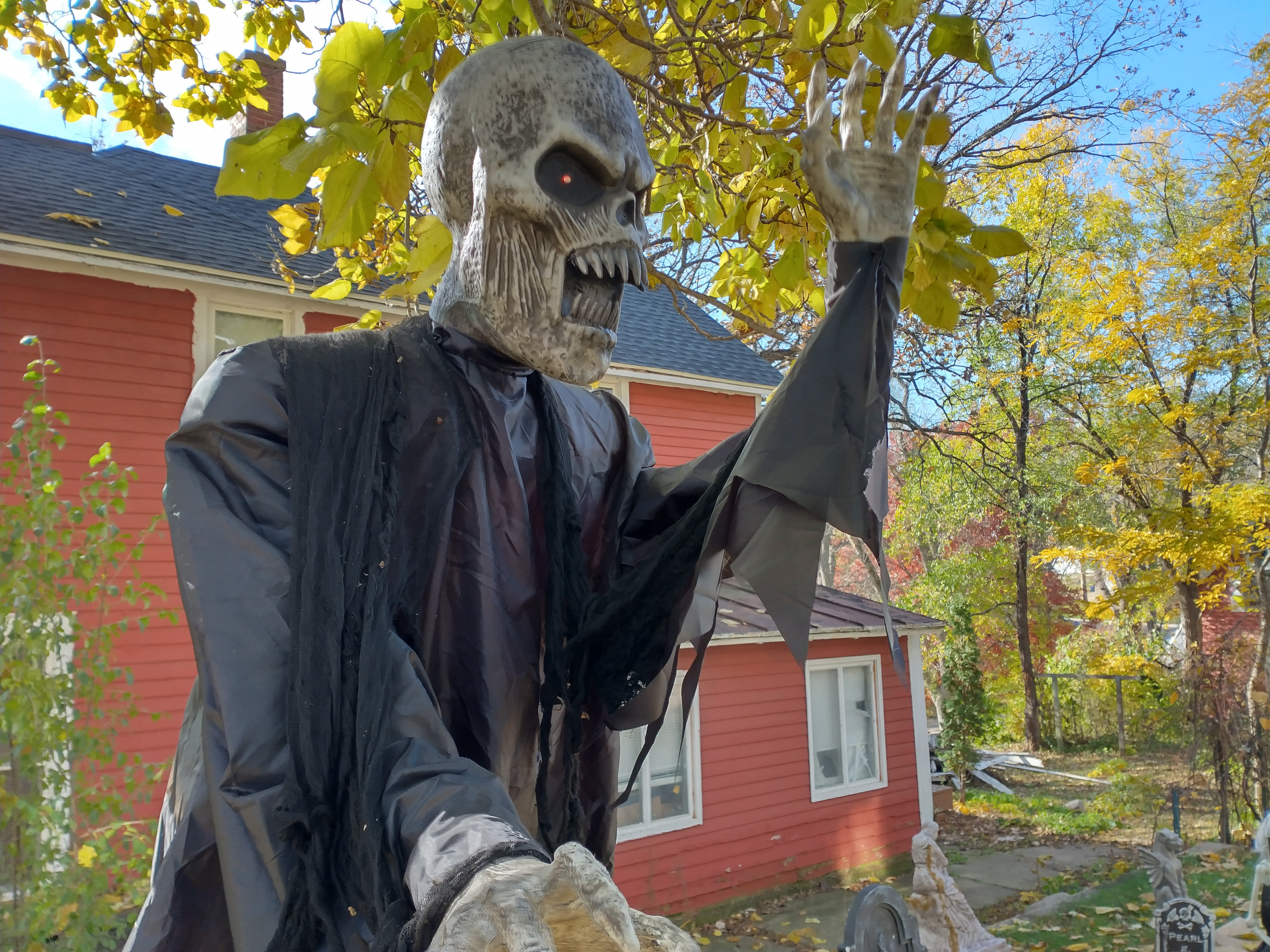
By the cemetery, an unexpected fright. (Minnesota Prairie Roots copyrighted photo October 2023)
From chatting with Kathy, it’s clear she and Coy love transforming their yard into a Halloween attraction that delights, awes and impresses. The couple enjoys the social aspect of interacting with visitors in what Kathy calls a family-friendly setting. If they learn that a young guest may be frightened by any aspect of their display, they’ll switch off the scary.
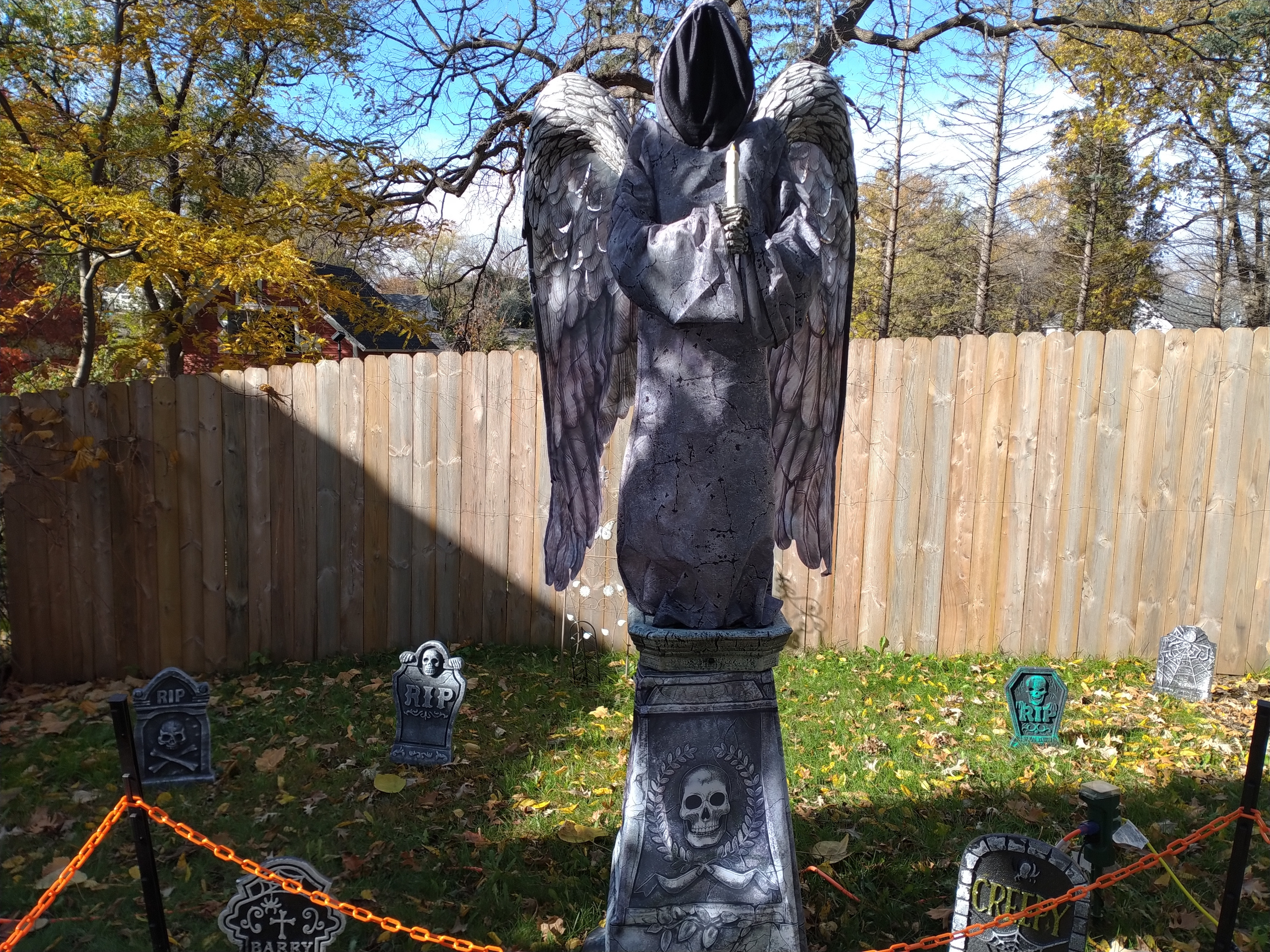
The Angel of Death activates to infuse scary into the cemetery.(Minnesota Prairie Roots copyrighted photo October 2023)
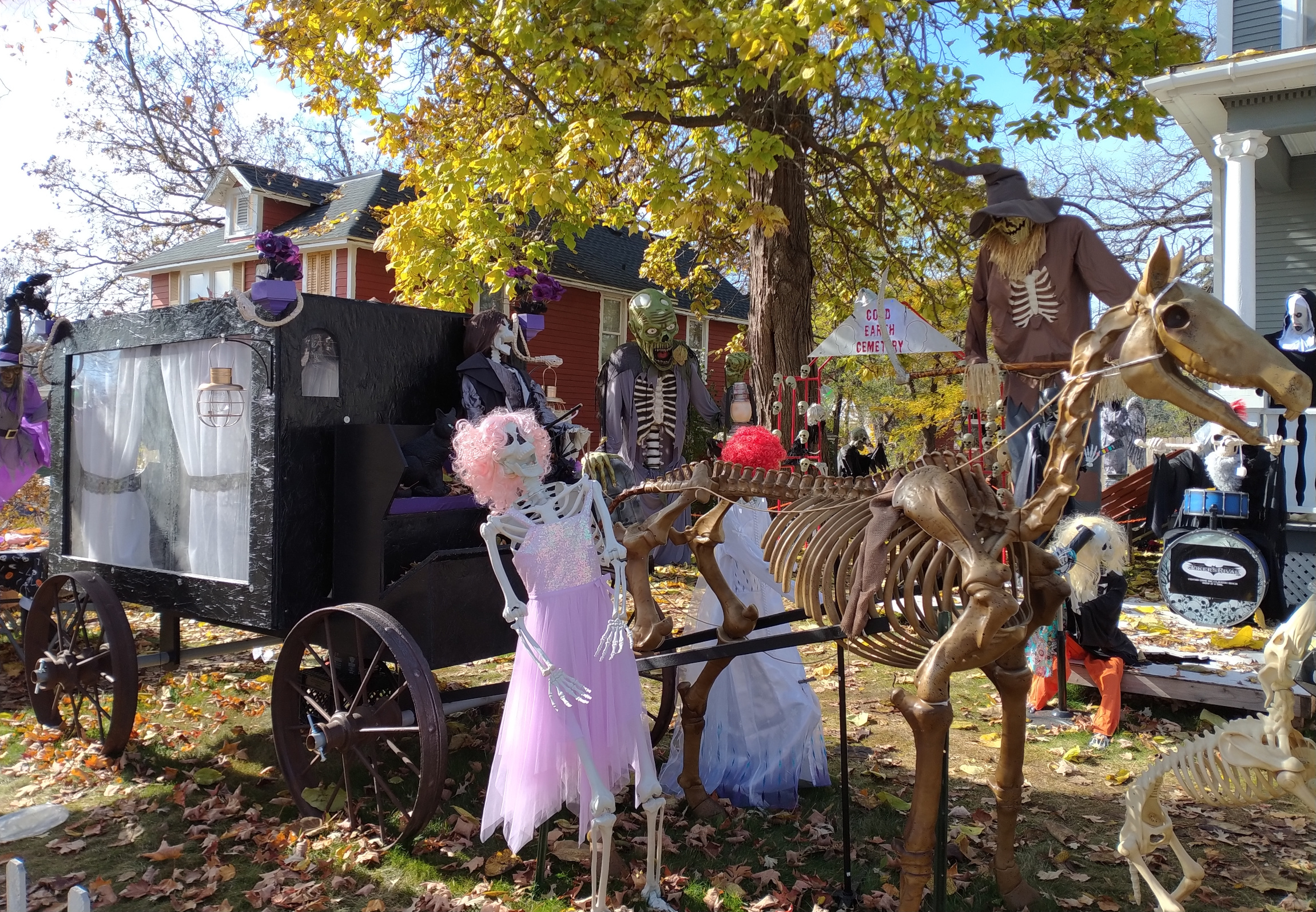
Had Kathy not warned me about the over-sized black-shrouded skeleton she activated near the cemetery, I may have jumped a bit. She noted every Halloween scene needs a cemetery, even at a wedding, where the reception was held at the Hiss and Hearse Golf Club and Cemetery. And, yes, there are open coffins and an Angel of Death and…
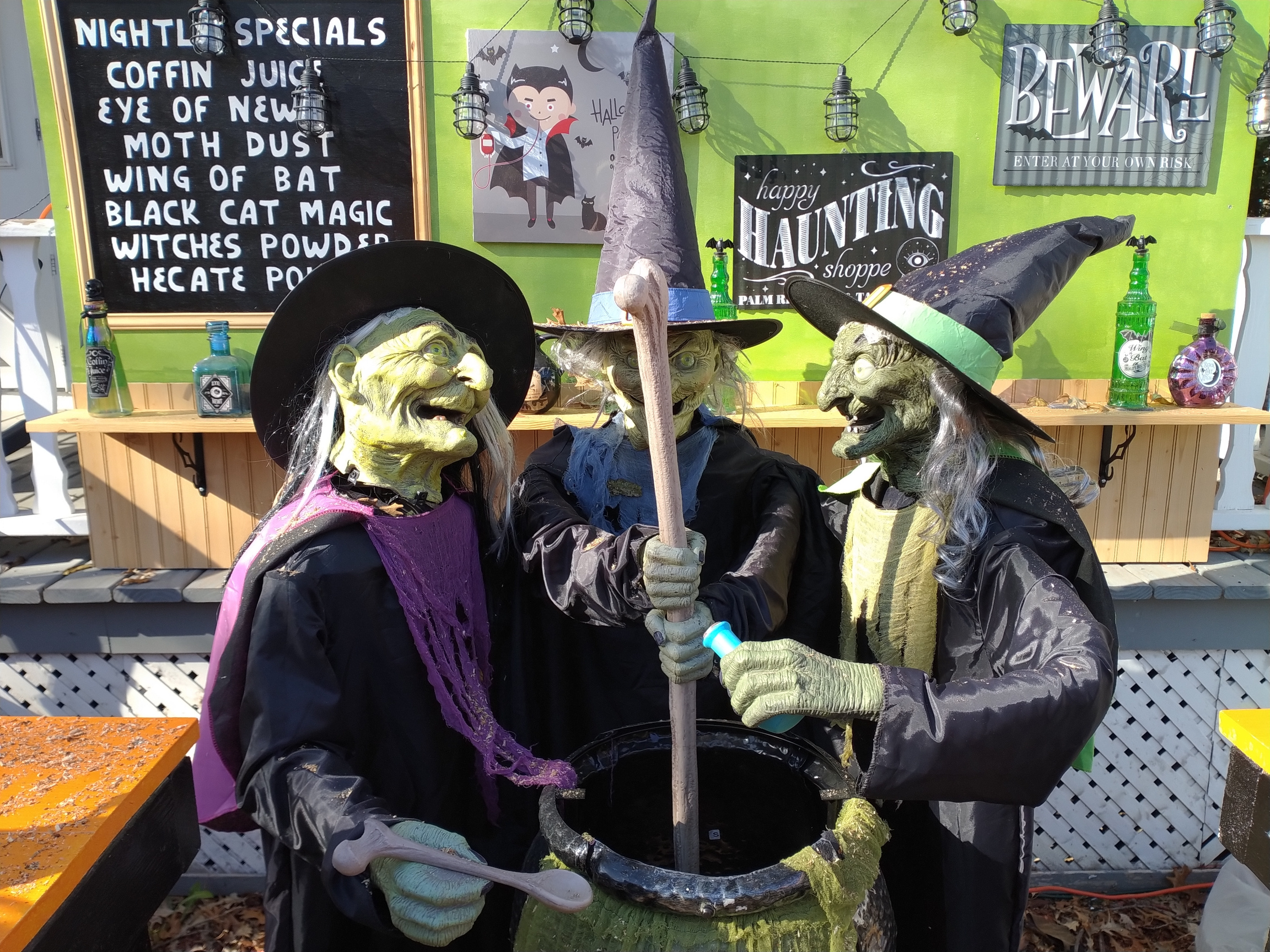
Brewing up drinks at the bar. (Minnesota Prairie Roots copyrighted photo October 2023)
And there’s a band and a wicked witch mother-in-law photo-bombing a photo of the bride and groom and a full open bar and a banquet table and a whole lot more.
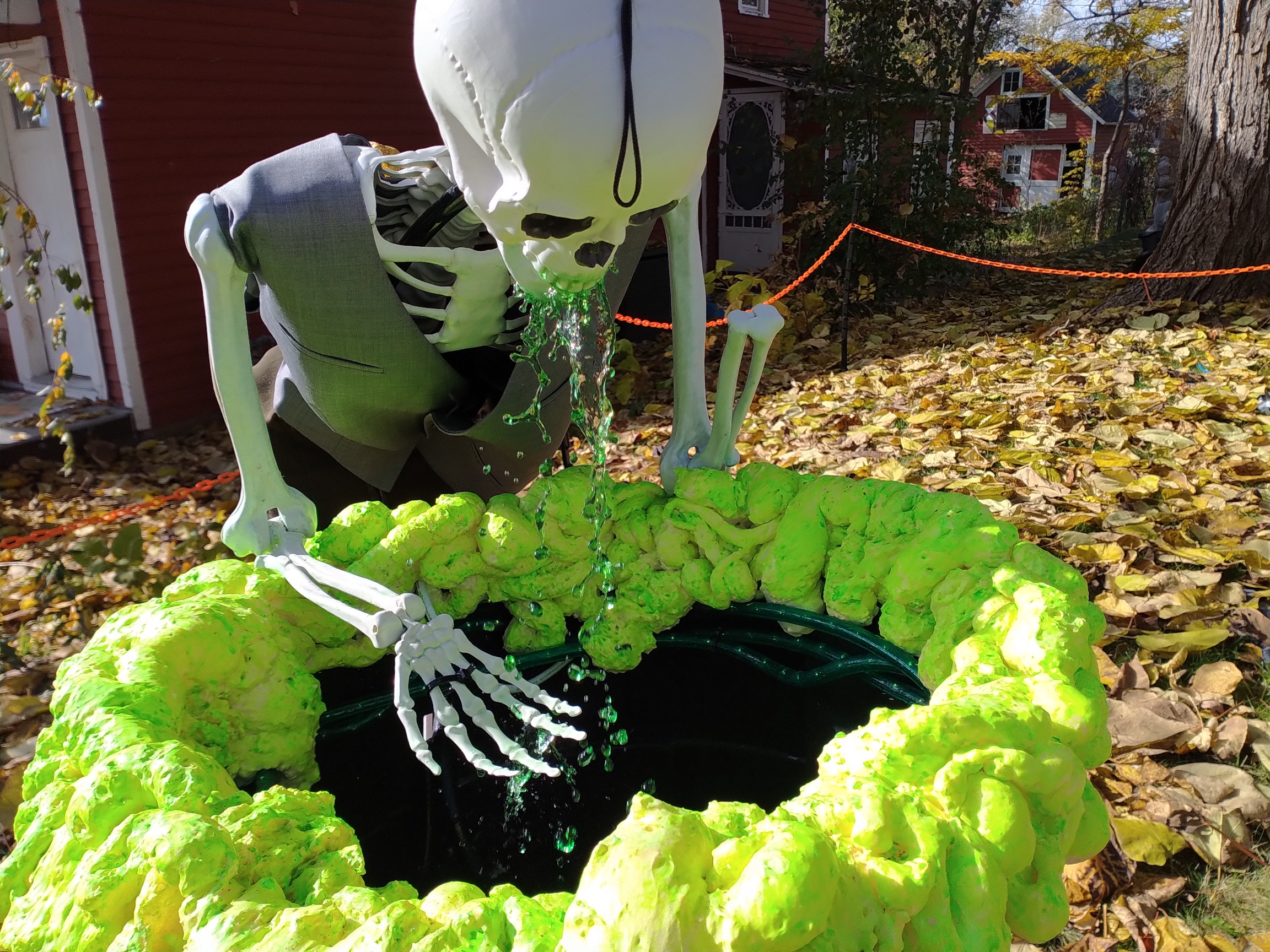
At least one wedding guest drank too much. (Minnesota Prairie Roots copyrighted photo October 2023)
The attention to detail is remarkable. A guest who’s overindulged, perhaps on North Dust, Coffin Juice or Wing of Bat, pukes green vomit. A skeleton drummer bangs out a rhythm with bone drumsticks. A granny, skeleton cat beside her, rocks on the front porch as she oversees the festivities.
The creepy little girl. (Minnesota Prairie Roots copyrighted photo October 2023)
Creepiest of all, in my opinion, is the teddy bear clutching girl who waits just inside the yard entry. Her long black hair falls around her sickly green face defined by glowing blue eyes. Over-sized green feet support her small frame. She’s off in a ghoulish sort of way that made me wonder what she’s capable of, what she’s thinking.
There’s lots to see, including a horse-drawn hearse with a surprise inside the glass-encased hearse. (Minnesota Prairie Roots copyrighted photo October 2023)
I know what I was thinking upon viewing the Coys’ display. I was thinking how generous, how creative, how wonderful of this couple to share their love of Halloween with the Faribault community. They’ve generated lots of smiles, mixed with an element of fear, but in a good sort of way.
FYI: The Halloween display, located at 234 First Avenue Southwest, will be up only until October 31. Lights turn off at 9 pm weekdays and 10 pm weekends.
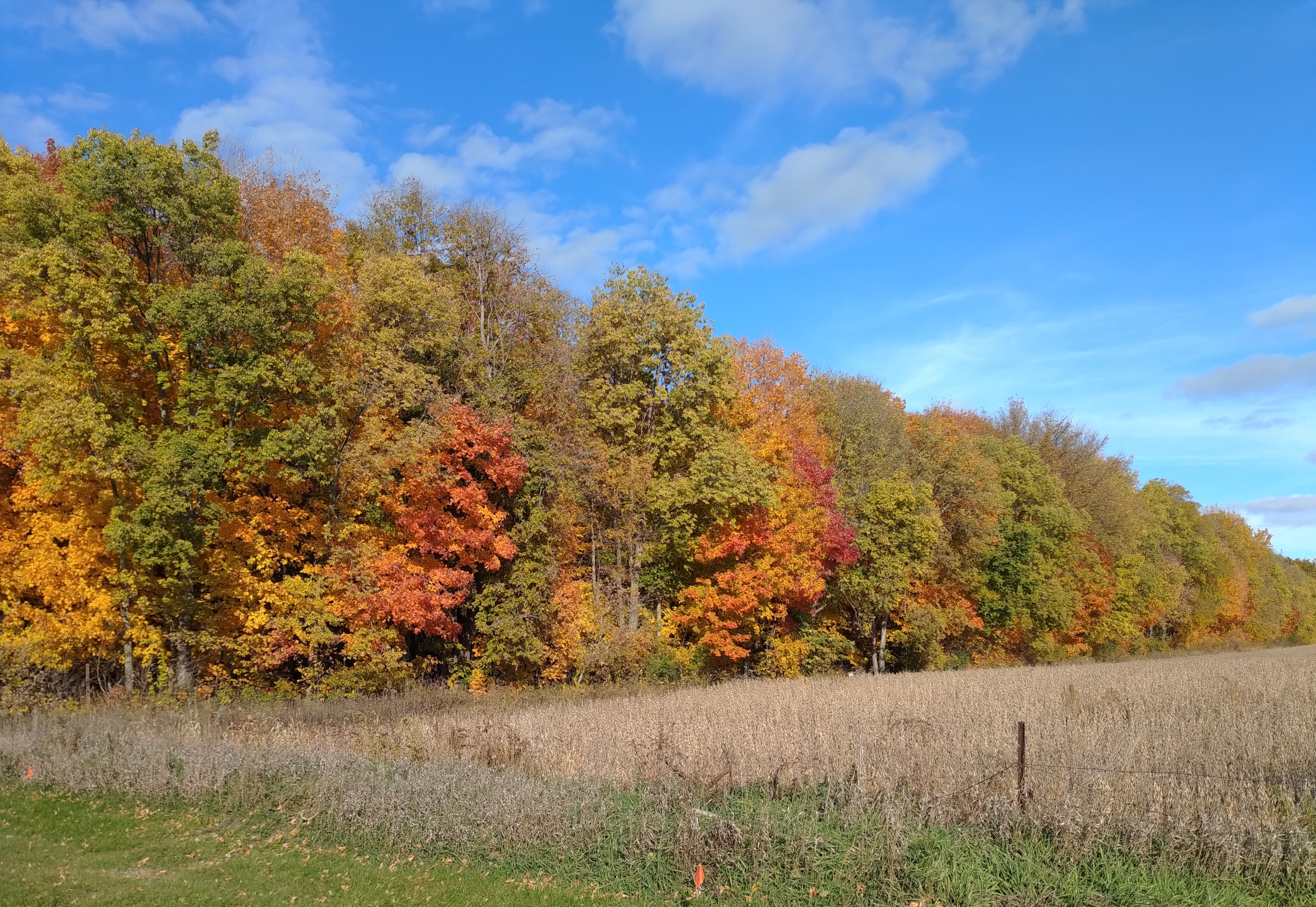
Stunning fall colors along Farwell Avenue north of Warsaw. (Minnesota Prairie Roots copyrighted photo October 2023)
AUTUMN BECKONED US RECENTLY to forgo the yard work, the half-finished interior paint job, the anything that would keep us at home. Rather, we hit the backroads, taking in the glorious fall colors which finally exploded. I can’t recall leaves ever turning this late in the season here.
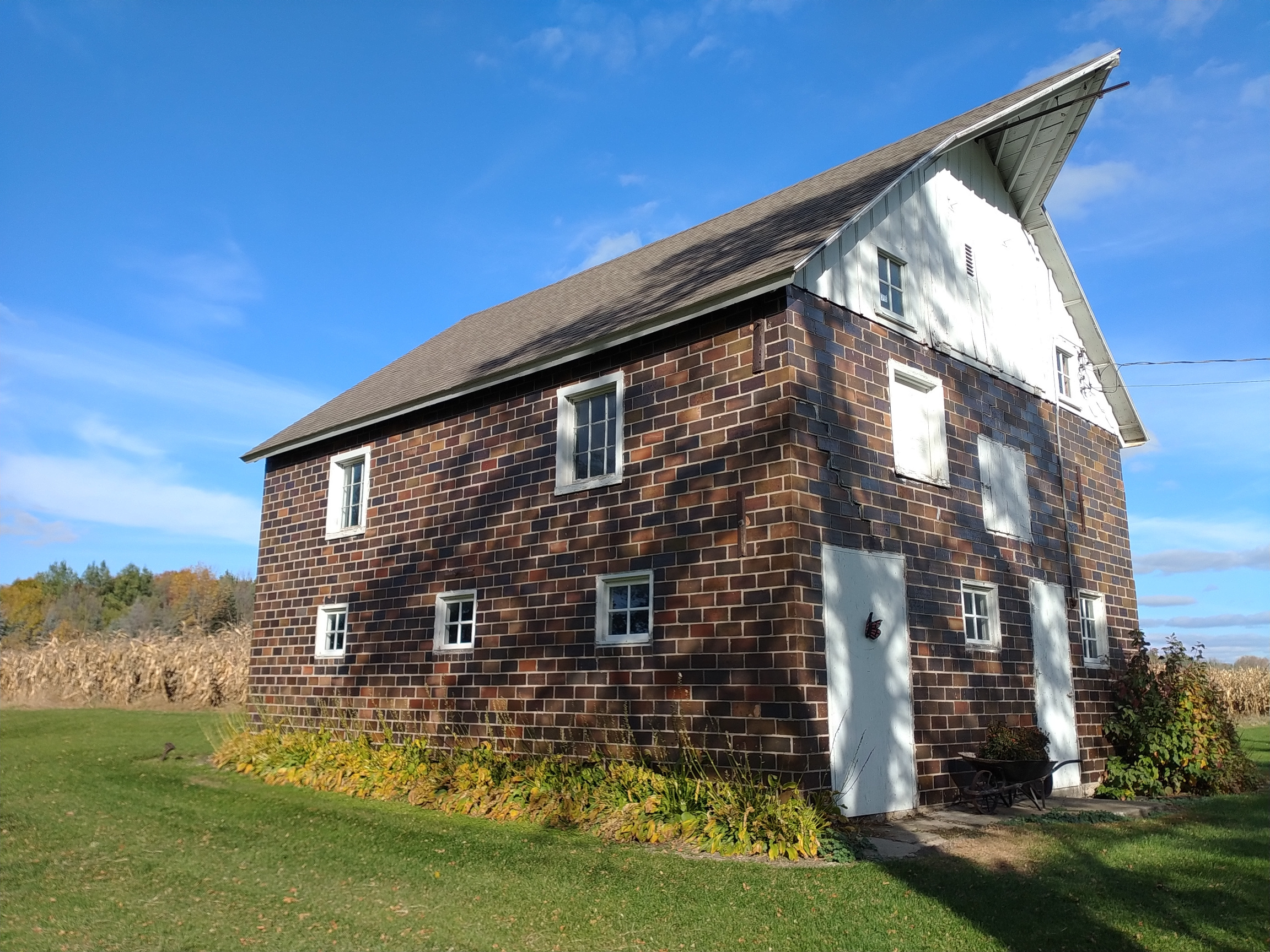
One of my favorite old barns in Rice County, located along Farwell Avenue north of Warsaw. (Minnesota Prairie Roots copyrighted photo October 2023)
This region of Minnesota seems vastly undiscovered as an autumn leaf-peeping destination. But I learned years ago that the Faribault area offers stunning fall foliage, especially along our many area lakes and in stands of trees among rural rolling hills.
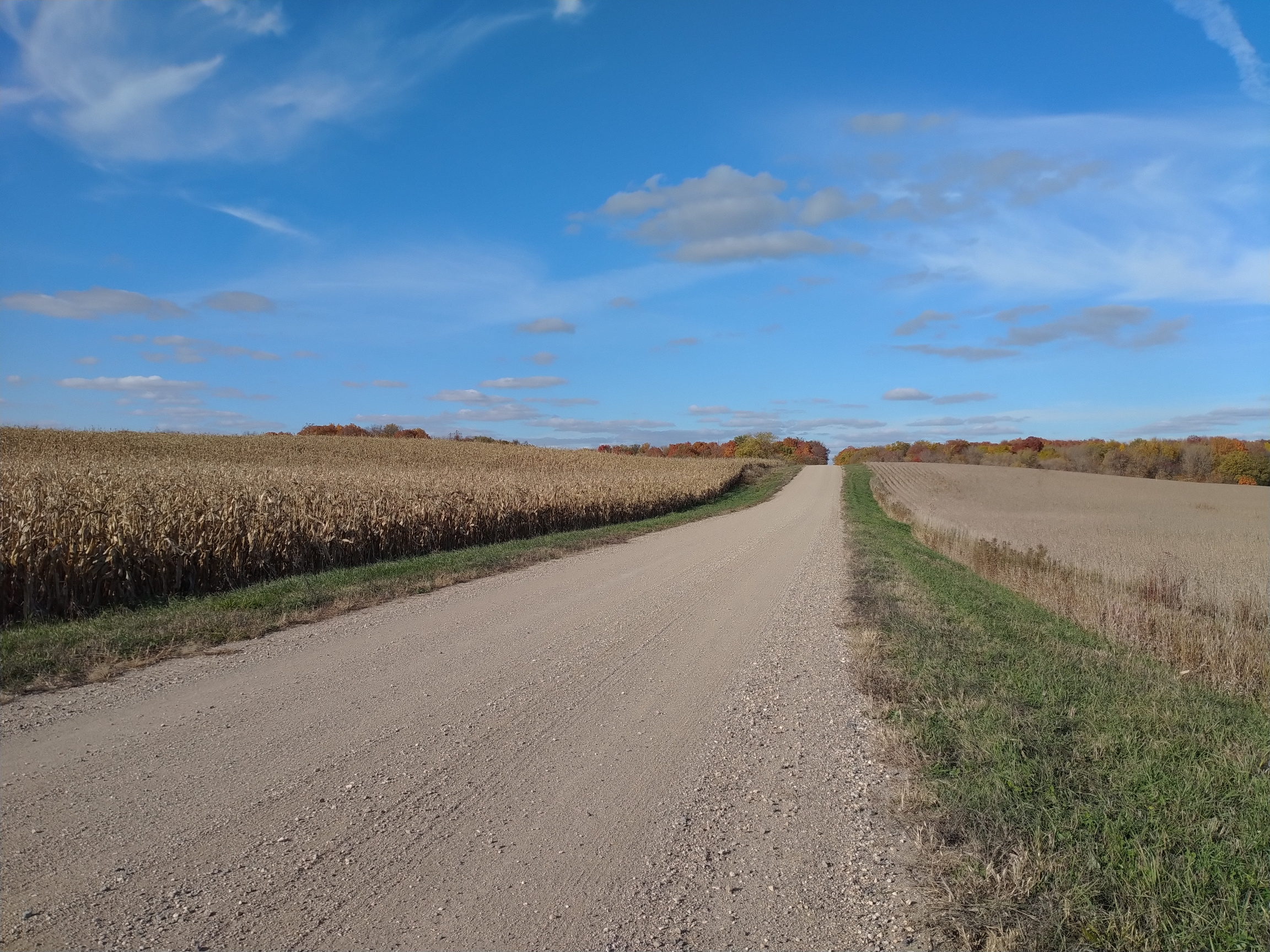
This gravel road, Farwell Avenue, took us past beautiful fall foliage. (Minnesota Prairie Roots copyrighted photo October 2023)
I like nothing better than to follow gravel roads that twist through the countryside. The slower pace connects me to the land, to the lovely scenes unfolding before me. Dust clouds trail vehicles rumbling along sometimes washboard surfaces. Combines kick up dust, too, as farmers harvest corn and soybeans, grain trucks parked nearby to hold the bounty.
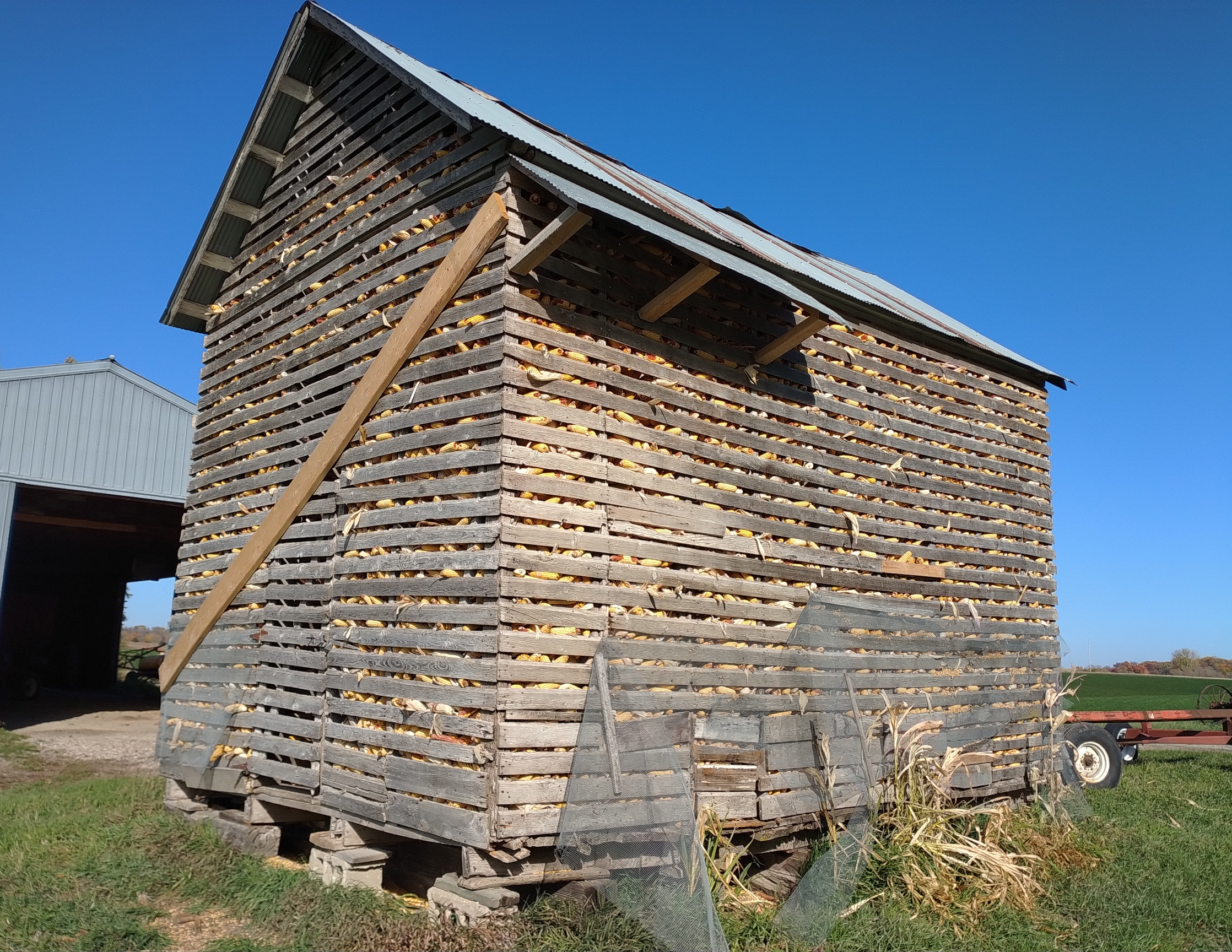
A rare find, a vintage corn crib packed with field corn in northwestern Rice County, in the Lonsdale area. (Minnesota Prairie Roots copyrighted photo October 2023)
Even inside our van, I can smell the scent of earth rising from freshly-tilled fields. Some acreage lies bare while others still hold endless rows of ripened crops awaiting harvest.
The Theis family has created a welcoming outdoor space for Apple Creek Orchard visitors to gather beside a fireplace against a wooded backdrop. (Minnesota Prairie Roots copyrighted photo October 2023)
At Apple Creek Orchard west of Faribault, families gathered on a sunny weekend afternoon to enjoy fun on-site activities like apple picking, bean bag toss, apple slinging, wagon rides, jump pad, corn maze and more. We wandered the grounds, admiring the improvements and expansions made by the Theis family to grow their orchard in to an agri-entertainment destination. They’ve also added an event center to host weddings and other gatherings.
Autumn-themed pillows are propped on the sitting area next to the outdoor fireplace at Apple Creek Orchard. (Minnesota Prairie Roots copyrighted photo October 2023)
As Randy paid for a half-peck of my favorite Minnesota-developed SweeTango pulled from a store cooler, I greeted Tami Theis, congratulated her on their upgrades. She inquired about my family. I got to know Tami and her daughter Amber sometime back while at the orchard. They are a delight— friendly, caring and, oh, so welcoming to everyone. Amber was running the concession stand on this busy afternoon and I gave her a hard time after learning the donut machine wasn’t working and I would get none of the mini donuts I craved.
Dudley Lake, one of my favorite places to see colorful lakeside treesin Rice County.(Minnesota Prairie Roots copyrighted photo October 2023)
No matter my disappointment in the lack of a sweet treat, nothing else about our afternoon outing disappointed. Onward Randy and I went. He turned the van left out of Apple Creek Orchard onto the paved roadway. Eventually we took gravel roads again, meandering past lakes and fields and farm sites, stopping occasionally so I could snap photos.
My next-door neighbor’s flaming maple. (Minnesota Prairie Roots copyrighted photo October 2023)
I love this time of year. The scent of decaying leaves. The sight of trees flaming red, yellow, orange. The muted fields that define the landscape. The apples and pumpkins and gourds. The bold blue sky. The bringing in of the harvest.
Looking up at our backyard maple, the wooded hillside and at our neighbor’s trees on a recent afternoon. (Minnesota Prairie Roots copyrighted photo October 2023)
Back home, the down side of autumn awaited us in outdoor chores—removing leaves from rain gutters, raking/mulching layers of maple leaves in the backyard, washing windows… To everything there is a season. And the season of autumn means taking time to view the colorful fall foliage when the trees are turning. The work can wait.
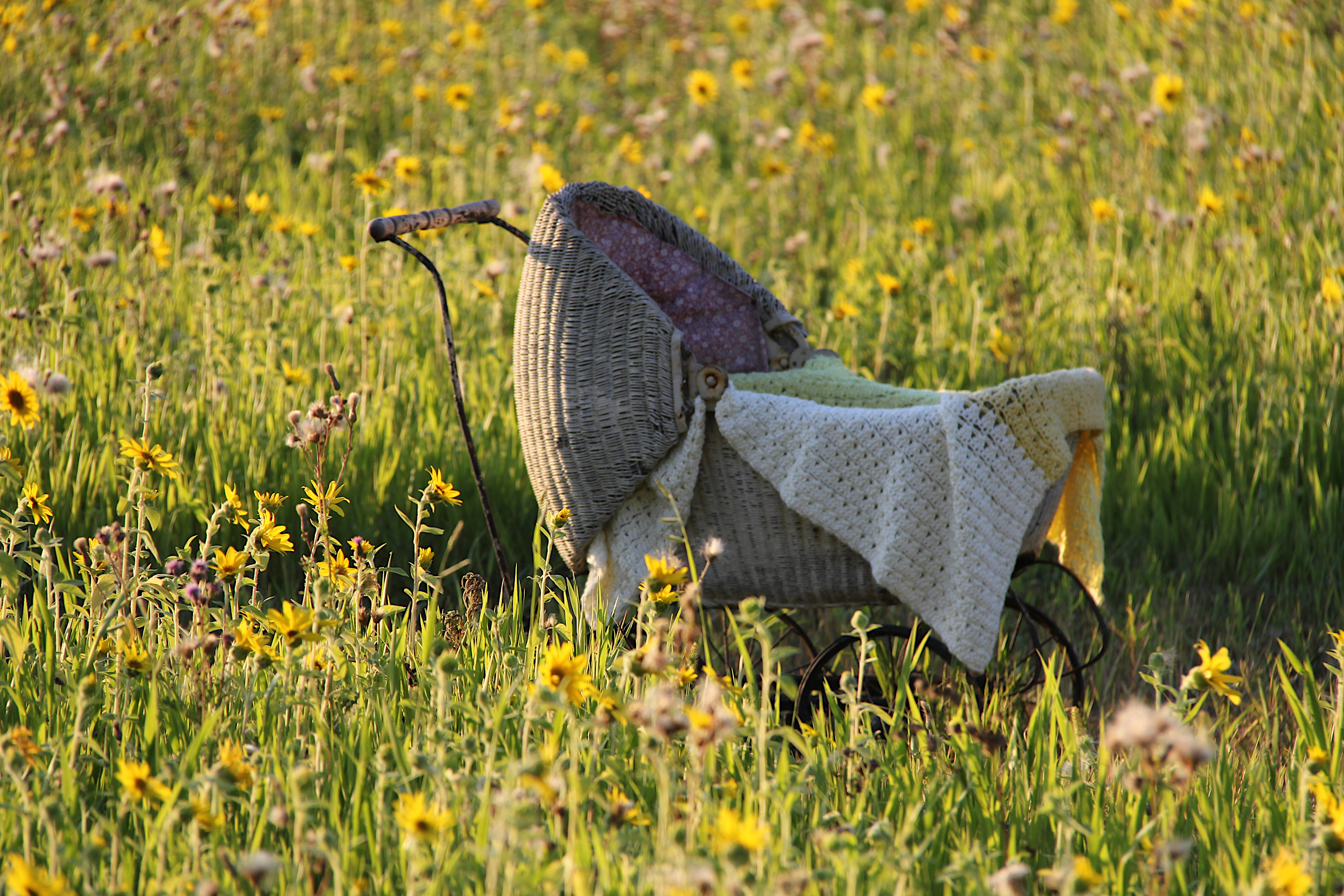
An empty buggy parked in a field of sunflowers was part of the IRIS Sunflower Garden planted in Faribault for the first time this summer. It offered a quiet place to contemplate, to grieve, to honor. (Minnesota Prairie Roots copyrighted file photo July 2023)
TO LOSE A CHILD, whether in utero, to stillbirth, to SIDS or some other disease, illness or tragedy is to experience profound grief. It is unfathomable, yet reality for too many. It is heartbreaking and gut-wrenching and painful beyond words.
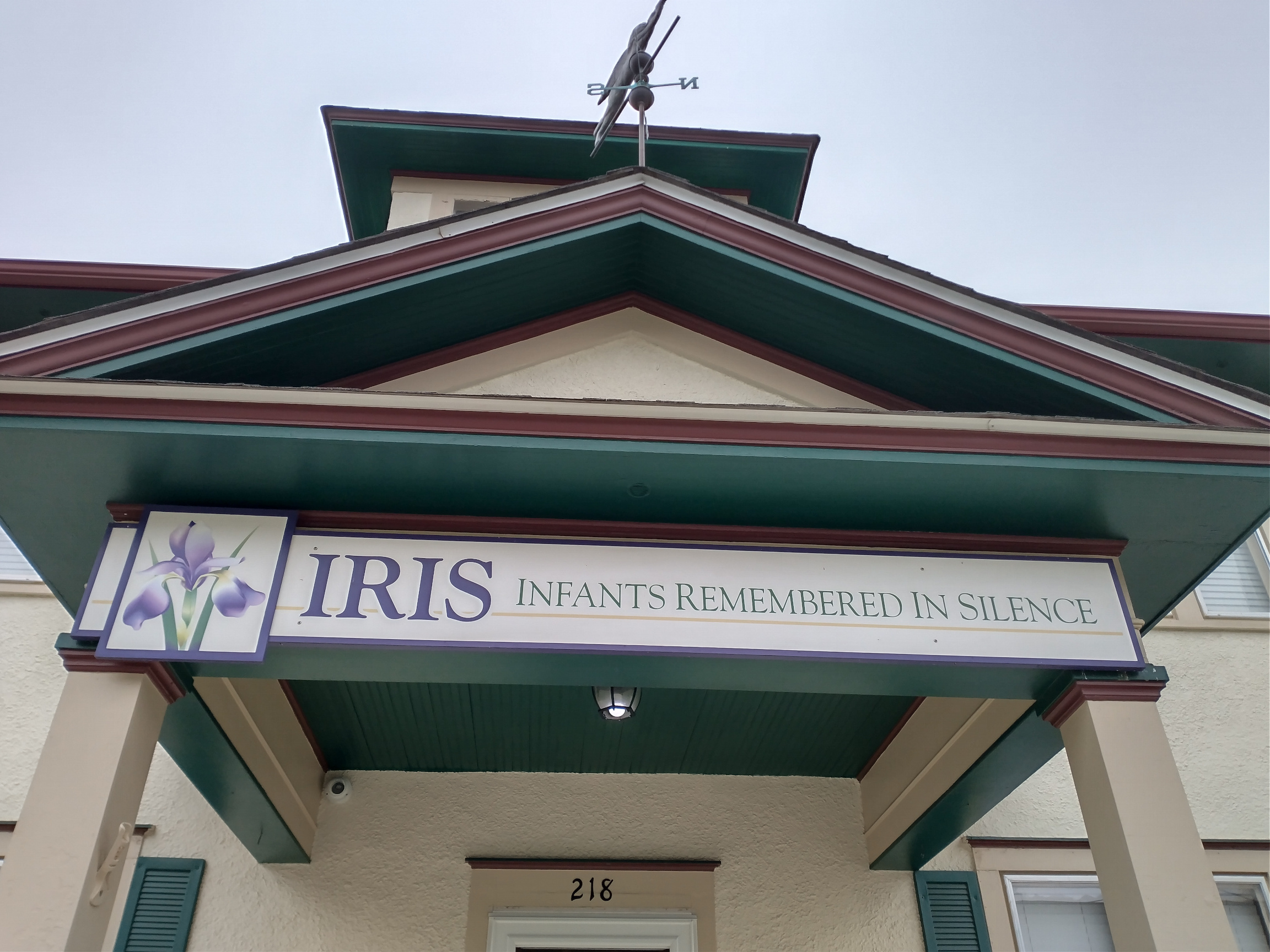
The IRIS house is located in central Faribault near downtown and near the Rice County courthouse and government services building. (Minnesota Prairie Roots copyrighted photo October 2023)
This evening at 7 pm, Faribault-based Infants Remembered in Silence (IRIS) hosts a Wave a Light Gathering to honor the memories of those children lost too soon, whether pre-birth, in infancy or in childhood. October 15 is Pregnancy and Infant Loss Remembrance Day. People around the world are invited to light a candle honoring those children in a collective show of love, support and care.
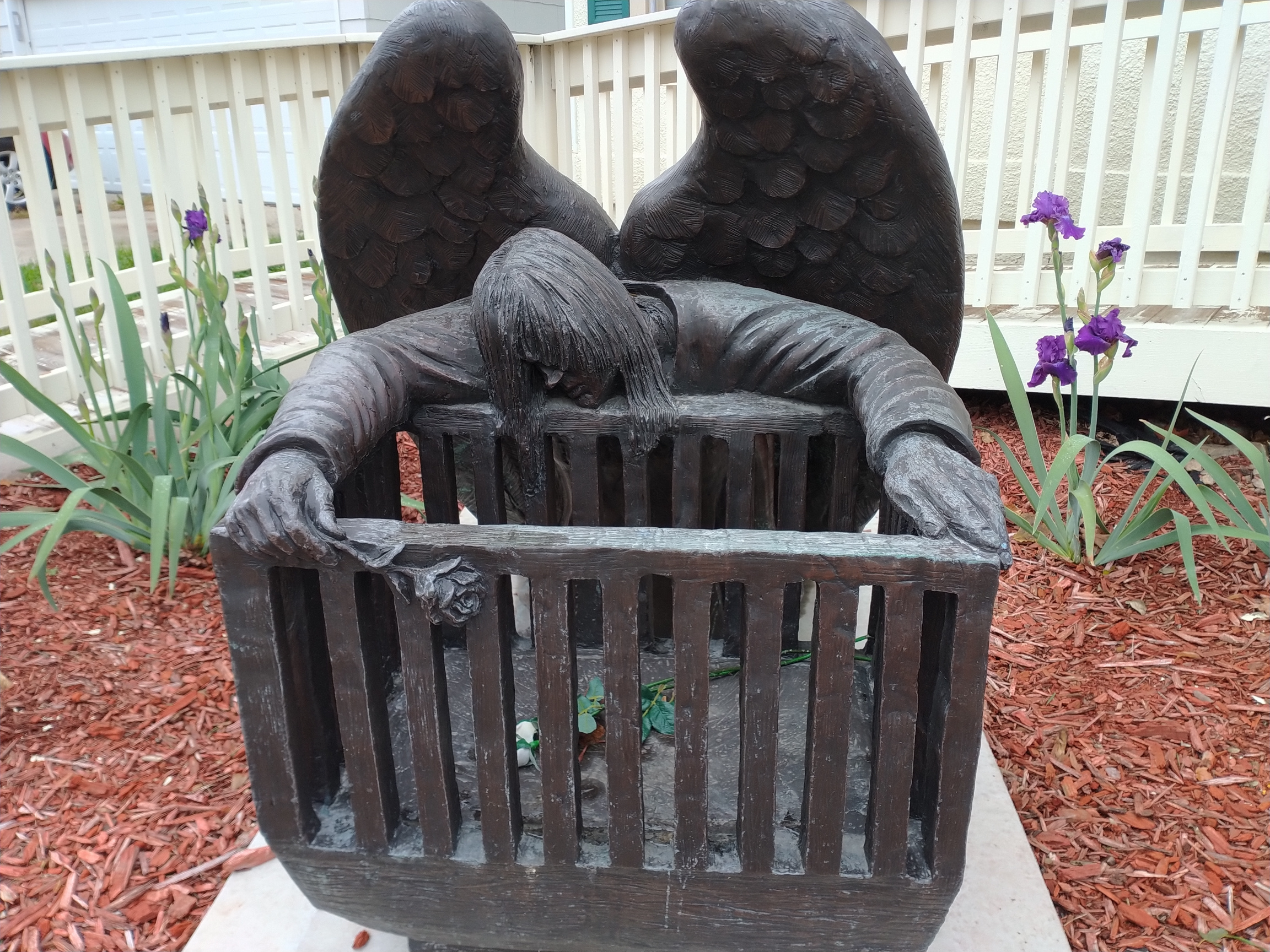
This moving sculpture defines the front yard flower garden of IRIS, where iris are currently blooming. Hearts will be placed inside the cradle this evening. (Minnesota Prairie Roots copyrighted photo October 2023)
Locally that will happen at the IRIS office, 218 Third Avenue. The Faribault event includes the sharing of poems, songs and readings plus the placing of hearts in the empty cradle of the on-site bronze statue, “I Knew You In The Womb.” Attendees should arrive with candles and with hearts (with the names of lost little ones written thereon). Those hearts will be added to IRIS’ permanent collection.
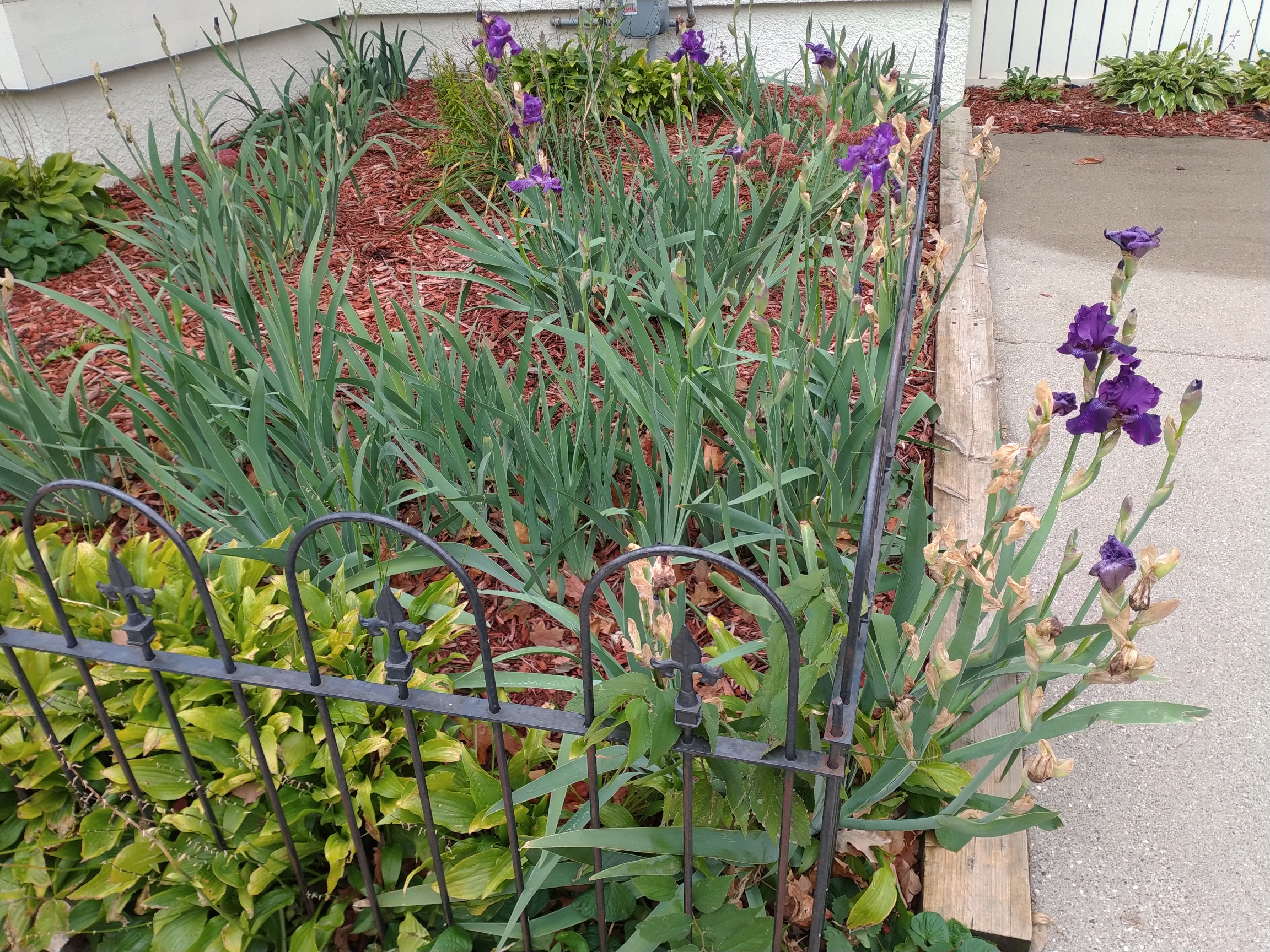
More iris bloom in a side garden of IRIS. (Minnesota Prairie Roots copyrighted photo October 2023)
IRIS, a non-profit which started in my community, has grown to a world-wide outreach. It supports, advocates, educates, serves, comforts and much more and is truly an invaluable resource for anyone grieving the loss of an infant, a child.
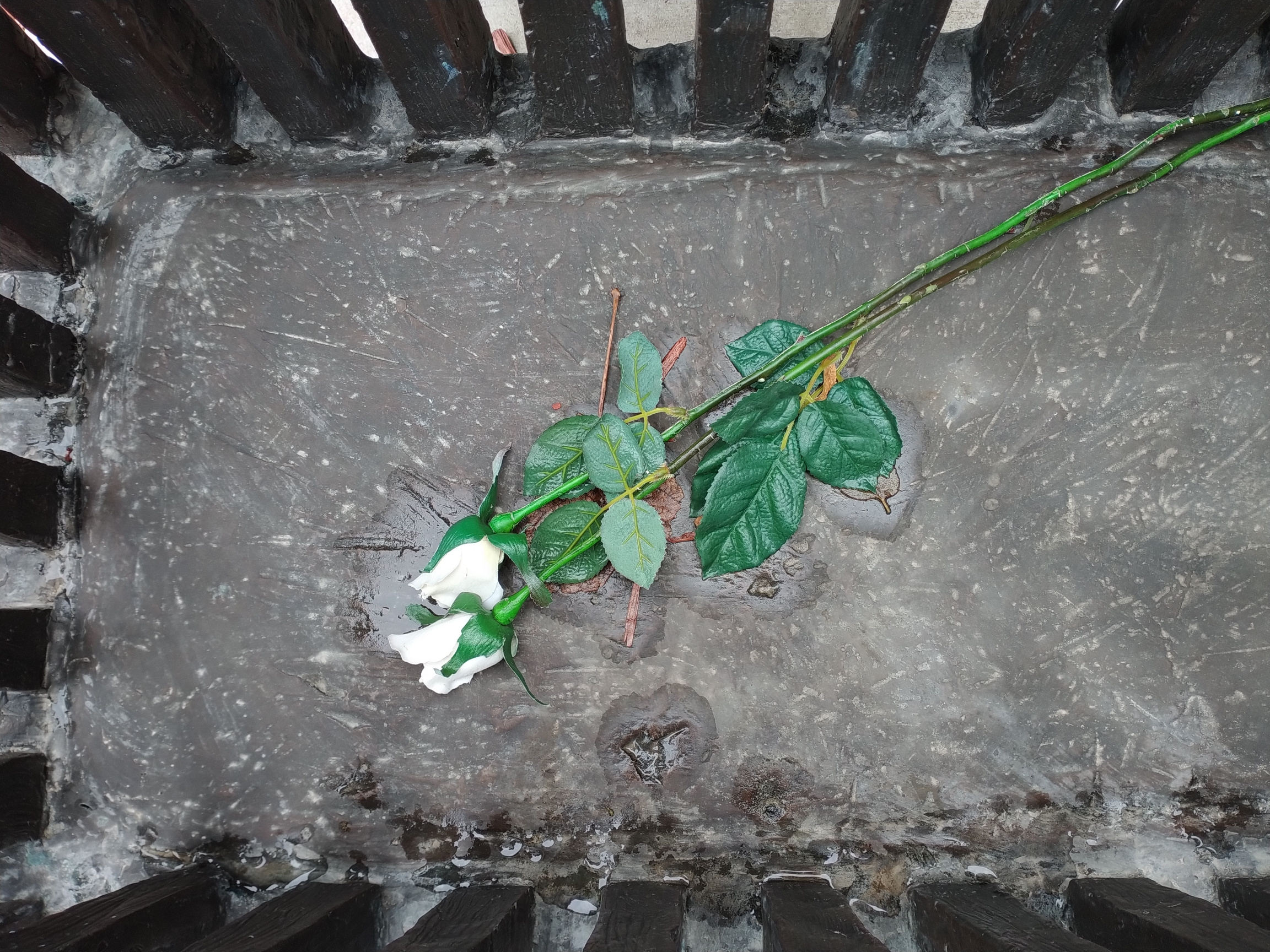
Sunday morning two roses lay inside the otherwise empty cradle of the IRIS sculpture. (Minnesota Prairie Roots copyrighted photo October 2023)
So this evening, light a candle. And if you see blue and pink lights lighting a public structure like the 35W bridge, the Lowry Avenue Bridge or the IDS Center, all in Minneapolis, think of the sweet babies, the darling children, the dear little ones lost, and, oh, so loved.
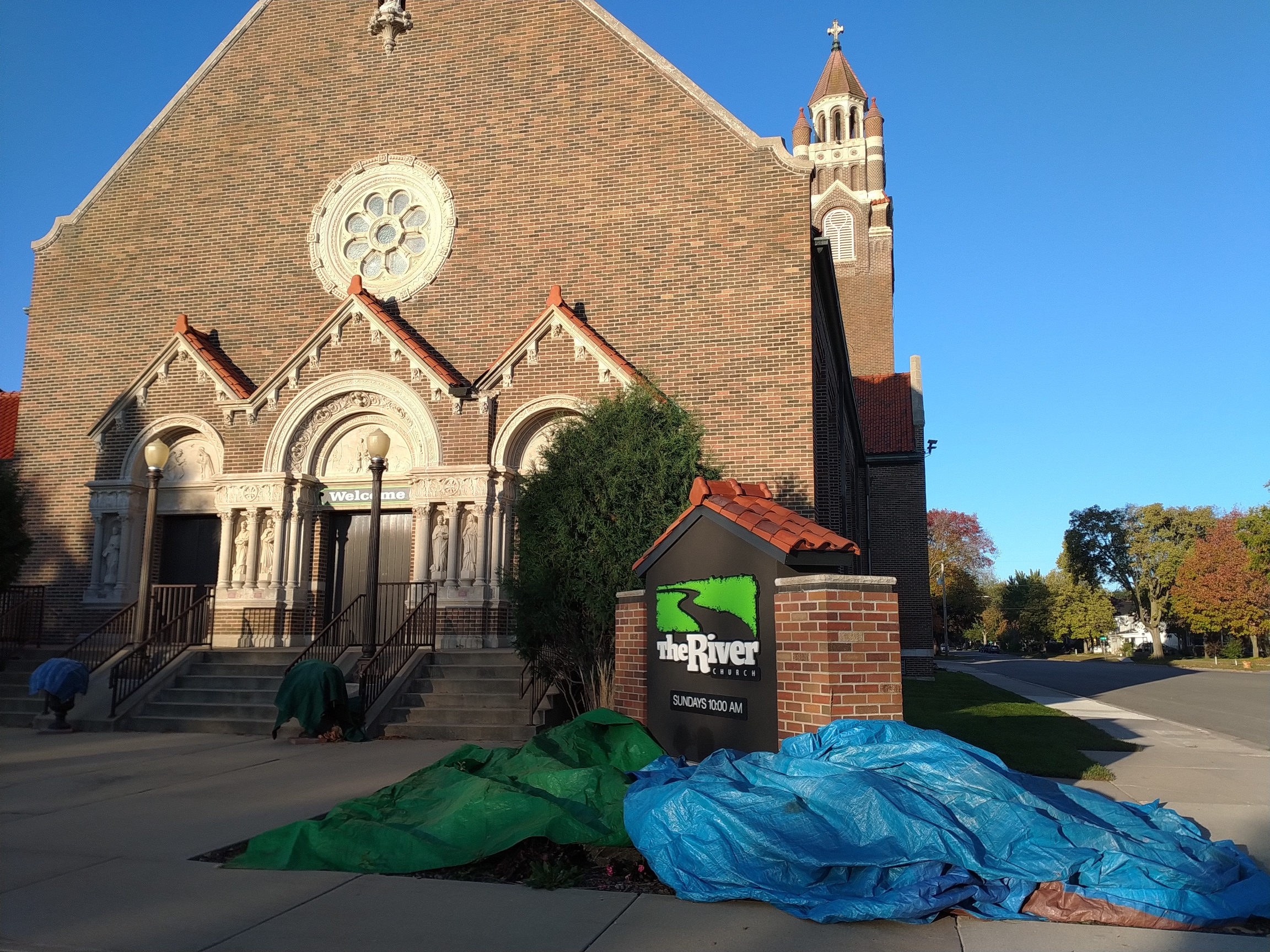
Flowers were covered to protect them from frost Monday morning at The River Church, Faribault. (Minnesota Prairie Roots copyrighted photo October 2023)
FROST LAYEREDWINDOWS of the neighbor’s 1970s Ford Gran Torino Monday morning. Frost also skimmed roofs, spotted lawns, nipped uncovered plants.
October 9 marked the first light frost in Faribault, a clear indication of winter’s impending arrival.
There was a time when I would have raced around the evening before a predicted frost, covering plants with old sheets. The desire ran strong to extend autumn by keeping outdoor flowers and other plants alive. No more. I no longer plant flowers in pots like I once did given the cost and work. Rather, I rely on primarily perennials to splash color and greenery into my yard.
Cyclamen. (Minnesota Prairie Roots copyrighted photo October 2023)
Only the oregano, rosemary and cyclamen, which I winter over, needed protection from Monday’s below freezing temps. So Randy carried those pots into the garage in the dark of Sunday evening.
Monday morning we arose to that first frost, turned on the furnace for the first time this fall, then slipped on our jackets, stocking caps and gloves and headed to Central Park for our morning walk. City employees were already there, shortly after 8 am, loading picnic tables and park benches onto a trailer and pick-up truck bed for winter storage.
Across the street, a lawn service company edged the sidewalk of grass at an apartment complex, making for easier snow removal come winter.
Across the street from the apartments, blankets and tarps draped flowers and plants at The River Church.
In the brilliant sunshine of this cold October morning, we walked away from and around Central Park, pausing to chat briefly with a Korean War veteran shoving his walker along the sidewalk. It’s part of his morning routine. He was an engineer in the war, tasked once with building a bridge in Korea. His brothers also served in various wars. All came home.
Home. On this day this veteran shared how he misses his lake home, how his children convinced him to move into cooperative senior living housing by the park. He shouldn’t have listened to his kids, he said, sadness tinging his voice.
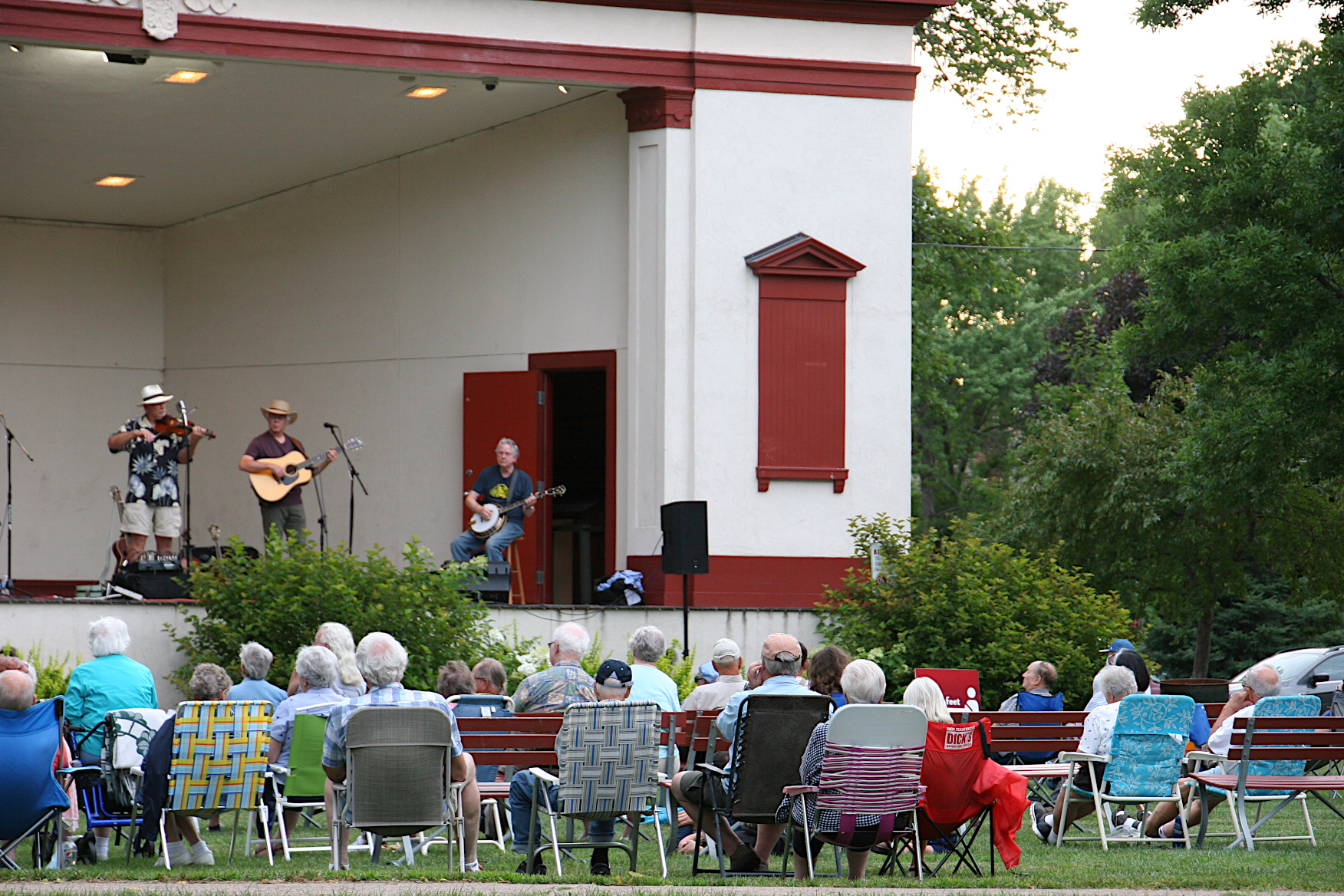
Enjoying a summer concert at Central Park. (Minnesota Prairie Roots copyrighted file photo July 2020)
Change. It can be tough. Randy and I continued on in the inevitable change of seasons. Past the band shell, where seniors and others once settled onto park benches, picnic tables and lawn chairs for summer concerts. And then back to the van for the drive home in the bright sunshine.
The backyard maple, still mostly green in early October. (Minnesota Prairie Roots copyrighted photo October 2023)
Back home I pulled laundry from the washing machine, carted the basket up the basement stairs, opened the door to the boldness of October, to the backyard maple still mostly green. It’s been an odd autumn of up and down temps which messed with fall colors.
I unwound the clothesline, then began clipping laundry on the line. Methodically. Placing heavier items like bluejeans in the full sun. Soon my fingertips felt the cold—from the cold morning and the dampness of the cold clothes.
And then, when I finished, I stepped inside the garage, carried out the pots of oregano, rosemary and cyclamen into the balminess of 40-degree temps.
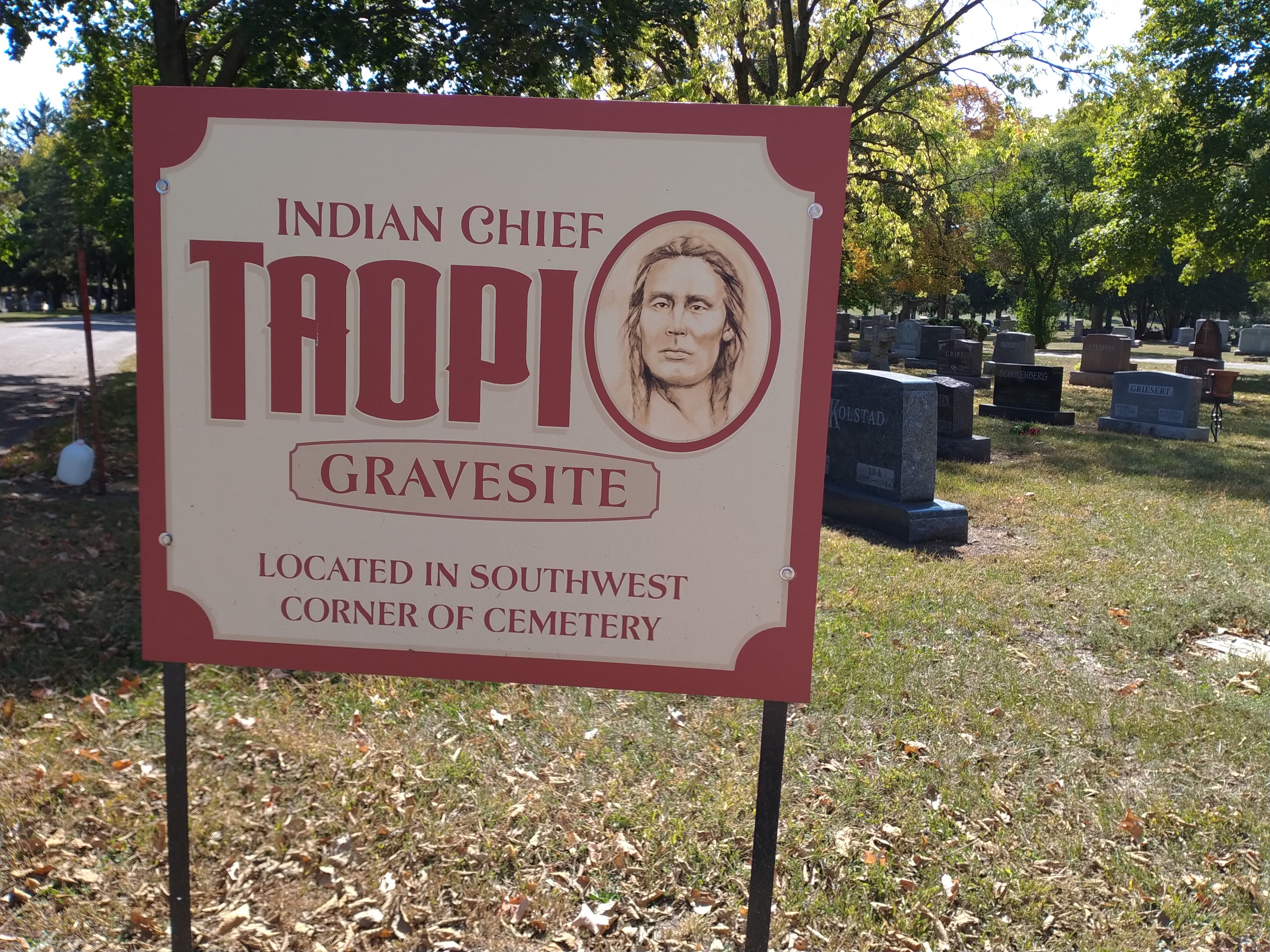
Just inside the entrance to Maple Lawn Cemetery, a sign directs visitors to Taopi’s gravesite. (Minnesota Prairie Roots copyrighted photo October 2023)
MY GOAL WAS SIMPLE—to write a piece honoring Indigenous Peoples’ Day. My focus, I initially decided, would be on Taopi, a member of the Little Crow Band of the Mdewakanton Dakota Tribe. Taopi is perhaps best known in Faribault, where he lived for a while and is buried. A small Mower County town near the Iowa border also honors him in name. But my writing expanded beyond Taopi.
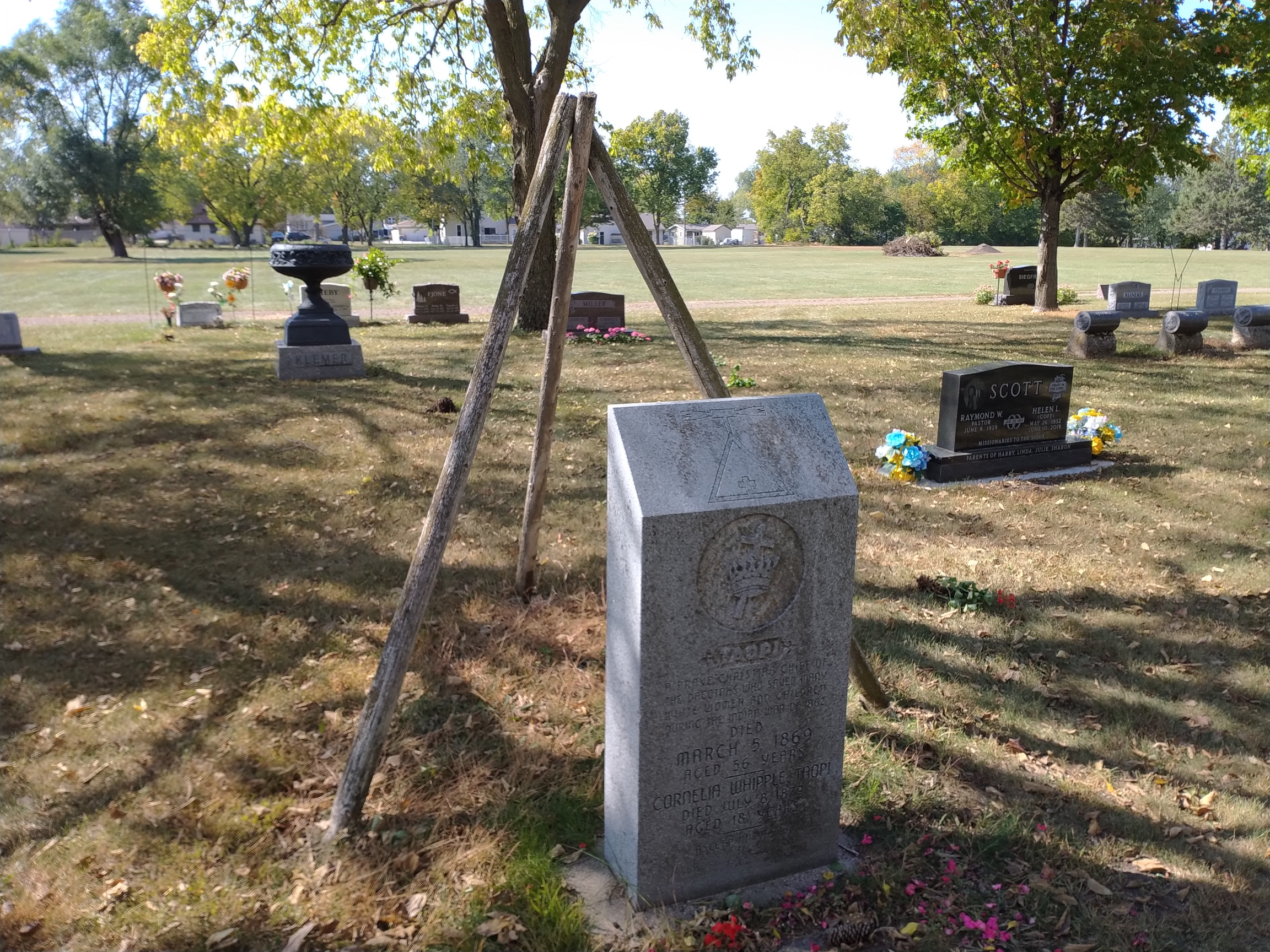
Taopi’s grave, and that of his daughter, are easily spotted via the propped poles. (Minnesota Prairie Roots copyrighted photo October 2023)
Recently I visited Taopi’s gravesite at Maple Lawn Cemetery. My interest piqued. I wanted to learn more about this Dakota leader and his importance in my community and in Minnesota history. His place in history connects to the US-Dakota War of 1862, a war all too familiar to me. My native Redwood County, where the Lower Sioux Agency was located, centered that deadly, short-lived conflict between white people and Native Peoples.
Now, viewing this war through a lens not tinted primarily by a white perspective, I understand the injustices. Decades ago, when I wrote a high school term paper on the war, I admittedly wrote a biased, unbalanced report based on biased, unbalanced research sources.
With time and maturity came the realization of the great injustices done, first when the US government acquired Indigenous Peoples’ land at a seemingly low cost and then failed to honor those treaties. The treaties opened nearly 24 million acres to white settlers. It was the Natives, the original inhabitants of this land, who found themselves cheated of government annuities, starving, pushed off their land and confined to strips of land along the Minnesota River. That includes the Wahpekute, a small band of the Dakota who lived in south central Minnesota, including the Faribault area. I live just below a Faribault city park called Wapacuta.
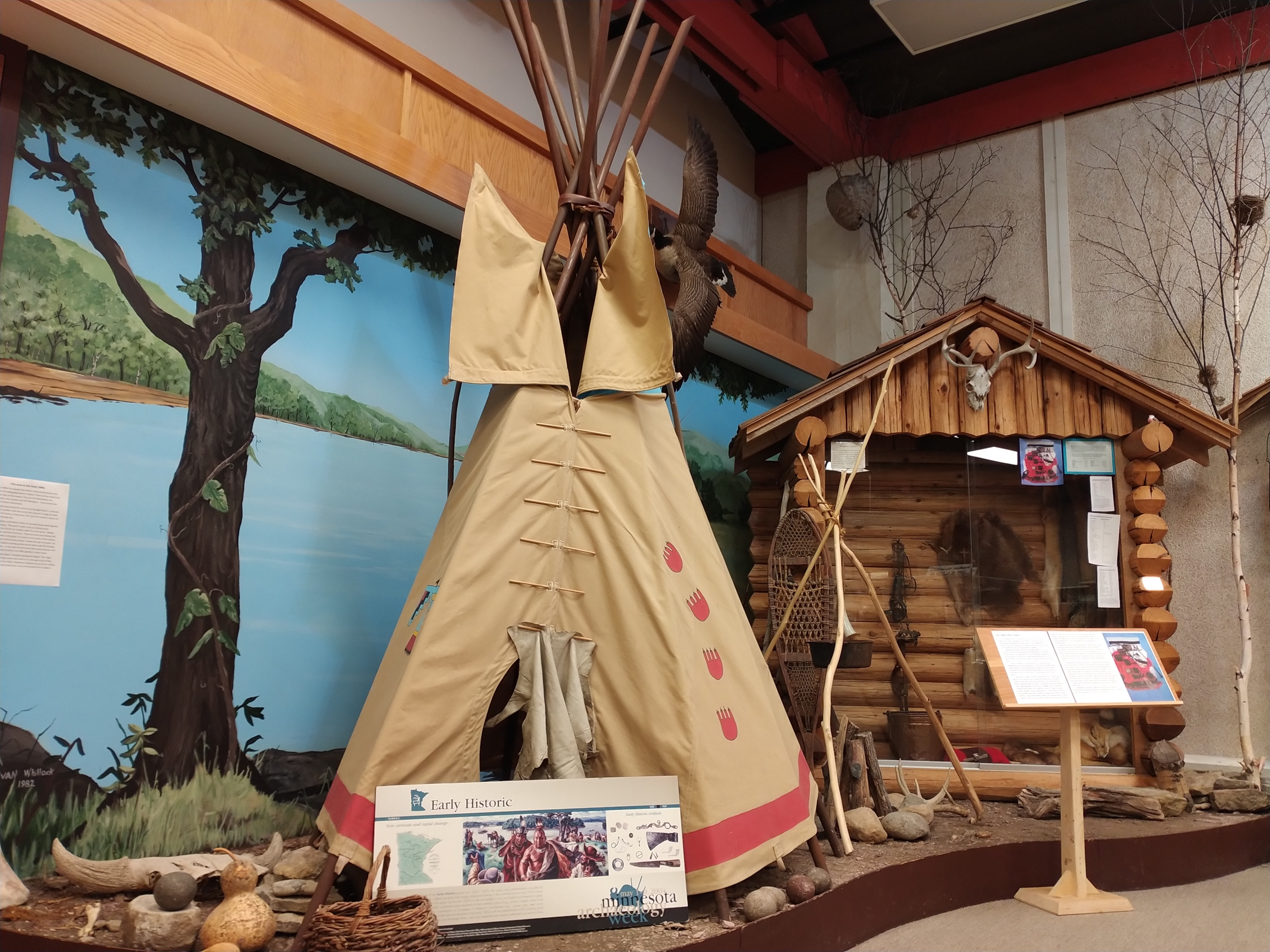
An exhibit at the Rice County Historical Society Museum. Artifacts from Indigenous Peoples are also displayed in cases. (Minnesota Prairie Roots copyrighted photo October 2023)
At the time of the US-Dakota War of 1862, Taopi was in the thick of all of it as a “farmer Indian,” the name tagged to Native Peoples who opted to farm, adapting the ways of the white man in occupation, dress and sometimes religion. He lived near the Lower Sioux Agency, relocated to a reservation there following the Treaty of Mendota in 1851. Those who continued with their hunting and fishing culture were known as “blanket Indians.” Taopi assuredly felt the animosity of his own people for the lifestyle and other choices he made.
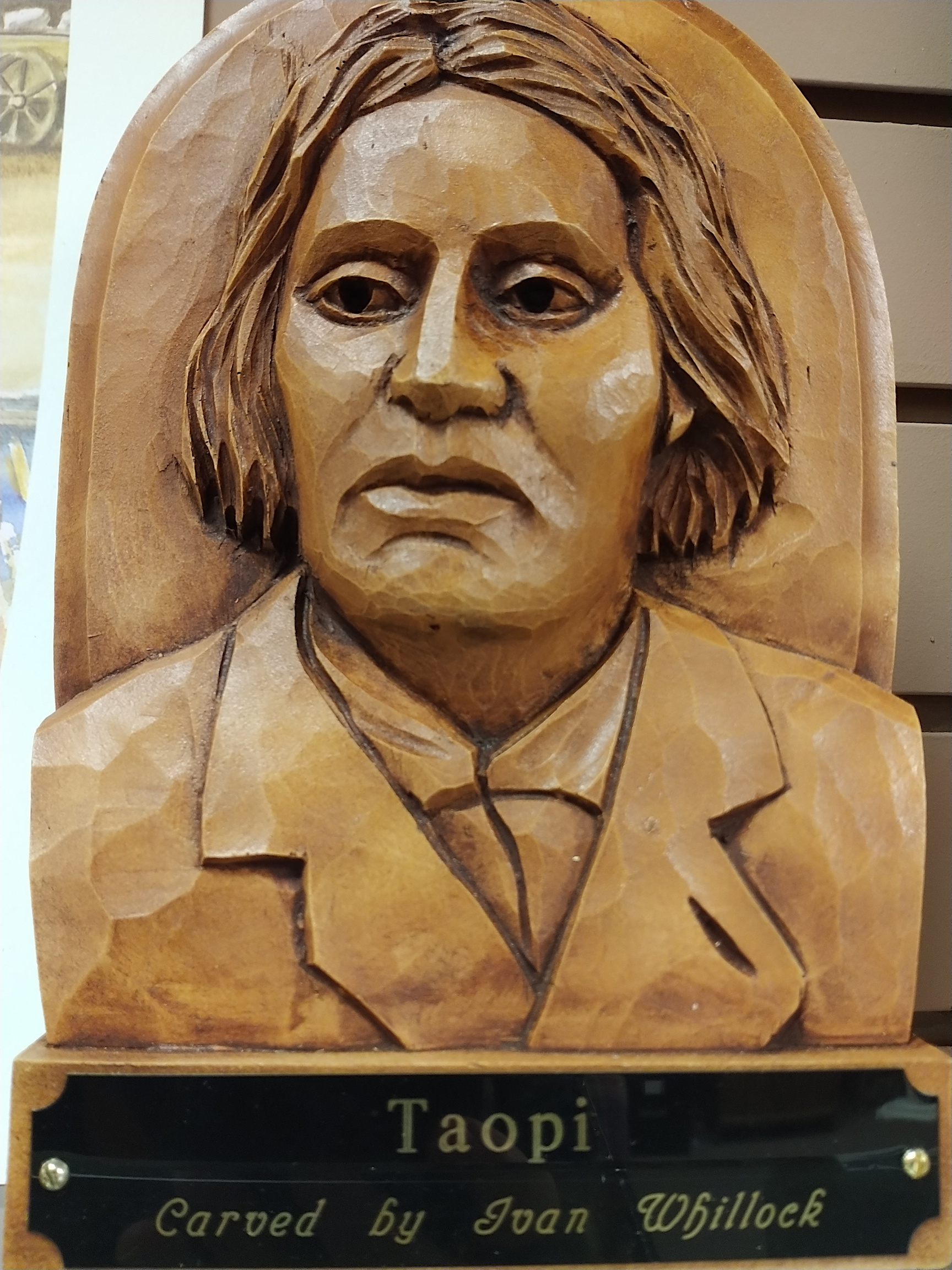
A woodcarving of Taopi by noted Faribault artist Ivan Whillock is for sale in the Rice County Historical Society Museum’s gift shop. One is also displayed in a museum exhibit on Taopi. (Minnesota Prairie Roots copyrighted photo October 2023)
I can only imagine the pressure Indigenous Peoples experienced as white settlers moved into the area. The change, at times, had to feel overwhelming. Life would never be the same. Long-time homelands were lost, tradition and culture endangered. And so Taopi and others adapted, likely accepting that change was inevitable.
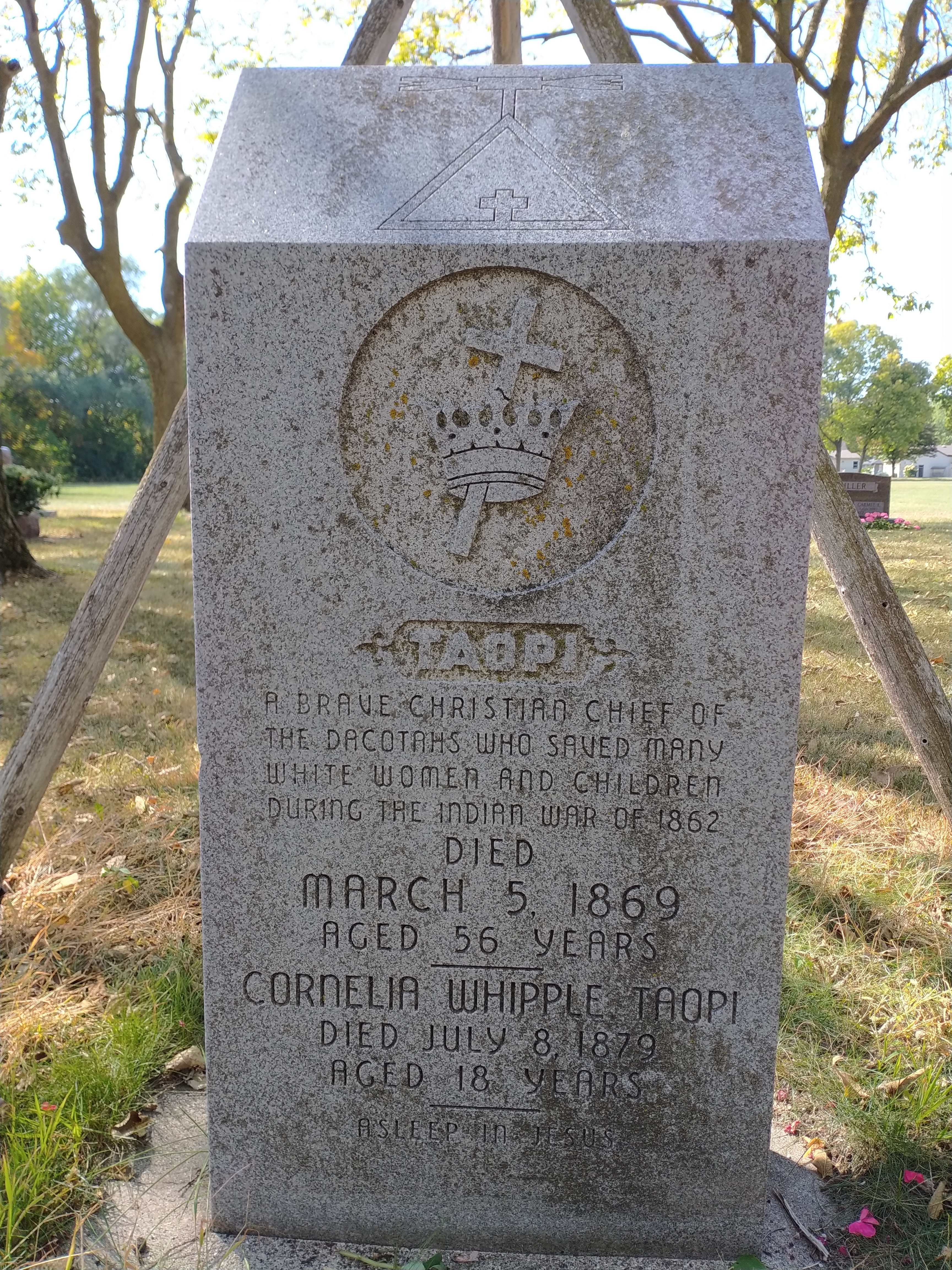
The gravesite of Taopi and his daughter, Cornelia Whipple Taopi (named after Cornelia Whipple, married to Bishop Henry Whipple). (Minnesota Prairie Roots copyrighted photo October 2023)
But one thing that remained constant with Taopi was his focus on peace. He opposed the war and was a leader in the Dakota Peace Party. He is credited with saving the lives of many.
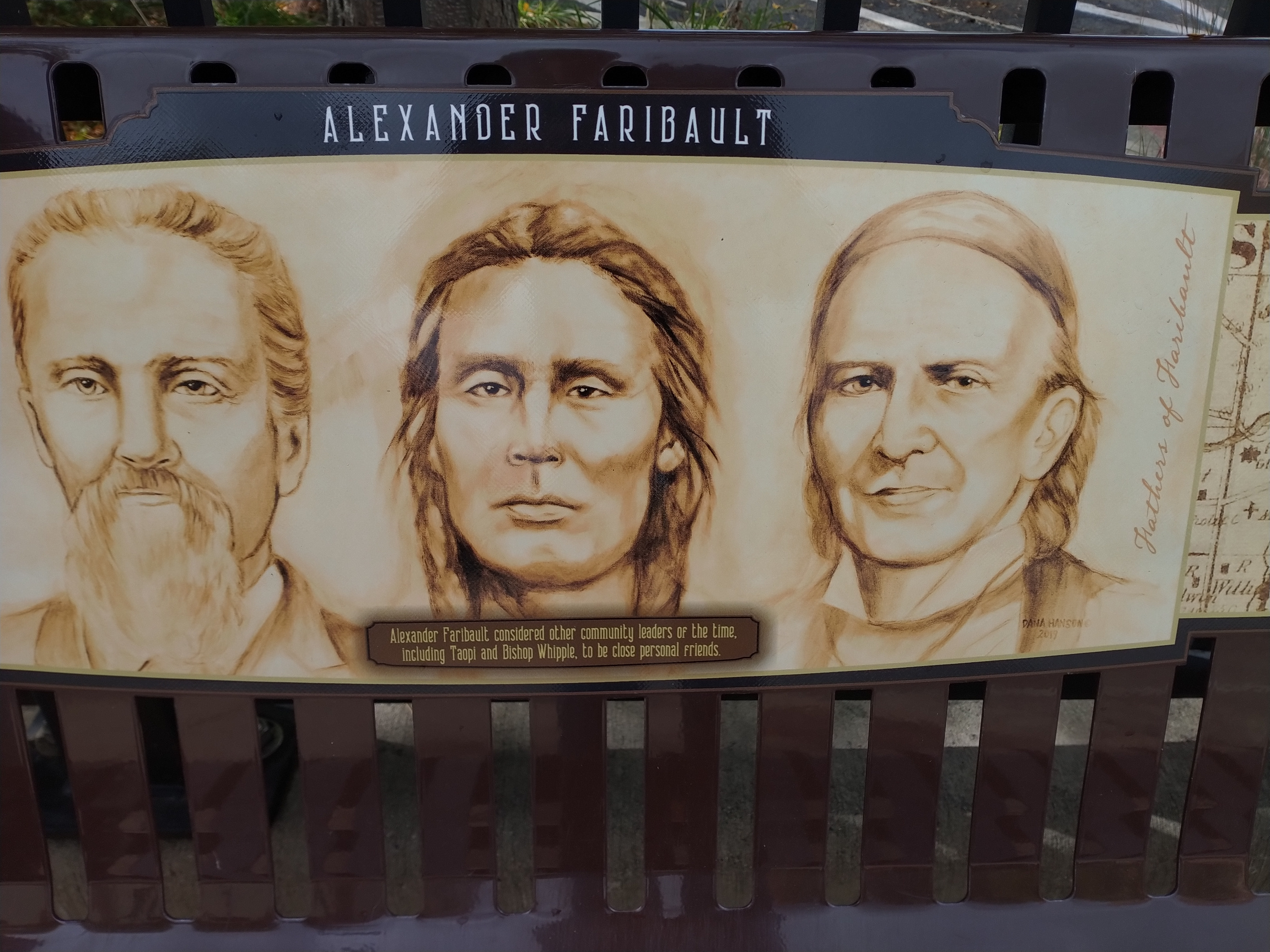
Yet, at war’s end, Taopi found himself caught—disliked by his peoples, who considered him a traitor, and disliked by whites holding a deep animosity toward any Native person. In Faribault, though, he had a friend in Bishop Henry Whipple, a strong advocate for First Peoples, and in town founder Alexander Faribault. Eventually, Taopi and other Natives moved onto land owned by Alexander Faribault, living under his protection on a bluff overlooking the Straight River. Taopi died in 1869. In 1895, the Indigenous Peoples of Faribault were displaced once again, moved to the Lower Sioux Reservation. They had always existed on the fringes in Faribault, never fully-accepted by most residents while under the protection of the bishop and town founder.
Dana Hanson’s “Father’s of Faribault” (left to right, Alexander Faribault, Taopi and Bishop Henry Whipple) featured on a bench along Central Avenue in downtown Faribault. The same artwork hangs inside Buckham Memorial Library. (Minnesota Prairie Roots copyrighted photo October 2023)
Sources: The First Cathedral, an Episcopal Community for Mission by Benjamin Ives Scott and Robert Neslund; the Minnesota Historical Society website; and the Rice County Historical Society Museum’s Taopi display.
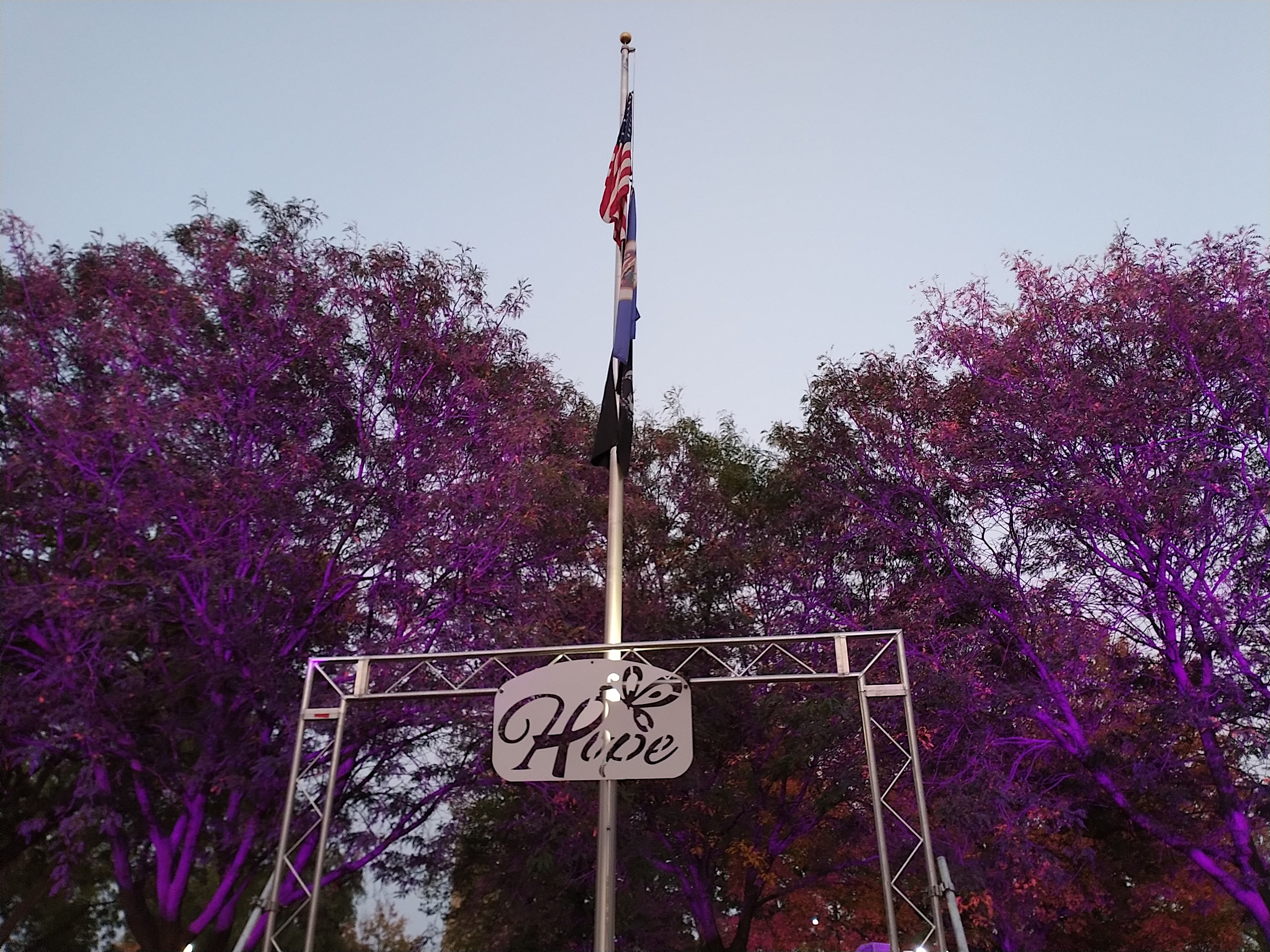
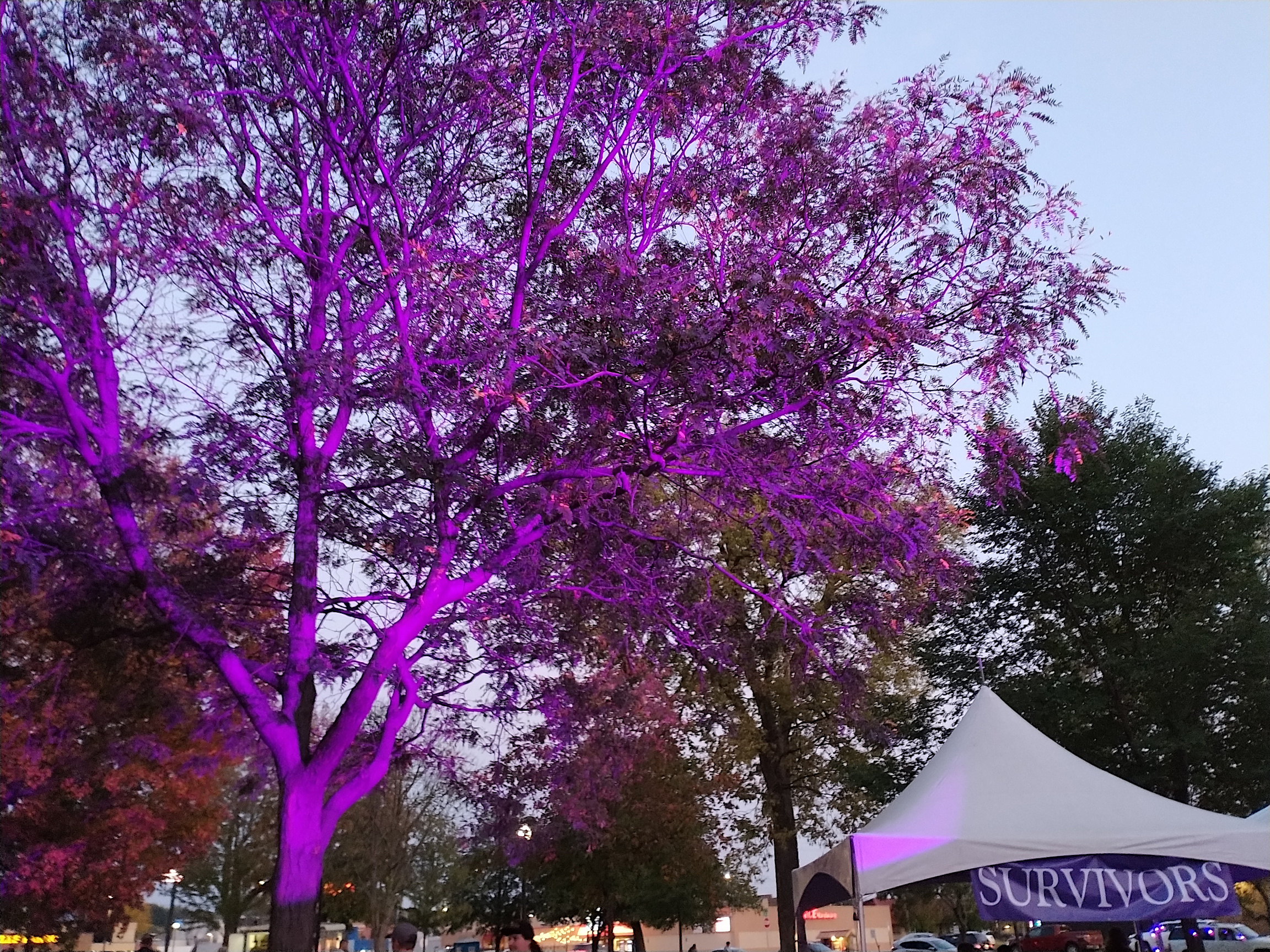
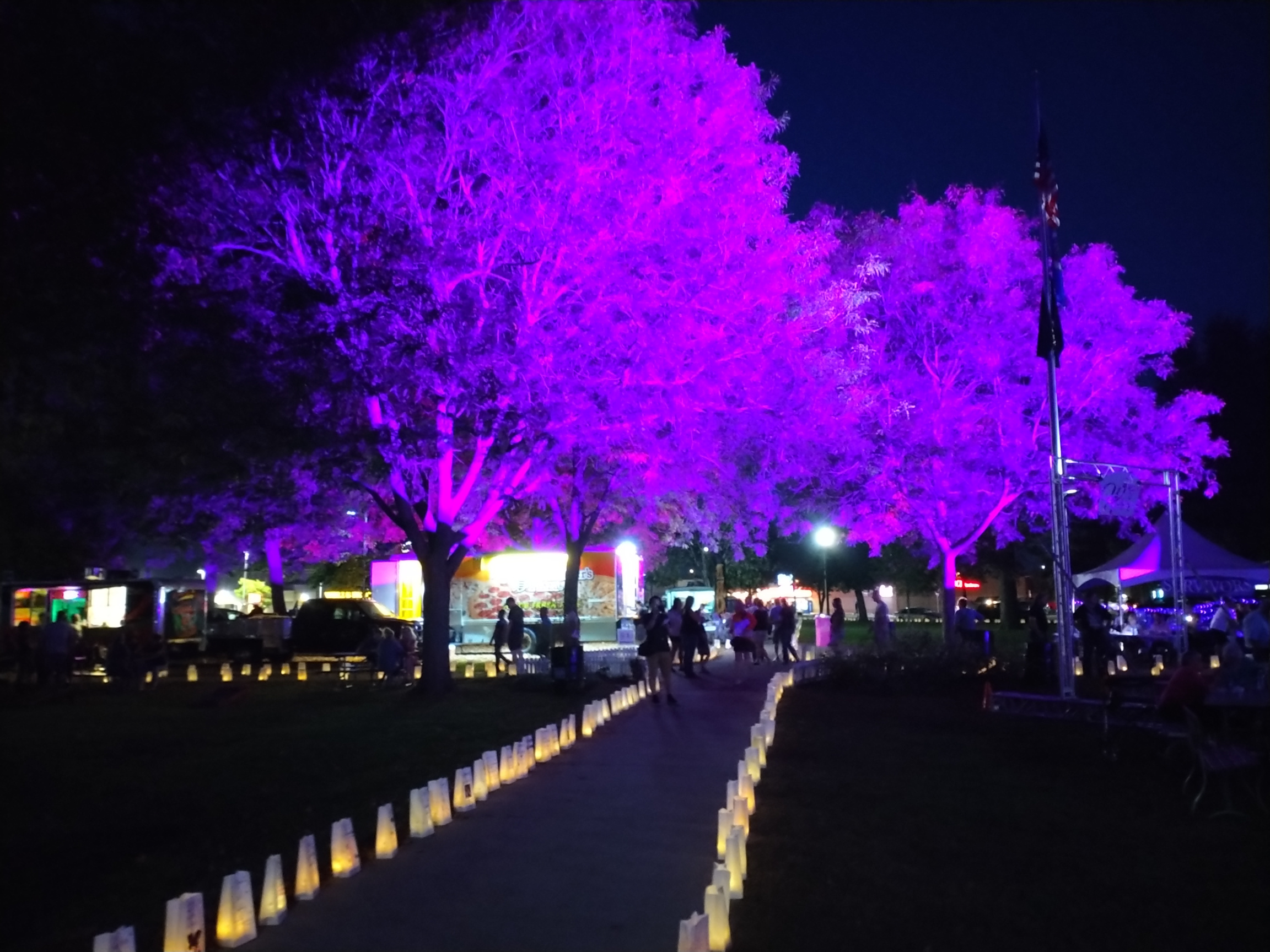
Purple spotlights transformed trees to shades of purple. (Minnesota Prairie Roots copyrighted photo September 2023)
IN THE EARLY EVENING DARKNESS of Faribault’s Central Park, on an unseasonably summery September Saturday, I felt enveloped in a magical world of autumn leaves sparkling purple. The setting seemed surreal, magical, enchanting. And the feeling felt hopeful.
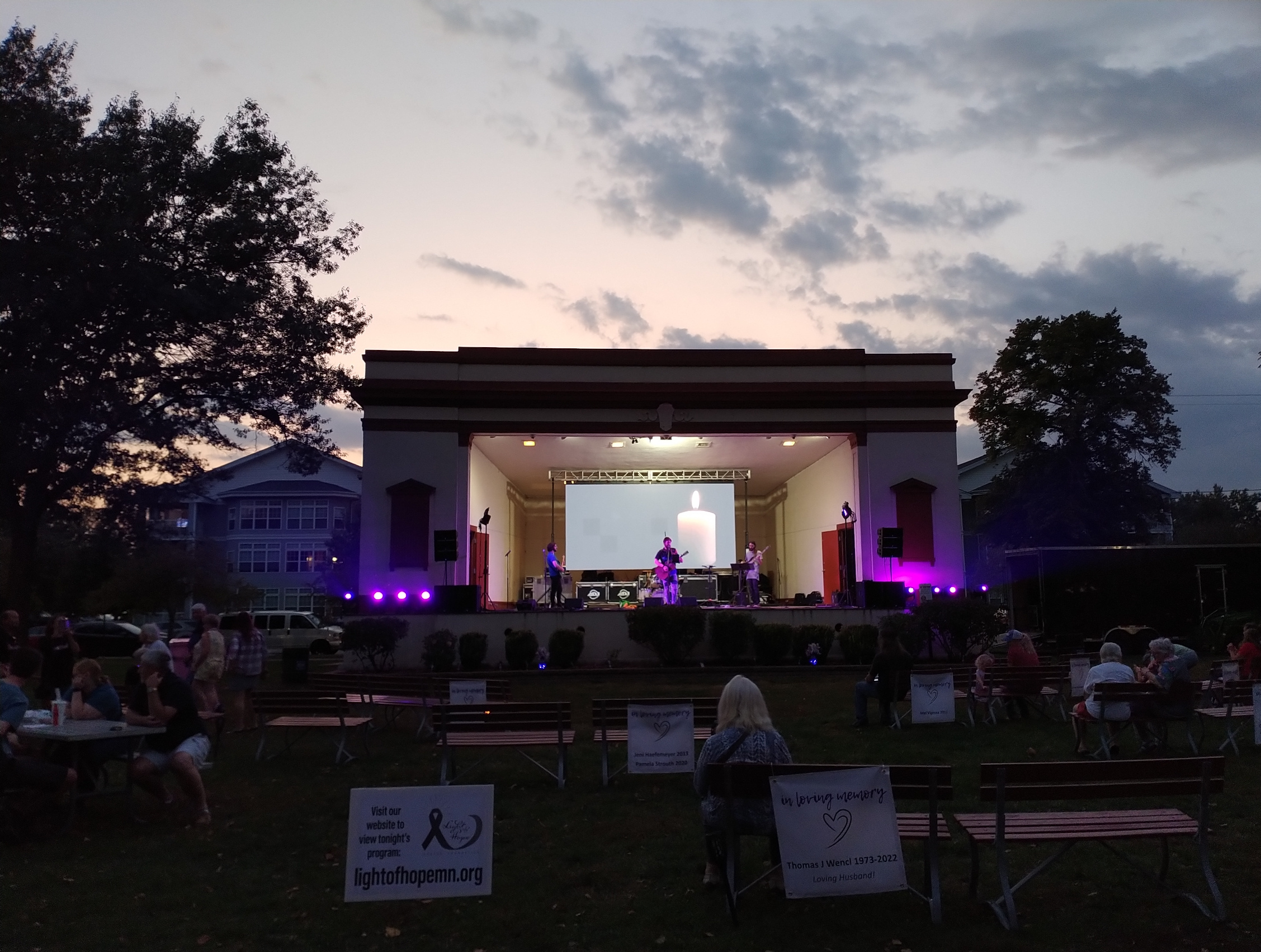
Musician Steve Huber performed first followed by Joe and the Mechanics in the Central Park Bandshell. (Minnesota Prairie Roots copyrighted photo September 2023)
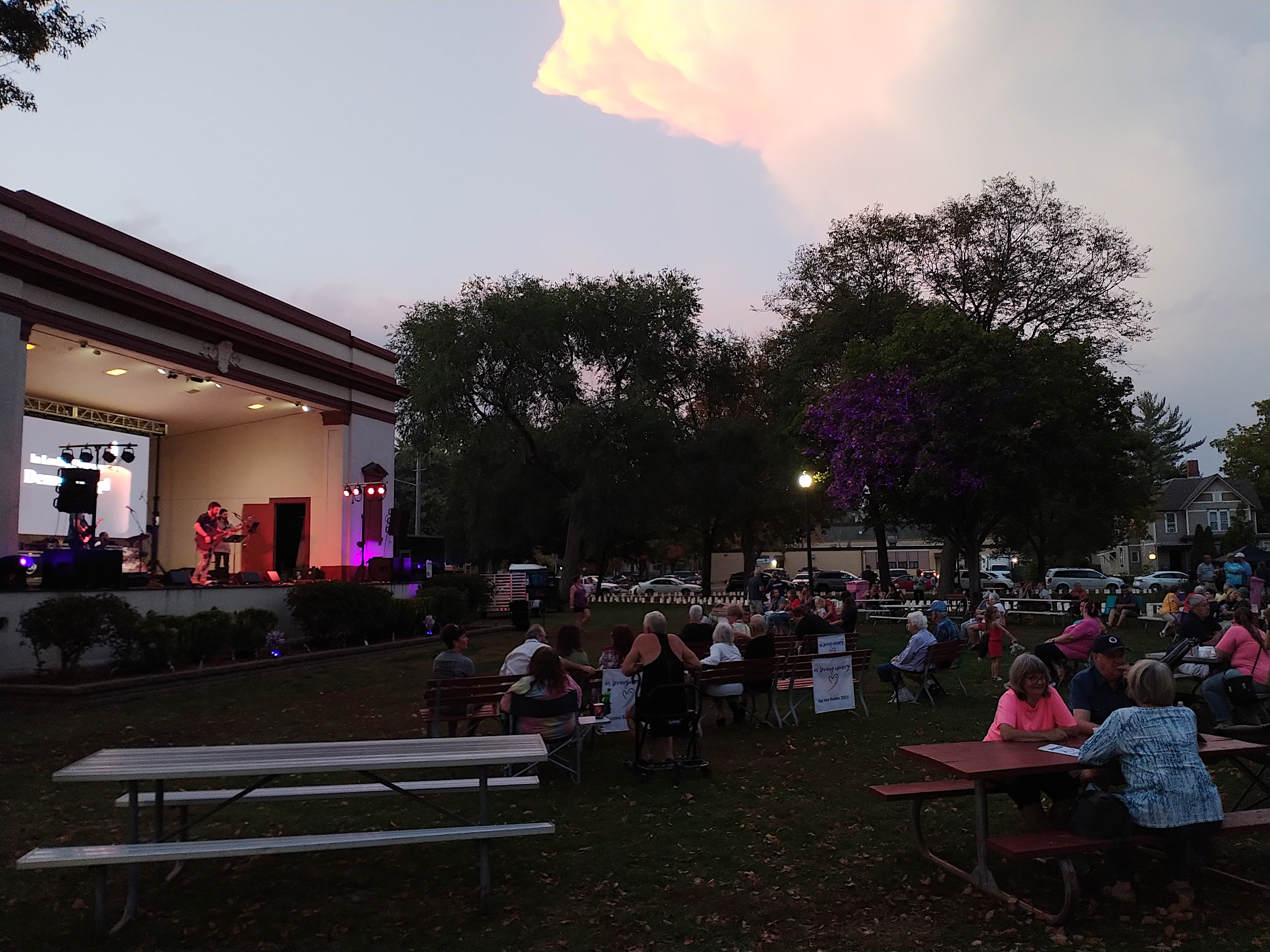
I was among hundreds gathered for the first-ever Light of Hope Celebration to recognize those lost to cancer, those battling cancer, those who’ve survived cancer…and those of us who love (d) them. Purple spotlights shone on trees centering the park, creating a serene, yet celebratory, scene while musicians performed in the bandshell, speakers spoke and kids engaged in activities just for them.
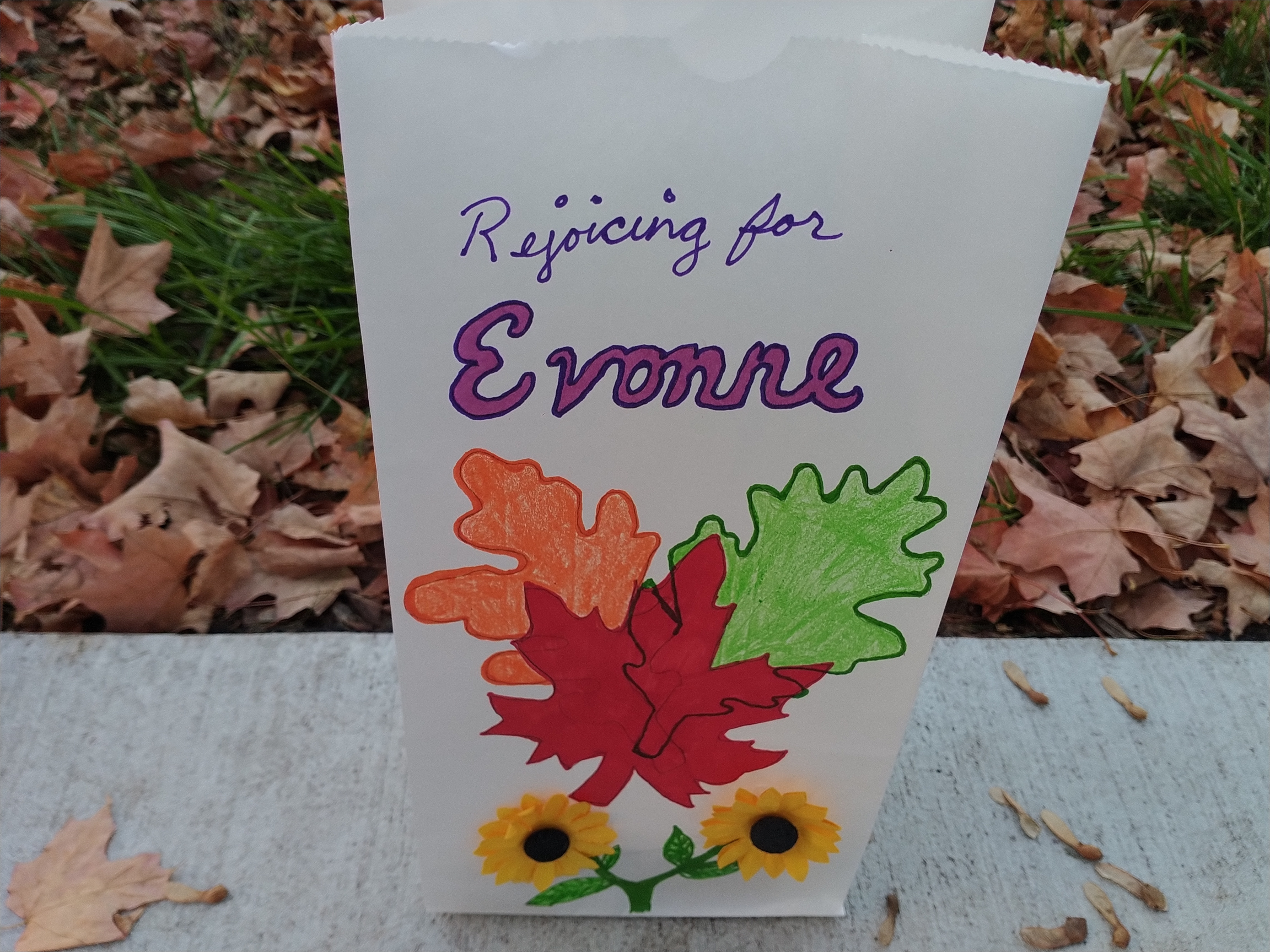
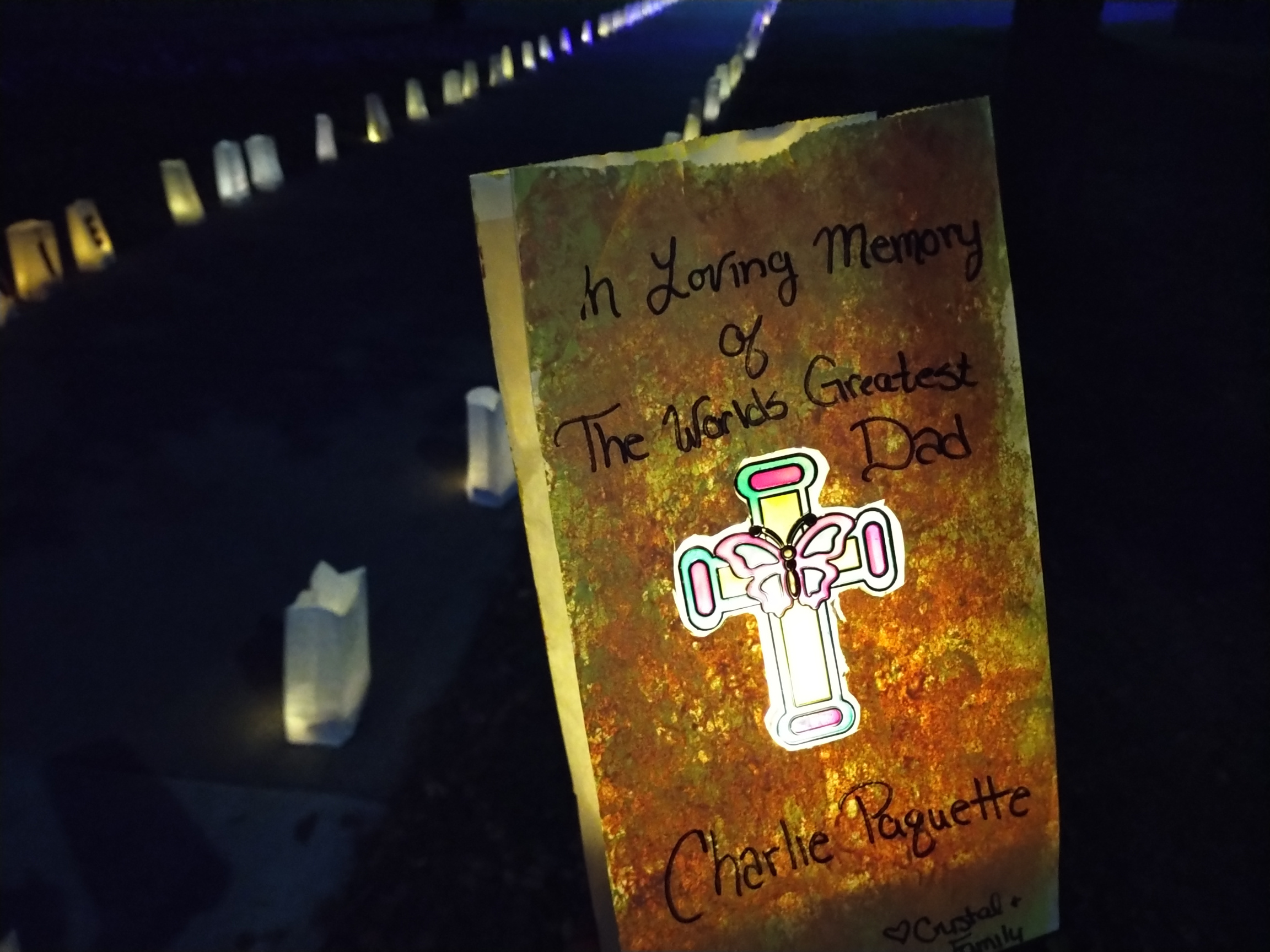
An autumn-themed luminary for a cancer survivor. (Minnesota Prairie Roots copyrighted photo September 2023)
My focus, though, was on the hundreds of luminaries lining the sidewalks that edged and crisscrossed this central community gathering spot. I walk here daily, among the towering trees and scampering squirrels. The din of traffic, the presence of others, the locations of St. Vincent de Paul and the Cathedral of Our Merciful Saviour across the streets are all reminders that Faribault truly is about community. We need one another. And I felt, at this event, a strong sense of community, of coming together, of leaning on one another.
Gathering to talk, to listen to music, to celebrate. (Minnesota Prairie Roots copyrighted photo September 2023)
I felt such love as I hugged the local x-ray tech who did my recent mammogram. I assured her my results were good. She and I have a history, meeting several years ago in the hospital ER when I broke my wrist. I hugged others, too, whom I haven’t seen in a while. It felt right, to reach out and encircle these individuals who, at some point, have been there for me, whether personally or professionally. And if my cousin and a friend, who are currently undergoing chemotherapy for aggressive, advanced breast cancer, had been there, I would have held them close in prolonged hugs also.
I saw so much love written upon luminaries by those who lost loved ones to cancer. (Minnesota Prairie Roots copyrighted photo September 2023)
Twenty years ago I was on the receiving end of many hugs as I stood inside my hometown church, St. John’s Lutheran in Vesta, embracing family and friends at the death of my dad. He died of esophageal cancer and other health issues. At the cemetery, I wrapped my arm around my mom, shaking with cold and grief on that brutal winter day. She was a breast cancer survivor.
Many family—including my husband, a sister and sister-in-law—and friends have survived cancer. Many family—including a dear nephew and aunt—and friends have died of cancer. And today many in my circle are battling cancer, including a much-beloved cousin, a brother-in-law and a dear friend. Cancer is brutal and awful and horrible. And it seemingly spares no family.
A beautiful hope sign suspended in the center of the park. (Minnesota Prairie Roots copyrighted photo September 2023)
But there is hope. In the support of others. In events like the one on Saturday organized by the Light of Hope Cancer Foundation with a mission “to empower local cancer patients and families to focus on treatment and healing by providing immediate and practical financial support while advocating and fundraising for research, education and cancer prevention.” There is strength in a supportive and caring community.
A survivors’ tent, right, offered survivors of cancer a place to gather, celebrate and enjoy cake. (Minnesota Prairie Roots copyrighted photo September 2023)
And there is hope, too, in knowing options are available for treatment. That is also personal for me as my uncle, Dr. Robert M. Bowman, developed the drug Letrozole (Femara), approved by the Food and Drug Administration in 1998 to treat certain types of breast cancer in post-menopausal women. Today, as my retired chemist uncle lies in hospice suffering from Parkinson’s, his wife, my beloved Aunt Dorothy, tells me how grateful Robin feels for having created a life-saving drug. He gave women hope.
I shot this scene shortly before leaving at 7:45 pm. So beautiful…the luminaries, the trees morphed purple by spotlights. (Minnesota Prairie Roots copyrighted photo September 2023)
As I walked among the hundreds of luminaries, first in the light of early evening and then in the darkness, I remembered, grieved silently, contemplated, celebrated… And I felt hope. Strong, beautiful, powerful hope.
It was a milestone day for me in managing the neurological issues I’ve faced following a *viral infection in early January. Twenty-one therapy sessions later and I’m much-improved. Not cured. Not fixed. Not all better. I’ll never be the same as I was pre-virus. But, through targeted therapy exercises, a lot of hard work and simply easing back into life, I’ve built my tolerance for everyday experiences. I can better handle sensory input. I can walk without feeling unbalanced. I can manage beyond sitting in a room with the curtains drawn to shut out light, windows closed to keep out noise.
I still have challenging days. I still struggle. But I am in a much better place than even a month ago.
And so I graduated. Not because I wanted to leave Courage Kenny and my incredibly knowledgeable, supportive and caring therapist. But Ryan and I mutually agreed that I was ready. And so he asked, on that final day together, whether he should cue “Pomp and Circumstance” on his laptop, the same laptop he used to introduce me to virtual reality roller coasters as part of my therapy. I told him we could pass on the music. And I am happy to pass on roller coaster rides.
But I did bring celebratory homemade carrot cake cupcakes with homemade cream cheese frosting. Ryan laughed when I walked through the door carrying that box of cupcakes to share with the Courage Kenny team. When I’d asked the week prior if we would have graduation cake, he said only if I brought it. So I did, along with a thank you card and homemade chocolate chip cookies for this professional who worked tirelessly to improve my health. I always felt like we were a team.
And now, like any new graduate, I hold the knowledge and tools that will help me handle daily living. I participated in class (kinda hard not to when you’re the only student). I did the assigned homework each week. I followed through by getting back into the real world, sometimes failing in my efforts, sometimes succeeding. I’ve done my best, through tears and discouragement and struggles, to rise above the challenges. And now I’ve graduated. Onward.
* Even though I self-tested negative twice for COVID in January, my primary care doctor believes I had COVID, the cause of my multiple, ongoing neurological issues.


















 Minnesota Prairie Roots
Recent Comments