Minnesota Prairie Roots

Writing and photography by Audrey Kletscher Helbling

Planting season in southern Minnesota May 28, 2014

Filed under: Uncategorized — Audrey Kletscher Helbling @ 6:00 AM
Tags: , , , , , ,

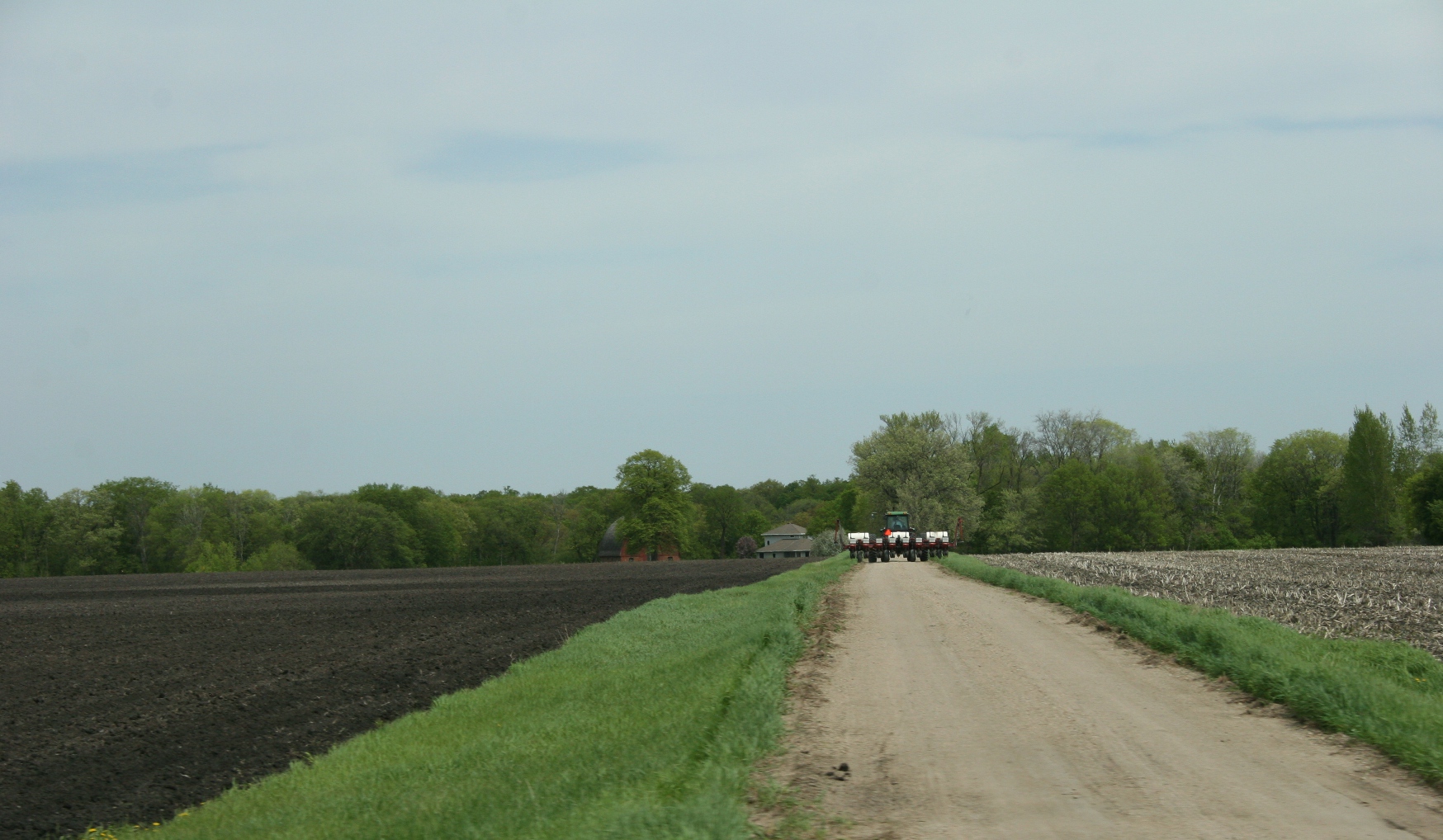
IF THEY WEREN’T WORKING the land, farmers along a stretch between Mankato and west of New Ulm were preparing to plant on Saturday.

Field work, tractor on drive, west of New Ulm

Everywhere, these tenders of the earth steered tractors along roadways and through fields, hurrying to prep the soil and seed crops during this year’s delayed planting season.

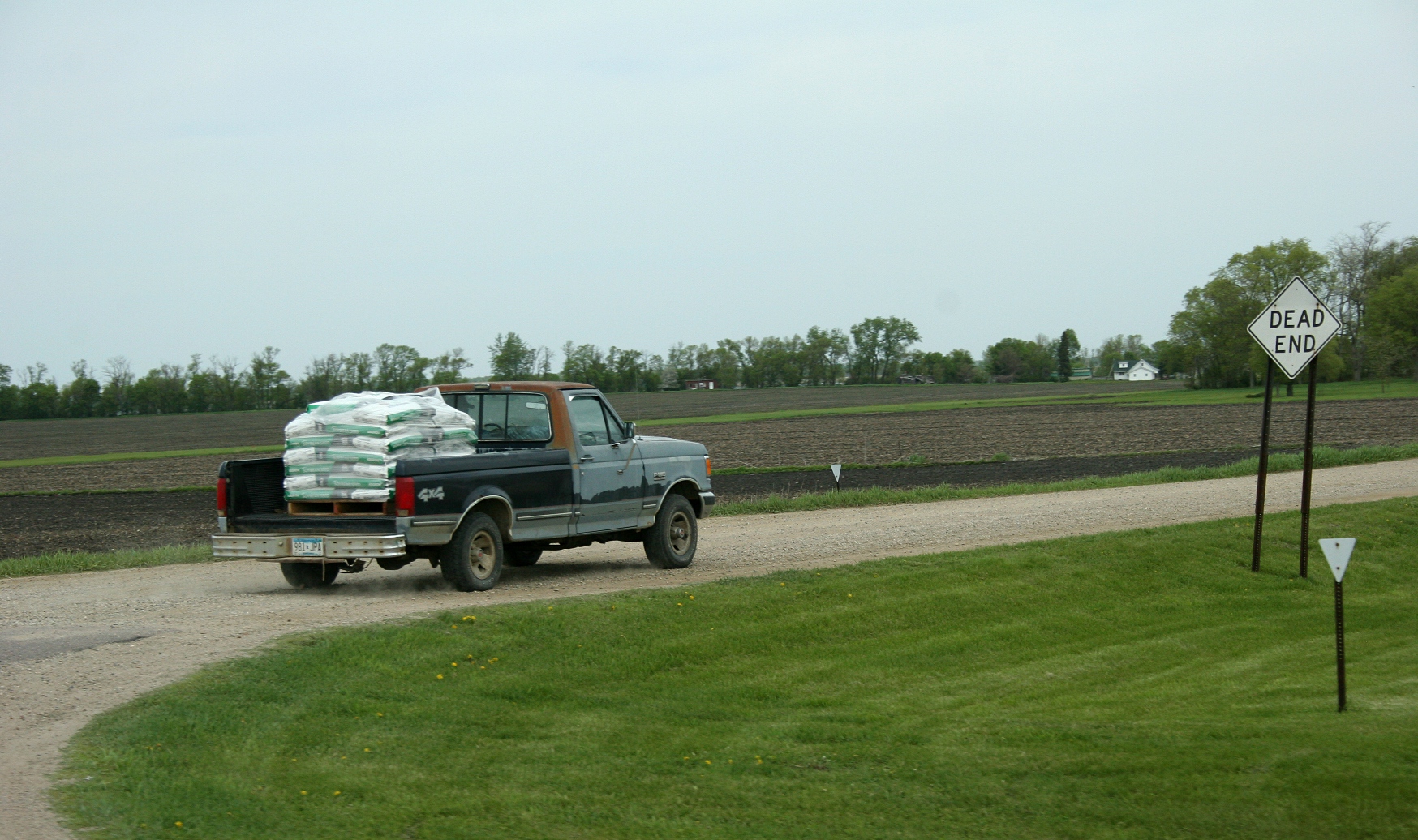
Field work, truck w seed bags west of Mankato

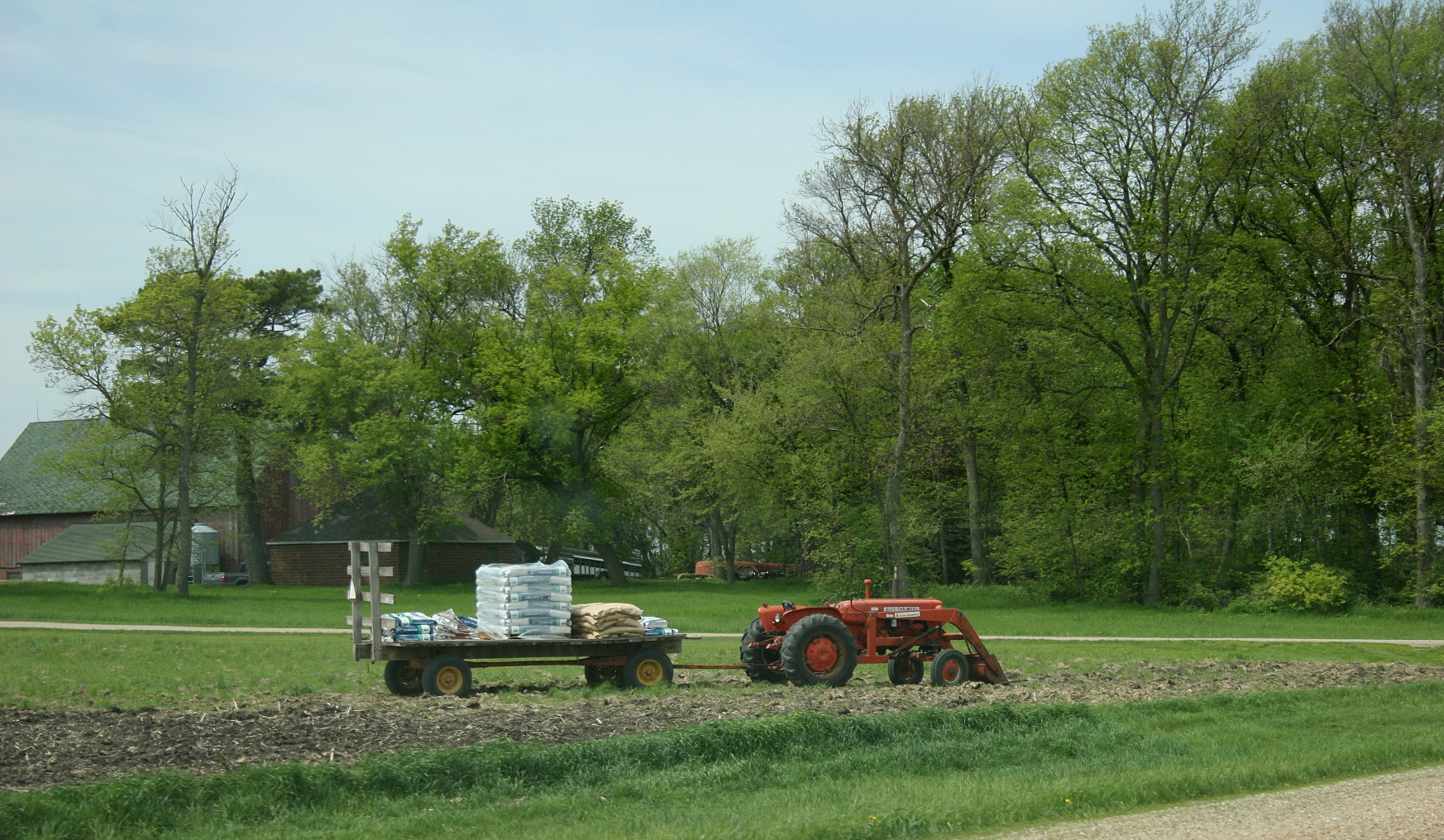
Seed bags topped wagons and pick-up trucks.

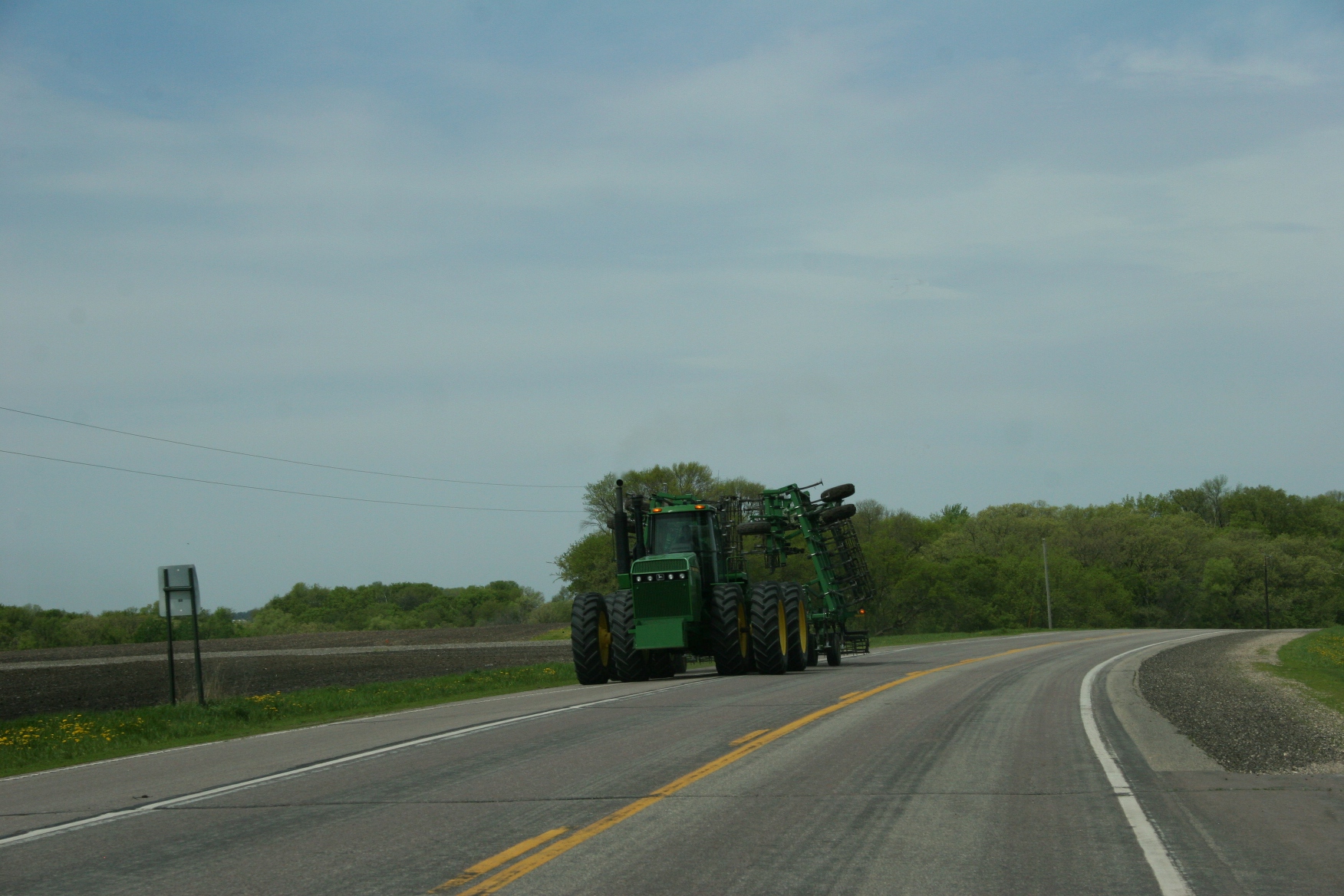
Field work, John Deere on curve west of New Ulm

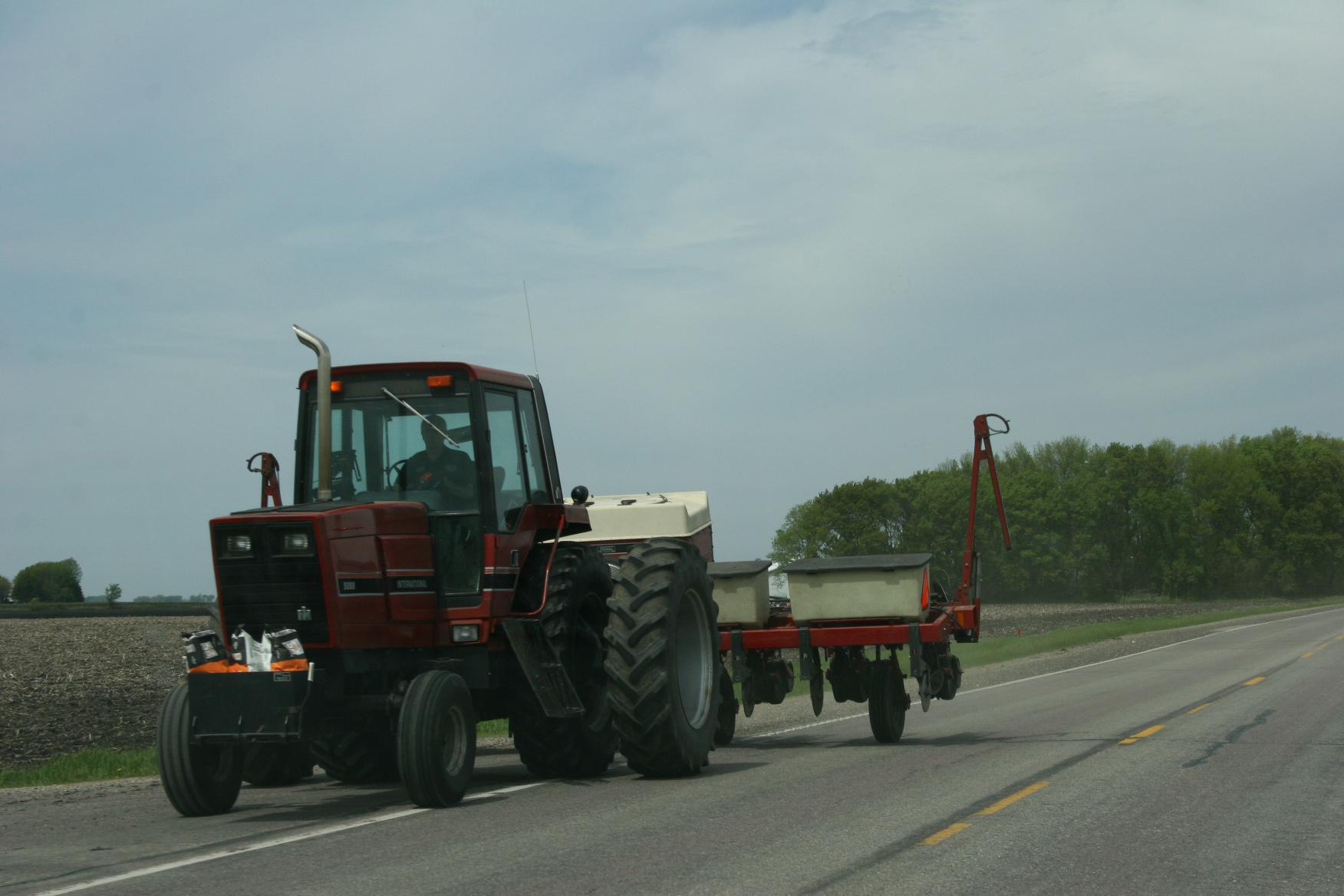
Mammoth tractors pulling equally mammoth implements crept along rural roadways.

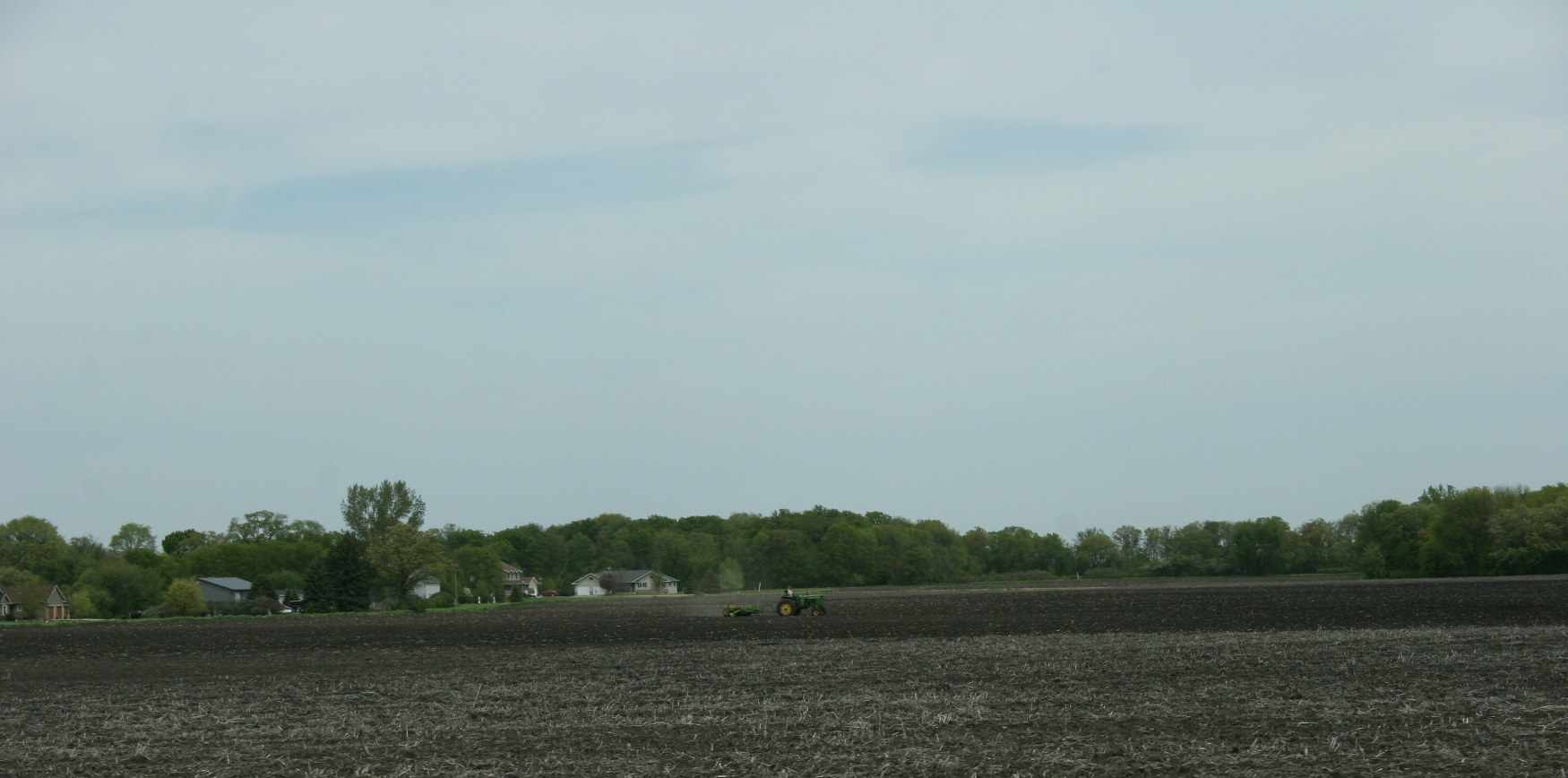
Field work, John Deere in field west of New Ulm

Sky and land swallowed small scale tractors.

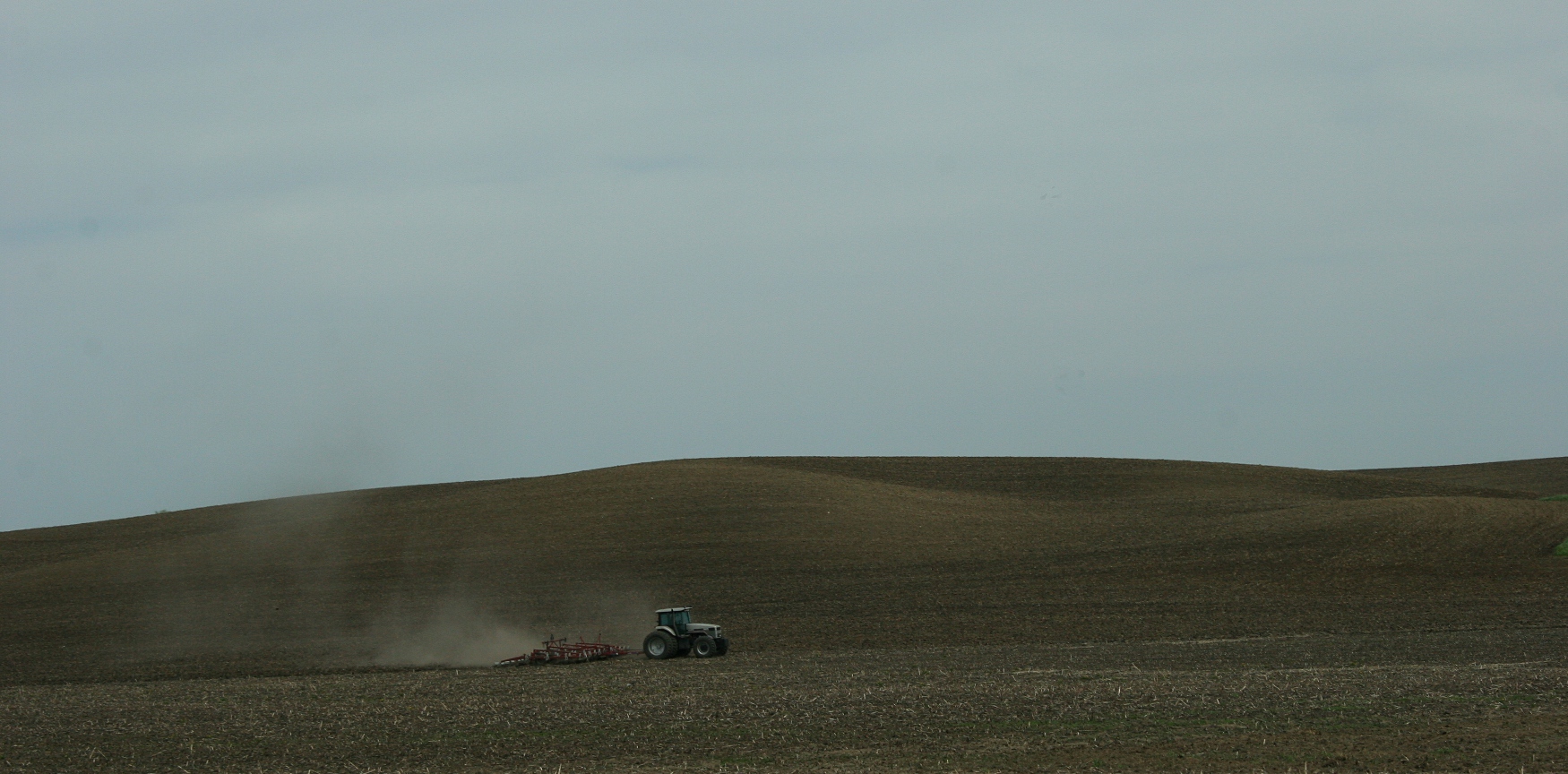
Field work, tractor hill, near Courtland

On a rare occasion dust flew in the field.

Field work, International on road west of New Ulm

And I took it all in, savoring this sweet time in the growing cycle as only one born and raised on a farm can.

Field work, bags on wagon, west of new Ulm

This place, this land, still claims my heart each spring, each summer, each fall, through the seasons of planting and growing and harvest.

Photos were taken along U.S. Highway 14 and along Brown County Road 29.
© Copyright 2014 Audrey Kletscher Helbling


One sweet antique shop in Mankato, on the way to Hiniker (not Golden) Pond January 16, 2014

Love these letters showcased at Pond Road Antiques.

Love these letters showcased at Pond Road Antiques.

I DON’T RECALL exactly when I began to appreciate antique stores. It certainly was not in my 20s or 30s, nor probably even in my early 40s.

But now, closer to age 60 than to 50, I’ve developed a fondness for these shops that hold memories of my past. Nostalgia sells.

Not all antiques shops are created equal, though. Too much old stuff stuffed inside a dark, cramped and musty building overwhelms me. Artfully arranged merchandise in sufficient light draws me for a closer look.

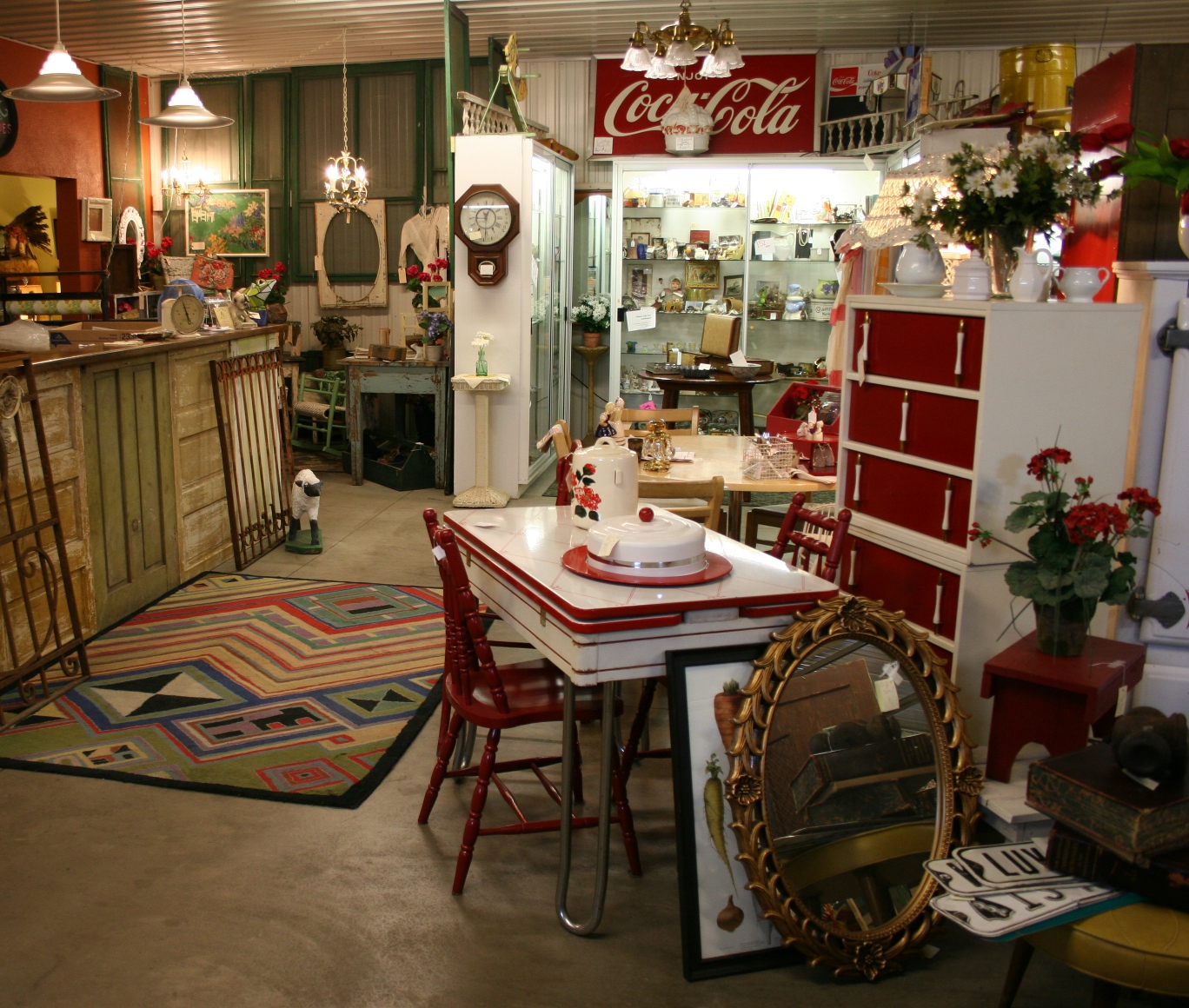
Inside Pond Road Antiques.

Inside Pond Road Antiques.

Pond Road Antiques, just off Highway 169 at 111 Butterworth Street in Mankato, ranks as one of the most visually appealing antique shops I’ve shopped. While the exterior, a fancied-up new pole shed style building, doesn’t fit the merchandise inside, don’t judge a book by its cover. Inside you will find 38 dealers showcasing their wares in a visually pleasing way. Think designer display.

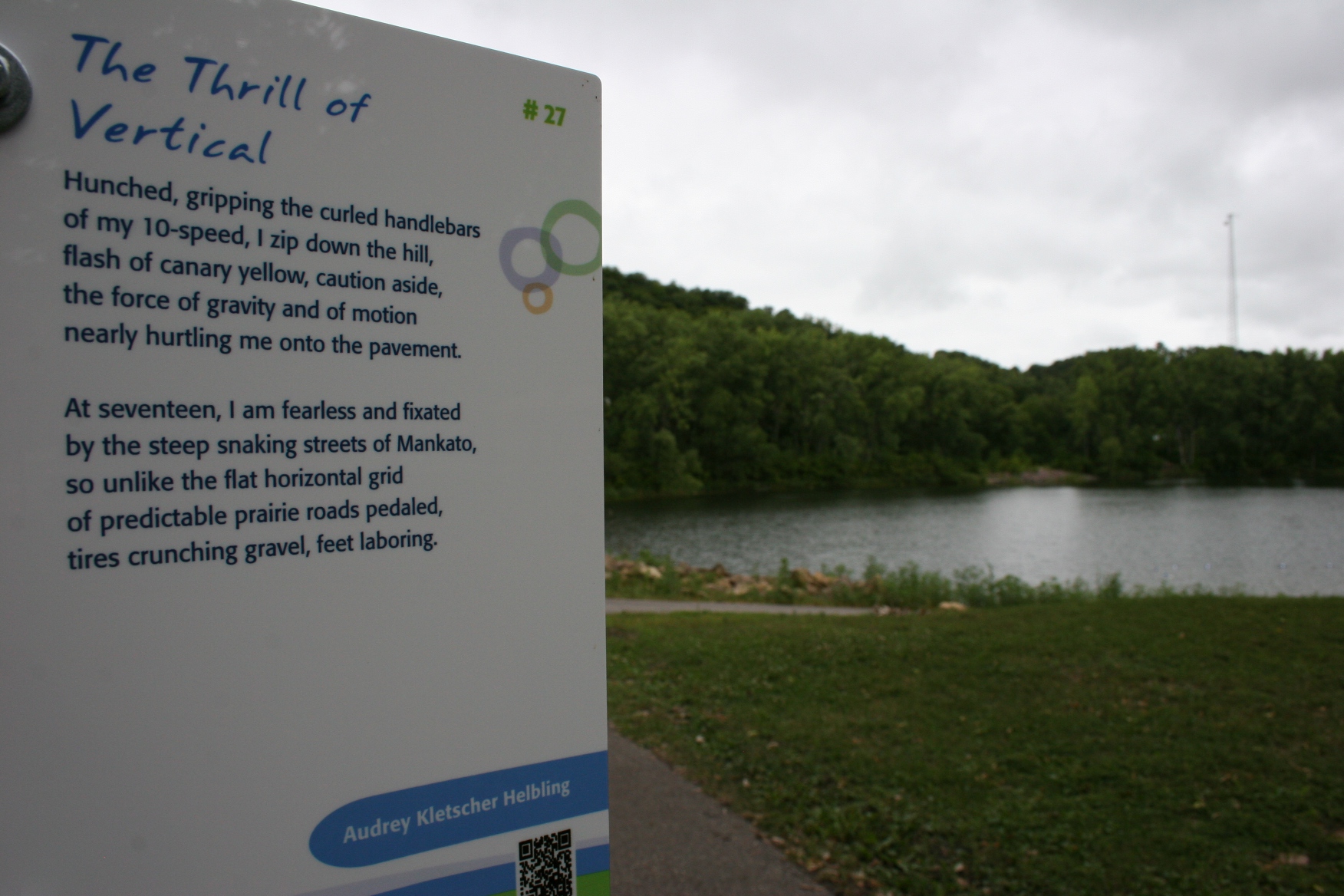
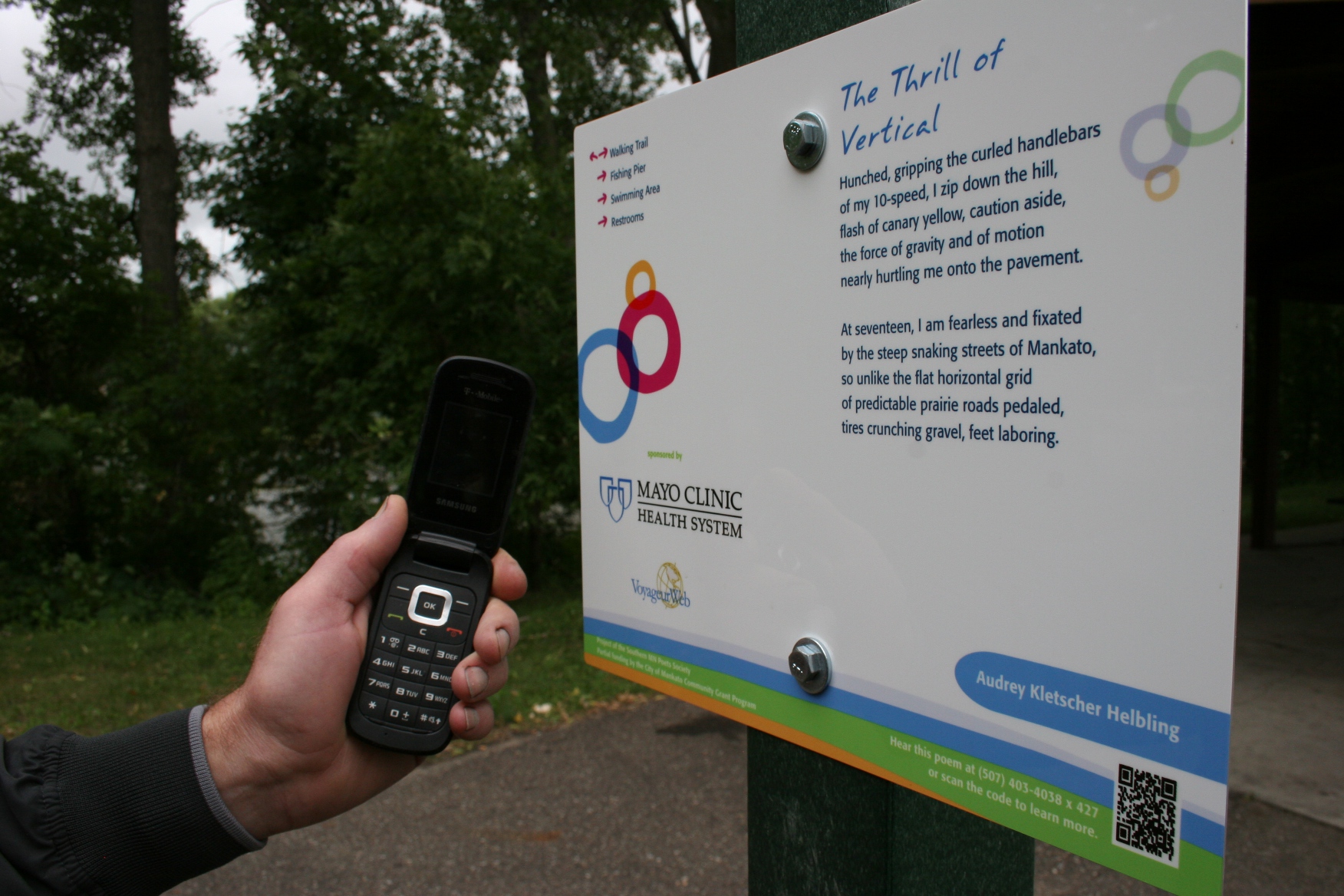
Here are a few photos of the merchandise (I failed to photograph the exterior) shot this past summer after a stop at nearby Hiniker Pond Park, where my poem, “The Thrill of Vertical,” is currently posted as part of the Mankato Poetry Walk and Ride. (Click here to learn about that poetry project.)

"The Thrill of Vertical," located next to Hiniker Pond.

My poem, “The Thrill of Vertical,” located next to Hiniker Pond.

I’d suggest a jaunt to Mankato to check out that poetry, scattered throughout Mankato and North Mankato, and to peruse the appropriately-named Pond Road Antiques.

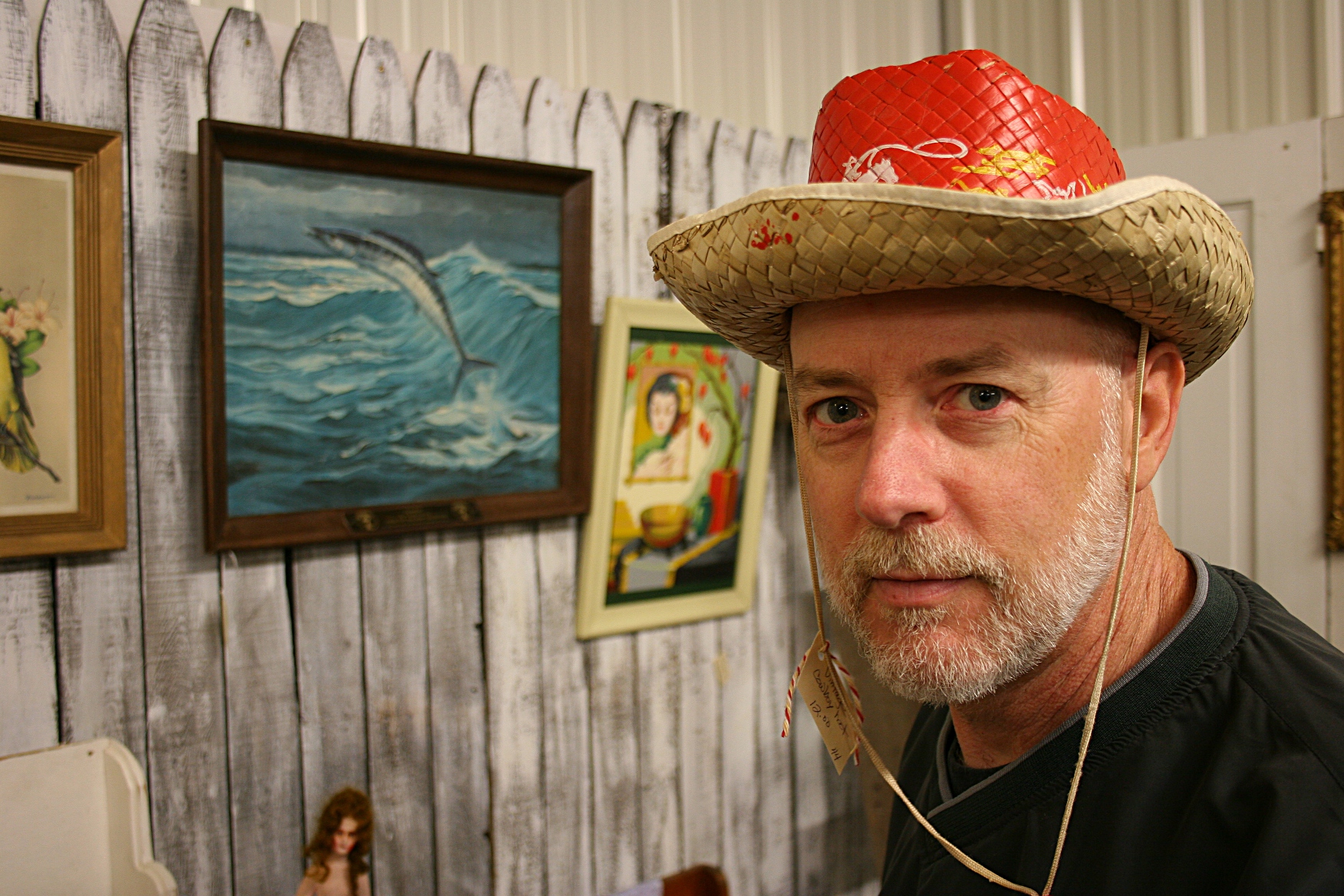
My husband, Randy, and I were thrilled to find this vintage straw cowboy hate. We reminisced for awhile about watching Westerns on TV and getting new cowboy hats each summer.

My husband, Randy, and I were thrilled to find this vintage straw cowboy hat. We reminisced for awhile about watching Westerns on TV and getting new cowboy hats each summer while growing up.

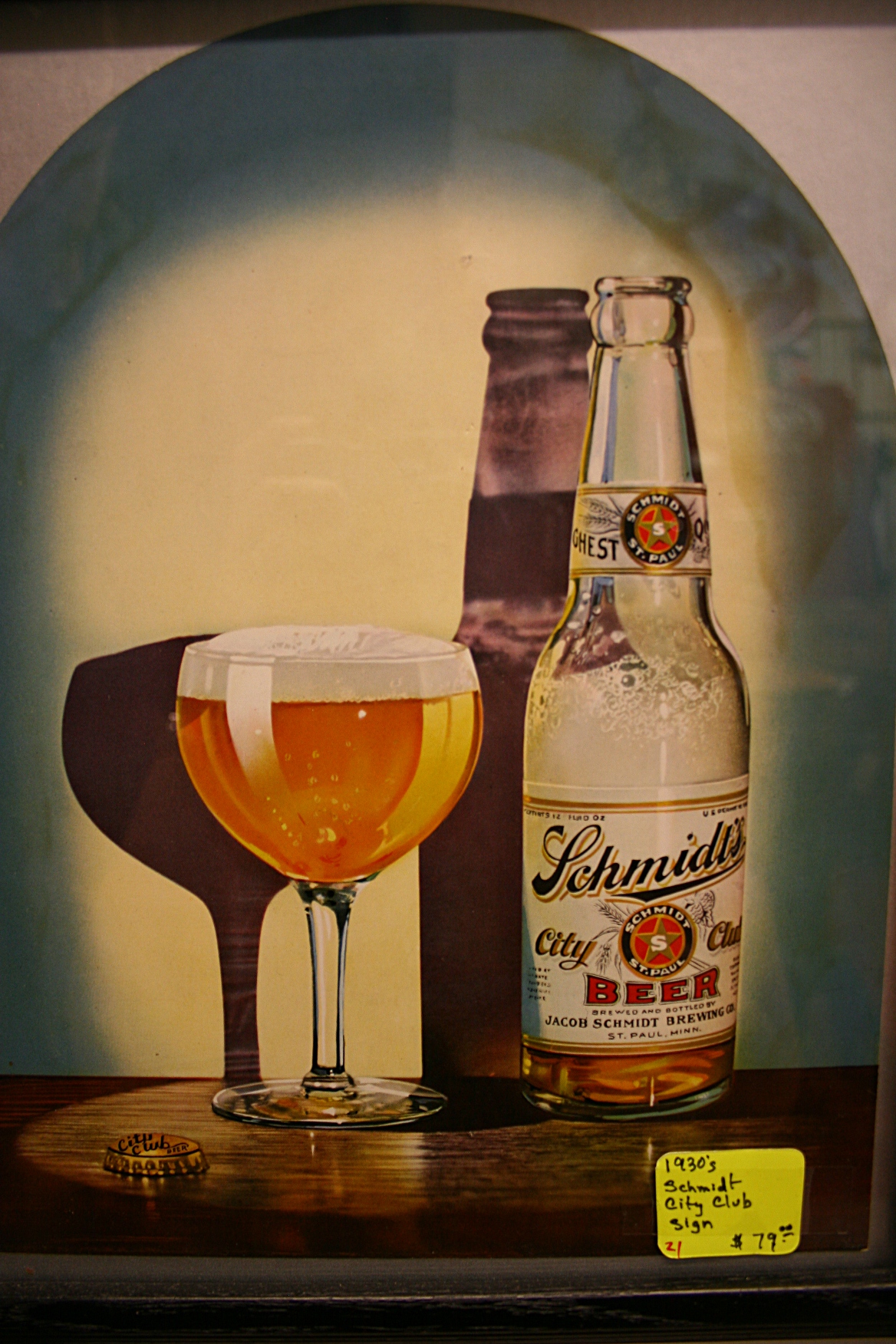
With a soon-to-be son-in-law with the last name of Schmidt, I find myself drawn to Schmidt beer collectibles.

With my eldest now married to a Schmidt, I find myself drawn to Schmidt beer stuff.

I nearly flipped when I saw this toy accordion, just like one I had as a child. I loved my accordion and it is the only musical instrument I've ever played.

I nearly flipped when I saw this toy accordion, just like one I had as a child. I loved my accordion. It is the only musical instrument I ever had the opportunity to play. I should have bought this although, if I recall correctly, the price was higher than I wanted to pay. But how I would love that toy accordion…

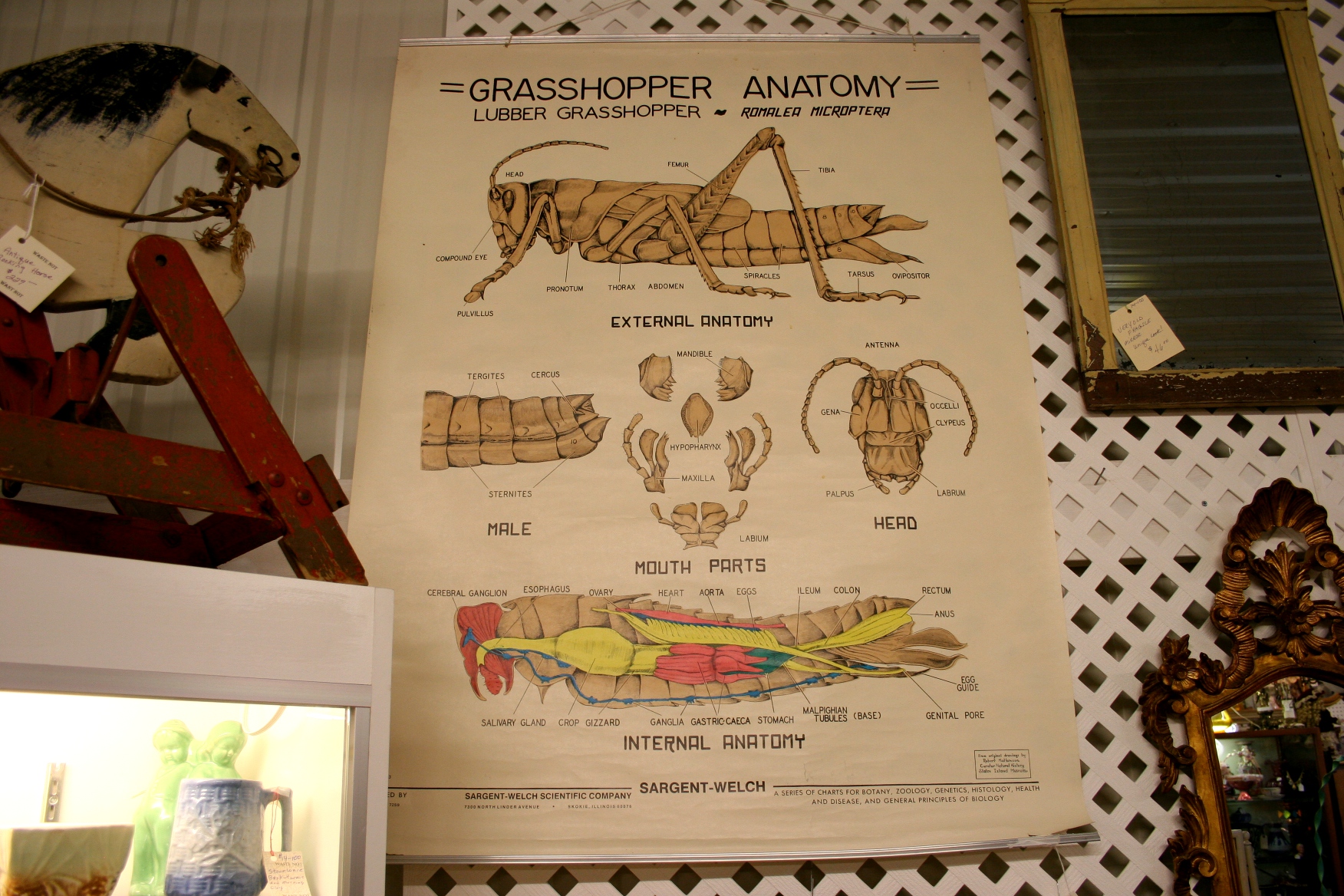
Unusual for sure and, well, I've always thought grasshoppers were interesting insects to watch.

Unusual for sure and, well, I’ve always thought grasshoppers are interesting insects to watch. Grasshoppers were everywhere on my native prairie when I was growing up. I love how items like this are being repurposed as art.

WHAT’S YOUR FAVORITE antique shop?

FYI: Pond Road Antiques is open from 10 a.m. – 5 p.m. Monday – Saturday and from noon – 5 p.m. Sundays.

© Copyright 2013 Audrey Kletscher Helbling


Shareholders vote to sell historic Blue Earth County Fairgrounds January 10, 2014

Filed under: Uncategorized — Audrey Kletscher Helbling @ 12:52 PM
Tags: , , , , , ,
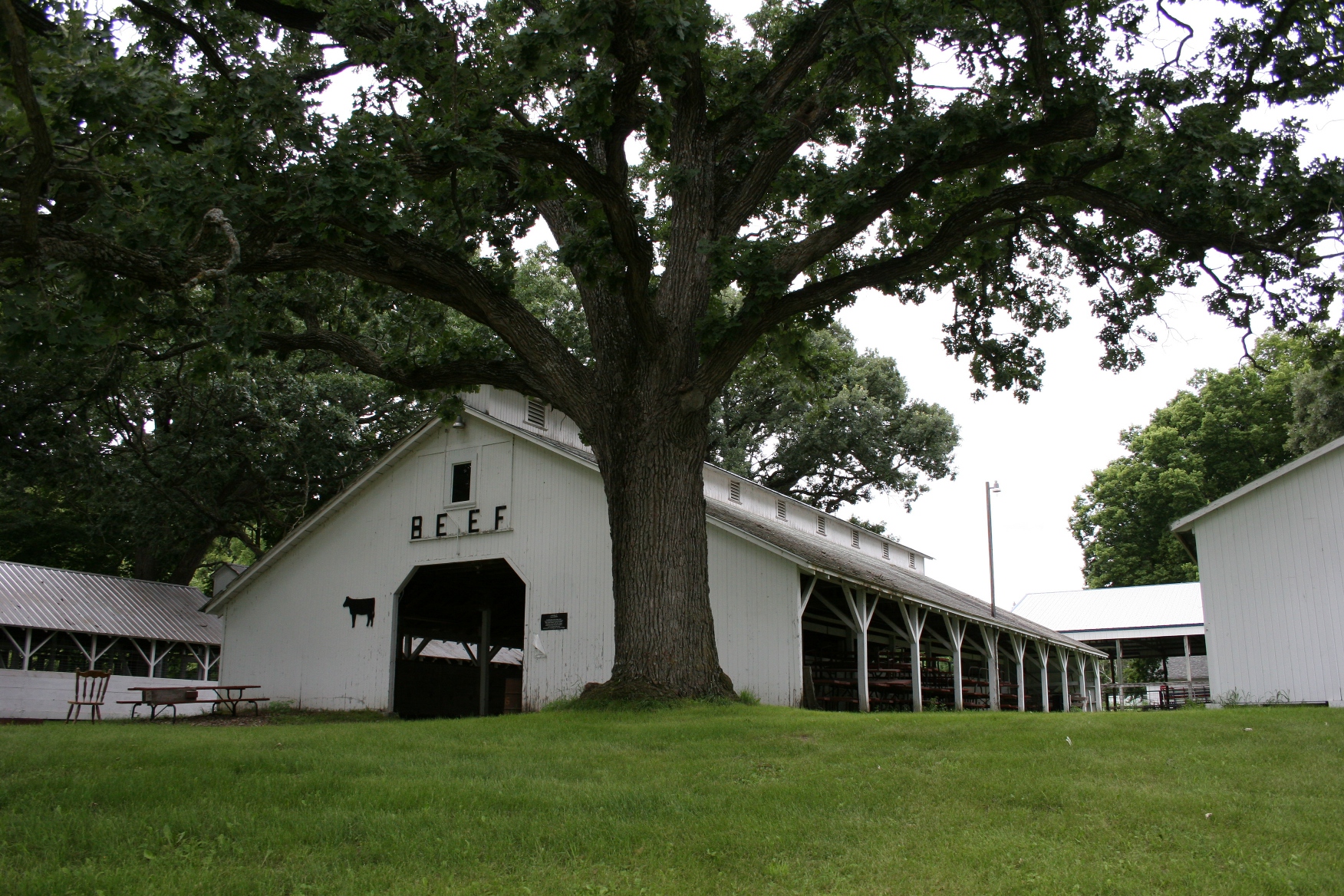
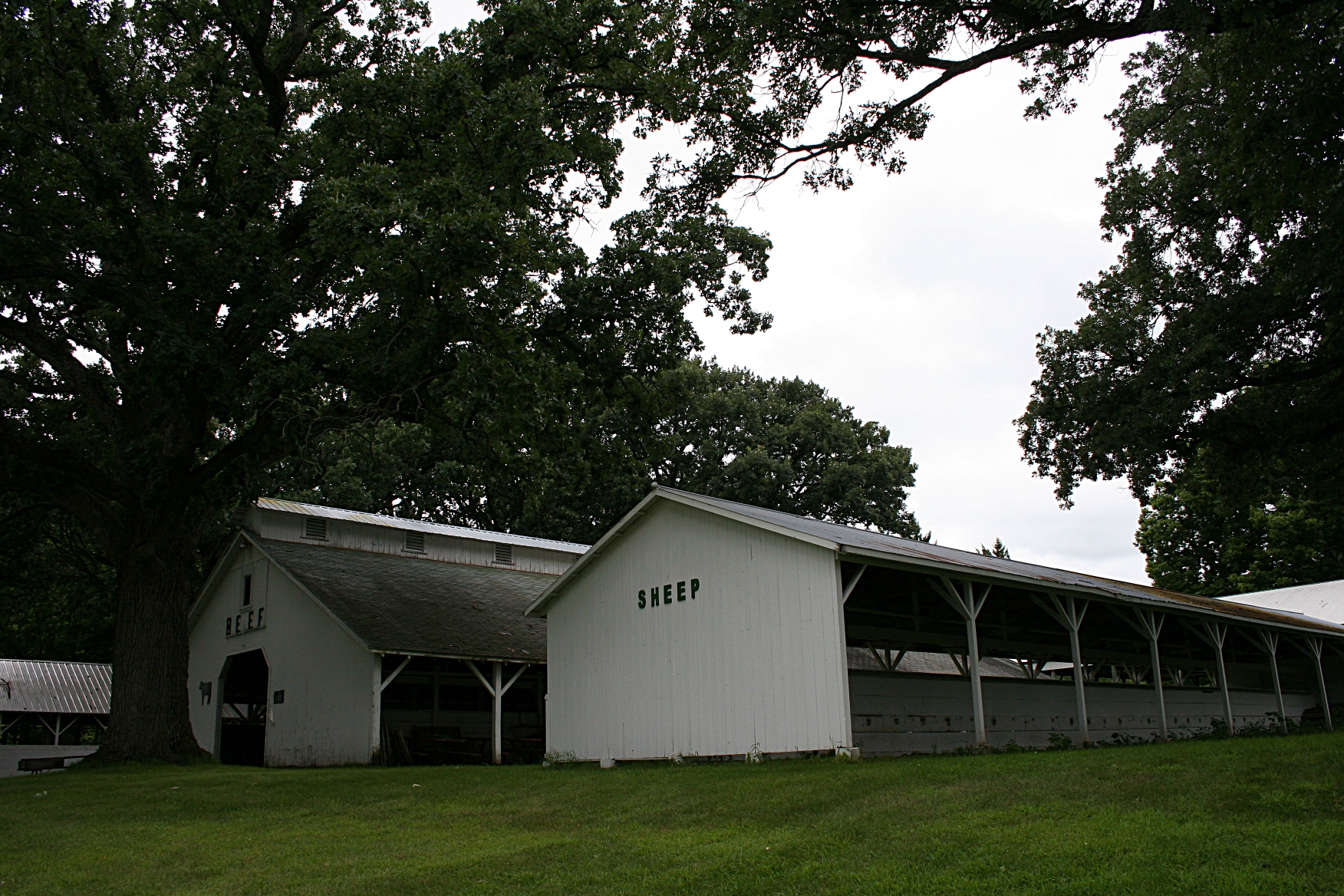
The beef barn, shaded by an oak tree.

This beef barn is representative of the many old buildings which grace the 154-year-old Blue Earth County Fairgrounds. The oak-covered fairgrounds sits along the Watonwan River in Garden City, Minnesota.

THE VOTE IS IN.

And if all goes as planned, the Blue Earth County Fair will move from an historic 154-year-old site in Garden City to within a two-mile radius of Mankato, 10 miles away.

Shareholders, during a special meeting Thursday evening, voted 175 in favor and 76 against to sell the long-time fairgrounds, according to an article in the Mankato Free Press. (Click here to read that story.) That sale authorization paves the way for possible construction of a new fairgrounds near Mankato, the county seat and county’s center of population.

For background on this story, click here and read my post, “Deciding the future of the historic Blue Earth County Fairgrounds.” Also click here to read an earlier post about my visit to the fairgrounds in July.

I am disappointed. Once an historic gem like this is lost, you can never replace it. Let’s hope, at least, that those old buildings can be saved.

And I wonder, too, whether simply moving the fair will increase attendance and push the fair out of debt.

This will be an interesting process, no matter what side of the issue you favor.


Deciding the future of the historic Blue Earth County fairgrounds January 8, 2014

The beef barn, shaded by an oak tree.

The beef and other barns are circled by aged oaks.

IN THE SHADE OF AGED OAKS sprawling along the banks of the Watonwan River in Garden City, agricultural buildings stretched long and lean as my husband and I drove through the Blue Earth County Fairgrounds on a July morning.

I was enamored with this charming and historic place, where buildings are labeled BEEF, SHEEP, POULTRY, FFA, 4-H EXHIBITS…

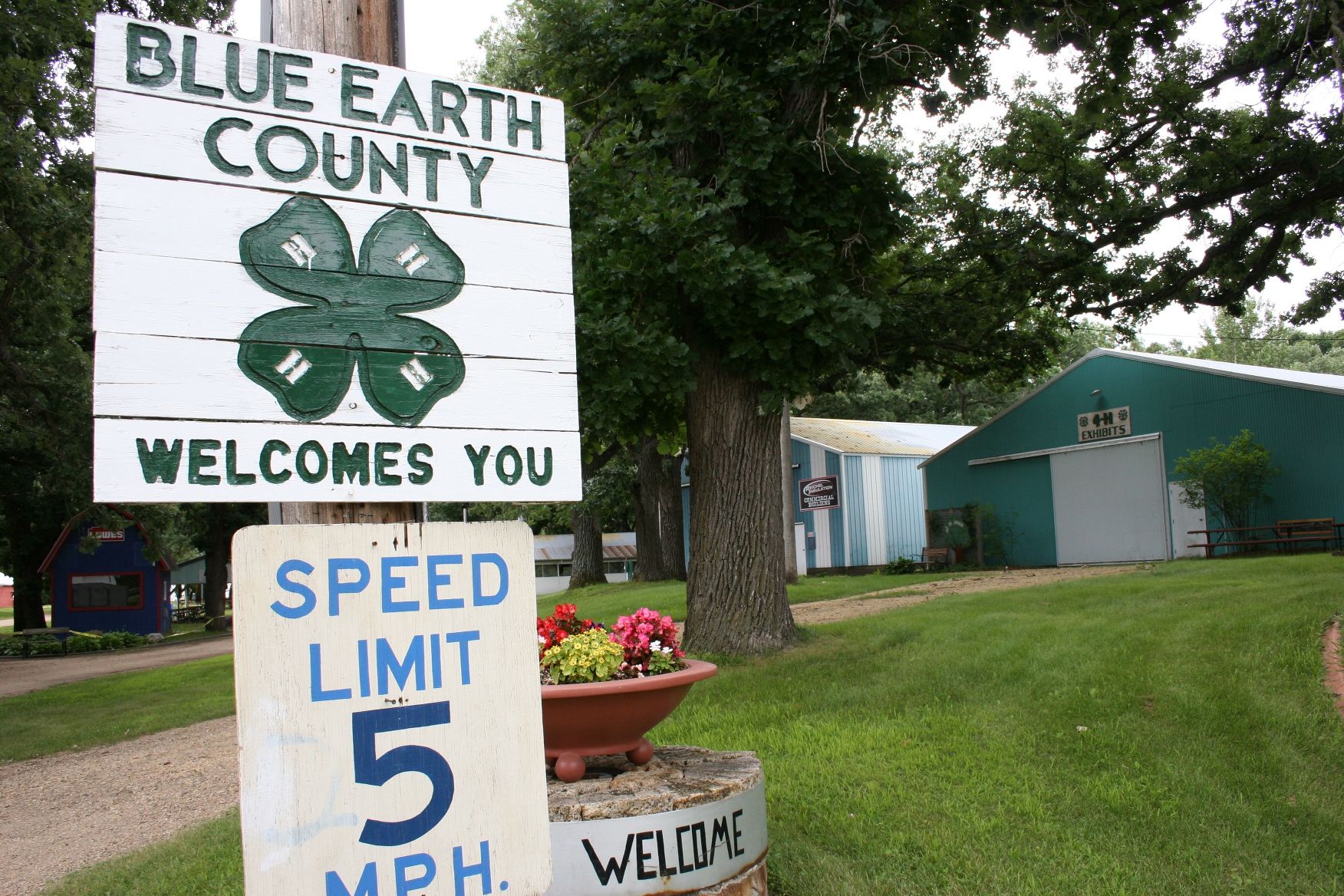
Just inside the entry to the Blue Earth County Fairgrounds.

Just inside the entry to the Blue Earth County Fairgrounds.

For 154 years, folks have come here each summer to celebrate the area’s agricultural roots.

But now this bucolic spot, which so charmed me during that brief drive-through this past July, may no longer serve as the site for Blue Earth County’s fair. The fair board is looking to move the fair within a two-mile radius of nearby Mankato, according to information on the fair website.

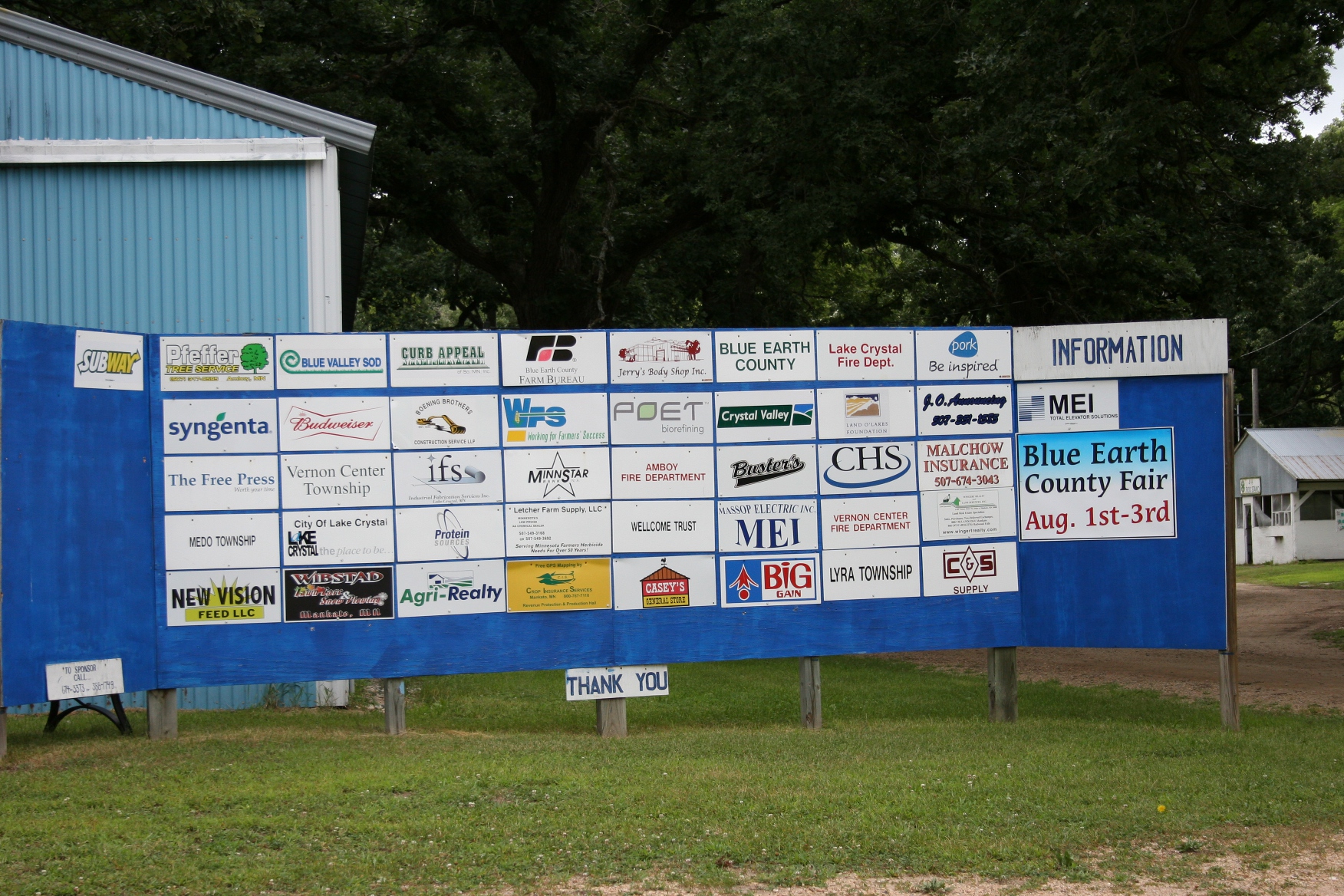
 A posting of fair sponsors just inside the front gate.

A posting of fair sponsors just inside the front gate.

Thursday evening, Blue Earth County Fair Association shareholders meet at Bethany Lutheran College in Mankato to discuss the future of the fair, supported in the past by rural sponsors like Crystal Valley Coop, Watonwan Farm Service and the Blue Earth County Farm Bureau.

Shareholders will vote, beginning at 6:20 p.m., on whether to sell the Garden City fairgrounds. I’m not privy to financial details but, according to a story in the Mankato Free Press, the fair has consistently lost money in recent years. The thought is that moving the fair nearer the county’s center of population (Mankato) and adding amenities will increase attendance and better tell the story of agriculture. Click here to read the document, BLUE EARTH COUNTY FAIR: GROUNDS FOR GROWTH.

I expect this membership meeting may be a heated one pitting historians and preservationists against those favoring change, and country folks against city residents. I might be wrong.

If you buy a $5 share, you can vote. Once. There’s no buying multiple shares for multiple votes. Shares are available for purchase yet today (from 11 a.m. – 1 p.m. and from 5-7 p.m.) at Busters on Madison Avenue in Mankato. And shares will be sold before the meeting, from 4:45-5:45 p.m. Thursday.

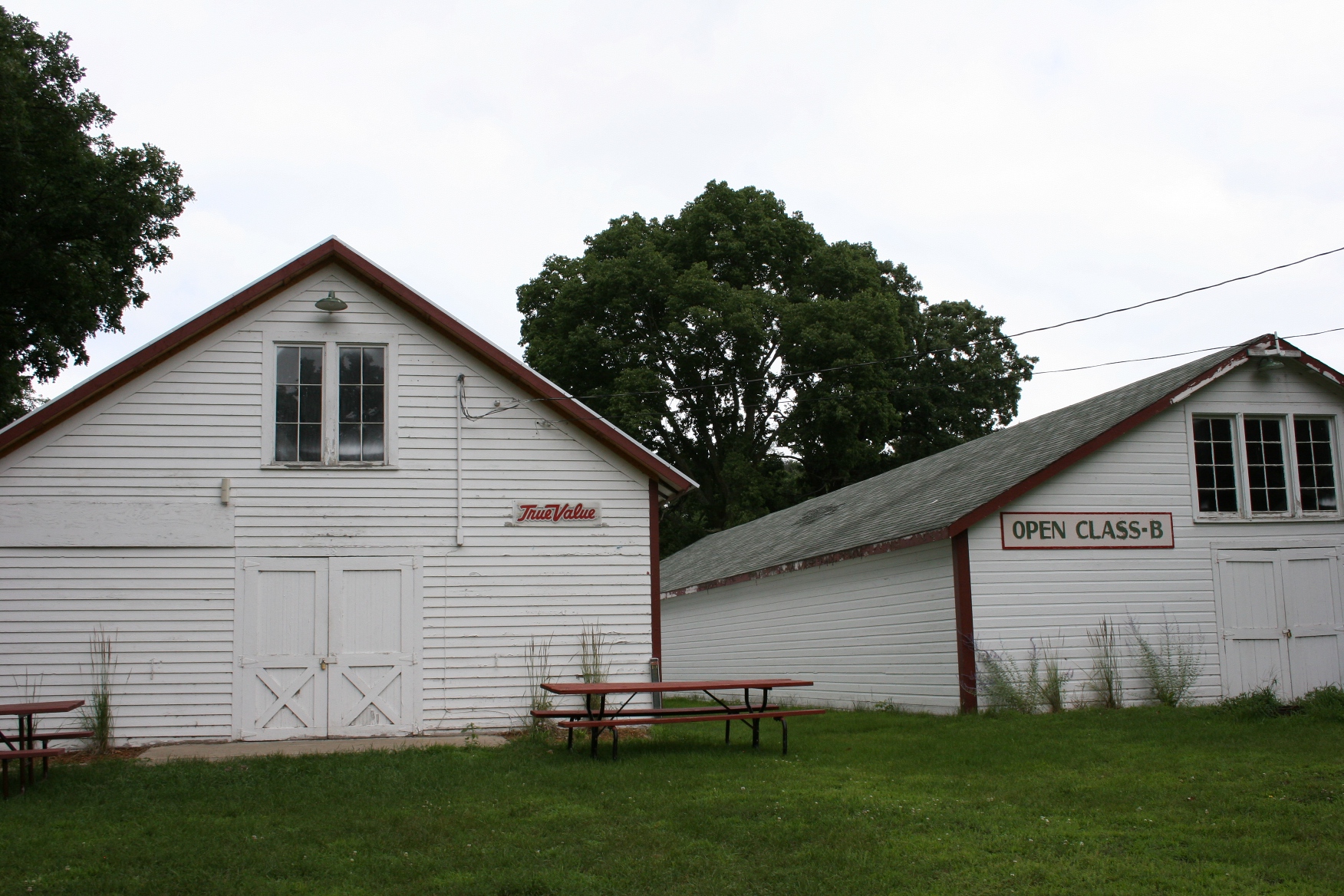
The open class exhibit buildings.

Open class exhibit buildings.

I’m not fully-informed on all sides of the issue. Yet I do know this: When my husband and I wove our way through the fairgrounds in Garden City, I was impressed by the historic character, the nostalgic charm, the quaint old buildings in the beautiful natural setting and the fact that a place like this still exists. There is something to be said for that, for the time-honored tradition of this fair and the pastoral appeal of this land. It is, undeniably, a picturesque place along the Watonwan River, a lovely gathering spot for the generations who have come here each summer to celebrate rural life.

LET’S HEAR YOUR THOUGHTS on the future of the Blue Earth County Fairgrounds. How would you vote? Move the fair to a site closer to Mankato or keep it here, in Garden City?

© Copyright 2014 Audrey Kletscher Helbling


Mankato’s newest public art project: “Poetry Walk and Ride” August 5, 2013

MANKATO HAS LAUNCHED its newest form of public art—poetry posted on signs in parks and along recreational trails.

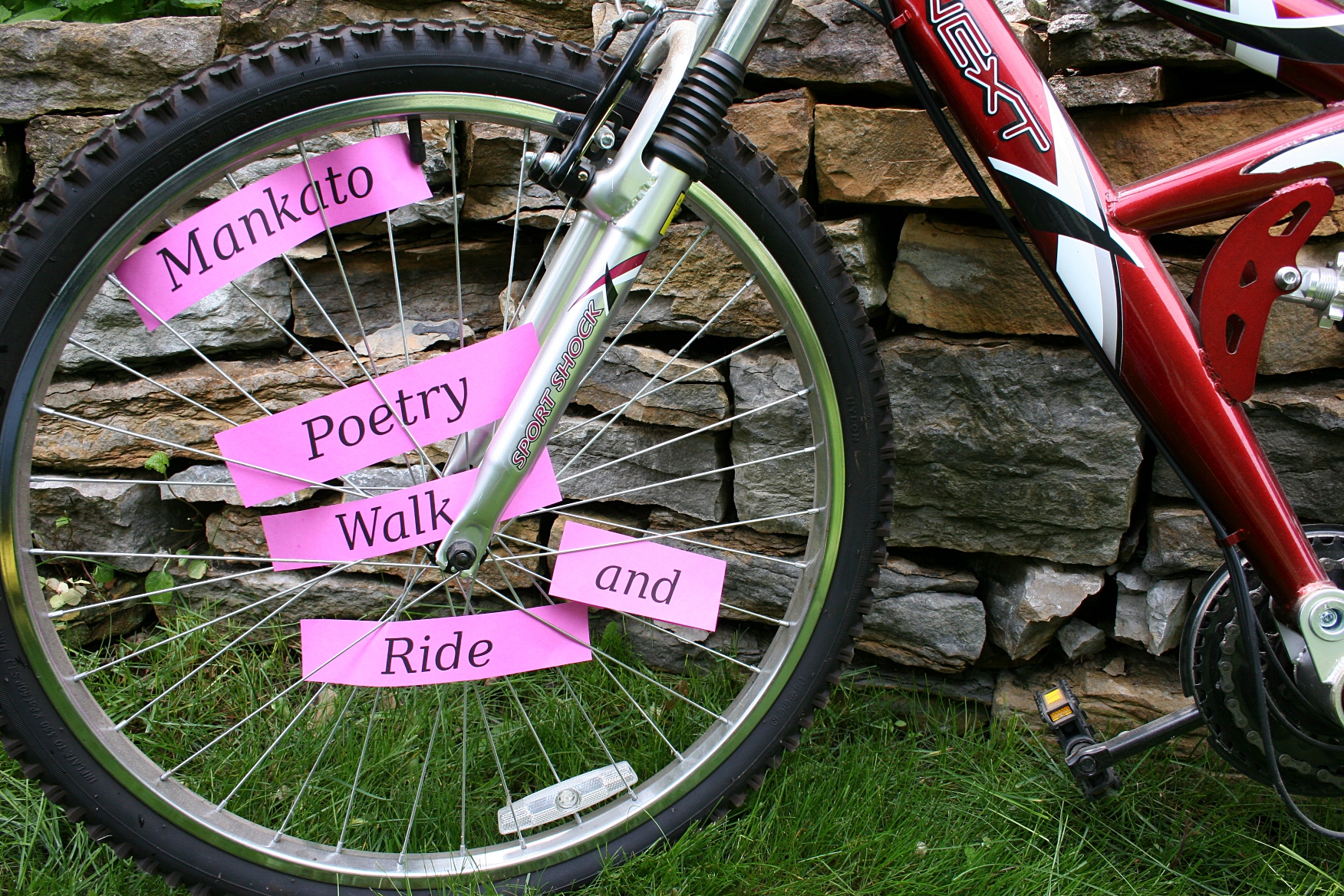
My artsy effort to illustrate this post.

A scene I created to illustrate the poetry project.

The Mankato Poetry Walk and Ride is designed “to inspire and encourage poets of all ages, to provide public art in our communities and to encourage exercise,” says Yvonne Cariveau who suggested the project to the Southern Minnesota Poets Society of which she is a member.

Serving on the committee for the Mankato and North Mankato CityArt Walking Sculpture Tour, an exhibit of annual rotating outdoor sculptures, Cariveau envisioned a similar concept for poetry.

The Poets Society embraced the idea (member Susan Stevens Chambers organized a contest) and, with support from the cities of Mankato and North Mankato and numerous businesses, the project took off.

My husband and I listen to one of my selected poems.

My husband and I listen to one of my selected poems, “The Thrill of Vertical.”

Today 34 poetry signs are up, mostly in Mankato, with a few in North Mankato, for reading and listening. Yes, listening. Poets recorded their poems, which can be accessed via phone, dialing (507) 403-4038 or scanning a QR code.

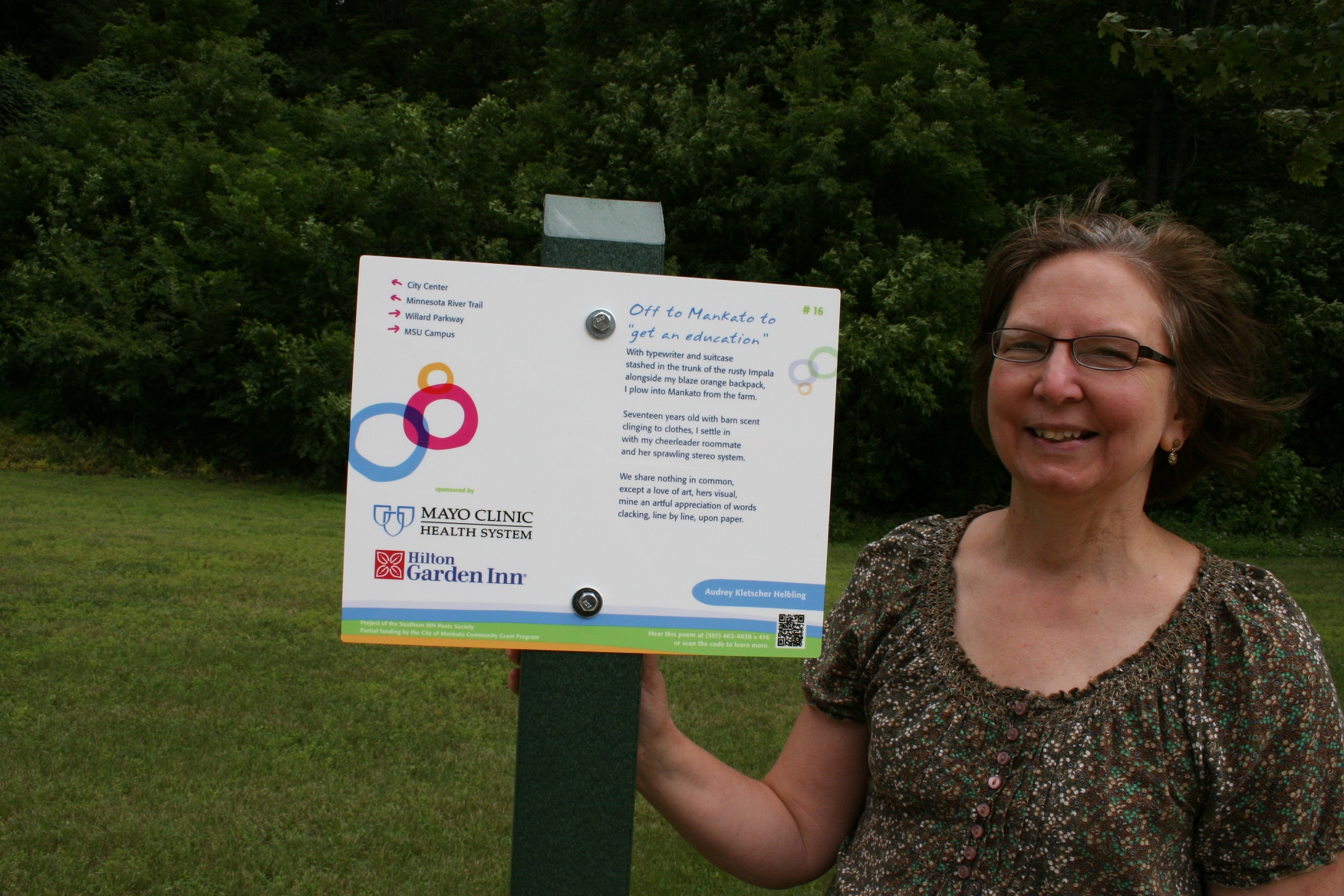
Me, next to my "Off to Mankato to 'get and education'" poem posted near Glenwood Gardens.

Me, next to my “Off to Mankato to ‘get an education'” poem posted near Glenwood Gardens.

Two of the 34 poems, 27 selected in a competitive process, are mine.

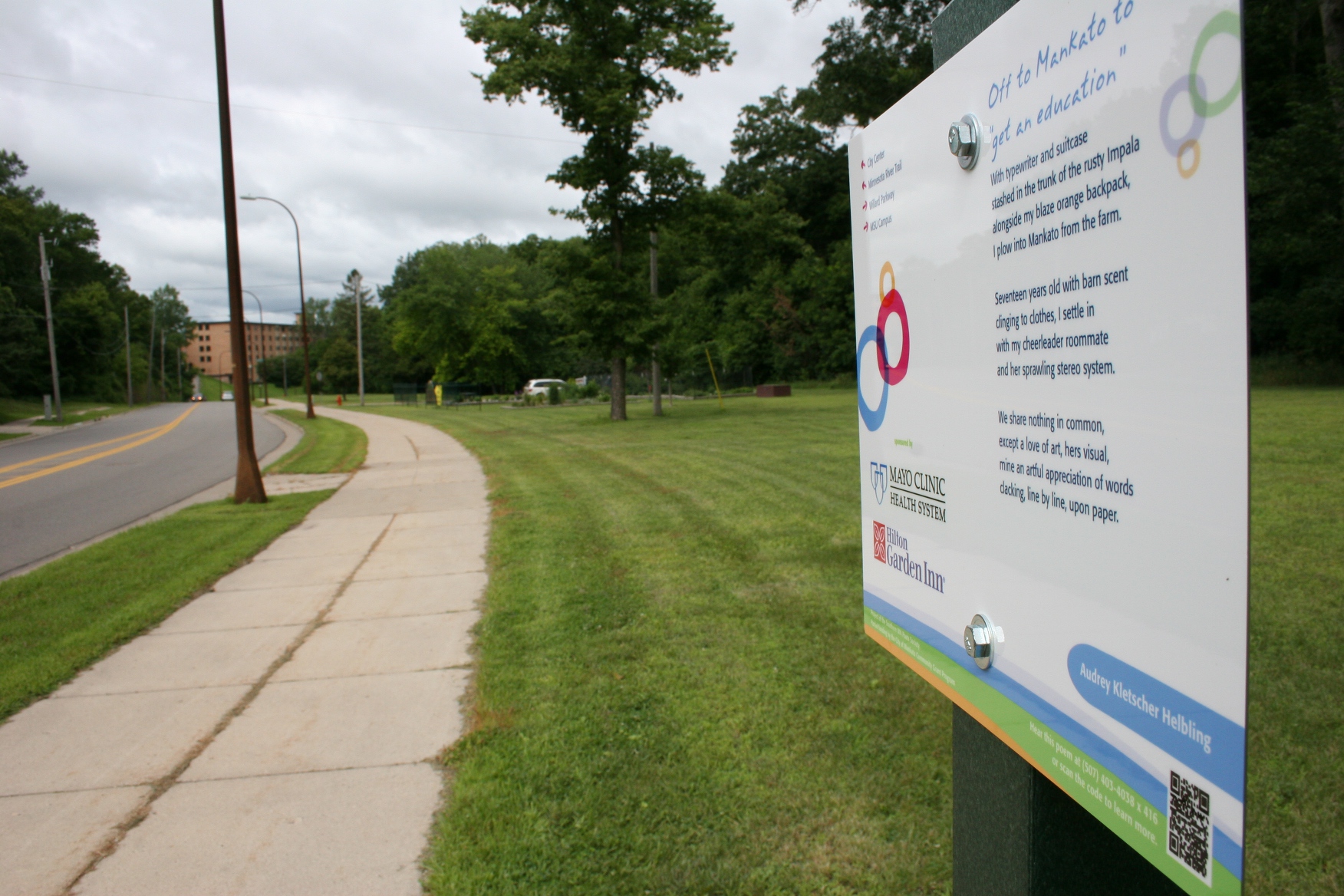
"Off to Mankato to 'get and education'", posted near Glenwood Gardens, in the background in this photo.

The setting in which one of my poems is posted near Glenwood Gardens.

You’ll find “Off to Mankato to ‘get an education’” near Glenwood Gardens close to the intersection of Glenwood Avenue and Division Street. The poem was inspired by my arrival in the autumn of 1974 as a freshman at Bethany Lutheran College, located not all that far from the posted poem.

"The Thrill of Vertical," located next to Hiniker Pond.

“The Thrill of Vertical,” next to Hiniker Pond.

My second poem, placed at Hiniker Pond Park in what seems like North Mankato but is really Mankato, also was prompted by my college year experiences. In “The Thrill of Vertical,” I write about zipping down the curving and hilly streets of Mankato on my 10-speed bike. Interestingly, the street I remembered in writing this poem is where “Off to Mankato to ‘get an education’” is posted along a recreational trail. Back in the 70s, there was no such trail.

Reflecting on that hurtling ride, I can’t help but think how stupid I was to fly at such speeds, back hunched, hands gripping racing handlebars, no helmet and two narrow bicycle wheels separating me from unforgiving pavement.

Today that crazy college kid abandon is forever captured in words, now published for all to see and recorded for all to hear. Until next June, when the 2013 poetry signs will come down and new ones will be erected.

Likewise, the other published writers—all of whom had to live within a 50-mile radius of Mankato, who range in age from seven to over 70 and are anywhere from new poets to recognized published poets—wrote about topics such as Mankato history, the river, Fudgsicles, family, mentors and more.

The challenge in writing the poems, for me anyway, came in the restrictions of 40 characters or less per line in a poem limited to 18 lines. It is a good exercise for any poet, to write within such confines, to value every letter, every space, every word.

One hundred twenty poems, submitted in specified age categories for those in third to 12th grades and then in adult divisions of humorous and serious, were anonymously judged. Doris Stengel, past president of the National Federation of State Poetry Societies, considered the adult entries while Peter Stein, League of Minnesota Poets youth chairperson, judged the youth poems. It is always rewarding as a poet to know that your work was selected on the basis of merit and quality rather than by name recognition.

The poems are posted in locations like this, near the shelter house in Hiniker Pond Park. the unobtrusive signs are about the size of a standard sheet of paper.

The poems are posted in locations like this, along a trail near the shelter house in Hiniker Pond Park. The unobtrusive signs are about the size of a standard sheet of paper.

In addition to the 27 winning poems, seven poems from notable Mankato area poets are among those posted.

Reaction to the poems thus far has been enthusiastic, says project initiator Cariveau, herself a poet. Her humorous poem, “Dreams of Coldstone,” was among those selected.

“People,” says Cariveau, “love the poems and are surprised by them.”

As for my reaction, I appreciate a project that makes poetry accessible. Those who may not otherwise read poetry likely will in an outdoor setting. Short poems. Easily read or heard. Non-intimidating. This is public word art at its best.

FYI: To read a list of the winning poets and the titles of their poems, click here.

For a map showing the locations of the posted poems, click here.

To learn about the Southern Minnesota Poets Society, click here.

You can hear me read my poems by calling (507) 403-4038 and then punching in 427 for “The Thrill of Vertical” and 416 for “Off to Mankato to ‘get an education’”.

Information on the 2014 Mankato Poetry Walk and Ride contest will be posted early next year on the SMPS website.

A chapbook of this year’s poems will also be published and will be available for purchase via the SMPS website and perhaps at other locations in Mankato.

P.S. I did not showcase other poems here in photos because I was unaware of their locations when I was in Mankato to photograph mine.

© Copyright 2013 Audrey Kletscher Helbling


Stepping into yesteryear at the Blue Earth County fairgrounds August 1, 2013

Just inside the entry to the Blue Earth County Fairgrounds.

Just inside the entry to the Blue Earth County Fairgrounds.

PRIOR TO LAST FRIDAY, I’d never been to the Blue Earth County Fairgrounds, nor even to Garden City, the unincorporated community in which the fairgrounds is located. That would be south of Mankato, along the banks of the Watonwan River.

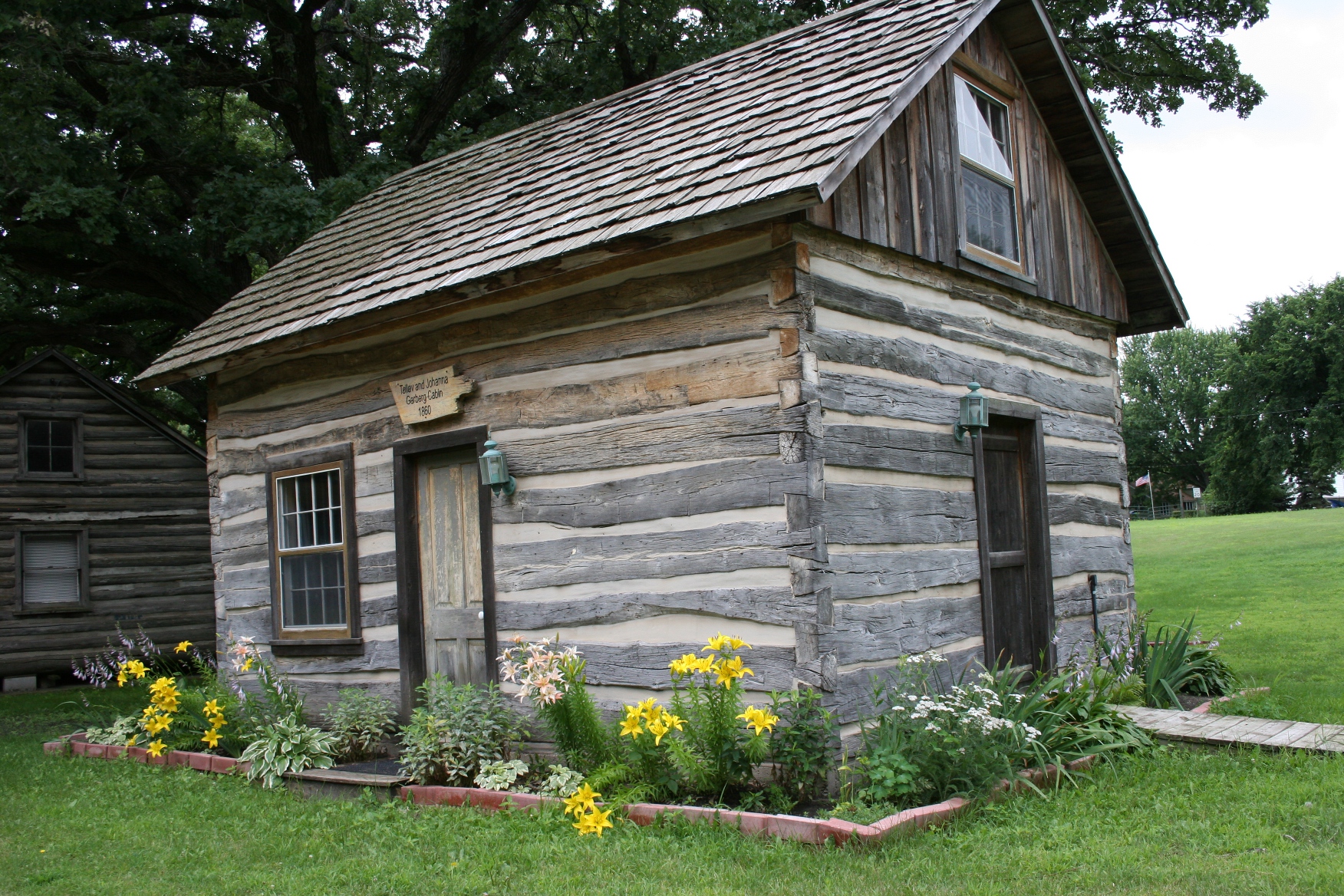
Log cabins on the fairgrounds include this one from 1860 and a replica of an 1839 cabin.

Log cabins on the fairgrounds include this one from 1860 and a replica of an 1839 cabin.

What a delightful place—like a step back in time.

The beef barn, shaded by an oak tree.

The beef barn, shaded by an oak tree.

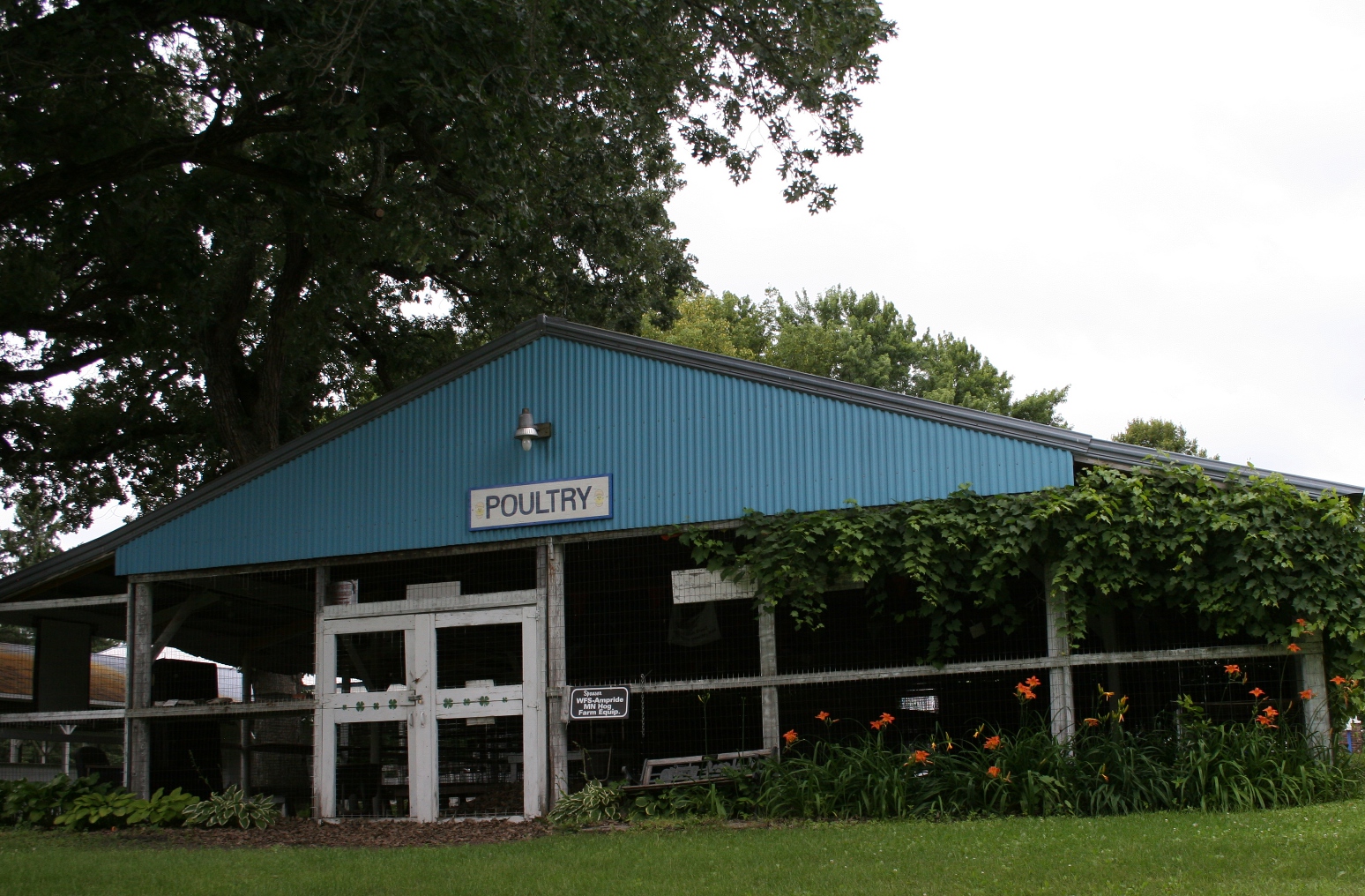
Space for chickens and ducks and geese and such poultry.

Space for chickens and ducks and geese and such poultry.

Always a fair favorite, the sheep.

Always a fair favorite, the sheep.

Just look at these old-fashioned buildings and imagine the cattle, pigs, poultry and sheep trucked into this scenic spot for the annual showing of the best of the best.

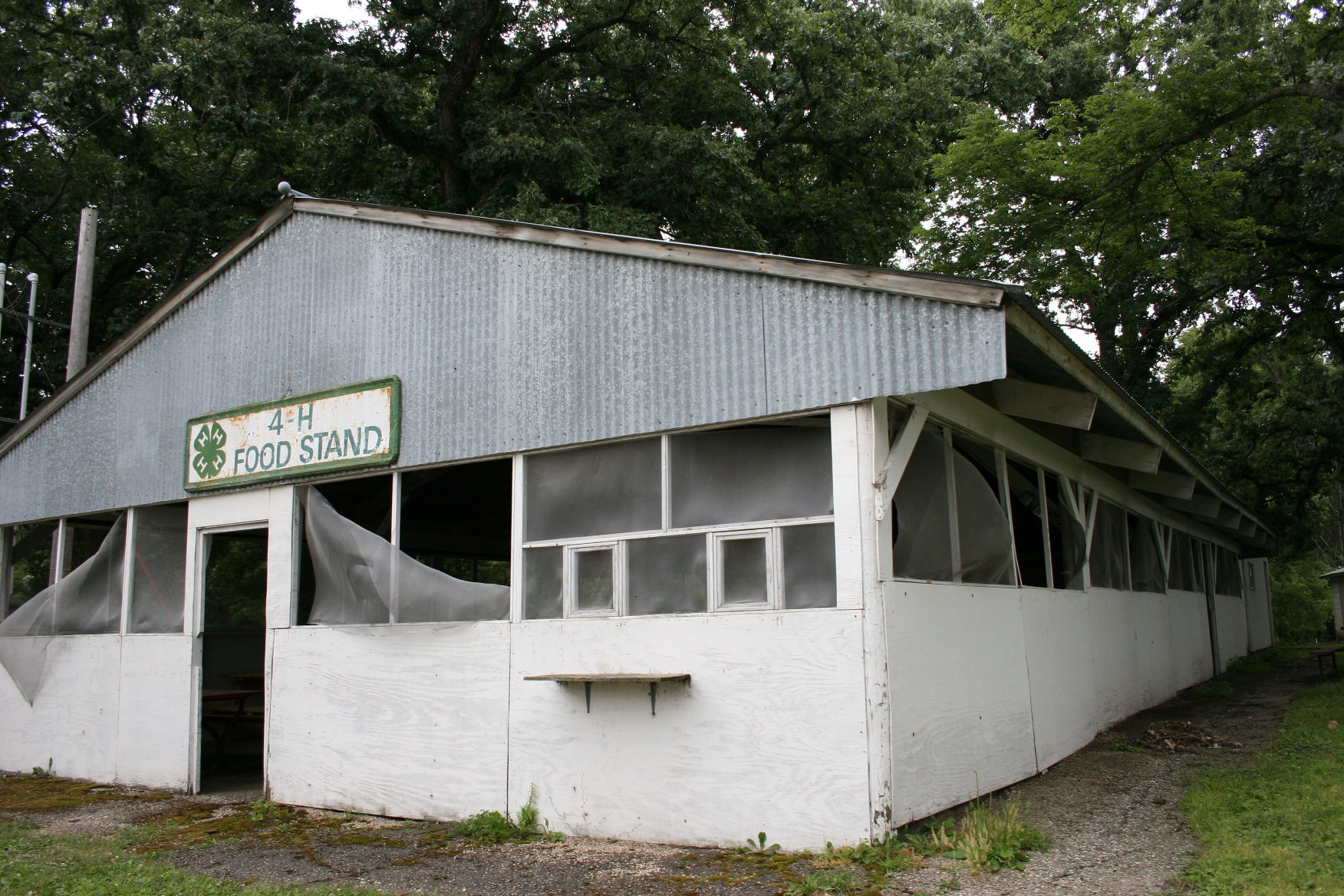
I expect (hope) the 4-H food stand will be repaired before the fair.

I expect (hope) the 4-H food stand was repaired before the fair.

Imagine 4-Hers clutching coveted ribbons.

The open class exhibit buildings.

The open class exhibit buildings. Look at the splendid old doors on these structures.

Imagine the families and old folks, the neighbors and strangers mingling here to celebrate life in rural Minnesota.

Imagine the young lovers strolling the grounds.

My Aunt Marilyn remembers, more than 50 years ago, attending this fair on a weekday afternoon along with other Blue Earth County employees. “I suppose they don’t do that anymore,” she said.

I expect not, Marilyn.

 A posting of fair sponsors just inside the front gate.

A posting of fair sponsors just inside the front gate.

Today, August 1, through Saturday, August 3, you can experience this grassroots fair when gates open at the Blue Earth County Fairgrounds/Shady Oaks Campground in Garden City just off U.S. Highway 169.

CLICK HERE for detailed fair information and click here for info about the campground.

BONUS PHOTOS:

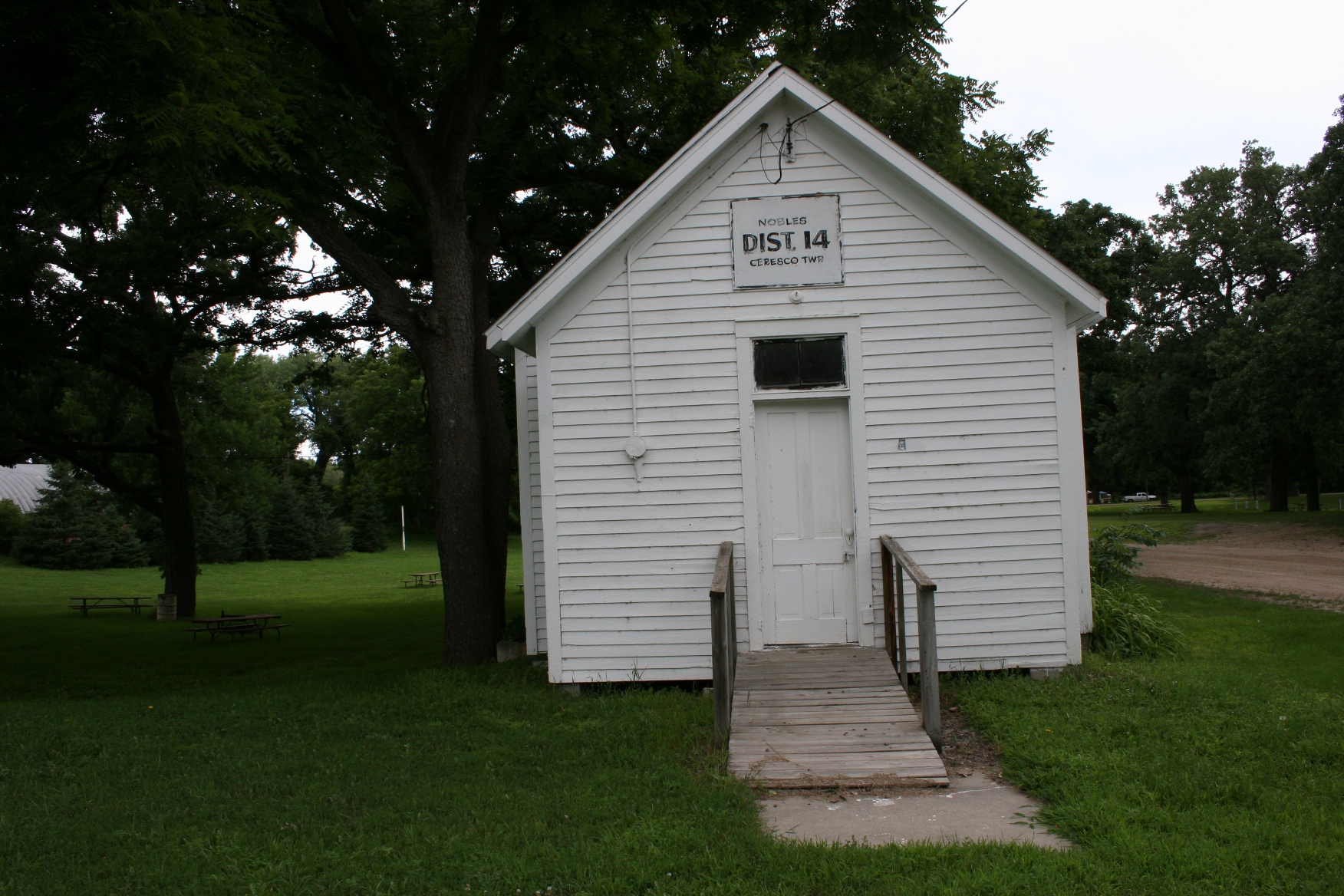
It seems every fairgrounds has an old school or church like this one.

It seems every fairgrounds has an old school or church like this one.

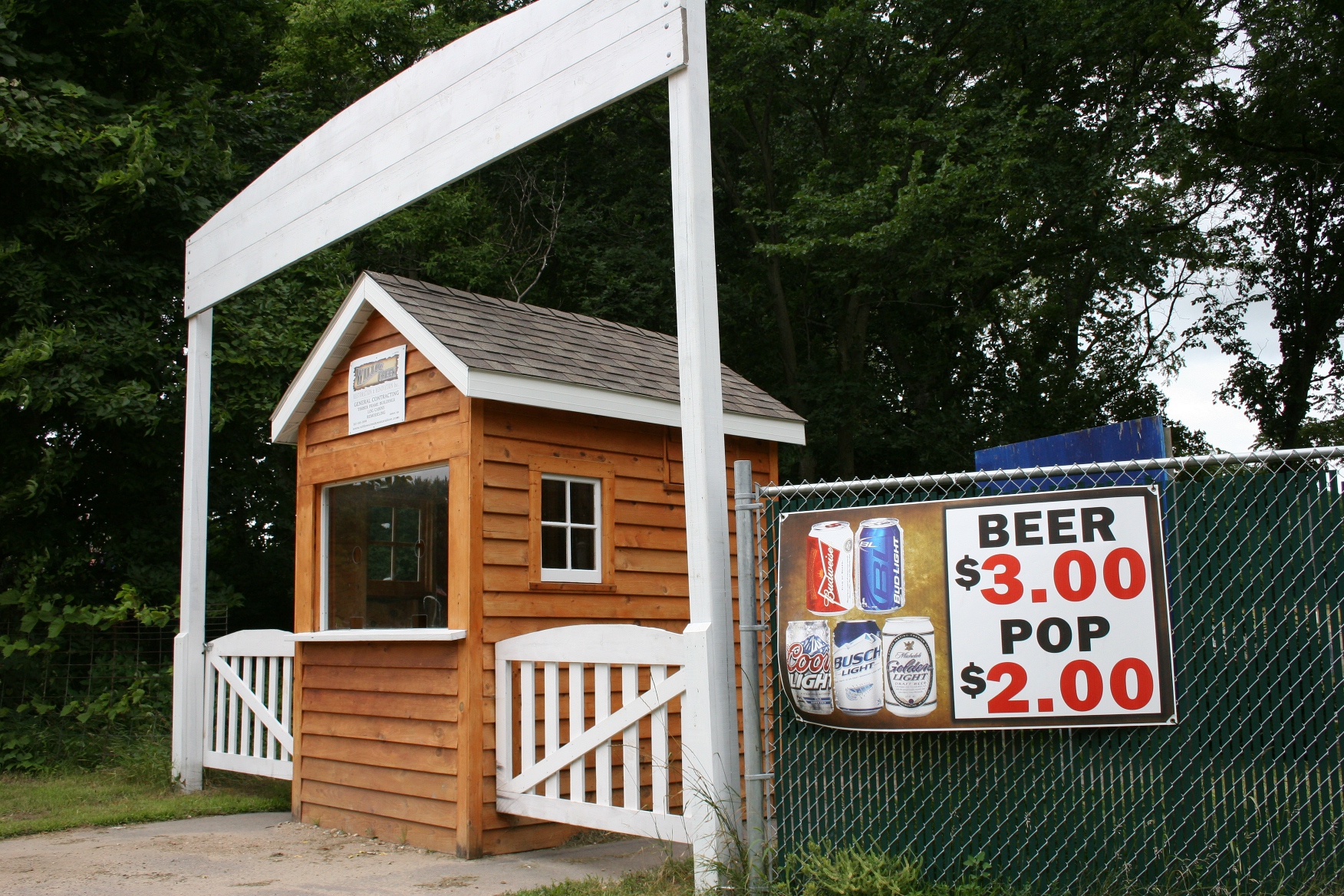
An on-site beverage stand.

An on-site beverage stand.

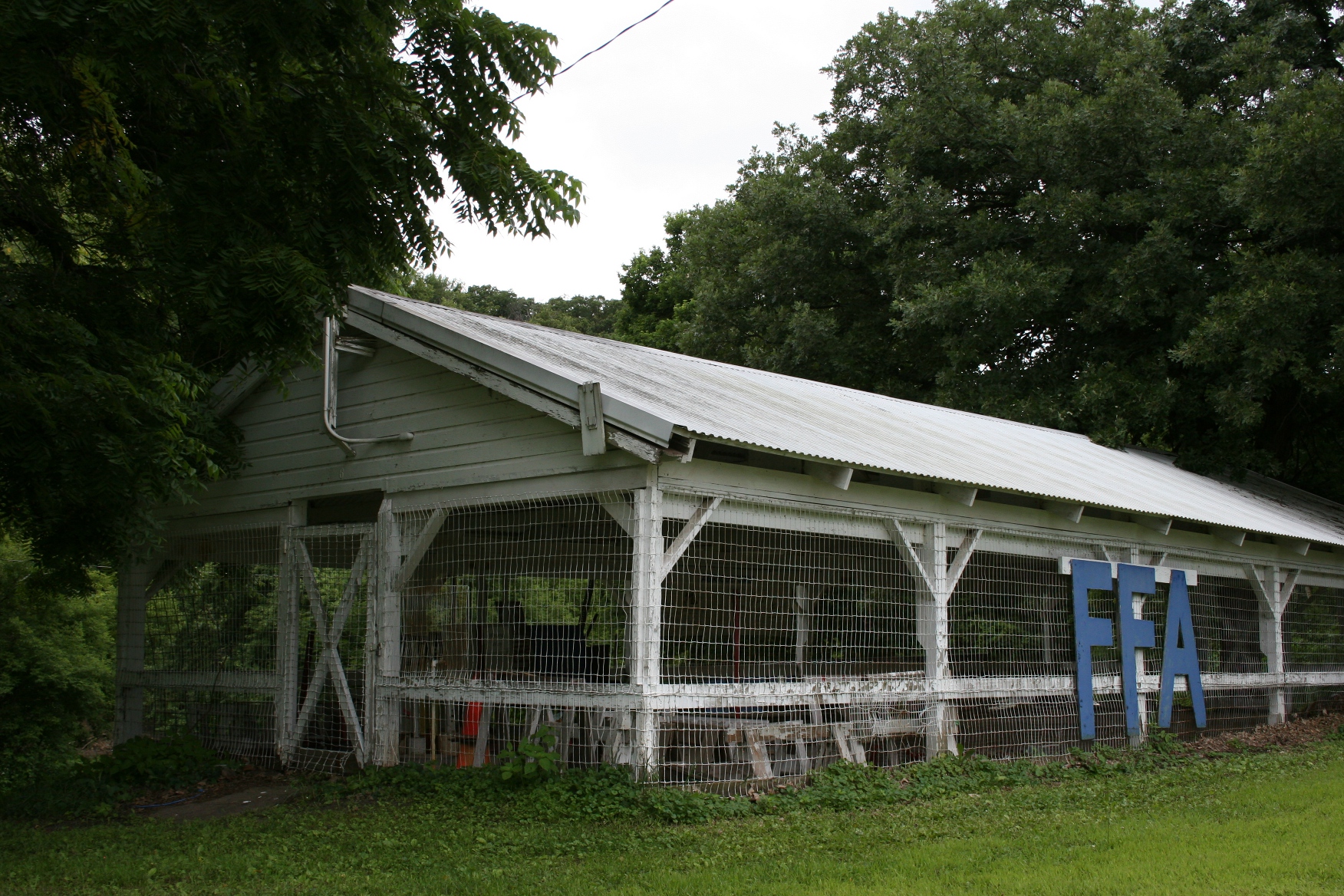
The Future Farmers of America building.

The Future Farmers of America building.

© Copyright 2013 Audrey Kletscher Helbling


Creativity unleashed at Bethany, my alma mater January 14, 2013

TYPICALLY, COLLEGE ALUMNI magazines hold my interest only long enough to thumb to the section where class updates are printed. I read those and then toss the publication into the recycling bin.

But recently, the bold, artsy cover of the November issue of the Bethany Report, the alumni magazine of Bethany Lutheran College, caused me to take a closer look at an article detailing the school’s new media arts program. I’m a Bethany grad, which in 1976 offered only a two-year associate arts degree to undergraduates.

Today this scenic hilltop campus in Mankato offers an array of four-year degrees, including one in communications, my eventual major at Minnesota State University, Mankato. Oh, how I wish majors and minors had been available back in my Bethany years, because I loved that small Christian college.

All of that aside, today’s Bethany students with an interest in communications, the fine arts and technology can enroll in the media arts major. I don’t pretend to know how Bethany’s program compares to that of other colleges.

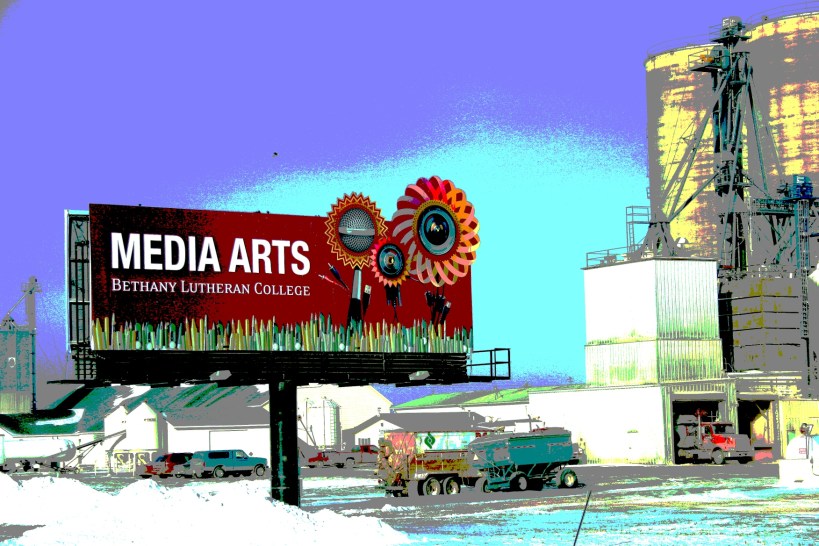
I did my own editing on this recent photo of a Bethany billboard along U.S. Highway 14.

I did my own editing on this recent photo of a Bethany billboard along U.S. Highway 14.

But when I saw that magazine cover design emphasizing the media arts program and then an equally vivid, eye-catching billboard along U.S. Highway 14 near Janesville recently, I was impressed enough to visit the BLC website.

There I clicked onto a portfolio showcasing the creations of current and former students.

I’m no expert on the fusing of art, technology and communication. But I liked what I saw. And perhaps that uninformed spontaneous reaction counts for more than the dissected opinion of anyone in academia.

© Copyright 2012 Audrey Kletscher Helbling


The educating & healing continue 150 years after The U.S.-Dakota War December 28, 2012

STUDYING MINNESOTA HISTORY decades ago, I learned about “The Sioux Uprising of 1862” and even wrote a term paper on the topic bearing that title.

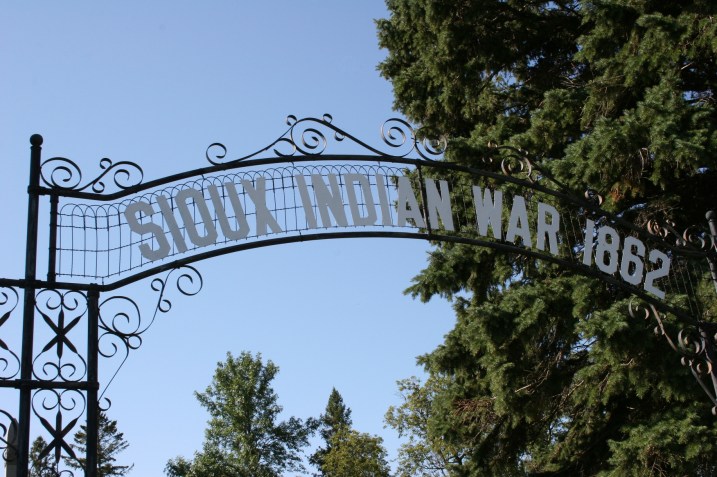
This archway leads to the Wood Lake State Monument, on the site of the battle which ended the U.S.-Dakota Conflict of 1862.

This archway leads to the Wood Lake State Monument, on the site of the battle which ended the U.S.-Dakota Conflict of 1862.

I thought nothing negative of that word, Sioux, which translates to “snake.” The Ojibway, once enemies of the Dakota, gave the tribe that name. I did not know; it was the word I was taught.

That I even studied “The U.S.-Dakota War of 1862,” the proper terminology for the six-week war fought primarily in my native southwestern Minnesota 150 years ago, seems remarkable. So many in Minnesota never knew of this conflict in our state’s history.

I don’t pretend to know every detail of the war between the Dakota and the white settlers and soldiers. But I do remember that I grew up with a fear of “Indians,” reinforced by the television westerns especially popular during my formative years and by the history lessons delivered about The Sioux Uprising of 1862, as it was then called.

Those classroom lessons were decidedly one-sided: The whites were the good guys, the Indians the bad guys. That line of thinking was wrong, oh, so wrong. I realize that now, having reached that conclusion decades ago.

The maltreatment of the Dakota by greedy traders, broken treaty promises, starvation, efforts to convert and transform the Dakota people into Christian farmers, expulsion from their homeland and more contributed to the war.

Yet, even the Dakota disagreed about the need to wage this battle. Some helped settlers escape to safety while others plundered and killed. My own maternal forefathers fled the New Ulm area to St. Peter, making this war a part of my personal family history.

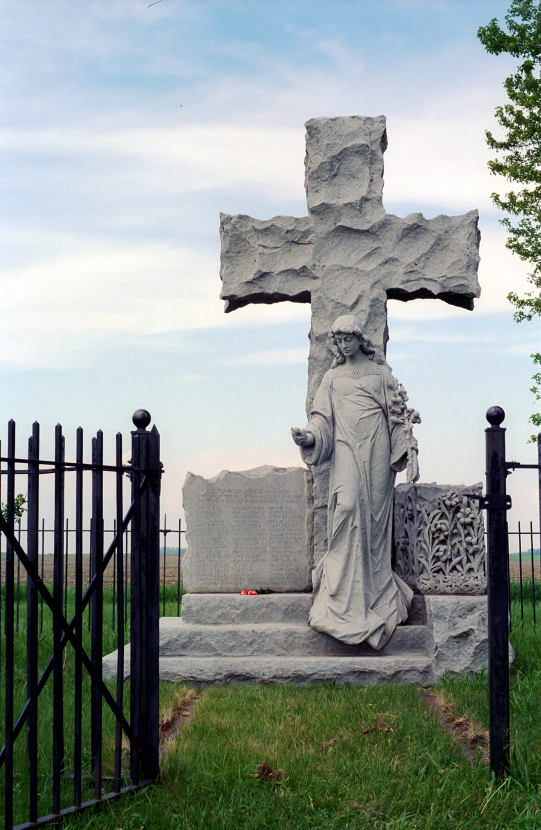
The Milford State Monument along Brown County Road 29 west of New Ulm commemorates the deaths of 52 settlers who were killed in the area. Located along the eastern edge of the Lower Sioux Reservation, Milford had the highest war death rate of any single township.

The Milford State Monument along Brown County Road 29 west of New Ulm commemorates the deaths of 52 settlers who were killed in the area. Located along the eastern edge of the Lower Sioux Reservation, Milford had the highest war death rate of any single township.

While I carry no ill will toward the Dakota, I will tell you, unequivocally, that feelings still run deep in southwestern Minnesota. I am also honest enough to admit that perhaps I would feel differently if my family members had been massacred or if I was of Dakota, instead of German, heritage.

Although time can heal, it doesn’t always. Misconceptions and misguided expectations, even after 150 years, exist on multiple sides of the issue. I won’t delve into that here, but I do think the healing is still ongoing, forgiveness (on both sides) still not attained.

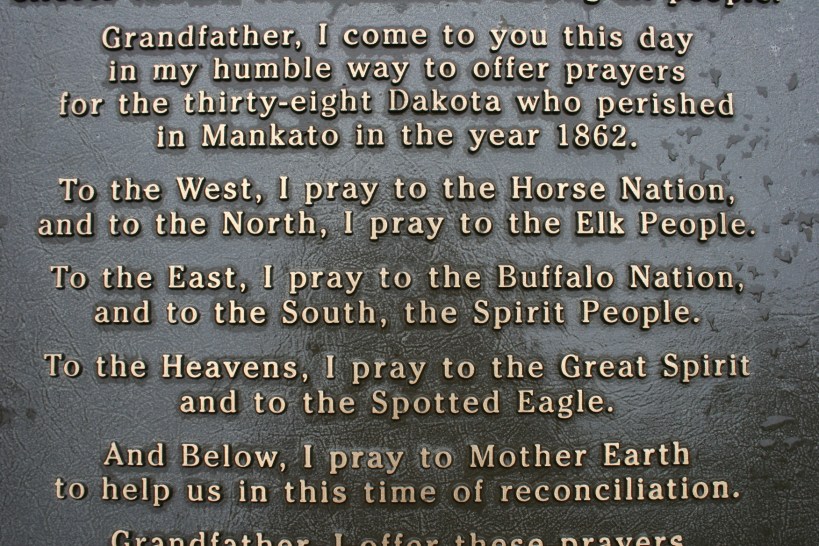
Words on a marker in Reconciliation Park in Mankato where 38 Dakota were hung on Dec. 26, 1862.

Words on a marker in Reconciliation Park in Mankato where 38 Dakota were hung on Dec. 26, 1862. On Wednesday, a new Dakota 38 Memorial was dedicated listing the names of the 38 men who died here. This file photo was taken of an existing plaque in the park.

In a ceremony in Mankato on Wednesday marking the 150th anniversary of the hanging of 38 Dakota, Mayor Eric Anderson proclaimed this the year of “forgiveness and understanding.”

The Dakota also called upon all to “forgive everyone everything.” Those words will be engraved into Kasota stone benches to be installed next summer at the site of the new Dakota 38 Memorial dedicated in Reconciliation Park on Wednesday.

Strides toward understanding and forgiveness, and education, can perhaps finally heal the still festering wounds of this long ago war.

TO VIEW PHOTOS from the event in Mankato on Wednesday, click to link here to Minnesota Public Radio.

TELL ME, ESPECIALLY if you grew up in Minnesota, did you study The U.S.-Dakota War of 1862? Also, are Minnesota students today being taught about this war?

© Copyright 2012 Audrey Kletscher Helbling


An enlightening, poetic moment and more January 21, 2012

SOMETIMES I’M A SLOW LEARNER, mostly in math and science. But this time my delayed learning applies to words, specifically poetry.

Dear readers, don’t stop reading now simply because I mentioned the word “poetry.”

I prefer to read and write poetry that is down-to-earth and not so open to interpretation or overloaded with big words that I cannot possibly comprehend the content.

With that perspective, consider this: Poetry is meant to be read aloud.

“Duh,” you say. “She just figured that out.”

Yes, I did.
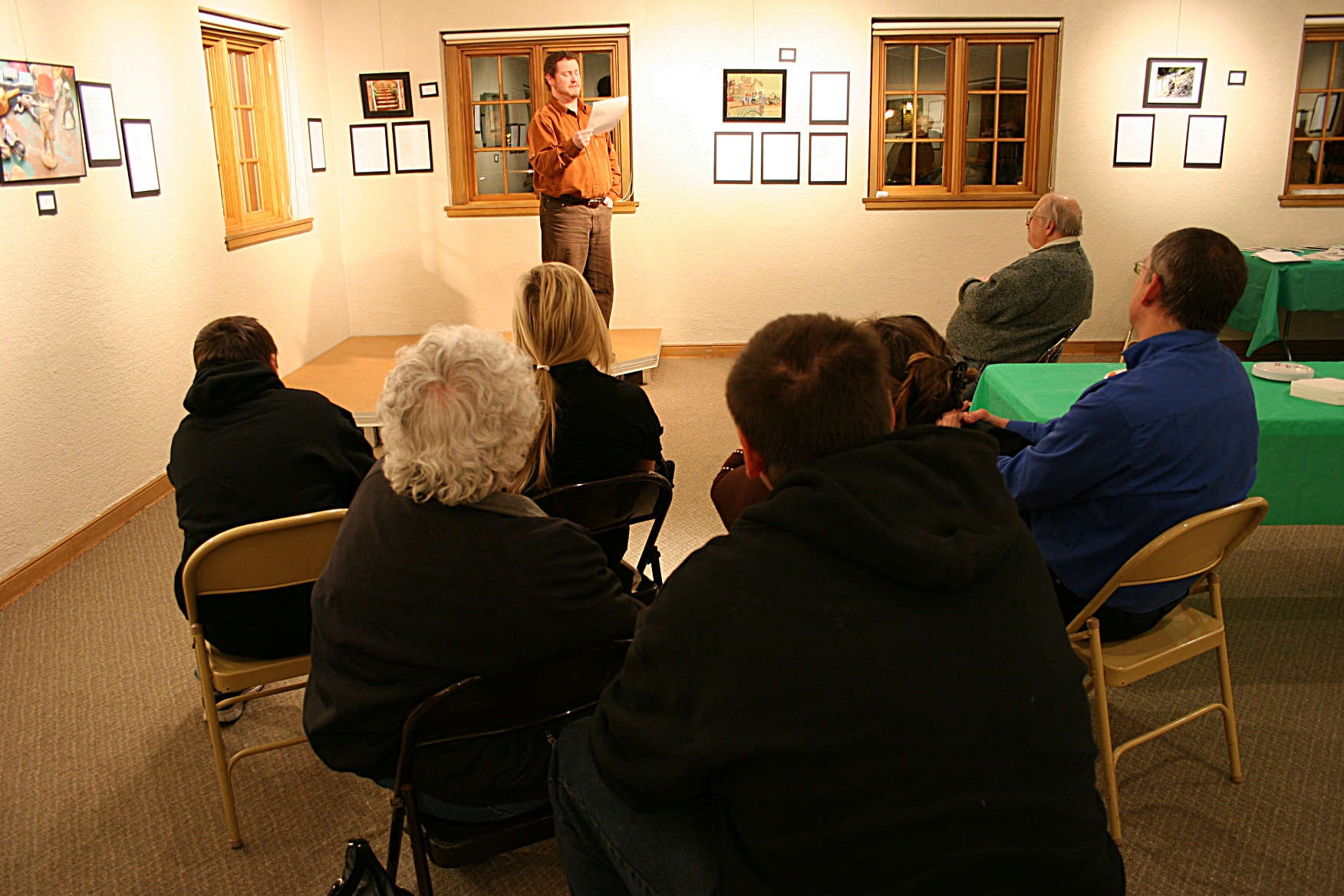
Poet Derek Liebertz reads a poem during "The Image and the Word 2012" reception. The poems are displayed next to the photos that inspired them.

Thanks to Derek Liebertz and Yvonne Cariveau, organizers of “The Image and the Word 2012” exhibit at the Emy Frentz Arts Guild in downtown Mankato, I now fully grasp the importance of reading poetry. Out loud. To an audience.

You see, I attended a reception Thursday evening for the poets and photographers whose work is featured in an exhibit that pairs photos and poems. During that event, Derek and Yvonne read poems inspired by those photos and also invited other participating poets, me among them, to read their works.

Only once, many, many years ago, have I read my poetry in public, unless, of course, you count all those times I read silly “married life” poems at cousins’ bridal showers decades ago. Public reading was not the easiest thing for me to do, but I managed.

The atmosphere on Thursday evening was so relaxed and casual, however, that I nearly breezed through reading two of the three poems I’d written. In hindsight, my readings could have been much better had I practiced at home. But I didn’t, and what’s done is done.
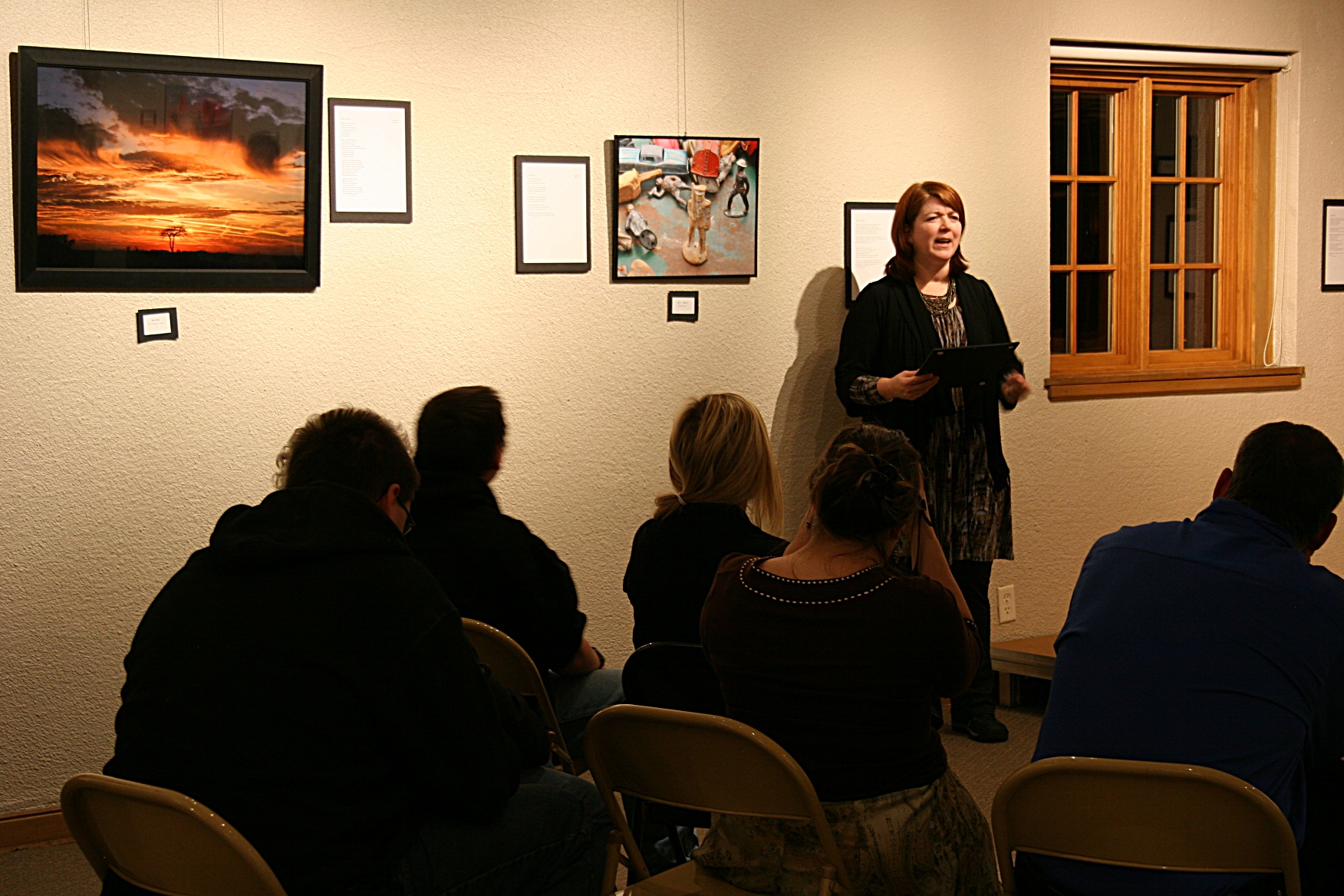
Yvonne Cariveau reads a poem. To the left is a photo taken by Kay Helms and voted as the "favorite photo" during the Thursday evening reception. The landscape image was taken along Highway 14 between Waseca and Owatonna.

The other poets, though, clearly were accustomed to and comfortable sharing their poetry with a listening audience. I listened with a learning ear, picking up on the drama, the cadence, the tone, the volume, the movement of the hands, the facial expressions and every nuance that conveyed the meaning and depth of a poem.

I got it. Finally.

That does not mean I’m eager to read poetry in public again. But I understand how a poem can be more fully appreciated when read aloud by its author.

Why did it take me so long to figure this out?

BESIDES THE POETRY lesson I learned Thursday evening, I also met and learned a bit about several other “The Image and the Word 2012” participants. Derek, for example, works as a programmer at his wife Yvonne’s company, Voyageur Web. Who would expect techies to write poetry? Not me. Derek, the most dramatic of the readers, tagged his day job as his “Clark Kent” persona. You have to appreciate a guy with that type of humor, which weaves into his writing.

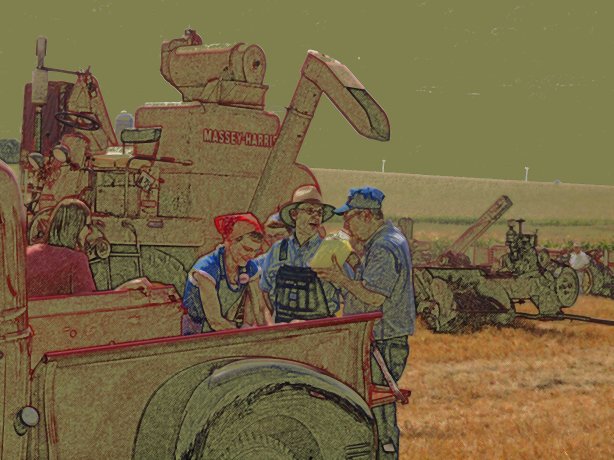
Then I met John Othoudt, a retired highway department employee turned photographer. His exhibit photo of farmers gathered at the tailgate of a vintage pick-up truck was taken at the Le Sueur County Pioneer Power Show. With a single click of his mouse, John edited the image into a pencil drawing style that makes the photo appear vintage 1950s. It inspired me to write “Taking lunch to the men in the field,” recalling the afternoons my older brother and I did exactly that on the Redwood County crop and dairy farm where we grew up.
"Lunch Time" by John Othoudt of Lake Crystal

I’d encourage you to click here and check out John’s photography. This man has talent. I share his passion for noticing details and photographing the often overlooked everyday and ordinary things in life. He shoots in the moment, he says. His “Lunch Time” photo, for example, happened as he was planning another shot. I understand. Some of my best photos have simply happened, unexpectedly.

Then I met Terri DeGezelle, whose credentials are even more impressive than those she shared with me Thursday. Click here to learn more about this woman who has written 64 nonfiction children’s books and is also an avid nature photographer. Her “Artist’s Colors,” a photo of colorful chalk, won the best paired photo-to-poem honor at the reception. Susan Stevens Chambers wrote the accompanying poem. I loved Terry’s enthusiasm and warm personality and the pure passion she exudes for the crafts of writing and photography.

As I was preparing to leave and thanking Yvonne for organizing the exhibit, I talked briefly with John Calvin Rezmerski, who encouraged me in my writing. His “Window” poem was voted as the favorite poem. Only until later, back home, did I learn that he is the League of Minnesota Poets current Poet Laureate and a well-known, established poet with 20 books, chapbooks and anthologies to his credit. He’s retired from teaching creative writing, journalism, literature, storytelling and more at Gustavus Adolphus College in St. Peter. Unlike me, he’s quite experienced at reading his work in public.

I met other delightful individuals, too, including Kay Helms, whose “The Witness Tree” was selected as the favorite photo at Thursday’s reception. The stunning sunset image was taken along U.S. Highway 14 between Waseca and Owatonna.

Helms’ photography will be displayed February 17 – March 18 at the Arts Center of Saint Peter in a collection of words and photos highlighting individuals who worked the land in south central Minnesota. Click here for details.

IN SUMMARY, Thursday’s reception proved invaluable for me. I learned that I could stand (or sit) before an audience and read my poetry without too much trepidation. I learned that poetry shines when read. And, finally, even though I was likely the most novice of the participating poets, I felt comfortable among all that talent. They are a fine bunch of poets, but more important, they are warm, kind and welcoming individuals with whom I enjoyed networking.

CLICK HERE TO READ a previous post I wrote about “The Image and the Word 2012.”

Click here to learn more about me, my writing and photography, including my published poetry credits.

© Copyright 2012 Audrey Kletscher Helbling

“Lunch Time” photo courtesy of and copyrighted by John Othoudt


Photos plus poetry equals what? January 17, 2012

OK, READERS, LISTEN UP. Time for a brief math lesson. Yes, math. Didn’t expect that from me, did you? But today I want you to solve a word problem. Remember those? Oh, how, as a child, I hated word problems like this:
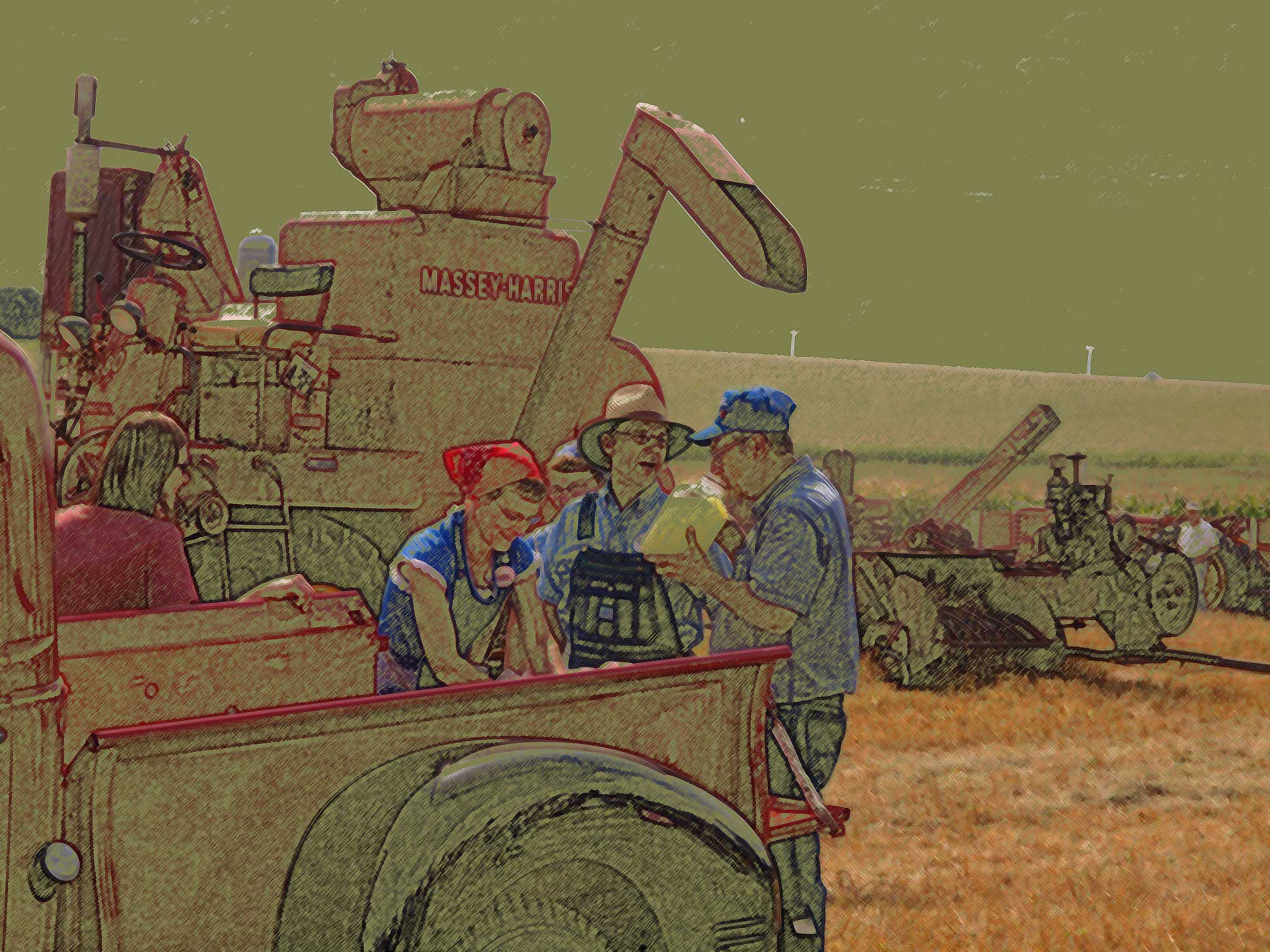
If  Susie goes to the grocery store and buys 3 apples for 25 cents each, an orange for 33 cents and a candy bar for $1, how much change will she get if she gives the clerk $5?

Questions like that taxed my pathetic little math brain back in grade school. This equation requires multiplication, addition and subtraction skills, all of which challenged me considerably and still do.

But present a word problem (perhaps more of a riddle) like this and I will solve it in a snap:

If you add poetry to a gallery full of photos, what do you get?

Ah, so have I stumped you on this one?

The answer: “The Image and the Word 2012”

Of course, you might stop right now and say I tricked you into believing we really were doing math. And you would be mostly correct. But since I prefer words to numbers, what would you expect?

You can expect to see three of my poems exhibited at “The Image and the Word 2012,” a show that pairs poems with photos. The exhibit opened January 11 at the Emy Frentz Arts Guild, 523 South Second Street, in downtown Mankato.

The brainchild of poets Derek Liebertz and Yvonne Cariveau, “The Image and the Word” features photograph-inspired poetry from southern Minnesota poets. This photo by Antje Meisner, for example, prompted me to write “I am not Martha.”

"Cartwheel" by Antje Meisner and the inspiration for one of my poems.

You might expect that this playful image inspired an equally carefree poem. It did not. Rather, I penned a poem about my not-so-fond memories of a junior high gymnastics class. Any of you who could not, like me, execute a perfect cartwheel, somersault or tumble will surely relate to “I am not Martha.”

A second poem recalls memories of my brother and me taking lunch to our dad and Uncle Mike working in the fields. The third poem I will not discuss here, in print.

All of the poems in the exhibit were inspired by photos from Mankato area photographers, including members of the Bend of the River Photography Club. This fifth annual “The Image and the Word” exhibit is presented in cooperation with the Southern MN Poetry Society.

I’d encourage you to attend an opening reception for this exhibit from 5 p.m. – 7 p.m.  on Thursday, January 19.  This free-form event, where visitors can wander in and out of the gallery, will feature poetry readings. (I’m not so sure about that “reading” part; I prefer solitary writing to public speaking.) The photographers will also talk about their photos.

Just to entice you, wine and snacks will be available and all who attend this free event will receive a free poetry book. Yes. Free and free.

And while you’re there, vote for your three favorite poems, three favorite photos and the best pairing of photo to poem. Three, three and three.

Plan also to stop at numerous artistic locales during the Third Thursday Gallery Walk from 5 p.m. – 7 p.m. You can view new art and visit with area artists. Click here to see a complete listing of sites on this monthly gallery walk.

REGULAR GALLERY HOURS  for this exhibit are from noon – 4 p.m. Monday, Tuesday, Wednesday and Friday and from 4 p.m. – 8 p.m. Thursdays.

The show continues through February 15.

Mankato offers many other cultural opportunities, including WordWalk at Riverfront Park and a CityArt Walking Sculpture Tour. Check my June and July 2011 blog archives to read posts on those attractions.

I’m sorry if you don’t live in or near Mankato. I will try to take photos of the exhibit.

OH, AND THE ANSWER to that first word problem, well, it’s $2.92.

© Copyright 2012 Audrey Kletscher Helbling

Photo courtesy of Antje Meisner