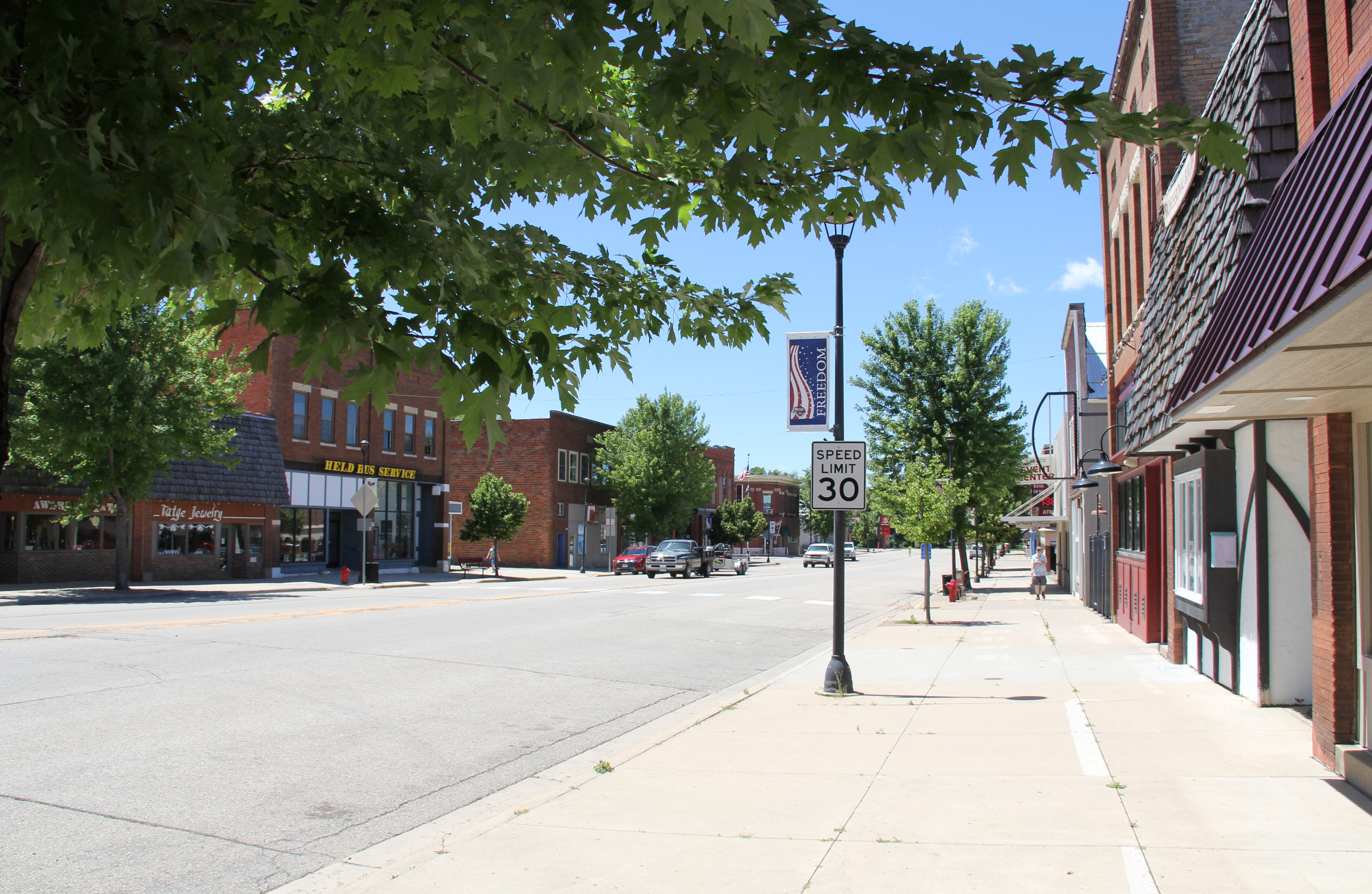
A view of Kenyon’s downtown business district along Minnesota State Highway 60 which runs through the heart of this southern Minnesota community. (Minnesota Prairie Roots copyrighted photo June 2024)
EVERY SMALL TOWN I’ve ever visited, and I’ve been to a lot, has unique, identifying qualities that make it memorable. In Ellendale, it’s the old-fashioned grocery store and meat market. In Montgomery, it’s the veterans’ photos displayed downtown, the bakery, the arts and heritage center, the murals and vintage signage. And in Kenyon, it’s the roses growing along the boulevard, the signs, the thrift shops and more.
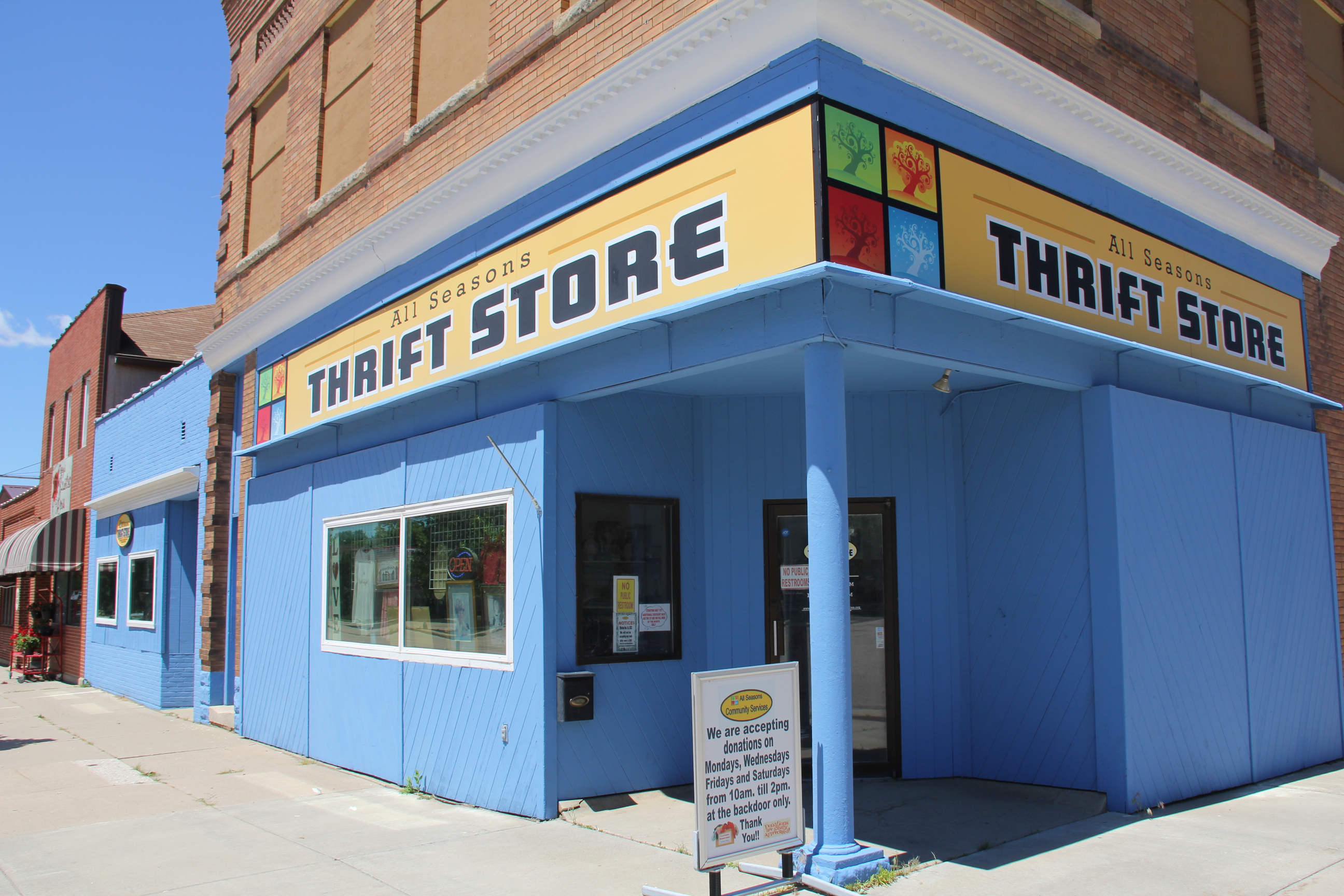
One of two fabulous thrift shops in Kenyon, the other SIFT Thrift Store. (Minnesota Prairie Roots copyrighted photo June 2024)
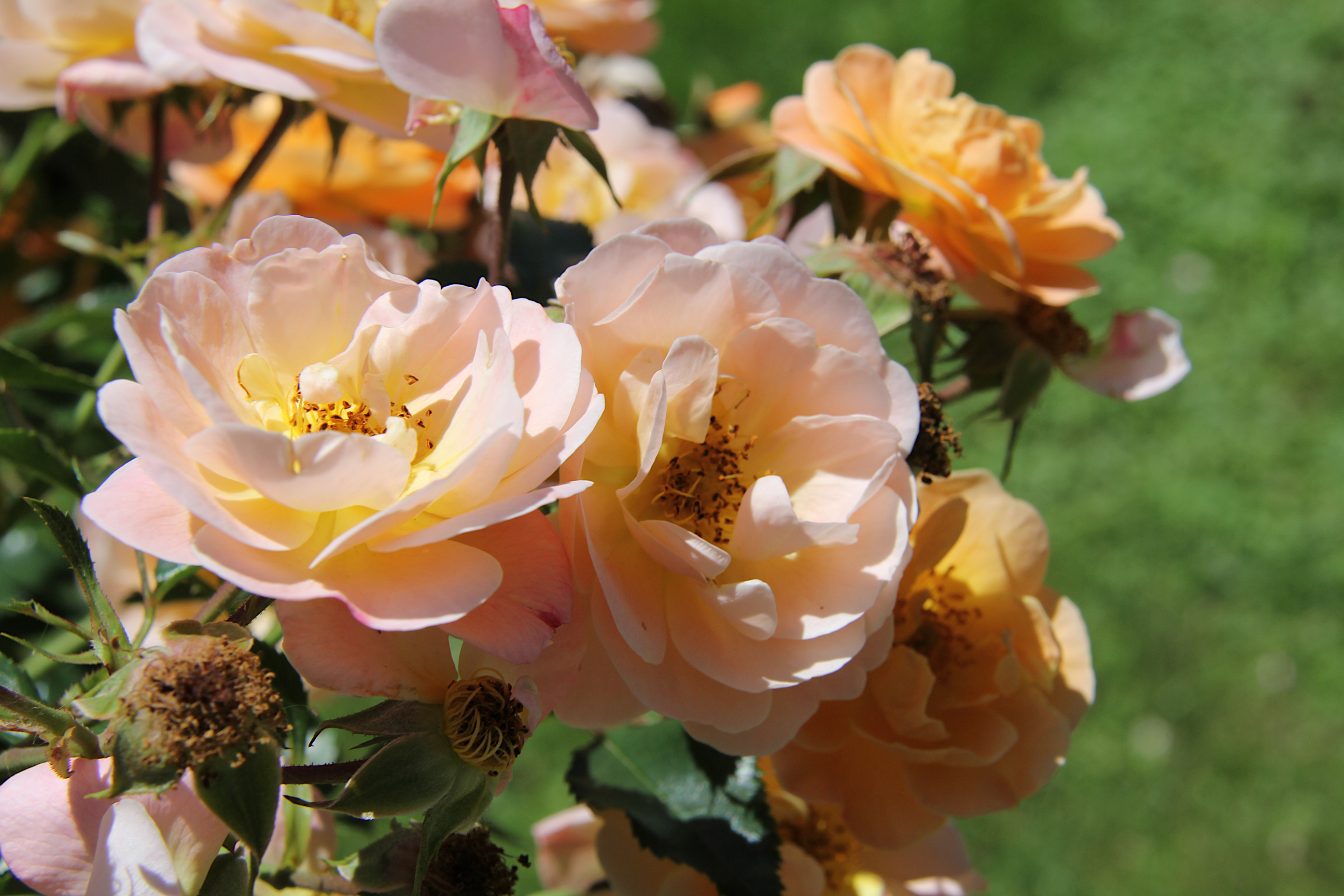
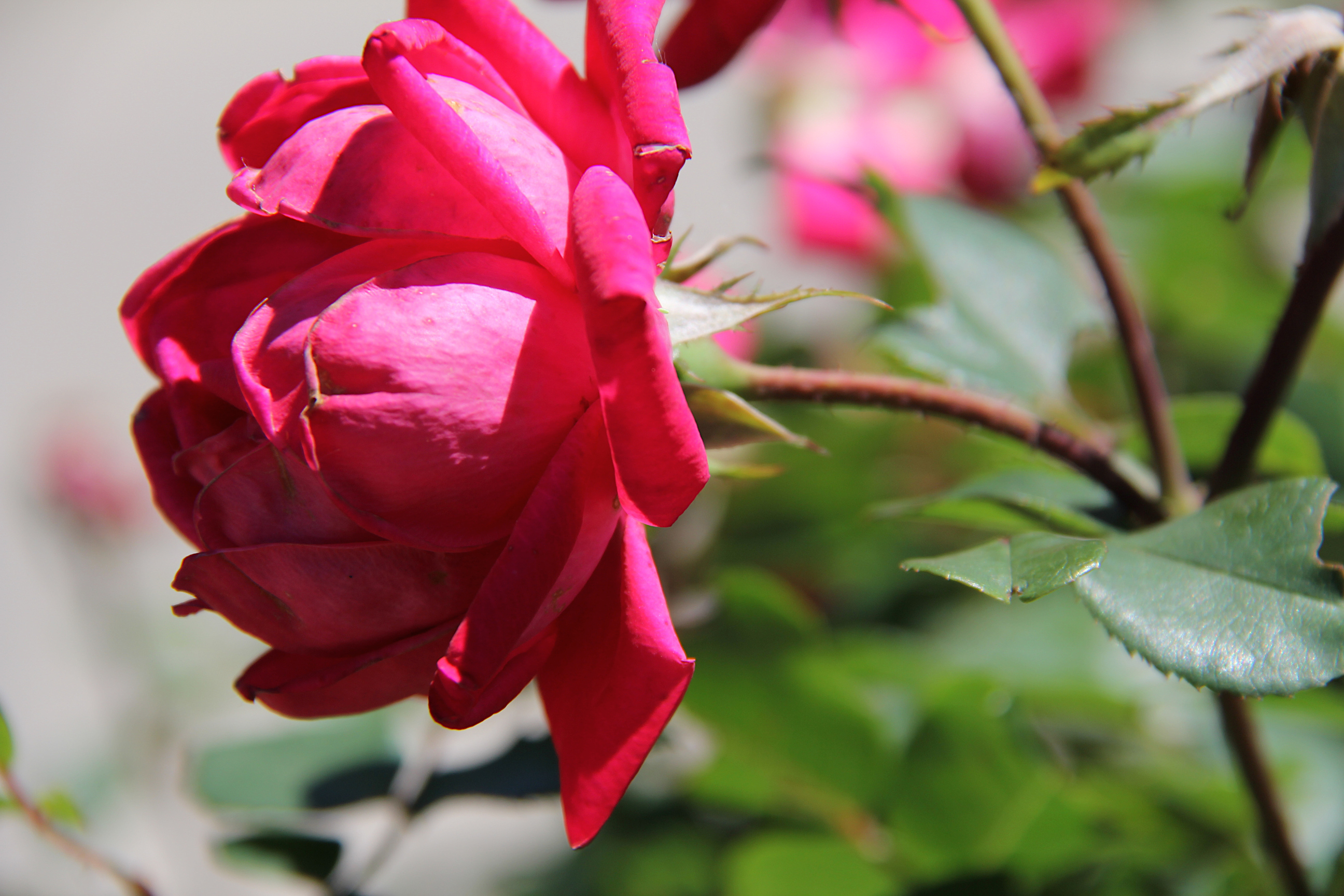
Among the many tree shrub roses blooming in the Boulevard of Roses along Highway 60 through Kenyon. (Minnesota Prairie Roots copyrighted photo June 2024)
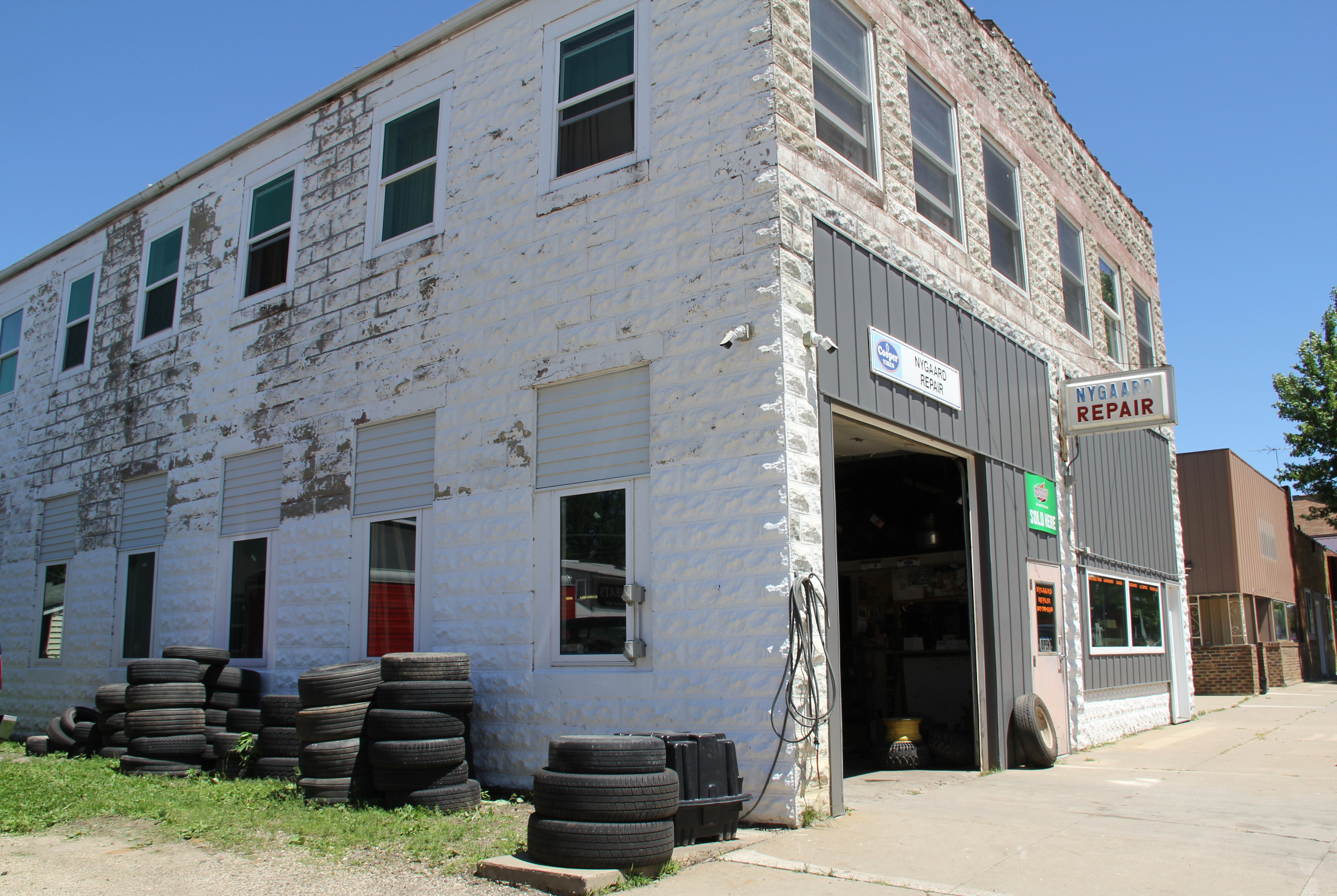
I peered inside Nygaard Garage to see a car on a hoist. (Minnesota Prairie Roots copyrighted photo June 2024)
There’s so much to see in these rural communities, if only we stop, exit our vehicles and walk. We miss a lot when we simply wheel by. I encourage you, next time you drive into an Ellendale, a Montgomery, a Kenyon, to explore. On foot.
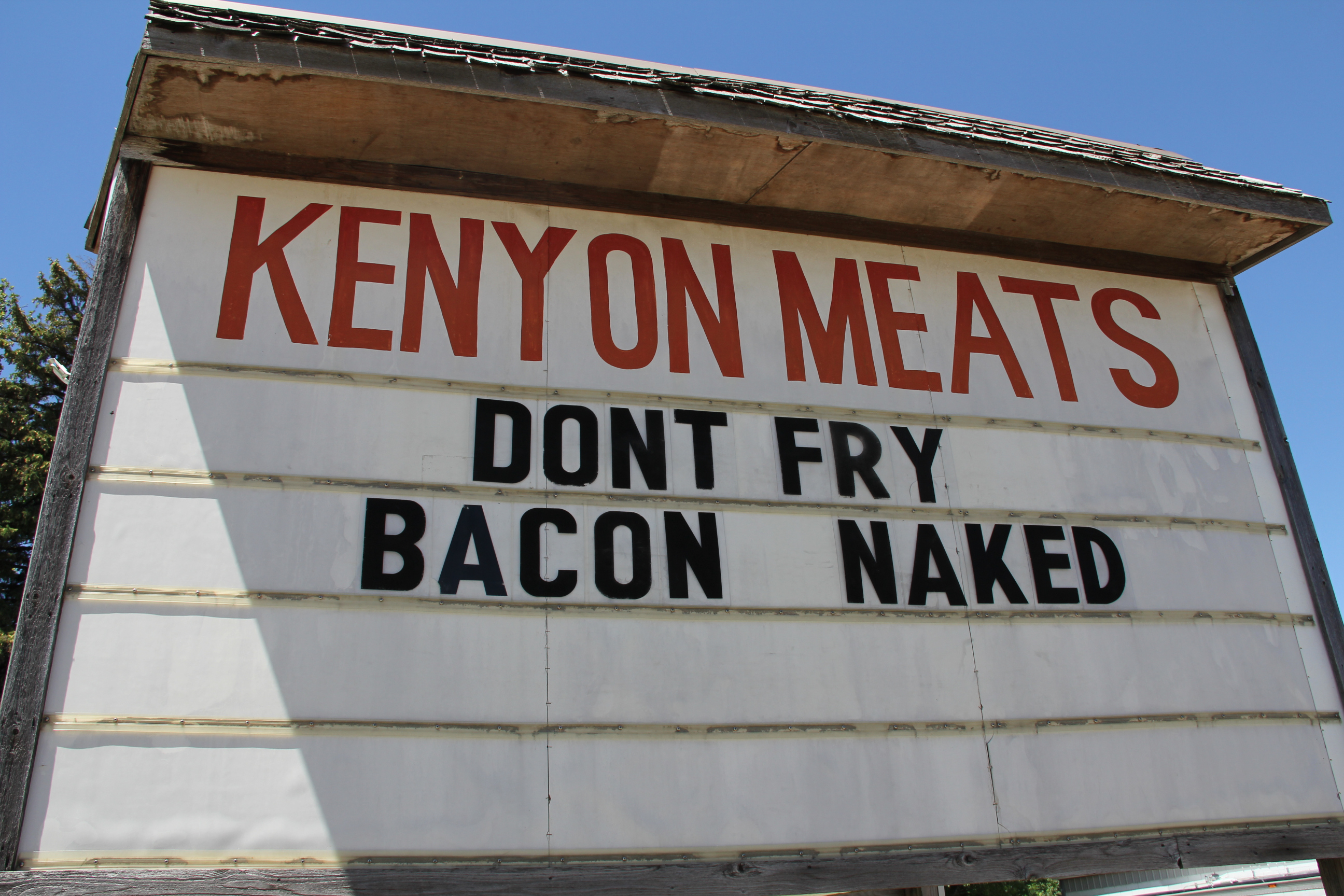
Kenyon Meats draws attention with humorous signage. (Minnesota Prairie Roots copyrighted photo June 2024)
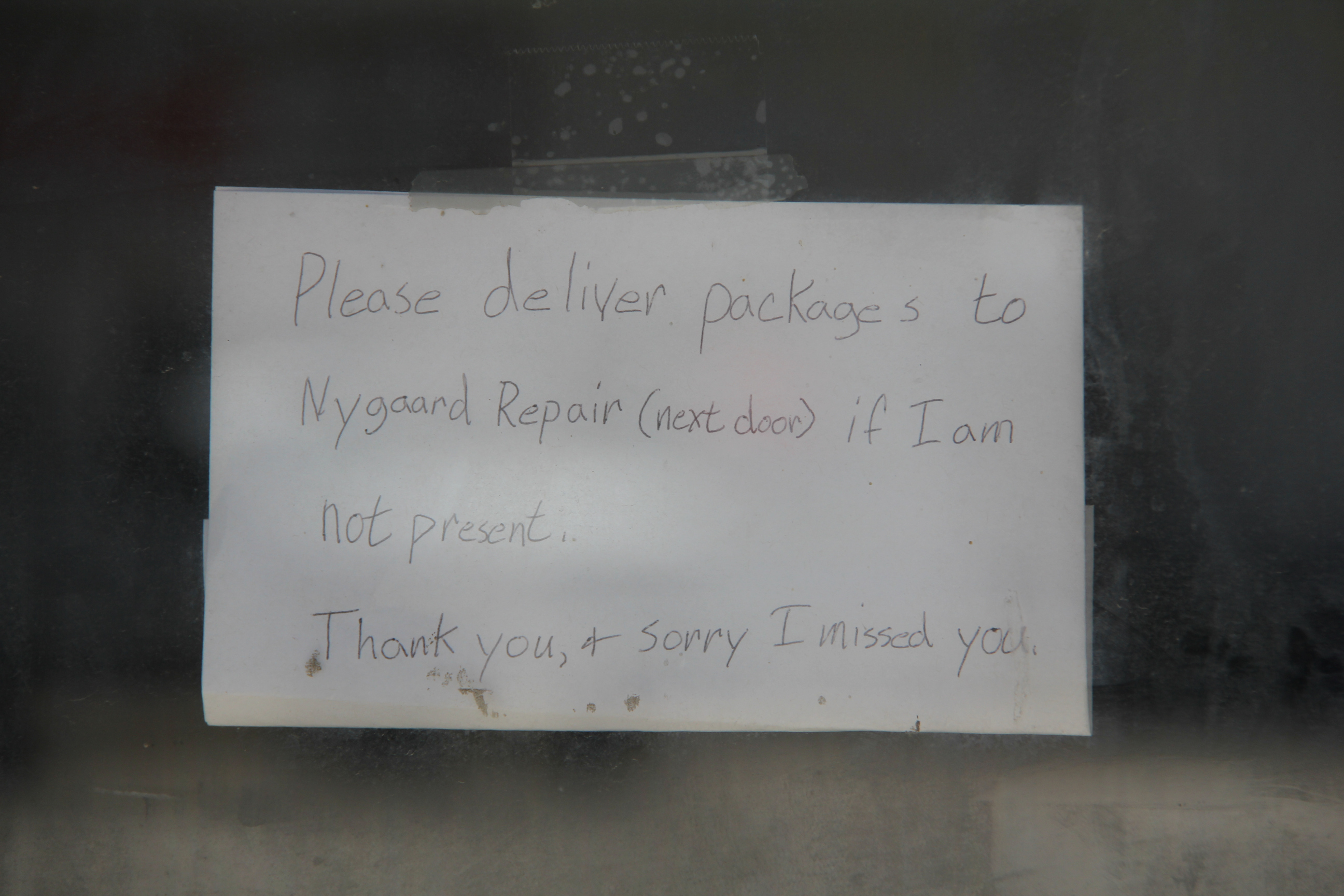
A note in a storefront window. (Minnesota Prairie Roots copyrighted photo June 2024)
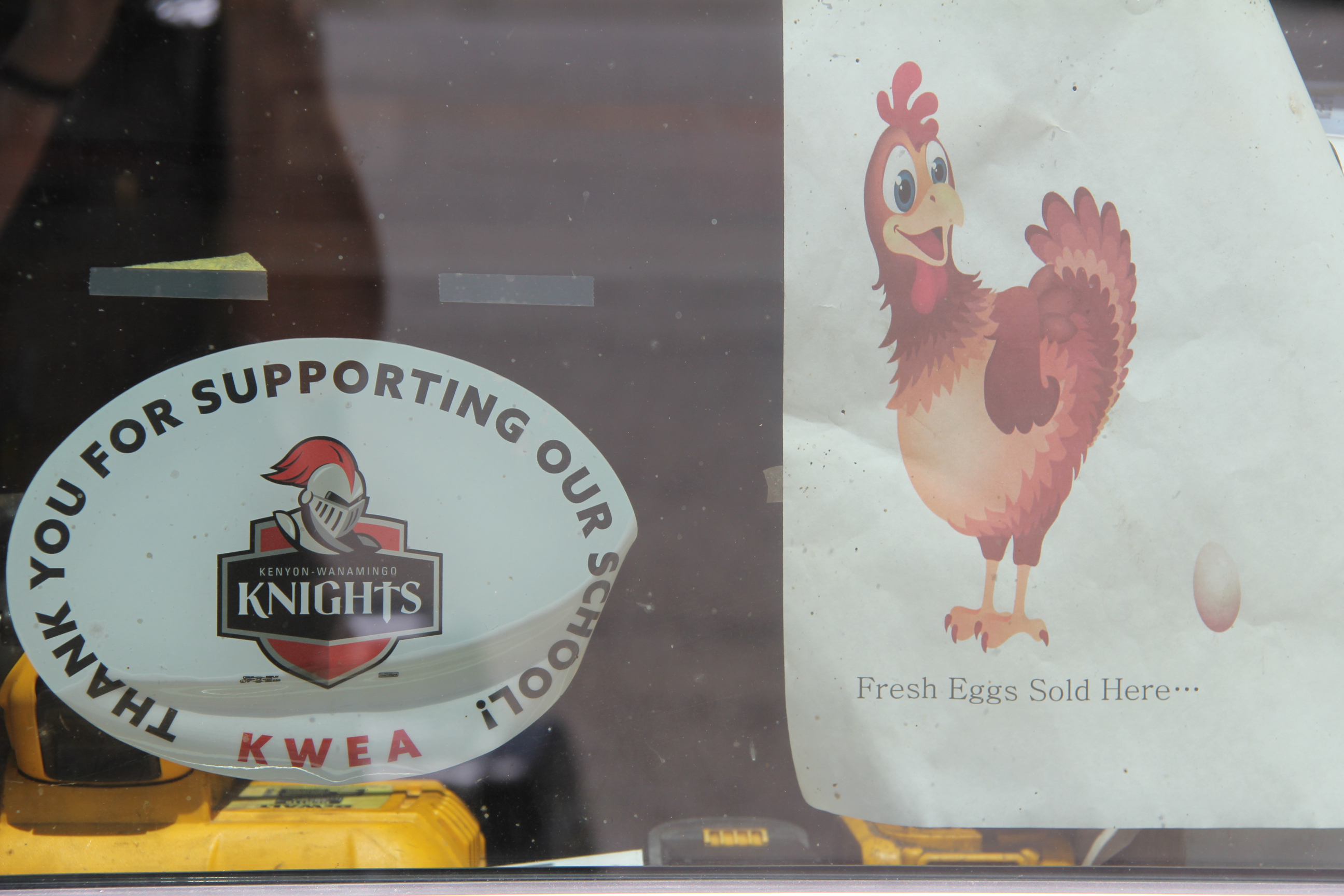
I spotted several signs noting eggs for sale and support for the local school. (Minnesota Prairie Roots copyrighted photo June 2024)
I did that recently in Kenyon, starting at Kenyon Meats, working my way through the several-block downtown business district. I moved at a slow pace, zooming in on details. Like handwritten notes posted in windows, business signs, community notices. Those show the nuances of place. I chatted with a barber and a restaurateur.
I saw two barbershops located across the street from one another, one with a laundromat in the back. (Minnesota Prairie Roots copyrighted photo June 2024)
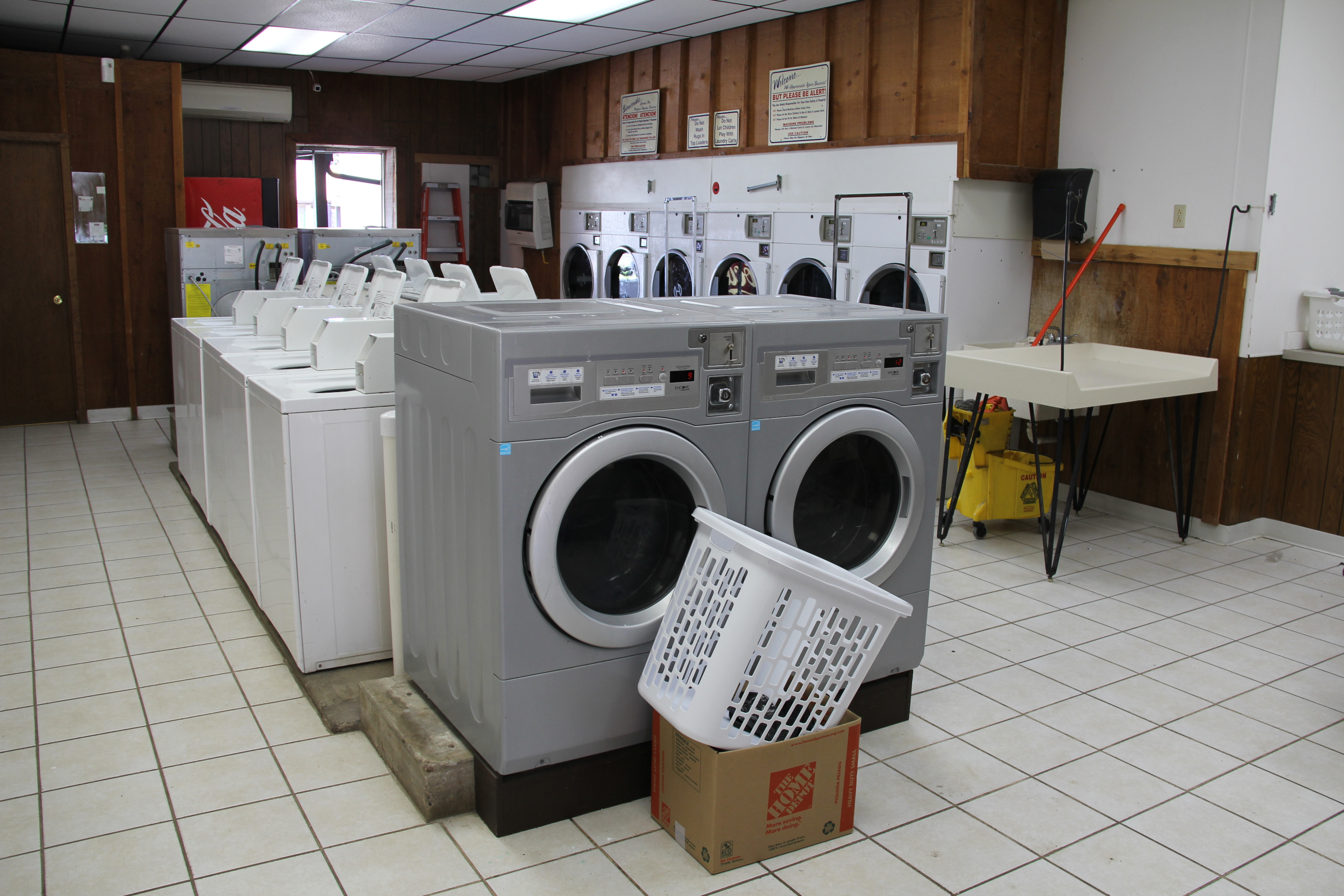
The laundromat behind Dick’s Barber Shop. (Minnesota Prairie Roots copyrighted photo June 2024)
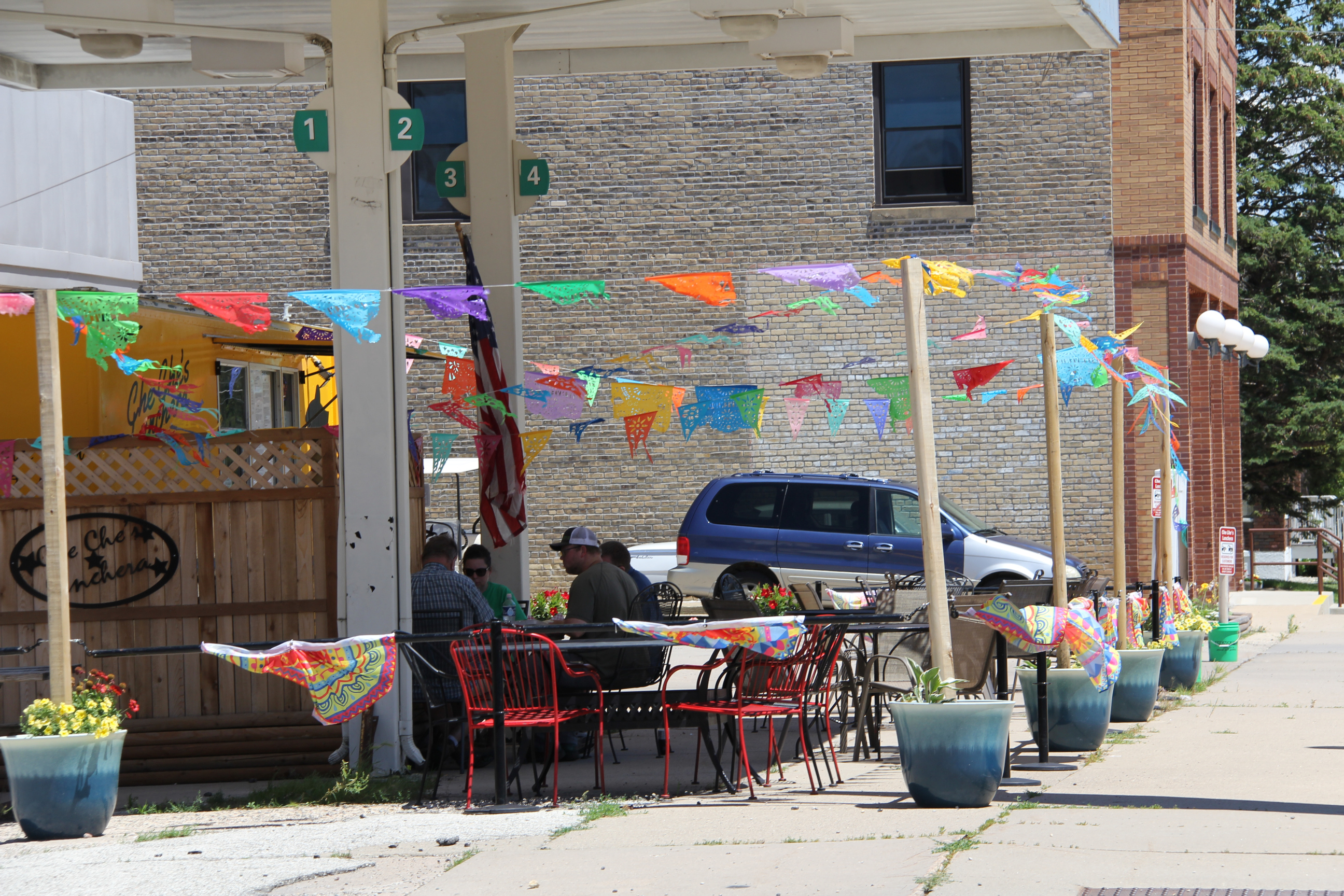
Colorful flags mark the permanent location of the food truck Che Che’s Lunchera on the corner of Highway 60 by the former BP station. (Minnesota Prairie Roots copyrighted photo June 2024)
Kenyon, with a population of just under 2,000, impresses me with its variety of businesses. Meat market, barbershops, floral and gift shop, jewelry store, two thrift shops, grocery store, repair shops/garages, insurance agencies, hardware store, municipal liquor store, restaurants, newspaper office, vet clinic, sign shop, bus service and more. Even a food truck parked on the corner of busy Minnesota State Highway 60. And that’s mostly in the core downtown area.
A sign posted downtown for this Saturday’s car and truck show. (Minnesota Prairie Roots copyrighted photo June 2024)
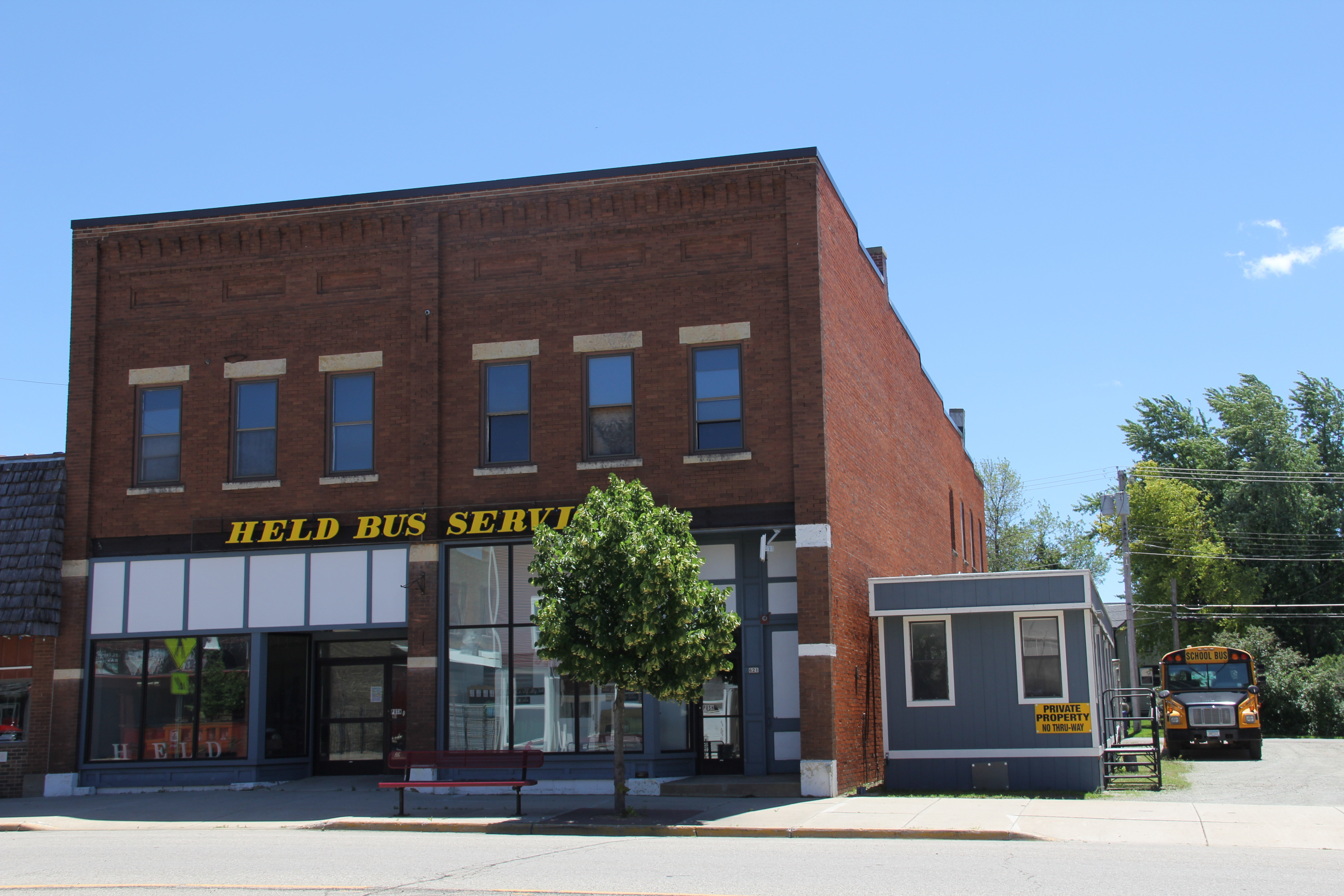
Held Bus Service is located right downtown Kenyon. (Minnesota Prairie Roots copyrighted photo June 2024)
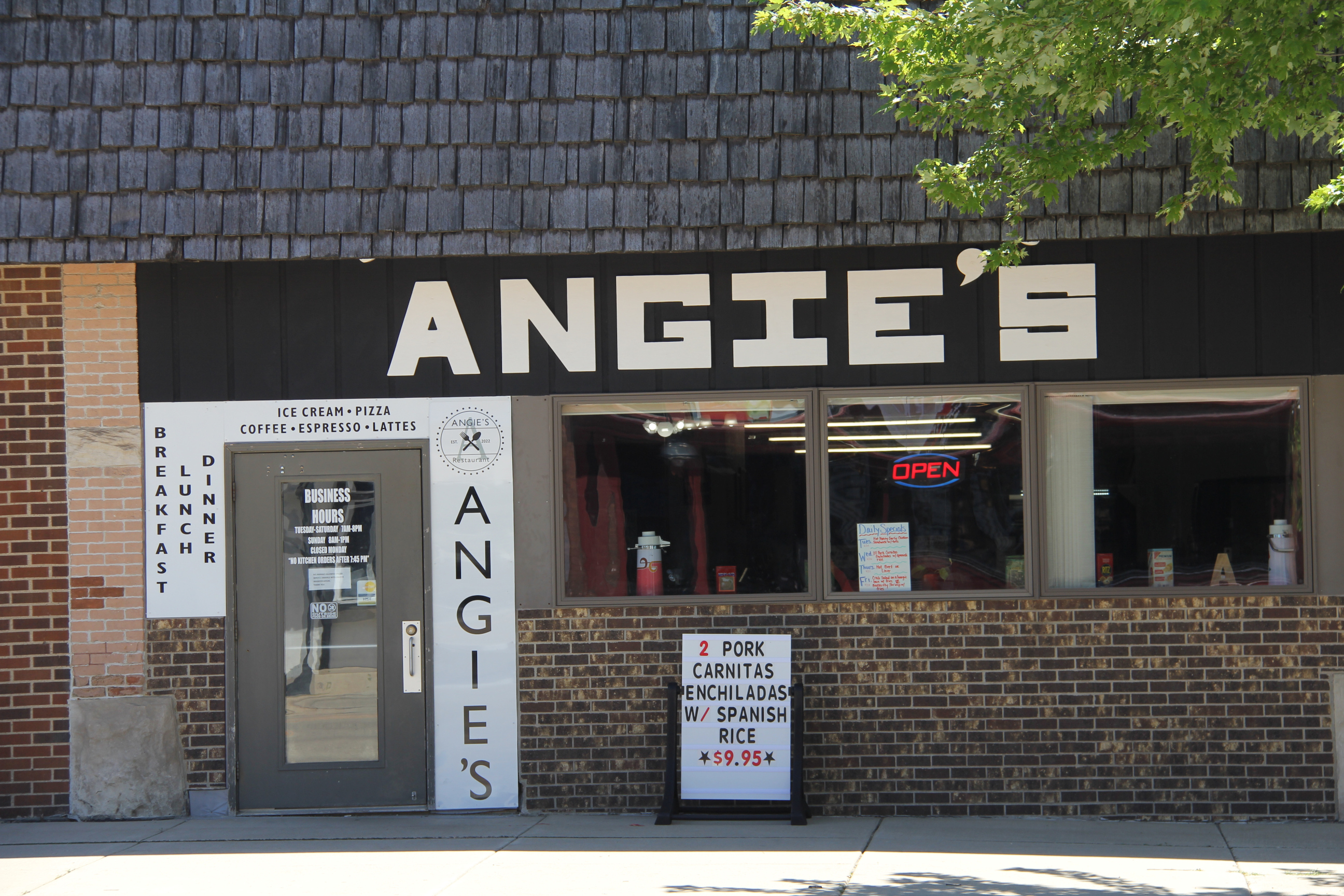
Next time I stop in Kenyon, I need to eat at Angie’s Restaurant. (Minnesota Prairie Roots copyrighted photo June 2024)
This week, Kenyon, like so many small towns, hosts a community celebration that is all about bringing people together. Rose Fest runs August 14-18 with a parade, car and truck show, vendor and craft market, city-wide garage sales, a regatta at the pool, BINGO, fire department water fights, tractor pull, magic show, music, food, food and more food… A true community celebration in every sense of a small town summer event that requires a great deal of planning and enthusiastic volunteers.
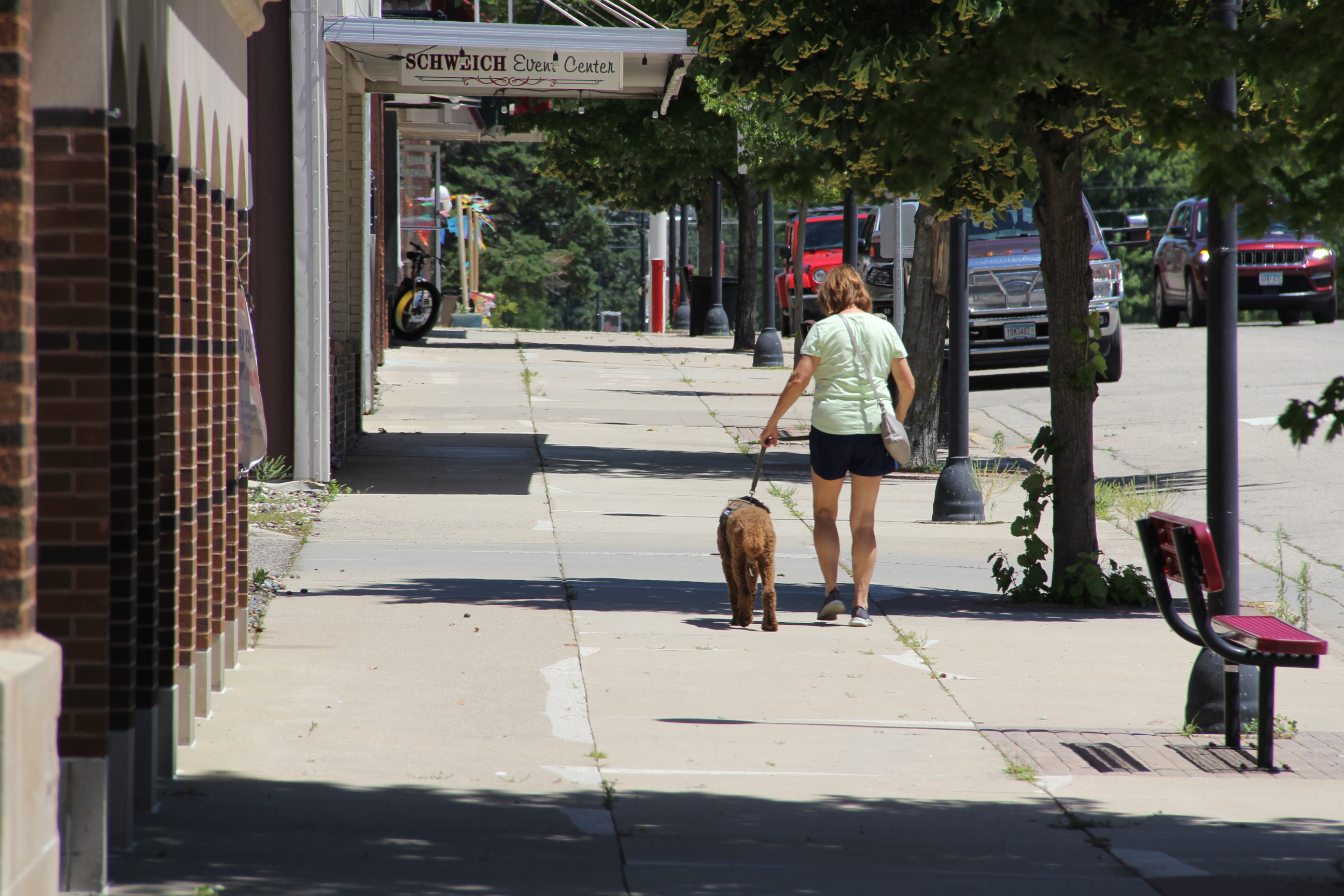
Walking the dog in downtown Kenyon. (Minnesota Prairie Roots copyrighted photo June 2024)
Among the many roses blooming in Kenyon’s Boulevard of Roses. (Minnesota Prairie Roots copyrighted photo June 2024)
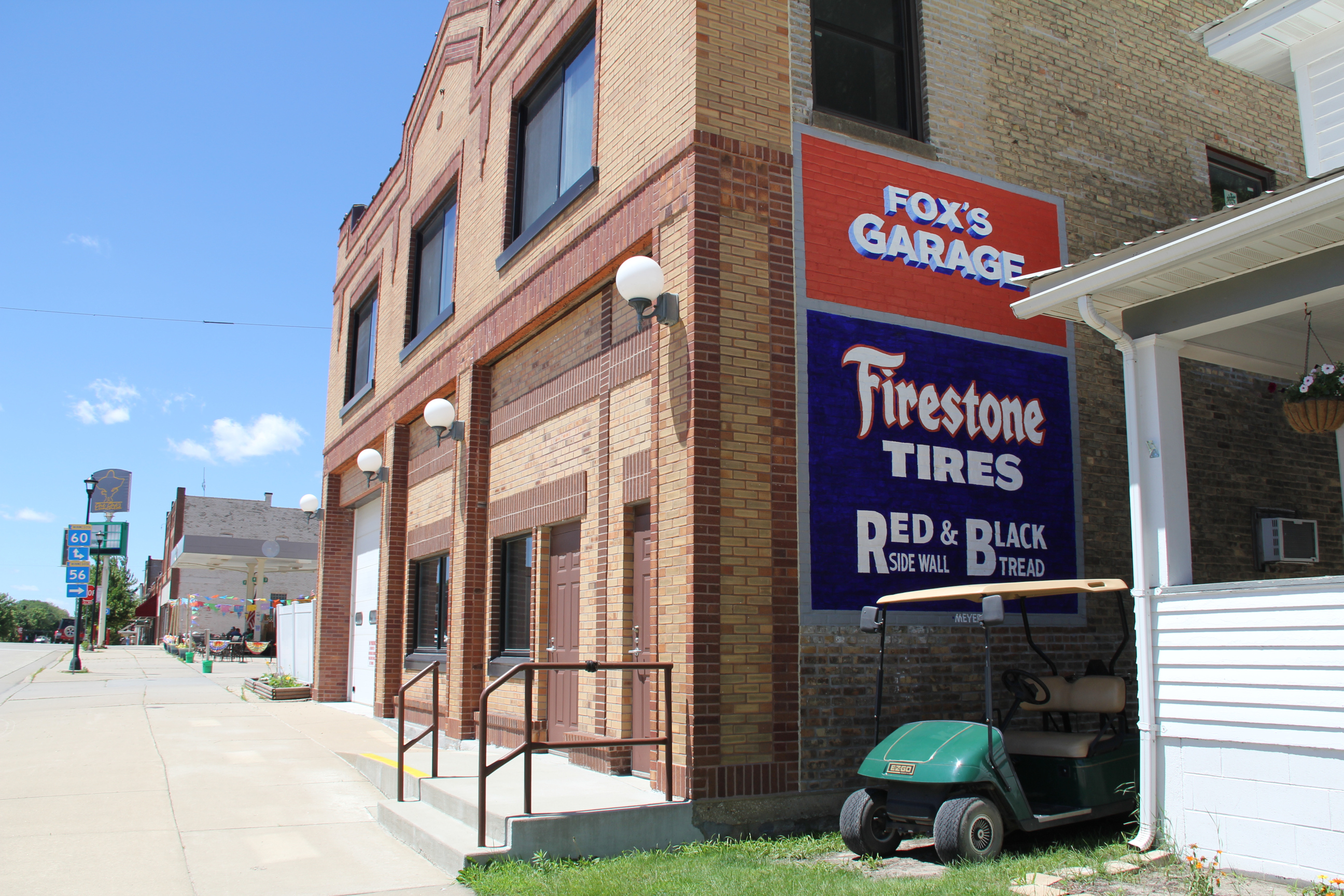
One of my favorite finds in Kenyon, this Fox’s Garage signage. This building once housed the Martin Fox Garage. (Minnesota Prairie Roots copyrighted photo June 2024)
At the heart of everything are the people—those who grew up here or moved from elsewhere to settle into this place—who call Kenyon home. Theirs is a community worthy of our pause. Stop. Walk. Smell the roses. Appreciate all that this small town offers. Just like so many other rural Minnesota communities.
#
NOTE: Watch for more posts from Kenyon as I have many more photos showcasing this southern Minnesota community.
WE CAN ALL USE some encouragement, no matter our age. And that’s exactly what you’ll find in “Little Mountain, Big Trouble,” a debut young adult novel by Owatonna writer Chris Norbury.
I don’t typically read fiction written for youth. But when I met Norbury this summer at Faribault’s Heritage Days and learned about his latest book, I knew I had to read it. I’m a fan of Norbury’s writing. He’s the author of three books in the Matt Lanier mystery/suspense/thriller series. All are set in Minnesota, which makes them even more appealing to me.
Given the differences in writing mysteries for adults versus fiction for youth, I wondered if Norbury could pull it off. He did, and so well that I wanted to continue reading “Little Mountain, Big Trouble” one evening well past my bed-time. That, in my opinion, is the sign of a good book.
BULLIED
The story centers around 12-year-old Eduardo, or EJ, who’s unpopular, bullied, short and at that awkward middle school age with its uncertainties, peer pressure and insecurities. Toss in poverty, a broken family and other challenges and you have a relatable read. I imagine many middle or high schoolers can empathize with EJ’s pain, struggles and lack of confidence. Even I, decades removed from junior high school, felt difficult memories of bullying surge back. Some things you just never forget. I still carry the pain of name-calling with me. But, because of that, I lean into compassion, understanding, empathy and kindness.
BIG BROTHER, LITTLE BROTHER
Norbury’s book is filled with all of that, too, no surprise given his experiences as a Big Brother. In real life, he mentored boys through Big Brothers Big Sisters of Southern Minnesota and now donates a portion of his book sale proceeds to the organization. When we met, Norbury enthused about the program and how much his “little brothers” meant, still mean, to him.
In “Little Mountain, Big Trouble,” main character EJ is paired with Big Brother, Russ. That relationship focuses the story-line as the chapters unfold. Although a disclaimer at the front of the book assures the content is fictional, I understand that, as a writer, our writing is influenced by what we’ve lived or observed.
CLIMBING MOUNTAINS
It takes EJ a while to trust Russ, to realize that his Big Brother is not perfect and is there to support him. Russ doesn’t talk down to EJ, but rather listens to and encourages him, like they are equals in many ways. Eventually, EJ opens up about his goal to become a mountain climber. At this point, I wondered what Norbury was thinking by writing that into the plot. A Minnesota kid with no mountain climbing background wanting to climb Mount Everest?
Russ doesn’t dismiss EJ’s dream as insurmountable. Rather, he breaks the goal down into doable steps, starting first with training and then climbing Eagle Mountain. That mountain is real, the highest point in Minnesota, with much of the hiking trail to the summit running through the Boundary Waters Canoe Area Wilderness.
ANXIOUS AND WORRIED
And that is where EJ and Russ end up, heading up, then down, the mountain. And this is where the tension thickens to the point that I am feeling anxious and worried. To elicit that response in the reader shows Norbury’s skills as a writer. The duo face challenges that test their strength and endurance, even threaten Russ’ life.
WE ALL NEED SOMEONE
I won’t spoil the book by revealing the outcome of that mountain hike. But know that the book ends in a heart-warming way. EJ has developed confidence, gained the acceptance and respect of his peers, and grown to understand that he can overcome, and do, anything. Sometimes it just takes someone, like Russ, believing in you and cheering you on, just as I expect Chris Norbury did for his little brothers.
It takes poles, a helping hand and skill to ride this unusual two-person unicycle. (Minnesota Prairie Roots copyrighted photo July 2024)
UNICON 21, THE INTERNATIONAL UNICYCLING competition and convention held recently in Bemidji, is history. But the memories wheel on for attendees and competitors. That I attended as an observer, if only for a day, proved an incredible experience. I had no idea so many types of unicycles existed or the level of talent among unicyclists.
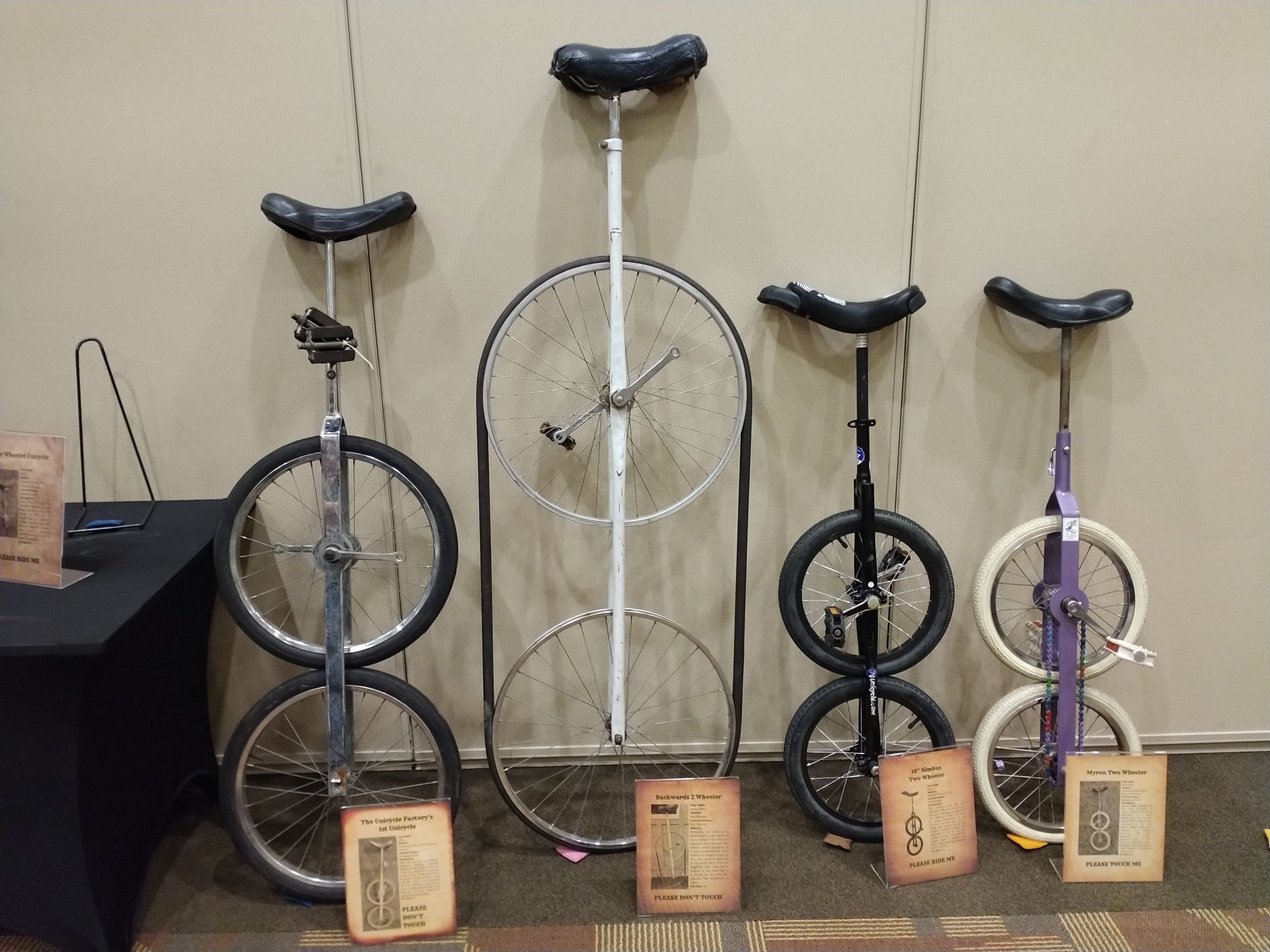
The museum featured assorted unicycles (many available to check out and ride), plus unicycling merch. (Minnesota Prairie Roots copyrighted photo July 2024)
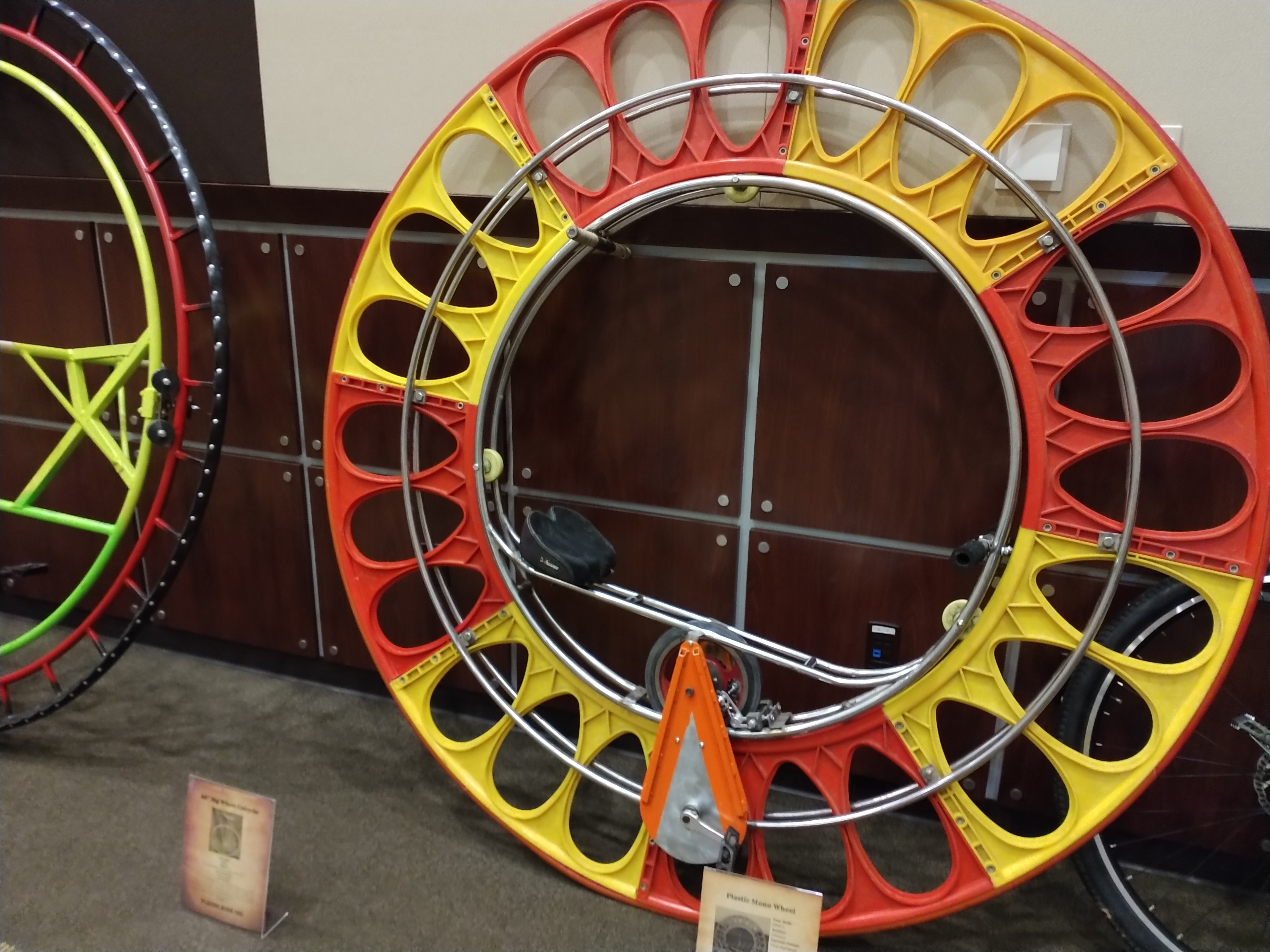
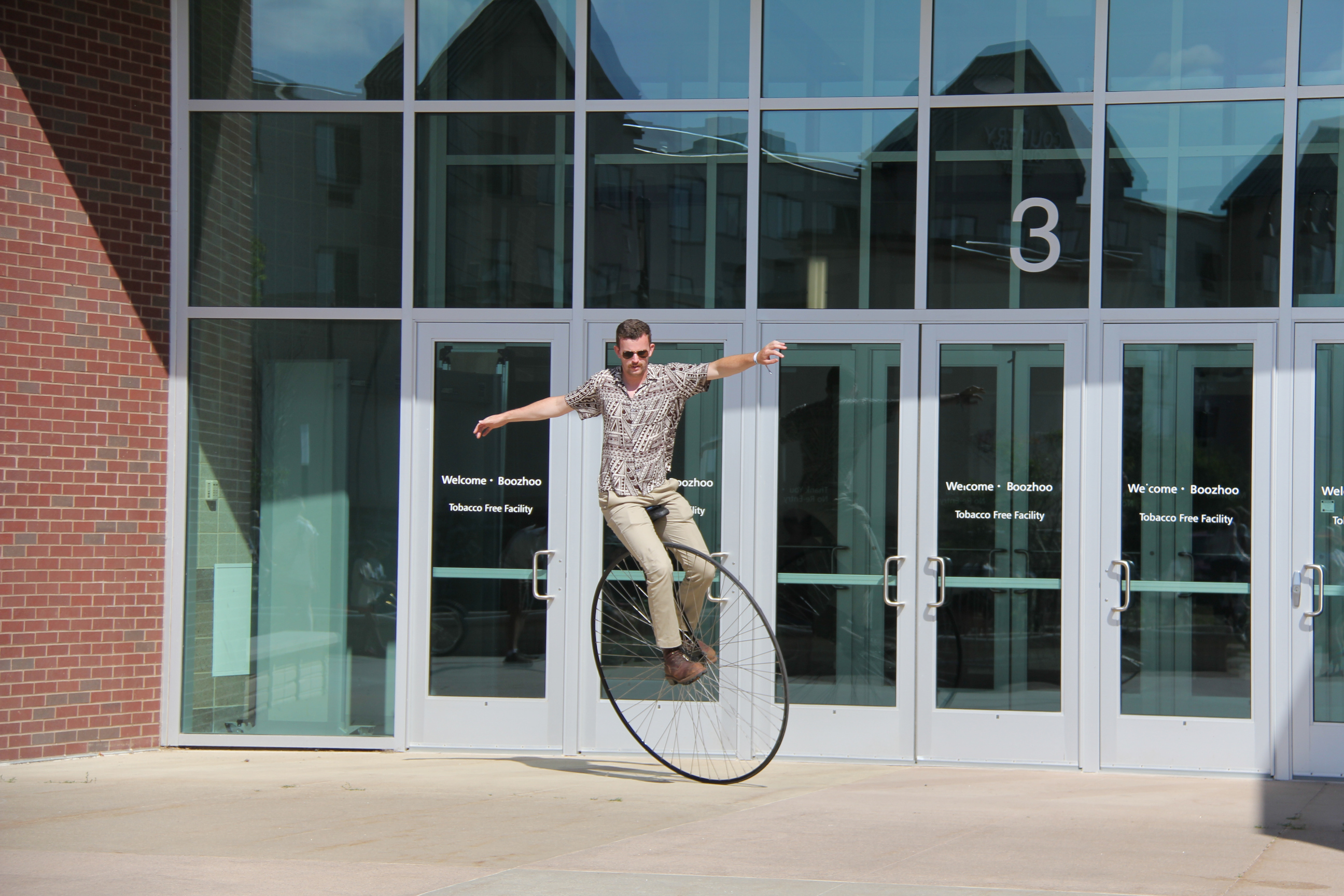
Among the most unusual unicycle wheels. (Minnesota Prairie Roots copyrighted photo July 2024)
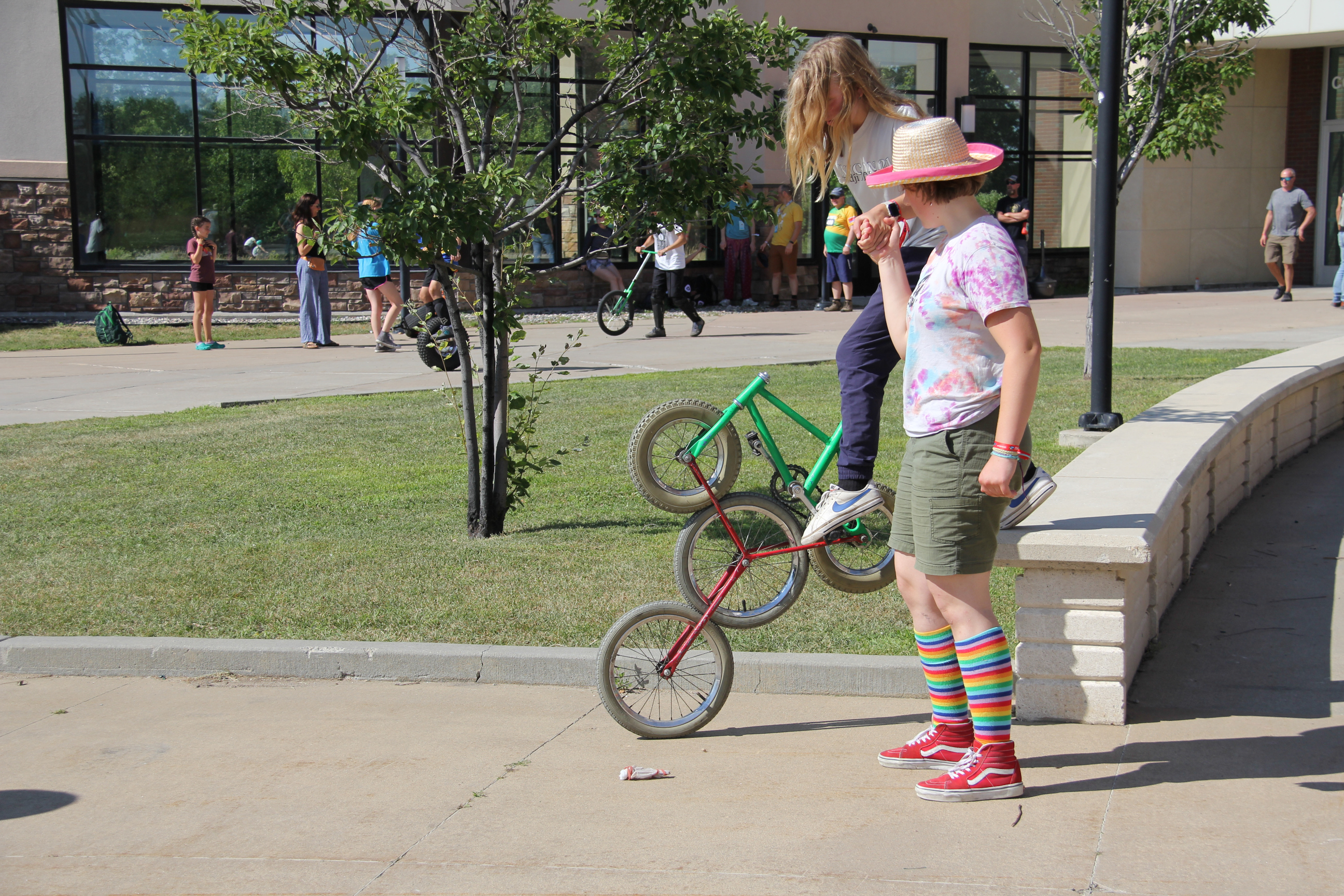
As if riding on one wheel isn’t difficult enough… (Minnesota Prairie Roots copyrighted photo July 2024)
I shot hundreds of photos and have shared many with you. It is my hope that, via my photography, you, too, have learned more about the international unicycling world. Today I bring you an assortment of images, most from the pop-up Unicycle Museum inside the Sanford Center and the unicycling happening outside. Others are simply pix I took throughout the day.
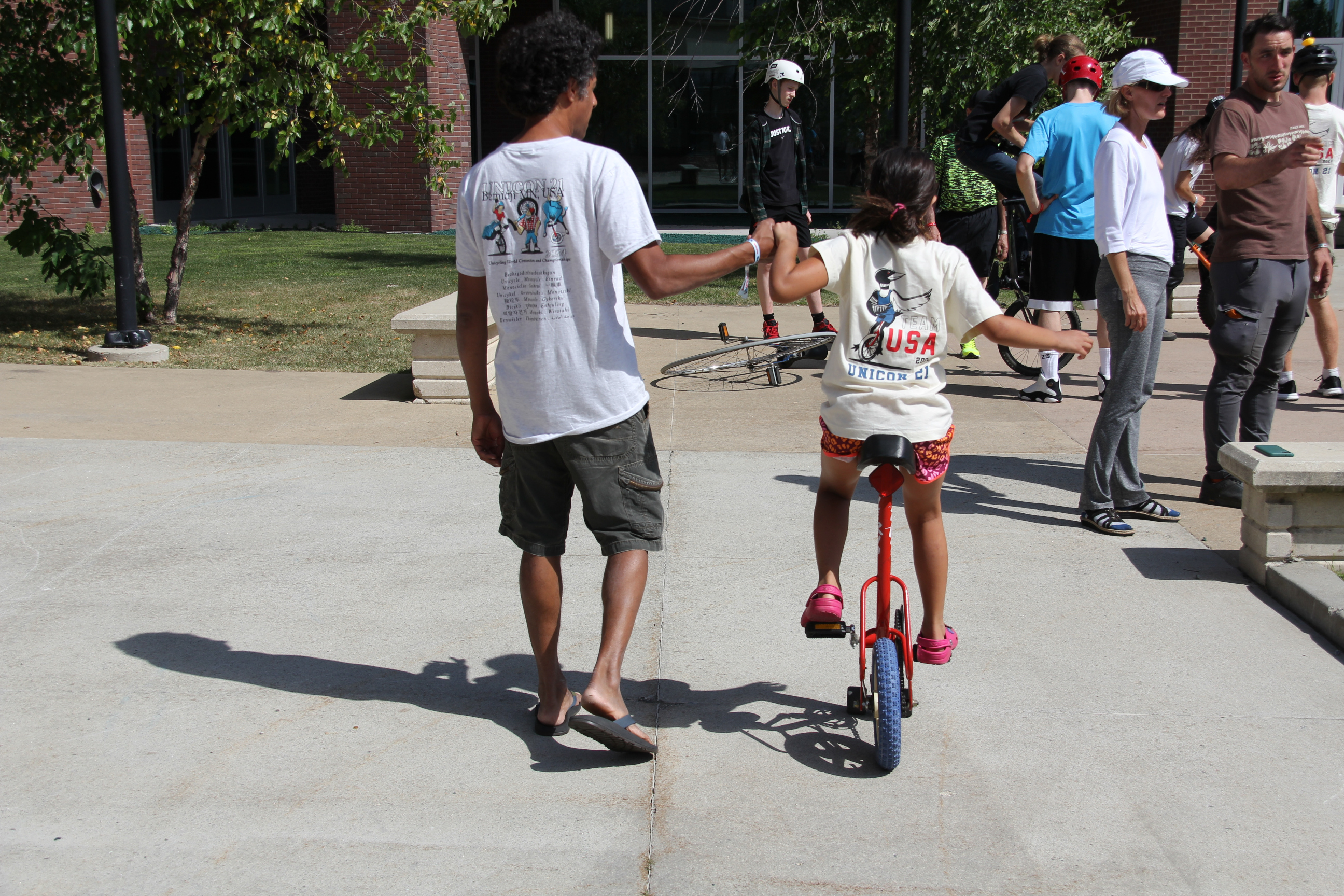
Trying out unicycling outside the Sanford Center. (Minnesota Prairie Roots copyrighted photo July 2024)
An experienced unicyclist rides with confidence and speed. (Minnesota Prairie Roots copyrighted photo July 2024)
A fat tire unicycle and one with two basketballs below the wheel intrigued me. The woman to the left attempted to unicycle, supported by bars on two sides and helping hands. (Minnesota Prairie Roots copyrighted photo July 2024)
Enjoy this collection, which I hope grows your appreciation for the ordinary people who choose to ride unicycles. Some ride simply for leisure while others excel as athletes and entertainers. No matter their skill level, anyone who can ride a unicycle impresses me.
One of the more unusual unicycles, with four wheels. How do you even ride that? (Minnesota Prairie Roots copyrighted photo July 2024)
This unicyclist, from Bemidji, received a medal for the closest attendee at Unicon 21. A unicyclist from Australia traveled the greatest distance. (Minnesota Prairie Roots copyrighted photo July 2024)
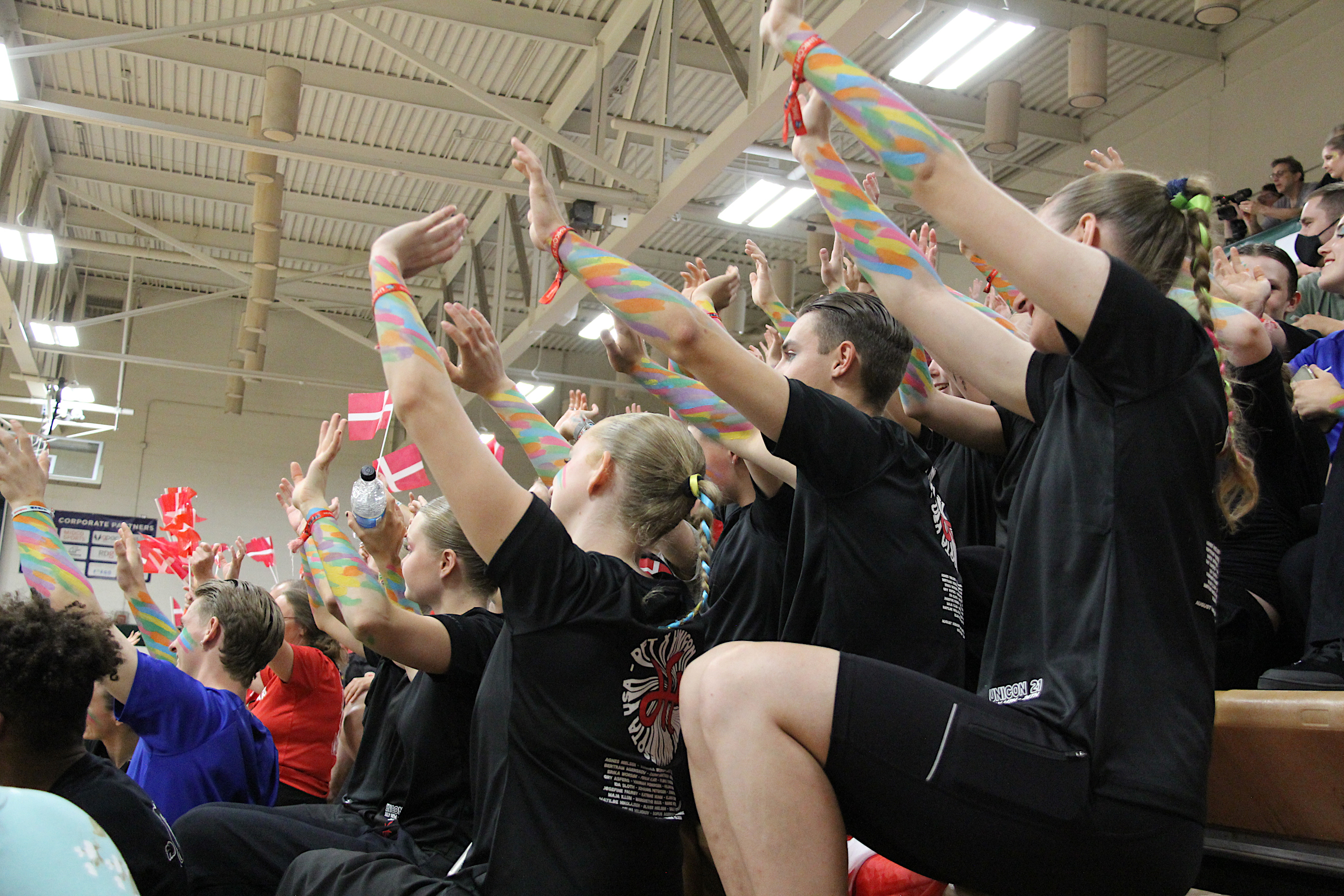
An entire group of attendees painted their arms. (Minnesota Prairie Roots copyrighted photo July 2024)
I saw how focused they were, how much fun they were having, how connected they seemed as a unicycling community. And perhaps that is the biggest take-away—this coming together of people from around the world to share their passion for unicycling. No politics. No conflict. No differences. Just people on unicycles enjoying Unicon 21 in northern Minnesota.
Unicon 21 participants got Paul Bunyan-themed swag bags promoting Bemidji. (Minnesota Prairie Roots copyrighted photo July 2024)
A fitting bumper sticker displayed in the Unicycle Museum. (Minnesota Prairie Roots copyrighted photo July 2024)
Among the items shown in the museum. (Minnesota Prairie Roots copyrighted photo July 2024)
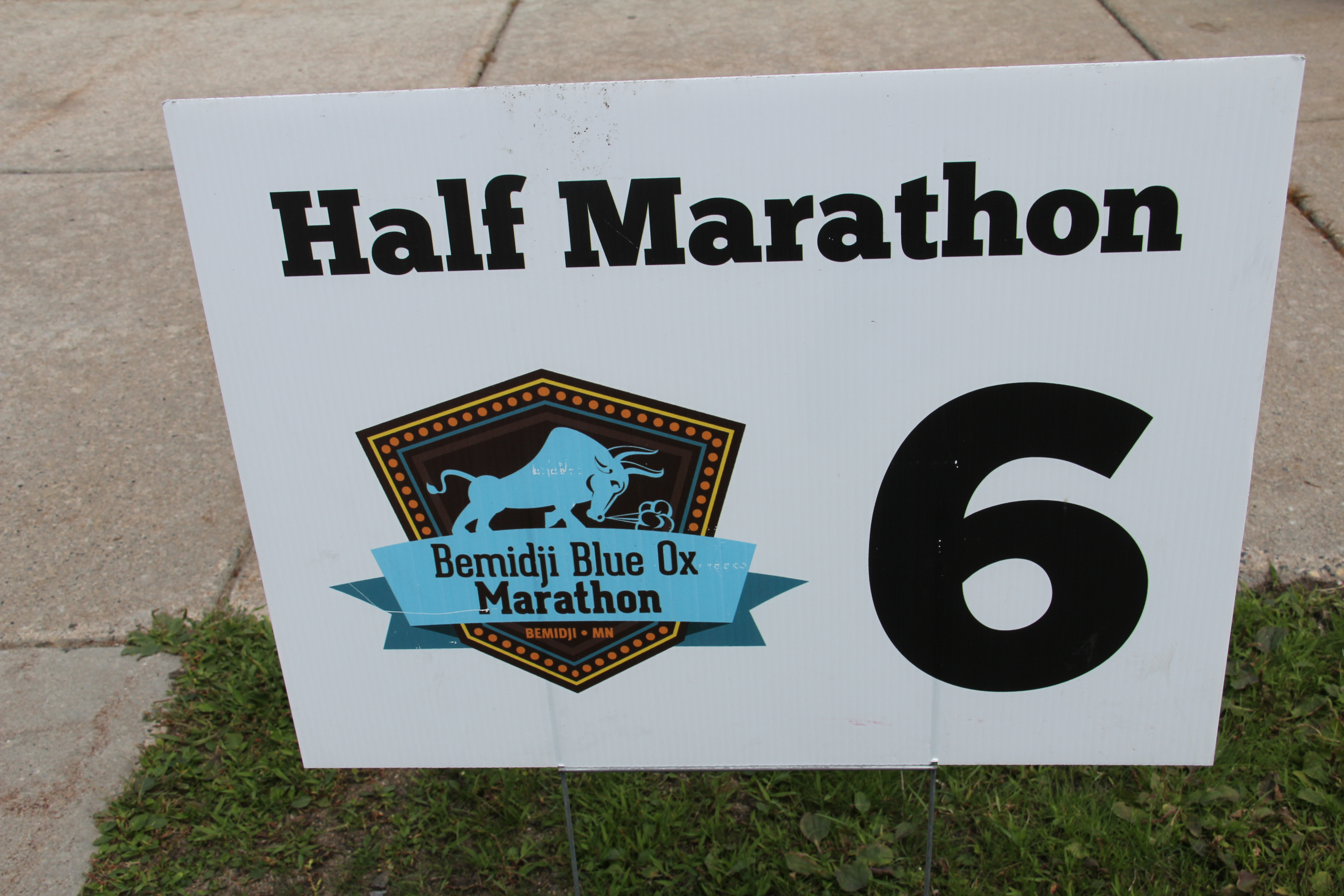
Competitive events included marathons. (Minnesota Prairie Roots copyrighted photo July 2024)
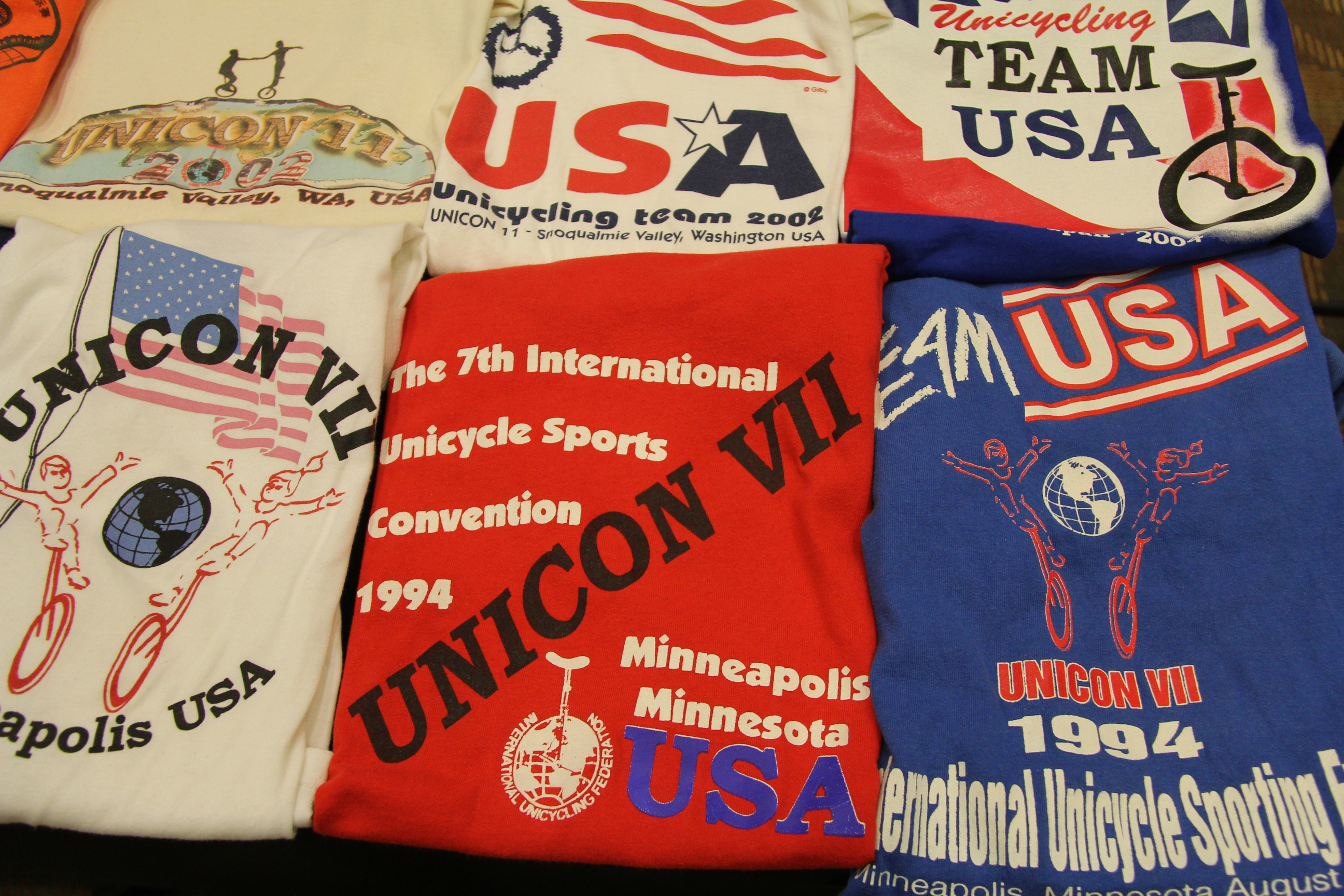
A collection of tees from past Unicon gatherings was displayed in the museum. (Minnesota Prairie Roots copyrighted photo July 2024)
If you couldn’t attend in person, live streaming was an option. (Minnesota Prairie Roots copyrighted photo July 2024)
It took a lot of dedicated volunteers to make Unicon 21 happen in Bemidji. (Minnesota Prairie Roots copyrighted photo July 2024)
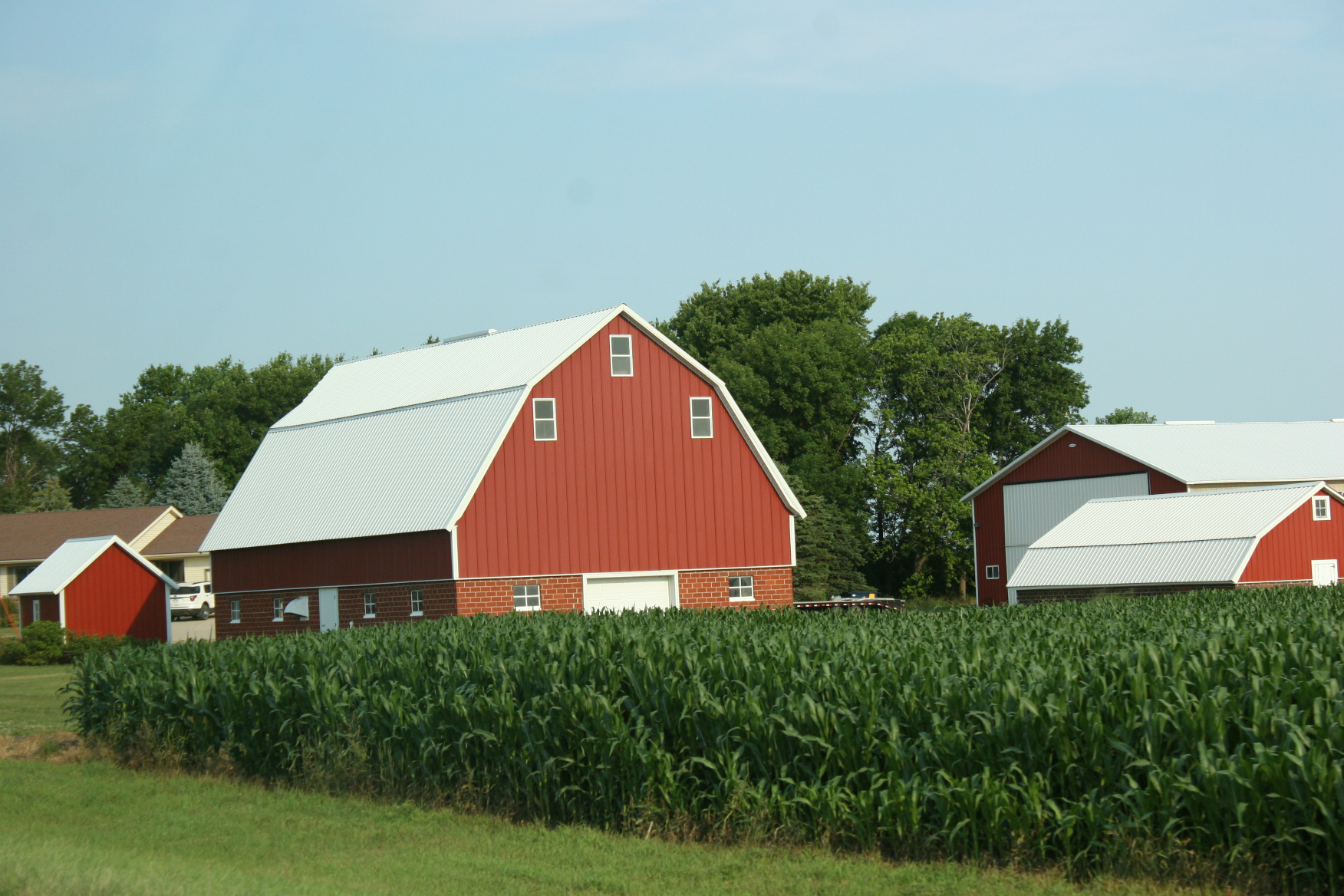
A farm site west of New Ulm. (Minnesota Prairie Roots copyrighted file photo)
WOULD YOU PICK rock, walk beans, clean up pig or cow muck? Joe and his crew will.
I can, too, as I’m experienced. But I have no desire to return to those farm tasks that are now only long ago youthful memories.
The sign I spotted in a Redwood Falls convenience store. (Minnesota Prairie Roots copyrighted photo July 2024)
Recently, I saw a sign, more like a note, posted by Joe on a convenience store bulletin board in Redwood Falls, deep in the heart of southwestern Minnesota farm country. I grew up in that area, on a crop and dairy farm.
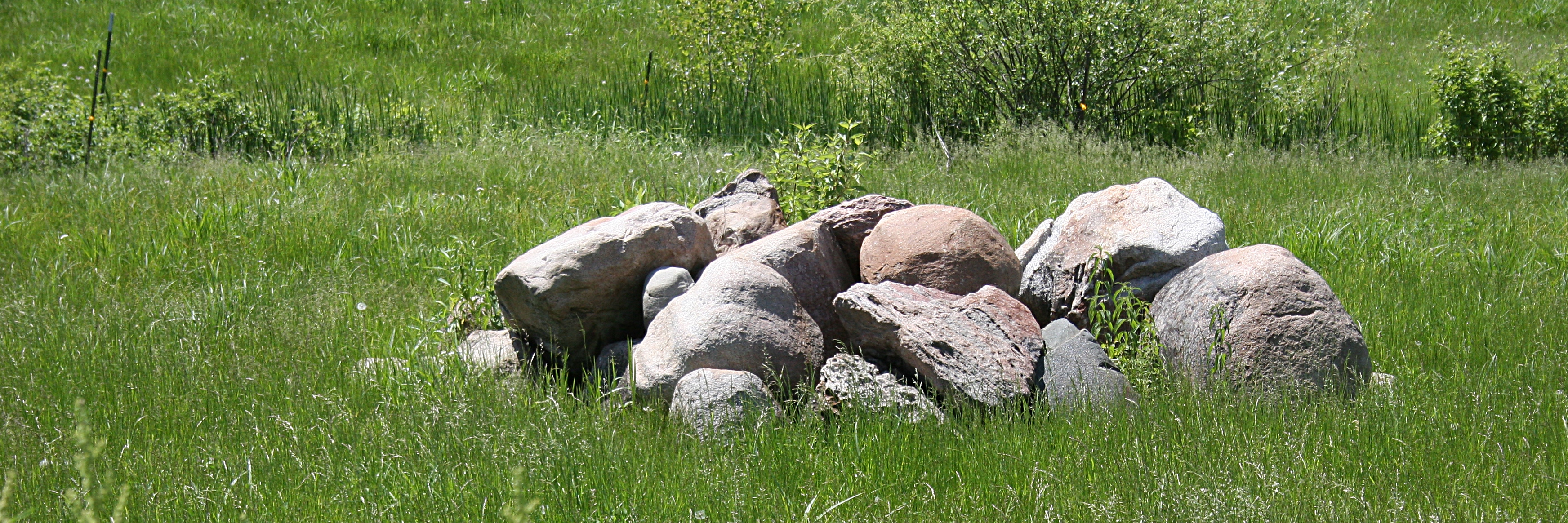
Rocks picked and piled at field’s edge. (Minnesota Prairie Roots copyrighted file photo June 2014)
Like Joe, I worked the land and labored in the barn. I picked rock, which is exactly as it sounds—walking fields to pick rocks from the soil and toss them onto a wagon or loader. Rock removal is necessary so farm equipment isn’t damaged during crop prep, planting and harvesting. It’s hard, dirty work when done by hand.
Likewise, walking beans is hard, dirty, hot work. That job involves walking down rows of soybeans to remove weeds and stray corn plants, either by hand or by hoe. At least that’s how I walked beans back in the day. Today that may involve spot spraying herbicides.
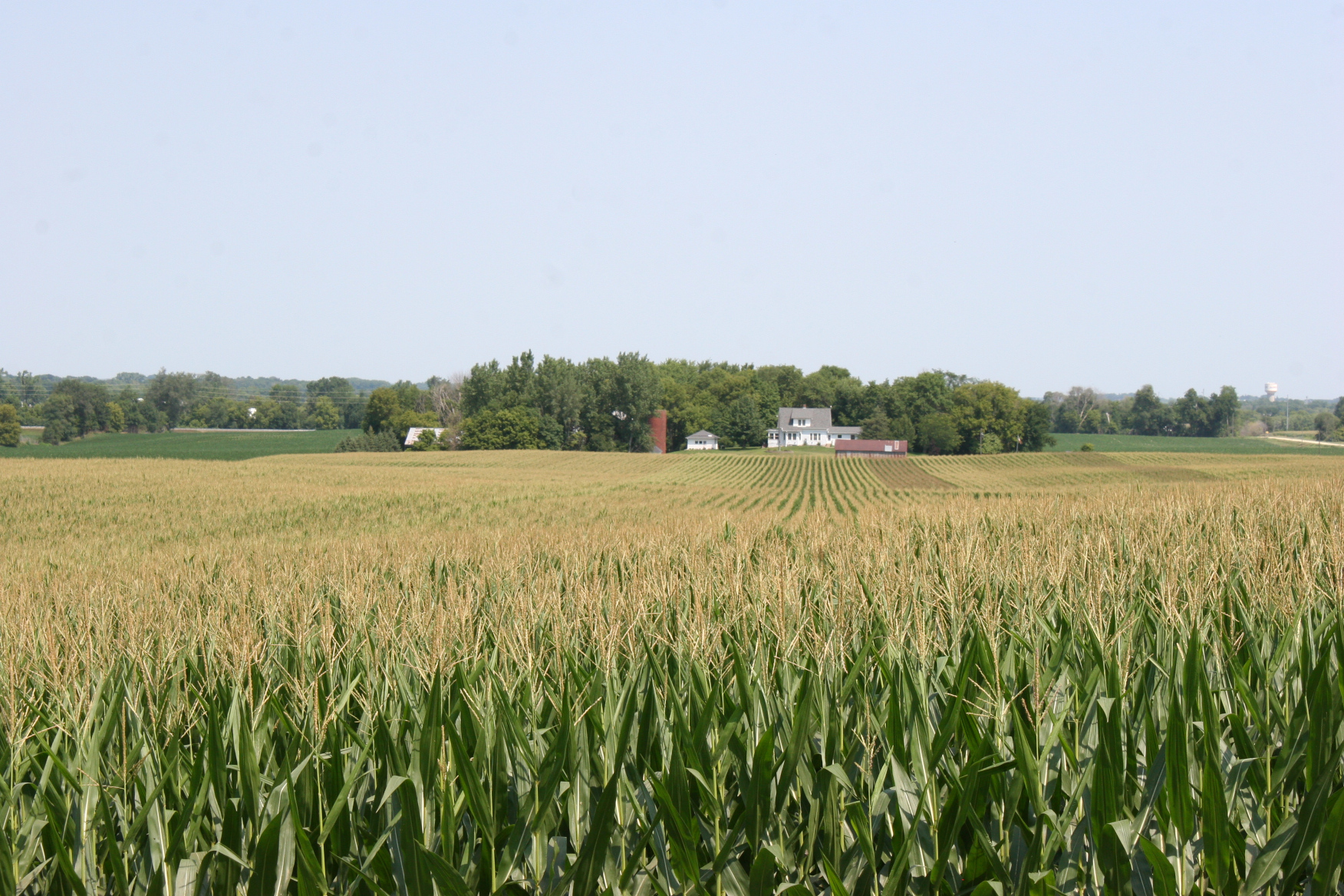
A tasseling Rice County corn field. (Minnesota Prairie Roots copyrighted file photo)
And when I worked corn fields, it was to detassel corn for the Dekalb seed company. I arose early, boarded a school bus with a bunch of other teens, arrived at a corn field and proceeded to walk the corn rows pulling tassels from corn plants. Dew ran down my arms, corn leaves sliced my skin, sweat poured off my body as the day progressed under a hot July sun. Of all the jobs I’ve had, detasseling corn rates as the most miserable, awful, horrible, labor intense work I’ve ever done.
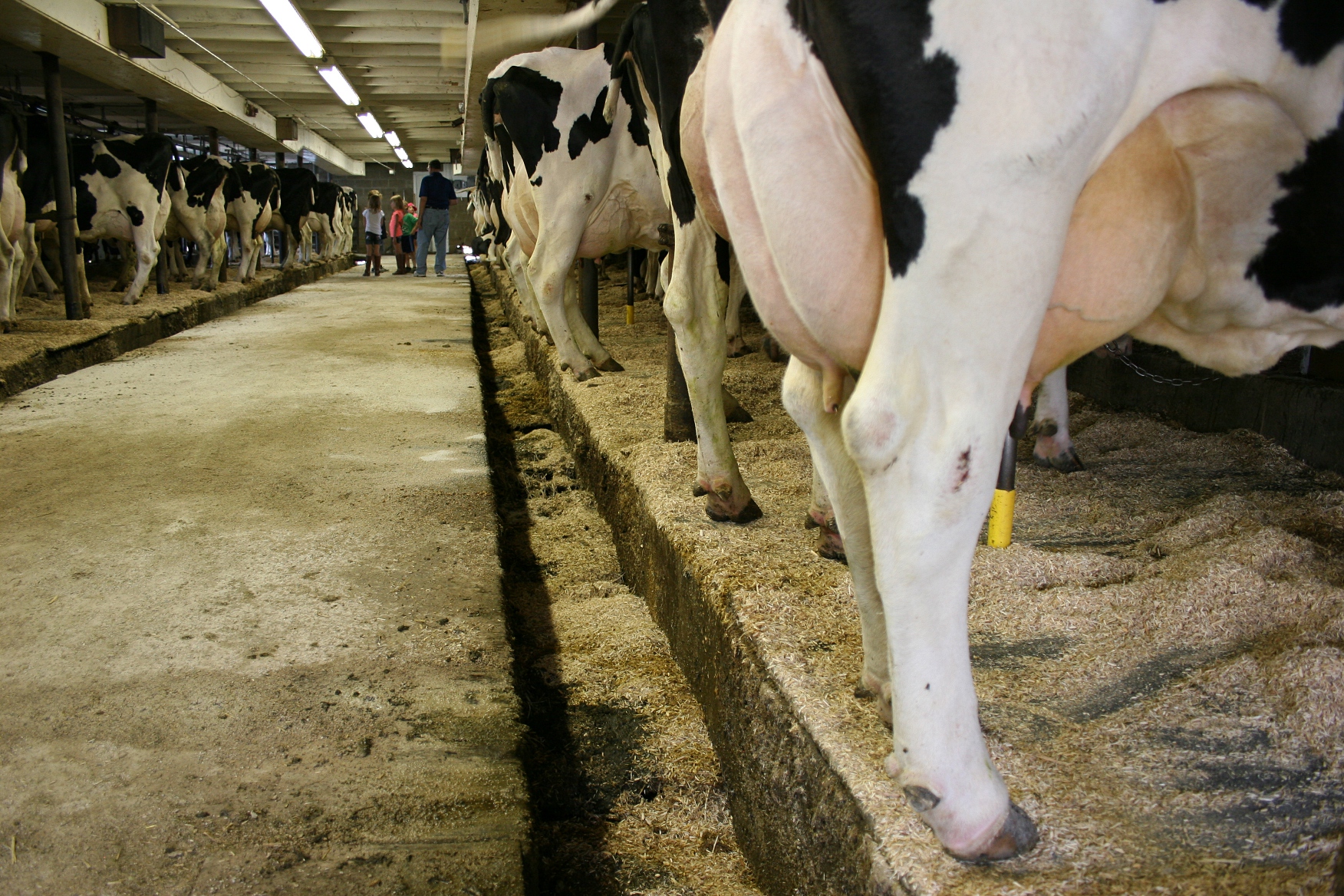
Inside a Rice County dairy barn. (Minnesota Prairie Roots copyrighted file photo)
I’d rather shovel cow manure. And I did plenty of that along with other animal-related farm chores.
If Joe and his team are willing to take on tasks that are labor intensive, hot and smelly, then I applaud them. We need hands-on folks who are not afraid to get their hands dirty, to break a sweat, to do those jobs that place them close to the land. Jobs many other people would not do.
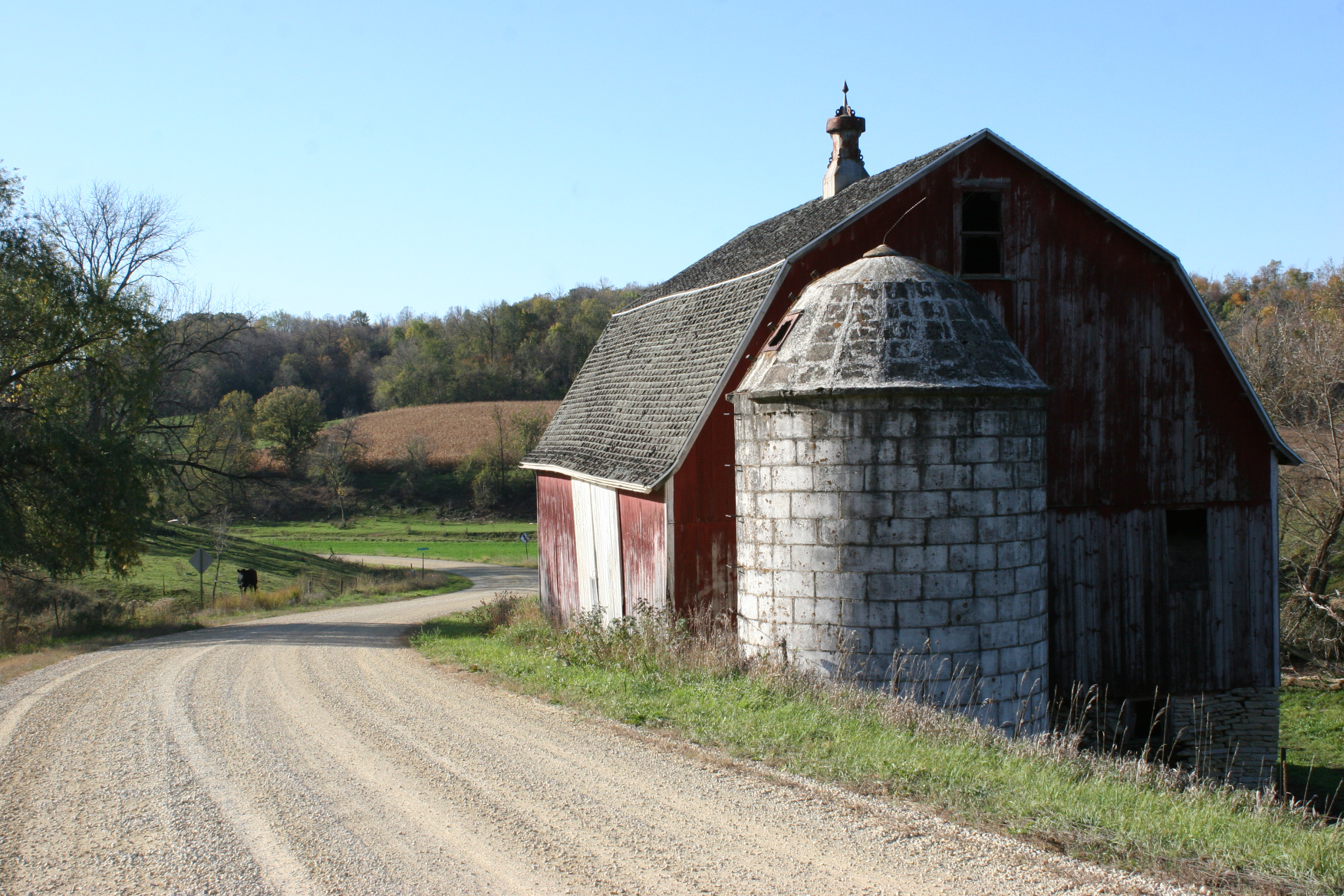
An abandoned barn and silo along a backroad in the Sogn Valley of southeastern Minnesota. (Minnesota Prairie Roots copyrighted file photo 2021)
I don’t regret my farm work experiences. I learned the value of hard physical labor, of working together, of understanding that what I did was necessary. Certainly farming has changed, modernized in the 50 years since I left the land. Machines and computers make life easier.
But sometimes it still takes people like Joe and his crew to plant their soles on the earth, their feet in the barn, to make a farming operation work, even in 2024.
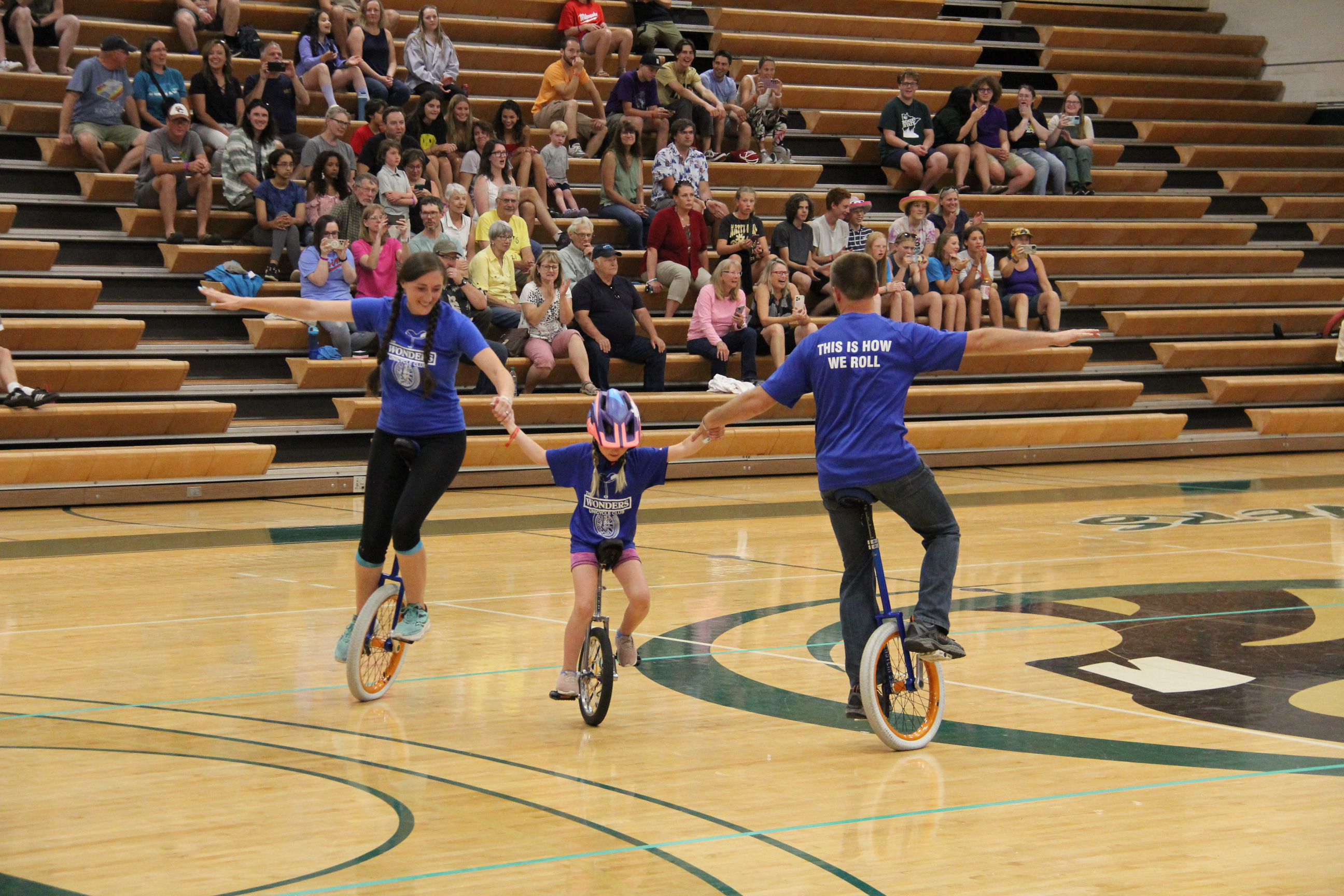
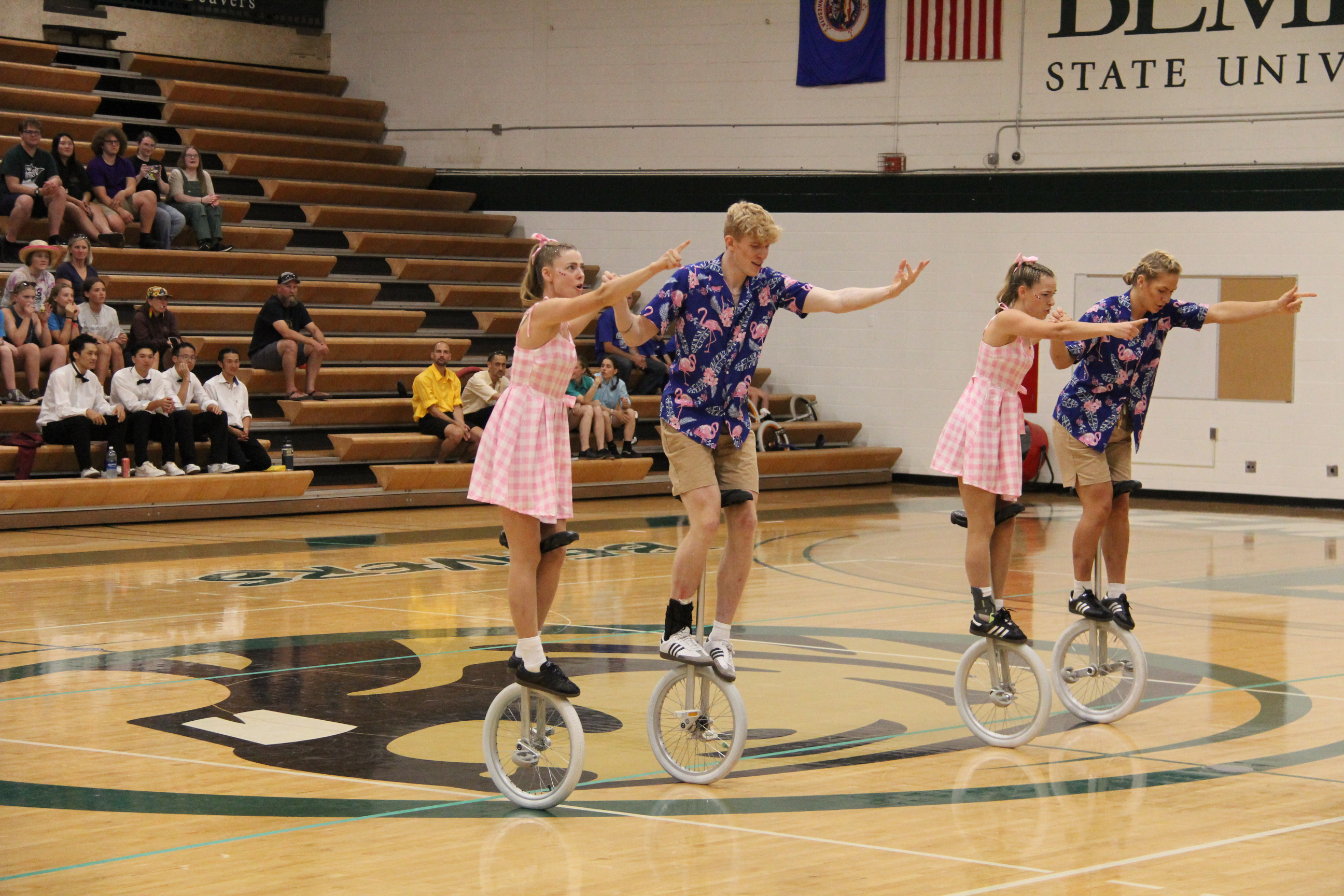
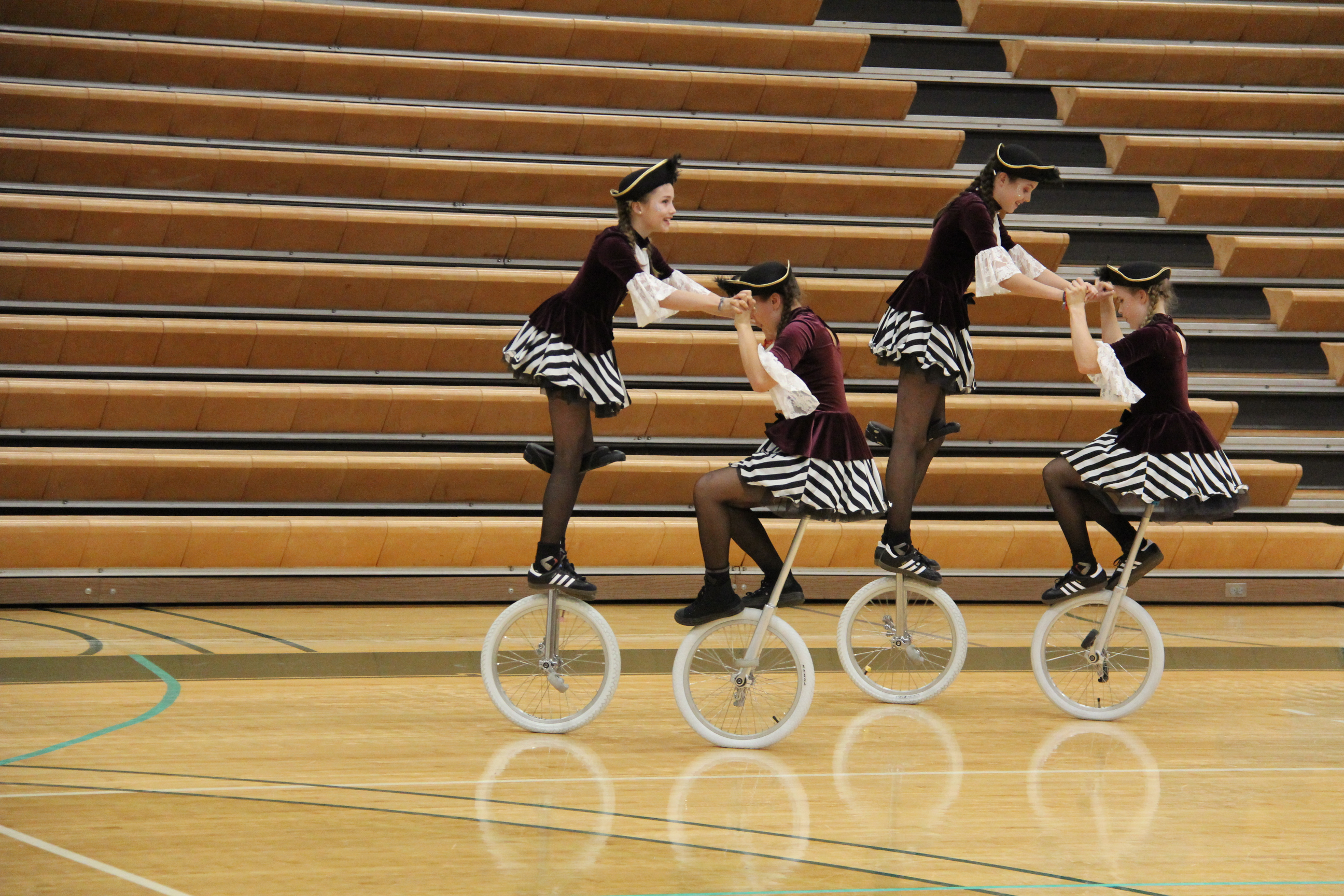
Members of The Wonders Unicycle Club, in themed t-shirts, compete in the freestyle group competition at Unicon 21.(Minnesota Prairie Roots copyrighted photo July 2024)
WHILE THE SUMMER 2024 OLYMPICS are now well underway, I’m still focused on another Olympics of sorts held in northern Minnesota. Unicon 21, a convention and competition for unicyclists from around the world, recently wrapped up in Bemidji. I spent one day watching competitive events with my husband and our son, who flew in from Boston to attend. Caleb unicycles as a leisure sport, not competitively.
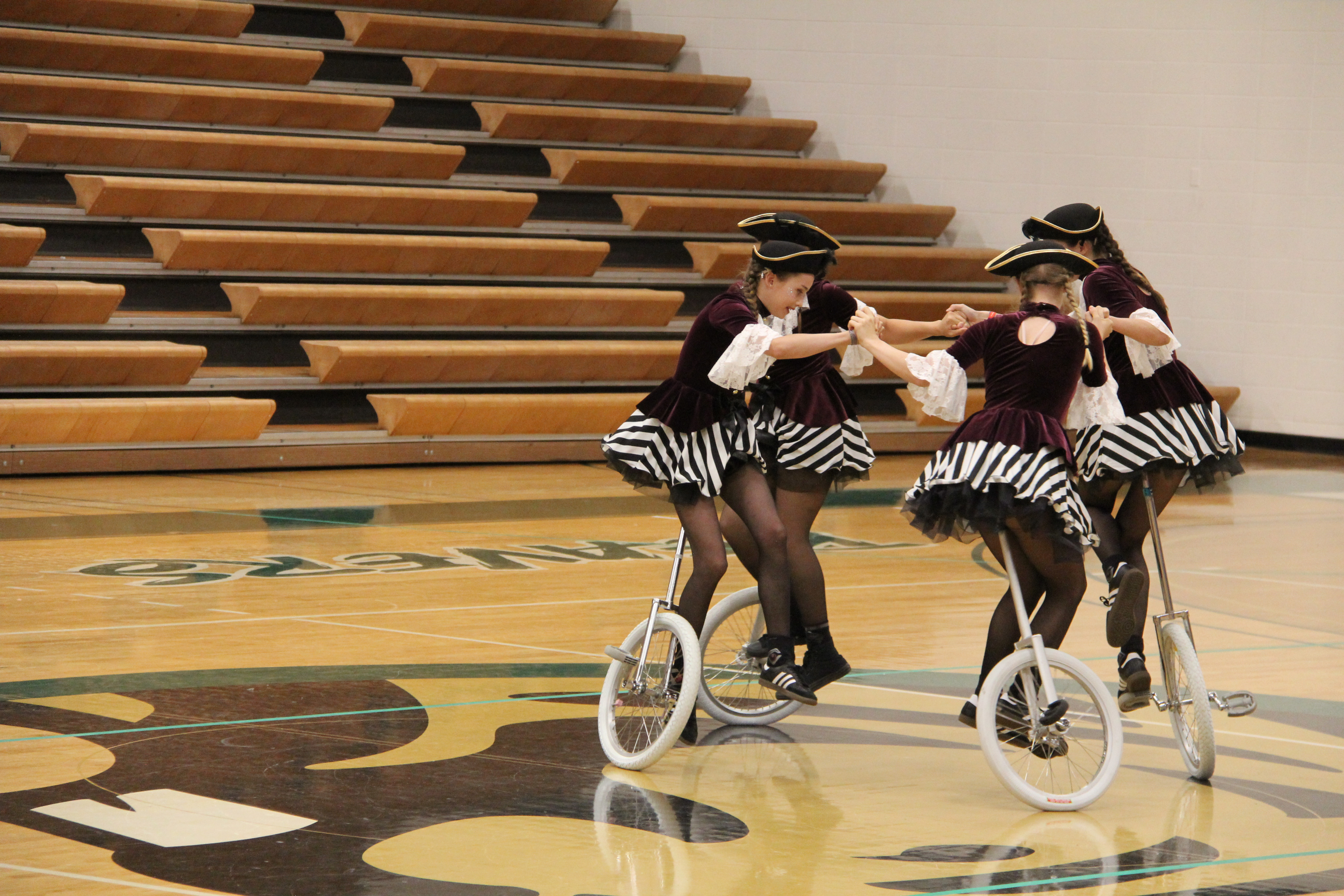
From Germany, The Black Pearl Group circles during their routine. (Minnesota Prairie Roots copyrighted photo July 2024)
I’ve already recapped Unicon 21 and showcased competitive basketball, relay races and freestyle group performances. But I have more to show you. Today I take you back to the freestyle group competition at Bemidji State University. This was, by far, my favorite organized unicycle competition. This seemed more performance art than sport, although it certainly is an athletic contest. As a creative, I lean into art more than sports.
Another team from Germany, the TSV Dudenhof Group, performs. (Minnesota Prairie Roots copyrighted photo July 2024)
A pause in the performance, and even that takes skill to balance in place. (Minnesota Prairie Roots copyrighted photo July 2024)
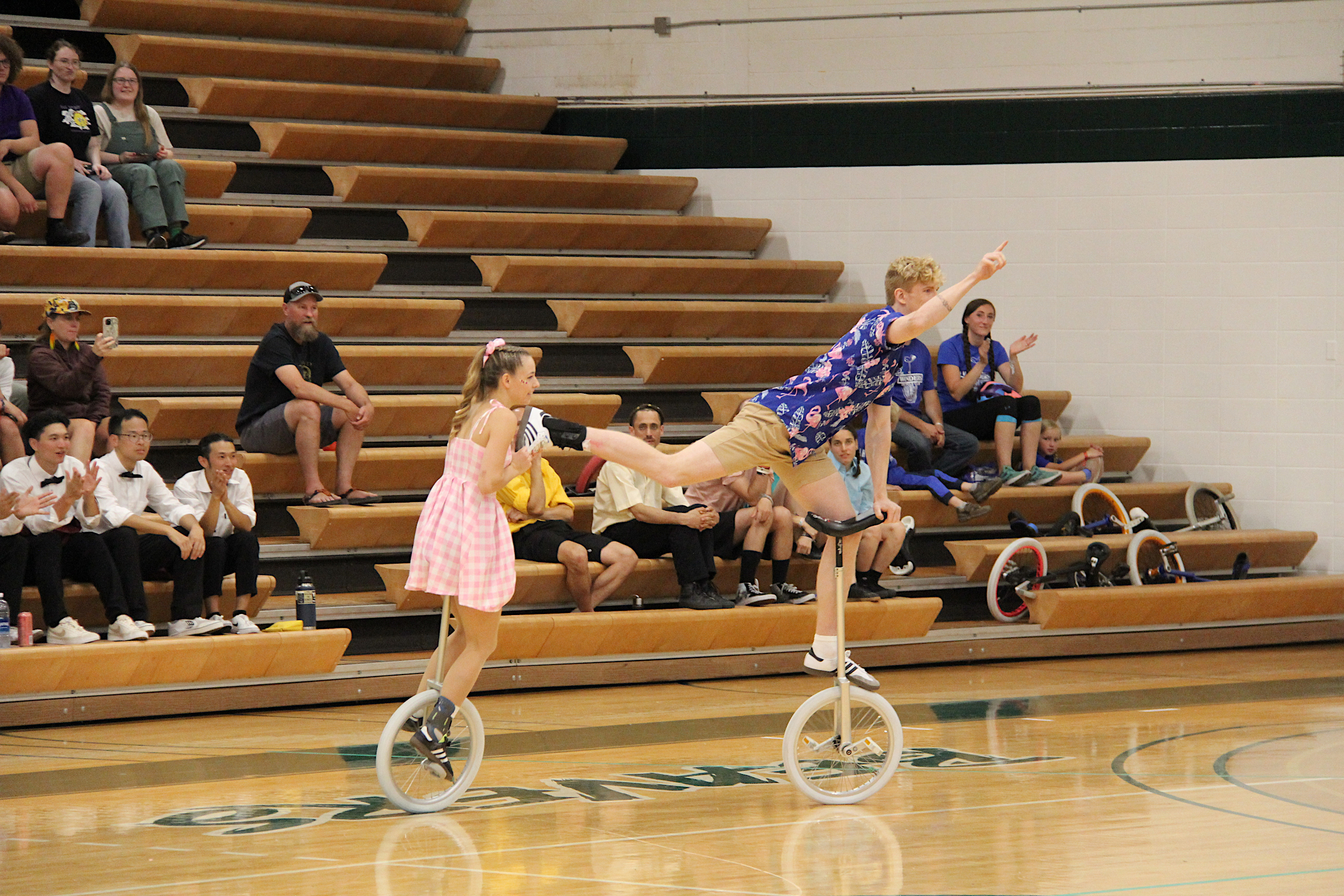
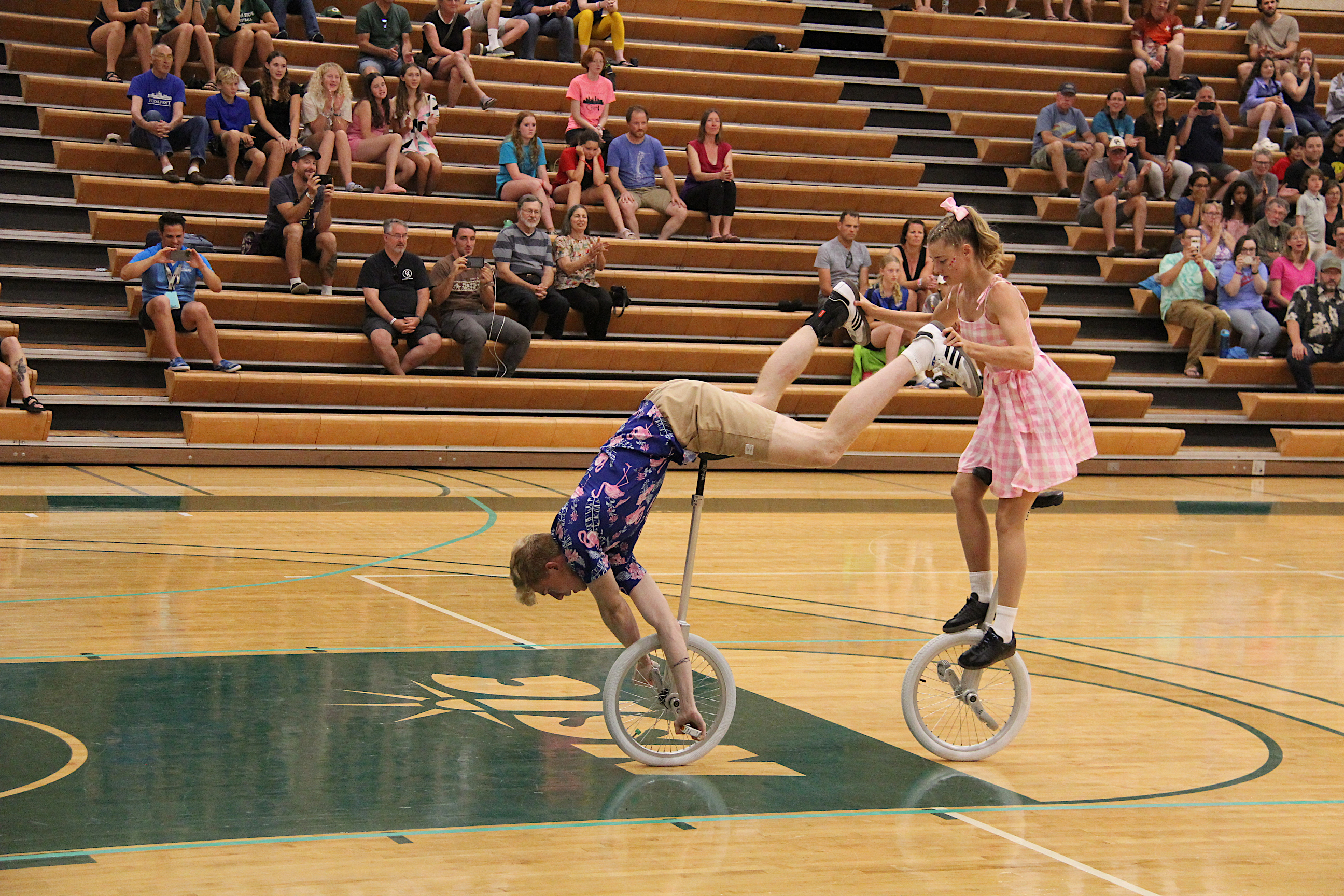
Now this takes skill, guts and daring. (Minnesota Prairie Roots copyrighted photo July 2024)
I didn’t see every performance. My schedule didn’t allow me to stay until the 10 pm end time. But I watched seven groups perform—two from Japan (previously featured here), one from the U.S. and the others from Germany.
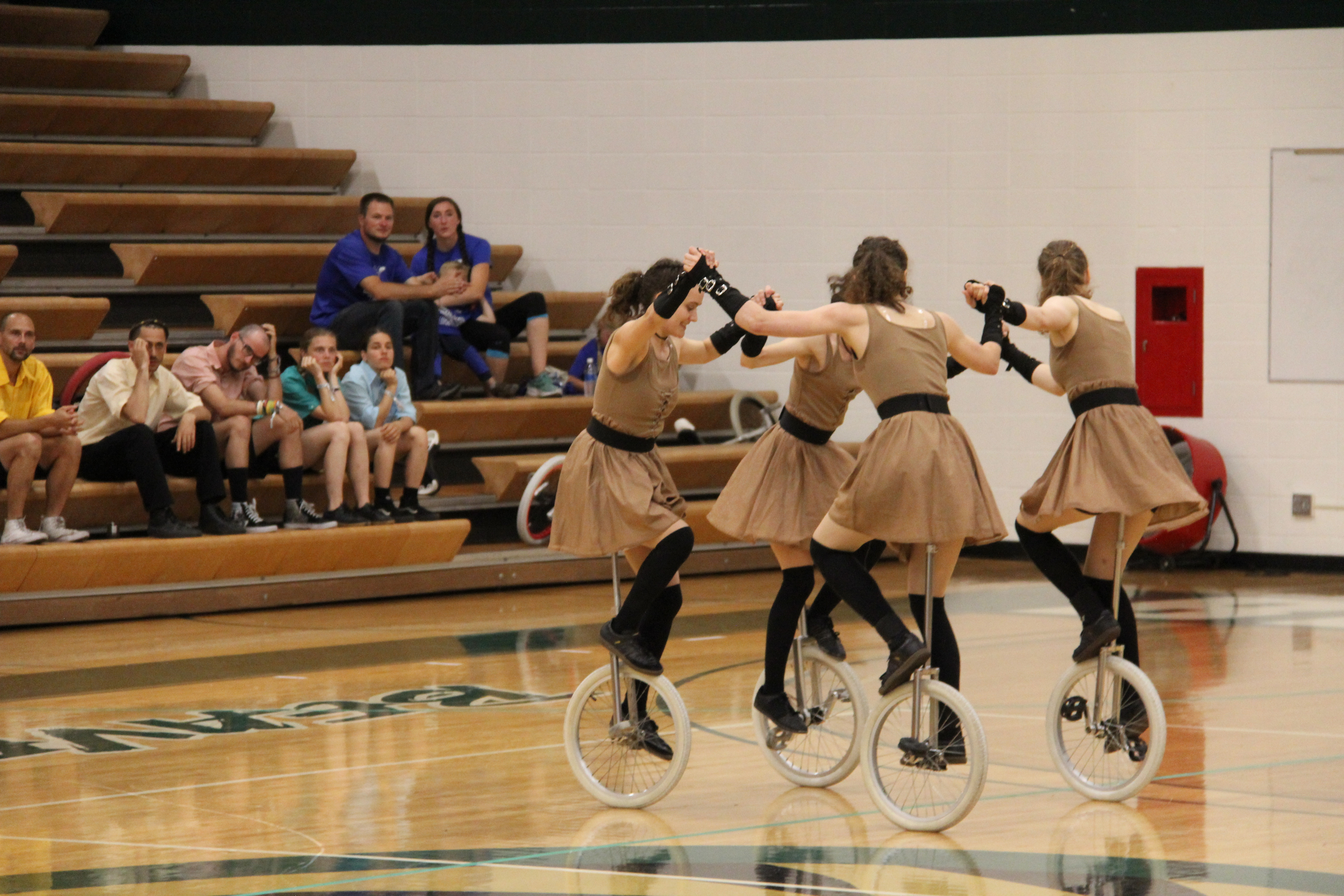
The Dragon Age Group from Germany performs. (Minnesota Prairie Roots copyrighted photo July 2024)
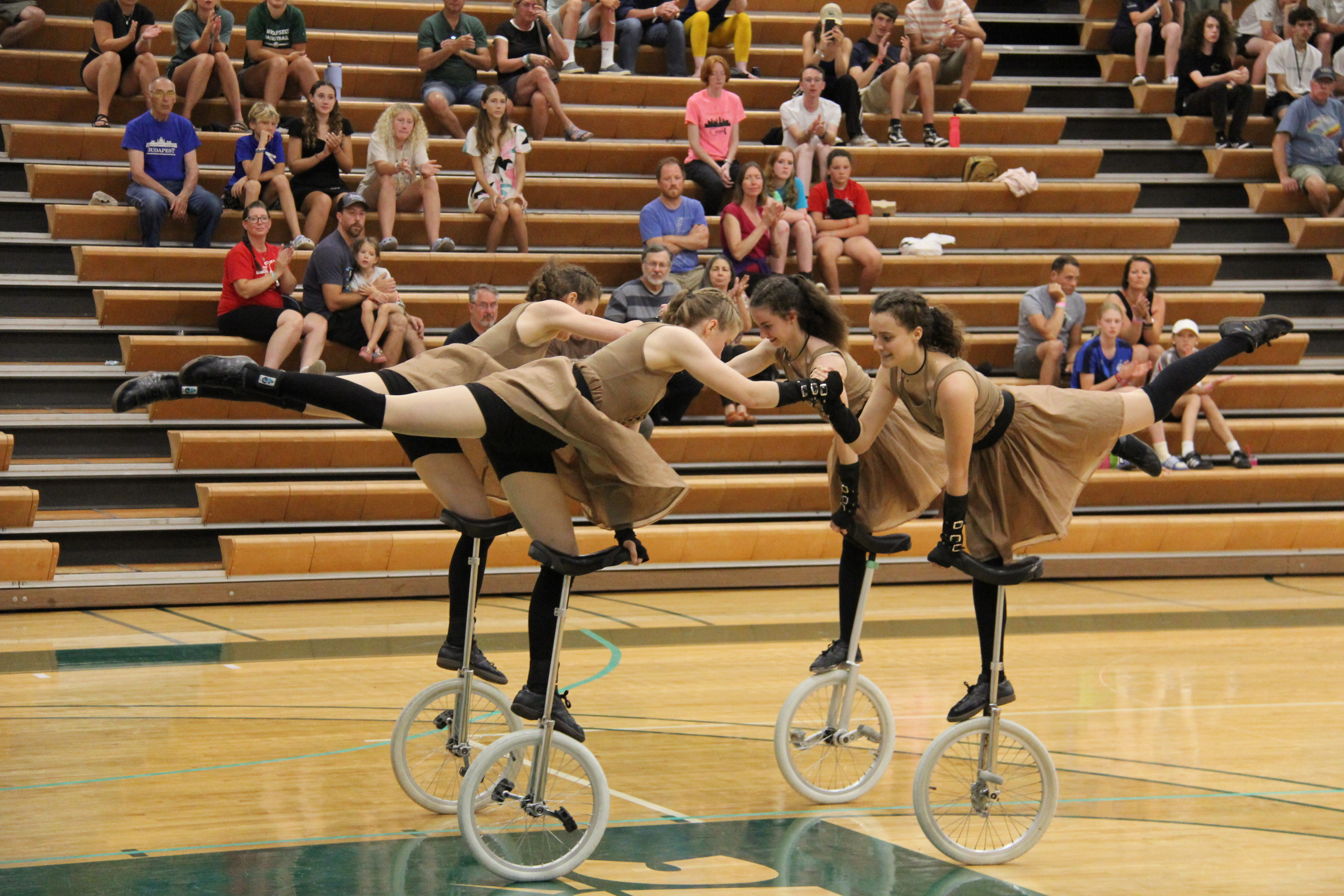
The skill, talent, precision and more required to perform choreographed routines is impressive.
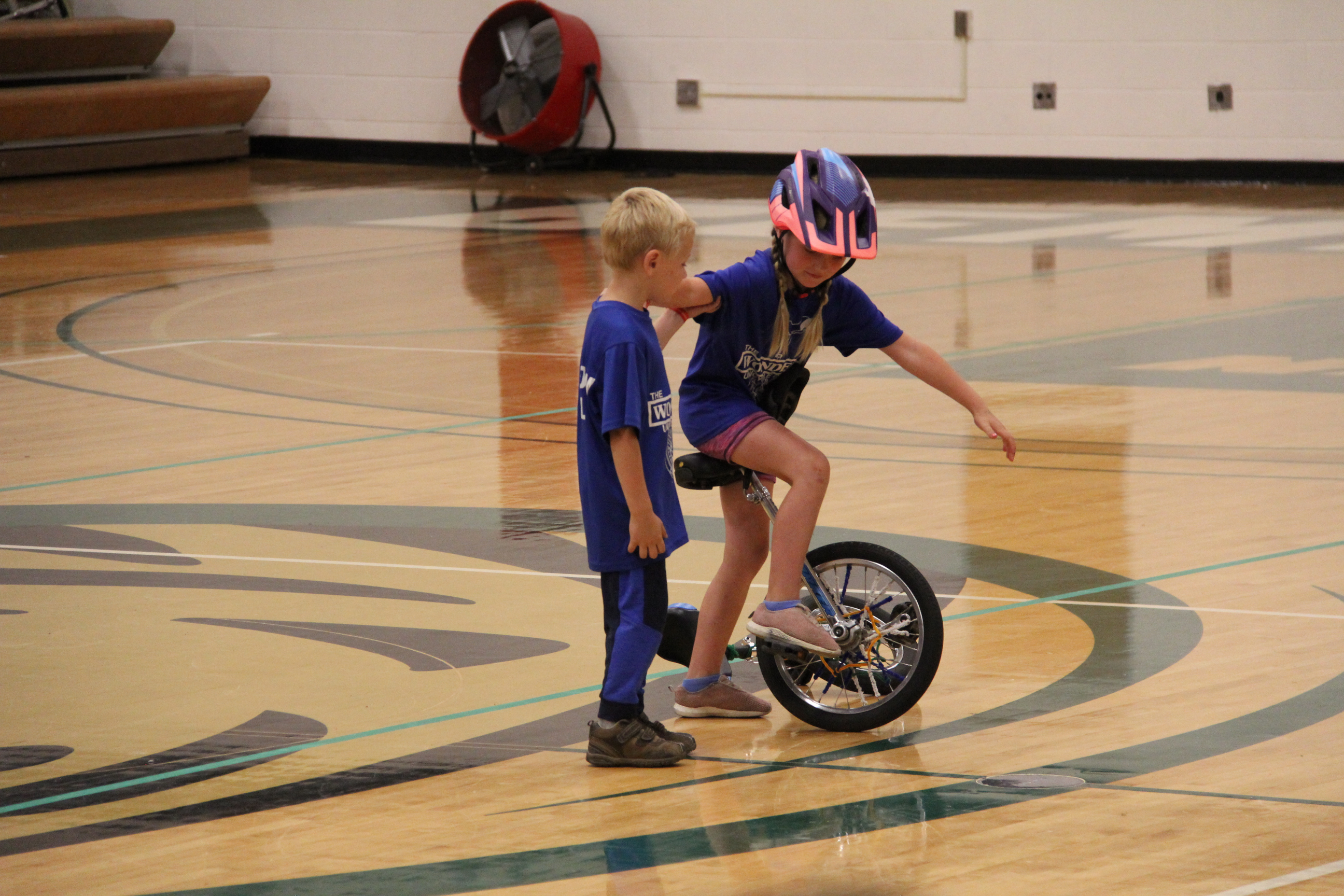
A helping hand at the start of The Wonders Unicycle Club performance. (Minnesota Prairie Roots copyrighted photo July 2024)
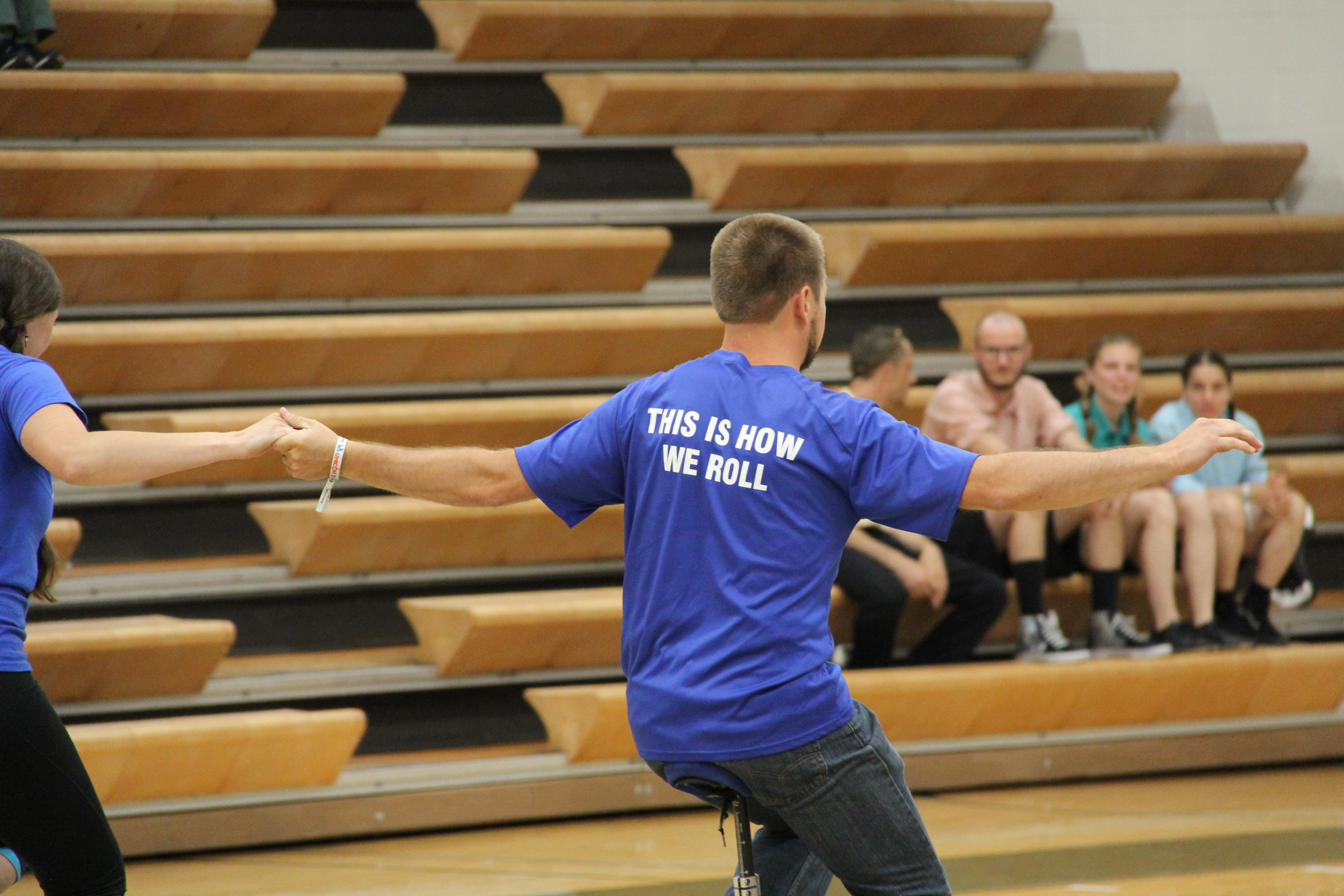
Themed t-shirts worn by The Wonders unicyclists. (Minnesota Prairie Roots copyrighted photo July 2024)
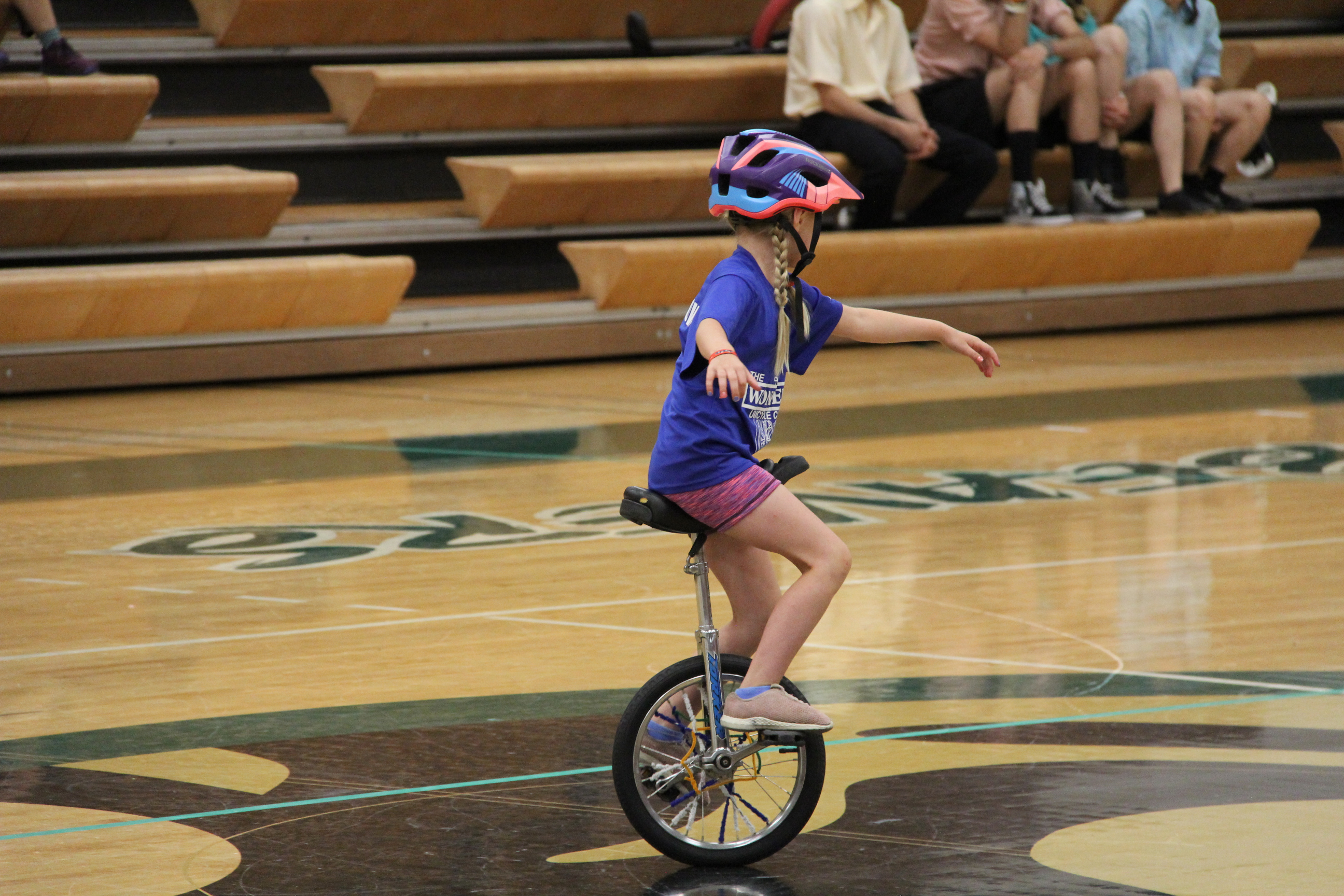
Success for the littlest Wonder. (Minnesota Prairie Roots copyrighted photo July 2024)
“THIS IS HOW WE ROLL,” printed onto tees worn by four unicyclists from The Wonders Unicycle Club, succinctly summarizes unicycling. This U.S. team won the hearts of the crowd not so much via a high level of performance skills, but rather with a cuteness factor. To watch a young girl wheel her way around the gym floor with two adults (presumably her parents) while helpful little brother assisted and then waited court-side, left me feeling all warm and fuzzy inside.
The Dragon Age Group circles during their routine. (Minnesota Prairie Roots copyrighted photo July 2024)
But everything about the freestyle group show left me feeling just plain happy. These were athletes, performers, entertainers who wowed the crowd, who absolutely deserved to be on a world stage showing off their athletic and performance skills.
Another German team, The SV Boostedt SG Group performs. (Minnesota Prairie Roots copyrighted photo July 2024)
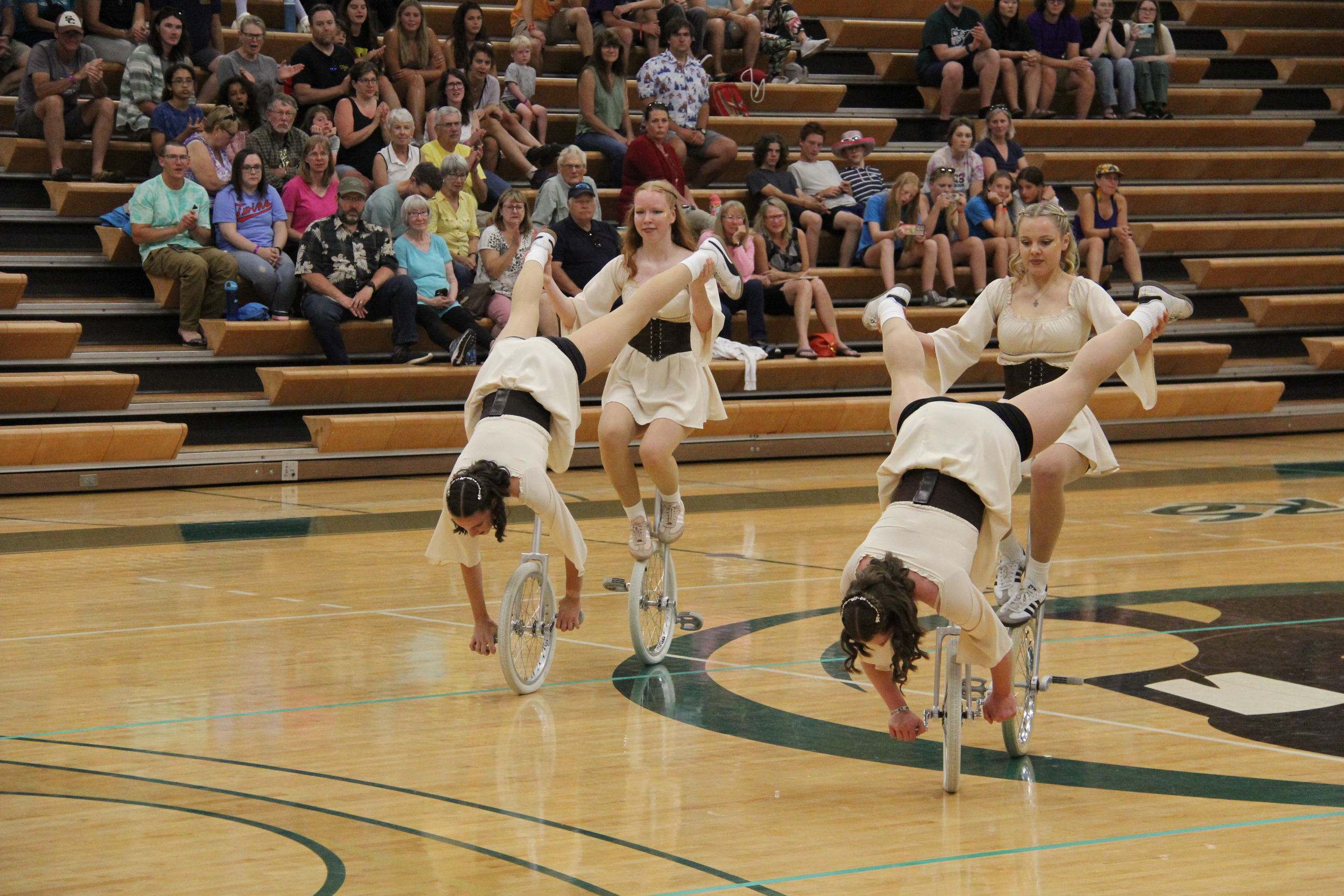
There’s probably a technical name for this, but I call it “the wheelbarrow.” (Minnesota Prairie Roots copyrighted photo July 2024)
I can’t tell you who won the freestyle competition because I don’t know and, frankly, I don’t care all that much. These young people are all winners in my book. They chose a sport that few have mastered, that sets them apart, that requires patience, persistence, practice and a genuine devotion to the act of unicycling.
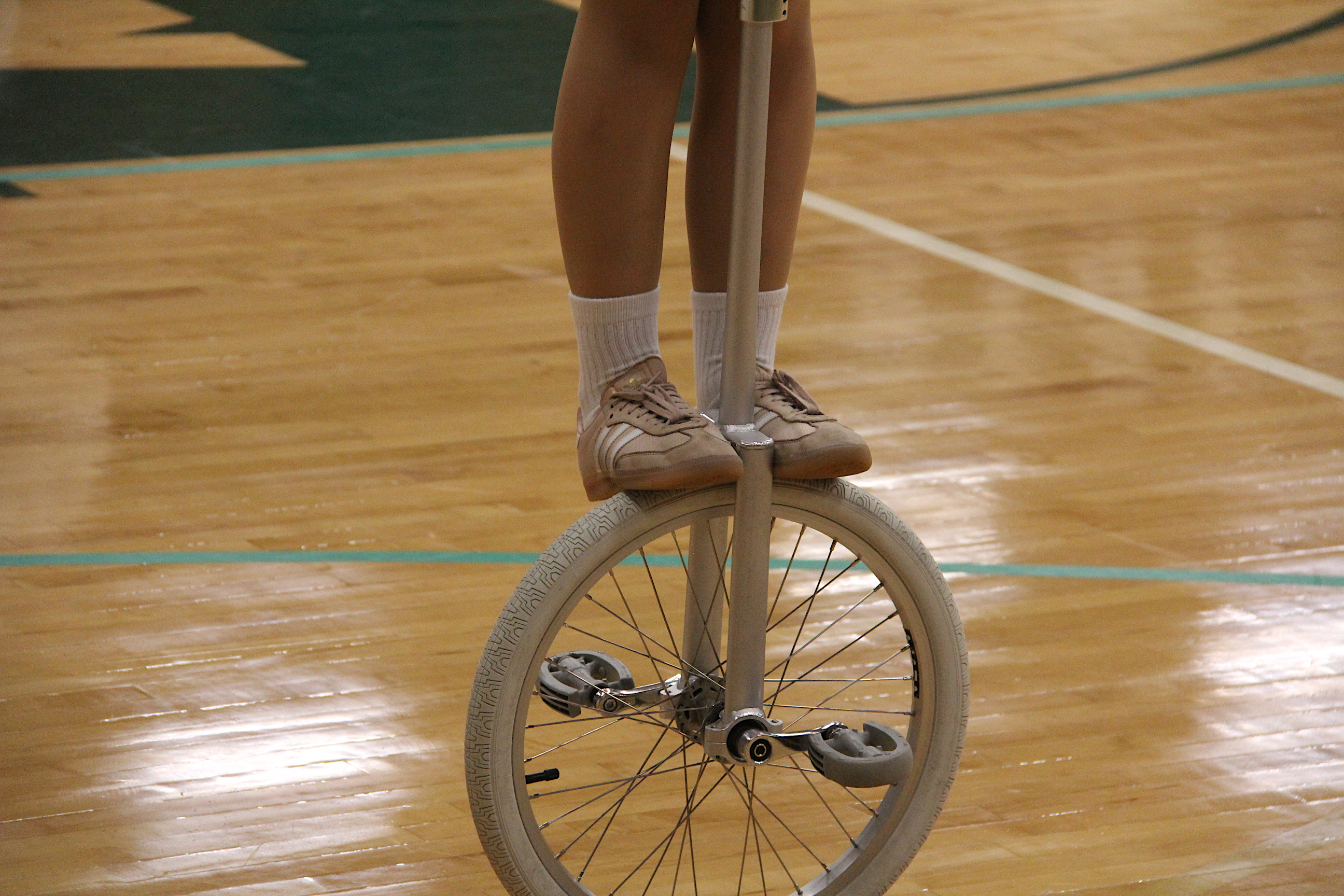
It’s all about the wheel, one wheel. (Minnesota Prairie Roots copyrighted photo July 2024)
There’s something to be said for someone who steps outside the norm (riding on one wheel rather than two) and embraces something that would challenge most of us. I recall my son relentlessly attempting to get on his first unicycle as a grade schooler, He would place one hand on a work bench in the garage and then try to get onto the unicycle seat. Eventually he could stay on the seat, then pedal forward out of the garage. Soon he was circling the driveway and riding along city bike trails with ease and speed that, admittedly, scared me. Yes, he fell off, breaking a finger once when his outstretched hand hit the side of the van parked in the driveway. And, yes, even the international performers fell occasionally.
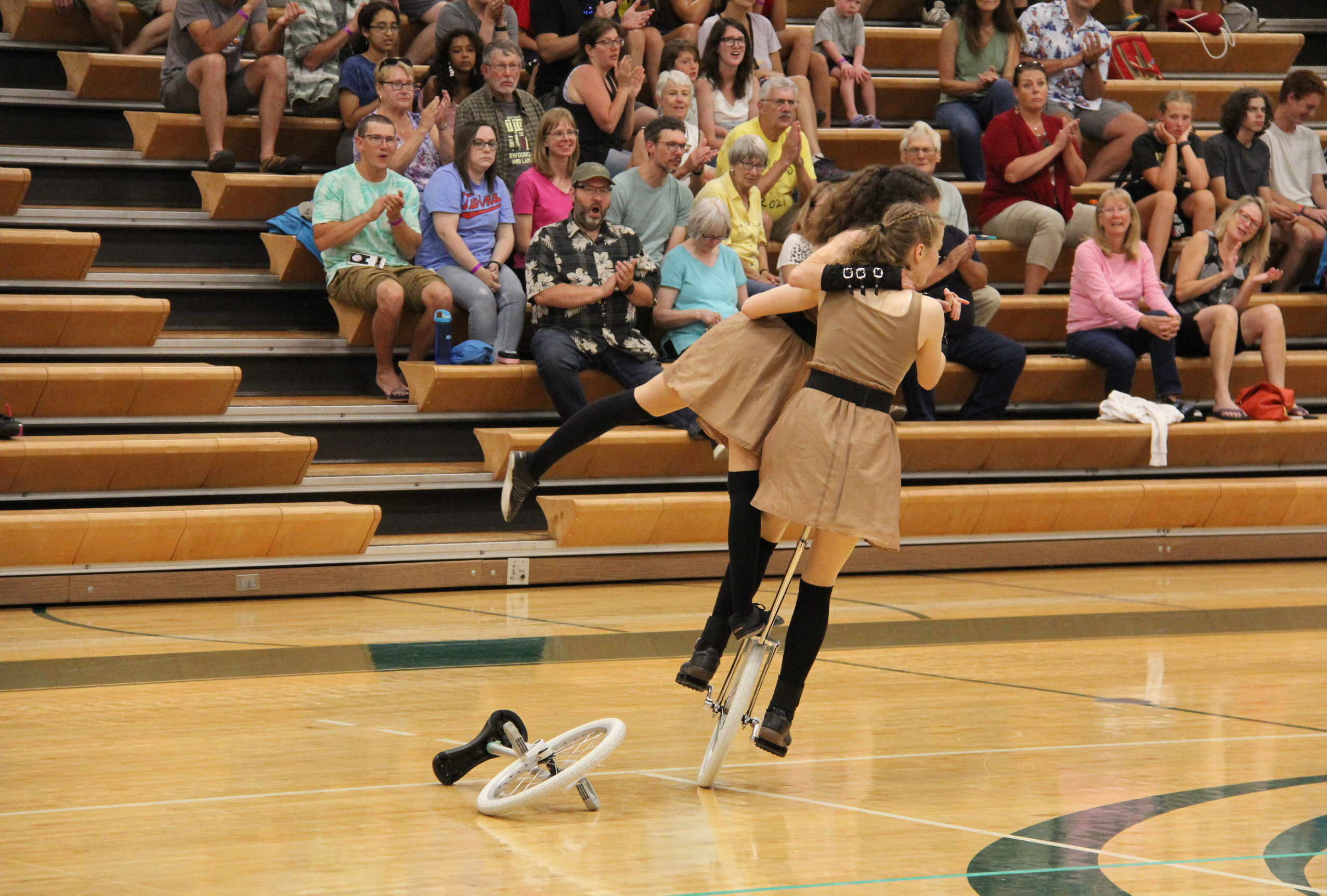
A seemingly impossible feat with two team members of The Dragon Age Group balancing on one unicycle. (Minnesota Prairie Roots copyrighted photo July 2024)
But none of these competitors fell short of creating a fun evening for those of us watching from the bleachers at Bemidji State. They entertained and wowed us, one wheel at a time.
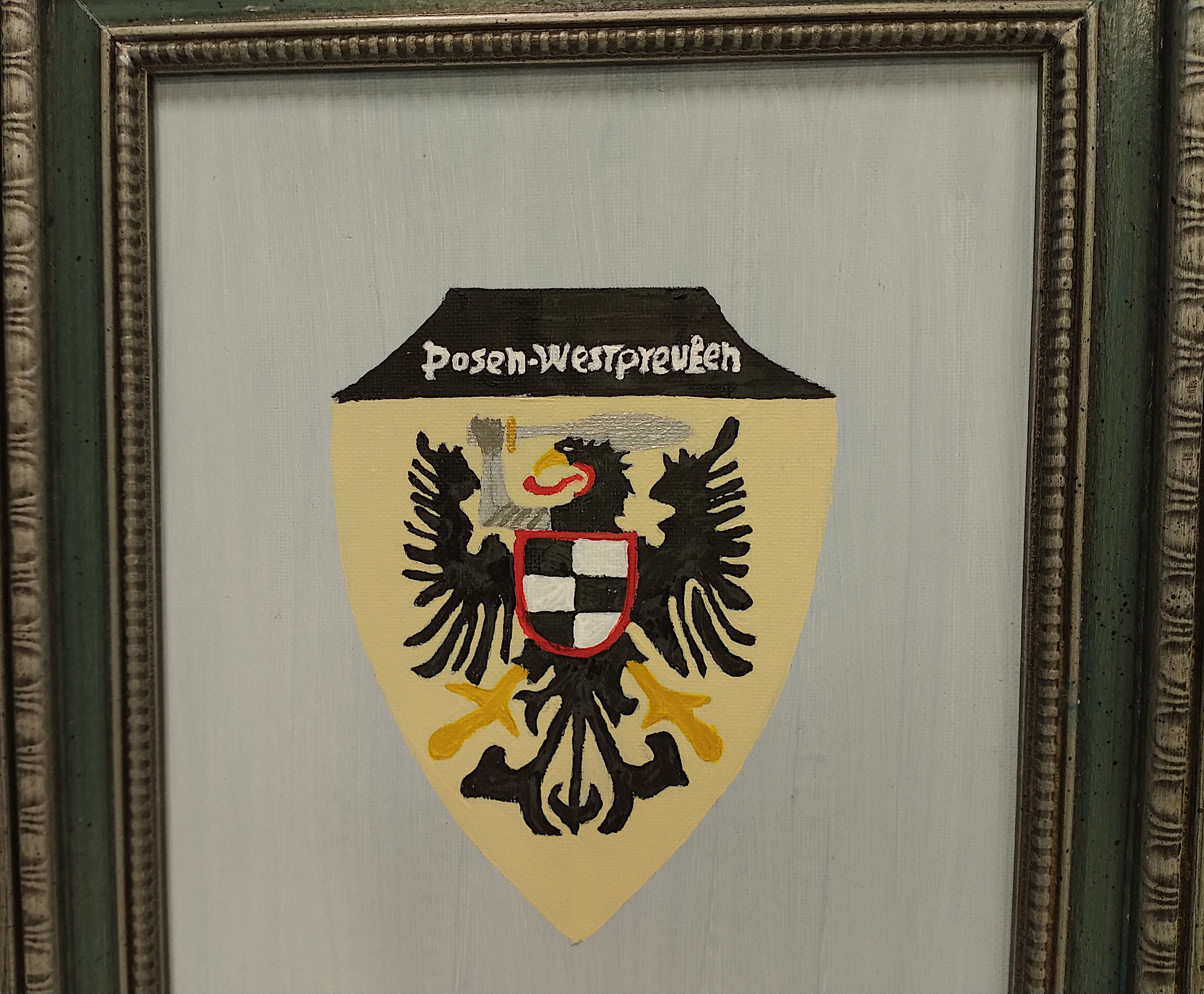
The Kletscher Family Coat of Arms of Posen-West Prussia. (Minnesota Prairie Roots copyrighted photo July 2024)
REUNITING. RECONNECTING. REMEMBERING. Those words define reunions, whether among family or friends. Summer marks prime reunion time in Minnesota, including for me, especially this year.
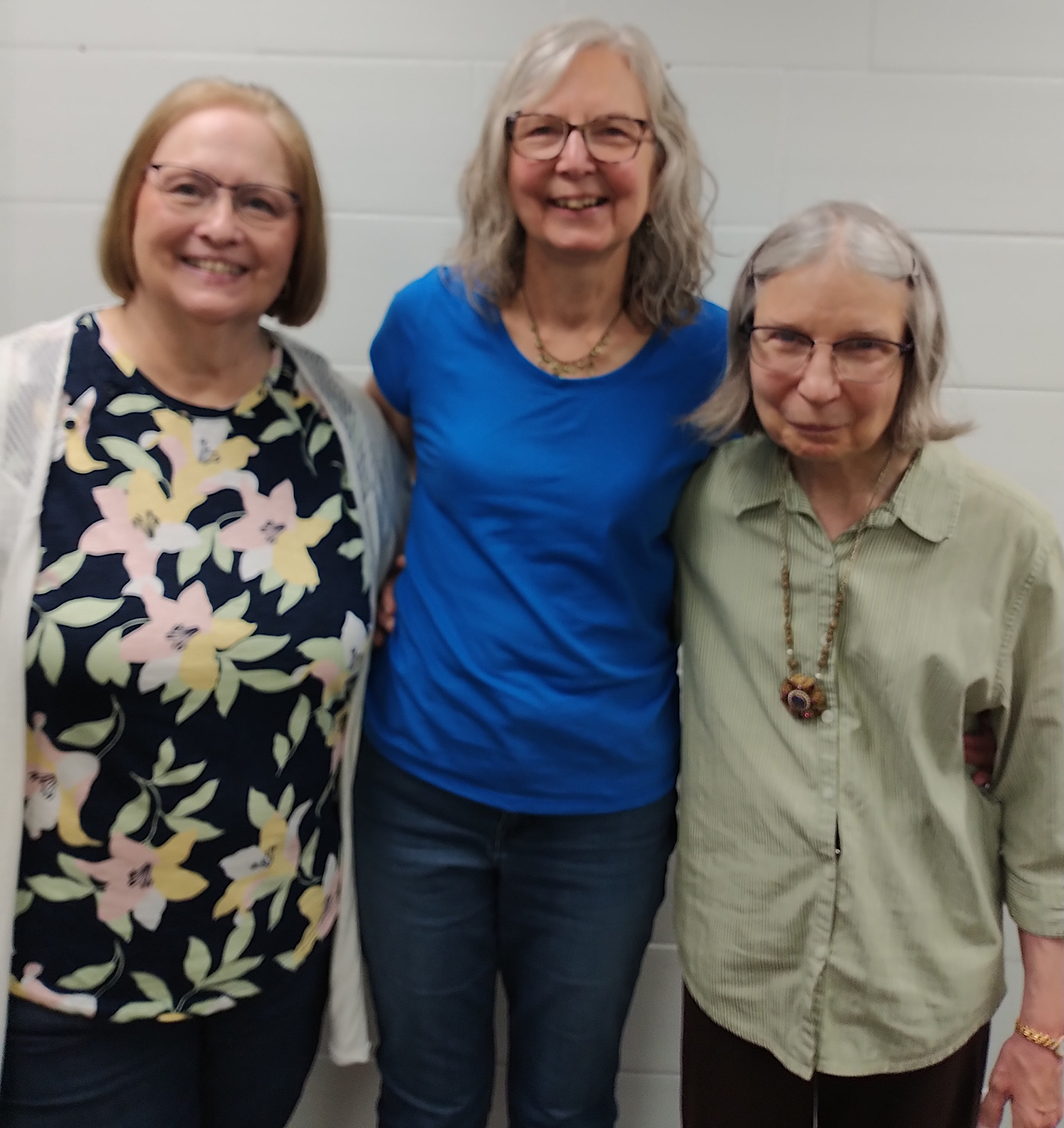
I’m flanked by cousins, Joyce, left, and LeAnn. We were born within months of each other and grew up spending lots of time together at family gatherings. (Photo credit: Kirt Kletscher)
From Pine River in northern Minnesota to Vesta on the southwestern Minnesota prairie to the Twin Cities and elsewhere, I’ve reconnected with people who are important to me, with whom I share roots and/or connections. And it’s been a joy because the older I grow, the more I realize that time is not a given and we need to gather and appreciate one another. With hugs, love and care.
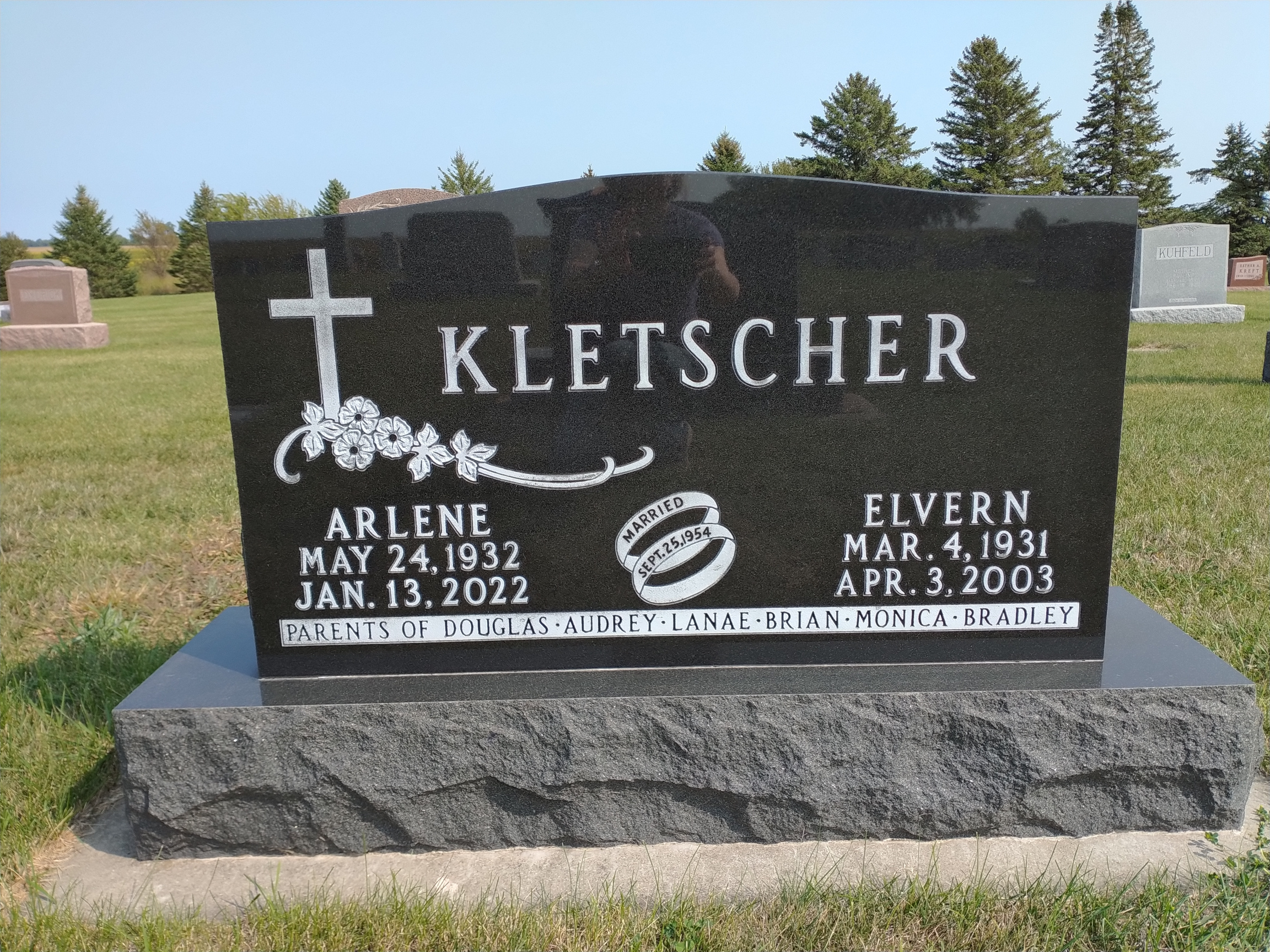
Myparents’ tombstone in the Vesta City Cemetery. (Minnesota Prairie Roots copyrighted file photo September 2022)
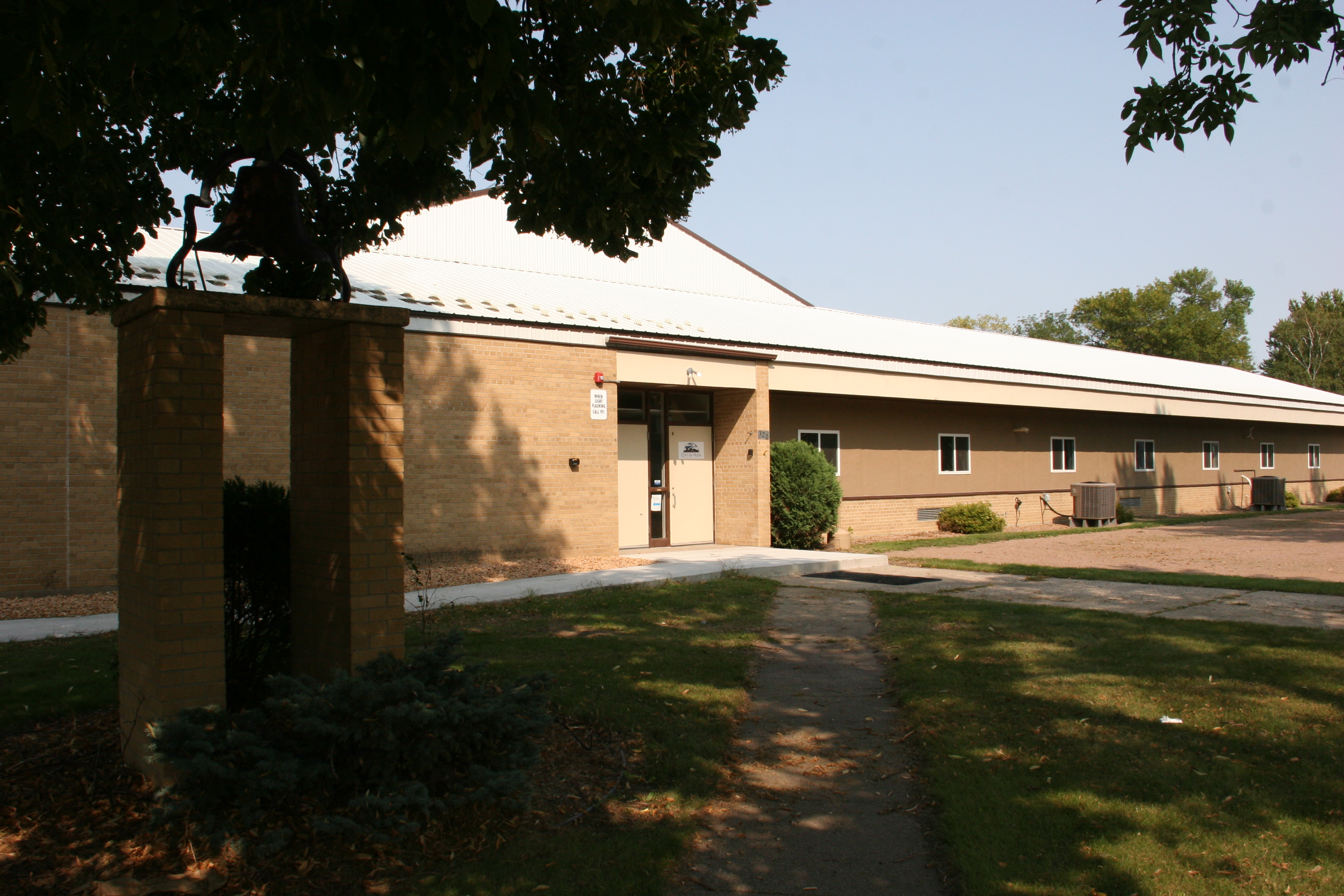
My most recent reunion happened July 28, when Randy and I traveled 2.5 hours west to my hometown of Vesta in Redwood County for the Kletscher Family Reunion, held annually on the last Sunday in July. First we stopped at the cemetery to visit the gravesites of my parents, grandparents and other family members. I wiped away tears before we followed the gravel road into town, to the reunion site, the former Vesta Elementary School, now turned city hall and community center.
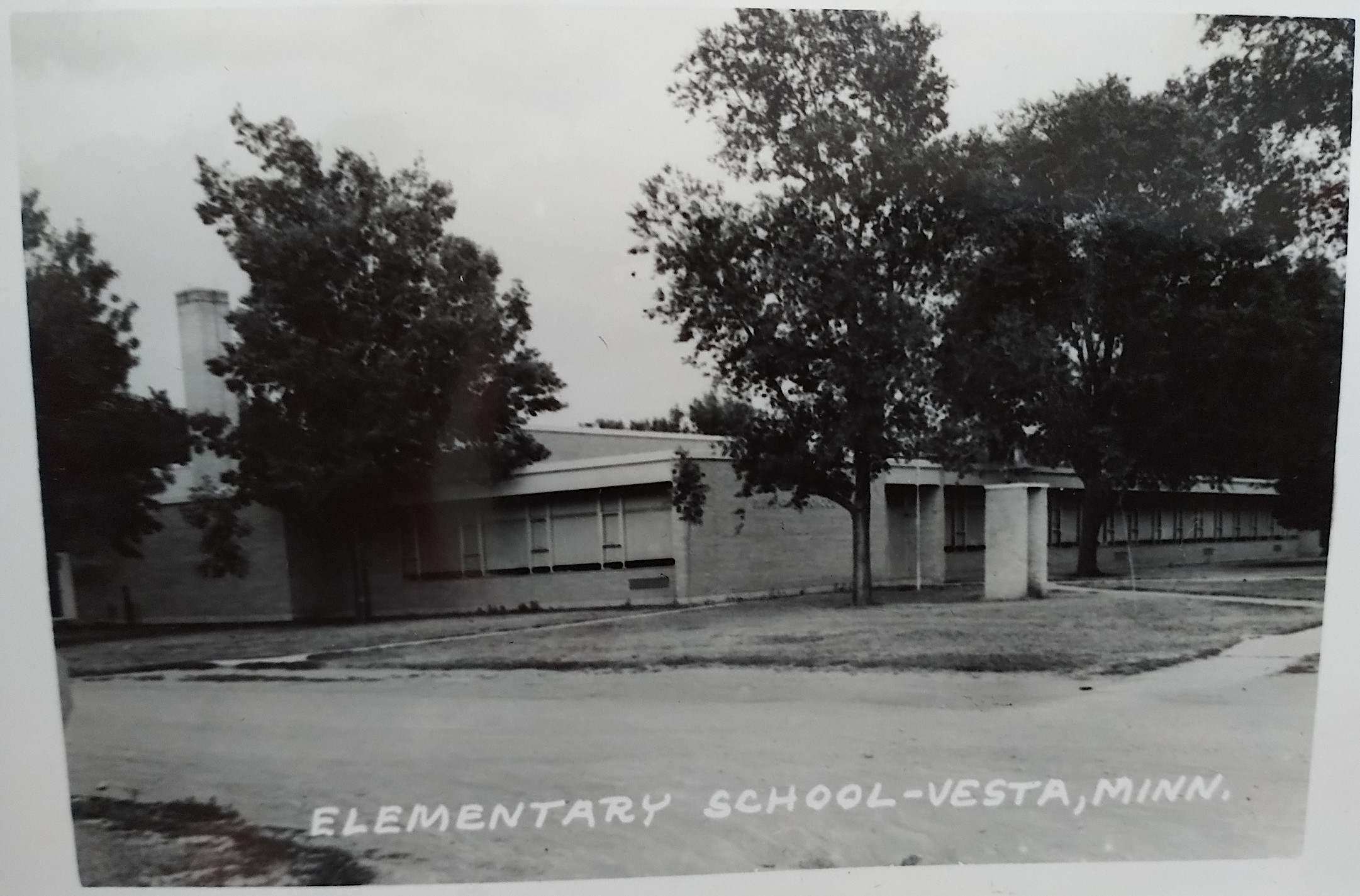
Vesta Elementary School in the 1960s.
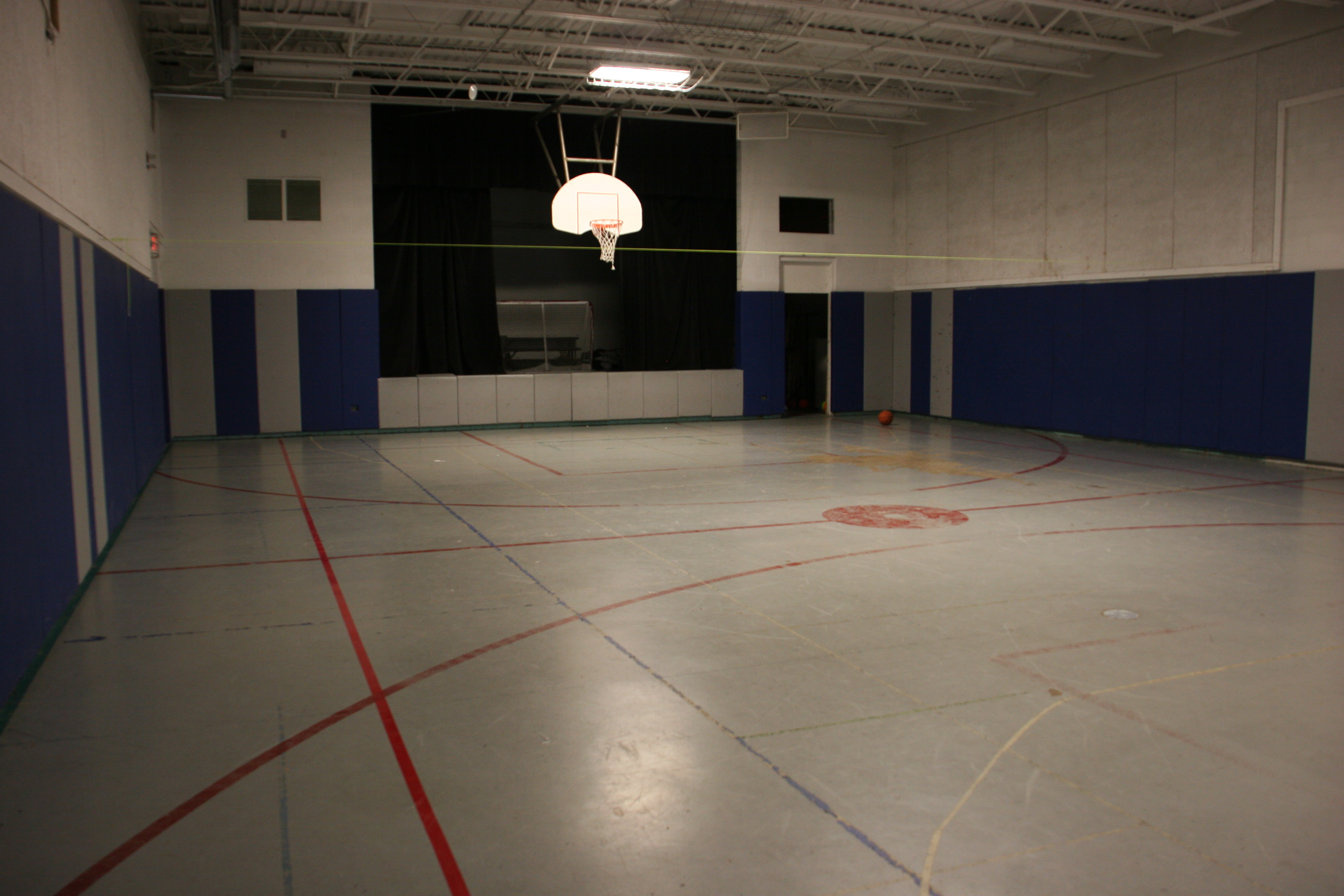
The old school gym, site of the family reunion. (Minnesota Prairie Roots copyrighted file photo September 2022)
The school today, as a city hall and community center. (Minnesota Prairie Roots copyrighted file photo September 2022)
To walk back into the building where I spent my first six grades learning to read, write, spell, do math and more felt comforting and disconcerting, like stepping back into a school that no longer looks the same, but still holds the same memories. Clapping erasers outside on the east brick wall. Listening to Mrs. Kotval read Laura Ingalls Wilder’s books after lunch. Scrawling letters in a penmanship book. Weaving a rug from rags. Building snowforts. Jumping rope on the front sidewalk. Performing on the stage. So many memories in this space.
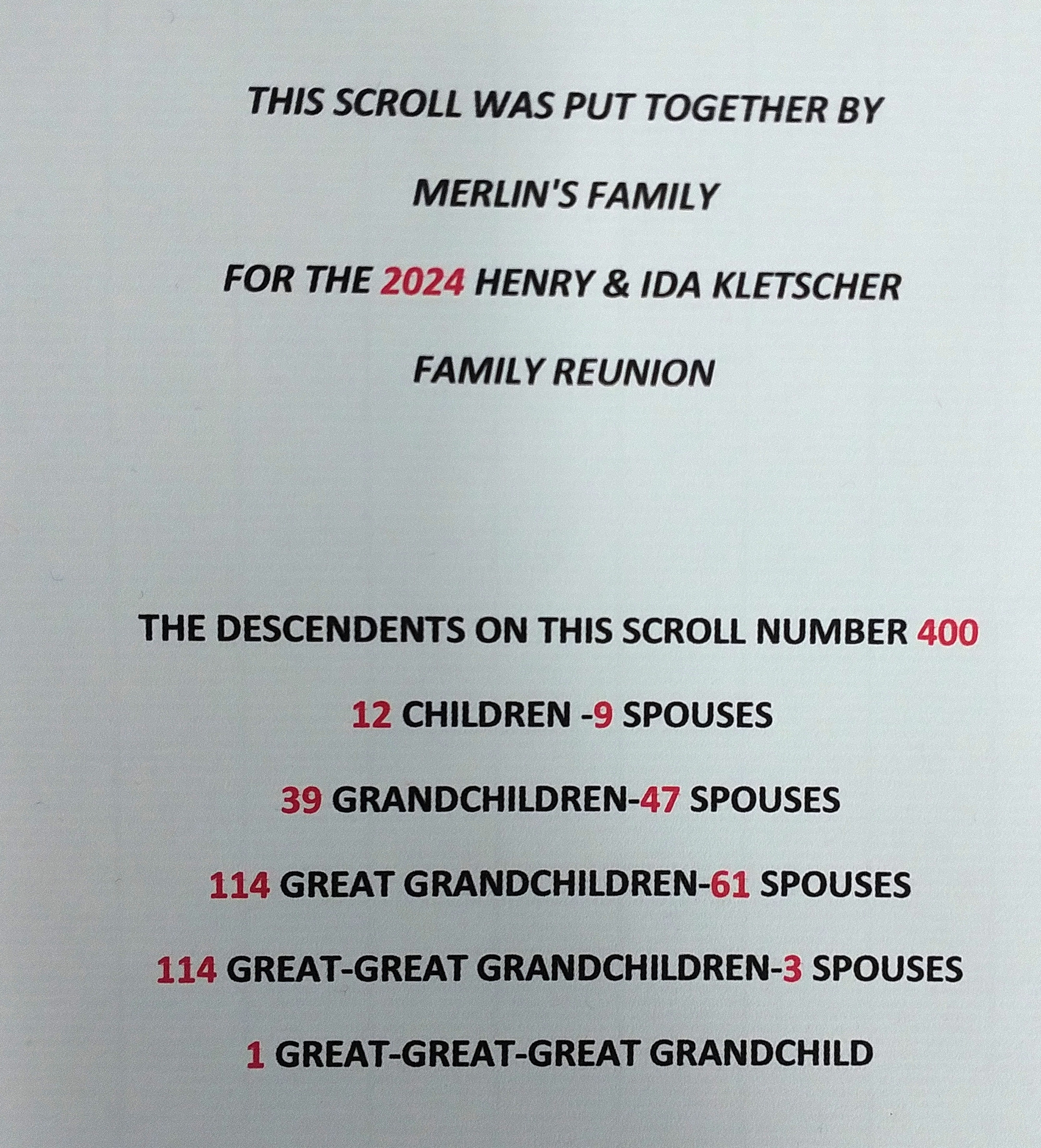
A summary of a 30-page family tree/scroll. (Minnesota Prairie Roots copyrighted photo July 2024)
And on Sunday, that space also held some 60-70 descendants of Henry and Ida Kletscher, parents of twelve, two dead in infancy and only three surviving today. The family tree, printed on 30 pieces of paper, stretched across several tables. I am one of 39 grandchildren, my children among 114 great grandchildren of Henry and Ida in a line that today also includes 114 great great grandchildren and one great great great grandchild. We are a large and prolific bunch that continues to grow. That we still gather annually is a testament to the strength of family bonds. I grew up near my paternal grandparents, aunts, uncles and cousins, spending lots of time together.
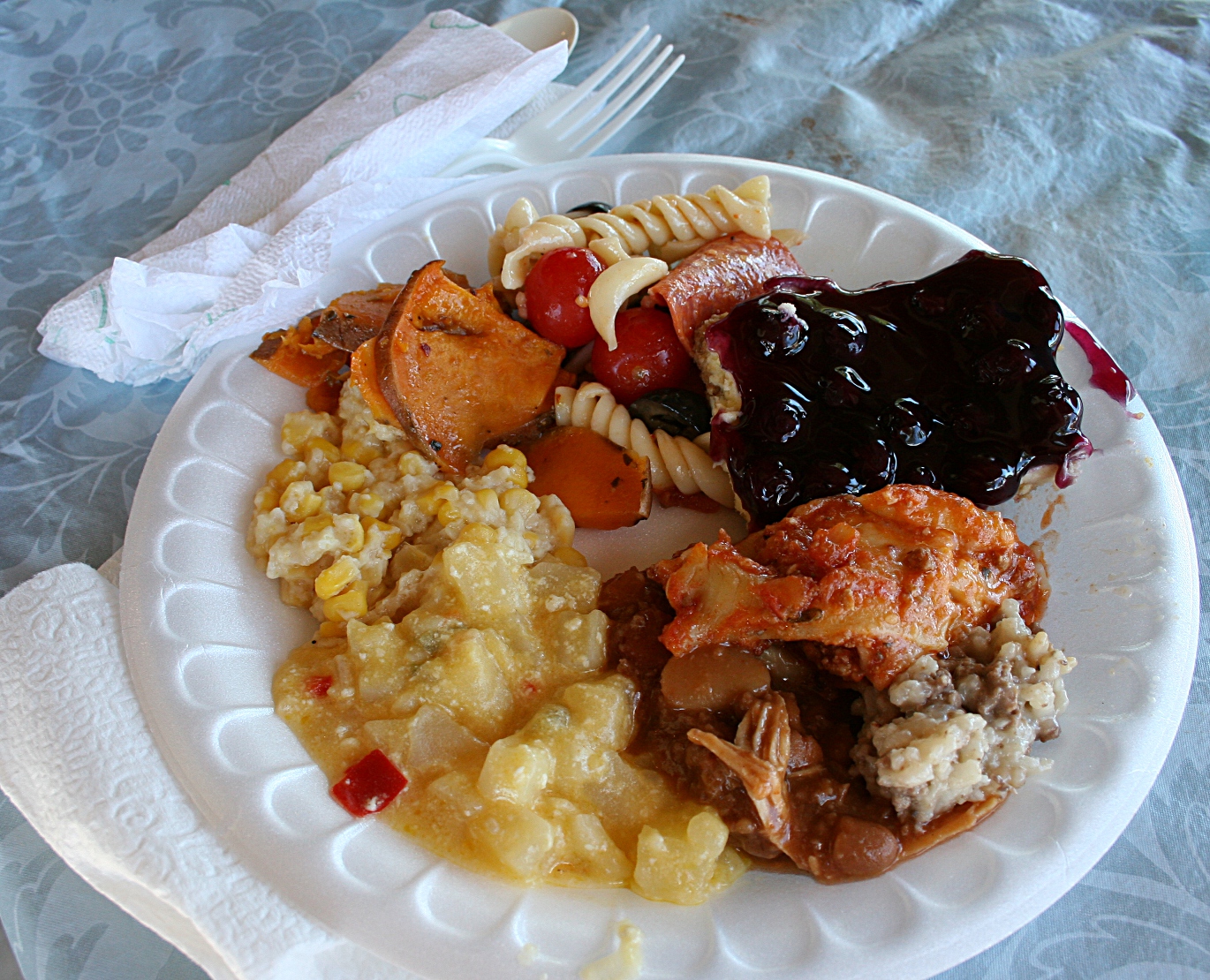
Everyone brings food for the potluck. There’s always blueberry dessert. The spread covers several tables. (Minnesota Prairie Roots copyrighted file photo July 2013)
But my generation and those thereafter have scattered well outside Redwood County. Family arrived from Wisconsin, Iowa, North Dakota and all parts of Minnesota from Blaine to Delano to Alexandria to Owatonna, Faribault, Waseca, and many other communities near and far. Those from even more distant locations like the East Coast did not attend.
As at all reunions, I intentionally circulated, attempting to converse with everyone at some point. This gathering, conversations were not so much about the past as about the present. We talked kids, grandkids, retirement (or not), health challenges, home improvement projects… There was a lot of phone scrolling, too, to show photos of grandchildren.
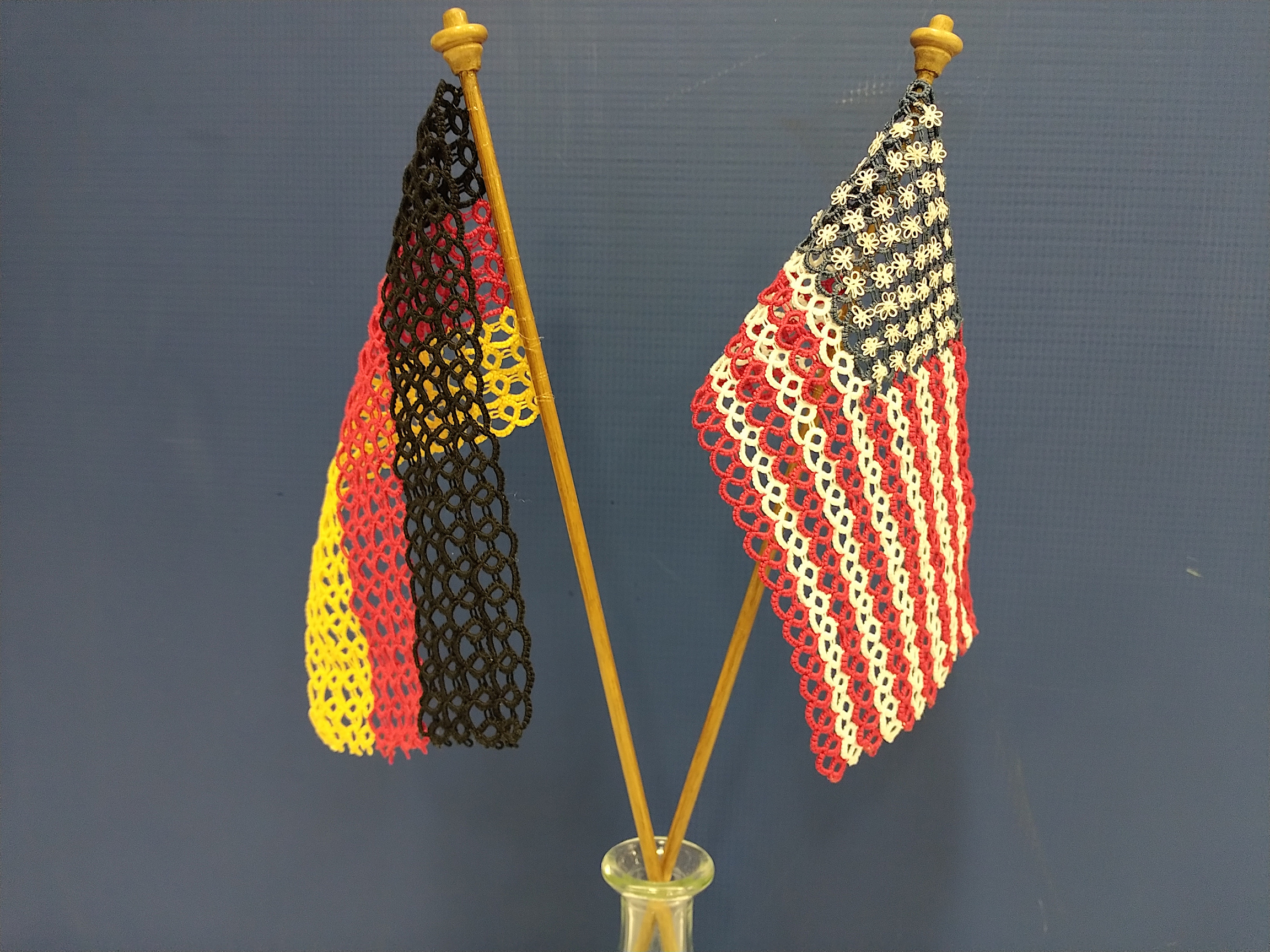
Aunt Iylene tatted these flags celebrating our German heritage and the Kletscher family’s new home in America. (Minnesota Prairie Roots copyrighted photo July 2024)
I cooed over new baby Wren; met Aubrey from West Fargo, going into first grade and whose name was easy for me to remember (and mine for her); saw photos of a wedding dress under construction by bride-to-be Sarah; encouraged Andy, who is in a drug trial study at Mayo Clinic for his debilitating heart condition; listened to Lynn’s recitation of a humorous poem her teacher didn’t appreciate back in the day; admired Aunt Iylene’s tatting projects (which she gave away on Sunday and which honor Grandma Ida, who also tatted); listened to stories of heartaches and challenges and life.
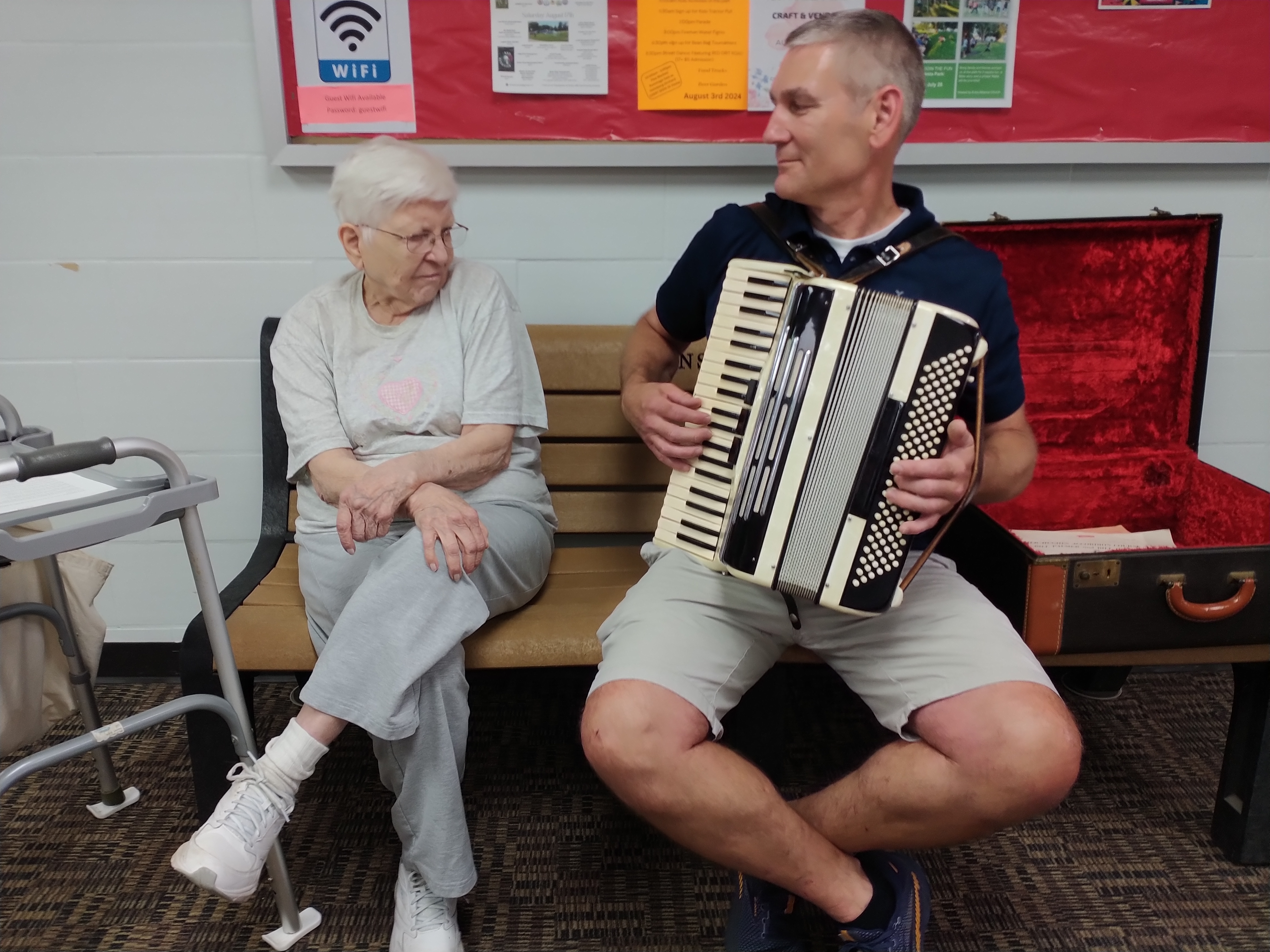
A highlight of the reunion was watching and listening to Kirt play Ardyce’s accordion. (Minnesota Prairie Roots copyrighted photo July 2024)
And then there was the impromptu concert by my cousin Kirt, who plays accordion. He brought his and was also gifted, at the reunion, with Aunt Ardyce’s 73-year-old accordion, a gift to her from her parents when she was only thirteen. She took lessons briefly as did two of her children. But the instrument has mostly sat in its case for seven decades…until Kirt picked it up and commenced to play, but only to a select few of us in the entry hallway. To watch my 86-year-old aunt, seated next to her nephew, listening intently to “her” accordion brought me such joy. I couldn’t help but think how happy this moment would have made my grandparents.
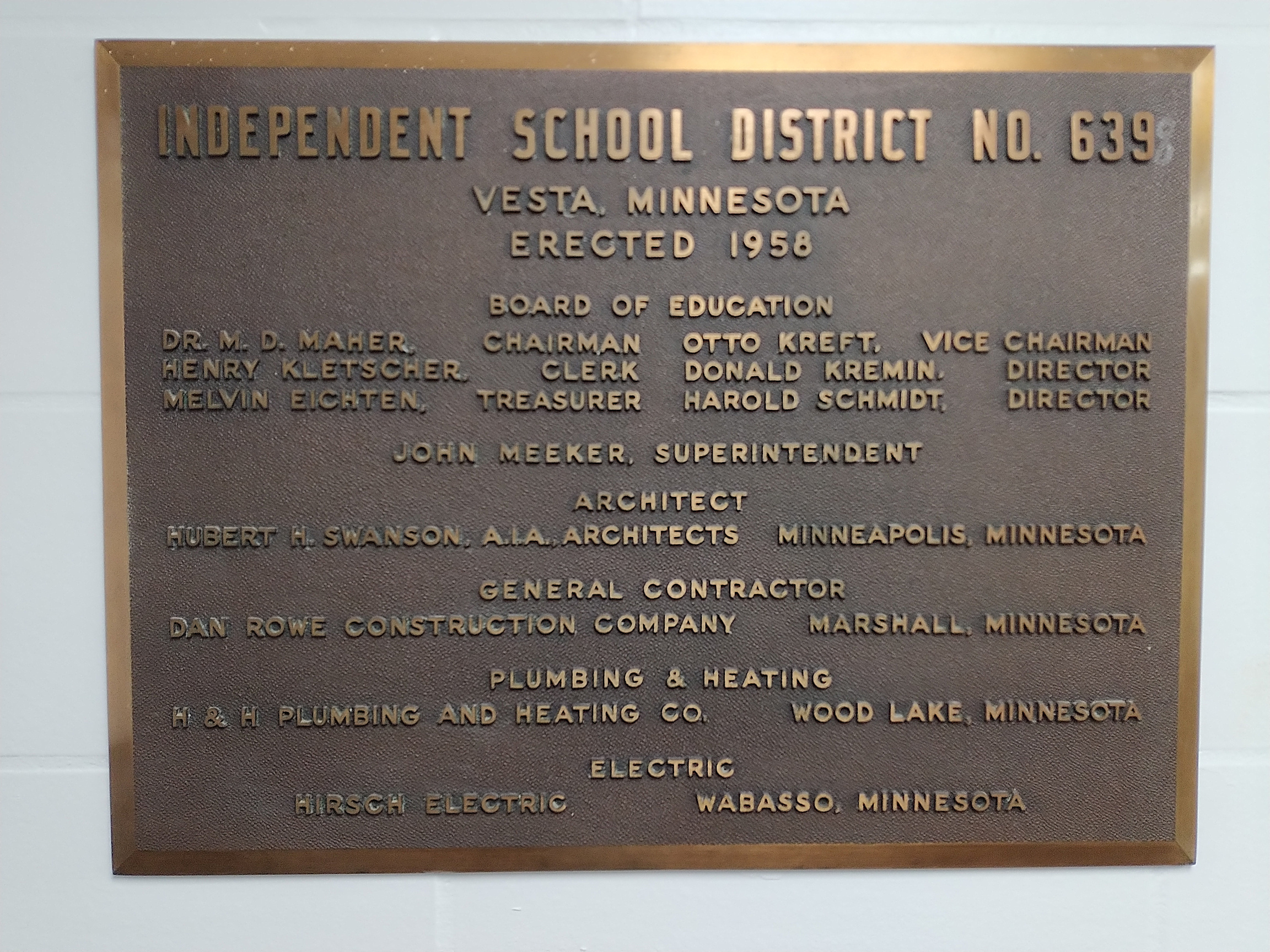
A plaque honors my grandpa and others who were instrumental in construction of Vesta Elementary School. (Minnesota Prairie Roots copyrighted photo July 2024)
We were here, in this place, because of Henry and Ida. Henry served as clerk of Independent School District #639 when the Vesta School was built in 1958. To think that, 66 years later, Grandpa’s descendants would gather here to celebrate family felt incredibly right. Two hours after we ate a potluck lunch (which always includes blueberry dessert), we honored Henry and Ida with 1919 root beer floats. My grandparents were married in November 1919.
Here we were in 2024, a family still going strong—reuniting, reconnecting, remembering and honoring the legacy of Henry and Ida Kletscher. Henry, the 25-year-old farmer, who married Ida just days before her eighteenth birthday 105 years ago.
#
FYI:In addition to the Kletscher Family Reunion, I’ve reconnected in July with Sue, a blogging friend; aunts from New Jersey and Missouri and family from Minneapolis; my son from Boston; and met three of Randy’s cousins originally from North Dakota. There are more gatherings to come with a Helbling Family Reunion in two weeks and 50-year class reunions for Randy and me in September.
Riding and performing for UniCircle Flow from Japan on July 18 at Unicon 21. (Minnesota Prairie Roots copyrighted photo July 2024)
THEY ARE TRUE ATHLETES in every sense of the word. But they are also performance artists. Recently they traveled from around the world to compete in the Freestyle Group Small category at Unicon 21 in Bemidji. That’s an international competition and championship for unicyclists.
Teams from Germany and Japan practice before the group competition begins. (Minnesota Prairie Roots copyrighted photo July 2024)
I watched the athletes practice before performances began in the Bemidji State University gym on July 18. I saw seven teams perform their choreographed routines before I headed back to a cabin near Crosslake and then home the next morning. I wish I could have stayed longer, because these athletes put on quite a show.
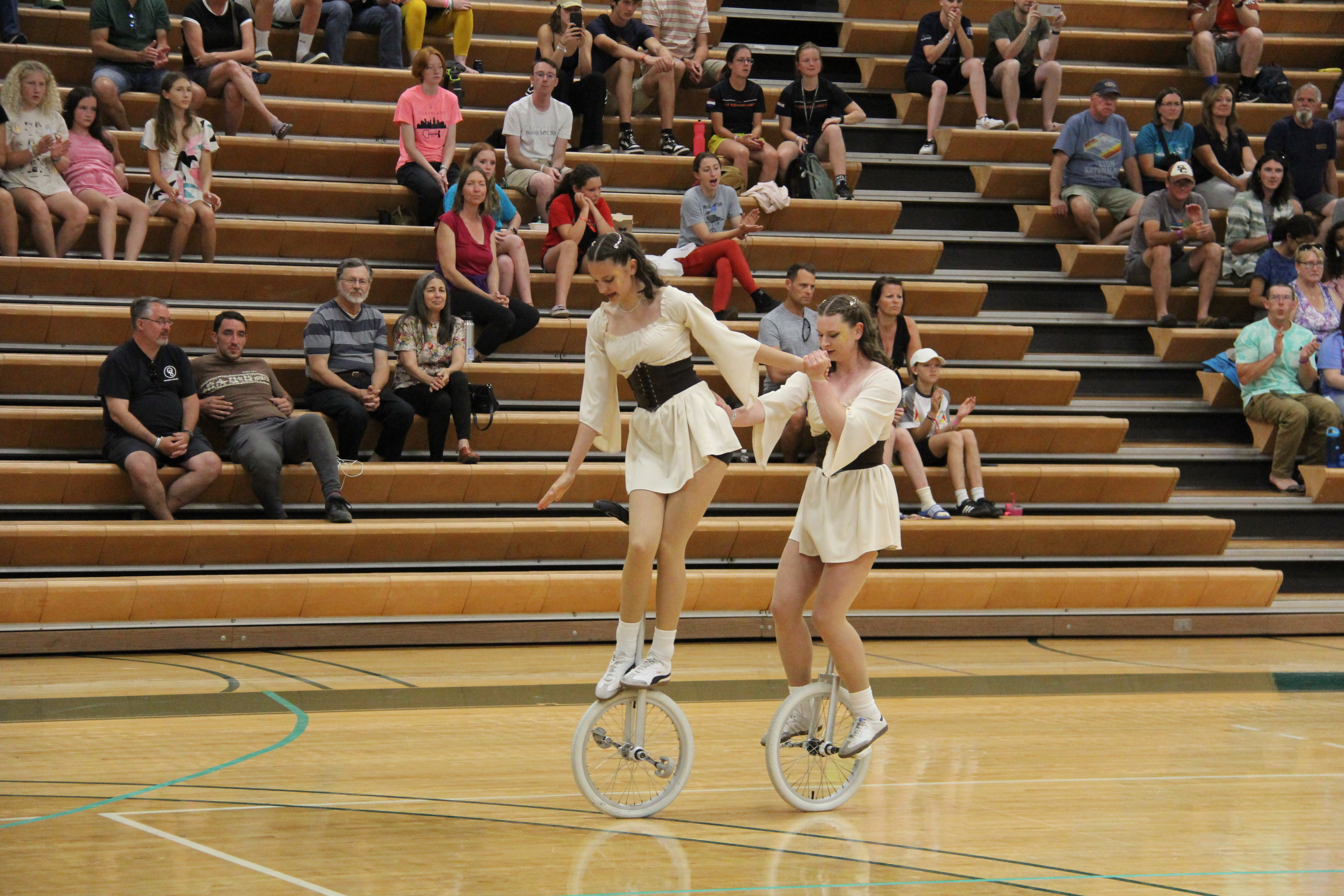
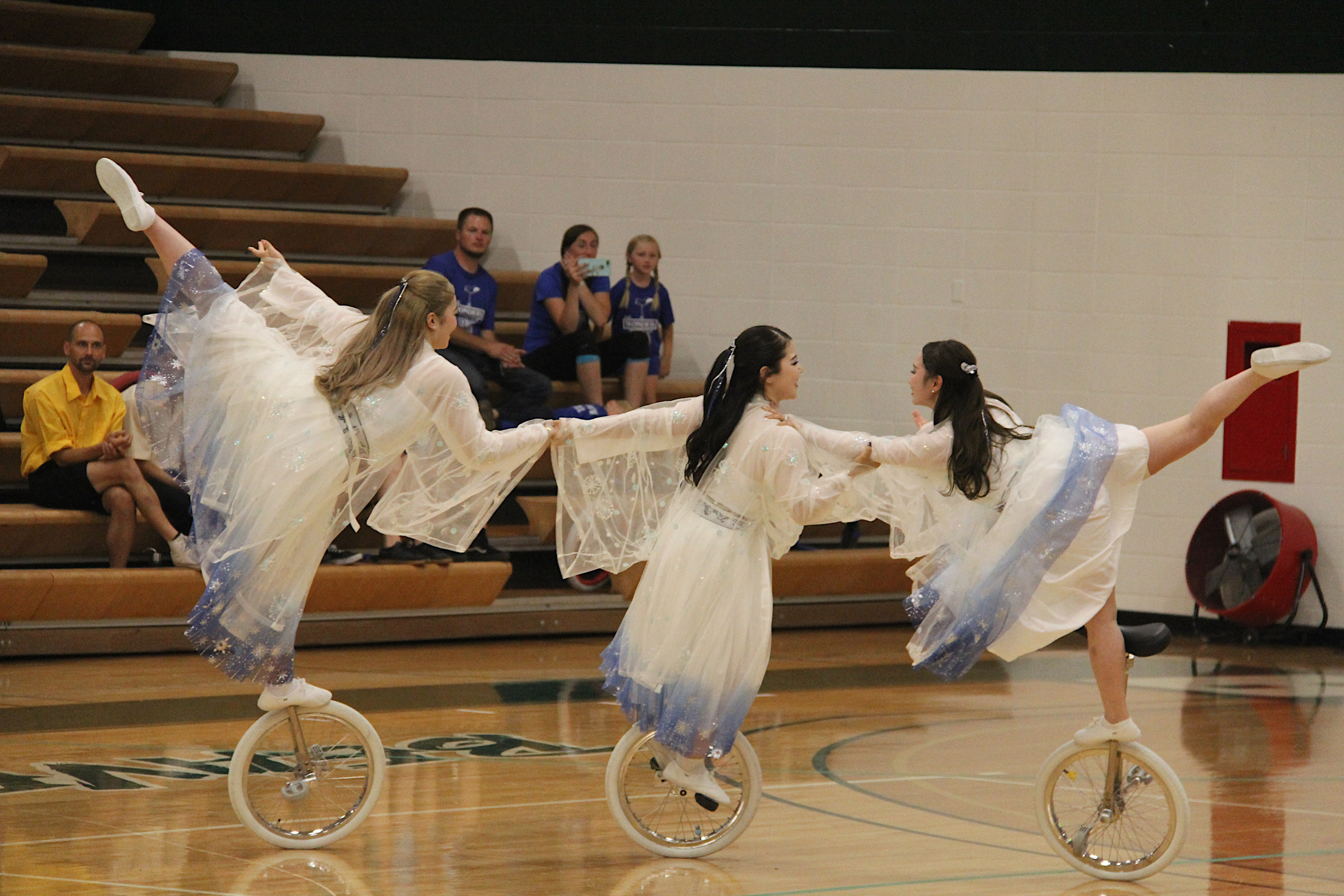
The UniCircle Flow team wheeled like figure skaters. (Minnesota Prairie Roots copyrighted photo July 2024)
Combining gymnastics, acrobatics and dance, these unicycle athletes had the crowd roaring, applauding, stomping. I was in awe of what they could do while maintaining their balance on one wheel.
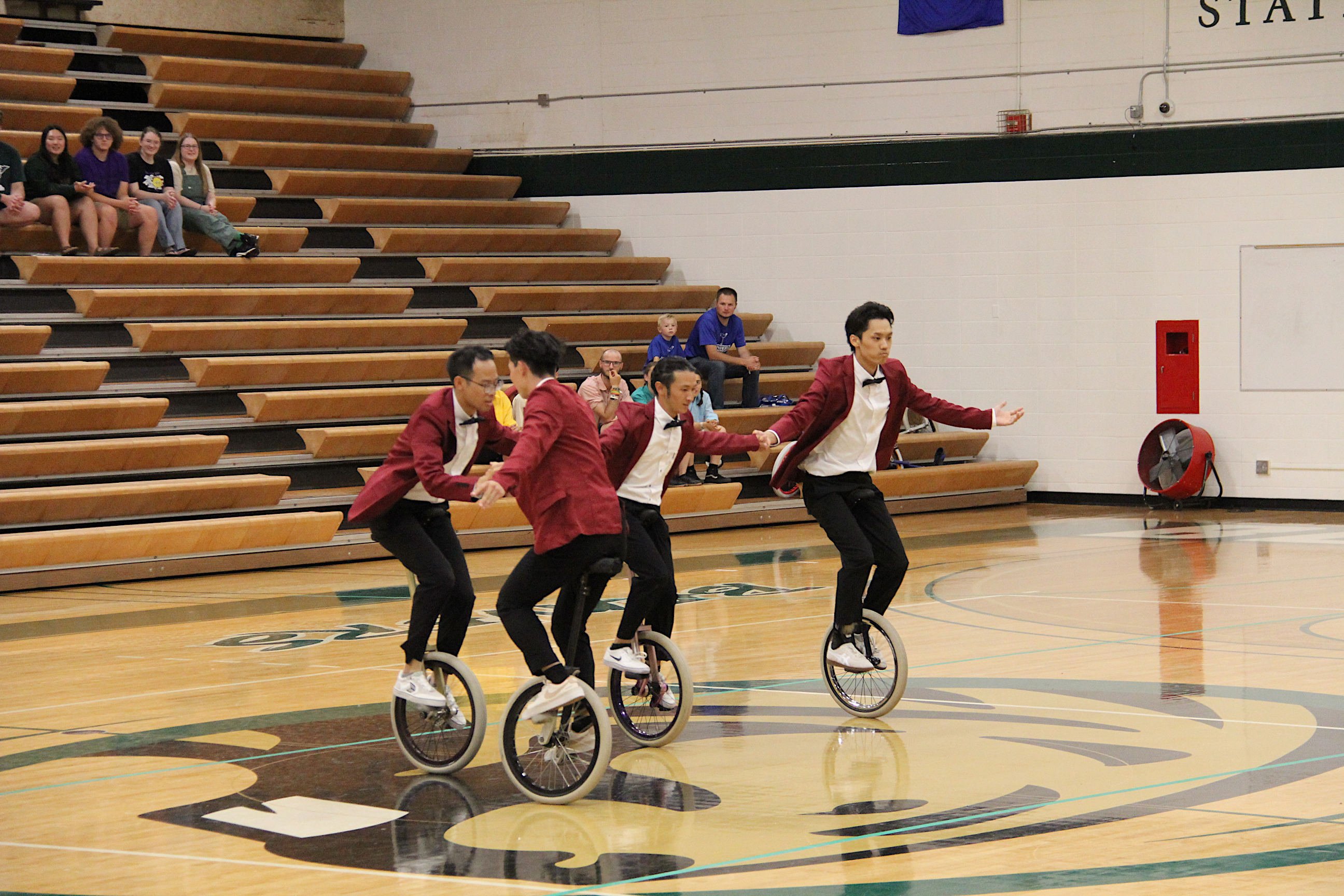
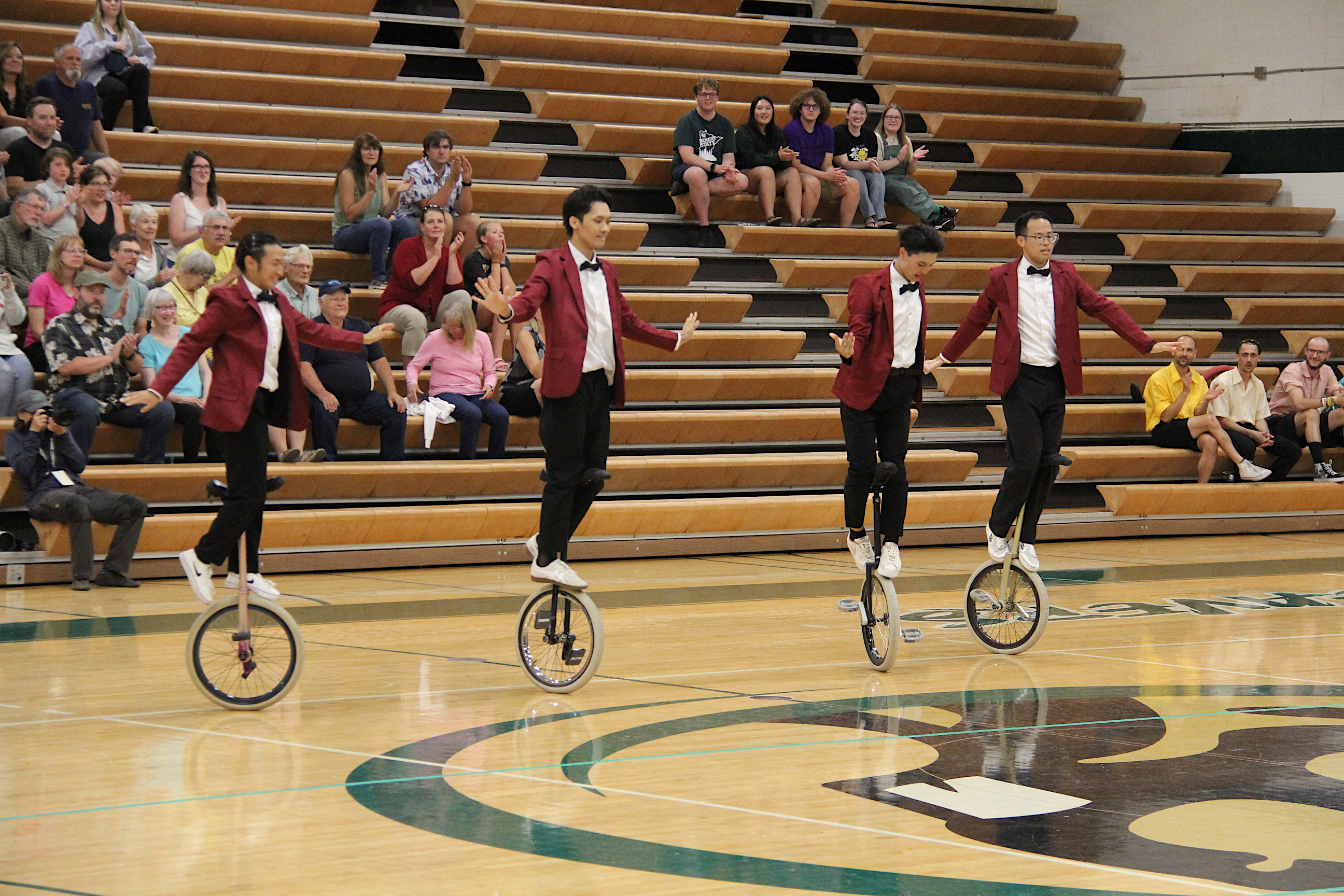
The Tokyo Boys begin their routine. (Minnesota Prairie Roots copyrighted photo July 2024)
The unicyclist on the right really played to the audience. (Minnesota Prairie Roots copyrighted photo July 2024)
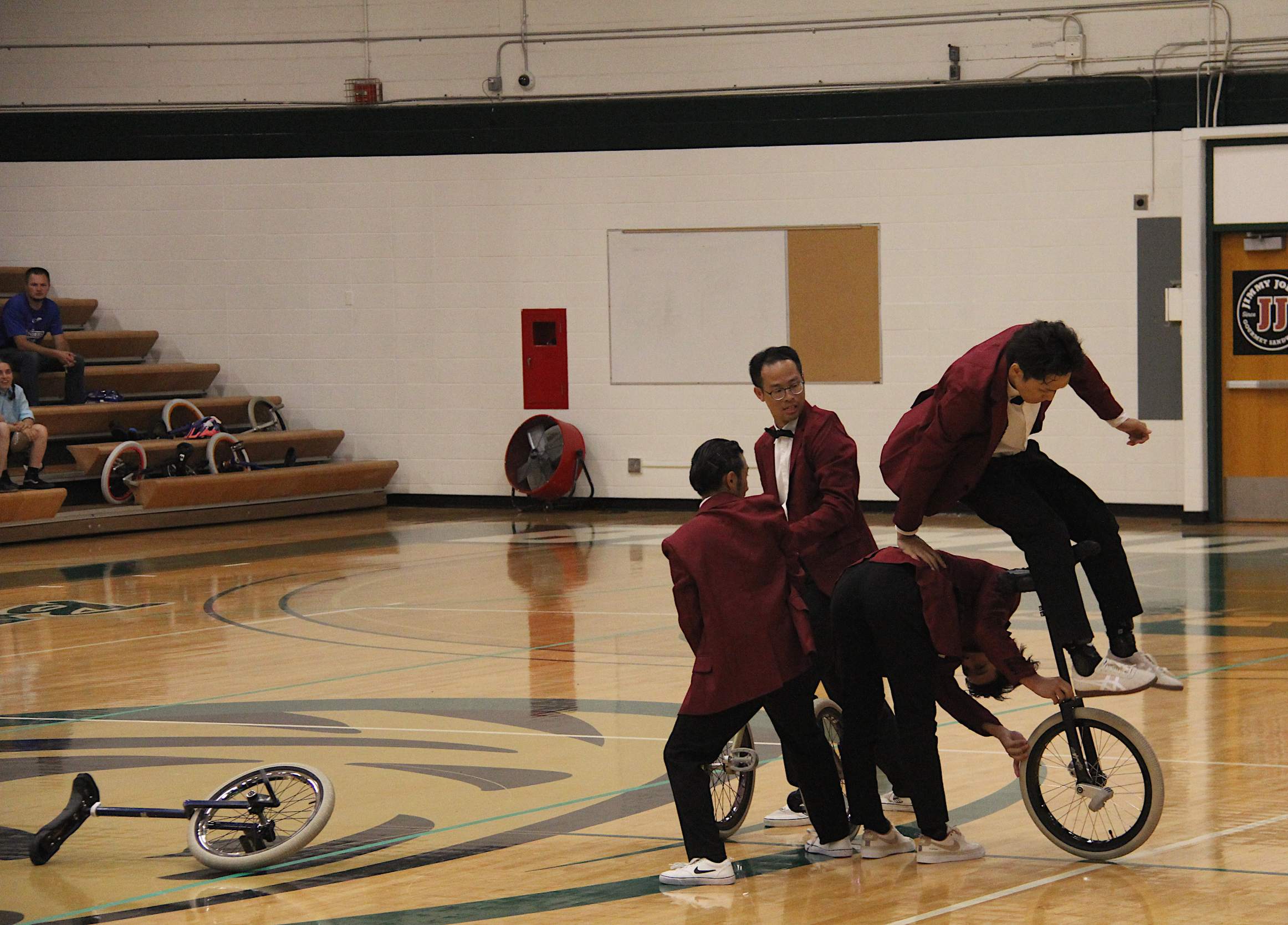
The Toyko Boys’ act even included acrobatics/gymnastics. (Minnesota Prairie Roots copyrighted photo July 2024)
The Tokyo Boys from Japan worked the crowd. They were about showmanship as much as performance in their black pants, white shirts, red jackets and bow ties. Popular boy band comparisons popped into my mind. The audience loved them. So did I.
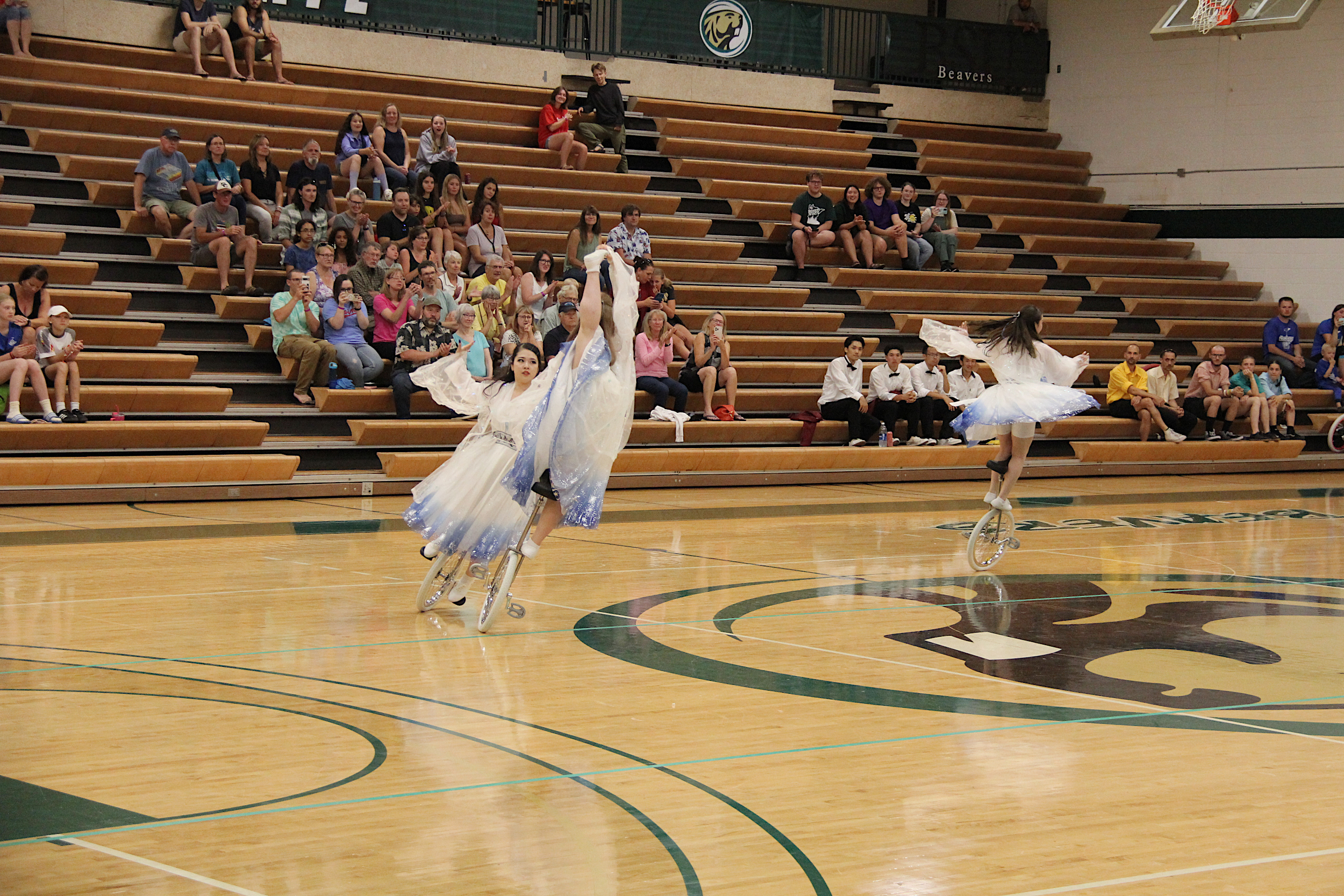
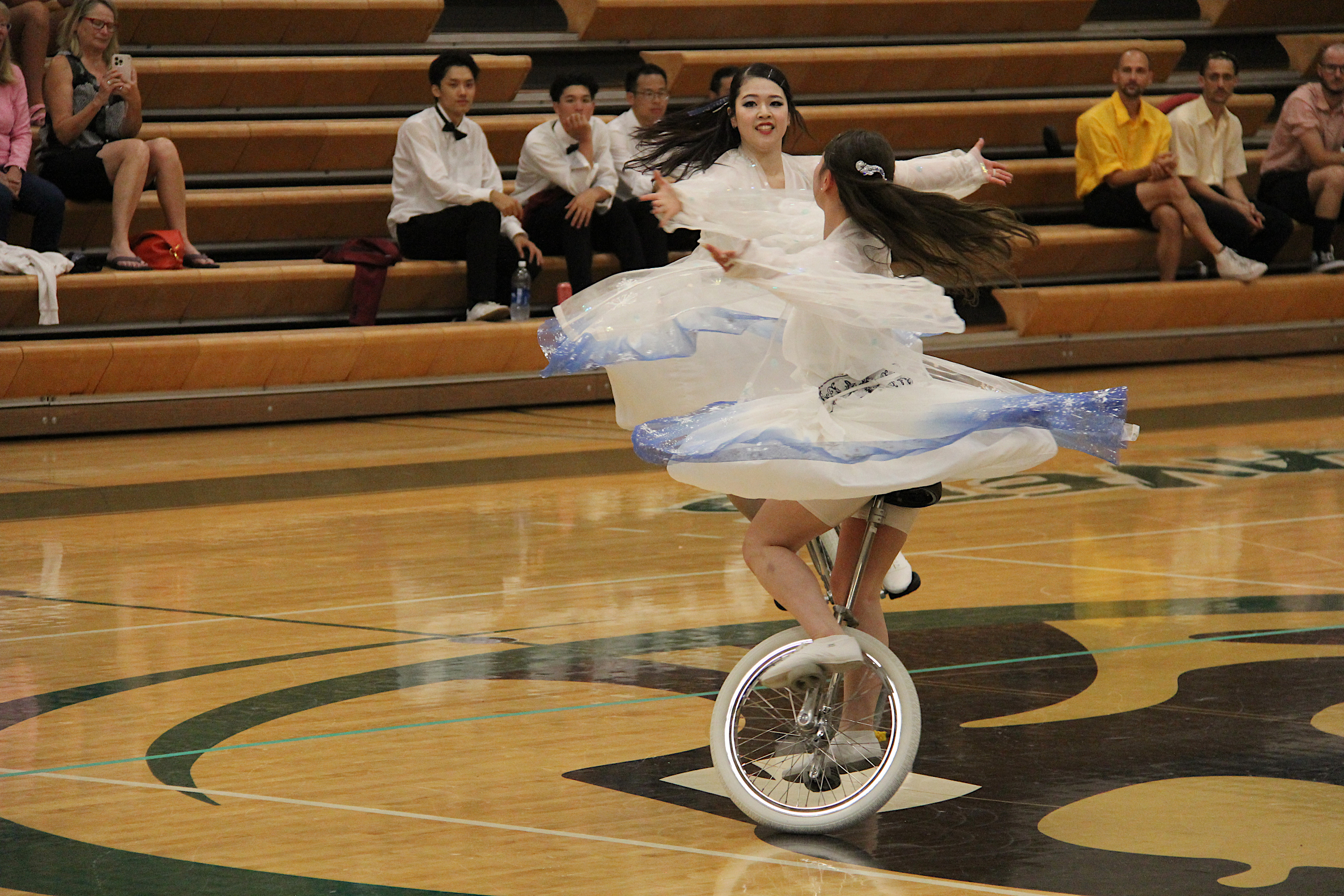
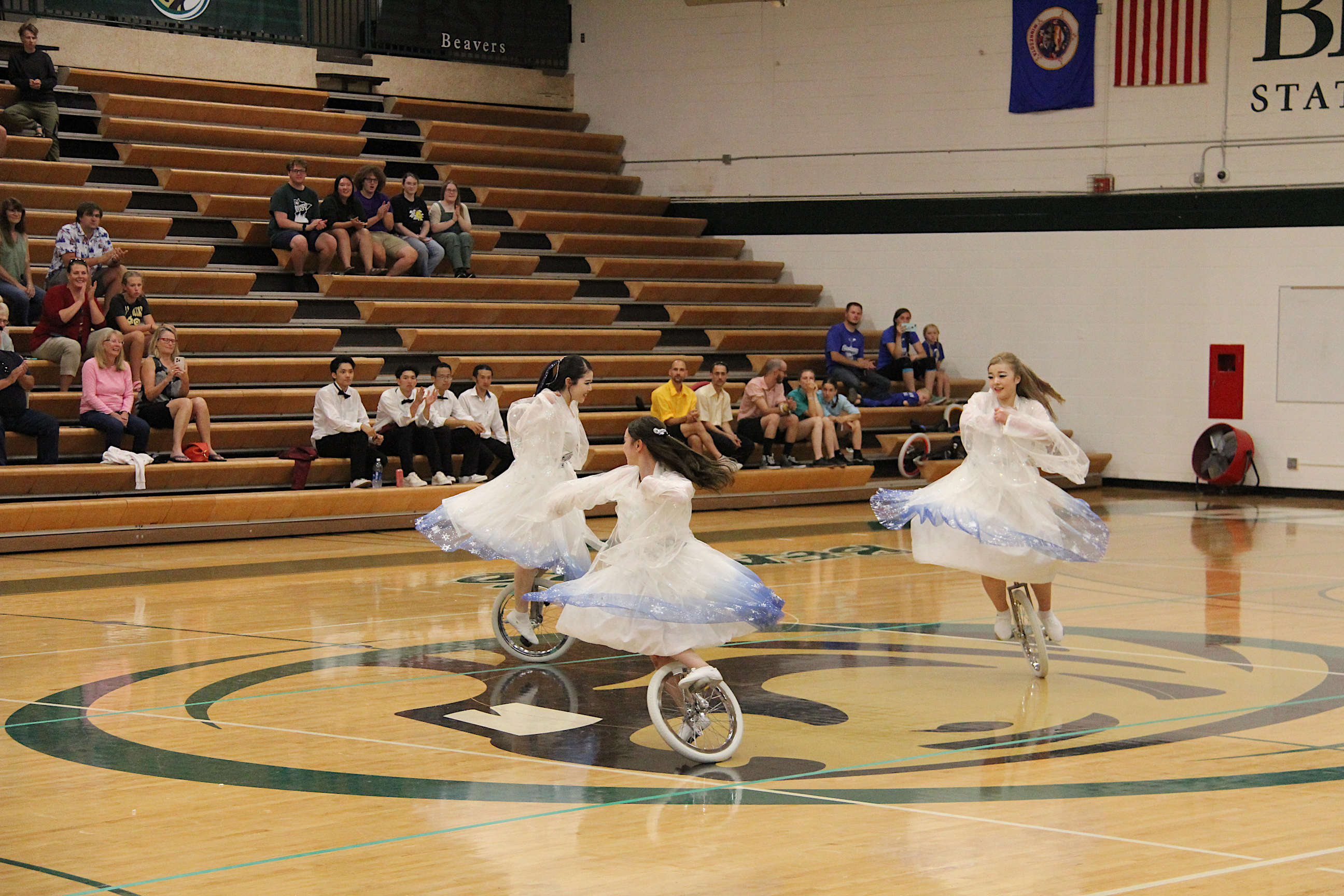
Spinning on unicycles, the UniCircle Flow team. (Minnesota Prairie Roots copyrighted photo July 2024)
UniCircle Flow spinning, a performance matching their name. (Minnesota Prairie Roots copyrighted photo July 2024)
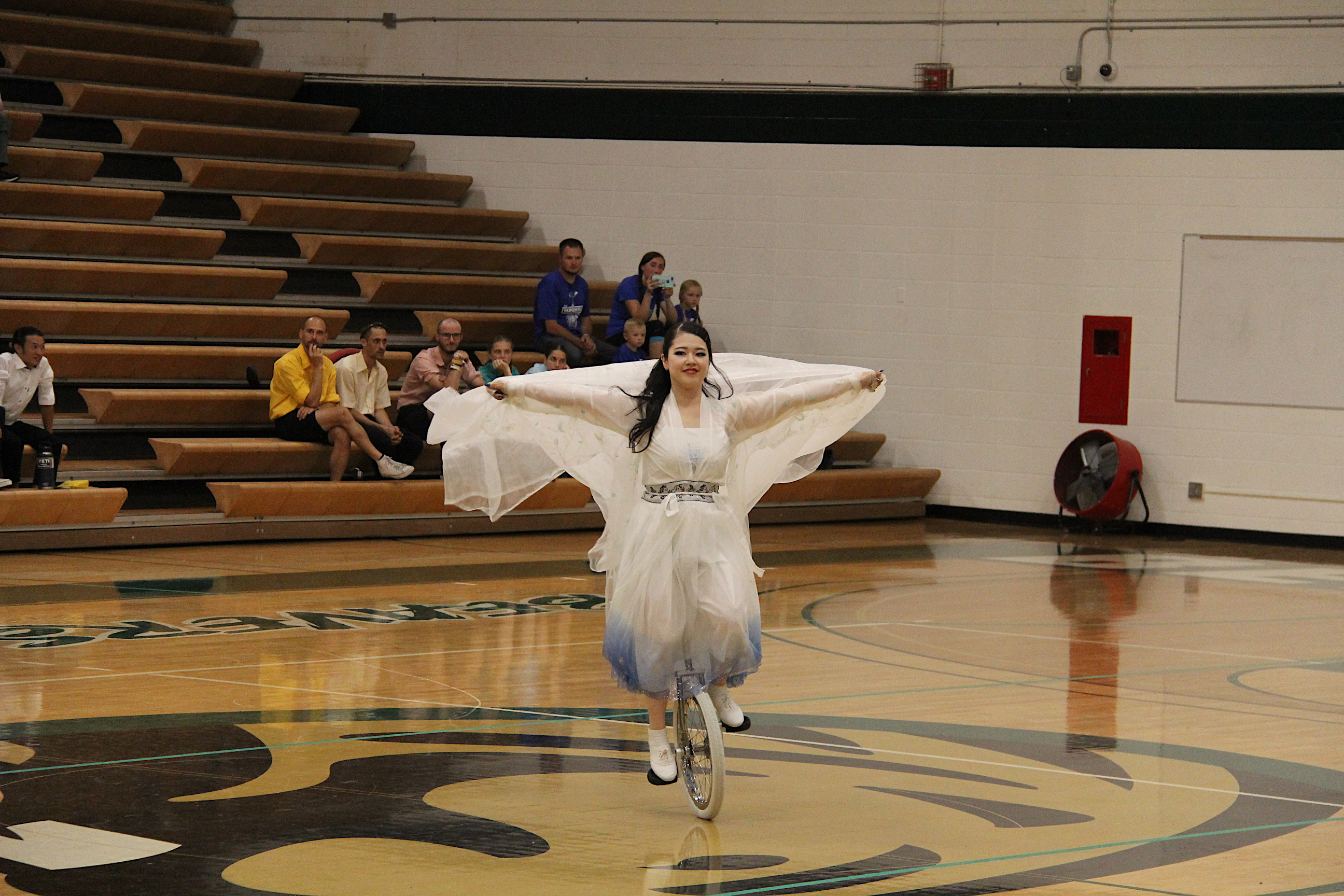
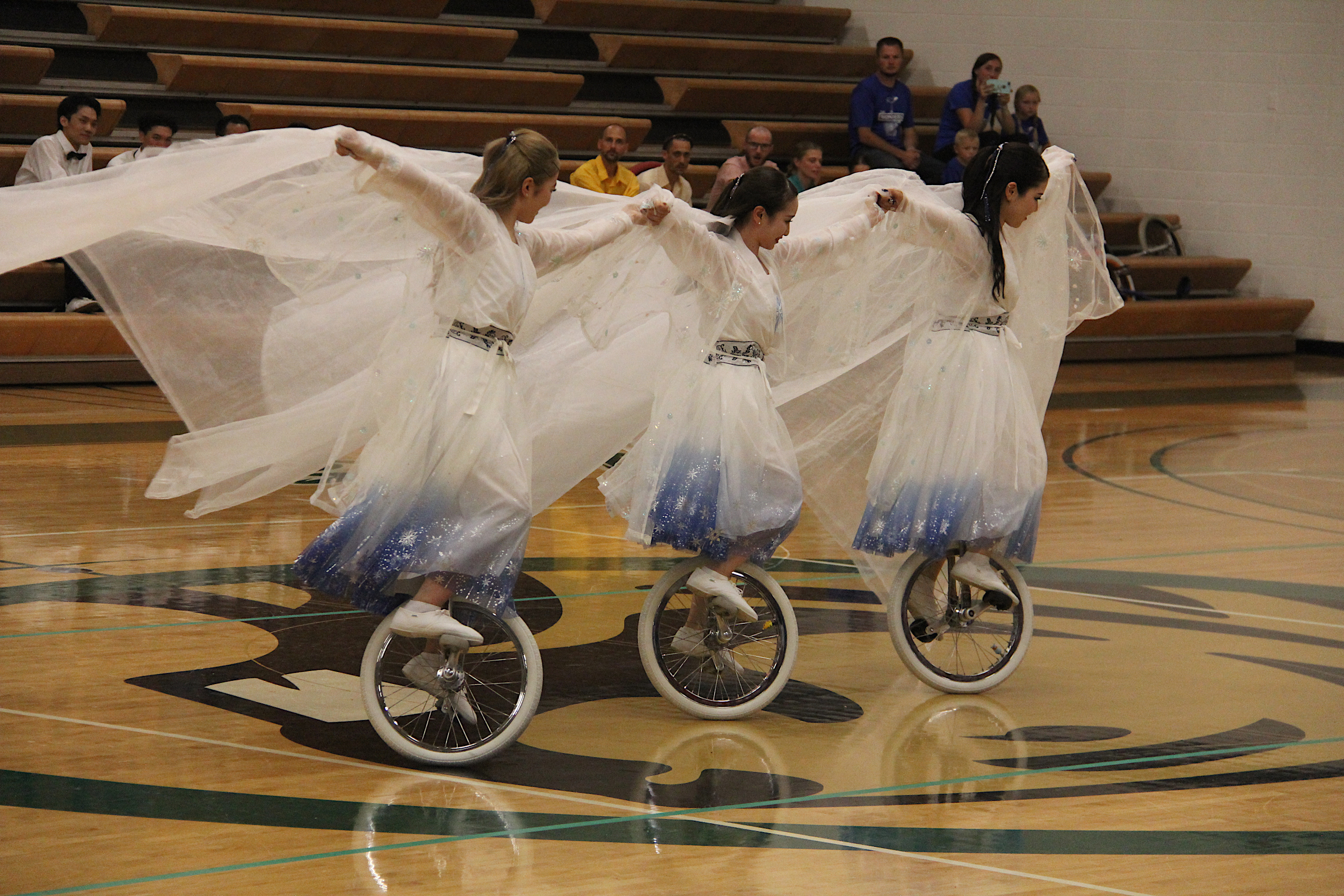
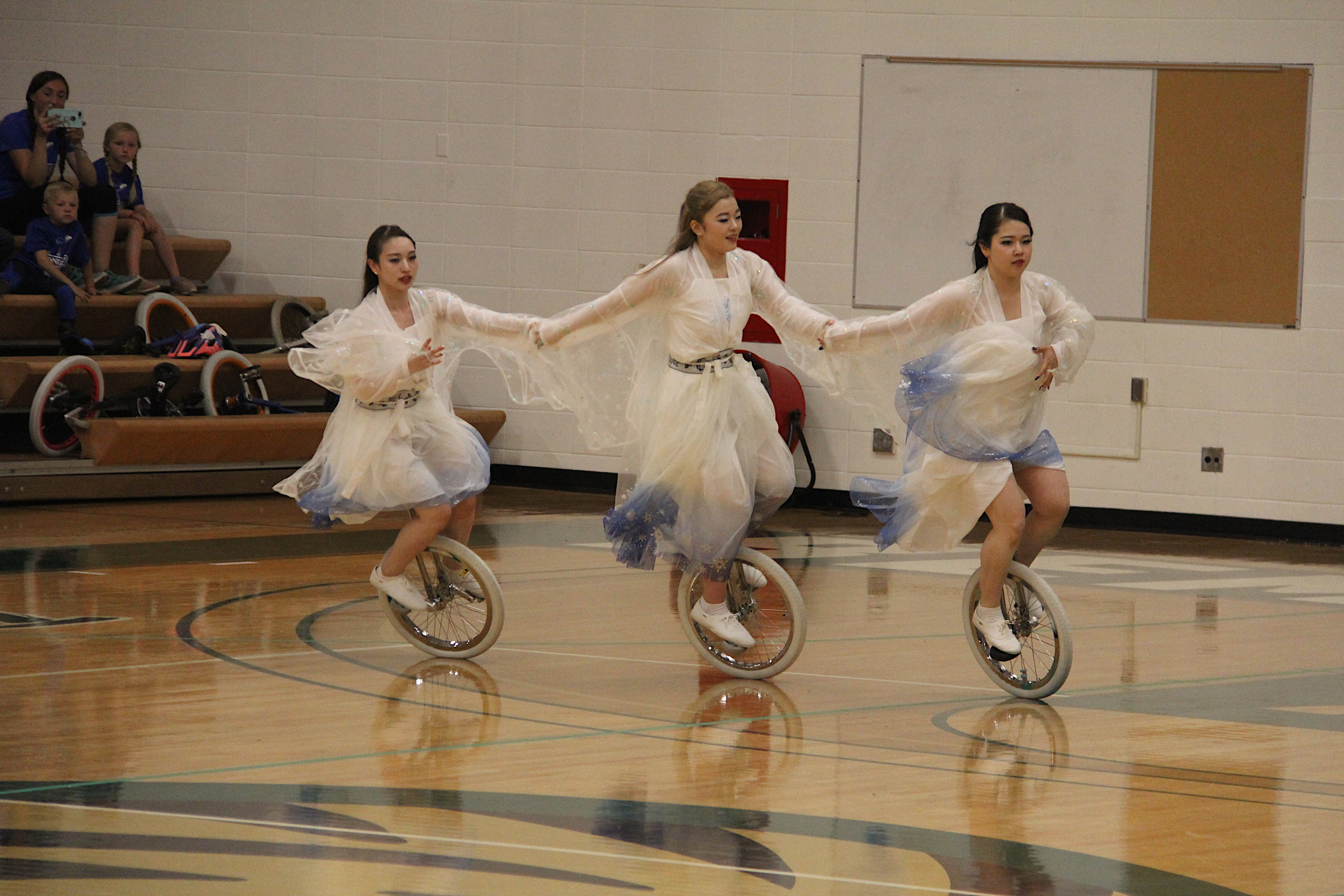
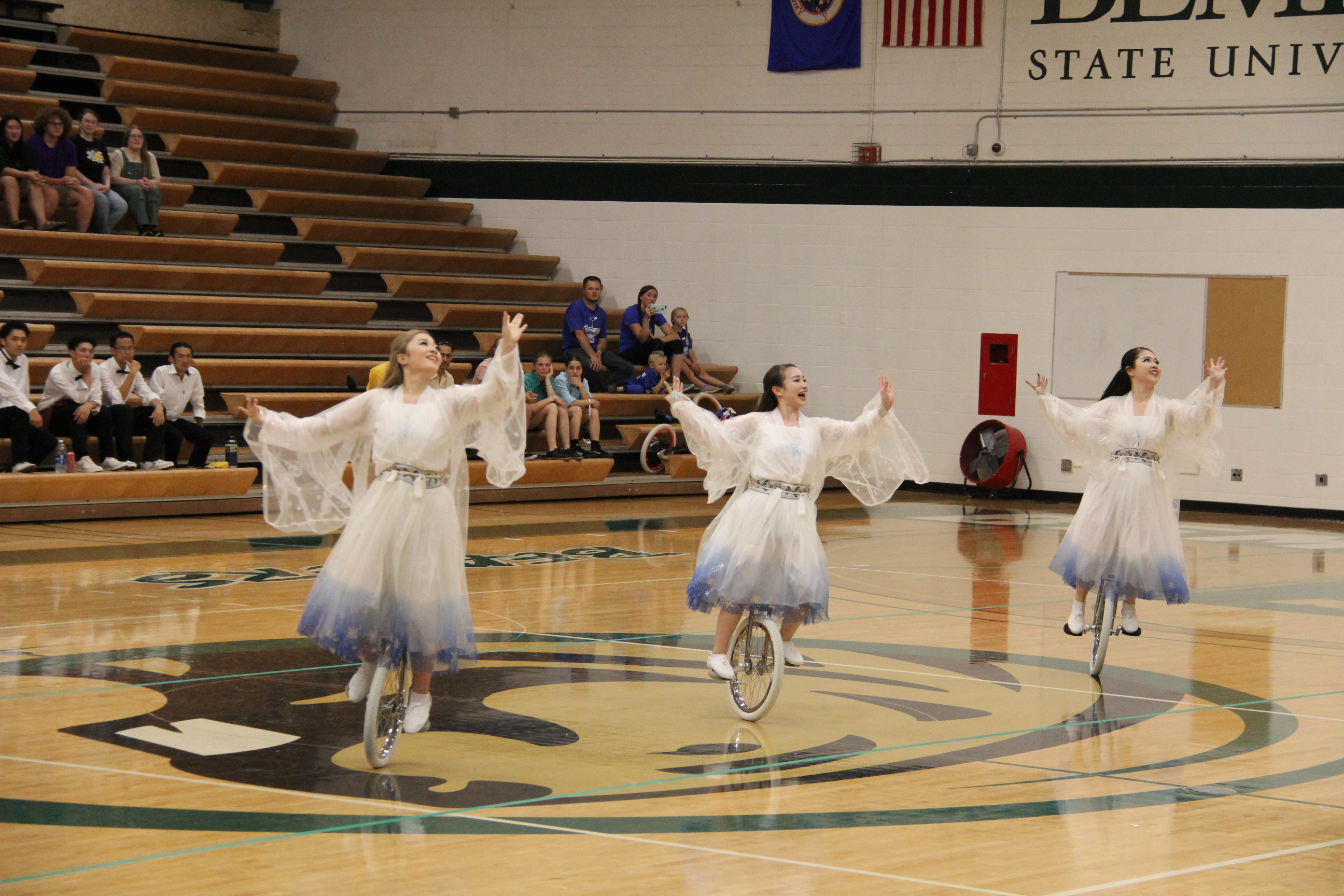
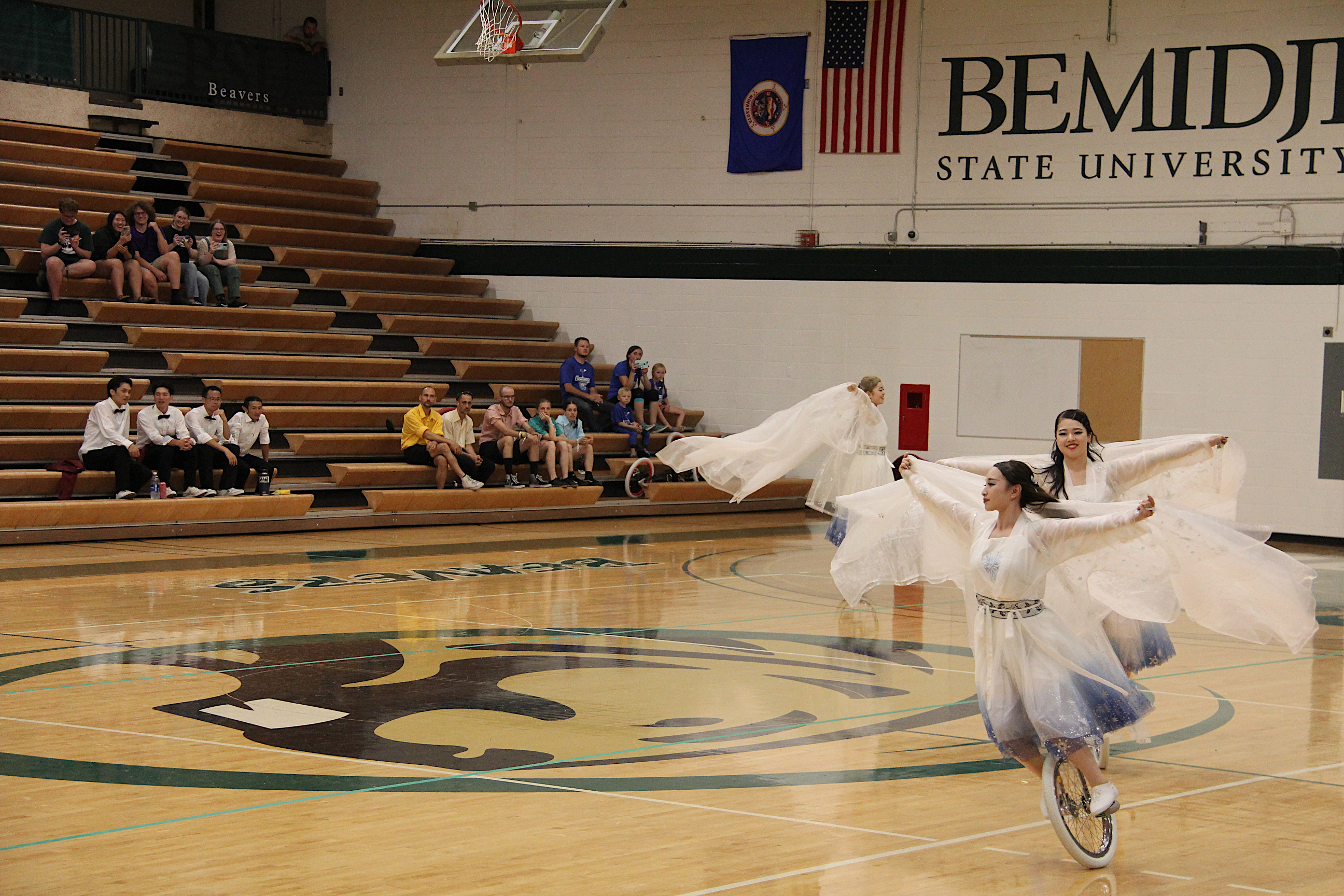
Likewise, UniCircle Flow, also from Japan, was a personal favorite. The three female athletes in gauzy white dresses edged in blue twirled across the gym floor like ballerinas or figure skaters. It was easy to forget they were actually dancing on unicycles rather than on their feet. Their performance flowed with ease and grace, not what I would ever expect while unicycling.
The Black Pearl Group from Germany shows off their unicycling acrobatics in group competition. (Minnesota Prairie Roots copyrighted photo July 2024)
I also watched several teams from Germany and a family of three from The Wonders Unicycle Club participate in the Freestyle group competition.
UniCircle Flow circles the gym together. (Minnesota Prairie Roots copyrighted photo July 2024)
UniCircle Flow leans on each other during their routine. (Minnesota Prairie Roots copyrighted photo July 2024)
Every single unicyclist, every team, impressed me. To see this level of skill, this talent right here in Minnesota was a once-in-a-lifetime opportunity. I am grateful my unicycling son flew in from Boston to attend Unicon 21 and that his dad and I had to pick him up from Bemidji.
UniCircle Flow strikes a graceful pose during their performance. (Minnesota Prairie Roots copyrighted photo July 2024)
And to think the road to this international unicycling competition started many years ago when we gifted our then grade school son with a unicycle for Christmas. Oh, the choices we make…and where they lead.
#
NOTE: Check back for more photos of the Freestyle Small Group competition and more as I continue my coverage of Unicon 21, held July 14-26 in northern Minnesota.
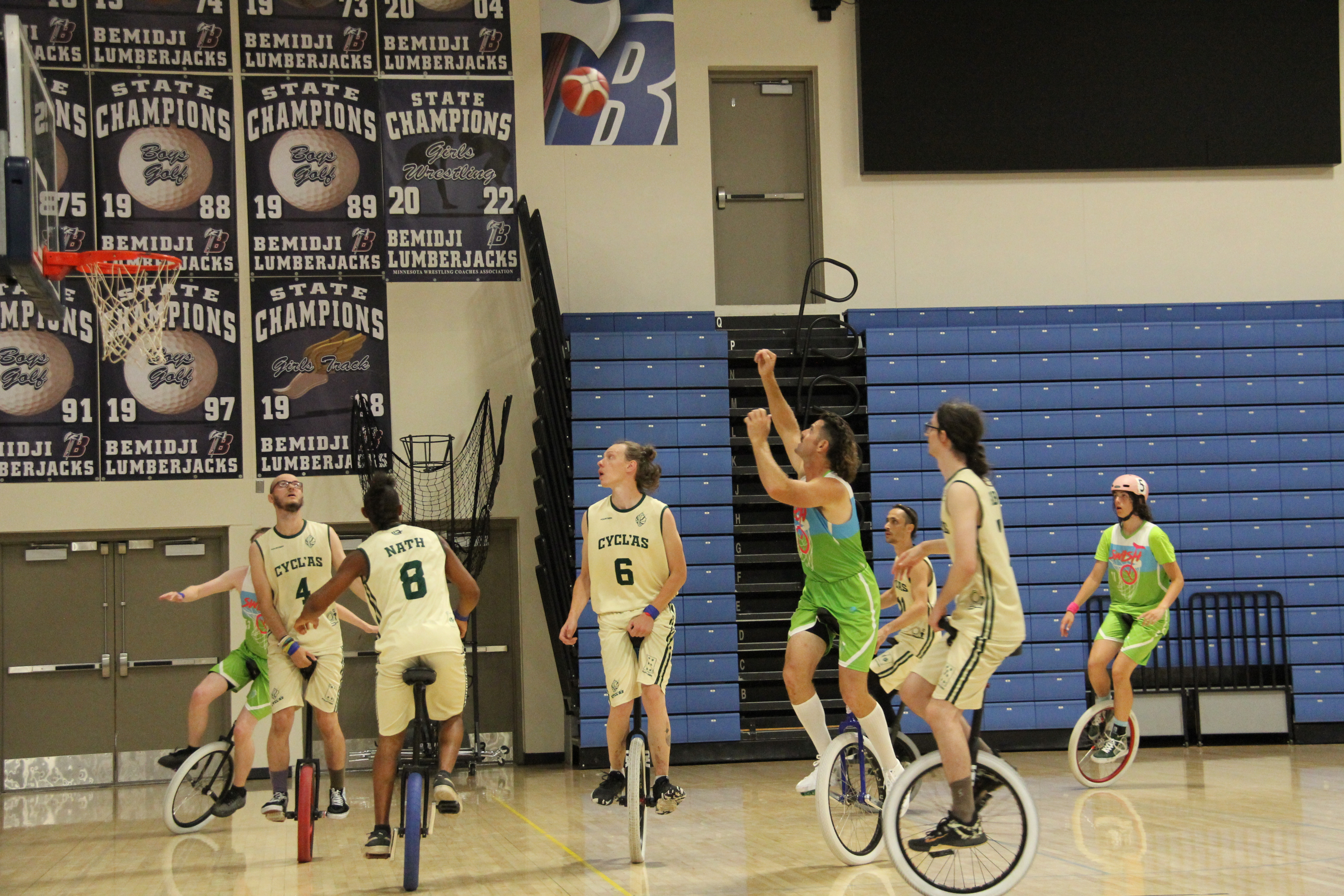
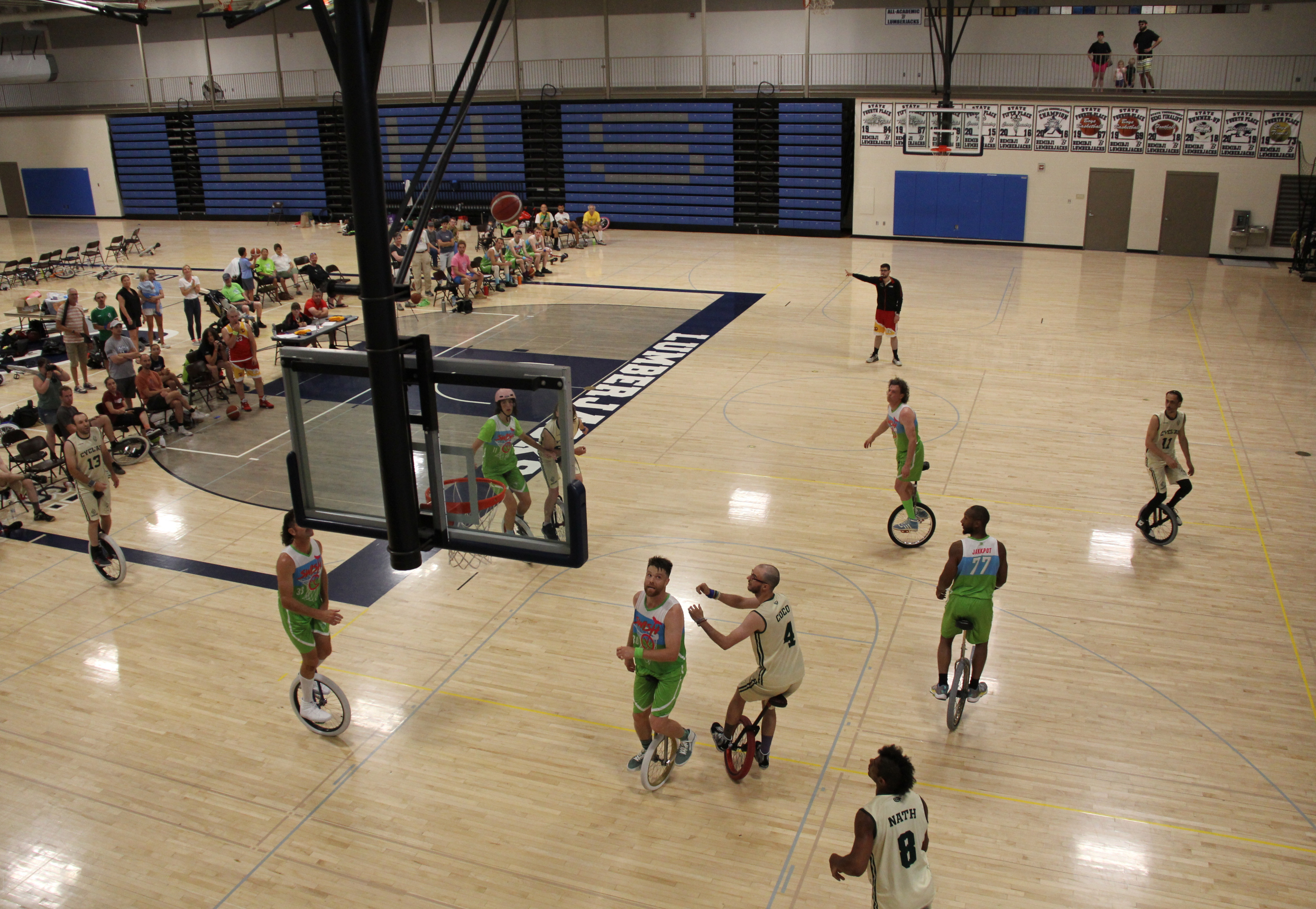
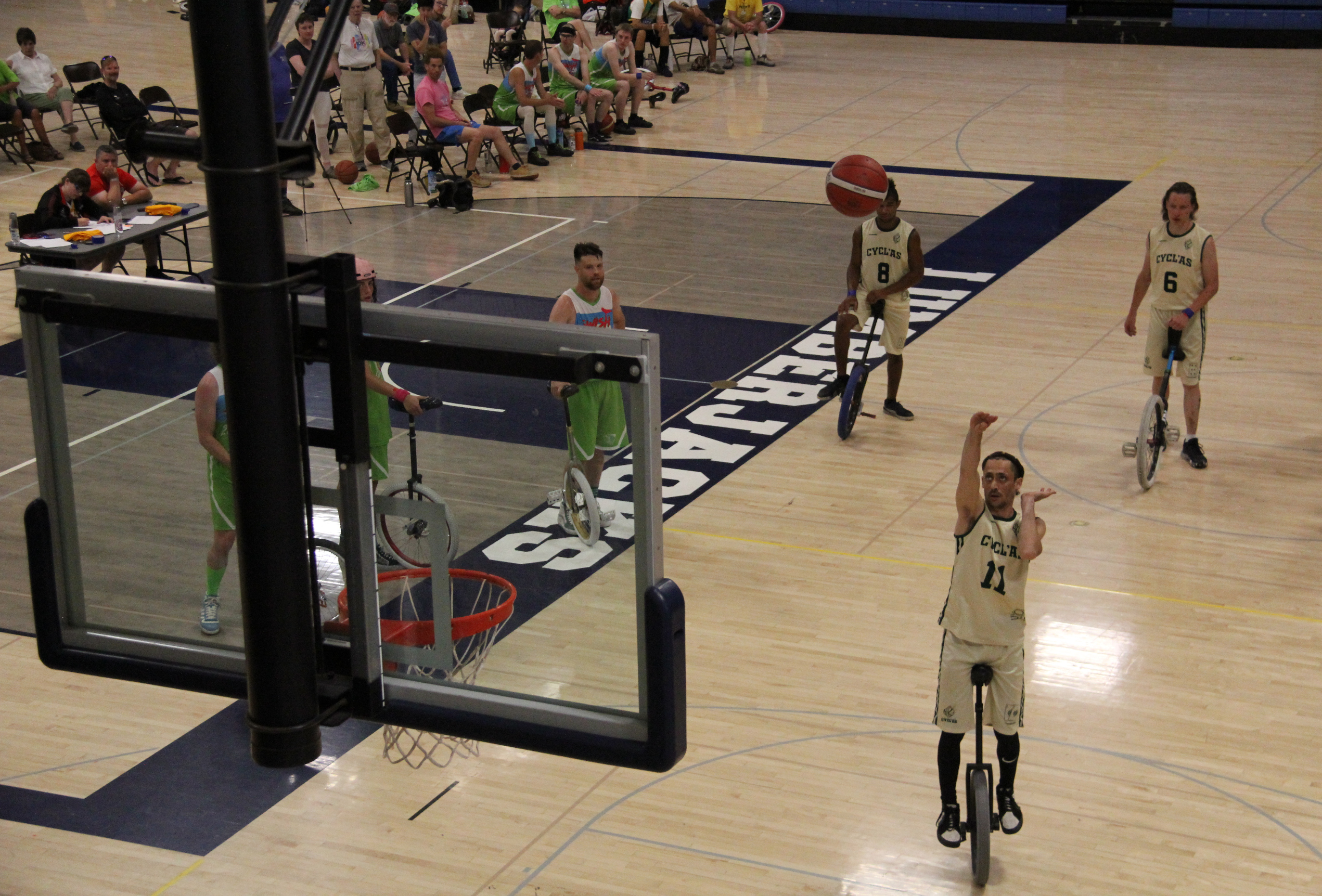
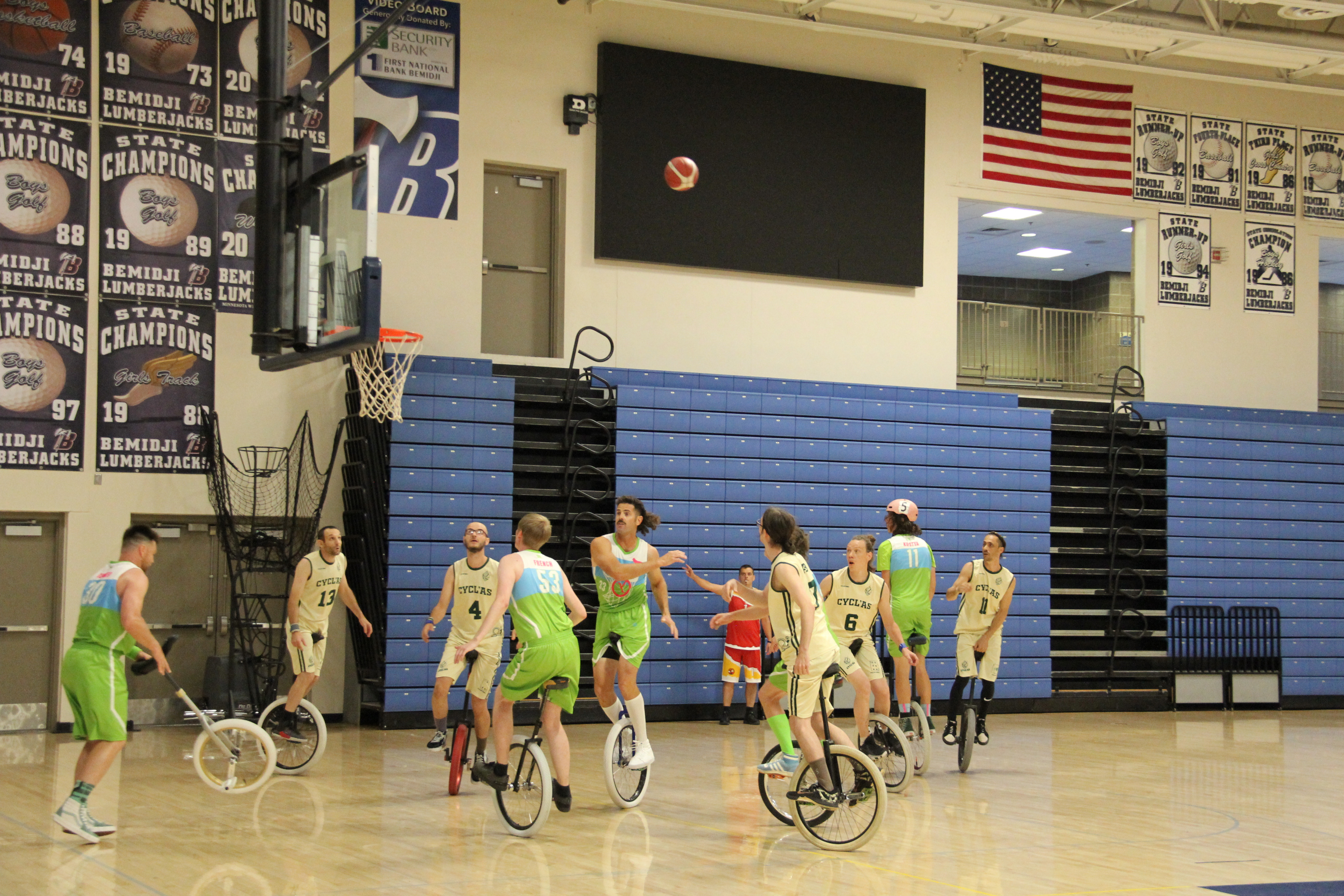
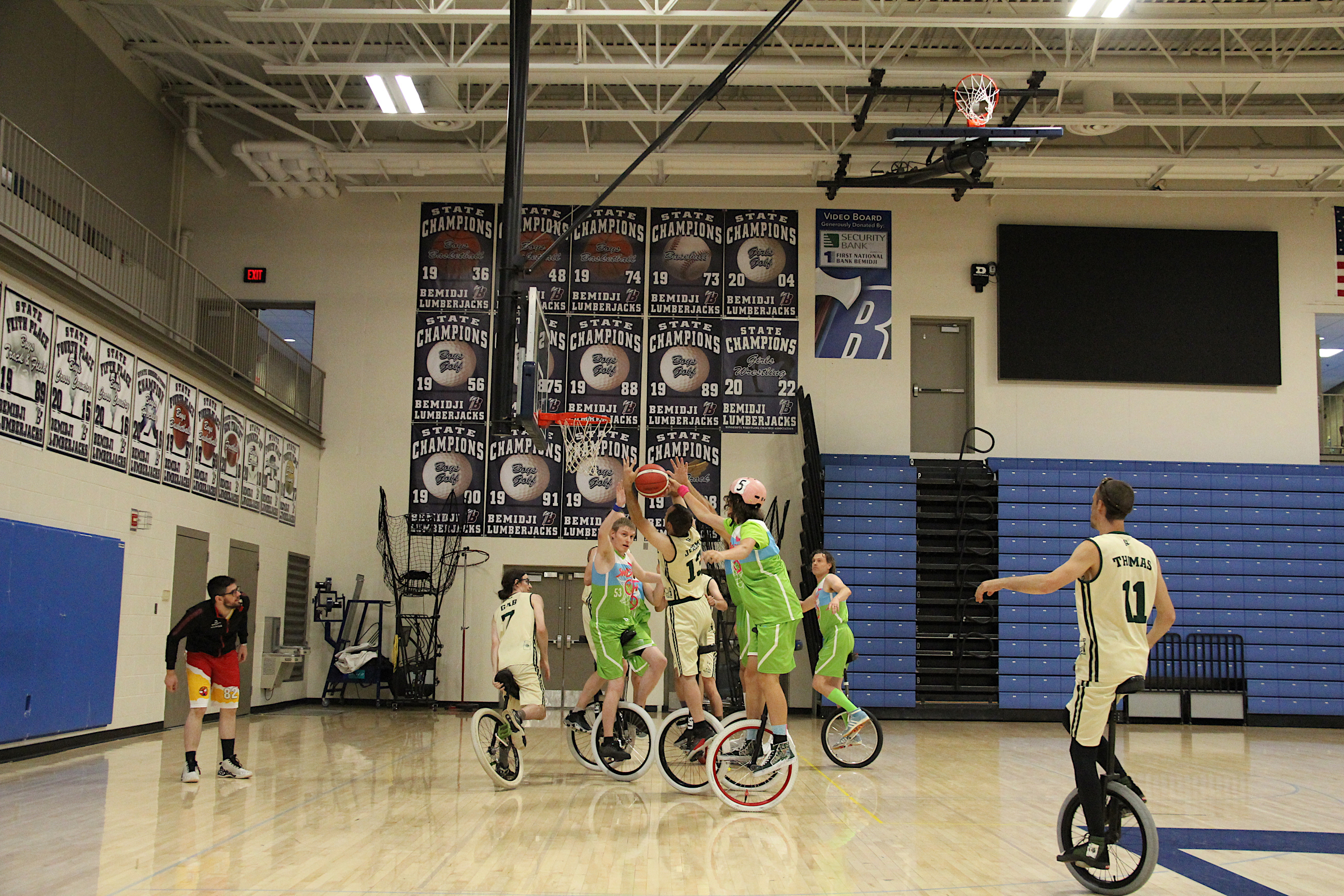
A Swish player shoots a basket in a July 18 game against a French team. (Minnesota Prairie Roots copyrighted photo July 2024)
SWISH, AND HE SCORES. Or Swish, they score.
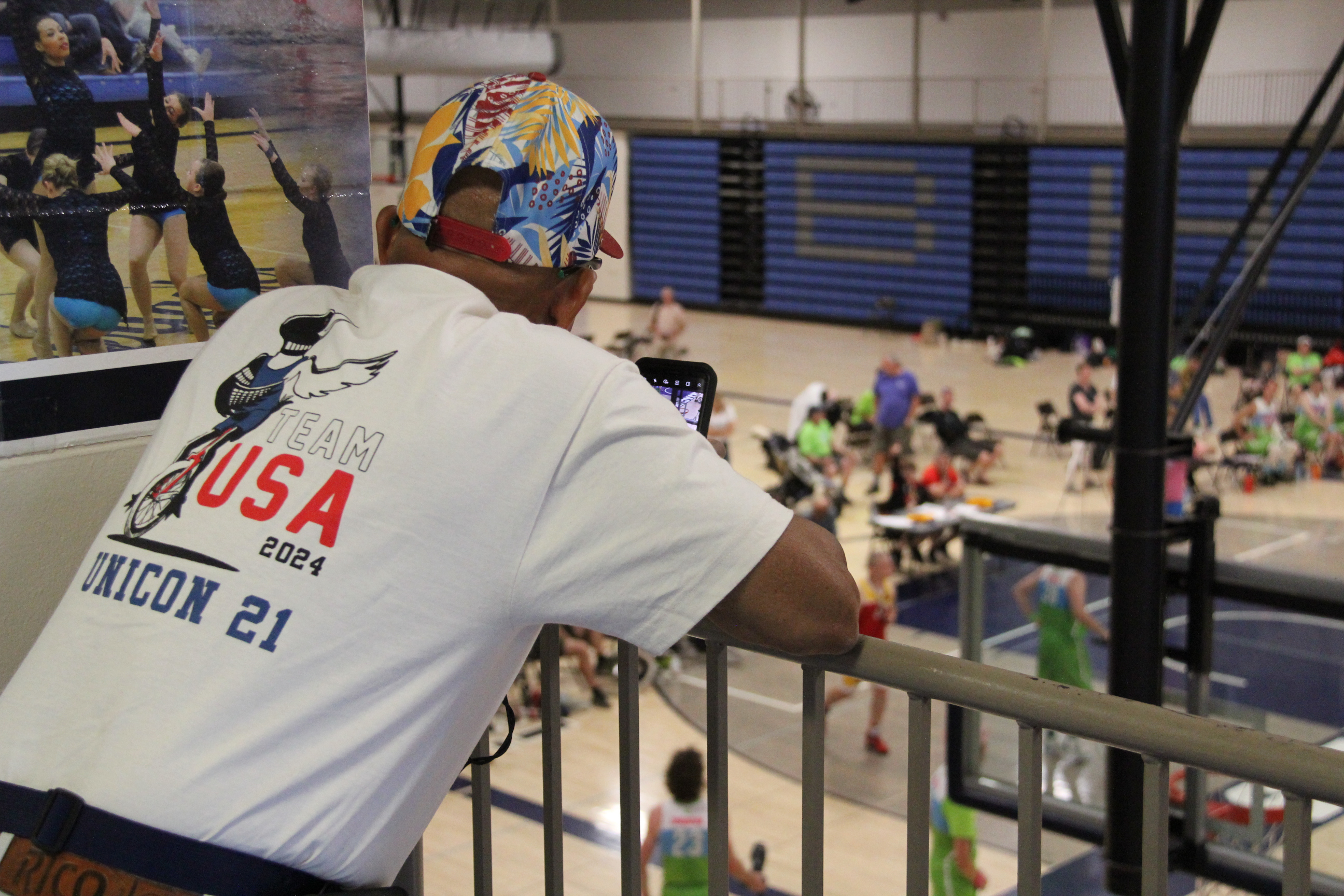
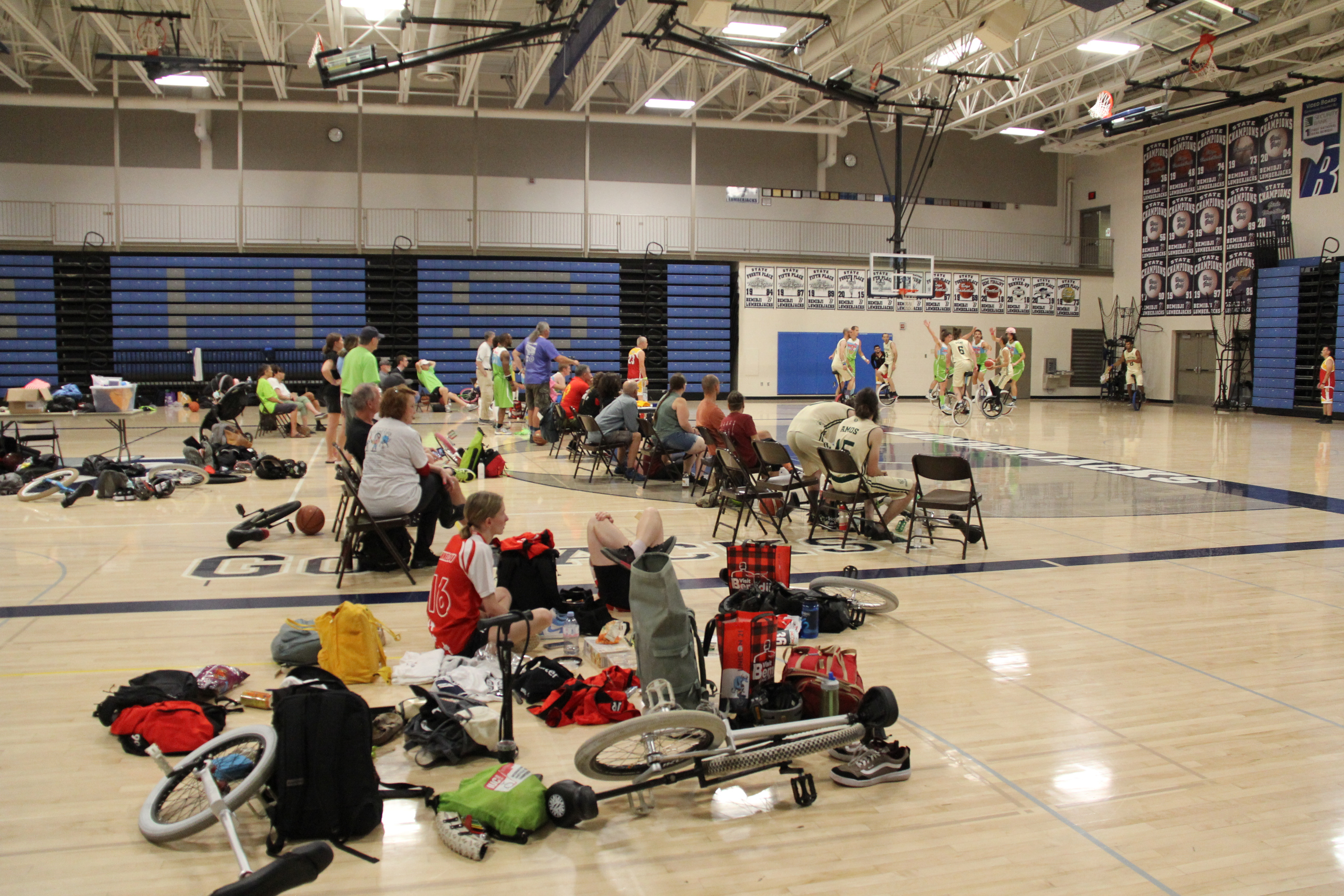
The scene from the balcony. (Minnesota Prairie Roots copyrighted photo July 2024)
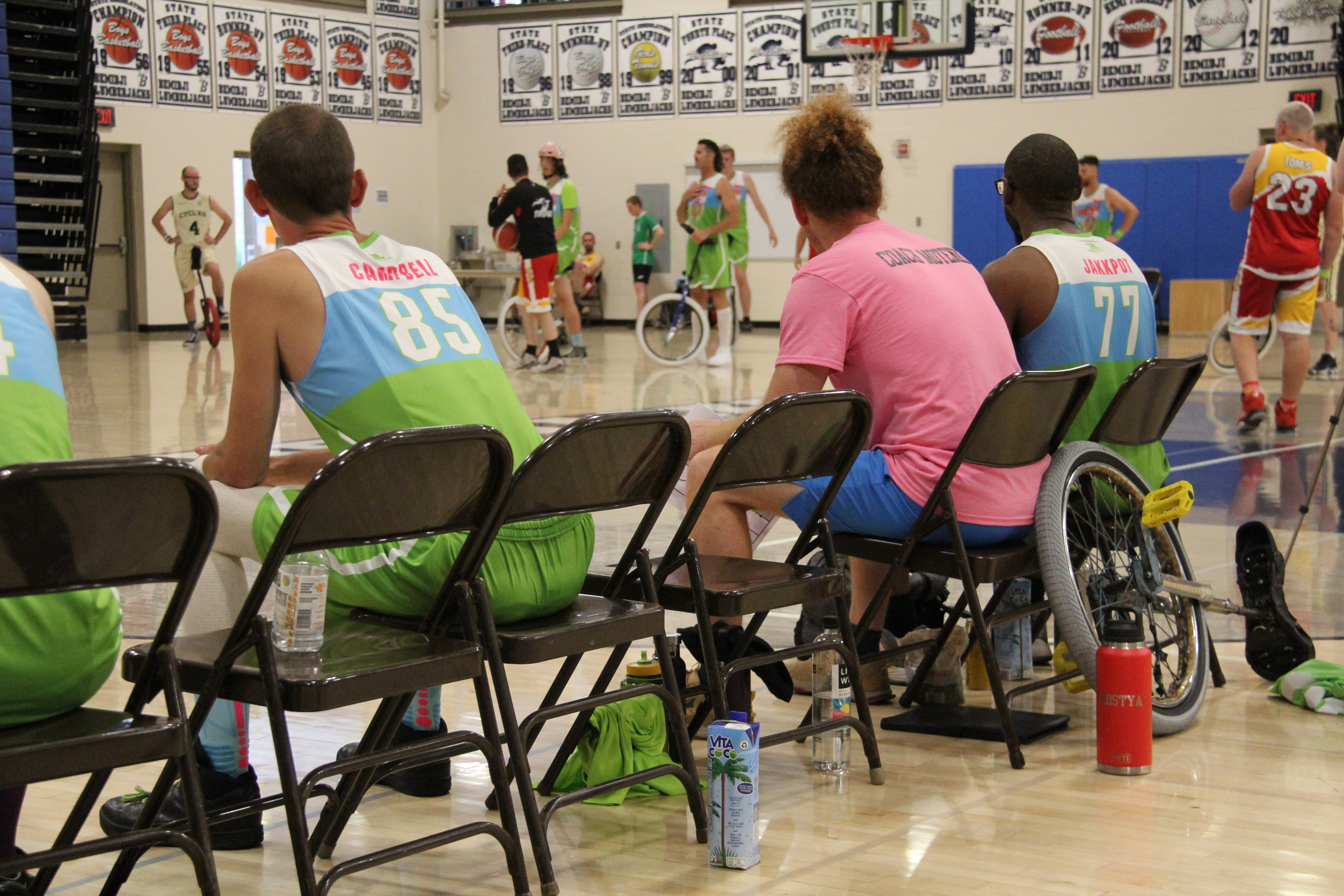
I love the Swish uniform graphic with a basketball and unicycle overlapping. (Minnesota Prairie Roots copyrighted photo July 2024)
Things were pretty informal with folding chairs serving as team benches. (Minnesota Prairie Roots copyrighted photo July 2024)
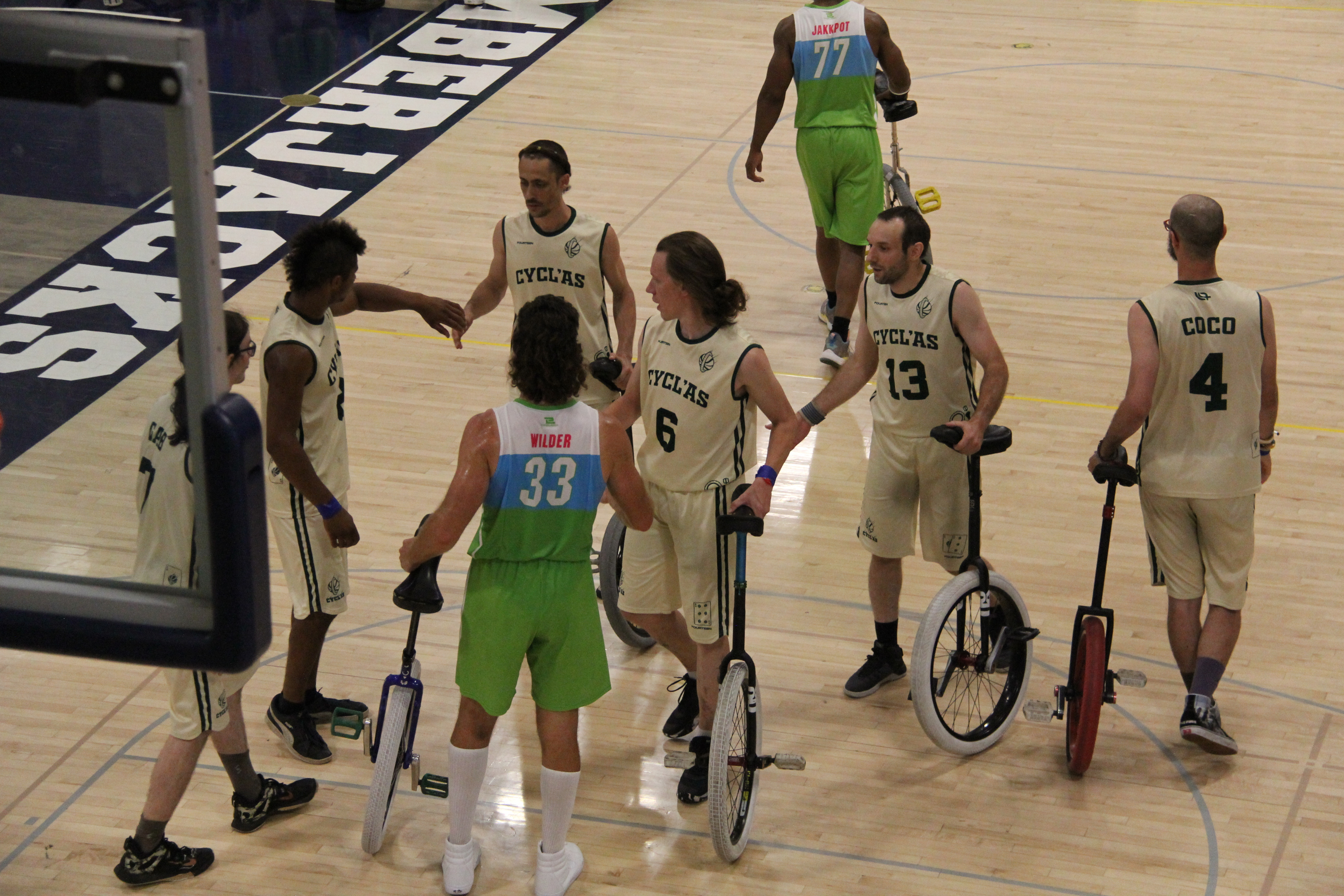
Swish, a team from California, earned the bronze medal in unicycling basketball competition this week at Unicon 21, the international unicycling convention held in Bemidji July 14-26. I saw them play early on against a French team in the high school gym. They lost that match in a close game.
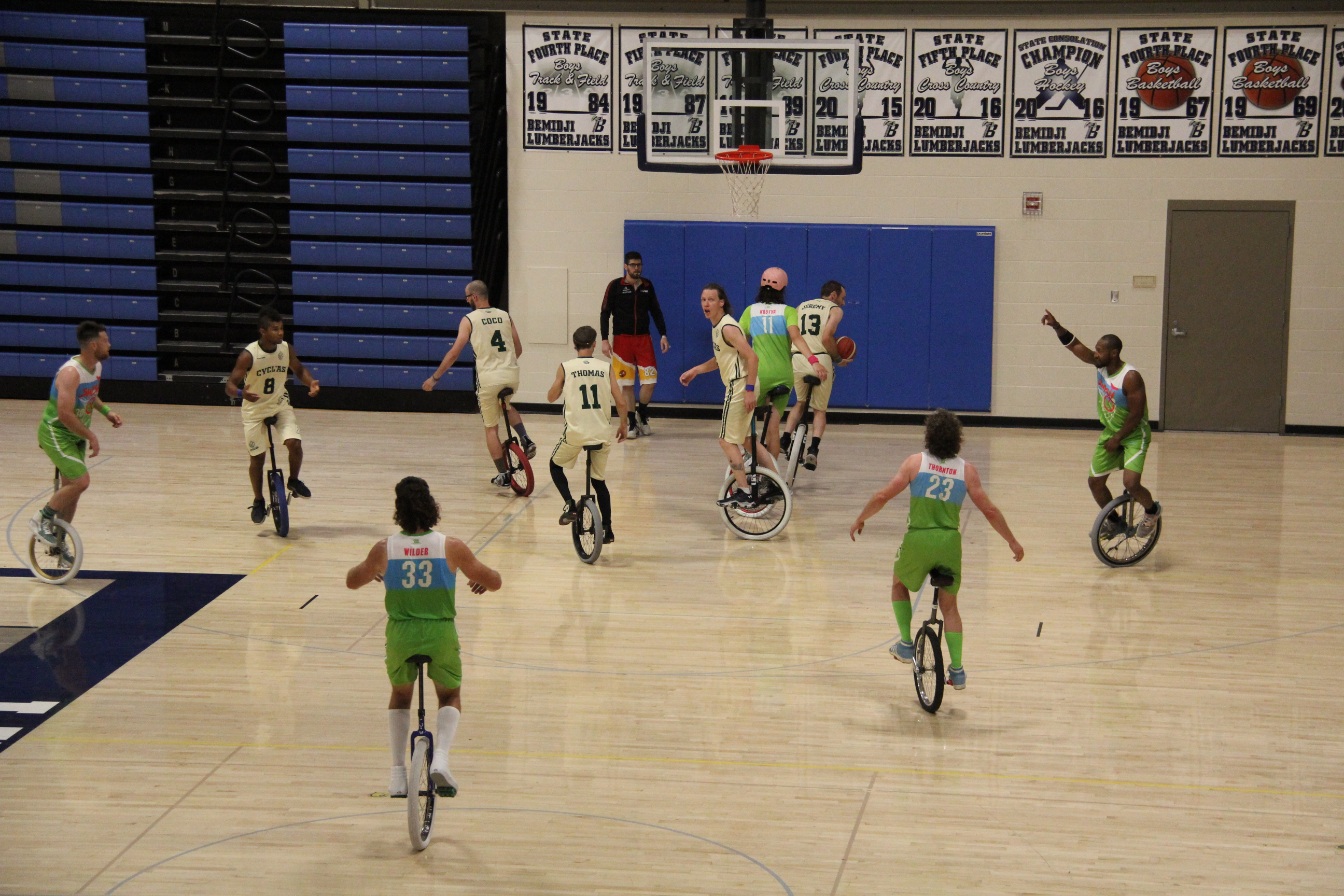
More basketball action… (Minnesota Prairie Roots copyrighted photo July 2024)
Watching from above. (Minnesota Prairie Roots copyrighted photo July 2024)
Aiming for the basket for the French team after being fouled. (Minnesota Prairie Roots copyrighted photo July 2024)
Although winning was the goal, it’s clear these basketball players are dedicated to a sport they love playing. I can’t imagine that hopping onto a unicycle, then dribbling and passing a ball, guarding and shooting baskets is easy. You gotta love the challenge this version of basketball presents.
Fans sat on folding chairs or on the gym floor, up close to the game. (Minnesota Prairie Roots copyrighted photo July 2024)
As the toddler daughter of one Swish player napped in her stroller, the game progressed. Nothing awakened Rosie, not even errant basketballs bouncing toward her and deflected by Grandpa, in Minnesota from Mississippi for the competition.
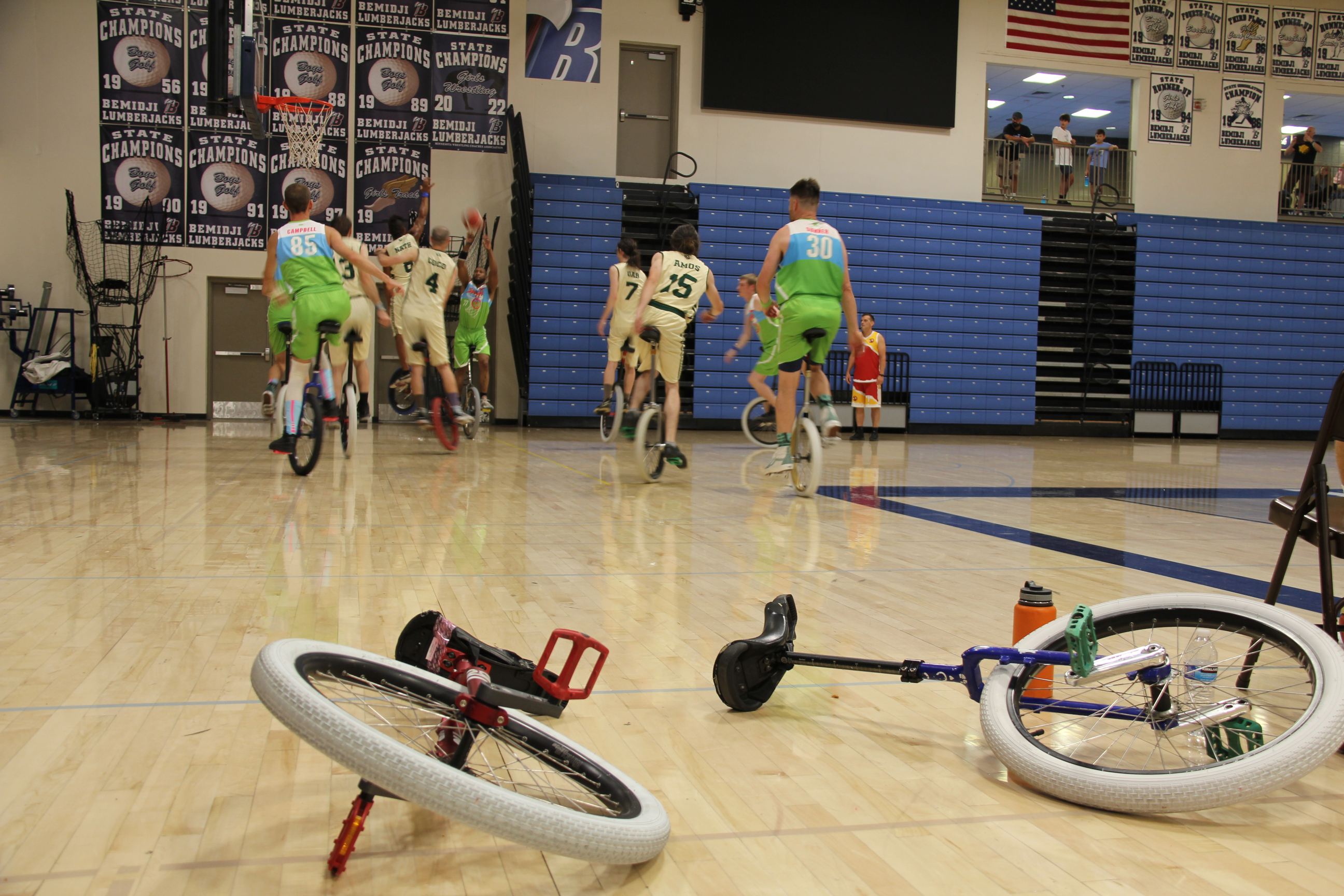
Most players simply threw their unicycles down when not riding them. (Minnesota Prairie Roots copyrighted photo July 2024)
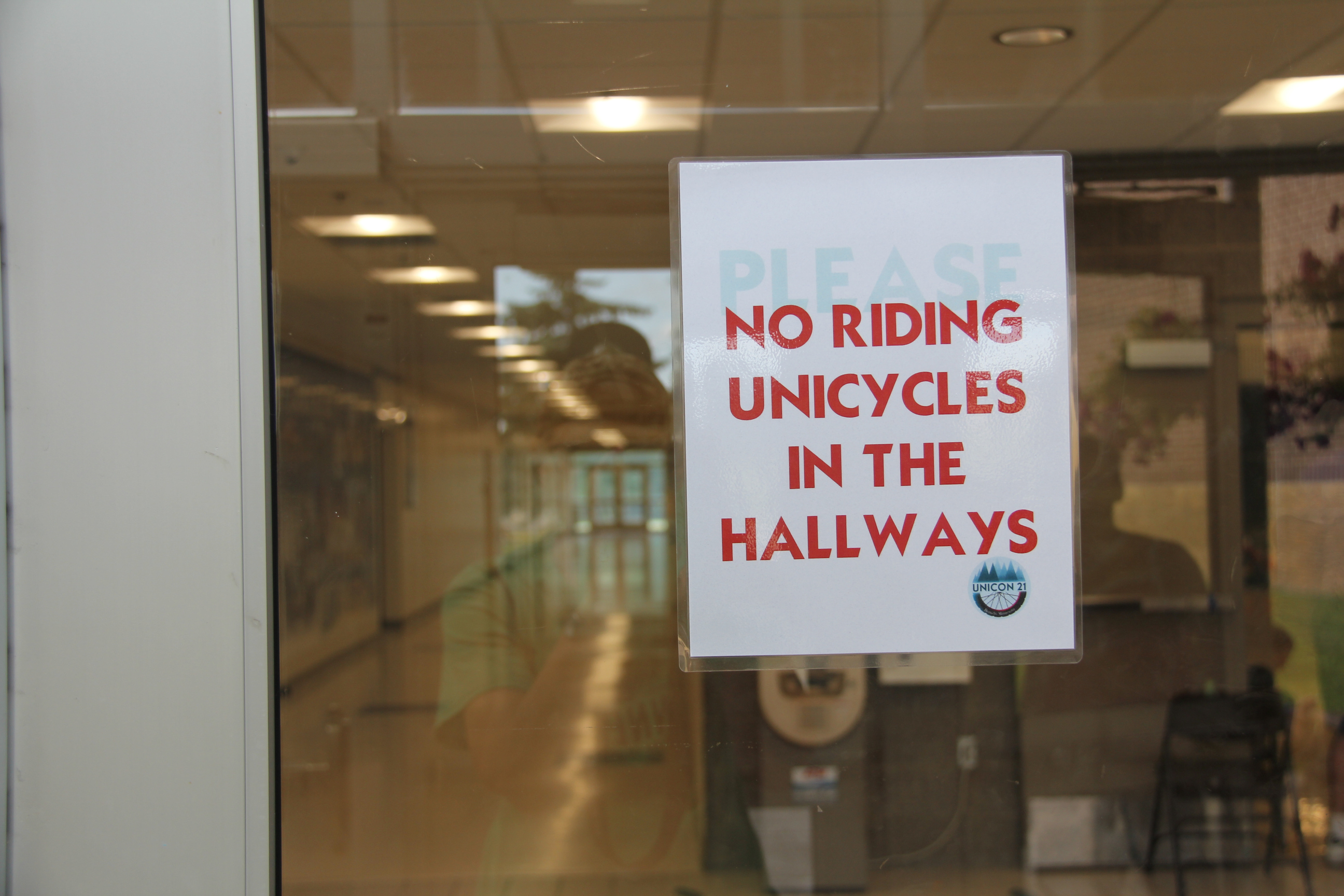
Posted on the entry door to the school. (Minnesota Prairie Roots copyrighted photo July 2024)
Playing hard, the California team vs the French. (Minnesota Prairie Roots copyrighted photo July 2024)
I watched the game, watched Rosie, got up and walked around looking for photo ops. Basketball, actually sports in general, don’t hold my interest for long, even an international competition. Plus, and I hesitate to write this, but the gym smelled of sweaty locker room. I stepped out occasionally simply to breathe fresher air in the air conditioned hallways.
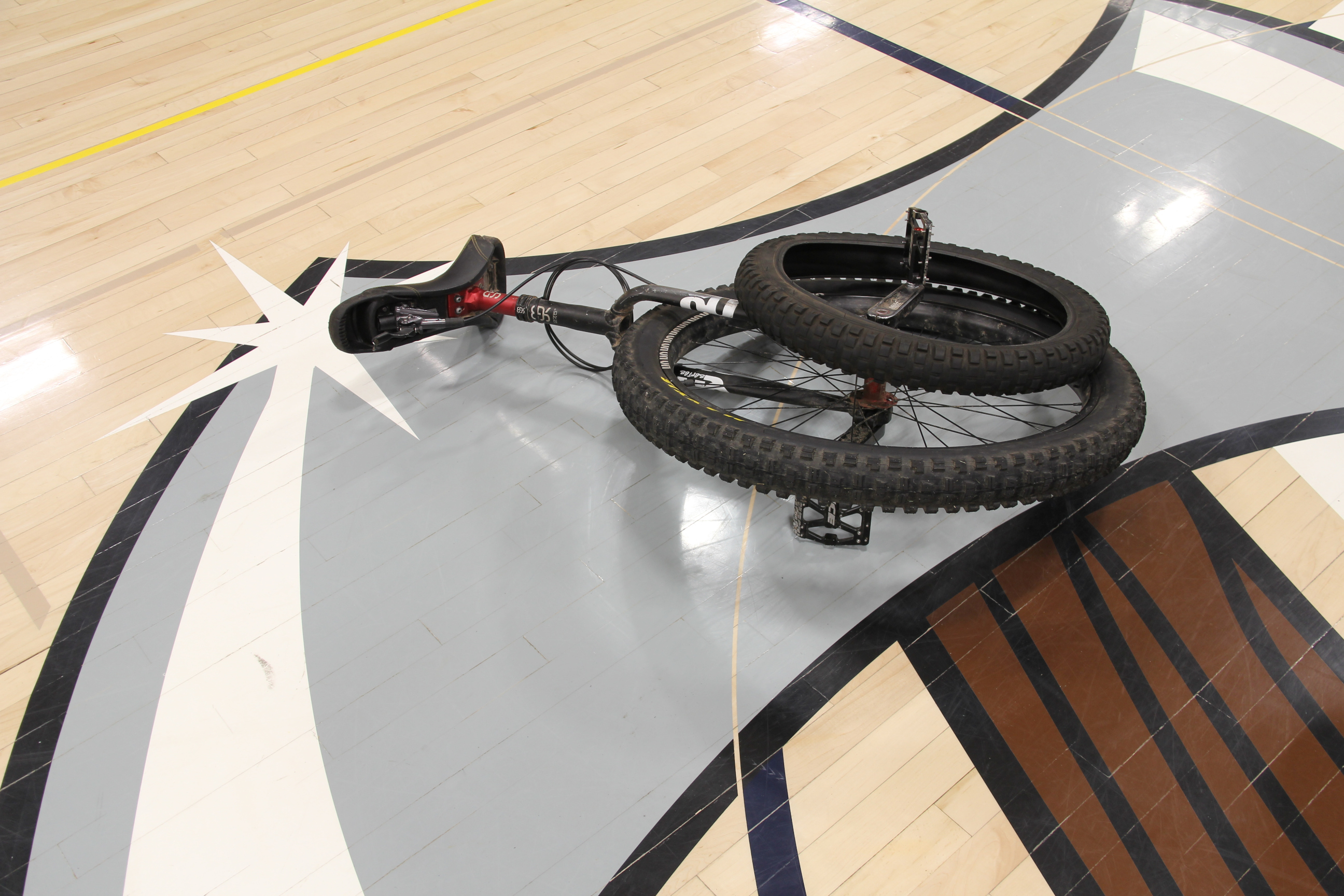
A unicycle lies atop Paul Bunyan’s axe blade on the gym floor. (Minnesota Prairie Roots copyrighted photo July 2024)
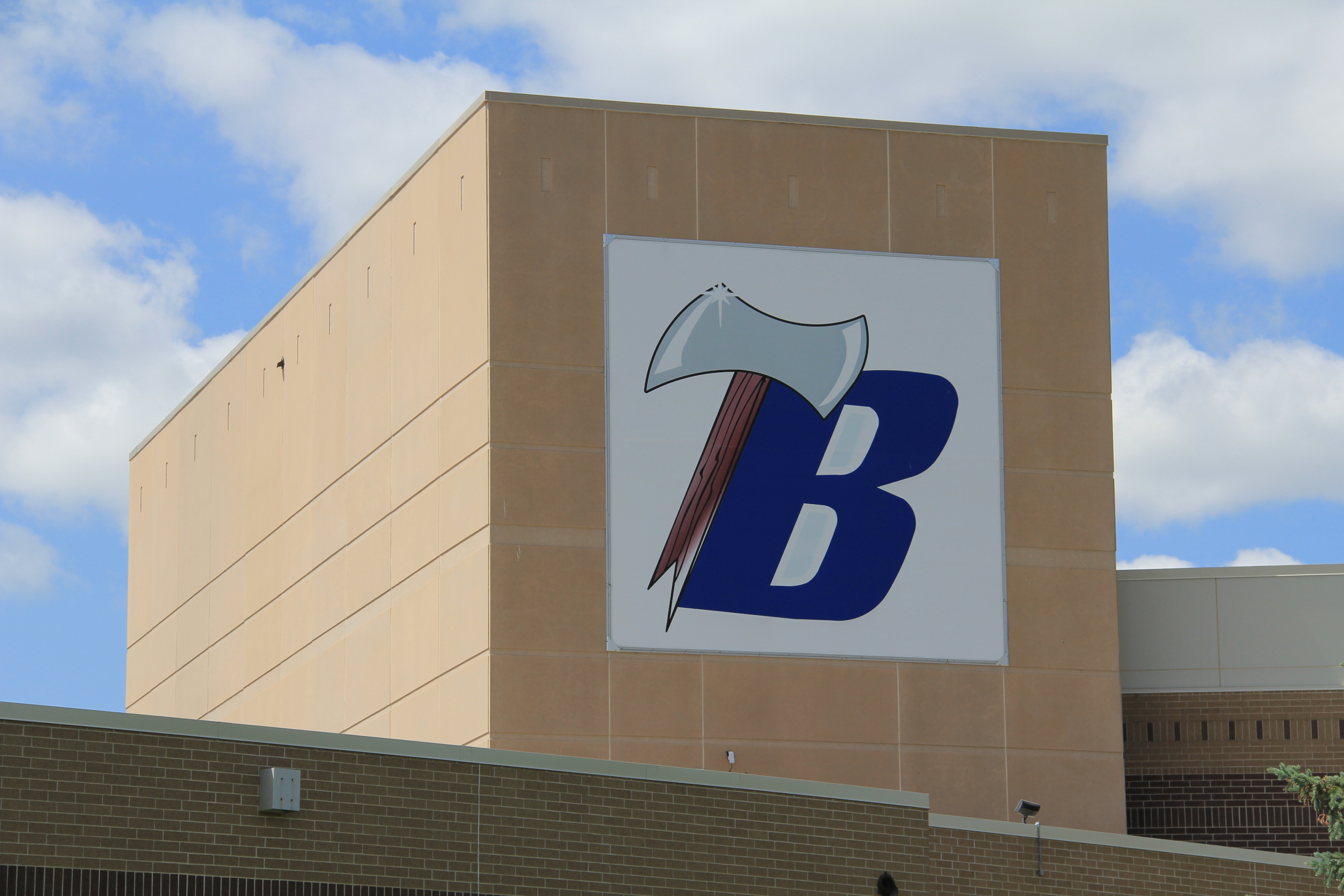
On the exterior of Bemidji High School, Paul Bunyan’s axe. (Minnesota Prairie Roots copyrighted photo July 2024)
While wandering, I noted the Paul Bunyan legendary influence. On the gym floor, a unicycle lay on the blade of Paul’s over-sized axe. It’s only fitting that the school mascot is the Lumberjacks given Paul is a lumberjack.
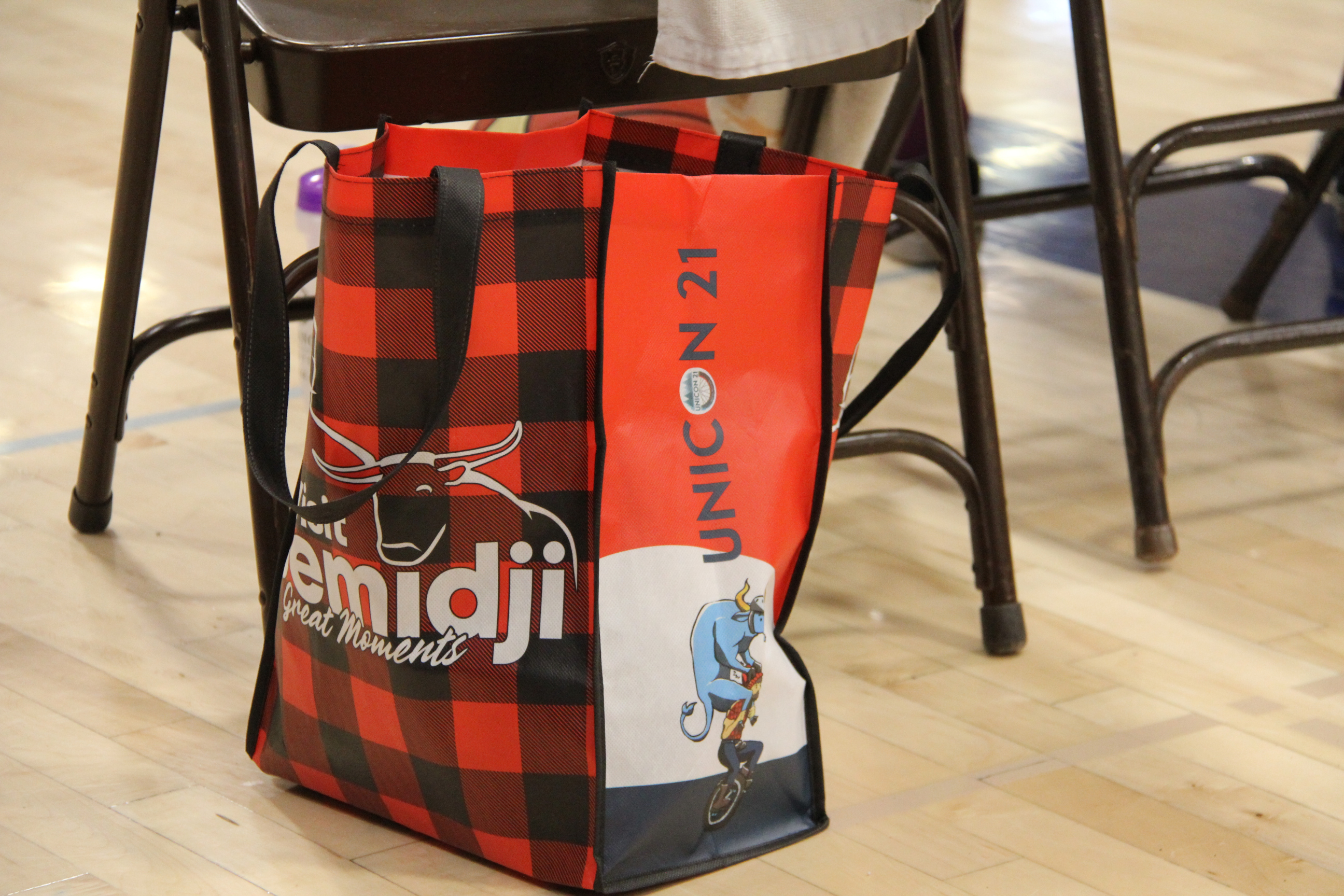
Unicon 21 attendees got Paul Bunyan-themed tote bags. (Minnesota Prairie Roots copyrighted photo July 2024)
His likeness, and that of his sweetheart, Lucette, and Babe the Blue Ox, adorned red buffalo plaid Unicon 21 swag bags scattered across the gym floor. The stuff of folklore, Paul and Babe are a major marketing brand in northern Minnesota. Statues of the pair stand along Lake Bemidji, for example, and are widely used in branding throughout the region from Brainerd northward.
The game ends. (Minnesota Prairie Roots copyrighted photo July 2024)
I wonder what the Californians thought of the whole Paul Bunyan lore, or if they even noticed. Swish was in Minnesota, after all, to play basketball. While Rosie napped and I wandered in and out of the gym, they wheeled across the gym floor, focused on scoring, on winning the game.
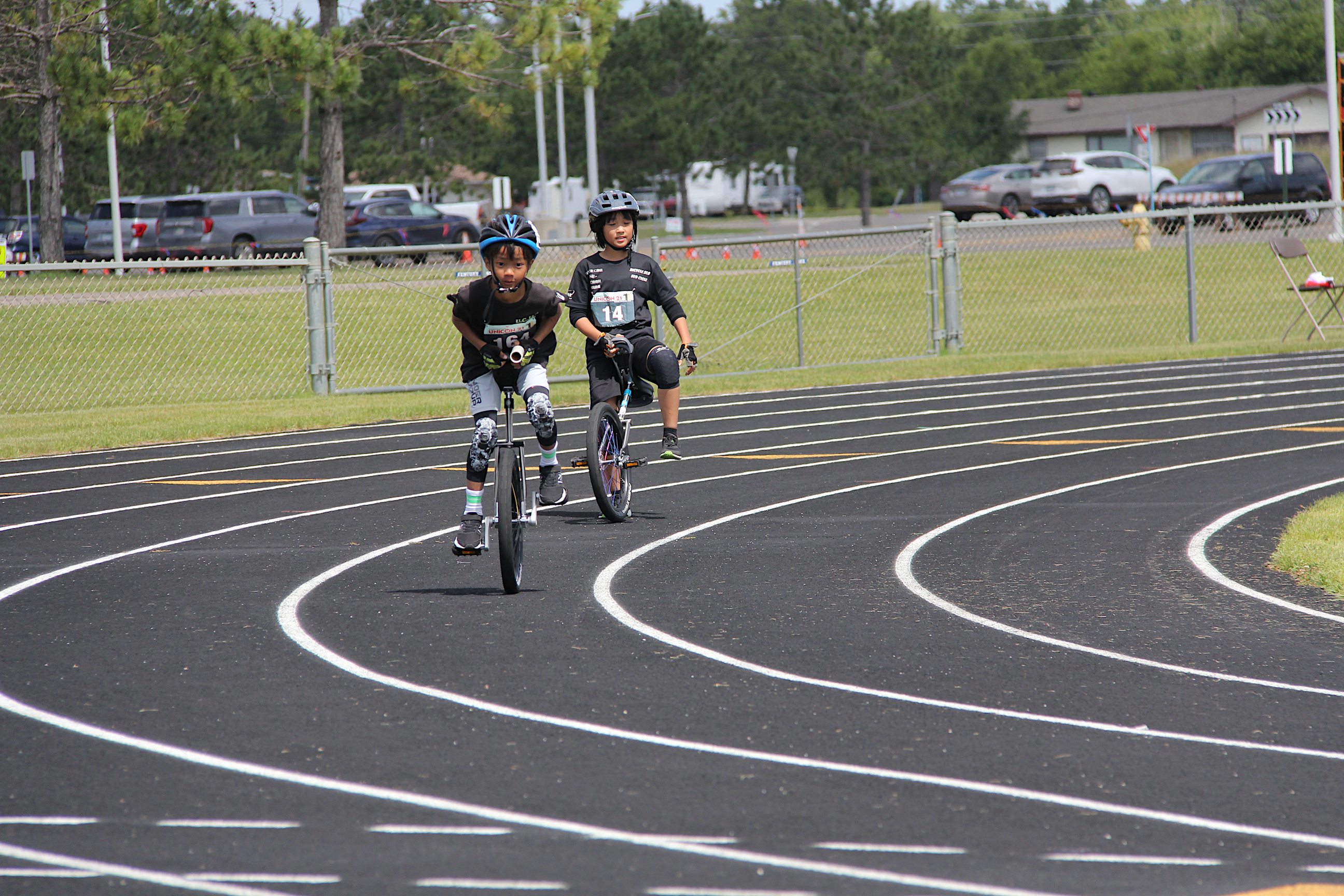
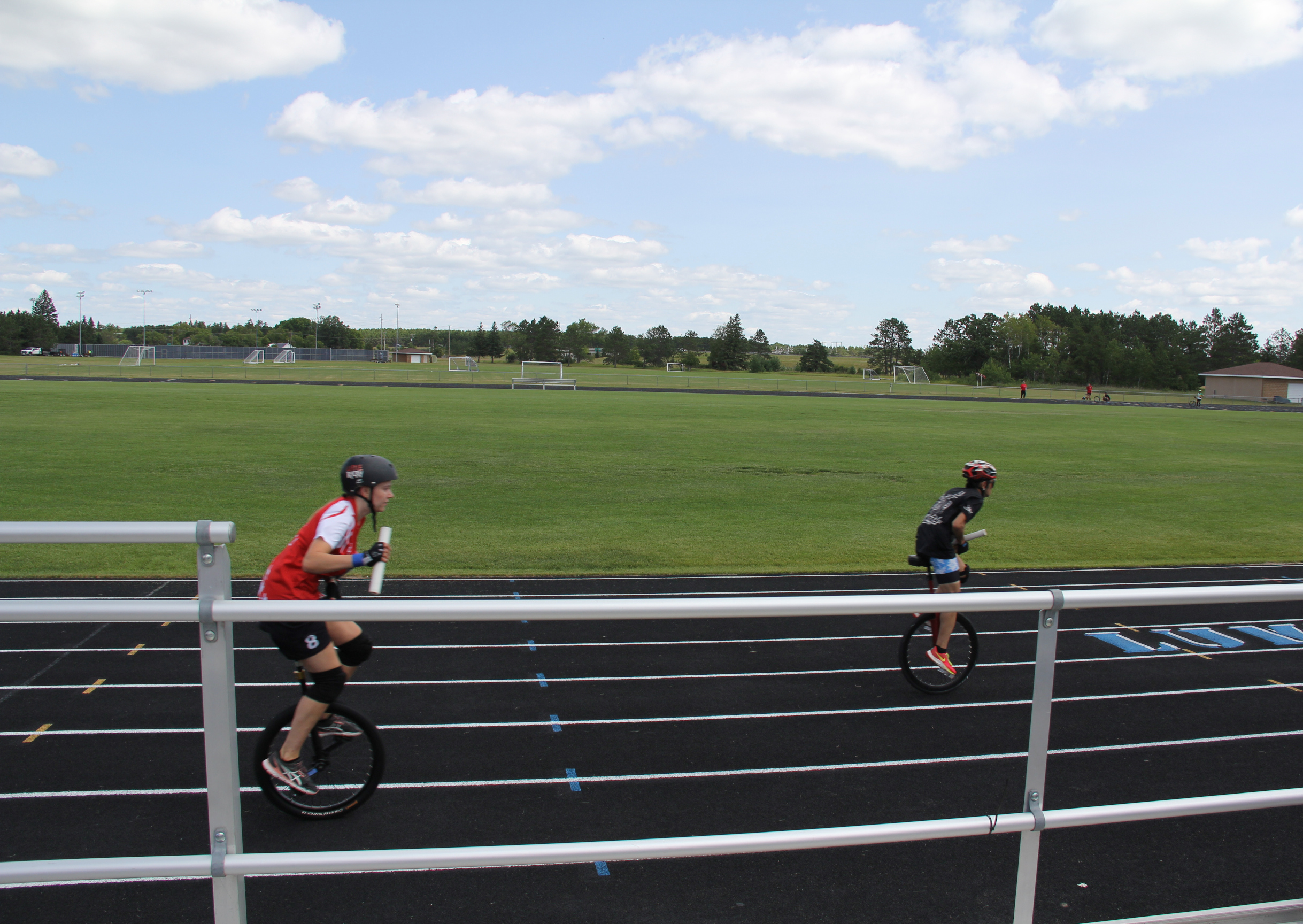
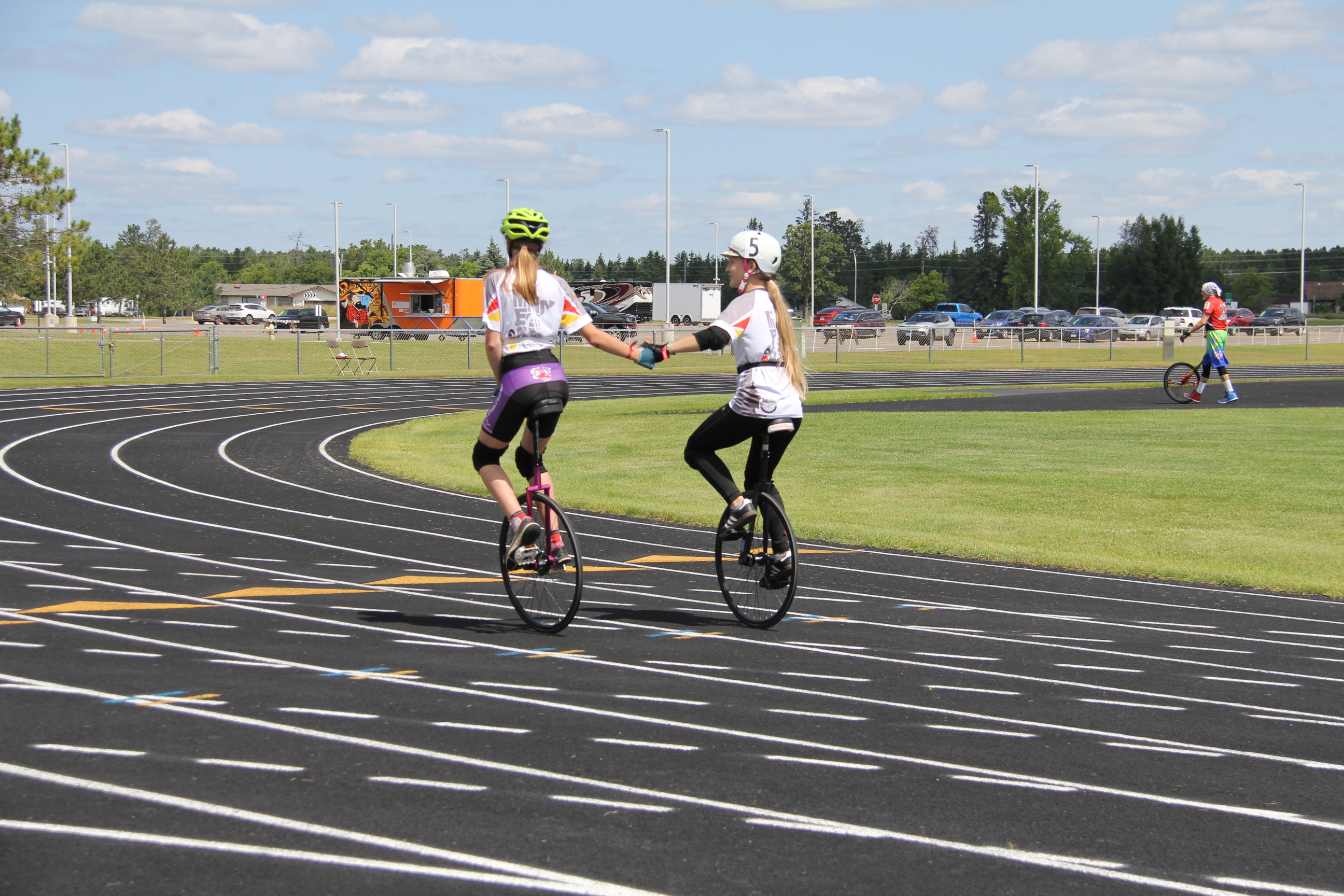
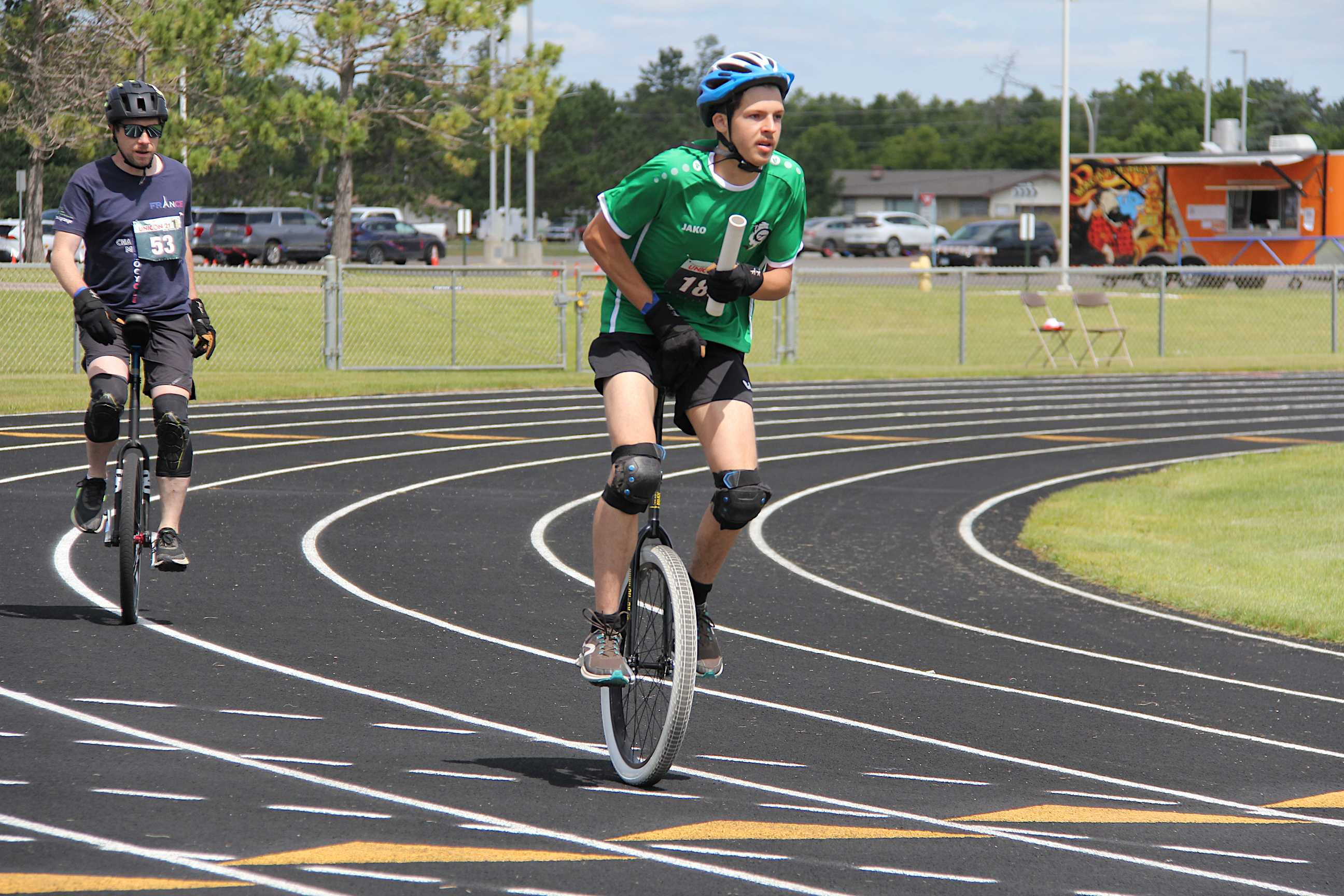
Competing for Japan, one team member has just passed off the baton. (Minnesota Prairie Roots copyrighted photo July 2024)
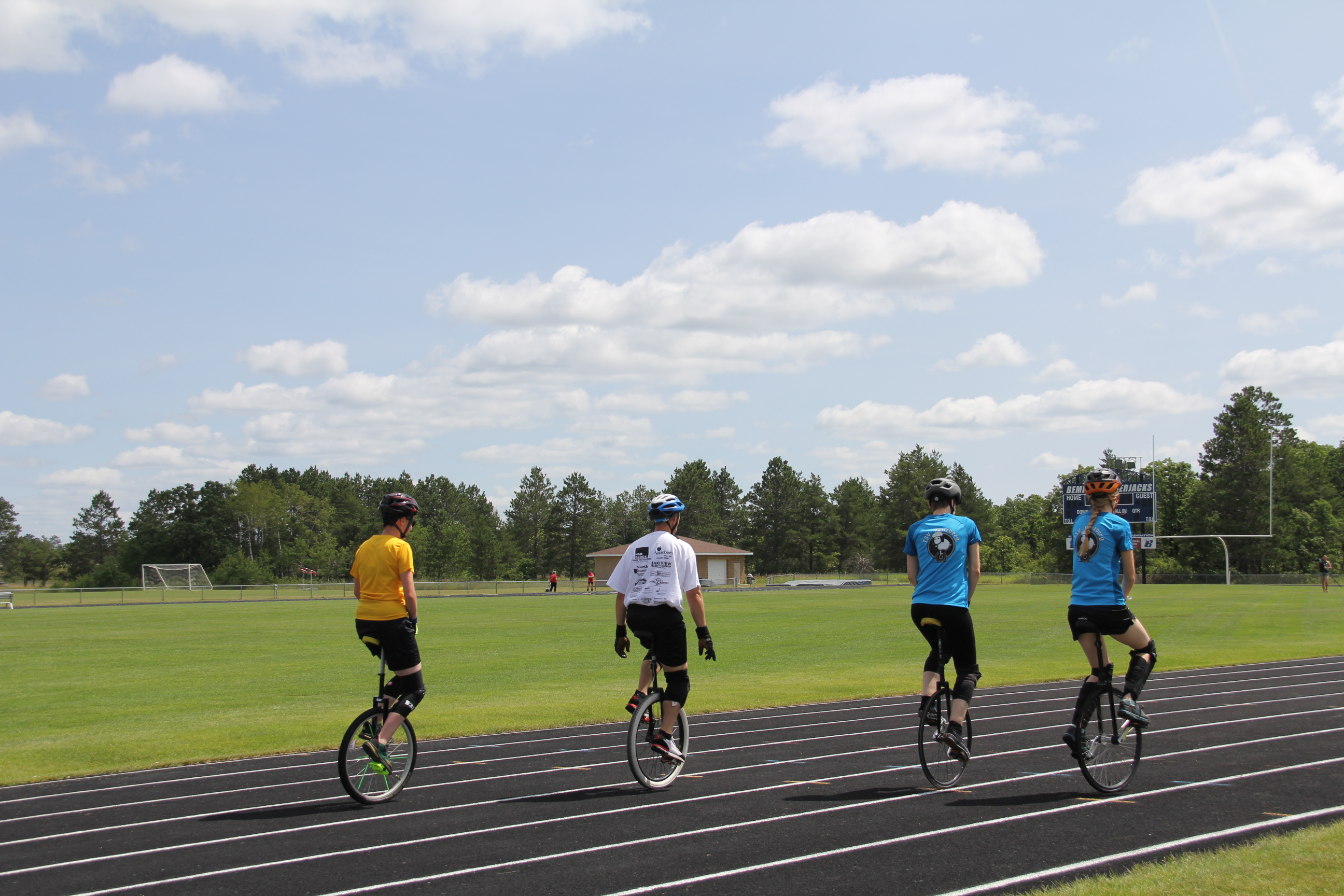
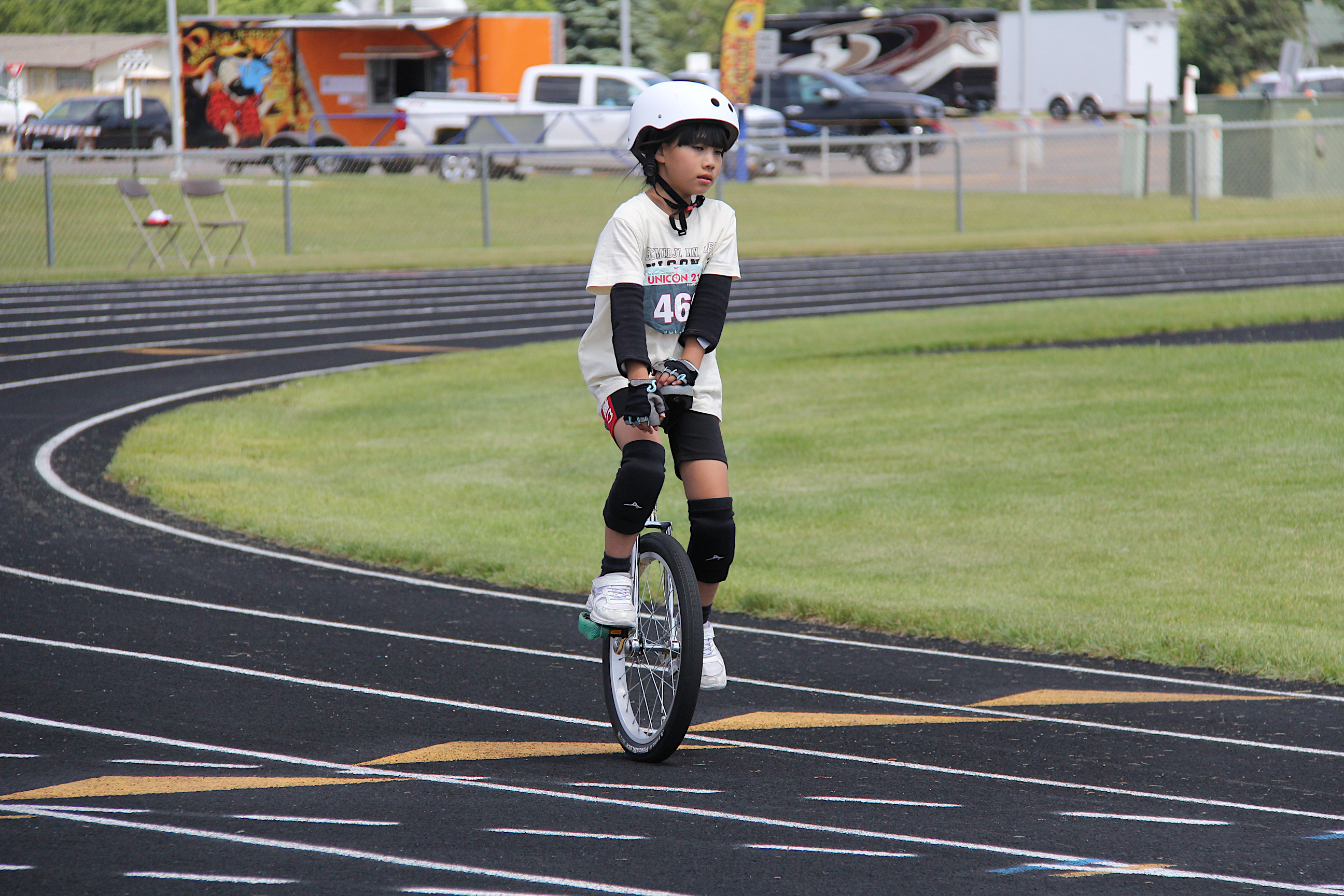
THEY PROPELLED down the track, leaning into the forward thrust of their unicycles as they pedaled toward teammates, then sped to the finish line in an international unicycling relay race. I was there, trackside on July 18, photographing teams from around the world at Unicon 21 in Bemidji.
Relay race competitors between races. (Minnesota Prairie Roots copyrighted photo July 2024)
Admittedly, I am not a sports fan (or sports photographer) and can’t recall ever seeing a relay race in person. But this, this was decidedly different due to the unicycles and due to the international level of competition at The Unicycling World Competition and Championships. This interested me.
Nearing the finish line with batons in hand. (Minnesota Prairie Roots copyrighted photo July 2024)
Running a race on your feet takes talent and skill. But try racing on one wheel, and the bar rises. That’s my opinion anyway. I thought of the balance required to ride quickly and then connect with a teammate to hand off a baton. I thought, too, of the pressure to succeed, to not let your team down.
Riding for Japan. (Minnesota Prairie Roots copyrighted photo July 2024)
Yet, the mood at the Unicon relay race at Bemidji High School didn’t feel oppressively competitive to me, an observer. Rather, it felt fun, connective. Perhaps the riders and their coaches thought differently.
This particularly colorful unicycle grabbed my attention. (Minnesota Prairie Roots copyrighted photo July 2024)
I love the graphics on this German uniform with a unicycle incorporated into the shape of Minnesota. (Minnesota Prairie Roots copyrighted photo July 2024)
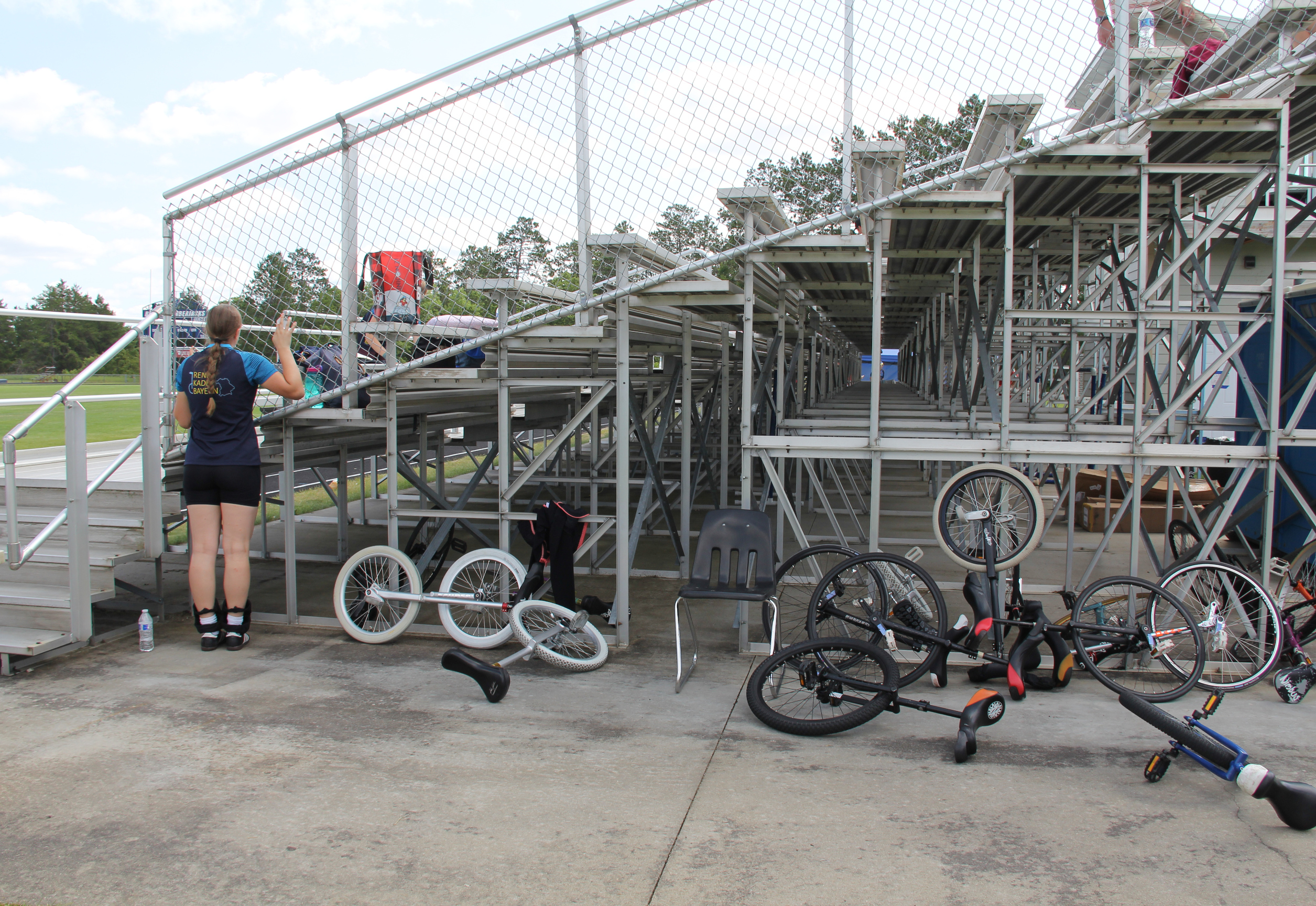
Unicycles galore dropped by the bleachers after the races. (Minnesota Prairie Roots copyrighted photo July 2024)
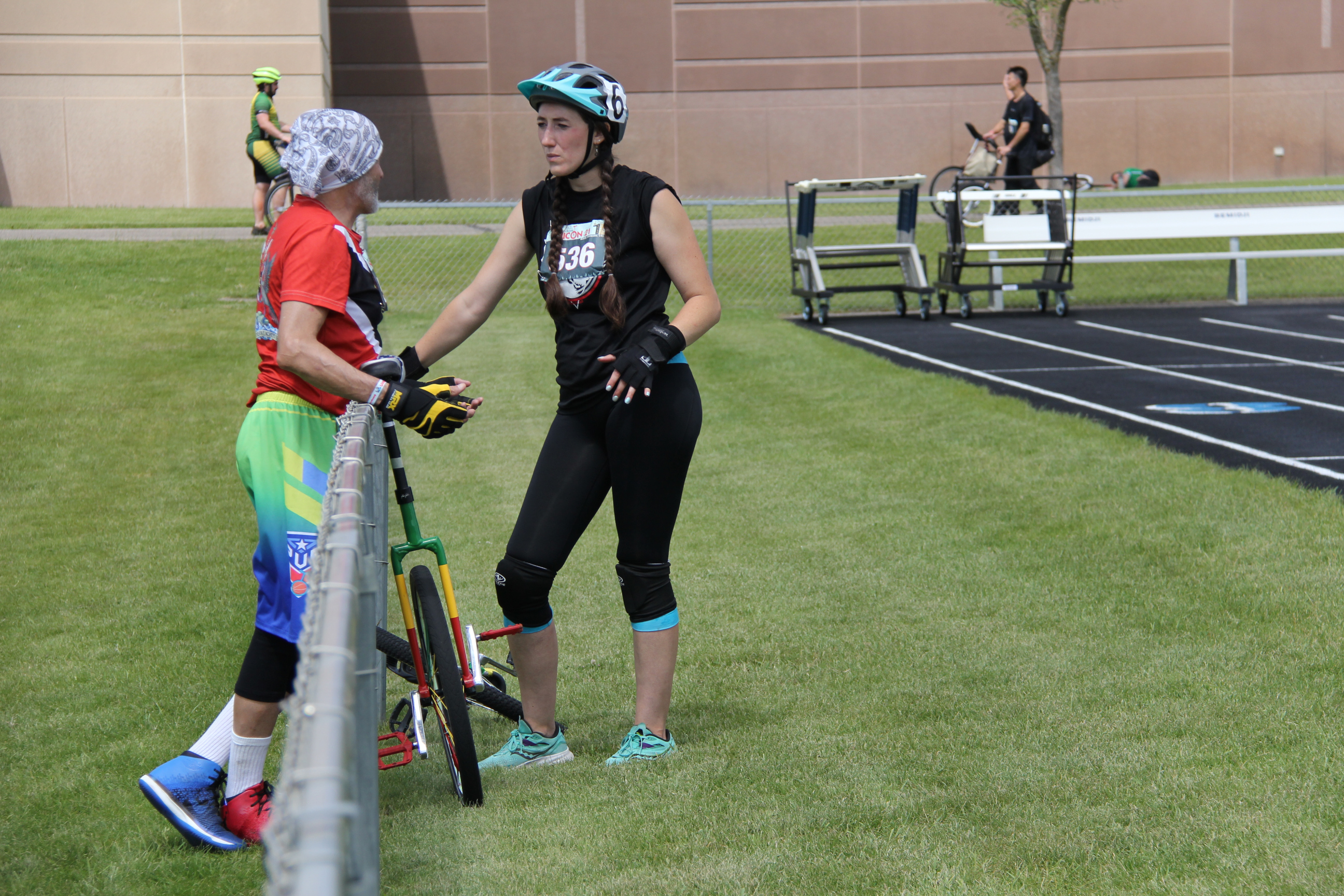
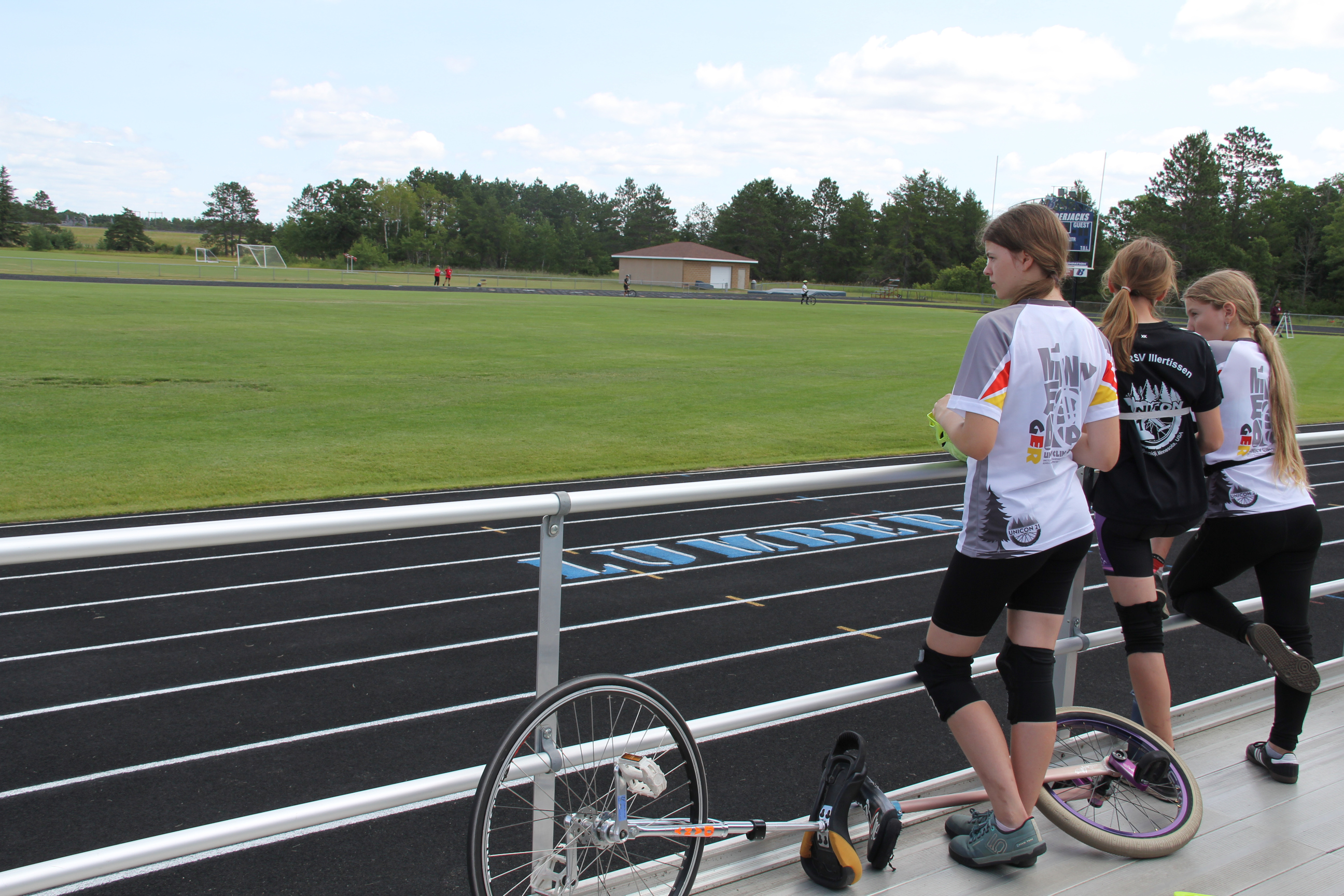
I watched the races as much as I watched people watching them. I am a quiet observer, taking in overall scenes and details. My eyes focused on a multi-colored unicycle, t-shirt graphics, unicycles dropped in a pile by the bleachers…
German teammates between races. (Minnesota Prairie Roots copyrighted photo July 2024)
They came from around the world (here Germany and Japan) to support their teams. (Minnesota Prairie Roots copyrighted photo July 2024)
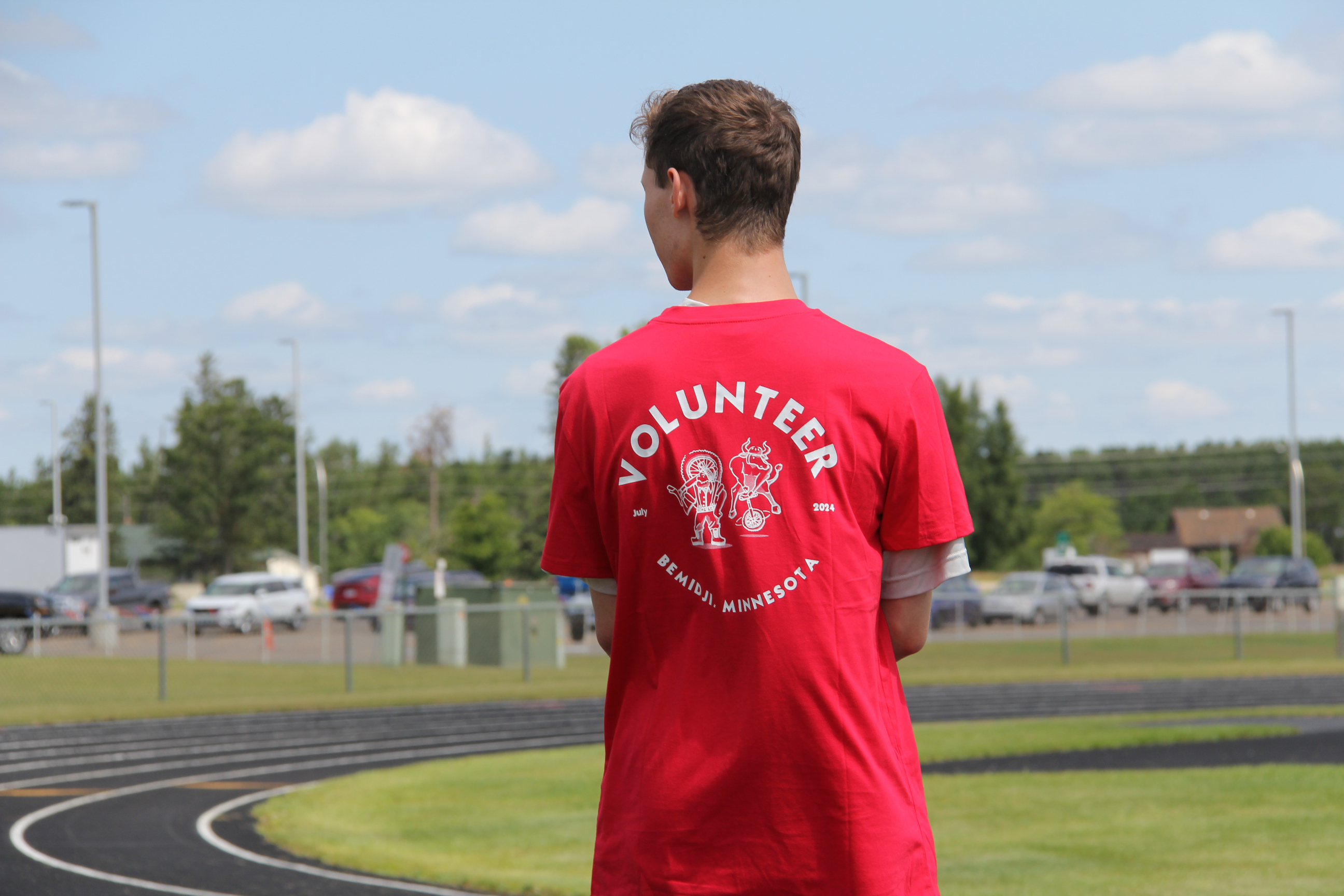
Volunteers were integral to the success of the international unicycling convention. (Minnesota Prairie Roots copyrighted photo July 2024)
Each detail is like a sentence written in to a paragraph written in to a story. Trackside conversations, including one I had in German with a man from Germany, and overheard in the stands added a personal international connection. To witness athletes from around the world come together in small town northern Minnesota was gratifying. I expect anyone participating or attending the Summer Olympics in Paris will experience that same feeling of unity, even in the competitiveness of the events.
German teammates circle the track before a race. (Minnesota Prairie Roots copyrighted photo July 2024)
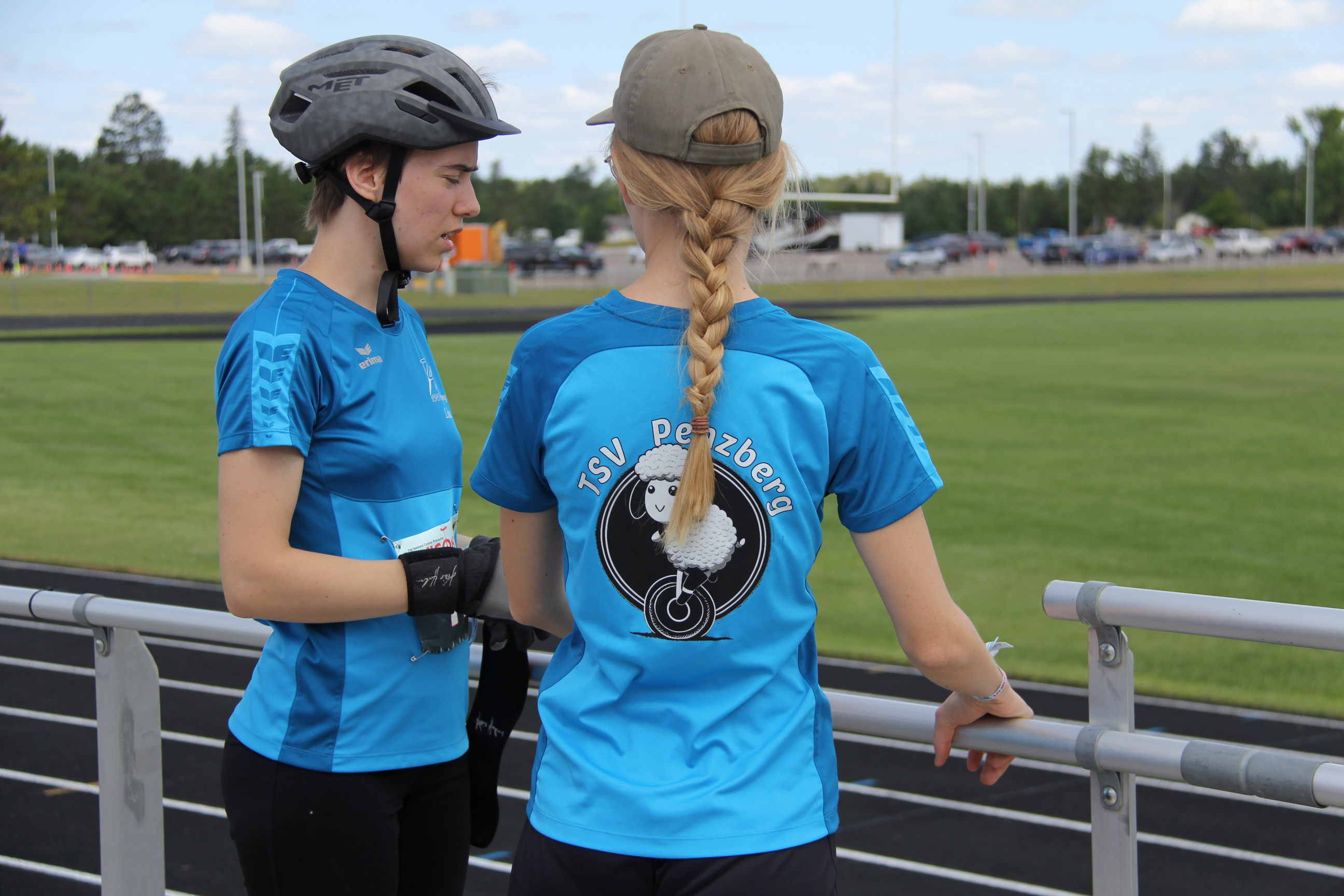
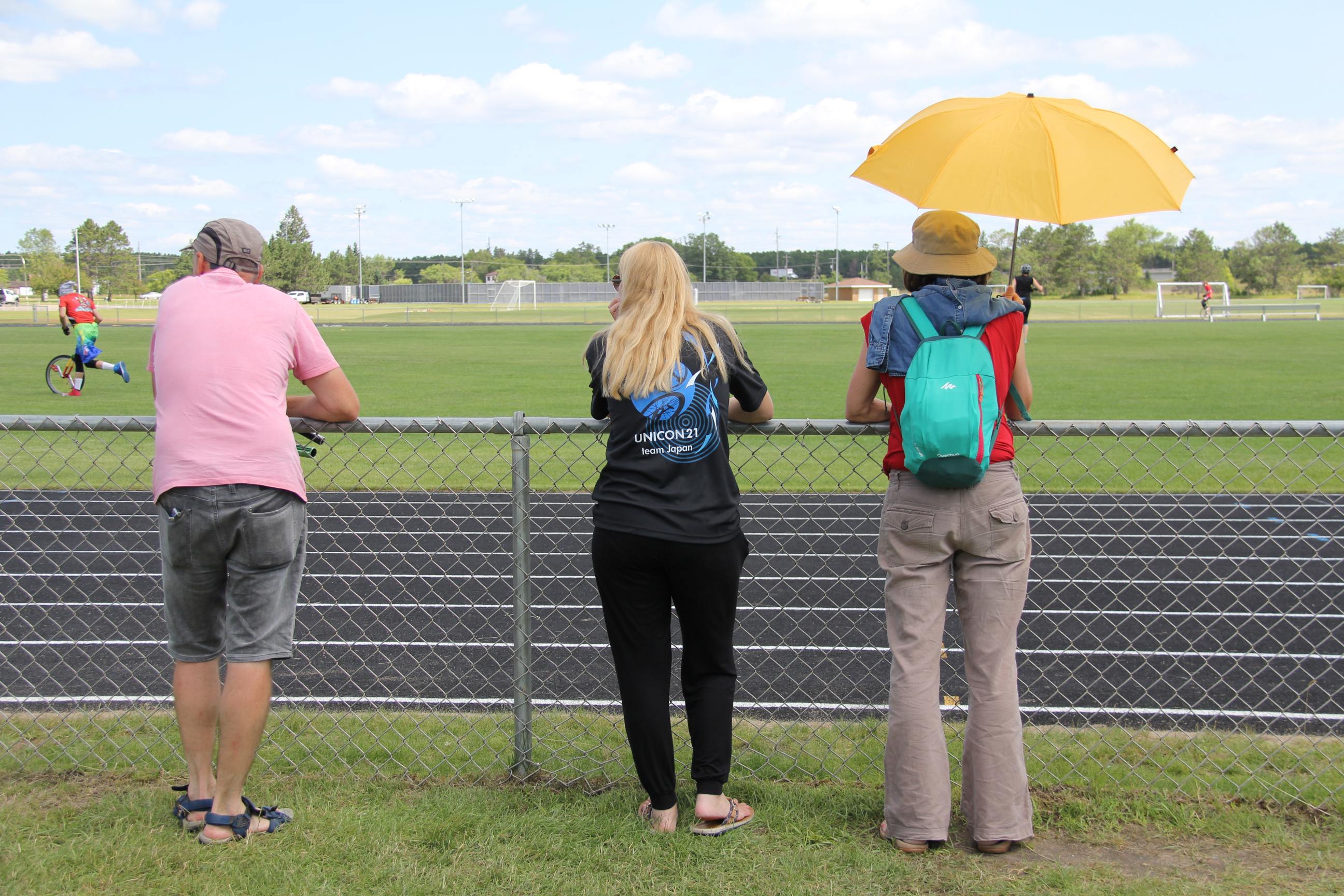
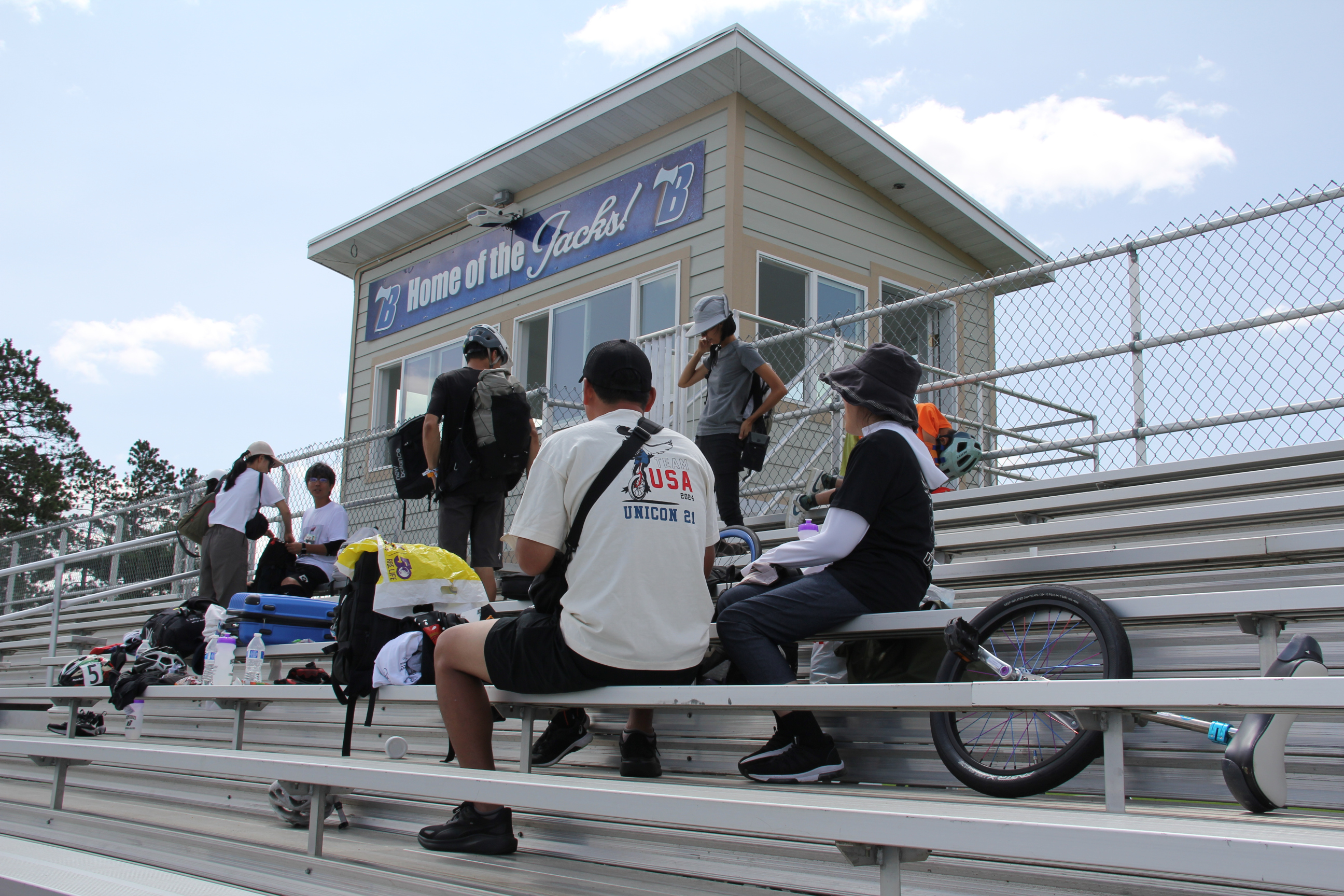
The Bemidji High School Lumberjacks (“Jacks” for short) hosted the track and field events on their athletic field. (Minnesota Prairie Roots copyrighted photo July 2024)
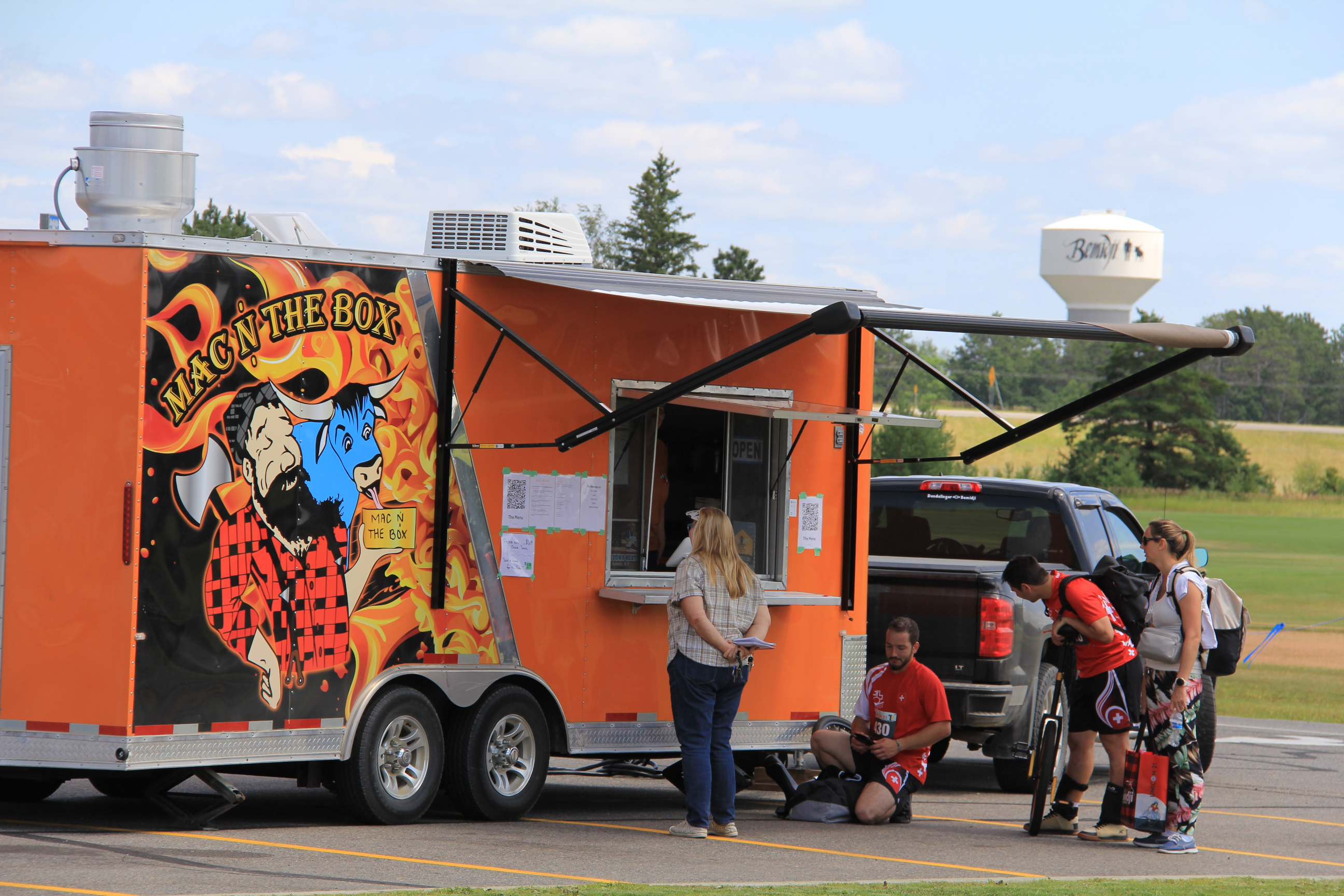
A Paul Bunyan-themed food truck serves food in the high school parking lot. (Minnesota Prairie Roots copyrighted photo July 2024)
Under a partly cloudy blue sky on a perfect July day in northern Minnesota, the world grew closer, while mine grew wider. Athletes wheeled around the BHS track, racing to win. In reality, they’d already won. They were here, together in Minnesota, connecting with other unicyclists, embracing a sport they love.
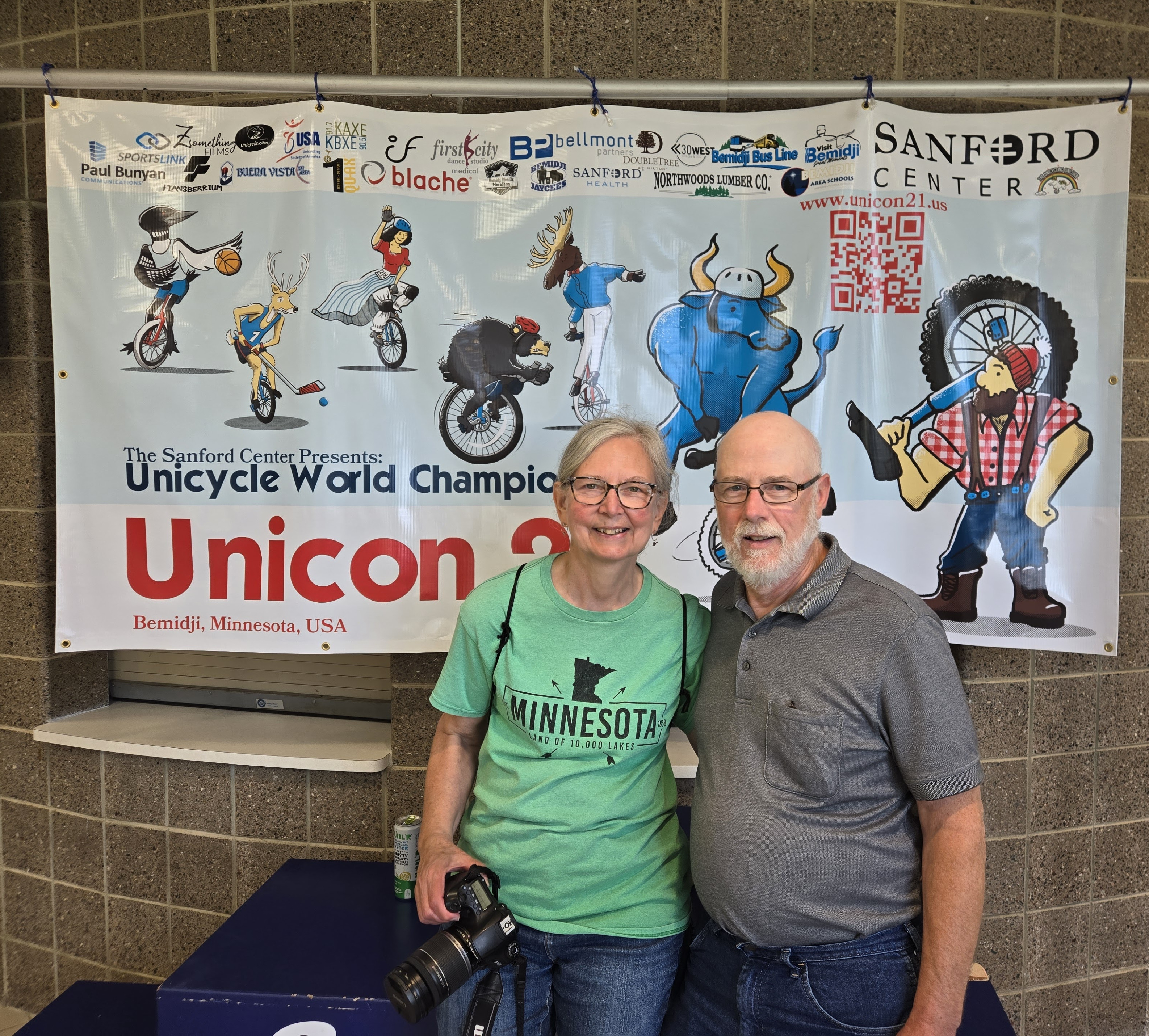
Randy and I pose in front of a Unicon 21 banner at Bemidji High School. (Photo credit: C. Helbling)
THEY ARRIVED from around the world, some 1,200 strong, to attend the Unicycling World Competition and Championships July 14-26 in Bemidji. Everything aligned for me to be there on July 18. Not many Minnesotans can say they’ve attended an international unicycling convention. But I can, and the unicyclists impressed, entertained and inspired me.
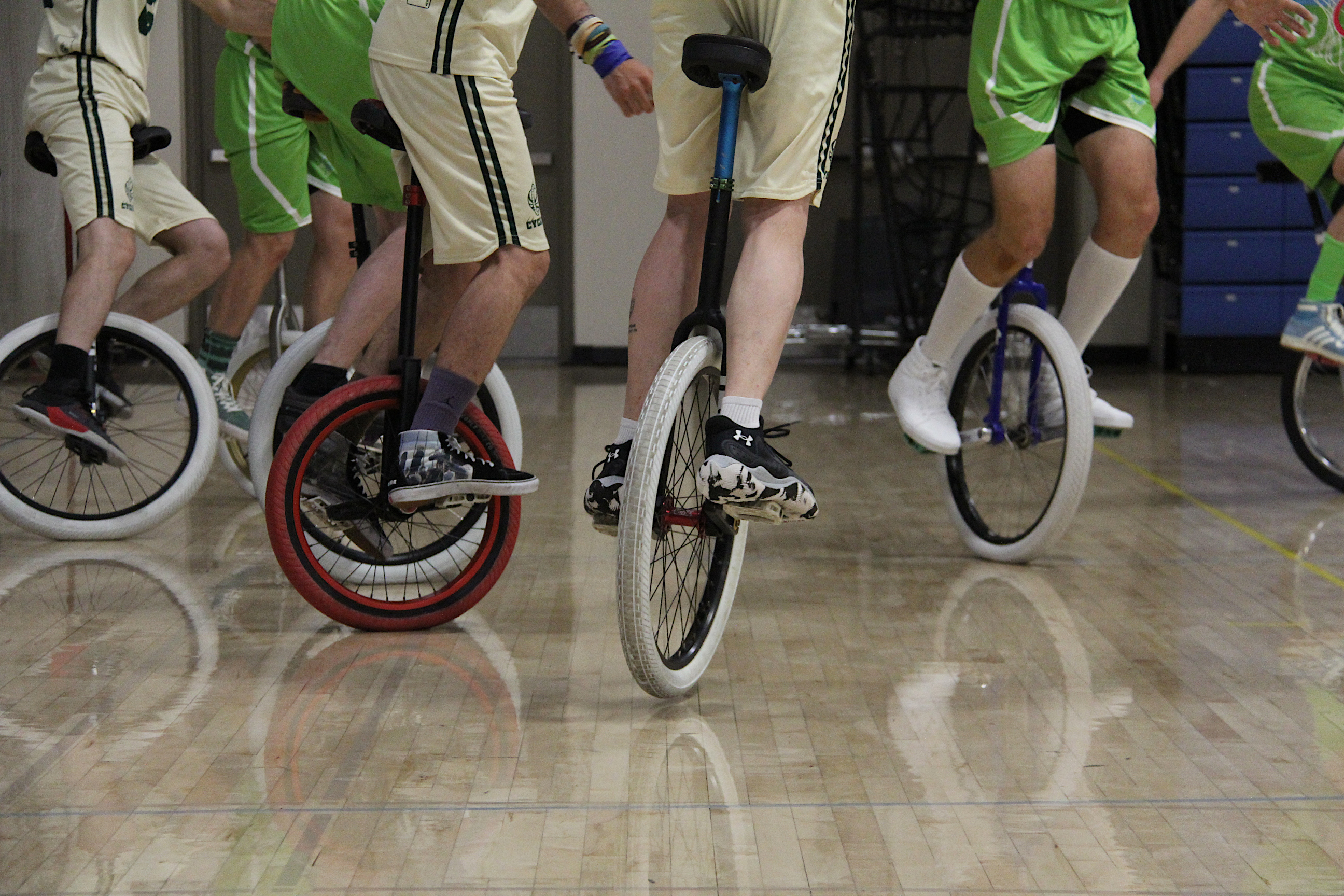
Unicycles were everywhere, including on the basketball court at Bemidji High School. (Minnesota Prairie Roots copyrighted photo July 2024)
The US last hosted Unicon in 2002 in Washington state. And 30 years ago, Minneapolis hosted Unicon 7. Held every two years, the prior international gathering was in France in 2022.
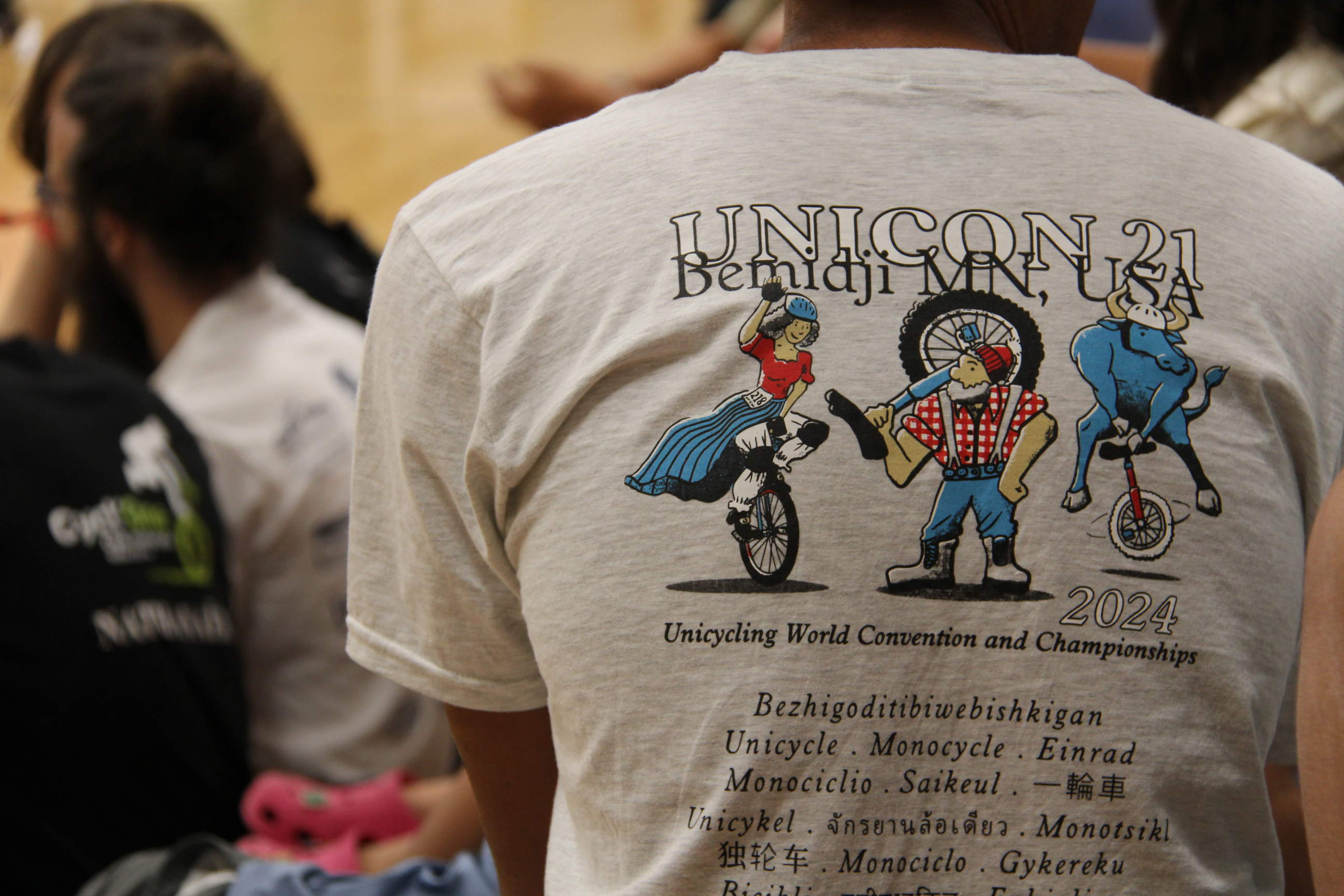
Paul Bunyan, his sweetheart, Lucette, and Babe the Blue Ox graphics on the back of a Unicon t-shirt. (Minnesota Prairie Roots copyrighted photo July 2024)
My road to Unicon 21 in Bemidji started when my son, who lives and works in Boston, and, yes, rides a unicycle, decided to attend the convention. Not as a competitive athlete, but as someone who likes unicycling and wanted to connect with, and learn from, other unicyclists. Randy and I happened to be vacationing only 1.5 hours from Bemidji, so the timing was perfect to head farther north into Paul Bunyan land.
A graceful freestyle performance by Japanese unicyclists reminded me of ballet. (Minnesota Prairie Roots copyrighted photo July 2024)
On the Thursday we were in Bemidji, we watched relay races, basketball, an obstacle course competition and freestyle performances along with touring the pop-up unicycle museum and watching people try their skills on a wide range of unicycles.
Skilled unicyclist Indiana (who is from Michigan) unicycles outside the Sanford Center. (Minnesota Prairie Roots copyrighted photo July 2024)
It takes balance, skill, patience, determination and a certain amount of fearlessness to ride a unicycle. At least that’s my assessment after observing both competitive athletes and ordinary unicyclists like my son. He started riding in grade school, performing once at a local church talent show—simultaneously unicycling and yo-yoing. I thought that took skill, and it does, but the skill level of the athletes in Bemidji was beyond impressive.
A team from California plays basketball with a team from France. (Minnesota Prairie Roots copyrighted photo July 2024)
Imagine dribbling and passing a basketball, then shooting a basket all while balancing and rolling and turning on a unicycle. I saw all of that as a team from California played a team from France in the Bemidji High School gym.
Pedaling with a baton in hand during the relay race. (Minnesota Prairie Roots copyrighted photo July 2024)
Outside, unicyclists pedaled around the high school track as they raced to connect with their team members to pass a baton. It was there that I used the German I learned more than 50 years ago. Although a bit rusty, I was able to welcome a man from Germany and exchange a few other words with him. He clued me in that a young boy from Japan was a speed demon, the athlete to watch. He was right.
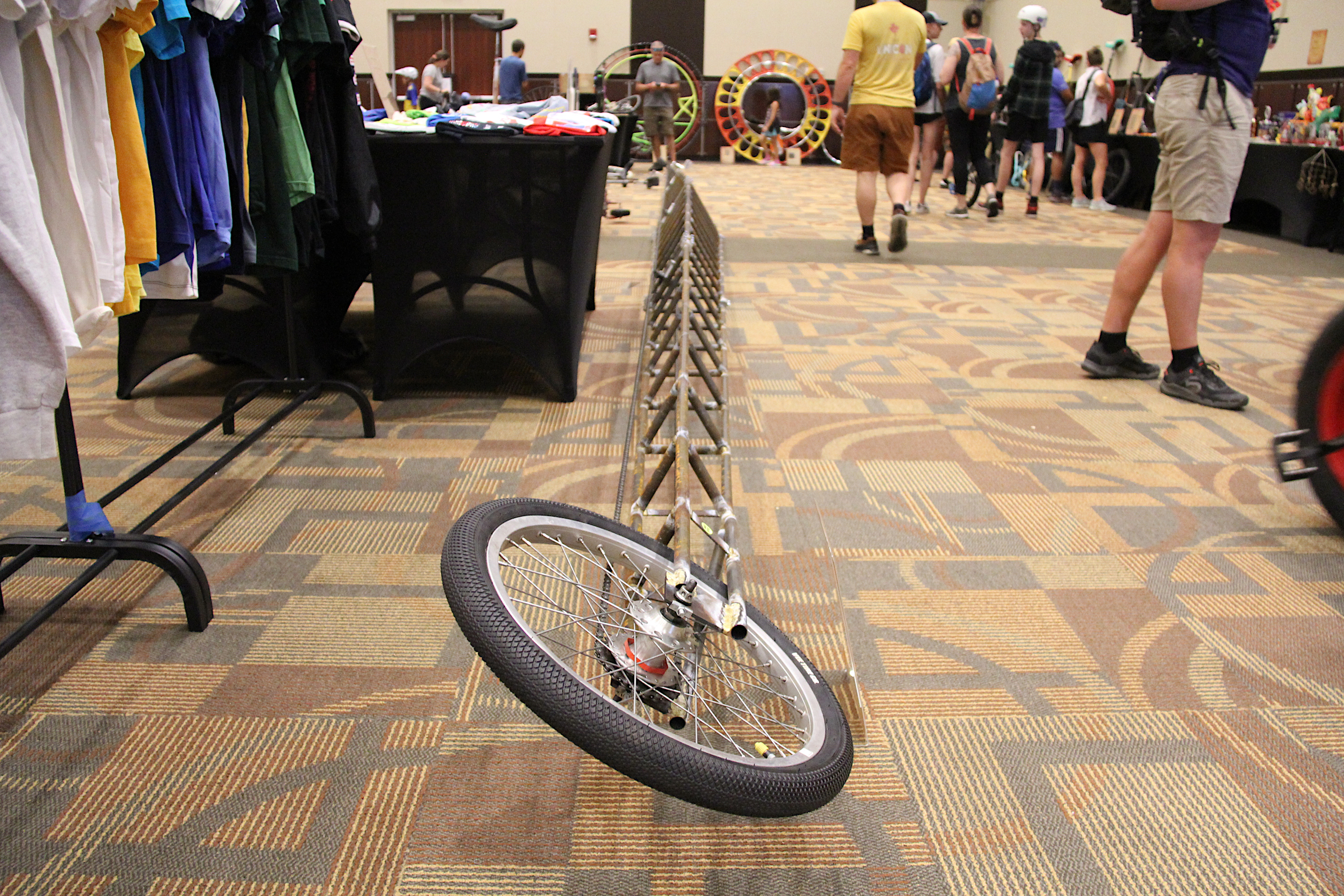
The Unicycling Unicorn’s 44-foot tall unicycle. (Minnesota Prairie Roots copyrighted photo July 2024)
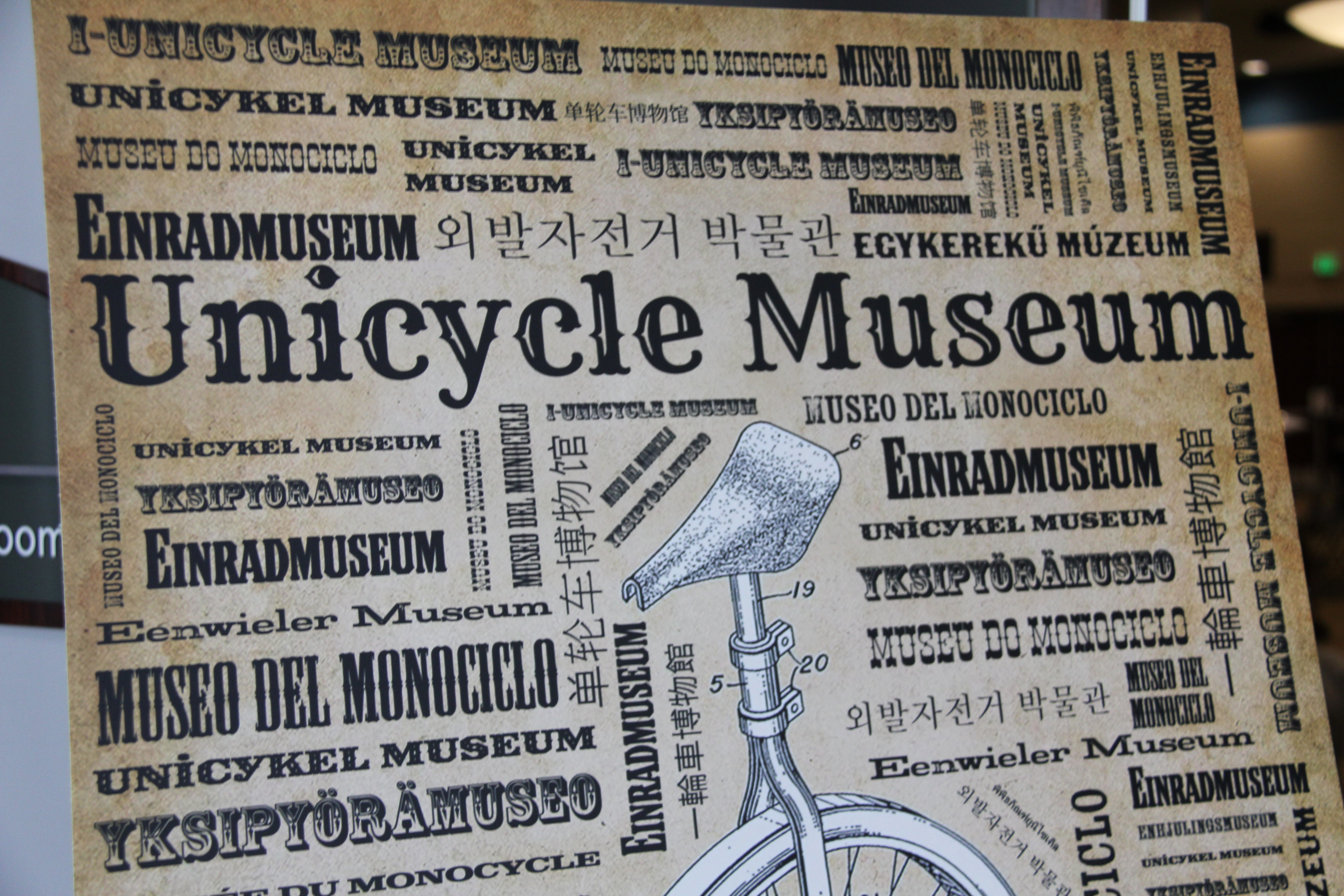
Then it was over to the Sanford Center across town to visit the Unicycle Museum. Unicycles of all ages, sizes and styles ringed the conference room along with unicycle t-shirts, merch and more. Among the unicycles was a 44-foot long custom-made unicycle stretched across the floor. Jamey Mossengren, known as The Unicycling Unicorn, rode the tower-like structure at Unicon 21 in an attempt to break the World Record for Tallest Rideable Unicycle. He failed during his public performance, but achieved his goal during practice, pedaling seven revolutions while in control. I didn’t see his attempt. My son did. As a side note, Mossengren travels around the world performing his unicorn unicycle themed comedy and circus show. He appeared at this year’s Bullhead Days in Waterville.
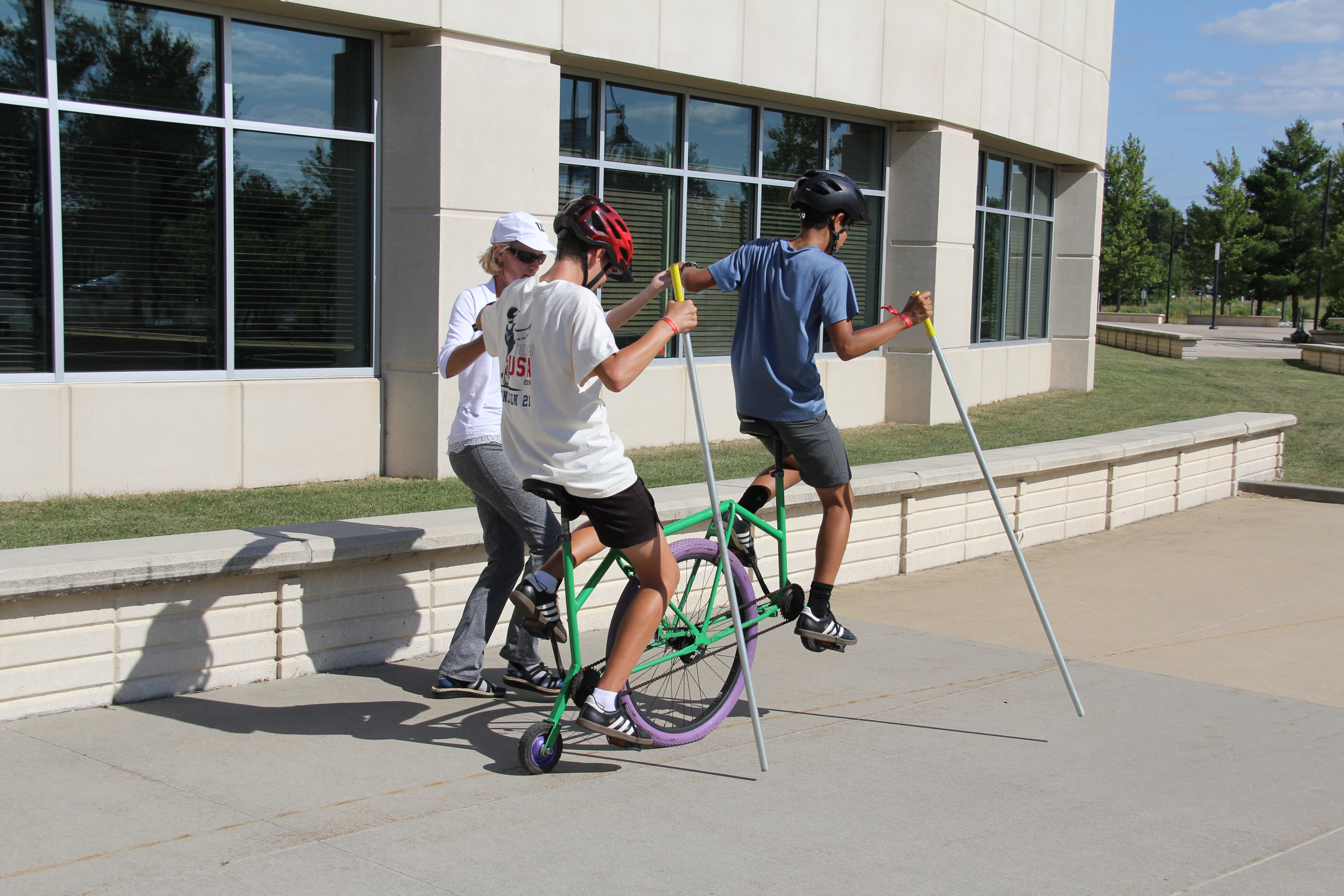
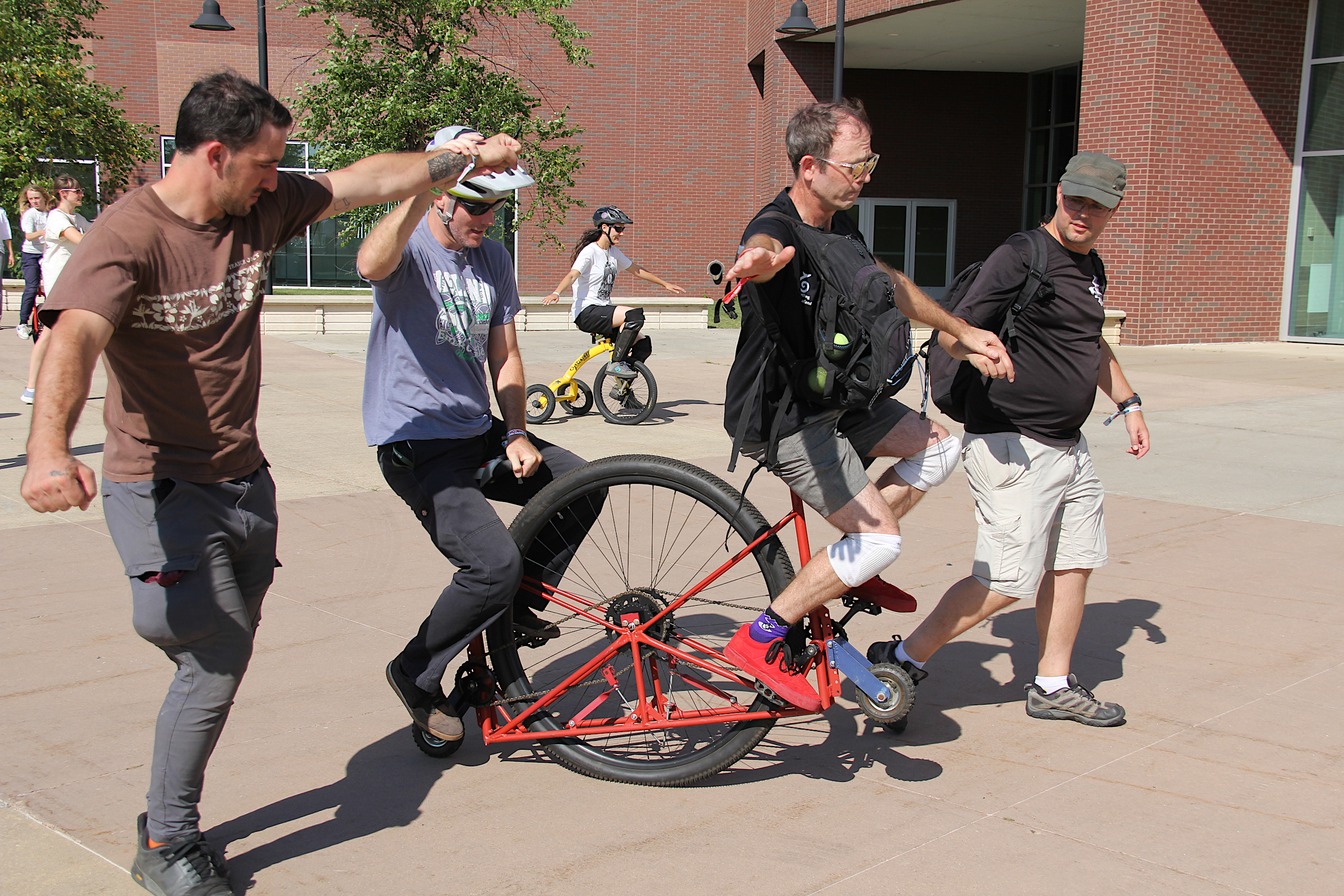
Riding this unicycle requires two riders who weigh about the same. A weighted backpack on the front rider’s chest makes attempting to ride this unicycle possible. (Minnesota Prairie Roots copyrighted photo July 2024)
The Unicycle Museum was about much more than looking, reading, learning. It was also participatory, with most unicycles available for temporary check-out. Outside the Sanford Center, individuals of all ages and skill levels tried out an assortment of unicycles. Me? I passed.
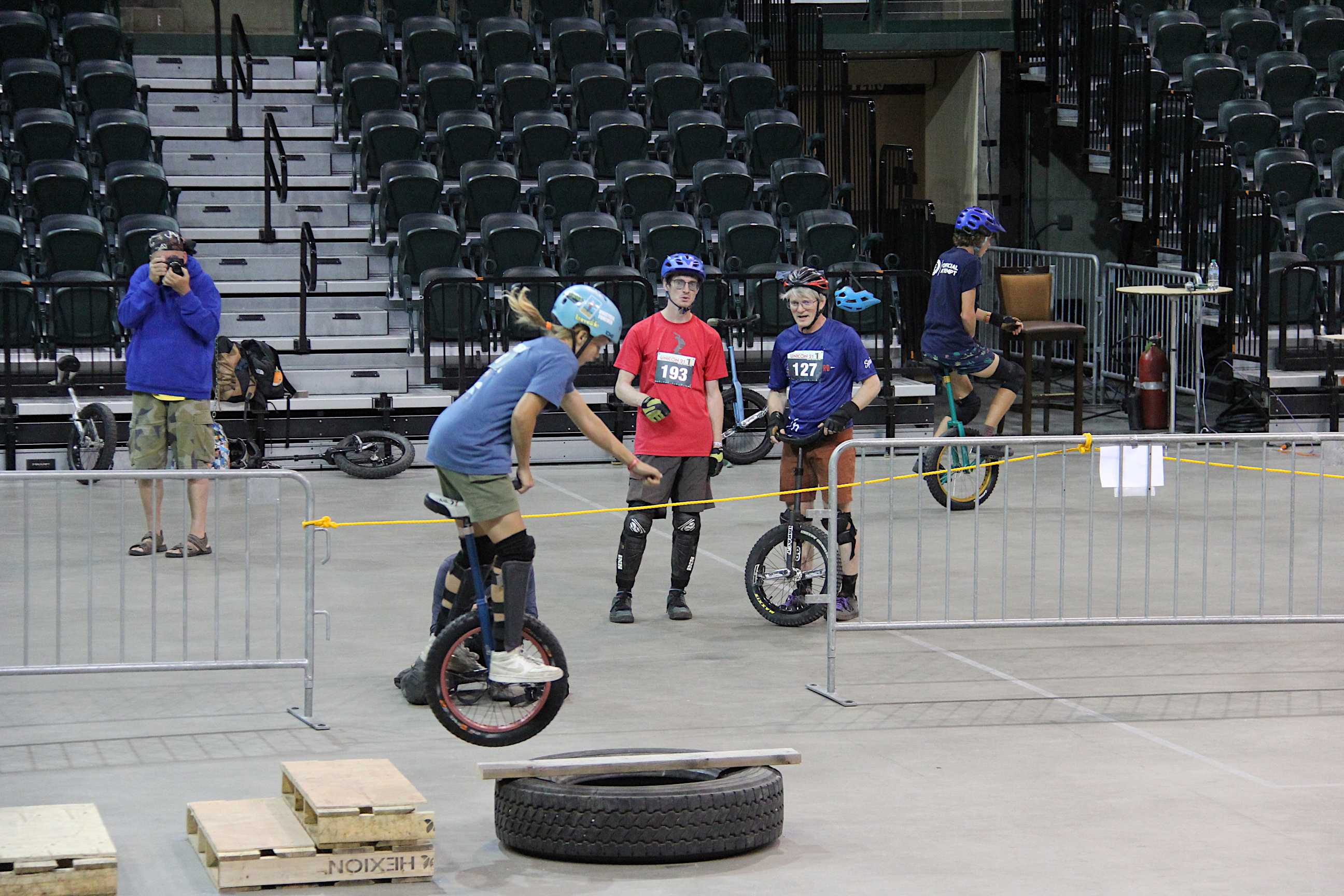
This unicyclist navigated planks, pallets and steps before jumping onto a plank atop a tire. (Minnesota Prairie Roots copyrighted photo July 2024)
For a while, we watched solitary unicyclists ride across narrow planks onto stacked pallets, jump steps and leap onto a single plank inside the Sanford Center. Short on time, we headed to the Bemidji State campus for supper in the cafeteria before the evening freestyle performances.
Acrobatics, dancing, gymnastics…all were part of the freestyle performances. (Minnesota Prairie Roots copyrighted photo July 2024)
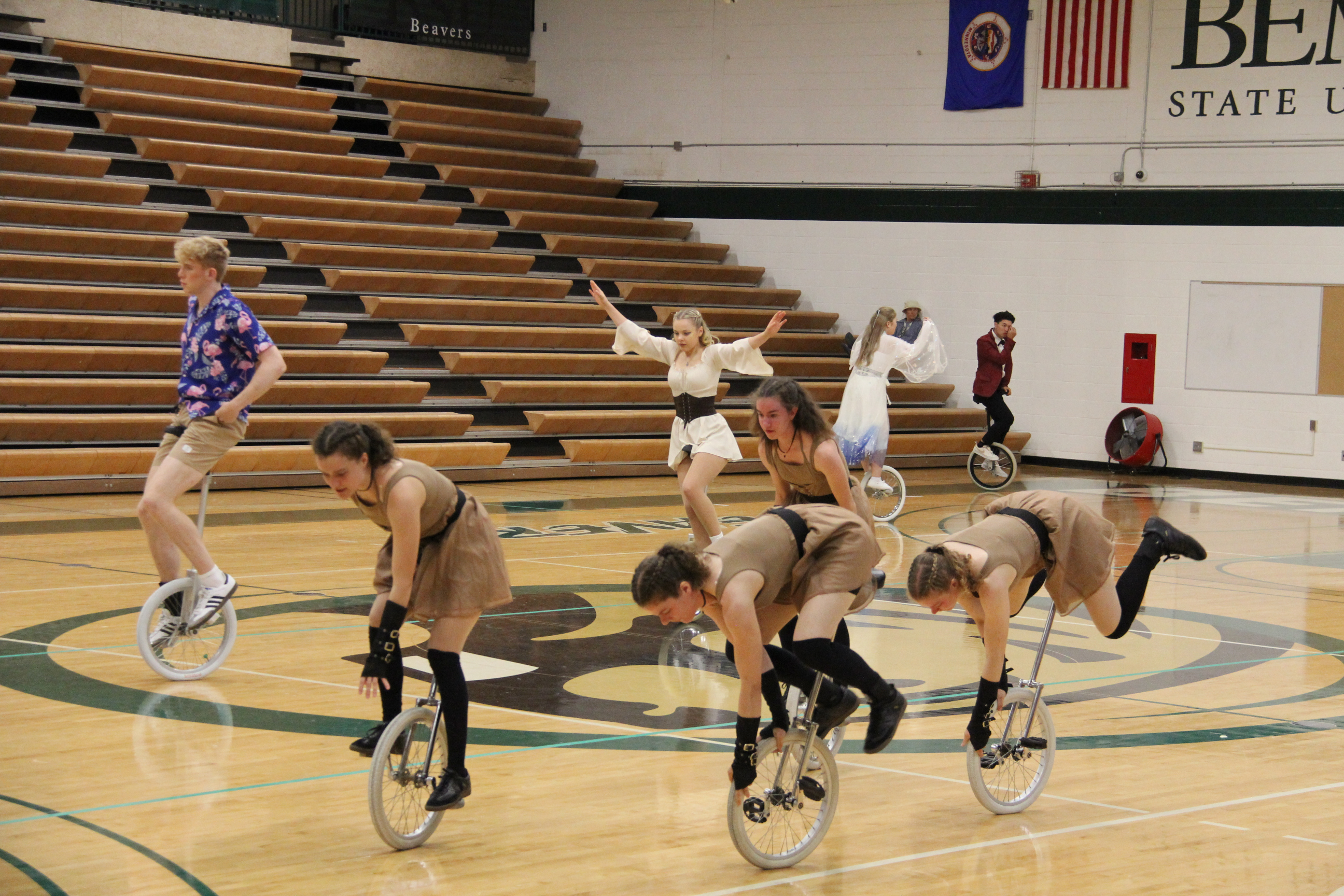
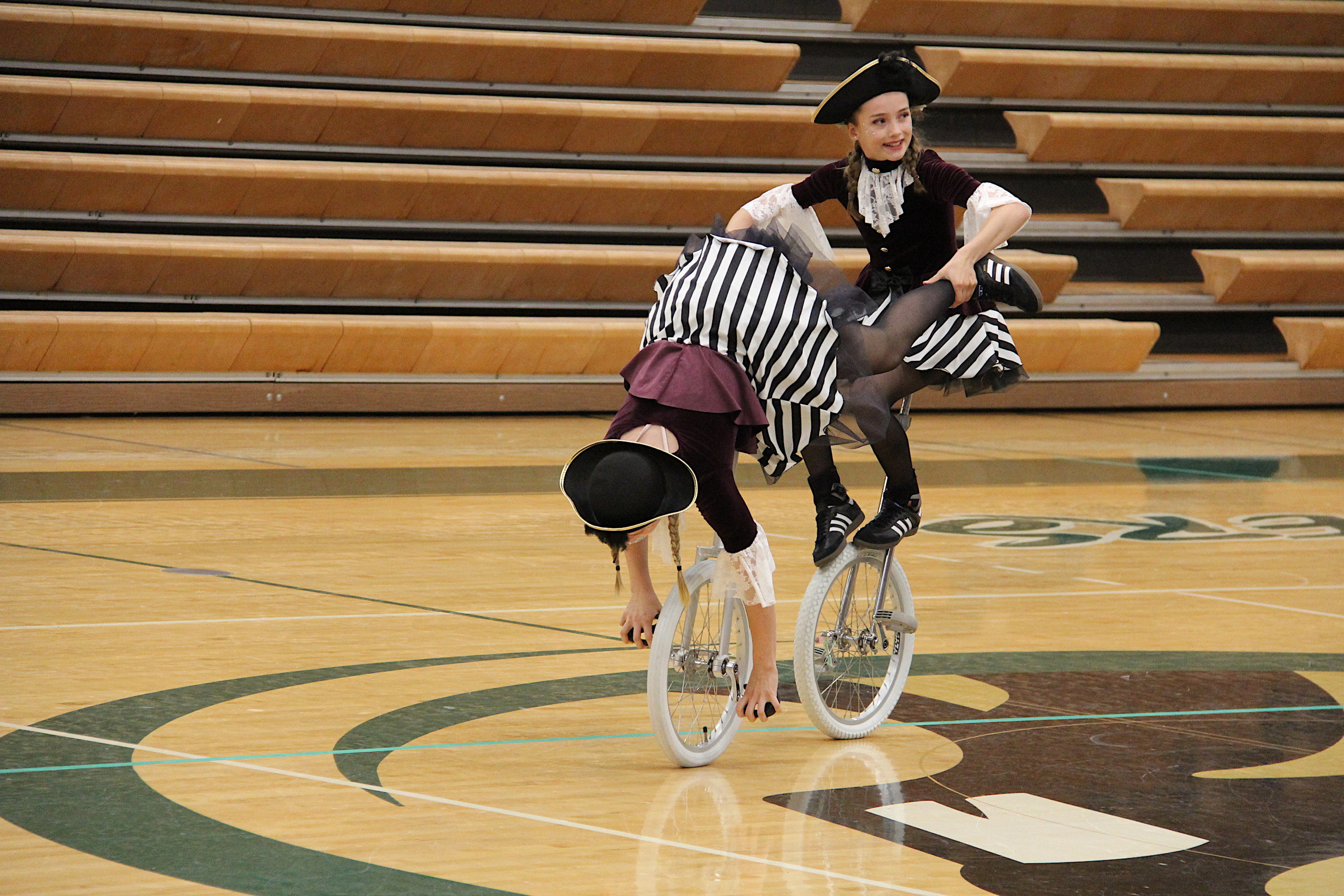
This was my favorite event with costumed unicyclists performing together. They twirled, leapt, moved like gymnasts, acrobats, dancers and ballerinas in time to music. It was beautiful. Mesmerizing.
The crowd does the wave in between performances at the freestyle competition. (Minnesota Prairie Roots copyrighted photo July 2024)
In that university gymnasium, filled with people from around the world, I felt an overwhelming sense of unity. The crowd encouraged performers with whistles, shouts, applause and foot-stomping. Flags waved. Smiles abounded. I felt a spirit of positivity, the sense of joy that prevails when we realize that we are all just people enjoying an event together. Our differences mattered not in that moment, in that place, among some of the world’s best unicyclists. To be part of that experience at Unicon 21 proved particularly uplifting and inspiring. And that it all happened right here in Minnesota felt, oh, so incredibly good.
NOTE: Check back for more photos from the international unicycling convention in Bemidji.














Recent Comments