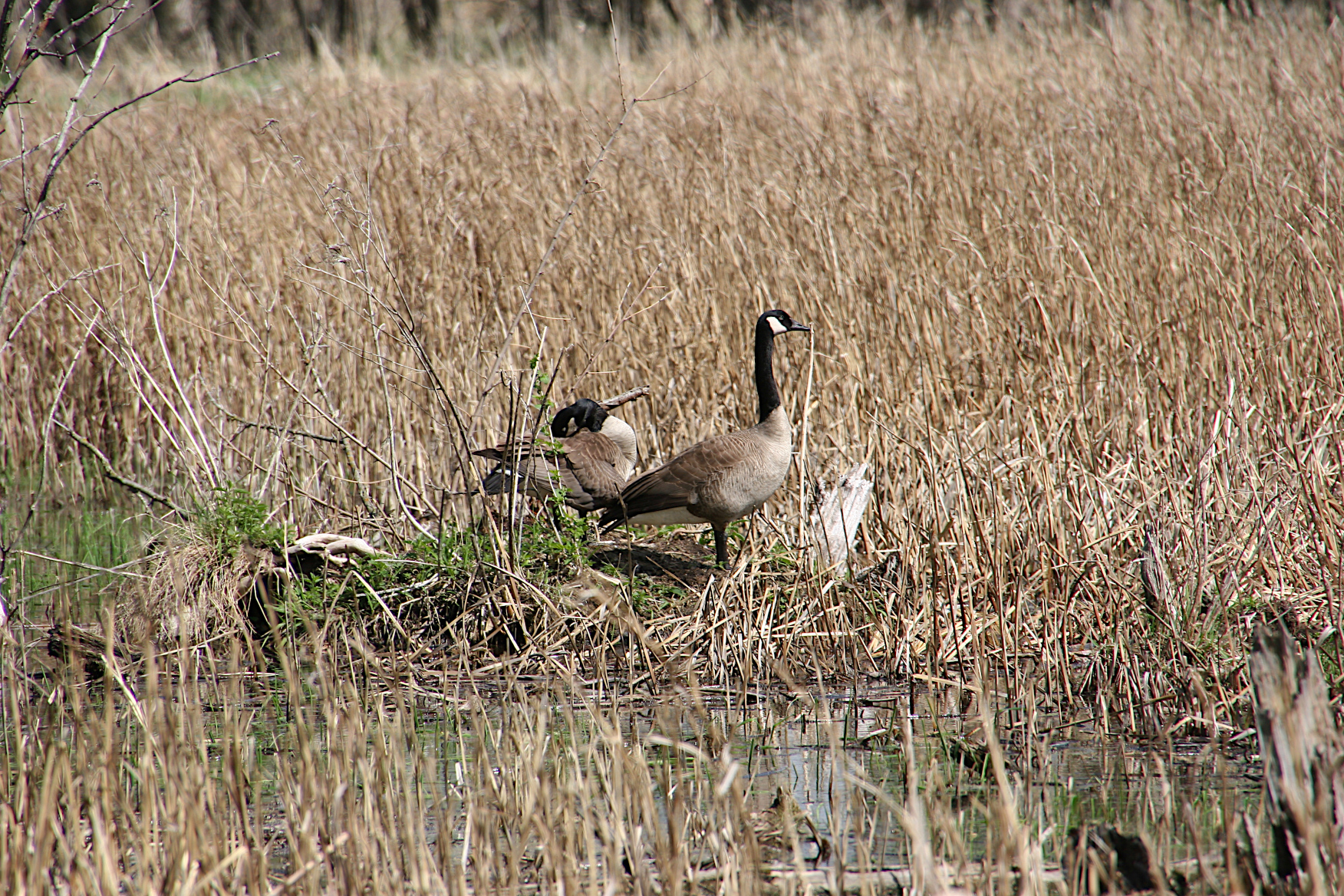
Geese atop a nest at River Bend. (Minnesota Prairie Roots copyrighted photo May 15, 2022)
Opportunities abound to observe newly-hatched spring waterfowl in my Minnesota community of Faribault, where two rivers run through—the Straight and the Cannon—and assorted ponds dot the landscape.
New signage graces the entrance to the nature center in Faribault. (Minnesota Prairie Roots copyrighted photo May 2022)
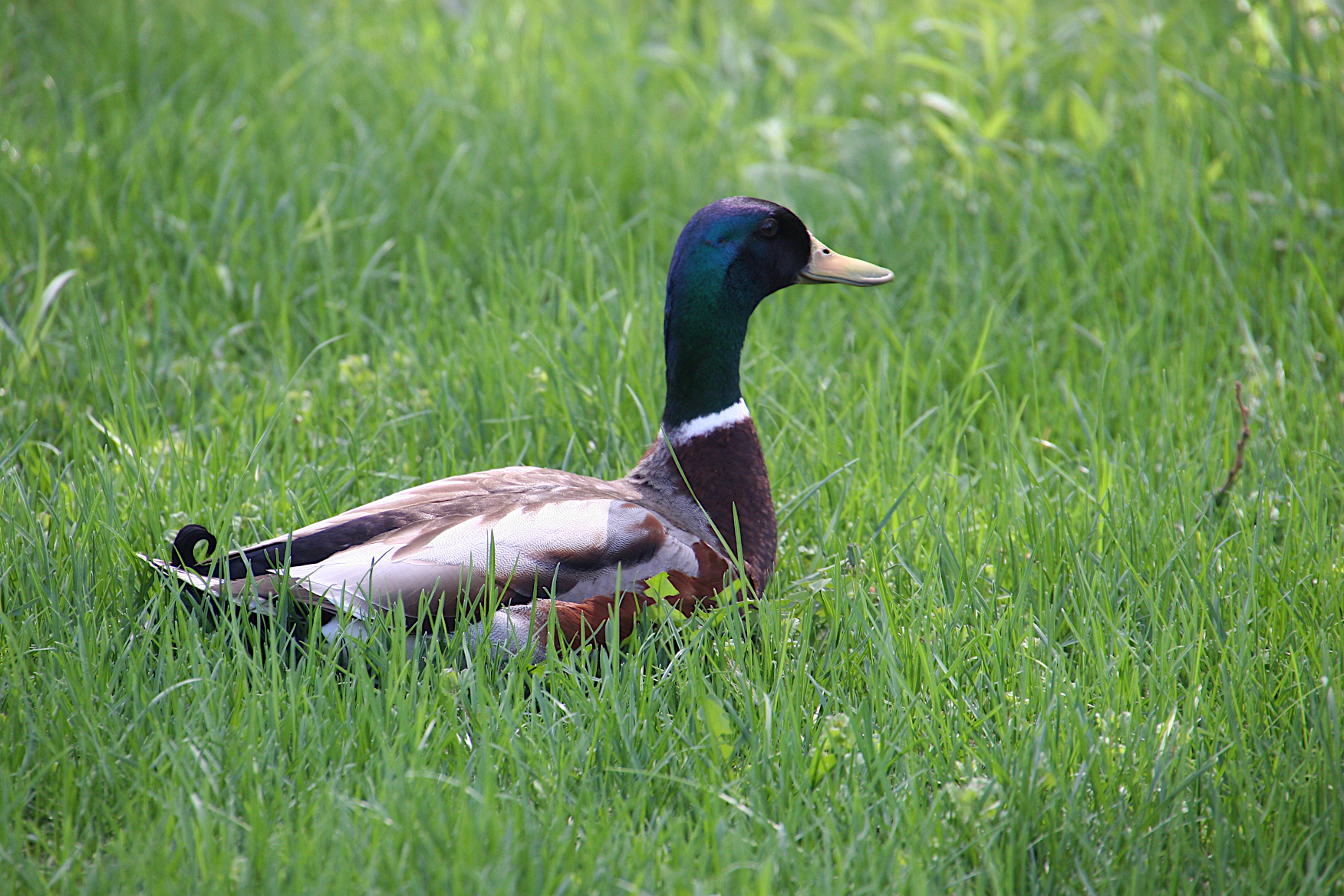
One of two mallards I saw. (Minnesota Prairie Roots copyrighted photo May 15, 2022)
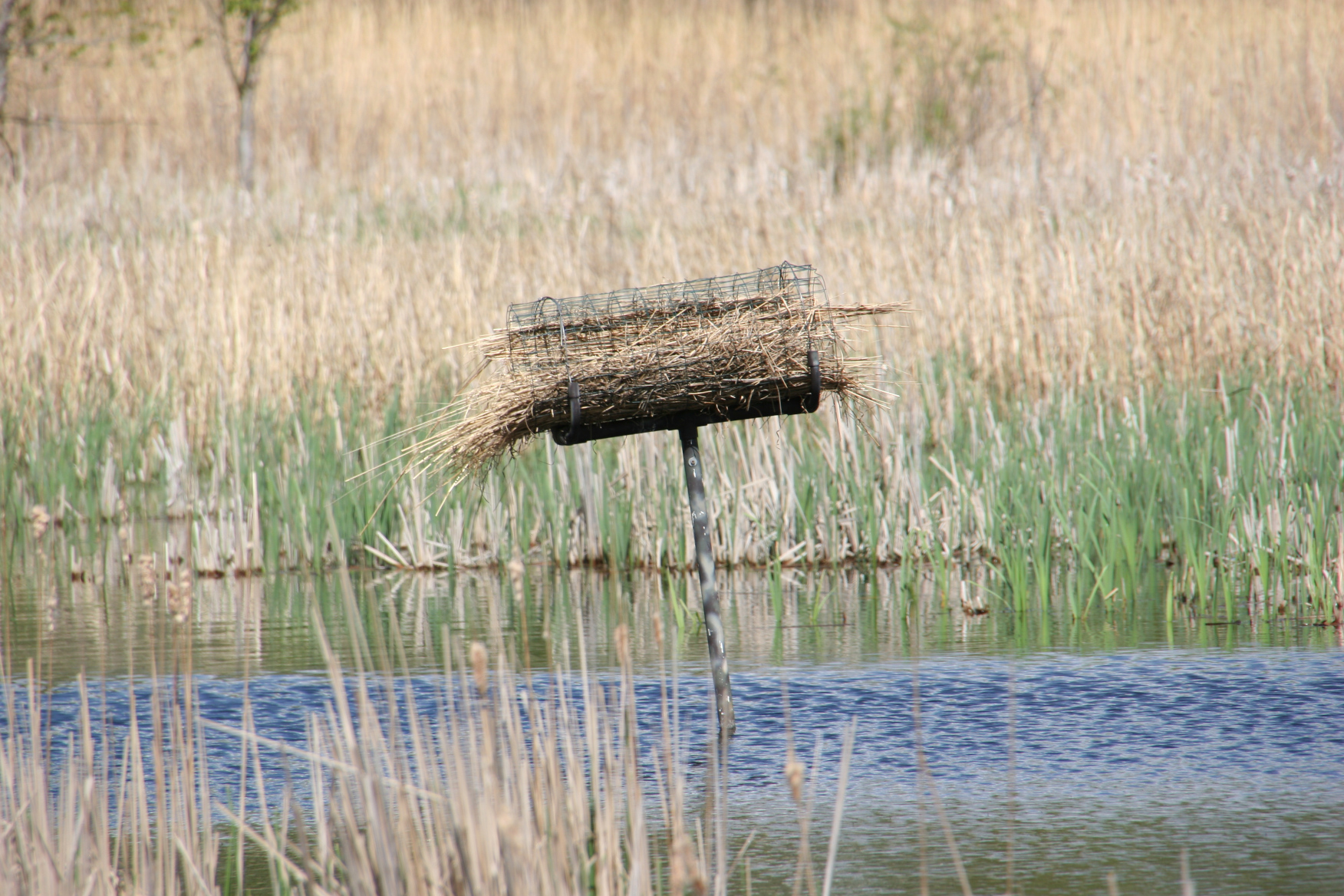
An obviously human-made nest in the pond. (Minnesota Prairie Roots copyrighted photo May 2022)
On a recent stop at River Bend Nature Center, I expected to see goslings and ducklings. But I didn’t. Instead, I saw two adult ducks in the grass aside the road upon entering the center. And then I spotted two grown geese atop a nest and a lone goose cruising the nearby pond. I need to check other locales, like the Cannon River in North Alexander Park. Ducks and geese are prolific there to the point of being a nuisance. I always watch where I step.
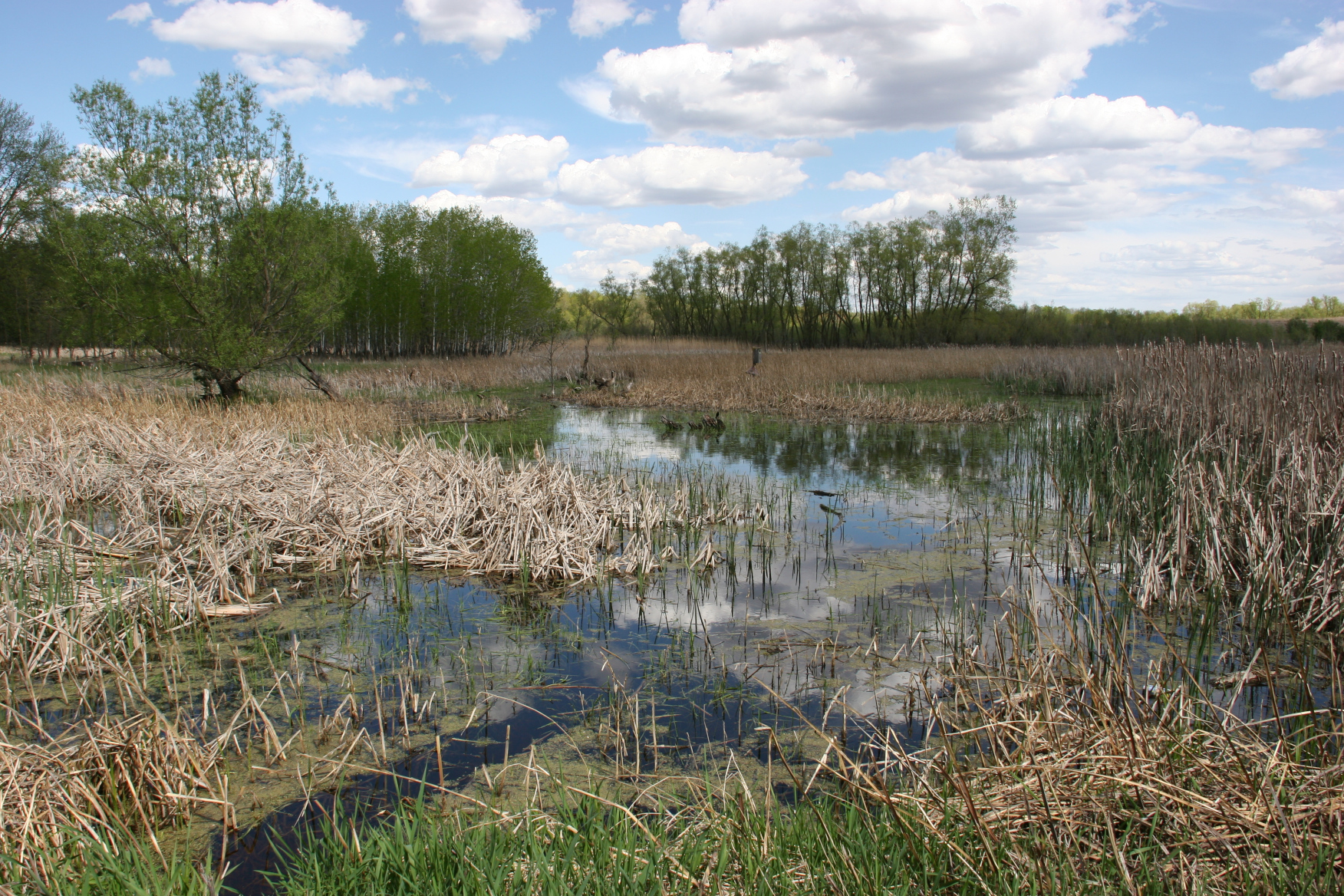
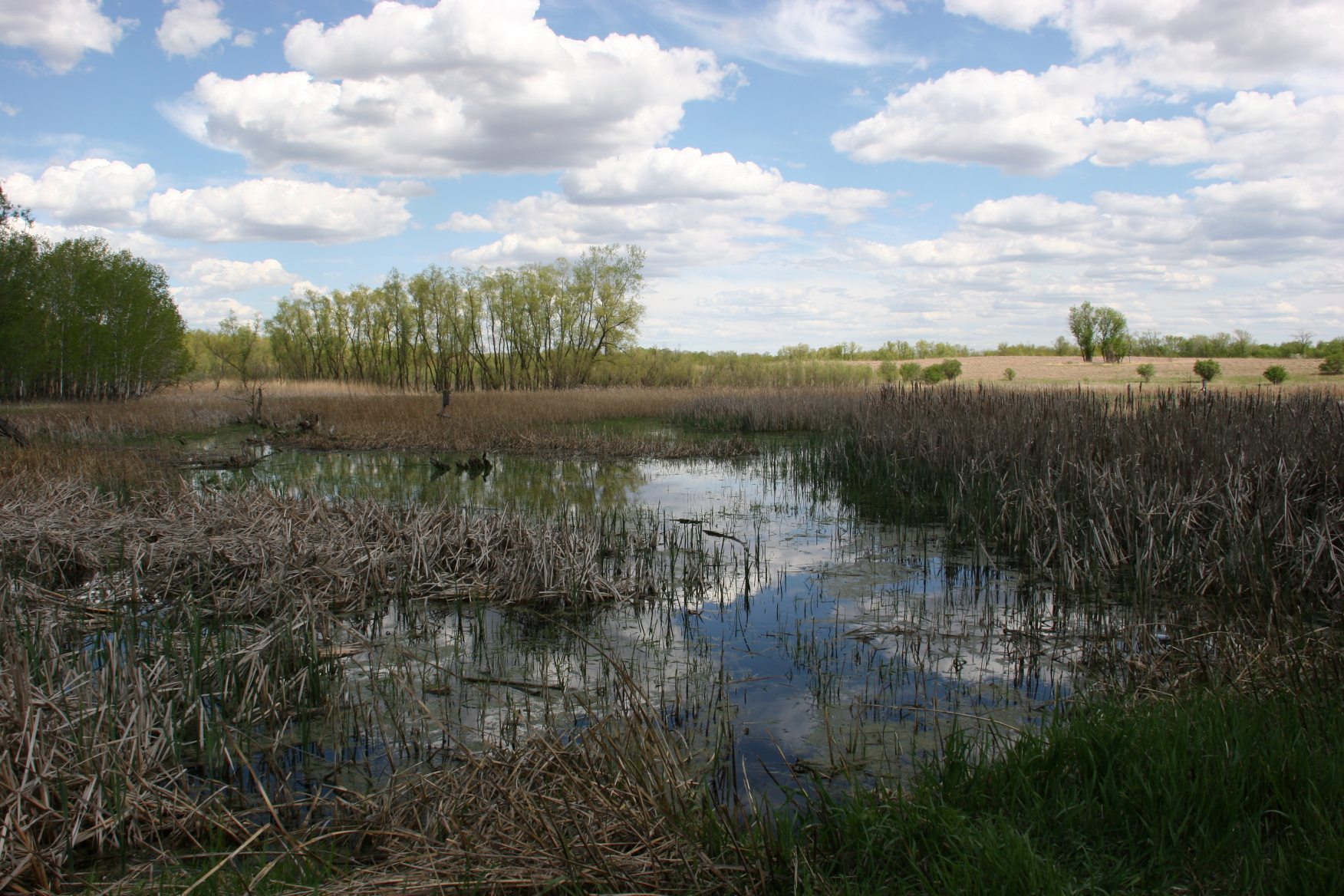
Sky and water come together. (Minnesota Prairie Roots copyrighted photo May 2022)
Despite the absence of sighting newborn waterfowl at River Bend, I found other scenes to focus my interest. I especially appreciated the sky, a patchwork of blue and white with clouds seemingly suspended overhead.
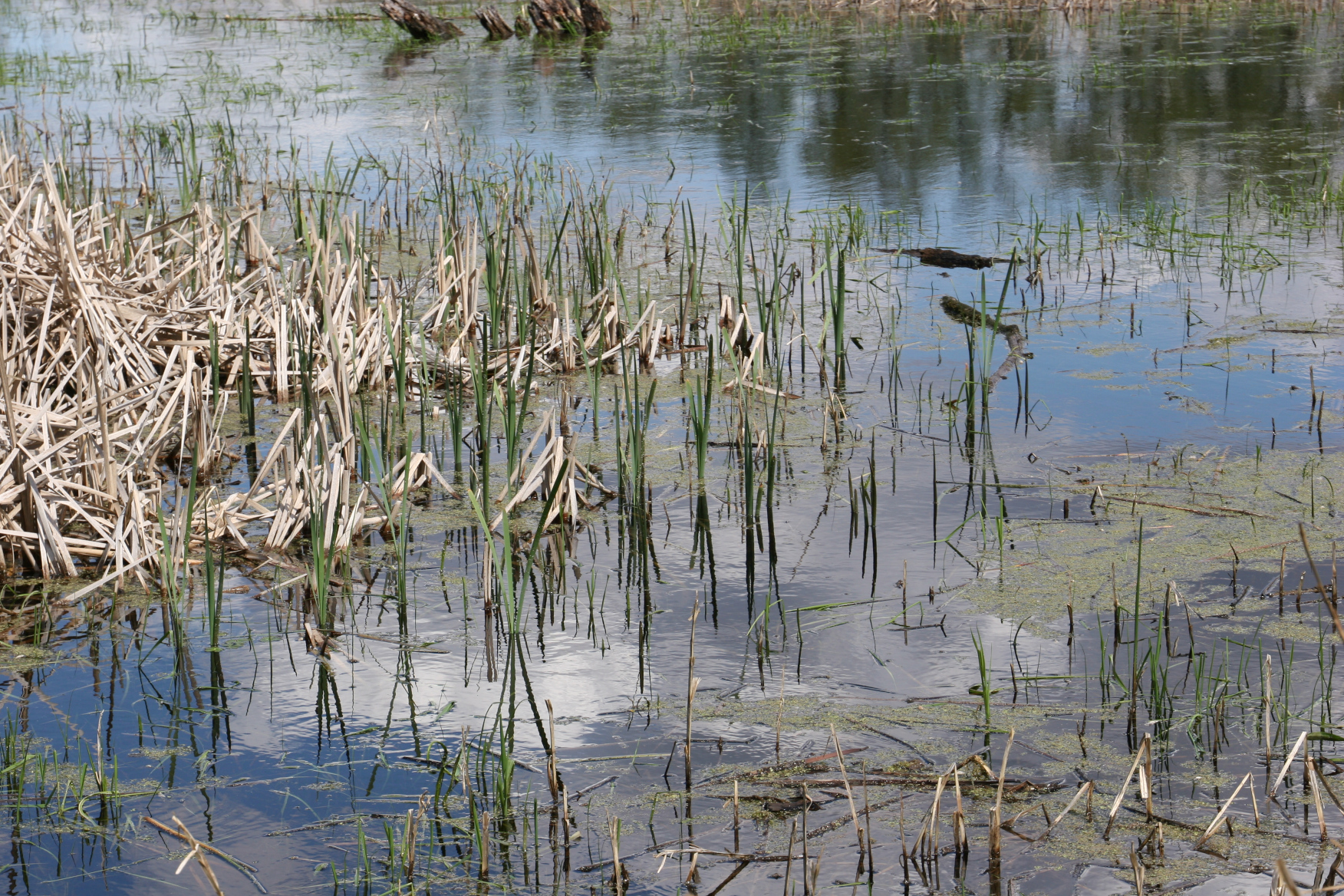
Pond close-up. (Minnesota Prairie Roots copyrighted photo May 2022)
And below, in the pond, those skies reflected on the water, among dried and greening grasses.
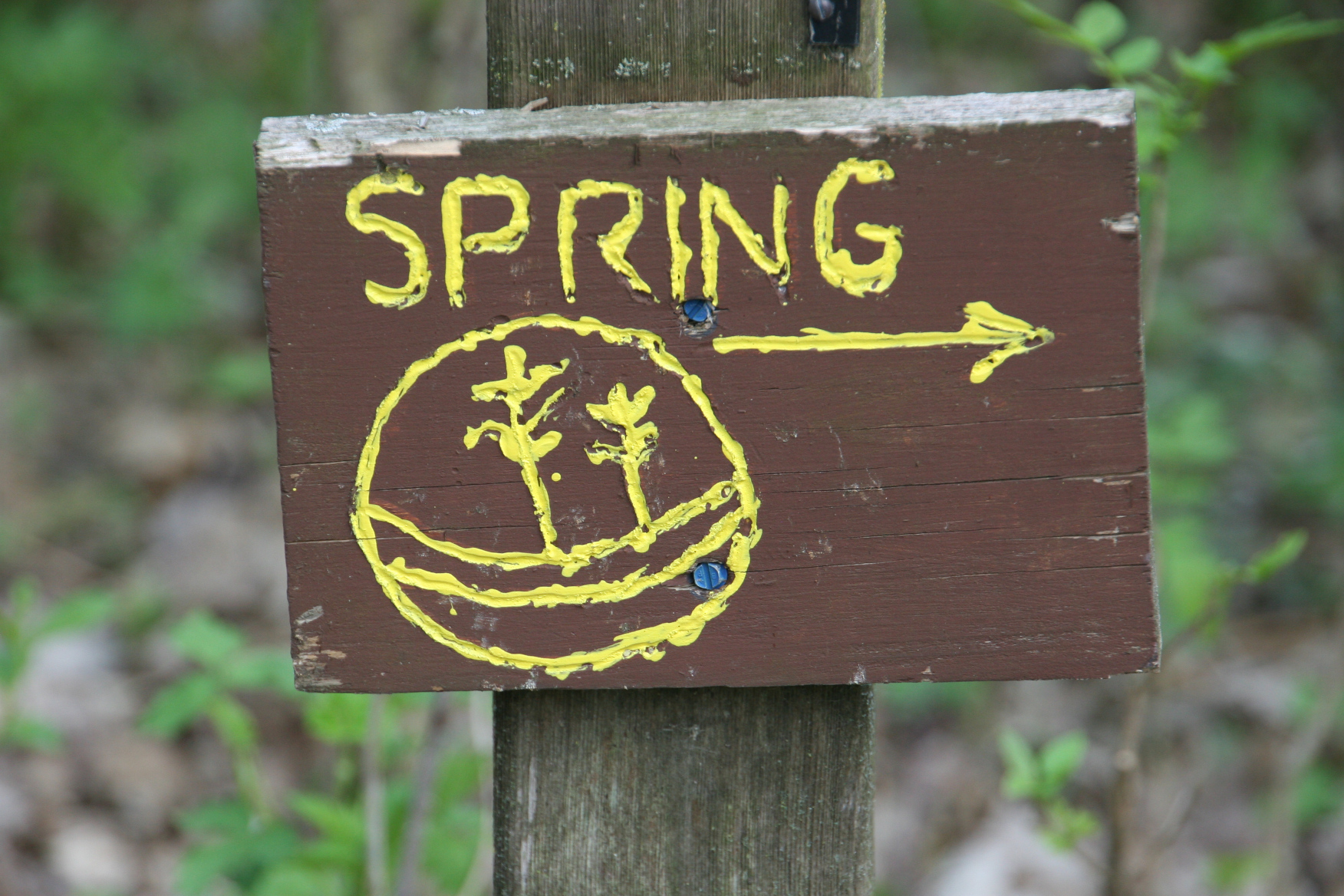
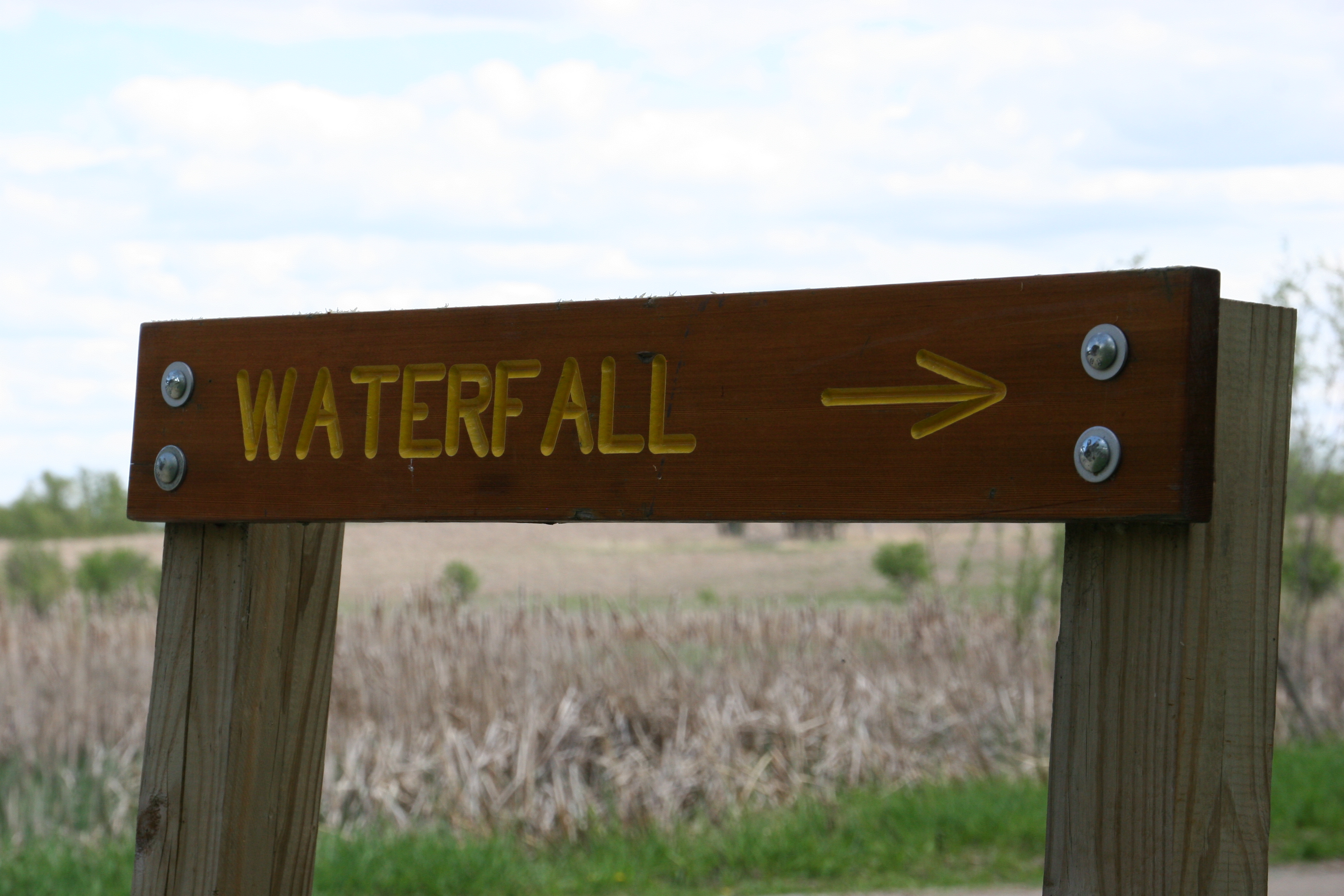
This sign at River Bend points to an actual spring, not a reference to the season. I love these kitschy homemade signs scattered throughout the nature center. (Minnesota Prairie Roots copyrighted photo May 2022)
This time in May, especially with a late spring, seasons mix. Textures and remnants of autumn remain, contrasting with the greening of spring.
Just inside the entrance a short distance is the waterfall, between the road and the Minnesota State Correctional Facility, Faribault. (Minnesota Prairie Roots copyrighted photo May 2022)
A short walk to the nearby waterfall yielded disappointment. With the recent rains, I expected water to be rushing over the rock ledges. Rather, there was barely a trickle. The same went for the spring, just off the parking lot near the nature center entrance. No water flowed.
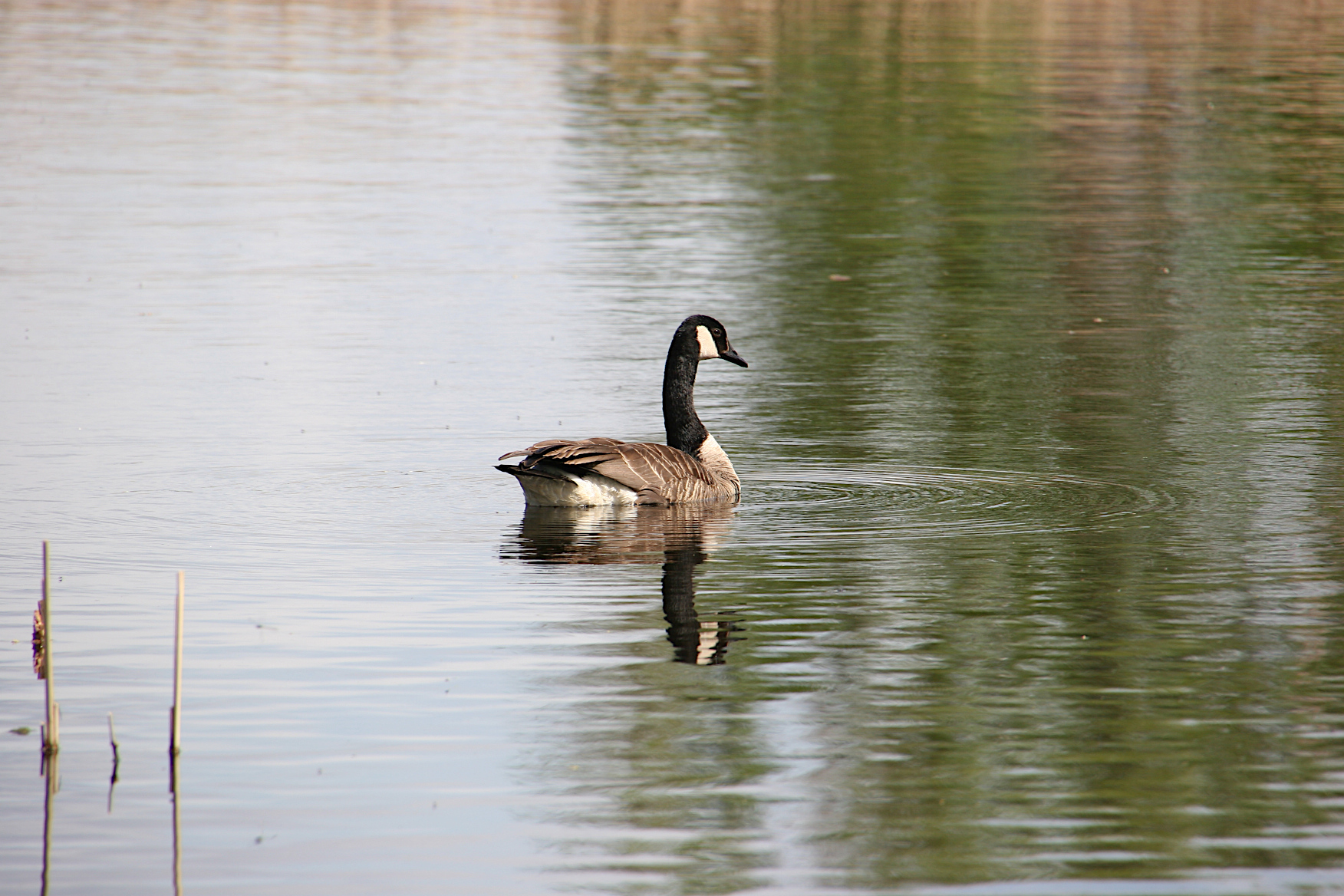
A goose swims alone in the pond. (Minnesota Prairie Roots copyrighted photo May 2022)
But back in the pond, the three geese I watched seemed comfortably settled. Soon, I expect, they will make way for goslings (not ducklings).
Aiming my camera lens skyward on a beautiful mid-May afternoon at Falls Creek County Park, rural Faribault. (Minnesota Prairie Roots copyrighted photo May 15, 2022)
I FIND MYSELF, daily, tipping my head back to view the trees, leaves unfurling, greening the landscape.
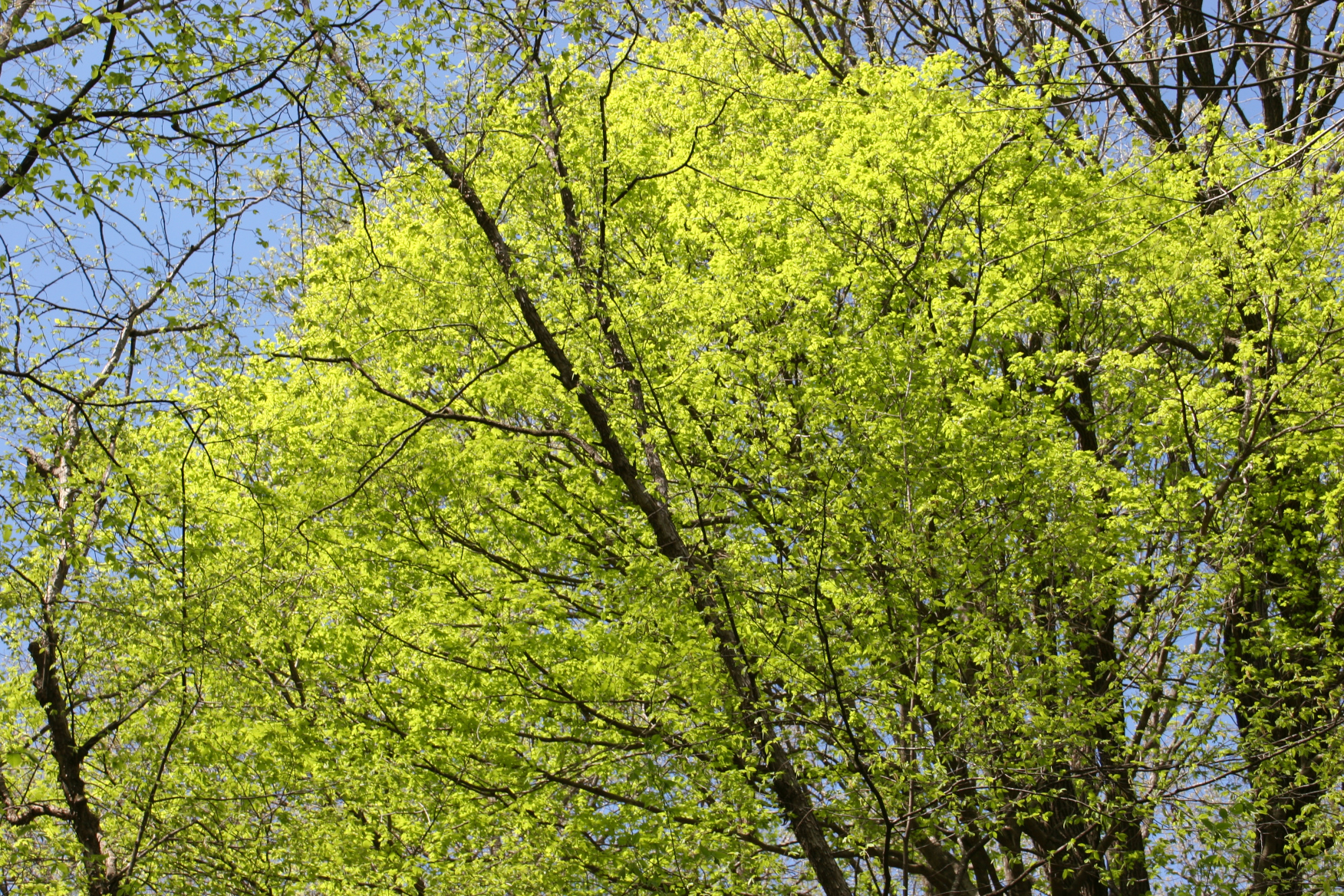
An especially vivid green tree in the woods at Falls Creek Park. (Minnesota Prairie Roots copyrighted photo May 2022)
In these early days of a much-too-late spring in Minnesota, the greens appear especially intense, vivid, lush. The infusion of color is almost like visual overload after months of living in a colorless, drab world. I welcome the change with my eyes wide open.
At sunset, hillside trees and the maple in my backyard create an artsy scene. (Minnesota Prairie Roots copyrighted photo May 2022)
From the woods that bump against my backyard to area parks and nature centers, I feel such gratitude for places where I can immerse myself in nature. Even if that’s simply looking skyward.
Even though buckthorn is an invasive tree, the scent of its flowers is lovely. Photographed at Falls Creek County Park. (Minnesota Prairie Roots copyrighted photo May 2022)
In this tech-centered world, we need to pause, to take a break, to connect, really connect, with nature. Falls Creek County Park, just east of Faribault along Minnesota State Highway 60, offers such a place to embrace the natural world.
A footbridge leads into the woods at Falls Creek County Park. (Minnesota Prairie roots copyrighted photo May 2022)
So soothing…water rushing over rocks in Falls Creek. (Minnesota Prairie Roots copyrighted photo May 2022)
Falls Creek flows under the footbridge. (Minnesota Prairie Roots copyrighted photo May 2022)
As soon as I step onto the footbridge over Falls Creek, I feel a sense of peace. In the sound and sight of water rushing over rocks. There’s nothing more soothing than that symphony, except perhaps the rush of wind through trees.
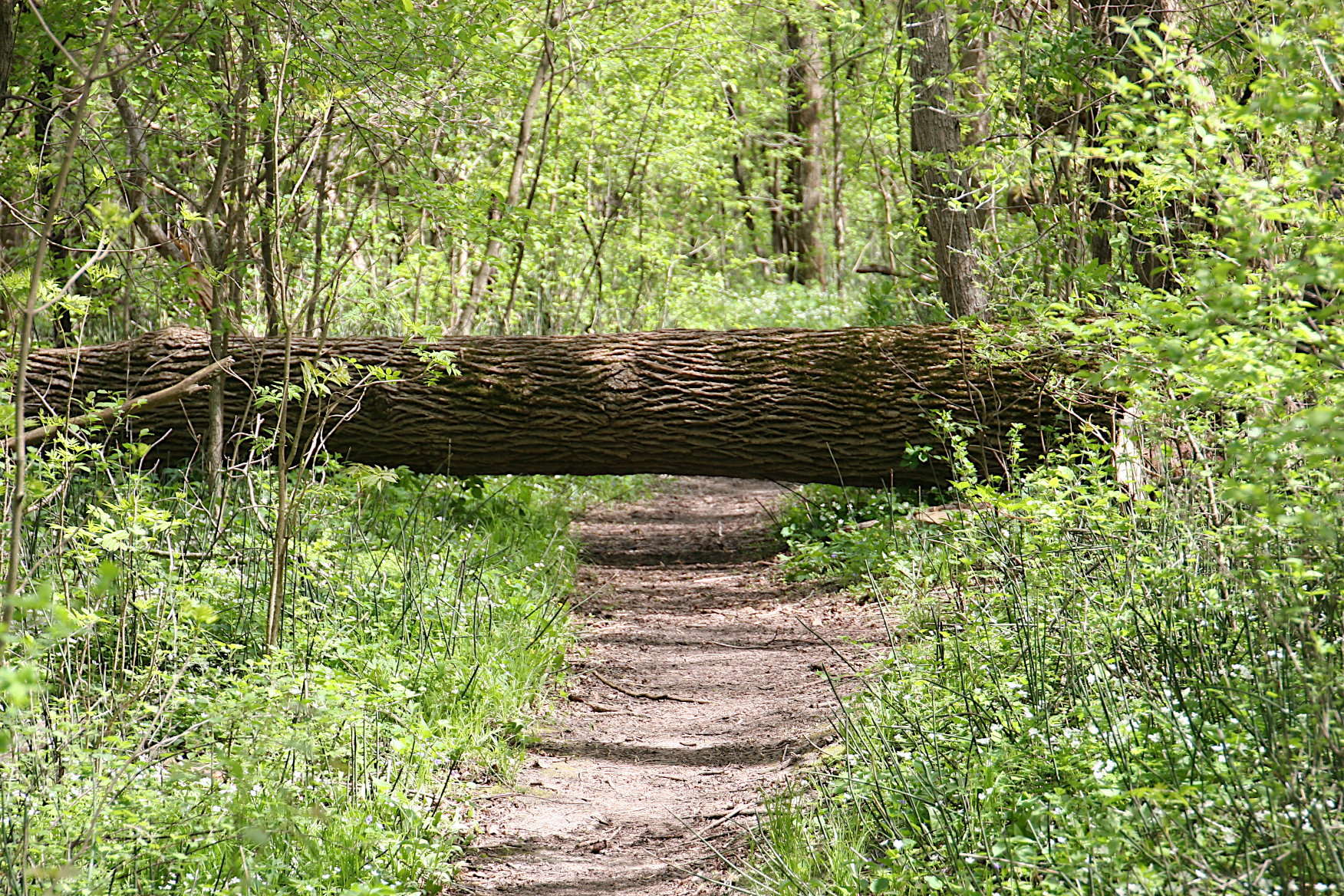
A fallen tree blocks the trail at Falls Creek Park. (Minnesota Prairie Roots copyrighted photo May 2022)
This park is more wild than tamed. Narrow dirt trails, packed hard by hikers’ shoes, call for caution. Roots can trip. Sections of eroded creek bank along the main path require focused walking, especially over a makeshift bridge of branches. In one area, a large, fallen tree blocks the route.
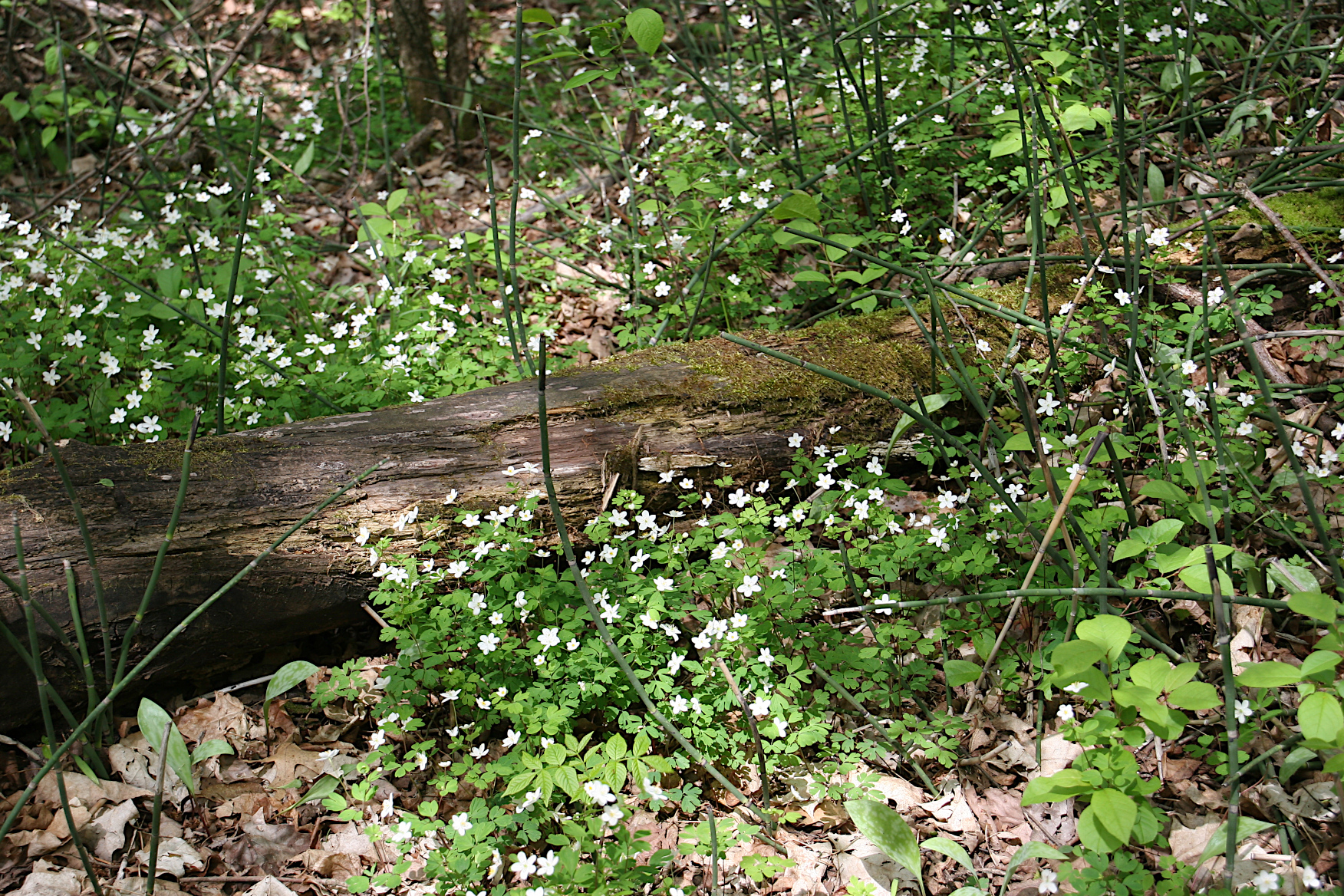
Wildflowers galore in the park woods. (Minnesota Prairie Roots copyrighted photo May 2022)
Still, despite the obstacles, this park is navigable. And worth visiting, especially now, when wildflowers blanket the woods. White, yellow, purple.
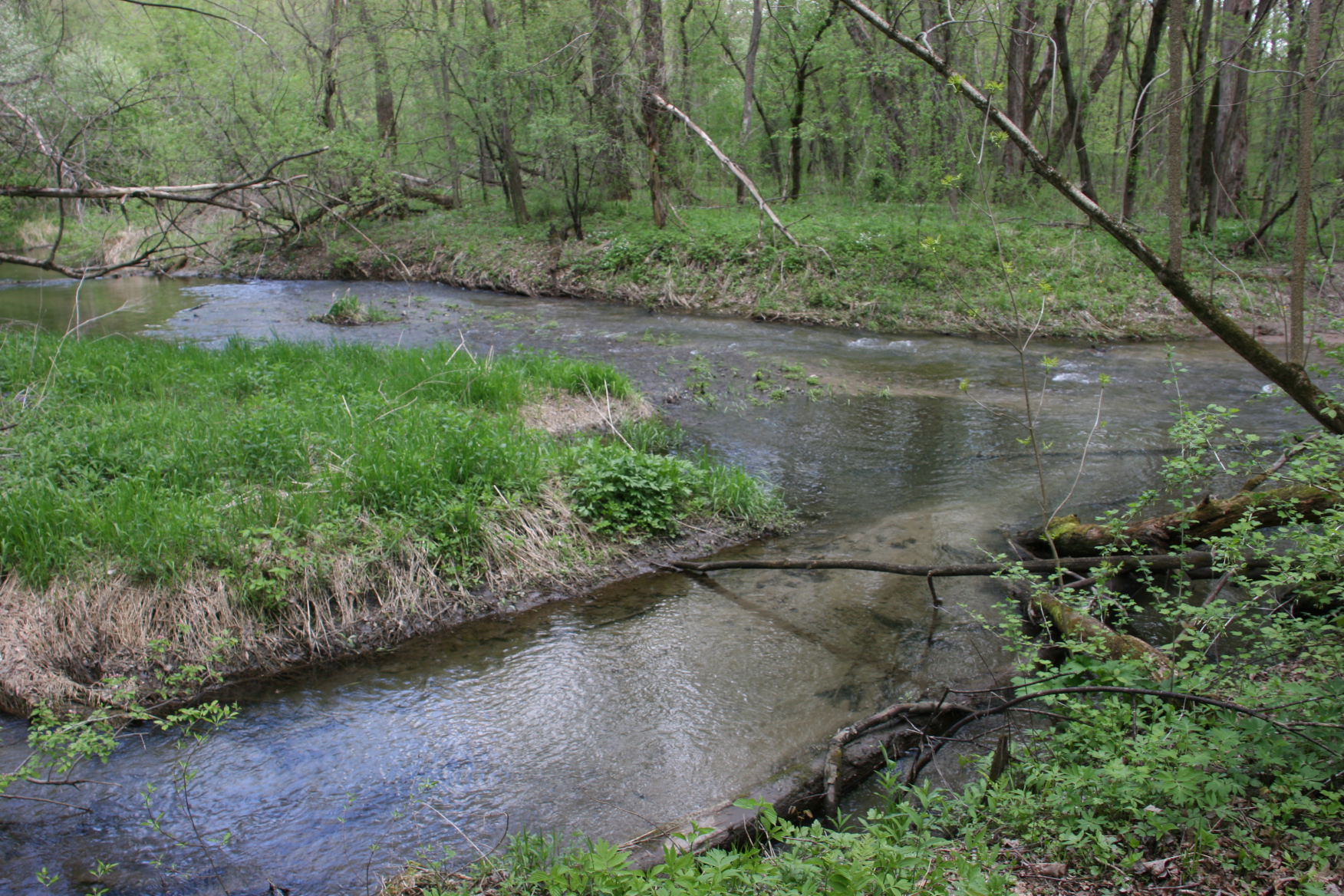
Winding Falls Creek. (Minnesota Prairie Roots copyrighted photo May 2022)
On a recent hike through Falls Creek County Park, Randy and I encountered another hiker and his two unleashed dogs who rushed us. I didn’t appreciate that, never do. But we also met a pre-teen girl and her dad on the bridge, she with book—some series about drama divas—in hand. The title fits his daughter, the dad said. They come to the park to read and to listen to music along the creek. How wonderful, I thought, to see this young girl into reading. And reading in the woods besides.
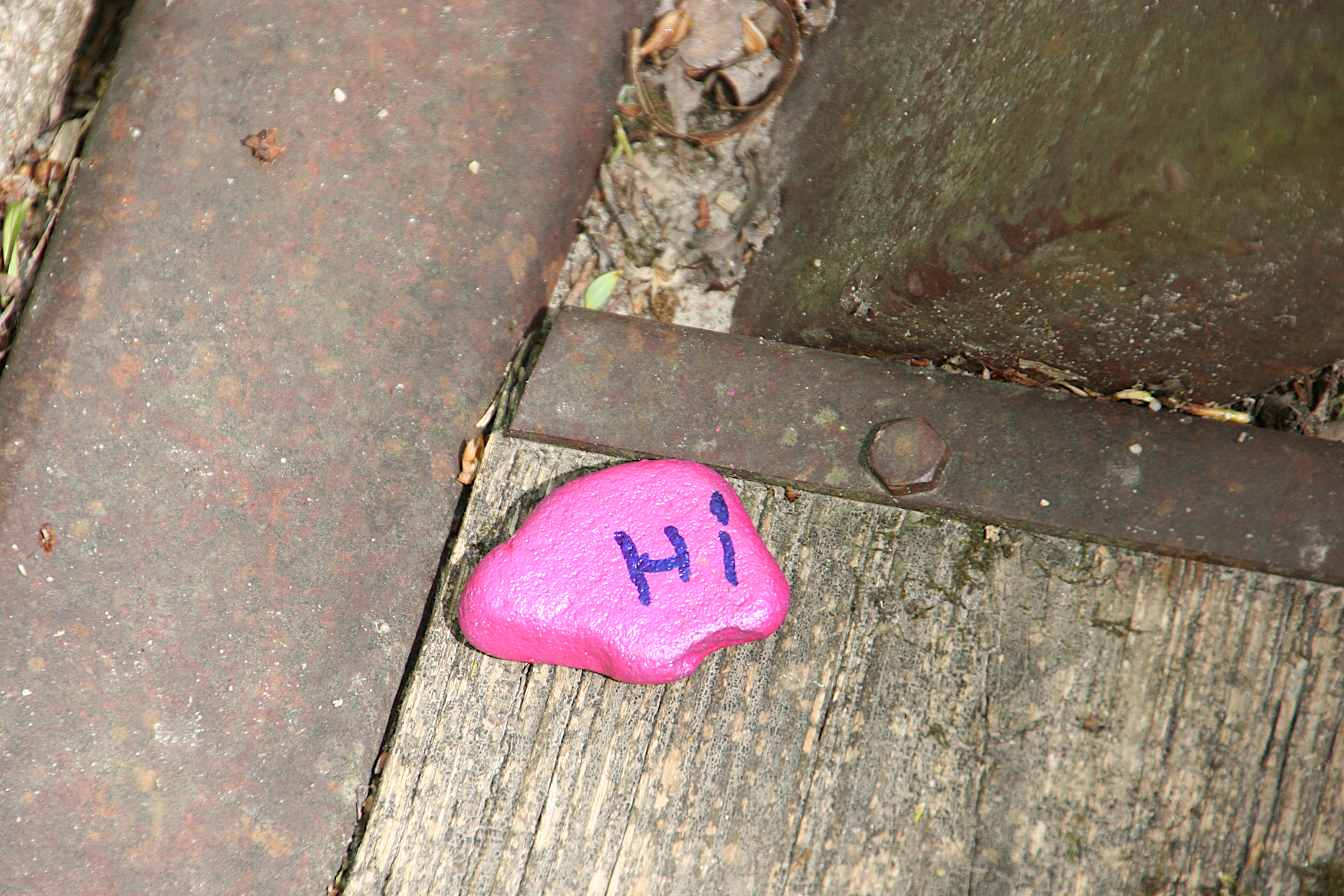
On the bridge, the first stone I spotted. (Minnesota Prairie Roots copyrighted photo May 2022)
I tipped the pair off to painted stones I’d discovered, pointing to the bright pink stone at the end of the footbridge. I found two more in the woods. “Look to your right,” I said. I delight in such unexpected messages that always cause me to smile and uplift me.
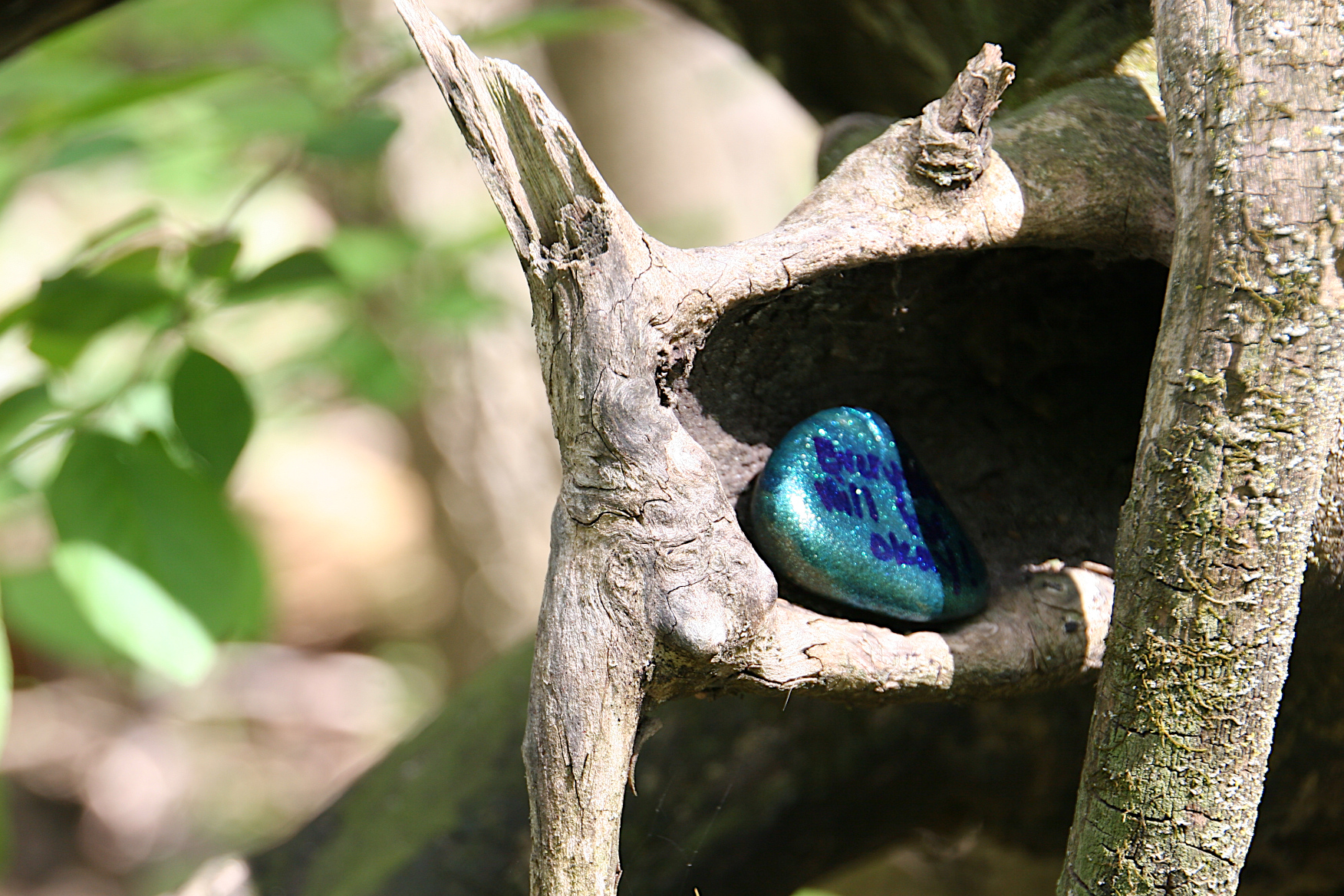
An encouraging message on a stone tucked into a tree. (Minnesota Prairie Roots copyrighted photo May 2022)
On this day, I took to heart the words—Everything will be okay!—printed on a stone painted a metallic, glittery turquoise. On this day, I needed to read that encouraging message left in the woods, left for me to see as I immersed myself in nature, in this Minnesota spring.
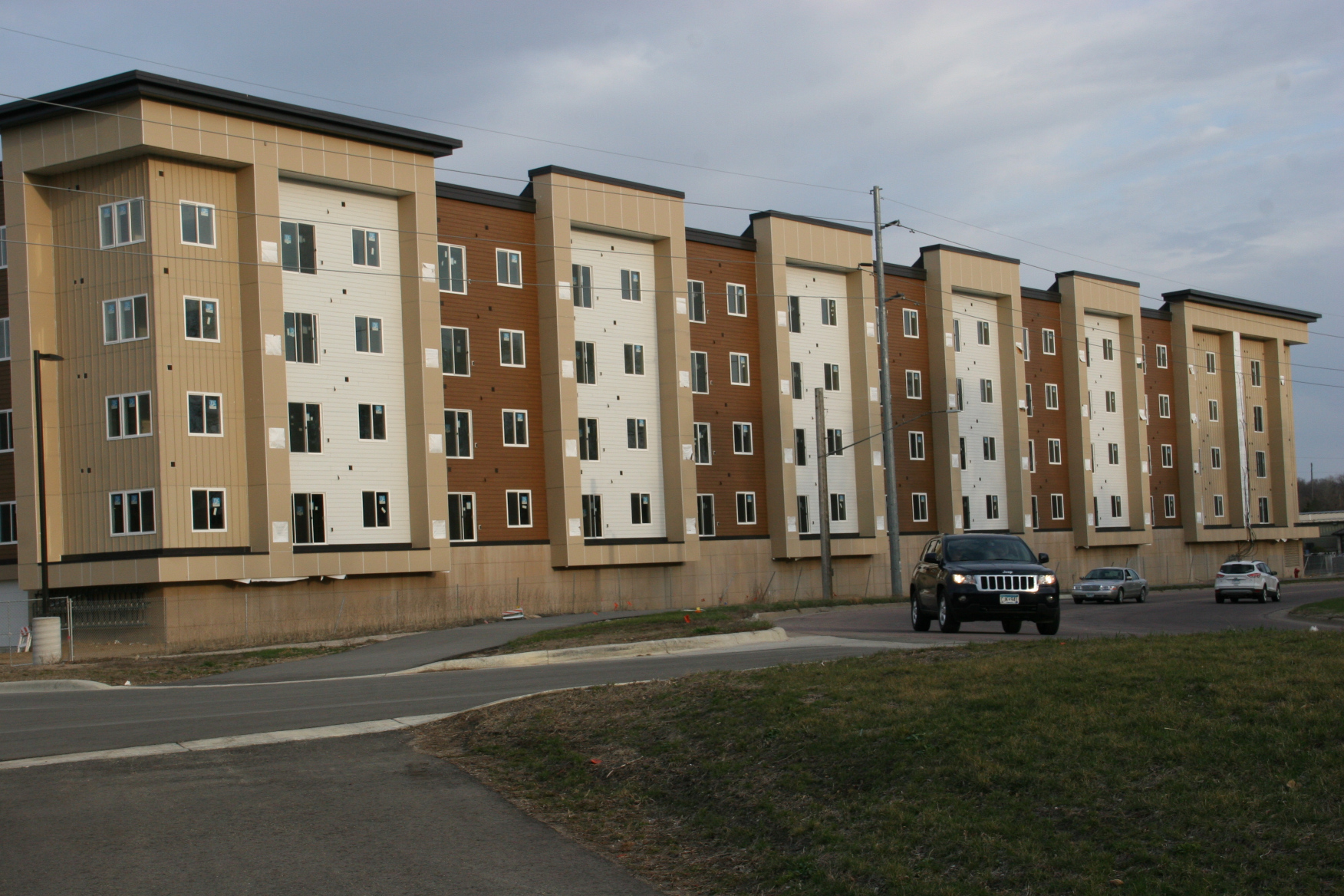
Traffic curves past Straight River Apartments, under construction along First Avenue Northeast in Faribault. (Minnesota Prairie Roots copyrighted photo late April 2022)
FOR MORE THAN A YEAR now, I’ve observed construction of a new apartment complex near downtown Faribault next to an in-progress city park.
Another view of Straight River Apartments, northeast side. (Minnesota Prairie Roots copyrighted photo late April 2022)
Straight River Apartments stand on the site of a former massive city garage, just north of the American Legion and aside train tracks tracing the Straight River. Fleckenstein Bluffs Park is adjacent. Both are definitely improvements to the properties.
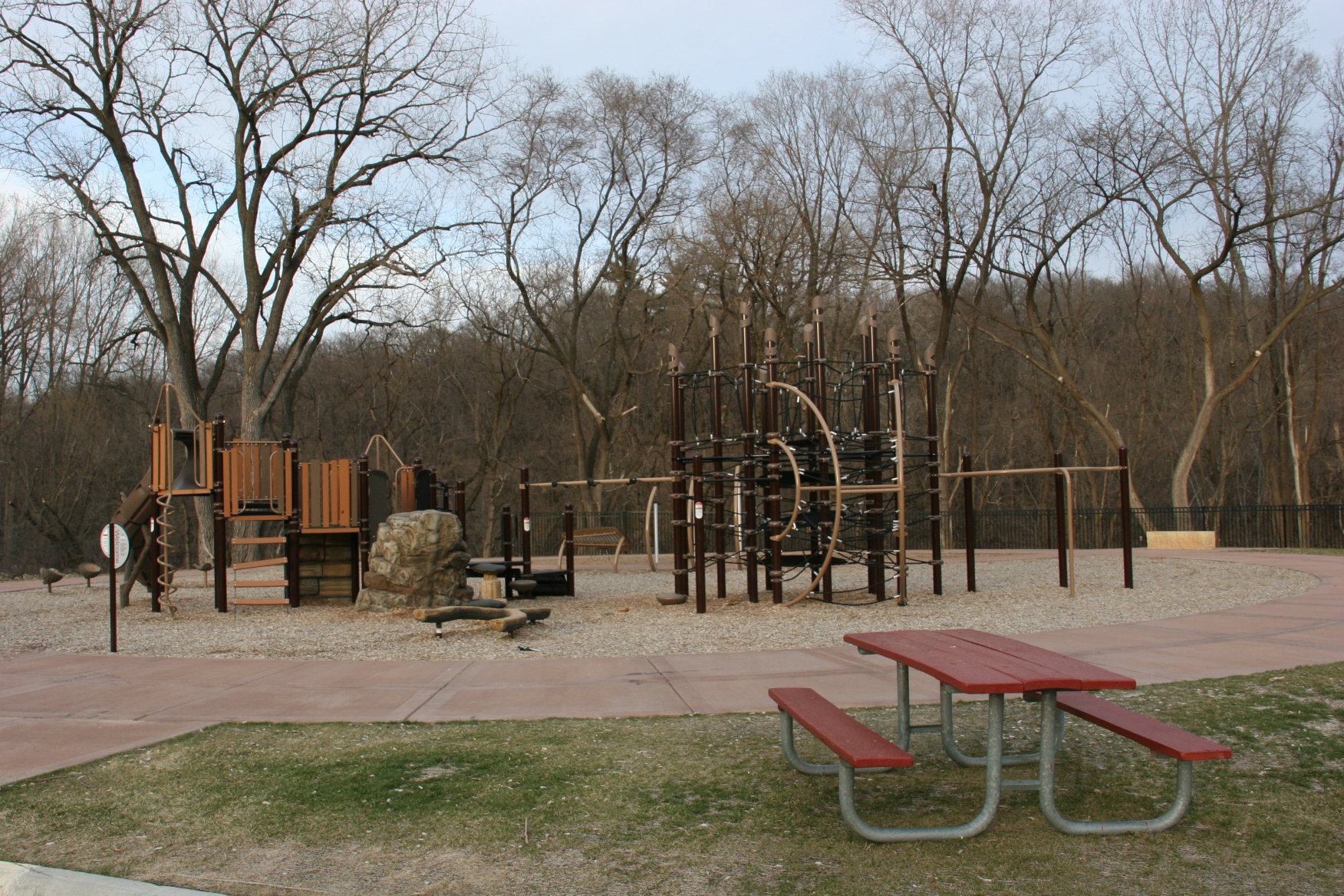
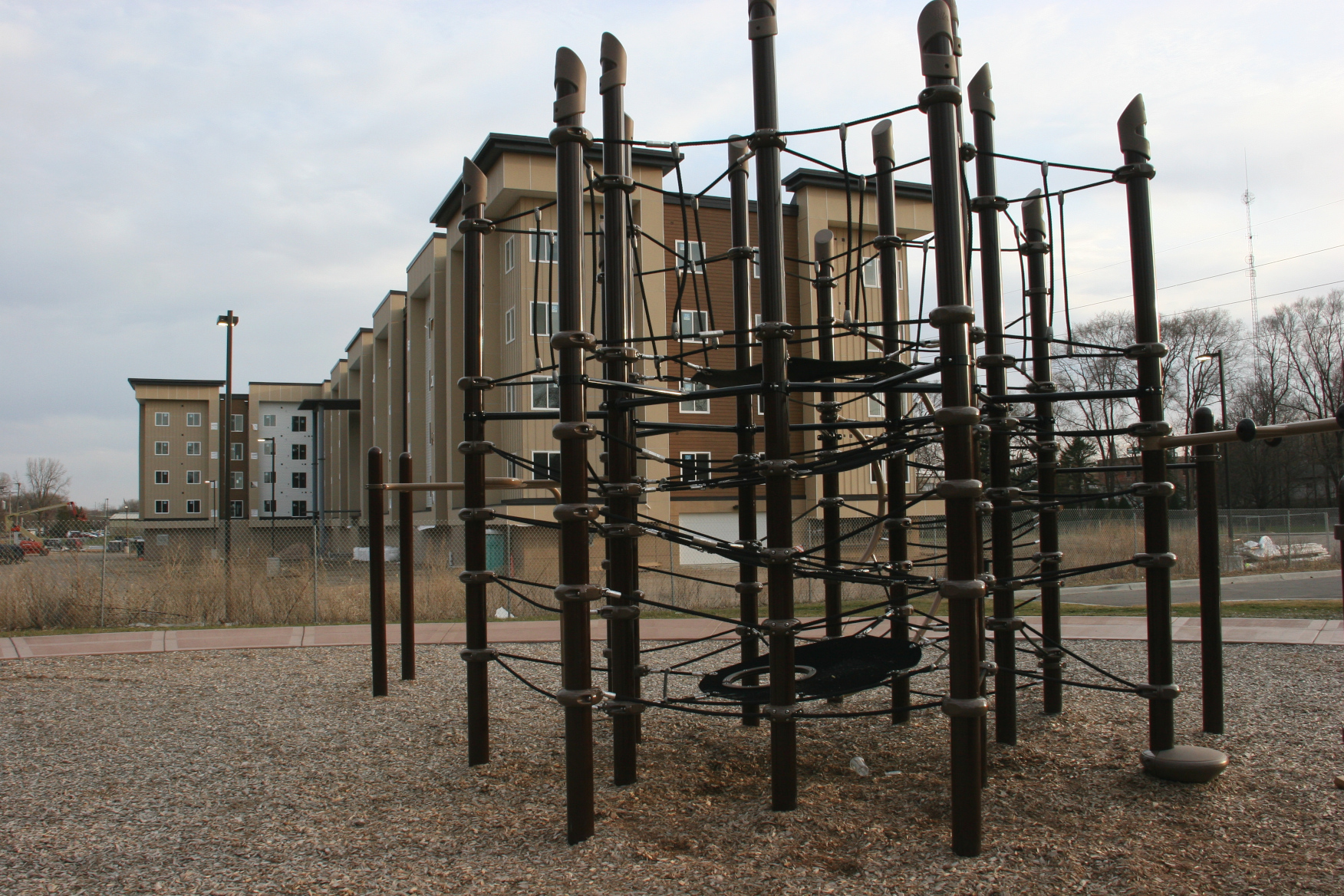
The sprawling nature-themed playground fits the setting along the Straight River. (Minnesota Prairie Roots copyrighted photo late April 2022)
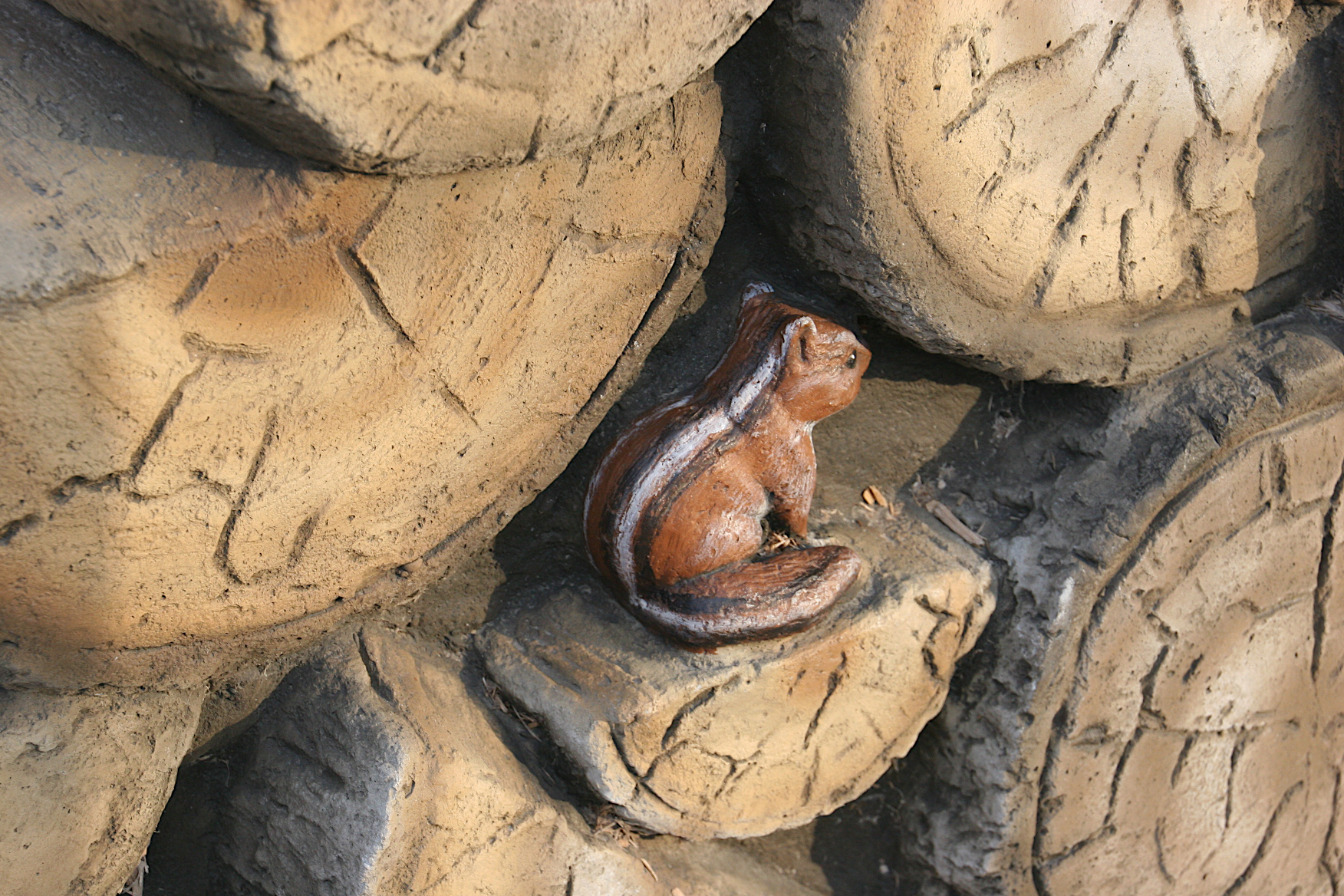
Animals, like this chipmunk, are incorporated into the playground equipment, following the nature theme. (Minnesota Prairie Roots copyrighted photo late April 2022)
The climbing apparatus at Fleckenstein Bluffs by Straight River Apartments. (Minnesota Prairie Roots copyrighted photo late April 2022)
As I’ve watched developments on this land, I’ve considered how the apartment location will connect renters to nature and downtown. Renters will not only benefit from the next-door park, complete with nature-themed playground, picnic shelter and scenic overlook over the Straight River, but will also have direct access to the Straight River Trail.
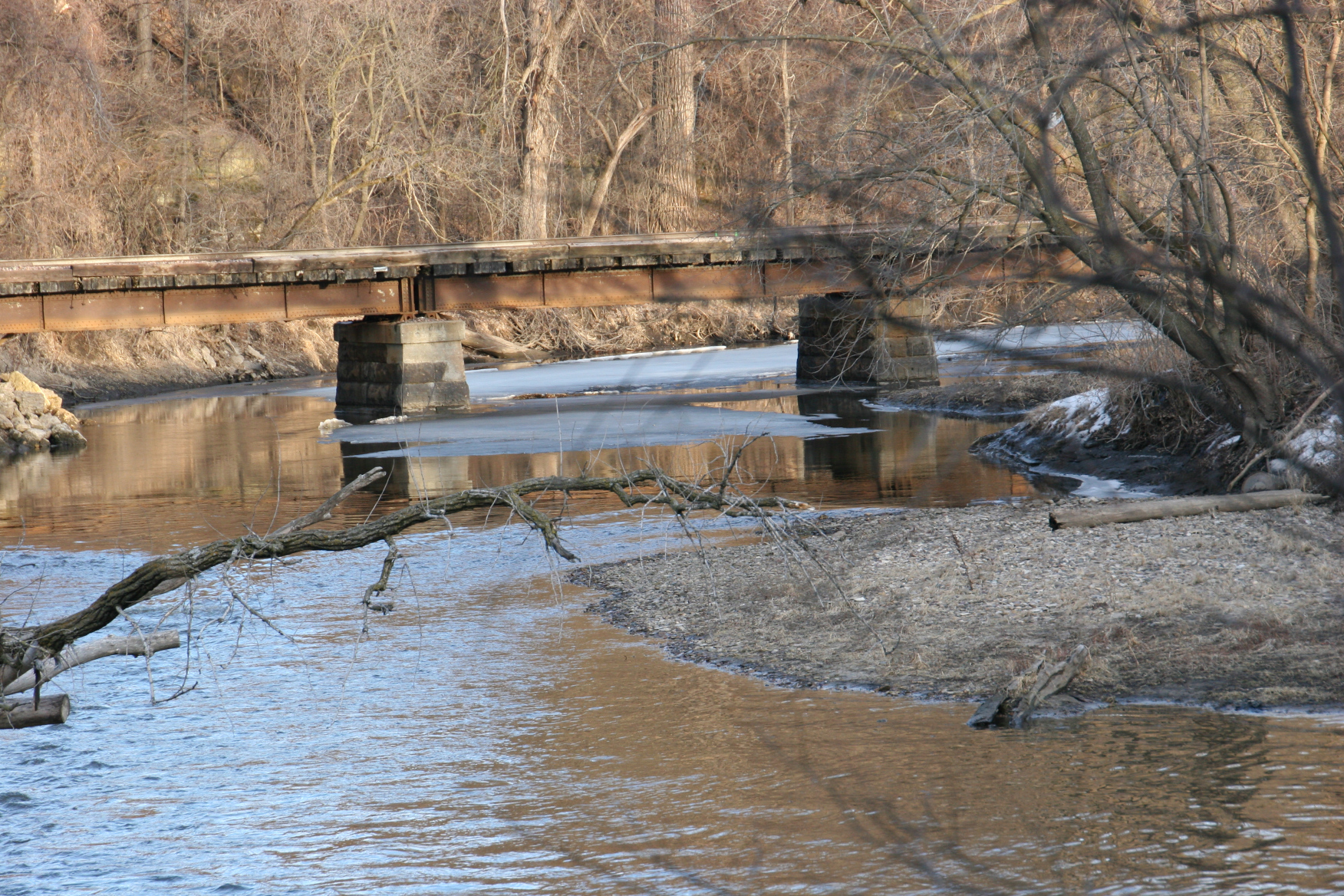
A view of the Straight River and the train track crossing, photographed from the Straight River Trail. This scene is by Fleckenstein Bluffs Park. (Minnesota Prairie Roots copyrighted photo March 2022)
A river overlook at Fleckenstein Bluffs was fenced during my visits. (Minnesota Prairie Roots copyrighted photo March 2022)
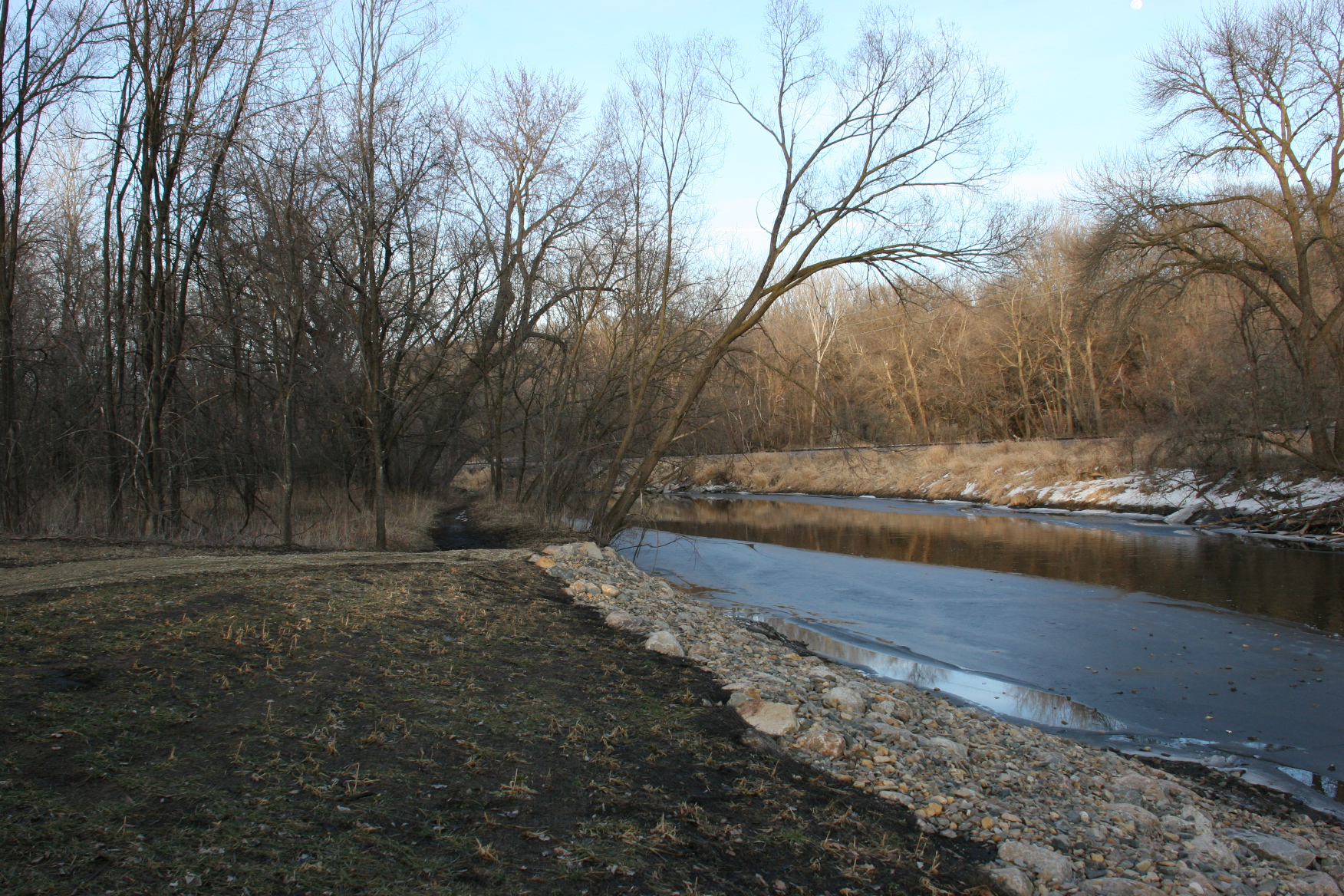
A short distance from the park, just off the Straight River Trail, a pathway leads to this opening in the woods along the river. There’s a picnic table in this space. Rocks were hauled in and placed along the river bank. (Minnesota Prairie Roots copyrighted photo March 2022)
Just a short walk, jog or bike ride away along the trail, those who live here can immerse themselves in woods and sidetrack off the paved route to river’s edge for a picnic, to meander or to fish. I thought a canoe and kayak launch were also part of the park plan, but see no indication that will happen.
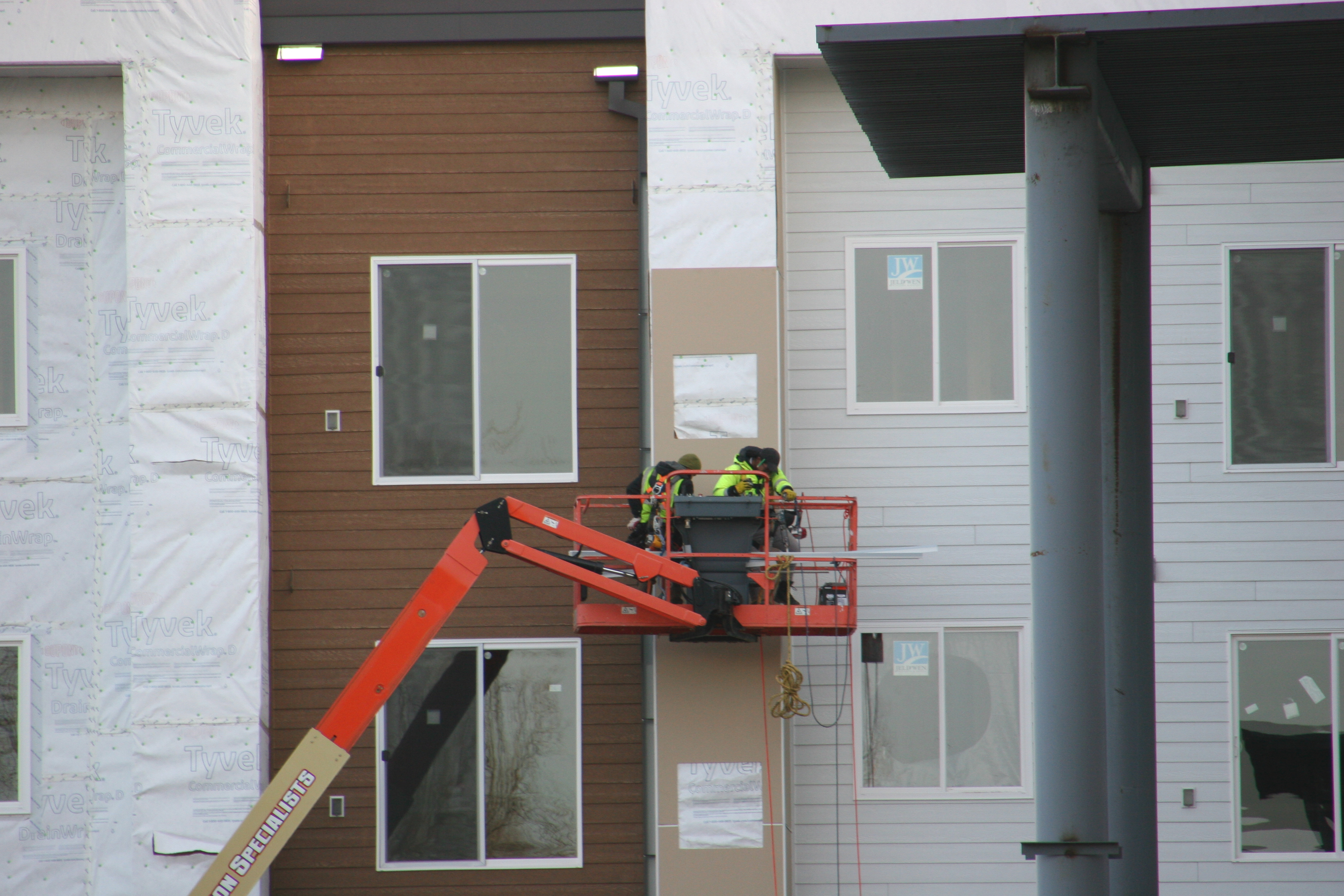
Photographed in mid-March as workers work on Straight River Apartments. (Minnesota Prairie Roots copyrighted photo March 2022)
Meanwhile, construction continues with an anticipated August opening of the 111-unit “boutique and high-tech apartment complex,” according to INH Properties. Apartment rental prices range from $925/month studio to two-bedroom two-bath plus den starting at $1,500/month. I’ve been out of the apartment market for decades, so rates seem high to me for Faribault. Yet, I realize that’s the going market rate in a community with a rental housing shortage.
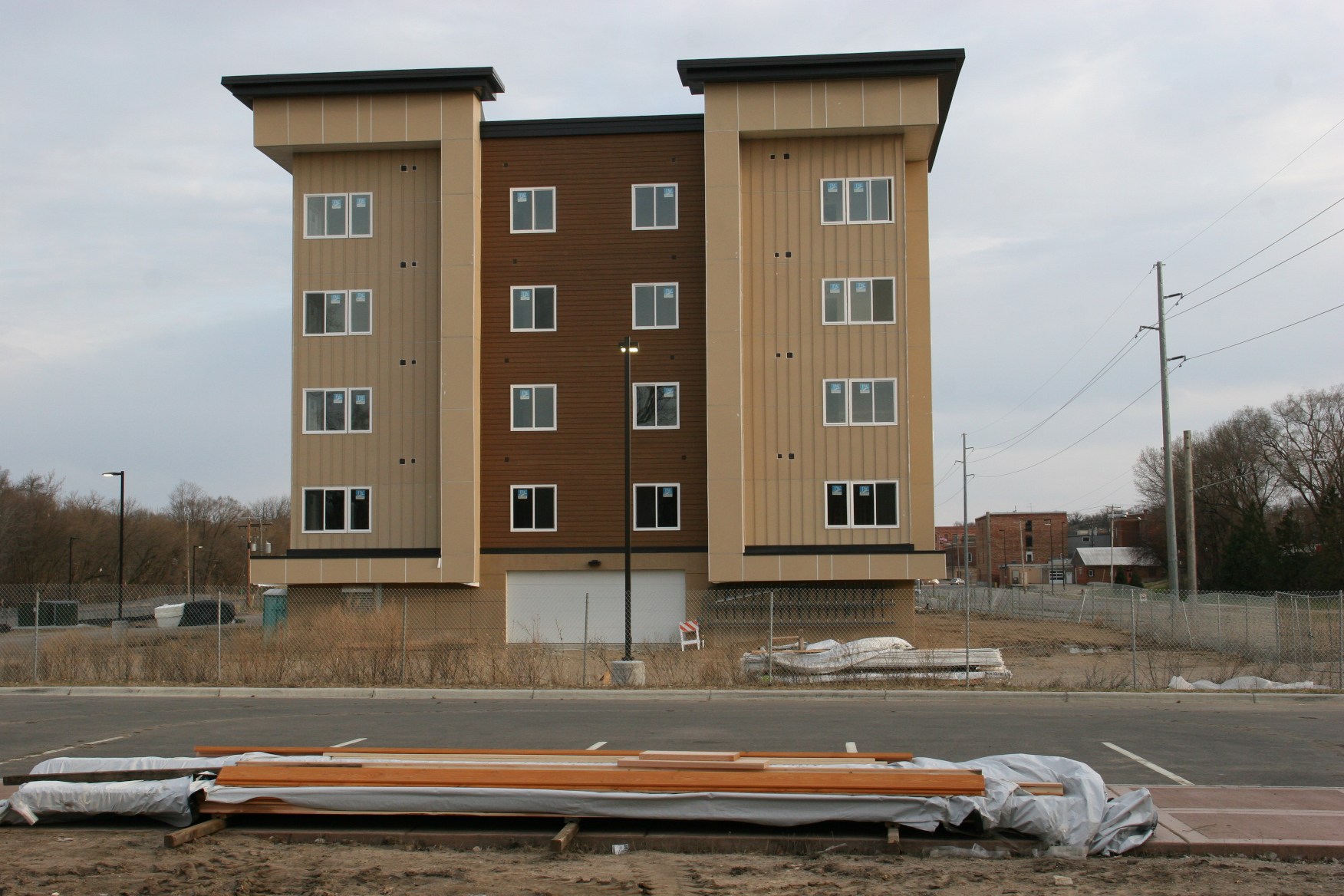
A north end view of Straight River Apartments. (Minnesota Prairie Roots copyrighted photo late April 2022)
Faribault is seeing a bit of a boom in apartment building construction. Other new complexes include Hillside Apartments across from Buckham Center and The Lofts at Evergreen Knoll on the site of the former Evergreen Knoll restaurant near Walmart.
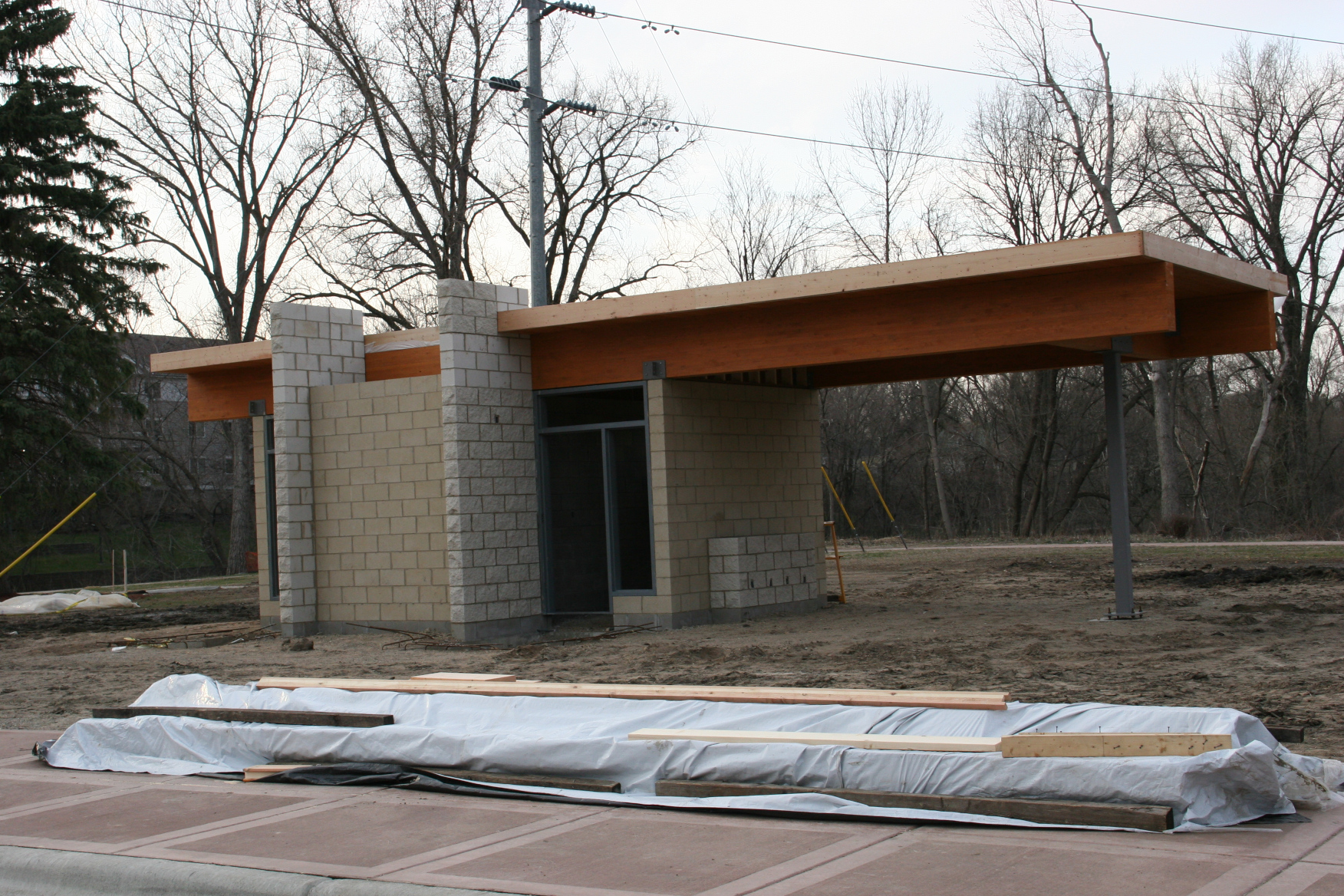
The restrooms and park shelter being built at Fleckenstein Bluffs Park. (Minnesota Prairie Roots copyrighted photo late April 2022)
Plans are also underway to build a 74-unit apartment near the viaduct, just blocks from my Willow Street home. And then even further along Willow, near the Faribault Soccer Complex and Middle School, developers are planning a 200-250 unit apartment complex. All of this new housing will bring even more traffic to my already heavily-traveled city street. And I’m not feeling at all good about that. More traffic equals more noise, more wear and tear on my street. More litter. More pollution.
No matter my concerns about more traffic past my house, the construction of new apartment buildings in Faribault is a good thing for those in need of rental housing. Our growing workforce demands local housing access. At least one Faribault business, C & S Vending, is planning workforce housing of three 12-plexes and one 8-plex. I’m sure there are other projects I’m missing in this summary.
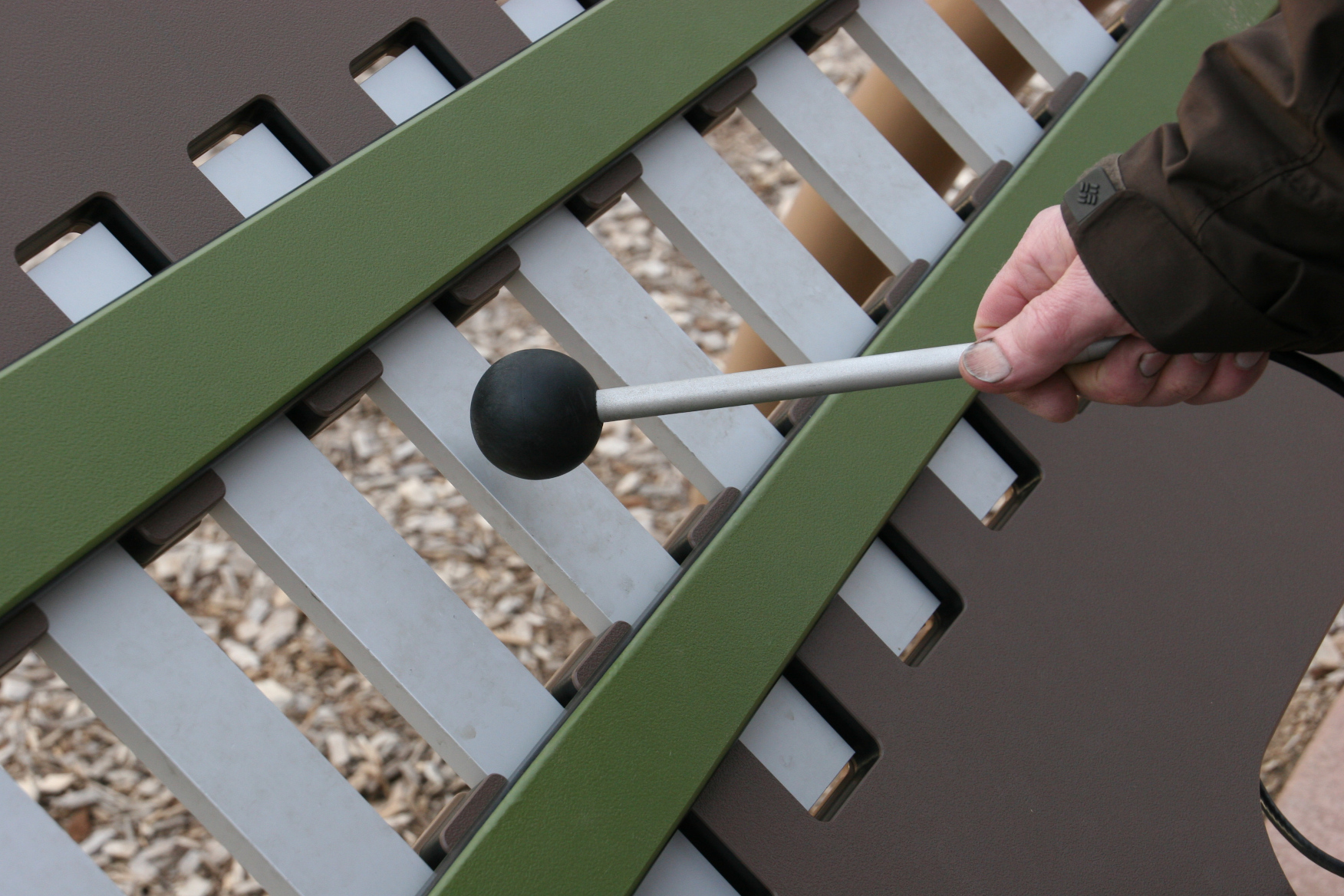
At the Fleckenstein Bluffs Park, a xylophone, among several large scale musical instruments. (Minnesota Prairie Roots copyrighted photo late April 2022)
We are a growing community. We need rental housing and affordable single family homes and nearby parks. (A new, community-centered park is also planned near the viaduct.) Come August, a whole lot more people will be living near downtown Faribault as Straight River Apartments open. Now we need to focus also on making home ownership available and affordable, if that’s even possible given the tight market and cost of new construction today…
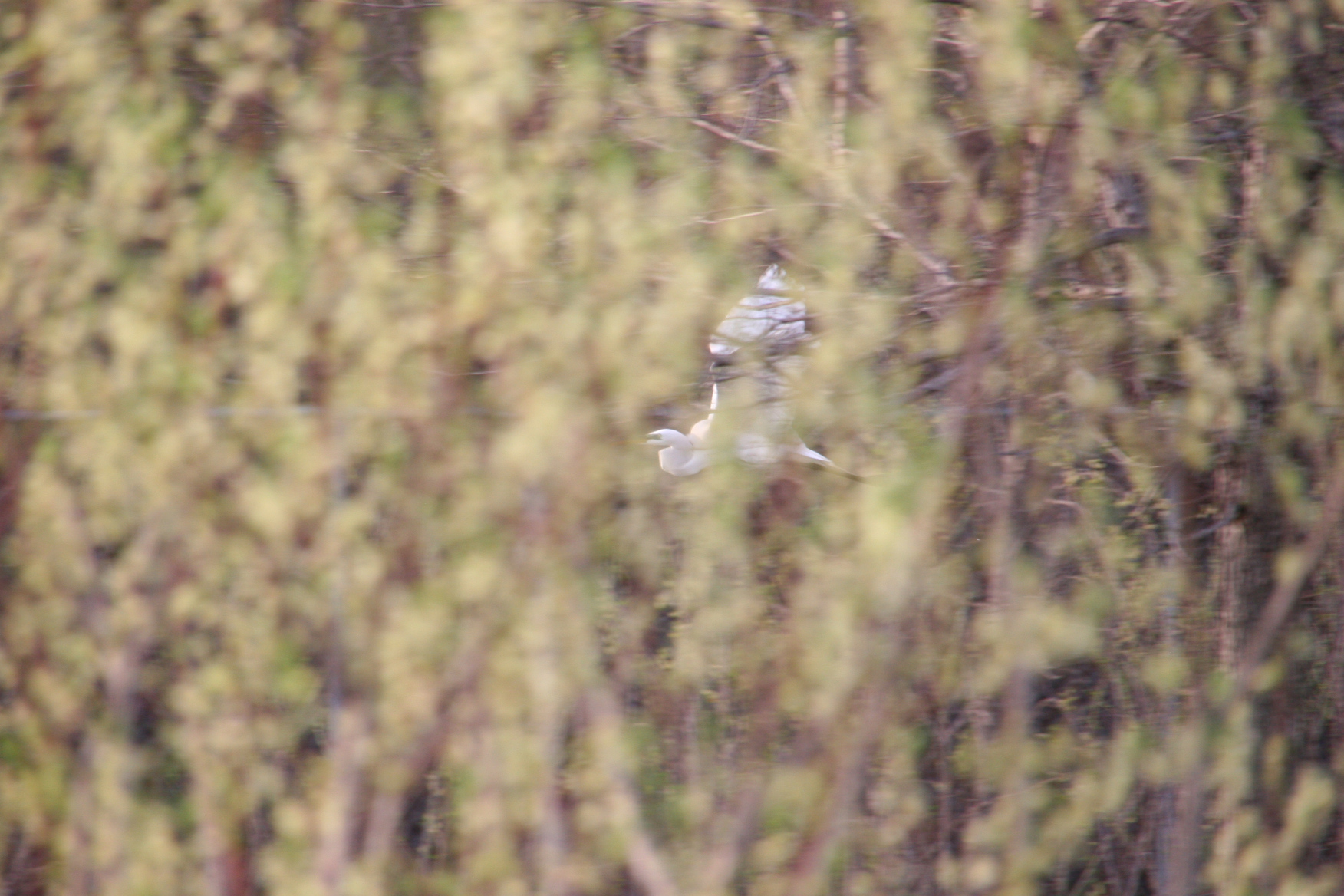
Through blurred trees in the foreground, an egret that has just taken flight. (Minnesota Prairie Roots copyrighted photo May 2022)
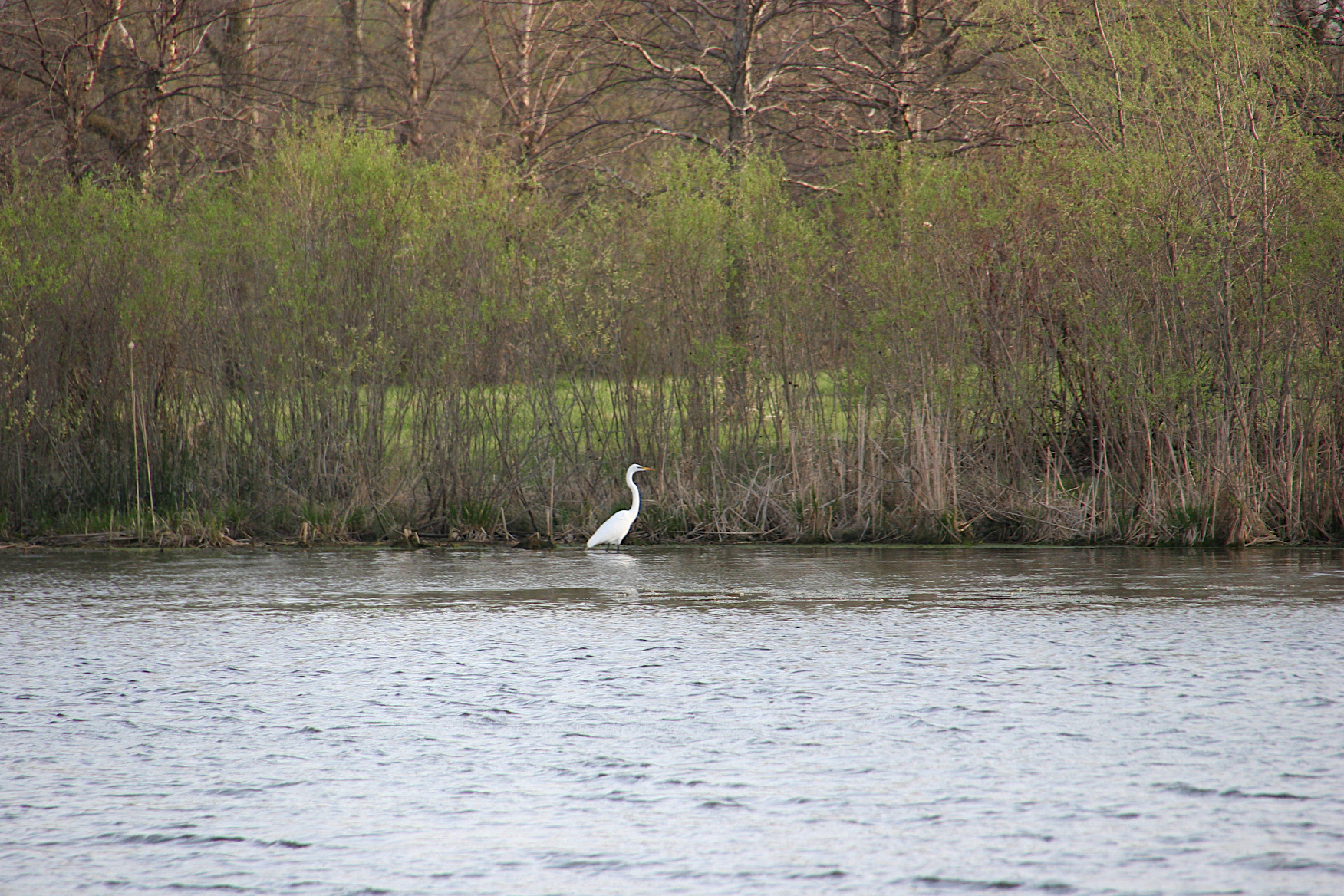
FROM ONE HOLDING POND to the next, then to the next, they flew. The elusive egrets.
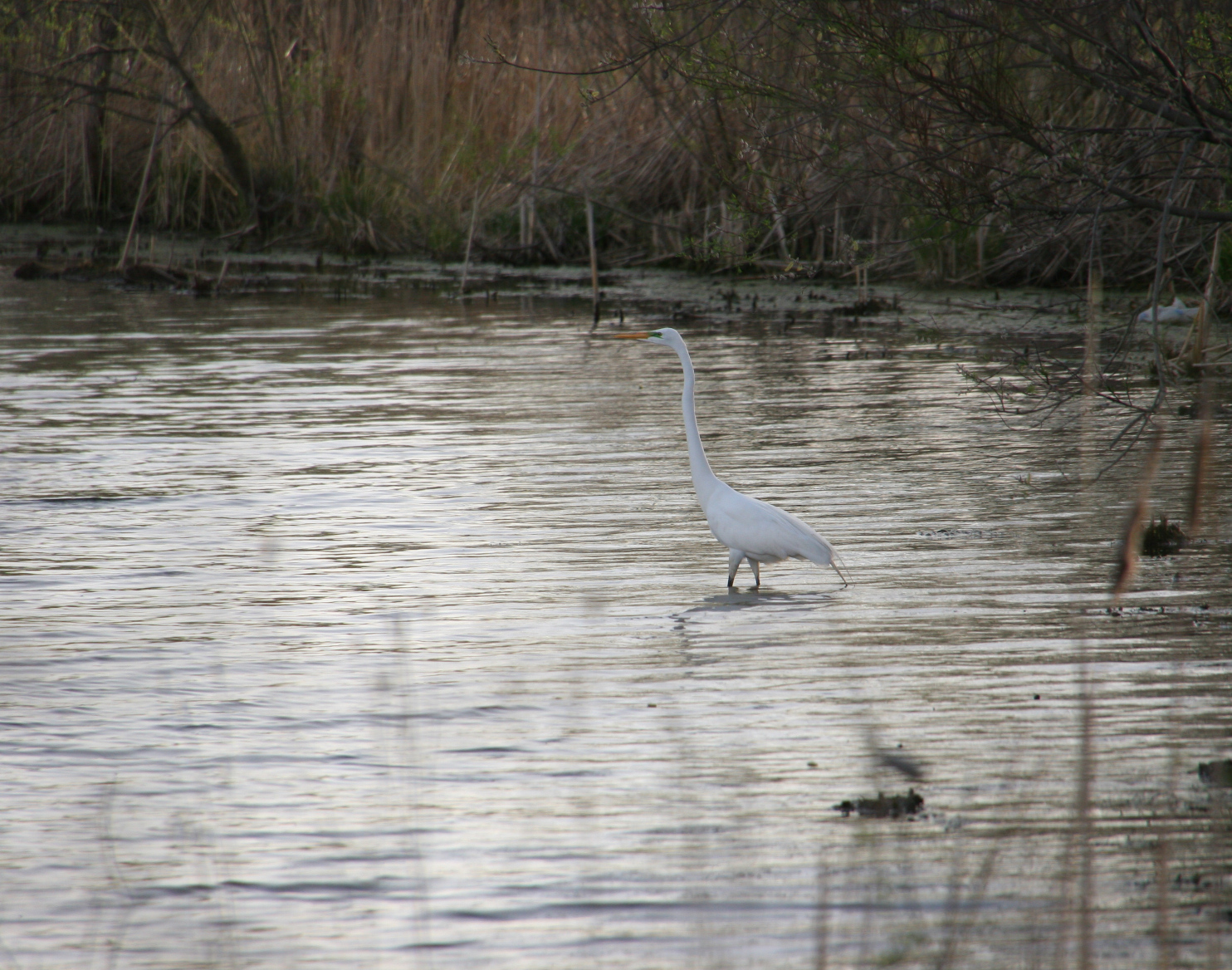
Pond walking. (Minnesota Prairie Roots copyrighted photo May 2022)
On a recent evening, I tried to photograph egrets at the Faribault Energy Park, place of dirt trails, ponds, creek, assorted trees, wildflowers and wetlands along Interstate 35.
A wildlife photographer I am not. But that doesn’t keep me from trying.
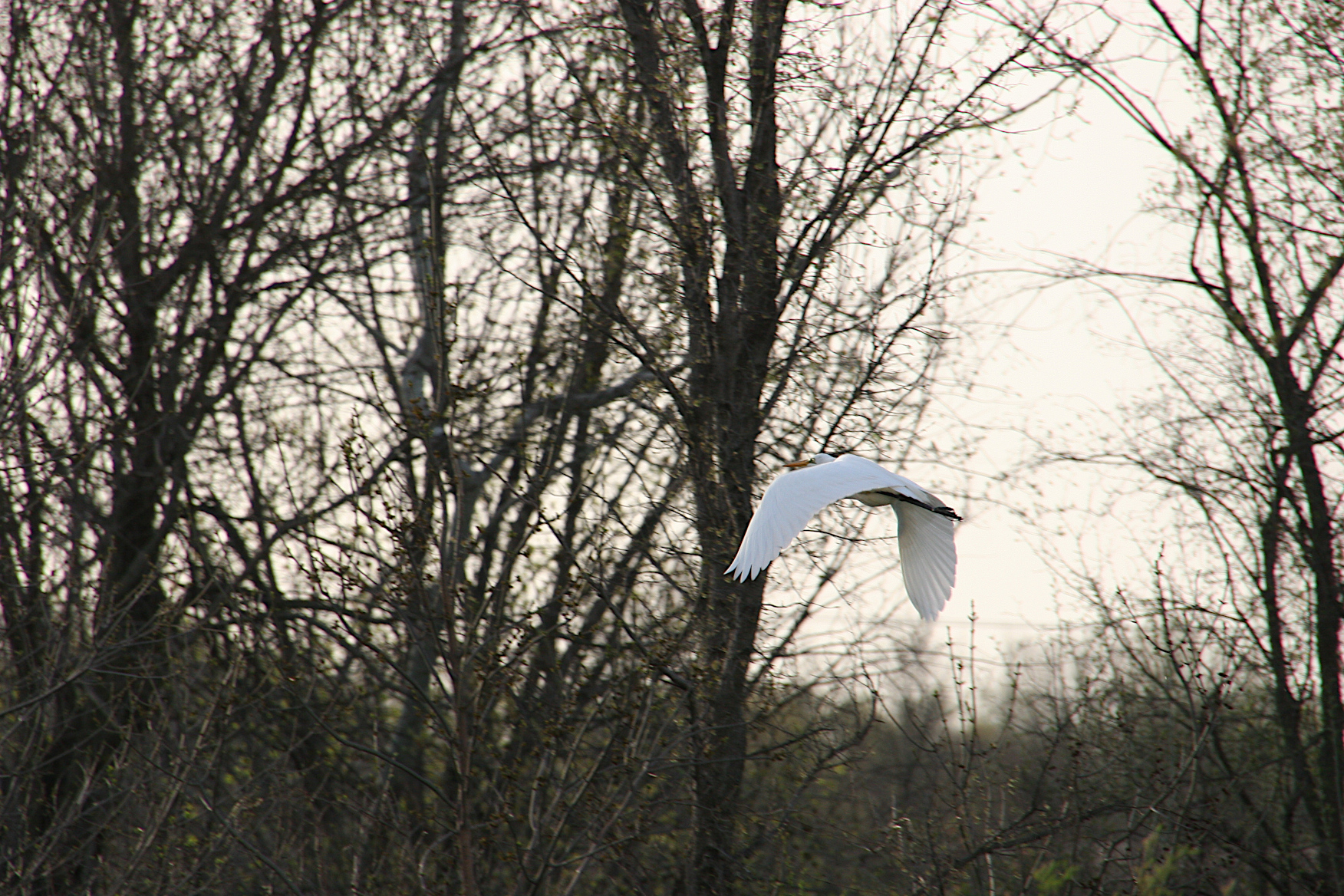
Wings so broad and white. (Minnesota Prairie Roots copyrighted photo May 2022)
Randy spotted the egrets first, in the waterway near the small shelter just off the entry road into the park. I hurried toward the shelter thinking I would quickly get the shots I wanted. But, as I soon discovered, egrets are observant and evasive. Before I even reached the site or had adjusted my camera for action shots, the two egrets were in the air.
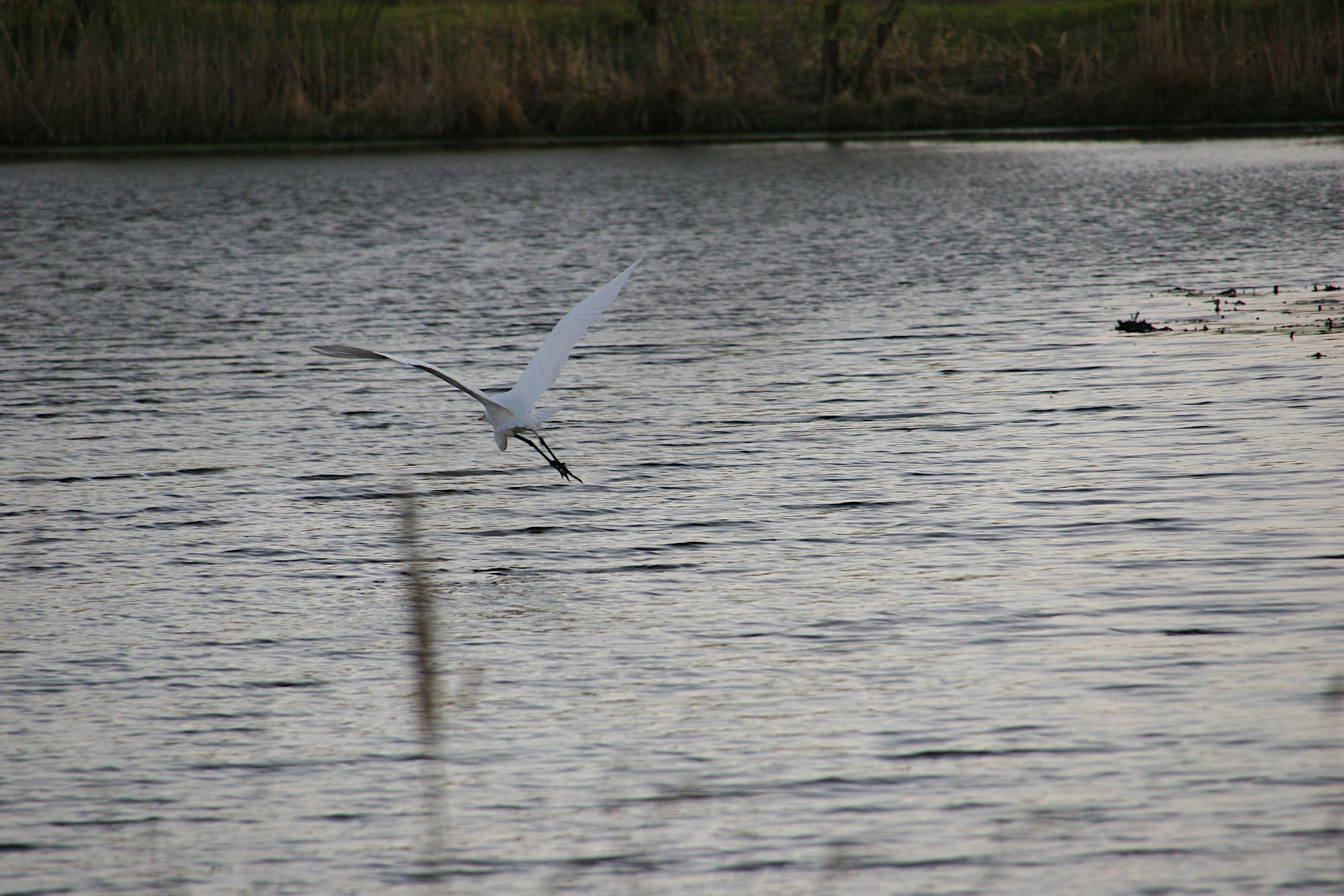
Either landing or taking off, I can’t recall which. (Minnesota Prairie Roots copyrighted photo May 2022)
They flew toward the nearest holding pond. I followed, stood on the dirt trail, zoomed from afar and clicked the shutter button multiple times. When I moved, the egret of my focal attention took off. I was intentionally trying to respect the birds and remain unobtrusive. But I suspect, even if I had simply been walking the trails minus my camera, their behavior would have been the same.
Hanging near the shoreline in the third pond. (Minnesota Prairie Roots copyrighted photo May 2022)
By this time I determined that egrets are camera, or people, shy, preferring to just be left alone in their watery habitat.
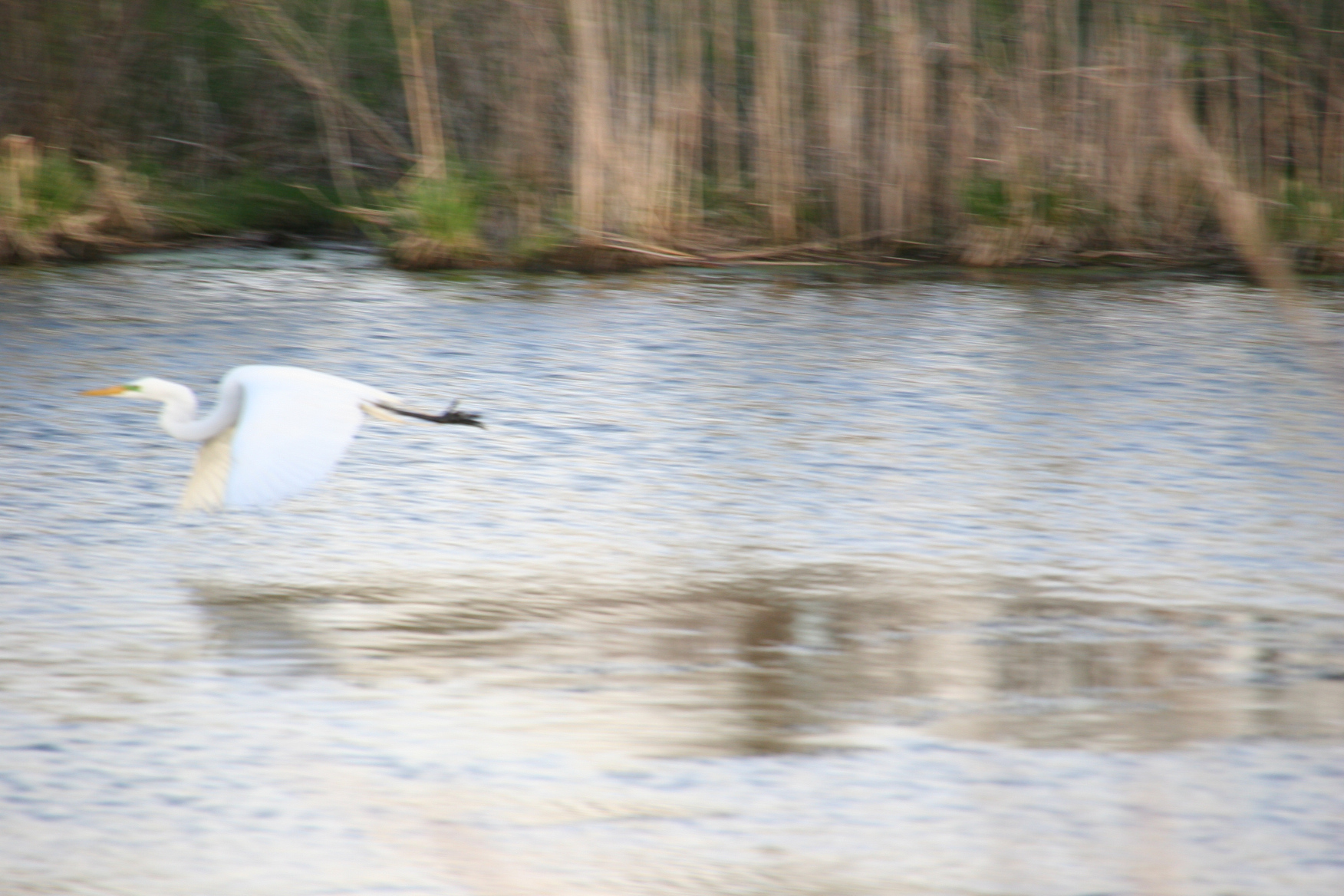
This unfocused image shows motionas the egret takes flight, neck curved. (Minnesota Prairie Roots copyrighted photo May 2022)
They are an interesting bird. Long of neck, curved when they fly. Wide white wing span, which leaves me wondering how they possibly keep those feathers so snowy white. Thin black legs resembling sticks. Long, jolt of orange beak. And not exactly graceful in flight. Rather clumsy-appearing, in my opinion.
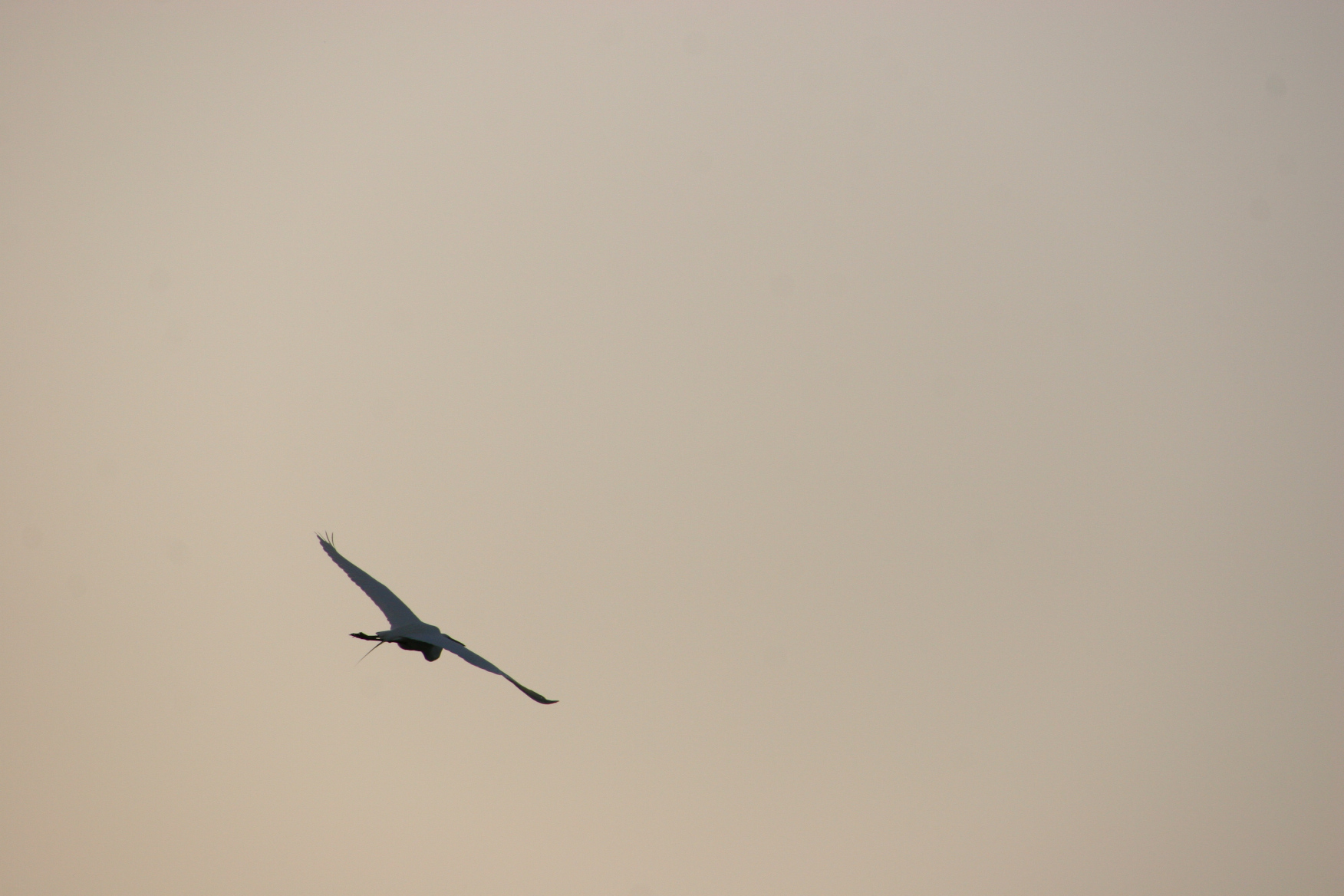
My final photo as the egret flies during the golden hour or sunset. (Minnesota Prairie Roots copyrighted photo May 2022)
I wonder what those egrets thought of me, earthling far below or nearby. Without wings. And although my legs are long given my height, they are no match for an egret’s long twiggy legs. I can’t compete with their vision either. That I observed in the short time I attempted to photograph…the elusive egret.
TELL ME: Do you know anything about egrets and/or their behavior?
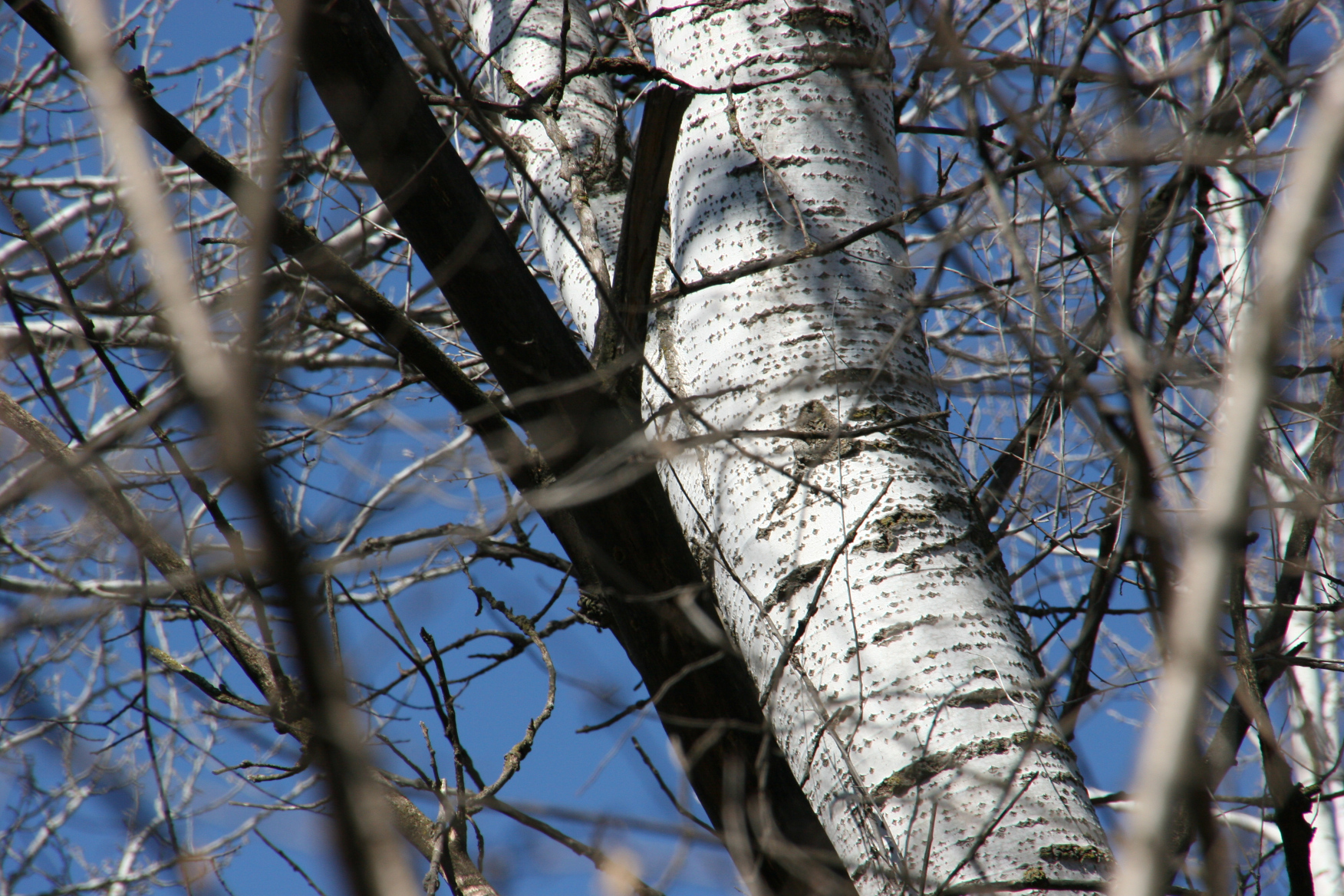
Oh, how lovely the textured bark. (Minnesota Prairie Roots copyrighted photo March 2022)
TREES DEVOID OF LEAVES open the woods to full view. Such is the benefit of this not-winter, not-yet-spring transitional time here in southern Minnesota.
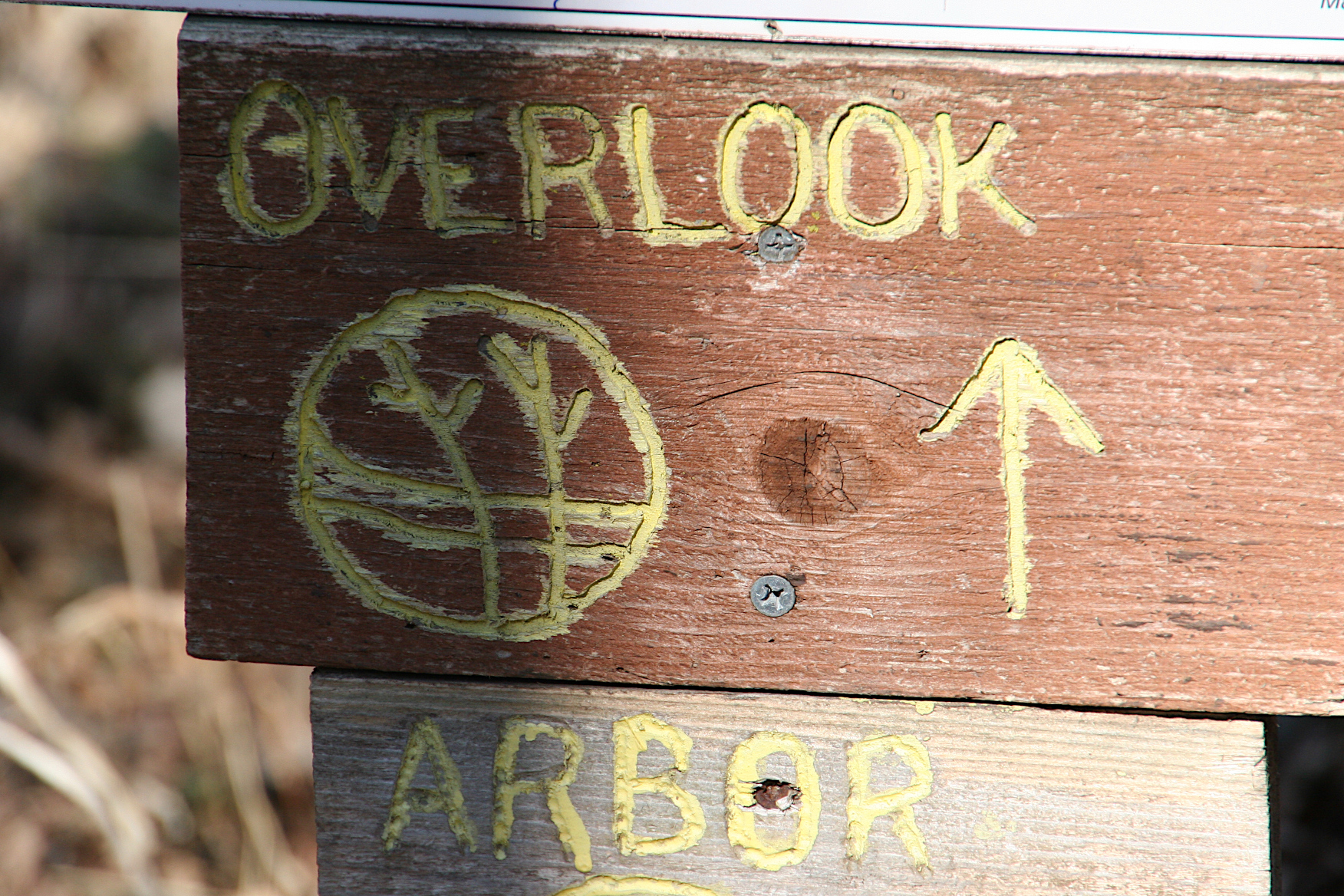
Signage identifies the the Arbor and Outlook Trails at River Bend Nature Center, Faribault. (Minnesota Prairie Roots copyrighted photo March 2022)
On a recent walk through Faribault’s River Bend Nature Center, I noticed nuances of nature that might otherwise not be seen in a leaf canopy, or at least not as deeply appreciated.
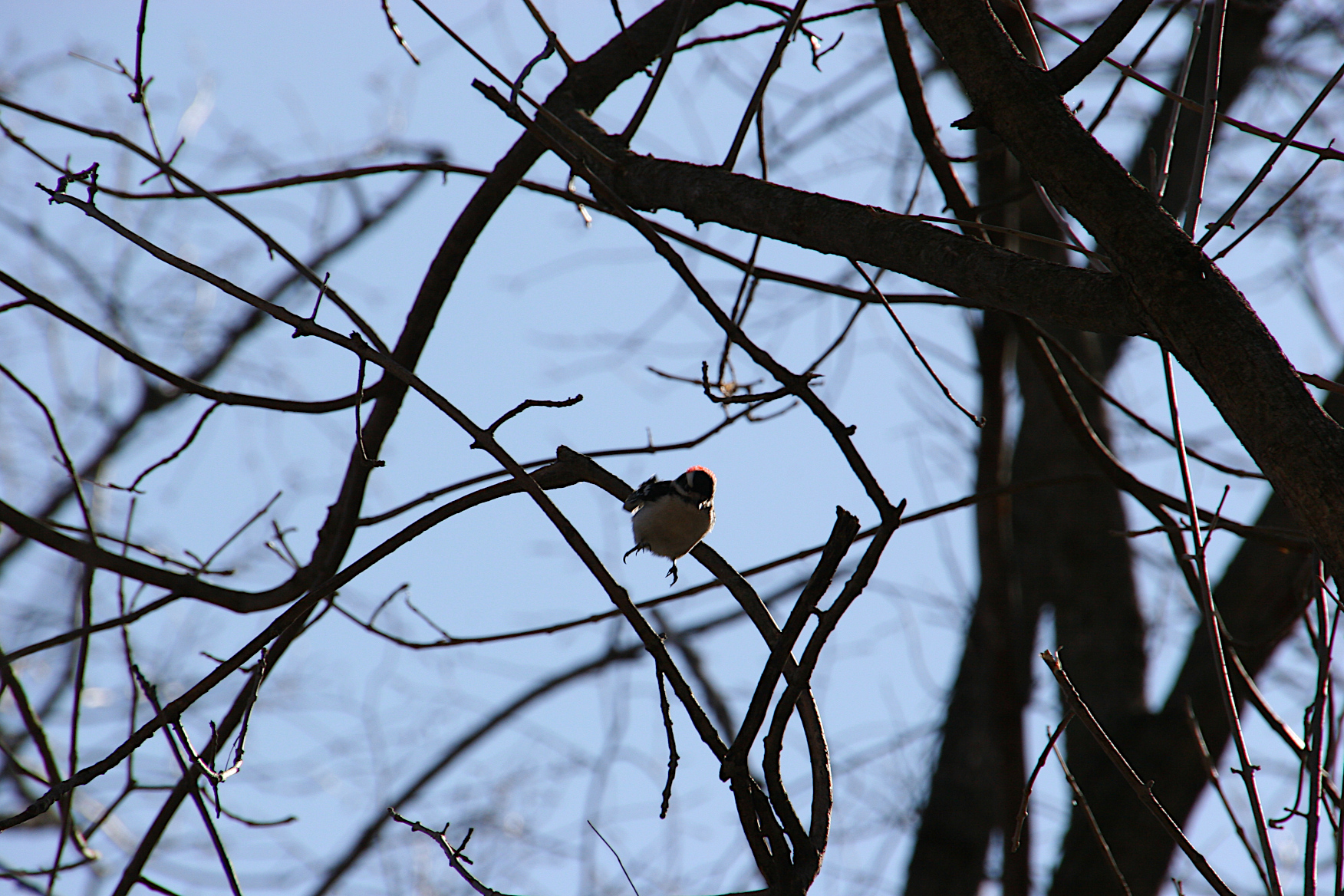
A woodpecker in flight. (Minnesota Prairie Roots copyrighted photo March 2022)
Following the Arbor Trail loop into the woods, I noticed first a red-capped woodpecker. I determined to get a photo. But, if you’ve photographed birds, you understand that such an endeavor requires patience, planning and a bit of luck. I caught the bird in flight. Maybe not the sharpest image, but certainly an unexpected moment I managed to snapshot.
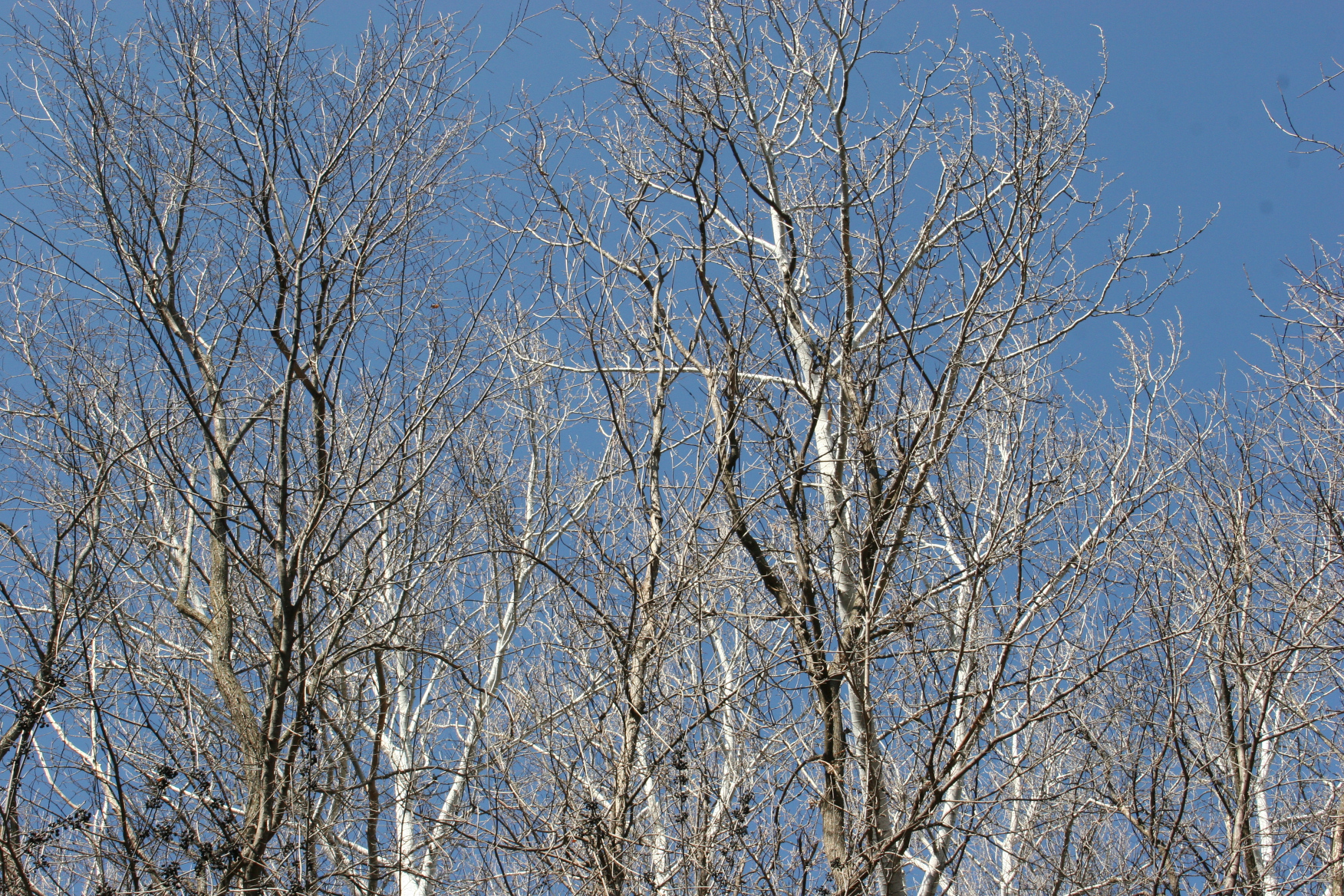
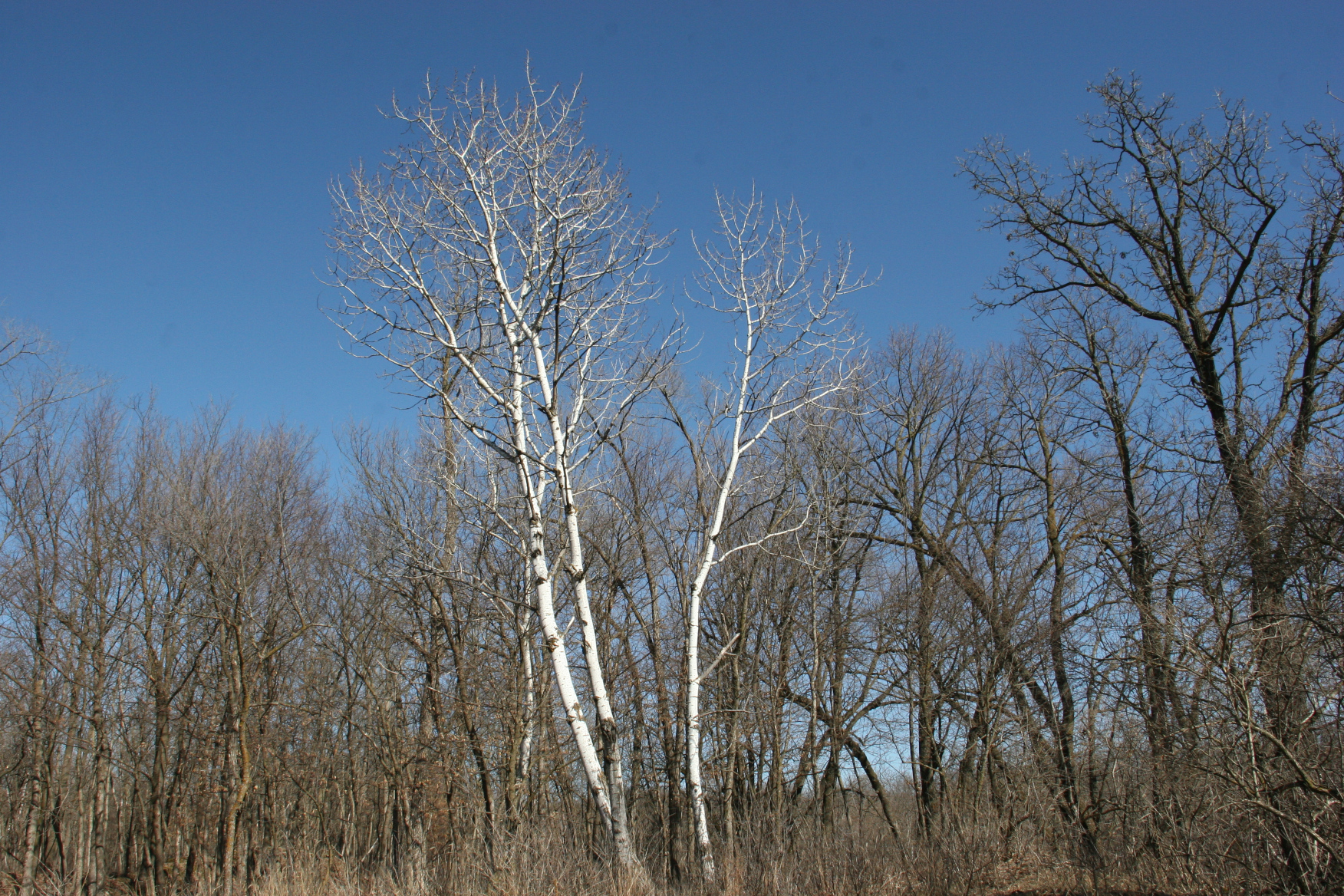
Bare treetops, beautiful against a bold sky. (Minnesota Prairie Roots copyrighted photo March 2022)
Trees themselves also draw my interest. I find myself especially drawn to oaks. Their sturdiness and expansive canopy exude strength and artistry. But I find birch trees equally as fascinating. Or at least those with white bark, which could be birch or aspen. Without leaves, trees are much more challenging to identify, at least for me.
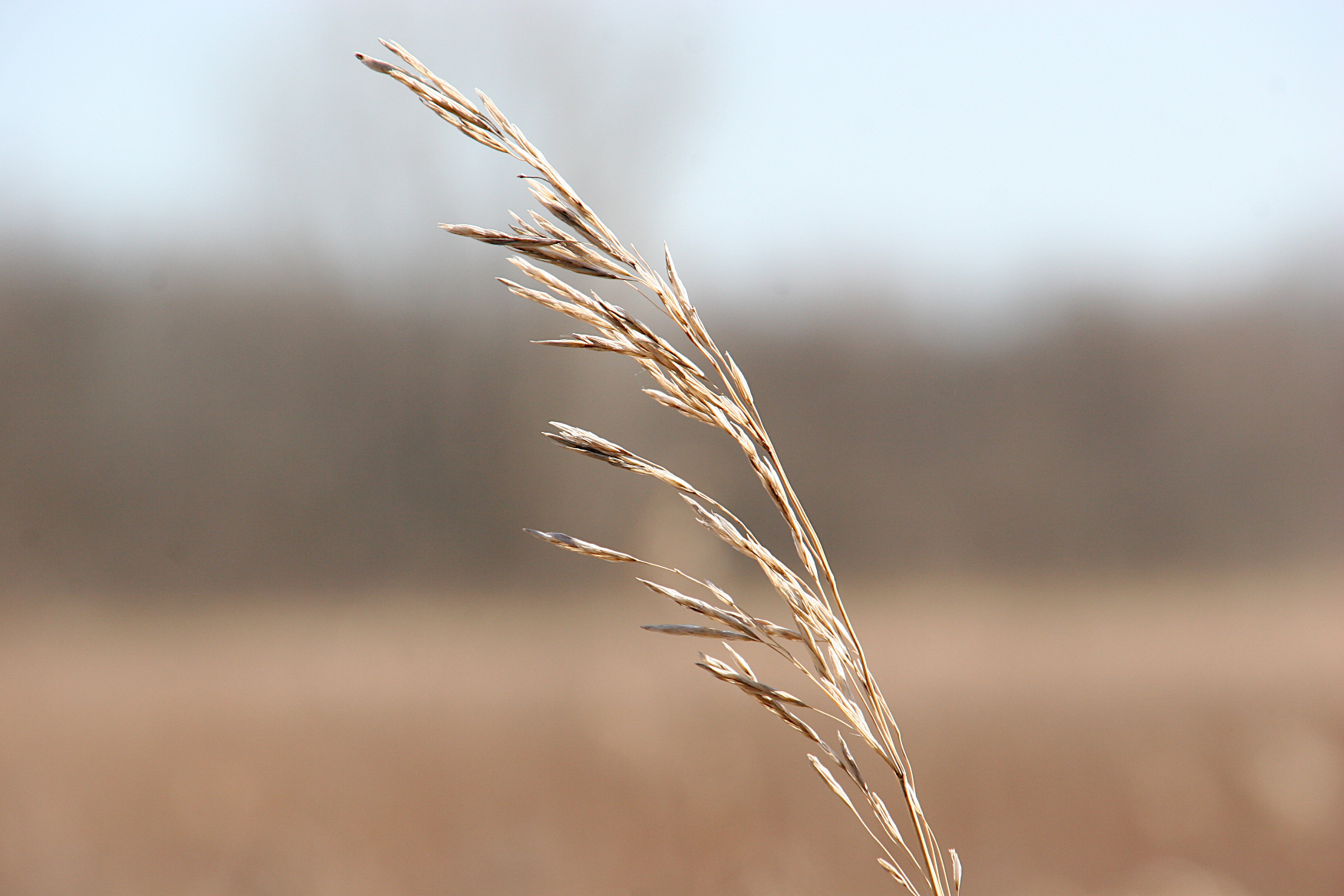
I love the beauty of dried grasses. (Minnesota Prairie Roots copyrighted photo March 2022)
As I forked off the Arbor Trail to the Overlook Trail, the vista opened to prairie. Now, as you would expect, this native prairie girl loves the prairie. No matter the season. I appreciate the tall dried grasses that arch and dip in the wind. Rhythmic. Poetic.
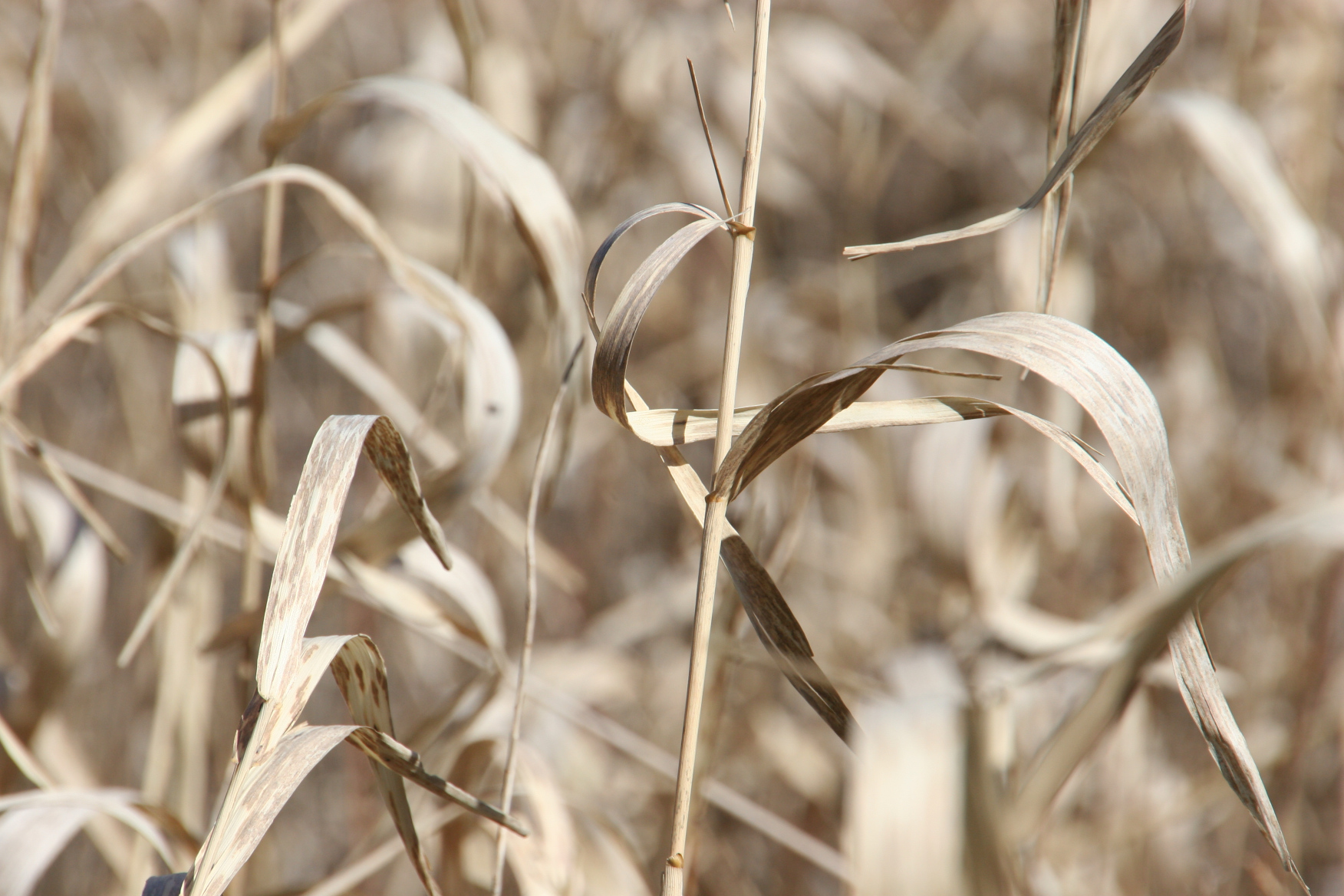
A solo grass stem bends in the wind. (Minnesota Prairie Roots copyrighted photo March 2022)
A single stem of grass reminds me of youthful summers on the farm, of playing in untamed tall grass. It reminds me, too, of the writing of Laura Ingalls Wilder, a favorite author. I grew up some 20 miles from her childhood home in Walnut Grove. Her ability to notice details inspires me in my writing.
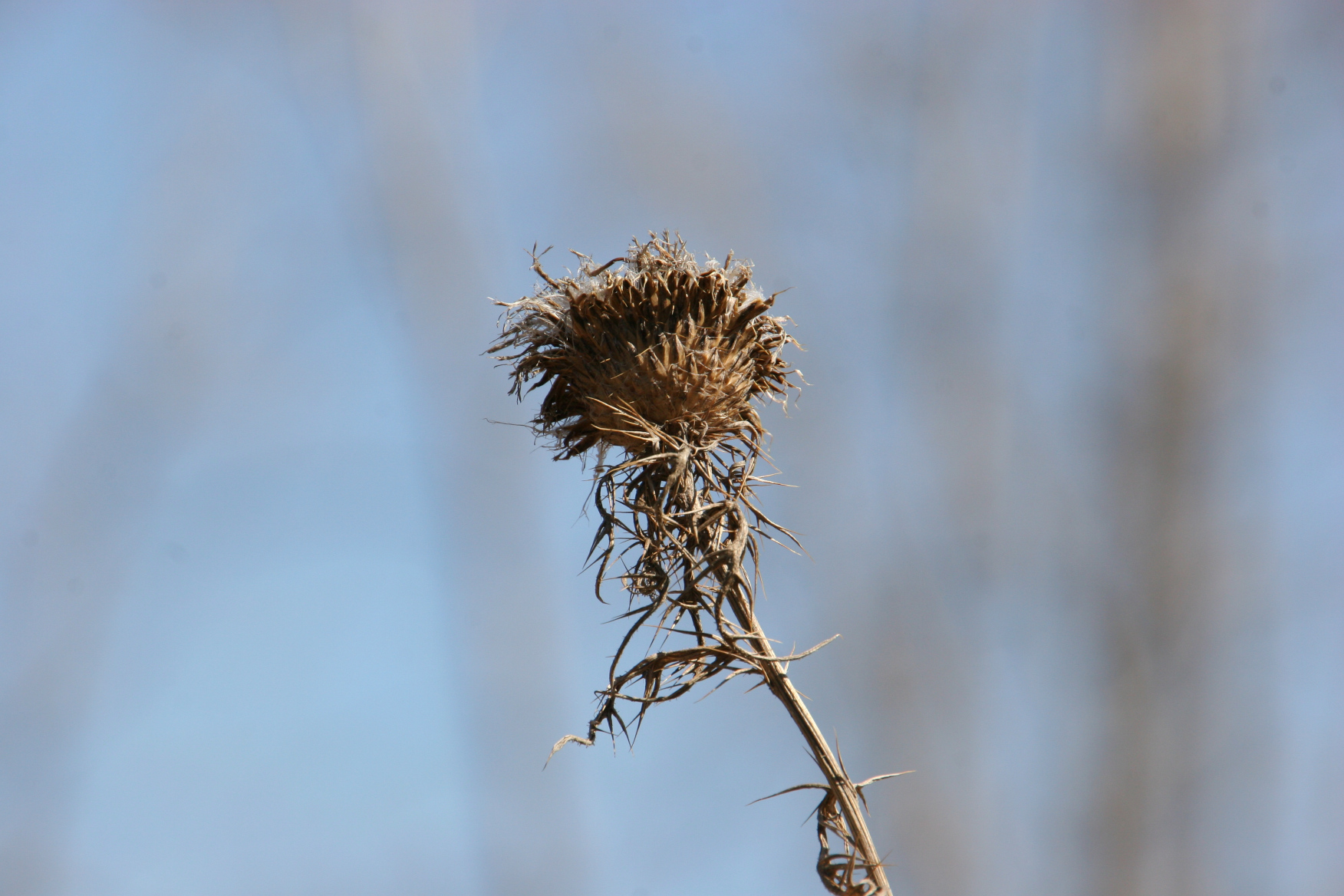
Beauty in a seed head. (Minnesota Prairie Roots copyrighted photo March 2022)
Dried seed heads catch my eye. Details. Promise of new growth from last season’s remnants.
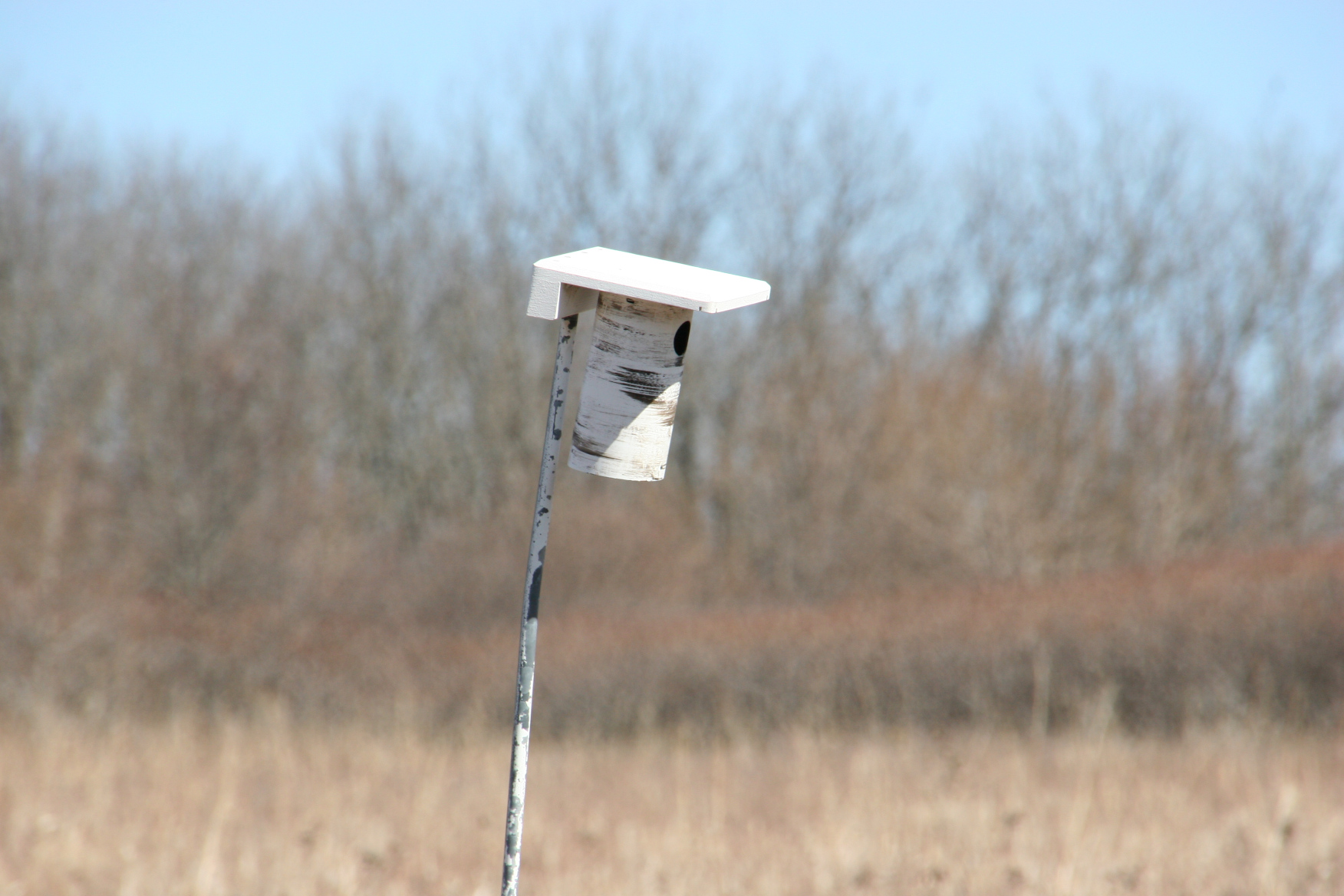
One of the many bluebird houses checked and maintained by volunteers. (Minnesota Prairie Roots copyrighted photo March 2022)
I notice, too, the bluebird house among the prairie grasses. Thanks to Keith Radel, who hails from my hometown and has lived in Faribault for decades, the bluebird thrives in these parts. Known as Mr. Bluebird, Keith appreciates bluebirds with a passion unequal. He’s determined to protect them, to assure they flourish. It’s heartening to see his devotion to this bird.
I see the deer and the deer see me through a treeline. (Minnesota Prairie Roots copyrighted photo March 2022)
As I return to the Arbor Trail, I wonder if I will see any deer, previously spotted in this area. And then Randy, my walking partner, alerts me to their presence. There, on the prairie, I observe four deer. I move quietly toward the edge of the treeline to photograph them through the trees. Careful. Cautious. Not wanting to scare them away before I can lift and focus my lens. But they are already aware, frozen in place, ears upright, faces turned toward me.
The deer vanish, nearly unseen, into the tall prairie grasses. (Minnesota Prairie Roots copyrighted photo March 2022)
Soon they are hightailing it away, vanishing, camouflaged by the high brown prairie grasses. I never tire of watching deer, even though I consider them too numerous and a roadway hazard.
In just a short distance, I’ve noticed nature’s nuances. In a woodpecker. In the bark of trees. In the prairie grasses. And, finally, in a quartet of deer. What a gift in this not winter, not-quite-spring season in southern Minnesota.
Inside the woods at River Bend Nature Center, Faribault, MN. (Minnesota Prairie Roots copyrighted photo March 2022)
FOR SOMEONE LIKE ME who grew up on the prairie, woods are not a natural fit. I’ve always felt a bit out of place in the density of trees. Uncomfortable even. But time and distance from a landscape of big sky and wide open spaces have eased me into the woods.
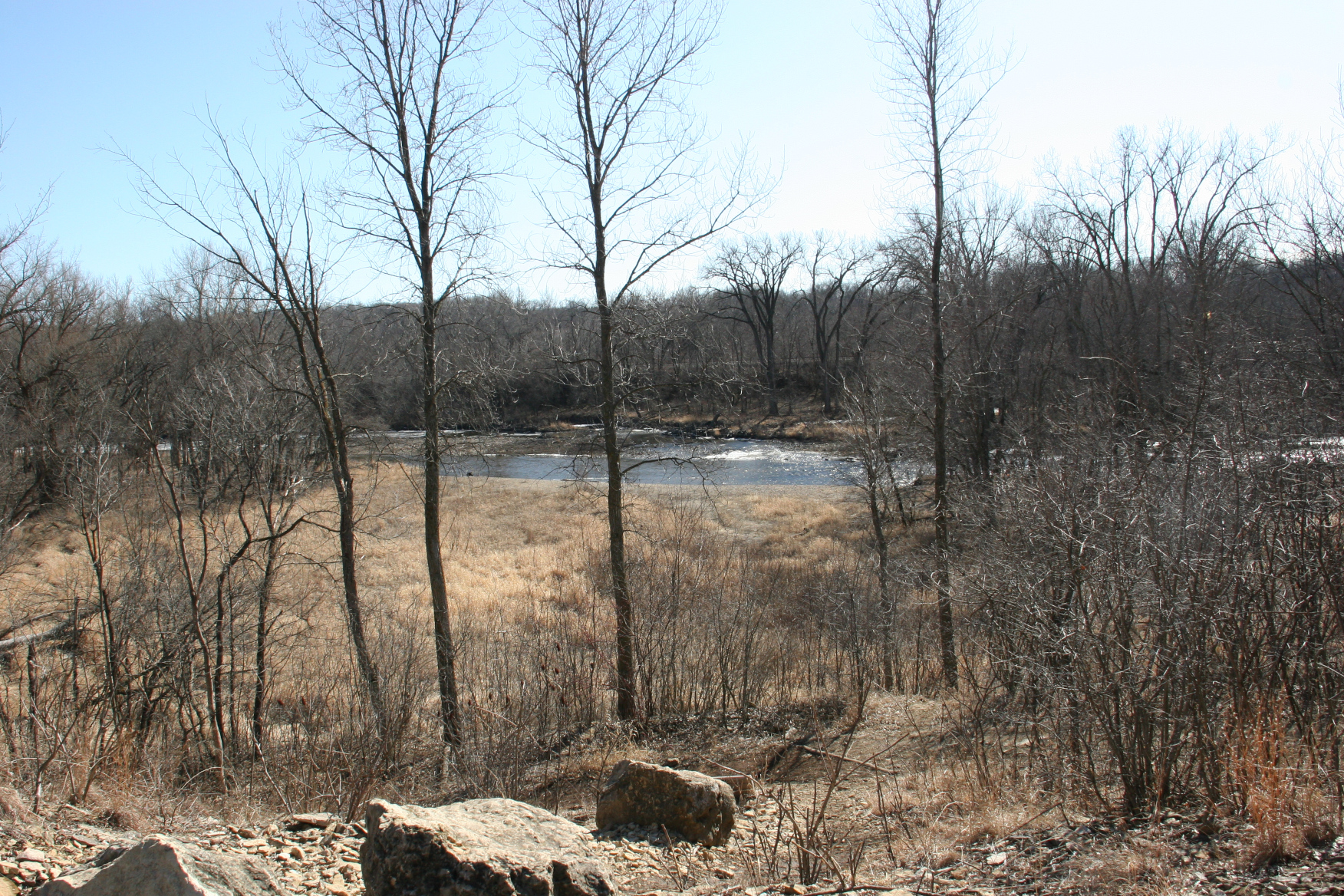
A view of the Straight River from Honor Point. (Minnesota Prairie Roots copyrighted photo March 2022)
I appreciate woods, as long as there aren’t “too many” trees. I need to see glimpses, even vistas, of openness. River Bend Nature Center in Faribault offers both. Prairie and woods.
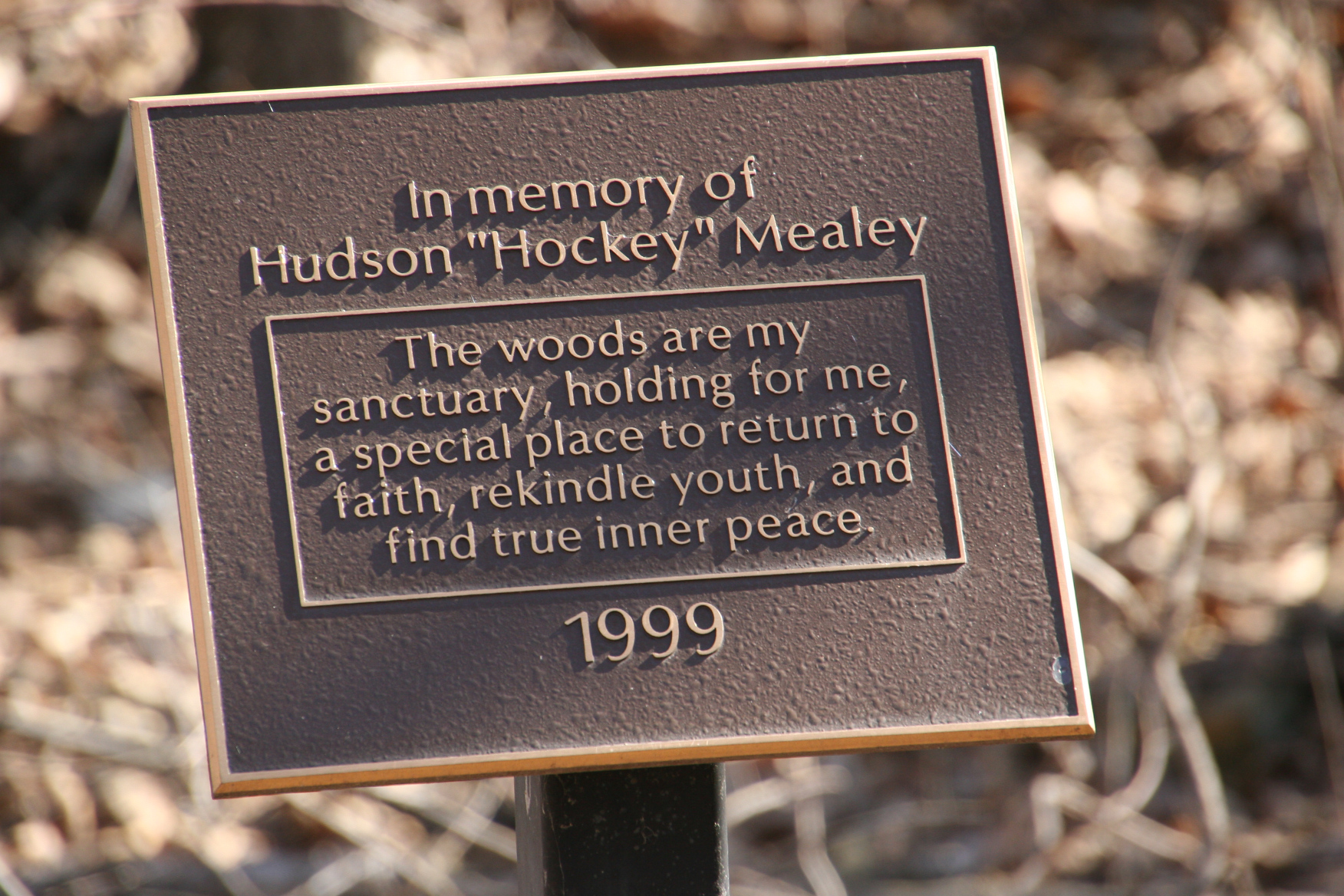
Love this quote on a memorial sign at River Bend. (Minnesota Prairie Roots copyrighted photo March 2022)
On a recent visit, I followed trails into the woods. And, as always, I noticed the beauty therein. I view the natural world through many lenses. Close-up. From afar. With an artsy perspective. But mostly with a deep appreciation.
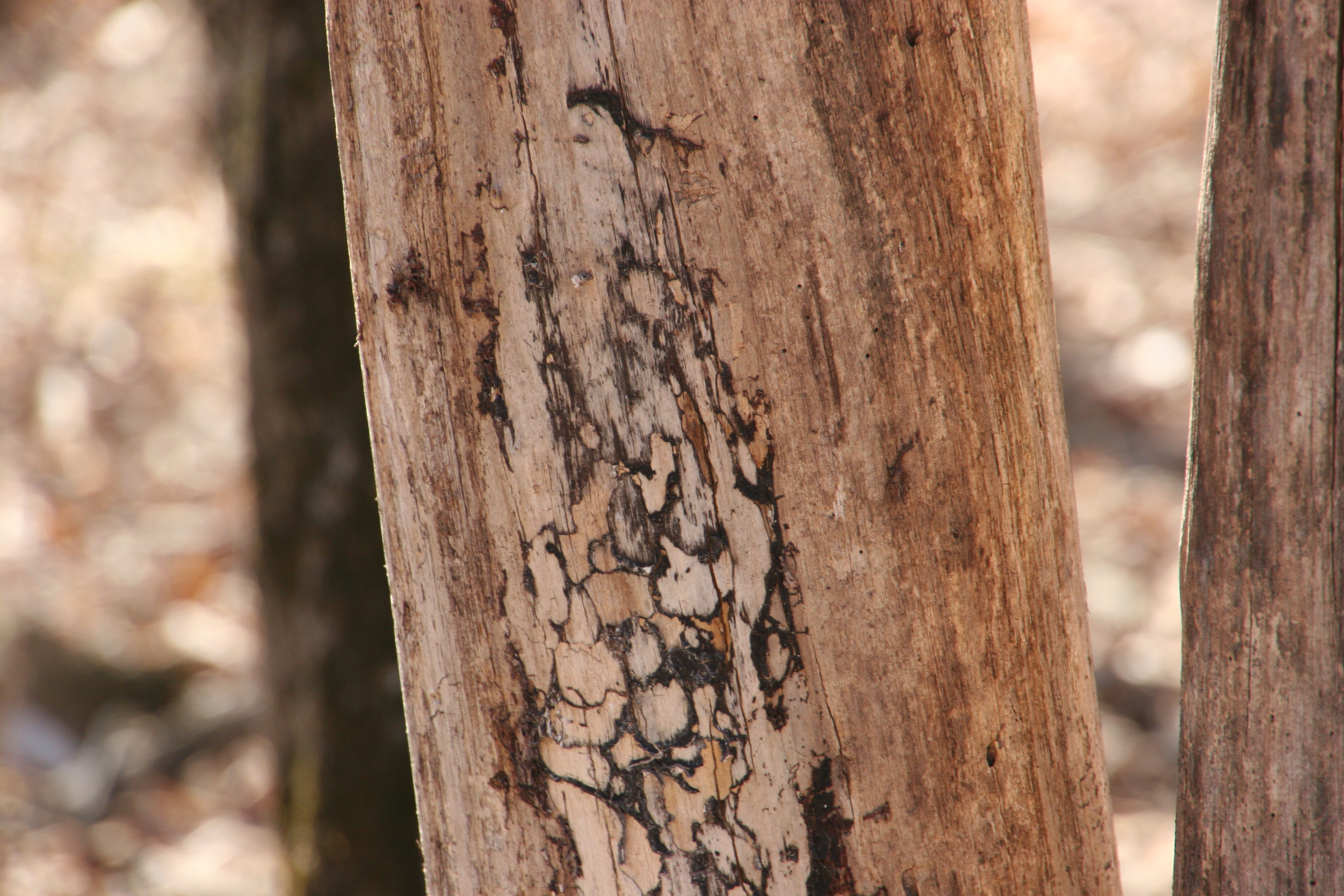
This mottling on a tree trunk looks like art to me. (Minnesota Prairie Roots copyrighted photo March 2022)
It doesn’t take much to catch my eye, to cause me to pause and reflect. Photograph. Delight. Savor the moment, the scene.
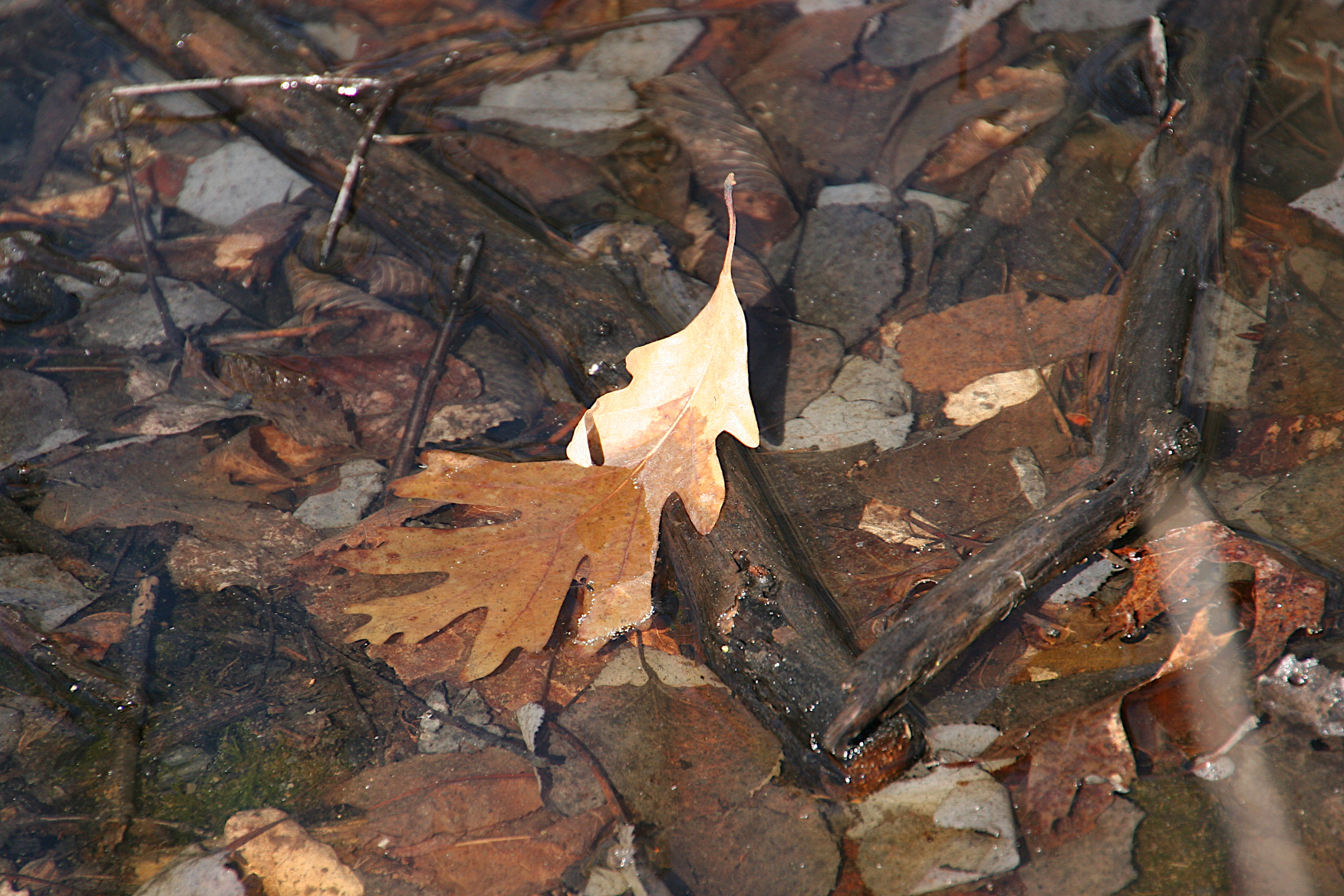
I’m always drawn to leaves in water, here in a melting snow puddle along a trail. (Minnesota Prairie Roots copyrighted photo March 2022)
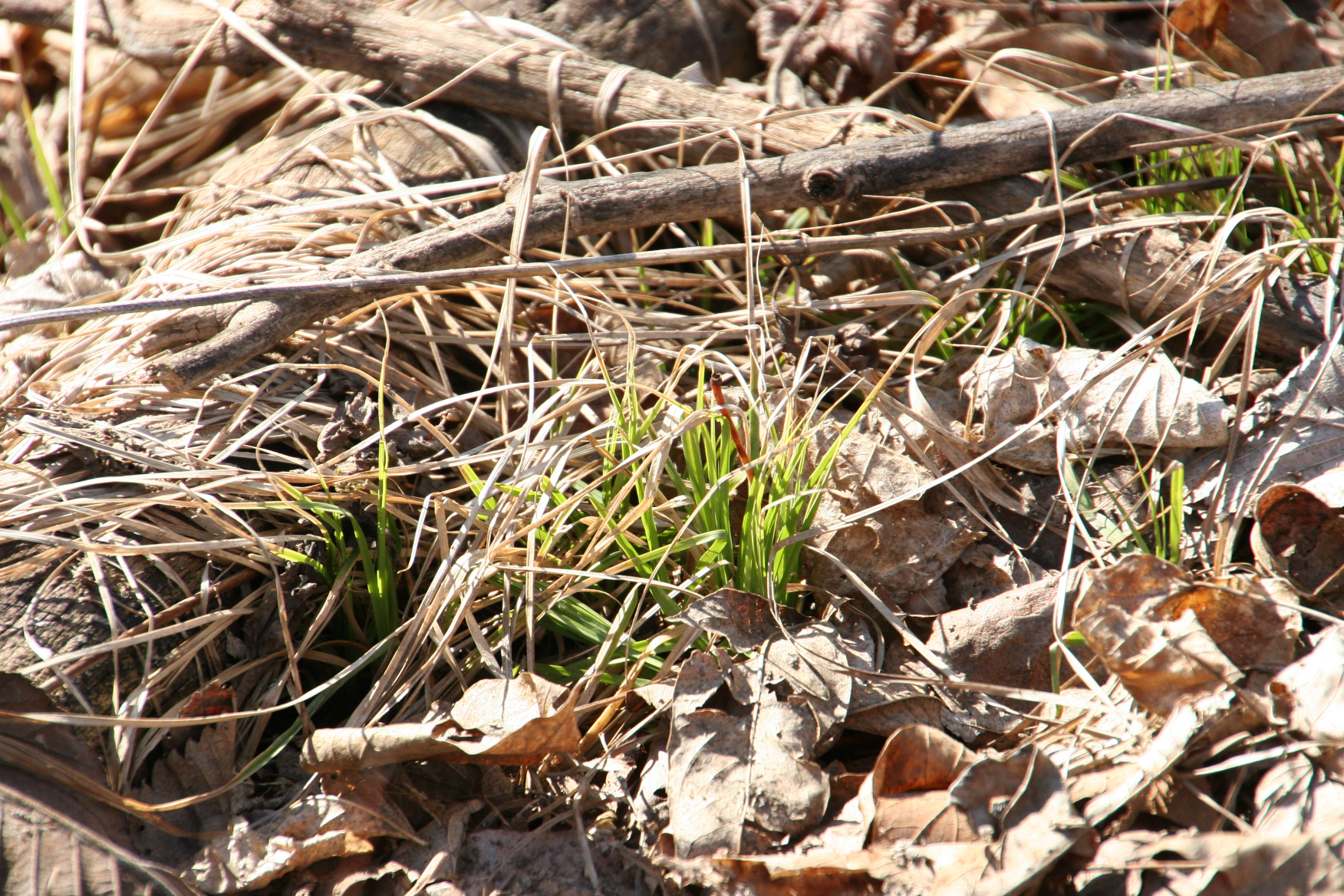
Loved spotting this patch of green in mid-March. (Minnesota Prairie Roots copyrighted photo March 2022)
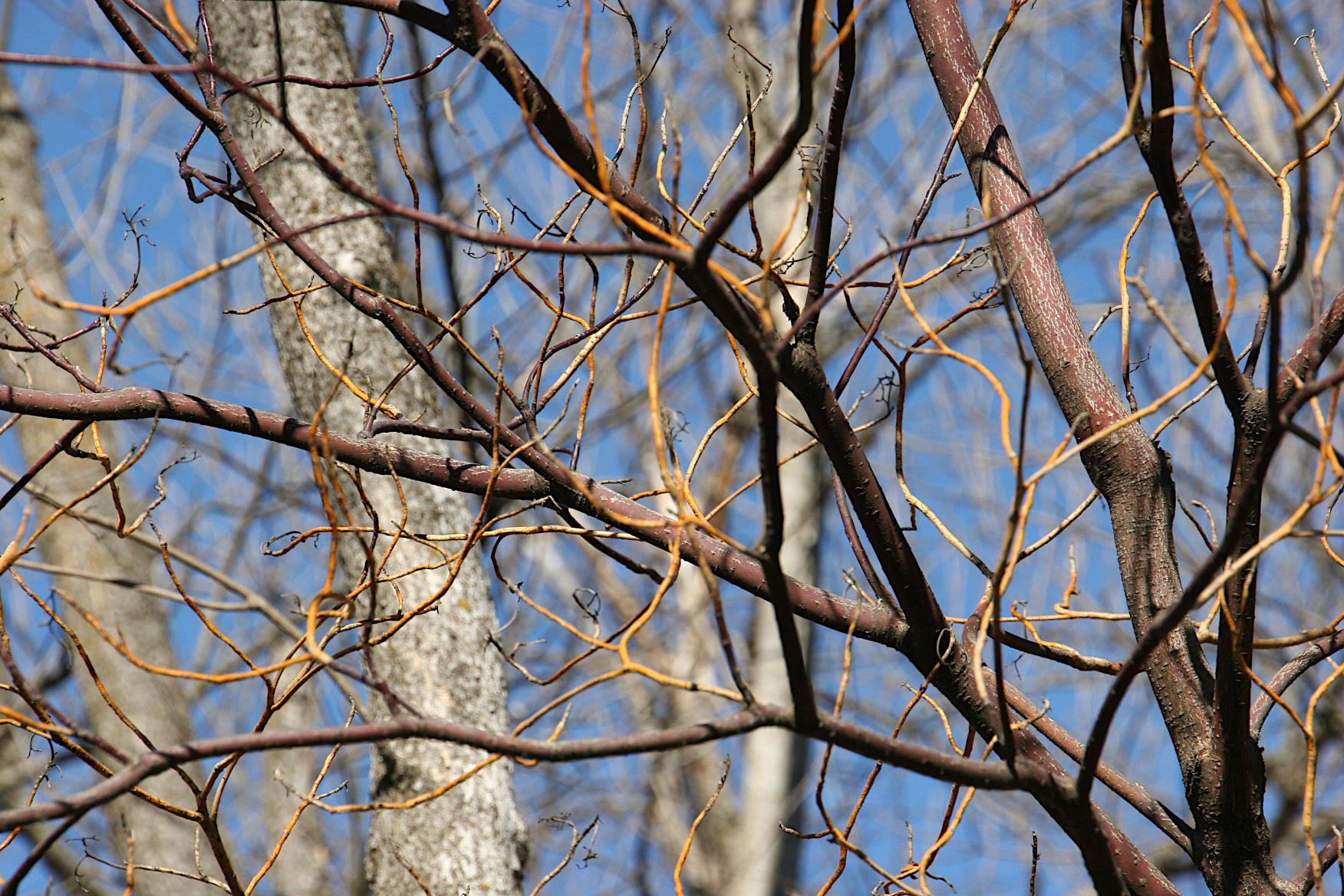
Tangled branches and blue sky. Beautiful. (Minnesota Prairie Roots copyrighted photo March 2022)
If you walk with me into the woods, you won’t fast track from Point A to Point B. Sometimes I go at a rapid pace. But most of the time, I can’t. Because I simply see too much. Poetry in puddled leaves. Spring in a patch of green grass. Abstract art in a mottled tree trunk. Dancers in twisted branches.
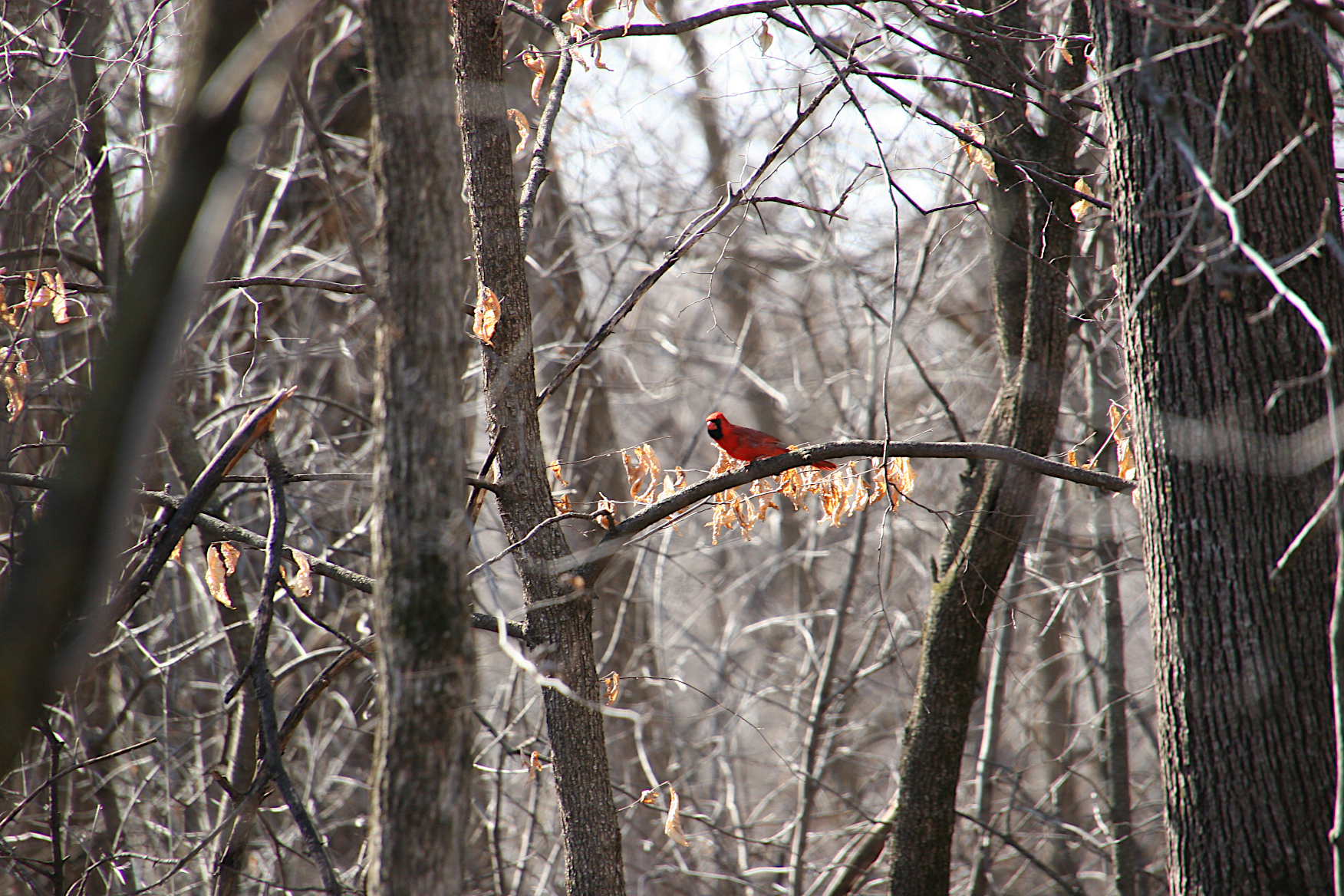
It took me awhile to get this focused shot with my zoom lens of a flitting cardinal. (Minnesota Prairie Roots copyrighted photo March 2022)
Sights and sounds draw me to linger in the woods. The shrill call of a cardinal and a flash of red cause me to pause. I wait. Listen. Photograph.
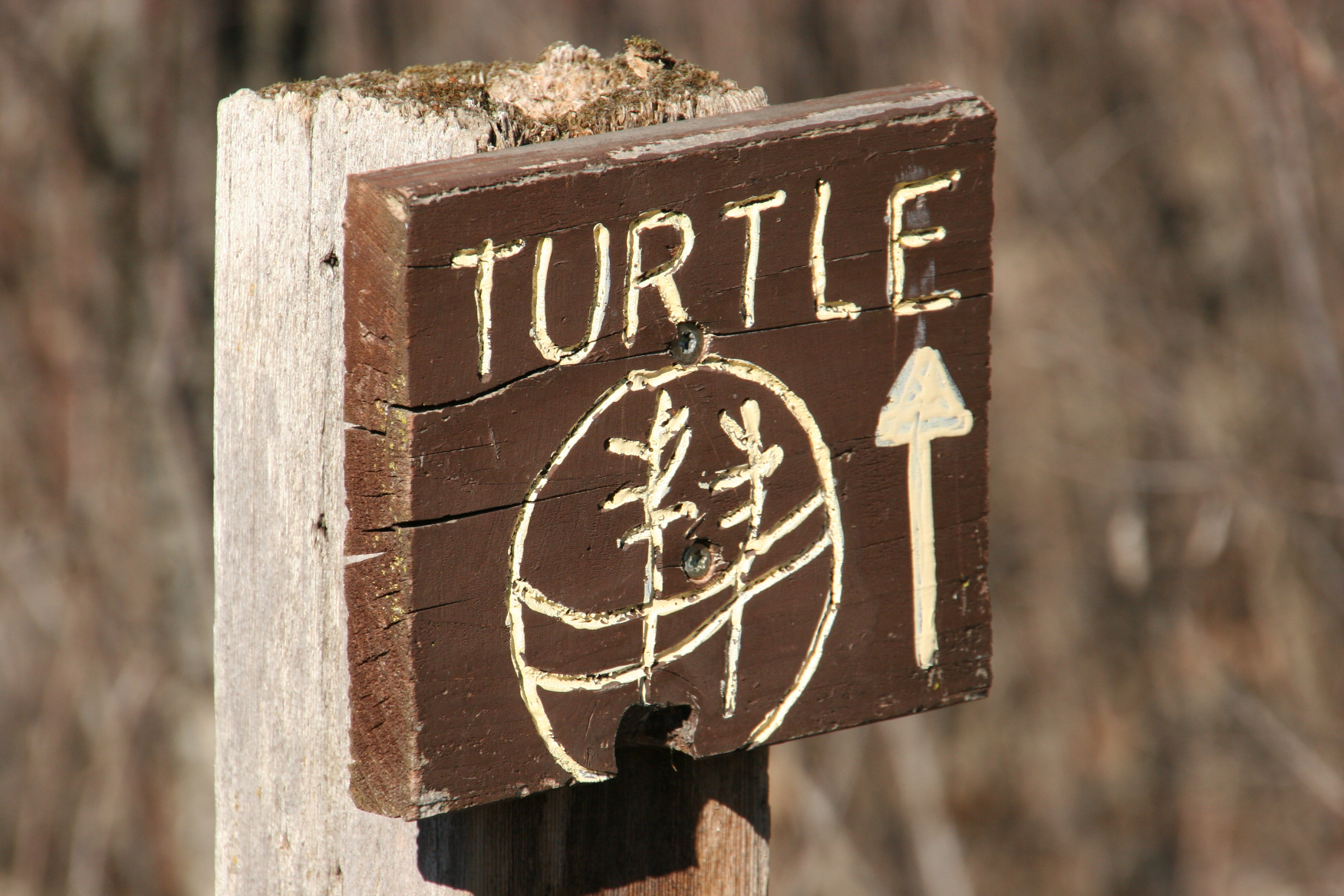
The sign pointing to the Turtle Pond, where the turtles had not yet emerged on my March 19 visit. (Minnesota Prairie Roots copyrighted photo March 2022)
I feel such a sense of wonderment in it all. A peace, too, that comes only from immersing one’s self in the natural world. In the chaos and noises of life, the woods are on this day, indeed, my sanctuary.
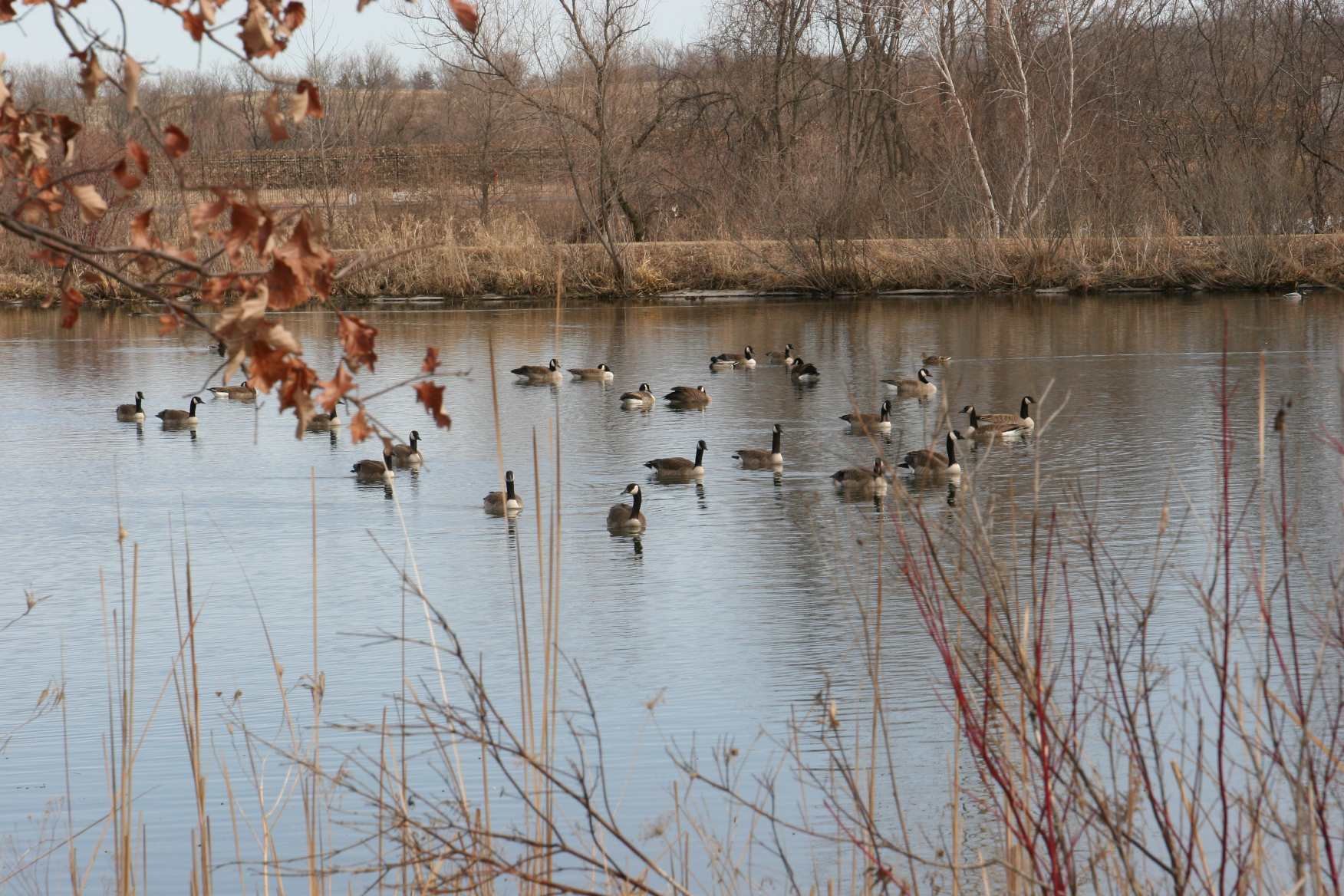
In one of two open ponds at Faribault Energy Park, geese settle in. (Minnesota Prairie Roots copyrighted photo March 2022)
AFTER WHAT SEEMED an especially long, cold winter in Minnesota, spring is emerging. And although the calendar confirms that with the vernal equinox on March 20, I need only look around me to verify this change in seasons.
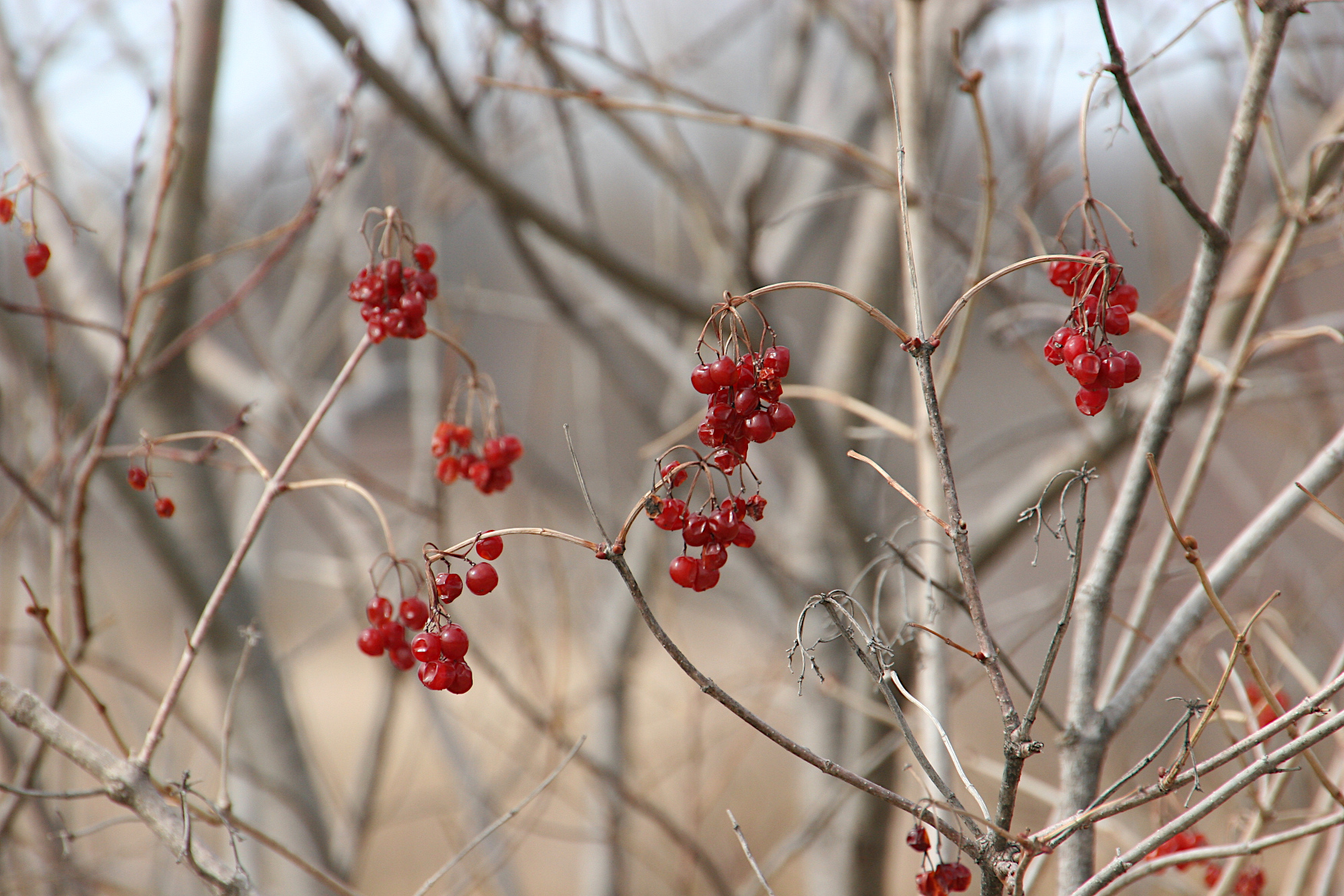
Last year’s berries still cling to branches. (Minnesota Prairie Roots copyrighted photo March 2022)
Several days of gloriously warm weather, capping with 70 degrees on Monday, meant lots of time outdoors in the warmth and sunshine. And nature, mostly nature.
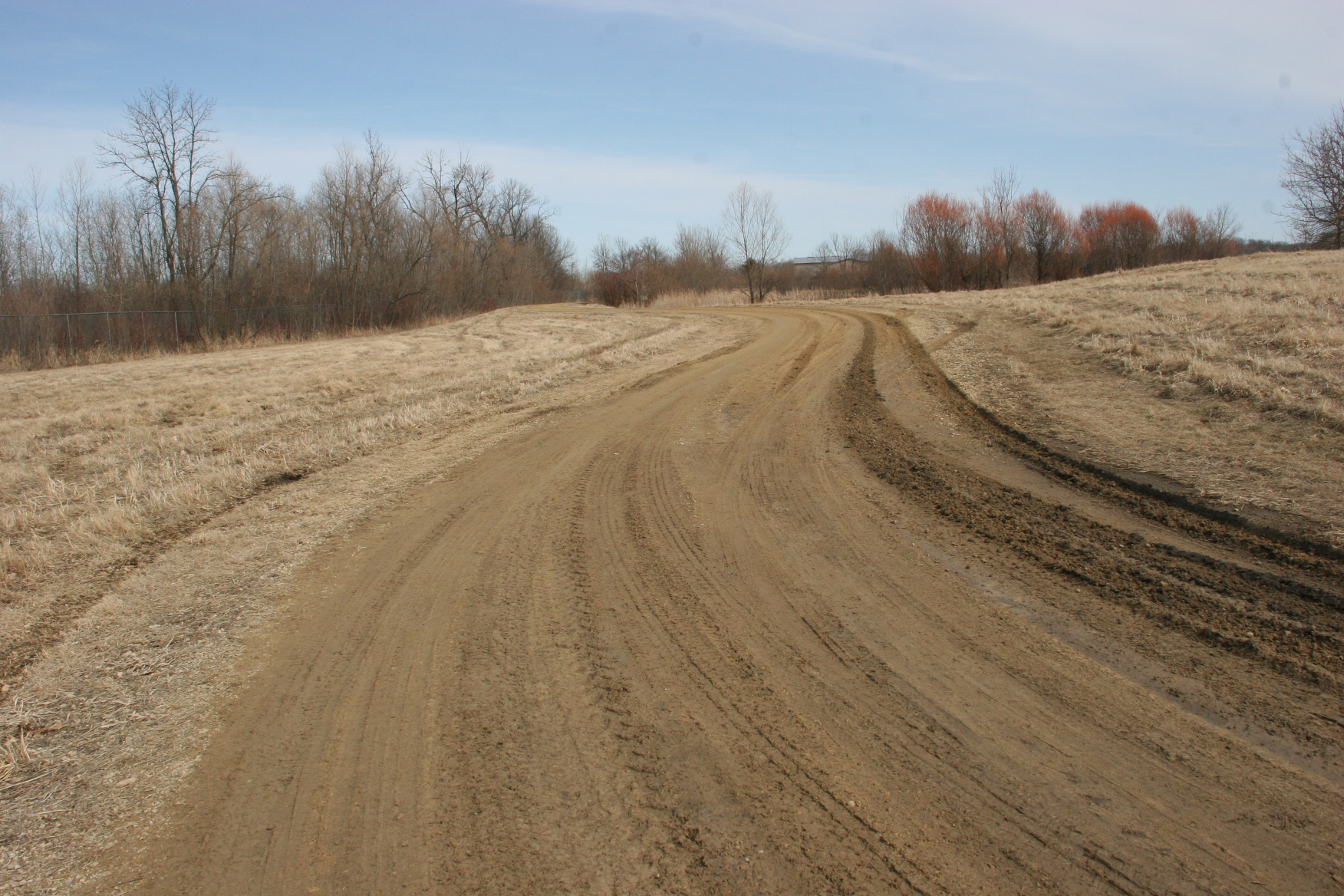
Dirt roads wind around ponds at Faribault Energy Park. (Minnesota Prairie Roots copyrighted photo March 2022)
I especially delight in following the packed dirt roads at Faribault Energy Park. Even with its location next to busy Interstate 35, the park provides, for me, a preferred place to immerse myself in the outdoors. I love the wide sky, the prairie feel of this landscape.
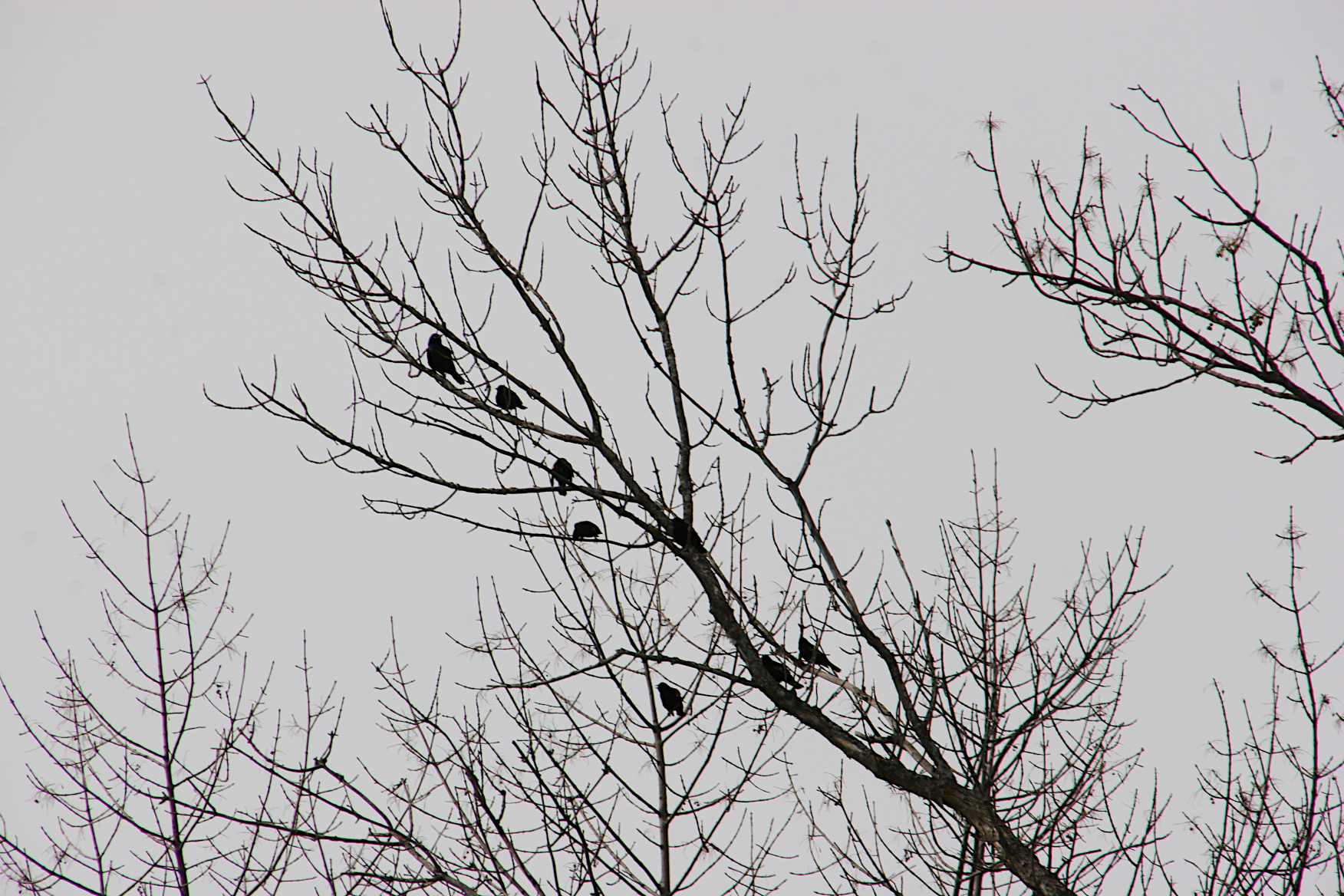
Just a snippet of the blackbirds I saw in these trees. (Minnesota Prairie Roots copyrighted photo March 2022)
As I began my walk around the on-site ponds that attract waterfowl aplenty, I hear first the overwhelming chorus of birdsong. Red-winged blackbirds, perched high atop a cluster of trees, trill a song of spring. I welcome the music.
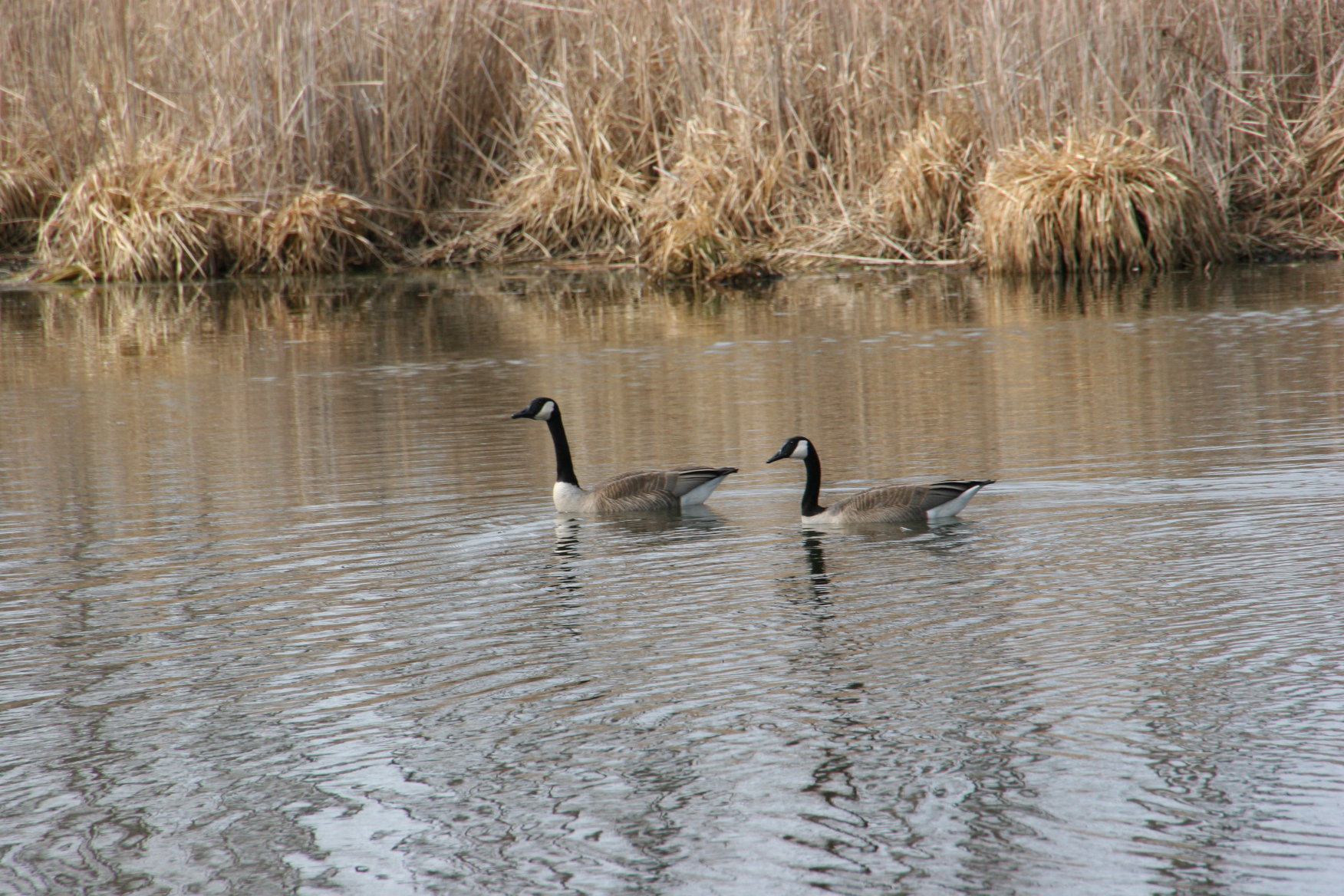
Canadian geese. (Minnesota Prairie Roots copyrighted photo March 2022)
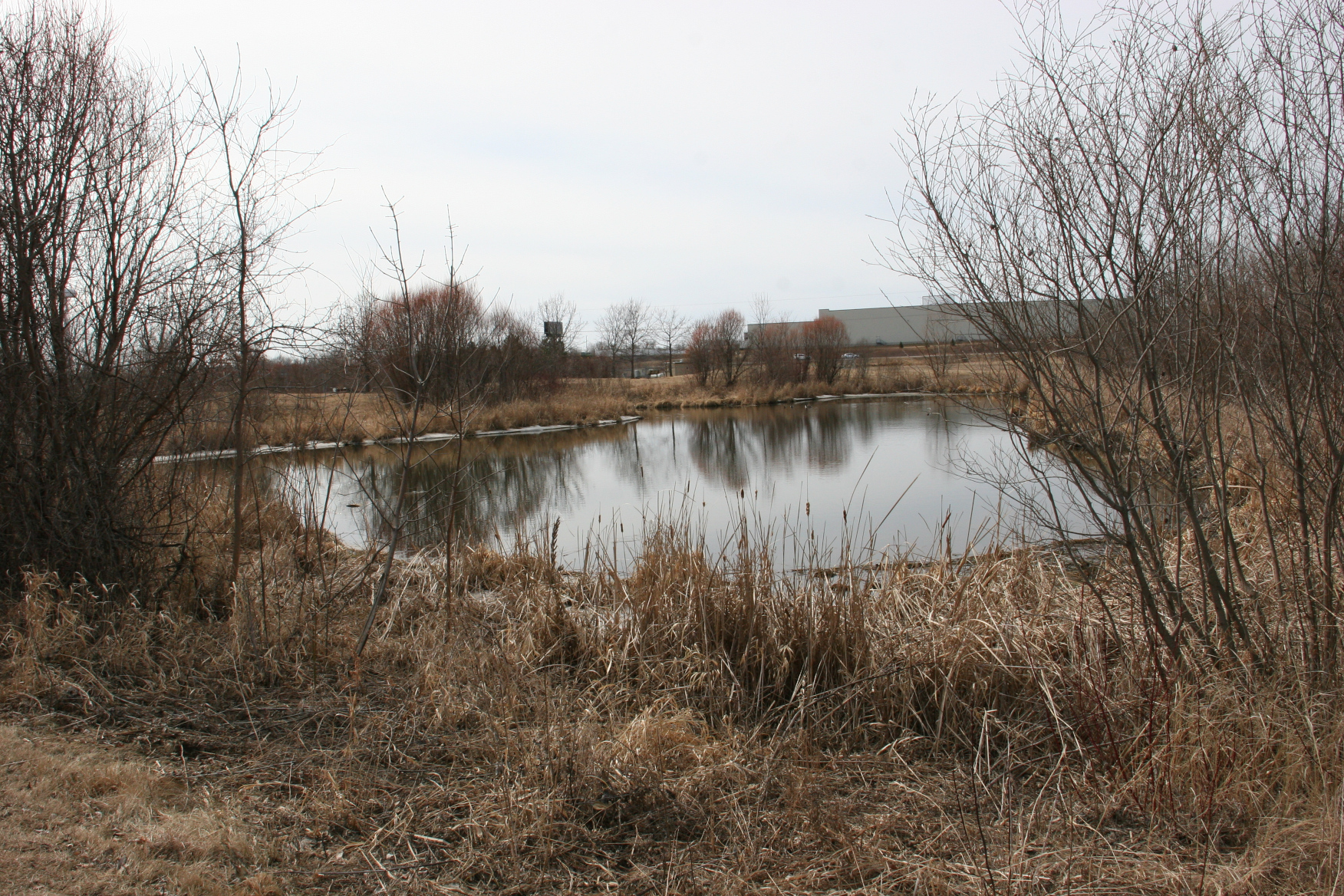
An overview of the smaller pond. (Minnesota Prairie Roots copyrighted photo March 2022)
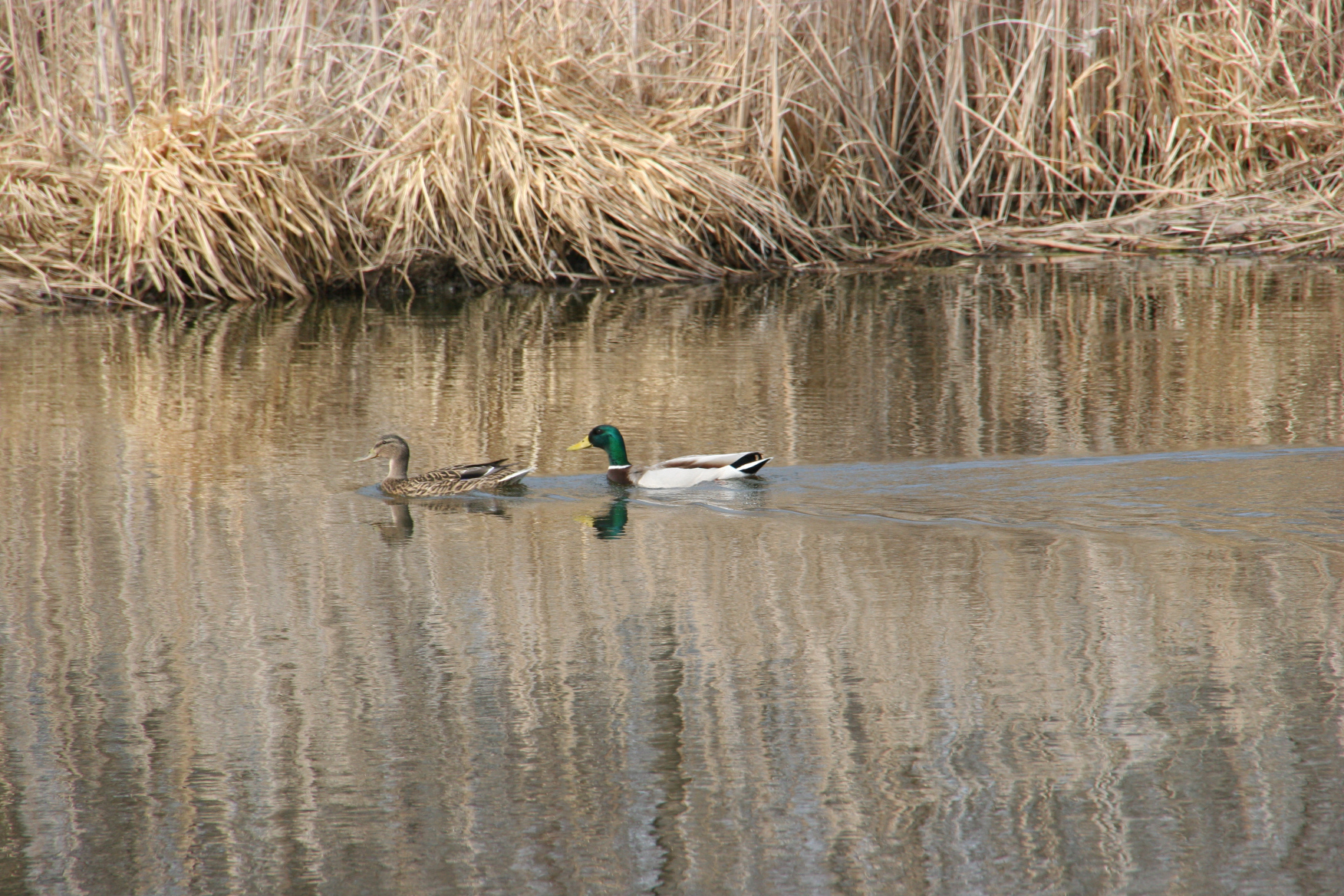
A mallard drake and hen. (Minnesota Prairie Roots copyrighted photo March 2022)
On two of the three ponds, I observe ducks and geese—mostly geese—rippling gracefully across the open water.
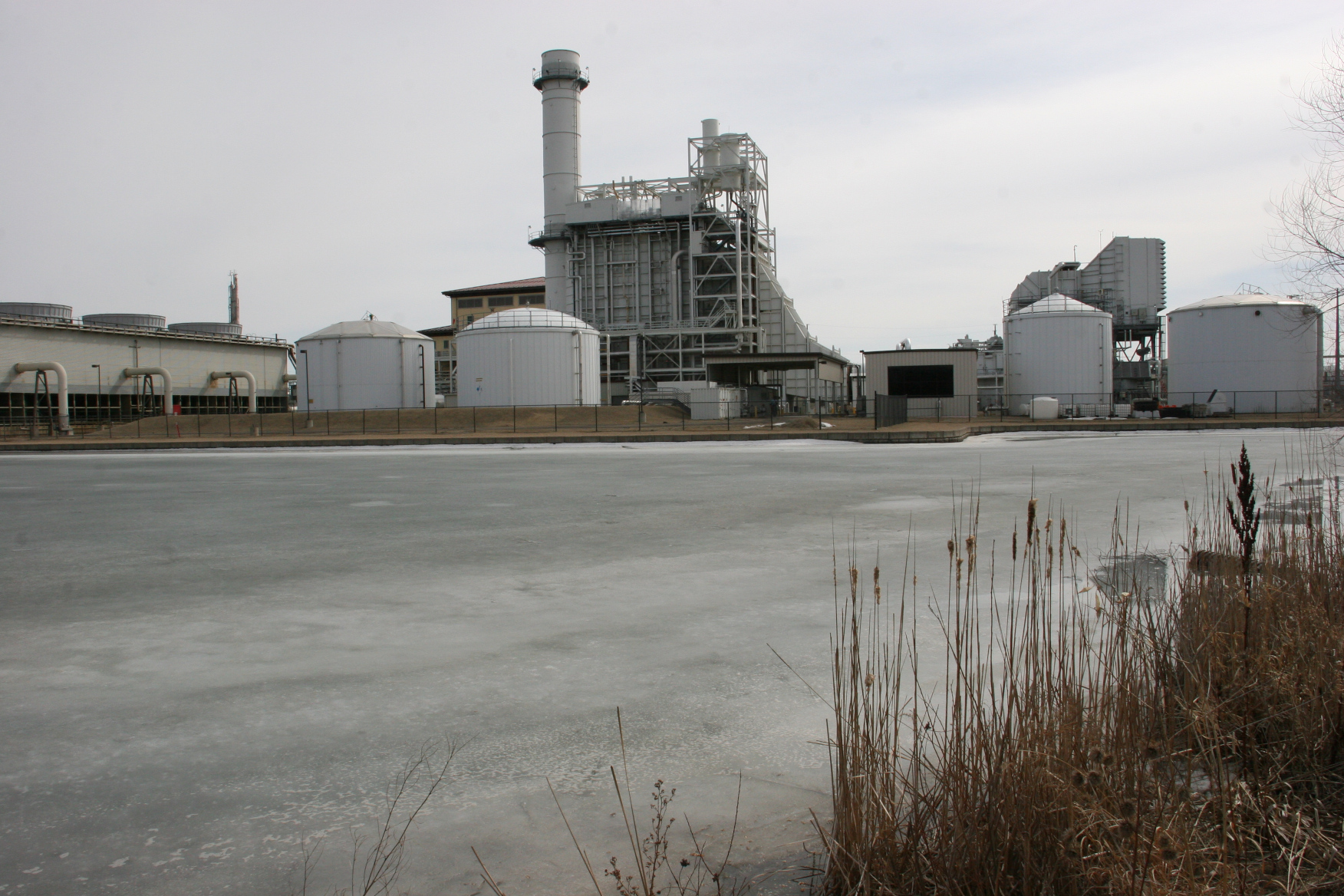
This pond right next to the energy plant was mostly iced on the first day of spring. (Minnesota Prairie Roots copyrighted photo March 2022)
The water on the pond nearest the energy plant remains frozen except along the fringes where an angler catches and releases bass and bluegills. It’s a good place to fish with kids, he says, or for someone like him, a kid. I laugh.
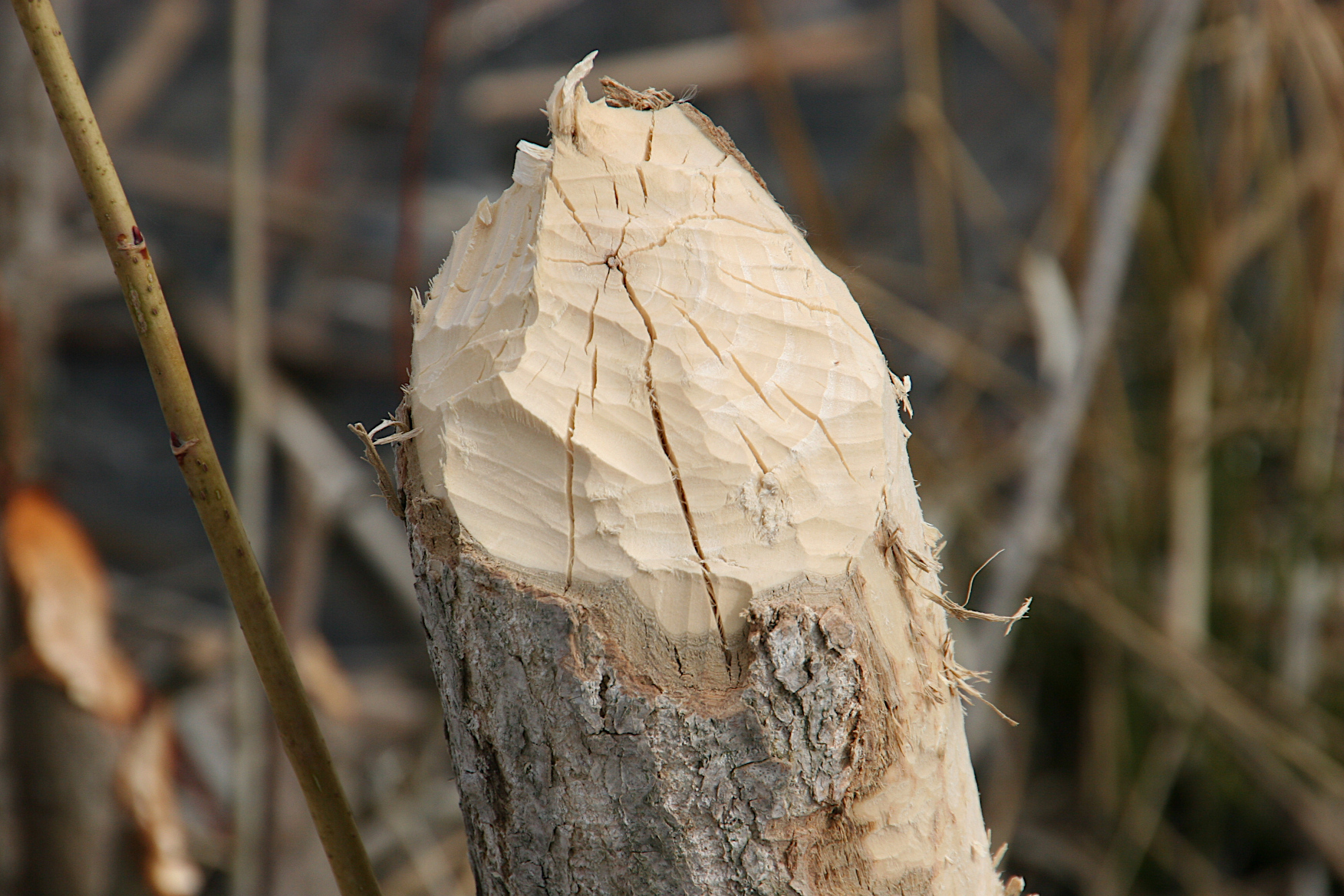
By the pond, evidence of a busy beaver. (Minnesota Prairie Roots copyrighted photo March 2022)
As I follow the paths and walk along main pond’s edge with camera slung around my neck, I notice the remnants of seasons past interwoven with signs of spring.
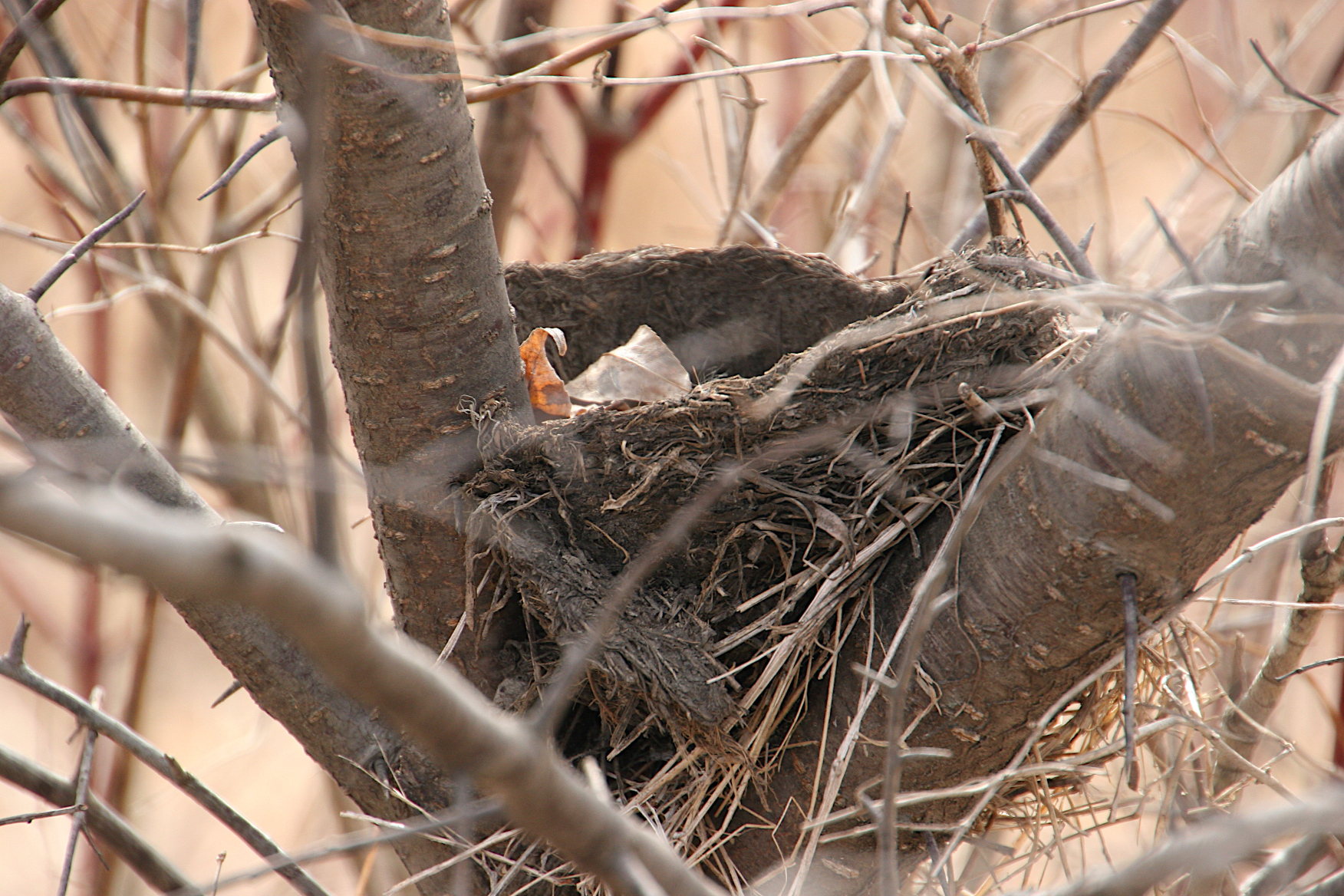
Nearly hidden, last season’s nest. (Minnesota Prairie Roots copyrighted photo March 2022)
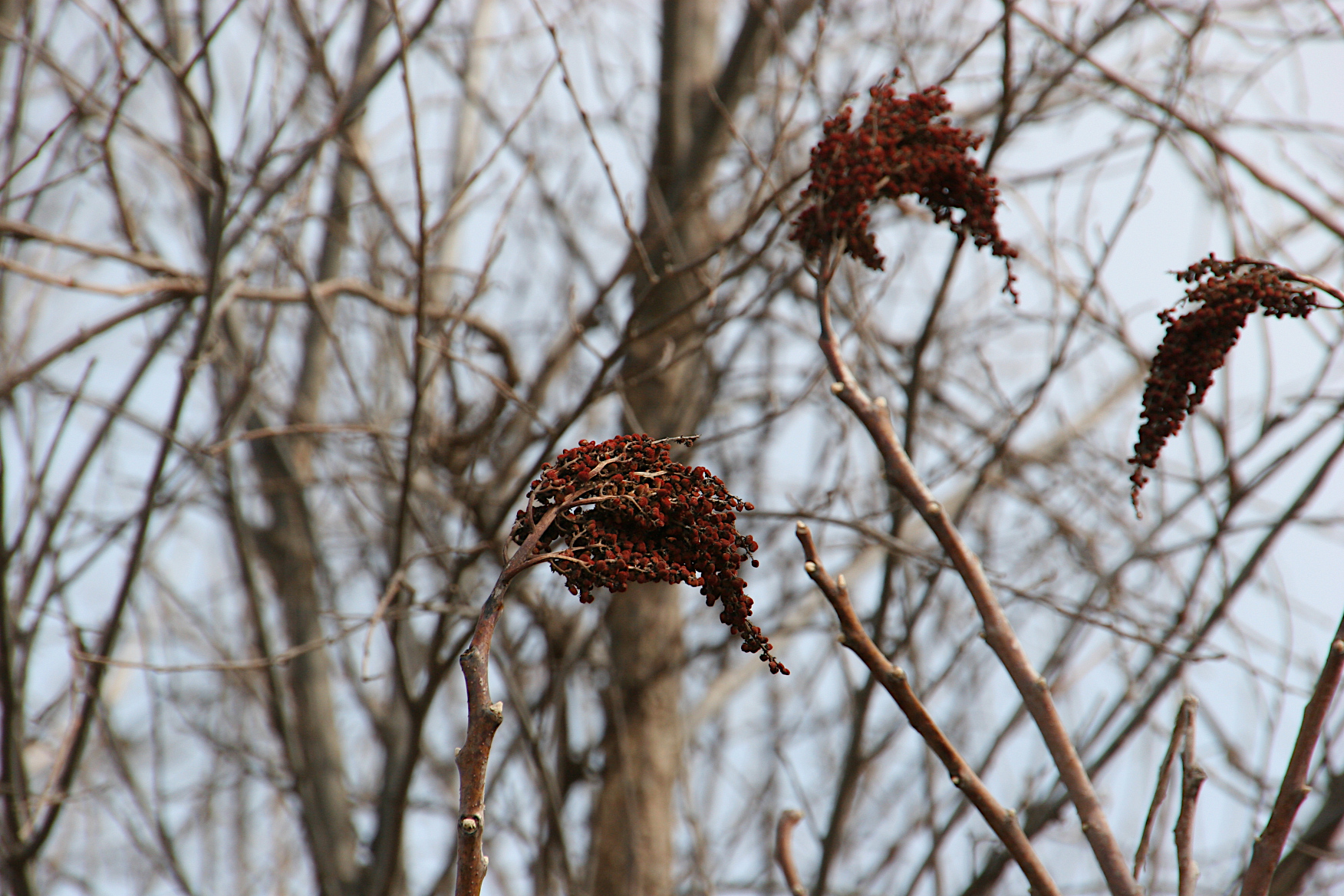
Sumac remnants. (Minnesota Prairie Roots copyrighted photo March 2022)
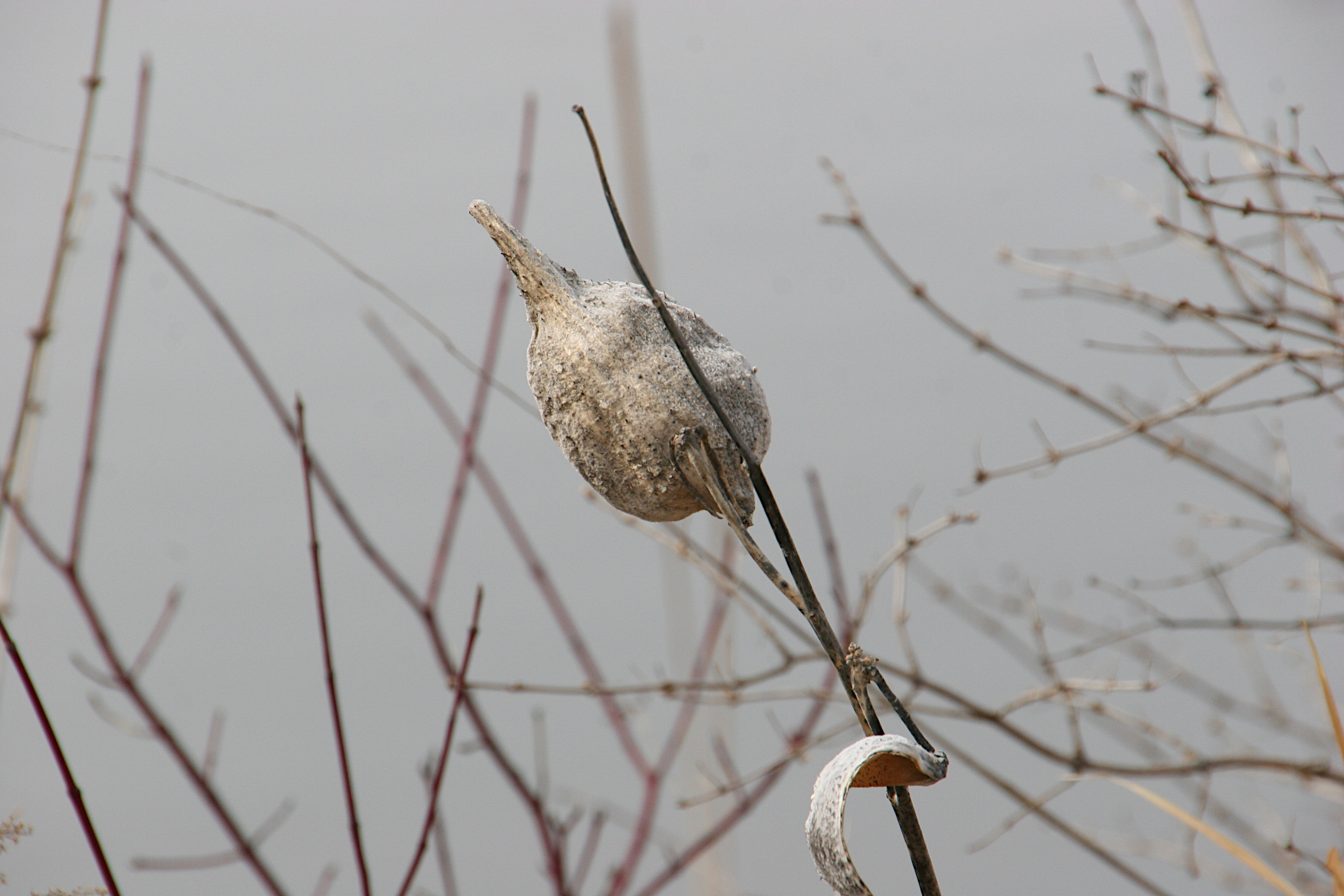
A dried milkweed pod. (Minnesota Prairie Roots copyrighted photo March 2022)
Dried leaves, sumac, grasses, cattails, berries, milkweed pods, pine cones, even a bird nest tucked low in the crook of a tree, remain from months earlier.
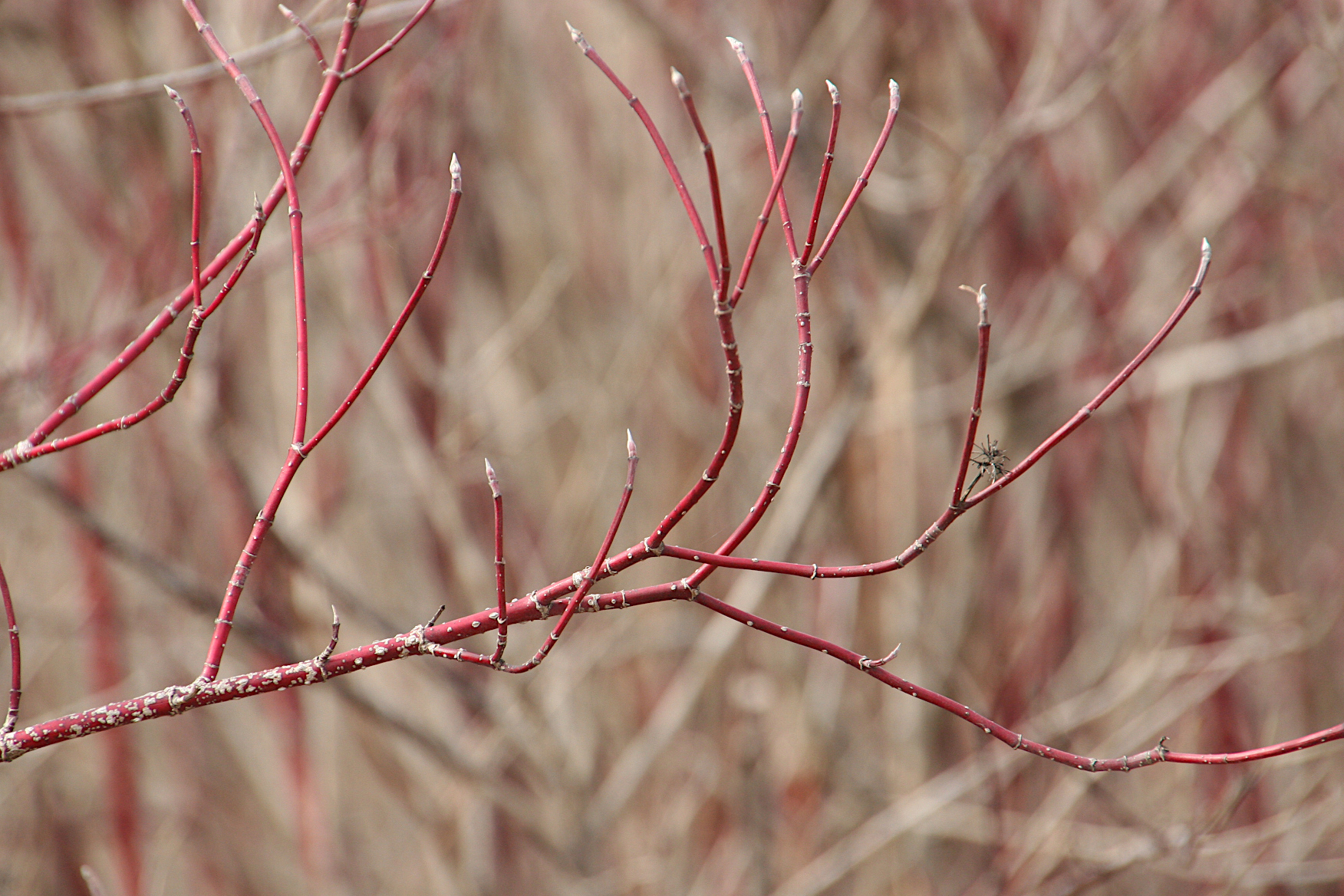
Dogwood. (Minnesota Prairie Roots copyrighted photo March 2022)
But now, amid all those visuals of autumn and winter, spring pops. Red dogwood colors the brush.
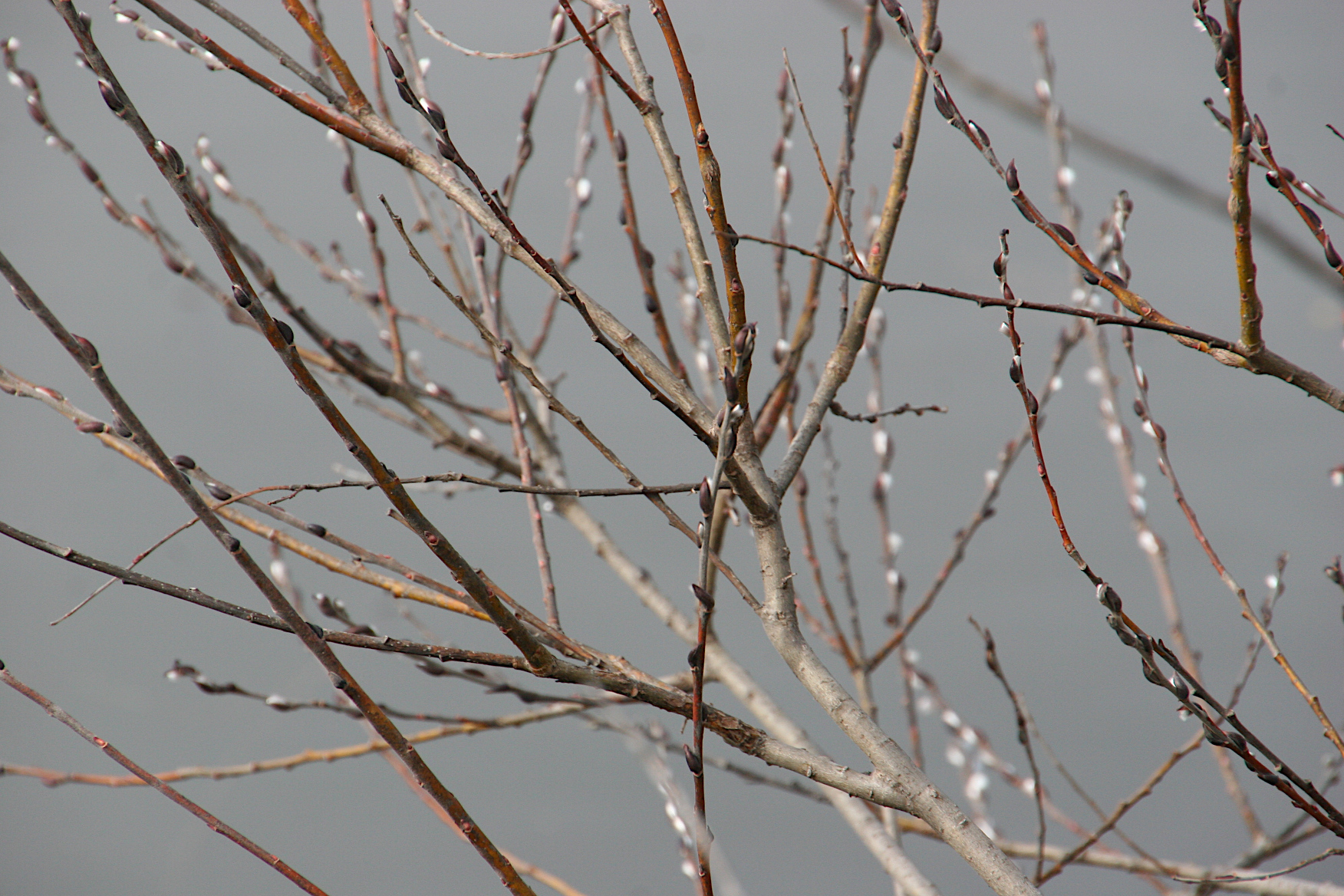
Pussy willows just beginning to open on the first day of spring. (Minnesota Prairie Roots copyrighted photo March 2022)
Pussy willow buds open, tracing a line of mini cotton balls along slender branches.
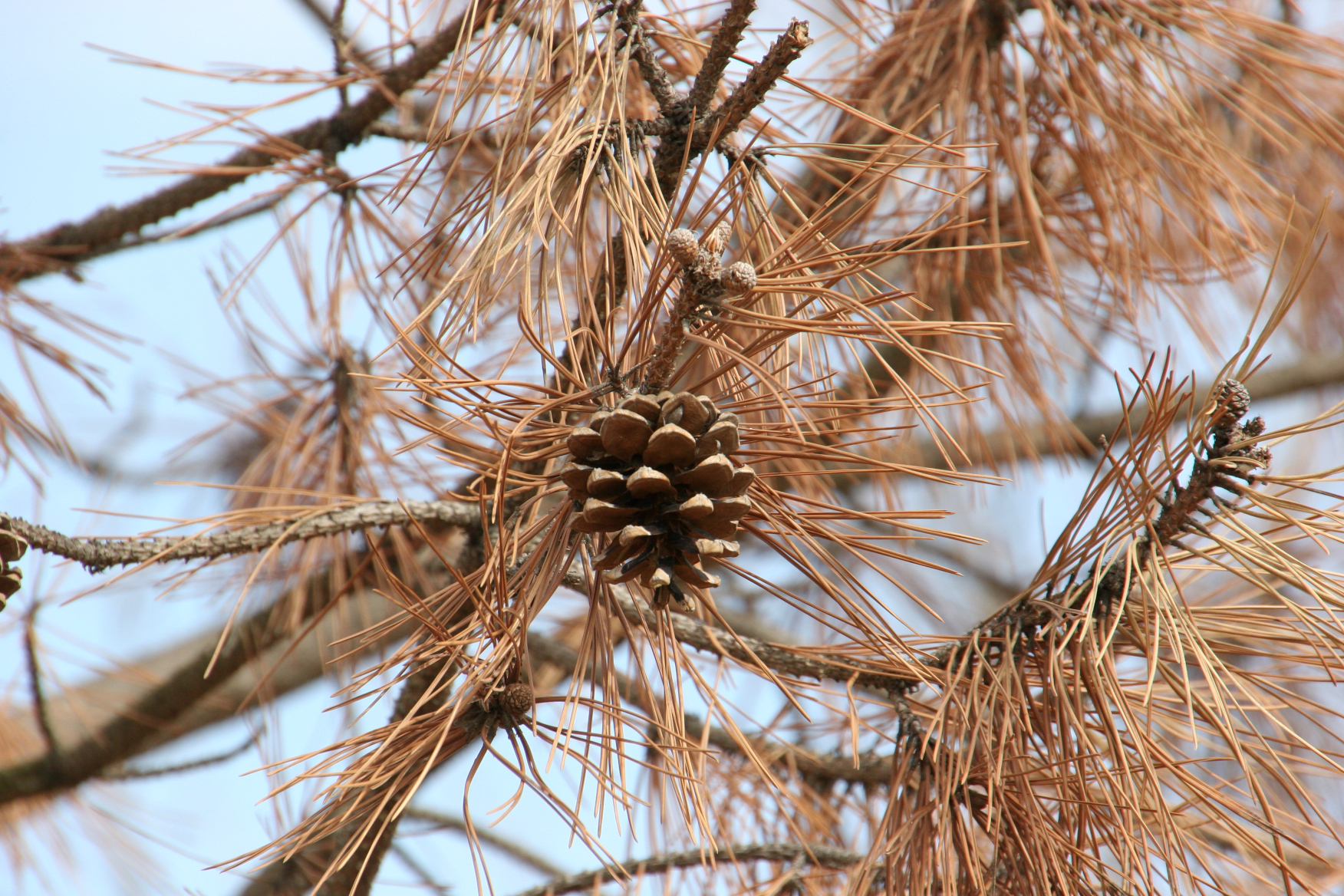
Last season’s pinecones. (Minnesota Prairie Roots copyrighted photo March 2022)
I take in this seasonal change. With my eyes, then my camera. And I listen to those blackbirds in concert, interrupted by the occasional applause of geese against the background music of I-35 traffic.
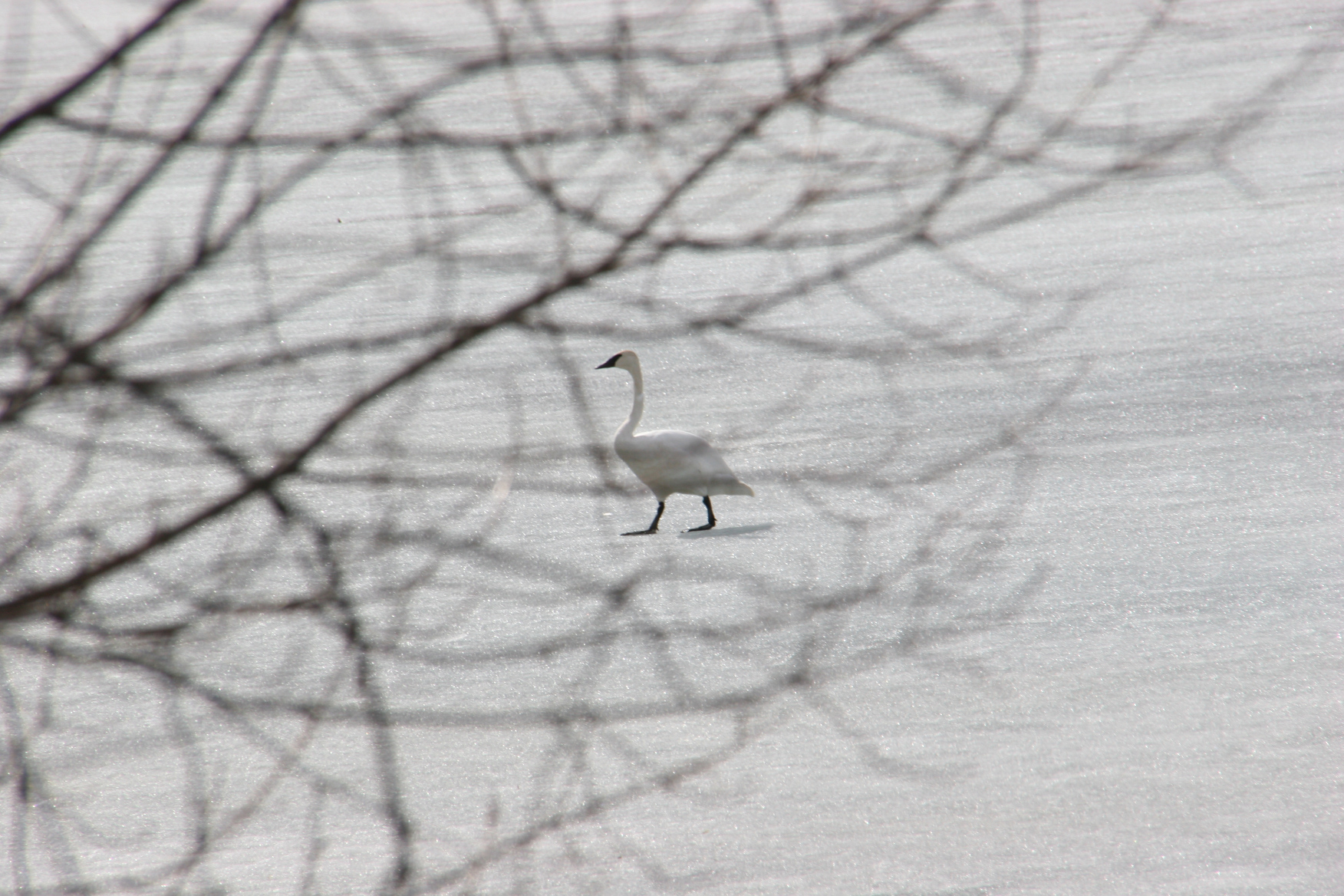
A swan navigates across a frozen pond (near the Energy Park) by I-35. (Minnesota Prairie Roots copyrighted photo March 2022)
It’s good to be here, to experience the beginning of spring. To connect to the earth along muddy dirt roads. To feel, hear and observe the transition of seasons as we step into spring in southern Minnesota.
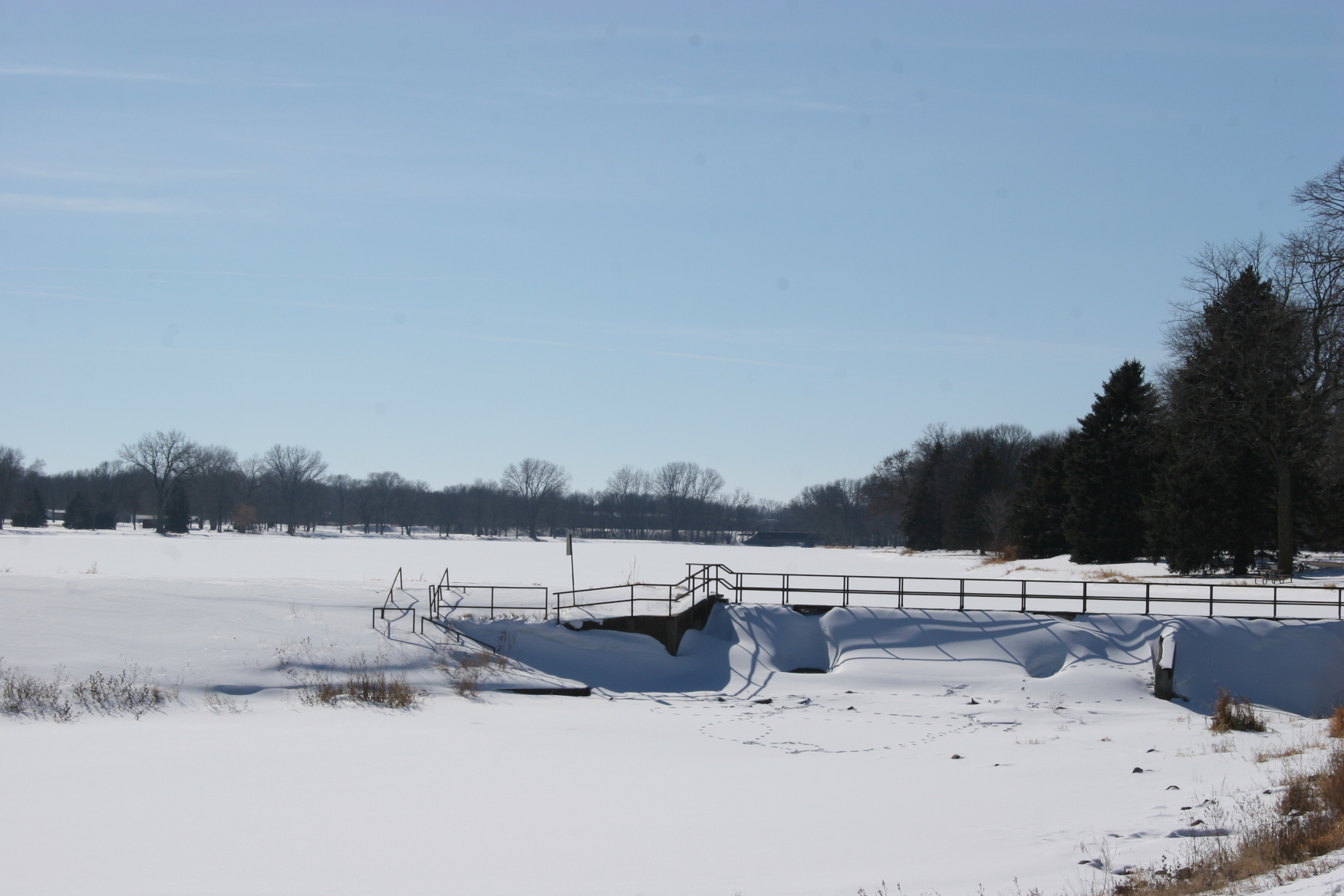
A wide view of the frozen Cannon River and dam adjacent to the Rice County Fairgrounds. (Minnesota Prairie Roots copyrighted photo March 2022)
THE SHIFT IN SEASONS seems subtle. But it’s there. In the lengthening of days. In brilliant sunshine that cuts through snowbanks, streams of water flowing and puddling. Iced rivers, too, are beginning to thaw.
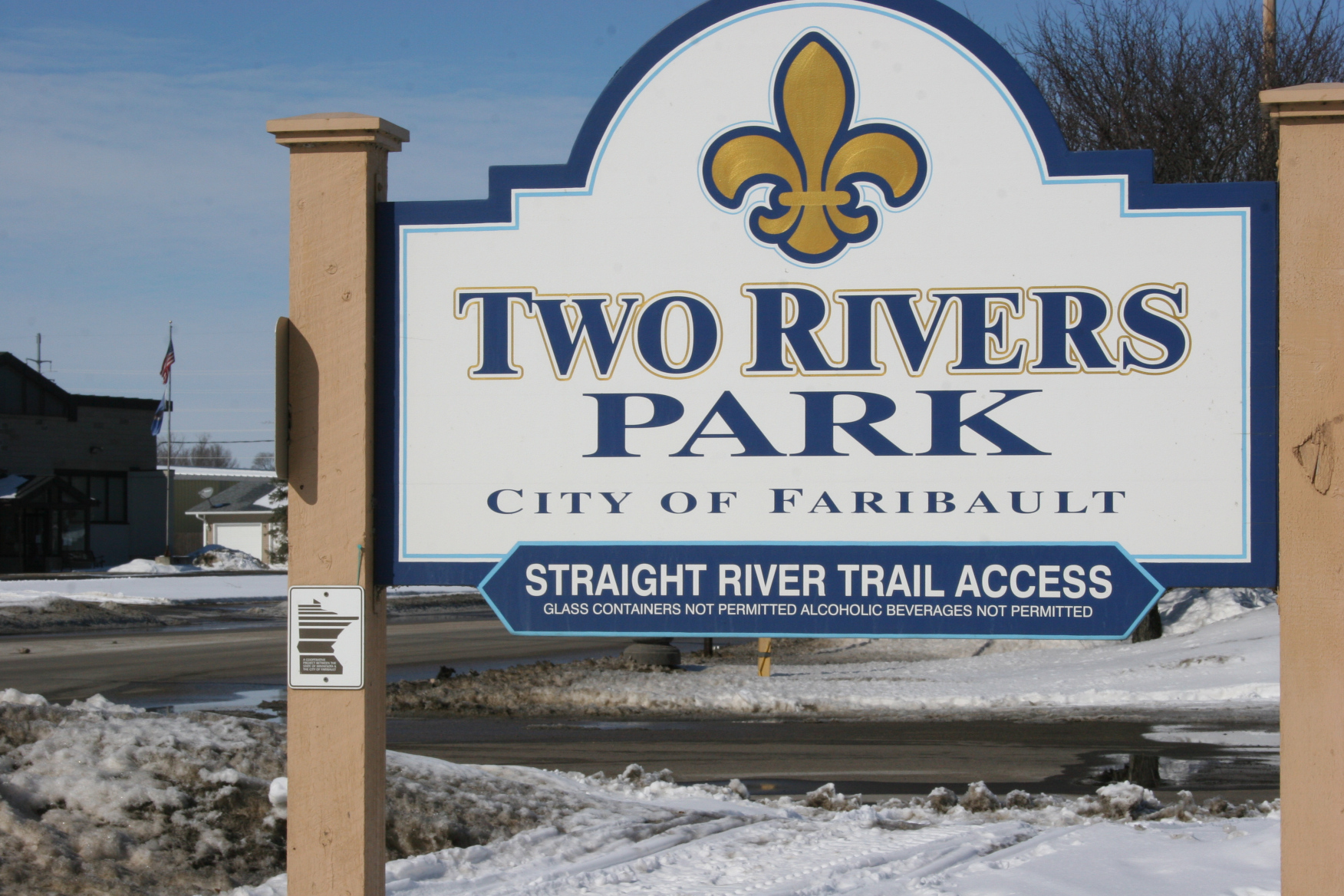
Signage marks this park just off Second Avenue on Faribault’s north side. (Minnesota Prairie Roots copyrighted photo March 2022)
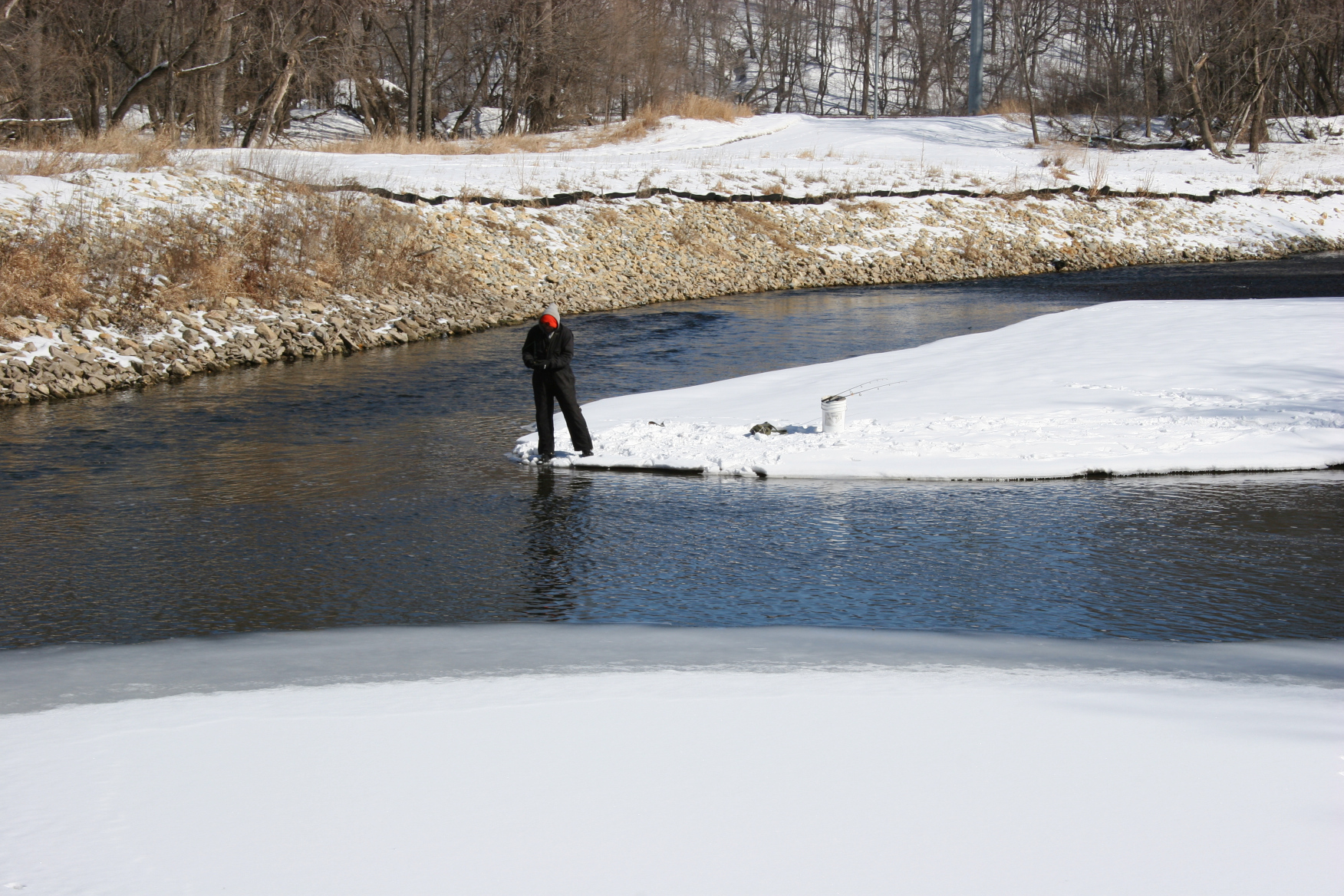
Fishing where the Cannon and Straight Rivers meet in Faribault. (Minnesota Prairie Roots copyrighted photo March 2022)
At the convergence of the Straight and Cannon Rivers, an angler fishes in the open water. His orange stocking cap covered by his hooded sweatshirt layered beneath black coveralls jolt color into an otherwise muted landscape. Randy and I watch as he reels in a large fish, then unhooks and plops it onto the snow. A northern, Randy guesses. We watch for awhile, content to see the river flow, sun glinting upon the surface.
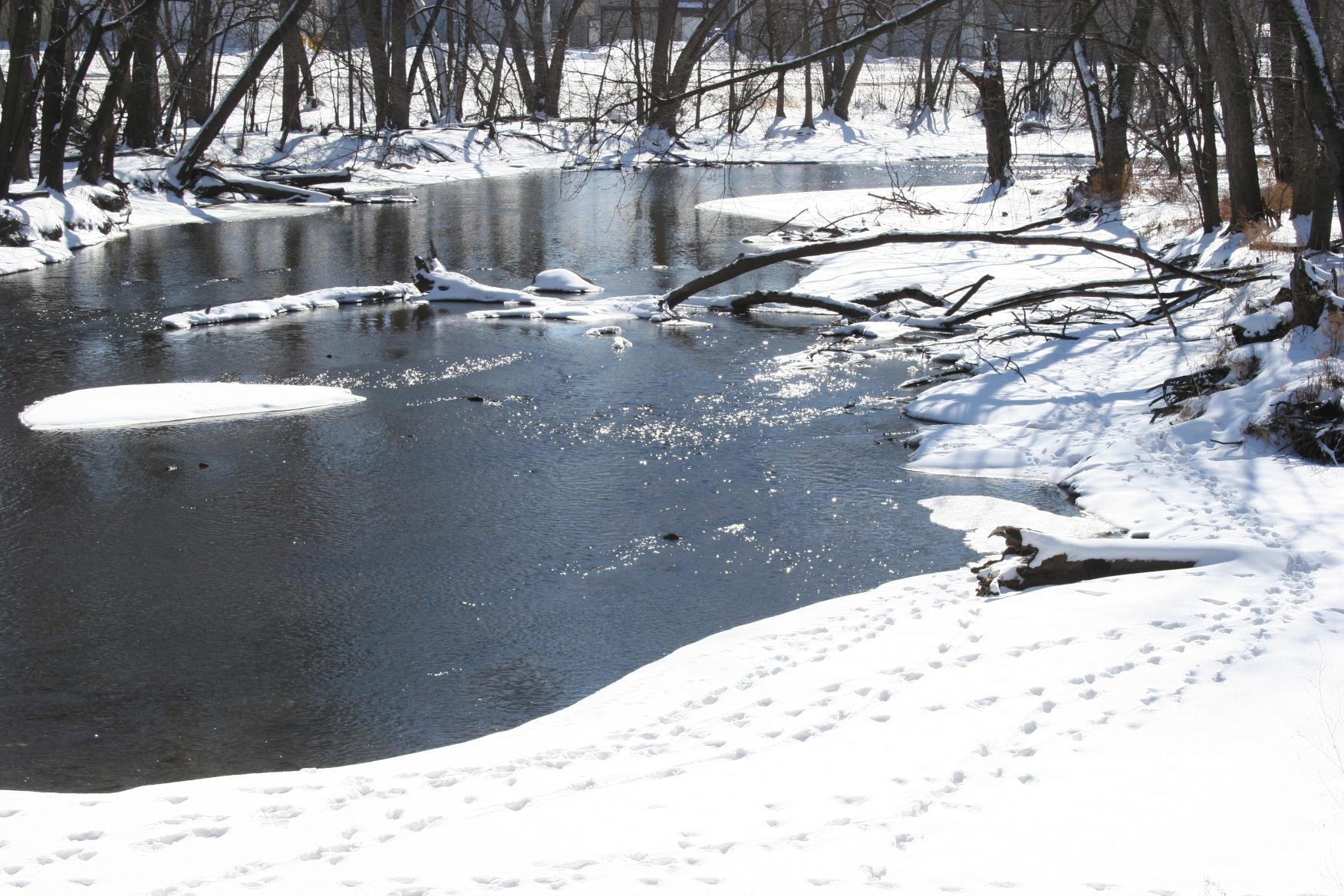
The beautiful open Cannon River at Two Rivers Park. (Minnesota Prairie Roots copyrighted photo March 2022)
We make our way back to the parking lot, after I pause to photograph the mostly open river sweeping between snowy woods. There’s sometime serene about such a scene. Peaceful, even as traffic drones by on nearby Second Avenue.
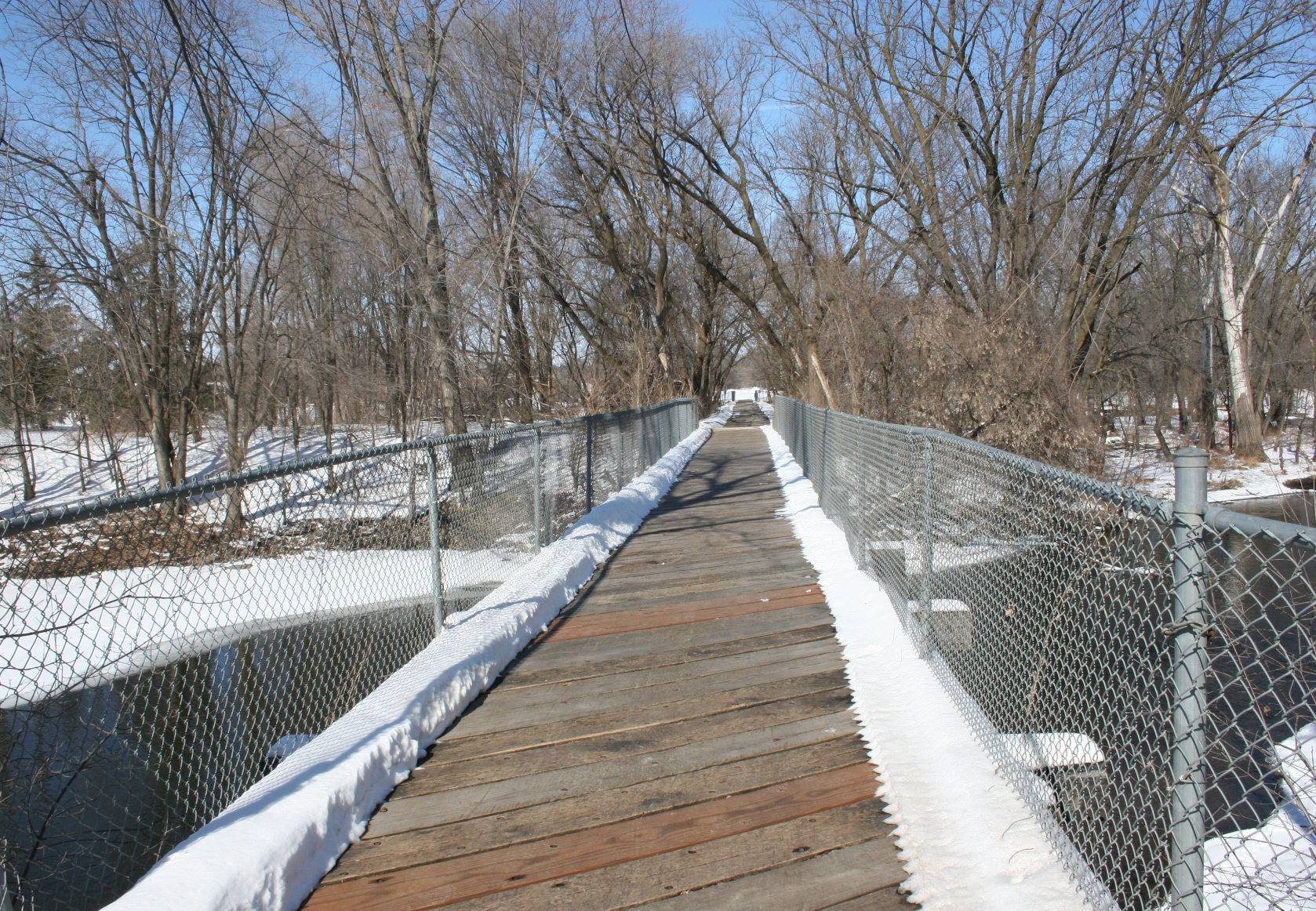
Pedestrian bridge over the river. (Minnesota Prairie Roots copyrighted photo March 2022)
On the trail, we cross bridges constructed of uneven angled boards that always trip me. I pause to peer into the river.
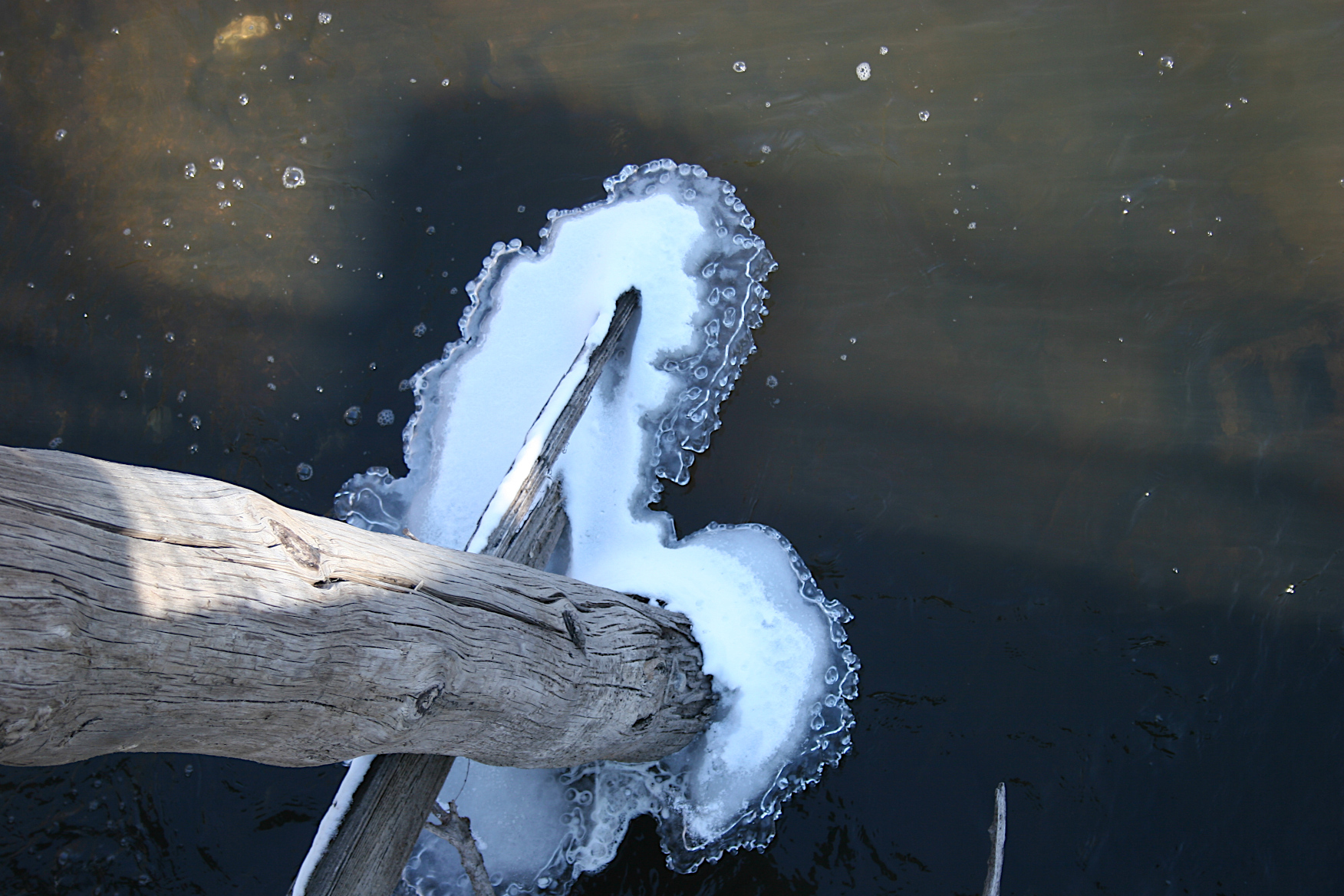
Ice rings a pedestrian bridge support post in the otherwise open river. (Minnesota Prairie Roots copyrighted photo March 2022)
Birdsong, a sure auditory sign of spring’s approach, resounds as I lean over the bridge railing to see the open water below. Both hint of winter’s retreat.
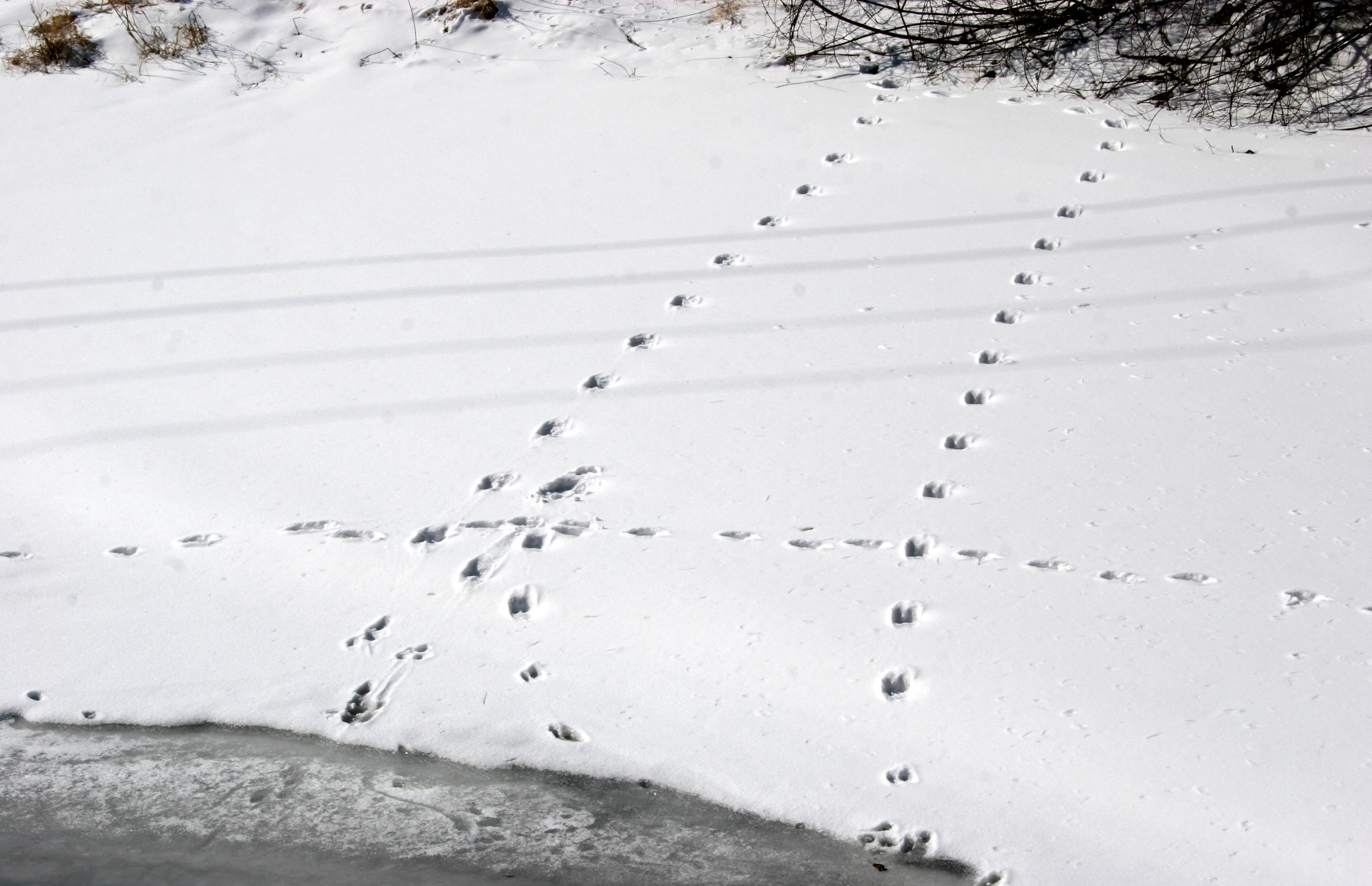
Animal tracks remind me of tic-tac-toe. (Minnesota Prairie Roots copyrighted photo March 2022)
Far below I observe animal tracks crossing the snow in a tic-tac-toe pattern leading to water’s icy edge.
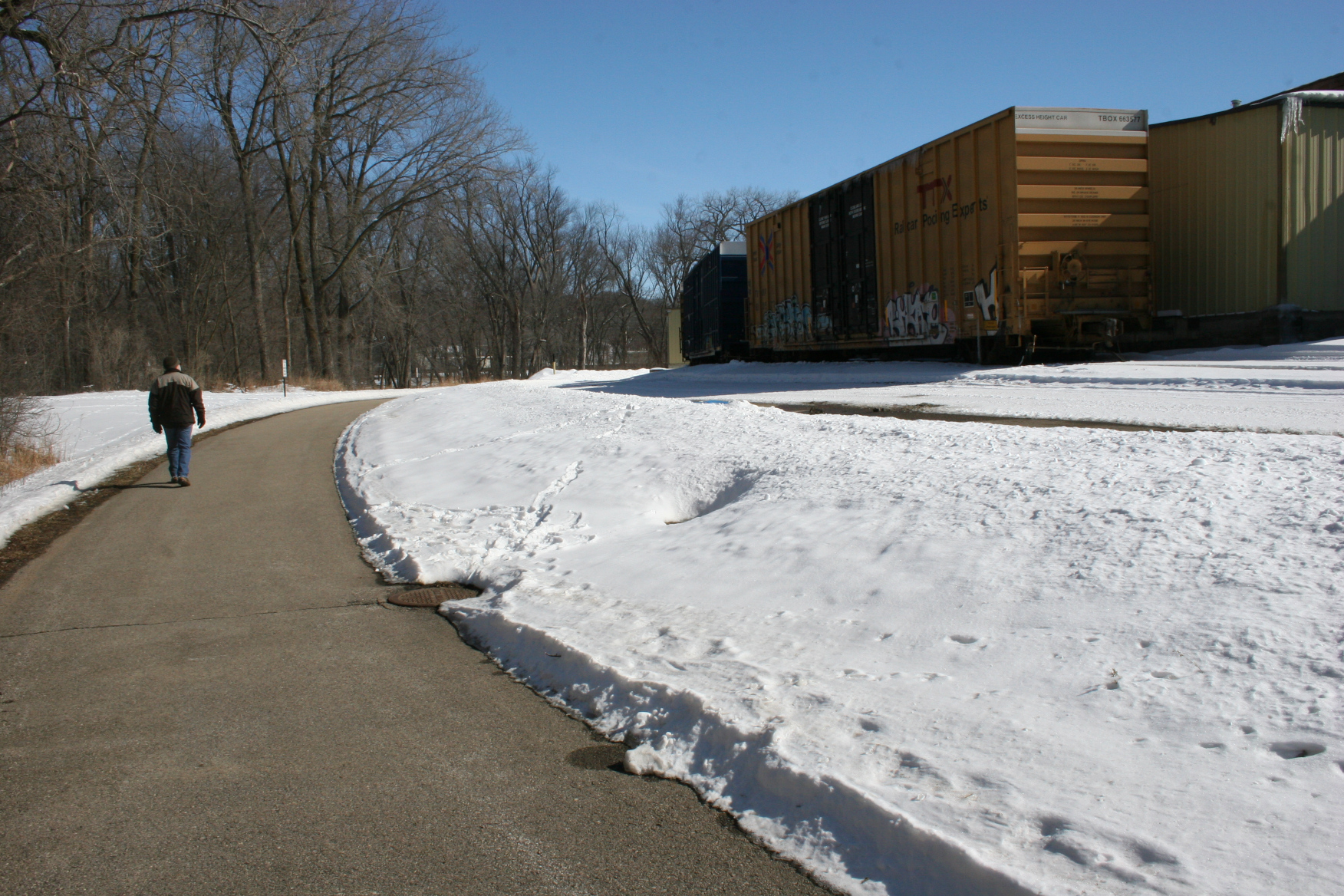
Following the Straight River Trailalongside the former vegetable canning company. (Minnesota Prairie Roots copyrighted photo March 2022)
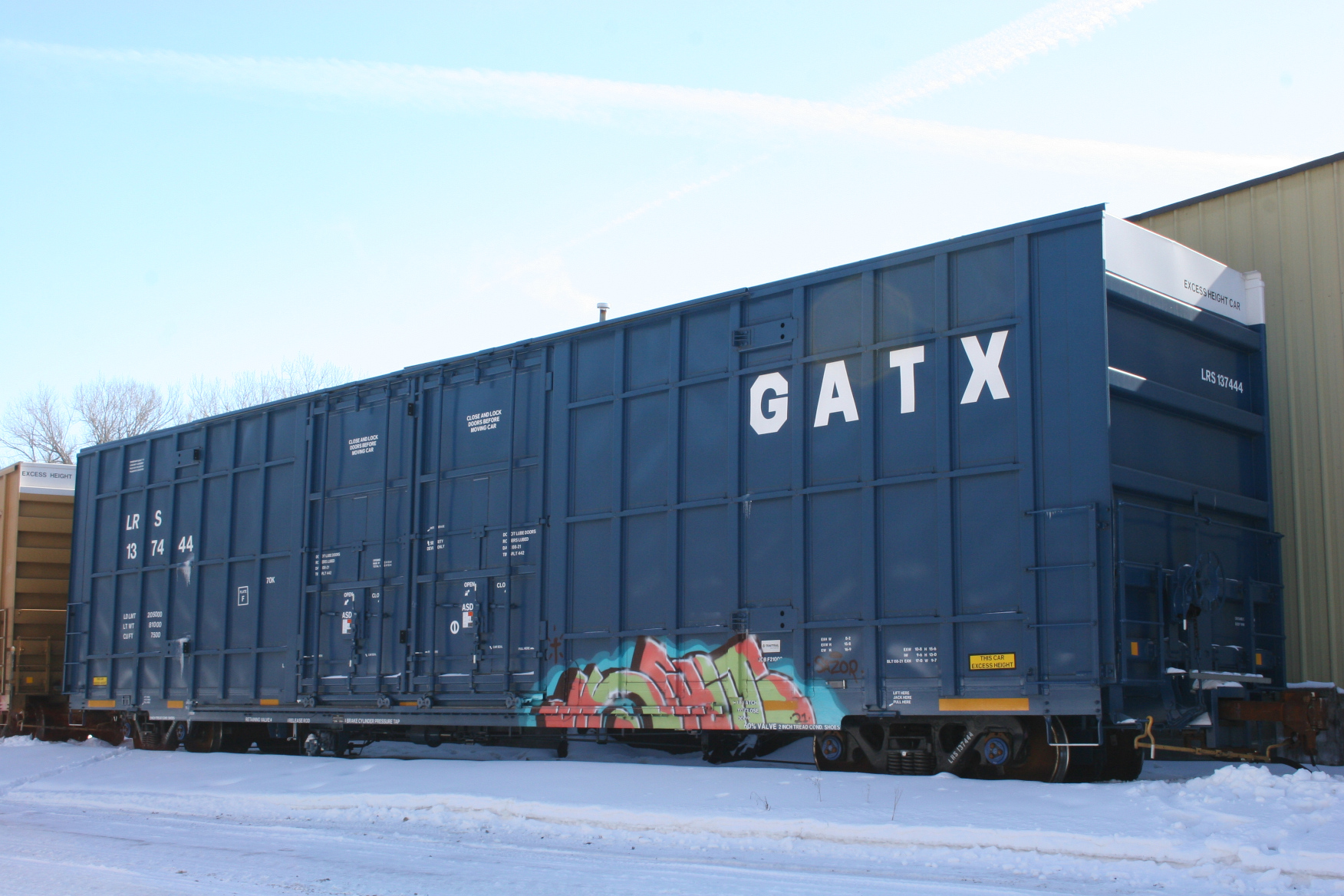
Curving along the path near the former Faribault Foods canning company, stationary boxcars sidle against the building.
Boxcar graffiti. (Minnesota Prairie Roots copyrighted photo March 2022)
Graffiti colors the boxcar canvases.
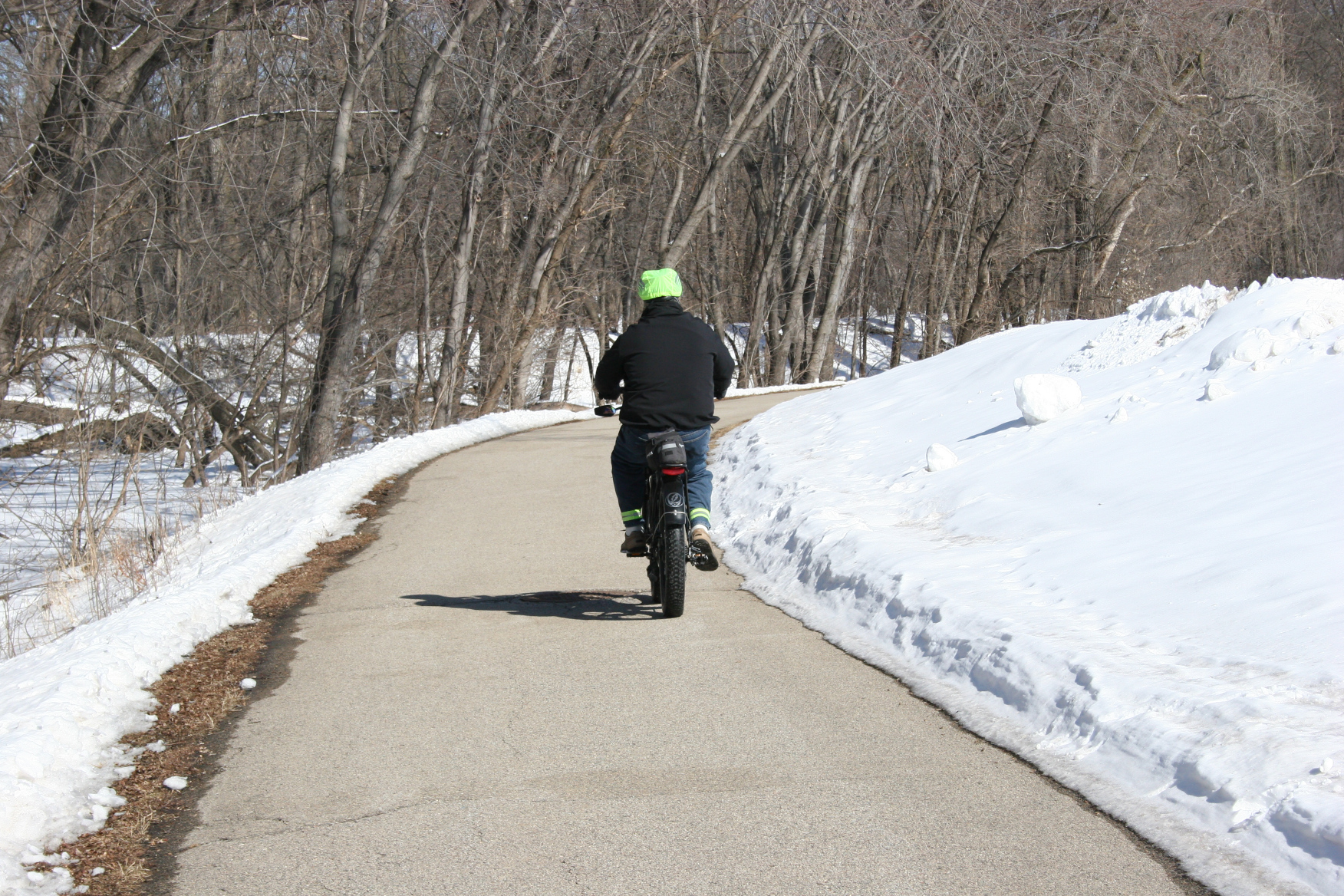
Biking the Straight River Trail in March. (Minnesota Prairie Roots copyrighted photo March 2022)
We walk for awhile, then retrace our steps. Randy warns of an approaching cyclist and we step to the right of the trail in single file. “Hi, Randy,” the guy on the fat tire bike shouts as he zooms past. We look at each other. His identity remains a mystery.
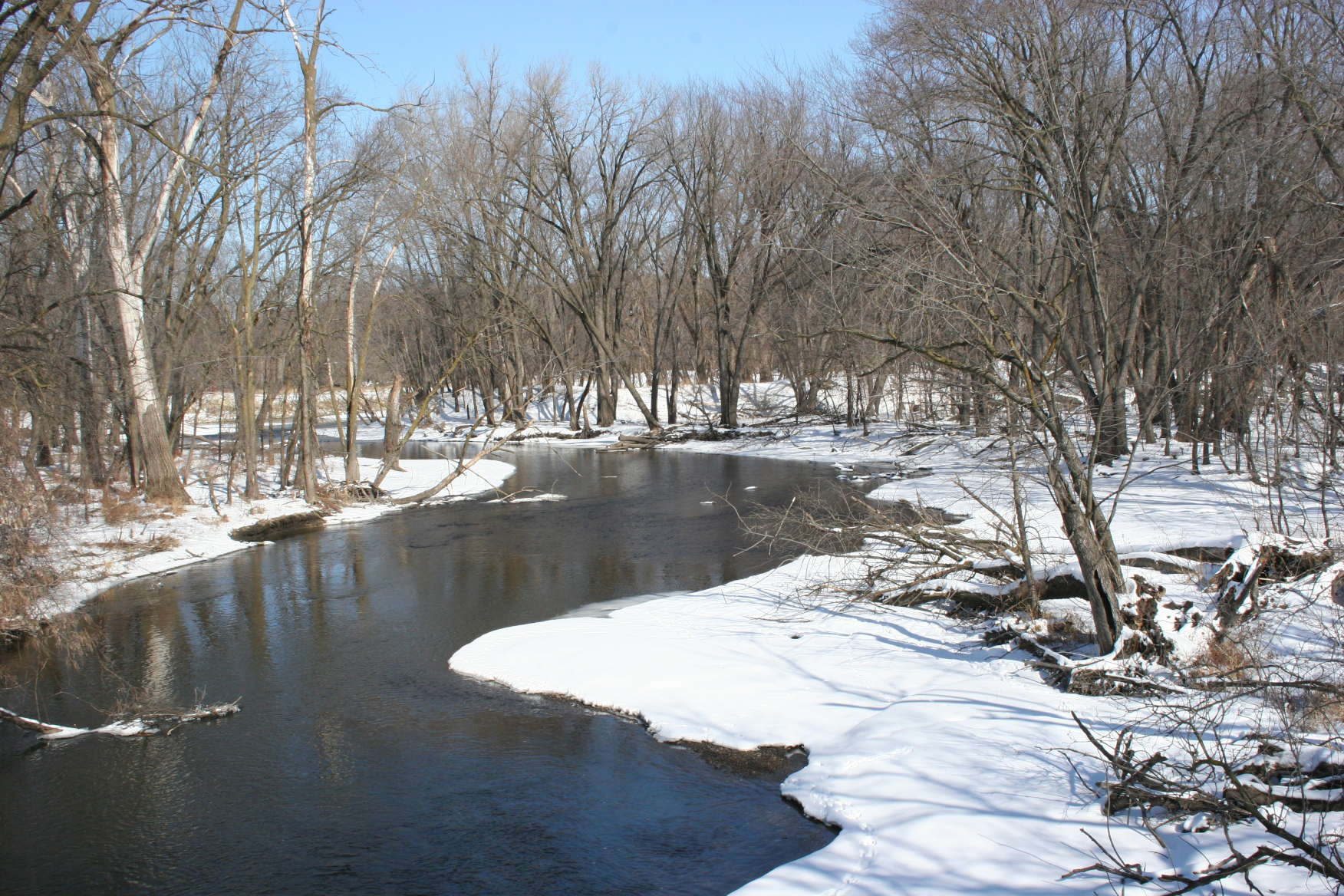
The scenic Cannon River snakes toward the Straight River. (Minnesota Prairie Roots copyrighted photo March 2022)
Back on the bridges, I pause again to view the Cannon River snaking across the landscape like a pencil path following a maze. More photographs.
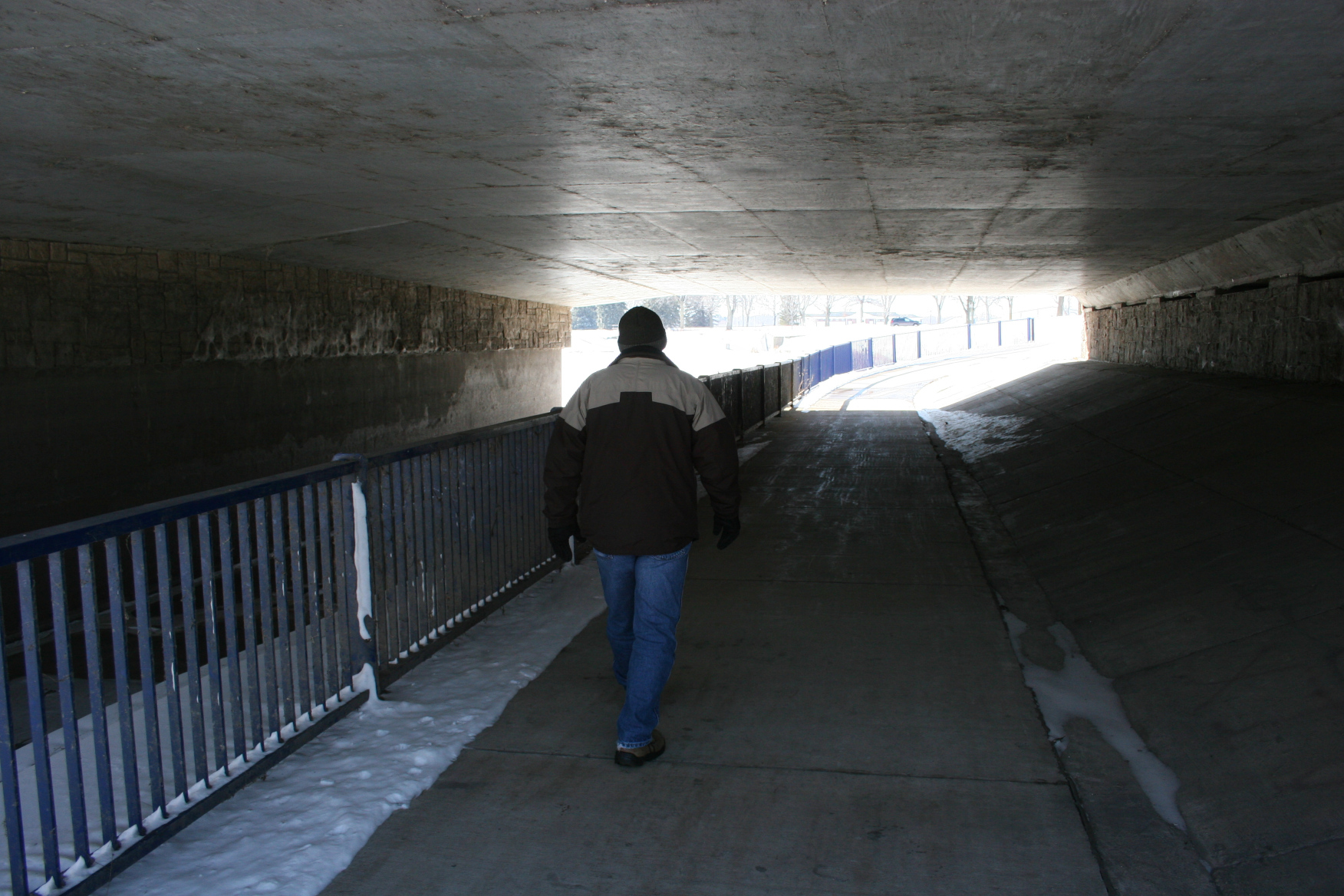
Randy follows the tunnel under Second Avenue toward North Alexander Park. (Minnesota Prairie Roots copyrighted photo March 2022)
Before heading home, we divert briefly toward North Alexander Park, taking the tunnel under the Second Avenue bridge where, on the other side, the scene opens wide to the frozen, snow-layered river. In warm weather, anglers fish here, below the dam in open water.
Picnic shelter at Father Slevin Park by the Cannon River. (Minnesota Prairie Roots copyrighted photo March 2022)
Now the place is mostly vacant, just like the riverside picnic shelter.
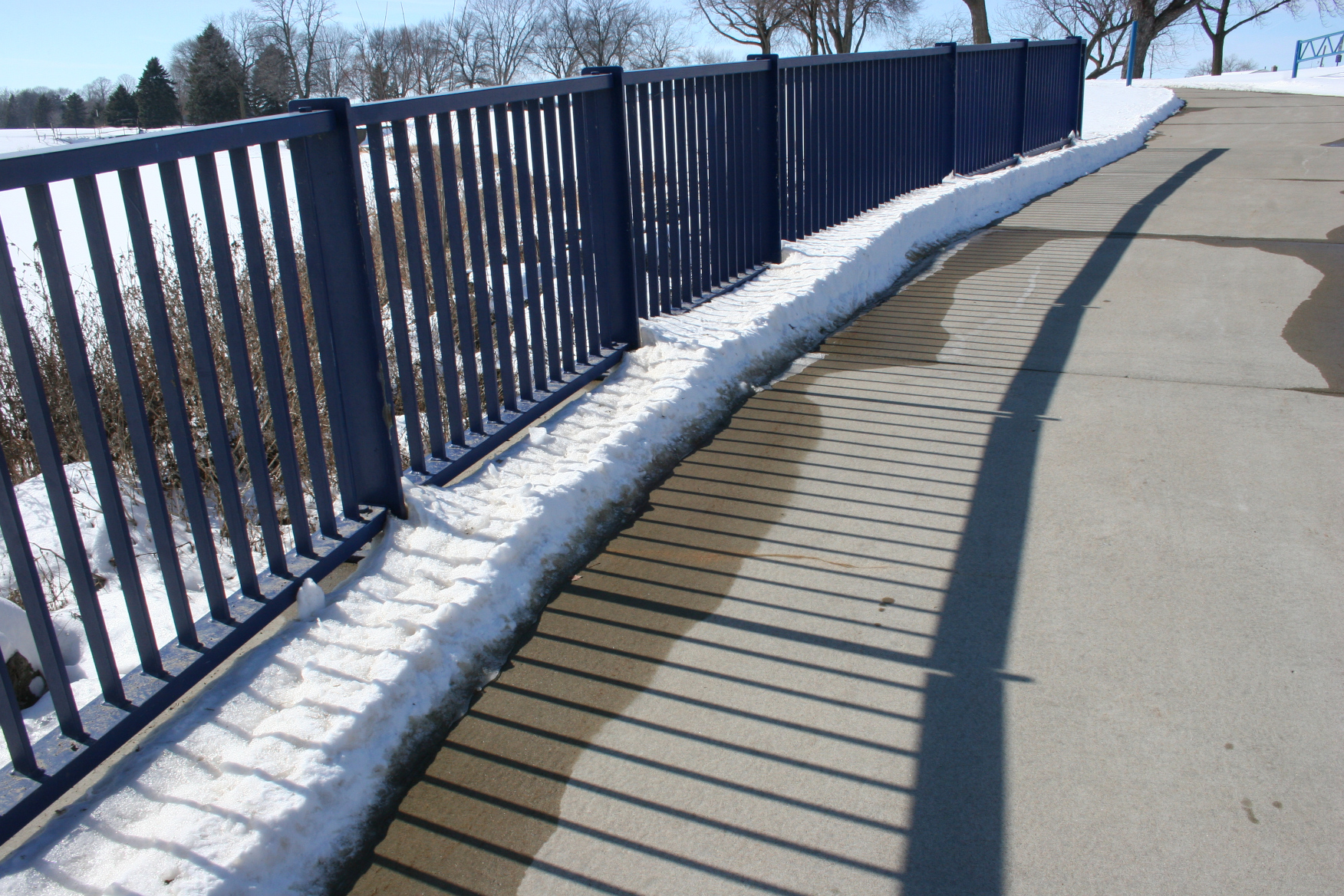
Shadowing of the trailside fence outside the tunnel. (Minnesota Prairie Roots copyrighted photo March 2022)
By now we are cold, ready to conclude our afternoon jaunt. As I stride downhill toward the tunnel, I notice shadows of fence slats spaced upon the concrete. Art to my eyes. I stop, photograph the fence and fence shadows as they arc. Even in this moment, I see signs of spring along the river, beneath the blue sky.
A view of frozen Rice Lake at Rice Lake State Park on February 19. (Minnesota Prairie Roots copyrighted photo February 2022)
IN THEORY, THE PLAN seemed a good one. Randy and I would hike in a nearby state park on February 19, the first of four “free entry” days to Minnesota’s 75 state parks and recreation areas.
Mid Saturday morning, we packed sandwiches, fruit, granola bars and almonds for a picnic lunch, although we would eat in the comfort and warmth of our van. Temps in the 20s do not allow for outdoor dining.
Wildflowers abound in the woods at Rice Lake State Park in this spring-time photo. (Minnesota Prairie Roots copyrighted file photo May 2022)
Originally we intended to drive to Carley State Park south of Plainview. It’s a park we have not visited. But part way there, I suggested we wait. A description of Carley’s Whitewater River-hugging Wildflower Trail and Virginia bluebells carpeting the forest floor in May prompted the change in plans.
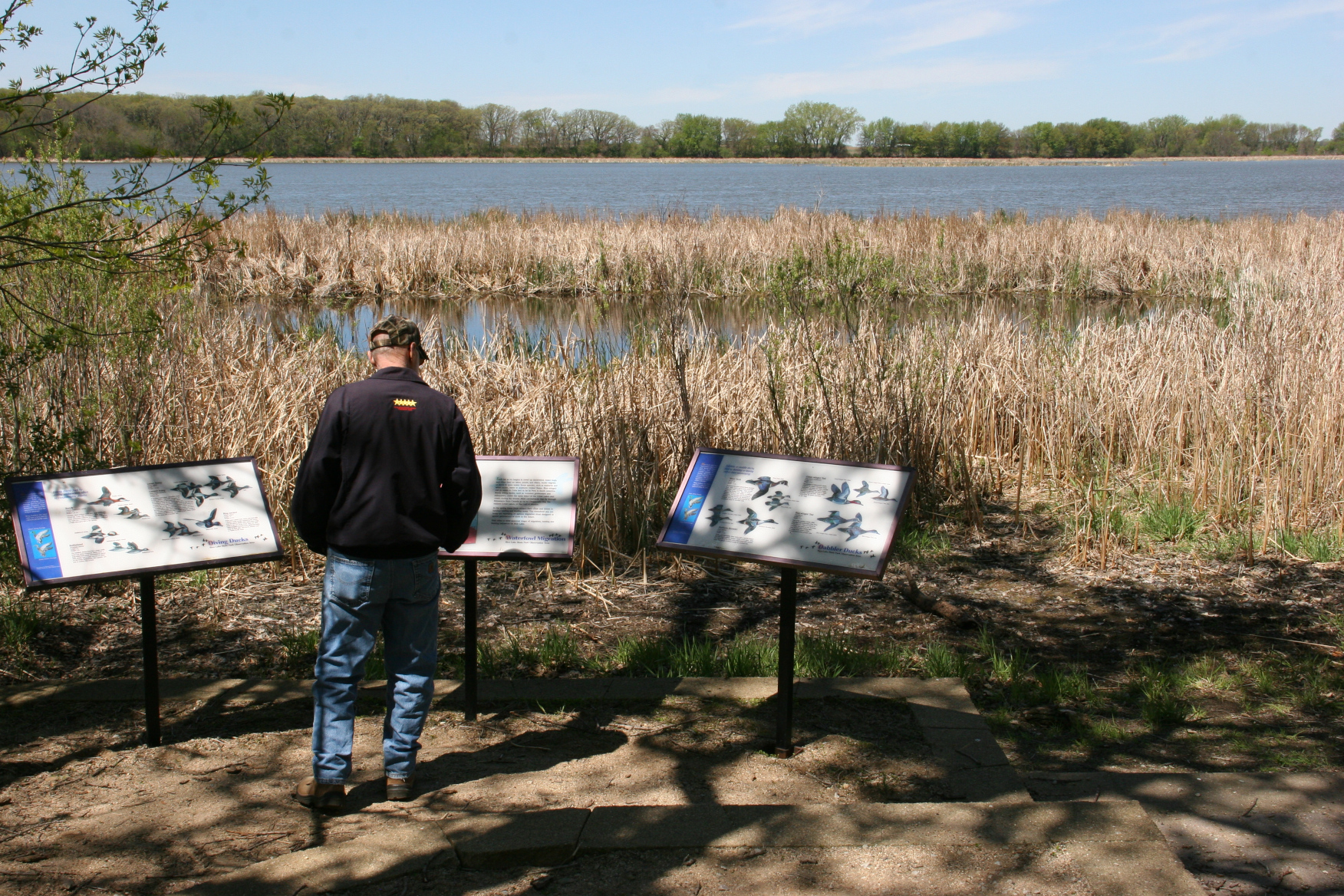
Randy reads signs about waterfowl posted by the lake during a May 2020 visit to Rice Lake State Park. (Minnesota Prairie Roots copyrighted file photo May 2020)
Instead, we aimed for Rice Lake State Park some eight miles east of Owatonna. We’ve previously been there, although not in winter. Following back paved county and gravel roads, I already envisioned hiking the park’s trails along frozen Rice Lake. I imagined the quiet of the woods, the beauty of the snow-covered landscape. Such were my expectations. I also felt excited to participate in the Rice Lake State Park Challenge, a special free entry day event that involved finding passwords to claim a possible prize.
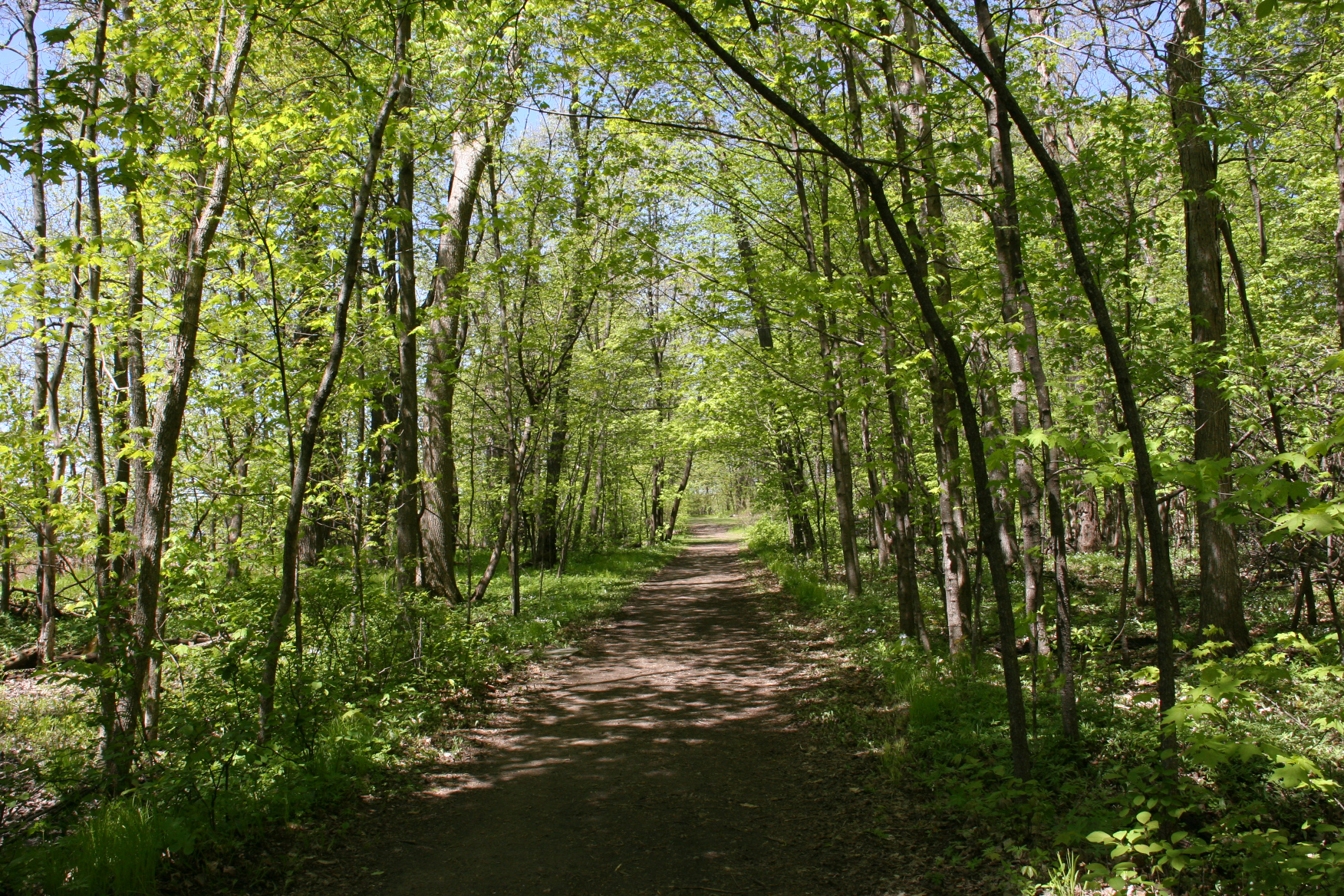
Walking into the woods at Rice Lake State Park in the spring. (Minnesota Prairie Roots copyrighted file photo May 2020)
When we pulled into the park, I checked in at the park office for a map and the challenge entry form. As I was about to leave, the park staffer warned, “Be careful, the trails are icy.” I would soon discover for myself just how right she was in that assessment.
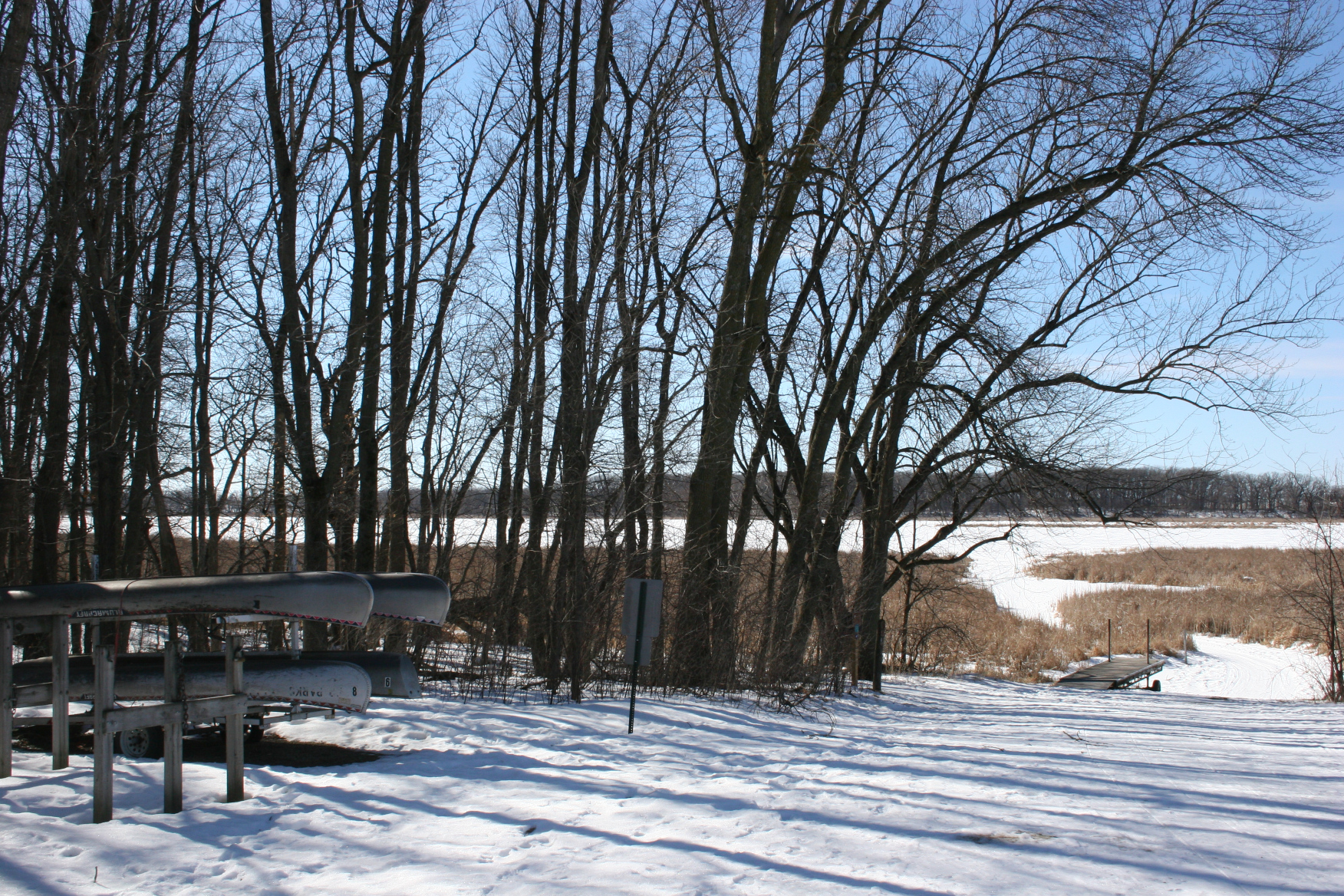
Rental canoes are stacked next to the parking lot and lake. The trail we took started at the edge of the woods near lake’s edge. (Minnesota Prairie Roots copyrighted photo February 2022)
The snow-packed, icy parking lot offered the first clue to conditions. I carefully stepped from the van, draped my camera strap around my neck and aimed toward the lakeside trail. Not even part way there, I was already grasping Randy’s arm. As someone who’s broken her right shoulder and left wrist in falls (the last requiring surgery), I have no desire to fall and break a third bone. Note that neither occurred in winter but rather in May and June and involved a missed step inside a hospital and a rain-slicked wooden step in a friend’s backyard.
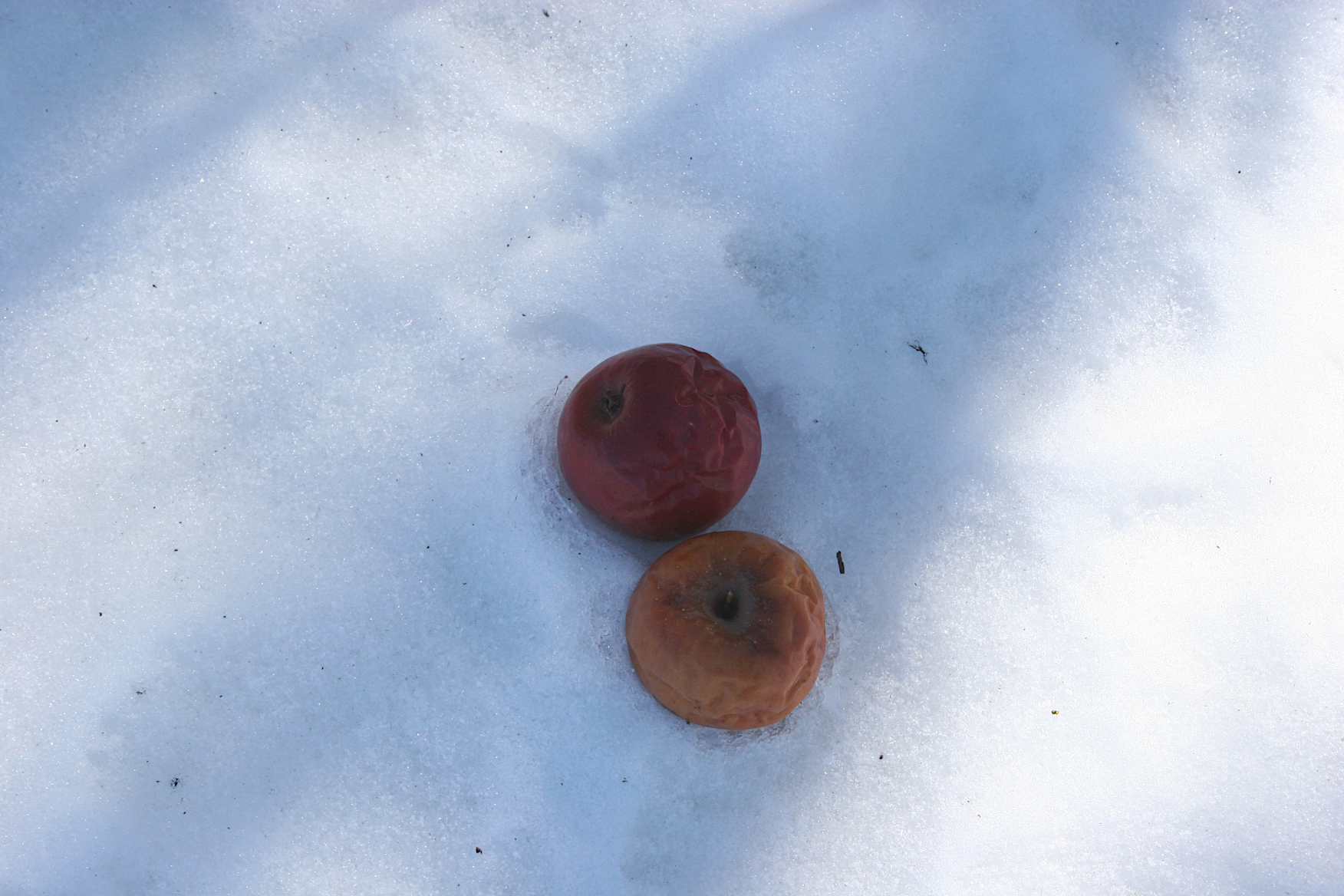
On the way back to the van, I spotted these apples in the snow. Deer food? (Minnesota Prairie Roots copyrighted photo February 2022)
At the beginning of the trail at Rice Lake State Park, I paused, observed and assessed that, yes, the trail was, indeed, icy. But I was willing to try, hoping conditions would improve. They didn’t. Soon Randy and I found ourselves crunching through the snow aside the trail rather than traversing the ice-packed path. Not even 20 feet in, Randy advised that perhaps we best turn around. I agreed.
Lake and sky meet at Rice Lake State Park during a spring visit. (Minnesota Prairie Roots copyrighted file photo May 2020)
Disappointment filled my thoughts. I didn’t realize how much I had anticipated this time in nature, in the woods, by the lake. And now…plans would pivot. We realized conditions would likely be the same at other state parks. So we headed west to Owatonna for that picnic lunch and more.
#
TELL ME: If you live in southern Minnesota, where can I find clear trails for winter hiking? If you live elsewhere, where do you like to hike this time of year?
#
FYI: Minnesota has three more upcoming “free entry” to state parks and recreation areas in 2022. Those dates are April 23, June 11 and November 25. I highly-recommend a warm weather hike in Rice Lake State Park. It’s especially peaceful.
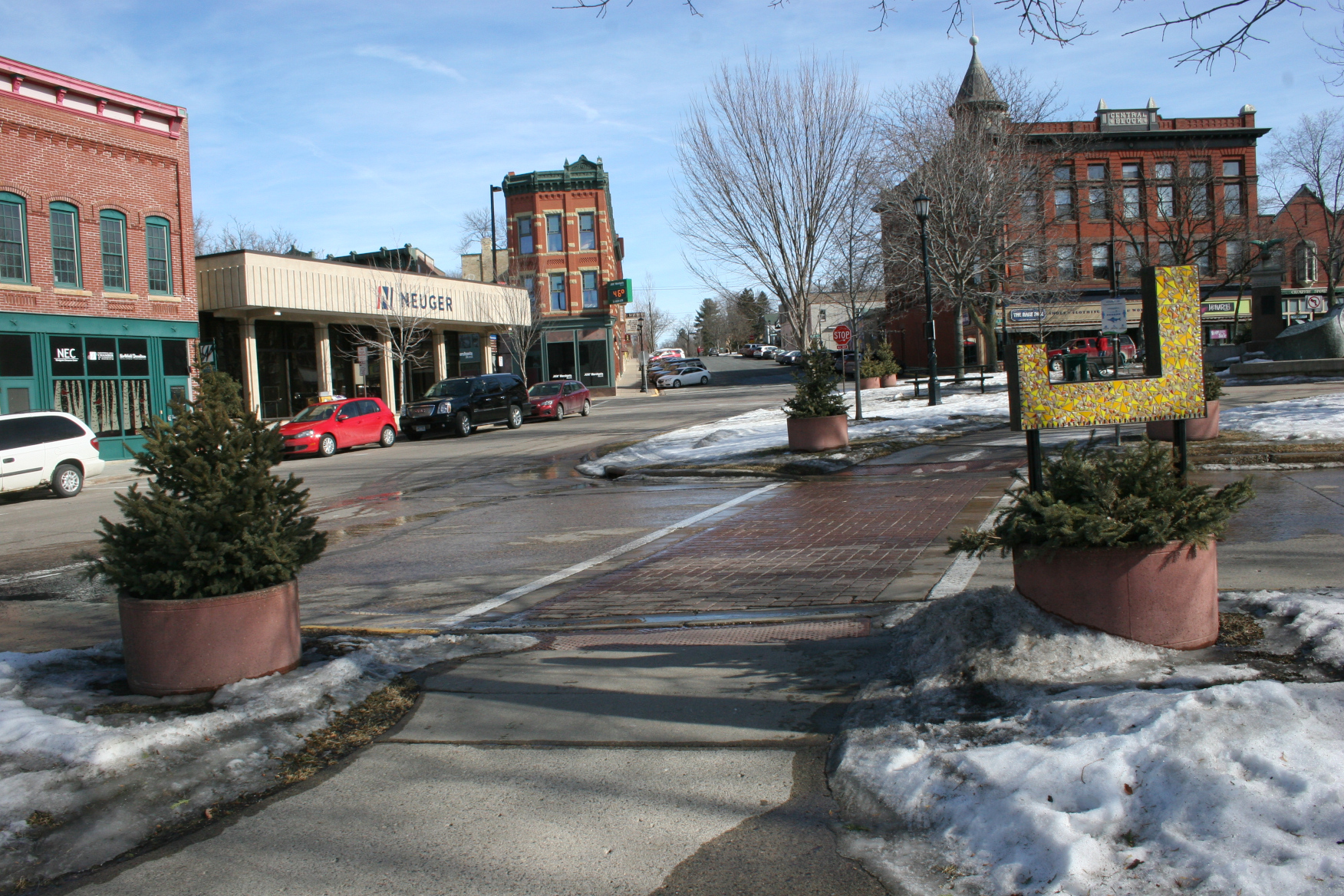
“Framing the Scene,” a relatively new art installation, right, in the heart of historic downtown Northfield.
AS A MEGA APPRECIATOR of outdoor public art, I delighted in the recent discovery of some new, at least new-to-me, art staged in historic downtown Northfield. This southern Minnesota river town boasts a thriving community of literary, visual and performing artists.
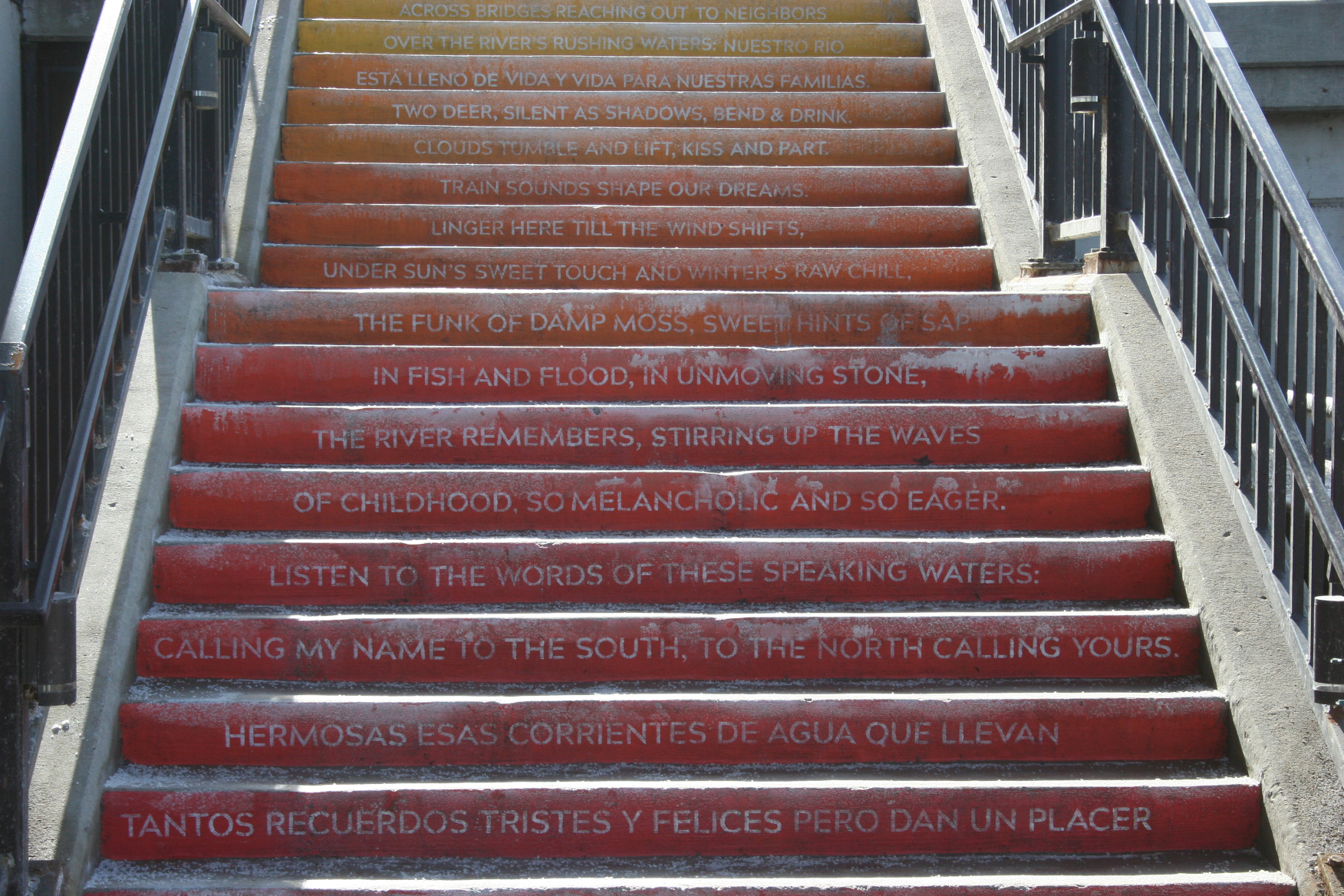
This shows a section of Northfield’s “Poem Steps,” a collaboration of 17 local poets. These poetry steps (covered here with salt residue) are along the Riverwalk. (Minnesota Prairie Roots copyrighted photo February 2022)
Here you’ll find poems imprinted in sidewalks, painted on steps and read at poetry readings in a city with a poet laureate. Here you’ll see outdoor sculptures scattered about town. Here you can listen to a concert at Bridge Square, a local church, St. Olaf or Carleton Colleges or elsewhere. Here you can enjoy live theater. Here you can appreciate the works of creatives at the Northfield Arts Guild and many other venues.
Northfield truly is synonymous with the arts.
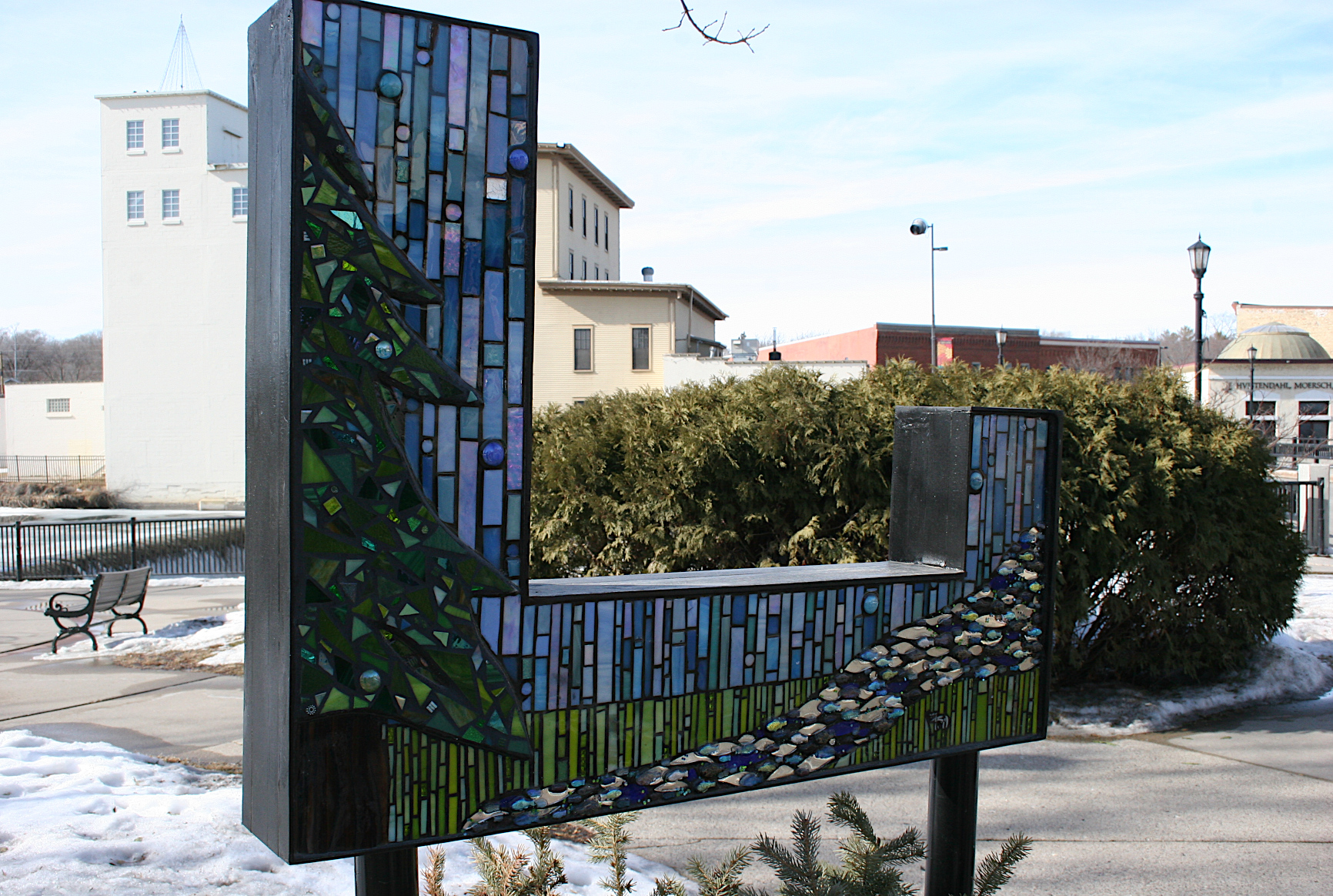
The riverside-themed side of Erin Ward’s “Framing the Scene.” In the background water rushes over the Ames Mill Dam next to the historic mill on the Cannon River. (Minnesota Prairie Roots copyrighted photo February 2022)
So when I spied a recently-installed sculpture, “Framing the Scene” by St. Paul glass artist Erin Ward, I felt a jolt of excitement. The free-standing, two-dimensional mosaic frames the nearby Cannon River and Riverwalk on one side and Bridge Square on the other. It’s meant to be an interactive sculpture for framing photos.
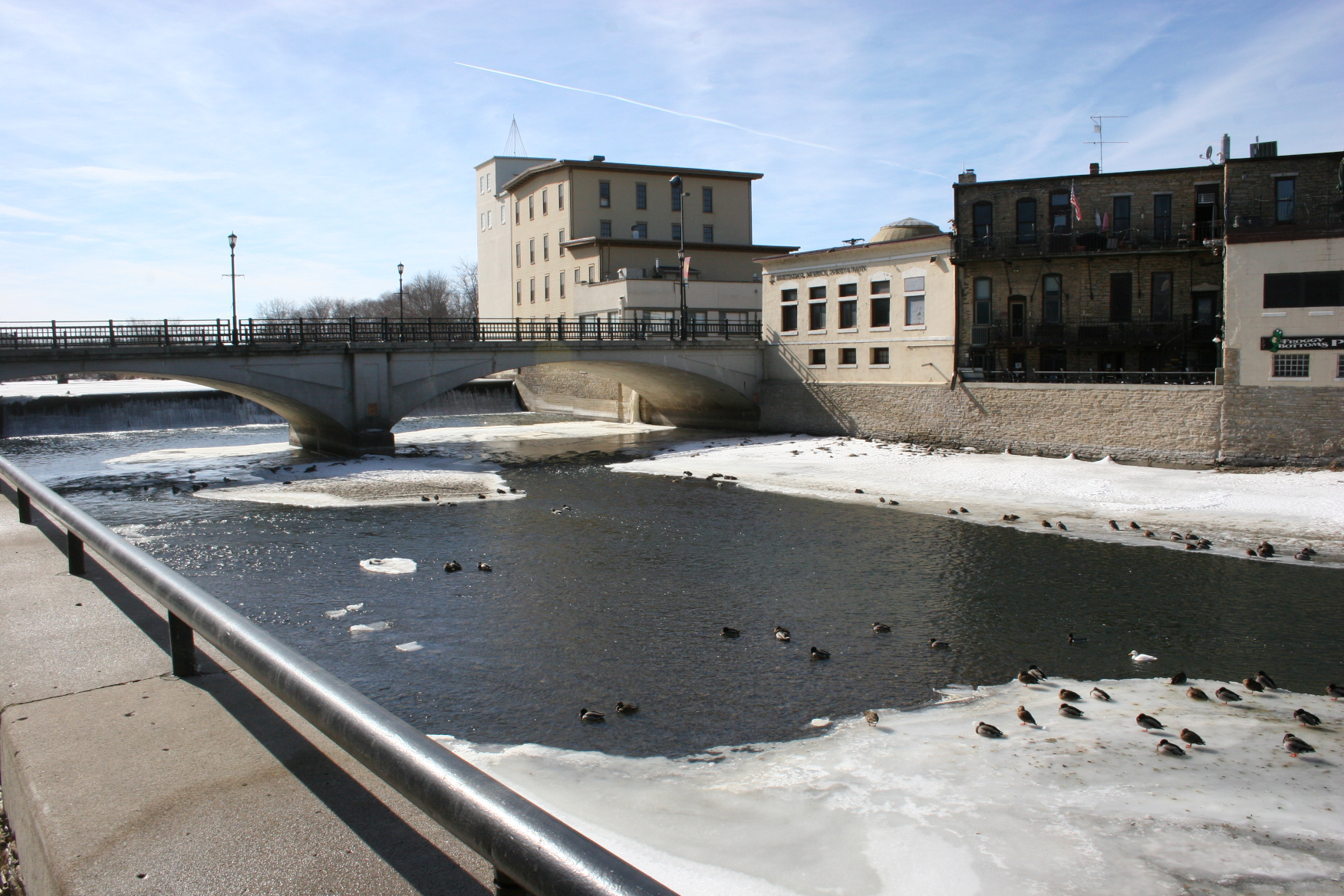
The Cannon River flows through downtown Northfield. (Minnesota Prairie Roots copyrighted file photo February 2022)
Ward was among five artists awarded $2,000 grants from the Minnesota Arts Board for the Northfield Downtown Development Corporation’s 2021 Artists on Main Street projects. That program aspires to get “creative placemaking” into the historic downtown. The intersection of arts and culture, downtown revitalization and historic preservation all factor into the artistic endeavors.
“Framing the Scene” meets all of those criteria, in my creative opinion. The artwork itself represents the vision and skills of a talented artist. The art adds to the downtown Northfield experience. That experience is one of dipping in and out of mostly home-grown local shops or of dining in an historic setting. The cliques “quaint and charming” fit Northfield. This is a community rich in history, rich in historic architecture, rich in natural beauty and rich in art.
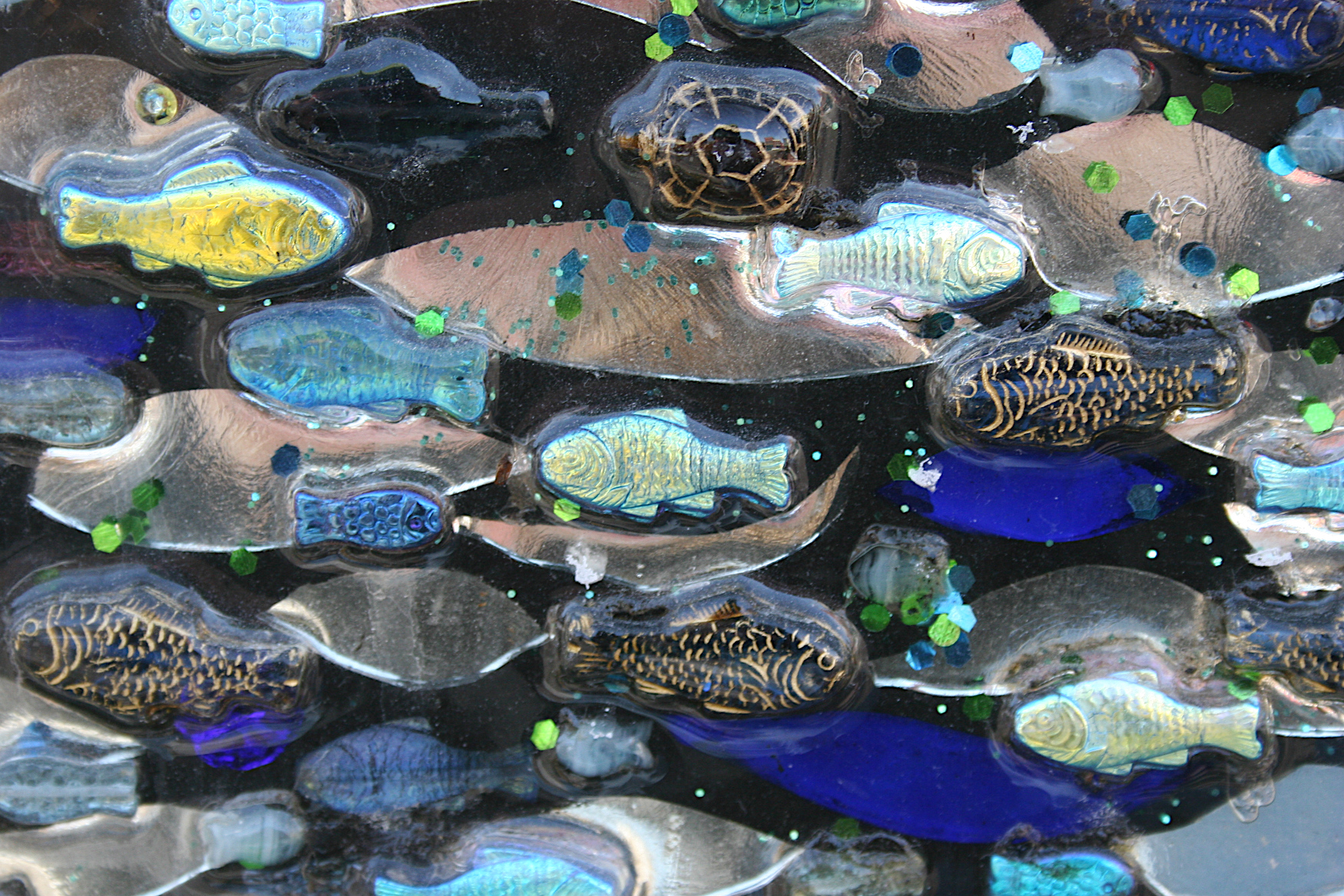
So much detail in the mosaic… (Minnesota Prairie Roots copyrighted photo February 2022)
I appreciate how Ward melded art and nature in creating a mosaic which honors both. As I studied her interpretation of the Cannon River, I recognized the thought she invested in this detailed art of many many pieces. Her river evokes movement in waters teeming with fish and the occasional turtle. Assorted greens and blues evoke a sense of calm and peacefulness. Ward’s art honors this river which runs through. This river of life, now a backdrop to a community which still appreciates her beauty, her recreational qualities, her history, her aesthetic value.
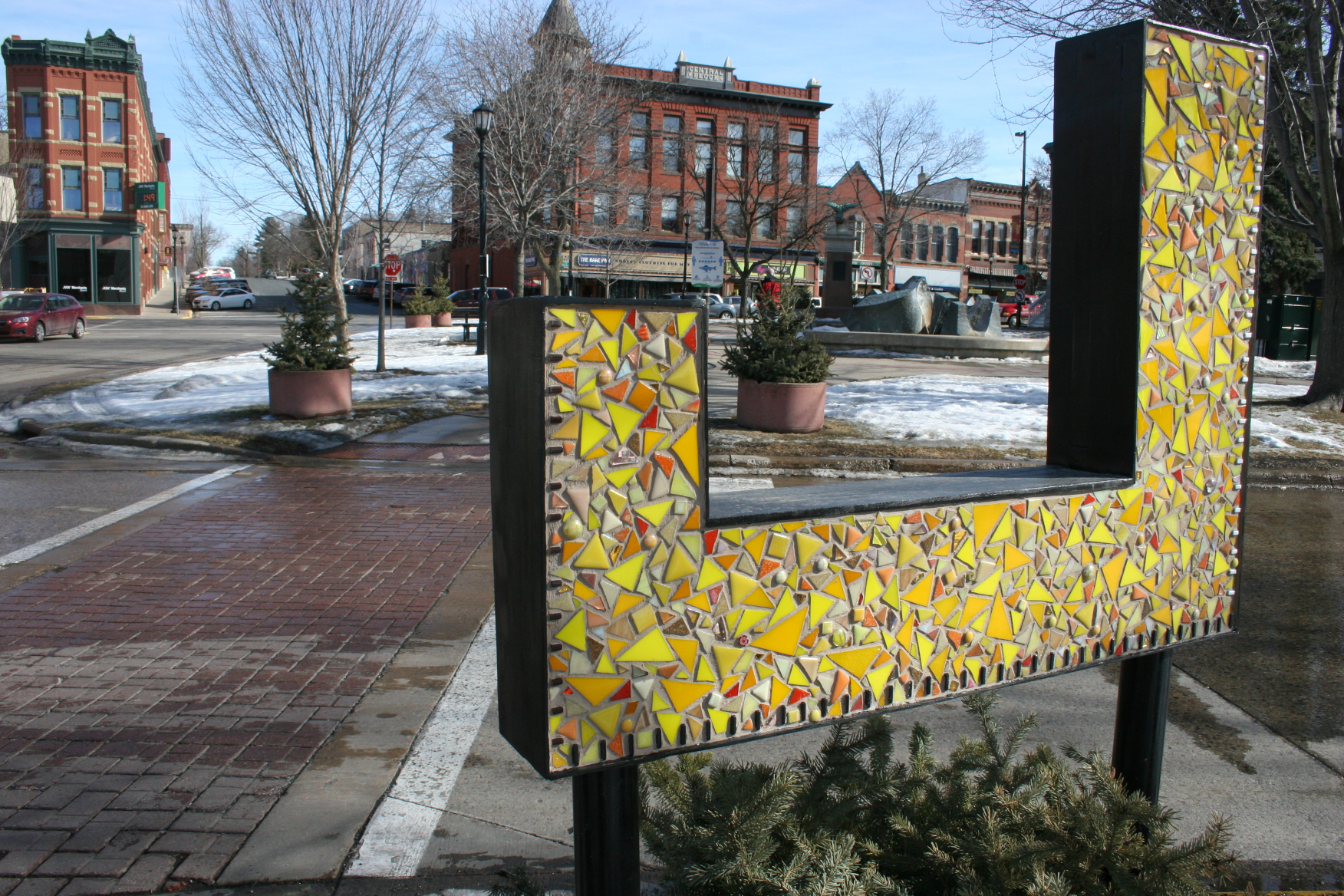
This side of Ward’s mosaic focuses attention toward Bridge Square and buildings downtown. (Minnesota Prairie Roots copyrighted file photo February 2022)
And then, on the flip side of “Framing the Scene,” bold pieces of mostly yellow, orange and red triangles create a completely different feeling. It’s as if sunbeams fell from the sun in a chaotic, jumbled mix of happiness. That’s my interpretation.
This side of the art looks toward Bridge Square, community gathering spot in downtown Northfield. Place of concerts and popcorn wagon, Santa house and quiet bench-sitting. Place of artistic activism. And beyond that, to the back of the frame, historic buildings rise.
One final look at Ward’s interpretation of the Cannon River in historic Northfield. (Minnesota Prairie Roots copyrighted photo February 2022)
Art rises in Northfield, enriching the lives of locals and the lives of visitors like me, come to town to follow the Riverwalk, to walk along Division Street and, then, to pause near Bridge Square and frame the scene.
Please check back for more posts about art in historic downtown Northfield, Minnesota.










Recent Comments