A protester at the NO KINGS day rally in Northfield. (Minnesota Prairie Roots copyrighted file photo June 2025)
MONDAY EVENING I GATHERED in rural Rice County with a crowd concerned about issues ranging from healthcare to immigration, agriculture, education, the environment, diversity, gun violence, the SNAP program, tariffs, voting rights, veterans’ benefits, the economy and much more. All current-day topics worrying many of us, including me.
I’ve never been politically active. Until this year. To stay silent now feels complicit. I care enough about this country, about freedom, about democracy, to let my voice be heard. I’ve participated in three pro-democracy rallies, including the NO KINGS Day Rally in Northfield and two on Labor Day in Owatonna. I’ve volunteered at a DFL Sweetcorn Feed in Faribault. I’ve donated to the DFL, called and emailed my legislators in Washington, DC. And Monday evening I attended a potluck, billed as a DFL Working Families Garden Party. This all from someone who previously voted primarily Republican. But no more, not in the past four Presidential elections or in some other past elections. I’ve always looked at candidates, their character and their stances on issues before voting. I still do, but party affiliation now matters to me, too.
Minnesota potlucks always include bars, like these at a previous event I attended. (Minnesota Prairie Roots copyrighted file photo)
DEEP CONCERN
At all of these recent events, I’ve heard—whether from politicians, candidates for office or ordinary people like me—a deep concern for our country under the current administration and those who go along with whatever our President says and does. This concern comes from good, decent people. Farmers, teachers, business owners, lawyers, blue collar workers, college students. People who carry crockpots of pulled pork and baked beans, bowls of creamy garden-fresh cucumber salad, peach pie and bars to a political party on a rural acreage.
As I sat in this bucolic setting Monday evening listening to short speeches from candidates like Martha Brown of Faribault, running for Minnesota House District 19A on the slogan of “Common-Sense Leadership for Working People,” or fiery Matt Little from Elko New Market who embraces the label of “radical” and who is running for Congress in the Second Congressional District or Ben Schierer of Fergus Falls, campaigning for state auditor and vowing to represent both urban and rural communities, I felt hope.
Minnesota Secretary of State Steve Simon speaks at the DFL Garden Party hosted by Ted Suss, right, near Nerstrand. (Minnesota Prairie Roots copyrighted photo September 2025)
COMPASSION & HOPE
I felt hope, too, when I heard Minnesota Secretary of State Steve Simon talk about protecting voter information, voting rights and more. I felt hope when I heard Minnesota Senate Majority Leader Erin Murphy speak. As a nurse, her care and compassion for others threads through her speeches, shines in her political life.
Murphy spoke on Monday evening against a backdrop of American and Minnesota state flags and a banner of the Hortmans and their dog with this message: STAND UP FOR JUSTICE AND PEACE. She talked, too, about attending the funeral on Sunday of Fletcher Merkel, 8, among two students killed in a mass shooting that injured 21 others at Annunciation Catholic Church in south Minneapolis on August 27. Justice. Peace. No more gun violence.
This sign from the NO KINGS rally in Northfield really resonated with me. (Minnesota Prairie Roots copyrighted file photo June 2025)
UNPRECEDENTED
I’ve lived enough years to observe that what’s happening in this country right now is unprecedented. I’ve never felt more fearful of losing our freedoms under authoritarian rule. It’s happening already with snatching people off the streets, imprisonment and deportations without due process. It’s happening in intimidation and retribution; mass firings; suppression of free speech; funding cuts that are undermining research, healthcare, education and more; gathering of private information by the government; sending armed military into cities; and in countless other ways that affect all of us no matter our political affiliations.
This isn’t about rural vs urban. This isn’t about us vs them. This is, rather, about preserving and protecting our very freedoms as Americans. This is about caring and feeling hopeful. This is about speaking up. About doing something. And sometimes this is also about eating pulled pork, baked beans, cucumber salad and homemade peach pie at a potluck on a beautiful September evening in southern Minnesota.
#
NOTE: I moderate all comments on this, my personal blog, reserving the right to publish or not publish comments. Please be respectfulwhether you agree or disagree with me.
I photographed this creative back-to-school front window display at Owatonna Shoes Monday afternoon. (Minnesota Prairie Roots copyrighted photo September 2025)
HOW WELL I REMEMBER the first day of classes at the start of a new school year. Decades ago as a student. Then as a parent of three. And now as a grandparent.
As a student, I felt excited. Nervous. Happy. I remember the sharp tips of new Crayola crayons. The discomfort of new shoes. Piles of multi-colored notebooks awaiting words.
As a mom, I remember worrying if my kids would catch the right bus, make friends, like their teachers.
But none of that matches the concerns I feel today as the grandmother of a first grader and a fourth grader who begin classes Tuesday morning in a community in the south metro. The deadly shooting of two students and injury of 21 others (including three octogenarian worshipers) during a morning back-to-school Mass last week at Annunciation Catholic Church in south Minneapolis weighs heavy on all of us.
(Minnesota Prairie Roots copyrighted photo September 2025)
Children, teachers and staff should feel and be safe in school. Parents should never have to wonder if their children will come home. Grandparents shouldn’t have to worry how their children, their grandchildren, are going to navigate all of this.
But school violence is all too real. And it shouldn’t be. I invite you to read a blog post by Kathleen Cassen Mickelson (click here), a mother, grandmother, writer, photographer, poet and activist. She writes with passion and clarity about the Annunciation shooting and gun violence, including steps we can take to change things. Kathleen’s words are powerful and move us to a place of action with the strong word, “Demand.”
As someone who grew up in Minneapolis, Kathleen writes from the heart. She is grieving. Angry. Frustrated. Just like me. Just like so many of us in Minnesota and beyond.
(Minnesota Prairie Roots copyrighted photo September 2025)
To the politicians out there who put guns before kids and who vote against funding for mental health programs, pause for a moment and assess your priorities. Walk in the shoes of kids, parents, grandparents, teachers. And then think of Fletcher Merkel, 8, and Harper Moyski, 10, shot to death in a Minneapolis church during the first week of classes at Annunciation Catholic School.
Minnesota Prairie Roots copyrighted file photo used for illustration only)
I HAVE SEVERAL THINGS on my mind today which are roiling my emotions. Not on a personal level. But on a broader, national scale.
First, I feel heartbroken over the loss of lives in Texas following flash flooding. The latest death count I’ve read is eighty-five, 27 of those children. Dozens remain missing. Most heart-rending are the deaths of the young campers at a summer camp. I think many parents, myself included, can relate to dropping a child off at camp with the full expectation that they will be there when we come to pick them up at camp’s end. For too many, a parent’s absolute worst nightmare—that of losing a child—is now reality. I feel for anyone who has lost a loved one in these floods, no matter their age. I am thankful for the 850 rescued thus far.
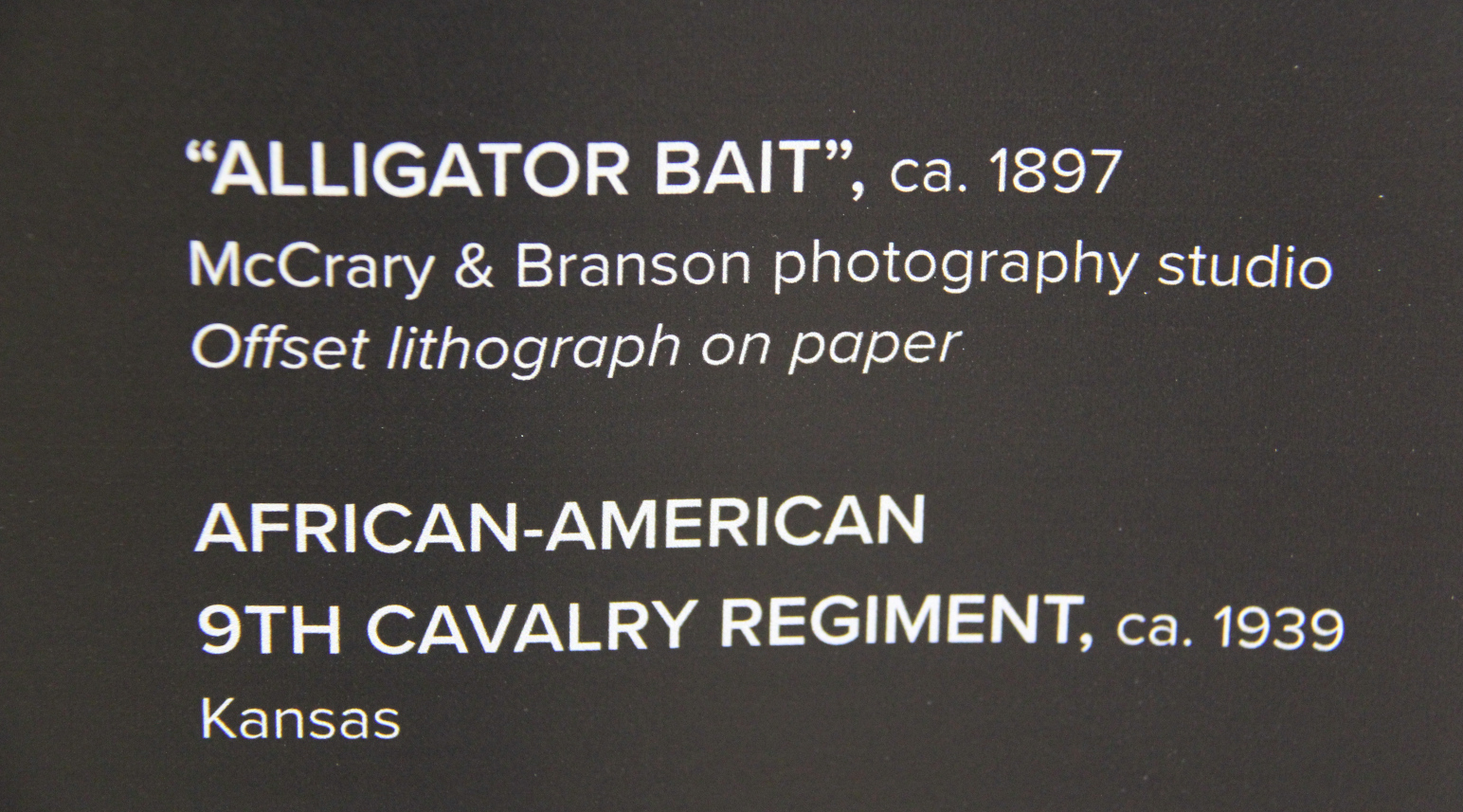
Titles of two photos in the “Testify” exhibit I saw. (Minnesota Prairie Roots copyrighted file photo April 2025)
ALLIGATORS
Secondly, I’m deeply-troubled by the gloating and hype about “Alligator Alcatraz,” a deportation detention facility in Florida. Those in power have been flaunting the name, stating quite clearly what will happen to anyone who tries to escape. There’s nothing remotely “funny” about alligators attacking and devouring human beings. There’s nothing “funny” either about placing people in cages. But neither seems to bother those who are vocally promoting this facility in such a vile way.
As soon as I heard the words “Alligator Alcatraz,” I was reminded of a traveling exhibit, “Testify—Americana Slavery to Today,” that I saw at my local library in April. Within that exhibit was a studio portrait of nine unclothed Black babies and toddlers sitting or standing in one long line. The circa 1897 image by a photography studio was simply titled “ALLIGATOR BAIT.” I remember standing there, my jaw dropping in disbelief. The photo was right above another image, that one of the African-American 9th Calvary Regiment, ca. 1939.
Then I read the text below the two photos: The juxtaposition of photos heightens the irony of being hawked as unwanted, or “alligator bait,” while at the same time being drafted into a calvary regiment to serve in the name of the United States’ highest ideals. Historians have actually investigated to determine if African-American children were indeed used by hunters to lure alligators. The results were somewhat inconclusive, but the fact that research was needed is telling.
I wondered when I saw the “ALLIGATOR BAIT” photo how humans can be so cruel? I wonder the same today.
Hands of an octogenarian used for illustration only. (Minnesota Prairie Roots copyrighted file photo)
A TROUBLING EMAIL
Lastly, a few days ago I received an email from the Social Security Administration, which I initially thought to be phishing given the title, “Social Security Applauds Passage of Legislation Providing Historic Tax Relief for Seniors.” Turns out this was legit. I’m sure many of you got the same email.
As I read on, I couldn’t quite believe what I was reading—a clearly partisan piece of propaganda from an agency I thought was non-partisan. Not only that, the content was not complete or accurate.
Whoever crafted this email and thought it was OK to mass-send, it is not OK.
LET’S DO BETTER
There you go. This is what’s on my mind today, just days after celebrating the Fourth of July in a country I love, even with all its faults, atrocities, injustices and troubles. But we can, and must, do better. I believe we can.
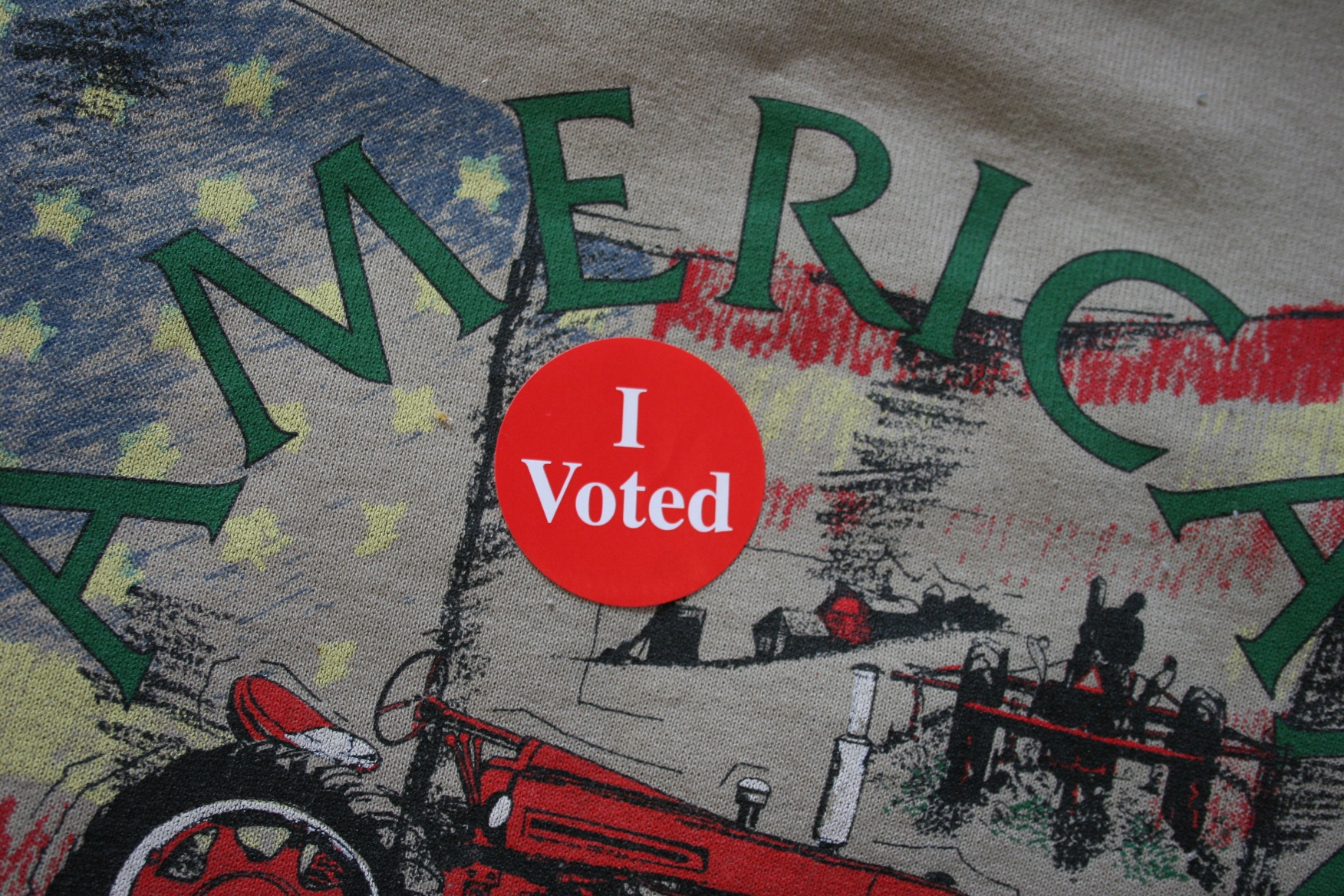
So you voted, then what? (Minnesota Prairie Roots copyrighted file photo)
TWICE I’VE ATTENDEDCity Council Chats in Faribault, a recently-implemented way of connecting local residents with the people they’ve elected and with city employees. And I’ve gotta say, I’m impressed.
All too often, there’s a disconnect, a feeling that elected officials aren’t listening and don’t care what constituents think. But I’ve found, at these informal sessions, that I am heard. I have a voice. Council members and staff members are, indeed, willing to listen. They care, because Faribault is their home, too, and they want this to be the best place it can be.
So how exactly do these Council Chats work? Once a month, the council sets a time and place to address a specific topic. Locations and times vary. You just show up. There may be a brief presentation. Or not. But there’s always time to mingle and ask questions of council members, city staff and others.
A rock arch rapids like this one in Pine River is being considered for Faribault. (Minnesota Prairie Roots copyrighted file photo July 2024)
FOCUS ON TWO FARIBAULT DAMS
Wednesday evening, for example, the Chat had an open house format to gather public feedback on options for improving the Woolen Mill Dam and the adjacent north dam on the Cannon River. A 2024 flood damaged the northern wall of the Mill Dam so repairs or improvements are needed. And now, the city decided, is an ideal time to consider alternatives beyond repairs.
You may wonder why I care about these two dams. Well, last summer I saw a rock arch rapids replacement of a traditional dam in Pine River in north central Minnesota. I loved what I saw. Smaller rip-rap rocks, larger rocks and boulders were placed in sloping rows across the Pine River, replacing the 200-foot long by 13-foot high 1910 concrete dam. Water spills over the rocks in a visually-pleasing way that looks almost natural. This area along the Pine River draws outdoor enthusiasts to fish, swim and more. That got me thinking about the dams in Faribault. Could we have the same thing—rock arch rapids that improve water quality, fishing and recreation while also functioning as a dam?
When I learned about the Council Chat addressing the two dams, I wanted to see if rock arch rapids were being considered. They are. An engineering firm presented multiple options, all laid out in architectural drawings spread across several tables. I could actually see choices. I had plenty of opportunity to study the designs, ask questions, get answers and offer my input. Attendees could even vote on project priorities, like fishing, canoeing, cost, funding and more. Just place a colored dot sticker next to your top three priorities.
I’ve never forgotten the message on this photo I photographed at a Civil Rights March exhibit at St. Olaf College in Northfield. It’s powerful. (Minnesota Prairie Roots copyrighted file photo)
LET YOUR VOICE BE HEARD
Like the previous Council Chat I attended, questions and conversations were encouraged in this informal, relaxed setting. I felt a comfortable level of accessibility, something not found at a regular city council meeting with an agenda and limited time for the public to speak. Certainly, those formal meetings are necessary to discuss, debate and make official decisions. But these Council Chats add a new, approachable dimension to city government that I appreciate. They directly involve the public.
Elected officials at all levels should embrace this way of listening to voters rather than keeping their distance. And, yes, I’m referencing the town halls many federal politicians are currently avoiding. Our government representatives need to hear our thoughts, our ideas, our concerns. And we, as voters, as Americans, need to continue expressing ourselves, educating ourselves, letting our voices be heard.
TELL ME: What, if anything, do your elected officials do to encourage constituent engagement so your voice is heard?
FYI: The next City Council Chat will give an airport overview and will be held at 5 p.m. Wednesday, July 9, at the Faribault Municipal Airport.Past Chats have covered the budget, construction projects, nuisance/blighted properties, tree removal and affordable housing.
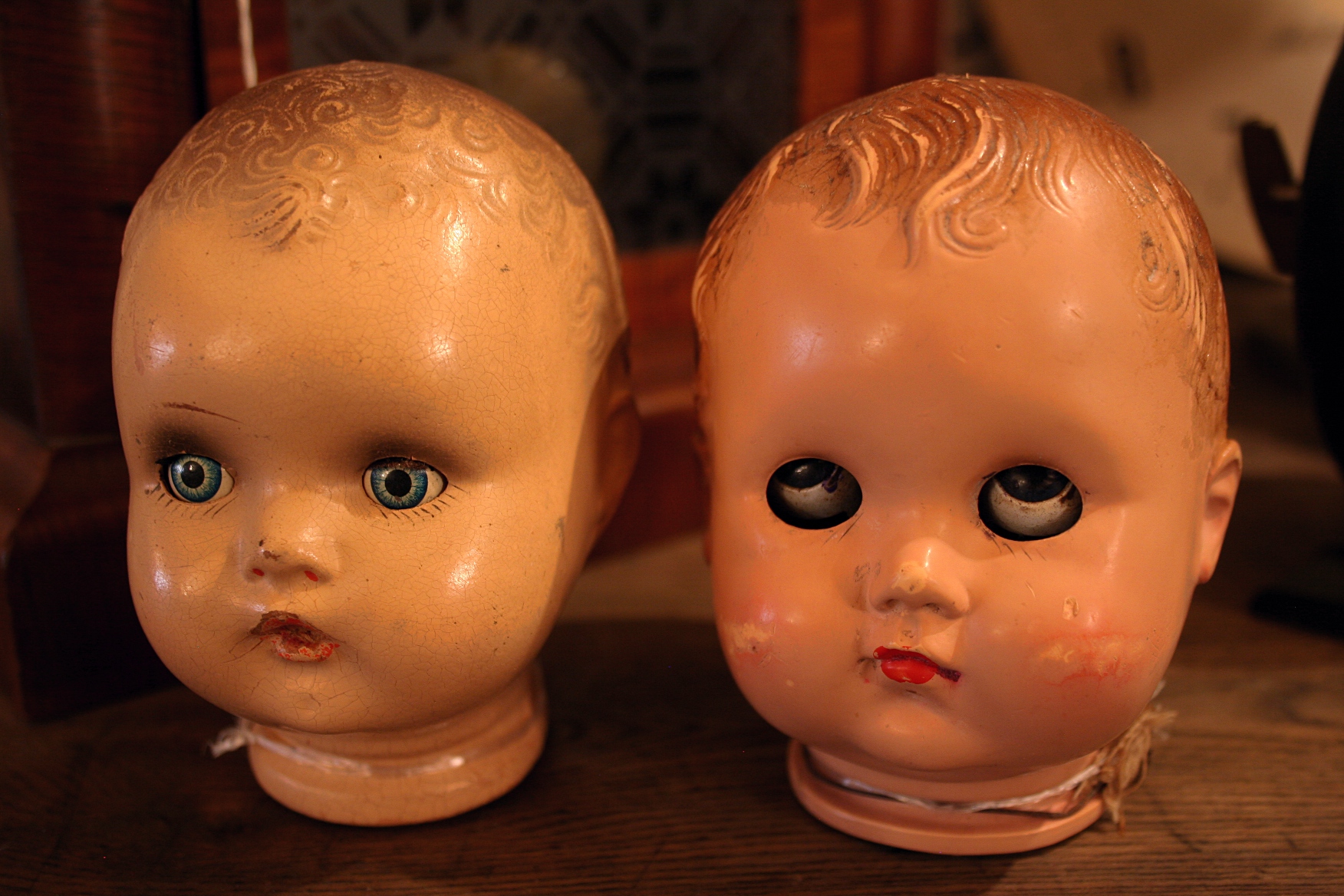
Dolls with appropriate eye-rolling and blank staring. (Minnesota Prairie Roots copyrighted file photo)
ONCE UPON A TIME in The Land of Plenty there lived a ruler who, once he took office, commenced to ruthlessly flaunt his authority (which fits, given his self-proclaimed ruler status). He really didn’t care what he said or did as long as it fit his agenda to make his kingdom—more precisely himself—great. The forceful leader promised that the “golden age” of Acirema would start on the day he assumed power. Perhaps he was referencing the opulent gold décor in his redecorated palace office.
The ruler gathered his team of loyalists and followers, assuring them that as long as they followed his plans, his instructions, his actions, his orders, he would reward them, or at least keep them out of the dungeon. Threats and intimidation have a way of instilling self-preservation and obedience.
But not everyone much cared for the self-centered leader or his policies. They never fell under his spell, his control. They were willing to stand up to him, question him, even at the risk of raising his ire. Or worse. They began to rise up and challenge him and his underlings. That didn’t sit well with the ruler. I mean, how would you like the courts calling you out, gray-haired ladies protesting, students criticizing you in schoolyards? Nope, can’t have that happening in Acirema. Never mind that The Land of Plenty was a land of freedom, of laws, of due process, of balanced powers. Or at least it was before the authoritarian ruler took over.
And so, 100 days into his reign, the ruler underwent a job review of sorts. Job reviews held no sway with him, although he should have understood their importance based on his previous experiences as a land baron who banished many a worker. Whatever. He was above everyone. All of them. He didn’t believe multiple reports of his declining popularity. He was doing a great job, he proclaimed. Great! And that was that. Don’t tell him otherwise for fear of being branded a liar. Or worse, banished from the kingdom. Just nod and agree that everything is going great and the ruler would call you a friend rather than a foe.
But you can only push people so far before they break and stop believing you, if they ever did in the first place. And many in the kingdom never did take this man at his word. He had a habit of distorting the truth, in other words lying. Now name-calling is not nice. But truth is truth.
One windfall apple, that will eventually rot. (Minnesota Prairie Roots copyrighted file photo)
BULLYING AND BLAMING
Many in the kingdom were weary of the bullying coming from the palace. No one likes a bully. No one likes decrees that harm, rather than help, the kingdom. When the ruler levied new taxes on goods, promising to enrich his subjects, many did not believe him. (It should be noted that some—too many—still believed him.) He urged patience and calm as anger rose both inside and outside the kingdom. The ruler had upset the marketplace apple cart. Yet, he would hear none of the verbal resistance. As was his usual reaction, he blamed the previous overseer of The Land of Plenty for the rising costs of food and for marketplace shortages. “It was him, not me!” the ruler shouted. He used that blame tactic often.
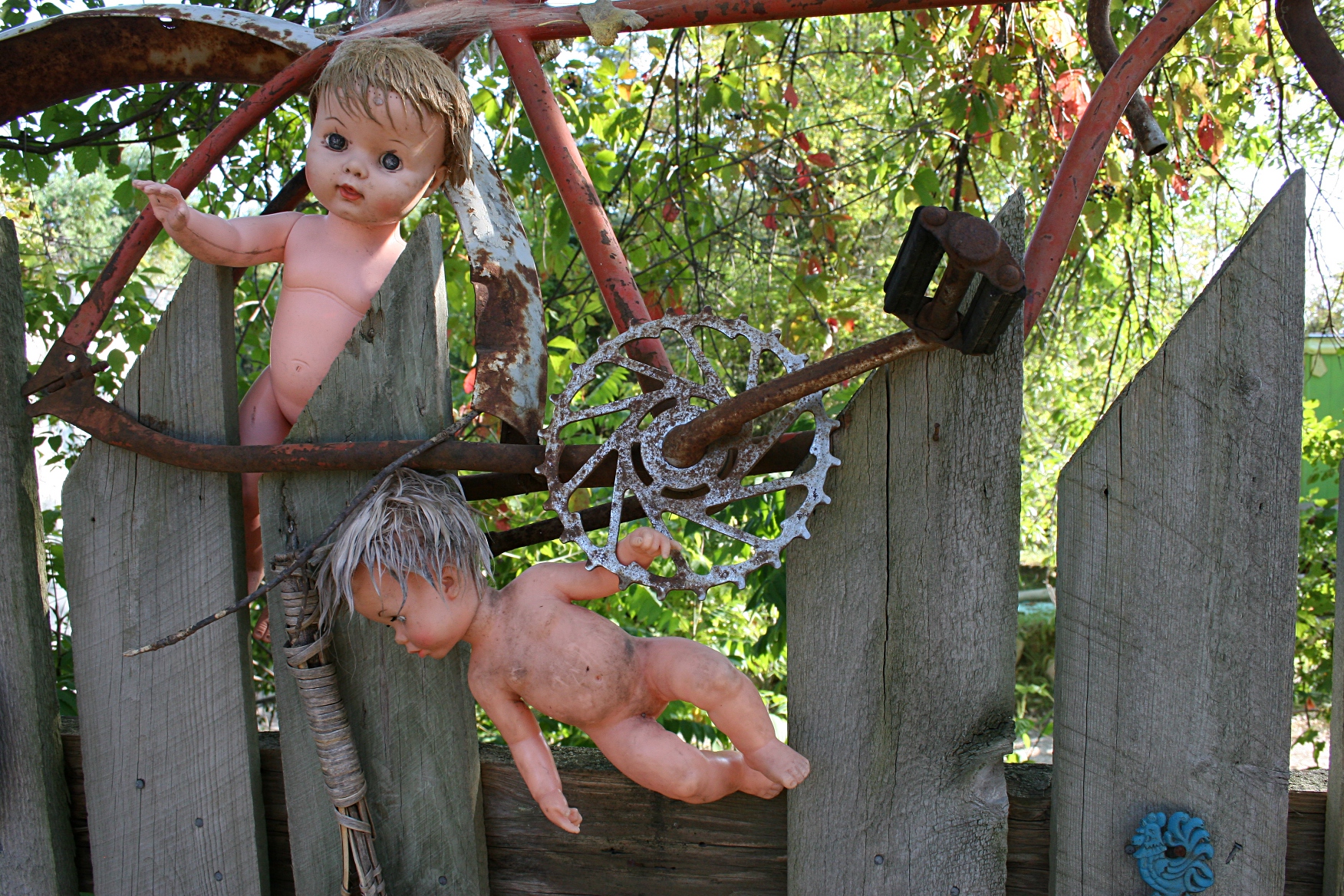
Dolls, dolls and more dolls.(Minnesota Prairie Roots copyrighted file photo)
2 DOLLS, 30 DOLLS, 900 DOLLS
But then he said something that deeply upset his subjects. “Well, maybe the children will have two dolls instead of 30 dolls,” the ruler responded when asked about rising prices and marketplace shortages. Outrage ensued. Thirty dolls? It was then that the people of the kingdom realized how disconnected the leader was from reality. Many of them now lived in poverty due to his policies. Their children had no dolls, unless you counted those crafted from corn cobs. The ruler’s grandchildren, however, had an entire playroom filled with imported dolls. Lovely dolls. Thirty times thirty. That’s 900 if you’re counting.
By this time the citizens of The Land of Plenty were counting only one thing—the number of days until they could vote in a new leader of Acirema. If that would even be an option. If they weren’t all banished. If they still had a country.
#
NOTE: While this is a fictional story, it is rooted in truth. Feel free to leave a comment, understanding that I moderate all comments on this, my personal blog.
One of the clocks in my small collection of vintage alarm clocks. (Minnesota Prairie Roots copyrighted file photo)
TIME TICKS. Things to do. Places to go. Appointments to keep. People to see. Conversations to have. Books to read. And for me, also, stories to write, deadlines to meet. Tick. Tick. Tick.
As I age, I feel more cognizant of time and the need to use it in the best possible way. The need to balance work and leisure. The need to spend more time with my core family. The need to use my talents in a positive way, in a way that makes a difference. The need to be there for, and serve, others. Tick. Tick. Tick.
We can’t stop time and aging. But we can manage how we use our time. I’m of the age where there’s significantly less time ahead of me than behind, although none of us knows the number of our days on this earth. Tick. Tick. Tick.
An important message displayed on a Scrabble board at LARK Toys, Kellogg, MN. (Minnesota Prairie Roots copyrighted file photo)
I hope we can all use our time to show compassion and empathy for others. Be kind. Be that person who listens rather than talks. Be that person who smiles, who hugs, who holds a door open. Be that person who sends an encouraging text or note. Be that person who reaches out to someone who is hurting, grieving, in need and do whatever you can to uplift and help. Tick. Tick. Tick.
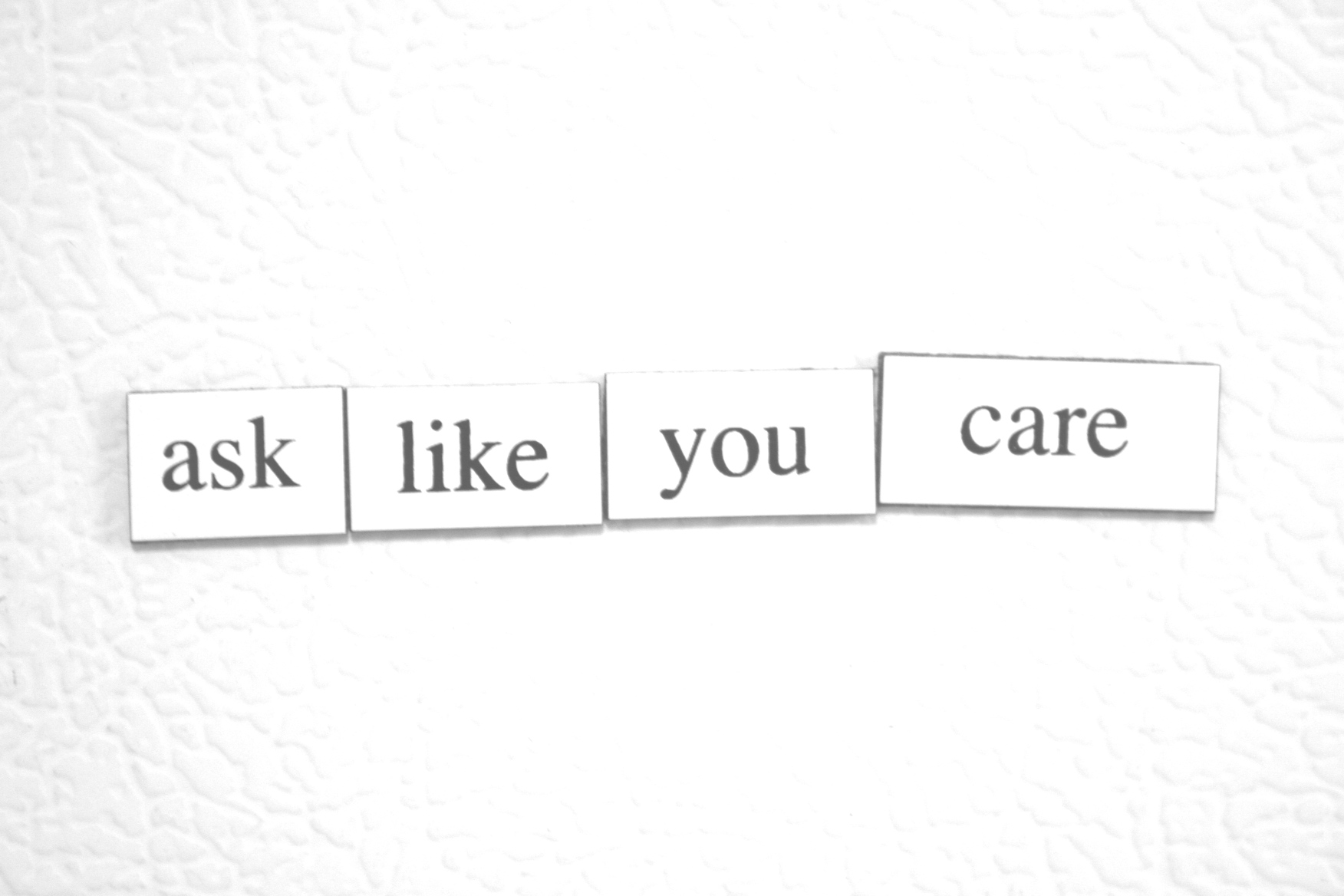
I used magnetic words to create this short message on my fridge. (Minnesota Prairie Roots copyrighted file photo)
Think before you speak or write, because words matter. Words can build relationships or words can destroy them. In a time when vitriol runs rampant, pause before letting words fly across a keyboard or from your mouth. I expect we all hold regrets for words we’ve written or spoken. Use self-control. Ask like you care. Time ticks. Let’s use our time in a way that embraces goodness and kindness, love and compassion. Tick. Tick. Tick.
WHAT WOULD YOU like to add to this conversation about the use of time?
Ten years ago I photographed this polaroid picture and comment at an exhibit on voting rights at St. Olaf College in Northfield. This seems applicable to today. (Minnesota Prairie Roots copyrighted file photo 2015)
IN THE 1970s, students at my alma mater, Minnesota State University, Mankato, protested the Vietnam War. Today MSU students are protesting the detainment of an international student and the revocation of visas for five others who attend this southern Minnesota college where I studied journalism.
US Immigration and Customs Enforcement (ICE) has also detained a student from Riverland Community College in Austin, Minnesota, and from the University of Minnesota in the Twin Cities. Other international students from colleges across the state have also had their visas revoked. The same is happening at college campuses throughout the country. Students snatched off the street, from their apartments, by ICE. Pffff, gone, just like that with no explanation and no initial access to their friends, families and legal assistance. This does not sound like the United States of America I’ve called home my entire life.
I’m not privy to specifics on why particular international students were targeted. But I have read and heard enough reliable media reports to recognize that these are likely not individuals committing terrible crimes, if any crime. In most cases they have done nothing more than voice their opinions whether at a protest or via social media. College campuses have always been a place for students to speak up, to exercise freedom of speech, to be heard. To protest.
I photographed this inside my local public library, not recently, but not all that long ago. (Minnesota Prairie Roots copyrighted file photo)
I’m grateful that student journalists at The Reporter, the Mankato State student newspaper where I worked while in college, are aggressively covering this issue. In particular, I reference the article “SCARED TO LEAVE MY HOUSE’—Mavericks react to ICE-detained student, what’s being done by Emma Johnson. She interviews international students who, for their own protection, chose to remain anonymous. It’s chilling to read their words. Words of fear. Words of disbelief and disappointment in a country where they once felt safe and free. The place where they chose to pursue their education, jumping through all the necessary legal hoops to do so. And now they fear speaking up and are asking their American classmates and others to do so for them. So I am.
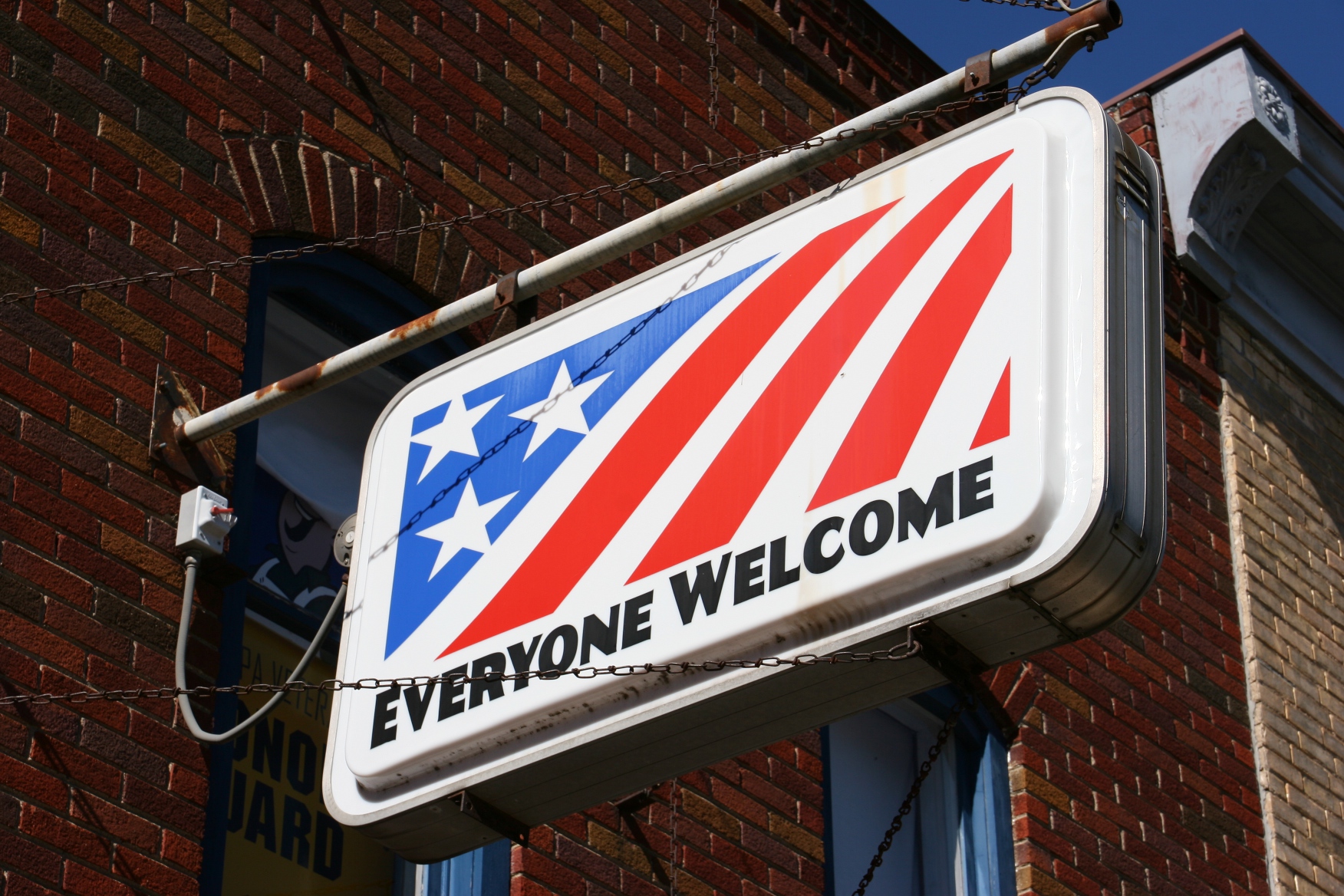
We’ve always been a nation that welcomed international students. (Minnesota Prairie Roots copyrighted file photo)
I photographed this sign on an American Legion post building in a small southeastern Minnesota community. It’s a reminder that veterans have fought for our freedom, including freedom of speech, and that we have always been a welcoming country. (Minnesota Prairie Roots copyrighted file photo)
These are troubling times. In my life-time, this has always been a nation where we’ve been able to freely express ourselves, where that freedom has been valued. We can agree to disagree. Respectfully. Without name-calling. Without the fear of suppression, retaliation and/or imprisonment. But I see that changing. Daily. And that, my friends, is cause for deep concern.
#
NOTE: I welcome respectful conversation. That said, this is my personal blog and I moderate and screen all comments.
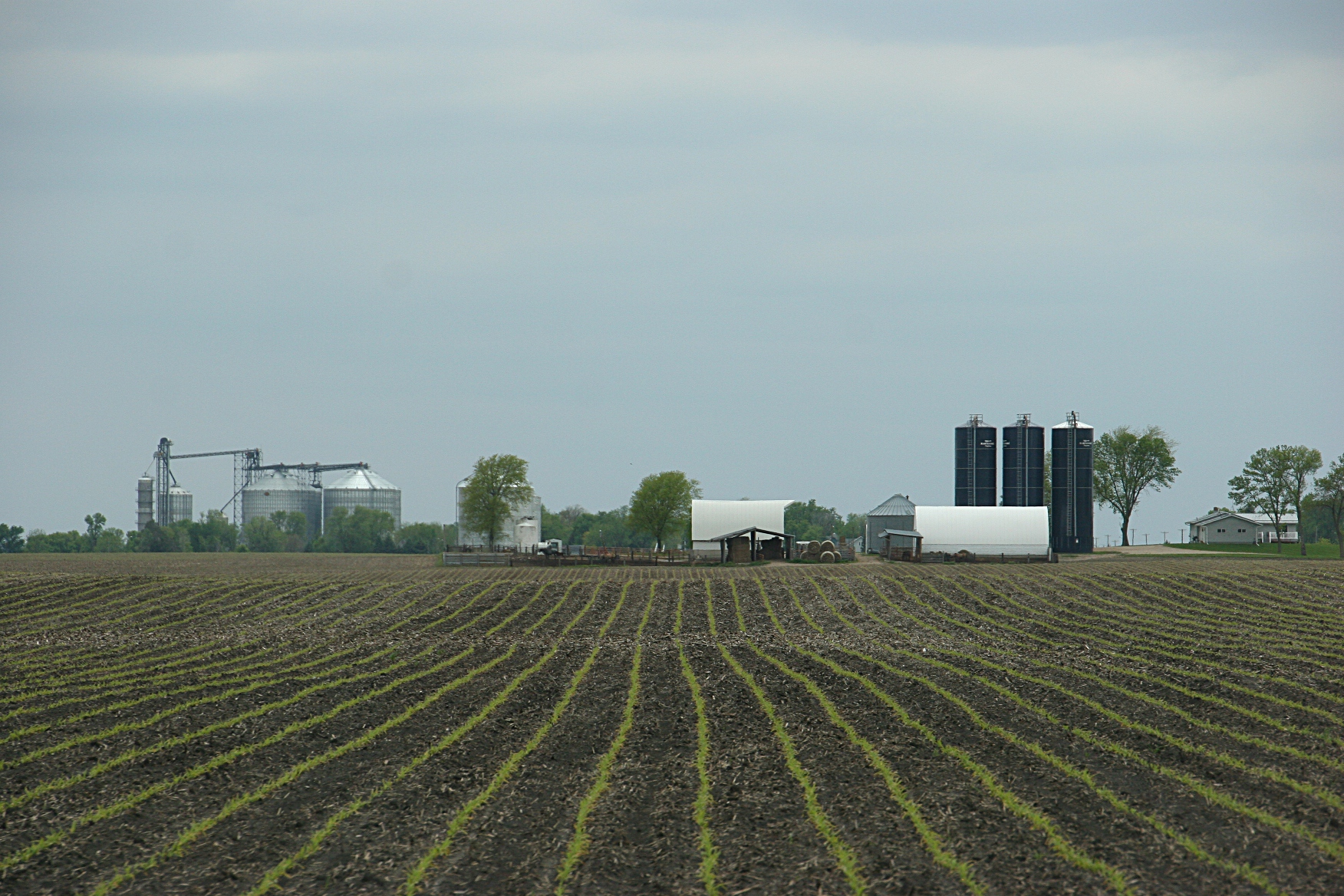
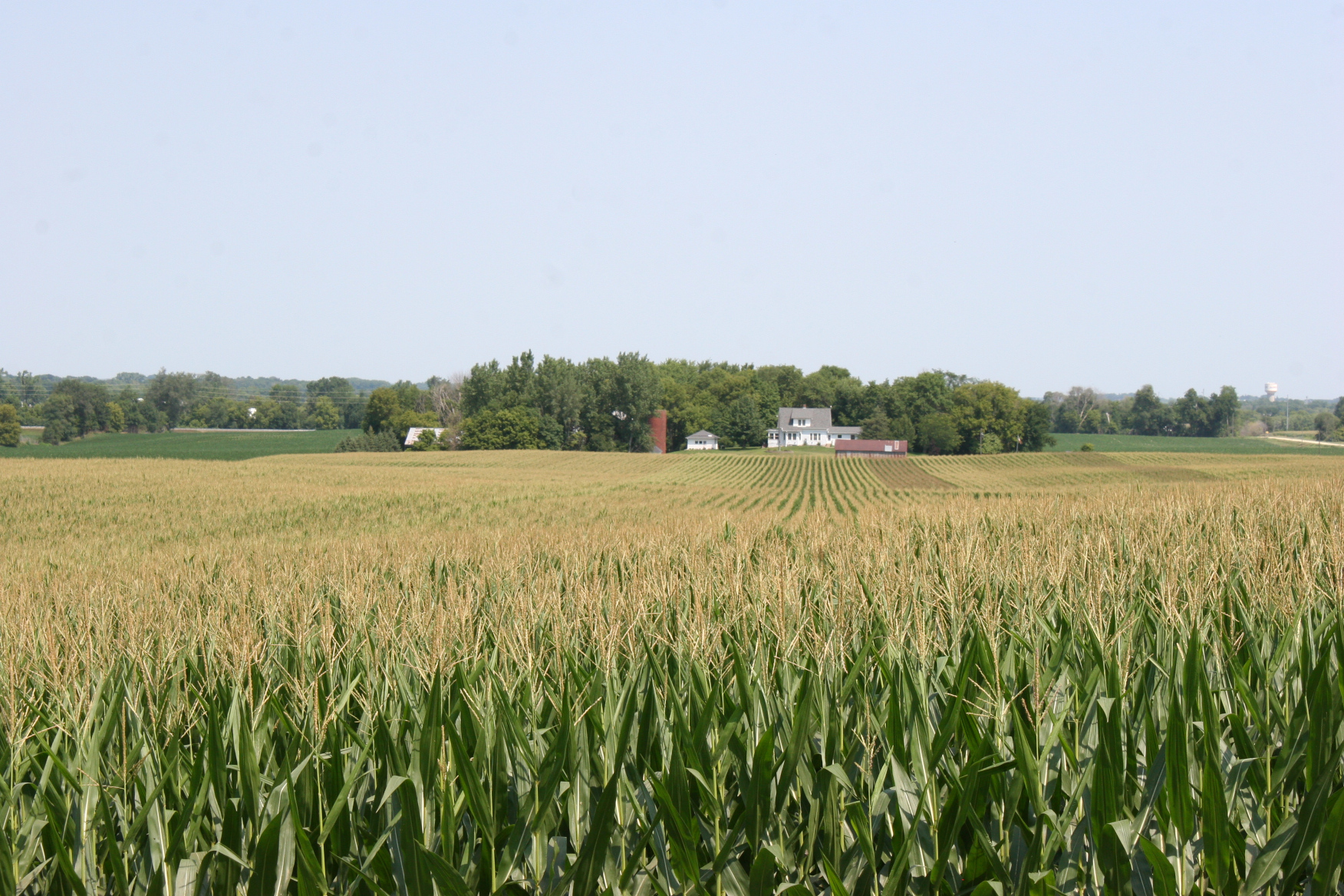
Corn rows emerge in a field near Delhi in my native southwestern Minnesota prairie.(Minnesota Prairie Roots copyrighted file photo)
I COME FROM A LONG LINE of engaged citizenry rooted in the rich dark soil of the southwestern Minnesota prairie. On that land, generations of my family used their voices and skills to create change, to make the place they called home a better place. My paternal great grandfather, Rudolph, started that engagement by helping found a Lutheran church in my hometown. Pre-building, congregants met in his farmhouse.
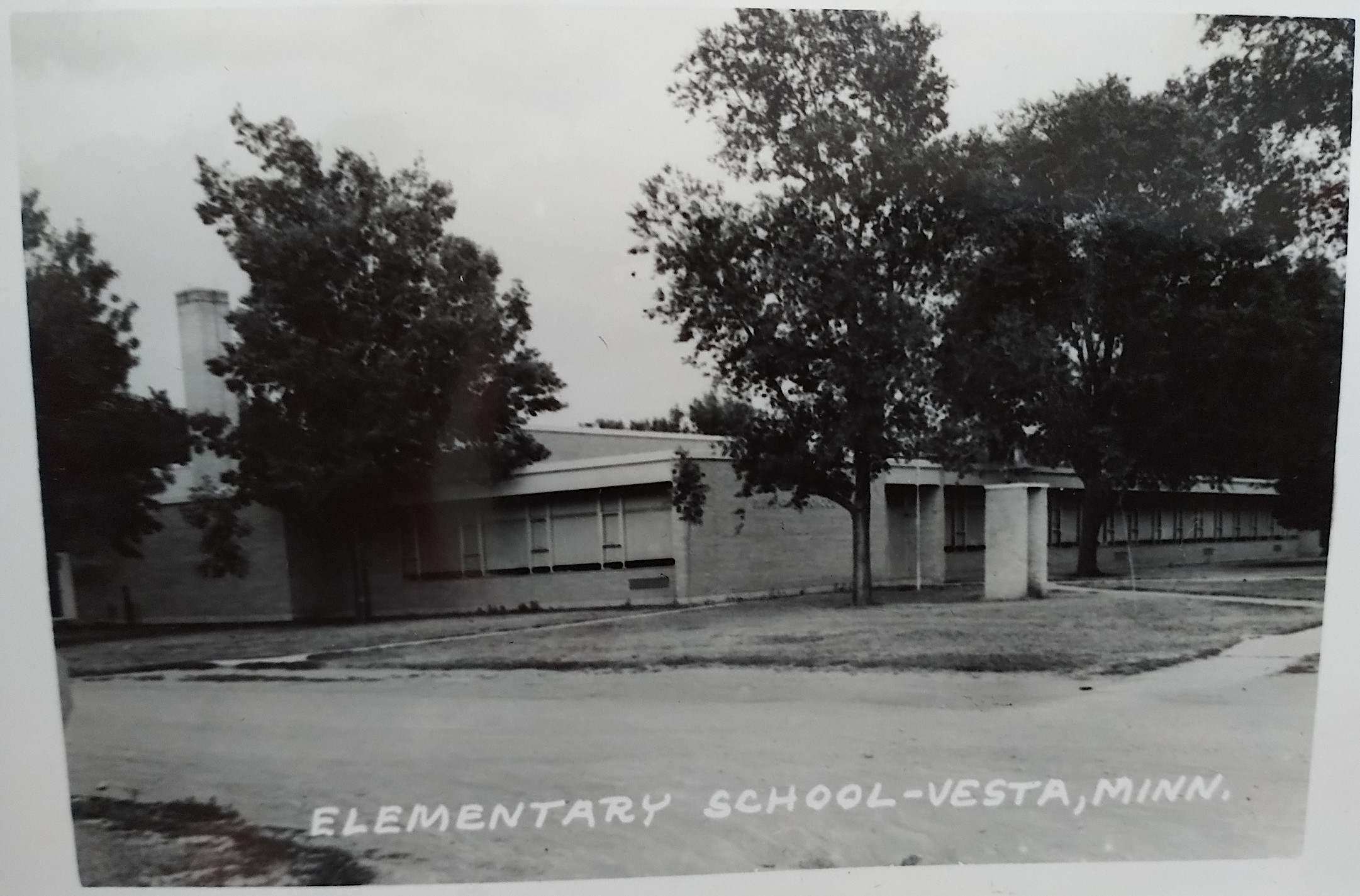
My grandfather, Henry Kletscher, served as school board clerk when Vesta Elementary School was built in the late 1950s. I attended school here. (Vintage photo from my collection)
From that church to school boards to county boards, from elementary schools to high schools to college campuses and more, countless family members have served and continue to serve others by representing them, crafting policies, improving lives. I am proud of that legacy.
Now you might ask, what about you, Audrey? I, too, have served, but in a different capacity. I’ve never held a desire to lead, to run for elected office or even sit on a board. Rather, I’ve observed, used the written word to inform others. During my years working as a newspaper reporter, I covered endless county board, city council, planning and zoning board, school board, caucuses and other meetings. I learned a lot about how government does and doesn’t work during those many hours of scribbling notes, gathering quotes, writing news stories. I learned, too, that individual voices matter and are heard. And I shared that in my unbiased, balanced reporting.
Today I craft writing that is not straight news reporting, because I am no longer a newspaper reporter. Rather, my writing is personal and sometimes opinionated. My voice matters…as much as anyone’s.
An opinion piece I wrote in 1974 for my high school newspaper. (Minnesota Prairie Roots copyrighted photo April 2025)
While coming of age near the end of the Vietnam war, I began writing angsty poetry about the war. I purchased and wore a POW bracelet, a thick silver band that wrapped around my wrist. It was engraved with the name of an American soldier held as a prisoner of war. I also wrote the occasional opinion piece for my high school paper. Not about the war, but on other topics.
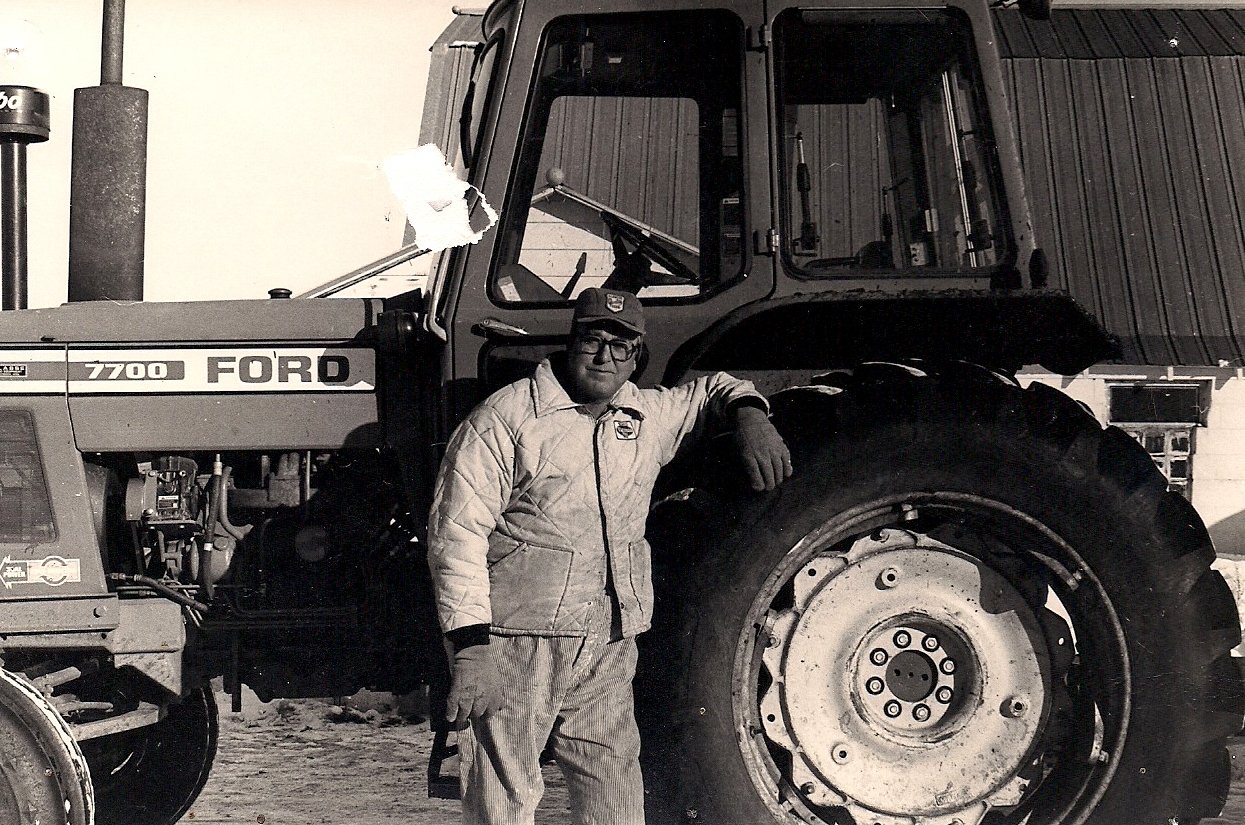
A photo of my dad, Elvern Kletscher, taken in 1980. (Photo from mycollection)
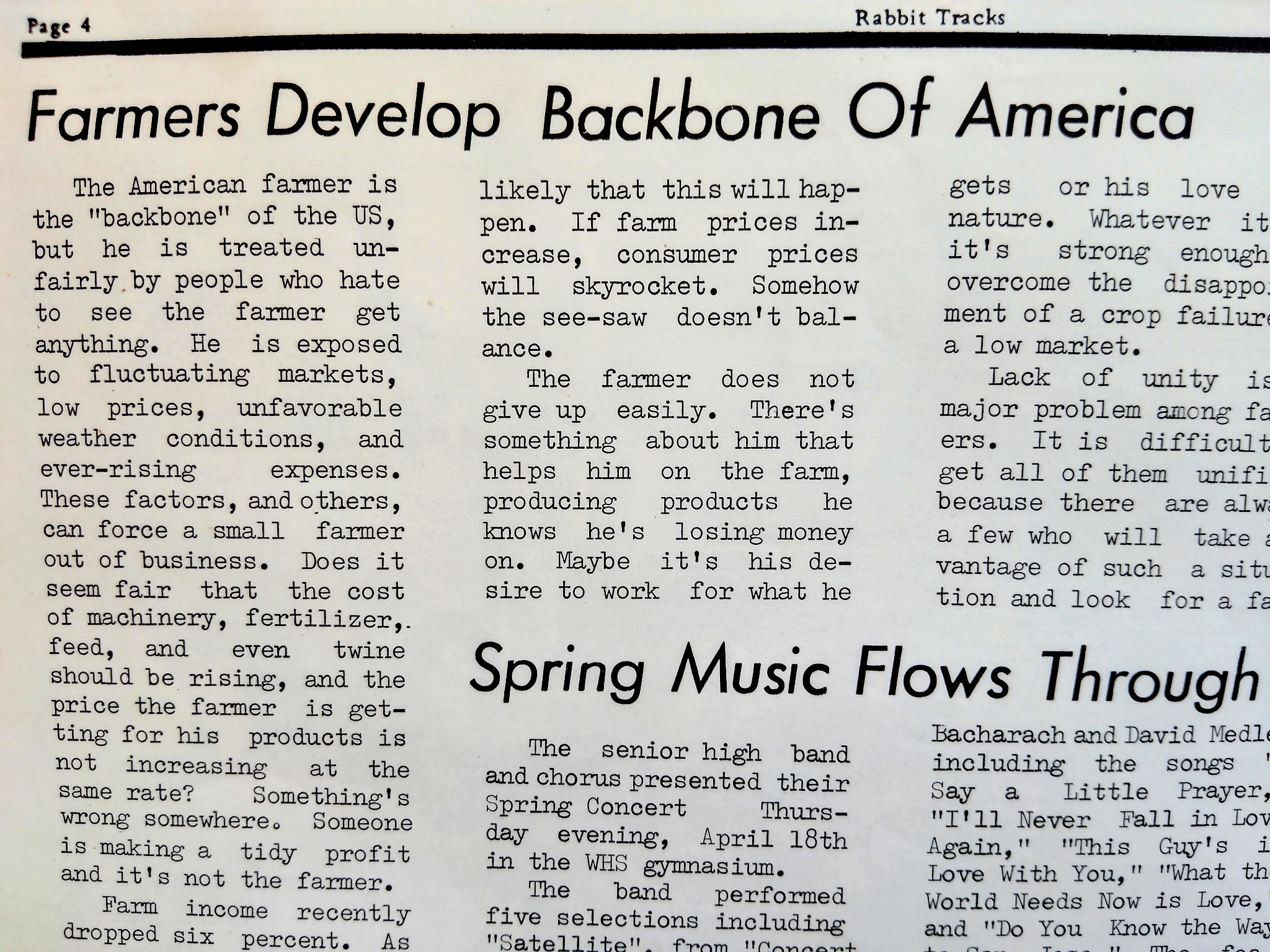
It was my dad, a dairy and crop farmer, who inspired me to voice my thoughts in the May 24, 1974, issue of my school paper, Rabbit Tracks. In an opinion piece titled “Farmers Develop Backbone of America,” teenage me wrote about low farm prices and how farmers were struggling to survive. I had witnessed my dad dumping milk down the drain during a nationwide protest by the National Farmers Organization. All these decades later, I more fully understand how difficult that must have been for Dad. He depended on income from milk sales to provide for our family. But he sacrificed and let his voice be heard in that NFO protest.
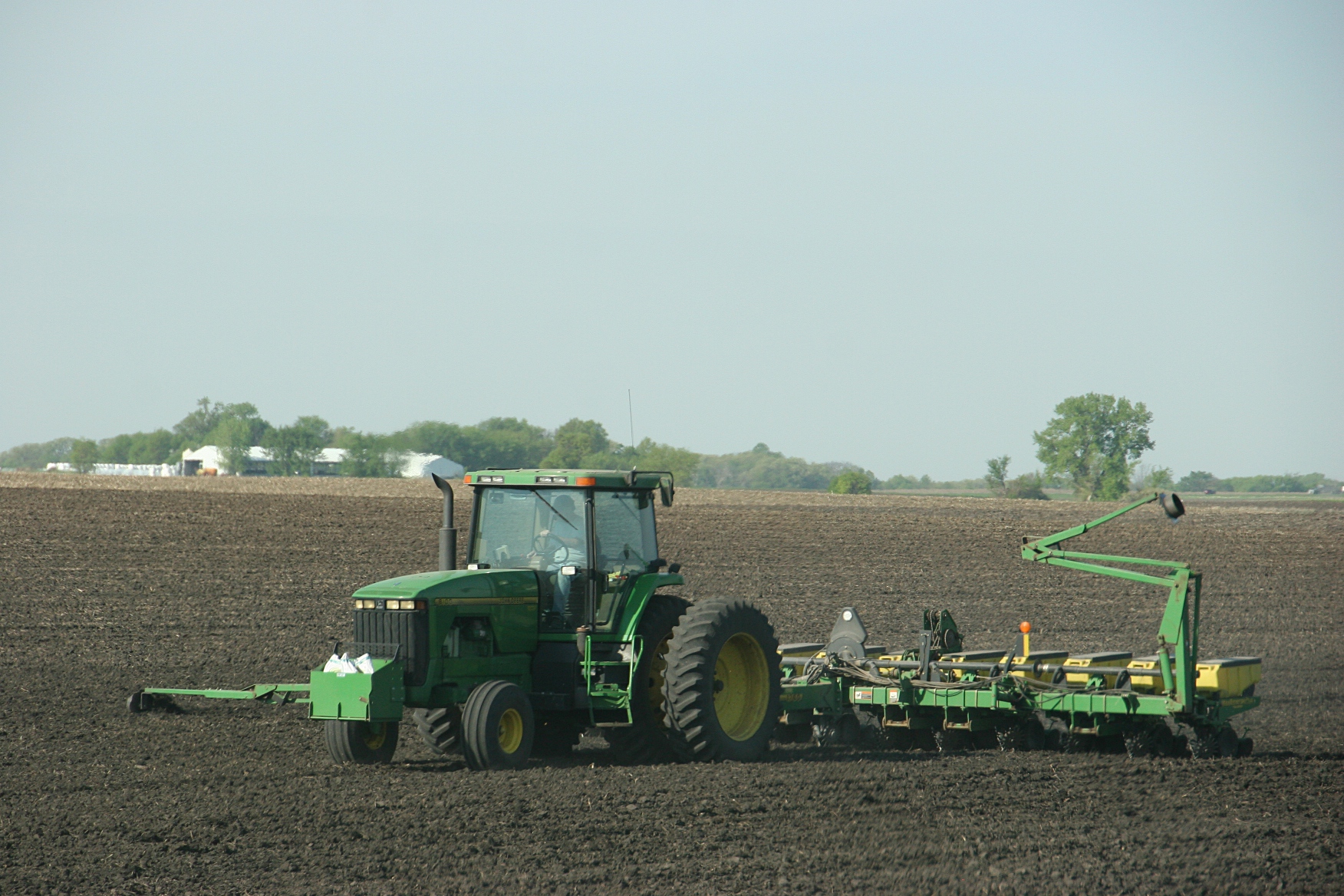
Spring planting in Minnesota will soon be underway. (Minnesota Prairie Roots copyrighted file photo)
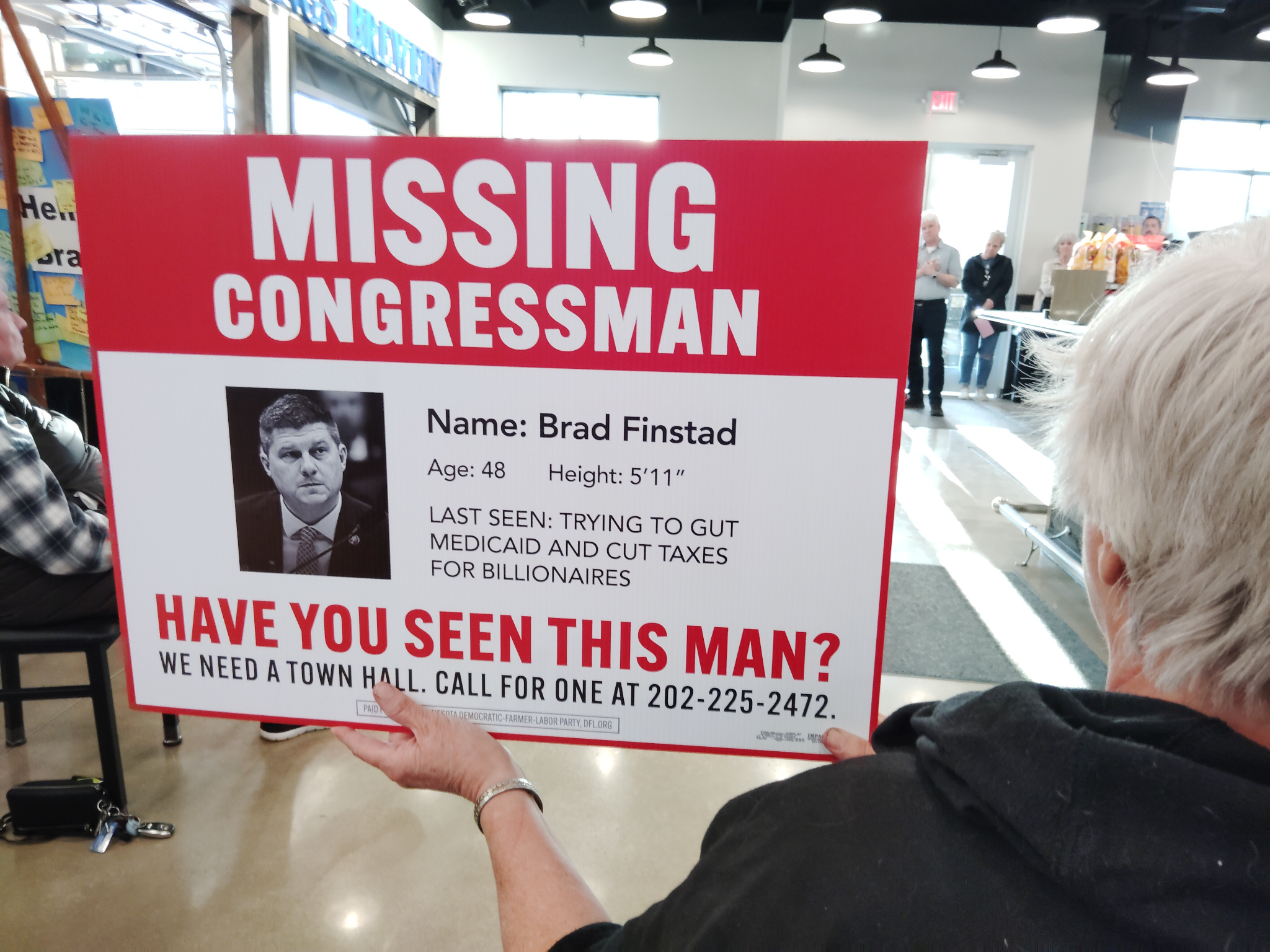
Sunday evening I listened to another farmer voice his thoughts, this time in the open mic part of a Town Hall meeting attended by hundreds in nearby Owatonna. He drove from Janesville to share concerns about how tariffs will negatively affect his farming operation via market loss, dropping crop prices and rising costs for everything from tractor parts to fertilizer and fuel. This farmer of 60-plus years pleaded with his Congressman, Representative Brad Finstad (a fourth-generation farmer who was invited but did not attend), to listen and to do something. It was a powerful and particularly emotional delivery.
This was one of the many signs displayed at the Sunday Town Hall in Owatonna. Organizers rightly guessed that Congressman Brad Finstad would not attend. He was also invited to a recent Town Hall in Faribault, but did not show. (Minnesota Prairie Roots copyrighted photo April 2025)
Emotions are running high right now across this country. I cannot imagine anyone who would disagree with that. We may disagree on policies, decisions and leaders. But we still—as of this writing—have a voice, even as efforts to suppress our voices continue. We can protest, like my 82-year-old uncle did on Saturday at the Minnesota State Capitol. We can attend town halls to learn, to speak, to let our voices be heard. We can contact our elected officials via phone and/or email and tell them what we think. We can engage. We can vote.
(Minnesota Prairie Roots copyrighted file photo)
A long line of speakers and attendees of all ages addressed numerous topics from veterans’ issues to education to housing to healthcare to democracy and more at the Sunday Town Hall in respectful conversation. The common threads weaving through the event were a deep concern for what is happening in our country and to assure our voices are heard.
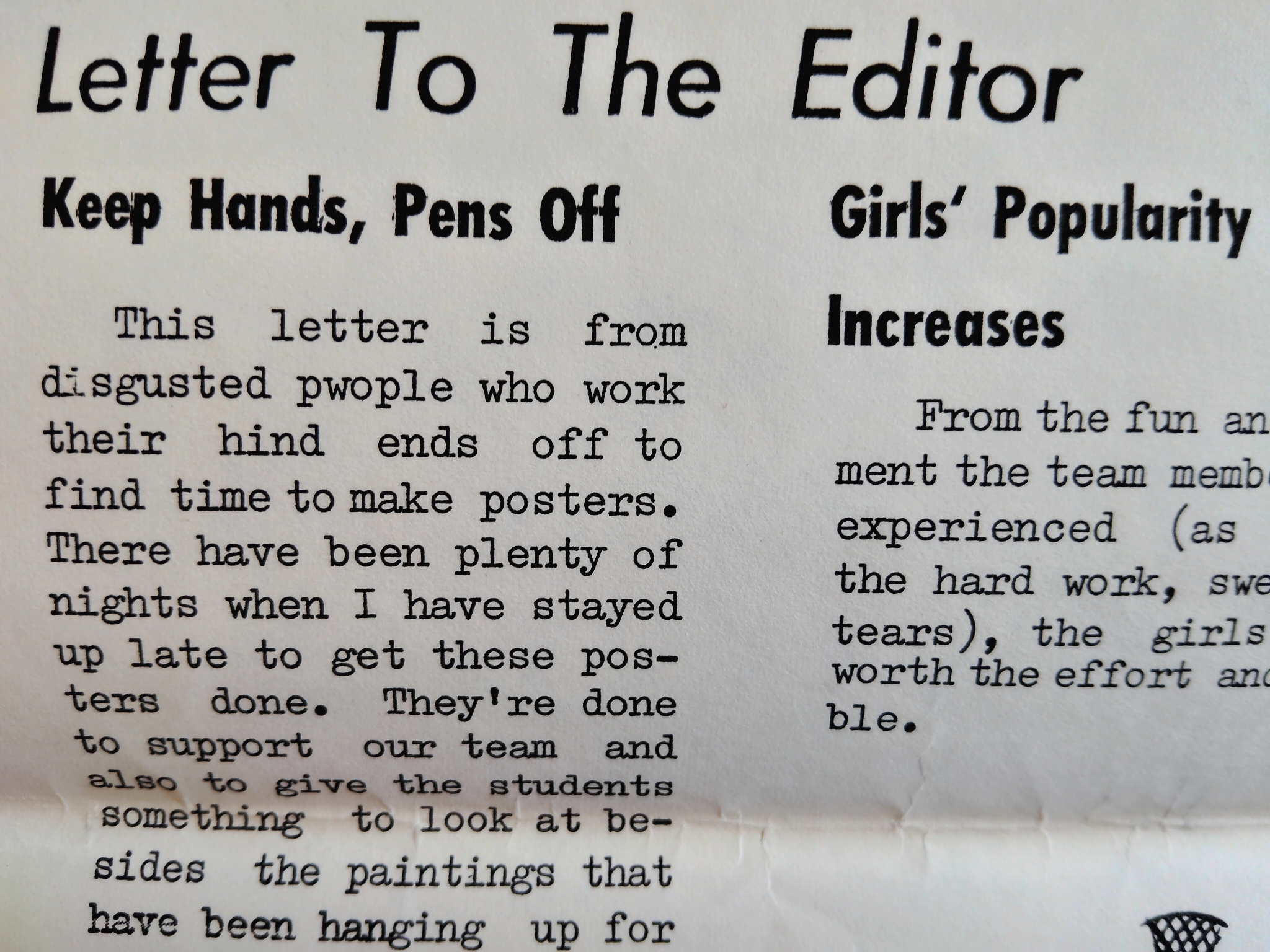
The beginning of Mary’s letter to the editor, penned in 1974 for Rabbit Tracks. The headline is so fitting for 2025. (Minnesota Prairie Roots copyrighted photo April 2025)
I leave you with this opinion piece published in the October 15, 1974, issue of my high school newspaper. An 11th grader wrote about posters she created and which students were defacing. Here’s Mary’s closing sentence in a letter to the editor titled “Keep Hands, Pens Off”: A lot of time and effort has been put into these signs and the least you can do is keep your hands off of them. If everyone is so anxious to write something on the wall, make your own posters. How applicable those words are to today.
#
NOTE: I welcome respectful conversation here. That said, I moderate all comments on this, my personal blog, and make the final decision on publishing comments.
Lots of jelly beans and other candy were sold in a Minnesota shop I visited years ago. (Minnesota Prairie Roots copyrighted file photo used for illustration only)
ONCE UPON A TIME in The Land of Plenty, there lived a ruler who, before he took office, declared that he would be king for a day, or some such wordage. He relished power and absolute control with the zeal of a kid unleashed in a candy store. Except even kids in a candy shop realize they can’t devour every piece of sticky taffy, every morsel of chocolate, every jelly bean in sight. Their stomachs would hurt. And they would soon be barfing all over the kingdom.
But the narcissistic leader, who promised to make the country the best it had ever been (because he craved praise and power), apparently did not understand this about consuming too much candy. Or he didn’t care. Once in office, the-man-who-would-be-king gathered his team, granting unfettered powers to one of them in particular. He pulled out his guidebook and magical pen and scrawled his signature across endless pieces of paper imprinted with orders to create an even more wonderful and efficient Land of Plenty, at least in his eyes. Such was his insatiable desire for adoration, domination and control. His plan to become king for a day extended well beyond a day into mindless infinity.
Candy galore in another Minnesota candy shop. (Minnesota Prairie Roots copyrighted file photo used for illustration only)
He proposed acquiring more land to add to his empire, focusing his efforts on the countries of Adanac and Dnalneerg, both of which wanted nothing to do with him, understandably so. But that didn’t stop the ruler from obsessing on the topic, for he was a determined man. Do this. Do that. Say this. Say that. Toss out an endless stream of threats and vitriol and perhaps some of it would stick like gum to the bottom of a shoe.
On and on it went. Each day something new. More taxes, which he called “tariffs” and a good thing for his subjects. He advised those who farmed the land to “have fun.” He fooled no one (OK, maybe some too many) with his spin on tariffs. Mass firings, deportations, funding cuts, closures and more (too many actions to count really) happened daily under the ruler’s authoritarian hand.
If anyone protested, spoke up or voiced opposition, the ruthless leader worked to quiet them. There were street snatchings and threats. Intimidation. Disrespect. Denial. Deflection. Distraction. Lies. Verbal attacks. He used all sorts of tactics to create fear, to suppress anyone who disagreed with him, his team and his/their words and actions. That included bullying the printers, lawyers and judges of the land, calling them all sorts of derogatory names. He threatened to come after them, to silence them, to show them who held the power. Sometimes he succeeded, sometimes not.
In this fictional story, chocolates are banned from candy shops. (Minnesota Prairie Roots copyrighted file photo used for illustration only)
Yet, one plan appealed to the unsuspecting masses. And that was the opening of more candy stores, with promises to give away millions, perhaps even billions, of pounds of candy. To qualify, subjects needed only to sign an irrevocable loyalty pledge, which seemed reasonable on the surface. But there’s always the fine print. They would need to agree with the mighty ruler’s ideology and actions or risk losing four years of a free candy supply or, worse yet, be locked up for rebellious attitudes or other so-called subversive acts. If the subjects looked even closer at the fine print, they would see that candy shops were forbidden from carrying chocolate. Surely that would be the deal breaker for most because, well, who doesn’t love chocolate? All candy, in fact, was to be colorless.
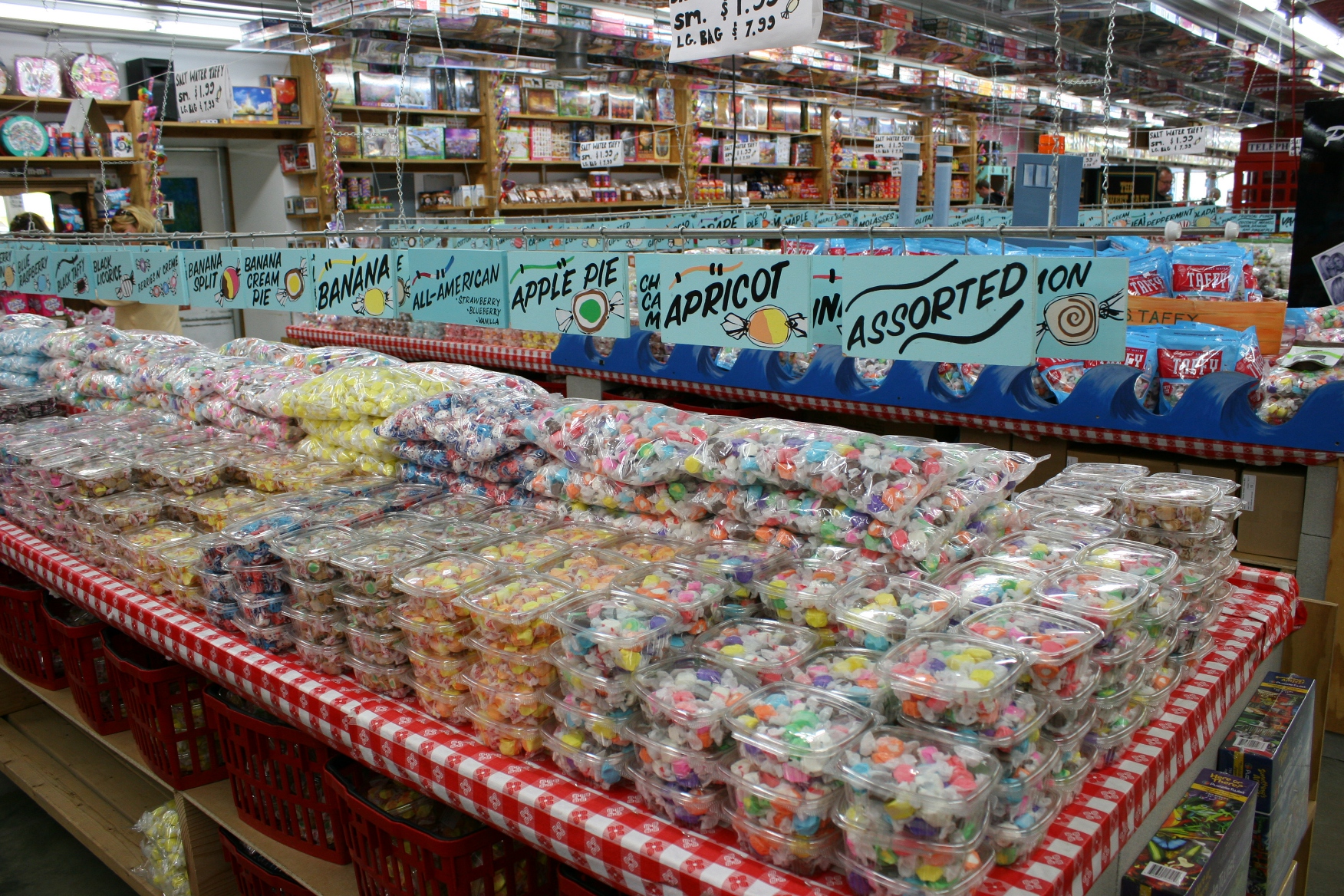
Nearly endless flavors of taffy and candy are sold in this mega Minnesota candy shop. (Minnesota Prairie Roots copyrighted file photo used for illustration only)
But most failed to read the fine print, so focused were they on a four-year supply of free candy. Such a sweet deal. They trusted that the ruler had their best interests in mind. He didn’t. Even kids understand that too much candy can cause a tummy ache that leaves them regretting their selfish gluttony.
This, my friends, is no April Fool’s Day joke.
#
FYI: While this short story is written as fiction, it is (as is most fiction) rooted in truth. It is also a commentary, a way for me to use my voice. Whether you agree or disagree with the content is your prerogative and right. Just note, though, that this is my personal blog and that I moderate all comments and have the final say in those I choose to publish or not.
An American flag flies in rural Minnesota. (Minnesota Prairie Roots copyrighted file photo)
I DEBATED FOR SEVERAL DAYS whether I should write this post, because it could be misconstrued as purely political. It is not. Rather this is a story about a grassroots gathering of people sharing information, ideas and opinions. Democracy at its core. This story is about us as Americans—listening, learning, agreeing or disagreeing, and letting our voices be heard.
Tuesday evening I attended a town hall meeting in Faribault hosted by DFL Senate District 19. It was open to everyone, regardless of political affiliation. But the crowd was decidedly Democrat, as you would expect given the hosting group. Republican Brad Finstad, who represents the 1st Congressional District in Minnesota, was invited, but did not attend. His district includes parts of Goodhue, Rice (where I live), Steele and Waseca counties in rural southern Minnesota.
Some 300 constituents packed the space, overflowing into adjacent rooms. Yes. Even I was surprised by the turn out. That tells me a whole lot of people have concerns about what is currently happening at the federal level and how government action is, or will, impact them. I expect not a single American will be untouched, whether directly or indirectly, by slashes in government personnel and funding and/or by changes in domestic and foreign policies.
A sculpture at the Northfield Area Veterans Memorial. (Minnesota Prairie Roots copyrighted file photo)
Town hall organizers lined up speakers to address topics covering a broad range of subjects affecting a whole lot of people and programs—farmers, education, healthcare, seniors, veterans, those with disabilities, communication, nonprofits and much more. I was impressed by how well prepared these speakers were with facts and statistics. I learned a lot.
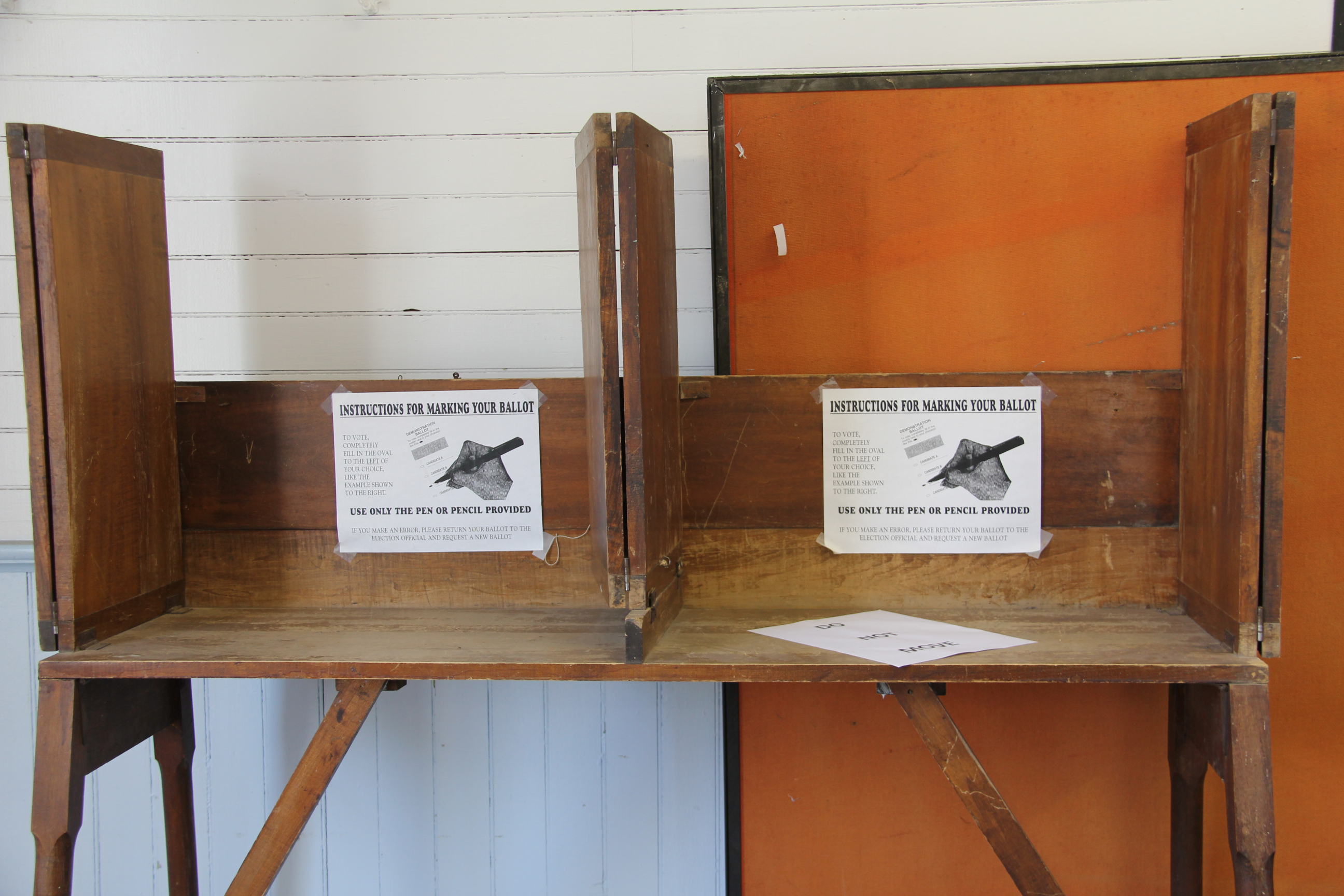
A vintage voting booth in the former Northfield, Minnesota, town hall. (Minnesota Prairie Roots copyrighted file photo)
I’m not going to give you a detailed report of what each speaker said. Rather, I want to share several messages or phrases which really resonated with me and which should resonate with every American, no matter who they voted for. The phrase “we the people” was repeated by one speaker and embraced by the crowd. “We the people” means us. Americans, not members of one political party or the other. And, yes, I’m well aware of how those words from the preamble to the Constitution are being used politically as a mantra of sorts. But in this context, “we the people” references our right to speak up, to be heard, to tell our elected officials what we think and what we would like them to do as our representatives in Washington DC. That can be done by attending town halls like this; the meeting was video taped and will be sent to Representative Finstad. We can be heard via phone calls, emails and letters. We the people have power in our voices, in our votes, whether Democrat, Republican or Independent.
Photographed on a back country road near Morgan in southwestern Minnesota. (Minnesota Prairie Roots copyrighted file photo)
Secondly, a local educator asked the crowd and Finstad to ask themselves this question: “How are the children?” So, yes, how are the children, when many live in poverty, when federal funding for education is in imminent danger of being mostly cut, when…fill in the blank here? I think we can all agree that children are our future and we ought to care about their health, happiness, education and much more.
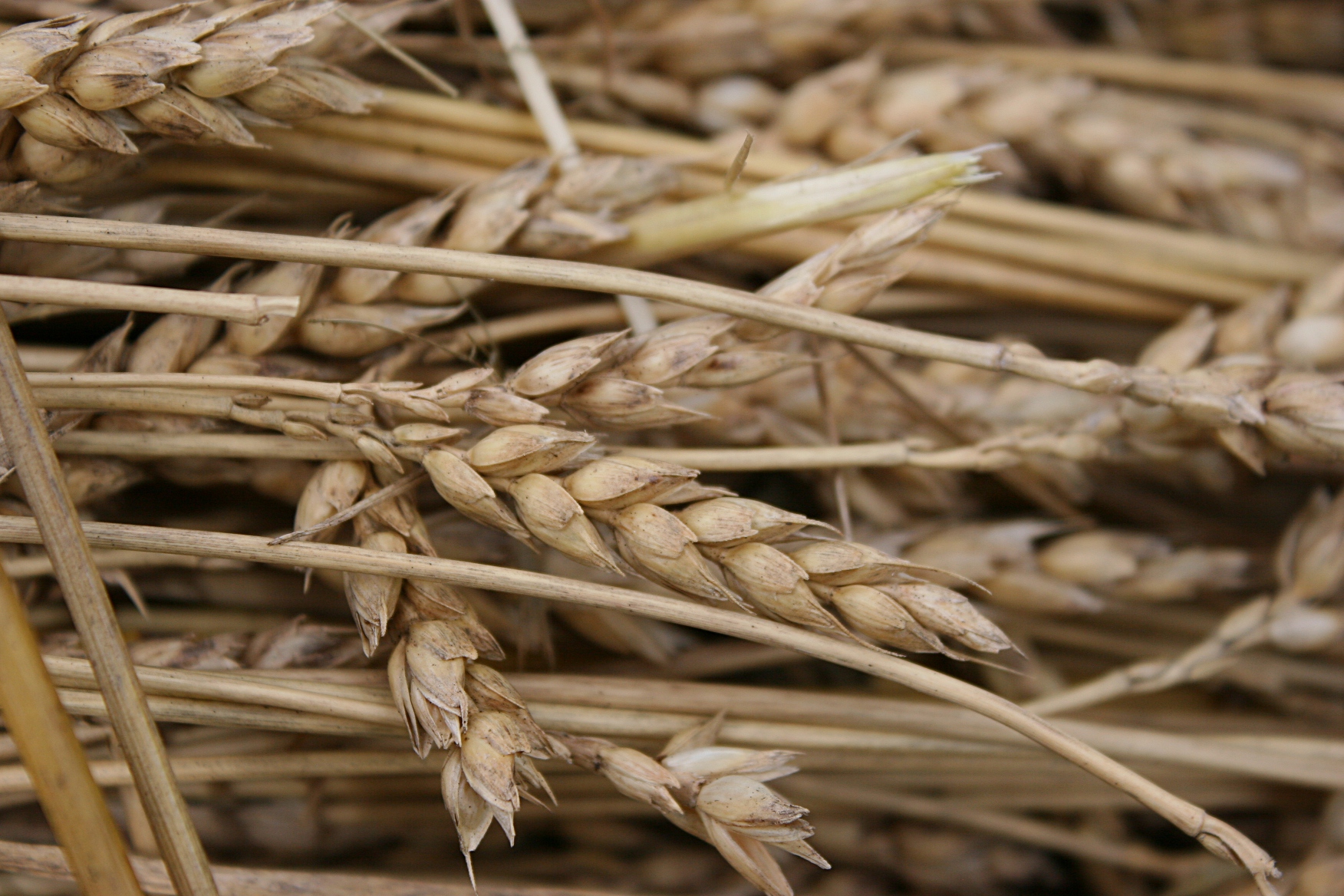
A pile of wheat. (Minnesota Prairie Roots copyrighted file photo)
Third, one of the speakers shared that, as someone of the Catholic faith, he is called upon to help others. He called upon Representative Finstad, who is also Catholic, to do the same. That means feeding the hungry (funding USAID, for example), protecting Medicaid and Social Security, etc. all of those ways and places we help one another as human beings in this country and abroad. Now I’m not Catholic; I’m Lutheran. Doesn’t matter. My faith compels me to show love, compassion and care for others, especially those in need. America once did that as a country. Generously. But that is changing. We have bounty and resources we can share to help starving children, to provide medical care, to help others in any way we can. It is the right thing to do as a nation blessed with great bounty.
Rural Rice County, Minnesota. (Minnesota Prairie Roots copyrighted file photo)
Fourth, a local farmer spoke about $3.2 million in contracts with farmers in our district which have now been broken by the U.S. government. The consequences will be devastating to those farmers who have already invested those federal monies in their operations. Trust has been broken, she said. I think we can all agree that when a legal contract is broken, it’s a breach of trust.
A symbol of freedom, an eagle sculpture at Veterans Memorial Park in Morristown, Minnesota. (Minnesota Prairie Roots copyrighted file photo)
There’s so much more I could share from that town hall session. But I want to conclude with this. I encourage you, if you have the opportunity to do so, attend a town hall meeting. Listen. Learn. Engage. Let your voice be heard. Remind your elected officials, too, that they need to listen, learn and engage.
FYI: A second Town Hall Meeting hosted by DFL Senate District 19 is set for 6 p.m. Sunday, April 6, at Mineral Springs Brewery, 210 N. Oak Ave., Suite 1, in Owatonna. It will follow the same format as the Faribault Town Hall with a moderator, speakers and an open mic. Representative Brad Finstad has been invited.






















Politics, passionate voices & peach pie at a potluck September 9, 2025
Tags: America, Ben Schierer, commentary, democracy, DFL, DFL Garden Party, freedom, Martha Brown, Matt Little, Minnesota, Minnesota Secretary of State Steve Simon, Minnesota Senator Erin Murphy, opinion, political candidates, politics, potluck, Rice County, southern Minnesota
MONDAY EVENING I GATHERED in rural Rice County with a crowd concerned about issues ranging from healthcare to immigration, agriculture, education, the environment, diversity, gun violence, the SNAP program, tariffs, voting rights, veterans’ benefits, the economy and much more. All current-day topics worrying many of us, including me.
I’ve never been politically active. Until this year. To stay silent now feels complicit. I care enough about this country, about freedom, about democracy, to let my voice be heard. I’ve participated in three pro-democracy rallies, including the NO KINGS Day Rally in Northfield and two on Labor Day in Owatonna. I’ve volunteered at a DFL Sweetcorn Feed in Faribault. I’ve donated to the DFL, called and emailed my legislators in Washington, DC. And Monday evening I attended a potluck, billed as a DFL Working Families Garden Party. This all from someone who previously voted primarily Republican. But no more, not in the past four Presidential elections or in some other past elections. I’ve always looked at candidates, their character and their stances on issues before voting. I still do, but party affiliation now matters to me, too.
DEEP CONCERN
At all of these recent events, I’ve heard—whether from politicians, candidates for office or ordinary people like me—a deep concern for our country under the current administration and those who go along with whatever our President says and does. This concern comes from good, decent people. Farmers, teachers, business owners, lawyers, blue collar workers, college students. People who carry crockpots of pulled pork and baked beans, bowls of creamy garden-fresh cucumber salad, peach pie and bars to a political party on a rural acreage.
As I sat in this bucolic setting Monday evening listening to short speeches from candidates like Martha Brown of Faribault, running for Minnesota House District 19A on the slogan of “Common-Sense Leadership for Working People,” or fiery Matt Little from Elko New Market who embraces the label of “radical” and who is running for Congress in the Second Congressional District or Ben Schierer of Fergus Falls, campaigning for state auditor and vowing to represent both urban and rural communities, I felt hope.
COMPASSION & HOPE
I felt hope, too, when I heard Minnesota Secretary of State Steve Simon talk about protecting voter information, voting rights and more. I felt hope when I heard Minnesota Senate Majority Leader Erin Murphy speak. As a nurse, her care and compassion for others threads through her speeches, shines in her political life.
Most notable in Murphy’s talk, at least for me, is the deep grief she feels over the politically-motivated assassination of her friend and colleague, Minnesota Speaker of the House Emerita Melissa Hortman and Hortman’s husband, Mark. The Hortmans were shot to death on June 14, the day I protested in Northfield, despite warnings not to do so. I refuse to be silenced.
Murphy spoke on Monday evening against a backdrop of American and Minnesota state flags and a banner of the Hortmans and their dog with this message: STAND UP FOR JUSTICE AND PEACE. She talked, too, about attending the funeral on Sunday of Fletcher Merkel, 8, among two students killed in a mass shooting that injured 21 others at Annunciation Catholic Church in south Minneapolis on August 27. Justice. Peace. No more gun violence.
UNPRECEDENTED
I’ve lived enough years to observe that what’s happening in this country right now is unprecedented. I’ve never felt more fearful of losing our freedoms under authoritarian rule. It’s happening already with snatching people off the streets, imprisonment and deportations without due process. It’s happening in intimidation and retribution; mass firings; suppression of free speech; funding cuts that are undermining research, healthcare, education and more; gathering of private information by the government; sending armed military into cities; and in countless other ways that affect all of us no matter our political affiliations.
This isn’t about rural vs urban. This isn’t about us vs them. This is, rather, about preserving and protecting our very freedoms as Americans. This is about caring and feeling hopeful. This is about speaking up. About doing something. And sometimes this is also about eating pulled pork, baked beans, cucumber salad and homemade peach pie at a potluck on a beautiful September evening in southern Minnesota.
#
NOTE: I moderate all comments on this, my personal blog, reserving the right to publish or not publish comments. Please be respectful whether you agree or disagree with me.
© Copyright 2025 Audrey Kletscher Helbling