THEY ARE SEASONED WRITERS, also well-seasoned in life. They are Becky Boling, Heather Candels, D.E. Green, Steve McCown and Julie A. Ryan, collectively The Poets of the Northfield Public Library. And at 6 p.m. Thursday, September 5, they will gather at Books on Central, 227 Central Avenue North, Faribault for a poetry reading followed by a Q & A.
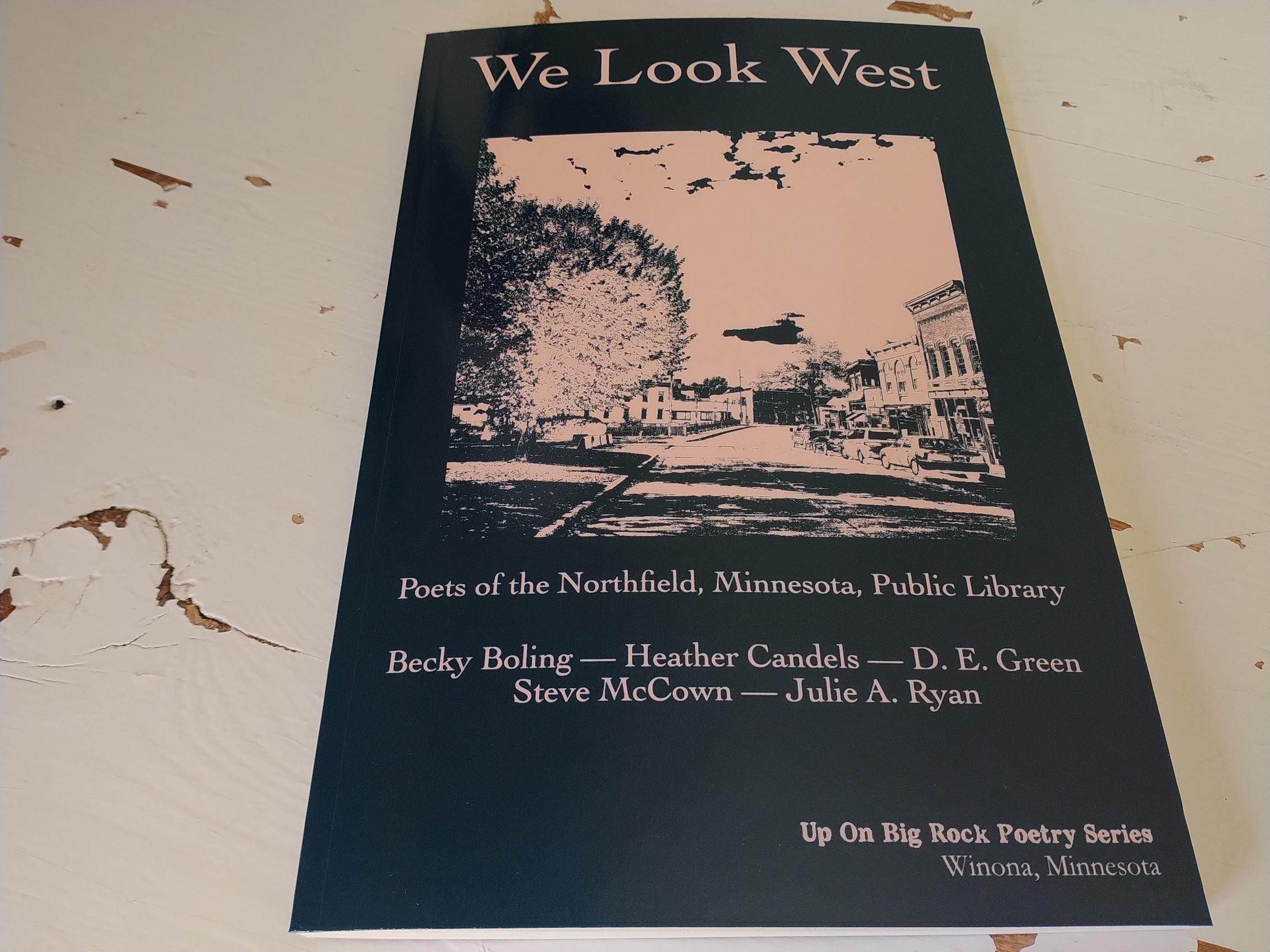
If you happen to be one of those people who claim a dislike of poetry, I encourage you to reconsider and come to this literary event. The poetry this group will read comes from their recently-published anthology, We Look West. Their poems are down-to-earth relatable. Trust me. I’ve read this 116-page book, loved it and reviewed it. (Click here to read my review.)
The writing within the pages of this volume are stories of life, in poetry form. Poems that transition from east to west, from the sunrise to the sunset of our lives.
They’re written by poets with extensive publishing credentials. Four have taught at the high school or college level. The fifth comes from a strong literary and visual arts background. Two are Pushcart nominees.
I’ve met Boling and Green and read poetry with them at an event at Mercado Local in Northfield. They are a wonderful married couple, comfortable and friendly. No stuffy poets here. And no stuffy poems. Just plain good writing that moves the spirit, fills the soul, imprints upon the heart.
I look forward to hearing The Poets of the Northfield Public Library read selected poems and then share the stories behind their poetry. As a poet, I’m always interested in learning what inspired a particular poem.
And if you have questions, ask away. Writers welcome engagement as they share their passion for poetry, the craft of writing.
FYI: Books on Central is a second-hand book shop run by the Rice County Area United Way and staffed by volunteers. Proceeds from the bookstore benefit organizations and nonprofits throughout the county.
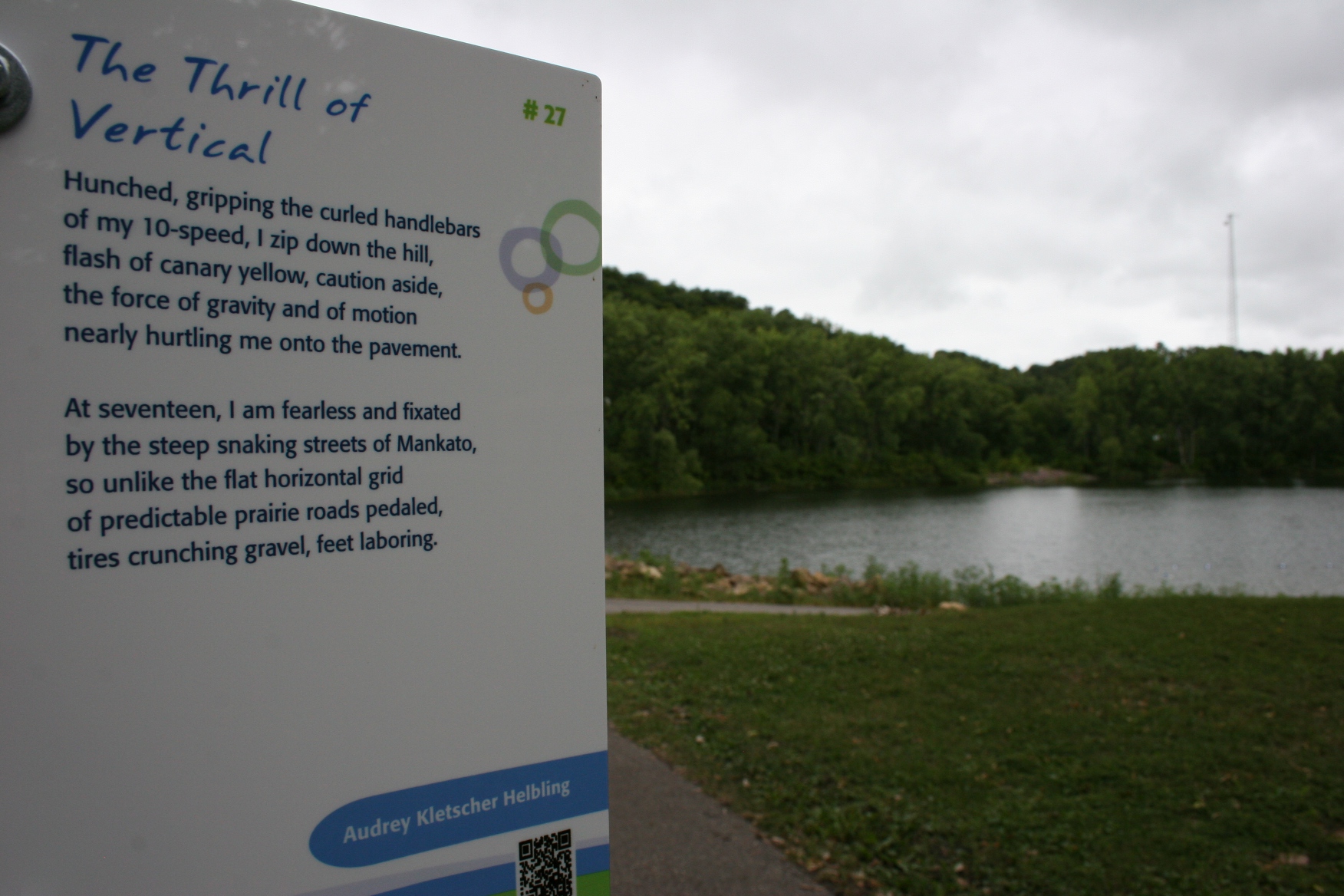
“The Thrill of Vertical,” posted on a sign in Spring Lake Park as part of the 2013 Mankato Poetry Walk & Ride, was inspired by my college years in Mankato. (Minnesota Prairie Roots copyrighted file photo 2013)
I ARRIVED IN MANKATO with a canary yellow 10-speed bike, a simple orange backpack, my Sears portable manual typewriter, a clock radio, a quilt stitched by Grandma Ida and a suitcase filled with clothes. The year was 1974, the beginning of my freshman year at Bethany Lutheran College, high atop a hill in this southern Minnesota city.
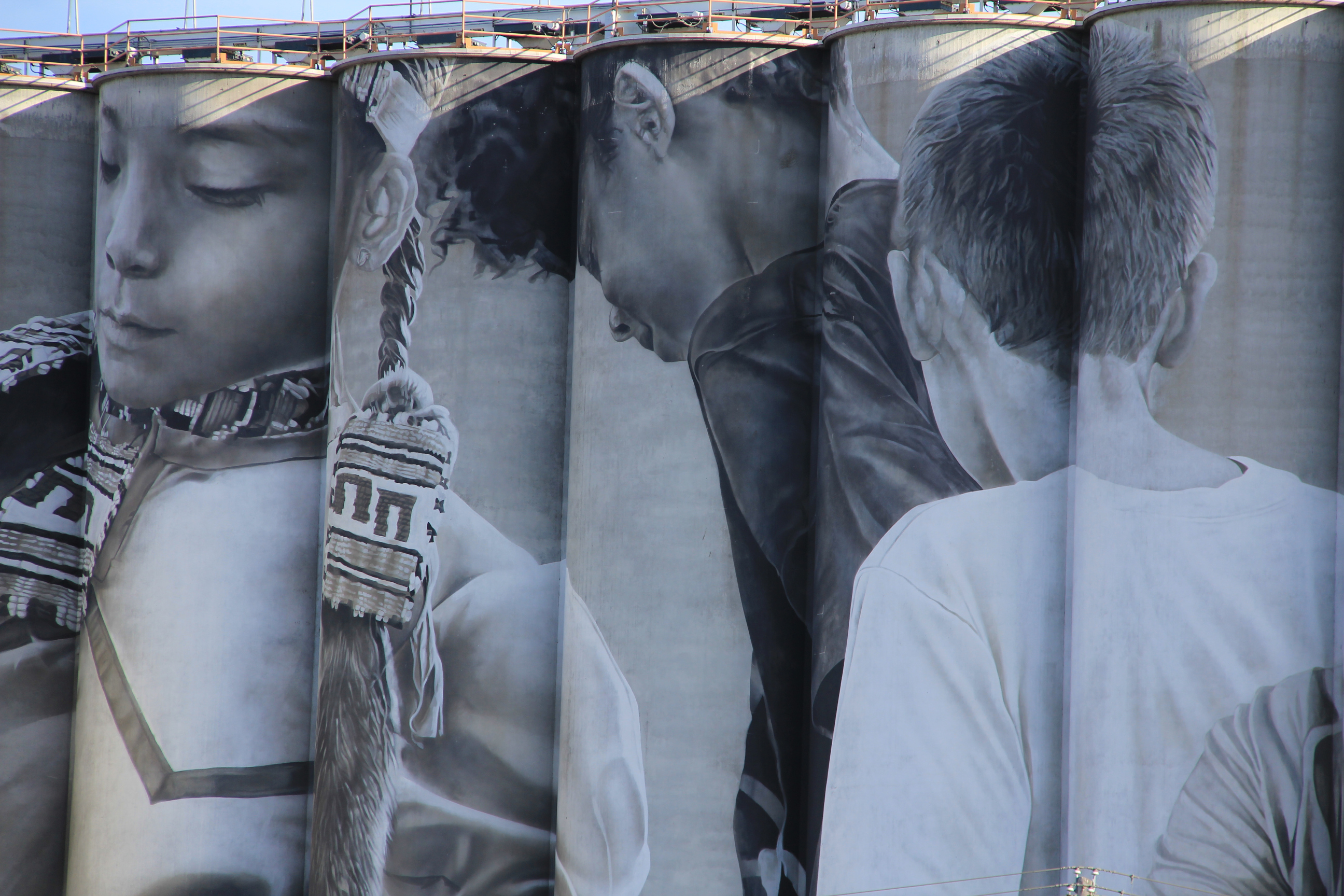
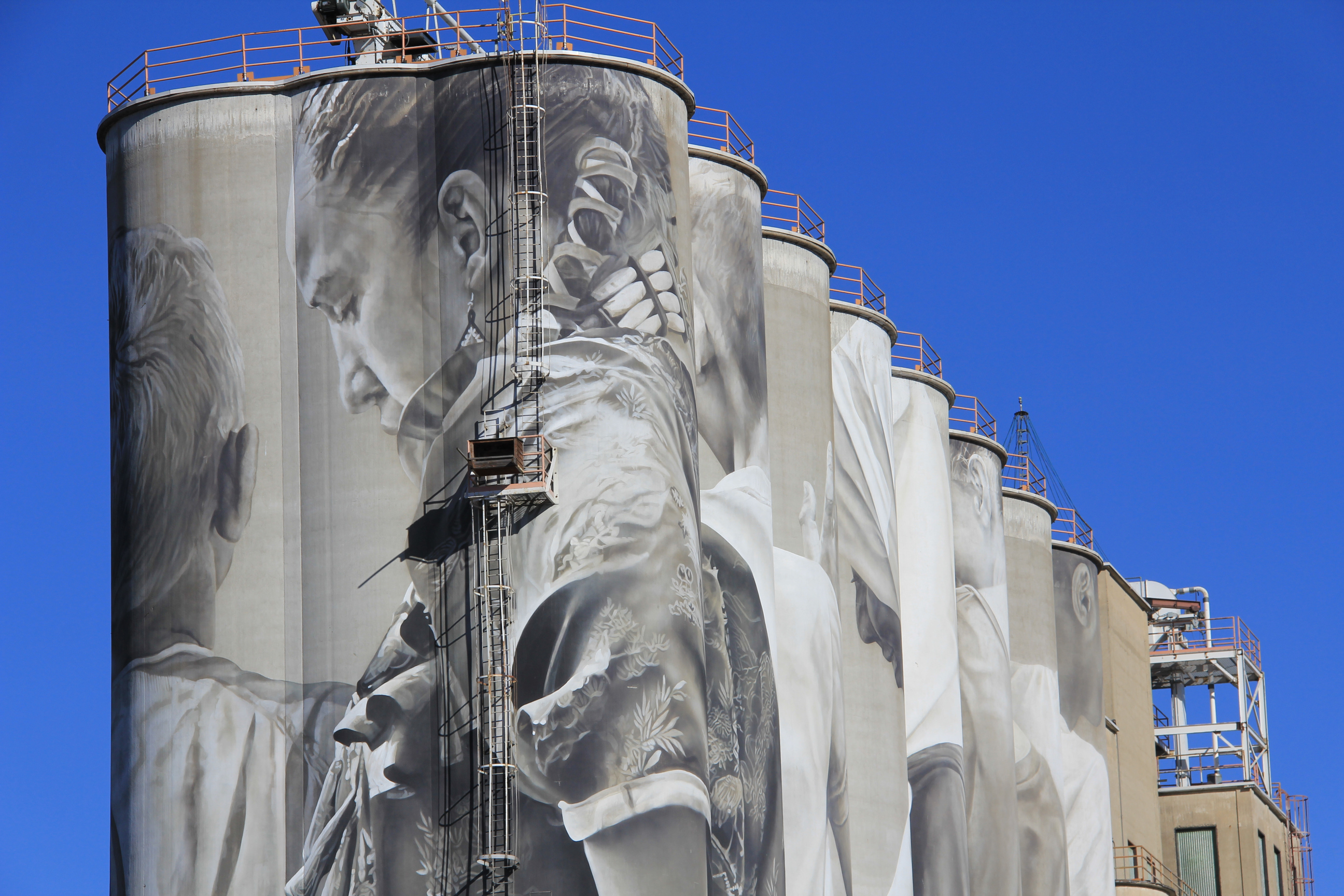
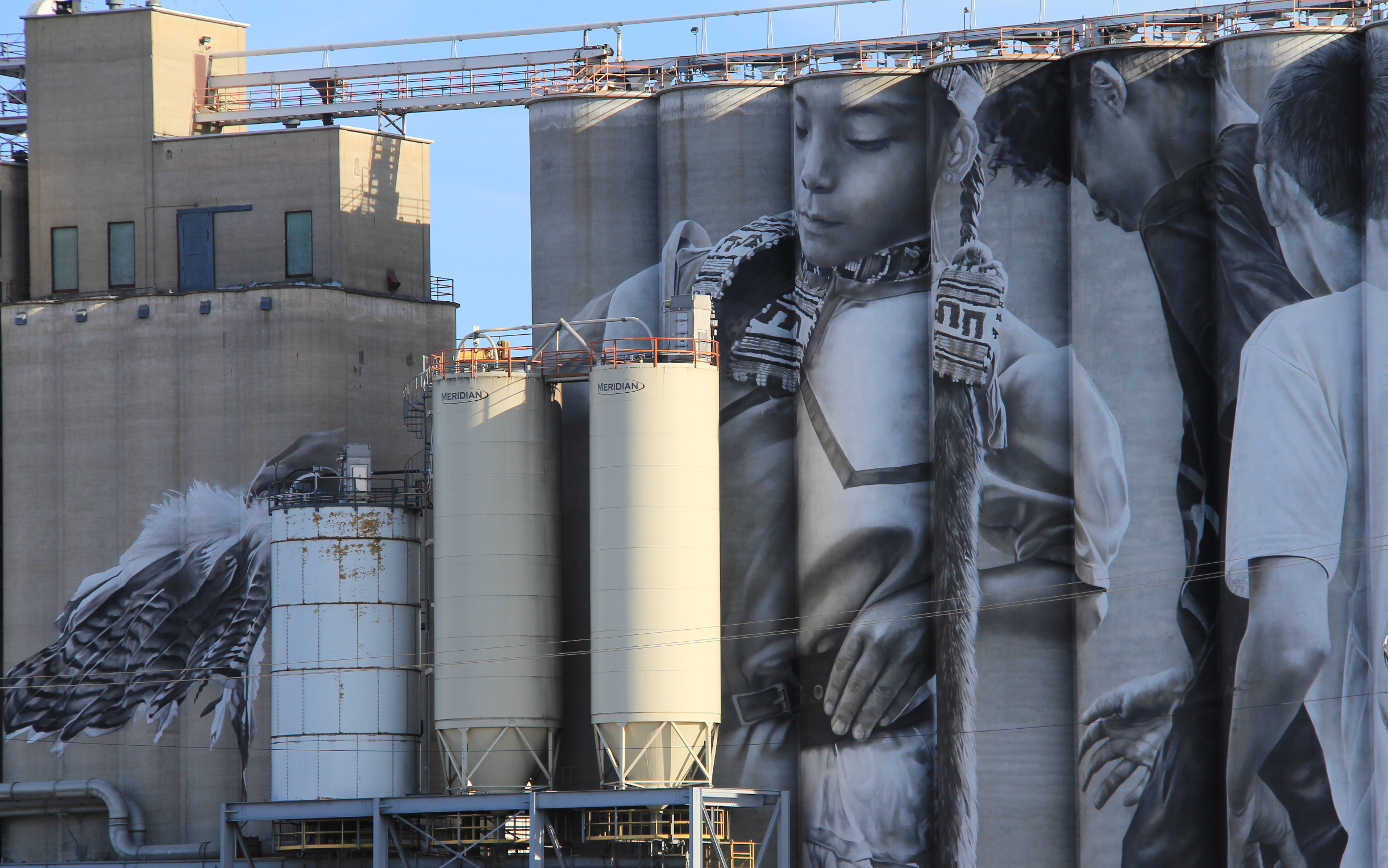
The Ardent Mills grain silos, a massive public art project, dominate the skyline along the Minnesota River in the heart of Mankato. The art depicts the diversity of the area. (Minnesota Prairie Roots copyrighted photo November 2023)
I was only 17, nervous, but ready to leave my childhood farm home some 85 miles to the west. I met my roommate, Rhonda, a beautiful high school cheerleader from western Wisconsin. She was well-traveled, outgoing, vastly different than me, quiet and shy. And she had a stereo for our cozy fourth floor corner dorm room. We were set. Despite our differences, we got along splendidly.
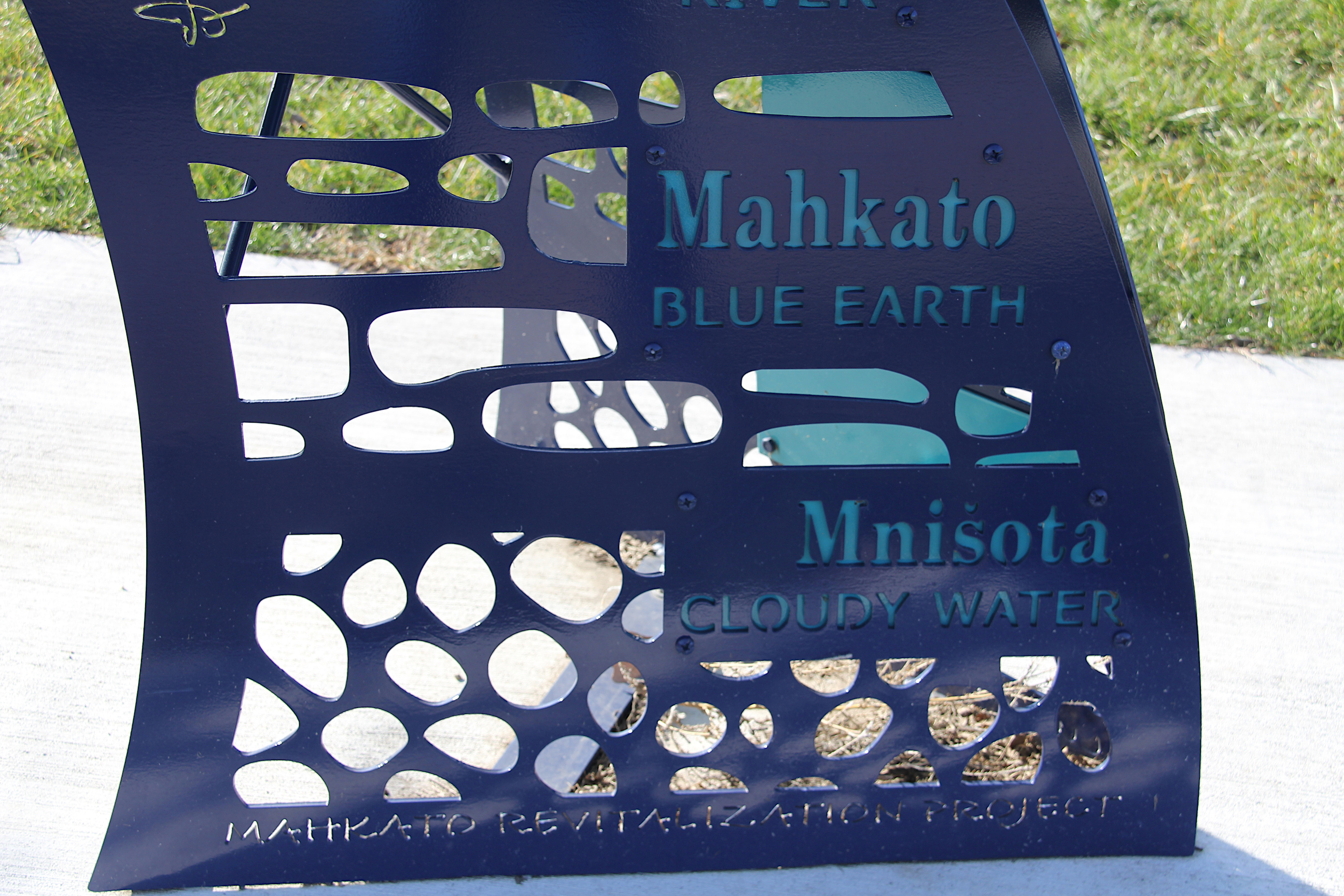
This shows the base of a place sculpture along the Minnesota River in Riverfront Park. The words for Mankato and Minnesota are written in the Dakota language and translated. (Minnesota Prairie Roots copyrighted photo November 2023)
As I settled into the big city (Mankato’s current population numbers around 45,000), big for me when you come from a town of 362, I began to feel at home. Not only on campus, but also in the community. Happy Chef became a go-to destination for conversation and for warm loaves of bread glazed with powdered sugar frosting. A Christian coffee house also drew me off campus. I wasn’t in to the bar scene.
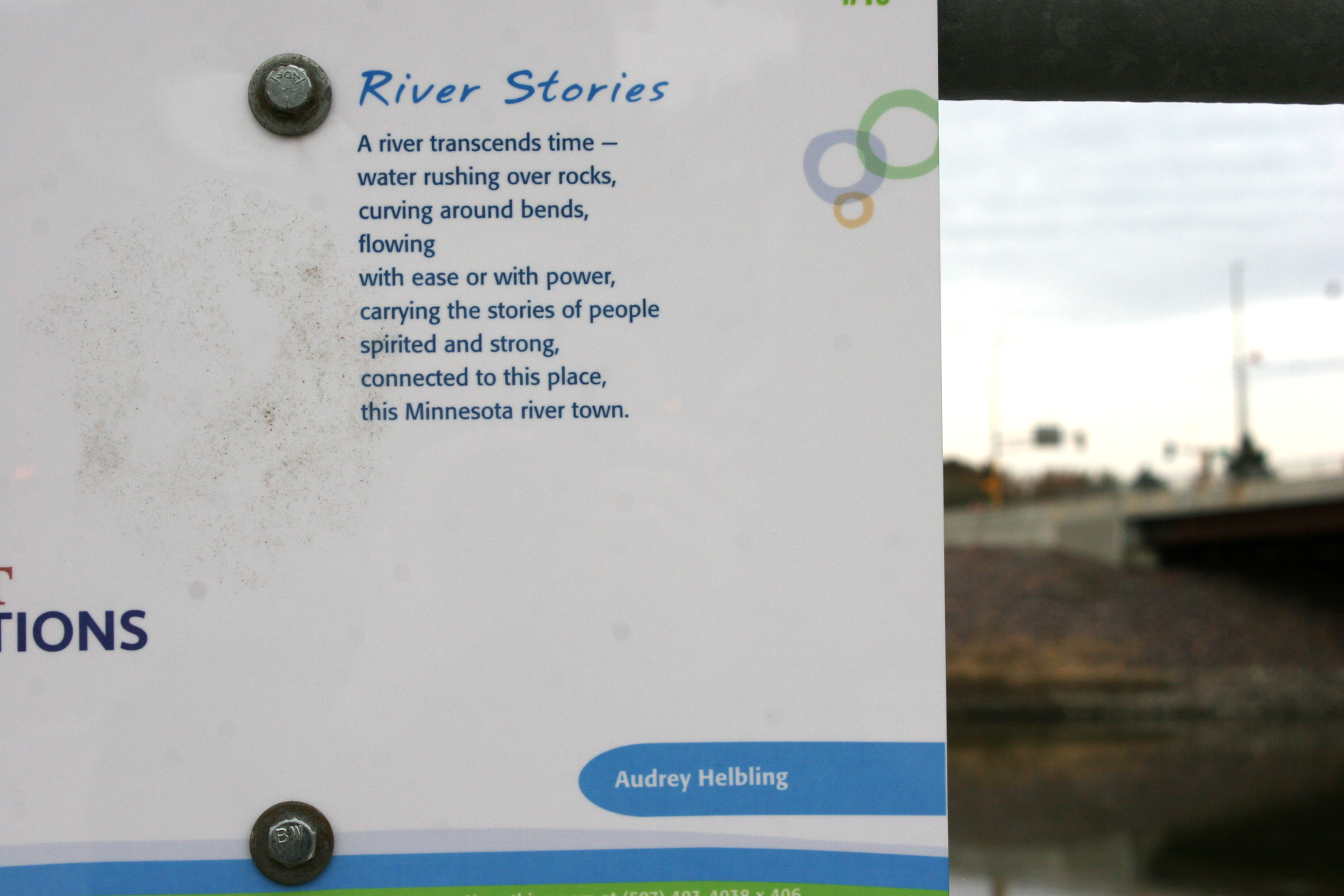
My poem, “River Stories,” highlights the Minnesota River, which winds through Mankato. It was posted along the river as part of the 2019 Mankato Poetry Walk & Ride. (Minnesota Prairie Roots copyrighted file photo 2019)
For nearly four years, Mankato became my home away from home. The place that grew me educationally and as a person. I earned an associate of arts degree from Bethany, then only a two-year college, before moving on to Minnesota State University, Mankato, to study journalism. I worked at the college newspaper, “The Reporter.” In the winter of 1978, I earned a mass communications degree with an emphasis in news/editorial. Soon thereafter, I started my career as a newspaper reporter and photographer. Years later I returned to work for “The Mankato Free Press,” heading up the paper’s St. James-based news bureau (me living and working from my apartment long before working remotely became a thing).
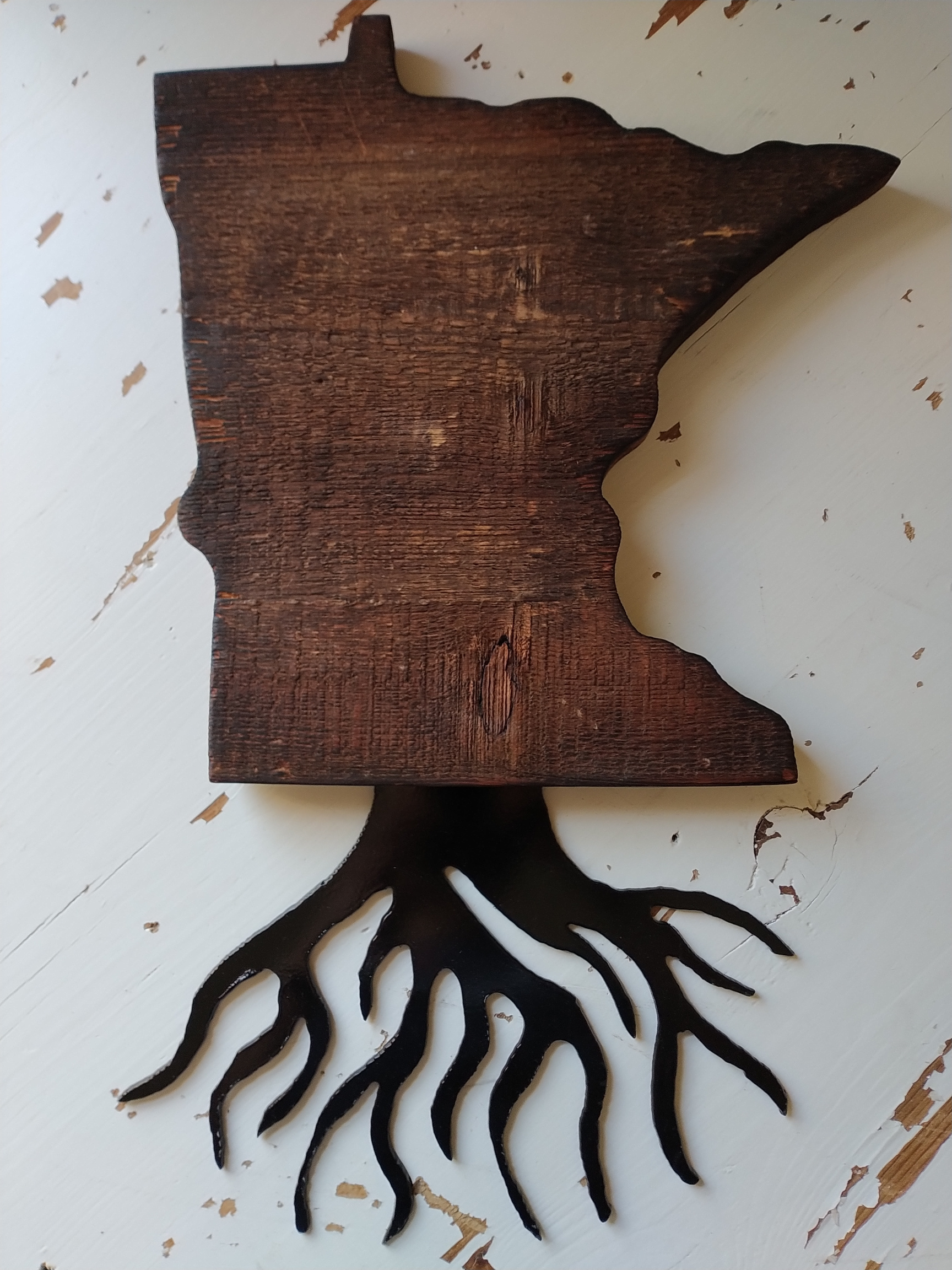
I am rooted in Minnesota. This art hangs in my home office. (Minnesota Prairie Roots copyrighted file photo)
Why am I sharing this with you today? Because of Minnesota Governor Tim Walz, now the vice presidential candidate on the DFL ticket. He lived in Mankato, where he worked as a social studies teacher and football coach at Mankato West High School. Walz, likely unfamiliar to most Americans up until recently, has put our state, specifically Mankato, on the map. As a life-long Minnesotan, I am proud to see my state, considered by many to be fly-over land, in the spotlight. No matter your political leanings, such publicity is good for Minnesota.
I’ve only attended the Minnesota State Fair a few times in my life. This mug came from my father-in-law’s collection. The State Fair started yesterday. (Minnesota Prairie Roots copyrighted file photo)
Like Walz, flannel shirts hang in my closet. I am wearing one as I write on this cool August morning. Flannel truly is a Minnesota thing, no matter political affiliations. We like our hotdishes (not “casseroles”) and the Minnesota State Fair (although not me; too many people), our cabins Up North. We claim musicians Bob Dylan and Prince, the Coen Brothers (of “Fargo” movie fame) and other notables like vice presidents Hubert Humphrey and Walter Mondale.
The grain silos are a massive work of public art. (Minnesota Prairie Roots copyrighted photo November 2023)
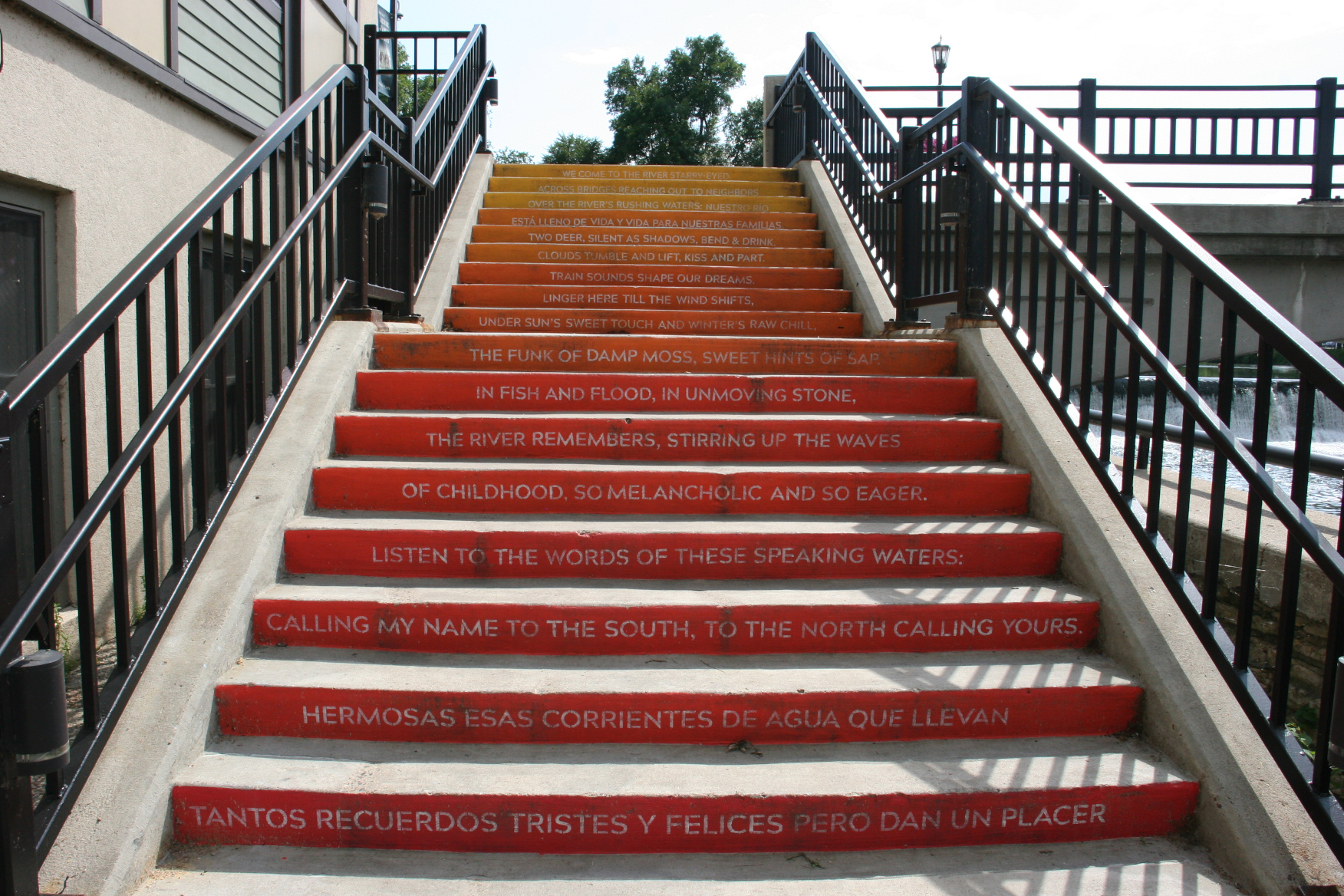
I cannot imagine living elsewhere, even if I don’t especially like the frigid cold and snow of a Minnesota winter. I loved winter as a Redwood County farm girl. Minnesota is home. I live 40 miles northeast of Mankato, a city originally inhabited by the Dakota. Mankato is a river town, a college town, a regional shopping hub, a community with a rich (but not always “good”) history. It is home to many creatives. I’ve been part of that with poetry showcased on signs through the Mankato Poetry Walk and Ride.
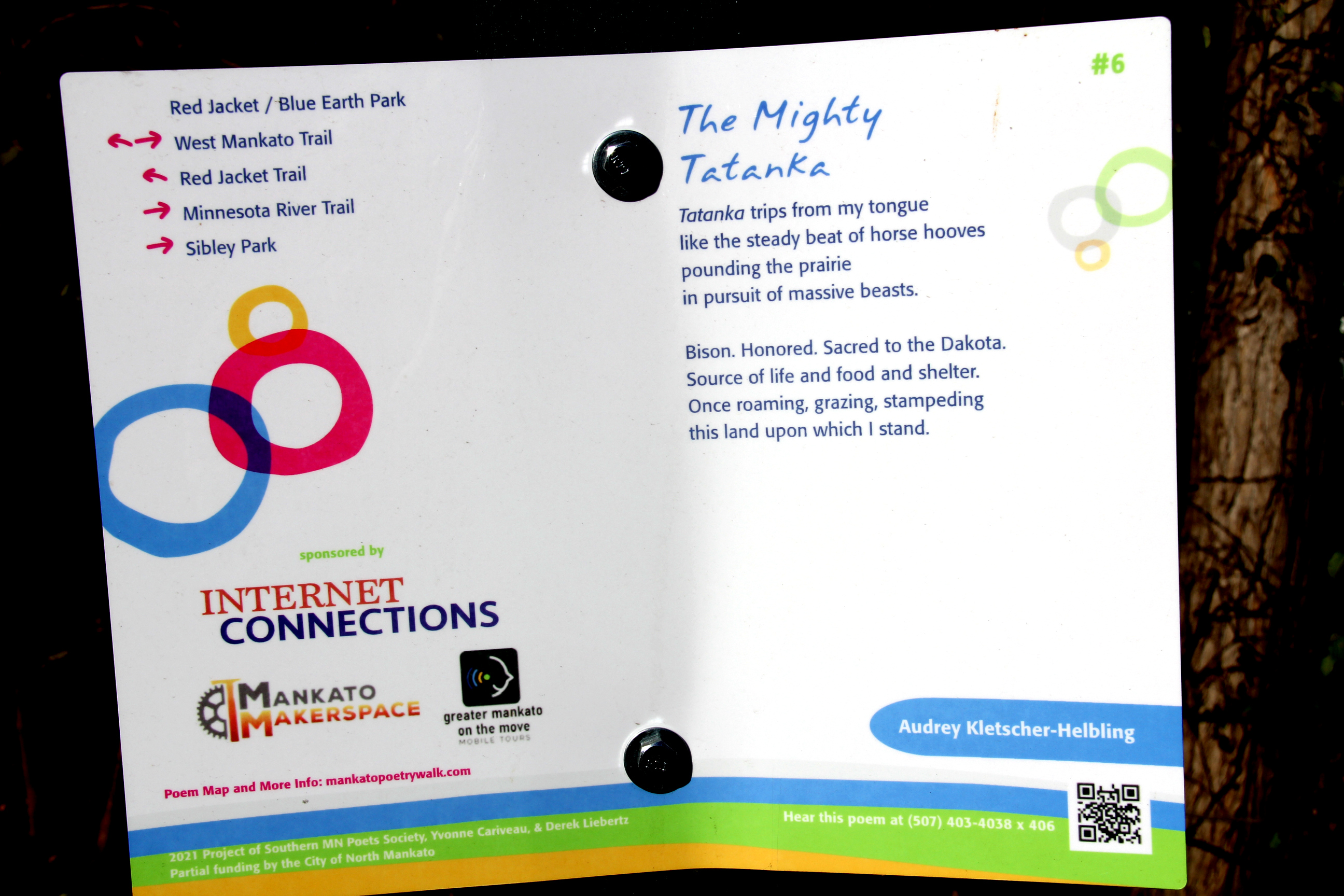
My latest poem, “The Mighty Tatanka,” posted along the West Mankato Trail near West Mankato High School. (Minnesota Prairie Roots copyrighted photo November 2023)
My connection with, and appreciation of, Mankato all started in that fourth floor dorm room with a roommate who was nothing like me. Despite our differences, we connected, forged a strong friendship, together grew and matured. We were on the cusp of our lives. Young. Open to new ideas and learning. The future held endless possibilities. For me, the 17-year-old with the canary yellow bike. And for Rhonda with her stereo system.
Turek’s Auction Service, 303 Montgomery Ave. S.E. (Highway 21), Montgomery, has been “serving Minnesota since 1958.”(Minnesota Prairie Roots edited and copyrighted file photo February 2014)
AUCTIONS ARE PART of my rural DNA. As such, a photo I took ten years ago of an auction barn on the edge of Montgomery, Minnesota, inspired me to write a poem. I entered “Sunday Afternoon at the Auction Barn” in the 2014 The Talking Stick writing competition. It earned second place in poetry and publication in The Talking Stick 23, Symmetry, a literary journal published by the northern Minnesota-based Jackpine Writers’ Bloc. It also earned the praise of noted Minnesota poet and poetry judge Margaret Hasse. She’s authored six full-length collections of poetry.
First, my poem:
Sunday Afternoon at the Auction Barn
Shoulder brushes shoulder as bidders settle onto plank benches
in the tightness of the arched roof auction barn,
oil stains shadowing the cement beneath their soles,
where a farmer once greased wheel bearings on his Case tractor.
The auctioneer chants in a steady cadence
that mesmerizes, sways the faithful fellowship
to raise hands, nod heads, tip bidding cards
in reverent respect of an aged rural liturgy.
Red Wing crock, cane back rocker, a Jacob’s ladder quilt,
goods of yesteryear coveted by those who commune here,
sipping steaming black coffee from Styrofoam cups.
In her critique of my poem, Hasse wrote:
“I loved how you turned a humdrum occasion of bidding on antiques in an old barn into a closely observed and luminous occasion. The writer John Ciiardi once wrote that close and careful observation can “leak a ghost.” The surprise of your poem was the elevation of a commercial or material enterprise into a spiritual gathering—with a fellowship, liturgy, reverent respect, and people who commune. The ending—visual and concrete—was just right. The poet Franklin Brainerd wrote a poem something to the effect, “in a world of crystal goblets, I come with my paper cup.” There’s something both unpretentious and appealing about “sipping steaming black coffee from Styrofoam cups.”
Hasse’s comment reflects that she understands the spirit and spirituality of my poem. It was a joy to write. As I recall, the words flowed easily from my brain to keyboard to screen as I visualized bidders inside that auction barn, like congregants in a church. When poetry works like that, it’s magical and fulfilling and beyond beautiful.
POETRY. Say that singular word and most people likely stop listening. But listening is precisely what you should do when you hear “poetry.”
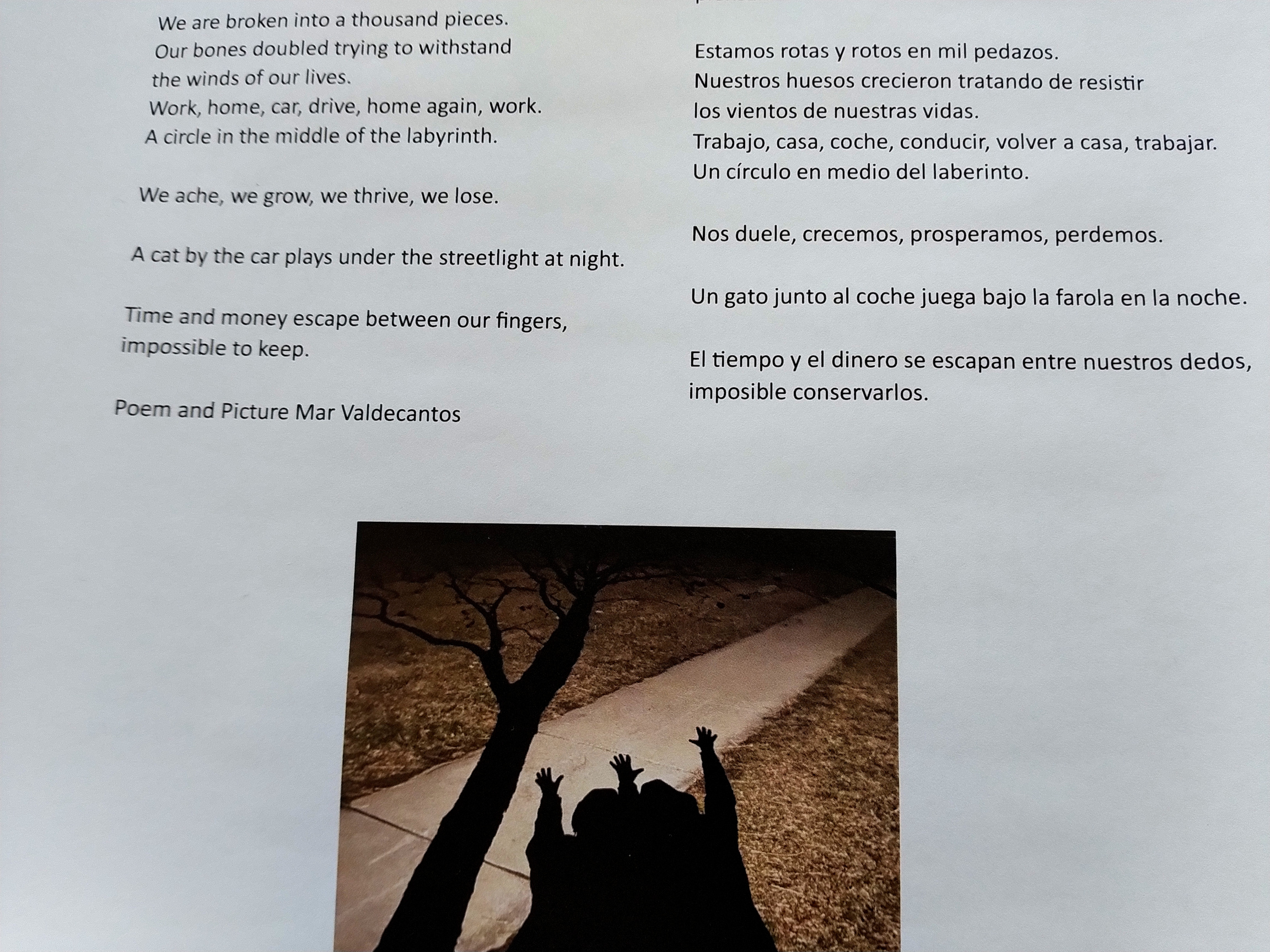
An original poem and photo by Mar Valdecantos, director of Rice County Neighbors United. (Minnesota Prairie Roots copyrighted file photo April 2024)
Poems are meant to be read aloud, to be heard. I didn’t always understand that. But when I started attending and participating in poetry readings many years ago, I realized that poems, like music, need to be vocalized to fully experience them.
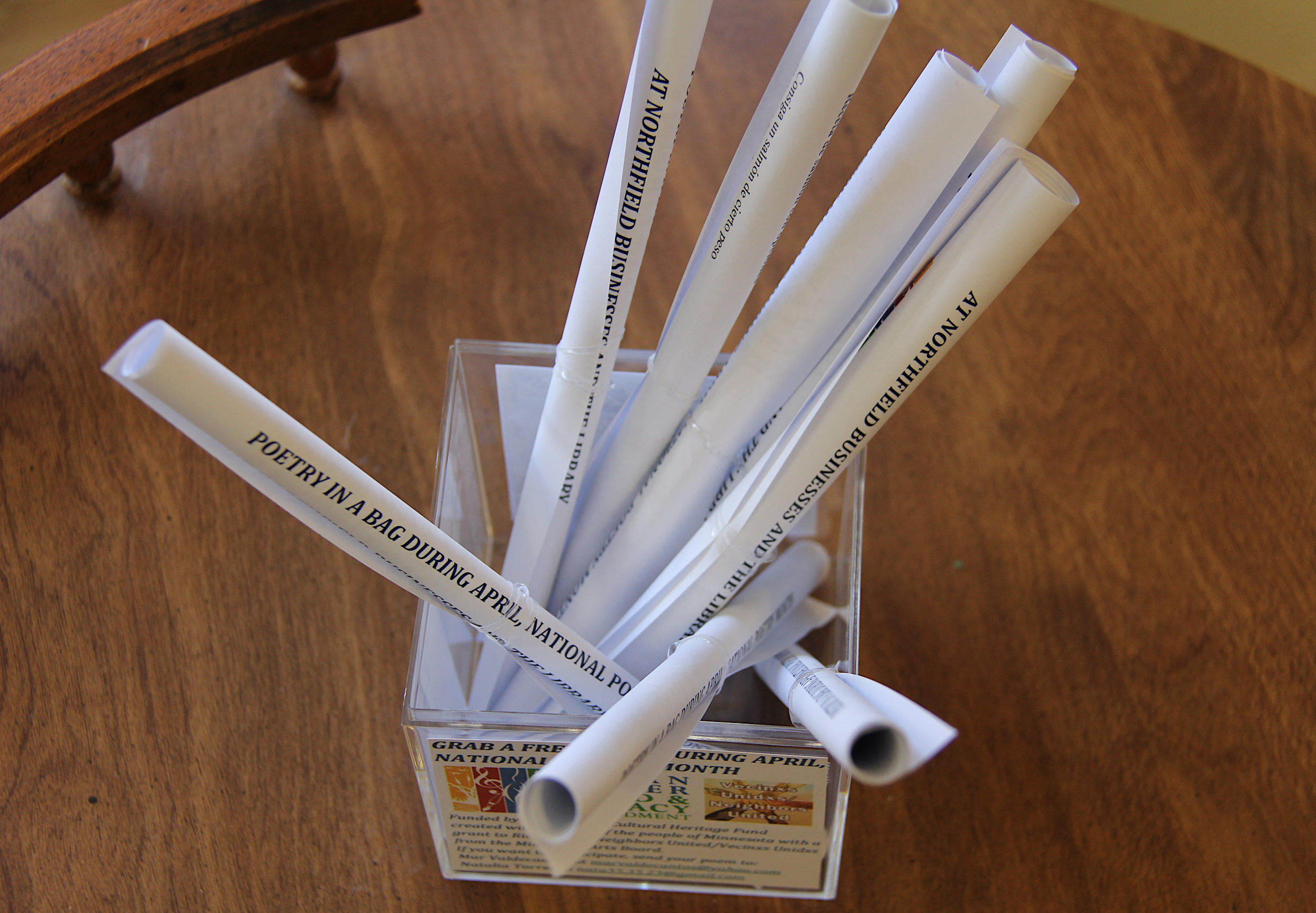
Rolled up poems were boxed (not bagged) and placed at local businesses. (Minnesota Prairie Roots copyrighted file photo April 2024)
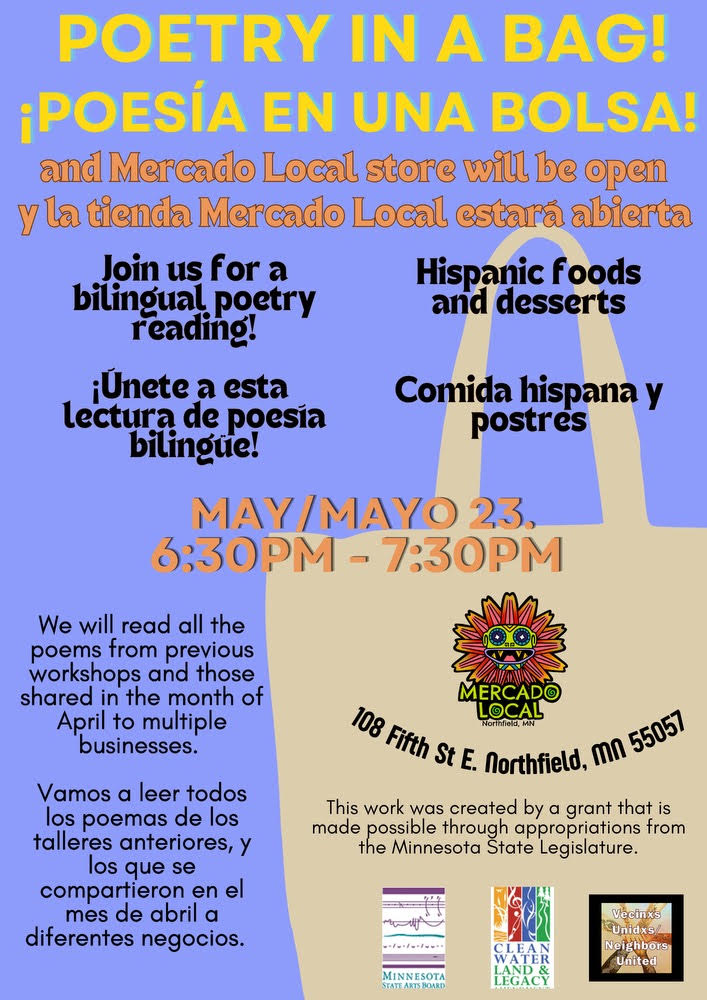
Thursday evening, May 23, I will be among poets and poetry lovers participating in a community poetry reading at Mercado Local, 108 Fifth St. E., Northfield, to celebrate “Poetry in a Bag!” Through this project of Rice County Neighbors United, original and favorite poems were collected, printed, then distributed to area businesses during National Poetry Month in April and into May. Customers were welcome to take a rolled up poem printed in both English and Spanish.
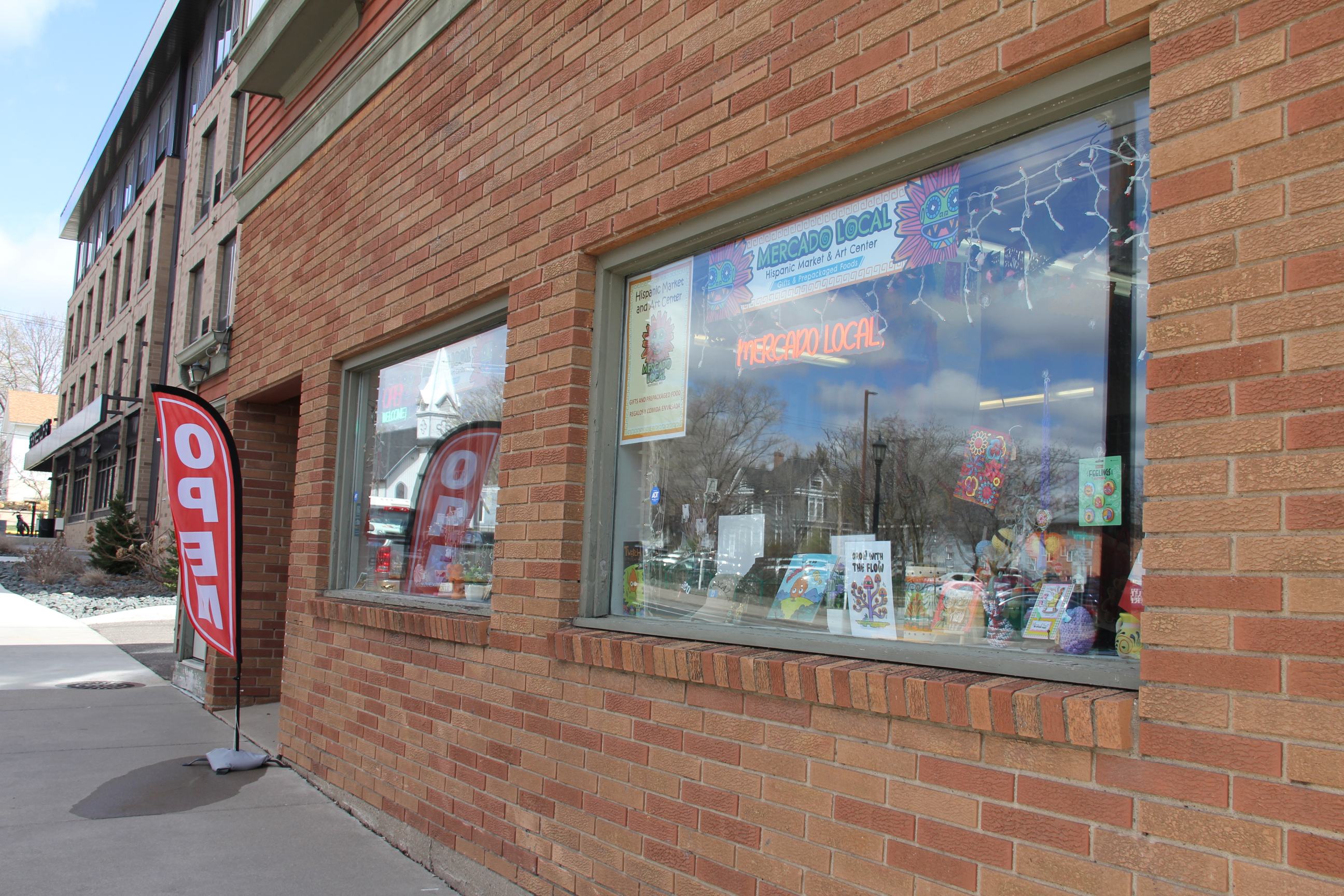
Mercado Local, located just off Division Street in Northfield. (Minnesota Prairie Roots copyrighted photo April 2024)
So this bilingual project is as much cultural as culture. That’s part of the mission of RCNU—to connect cultures, to increase visibility of immigrants and refugees in the community, to empower them. Mercado Local serves as a home base for the advocacy organization with its store, art center and community room.
A sampling of the merchandise inside the Mercado Local store. (Minnesota Prairie Roots copyrighted file photo April 2024)
The store will be open during Thursday’s 6:30-7:30 pm gathering in the community space. I’ll be there reading the six original, previously-published poems I submitted for “Poetry in a Bag!” Likewise Northfield poets will read their poems. It’s certain to be a connective experience.
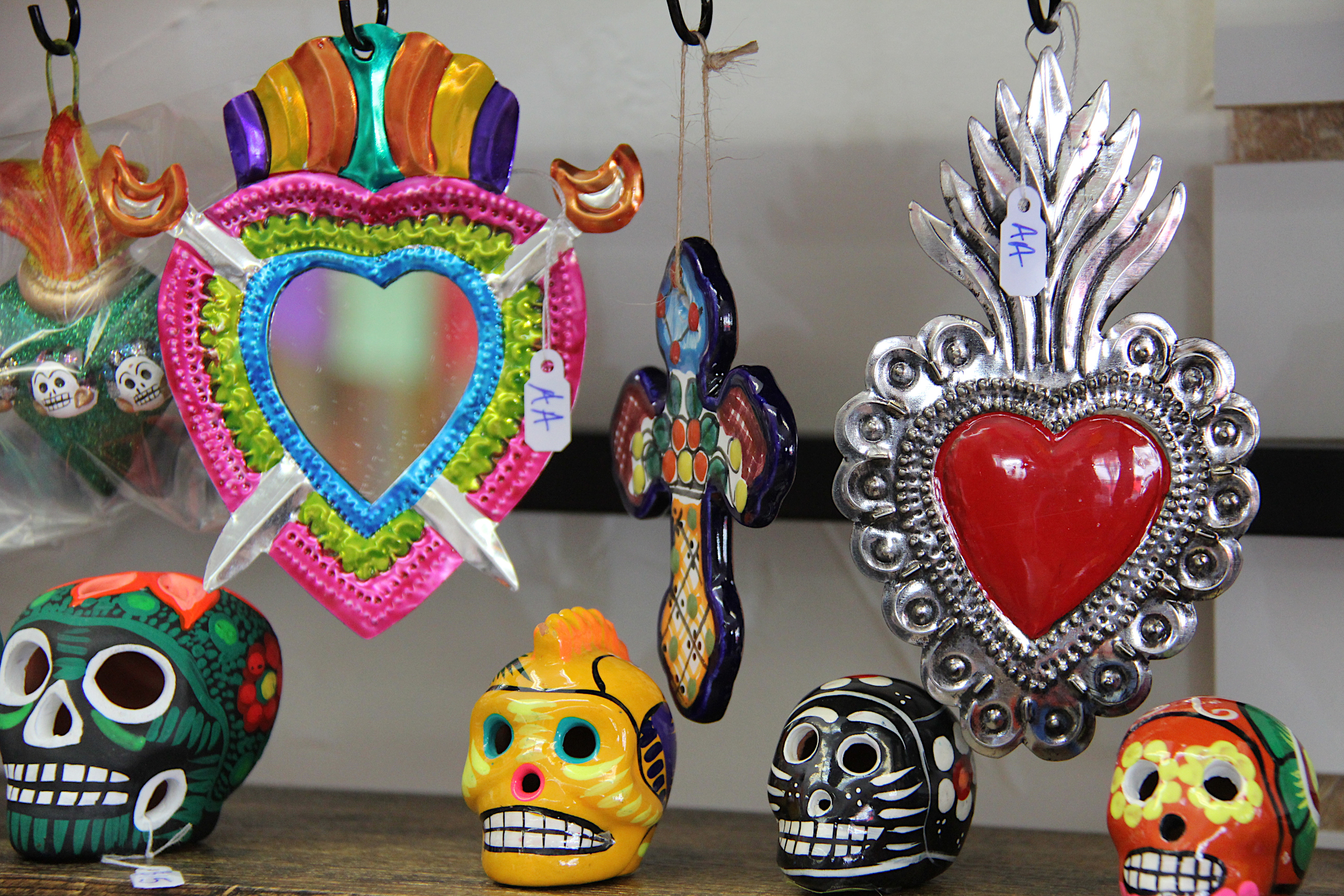
For sale in the store at Mercado Local. (Minnesota Prairie Roots copyrighted file photo April 2024)
The free public event also features Hispanic foods and desserts, a sure way to bring people together. Already “Poetry in a Bag!” has done that personally, connecting me with Northfield poets previously unknown to me. I expect to make more new friends on Thursday when I read poetry, listen to poetry, sample Hispanic foods and immerse myself in a culture different than mine.
Plenty of offerings inside the Mercado Local store. (Minnesota Prairie Roots copyrighted file photo April 2024)
Two cultures connecting via words and food. Now that’s poetry to my ears, food for my soul.
HER POEMS SING with the rhythm of a writer closely connected to land, heritage and history. She is Gwen Nell Westerman of Mankato, Minnesota poet laureate and author of Songs, Blood Deep, published by Duluth-based Holy Cow! Press.
Of Dakota and Cherokee heritage, Westerman honors her roots with poems that reflect a deep cultural appreciation for the natural world. The water. The sky. The seasons. The earth. The birds and animals. They are all there in her writing, in language that is down-to-earth descriptive. Readers can hear the birdsong, feel the breeze, see the morning light… That she pens nature poems mostly about the land of my heart—fields and prairie—endears me even more to her poetry.
This slim volume of collected poems is divided into seasons of the year, each chapter title written in the Dakota language. The book features multiple languages—Dakota, Cherokee, Spanish and English. That adds to its depth, showing that, no matter the language we speak, write or read, we are valued.
This silo mural in downtown Mankato celebrates the cultural diversity of the region, including the Dakota. (Minnesota Prairie Roots copyrighted photo November 2023)
Westerman clearly values her Native heritage, how lessons and stories have been passed to her through generations of women, especially. Songs, blood deep. In her poem “First Song,” she shares a lesson her grandmother taught her about the importance of sharing. After reading that thought-provoking poem, I considered how much better this world would be if we all focused on the singular act of sharing.
The Dakota 38 Memorial at Reconciliation Park in downtown Mankato lists the names of the 38 Dakota men hung at this site on December 26, 1862. (Minnesota Prairie Roots copyrighted photo November 2023)
This poet, who is also a gifted textile artist (creator of quilts), wraps us in her words. In the season of waniyetu, her poetry turns more reflective and introspective, as one would expect in winter. She writes of family, injustices and more. “Song for the Generations: December 26” is particularly moving as that date in history references the mass execution of 38 Dakota sentenced to death in 1862 and hung in Mankato. Westerman writes of rising and remembering, of singing and prayer. It’s a truly honorable poem that sings of sorrow and strength.
Her poems remind us that this land of which she writes was home first to Indigenous Peoples. Westerman writes of a state park in New Ulm, the sacred Jeffers Petroglyphs and Fort Snelling, where Dakota were imprisoned after the U.S.-Dakota War of 1862 and before their exile from Minnesota. The name of our state traces to Mni Sota Makoce, Dakota for “the land where the water reflects the sky.” It’s included in Westerman’s poetry.
I appreciate poems that counter the one-sided history I was taught. I appreciate Westerman’s style of writing that is gentle, yet strong, in spirit. Truthful in a way that feels forgiving and healing.
In the all of these poems, I read refrains of gratitude for the natural world, gratitude for heritage and gratitude for this place we share. We sang. We sing. Songs, blood deep.
FYI: Songs, Blood Deep, is a nominee for the 2024 Minnesota Book Award in poetry. The winner will be announced May 7. This is Westerman’s second poetry book. Her first: Follow the Blackbirds. In addition to writing poetry and creating quilts, Westerman teaches English, Humanities and Creative Writing at Minnesota State University, Mankato.
Pick a poem from a box at Mercado Local (and other locations) as part of a poetry initiative rooted in Northfield. (Minnesota Prairie Roots copyrighted photo April 2024)
PRINTED POETRY PLACED in public pleases me. Pleases me because putting poetry out there places this literary art into hands that might not otherwise pick poetry. I mean, if we’re honest, how often do we purchase a poetry book or pull a poetry volume from the 811. section of the library? Probably not all that often.
Among colorful merchandise sold by immigrant vendors at Mercado Local in Northfield. (Minnesota Prairie Roots copyrighted photo April 2024)
That is why I love the latest poetry project in my area—“Poem in a Bag.” Rice County Neighbors United, an advocacy group for low income and immigrant community members, recently launched this project in Northfield, a city rich in the arts, including poetry. Mar Valdecantos, RCNU advocate director and also a poet, writer, visual artist and art teacher, is leading this endeavor.
Grab a poetry scroll from the box. (Minnesota Prairie Roots copyrighted photo April 2024)
The concept is simple. Collect, translate, print and place poems inside a box (not a bag) in locations accessible to the public. The poetry, both original and favorites, is paired with local original art, including that of Valdecantos. Anyone can grab a poetry scroll and have instant access to literary and visual art.
Northfield is home to a sizeable Hispanic population. Immigrant vendors sell their art and more at Mercado Local. (Minnesota Prairie Roots copyrighted photo April 2024)
But there’s more. The poems are printed in Spanish and in English. I can’t read Spanish. (My second daughter can; she’s a former Spanish medical interpreter and translator.) That doesn’t matter. What matters is that each poem is printed in two languages, reflecting, respecting and celebrating cultural diversity in our region of southern Minnesota.
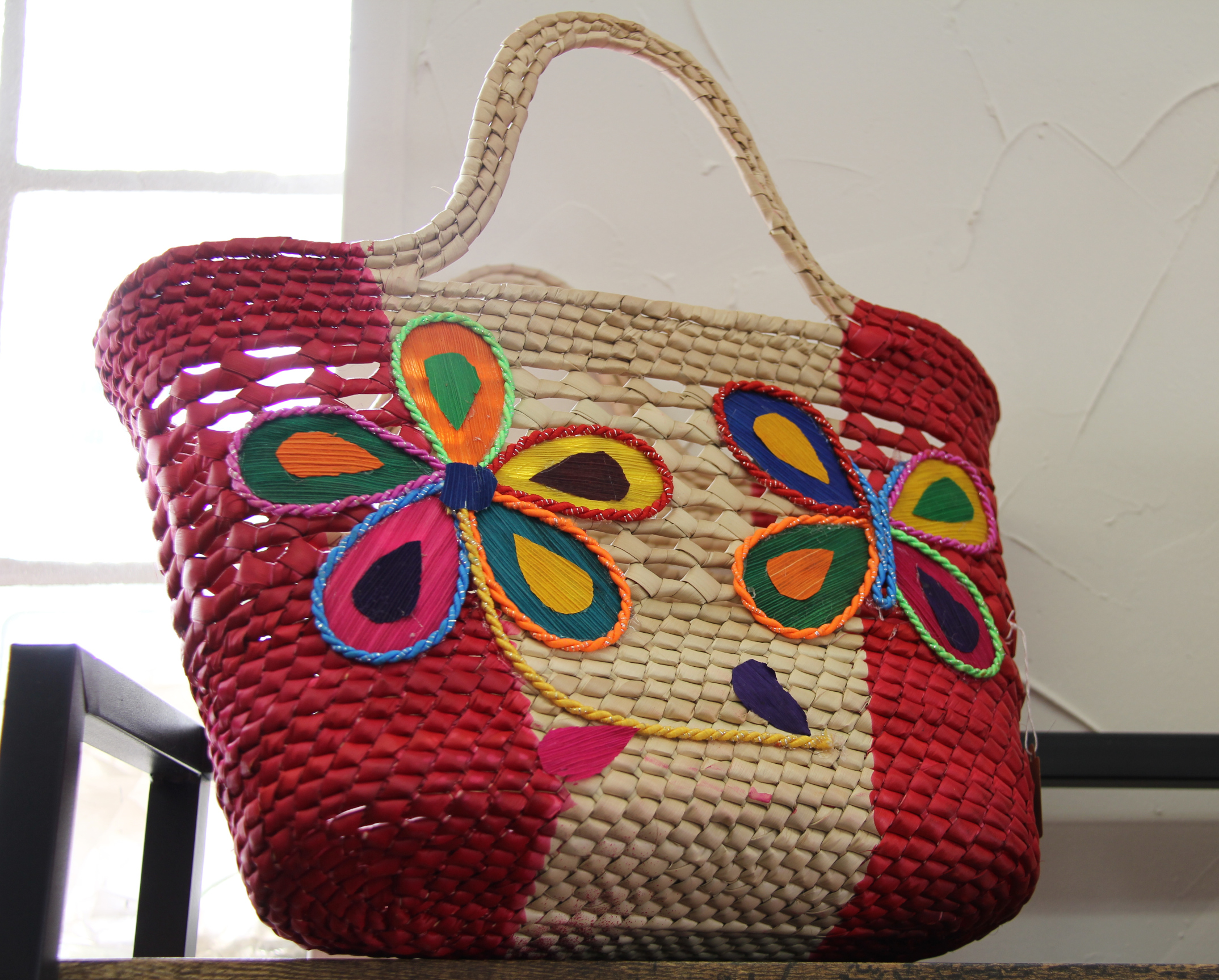
The merchandise inside Mercado Local, including this woven tote, is a colorful, visual delight. (Minnesota Prairie Roots copyrighted photo April 2024)
Rice County Neighbors United aims to raise cultural awareness via events and activities like “Poem in a Bag,” funded by a grant from the Minnesota Arts & Cultural Heritage Fund. The arts have always been a way to connect peoples, to communicate, to inspire and more. Whatever our differences, art is universal, linking us in our humanity.
A portion of the poem, “Streetlight at Night,” and art by Mar Valdecantos. All poems are printed in Spanish and in English. (Minnesota Prairie Roots copyrighted photo April 2024)
Poems submitted for this National Poetry Month project cover a range of topics, some specific, others broader. Sunrise, empanadas, children, cancer, loneliness, life, winter, salmon, even a dead mouse, are among the subjects of original poems. I’ve lent several poems for the project.
More cultural offerings at Mercado Local. (Minnesota Prairie Roots copyrighted photo April 2024)
And then there is the poetry of renowned poets—Latin American, Cuban, American—selected and submitted as favorite poems. Nature, the mother-child relationship, a white rose and service to others theme these. They, too, are accompanied by art.
Mercado Local is located in the heart of downtown Northfield, just off Division Street. (Minnesota Prairie Roots copyrighted photo April 2024)
Art in all its forms is powerful. Rice County Neighbors United recognizes that, celebrating creativity and entrepreneurship at Mercado Local, a marketplace for immigrant vendors and also an art center, community room and education space located at 108 5th Street East in Northfield.
Mercado Local explodes with color. The “Poem in a Bag” box is on the cashier’s counter. (Minnesota Prairie Roots copyrighted photo April 2024)
“Poem in a Bag” poems are available at Mercado Local and at other Northfield businesses (currently Content Bookstore, Imminent Brewery and radio station KYMN) and at the Northfield Public Library. Valdecantos aims to get poetry boxes into more Northfield businesses. In Faribault, “Poem in a Bag” can be found at Books on Central, a used bookshop run by the Rice County Area United Way.
This is an ambitious undertaking, one Valdecantos hopes to repeat next April during National Poetry Month. She intends to extend this year’s “Poem in a Bag” into May with a poetry reading set for 6:30-8 pm Thursday, May 23, in the community room/art space at Mercado Local. I appreciate all of this. To place poetry in public places, to use art to connect cultures, is truly a welcoming, neighborly gift to our culturally diverse communities.
Just-published, a 116-page anthology featuring the poetry of five Northfield, Minnesota, poets. (Minnesota Prairie Roots copyrighted photo April 2024)
ON AN APRIL AFTERNOON when gray skies reverberated thunder and unleashed sheets of rain upon parched southern Minnesota, I read their words, table-side lamp pooling light onto pages. It felt right, to cozy under a fleece throw, to immerse myself in the poetry of Becky Boling, Heather Candels, D.E. Green, Steve McCown and Julie A. Ryan on a day meant for sheltering indoors.
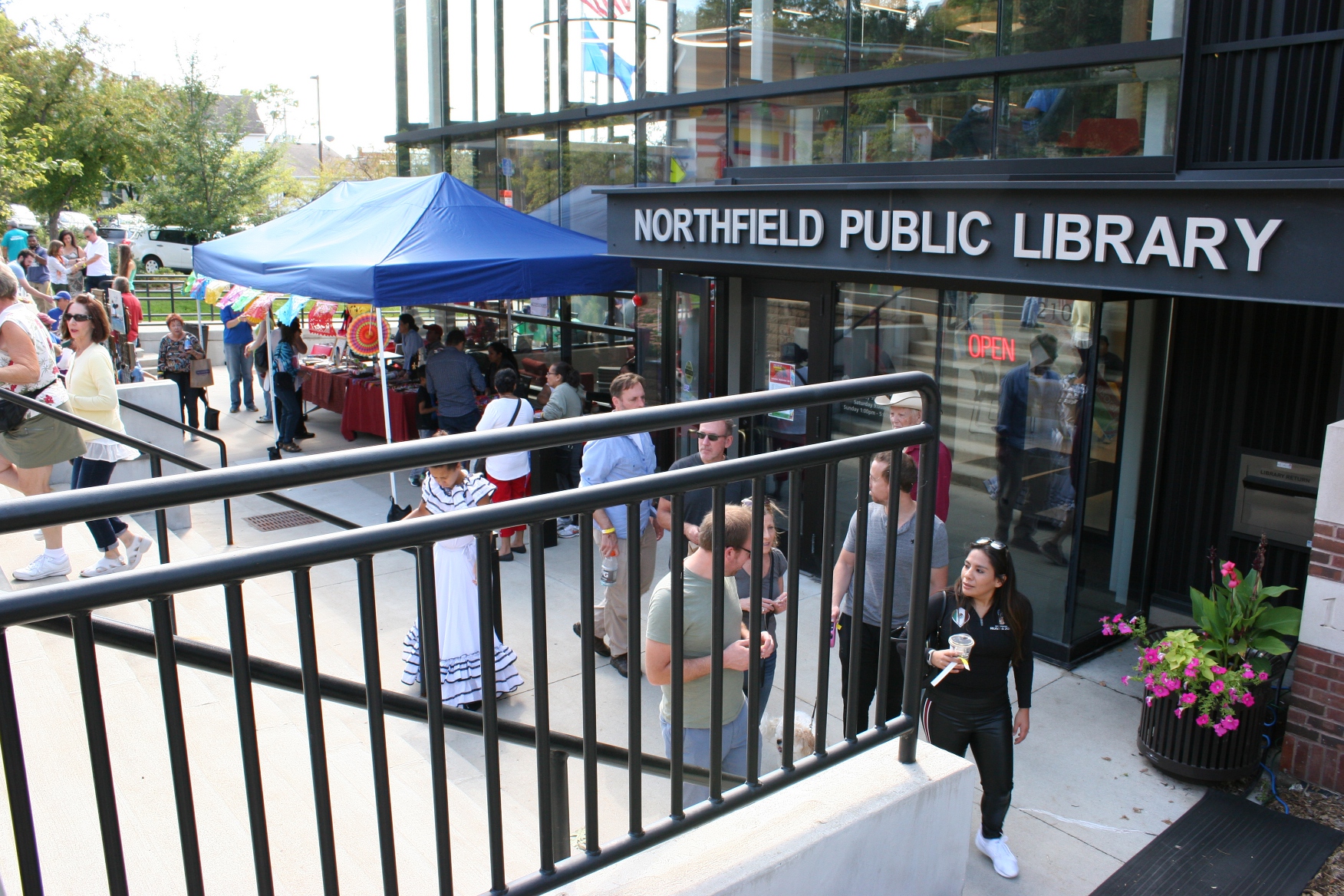
Outside the Northfield Public Library during a 2019 celebration of Hispanic Heritage Month. (Minnesota Prairie Roots copyrighted file photo September 2019)
Antiques on 4th in Cannon Falls. (Minnesota Prairie Roots copyrighted file photo October 2021)
Youthful memories of grandmothers, homemade ice cream, small towns as they once were and much more flow through the pages. At times I feel as if I’m reading about “the dusty excess of nostalgia” of my life, as Steve McCown writes “In an Antique Store.” His mention of a Tom Thumb toy cash register sends me back to a long ago Christmas. His poems are sparse, yet fully-descriptive in the way of language carefully-culled by a man who taught high school and college English.
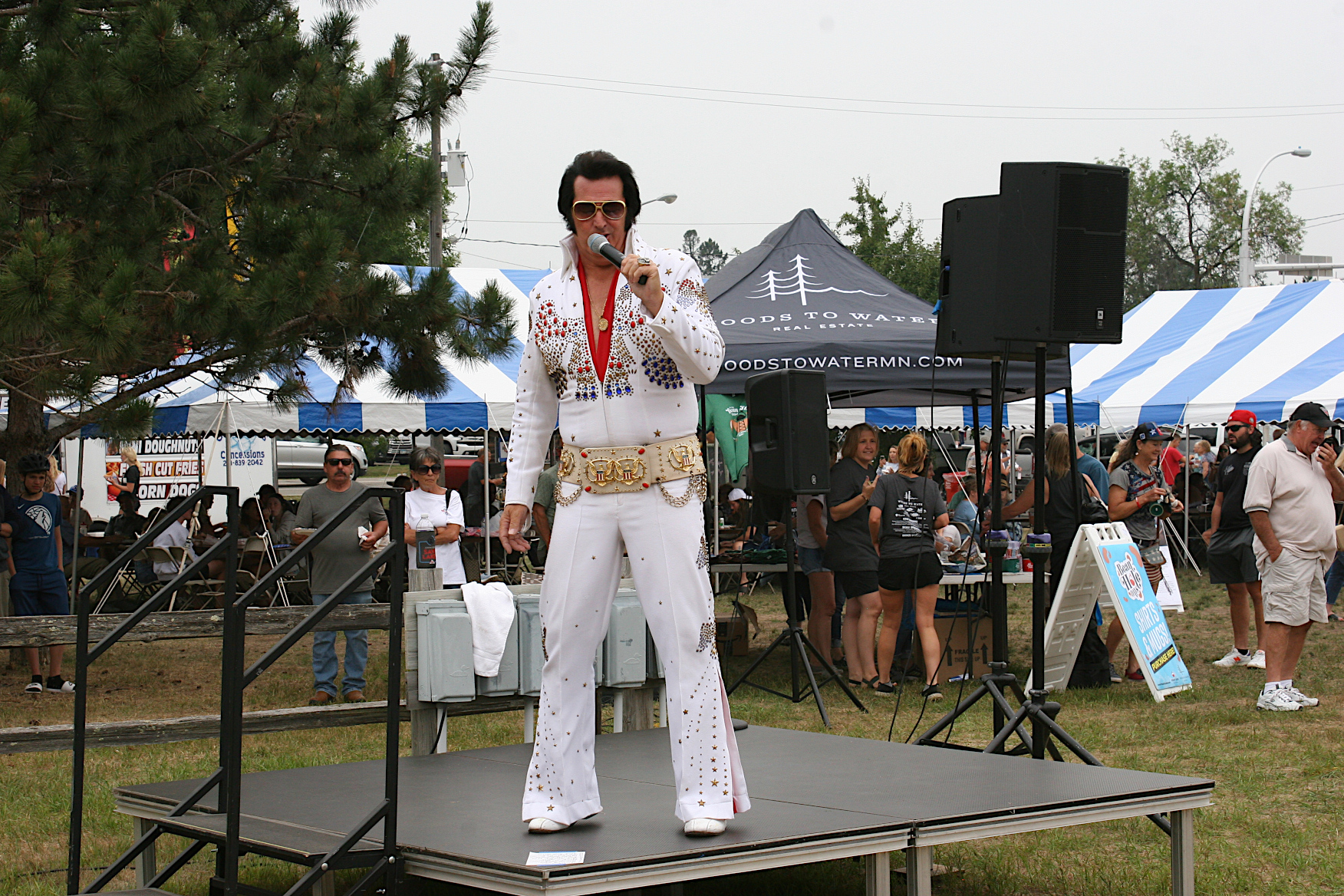
An Elvis impersonator performs during Bean Hole Days in Pequot Lakes. (Minnesota Prairie Roots copyrighted file photo July 2021)
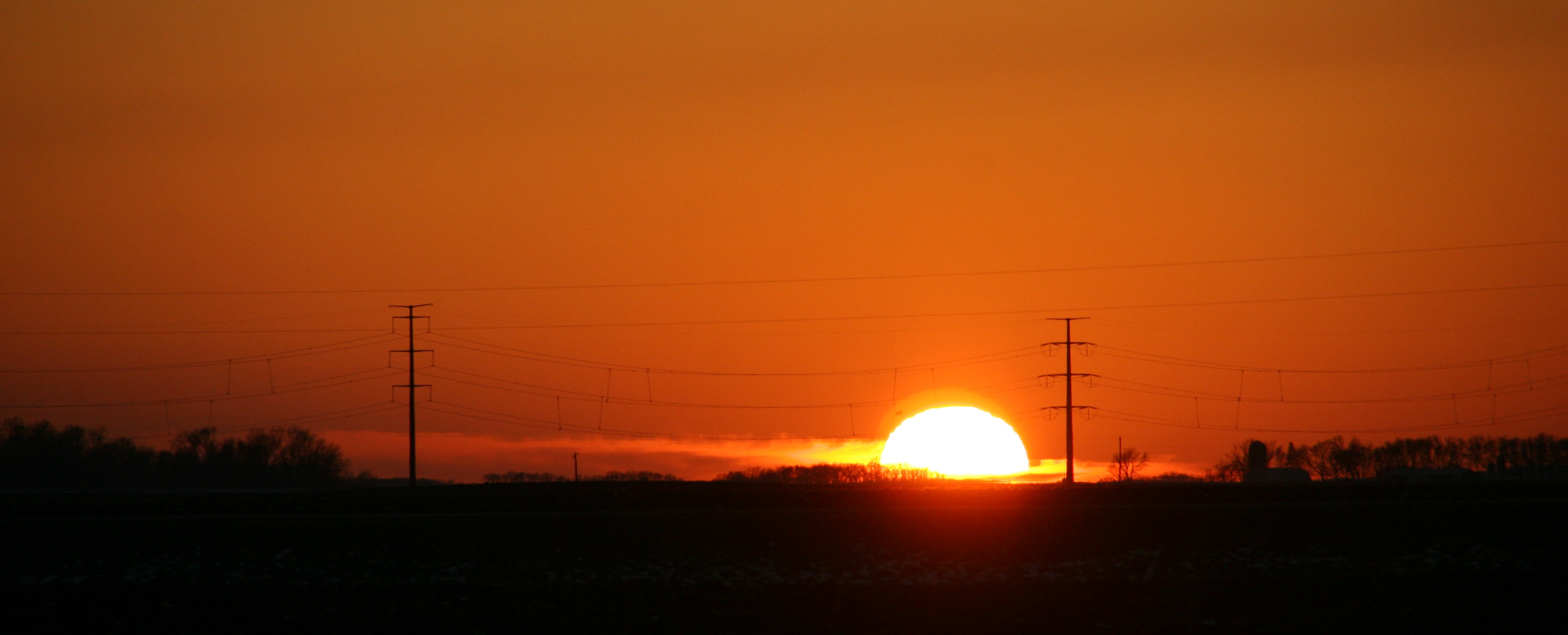
Likewise, Julie A. Ryan, has me reminiscing with “Candy Cigarettes,” the chalky white sticks of fake cigarettes that I, too, “smoked” in the 1960s. Ryan paints with her words, revealing the visual artist side of her creativity. She mentions Van Gogh and painting and also leans into music within her poetry. Especially powerful is her poem, “’68 Comeback Special,” in which she shares about a near-death experience, of almost meeting Elvis. Her final poem, “We Look West,” titles the book, summarizing well the transition of life from sunrise/birth to sunset/death. That themes the anthology, the movement of life from east to west.
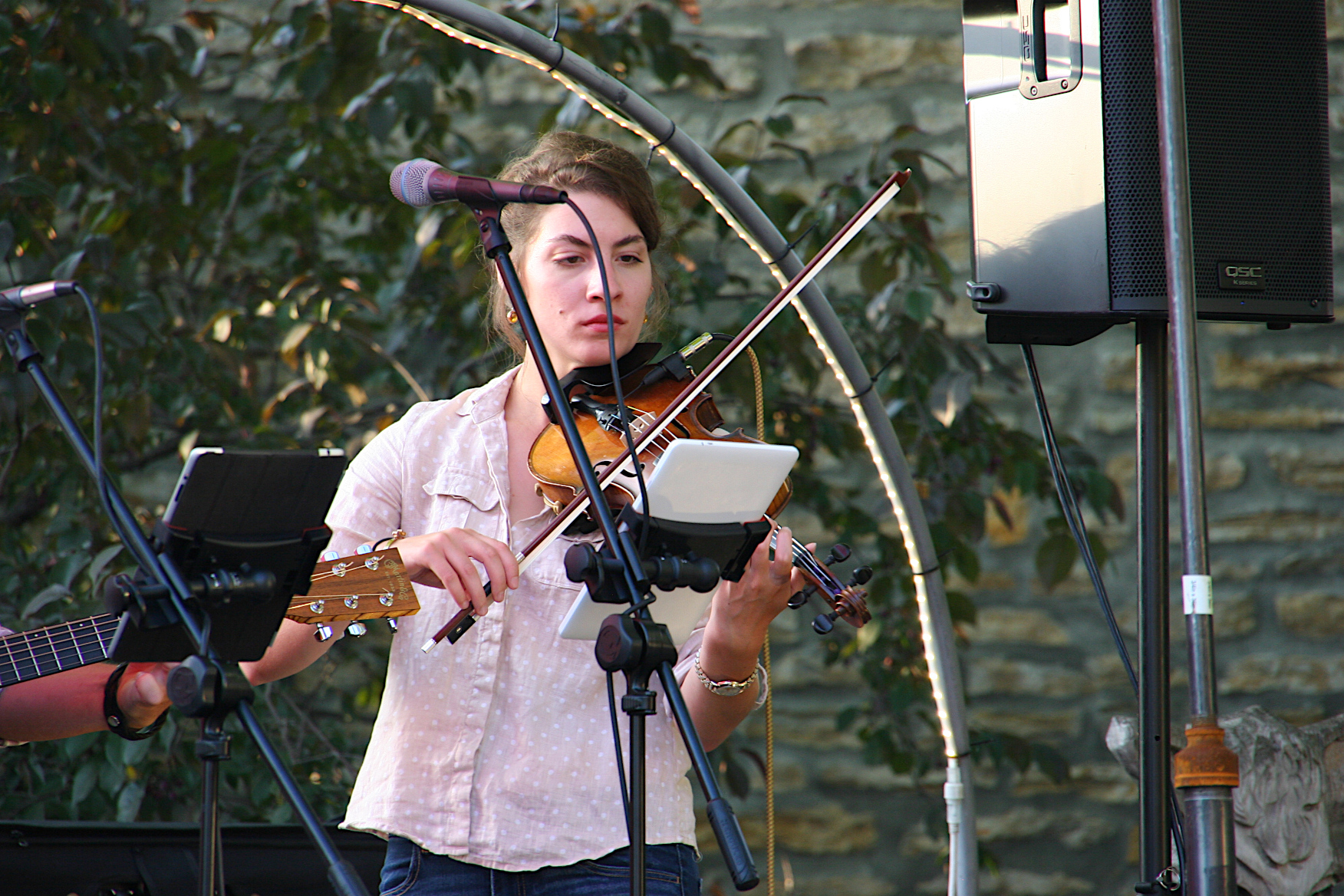
Performing at The Contented Cow in downtown Northfield. (Minnesota Prairie Roots copyrighted file photo August 2020)
In her poetry, Becky Boling moves readers through life from playground monkey bars to motherhood to contemplating old age. I am particularly drawn to “Violin Lesson,” in which Boling observes her young son learning to play the violin. From a deep cushioned armchair, she is caught up in the artistry, the beauty, the movement as am I through her observational writing. And then she closes with the emotional thought of not wanting the moment to end, of understanding that some day she will let her son go. As the mother of three, I feel her sadness at the lesson completed. I expect in her 36 years of teaching Spanish and Liberal Arts at Carleton College in Northfield, Boling has observed the movement of young people whose parents let them go to learn and grow their independence.
A southwestern Minnesota prairie sunset between Redwood Falls and Morgan. (Minnesota Prairie Roots copyrighted file photo)
D.E. Green, who taught English for 33 years at Augsburg University, has likely seen the same. His poems reflect life and love. Particularly endearing is his poem, “For Becky: Love Sonnet after Neruda,” written for Boling, to whom he’s married. (They also share the position of interim co-poet laureates in Northfield.) His appreciation for and study of Shakespeare show in this love poem, as touching as any love poem I’ve read. “I love you unthinkingly/like a deep breath, a careless yawn, a sigh,” he writes. Beautiful. Green also reflects on his life lived “good enough” and on life during retirement. His poetry should be required reading for anyone closer to west than to east.
My mom lived in a care center, confined to a wheelchair in the end years of her life. I took this photo of her hands about a year before her January 2022 death. (Minnesota Prairie Roots copyrighted file photo December 2020)
Heather Candels, too, reflects on her passing life in a poem aptly titled “Passing.” But it is “Situation Comedy,” a poem about a 104-year-old woman living in a care center, which elicits an especially emotional reaction from me. I can picture the centenarian shoving her walker (as my octogenarian mom did) to the dining room, then sitting with Grace and Lloyd, whom she secretly calls Grease and Lard. “Something has to be funny about all this,” Candels writes. The former English teacher is a gifted storyteller who brings unexpected emotional lines to her writing.
In “A Sign,” Heather Candels writes about racial injustice via white lilies of the valley and “their colonies spreading underground/roots nurtured by the rich dark soil…” This poem alone is reason enough to buy this anthology. Photo taken in Madison, Wisconsin. (Minnesota Prairie Roots copyrighted file photo September 2020)
And then there are the poems that touch on tough topics, on social issues, on disparities. Climate change. Evidence in the Nuremberg Trials. Racial injustice. Poetry doesn’t right life. But it opens our minds, causes us to think, reflect, perhaps take positive action as we move from east to west.
Mention poetry and many people likely stop listening. In a way, I understand. To their ears, they hear the stuffy, rhyming, difficult poems of yesteryear. The poems that made no sense to many of us. The poems that had to be read as part of a high school English class.
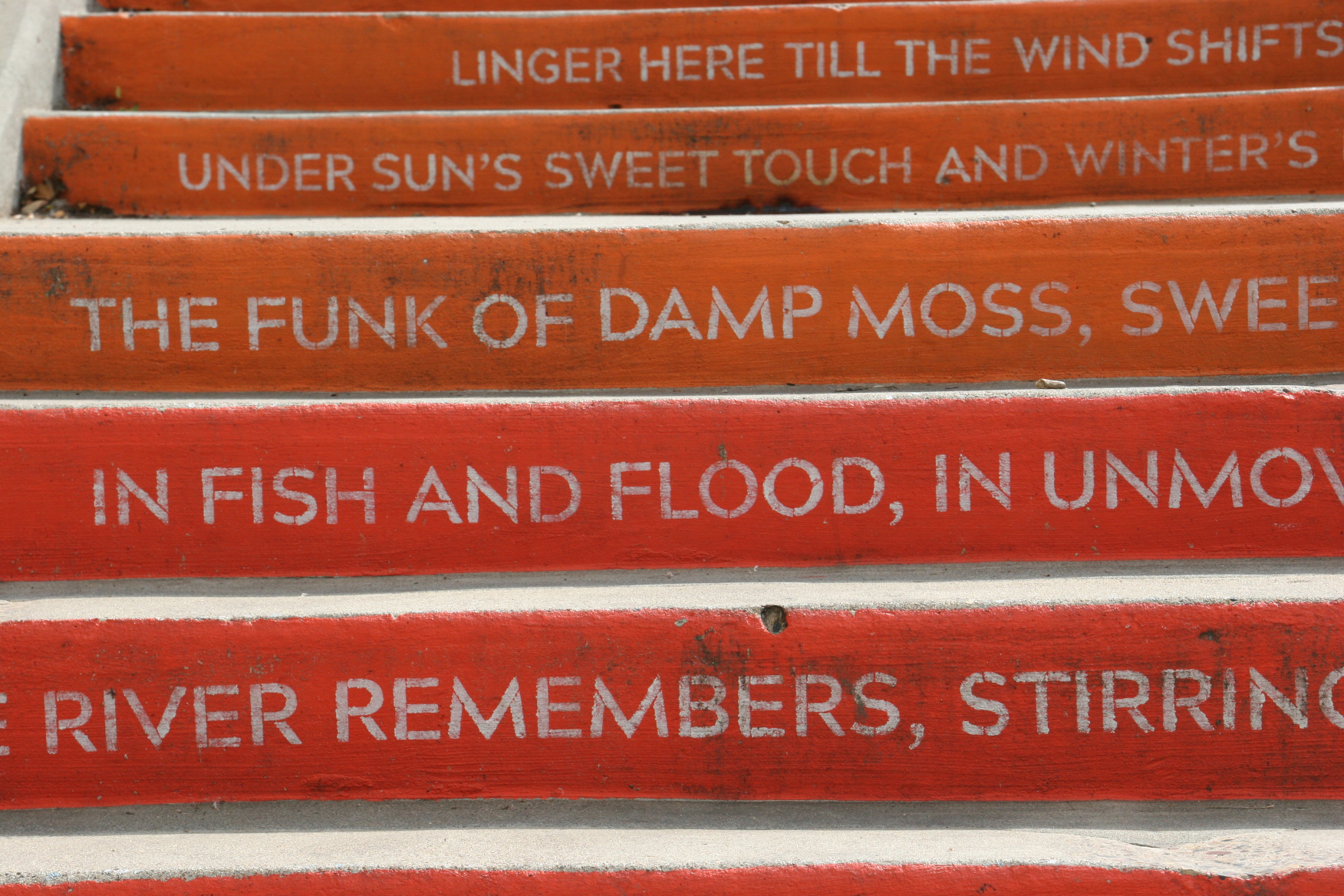
A close-up of lines in the poem steps along the River Walk in downtown Northfield. (Minnesota Prairie Roots copyrighted file photo 2022)
While I’m not privy to how poetry is taught today, I do recognize that it’s, overall, much more approachable, at least in Minnesota. We are home to a talented array of poets with their writing published not only in anthologies and literary journals, but also presented in widely-accessible, public ways.
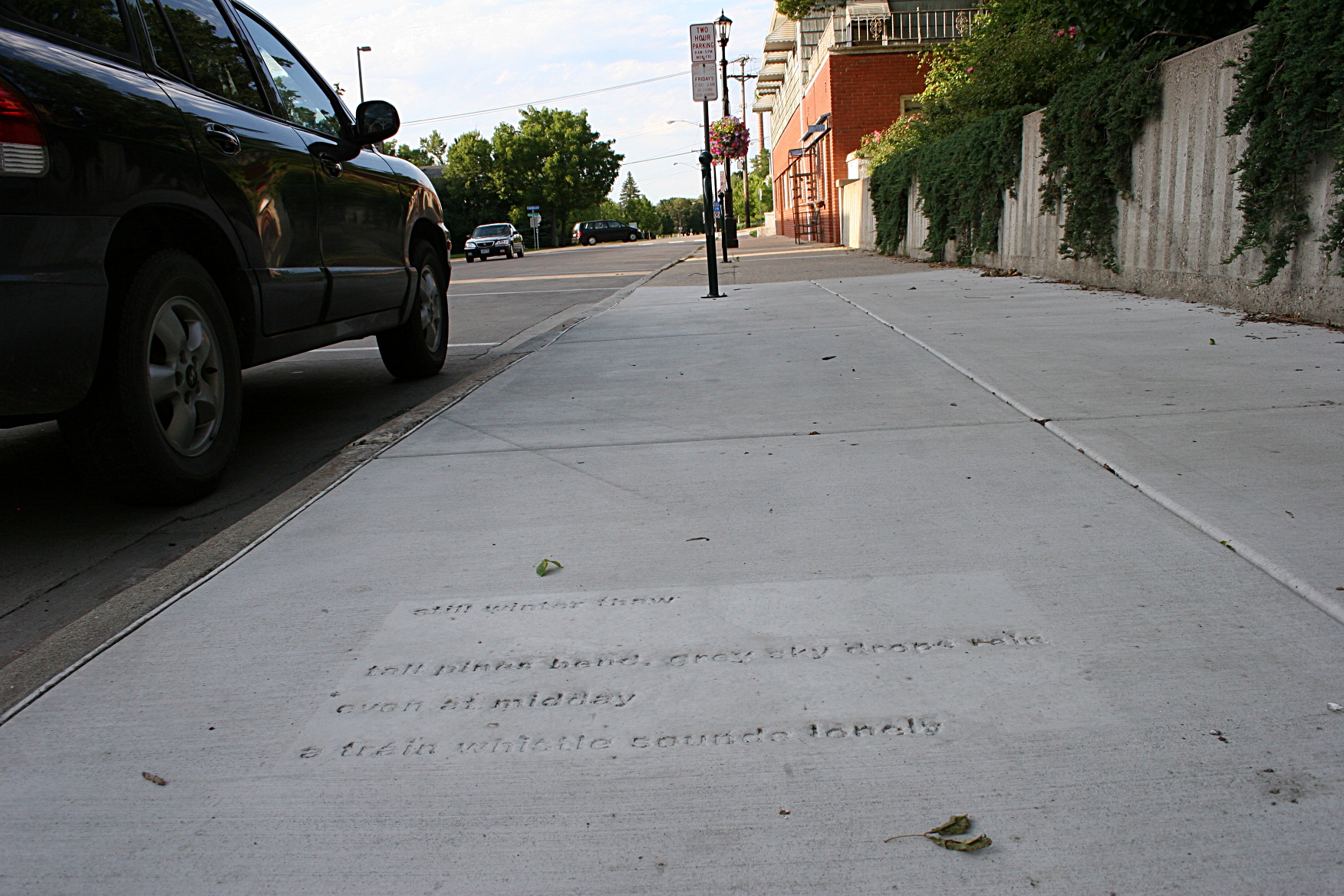
A poem by Patrick Ganey is stamped into the sidewalk near the Northfield Public Library: still winter thaw/tall pines bend, grey sky drops rain/even at midday/a train whistle sounds lonely (Minnesota Prairie Roots copyrighted file photo)
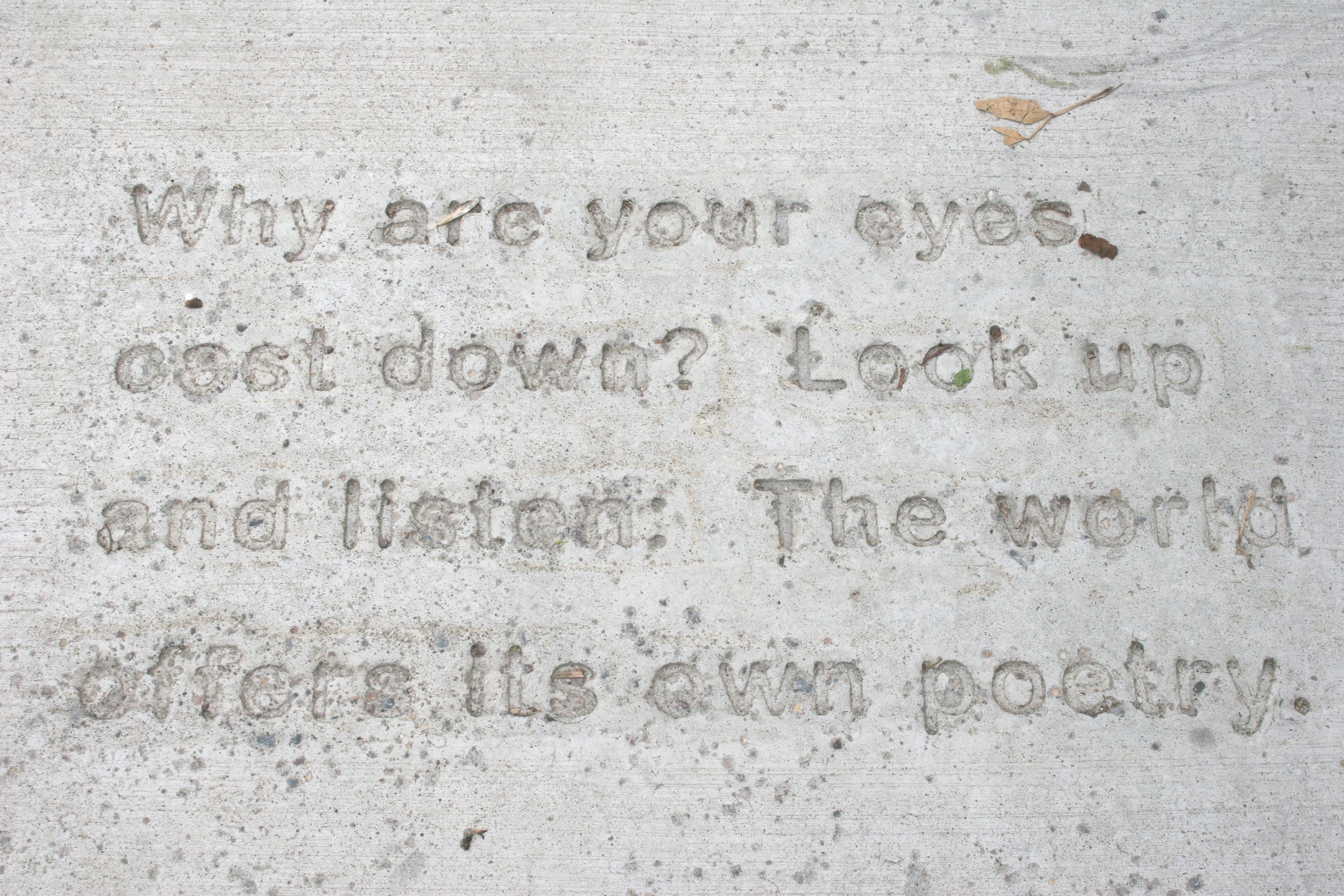
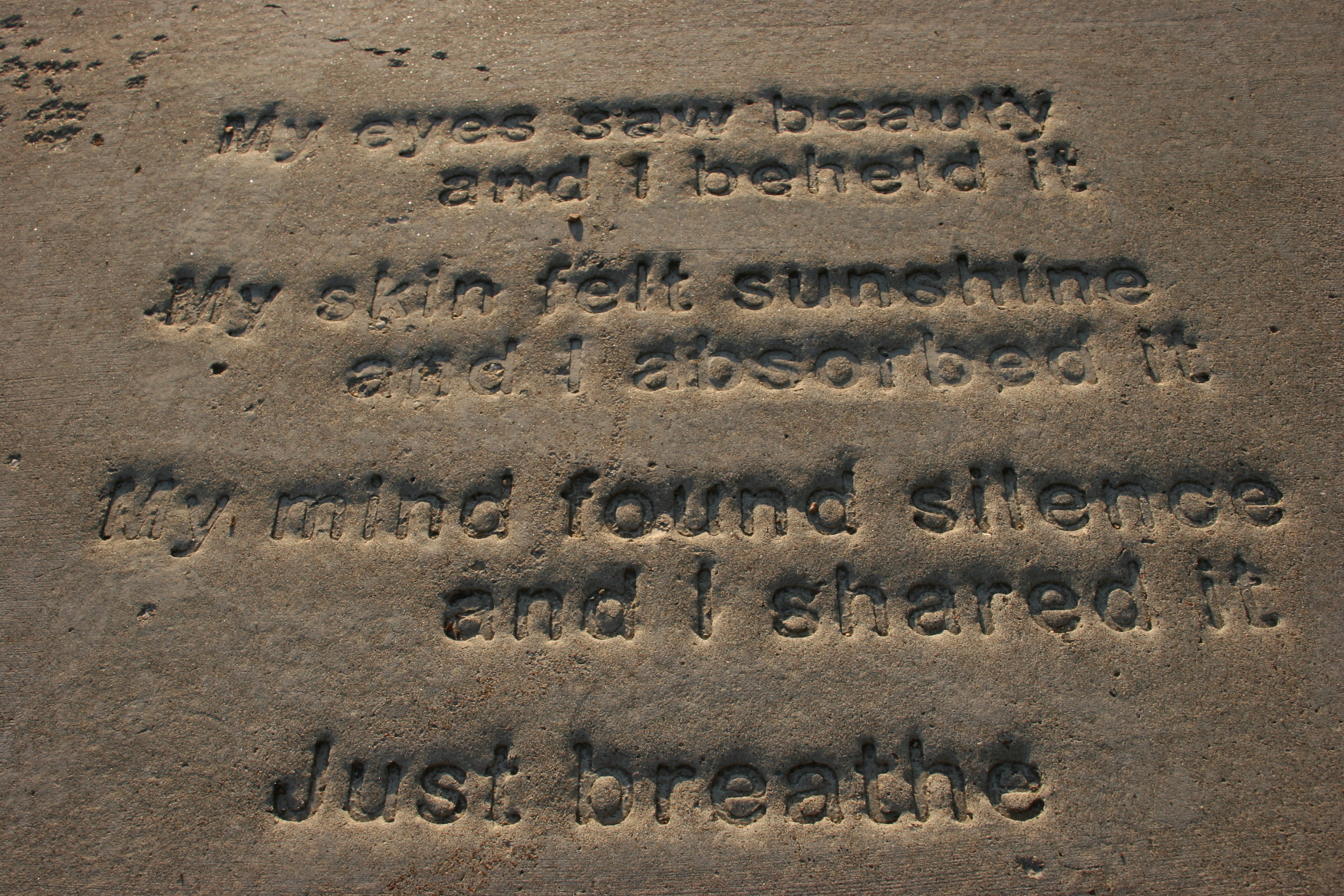
Nearby Northfield, for example, prints poetry into sidewalks. In 2011, the Arts and Culture Commission launched Sidewalk Poetry. Through that annual competition, selected poems are stamped into sidewalks in the historic downtown, along routes to schools and in residential neighborhoods. I always enjoy walking in downtown Northfield and pausing to read poetry. As a poet myself, I appreciate how much this community values this literary art.
This month, National Poetry Month, and into May, Northfield-based nonprofit Rice County Neighbors United is offering “Poem in a Bag.” Submitted original and favorite poems were printed, rolled and placed in poetry boxes (not bags) set out at select Northfield businesses and at the Northfield Public Library. Poems are printed in both English and Spanish and paired with original art by local artists. What a fun idea, to give away poems, perhaps reaching people who would not otherwise read poetry. I’ve submitted several poems for this project.
My poem, “Lilacs,” inspired “Lilacs on a Table,” an oil on linen painting by Jeanne Licari. This was part of an poet-artist collaborative exhibit at Crossings at Carnegie in Zumbrota ten years ago. Today my poem is part of Northfield’s “Poem in a Bag.” (Minnesota Prairie Roots copyrighted file photo April 2014)
A portion of a poem by Rob Hardy, former Northfield Poet laureate, in the Northfield Library atrium. (Minnesota Prairie Roots copyrighted file photo)
At the Northfield Public Library, Open Mic Poetry is held monthly in the atrium for poets to share their writing with an appreciative audience. The next event is at 6:30 pm Wednesday, May 8.
Poem steps in Northfield along the River Walk. (Minnesota Prairie Roots copyrighted file photo 2022)
Northfield also has a poet laureate actively promoting poetry and poetry events within the community. A new laureate will soon be named to replace past laureate Rob Hardy and current interim co-poet laureates Becky Boling and D.E. Green.
This new anthology features the poetry of five Northfield poets. (Minnesota Prairie Roots copyrighted photo April 2024)
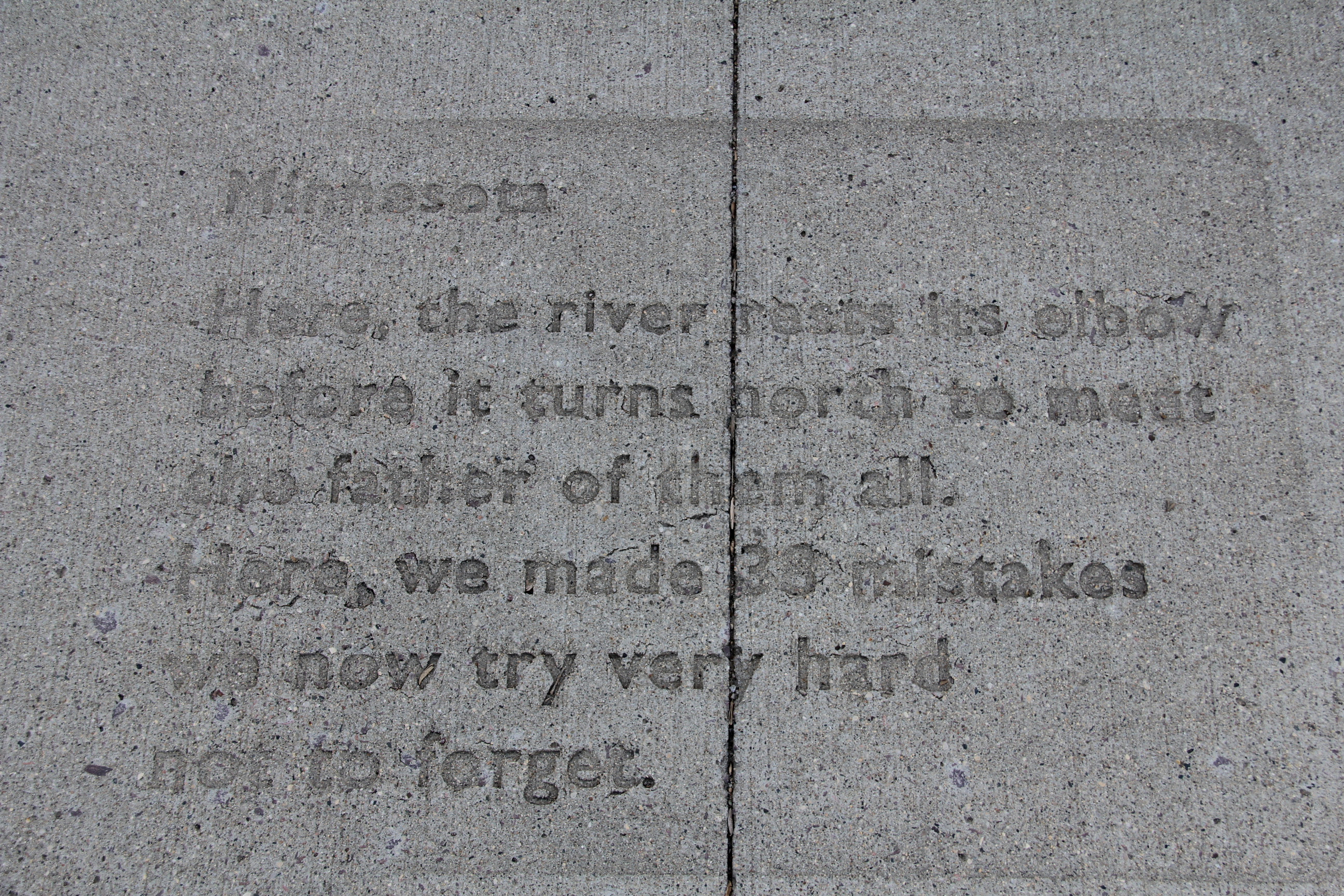
This sidewalk poem in Mankato’s Riverfront Park references the mass hanging of 38 Dakota (plus two) in December 1862 in Mankato. (Minnesota Prairie Roots copyrighted file photo November 2023)
I also have two other recently-released poetry books to read: Broad Wings, Long Legs, A Rookery of Heron Poems in which Minnesota writers (including Larry Gavin of Faribault and many other recognizable poets) contemplate a regional icon, and Songs, Blood Deep by Poet Laureate of Minnesota, Gwen Nell Westerman of Mankato. Westerman is Minnesota’s first Native poet laureate and teaches English, humanities and creative writing at Minnesota State University, Mankato, my alma mater.
My poem, posted along the West Mankato Trail. (Minnesota Prairie Roots edited & copyrighted photo November 2023)
Mankato is a community rich in poetry. I’ve found poems stamped into concrete at Riverfront Park as part of WordWalk. But it’s a project of the Southern MN Poets Society which really puts poetry out in the community. Through the Mankato Poetry Walk & Ride, winning poems are printed on signs and posted along walking and biking trails in Mankato and North Mankato. My poems have been included perhaps half a dozen times—I’ve lost count—with one, “The Mighty Tatanka,” a poem about bison, currently displayed along a trail in West Mankato.
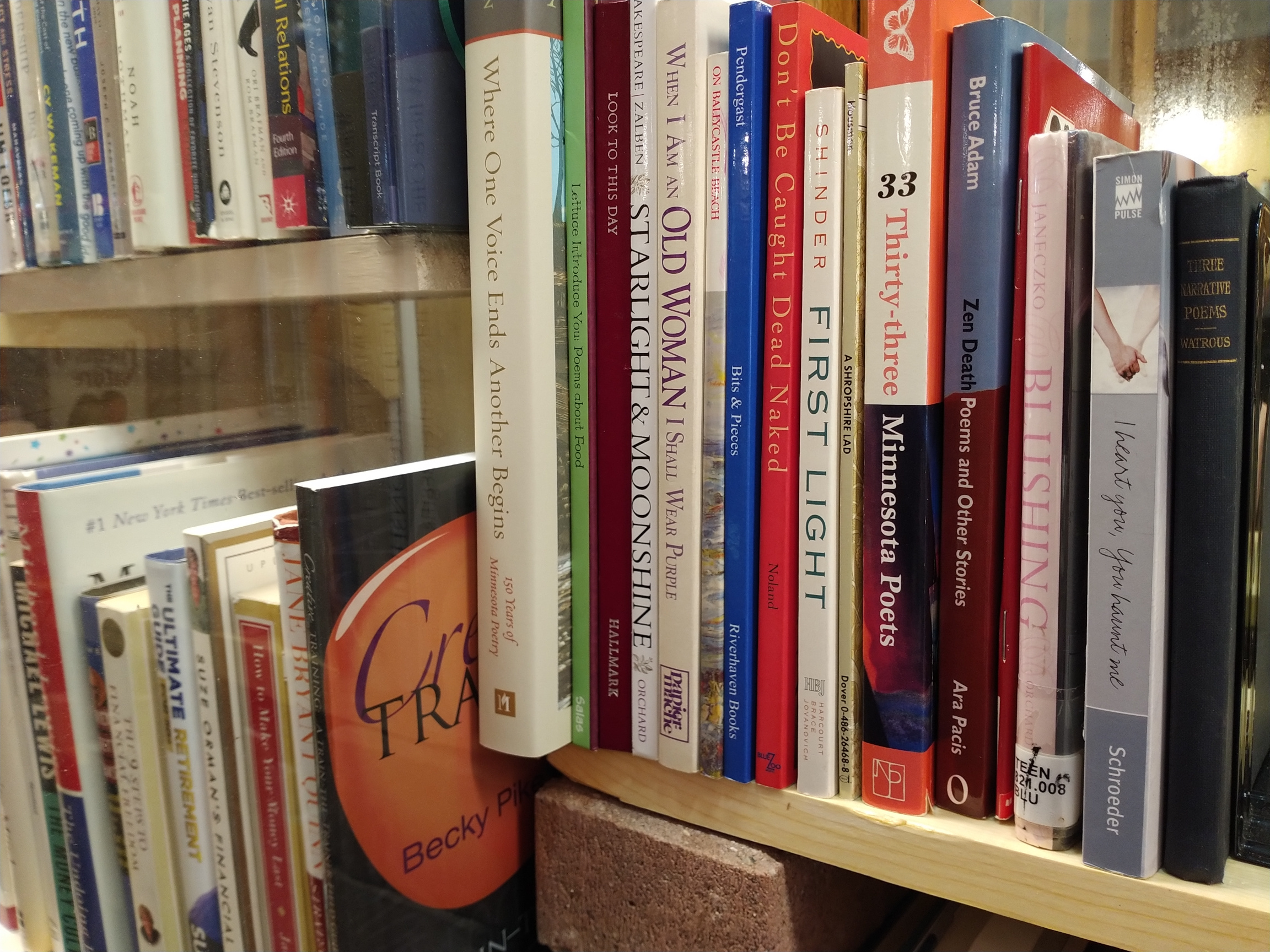
A sampling of poetry books, right, for sale at Books on Central in Faribault. (Minnesota Prairie Roots copyrighted photo April 2024)
Poetry is seemingly everywhere these days, unconfined to the space between book covers. Yet poems printed upon paper remain the primary place to find poetry. I recently picked up a stash of poetry books from my local library. I also perused poetry offerings at Books on Central, a Rice County Area United Way bookshop selling used books in downtown Faribault. In Northfield, independent bookseller Content Bookstore not only sells poetry books, but regularly hosts book signing events with writers, including poets.
An especially thought-provoking poem in Northfield’s Sidewalk Poetry project. (Minnesota Prairie Roots copyrighted file photo August 2020)
How we access poetry has certainly changed over the years. It is my hope that, even if you think you don’t like poetry, you open your mind to this creative art form. There’s much to be learned about nature, about ourselves, about life through the carefully-selected, sparse words of gifted poets, many of whom call Minnesota home.
FYI: Please check back for a more in-depth look at “Poem in a Bag” and reviews of poetry anthologies referenced in this post. Now, tell me, do you read poetry, have a favorite poem?
I CAN’T IMAGINE a world without books. From the time I was first read to and then learned to read as a young child, I have loved books. From books, I’ve learned, I’ve escaped, I’ve broadened my world well beyond southern Minnesota.
From reading the writing of others, I’ve grown, too, as a writer. Laura Ingalls Wilder, in her Little House books, taught me the importance of detail, of setting, in writing. I grew up on the prairie, some 20 miles from Walnut Grove, once home to the Ingalls family. A grade school teacher read the entire Little House series to me and my classmates. Books have, in many ways, shaped me.
Book cover image sourced online.
But imagine a world without books. That was a reality for slaves in America, denied access to books and to education. I just finished reading Kin: Rooted in Hope, written by Carole Boston Weatherford and illustrated by her son, Jeffery Boston Weatherford. The young adult book, published by Atheneum Books for Young Readers, was named a Coretta Scott King Author Honor Book 2024. It is a book that ought to be read by everyone not only for its insightful poetry-style storytelling, but also for its haunting scratchboard art.
Looking down on the pages of the book with a mix of black and white paper. (Minnesota Prairie Roots copyrighted photo February 2024)
Adding to the overall subliminal effect is the way in which the book is printed. Black words ink white paper. White words imprint black pages. And the artwork is made by etching away black ink to reveal white. This mixed usage of black and white, reinforces the storyline of slavery and slave owners. Black. White.
As I read Kin, which I pulled from a book display for kids and teens at my local library, I was increasingly horrified by what I read. Sure, I’ve read about slavery in history books. But this approach of historical fiction really brought home the ugliness, the abuse, the violence, the awfulness of slavery in a personal way. Fiction rooted in truth.
Children born into slavery. Whippings. An auctioneer’s gavel. Names written on an inventory list along with commodities. Jemmy. Big Jacob. Lyddia. Tom. Walter. Isaac. Mush ladled into a trough. Swimming banned lest an escape to freedom be attempted. And on and on. Atrocities that seem unfathomable to inflict upon individuals chained in Africa, sailed to Maryland, sold, abused, treated like property by wealthy white families.
Photo used for illustration only. (Minnesota Prairie Roots copyrighted file photo)
But in the all of this, threads of kinship, endurance, strength and hope, even defiance, run. Perhaps my favorite line in the book is that of Prissy, a house servant waiting on a dinner guest. He leers at her, making an inappropriate comment. She wants to tell him that she spit in his soup. At this point half way into the book, I applaud her unstated rebellion. As the chapters unfold, so does the move toward freedom for slaves. The author writes of freedom at last and of current day issues (controversial statues in public places, the murder of George Floyd…), all interspersed with a whole lot of history (including historic figures like Frederick Douglass and Harriet Tubman…).
Even though this book is written for young adults, it should be read by older adults, too, who need to hear Prissy’s defiant voice. Author Carole Boston Weatherford gives voice to those who endured slavery, and to those whose family histories trace to enslavement, including her ancestors. Her son’s detailed scratchboard art reinforces the story, the words which wrench the spirit.
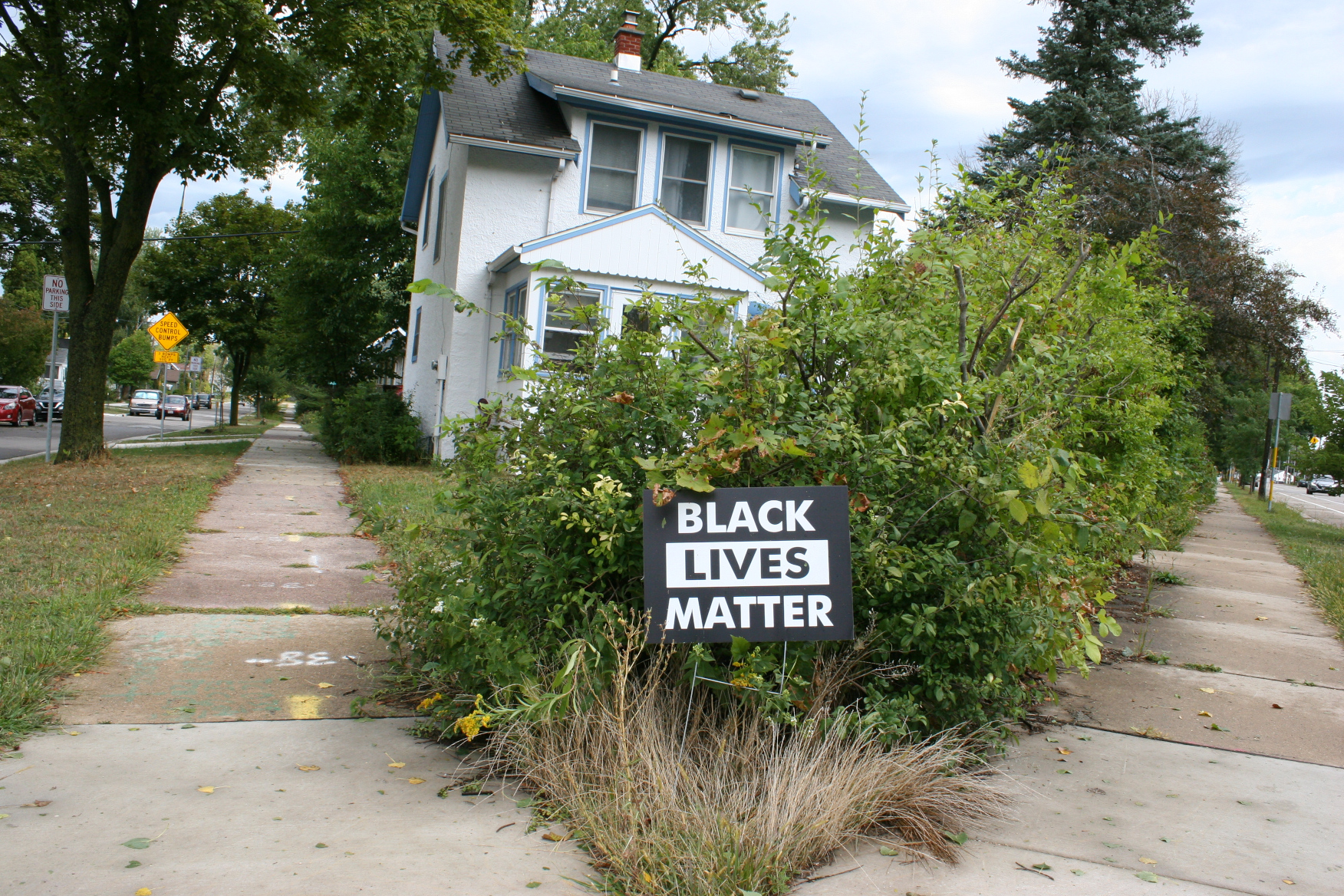
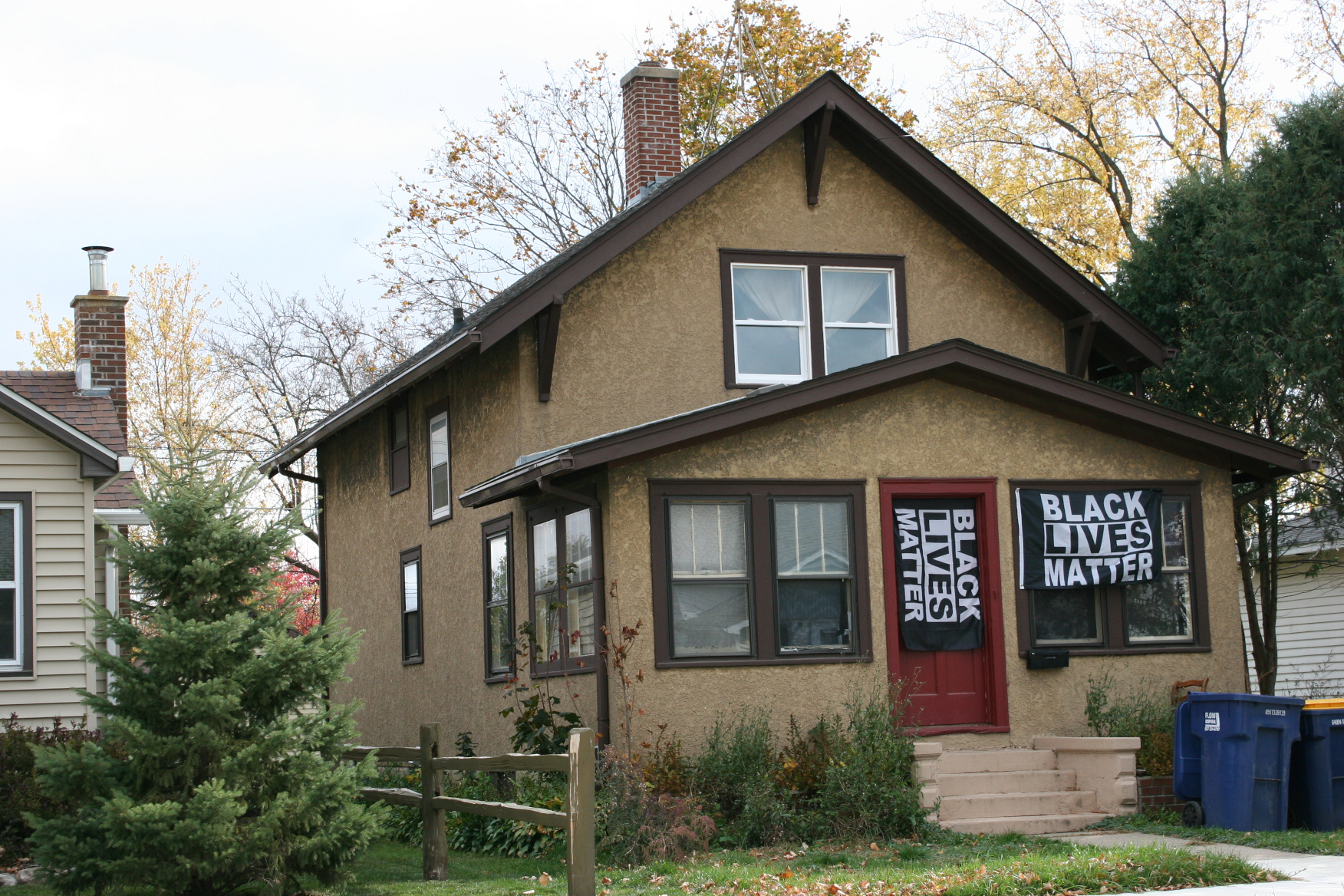
I photographed this scene in 2020 in Kenyon, MN. It remains one of my favorite images of this message given its location in a small town.(Minnesota Prairie Roots copyrighted file photo October 2020)
Kin: Rooted in Hope proves an especially fitting read during February, Black History Month. Through this book of historical fiction, I’ve learned more about a part of U.S. history which is horrendous in every possible way. That humanity can treat humanity so atrociously seems unfathomable…until I consider underlying and outright racist attitudes which continue yet today.
Minneopa State Park near Mankato is home to 30-40 bison fenced on 325 acres of primarily prairie. (Minnesota Prairie Roots copyrighted file photo 2019)
THEY ARE MASSIVE BEASTS, once roaming the American Great Plains by the millions. They are bison, also called buffalo, today numbering some 370,000 in North America. Most are raised as livestock. But some 31,000, or eight percent, are part of conservation herds, including right here in Minnesota. Such herds are designed to protect wild bison and preserve their genetic diversity.
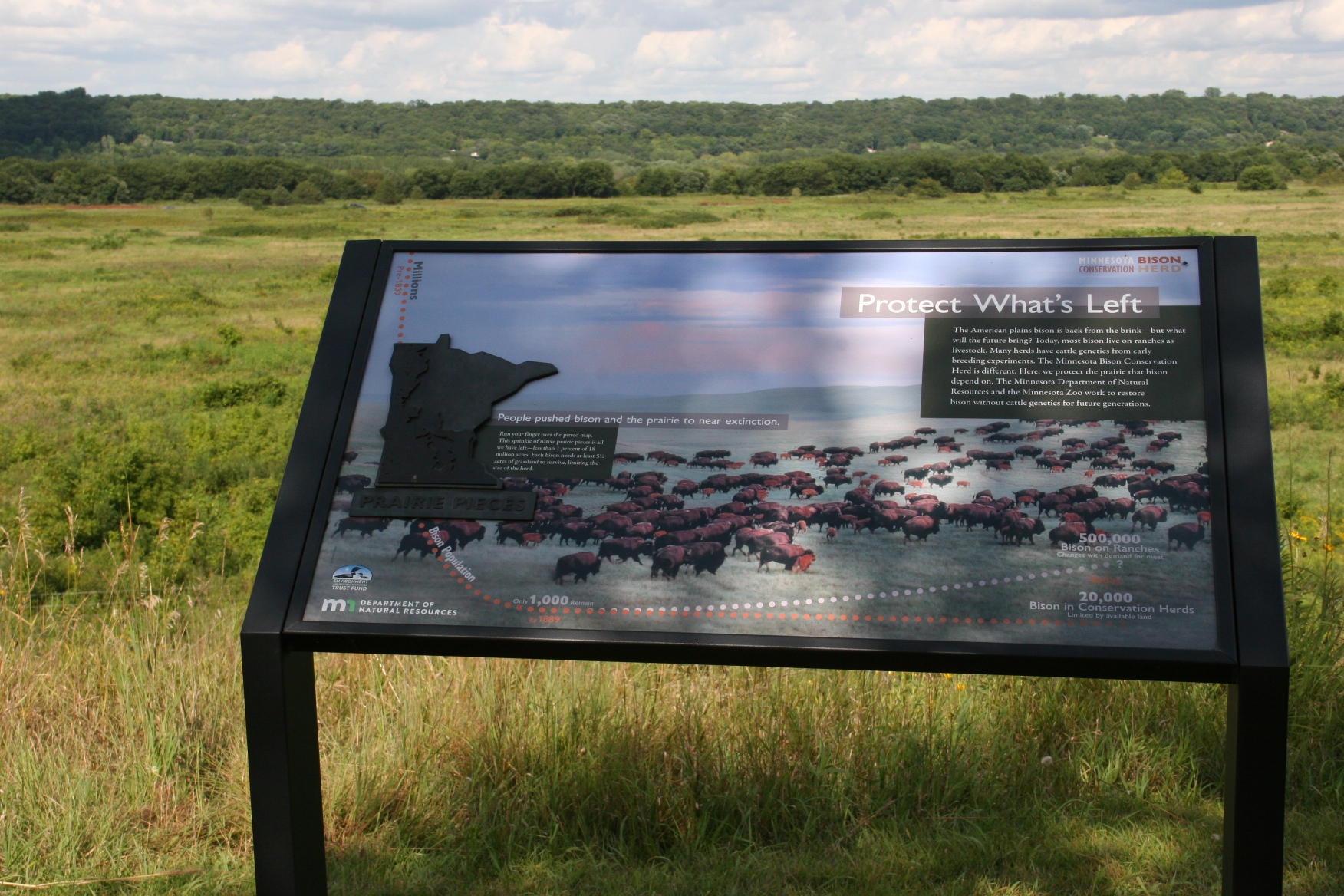
Interpretive signage about bison overlooks the prairie at Minneopa State Park. (Minnesota Prairie Roots copyrighted file photo 2019)
An upcoming documentary, “The American Buffalo—A Story of Resilience” by awarding-winning filmmaker Ken Burns, and my own recently posted poem about bison prompted my renewed interest in this animal. Burns’ 4-hour film airs in two parts, at 7 pm on Monday, October 16, and on Tuesday, October 17, on PBS. His documentary traces the history of bison, their importance in Native peoples’ lives and culture, their near extinction, and efforts to bring them back.
Bison up close while driving through Minneopa State Park. (Minnesota Prairie Roots copyrighted file photo 2019)
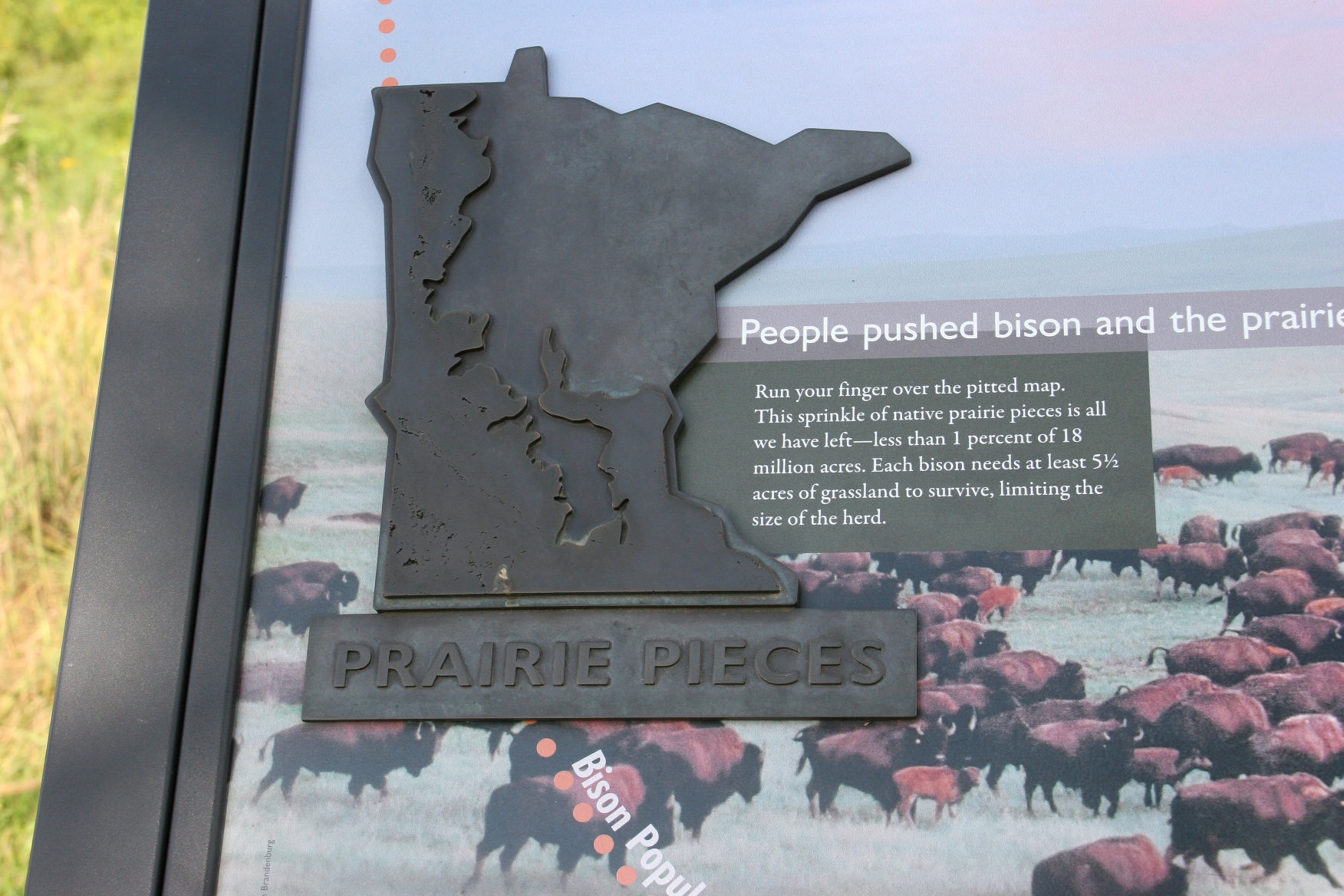
A map, posted in Minneopa State Park, shows the prairie and historic bison territory in Minnesota. (Minnesota Prairie Roots copyrighted file photo 2019)
Given the region’s rich Native heritage, the presence of a small group of bison in the Ramsey Park Zoo seems fitting. I recall rushing to see the buffalo there, both excited and intimidated by their massive hulk. Today I’m not so much afraid as respectful of their size and their importance in Indigenous Peoples’ culture.
A sculpture of White Buffalo Calf Woman, part of Indigenous culture, displayed at the 2011 Mankato City Art Walking Sculpture Tour. Artwork by Lee Leuning and Sherri Treeby. (Minnesota Prairie Roots copyrighted file photo 2011 by Audrey Kletscher Helbling)
One need only look back in history to see how invaluable bison were to these original inhabitants of the prairie, the plains. Bison provided food, shelter, clothing and more to Indigenous Peoples. They also held spiritual and cultural significance. Bison were considered kin, respected by those who respected Mother Earth.
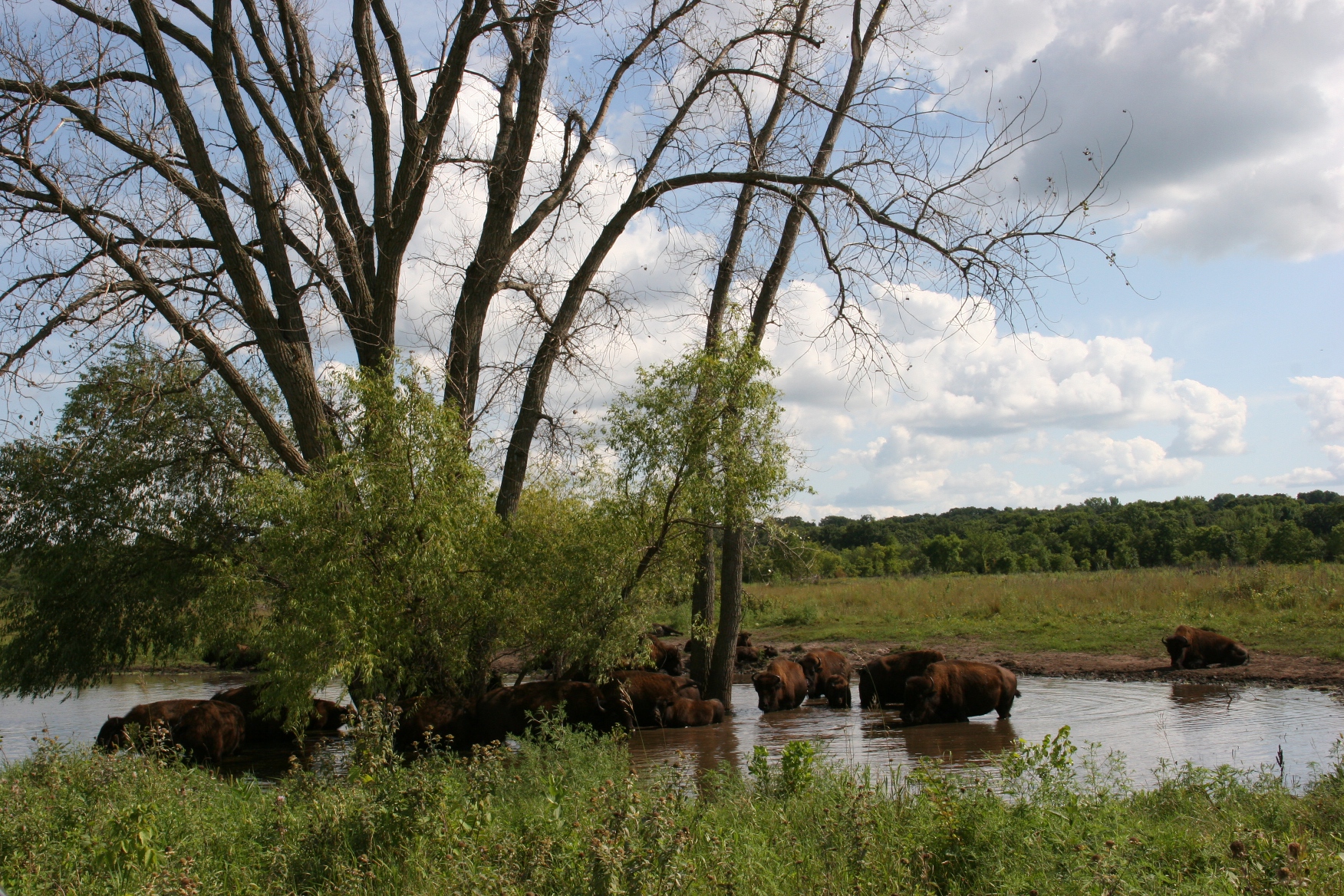
Bison at Minneopa State Park watering hole. (Minnesota Prairie Roots copyrighted file photo 2019)
And then the white man came in the 1800s, overtaking the land, nearly driving bison to extinction as they hunted and slaughtered the animal primarily for their hides.
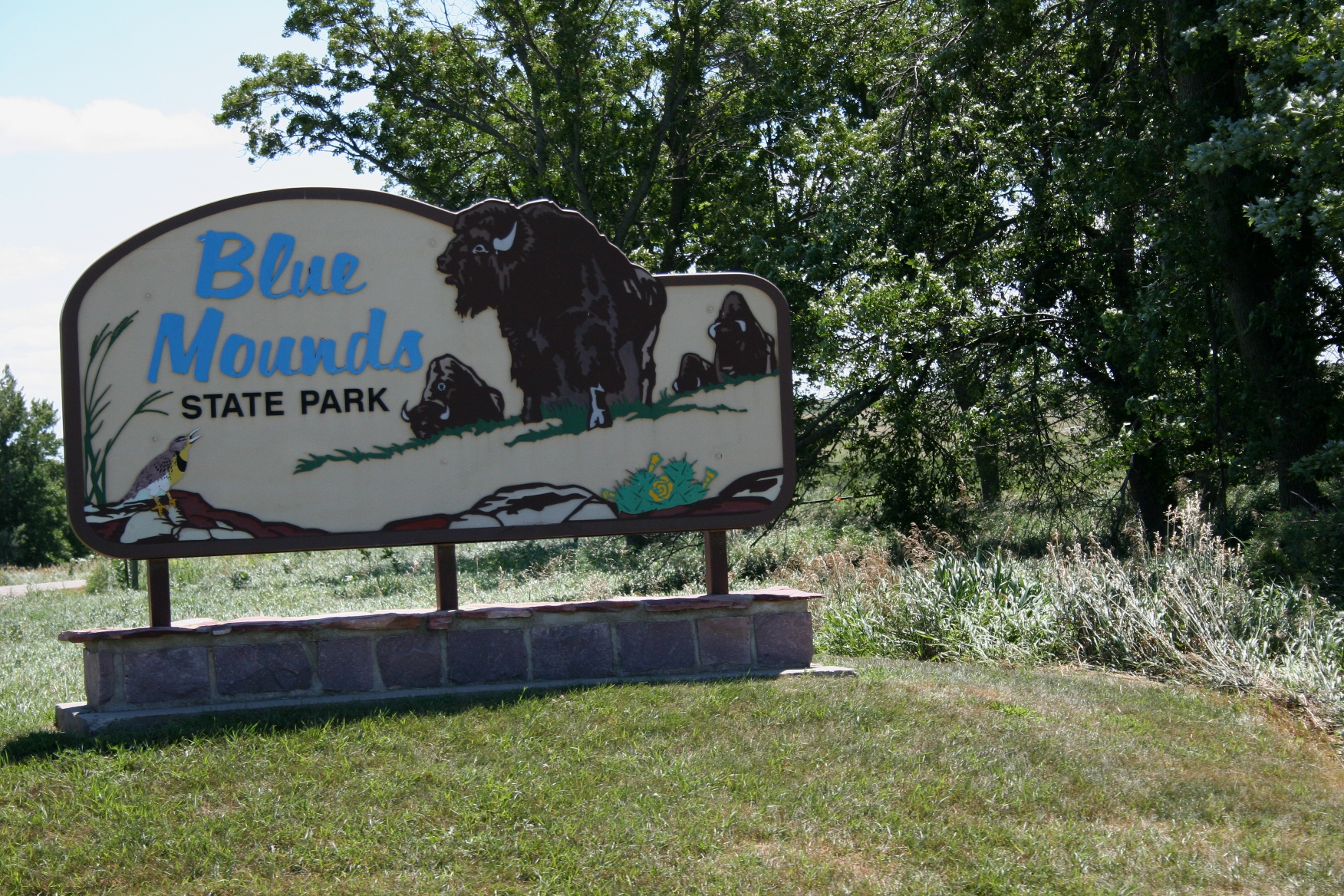
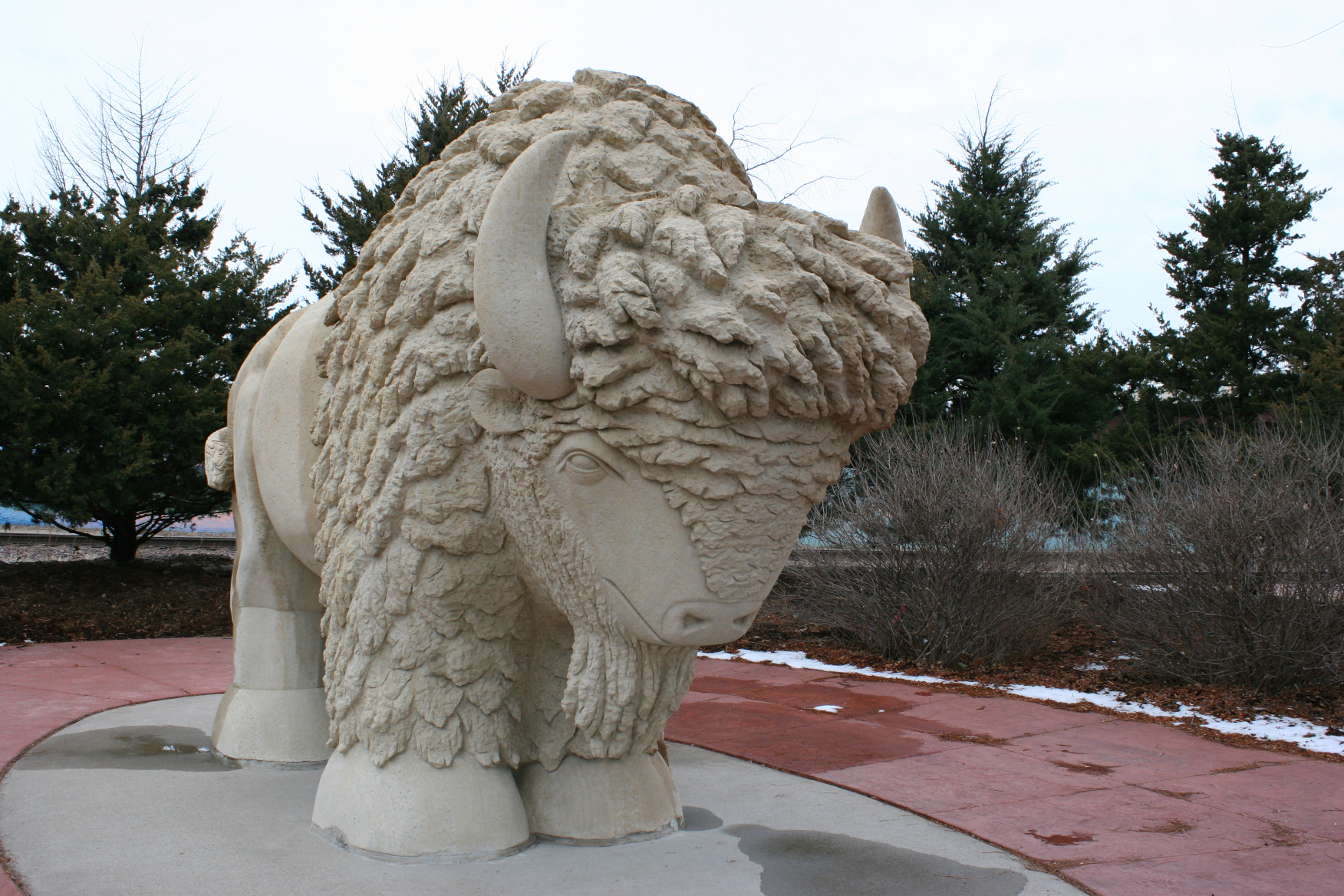
Blue Mounds State Park in rural Rock County, Minnesota, is home to 80-90 bison, although I did not see them when I visited the park in 2013.(Minnesota Prairie Roots copyrighted file photo 2013)
And so the story of bison is not only one of past atrocities in American history, but also one of personal history for me with those fenced bison in Minnesota’s largest municipal park, known as “The Little Yellowstone of Minnesota” for its beautiful natural topography seemingly like Yellowstone National Park. Yellowstone, the one in Wyoming, is home to nearly 6,000 bison.
A sign along the prairie’s edge at Minneopa State Park informs about bison in Minnesota. (Minnesota Prairie Roots copyrighted file photo 2019)
In my youth, I didn’t understand the importance of bison in Native culture. I simply delighted in seeing them in the zoo at then Alexander Ramsey Park in my native Redwood County. Neither did I recognize how offensive the name of the park I loved as a child—Alexander Ramsey Park. Alexander Ramsey served as our first territorial governor and then as the second state governor of Minnesota during the US-Dakota War of 1862. He offered a bounty to anyone who killed a Dakota person and called for Indigenous Peoples to be driven out of Minnesota.
This 67-ton Kasota limestone sculpture stands in Reconciliation Park in Mankato. It symbolizes the spiritual survival of the Dakota People and honors the area’s Dakota heritage. The park is the site of the largest mass hanging in U.S. history. (Minnesota Prairie Roots copyrighted file photo 2019)
My poem posted along a recreational trail in Mankato. (Photo credit: Kay Herbst Helms)
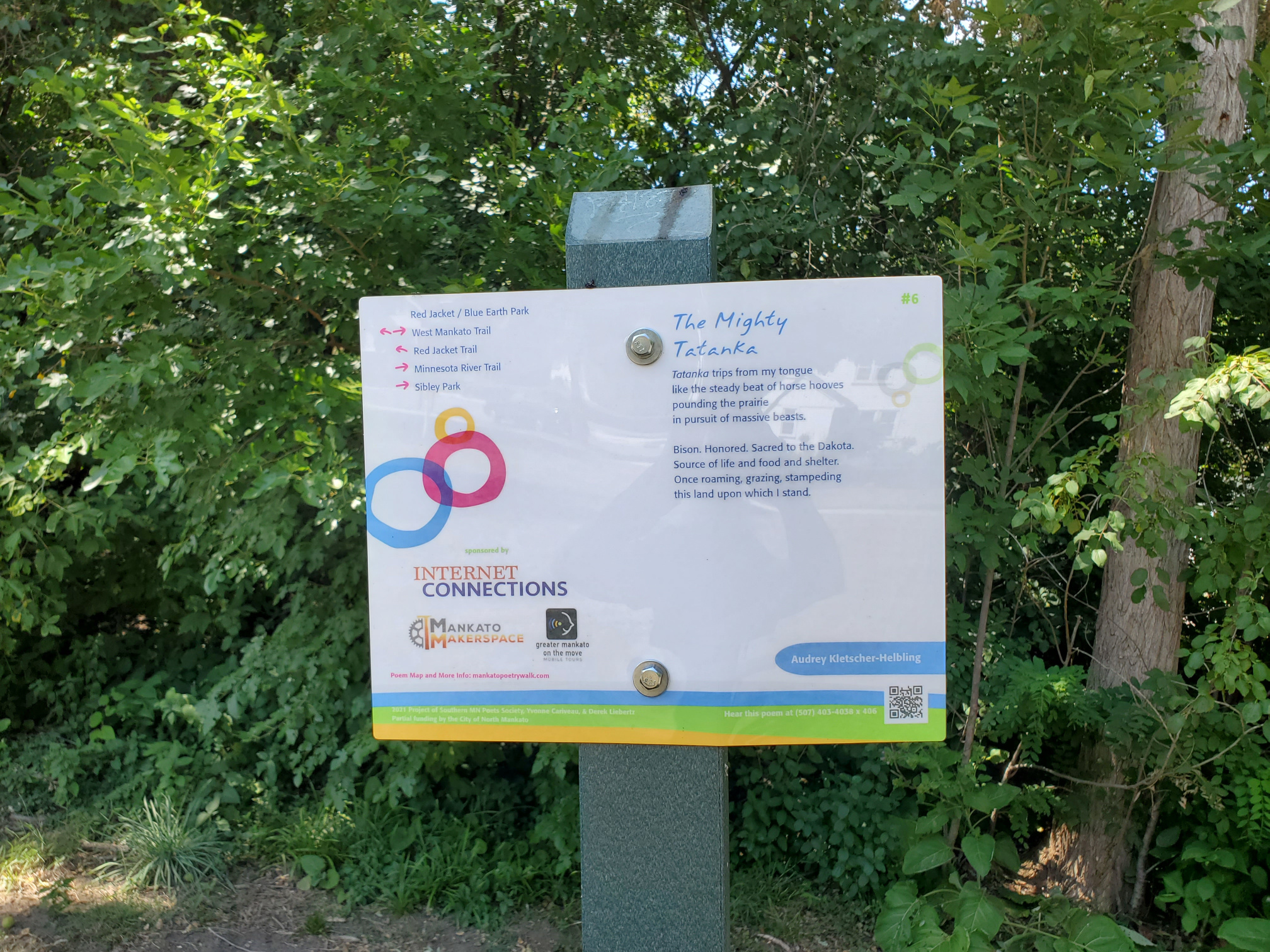
I wanted to honor the original inhabitants of Mahkato, the bison, the Native culture, the land. And so I wrote “The Mighty Tatanka,” using the Dakota word for bison. My poem was selected for inclusion in the Mankato Poetry Walk & Ride and is posted on a sign in West Mankato.
The Mighty Tatanka
Tatanka trips from my tongue like the steady beat of horse hooves pounding the prairie in pursuit of massive beasts.
Bison. Honored. Sacred to the Dakota. Source of life and food and shelter. Once roaming, grazing, stampeding this land upon which I stand.
While my poem is succinct, limited by wordage requirements in the poetry competition, I’d like to think “The Mighty Tatanka” is powerful. It holds not only the rhythm of carefully selected words, but a story. A story of bison, of Indigenous Peoples, of a way of life, of a culture. It holds, too, honor for the land and of those who first inhabited, and respected, it.
#
FYI: My poem is posted on a sign along the West Mankato Trail near the intersection of Owatonna Street and Blue Earth and Sylvia Streets in West Mankato. You can listen to me read my poem by calling 507-403-4038 and entering 406.
Noted Minnesota wildlife photographer Jim Brandenberg’s (right in video) work, including this image of bison, is featured in a gallery bearing his name in Luverne, near Blue Mounds State Park. (Minnesota Prairie Roots copyrighted file photo 2013)
To see Minnesota Bison Conservation Herd bison in Minnesota, visit Minneopa State Park near Mankato, Blue Mounds State Park near Luverne, the Minnesota Zoological Garden, Oxbow Park & Zollman Zoo by Byron, and Spring Lake Park Reserve Bison Prairie in Dakota County.




















 Minnesota Prairie Roots
Recent Comments