Minnesota Prairie Roots

Writing and photography by Audrey Kletscher Helbling

Thoughts after the season’s first snowfall December 4, 2011

Filed under: Uncategorized — Audrey Kletscher Helbling @ 1:58 PM
Tags: , , , , , , , ,

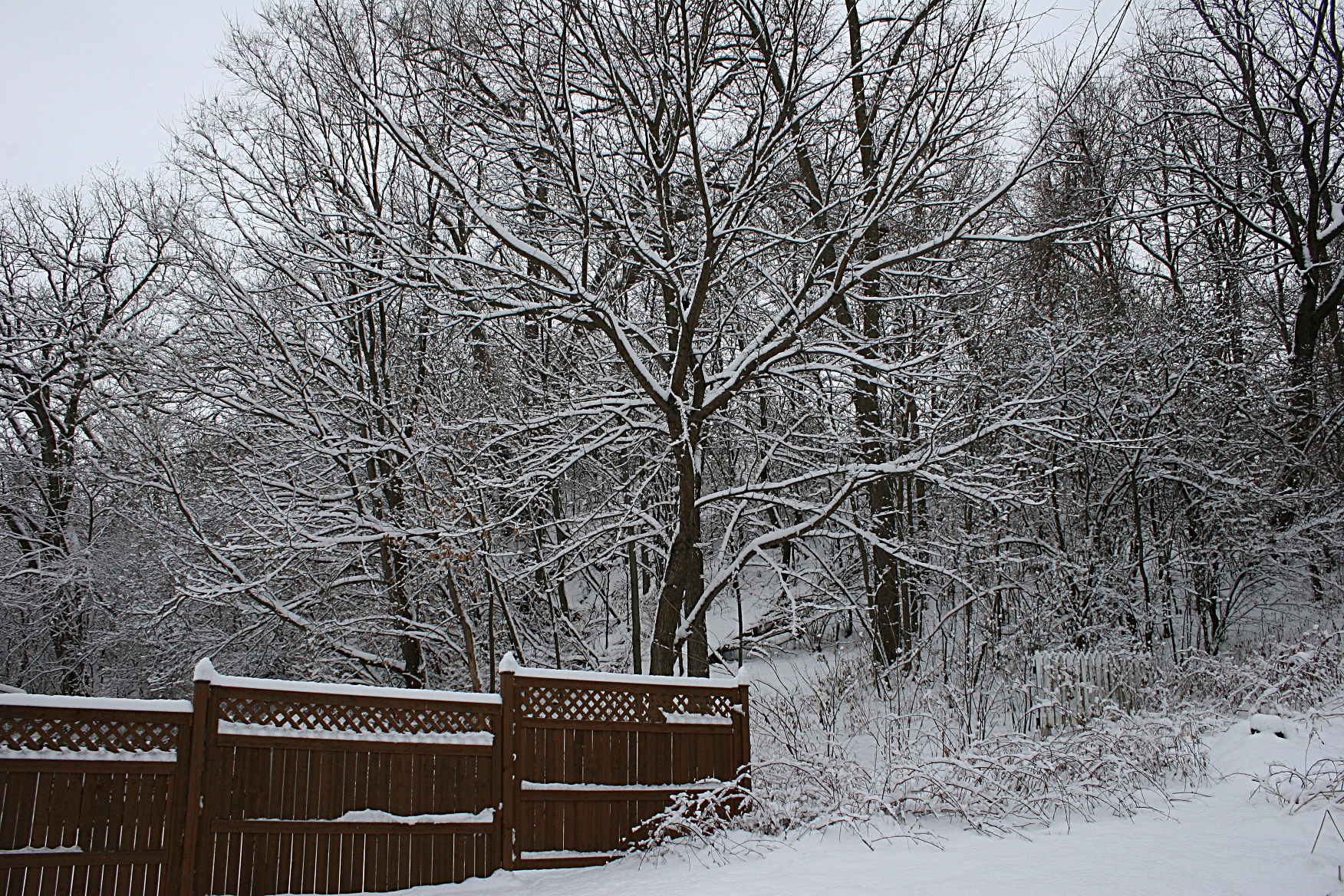
The snowy woods adjoining my backyard in Faribault late Sunday morning following about a five-inch snowfall.

WELCOME TO MY BACKYARD after the first significant snowfall in Faribault this season.

It is a world of mostly black-and-white, like vintage photos in an album.

Branches laden with the first significant snowfall.

I’m trying to be poetic here because, as disloyal Minnesotan as this sounds, I don’t particularly like snow. I dread the resulting icy sidewalks and parking lots.

I realize I possess the attitude of  “an old person” here. No offense meant to any of you who are older than me. But, at age 55 and with an artificial hip implanted in my right side three years ago, snow and ice threaten me. I fear falling, so I inch across ice with trepidation.

Just to clarify, my hip replacement did not result from a fall. I suffered from osteoarthritis and reached the point where surgery was the only option to deal with near immobility and chronic pain.

So here we are, in the season of snow and ice in Minnesota. If I don’t exactly embrace it, now at least you understand why. I suspect it is the reason many Minnesotans flee to Arizona and Florida during the winter months—not only to escape the cold, but to escape the danger.

Yet, even I can see the beauty in a fresh snowfall that layers branches and seed heads and the entire world around me in a surreal sort of peacefulness on a Sunday morning.

That, for me, redeems winter.

The blessing of winter lies in its beauty, seen here in a snippet of time-worn fencing in my backyard.

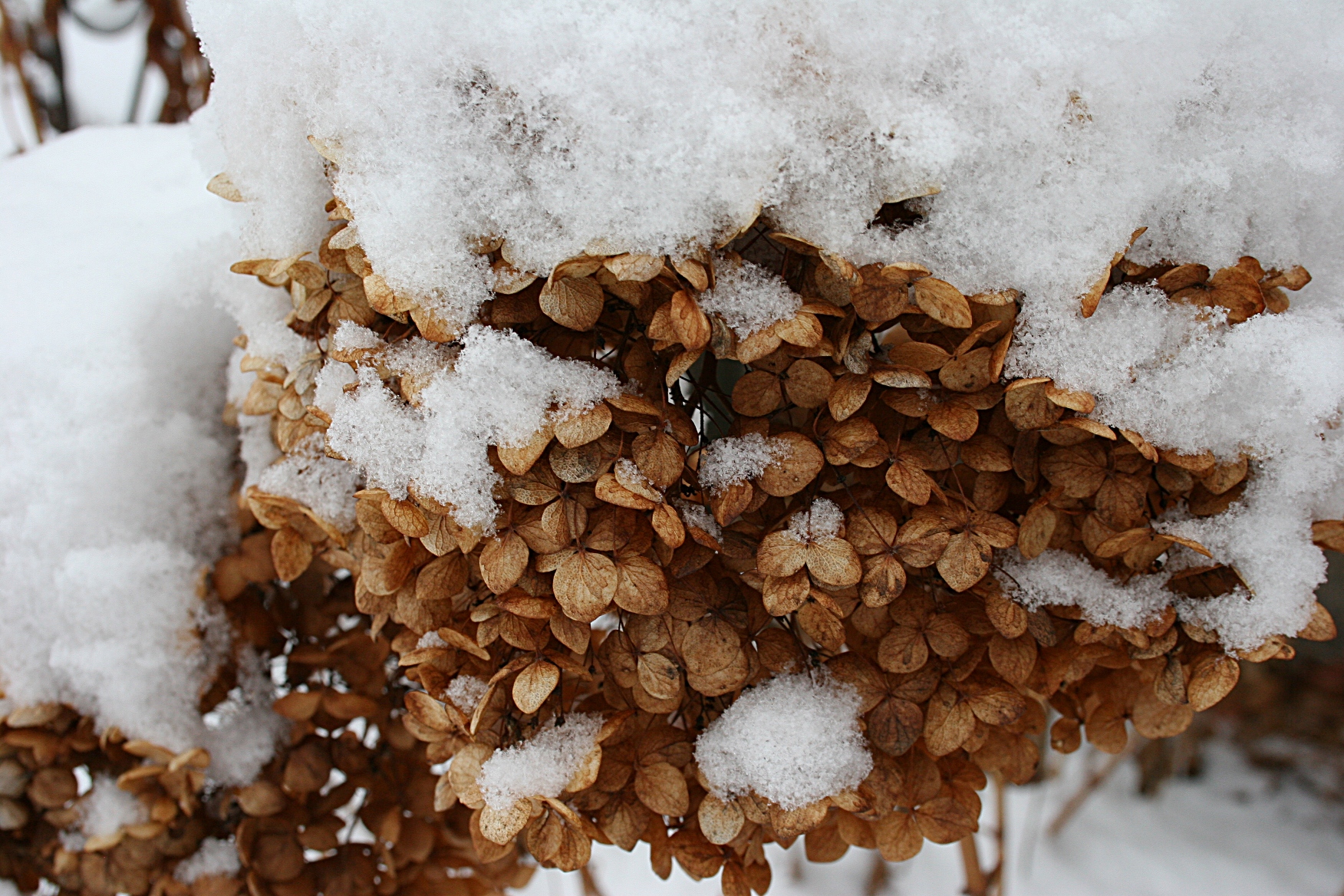
An unobtrusive patch of color in a mostly black-and-white world Sunday morning: Snow capping a hydrangea.

HOW DO YOU feel about snow and winter in general? The truth, please.

© Copyright 2011 Audrey Kletscher Helbling


Too much pre-holiday consumerism? November 29, 2011

Filed under: Uncategorized — Audrey Kletscher Helbling @ 8:28 AM
Tags: , , , , , ,

DURING THE PAST WEEK, we’ve been bombarded with news stories and advertising campaigns aimed at Black Friday, Small Business Saturday and Cyber Monday, all with the underlying theme of spending.

Honestly, I am tired of the greedy, materialistic consumerism that grips us during the pre-holiday season.

Are we so materialistic that we have to skip or cut out early on family gatherings, fight each other in the aisles and buy items simply because they are on sale?

I get nostalgic for those days when we weren’t quite so materialistically-inclined.

But, if I’m honest, I can look back and see that even during the 1960s, when I was growing up, we, too, focused on the gift aspect of Christmas more than we should have.

Remember “the Christmas catalog?”

I could not wait for the mailman (not carrier) to drop off the J.C. Penney Christmas catalog in our mailbox at the end of our southwestern Minnesota farm driveway.

My siblings and I fought over who got to look at the Christmas catalog first. By the time all six of us had thumbed through the wish book numerous times, the pages were worn and creased. We drew up Christmas lists from the catalog, wishing for the doll or the Army tank or the spotted Twister mat featured in the photos.

Rarely did we get any of those requested items; our parents simply did not have the money. Even though we certainly dreamed and wished and dreamed and wished some more, we were content with whatever gifts we received.

Today, however, I think many parents feel obligated to give their kids whatever they ask for. I don’t agree with that line of thinking. Kids need to learn and understand that they cannot have everything they want when they want it.

But first, we as adults need to curb our own greedy consumerism and our desire to have everything we want when we want it.

WHAT’S YOUR OPINION on consumerism this time of year, or in general? Let me hear your thoughts.

© Copyright 2011 Audrey Kletscher Helbling


Gaining confidence as a poet October 19, 2011

I THINK ALL WRITERS, if we’re honest with ourselves, face insecurities about writing.

Can we write? Is our writing “good enough” to publish? Will anyone read, or even care about, what we write?

I’ve long overcome any issues I faced about journalism style writing. I’m confident in my abilities to pull together a good feature story or another journalistic piece given my educational background in mass communications and my years of experience in journalism. And with several years of blogging to my credit, I’m also confident in that writing style.

It’s poetry which has challenged my confidence. Although I’ve written poetry off and on since high school—which stretches back nearly four decades—I’ve never written much poetry, at least not enough to consider myself a true poet. Until now.

Finally, this year, with the publication of two poems in two Minnesota literary journals and winning the spring Roadside Poetry contest, I’m comfortable adding “poet” to my writing credentials.

Getting to the point of feeling comfortable with the term “poet” really began 11 years ago with publication of a poem in Poetic Strokes, A Regional Anthology of Poetry from Southeastern Minnesota, Volume 2. I considered that a stroke of good fortune. But when four more poems published in the next two volumes, I began to think that maybe, just maybe, I could write poetry. After all, I had competed against other writers to get into the Poetic Strokes anthologies.

Then I had a poem accepted for publication in The Lutheran Digest.

Next, I earned an honorable mention for my poem, “Hit-and-Run,” published last year in The Talking Stick, Forgotten Roads, Volume 19.

Finally, this year, I had an official poet epiphany when I entered three poetry competitions and was subsequently published on Roadside Poetry billboards, in The Talking Stick, Black & White, Volume 20 and Lake Region Review.

Although I don’t know how many poets I competed against in Roadside Poetry, I do have the numbers for the two literary journals. The Talking Stick this year published 140 pieces of poetry, creative nonfiction and fiction from 99 writers, me being one of them with my poem, “Abandoned Barn,” and my creative nonfiction, “Welcome Home.” That’s out of 326 submissions from 171 writers.

Look at the list of writers, and you may recognize a few names like Marge Barrett, Tim J. Brennan, Charmaine Pappas Donovan, Jerry Mevissen, Candace Simar…

It’s quite a process to get into The Talking Stick with five members of The Jackpine Writers’ Bloc reading all of the entries and then an editorial board meeting to vote and discuss. The top four to seven favorites in each category are then forwarded to celebrity judges—this year Kris Bigalk, Kevin Kling and Alison McGhee—to choose first and second place winners in each division.

As for Lake Region Review, the process of selecting the works for publication is equally as rigorous. Co-editors Mark Vinz—author, professor emeritus of English at Minnesota State University Moorhead and first coordinator of MSUM’s Master of Fine Arts in Creative Writing—and Athena Kildegaard—author and lecturer at the University of Minnesota Morris—worked with a staff of 10. They read more than 200 submissions before narrowing the field to 27 established and emerging writers.

I’m one of those 27.

And so is Leif Enger, author of the 2001 New York Times best-seller Peace Like a River, which happens to be a favorite book of mine. It’s nice to be in the company of someone who, like me, writes with a strong sense of place.

Most of my poetry connects to the southwestern Minnesota prairie, where I grew up on a dairy and crop farm. Specifically, the barn on the home place inspired my two distinct barn poems which published in The Talking Stick and Lake Region Review.

I don’t know what moved the editors of either publication to select my poems for inclusion in their literary journals. But I did incorporate lines such as “hot cow pee splattering into her gutters” and “rusty hinges creaking like aged bones.”

According to Co-editor Kildegaard at Lake Region Review, editors chose pieces that were “fresh, creative, lively, interesting. We were looking for writing that has something new to say.”

Apparently I had something new to say about the old barn.

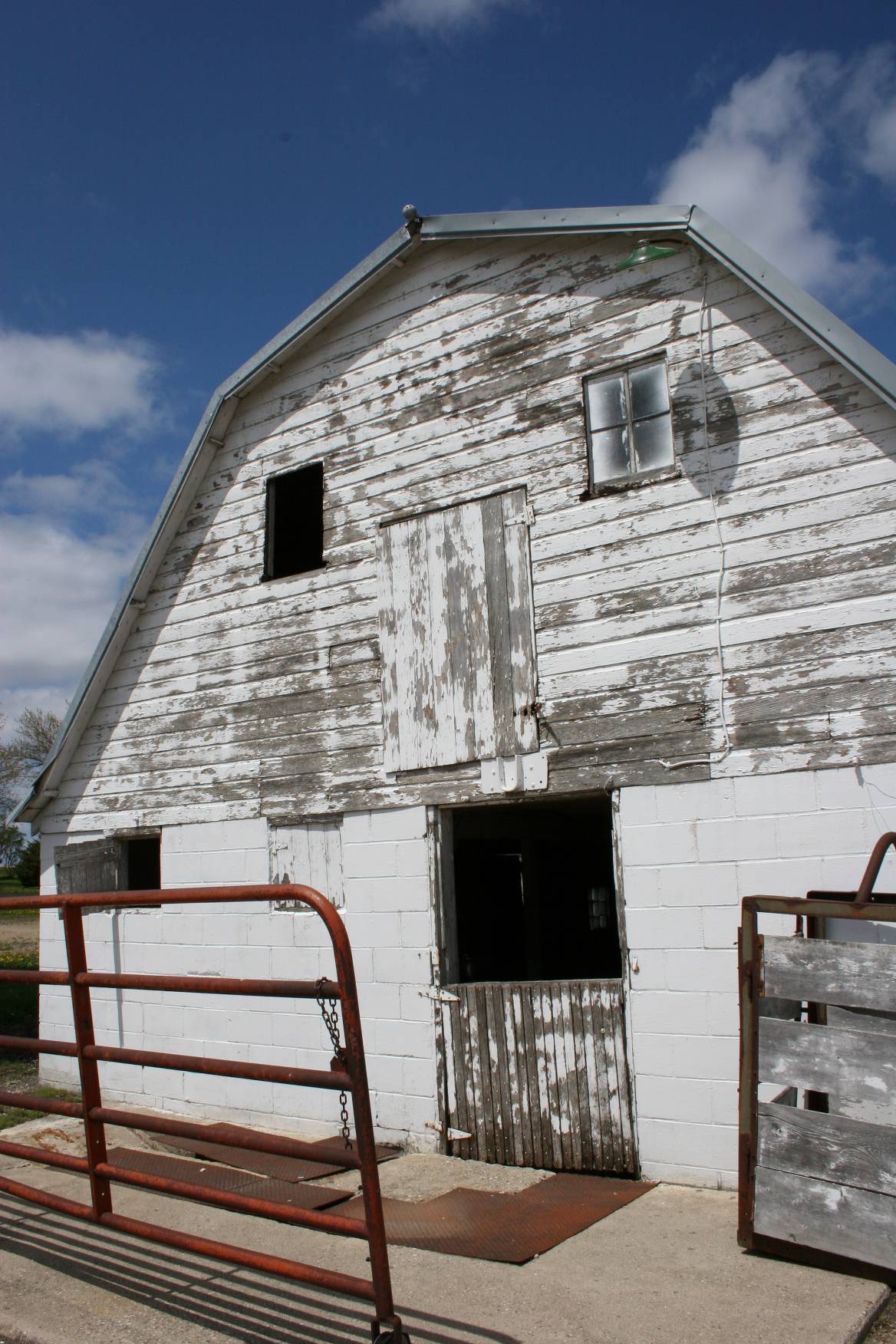
The early 1950s barn on the Redwood County dairy farm where I grew up today stands empty of animals.

WRITERS FEATURED in the recently-published 212-page The Talking Stick, Black & White, Volume 20, are from, or have a strong connection to, Minnesota. Those published in the 138-page debut of Lake Region Review live primarily in west central Minnesota. Eight writers have been published in both collections.

The cover of Lake Region Review is a detail of an original landscape painting, “Christina Lake: View from Seven Sisters,” by American impressionist painter Stephen Henning of Otter Tail County.

IF YOU’RE A WRITER, specifically of poetry, did you/do you struggle with confidence issues? At what point did you/will you call yourself a poet?

FYI: For more information or to purchase copies of either literary journal featured here, click on the appropriate link below:

www.lakeregionreview.net

www.thetalkingstick.com

And click here for more information about Roadside Poetry.

© Copyright 2011 Audrey Kletscher Helbling


Worshipping at a country church October 16, 2011

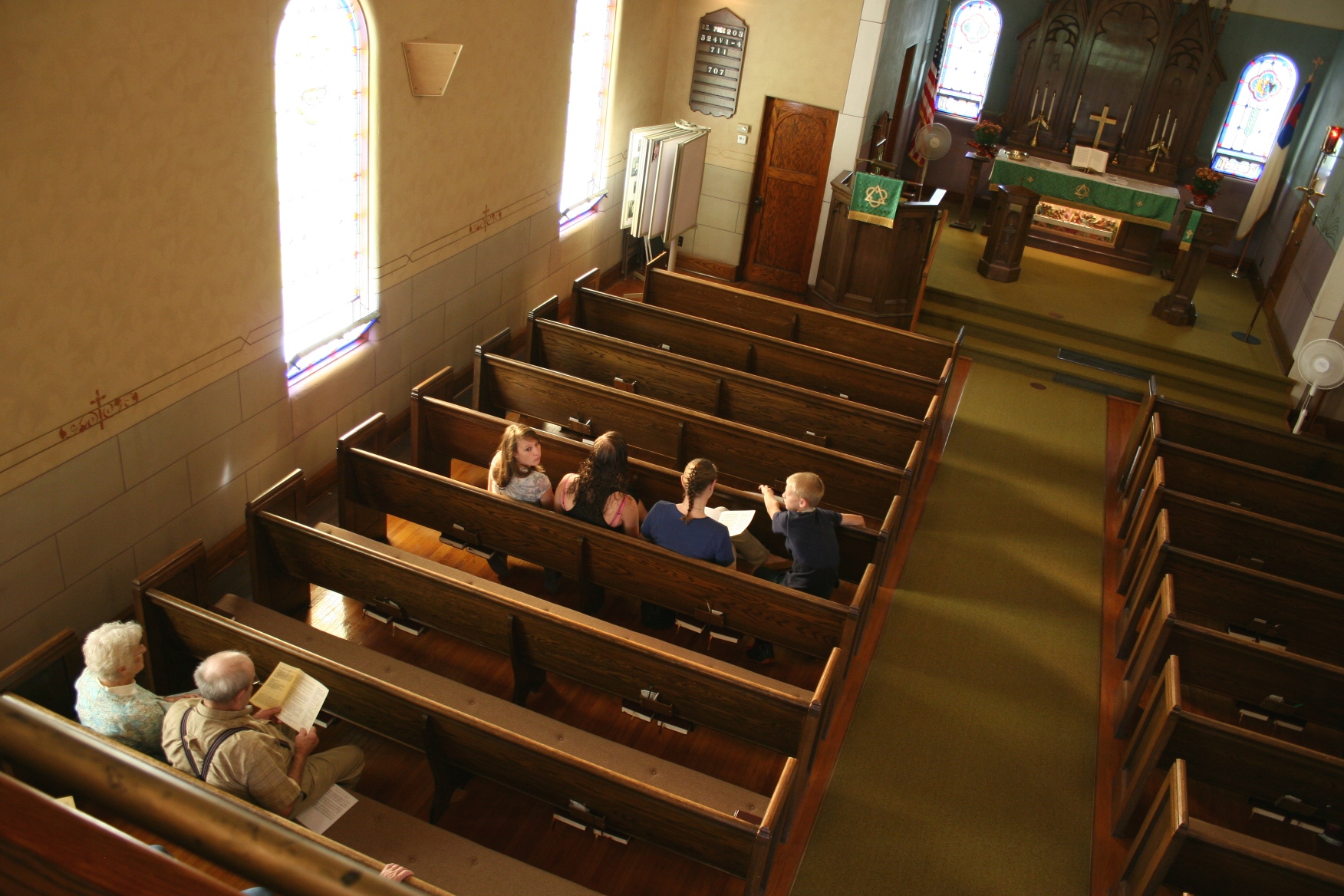
Before worship services on a Sunday morning at Trinity Lutheran Church, North Morristown.

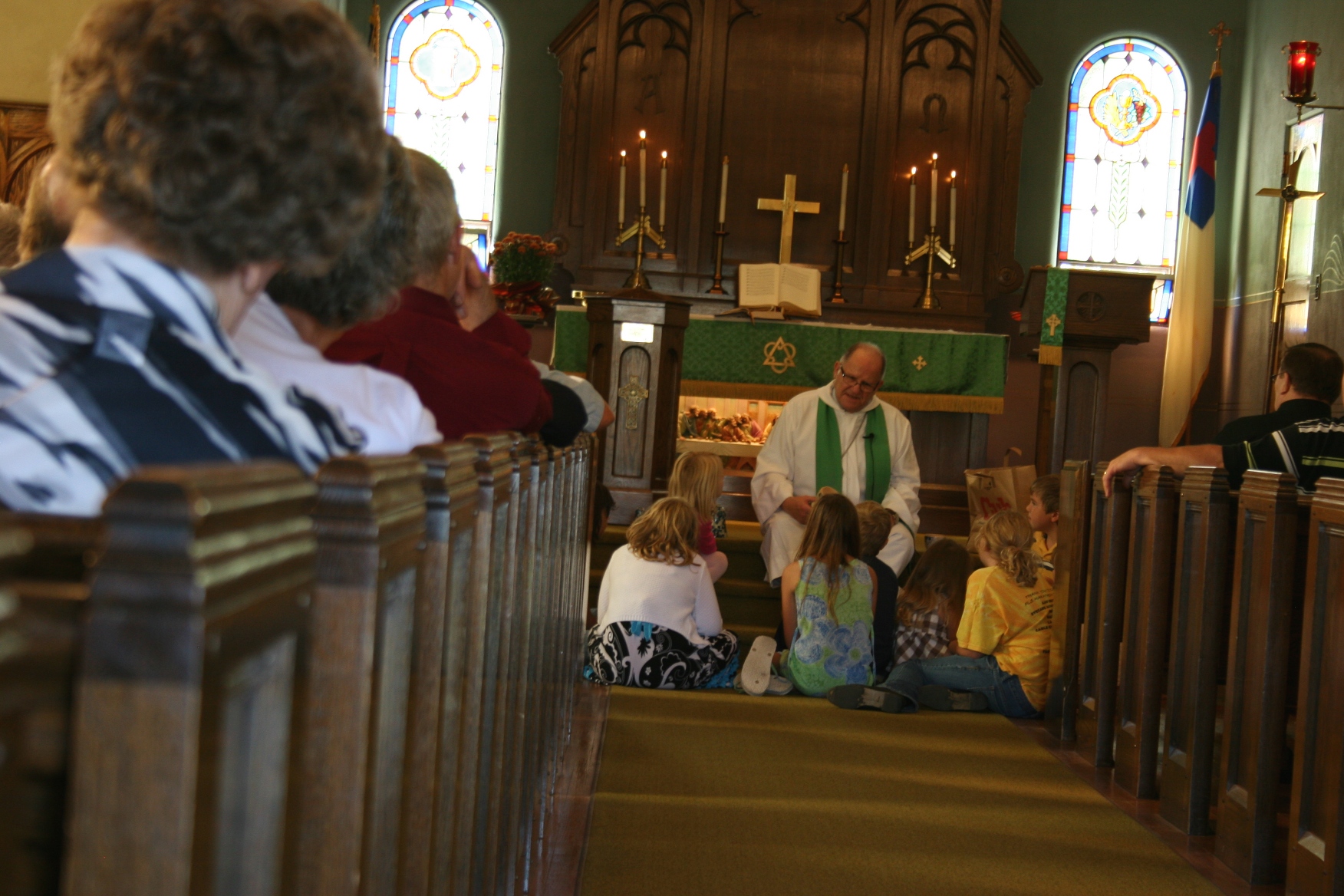
“THERE’S ONE MORE THING to do,” said the Rev. Merle Lebahn, vacancy pastor at Trinity Lutheran Church, North Morristown, before dismissing his congregation. “Give ‘em heaven!”

And so concluded one of the most dynamic worship services I’ve attended in a long time. Pastor Lebahn didn’t deliver a fire-and-brimstone sermon in this country church. But he shared a message memorable both in content and method of presentation.

Pastor Lebahn gets front and center when he gives the children's lesson, just as he does during the sermon.

He’s not a preach-from-the-pulpit style of preacher, but rather an up-close, center-of-the aisle, close-to-his-flock kind of clergyman. His voice rises to a near shout when he wants to emphasize a point and then drops to a quiet, gentle cadence to drive home the message.

And that message last Sunday reflected on the gospel lesson from Luke 10 and the story of the Good Samaritan. Remember that bible story about the beaten man lying at the side of the road, passed by many until, finally, a Samaritan stopped to help?

Rev. Lebahn told us we were the beaten ones lying in the ditch until we received Christ.

He talked, too, about crossroads in our lives and about the people God brings into those crossroads.

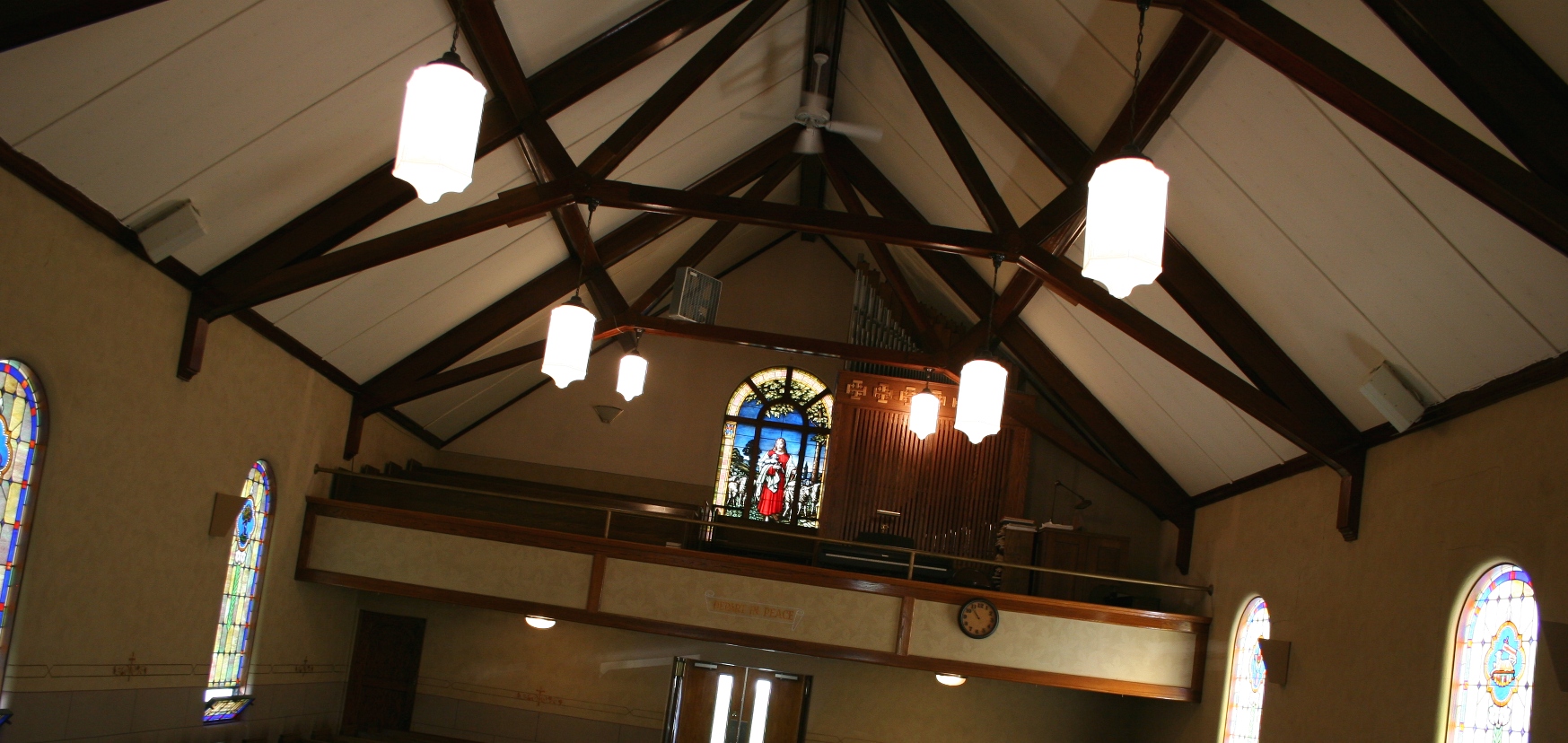
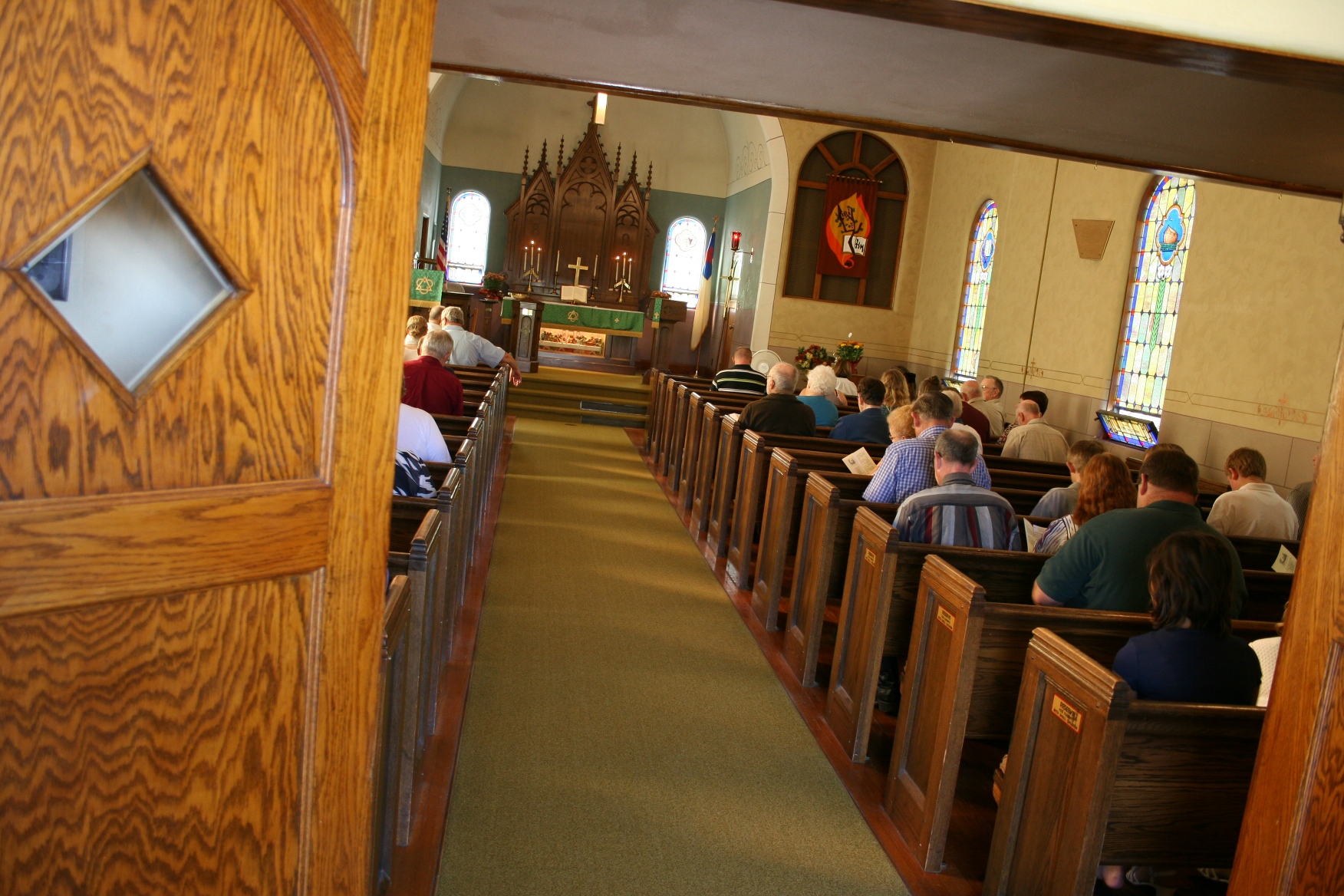
I could go on and on about that sermon. But I think you get the main point delivered by this 78-year-old clergyman who looks, and acts, considerably younger than a near octogenarian. Consider his foot stomping and arm flailing and constant motion. I got tired just watching from my end-pew position in this sanctuary that holds 26 six-person pews on the lower level and a few more in the balcony.

A view of the balcony in this 1938 rural church.

It’s the type of snug church where you won’t get away with napping during the sermon, like you could anyway under Pastor Lebahn’s watch.

There’s something about worshipping in a small country church like this that you can’t replicate in a modern, large-scale church, even if you incorporate stained glass windows or other elements from an historic building.

I felt a sense of connection, of closeness, on Sunday as the congregation joined in prayer—for those celebrating anniversaries and birthdays and for those in need—and sang old favorite hymns like “Oh, That the Lord Would Guide My Ways.”

Looking from the entry into the sanctuary during worship services.

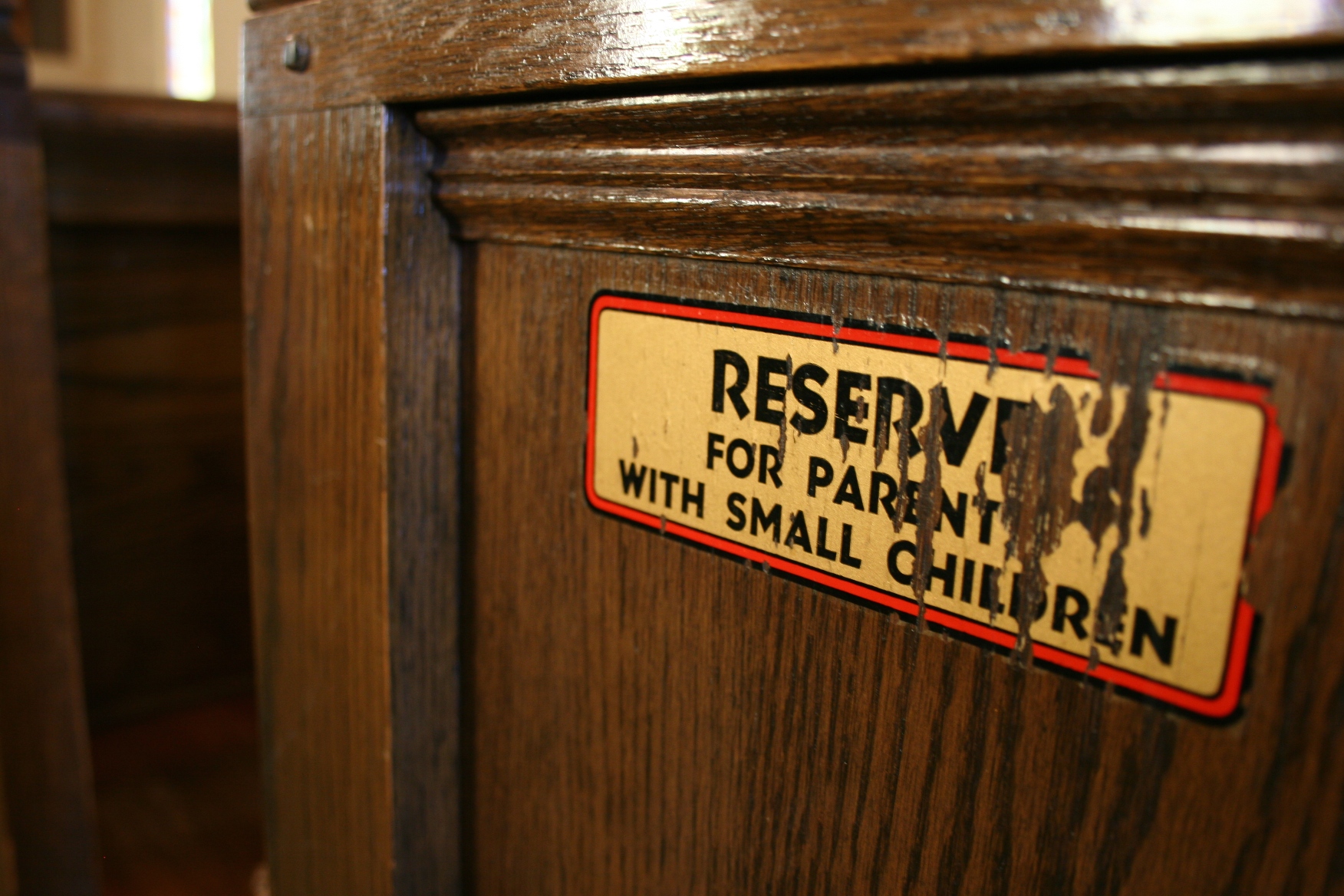
In the back of the church are pews for families with little ones.

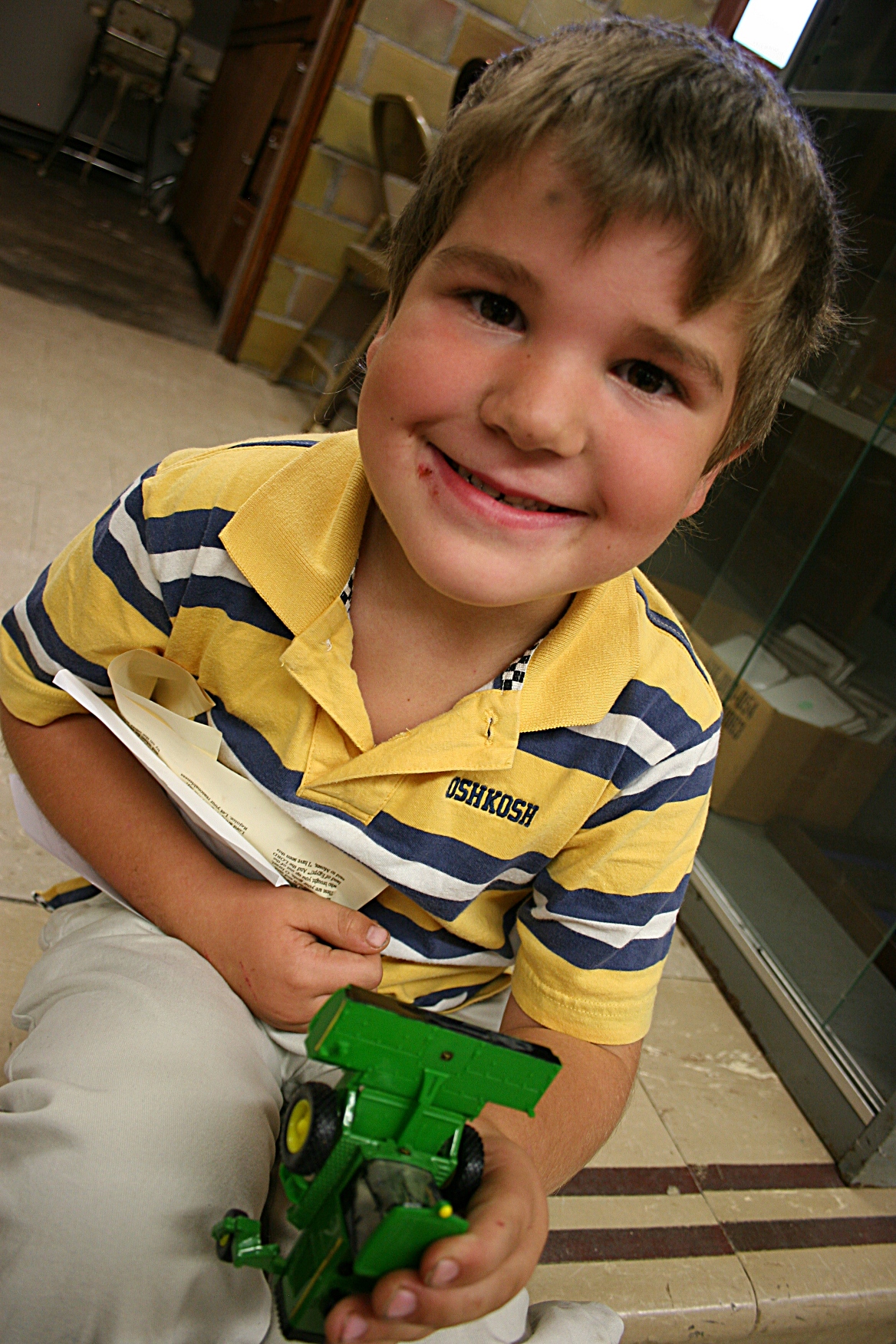
Farm boy, 6-year-old Jonathan, after services in the basement.

You can’t help but feel close when you’re tucked into tightly-jammed pews in a place where a comfortable pair of jeans is as common as a suit and tie and where farm kids like 6-year-old Jonathan bring a mini toy John Deere haybinder to church to keep his little hands busy.

Because just outside the church doors lie fields of corn and alfalfa and soybeans…

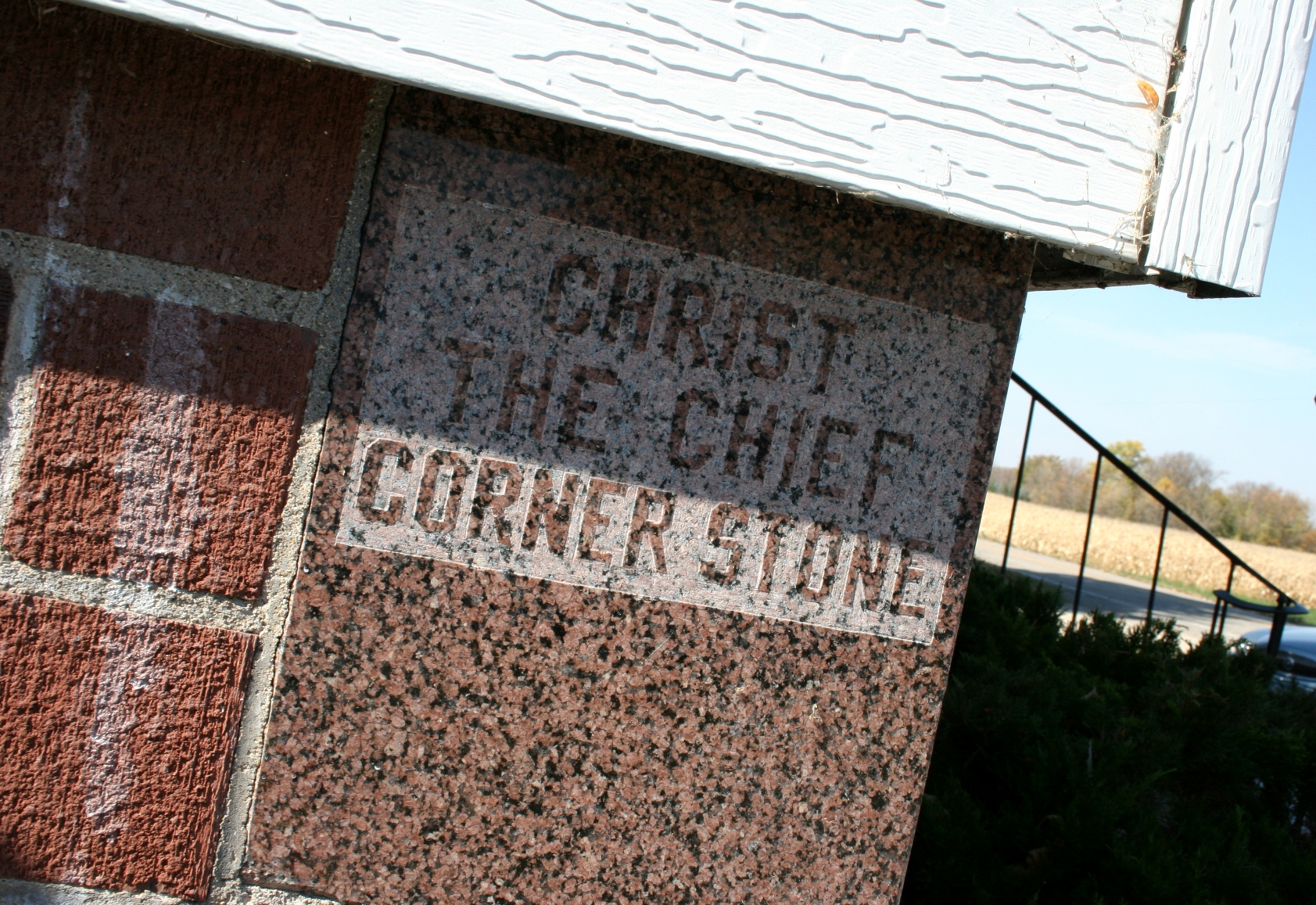
To the right of the cornerstone, in the distance, you can see corn fields.

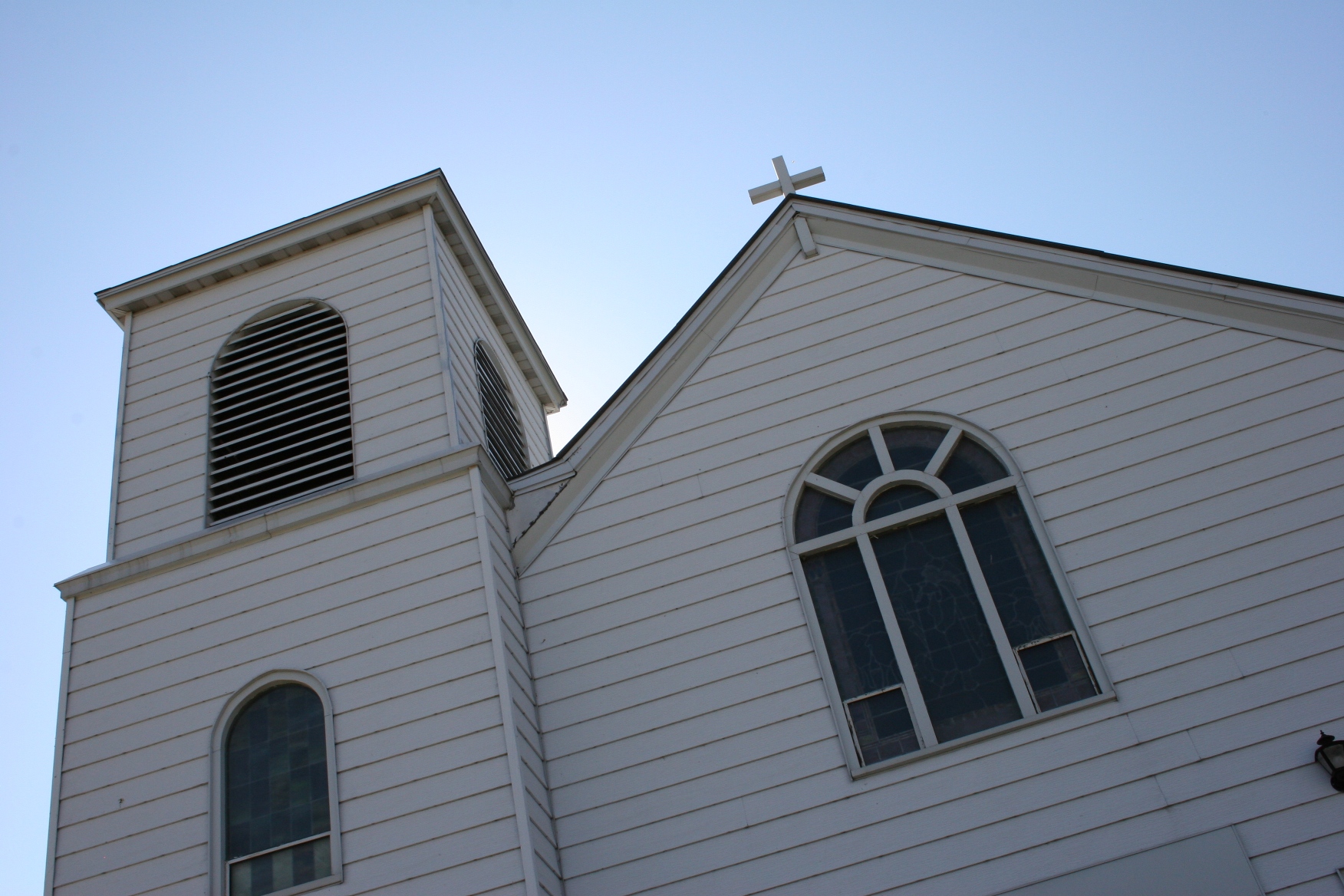
Looking heavenward...

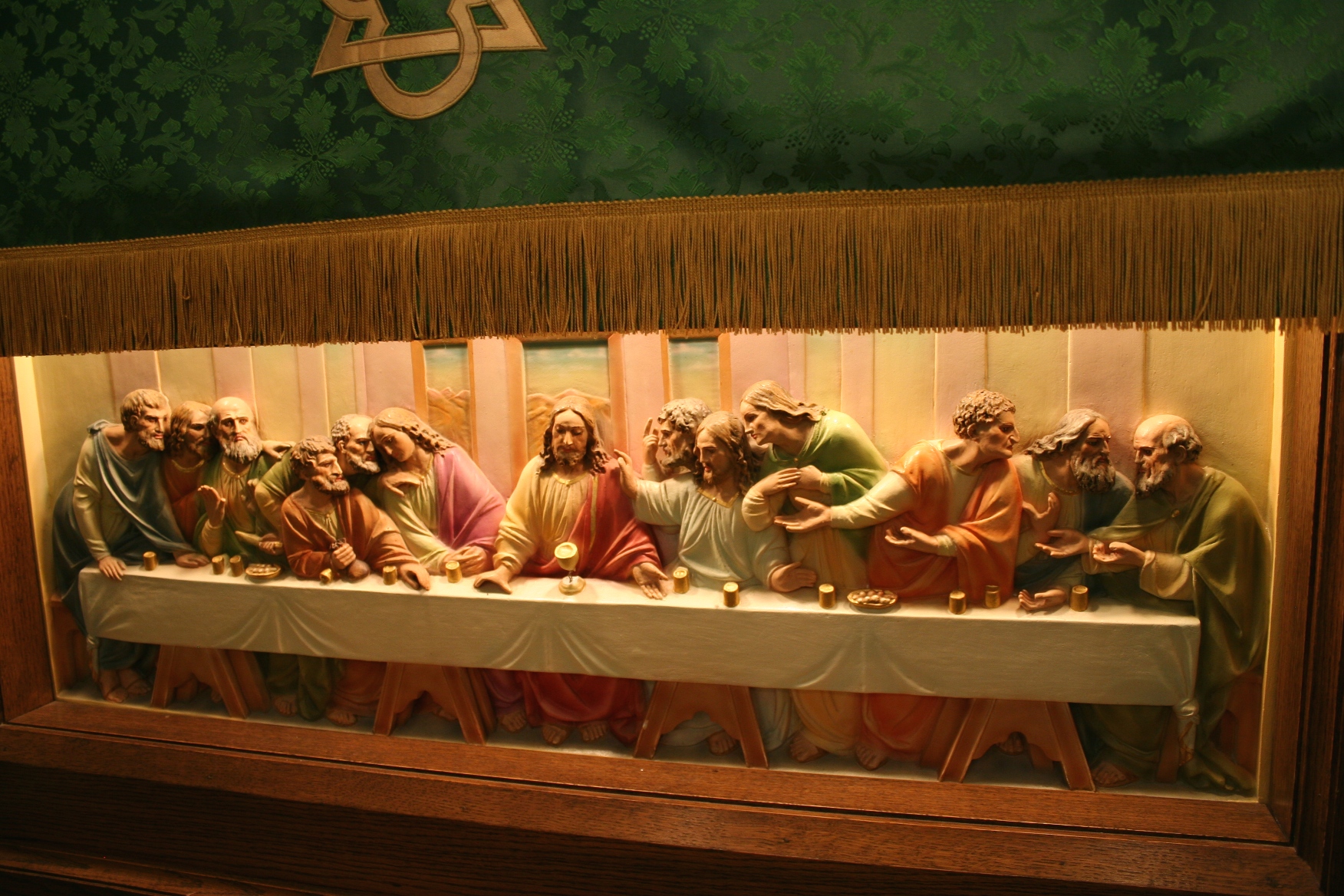
The Last Supper art on the lower part of the altar.

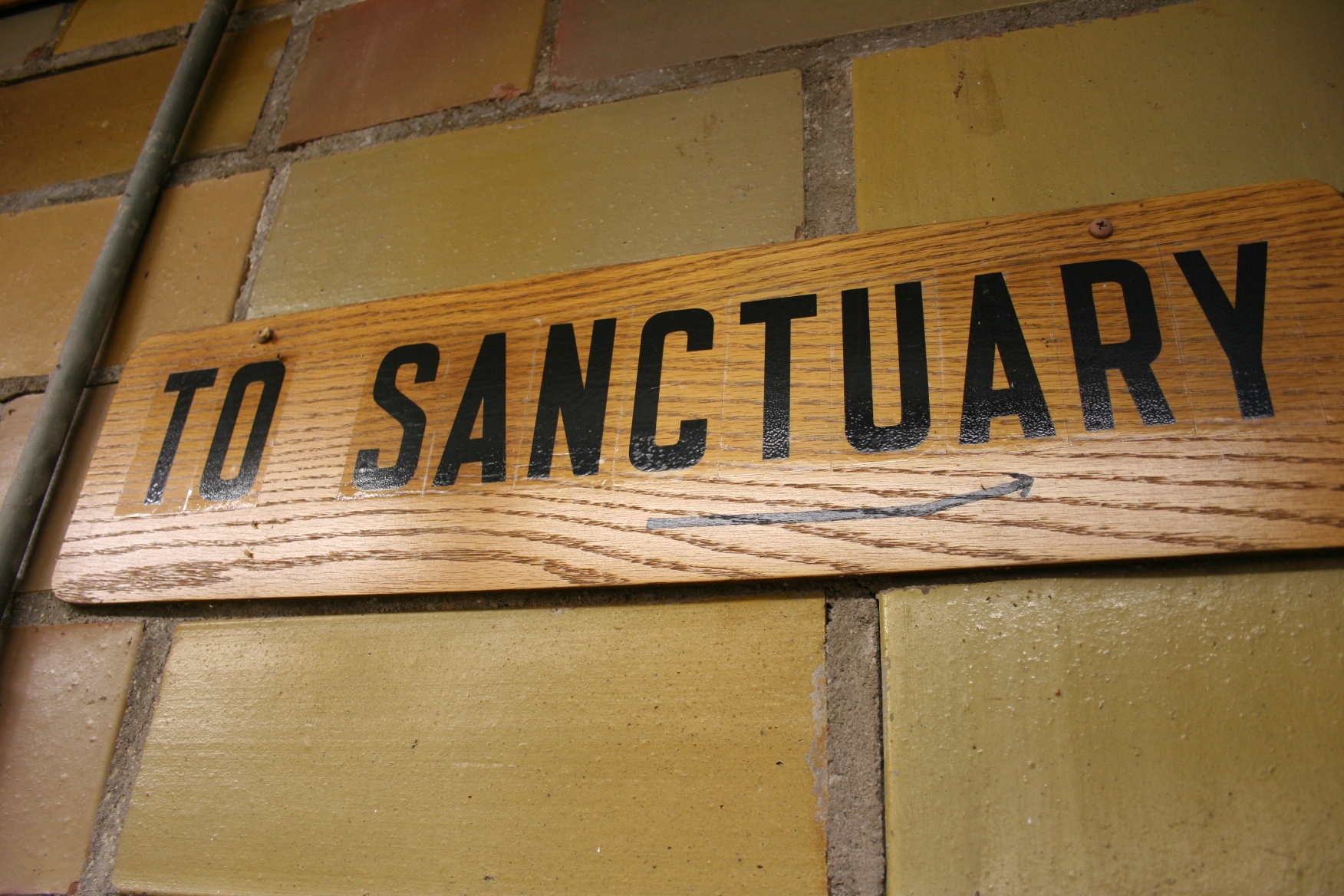
In my next post about this church, I'll take you into the basement where this sign is located.

CHECK BACK FOR A POST about the harvest dinner at this country church following the worship service.

© Copyright 2011 Audrey Kletscher Helbling


Happy birthday, Randy October 12, 2011

Filed under: Uncategorized — Audrey Kletscher Helbling @ 1:52 PM
Tags: , , , , , ,

TODAY MY HUSBAND is celebrating his 55th birthday, which now officially makes him as old as me. Yeah, I was smart and married a younger man, albeit by only about two weeks.

I’ve been contemplating what message to write here today to him. I decided, instead, to tell you a few things about Randy.

He’s the oldest boy in a family of nine children and was born in North Dakota, where he attended a one-room country school. As the story goes, one day the students were kept inside during recess because of coyotes roaming the schoolyard. True story, he swears.

Randy moved with his family to central Minnesota when he was six or seven, or some young age like that.

It was on the family’s farm south of Buckman that Randy saved his father’s life. Yes, you read that correctly. He saved his dad’s life. My spouse seldom talks about that October 21, 1967, accident shortly after his 11th birthday.

But he was there as his dad’s hand was pulled, along with corn stalks, into the spring-loaded rollers of a corn chopper. Blades sliced off his father’s fingers. Rollers trapped his arm.

And Randy was there to disengage the power take-off. He then raced across swampland and pasture to a neighbor’s farm. To save his father’s life. (You can read the details by clicking here.)

An Allis Chalmers corn chopper like this one exhibited at the 2010 Rice County Steam & Gas Engines Show, claimed my father-in-law's left hand and much of his arm in a 1967 accident. That's my husband, Randy, who saved his dad's life by running for help.

My spouse possesses a calm demeanor, meaning not much rattles him. He’s soft-spoken and funny in that quirky kind of humor way.

He does sudoku puzzles and is good at math and numbers and figuring stuff out.

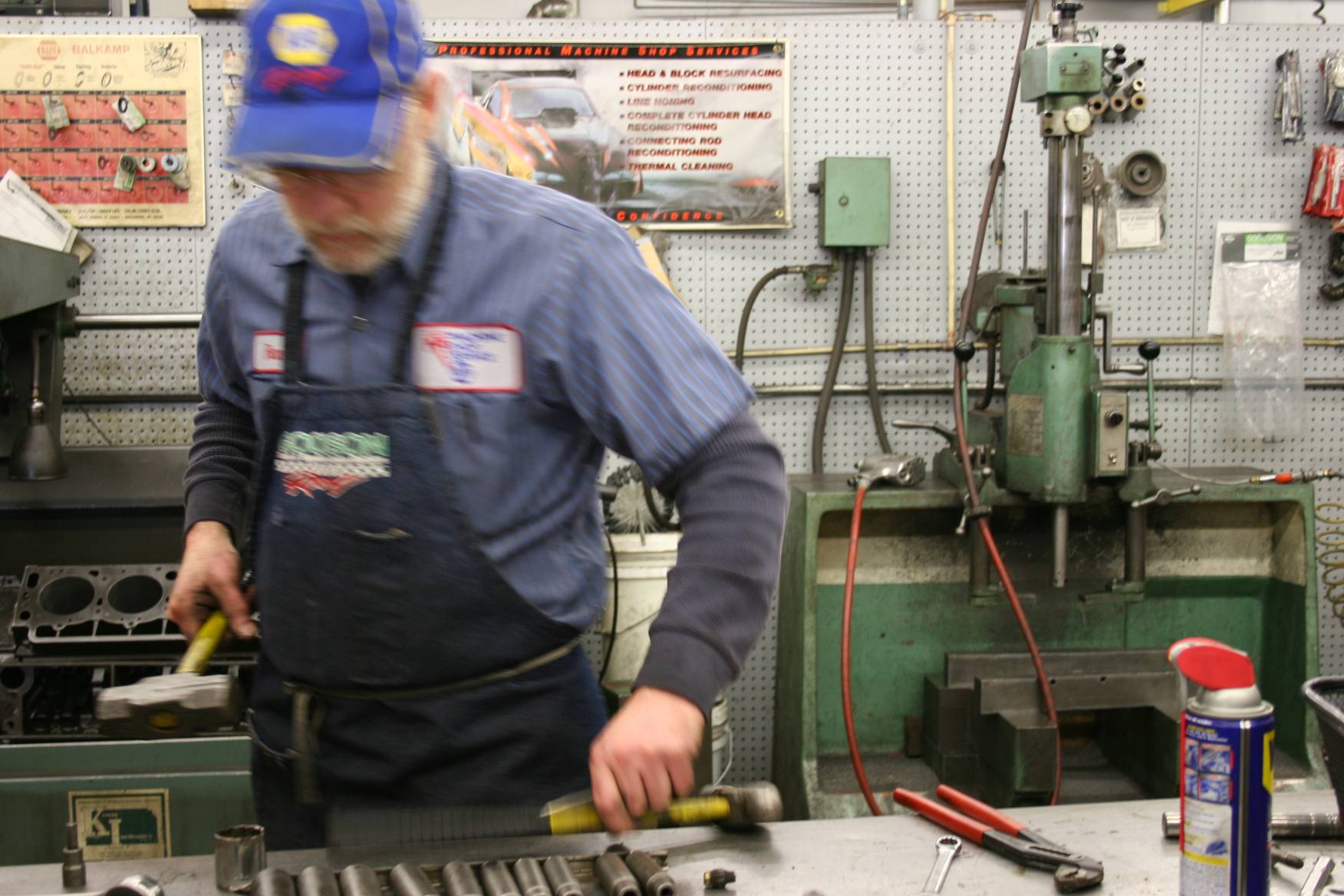
His work as an automotive machinist at Parts Department, Inc., Northfield (NAPA) is always in demand. Suffice to say you better get in line. He’s that good at his job.

Randy at work in the NAPA machine shop in Northfield where he's worked since 1983.

He once owned a Harley, which was smashed in a crash, and once won a trip to the Bahamas.

Right about now, Randy’s probably eating his second or third piece of apple pie bars, his birthday treat at work. Tonight I’ll serve him his favorite cake, angel food, topped with one of his favorite fruits, raspberries.

Speaking of which, I need to bake that cake. Now.

Happy birthday and many more, Randy! (See, I used an exclamation mark, which I never use in my writing.)

I love you.

IF YOU WISH to leave a birthday message for Randy here, please do so. He reads my blog and is, indeed, one of my most vocal fans. Thank you for always supporting me in my writing, Randy.


The truth about goldfish revealed at a convenience store October 11, 2011

YOU’RE ON THE ROAD. You need to pee. You also need a beverage to quell your thirst. It’s a hot afternoon. So you pop into a convenience store.

You use the facilities, select a bottle of tart lemonade and then head for the check-out counter.

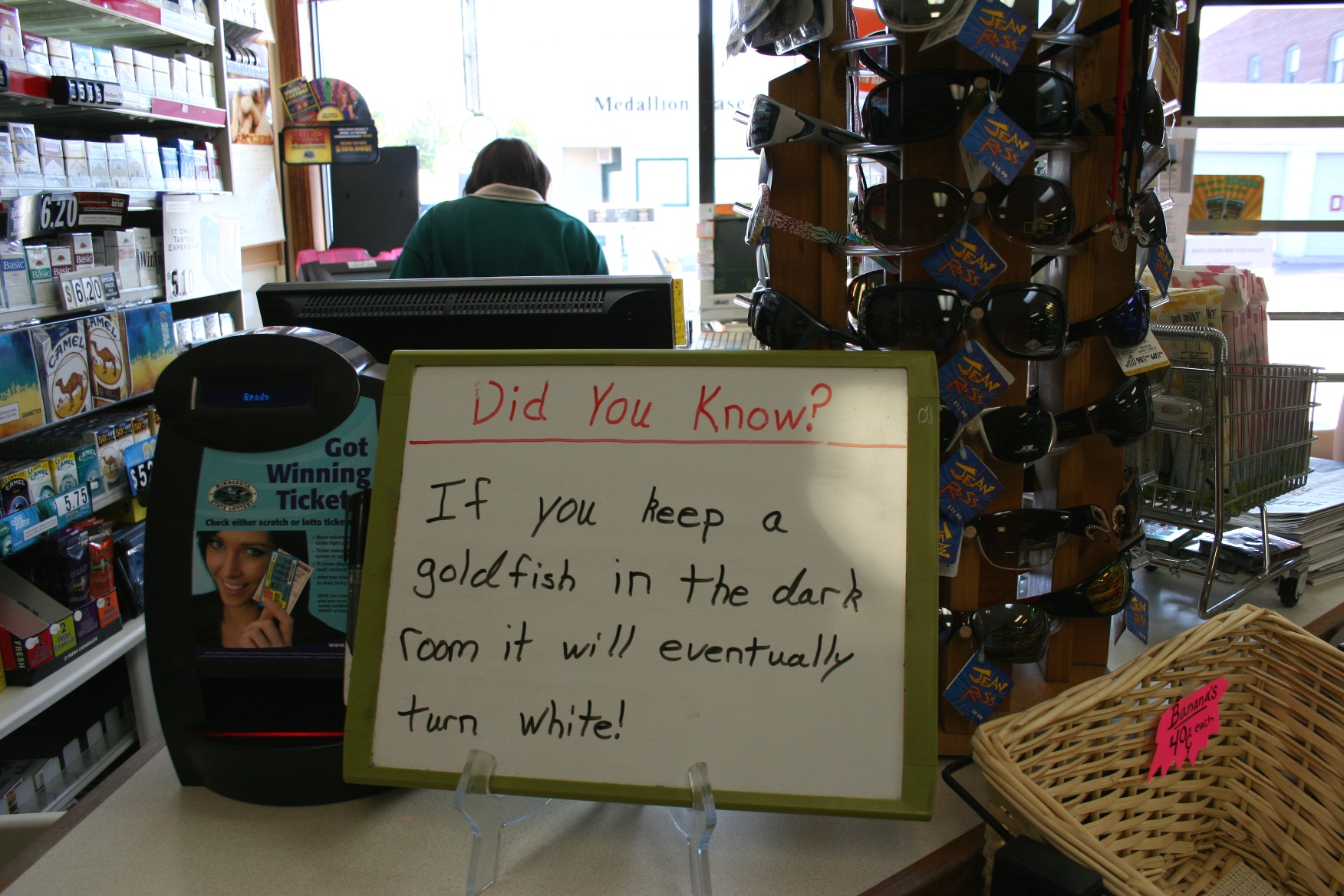
That’s when you spot this message scrawled on the whiteboard, propped between the Minnesota State Lottery and Jean Ross sunglasses displays:

The message posted recently at a southeastern Minnesota convenience store.

And then you think to yourself, “What is the meaning of this message?”

When you inquire, you learn that this is the “thought of the day,” with a new parcel of wisdom or tidbit of information posted whenever the manager is on duty.

It’s as simple as that.

As you walk out of Parkside Gas and Grocery on Main Street in Nerstrand, you think, “Well, I just learned something new.”

And then you have this fleeting thought that you should rush out and buy a goldfish, stash the fish tank in a closet and test the validity of this statement.

But then you remember just how much you dislike cleaning a fish tank.

HAS ANYONE ever tried this? Do goldfish really turn white when kept in the dark?

© Copyright 2011 Audrey Kletscher Helbling


Recovering from the Hammond flood, in the voice of a survivor September 23, 2011

FOR THE PAST YEAR, Katie Shones has been my main connection to Hammond, the southeastern Minnesota community of 230 flooded one year ago today by the raging waters of the Zumbro River.

Katie and her family—husband Scott and children Bekah and Romie—live just across Wabasha County Road 11 from the Zumbro. The floodwaters came within mere feet of their home on the east end of Hammond’s business district.

Katie Shones and her family live in this house, photographed during the September 2010 flood by Gene Reckmann.

Even though the family’s home was spared, they were still deeply impacted by the flood, especially the Shones children.

I offered Katie the opportunity to reflect on the flood and its impact on this, the one-year anniversary. Her words are sure to move you. Katie is a woman who speaks her mind and tells it like it is. (Click here to read my first interview with her in October 2010.)

Through our months of corresponding, I’ve come more and more to appreciate the resilience and strength of individuals like Katie who’ve endured so much and yet find the silver lining in the most difficult of situations.

Main Street Hammond at the height of the September 2010 flood. Water was rushing over the sidewalk and into the basement of the gray house via the cellar doors. Katie Shones' house is only two lots away from the gray house. Photo by Gene Reckmann.

Here, then, are Katie’s words:

I DO NOT LIKE to think of that day nor the days immediately following the flood. I don’t like to look at pictures, either. I shudder at the thought of being evacuated from my home and the three-plus long weeks of the National Guard patrolling the town and enforcing a 6 p.m. curfew. Check points to enter the city, not being outside after 6 p.m….

The response of people to this tragedy has been overwhelming. Complete strangers have come into the town and surrounding areas and donated hundreds, no thousands, of man hours for clean up and rebuilding. Thousands of dollars of building materials were donated and installed in homes and businesses. Local restaurants provided delicious meals.

The flood has reaffirmed my belief that people are basically good and caring deep down inside.

I cannot sing praises high enough to Lutheran Social Services. Their aid to people was up and above the call of duty. Camp Noah, (for children who have survived a natural disaster) was a positive experience for my children. Bekah and Romie could talk about their feelings and express them through art, theater, crafts, etc. LSS still has an office in Hammond to assist people.

The parks are coming along beautifully. The baseball field is usable again and a new chain link fence has been installed around it and the basketball court. Flowering crabs have been planted in the boulevard of Main Street. I can’t wait until spring to see them bloom.

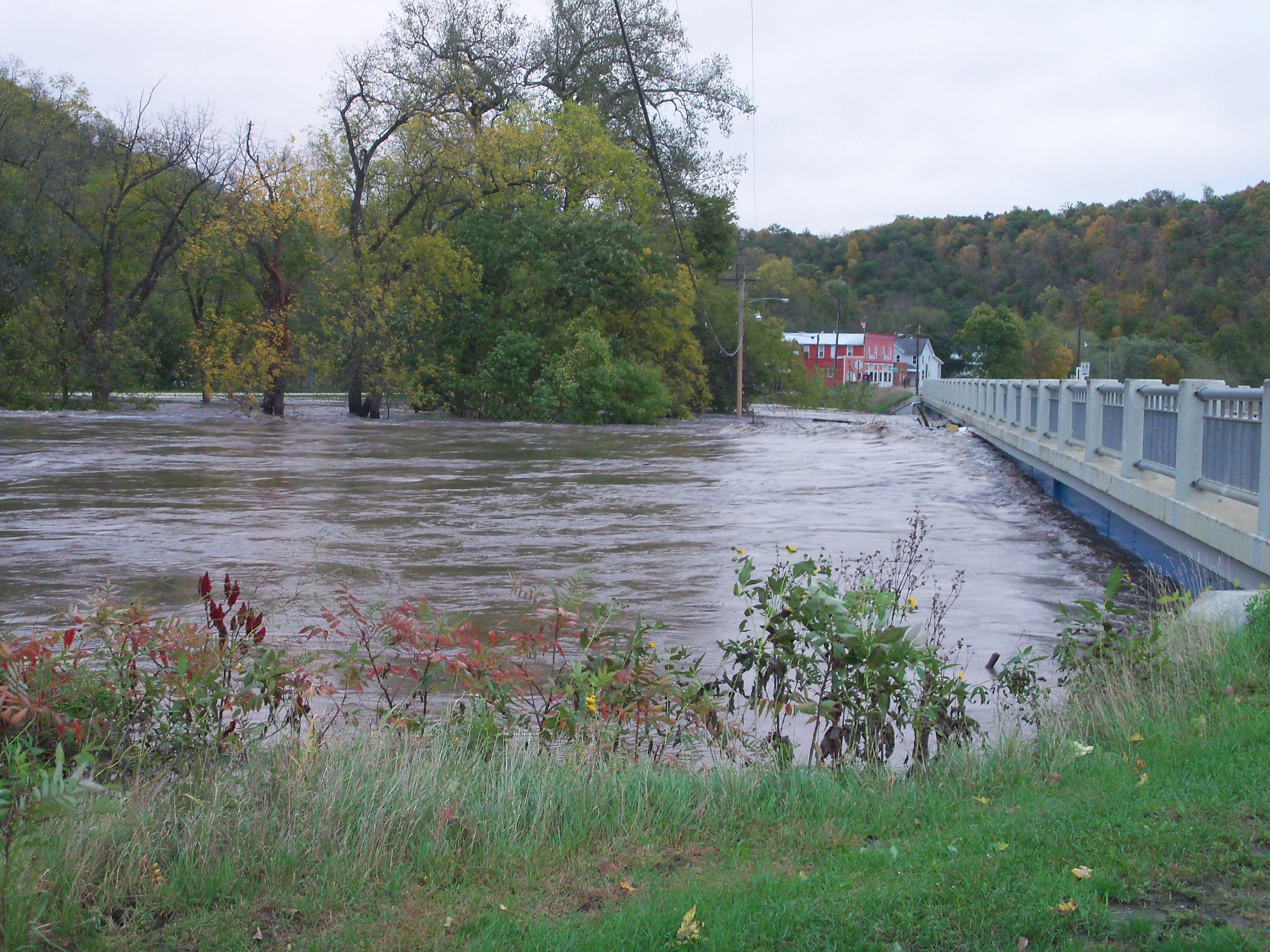
This photo by Carrie Hofschulte shows the Zumbro River raging across the bridge that connects east and west Hammond on Wabasha County Road 11.

FRUSTRATIONS. I believe there are 17 or 18 homes on the buy-out list. I am being told it will be another 18 months before the buy-out is complete. That will be 2 ½ years after the flood occurred. That is a long time to wait.

Some people are still making double payments. When those homes are demolished, it will significantly impact the tax structure of this town. What will happen to my property taxes? I also expect a dramatic increase in the water and sewer bill. We already pay about $100 a month for water and sewer…

A view of the raging Zumbro River, looking from the west side of Hammond to the east at 7:30 a.m. on Friday, September 24, 2010. Photo by Susie Buck.

I CERTAINLY RESPECT Mother Nature more now than prior to Sept. 23, 2010!  The sheer force and power of the Zumbro River was unbelievable. We did not enjoy the river this year as in years past. Bekah and I only went tubing twice this year—last year we went 13 times in one week!  Scott and Jerome took the flat bottom out a few times in 2011. Not very often compared to years past.

However, there is a silver lining to this all. People have come together to help each other. The community is much closer knit than before. Neighbors that haven’t spoken to each other for a long time stop by to chat and visit. After Scott’s neck surgery last fall, I had many offers of help for snow removal and cutting and splitting of firewood. I don’t think as many people would have helped out prior to the flood as after.

Sheri Ryan shot this image of the same bridge, above, when the water had returned to its almost "normal" level.

BEKAH AND ROMIE STILL WORRY about flooding, especially when it downpours. They monitor the weather station almost every day and keep a close eye on the river level. Rebekah doesn’t cry out in her sleep anymore, thank goodness. The bags are still packed under her bed, though. Jerome doesn’t speak of that day often. I think he is like me, I try to forget it. However, I know they will never forget that day for the rest of their lives. (Click here to read an earlier post about the flood’s impact on Bekah and Romie.)

One more thing: The flood has taught me not to sweat the little things in life. Family, friends and faith are what is important in life.

© Copyright 2011 Audrey Kletscher Helbling


Grieving September 22, 2011

Filed under: Uncategorized — Audrey Kletscher Helbling @ 10:19 PM
Tags: , , , , , , ,

“THANK GOD FOR MY FAITH,” my mom said as she shared yet another piece of tragic news that has touched my extended family this week.

Her dear cousin Alice, 79, died Tuesday as a result of injuries sustained in a car accident in North Mankato. This I learned in a phone call on Wednesday. After I hung up, and per my mom’s request, I began phoning four of my five siblings.

A day earlier I had done the same.

My sister-in-law’s 64-year-old father was found dead at the scene of a single-vehicle accident in Cottonwood County early Tuesday morning, news I was asked to share with other family members.

This is almost more than we, my extended family, can bear right now. We’ve leaned on and supported each other and relied on our strong faith in God and on friends to get us through our hours and days.

Yet, I know the most difficult minutes are yet to come—when I see my brother and his wife and their two children. What will I say that will console them? Words and hugs seem inadequate. Prayers are not.

My mom is right. It is faith in God that sustains us. We are not alone.

And, certainly, we are not the only family grieving. In Waseca, many are mourning the loss of 11-year-old Jaiden, a sixth-grader who on Monday committed suicide. My sister, a Waseca floral designer, has been creating floral arrangements for Jaiden’s funeral. My two young nieces, who attend school in Waseca, and my other sister, who teaches in Waseca, have all been impacted by Jaiden’s death.

Grief runs deep.

In Faribault, family and friends are mourning the death of 25-year-old Wendi due to injuries sustained in a motor vehicle accident. She was a Faribault High School classmate of my eldest; my daughter did not know her well.

Grief runs deep.

We all know we are going to die. Yet, when a death comes unexpectedly, in a tragic way, it’s especially difficult to comprehend, to accept, to understand.

We do the best we can. We cry and pray and talk and, for me, write.

And last night I laughed, a laugh that built and rolled into a deep belly laugh that left my muscles aching. When I think about it now, the subject of my laughter wasn’t at all funny—as my husband told me at the time. But I asked him, “Would you rather I cry?”

So I laughed. Because I’ve already cried too much.

© Copyright 2011 Audrey Kletscher Helbling


After the flood: “A long way from normal” in Hammond

HOW DOES A DEVASTATING flash flood change you and the place you call home?

I posed those and other questions to Tina Mann from Hammond, a southeastern Minnesota community ravaged last September by the overflowing waters of the Zumbro River. A year later, what is life like in Hammond for residents such as Tina, now a member of the Hammond City Council?

Here, in her words, are Tina’s reflections one day before the one-year anniversary of the flood which left her and her family living in three hotels and a rental house for three months before they could return to their Hammond home.

Tina, on her June 25 wedding day, in the bridal gown she saved when she had to evacuate her home last September. Photo by Sherwin Samaniego Photography.

How has Hammond/life in Hammond changed since the flood?

Hammond is a lot quieter now. A lot of our long time residents have left, and a lot of our regular crowd has been sporadic. But, they are slowly starting to trickle back in.

Hammond has made some new friends along the way, and we see some of them come back down from time to time, too. I predict, though, that as winter draws close, that it may taper off. I think we may be in for another very quiet Hammond winter. There are fewer children, too, which makes it hard for the few that are still here. I hope that sometime down the line, Hammond will start to see more families coming down here.
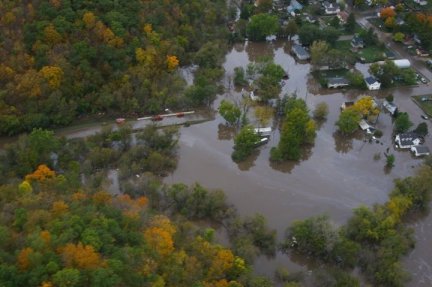
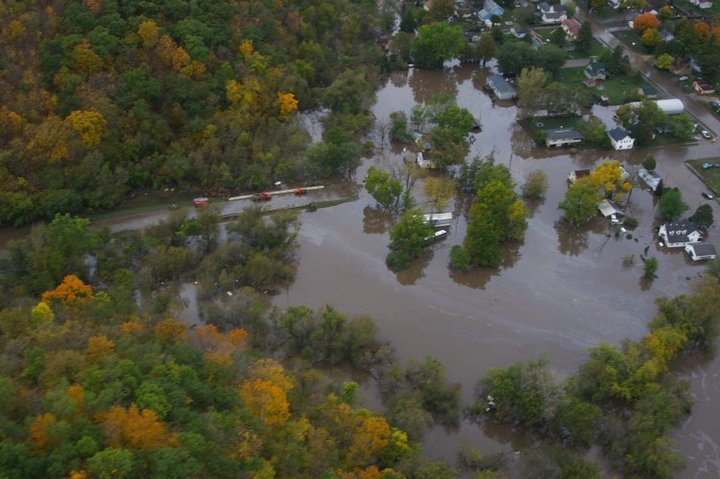
An aerial view of Hammond during the flash flood of September 2010. Photo courtesy of Micheal and Tina Mann.

What still needs to be done in terms of recovery in your community? Be specific.

For the most part, weather permitting, the city should be done with the municipal repairs by the end of the month. We were able to get the park building repaired and fully restored.

On the residential end, however, things are different. FEMA and the State funded the programs to repair the Municipality of Hammond and, with some careful planning and negotiating, we were able to come very close to a pre-flood state.

But the residents did not get any FEMA aid at all. Some only qualified for a state grant, which just barely covered expenses to repair their homes. Some qualified for low-interest loans and depending on the amount of damage to the home, they may have been able to replace a few of their possessions. But without FEMA funding, most people were not compensated for their personal belongings and it may well be many years before they feel they are ‘recovered.’

Then there are those still waiting for their buy-outs. The residents on the state program have begun receiving their offers, but are still in the ‘red tape’ part of the process and have not received any funding yet, and those on the federal list (50 percent or more damage, in flood way and flood plain) have been put on hold by the federal government, and no one knows how long that is going to take.

After the flood, the gutted home of Dallas and Vicki Williamson, who relocated 35 miles away to an 1882 hilltop farmhouse in rural Cannon Falls. Photo by Sheri Ryan.

Do you need additional funding for Hammond recovery projects? Volunteers still needed? I’m wondering how that park rebuilding is going.

The ‘city’ is pretty well rebuilt and I am happy to say that we no longer need volunteers unless we decide to start some new projects.

Financially, however, we are still trying to find ways to compensate for some shortfalls. There are city employees that have not been compensated for personal expenses, such as cell phone overages, incurred while working for the city during the immediate aftermath. Although it is realized that it is a responsibility of your position, we also feel that if we can find a way to do it, it really is the right thing to do.

We also have employees who worked well beyond the normal scope of their position and they really do deserve compensation for their time, services, and personal expenditures. Although most of them haven’t asked for it, it still would be nice if somehow we could work it out. These people did a phenomenal job taking care of our city!

And we have the future to look at, too. We are probably going to loose 6-8 residential properties to the 100 percent buy-outs. There are another 10 or so on the 50/50 buy-out list And those who choose the 50/50 but do not rebuild, of course their property value will decrease dramatically.

This is going to have financial consequences to our tax base, which is going to result in higher property tax and water and sewer bills for every business and property owner in Hammond.

And we need to take a look at what we are going to do with all of the new green space in town. When we lose the residents to the 100 percent buy-outs, those properties become ‘green space’ by law. That means that the lots become city property that cannot have permanent structures built on them. Many of these lots are centrally located in the middle of a residential area. The city is going to be moving into phase two of the recovery, which is the long-term aspect…and we do have a lot of things to think about and consider.
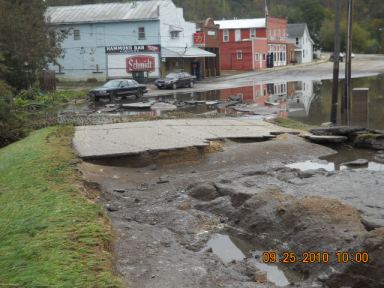
This photo shows the destroyed road that goes from Wabasha County Road 11 to the business area on the east side of Hammond. Waters were receding in this photo taken mid-morning on Saturday, September 25, 2010, by Jenny Hoffman.

Is there a sense of frustration about anything or are things going well?

Yes, there has been, and is, a lot of frustration. It has been a very long, hard process trying to filter through the red tape to realize what is the ‘city’s’ responsibility, what is the ‘residents’” responsibility, and what programs are responsible for what.

A lot of phone calls from residents, confused about who they should be speaking to. Frustration because the process is very slow. The city has very few answers for the residents who are working with the buy-out program and it’s been hard to convey the message that the city has nothing to do with that part of it and we really have no answers for them. All we can do is direct them back to the agencies they are working with.

We have lawns that are not being mowed, properties that have been abandoned since the flood. The residents that have rebuilt are frustrated because the ‘clean-up’ won’t be complete until these issues are resolved, and we don’t know how long it is going to take.

Our city is coming together, but we really are still a long way from being back to normal.
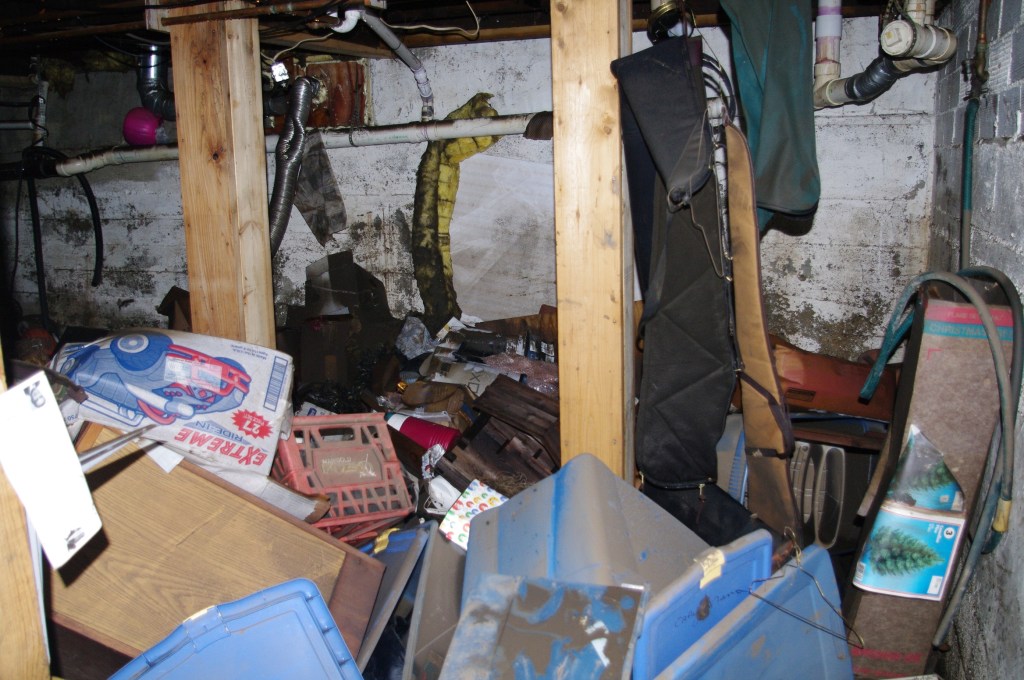
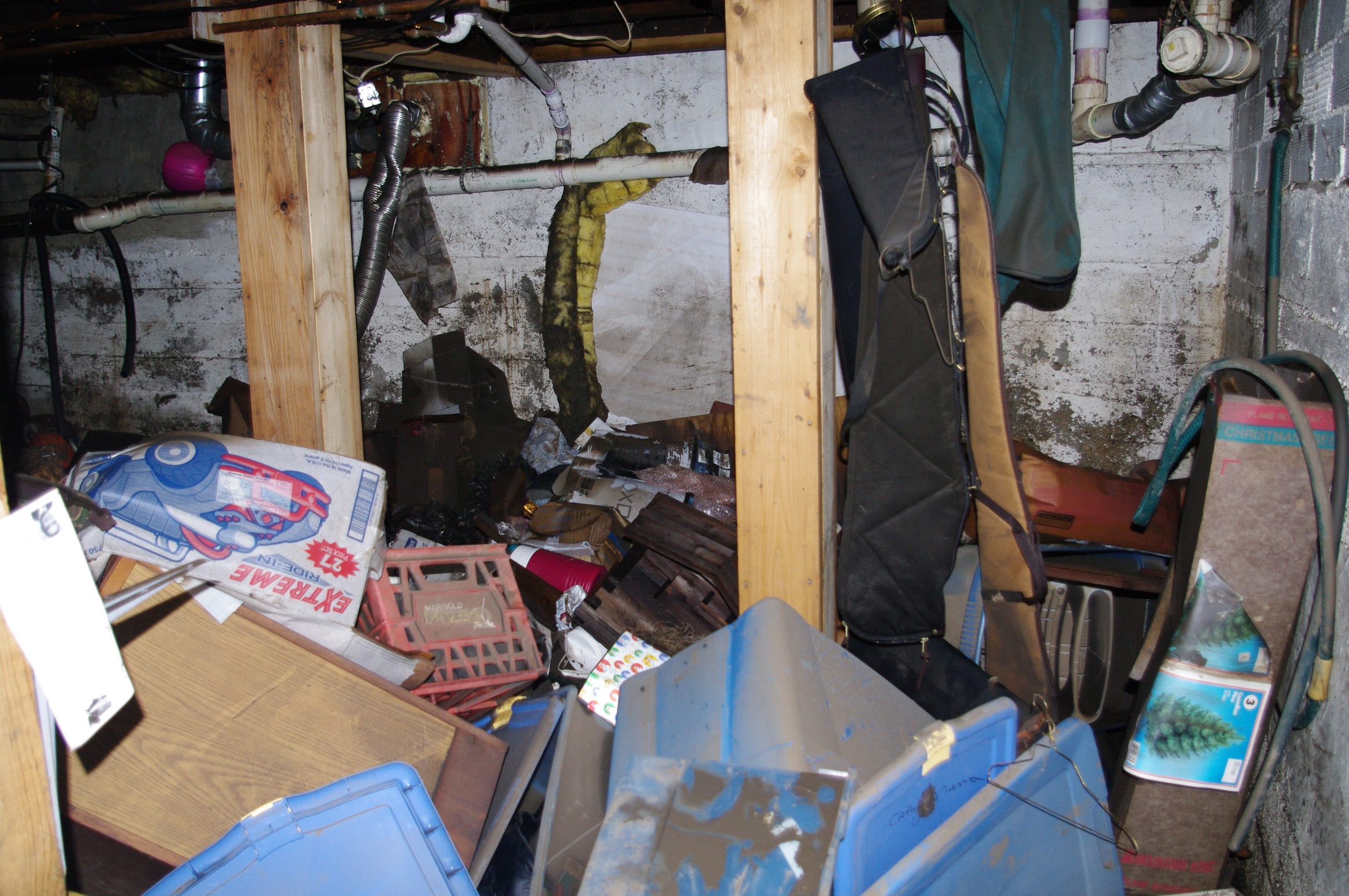
Floodwaters destroyed everything in the basement of the house where Tina, Micheal, Cassie and Christian and Bob and Cathy Mann live. Photo courtesy of Micheal & Tina Mann.

What was the biggest single impact of the flood on you emotionally? Did it change you in any way?

Watching the hurricanes and flooding in the east was really hard and I realized that my emotions are still very raw. I could not control my weeping as I watched the news and saw the devastation in the eyes of those people. I know how that feels, I’ve been there….. It still hurts very much. I doubt that feeling is ever going to go away.

Becoming involved with the city on the council has opened my eyes to a lot, and yes, it has changed me. This flood and the impact it is going to continue to have on this area for years to come is bigger than what the eye can see. We are going to be dealing with this for a long time.

On a personal level, I am dealing with the impact by being involved with the revolution of Hammond. I have been very busy planning the Anniversary Party (set for Saturday, September 24) and working on the council ‘learning the ropes’. I plan to be involved in finding the solutions to the challenges that are before us, and help guide Hammond into the future.
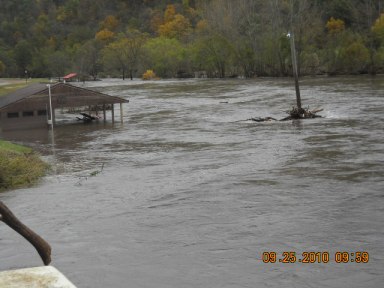
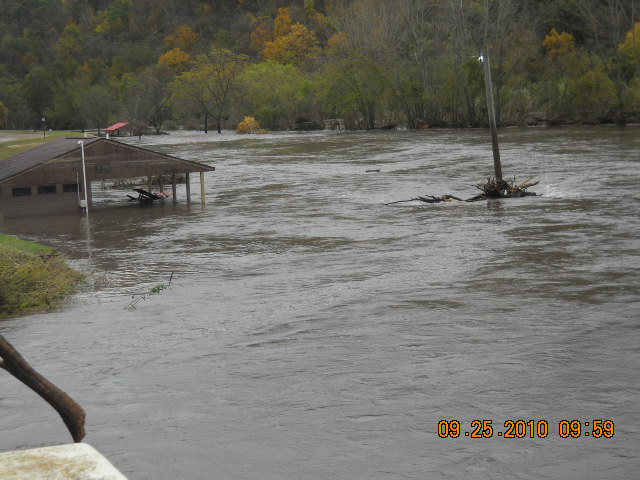
Hammond's riverside park was all but destroyed by the flood. Marks on the shelter roof show how high the water rose. A baseball field next to the shelter, with a fence around it, is covered by receding floodwaters. Jenny Hoffman took this photo at 10 a.m. on Saturday, Sept. 25, 2010.

THANK YOU, TINA, for sharing your thoughts. You have always been open and honest, never holding back, and I appreciate that. We can all learn a thing or 10 from you about the strength of the human spirit and the strength of community.

READERS, PLEASE CHECK BACK for another post featuring thoughts from Hammond resident Katie Shones.

© Copyright 2011 Audrey Kletscher Helbling


Hurting hearts in need of prayer September 21, 2011

Filed under: Uncategorized — Audrey Kletscher Helbling @ 7:30 AM
Tags: , , , , , ,

WHAT DO YOU SAY? What do you say? What do you say to your sister-in-law who has just learned that her father has died in a single-vehicle accident in southwestern Minnesota?

What do you say when your heart hurts, when all you can do is cry and you need to console someone who is hurting more than you?

What do you say?

“I’m sorry. I’m so sorry… I love you.”

As your voice breaks and the tears fall and there is silence on the other end of the phone line, you pull yourself together. Not because you can, but because you must. You want your sister-in-law to hear you speak, to feel your love embracing her, in your words, on the worst day of her life.

This was my Tuesday.

First came the phone call early Tuesday morning from my other sister-in-law with the news which sent me reeling, my heart racing, the tears flowing in a river of grief.

“… dad was killed in a car accident last night…”

Sketchy details that don’t matter because they won’t bring him back—the husband, the father, the grandfather, the brother, the uncle, the man loved by so many.

It is my duty to inform three of my younger siblings, my mom… What do I say? How can I tell them?

So I phone my husband first, barely able to still my trembling fingers to punch the numbers into my cell phone. I can hardly get the words out, to tell him the awful, awful news. He offers to call my family. But I tell him, “No, I can do this.”

And I do. First my brother, who is on vacation and whom I am unable to reach. In my voice message I instruct him to call me, that it is important.

Then I speak to my sister, who will contact my other sister.

I call my eldest daughter, leave a message with the other daughter. My son will get the news when he arrives home from school.

And then I must tell my mom. But I don’t want her to be alone, so I call my aunt—her neighbor—to deliver the news in person. I phone my mom 10 minutes later, after my aunt has arrived, and my grief breaks through again in words overwhelmed with emotion.

Later my aunt phones to tell me we reached my mom just in time, before a friend called with the news of Steve’s death. In a small town, word travels quickly.

And so my Tuesday ebbed and flowed with grief in more than a dozen phone calls made and fielded. The message left with my youngest brother, mourning the tragic death of his father-in-law. The husband and father trying to be strong for his wife and their children.

I cry for my young nephew and my teenage niece and their mom and her mom and my youngest brother. All of them. A family hurting.

And then when I can calm myself, if but for a moment, I bow my head in prayer, asking for God’s comfort and peace to bless this grieving family.

It is all my sister-in-law has asked of me—to pray.

And now I am asking you. Please pray.

© Copyright 2011 Audrey Kletscher Helbling