

St. John’s Evangelical Lutheran Church in Vesta, hours after a July 1, 2011, storm ripped half the roof from the sanctuary. Photo courtesy of Brian Kletscher.
“There is no place like home. We cannot wait to be back in our own church.”
And so, 10 months after a powerful July 1, 2011, storm packing winds of 90 – 100 mph ripped half the roof from St. John’s Evangelical Lutheran Church in my hometown of Vesta in southwestern Minnesota, congregants will worship for the first time in their rebuilt sanctuary this Sunday morning.
I expect many of St. John’s 323 baptized members feel exactly as my uncle, Milan Stage, does—simply happy to return to the comfortable familiarity of their home church.
Since the storm, parishioners have worshiped at their sister congregation in neighboring Echo. Says long-time St. John’s member Karen Lemcke, “We thank Peace Lutheran of Echo for allowing us to join their services for all of this time. It was enjoyable to be in fellowship with them but still nice to be back in our church.”

Inside St. John’s sanctuary in September, I listened to the wind flap the tarp that covered the damaged roof.
When worshipers arrive at St. John’s Sunday morning, they will enter through a new south-facing 20 x 40-foot addition which includes a handicap accessible bathroom, storage room and study area/office for the pastor.
And above them a new south roof—the portion ripped off by the winds—and a new exterior steel roof cover the sanctuary refurbished with new ceiling planking and hanging lights.
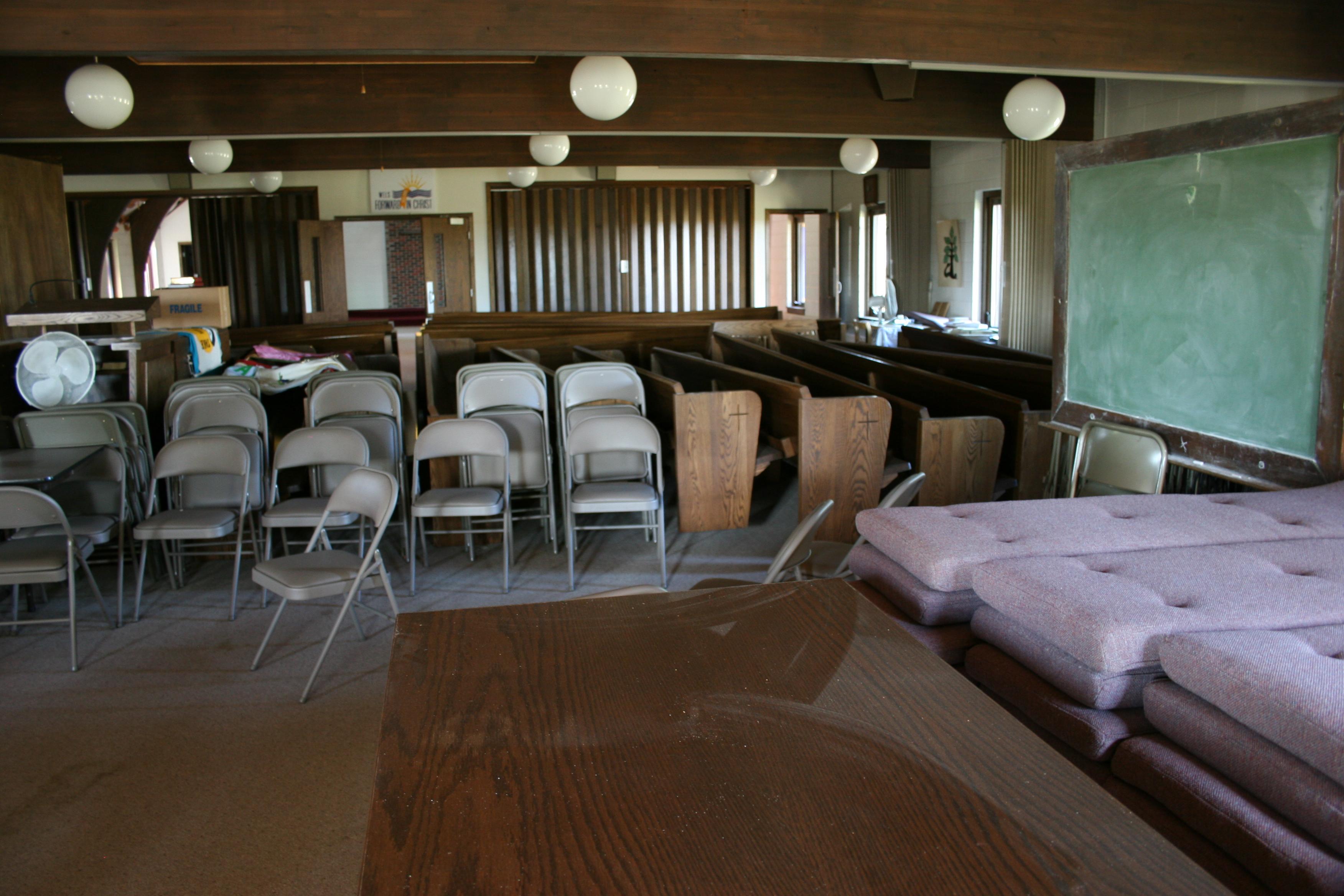
The pews and other items from the church were moved into the undamaged social hall after the storm.
They’ll walk on new carpeting and settle onto new pew cushions to hear the sermon delivered by a former St. John’s pastor, the Rev. Randy Bader, Mission Advancement Director of Great Plains Lutheran High School in Watertown, S.D. Says Rev. Bader, in part:
I am planning on using the Holy Spirit-inspired words of Isaiah as the basis for the sermon. It includes these words: “For My thoughts are not your thoughts, neither are your ways My ways,” declares the Lord. “As the heavens are higher than the earth, so are My ways higher than your ways and My thoughts than your thoughts.”
We may wonder why our gracious God would allow such a dangerous and difficult situation to touch the lives of His people as it did on that July day last summer. So often we do not understand. But the truth is, we don’t have to understand. Jesus has a purpose for everything that he allows to happen to us, and His ultimate purpose is to bless and save us.
…Trust Him. His love is the constant, in, and even through, challenging circumstances.
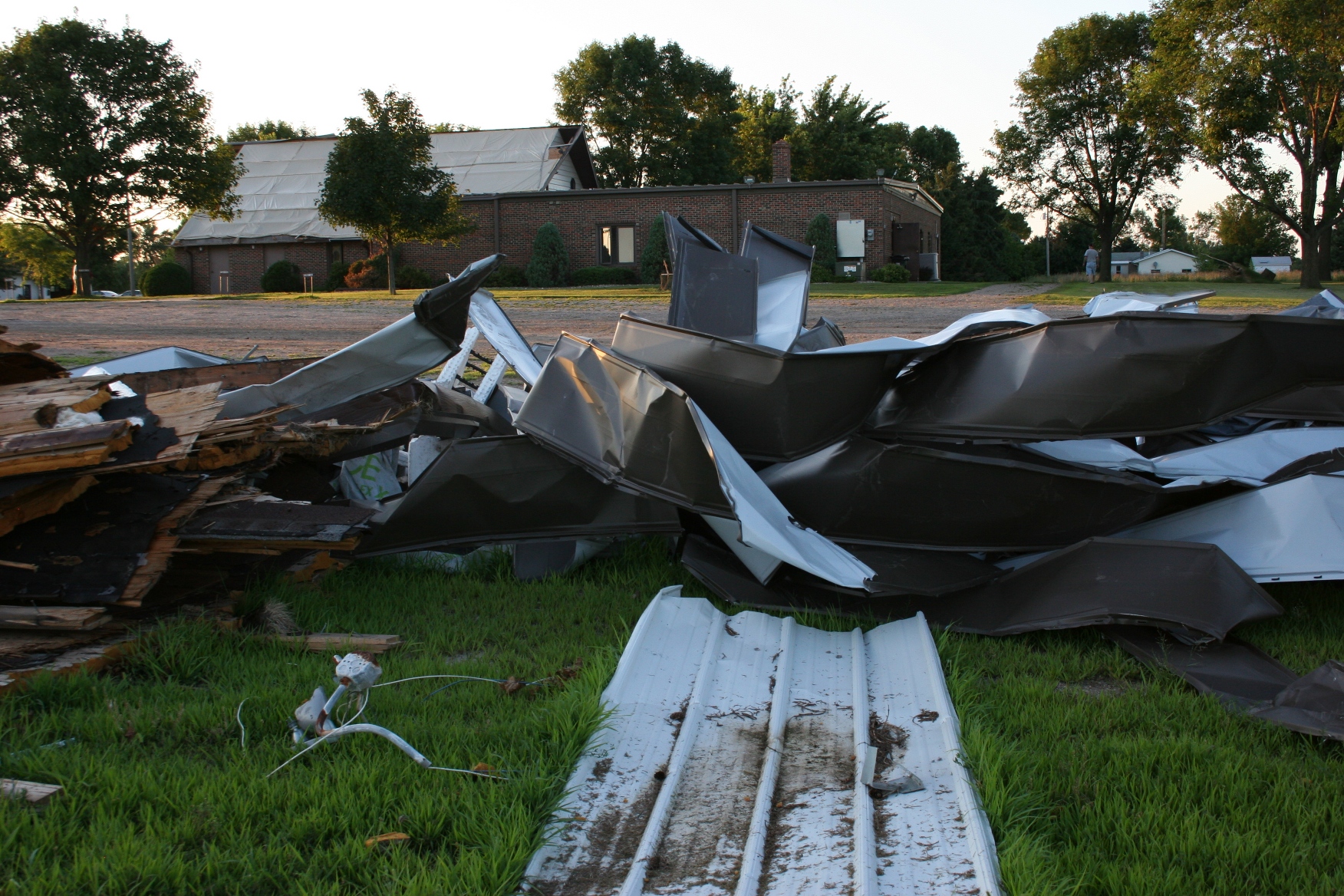
A debris pile on the edge of the church parking lot includes pieces of steel from the roof and brick from the bell tower. Photo taken in September 2011.
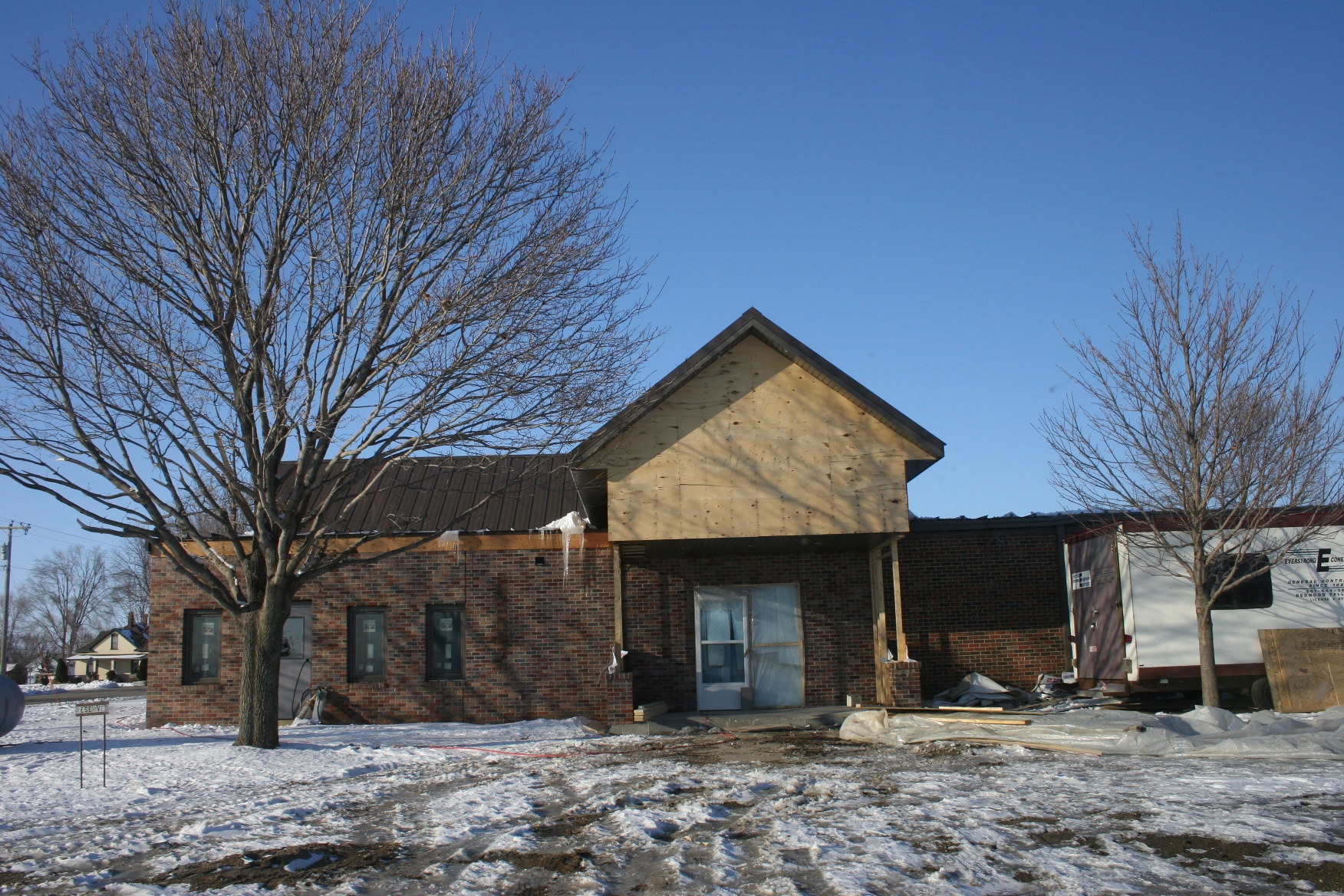
Under construction in March, a pastor’s office, bathroom and storage room were added to the south side of the early 1970s era church.
St. John’s members like my 80-year-old mom, especially, welcome the reopening of the church. It’s much easier for her to drive across town to worship services and other functions than to drive or catch a ride the eight miles to Peace Lutheran in Echo. I’m thankful for family members who’ve taken my mom to church services.
During the 10 months since the storm ravaged Vesta and the surrounding area, I’ve kept tabs on St. John’s, checking in most visits back to my hometown to see how the reconstruction was progressing. This, after all, is the church where I was married 30 years ago this May 15. It is the church where my family mourned the loss of our father, maternal grandfather, paternal grandmother and many other loved ones. We celebrated family weddings here and attended confirmations and worshiped here on Sunday mornings and on Christmas Eve.
The old saying goes that a church is not a building. That adage holds true if you consider the essence of a congregation.
But, there is much to be said for a physical structure, for the memories it holds, for the comfort it gives in familiarity. Boards and walls and details in construction and décor connect us to our past, to emotions and to loved ones. A place represents, if anything, a tangible legacy of faith.
And in a farming town like Vesta, population 330, a church building also serves as a place to gather, to swap rain gauge totals and crop reports, to exchange family news, to embrace each other in sorrow and in joy, to welcome the newest residents with baptism banners, to grieve the loss of neighbors and friends and family. A church building represents community within a community, the very soul of small town life.
© Copyright 2012 Audrey Kletscher Helbling








 Minnesota Prairie Roots
Yes, Faribault is a diverse community May 3, 2012
Tags: City Pages, comments, diversity, Faribault, Minnesota, thoughts
In this file photo, a Somali family waits to cross a downtown Faribault street.
ON ANY GIVEN DAY, I can drive on a street in Faribault, walk along the sidewalk, glance out my office window or go shopping and see a racial diversity of people.
I can stand in my side yard and look toward the home of an Asian couple. I can glance up the hill and watch two preschoolers, the daughters of a white mother and an African American father, play outside. In my front yard, I can see, several houses down, the Hispanic family that has lived in my neighborhood for years.
Yes, Faribault, population 23,352, is a community of diversity. Thirteen percent of our residents are Hispanic/Latino and another 7.4 percent, black or African American, according to the 2010 U.S. Census. All totaled, about one-fifth of our residents identify themselves as “non-white.”
As my husband would say—and this is not meant at all as derogatory—shopping in at least one local grocery store is like walking into the United Nations. We shop side-by-side with Spanish-speaking Latino families and with Somali women clothed in billowing dresses and head scarves.
Just the other evening, as I entered the local public library, a Sudanese man held the exterior library door open for me while his pre-teen son opened the interior door. It’s been a long time since a young boy held a door for me and I expressed to him my appreciation for his respect and good manners.
The other day, while waiting in the car for my husband to pick up milk at a local convenience store, I observed a cluster of teenaged Somali girls, dressed in head scarves and flowing dresses, move along the sidewalk while, just across the street, a 60-something white woman clad in a jacket resembling an American flag pushed a cart of groceries. It was a unique visual illustrating diversity in Faribault.
Several Latinos lead in singing of Mexico’s national anthem last September during the International Festival at Faribault’s Central Park. Flags represent the birthplace nations of those participating.
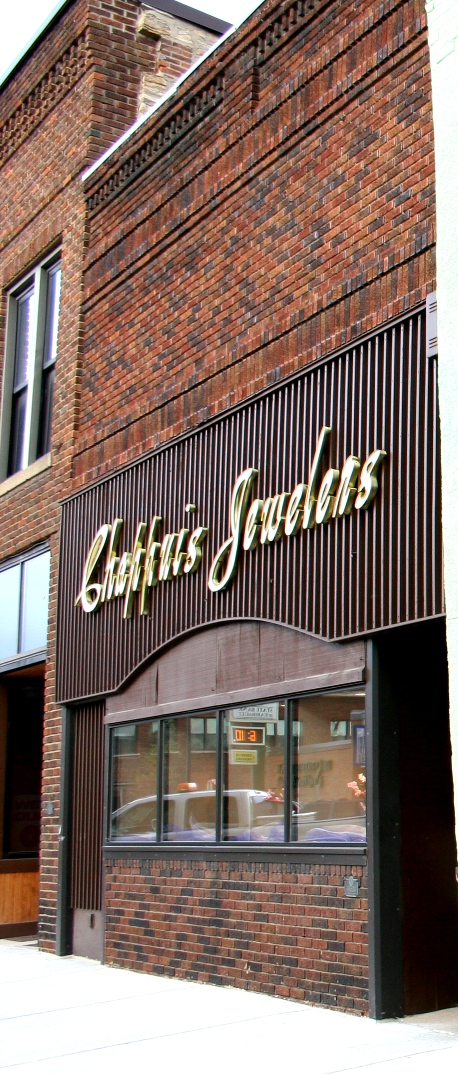
The diversity of my community bubbled to the surface Tuesday after I read a comment on City Pages, an online Minneapolis-based information source. A post I published last week about jewelry store thefts in Faribault and elsewhere in Minnesota was linked to in “The Blotter” section as was an article in the Faribault Daily News which identified the jewelry store thieves as “black males.”
Now I don’t want to get into the issue of whether the news reporter should have racially-tagged the suspects. But I was miffed by the first Blotter comment on the blog post.
It looks like “diversity” has now spread to Hastings and Faribault.
That comment was followed by a reply I won’t print here because of the language. But you can read it by clicking here.
So why did the initial diversity comment rile me? Well, I’m tired of over-generalizations that those of us living outside the Twin Cities metro area reside in closed-up communities comprised mostly of Anglo-Americans. We are not just a bunch of white descendants of Scandinavians or Germans or Irish or French… We are racially diverse and growing in diversity.
If you ask the residents of Willmar or Worthington, St. James or Madelia, or many other Minnesota towns, they’ll tell you the same. Latinos, Asians, Somalians, Sudanese and others call outstate Minnesota home.
Diversity spread to Faribault decades ago. Just stroll through my neighborhood.
How diverse is your neighborhood, your small town, your suburb, your city? Let’s hear.
© Copyright 2012 Audrey Kletscher Helbling