Minnesota Prairie Roots

Writing and photography by Audrey Kletscher Helbling

March 1965, a harsh Minnesota prairie winter documented March 13, 2023

This huge snowdrift blocked my childhood farm driveway in this March 19, 1965, photo. I’m standing next to Mom. (Photo credit: Elvern Kletscher)

SHE WAS NOT QUITE 33 years old, this young mother of five living on a southwestern Minnesota dairy and crop farm in March 1965. It was an especially harsh winter, documented in a spiral bound notebook she kept.

She filled page after page with several-line daily entries about everyday life. She wrote about crops and household chores and kids and food and the most ordinary daily happenings. And, always, she recorded the weather—the wind, the precipitation, sometimes the temperature.

Arlene Kletscher’s journals stacked in a tote. (Minnesota Prairie Roots copyrighted file photo)

This keeper of prairie history in rural Redwood County was my mother, who died in January 2022 at the age of 89. I am the keeper of her journals, which she kept from 1947-2014, from ages 15 to 82. Sixty-seven years of journaling. Several years, when she met and fell in love with my dad, are noticeably missing.

Recently, I pulled the tote holding her collection of writing from the closet. This snowy winter of 2022-2023 in Minnesota prompted me to filter through Mom’s notebooks from 1964 and 1965. That winter season of nearly 60 years ago holds the state record for the longest consecutive number of days—136—with an inch or more of snow on the ground. We are closing in on that, moving into the top ten.

Mom’s journal entries confirm that particularly snowy and harsh winter on the Minnesota prairie. From February into March, especially, many days brought snow and accompanying strong wind. Two photos from March 1965 back up Mom’s words. Her first March entry is one of many that notes the seemingly never-ending snow falling on our family farm a mile south of Vesta. She writes of the weather:

March 1—What a surprise! Snowing & blowing when we got up & kept on all day. No school.

March 2—Still blowing & started to snow again. Really a big drift across the driveway. Mike came & opened up driveway. No school again. Milk truck didn’t come so Vern has to dump tonight’s milk.
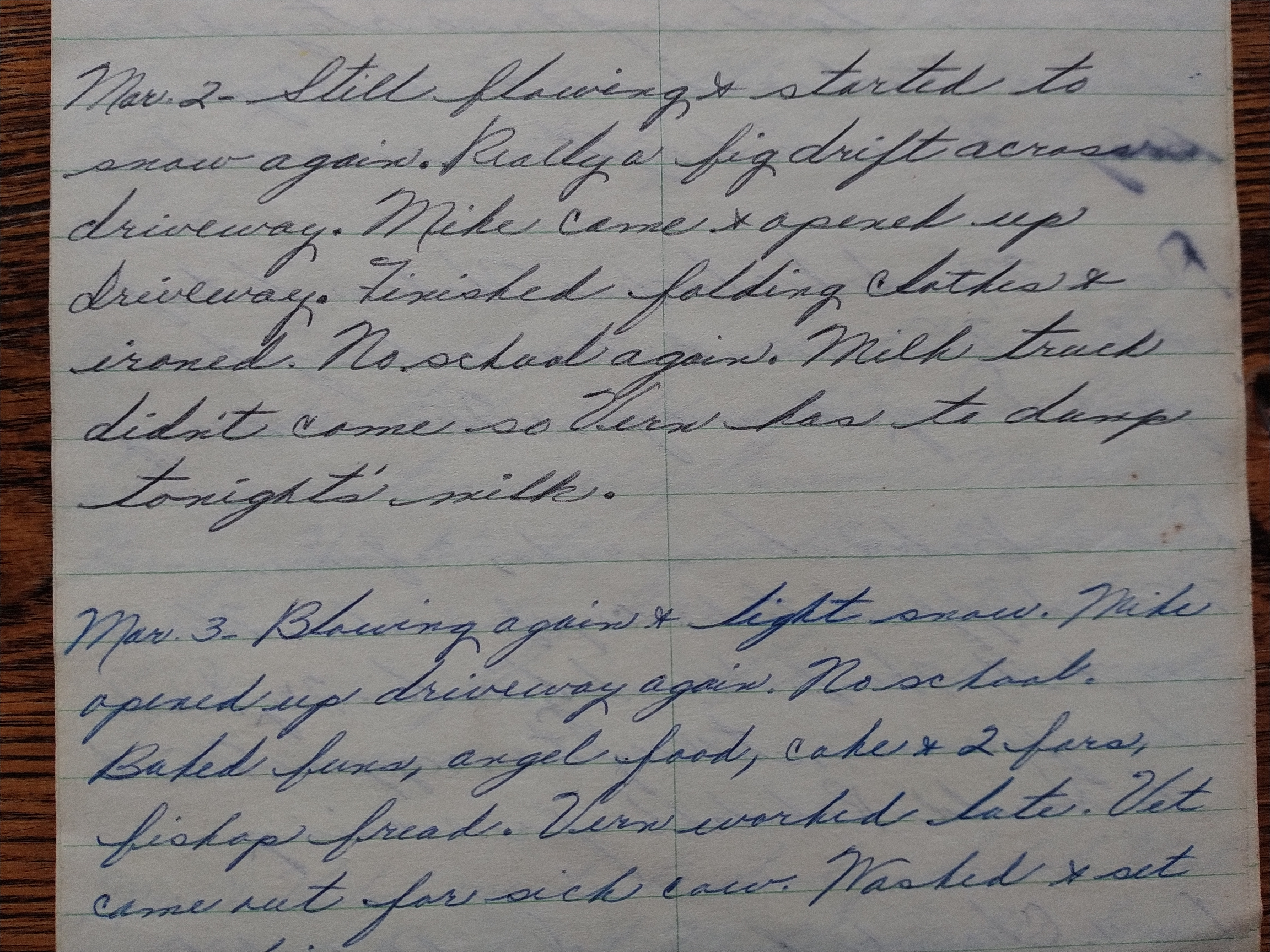
Entries from my mom’s March 1965 journal document a harsh Minnesota winter. My Uncle Mike had to drive from his farm a mile-plus away to open our driveway. (Minnesota Prairie Roots copyrighted photo March 2023)

Let me pause here and emphasize the hardship referenced in Mom’s March 2 entry. My dad had to dump the milk from his herd of Holsteins. That was like pouring money down the drain. I can only imagine how emotionally and financially difficult that was to lose a day’s income. But if the milk truck can’t get through on snow-clogged country roads to empty the bulk tank, there’s no choice but to pour away milk.

My dad planted DeKalb seed corn (among other brands). (Minnesota Prairie Roots copyrighted file photo September 2015)

On March 3-5, Mom writes the same—of snow and blowing snow and efforts to keep the driveway open and no school. Then comes a respite from the snow. Dad was even planning ahead to spring, receiving a delivery of DeKalb seed corn on March 15. But then snowfall resumes on St. Patrick’s Day in this land of wide open spaces, where the wind whips fierce across the prairie.

March 17—Snowing & blowing. Got worse all day. Good thing the milk truck came. No school.

March 18—Quit snowing, but is really blowing. Huge drift across driveway & in grove. Almost all roads in Minn are blocked. No school. Cold, about 10 degrees.
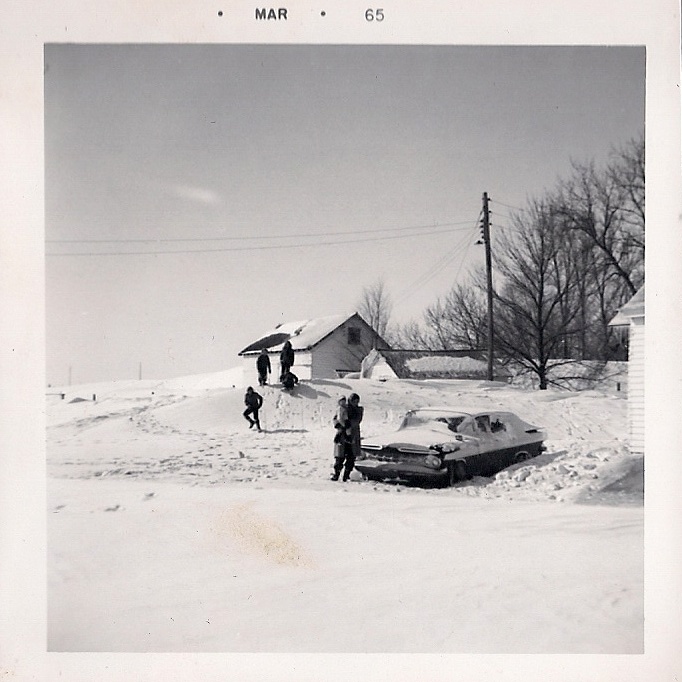
Our southwestern Minnesota farmyard is buried in snowdrifts in this March 19, 1965, image. My mom is holding my youngest sister as she stands by the car parked next to the house. My other sister and two brothers and I race down the snowdrifts. (Photo credit: Elvern Kletscher)

March 19—We all went outside & took pictures of the big drifts & all the snow. Mike came over through field by gravel pit & started to clear off yard. Clear & cold.

Mom’s March 19 entry is notable for multiple reasons. First, my parents documented the snowdrifts with their camera. They didn’t take pictures often because it cost money to buy and develop the film. Money they didn’t have. That is why I have few photos from my childhood. That they documented the huge drifts filling our driveway and farmyard reveals how much this snow impacted their daily lives. In the recesses of my memory, I remember those rock-hard drifts that seemed like mountains to a flat-lander farm girl. That my Uncle Mike, who farmed just to the east, had to drive through the field (rather than on the township and county roads) to reach our farm also reveals much about conditions.

In the two days following, Mom writes of a neighbor coming over with his rotary (tractor-mounted snowblower) to finally open the driveway. But when the milk truck arrived at 4:30 am, the driveway was not opened wide enough for the truck to squeeze through the rock hard snow canyon. The driver returned in the afternoon, after Dad somehow carved a wider opening.

The weather got better in the days following, if sunny and zero in the mornings and highs of 12 degrees are better. At least the snow subsided. On March 23, Mom even notes that they watched the space shot on TV. I expect this first crewed mission in NASA’s Gemini Project proved a welcome diversion from the harsh winter.

In her March 27 journal entry, hope rises that winter will end. Mom writes: Sunny & warmer than it has been for days. Got to 45 degrees. Minnetonka beat Fairbault (sic) in basketball tournament. I almost laughed when I read that because Minnesotans often associate blizzards with state basketball tournament time. I also laughed because Faribault would eventually become my home, the place I’ve lived for 41 years now.

So much for optimism. On March 28, snow fell again. All day.

But the next day, Mom writes, the weather was sunny and warm enough to thaw the snow and ice and create a muddy mess. I stopped reading on March 31. I’d had enough snow. I expect Mom had, too.

© Copyright 2023 Audrey Kletscher Helbling


About that man named Ove March 10, 2023

Book cover source: Goodreads

I NEARLY STOPPED READING the book several chapters in. The content weighed on me, so emotionally heavy that I wondered if I could continue. But then the story line began to unfold in a more hopeful way. And I read on.

By the time I reached the final chapter of A Man Called Ove, I was so invested in this book, the characters and relationships that formed, the way lives intertwined to save a life, that I wondered why I ever considered not finishing.

This 2014 international bestselling novel by Swedish blogger and columnist Fredrik Backman now ranks as a favorite book of mine. It made me cry. Correction. Sob. I struggled to read the final pages as tears blurred my vision. It’s been awhile since a work of fiction has spawned such a heart-wrenching emotional reaction.

I challenge you to pick up this book and read about aging Ove and his grief and grumpiness and outspokenness and how the edges of his hardness begin to soften. I laughed. I cried. I worried. I felt hopeful. I cheered. I wanted to give Ove a kick in the pants. I pondered. I related.

The mix of emotions elicited by A Man Called Ove tells me one thing. This is a remarkable book. The writing. The way mental health weaves into the story. There’s no avoidance of hard topics—of bullying and trauma and loss and grief and obsessive compulsive behavior and suicide and the way the mind wraps and detours and struggles and copes.

Into all of this, the author brings hope. In new neighbors. In a mangy cat. In a teen with sooty eyes and a determined journalist and a friend with dementia. I appreciate how, in the end, differences matter not. It’s that kind of book. Real. Honest. Heart-breaking.

I did not see the American movie, “A Man Called Otto,” based on the book. I’ve been told it’s good by some, advised by others to watch the Swedish version instead. Usually I’m disappointed in film adaptations. I haven’t seen a movie on the big screen in many years.

This Sunday evening, movies will be front and center in Los Angeles as “best of” awards are presented at The Oscars. I didn’t find “A Man Called Otto” (or any of the actors/actresses) on a quick scroll through The Academy Awards nominees list. Tom Hanks stars as Otto. I’m not into Hollywood events like this, although certainly they are important to honor those who do outstanding work in their craft. Rather, I prefer books, where I can read and then visualize people, scenes, interactions. My imagination unleashes, prompted by the writing of creatives passionate about the written word.

TELL ME: Have you read A Man Called Ove and/or seen the Swedish or American film based on the novel? I’d like to hear your reactions to either or both.

Thank you to readers Ken and Colleen who suggested I read this book.

© Copyright 2023 Audrey Kletscher Helbling

 

Flamingos inspire me to escape this Minnesota winter March 9, 2023

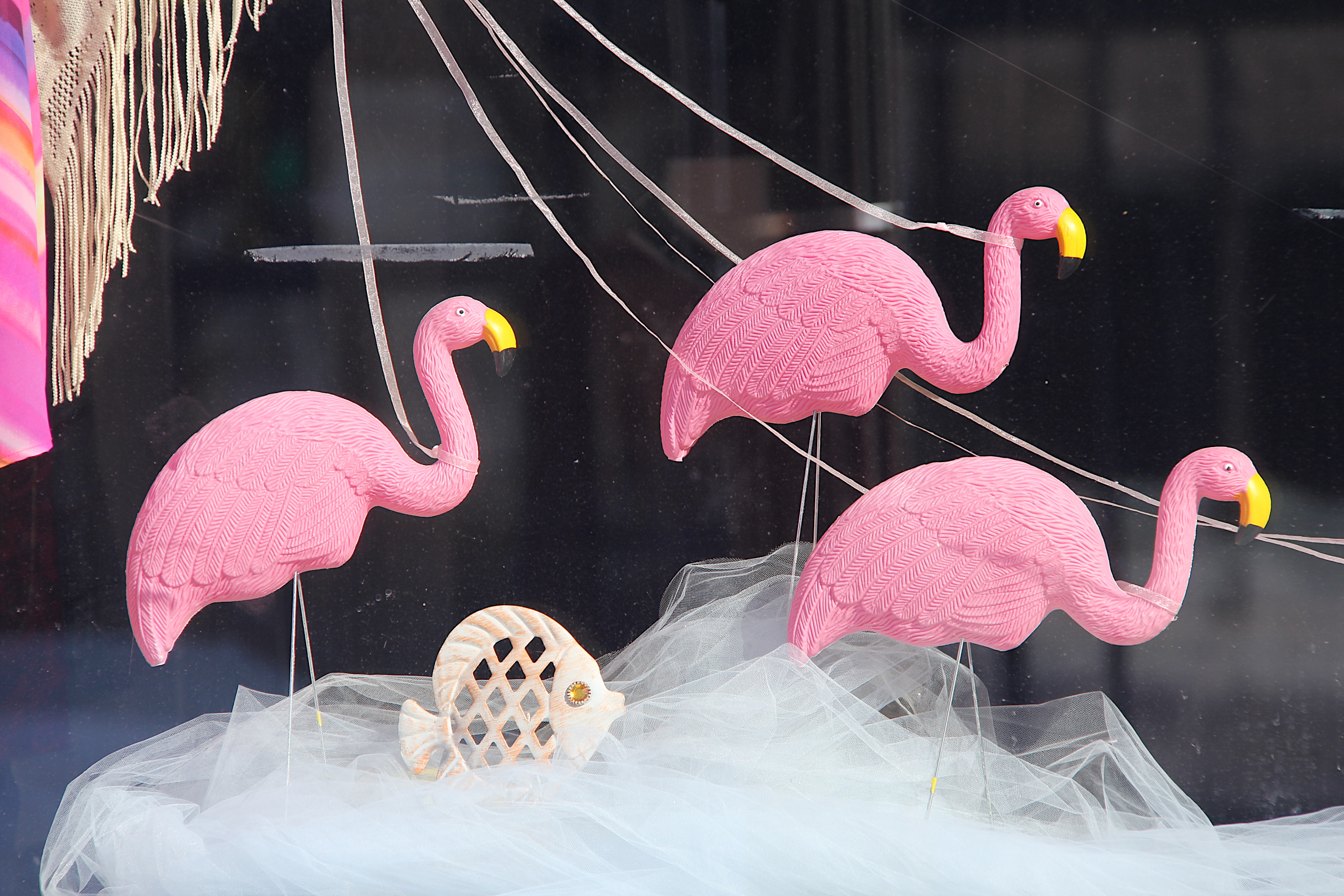
Framed in the front window of Fashions on Central, this tropical display was created by volunteer Ann Meillier for the Buckham West (senior center) retail store. Ann also crafts displays inside this primarily volunteer-run business. (Minnesota Prairie Roots copyrighted photo February 2023)

DECIDEDLY NONTROPICAL MINNESOTA seems an unlikely place to find wild or captive flamingos. And it is…with the exception of the Minnesota Zoo in Apple Valley and Como Park Zoo in St. Paul and their resident flamingos. While those two zoos are not all that far from Faribault, we have our own flock right here. Not real, of course, but fake flamingos, which are good enough for me in the midst of a particularly long and snowy Minnesota winter.

The Fashions on Central Facebook page features this post about its flamingos: Walk like a flamingo! Walk WITH flamingos! YOU ARE FLAMAZING! (Minnesota Prairie Roots copyrighted photo February 2023)

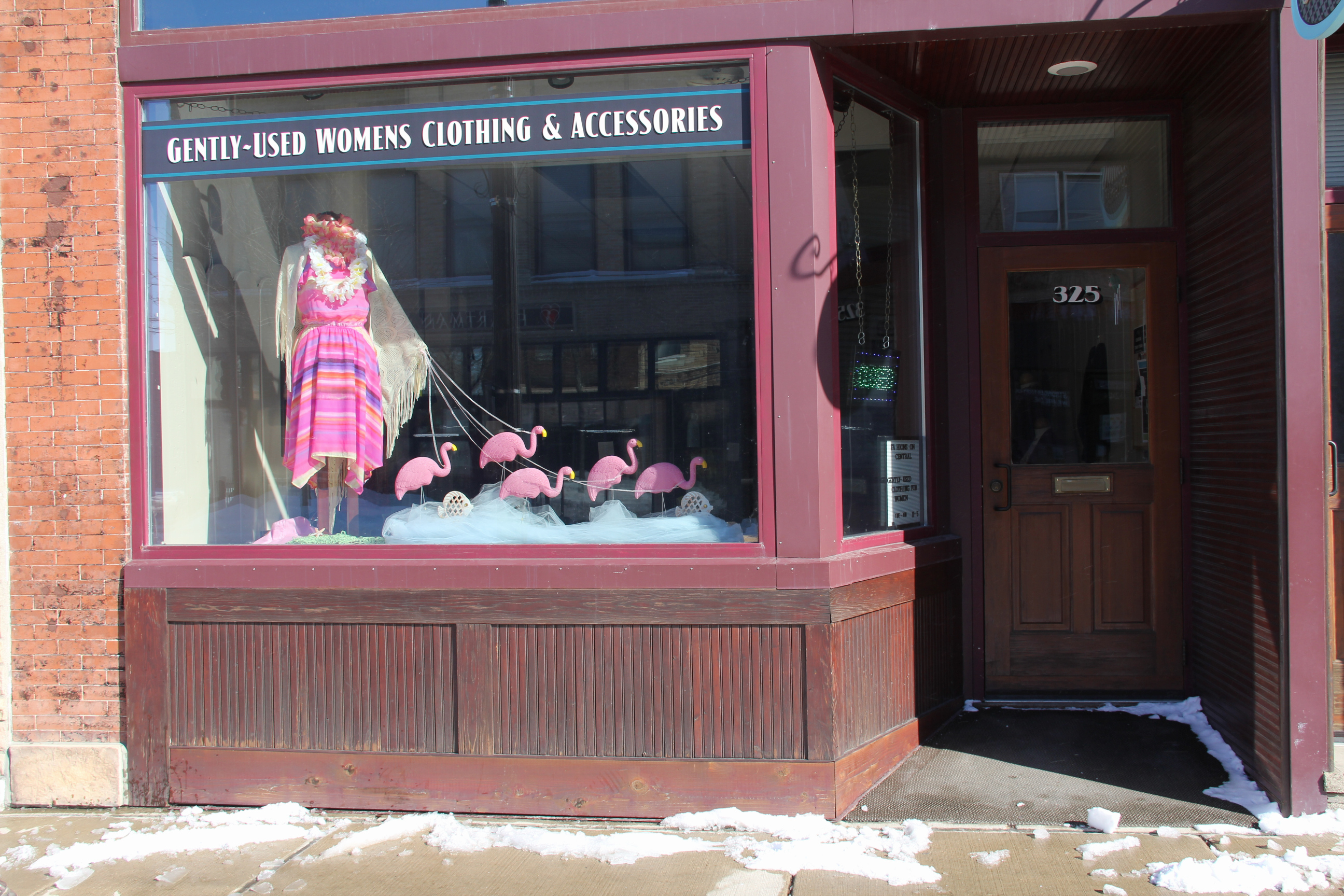
In the storefront window of Fashions on Central, a fashionably-dressed headless mannequin grips the leashes of five plastic flamingos wading in a sea of gauzy fabric. With two fish among them and a starfish to the far left, I recognize this as a tropical scene. Yet my imaginative snowbanked mind drifts to snowdrifts enveloping those warm weather birds.

Enough of that thinking.

Fashions on Central, located at 325 Central Ave. N. in downtown Faribault, is open from 11 am – 5 pm Tuesday through Friday. (Minnesota Prairie Roots copyrighted photo February 2023)

I appreciate the creative efforts at Fashions on Central, a women’s clothing store owned and operated by Buckham West. Proceeds from the sales of gently-used clothing, shoes and accessories go directly back to the local senior center. I love this environmentally-friendly mission of recycling donated, used clothing. I’ve shopped here and, in fact, found a like-new gray wool pea coat for a bargain $7. It’s kept me warm for multiple Minnesota winters already.

While I’m not in the market for beach clothes like those worn by the store-front mannequin, I know others may be as they plan spring break vacations. No matter, this tropical scene gives me a visual respite. If I focus hard enough and long enough, I can imagine myself ocean-side, hot sun warming my skin, leis layered around my sweaty neck, fish swimming, flamingos flaunting.

This streetscape scene shows snow along the sidewalk and street curbs, a contrast to the tropical scene at Fashions on Central. (Minnesota Prairie Roots copyrighted photo February 2023)

And then, if I walk several blocks south from Fashions on Central to Division Street and aim straight ahead rather than turn right to Buckham West, I can escape, too. Inside Buckham Memorial Library, books set in tropical locations await me. Yes, there’s always a way to flee winter in Minnesota, even when you can’t leave.

© Copyright 2023 Audrey Kletscher Helbling


Jack Frost, southern Minnesota artist-in-residence March 8, 2023

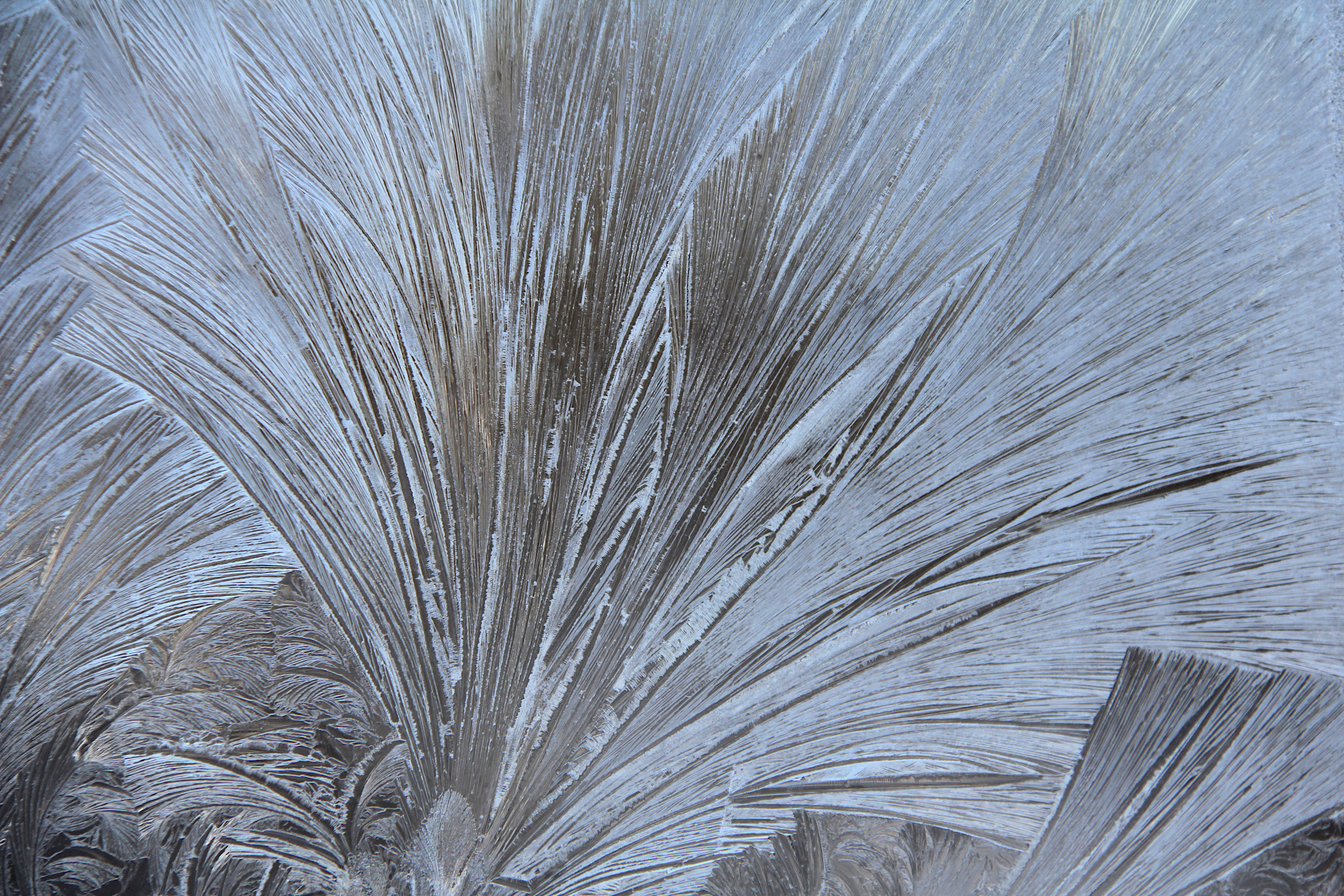
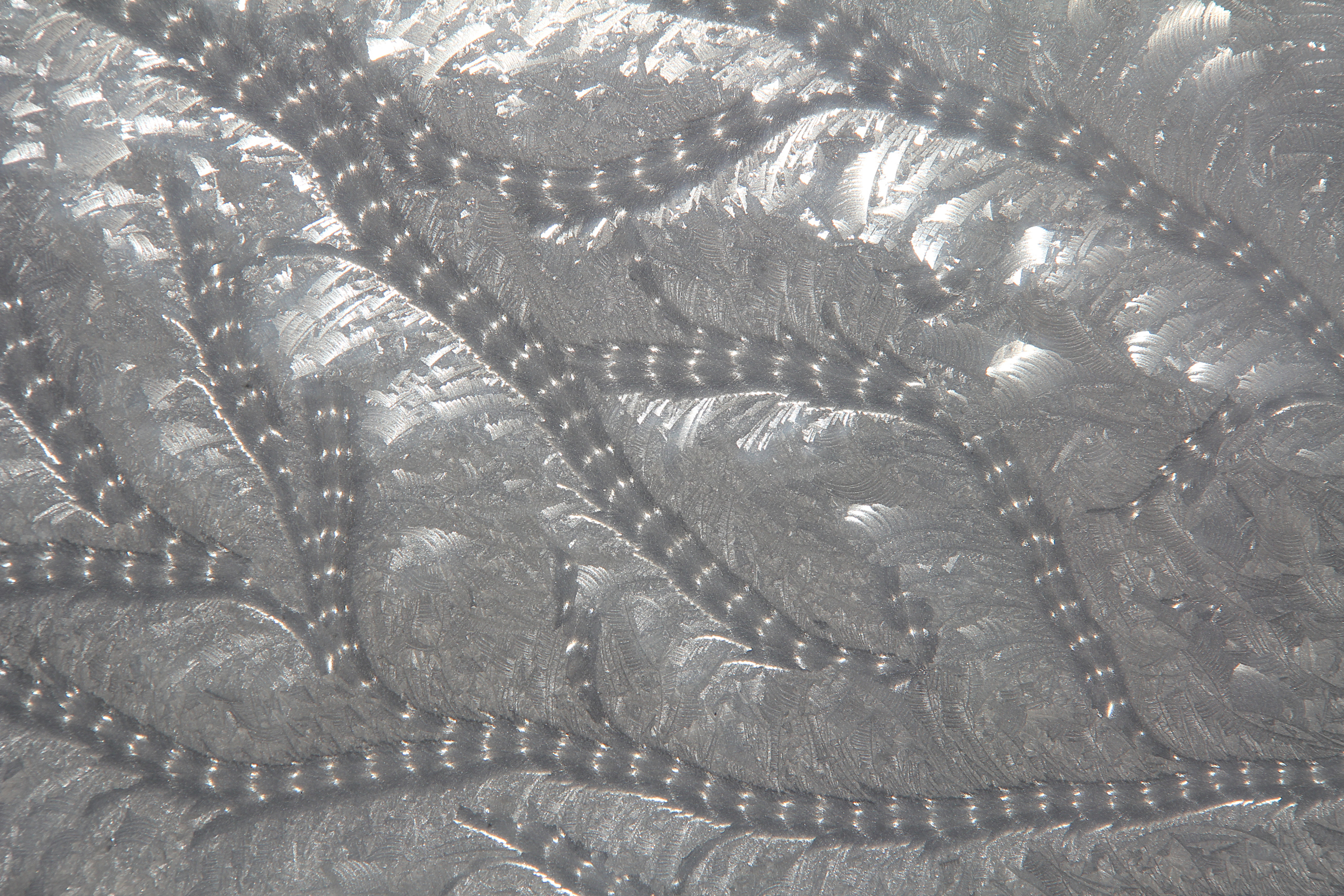
“Branches” (or perhaps “Tendrils”) by Jack Frost. (Minnesota Prairie Roots copyrighted photo February 2023)

DURING ONE OF SOUTHERN MINNESOTA’S recent cold snaps, I pulled out my camera to photograph some particularly intricate art. Not artwork in a public gallery exhibit, but rather art displayed in a private space—my upstairs bedrooms.

I live in a 90+-year-old house, built sometime in the 1930s. Locally, it’s the Swanson house, although Randy and I have owned this 1 ½-story structure since 1984. But it will forever be the home of its former owners.

The canvas for Jack Frost’s art. (Minnesota Prairie Roots copyrighted photo February 2023)

Although we’ve made many improvements through the decades, including installing a new furnace and central air conditioning that included additional duct work, the upstairs remains notably cold in the winter and hot in the summer. A single heat vent opens to both bedrooms. Updated replacement windows installed some 30 years ago also did little to improve cold weather heat retention on the second floor.

And so Jack Frost finds our second floor vacant bedrooms a welcoming short-term studio in the deep cold of a Minnesota winter. With the three kids long-grown into adulthood and us empty nesters for 11 years now, he can settle in as an artist-in-residence without notice.

When temperatures drop into that frigid category of frostbite warnings, tires crunching on snow and extra blankets layered on the bed, Jack Frost arrives. It’s OK hosting him as a short-term guest, but anything beyond a few days and I’m ready to boot him out.

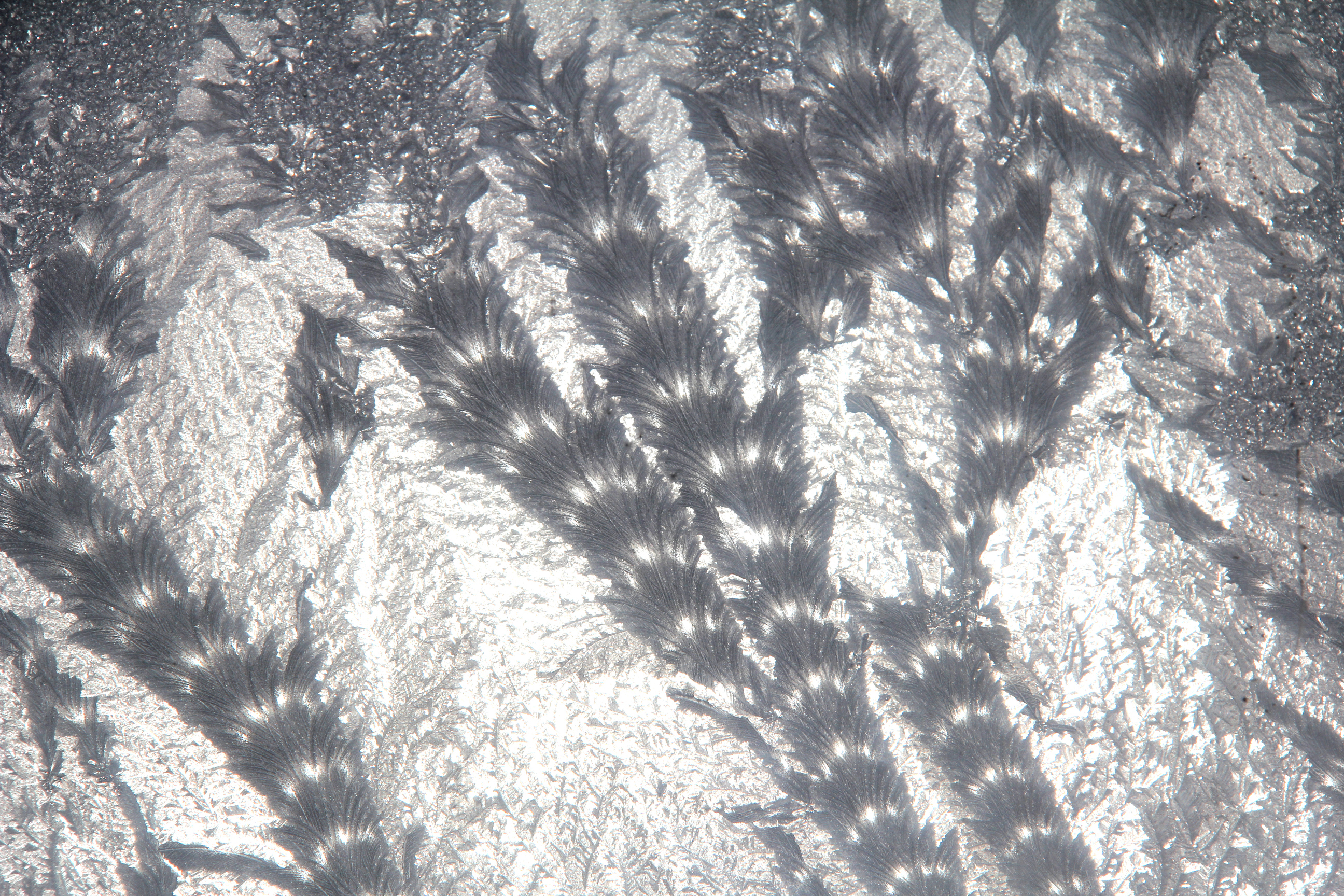
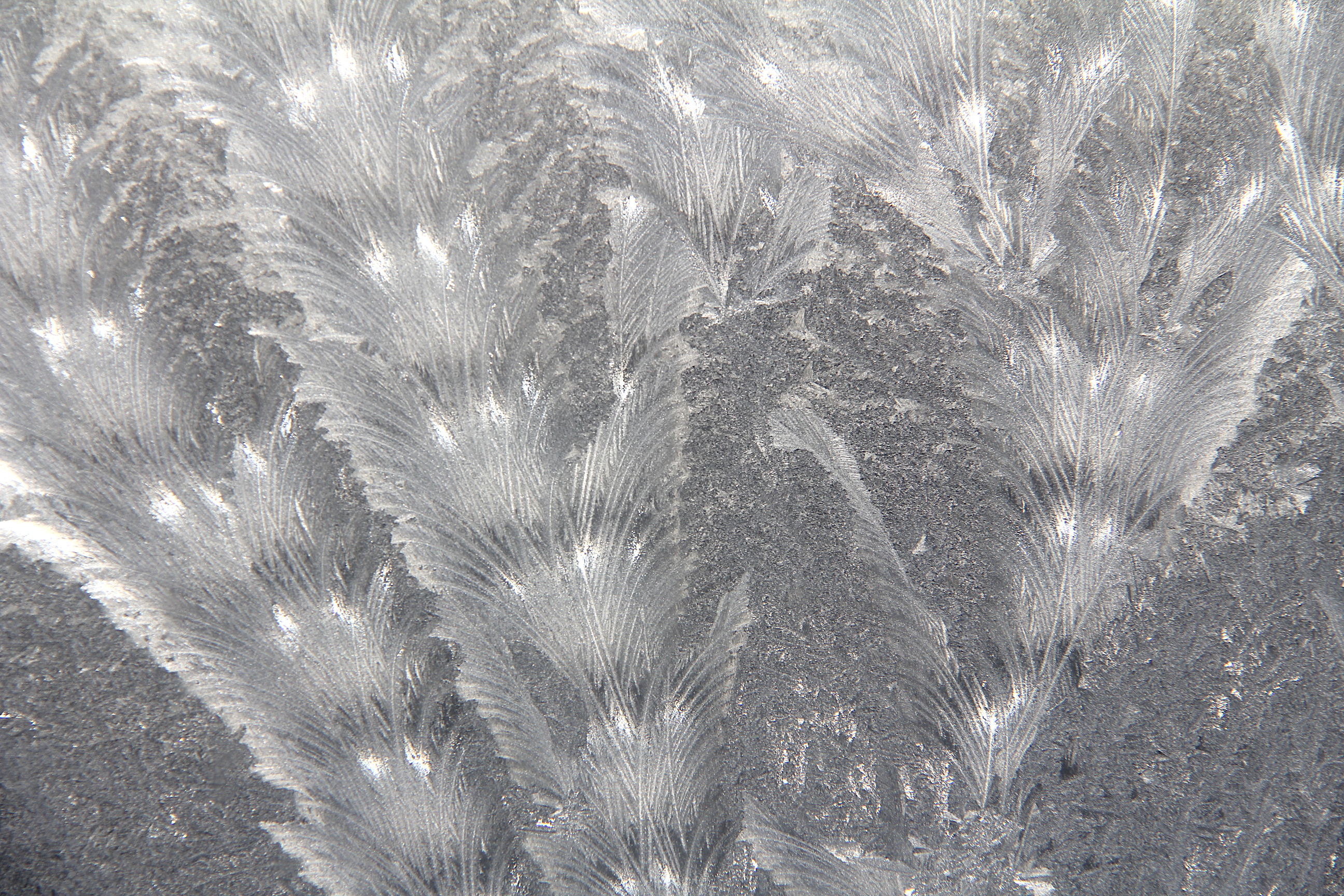
“Feathers” by Jack Frost. (Minnesota Prairie Roots copyrighted photo February 2023)

He does some creative work on the canvas of cold window panes. Whether he etches or paints or draws or exactly how he crafts his art remains an unknown to unscientific me. But I’m impressed by the primarily nature-themed work he designs.

“Feathered intricacies” by Jack Frost. (Minnesota Prairie Roots copyrighted photo February 2023)

In his last exhibit, Jack Frost incorporated mostly branches, grass stems, water and feathers. They were beautiful in their detailed intricacy, a Frost signature style.

“Prairie Grasses in the Morning Light” by Jack Frost. (Minnesota Prairie Roots copyrighted photo February 2023)

When sunlight shown on the eastern window in the morning, the contrast of light and dark in the artist’s art sharpened. Dazzled, almost.

“Drips” or “Tears,” depending on your mood and perspective. (Minnesota Prairie Roots copyrighted photo February 2023)

Yet, even in diminished light, the graininess of some pieces produced more introspective and moody scenes.

Jack Frost has a sense of humor, creating this “I Bet You Wish You Were Here” beach art. (Minnesota Prairie Roots copyrighted photo February 2023)

Jack Frost’s art installations in my second story home gallery are typically short showings of several days. Just enough time for me to pause and appreciate his work before outdoor temperatures rise, the sun melts his art and he vanishes. Poof. I can’t say I welcome him with open arms because I really don’t like sub-zero temps. But I can appreciate Jack Frost’s art as more than just frost accumulating on energy inefficient windows.

© Copyright 2023 Audrey Kletscher Helbling
 

The magic of Faribo Frosty March 7, 2023

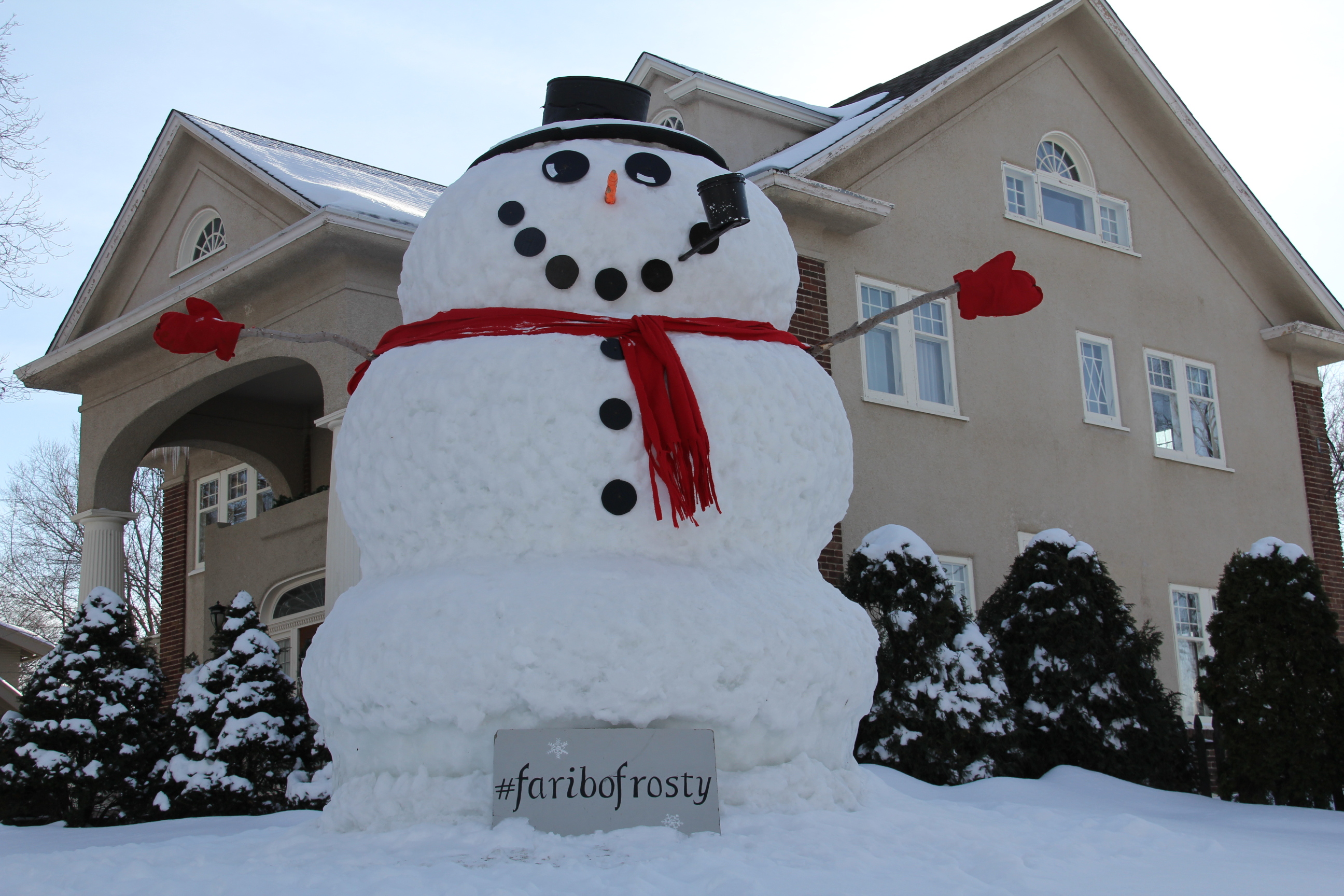
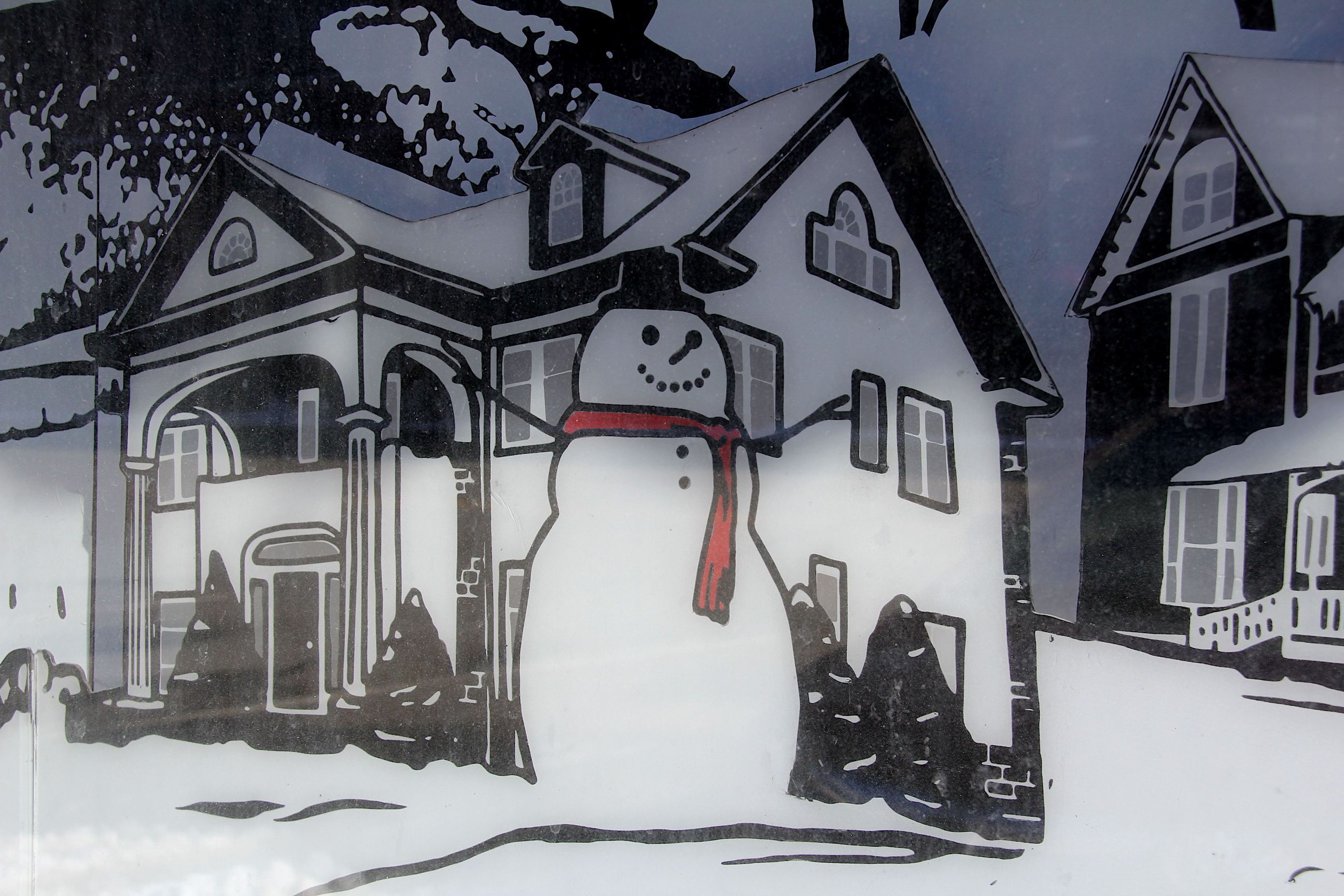
Faribo Frosty, a Faribault icon. (Minnesota Prairie Roots copyrighted photo February 2023)

NOSTALGIA WEAVES into our lives the older we grow, time blurring the edges of memories. But then something comes along to jog the mind into recalling a sweet childhood memory. For me, that’s Faribo Frosty.

Faribo Frosty’s smile brings so many smiles. (Minnesota Prairie Roots copyrighted photo February 2023)

Since 2005, the Hoisington family has built my community’s version of Frosty the Snowman. I loved Frosty as a child—the song, the Little Golden book, the animated holiday cartoon narrated by Jimmy Durante. There’s something so compelling about a snowman that comes to life via a magical top hat. And when he melts, oh, the sadness.

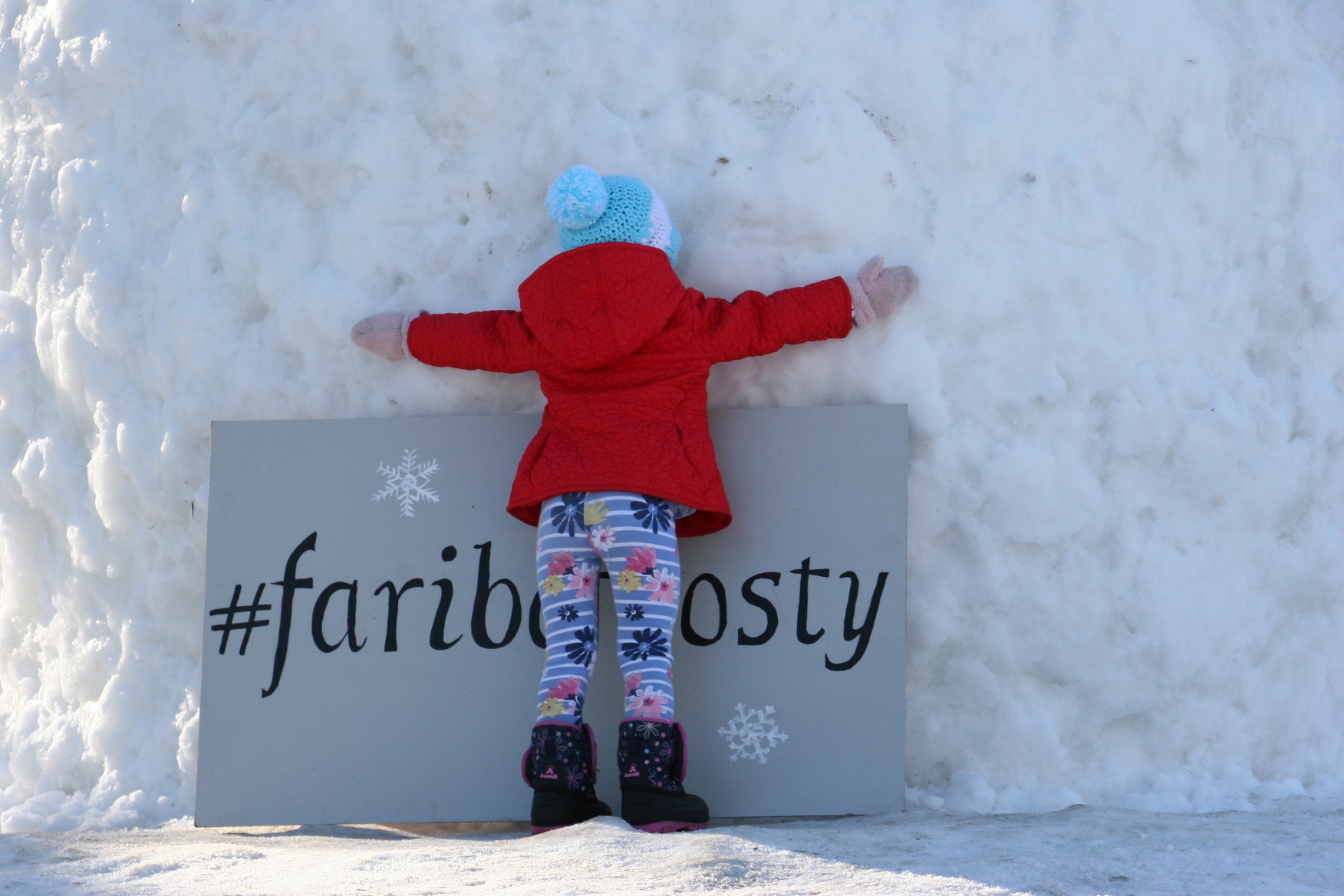
My then 2 1/2-year-old granddaughter hugging Faribo Frosty in December 2018. (Minnesota Prairie Roots copyrighted file photo December 2018)

But the melting of Faribo Frosty, given his robust size and current height of 17 or so feet, is not imminent. Lead creator Andy Hoisington cares for Frosty with the devotion of a man who recognizes the importance of his snowman. Families and grandparents and couples come to the corner of First Street Northwest and Third Avenue Northwest to see Faribo Frosty in the Hoisington’s front yard. I’ve been there with my grandkids, most recently a few weeks ago. When my granddaughter was two, she stretched her arms wide to hug Frosty. Couples have gotten engaged here and been photographed here to announce a pregnancy.

I photographed this Faribo Frosty art through the storefront window of Actualize Fabrication in the 300 block of Central Avenue in historic downtown Faribault. (Minnesota Prairie Roots copyrighted and edited photo February 2023)

Ginormous Faribo Frosty, crafted with shaved ice from the local ice arena and from snow by Andy and his family (including adult sons Jake and Josiah and son-in-law Nick), attracts visitors from well beyond Faribault. He’s also been filmed for metro area television features, including KARE 11 Boyd Huppert’s “Land of 10,000 Stories.”

Jake, left, and Andy Hoisington work on Faribo Frosty in this December 2020 image. (Minnesota Prairie Roots copyrighted file photo 2020)

I’ve watched the Hoisingtons work on Frosty, shoveling shaved ice from a trailer, climbing a ladder to pack and shape the beloved snowman. He requires constant maintenance given Minnesota’s diverse winter weather. This is truly a labor of love after 18 years.

The Hoisington’s beautiful historic home is a lovely backdrop for their snowman. (Minnesota Prairie Roots copyrighted photo February 2023)

I am grateful for this family’s dedication to bringing joy into my community with their version of Frosty. Faribo Frosty makes me happy. He makes me smile with his wide smile, his bright carrot nose, his over-sized signature red scarf and mittens, even his black bucket pipe and his black top hat. Faribo Frosty is, in every way, nostalgically magical.

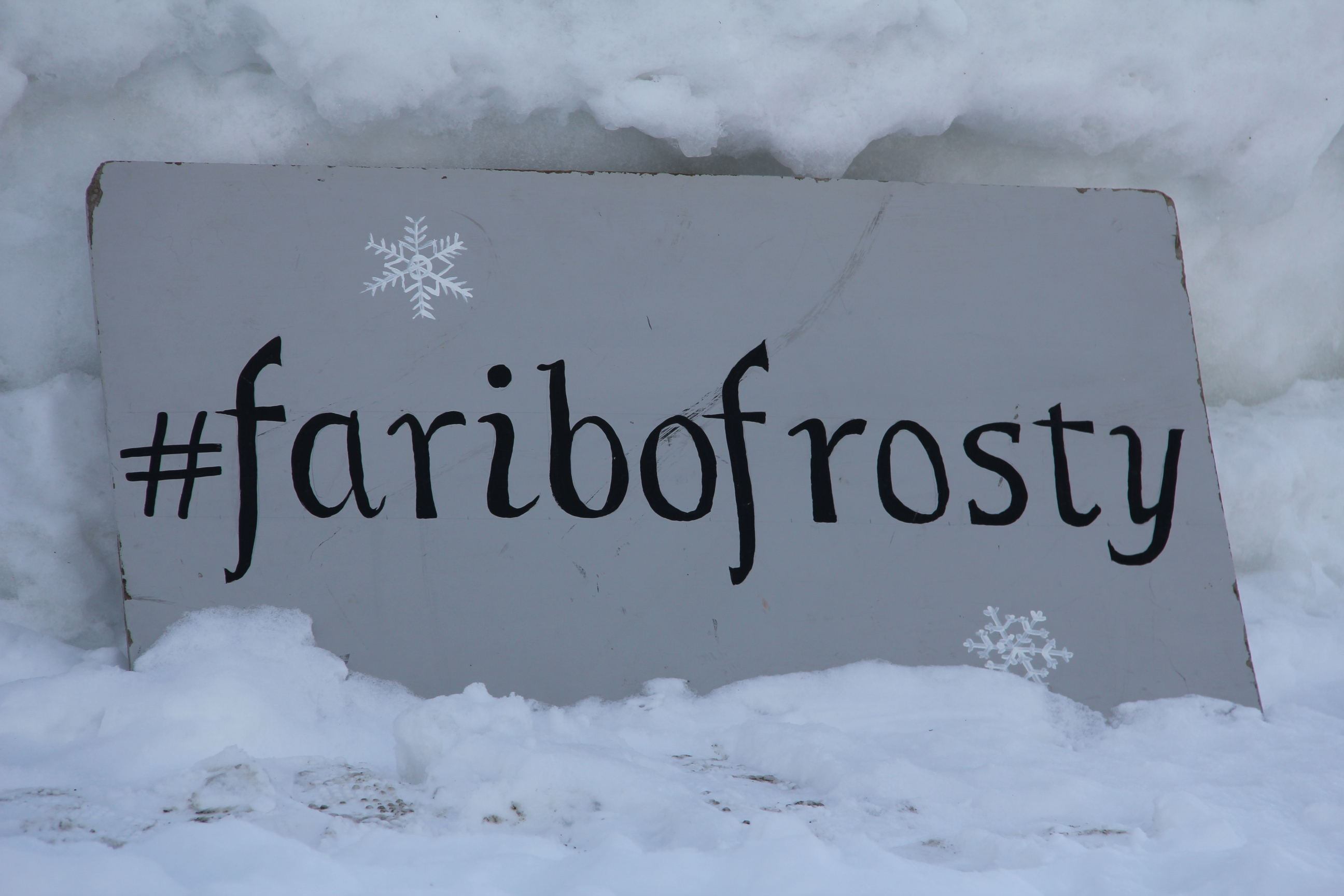
This sign standing in front of Frosty encourages others to share the snowman on social media with this hashtag. (Minnesota Prairie Roots copyrighted photo February 2023)

TELL ME: If you live in southern Minnesota, have you seen Faribo Frosty? If you live in another cold weather area, do you have a similar winter attraction or have you seen one?

© Copyright 2023 Audrey Kletscher Helbling
 

Missing a “spring” Dairy Queen tradition March 3, 2023

A DQ Peanut Buster Parfait (Minnesota Prairie Roots copyrighted file photo)

THE LITTLE DAIRY QUEEN OF FARIBAULT opened a week ago, marking the unofficial start of spring in my southern Minnesota community, and we missed it. I’m bummed.

Traditionally, Randy and I stop by during this late February opening of the walk-up/drive-up DQ for the bargain Peanut Buster Parfaits. When the DQ closes for the season at the end of October, we’re there, too, for the discounted parfaits.

Typically, we wait in line behind a long string of vehicles for the coveted treat. Last October we pulled up to the drive-up window only to learn that they’d just run out of ice cream and there would be no more with the shop temporarily closing. Disappointed doesn’t quite describe my emotion in that let-down moment. I’d been anticipating the taste of sweet and salty—hot fudge and peanuts atop that sweet, snow white soft-serve ice cream.

And now here it is, March 3, and I missed opening weekend with the $2.49/each Peanut Buster Parfait three-day special. Perhaps this winter of too much snow distracted me. Even if the calendar shows that spring is only officially 17 days distant, nothing feels or looks remotely like spring here. And so, I reason, this is why I missed opening weekend at The Little Dairy Queen of Faribault. My thoughts remain deeply entrenched in this winter of deep snow.

© Copyright 2023 Audrey Kletscher Helbling


A tropical escape from Minnesota March 2, 2023

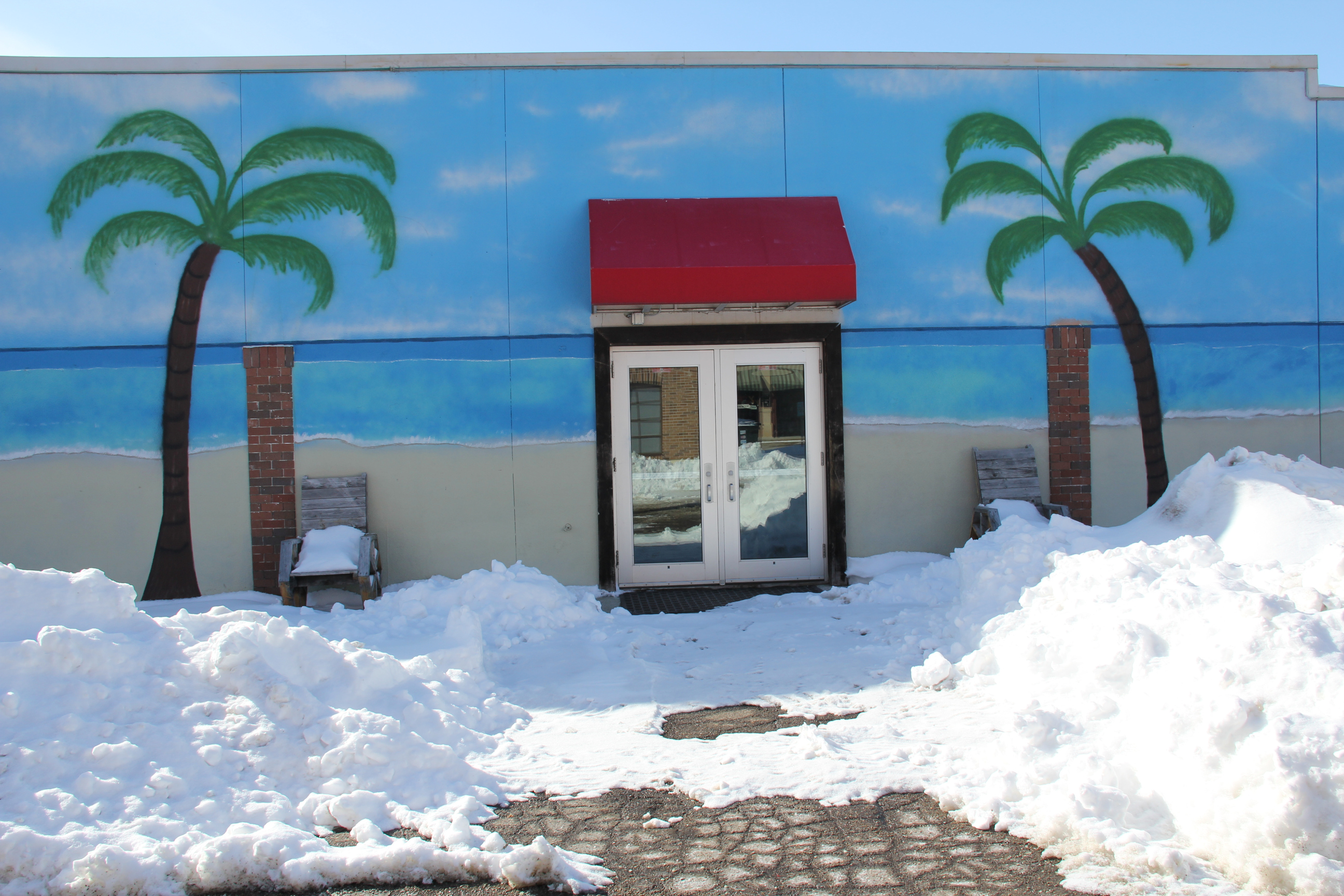
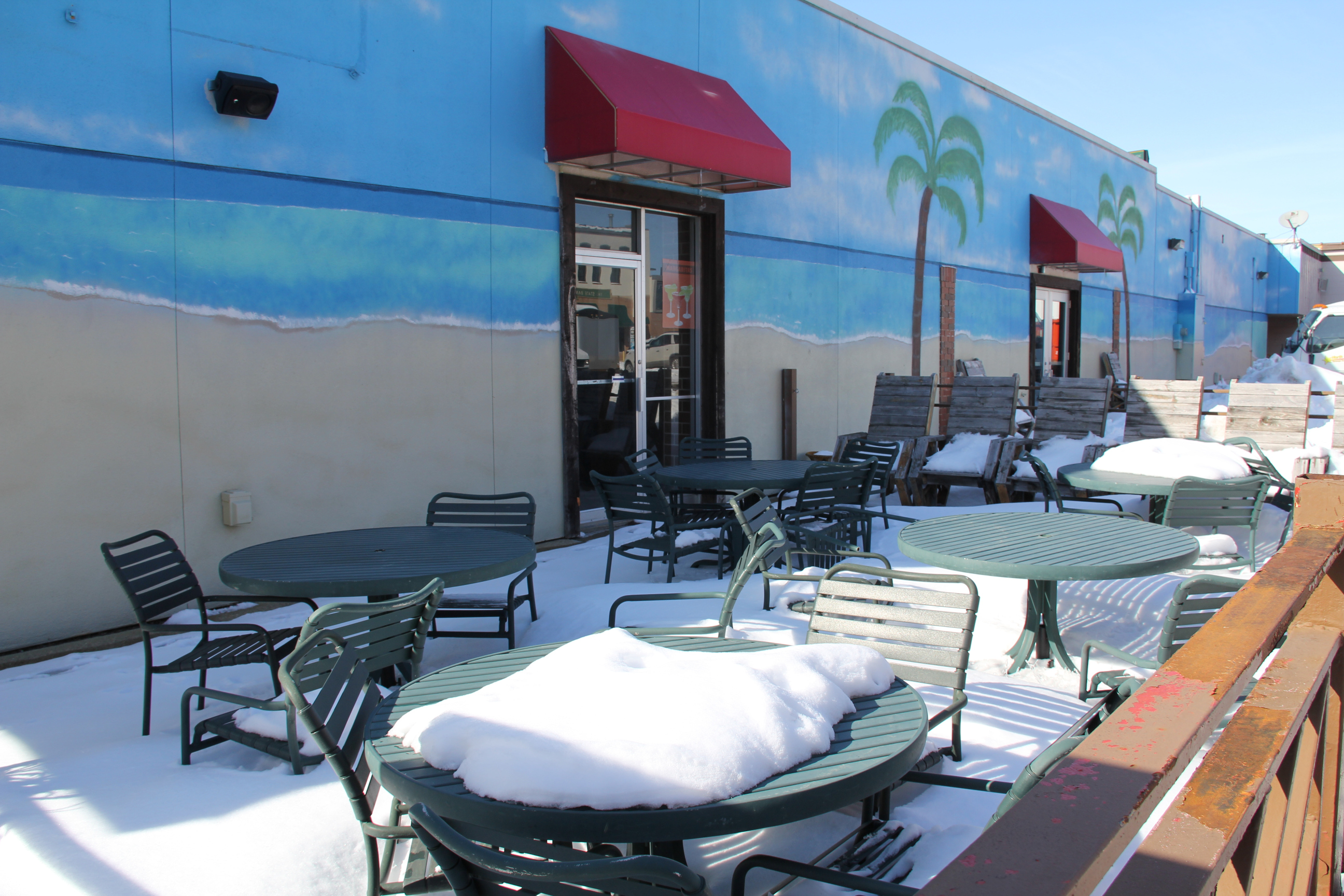
This tropical mural graces the side of the former Cancun Grill Mexican Restaurant in downtown Faribault. (Minnesota Prairie Roots copyrighted photo February 2023)

IF NOT FOR THE SNOW, I can envision this as some place warm and sunny. Some location other than here. Some place with real palm trees, not just those painted on the side of a building.

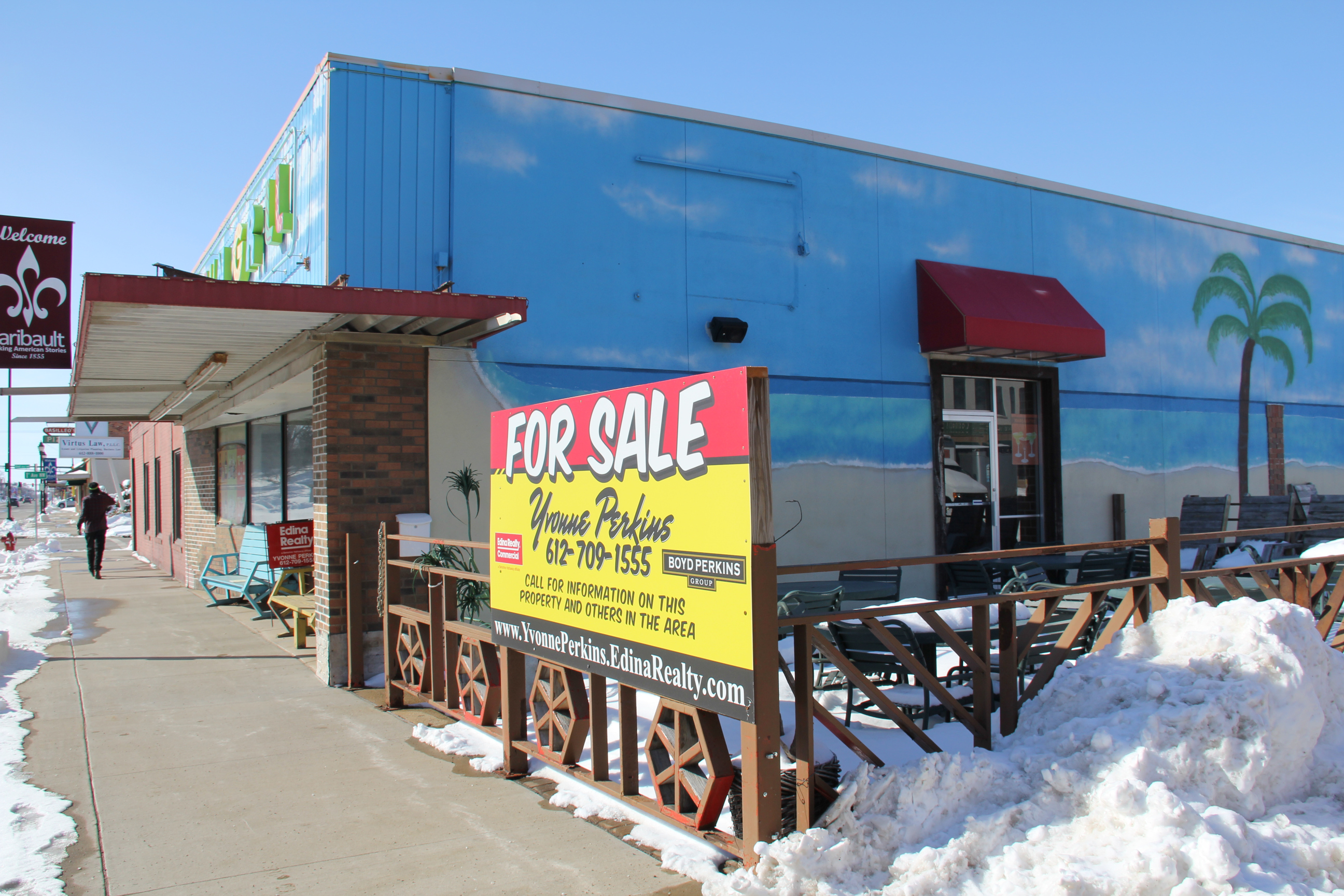
The closed restaurant is located downtown along a busy state highway that runs right through the heart of Faribault. (Minnesota Prairie Roots copyrighted photo February 2023)

I can picture myself on the patio, relaxing and conversing at a table with friends, drinking margaritas while the hot sun bakes my skin. But wishful thinking doesn’t land me in Arizona or Texas or California or Florida or Mexico. I am in Minnesota, outside the shuttered Cancun Grill Mexican Restaurant, drawn here by an inviting tropical scene of ocean and palm trees.

Snow blankets an otherwise inviting outdoor dining and drinking space. (Minnesota Prairie Roots copyrighted photo February 2023)

Just days after a major multi-day winter storm dumped some 14 inches of snow on Faribault, I find myself photographing the “for sale” restaurant. The contrast of snow layering tables, chairs and patio against the backdrop tropical-themed mural catches my creative eye, allowing for a visual and mental escape from all this winter.

I’ve never dined at this restaurant, although I wish I had based on the positive online reviews: Authentic wonderful Mexican cuisine. Best tacos here. Excellent burritos and margaritas. Large portions. Delicious. Great service.

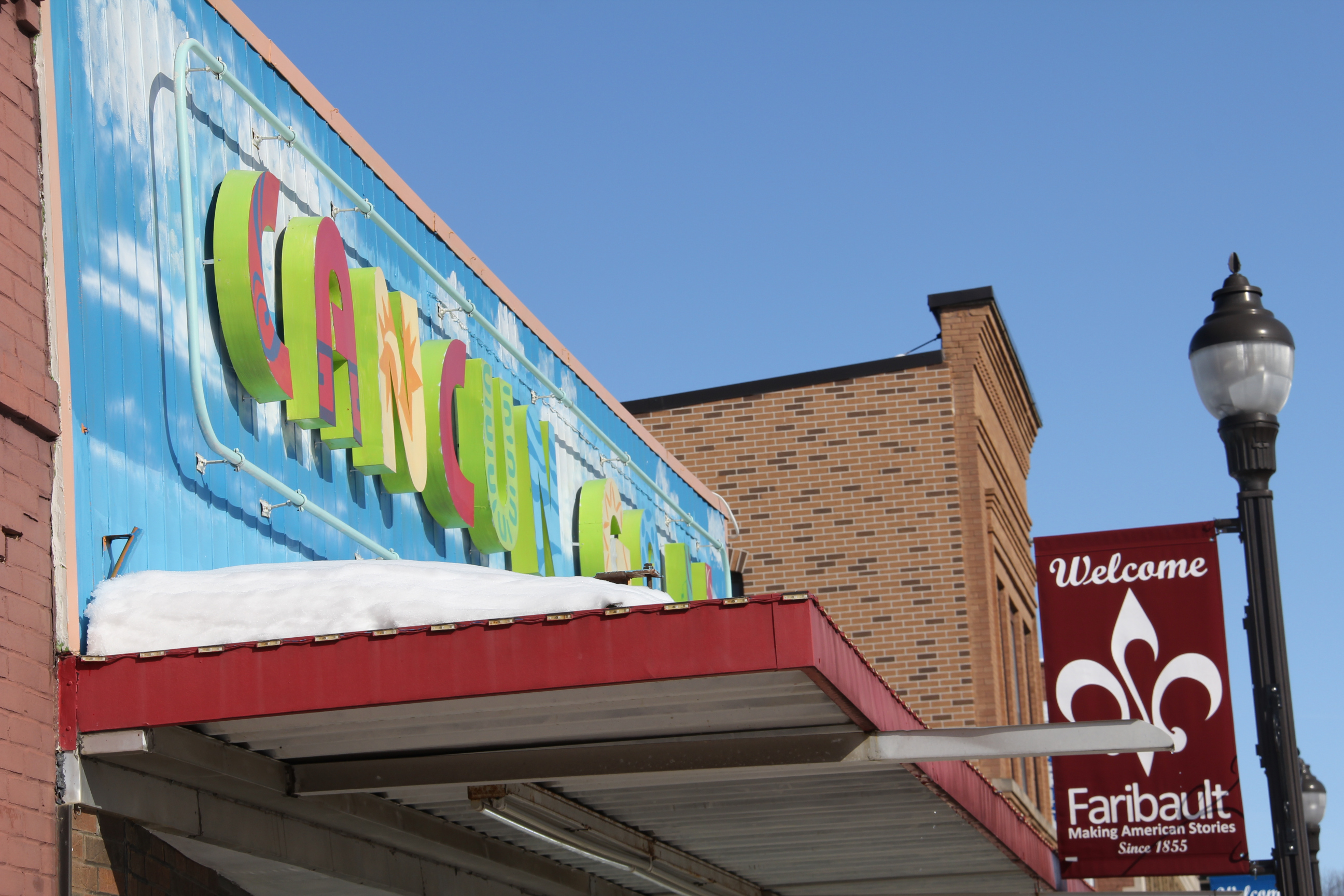
Even the Cancun Grill business sign is tropically inviting. (Minnesota Prairie Roots copyrighted photo February 2023)

Now it’s too late to experience this taste of Cancun in my southern Minnesota community. But I can dream. I can dream of palm trees I’ve never seen, except at Como Park Conservatory in St. Paul. I can dream of places I’ve never visited. I can dream of staying at an all-inclusive fancy resort, of warm beach sand filtering through my toes and sunshine on my face. I can dream of lazy days lounging by the sea with a good book rather than time spent shoveling snow.

In this moment I am not in Minnesota, enveloped in a wintry landscape. Rather, my imagination melts away the snow, replacing it with beach sand so white I need sunglasses. Ah, this is lovely, this Cancun of fleeting travel.

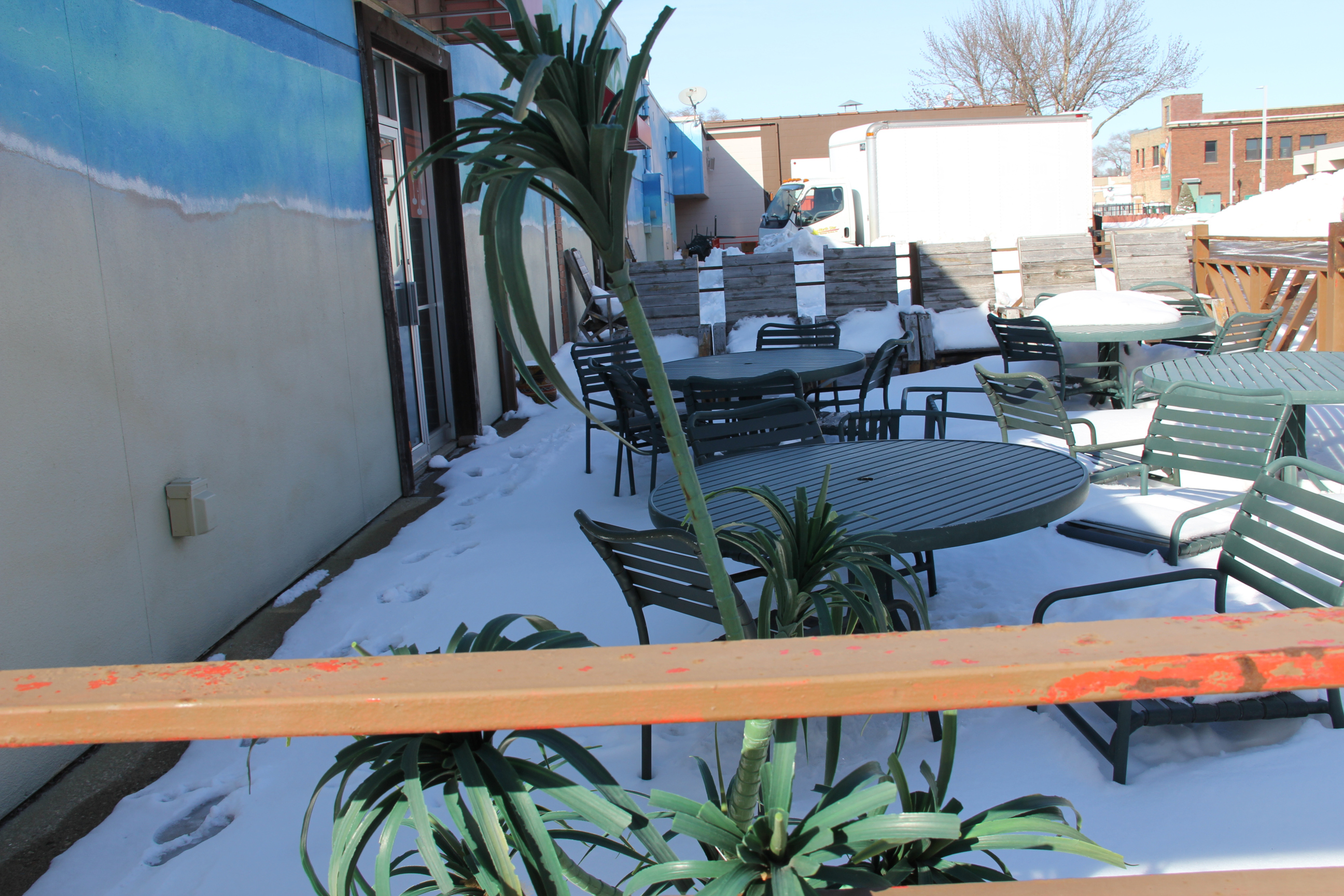
A fake tropical plant stands inside the gated patio next to the tropical mural. (Minnesota Prairie Roots copyrighted photo February 2023)

This permanently closed restaurant along busy Fourth Street Northwest/Minnesota State Highway 60 in Faribault offers me a momentary escape. I feel the breeze as palm trees sway against the merging blue sky and water while I sip a strawberry margarita on the sun-drenched patio.

© Copyright 2023 Audrey Kletscher Helbling
 

Ice fishing on the Cannon, but not exactly March 1, 2023

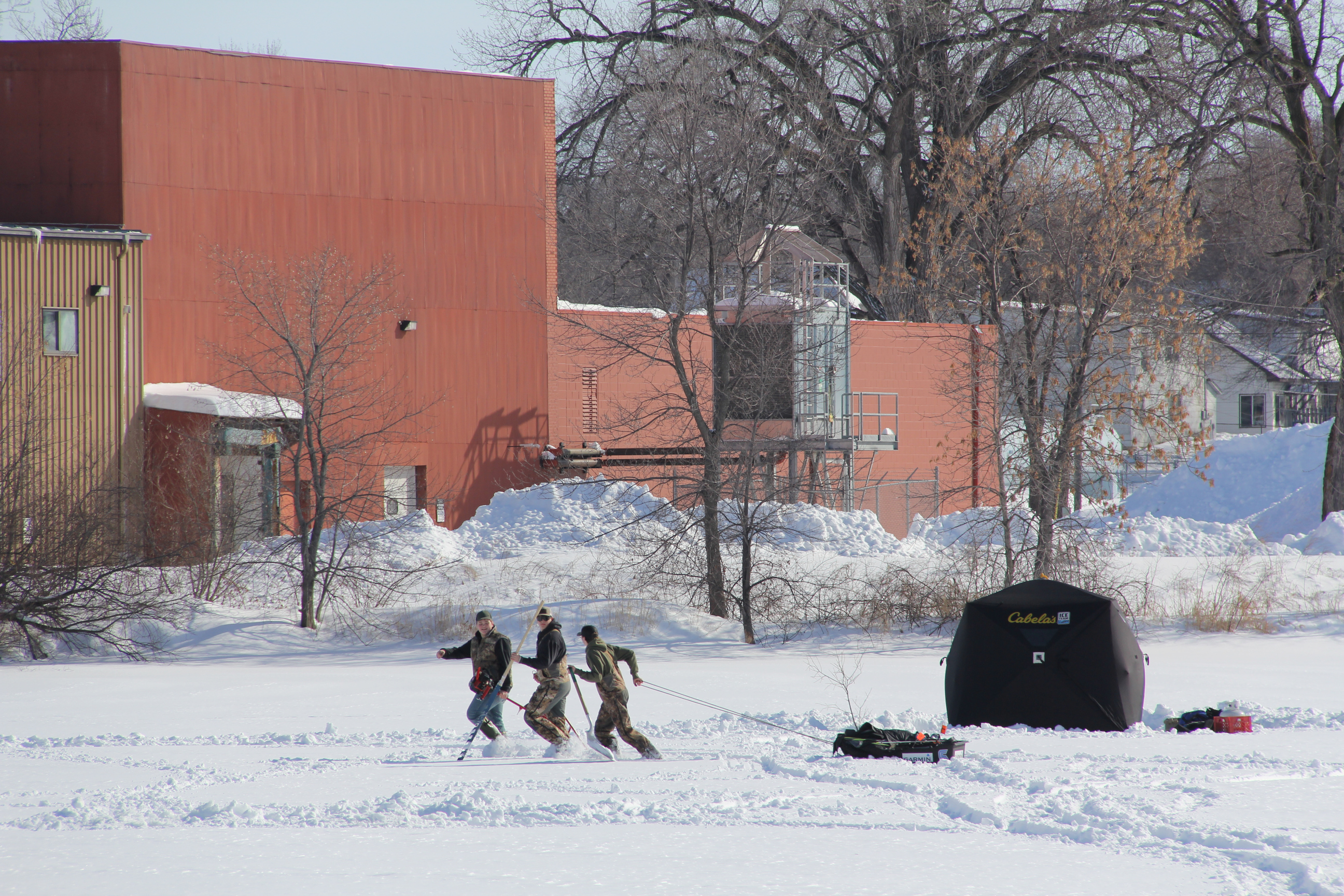
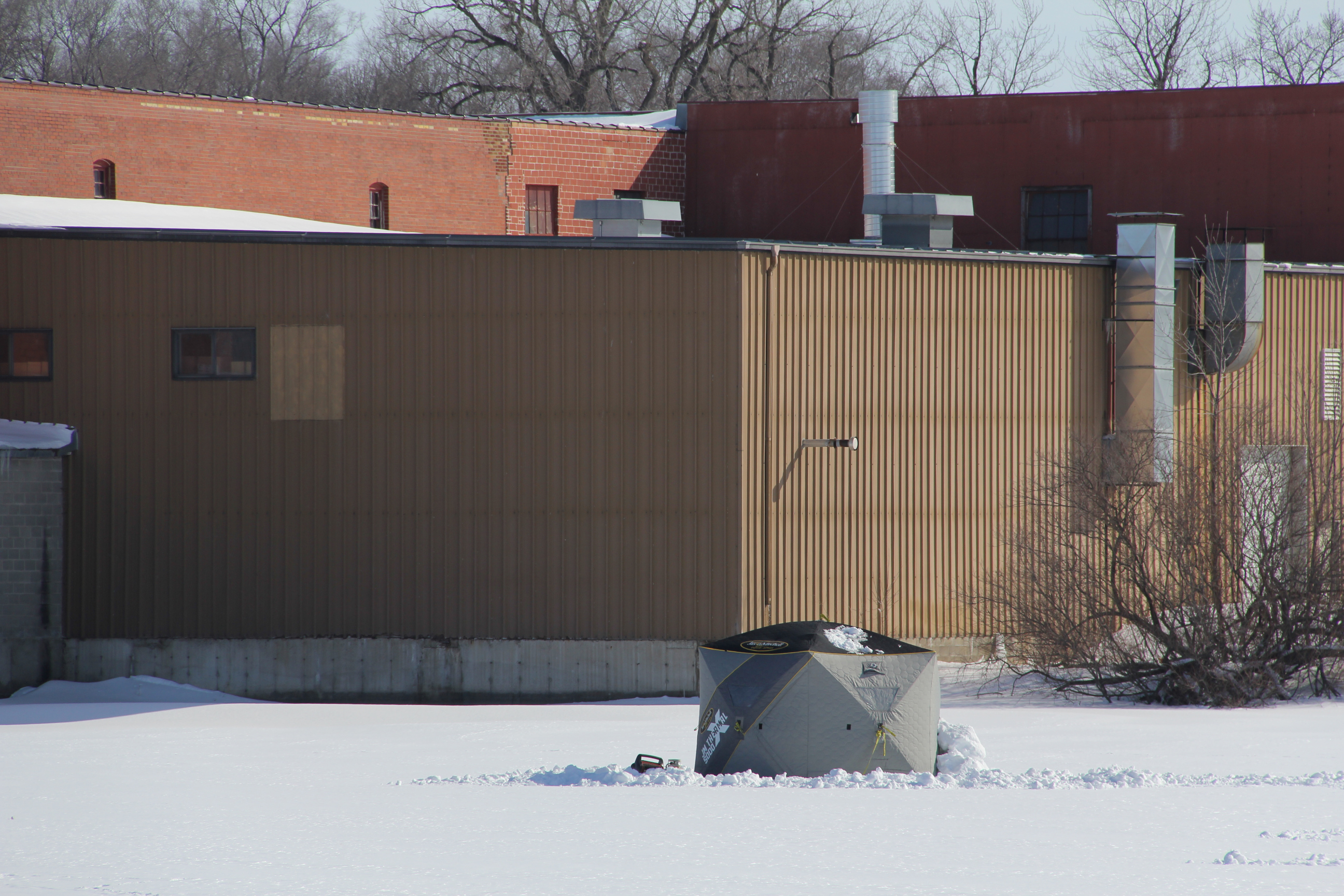
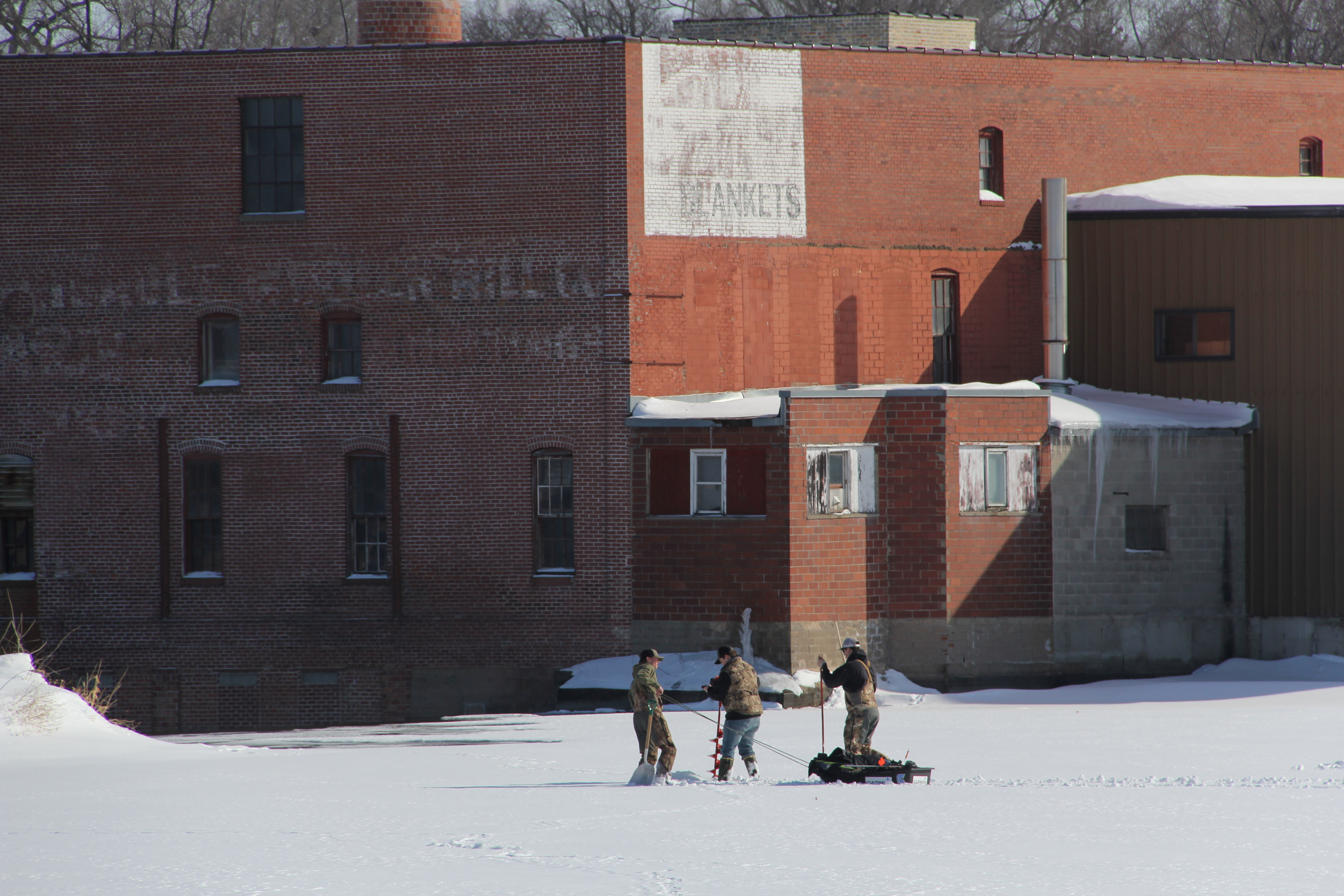
Carting ice fishing gear across the snow-covered Cannon River by the Faribault Mill. (Minnesota Prairie Roots copyrighted photo February 2023)

ICE FISHING RATES AS A SPORT that must seem absurd to anyone living in a warm weather climate.

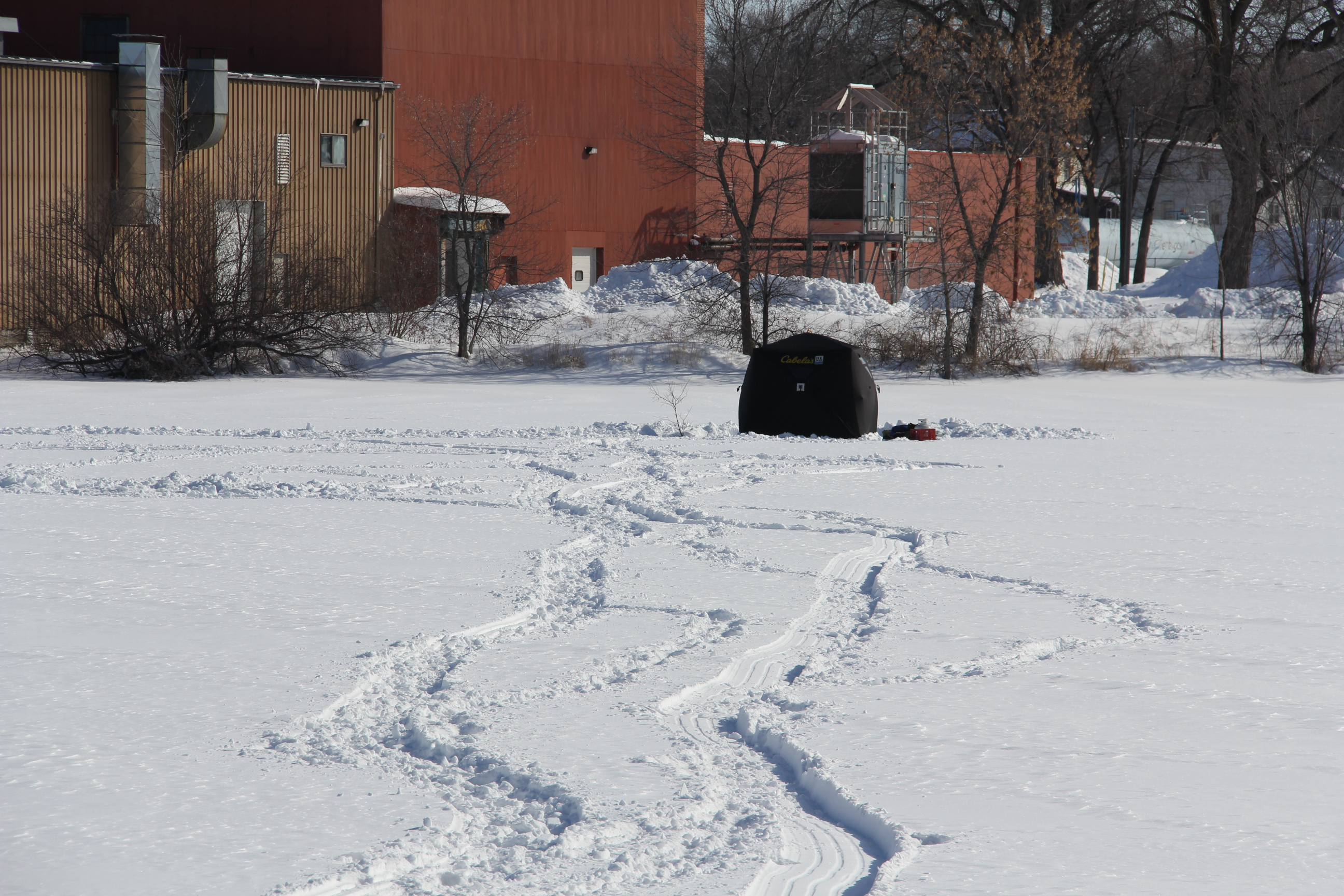
The second portable fish house the anglers set up on the Cannon River near the mill. (Minnesota Prairie Roots copyrighted photo February 2023)

I mean, if you aren’t from a place like Minnesota or Wisconsin, how would you react to anglers driving their vehicles onto a frozen lake, fish houses in tow? That seems reckless and unsafe and dangerous, and it can be. No ice is ever considered 100 percent safe. But, take precautions like knowing your lake (or river) and its ice thickness, driving with windows rolled down and carrying safety equipment, and the sport can be relatively safe.

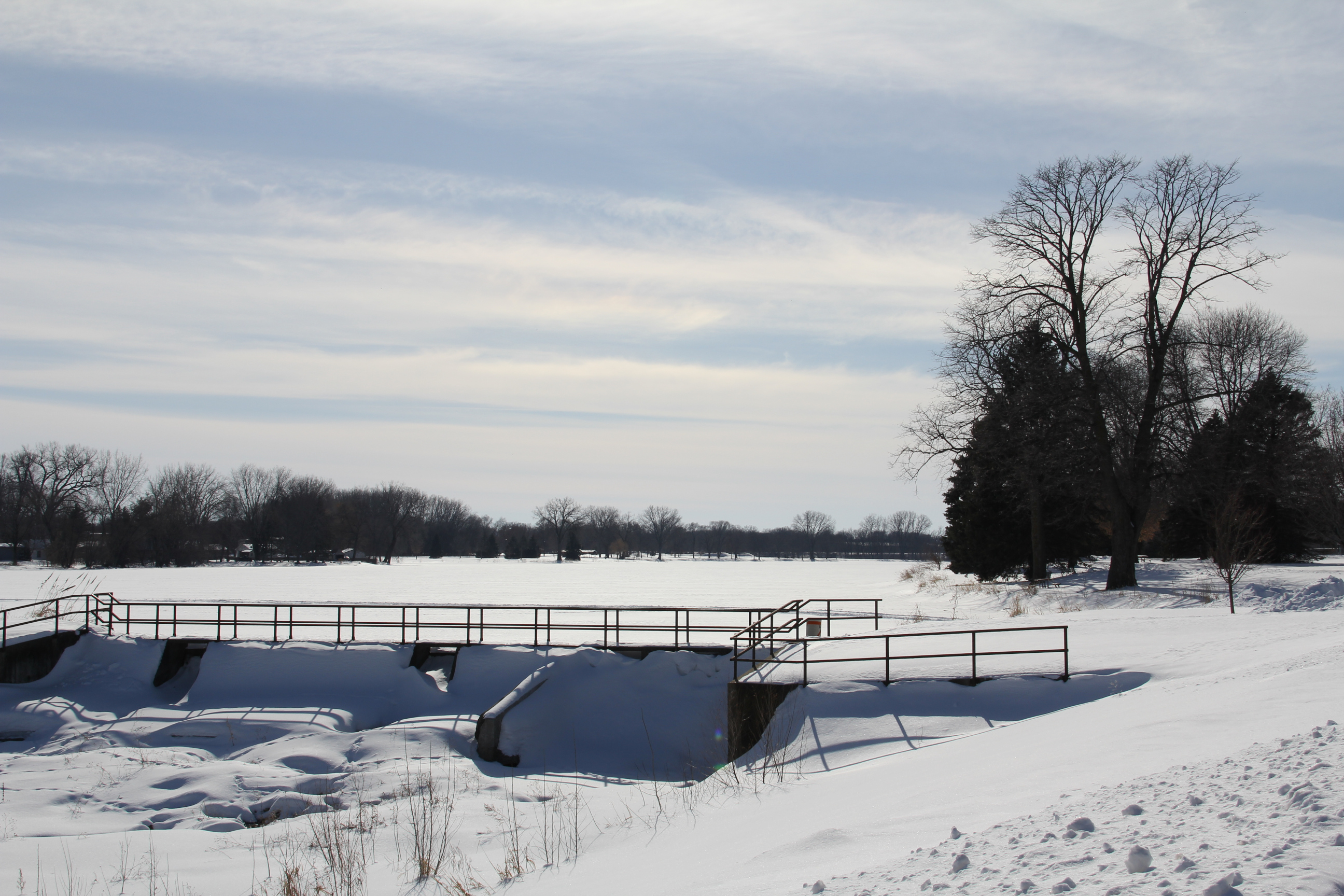
A view of the dam and frozen Cannon River from the recreational trail in North Alexander Park. There are two dams in this location, one next to the woolen mill and then this one. (Minnesota Prairie Roots copyrighted photo February 2023)

Still, this time of year and with the particularly snowy winter we’ve had in Minnesota, ice fishing right now doesn’t seem all that safe to me. Snow acts like a blanket, insulating the ice, resulting in thinner, inconsistent and weaker ice. Decades have passed since I engaged in the sport so I am not writing from current day experience, only from basic knowledge.

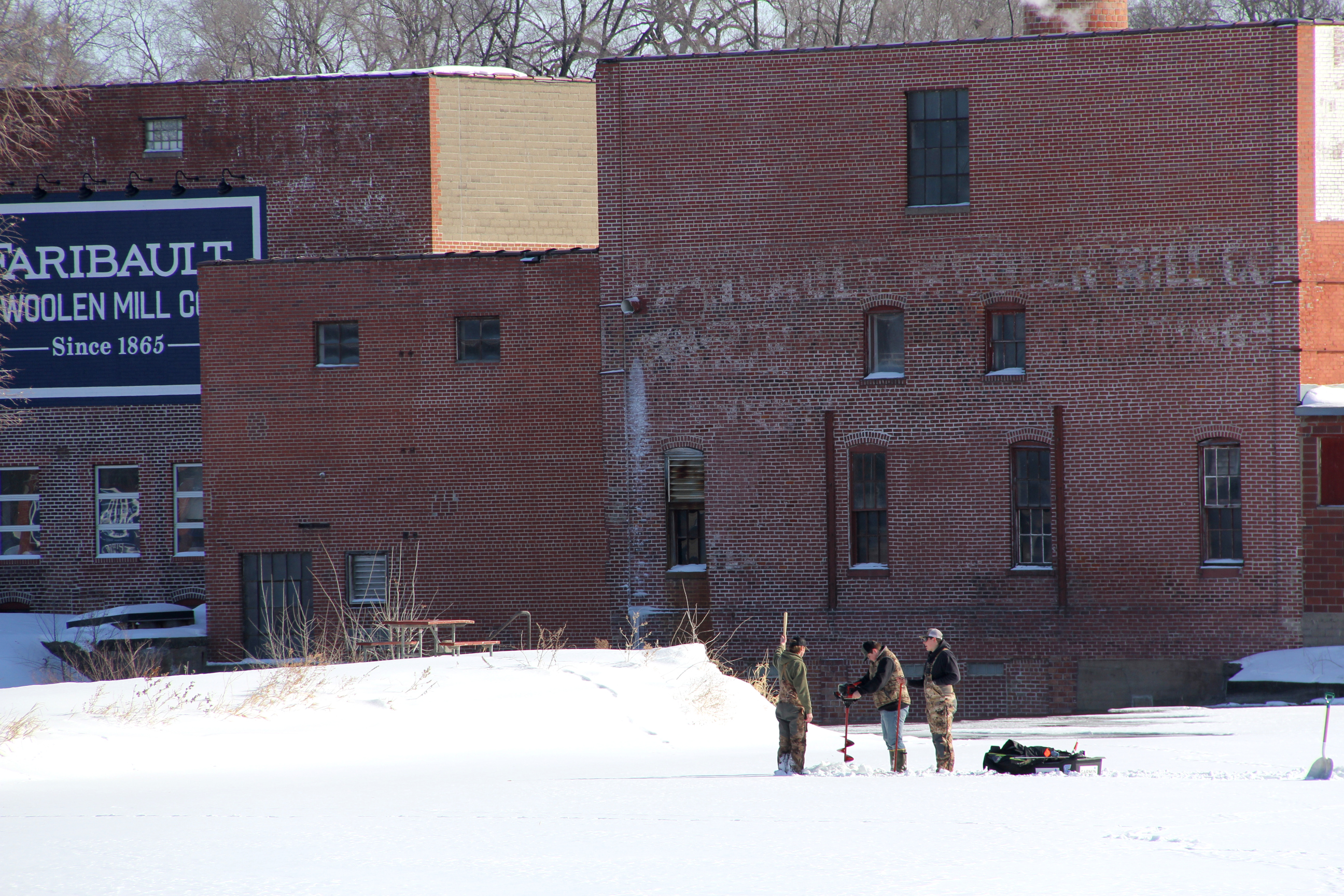
Drilling a hole in the frozen river near the top of the Woolen Mill Dam. (Minnesota Prairie Roots copyrighted photo February 2023)

Sunday afternoon while out and about in Faribault, I came upon three guys with ice fishing equipment on the frozen Cannon River Reservoir by the Woolen Mill Dam. As I watched, I hoped they knew what they were doing because I didn’t feel all that confident in the strength of the river ice with water flowing below.

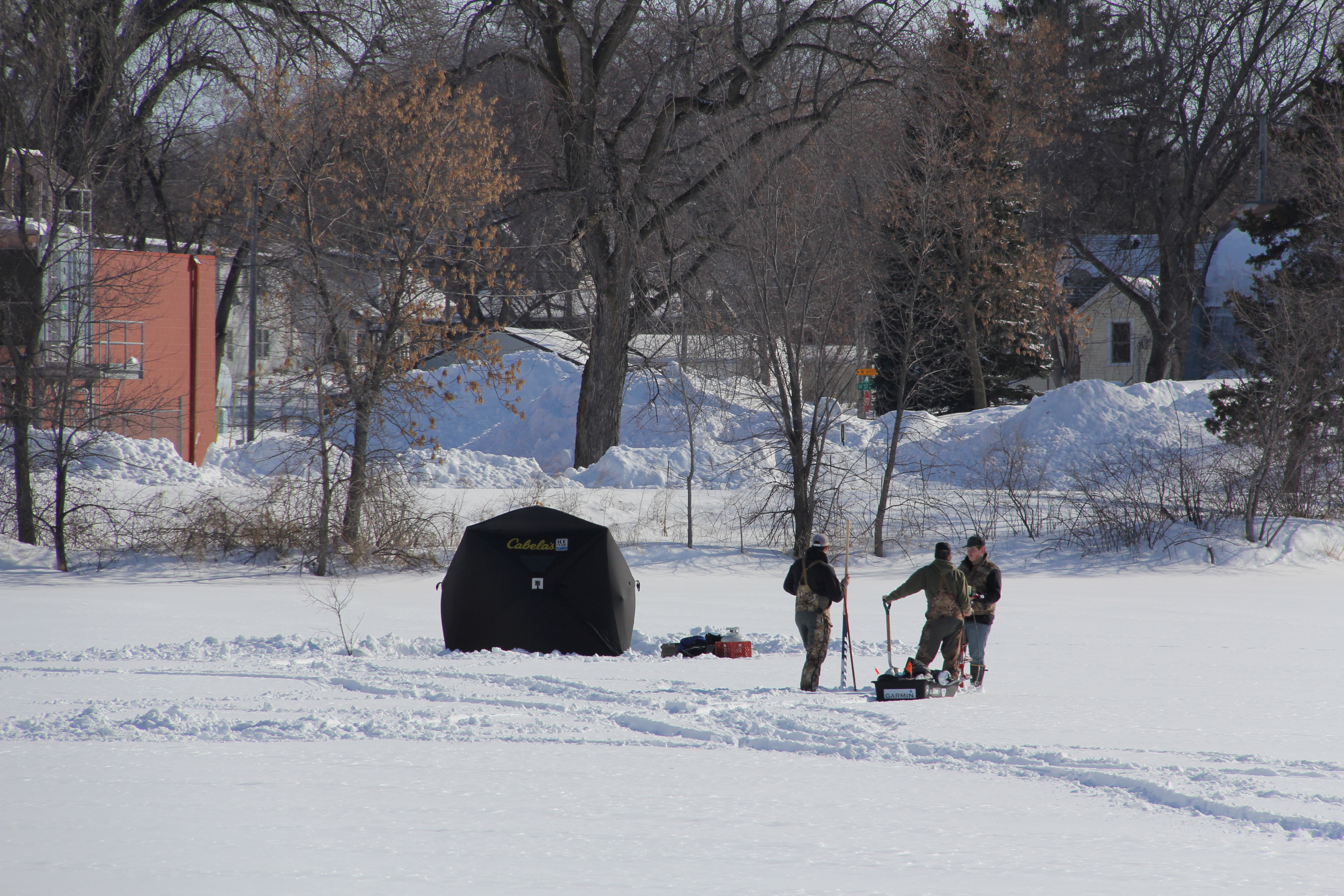
I can almost hear the discussion about where to drill holes in the ice. (Minnesota Prairie Roots copyrighted photo February 2023)

But I appreciated that they were out enjoying the 30-degree sunny afternoon, warm enough even to shed their gloves and heavy coats. They’d already set up two portable fish houses by the time I arrived at North Alexander Park. I stood there and observed as the trio carried ice auger, ice saw, and scoop shovel and towed a sled with fishing gear across the snow-covered river. I was uncertain whether they were spearing for or simply angling for fish. Turns out neither.

Local avid outdoorsman and columnist Larry Gavin clarified: Those guys were actually netting carp. The net is stretched from one tent to the other using a hook and a series of holes. They were checking to see if the location was a good one. Every year they net Wells Lake and get a semi tanker full of carp that are shipped overnight to Chicago. There is a high demand for carp as a food source in some ethnic dining.

Turning the ice auger into the ice to create a hole. (Minnesota Prairie Roots copyrighted photo February 2023)

It was such an iconic Minnesota winter scene, the fishermen in their camouflage attire, a visual clue that they are year-round sportsmen. I can only imagine the camaraderie, the BS, the anticipation of these friends as they searched for fish.

A sled trail across the river to the portable fish house. (Minnesota Prairie Roots copyrighted photo February 2023)

I loved the way their sled left a snaking trail across the Cannon, almost like a line of poetry winding through the snow, writing of winter outdoors, of fish tales, of ice fishing in Minnesota.

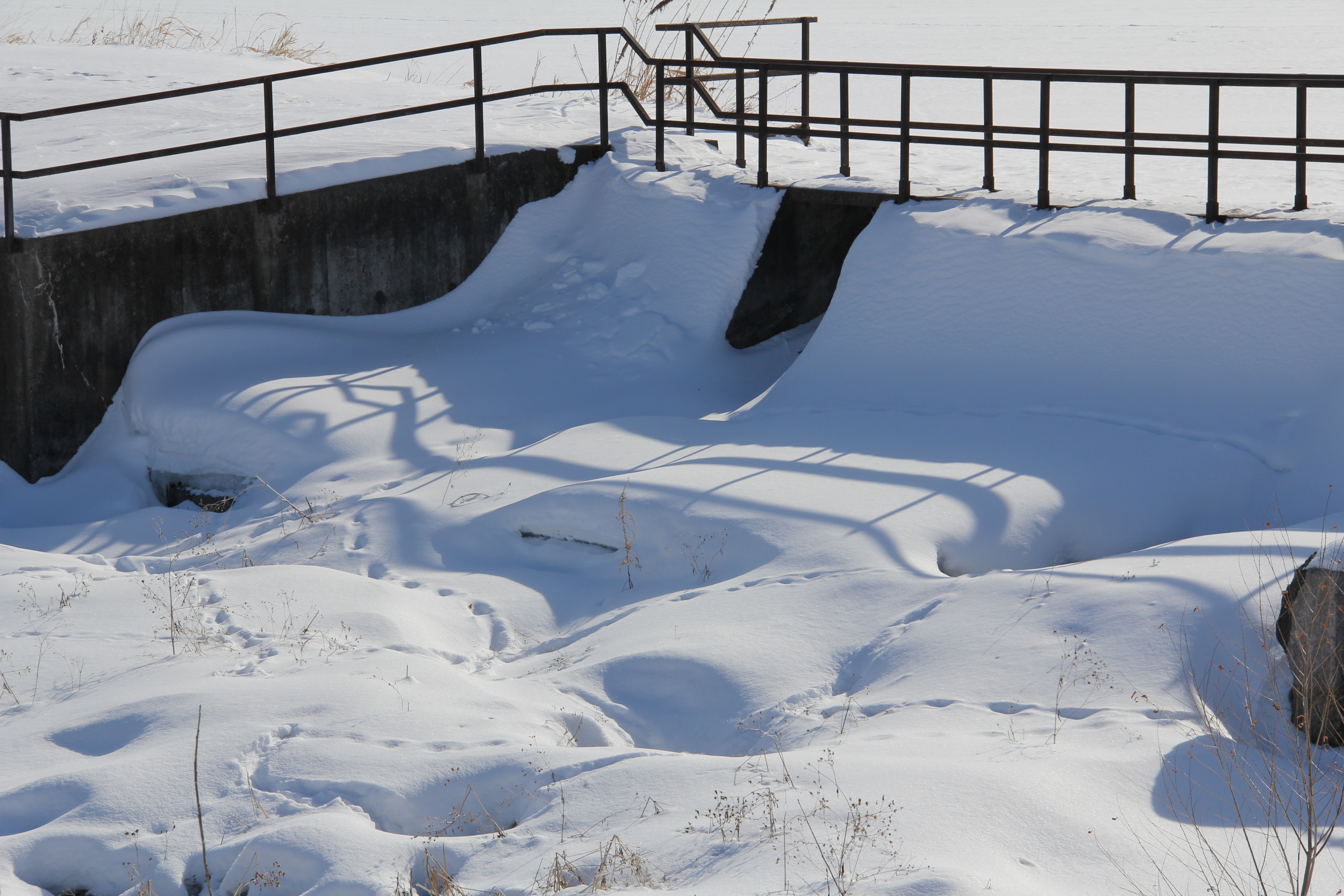
Animal tracks through the snow below the Cannon River dam nearest the recreational trail. (Minnesota Prairie Roots copyrighted photo February 2023)

FYI: The ice fishing season is winding down in Minnesota. All dark houses, fish houses and portables must be off inland lakes by the end of the day beginning on March 6 in the southern two-thirds of the state and by March 20 in the northern third. You can still ice fish, just can’t leave houses unattended. Local officials can set different restrictions if unsafe conditions call for such action.

© Copyright 2023 Audrey Kletscher Helbling


Mountains of snow in this winter of mega snow in southern Minnesota February 28, 2023

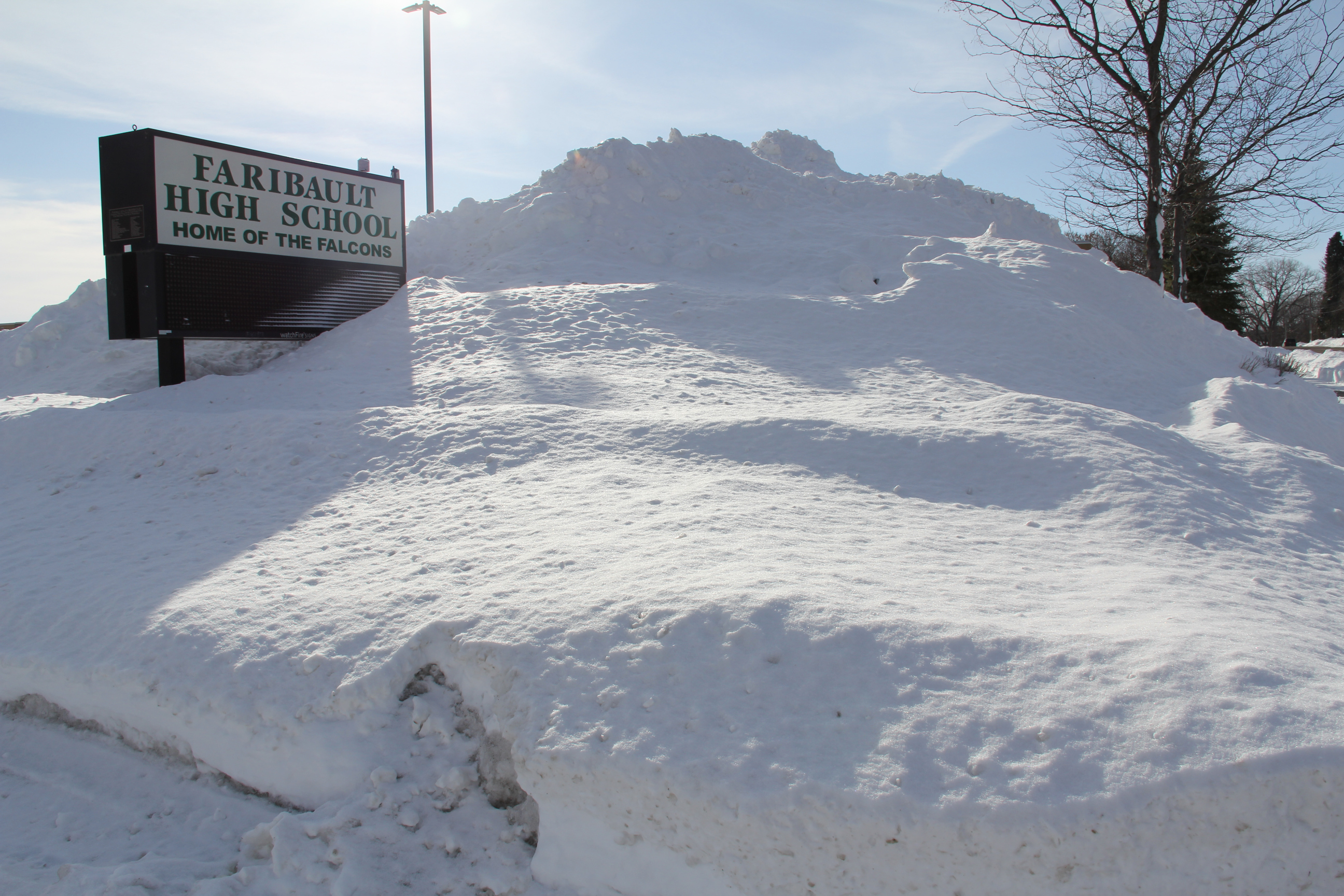
A massive snow pile fills a corner and side of the Faribault High School parking lot. (Minnesota Prairie Roots copyrighted photo February 2023)

BEFORE THE RAIN OF MONDAY, which reduced our significant snow pack, I determined to document the snowy landscape of Faribault. Plus, Randy and I needed to get outdoors, stretch our legs and embrace the 30-some-degree warmth of a sunny Sunday afternoon.

A different view of the FHS snow pile shows the length and height of the mountain in comparison to the vehicle pulling up to the intersection. (Minnesota Prairie Roots copyrighted photo February 2023)

Traveling around town these days requires a bit of extra caution, starting in our driveway. The towering snowbanks flanking the ends necessitate creeping out, all the while trying to see whether any vehicles are approaching. The same goes for many intersections around my community. It’s been a few winters since I’ve seen snow mounded this high. City crews are doing a good job of moving or removing snow to increase visibility. They were on my corner Monday morning to clear snow from the storm sewer drain and intersection.

From behind the massive FHS snow pile, the rambler across the street is barely visible and seems dwarfed in comparison. (Minnesota Prairie Roots copyrighted photo February 2023)

Parking lots hold mountains of snow which take me back to just how much fun I had as a kid playing on the massive piles of snow my dad built with the loader on his John Deere tractor. Up and down the snow hills my siblings and I ran, playing Canadian Mounties or whatever our imaginations decided.

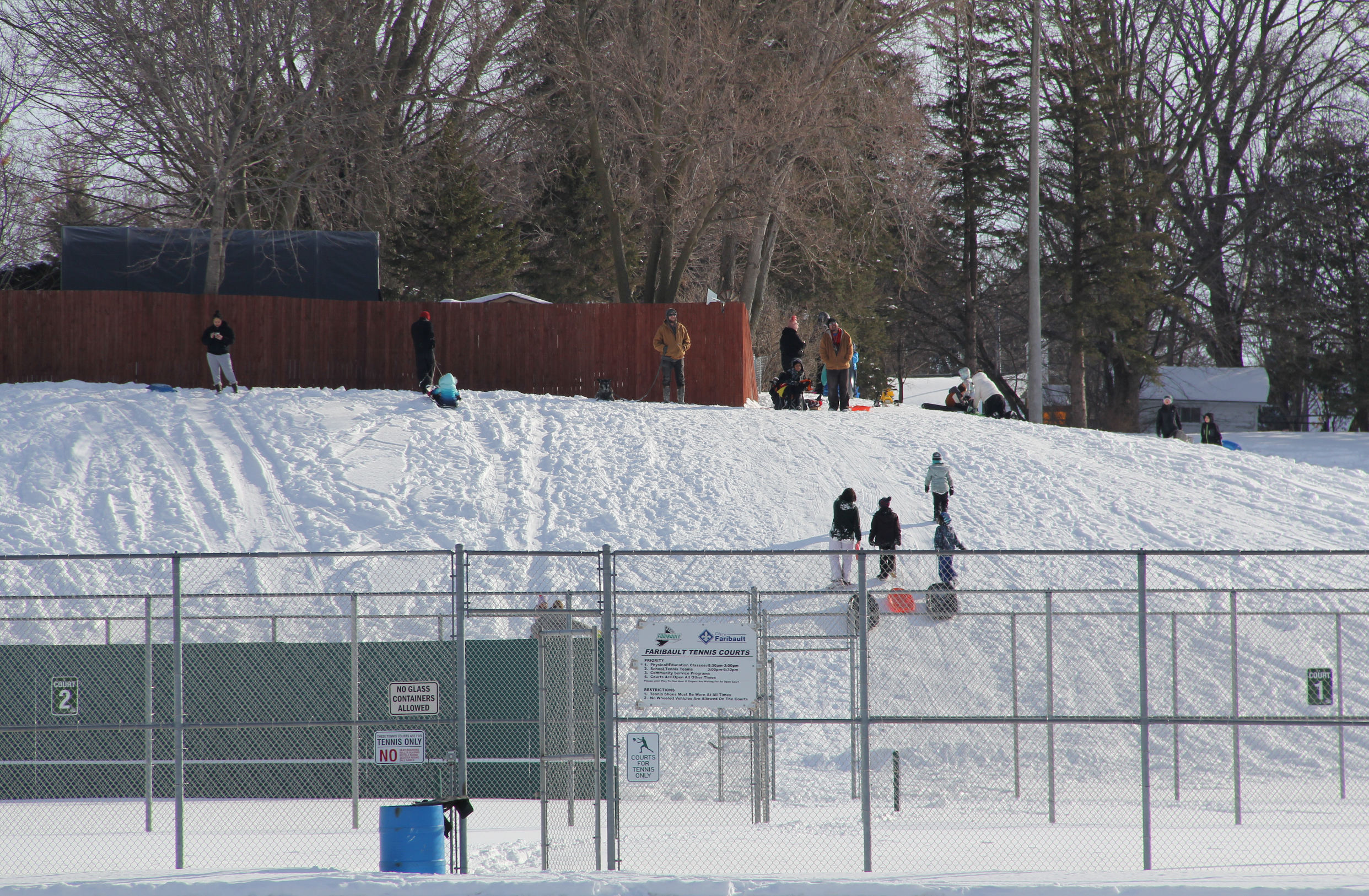
The sledding hill by Faribault High School proved a popular place Sunday afternoon. (Minnesota Prairie Roots copyrighted photo February 2023)

In Faribault on Sunday, I observed families scaling the hill by the high school after sliding down. I love seeing kids enjoying winter outdoors in Minnesota.

Many Minnesota schools, including Faribault Public Schools, have closed during snowstorms and gone to distance and/or e-learning. (Minnesota Prairie Roots copyrighted photo February 2023)

In a corner of the high school parking lot, the snow is pushed so high that I’m clueless as to how it got that high. It’s impressive. I don’t even want to think about how long it will take for that glacier to melt. June?

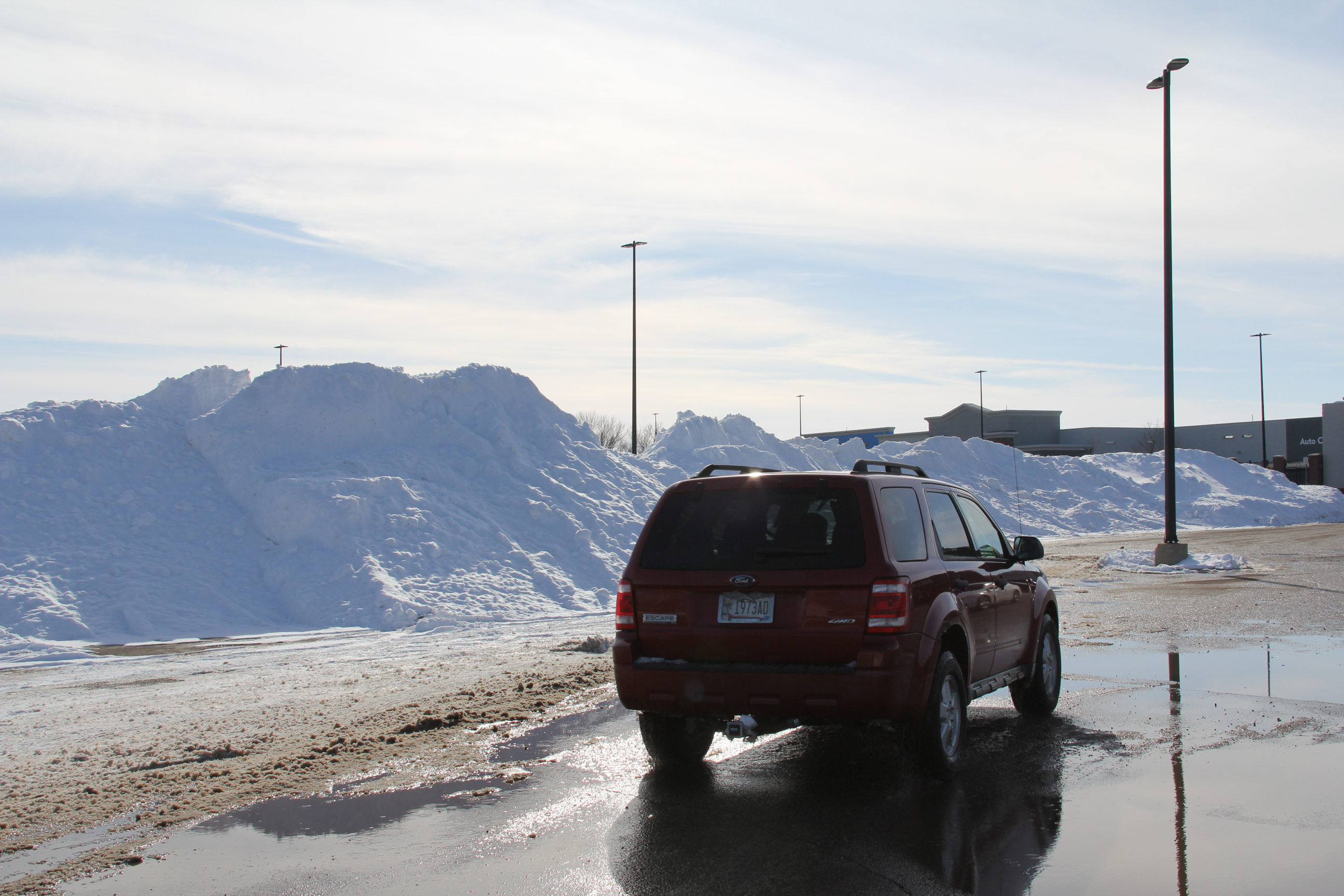
Mountains of snow fill the parking lot at the Faribo West Mall. Walmart is barely visible in the distance. (Minnesota Prairie Roots copyrighted photo February 2023)

The same goes for the snow piled in the Faribo West Mall parking lot. Or maybe it’s the Walmart parking lot. The roofline of the discount retailer is barely visible.

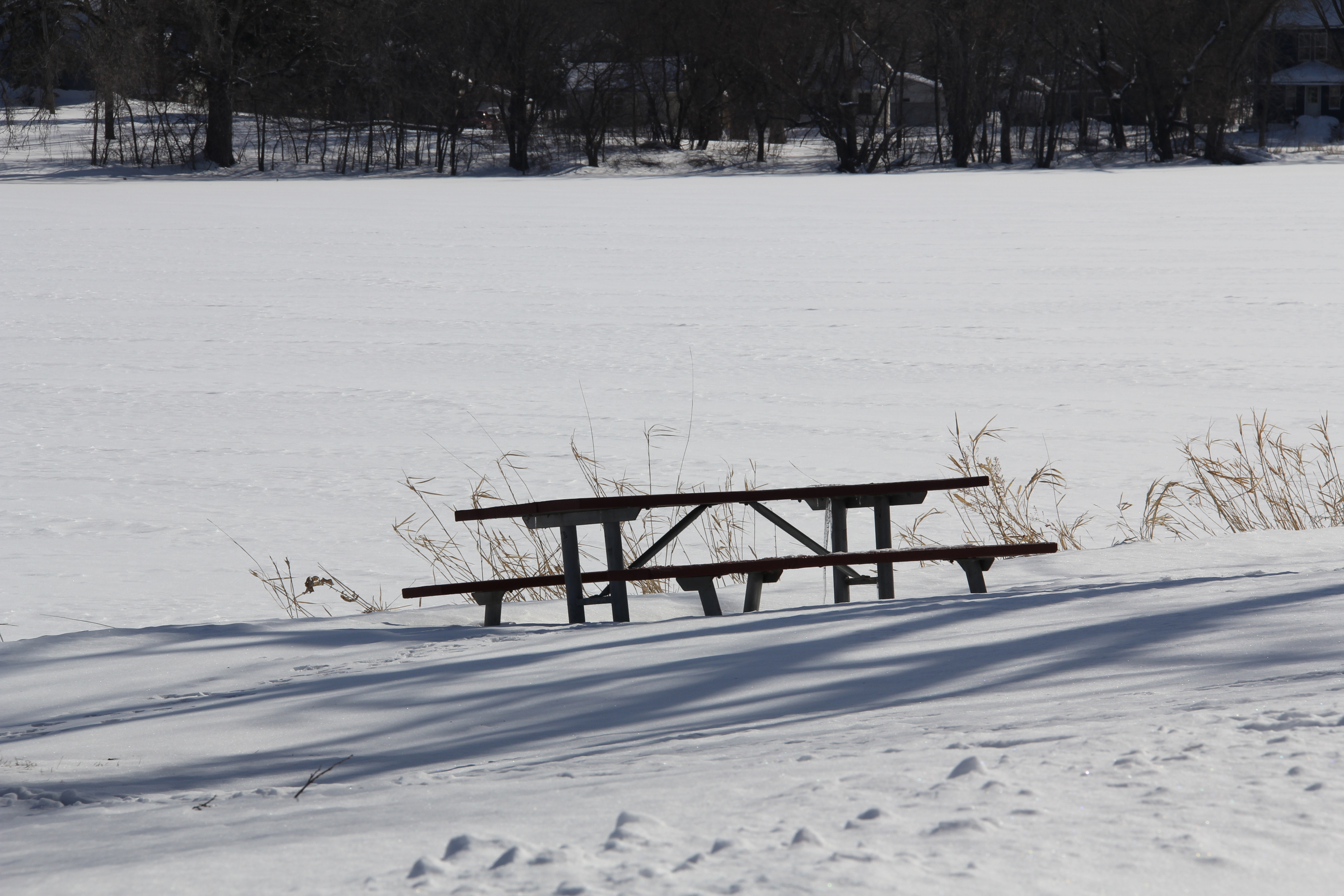
A picnic table sits along the bank of the frozen and snow-covered Cannon River in Faribault’s North Alexander Park. (Minnesota Prairie Roots copyrighted photo February 2023)

Along and near the river in two city parks, picnic tables surrounded by snow remind me that many months will pass before anyone can picnic. Well, I suppose, technically one can picnic in winter, if you are willing to slog through a foot plus of snow to dine.

Carrying ice auger and ice saw and pulling a sled full of gear, this trio of ice fishermen aim toward a spot to fish on the Cannon River by the Woolen Mill Dam. They had set up two portable fish houses. Check back for more images. (Minnesota Prairie Roots copyrighted photo February 2023)

To my photographic delight, though, three ice fishermen slogged through the snow to fish on the Cannon River by the Faribault Woolen Mill Dam. Randy suggested I might want to walk out there for some close-up photos rather than rely on my zoom lens. No, thank you. At this stage in winter, especially, with snow acting as insulation on ice, I don’t trust the ice. These guys, with their portable pop-up fish houses, clearly think differently than me.

My thoughts about right now are those of being ready for winter to end. But, realistically, I understand that we have two months of winter remaining here in Minnesota. As a life-long Minnesotan, I can’t deny that. Onward, into March.

© Copyright 2023 Audrey Kletscher Helbling
 

Minnesota makes strong showing in U.S. Cheese Makers Contest February 27, 2023

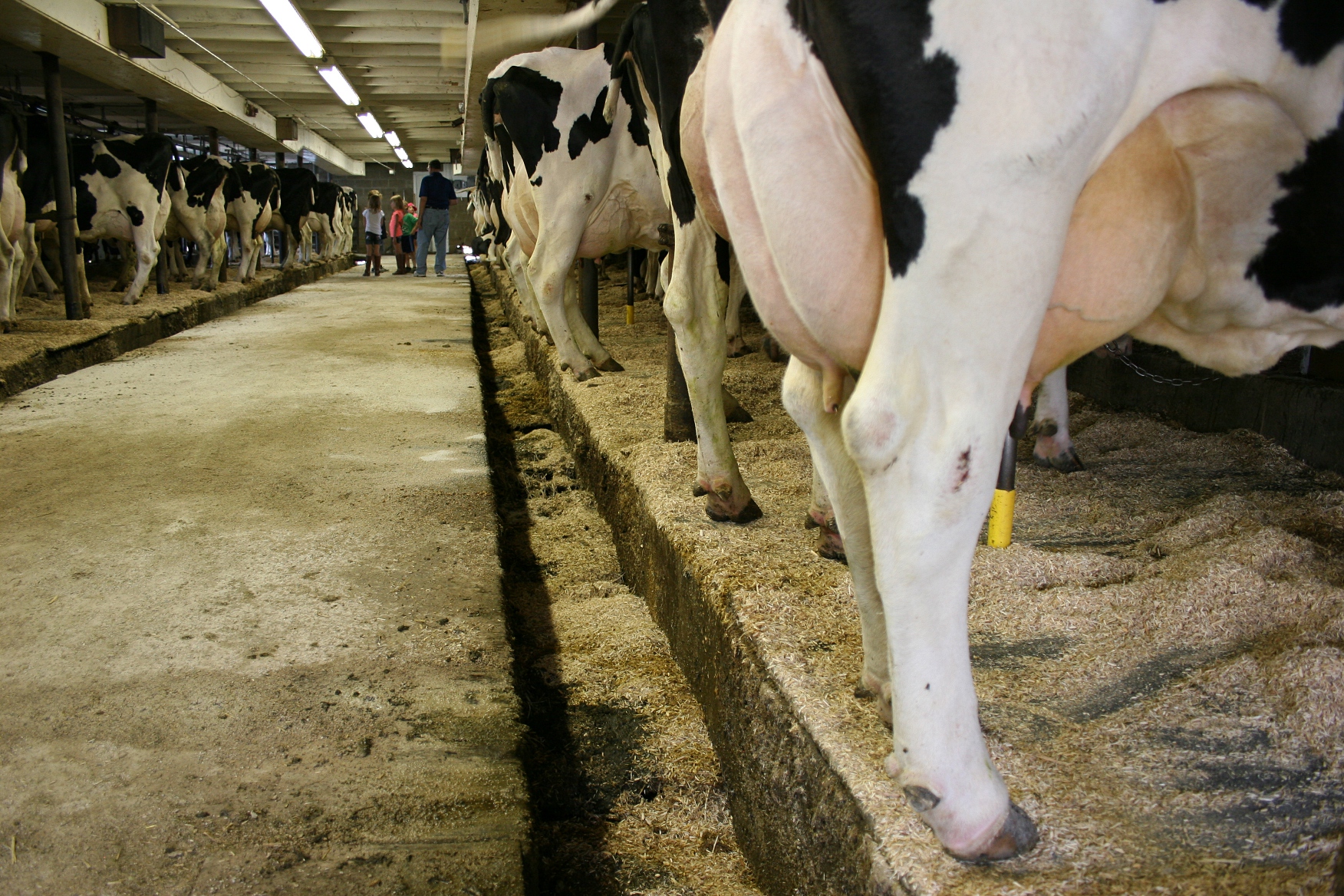
Inside a Rice County dairy barn. (Minnesota Prairie Roots copyrighted file photo)

AS SOMEONE WHO GREW UP on a dairy farm, I understand the hard work and commitment of feeding, caring for and milking cows. Every. Single. Day. Although the process has become easier with automation, the fact remains that dairy farmers can’t just walk away from the barn for a day. The cows still need to be milked.

As a child and teen, I labored in the barn, assisting my dad with feeding, bedding straw, and scooping manure. He did the actual milking. And he was under a time crunch to finish milking our Holsteins before the milk truck arrived to empty the bulk tank and transport our cows’ milk to the Associated Milk Producers plant in New Ulm.

That backstory brings me to today, nearly 50 years removed from the southwestern Minnesota crop and dairy farm where I learned the value of hard work. AMPI in New Ulm is still going strong and recently won several honors at the Wisconsin Cheese Makers Association 2023 U.S. Champion Cheese Contest in Green Bay, Wisconsin. Forty-two judges evaluated entries based on flavor, texture, appearance and taste. There were 2,249 entries from 197 dairy companies and cooperatives in 35 states. Minnesota was well-represented. (Click here to see a full list of the winners by category.)

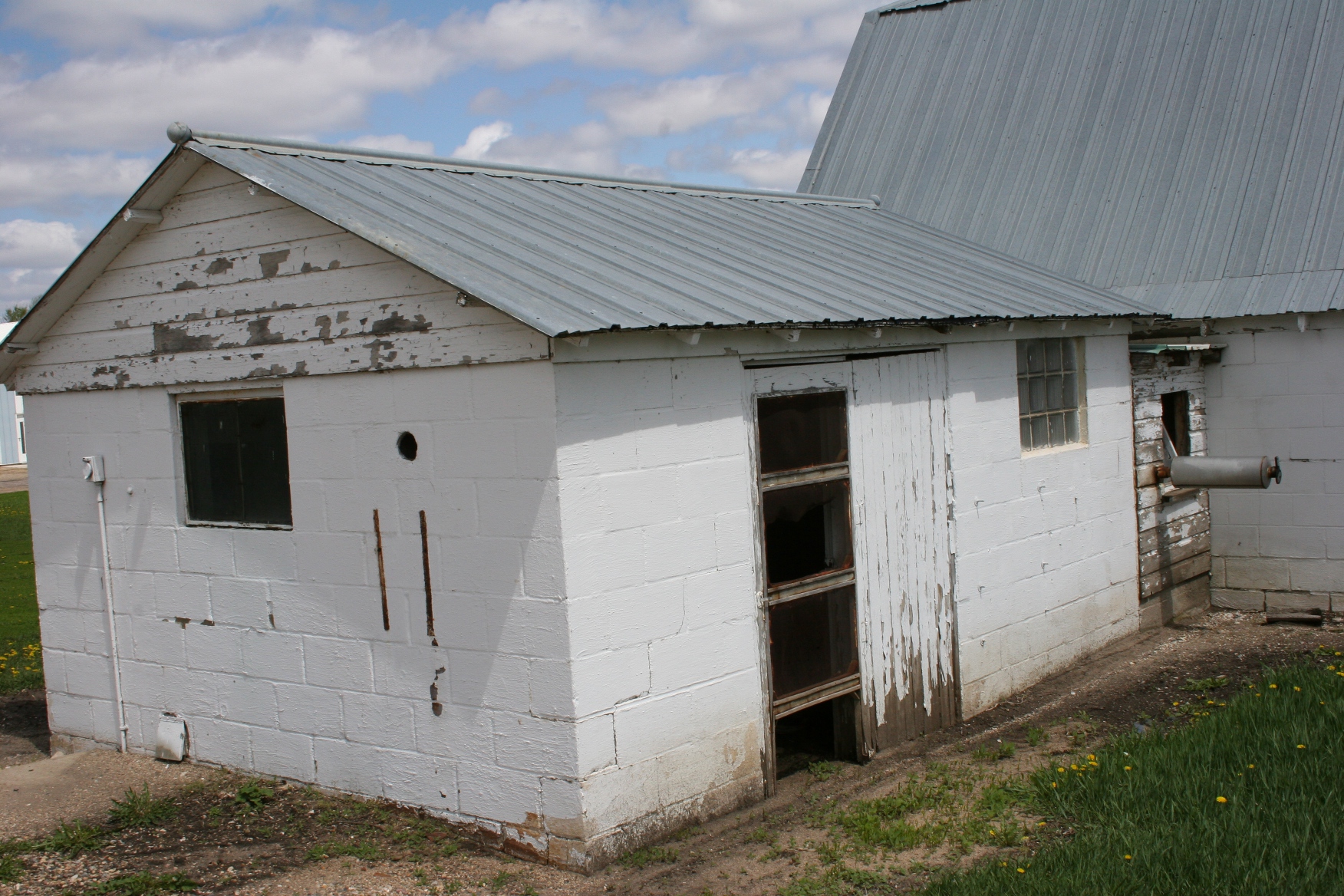
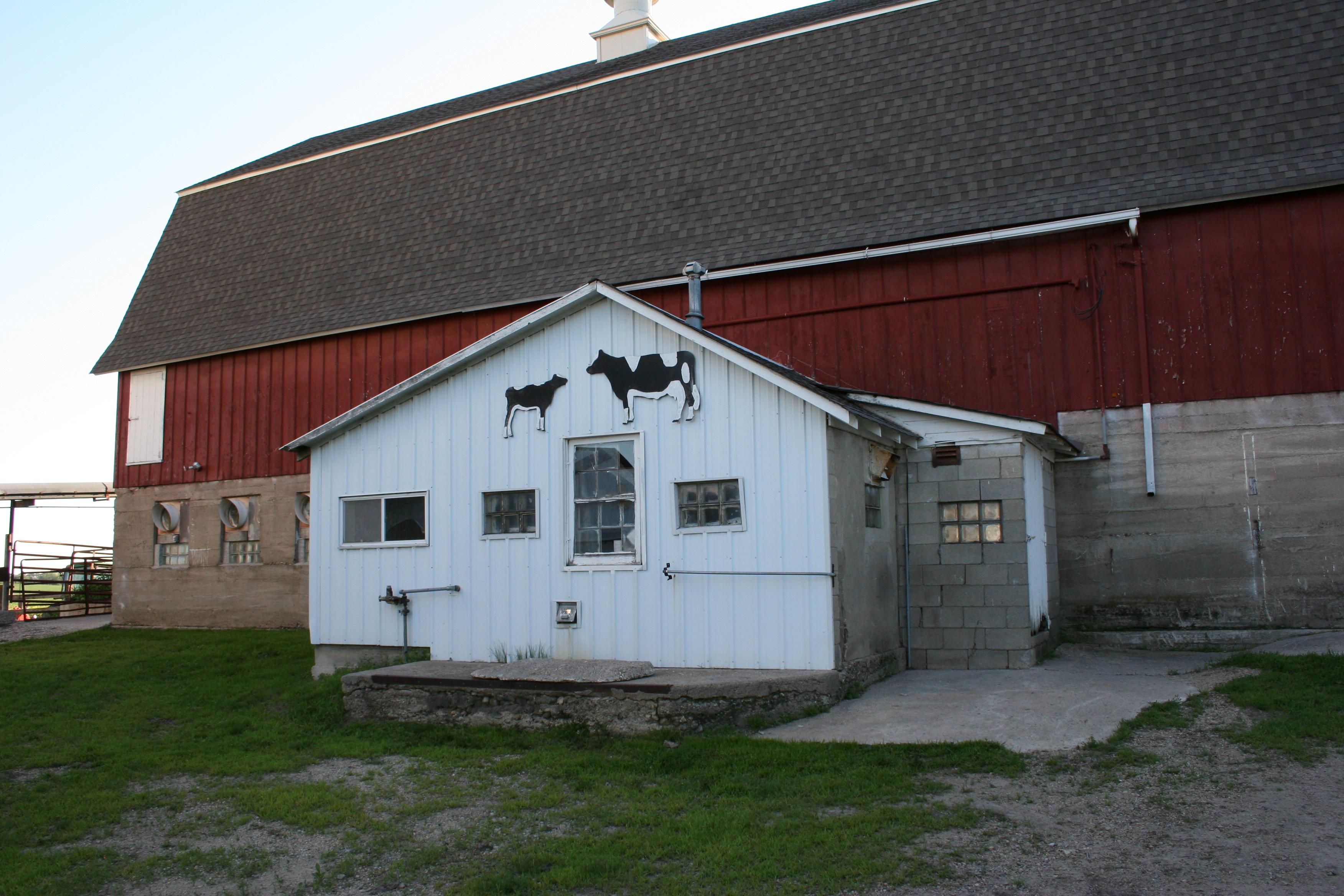
The abandoned milkhouse, attached to the barn on the farm where I grew up outside Vesta. (Minnesota Prairie Roots copyrighted file photo 2009)

AWARD-WINNING BUTTER FROM NEW ULM

The 113 contest divisions include dairy products beyond cheese. And that’s where New Ulm’s AMPI plant scored, earning second place for its unsalted butter and third places for salted butter and flavored butter, specifically chipotle butter. AMPI’s Sea Salted Root Beer Butter which sounds, in Minnesota lingo, “different,” did not place.

I grew up on AMPI salted butter. The milk man—the guy who picked up the milk from our milkhouse—also brought blocks of butter. Dad just left a slip of paper indicating how many pounds we needed and the driver pulled the packages from his truck.

Lucky Linda Cheddar (Photo credit: Redhead Creamery Facebook page)

REDHEAD CREAMERY CHEESE CRAFTS A TOP 20 CHEESE

What I didn’t have back then was access to good quality cheese like that produced in Minnesota today. I love cheese. And yogurt and cottage cheese and ice cream and cheese curds…, well, all things dairy. This year a cheddar cheese produced by a small west central Minnesota cheese maker, Redhead Creamery, was named one of the top 20 cheeses in the country during last week’s national competition. And, yes, the president and CEO of this creamery in rural Brooten, Alise Sjostrom, is a redhead.

Redhead Creamery earned Best of Class in the Natural Rind Cheddar category with its previously award-winning Lucky Linda Clothbound Cheddar, named after Sjostrom’s mom. That top cheese was then chosen to compete against 19 other top cheeses for the honor of U.S. Champion Cheese. An aged Gouda made by the team at Arethusa Farm Dairy in Connecticut won the best cheese in the U.S. title. Two Wisconsin cheeses earned second and third places.

I have yet to try, or even find, Minnesota-made Redhead Creamery cheeses. But I will be looking for them locally, especially Lucky Linda Cheddar. I’d even like to take a road trip to the dairy and cheese operation, which offers tours.

Award-winning Amablu Gorgonzola from Caves of Faribault. (Minnesota Prairie Roots copyrighted file photo)

CAVES OF FARIBAULT EARNS HONORS

My community is also home to award-winning handcrafted cheeses. This year cheesemakers at Prairie Farms’ Caves of Faribault placed second in the Gorgonzola competition with Ama Gorg. In the blue-veined division, Caves of Faribault earned fourth for its AmaBlu. These cheeses have previously won honors and they are well-deserving. I love Caves of Faribault cheeses, aged in sandstone caves along the Straight River. If you like blue cheese, and I realize either you love it or you hate it, then this is your cheese.

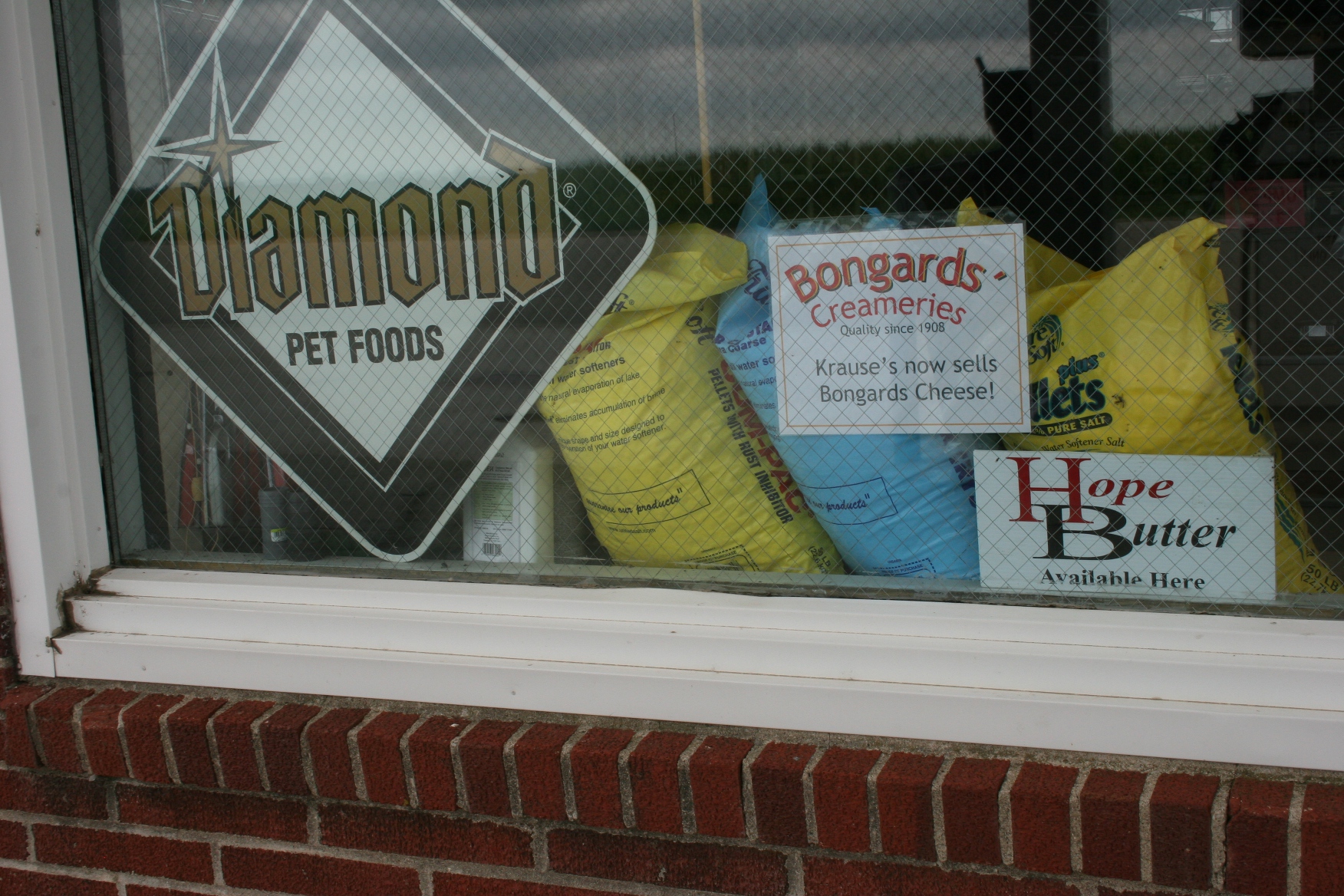
Krause Feeds & Supplies in Hope advertises the availability of Hope butter and Bongards cheese. (Minnesota Prairie Roots copyrighted file photo June 2013)

MORE MINNESOTA WINNERS

Minnesota-based Bongards Creameries in Perham also earned a Best of Class with its Monterey Jack cheese in the national competition. Likewise, Kemps, LLC in Farmington took Best of Class for its pineapple flavored cottage cheese and second for its chive flavored cottage cheese. I didn’t even realize cottage cheese came in such flavors.

In another division of the national competition, whey protein concentrate 80 from Milk Specialties Global’s plant in small town Mountain Lake garnered the Best of Class and a second place (for instantized).

If there were other top winners from Minnesota in the 2023 U.S. Cheese Contest, I apologize for missing them. But after scrolling through pages of information, I stopped looking.

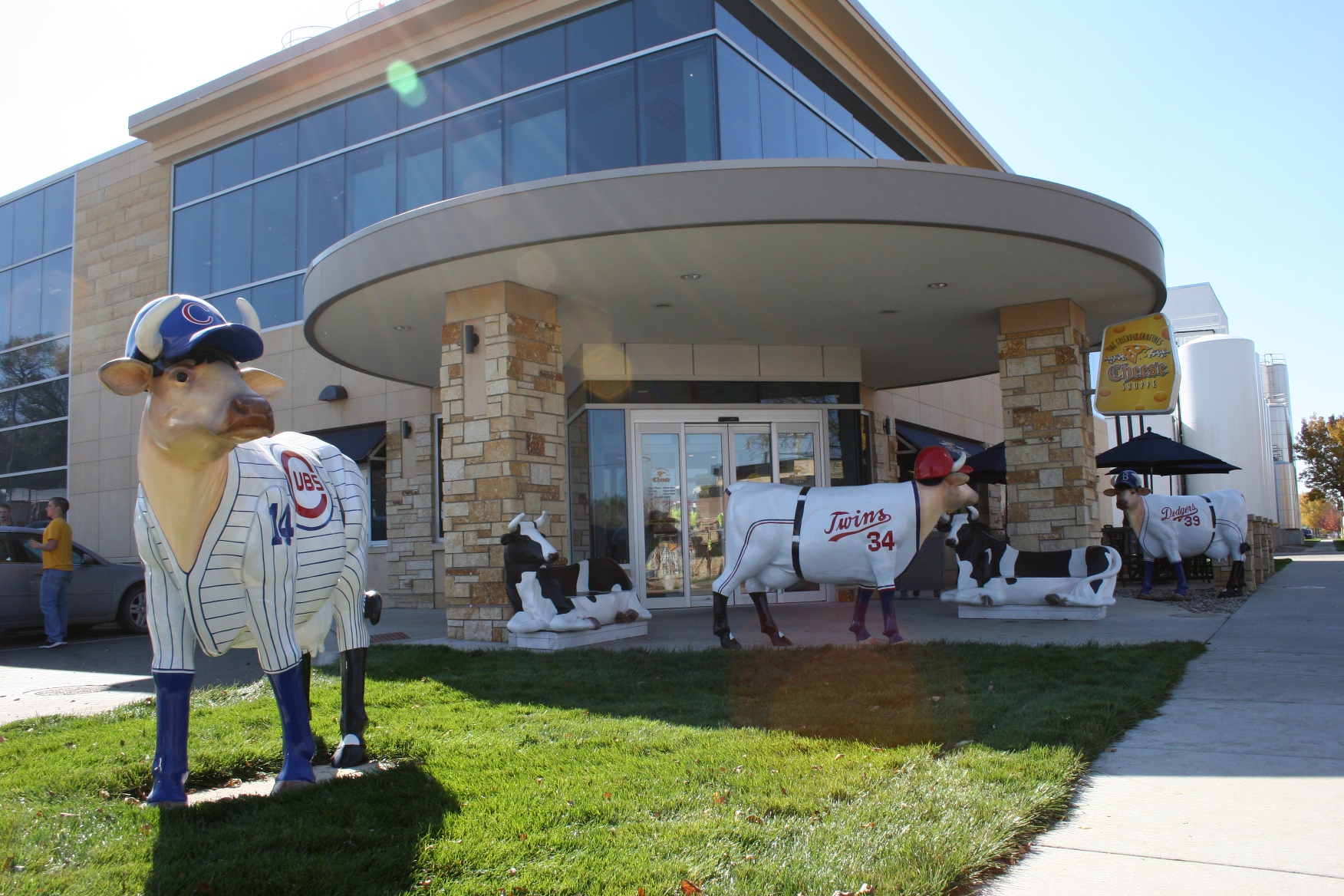
Cow sculptures outside The Friendly Confines Cheese Shoppe in Le Sueur. (Minnesota Prairie Roots copyrighted file photo June 2013)

MINNESOTA IS DAIRY STRONG

What I realized is that small creameries to co-ops to large companies in Minnesota make a lot of dairy products. We may not have as many cheesemakers as the Dairyland State, but certainly enough for anyone who likes cheese and other dairy products to recognize Minnesota’s value in the dairy industry.

I saw Minnesota entries (again, I may have missed some) from Prairie Farms Dairy Cheese Division in Rochester, Bongards in Norwood, Agropur in Le Sueur, Stickney Hill Dairy in Rockville and First District Association in Litchfield. The varieties of cheeses range from pasteurized process American cheese from Prairie Farms to jalapeno and roasted red cheddar from Litchfield-based FDA, “a grassroots cooperative since 1921.”

This rural Dundas barn once housed a herd of dairy cows. No more. But the barn has been maintained. (Minnesota Prairie Roots copyrighted file photo September 2011)

CHANGED & UNCHANGED

Much has changed, yet much has not since I left the farm in 1974. Cooperatives remain as strong as ever, yet small scale artisan cheese makers, have also emerged. The demand for basic cheeses remains, yet cheese makers are crafting diverse flavors to meet consumers’ expanding tastes. Small family dairy farms have been mostly replaced by large-scale dairy operations. Change is inevitable. But one thing has not changed for me personally. I love dairy products, especially cheese.
© Copyright 2023 Audrey Kletscher Helbling