Minnesota Prairie Roots

Writing and photography by Audrey Kletscher Helbling
From Northfield: Snapshots of an abbreviated Defeat of Jesse James Days September 17, 2020

The site of the 1876 attempted bank robbery, now the Northfield Historical Society.


TYPICALLY, THE DEFEAT OF JESSE JAMES DAYS in Northfield finds Randy and me avoiding this college town only 20 minutes from Faribault. Crowds and congestion keep us away as thousands converge on this southeastern Minnesota community to celebrate the defeat of the James-Younger Gang in a September 7, 1876, attempted robbery of the First National Bank.


Waiting for fair food at one of several stands.


But this year, because of COVID-19, the mega celebration scaled back, leaving Northfield busy, but not packed. And so we walked around downtown for a bit on Saturday afternoon, after we replenished our book supply at the local public library—our original reason for being in Northfield.


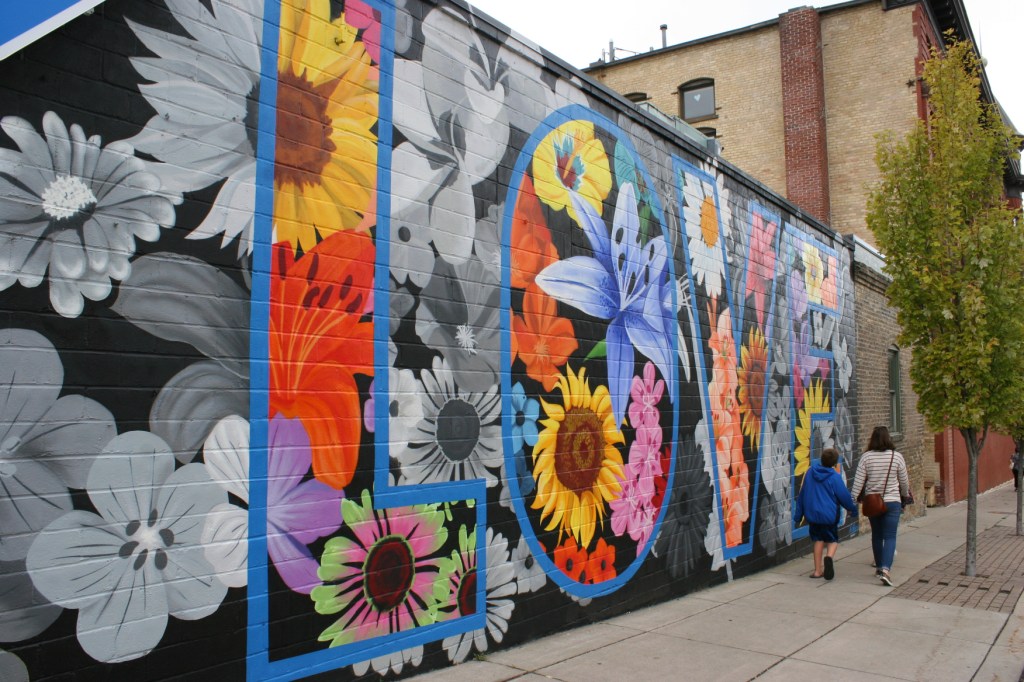
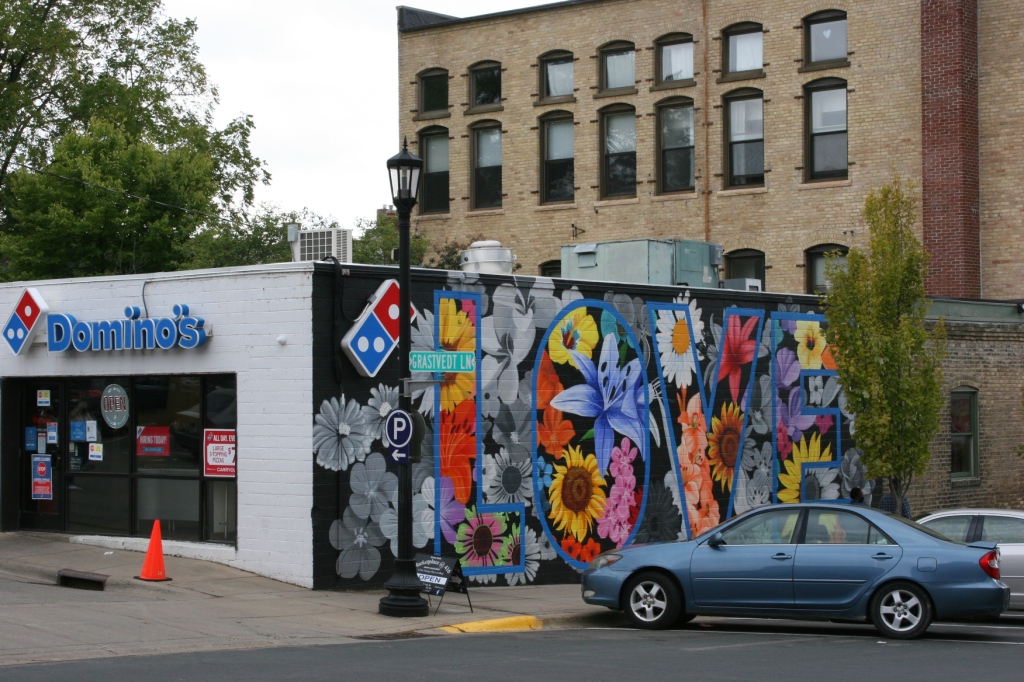
The LOVE mural painted on a pizza place in Northfield drew lots of fans taking photos, including me.


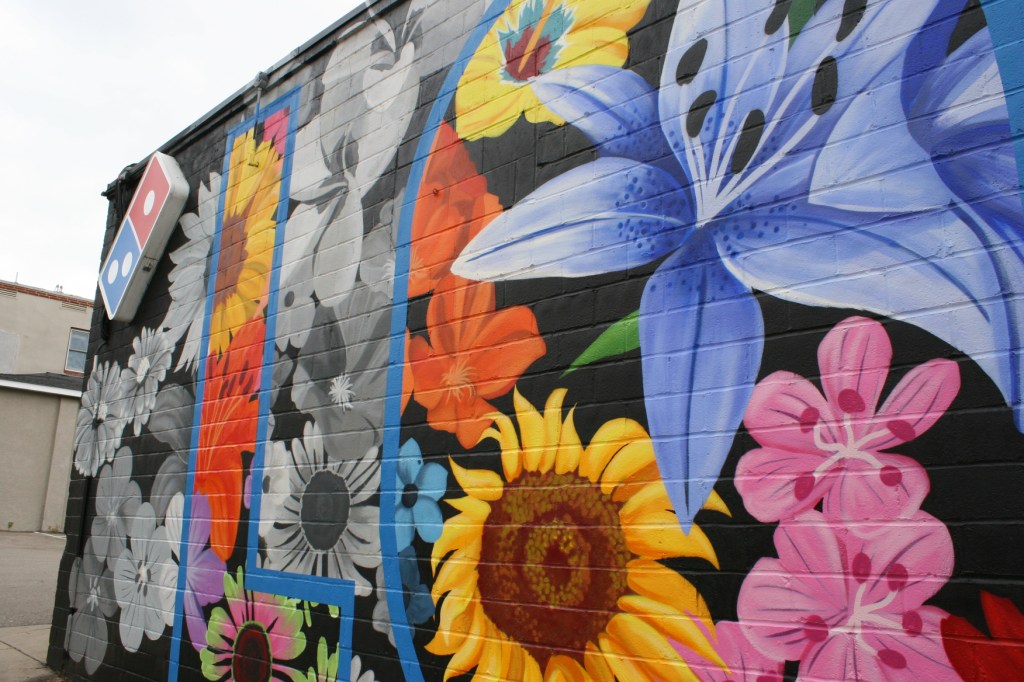
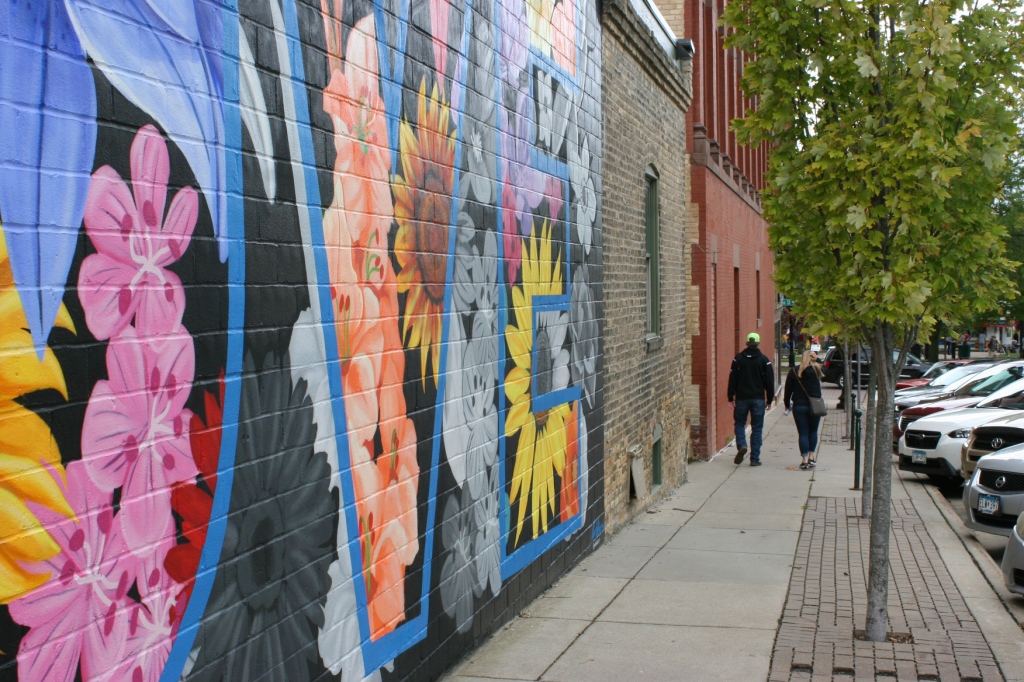
On our way to Bridge Square, a riverside community gathering spot in the heart of this historic downtown, I paused to photograph the latest public art project here—a floral mural painted on the side of the Domino’s Pizza building by Illinois artist Brett Whitacre. (More info and photos on that tomorrow.)


One of the many Sidewalk Poetry poems imprinted into cement in downtown Northfield.


Northfield’s appreciation of the arts—from visual to literary to performing—is one of the qualities I most value about this community. As a poet, I especially enjoy the poetry imprinted upon sidewalks.


An impromptu concert in Bridge Square.


A fountain, monument and the iconic popcorn wagon define Bridge Square in the warmer weather season.


Buying a corn dog…


I was delighted also to see and hear a guitarist quietly strumming music in the town square while people walked by, stopped at the iconic popcorn wagon or waited in line for corn dogs and cheese curds. Several food vendors lined a street by the park.


The Defeat of Jesse James Days royalty out and about.


Among fest-goers I spotted Defeat of Jesse James royalty in their denim attire, red bandanna masks, crowns and boots, the masks a reminder not of outlaws but of COVID-19.


Photographed through the bakery’s front window, the feet-shaped pastries.


Yet, in the throes of a global pandemic, some aspects of the celebration remained unchanged. At Quality Bakery a half a block away from Bridge Square, the western-themed window displays featured the bakery’s signature celebration pastry—De-Feet of Jesse James.


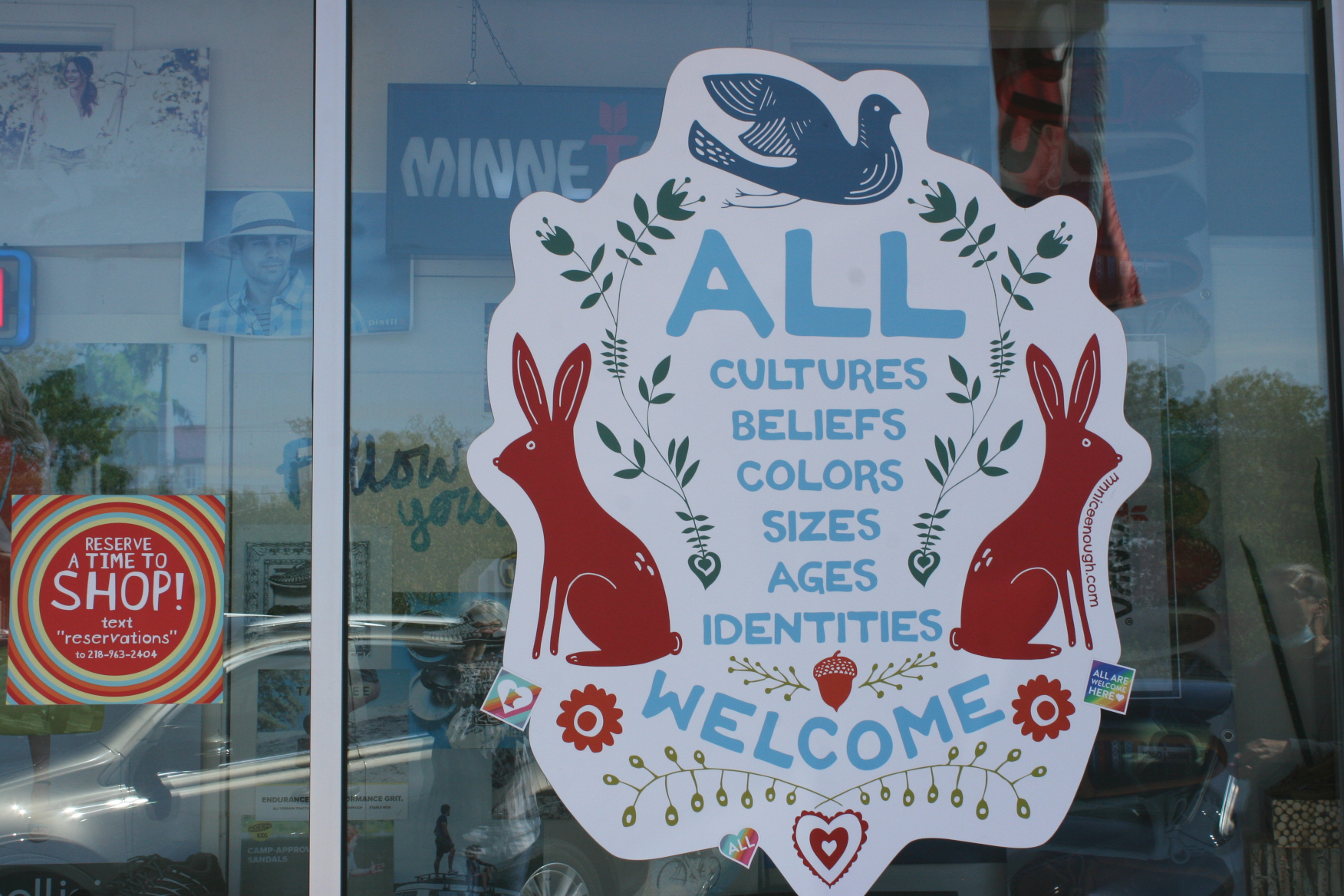
A sign outside a Division Street business fits the theme of the celebration.


For a bit of this Saturday, it felt good to embrace this long-running event, to experience a sense of community, to celebrate the defeat of the bad guys.


© Copyright 2020 Audrey Kletscher Helbling
 

Up close in the Atwood Neighborhood of Madison, Part II September 16, 2020


PLACE REVEALS ITSELF in the details.


Sunflowers brighten the Atwood Community Gardens.


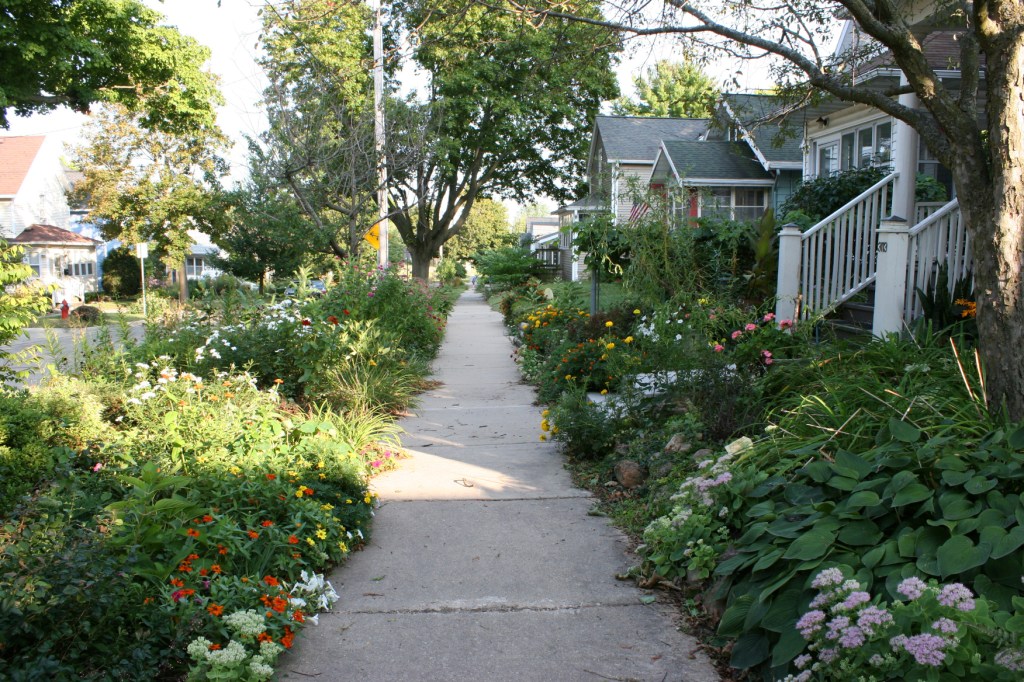
Put me in a location, like the Atwood Neighborhood on the east side of Madison, Wisconsin, and I will focus on the nuances. The seemingly little things that, when connected, define this as a neighborhood rooted in art, in the outdoors, in a genuine care for one another.


This is one busy bike path, frequented by all ages.


All of this I surmised simply by walking along Atwood area residential streets and past businesses and by following the Capital City State Trail for several blocks.


Flowers, oh, so many flowers…


My post today takes you back to the bike path, to those details that caused me to pause with my camera as bikers zipped past me. To photograph the flowers.


An artsy sign in the community garden.


Inspiring graffiti.


Madison’s capitol is depicted in this manhole cover art.


And the signs—always the signs, the aged brick buildings and, yes, even the manhole covers.


A little seasonal fun added to the Atwood Community Gardens.


And resident garden skeleton.


Cow art by the Goodman Community Center and right next to the bike trail.


What I observed pleases me as a creative, as an appreciator of aged architecture, as a nature lover and as a human being who values respect for others.


Colorful flowers thrive, including this zinnia.


The natural beauty of the Atwood Neighborhood appeals to me.


Spotted in a window of a residence along the bike trail.


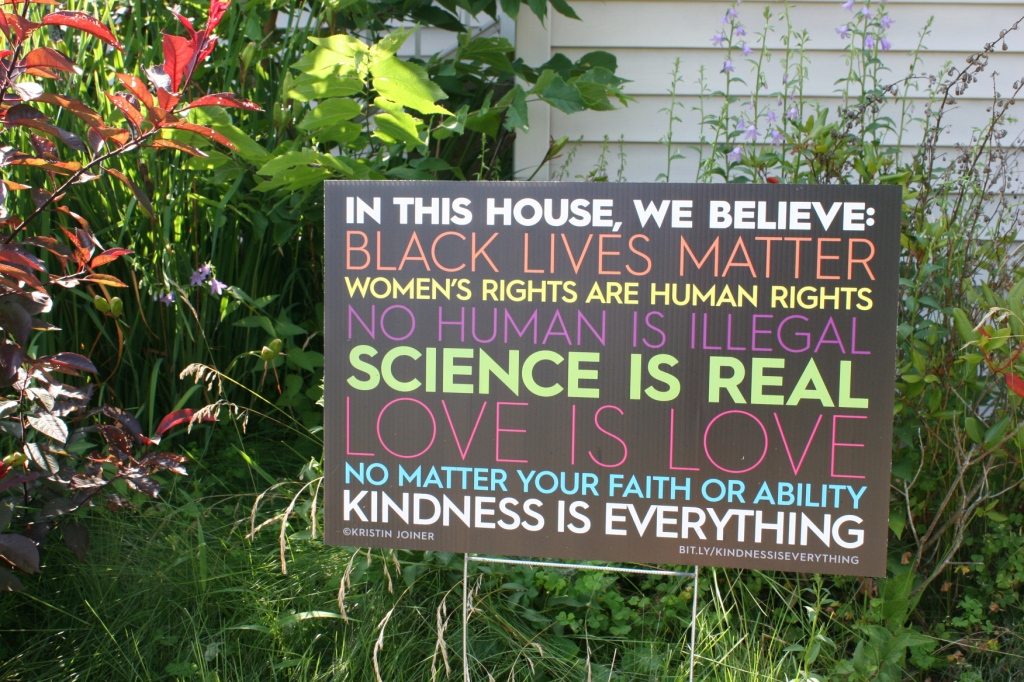
The spirit of the Atwood Neighborhood appeals to me, too. With its earthiness. Its embracing of differences. Its sense of neighborhood pride. Its art. I feel comfortable here. Welcome. And that, my friends, is more important than ever in these times of upheaval, discontent, frustration and disconnect.

#

Note: Like anywhere, no place is utopia, and that includes the East Side of Madison. While visiting my son, who lives in the Atwood Neighborhood, I learned of a recent daytime “shots fired” along his street. He didn’t tell me about this, of course, not wanting to worry his mom. There have been other similar incidents. Does this concern me? Yes. But then I think of my neighborhood in Faribault, considered small town to many, but not to me. In the 36 years I’ve lived here, my section of town has seen violence also. In 1999, a young man was stabbed to death within blocks of my home. We’ve also experienced drive-by shootings only blocks away. Not recently. No matter where you live, no place is fully safe. But, of one thing I am certain. We each have within us the capacity to shine lights of hope in our neighborhoods, to be decent and kind and caring.

Please check back soon for more posts from this section of Madison, Wisconsin.

© Copyright 2020 Audrey Kletscher Helbling
 

Exploring Madison’s Atwood Neighborhood via the bike trail, minus the bike, Part I September 15, 2020

A colorful cow sculpture stands next to the bike trail by the Goodman Community Center in the Atwood Neighbohood of Madison, Wisconsin.


BUTTERFLIES. BOOKS. BIKES. Even a bovine. And a sign for burgers and brats.


The bike path teems with bikers of all ages, and some walkers.


All defined a Labor Day weekend walk along the Capital City State Trail on Madison’s east side while visiting family. This Wisconsin state capital fully embraces biking via a city-wide system of connecting trails. Walk the paved pathways rather than wheel them and you best remain vigilant. And to the side. Most bikers zoom by.


By the community center, a Little Free Library sits right next to the bike trail.


With that awareness, I fully enjoyed this opportunity to see more of the thriving and vibrant Atwood Neighborhood.


Next to the trail, an electric bike rental station.


I almost wished I had a bike, though, and I suppose I could have rented an electric one from a rental station positioned along the trail, just another way to get those without bikes out, moving and exploring.


Flowers fill yards and sections of community garden plots.


But, given I had my DSLR camera, walking worked better. I could stop when I wanted—which was often—to document my surroundings. My walking companions—the husband and the son—often paced yards ahead and I finally told them to continue without me. They did. And later returned with an ice cream treat from a trail-side shop.


The community gardens are popular and filled with fruit, vegetables and flowers.


Even in the gardens, you’ll find art in signage.


This fence panel/art graces a corner of a garden plot. The gardens stretch along the bike path.


While they pursued ice cream, I snapped photos in the Atwood Community Gardens next to the trail. There I chatted briefly with a woman harvesting kale. I shared my appreciation for the lovely neighborhood and she told me of the long waiting list to get a garden plot.


Environmental concerns shared in art painted on a sidewalk by the trail.


She also tipped me off to concerns about groundwater and soil contamination from a resident industry (which I later verified online at the Wisconsin Department of Natural Resources).


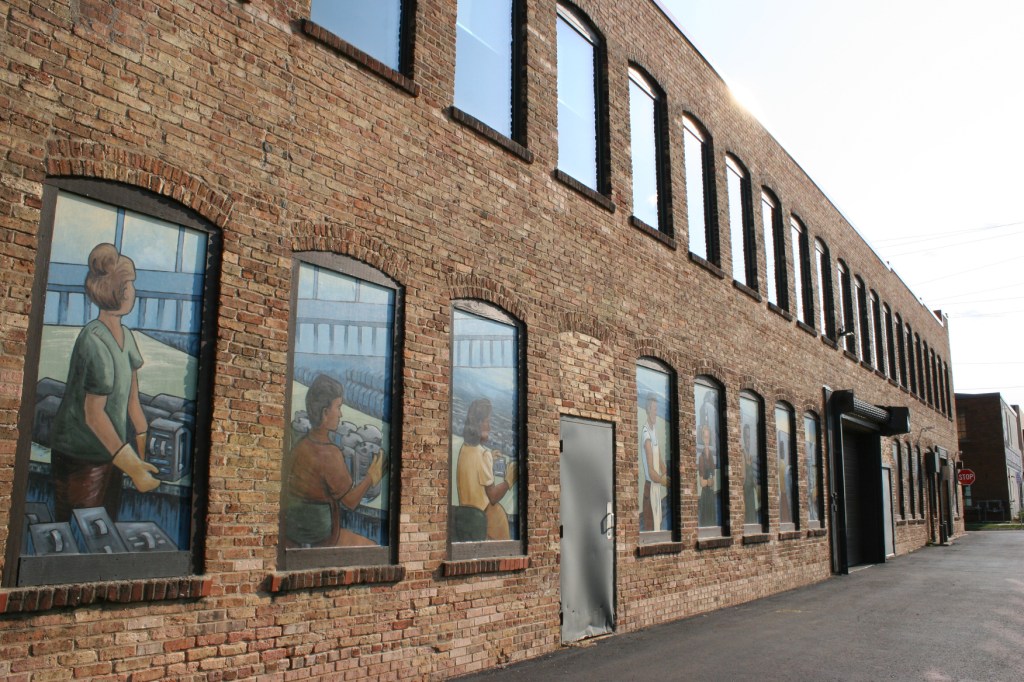
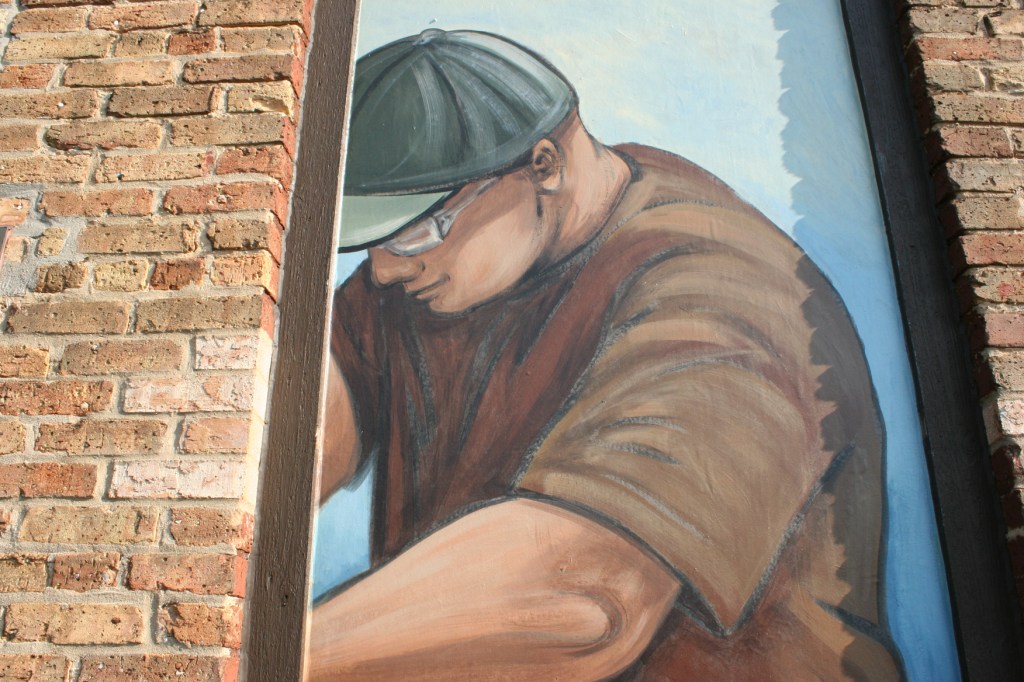
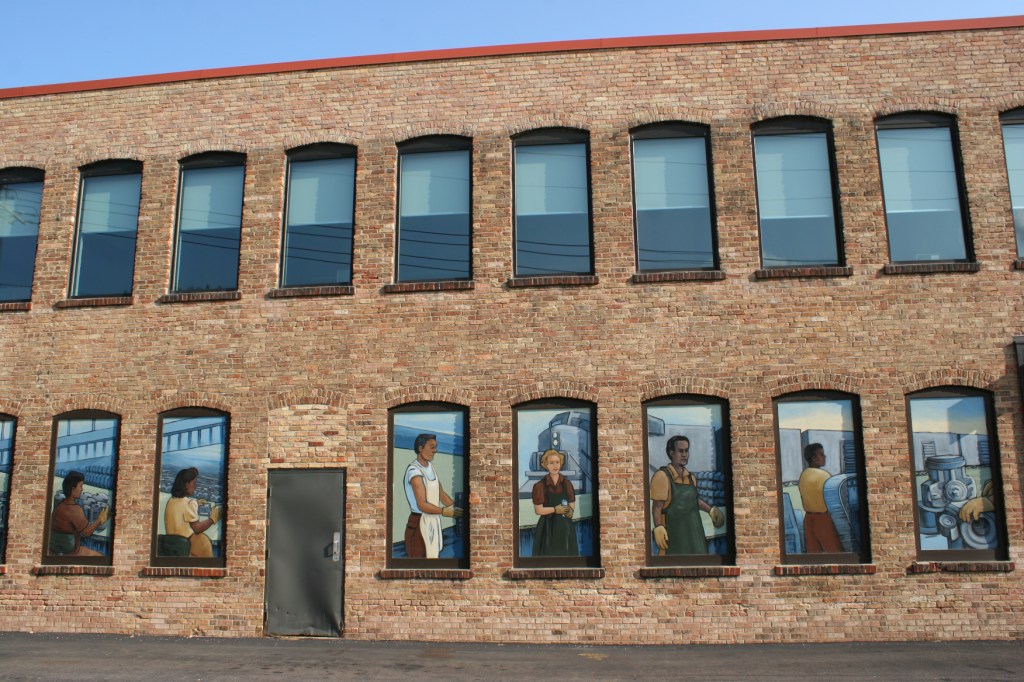
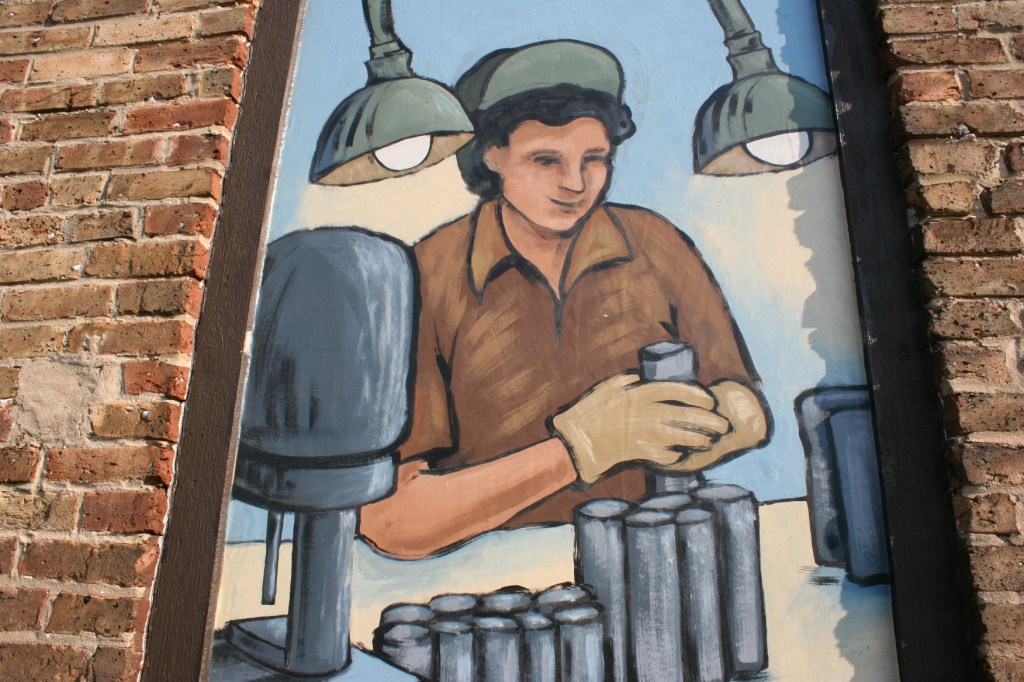
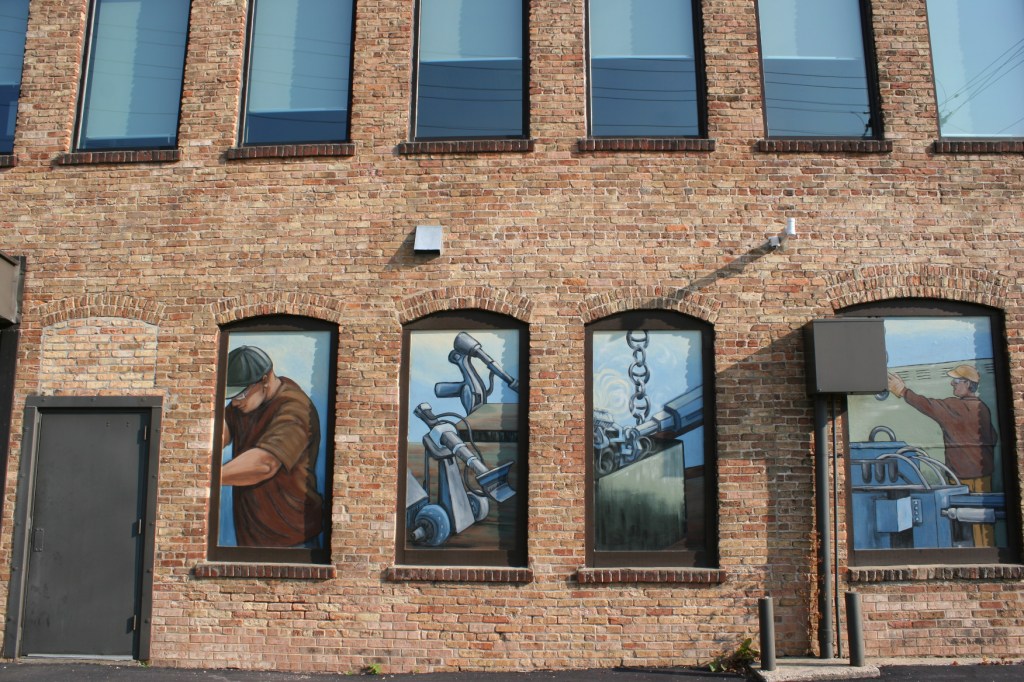
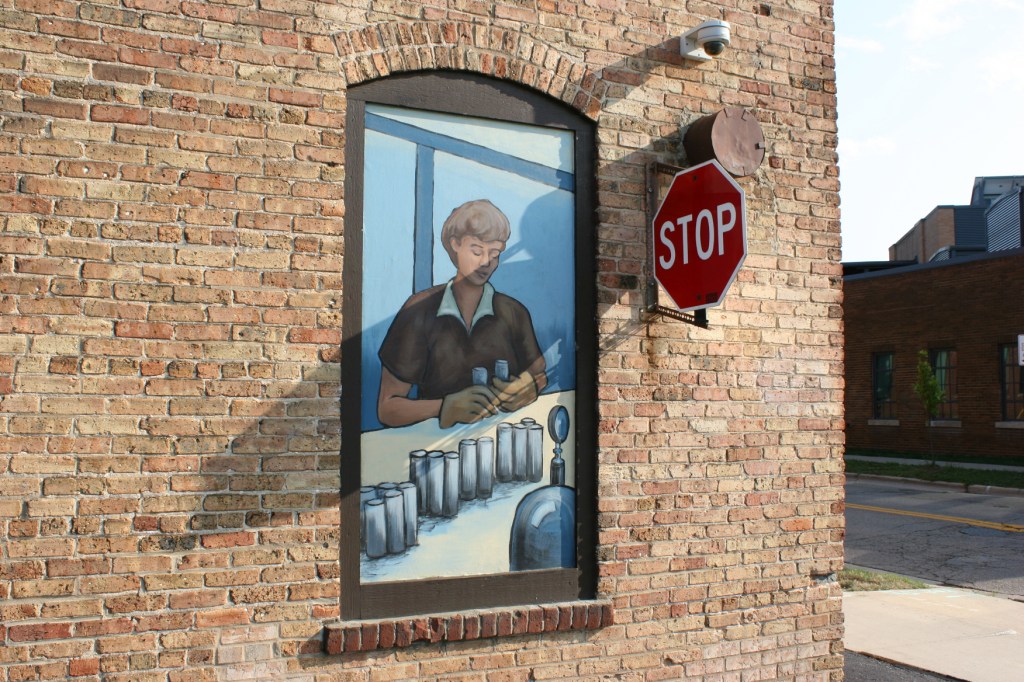
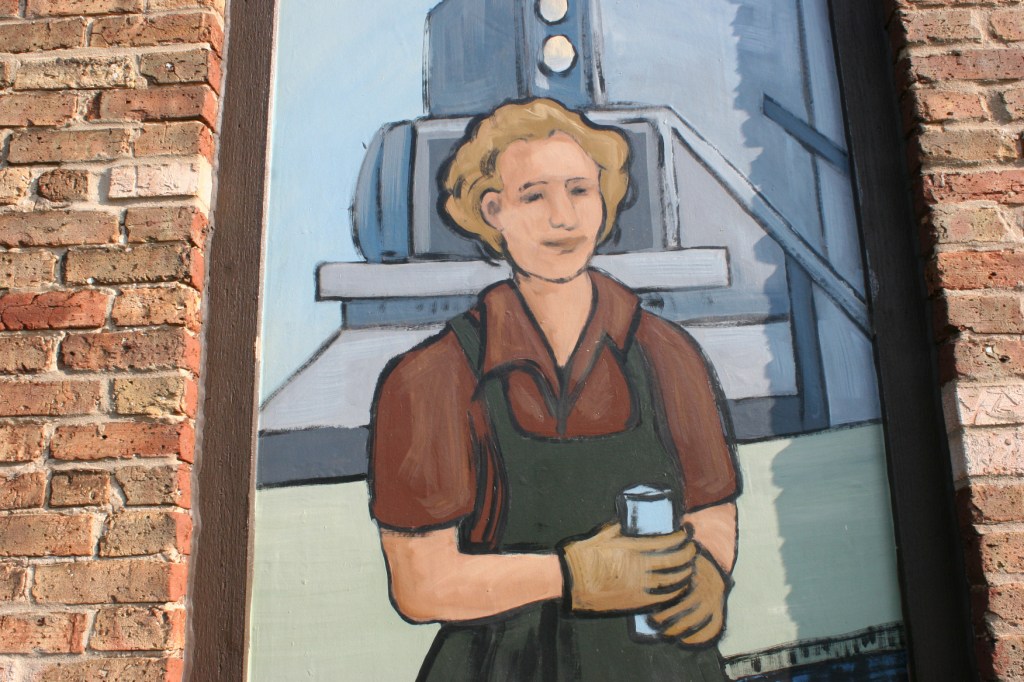
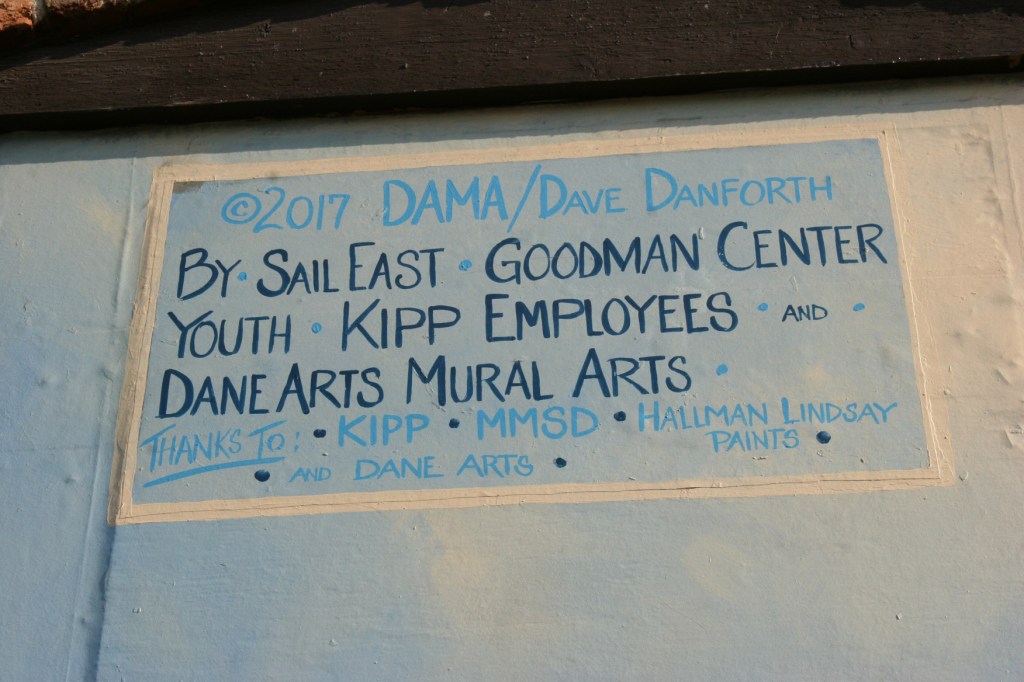
Murals stretch along the side of the historic Madison Kipp-Corporation building next to the bike trail. Sail East, Goodman Center Youth, Kipp employees and the Dane Arts Mural Arts worked together on the 2017 project. Please check back for a post focusing on this public art.


It was on that industrial building that I found art. Murals of laborers at work, a fitting discovery on Labor Day weekend. The portraits show the strength of those who work with their hands. I spent many minutes photographing those paintings of blue collar workers.


Wisconsin and brats are synonymous.


A colorful cow sculpture by the Goodman Community Center also drew my attention. It seems fitting given Wisconsin’s “Dairyland State” motto and affinity for cheese curds. In addition to brats and beer.


This is the first photo I took as we walked the bike trail. You’ll find reaffirming messages like this throughout the Atwood Neighborhood in Madison, Wisconsin.


In many ways, my walk along the bike trail offered a mini snapshot of Madison in the context of the Atwood Neighborhood. I saw an appreciation for the arts, for the land, for the outdoors. And I felt, too, a strong sense of community grounded in caring for one another. And that, more than anything, makes me feel…hopeful.


Please check back for more posts from my recent visit to Madison, including a second one of images from this same section of the Capitol City Bike Path.

© Copyright 2020 Audrey Kletscher Helbling


Immigrants, Escape Artists &, yes, Elvis in the house September 1, 2020

“Ashley,” portrait by Kate Langlais.


“GO BACK TO WHERE YOU CAME FROM. GO BACK TO MEXICO AND NEVER COME BACK!”


A snippet of Ashley’s story, as posted with her portrait.


I intentionally capitalized and boldfaced those angry words spoken to a 5-year-old by a “mean girl.” Can you imagine hearing such awful, horrible words directed at you? Yet, they are all too common. If not spoken, then thought.


Kate Langlais, painting at a recent concert in Faribault’s Central Park as part of “Art in the Park.” Minnesota Prairie Roots file photo August 2020.


Ashley, the subject in an art exhibit, “I Am Minnesota,” by Faribault portrait artist Kate Langlais, experienced that hatred. She reported the insult to her mom and her principal. I’m thankful she called out the bully, because no one should have to endure such disrespect, especially a kindergartner.


“Faysel” up close by Kate Langlais. He fled war in Somalia.


And I’m thankful to Kate, the artist, for taking on this project which features portraits of first and second-generation immigrants living in Faribault and their stories. Her portraits are currently exhibited at the Paradise Center for the Arts in historic downtown Faribault through September 12.


The title of each portrait is simple. The subject’s name.


Kate invites viewers to “recall what they know about their family’s immigration stories.”


Parker, four months, the son of an immigrant who arrived here at about the same age. Portrait by Kate Langlais.


But she pushes beyond that to prompt thought about problems immigrants must overcome—language barriers, cultural differences, acceptance (or not) by neighbors.


An overview of a portion of the Escape Artists exhibit.


After viewing Kate’s thought-provoking portraits and accompanying life summaries, I walked over to a larger gallery featuring art by the Escape Artists. Right away, I connected the two. Not because the art is at all alike. But because of the word “escape.” The subjects in Kate’s portraits escaped oppression, war, poverty and more for life in America. The Escape Artists are a group of artist friends who, 30-plus years ago, began escaping together to create art.


A section of “On the Ragged Edge” by Theresa Harsma.


As I meandered through the gallery, I considered the Escape Artists’ art with the imprint of Kate’s portraits on my mind. For example, Theresa Harsma writes in her artist’s statement for “On the Ragged Edge” of sorting through her collection of found objects and choosing those that seemed to want to be part of the piece. Just like immigrants want to be part of the piece that is America.


“1938 Church Wedding” by Linda Van Lear is based on The Holy Innocents Episcopal Church located at the Rice County Fairgrounds/Historical Society Museum Grounds.


I expect LInda Van Lear’s painting of “1938 Church Wedding” includes immigrants among wedding guests, probably even in the bridal party.


“Lasso the Moon” by Susanne Crane.


And I interpreted Susanne Crane’s “Lasso the Moon” as lassoing dreams. Dreams of a better life for those who came to America, including my forefathers, and probably yours.


This photo shows part of “Streams of Consciousness, Rivers of Green” by Theresa Harsma.


“Maria” by Kate Langlais.


Back to artist Theresa Harsma, another work, “Streams of Consciousness, Rivers of Green,” struck me in its connection to one story in “I Am Minnesota.” Three times Maria attempted to cross the river from Mexico into the U.S. The determination, the exhaustion, the despair—they’re all woven into her story. No matter how you feel about immigration issues, at the very core is a human being, now a Minnesotan, with struggles, hopes and dreams.


An overview of the Cash-Elvis exhibit.


Julie M Fakler created this piece, “You ain’t nothin’ but a hound dog,” inspired by Elvis’ song.


A close-up of Dan Rathburn’s “A Man in Black” (aka Johnny Cash).


Once I finished touring the Escape Artists’ exhibit, I shifted my focus to a Johnny Cash and Elvis pop-up show in a small corner gallery. In some ways, these two musicians were escape artists, too, escaping through their music.


“Tree of Life with Mother Nature’s Daughters” by Susanne Crane.


I love when art, from a divergence of artists, connects. We are all different. Yet alike in our humanity.


The Paradise Center for the Arts marquee.


FYI: The Paradise Center for the Arts, 321 Central Avenue North, Faribault, is open Thursday-Saturday from noon to 5 p.m. The above exhibits close on September 12.

© Copyright 2020 Audrey Kletscher Helbling
 

Beyond simply chalk art August 27, 2020

Filed under: Uncategorized — Audrey Kletscher Helbling @ 5:01 AM
Tags: , , , , , , , ,

Chalk art by Jane.


SIMPLY PASSING BY without acknowledgment of something we appreciate is so easy. We all do it, right? Admire something from afar, and then continue on our way. And Randy and I did just that, even though he asked if we should stop. “Maybe on the way home,” I said.

“She’ll be gone by then,” Randy surmised.

At that point, I was more interested in getting to North Alexander Park for a short evening walk than in photographing a chalk art artist. I appreciated her efforts from the comfort of our passing van and figured if I remembered the art on our return trip, fine. If not, fine, too.

And so we enjoyed our evening trail walk, which included geese and squirrel watching, and a pass through the Rice County Fairgrounds as we headed back toward home along Second Avenue. Nearing the intersection with Seventh Street, Randy repeated his “Do you want to stop?” question.

This time I agreed.


Jane, at work, with her angel heart wings in the foreground.


And I’m glad I did. Or I never would have met Jane, a lovely young woman who looks about 10 years younger than her mid-twenties age. She sat on a sidewalk step at a house along Seventh Street, chalk in hand, creating art.


As I admired the flowers, turtle, angel heart wings, peace symbol and smiley face, and took photos, Jane and I chatted for a bit. She shared a glimpse into her life story. There have been struggles.


But here she was, exuding joy in our conversation, in the sweet smile gracing her face. I saw grit and determination there, too, as she focused on creating art. Her fingers, dusted with chalk, worked art onto the sidewalk. She was creating this public art to bring joy to others. I thanked her for that effort. That gift.


Chalk, Jane’s tool of choice on this summer evening.


Art, Jane says, is her passion. She’s also painted with acrylics, had some art training. Nothing formal.


Jane’s art stretches along the sidewalk in front of her Seventh Street residence.


I felt compelled to encourage this young woman as I asked about her plans. She’s uncertain about her future. I advised her to follow her passions in life, that life is too short to not do what you love. And that money isn’t everything. Things aren’t everything. But happiness is. I sensed she already knows this.


I complimented her, too, on her smile and Jane confirmed others have told her the same, how beautiful her smile. It was genuine, coming from deep within. From a place that has experienced challenges and overcome them. To create art. Bright and bold and beautiful.


© Copyright 2020 Audrey Kletscher Helbling
 

Not even COVID-19 can stop the music in Faribault August 22, 2020

Just a small portion of the people attending a concert in Faribault’s Central Park on Thursday evening.


IN THIS SUMMER OF COVID-19 limitations, I feel fortunate to live in a community where at least one bit of normalcy remained—weekly Thursday evening concerts in Faribault’s Central Park.


People walk, bike and drive to the park in downtown Faribault.


With concert-goers spreading out throughout the block square park and wearing masks when needed, I am comfortable in the outdoor space listening to music. Randy and I missed only a few concerts, one due to rain, the other because we didn’t want to be in the park following the annual pet parade. I love kids. But they tend to forget about COVID and the need to keep their distance. Who can blame them? They’re just kids.


Jivin’ Ivan and the Kings of Swing perform in the Central Park Bandshell.


This past Thursday evening we went to the final scheduled concert in this summer series organized by the Faribault Parks and Rec Department. It was a lovely evening relaxing in our lawn chairs listening to Jivin’ Ivan and the Kings of Swing. Minus Ivan Whillock. The aging musician and noted woodcarver is being extra cautious during COVID and stayed home. Instead, we were treated to an audio of him singing. It was a nice personal touch, Ivan’s way of connecting with fans of his rich, golden voice. The Kings perform Golden Era swing music. Soothing. A journey back in time.


I’ve seen more families at this summer’s concerts than in recent years.


As I listen, I watch. And I observed children running, playing, painting, tossing hula hoops and multi-colored scarves, doing back flips. It all looked so normal. Just like any summer evening. Except for the face masks occasionally seen on kids and adults. And except for the lack of people mingling and visiting as typically happens at these summer concerts.


Art in the Park, an opportunity to paint, has been added to this year’s concerts. Here Paula creates.


Professional artist Kate Langlais paints during the concert.


A young concert-goer creates art.


I also noted the size of the crowd, much larger than in past summers. That comes as no surprise given many of us in the aging demographic are limiting who we see and what we do. And this is the one event we can attend because it’s outdoors and people (mostly) follow safety protocol.

As the evening closed in on 8:30 and the bandshell lights switched on, the air chilled and some concert-goers began leaving. But my friend Valerie didn’t leave before we met up. She’d texted earlier wondering if I was at the concert. I haven’t seen her in forever, long before COVID started. And so we stepped to the side of the crowd, both in our face masks and caught up. It was so hard not to hug one another. But we didn’t. And even though I couldn’t see Valerie’s smile, I could see the smile in her eyes. In our brief conversation I felt reconnected, overjoyed, as if COVID exited and we were just two friends chatting with each other on a summer evening.

I can only hope that by this time next summer, COVID-19 will be history and we will all be vaccinated and life back to normal, whatever that may be.


Art in painting. Art in music.


But for now, for this summer, this is life. Masks and social distancing. Few or no social activities. Except for these concerts in the park—with an encore concert set for 6 pm Thursday, September 3, featuring instrumentalist Doug Madow and vocalist Barb Piper. To that announcement, the crowd reacted with raucous applause. One more evening of music to help us sort of forget about this global pandemic.

ENCORE TWO: Minnesota-born singer, songwriter and guitarist Mark Joseph performs at 7 pm Friday, September 11, in Central Park. Sponsored by the Caron family, this blues concert benefits the Paradise Center for the Arts in Faribault via a suggested free will donation of $10.


© Copyright 2020 Audrey Kletscher Helbling


Montgomery’s new mural details this Czech community August 19, 2020

Filed under: Uncategorized — Audrey Kletscher Helbling @ 5:00 AM
Tags: , , , , , , , , , ,

A family views Montgomery’s updated mural by Victor A. Garcia.


PUBLIC ART, WHEN RESEARCHED, well thought out and created by talented hands, enhances any community. Montgomery, Minnesota included.


The new mural, recently installed in Montgomery.


Recently, this town of some 3,000 in Le Sueur County unveiled a new historic-themed mural done by former long-time Montgomery resident and artist Victor A. Garcia, now of Belle Plaine.


A close-up shot of the prior Montgomery mural, photographed around 2013. Minnesota Prairie Roots file photo.


The latest 40-foot long painting replaces a weather-beaten mural Garcia created about 25 years ago.


Montgomery’s main street, circa 1900. Overhead lights shadow across the mural.


A current day view of a section of downtown Montgomery. The mural is to the left, on a side street.


Like the previous scene, the new mural depicts a view of the town’s main street, First Street, around 1900. But this time, both sides of the street are included in the painting.


A “key” of sorts to the mural. And a thank you to supporters.


Kolacky Days honored in the mural.


Garcia also featured “Montgomery Identifiers” to search for in his artwork. Like kolacky. This Czech community is, after all, the self-proclaimed “Kolacky Capital of the World.”


Franke’s Bakery is among businesses incorporated into the mural.


My photo of Franke’s photographed from across the street, by the mural.


Right across the street from the mural sits Franke’s Bakery, a popular local source for this fruit-filled Czech pastry.


The artist’s signature and a “Redbird.”


Cardinals are also painted into the mural, honoring the former school mascot, the Redbirds, before schools merged and the mascot became the Titans.


The local newspaper gets a place on the mural.


A Czech flag and the Green Giant and many more details incorporated into the mural depict the history and heritage of Montgomery.


One of several names I spotted on the mural.


Garcia even added some personal touches in images and words.


One last look at the Montgomery mural on Ash Street.


This mural calls for close study, not just a quick drive-by or look. Next visit to Montgomery, I’ll take more time to study the details I missed. For it is in the details that we learn the intricacies of a community and its history. And grow to understand and appreciate that which defines a place.


FYI: This $20,000 project was funded and supported by the Southern Minnesota Initiative Foundation, The Montgomery Community Foundation, Prairie Lakes Regional Arts Council, individuals, businesses and more.

This concludes my series of blog posts from Montgomery.

© Copyright 2020 Audrey Kletscher Helbling
 

LaNette’s, more than a coffee shop in small town Montgomery August 18, 2020

Filed under: Uncategorized — Audrey Kletscher Helbling @ 5:00 AM
Tags: , , , , , , , , ,

A view outside LaNette’s Coffee Shop, 225 First Street South, Montgomery, Minnesota.


FOUR PLASTIC MOLDED CHAIRS in a blue that seems more beachy than rural Minnesota, angle outside LaNette’s Coffee Shop. Two women sit here, sip coffee, engage in conversation on this sunny summer Saturday morning.


A close-up of that kitschy cute cone art.


The occasional vehicle passes by or stops at the stop sign before crossing or turning onto First Street. LaNette’s anchors a corner on the south end of Montgomery’s main business district and is housed in a small brick building marked by smiling waffle cone art that identifies this as more than just a coffee source.

Besides a variety of coffees and bakery treats like muffins, cinnamon rolls and cookies, Owner LaNette also serves up ice cream in homemade waffle cones. I’ve yet to try any of her treats. Next visit.


Pat Preble won first place for “Old Barn” and “Cows in the Field,” both displayed in the front window of the coffee shop.


But this time in town, I’d already eaten my sweet for the day—from Franke’s Bakery just up the street. Instead, I popped into La Nette’s for a closer look at the art displayed in her front window as part of the local “Celebrating Farmers and Agriculture” Exhibit coordinated by the Montgomery Arts & Heritage Center. I asked LaNette if I could turn a barn painting by Pat Preble to photograph it. She quickly agreed.


An example of the art in LaNette’s.


I noticed the work of other artists showcased and available for purchase in LaNette’s shop. I love when local businesses support local artists. And writers, as noted by a Hometown Authors section in a wall display.


The inviting interior.


An antique doorstop keeps the front door open.


LaNette’s with mismatched tables and chairs, inviting sitting spaces, art, a few antiques, a pine plank floor and the aforementioned beverages and treats, has a comfortable feel of neighborliness. Of gathering with friends. Of catching up on family and town news. Of enjoying the often slower pace of life found in small town Minnesota. Of contentment.


A neon sign in the front windows signals that the coffee shop is open.


FYI: LaNette’s Coffee Shop is open from 6 am – 3 pm Monday-Saturday. Please check back for one final post from Montgomery tomorrow.

© Copyright 2020 Audrey Kletscher Helbling
 

I’m a princess, but not of the Milky Way August 15, 2020

Past Rice County Dairy Princess Kaylee Wegner. Minnesota Prairie Roots file photo 2015.


“I LOVE YOU, my Little Princess.”

Oh, how sweet those loving words from my Aunt Dorothy, who has always called me her “Little Princess.” And still does. In every phone conversation between Minnesota and New Jersey, she ends our call with those endearing words.

It’s not that I’m much of a princess. Far from it. At least not in the sense of how most of us visualize royalty. I’m a tee and jeans woman. No glitz, no glam, no nail polish. And, in recent years, I’ve allowed my hair to go naturally and beautifully grey. Because, you know, I’m tired of putting chemicals on my head and I earned every grey strand…so I’m owning it.


The early 1950s barn on the Redwood County dairy farm where I grew up. I spent a lot of hours through my childhood working in this barn. Minnesota Prairie Roots file photo.


But there was a time, back in my teen years, when I wanted to be a real princess. As in the Redwood County dairy princess. So I competed for that title, recognizing from the minute I stepped into the room of competitors, that I had no chance. I may have been a hands-on, working-in-the-barn daughter of a dairy farmer, but I didn’t possess the confidence, poise or other skills to represent Minnesota’s dairy industry.


The Princess Kay of the Milky Way competition is a part of Minnesota culture. A past exhibit at the Steele County History Center in Owatonna featured photos of previous royalty, including 1978 princess Kari Schroht, left, and 1976 princess Kathy Zeman, right. Minnesota Prairie Roots file photo.


The judges chose a competent young woman, whose name I don’t recall, to rein as the Redwood County dairy ambassador along with other county princesses from throughout the state. Dairy princesses have been a Minnesota tradition for 67 years, highlighted in crowning of Princess Kay of the Milky Way around the time of our State Fair. Wednesday evening, Olmsted County Dairy Princess Brenna Connelly of Byron was crowned in a private ceremony among 10 masked and social distancing candidates.


A Princess Kay of the Milky Way butter carving in the Minnesota History Center’s MN150 exhibit and photographed several years ago at the Steele County History Center. Minnesota Prairie Roots file photo.


Post coronation in a typical year, the new state princess and nine other candidates sit in a special refrigerated and rotating cooler in the dairy building at the Minnesota State Fairgrounds to get their heads carved in blocks of butter while fair visitors crowd around and watch. But this year, because of COVID-19, there is no fair. But the butter sculpting tradition continues, with notable changes.

Each county princess, starting with the new 67th Princess Kay of the Milky Way, will sit alone in the 40-degree butter sculpting booth with Litchfield artist Gerry Kulzer as he sculpts their likenesses from 90-pound blocks of Dinner Bell Creamery butter. They will be masked and social distancing. And when it comes to getting the princesses’ noses and mouths just right, each young woman will move outside the cooler and onto a ladder and remove her mask.


I’ve only attended the Minnesota State Fair a few times in my life, the last time decades ago. Many people love the fair. But I don’t because of the crowds. This mug came from my father-in-law’s collection of mugs.


Crowds won’t watch from inside the dairy building. Rather, updates are posted thrice daily on the Princess Kay Facebook page, starting at 10:30 am and continuing through August 22. The sculpting, which takes from six to eight hours, begins at 8:30 am and ends at 5 pm with several breaks. You can only imagine the challenges of sitting in 40 degrees for a prolonged period of time. We may be hardy Minnesotans to whom that temp feels balmy come mid-winter. But in August, not so much.

Once the butter sculpting is done, the princesses take their blocks of butters back to their respective homes and then do what they wish with them. The new princess is sharing hers with family and friends first and then with a food shelf. In past years, I’ve read stories about princess butter heads buttering corn at community sweetcorn feeds. But this year I don’t expect that to happen. Or at least it shouldn’t.


Inside the Ron and Diane Wegner dairy barn during a dairy day several years ago. Minnesota Prairie Roots file photo 2015.


That I was never chosen as a county dairy princess nearly 50 years ago was the right decision. I feel no disappointment because, I’ve always been a princess…in the eyes of my beloved Aunt Dorothy.


© Copyright 2020 Audrey Kletscher Helbling
 

Montgomery celebrates agriculture with art August 13, 2020

“Stop to Remember,” a pen and watercolor by Cami Vargo, was awarded third place in the show by judges Dale and Gale Looft. The art depicts her Great Grandpa Orville Richter’s 1965 Ford tractor.


THEIR ARTIST STATEMENTS are as compelling as their art.
 

Cami Vargo’s artist statement about her tractor art.


In a new exhibit, “Celebrating Farmers and Agriculture,” coordinated by the Montgomery Arts & Heritage Center, 15 artists share their deep love and appreciation for all things rural. Recently I viewed the 22 pieces of art displayed in the front windows of the arts center and businesses in the heart of this small Minnesota town.
 

One of two photos by Liz Krocak, this one titled “Apple Harvest Visitors.”


Through the screen window, you can read this artist statement by Liz Krocak.


Bold and beautiful stained glass art by Annette Stavos hangs in a window of Hermann Thrifty White Pharmacy. If the drugstore is open, go inside and view the art to see the sun shining through it. Another stained glass creation by Mona Grimm hangs in a window of Montgomery Chiropractic and was awarded second place in the show.
 

From cows to a rooster to a farm dog, from tractors to windmills, from barns to country scenes, the art showcases important aspects of rural life.


Constructed from cardboard by Brian Prchal, this is a replica of a modified 4020 John Deere.


Brian Prchal shares the stories behind his two art pieces.


And the stories that accompany that art are often deeply personal. Rooted in the land.


The Montgomery Arts & Heritage Center (right side of building), 206 First Street North on the north end of downtown.


In the ag display, 4-H buttons.
 

County fairs are an important part of rural life.


Before beginning my tour, I stopped first at the arts and heritage center to pick up a map and to view an exhibit of local ag-related memorabilia showing the importance of agriculture in this community.


The grain elevator complex in Montgomery.


Just down the hill from the arts center, grain elevators loom, a strong visual of ag’s local economic value. On the opposite end of town, the canning company processes sweetcorn. And on every border of town, homes or businesses adjoin farm fields.


Future Farmers of America, based at the local high school.


Recognizing 4-H in Le Sueur County.


Lots of signs downtown celebrate kolacky, a Czech pastry sold at Franke’s Bakery and Mackenthune’s Fine Foods.


Montgomery centers on agriculture and its Czech heritage as the self-proclaimed Kolacky Capital of the World. So it seems particularly fitting that the arts center would focus its new exhibit on farmers and agriculture. The project was funded with a Prairie Lakes Regional Arts Council grant and donations from the Bob and Mary Jo Loftus Foundation and Compeer Financial.


“The Nuts & Bolts of Farming” fits this tractor art crafted by Tyler Fromm.


Area artists clearly enjoyed the challenge of creating ag-themed art. I saw that in tractor art drawn, formed from string and nails, cut and crafted from cardboard, welded from nuts and bolts.


Pat Preble won first place for “Old Barn” and “Cows in the Field.” She incorporated a “Star of Heaven” quilt block into her barn art in honor of her mom, a quilter.


Stained glass. Batik. Wood. Photos. Quilts. So many different tools and styles and ways of creating art add to the interest.


This artist statement made me laugh out loud. Because of glare, I was unable to photograph Anna’s cow art.


The art honors pioneer women who pieced quilts, an uncle, farm wives… Liz Krocak writes in her artist’s statement, “Behind every good farmer is his wife, rolling her eyes.” Yes, humor even infuses some of the artist statements.


Glare made it really challenging to photograph Carol Ehrhardt’s entire cattle and windmill art. But I decided I like this image showing only the top of the windmill and the reflection of an aged building. Ehrhardt was awarded third place in the show.


Annette Stavos, who grew up on a hobby farm, honors her uncle. “My uncle was the real farmer and we helped him pick rocks and bale hay.”


A close-up of Susan Hayes batik art titled “Summer Fields.”


Susan Hayes, a city girl who married a farmer, writes. “…I’ve had first hand experience with agriculture and life on a small farm. It’s not easy getting up before 5 am to milk the cows or baling hay in 100 degree weather. She created a beautiful batik piece, “Summer Fields.”


A farm in the Montgomery area.


Anna Prchal expresses her love of rural life in these words: “The fresh air, hard work ethic and never having a dull moment there are the things I love most about the farm.”


The countryside near Montgomery.


For Kimmie Loranger, who once traveled with the carnival, worked as a nanny and waitress, and who was at one time homeless, living in rural Montgomery and now creating art “is the happiest I’ve ever been in my whole life.”


Tyler Fromm drew this picture of his “beloved farm dog, Buddy.” Oak siding from the corn crib on his family’s century old farm frames the art.


These are the stories that make this exhibit especially meaningful, especially touching, especially impressionable. This isn’t just another art show, but rather an expression of emotions with a rural perspective. Written. And showcased in art.


FYI: You can view this exhibit any time during the day as the art is visible from outdoors in front windows. Note that glare and reflections sometimes make seeing the art a challenge. The Arts & Heritage Center, however, is open limited hours from 2-5 pm Thursday and Friday and from 9 am to noon Saturdays. The exhibit runs until the end of November. Maps to the art locations are available from several downtown Montgomery businesses in addition to the arts center. Be sure to vote for your favorite for the People’s Choice Award. This blog post represents only a sampling of art in the exhibit.

Please check back next week for additional posts from my visit to Montgomery.

© Copyright 2020 Audrey Kletscher Helbling