Minnesota Prairie Roots

Writing and photography by Audrey Kletscher Helbling
Poetry in wine tasting November 14, 2011

I photographed this gorgeous mural at Cannon River Winery in downtown Cannon Falls in mid-August. This was the only Minnesota winery represented at a wine tasting event in Faribault Friday evening.

Cannon River Winery Sogn Blush with the label created by an artist from the region.

Crisp nuances of pink grapefruit, mango and sweet melon interwoven with hints of soft white tea and honeysuckle.

Flavors of rhubarb and black cherry complemented by hints of mocha, chocolate, spice and vanilla.

…slightly sweet with aromas of wild berries and just a hint of American Oak.

Welcome to wine tasting.

My husband and I embarked on our first-ever wine tasting experience Friday at the Paradise Center for the Arts Members Appreciation Night in historic downtown Faribault. I know. You’re thinking: “She’s never been to a wine tasting party…”

Well, well, isn’t life all about new experiences no matter your age?

Once Randy and I got our instructions, wine glasses and guidebook, from whence the above lovely and poetic phrases have been lifted, we headed into the Paradise theatre to sample wines.

We quickly discovered that, with 45 wines available, we would need to be selective in our sampling.

We also surmised that we needn’t be “Minnesota Nice” and finish off any wine samples we disliked. “Just pour it in here,” we were instructed. And so we did, whenever we found a wine too bitter or not quite delivering as described.

And so the evening proceeded—meandering and sipping and repeating “I don’t like dry wine,” and chatting with friends and acquaintances. We discussed the wines, traded glasses and sipped and sampled and asked each other, “Do you like this one?”

It was fun.

We’re never going to become wine connoisseurs. But if Randy and I pick up tidbits here and there, we learn a thing or ten that might assist us with selecting wines. I mean, I’ve bought wine in the past because I liked the label design or name or bottle, silly as that may sound. So, yes, graphic designers, artists and marketers, you can influence my wine choices with creative and visually appealing packaging.

Friday night, words also impacted my wine tasting decisions. Imagine that—words influencing me.

I mean, could you resist …zesty aromas of orange, lemon-lime and peach…silky, black-cherry elegance…memorably lush…exquisitely sweet…decadent character…intriguing layers of fresh pineapple, green apple, crisp lemon, juicy pear and wildflowers…?

(How do you get a job describing wines? That’s a writing assignment I could savor given I enjoy turning a poetic phrase now and then.)

Visitors to the Cannon River Winery enjoyed Minnesota wines on an August afternoon.

Wine barrels inside Cannon River Winery.

The labels for Cannon River's "Sogn" series are designed by regional artists who compete for the honor. Currently, you can vote for your favorite Sogn art at the winery.

A former garage houses the Cannon River Winery. President Obama visited Cannon Falls, thus the welcome sign on the winery during my mid-August visit..

Click here for more information about Cannon River Winery.

© Copyright 2011 Audrey Kletscher Helbling
Wine description source: Paradise Center for the Arts Holiday Wine Tasting booklet; wine selections sponsored by Haskell’s.


One final visit to Stockholm. Wisconsin. Not Sweden. November 8, 2011

Filed under: Uncategorized — Audrey Kletscher Helbling @ 8:18 AM
Tags: , , , , , , , , , ,

Shops, eateries and more line the streets of Stockholm, a quaint village along Lake Pepin. This photo was taken in early October. To the left you'll see blue bikes, available for visitors to use at no cost.

TO WHOM THIS MAY CONCERN in Stockholm (Wisconsin. Not Sweden):

If only I had known about the bribe.

I would have accepted your offer, the one I found listed under “Stockholm News & Media” on your website:

Are you a writer, blogger, reviewer, photographer with a web site? Let us bribe you (how about a fresh cup of expresso from Stockholm General, a piece of pie from the Stockholm Pie Company, lunch at Bogus Creek Café, a beer at Gelly’s, a ticket to an event at the Widespot?) in exchange for your coverage!

Yes. Yes. Yes. Yes. And, yes.

While I’ve never drank an expresso, I’m certainly open to trying one. I like pie. A lot. I do lunch. Yes, I’ll toast your town with an icy mug of beer. And, yes, I always enjoy being entertained.

I was too full from lunch across the river in Wabasha to try the Stockholm Pie Company's pie, made completely from scratch. Not that I wasn't tempted to try a slice of caramel apple crunch or key lime or peanut butter fudge. I even stepped inside this tiny shop to smell the baking pies. Next time I'll save room for dessert.

However, dear people of Stockholm (Wisconsin. Not Sweden.) and dear readers of Minnesota Prairie Roots, my writing has not been influenced, not one teeny bit, by offers of free anything. My three previous, glowing posts from Stockholm were written from the heart. Simply put, I fell head-over-heels for this quaint Lake Pepin-side village of 89 without any undue influence.

Today I’ll take you on one last visit to this destination town just across the Mississippi River from Minnesota. Enjoy. And if you’ve been to Stockholm, Wisconsin, not Sweden, I’d like to hear what you most appreciate/relish/savor about this riverside get-away.

And if you own a business or live in Stockholm, submit a comment and tell readers why you love your village and why they should visit.

P.S. I’ll be back for the pie and the lunch and the…

One of the many shops lining the streets of Stockholm.

One of my favorite finds, a lizzard crafted from old silverware and more and lounging outside a shop. No, I didn't purchase this critter, but I certainly admired the creativity.

I notice details, especially signs, windows and doors, including this door on the Stockholm Museum.

The Stockholm Museum, home to the Stockholm Institute which preserves and celebrates the history of the Stockholm area, is housed in a former post office.

On the museum exterior, I discovered this handcrafted tribute to WW II vets.

The lovely Abode gallery, where my artist friend Arlene Rolf of Faribault has artwork displayed.

Another business door and signage that caught my eye. It's all about the details, my friends, all about the details.

A residence, I assume, since the steps were marked with a "private" sign. So inviting and lovely, just like all of Stockholm.

To read my previous posts from Stockholm, click on each story link below:

Russell, the Bookseller of Stockholm

A bit of Sweden in Wisconsin

A garage sale in Stockholm, Wisconsin

© Copyright 2011 Audrey Kletscher Helbling

 

In the middle November 5, 2011

Filed under: Uncategorized — Audrey Kletscher Helbling @ 2:50 PM
Tags: , , , , , , , ,

TODAY I HAVE SEVERAL STORIES to share with you, all with a single common denominator: the middle.

Let’s start with the most recent. I made myself a sandwich for lunch—a little mayo, turkey deli meat and ham deli meat with a slice of pepperjack cheese layered in the middle. Nothing unusual about that.

The second half of my sandwich, minus the...

Until I bit into the sandwich and hit something that didn’t seem quite right. But I kept biting and chewing, thinking it was just the rough grains in the multi-grained bread or an edge on the meat.

But after several bites, I paused to investigate and discovered a piece of paper. Yes, people, I was eating the paper that separates cheese slices. I had removed one piece of paper while making the sandwich. Clearly I had not checked the flip side of the cheese slice.

WARNING: Always remove the paper from BOTH sides of the cheese slice before eating.

In relaying this story to my husband, he could only shake his head, laugh and repeat several times, “That’s my Audrey.”

Now onto those other “middle” stories, which have cast me in the role of a “middlewoman.”

Earlier this week I received a request from a retired Air Force chaplain for commissioned artwork. Not my art; I don’t paint or draw or sculpt or anything artsy like that. Rather, the retired military man was looking to contact Richard Vilendrer, a 72-year-old Faribault artist whom I met at the Faribault Farmers’ Market and featured in a September blog post. I spoke with Richard’s wife Carol several days ago and now I’m waiting to hear if Richard is being commissioned.

An example of Richard's nature and faith-inspired pen-and-ink and colored pencil artwork.

Another inquiry this week came from a videographer for Farm Rescue, an organization that helps farmers in need. The North Dakota man was requesting permission to use images from a July 1 storm (in southwestern Minnesota) which I published on my blog. Because I hadn’t taken the two photos he wanted, I had to contact my brother and my uncle. Done. I’ll tell you more about this organization next week.

Then, the same day, an inquiry came via a blog comment from a South Dakota writer. She wanted to know if I knew of a Minnesota organization that works to preserve prairie churches. I don’t. Do you?

On Friday I learned that I made my first art sale. Again, not my art. Not my money. But a reader saw my photo of a hideous “turkey choir” print in a blog post about a Stockholm, Wisconsin, antique shop and promptly put the print on hold to purchase. Do I get a commission on this sale?

The "singing turkeys" print I helped to sell.

Finally, today, a metro woman asked, via a blog comment, if I could find the man at the Faribault Farmers’ Market who sold fresh horseradish. I knew exactly who she needed to contact. So I dialed Dennis Gare’s number, spoke to his wife and hopefully fresh horseradish will soon be on its way to this reader’s house.

You might rightly conclude from the above stories, with the exception of that paper eating incident, that I am truly a “middlewoman.” And all because of the power of this blog.

Thank you, readers, for reading Minnesota Prairie Roots. Happy to help you if you’re in the market for art, photos, information or horseradish.

© Copyright 2011 Audrey Kletscher Helbling
 

A peek at the South Central Minnesota Studio ArTour October 15, 2011

This building at 101 E Fifth Street in downtown Northfield includes a studio that showcased the art of Nancy Carlson, Lucky Rimpila and Meg Jensen Witt.

OK, PEOPLE, YOU have one more day to tour 23 art studios featuring 46 artists during the South Central Minnesota Studio ArTour.

The free tour, which opened today, continues Sunday from 10 a.m. – 6 p.m. in the Northfield, Cannon Falls and Faribault area.

Now I’m going to be honest with you here. My husband and I went on the tour last year. We loved it. But we really didn’t weave the event into this weekend’s plans what with painting a bedroom this morning and then sampling chilis at the Faribault Fall Festival today and other stuff that involved work.

But then we drove up to Northfield to look at a van for sale and, as long as we were in the vicinity of most of those open studios, we toured about a half-dozen. And let me tell you, we were in for some sweet surprises.

Here’s a sampling from those studios, which should inspire you to abandon any other plans you have for Sunday and make a day of it visiting with artists and perusing (maybe even purchasing) their work.

Meet metalsmith Tim Lloyd, surrounded by the tools of his trade. He’s a congenial guy, retired from 40 years of teaching metalsmithing at Carleton College in Northfield. He’ll explain things to you, answer your questions about what he keeps in narrow drawers in his workshop. You’ll see leaves in one drawer. He’ll tell you about the prairie dock (a native prairie plant that looks like rhubarb) and the ginkgo leaves he imprints into silver.

And then he might mention that he has a work of art at the Smithsonian American Art Museum. A teapot. At the Smithsonian.

And so here are some of Tim’s teapots, not exactly like the one at the Smithsonian, but beautiful, just beautiful. He’ll even listen to you tell a story about a railroad teapot reclaimed from a junk pile on a North Dakota farm, if you have a story like that to share.

So when I saw this vessel, I thought of a Communion chalice, which it is not. But Tim has made those, too.

Because Tim didn’t seem to mind, I moved in close to his work desk and photographed these tools.

Moving along, artist Kirsten Johnson wouldn’t allow me to photograph any of her art (not all that uncommon) except this visual journal of watercolor paintings. In January, she began painting an hour a day and continued for five months. About mid-March she took lessons in watercolor. She learned this: “Water is boss.”

Down-home, earthy simplicity is how I would describe this bowl by Meg Jensen Witt, who once worked at a food co-op with someone I met several days ago. Small world. And, yes, I’ll tell you about this interesting mutual acquaintance in a few days in another post.

I still don’t know if he was telling me the truth or spinning a tall tale. But the creator of this stained glass window introduced himself as Lucky Rimpila. I mean, who has a name like Lucky? Lucky, apparently.

And then there’s Nancy Carlson (for sure her real name) who was in the same studio as Lucky and Meg. Nancy used a dropper to create mini works of art with India ink. She grouped and framed them together and here you’re seeing one snippet.

 Meet Louise. She is not an artist. But she is an original poodle (or something like that) before poodles shrunk. Louise was hanging out in potter Tom Willis’ Sunset Studio near Dundas. Tom says Louise is shy and that she needs a haircut. He is right.

Since Louise was sort of blocking the view of Tom’s pottery, above, I moved in close to photograph it for you. Then I went outside his studio and found more…

I could show you many, many more close-up photos of Tom’s pottery. Lovely, lovely art. But here’s an overview. You can go to his studio and examine it more closely on your own. Tomorrow. Remember, 10 a.m. – 6 p.m.

Oh, and if you time it just right, you may get to see Tom and ceramic sculptor DeAnn Engvall take a dragon out of the 1800-plus degree raku kiln. Yes, that is hot. And, yes, DeAnn has gotten burned, singed her eyebrows once.  And, yes, I took this photo at a weird angle so just tip your head.

Next, the red hot dragon (see it?) is placed inside a garbage can, where it ignites newspaper. About then you can make a smart comment about a fire-breathing dragon before the lid is slapped onto the garbage can. A half hour later, a colorful dragon emerges. DeAnn will explain to you that the fire “pulls the oxygen molecules in the glaze to the surface.” And if you’re like me, you’ll think, “OK, if you say so.”

That concludes my mini-tour of several art studios. Now, have I convinced you to take in the South Central Minnesota Studio ArTour tomorrow?

For more information, click here at www.studioartour.com.

© Copyright 2011 Audrey Kletscher Helbling
 

Sign junkie October 14, 2011

A note on the door at Medallion Case.

YOU MIGHT NOT APPRECIATE business signage like me. Heck, you may not even pay much attention to signs unless, of course, you are looking for a specific place. Then you would notice.

But I notice signs because I consider them to be works of art, reflections of personalities and history, trademarks of small-town life, and sources of entertainment.

I’m not talking about the mass-produced, generic signage that marks a chain store. Rather, I mean those handcrafted and/or custom signs (and notes) you’ll find on small-town Main Street or along rural roadways.

Recently, signage in Nerstrand, a village of 233 residents in eastern Rice County near Nerstrand Big Woods State Park, attracted my interest.

And because most of you aren’t going to drive to Nerstrand to see these signs, you can just view them here.

Then, once you’ve perused my discoveries, I challenge you to go out into your own communities and search for sign art.

WARNING: If you accept this assignment, you may become a sign junkie just like me.

No confusion about the meat market business located here along Main Street Nerstrand.

Additional signage on the Nerstrand Meats building highlights the products available.

Another business sign along Nerstrand's Main Street.

This sign on the corner of a Main Street business in Nerstrand directs motorists to Grace Lutheran Church.

Just so you believe me, here's Grace, under the water tower.

BONUS: I’ve tossed in two signs from rural Dennison also.

This sign at the end of the driveway at 2290 Goodhue County 49 Blvd will direct you to Potpourri Mill Log Cabin near Dennison. That's Vang Lutheran Church in the background.

Once you drive up to the log cabin, you'll see this season appropriate sign outside the front door. Inside you'll find the Harvest Thyme Craft Show, which runs weekends through October 16.

© Copyright 2011 Audrey Kletscher Helbling
 

Fill the grain bin in Dennison October 6, 2011

Filed under: Uncategorized — Audrey Kletscher Helbling @ 7:05 AM
Tags: , , , , , , , , , , , ,

SO, TODAY WE’RE GOING to talk signs. Not just any signs, but those homemade signs you find in rural Minnesota.

Chances are, no matter where you live, you drive or walk by creative signage every day and don’t give it a second thought. The signs have simply become part of your landscape. You fail to notice either the messages or the art.

And, yes, signs fall into my definition of art.

But then one day an outsider like me comes to town. And I view your town with fresh eyes. I notice the details—the windows and doors, the wood and brick, and the signs that define your community.

Main Street in Dennison, from city hall north.

That is how I happened upon a unique fundraising sign in Dennison, a community of 168 which straddles the Rice/Goodhue county lines in southeastern Minnesota. My husband and I stopped in Dennison while on a Sunday afternoon drive to view the fall colors in the Sogn Valley area.

There, along Goodhue County Road 9, the main east-west road through town, I found this sign appropriately placed by the Farmers State Bank.

Fronting the road and the bank, this sign tracks contributions to the park fund.

Now, whoever dreamed up this sign deserves some type of recognition for effort and creativity.

Dennison is a farming community. The sign reflects that ag heritage with the half-full grain bin. You did notice the corn and the grain bin, right?

The goal is to fill this grain bin and build that park. Want to help? Contact the city or Farmers State Bank.

The promoters of this park project could have designed the typical graph or thermometer sign to track contributions. But, instead, the sign honors the rural heart of Dennison. You simply have to appreciate that type of creative thinking.

You also have to value the sense of community that defines towns like Dennison. Here folks work together to raise funds for a park and don’t/probably can’t rely on government.

Well done, Dennison, and may you get a good corn yield this fall. Enough to fill the bin.

CHECK BACK for another post featuring interesting signage I found in rural Minnesota.

CLICK HERE to see signs I photographed recently in downtown Janesville.

ALSO, CLICK HERE to see sign images taken a year ago in Pemberton.

© Copyright 2011 Audrey Kletscher Helbling
 

Meander west this weekend September 29, 2011

WEST WOULD BE my destination of choice this weekend.

Not west as in West. But west as in Fergus Falls or the Upper Minnesota River Valley.

Two arts events in western Minnesota this weekend will take you nearly into the Dakotas.

I’d like to be at the Lake Region Writers Network Conference at Minnesota State Community and Technical College in Fergus listening to author Leif Enger (of Peace Like a River and So Brave, Young and Handsome) talk about “place” in writing.

I’d like to be there picking up my copy of Lake Region Review, a literary magazine of regional writing. You see, two months ago I received this e-mail:

Dear Ms. Helbling,

The Editorial Board of Lake Region Review 2011, after careful consideration, has finalized selections for Lake Region Writers Network’s first literary magazine. While editors and readers were pleased with the number of submissions, the sheer volume of entries also made their choices much more difficult.

Regardless, the board is pleased to inform you that the work indicated below HAS BEEN ACCEPTED WITH REVISION for publication in Lake Region Review 2011, which will be released at the LRWN Oct. 1 writing conference at M-State in Fergus Falls:…

But I won’t be in Fergus on Saturday at the conference. It’s a long drive there from Faribault and I have this room to paint and…

…not only that, but back in June my husband and I traveled the 200 miles to Fergus Falls to see my winning entry in the spring Roadside Poetry competition splashed across four billboards near the college.

The last of four billboards featuring my Roadside Poetry spring poem.

So I’ll wait for the LRWN folks to send me a copy of their literary magazine, which I’m mighty pleased to be a part of because, well, any time you win a highly-competitive contest judged by others of literary talent, it’s an honor.

I’LL HAVE TO WAIT until another year also to attend an arts event that’s long been on my list of “things I want to do.” That’s Meander—Upper Minnesota River Art Crawl. Thirty-three art studios featuring the work of 45 artists will be open during a free self-guided tour that begins Friday (2 p.m. – 6 p.m.), continues into Saturday (9 a.m. – 6 p.m.) and ends Sunday (9 a.m.– 4 p.m.).

This event is happening in the Minnesota River Valley region of western Minnesota near the towns of Ortonville, Appleton, Madison, Milan, Dawson, Montevideo and Granite Falls. It’s beautiful land—prairie and fields, rock and woods, rivers, small towns, farms…

The region seems a mecca for artists, which doesn’t at all surprise me given I’m a southwestern Minnesota native. Something about this land fosters creativity. Remember my earlier mention of Leif Enger and his focus on place? At the writers’ conference in Fergus Falls, he’ll “look at how geography of a tale infuses it with gravity, wit and credibility.”

I suspect place, as much as anything, influences the photography, paintings, pottery, fiber art, woodworking and other art created by those artists featured in the Meander.

Meander featured artist Kerry Kolke-Bonk of Appleton created the painting, "What goes around comes around," to promote this year's art tour.

According to economic impact information I received from Kristi Fernholz, Community Development Planner for the Upper Minnesota Valley Regional Development Commission, the Meander brings in an average of $1,652 in art sales per artist (2010 and 2009 statistics).

Last year, art sales during Meander weekend totaled $69,395. In addition, attendees infuse the area with more money spent on food, lodging and other shopping.

I won’t be one of those shoppers this year. But you could be. If you have an open schedule this weekend, consider a trip west, as in western Minnesota.

#

FYI: Click here for more information about Meander—Upper Minnesota River Art Crawl.

#

Click here for more information about the Lake Region Writers Network. If you would like to purchase a copy of the first-ever Lake Region Review with my poem (sorry, not going to yet divulge its title), send $10 plus $3 for shipping and handling to:

Lake Region Writers Network, P.O. Box 356, Battle Lake, MN. 56515

#

Click here for more information about Roadside Poetry.

© Text and photos copyright 2011 Audrey Kletscher Helbling
 

God’s beauty blooms in Richard’s art September 18, 2011

I HAVE NOT MET Richard Vilendrer, only spoken with him briefly on the phone.

Yet, I feel a connection to this 72-year-old Faribault man, this artist who creates art for the pure joy of doing so. I understand that. It is the same reason I write and take photos for this blog.

You can see that joy in Richard’s art, which I discovered Saturday morning at the Faribault Farmer’s Market. I had passed only a few vendors’ booths—laden with the typical fresh produce, flowers and baked goods you would expect to find in this venue—when I noticed the pen-and-ink and colored pencil drawings vended by Carol Vilendrer, Richard’s wife of 35 years.

I stopped and just stood there. And it flashed through my mind that this Christian-themed art would be a good fit for Christian greeting cards. And when I looked further, I saw that Richard had already made cards. But I write greeting card verses for an Indiana-based publisher and I asked Carol then and there if I could direct my editor to Richard’s work. So I am. I don’t know if this will go anywhere; I have to try, though.

There’s a certain passion in Richard’s art and you can sense that when you speak with the man. He doesn’t do this for the money—although he’s sold some pieces—but for the pure enjoyment of creating art.

Since grade school this former Faribault Regional Center employee, who worked with handicapped children until the center closed, has put pencil to paper. As a youth, when he should have been listening in English class, he was instead inspired by textbook images—of Indians and of soldiers in helmets and of airplanes—to duplicate those drawings.

Scripture and Christian songs inspire Richard.

Today words from a song heard on Twin Cities-based Christian radio station KTIS, or words from Scripture or a found feather on a nature walk inspire him to first draw in pencil, then go over the pencil with ink and finally fill in with colored pencil.

He prefers to draw small, detailed subjects like his hand or a feather or a maple leaf. Yet, he’s also drawn John Deere tractors and buildings and classic cars.

Richard uses a technique called cross hatching—to perfect shading—by using a ball point pen to draw lines close together in one direction and then crosses in an opposite direction. He learned that in high school. Mostly, though, he’s self-taught, without formal training. He calls his artistic skills a “God-given talent.”

This man of faith has used that gift from God to create artwork for fundraisers at his church, Divine Mercy in Faribault.

A year ago, he suffered a stroke. But even in that he sees the blessing—the stroke affected his entire right side, not his left. Richard, the artist, is left-handed.

Nature and faith inspire his detailed art.

A pen-and-ink drawing of a building at the former Faribault Regional Center where Richard worked.

St. Lawrence Church in Faribault where Richard and Carol Vilendrer were married 35 years ago this coming October 1.

IF YOU ARE INTERESTED in purchasing Richard’s art or learning more about him, submit your contact information (which I will not publish) in a comment and I will pass that along to Richard.

PLEASE NOTE THAT the photos in this post are not 100 percent accurate to the true colors of Richard’s work. His drawings were wrapped in plastic, which filtered the colors and which created some glare. I edited each image somewhat to overcome those challenges.

© Copyright 2011 Audrey Kletscher Helbling
 

We’re not hyphenated Americans… September 12, 2011

Xafsa, age 5

THEY ARE THE FACES, the hands, the feet, the voices of a new Faribault. Not the community of only French or Germans, Scandinavians or whatever ethnic groups shaped and defined this southeastern Minnesota city for so many years.

Today the face of Faribault is changing with one-fifth of the population identifying itself as non-white in the 2010 U.S. Census. Most of those minorities are Latinos and Somalis, “drawn by the opportunity to live in a small town and work in food processing plants, especially meat-packing plants,” according to a recent research report, “After the Welcome Center: Renewing Conversations about Immigration and Diversity in Faribault,” conducted by students and staff with the St. Olaf College Political Science Department. To read that report, follow this link:

http://www.stolaf.edu/services/cel/students/CURI_Immigration.html

I can’t possibly attempt to summarize the contents of that report here. But it is packed with information that should be a must-read for every member of my community. We can all learn a thing or two or ten or 20 from this research project.

But mostly we can learn from meeting our neighbors at events like the International Festival held Saturday in Faribault’s Central Park. I’ve attended this meld of ethnic cultures several times already and each time enjoyed interacting with my neighbors whose skin color differs from my own.

That all sounds nice, politically-correct, and exactly what you’d expect me to write in a public venue like this blog. But I am sincere in my appreciation to the volunteer organizers of the International Festival and to those who participate. We just need more Caucasians to attend.

Several Latinos lead in singing of Mexico's national anthem on the band shell stage.

From the food and merchandise vendors to the musicians and everyone in between, I had ample opportunity to educate myself about Mexico, El Salvador, Guatemala, Honduras, Somalia, Holland and Norway. My husband and I sampled ethnic foods from five vendors.

We sampled pupusas right off the griddle.

My husband and I tried Guatemalan chuchitos-- chicken, corn and salsa wrapped in a corn husk.

Faribault resident and one of the organizers, Peter van Sluis a Dutch citizen who has lived in the U.S. for 25 years, says the festival offers “a chance to mingle with different cultures.”

For me that mingling was most evident when children gathered under shade trees just south of the Central Park band shell to break piñatas. It didn’t matter if their skin was the beautiful color of sun-baked clay, or a nearly-black deep brown, or pale white. They were all kids, just kids, waiting to whack that swaying treasure-trove apart and then scramble for candy.

After the pinata was broken, the kids shared the candy.

While waiting for the piñata busting, I made a point of scanning the adult faces. I saw smiles—smiles nearly as wide as the brimmed hat worn by the man donning an El Salvador T-shirt. That’s an exaggeration, but you get my point. Viewing kids having fun has no color barriers.

Riyaam, 16

I would be remiss, however, if I didn’t mention my chat with Owatonna High School student Riyaam, a stunning Somali teen who was peddling shoes, skirts and other merchandise at a table. Well-spoken and seemingly mature beyond her 16 years, Riyaam and I talked about clashes between whites and Somalis at OHS which she says has led to a new policy of basically, “you fight, you’re out.”

She told me how the angry voice of a single white student, who declared, “Somalis don’t belong here,” triggered those racial tensions.

As she spoke, her voice became more agitated, edged with emotion. I wanted to reach across the table and hug her and I wish now that I had.

But I didn’t and it is too late for that now, but not too late to encourage Faribault residents to make the effort to meet the Somalis, the Sudanese, the Latinos and other immigrants who now live among us. It is easy to dismiss and stereotype an ethnic group if you’ve never made the effort to personally meet them individually.

A member of the Faribault-based band Circles and Squares, of which two members performed at Saturday’s International Festival, nicely summarized, I thought, the goal of the gathering: “Remember, we’re not hyphenated Americans. We’re friends.”

Well, said.

National flag ribbons were tied to trees in Central Park during the celebration.

Vendors peddled their wares at the festival.

Shoes from Somalia on display at Riyaam's table.

A woman from El Salvador cooked at her food both.

Sanji, 18 months, plays with toys in the kids' activity area of the fest.

Hoop maker, performer and teacher Adrienne Lee teaches a Girl Scout the art of hoop dancing. The Girl Scouts were among the non-profit groups with booths at the festival.

A young girl's henna stained foot.

Colorful skirts for sale at Riyaam's booth.

THE ST. OLAF RESEARCH, which included interviews with 39 Faribault community members, states: “Most interviewees agree that Faribault’s immigrant and native-born communities operate alongside each other; coexisting peacefully, but not acting as a single integrated community.”

Exactly.

The report continues: “They do not agree about what should be done to unite these groups.

“We found Faribault leaders thus enmeshed in the long-standing American debate about which people ought to change and how much.”

A colorful, detailed wall hanging/blanket represented El Salvador at one booth.

FYI: International Festival, Faribault, a recently-formed non-profit, has set its number one goal “to promote understanding of different cultures by organizing an annual event,” says Peter van Sluis. Secondly, the group wants to raise money and assist other non-profits.

© Copyright 2011 Audrey Kletscher Helbling
 

Visiting down-home Indian Island Winery August 30, 2011

This building complex houses one of southern Minnesota's newest wineries.

IF YOU DIDN’T KNOW, you likely would think, from a distance, that the sprawling pole shed along Waseca/Blue Earth County Road 37 several miles south of Smith Mills is just another farm building planted among acres and acres of soybean and corn fields.

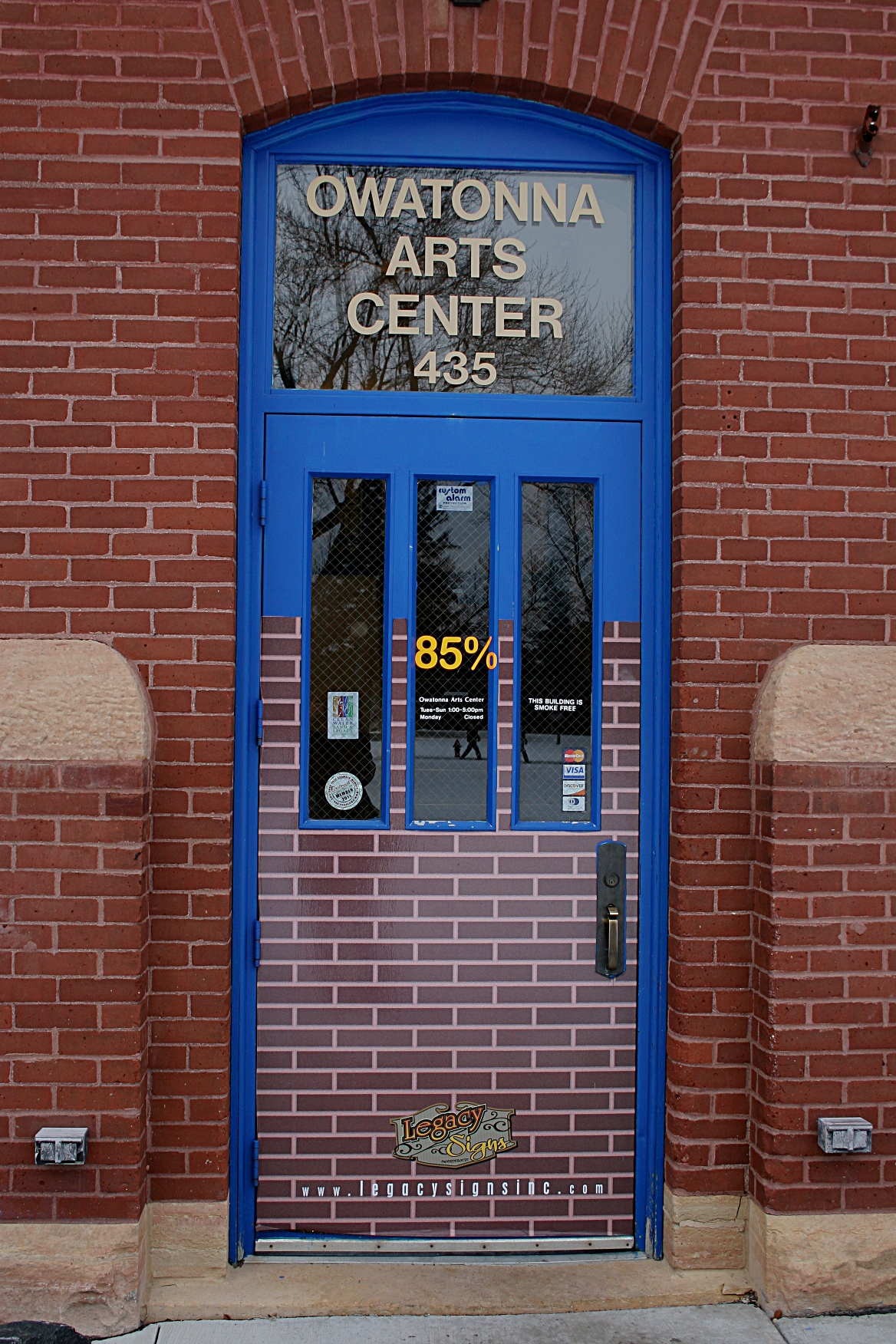
But you would be wrong. This is home to Indian Island Winery, among southern Minnesota’s newest wineries.
Minnesota artist Jim Hansel created the artwork, "Native Lands," for Indian Island Winery. Considered one of America's premier wildlife, nature and landscape artists, Hansel is legally blind.

Sunday afternoon my husband and I drove west from our Faribault home to check out the winery with the intriguing name, drawn from the Native Americans who once used this land—at one time nearly surrounded by water—as their summer hunting camp.

Inside the winery, you’ll see the artifacts, found on this property, to back up the historical context of this place. And, no, this site was not a Native American burial grounds.

Indian artifacts found on-site and displayed inside the winery.

Tour the winery and/or the vineyard and the Winter family will fill you in on the grape-growing and harvesting and wine-making process. We opted in on the winery tour, out on the vineyard tour given I wanted to photograph the vineyard and didn’t want to hold up a whole trolley full of tourists.

Instead, Tom Winter, who is a partner in the business along with his parents, Ray and Lisa, his wife Angela, and his sister Angie, invited us to follow the trolley out to the grape fields and explore on our own.

Visitors experience the country as they ride past soybean fields on the way to the vineyard.

That no qualms invitation warmed me up to the Winter family right then and there. And, if I was to choose a phrase defining our visit to Indian Island, that would be “down-home, country friendly.”

From Tom’s broad smile, to his and Angela’s adorable 7-month-old son to the charming college student tending the wine-tasting bar to the bucolic setting, everything about Indian Island speaks  “Welcome, we’re happy to have you here in this place we love.”

And clearly the Winters love this land, and each other, as they reside on various building sites within view of the winery and vineyards. “Close, but not too close,” Tom laughs, adding that a cousin also lives nearby.

Indian Island's vineyard covers 13 acres. Here's a view between rows of plants.

Clusters of grapes hang heavy on vines awaiting the harvest.

Grape leaves arc above the rows.

I don't know grape types, but my husband and I found many varieties in the vineyard.

Masses of grapes and individual grapes made for some lovely photos.

The thing we noticed about the vineyard grapes is that they don't look at all like the types of larger grapes sold in grocery store produce departments.

Tom Winter warned us about the LP-fueled cannon before we headed for the vineyard. The cannon "fires" periodically to scare away the birds. Likewise, a loudspeaker system intertwined among the grapes broadcasts the voices of squawking birds, all to keep real birds away from the fruit.

During the winery tour, Tom says several times, “My sister’s the winemaker.” Even though Angie Winter makes the wine, this family works together, from Angela keeping the books to Tom pinch-hitting as a tour guide when he isn’t working in other facets of the winery to… Earlier this year, the Winters were named Waseca County’s Farm Family of the Year.

Visitors learn about the press, filter, crusher and other equipment in the wine-making room.

A box full of corks in the wine-making section of the business.

Together, after only a few years in the wine business, the Winters have accumulated a long list of awards—the most recent the coveted Minnesota Governor’s Cup (aka gold medal) in the 2011 International Cold Climate Wine Competition for their Frontenac Rosé.

The Winters’ wine beat out 250 other entries to take the top honors, Ray Winter says.

Winner of the 2011 Governor's Cup, Frontenac Rose.

Inside the machine shed style building, which looks nothing like a storage place for farm machinery, you can (for $5 and you get to keep an Indian Island wine glass) sample four pre-selected wines and three others at the wine bar. You’ll find Maiden Blush, this year’s bestseller, and wines with names like Dreamcatcher, Prairie Wind and St. Pepin.

You can sample wines (17 are on the current wine-tasting list) and/or enjoy a meal inside or outside the winery.

One of the many winery offerings: St. Croix, a semi-dry red table wine.

Grab a bottle of wine from the vast selection at Indian Island Winery.

If all goes well with this year’s crop, Indian Island plans to offer wines made from only Minnesota-grown grapes. Most grapes will come from the family’s own vineyards with some also coming from local contractors.

For now, Indian Island makes only grape wine. I have yet to sample any, although my husband and I picked up bottles of Maiden Blush and Frontenac Rosé.

The bartender suggested we return: “Come back in the evening, have a glass of wine and watch the sun set.”

That sounds like a plan to me, to this former southern Minnesota prairie farm girl who appreciates nothing more than the sun slipping below the horizon in a serene setting like that at Indian Island Winery.

I can picture myself sitting on the patio at Indian Island, sipping wine and watching the sun set.

FYI: Indian Island Winery is among places featured in the “Minnesota River Sips of History” wine, beer and history trail tour. Click here for more information on this tour that will take you to places like August Schell Brewing Company in New Ulm, Fieldstone Vineyards in Redwood Falls, the historic R.D. Hubbard House in Mankato, Gilfillan Estates between Morgan and Redwood Falls, and more. The sites are hosting special events the weekend of October 21 – 23.

Indian Island is among about 30 wineries in Minnesota and is located southeast of Mankato. The business aims to use only Minnesota grapes, most grown on-site.

FYI: Click here to learn more about artist Jim Hansel who created the signature artwork that graces Indian Island wine labels.

© Copyright 2011 Audrey Kletscher Helbling