Minnesota Prairie Roots

Writing and photography by Audrey Kletscher Helbling

Pancakes for paper May 13, 2011

MY KNEE JERK REACTION went something like this: I pay taxes and now the school is hosting a pancake breakfast to buy “needed supplies.”

Because things aren’t always as they seem, I called Faribault High School to inquire about the Pancake Breakfast flier which was mailed to me on Thursday along with my son’s mid-quarter grades and information about ordering a $75 high school yearbook.

When the woman who answered the phone couldn’t help, she transferred me to Assistant Principal Dennis Germann’s voicemail. He explained everything to me in two return phone calls and now I feel much better and more informed.

Faribault Masonic Lodge #9 and Faribault Eagles Club #1460 are teaming up to raise monies for school supplies for students at FHS. Notebooks, inexpensive calculators, paper, project supplies, etc. will be given to students who can’t afford to purchase those basics, Germann told me. He added that nearly 50 percent of FHS students qualify for free or reduced school lunches. Translate that into families that could use some extra help with school expenses. The United Way has provided some assistance in the past with school supplies.

Germann welcomes the monies that will be raised at the Sunday, May 15, Pancake Breakfast from 8:30 a.m. – 12:30 p.m. at the Faribault Eagles Club. Cost of the breakfast, which includes all you can eat pancakes with a serving of sausage and eggs and milk, coffee or juice, is $7 for adults, $5 for students and free for those five and under.

It’s the first time apparently that the high school has been selected as the recipient of this Pancake Breakfast fundraiser. That’s why the flier caught me by surprise and I really didn’t understand the definition of “needed supplies.”

As the parent of a high schooler, and two FHS graduates, I’m happy to see secondary students benefiting from a fundraiser like this. Typically the focus is on elementary age kids. I know how quickly costs add up to buy school supplies for a teen. Last year, if I remember correctly, I forked out $100 for some fancy schmancy calculator my son needed for a math class. Students won’t get fancy calculators like that through this program (I think the school has some available to borrow). But at least they’ll get basic school supplies.

So much has changed in the decades since I graduated from high school and we really only needed 3-subject notebooks, pens, pencils, folders and loose leaf paper.

Now it’s way beyond paper, to needing computers and internet access at home. I bet many families out there can’t afford internet service. Thankfully free internet is available at the public library. But it isn’t always easy for students to get there when they need to do online research.

I wonder also about the cost of class field trips, if some students can’t afford even basic school supplies. I recently wrote a $27 check for my son to go on a field trip to the Science Museum to view the King Tut exhibit. I gave him another $15 for lunch, which even he told me was expensive. How do families with already stretched budgets manage these additional costs?

We shouldn’t need pancake breakfast fundraisers to supplement the cost of education. But we all know times are tough. So thanks, Eagles and Masons, for doing your part to organize this event that will help Faribault families.

© Copyright 2011 Audrey Kletscher Helbling


The trend toward healthier foods in schools and the chocolate milk debate May 7, 2011

SHOULD PUBLIC SCHOOLS offer chocolate milk with school lunches?

That’s an issue being discussed right now in the Fergus Falls Public School system, according to an article published in the Fergus Falls Journal.

The head of the Parent Teacher Organization appeared before the school board recently requesting that chocolate milk no longer be offered to students, except on Fridays as a “special treat.” She’s concerned about the sugar in chocolate milk and about serving healthier food. You can read the entire story by clicking here.

Based on the volume of responses to the Journal article, I quickly concluded that chocolate milk in school is certainly a hot button topic.

Opinions range from “let the kids have their chocolate milk because then at least they are drinking milk” to school lunches need an overhaul to this is a political issue.

Personally, I’ll pick white milk over chocolate any day. I grew up on a dairy farm, meaning I can’t really give an unbiased opinion here. Cows don’t produce chocolate milk. To my taste buds, chocolate milk compares to chugging chocolate syrup and I prefer my chocolate syrup on ice cream.

Here’s my take on banning chocolate milk from school lunchrooms:  Kids will eventually learn to drink white milk if they don’t have the chocolate option.

I think the PTO president erred with her compromise offer to allow chocolate milk as a “special treat” on Fridays. That would send a mixed message to students. Labeling a food as a “treat” only makes it more appealing.

This chocolate milk discussion reminds me of a controversy over soda pop vending machines in schools several years ago. I don’t recall the details, but it was a point of much debate in my community of Faribault. I don’t know how the issue was eventually resolved. And, honestly, because my kids are big milk, and not big soda, drinkers, I really did not pay that much attention to the issue. I should have.

Whether milk or soda is at the center of discussion, it’s good that parents, food service employees, school administrators and others are finally taking a good look at school lunches and working toward serving healthier foods and beverages to our kids.

In Fergus Falls, a Wellness Committee is tackling the topic of improving school lunches. Click here and here for the May school lunch menus in Fergus Falls. You’ll find main menu items like chicken nuggets, hot dogs, corn dogs and super nachos along with baked (not fried) fries, sunflower nuts, fresh fruit and fresh veggies. I can see progress in that list, but still some of those food choices don’t seem all that healthy to me.

And just to be clear here, I’m neither a food purist nor a perfect parent. I’ve served chicken nuggets to my family and I would label my 17-year-old son, my youngest, as a “picky eater.” It’s not that I haven’t tried to get him to eat his fruits and vegetables…

Fergus Falls certainly isn’t alone in moving toward healthier school lunches that feature fewer processed foods and more fresh veggies and fruit.

Throughout Minnesota, students, staff and volunteers are planting gardens, a win-win way to engage and teach students about healthier eating. The gardens will also provide fresh vegetables for school lunchrooms. The Statewide Health Improvement Program (SHIP) is helping lead the way. You can click here to see what’s happening in your county through SHIP.

In my county, Rice, for example, a “Growing Healthy Foods” workshop is slated for 6:30 p.m. Wednesday, May 11, in the 4-H building at the Rice County Fairgrounds. Master gardeners will present information about gardening in this program funded through a SHIP grant.

While individuals and students are planting gardens, Minnesota schools are also working with local growers to incorporate fresh produce into school lunches.

Check out the Minnesota Farm to School Program to see how some schools are embracing the trend toward eating local. It’s inspiring to read about apple orchards and tomatoes and school gardens and efforts to educate and reconnect students to the land.

I expect, though, that despite efforts to improve the quality of food in school lunchrooms, cost will determine whether healthy, permanent changes can be made. School districts don’t exactly have extra money in their budgets. And parents, in a time of already stretched family finances, won’t appreciate/can’t afford hikes in school lunch prices.

Getting kids to change their eating habits presents a major challenge also.

What’s your opinion on the current trend toward serving healthier foods in schools? Are changes needed? Will kids embrace such changes? Can school districts afford to offer healthier foods (which will likely cost more to buy and to prepare)? Will parents pay higher prices for school lunches?

And, finally, how do you feel about pulling chocolate milk from school lunchrooms?

© Copyright 2011 Audrey Kletscher Helbling
 

Meet the new Minnesota FFA president May 5, 2011

I AM PROUD, so, so proud, of my niece Hillary Kletscher of Vesta.

On Tuesday, she was named the 2011-2012 Minnesota Future Farmers of America president. (Click here to see the announcement.)

That selection speaks volumes to Hillary’s leadership skills, character and commitment to a stellar organization. She is among 9,100 FFA members from 175 Minnesota chapters. Her home chapter is my alma mater, Wabasso High School in Redwood County on the southwestern Minnesota prairie.

Nearly 40 years ago I became the first girl to join the WHS FFA, blazing the way in a previously male-dominated organization.

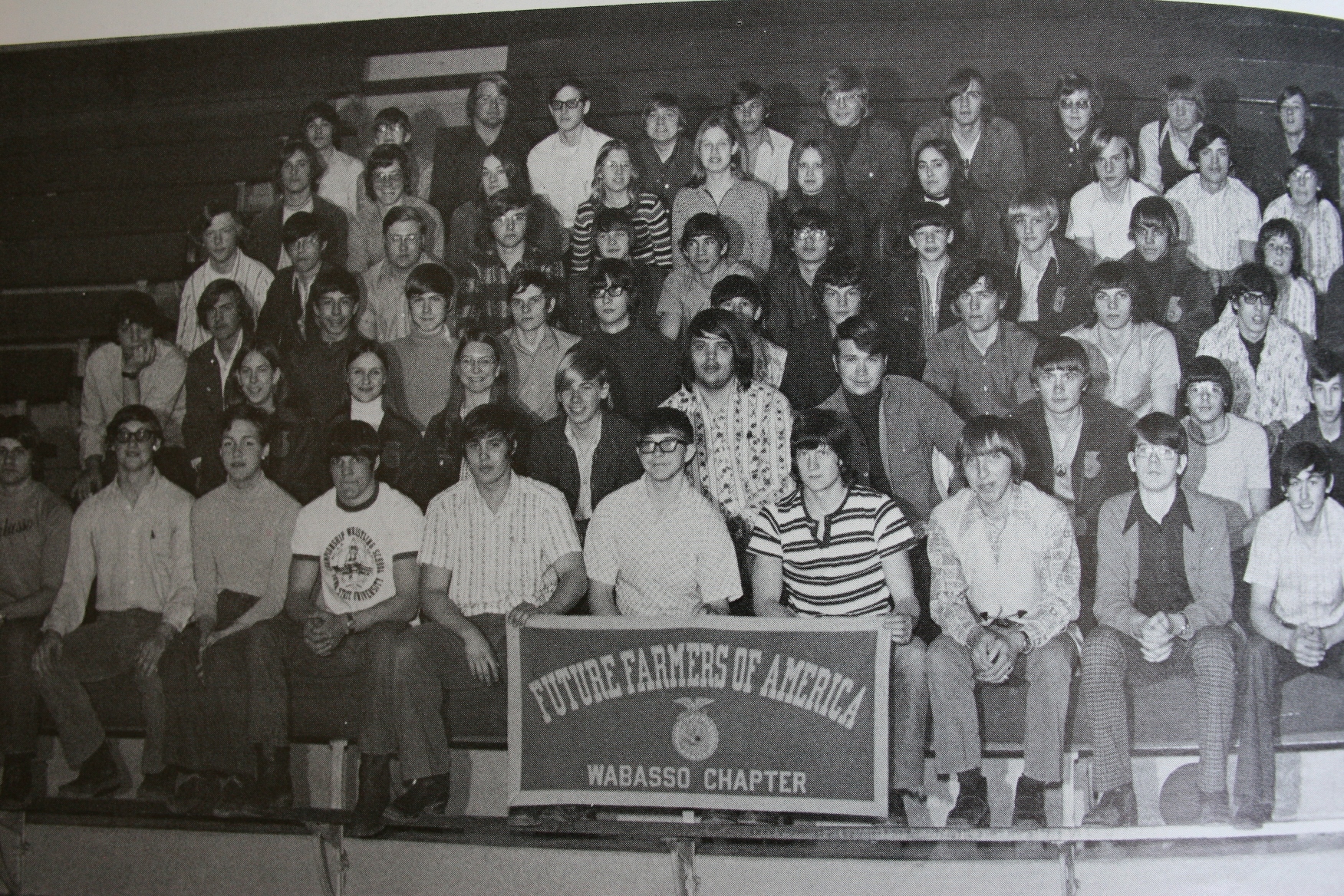
The 1973 - 1974 Wabasso High School FFA chapter consists of mostly male students. I am among the few females featured in this yearbook photo. I'm seated in the second row, third girl on the right.

For that reason I am particularly, personally, pleased that my niece now holds the highest office in Minnesota’s FFA.

It is an accomplishment that will open many doors for this WHS senior who has been serving as the Region V FFA president and as her chapter’s president. Hillary is a leader.

But it takes more than strong leadership skills to garner the top FFA spot in the state. Hillary and the other 15 candidates for state offices (selected by a nominating committee of their peers and adults) were evaluated in the areas of communication, team player, knowledge, organization, character, passion for success, influence and critical thinking.

Whew, simply reading that list posted on the Minnesota FFA website makes me realize that this is a daunting process that includes a written application, interviews, a written test, round robin issues conversations and more.

My niece, I am certain, can handle the responsibilities that will come with her new position.

Hillary is also an academically-gifted student and will graduate in a few weeks at the top of her class, 60 years after her paternal grandmother, Arlene (Bode) Kletscher, also graduated as the WHS valedictorian.

(I graduated in 1974 as the WHS salutatorian and my own daughter, Miranda, graduated as the Faribault High School valedictorian in 2006.)

Wabasso High School's winning T-shirt design, front and back.But back to Hillary. Her list of accomplishments in FFA, if I knew all of them, would be lengthy. She’s excelled in soil competition. And last year a T-shirt she designed won the National FFA T-shirt Contest. The winning slogan: “Who needs a license…When you can drive a tractor!”

I never came close to doing what Hillary has done in FFA. I won the Chapter Farmer Scholarship Award, and that’s about all I remember other than my first-female member status.

Hillary will have a busy year ahead of her as she juggles her freshman year of college at Iowa State University and trips back to Minnesota to carry out her FFA presidential duties. But if anyone can handle the stress, the pressure, the demands, it is my strong, determined niece.

She will continue to live the FFA motto:

Learning to Do

Doing to Learn

Earning To live

Living to Serve

© Text copyright 2011 Audrey Kletscher Helbling

T-shirt graphic courtesy of Hillary Kletscher

Hillary Kletscher photo by Matt Addington Photography and courtesy of Hillary Kletscher


Defining Easter eggs in Seattle April 21, 2011

Filed under: Uncategorized — Audrey Kletscher Helbling @ 7:39 AM
Tags: , , , , , , , , ,

I spotted these over-sized Easter eggs in the front yard of a home along Second Street Northwest in Faribault.

HAVE YOU HEARD about “spring spheres,” the latest politically-correct terminology—at least on the West Coast—for Easter eggs?

Apparently a Seattle teacher would allow a high school volunteer to bring candy-filled plastic eggs into her classroom only if she called them “spring spheres.”

Now, how ridiculous is that?

As soon as the volunteer pulled the eggs out of a bag and after the teacher pronounced them “spring spheres,” the third graders promptly called them “Easter eggs.”

You can’t fool kids into believing an oval is a sphere and Easter isn’t Easter. These Seattle students clearly know their shapes, and their holidays.

More Easter decorations in that Faribault front yard.

© Copyright 2011 Audrey Kletscher Helbling

 

Flat Ole wants my son to move to South Dakota April 14, 2011

ALMOST DAILY WHEN I pull open the mailbox, I reach inside to find another handful of letters for my son.

I dutifully toss them onto an end couch cushion, the one spot where he sits, with his laptop, and where he can’t miss his mail.

The stash of accumulating college information sent to my 17-year-old high school junior son.

Sometimes my high school junior opens the letters, but more often than not, he tosses them onto the middle couch cushion where they lie for a day or two or three before I scoop them up and jam them into a plastic shopping bag.

That bag bulges with letters and brochures from colleges across the country. Most arrive from the East Coast, including from some very prestigious colleges. But there are also letters from the West Coast and the in-between Midwest and down South.

I understand why my 17-year-old has stopped opening his mail, stopped reading the spiels about the best programs and students and campuses. After awhile, the pitches all begin to sound the same.

So what does it take for him to actually pause and open a piece of college mail?

For my computer geek teen, it’s all about grabbing his attention by presenting an eye-catching, out-of-the-ordinary, graphically well-designed mailing.

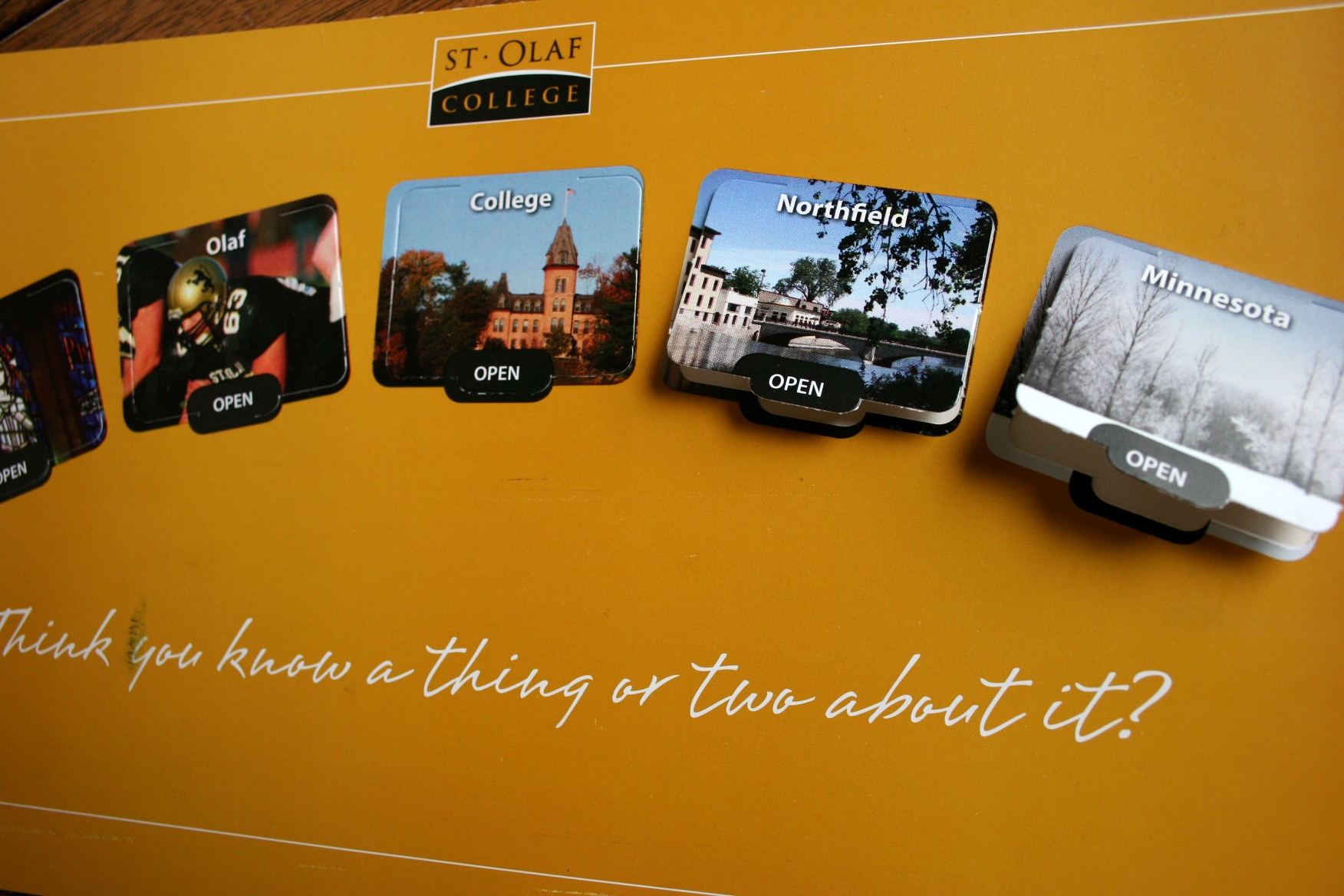
St. Olaf College in Northfield managed to attract the college-bound boy’s interest recently with a brochure that features little tabs to open. Who doesn’t like to see what’s hidden behind a closed door? An air of mystery sparks curiosity and…prompts us to investigate.


These five tabs each lift to reveal information about St. Olaf College in Northfield.

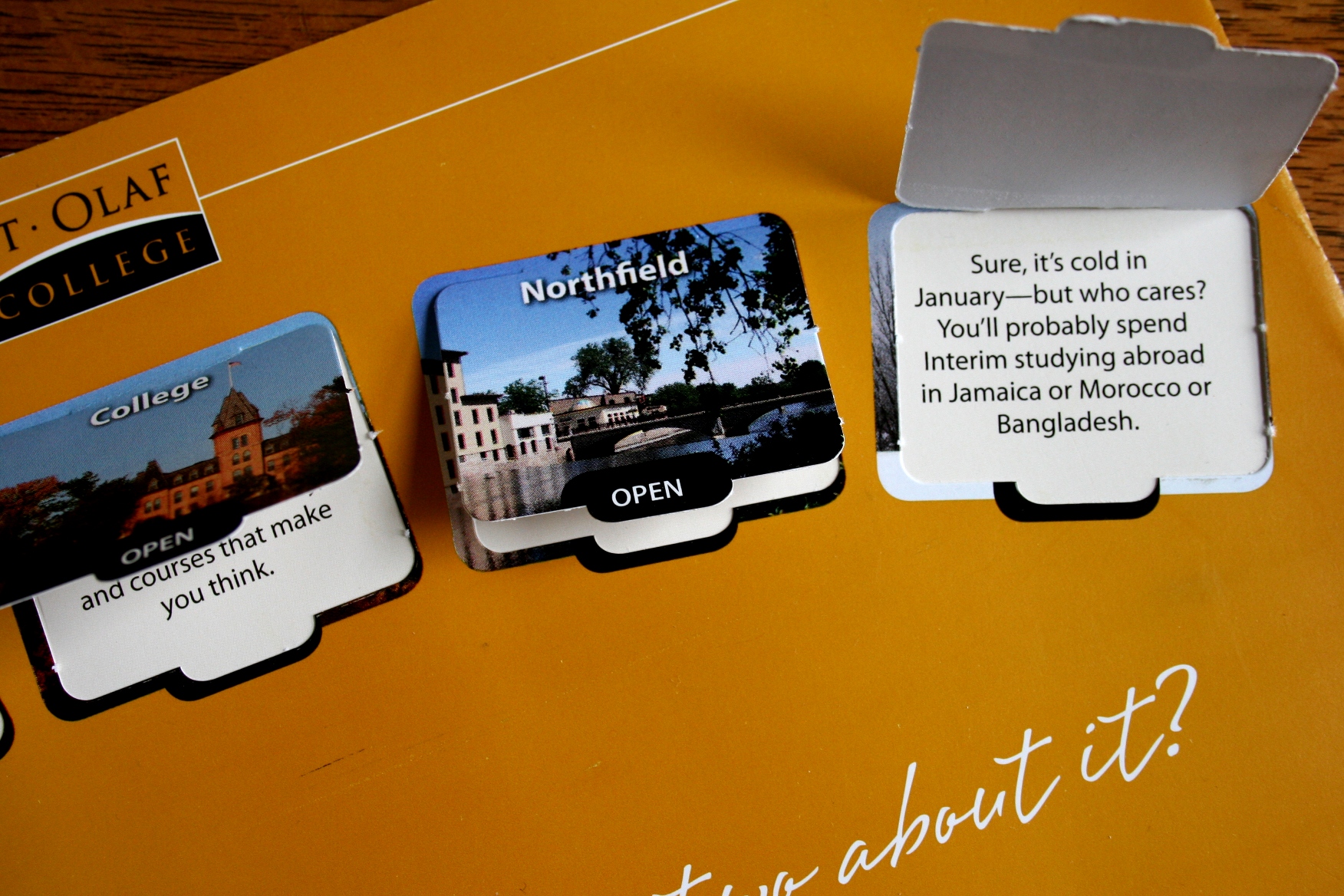
For each of five words—St. Olaf College Northfield Minnesota—the tabs lift to reveal a sentence. Behind the word door “St.,” for example, you’ll read this message: “You won’t literally find any saints here, but you will find students who ask big questions and take on big challenges.”


Under the word "Olaf," you'll learn that St. Olaf was founded by Norwegians.

And just in case the Minnesota winter may keep you from St. Olaf, think study abroad opportunities.

Honestly, this is, by far, my favorite college mailing that has arrived to date. So congratulations, St. Olaf marketing department, on some creative marketing that drew both my, and the teen’s, attention. Now, if you can show us some hefty scholarship money, we just may have a deal.

The second piece of noteworthy college literature didn’t exactly draw my eye initially. In fact, I almost threw Augustana College’s Go Viking magazine style publication into the recycling bin without a look. Its appearance suggested an alumni magazine rather than a college recruiting tool. But then, lucky for this Sioux Falls, South Dakota, college, I flipped through the pages and discovered—Flat Ole.

The folks at Augustana want potential students to cut out the picture of Flat Ole and take him on their travels. Photograph Flat Ole at famous landmarks, in exotic locales, in historic buildings, etc., and join his Facebook at facebook.com/flat.ole. This whole marketing gimmick, of course, plays off the Flat Stanley storybook character, with the Augie’s  irresistibly charming Viking mascot claiming to be Stanley’s Norwegian cousin.


You can clip Flat Ole out of the Go Viking magazine and take him on your travels. Or you can go to his website and download a Flat Ole cutout.

Except for that Flat Ole page, I didn’t read the rest of the magazine. So you judge whether Go Viking represents savvy college recruiting.

Finally, a third piece of college mail grabbed me primarily because of the word “geek,” which would certainly fit my computer brilliant teen. “Don’t be a geek out of water…dive into the G33KOSYSTEM.” I continued to read: “…at UAT, advancing technology will infuse every aspect of your education…the idea atmosphere developed by geeks for geeks…passionate about technology.”


Eye-catching words for any student who's in to technology.

And all the while I wondered, what is UAT? I flipped the brochure and read and reread, until I finally noticed the tiny logos in the corners with the miniscule writing, University of Advancing Technology. Still, that didn’t give me the location of the college. So, for that reason, even if this is a graphically-appealing mailing, I can’t give this brochure high marks. It’s important, really, really, really important, to make the college name pop.


Although the bright colors and graphic design grabbed my attention, I really had to look to find the name of the college on this UAT brochure.

By the way, my boy and I are not Norwegian. The fact that two “Ole” colleges scored well with me in the marketing area is pure coincidence.

HAVE YOU SEEN any college recruiting materials that stand out or fail in the marketing department? Why? Please share.

© Copyright 2011 Audrey Kletscher Helbling
 

Prom economics 101: Lessons in giving March 30, 2011

The 1984 formal I donated to the FHS NHS Prom Dress Drive .

SEVERAL WEEKS AGO my husband stuffed a 1984 lavender formal into the back seat of our car and delivered it to Faribault High School. (I was sick that day or I would have dropped off the old bridesmaid’s dress myself.)

He was donating my dress, which has hung in an upstairs closet for decades, to the FHS National Honor Society’s first-ever Prom Dress Drive.

Naturally, I couldn’t allow this event to pass without asking whether a local high school student will wear “my” dress to the April 30 FHS prom. I also wanted to know how the drive went.

Although several young women tried on my lavender formal and one in particular with sewing abilities considered changing it up, no one bought it, says NHS co-advisor and FHS English language arts instructor Rachael Hoffman.

However, Hoffman, who is also the FHS theater wardrobe director, says she’s keeping my cast-off for possible use in future FHS theatrical productions.

Of 80 – 85 donated dresses, about 15 were sold with prices ranging from $2 – $50 and averaging around $20. Donations included vintage to current fashionable dresses, a few with price tags still attached. Shoes and jewelry were also contributed.

Hoffman, while grateful for the quantity of dresses donated, was hoping for more shoppers. Yet her enthusiasm for the project and its purpose cannot be quelled.

I’ll let her share a story that nearly moved me to tears. “I was overjoyed to hear a student say that she wouldn’t have to order a dress to fit her size this year since she found one at our drive,” Hoffman writes in an e-mail. “You could see on her face that she felt pretty and I really felt that made the drive worth it.

I also think that some of the NHS students who worked at the drive with me got to put themselves in other students’ shoes for a moment. It was a valuable experience.”

Lessons like that can’t be taught in a classroom.

While the project was a fundraiser for the NHS (the group raised about $400), Hoffman says more importantly that it was a service to the students and the community during difficult economic times. “It was my personal hope that a student who could not afford a dress would come and buy one. We did, in fact, have a few students who showed up with this purpose. It was a wonderful reward.”

Lessons like that can’t be taught in a classroom.

Hoffman clearly understands her students. “As a teacher at FHS, I know that many of these young people work jobs not merely for themselves but to contribute to their families in these hard times, or to save for college,” this astute educator observes. “We really wanted to serve our community in this way. Prom is a special occasion and many families cannot afford ‘extras’ right now. We wanted to make this less of a stressor on normal working families and more of an event to look forward to for the students.”

No one left the Prom Dress Drive without a dress, if they wanted one, Hoffman says. Prices were negotiable and most donors told organizers to give away their dresses (if they could not sell them) to anyone who needed a formal.

Lessons like that in giving from the heart can’t be taught in a classroom.

Details on the front of a lovely formal that also hangs in my closet and which my eldest wore in a friend's wedding. It would make a lovely prom dress, but it wasn't mine to give. Maybe next year?

THE GIVING DIDN’T END in Faribault. Extra Prom Dress Drive formals which won’t be utilized locally were donated to Total Care Cleaners. The south metro business sells the dresses for $10 to any prom-goer who needs one. Total Care also gives away $10 in dry cleaning services for each donated dress.

“They were so appreciative of the donations and excited to give more students this option for a prom dress,” says Julie Petersen, a co-advisor for Faribault’s NHS and a FHS Spanish instructor. “The owner said that many of the girls he helps would not be able to go to prom if not for the dresses he gets donated.”

That economic reality extends nationwide. At donatemydress.org, a national network connecting local dress drive organizations across the country, you’ll find a state-by-state listing of groups sponsoring these dress projects. Scroll to Minnesota and you can link to five metro area formal dress drives—Ever After Gowns, Operation Glass Slipper and The Paperbag Princess—and the two businesses-based projects at Vista Images and Total Care Cleaners.

I expect there are other Minnesota dress drives not listed on this website.

At least one of the prom projects, South St. Paul-based The Paperbag Princess, also accepts suits. Some take accessories too. Ever After Gowns will even accept spa products and new makeup.

I commend groups like the FHS National Honor Society for undertaking a drive like this which offers affordable prom attire to young women. NHS members seem to have benefited from the project, in lessons learned, as much as the young women who found prom formals.

Now, if only the cost of attending the FHS prom—$175 per couple for the event to be held at a South Saint Paul night club—would be more affordable…

© Copyright 2011 Audrey Kletscher Helbling

 

My son educates me about the Ides of March March 15, 2011

Filed under: Uncategorized — Audrey Kletscher Helbling @ 10:14 AM
Tags: , , , , , , ,

My son has been painting tiny Dungeons and Dragons figurines and this one reminds me of the Ides of March, which has evolved, in my mind, into a menacing creature. I played around with the photo, adding the green in honor of March.

“WHAT DATE IS IT tomorrow?” he asks, even though he’s sitting only feet from the wall calendar.

“March 15,” I answer.

“Beware the Ides of March,” he booms in the deep voice of a boy becoming a man.

“What does that mean?” I ask.

And then my 17-year-old spouts off bits and pieces of information, bits and pieces, about Shakespeare’s famous line in Julius Caesar—the warning from the soothsayer about J.C.’s impending death on March 15: “Beware the Ides of March.”

Then we are discussing Shakespeare and I tell him how much I dislike the playwright’s work except maybe Romeo and Juliet and the line, “double, double toil and something-or-other” from Macbeth.

I find Shakespeare’s writing stuffy and confusing and not at all fun to read, and I’m an English minor.

So I’m surprised that my boy, who professes to hate writing, claims a fondness for Shakespeare and Greek philosophers, which he just studied in humanities.

He thinks he knows so much and I know so little. I try to tell him that decades have passed since I studied these things. But he surmises that I am getting old and forgetful and maybe I am.

Mostly, though, I tell him I never cared about some of this information in the first place, so why would I remember it beyond knowledge necessary to pass a test or a class? Probably not the right thing for a mother to tell her son, but it is the truth.

I don’t care if I remember that the Roman statesman Julius Caesar was assassinated by Brutus and others on March 15 in 44 B.C. I didn’t remember; the smart junior in high school had to tell me.

Then today, on this middle March morning, before he headed out the door to school, my boy warned me, “Beware the Ides of March!”

“Beware the Ides of March!” I echoed. “Beware the Ides of March as you walk to school.”

He smiled a wide grin that told me that for that moment on this morning, March 15, I succeeded in saying something that was momentarily brilliant. Oh, joy, for the Ides of March.

© Copyright 2011 Audrey Kletscher Helbling


A super soup competition March 14, 2011

AT HIS DAY JOB, Steve sells cars. On the side, he raises chickens on his small Minnesota acreage. He’d like to add a few pigs and cows, but he’s not versed in raising those critters.

He’s an expert gardener, though, who cans his produce. He appreciates the taste of home-grown vegetables and those farm-raised chickens.

Steve also loves to cook.

Sunday night I met Steve and sampled some of his cooking at Cannon Valley Lutheran High School’s first-ever “Soup-er Bowl” in Morristown. Loaded with hefty chunks of chicken, thick homemade noodles, carrots, celery, onion and garlic, Steve’s creamy chicken noodle soup earned him a second place finish among the 10 soups entered in the cooking competition. He deserved it. I don’t typically like chicken noodle soup, but I loved Steve’s.

I asked for the secret to the cream base. A stick of butter and half-and-half combined with the juices of his home-grown chicken, additional chicken stock, bay leaves and other spices created a savory broth. By the way, Steve appears to be the kind of guy who would rather share cooking tips than keep them secret.

Steve's chicken noodle soup is in the top left corner of this photo. The winning soup, taco chili, is next to it on the right. The other soups here are corn chowder, Mulligan stew and (I think) cheeseburger.

I don’t know how the other nine competing cooks—except the youngest cook, eighth grader Louis—felt about revealing their recipes. Louis left the recipe for his fiery green chili on a table for diners to pick up. Let me tell you, when I tasted his chili laced with hot jalapenos, I gulped lemonade.

Taco chili won the 2011 “Soup-er Bowl” trophy from among entries like Mulligan stew, cheesy wild rice, corn chowder, ultimate cheeseburger, a second chicken noodle soup and Steve’s chicken noodle soup.

The "Soup-er Bowl" trophy, awarded this year for the taco chili.

This whole idea of a “Soup-er Bowl” was the brainchild of my friend Mike, who volunteers as CVLHS acting development director. Mike is one of those guys who is always giving back to the community. He remains a strong supporter of the Lutheran high school even though his eldest son graduated from there several years ago.

Wanting to connect the congregations that are part of an association supporting CVLHS, Mike came up with the soup competition. Last weekend five of the member churches held local contests with the two top winners from each church advancing to yesterday’s finale.

Soup and chili samples were placed onto vintage metal trays for each diner.

Unfortunately, I was out of town last weekend, or I would have entered a soup. Mike has already invited me to participate next year. But after tasting all of the excellent soups and chilis on Sunday, I’m hesitant to vie against so many great cooks. I might simply remain a taster.

I love soups. Each year for the past seven, my sister Lanae has hosted an autumn soup party at her Waseca home. While she doesn’t award a trophy for the best soup, the winners are really us, the invited guests. Last year we could choose from 17 homemade soups spread out on tables in her and husband Dale’s garage. Click here to read all about her 2010 soup party.

When I heard about the CVLHS “Soup-er Bowl” gathering, I wasn’t about to miss an opportunity to eat soup and support the school. For $5, diners got small samplings of each soup or chili, breads and sweet treats, along with beverages.

The party was not only a fundraiser for the school but, more importantly, an evening of fellowship, organizer Mike said.

Diners packed tables in the Bethlehem Lutheran Church fellowship hall to taste 10 soups and chilis and then vote for their favorite at the CVLHS "Soup-er Bowl" party.

He’s right. I met car salesman/chicken farmer/chef Steve when I sat at the same table as him. Now my name is on Steve’s list to contact when his chickens are ready for butchering next summer. I can already taste that delicious chicken noodle soup…

By the time I went through the line, the vintage trays had all been used, so seven soups and chilis were crammed onto an oval plate. I later picked up the remaining three to sample. My sister also uses vintage trays at her party.

HERE’S THE RECIPE for Green Chili from eighth grader Louis:

Green Chili

Brown hamburger. Separate hamburger from juice and let juice sit.

Sauté celery, white and green onions, jalapenos, cilantro, green peppers, black pepper and hamburger juice.

Put hamburger and vegetables in pan and add green tomatoes and stir until finished.

NOTE: Louis did not list specific ingredient amounts, so I guess you need to figure that out for yourself.

© Copyright 2011 Audrey Kletscher Helbling

 

An aha moment at parent-teacher conferences March 5, 2011

EVER SINCE OUR TEEN stopped accompanying us to parent-teacher conferences, my husband and I have felt more open to asking candid questions about him. Not that we’re trying to talk about him behind his back, but his absence certainly allows us to ask questions we probably wouldn’t ask in his presence.

He’s a great student, near the top of his class. He’s taking rigorous courses, earns straight As and scores exceptionally well on tests. In other words, academics are not an issue.

So, then, you might wonder why we even bother to attend parent-teacher conferences. First, it’s important to show our son that we care about his education.

Secondly, it’s important for his teachers to know we care and to connect with them.

Third, I want to know what he’s learning, because I certainly don’t hear that information from him.

I’ll qualify that, though, by saying that this time, when our 17-year-old was helping me with dishes the night before conferences, I asked for an academics primer. I wanted a list of the classes he’s taking, the names of his teachers and what he is currently studying. Surprisingly, he obliged and I felt better prepared for conferences.

Just a note. I could have pulled his course information from a file, but engaging him in conversation about school seemed the better alternative. Also, I wasn’t completely oblivious to his class schedule or assignments.

When my husband and I headed off to conferences on Thursday evening, I wasn’t sure exactly what information I wanted to glean from or exchange with his teachers. Last time we focused on his future—his main interests, career options and college choices.

This time, though, a conversation with a friend several days earlier niggled in my mind. We were discussing our sons, who are both wired with strong science and math brains. Neither one cares all that much about engaging in social activities. My husband and I have worried for some time about our teen’s lack of interest in socializing and minimal participation in extracurricular activities.

About now, if you’re the parent of a teen, you’re probably thinking, how lucky to have that “problem.”

Well, as parents, we want a well-adjusted teen.

We were reassured by every teacher we asked that our son is well-liked by his peers, participates in class and socializes, has a great sense of humor that they enjoy, loves to learn, etc. In other words, they alleviated our worries.

While talking with his journalism teacher, I had one of those aha moments. My son, I realized, is confident enough in himself that he doesn’t feel the need to conform, to give in to peer pressure, to be surrounded by a group of friends. All the while I’ve been focusing on the negative when I should have been focusing on the positive, seeing the strengths in his personality.

Not everyone is interested in sports or theater or music, etc. And just because we as parents, as educators, as a society, think every kid should be intensely involved in extracurricular activities, we must also accept and realize that not every teen wants to be so involved. Not every teen is a social butterfly outside of the classroom.

My son doesn’t think like most teens. That’s OK. But he’s strong, smart, confident, inquisitive and more. When he focuses on a task, he wants his efforts to be invested in a real project, with real results. He doesn’t want to do something just to compete, although when he competes he’s very competitive. I finally understand that about him.

It just took asking the right questions at parent-teacher conferences to get there.

© Copyright 2011 Audrey Kletscher Helbling
 

Dressing up like Cinderella on the cheap March 1, 2011

TOUGH ECONOMIC TIMES prompt us to look for creative ways to save money.

That stated, if you are the parent of a high school age daughter who will attend prom in a month or two, listen up. Your girl can dress up like Cinderella without breaking the bank.

I would love to take credit for the following thrifty idea, but I can’t. I’m sure it’s been tried many other places. But this is the first time I’ve heard of a Prom Dress Drive in Faribault.

I learned of the drive, sponsored by the Faribault High School National Honor Society, via an insert included with my son’s mid-quarter grades.

NHS members are accepting donations of formal dresses that are in “good, sellable condition.” They promise to reasonably price and sell the formals to prom-goers.

I didn’t see any other restrictions listed…which means maybe I can get rid of that purple and lavender bridesmaid dress hanging in my closet since, oh, 1984. I actually loved the dress when I wore it. A young woman who is a size 12 might like it too. I have no use for the formal and when I slipped the cinching waistband around my waist, let’s just say I couldn’t button it in place.

A belted waistband buttons at the back of the bridesmaid dress I wore in 1984.

Ruffles accent the neckline of the dress.

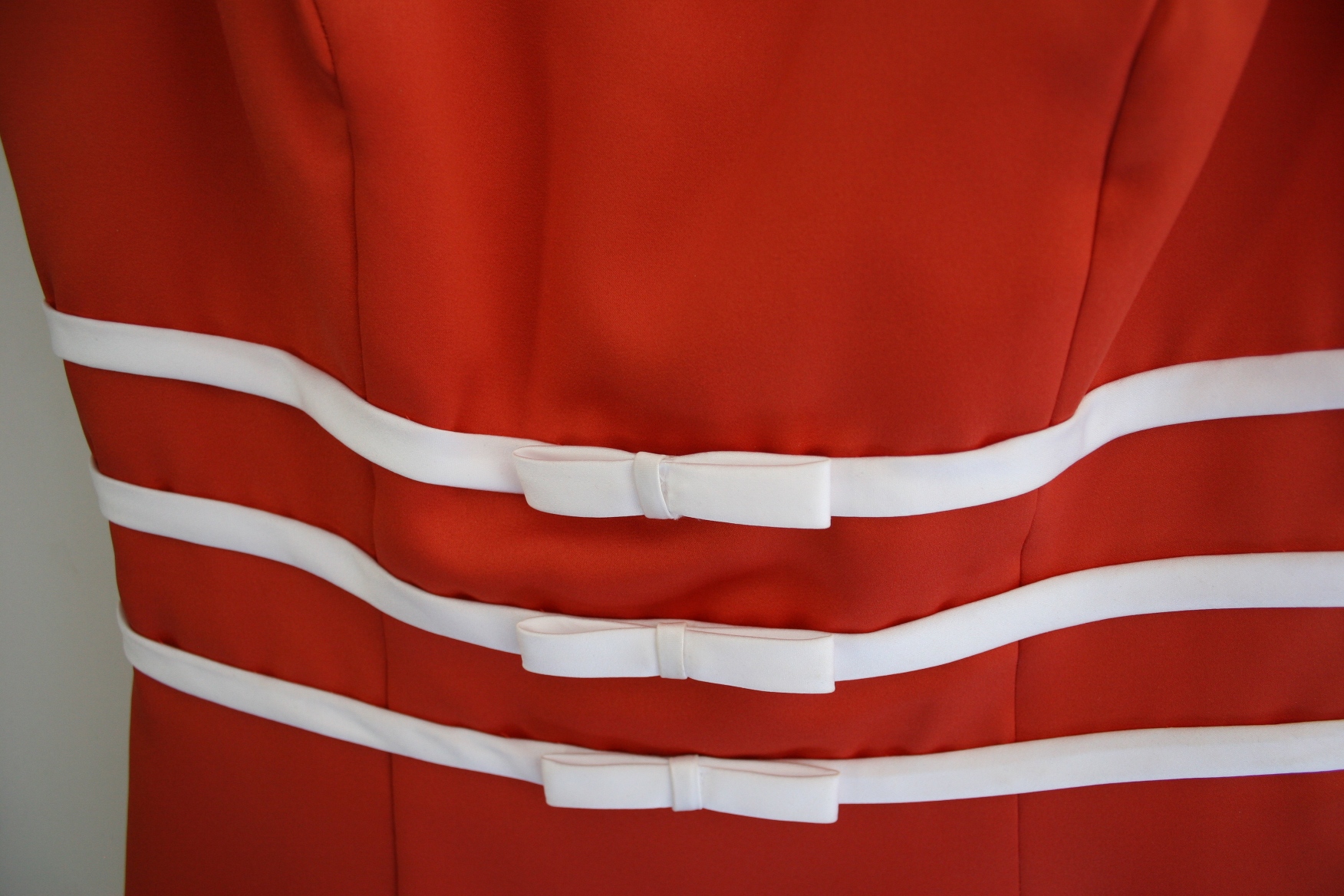
Layers and bows define the full skirt. Follow this post to the end for a view of the entire dress.

Anyone may donate dresses to the Prom Dress Drive from 4 p.m. – 6:30 p.m. on Friday, March 11, and from 12:30 p.m. – 4 p.m. on Saturday, March 12, at the FHS Black Box Theater. Enter through the northeast doors at the front of the building.

Then, from 3:30 p.m. – 6:30 p.m. on Wednesday, March 16, and Thursday, March 17, doors on the northeast side of FHS will be open for prom-goers to try on and purchase dresses.

To me this seems like a win-win situation. Donors clear their closets of unwanted formals given to a good cause. NHS kids earn money. And prom-goers save money.

The NHS students are also accepting cash donations, although they don’t explain why they want cash too. Are they giving out a random cash prize? Are they donating the cash to charity? How will the money be used?

For now, women, check your closets and consider donating to this project. I’m all for a drive like this that will help make prom more affordable. I don’t know the costs of attending prom. But with attire, flowers, food, photos, salon and transportation expenses, I bet attendees who don’t penny-pinch easily spend $500.

Other affordable options for dresses include borrowing a formal, shopping at a thrift or second-hand store or browsing the classified ads. In local recently-published classifieds, I saw a candy apple green dress advertised for $90. It cost $300 new. Another seller was pushing a baby blue ballroom-style prom dress for $150. I expect lots more of these ads as prom time draws nearer.

Those who wish to save even more money can consider foregoing the dining out experience by dining in. Back in the 1980s, my youngest brother and his date, now his wife of 22 years, sat down to a pre-prom dinner at my parents’ house. This year my niece and her friends plan to gather at her dad’s house for a prom dinner.

(The in-house dining has the added benefit of parental supervision and keeping kids safer by cutting out the long-distance travel to dine out.)

Nothing says you have to follow the expected norm.

I say when times are tough, and even when they’re not tough, curtail your spending at prom time. Be proud of your frugality.

I hope young women and parents embrace this recycled prom dress idea and realize that prom can be just as enjoyable in a second-hand dress as in a new dress.

WHAT ARE YOUR THOUGHTS on this dress drive and/or the cost of attending prom? Do you have any money-saving tips for prom to pass along?


Should I donate this 1984 formal to the Prom Dress Drive? Will today's teen think it cool vintage chic or totally outdated? I value honesty. I paid $124 for this dress 27 years ago and wore it once.

© Copyright 2011 Audrey Kletscher Helbling