A sign posted on a pillar at MSAD and viewed when exiting the campus. (Minnesota Prairie Roots copyrighted photo May 2022)
HAVE YOU EVER CONSIDERED what it would feel like to be deaf or blind, or both? I remember pondering that from a young age after learning about Helen Keller, who was unable to see and hear. I asked myself which would be harder. I concluded that I’d rather lose my hearing than live in darkness.
I lost most of my hearing in my right ear in 2011. (Minnesota Prairie Roots copyrighted file photo)
Realistically, both present challenges. And, because I am neither blind nor deaf, I really can’t fully understand what it means to live with those disabilities. I do, however, have a partial understanding of deafness.
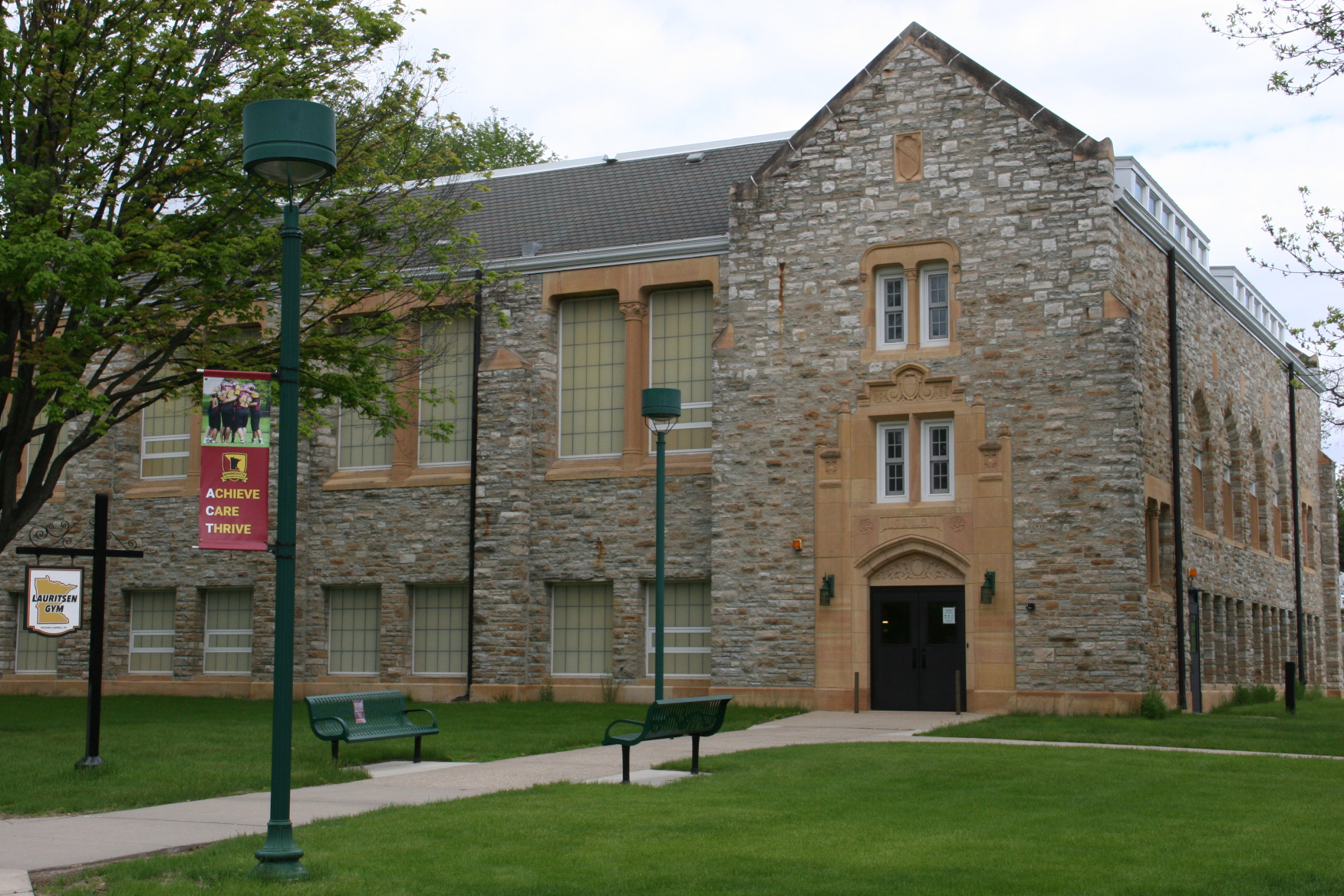
Achieve. Care. Thrive. ACT banners a sign outside Lauritsen Gym at MSAD. (Minnesota Prairie Roots copyrighted photo May 2022)
Nearly 12 years ago, I lost most of my hearing in my right ear, diagnosed as sudden sensory hearing loss. I know the exact moment it happened. Visits and tests with a local ENT doctor and an ear specialist at the University of Minnesota led to the conclusion that my hearing loss was caused by a viral infection. My hopeful reaction was this—I could get a hearing aid. That is not an option for my type of hearing loss. Thus I’ve learned to live with near deafness in my right ear. Yes, it’s annoying and bothersome that I can’t hear whispers in my right ear, that I can’t tell the location of sound, that white noise and too many conversations at one time make hearing really difficult, that I need people on my left side when they are talking to me. But I manage with one ear.
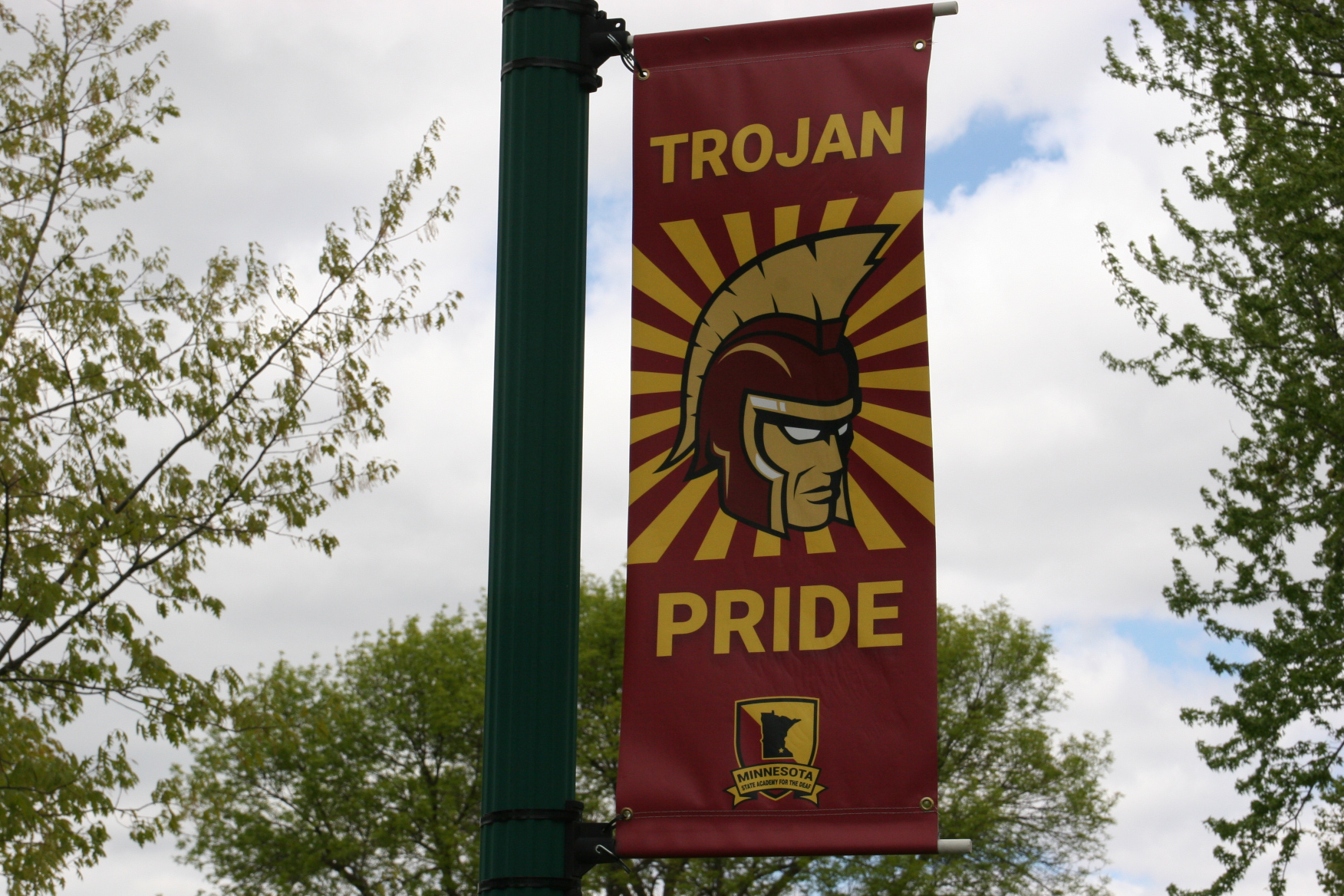
Bannering the Minnesota State Academy for the Deaf in Faribault, the school’s mascot. (Minnesota Prairie Roots copyrighted photo May 2022)
I’ve been advised by my medical team that, if I ever experience hearing issues with my good left ear, I should consider it a medical emergency and seek immediate care. I will.
Stunning Noyes Hall Auditorium on the MSAD campus. (Minnesota Prairie Roots copyrighted photo May 2022)
I live in a community especially attuned to sight and hearing. Faribault is home to the Minnesota State Academies for the Deaf and the Blind. Here, at two separate campuses on the east side of town, students from all over Minnesota attend residential academies for preschool through high school.
An early childhood scarecrow displayed next to the ball field and green space which center the MSAD campus. (Minnesota Prairie Roots copyrighted photo October 2022)
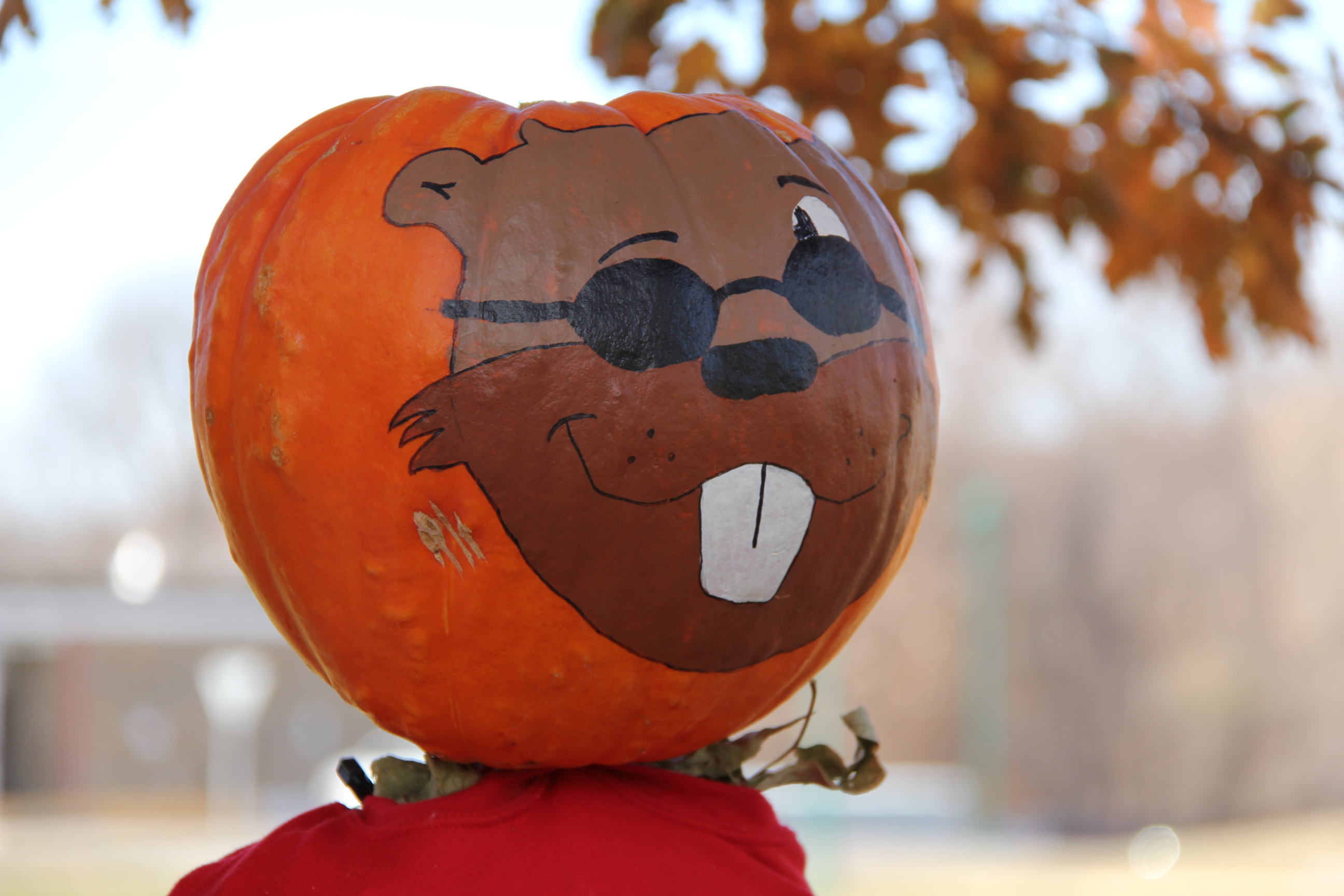
A Gopher pumpkin head represents the Minnesota State Academy for the Blind mascot. (Minnesota Prairie Roots copyrighted photo October 2022)
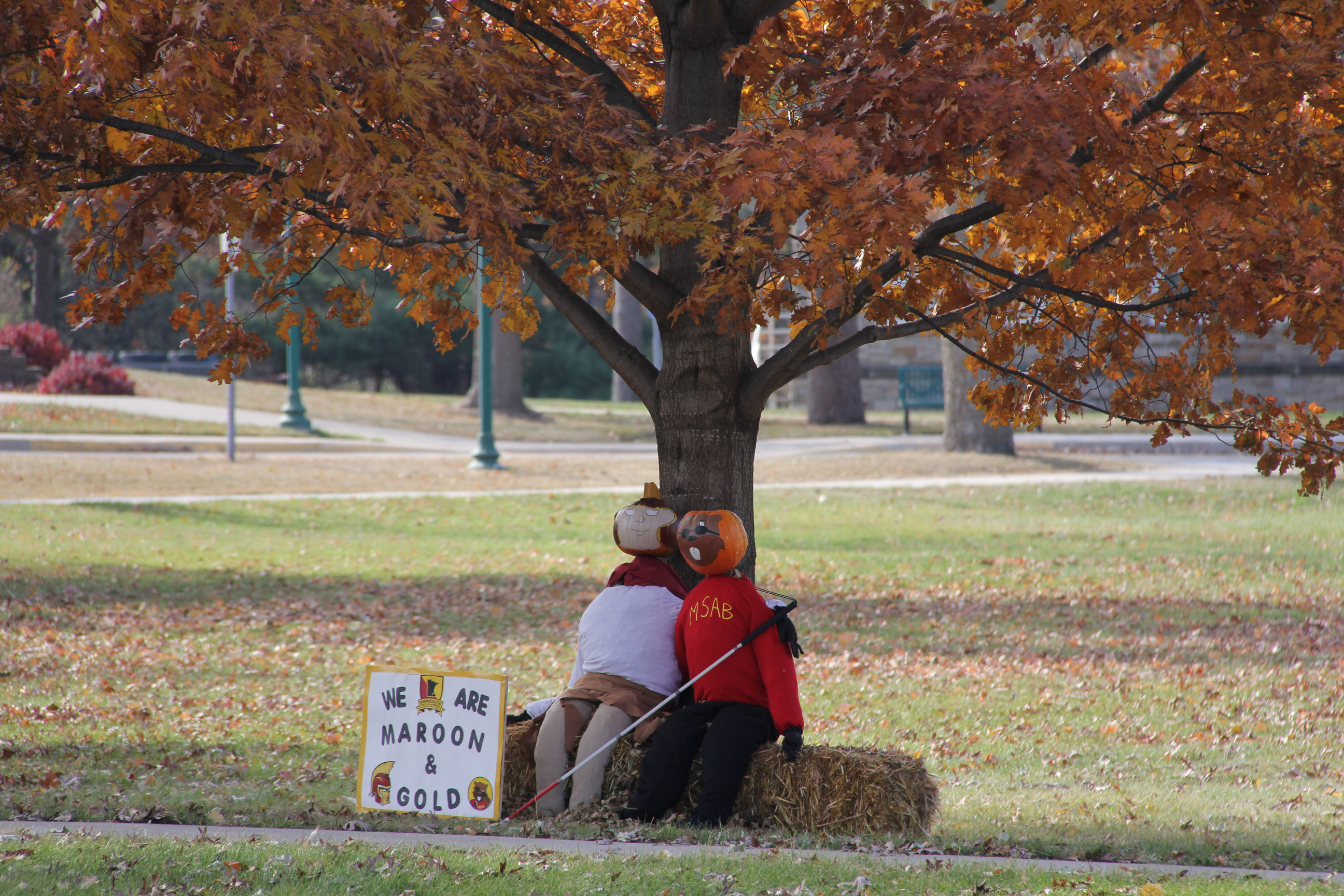
Side-by-side scarecrows from each academy. Trojans, left at MSAD and Gophers, right at MSAB. (Minnesota Prairie Roots copyrighted photo October 2022)
Occasionally on weekends I walk the campus for the deaf. It’s a beautiful setting of mostly historic buildings (many on the National Register of Historic Places) ringing a green space. I last walked there right before Halloween to view the annual scarecrow display. It’s been a school tradition for many years, a bit scaled back now.
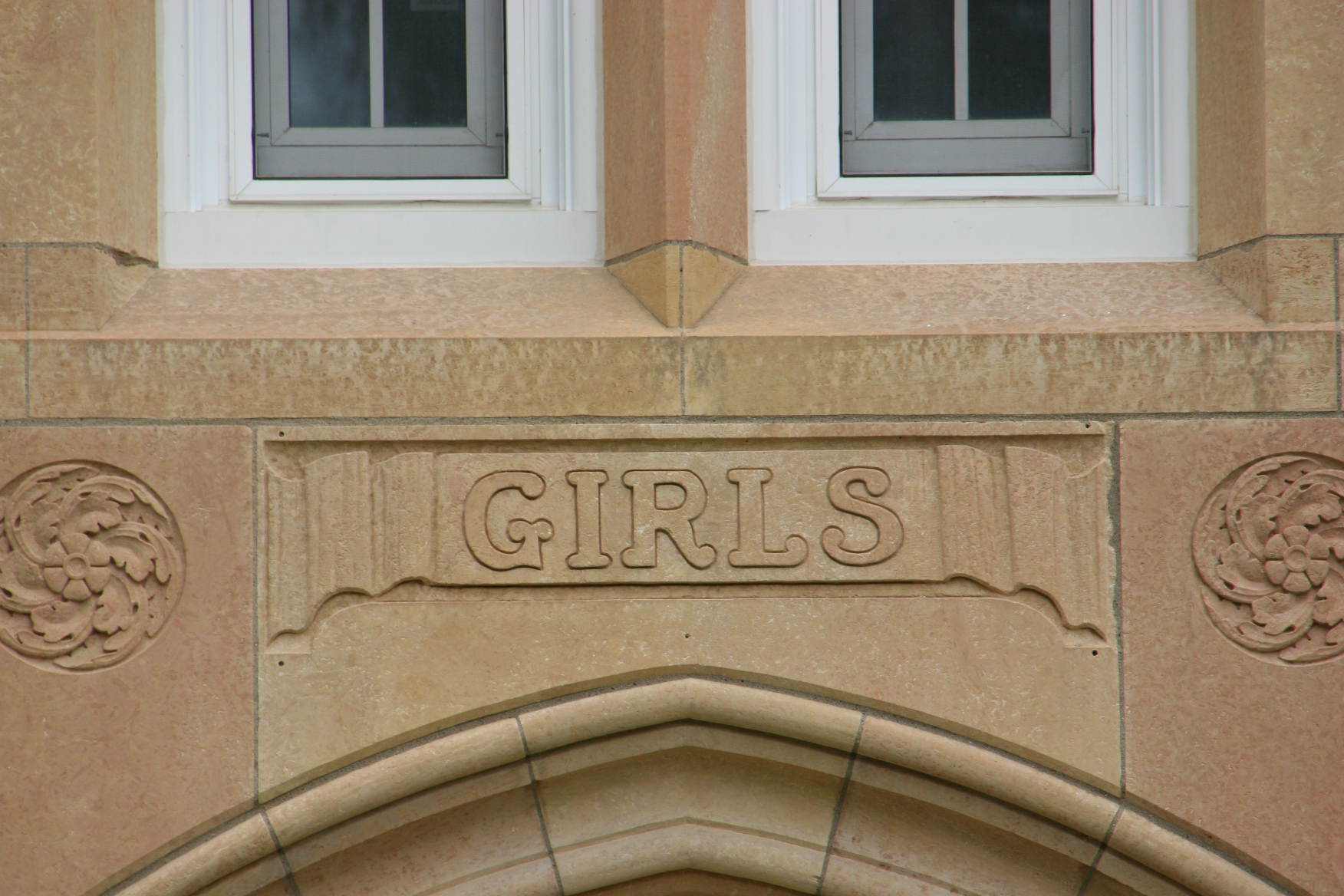
Detailed building identifiers of old. (Minnesota Prairie Roots copyrighted photo May 2022)
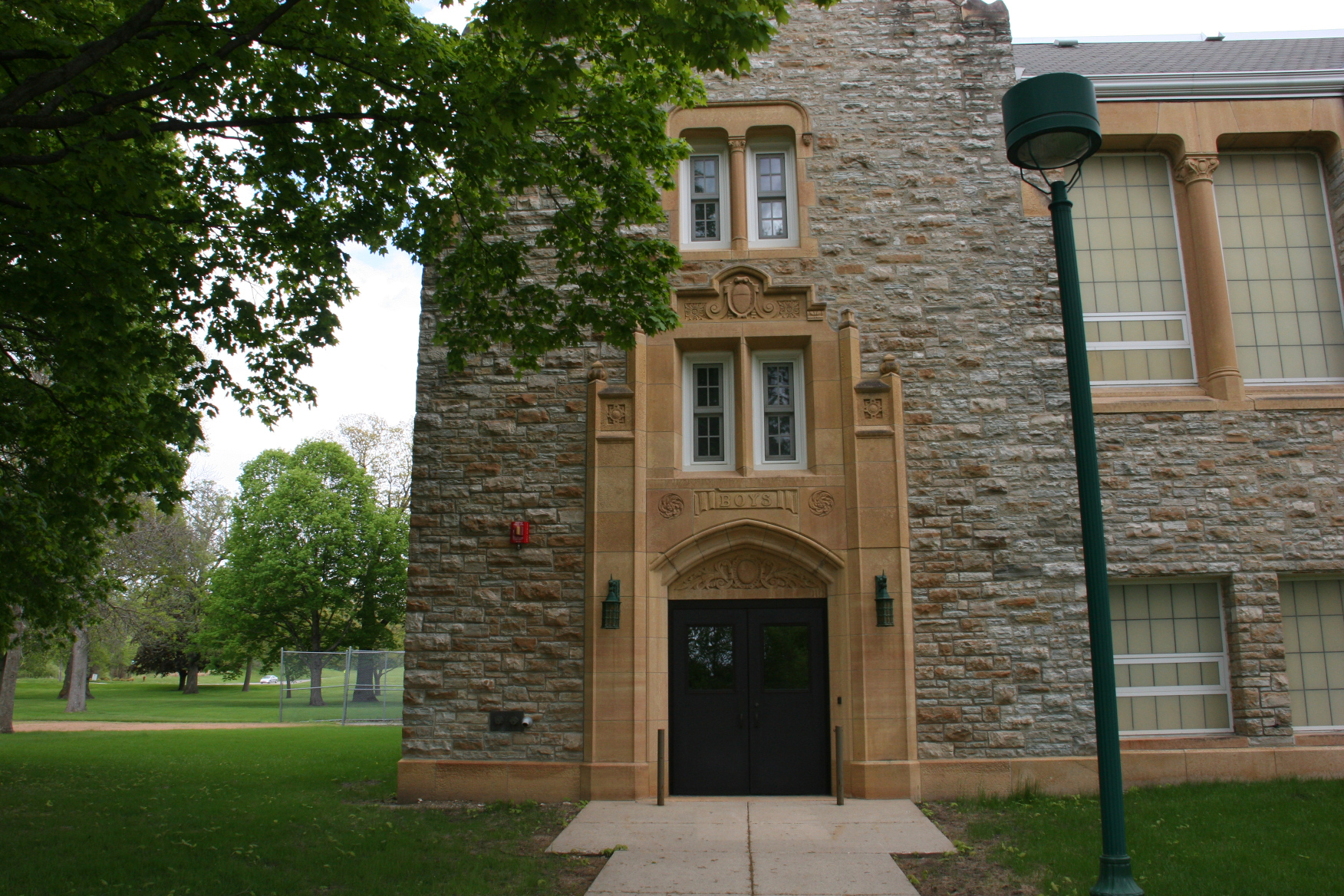
Identified as a residential hall for boys. (Minnesota Prairie Roots copyrighted photo May 2022)
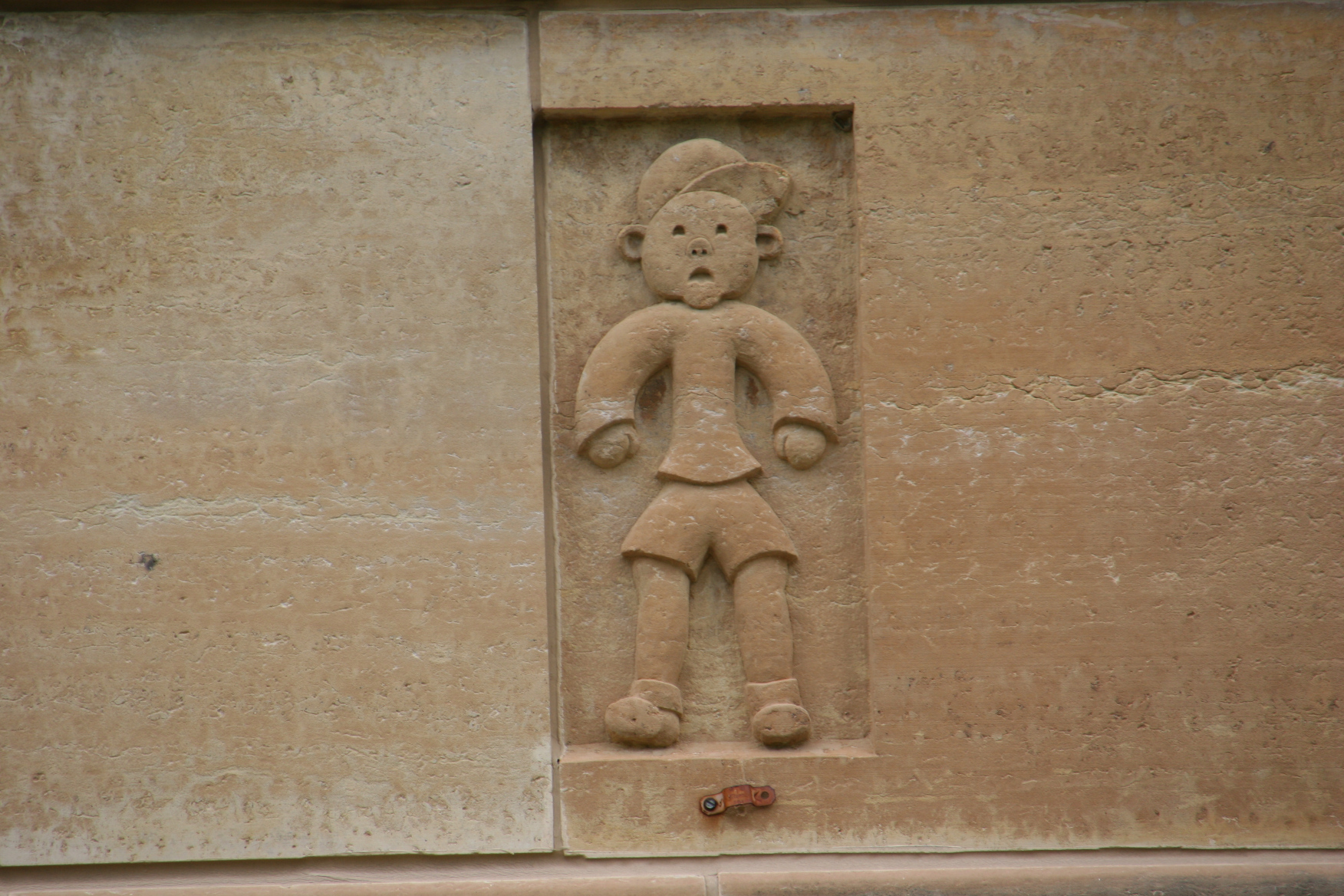
Art on Pollard Hall. (Minnesota Prairie Roots copyrighted photo May 2022)
When on the MSAD campus following sidewalks that take me past buildings where deaf students learn, live, gather, I consider how difficult it must be for families to separate on weekdays. (Some families live locally, thus are not separated.) Yet, I understand the necessity of residential schools that focus on educating and preparing these young people for life. They learn to navigate in a hearing world. And, I expect they learn, too, that their disabilities do not define them, that they can pursue their hopes and dreams.
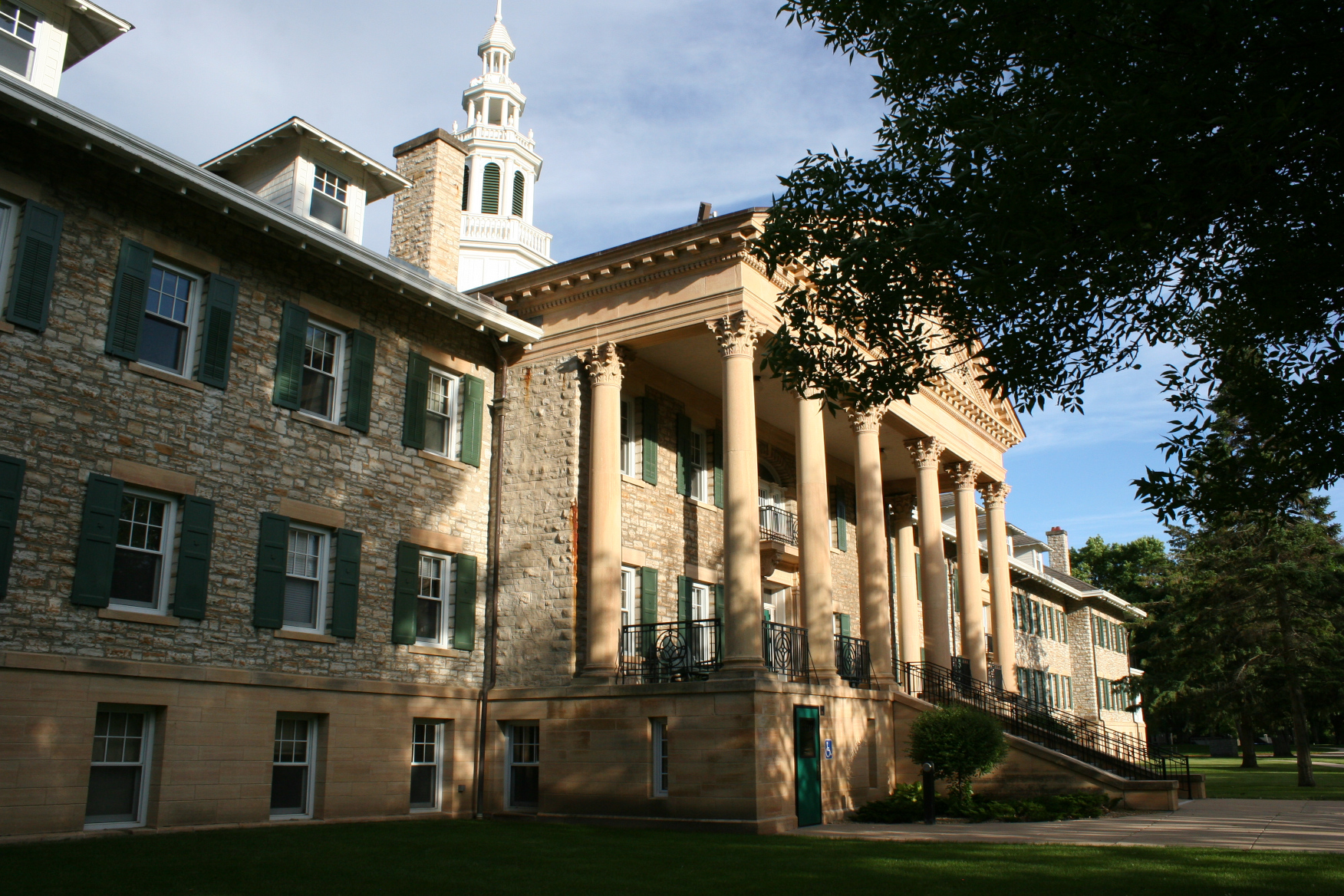
Sprawling Tate Hall is majestic, historically and architecturally stunning. (Minnesota Prairie Roots copyrighted photo May 2022)
When on the MSAD campus, I consider also how we sometimes take our senses for granted, until they become diminished or we lose them. Aging, or something like my sudden sensory hearing loss, open the door to understanding, to a deepened sense of awareness, to empathy and compassion.
I feel grateful for the reminders, the lessons learned when I walk the Minnesota State Academy for the Deaf campus. To ponder deafness and blindness connects me to a segment of our population which faces challenges beyond my full understanding. To walk these grounds for a short time stretches my mind, opens my heart, broadens my perspective.
FYI: Limit your time on either academy campus to weekends, when students are not there. Be aware that building construction is also underway so follow posted rules.
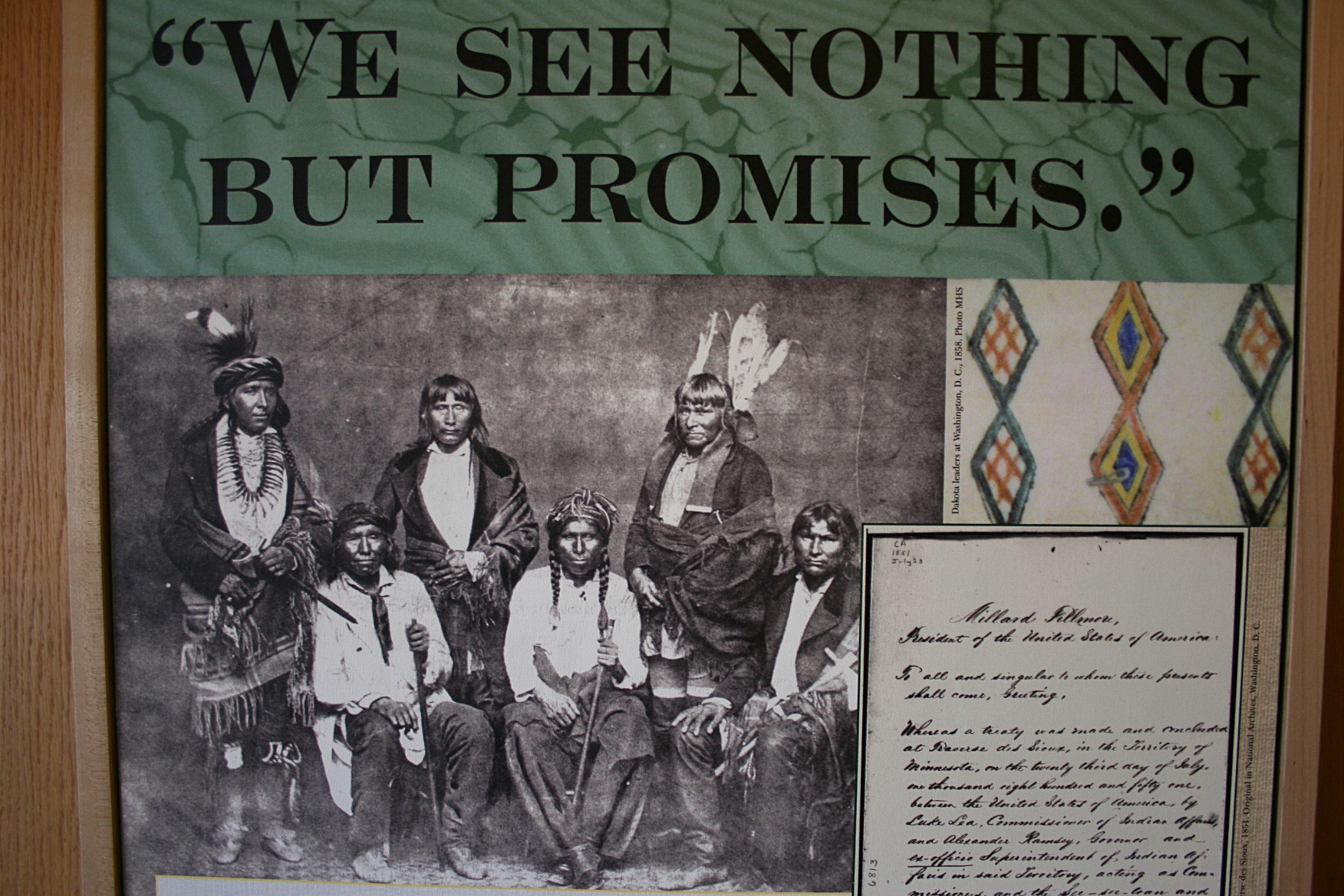
A photo panel at the Traverse des Sioux Treaty Center in St. Peter shows Dakota leaders photographed in Washington D.C. in 1858. The photo is from the Minnesota Historical Society. Broken promises led to the 1862 war.(Minnesota Prairie Roots file photo)
TODAY, INDIGENOUS PEOPLES’ DAY, I think of the US-Dakota War of 1862. When as a high school student I studied that war, I felt an immediate connection to the event which occurred in my home county and neighboring counties in southwestern Minnesota. My interest sparked because this happened in my backyard. Today I have a much better understanding of the 1862 conflict among the native Dakota peoples, the settlers and the government. My learned “white” perspective has shifted, my viewpoint has broadened. That has come through listening, reading, educating myself.
A public art installation at Northfield’s 2022 Earth Day celebration. Northfield has a Land Acknowledgement Agreement. (Minnesota Prairie Roots copyrighted file photo April 2022)
I see the same shift in attitudes throughout our nation, state and communities today. Land acknowledgment agreements are being written. There’s an awareness that indigenous peoples are the original inhabitants of the land, including in my home county of Redwood and my home of the past 40 years, Rice County.
I recently learned that the Wahpekute, part of the Dakota Nation, placed their dead on scaffolding on land just up the hill from my Faribault home. Land that is now a city park. After a year, the bones of the deceased were moved a few blocks away to a permanent burial grounds. That cemetery is not marked as such. Up until a presentation by Susan Garwood, director of the Rice County Historical Society, I was unaware that Peace Park was a sacred place, not simply a triangle of land with a WW II memorial along busy streets. Efforts are underway in Faribault to landmark such places of importance, to honor the Dakota.
A must-read novel based on fact.
It starts at a grassroots level, this unraveling of the truth, this recognition, this acknowledgment. I’ve toured museum exhibits, read books, attended presentations and more to assure that I am informed. I highly-recommend reading the award-winning book, The Seed Keeper by Diane Wilson. (Click here to read my review.)
I value that awareness of Indigenous Peoples’ food, culture, history and more is growing. In Minneapolis, diners can enjoy North American traditional indigenous food at award-winning Owamni by The Sioux Chef, for example.
Back in my home county, the Lower Sioux Indian Community is working hard to assure its culture remains strong through ongoing traditional events and teaching of the Dakota language.
A bison herd has been reintroduced to the prairie at Minneopa State Park near Mankato. (Minnesota Prairie Roots copyrighted file photo 2019)
I still have much to learn about the Indigenous Peoples of Minnesota. That I admit. Perhaps much of it is really unlearning. Today I pause to honor those who called this place, this southern Minnesota, home first, back when prairie grasses stretched high, bison roamed and the land was respected.
A massive wind turbine at Faribault Energy Park dwarfs my husband, Randy, walking near it. (Minnesota Prairie Roots copyrighted photo July 2022)
COMING OF AGE in the early 1970s, I held a general awareness of environmental concerns. A respect for the earth and the environment was beginning to emerge as young people and others raised their voices.
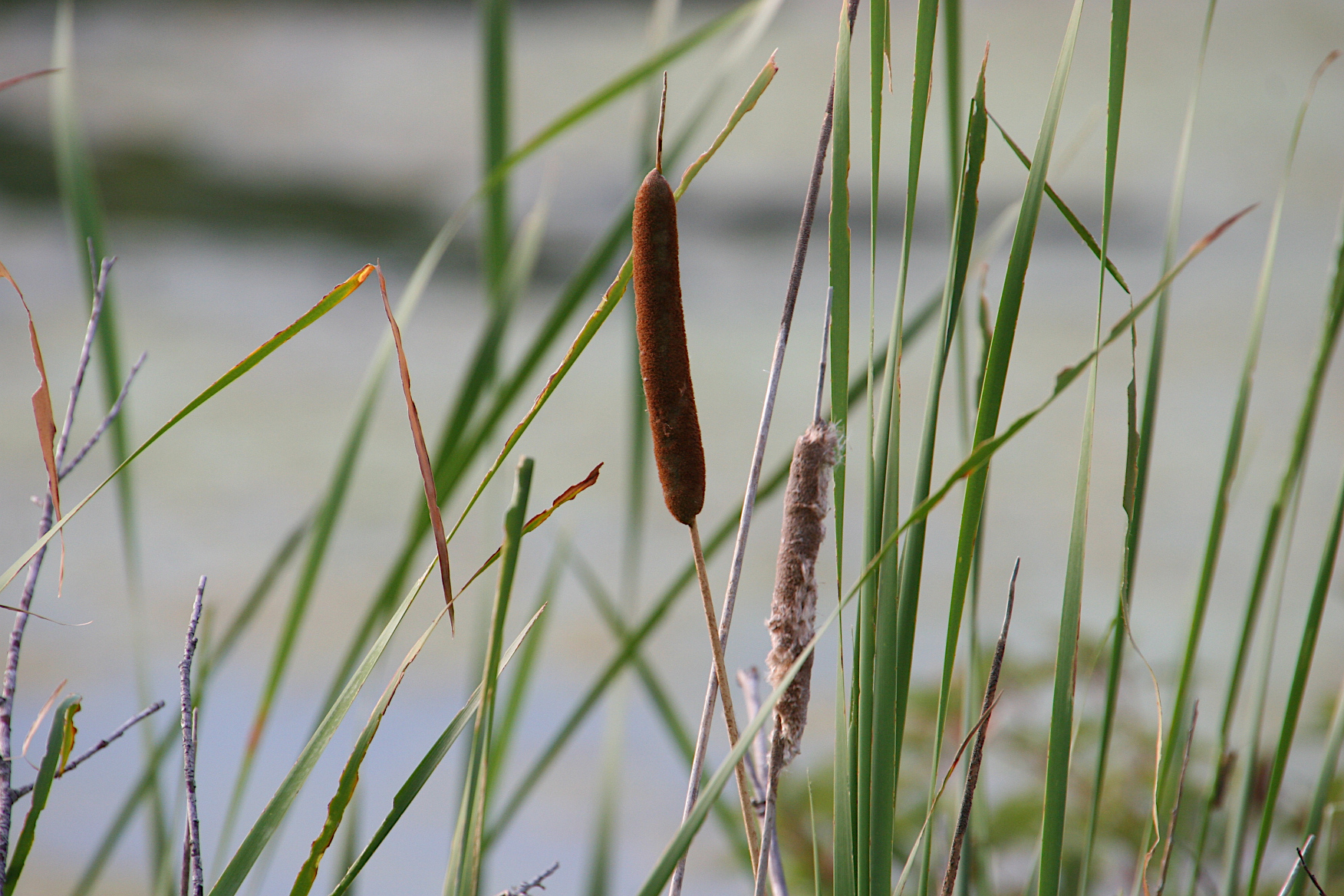
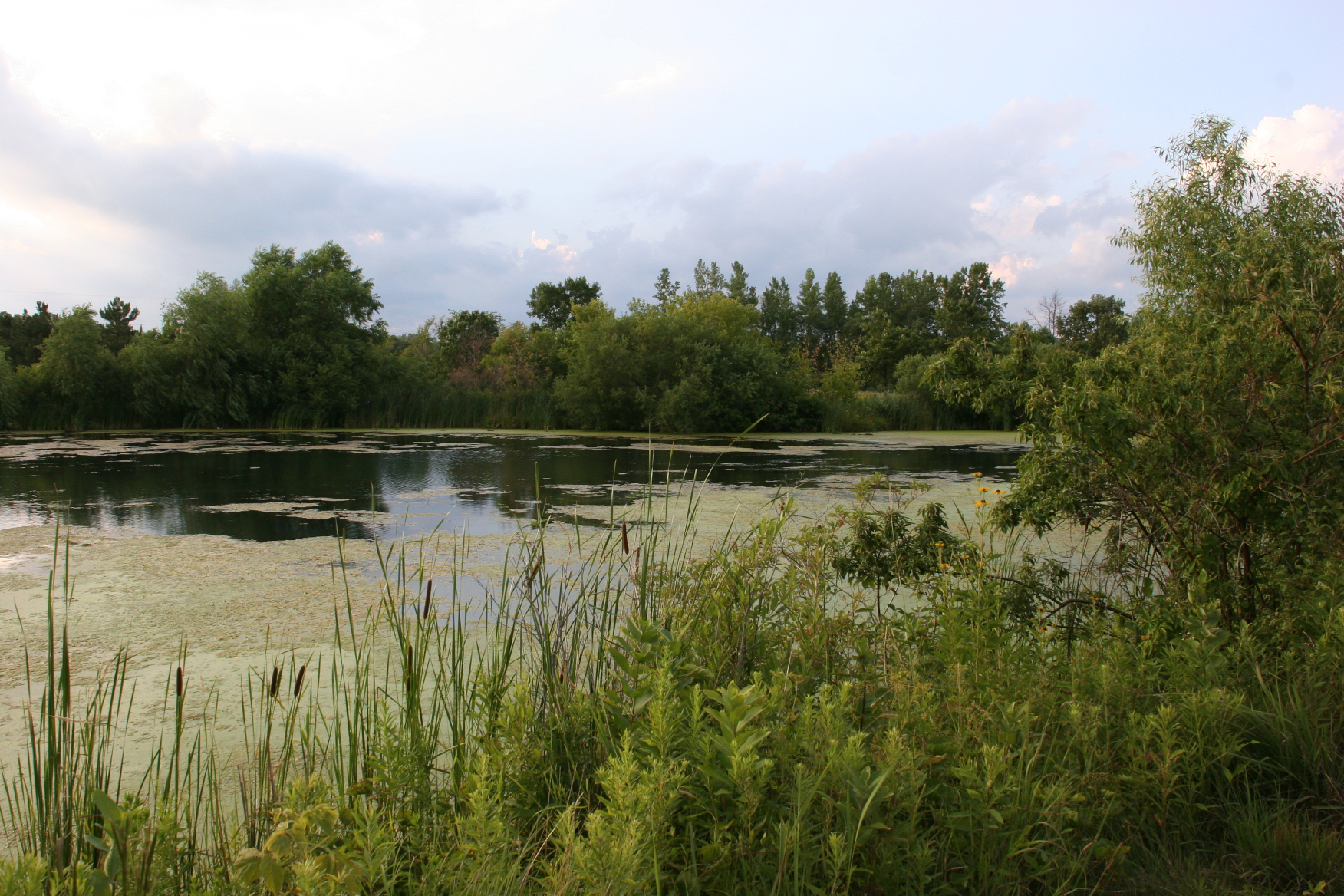
Cattails flourish in the park wetlands. Restoration, rather than draining, of wetlands is the norm today. (Minnesota Prairie Roots copyrighted photo July 2022)
I remember the anti-littering campaigns. The concerns about water and air pollution. The efforts to limit billboards. I recall, too, Earth Shoes, although I’m uncertain what that footwear had to do with anything environmental.
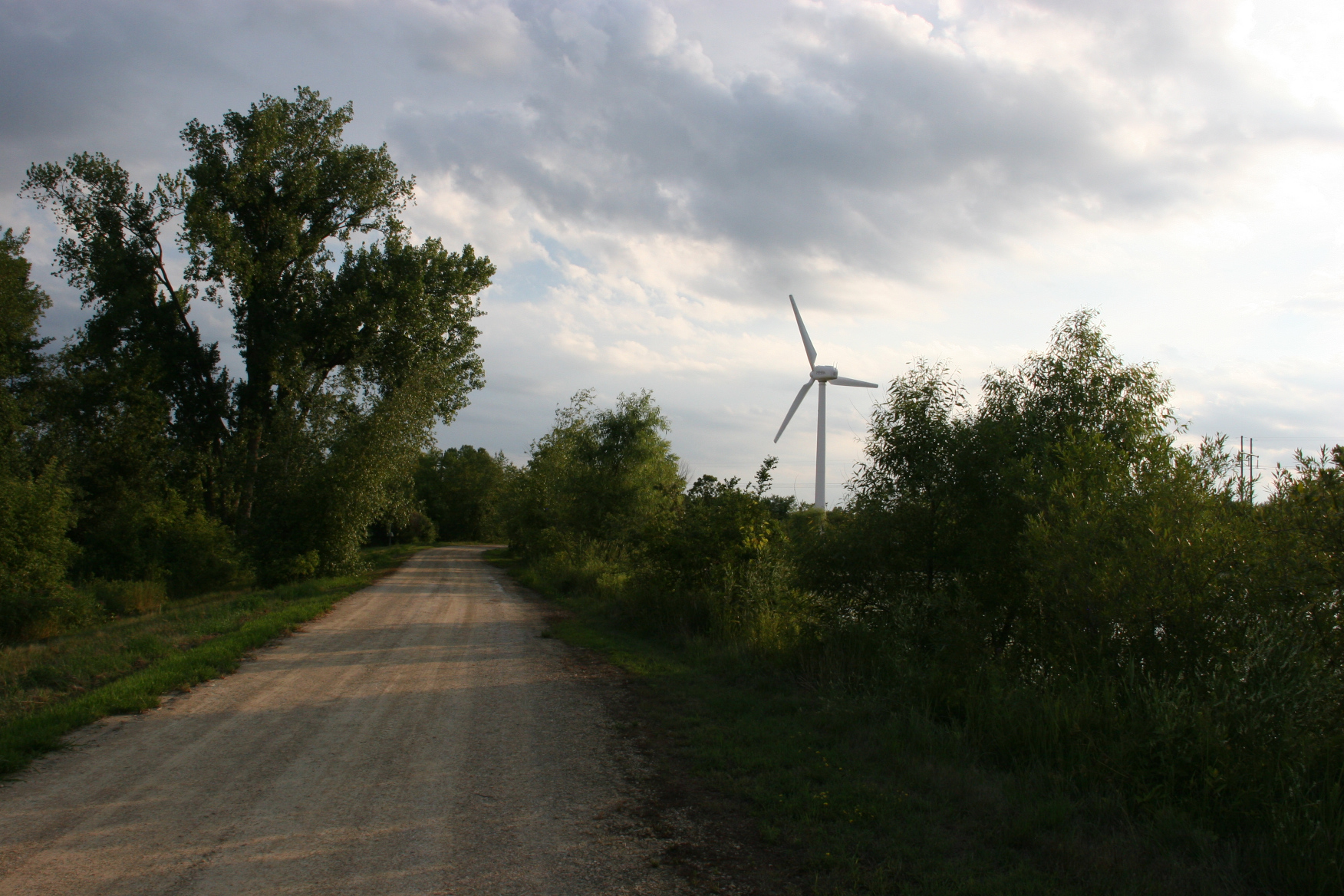
This trail leads to the wind turbine, a teaching tool inside Faribault Energy Park. (Minnesota Prairie Roots copyrighted photo July 2022)
Perhaps previous generations cared, too, but it seems the young people of the 70s started a new environmental movement that pushed personal and societal responsibilities in caring for our planet. Those efforts continue today, but with additional focuses: climate change, alternative energy, electric-powered vehicles and more. Today’s young adults are among those leading the way in discussions and effective change.
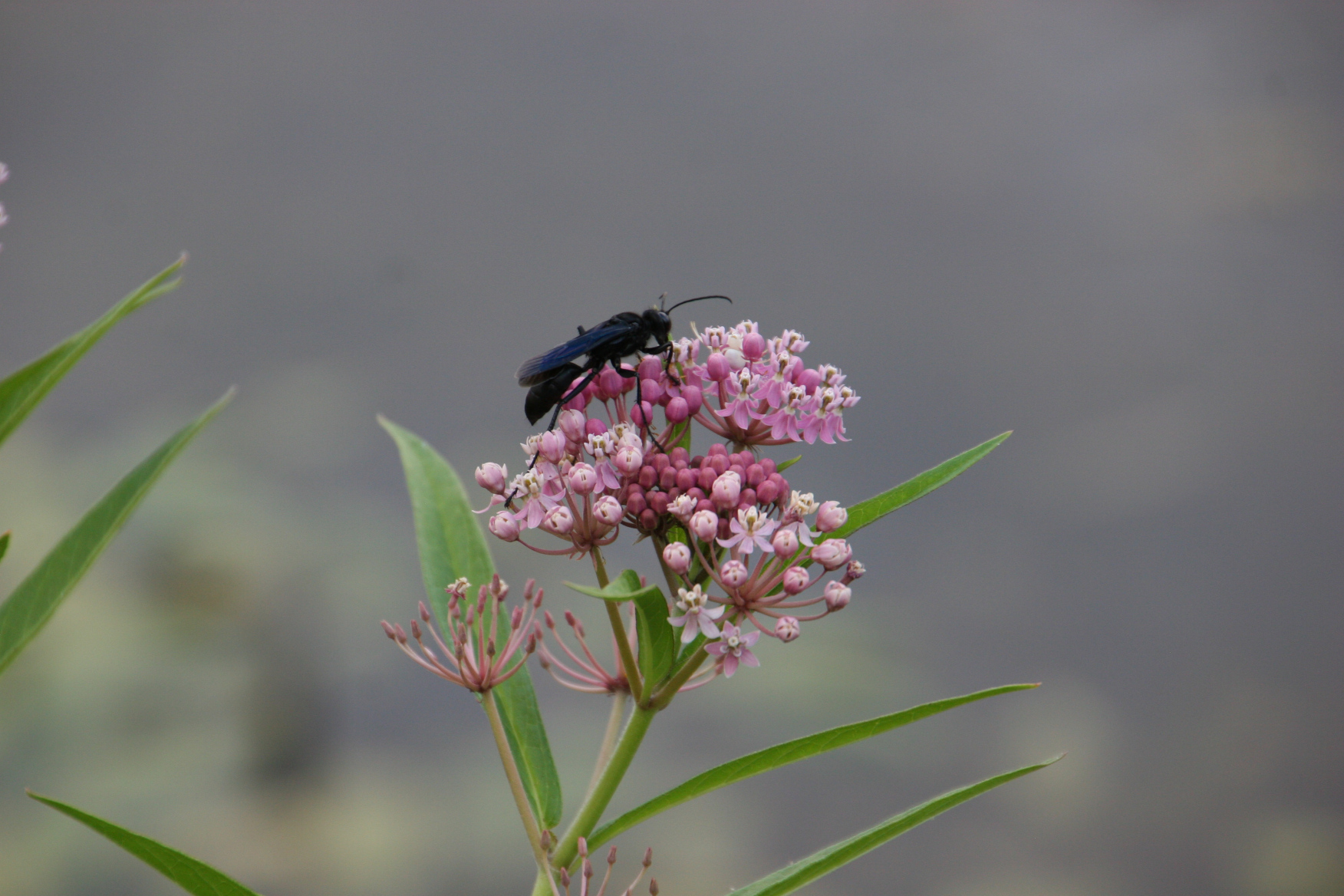
I grow milkweeds in my Faribault yard. I photographed this milkweed flower with an unknown insect atop at the energy park. (Minnesota Prairie Roots copyrighted photo July 2022)
I feel such hope. Within my own family circle, my eldest daughter and son-in-law compost food and bio-degradable paper products. My son owns an e-bike, not a car, his primary mode of transportation between his Indiana apartment and Purdue University. We recycle, donate or give away items we no longer need. Every little bit helps. My young granddaughter wears hand-me-downs from her cousins. Just like her mother before her, whom I outfitted primarily via rummage sale purchases.
Unlike this dead frog flattened ona road at the energy park, thrifting/recycling/upcycling is very much alive. (Minnesota Prairie Roots copyrighted photo July 2022)
Thrifting is in vogue. I recently spoke with a shop owner in Northfield who said local college students flock to her antiques and collectibles store to buy vintage clothing from one particular vendor.
Solar panels inside the park focus on alternative energy. (Minnesota Prairie Roots copyrighted photo July 2022)
Across the Minnesota countryside, solar fields are replacing crop fields. Wind turbines are popping up, too, adding to those that have been around for decades.
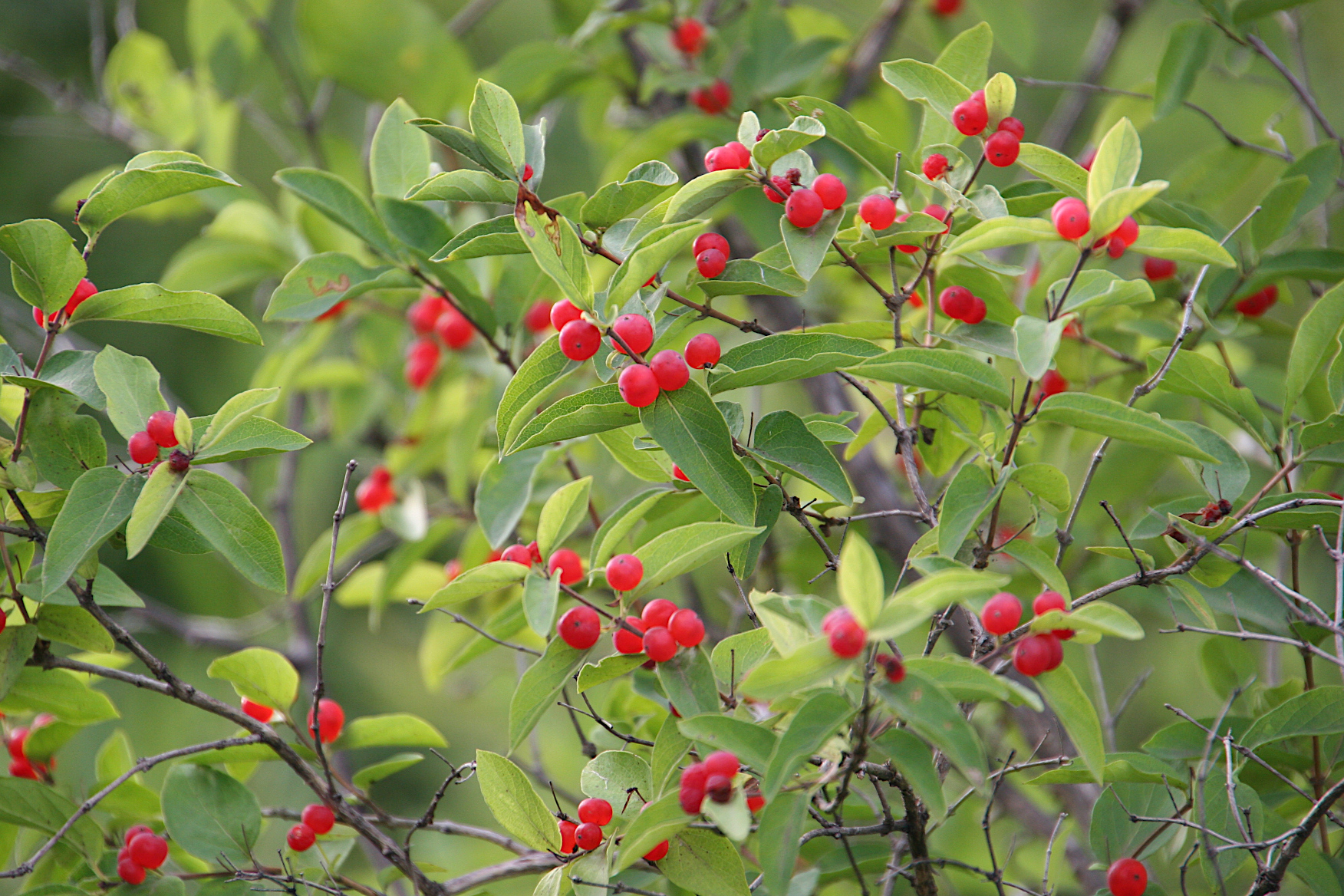
Bold red berries burst color into the park’s landscape. (Minnesota Prairie Roots copyrighted photo July 2022)
It makes a difference—these seemingly small and big changes. A shift in attitudes with a new-found appreciation for our natural world can preserve, and hopefully, improve this place we call home.
A sign posted inside Faribault Energy Park lays out the rules. (Minnesota Prairie Roots copyrighted photo July 2022)
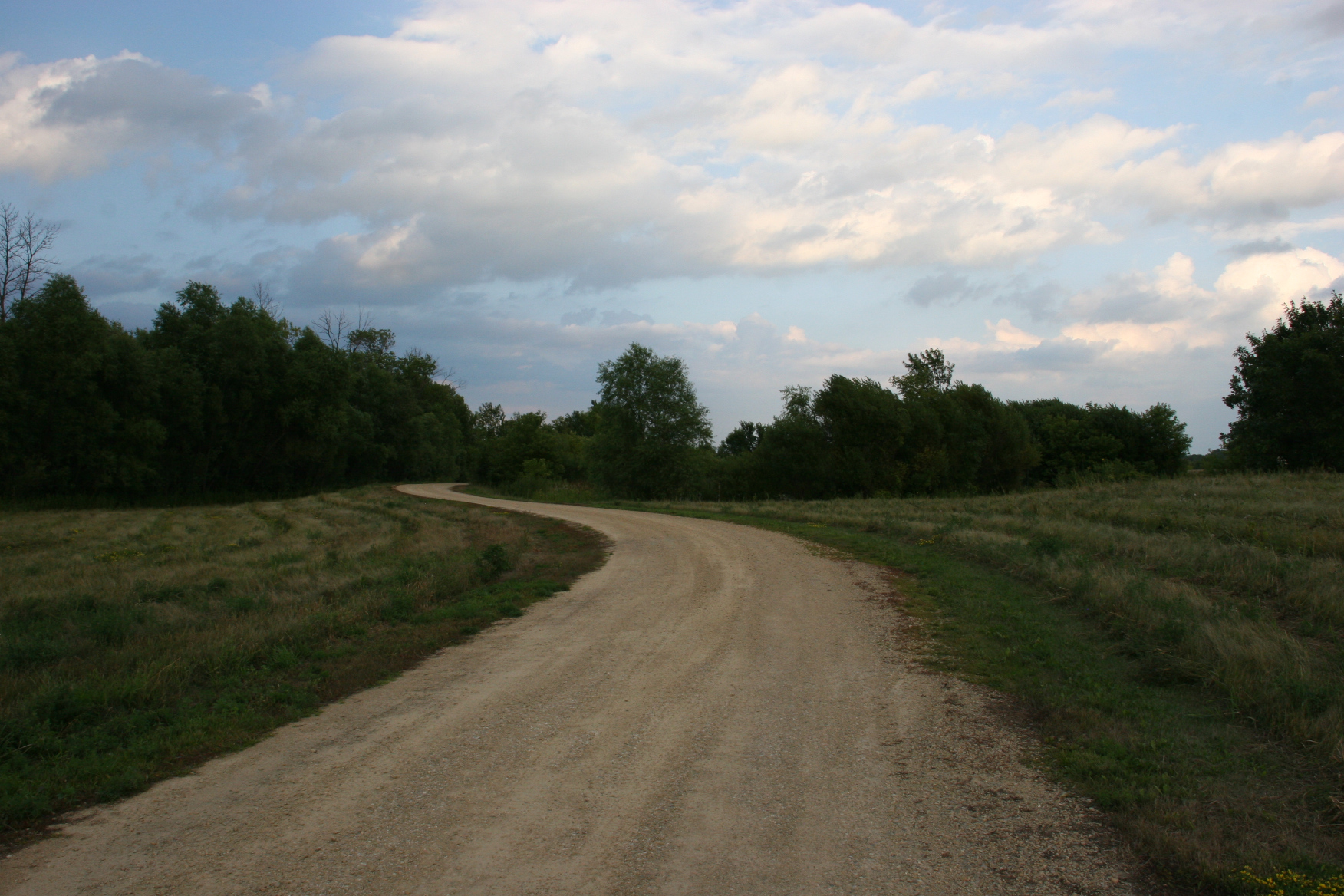
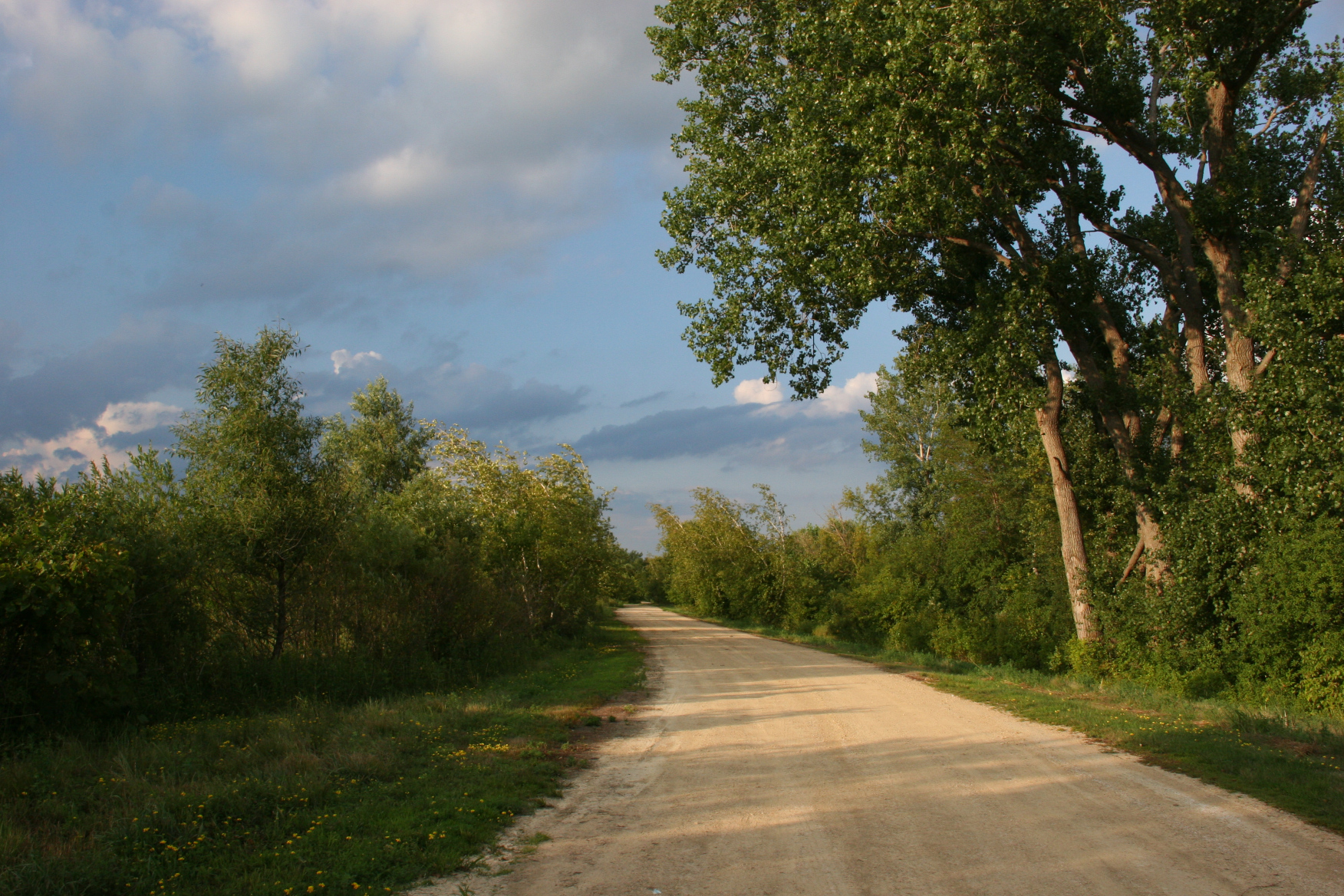
Dirt roads wind around two ponds. (Minnesota Prairie Roots copyrighted photo July 2022)
Although I’ve never been inside this power plant (tours are offered, primarily to schools), I’ve walked the grounds many times. The MMPA created a public park here on its 35 acres of wetlands. I love following the dirt roads that wind around ponds. And while it’s not the most peaceful place given the location along busy Interstate 35, the park still holds an appeal for me.
Beauty even in a thistle growing along pond’s edge. (Minnesota Prairie Roots copyrighted photo July 2022)
On this particular visit, I didn’t see any waterfowl, unusual, but perhaps not due to avian influenza. (Minnesota Prairie Roots copyrighted photo July 2022)
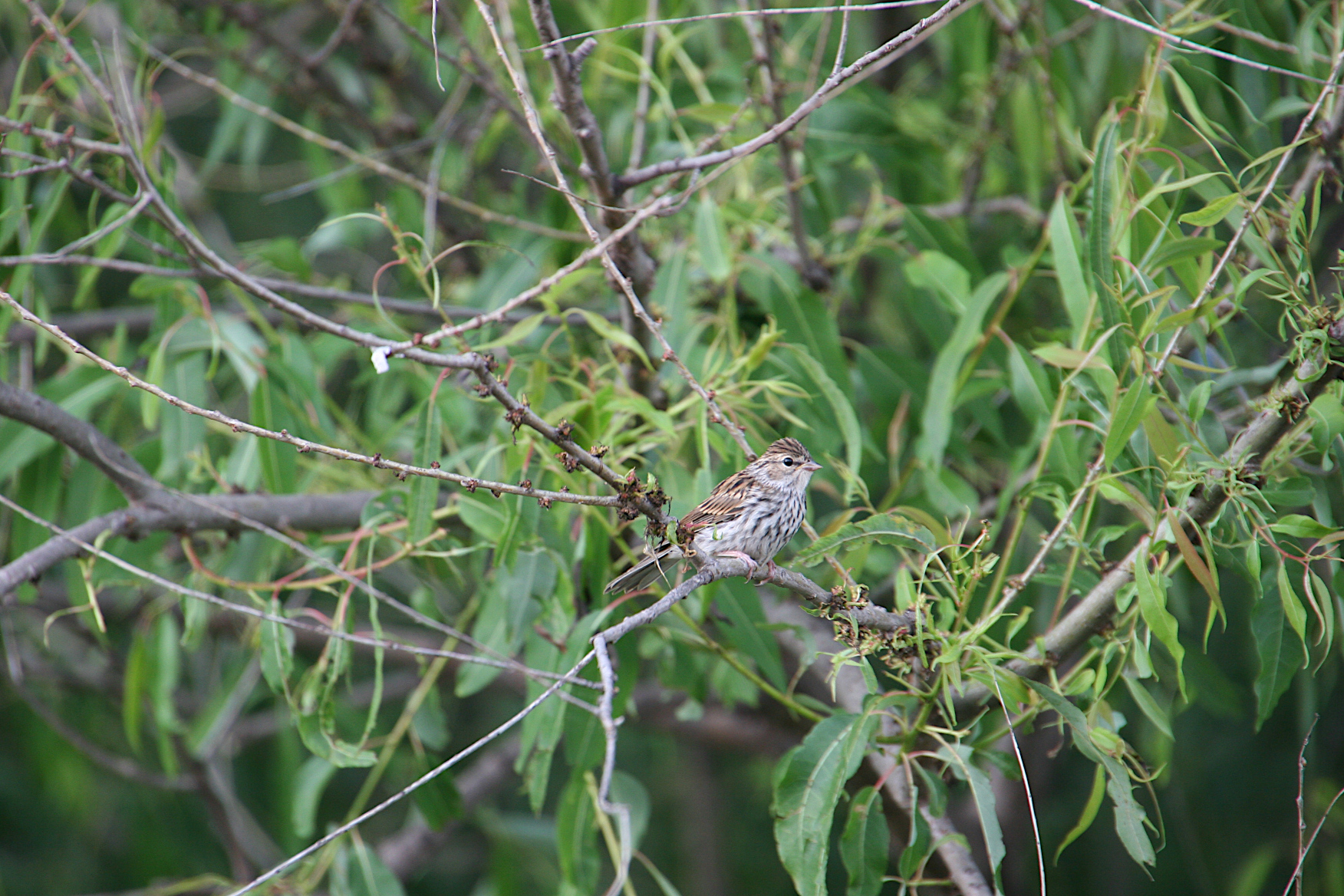
One of many birds observed inside the park. (Minnesota Prairie Roots copyrighted photo July 2022)
That enjoyment comes in vegetation—cattails, flowers, trees, grasses—and in the birds, including waterfowl.
Anglers fish this pond next to the Faribault Energy Park power plant. (Minnesota Prairie Roots copyrighted photo July 2022)
Other visitors fish here, in the large pond next to the power plant. This is also an educational grounds with a massive wind turbine and a stand of solar panels in place.
I especially like walking this park around sunset. (Minnesota Prairie Roots copyrighted photo July 2022)
Combined, these elements remind me that I cannot take the natural world for granted, that I need to be environmentally-aware, that I need to do my part to protect and preserve Earth. I continue to learn, some 50 years after an awareness sparked within me that I really ought to care about this planet on a personal level.
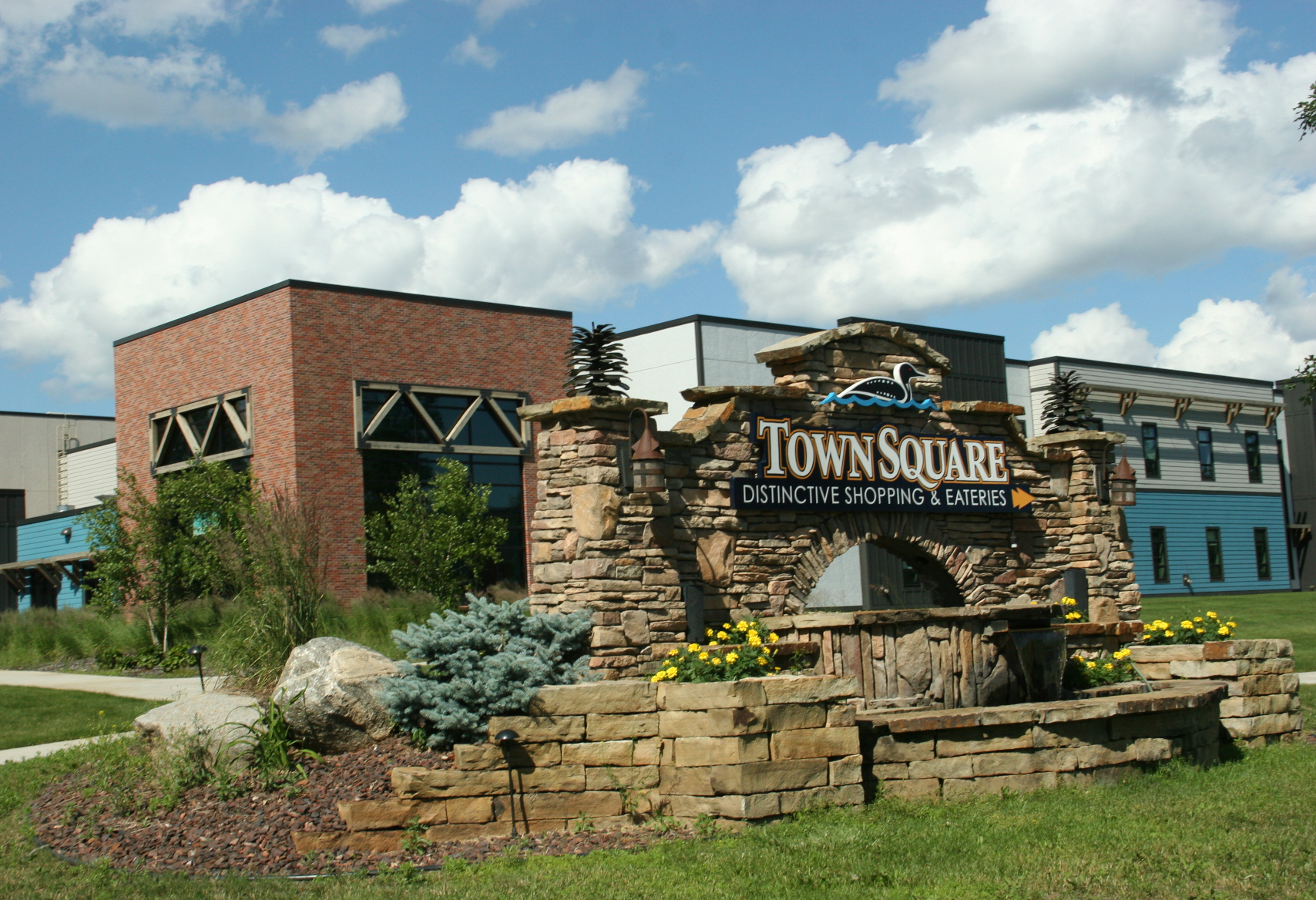
Signage for Crosslake Town Square features a loon graphic. (Minnesota Prairie Roots copyrighted photo July 2022)
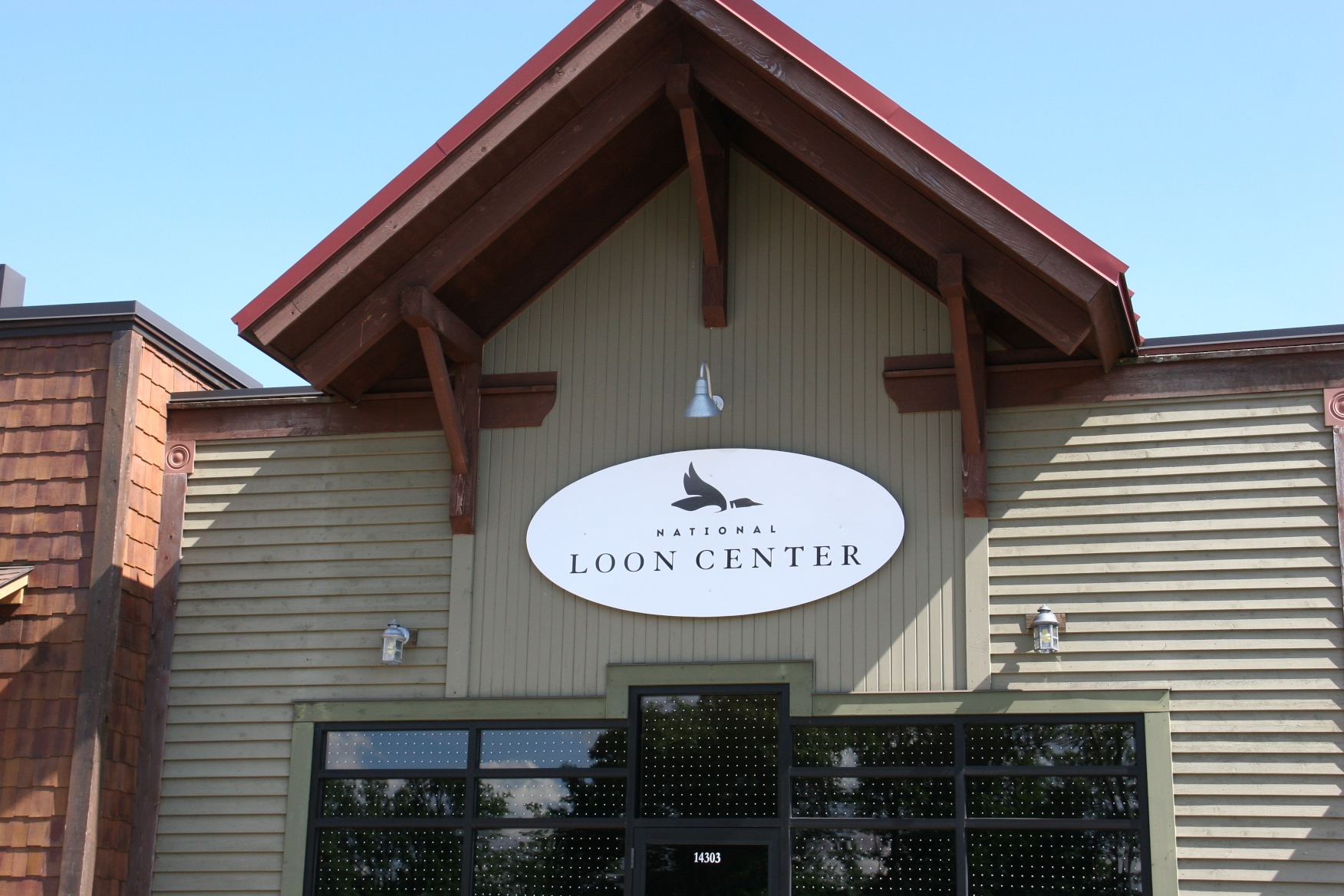
I’m excited about the forthcoming center, which will enlighten me about the Minnesota state bird. Up until I started going Up North to the cabin several years ago, the loon was mostly an unfamiliar bird to me. If there are loons in southern Minnesota, I haven’t seen them. Minnesota is home to an estimated 12,000 loons, their habitat primarily in central and northern lakes.
Photographed from a distance, the loon family on Horseshoe Lake. (Minnesota Prairie Roots copyrighted photo July 2022)
Now each visit to my sister-in-law and brother-in-law’s lake property south of Crosslake, I hope to see loons. This summer I enjoyed plenty of loon watching as a family of four swam the waters on our side of Horseshoe Lake.
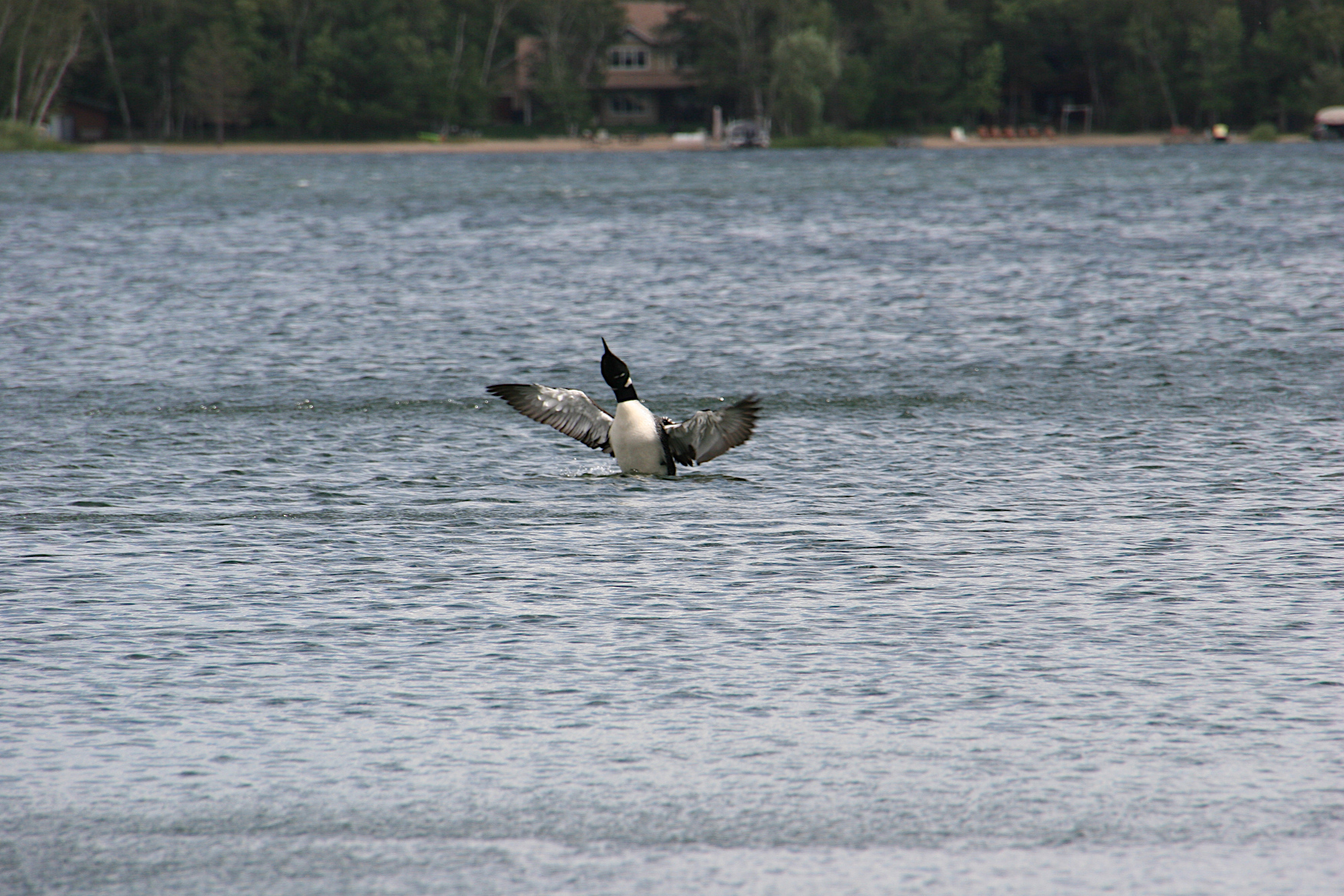
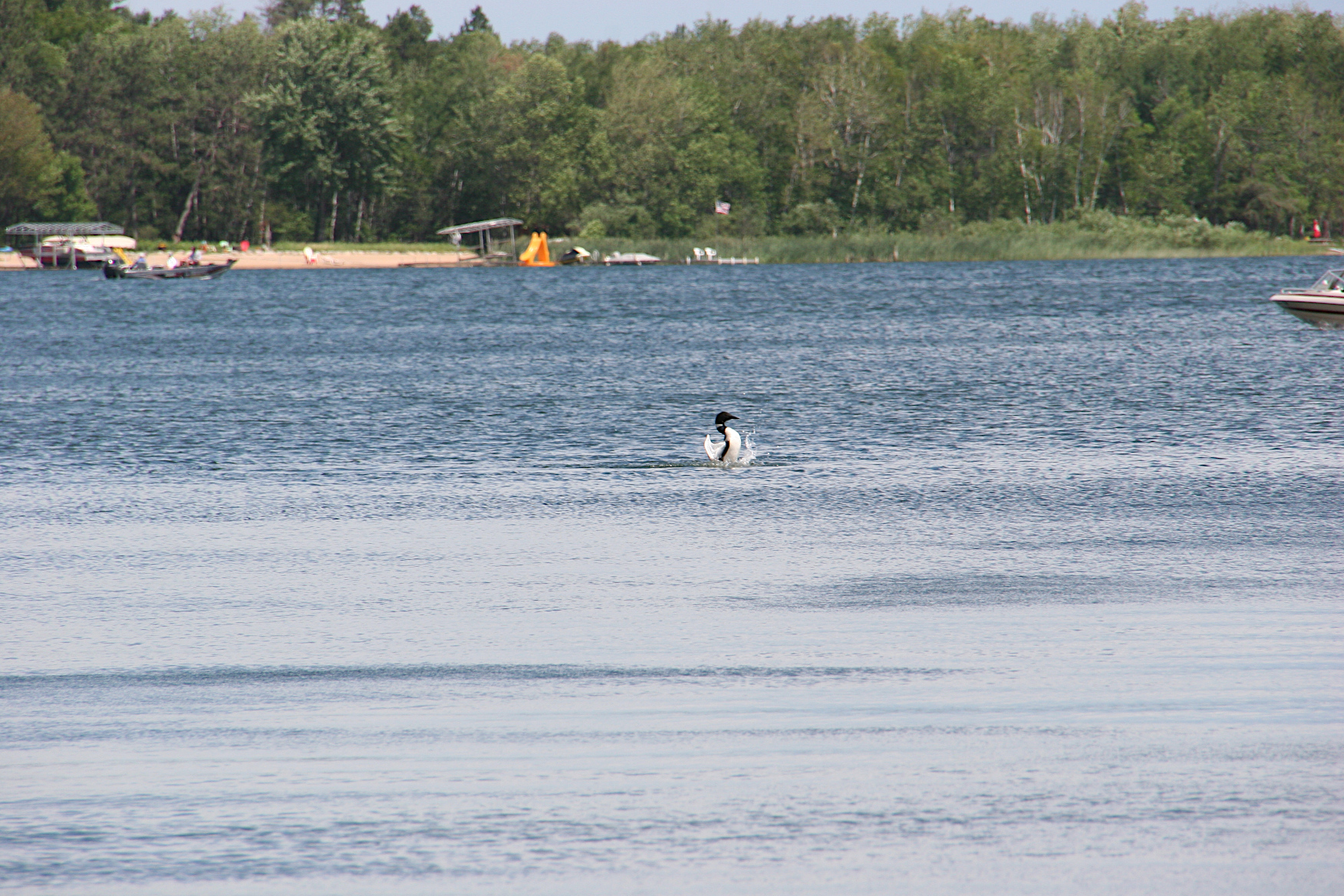
I observed this behavior once, of a loon rising from the lake. (Minnesota Prairie Roots copyrighted photo July 2022)
It’s entertaining to watch these birds swim close together, the parents obviously protecting their two young offspring. It’s interesting, too, to see how the adults dive underwater, resurfacing a significant distance away. I’m especially intrigued by their haunting call. There’s no other word to describe the voice of the loon.
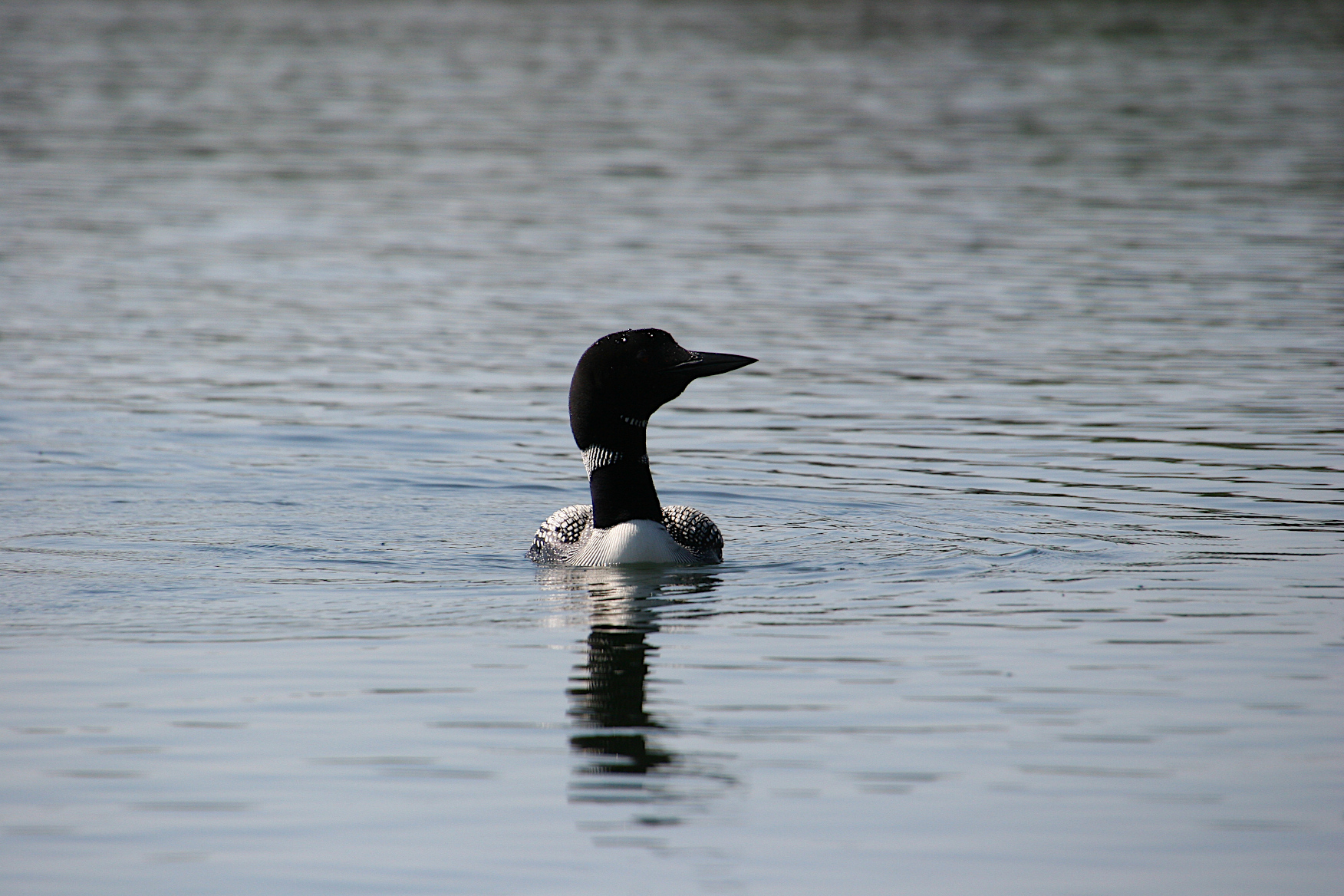
A loon photographed near the Horseshoe Lake cabin dock. (Minnesota Prairie Roots copyrighted photo July 2022)
On our final morning at the cabin in early July, Randy called me to come quick to the dock. The loons were the closest they’d been during our four-day stay. Just off the dock. It was then that I got my best photos. My daughter and granddaughter got even closer when a loon landed next to them while they were paddleboarding during a recent stay at the lake.
To the right in this frame, you can see a boat nearing the loon on Horseshoe Lake. (Minnesota Prairie Roots copyrighted photo July 2022)
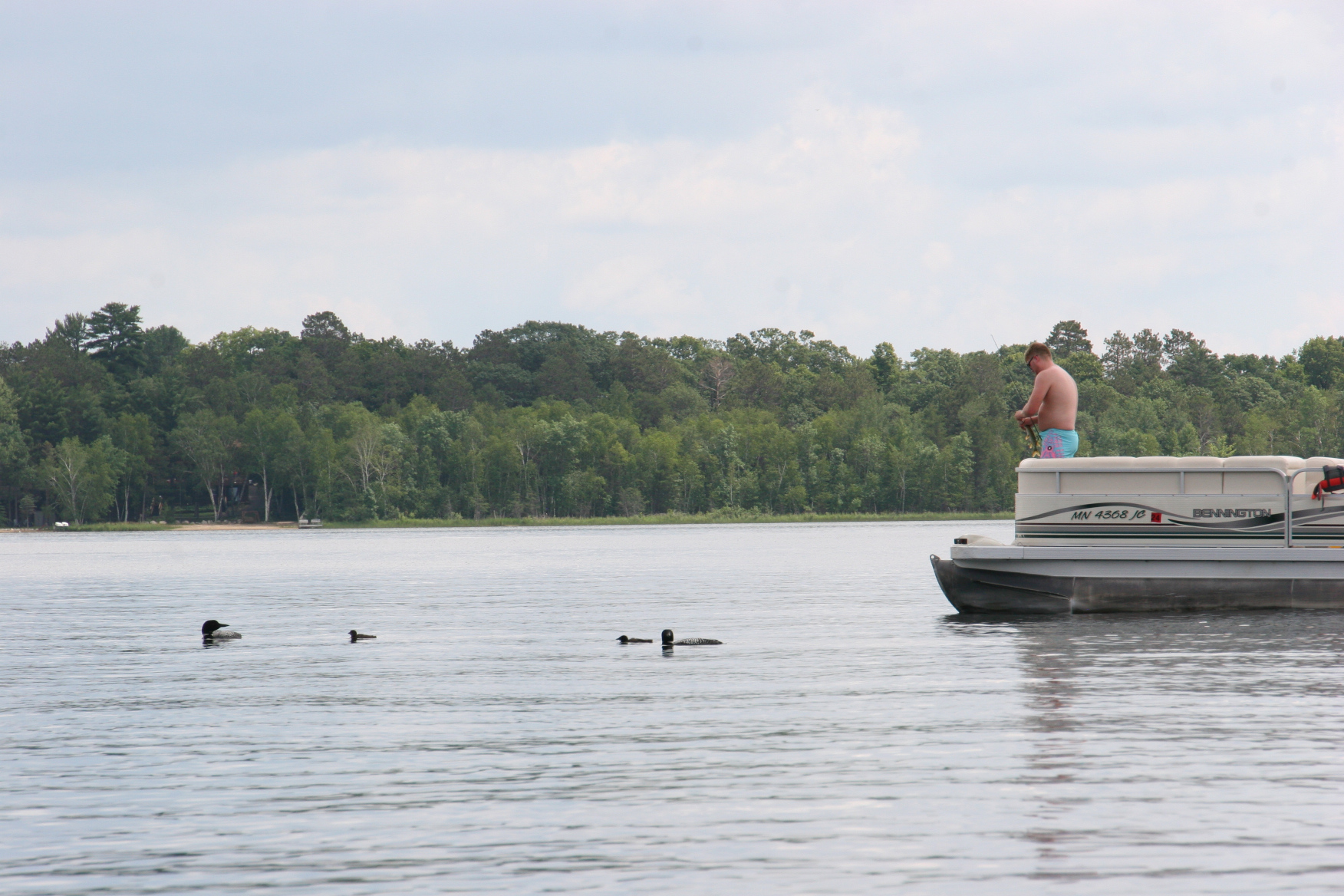
I wonder about the closeness of people to these birds. I worried about recreational boaters speeding across the lake and possibly hitting the loon family. It seemed a real possibility at times. I imagine the speedboats and jet skis and water-skiers stress the loons.
A loon photo graces the side of a truck parked in a parking lot across from Crosslake Town Square. (Minnesota Prairie Roots copyrighted photo July 2022)
Once the Loon Center opens, I’ll be more informed about the red-eyed common loon with the black head and ringed neck and distinctive patterned black-and-white feathers layering over a white body. There’s simply no mistaking a loon’s identity. Adults weigh 7-13 pounds.
A loon family and a boater mingle on Horseshoe Lake. (Minnesota Prairie Roots copyrighted file photo July 2022)
This lovely and distinct bird symbolizes not only Crosslake and the surrounding area, but Minnesota. In 2019, Minnesota lawmakers appropriated $4 million for the National Loon Center. Fundraising is also part of the financing plan. In the end, the loons will benefit as the center aims to protect and restore loon habitat, to research this beautiful waterfowl and to teach all of us about our state bird.
TELL ME: Have you seen a loon? I’d like to hear about your observations of loons.
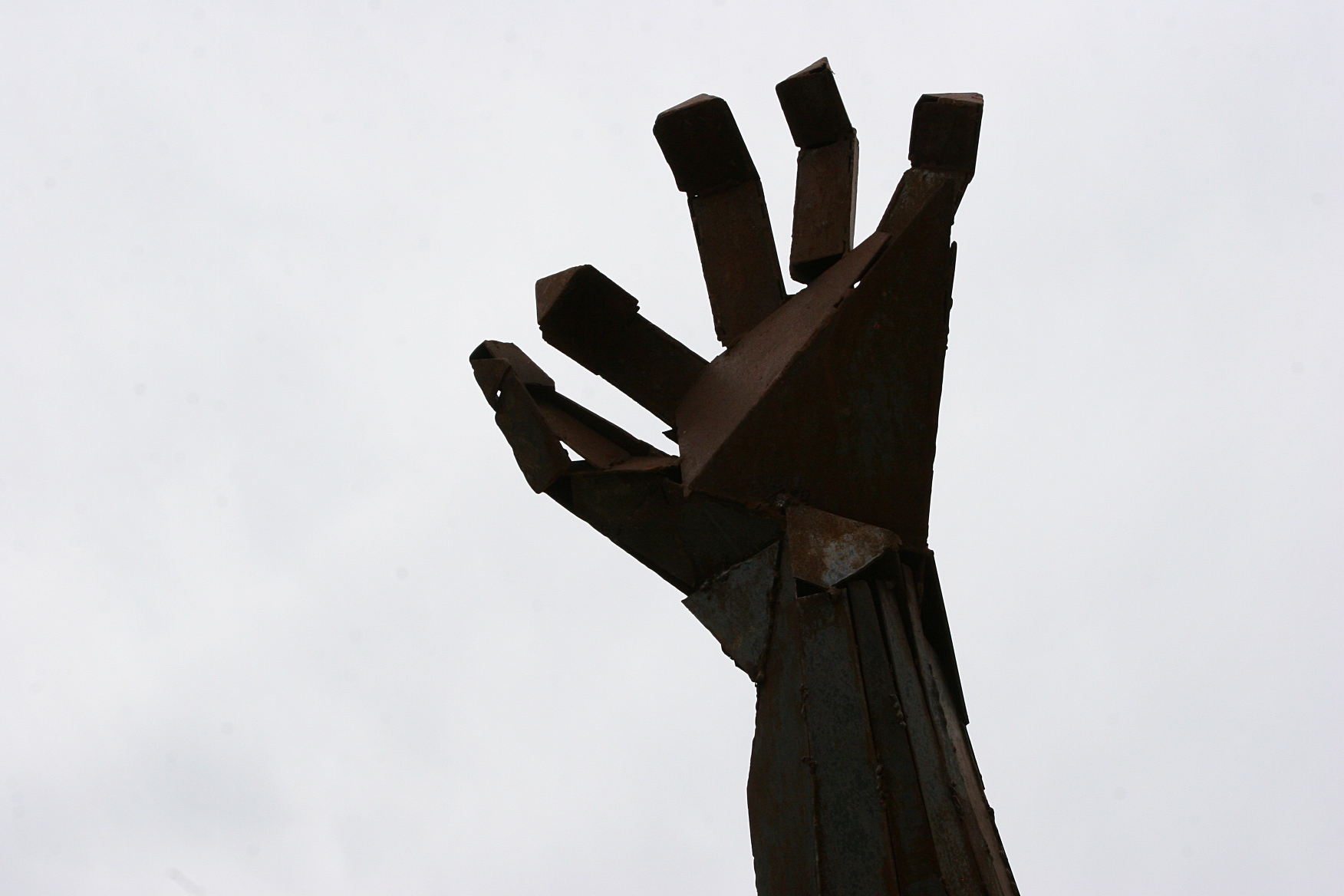
A hand reaches skyward in a mental health themed sculpture that once graced a street corner outside the Northfield, Minnesota, Public Library. (Minnesota Prairie Roots copyrighted file photo 2019)
WHEN HE HEARD ME rant for the umpteenth time about “people just don’t get it, they don’t understand,” he advised, “Then you need to educate them.”
He, my husband of 40 years, is right. Venting to Randy about offensive terminology and uninformed/misinformed comments and attitudes about mental illness does nothing other than temporarily ease my frustrations. Speaking out, writing, based on my observations and experiences, can make a difference. So write about my concerns I will, with the disclaimer that I am not a medical professional.
I photographed this shirt at an event at the Northfield Public Library. This message refers to the struggles with mental illness. (Minnesota Prairie Roots copyrighted file photo September 2019)
WORDS MATTER
Today—on the heels of recent offensive lyrics by Beyonce’—seems the right time to share what’s bothered me for way too long. The pop singer used the derogatory term, “spaz/spazzin,” in her new release, “Heated.” Although she was referencing spastic diplegia, a form of cerebral palsy causing motor impairments in limbs, and not mental health, the analogy fits. Her word choice proved offensive to people who are disabled. And rightly so. To her credit, Beyonce’ acknowledged her unintentional slur and is changing the lyrics. Just like Lizzo, who used the same wordage not all that long ago.
For the millions who each day bravely face mental health challenges and for those who love them, everyday careless language can hurt. Words like crazy, insane, nuts, it’s all in their head, off their rocker, out of his/her mind…are hurtful. As hurtful as the lyrics sung by Beyonce’ and Lizzo.
Recently, while reading a Good Morning America Book Club selection published in 2021, I came across this phrase: “the usual terrible but addictive schizophrenic medley.” In the context of this fictional story, the character was not talking about anything mental health related, but rather about what she was seeing on Instagram. I stopped reading and considered how insulting those words, especially to someone diagnosed with schizophrenia. I doubt the author intended to offend. But she did.
Buttons previously available for the taking at the Northfield library. (Minnesota Prairie Roots copyrighted file photo)
IF YOU HAD…
Now you might say I’m being overly-sensitive. But consider if you, or someone you loved, was diagnosed with cancer, diabetes, whatever, and uncaring words (which I can’t even think of) were tossed out there. It’s no different for those diagnosed with bi-polar, schizophrenia, depression, anxiety, post traumatic stress disorder…
I’m thankful individuals undergoing cancer treatment and/or who have survived cancer, for example, are not subjected to negative/offending words and behavior, but rather are supported with encouragement, fundraisers, even hot dishes delivered to their homes. That type of care and attitude should be a model for how all of us treat individuals dealing with a mental health crisis and their families. We should respond with equal love, compassion, care and understanding. And tangible support.
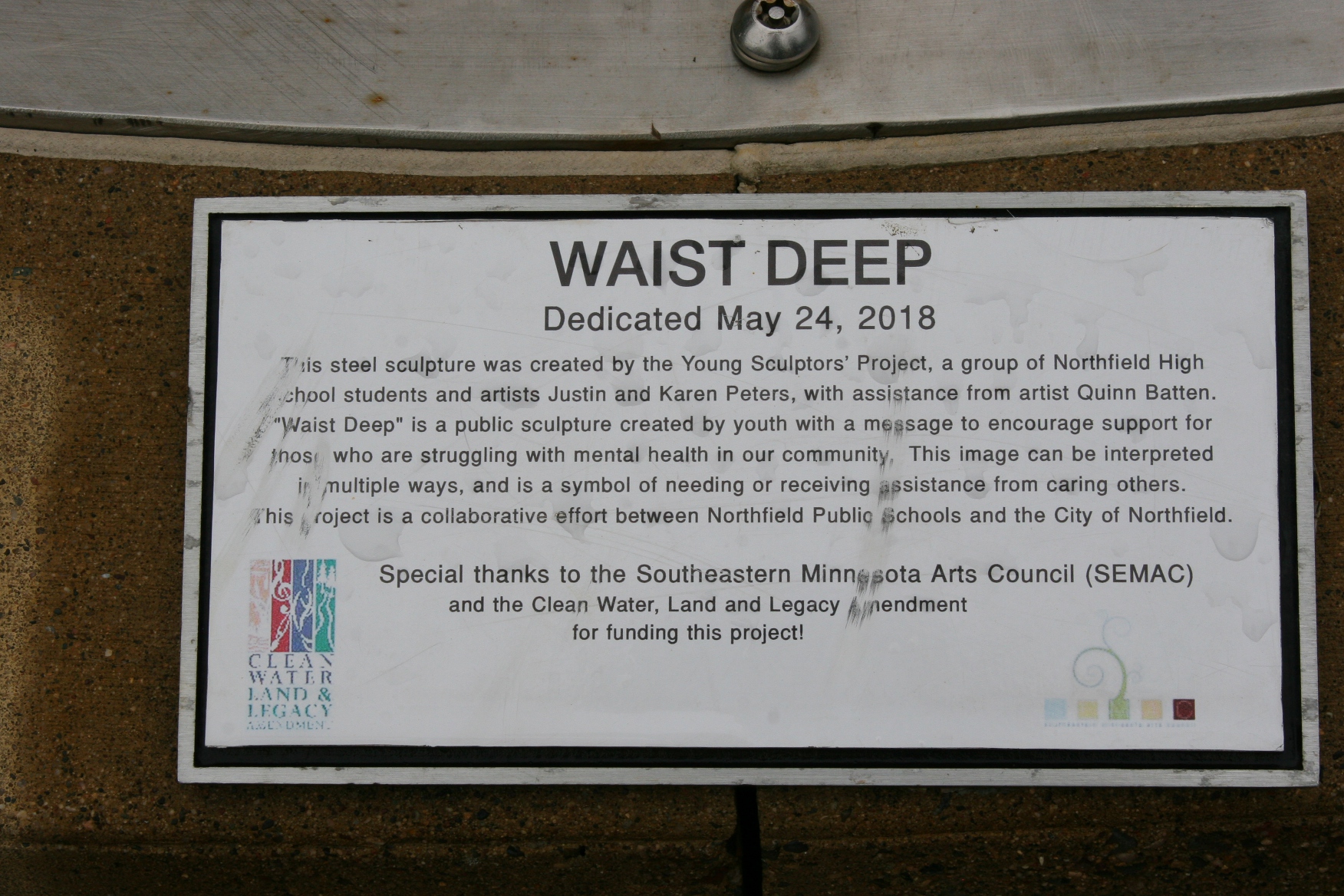
A sign explains the story behind the “Waist Deep” sculpture in Northfield. (Minnesota Prairie Roots file photo September 2019)
CHANGING ATTITUDES, BUT MORE IS NEEDED
I recognize attitudes toward mental health are changing, that, as a whole, we are growing more informed, finally beginning to reduce the stigma of brain disorders. But much work remains. Individuals in a mental health crisis should have immediate access to care. Busy, understaffed emergency rooms are often the first-line treatment option. I don’t know of a single doctor who would send a person experiencing a heart attack home. Individuals in a mental health crisis, the equivalent of a heart attack, deserve the same immediate life-saving care. Yet the wait to see a psychiatrist often exceeds six weeks, at least here in greater Minnesota. That’s unacceptable.
There’s a need for more mental healthcare professionals and in-patient treatment and recovery centers. There’s a need for more funding, more research. Insurance companies should not determine care/medications or refuse to fully cover mental healthcare expenses.
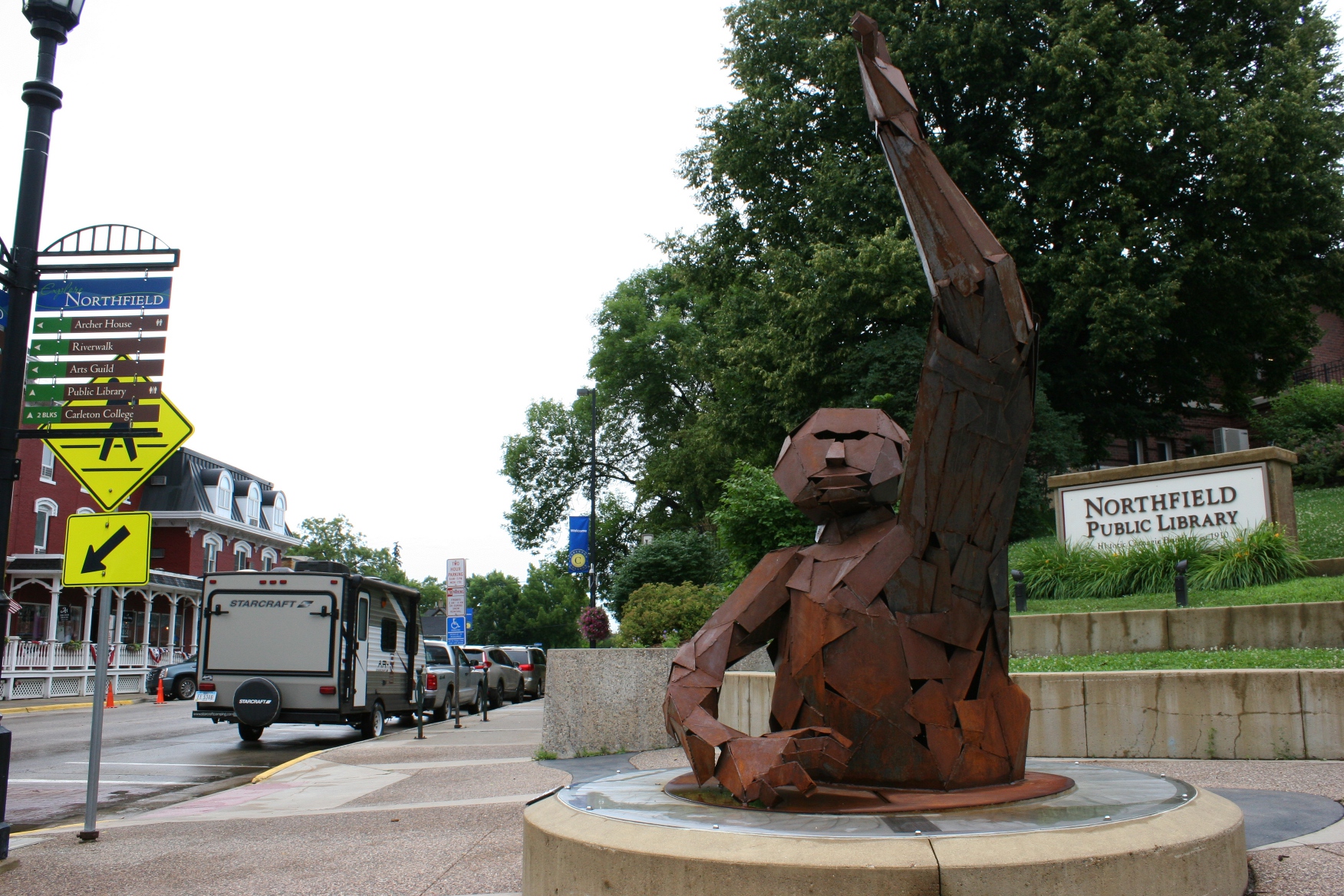
This sculpture, once located outside the Northfield library, is called “Waist Deep” and addresses mental illness. (Minnesota Prairie Roots copyrighted file photo 2019)
IT STARTS WITH EACH OF US
At a grassroots level—that’s each of us individually—more compassion, support, understanding are needed. A few years ago I walked into a southwestern Minnesota brewery and spotted a man sporting a jacket advertising a neighboring brewery. Imprinted on the back was an image of a straitjacket. I could not believe what I was seeing, especially after also reading the offensive name of the brewery. Later I looked online to read the brewery’s list of “Crazy Good Beer” with words like manic, catatonic, lobotomy, kookaloo… in the craft beer names. Simply writing this makes my blood pressure rise. I wanted to rip that jacket right off that beer drinker, so strong was my anger in that moment. Imagine the uproar, for example, if a brewery used words like chemo or radiation in its beer names or used an IV drip as its logo. Somehow a straitjacket is OK? Not from my perspective.
Imagine, too, if you have gone through cancer treatment and someone said you will be fine now that you’ve completed treatment. In the back of your mind, you recognize that the cancer could return despite the treatment. It’s no different for someone with a serious mental illness. Drugs work for awhile and then they don’t. Medications and therapy help manage symptoms, but there is no cure. Symptoms can return. Relapses, crises, happen.
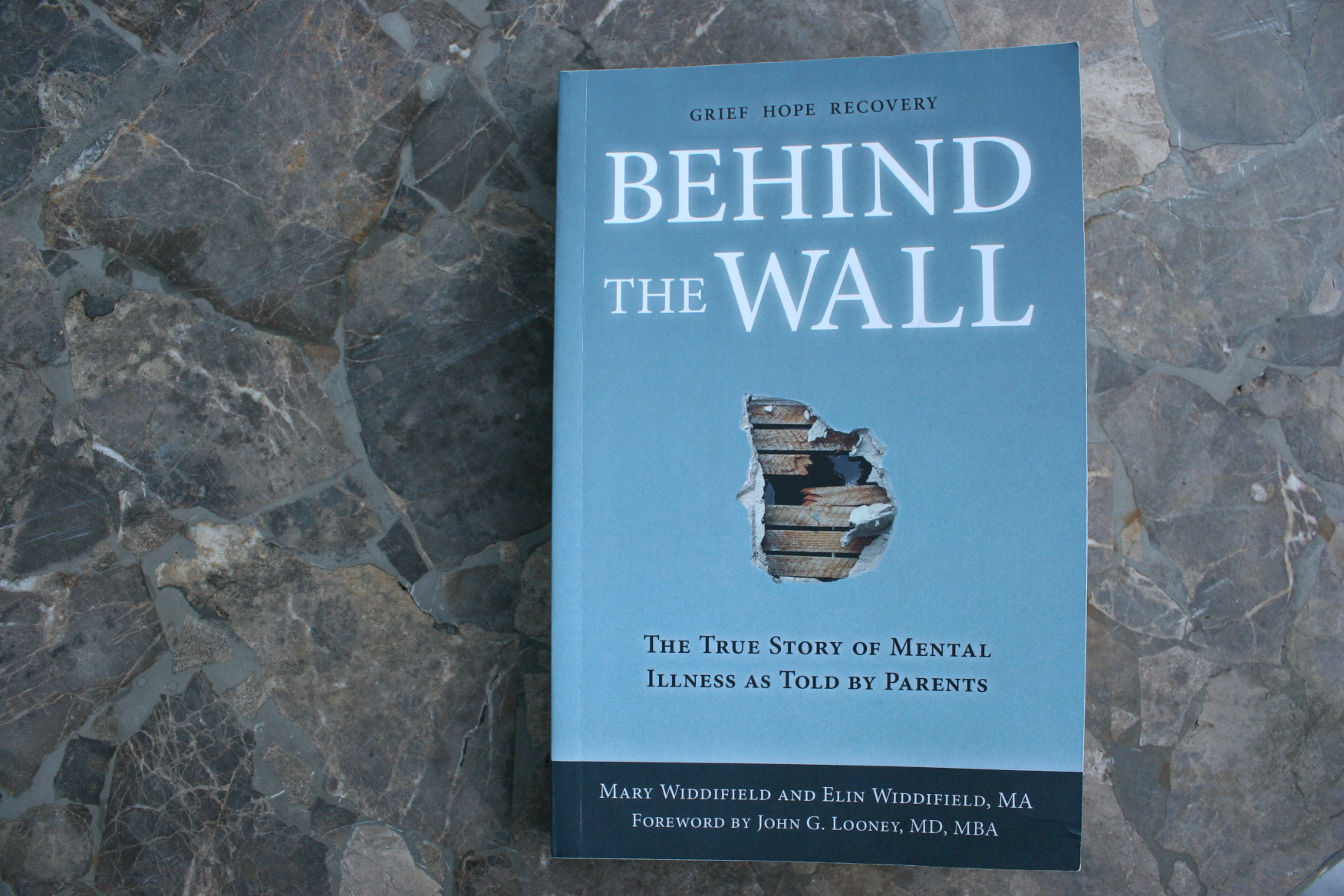
I highly recommend this book, among many I’ve read on the topic of mental illness. (Minnesota Prairie Roots copyrighted file photo)
GRATITUDE & RESOURCES
I appreciate every single person who has made a concerted effort to understand mental health, mental illness specifically. I appreciate organizations like the National Alliance on Mental Illness, which works tirelessly to support individuals and their families who face mental health challenges. I appreciate NAMI’s advocacy work and education. I appreciate mental healthcare professionals. And, most of all, I admire those individuals who deal with mental illness—whether depression, anxiety, post traumatic stress disorder, schizophrenia, bi-polar… They are among the strongest people I know and they deserve, yes, deserve, our love, compassion, understanding, support and respect.
This message refers to the struggles with mental illness. (Minnesota Prairie Roots file photo September 2019)
A DAY BEFOREMental Health Awareness Month began on May 1, the Judd family lost their beloved Naomi “to the disease of mental illness.” She was a wife, a mother and a country western superstar singer. That the family chose to publicly attribute Naomi’s cause of death to mental illness shows strength and honesty. And a desire to increase awareness.
On my reading list…
Naomi was open about her severe, treatment resistant depression. She wrote about her mental illness in a book, River of Time: My Descent into Depression and How I Emerged with Hope, in 2016. I have yet to read this book, but I will. Soon.
Reflecting on Naomi’s death focused my thoughts on the many books I’ve read in recent years about mental health related topics. I’ve reviewed numerous books on my blog and written on the topic often. Why? Because I care. I care that people understand depression, bipolar, schizophrenia, anxiety… I care that we show compassion, support, encouragement and more to those dealing with these often overwhelmingly challenging and debilitating diseases. I care that stigmas vanish, that treatment options improve, that access to mental health care is easily and readily available to anyone anywhere anytime.
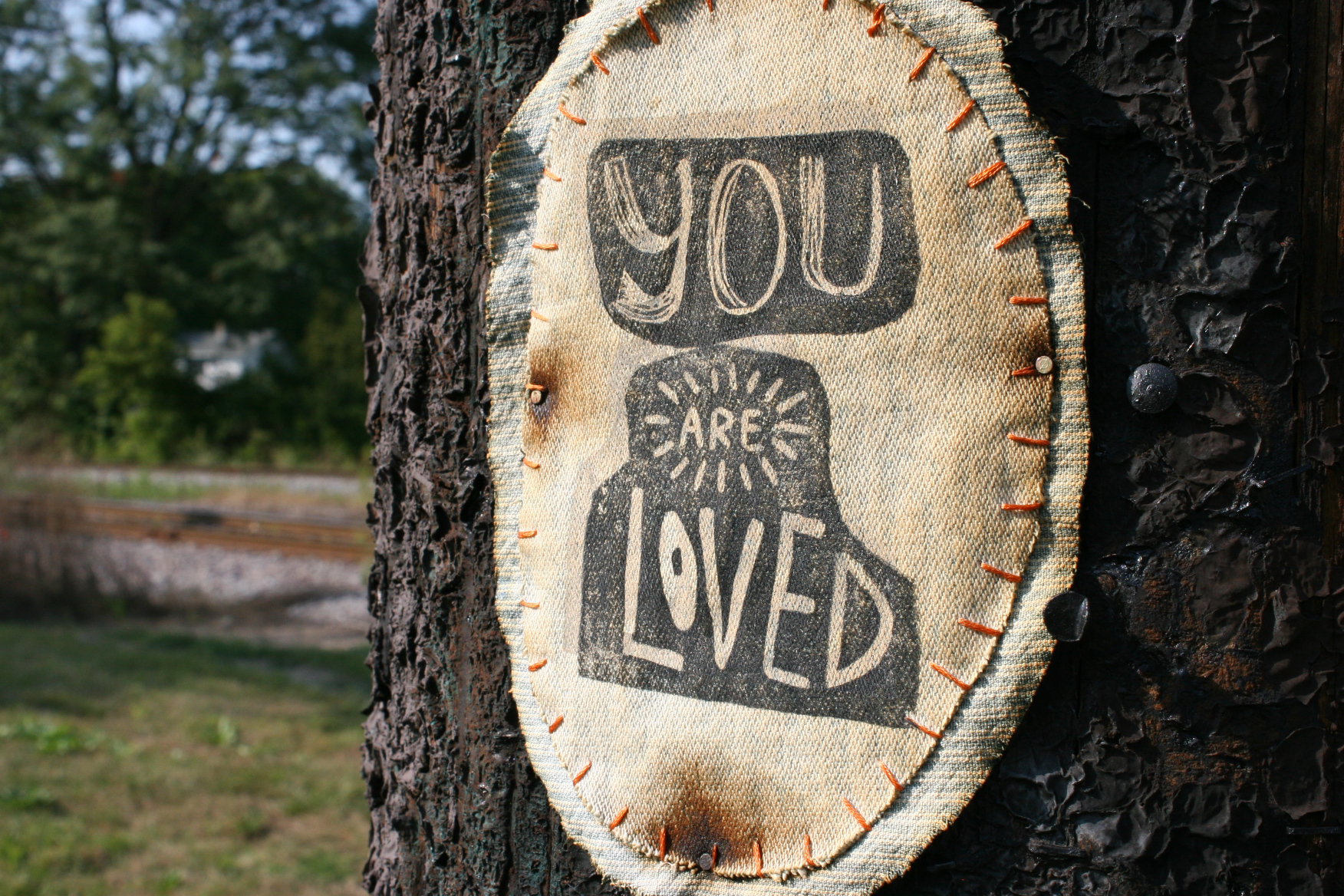
Love this message posted along a recreational trail in the Atwood Neighborhood of Madison, Wisconsin. (Minnesota Prairie Roots copyrighted file photo)
I care, too, that no one feels alone. That anyone dealing with a mental health issue understands they are loved, valued and cherished. That families, too, feel supported.
Much progress has been made in recent years to shine the light on mental health. I appreciate that. And I appreciate the efforts of groups like the National Alliance on Mental Illness. But, still, it is up to each of us individually to do what we can to educate ourselves and increase awareness, to offer love and support… To be there. To listen. To recognize the value of professional help.
Clinical depression like Naomi Judd experienced is deep and dark and debilitating. She couldn’t talk herself/smile herself/lift herself out of the depths of such depression. Not alone. That’s what we all need to understand. Hers wasn’t situational depression. Hers was persistent, powerful, all-encompassing. And, in the end, it killed her.
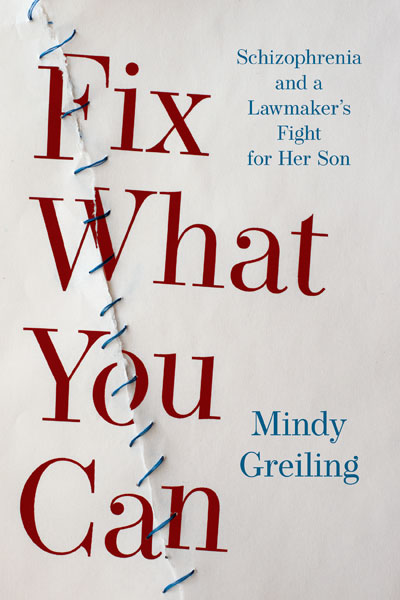
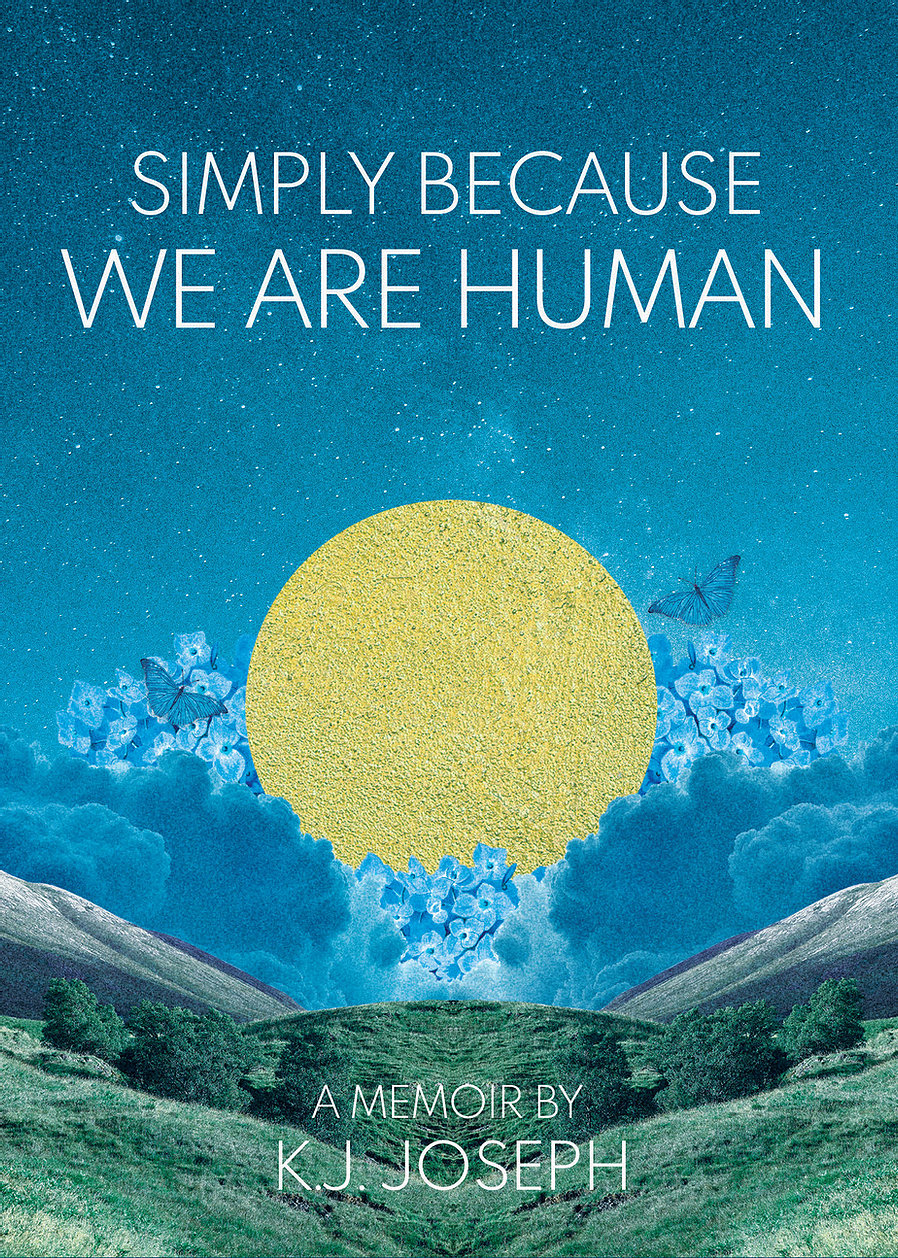
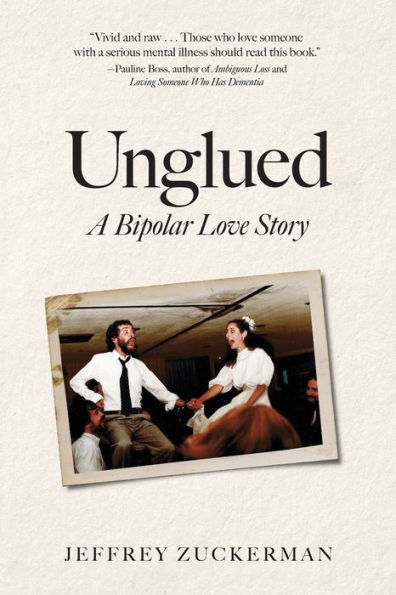
I find that reading or hearing personal stories is often the best way to understand anything. That includes mental health. For that reason, I recommend you read one or more of the following books, which I’ve previously reviewed on this blog (click on the title to read my review):
I highly-recommend this book, which is why it tops my list. (Minnesota Prairie Roots copyrighted file photo)
A must-read for connecting and ministering within faith communities.
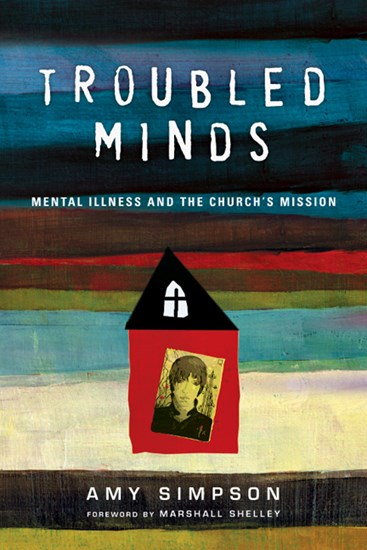
One other book, which I’ve read and highly-recommend (but have not reviewed) is Troubled Minds—Mental Illness and the Church’s Mission by Amy Simpson. A friend referred me to this book and it’s a must-read. I’ve marked the pages with about a dozen Post-It notes. It’s that good, that invaluable for faith communities. Anyone really.
Thank you for reading this post. Thank you for caring about mental health. Thank you for doing your part to shine the light. To be the light.
#
TELL ME: Are there any books about mental health that you recommend? Or, if you have other thoughts to share on the topic, please do. We can all learn from one another.
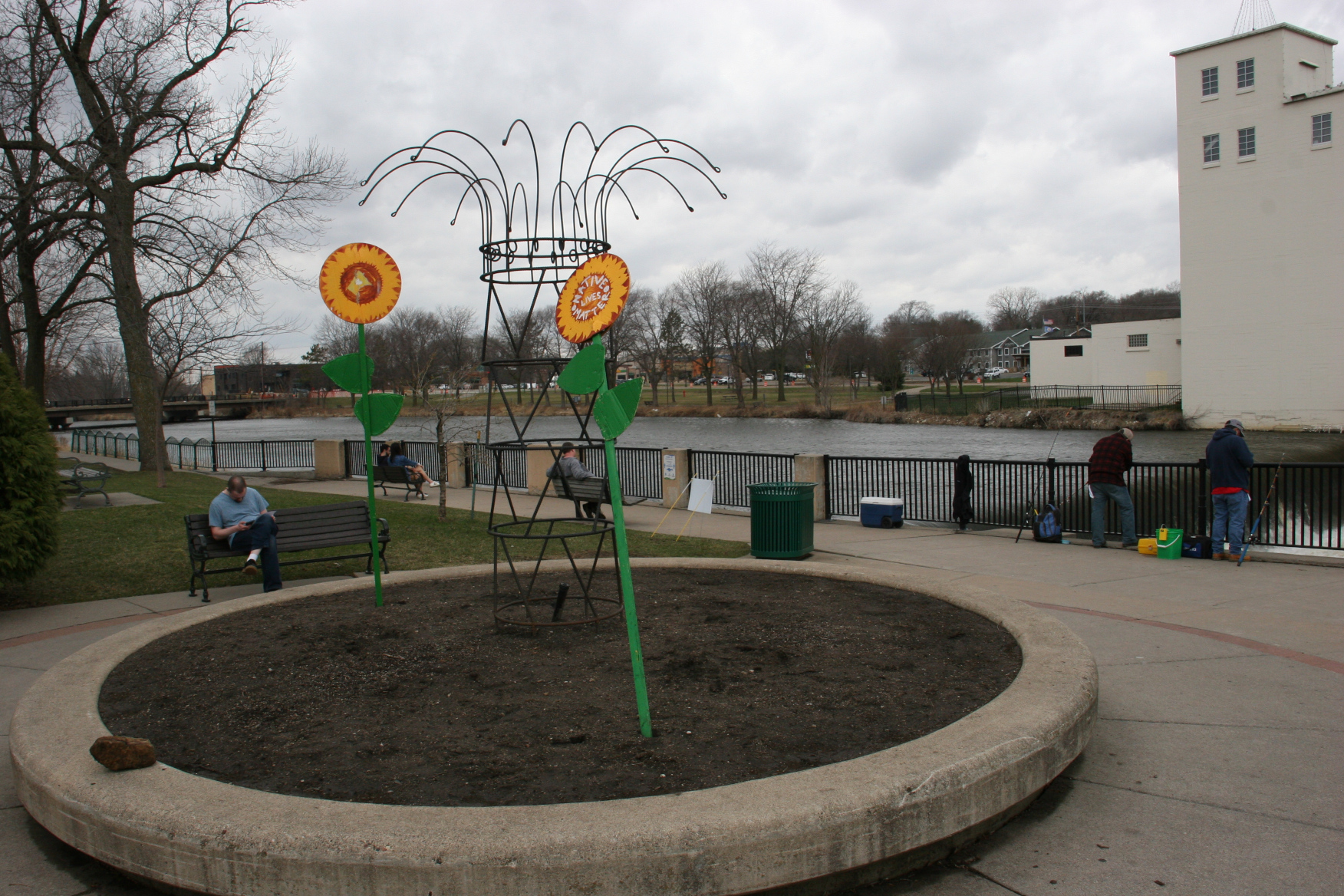
Part of a temporary public art installation at Northfield’s Earth Day Celebration. (Minnesota Prairie Roots copyrighted photo April 2022)
IN THE GEOGRAPHICAL BACKGROUND of my childhood, I knew of the “Indian Reservations” to the northwest near Granite Falls and then to the east near Morton. My hometown of Vesta sits between the two, no longer referred to as “reservations” but as the Upper Sioux Indian Community and the Lower Sioux Indian Community.
A Dakota man and Alexander Faribault are depicted trading furs in this sculpture at Heritage Park near the Straight River and site of Faribault’s trading post. Ivan Whillock created the sculpture which graces the Bea Duncan Memorial Fountain in my community of Faribault. (Minnesota Prairie Roots copyrighted file photo 2012)
Today I live 120 miles to the east in Faribault, next to Wapacuta Park. Rice County is the homeland of the Wahpekute (not Wapacuta), a tribal band of the Dakota.
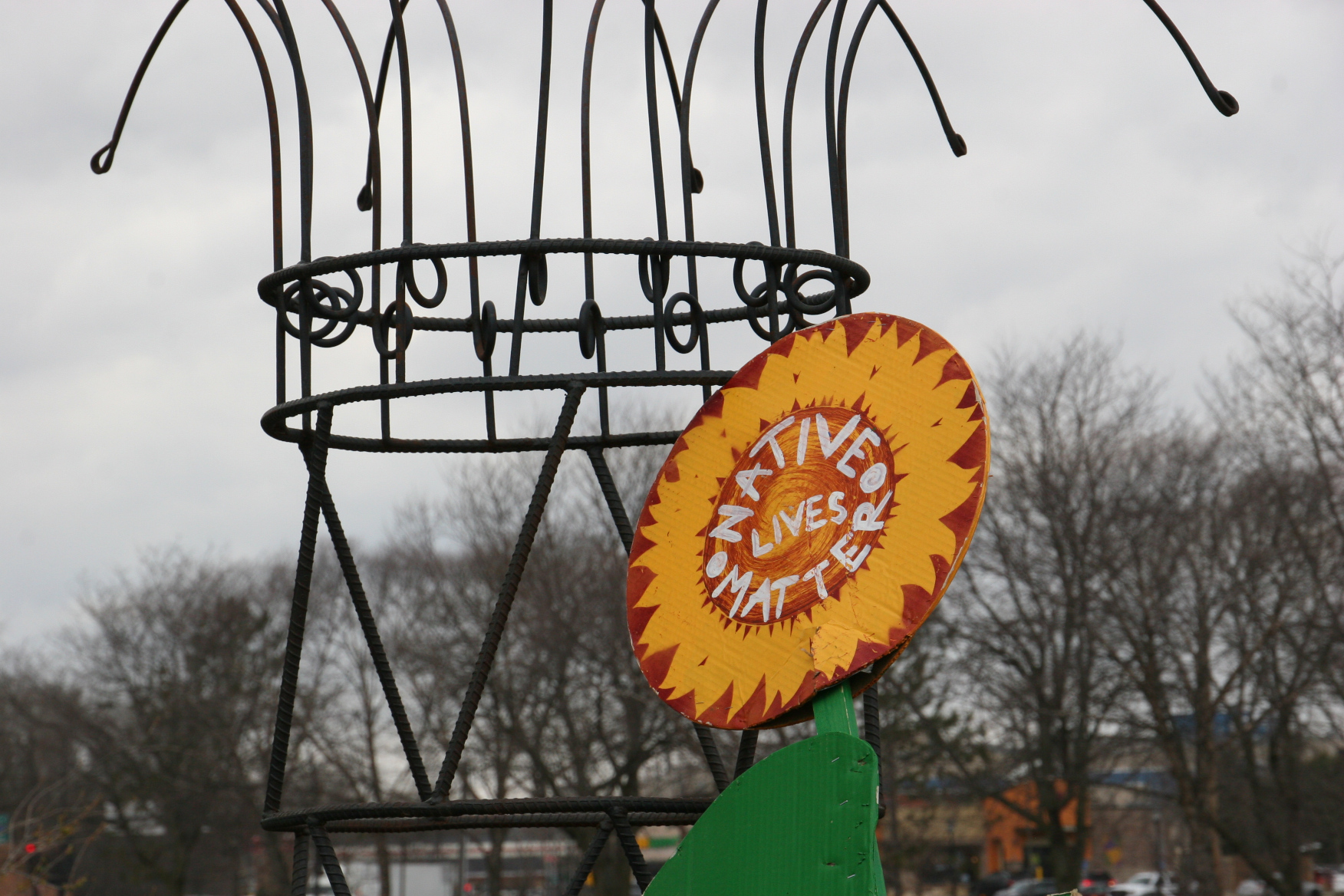
The Earth Day art carried two messages: NATIVE LIVES MATTER and CLIMATE JUSTICE. (Minnesota Prairie Roots copyrighted photo April 2022)
A temporary public art installation at the recent Earth Day Celebration in neighboring Northfield prompted me to reflect on Indigenous people in southern Minnesota. Growing up in Redwood County, my knowledge of area Native Americans focused primarily on “The Sioux Uprising.” History teachers then used that term, rather than the current-day “US-Dakota War of 1862,” which should tell you a thing or ten about how biased that perspective back in the 1970s. How thankful I am that my awareness and understanding have grown and that attitudes are shifting to better reflect all sides of history.
The message grows, blossoms in the Earth Day art. (Minnesota Prairie Roots copyrighted photo April 2022)
We stand on the homelands of the Wahpekute and other Bands of the Dakota Nation. We honor with gratitude the people who have stewarded the land throughout the generations and their ongoing contributions to this region. We acknowledge the ongoing injustices that we have committed against the Dakota Nation, and we wish to interrupt this legacy, beginning with acts of healing and honest storytelling about this place.
NATIVE LIVES MATTER fits the spirit of the Land Acknowledgment Statement. Those three words caused me to pause, to think, to consider what I’d been taught all those decades ago and how my thinking has shifted as I’ve aged, opened my mind and learned.
Dakota beadwork displayed and photographed at the Rice County Historical Society Museum, Faribault, in 2010. (Minnesota Prairie Roots copyrighted file photo 2010)
The Rice County Historical Society, which exhibits a collection of Native American artifacts in its Faribault museum, shares a statement similar to the City of Northfield’s on its website:
We acknowledge that the land that is now Rice County, MN, was their (Dakota) homeland and for many tribal members today, it is still their home.
In all of this, I feel a sense of gratitude regarding increasing public recognition of the land history and contributions of Indigenous People in Minnesota. In my home area of Redwood County, nearly 1,000 individuals from the Mdewakanton Band of Dakota call the Lower Sioux Indian Community home. To the east in Yellow Medicine County near Granite Falls, nearly 500 individuals from the Dakota Oyate call the Upper Sioux Indian Community home.
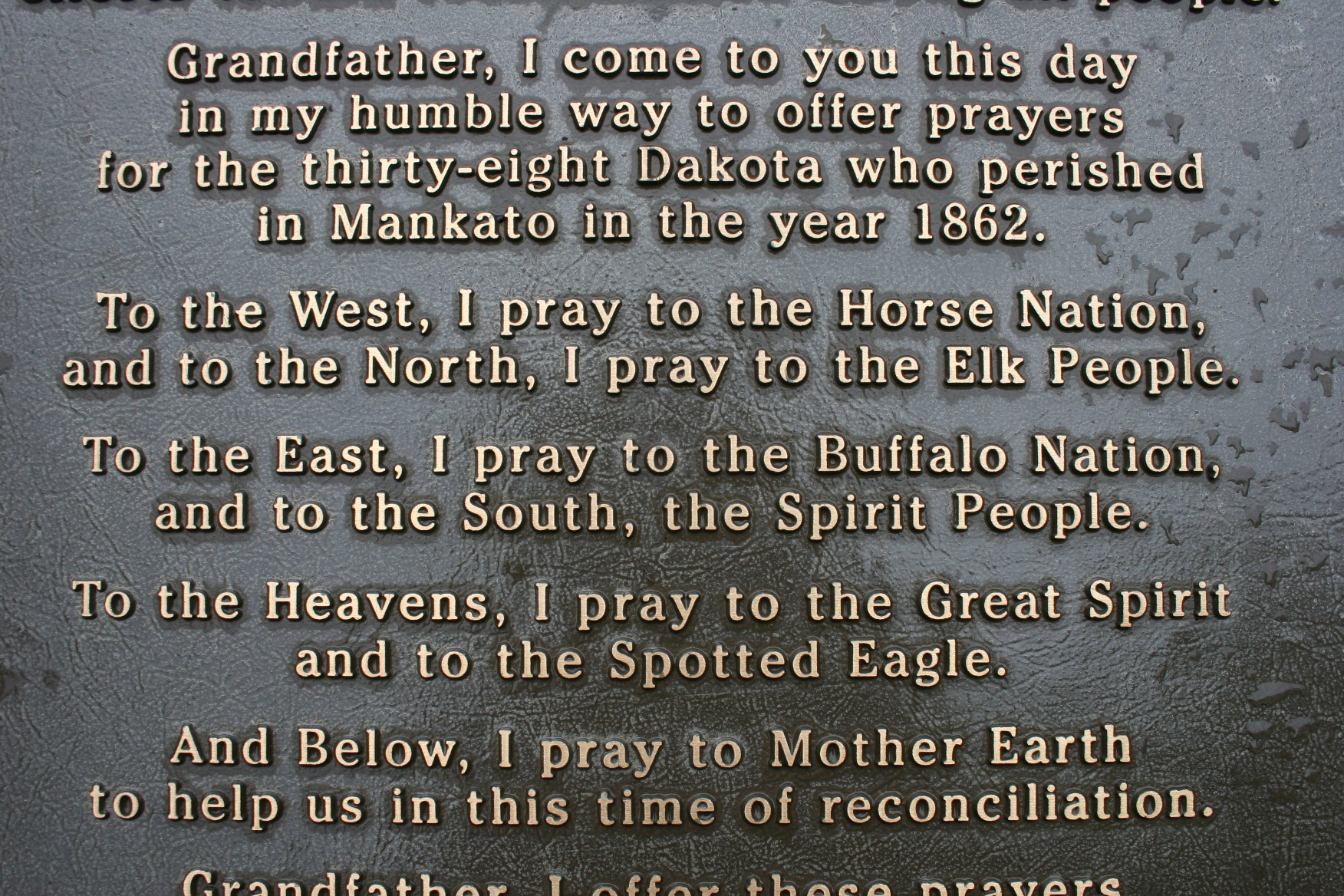
Words on a marker in Reconciliation Park in Mankato where 38 Dakota were hung on Dec. 26, 1862. (Minnesota Prairie Roots copyrighted file photo 2012)
I hope educators in my home area are today teaching students about the local Dakota and even bringing elders into classrooms. I graduated, after all, from Wabasso High School, the name Wabasso coming from a Native word meaning “white rabbit.” I would then go on to attend college in Mankato, site of the largest mass execution in the US with 38 Dakota killed in a public hanging on December 26, 1862.
I would be remiss if I did not share that, during the US-Dakota Conflict of 1862, family members on my mom’s side fled their rural Courtland farm for safety in St. Peter. They later put in a claim to the US government for crop loss.
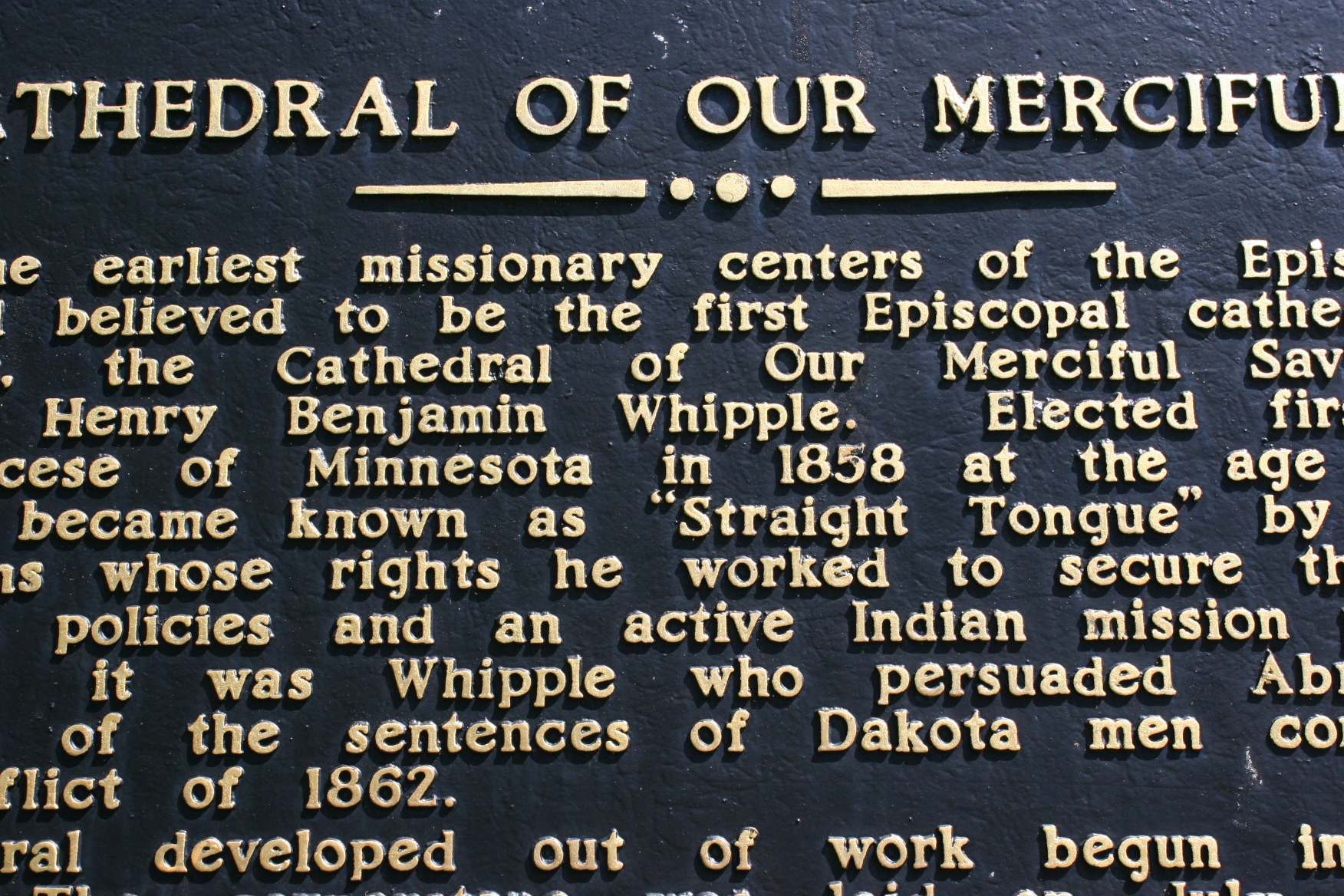
Details on a sign outside the Cathedral of our Merciful Savior in Faribault. Bishop Henry Whipple, who served here, advocated for the rights of Native Americans and had a strong friendship with them. (Minnesota Prairie Roots copyrighted file photo 2020)
Now, 160 years after that event in my ancestors’ history, I continue growing my knowledge, widening my understanding of Minnesota history and of the Indigenous people who first called this land home.
A graphic of Minnesota is painted on the back of the art installation. (Minnesota Prairie Roots copyrighted photo April 2022)
Also, I suggest you read an article on the Minnesota Public Radio website about efforts to change the Minnesota State flag. The flag depicts, among other details, a Native American in the background riding off into the sunset while a settler focuses the foreground, hands on a plow, rifle nearby. I agree that change is needed. But, as too often happens, the issue has become politically-charged.
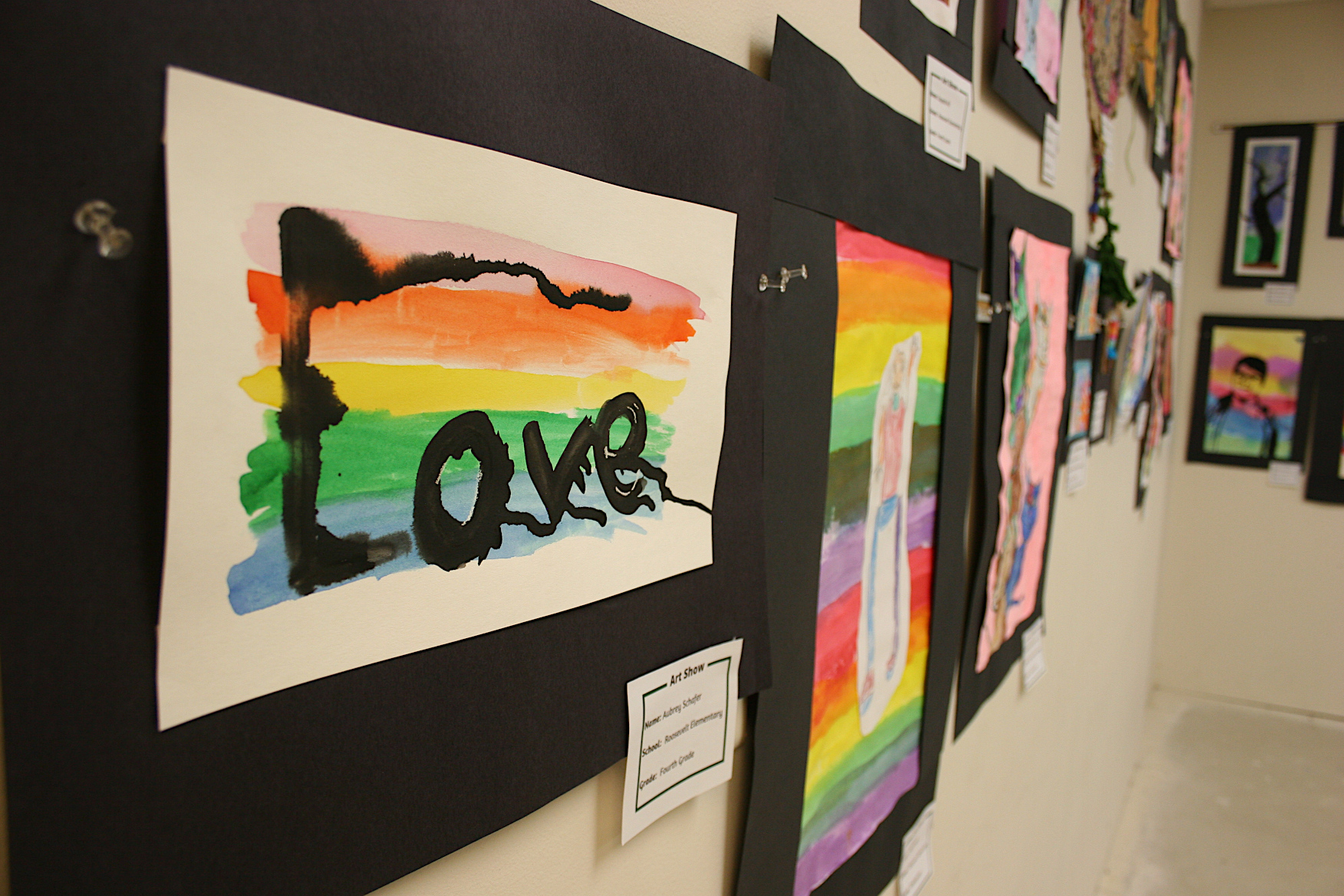
Love the student art spanning walls in a current exhibit at the Paradise Center for the Arts in Faribault. Aubrey Schafer, Roosevelt Elementary fourth grader, created the Love art on the left. (Minnesota Prairie Roots copyrighted photo March 2022)
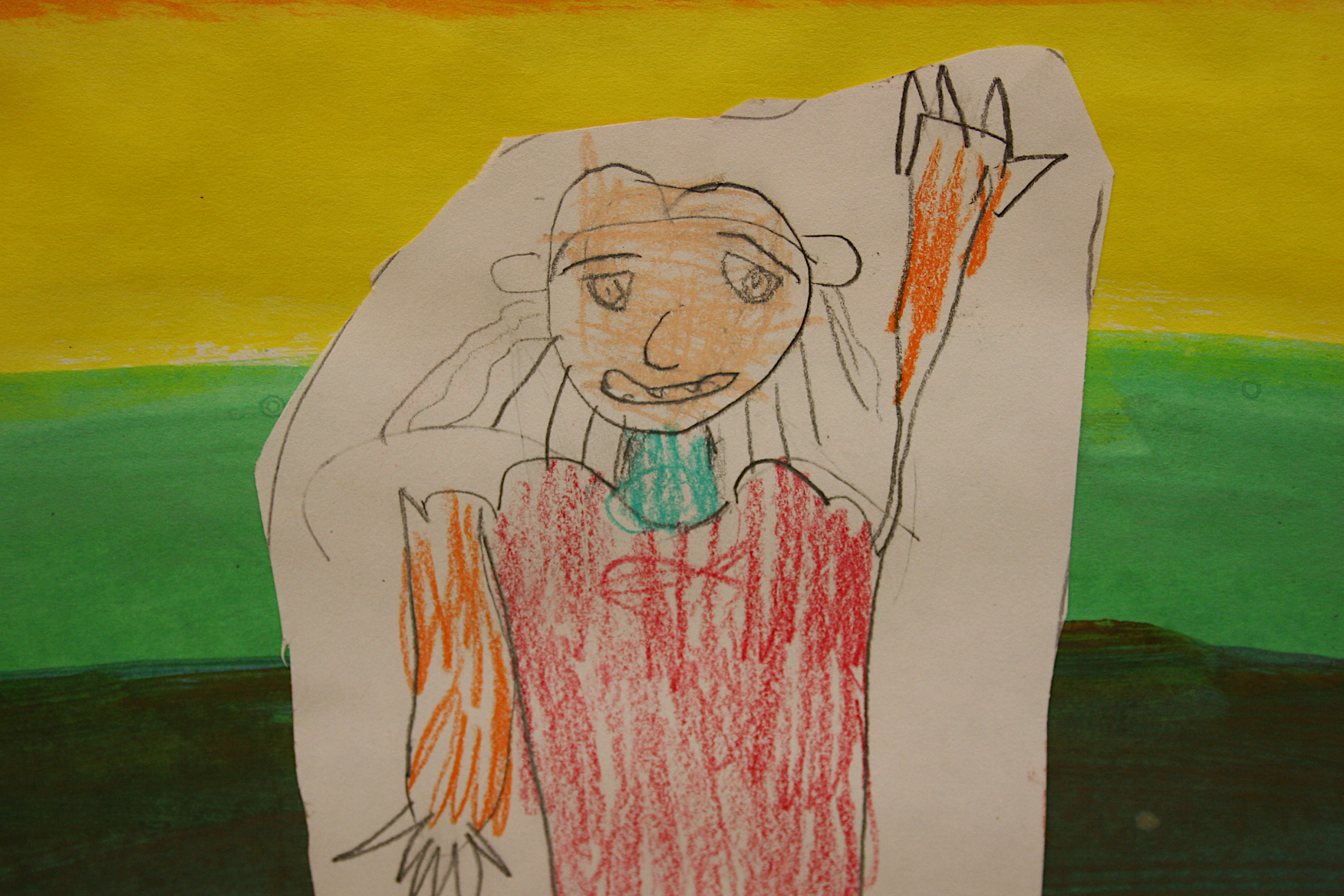
IF I COULD TALK to these students, what would they tell me about their art? Would their responses show a passion for creating? Would they tell me they were just completing an assignment? Or would their answers fall somewhere in between?
Assorted art by Lincoln Elementary students. (Minnesota Prairie Roots copyrighted photo March 2022)
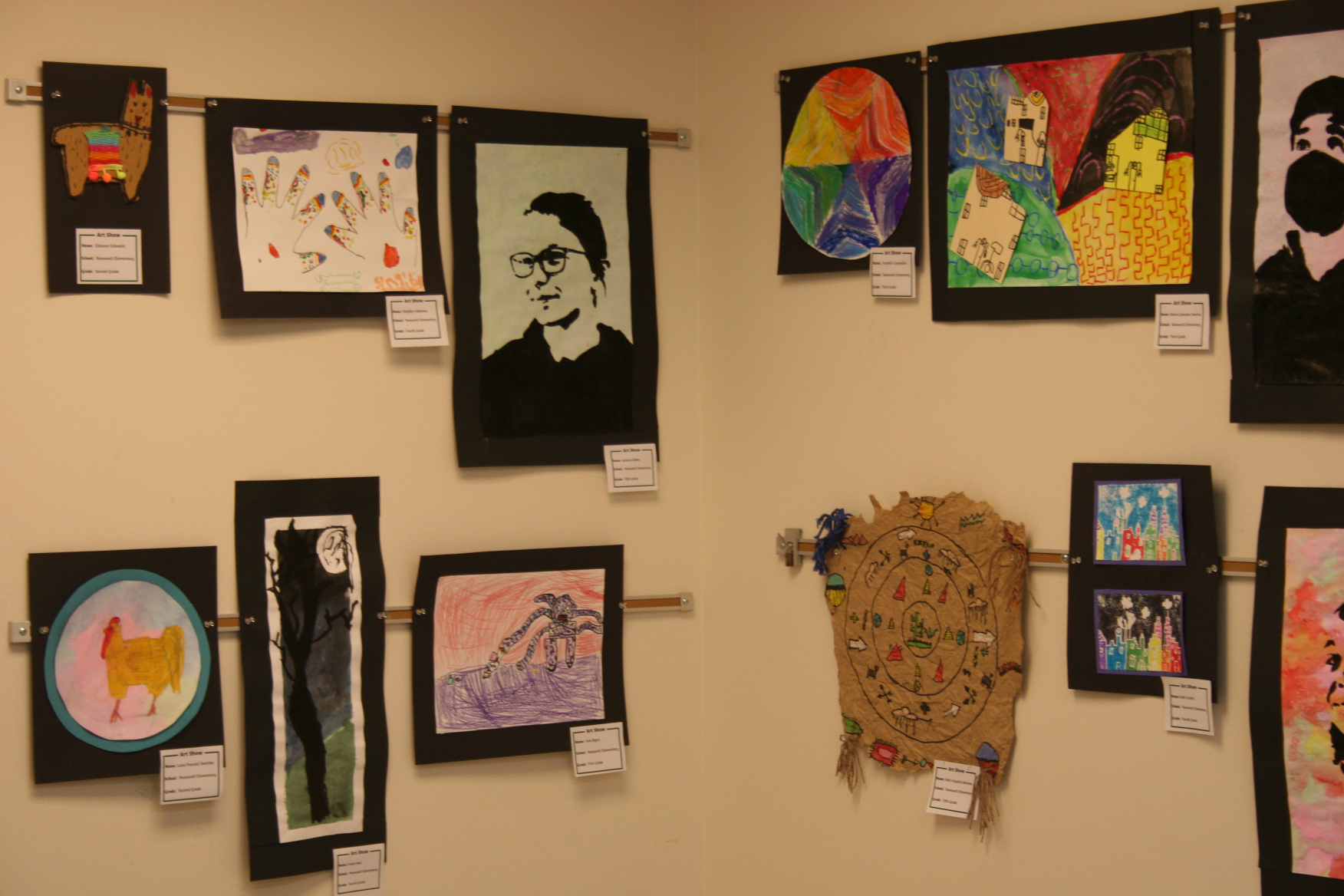
As a wordsmith, I often wonder about the stories behind the art displayed at the annual All Area Student Show at the Paradise Center for the Arts in historic downtown Faribault. While perusing the pieces, I see varied versions of the same theme. That reveals a general classroom assignment focused on a subject. Yet even that prompt leads to individual creativity.
Portrait by Isaac Rodriguez, fifth grader at Roosevelt Elementary School. (Minnesota Prairie Roots copyrighted photo March 2022)
What would Ayub, Mariyo, Isaac, Natalia, Aubrey, Lily, Myrka, Jaelynn, Mumtaaz, Brianna, Rain and the many other student artists say about their art? The art they created at their respective schools—Faribault Area Learning Center and Jefferson, Lincoln and Roosevelt Elementary schools.
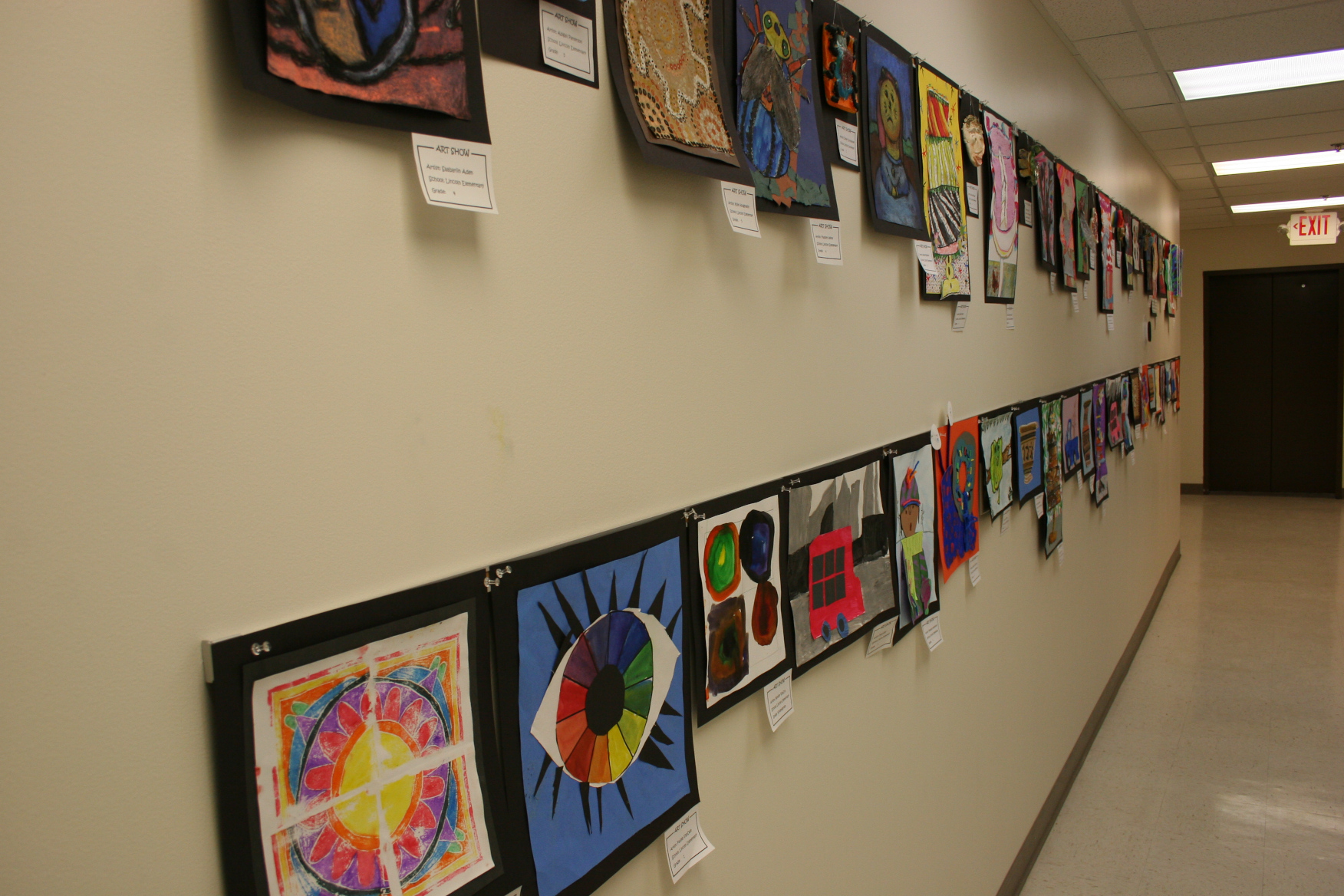
Student art runs the length of a second floor hallway. (Minnesota Prairie Roots copyrighted photo March 2022)
When I view their exhibit, I am impressed by the level of talent—from kindergarten through high school. But this is about much more than talent. This is about encouraging young people in the arts. This is about showing us adults that young people have an artistic voice. This is about taking away our own interpretations of this artwork.
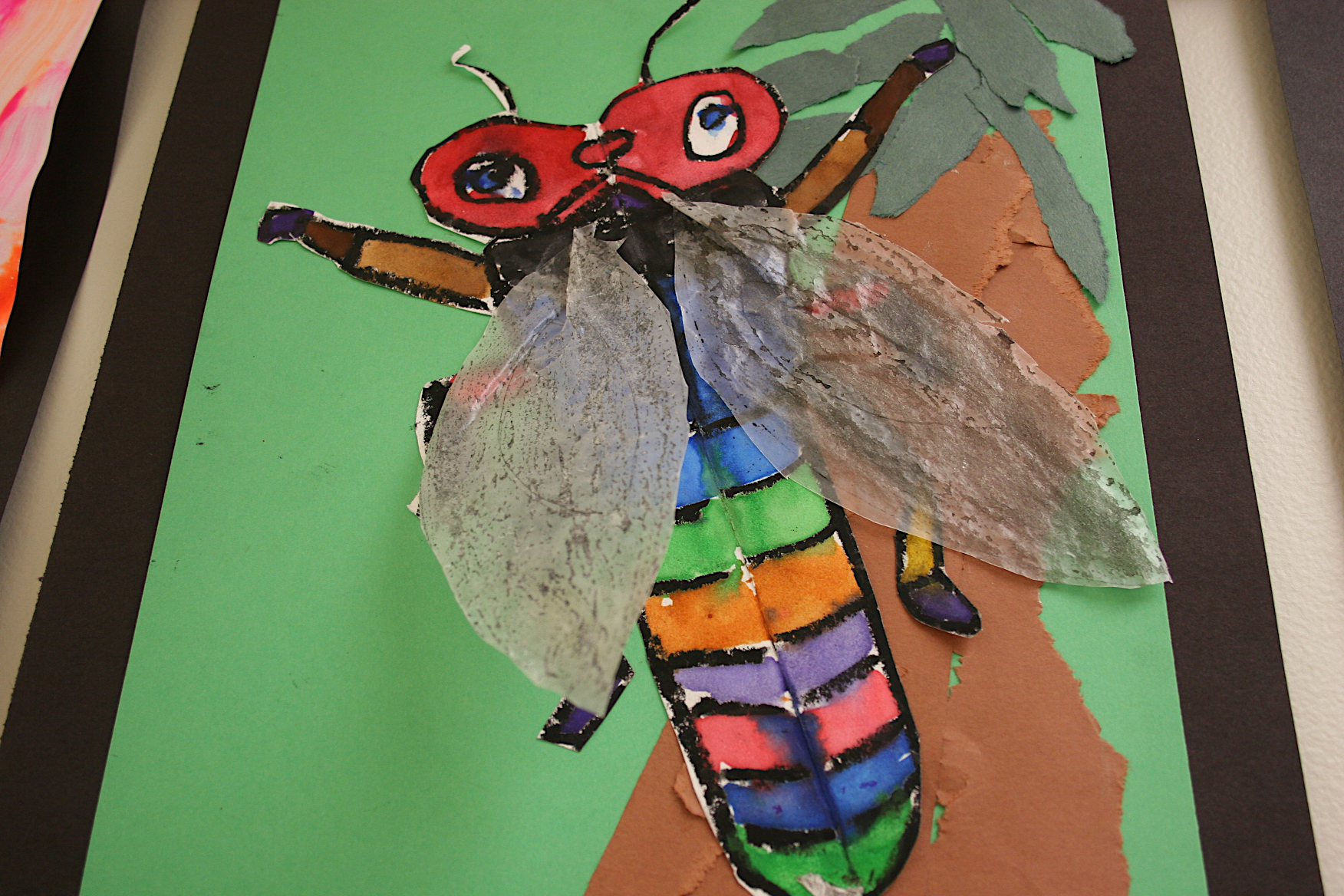
Colorful insect art by Ayub Osman, fourth grade, Lincoln Elementary. (Minnesota Prairie Roots copyrighted photo March 2022)I
Myrka Mendoza, Faribault Area Learning Center 11th grader, drew this realistic butterfly. (Minnesota Prairie Roots copyrighted photo March 2022)
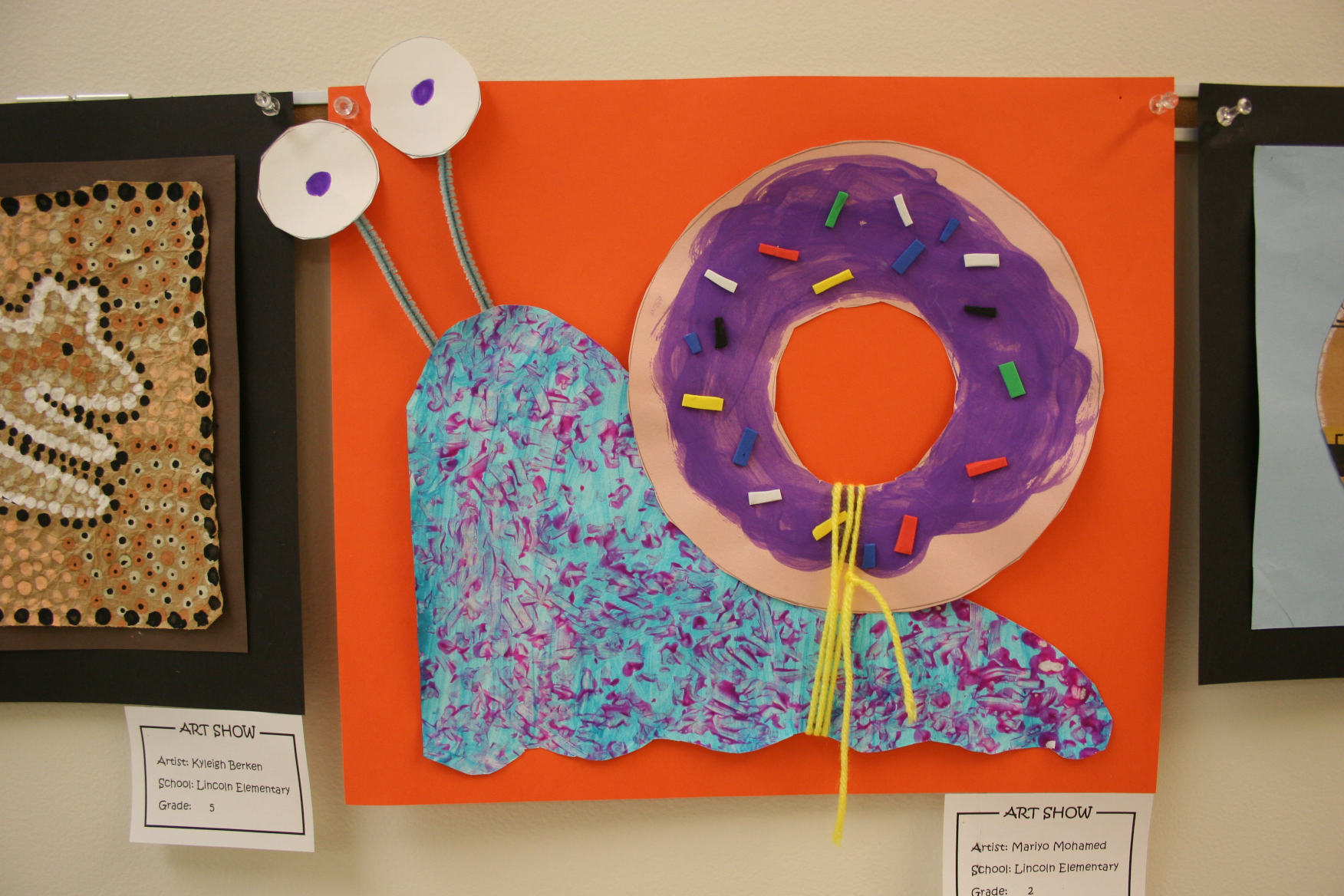
Envisioning Mariyo Mohamed’s (second grader at Lincoln Elementary) snail in a picture book.(Minnesota Prairie Roots copyrighted photo March 2022)
I appreciate how, even on the theme of nature, students’ interpretations range from boldly colorful—as if illustrated in a children’s picture book—to realistic—as if printed in the pages of a nature guidebook.
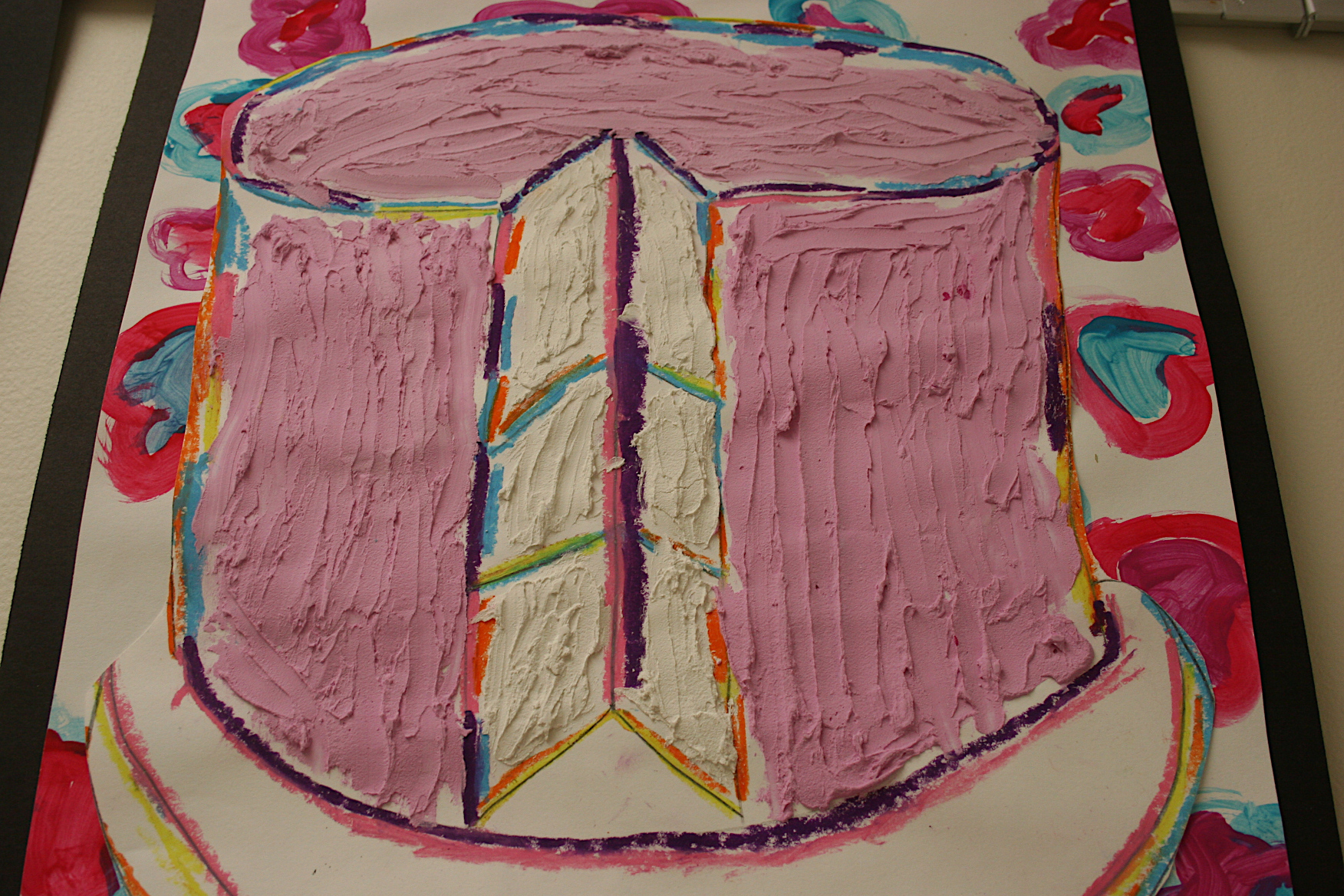
This textured birthday cake art by Lincoln second grader Jaelynn Martinez makes me want to grab a slice and celebrate. (Minnesota Prairie Roots copyrighted photo March 2022)
The art shown in this exhibit conveys celebration, joy, history, a sense of place, personality, messages, nature and more.
Each art piece is titled with basics of name, grade and school. (Minnesota Prairie Roots copyrighted photo March 2022)
If these students wrote artists’ statements, what backstories would they share? What inspires them? Why did they choose bold or subtle? Are they conveying a message? Or simply creating?
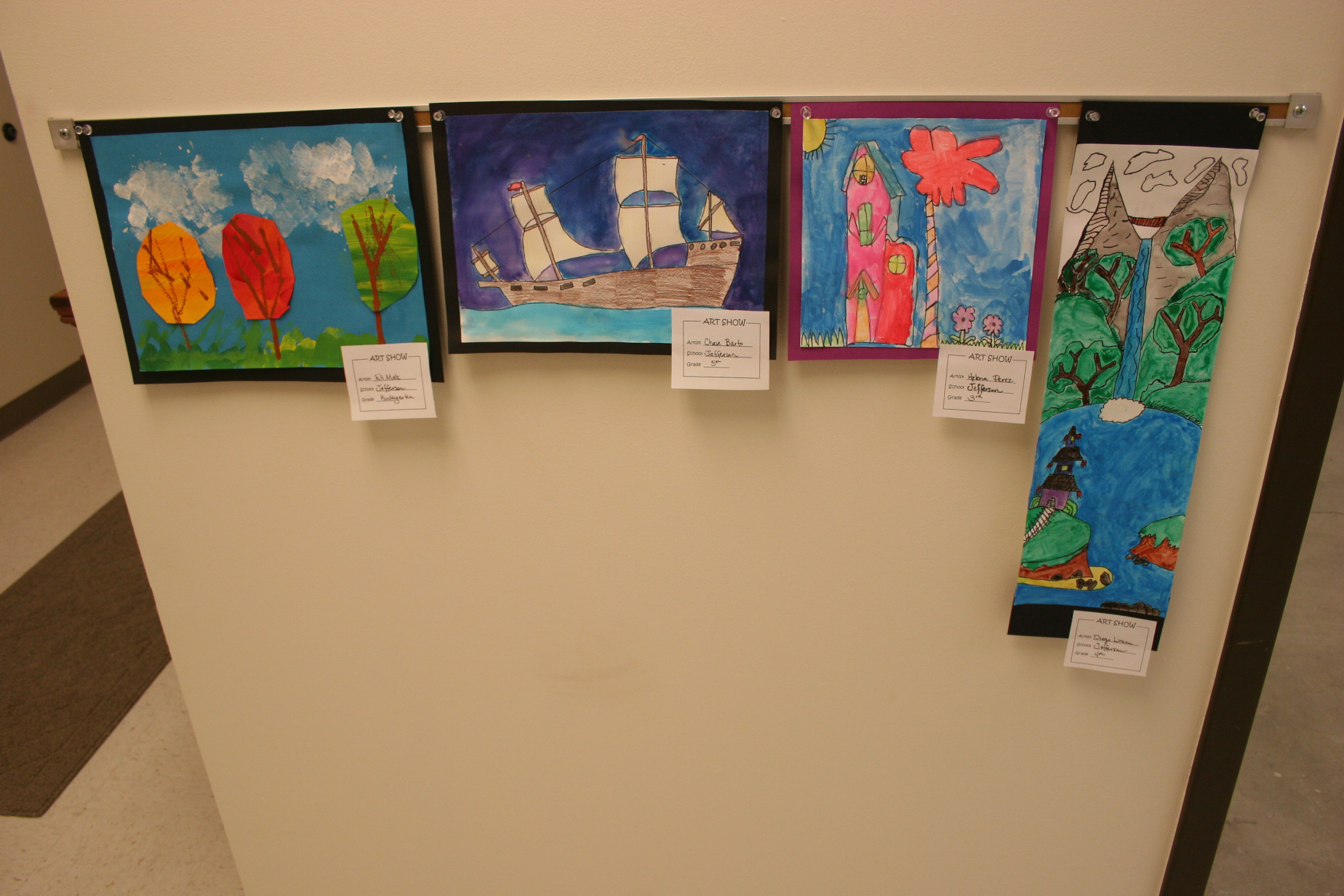
Art by students from Jefferson Elementary School. (Minnesota Prairie Roots copyrighted photo March 2022)
As someone who’s created with words and images for decades, I understand how my prairie background, upbringing in a southwestern Minnesota farm family and personality influence my work. I write and photograph with a strong sense of place, with detail. And, I hope, with compassion, empathy, understanding, connection and a desire to make a positive difference. I listen. I observe. I create.
Created by Lily Krauth, kindergarten, Roosevelt Elementary. (Minnesota Prairie Roots copyrighted photo March 2022)
I create, too, with a focus on what’s right here—in our area communities, in the countryside… And, today, what’s on the second floor of the Paradise Center for the Arts—the art of young creatives.
FYI: The student art show continues through April 9 at the Paradise, 321 Central Avenue North, Faribault. PCA hours are from noon – 5 pm Wednesday through Friday and from 10 am – 2 pm Saturdays. Click here to read Part I in this two-part series.
Eye-catching student art lines a second floor hallway at the Paradise Center for the Arts in Faribault. The eye art is by Wyatt Suckow, Lincoln Elementary School first grader. (Minnesota Prairie Roots copyrighted photo March 2022)
ENCOURAGEMENT. OPPORTUNITY. CONFIDENCE. Like dominoes, those three words tip into one another. And the result for young people can make all the difference.
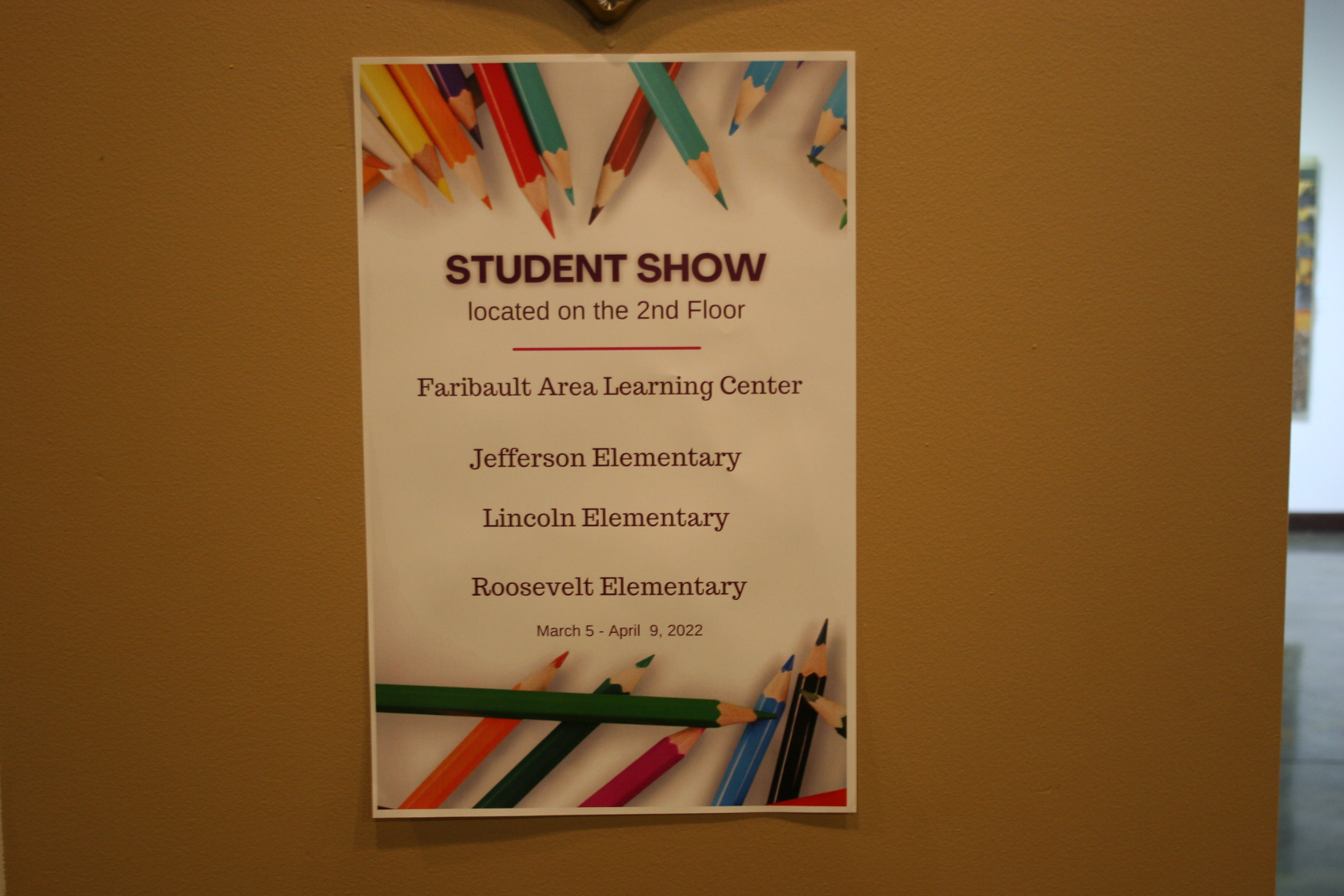
A poster outside the main gallery at the Paradise Center for the Arts promotes the student art show on the second floor. (Minnesota Prairie Roots copyrighted photo March 2022)
Those thoughts emerge upon viewing the All Student Art Show at the Paradise Center for the Arts in historic downtown Faribault. This year’s show, featuring the art of students from Faribault Area Learning Center and Jefferson, Lincoln and Roosevelt Elementary Schools, runs until April 9.
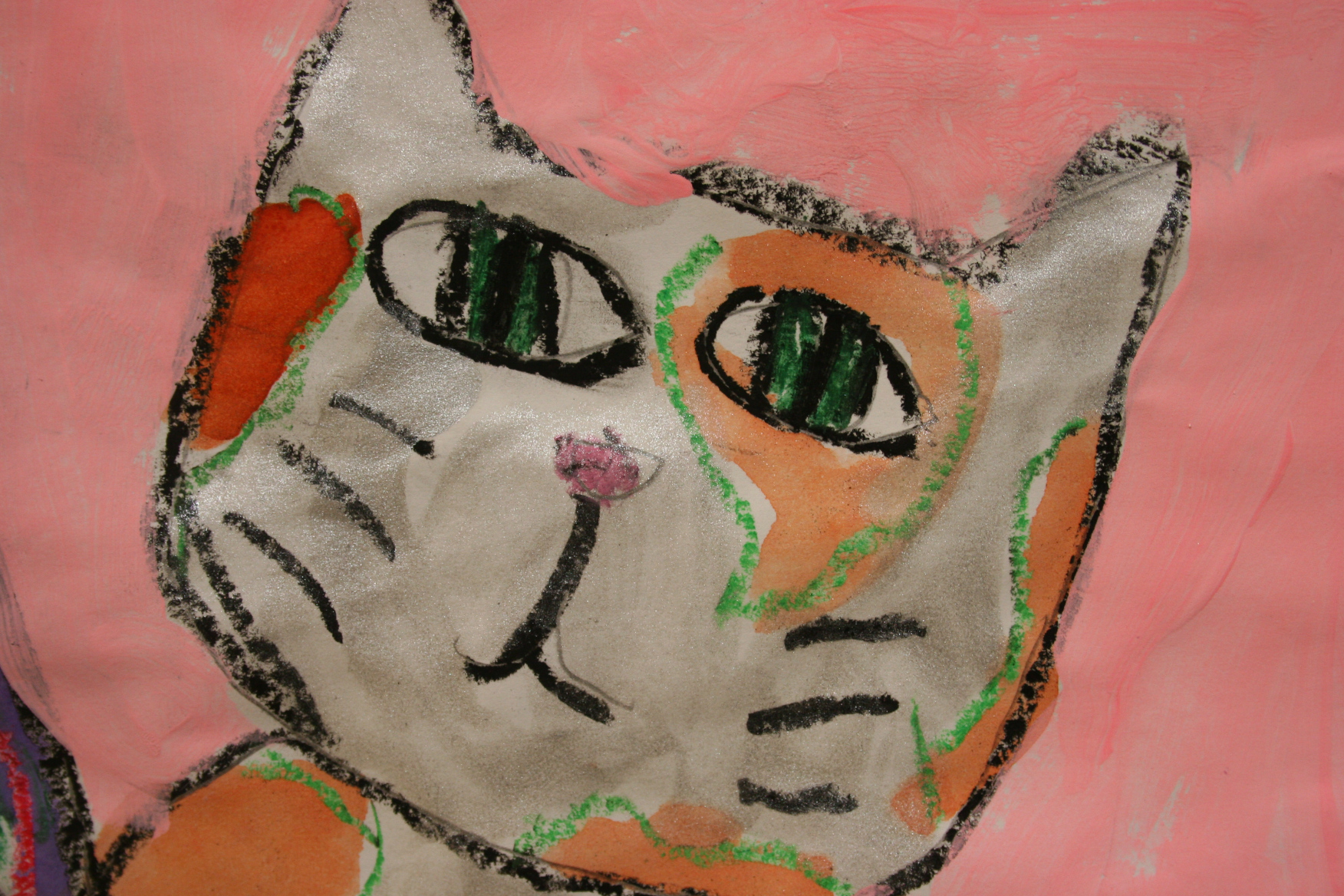
Eydelin Leon Ruiz, Roosevelt Elementary School second grader, created this sweet kitty face. (Minnesota Prairie Roots copyrighted photo March 2022)
I view this show through not only an appreciative lens, but also through the lens of encouraging students in the arts. Showcasing their art in a public exhibit most assuredly builds confidence.
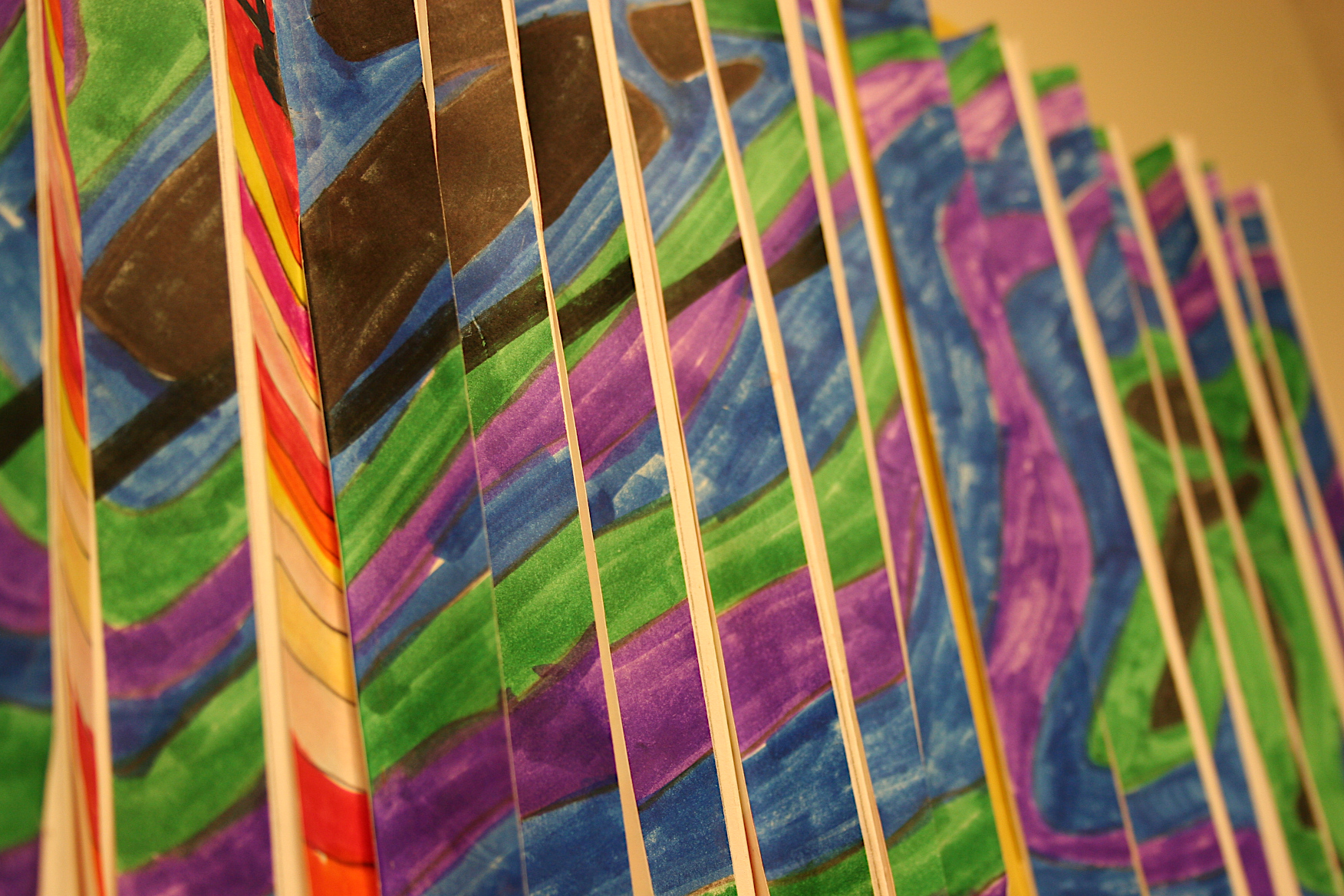
One of the more unusual pieces of art was crafted by two Lincoln Elementary School fourth graders, Cole Hammer and Barrett Boudreau. The folded art looks different when viewed from opposite sides. (Minnesota Prairie Roots copyrighted photo March 2022)
If we all thought for a moment, I expect we could list individuals in our lives who encouraged us in our interests, passions and/or careers. For me, that would be Mrs. Kotval, an elementary school teacher who each afternoon read aloud chapters from books—the entire Little House series, The Adventures of Huckleberry Finn (and Tom Sawyer), Black Beauty… From those post lunch readings, my love for language and stories sparked. In middle school, Mrs. Sales fostered my increasing love for language and writing. Across the hall, a math teacher (whom I shall not name) scared me so much that my dislike of numbers multiplied. In high school, Mr. Skogen required journal keeping, further fostering my love of writing. And in college, Mr. Shipman and Mrs. Olson offered such encouragement that I never questioned my decision to pursue a journalism degree.
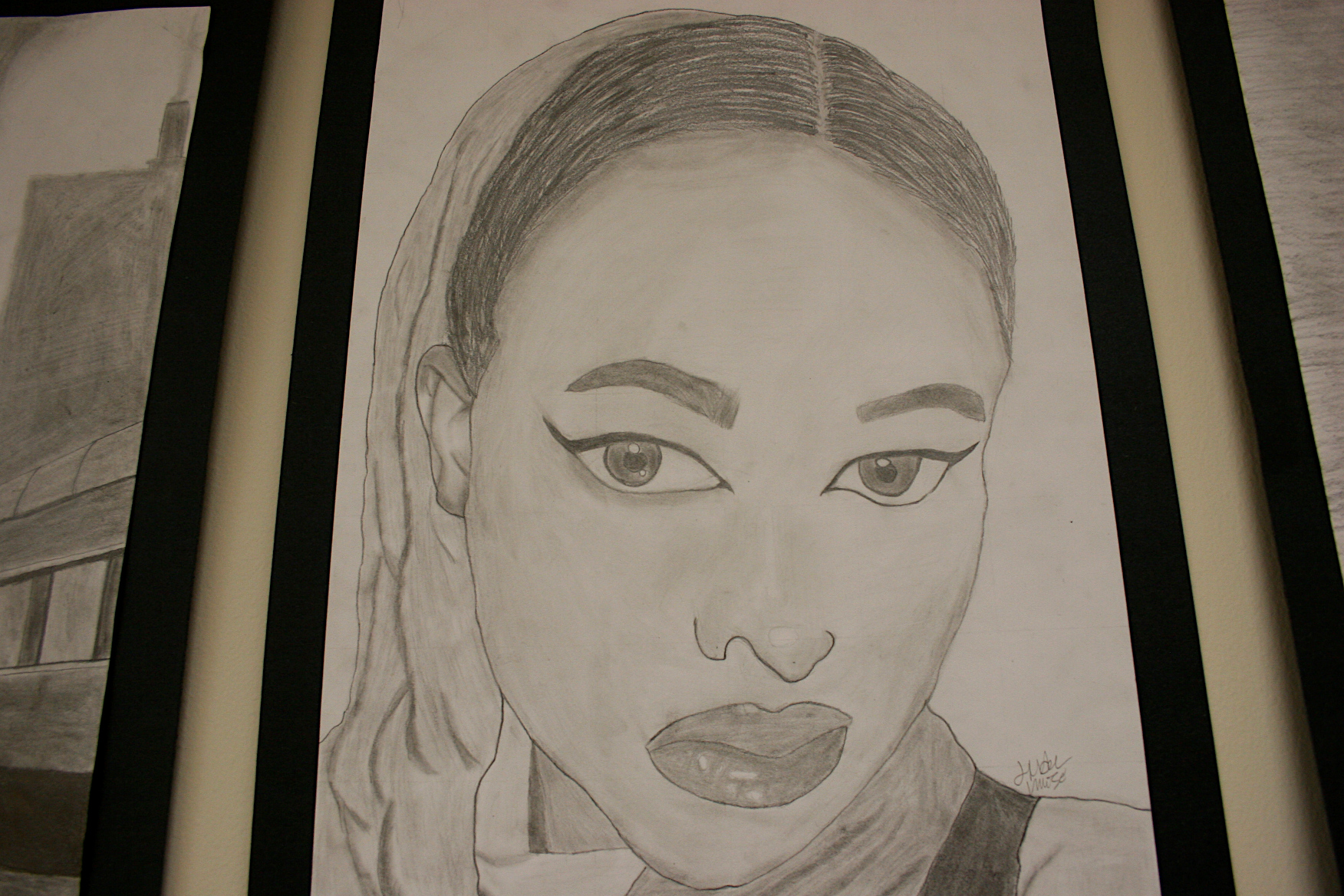
A portrait by Huda Muse, Faribault Area Learning Center junior. (Minnesota Prairie Roots copyrighted photo March 2022)
How reaffirming then to have educators encouraging young people in the arts, and an arts center that values their work.
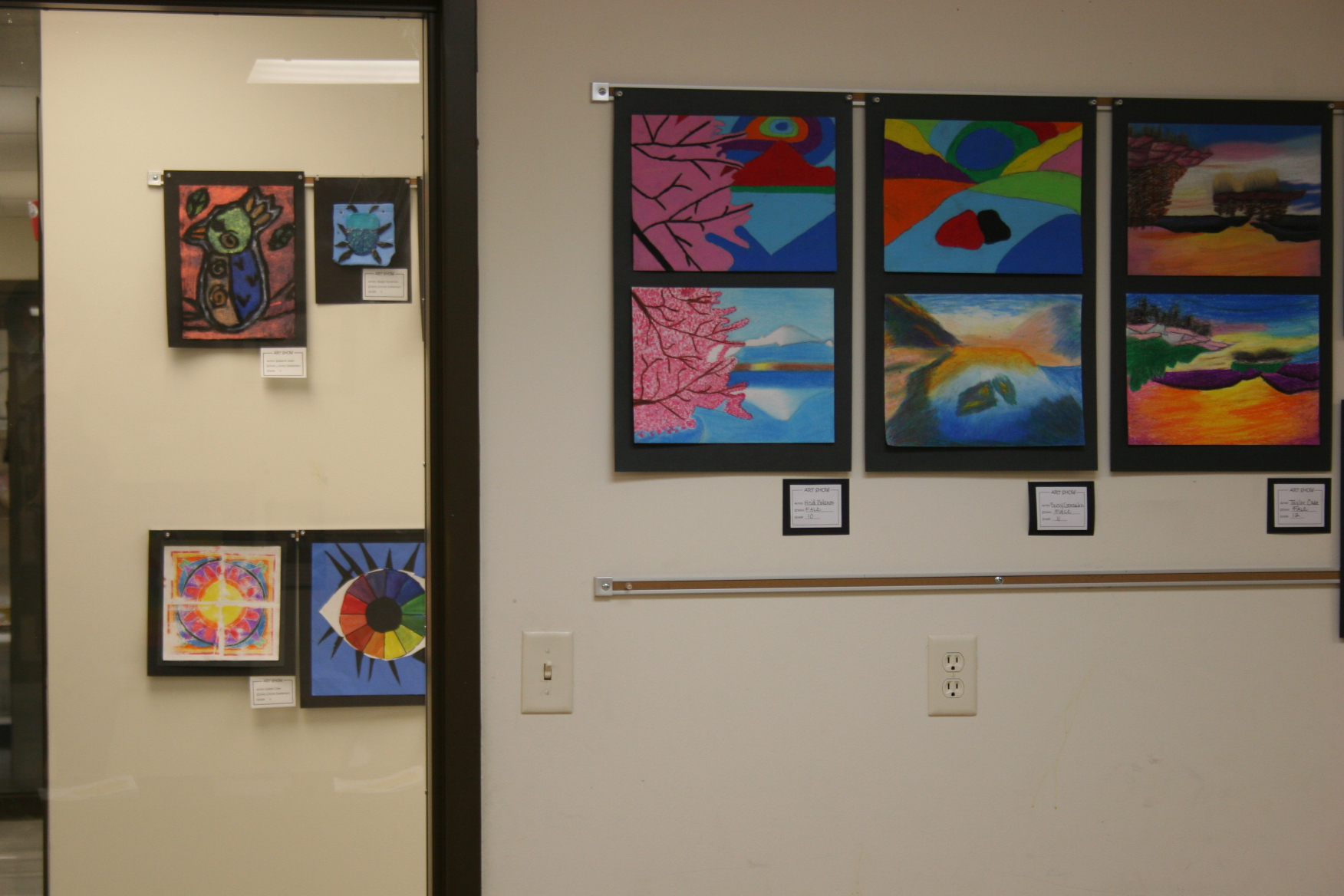
Each piece of art names the artist and his/her school and grade. (Minnesota Prairie Roots copyrighted photo March 2022)
At this student art exhibit, you won’t find ribbons or other awards. And that, too, I appreciate. You’ll find art. Simply art. I think too often there’s a tendency to pass out ribbons to everyone. Kids can see right through universal praise, which then feels mostly meaningless.
Art aplenty… (Minnesota Prairie Roots copyrighted photo March 2022)
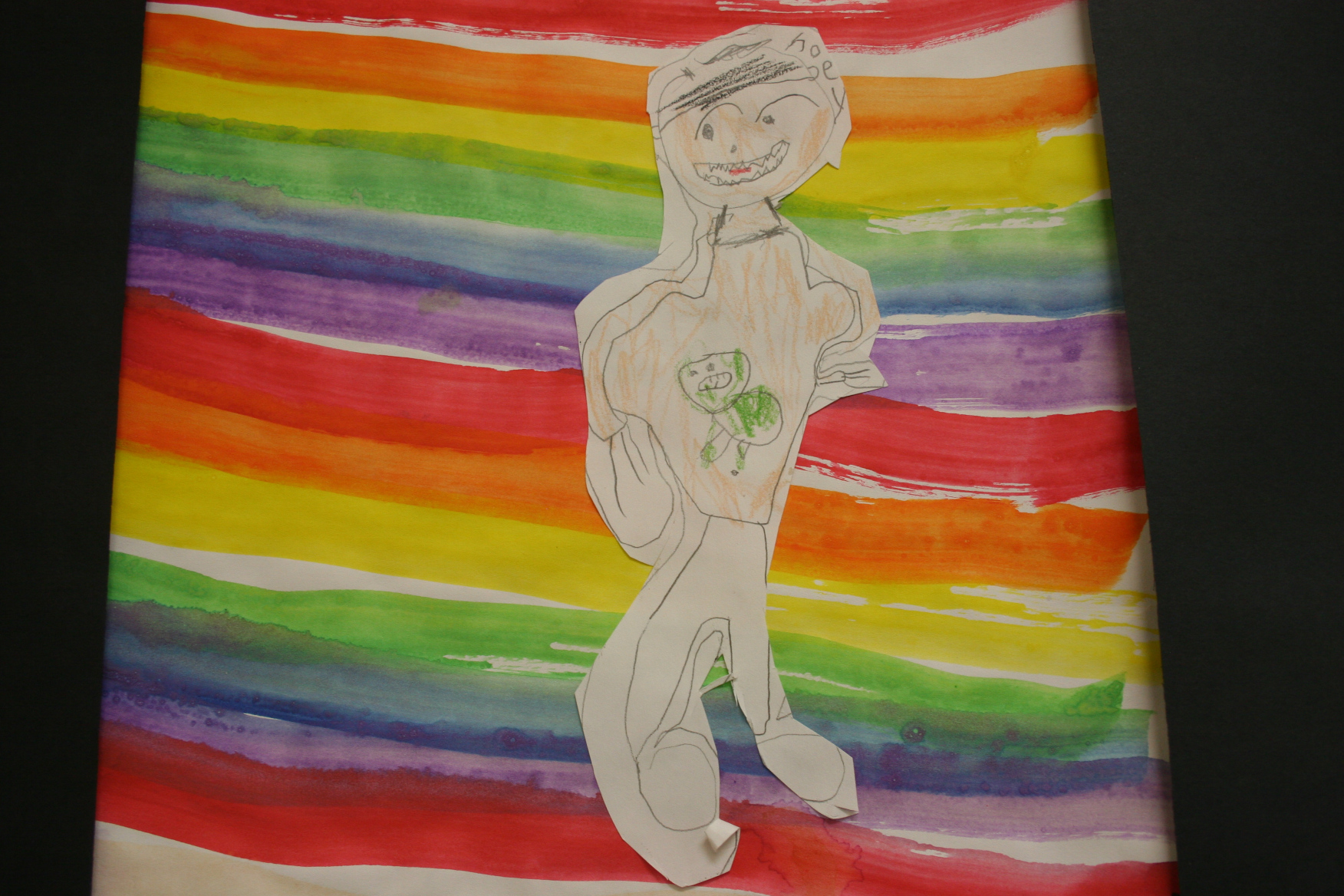
The art of Roosevelt Elementary School kindergartner Joey Trevino. (Minnesota Prairie Roots copyrighted photo March 2022)
Art, inside a classroom exhibit space and outside along a hallway. (Minnesota Prairie Roots copyrighted photo March 2022)
But nothing is meaningless about the art showcased along the hallway and a classroom on the second floor of the Paradise. Every student, from kindergarten through high school, created a work of art worthy of public showing. Worthy, not necessarily by the art critic definition of art, but rather via the definition of this is something a child/pre-teen/teen created. That’s the value therein.
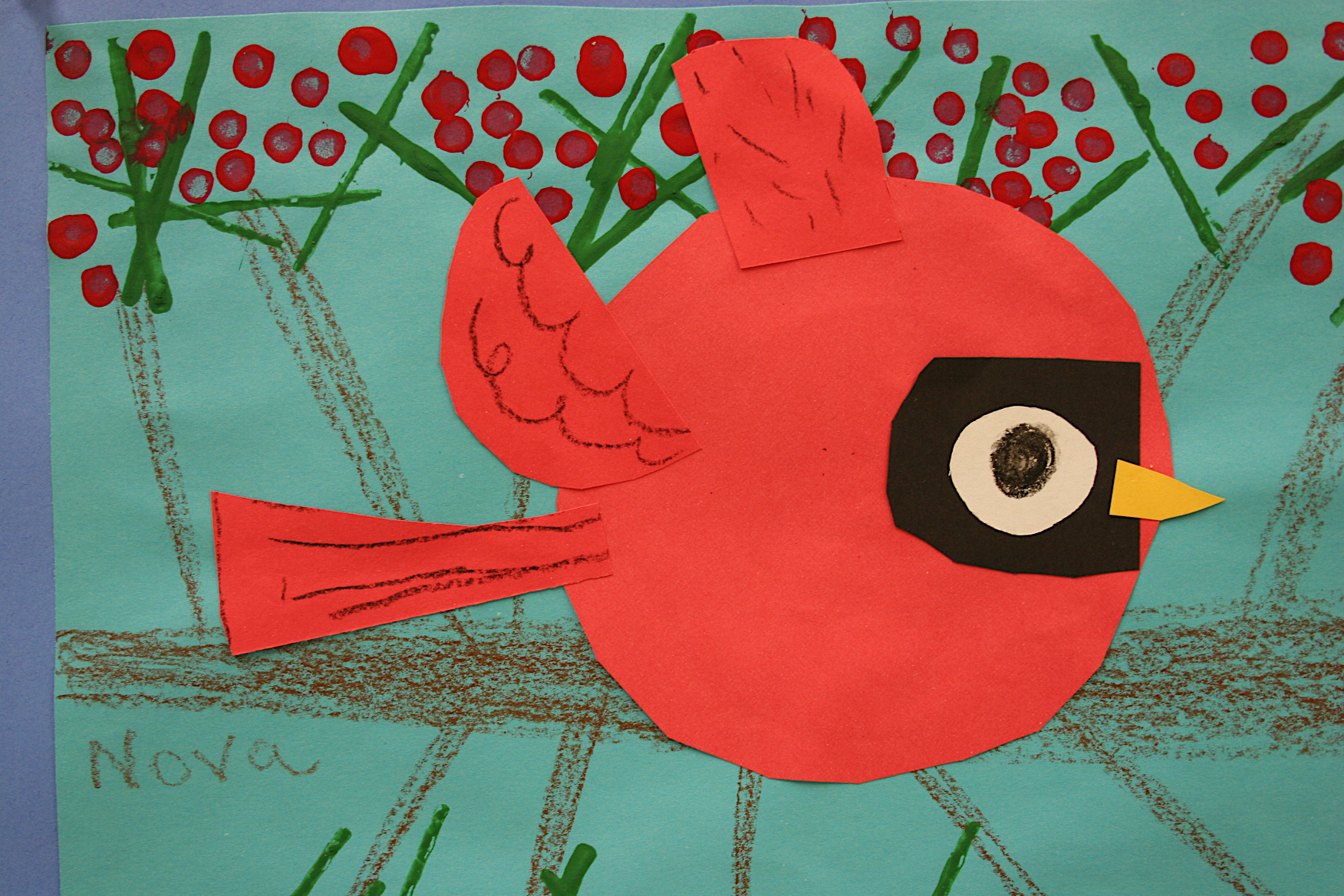
A cardinal by Nova Vega, a kindergartner at Jefferson Elementary School. (Minnesota Prairie Roots copyrighted photo March 2022)
Perhaps some of these students will pursue art professionally. But I expect most won’t. For some, art will always be a side interest/hobby/pursuit. Yet, this early encouragement, no matter future interest, fosters an appreciation for the arts that can last a lifetime. What a gift that is to our young people.
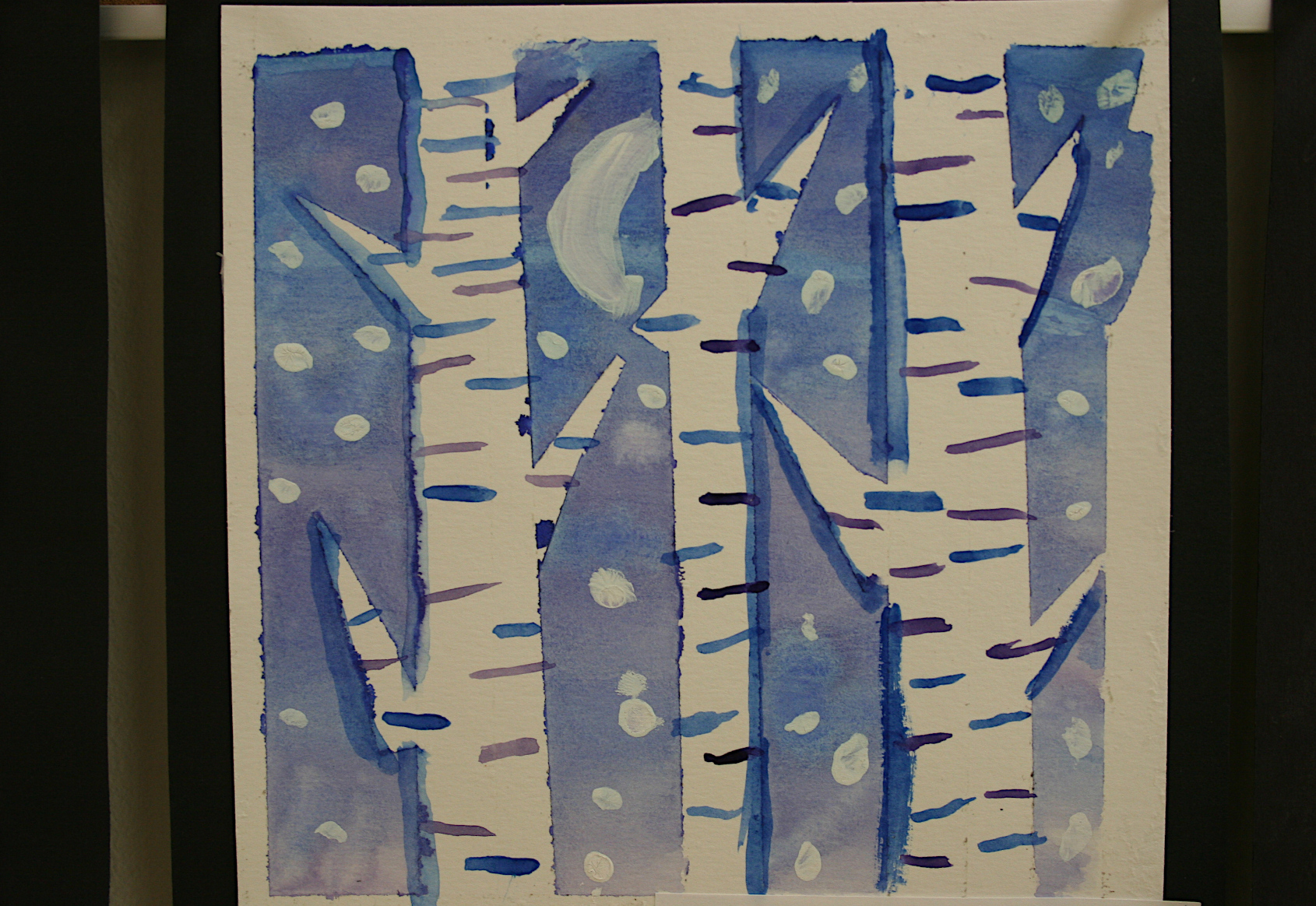
Birch trees painted by Suprise Sonpon, 4th grade, Jefferson Elementary School. (Minnesota Prairie Roots copyrighted photo March 2022)
To the students who created art for the 2022 exhibit, thank you for sharing your creativity. To the educators who worked with these youth, thank you. And to the Paradise Center for the Arts, thank you for each year hosting this student art exhibit. What a gift to our community.
Faribault Area Learning Center students Hunter Quast and Justin Horejsi worked together to create this service station model. (Minnesota Prairie Roots copyrighted photo March 2022)
TELL ME: Did someone encourage you at a young age to follow an interest/passion/other pursuit? I’d like to hear.
FYI: Other area arts centers are also featuring youth art in current exhibits. At the Owatonna Arts Center, view the Owatonna Public Schools K-12 Art Exhibit from now until March 27. At the Arts and Heritage Center of Montgomery, student art from Tri-City United is now displayed, beginning with elementary age. That transitions to art by middle schoolers and then to high school students, through May 14.
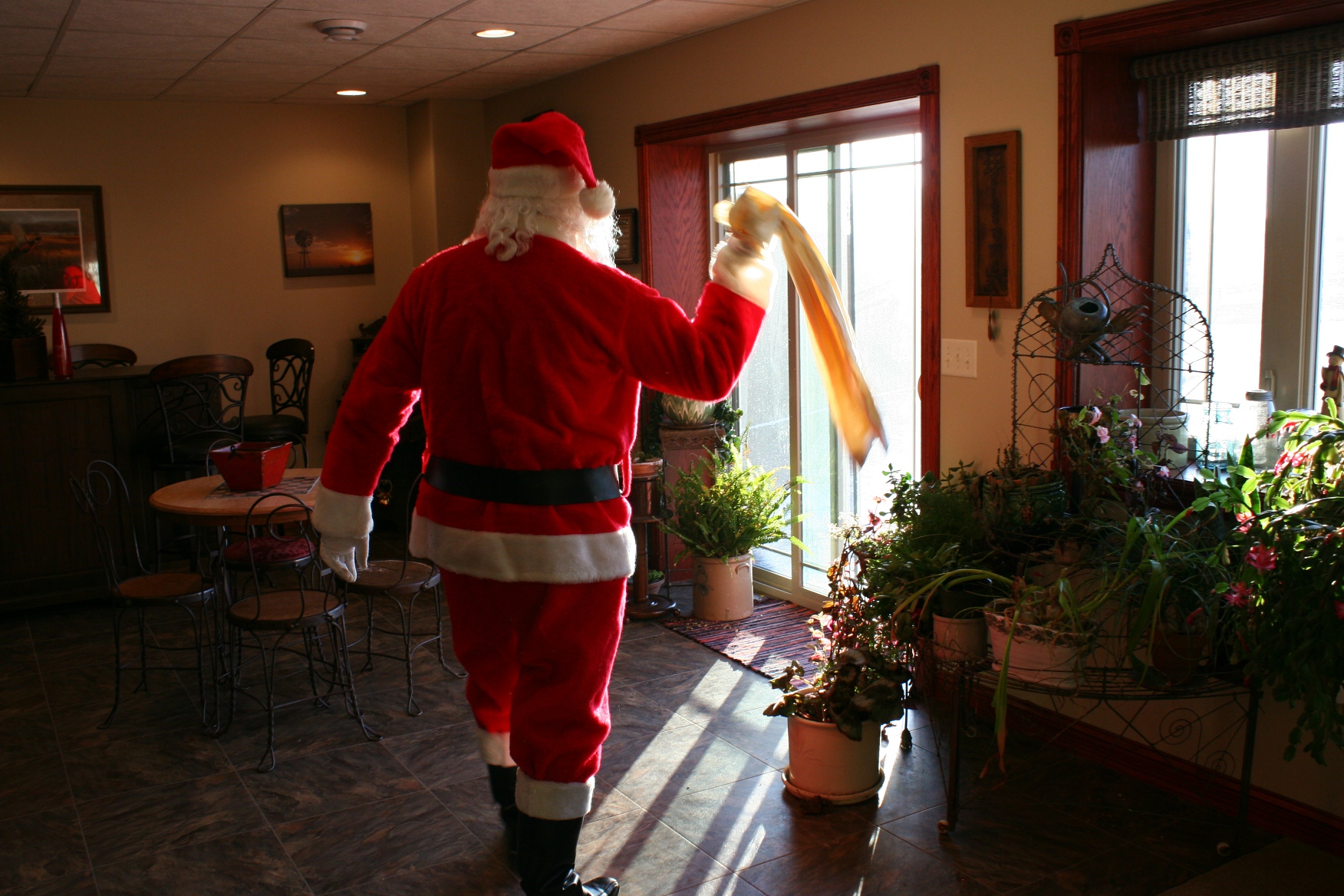
Santa, done delivering gifts at a family Christmas. (Minnesota Prairie Roots copyrighted file photo December 2015)
DAYS BEFORE CHRISTMAS, a small town Minnesota weekly newspaper published 32 letters—31 addressed to Santa and one to Elsa. The letters written by Sibley East first graders, as you would expect, are honest. Or at least honest enough to convince Santa of good behavior.
As I read through the letters to Santa published in The Gaylord Hub (where I worked as a reporter from 1978-1980), I laughed. And I nearly cried. Read on and you’ll understand as I share highlights pulled from the kids’ writings.
Many first graders assured Santa of their helpfulness and kindness among family and friends. But young Oskar hesitated. “I have been kind of good this year,” he penned before asking for Legos and books with one Lego figurine.
WISH LISTBASICS
What kids wanted for Christmas varied widely. Aleah asked for markers, glue, coloring books, crayons and Skye from Paw Patrol. Her request for glue and for crayons caused me to pause, considering she needed/wanted something so basic. I hope sweet Aleah got those gifts. Other kids asked for items like shoes, clothes, a bunk bed, a garbage can for their bedroom. Necessities.
But perhaps the most touching was Elsa’s request: “Please can you give me a picture of me for my family.”
WISHFUL THINKING
On the opposite end of the spectrum, Alex requested items that could bankrupt Santa. He not only wanted a remote control car, a gun, a kids’ motorcycle and an iPhone 11, but he also asked for $1 million. Alright then. Alex wants a sister, too. Not sure how Santa handled that.
A UNIQUE REQUEST
Perhaps the most unusual gift desired came from Angie, who assured Santa she’s been working hard in school and helping her mom with dishes. The first grader asked for a skeleton so she can study the human body. Impressed? I am. I expect Angie will accomplish anything she sets her mind to, maybe even becoming a medical professional.
Other gift lists included Nintendo games, a skateboard, not just some but “a lot of” Nerf guns, a remote control semi, a LOL doll, Pokemon cards…and the usual horse and puppy. And for one boy, dogs. Plural, not singular. He promised to share the dogs with his friends.
QUESTIONS FOR SANTA
These kids also had lots of questions for Santa. About the reindeer (What do they eat? How do they fly?). About the elves (How are they?). About Mrs. Claus (How old is she?). About the North Pole (How cold and snowy is it there?).
Santa also faced questions about himself. “Do you like cookies or not?” Cameron asked, getting right to the point. Oskar was more specific. “Do you like cookies that are bought or decorated cookies?”
Angie, who wanted the skeleton to study the human body (I sure hope she got it) wondered why Santa wears a red hat instead of a blue hat. Good question. Like I said, I expect this inquisitive first grader will achieve whatever goals she sets.
REALLY PERSONAL QUESTIONS FOR SANTA
Then two first grade boys got even more personal. “Do you have any kids?” Charlie asked Santa. Good question.
And then there’s Jaxson, concerned about Santa’s mental health. “Are you happy? Yes?” I love how this little boy’s letter opened with that question before he went on to ask for one thing, a Nintendo Switch. He even thanked Santa. We could all learn from Jaxson. About compassion and care for others. From the pencils of first graders…





























 Minnesota Prairie Roots
Recent Comments