Minnesota Prairie Roots

Writing and photography by Audrey Kletscher Helbling

“Evening Prayer for Our Nation” planned at Bishop Whipple’s church in Faribault February 2, 2026

(Promo courtesy of the Cathedral of Our Merciful Saviour)

FIFTY MILES FROM THE NON-DESCRIPT Bishop Henry Whipple Federal Building currently housing ICE detainees in Minneapolis, a beautiful, aged cathedral rises high in the heart of Faribault. Wednesday evening, February 4, that magnificent, massive cathedral—Bishop Whipple’s church—will center a community gathering.

The historic Cathedral of Our Merciful Saviour, 515 Second Avenue Northwest, across from Central Park in Faribault. (Minnesota Prairie Roots copyrighted file photo November 2025)

Beginning at 7 p.m. the historic Cathedral of Our Merciful Saviour will open its doors for “Evening Prayer for Our Nation” in support of Faribault’s refugees and immigrants. The Cathedral’s pastor, the Rev. James Zotalis, and the Rev. Henry Doyle will lead the event, which includes prayers, readings, music and teachings from Bishop Whipple.

Organizers also promise networking opportunities and information about ways to help others.

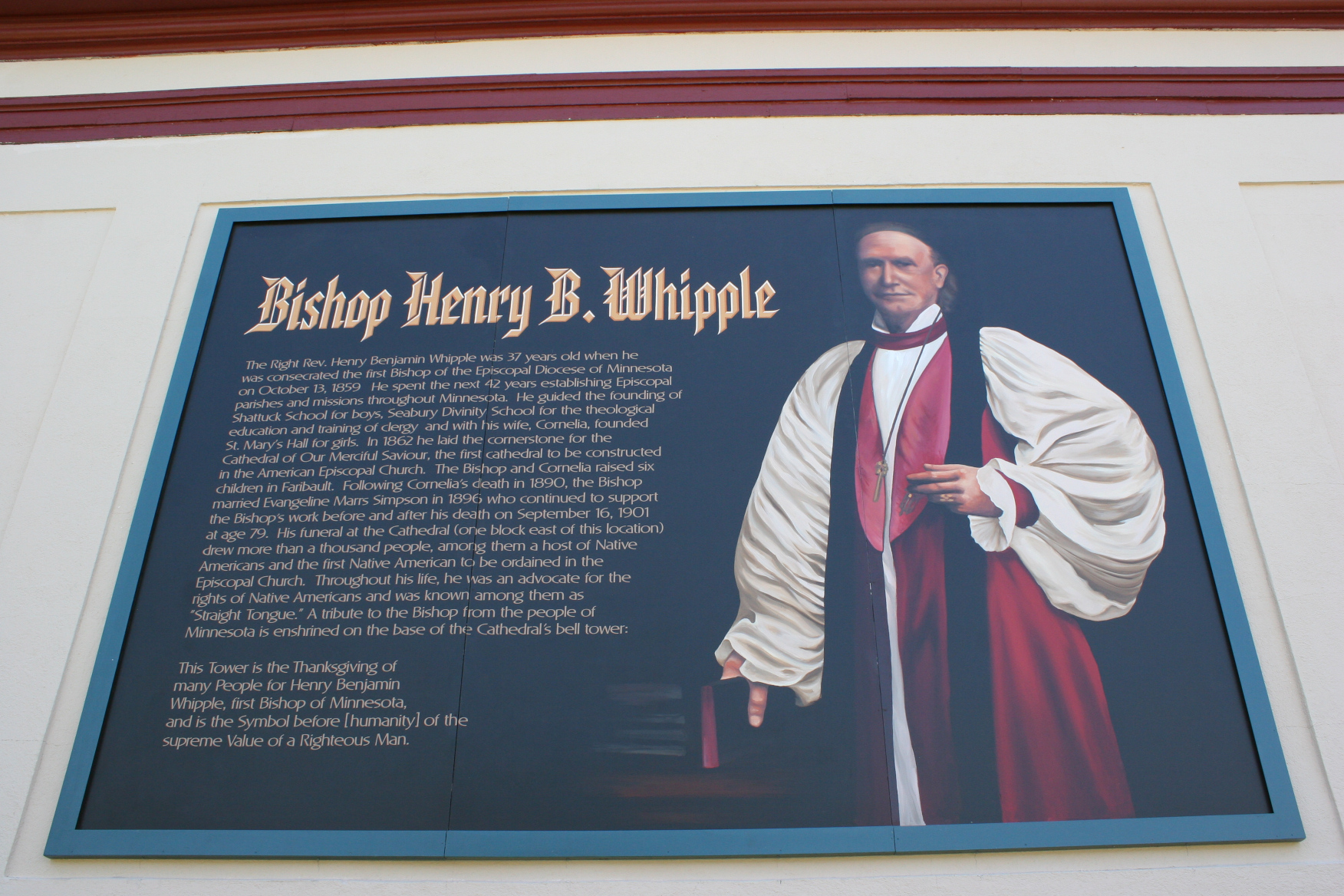
A mural on the back side of the Central Park bandshell in Faribault features a portrait and information about Bishop Henry Whipple. (Minnesota Prairie Roots copyrighted file photo)

Bishop Whipple, who shepherded this congregation while serving as the first Episcopal bishop of Minnesota beginning in 1859, would surely be pleased with the upcoming gathering just as he would surely be displeased with the imprisonment of detainees at the federal building bearing his name. He would likely be standing alongside protesters protesting immigration enforcement and asking to visit detainees inside.

This clergyman focused his ministry on “justice and mercy for all.” And that is evidenced in his ministry to the Dakota both in Faribault and parts west in Minnesota and then at Fort Snelling. Whipple went to the fort and ministered to the Dakota held captive there following the U.S.-Dakota War of 1862.

When 303 Dakota were sentenced to hanging after the war, Whipple traveled to Washington DC to ask President Abraham Lincoln to spare their lives. Lincoln pardoned most, but 38 were still hung in the nation’s largest mass execution.

Encouraging words posted near a garden in the heart of downtown Faribault many years ago. (Minnesota Prairie Roots copyrighted file photo)

If Bishop Whipple was alive today, I expect he would be doing everything in his power to help anyone threatened and/or taken by ICE and CBC. But because he is not here, it is up to us to help. I know many people in my community are helping quietly behind the scenes. Walking kids to bus stops. Giving co-workers rides. Delivering groceries. Donating money and food. Volunteering.

Wednesday evening’s “Evening Prayer for Our Nation” is needed, too. It’s needed to bring people together in community, to unite, to uplift, to pray, to share, to recharge, to publicly support our neighbors, to find tangible ways to help. Bishop Whipple would feel grateful. He cared. And so should we.

#

FYI: Whether you live near or far, Faribault nonprofits are in need of donations to help families sheltering in place during ICE operations in Minnesota. This is not just a Twin Cities metro enforcement. Many communities in greater Minnesota, including mine, are suffering.

Please consider helping immigrants and refugees in my community via a monetary donation to the Community Action Center in Faribault (Community Response Fund) or to St. Vincent de Paul. The need for rental assistance, especially, is growing.

© Copyright 2026 Audrey Kletscher Helbling


Learning & connecting at a bridging cultures talk in Faribault January 30, 2026

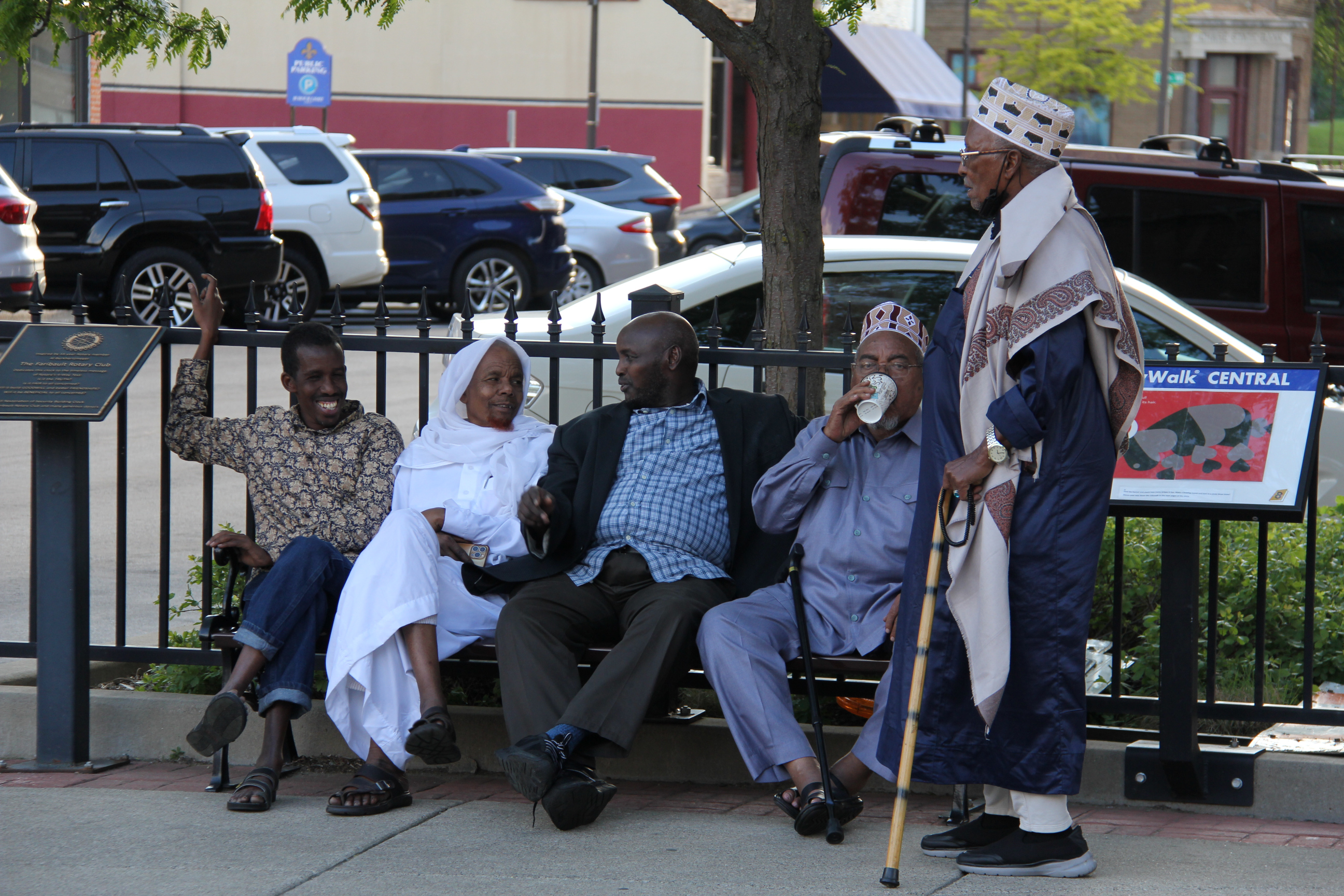
Somali men gather on a bench in downtown Faribault. (Minnesota Prairie Roots copyrighted file photo May 2024)

HE ARRIVED IN MINNESOTA as a teenage refugee from Somalia. Today Ibrahim Khalif heads the nonprofit Faribault Youth Empowerment Center. And Thursday evening this well-spoken young man with a sense of humor spoke to nearly 60 people at Buckham Memorial Library. We gathered to learn about Somali history and culture in a “Building Bridges Across Cultures” talk.

I am a firm believer that knowledge, understanding and personal connections do, indeed, build bridges.

Ibrahim presented a whole lot of information with accompanying slides. So, rather than attempt to cover everything, I’ll share some highlights.

The Somalian culture is an oral culture, Ibrahim said. That was not new to me, mostly because I’ve heard complaints through the years of locals fearing the Somali men who gather on street corners in downtown Faribault. I knew these men met outside to chat and share news, much like men everywhere meet for coffee and playing cards. Many Somalis live above businesses in downtown Faribault and street corners are their front porches.

ARRIVING IN FARIBAULT

In the early 2000s, Somalis began arriving in Faribault, many from refugee camps, Ibrahim said. They fled a civil war that started in 1991 with faith-based organizations—Lutheran and Catholic—helping them resettle in America. Ibrahim showed before and after the civil war pictures of Somalia that revealed absolute devastation. He also showed images of crowded refugee camps.

Minnesota is home to the largest population of Somalis, some 25,000, outside of Somalia. Thousands call my community home. Ibrahim shared that they came to Faribault for a quiet life, to be close to family already here (family is deeply-valued), for the education system, affordable housing and jobs not requiring English-speaking skills. He specifically named the local turkey processing plant as a place of employment.

Challenges upon arrival included, as you would expect, language barriers, an educational system unprepared for an influx of Somali students, difficulty making friends, racial discrimination and more, Ibrahim said.

VETTING

While I was taking notes, I starred Ibrahim’s statement that refugees undergo rigorous security vetting and screening by the FBI before they are allowed into America. I found that especially pertinent in these times when Somali refugees have been targeted by the federal government and called “garbage” by the president who wants them out of the U.S. Yes, Somalis are worried, Ibrahim acknowledged. Yet, he sounded upbeat, emphasizing several times how much he loves Faribault.

LEARNING

I appreciated that Ibrahim engaged us via asking us to repeat Somali phrases that will help us connect with our Somali neighbors. I admit, I struggled. But I tried and trying is a start. He encouraged us to love each other, to break the ice even with something as simple as a smile. To build partnerships.

But a hug or a handshake with someone of the opposite sex, unless initiated by the person, is unacceptable in Somali culture. Both my friend Ann and I publicly admitted breaking that cultural rule, unbeknownst to us. I am a hugger.

I am also an appreciator of personal details, like Ibrahim’s memory of drinking water from a dirty creek in Somalia and how much his elderly parents miss goats and cattle.

LAUGHING

I also appreciate Somali food, enjoying a savory sambusa Ibrahim brought in a heaping tray to the event. When an audience member asked about his favorite Somali food, Ibrahim replied, burgers and fries. The crowd erupted in laughter.

It felt good to laugh. In the midst of everything happening in Minnesota with ICE, we need laughter. And we need individuals like Ibrahim, standing strong and helping build bridges across cultures.

© Copyright 2026 Audrey Kletscher Helbling
 

My non-diverse background & “Building Bridges Across Cultures” January 28, 2026

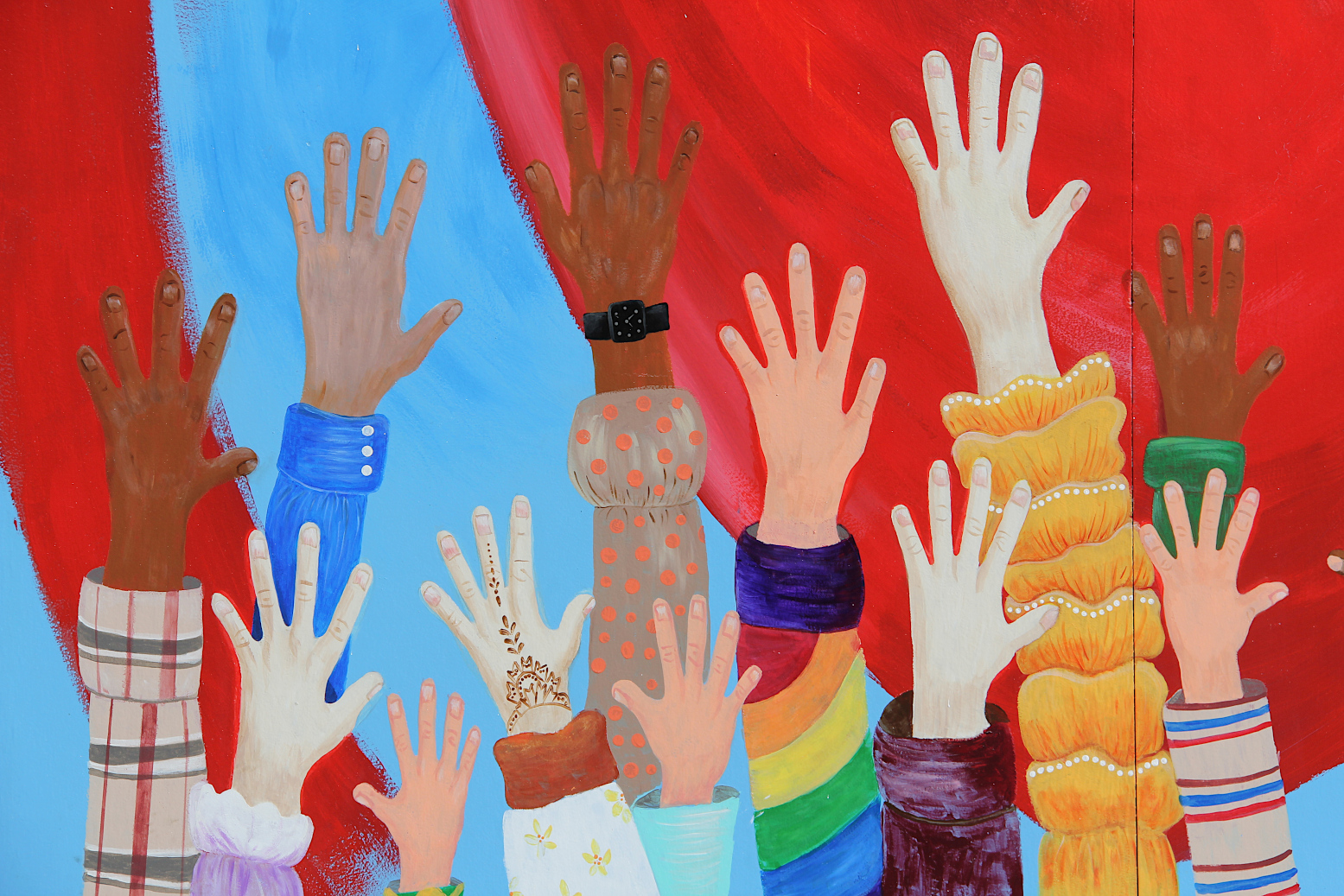
Some places are culturally-diverse, others not. This new mural at the Congregational Church of Faribault United Church of Christ reflects Faribault’s diversity. (Minnesota Prairie Roots copyrighted file photo September 2025)

I GREW UP in southwestern Minnesota, in rural western Redwood County where diversity was absent unless you count religious affiliation or ancestry as diversity. You were either Lutheran or Catholic with a few Methodists, Presbyterians and Brethren thrown in the mix. And you were of German, Irish, Polish or Scandinavian descent, but mostly German. And your skin color was certainly white, unless you were among the Native Americans living on the eastern side of the county.

I left Redwood County for college in the early 1970s. Not much has changed in racial demographics in that rural area, population hovering around 15,000, with the exception of a sizable Hmong population resettling in small town Walnut Grove. Leaving the prairie, a place I loved and still love, broadened my perspectives.

Many Somalis live in downtown Faribault above businesses. They often meet on street corners to visit. (Minnesota Prairie Roots copyrighted file photo May 2024)

Today I live on the eastern side of Minnesota in Faribault, a city of around 25,000 about an hour south of Minneapolis. Mine is a diverse community, home to many Hispanics, Latinos and Somalis. They work here, raise families here, open businesses here and add much color and culture to this city I’ve called home since 1984. Somalis are the newest of Faribault’s immigrants and the group which still struggles with animosity toward them. That makes getting to know them and their stories especially important.

Lul Abdi shows off beautiful wood crafts from Kenya and Somalia at a past International Festival in Faribault (Minnesota Prairie Roots copyrighted file photo)

I’ve attended Somali cultural events, diversity celebrations, talked with local Somalis, photographed them, drank their delicious hot tea, eaten their savory sambusas, walked into their shops, tried to learn about and embrace these residents of Faribault.

I love living in a community with such diversity. Not everyone here feels as I do and would prefer Faribault remain white and non-diverse, as it was when they were growing up. That saddens me. I often think, if only people would take the time to connect one-on-one, to listen, they would begin to see that we are all human, even if different.

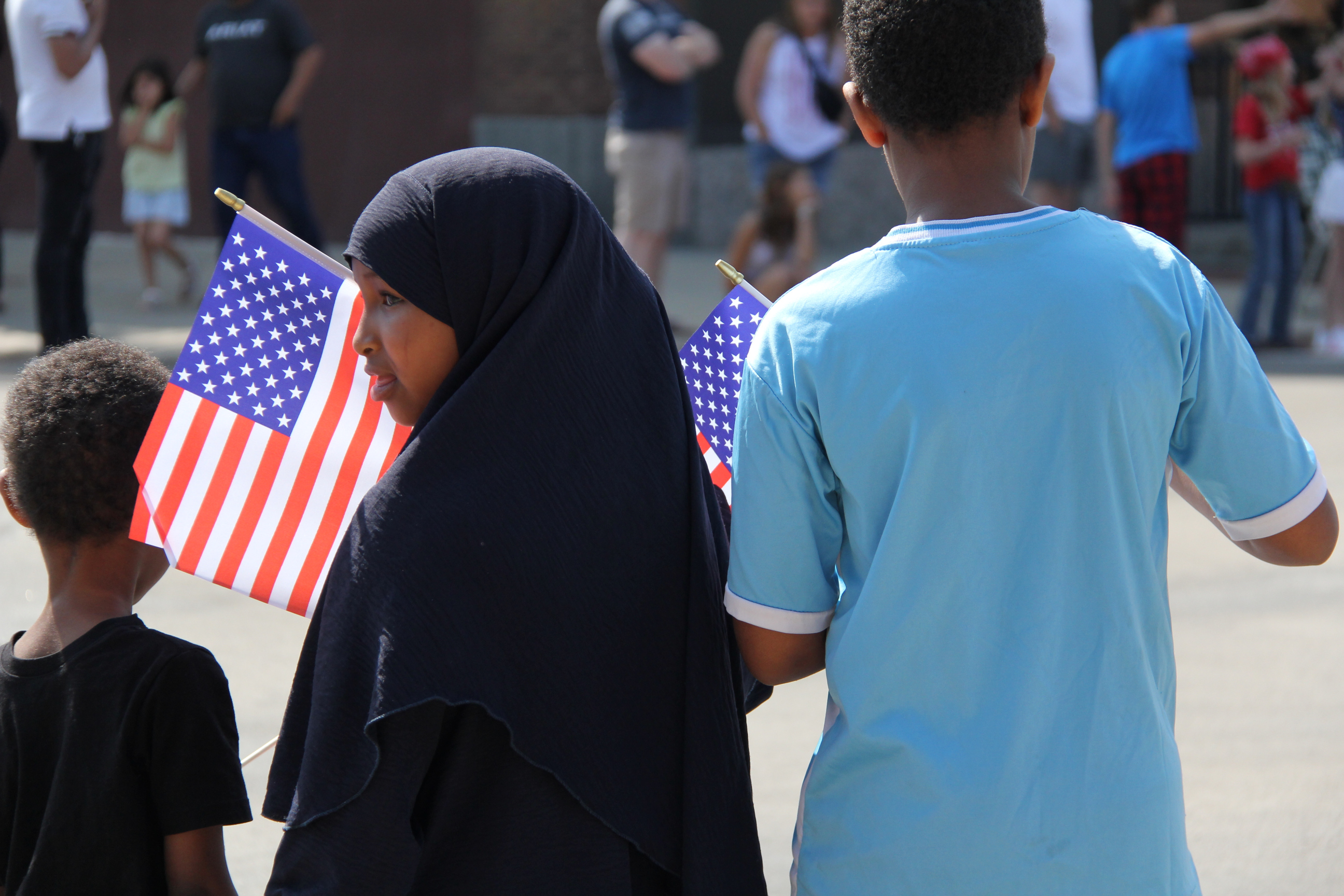
Somali children watch Faribault’s 2025 Memorial Day parade. (Minnesota Prairie Roots copyrighted file photo May 2025)

Instead of fearing others who may not speak the same language, eat the same foods, wear the same clothes, practice the same religion, we can choose to embrace one another. In an ideal world, that would happen. But it takes time, effort and an open heart and mind to get there.

(Promo courtesy of Buckham Memorial Library)

At 6 pm this Thursday, January 29, Buckham Memorial Library is hosting a talk, “Building Bridges Across Cultures,” by Ibrahim Khalif, director of Faribault Youth Empowerment. He will present on the history and culture of Somalia in the library’s Great Hall. The event is part of the library’s adult programming efforts.

This talk is certain to be interesting and informative. The title alone, with the words “building bridges,” reflects my feelings on what needs to happen in my community. A bridge gets you from one side to the other, to a different destination. But to get from one side to the other, you need to first build a bridge together then willingly cross it, not remain firmly planted and divided on a riverbank, unwilling to move.

© Copyright 2026 Audrey Kletscher Helbling
 

Walking in silent solidarity during a candlelight vigil in Faribault January 25, 2026

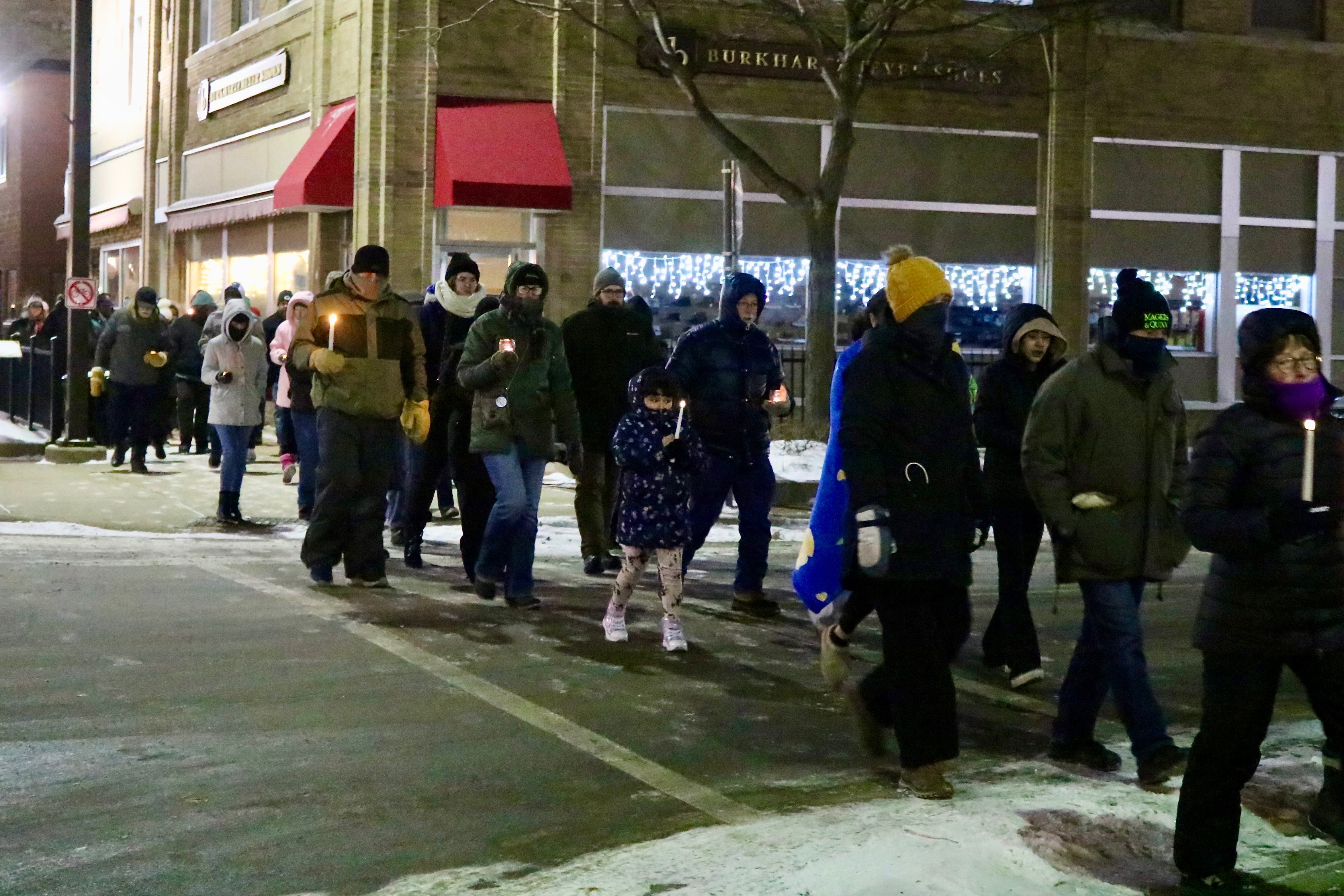
I join others for a candlelight vigil in downtown Faribault on Saturday evening. (Photo by and courtesy of Chloe Kucera, Faribault Daily News)

WE MARCHED IN SOLIDARITY, in community, in collective grief Saturday evening through downtown Faribault. No signs. Only candles, flames flickering, lights shining in subzero temps as vapor billowed from our faces.

An estimated 100 of us walked eight blocks in reverent silence, only the sound of boots crunching on snow and the occasional passing vehicle breaking the quiet.

Bundled up against the frigid cold, we left our warm homes to gather and honor 37-year-old Alex Pretti, an ICU nurse shot to death Saturday morning by ICE agents on the streets of south Minneapolis, less than an hour’s drive north on Interstate 35. It is the second fatal shooting of a Minneapolis resident, a Minnesotan and an American citizen by federal agents in recent weeks.

Faribault resident Martha Brown hastily organized the candlelight vigil via social media, calling for people to walk in silence on our city streets “to mourn together and peacefully pray for the (federal) occupation to end.” I knew I needed to be there, to join Martha and others who felt overwhelmed, yet determined to raise their voices via silence.

FOR OURSELVES & OUR NEIGHBORS

We did this not only for ourselves individually and collectively, but also for the Hispanics, Latinos and Somalis who call Faribault home and who have been targeted by ICE. Our neighbors are living in fear, sheltering in their homes as ICE continues to threaten, take and traumatize right here in my community and across the state.

As the march began in the parking lot outside Buckham Memorial Library, a Hispanic family waited along the curb. I motioned for them to join us and they did as the father filmed the walk for those whom he said could not be there. Those who cannot leave their homes for fear of ICE.

His daughter, about 8 years old, walked ahead of me, her bare hands clutching a slender battery-lit candle someone had given her. I felt so proud of this little girl while simultaneously thinking, she should not have to be here doing this. What a strong, brave family.

REFLECTING IN SILENCE

Walking in silence gave me time to reflect, process my emotions and observe. I passed Mexican and Somali-owned shops, restaurants and a bakery, all told about a dozen in our core downtown business district. I considered how they contribute to our economy, our tax base, our diversity, filling buildings that may otherwise stand vacant.

But I passed, too, a large GUNS sign on the pawnshop, the significance of that singular word not lost on me in the context of the day’s shooting.

Four blocks into the march, I felt strengthened by simply being among caring people of all ages united in purpose and grief. That young girl and her family. A woman in a wheelchair who was wheeled across snowy curb cuts. All of us there, connected by this moment in time in Minnesota.

GRATITUDE FOR COMMUNITY SUPPORT

When the half hour vigil walk ended back in the library parking lot, we stood in a moment of silence, then prayer before the Hispanic man stepped up and thanked us for coming, explaining how much it meant to him to see and feel our support.

Back home I got a text from family in south Minneapolis to “Shine a Light for Minnesota” by placing a lit candle outside at 7 pm. And so Randy set the tea light candles we had just carried through downtown Faribault on our front steps, flames flickering for our communities, for Alex, with the flaming message of ICE OUT NOW.

© Copyright 2026 Audrey Kletscher Helbling


Feeding the hungry on Wednesdays in Faribault January 20, 2026

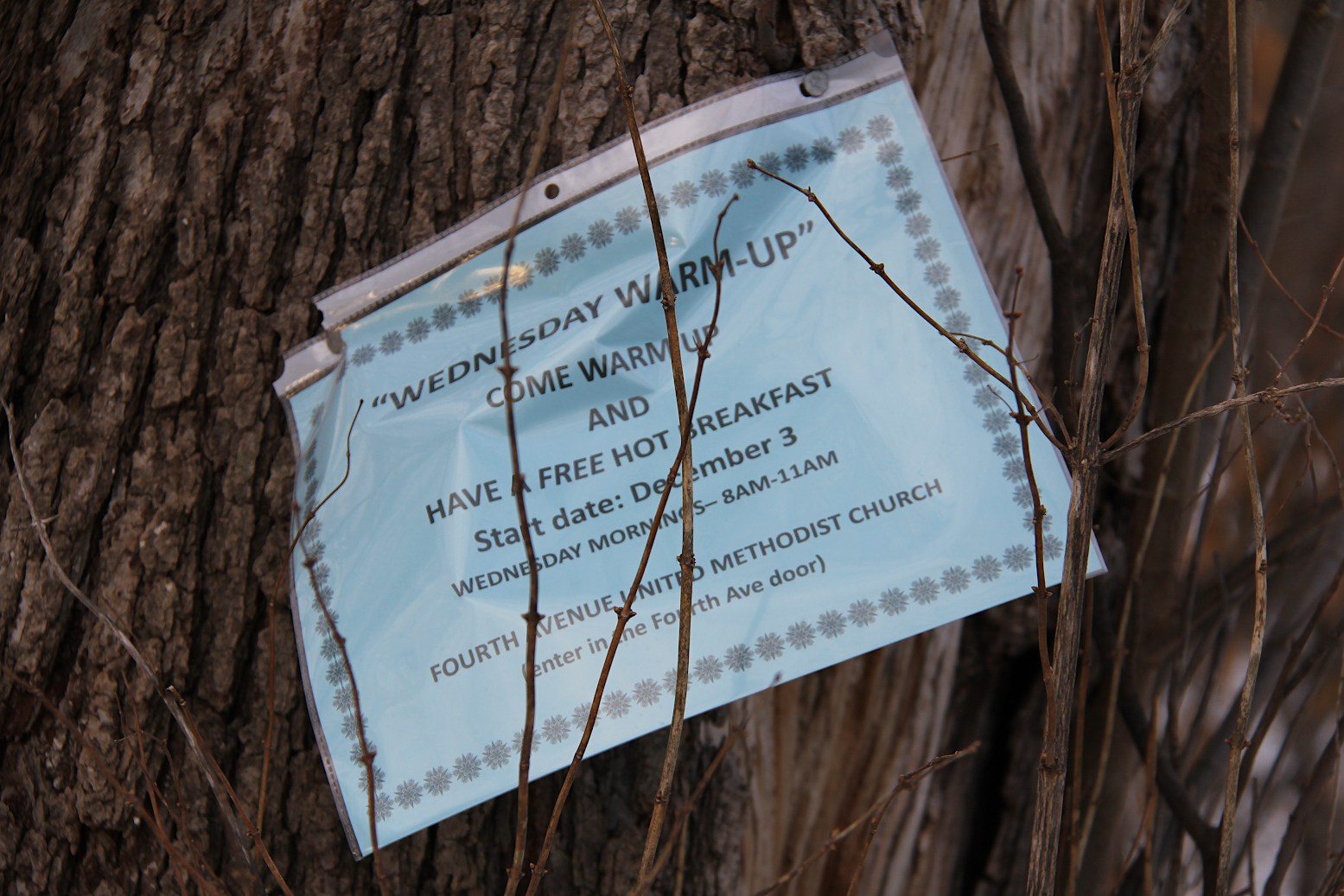
This sign posted on a tree led me to learn more about “Wednesday Warm-Up.” (Minnesota Prairie Roots copyrighted photo January 2026)

POSTED ON TREES in woods edging the Straight River Trail in Faribault, two duplicate blue signs drew my attention. I paused in my walk to read the notices slipped into protective plastic sleeves. And that is how I learned about “Wednesday Warm-Up” at Fourth Avenue United Methodist Church.

Since December, this Faribault congregation has opened its doors from 8- 11 a.m. every Wednesday to anyone wanting a free hot breakfast. They’re focusing on the underprivileged and those experiencing homelessness, according to John Streiff, mission outreach chairman for Fourth Avenue UMC.

(Minnesota Prairie Roots copyrighted file photo used for illustration only)

A few people come for the morning meal, which changes weekly. One Wednesday the featured food may be French toast, the next week biscuits and gravy, eggs or pancakes with a meat, fruit, doughnuts/toast and beverages. Most of the food is donated.

This is not, Streiff emphasizes, about “drafting” people into church. Rather, it’s about “what Jesus would do…to show what unconditional love is,” he said.

And that’s exactly what I heard in my brief phone conversation with Streiff about the Wednesday morning breakfast. I could hear the compassion in his voice as he mentioned a couple who came to eat and who are living out of their car. Some are down on their luck. Some share their personal stories, others don’t.

If anyone needs additional assistance, the church will do what they can by directing them to resources and/or providing tangible help such as gift cards for gas. “All we’re trying to do is share the love of God,” Streiff said.

This message, posted outside Fourth Avenue UCC in 2019 under a previous pastor, seems to fit the congregation’s community outreach mission of caring for others. (Minnesota Prairie Roots copyrighted file photo)

In online videos, Fourth Avenue UMC pastor, the Rev. Shawn Stoll, talks about building community and friendships over food at the Wednesday Warm-Up breakfasts. The breakfast is open to anyone, “regardless of who you are or where you slept,” he says.

Streiff echoed that message as he talked about opening the church doors for people to come in, warm up and visit (if they wish) over breakfast. Fourth Avenue will continue serving breakfast weekly through the end of February and perhaps beyond. Streiff noted that it takes time to build trust between people.

I love this community outreach, something Fourth Avenue UCC has done previously with a free Christmas dinner open to anyone. Congregants understand the importance of building community and of meeting people where they are at in life. And of serving.

Wednesday Warm-Up breakfasts provide for a basic human need—food. This faith community is taking biblical directives to feed the hungry and actually doing that, not simply talking and praying about it. And for that action, that compassion, that love, that service, I feel deep gratitude.

© Copyright 2026 Audrey Kletscher Helbling
 

Bishop Henry Whipple, the man behind the federal building bearing his name January 16, 2026

A mural on the bandshell at Faribault’s Central Park honors Bishop Henry Whipple. (Minnesota Prairie Roots copyrighted file photo)

I EXPECT BISHOP HENRY WHIPPLE may be turning over in his grave under the altar inside the Cathedral of Our Merciful Saviour in Faribault. He would be appalled by what’s happening in this community with ICE enforcement. And he would also likely be standing side-by-side with protesters outside the Bishop Henry Whipple Federal Building at Fort Snelling protesting ICE’s presence in Minnesota. The federal agents are based inside the building named after him.

Whipple was all about compassion and embracing others, especially as a friend to the Dakota in Minnesota following his arrival here in 1860 and throughout his ministry. He would not be fine with ICE violently, or non-violently, taking people from their vehicles, their homes, clinics, outside schools and churches, inside businesses…and illegally detaining them without due process. That includes those here legally and American citizens imprisoned inside the building bearing Whipple’s honorable name.

I am not OK with this. None of us should be.

HOW BISHOP WHIPPLE MIGHT REACT

As Minnesota continues to deal with the presence of 3,000 ICE agents in our state, I think of the Episcopalian bishop, known as “Straight Tongue” for his honesty, and how he would react. He would assuredly be on the streets advocating for human rights. He would be talking with the current president, just like he did in 1862 with President Abraham Lincoln. Whipple traveled to DC then to personally plead for the lives of 303 Dakota sentenced to death by hanging.

Whipple would probably also be out buying groceries for Faribault residents afraid to leave their homes. He would be walking kids to their bus stops in trailer parks. He would be preaching peace, love and compassion.

HONORING WHIPPLE’S LEGACY

Those who disliked Whipple, and the Dakota, disparagingly tagged the clergyman as “The Sympathizer.” Little has changed. There are far too many in my community who hate, and, yes, that’s a strong word, anyone whose skin color is other than white. I don’t understand. They all, unless they are Native American, can trace their presence in America back to immigrants.

If only Bishop Henry Whipple was still alive to spread love in Faribault and beyond. It’s up to us to honor his legacy by loving and helping our neighbors during these especially dark days of injustice and oppression.

#

FYI: To learn more about the bishop, I direct you (click here) to a previous blog post I wrote about him and his role in Minnesota history following a 2023 presentation at the Rice County Historical Society.

© Copyright 2026 Audrey Kletscher Helbling

 

Council chat focuses on community concerns January 13, 2026

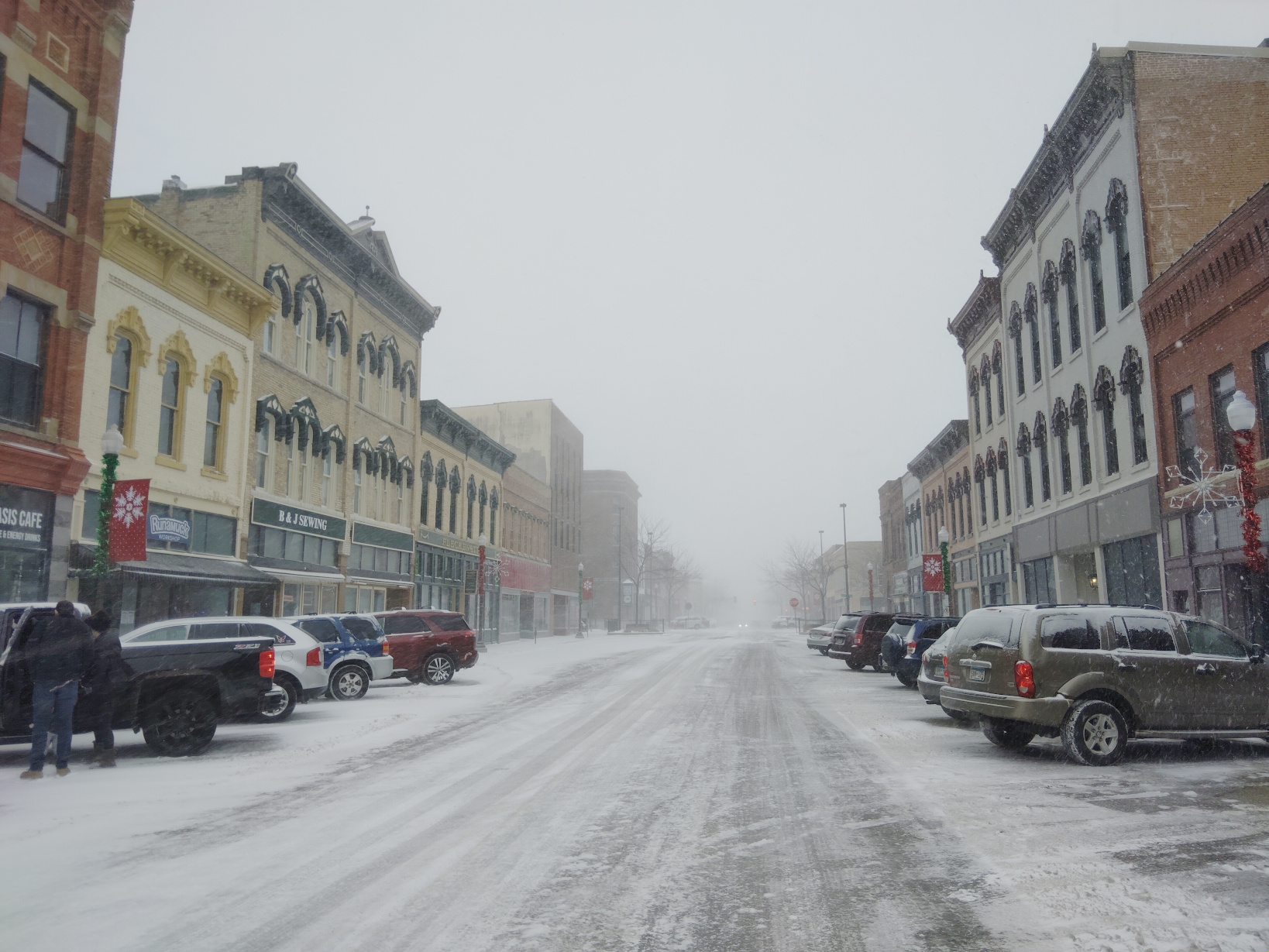
Downtown Faribault during a snowstorm on a recent Sunday afternoon. (Minnesota Prairie Roots copyrighted file photo December 2025)

COMPLAIN. COMPLAIN. COMPLAIN. We all do it, right? While venting helps, that doesn’t solve problems. But listening, really listening, and sharing ideas thoughtfully and respectfully moves us toward solutions.

With that introduction, I point to the city of Faribault and its monthly Council Chats, an opportunity to engage with elected officials, city staff and others on issues of concern within the community. I’ve been to several of these and really appreciate the informal format of short presentation followed by a Q & A and then mingling. “Chat” definitely fits.

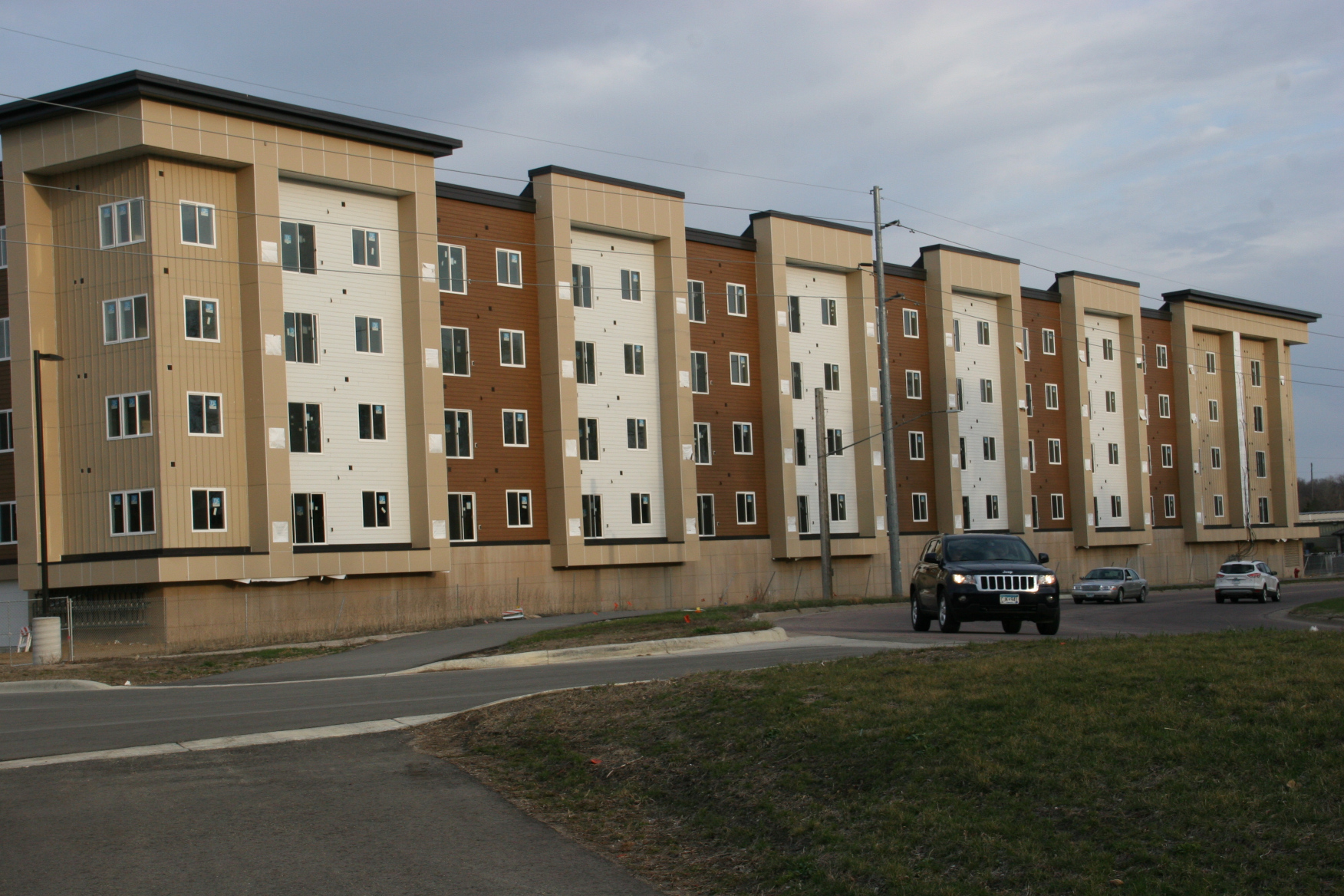
Faribault has experienced a surge in apartment construction in recent years, especially near downtown. This shows Straight River Apartments under construction in April 2022. (Minnesota Prairie Roots copyrighted file photo 2022)

This month’s meeting, set for 6 pm Wednesday, January 14, at the Viaduct Park building, is promoted as a “Community Listening Session” led jointly by city staff and the Community Action Center, a community-based human services nonprofit in Faribault (and also in Northfield). Lack of housing, environmental concerns and employment opportunities will focus discussion. Those have been identified as top issues by city residents.

Based on the pre-event information I’ve read, the Community Listening Session promises to be a worthwhile sharing of information, exchange of ideas and thoughtful conversation. Attendees will be able to view and give feedback on locally-themed posters with Faribault specific data. It is the feedback that I find invaluable in planning for the future of my community. Attendees may have other concerns they wish to address.

The Community Action Center, according to its Facebook page, has been working hard to gather information for Wednesday’s chat:

Over the last few months we’ve been collecting meaningful feedback from our neighbors about important topics impacting all of our daily lives. Through one-on-one conversations with food shelf shoppers and folks at community events, by carefully listening to parent groups and partners, while reading responses from multilingual surveys, and by hearing participant stories, we are finally prepared (and excited) to share the perspectives and experiences that will help inform the future of our community.

The Gathering Room at Viaduct Park, the city’s newest park, will be the site of Wednesday evening’s Council Chat Listening Session. (Minnesota Prairie Roots copyrighted file photo December 2025)

I am hopeful turn-out for this event will be good. People are too quick to criticize, especially on social media. Too quick to blame. Too quick to attack. Too quick to think their voice either doesn’t matter or is the only one that matters.

In many ways, these Council Chats are the most basic form of grassroots government—like sitting down over a cup of coffee, or a bottle of beer if you prefer that, and talking to one another sensibly. If we actually listen to one another, then perhaps together we can forge a plan of action that betters our community.

© Copyright 2026 Audrey Kletscher Helbling
 

Protesting in Faribault January 11, 2026

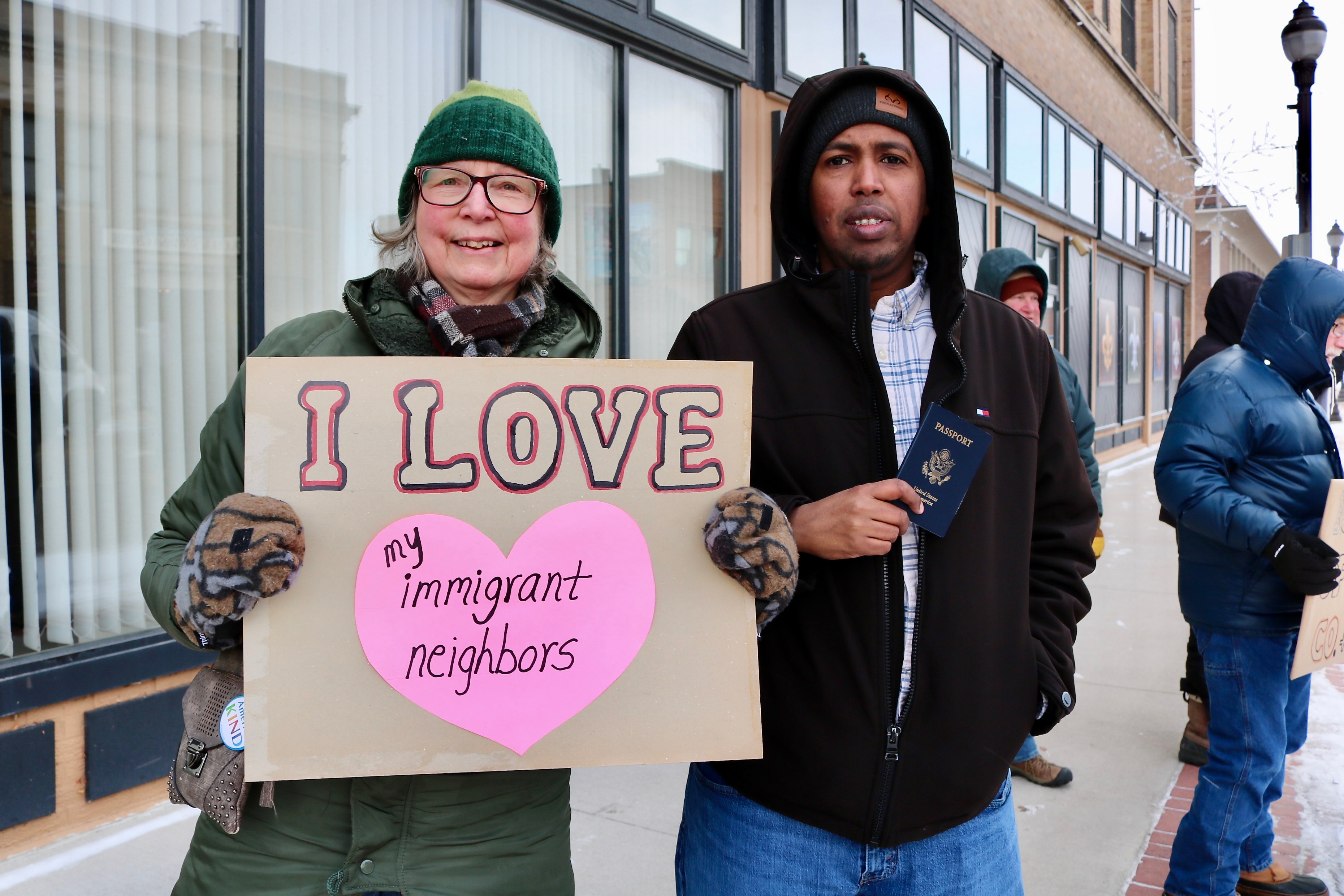
Me with my new friend, Bashir, a U.S. citizen who now carries his passport with him at all times. Bashir works as a family and community engagement specialist in the Faribault Public Schools. (Copyrighted photo by & courtesy of Chloe Kucera, Faribault Daily News)

SATURDAY AFTERNOON, as a raw northwest wind swept down Minnesota State Highway 60, I stood side-by-side with others at a busy intersection in the heart of downtown Faribault. I stood in solidarity over concerns about ICE enforcement locally, across the state and country. I stood in solidarity over concerns about the fatal shooting of Renee Good by an ICE agent in Minneapolis on January 7. I stood in solidarity over concerns for our democracy. And I stood in love and support of my neighbors.

Neighbors like Bashir, a long-time Faribault resident whom I met shortly after arriving at the gathering to the sound of bagpipes. My interaction with him nearly broke me emotionally after Bashir reached inside his jacket and pulled out his passport. “I carry this with me everywhere now,” he said. It’s one thing to hear and read about this in media reports. It’s quite another to meet a U.S. citizen “forced” to carry his passport by a president who has publicly stated he wants Somalis out of the country.

My humanity, my compassion, my heart and soul and spirit call upon me to support individuals like my new friend, Bashir, in this moment. My humanity also calls upon me to support the Latino and Hispanic communities who comprised the majority of the 25 or so of us gathered during the quickly-organized protest on Saturday.

Organizer Sonia mingled among us, protesting, passing out hot chocolate and later distributing educational information about Constitutional rights, alerting others to ICE’s presence and more.

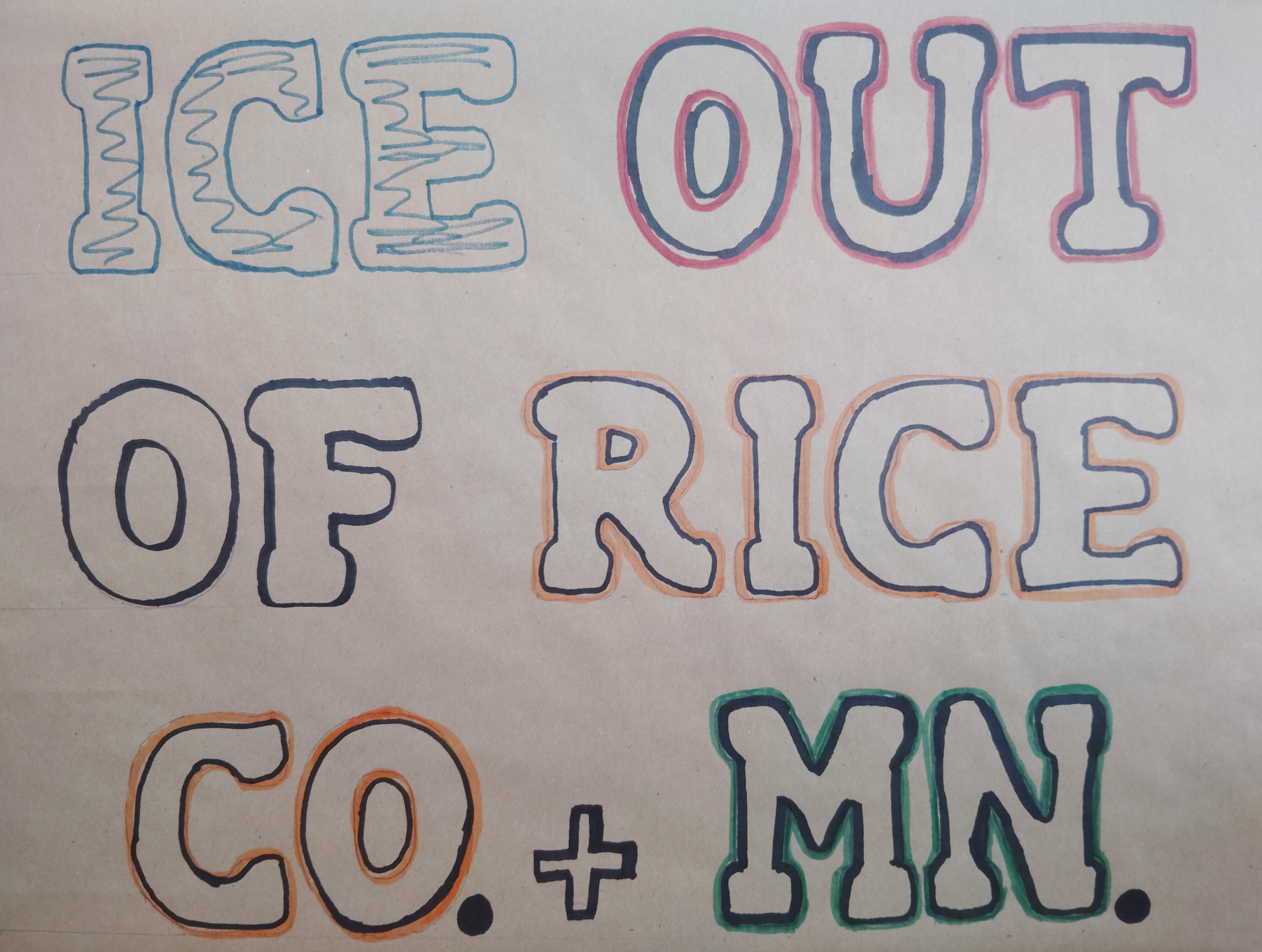
The second protest sign I made and which my husband carried. Many at the rally held similar signs. (Minnesota Prairie Roots copyrighted photo January 2026)

ICE IN FARIBAULT

In conversations, I learned that ICE has been especially active in Faribault recently. I’d heard this previously from multiple sources. Protester Travis, who works in the school system, confirmed this, noting that student attendance is down. He watched for ICE vehicles during the rally and had every right to be worried given ICE activity along Lyndale Avenue in Faribault earlier Saturday. That resulted in multiple 911 calls, including one from a caller claiming they were “about to get shot,” according to a media release from Faribault Police Chief John Sherwin. Officers responded to ensure public safety. ICE was there. But no shooting occurred.

We are a state and community on edge following the killing of Renee Good. We are a state and community under incredible stress as the federal government relentlessly targets Minnesota and the people who call this state home. It is unfathomable to think that those of skin tones other than white must fear they will be taken by masked agents. It was not lost on me that I am (at least for now) exempt because I am white.

Another new friend, a young Hispanic woman named Christina, shared how ICE agents are patrolling the Cannon River Mobile Home Park, home to many Hispanics and Latinos. Residents are afraid to leave their homes for fear of being taken by ICE. Doesn’t matter if you are here legally or not.

Protesters line the sidewalk at the intersection of Central Avenue and highway 60. I am hugging Bashir in this image. (Copyrighted photo by & courtesy of Chloe Kucera, Faribault Daily News)

OVERWHELMINGLY POSITIVE SUPPORT

As I stood with Bashir, Sonia, Travis, Christina, Hannah, a high school senior and a mix of multi-aged Latinos, Hispanics and white people like me, I felt empowered. Our numbers may have been small. But for a last-minute protest and the first in Faribault, turn-out was encouraging.

Even more encouraging was the overwhelmingly positive response we got from passing motorists in honks, friendly waves, thumbs up and more to counter the few middle fingers, thumbs down and venomous words spewed by one especially angry young female driver. How anyone can hold such hate toward immigrants is beyond my understanding.

I felt only love in the presence of my new friends. Many thanked me for coming. I hugged several, offered words of encouragement. Words matter. And so do actions. A Somali couple arrived to distribute hot tea. I’d been protesting for 1 ½ hours and felt chilled to the bone by the estimated zero-degree windchill. That offering of Somali tea warmed my body and my heart. As I reached for a cup of the hot beverage, I was overcome by emotion. The message I carried—“I LOVE my immigrant neighbors”—reflected back on me as I, too, felt loved in that moment.

#

NOTE: I moderate all comments on this, my personal blog. I will not publish comments which express hatred or are otherwise offensive, include intentional false information and/or do not meet the standards of decency I expect here.

© Copyright 2026 Audrey Kletscher Helbling
 

A winter walk along the Straight River inspires January 7, 2026

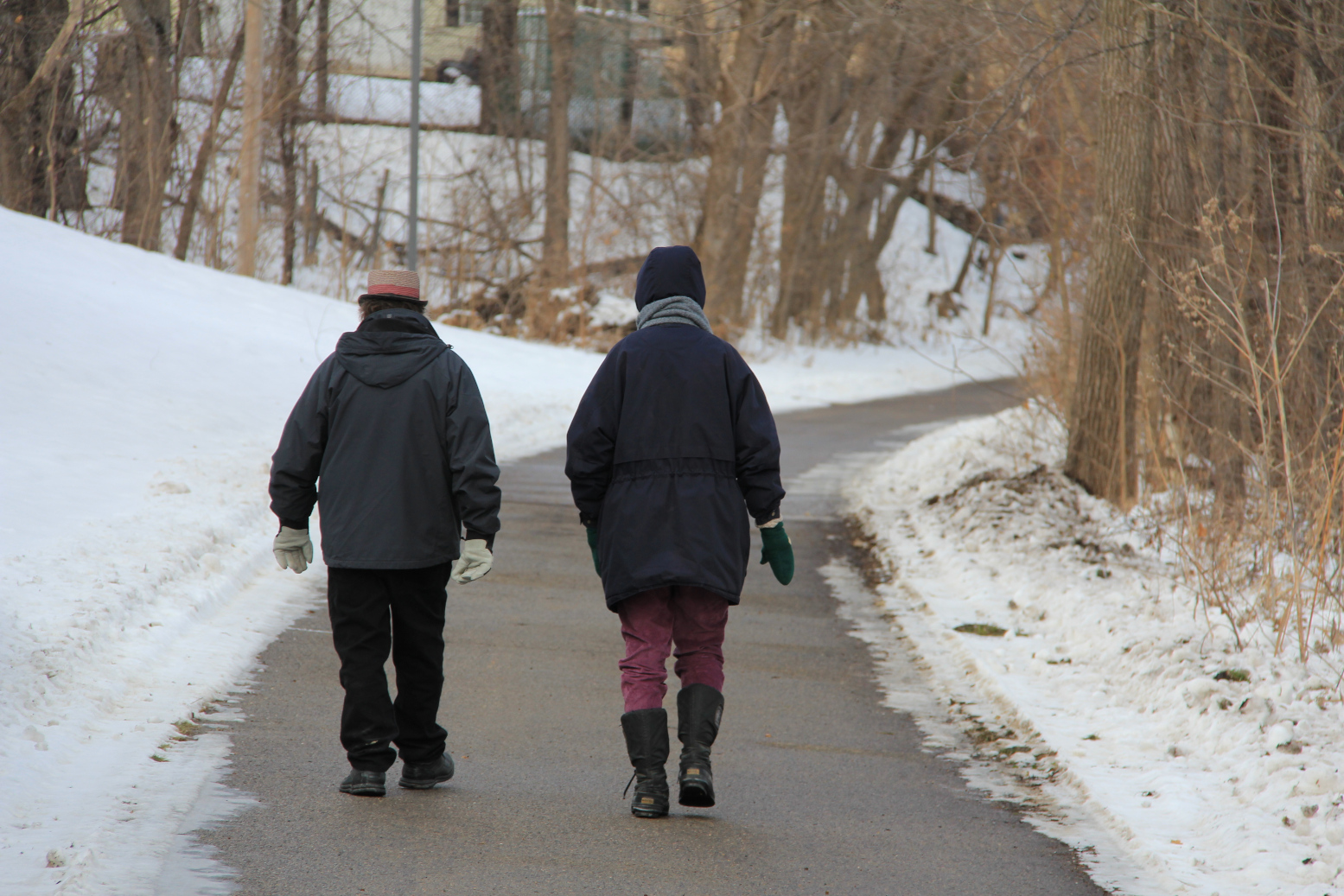
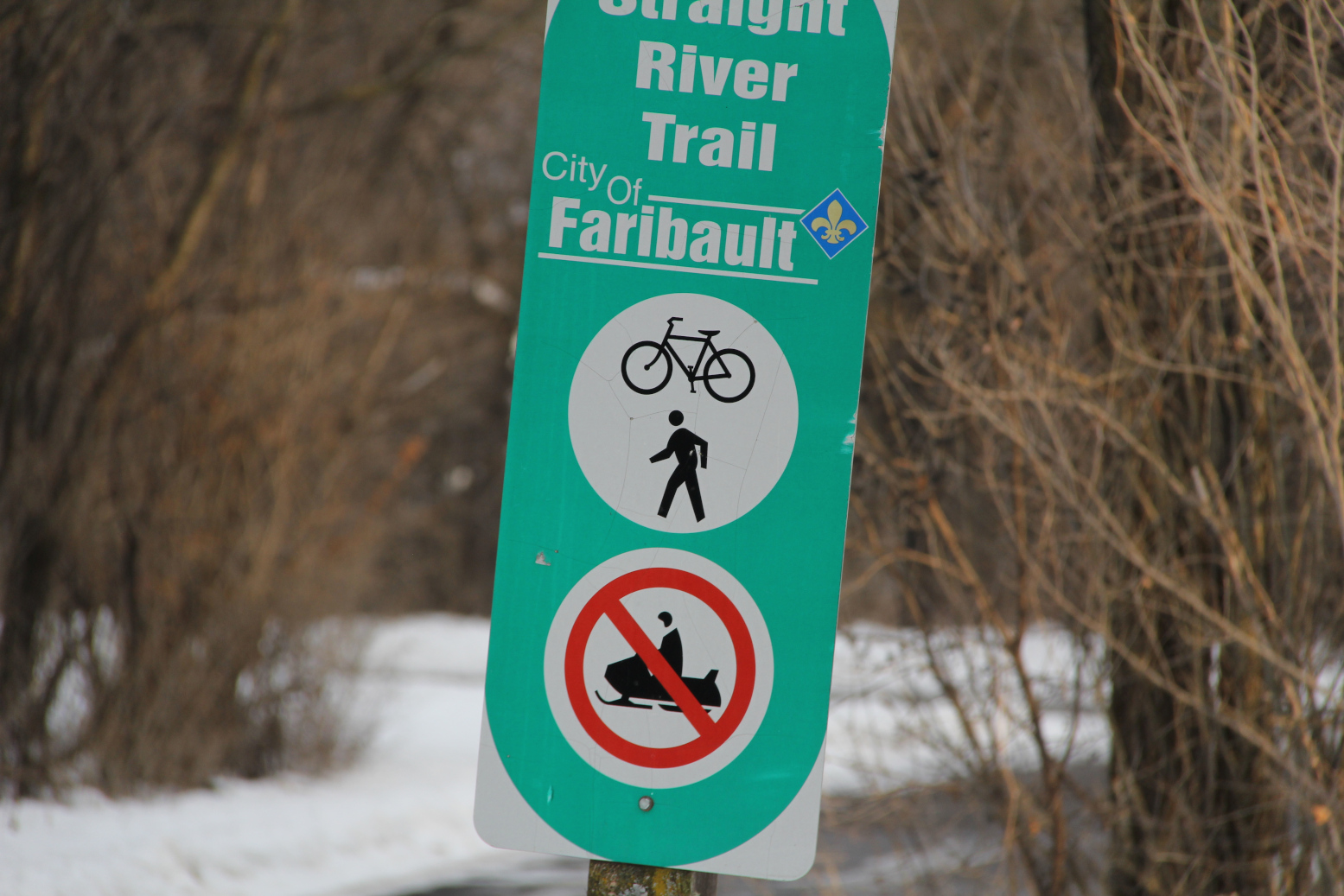
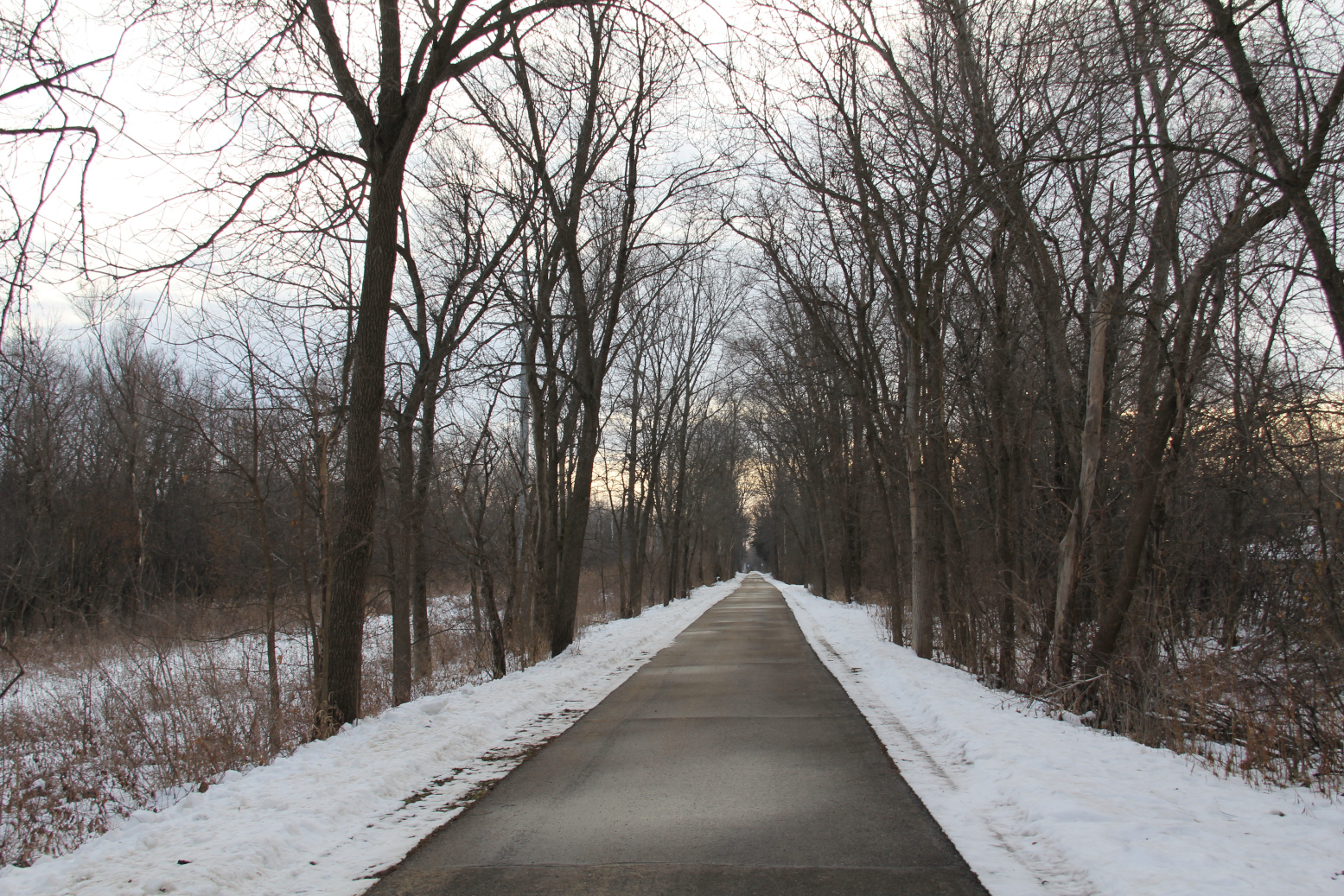
Walking along the Straight River Trail near Fleckenstein Bluffs Park on a recent winter day. (Minnesota Prairie Roots copyrighted photo December 2025)

WITH WINTER OFFICIALLY LAUNCHED, it’s easy enough to stay home, settle in, curl up with a good book and avoid the ice, cold and snow that define Minnesota weather in January. When winter burrows in, I’m more inclined to hibernate. But I push myself to get out. It’s good for my physical, mental and emotional health.

An extensive city trail system runs throughout Faribault. (Minnesota Prairie Roots copyrighted photo December 2025)

Faribault offers plenty of options for aging Baby Boomers like me and others who simply want to take a walk. On the worst of winter days, I can loop around the soccer field at Shattuck-St. Mary’s School, which opens its dome to the public most weekday mornings (except holidays) from November into early spring. Hours vary, but generally run from around six-ish to 9:30 am.

The Straight River Trail stretches before me in the area known as Frog Town. (Minnesota Prairie Roots copyrighted photo December 2025)

And when I want to be outdoors, the city’s paved recreational trails are usually cleared, allowing me to safely immerse myself in nature. There’s something about walking outdoors at a brisk pace on a cold winter day that invigorates.

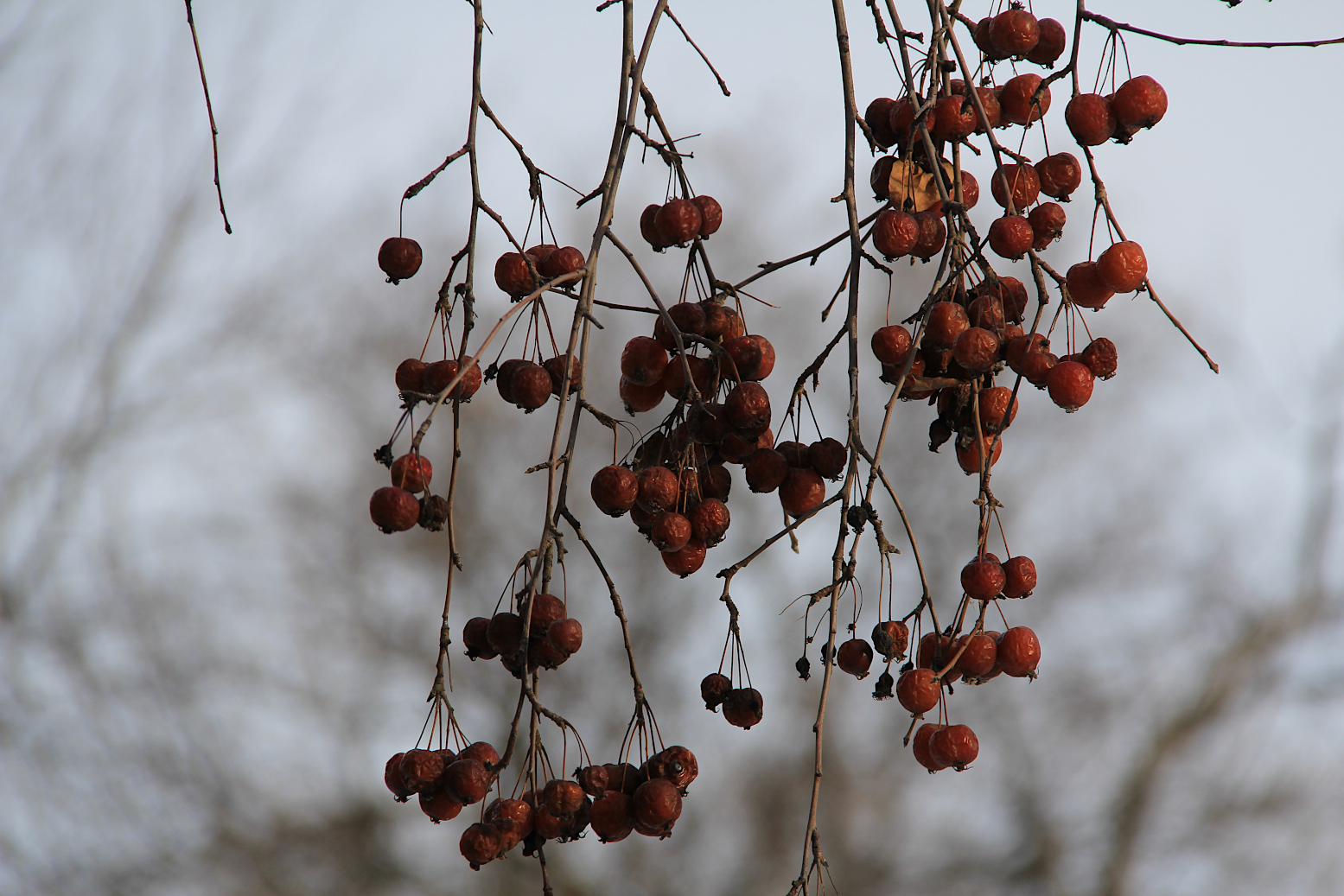
Even in the drab winterscape, color can be found, such as in these dried berries. (Minnesota Prairie Roots copyrighted photo December 2025)

Sometimes, though, I opt to carry my camera and focus on the environment rather than upping my heart rate. Photography improves my well-being, too, because I begin to notice nature’s details in a mostly monochrome landscape. Winter’s beauty emerges. And that is good for my spirit, my soul, my creativity.

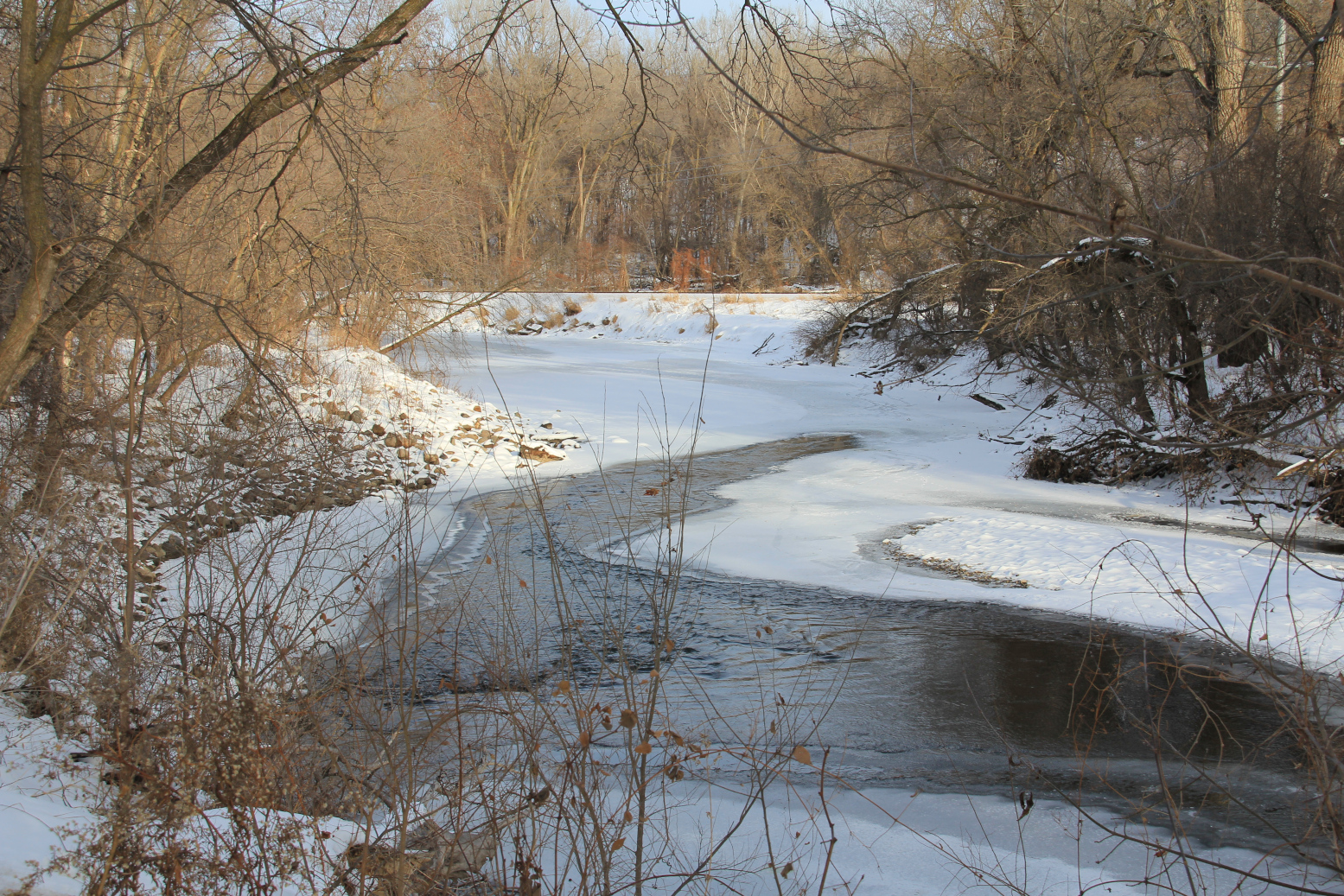
The Straight River is anything but straight as it winds between woods and bluffs in Faribault. (Minnesota Prairie Roots copyrighted photo December 2025)

I especially delight in following the Straight River Trail because water, whether frozen or flowing free, mesmerizes me. I think humans have always been drawn to water. Near Fleckenstein Bluffs Park, the Straight River curves, winding through the woods, under the railroad bridge, along the bluffs.

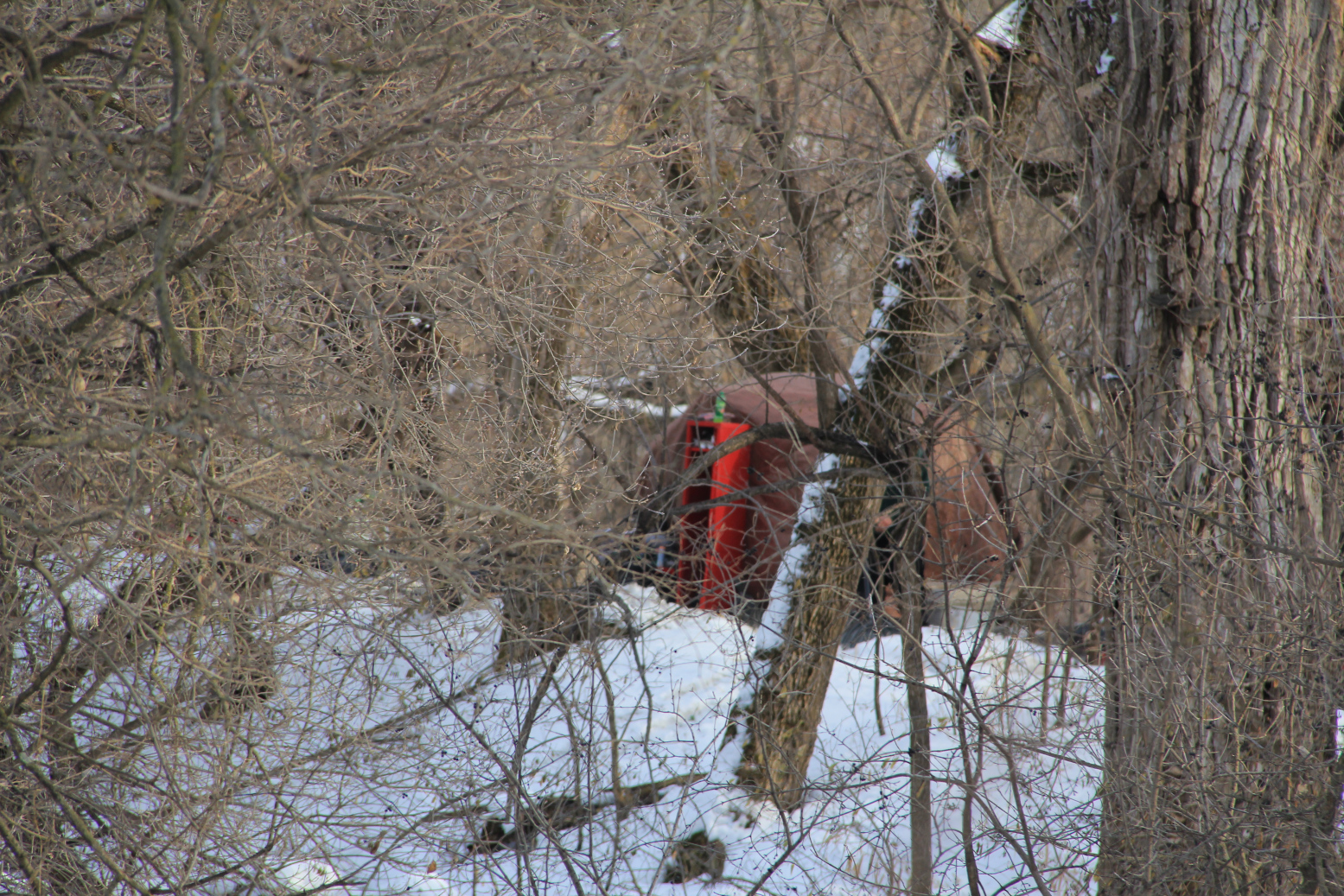
Barely discernible, a temporary riverside shelter in the woods near Fleckenstein Bluffs Park. (Minnesota Prairie Roots copyrighted photo December 2025)

On a recent afternoon along the trail, with Canon camera in hand, I spotted a flash of red across the river in the woods. From a distance and through the trees, I couldn’t clearly distinguish details. But I knew this was a temporary shelter for someone without a permanent home. I saw a person shoveling snow.

Tangled twigs along the Straight River Trail. (Minnesota Prairie Roots copyrighted photo December 2025)

And I thought of my poem, “Misunderstood,” inspired by a previous walk along the Straight River Trail. That poem published in 2024 in Talking Stick 33, Earth Signs, a Minnesota literary anthology:

Misunderstood

Tents cluster along the Straight River,

home to the homeless on land

once held by the Wahpekute.

History and hardship merge here

in long-ago and present-day stories.

Bison skin tipis and nylon tents.

Different times. Different peoples.

Drawn to the water, the sheltering woods.

Misunderstood then. Misunderstood now.

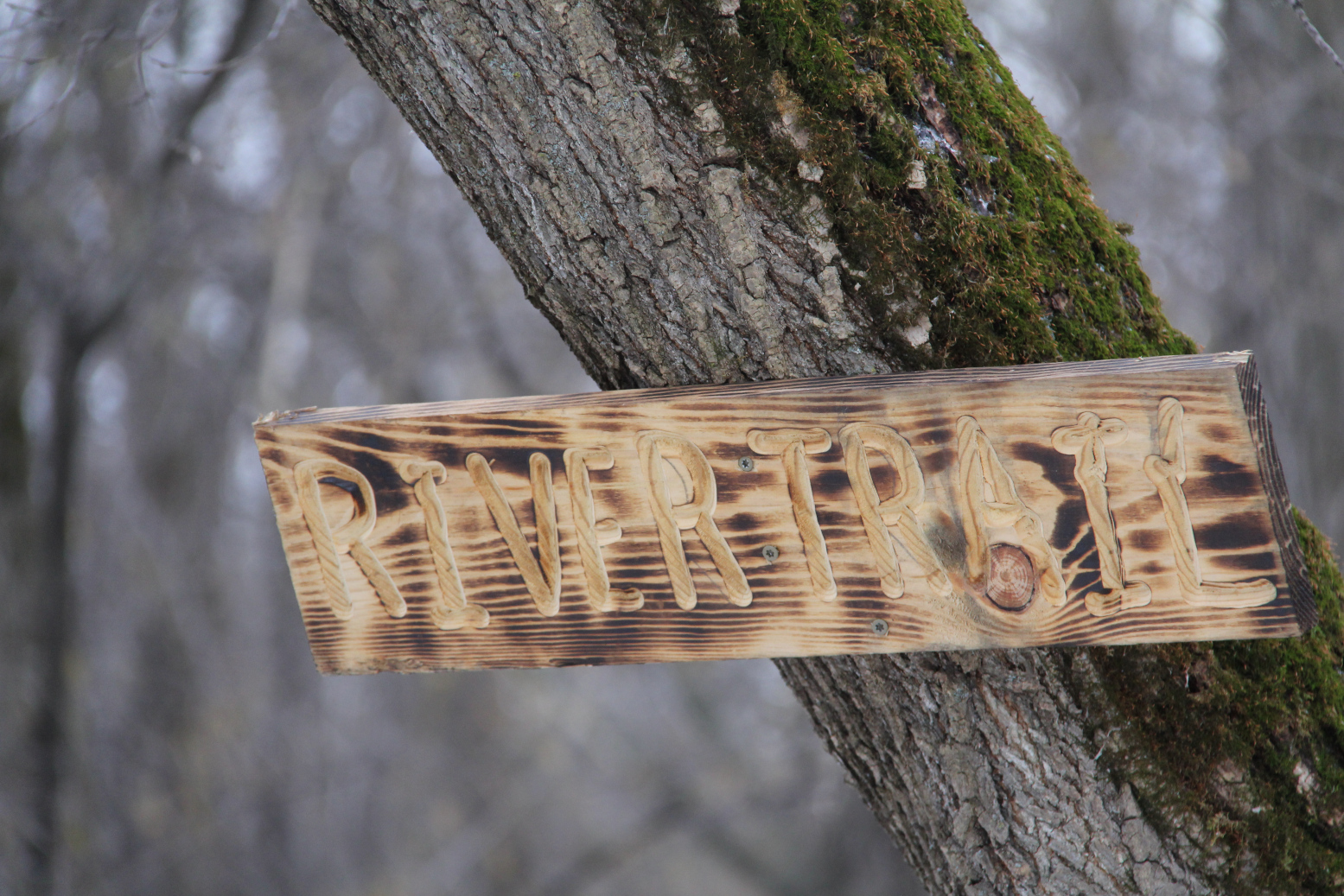
This homemade trail sign, screwed to a tree along the Straight River Trail in Frog Town, leads to a path beaten through the snow. I did not follow the unofficial trail, not this time. (Minnesota Prairie Roots copyrighted photo December 2025)

Getting outdoors feeds my creativity. If not for that walk and my knowledge of Faribault history, I would not have crafted that poem about the Dakota and those experiencing homelessness today in my community. I observe, photograph, write, creating photos and stories that need to be shared.

© Copyright 2025 Audrey Kletscher Helbling