Minnesota Prairie Roots

Writing and photography by Audrey Kletscher Helbling

Time for a flea market, May Market & garage sales May 16, 2025

Vendors set up and shoppers shop in front of an historic church and school at the 2024 RCHS Spring Flea Market. (Minnesota Prairie Roots copyrighted file photo May 2024)

TIS THE SEASON of sales for anyone who appreciates used and local handcrafted and homemade goods. That would be me.

The seasonal-themed paint-by-number paintings I regret not buying at a past RCHS Flea Market. (Minnesota Prairie Roots copyrighted file photo 2022)

Saturday brings a flood of such sales to my area beginning with the Rice County Historical Society Annual Spring Flea Market from 8 a.m.-2 p.m. at the RCHS in Faribault. I’ve attended this spring and fall event often, both as a shopper and a photographer. Well, and also as a place to connect with others. From antiques and collectibles to glassware, handcrafted goods and more, the offerings are varied and many, as are those who attend. I love catching up here with people I haven’t seen in a while.

Flea market merch, old Minnesota polka albums. (Minnesota Prairie Roots copyrighted file photo)

Over in the much smaller community of Nerstrand to the east of Faribault, the town is hosting city-wide garage sales, also from 8 a.m.-2 p.m. Saturday. I’ve never been to yard sales in Nerstrand. But this Saturday may be a good time to start. Among those vending used goods are two churches. St. John’s United Church of Christ, Wheeling Township, will be selling at the city park pavilion. And Nerstrand United Methodist Church hosts its sale at the church, offering household items, clothing, vintage goods and more.

This sign marks a much-loved small town meat market. (Minnesota Prairie Roots copyrighted file photo)

That “more” includes food—donuts, rolls, beverages and Nerstrand weiners. The weiners, which I suppose you could say are “famous,” come from Nerstrand Meats & Catering. The meat market has crafted old-fashioned wood-smoked meats since 1890. Unfortunately, the market will be closed during the city-wide garage sales, likely to the dismay of my husband (who loves Nerstrand weiners; there’s a package in our fridge right now) and many others. But the butcher shop and its next door eatery, Boots and Lu’s Cafe, are temporarily closed for good reason. They are renovating and expanding with reopening set for early June.

In the meantime, Nerstrand Meats meats are available at their Lakeville storefront (didn’t previously know they had one) and in area grocery stores.

Artist Jordyn Brennan painted this mural on WildWood of Nerstrand. There’s a green space on this side of the event center/gathering place. (Minnesota Prairie Roots copyrighted photo October 2024)

A few doors down from the meat shop, WildWood of Nerstrand will host a May Market from 9 a.m.-2 p.m. Saturday inside and out its event center, easily-identified by a beautiful sprawling floral mural. Simply reading through the lengthy list of local crafters, artists, bakers and growers is enough to get me interested in attending. Here’s a sampling of those creative business names: The Dancing Baker Co., Papa Bear Bar-B-Que, Rustic Woods by Gavinn, Cookie Cruiser, Plants Need Sunshine, Grumpy Dwarf Iron & Fine Leather, and Happy HomeSteader. See what I mean?

WildWood is located in a renovated historic building in Nerstrand. (Minnesota Prairie Roots copyrighted file photo October 2024)

Besides all those handcrafted goods and homemade foods offered at the May Market, attendees can also enjoy outdoor music and treats. This event is about much more than local sales. It’s also about bringing people together, about connecting, about building and celebrating community.

One of two hardware stores in small town Waterville. (Minnesota Prairie Roots copyrighted photo June 2024)

Over in Waterville to the west of Faribault and in Lakeville to the north in the south metro, you will find more city-wide garage sales on Saturday. Tis the season when garage doors rise to a treasure-trove of goods, when driveways crowd with tables overflowing with excess and unwanted items, when another’s cast-offs may be just what you want or need. Or don’t need.

Shopping at the 2024 RCHS Spring Flea Market. (Minnesota Prairie Roots copyrighted file photo May 2024)

Happy shopping, wherever you live!

TELL ME: Do you shop flea markets, garage/yard/rummage sales and/or maker markets? If yes, why? I’d like to hear about your experiences, your finds.

© Copyright 2025 Audrey Kletscher Helbling


Hands-on engaging history at Faribault’s Riverside Rendezvous May 14, 2025

Rendezvous re-enactors visit near the pirate ship. (Minnesota Prairie Roots copyrighted photo May 2025)

I’M INTERESTED IN HISTORY, although not as much as my husband. He reads history-themed books, remembers historical dates and facts, and leaves a museum with more info imprinted on his brain than me. I learn about and retain history better when I can actually “see” and experience it. That’s why I find events like the recent Riverside Rendezvous and History Festival in Faribault especially appealing.

One of many tents where you could learn and also buy goods. (Minnesota Prairie Roots copyrighted photo May 2025)

That same connective shift is something I see happening more and more in history centers and museums. And that’s a good thing—to have interactive and creative exhibits that draw people into history. It is via connecting with our past that we begin to understand today.

Fur pelts and hats at the Mountain Man Hat Making tent. (Minnesota Prairie Roots copyrighted photo May 2025)

After attending the Riverside Rendezvous, I hold a deeper understanding of early life in Minnesota, specifically the Faribault area. Fur trading shaped the local economy. Those long ago fur traders and Indigenous Peoples got along, realizing they could help one another by exchanging goods. It seemed to work for a long time, until European settlers moved in, pushing the Dakota off their native land. Cultures clashed. War ensued. Everything changed.

This historian talked about whip making. His partner later cracked the whip. (Minnesota Prairie Roots copyrighted photo May 2025)

Change is inevitable. The Rendezvous provided ample visual evidence of that by focusing on everyday life in the 1700s and 1800s. Each encampment participant highlighted a specific area of yesteryear. And by that I mean a skill—like pounding metal, stitching leather, shaping hats and much more.

Jenna Nelson demonstrates candle making. (Minnesota Prairie Roots copyrighted photo May 2025)
My grandson layers hot wax onto a wick as he builds his candle. (Minnesota Prairie Roots copyrighted photo May 2025)

That included candle making, something my kindergarten-aged grandson tried. Under the watchful guidance of Rice County Historical Society Curator Jenna Nelson, Isaac dipped a wick into a pot of hot wax and then into a jar of cold water, repeating the process until he had a thickened candle.

This toy of yesteryear fascinated my young grandson as he adjusted the wooden figure in varying positions. (Minnesota Prairie Roots copyrighted photo May 2025)

Isaac also tried his hand at stitching a leather pouch, rug weaving and playing with toys of yesteryear. He smiled the entire time. He is very much a hands-on kid who loves creating. His older sister, not so much.

A tent full of books. bowls and hats for sale at the Rendezvous. (Minnesota Prairie Roots copyrighted photo May 2025)

But Izzy did race to a tent full of books and happily accepted rock candy from a costumed character at the axe-throwing station.

Lots of kids attended the Rendezvous. Here a young girl and her stuffed animal, wait inside Baby’s Indian Frybread tent. (Minnesota Prairie Roots copyrighted photo May 2025)

I give great credit to the Rendezvous re-enactors who engaged with all ages, who clearly know their crafts and who were excited to share their knowledge of both skills and history with attendees.

From rugged to well-dressed, period attire varied depending on character role-playing. (Minnesota Prairie Roots copyrighted photo May 2025)
I zoomed in on this lovely lady from afar, so I don’t know her story. But she was the most fancily-dressed at the Rendezvous. (Minnesota Prairie Roots copyrighted photo May 2025)
I saw lots of leather, fur, jewelry, piercings and tattoos. (Minnesota Prairie Roots copyrighted photo May 2025)

And that they played the parts by dressing in period costume certainly made the experience real, as in really stepping back in time. Just ignore the ringing cellphones.

Stitching a buckle on a leather belt, right, at a trading post type tent. (Minnesota Prairie Roots copyrighted photo May 2025)

I gathered in chatting with these historians that attending rendezvous is part of their way of life. They become like family to one another. I expect their love of these history festivals grows with each experience, each interaction. They are a friendly lot. Engaging.

Leather bags and blankets available at the leather stitcher’s booth. (Minnesota Prairie Roots copyrighted photo May 2025)

This approach to history carried me back to the past in a way I’ve not previously experienced. Visually, I saw history unfold before my eyes at the Riverside Rendezvous. And that I’ll remember.

The rope maker. (Minnesota Prairie Roots copyrighted photo May 2025)

FYI: The Rice County Historical Society organized this first rendezvous along the Cannon River in Faribault’s North Alexander Park. Given the success of this year’s event, they are planning a second rendezvous in May 2026. To read my first of two posts about the 2025 Rendezvous, click here.

© Copyright 2025 Audrey Kletscher Helbling
 

Gathering beside the Cannon for history come alive at Riverside Rendezvous May 13, 2025

Learning about pirates at the pirate ship sitting near the Cannon River. (Minnesota Prairie Roots copyrighted photo May 2025)

TO READ ABOUT THE PAST is one thing. To learn about history via people passionate about the past is quite another.

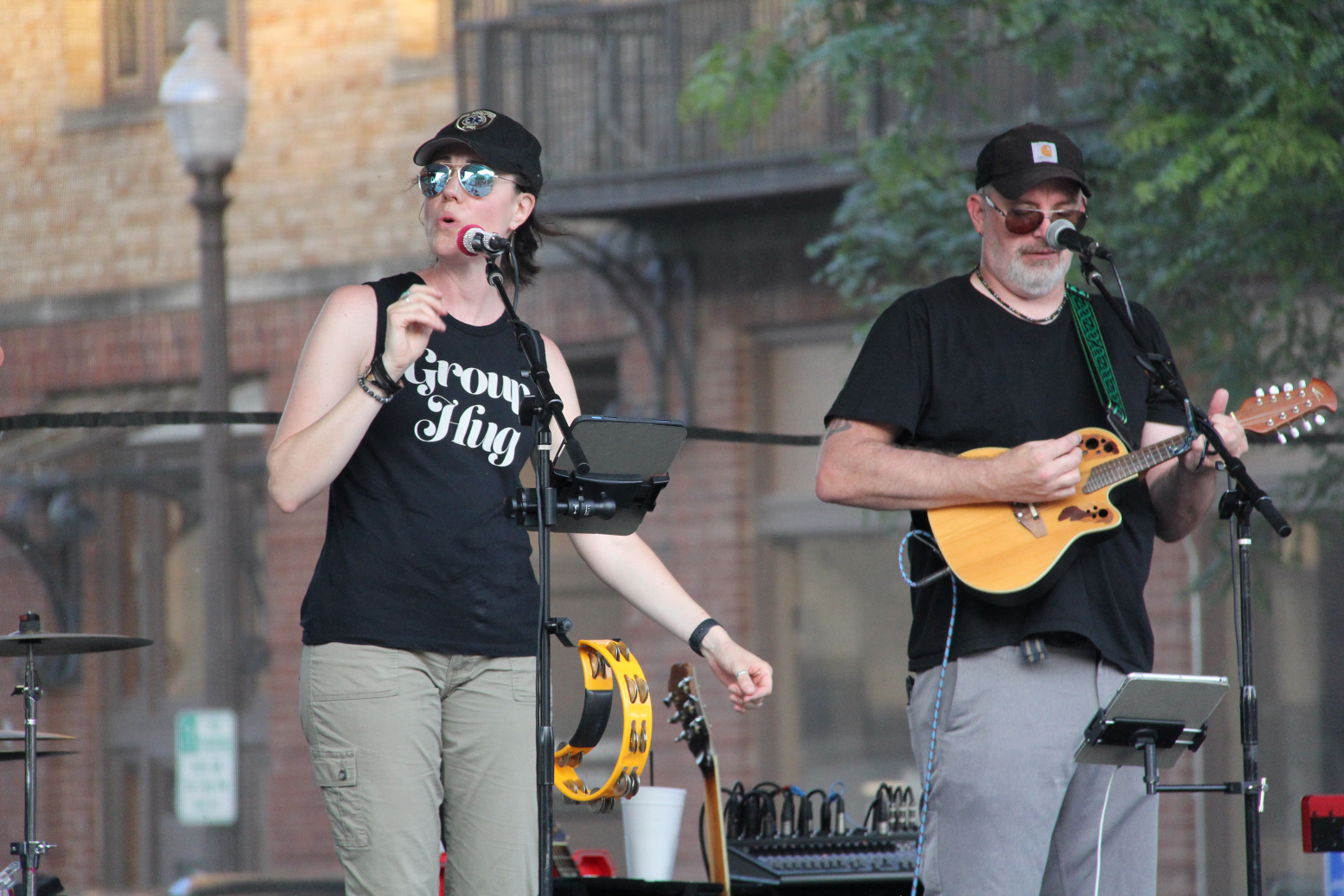
Folk singers Curtis & Loretta from Minneapolis perform Sunday morning. (Minnesota Prairie Roots copyrighted photo May 2025)

The past came alive over the weekend at the first-ever Riverside Rendezvous and History Festival in Faribault organized by the Rice County Historical Society. I spent four hours of my Mother’s Day roaming the festival grounds alongside the Cannon River at North Alexander Park. Listening. Learning. Connecting. Questioning. Observing. And photographing.

Many rendezvous feature medallions (like these for the Faribault festival) which participants post on their tents. (Minnesota Prairie Roots copyrighted photo May 2025)
This re-enactor taught kids and adults to stitch mini leather pouches. (Minnesota Prairie Roots copyrighted photo May 2025)
Small handcrafted leather bags for sale. (Minnesota Prairie Roots copyrighted photo May 2025)

The Rendezvous covered 1701-1900 with participants dressed in period costume. Think top hats, mountain hats, head scarves, long skirts, lots of leather and fur.

Before shooting off three cannons, this re-enactor talked about cannon balls, loading and firing a cannon, and safety. (Minnesota Prairie Roots copyrighted photo May 2025)
Firing one of three cannons. (Minnesota Prairie Roots copyrighted photo May 2025)
Before the cannons were fired, fest attendees were told to cover their ears “like fish.” The boom was loud. (Minnesota Prairie Roots copyrighted photo May 2025)

The re-enactors shared their period skills from blacksmithing to hat making to cannon shooting, rug weaving, leather stitching and much more. There was a lot to see, a lot to learn. And a lot to do, if you chose to participate.

Spools of colorful string for rug weaving fill a vintage suitcase. (Minnesota Prairie Roots copyrighted photo May 2025)
Folks gather around Lori Feltis as she weaves on her portable loom and talks about rug making. She operates Bohemian Rag Rug Studio near Stewartville. My grandkids enjoyed some hands-on weaving with Lori. (Minnesota Prairie Roots copyrighted photo May 2025)
A narrow strip woven on Lori’s loom. (Minnesota Prairie Roots copyrighted photo May 2025)

I left the hands-on activities to others, including two of my elementary-aged grandkids. They joined many kids trying out new skills, making memories. School classes attended the festival Thursday and Friday. So many lessons taught and learned.

Valin with his “pet” skunk. (Minnesota Prairie Roots copyrighted photo May 2025)

My biggest personal lesson of the day came in an unexpected way, and not until I arrived home. While walking from one tent to another at the Rendezvous, I crossed paths with Valin cuddling his pet skunk. I’d never seen a real skunk up close and I was rather excited to photograph Little Stinky. I even called my husband over for a close-up look. Valin assured me Stinky’s stinky part had been removed. Back home, Randy revealed to me that Little Stinky was a pelt. “Didn’t you see his (Valin’s) hand underneath moving the skunk?” Uh, no. I can only imagine the story Valin told around the evening campfire about the lady who thought his skunk was alive. This is now the stuff of laughter and legend for my family. Lesson learned: Everything is not as it appears.

Sam Temple presented about early Minnesota history with a focus on Faribault. (Minnesota Prairie Roots copyrighted photo May 2025)

That humorous moment aside, I did appreciate the honest and informative storytelling of local historian and documentary filmmaker Sam Temple. Smartly attired in a top hat and dress clothes, he talked about early Minnesota, about Indigenous Peoples, about the illegal French Canadian fur traders who came here first—about their relationship of interdependence and co-existence with Native Peoples and how a new mixed race culture developed.

Scraping a beaver hide, the woman in this tent focused on the Dakota, their connection to nature and how that wove into their way of living. They traded furs for goods. (Minnesota Prairie Roots copyrighted photo May 2025)

Temple shared much more before shifting his focus to Faribault town founder Alexander Faribault, of mixed race (his mother was part Dakota) and a licensed fur trader by age 21. Alexander arrived in a multi-cultural community with “a foot in both worlds,” Temple said. Wood-frame houses and teepees stood side-by-side. As I listened, I considered my multi-cultural community today. Getting along, but not always. By the time Alexander Faribault, who was historically-influential both locally and state-wide, left Faribault, “the teepees were missing and his mother’s culture was gone,” Temple said.

There were several food and beverage vendors on-site, with Baby’s Indian Frybread proving especially popular. (Minnesota Prairie Roots copyrighted photo May 2025)

If there’s something else I learned while attending the Rendezvous it is that I absolutely love fruit-filled Indian frybread, which I’ve not previously eaten. The sugar-topped pie-like dessert oozed blueberry filling and cream cheese. It was beyond decadent.

A blacksmithing demonstration. (Minnesota Prairie Roots copyrighted photo May 2025)

As much as I loved frybread and Little Stinky, the good folks who participate in history fests like the Riverside Rendezvous assuredly love stepping back in time. Their passion and desire to present the past in a way that engages people in history was something I felt, saw, heard while moving from tent to tent, space to space. To be part of this proved a cultural, historic experience, growing my knowledge and appreciation of those who shaped Minnesota and Faribault, this place I call home.

Tents were scattered across the spacious, shady grounds of riverside North Alexander Park. (Minnesota Prairie Roots copyrighted photo May 2025)

FYI: Please check back for more photos from the Riverside Rendezvous and History Festival in Faribault. This year’s Rendezvous was so successful that the Rice County Historical Society is planning a second one for 2026, but a weekend later so the event does not fall on Mother’s Day and the fishing opener weekend.

© Copyright 2025 Audrey Kletscher Helbling
 

Experience yesteryear at Riverside Rendezvous & History Festival in Faribault May 8, 2025

An1849 map of Minnesota Territory and more as seen through a magnifying lens inside the Rice County Historical Society Museum. Minnesota became a state in 1858. (Minnesota Prairie Roots copyrighted file photo)

HISTORY COME TO LIFE appeals to me because of the immersive experience. I learn better, retain more, when I can engage. This weekend offers ample opportunity to get into history at the Rice County Historical Society’s first-ever Riverside Rendezvous and History Festival along the banks of the Cannon River in Faribault’s North Alexander Park.

A scene inside an 1856 log cabin during a past living history event at the Rice County Historical Society. This weekend’s festival will be outdoors in a park in an encampment type setting. (Minnesota Prairie Roots copyrighted file photo)

Organizers promise that the trades, traditions and history of the 18th and 19th centuries (1701-1900) will come alive via hands-on activities, demonstrations, workshops, storytelling, music and special events. Hours are 9 a.m.-5 p.m. Saturday, May 10, and Sunday, May 11. Mothers get in free on Mother’s Day. Otherwise ticket prices are $10 for adults, $5 for children 6+ and $30 for a family pass.

Admittance buys you a whole lot of history-based entertainment, knowledge and fun. For example, the hands-on history happening all day both days includes candle making, rope making, tomahawk throwing, historic toys and games, quill making, log cutting and shops at which to shop, not trade.

This sculpture of Alexander Faribault and a Dakota trading partner stands in Faribault’s Heritage Park near the Straight River and site of Faribault’s trading post. (Minnesota Prairie Roots copyrighted file photo)

But you can learn about the fur trade at noon either day as local historian and documentary filmmaker Sam Temple talks about town founder Alexander Faribault and the fur trade. Todd Finney, a descendant of the Wahpekute band of the Dakota (original inhabitants of the land which is now Rice County), will speak at 3 p.m. Saturday and again at 11 a.m. Sunday about the Wahpekute Dakota.

On that same storytelling stage, musicians The Roe Family Singers, The Skally Line, Hannah Flowers, and Curtis and Loretta will perform at various times throughout the festival.

You can learn about hat making, pirates (yes, pirates with MN Jack Sparrow), historic clothing and weapons, things that do and don’t go boom, Civil War medical care and more during workshops and demos.

And then there are four special events, the first a Cane Pole Fishing Tournament starting at 10 a.m. Saturday. Bring your cane pole, not your rod and reel. Some cane poles will be available for participants. Saturday also brings Voyageur Games at 1 p.m. On Sunday, there’s a Tomahawk Throwing Competition at 1 p.m. followed by a Log Cutting Contest at 3 p.m.

I’ve never attended a rendezvous, so I have nothing with which to compare this event. But just reading through the schedule, I’m excited to take in this history festival with my two elementary-aged grandchildren, their parents and my husband. I expect we will all learn a lot and make some great memories.

Vendors will be selling food and beverages. (Minnesota Prairie Roots copyrighted file photo used for illustration only)

One more thing, food and beverages will be available for purchase, the food being cheese curds (no festival is complete without that deep fat fried fair food), hot dogs, corn dogs, assorted frybreads, and candy and fudge.

All in all, the Riverside Rendezvous and History Festival looks to be an interesting, informative and enjoyable event for history lovers, families and anyone who’s looking for something different to do on a beautiful spring weekend in southern Minnesota.

© Copyright 2025 Audrey Kletscher Helbling

 

Weather update: Tornado touches down near Faribault April 29, 2025

These are the most menacing (at least to me) clouds I’ve ever photographed. I shot this image in July 2011 on a friend’s country acreage between Faribault and Nerstrand. I don’t have any photos from yesterday as I was hunkered in my basement. (Minnesota Prairie Roots copyrighted file photo July 2011)

I OWE YOU a weather report.

The much-touted level 4 risk (out of 5) of severe storms here yesterday did not materialize. At least not in Faribault. But just to the east it did. A confirmed tornado touched down southeast of town in Richland Township, destroying several farm buildings and damaging a silo on a neighboring farm. That’s close enough for me. I feel badly for that farm family. Property damage was also reported by the Rice County Sheriff’s Department near Morristown, which is southwest of Faribault.

While that was happening, Randy and I were sheltering in our basement after warning sirens sounded just before 5:30 p.m. I’d prepared, earlier in the day gathering documents and items (yes, including my camera and Randy’s hearing aids) that I didn’t want blown away in a storm. My retired National Weather Service friend, who grew up in southwestern Minnesota, was keeping me updated on the weather throughout the day.

“PLEASE, JUST GET HOME.”

The biggest issue for me was that Randy was not yet home when the emergency sirens went off. I’d tried several times to reach him at work late Monday afternoon to warn him of the bad weather moving into our area. But his cellphone mostly doesn’t work inside the pole shed style garage in the countryside near Randolph. I texted and called numerous times in hopes that he might actually be in a part of the building with cell reception. I finally resorted to phoning the main garage in nearby Cannon Falls. Ideally, whoever answered could ring up Randy in the machine shop. That didn’t happen.

While I wanted Randy home, I really just wanted him safe. A pole shed, with no place to shelter, offers no protection during a storm. And I had no idea how weather-aware he was staying. Probably not too much given he’s swamped at work. He can’t hear warning sirens either.

In the end, it all worked out. Randy pulled into the driveway after sirens had been sounding for awhile. He’d stopped at the Faribault compost pile to drop off plant debris rather than driving directly home. Really? While sirens are wailing and a storm is moving in?

THREE LAUGHING EMOJIS

I recognize that Randy doesn’t fear storms. He doesn’t have the storm history that I do. I’m the one hustling us to the basement. It’s a bit of a joke with our adult kids. The second daughter, who lives in Madison, Wisconsin, texted yesterday, “Randy, get in the basement!” with three laughing emojis. Humor helps in a tense situation.

Many Minnesotans were not laughing yesterday as storms rolled in with tornado and severe thunderstorm warnings resulting in damaging winds and hail and that confirmed tornado between Faribault and Kenyon.

FEELING GRATEFUL THIS MORNING

This morning the sun is shining, popping through massive clouds in a deep blue sky. Crisp, cool air has replaced the heat and humidity of yesterday. Snow even fell in parts of northern Minnesota. Yesterday’s storms are behind us. I, for one, am thankful that strong tornadoes did not develop, that the National Weather Service and Twin Cities TV meteorologists prepared us and kept us informed, that my NWS friend, Brad, updated me and that Randy finally got home. Now, if only his cellphone would work inside that pole shed a 32-minute drive away. I’d feel much better next time severe weather rolls in.

#

TELL ME: If you live in Minnesota or a neighboring state, did you experience any storms and/or storm damage on Monday? How do you react to storms, including warning sirens going off?

© Copyright 2025 Audrey Kletscher Helbling

 

Finding peace & more on a spring day at River Bend

This small memorial plaque honors parents and River Bend with joyful words. (Minnesota Prairie Roots copyrighted photo April 2025)

FOR YOU SHALL GO out in joy, and be led back in peace. Those words from Isaiah 55:12, printed on a memorial plaque by a tree near the River Bend Nature Center interpretative center, summarize well my feelings about this spacious public area of ponds and river, woodland and prairie in Faribault. Whenever I arrive here, I come with joyful anticipation. I always leave feeling refreshed, at peace. Nature has a way of infusing happiness while simultaneously calming the spirit.

I love the contrast of textured white bark against the bold blue sky of a sunny spring afternoon. (Minnesota Prairie Roots copyrighted photo April 2025)

After a long winter, which wasn’t particularly harsh by Minnesota standards, River Bend draws friends, families, couples, individuals and students to experience the unfolding of spring, me among them. This time of year, perhaps more than any other, I am cognizant of the natural world evolving, changing, teeming with life.

Buds unfurl as temps warm. (Minnesota Prairie Roots copyrighted photo April 2025)

In the shelter of woods, buds tip trees, unfurling with each warm and sunny day until the barren gray branches of winter morph into a canopy of green. We’re not quite there yet. But I see the greenery. I doubt there’s a green more intense than that of early spring.

Pockets of green along the Straight River bottom. (Minnesota Prairie Roots copyrighted photo April 2025)
Sunlight slices shadows onto the path to the Turtle Pond and spotlights greenery. (Minnesota Prairie Roots copyrighted photo April 2025)
Sunlight illuminates patches of grass growing among limestone. (Minnesota Prairie Roots copyrighted photo April 2025)

On recent hikes at River Bend, I noticed vivid swaths of green by the Straight River, scattered patches of green on the forest floor, tufts of greenery clinging to a rocky hillside. Green. Green. Green.

Lazy turtles on a log cause me to stop and linger. (Minnesota Prairie Roots copyrighted photo April 2025)
And sometimes turtles choose to hang out alone. (Minnesota Prairie Roots copyrighted photo April 2025)

At the Turtle Pond, I delighted in the emergence of painted turtles, a cluster of them sunning themselves on a weather-worn tree lying near pond’s edge. Others chose to sunbathe alone. I am always fascinated by these creatures. They impart a sense of serenity, perhaps giving us permission to pause and enjoy the simple things in life. Like watching lounging turtles, reminding us that life’s pace needn’t always be hurried.

A family walks along a trail near the river. (Minnesota Prairie Roots copyrighted photo April 2025)
Natural entertainment…balancing on a tree branch. (Minnesota Prairie Roots copyrighted photo April 2025)
About to load up the bikes after biking at River Bend. (Minnesota Prairie Roots copyrighted photo April 2025)

I especially appreciate seeing families outdoors. Walking. Balancing on a fallen branch. Biking. Being away from the distractions of busy schedules and technology and everything that intrudes on time together outside in nature.

River Bend proves a popular place for humans and dogs. (Minnesota Prairie Roots copyrighted photo April 2025)

In the woods, we are sheltered and embraced while walking side-by-side, close to one another along narrow pathways. Conversations happen. We notice things, like squirrels scampering across dried leaves that hide as yet unseen spring wildflowers. Birds flit. The woods are beginning to awaken within our vision and hearing.

From a hilltop overlook, I view a diverse landscape of prairie and woods. (Minnesota Prairie Roots copyrighted photo April 2025)

Outside the woods on the prairie, I feel exposed but innately comfortable for I am of prairie stock. I know this wind. I know this wide sky. I know these tall grasses. This landscape would please Willa Cather, American author who wrote of the Great Plains and life thereon. In her novels, she shared a deep love of the land, of place.

That blue of pond and sky…beautiful to behold. (Minnesota Prairie Roots copyrighted photo April 2025)

At the prairie-side pond, I stop to take in water and sky and land—below, above and beyond. The deep blue of the pond, a reflection of the blue sky, contrasts sharply with the muted brown of dried pond grasses and reeds. The scene is painterly beautiful.

River Bend covers hundreds of acres and is one of Faribault’s greatest treasures. (Minnesota Prairie Roots copyrighted photo April 2025)

My time at River Bend always leaves me feeling better as I forget about worries and responsibilities, deadlines and everyday distractions.

A sizable deer population lives at River Bend. (Minnesota Prairie Roots copyrighted photo April 2025)

Upon exiting the nature center, I am offered one final gift—three deer leisurely grazing alongside the road. They hold minimal fear of humans, so comfortable are they with the many visitors here. Yet, I can’t help but wonder if the deer would rather we just move along rather than watch them with wonder, our eyes, our souls, seeking joy and peace.

© Copyright 2025 Audrey Kletscher Helbling


A documentary, 50 years after the Vietnam War, showing in Faribault April 28, 2025

A Vietnam veteran views The Traveling Vietnam Memorial Wall when it came to the Rice County Fairgrounds in Faribault in 2016. All photos in this story were taken at that exhibit. (Minnesota Prairie Roots copyrighted file photo 2016)

MENTION THE VIETNAM WAR and the reaction will be mixed, depending. Some served. Some supported. Others protested. And some, like me, viewed the war as teens not quite old enough to vote, but old enough to care.

A map posted in the veterans’ lounge when the traveling wall was in Faribault. (Minnesota Prairie Roots copyrighted file photo 2016)

Fifty years ago on April 30, 1975, Communist forces seized control of the South Vietnamese capital, ending the war in what became known as “The Fall of Saigon.” Two years prior, with the signing of the Paris Peace Accords, the U.S. ended its direct military involvement in the conflict.

A soldier’s photo displayed in the traveling exhibit. (Minnesota Prairie Roots copyrighted file photo 2016)

But those two events did not end the pain and suffering or the issues which still linger and swirl regarding the Vietnam War.

The purpose of the wall and the names thereon. (Minnesota Prairie Roots copyrighted file photo 2016)

At 6:30 p.m. on Tuesday, April 29, American Legion Post #43, Unit #43 Auxiliary and Operation: 23 to Zero are hosting a showing of the 47-minute documentary film, “Truths and Myths About the Vietnam War,” at the Legion in Faribault. The film was produced by the Atlanta Vietnam Veterans Business Association “to honor those who served in the Vietnam War, by providing factual information to address the decades of misinformation that has presented a skewed historical perspective of the war,” according to the AVVBA website. “We believe this a very important and long overdue film, one that captures the information and lessons learned most Vietnam War veterans want reported about the war.”

I lifted my camera and pointed the lens down at a panel filled with names of soldiers. (Minnesota Prairie Roots copyrighted file photo 2016)

Now I’m always interested in learning and considering different viewpoints. And it seems this 2024 documentary by Emmy Award-winning film producer David Naglieri will offer me some new insights and perspectives via a Medal of Honor recipient, those who served, and historians. The film promises to address many facets of the Vietnam War from media coverage to anti-war protests to politics to the treatment of returning soldiers and more.

An area set aside for protesters on the northwest side of the fairgrounds. (Minnesota Prairie Roots copyrighted file photo 2016)

I well remember how poorly returning American soldiers were treated by many who opposed the war. They were not respected for their service. Rather, they were met with protests and disdain. I’m all for free speech and expressing our opinions via protests. But it had to be hard, really hard, for those Vietnam veterans, most of whom were drafted. I remember my own dad, who served on the front lines during the Korean War (“The Forgotten War”), sharing how he never felt supported and appreciated upon his return home.

Multiple wreaths featured words of remembrance. (Minnesota Prairie Roots copyrighted file photo 2016)

Tuesday’s event at my local Legion, while focusing on the Vietnam War, will honor all veterans and offer them free wings during Wing Night. A social hour runs from 5:30-6:30 p.m. followed by the film screening from 6:30-8 p.m. The event is free and open to the public.

The ultimate honorary salute to a fallen soldier. (Minnesota Prairie Roots copyrighted file photo 2016)

I encourage you to attend, whether you are a veteran or friend/family member; were a war protester; were, like me, a Vietnam War-era teen (who wore a POW bracelet); or simply want to learn more about a war which claimed 58,220 American and millions of other lives and left countless traumatized.

#

FYI: You can watch “Truths and Myths About the Vietnam War” online by clicking here.

If you served in the Vietnam War, lost a loved one in the war, protested or otherwise, please feel free to share your experiences/thoughts in a respectful comment.

© Copyright 2025 Audrey Kletscher Helbling
 

Chief Taopi: Man of peace, community leader & more April 21, 2025

Prominent signage at Maple Lawn Cemetery directs visitors to the gravesite of Chief Taopi, “Wounded Man.” He was wounded in a battle with the Ojibwe. (Minnesota Prairie Roots copyrighted file photo)

HE FOUND HIMSELF AT ODDS with his own people. A “Farmer Indian” among “Blanket Indians.” A peace promoter among those who favored war. He was Chief Taopi, a member of the Little Crow Band of the Mdewakanton Dakota. He’s buried in Faribault, at Maple Lawn Cemetery.

A tipi formation easily identifies the burial site of Taopi and his daughter, Cornelia Whipple Taopi. She died at age 18. He died at 56. (Minnesota Prairie Roots copyrighted file photo)

Recently, I attended a presentation about Taopi by Rice County Historical Society Executive Director Dave Nichols. It’s not the first time I’ve listened to local talks on the history of Native Americans in Minnesota, focused on those who called Faribault home. Each time I learn something new.

A Taopi exhibit at the Rice County Historical Society. The carving (by Ivan Whillock) and photo show Taopi with short hair as a “Farmer Indian.” (Minnesota Prairie Roots copyrighted file photo)

During his talk, Nichols called Taopi “a poster child for what an assimilated Dakota looks like.” And he didn’t mean that in a negative way. “You either assimilated or you would be destroyed,” Nichols said, qualifying that he wasn’t saying assimilation was right. Understood.

As settlers moved into Minnesota, pushing onto Native lands, the Dakota found themselves facing many challenges. Some, like Taopi, gave up their culture and adopted European ways, believing that was the only way to survive. That included learning to farm as the White man farmed. Taopi was considered the leader of the “Farmer Indians,” a term assigned during the U.S. Census. Dakota who continued in traditional cultural ways were labeled “Blanket Indians.”

A photo panel at the Traverse des Sioux Treaty Center in St. Peter shows Dakota leaders photographed in Washington D.C. in 1858. The photo is from the Minnesota Historical Society. The war followed broken treaties. (Minnesota Prairie Roots copyrighted file photo)

Taopi farmed and established a school and mission, Hazelwood Republic, with chiefs Wabasha and Good Thunder on the Lower Sioux Reservation along the Minnesota River in southwestern Minnesota, Nichols shared. Because I grew up in that region, I’ve always been particularly interested in the Indigenous Peoples who were original inhabitants of the land, including Redwood and Brown counties. The region became the epicenter of the U.S.-Dakota War of 1862, which centered around issues of land, hunger and broken promises.

An historic-themed bench on the corner of Central Avenue and Sixth Street in Faribault highlights Taopi. (Minnesota Prairie Roots copyrighted photo April 2025)

That war facilitated the banishment of most Native Americans from Minnesota. If Taopi and other Dakota would have had their way, that war may not have happened. He led the Peace Party opposed to war, while his cousin, Little Crow, led the War Party, Nichols said. Taopi protected White settlers during the short war which claimed countless lives on both sides.

The names of the Dakota who were hung are listed at Reconciliation Park in Mankato. (Minnesota Prairie Roots copyrighted file photo)

Post-war, though, it mattered not to the U.S. government whether you were a Dakota person who opposed the war or who engaged in war, according to Nichols. All were considered guilty, imprisoned and eventually exiled from Minnesota (although not the Mdewakanton). Thirty-eight Dakota men were hung on December 26, 1862, in Mankato (40 miles from my community) during the largest mass execution ever in the U.S. It’s truly a tragic event in Minnesota history. But what multiples the awfulness is that 1,600 Dakota prisoners were marched to Mankato to watch the hangings before being marched back to Fort Snelling. That was new information I had not previously heard and it troubles me greatly.

These portraits by Dana Hanson of Faribault’s Founding Fathers, Alexander Faribault (left to right), Taopi and Bishop Henry Whipple, hang in Buckham Memorial Library. (Minnesota Prairie Roots copyrighted file photo)

Taopi avoided prosecution and banishment, eventually landing in Faribault with 180 other Mdewakanton. About 80 were family members, according to Nichols. It was his friendship with Bishop Henry Whipple, who had long worked with and advocated for Native Peoples, that brought Taopi here. Town founder Alexander Faribault housed “the Peacefuls,” as the 180 were considered, on his land. They lived in tipis and lodges.

The home of fur trader and town founder Alexander Faribault. (Minnesota Prairie Roots copyrighted file photo 2017)

As you might rightly guess, not everyone in Faribault liked the Mdewakanton living among them. A wall was built in the area around Alexander Faribault’s house to protect them. Taopi became a community leader, said Nichols. As such he represented his people and mediated when necessary.

By the time of Taopi’s 1869 death, 90 of the 180 Mdewakanton who settled in Faribault had already left. But they left behind an imprint upon the land, not necessarily seen or appreciated even today. Yet, efforts are underway to change that with The Faribault Dakota Project. Nichols couldn’t speak specifically to that, only to say that local historian Jeff Jarvis has been working with the Dakota community on how to memorialize and honor the Indigenous Peoples of Faribault. That also includes the Wahpekute Dakota.

Peace Park, a protected Dakota burial site (but unmarked as such) next to the parking lot of Buckham Memorial Library. (Minnesota Prairie Roots copyrighted file photo)

Among the locales discussed by those attending Nichols’ talk was Peace Park, a triangle-shaped slice of property near Buckham Memorial Library. Alexander Faribault donated the land to the city with the stipulation that it never be developed. According to Nichols, the park is a protected burial site, where at least two Dakota are buried. Their bones were unintentionally uncovered in 1874 and then reburied. Today nothing marks that land as a cemetery. Rather a faith-based WWII monument stands in Peace Park. There is no reference to the Dakota. Perhaps some day this will be righted and the land publicly recognized as sacred ground. That is my hope as I continue to learn about the Dakota who once called Faribault home. I am grateful for every opportunity to grow my knowledge of them and their importance in local and state history.

#

FYI: Here are some suggested Dakota-connected places to visit in Faribault: the Rice County Historical Society Museum, Maple Lawn and Calvary cemeteries, the Cathedral of Our Merciful Saviour, a mural on the Central Park Bandshell and information on an historic-themed bench along Central Avenue.

Two fun facts: A small southeastern Minnesota town in Mower County near the Iowa border is called Taopi, named after the Mdewakanton Dakota chief. It suffered a devastating tornado in April 2022. The town celebrates its 150th birthday this year.

A woman attending Dave Nichols’ talk named her horse Taopi after Chief Taopi.

© Copyright 2025 Audrey Kletscher Helbling
 

“Testify,” an enlightening & unsettling exhibit focused on Black history April 18, 2025

The first panel explains the “Testify” exhibit. (Minnesota Prairie Roots copyrighted photo April 2025)

THE IMAGES AND WORDS left me feeling simultaneously unsettled, uncomfortable, disturbed, enlightened, impressed, angry and incredibly sad. My emotional reaction is not surprising after viewing the traveling exhibit, “Testify—Americana Slavery to Today,” at my local public library.

The 16 “Testify” panels stretch along the hallway connecting the library and community center in Faribault. (Minnesota Prairie Roots copyrighted photo April 2025)

The exhibit features photos of select African American art and artifacts from The Diane and Alan Page Collection. Alan Page, who is Black, was a Minnesota Supreme Court justice and, in the 1970s, a defensive lineman for the Minnesota Vikings. He’s in the NFL Hall of Fame. Diane, who was White, worked in marketing and was a businesswoman and notable philanthropist. She led the way in securing the art and artifacts in the couple’s collection.

This 1864 banner may have been carried by freedmen at a rally or march. During the 1864 election of Abraham Lincoln, both political parties came together to reject slavery. (Minnesota Prairie Roots copyrighted photo April 2025)

I’m grateful Buckham Memorial Library (through SELCO, the regional library system) brought this exhibit to Faribault for the public to see. We can all learn from history, deepening our understanding. We begin to recognize perspectives and biases and can then move toward change and healing.

The last five panels cover a span of topics. (Minnesota Prairie Roots copyrighted photo April 2025)

As I walked my way along the 16 towering photo panels paired with text, I began to more fully appreciate the suffering, the abuse, but also the fortitude, of African Americans. Despite everything, they retained strength and resilience.

Notice of an 1833 slave auction in Charleston, South Carolina. (Minnesota Prairie Roots copyrighted photo April 2025)

Yet, how hard it must have been at times to hold hope, especially from slavery to the time of Jim Crow laws. When I read a Public Sale of Negroes notice from 1833, I read words of degradation. I cannot imagine being that “valuable Negro woman,” that “very valuable blacksmith,” the slaves in “miscellaneous lots of Negroes” who were auctioned off like so much property. What humanity does to one another seems unimaginable, unfathomable. Yet, it still happens today, just in different ways.

A description of a slave to be sold at the 1833 auction. (Minnesota Prairie Roots copyrighted photo April 2025)

As disturbing as that slave bill of sale was, a group photo of nine unclothed Black toddlers in a professional studio portrait titled “Alligator Bait” proved profoundly disturbing to me. So much so that I can’t bear to show this 1897 image to you. The accompanying text states that historians researched whether hunters actually used African American children as alligator bait. Results were inconclusive, which is telling.

An unwelcoming 1942 sign from the Lonestar Restaurant Association in Dallas, Texas. (Minnesota Prairie Roots copyrighted photo April 2025)
A 1920s spring-loaded Jim Crow sign. (Minnesota Prairie Roots copyrighted photo April 2025)
Protest art from the Civil Rights Movement. (Minnesota Prairie Roots copyrighted photo April 2025)

A sign banning “dogs, Negroes and Mexicans” and another pointing Whites one way and “Colored” people the other prompted thoughts of, well, things have not changed all that much. Of course, they have, but not really if you dig deep or, conversely, read today’s headlines.

A brick crafted by slaves for the White House. (Minnesota Prairie Roots copyrighted photo April 2025)

I want to backtrack for a minute to the first photo I saw in the exhibit. It was of a single brick, circa 1792-1798. This singular object drove home the point that this country was built on the backs of slaves, like those who molded and laid the bricks for government buildings in Washington DC. That includes the White House and many U.S. Capitol buildings, according to the exhibit text. Unpaid slave labor. Think about that for a minute or ten.

“Only on Thursdays,” a 1940 painting by Burr Singer. (Minnesota Prairie Roots copyrighted photo April 2025)

There’s lots to contemplate in the “Testify” exhibit. That includes the watercolor art of Burr Singer titled “Only on Thursdays.” If you just looked at the art without the title and context, you might think it was simply a depiction of African Americans swimming. But it’s not. Thursday was the only day Blacks could use the Pasadena public pool. This painting makes a statement.

This 1991-1992 plate in Carrie Mae Weems’ Sea Island Series honors the creative survival strategies of African Americans. (Minnesota Prairie Roots copyrighted photo April 2025)

This exhibit makes a statement. Through images and words, it shines a light on the past, on Black history, on the atrocities of slavery and segregation and racism (both subtle and overt). Through “Testify,” truth-telling emerges for all to view and contemplate.

The panel to the far left shows a photo of the board game GHETTO. Social workers in training used the game to understand issues facing marginalized communities. (Minnesota Prairie Roots copyrighted photo April 2025)

FYI: “Testify—Americana Slavery to Today” is on display until April 23 in the corridor linking Buckham Memorial Library to the Faribault Community Center. The photos and information included in this story are only a sampling of what you will see in the exhibit. The Mabel Public Library hosts the exhibit from April 25-May 7.

© Copyright 2025 Audrey Kletscher Helbling
 

My Easter week message to you April 17, 2025

Filed under: Uncategorized — Audrey Kletscher Helbling @ 6:00 AM
Tags: , , , , , , , , , , , , ,
“Believe” by Mackenzie Miner, a then eighth grader at Faribault Middle School, was exhibited at a past student art show at the Paradise Center for the Arts. (Minnesota Prairie Roots copyrighted file photo)

DURING THE PAST SEVERAL DAYS, I’ve thought a lot about how to craft an Easter message about living my Christian faith against the backdrop of what’s happening in our country today. It’s tough, really tough, to feel positive and joyful. But I must believe that things will get better. Eventually.
Palm branches. (Minnesota Prairie Roots copyrighted file photo)

Rather than dwell on the totality of everything negative, I decided to focus on messages I heard during a Palm Sunday worship service at my eldest daughter’s Lakeville church. Randy and I were there for a pancake breakfast fundraiser and then to listen to our grandchildren sing. We—kids and adults alike—sang the traditional processional hymn, “All Glory, Laud and Honor,” as we waved palm branches. It was an uplifting, praise-filled, reverent experience, reminding me of Jesus’ triumphant entry into Jerusalem among a joyful crowd waving palm branches and shouting, “Hosanna!” Jesus rode in on a donkey, symbolic of his humility and humanity. Days later, the people would turn on Jesus and he would die an agonizing death upon a cross.
A stained glass window inside Holden Lutheran Church, rural Kenyon, Minnesota, depicts Jesus’ crucifixion. (Minnesota Prairie Roots copyrighted file photo)

That journey to the cross, followed by the resurrection of Jesus on Easter morning, started on Palm Sunday, the beginning of Holy Week and a time of reflection. The service at St. John’s started with a blessing of the palms. That blessing set the tone for worship, at least for me. The palm branches we held represented celebration, justice and comfort. These are the words that most resonated with me: Bless these protest palms, O God of Justice…may they make us bold and brave to stand up against injustice.

The unsheltered, photographed in downtown Madison, Wisconsin, in June 2018 near the state capitol. (Minnesota Prairie Roots copyrighted file photo)

So, as I stood at the back of the church, I waved my palm frond high like a protest sign, thoughts of injustices racing through my mind. I’ve done some protesting lately with my words. I felt encouraged and empowered to stand bold and brave against injustices. Jesus did. He called people out. He got mad. He chastised. He advocated for and helped those who suffered the most. The outcasts. The lonely. The poor and hungry. He showed compassion and love. He provided. He forgave.

A portion of a quote by John Lewis posted in the window of a Dundas, MN., home. (Minnesota Prairie Roots copyrighted file photo)

Remember the once popular WWJD/What Would Jesus Do slogan? I think Jesus would be more than a little ticked off about the injustices today, how people are treating one another, how those in positions of leadership are abusing their power. Jesus did, after all, overturn the tables in the temple when it became a noisy marketplace for greedy vendors focused on making money rather than allowing people easy access inside for spiritual reasons.

Posted on the exterior of the Congregational Church of Faribault United Church of Christ. (Minnesota Prairie Roots copyrighted file photo)

I’d like to think that Jesus wants every single one of us to be bold and brave in our words and actions. It’s easy enough to sit quietly and do nothing. Just pretend all is well with everyone when, in reality, it’s not. People are struggling. In relationships. With unexpected and unnecessary job loss. Financially. Mentally. In ways I would never have thought possible in this country—suppression, oppression, ongoing discrimination, intimidation, imprisonment… Injustices run rampant.

A loving message posted along a bike trail in Madison, WI. (Minnesota Prairie Roots copyrighted file photo)

We each have the power to do something about those injustices. Volunteer. Encourage. Donate money to charitable organizations or to individuals in and outside your circle who may need a little extra help right now. Smile. Be respectful. Extend small acts of kindness. Simply be a kind, decent, compassionate and loving person.

A message on a tombstone at Valley Grove Cemetery, rural Nerstrand. (Minnesota Prairie Roots copyrighted file photo)

But also don’t hesitate to be bold and brave to stand up against injustice, to wave your protest palm branch high, then higher still.

© Copyright 2025 Audrey Kletscher Helbling