The only photo I have of my mom holding me. My dad is holding my brother Doug. (Minnesota Prairie Roots)
MOTHER’S DAY. It’s a day that can feel both sad and joyful. Sad if your mom is no longer living. Mine isn’t. Joyful if you have children, no matter their age.
It is a Sunday of gathering, of remembering, of honoring, of celebrating motherhood. Perhaps with a meal together. Perhaps with flowers delivered or received. Whatever, however, the focus should be one of love and gratitude.
I feel grateful for my lovely mom, who taught me kindness, compassion and care. Sure, she had her moments. Who wouldn’t with six kids spanning 12 years? We tested her patience more than once. But that didn’t diminish her love for us. Her own mother died at age 48, when I was only two months old, and I cannot imagine how difficult that was for my mom and her three younger siblings. So treasure your mom. Time together is precious.
The card I made for my mom as a child. (Minnesota Prairie Roots copyrighted photo)
So are words shared. As a writer, I value greeting cards as a way of expressing love and other emotions. My mom did, too. She saved cards, including a simple card I created for her in elementary school for Mother’s Day. I cut a flower photo from a seed catalog and pasted it to the front of a folded piece of paper, then printed I love you Mother. Audrey inside. The editor in me wants to add a comma and change the formal Mother to Mom. But I doubt Mom much cared. She was just happy to get a handcrafted card from her eldest daughter.
Likewise, I love getting greeting cards from my now-grown children. One arrived in the mail today from my second daughter, who lives 260 miles away in Madison, Wisconsin. I last saw her at Christmas. Her job as a letter carrier for the US Postal Service keeps her working 10-12 hours daily, usually six days a week. So seldom does Miranda have adequate time off to travel to Minnesota. I couldn’t help but think, as I opened her Mother’s Day card, that Miranda was likely dropping similar cards into mailboxes along her route.
Mothers always appreciate flowers. These were a gift from my daughter Amber and her family in 2021. (Minnesota Prairie Roots copyrighted file photo 2021)
She chose a lovely floral design card that is certainly “me.” And then my sweet daughter penned the most loving message. One that left me in tears. Hope you have a nice, relaxing day surrounded by the people you love. We love & miss you. Love, John & Miranda.
A plane leaves Minneapolis St. Paul International Airport. (Minnesota Prairie Roots copyrighted file photo)
I will be surrounded by people I love—my eldest daughter, Amber, son-in-law and two grandchildren—on Saturday. But “the people I love” also includes the rest of my family. And in that moment tears fell at the missing of Miranda and her brother, Caleb, both of whom I haven’t seen in more than four months. Caleb lives in Boston.
This photo of me with my mom was taken two years before her death. Minnesota Prairie Roots copyrighted file photo January 2020 by Randy Helbling)
To be a mom is to understand that separation is inevitable. Our kids grow up, move away, sometimes farther than we’d like. Things keep us apart. Death also separates. Daughters and sons have lost mothers. Mothers have lost children. But in the end, love remains. As does gratitude. I am grateful for my mom. Grateful for my three children. I am grateful to be a mother.
Happy Mother’s Day to all the moms out there! You are loved. And appreciated.
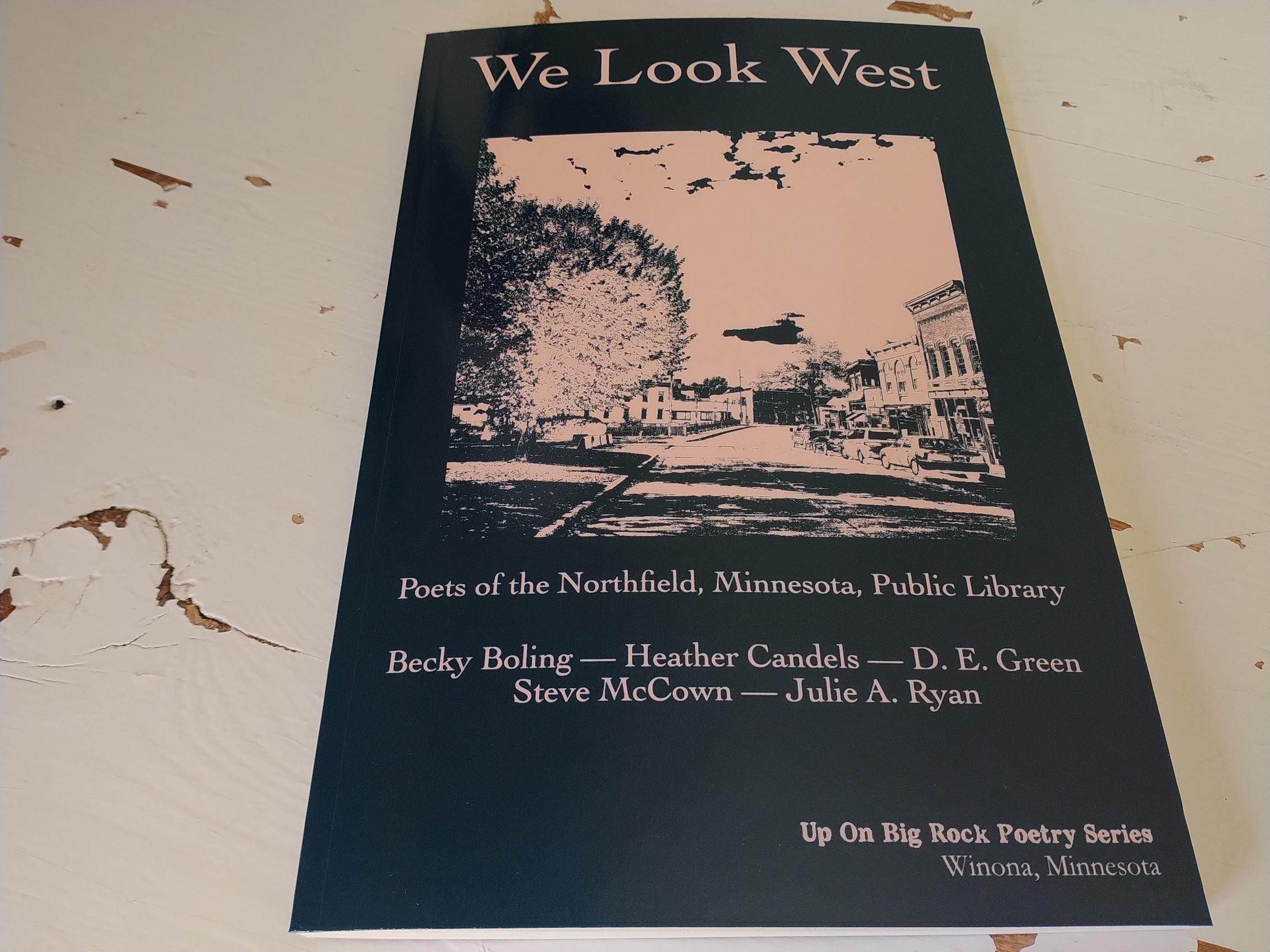
Just-published, a 116-page anthology featuring the poetry of five Northfield, Minnesota, poets. (Minnesota Prairie Roots copyrighted photo April 2024)
ON AN APRIL AFTERNOON when gray skies reverberated thunder and unleashed sheets of rain upon parched southern Minnesota, I read their words, table-side lamp pooling light onto pages. It felt right, to cozy under a fleece throw, to immerse myself in the poetry of Becky Boling, Heather Candels, D.E. Green, Steve McCown and Julie A. Ryan on a day meant for sheltering indoors.
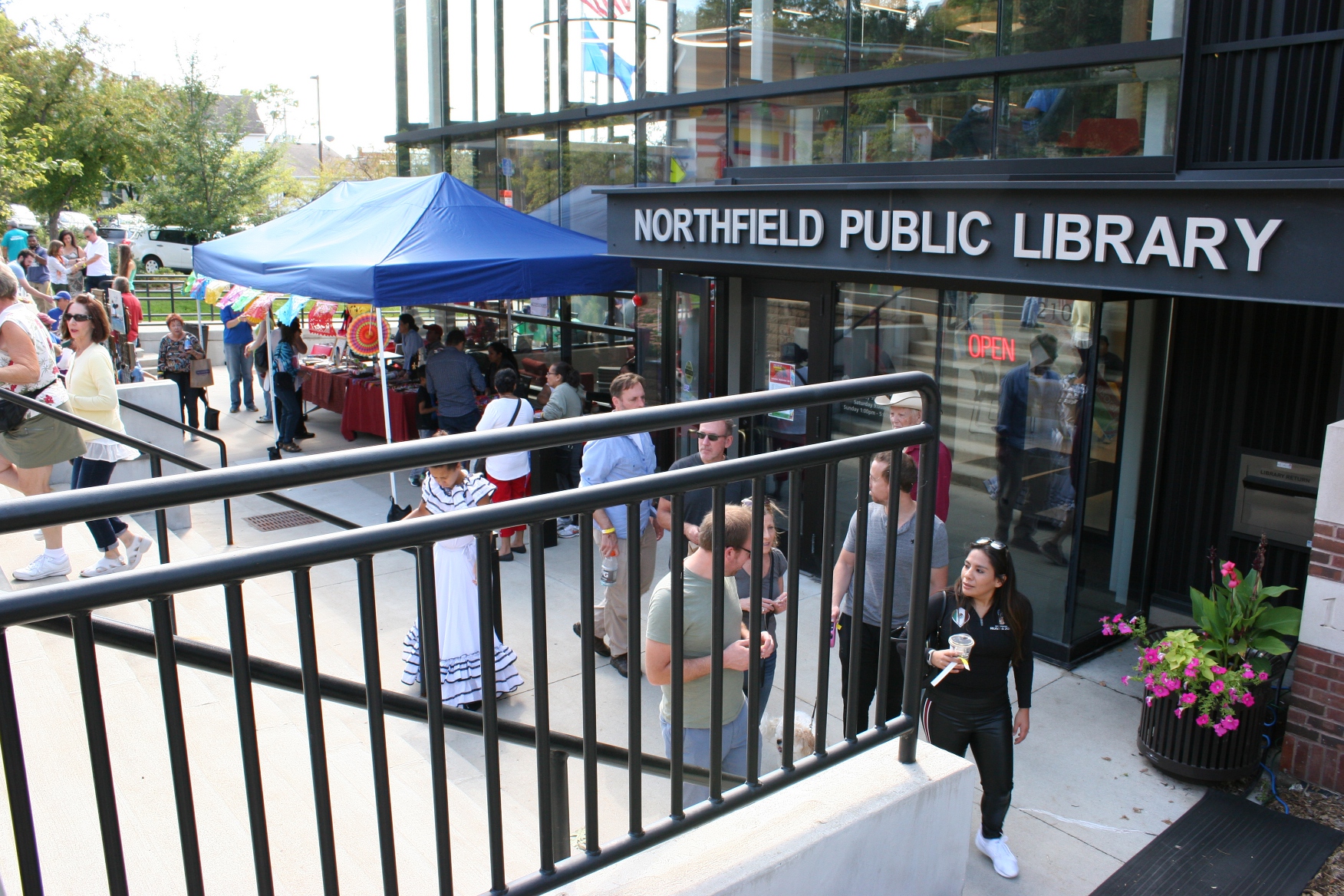
Outside the Northfield Public Library during a 2019 celebration of Hispanic Heritage Month. (Minnesota Prairie Roots copyrighted file photo September 2019)
Antiques on 4th in Cannon Falls. (Minnesota Prairie Roots copyrighted file photo October 2021)
Youthful memories of grandmothers, homemade ice cream, small towns as they once were and much more flow through the pages. At times I feel as if I’m reading about “the dusty excess of nostalgia” of my life, as Steve McCown writes “In an Antique Store.” His mention of a Tom Thumb toy cash register sends me back to a long ago Christmas. His poems are sparse, yet fully-descriptive in the way of language carefully-culled by a man who taught high school and college English.
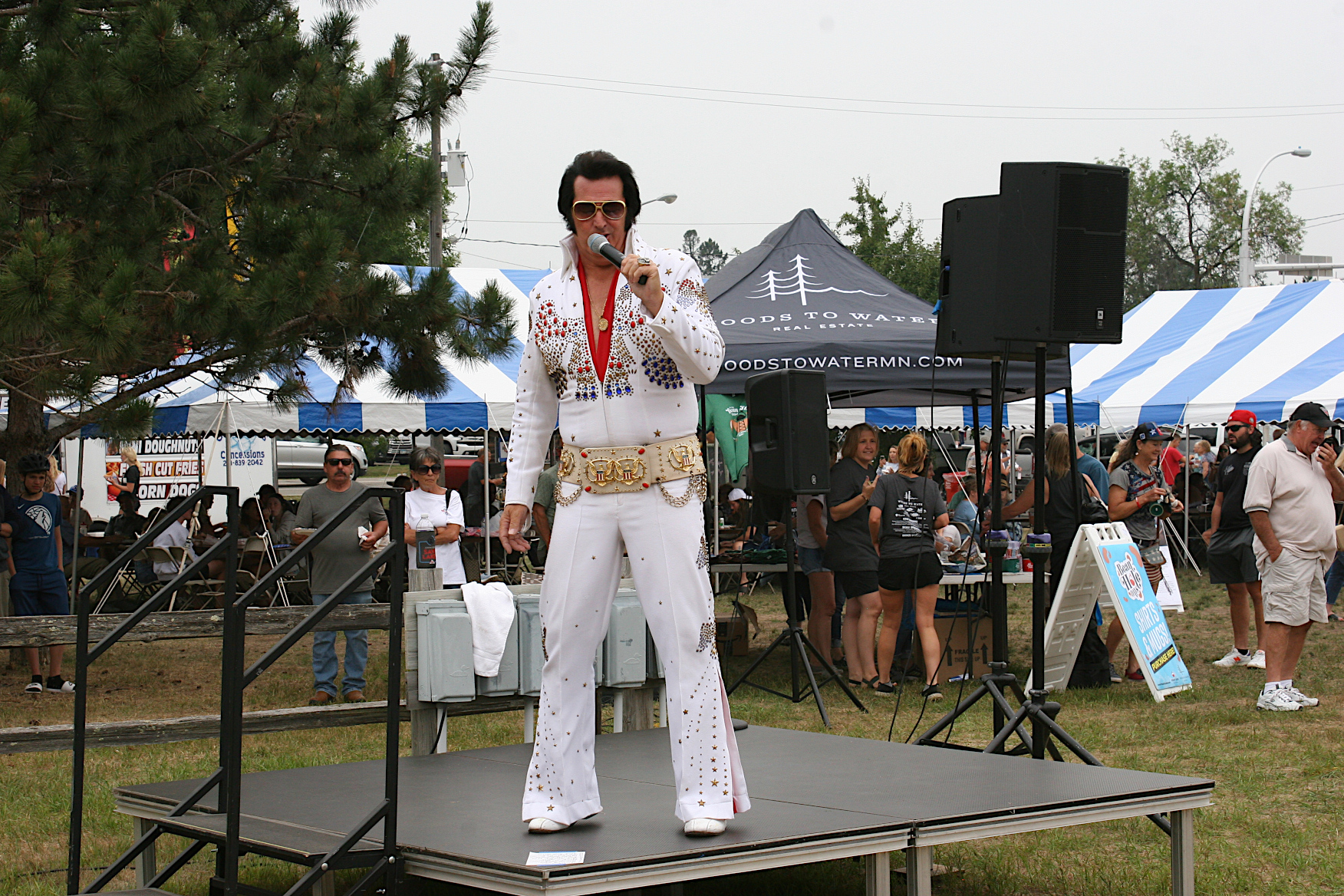
An Elvis impersonator performs during Bean Hole Days in Pequot Lakes. (Minnesota Prairie Roots copyrighted file photo July 2021)
Likewise, Julie A. Ryan, has me reminiscing with “Candy Cigarettes,” the chalky white sticks of fake cigarettes that I, too, “smoked” in the 1960s. Ryan paints with her words, revealing the visual artist side of her creativity. She mentions Van Gogh and painting and also leans into music within her poetry. Especially powerful is her poem, “’68 Comeback Special,” in which she shares about a near-death experience, of almost meeting Elvis. Her final poem, “We Look West,” titles the book, summarizing well the transition of life from sunrise/birth to sunset/death. That themes the anthology, the movement of life from east to west.
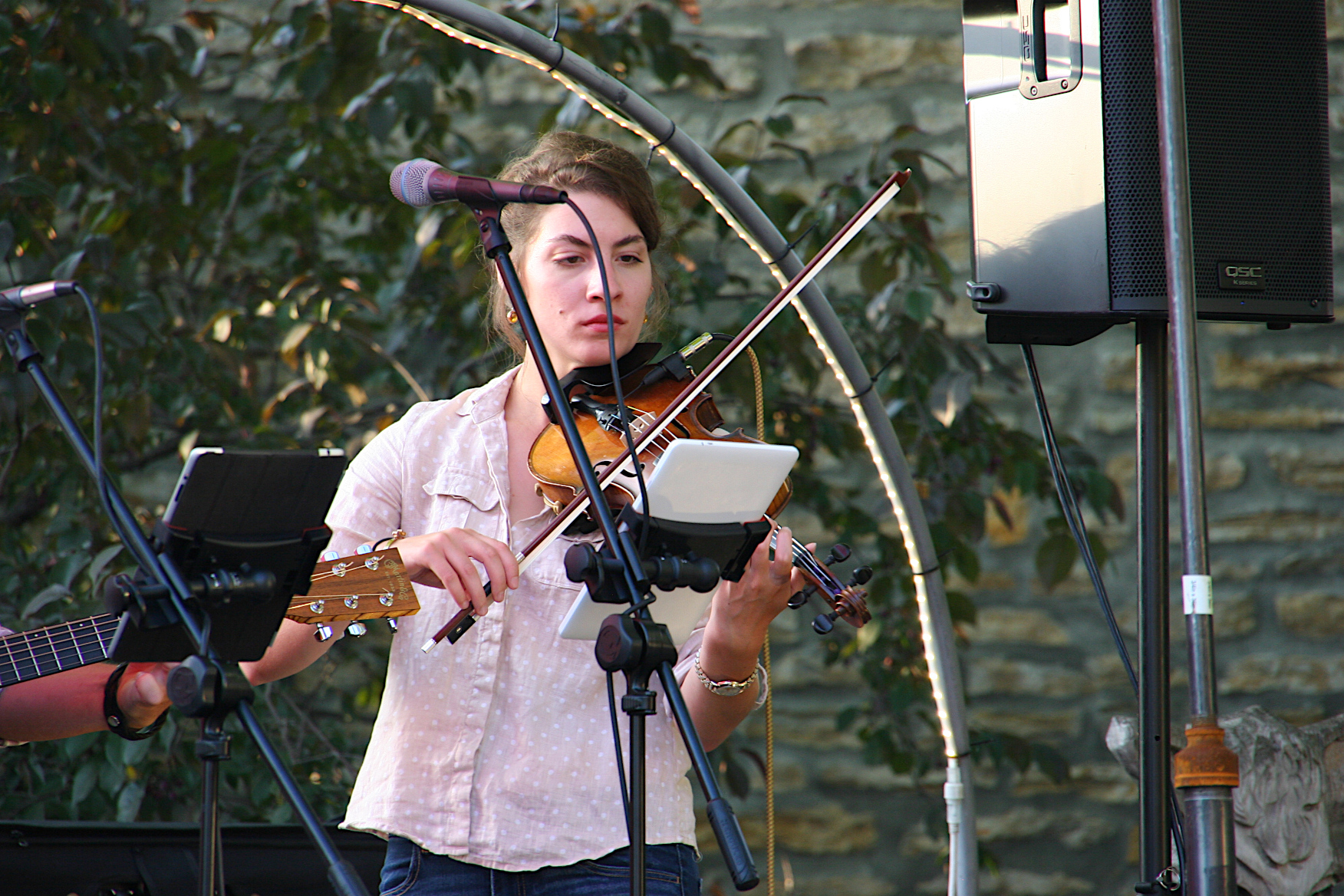
Performing at The Contented Cow in downtown Northfield. (Minnesota Prairie Roots copyrighted file photo August 2020)
In her poetry, Becky Boling moves readers through life from playground monkey bars to motherhood to contemplating old age. I am particularly drawn to “Violin Lesson,” in which Boling observes her young son learning to play the violin. From a deep cushioned armchair, she is caught up in the artistry, the beauty, the movement as am I through her observational writing. And then she closes with the emotional thought of not wanting the moment to end, of understanding that some day she will let her son go. As the mother of three, I feel her sadness at the lesson completed. I expect in her 36 years of teaching Spanish and Liberal Arts at Carleton College in Northfield, Boling has observed the movement of young people whose parents let them go to learn and grow their independence.
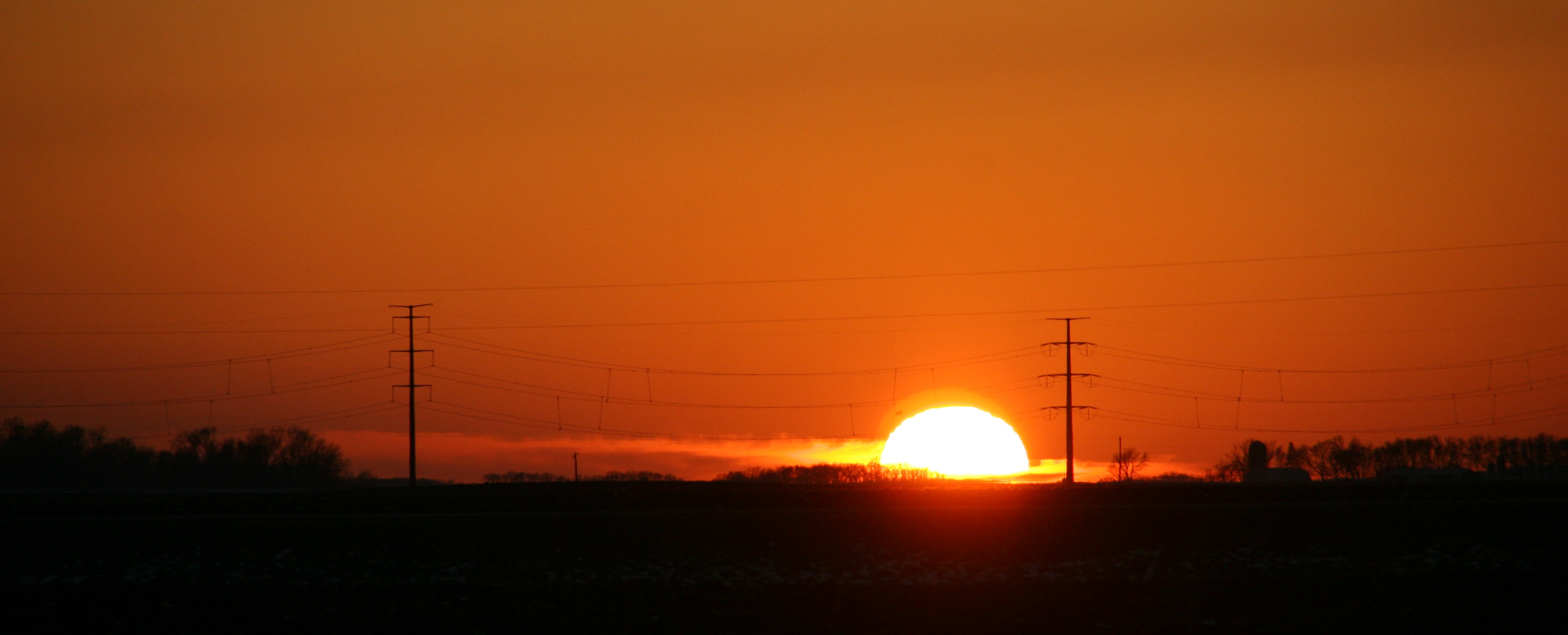
A southwestern Minnesota prairie sunset between Redwood Falls and Morgan. (Minnesota Prairie Roots copyrighted file photo)
D.E. Green, who taught English for 33 years at Augsburg University, has likely seen the same. His poems reflect life and love. Particularly endearing is his poem, “For Becky: Love Sonnet after Neruda,” written for Boling, to whom he’s married. (They also share the position of interim co-poet laureates in Northfield.) His appreciation for and study of Shakespeare show in this love poem, as touching as any love poem I’ve read. “I love you unthinkingly/like a deep breath, a careless yawn, a sigh,” he writes. Beautiful. Green also reflects on his life lived “good enough” and on life during retirement. His poetry should be required reading for anyone closer to west than to east.
My mom lived in a care center, confined to a wheelchair in the end years of her life. I took this photo of her hands about a year before her January 2022 death. (Minnesota Prairie Roots copyrighted file photo December 2020)
Heather Candels, too, reflects on her passing life in a poem aptly titled “Passing.” But it is “Situation Comedy,” a poem about a 104-year-old woman living in a care center, which elicits an especially emotional reaction from me. I can picture the centenarian shoving her walker (as my octogenarian mom did) to the dining room, then sitting with Grace and Lloyd, whom she secretly calls Grease and Lard. “Something has to be funny about all this,” Candels writes. The former English teacher is a gifted storyteller who brings unexpected emotional lines to her writing.
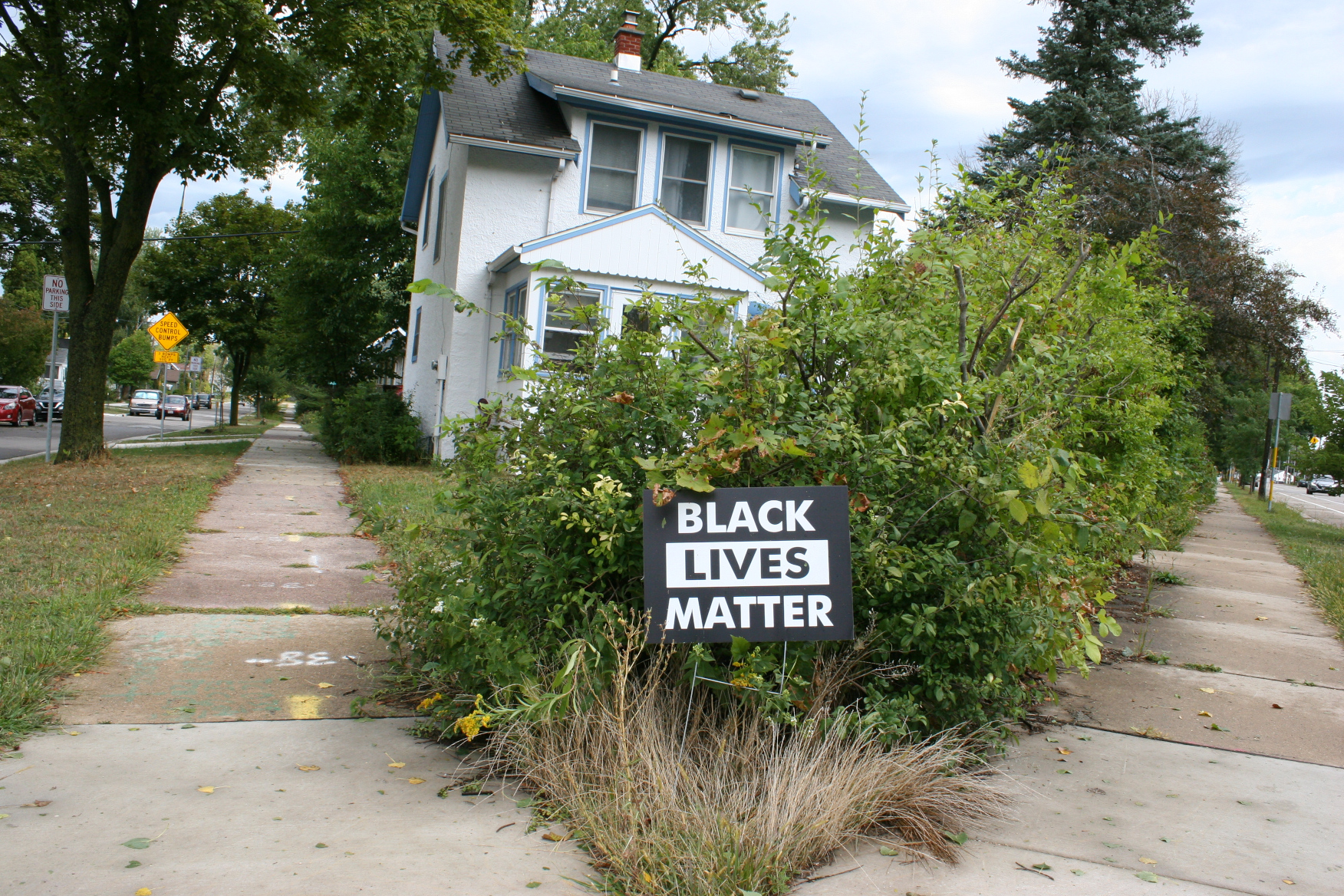
In “A Sign,” Heather Candels writes about racial injustice via white lilies of the valley and “their colonies spreading underground/roots nurtured by the rich dark soil…” This poem alone is reason enough to buy this anthology. Photo taken in Madison, Wisconsin. (Minnesota Prairie Roots copyrighted file photo September 2020)
And then there are the poems that touch on tough topics, on social issues, on disparities. Climate change. Evidence in the Nuremberg Trials. Racial injustice. Poetry doesn’t right life. But it opens our minds, causes us to think, reflect, perhaps take positive action as we move from east to west.
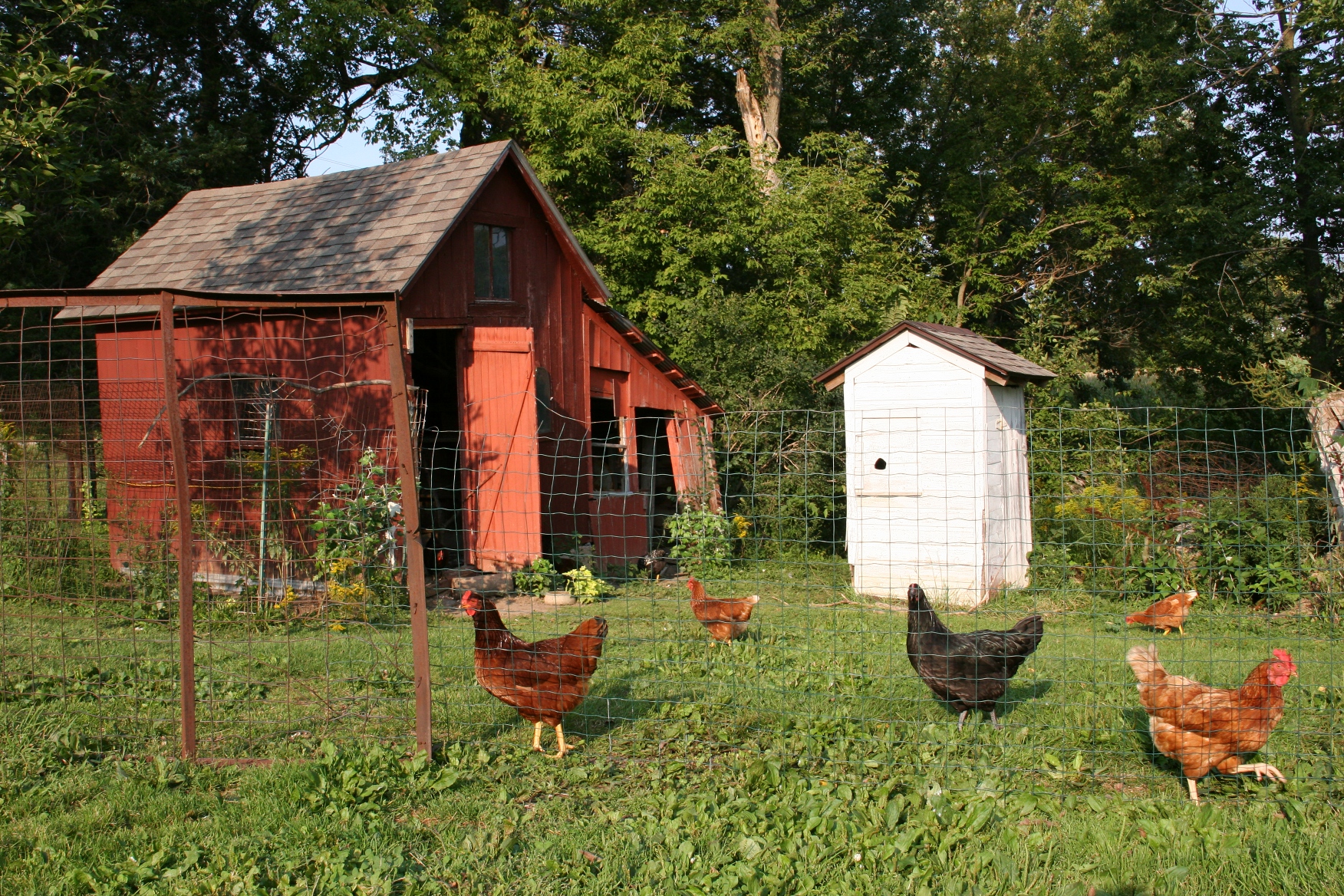
My friend Joy’s chickens. (Minnesota Prairie Roots copyrighted file photo)
I’M NO CHICKEN farmer. I’m not even particularly fond of roaming chickens (ducks or geese). But this time of year on “Chick Days,” I feel nostalgic, remembering the delivery of newly-hatched chicks. They arrived on my southwestern Minnesota childhood farm via the U.S. Postal Service, cheeping raucously and, I’m certain, desiring to escape their cardboard boxes.
A snippet of a promo for “Chick Days” at a local business.
Today, chicks still ship via mail, but need to be picked up at the post office or at a local supplier on “Chick Days.” That may be at a farm store, a grain elevator, a feed store…
A boarded up hatchery in southwestern Minnesota. (Minnesota Prairie Roots copyrighted file photo)
Gone are the days when chick hatcheries were found in many farming communities. But this is not Mayberry anymore. Rural America has changed significantly since I was growing up in the 1960s and 1970s with businesses now shuttered, buildings vacated.
A 1950s or 1960s era greeting card from a hatchery in Minneota, Minnesota. (Minnesota Prairie Roots copyrighted photo April 2024)
But, if you look closely enough, dig deep enough, ghosts of those businesses remain, including chick hatcheries. Among the vintage greeting cards my mom saved (she saved everything), I found a holiday card from Dr. Kerr’s Hatchery. That was in Minneota; that’s Minnesota minus the “s.”
Minneota sits on the prairie northwest of Marshall in Lyon County. This small town is perhaps best-known as the home of the late Bill Holm, noted writer and English professor at Southwest Minnesota State University. Among his work, Boxelder Bug Variations, a collection of poetry and essays about, yes, boxelder bugs. Minneota celebrates Boxelder Bug Days annually.
But it doesn’t celebrate chicks, as far as I know, or the hatchery with the unusual name of “Dr. Kerr’s Hatchery.” There’s a story behind that moniker. I just don’t know what that may be.
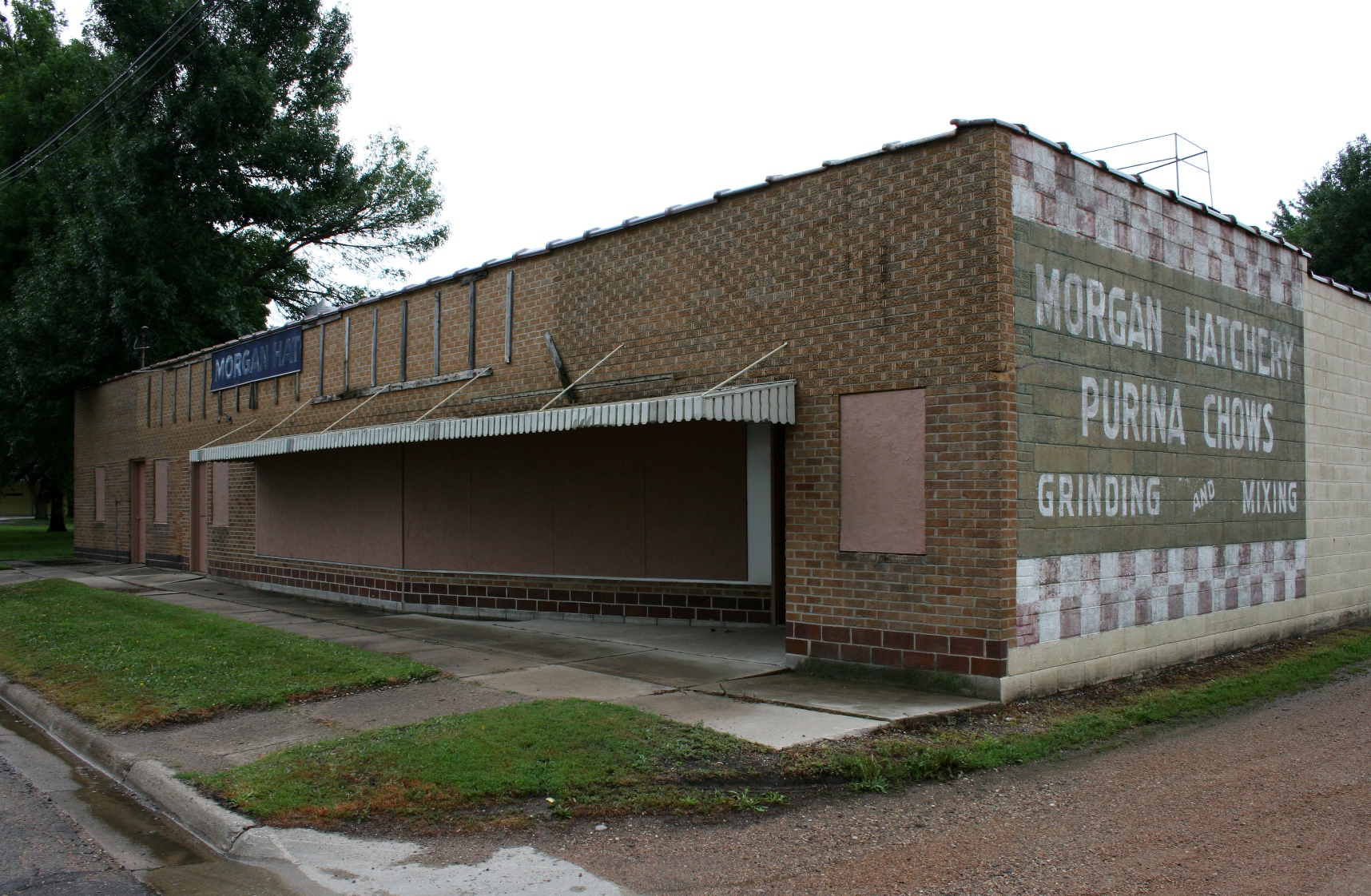
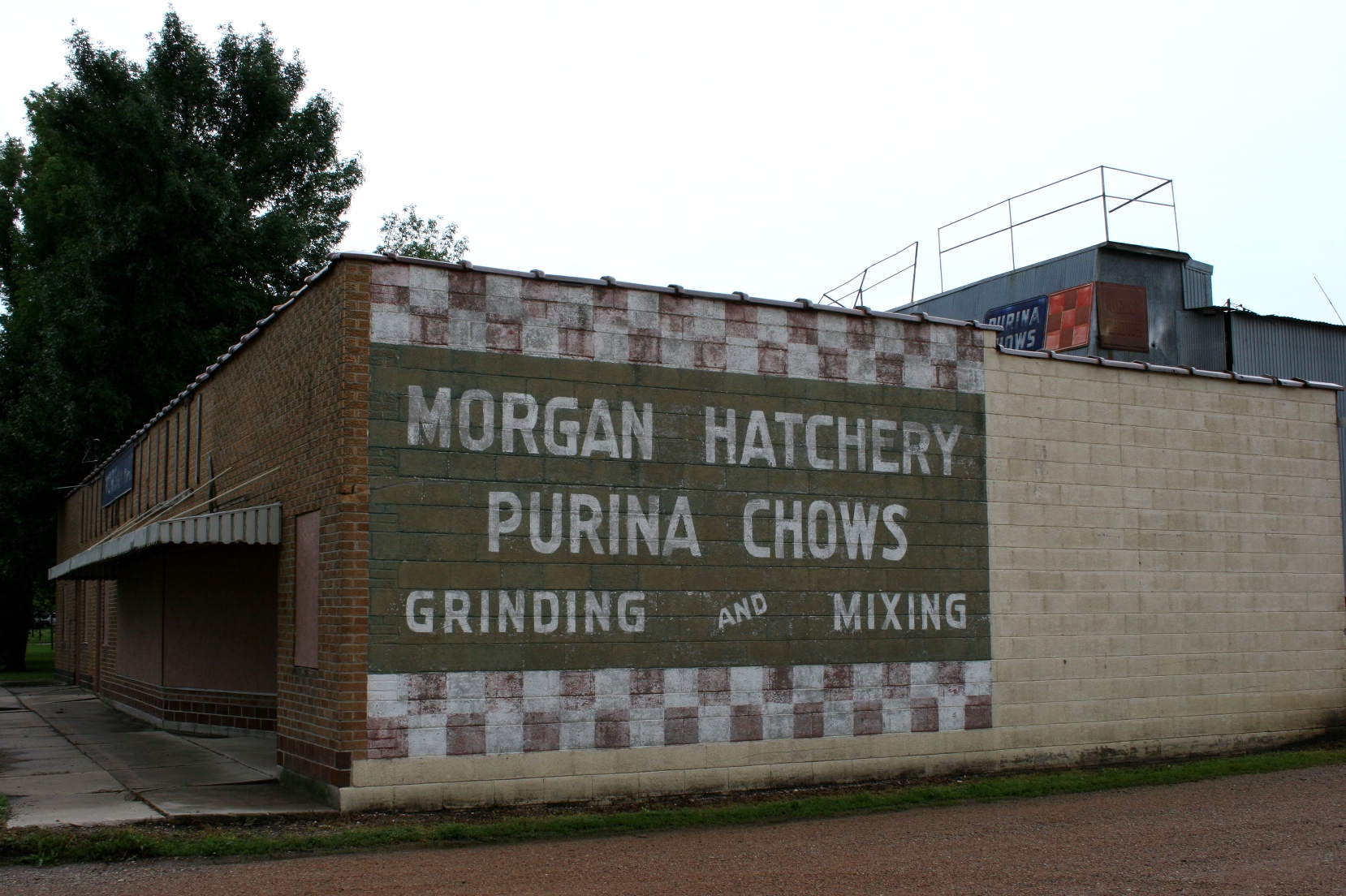
Signage is a reminder that this building once housed a hatchery in Morgan. (Minnesota Prairie Roots copyrighted file photo)
I do know, though, that Morgan, 60 miles to the east of Minneota, also had a hatchery, aptly named Morgan Hatchery. I photographed the exterior of the former hatchery and feed store in 2013 while en route to my hometown of Vesta.
Chickens are fenced next to the red chicken coop on Joy’s rural acreage. Sometimes they also roam free aroundthe yard. (Minnesota Prairie Roots copyrighted file photo)
Thoughts of home take me back to those chicks delivered by the mailman, as we called letter carriers back in the day. After retrieving the box (es) of chicks from aside the roadside mailbox, Mom released them into the chicken coop. There they clustered around shallow water dishes under the warmth of heat lamps. I don’t recall many details other than the fluffy fowl feathering all too soon. For me, the chicks’ transition toward adulthood quickly ended my adoration.
A fenced rooster at my nephew and niece’s rural acreage. (Minnesota Prairie Roots copyrighted file photo)
There’s a reason I dislike being in close proximity to chickens: pecking hens and a vicious rooster. Gathering eggs from angry hens as a young girl proved an unpleasant chore. And avoiding a mean rooster proved impossible. One day Dad had enough of the rooster attacking his children. He grabbed an ax and that quickly ended the hostile encounters. I still hold trauma from that rooster. But I’ve gotten better about being around chickens. However, if I even pick up on a hint of meanness, I flee.
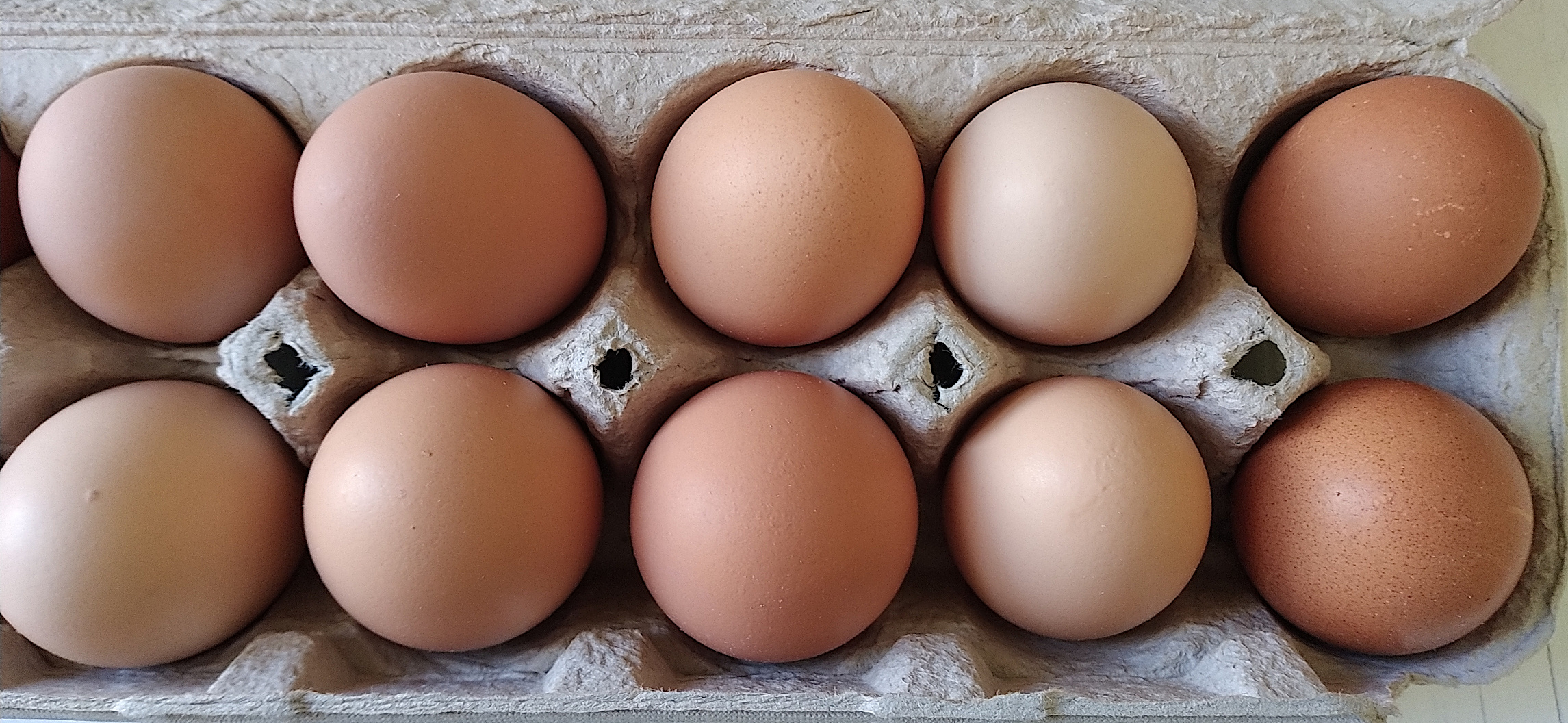
Farm fresh eggs from Nancy and Loren’s chickens. (Minnesota Prairie Roots copyrighted photo April 2024)
The difference in eggs, with the yolk from a store-bought mass-produced egg on the left and a farm fresh egg on the right. (Minnesota Prairie Roots copyrighted photo April 2024)
Given my history, I’ll never own chickens. But I eat chicken. And I eat eggs. I especially like farm fresh eggs from free-range chickens. The dark orangish-yellow yolk hue, the taste, are superior to mass-produced eggs.
A maturing chick. (Minnesota Prairie Roots copyrighted file photo)
And I still think chicks are cute, even if they quickly morph into feathered birds I’d rather not be around.
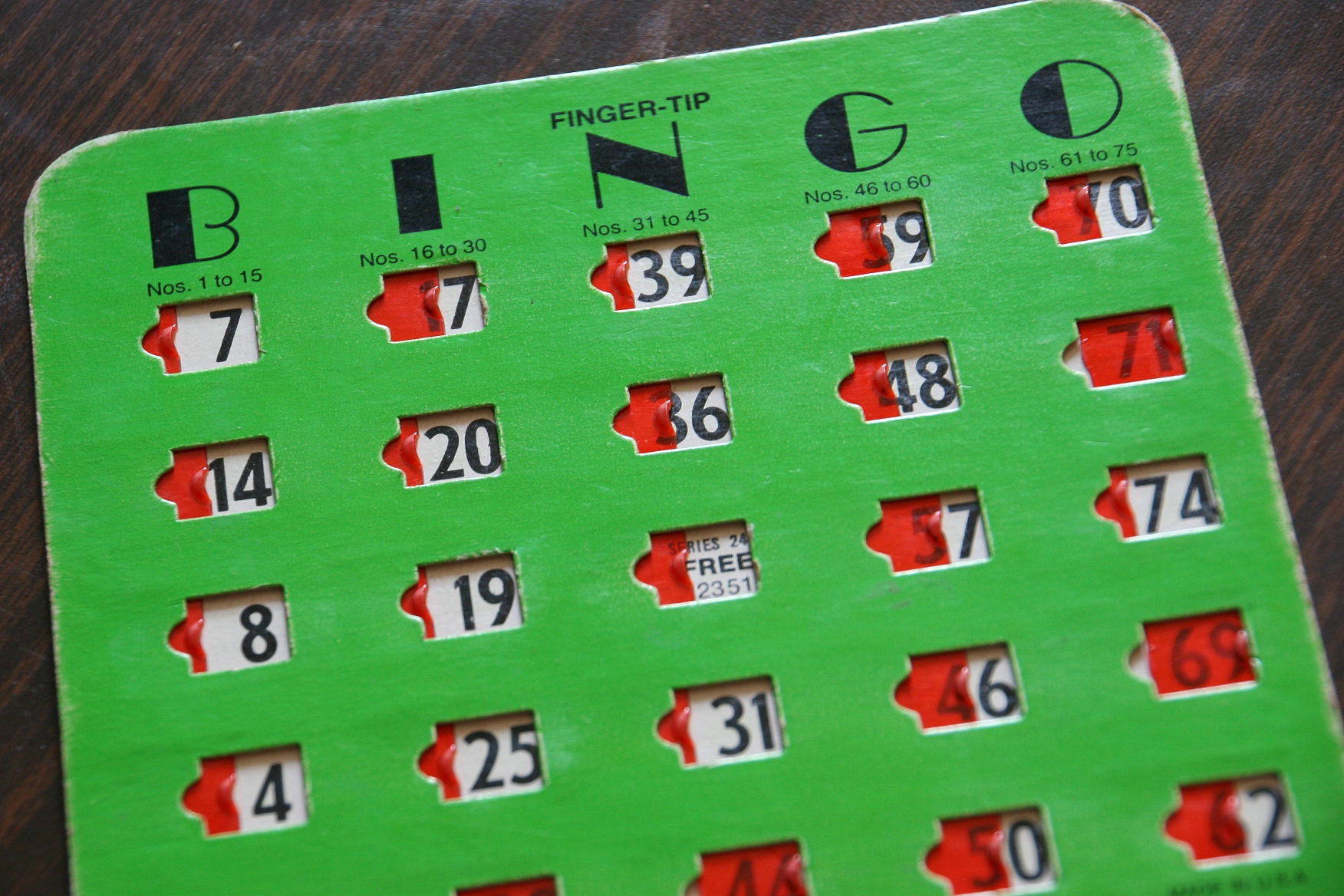
An old school BINGO card. (Minnesota Prairie Roots copyrighted file photo)
ISAAC’S EXCITEMENT was palpable. He flew into Grandpa’s arms for a hug. They share a special bond; they are buddies. I love witnessing the love between them.
“Aren’t you going to give Grandma a hug?” my daughter asked Isaac. He wasn’t. Not initially. But then Isaac did. After his sister, Izzy, hugged me. There were more embraces for their parents. We were ready to go.
The six of us entered a spacious gathering room accented by a stained glass cross and other faith-based art. The buttery scent of popcorn permeated the space. Prizes covered tables. BINGO cards, some white, some green, layered more tables.
This was Family BINGO Night at Isaac’s preschool at a Lutheran church in the south metro. Randy and I were there to play the game, but mostly to spend time with our grandkids, eldest daughter and son-in-law. Making memories. Building bonds. Sharing moments.
Isaac and Izzy were there for one thing—to win at BINGO and claim a prize. They scoped out the goods, Isaac eyeing an alien painting kit and Izzy a Paw Patrol puzzle.
As we grabbed BINGO cards and settled onto chairs ringing a large round table, Izzy next to me and Isaac next to Randy, I could see the kids’ anticipation. Izzy fidgeted. Isaac’s cheeks were flushed. While we waited for the game to start, we picked up frosted cookies to go with popcorn scooped into paper boats. Sweet and salty. Yum.
Soon enough the BINGO calling began. Loud. But I managed, even with sensory issues caused by long haul COVID.
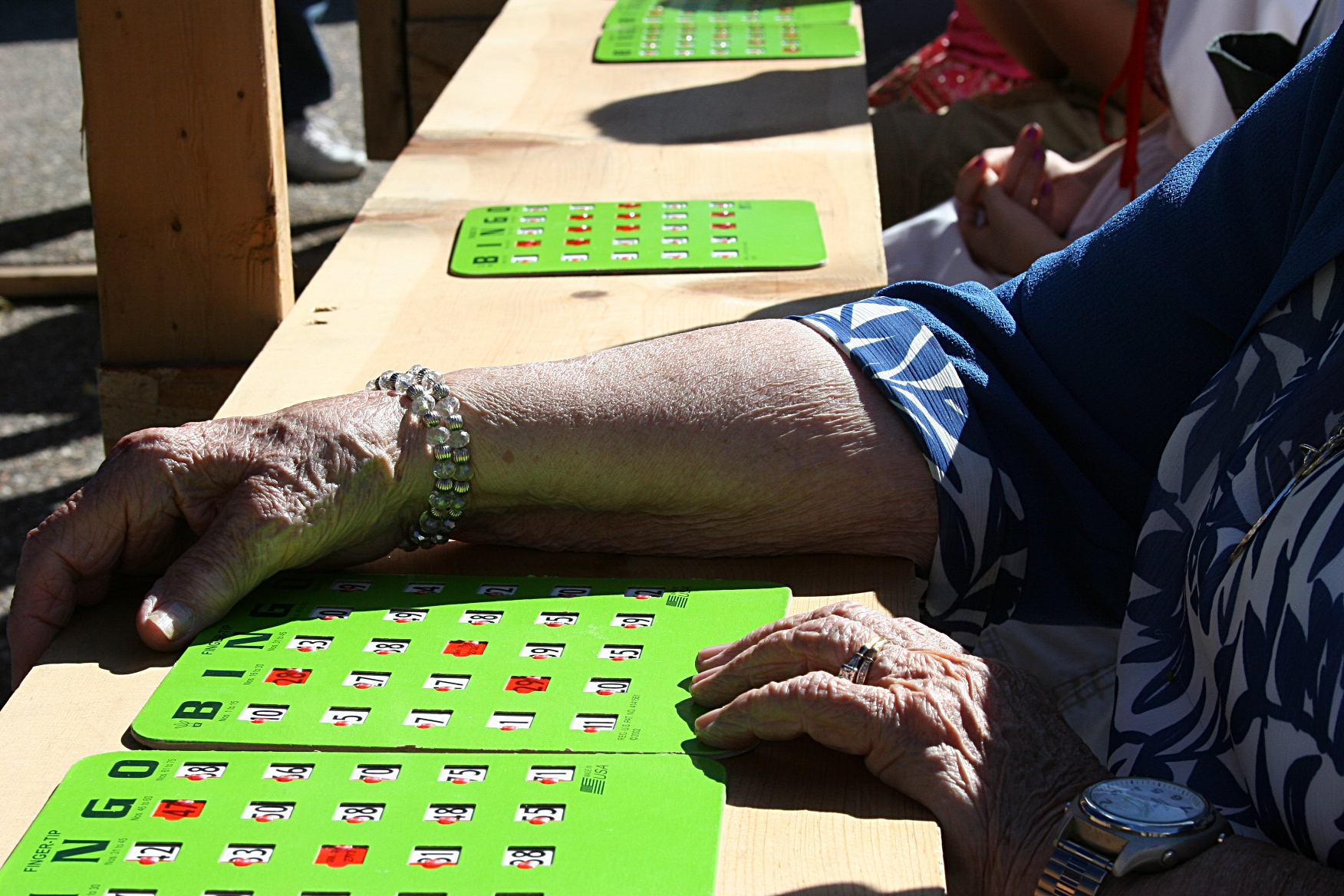
Playing BINGO at a church festival. (Minnesota Prairie Roots copyrighted file photo)
We slid red plastic tabs across BINGO numbers. The adults played two cards each, doubling our chances of winning a coveted prize. Soon Marc was calling “BINGO!” and Isaac had his alien art. Good, one happy kid.
The BINGO rounds continued with no winners at our table. By then I was struggling visually, seeing double sometimes. My eyes are still healing from bilateral strabismus eye surgery and they were getting a work out playing BINGO. Not only were my eyes darting between two cards, but they were also occasionally focusing on the overhead screen to read numbers, when I was unsure I heard correctly. I felt my right eye muscles stretching, hurting. I needed Izzy’s help. She took one of my cards. I noted Izzy was becoming increasingly antsy about winning a prize. And then Grandpa came through and, boom, she had her puppy puzzle.
My siblings and I have a saying, “Life isn’t fair and the fair is in August.” I wanted to say that to Izzy, but I didn’t think she would understand. (Minnesota Prairie Roots copyrighted file photo 2019)
All was good and fine…until Grandpa won a second time and it wasn’t fair, proclaimed Izzy, that Isaac got two prizes and she only had one. Try and reason with an almost eight-year-old. It went something like this, “Well, Grandma won and she could have picked a prize for herself, but she let you pick one.”
“I thought Grandpa won,” Izzy replied, emphasis on Grandpa.
My granddaughter was right. I didn’t win. Randy did. Not only were my eyes tired. But apparently so was my brain. BINGO!
The restored Security State Bank Building clock in historic downtown Faribault. (Minnesota Prairie Roots copyrighted file photo)
TIME, WHEN YOU’RE YOUNG, seems to pass slowly. You’re waiting, always waiting. To turn another year older. To master a skill. To gain independence. To do whatever seems so important you wonder how you can possibly wait for another day or week or month to pass.
Now I wish time would slow down. But it can’t and it won’t and so I accept the reality of time passing, of aging, of days disappearing too quickly. Of celebrating my 50-year high school class reunion this year. Of my youngest turning thirty. Of me nudging seventy.
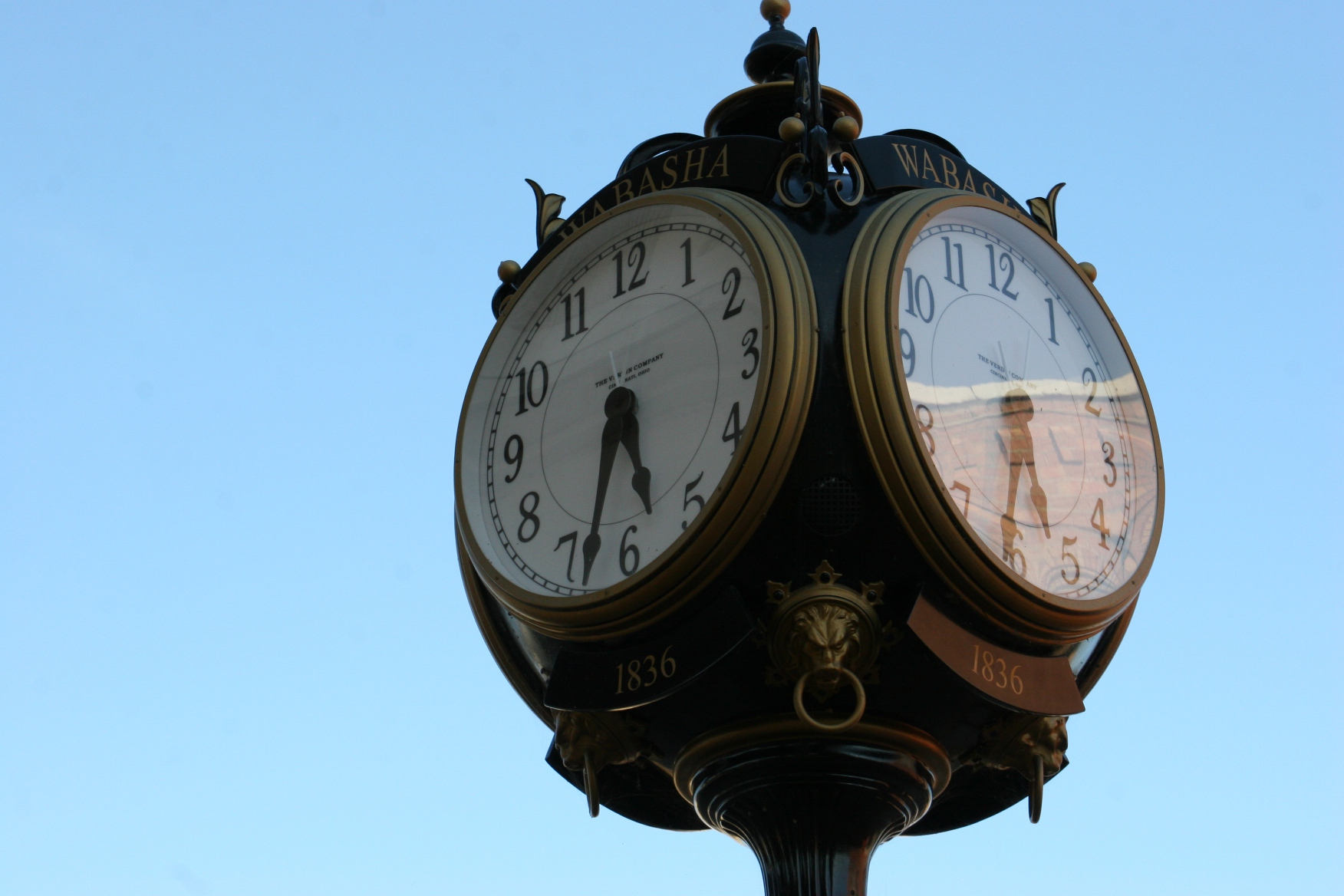
A street clock in historic downtown Wabasha. (Minnesota Prairie Roots copyrighted file photo)
In a recent conversation with a beloved aunt, she shared that she can’t believe how old her nieces and nephews are, considering she’s only twenty-nine. I love that about Aunt Dorothy, who has always and forever declared herself on the cusp of thirty while in reality she’s closing in on ninety. I like her thinking.
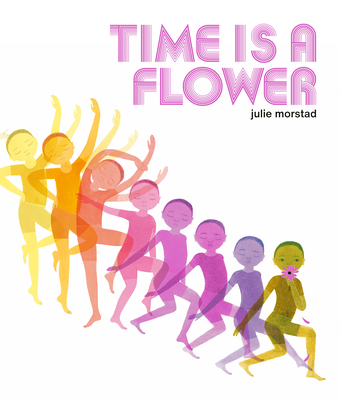
(Book cover sourced online)
By happenstance, I picked up a children’s picture book at my local library a few weeks ago that focuses on time. I’m not trying to go back in time to my childhood. Rather, I enjoy books written for kids. Many hold important messages and beautiful art that resonate with me. I highly-recommend you check out recently-published children’s picture books to see how they’ve evolved over the decades into some timely masterpieces of words and art.
Among the books I selected was Time Is a Flower, written and illustrated by Julie Morstad of Vancouver, British Columbia. In her opening page, Morstad writes of time as a clock, as a calendar, in the traditional ways we consider time.
A prairie sunset in southwestern Minnesota. (Minnesota Prairie Roots copyrighted file photo)
But then the book unfolds, page by page, into time comparisons that are simplistic, everyday, ordinary, unremarkable. Yet remarkable in the way Morstad presents them with sparse words and bold art. If I could rip the pages from her book, I would frame her illustrations of a sunset reflected in sunglasses; a child’s long wavy locks woven with bird, butterfly and flower; and a wiggly tooth in a gaping mouth.
A swallowtail butterfly feeds on a zinnia. (Minnesota Prairie Roots copyrighted file photo)
Time is the moments, the memories. The details. Not necessarily the extraordinary. That is the message I take from Morstad’s book. Appreciate the caterpillar, not just the butterfly. Appreciate the seed, not just the flower. Value the slant of sunlight across the floor, and the shadows, too.
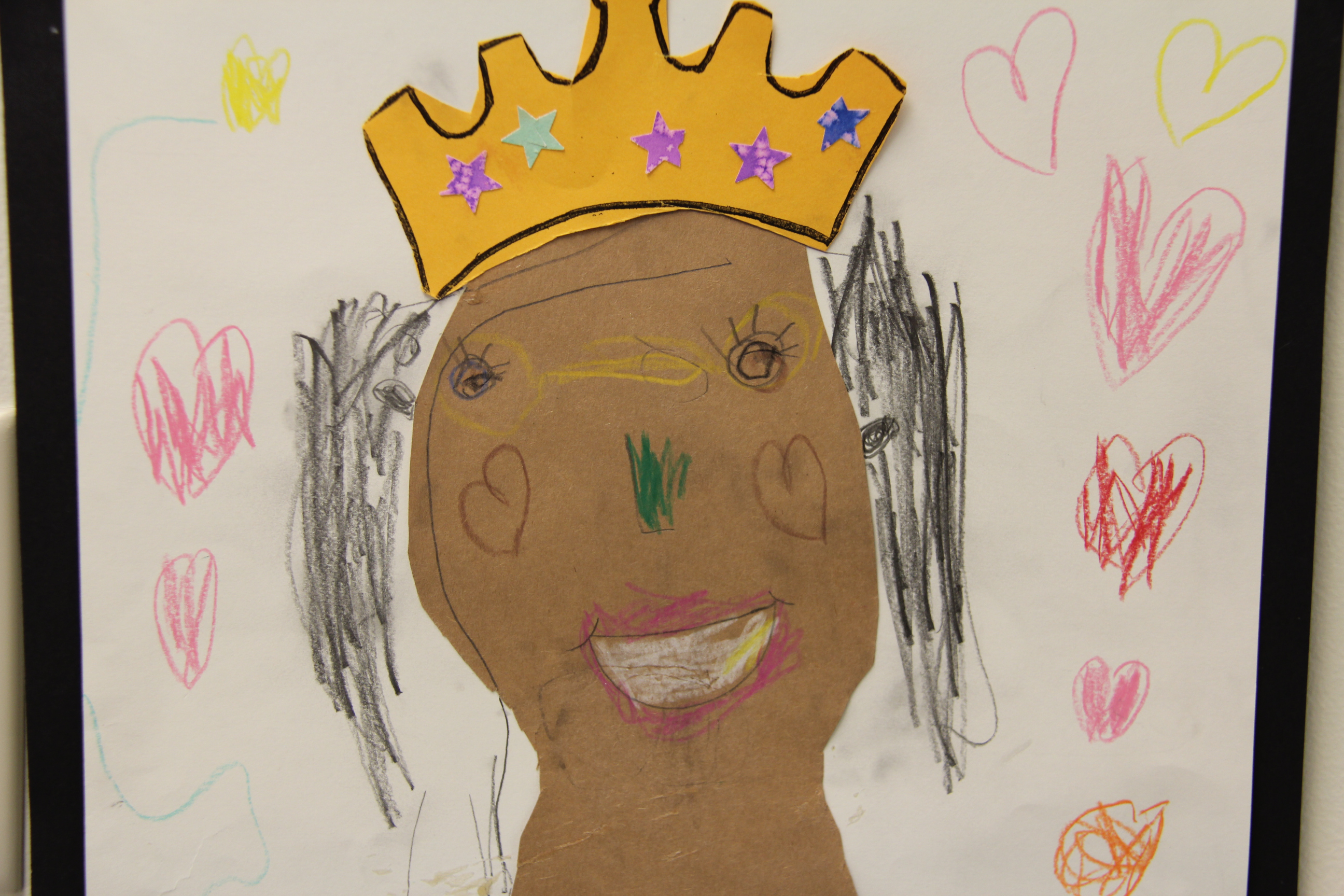
A princess by Roosevelt Elementary School kindergartner Ruweyda, exhibited in March 2023 at the Student Art Show, Paradise Center for the Arts, Faribault. (Minnesota Prairie Roots copyrighted file photo)
As I consider Time Is a Flower, I think of my dear aunt half a country away in New Jersey. Too many years have passed since I’ve seen Aunt Dorothy, so long that I can’t recall the last time we embraced. But I hold memories of her, of our time together. She was the young aunt who arrived from the Twin Cities with discarded jewelry and nail polish for me and my sisters. She was the aunt who called her husband, “My Love,” an endearing name that imprinted upon me her deep love for Uncle Robin (who died in January). She is the aunt who took me into New York City when I was a junior in college visiting her on spring break. She is the aunt who, for my entire life, has called me “My Little Princess.”
A 1950s scene in downtown Faribault honors history and the passage of time in this mural. (Minnesota Prairie Roots copyrighted file photo)
Yes, time passes too quickly. The clock ticks. Days on the calendar advance. Years pass.
Each spring the daffodils bloom. (Minnesota Prairie Roots copyrighted file photo)
But within each day, seconds and minutes and hours remain. Time to live. Time to love. And time to remember that time is like a flower. Sprouting. Growing. Blooming. Dying. Time is a moment, until it’s a memory.
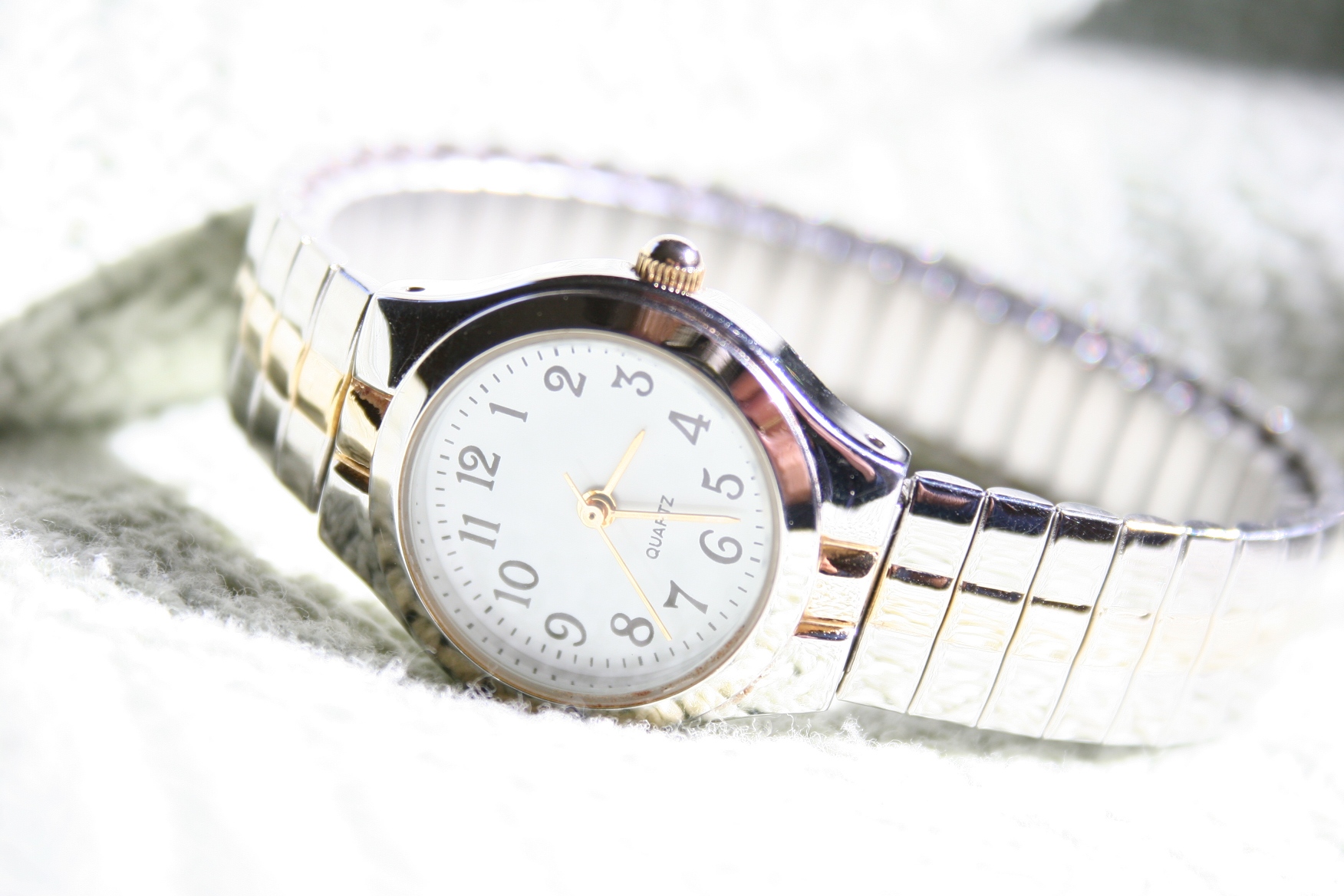
Most people no longer wear wrist watches. I still do. (Minnesota Prairie Roots copyrighted file photo)
NOTE: Remember, this Sunday, March 10, time changes as we shift to daylight savings time in the U.S. We lose an hour of time as we spring forward.
A row of John Deere tractors at the 2022 Rice County Steam & Gas Engines Show, rural Dundas. (Minnesota Prairie Roots copyrighted file photo September 2022)
AS A WRITER, a storyteller, I read obituaries. Doesn’t matter if the deceased is known to me or not. I find obits interesting for the stories therein.
Stories weren’t always part of obituary writing. Obit style has evolved since I graduated in 1978 with a journalism degree from Minnesota State University, Mankato. And that is a good thing. Today’s death notices are not just summaries of facts, but rather personalized in a way that helps the reader understand the person as a person. That holds value to those who are grieving and to those of us who hold no connection to the individual.
I need to backtrack for a moment and share that writing an obituary was my first writing assignment in Reporting 101. Although I’ve forgotten details about that long ago college course, I remember the professor stressing the importance of spelling names correctly. That carried through to all types of newspaper reporting. First reporting job out of college, I learned a source was Dayle, not Dale.
Emmett Haala (Photo source: Sturm Funeral Home)
That MSU instructor also imprinted upon me the importance of obituaries. As I age, I find myself drawn more and more to reading obits. Too often now, I know the deceased. Recently, I found a gem in the obituary of Emmett Haala, 87, of Springfield (that would be Springfield, Minnesota), who died on February 28. His funeral is today.
Hanging out by a John Deere tractor at the Rice County Steam & Gas Engines Show. (Minnesota Prairie Roots copyrighted file photo September 2022)
It wasn’t the basic facts about Emmett that captivated me, but rather his interest in John Deere tractors. He, according to his obit, “lived and breathed John Deere.” Now to anyone with a rural connection, the idea of fierce tractor brand loyalty is familiar. This retired mechanic began his career at age 14 at Runck Hardware and Implement in Springfield, eventually opening Emmett’s Shop in 1970. He was a trusted mechanic who serviced all machinery brands, but favored John Deere.
“Nothing runs like a Deere” is the John Deere slogan. (Minnesota Prairie Roots copyrighted file photo September 2017)
That tidbit got me reminiscing and also contemplating the importance of open houses in rural Minnesota. Events that continue today. Emmett, his death notice read, shared many memories of John Deere Days at Runck Hardware and Implement. He “…enjoyed making hot dogs and coffee for the throngs of people attending and showing the newest John Deere movie.”
To this day, I remain a fan of John Deere. Here Randy and I pose aside a vintage John Deere at Bridgewater Farm, rural Northfield in October 2023. (Photo credit: Amber Schmidt)
That was it. I was hooked. I attended John Deere Day at a farm implement dealership while growing up in southwestern Minnesota. While the event was a way for machinery dealers to get farmers inside their shops, the open houses were also a social gathering for rural folks. My siblings and I piled into the Chevy aside Dad and Mom for the 20-mile drive to Redwood Falls and John Deere Day.
Free food—usually BBQs, baked beans, chips and vanilla ice cream packaged in little plastic cups and eaten with a wooden spoon—comprised dinner (not lunch to us farm types). Maybe there were hot dogs, too, like at Emmett’s place of employment. Memories fade over the decades.
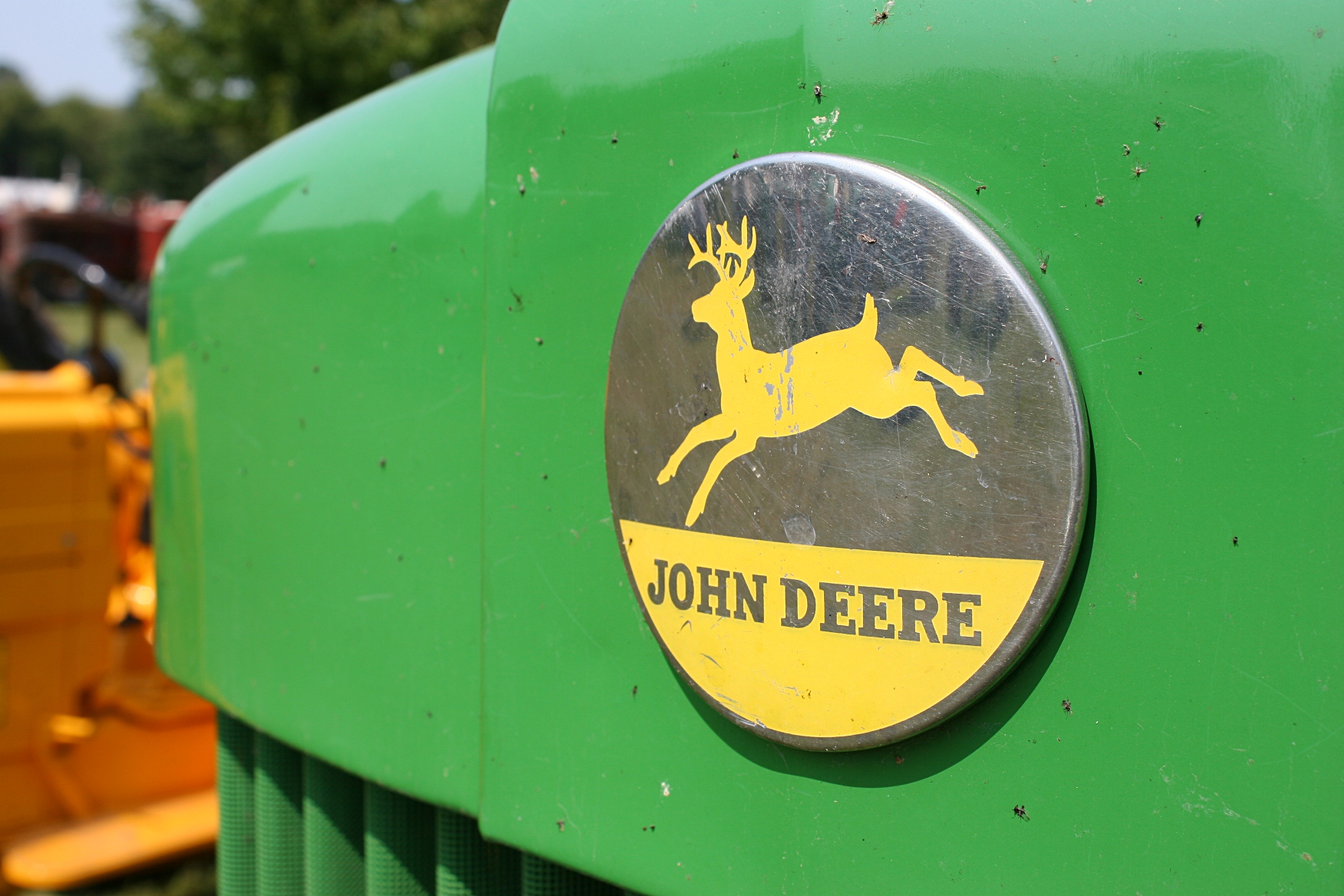
A worn vintage John Deere emblem. (Minnesota Prairie Roots copyrighted file photo September 2017)
But I do recall the John Deere movies shown post meal at the theater in Redwood Falls. Sure, they were nothing but advertisements for “the long green line” of farm machinery. But to a kid who seldom set foot in a theater, the promotional films held all the appeal of a box office hit. Plus, there were door prizes like bags of seed corn and silver dollars. I never won anything. A cousin did.
At the Rice County Steam & Gas Engines Show. (Minnesota Prairie Roots copyrighted file photo September 2017)
And so all those John Deere memories and more—including the distinct pop of my dad’s 1950s John Deere tractor—rushed back. Putt, putt, putt. Emmett belonged to the Prairieland Two Cylinder Club. Nostalgia is powerful. So is the art of crafting an obituary. Many of today’s obituaries feature detailed personal stories, not simply superlatives. Stories that reveal something about the individual who lived and breathed and loved. Stories well beyond life-line basics. Stories of life. Stories that resonate, that connect us to each other. Stories like those of Emmett, who “lived and breathed John Deere.”
(Book cover image sourced online)
FYI: I recommend reading this guidebook to obituary writing by retired The Wall Street Journal obit writer James R. Hagerty: Yours Truly: An Obituary Writer’s Guide to Telling Your Story. Hagerty is the son of Marilyn Hagerty, columnist for The Grand Forks Herald. In a March 2012 “Eatbeat” column, Marilyn reviewed her local Olive Garden and gained instant internet fame.
My eyes have always been drawn to rocks in nature, here in the creek twisting through Falls Creek Park, rural Rice County. (Minnesota Prairie Roots copyrighted file photo June 2020)
THEY WERE ROCK HOUNDS, the great uncles who hunted, collected, cut, polished and made rocks in to jewelry. The bachelor brothers were passionate about their hobby, delighted to share their enthusiasm, and their rock collection, with their great nieces and nephews.
I remember the excitement of arriving at Uncle Walter and Uncle Harvey’s Redwood County farm home, where they lived with my great grandma and with their sister Dora. My siblings and I nearly flew out of Dad’s Chevy, through the front door of the farmhouse and down the basement stairs to Rock Station Central.
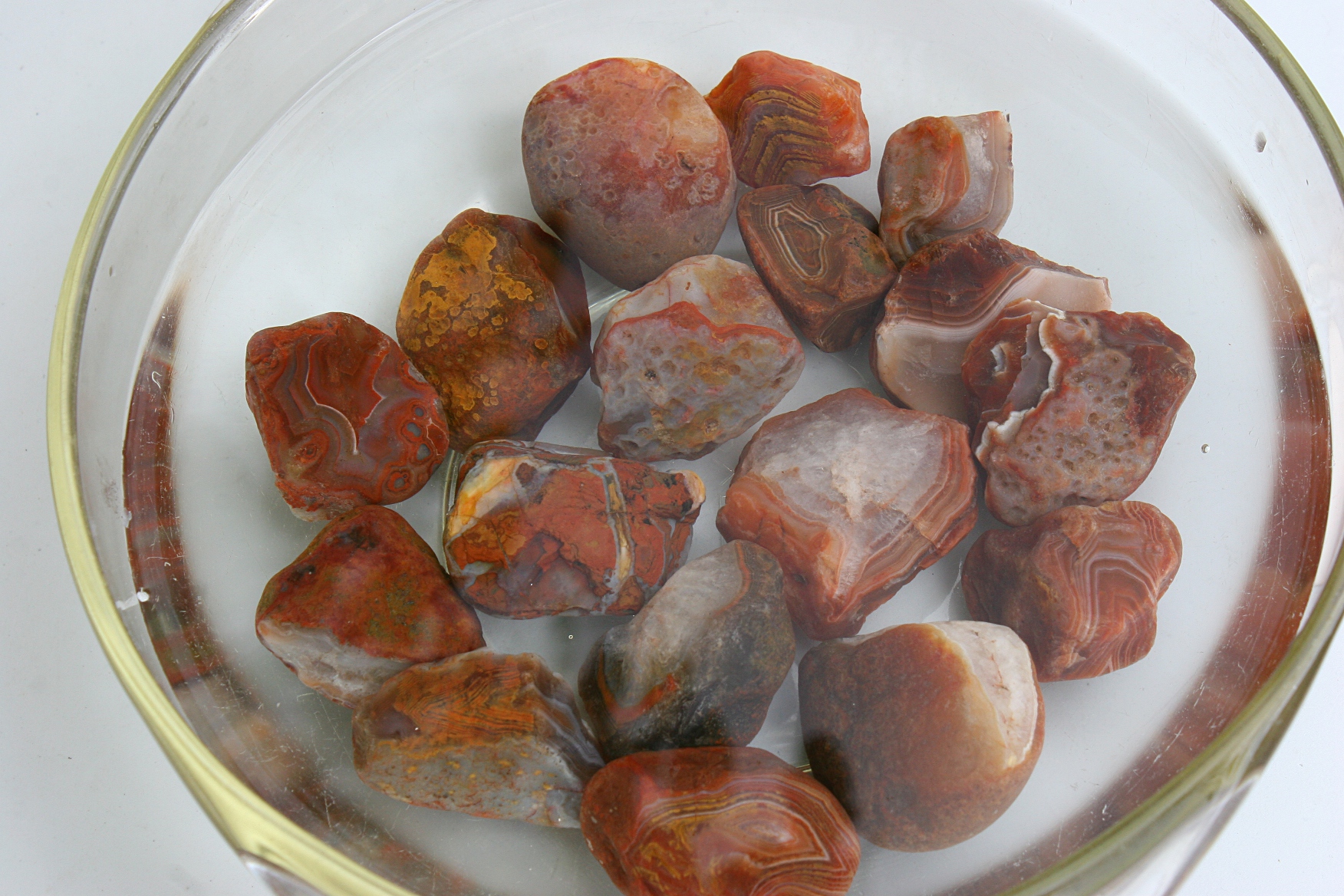
Agates in water, Faribault Farmers’ Market. (Minnesota Prairie Roots copyrighted file photo September 2019)
My great uncles enthusiastically welcomed us, showing us Lake Superior and honey agates, garnets, geodes and all sorts of rocks they’d found on their forays West and to Minnesota’s North Shore. We fingered uncut stones and polished stones as the pair schooled us in identifying rocks. And they always, always, sent us home with handfuls of small polished stones. And occasionally they gifted us with jewelry they’d made.
The Straight River churns over rocks at Morehouse Park in Owatonna. (Minnesota Prairie Roots copyrighted file photo)
Although this scene played out decades ago, my fascination with rocks remains. I still find myself looking for agates, admiring unusual stones while out in nature. I’m no rock hound, simply someone who appreciates the beauty of rocks thanks to those two caring great uncles.
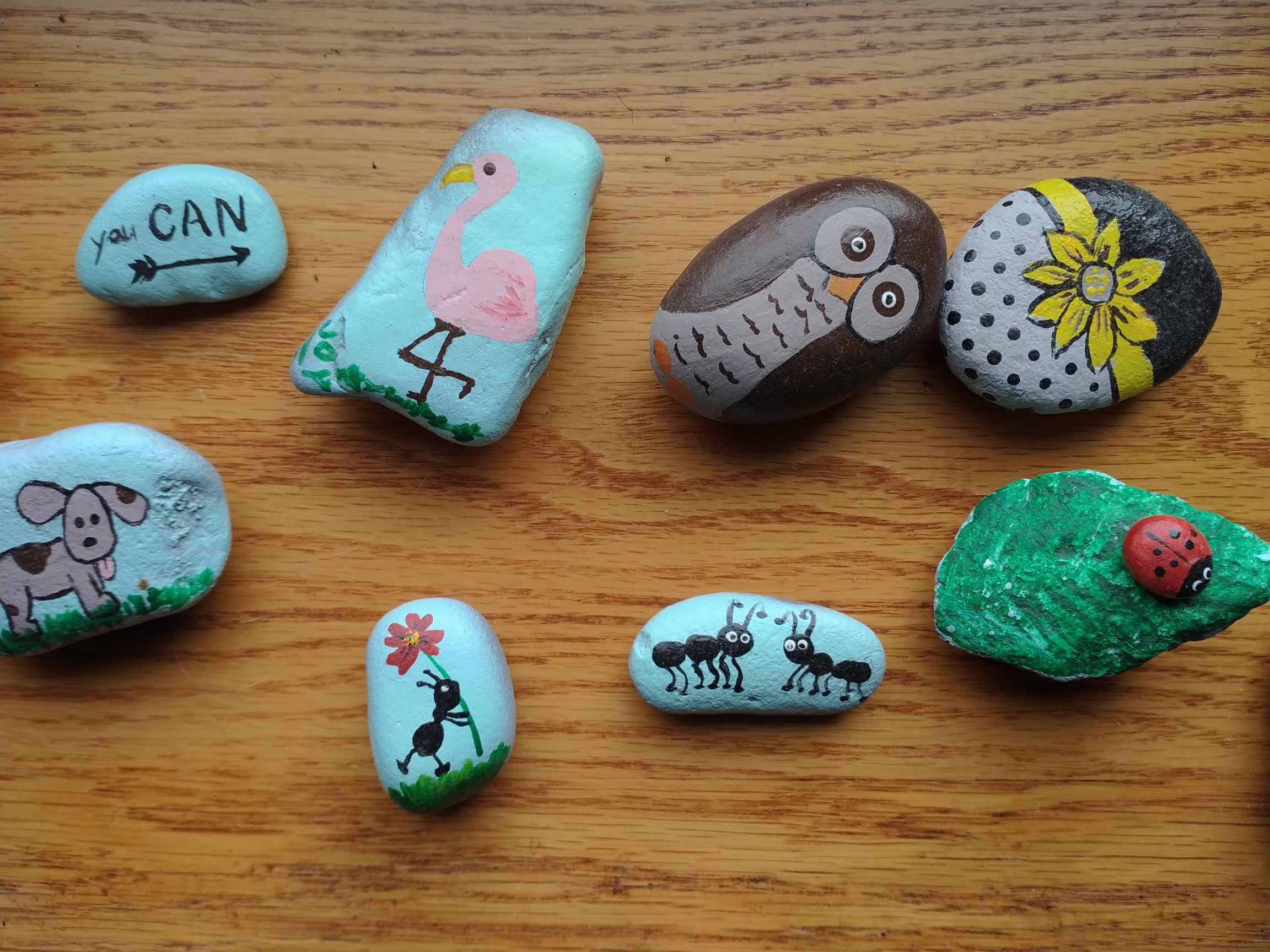
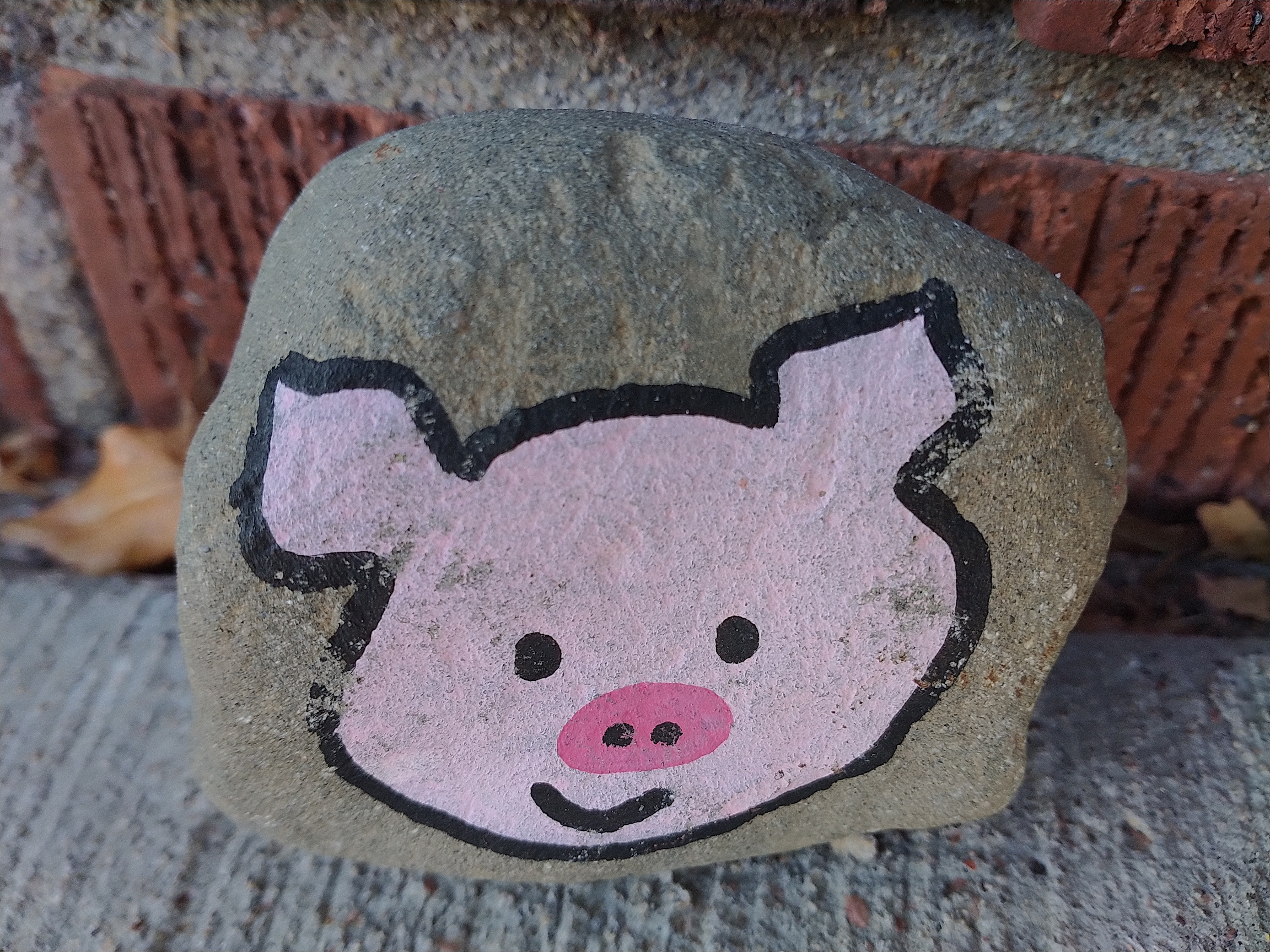
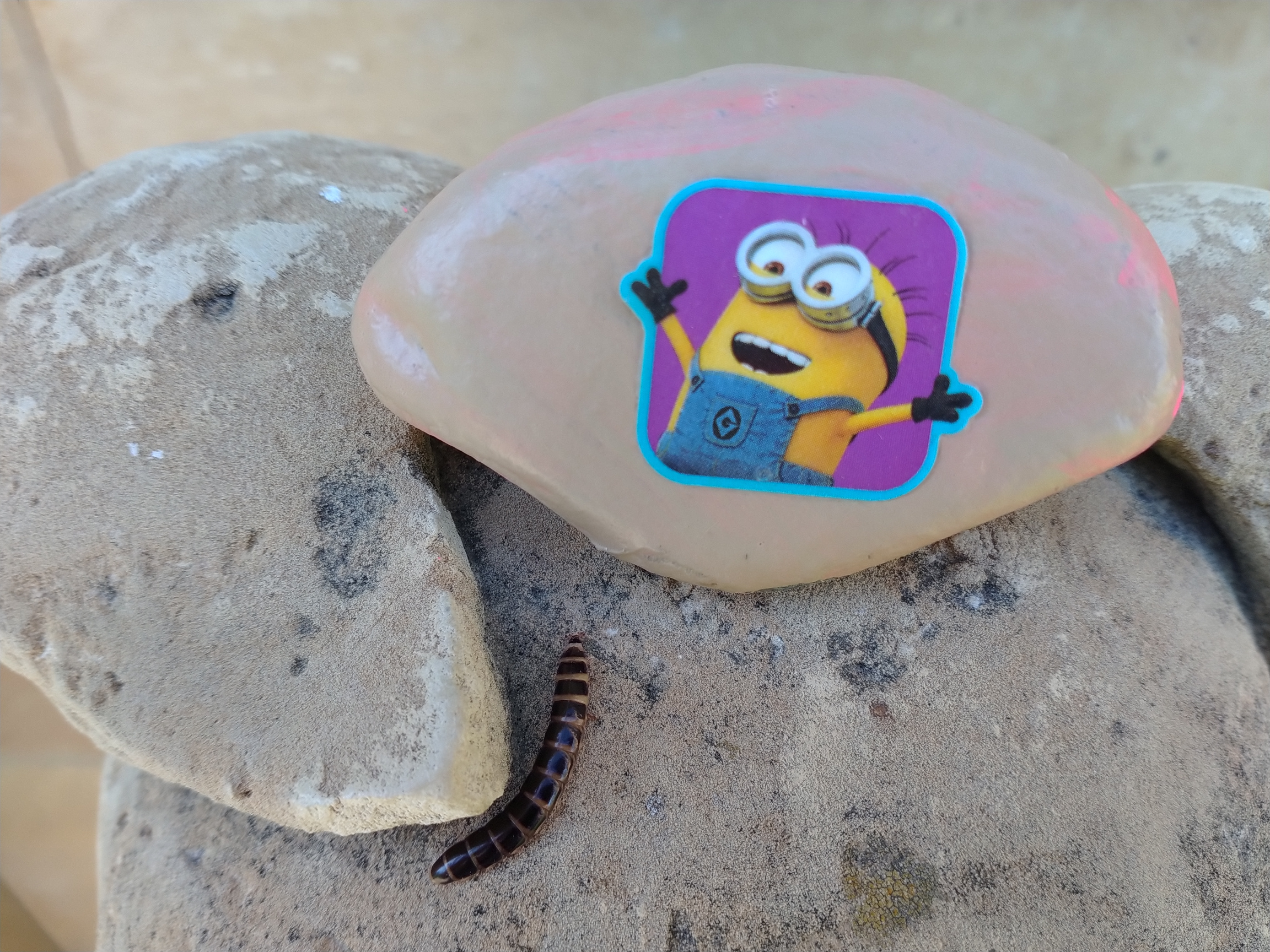
My friend Joy paints rocks with inspirational messages and fun art. (Minnesota Prairie Roots copyrighted photo 2023)
Joy’s original rock art. (Minnesota Prairie Roots copyrighted photo 2023)
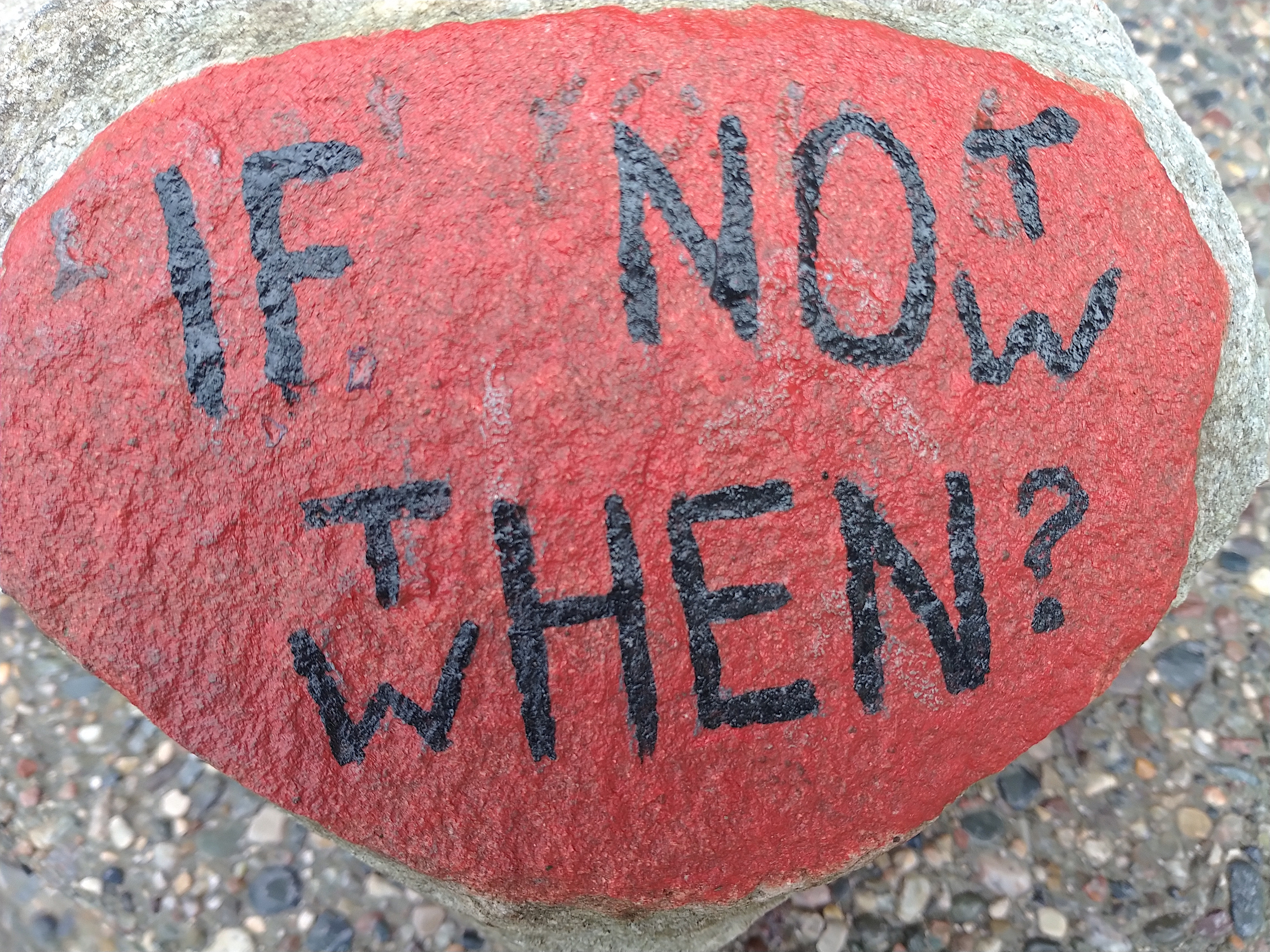
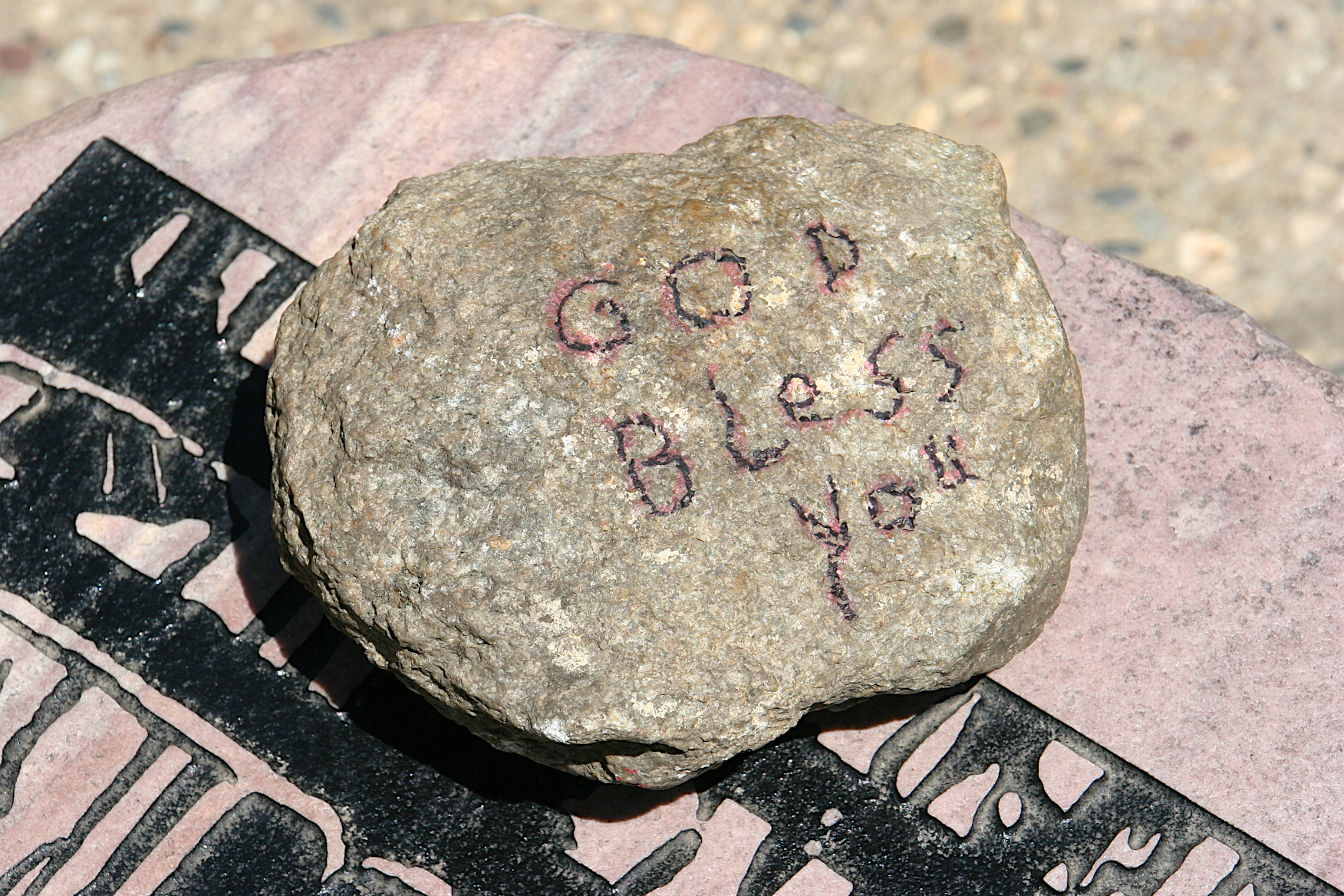
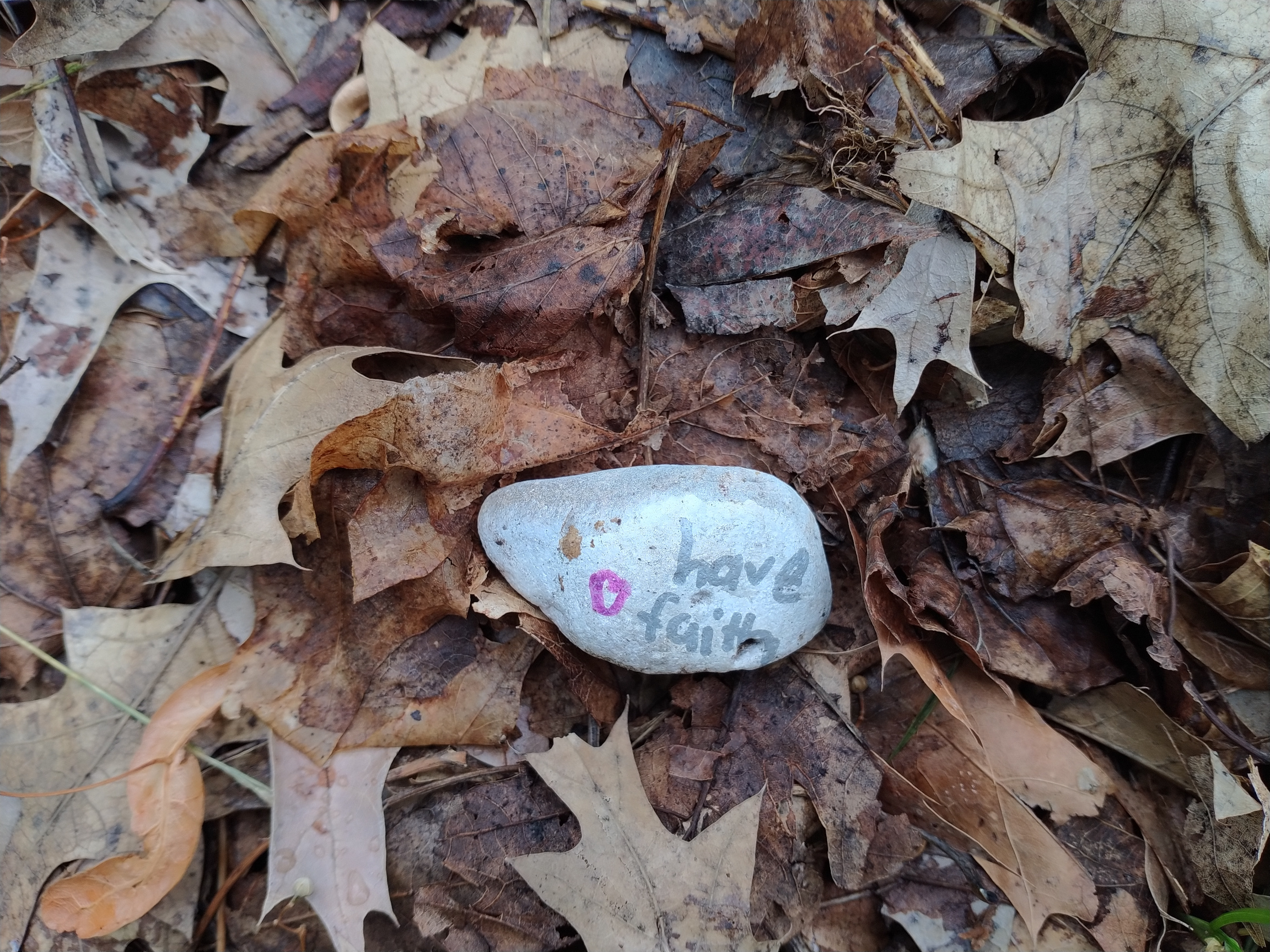
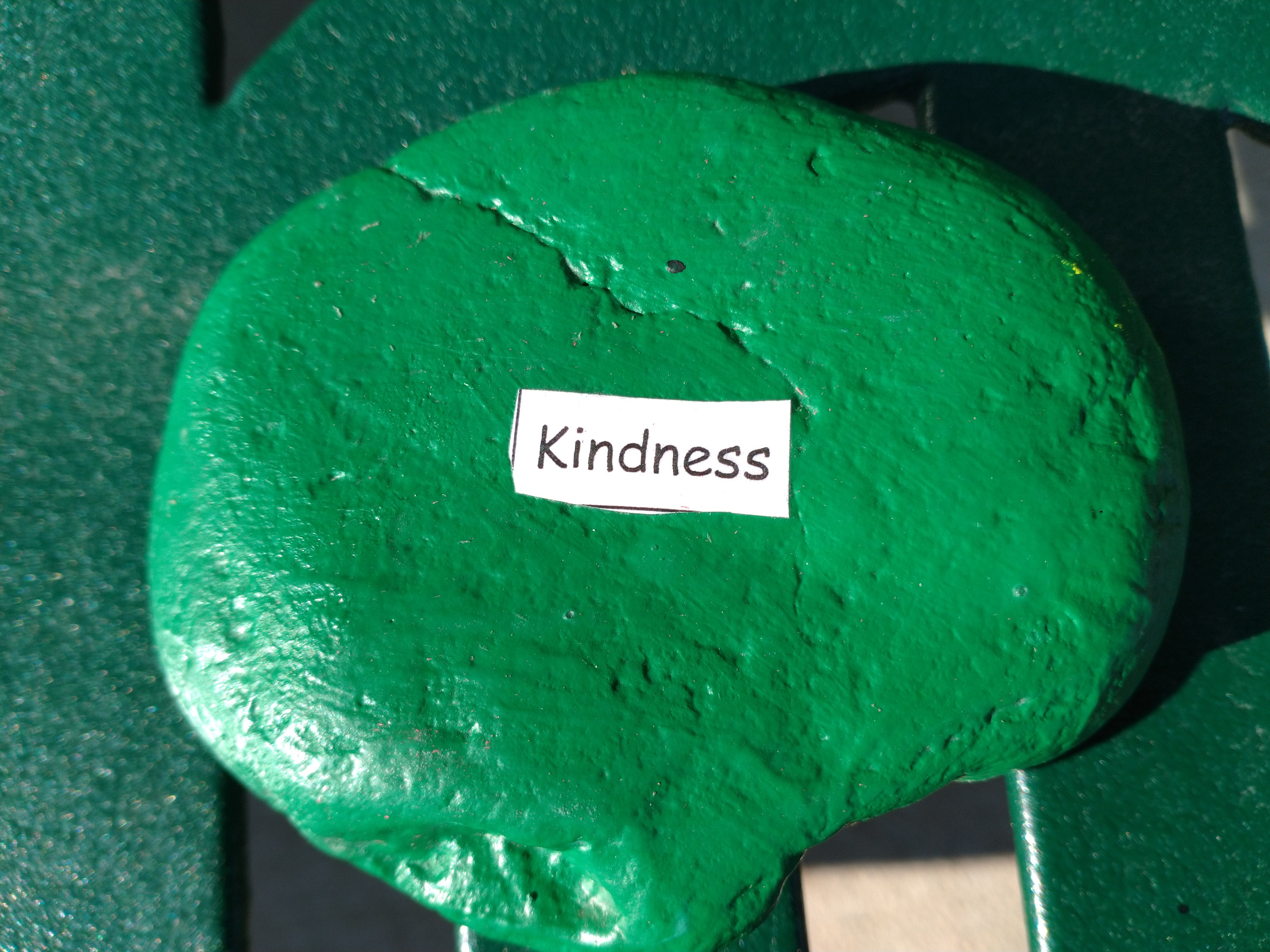
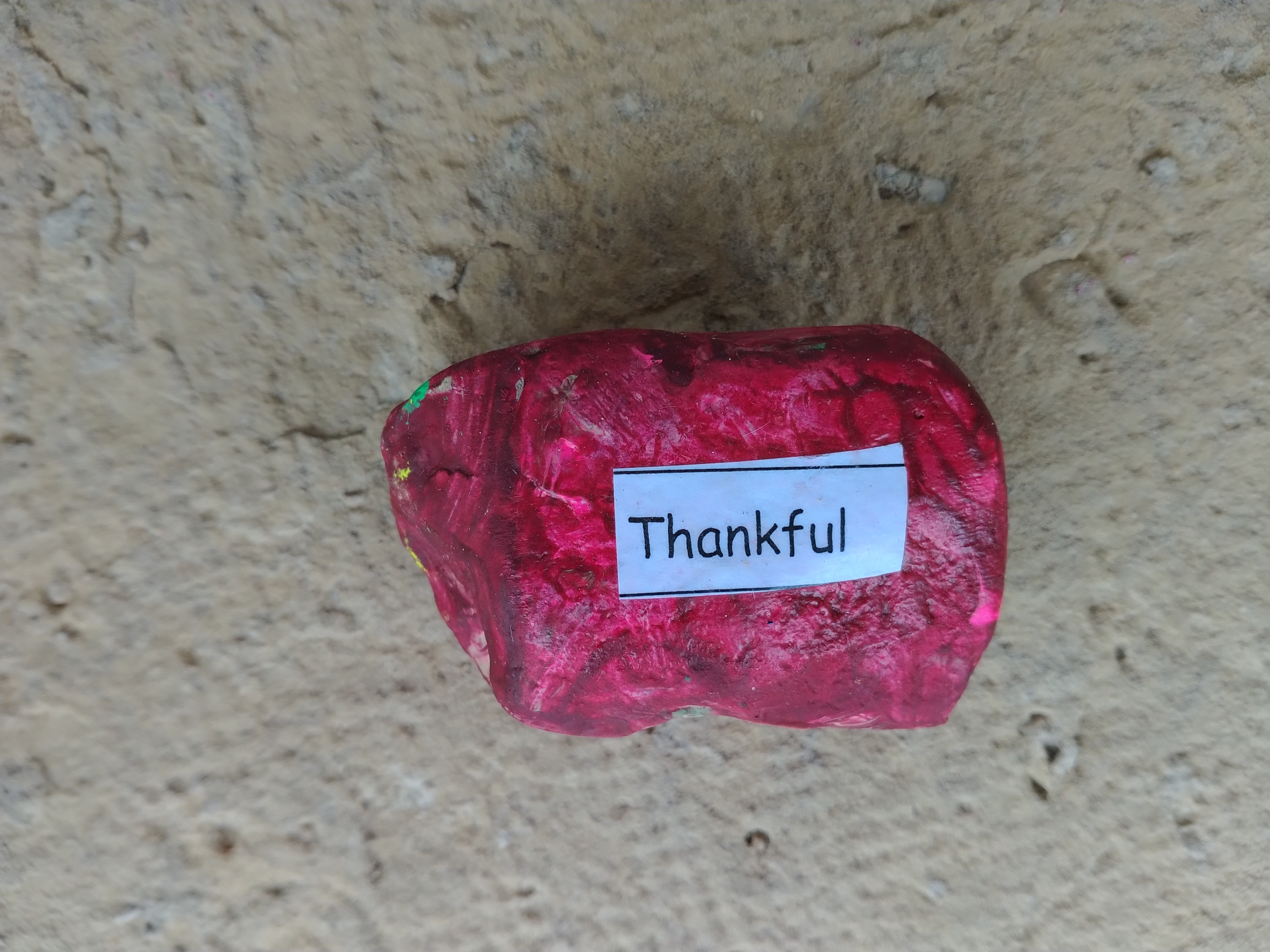
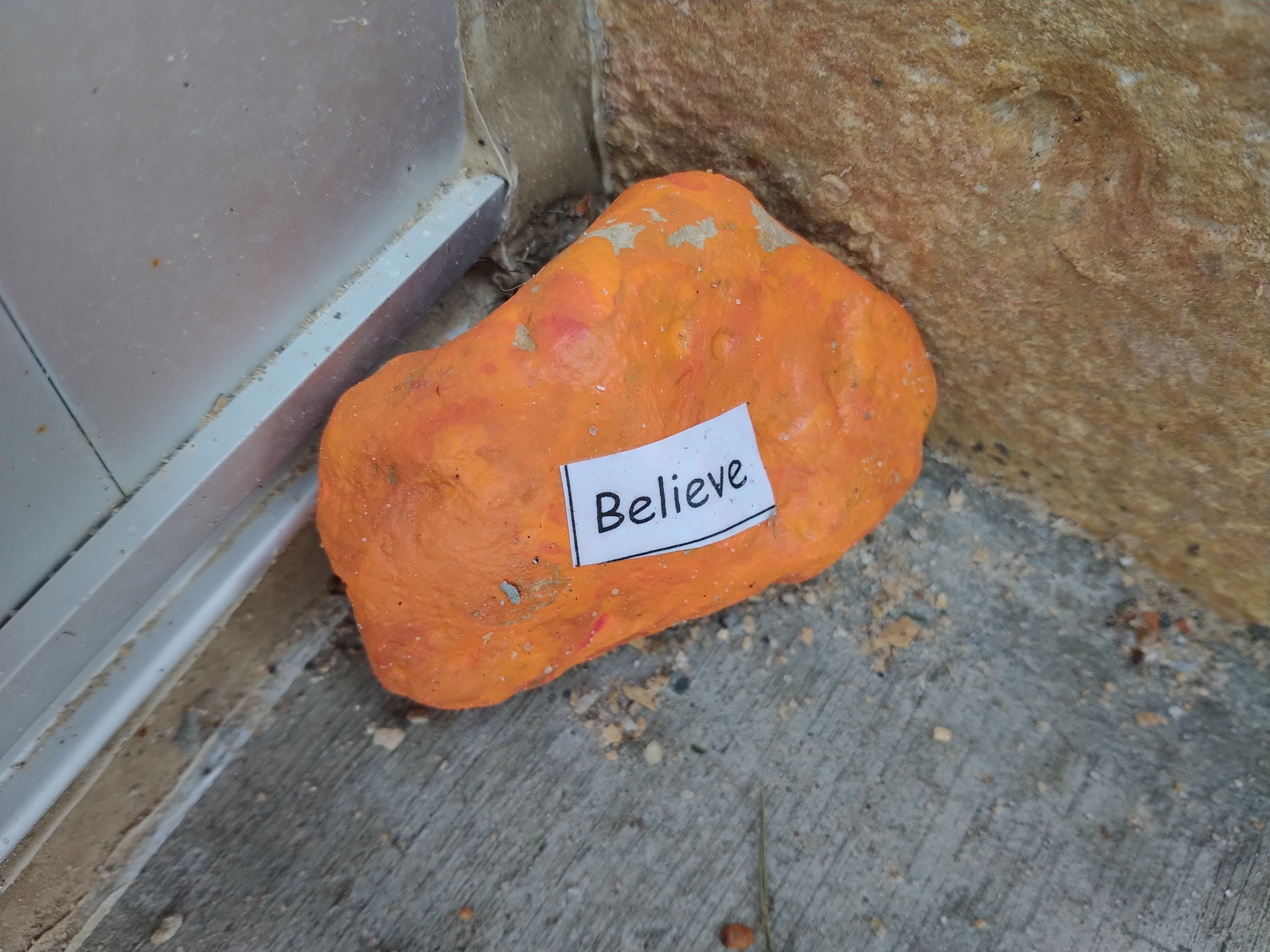
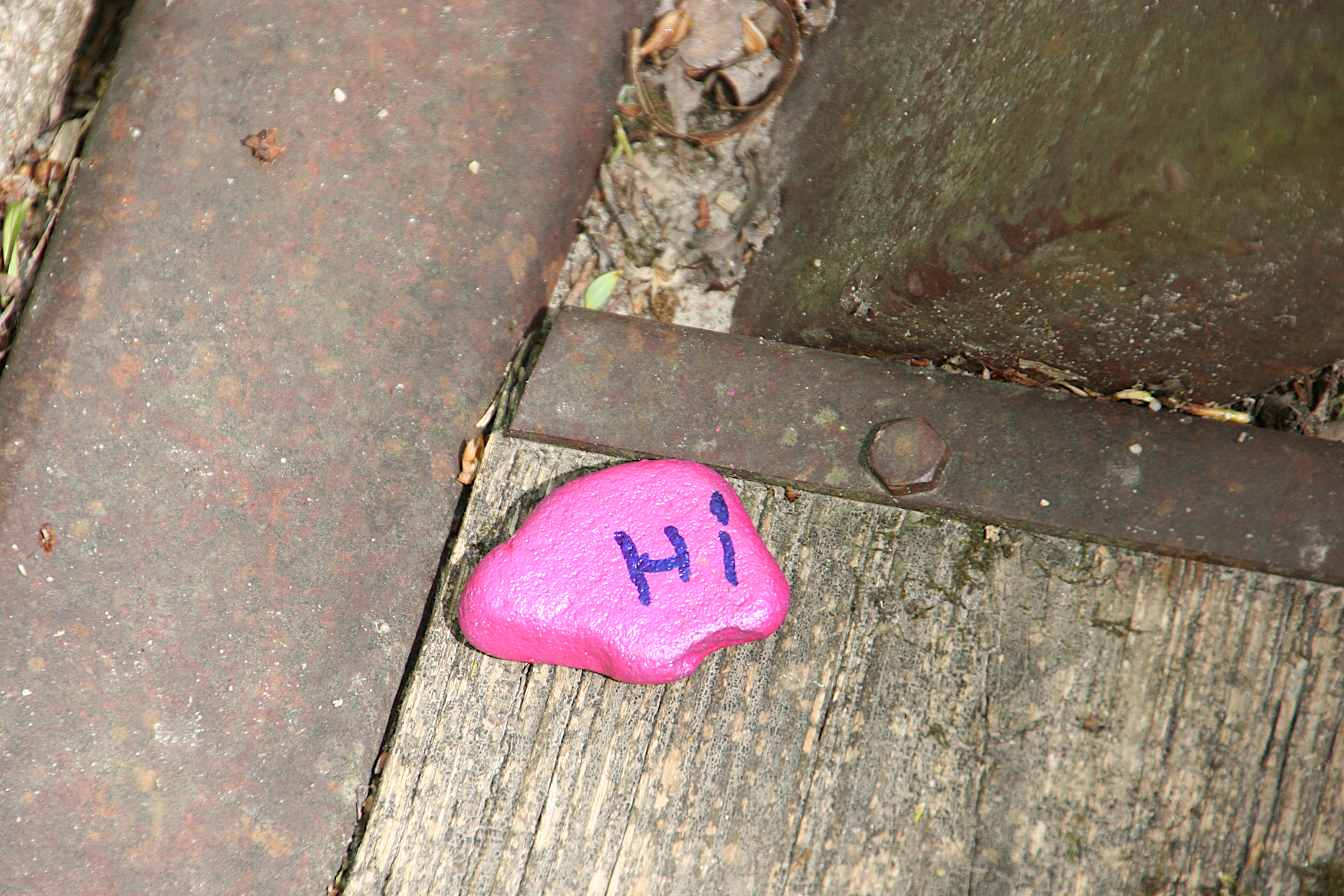
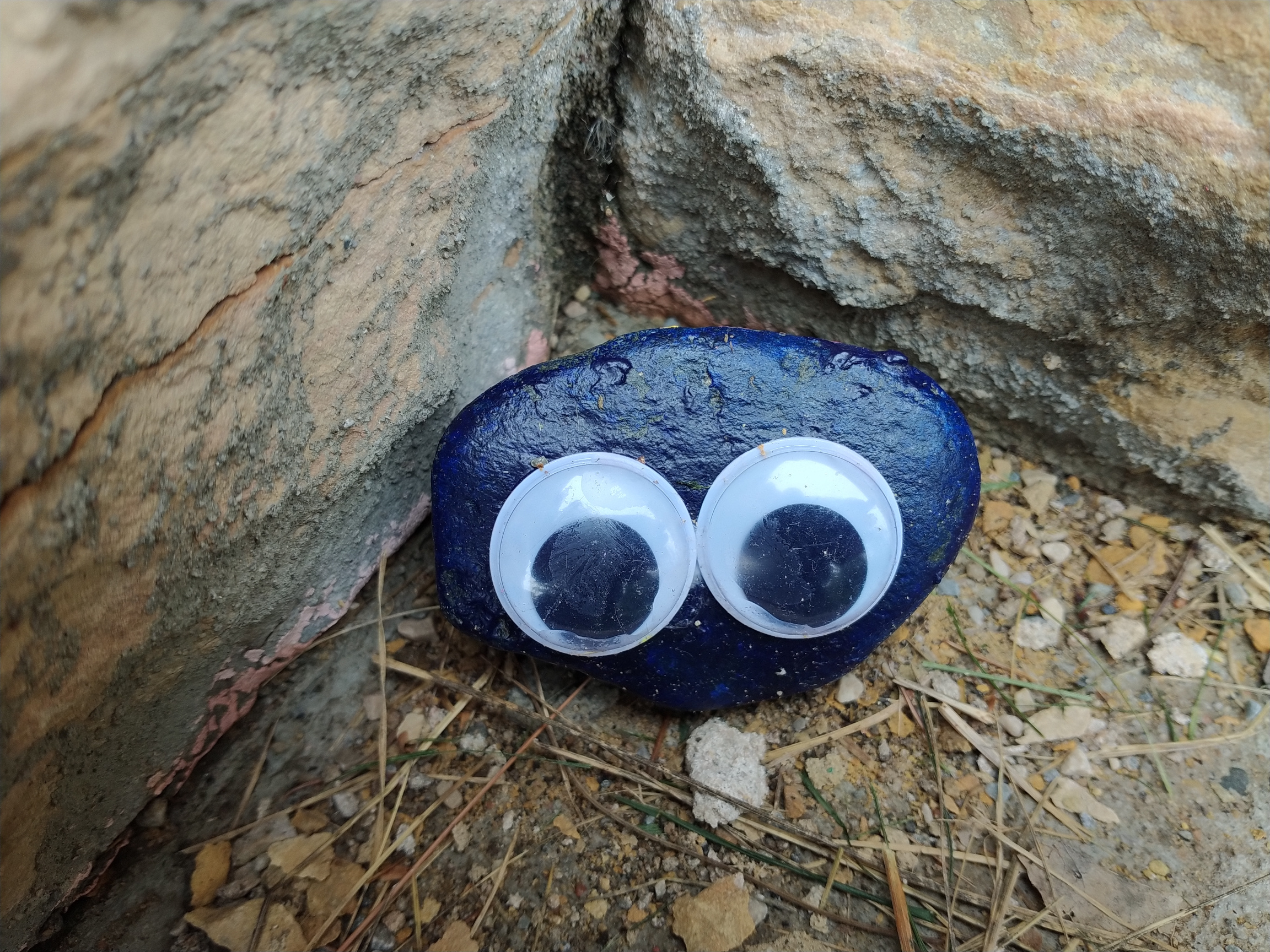
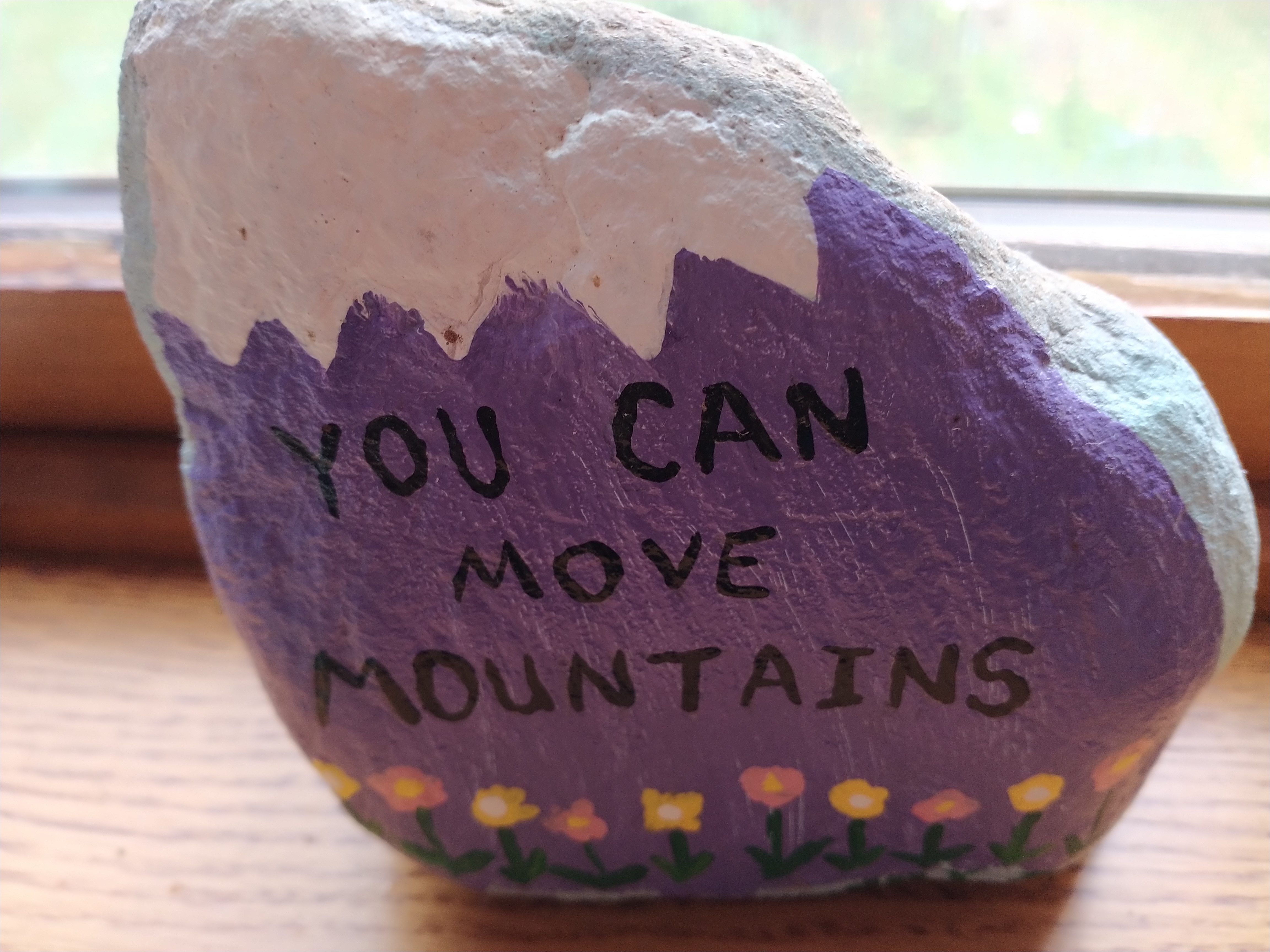
But my interest, my search for rocks has taken a modern day twist, one Walter and Harvey likely would approve of even if not a purist form of rock collecting. I collect inspirational and artsy rocks with my camera. These are painted rocks upon which a single word, message or image has been written, painted or adhered. Whenever I find one—and I’ve found them in many public places throughout southern Minnesota—I photograph them. I feel the same giddiness I experienced many years ago in that farmhouse basement.
Found at Mineral Springs Park, Owatonna. (Minnesota Prairie Roots copyrighted file photo May 2020)
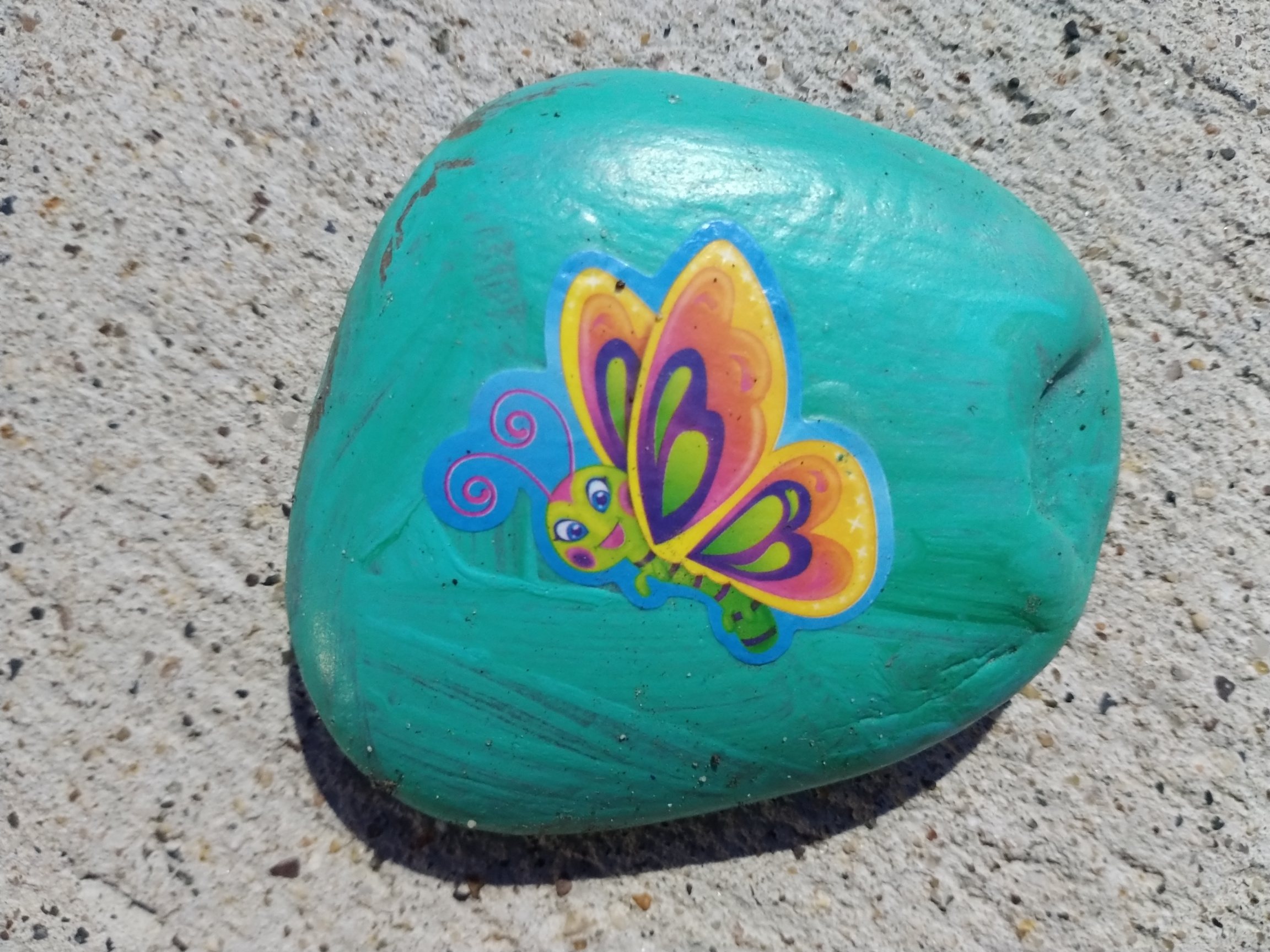
Colorful stickers on painted rocks found at the Minnesota State Academy for the Deaf. (Minnesota Prairie Roots copyrighted photo 2023)
Found in Faribault’s Central Park. (Minnesota Prairie Roots copyrighted file photo)
My thrill in discovering painted rocks focuses on the positive messages or images thereon. There’s something undeniably beautiful and wonderful and uplifting about these inspirational rocks. I feel such happiness, such gratitude for the individuals who create, then share, these stones. Rather like my great uncles who showed their love for family via sharing of their rock collection.
Single words inspire on a series of painted rocks found at the Minnesota State Academy for the Deaf, Faribault. (Minnesota Prairie Roots copyrighted photo 2023)
This painting of rocks has spread worldwide as The Kindness Rocks Project with a mission “to cultivate connections within communities and lift others up through simple acts of kindness.” It’s a simple, and much-needed, project in a world filled with discord, division and, yes, even hatred.
Found outside a meat market in Lonsdale. (Minnesota Prairie Roots copyrighted photo 2023)
A simple message found at Falls Creek Park. (Minnesota Prairie Roots copyrighted photo May 2022)
A fun find at the Minnesota State Academy for the Deaf, Faribault. (Minnesota Prairie Roots copyrighted photo 2023)
We need more inspirational, artistic rocks scattered in public spaces. I’ve most often found them in parks, tucked along the edges of flowerbeds, sometimes on ledges and steps and at the bases of trees. I’ve found them along trails, outside a public library. Typically they are hidden in multiples.
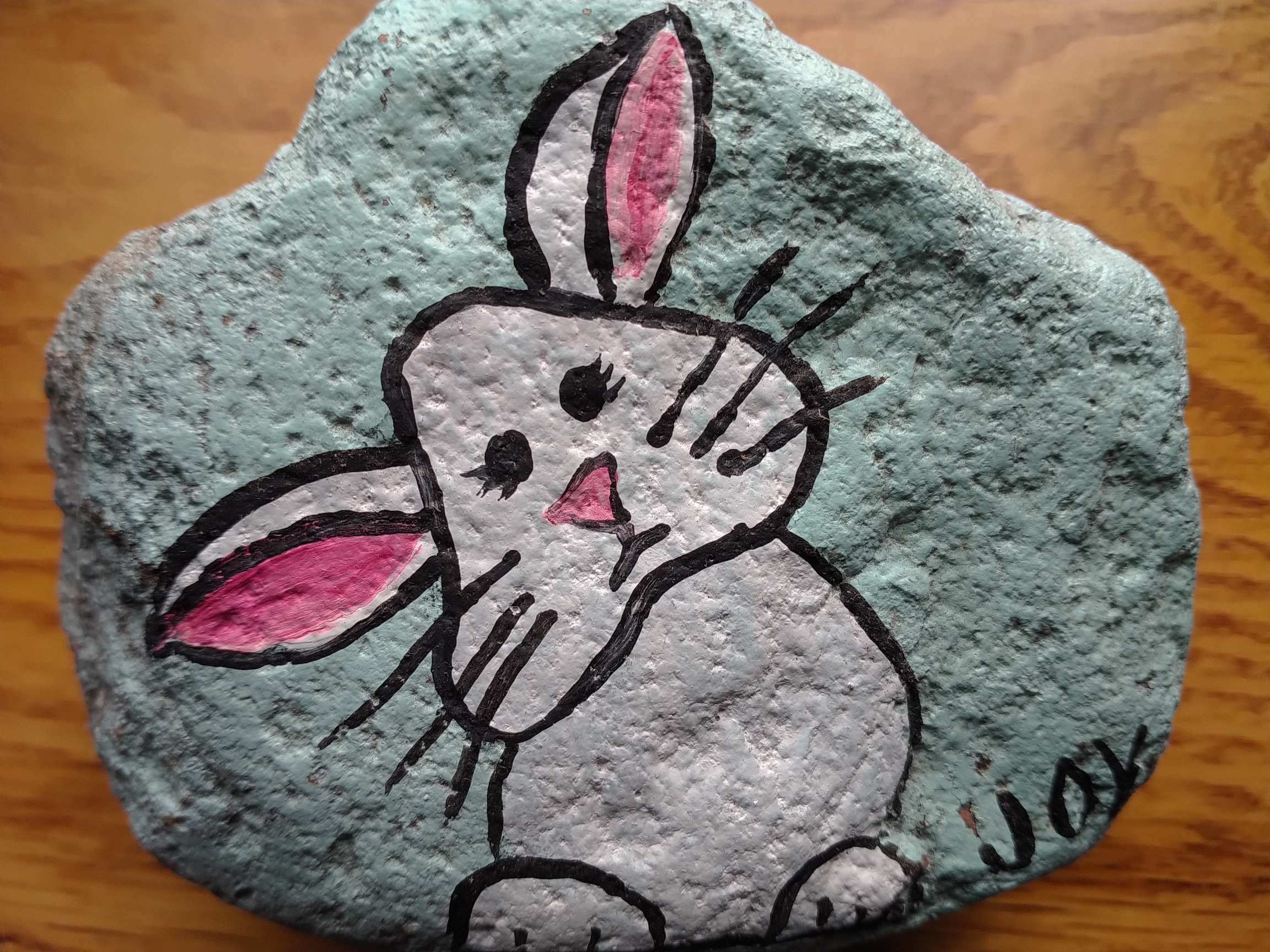
An especially inspiring message written on a rock painted by Joy. (Minnesota Prairie Roots copyrighted photo 2023)
All it takes are stickers and stones to create art, this found at the Minnesota State Academy for the Deaf. (Minnesota Prairie Roots copyrighted photo 2023)
This rock painted by a great niece sits on my office desk, a daily inspiration to me. (Minnesota Prairie Roots copyrighted file photo)
My reaction is always the same. Joy. Excitement. I’m suddenly that little girl again standing next to her great uncles at Rock Station Central. I feel loved. I feel, too, as if I’ve uncovered a treasure, a treasure of kindness and positivity and inspiration. And that uplifts me, gives me hope for humanity, that much goodness still remains in this world.
#
FYI: For anyone in southern Minnesota interested in rock collecting (like my great uncles did), the Steele County Gem and Mineral Club meets at 6 pm on the second Monday of the month at the Owatonna Public Library.
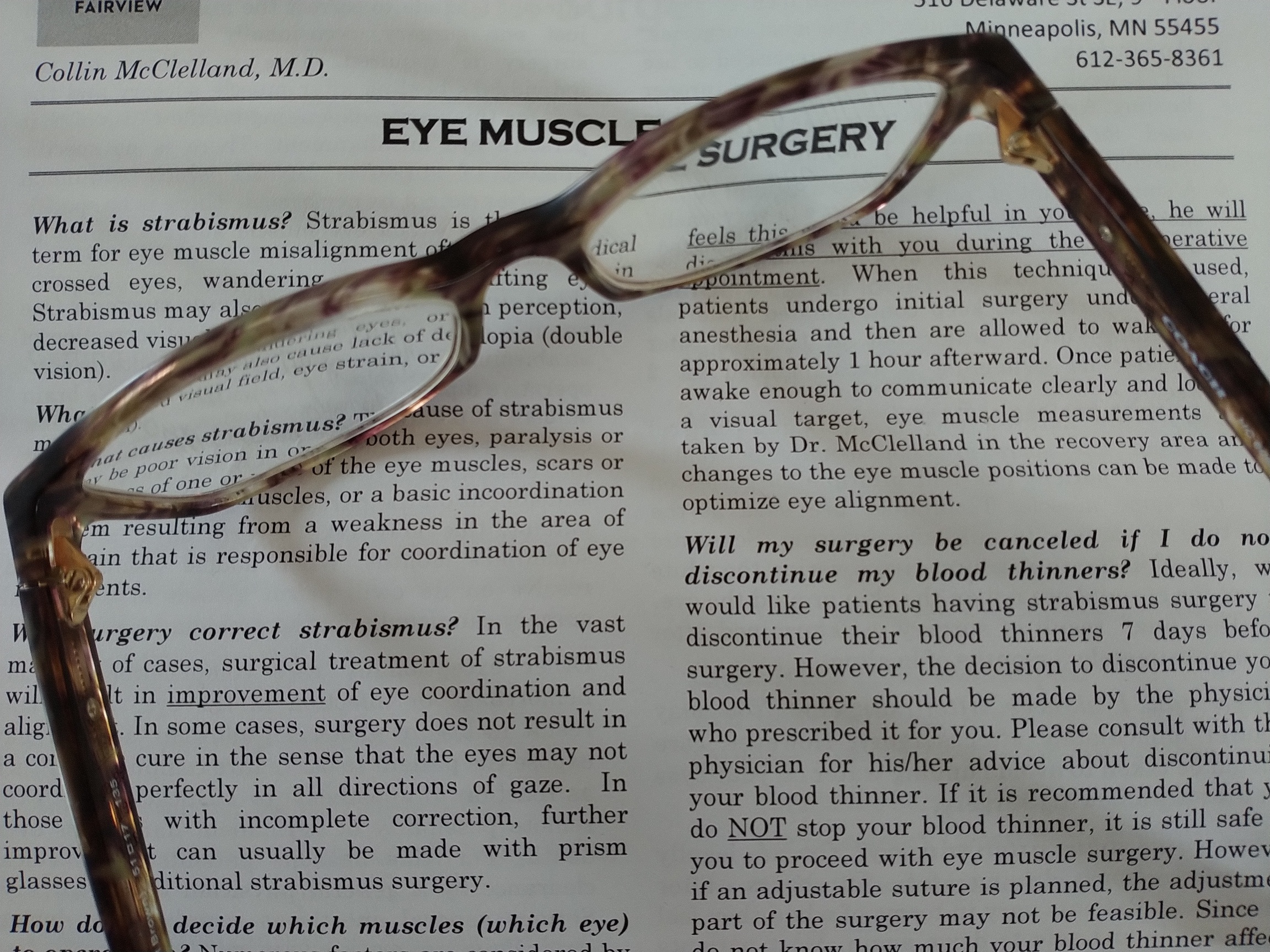
My current eyeglasses atop info about bilateral strabismus eye surgery. (Minnesota Prairie Roots copyrighted file photo November 2023)
THE EYES HAVE IT. Until they don’t.
Next week I undergo bilateral strabismus eye surgery at M Health Fairview Clinics and Surgery Center in Minneapolis. Basically, I’m having surgery to align my misaligned eyes. The neuro ophthalmologist will cut into the white of my eyes and then the muscles, tightening them into alignment using adjustable sutures. That’s the plan. Randy has advised me not to watch any online videos. I have no intention of doing so. Reading about this surgery is more than enough for me.
If you look closely at this image, you can see the patch covering my left eye. This 1960 photo of my mom, sister Lanae and brother Doug was taken on a rare family vacation to the North Shore near Duluth, Minnesota.(Photo sourced from my personal photo album)
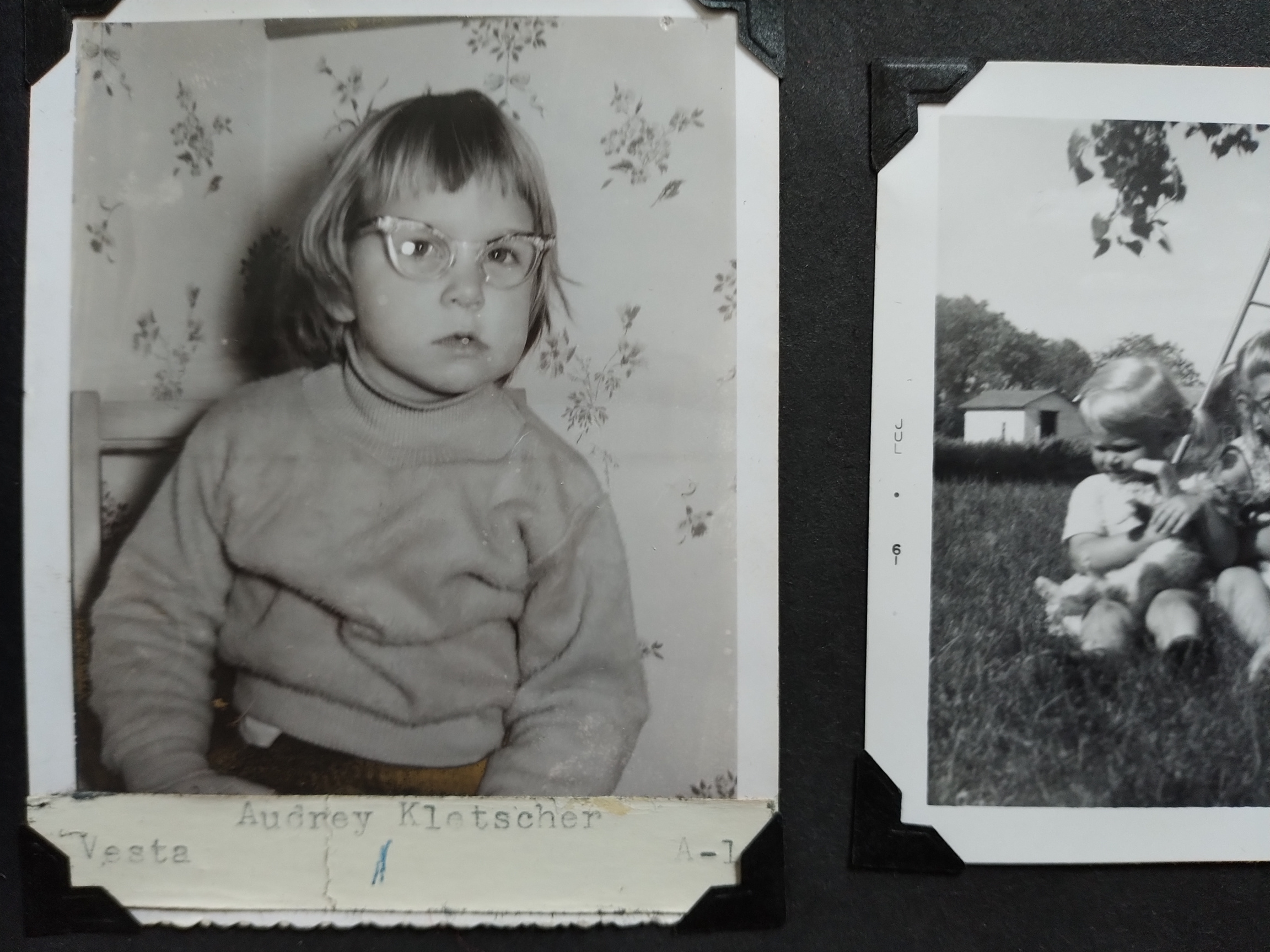
The thing is, I’ve had this surgery before. Sixty-three years ago. I was just four, cross-eyed and needing medical intervention to correct my vision. Patching my lazy eye didn’t work. So my parents took me to a specialist in New Ulm 60 miles away from our southwestern Minnesota farm. Eventually, ophthalmologist Dr. Theodore Fritsche would do corrective eye surgery at Union Hospital. I will always be grateful to this surgeon and to my parents for recognizing I needed help or I likely would have gone blind in one eye.
I remember little about that long ago surgery except drinking tomato juice at the hospital and looking at books. The books I understand. But tomato juice? I like it now, but didn’t as a preschooler. I also remember getting orange circus peanut candy as a treat from the dime-store following my numerous appointments. I’ve blocked any other memories.
Fast forward to today and how I got here, on the brink of another corrective eye surgery.
As my neuro ophthalmologist explains, my eye muscles loosened through the decades, shifting my eyes into misalignment. My brain was compensating for the most part until I experienced neurological issues following a January 2023 viral infection suspected to be COVID. (I self-tested negative twice.) The niggles of double vision which had bothered me for a few years, mostly in the evening when I was tired, worsened. COVID messed up my brain function and communication between the brain and my eyes was misfiring. In the past year, it’s become increasingly difficult to only see one, even with prisms in my prescription lenses. Trying to see only one taxes, exhausts, me. Sometimes I can’t read. Sometimes I close one eye simply to eliminate the double vision. It is getting to be too much.
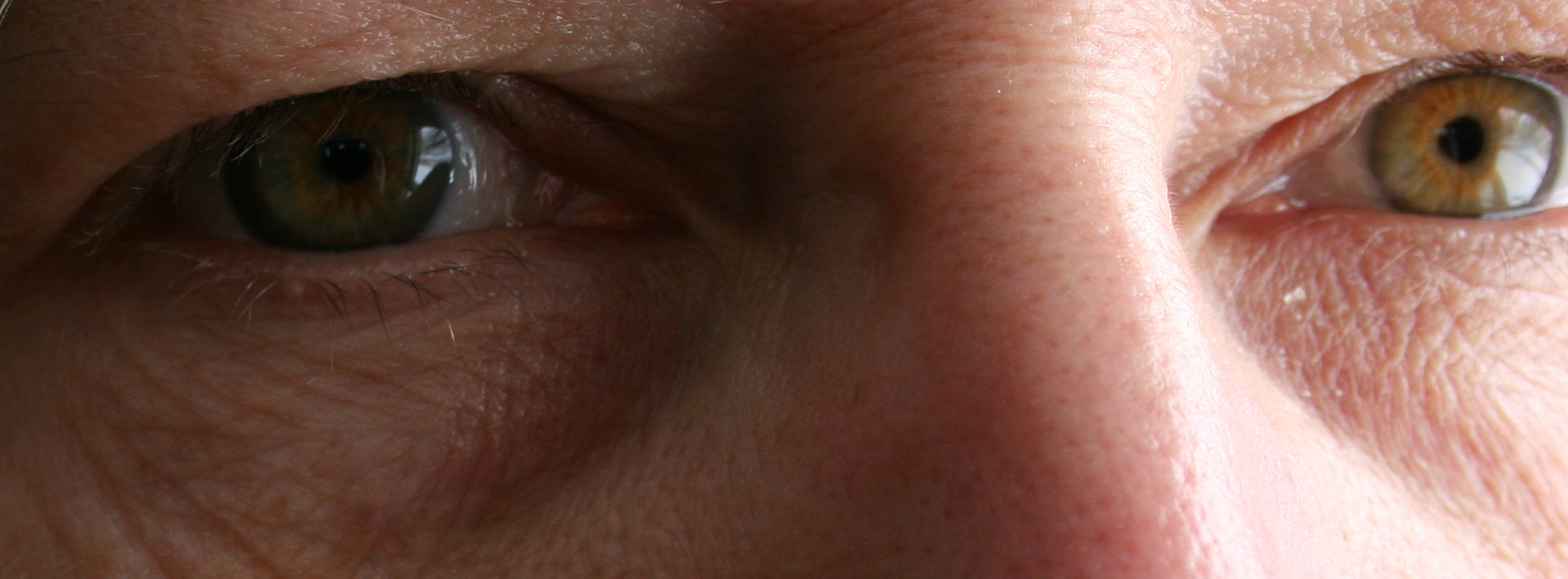
My green eyes up close pre double vision. (Minnesota Prairie Roots copyrighted file photo)
Once I completed 5 ½ months of vestibular rehab therapy to retrain my brain and help me deal with the devastating affects of long haul COVID, I was ready to see a professional about my double vision. I started locally. I went into an August ophthalmology appointment optimistically thinking I could simply get a new pair of prescription eyeglasses with more prisms added. Not so. As the ophthalmologist held up prism after prism to my eyes, it became clear nothing in his trays of prisms would effectively improve my vision. I was, he said, beyond his realm of expertise and would need to see a specialist.
After a several-month wait, I saw the neuro ophthalmologist at M Health Fairview in late October. Following 2 ½ hours of exhaustive testing, of looking through prisms and layers of prisms, I understood that I was well beyond the corrective lenses with prisms option. I would need surgery.
A childhood photo of me taken at an optometrist’s office in Redwood Falls. (Photo sourced from my personal photo album)
So here I am after another long wait—three months this time—on the cusp of bilateral strabismus eye surgery. I just want to be done. I am hopeful this outpatient surgery will fix my eyes and eliminate my double vision. Am I scared? Yes. The idea of undergoing general anesthesia and having a surgeon cut into my eyes and eye muscles is frightening. If only I could zoom back in time to my 4-year-old self who remembers nothing but books, tomato juice and circus peanut candy.
#
FYI: If I’m absent from blogging for a while, it’s because I’m resting my eyes, recovering from surgery. I’ll be back, hopefully no longer seeing double.
Photo used for illustration only. (Minnesota Prairie Roots copyrighted file photo)
HE LOOKED NOTHING like a leprechaun. No pointy ears. No red hair or freckles. Rather he was a slim man with definitive wavy hair. Not at all what I expected given my Aunt Dorothy’s description of her fiancé. Clearly I misheard and in my 10-year-old self’s excitement missed the word “not.” “Robin does not look like a leprechaun,” Dorothy told me and my sister Lanae. We apparently were hoping for a boisterous leprechaun like that pictured on boxes of Lucky Charms cereal.
The morning after my uncle’s death, I called Dorothy at her New Jersey home. I needed to talk to her as much as she needed to talk to me. We share a special bond. She’s always called me, “My Little Princess.” I cannot even begin to tell you how loved I feel when Dorothy calls me by that endearing name. I never grow weary of those loving words.
But it is the loving name she had for her beloved Robin that sticks with me also. She always called him “My love” or simply “Love.” Dorothy and I talked about this in our phone conversation, about how the two met at a party at the University of Minnesota where Robin was doing his post doctorate studies. Within the year, they married. I learned from Dorothy that speaking love aloud to a spouse within a stoic German family is not only OK, but quite lovely. That has stuck with me through the decades. To be witness to the love my aunt and uncle shared was a gift.
CREATING A LIFE-SAVING DRUG
In his professional career, Robin gave another gift, one with a broad, life-saving reach. He was the lead chemist in the development of the compound Letrozole (brand name Femara) used to treat certain types of breast cancer in postmenopausal women. As I spoke with Dorothy, she underscored how grateful Robin felt to accomplish this, to potentially save the lives of women via this hormone therapy drug.
Robin was clearly passionate about research. He was also passionate about golf. But of one thing he wasn’t passionate and that was eating leftovers. He didn’t. I don’t know why I knew this or why it matters, but it was something we all simply understood about Uncle Robin.
AN EMBARRASSING MOMENT
That leads to a food story. Once while visiting my childhood farm, Robin’s dinner plate broke in his hands. He was just sitting there in an easy chair in the living room eating his meal when the vintage plate broke. Someone snapped a photo, thus documenting this as part of family lore. I remember the laughter that erupted and the absolute embarrassment this quiet Irishman felt. Perhaps in this moment he wished he could, like a leprechaun, magically disappear.
BLESSED BE HIS MEMORY
In the funeral flowers my youngest brother ordered from our family for Robin’s funeral, Brad included this fitting Irish blessing:
May the road rise up to meet you. May the wind be always at your back. May the sun shine warm upon your face. Until we meet again, may God hold you in the palm of His hand.
Loving words for an Irishman who looked nothing like a leprechaun.
The Kletscher family Christmas tree always sat on the end of the kitchen table, as shown in this December 1964 photo. That’s me in the red jumper with four of my five siblings.
TO BE OR NOT TO BE is not the question. Rather, the question is this: Real or artificial? Do you prefer a real Christmas tree or an artificial one?
There’s no right or wrong answer here. Rather tree choice is a matter of personal preference. But I am unequivocally a real Christmas tree kind of woman.
Given my farm background, my strong connection to the land, my love of simple and natural, I have always selected a real tree. Even when I lived in a college dorm and my own apartment, I had real trees. The dorm tree was a small potted Norfolk Island Pine, gifted to me by my Secret Angel, Elise, during my freshman year at Bethany Lutheran College in Mankato.
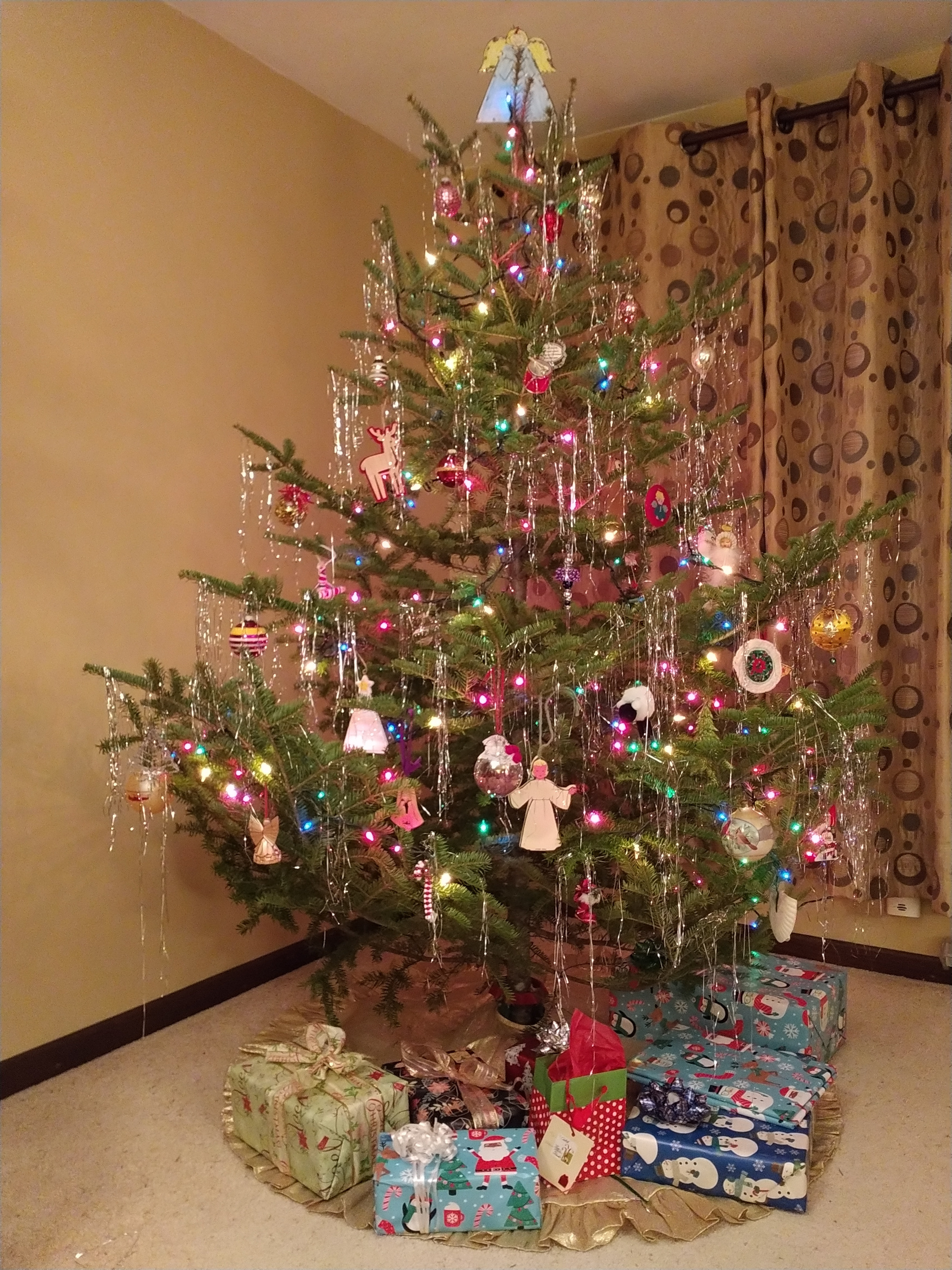
Our Christmas tree this year. I always hang tinsel on our tree. (Minnesota Prairie Roots copyrighted photo December 2023)
My preference for real Christmas trees, though, traces back to my childhood. Each December our family trekked to the local grocery store—back in the days when Vesta had a corner store and a whole block of businesses—to peruse the trees leaning against the exterior storefront. I don’t recall details, only that our tree was small, short and short-needled, intentionally so.
I lived in a tiny 1 ½ story farmhouse during the first 11 years of my life. An oil-burning stove and several pieces of furniture filled the living room, leaving no space for a Christmas tree. Our tree sat on the end of the Formica kitchen table, next to the west-facing drafty window. Remembering it from an adult perspective, that tree had to be really small. But I loved the imperfect Charlie Brown tree. Everything from the colorful bulb lights to the ornaments to the tinsel draping the boughs delighted me.
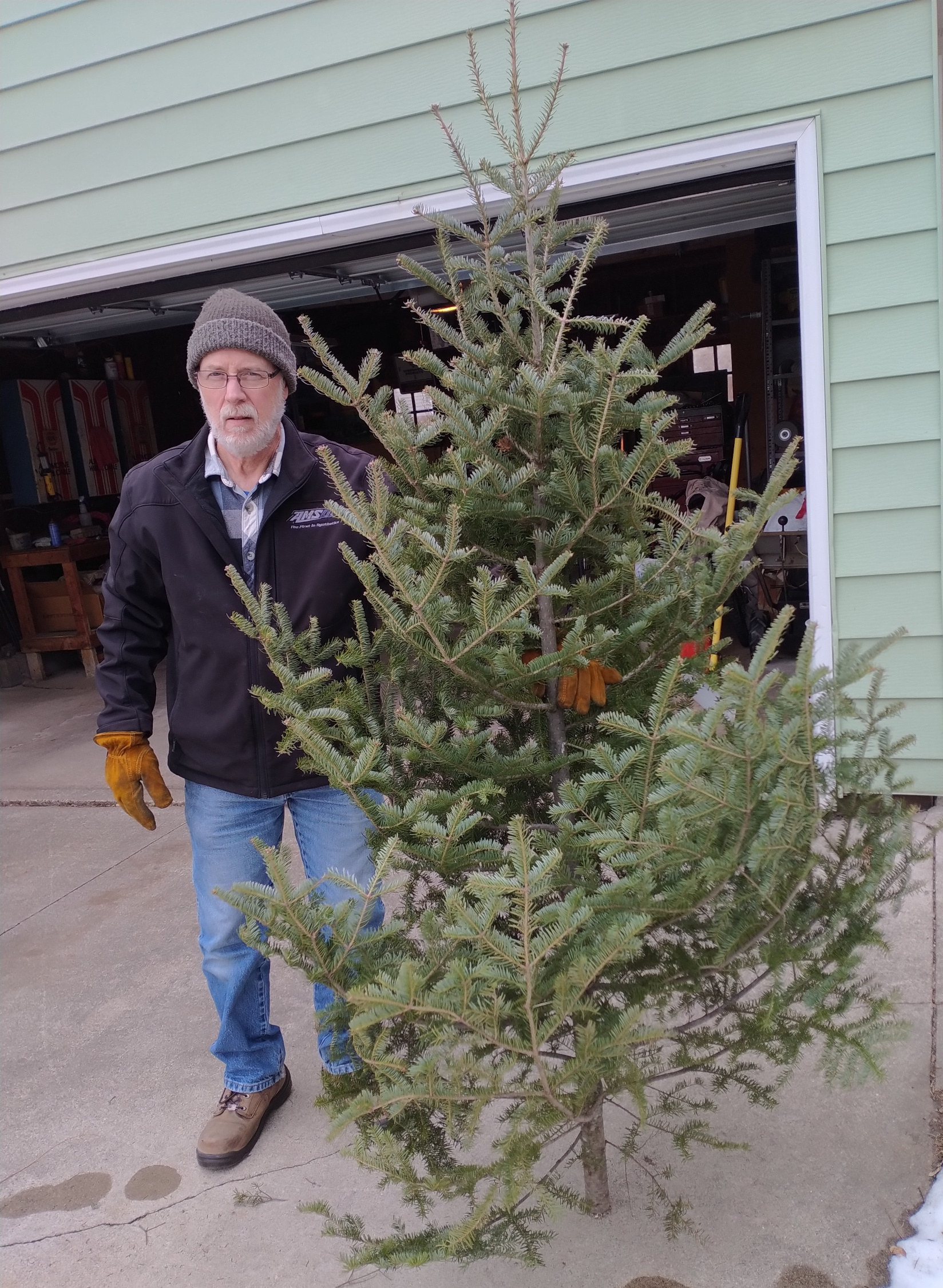
Randy stands outside the garage with our tree, purchased at Ken’s Christmas Trees. (Minnesota Prairie Roots copyrighted photo December 2023)
Today that childhood nostalgia deeply influences my tree choice. I prefer imperfect and smallish to anything sculpted or over-sized. Seven foot ceilings also limit the height of our tree.
When my kids were little, our friends Joy and Steve invited us to their rural property to cut down a pine tree from among those they intentionally planted for Christmas trees. I hold fond memories of our young family weaving among the trees to find just the right one. Eventually that forest was depleted and it was on to other options—like Farmer Seed and Nursery, Faribault Garden Center or Donahue’s Greenhouse. The nursery and garden center are permanently closed now, Donahue’s no longer open at Christmas.
The photo of Ken Mueller is new to the tree lot this season. (Minnesota Prairie Roots copyrighted photo December 2023)
Our go-to tree source now is Ken’s Christmas Trees, a temporary tree lot set up in a parking lot next to the now-closed Taco John’s. Ken Mueller started his holiday side business years ago at a north-side Faribault site along a busy thoroughfare. Eventually, he had to move and we followed him to his new location.
Ken has since retired. Sort of. On the December day Randy and I stopped by to buy our tree, he was vending trees, wreaths and more. His kids have taken over the business, but can’t always be there. So Ken steps in. And when he’s not around, he’s still there. A life-size photo cut-out of the Christmas tree vendor stands next to a row of trees. It was a surprise to Ken, who, even if he may not admit it, appreciates the unexpected, humorous recognition.
Ken’s Christmas Trees seems to have a loyal following of customers who appreciate his fresh trees, trucked in from Up North. Sizes and shapes range from the short and Charlie Brownish to larger, sculpted. Every year I bundle up, head to the west side of town and search for my imperfectly perfect Christmas tree.
TELL ME: Is your Christmas tree real or artificial? Why? I’d love to hear your stories.





























 Minnesota Prairie Roots
Recent Comments