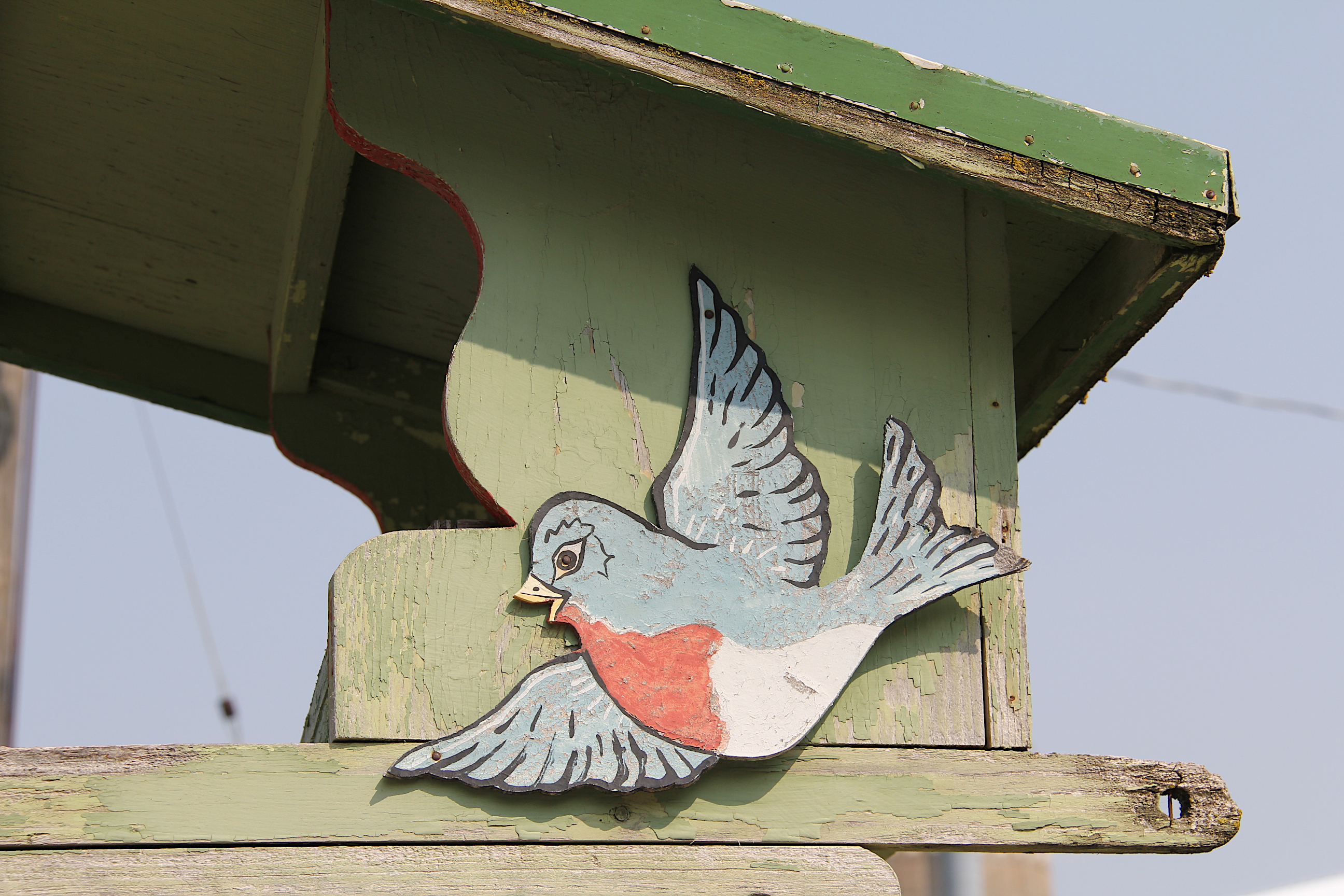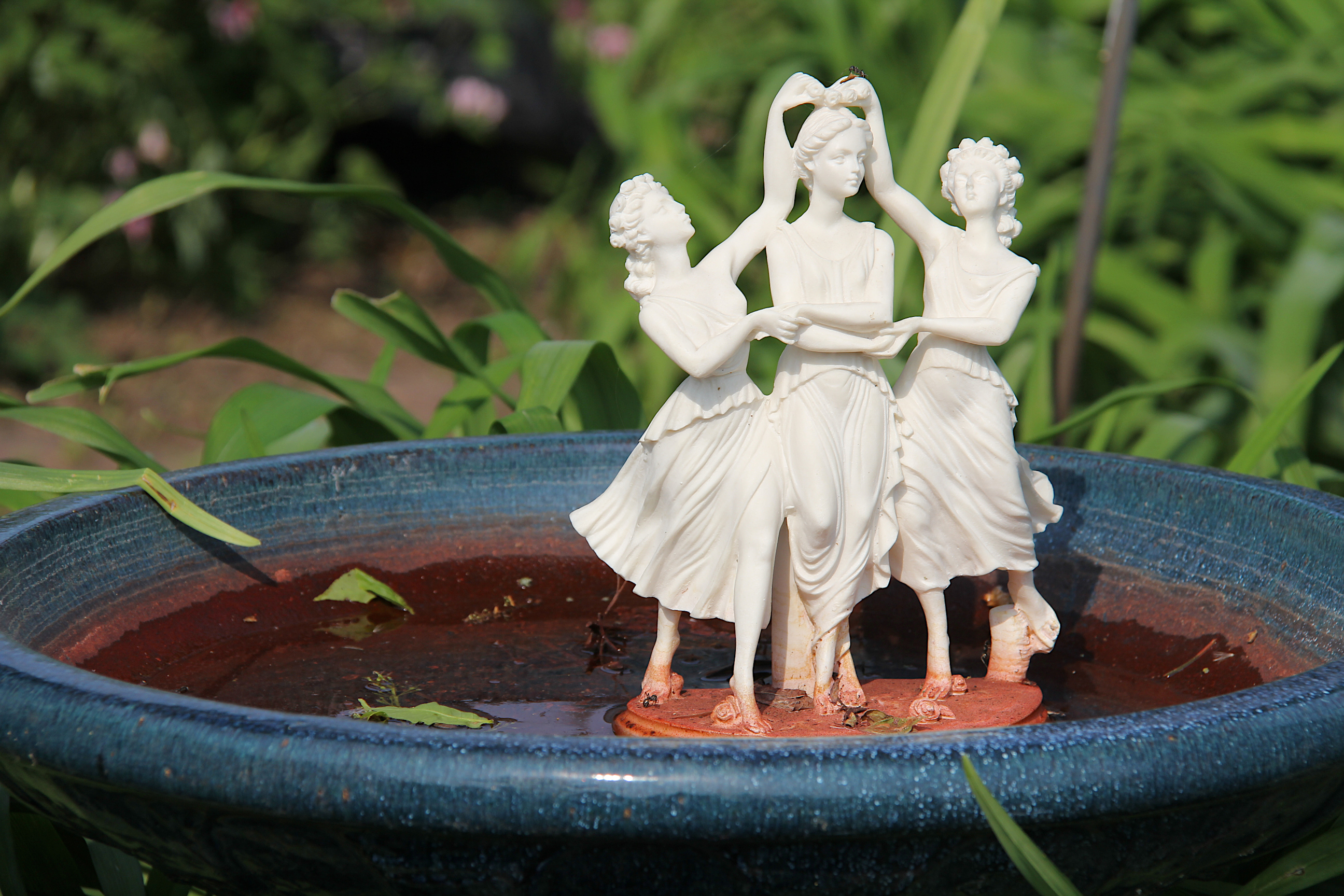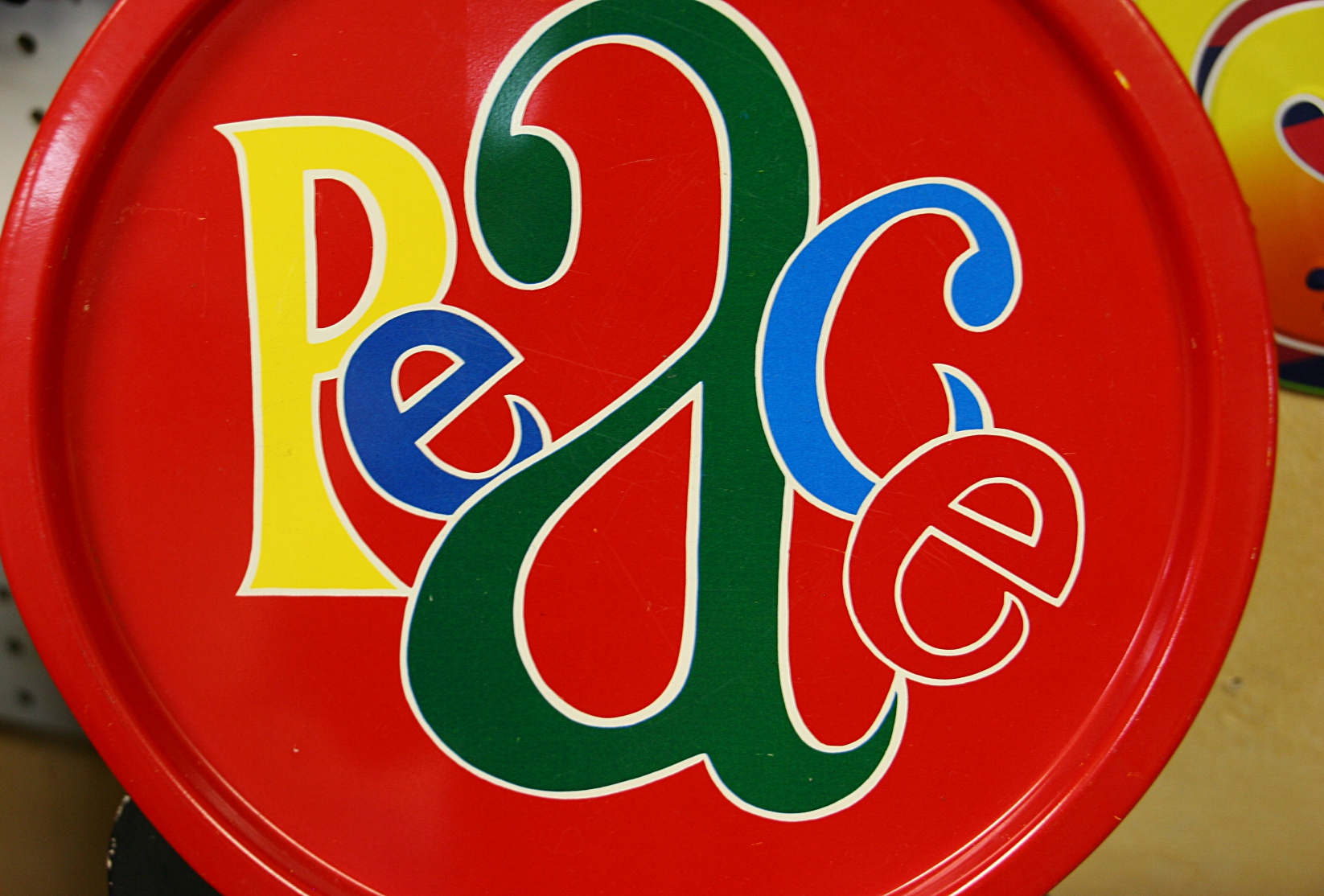
A retro tray I purchased at a second-hand shop. (Minnesota Prairie Roots copyrighted file photo)
I AM OF THAT AGE, not quite old enough to have once considered myself a hippie, an anti-war activist or a rebellious, anti-establishment young person coming of age. But I did embrace the peace symbol and embroider flowers on my home-sewn gauzy shirts accenting lime green bell bottoms. I wore a prisoner of war bracelet and Earth Shoes, a marketing gimmick more than anything.
Golden light slices across the sky above Mother Earth at King Mill Dam in Faribault. (Minnesota Prairie Roots copyrighted file photo September 2018)
I was on the edge of a generation that no longer accepted the status quo. The generation that latched onto causes, the generation weary of war and wanting to effect change. That applied also to the early 1970s growing awareness of environmental issues and an earth which needed, still needs, protecting, nurturing, care.
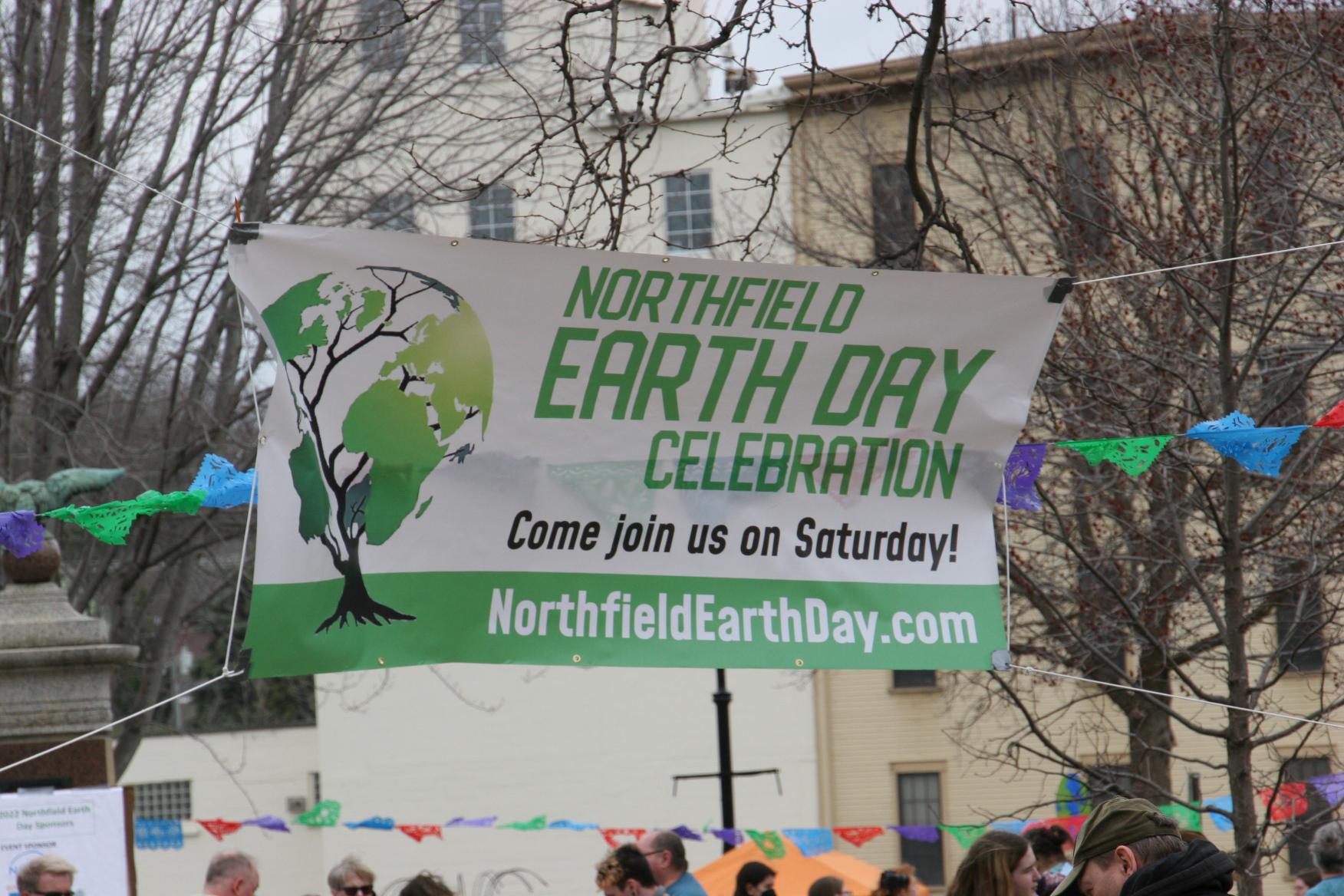
A banner marks the 2022 Earth Day Celebration at Bridge Square in Northfield. This year’s event has been moved indoors to First United Church of Christ. For a complete listing of 2023 events, click here. (Minnesota Prairie Roots copyrighted file photo April 2022)
In 1970, the first celebration of Earth Day happened. Now here we are 53 years later and still trying to deal with issues affecting our planet. A lot of good has happened in those five decades, especially in creating awareness. Sometimes that has led to action. But a lot has also deteriorated.
I thought about that, specifically, “What do I do in my everyday life that reflects care for the world in which I live?”
Topping my list is buying used rather than new. It helps that I really don’t like to shop and that I don’t even care about stuff all that much. No one will ever view me as fashion conscious. I simply don’t care.
This peace-themed art painted on burlap by Jose Maria de Servin, is one of my favorite artworks. I purchased it at a recycled art sale at the Paradise Center for the Arts in Faribault. (Minnesota Prairie Roots copyrighted file photo)
Nearly all of the furniture in my house has come from family, garage sales or thrift shops. The same for art. I love art. It is admittedly my one indulgence. But the art I own—and it’s a lot, enough so that I rotate it off and on my walls—has come from second-hand sources. The dishes in my cupboard were my mom’s. Drinking glasses are vintage. Serving pieces and bowls were passed down or purchased second-hand.
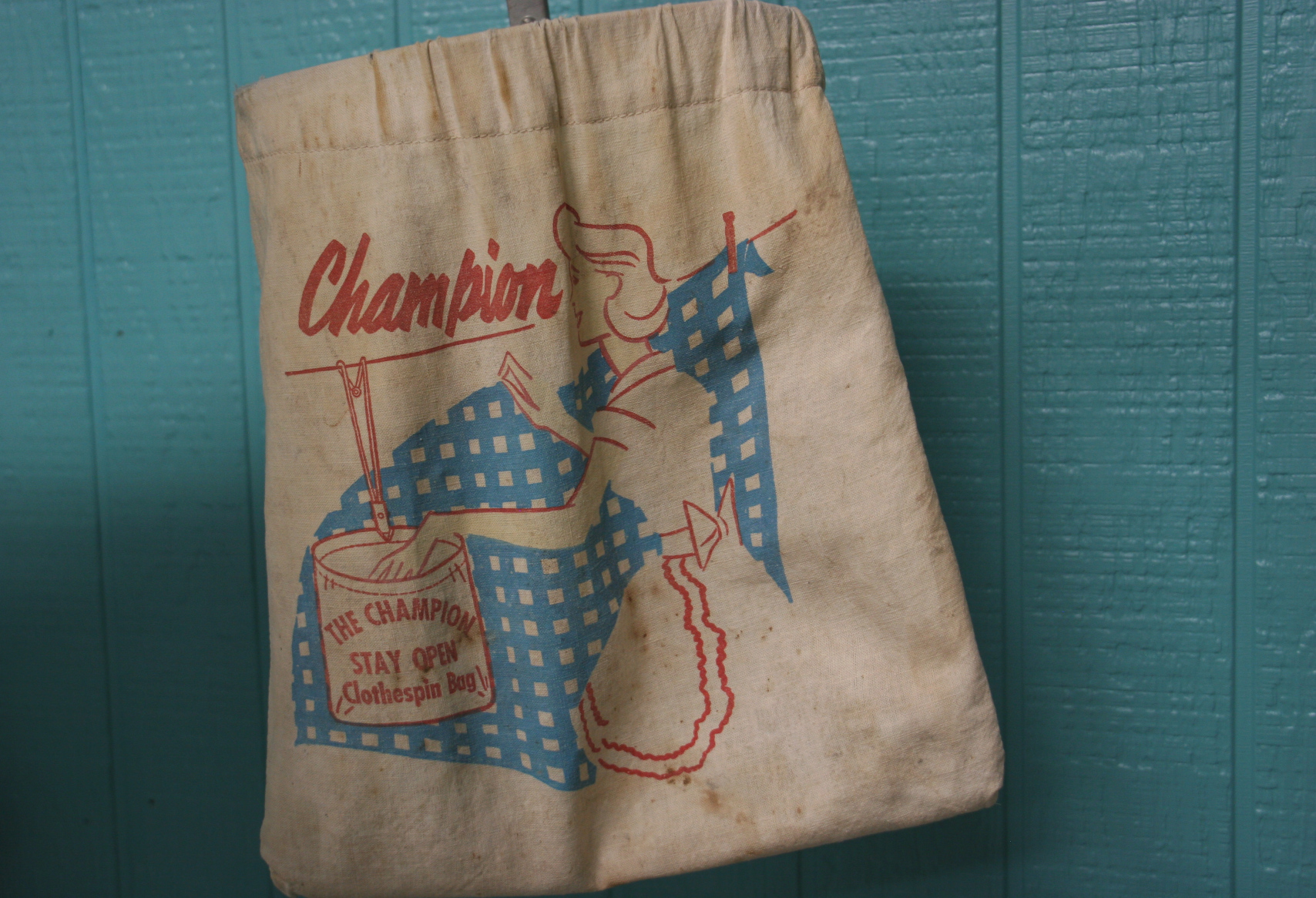
Hanging laundry on the line has been around forever. I photographed this clothespin bag in an exhibit, “Making Lyon County Home,” at the Lyon County Historical Society Museum in Marshall. And, yes, I have a clothespin bag. (Minnesota Prairie Roots copyrighted file photo September 2022)
Then there’s laundry. For decades I’ve dried laundry outside on a clothesline. I love the task of rhythmically clipping clothing to line. It’s therapeutic in connecting me with nature. I feel the sun, if it’s shining. Or I feel the nip of frosty weather numbing my fingers. I feel the wind, hear the birds, notice the shift of seasons. I am attune to Earth.
In the winter, I layer laundry over a drying rack. Seldom do I use my electric dryer. I’m trying to conserve energy, do my part.
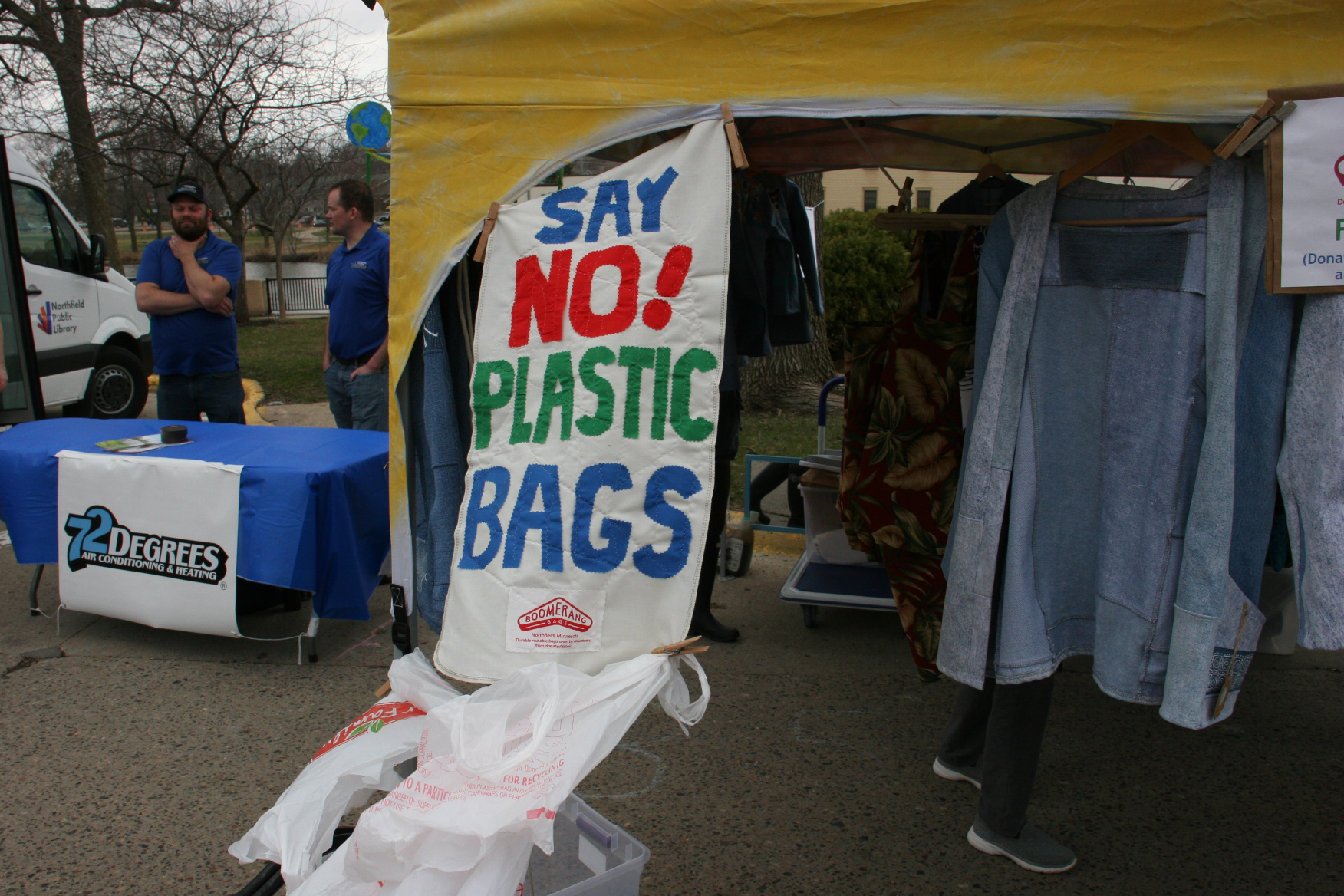
A reminder at last year’s Northfield Earth Day to stop using plastic bags. (Minnesota Prairie Roots copyrighted file photo April 2022)
I also use cloth bags. But only sometimes. I take my boomer-rang cloth bag to bag books at the library. At least I’m consistent with that. But I need to use cloth all the time at all the grocery stores I shop, not just the one that requires bringing your own bags.
I recycle wrapping paper, tissue paper, ribbon, bows and gift bags to the point that my extended family ridicules me for that behavior. I learned this from my mom, who did the same, but for economic reasons. I don’t care if my siblings laugh. I’m doing what’s environmentally right.
Admittedly, I can do more. But it’s a start. Every single effort, big or small, matters. We only have one Earth and we all need to care, and do our part.
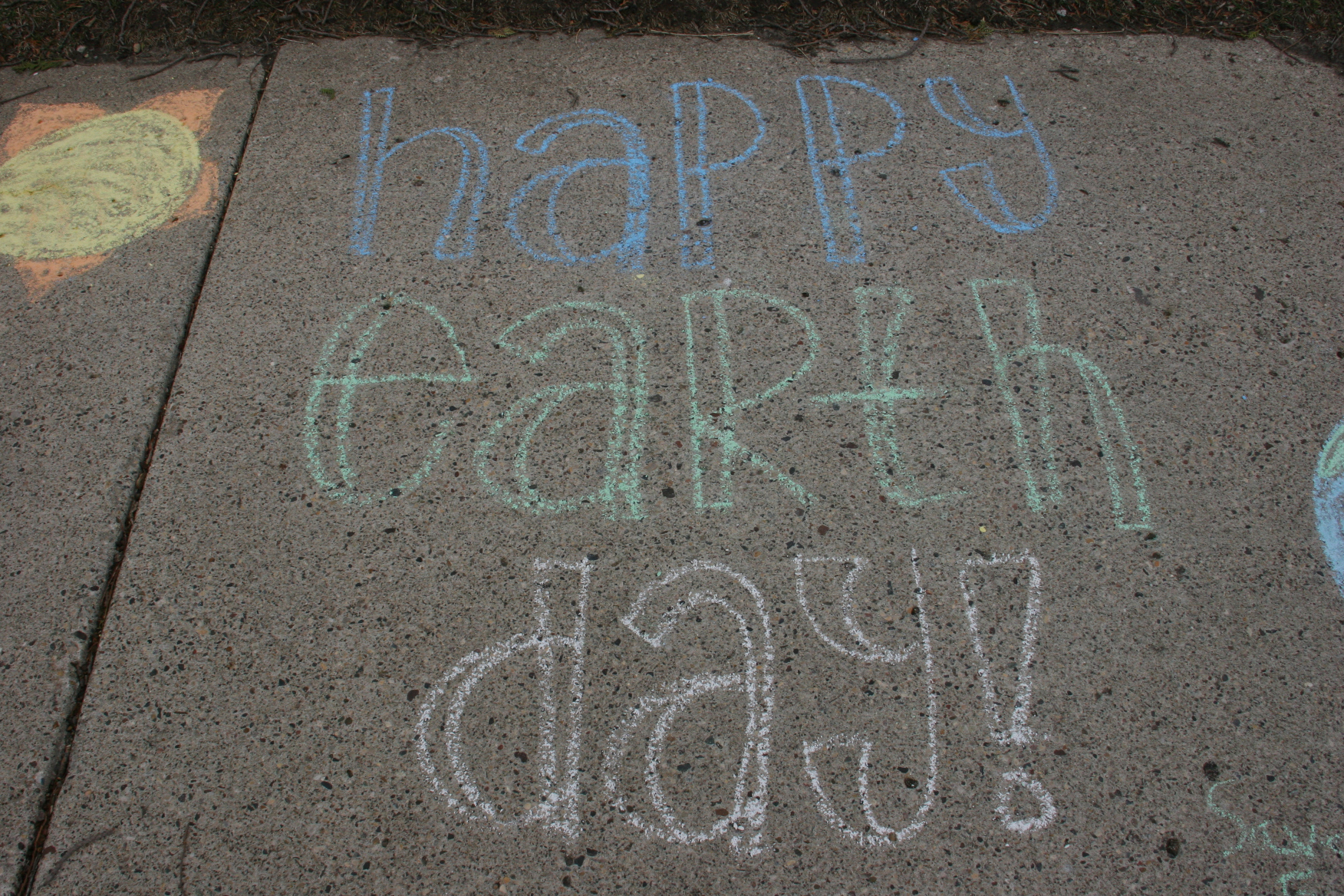
Chalked onto the sidewalk at Northfield’s Bridge Square during the 2022 Earth Day Celebration. (Minnesota Prairie Roots copyrighted file photo April 2022)
TELL ME: What are you doing in an effort to protect and care for our planet?
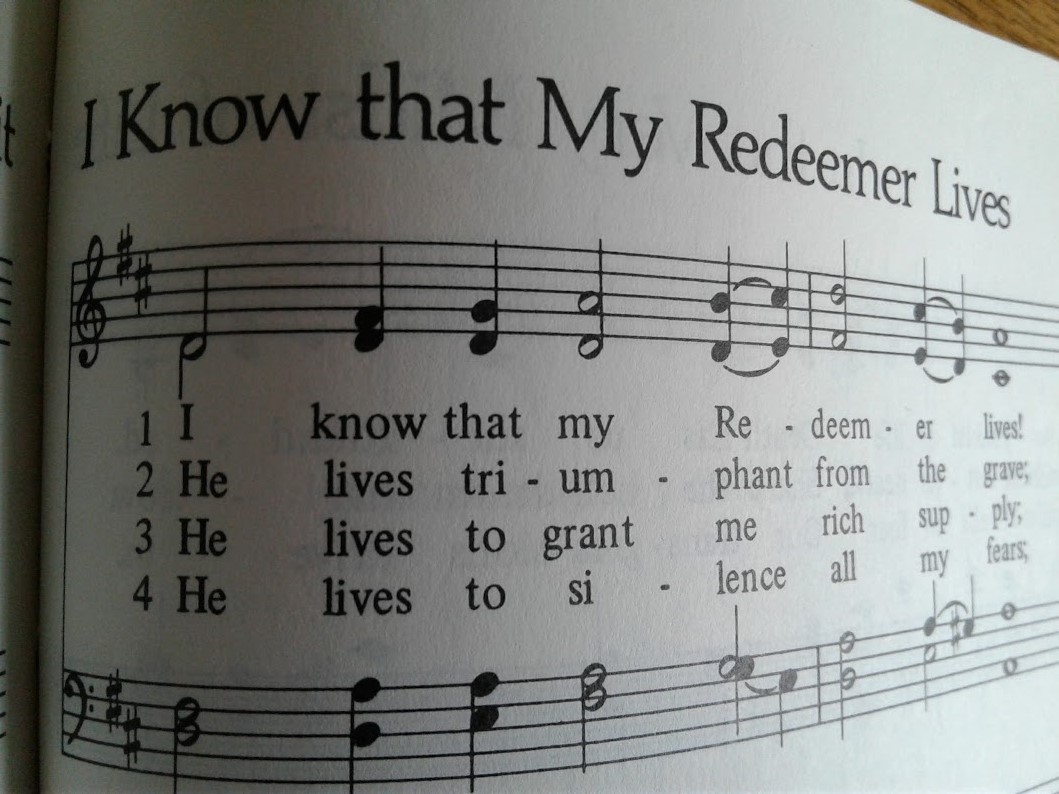
My favorite Easter hymn. (Minnesota Prairie Roots copyrighted file photo)
IT IS MY ABSOLUTE favorite Easter hymn—“I Know that My Redeemer Lives.” And there is a reason behind that choice.
As a child, I sang that song with my Sunday School class during Easter worship services at St. John’s Lutheran Church in Vesta. Dressed in our Easter finery—girls in pastel dresses and Easter hats, boys in dress pants and shirts, some with bow ties cinching their necks—we belted out the joyful words about the risen Lord.
To this day, I can recite most of the verses. The words are that ingrained in my memory. Words of triumph, love, blessings, assurance and so much more. I feel my soul filling with Easter morning hope in the memories of singing that aged hymn.
I admittedly cannot carry a tune or read a single musical note. And I admit to a bit of fear on those long ago Easter mornings in rural southwestern Minnesota. Not fear about forgetting the words to a hymn. But rather a dislike of sitting in the St. John’s balcony with only a low, partial wall separating me from the sanctuary below. I never jostled for the front pew in that upstairs packed with kids.
I hold another memory from Easter morning. Not of danger, but rather of youthful disobedience. Mom asked my siblings and me not to tattoo our arms before church services. Of course, we didn’t listen and excitedly held washcloth to paper tattoos, imprinting temporary art (from Easter egg dyeing kits) onto our skin. In the end, I don’t think anyone really cared as long as we showed up to sing at church.
And so all these decades later, I remember my favorite hymn and how my faith has carried me through life. Through joyful moments, through ordinary days, through really difficult times…
He lives to bless me with his love.
He lives to help in time of need.
I know that my Redeemer lives!
A joyful Easter to all of you from my home in southern Minnesota, not from the balcony of St. John’s!
TELL ME: Do you have a favorite Easter hymn and/or memory? I’d like to hear.
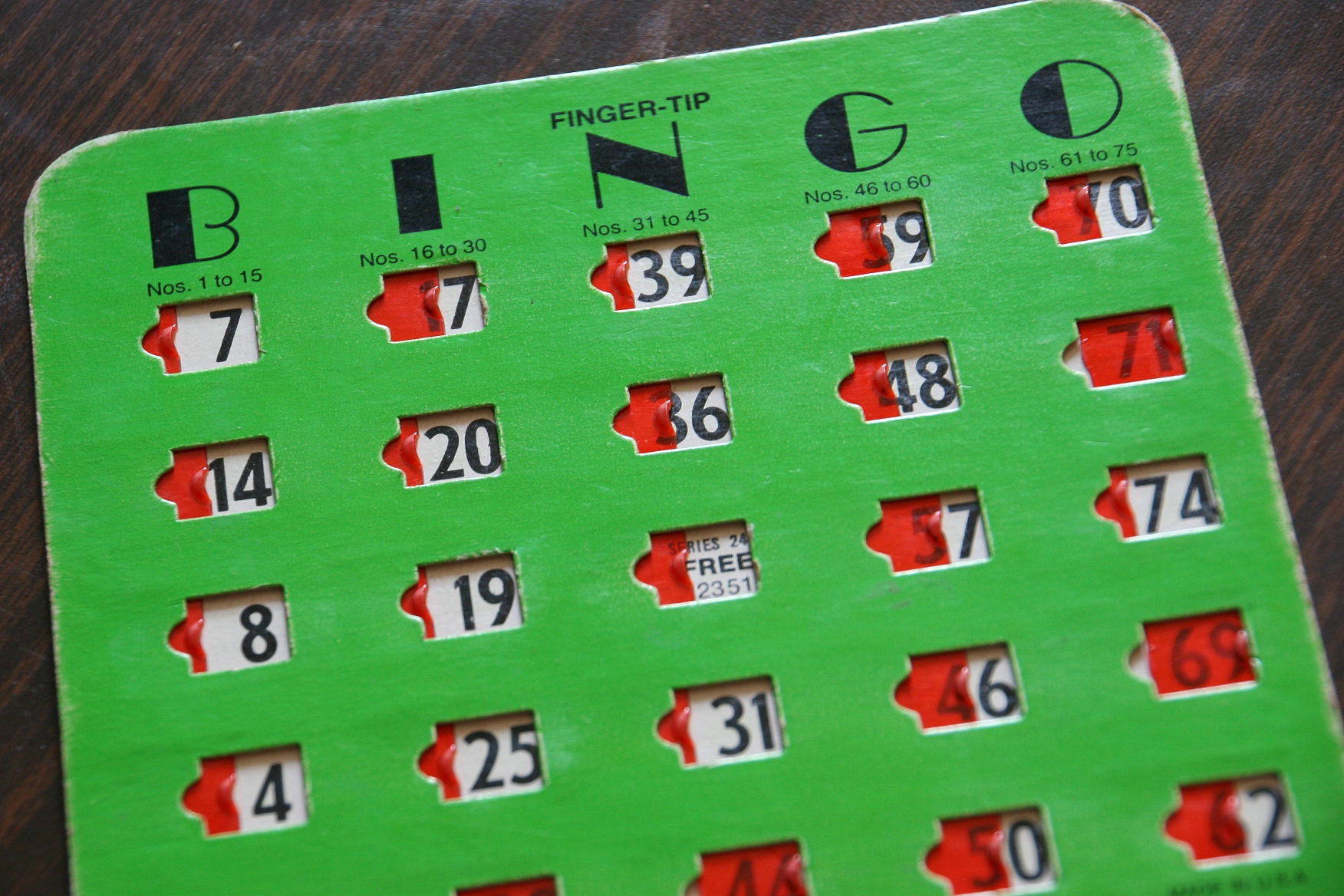
We played with BINGO cards similar to these at Preschool BINGO Night. (Minnesota Prairie Roots copyrighted file photo July 2016)
I COLLECTED MY CARD, then settled onto a chair around the large round table, eldest daughter and son-in-law to my left, granddaughter, grandson and husband to the right. An instruction sheet and popcorn heaped in paper boats were already on the table. Centering the tabletop were orange, white and green tissue paper flowers, green beads and more, remnants from St. Patrick’s Day only days prior.
This was a much-anticipated evening for families packing a massive room at a Lutheran church in a south metro suburb. This was BINGO Night at Isaac’s preschool, an event Randy and I were delighted to attend. Isaac, 4, and his big sister, Isabelle, 6, like to play BINGO when they stay overnight with us.
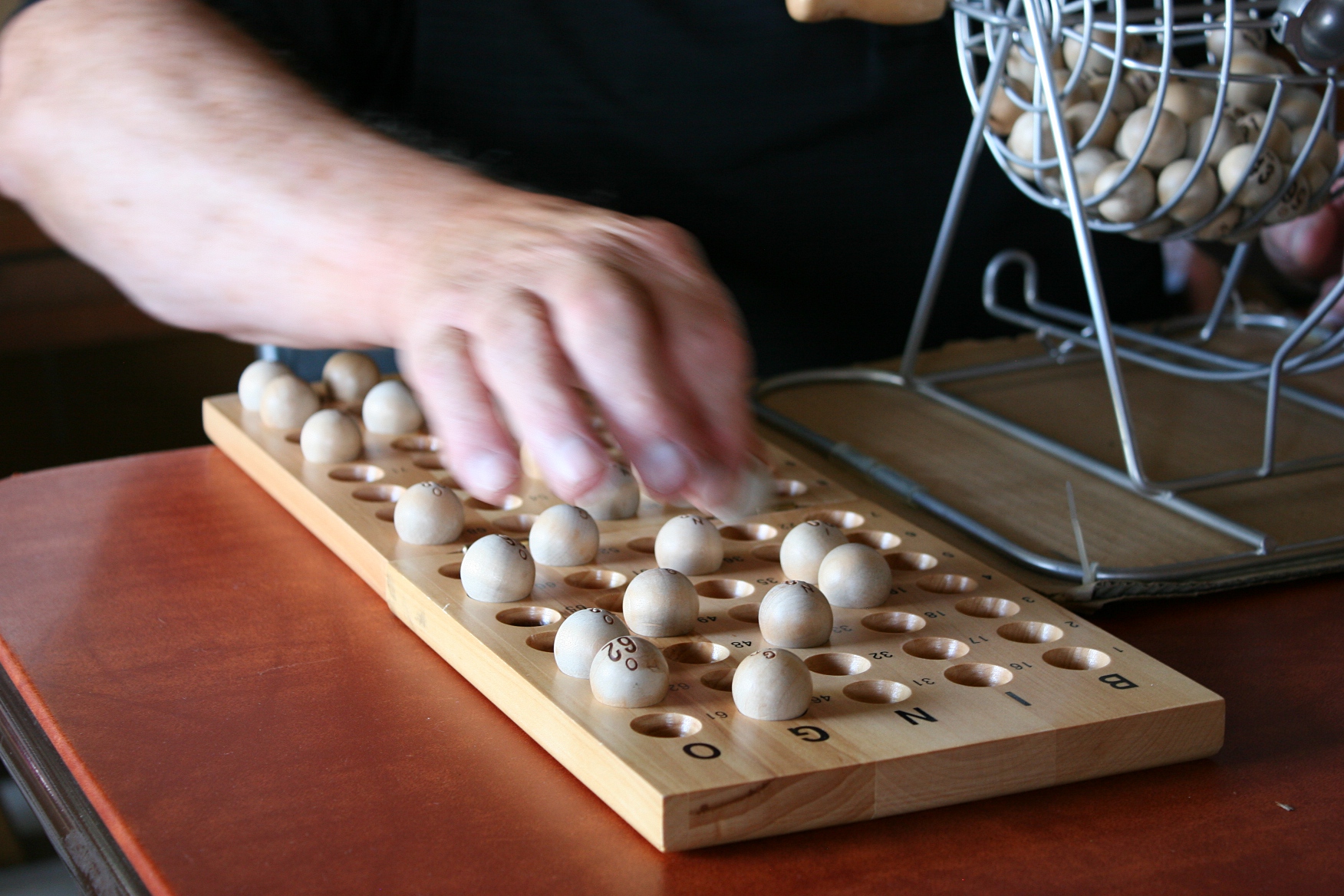
But this preschool BINGO is not your grandma’s BINGO, I soon discovered. The game we play in our dining room involves balls rolling, rattling in a cage. The game we play in our home also involves placing physical markers on BINGO squares. And the BINGO we play on our dining room table offers coinage as prizes, not toys filling a prize table.
I could see the kids’ excitement when they eyed the loot laid out before them. Izzy focused on plastic dinosaurs. And Isaac, well, I expected he wanted something with which he could create. The desire to win ran strong. The pressure was on for two winning games, minimum, at our table.
The type of BINGO set-up we use at home. (Minnesota Prairie Roots copyrighted file photo 2011)
And then the games began, not with the rattling of balls spun in a metal cage, but rather with a teacher announcing numbers popping onto a computer and then projected onto overhead screens. This was high-tech BINGO. And this grandma was amazed. The game moved at a faster pace than rotating a cage and pulling balls.
I appreciated the absence of distracting noise that accompanies the manual way of playing BINGO. I still struggled to hear, though. I’m deaf in my right ear, the result of sudden sensory hearing loss in 2011. That affects my overall hearing and processing of speech and conversation. Thankfully, my daughter patiently repeated numbers when needed or I turned to the screen behind my back to view the too-small numbers. (And, no, a hearing aid will not help with this type of hearing loss; I would have one if it did.)
I won first place in a contest for this photo of BINGO callers at the July Fourth 2013 celebration in North Morristown, rural Minnesota through and through. (Minnesota Prairie Roots copyrighted file photo July 2013)
Two games in, Grandpa scored a BINGO on the cards with pull-across, see-through red squares to cover numbers. I joked initially that I needed corn kernels to play. When I attended the annual American Legion BINGO Night while growing up in rural southwestern Minnesota, I covered squares with kernels of corn. Totally appropriate and accessible in farm country. But we were not in rural Minnesota and this was six decades later. There was not a kernel of corn to be found.
Upon Grandpa’s BINGO win, he and Isaac scooted to the prize table. As I predicted, our grandson chose an art-related prize—a mini painting book. I could see Izzy coveting her brother’s prize, anxious to claim a dinosaur.
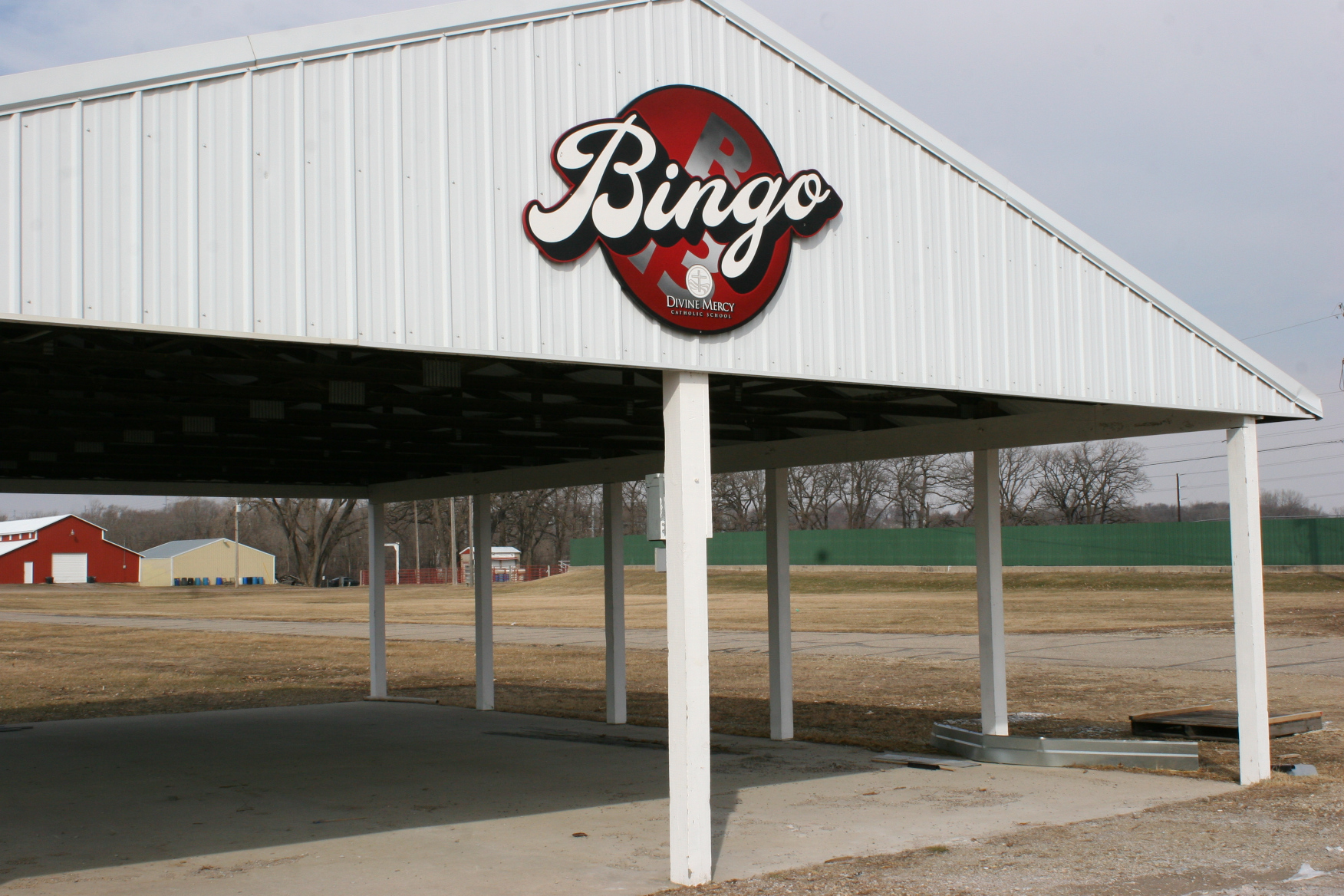
BINGO is popular in Minnesota, including at the Rice County Fair in Faribault. This photo was taken in the off-season. (Minnesota Prairie Roots copyrighted file photo April 2021)
Game after game after game we played with no winners at our table, but everywhere else. Isaac soon tired of playing and Grandpa grabbed his card. Yes, playing more than one card was allowed. At one point I joked that Isaac should have hacked into the computer while at preschool earlier that day and rigged the games.
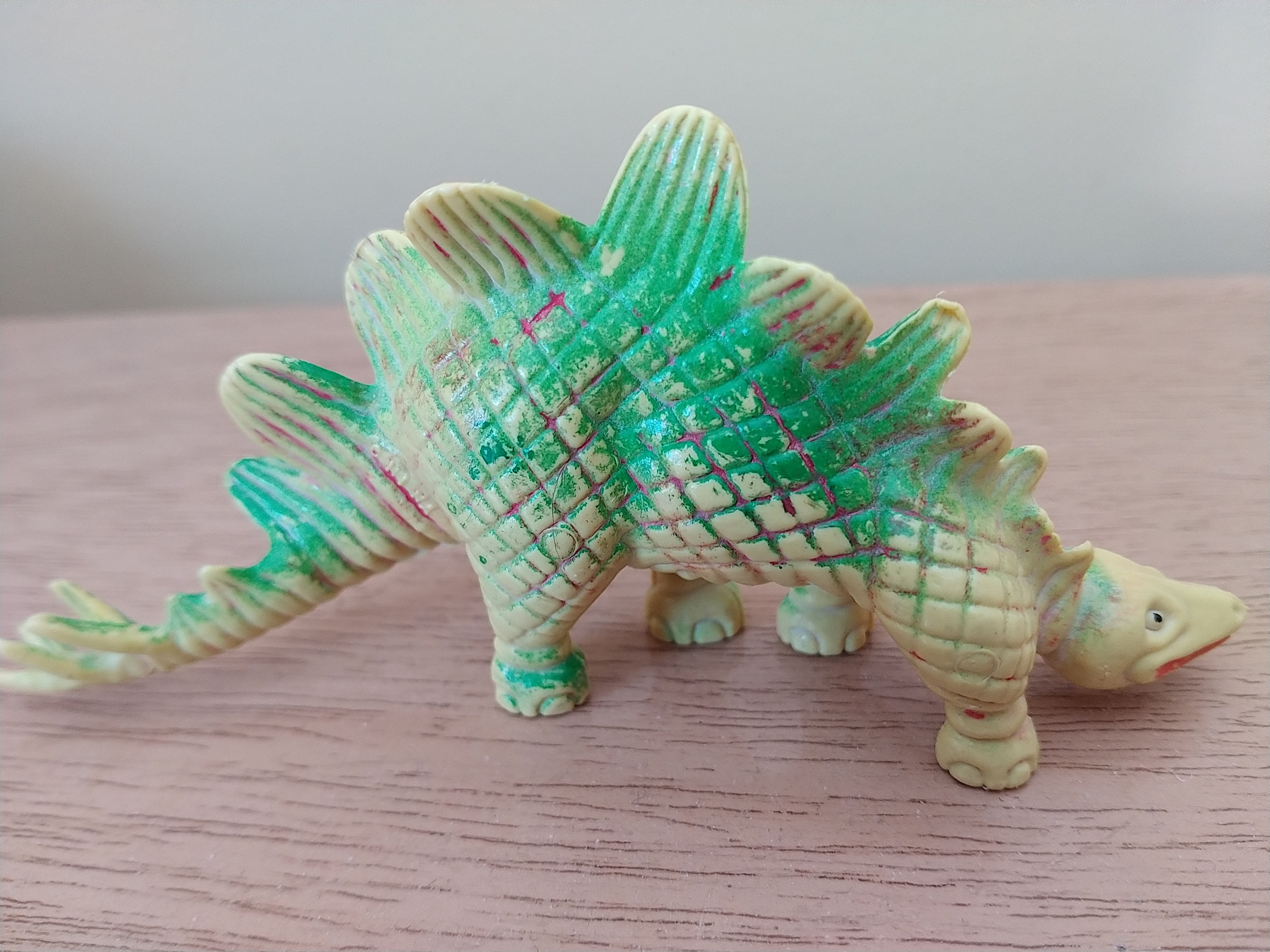
Izzy won a dinosaur similar to this one from our basement toybox. Hers was new and not worn. (Minnesota Prairie Roots copyrighted photo March 2023)
Finally, the dad won and Marc and Izzy raced to get a prize. All the while I was repeating silently, “Please let there be a dinosaur still on the table. Please, please, please.” The first grader returned clutching a dinosaur, broad smile lighting her face. I breathed a sigh of relief and gratitude that Izzy got a dinosaur, one of three still on that prize table.
About 1.5 hours in, we were down to the last game, a BINGO cover-all. As the game progressed, Izzy was getting more and more excited. She had one number left to cover. I could feel, see and hear her anticipation, her mind likely focused on grabbing a second dinosaur. But she didn’t win and then the tears came. And Grandma tried to work her grandma magic. “Look at how lucky you were to get that dinosaur!” And so on and so forth until her dad said, as we were walking across the parking lot, that he really won the dinosaur and he would be taking it to work. Marc roared and joked until all of us were laughing, even the previously-disappointed dinosaur-loving six-year-old.
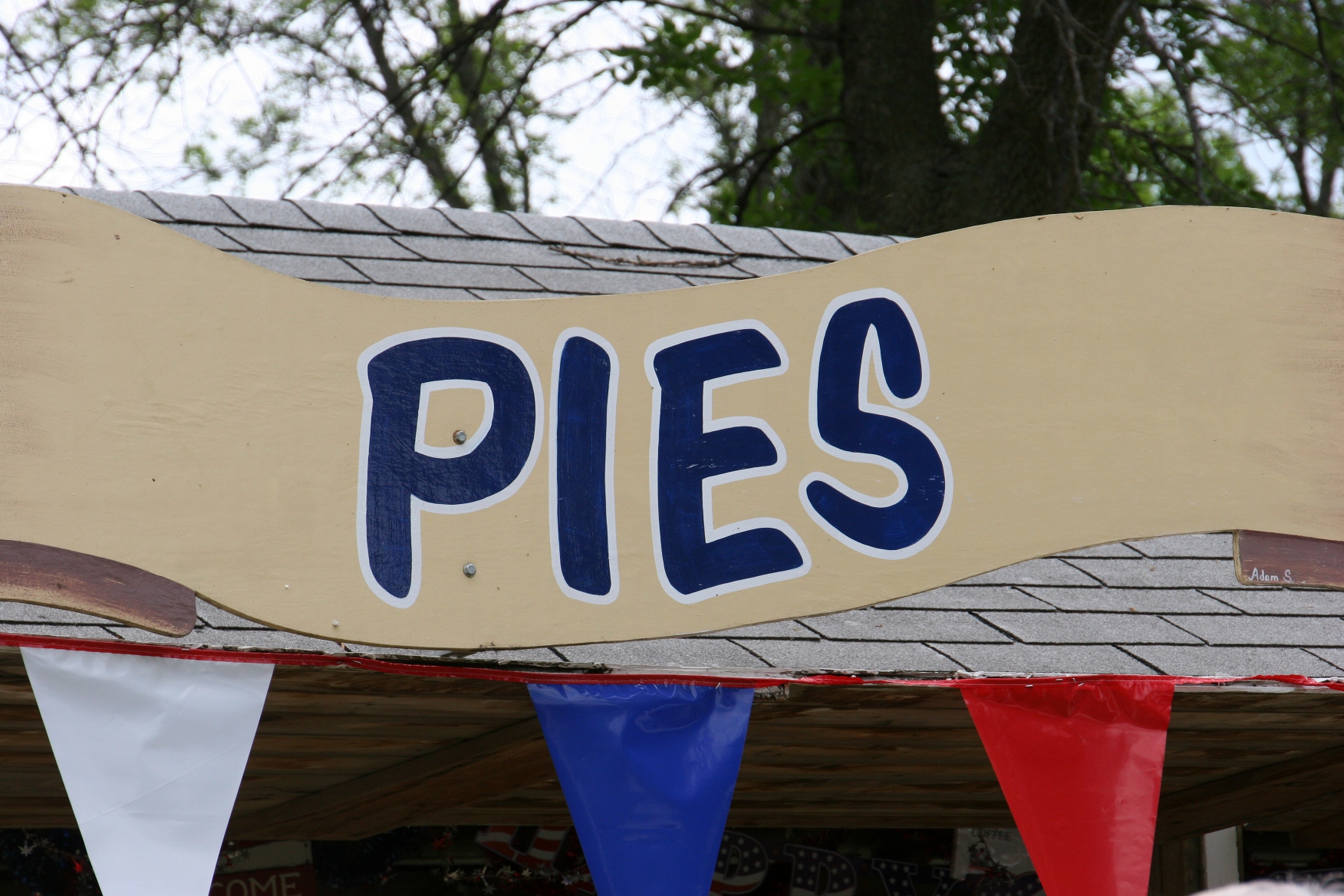
A sign marks the pie booth at the North Morristown, Minnesota, Fourth of July celebration. This is my kind of “pi.” (Minnesota Prairie Roots copyrighted file photo)
ON THIS, PI DAY and the International Day of Mathematics, I openly admit that I dislike math. I’ve never been good with numbers, never got the early intervention in grade school to help me with the dreaded fractions and other math challenges. And let’s not even discuss how much I disliked word problems. Reflecting as an adult, those problems seem particularly useful in everyday mathematics application. But back in the day, I could not wrap my brain around solving them. And back in the day, my school did not offer extra help to students struggling in any subject.
Moving into junior high school, my dislike of math only intensified. One particular math teacher, who shall go unnamed, scared me to death. He would call students to the blackboard to solve math equations. Talk about intimidating, terrifying and humiliating for those of us who were not good in math, but which he expected to be good in math because, hey, he was. I hope teachers no longer do that—call students to the front of the class to solve math problems.
Then came high school and the dreaded, required algebra. That I made it through that class without failing is still almost incomprehensible. Again, my brain could not understand what letters and exponents had to do with numbers. To this day, I don’t get it and I’m all too happy to leave algebra back in the early 1970s.
Thankfully, the next generations have not inherited my math deficiencies. My son holds a math minor to supplement his computer science degree. And my two grandchildren excel in math. The first grader is in an advanced math class. I can ask Isabelle to solve a math equation well beyond what a nearly 7-year-old should know and I can almost see her brain spinning as she pops out the answer, boom, just like that.
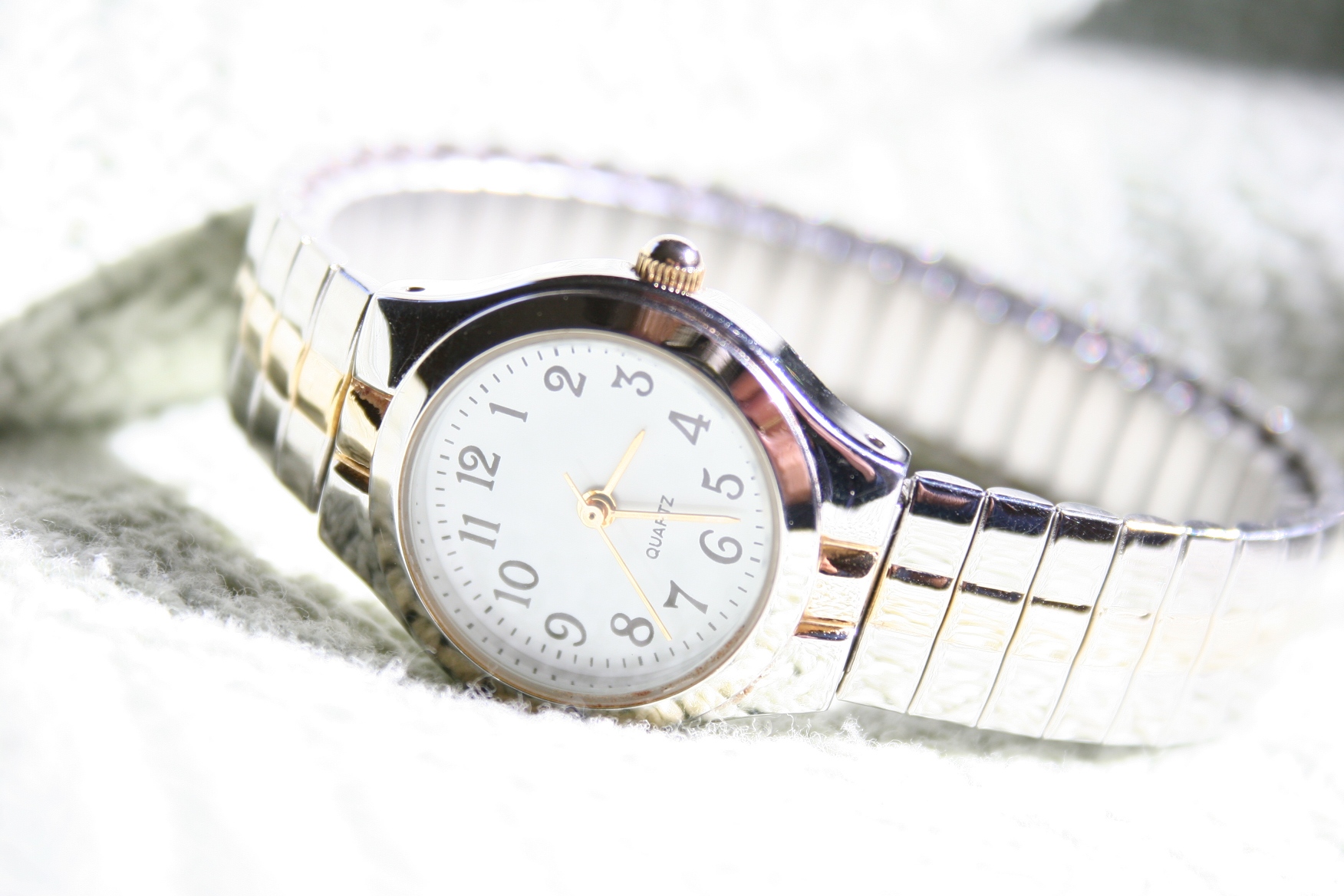
A previous wristwatch of mine. (Minnesota Prairie Roots copyrighted file photo)
Isaac, who recently turned four, shows the same developing math strengths. When he stayed with us last week, he was writing digital time in squares across sheets of paper. He started with 1:00, finished at 1:59 and then started with 2:00, reaching 2:59. Early on, he was fascinated by my wristwatch, which I often removed from my arm and slipped onto his. He also liked my vintage alarm clock collection and our wall clock. But mostly, Isaac simply loves numbers.
That their dad, Marc, holds a math degree and works as an actuary likely factors into the grandkids’ math interests and skills. I am grateful they won’t struggle with math like their grandma did all through school.
And then there’s my sister-in-law Rosie, a retired math teacher. No questioning that she loves math.
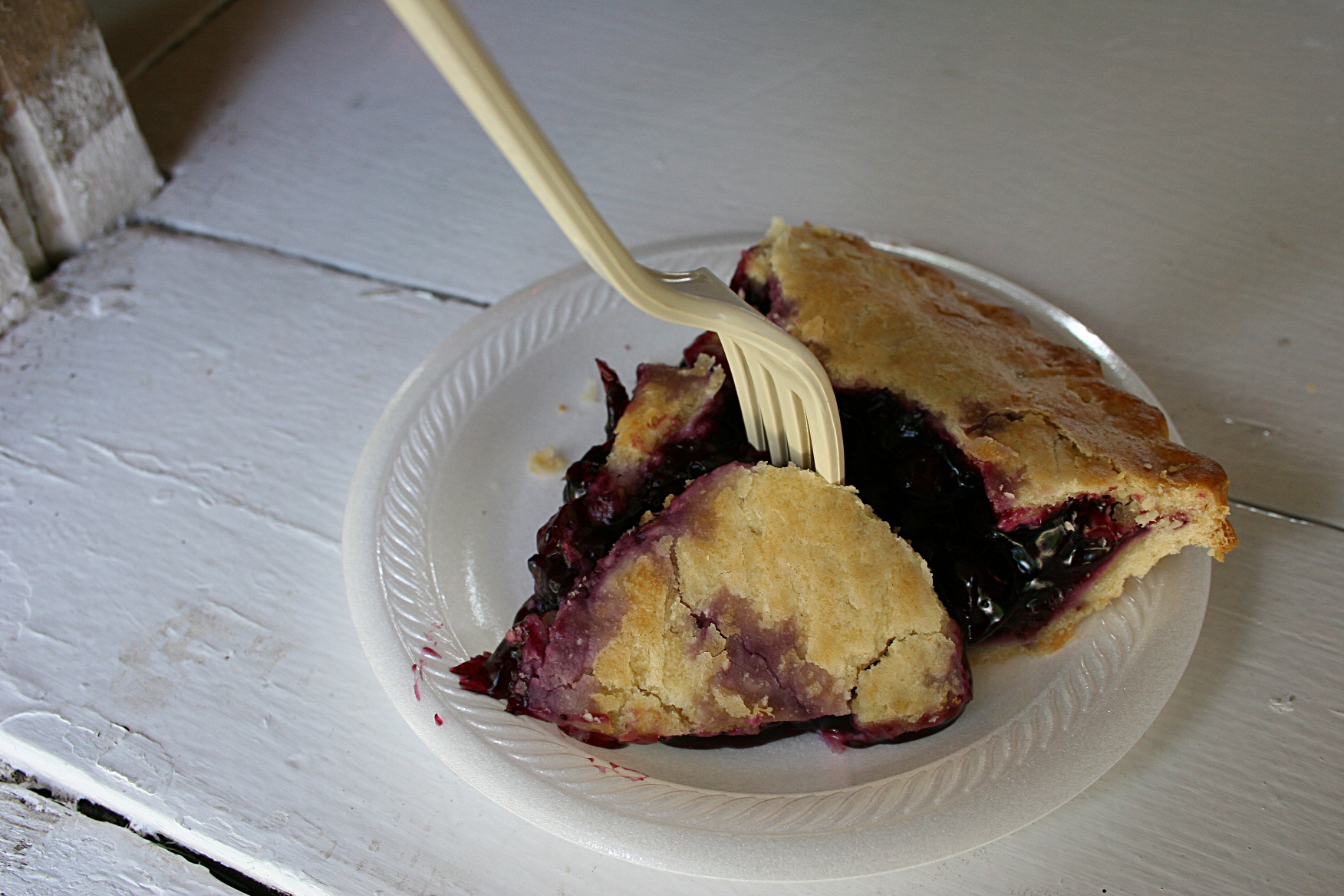
Homemade blueberry pie purchased at the North Morristown Fourth of July celebration. (Minnesota Prairie Roots copyrighted file photo)
But me? Nope. Math-lovers may be celebrating Pi Day today (what does “pi” even mean?), but not me. I’d rather have the pie you can eat, thank you.
TELL ME: Are you good in math? Do you like math? Did you have any experiences like mine in school?
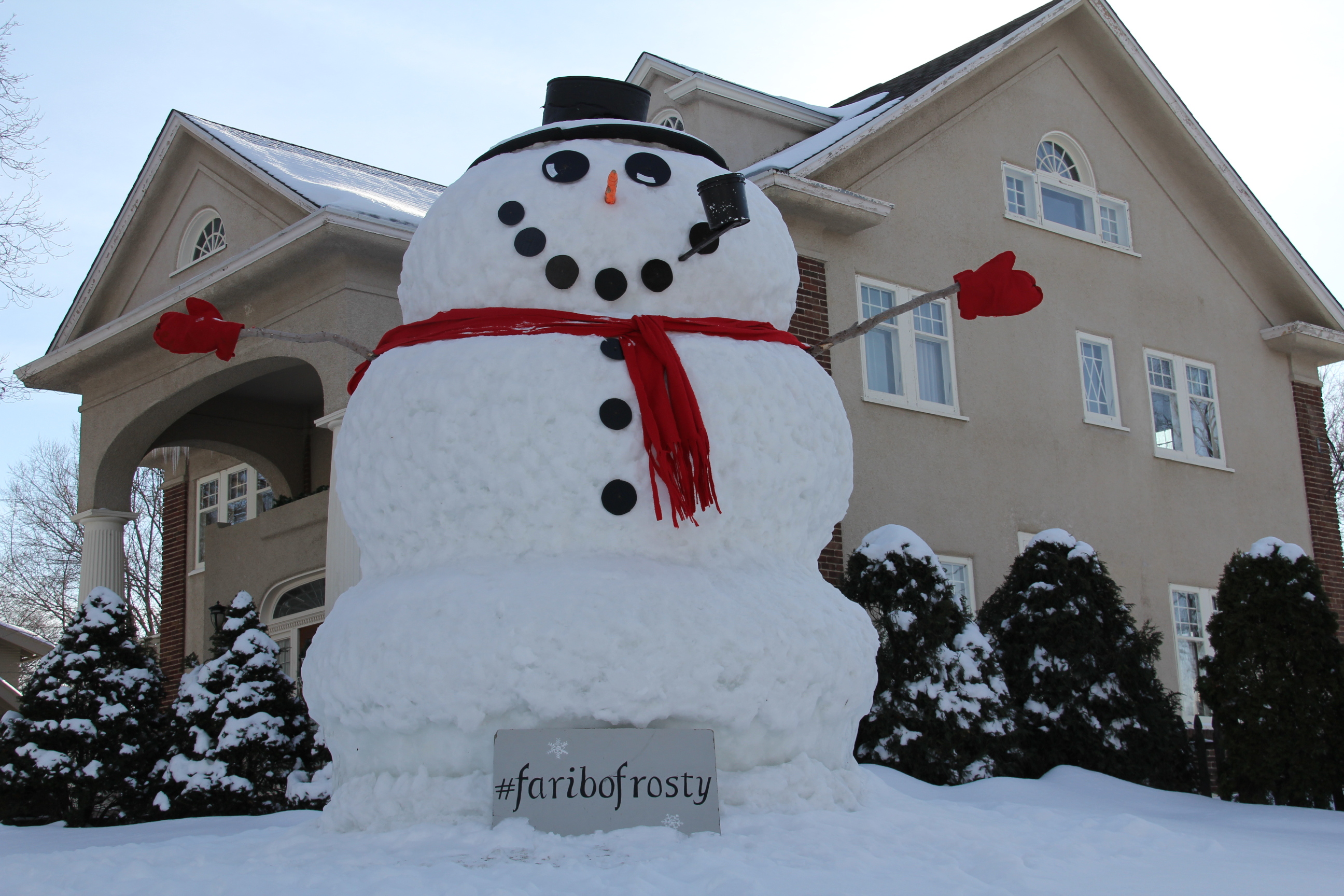
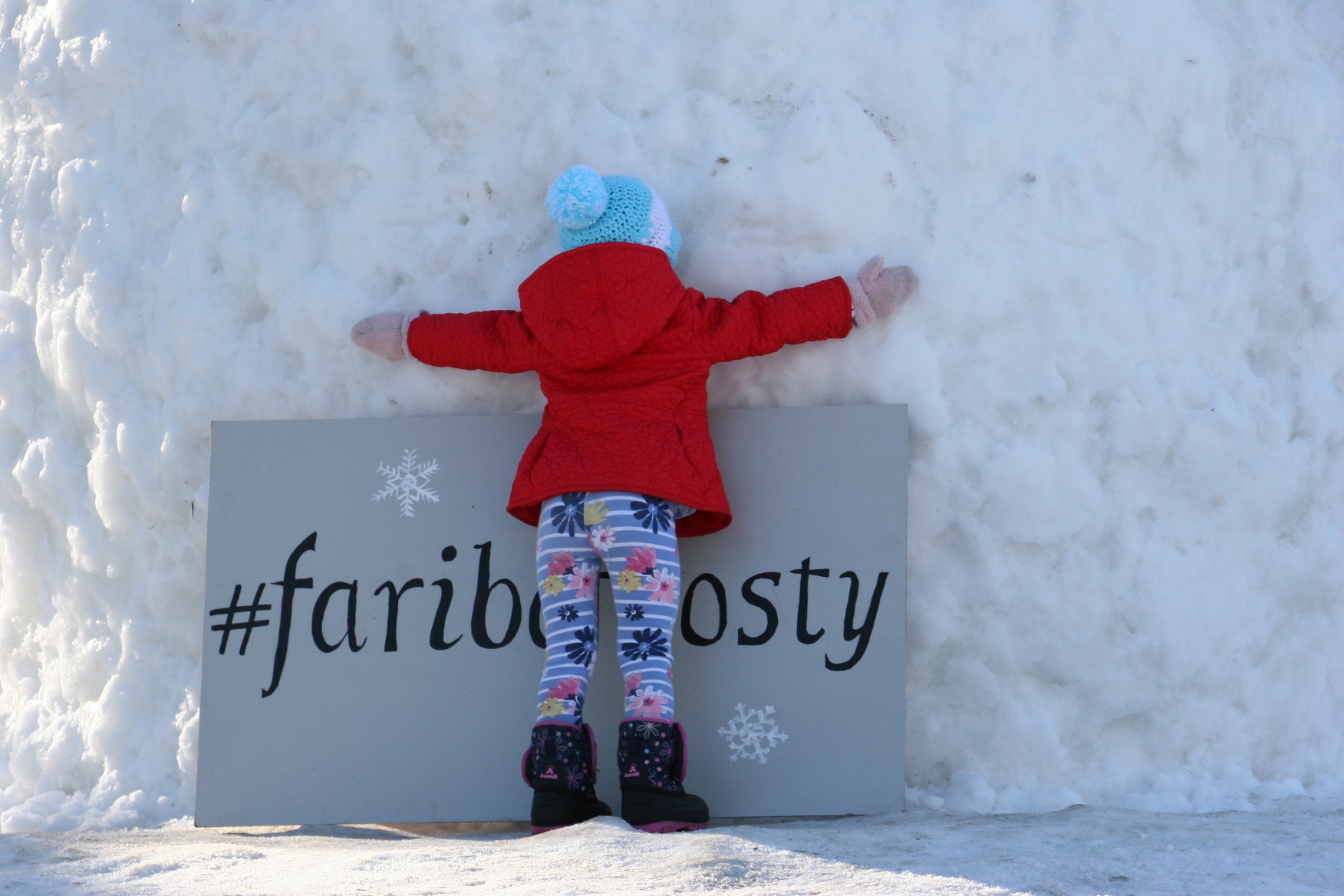
Faribo Frosty, a Faribault icon. (Minnesota Prairie Roots copyrighted photo February 2023)
NOSTALGIA WEAVES into our lives the older we grow, time blurring the edges of memories. But then something comes along to jog the mind into recalling a sweet childhood memory. For me, that’s Faribo Frosty.
Faribo Frosty’s smile brings so many smiles. (Minnesota Prairie Roots copyrighted photo February 2023)
Since 2005, the Hoisington family has built my community’s version of Frosty the Snowman. I loved Frosty as a child—the song, the Little Golden book, the animated holiday cartoon narrated by Jimmy Durante. There’s something so compelling about a snowman that comes to life via a magical top hat. And when he melts, oh, the sadness.
My then 2 1/2-year-old granddaughter hugging Faribo Frosty in December 2018. (Minnesota Prairie Roots copyrighted file photo December 2018)
But the melting of Faribo Frosty, given his robust size and current height of 17 or so feet, is not imminent. Lead creator Andy Hoisington cares for Frosty with the devotion of a man who recognizes the importance of his snowman. Families and grandparents and couples come to the corner of First Street Northwest and Third Avenue Northwest to see Faribo Frosty in the Hoisington’s front yard. I’ve been there with my grandkids, most recently a few weeks ago. When my granddaughter was two, she stretched her arms wide to hug Frosty. Couples have gotten engaged here and been photographed here to announce a pregnancy.
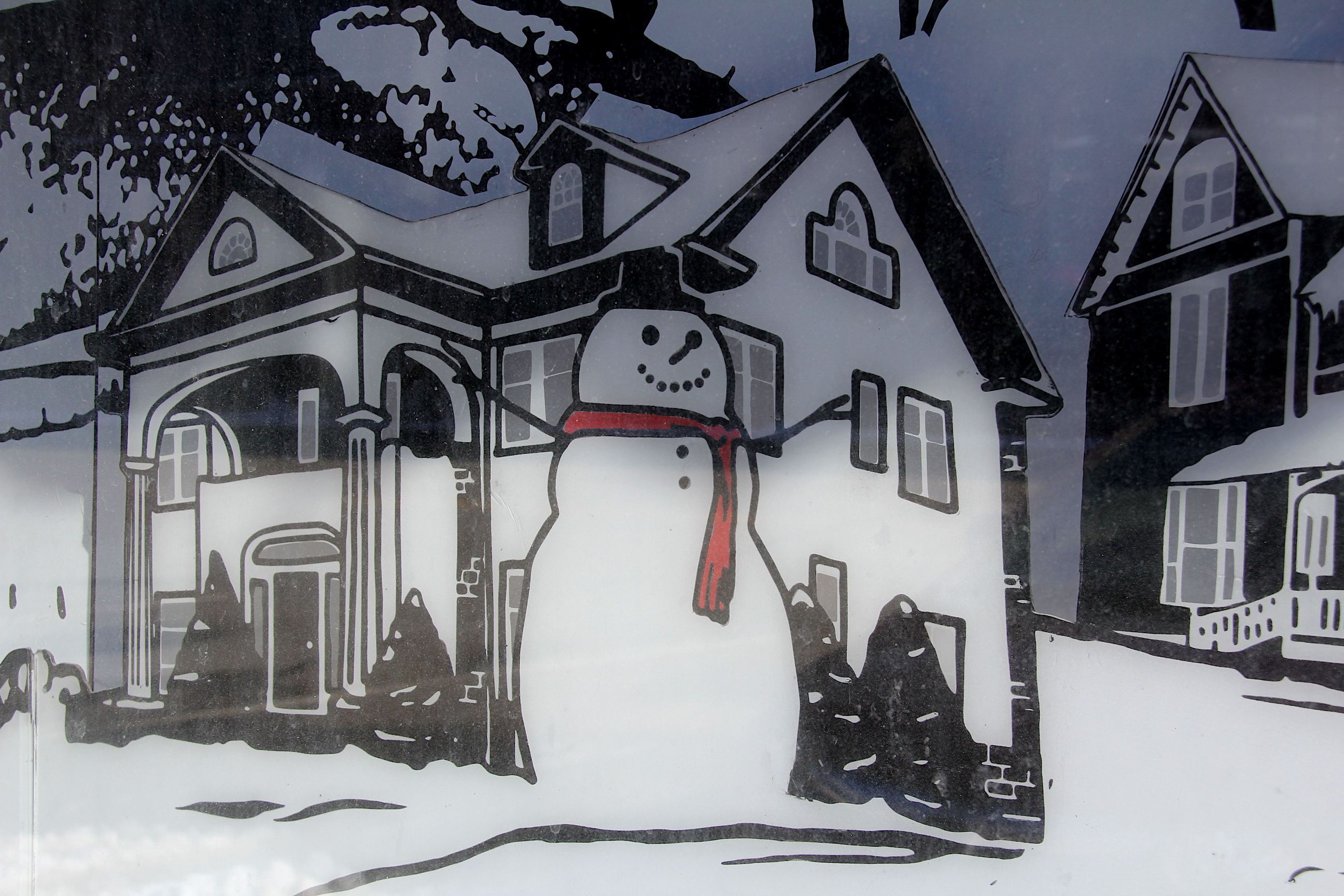
I photographed this Faribo Frosty art through the storefront windowof Actualize Fabrication in the 300 block of Central Avenue in historic downtown Faribault. (Minnesota Prairie Roots copyrighted and edited photo February 2023)
Ginormous Faribo Frosty, crafted with shaved ice from the local ice arena and from snow by Andy and his family (including adult sons Jake and Josiah and son-in-law Nick), attracts visitors from well beyond Faribault. He’s also been filmed for metro area television features, including KARE 11 Boyd Huppert’s “Land of 10,000 Stories.”
Jake, left, and Andy Hoisington work on Faribo Frosty in this December 2020 image. (Minnesota Prairie Roots copyrighted file photo 2020)
I’ve watched the Hoisingtons work on Frosty, shoveling shaved ice from a trailer, climbing a ladder to pack and shape the beloved snowman. He requires constant maintenance given Minnesota’s diverse winter weather. This is truly a labor of love after 18 years.
The Hoisington’s beautiful historic home is a lovely backdrop for their snowman. (Minnesota Prairie Roots copyrighted photo February 2023)
I am grateful for this family’s dedication to bringing joy into my community with their version of Frosty. Faribo Frosty makes me happy. He makes me smile with his wide smile, his bright carrot nose, his over-sized signature red scarf and mittens, even his black bucket pipe and his black top hat. Faribo Frosty is, in every way, nostalgically magical.
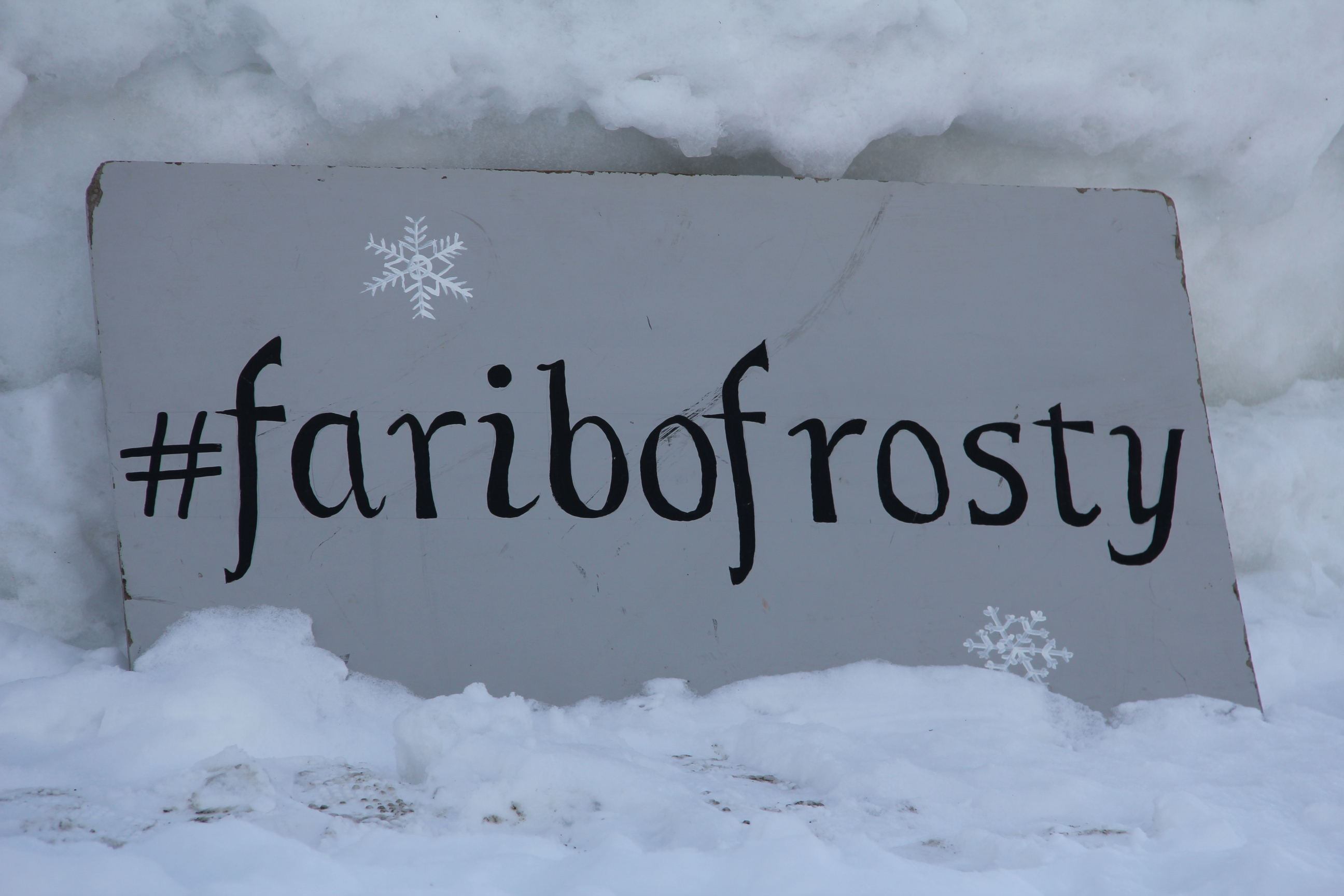
This sign standing in front of Frosty encourages others to share the snowman on social media with this hashtag. (Minnesota Prairie Roots copyrighted photo February 2023)
TELL ME: If you live in southern Minnesota, have you seen Faribo Frosty? If you live in another cold weather area, do you have a similar winter attraction or have you seen one?
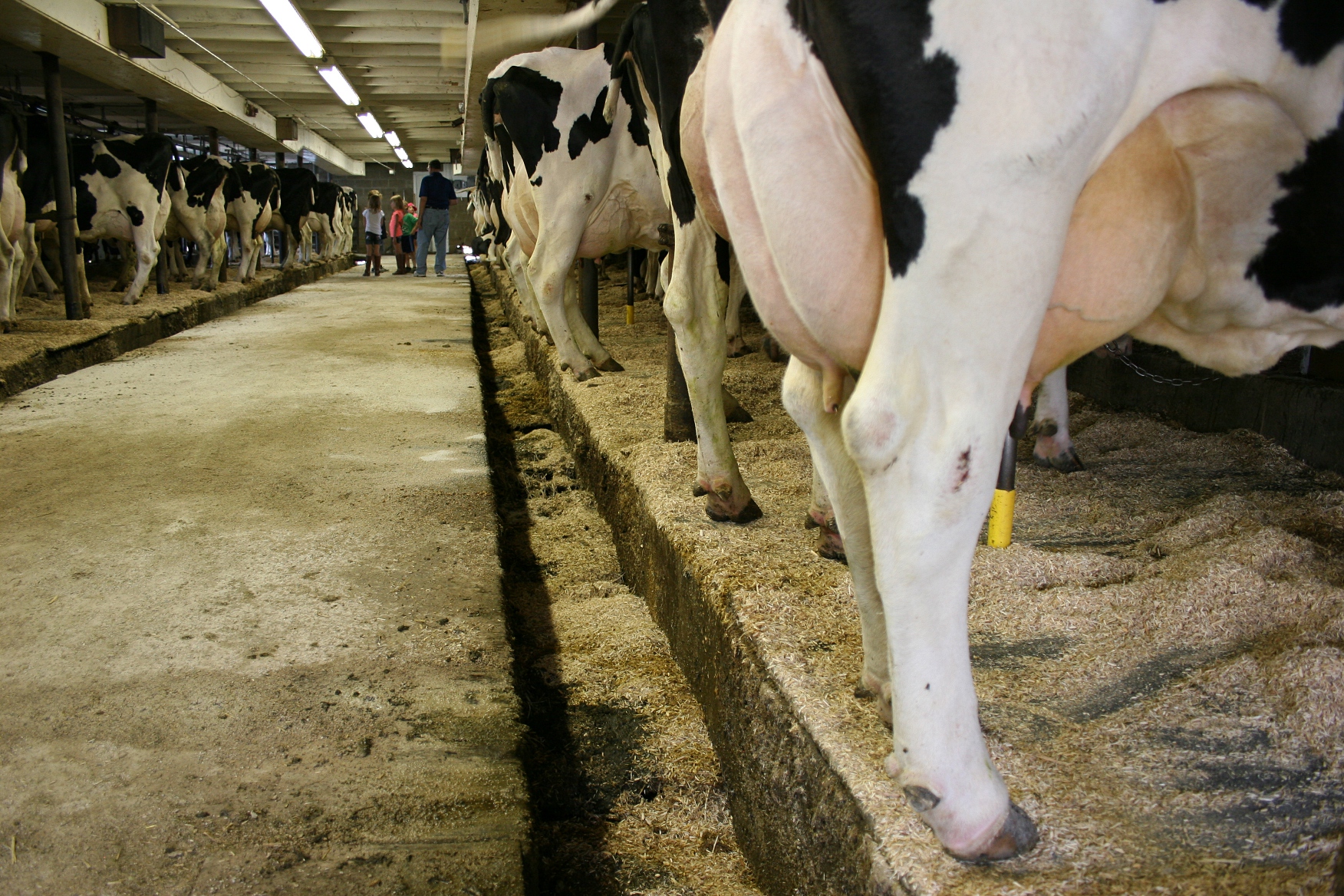
Inside a Rice County dairy barn. (Minnesota Prairie Roots copyrighted file photo)
AS SOMEONE WHO GREW UP on a dairy farm, I understand the hard work and commitment of feeding, caring for and milking cows. Every. Single. Day. Although the process has become easier with automation, the fact remains that dairy farmers can’t just walk away from the barn for a day. The cows still need to be milked.
As a child and teen, I labored in the barn, assisting my dad with feeding, bedding straw, and scooping manure. He did the actual milking. And he was under a time crunch to finish milking our Holsteins before the milk truck arrived to empty the bulk tank and transport our cows’ milk to the Associated Milk Producers plant in New Ulm.
That backstory brings me to today, nearly 50 years removed from the southwestern Minnesota crop and dairy farm where I learned the value of hard work. AMPI in New Ulm is still going strong and recently won several honors at the Wisconsin Cheese Makers Association 2023 U.S. Champion Cheese Contest in Green Bay, Wisconsin. Forty-two judges evaluated entries based on flavor, texture, appearance and taste. There were 2,249 entries from 197 dairy companies and cooperatives in 35 states. Minnesota was well-represented. (Click here to see a full list of the winners by category.)
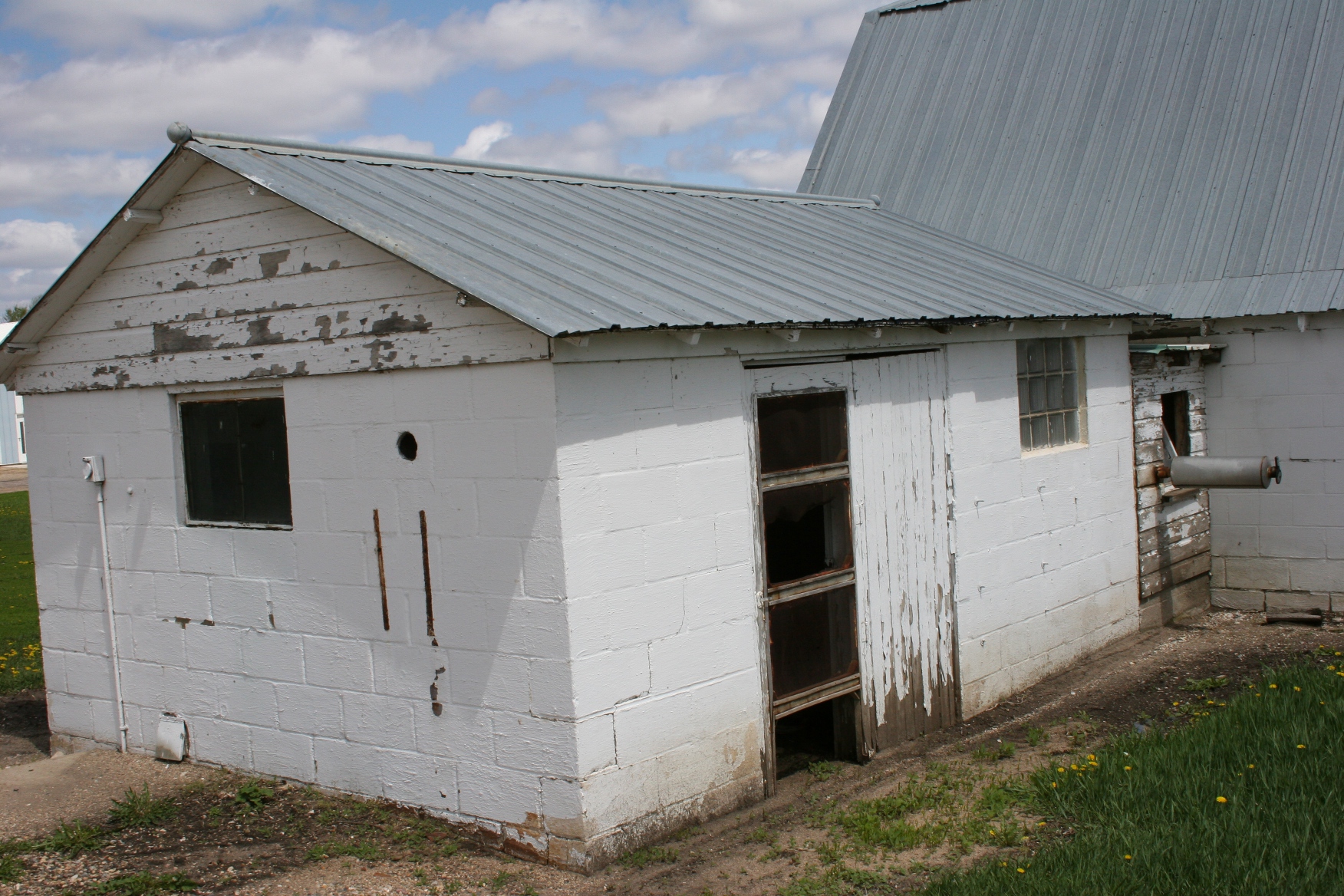
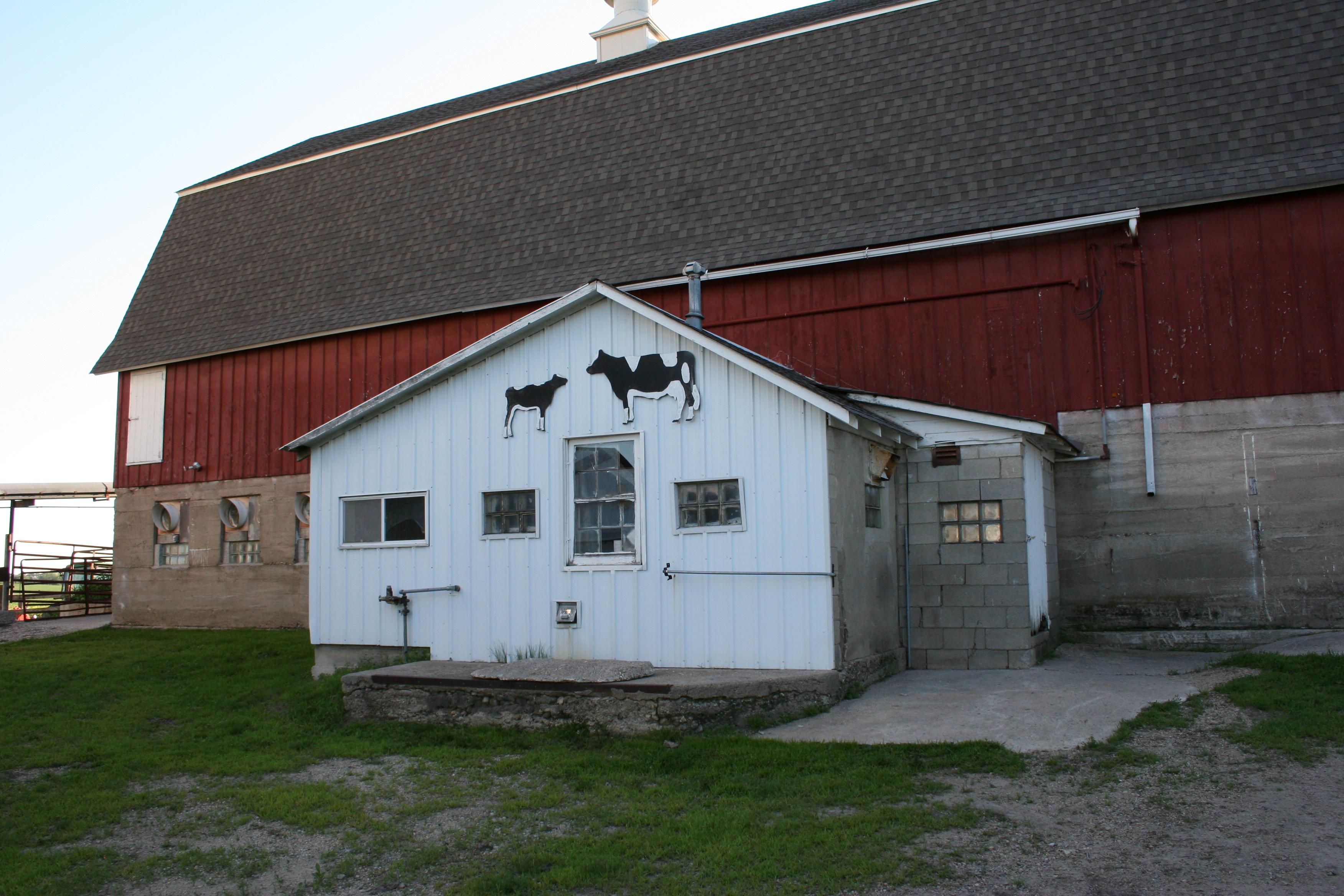
The abandoned milkhouse, attached to the barn on the farm where I grew up outside Vesta. (Minnesota Prairie Roots copyrighted file photo 2009)
AWARD-WINNING BUTTER FROM NEW ULM
The 113 contest divisions include dairy products beyond cheese. And that’s where New Ulm’s AMPI plant scored, earning second place for its unsalted butter and third places for salted butter and flavored butter, specifically chipotle butter. AMPI’s Sea Salted Root Beer Butter which sounds, in Minnesota lingo, “different,” did not place.
I grew up on AMPI salted butter. The milk man—the guy who picked up the milk from our milkhouse—also brought blocks of butter. Dad just left a slip of paper indicating how many pounds we needed and the driver pulled the packages from his truck.
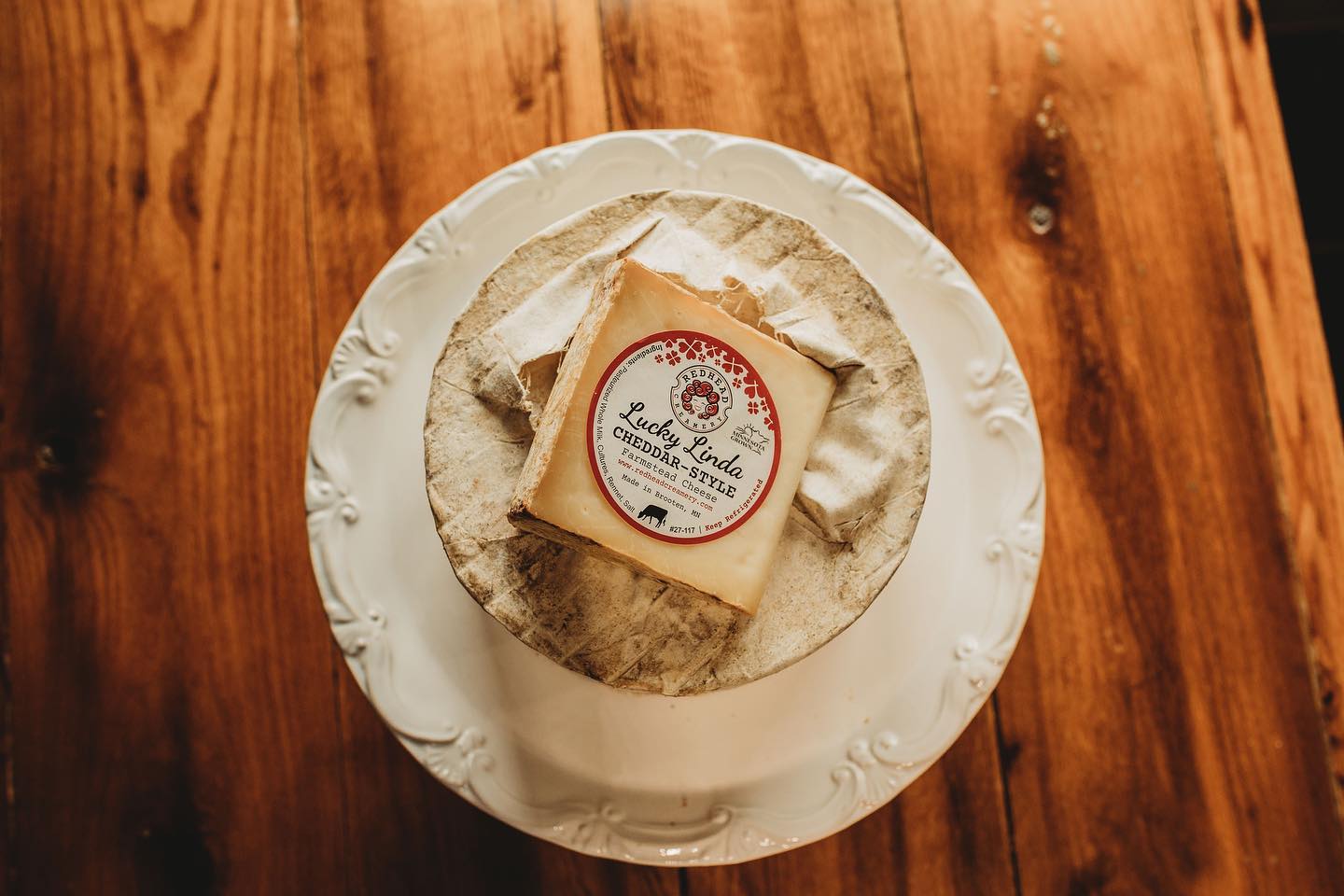
Lucky Linda Cheddar (Photo credit: Redhead Creamery Facebook page)
REDHEAD CREAMERY CHEESE CRAFTS A TOP 20 CHEESE
What I didn’t have back then was access to good quality cheese like that produced in Minnesota today. I love cheese. And yogurt and cottage cheese and ice cream and cheese curds…, well, all things dairy. This year a cheddar cheese produced by a small west central Minnesota cheese maker, Redhead Creamery, was named one of the top 20 cheeses in the country during last week’s national competition. And, yes, the president and CEO of this creamery in rural Brooten, Alise Sjostrom, is a redhead.
Redhead Creamery earned Best of Class in the Natural Rind Cheddar category with its previously award-winning Lucky Linda Clothbound Cheddar, named after Sjostrom’s mom. That top cheese was then chosen to compete against 19 other top cheeses for the honor of U.S. Champion Cheese. An aged Gouda made by the team at Arethusa Farm Dairy in Connecticut won the best cheese in the U.S. title. Two Wisconsin cheeses earned second and third places.
I have yet to try, or even find, Minnesota-made Redhead Creamery cheeses. But I will be looking for them locally, especially Lucky Linda Cheddar. I’d even like to take a road trip to the dairy and cheese operation, which offers tours.
Award-winning Amablu Gorgonzola from Caves of Faribault. (Minnesota Prairie Roots copyrighted file photo)
CAVES OF FARIBAULT EARNS HONORS
My community is also home to award-winning handcrafted cheeses. This year cheesemakers at Prairie Farms’ Caves of Faribault placed second in the Gorgonzola competition with Ama Gorg. In the blue-veined division, Caves of Faribault earned fourth for its AmaBlu. These cheeses have previously won honors and they are well-deserving. I love Caves of Faribault cheeses, aged in sandstone caves along the Straight River. If you like blue cheese, and I realize either you love it or you hate it, then this is your cheese.
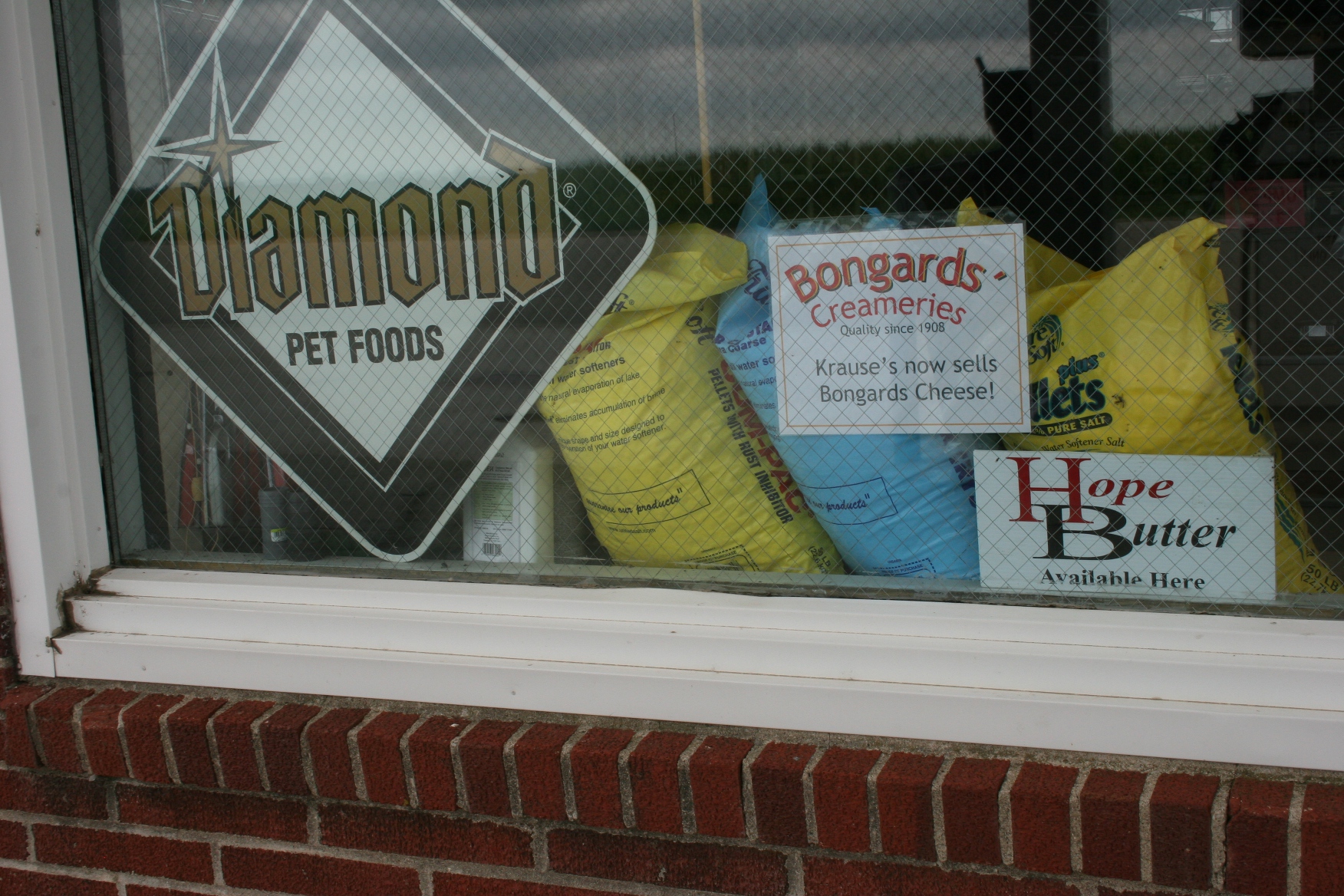
Krause Feeds & Supplies in Hope advertises the availability of Hope butter and Bongards cheese. (Minnesota Prairie Roots copyrighted file photo June 2013)
MORE MINNESOTA WINNERS
Minnesota-based Bongards Creameries in Perham also earned a Best of Class with its Monterey Jack cheese in the national competition. Likewise, Kemps, LLC in Farmington took Best of Class for its pineapple flavored cottage cheese and second for its chive flavored cottage cheese. I didn’t even realize cottage cheese came in such flavors.
If there were other top winners from Minnesota in the 2023 U.S. Cheese Contest, I apologize for missing them. But after scrolling through pages of information, I stopped looking.
What I realized is that small creameries to co-ops to large companies in Minnesota make a lot of dairy products. We may not have as many cheesemakers as the Dairyland State, but certainly enough for anyone who likes cheese and other dairy products to recognize Minnesota’s value in the dairy industry.
I saw Minnesota entries (again, I may have missed some) from Prairie Farms Dairy Cheese Division in Rochester, Bongards in Norwood, Agropur in Le Sueur, Stickney Hill Dairy in Rockville and First District Association in Litchfield. The varieties of cheeses range from pasteurized process American cheese from Prairie Farms to jalapeno and roasted red cheddar from Litchfield-based FDA, “a grassroots cooperative since 1921.”
This rural Dundas barn once housed a herd of dairy cows. No more. But the barn has been maintained. (Minnesota Prairie Roots copyrighted file photo September 2011)
CHANGED & UNCHANGED
Much has changed, yet much has not since I left the farm in 1974. Cooperatives remain as strong as ever, yet small scale artisan cheese makers, have also emerged. The demand for basic cheeses remains, yet cheese makers are crafting diverse flavors to meet consumers’ expanding tastes. Small family dairy farms have been mostly replaced by large-scale dairy operations. Change is inevitable. But one thing has not changed for me personally. I love dairy products, especially cheese.
“Main Street,” watercolored block print by Nan Karr Kaufenberg. (Minnesota Prairie Roots copyrighted photo September 2022)
MANY DECADES AGO, in a time when gender roles factored strongly into classes a student could and couldn’t take in high school, I learned to carve a design into a linoleum block for printing. Girls and boys traded classes for two weeks with female students allowed into the male-dominated world of shop class. The guys headed to the home economics kitchens to acquire basic cooking and baking skills.
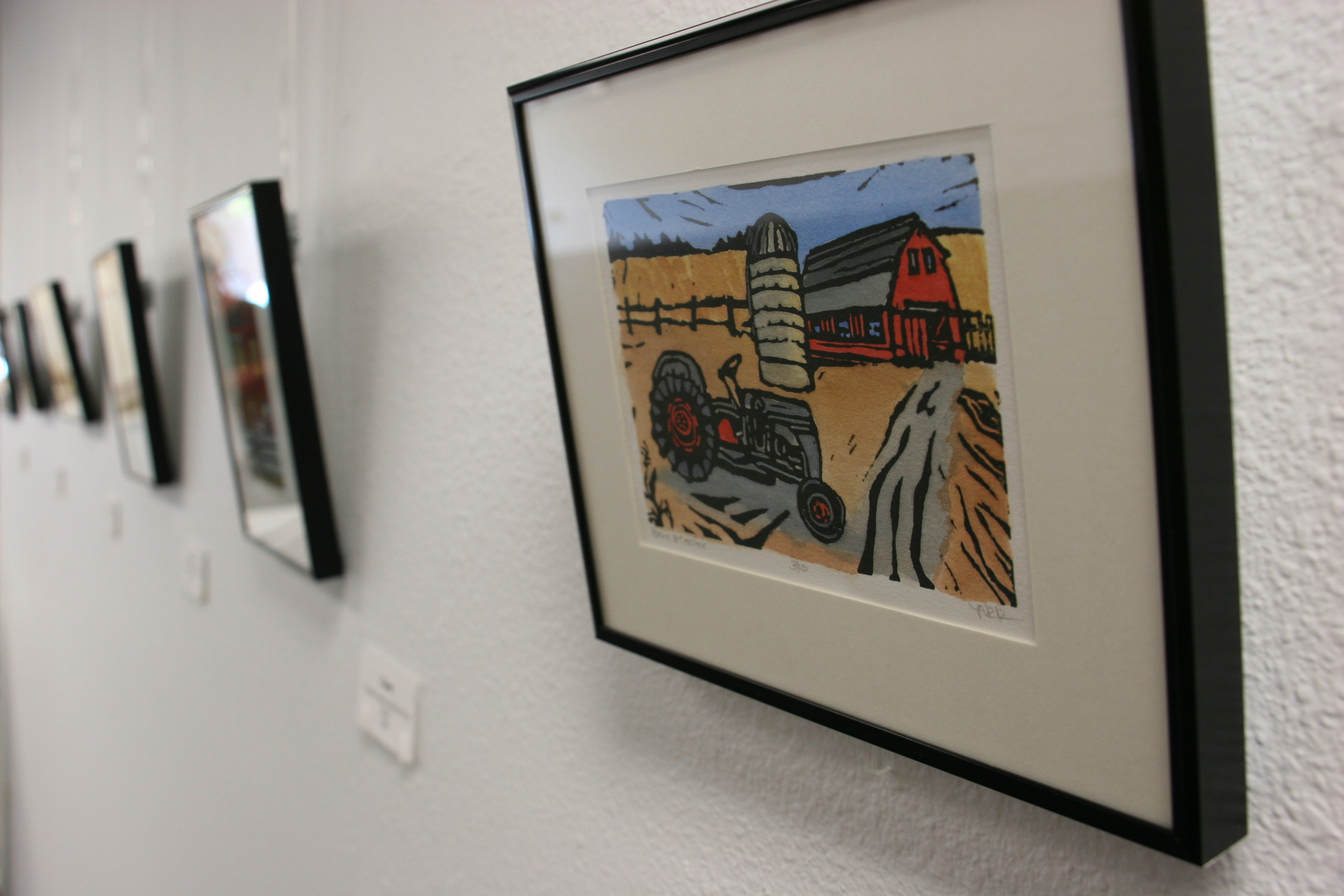
Nan Karr Kaufenberg’s depiction of a farm site. (Minnesota Prairie Roots copyrighted photo September 2022)
Oh, how things have changed since I was an early 1970s high school student briefly surrounded by saws and tools and other equipment and carving art into a linoleum block. I don’t recall the design I crafted. But I do remember feeling empowered inside that industrial arts shop, my eyes opened to possibilities that stretched beyond societal limitations.
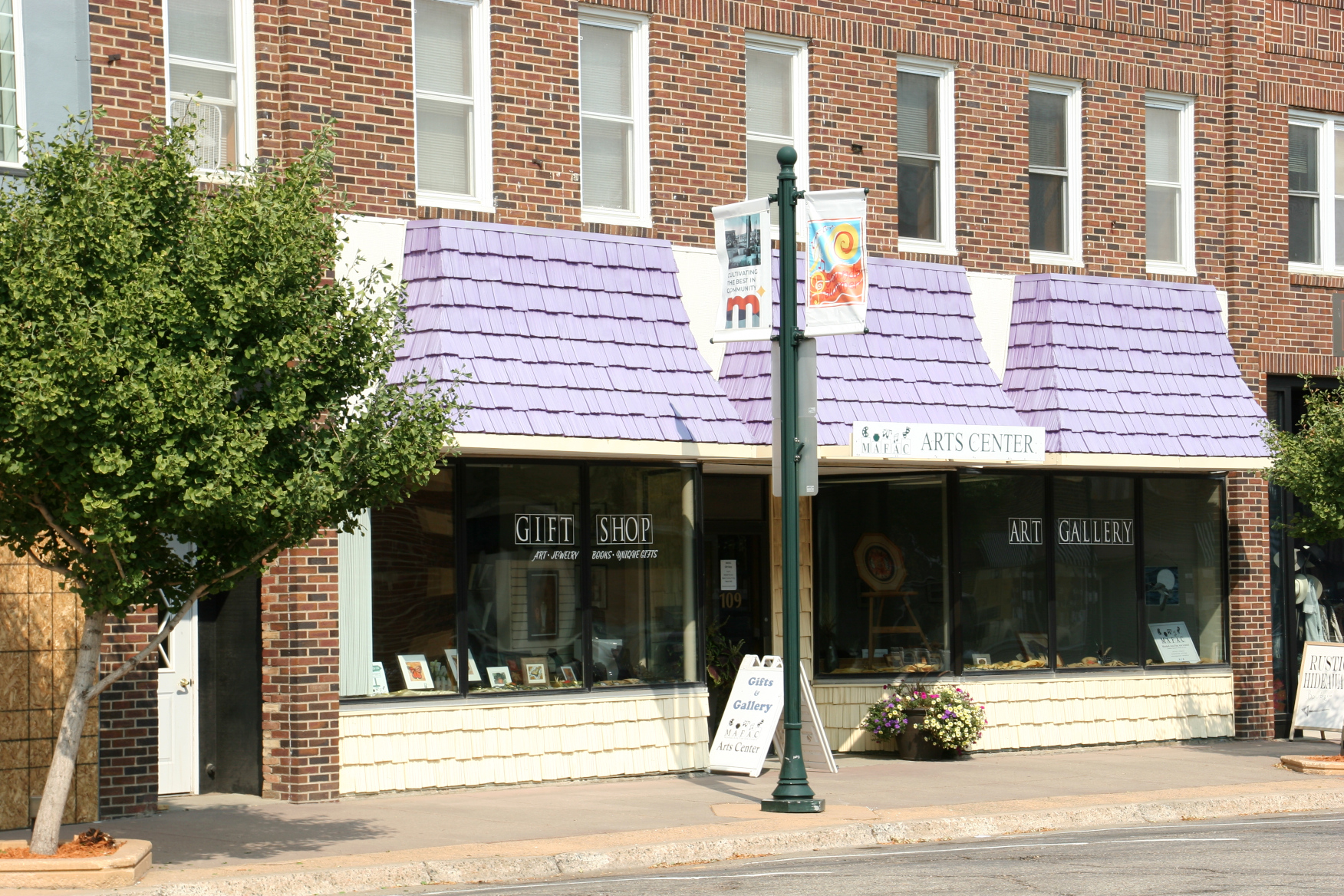
The Arts Center in downtown Marshall. (Minnesota Prairie Roots copyrighted photo September 2022)
Nan Karr Kaufenberg’s “Coneflowers.” (Minnesota Prairie Roots copyrighted file photo September 2022)
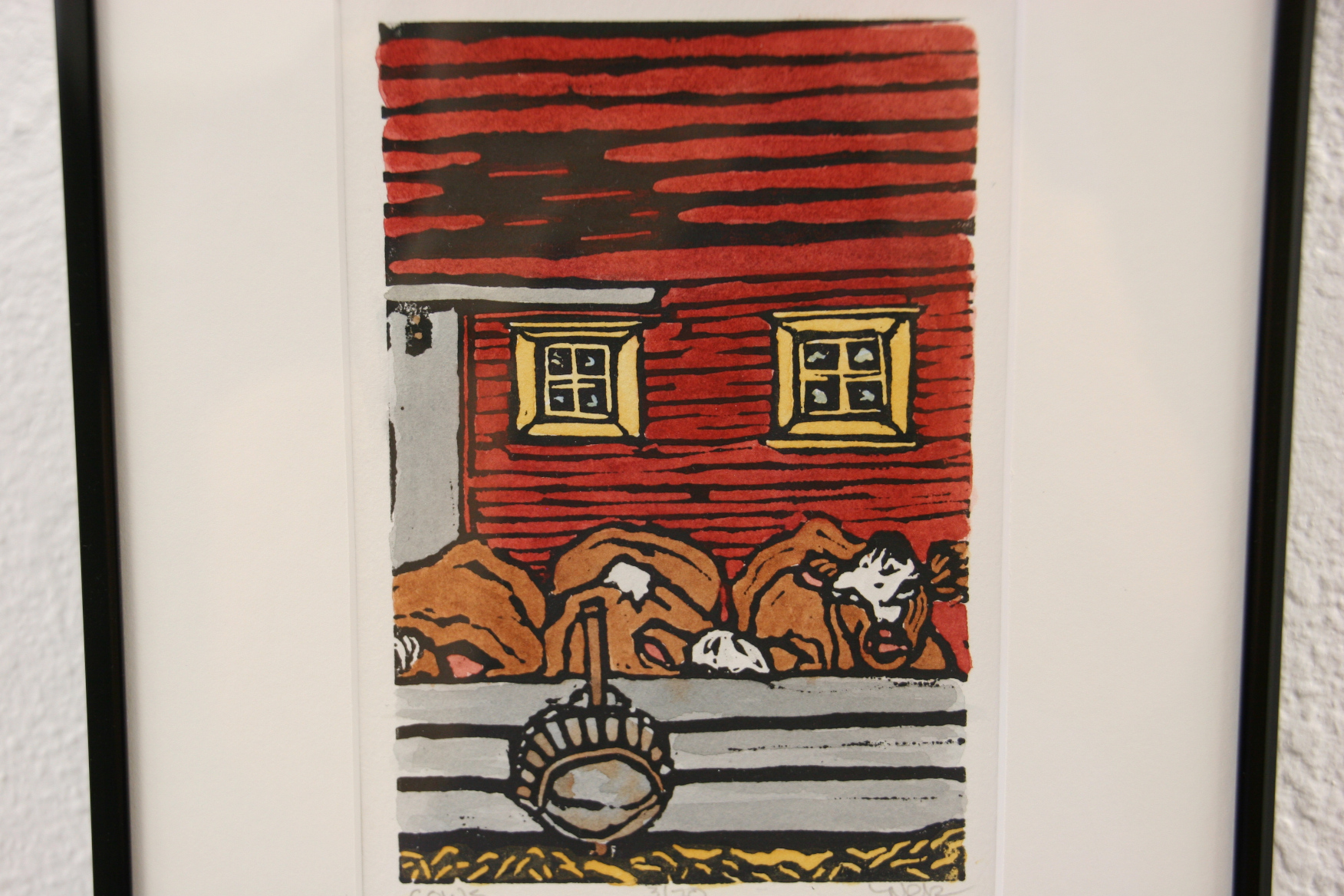
Feeding cattle focus this print by Nan Karr Kaufenberg. (Minnesota Prairie Roots copyrighted photo September 2022)
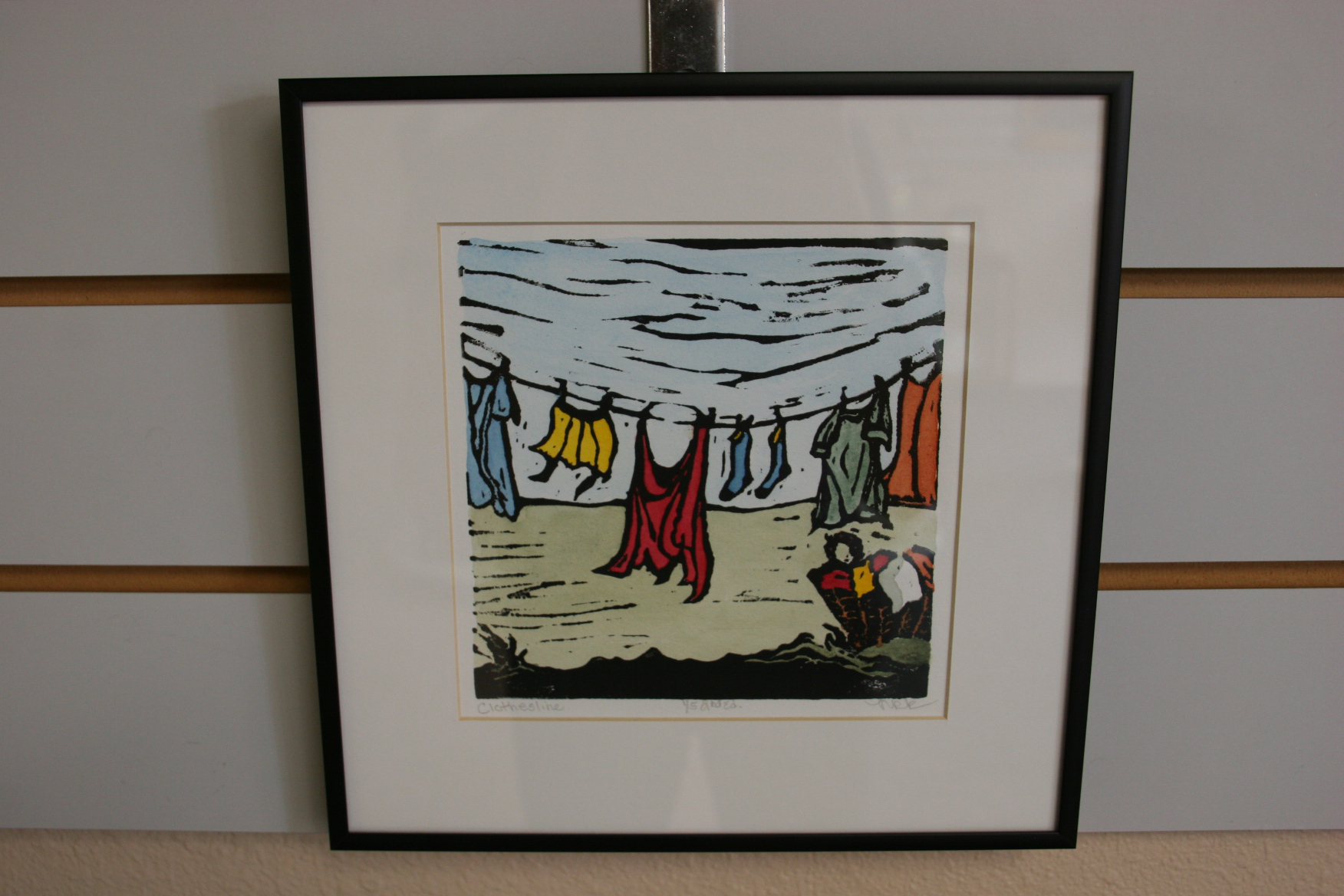
“Clothesline” by Nan Karr Kaufenberg. (Minnesota Prairie Roots copyrighted photo September 2022)
That admiration remains for this artist who observes the prairie world around her and then creates. I feel comfortably at home with her interpretations of rural southwestern Minnesota. Her depictions of prairie flowers, farm scenes, small towns, even laundry on a clothesline, touch me with that sense of familiarity, that feeling of connection to a place I called home and forever hold dear.
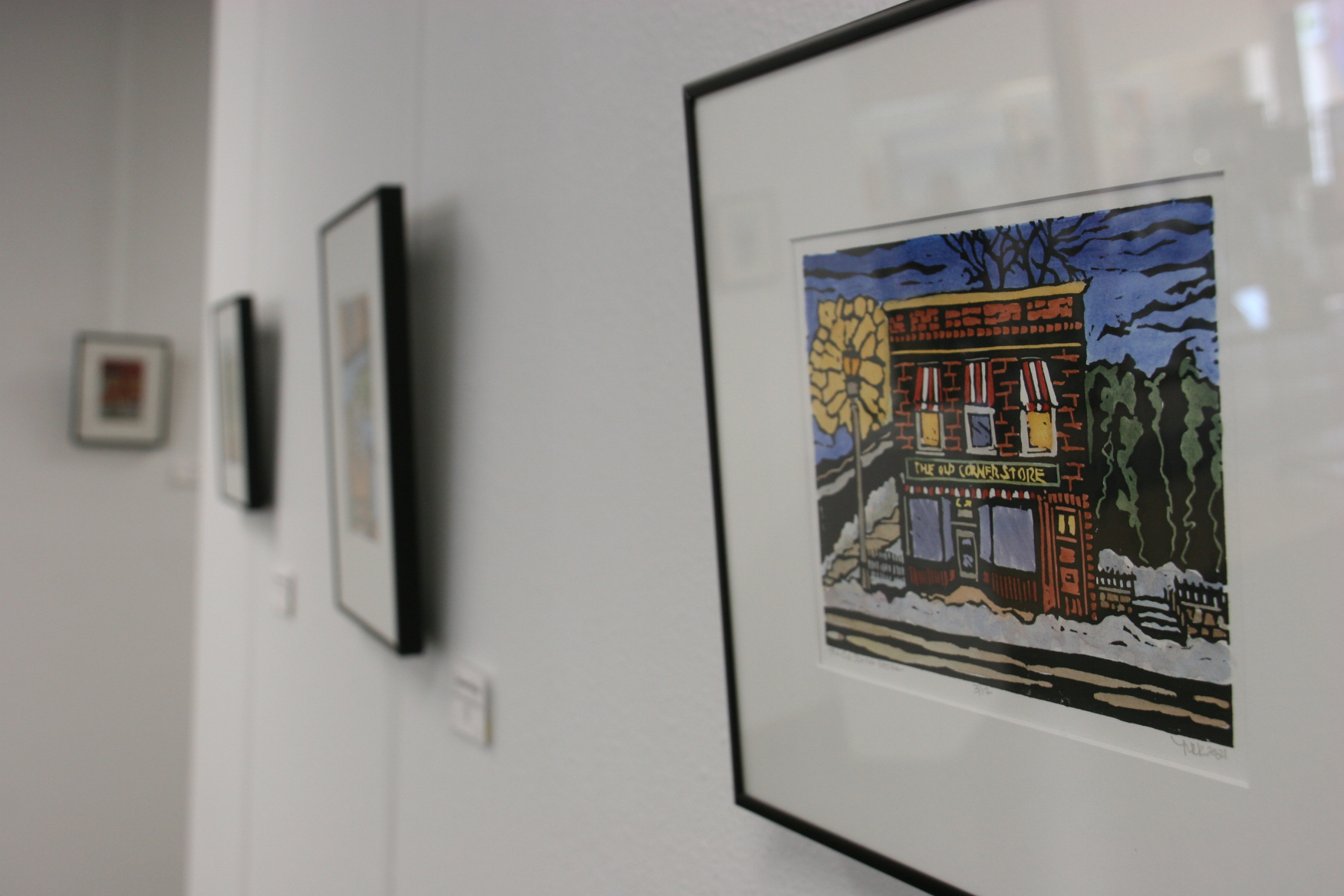
A block print by Nan Karr Kaufenberg of The Old Corner Store. (Minnesota Prairie Roots copyrighted photo September 2022)
For more than 30 years, Kaufenberg, who has art degrees (from the University of Minnesota and Southwest Minnesota State University), who once worked at a tourism center in extreme southwestern Minnesota (she moved following the 2001 high profile murder of her daughter Carrie Nelson), and who is also a realtor, has specialized in tinted linoleum block prints. She colors her printed designs with watercolors. The results are simply stunning. Bold black stamped ink softened by watercolor.
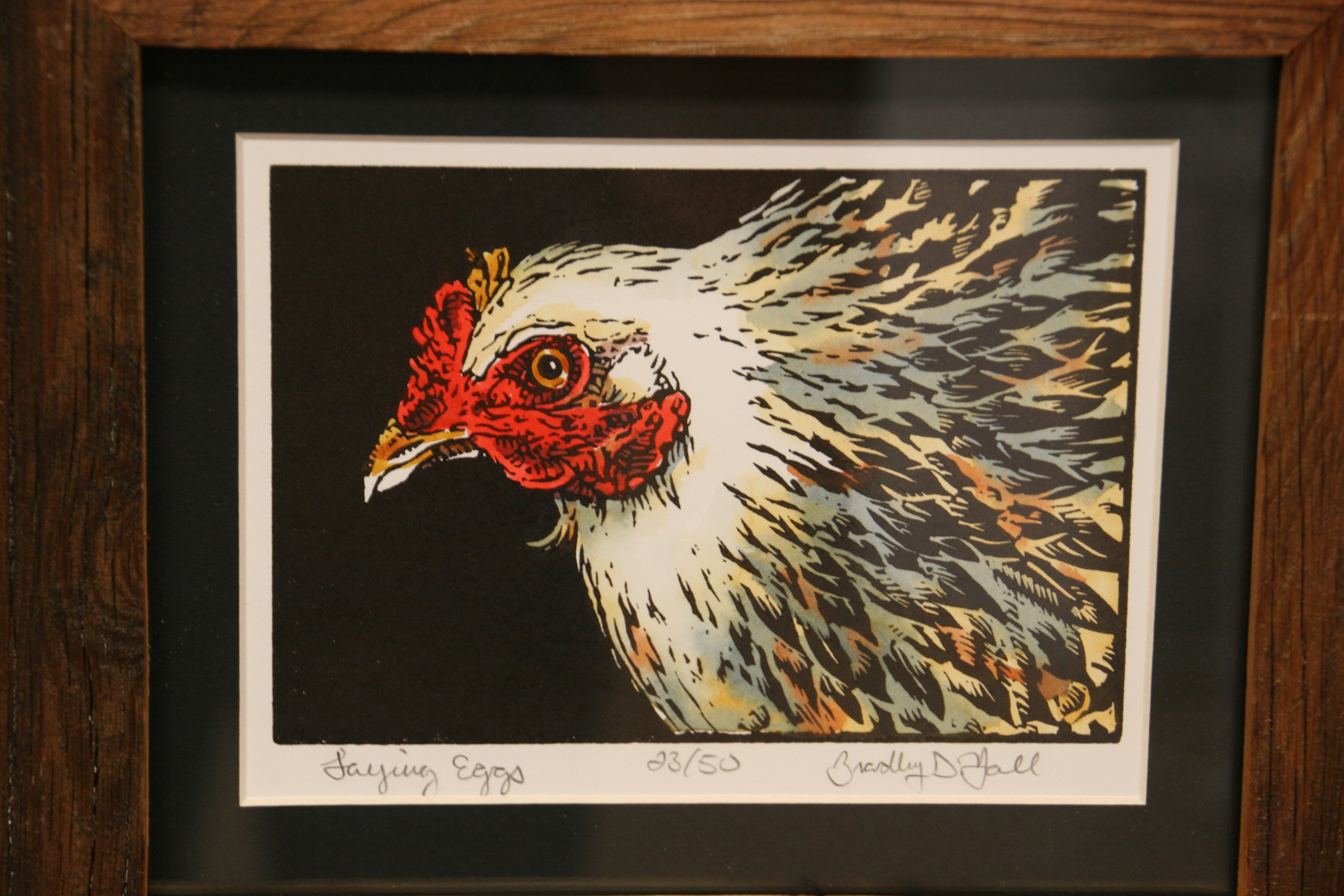
“Laying Hens” by Bradley D. Hall. (Minnesota Prairie Roots copyrighted photo September 2022)
Granite Falls artist Bradley D. Hall does the same, hand-carving linoleum blocks, then hand-printing the inked block design before hand-coloring with watercolors. I also saw his work inside the Marshall Arts Center. While similar to that of Kaufenberg in its rural themes, Hall’s art features finer black lines. Each artist has developed a certain identifiable style with the same basic art form.
A view of the Marshall Arts Center gift shop. (Minnesota Prairie Roots copyrighted photo September 2022)
Hall, who left southwestern Minnesota for Chicago and worked there for 20 years in factories, returned to his native Granite Falls in 2002 to open a studio. By then he’d already taken numerous art classes, including at the American Academy of Art in downtown Chicago. Upon his return to Minnesota, Hall connected with letterpress artist Andy Kahmann of A to Z Letterpress in Montevideo and learned the arts of linoleum block carving and printmaking. I love that these creatives shared with, and learned from, one another.
“Windmill” by Bradley D. Hall. (Minnesota Prairie Roots copyrighted photo September 2022)
More than 50 years ago, industrial arts teacher Ralph Brown shared his linoleum block print skills with me and a shop full of other teenage girls at Wabasso High School. Those two weeks of hands-on learning inside a place typically reserved for male students proved pivotal. I could see the world beginning to crack open to young women, emerging women who would ink life with their designs, their styles, their strong bold lines.
WHEN MY ELDEST DAUGHTER asked me to bake Chocolate Crazy Cake iced with peanut butter frosting for her upcoming birthday celebration, I was delighted. I’d offered to make her birthday treat, but expected Amber to choose a simplified version of cheesecake or Chocolate Tofu Pie. So when she picked Crazy Cake, I was nostalgically surprised. This is the recipe my mom used for my birthday cakes when I was growing up. And it is the same recipe I used when baking cakes for my three kids.
Although Amber never asked me to craft the cake into a shape like a Teenage Mutant Ninja Turtle, snowman or Garfield the cat as I did when she was a child, I considered it. In the end, I’m going with a basic rectangular frosted cake. Maybe I’ll add sprinkles for the grandkids.
For his eighth birthday, Caleb’s sisters created a PEEF cake for their brother. PEEF is a fictional bear featured in books written and illustrated by Minnesotans Tom Hegg and Warren Hanson. (Minnesota Prairie Roots copyrighted file photo)
February brings not only Amber’s birthday, but also that of her brother, just one day shy of eight years younger than her. Their sister, sandwiched between, is 21 months younger than Amber. Yes, I was a busy mom. I baked a lot of Chocolate Crazy Cake birthday cakes through the years, cutting them into designs typically fitting the birthday child’s interests.
A blogger friend gifted me with a copy of the cake design booklet my mom used when crafting birthday cakes. (Minnesota Prairie Roots copyrighted file photo)
My mom used the Baker’s Coconut Animal Cut-Up Cake booklet as her guide to creating animal-shaped cakes for me and my five siblings. Her handcrafted designs defined our birthdays because we didn’t receive gifts. Finances didn’t allow and the adage of you can’t miss what you never had certainly applies. My kids got gifts along with personalized homemade cakes. If I were to ask them, they would likely remember the cakes I made and not the gifts received.
Birthdays always cause me to feel reflective as in how the heck are my kids already adults and x number of years old? It seems like only yesterday that I was planning birthday parties with their classmates, mixing up Chocolate Crazy Cake and lighting candles.
And now here I am, looking through my stash of church cookbooks for a cherished cake recipe. I’m feeling all nostalgic, wishing there was a way to ship a Chocolate Crazy Cake birthday cake to Caleb in Indiana.
Chocolate Crazy Cake*
3 cups flour
½ cup powdered cocoa
2 cups sugar
1 teaspoon salt
2 teaspoons baking soda
2 cups cold water
¾ cup vegetable oil
2 Tablespoons vinegar
1 teaspoon vanilla
Stir the dry ingredients together in a large bowl. Then add the liquids and mix. Pour into a 9 x 13-inch cake pan and bake for 30-40 minutes at 350 degrees.
#
Recipe source: The Cook’s Special 1973, St. John’s Evangelical Lutheran Church, Vesta, Minnesota
The recipe is listed as “Wacky or Chocolate Cake” in the church cookbook. I’ve always known it as “Crazy Cake.”Why is it called “wacky” or “crazy” cake? I don’t know.
When my grandchildren say the darndest things, I think of Art Linkletter’s “House Party” and his “Kids Say the Darndest Things” segment. Their answers to his questions proved honest, humorous and entertaining.
KIDS SAY THE DARNDEST THINGS. I can vouch for that. I raised three kids, cared for many others and am now the grandmother of two, one going on seven, the other just turned four.
Recently the grandkids, Isabelle and her little brother, Isaac, stayed overnight. During that short stay, Izzy elicited laughter with her honest observations and her leadership skills.
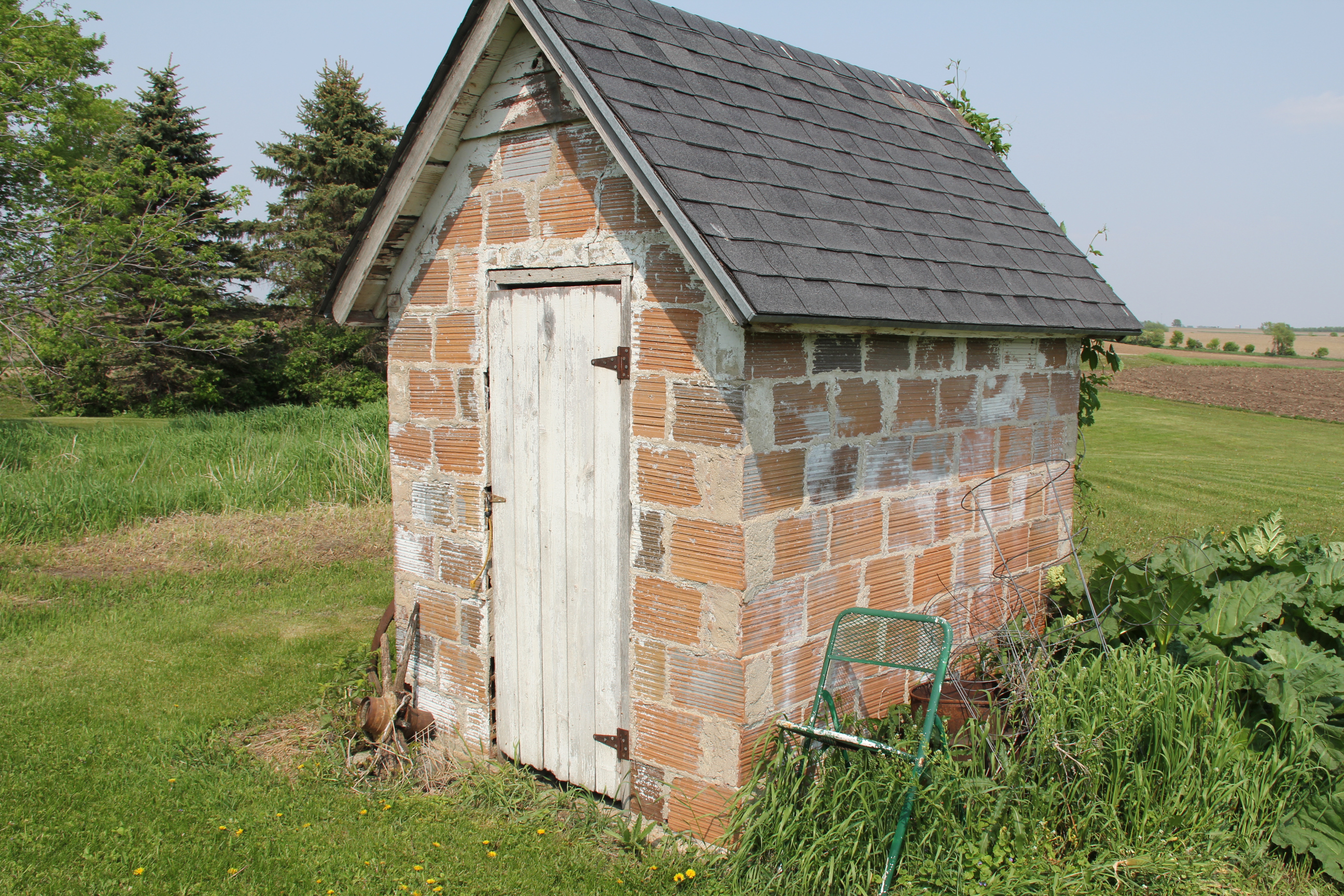
An outhouse repurposed as a garden shed at my brother and sister-in-law’s rural southwestern Minnesota acreage. (Minnesota Prairie Roots copyrighted file photo)
First the honesty. I don’t recall how we got on the topic, but at some point I shared that I grew up in a house without a bathroom. Taking a bath meant my dad hauling a tin tub from the porch into the kitchen every Saturday evening and then Mom filling it with water. Our bathroom, I explained to Izzy, was a little building outside with two holes cut in a bench. And in the winter, we used a covered pot set inside the unheated porch.
I don’t know that Izzy understood all of this. But, as she sat there listening to Grandma spin tales of the olden days, she assessed. “It sounds like a different world to me!” I laughed at her observation. She was right. Growing up in rural Minnesota in the 1950s and 1960s was, most assuredly, a different world from hers. My granddaughter lives in a sprawling suburban house with four bathrooms. In 1967, my family of birth moved into a new farmhouse with a single bathroom. And a bathtub. Today I feel thankful to live in a house with one bathroom. I wouldn’t want to clean four.
I took this award-winning photo of BINGO callers at the North Morristown July Fourth celebration in 2013. (Minnesota Prairie Roots copyrighted file photo 2013)
Then there’s BINGO, which we play nearly every time we’re together with Isabelle and Isaac. They were introduced to the game at the Helbling Family Reunion and have loved it since. The kids take turns not only playing, but also calling numbers.
Isabelle has advanced greatly in her BINGO-calling skills. This time, in addressing us, she called us “folks.” I don’t know where Izzy heard that term, but it’s certainly more rural than suburban lingo. I suggested she might be ready to call BINGO next summer at North Morristown’s annual Fourth of July celebration. Unincorporated North Morristown is a Lutheran church and school and a few farm places clustered in the middle of nowhere west of Faribault. Izzy seems well-prepared to call BINGO numbers to the folks there.
I should have shared with my granddaughter that, when I was growing up, we covered our BINGO cards with corn kernels during Vesta’s (my hometown) annual BINGO Night. I expect she would have responded as a child 60 years younger than me: “It sounds like a different world to me!” And I would have agreed.
A children’s picture book features zodiac animals in this story focused on the Chinese New Year.
THE FIRST TIME I NOTICED a grouping of rabbit-themed books displayed on a table at my local library, I passed right by. That’s odd, I thought to myself. The second time I glimpsed those books, I walked over and looked. Turns out 2023 is The Year of the Rabbit and this book collection is a way to celebrate.
Today, Sunday, January 22, marks the beginning of the Chinese Lunar New Year, the year when the rabbit takes zodiac animal center stage. The rabbit symbolizes luck (no surprise there; think a good luck rabbit foot), diplomacy, peace, compassion, kindness, all words I can get behind. We’re overdue for a year of people and nations treating each other with respect, kindness and decency.
This road-side white rabbit sculpture welcomes travelers to Wabasso. (Minnesota Prairie Roots copyrighted file photo)
While I’m not into the zodiac, I respect the Asian culture. And I like rabbits…because I am a Rabbit. Clarification, I was a Rabbit, as in a Wabasso Rabbit. I graduated from Wabasso High School, a southwestern Minnesota school with a white rabbit as its mascot. I can almost hear the laughing. A rabbit as a mascot? Yes, I admit to hearing a fair share of put-downs about being a lowly Rabbit. But don’t underestimate a rabbit/Rabbit.
A broad view of Wabasso’s Main Street. (Minnesota Prairie Roots copyrighted file photo April 2012)
There’s a reason behind the chosen mascot. The town name, Wabasso, is a Dakota word meaning “white rabbit.” So it makes total sense that the public school would choose a rabbit mascot. This prairie region of Minnesota is rich in Dakota history.
The WHS gym in 2009. (Minnesota Prairie Roots copyrighted file photo August 2009)
For me, rabbits are part of my personal history. I hold many memories of overall Rabbit pride. Pep fests, football and basketball games, theater, writing for the high school newspaper, The Rabbit Tracks… Attending a small rural Minnesota high school with mostly farm kids from the communities of Wabasso, Wanda, Lucan, Seaforth and Vesta (my hometown) was a good fit for me. I am forever proud of being a Rabbit.
The sign marking the current building came from the old building. And apparently back in the day, a “u” looked like a “v.” The school looks different than when I attended WHS. (Minnesota Prairie Roots copyrighted file photo August 20029)
Next year, 2024, marks The Year of the Rabbit for me. In that calendar year, my WHS graduating class celebrates its 50th class reunion. Unbelievable. I once considered people who’ve been out of high school for 50 years to be really old. I don’t think that way any more, although I do admit my advancing age.
As we reunite, we’ll pull out our yearbooks and reminisce. We’ll pull out our smartphones to share family photos. We’ll celebrate the years we were Rabbits. And we’ll celebrate, too, the lives we’ve lived since, lives I hope have been filled with peace, kindness and love.
Recent Comments