Minnesota Prairie Roots

Writing and photography by Audrey Kletscher Helbling

Reflections on diversity & growing community in Faribault December 30, 2025

Among the many hands of the Faribault community, painted in a mural. (Minnesota Prairie Roots copyrighted photo September 2025)

WHAT ARE WE without community? The answer: alone.

We, at our very core, need each other. In times of celebration. In times of challenges. Even in times of great division. Without friends, family, neighbors and others, we are but individuals without community.

This mural was painted for and placed outside the Congregational Church in Faribault. (Minnesota Prairie Roots copyrighted photo September 2025)

And in Faribault, among the many murals adorning public spaces in the downtown area, one piece of art stands out as representing community. That is a free-standing mural placed on the west side of the Congregational Church of Faribault United Church of Christ this past summer. It seems an appropriate focal point to end 2025 and begin the new year.

The artwork, created by Shirley Rainey and her son Jason, features outstretched arms rising from the earth against a backdrop red heart and blue sky. “The mural represents the importance of coming together to share burdens and triumphs, while reaching for our highest selves,” Rainey said in an artist’s statement.

Henna painted on a hand reflects Somali culture. (Minnesota Prairie Roots copyrighted photo September 2025)

I see that in the mural. But I also see a community of diversity. The Raineys show that in assorted skin tones, clothing, hand sizes and even henna painted on a hand. I love that about this art, this intentional, varied depiction of Faribault as it is—gloriously diverse.

That said, I am well aware of the racial tension (and that’s a tamped down word) in my community. I wish it didn’t exist, that we all got along, welcomed and embraced one another. We are, after all, just people who live, love, work, play, laugh, cry… The list of commonalities we share as humans goes on and on. Yes, we are different, too. But differences seen as negative, those we create.

The diverse hands of Faribault, up close, in the new community mural. (Minnesota Prairie Roots copyrighted photo December 2025)

We can learn from that church painting. We can choose to love one another, as portrayed in the over-sized backdrop red heart. We can stand side-by-side and raise our hands to help one another. We can see, in those arms stretched skyward, the possibilities in building community. In that blue sky, we can envision not only our personal dreams, but the dreams of all who call Faribault home.

Faribault is a multi-cultural community, always has been. From early settlement days to today, people have come here from around the world to start anew. Whether French, Irish, German, Scandinavian, Latino, Asian, Sudanese, Somalian or any of many other ethnicities, this place has become home. We can choose to create community or not.

I hope in 2026 that Faribault can build a better, stronger, more unified community which celebrates our commonalities, and our differences.

© Copyright 2025 Audrey Kletscher Helbling


Rural living history & threshing memories September 3, 2024

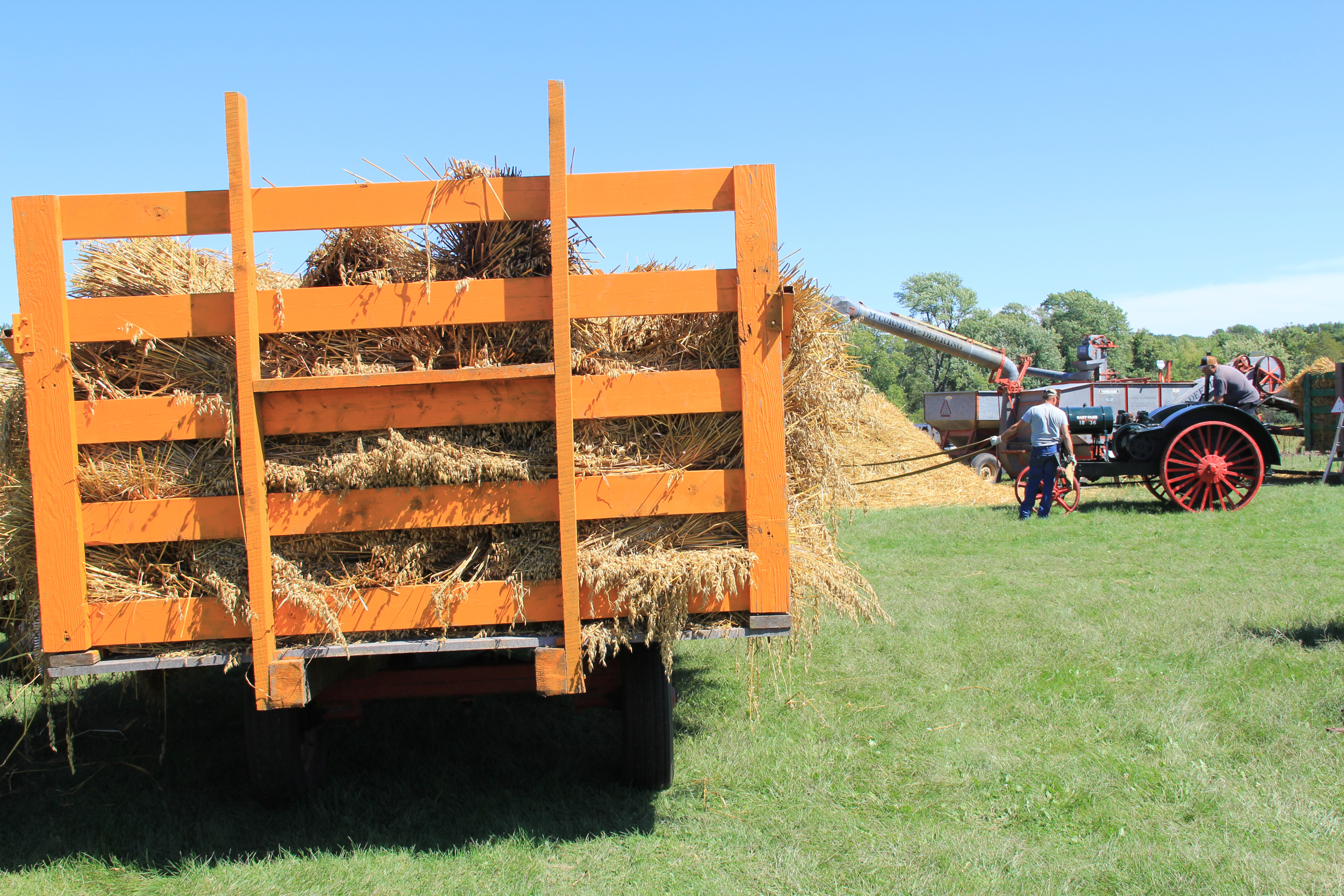
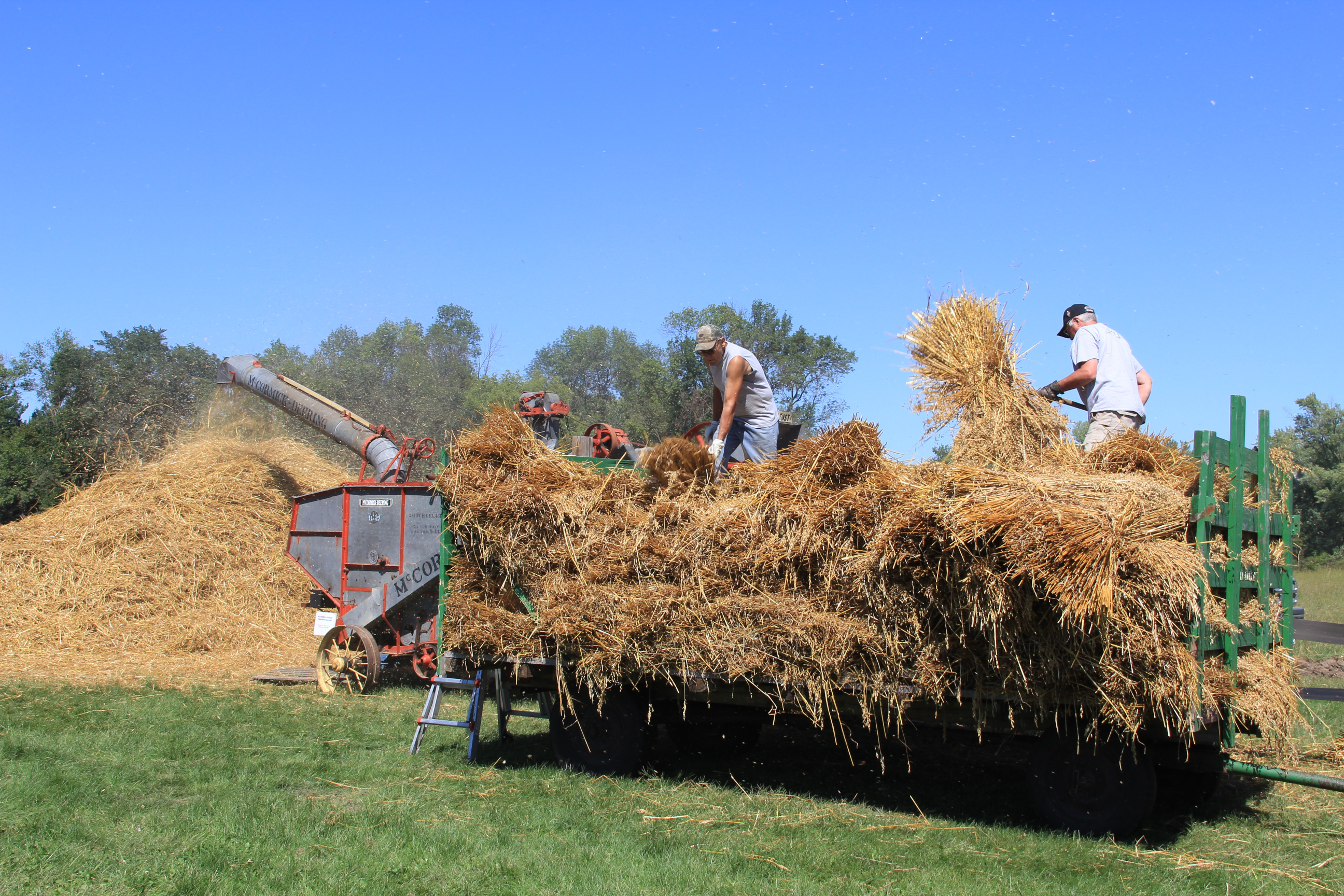
A wagonload of oats awaits threshing at the Rice County Steam & Gas Engines Fall Show. (Minnesota Prairie Roots copyrighted photo August 2024)

MEMORIES. A HISTORY LESSON. A step back in time. The Rice County Steam & Gas Engines Fall Show is that and more. It’s also entertainment, a coming together of friends and families and neighbors. A reason to focus on farming of yesteryear.

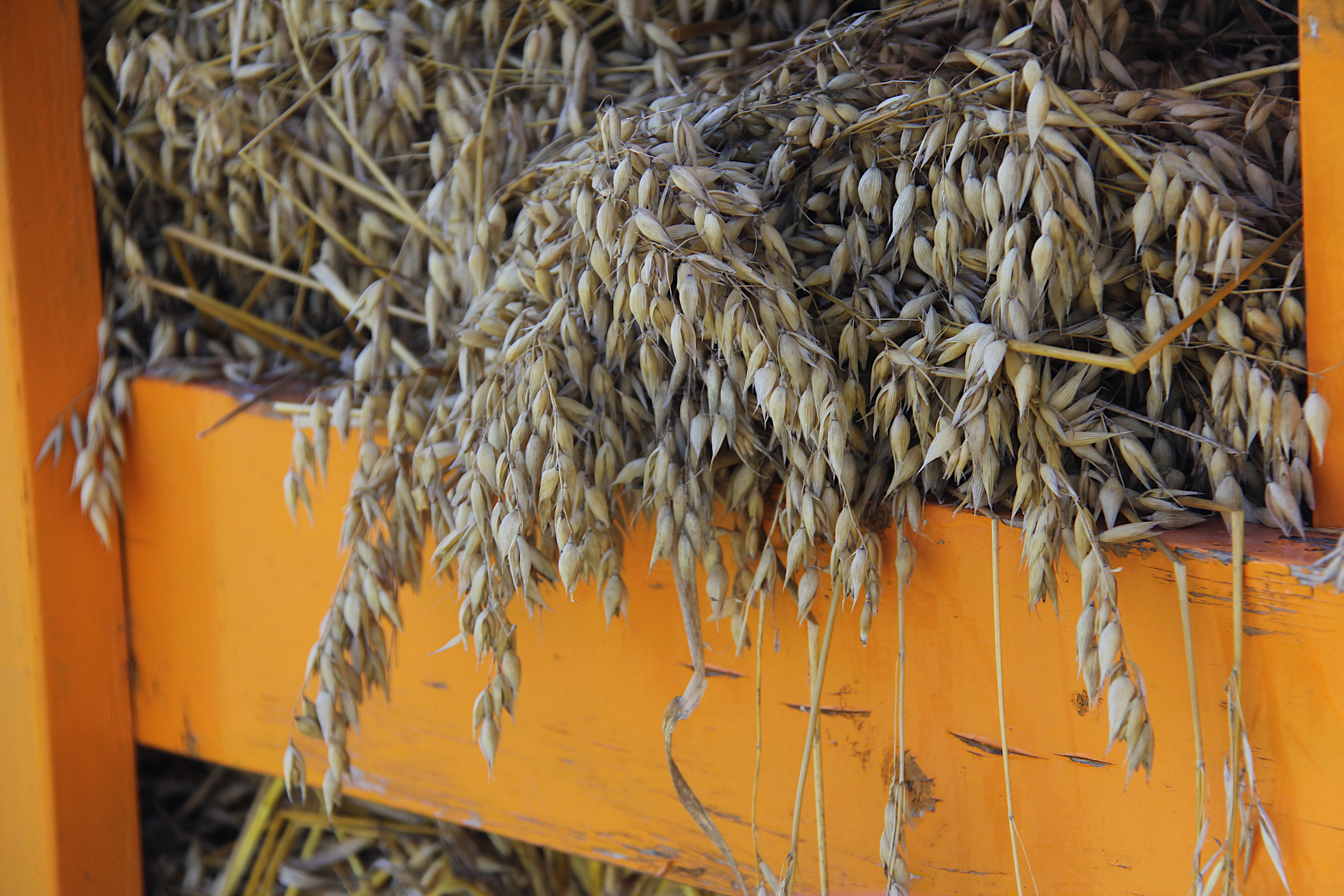
Oats drape over the edge of the wagon. (Minnesota Prairie Roots copyrighted photo August 2024)

I was among the crowds gathered over the Labor Day weekend at the showgrounds south of Dundas. This show features demos, rows and rows and rows of vintage tractors and aged farm machinery, a tractor pull, flea market, music, petting zoo, mini train rides and a whole lot more.

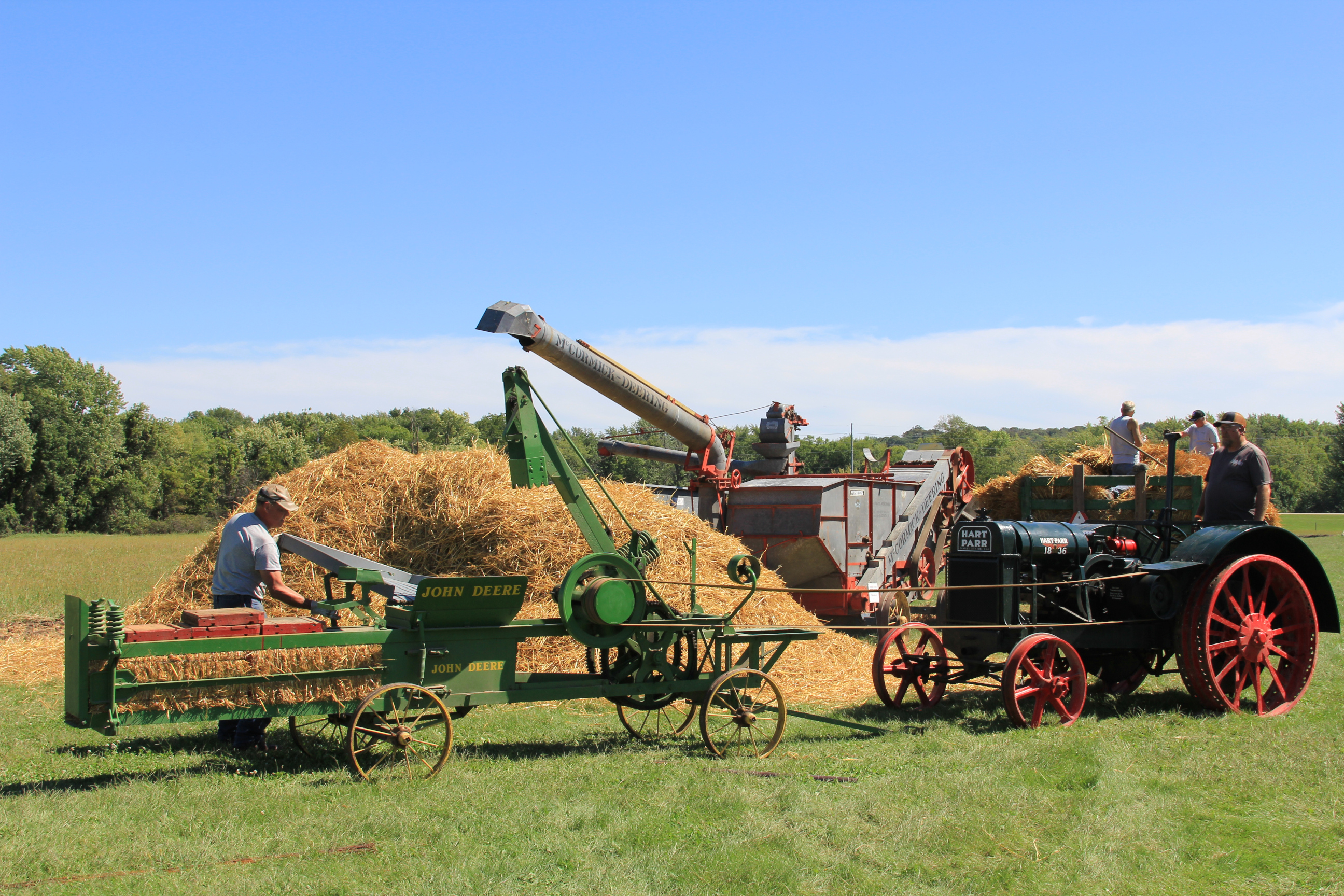
The scene is set to resume threshing with thresher, tractor, baler and manpower. (Minnesota Prairie Roots copyrighted photo August 2024)

For me, a highlight was watching a crew of men threshing oats. The work is hard, labor intensive, even dangerous with exposed belts and pullies. It’s no wonder farmers lost digits and limbs back in the day.

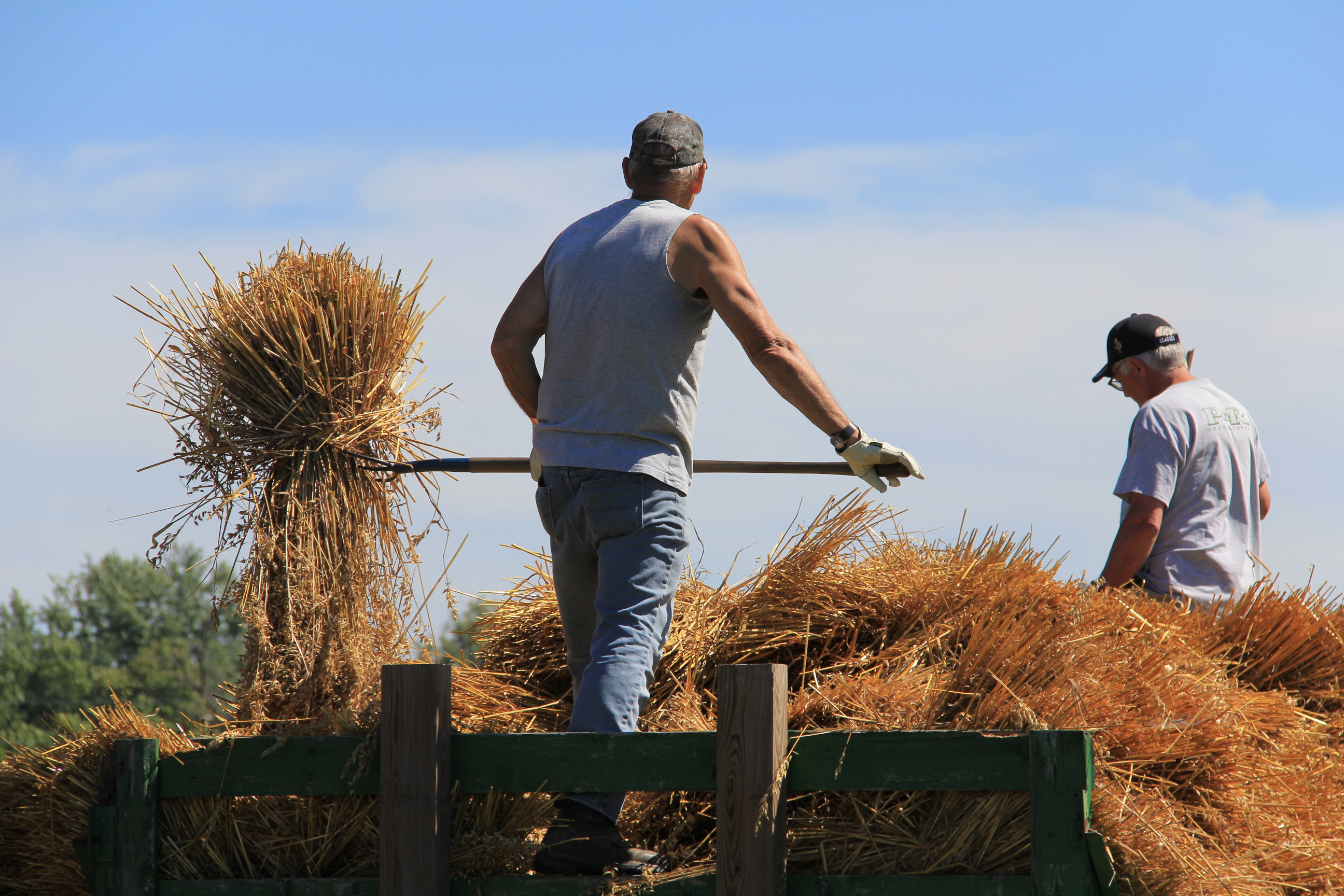
This part of the threshing crew pitches oats bundles into the threshing machine. (Minnesota Prairie Roots copyrighted photo August 2024)

While my observations are not connected to memories, my husband’s are as he recalls threshing on his childhood farm in rural Buckman, Morrison County, Minnesota. After Randy moved with his family from rural St. Anthony, North Dakota (southwest of Mandan), his dad returned to threshing oats. In North Dakota, he used a combine. But his father before him, Randy’s grandfather Alfred, threshed small grains.

Hard at work forking bundles into the thresher. (Minnesota Prairie Roots copyrighted photo August 2024)
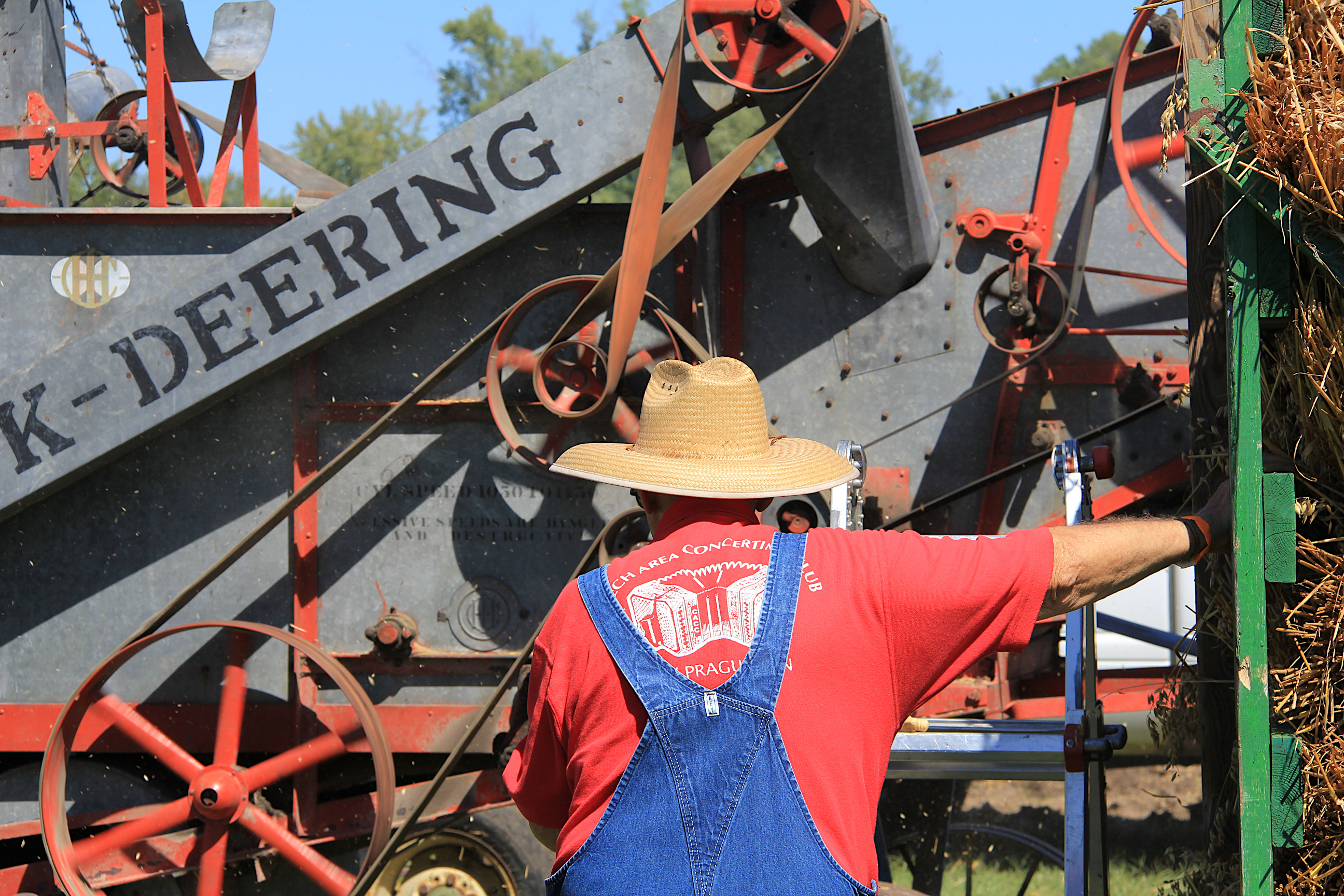
Lots of exposed pullies and belts line the threshing machine. (Minnesota Prairie Roots copyrighted photo August 2024)
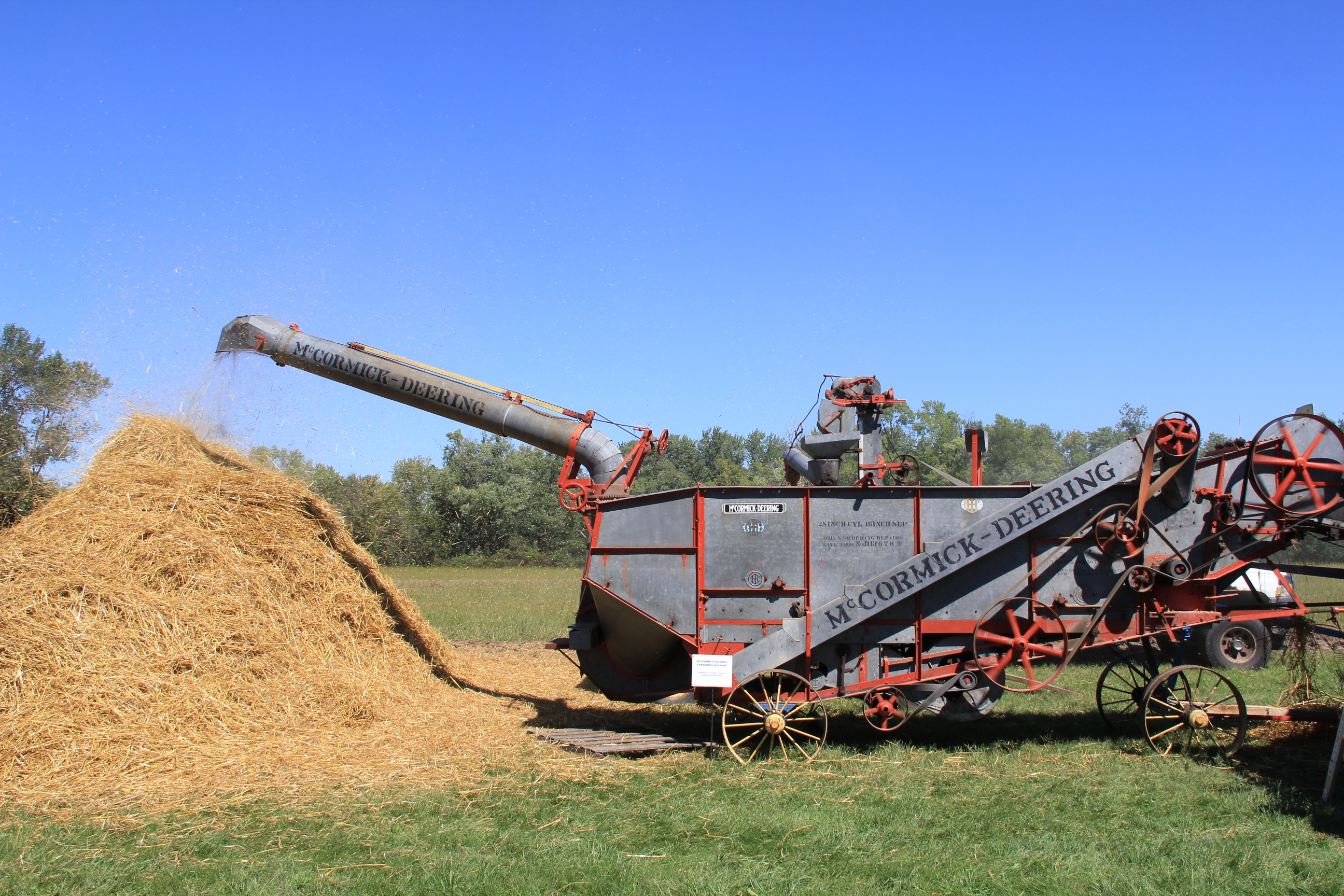
The workhorse of the operation, the threshing machine. (Minnesota Prairie Roots copyrighted photo August 2024)

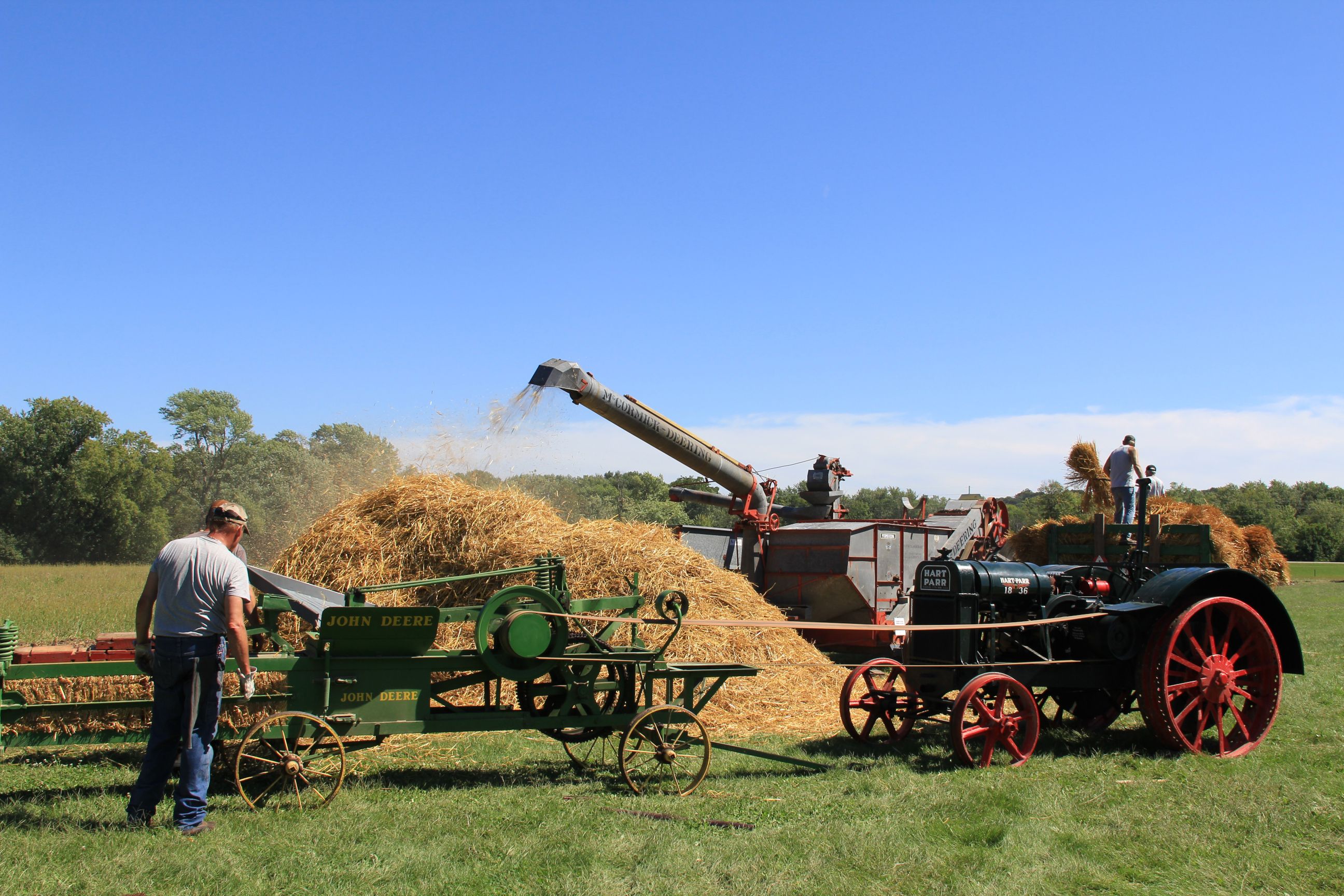
As I watched in Dundas, men forked bundles of oats into a McCormick-Deering thresher. The threshing machine separated the grain from the stalk, the oats shooting one direction into a wagon, the straw the other way into a growing pile. I stood mostly clear of the threshing operation with dust and chafe thick in the air.

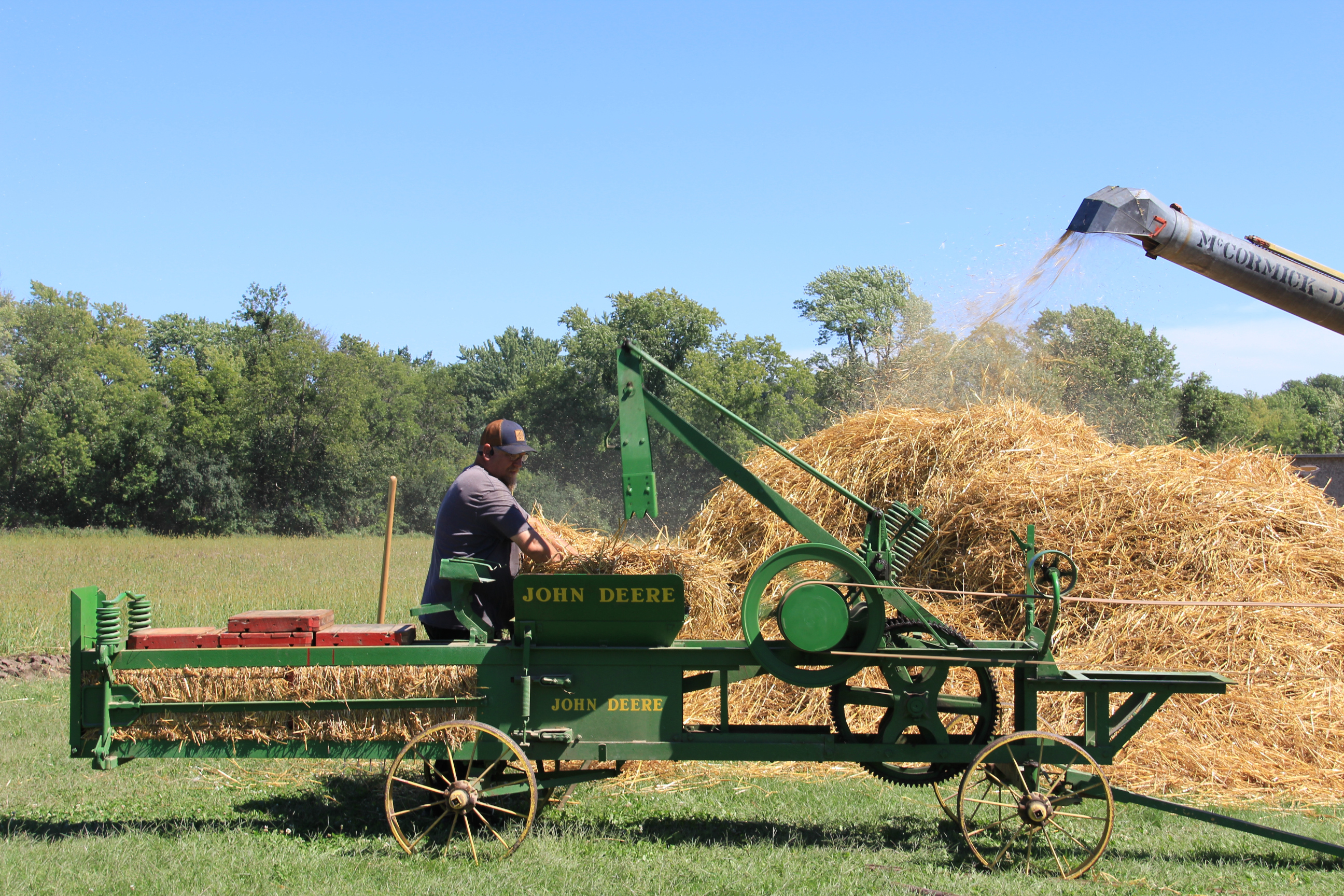
Feeding the loose straw into the baler. (Minnesota Prairie Roots copyrighted photo August 2024)

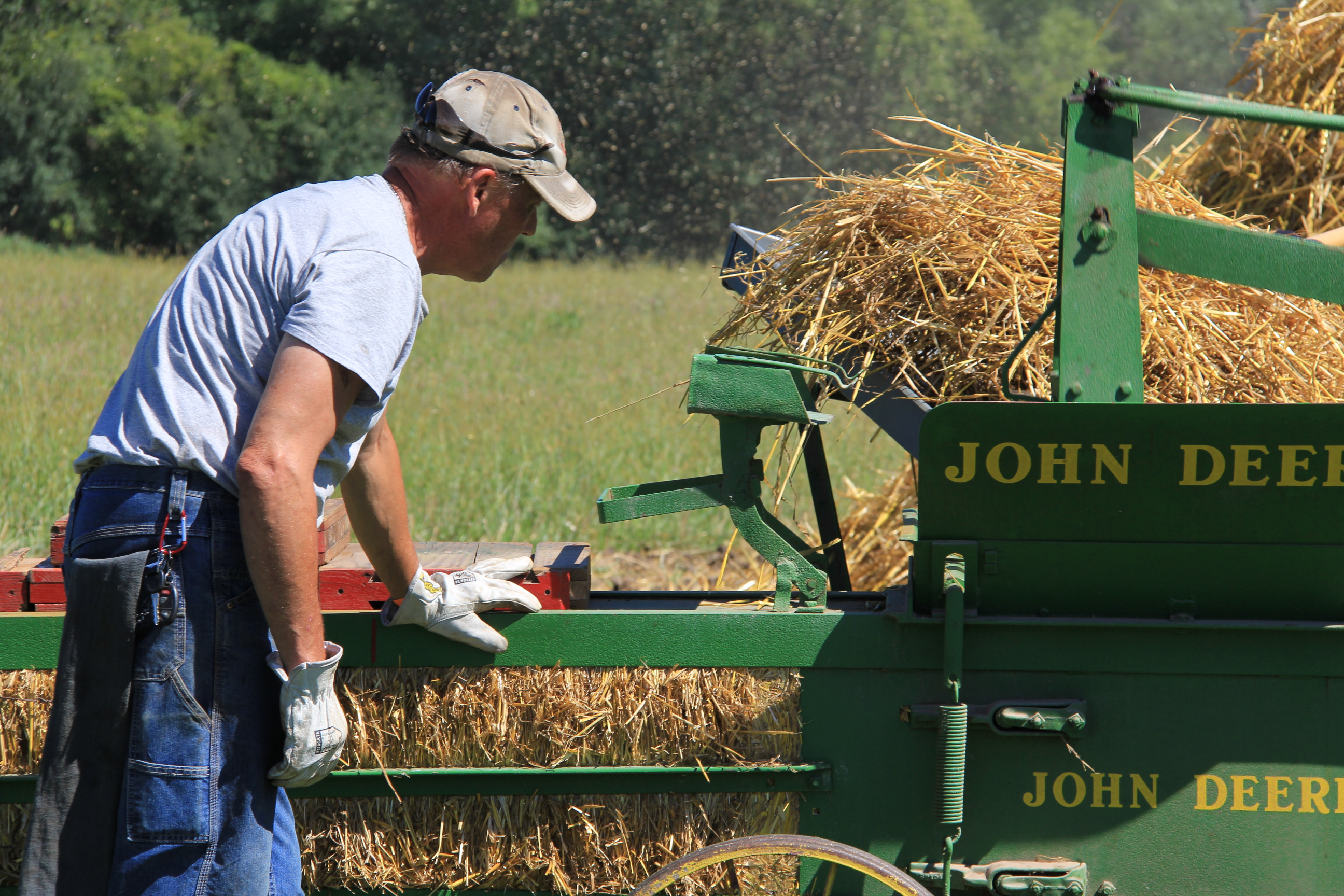
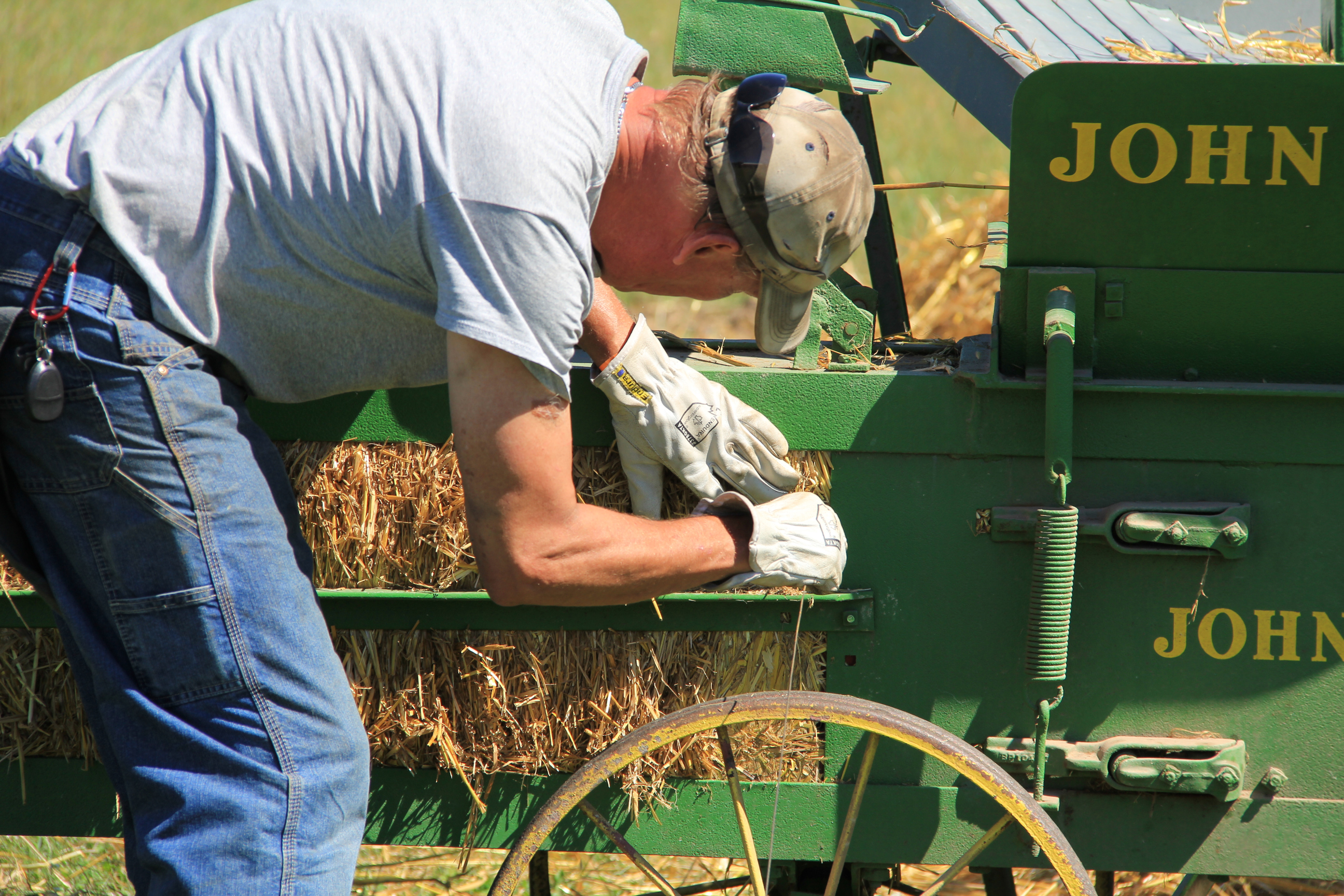
From the straw pile, a volunteer stuffed the stalks into the shoot of an aged baler. An arm tamped the straw, feeding it into the baler. Another guy stood nearby, feeding wire into the baler to wrap the rectangular bales. A slow, tedious process that requires attentiveness and caution.

Watching and waiting for the straw to compact in the baler. (Minnesota Prairie Roots copyrighted photo August 2024)

The entire time I watched, I thought how easy it would be to lose focus, to look away for a moment, to get distracted and then, in an instant, to experience the unthinkable. Farming is, and always has been, a dangerous occupation.

Carefully guiding wire into the baler to wrap each bale. (Minnesota Prairie Roots copyrighted photo August 2024)

Randy understands that firsthand as he witnessed his father get his hand caught in a corn chopper. Tom lost his left hand and part of his forearm. But Randy saved his life, running across fields and pasture to summon help. It is a traumatic memory he still carries with him 57 years later.

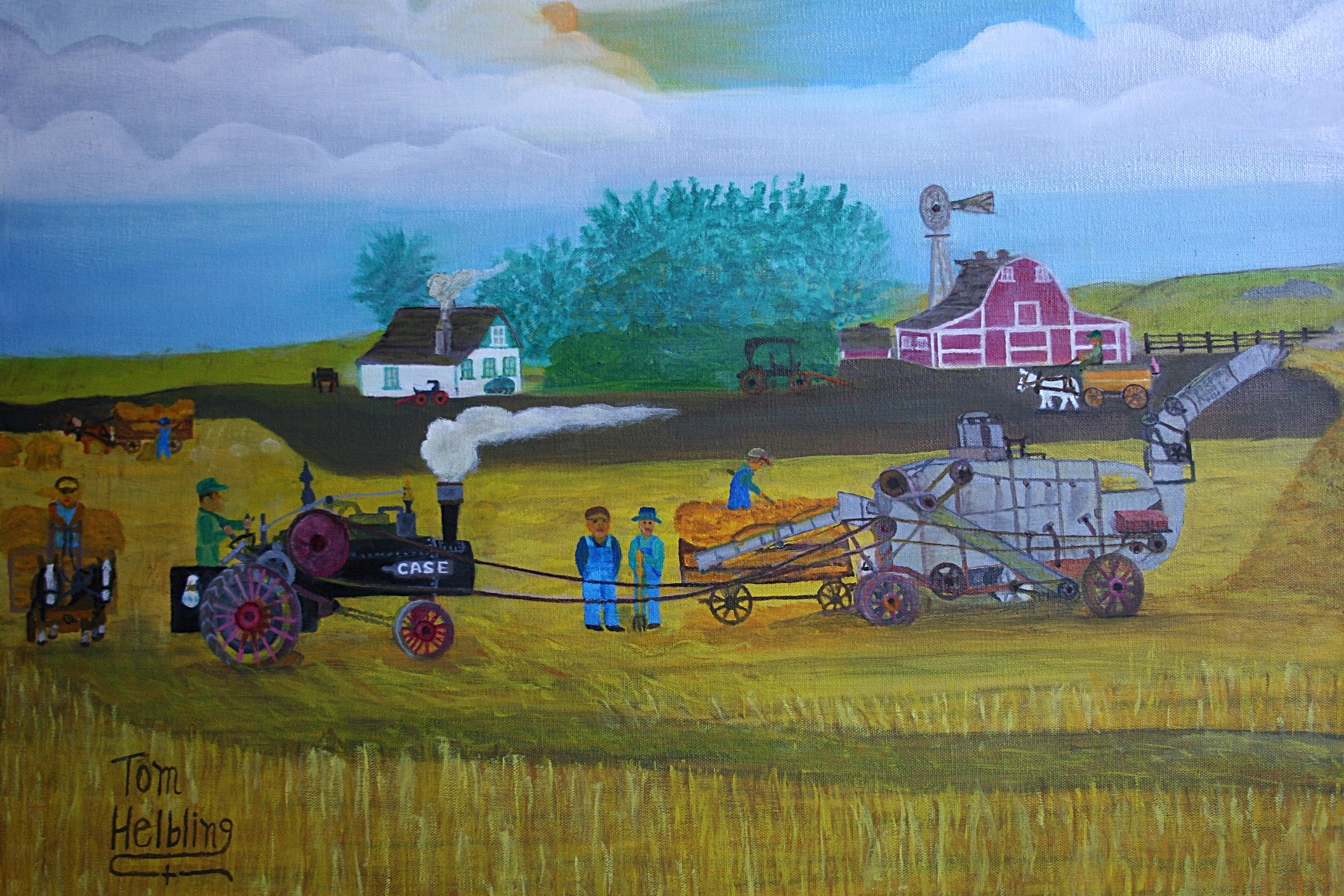
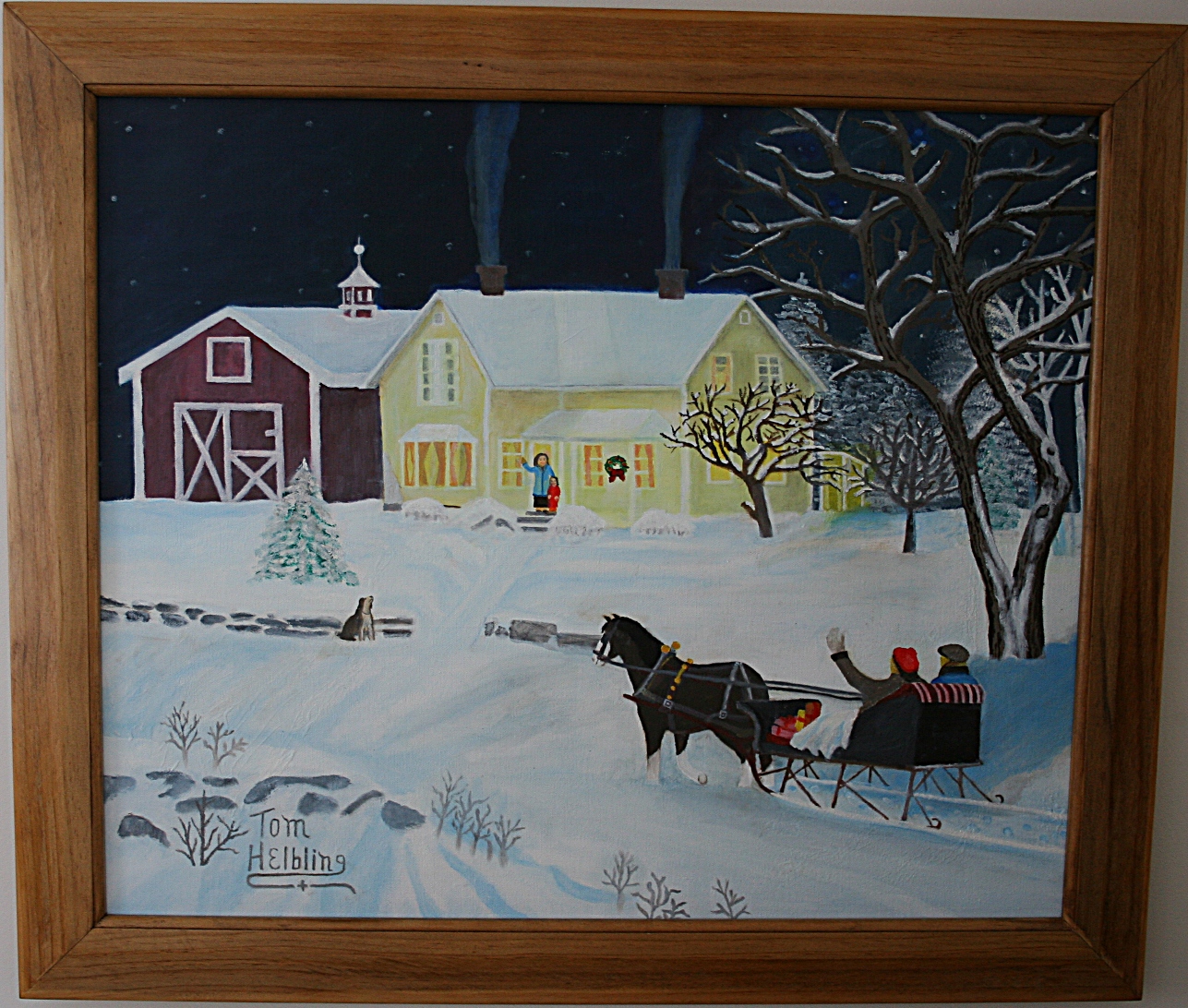
Threshing at Sunnybrook Farm, St. Anthony, North Dakota, as painted by Tom Helbling. (Minnesota Prairie Roots copyrighted file photo)

But memories of threshing are good memories, preserved today in an oil painting from the farm in North Dakota, Sunnybrook Farm. My father-in-law took up painting later in life. Among the art he created was a circa 1920s threshing scene. We have that painting, currently displayed in our living room. I treasure it not only for the hands that painted it, but also for the history held in each brush stroke.

Threshing grain, living history in 2024. (Minnesota Prairie Roots copyrighted photo August 2024)

The painted scene differs some from the threshing scene I saw in Dundas. In North Dakota, horses were part of the work team, the tractor steam powered. In Dundas, there were no horses, no steam engine at the threshing site. Still, the threshing machine is the star, performing the same work. And men are still there, laboring under the sun on a late summer afternoon.

© Copyright 2024 Audrey Kletscher Helbling


Celebrating creativity at Straight River Art Festival May 20, 2024

Acrylic dot art by Alyssa Laws of LoopedbyLaws Dots Division. (Minnesota Prairie Roots copyrighted photo May 2024)

LOONS, LEATHER, LITERARY ART…, oh, the work of creatives who set up shop Saturday at Faribault’s annual Straight River Art Festival. It’s an event that always impresses upon me the incredible talent of those who create with their minds, their hands, even their voices.

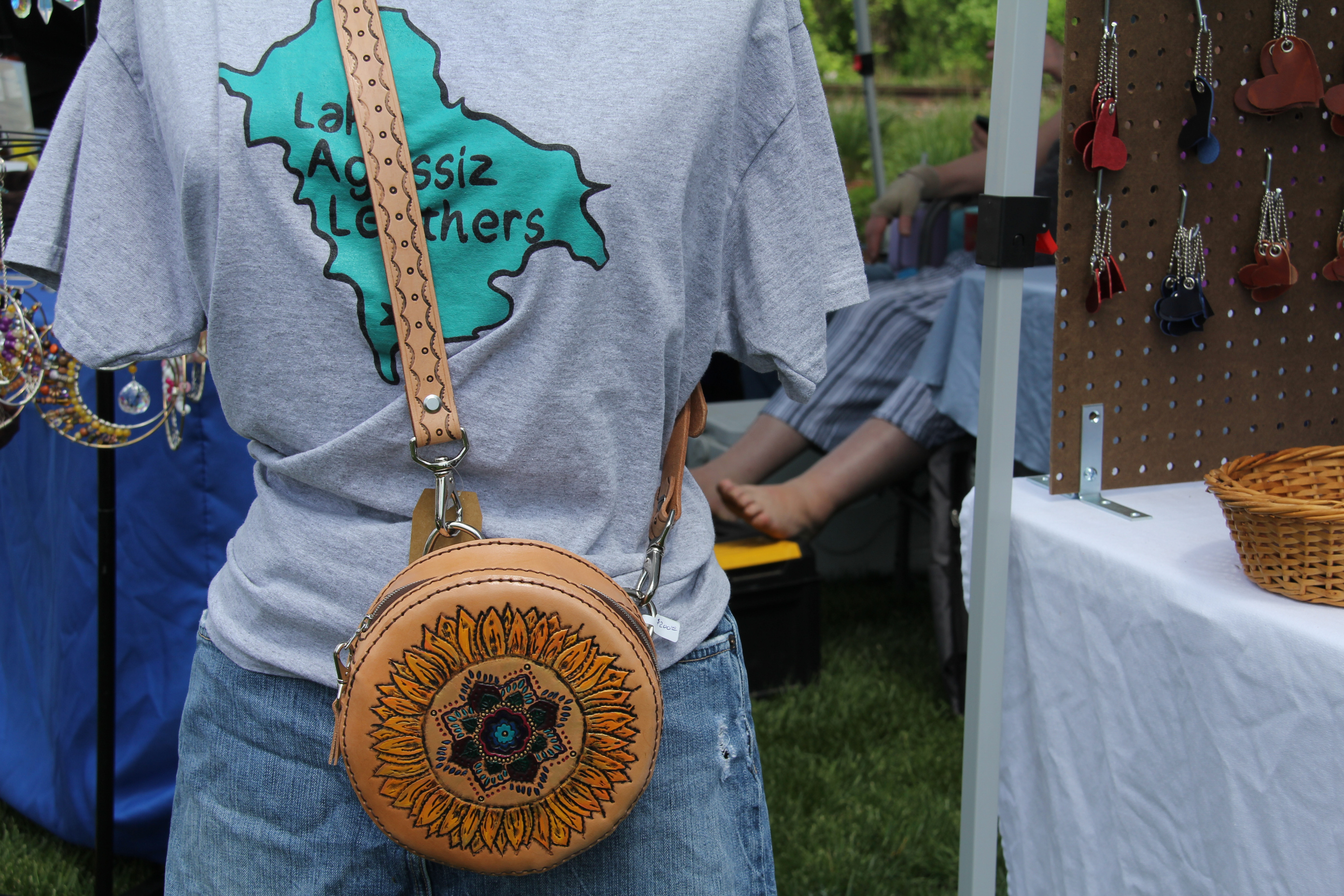
A hand-tooled sunflower mandala circle crossbody purse crafted by Susan McCabe of Lake Agassiz Leathers LLC. (Minnesota Prairie Roots copyrighted photo May 2024)
Mankato author Jason Lee Willis brought a selection of his Minnesota-themed historical fiction books. (Minnesota Prairie Roots copyrighted photo May 2024)
Los Tequileros played a mix of music during the art festival. (Minnesota Prairie Roots copyrighted photo May 2024)

One photographed loons. Another crafted goods from leather. And an author represented the literary arts in his books of historical fiction. Several bands played, bringing in the performing arts.

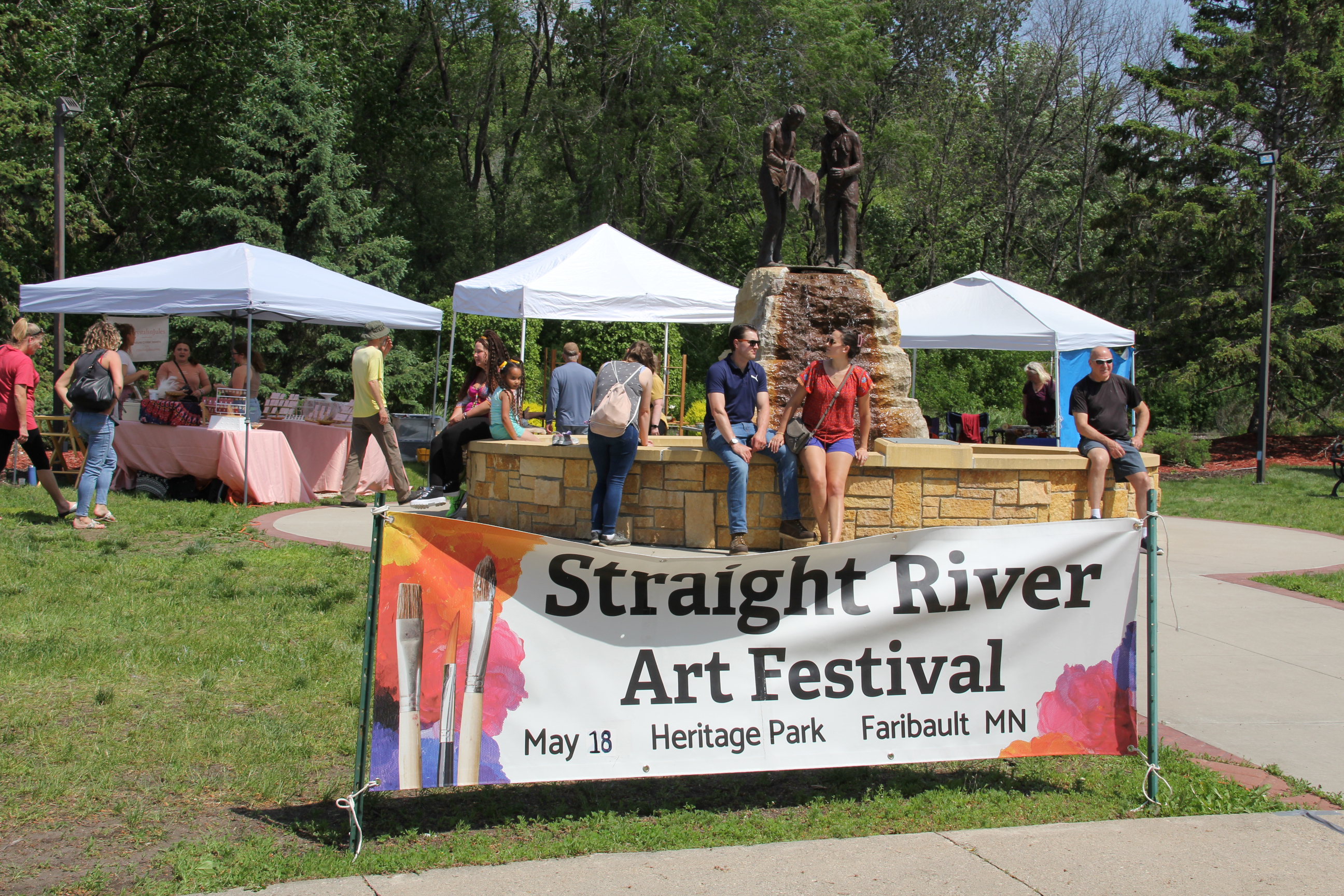
Vendor tents ringed and filled the park. (Minnesota Prairie Roots copyrighted photo May 2024)

This fest, held in Heritage Park against a scenic backdrop of trees and limestone bluffs aside the Straight River near downtown, is a lovely setting for meandering among vendor tents, viewing art, chatting with artists and enjoying the Minnesota outdoors.

Bea Duncan Memorial Fountain centers Heritage Park, site of the art festival. (Minnesota Prairie Roots copyrighted photo May 2024)

A fountain sculpture depicting town founder Alexander Faribault trading with a Dakota man centers the park, adding an historic, artsy element.

An acrylic painting by Peggy Paulson of Prairie Creek Art, Faribault. (Minnesota Prairie Roots copyrighted photo May 2024)
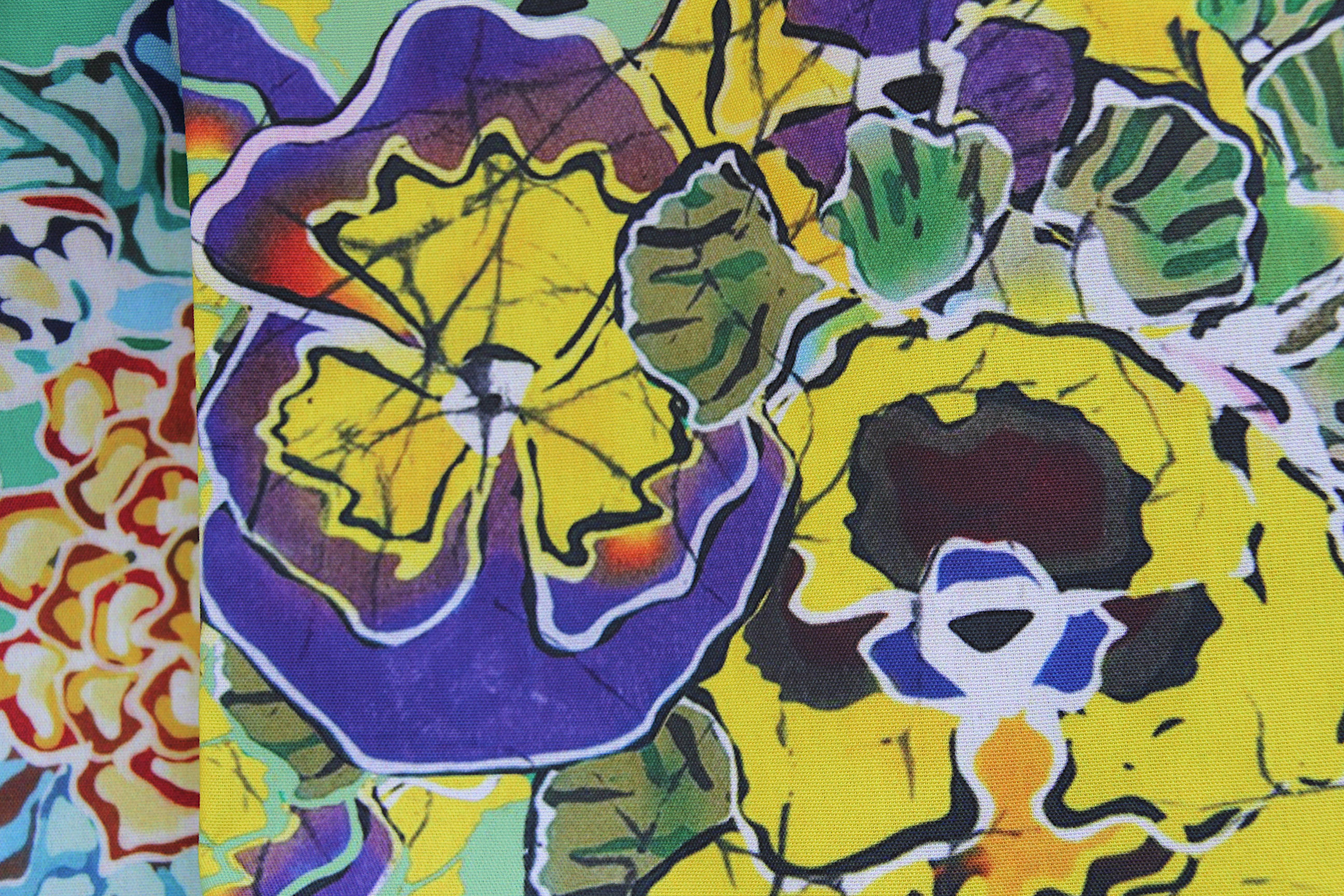
Original textile design art done with a serti-batik technique by Suz Klumb of Brigg Evans Design. (Minnesota Prairie Roots copyrighted photo May 2024)
Kathy Weed’s textile art. (Minnesota Prairie Roots copyrighted photo May 2024)

Like most arts festivals, this one featured a variety of art, this year from 30-plus creatives. I saw pottery, fabric and textile, batik, acrylic paintings, photography, stained glass, jewelry, fiber soft sculptures, handcrafted glass botanicals and more. Much more.

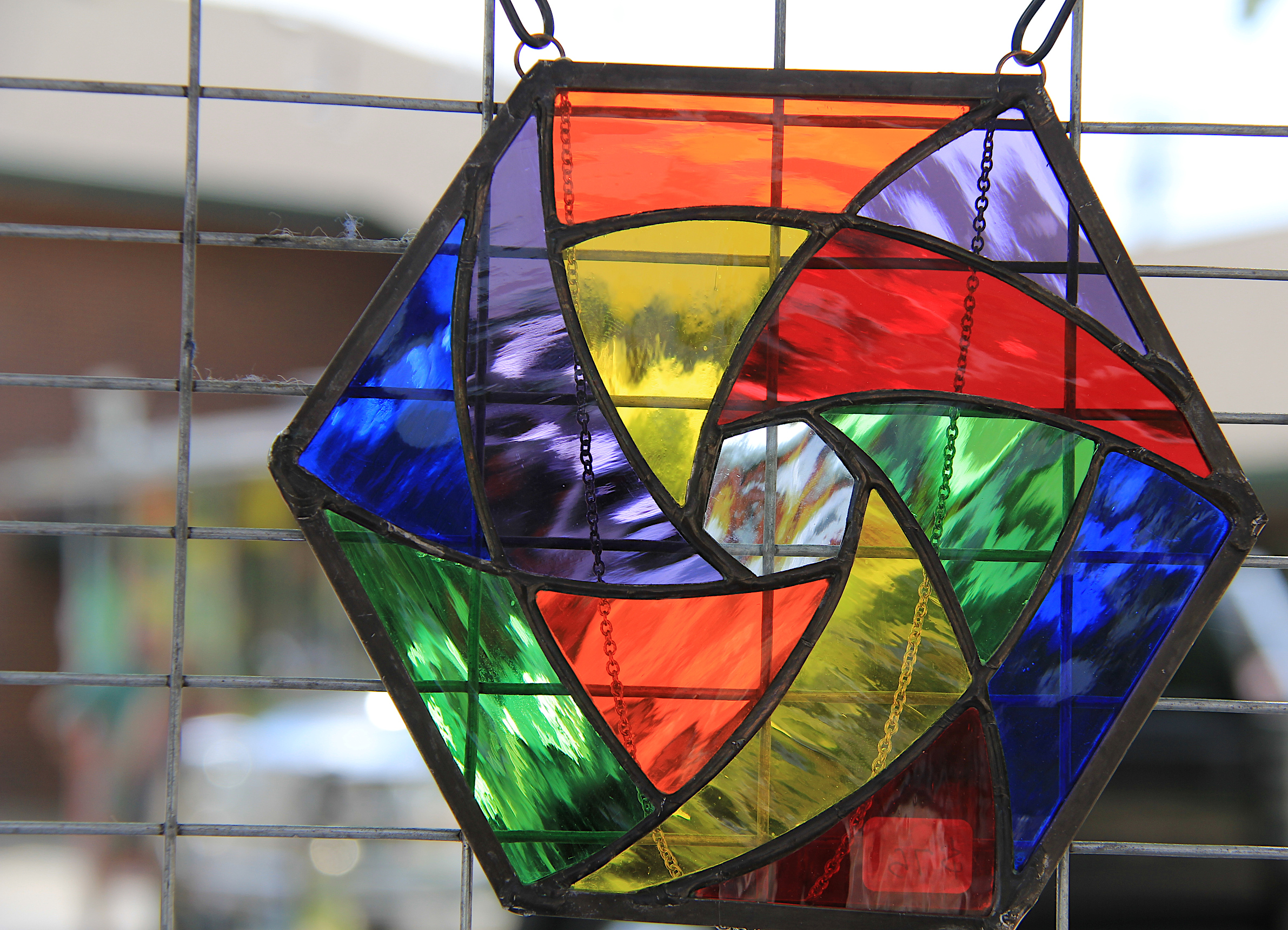
A suncatcher by Sandra Sargent of Bending Sunlight Stained Glass Studio. (Minnesota Prairie Roots copyrighted photo May 2024)
Textured fiber art by Lynn Hirschey. (Minnesota Prairie Roots copyrighted photo May 2024)
Diane Lockerby’s earthy pottery mugs. (Minnesota Prairie Roots copyrighted photo May 2024)

Vivid colors. Textures. Earthen hues. Stitching and sculpting. And shaping. An assortment of art appealing to assorted interests. It was all there.

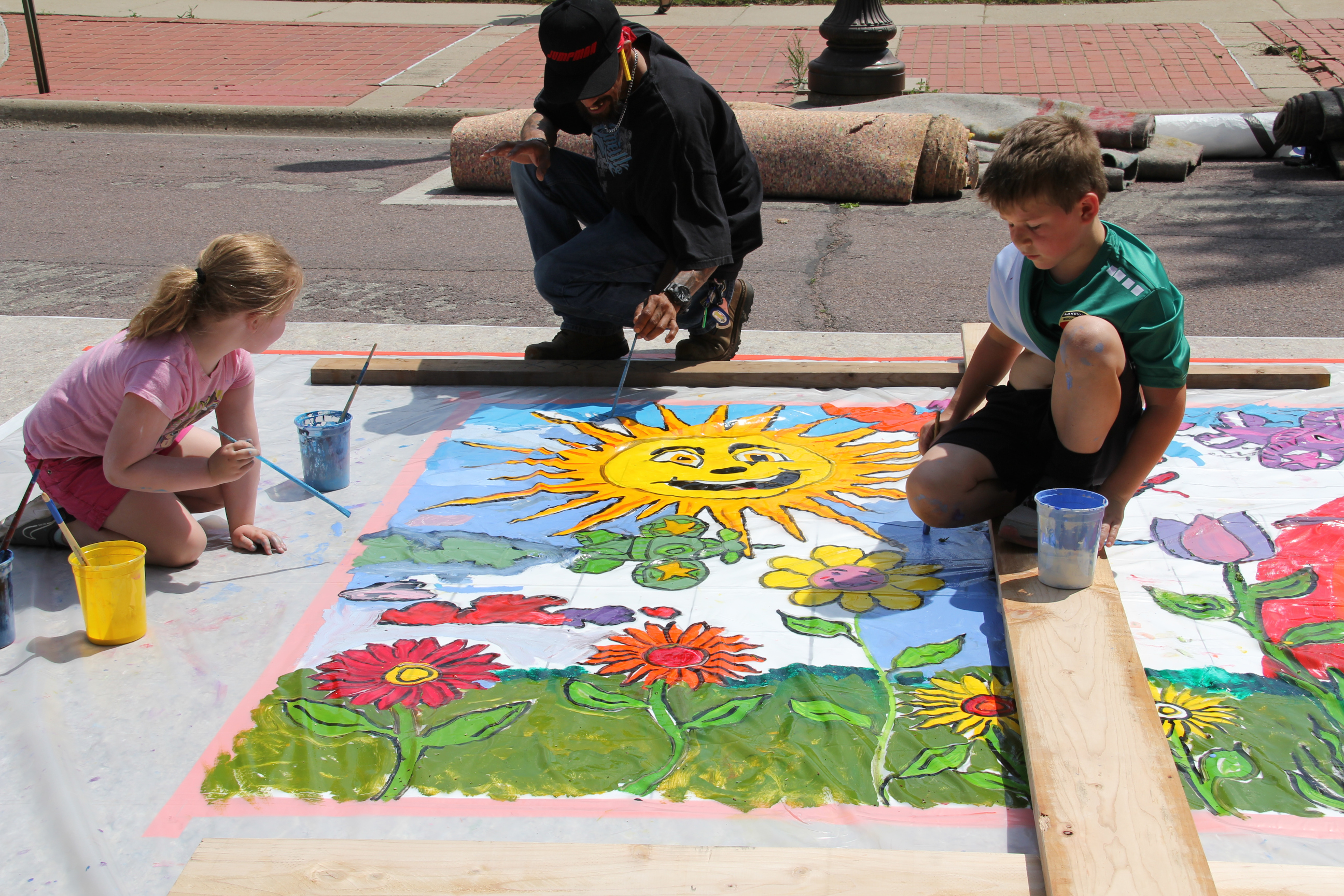
Mural painting at the Straight River Art Festival. (Minnesota Prairie Roots copyrighted photo May 2024)

There were activities for kids also, which I always appreciate since it’s important to engage families. The Paradise Center for the Arts offered hands-on art. Books on Central, a used bookshop in downtown Faribault run by Rice County Area United Way, handed out free picture books to little ones. And on a section of blocked off street, visual artist Stephen McKenzie laid out a mural for the community to paint. It’s on display now inside the Bachrach building along Central Avenue.

The center of the mural. (Minnesota Prairie Roots copyrighted photo May 2024)

The mural is bold and vibrant, engaging and beautiful, reflecting nature. It reflects, too, a sense of togetherness, that we are all one on this earth, under one sun, all colors of the rainbow, surrounded by beauty.

Kids and adults work side-by-side to paint the community mural. (Minnesota Prairie Roots copyrighted photo May 2024)

Watching adults and youth working side by side, painting bold hues onto the mural design, I felt joy. Individuals worked as a cohesive team to create art. There’s something to be said for that in this time of much divisiveness.

Paint inside a trailer used in painting the mural. (Minnesota Prairie Roots copyrighted photo May 2024)

Art brought folks together on Saturday to show and sell their art. But, more than that, the Straight River Art Festival builds community, energizes and connects creatives. There’s a certain vibe to an event like this that feels good, really good. But then again, I love art. And I deeply appreciate those who share it with us.

© Copyright 2024 Audrey Kletscher Helbling

All artwork was photographed with permission from the artists.


Regarding Ukraine March 9, 2022

A peace dove themes this painting on burlap by Mexican artist Jose Maria de Servin. I purchased this at a recycled art sale in Faribault perhaps 10 years ago. It is among my most-treasured pieces of art. (Minnesota Prairie Roots copyrighted photo March 2022)

I’M STRUGGLING, really struggling, with the invasion of Ukraine by Russia and the resulting death, destruction and humanitarian crisis.

Deaths of civilians, documented in a powerful image of a mother, her teenage son, her elementary-age daughter and a family friend killed by Russian mortar fire. Lying dead in the street, luggage beside them, as they attempted to reach safety in Kyiv. Photojournalist Lynsey Addario witnessed the attack and photographed the scene for The New York Times. That published March 6 on the front page. In a television interview, I could see and hear Addario’s pain, her grief. She struggled to photograph the deadly scene, terming this killing of innocent civilians a “war crime,” which the world needed to see. I saw. I cried.

I’ve seen, too, media images of bombed homes and other buildings. Utter destruction. I cry.

And I cry, too, over the “humanitarian crisis,” the endless exit of refugees from this country under attack. I can’t even count how many times I’ve cried over scenes of young mothers wheeling suitcases with young children clinging to their hands. I imagine my own daughter doing the same with my two grandchildren and the idea of that shakes me to the core. To see children clutching their stuffed lovies or a mom spoon-feeding soup to her preschooler roadside or a soldier cradling a baby…it’s overwhelmingly sad.

I wonder why, this time, I’ve felt such angst, such concern, such grief. War has always wrought death, destruction and exodus. But this seems different in sheer numbers of individuals and families fleeing. This seems different in the depth of evil behind what is unfolding in Ukraine. This seems different in the worldwide implications. I write this in the context of my life-time.

I think, too, my husband’s connection to Ukraine, where his ancestors resettled from Germany to then Russia (current-day Ukraine), deepens my sorrow. His forefathers once farmed the land around Odessa before journeying to America and a new life in North Dakota.

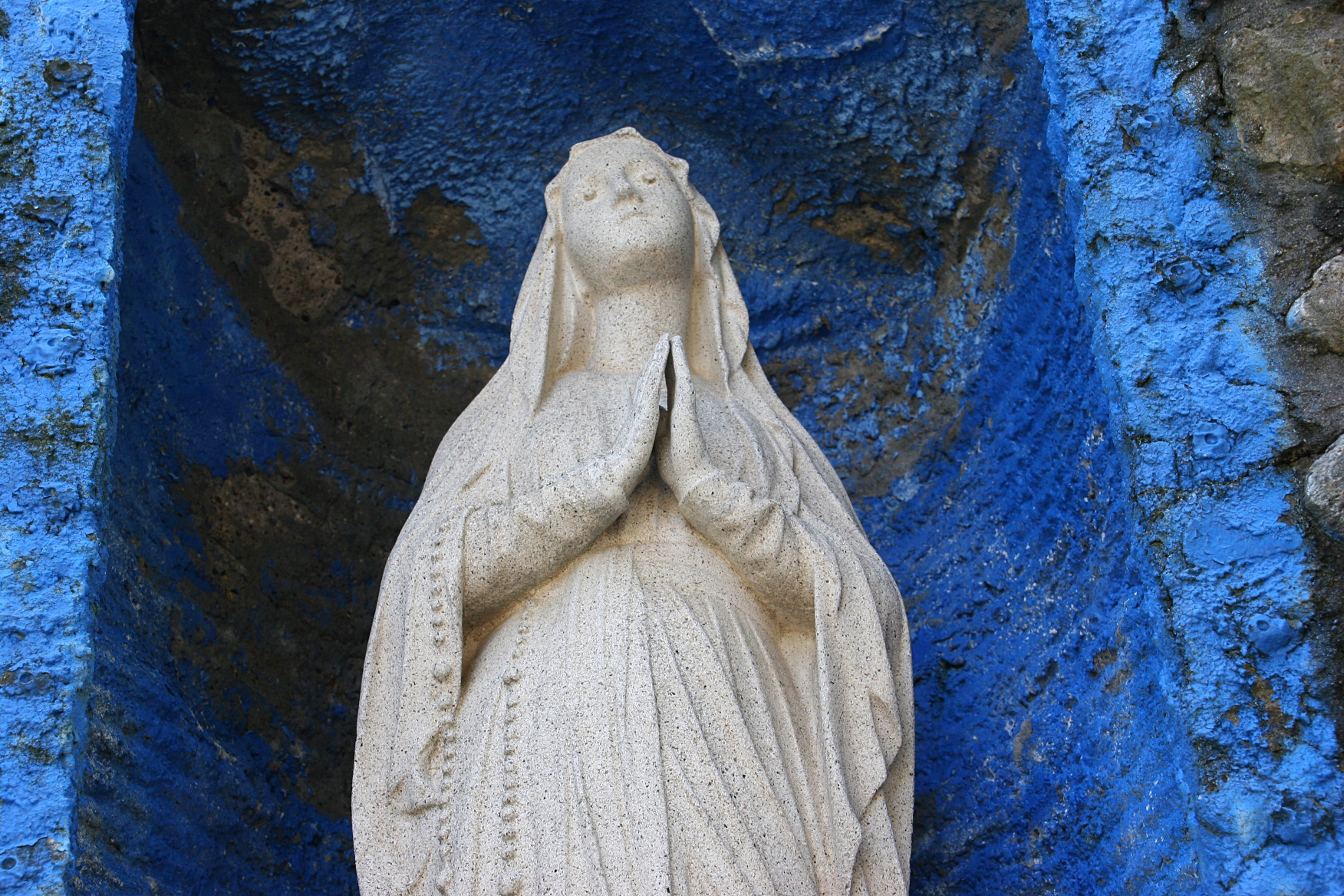
In prayer…just as Mary is depicted praying in this statue at the Holy Trinity Catholic Church Grotto in Waterville, Minnesota. (Minnesota Prairie Roots copyrighted file photo September 2016)

My feelings now are mostly of concern, angst, helplessness. Yet, there are three actions I am taking. As a woman of faith, I pray. I pray for protection of the Ukrainian people, some by name (given to me by friends). I pray for their leader, President Volodymyr Zelensky, and other world leaders. I pray for peace. And more.

I am also supporting and encouraging friends worried about people in Ukraine. Family of family. Friends.

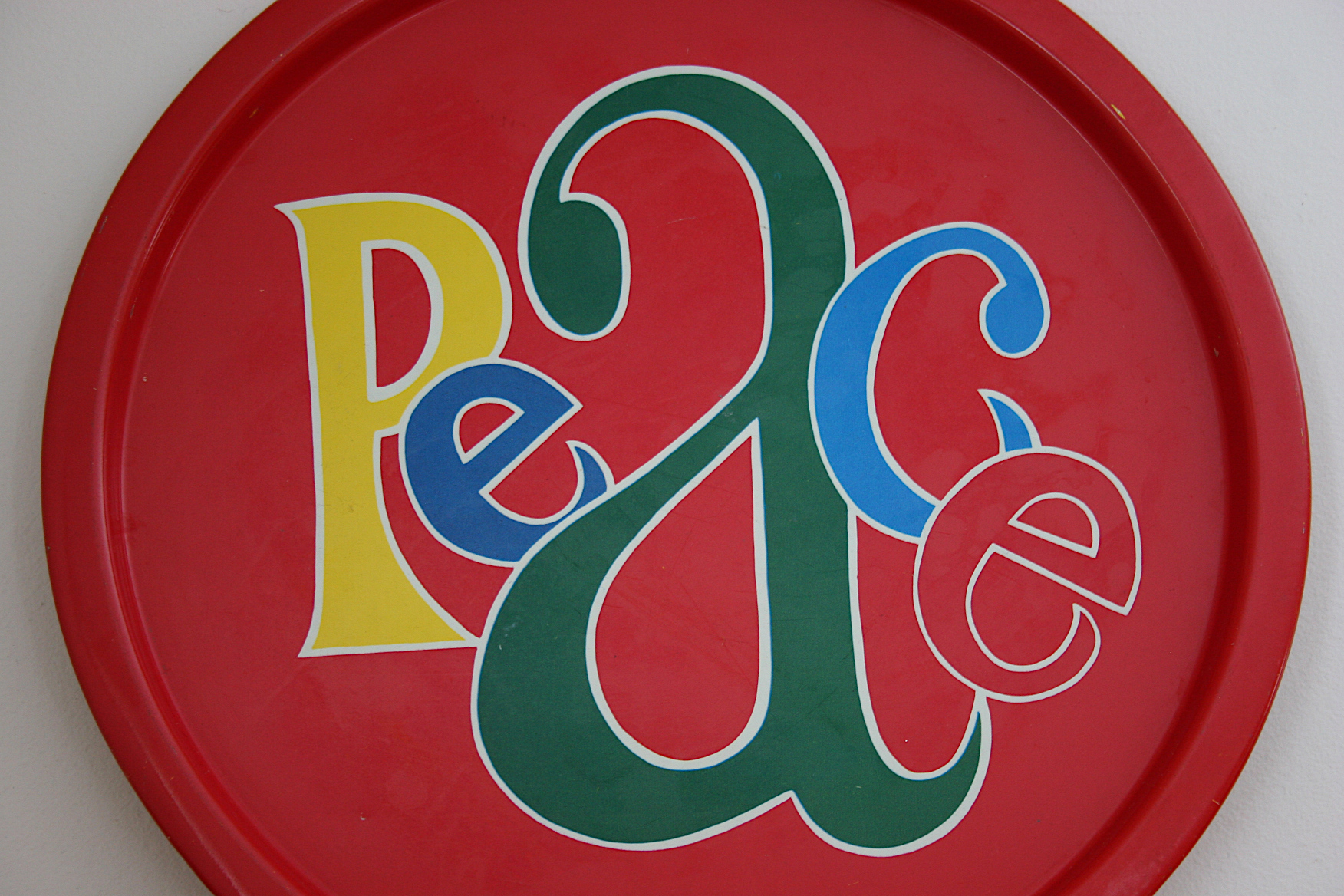
I purchased this vintage tray at an antique shop in St. Charles many years ago. It’s likely from the 60s or 70s. (Minnesota Prairie Roots copyrighted photo March 2022)

And, finally, I’ve pulled out my “peace” art as a visual reminder. Coming of age in the 1960s and 1970s, at the time of the Vietnam War, the word “peace” played into my everyday vocabulary. The peace symbol was everywhere. On posters, jewelry, drawn in my spiral-bound notebooks. Today, more than ever, I need visual cues that peace is possible. I need hope when I cry.

TELL ME: How are you reacting to the situation unfolding in Ukraine? If you have personal connections to Ukraine and feel comfortable sharing, please do.

ALSO, please take time to read my friend Paula’s post, “Spring in Europe.” You will be moved by the message from this US combat veteran and native Minnesotan living with her husband in the Netherlands.

© Copyright 2022 Audrey Kletscher Helbling


Believe April 20, 2014

Filed under: Uncategorized — Audrey Kletscher Helbling @ 6:00 AM
Tags: , , , , , , , , , ,

"The Risen Lord," painted in by my artist friend, Rhody Yule of Faribault, who dies in June 2011 at the age of 92.

“The Risen Lord,” painted in 1951 by my artist friend, Rhody Yule of Faribault, who died in June 2011 at the age of 92.

When Jesus rose early on the first day of the week, he appeared first to Mary Magdalene… She went and told those who had been with him and who were mourning and weeping. When they heard that Jesus was alive and that she had seen him, they did not believe it.—  Mark 16: 9-11


Creative parenting: Let the painting & mud slinging begin August 26, 2013

Filed under: Uncategorized — Audrey Kletscher Helbling @ 5:00 AM
Tags: , , , , , , , ,

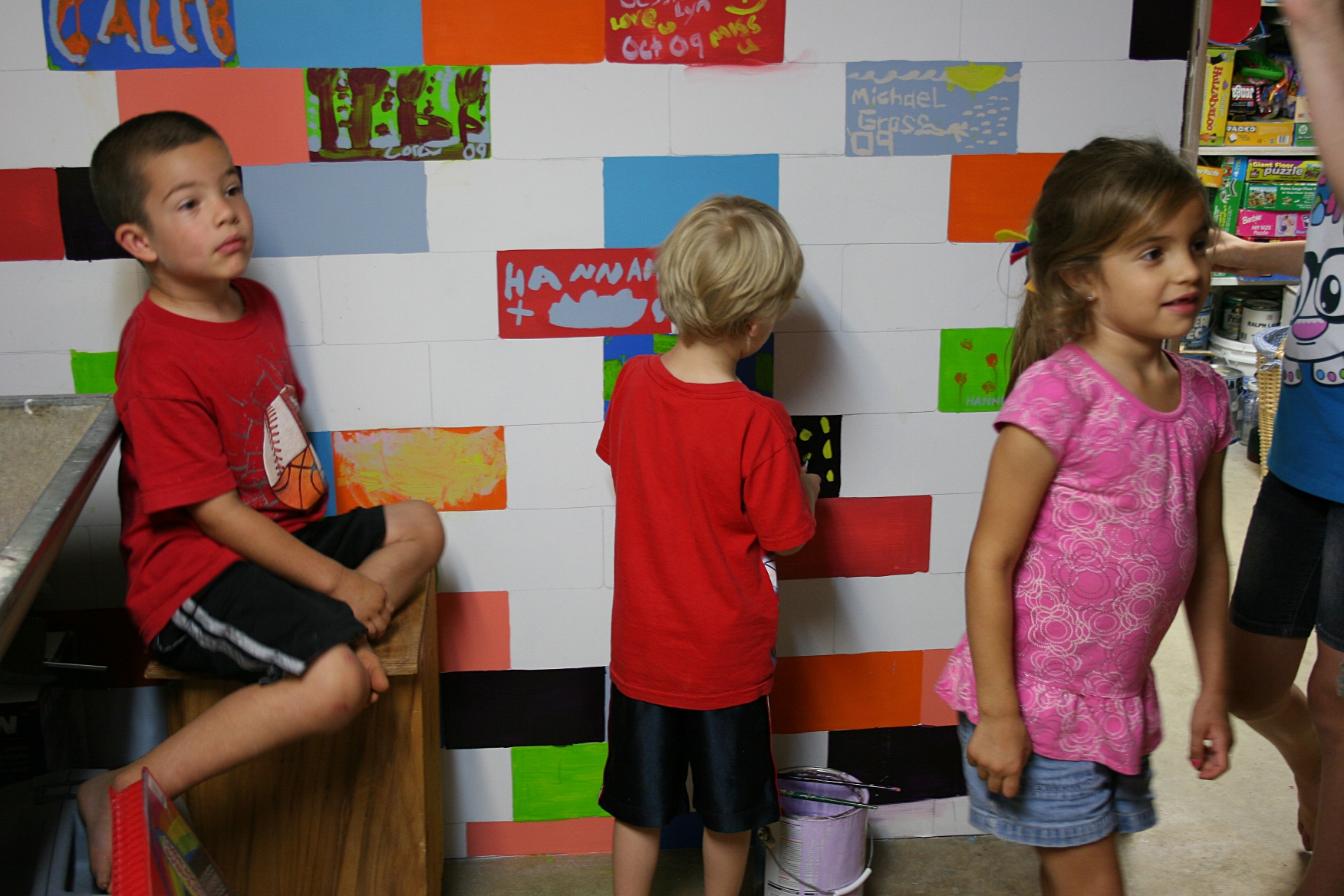
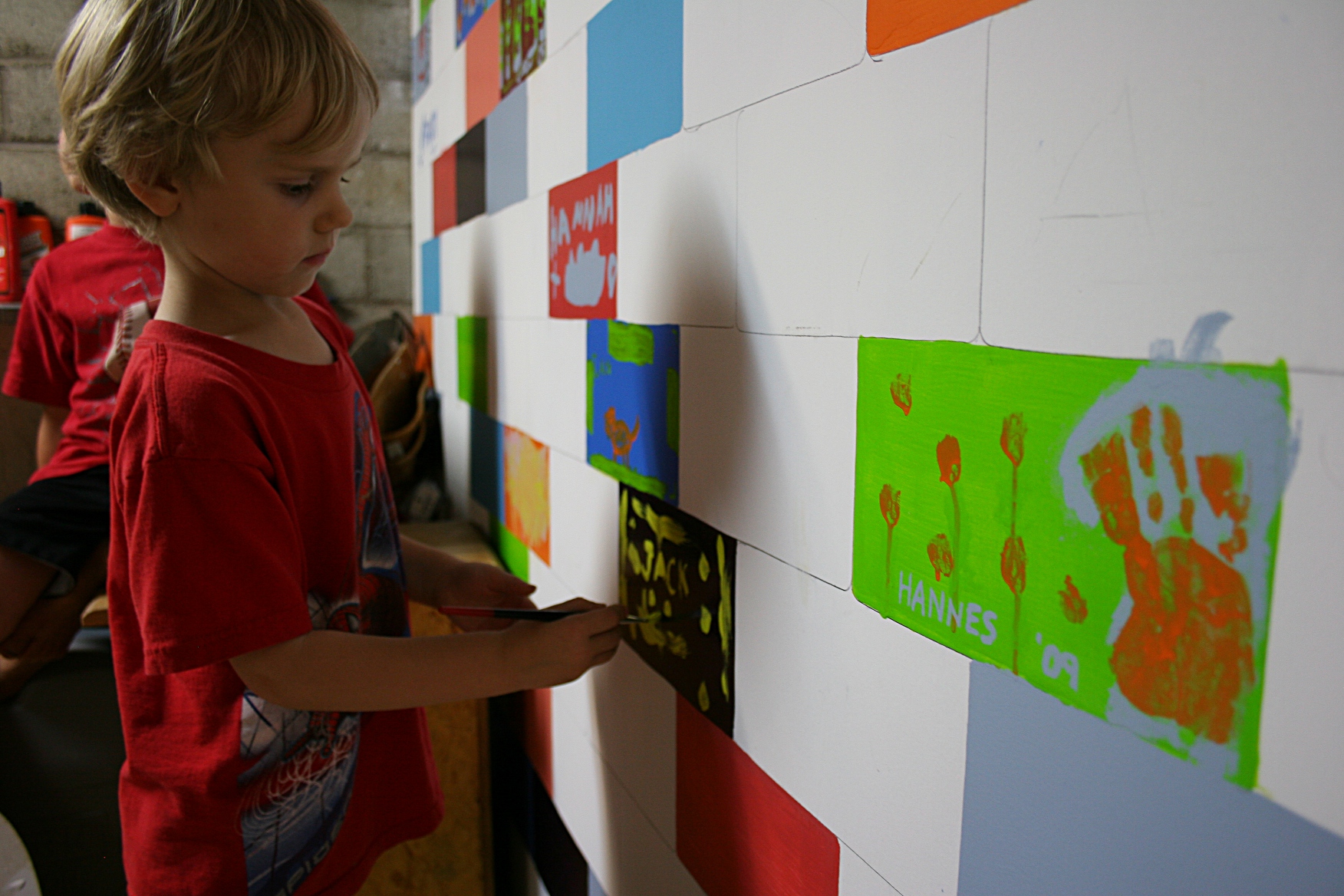
The kids, Braxton, left, Jack and Nevaeh, were thrilled to paint blocks, unlike me.

The kids, Braxton, left, Jack and Nevaeh, were thrilled to paint blocks, unlike me.

I SWEAR SHE would have locked me in the basement.

The sheetrock wall canvas.

The sheetrock wall canvas.

Billie Jo, a former preschool teacher and the mother of two school-aged youngsters, insisted. “You need to paint a brick, Audrey.” She emphasized “Audrey.”

The paint comes from the county recycling center.

The paint comes from the county recycling center.

There was no wiggling my way out of her demand, even if my friend was preoccupied with opening paint cans, stirring paint, handing out brushes, washing kids’ hands and wiping paint spills from the concrete basement floor.

See, I really was busy taking photos, here of Hannah. She's quite the artist who not only paints, but also sews. Plus, she writes poetry.

See, I really was busy taking photos, here of Hannah. She’s quite the artist who not only paints, but also sews. Plus, she writes poetry. Oh, and she made that pony tail holder in her hair.

feet

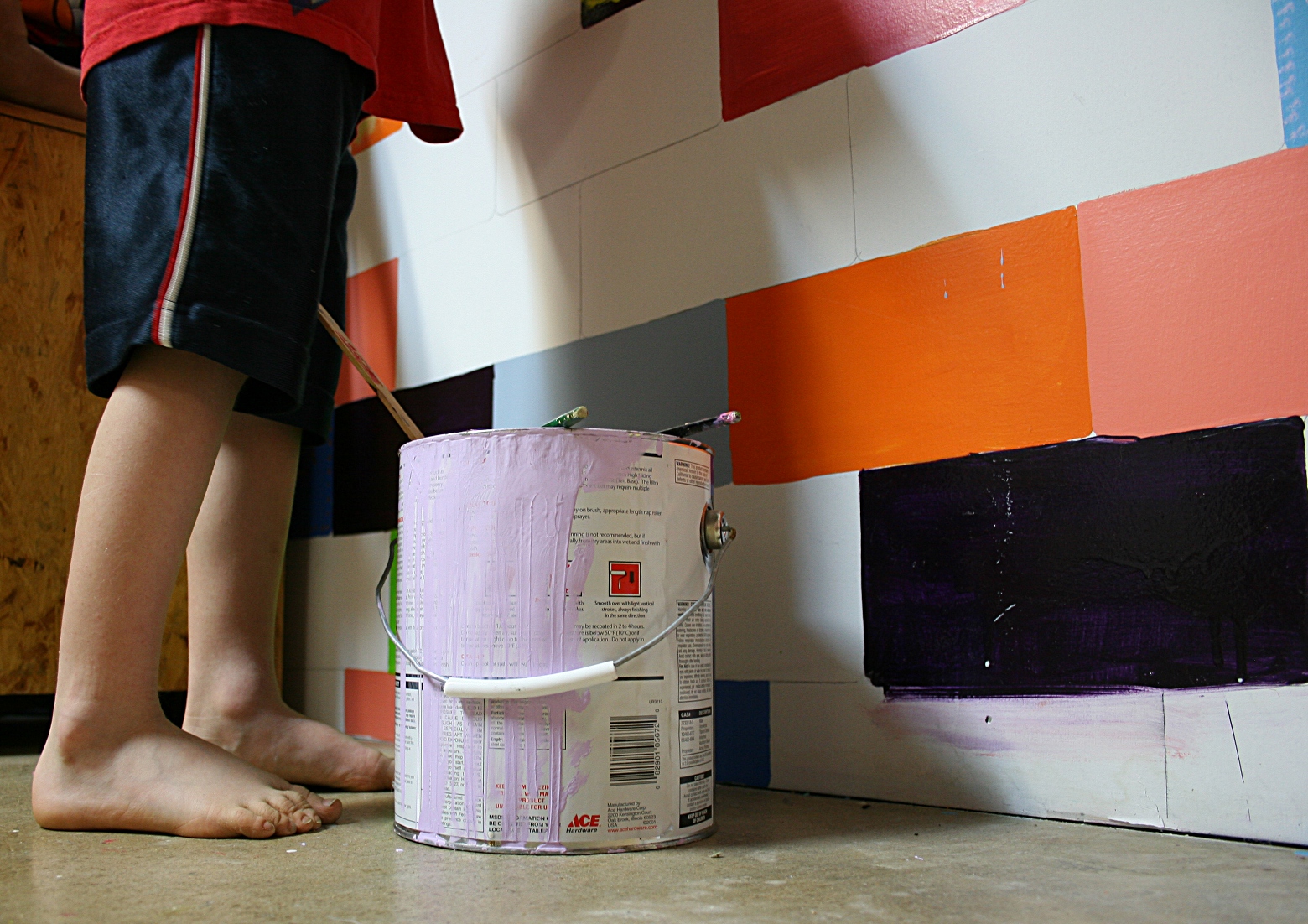
Painting in bare feet.

Jack creating his masterpiece.

Jack creating his masterpiece.

My excuse of “I’m busy taking pictures” wasn’t sliding by Billie Jo. Nope.

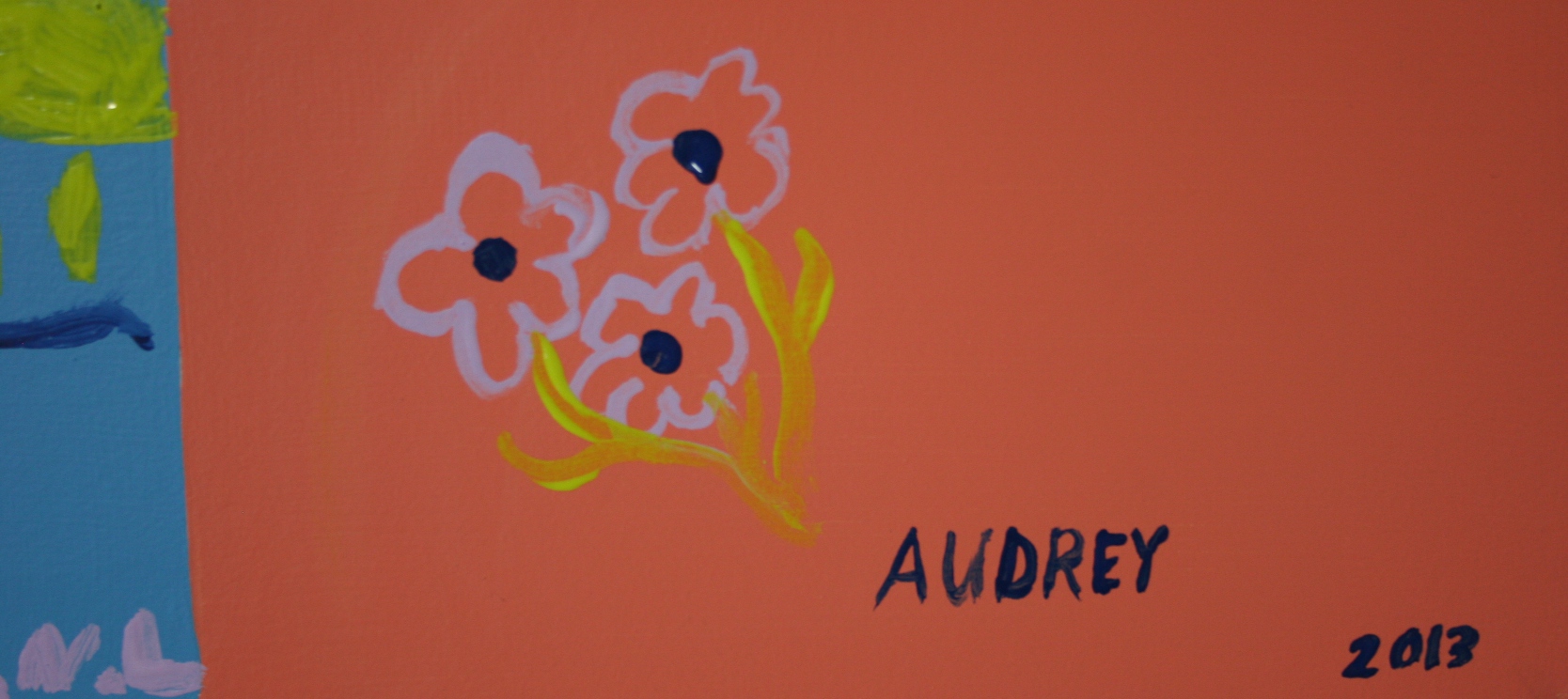
My, ahem, masterpiece.

My, ahem, masterpiece.

So, eventually, I set down my camera and picked up paintbrushes to paint a clutch of lilac hued flowers, my name and the year onto an orange brick painted upon a sheetrock wall. I’ve never pretended to be an artist, except perhaps in photography.

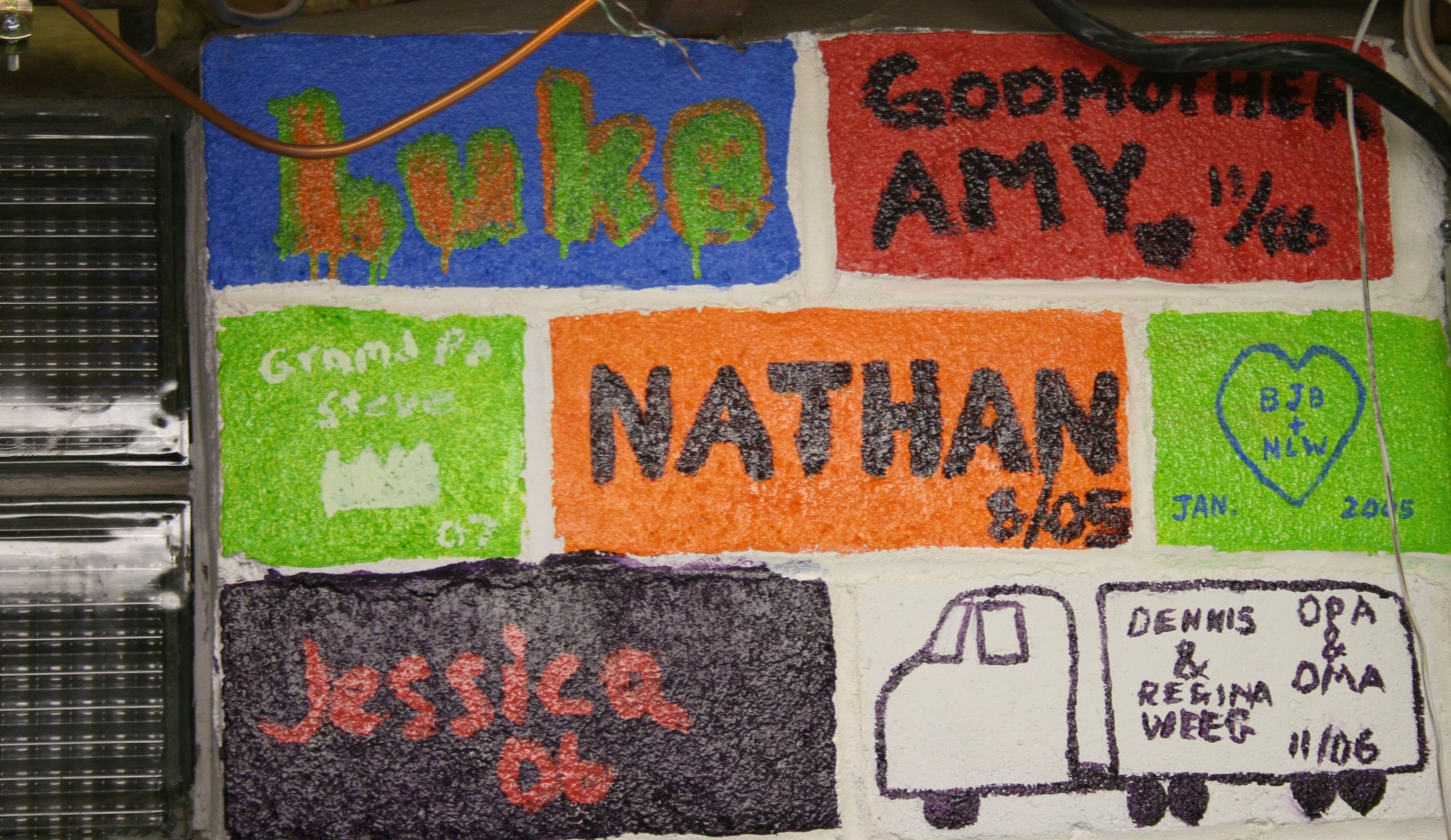
Where the project started, on the cement walls.

Where the project started, on the cement walls.

Prior to the sheetrock dividing wall construction, visitors to Billie Jo and Neal’s south Faribault home created art (a record of their visits) on a cement block wall in a corner of the basement. That area is now covered by totes in a storage room stocked full of board games, art supplies and more.

“Garage sales are great,” Neal says.

Braxton, in near constant motion, took time to paint.

Braxton, in near constant motion, took time to paint.

And so are he and Billie Jo and their kids, Nevaeh (heaven spelled backwards) and Braxton.

They are loving and kind and fabulous and generous and in the paperwork process of adopting, hopefully, two children from Colombia. These will be blessed children to join this fun-loving family. (International adoptions are costly, so if you wish to donate to the cause, email me personally or at audrey at mnprairieroots.com)

I love how they parent, reminding me of bygone times. They have no television, instead choosing board games and crafts and bike rides and storytime at the library and such to define their family togetherness.

My friends stretched a wood plank between their deck and an outdoor play cube for the kids to jump and run and do whatever kids’ imaginations tell them to do. The plank was added when Braxton was in his pirate phase.

Fun times at Billie Jo and Neal's mud party.

Fun times  for Hannah at Billie Jo and Neal’s mud party. The event included mixing of “potions” at the picnic table. Photo courtesy of Billie Jo.

Recently, they hosted a mud party, as in purchasing black dirt, shoveling it into a kids’ swimming pool, mixing in water and letting Nevaeh and Braxton and friends muck around.

Billie Jo tells me that clean-up lasted longer than the party. Here Braxton and Nevaeh pose. Photo courtesy of Billie Jo.

Billie Jo tells me that clean-up lasted longer than the party. Here Braxton and Nevaeh pose. Photo courtesy of Billie Jo.

If I hadn’t been out of town, I would have been there photographing the event. But, if Billie Jo had insisted I join the fun…

© Copyright 2013 Audrey Kletscher Helbling


Recycling art in Faribault June 14, 2013

Just a snippet of the art at the Recycled Art Sale, Paradise Center for the Arts, downtown Faribault.

Just a snippet of the art at the Recycled Art Sale, Paradise Center for the Arts, downtown Faribault.

ORIGINAL ART at a fraction of the cost. Check.

One of many pieces of original art for sale.

One of many pieces of original art for sale.

Priced to sell. Check.

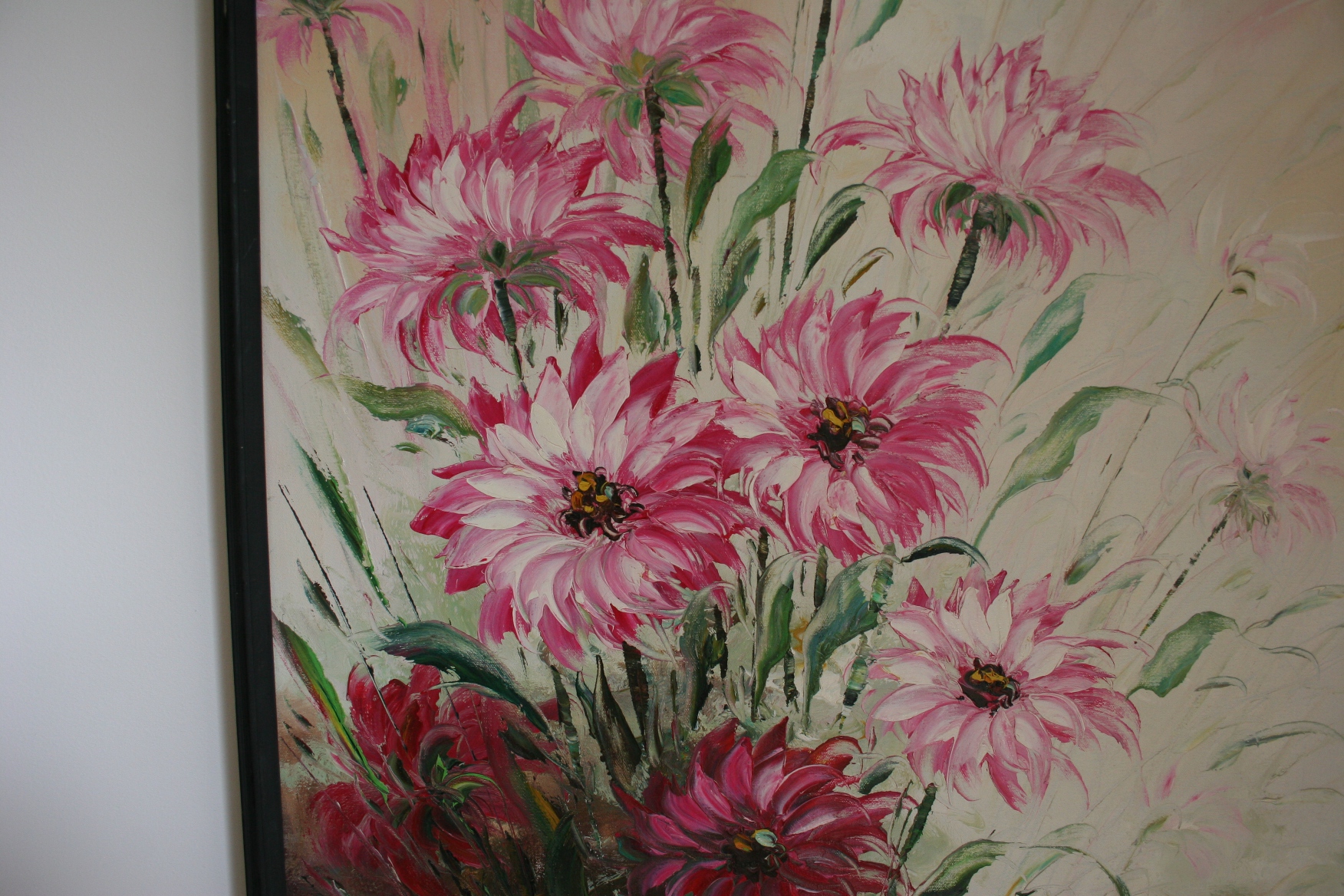
A section of the floral painting I purchased.

A section of the floral painting I purchased.

Original painting purchased for $15. Check.

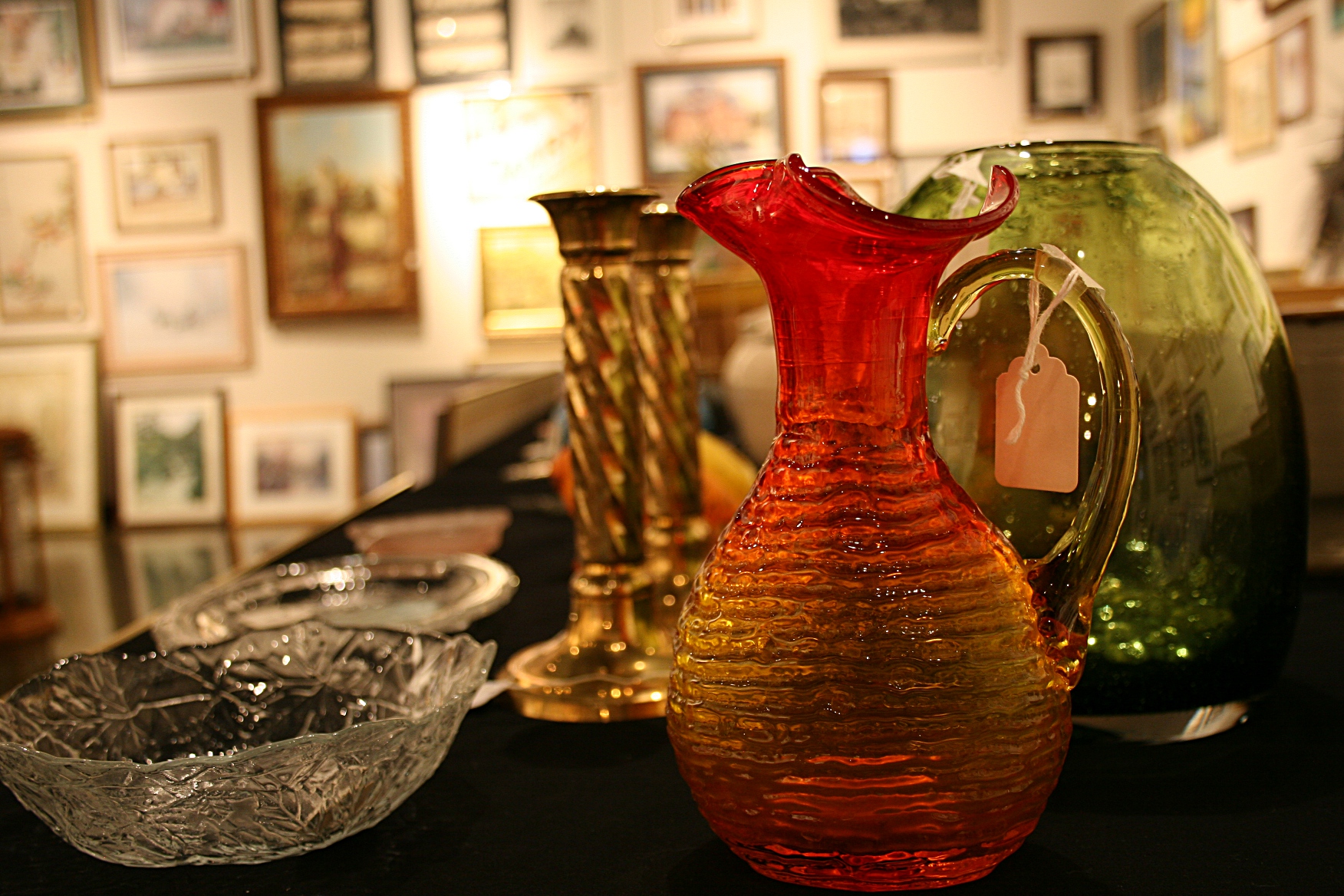
Art of all types is available for purchase.

Art of all types is available for purchase.

If you live anywhere near Faribault and have not checked out the annual Recycled Art Sale at the Paradise Center for the Arts, race down to 321 Central Avenue between noon and 5 p.m. today or Saturday.

I look forward to this sale every year and have found some great pieces, including an original oil on burlap by Mexican artist Jose Maria de Servin and Theodore de Groot LathArt by Austin Productions.

This year I brought home a floral oil painting by P. Willis, whose identity is unknown to me. Pamela? Patricia? Paul? I have no idea. But of one fact I am certain. I love the painting.

Shopping for art.

Shopping for recycled art.

And that’s the type of reaction Gail Kielmeyer, who serves on the Paradise Gallery Committee and the Mural Society of Faribault—sponsors of the Recycled Art Sale—witnesses among many a shopper. “All of a sudden they fall in love with a piece and have to take it home,” she says.

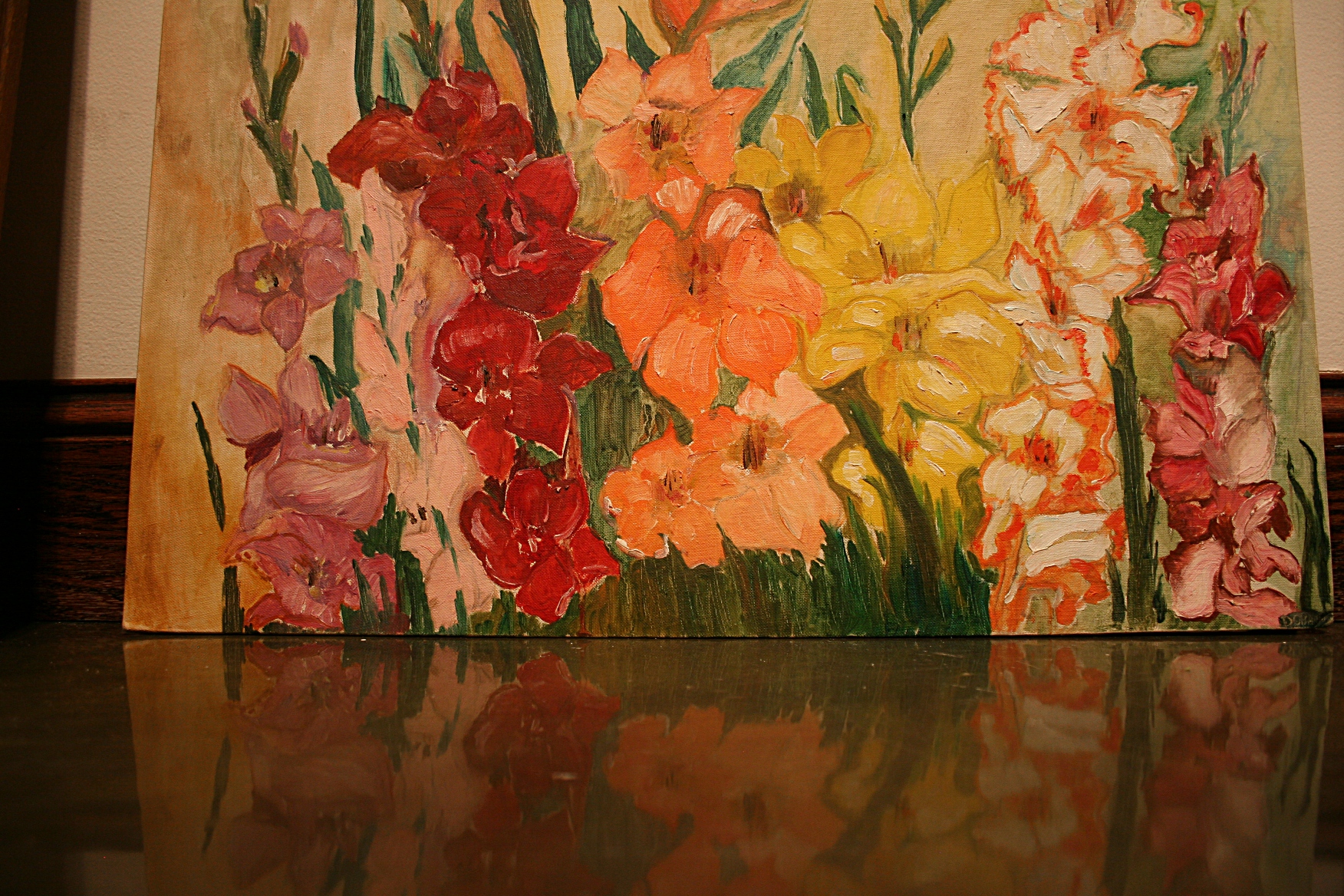
I came very close to purchasing this painting of gladioli. May still buy it.

I came very close to purchasing this painting of gladioli. May still buy it.

I expect that’s exactly what Kielmeyer and co-volunteer Mary Niermann thought as they watched me peruse the Paradise gallery crammed with everything from original pieces to prints to pottery, sculptures, mirrors, ceramics, and even art books. Prices ranged from a quarter for a dish to $400 for four Vietnamese in-laid mother-of-pearl panels which sold on the first day of the sale on Thursday.

Art lovers were waiting in line outside the Paradise for the noon opening of the sixth annual sale. One enthusiast calls the event her “very favorite sale of the year.”

And part of the reason may be the incredibly affordable prices. “A lot of people think original art is expensive and for wealthy people,” Kielmeyer says. Not so at this sale. Prices are kept purposely “priced to sell,” giving art lovers who might not otherwise be able to afford original art (that would be me), the opportunity to own original art.

That de Servin purchased several years ago cost me $7. The de Groot LathArt, $10.

You will find a variety of art from stills to landscapes, abstracts and plenty more priced to sell, many for under $20. Yes. Incredible.

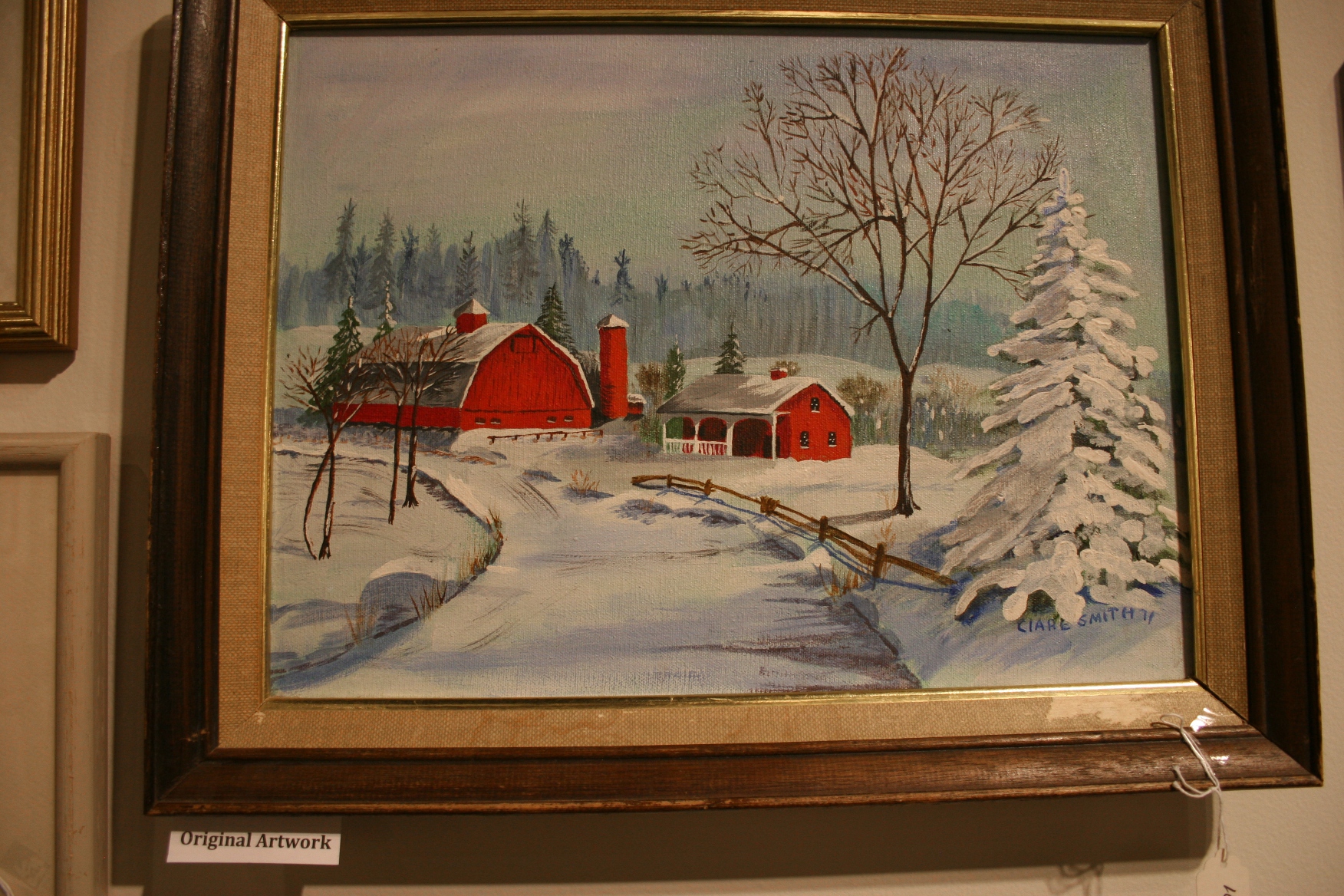
I contemplated buying this barn art.

Lovely rural art.

All of the pieces are donated by people who are downsizing, for example, or remodeling or have had a piece forever. Or the favorite explanation this year heard by Kielmeyer: “We’re pretending we’re moving.”

Some artists come to the sale and buy the art just for the frames.

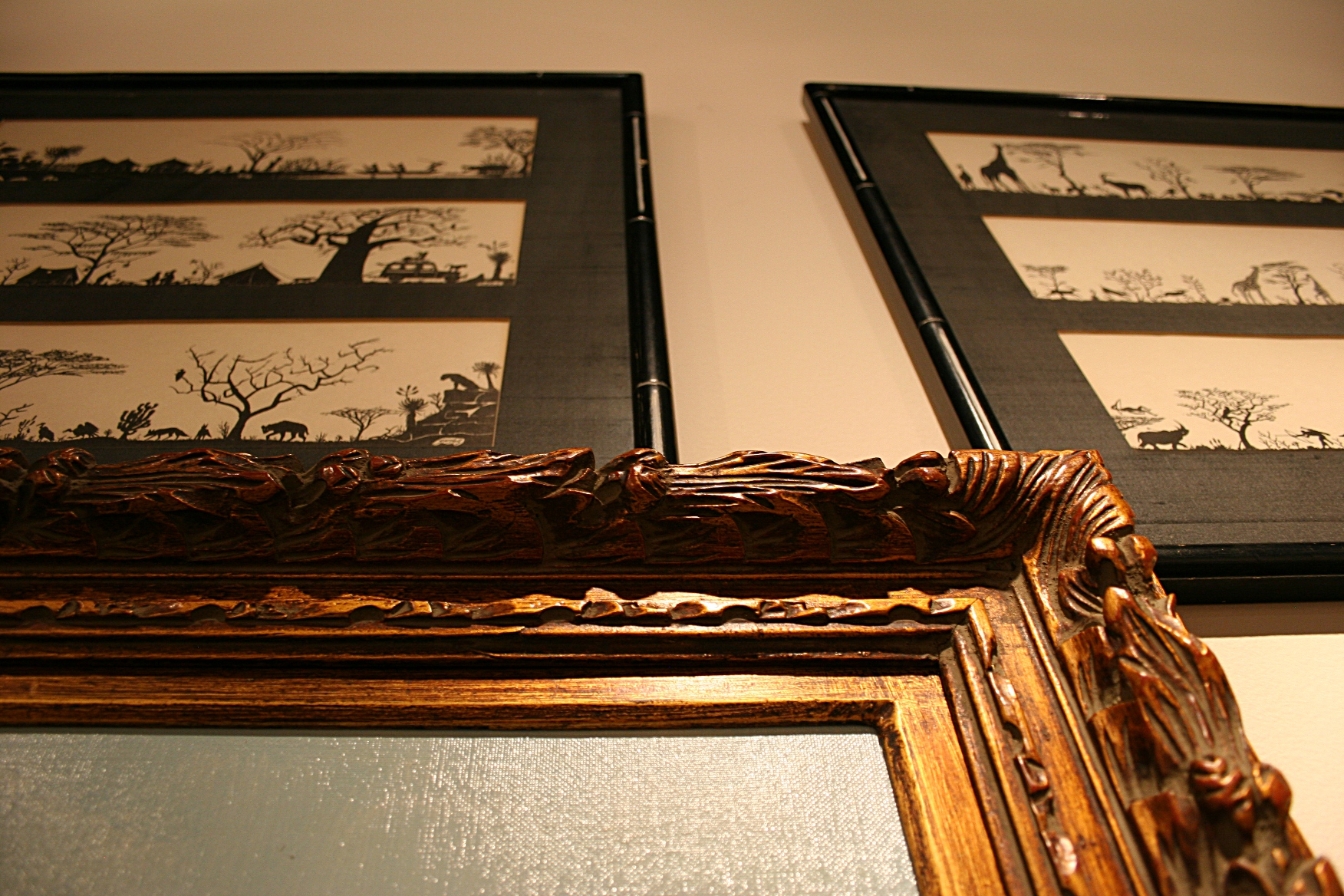
Some artists come to the sale and buy the art just for the frames. Note the interesting original duo art from Africa, above the frame. Loved it.

So the art some no longer want, need or have space for is now recycled into the hands of happy art lovers like me.

And, as a bonus, the Paradise and the Mural Society make some money. This year organizers hope to bring in $4,000 from the sale, about $1,000 more than last year. The first sale six years ago brought in $800.

Art and more art.

Art and more art.

Interest grows as do the number of donations and the variety of art offered. This year an estimated 1,000 items are for sale. Many had already been sold when I shopped on Thursday evening.  But you could have fooled me. The gallery is still packed with incredible art priced to sell.

BONUS PHOTOS:

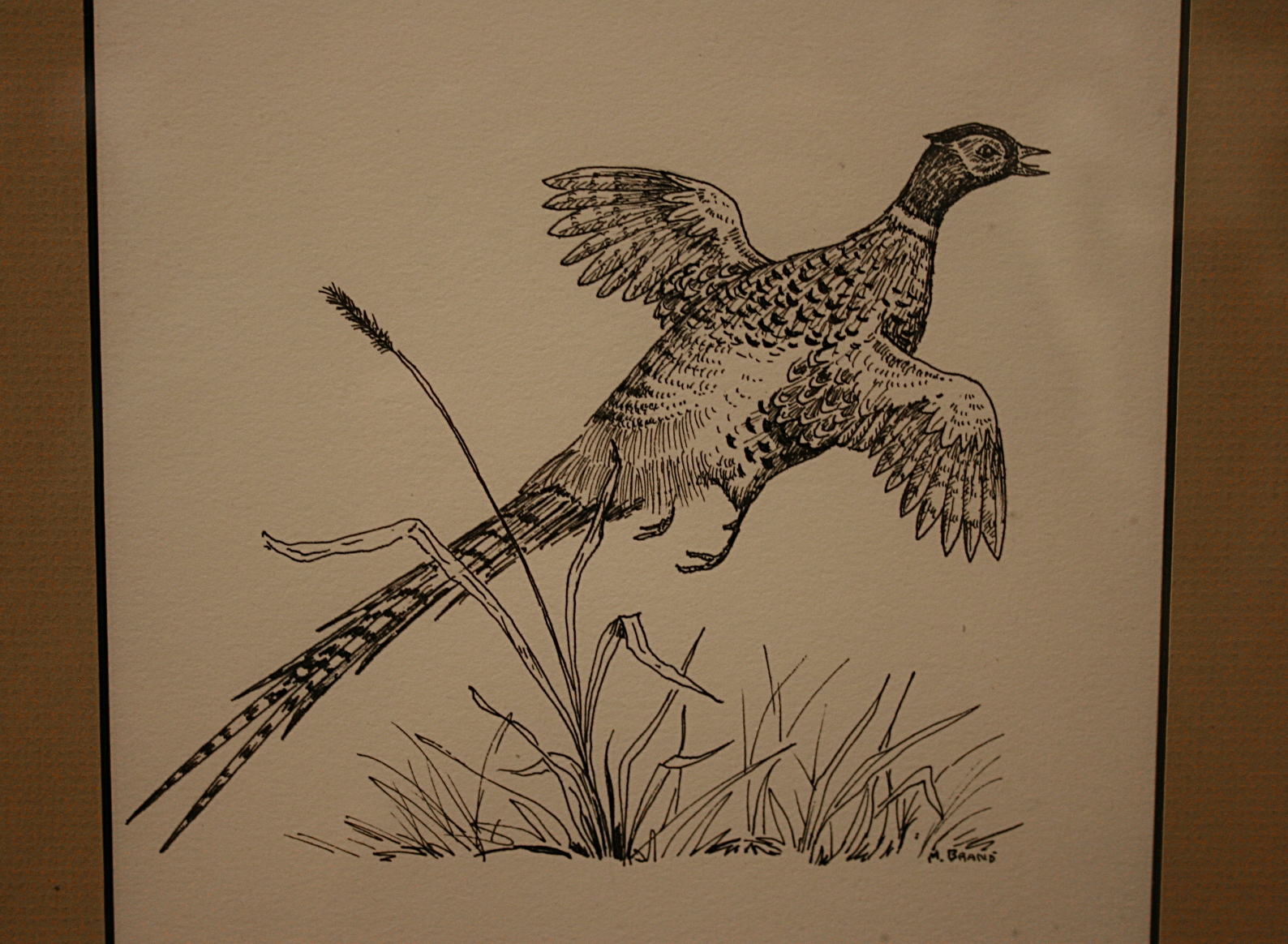
For the wildlife lover...

For the wildlife lover…

If you appreciate a still life.

If you appreciate a still life.

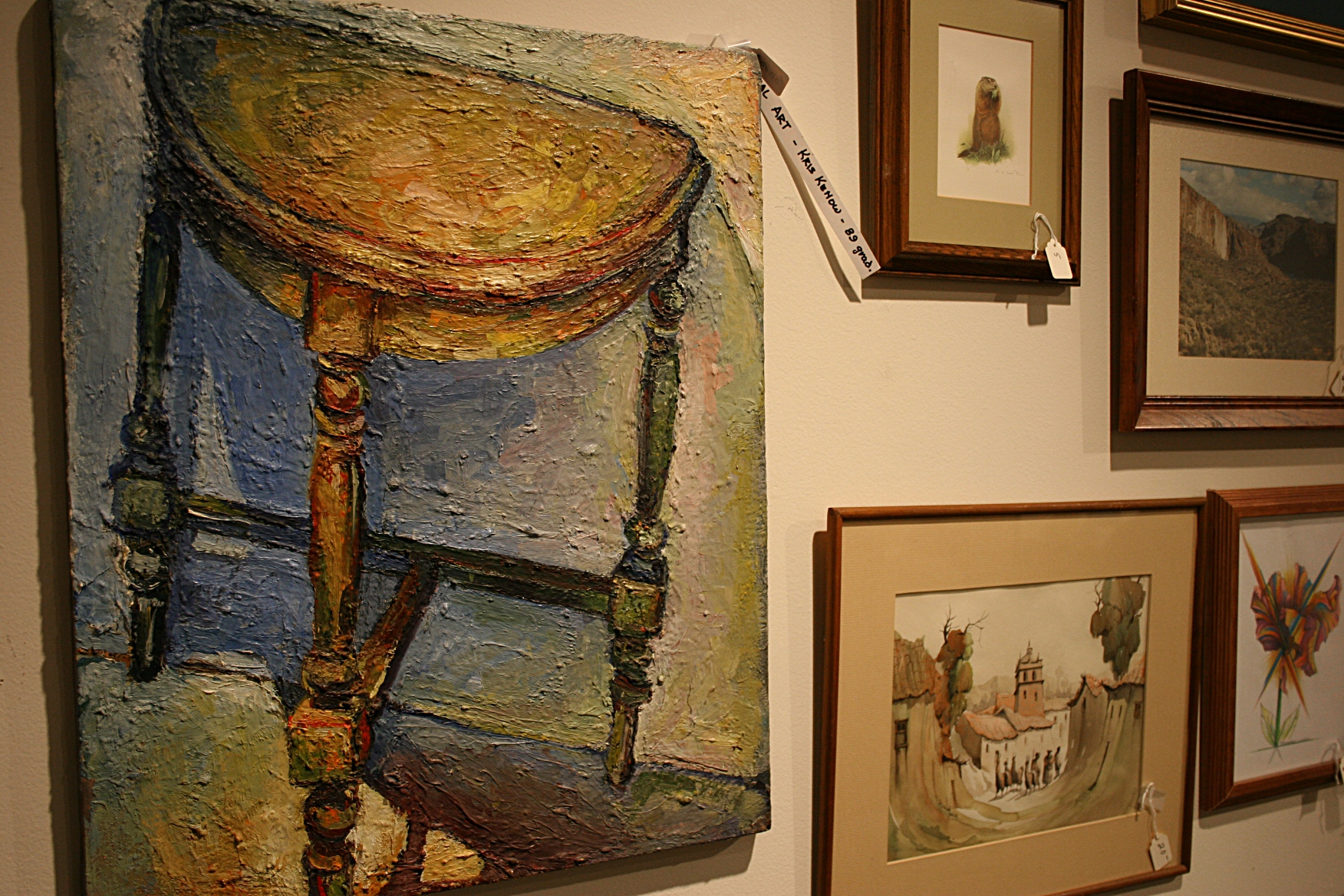
For the traveler or the dreamer...

For the traveler or the dreamer…

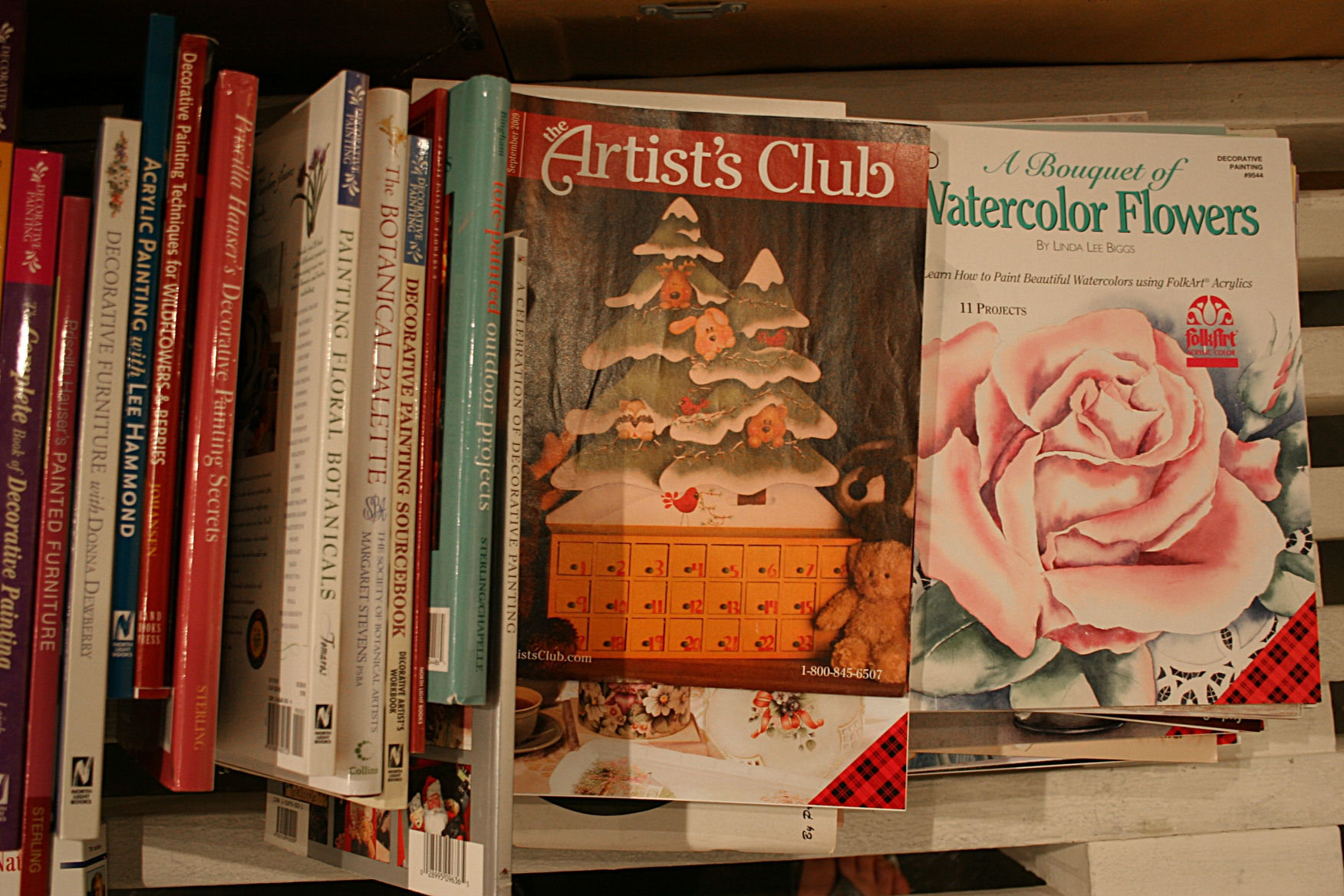
For those who want to learn more about creating art...books and magazines.

For those who want to learn more about creating art…books and magazines are among the estimated 1,000 items at the sale.

© Copyright 2013 Audrey Kletscher Helbling


Margaret’s Monet garden June 27, 2012

Filed under: Uncategorized — Audrey Kletscher Helbling @ 7:07 AM
Tags: , , , , , , , ,

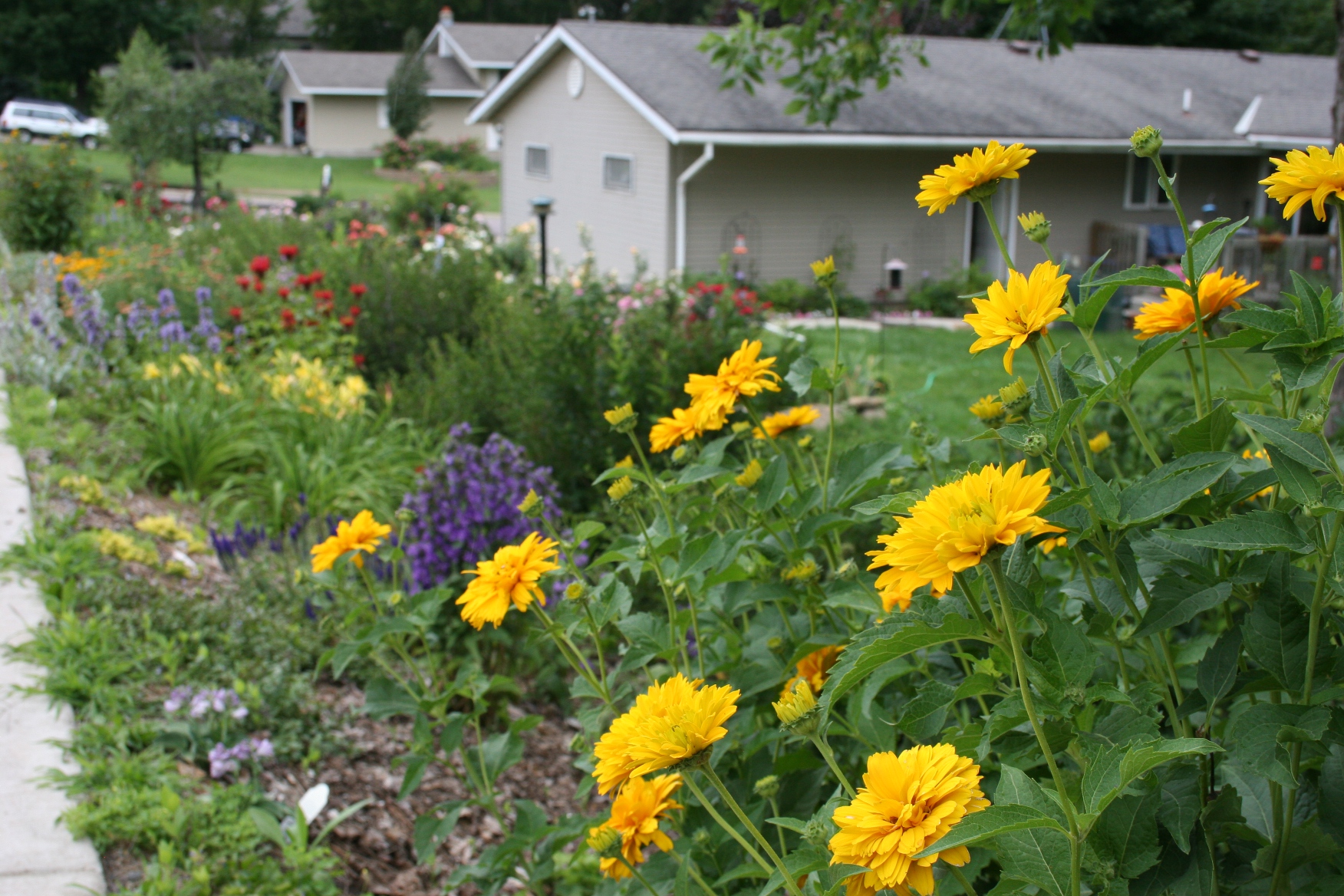
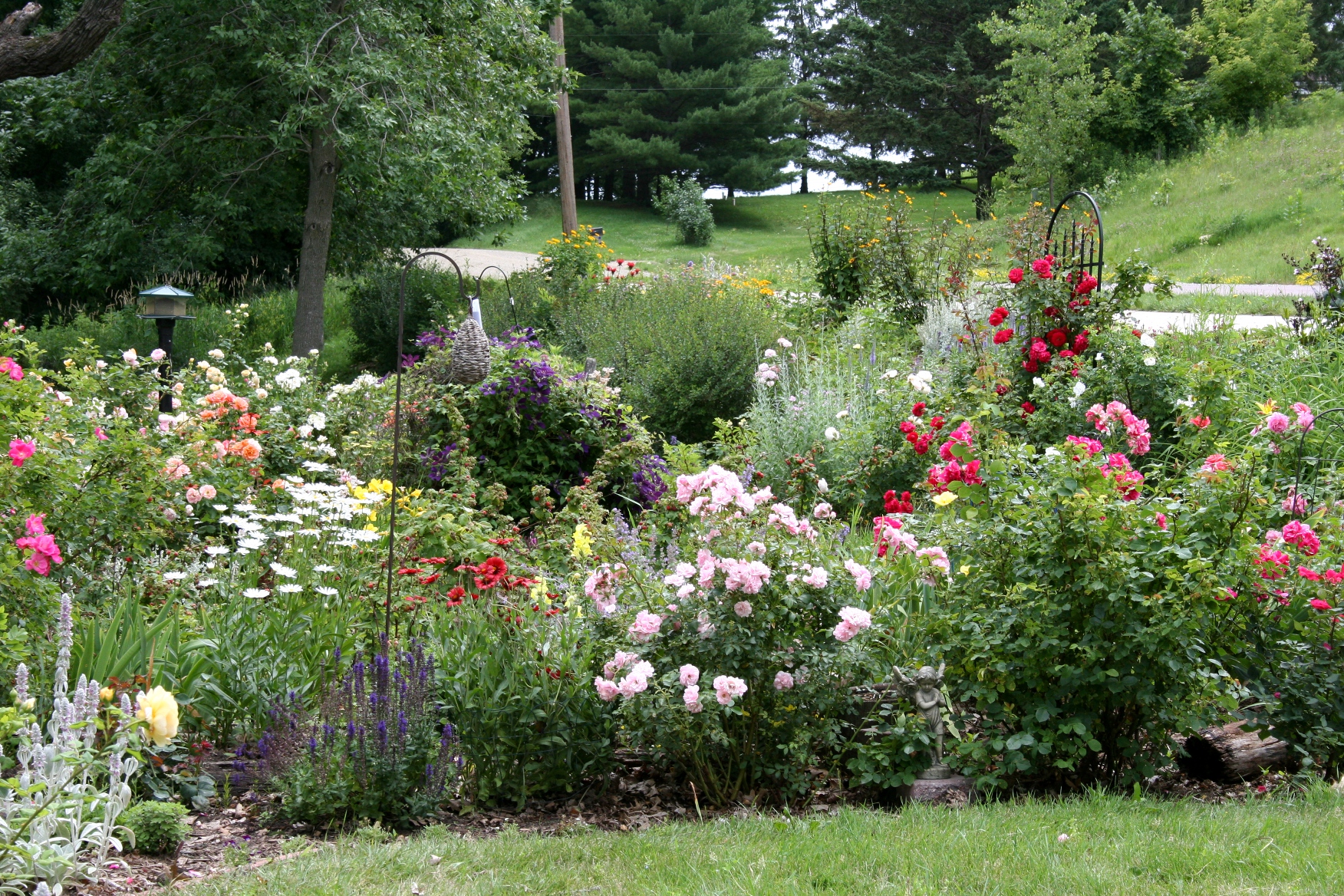
This overview shows you the size of Margaret’s sprawling flower garden on Faribault’s east side.

OH, WHAT AN ABSOLUTE JOY to be Margaret’s neighbor, to gaze across the street into her flower garden reminiscent of a Claude Monet painting.

But, alas, I live down the hill, over the river and into the valley across town from this eastside Faribault garden.

I happened upon Margaret’s sprawling, Impressionist style garden on a recent Saturday morning. And because I’m not at all shy, I popped out of the van and approached Margaret as she weeded her flowers.

She obliged my request to photograph her flowers (but not her) and also answered my questions like, “What is that?” or “Is that …?”

Low-lying fuchsia sedum add a jolt of brilliant color.

Loved these dainty, pale pink flowers. Gardeners, what are they? No, I couldn’t ask Margaret to identify every single plant.

Margaret didn’t tell me I couldn’t photograph her hand. She kept working while we talked, bucket of tools nearby. She had more gardening tools in the garage, she said.

Margaret knows her flowers and her passion for them is irrepressible. She simply loves to garden. That’s apparent as her flower garden stretches nearly the entire 180-foot length of her and her husband’s lot and then extends 30 – 40 feet from the edge of the sidewalk, down the slope and to the garage. She began planting the garden about five years ago, partially so her husband wouldn’t need to mow the slope of the lawn.

From daisies to bee balm, sedum to clematis, lamb’s ears to lilies and dozens of other perennials, Margaret’s garden is awash in color and blooms. Her pride and joy, though, are her 50 some rose bushes.

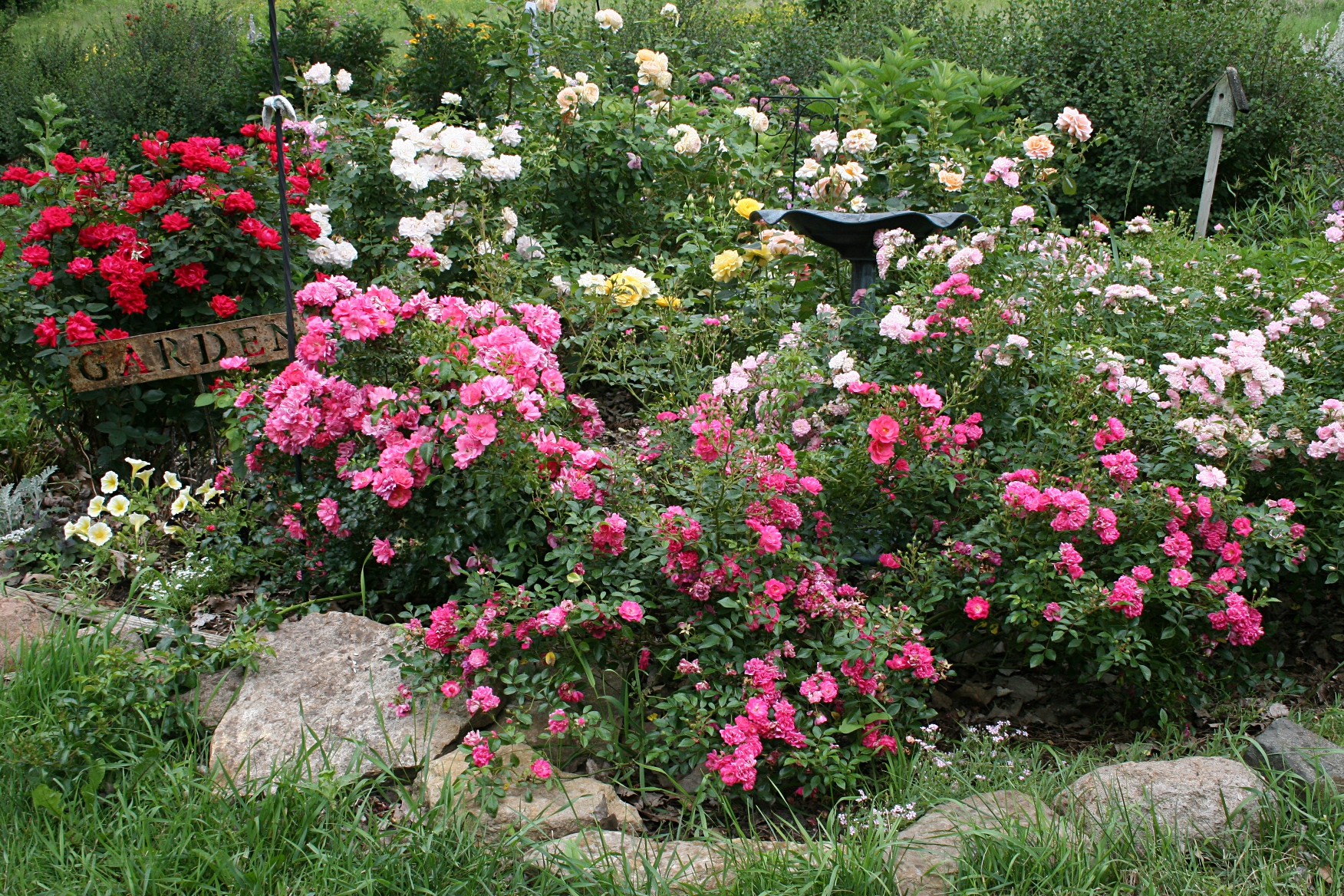
Margaret’s garden is a rose lover’s paradise.

“I just love roses,” Margaret says. “They just have beautiful flowers and smell wonderful.”

Roses and more abloom with pieces of art tucked in among the flowers.

One of the many English rose bushes, which are Margaret’s favorite for their thick layers of petals and scent.

I roamed the perimeter of the garden, snapping photos as rain pittered and hastened my photo shoot. Yet, I took time to inhale the heady perfume of Margaret’s beloved English roses. English and shrub rose bushes compromise most of the roses in her garden.

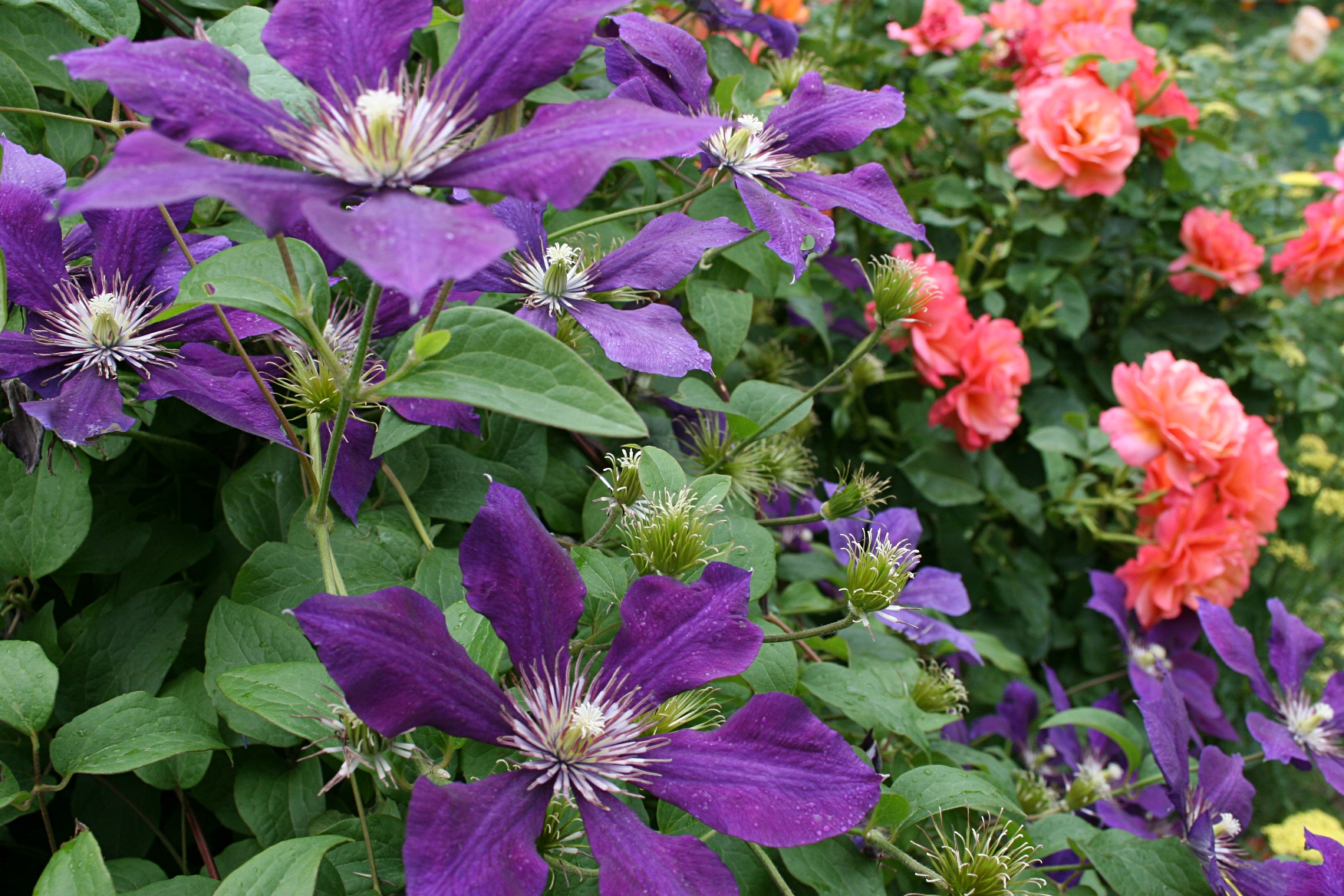
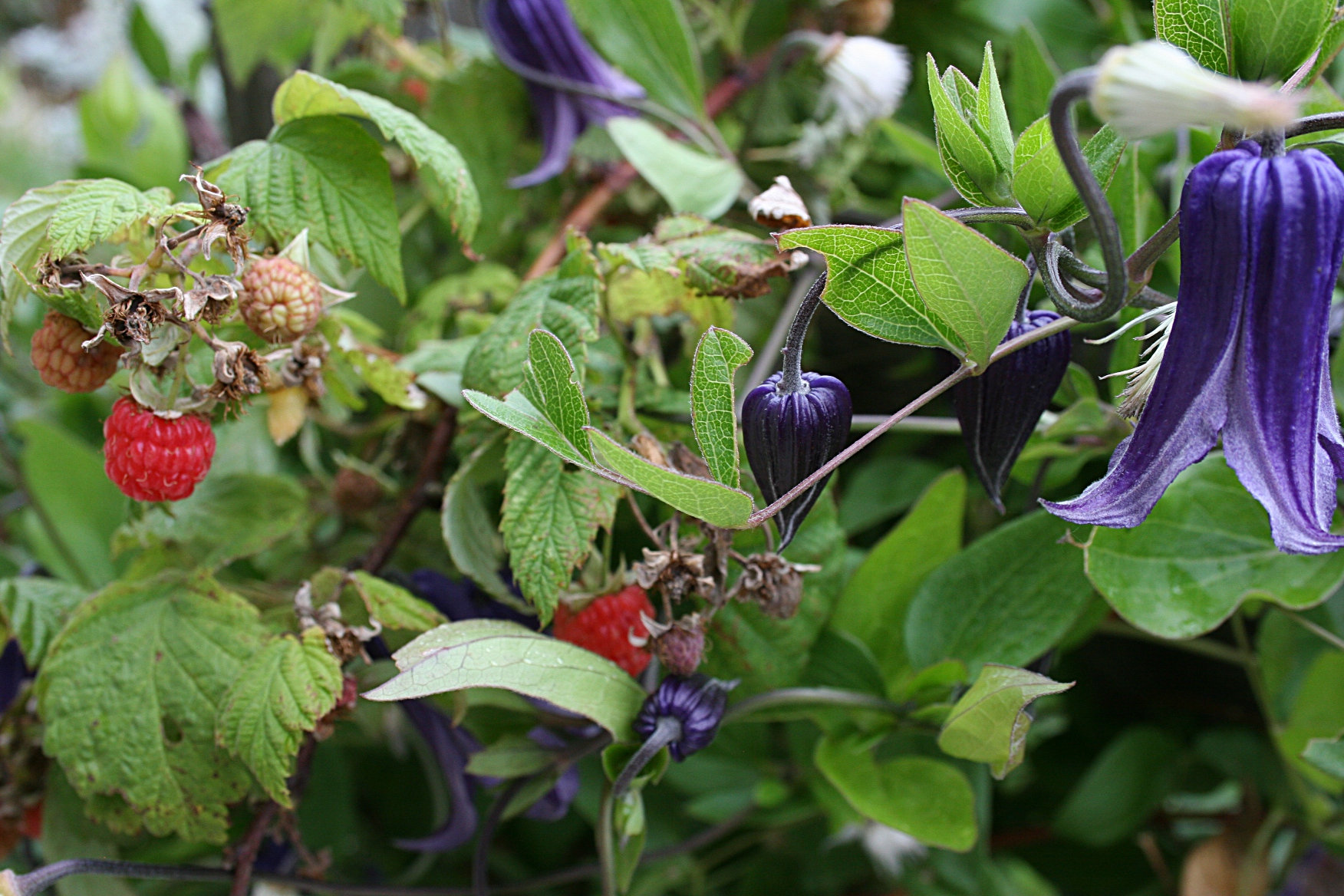
The most gorgeous clematis I’ve ever seen, in full bloom.

Just look at Margaret’s eye for color, pairing purple clematis and coral roses.

I noticed this gardener’s talent for pairing colors—especially the striking contrast of royal purple clematis next to coral-hued roses.

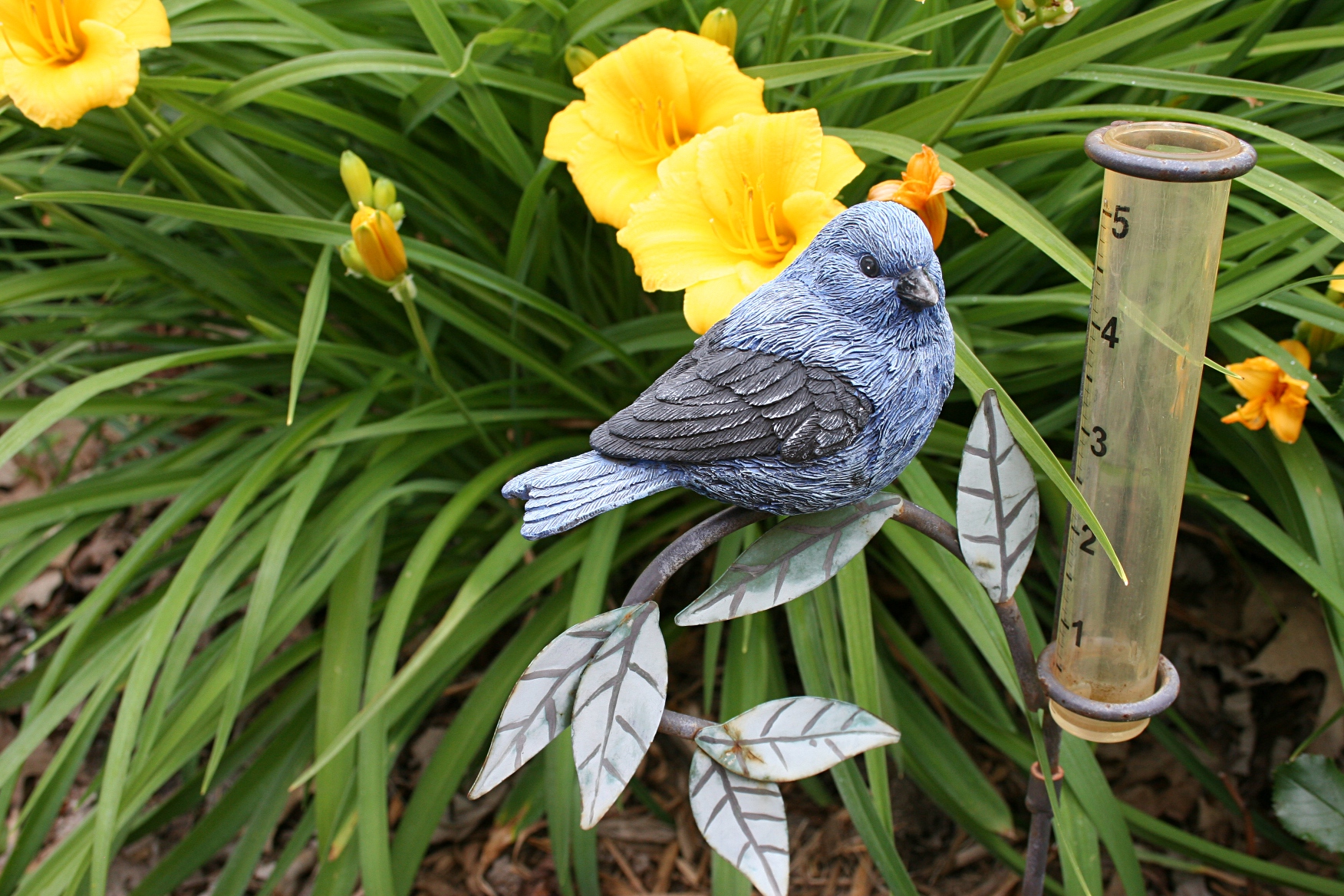
Who knew a rain gauge could also be a piece of garden art staked next to lilies?

I appreciated, too, how she tucks garden art among her flowers with the skills of a designer.

A snippet overview of a portion of Margaret’s Monet garden.

If Margaret’s garden was a painting, surely it would be a Monet.

Margaret mixes the jewel tones of raspberries with flowers. She’s also incorporated strawberries and tomatoes into her flower garden.

FYI: Margaret’s garden is located at 1325 11th Avenue Northeast, Faribault.

© Copyright 2012 Audrey Kletscher Helbling


Feeling like a Grinch December 8, 2011

Filed under: Uncategorized — Audrey Kletscher Helbling @ 8:05 AM
Tags: , , , , , , , ,

WITH LESS THAN three weeks until Christmas, I truly need to pull myself out of my pre-holiday funk.

Here’s the deal. I haven’t sent out a single Christmas card, although the annual holiday letter has been drafted and awaits final editing.

I haven’t baked Christmas cookies. I don’t need the sweets and the guys in the house don’t have a sweet tooth. Eventually I’ll bake the cream cheese roll-out cookies that have been part of my Christmas since childhood. And I’ll pull together some date pinwheels for my husband, part of his childhood tradition.

No presents in my sleigh yet.

As for shopping, the lists have been compiled. But since I dislike shopping, the task looms before me.

Decorations? If you count the holiday painting by my father-in-law hanging in the dining room, the six Christmas cards we’ve received and the peppermint candies in a dish, then, yes, I’ve started my decorating.

I’m not the type who goes all out with holiday decorating because, visually, I dislike clutter. I also live in a relatively small house.

Then there’s my husband, who worries about the Christmas tree drying out and creating a fire hazard (a legitimate concern) if we buy it “too early”. Once we waited so long to purchase a tree that we had five pathetic choices in the tree lot. We got a heckuva deal, though, by buying only days before Christmas. True story.

So there you have it. I am feeling more Grinch-like than holiday-ish. For me, the important part of Christmas lies in celebrating Christ’s birth and in gathering with family.

Gathering with family...one of the most important aspects of Christmas for me.

I expect therein exists the partial reason for my melancholy. My second daughter, who lives in eastern Wisconsin, will not be home for Christmas. She’s on-call both holiday weekends at her job as a Spanish medical interpreter. She has missed Christmas before, while living in Argentina. So I should be used to this. I am not.

I have no right to complain. None. Many families are separated by greater distances or war or illness or death, or even by choice.

Eventually I’ll pull myself out of my holiday blues. Perhaps I’ll start with addressing Christmas cards and work my way up to mixing cookie dough. The shopping, though, I never have been able to embrace no matter how hard I try.

Although I'm struggling right now to pull everything together for Christmas, I will. Here's the complete holiday painting by my father-in-law, Tom Helbling of St. Cloud, MN.

SO…WHERE ARE YOU at with your holiday preparations? Do you struggle with any aspect of preparing for Christmas? Submit a comment and share.

© Copyright 2011 Audrey Kletscher Helbling


Presenting Leonardo da Vinci’s The Last Supper at a Minnesota church April 19, 2011

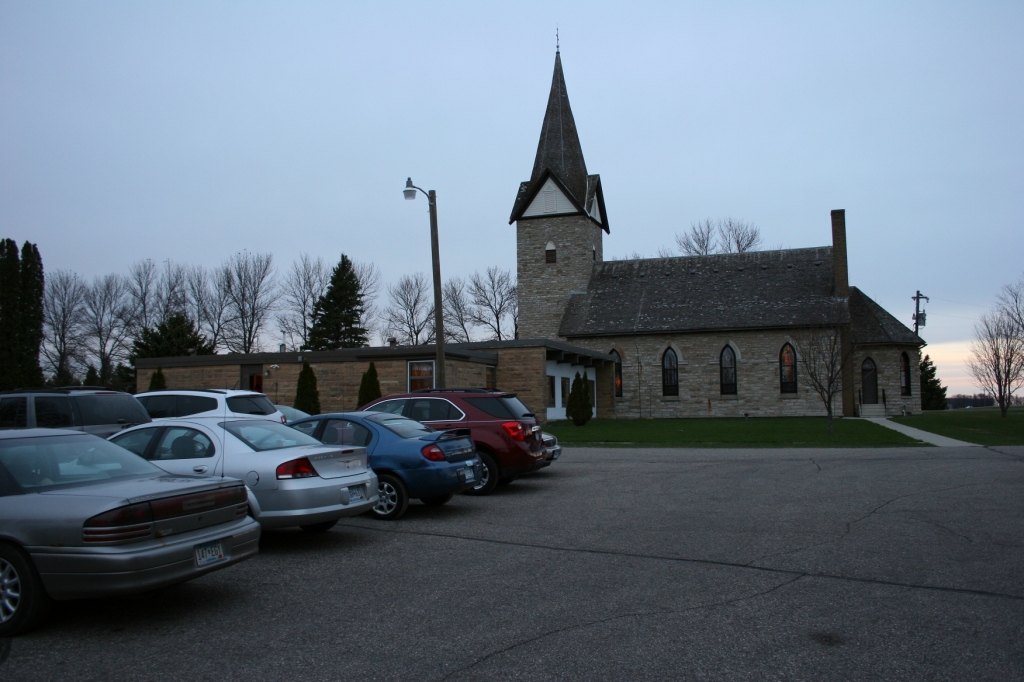
The parking lot at St. John's United Church of Christ, Wheeling Township, is nearly full 20 minutes before the congregation's annual performance of The Last Supper Drama.

AS THE FINAL wisps of daylight dissipate into darkness, the church windows glow with the subtle warmth of welcome on this Palm Sunday evening.

Inside, worshippers are already gathering in the tightly-knit pews, eyes focused on the long table before them.

As I wait, seated in a pew tucked under the rim of the balcony, I study the stained glass windows, the suspended ceiling lights where lady bugs cling, the golden cross high above the altar.

Then, shortly after 8 p.m., after the hymn and the invitation and recitation of The Lord’s Prayer, the drama begins unfolding—for the 49th consecutive year.

St. John’s United Church of Christ, Wheeling Township, is presenting its annual The Last Supper Drama.

The Rev. Lora Sturm provides brief historical background on Leonardo da Vinci’s The Last Supper painting, the visual basis for the evening’s drama.
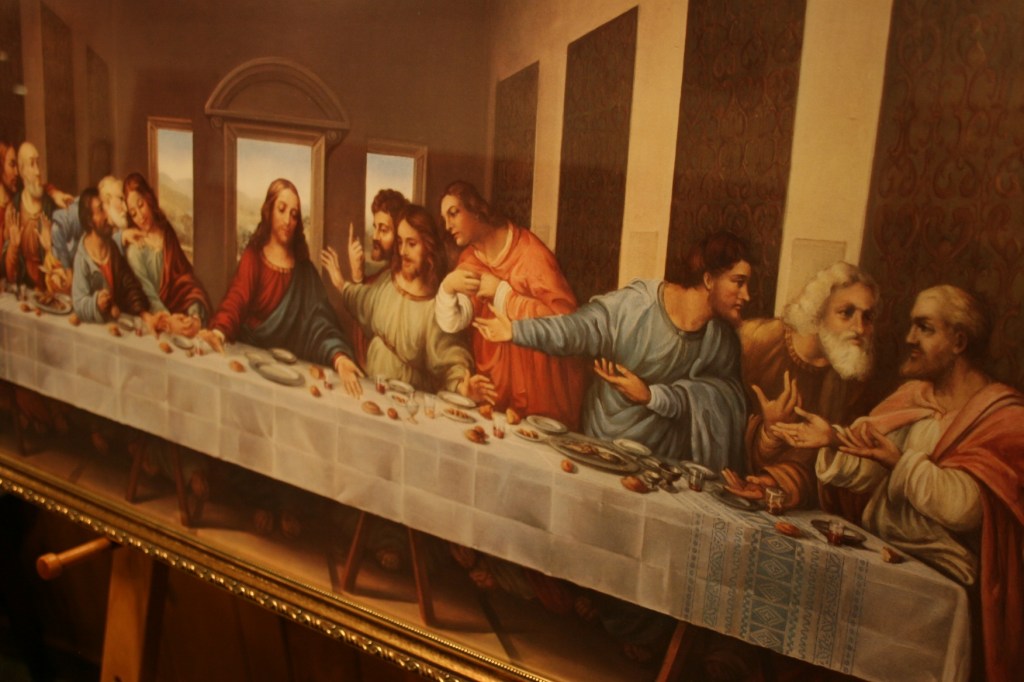
Leonardo da Vinci's painting of The Last Supper inspired the dramatic presentation at St. John's. This print was donated to the church in memory of Arnold Keller.

And then the lights fade, slowly, until a spotlight shines only on the cross. Soon that light and the organ light are extinguished, plunging the sanctuary into near darkness save for the remnants of daylight filtering through the stained glass windows.

A quiet reverence, a sense of anticipation, falls upon the congregation in the moments of silence and darkness before the actors begin filing into the church. Small clusters of men, seemingly engaged in conversation, without words to be heard, walk toward the table set with bread and a chalice and a bag of silver, although I am not sure whether the betrayal money was there initially or was carried in by Judas, the betrayer.

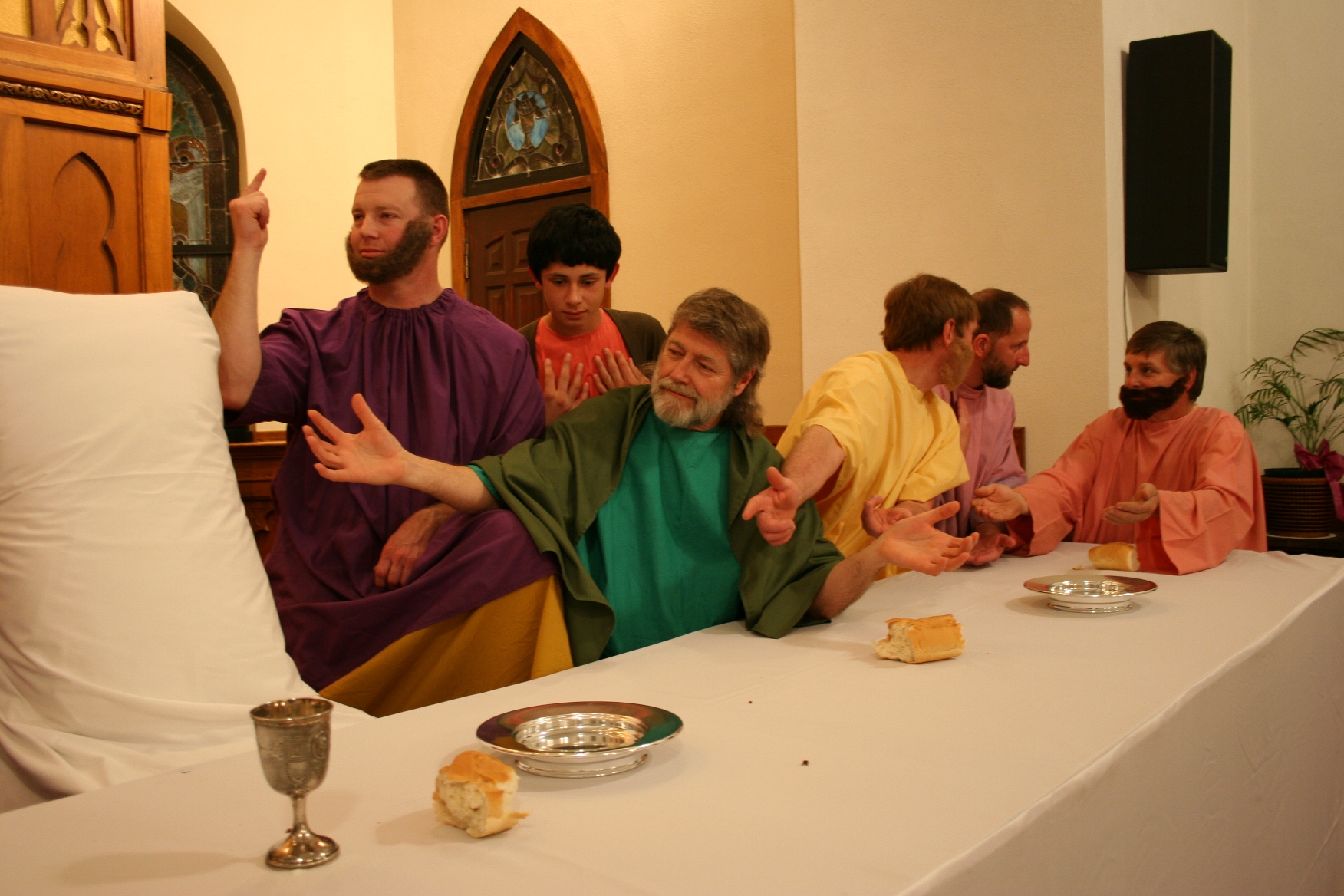
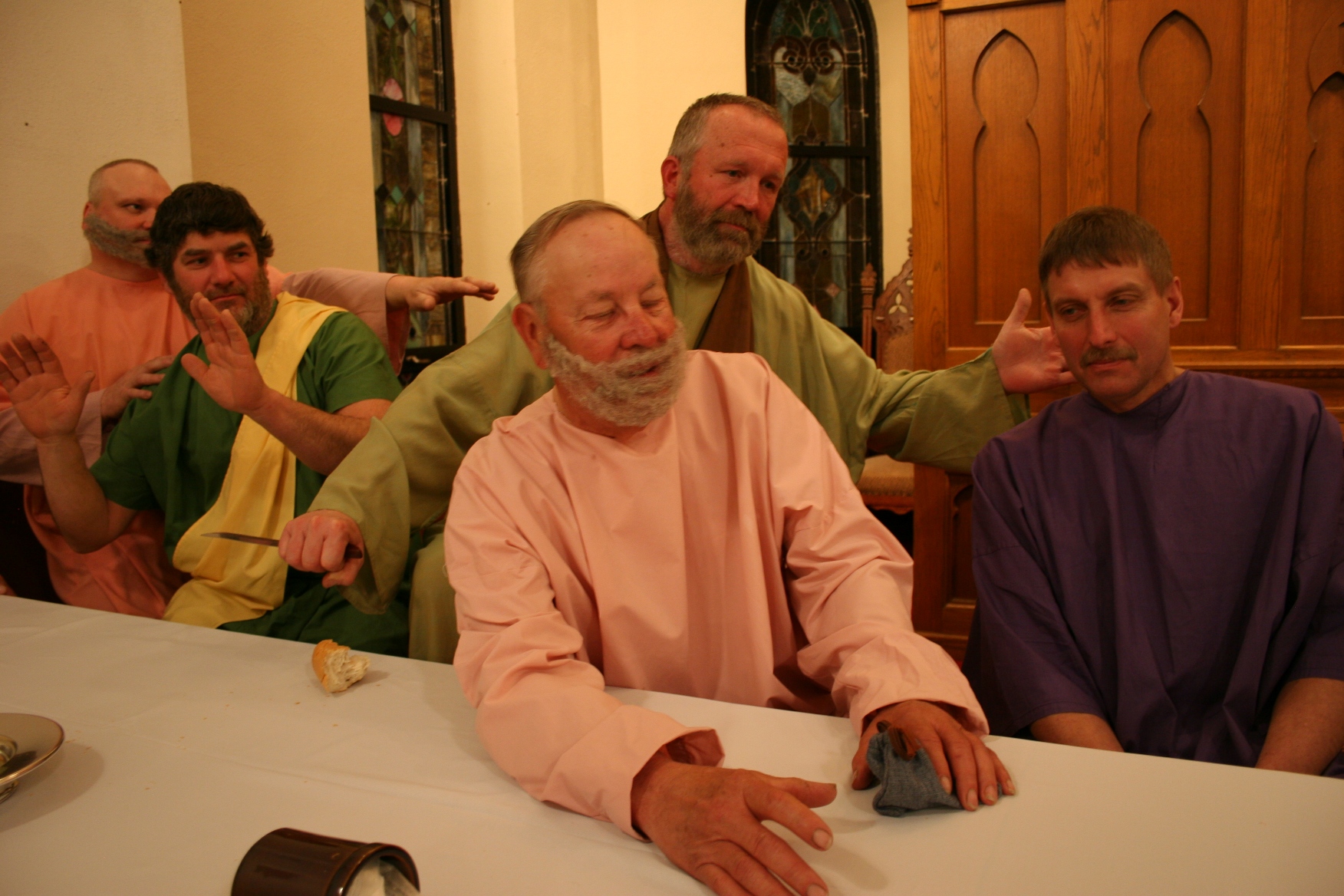
In darkness, these actors, these 12 disciples, pose themselves, replicating the positions da Vinci painted into his famous The Last Supper painting. But no one plays the role of Jesus, represented instead by an empty chair draped in white cloth.
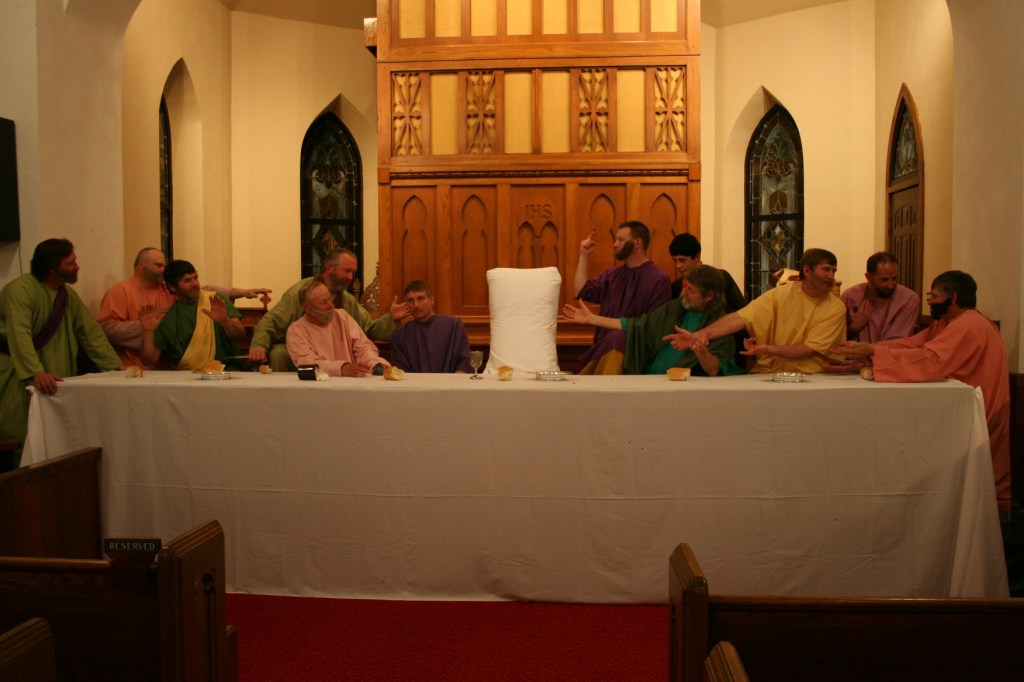
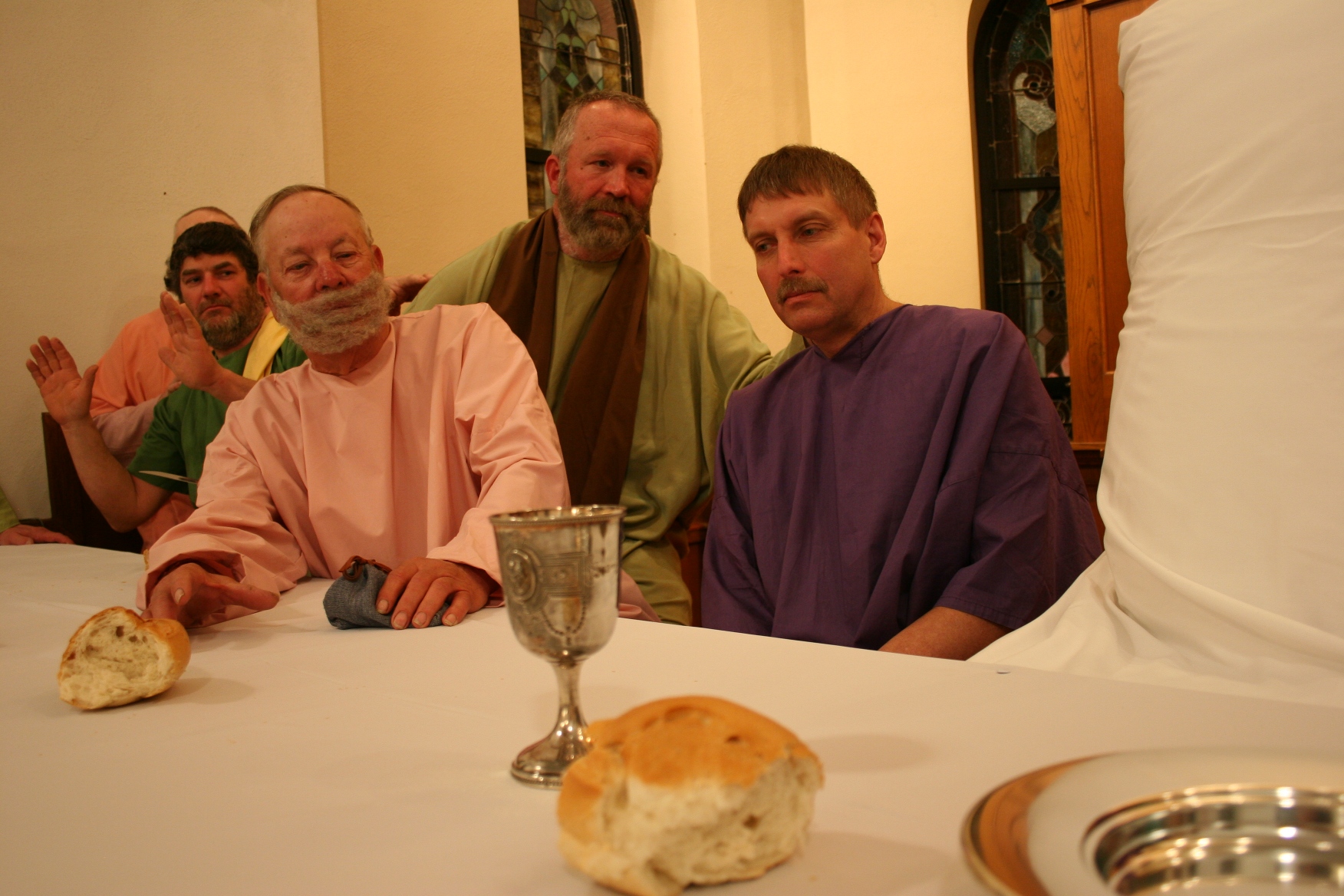
The actors position themselves to replicate da Vinci's The Last Supper, except for Jesus, who is represented by the empty white chair in the middle of the table setting.

When the lights flick on, the frozen scene catches me off guard, even though I’ve previously seen the performance. The stillness fills me with a certain sense of peace, yet uneasiness.

I know what is coming. Words from Scripture that will tell of Jesus’ forthcoming death. The accusation that one of the 12 will betray Christ. It is the moment da Vinci depicts in his art—that moment when the disciples learn that one of them will give up their Lord to death.

Yet, in this script penned by a St. John’s pastor, Walter Rasche, 49 years ago, it is the depth of faithfulness that causes me to pause and look inside. Would I be so faithful as to become a martyr, to die, like the disciples, by stoning or crucifixion or beheading?

In their monologues, each disciple speaks honestly of his struggles, his lack of faithfulness, his travels to preach the gospel, and, then, the blessed words of a better and more abundant life found in following Christ.
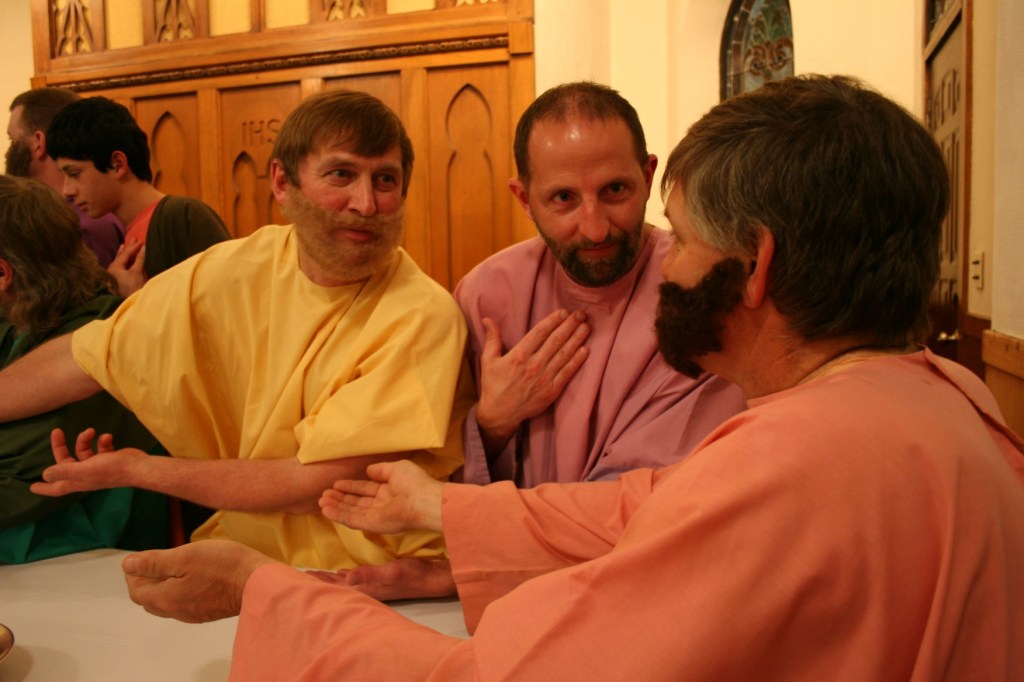
The actors freeze as they role-play the disciples.
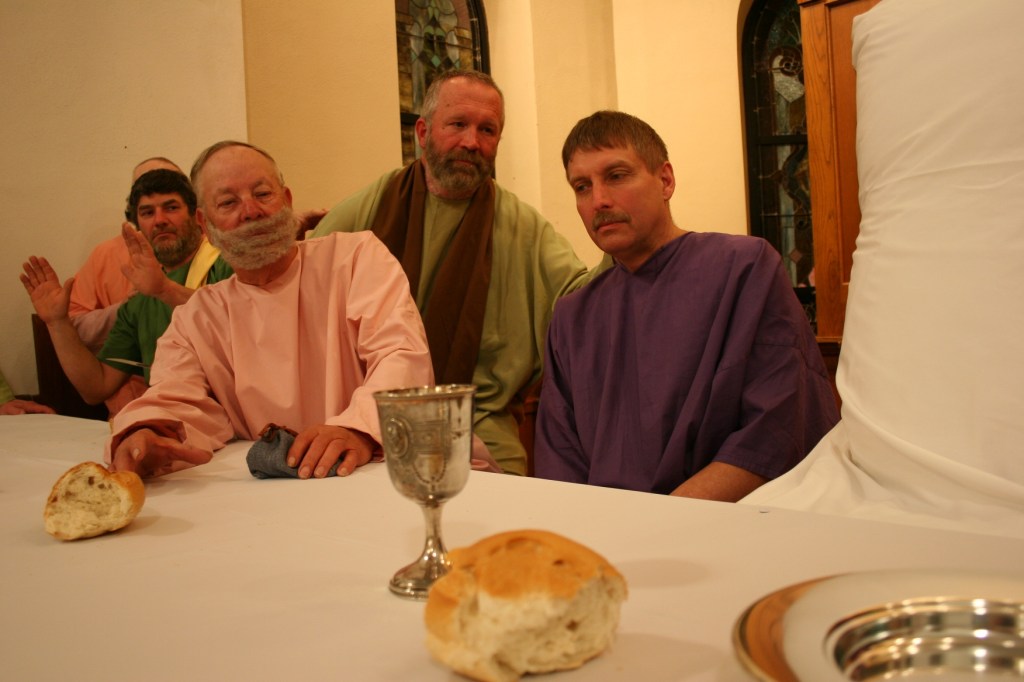
Five of the six disciples sitting to Jesus right with Christ represented by the empty white chair.
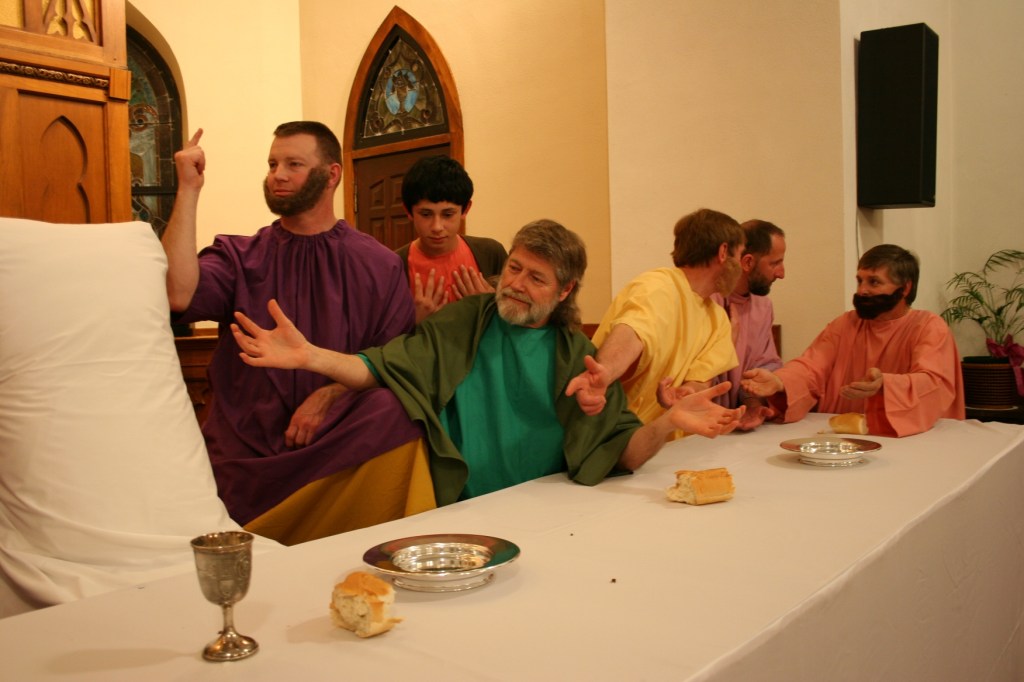
The disciple/actors to Christ's left, including first-time actor, 13-year-old Kyle Keller, the youngest cast member.

Judas’ words—that he regrets betraying Christ with a kiss, turning him over to the authorities for 30 pieces of silver—sting.
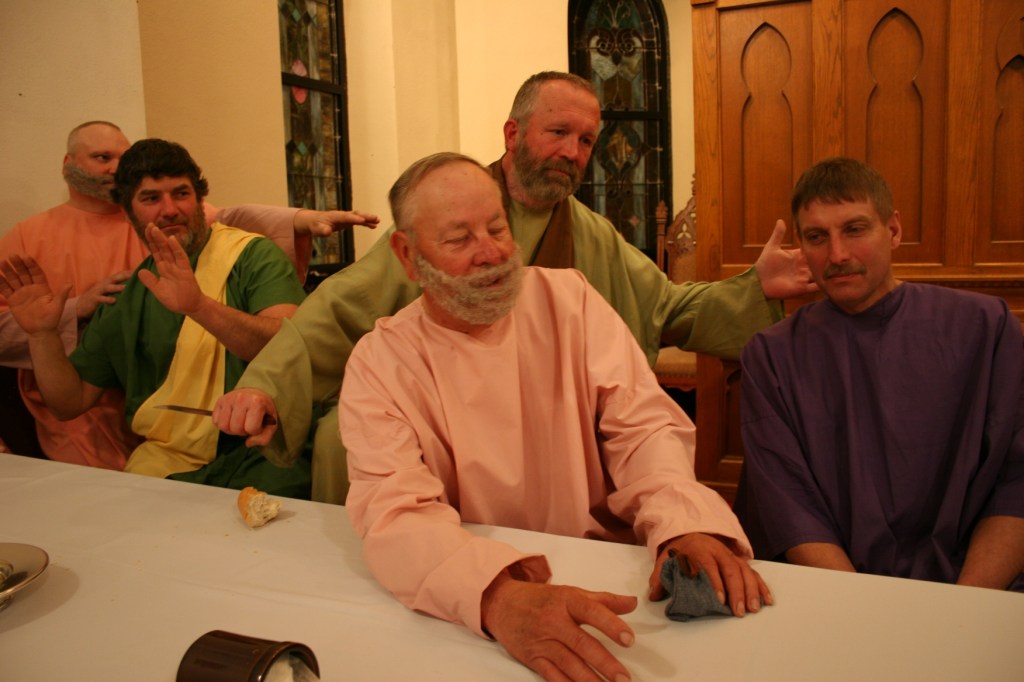
Judas, front, betrays Jesus with a kiss and 30 pieces of silver.

But the pastor’s prayer afterward encourages and uplifts me: “…hear your voice calling us to follow you…you call us to simply follow…”

And then her benediction blesses me with peace: “The Lord bless thee and keep thee…”

As the actors exit, as the worshipers file out of the sanctuary, I linger, waiting for the opportunity to shoot photos, which weren’t allowed during the performance. The men return, pose at the table, some of them telling me how they watched this drama as boys and now role-play as men.

This year a boy-becoming-a-man, 13-year-old Kyle Keller, plays the part of Philip, standing behind his father, Keith, who has assumed the role of Matthew. The seventh grader is the youngest participant ever in the St. John’s re-enactment. He was talked into playing the part, but says now that he’ll be back.

With two casts, the actors (most of them) return every other year to assume the same character roles. Some travel from the Twin Cities back to this, their home church near Nerstrand Big Woods State Park. They speak and gesture like seasoned actors, some growing beards for the occasion, others sporting fake, glued-on facial hair. Sharon Meyer jokes that she has the shaver charging at home, ready to shave off her dairy farmer husband’s beard. Alan Meyer has played the part of Andrew in the evening’s performance.

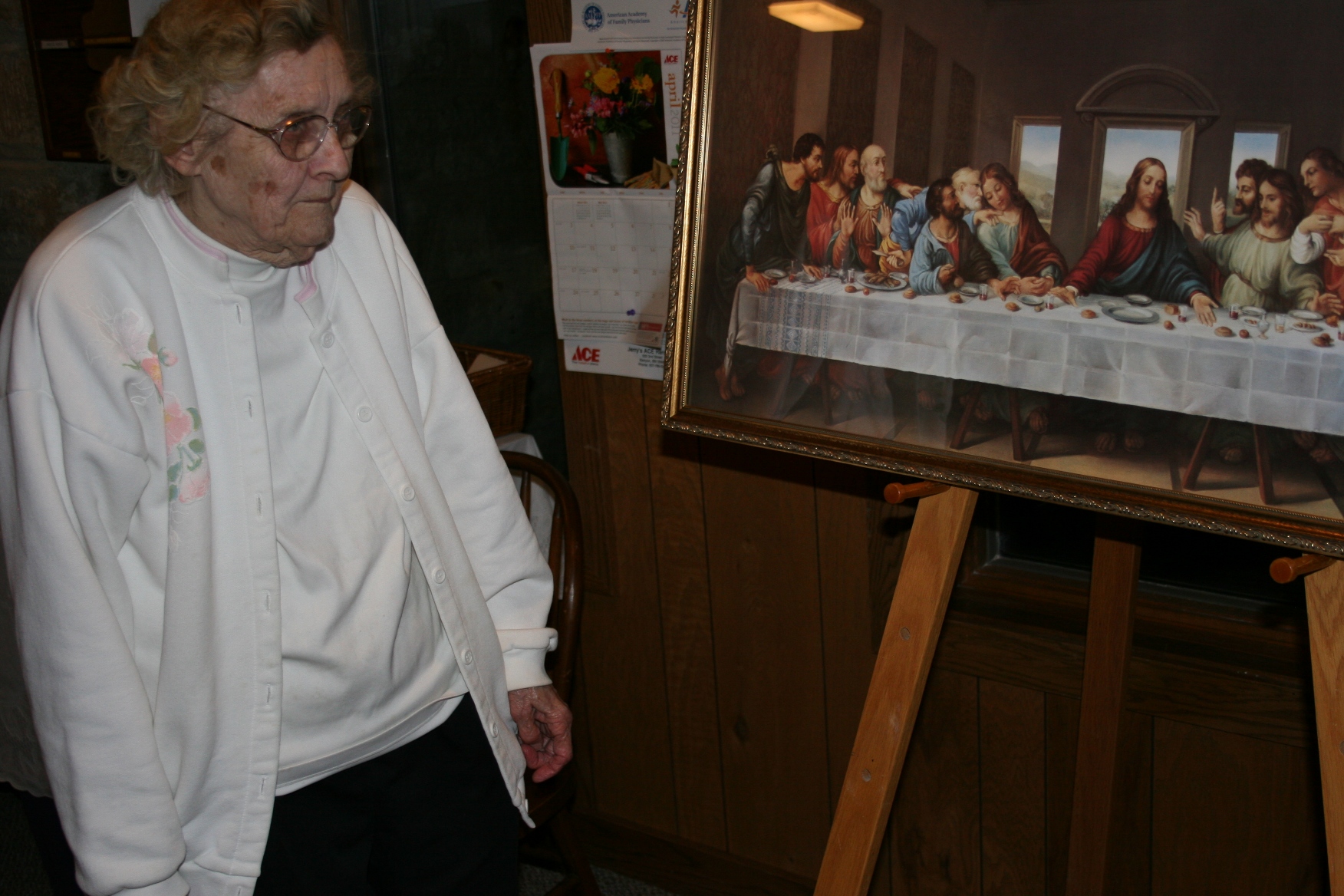
Occasionally, a new cast member like Kyle is recruited. He’s the grandson of Elsie Keller, who stands after the service next to a print of The Last Supper angled onto an easel in the church narthex. The Keller family gave the print to the church in memory of Elsie’s husband, Arnold, who died in 1999. On Palm Sunday the print is moved from its usual spot in the fellowship hall to this place of honor.
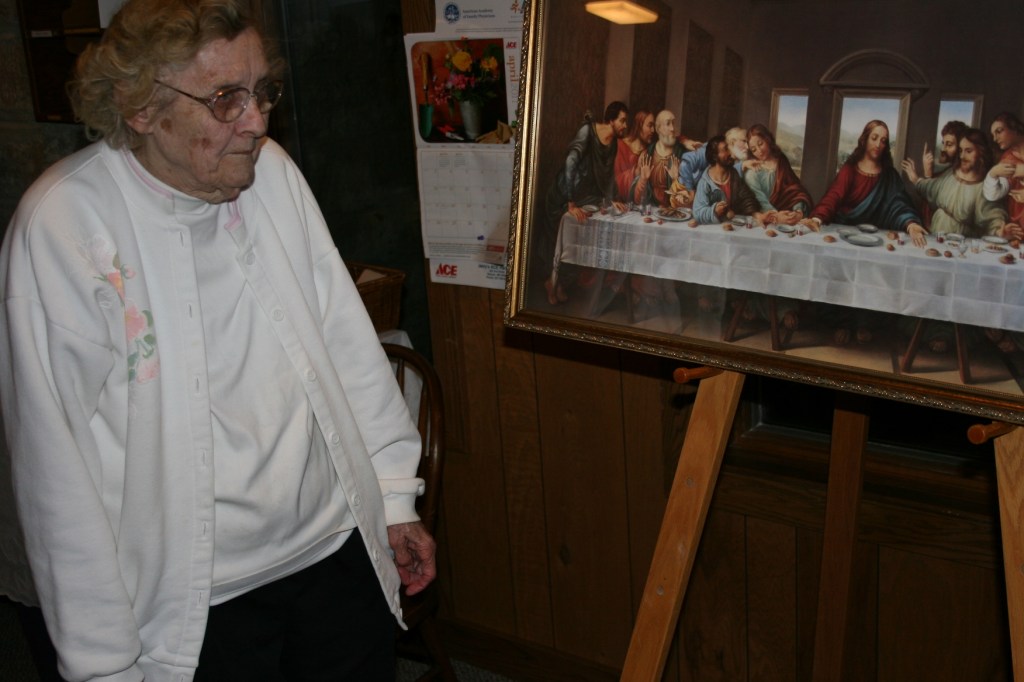
Elsie Keller, 85, stands next to The Last Supper painting given to St. John's in honor of her husband, Arnold.

The evening takes on special significance for this 85-year-old as she watches Thomas and thinks of her husband. Arnold played Thomas in the debut performance at St. John’s and continued with that role for many decades thereafter. Elsie, who was baptized, confirmed and married at St. John’s, as was her husband, hasn’t missed a single performance of The Last Supper Drama.

Her son, Craig Keller, the church organist, tells me that the drama originally was staged on a Wednesday during Lent. At one time there were two evening performances and even an afternoon presentation with the windows covered in black plastic to block out the light.

On this evening, some half-dozen church pews remain empty and I wonder why this place is not packed with a standing-room only crowd.

I’ve been deeply impressed with so many facets of the drama—by the level of commitment within this country congregation to continue a nearly 50-year tradition, by the professionalism of the actors, by the words they’ve shared that make the painting and Scripture and apostles come to life and, certainly, by the actors’ ability to freeze without barely an eye blink or a twitch. How do they do it?
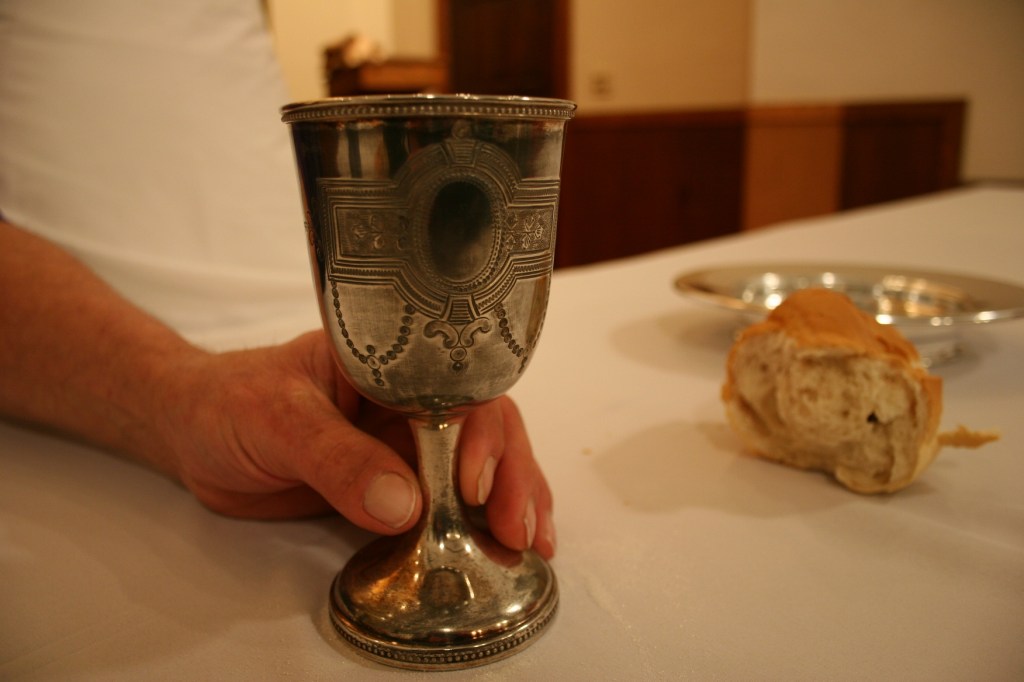
The congregation's original chalice is used each year in the drama.

"Take eat, this is my body..." bread on the table during The Last Supper Drama.

FYI: Next year plan to attend the 50th presentation of The Last Supper at 8 p.m. on Palm Sunday. St. John’s United Church of Christ, Wheeling Township, is located about a 15-minute drive east of Faribault on Minnesota Highway 60 and then north on Rice County Road 24. At this point, I expect organizers may add activities to commemorate the 2012 anniversary production.

Credit goes to the following for their parts in presenting this year’ production: directors Shirley Little and Kelly Dahl; co-director Pauline Wiegrefe; organist Craig Keller; narrator Don Katra; prompter Steve Wille; lighting, Ben Heil; greeters Steve and Deb Wille; the youth fellowship ushers; the church council coffee hour servers; pastor Lora Sturm; and actors Alan Meyer, Grant Meese, Craig Mueller, Kyle Keller, Todd Lien, Thad Monroe, Keith Keller, Doug Spike, Marty Budde, Brian Little, Randy Tatge and Paul Meyer.
Thank you all for this exceptional gift during Holy Week.

© Copyright 2011 Audrey Kletscher Helbling