
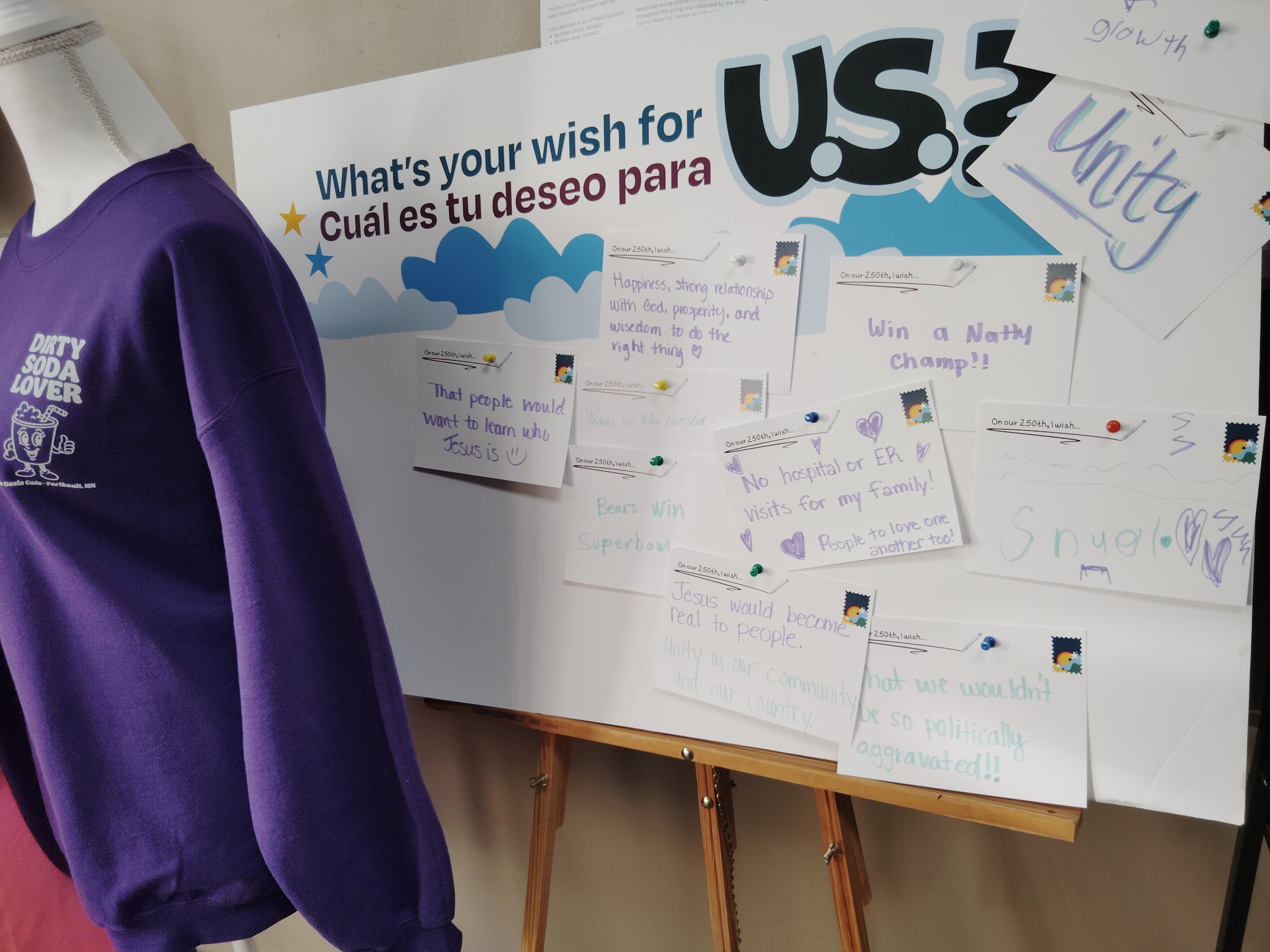
WHAT IS A WISH if not a hope, a dream, a vision for the future?
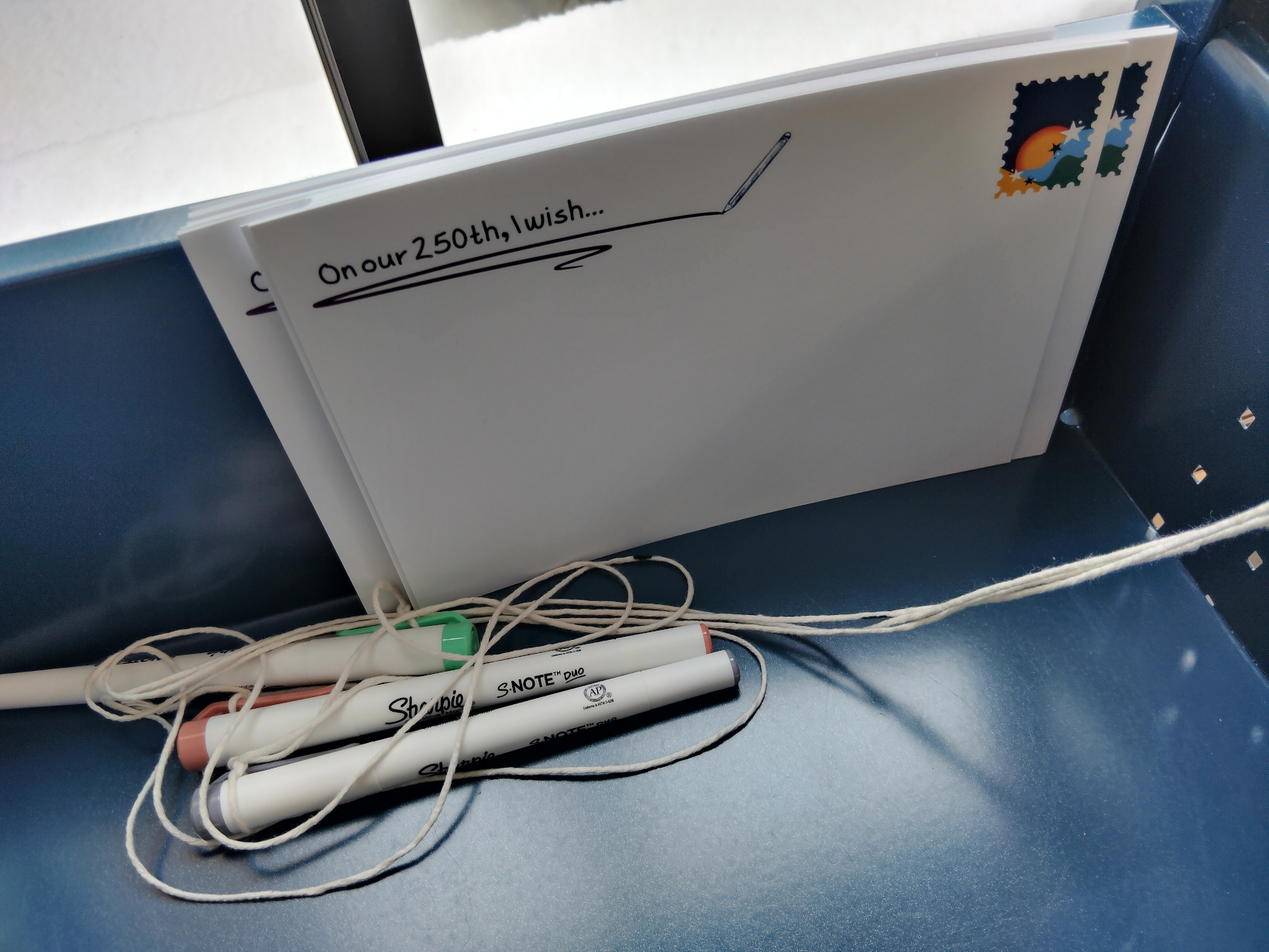
With that focus, a Carleton College history class and the Rice County Historical Society are collaborating on a nation-wide Made By Us Wish Walls project to gather local public input on “What’s your wish for U.S.?” And, yes, U.S. is the United States, which is also us.
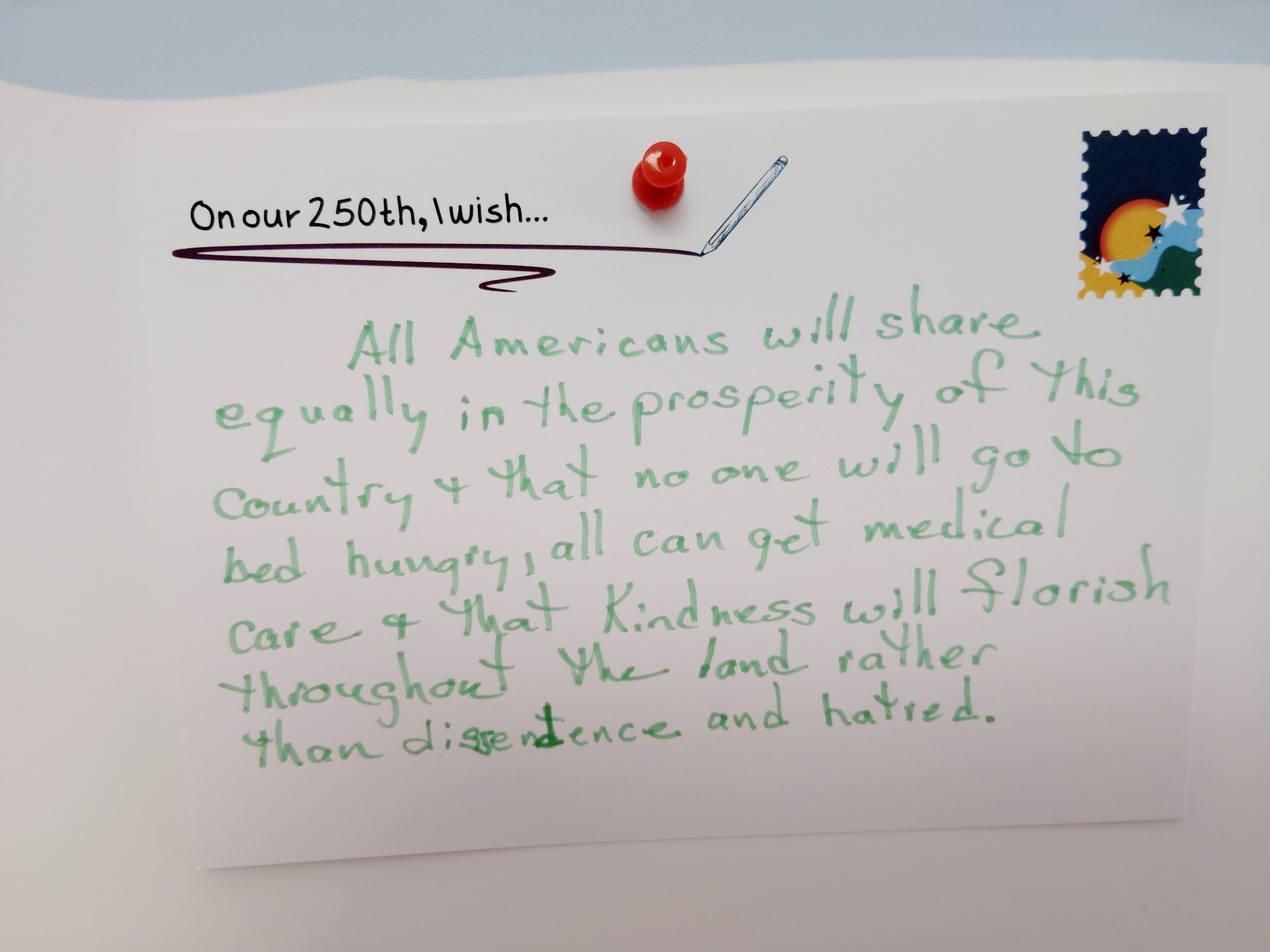
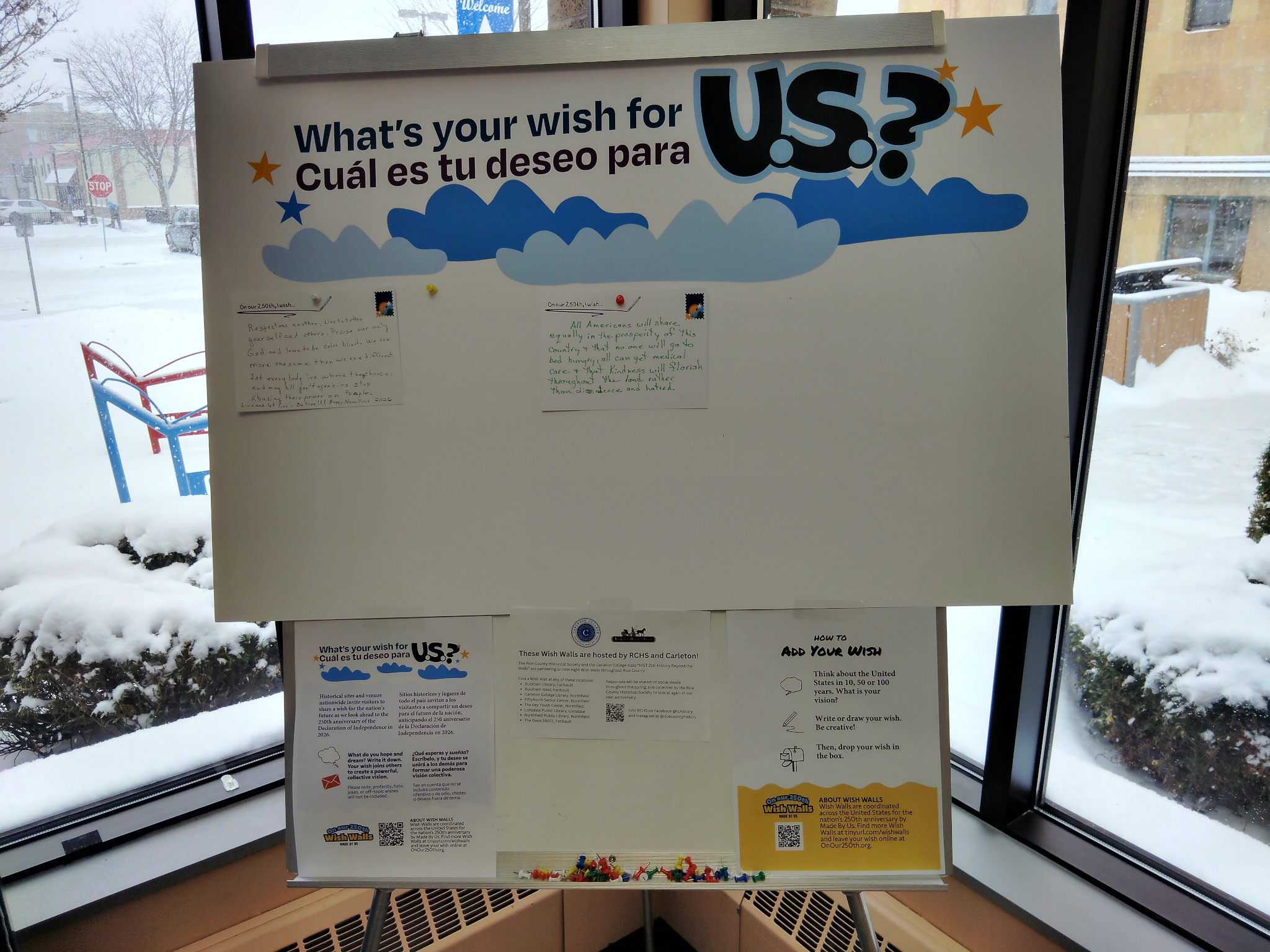
I happened upon this project a few weeks ago while walking through the hallway connecting Buckham Memorial Library to the Faribault rec center. I knew I needed to write about this effort to gather comments in a time of much uncertainty and turmoil in America as we approach the 250th anniversary of the Declaration of Independence.
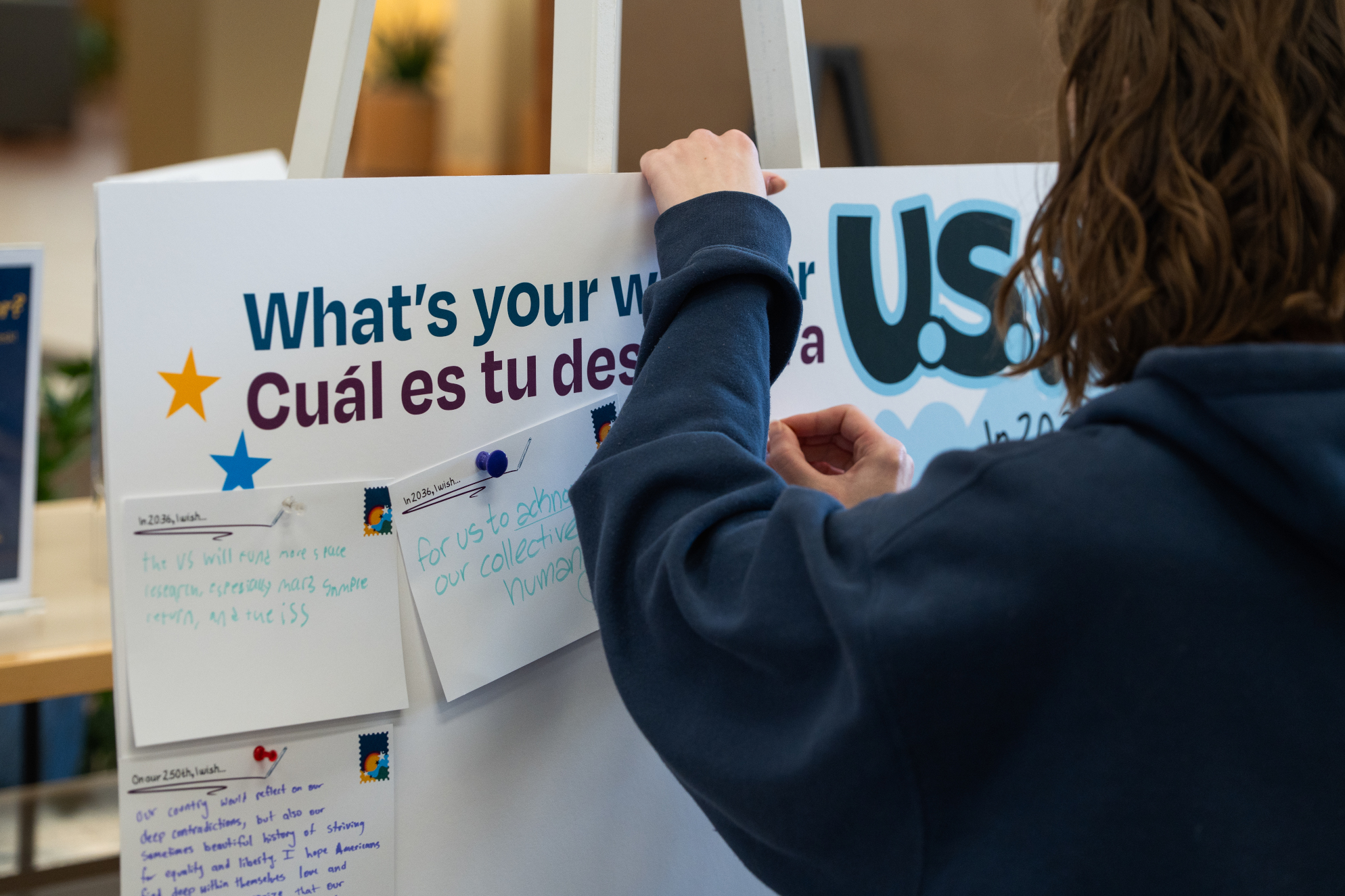
Weeks into the project, Wish Walls, set up in eight locations throughout Rice County, are generating high interest and participation. “The public has really embraced the opportunity to express their feelings about America on its birthday. We originally hoped we’d get 200 responses total. I suspect now that we’ll get three times that number by the time we take down the Wish Walls (around February 16)” said Serena Zabin, professor of history and liberal arts at Carleton College in Northfield. She teaches the class, HIST 216: History Beyond Walls, that is leading this civic engagement effort.
WISHING FOR UNITY & MORE
And what are people in Faribault writing on those Wish Walls, which I checked on January 21-22? Answers range from personal to general. Some common themes emerge with wishes for love, happiness, respect, kindness, empathy… I especially appreciated the wish that we would “…learn to be color blind. We are more the same than we are different.” That resonates.
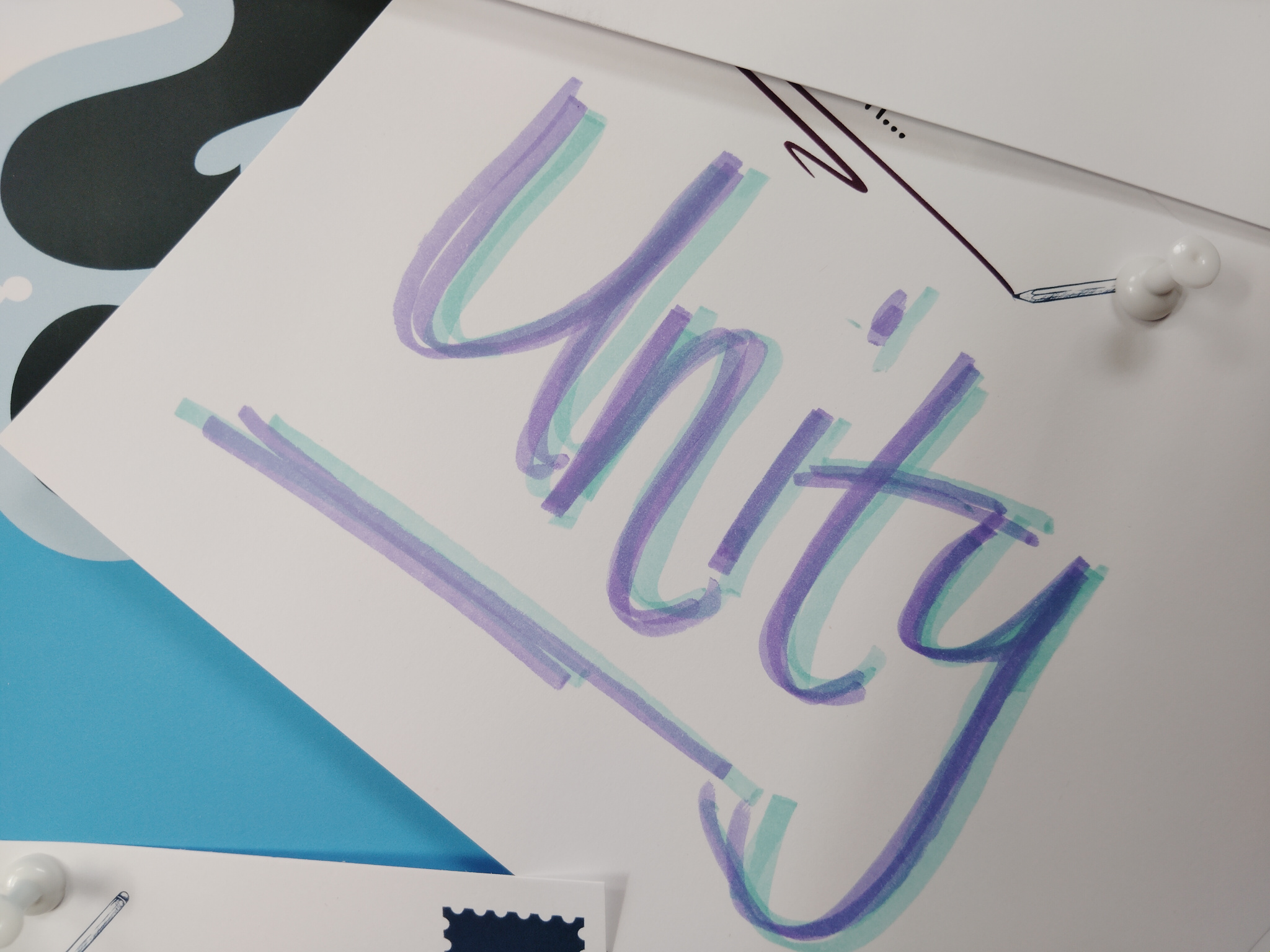
I felt the deep concern of the writer who hopes for a return to “humanity.” Another wishes “that we wouldn’t be so politically aggravated.” Another holds one singular wish: Unity.
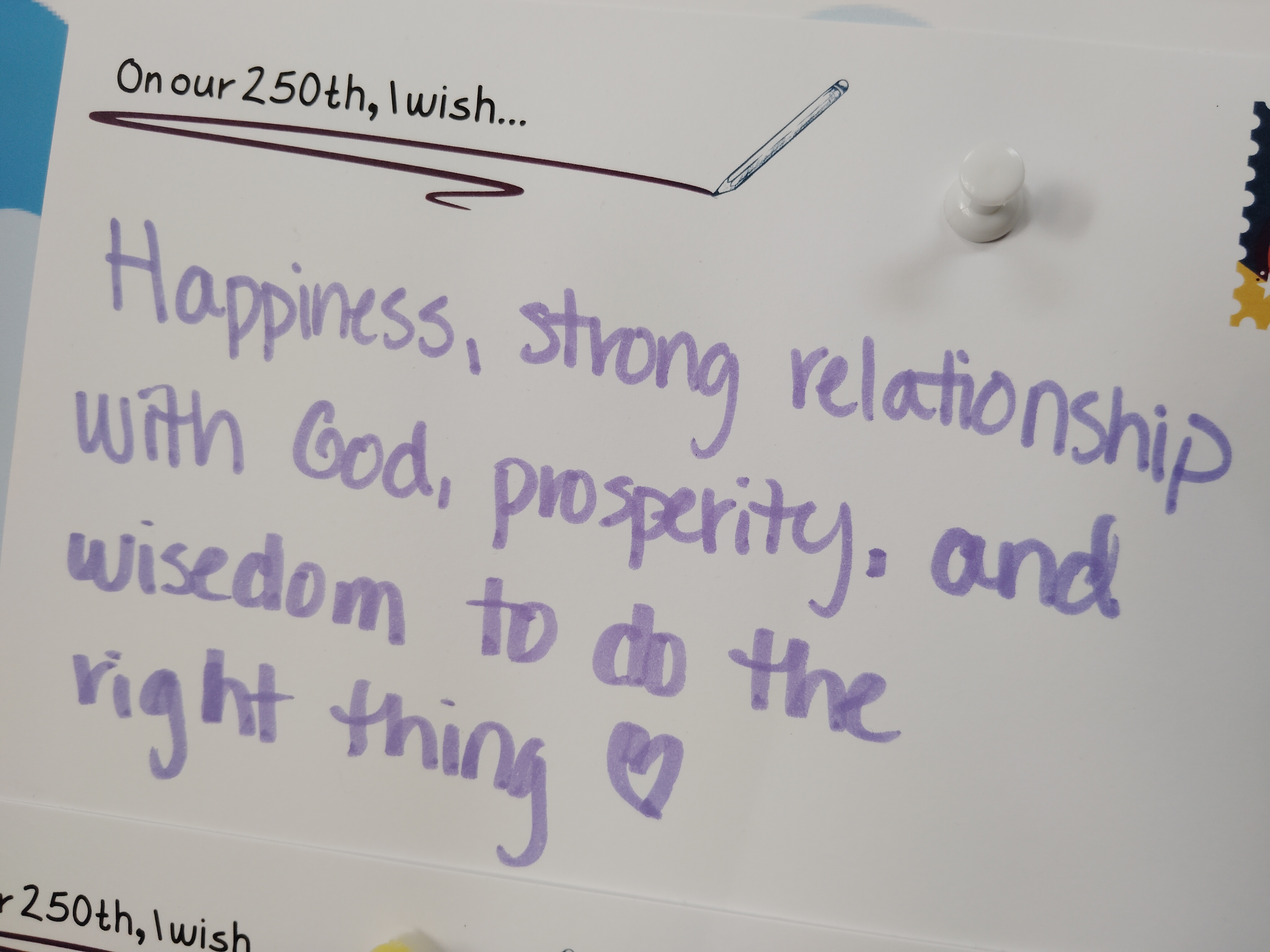
There’s a lot of thought and emotion behind these written words posted on local Wish Walls. When I read about desires that no one go hungry, that all can access medical care, that we ought to help our neighbors, I felt the love of community.
REVIEW, ANALYZE, SUMMARIZE, LEARN
When the Wish Walls come down, the Carleton College history class will review, analyze and summarize the comments, looking for patterns and common themes, determining whether location impacted responses and more, according to professor Zabin. Results will be shared via social media through the college and the county historical society and at the county fair.
Students will also compare comments with historical research they are doing on the commemoration of the 1876 Centennial, Zabin said, with a goal to answer this question: If there had been Wish Walls around Rice County in 1876, what responses might people have posted?
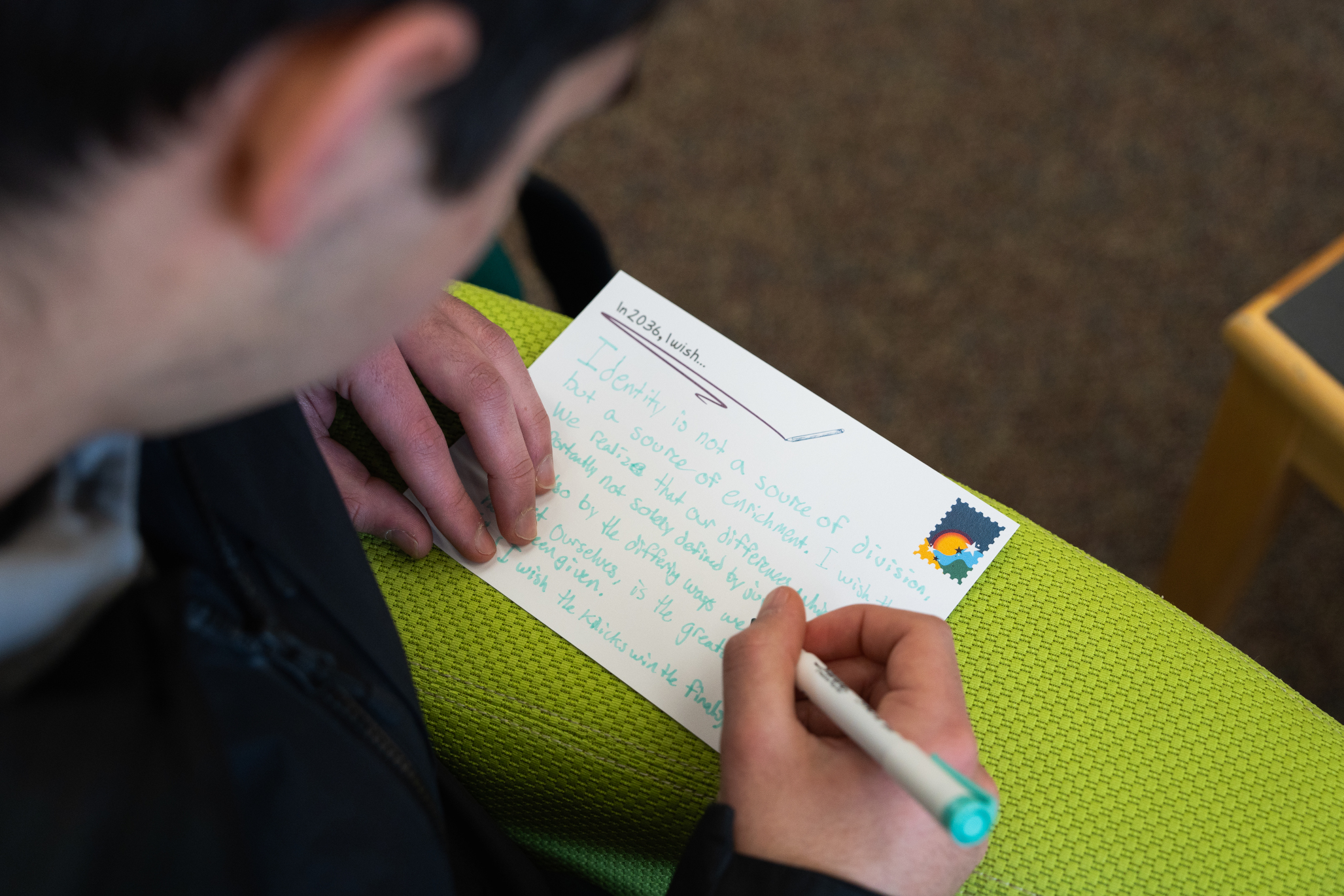
I appreciate the work of these students, who are monitoring the Wish Walls, making public presentations and researching. What they learn will not only be invaluable in connecting them with local communities, but will also provide useful information and insights for those of us who call Rice County home. Responses and reports will be kept in a time capsule by the county historical society.

Via this nationwide project, people from across the country are sharing their thoughts about America’s future. There’s much to contemplate during this 250th year anniversary of the Declaration of Independence and the birth of our nation in the context of today in the U.S.
#
FYI: Wish Walls in Rice County have been placed in Faribault at Buckham Memorial Library, Buckham West and The Oasis 55021; in Northfield at the Northfield Public Library, FiftyNorth Senior Center, the Key Youth Center and the Carleton College Library; and at the Lonsdale Public Library.
© Copyright 2026 Audrey Kletscher Helbling




 Minnesota Prairie Roots
Continuing to raise our Minnesota Strong voices in Faribault February 9, 2026
Tags: activism, commentary, Constitutional rights, Faribault, free speech, freedom, Immigration and Customs Enforcement, injustice, Minnesota, Minnesota Strong, news, protests, Rice County
I PULLED OUT my long johns, wool socks, stocking cap, mittens, hand warmers, winter boots and scarf. Then I pulled out my parka and my protest sign: STAND UP FOR HUMAN RIGHTS.
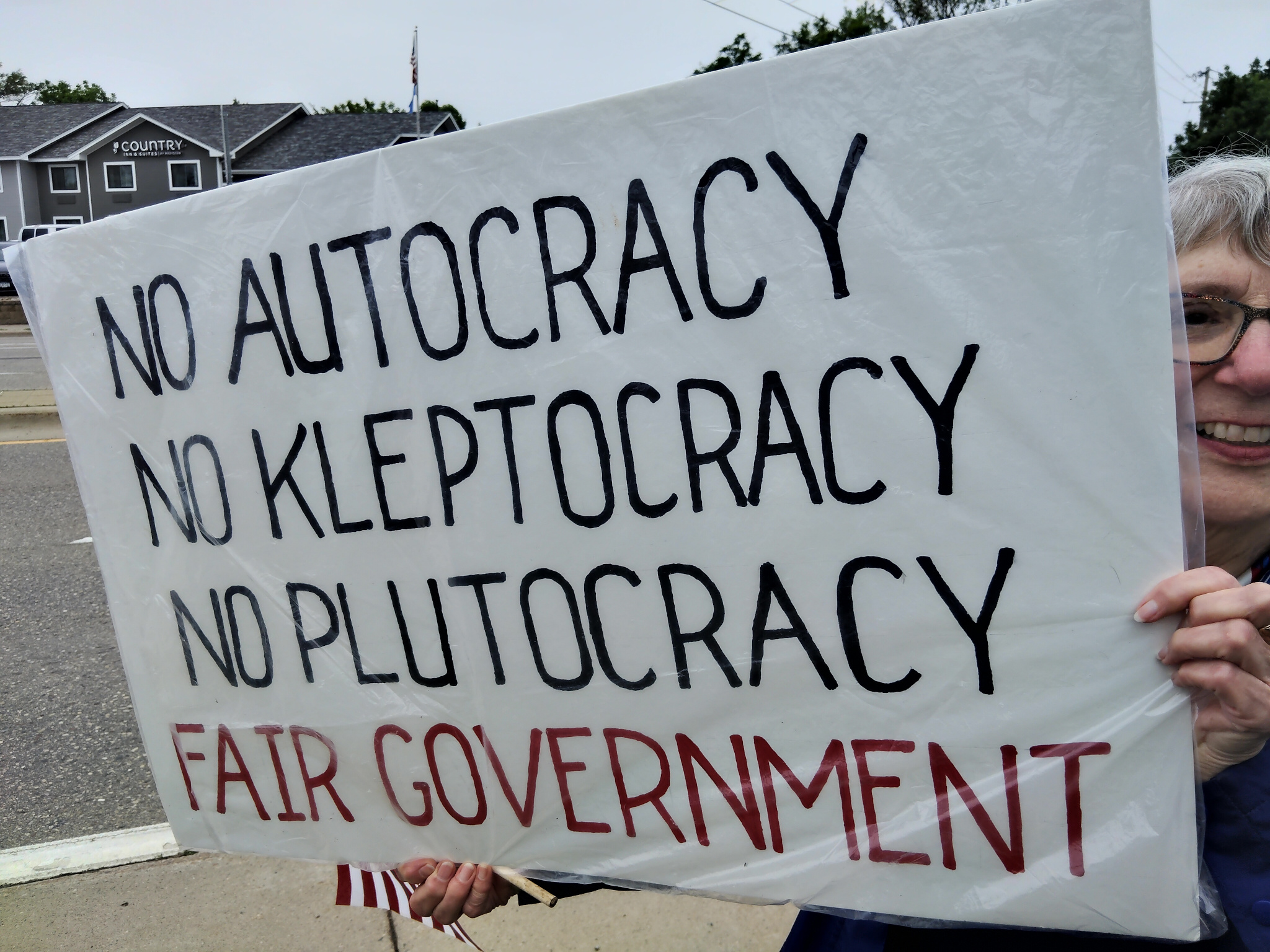
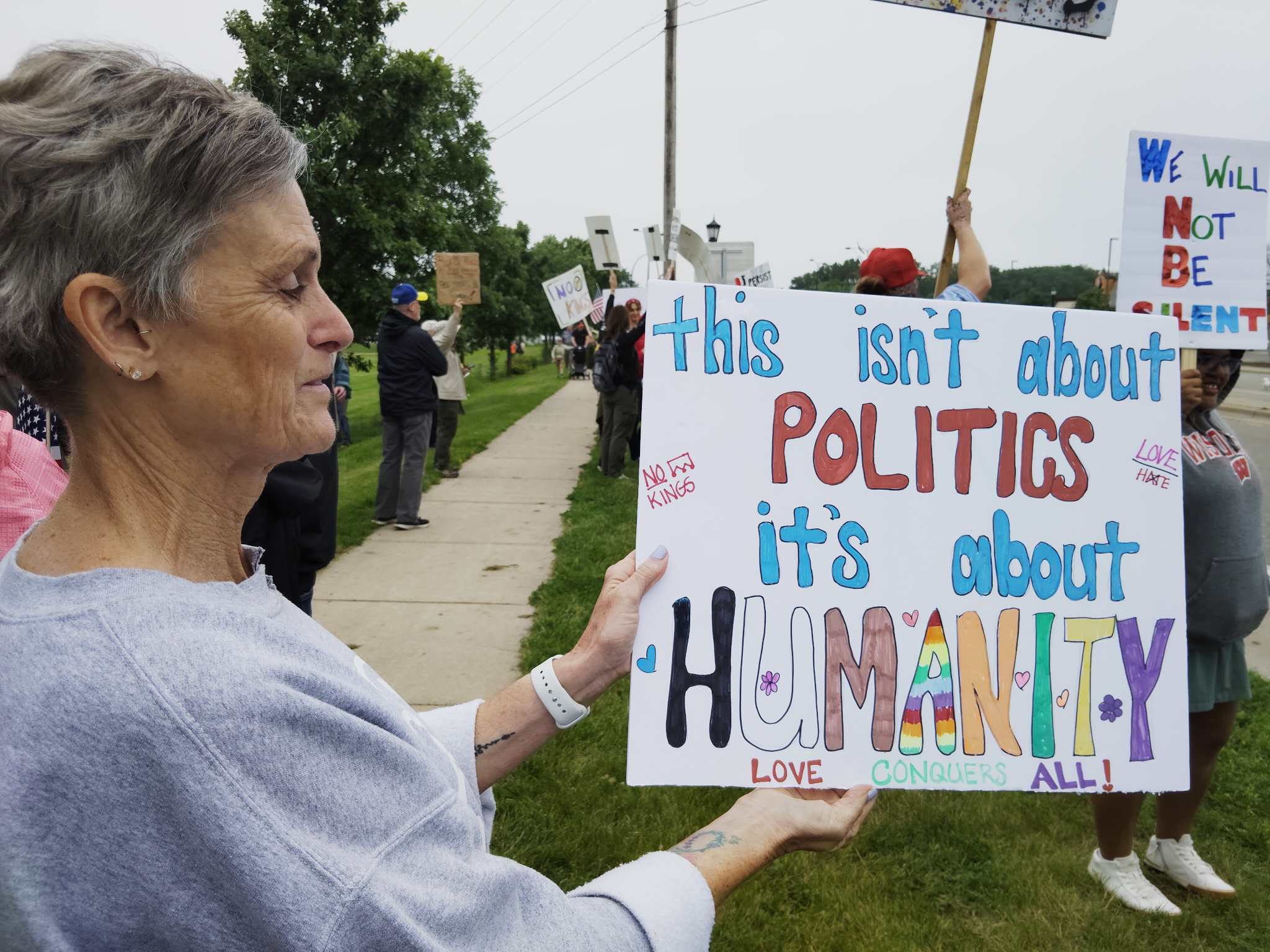
Just before 11 a.m. Saturday, Randy and I joined others outside the Rice County government services building along Minnesota State Highway 60 for our fourth protest there and the fifth in Faribault. Each week numbers grow, this time reaching some 80 of us stretched along the sidewalk with our signs.
We are not agitators or paid protesters as some claim, but rather ordinary Minnesotans united, called by our morals, our compassion, our concerns, to publicly say we are not OK with what is happening in this country. We are Minnesotans who care about immigrants and refugees, about freedom, about the Constitution, about due process and much more. We are concerned about the presence of ICE agents, whom we want out of our community, out of our state, after two-plus months of occupation.
And so we protest, week after week in our community an hour south of Minneapolis, because our city, too, has been impacted by ICE. People have been taken by federal agents from an apartment complex near the public library, by the railroad tracks near the turkey processing plant, from the trailer parks… It’s documented in videos. Warning horns blare, whistles sound, bystanders yell, sometimes. ICE has parked for hours in a neighborhood with Hispanic families. Watching, intimidating, silently threatening. Agents have photographed license plates at a gas station. This is reality in my city of 25,000.
School attendance has dropped. People are afraid to go to work, afraid to go grocery shopping and/or to food shelves (because ICE is watching), afraid to go to the doctor, afraid to leave their homes for fear of being taken by ICE. Legal status doesn’t seem to matter, only skin color, although even white people have been detained (with two killed) in Minnesota. Neighbors, churches and more have rallied to help with grocery shopping and delivery, walking kids to bus stops, giving co-workers rides. That support matters as does participating in protests. I’ve personally been thanked by Latinos and a Somali man for protesting.
This is why I’ve become an activist. This is why I use my voice as a writer and photographer. That is why I’ve started volunteering at a local food shelf. No one should live in fear of simply going about their daily lives. I am also doing this for my young grandchildren. I want them to understand the importance of speaking up for others. I want them to realize, when they are old enough, that their grandma did not remain silent in the face of atrocities inflicted by the federal government upon its people.
There is value in publicly taking a stand, especially in a city like mine which votes red. (Well, certainly not all of us.) Every protest brings out some who object to our activism as they drive by. That is their Constitutional right. They flash middle fingers, shout profanities, sometimes drive aggressively close, raging mad. That is not OK, potentially endangering people protesting in a public space. But we remain undeterred in raising our voices.
ON TUESDAY, FEBRUARY 10, a group of county residents are going to the Rice County Board of Commissioners meeting to speak about the impact of ICE on the community. That will happen during the open comments portion of the meeting at 8 a.m. I’m not part of that group, but was made aware of it. I’ve felt for a while that our local city and county government officials need to address this topic. ICE is certainly having a negative impact on the health, safety and well-being of county residents both directly and indirectly. That should not, and cannot, be ignored.
We must all do whatever we can, whenever we can, however we can to speak up, help and love our neighbors, and stand strong in the face of tyranny and injustice.
© Copyright 2026 Audrey Kletscher Helbling